James 1:2 Commentary
James 1:3 Commentary
James 1:4 Commentary
James 1:5 Commentary
James 1:6 Commentary
James 1:7 Commentary
James 1:8 Commentary
James 1:9 Commentary
James 1:10 Commentary
James 1:11 Commentary
James 1:12 Commentary
James 1:13 Commentary
James 1:14 Commentary
James 1:15 Commentary
James 1:16 Commentary
James 1:17 Commentary
James 1:18 Commentary
James 1:19 Commentary
James 1:20 Commentary
James 1:21 Commentary
James 1:22 Commentary
James 1:23 Commentary
James 1:24 Commentary
James 1:25 Commentary
James 1:26 Commentary
James 1:27 Commentary
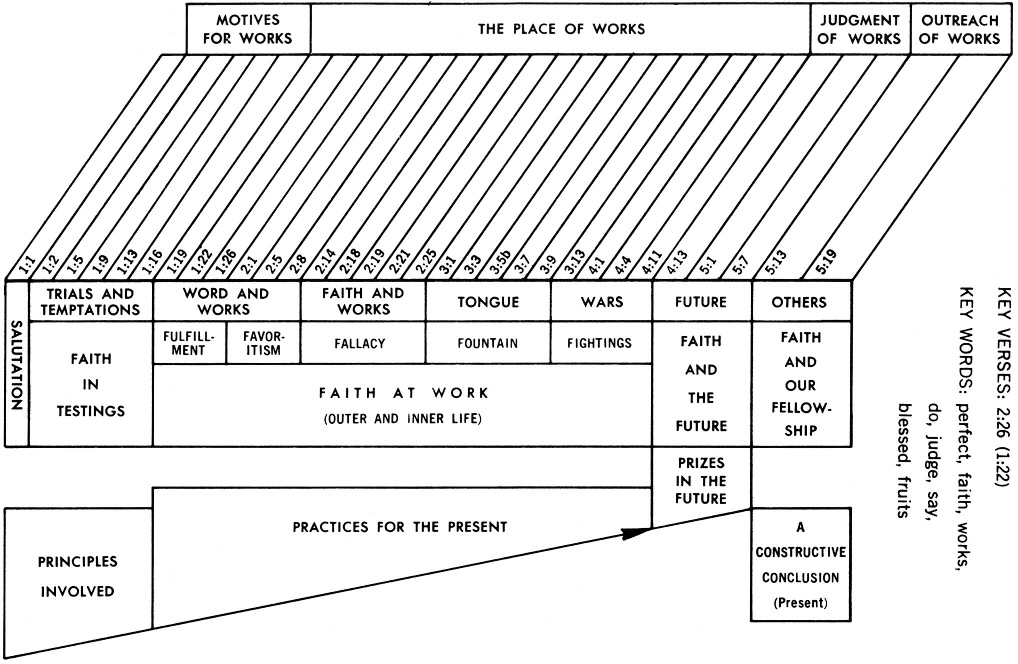
Click chart to enlarge
Chart from recommended resource Jensen's Survey of the NT - used by permission
See also Overview Chart by Charles Swindoll
|
JAMES |
|||||||
| Motives for Works |
The Place of Works: Outward Demonstration of Inner Faith |
Outreach of Works |
|||||
| Jas 1:1-18 | Jas 1:19-2:13 | Jas 2:14-25 | Jas 3:1-12 | Jas 3:13-4:12 | Jas 4:13-5:12 | Jas 5:13-19 | |
| Trials & Temptations |
Word & Works |
Faith & Works |
Tongue | Wars | Future | Others | |
|
Faith |
Fulfill |
Favor |
Fallacy |
Fountain |
Factions |
Faith |
Faith |
|
FAITH AT WORK |
|||||||
Hannah's Bible Outlines.
- Faith and the word (James 1:19-27)
- The reception of the word (James 1:19-21)
- The principle (James 1:19)
- The reason (James 1:20)
- The method (James 1:21)
- The doing of the word (James 1:22-27)
- The command (James 1:22)
- The hearer described (James 1:23-24)
- The doer described (James 1:25)
- The practice desired (James 1:26-27)
- The reception of the word (James 1:19-21)
James 1:19 This you know, my beloved brethren. But everyone must be quick to hear, slow to speak and slow to anger (NASB: Lockman)
Greek: Iste (2PRAM) adelphoi mou agaphetoi. esto (2SPAM) de pas anthropos tachus eis to akousai, (AAN) bradus eis to lalesai, (AAN) bradus eis orgen;
BGT Ἴστε, ἀδελφοί μου ἀγαπητοί· ἔστω δὲ πᾶς ἄνθρωπος ταχὺς εἰς τὸ ἀκοῦσαι, βραδὺς εἰς τὸ λαλῆσαι, βραδὺς εἰς ὀργήν·
Amplified: Understand [this], my beloved brethren. Let every man be quick to hear [a ready listener], slow to speak, slow to take offense and to get angry. (Amplified Bible - Lockman)
ASV: Ye know this, my beloved brethren. But let every man be swift to hear, slow to speak, slow to wrath:
Barclay: All this, my dear brothers, you already know. Let every man be quick to hear, slow to speak, slow to anger. (Westminster Press)
Hiebert: My dear brothers, take note of this: Everyone should be quick to listen, slow to speak and slow to become angry
KJV: Wherefore, my beloved brethren, let every man be swift to hear, slow to speak, slow to wrath:
Lenski: Know it, my brethren beloved! Moreover, let every person be swift for the hearing, slow for the speaking, slow for wrath
NET Understand this, my dear brothers and sisters! Let every person be quick to listen, slow to speak, slow to anger.
CSB My dearly loved brothers, understand this: Everyone must be quick to hear, slow to speak, and slow to anger,
ESV Know this, my beloved brothers: let every person be quick to hear, slow to speak, slow to anger;
NIV My dear brothers, take note of this: Everyone should be quick to listen, slow to speak and slow to become angry,
NLT Understand this, my dear brothers and sisters: You must all be quick to listen, slow to speak, and slow to get angry. (Revised)
NLT: My dear brothers and sisters, be quick to listen, slow to speak, and slow to get angry. (NLT - Tyndale House)
Phillips: In view of what he has made us then, dear brothers, let every man be quick to listen but slow to use his tongue, and slow to lose his temper. (Phillips: Touchstone)
Wuest: You know, my brethren, beloved ones,. Now, let every person be quick to hear, slow to speak, slow with respect to anger,
Young's Literal: So then, my brethren beloved, let every man be swift to hear, slow to speak, slow to anger,
- You know (better - take note or understand) - Ne 8:2,3,12-14,18; 9:3; Pr 8:32-35; Eccl 5:1; Mark 2:2; 12:37; Lk 15:1; 19:48; Acts 2:42; 10:33; 13:42-44,48; 17:11; 1Th 2:13
- Slow to speak - Jas 1:26; 3:1,2; Pr 10:19; 13:3; 15:2; 17:27; 18:13,21; 21:23; Eccl 5:2,3
- Slow to anger - Neh 9:17; Pr 14:17,29; 15:18; 16:32; 17:14; 19:11,19; 25:28; Eccl 7:8,9; Mt 5:22; Gal 5:20,21; Ep 4:26,31; Col 3:8,15
- James 1 Resources - multiple sermons and commentaries
A CALL TO RECEIVE THE
WORD IN ORDER TO GROW
This you know, my beloved brethren - This is a command but is difficult to discern as such in the NASB. I prefer the renderings in other modern vesions which clearly read as commands - NET = Understand this, ESV Know this, NIV My dear brothers, take note of this. NLT Understand this. Some writers feel it is not a an imperative but a perfect tense indicating the following is truth the readers understand. Also note the NASB adds a "but" which is normally a contrast, but no other modern version has a "but." The point is that when you are doing a deeper study, it is always advisable to check other translations (unless you know the Greek or Hebrew which is the best choice). Whether a command or not clearly James desires for his readers to understand the next clause.
This you know (1492) (present imperative second person plural of oida)- To reiterate, this verb is most likely a command. The idea would be something like "Come to an understanding of this." The idea then is that what James is getting ready to say, although short and pithy is nevertheless important for their growth in Christlikeness.
But everyone must be quick to hear, slow to speak and slow to anger - The command is "be" which governs all three verbs hear, speak and anger. The present imperative calls for the reader's continual attention. So the question is attention to what? Context is always "king" in interpretation and from the immediate context (Jas 1:18) James is clearly referring to the word of truth (in effect the gospel) but which they were saved in James 1:18. So after describing their initial salvation (past tense salvation, justification), now James focuses on their present tense salvation (progressive sanctification) or growth in Christlikeness. He is in effect saying that the primary means of maturation is by intake of the word of truth. The same word that saved them initially is the same word that will "save" them daily. As noted in the POSB the goal of sanctification in this context is to enable them to overcome temptation (Jas 1:13-15) and to bear up better under trials (Jas 1:2-12).
POSB (BORROW The Preacher's outline & sermon Bible ) refers to James 1:19-27 as "The Preparations Necessary to Withstand Trials and Temptation." In no uncertain terms there are several preparations that must be made in order to overcome temptation. Without these preparations, temptation can never be conquered.
- Preparation 1: be quick to hear the Word of God (Jas 1:19-21).
- Preparation 2: be a doer of the Word and not a hearer only (Jas 1:22-25).
- Preparation 3: bridle and control the tongue (Jas 1:26).
- Preparation 4: visit the needy and keep yourself unspotted from the world (Jas 1:27).
At first glance James 1:19-20 appears to be a series of isolated exhortations and in Scripture memory exercises that is how these verse are often interpreted or presented. However (as I have been guilty of on numerous occasions), to quote these passages in isolation is to "yank" them from their context. To take passages out of context sets the stage for misinterpretation, sometimes only slight misinterpretation, but occasionally resulting in grossly distorted interpretations (the cults specialize in this latter degree of misinterpretation as they are experts at taking a text out of context and using the resulting distortion of truth to deceive and dupe their victims!). The context of James 1:19-20 includes the previous passages…
Do not be deceived, my beloved brethren. Every good thing bestowed and every perfect gift is from above, coming down from the Father of lights, with whom there is no variation, or shifting shadow. In the exercise of His will He brought us forth by the word of truth, so that we might be, as it were, the first fruits among His creatures. (James 1:16-18)
From these verses, one observes that James is clearly describing persons who have listened to or heard and received the word of truth and have been born again and become "as it were, the first fruits among His creatures". Observe also that James 1:21 is again referring to the Word of God and what must be done in order to receive it. Finally, in James 1:22, 23, 24, 25 teaches what the hearer of the Word must "do" with the Word once received in order for it to be an effective agent of transformation (sanctification) in one's life. Notice then that the verses preceding and following James 1:18-19 refer to the Word of God. (the Word of Truth, Jas 1:18+) Therefore it is only reasonable to interpret James 1:18-19 as referring to one's reaction/attitude toward the Word of God. Thus in order to maximize one's reception of the Word of God one needs to listen ("quick to hear"), restrain speaking (it is very difficult to hear God speaking if we are speaking) and refrain from anger, which is a major impediment to receiving the word and growing in Christlikeness as explained in Jas 1:20.
James says that as those who have been given new life from God, we must prepare our hearts
to be receptive to God’s word. The receptive heart opens the ears,
controls the tongue, and controls the emotion of anger.
- Steven Cole
Hiebert explains the relationship of this verse with the previous writing that "The reference to the regenerating word of truth in Jas 1:18+ appropriately provides the subject for the first test of a living faith that James develops in this epistle. Having been brought to life by means of the Word, a genuine faith will rightly relate to that Word. The "word" in this paragraph seems clearly to have the same meaning as in Jas 1:18 above—the message of God's truth as embodied in the Person and work of Jesus Christ (ED: THE GOSPEL OF JESUS CHRIST). The word of truth must be dominant in nurturing, guiding, and disciplining the life that God implanted by means of the Word. In this paragraph, its nature and function appear under three different figures: as seed (Jas 1:21), as a mirror (Jas 1:23), and as a law that gives freedom (Jas 1:25). In developing this test of faith (ED: WHICH PREPARES US FOR FAITH/WORKS DISCUSSION IN JAMES 2), James calls for the proper reaction to the Word (Jas 1:19, 20), notes the condition for effective reception of the Word (Jas 1:21), and discusses the nature and importance of obedience to the Word (Jas 1:22, 23, 24, 25, 26, 27). (Commentary on James)
James is saying that in view of the fact that they are now new creatures in Christ ("first fruits, v18), there are some vital/crucial truths that they need to know to bloom into the creations they were created to be (and have the potential to be) in Christ.
As emphasized above, James 1:19, 20, 21 refers primarily to listening to and receiving the Word, while James 1:22, 23, 24, 25 emphasize primarily the doing and obeying the Word. This order is quite logical for you cannot obey the Word of Truth until you hear the Word of Truth!
🙏 THOUGHT - Beloved, are you quick to hear the Word of Truth? Are you quick to hear (read) your devotional about the Word or the latest NY Times best selling Christian book, etc? I am not saying you should never read anything but the Word of Truth, but considering the truth that only the Word of Truth provides everything necessarily for life and godliness (2Pe 1:3, 4+), you should make it a priority to allot as much (or more) time to reading the Word of Truth (cp Ps 119:89+; Ps 119:97+) as you do that Christian novel or other humanly composed literature! Do you prioritize God's Holy inerrant, all sufficient, eternal Word of infallible Truth? If not, please consider James' wise exhortation to be "quick to hear" the pure "Word of truth" and then obey what you read and you will be greatly blessed (cp Rev 1:3+)
Charles H. Talbert introduces James 1:19-25 reminding us that in the book of Acts Christianity was often referred to as The Way (Acts 9:1, 2; 19:9; 19:23; 22:4; 24:14; 24:22) and…
What early Christian teachers like James aimed to do was to clarify the Way and to encourage a certain Walk. James 1:19-27 is a Travelers’ Advisory, advice from an early Christian teacher to travelers on their Christian walk. (Review and Expositor: James: Teaching Outlines and Selected Sermon Seeds)
Beloved brethren - "My dear brothers in Christ… my fellow believers" is what he is saying. A repeated idea in James - Jas. 1:16, 19; 2:5. Hiebert observes that "With his affectionate "my brothers" James draws them to his heart as members of the same spiritual family. It softens any suggestion of harshness in his commands to them and assures them that "he wants them to feel that he is not a superior, commanding them, but an equal, exhorting them." They are the objects of his brotherly concern, and this should strengthen their desire to accept his call unto attainment of the ideal for the Christian life.: (Ibid)
Beloved (27) (agapetos from agapao = to love) means beloved, dear, very much loved. Agapetos is love called out of one’s heart by preciousness of the object loved. Agapetos is used only of Christians as united with God or with each other in love. In Scripture, this term is never applied to non-believers. God the Father uses this same word describing Jesus declaring that "This is My beloved Son, in whom I am well-pleased" (Mt 3:17) and in fact the first 9 uses in the NT are of God the Father speaking of Christ, His beloved Son. This gives you some idea of the preciousness of the word "beloved"! This truth makes it even more incredible that Paul described the saints at Thessalonica (and by application all believers of all ages) as "brethren beloved by God, His choice" (1Th 1:4+).
Beloved is a term of endearment and is someone that you love, and someone you are deeply devoted to. Beloved means the other person has struck a "chord" in your heart. There is a bond of love, a bond of faith that draws believers together. When you find somebody who loves you that way and you can love them, the two of you to each other are beloved and that's the way James felt about his readers.
Brethren (80) (adelphos from collative a = denoting unity + delphús = womb) is literally one born from same womb and so a male having the same father and mother as reference person. Adelphos here refers to fellow believers (both brothers and sisters!) in Christ who are united by the cords of love and bond of affection.
Everyone (pas anthropos) is literally "all men" or "all mankind".
The Nelson Study Bible has an interesting comment on quick to hear, slow to speak, slow to anger writing that…"These three exhortations reveal the outline of this letter (Jas 1:21-2:26 for “swift to hear”; Jas 3:1-18 for “slow to speak”; Jas 4:1-5:18 for “slow to wrath”). (NKJV study Bible)
The KJV Bible Commentary has a similar note writing that…"From this point, the practical Epistle of James follows the three categories listed here: (1) swift to hear (Jas 1:21-2:26), regarding hearing as doing; (2) slow to speak (Jas 3:1-18), including the vulnerability of excessive talking and the comparison of conduct and speech; and (3) slow to wrath (Jas 4:1-17), identifying the sources of bitterness. The threefold admonition explains the proper response to the trials of life discussed in 1:2–18. (ONLINE KJV Bible Commentary)
Must be (2077) (second person singular present tense; active voice; imperative mood of eimi - 1510) is a command to be and in the present tense means you must continually be. James is calling for this to be the habitual practice of everyone (every single believer) who reads the Word of Truth (to be quick to hear, etc). Just try to keep this command (must be) by continually relying on your own natural strength! You will eventually fail! And you become frustrated. The ONLY way to keep this command is by continually being filled with (controlled by, empowered by, enabled by) the indwelling Spirit Who will give you both the DESIRE and the POWER to control your ears, your mouth and your heart (so you don't become angry). This is not "let go and let God," because you are still responsible to exercise your will and the power the Spirit provides to work out your salvation in fear and trembling (see Php 2:12+, Php 2;13+). This is better described as "let God, let's go."
D Edmond Hiebert explains that "All members of the Christian community, whatever the extent of their knowledge of the Word or the degree of their spiritual maturity, need the exhortation. The imperative, as an appeal to the will, calls for their personal acceptance of the duty. The effective functioning of the Word in daily life demands their active cooperation…"the Christians were dependent upon the preaching of traveling missionaries … and of local teachers (Acts 13:1) for their knowledge of the gospel.'" To listen eagerly to the message was the first duty of discipleship. (Ibid)
R C H Lenski - James is clearing up the way for the proper reception of the saving Word of God. A person who keeps up his own talking makes a bad hearer. (BORROW the interpretation of the epistle to the hebrews and ..)
C H Spurgeon - Because it is by the Word that we are begotten: let us be swift to hear it. “Slow to speak,” because there is so much sin in us that the less we speak the better. In the multitude of words there wanteth not sin. Great talkativeness is seldom dissociated from great sinfulness. “Slow to wrath.”
Alec Motyer explains it this way…By the experience of conversion we discovered an important truth about ourselves—that the word of the gospel matches the new nature which God had secretly created within us, so that we were able to hear, understand and respond. The truth triggered the response. Conversion itself needs no repetition. It is a once-for-all, eternal transaction with God (e.g. Eph 1:13, 14). But the same pattern remains as the key to an on-going experience: we must go on hearing that word (the word of truth) which corresponds to the God-given new nature and in this way progressively enter into new life. By hearing the life-giving word, the energies of the new nature are stimulated into action. Therefore, we must be quick to hear. We might wonder why the ever-practical James does not proceed to outline schemes of daily Bible reading or the like, for surely these are the ways in which we offer a willing ear to the voice of God. But he does not help us in this way. Rather, he goes deeper, for there is little point in schemes and times if we have not got an attentive spirit. It is possible to be unfailingly regular in Bible reading, but to achieve no more than to have moved the book-mark forward: this is reading unrelated to an attentive spirit. The word is read but not heard. On the other hand, if we can develop an attentive spirit, this will spur us to create those conditions—a proper method in Bible-reading, a discipline of time, and so on—by which the spirit will find itself satisfied in hearing the Word of God. (SEE The Message of James) (Bolding added)
John MacArthur - Jesus said in Luke 8:18 “So take care how you listen; for whoever has, to him more shall be given; and whoever does not have, even what he thinks he has shall be taken away from him.” When I was a little school boy (John MacArthur), it was common for my teachers to send notes home informing my parents of my behavior. There were a number of constants in the information that came to my parents. One of them was this, "Johnny talks too much and doesn't listen." Since they didn't have any clinical initials to attach to my condition, there was no ADD or ADHD, and there was no Ritalin to sedate me, so they just said I was disobedient and they punished me, with the instruction that listening would be less painful. And so I learned to listen. Frankly, good listeners make good company. Good listeners make good friends. Good listeners make good learners. And good listeners then make good teachers. Good listeners make good counselors. On the other hand, poor listeners who only want to hear themselves talk and even while forced to listen are only planning what they're going to say as soon as you take a breath are usually cheated out of the best relationships in life. Just from a human standpoint, learning how to listen is important. It determines an awful lot about our relationships to others. Far more important, however, than how we listen to others is how we listen to the Lord. How good are we at listening to God? What kind of listeners are we? (Be Careful How You Listen)
For the believer to accept regeneration through the Word is one thing;
to permit the Word to work spiritual maturity in him is another.
D Edmond Hiebert sums up this last section of James (Jas 1:19-27) entitling it Faith Tested by Its Response to the Word of God (Jas 1:19-27) explaining that
Since God’s Word is the means of regeneration (Jas 1:18), a right response to the Word is appropriately presented as the initial test of a vital faith. For the believer to accept regeneration through the Word is one thing; to permit the Word to work spiritual maturity in him is another. The necessary response is threefold: eagerness to hear it, restraint on any premature reaction, bridling of any angry rejection (Jas 1:19, 20). Before the Word can have full sway in the believer’s life, he must remove all that hinders its operation (Jas 1:21). Acceptance of the Word must be followed by persistent obedience to the Word (Jas 1:22–27). Hearing must be followed by active obedience; otherwise the hearing is useless (Jas 1:22, 23, 24, 25). But obedience to the Word is more than mere observance of outward forms of “religion” (church attendance, rote prayers, participation in the rites of religion) without the development of inner power to control the tongue (Jas 1:26). True obedience to the Word must reveal itself in beneficent social activity and stimulate personal self-control and purity in separation from worldly contamination (Jas 1:27). (The Unifying Theme of James - Excellent overview)
William Kelly writes…
The exhortation therefore here is: "let every man be swift to hear." Christ Himself is the model of this, as of all else that is good. Though the Holy One of God, never was any so swift to hear God's word. So the prophet Isaiah distinguished Him,
The Lord GOD has given Me the tongue of disciples,
That I may know how to sustain the weary one with a word.
He awakens Me morning by morning,
He awakens My ear to listen as a disciple.
The Lord GOD has opened My ear;
And I was not disobedient,
Nor did I turn back. (Isa 50:4, 5)
Nor was it, otherwise with His bearing in presence of the tempter: the word of God was His constant resource (Mt 4:3,4), and only the more if Satan perverted it. "It is written again" (Mt 4:5, 6) was His lowly God-honouring answer (Mt 4:7, 8, 9 10, 11). And so it is, and has ever been, with His sheep. They hear His voice, and follow Him; they know not the voice of strangers (Jn 10:4, 5, 7, 8).
The word of truth abides in its value. By it they were begotten of God (Jas 1:18); by it the new life is fed, formed, directed, and strengthened. All the written word is prized as well as authoritative; but for special instructions God has been pleased to furnish those communications we call the New Testament. If we rightly heed all scripture, we assuredly shall welcome every word that explains the new life and its duties, and His glory and grace Who is its spring and fulness. (Commentary)
William Barclay observes that…
There are few wise men who have not been impressed by the dangers of being too quick to speak and too unwilling to listen. A most interesting list could be compiled of the things in which it is well to be quick and the things in which it is well to be slow. In the Sayings of the Jewish Fathers we read: “There are four characters in scholars. Quick to hear and quick to forget; his gain is cancelled by his loss. Slow to hear and slow to forget; his loss is cancelled by his gain. Quick to hear and slow to forget; he is wise. Slow to hear and quick to forget; this is an evil lot.” Ovid bids men to be slow to punish, but swift to reward. Philo bids a man to be swift to benefit others, and slow to harm them.
In particular the wise men were impressed by the necessity of being slow to speak. Rabbi Simeon said, “All my days I have grown up among the wise, and have not found aught good for a man but silence … Whose multiplies words occasions sin.” Jesus, the son of Sirach, writes, “Be swift to hear the word that thou mayest understand … If thou hast understanding, answer thy neighbour; if not, lay thy hand upon thy mouth, lest thou be surprised in an unskillful word, and be confounded” (Ecclesiasticus 5:11, 12). Proverbs is full of the perils of too hasty speech. “When words are many, transgression is not lacking, but he who restrains his lips is prudent” (Proverbs 10:19). “He who guards his mouth preserves his life; he who opens wide his lips comes to ruin” (Proverbs 13:3). “Even a fool who keeps silent is considered wise” (Proverbs 17:28). “Do you see a man who is hasty in his words? There is more hope for a fool than for him” (Proverbs 29:20).
Hort says that the really good man will be much more anxious to listen to God than arrogantly, garrulously and stridently to shout his own opinions. The classical writers had the same idea. Zeno said, “We have two ears but only one mouth, that we may hear more and speak less.” When Demonax was asked how a man might rule best, he answered, “Without anger, speaking little, and listening much.” Bias said, “If you hate quick speaking, you will not fall into error.” The tribute was once paid to a great linguist that he could be silent in seven different languages. Many of us would do well to listen more and to speak less. (Barclay, W: The Daily Study Bible Series.)
Quick (5036) (tachus) is an adverb which literally means quick, swift, speedy as opposed to slow. The emphasis is on a very brief period of time so that an activity or event occurs with speed or swiftness. In the NT, figuratively, quick, swift, with the meaning of ready, prompt (James 1:19; Sept.: Prov. 29:20). It also carries the sense of soon, in the near future, without undue time lapse; before long, in a prompt manner; "speedily" (Acts 17:15, Heb 13:19, 23). John uses tachus to describe the Second Coming in Rev 3:11, 22:7,12, 20 and a spiritual coming of judgment in Rev 2:16 (cf third woe of judgement coming quickly in Rev 11:14).
Tachus is used 26x in 25v in the Septuagint (see verses below) and can refer to the speed of doing something (Ge 27:20, Dt 9:12). In Ex 32:8 it describes how Israel "quickly turned aside" from the covenant and made an idolatrous golden calf (cf Jdg 2:17+). There is a strong lesson here for all of us to be careful when we've had a "Red Sea" redemptive experience, lest we become prideful and forgetful and quickly turn aside from the Lord (cf 1 Cor 10:12). In Dt 11:17 Moses warns Israel "you will perish quickly from the good land which the LORD is giving you." Oh, dear fellow follower of Jesus, to be quick to hear these words of clear warning (cf 1 Cor 10:6, 11)! Tachus is used in the psalms in calling on the Lord, especially appealing for Him to answer...quickly (Ps 69:17, 79:8, 102:2, 143:7).Ecclesiastes 8:11 gives a strong warning to all of us sinners (saved and not saved!) - " Because the sentence against an evil deed is not executed quickly, therefore the hearts of the sons of men among them are given fully to do evil." Beware, of your (mine included) deceitful heart (Jer 17:9, cf Gal 6:7-8+). Zephaniah 1:14 says "Near is the great day of the LORD, Near and coming very quickly; Listen, the day of the LORD! In it the warrior cries out bitterly."
There are times when we need to do something quickly, urgently or promptly and James like a flash gives two pithy, but powerful charges—we should be quick to listen, quick to hear.
Exegetical Dictionary of the New Testament- This word occurs as an adj. only in Jas 1:19: ταχὺς εἰς τὸ ἀκοῦσαι, "quick to hear." It appears otherwise (12 times) in the neut. sg. as the adv. ταχύ: soon, in a short time, or immediately thereafter (Mark 9:39); right away, quickly, immediately, without delay (Matt 5:25; 28:7, 8 ["depart quickly"; cf. Mark 16:8 TR: ταχὺ ἔφυγον]; Luke 15:22; John 11:29 [cf. v. 31]). It occurs 6 times in Revelation in the phrase ἔρχομαι ταχύ (Rev 2:16; 3:11; 11:14; 22:7, 12, 20; also Rev 2:5 Koine and elsewhere) as a word of both consolation and admonition.
Tachus is used 18 times in 18 verses in the NT - Usage: faster(1), quick(1), quickly(13), soon(2), sooner(1).
Matthew 5:25 "Make friends quickly with your opponent at law while you are with him on the way, so that your opponent may not hand you over to the judge, and the judge to the officer, and you be thrown into prison.
Matthew 28:7 "Go quickly and tell His disciples that He has risen from the dead; and behold, He is going ahead of you into Galilee, there you will see Him; behold, I have told you."
Matthew 28:8 And they left the tomb quickly with fear and great joy and ran to report it to His disciples.
Mark 9:39 But Jesus said, "Do not hinder him, for there is no one who will perform a miracle in My name, and be able soon afterward to speak evil of Me.
Luke 15:22 "But the father said to his slaves, 'Quickly bring out the best robe and put it on him, and put a ring on his hand and sandals on his feet;
John 11:29 And when she heard it, she got up quickly and was coming to Him.
John 13:27 After the morsel, Satan then entered into him. Therefore Jesus said to him, "What you do, do quickly."
John 20:4 The two were running together; and the other disciple ran ahead faster than Peter and came to the tomb first;
Acts 17:15 Now those who escorted Paul brought him as far as Athens; and receiving a command for Silas and Timothy to come to him as soon as possible, they left.
Hebrews 13:19 And I urge you all the more to do this, so that I may be restored to you the sooner.
Hebrews 13:23 Take notice that our brother Timothy has been released, with whom, if he comes soon, I will see you.
James 1:19 This you know, my beloved brethren. But everyone must be quick to hear, slow to speak and slow to anger;
Revelation 2:16+ 'Therefore repent; or else I am coming to you quickly, and I will make war against them with the sword of My mouth.
Comment - A futuristic use of the present tense, erchomai , I am coming. If the saints at Pergamum do not repent, His arrival is imminent! He is already on His way! Here it seems best to understand quickly as denoting a spiritual coming in judgment upon the Nicolaitans. No mention of such a sect extends beyond the early church. “This ‘coming,’ like that of Revelation 2:5, is not our Lord’s second advent, but His entering personally and that quickly, upon their affairs judicially.”
Revelation 3:11+ 'I am coming quickly; hold fast what you have, so that no one will take your crown.
Comment - “The placement of this fifth promise at this point is clear implication that the deliverance of the faithful will occur in conjunction with His coming. It holds open the possibility that His coming will happen before this generation passes, but does not guarantee it. This heightens the expectancy of Christ’s coming soon, a possibility which is stressed further by the presence of tachy (‘soon’).”
Revelation 11:14+ The second woe is past; behold, the third woe is coming quickly.
Comment: The third woe refers to the judgments attending the sounding of the seventh trumpet. This would seem to indicate that the sounding of the seventh trumpet follows the ministry of the two witnesses and their overthrow by the beast. The seventh trumpet must sound near the midpoint of the Tribulation or early in the second half. This would position all seven of the final bowl judgments in the last half of The 70th Week of Daniel. See The 70th Week in Relation to the Book of Revelation. Each of the final seal and trumpet judgments is set off from the previous six by an interlude during which additional information and perspective is provided and the greater severity of that which is to come is emphasized. Between the opening of the sixth and seventh seal, we are informed of the 144,000 sealed of Israel and the multitude coming out of the Great Tribulation (Rev. 7:1-17+). Between the sounding of the sixth and seventh trumpet, we are told of the mighty angel standing upon the earth, the book of prophesy eaten by John, the Tribulation Temple, and the ministry of the two witnesses (Rev. 10:1+- Rev 11:13+)
Revelation 22:7+ "And behold, I am coming quickly. Blessed is he who heeds the words of the prophecy of this book."
Comment - I am coming is erchomai , present tense: I am presently coming. The emphasis on the impending arrival of Jesus and the events described in John’s vision is intentional (Rev. 3:11+). John is told not to seal the words of the prophecy of this book, “for the time is at hand” (Rev. 22:10+). Jesus is coming quickly with each man’s reward (Rev. 22:12+). His coming is imminent: it is as if He is already underway. His impending arrival serves as a great motivator for godly living in the present. It also indicates there are no preconditions on His return for the church at the Rapture nor for His return as a thief upon an unsuspecting world in the Day of the Lord (1Th 5:2+). See When Does the Day of the Lord Dawn? See Imminency. See commentary on Revelation 3:3, Revelation 3:11, and Revelation 16:15.
Revelation 22:12+ "Behold, I am coming quickly, and My reward is with Me, to render to every man according to what he has done.
Comment - I am coming quickly is erchomai tachy , present tense: I am presenting coming quickly. His arrival is imminent—He is already underway!
Revelation 22:20 see excellent comments He who testifies to these things says, "Yes, I am coming quickly." Amen. Come, Lord Jesus.
Tachus is used 26x in 25v in the Septuagint - Gen. 27:20; Exod. 32:8; Deut. 9:12; Deut. 11:17; Jdg. 2:17; Jdg. 9:54; 2 Sam. 17:16; Ezr. 7:6; Ps. 37:2; Ps. 69:17; Ps. 79:8; Ps. 102:2; Ps. 138:3; Ps. 143:7; Prov. 12:19; Prov. 20:25; Prov. 29:20; Eccl. 8:11; Isa. 5:26; Isa. 9:1; Isa. 13:22; Isa. 32:4; Isa. 49:17; Isa. 51:5; Isa. 58:8; Jer. 48:16; Jer. 49:19; Nah. 1:14; Zeph. 1:14; Mal. 3:5
Ropes (Commentary on James 1) suggests that the phrase “swift to hear,” used in James 1:19 (i.e., tachus eis to akousai), relates primarily to the hearing of or the ready obedience to the Word (referring to 1:18). It is not just an imperative concerning normal social interaction or communication. It is, in fact, the trait of a good pupil, “quick to learn, slow to forget” (Ropes, International Critical Commentary, James, pp.168f.). The imperative given in this text is really a conventional Jewish exhortation. The same form or pattern (not exactly the same directive) can be seen in Ecclesiastes 7:9, Matthew 5:22, and Ephesians 4:26 (Sidebottom, Century Bible, James, p.33). Greek moralists also use such short, concise moralisms in their writings. Robertson suggests that the picture presented is one of listening to the word of truth, and the directive is aimed against “violent and disputatious speech.” This is emphasized in James 3:1-12 (Word Pictures in the New Testament, 6:21). The directive to be “swift to hear” is a reference to what has preceded the statement. It implies that the hearers are well aware or have knowledge of the word of truth. Consequently, they should be “swift to hear” (tachus eis to akousai) the word of truth that has such great power for good and for life (Alford, The Greek Testament, 4:285).
So first James says let everyone of us be quick to listen to the Word of God itself, quick to listen to what God is saying directly to you in the Bible. Are you doing a through the Bible reading program this year? If you are, the question is "Are you quick to hear" or just quick to get through your required texts for that day? There is a huge difference in those two goals. Robert Morgan tells this story to illustrate the difference…
When I was in college, I had a buddy named Joe who was a close friend to Billy and Ruth Graham. We sat together in chapel and we went to church together in Columbia, and I noticed that Joe carried around a little notebook and took copious notes of all the sermons he heard in church or school. One day I asked him about it. He said that on those weekends when he drove up to Montreat to spend time with the Grahams, he would go to church with them at the little Presbyterian church they attended. The pastor was Calvin Thielman, who is now in heaven. One day after church as he drove home with Billy and Ruth, Joe said, “Man, I almost went to sleep in church today. That was a boring sermon.” To which Billy replied, “Why, Joe, I thought it was a wonderful sermon. I got a lot out of it.” That was a rebuke to Joe, and later he asked Ruth about it. She told him to listen more carefully and to take notes. And I remember seeing Joe in chapel and in church with his little notebook, meticulously taking notes during the sermon, jotting down the outline, the cross-references, and even the stories and illustrations. And it made a huge difference every week. (See full sermon)
Our standing attitude is to be quick to listen, which demands an eager, attentive ear, ready to receive and process the word heard. As Kistemaker puts it "Listening is the art of closing one's mouth and opening one's ears and heart."
To hear (191) (akouo) means to exercise ones faculty of hearing and can convey the sense of not just listening/hearing but of understanding that which has been heard (eg, 1Co 14:2, Ga 4:21). In some contexts, akouo conveys the sense of to pay careful attention to or to heed (Mt 17:5, Lk 9:35, Acts 3:22). To hear suggests that there was public reading of the Word as well as oral instruction regarding the Christian faith. We need to listen carefully to make sure we get the message correct.
Warren Wiersbe (WIERSBE SEES THIS COMMAND AS DIRECTED TO BELIEVERS, NOT NON-BELIEVERS) explains quick to hear by first noting that "the Word of God cannot work in our lives unless we receive it in the right way. Jesus not only said, “Take heed what ye hear” (Mark 4:24), but He also said, “Take heed how ye hear” (Luke 8:18). Too many people are in that tragic condition in which “hearing they hear not, neither do they understand” (Matt. 13:13). They attend Bible classes and church services but never seem to grow. Is it the fault of the teacher or the preacher? Perhaps, but it may also be the fault of the hearer. It is possible to be “dull of hearing” (Heb. 5:11) because of decay of the spiritual life. If the seed of the Word is to be planted in our hearts, then we must obey the instructions James gives us… “Who hath ears to hear, let him hear!” (Mt 13:9) “So then faith cometh by hearing, and hearing by the Word of God” (Ro 10:17). Just as the servant is quick to hear his master’s voice, and the mother to hear her baby’s smallest cry, so the believer should be quick to hear what God has to say." (Bible Exposition Commentary)
Mike Andrus - Listening was very important in the first century, because books were rare, especially written Scriptures. It was an oral culture, and those not disciplined in listening ran the risk of missing out on spiritual truth. I suggest we are again quickly becoming an oral and visual culture, and so we need these instructions as much as his first-century listeners. In urging us to be good listeners James is suggesting we need to soak up truth and to be teachable. Very closely related to being a good listener is the second prerequisite: a controlled mouth. (Sermon)
Steven Cole sees several "marks" of the heart which is receptive to the Word of truth observing that James'…
first mark of a heart that is receptive to God’s word is that it is quick to hear the word. Jesus told the Jews who disputed with Him (John 8:47),
“He who is of God hears the words of God; for this reason you do not hear them, because you are not of God.”
Obviously, these Jews heard the sound of the words that Jesus spoke. They were not deaf. But they did not (and could not, according to Jesus) understand them (John 8:43 "Why do you not understand what I am saying? It is because you cannot hear My word."), because they were not born of God. They lacked the ability to hear and understand spiritual truth. As Paul said (1Cor 2:14),
But a natural man does not accept ( = same verb used in ) the things of the Spirit of God, for they are foolishness to him; and he cannot understand them, because they are spiritually appraised.
To be quick to hear God’s word implies an attitude of eagerness to take in the word from every angle. As a believer, you should desire to read the word, to listen to biblical preaching of the word, to memorize the word, and to understand all of its teaching with a view to obedience. The centerpiece of the Bible is Psalm 119, which goes on for 176 verses extolling God’s word and expressing the psalmist’s delight in it. We see his eagerness when he says (Ps 119:131), “I opened my mouth wide and panted, for I longed for Your commandments.” In Psalm 19:10, David said regarding God’s commandments, “They are more desirable than gold, yes, than much fine gold; sweeter also than honey and the drippings of the honeycomb.”
The apostle Peter says (1Pe 2:2+), “Like newborn babies, long for the pure milk of the word, so that by it you may grow in respect to salvation, ….” That verse became very vivid to me when as a new father, I made the mistake of holding my newborn daughter with my shirt off. To her, any nipple looked like the source of milk, so she latched onto me with a vengeance! I never made that mistake again!
Evaluate your heart for God’s word. Do you delight in it? Do you long for it and pour over it as a young woman longs for and pours over a love letter from her fiancé who is in another country? What is your attitude when you go to hear the word preached? The Welsh preacher Rowland Hill (1744-1833), as an old man, was visiting with a longtime friend who said, “It is now 65 years since I first heard you preach. I still remember your text and a part of your sermon.” Hill asked, “What part of the sermon do you remember?”
The friend answered, “You said that some people, when they went to hear a sermon, were very squeamish about the delivery of the preacher. Then you said, ‘Supposing you went to hear the will of one of your relatives read, and you were expecting a legacy from him. You would hardly think of criticizing the manner in which the lawyer read the will, but you would be all attention to hear whether anything was left to you, and if so, how much. And that is the way to hear the gospel.’” (Adapted from Spurgeon's Lectures to his Students, condensed and edited by David Otis Fuller [Zondervan], p. 374.) A receptive heart opens the ears to God’s word of truth. (Steven Cole - excellent sermons that read much like commentaries - see James 1:19-21 A Receptive Heart)
In Jeremiah, the LORD derides the faithless house of Jacob for failure to even hear much less heed declaring…
Hear this, O foolish and senseless people, who have eyes, but see not; who have ears, but hear not. (Jeremiah 5:21)
Slow (1021) (bradus) means literally to take a relatively long time or not happening in a short time. By implication it means not hasty, not precipitate and so acting (in this case speaking) with deliberation. Bradus can refer to either physical or mental slowness as well as to the “slowness” of time’s speed, i.e., “late, tardy” (Liddell-Scott). Various cognates are associated with this term (e.g., bradunō, “to make slow, delay”; bradutēs, “slowness”). Bradus does not occur in the Septuagint.
Bradus is used only 3 times in the NT, twice here in Jas 1:19 and once in Jesus' description of the travelers on the road to Emmaus Lk. 24:25+ "And He said to them, “O foolish men and slow of heart to believe in all that the prophets have spoken!" Here the sense is that they were not only unperceptive mentally; they were equally unreceptive and unperceptive spiritually. They were “slow” to believe, because Jesus himself had foretold them what would happen on several occasions (e.g., Luke 9:21,22,44; 18:31-33). Moreover, the prophets had told that Messiah would necessarily suffer and then enter His glory (Luke 24:25-27).
William Barclay - Proverbs is full of the perils of too hasty speech. "When words are many, transgression is not lacking, but he who restrains his lips is prudent" (Proverbs 10:19). "He who guards his mouth preserves his life; he who opens wide his lips comes to ruin" (Proverbs 13:3). "Even a fool who keeps silent is considered wise" (Proverbs 17:28). "Do you see a man who is hasty in his words? There is more hope for a fool than for him" (Proverbs 29:20).Hort says that the really good man will be much more anxious to listen to God than arrogantly, garrulously and stridently to shout his own opinions. The classical writers had the same idea. Zeno said, "We have two ears but only one mouth, that we may hear more and speak less." When Demonax was asked how a man might rule best, he answered, "Without anger, speaking little, and listening much." Bias said, "If you hate quick speaking, you will not fall into error." The tribute was once paid to a great linguist that he could be silent in seven different languages. Many of us would do well to listen more and to speak less… To be slow to speak, slow to anger, quick to listen is always good policy for life. (James 1 - Daily Study Bible)
To speak (2980) (laleo) means to make a sound and then to utter words. You have probably heard the saying that God created us with two ears and one mouth, which ought to remind us to listen twice as much as we speak (cf. Pr 10:19; 17:27). In the context of the Word of Truth, James is alluding to those times when we argue with the Word if not audibly, at least in our hearts, rather than receiving the Word in humility.
Vincent says that laleo is "used of speaking, in contrast with or as a breaking of silence, voluntary or imposed. Thus the dumb man, after he was healed, spake (Mt 9:33- "And after the demon was cast out, the dumb man spoke; and the multitudes marveled, saying (lego), "Nothing like this was ever seen in Israel.") and Zacharias, when his tongue was loosed, began to speak (Lk 1:64 - "And at once his mouth was opened and his tongue loosed, and he began to speak in praise of God") The use of the word laleo … contemplates the fact rather than the substance of speech. Hence it is used of God (Heb 1:1), the point being, not what God said, but the fact that he spake to men. On the contrary, lego refers to the matter of speech. The verb originally means to pick out, and hence to use words selected as appropriate expressions of thought, and to put such words together in orderly discourse." (Vincent, M. R. Word studies in the New Testament).
Kenneth Wuest - Laleo (was) used originally just of sounds like the chatter of birds, the prattling of children, (but was also used) of the most serious kind of speech. It takes note of the sound and the manner of speaking. One thinks of the words in the song In the Garden; “He speaks, and the sound of His voice is so sweet, the birds hush their singing (Eerdmans Publishing - used by permission)
William Kelly writes…we are told also to be "slow to speak." For we have another nature which is self-confident and impulsive; and there do we need to be on our guard, that, knowing ourselves weak, ignorant, and naturally prone to evil, we may look up to God and wait dependently on Him. As born of Him, it is ours to be jealous that we may neither misrepresent nor grieve Him. And therefore are we warned of another danger, when it is added "slow to wrath." How often it is impotent and hasty self-will! We are now sanctified to do His will, to obey as Christ obeyed. There is of course a right occasion for wrath. So the Lord looked round about on those that misused the sabbath to oppose God's grace in an evil world. But we are exhorted to be slow to wrath, and to let it soon be over. "Be ye angry and sin not: let not the sun go down upon your wrath; neither give place to the devil" (Ep 4: 26, 27). (Commentary)
C H Spurgeon - Therefore, when we are tempted, let us not be in a hurry to pronounce a verdict on the temptation. If we are slandered and evil spoken of, let us not be quick to reply, or to grow angry. Let us be slow — very slow — to wrath; it will be our wisdom, for no good comes of human wrath: “The wrath of man worketh not the righteousness of God.” (A Warning to Waverers)
Alec Motyer - The great talker is rarely a great listener, and never is the ear more firmly closed than when anger takes over… slow to speak does not mean ‘never speak’, but ‘speak with due thought and care’. (See The Message of James)
John MacArthur explains slow to speak this way…
You cannot listen carefully while you are talking, or even while you are thinking about what to say. Many discussions are fruitless for the simple reason that all parties are paying more attention to what they want to say than to what others are saying. In this context, therefore, it seems that slow to speak includes the idea of being careful not to be thinking about one’s own thoughts and ideas while someone else is trying to express God’s. We cannot really hear God’s Word when our minds are on our own thoughts. We need to keep silent inside as well as outside. The primary idea here, however, is that, when the appropriate time to speak does come, what is said should be carefully thought out. When we speak for the Lord, we should have the gravest concern that what we say not only is true but is spoken in a way that both edifies those who hear and honors the Lord in whose behalf we speak. We should pursue every opportunity to read the Word ourselves, to hear it preached and taught, and to discuss it with other believers who love, honor, and seek to obey it. At the same time, we should be cautious, patient, and careful when we have opportunity to preach, teach, or explain it to others. It is doubtless for that reason that James later warns, “Let not many of you become teachers, my brethren, knowing that as such we will incur a stricter judgment” (James 3:1). (See James MacArthur New Testament Commentary - Page 70)
Hiebert - "Slow to speak" does not mean slowness in speaking but is a call for restraint upon hasty and ill-considered reactions to what is heard. It would allow time for a fuller apprehension and thoughtful evaluation of what had been heard. It offered a valuable safeguard against shallow, immature, and immoderate reactions. "A continual talker cannot hear what anyone else says and by the same token will not hear when God speaks to him." The need for this exhortation apparently arose out of the free and largely unstructured nature of the early Christian assemblies, permitting personal participation in, and ready interaction with, others sharing in the service (1Co 14:26 33). Hasty reaction to what was felt to be objectionable, or individual zeal for what was held to be the truth, might lead to rash assertion and overstatement, which often tended to obscure the truth. Let them remember that freedom of expression involves grave responsibility (Ibid)
Instead of opening your mouth to speak when you hear the Word of truth, just open your mouth and pant and long for the Word like the psalmist…
Psalm 119:131 I opened (Lxx = anoigo - see notes on use in Rev 3:20) my mouth wide and panted, (Why did he "pant"?) for I longed for Thy commandments.
The English rendering of the Greek Septuagint translation is…Psalm 119:131 I opened my mouth, and drew breath: for I earnestly longed (see study of epipotheo; the verb tense is imperfect tense = pictures the psalmist over and over longing) after Thy commandments.
🙏 THOUGHT - Beloved, does this describe your Christian walk? If not perhaps you might dare to pray this prayer to God, asking Him to give you a desire that pants for and cannot live without His Word of truth and life (cf Job 23:12. When we pray boldly in God's will, we can be assured that He hears us and that He will give us the requests that are in accord with His good and acceptable and perfect will - see 1 John 5:14-15+).
Matthew Henry comments on Ps 119:131… When he was under a forced absence from God's ordinances he longed to be restored to them again; when he enjoyed ordinances he greedily sucked in the word of God, as new-born babes desire the milk. When Christ is formed in the soul there are gracious longings, unaccountable to one that is a stranger to the work. The degree of that desire appearing in the expressions of it: I opened my mouth and panted, as one overcome with hear, or almost stifled, pants for a mouthful of fresh air. Thus strong, thus earnest, should our desires be towards God and the remembrance of his name, Ps. 42:1, 2. Lk. 12:50.
C H Spurgeon comments on Ps 119:131…So animated was his desire that he looked into the animal world to find a picture of it. He was filled with an intense longing, and was not ashamed to describe it by a most expressive, natural, and yet singular symbol. Like a stag that has been hunted in the chase, and is hard pressed, and therefore pants for breath, so did the Psalmist pant for the entrance of God's word into his soul. Nothing else could content him. All that the world could yield him left him still panting with open mouth.
For I longed for thy commandments. Longed to know them, longed to obey them, longed to be conformed to their spirit, longed to teach them to others (cp notes on Ezra 7:10). He was a servant of God, and his industrious mind longed to receive orders; he was a learner in the school of grace, and his eager spirit longed to be taught of the Lord.
Panting for holiness. A rare hunger; the evidence of much grace, and the pledge of glory.
Puritan Thomas Manton writes on Ps 119:131…I opened my mouth, and panted. A metaphor taken from men scorched and sweltered with heat, or from those that have run themselves out of breath in following the thing which they would overtake. The former metaphor expressed the vehemency of his love; the other the earnestness of his pursuit: he was like a man gasping for breath, and sucking in the cool air.
I longed for thy commandments. This is a desire which God will satisfy. "Open thy mouth wide, and I will fill it": Psalms 81:10.
William Cowper comments on Psalm 119:131… I opened my mouth, and panted. By this manner of speech, David expresses, as Basil thinks, animi propensionem, that the inclination of his soul was after God's word. For, this opened mouth, Ambrose thinks, is os interioris hominis, the mouth of the inward man, which in effect is his heart; and the, speech notes vehementem animi intensionem, a vehement intension of his spirit, saith Euthymius. Yet shall it not be amiss to consider here how the mind of the godly earnestly affected moves the body also. The speech may be drawn from travellers, who being very desirous to attain to their proposed ends, enforce their strength thereunto; and finding a weakness in their body to answer their will, they pant and open their mouth, seeking refreshment from the air to renew their strength: or as Vatablus thinks, from men exceeding hungry and thirsty, who open their mouth as if they would draw in the whole air, and then pant and sigh within themselves when they find no full refreshment by it. So he expresses it: "My heart burns with so ardent a longing for thy commandments, that I am forced ever and anon to gasp by reason of my painful breathing."
However it be, it lets us see how the hearing, reading, or meditating of God's word wakened in David (Ed note: Some think Psalm 119 was written by the scribe Ezra) a most earnest affection to have the light, joy, grace, and comfort thereof communicated to his own heart. For in the godly, knowledge of good increases desires; and it cannot be expressed how vehemently their souls long to feel that power and comfort which they know is in the word; and how sore they are grieved and troubled when they find it not.
And happy were we, if we could meet the Lord with this like affection; that when he opens his mouth, we could also open our heart to hear, as David here doth… For it is His promise to us all -- "Open thy mouth wide, and I will fill it." (see Ps 81:10 - Spurgeon's note) Let us turn it into a prayer, that the Lord, who opened the heart of Lydia (Acts 16:14), would open our heart to receive grace when He offers by His word to give it.
Henry Melvill writes on Ps 119:131…There are two ways in which these words may be understood. They may be considered as expressing the very earnest longing of the Psalmist for greater acquaintance with God in spiritual things; and then in saying, "I opened my mouth, and panted," he merely asserts the vehemence of his desire. Or you may separate the clauses: you may regard the first as the utterance of a man utterly dissatisfied with the earth and earthly things, and the second as the expression of a consciousness that God, and God only, could meet the longings of his soul. "I opened my mouth, and panted. "Out of breath, with chasing shadows, and hunting after baubles, I sit down exhausted, as far off as ever from the happiness which has been earnestly but fruitlessly sought. Whither, then, shall I turn? Thy commandments, O Lord, and these alone, can satisfy the desires of an immortal being like myself; and on these, therefore, henceforward shall my longings be turned.
Ross - Ceaseless talkers may easily degenerate into fierce controversialists
People who fly into a rage
Always make a bad landing.
Slow to anger - In context we are to be slow to become angry at God or His Word, for as Solomon wisely stated…
He who is slow to anger has great understanding, but he who is quick-tempered exalts folly. (Pr 14:29, cp Pr 14:17, 15:18, 16:32)
Warren Wiersbe - I once saw a poster that read, “Temper is such a valuable thing, it is a shame to lose it!” It is temper that helps to give steel its strength. The person who cannot get angry at sin does not have much strength to fight it. James warns us against getting angry at God’s Word because it reveals our sins to us. Like the man who broke the mirror because he disliked the image in it, people rebel against God’s Word because it tells the truth about them and their sinfulness. (Bible Exposition Commentary)
Hiebert explains that slow to anger…
rebukes the danger involved in a flash reaction. Rash and reckless speech is prone to wound; it is likely to provoke animosity. "Intemperate religious zeal is often accompanied with a train of bad passions, and particularly with great wrath against those who differ from us in opinion." James's warning suggests "scenes of wrangling, of attempts at self-display, of the manifestation of unchristian tempers in the midst of debates on Christian truth." Mitchell calls it "the wrath of argumentation." Such wrathful reactions are manifestations of carnal zeal under a religious guise. Such furious reactions to the views of others have always been a discredit to the cause of Christ.
The Greek noun (orge), here rendered "become angry" implies more than a passing surge of irritation or displeasure. It denotes a strong and persistent feeling of indignation and active anger. Another Greek word, thumos, also means anger. It denotes the turbulent, passionate outburst of anger, whereas the term used here points more to the deliberate, persistent attitude of hostility." In Mt 5:22 the verbal form suggests the persistent harboring of the feeling of resentment.
Human anger is an instinctive reaction against that which is evil and injurious. The feeling of anger is not always wrong (cf. Mk 3:5). The individual who is never aroused and deeply stirred at evil is gravely deficient in moral character. James's words do not forbid all anger, but this instinctive feeling needs careful control lest it blaze forth in unjustified and injurious reactions. The attitude of Scripture is consistently negative toward the indulgence in human wrath." (Ibid)
Andrus notes that "Anger is a complex topic in Scripture. It is a very natural emotion, and clearly it is not always evil. We are all familiar with what we call righteous indignation, and we are aware that anger is a great motivating factor in correcting injustice. That’s why it is important to note the specific kind of anger James is denouncing here: he calls it “man’s anger” (as opposed to God’s anger or righteous indignation). “Man’s anger,” he says, “does not bring about the righteous life that God desires.” (Sermon)
Anger (3709) (orge from orgaô = to teem, to swell) conveys the picture of a swelling which eventually bursts, and thus describes an anger that proceeds from one’s settled nature. Orge refers to to an inner, deep resentment that seethes and smolders. What a contrast in heart attitudes between a seething, teeming anger and a heart that pants for the water brooks, desiring to meditate on the Word night and day, taking in the pure milk of the Word like a new born babe does its mother's milk.
MacArthur makes a good point about the danger of the orge type of anger noting that "It is therefore an anger that only the Lord and the believer know about. Therefore, it is a special danger, in that it can be privately harbored… James’ emphasis here seems to be on those who hear the truth and resent its exposing their personal false ideas or ungodly lifestyles… throughout the history of the church—in fact, throughout the history of fallen mankind—even believers have resented God’s truth and the messenger who brought it… There is, of course, a just anger, a holy indignation against sin, Satan, and anything that dishonors the Lord or assaults His glory. (See James MacArthur New Testament Commentary - Page 72)
If we have an angry or argumentative attitude when we hear God's Word of truth that displeases or rebukes or confronts us (cp "all Scripture… is profitable for… for reproof" 2Ti 3:16+), we are not likely to retain what truth we do hear and then even less likely to be effected by it "for the anger of man does not accomplish the righteousness of God."
Orge is used 36 times in the NT -Mt 3:7; Mk. 3:5; Lk. 3:7; 21:23; Jn 3:36; Ro 1:18; 2:5, 8; 3:5; 4:15; 5:9; 9:22; 12:19; 13:4, 5; Ep 2:3; 4:31; 5:6; Col. 3:6, 8; 1Th 1:10; 2:16; 5:9; 1Ti 2:8; He 3:11; 4:3; Jas 1:19, 20; Re 6:16, 17; 11:18; 14:10; 16:19; 19:15
Moyer has an excellent, eminently pragmatic comment noting that "slow to anger is not the same as ‘never be angry’. On the other hand, to say that human anger does not forward God’s righteous purposes is pretty unequivocal. Paul evidences the same duality when he says, ‘Be angry but do not sin; do not let the sun go down on your anger’ (Ep 4:26+). Both writers imply the possibility of a righteous anger; both give a straight warning that anger and sin are never far apart; both counsel great watchfulness. It is an aspect of James’ style to say things bluntly and not to pause to spell out details or make refinements. He contents himself, therefore, with the general truth about human anger. It is not a pure emotion; it is usually heavily impregnated with sin—self-importance, self-assertion, intolerance, stubbornness. Most of us would have to confess that holy anger belongs in a state of sanctification to which we have not attained. James is writing of us and to us: your anger does not bring about the righteous plans of God. It is a salutary reminder and a merited rebuke. At any rate, an angry spirit is never an attentive one. When anger comes in, listening flies out. The courts of men are our drill-ground for the courts of the Lord. Those who would listen to Him must train themselves to be listeners and, to that end, they must covet and cultivate a reticent tongue and a calm temper. For nothing must militate against—rather, everything must be made an adjunct to—that great, fundamental practice, hearing God’s Word. (See The Message of James) (Bolding added for emphasis)
Guzik adds an interesting thought - We can learn to be slow to wrath by first learning to be swift to hear and slow to speak. So much of our anger and wrath comes from being self-centered not others-centered. Swift to hear is a way to be others-centered. Slow to speak is a way to be others-centered.
Everyone should be quick to listen, slow to speak and slow to become angry. James 1:19
Today's Scripture & Insight : James 1:19-27
Reflecting on why people tend to be entirely convinced they’re right—even when they’re not—author Julia Galef suggests that it has to do with a “soldier mindset”—where we’re focused on defending what we already believe against what we see as threats. Galef argues a more helpful mindset is that of a scout—someone focused not primarily on eliminating threats but on seeking the complete truth: comprehending “what’s really there as honestly and accurately as you can, even if it’s not pretty or convenient or pleasant.” People with this outlook have the humility to continually grow in understanding.
Galef’s insights bring to mind James’ encouragement that believers adopt a similar mindset—one where they’re “quick to listen, slow to speak and slow to become angry” (James 1:19). Instead of being driven by knee-jerk reactions to others, James urges believers in Jesus to remember that human anger doesn’t lead to God’s righteousness (v. 20). Growth in wisdom is only possible through humble submission to His grace (v. 21; see Titus 2:11-14).
When we remember that each moment of our lives is dependent on God’s grace—not on us—we can let go of a need to always be right. And we can rely on His leading for how to live and care well for others (James 1:25-27). By: Monica La Rose (Reprinted by permission from Our Daily Bread Ministries. Please do not repost the full devotional without their permission.)
Reflect & Pray
What examples have you seen of a spirit of humble willingness to learn and change? How can you cultivate a willingness to learn from others?
Dear God, please help me to surrender the need to always be right in exchange for the gift of unending learning as I journey with You.
Quick to Judge -
“The people upstairs are very annoying,” complained the tenant. “Last night they stomped and banged on the floor until midnight.”
“Did they wake you?” asked the landlord.
“No,” explained the tenant. “Luckily, I was up playing my tuba.” - Dixie Yarns
Everyone should be quick to listen, slow to speak and slow to become angry. James 1:19
Today's Scripture & Insight : James 1:19–27
On one side of the street a homeowner displays in his yard a giant blow-up bald eagle draped in a US flag. A big truck sits in the driveway. Its side window features a painted flag and the back bumper is covered with patriotic stickers. Directly across the street in a neighbor’s yard are signs that highlight the slogans for current social justice issues in the news.
Are the people in these homes feuding or friends? we might wonder. Is it possible that both families are believers in Jesus? God calls us to live out the words of James 1:19: “Everyone should be quick to listen, slow to speak and slow to become angry.” Too often we stubbornly hold on to our opinions and aren’t willing to consider what others are thinking. Matthew Henry’s Commentary has this to say: “We should be swift to hear reason and truth on all sides, and be slow to speak . . . and, when we do speak, there should be nothing of wrath.”
Someone has said, “Learning requires listening.” The practical words from God in the book of James can only be accomplished if we’re filled with God’s loving Spirit and choose to respect others. He’s willing to help us make changes in our hearts and attitudes. Are we open to listen and learn? By: Anne Cetas (Reprinted by permission from Our Daily Bread Ministries. Please do not repost the full devotional without their permission.)
Reflect & Pray
How does God want you to put James 1 into practice? Whom might you need to listen to and hear?
You know me, God. I can be opinionated sometimes. Help me to be quick to listen and slow to speak.
Everyone should be quick to listen, slow to speak and slow to become angry, because human anger does not produce the righteousness that God desires. James 1:19–20
TODAY'S SCRIPTURE James 1:19–26
“ARRRGH!” I yelled as the repair truck cut in front of me.
That’s when I saw the message: “How’s My Driving?” And a phone number. I picked up my phone and dialed. A woman asked me why I was calling, and I vented my frustration. She took down the truck’s number. Then she said, wearily, “You know, you can always call to report someone who’s driving nicely.”
Ouch. Her tired words instantly punctured my smug self-righteousness. Embarrassment flooded me. In my zeal for “justice,” I hadn’t paused to consider how my rage-filled tone could affect this woman in her difficult job. The disconnect between my faith and my fruitfulness—in that moment—was devastating.
The gap between our actions and our convictions is what the book of James focuses on. In James 1:19–20, we read, “My dear brothers and sisters, take note of this: Everyone should be quick to listen, slow to speak and slow to become angry, because human anger does not produce the righteousness that God desires.” Later, he adds, “Do not merely listen to the word, and so deceive yourselves. Do what it says” (v. 22).
None of us is perfect. Sometimes our “driving” in life needs help, the kind that starts with confession and asks for God’s help—trusting Him to keep filing the rough edges of our character.
Reflect & Pray
Why can words spoken quickly and in anger be problematic? How can you better live out what you truly believe?
Father, sometimes my anger wins out and I say hurtful things. Please help me to grow in this area.
Today's Insights - The book of James is deeply concerned about justice, especially in the relationships between the rich and poor (2:6; 5:1–6). In fact, the Greek word often translated “righteousness” in James 1:20 (dikaiosynē) can also be translated “justice,” a plausible translation of this verse in the context. Because strained and unjust relationships between rich and poor is such a core issue in this book, some scholars have suggested that in 1:19–20 the author feels the need to urgently emphasize that human anger won’t result in the justice the poor long for. Instead, James emphasizes being “quick to listen, slow to speak and slow to become angry.” In James 4:1–2, the author again warns against allowing unmet desires to turn into anger and even violence. Believers in Jesus are called to live in humble dependence on God (1:21) and to be devoted to serving others (v. 27).
Do not merely listen to the word . . . . Do what it says. James 1:22
TODAY'S SCRIPTURE James 1:19–27
The scene in the parking lot might have been funny if it wasn’t so tragic. Two drivers were arguing loudly over one of their cars that was blocking the passage of the other, and harsh words were being exchanged.
What made it especially painful to watch was that this quarrel was taking place in the parking lot of a church. The two men had possibly just heard a sermon about love, patience, or forgiveness, but it was all forgotten in the heat of the moment.
Passing by, I shook my head—then quickly realized I was no better. How many times had I read the Bible, only to fall into sin moments later with an uncharitable thought? How many times had I behaved like the person who “looks at his face in a mirror and, after looking at himself, goes away and immediately forgets what he looks like” (James 1:23–24)?
James was calling on his readers not only to read and reflect on God’s instruction, but also to do what it says (v. 22). A complete faith, he noted, means both knowing Scripture and putting it into action.
Life’s circumstances can make it hard to apply what Scripture reveals. But if we ask the Father, He’ll surely help us obey His words and please Him with our actions. Leslie Koh (Reprinted by permission from Our Daily Bread Ministries. Please do not repost the full devotional without their permission.)
Reflect & Pray
What have you read in Scripture that you can do today? What might you stop doing?
Dear God, forgive me for the times I haven’t done what You’ve instructed. Give me the strength and the willingness to obey You with words, actions, and thoughts that please You.
Today's Insights - The book of James is often referred to as the Proverbs of the New Testament because its message centers around wise living in light of the Scriptures. The middle paragraph of today’s passage (1:22–25) highlights this focus.
Though in our English translations verse 22 seems to contain two commands—“do not” and “do”—in Greek there’s only a single imperative verb, ginesthe, which means “to be.” It indicates continuing action—“continue to be”—rather than a single completed action. Be is also the first word in the Greek, which emphasizes its significance in the verse. So James’ command in 1:22 would literally read: “Be, and continue to be, doers of the word and not merely hearers, deceiving yourselves.” James is emphasizing that actions guided by the Scriptures and the enabling of the Spirit are to define the believer in Jesus.
A word fitly spoken is like apples of gold in settings of silver. — Proverbs 25:11
Today's Scripture & Insight : Proverbs 25:11-15
You may have heard the adage, “Timing is everything.” According to the Bible, good timing applies to our words and speech too. Think of a time when God used you to bring a timely word to refresh someone, or when you wanted to speak, but it was wiser for you to remain silent.
The Bible says that there is an appropriate time to speak (Eccl. 3:7). Solomon compared properly timed and well-spoken words with golden apples in a silver setting—beautiful, valuable, and carefully crafted (Prov. 25:11-12). Knowing the right time to speak is beneficial for both the speaker and hearer, whether they are words of love, encouragement, or rebuke. Keeping silent also has its place and time. When tempted to deride, belittle, or slander a neighbor, Solomon said that it is wise to hold our tongue, recognizing the appropriate time for silence (11:12-13). When talkativeness or anger tempts us to sin against God or another human being, resistance comes by being slow to speak (10:19; James 1:19).
It’s often hard to know what to say and when to say it. The Spirit will help us to be discerning. He will help us use the right words at the right time and in the right manner, for the good of others and for His honor. By: Marvin Williams (Reprinted by permission from Our Daily Bread Ministries. Please do not repost the full devotional without their permission.)
Reflect & Pray
Heavenly Father, thank You for using others to speak words of encouragement and challenge to me. Help me to be wise in how and when my words or my silence may be helpful to someone else.
Timely words are works of art.
Brian Bill on the tongue
This morning, I want to give you some practical steps that will help you tame your tongue. The stakes are high. Your words can either bring life, or they can bring death to your spouse, your kids, your parents, your siblings, your relatives, your friends, your co-workers, and your neighbors. Our tongues can build others up, or they can tear them down.
Small-minded People - Our study this morning will center on the Book of James. This short book has only five chapters and is known for its practical wisdom and common sense sound bites for life. Throughout the letter James is helping his readers learn to view their trials from God’s perspective and to resist temptation as they bridle their anger. The church was tolerating evil, showing favoritism and participated in fighting, slander and lying about one another. They were using their tongues to destroy each other.
Someone has said that great minds discuss ideas, average minds discuss events, and small minds discuss people. The church that James is writing to was full of small-minded people who gossiped about each other and tore one another apart with their tongues. I wonder if we’re a bit like that church today?
We’re quick to avoid murder, stealing, and drunkenness, but we often assassinate fellow believers and leave destruction in our wake by the way we use our tongues. Husbands have stabbed their wives with words that are as sharp as daggers and wives have lashed out with tongues that cut and pierce. Parents have devastated their kids by repeated blasts of venom. Children have exploded at their parents with volleys that have leveled the family like a bomb. And churches have been wiped out by wagging tongues that have sliced, diced, and chopped people to shreds.
If you and I launch verbal balloons of destruction, they will have devastating consequences on others. And, our words have a direct correlation with our own spirituality -- if we don’t exhibit control over our tongues, we can render our religion of no value.
James continues his treatment of the words that come out of our mouths by devoting almost all of chapter 3 to the topic. In verse 1, James warns people to be careful about their eagerness to be teachers because teachers are held to a stricter judgment. Perhaps they were impressed with the authority and prestige of the office and forgot about the tremendous responsibility a teacher has to guard his or her words.
Teachers are not the only ones who are prone to sin. In verse 2 we see that each of us need to admit that, “We all stumble in many ways. If anyone is never at fault in what he says, he is a perfect man, able to keep his whole body in check.” The word “perfect” is a banking term that pictures a note that has come due. If we are able to discipline our tongue, we can prove that we are a mature person.
I want you to notice how James connects sins of the tongue with sins of the body. He does this because our words usually lead to deeds. The hardest sins to control are the sins of the tongue. A mature person is able to hold the most uncontrollable part of his human anatomy in check. Proverbs 21:23 says “He who guards his mouth and his tongue keeps himself from calamity.”
The tongue remains hidden for the most part, but when it does make its presence known it has devastating power. The tongue can express or repress; release or restrain; enlighten or obscure; adore or abhor; offend or befriend; affirm or alienate; build or belittle; comfort or criticize; delight or destroy; be sincere or sinister. The tongue can Xerox the good or X-ray the bad.
In James 3:3-12, James uses 6 different word pictures of the tongue to help us see how small, yet powerful it is:
- A bit
- A rudder
- A fire
- A dangerous animal
- A spring
- Fruit
See full messages - Taming the Tongue
+: The following devotionals do not speak to the primary interpretation of James 1:19-20 as related to listening to the Word of Truth but nevertheless still have some good applications regarding listening…
Epp has the following devotional on James 1:19-21…
James wanted all believers to be alert to comprehend the Word of God. This is very important since "faith cometh by hearing, and hearing by the word of God" (Ro 10:17 +). The Word of God gives us faith to believe, and when we believe, God creates new life within us.
Many people hear the Word of God, but to some of them it is only words; they do not accept it as the Word of God. What a paradox it is that all creation obeys His Word except we who are made in the image of God and have the ability to choose.
Many people have an extensive knowledge of the Word of God, but they do not really believe what it says, so they do not respond to it as His Word.
We should not be quick to retort when someone has spoken against us. To be quick with an answer can sometimes get us into much trouble.
Consider what the Word of God has to say about these matters.
Proverbs 29:20 says, "Seest thou a man that is hasty in his words? there is more hope of a fool than of him."
Proverbs 10:19 says, "In the multitude of words there wanteth not sin: but he that refraineth his lips is wise."
A rule that should govern our lives is stated in Proverbs 15:1: "A soft answer turneth away wrath: but grievous words stir up anger."
"The soul of the transgressors shall eat violence. He that keepth his mouth keepeth his life" (Pr 13:2,3).
JUMPING TO ILLUSIONS - How frustrating to have someone interrupt you, thinking he knows what you're about to say and then jumping to a conclusion! We've all done that. We've jumped to "illusions" about what the person was actually saying. We've heard the words that were spoken, but we didn't really listen to what was being said. And what misunderstanding has resulted!
Recently I "sat on the sidelines" as a husband and wife argued, firing volley after volley of accusations at each other, both talking at the same time, and constantly interrupting each other. Each word drove the wedge of misunderstanding deeper and deeper into their relationship. I could hardly call for a ceasefire above the din of their verbal warfare.
I can't imagine that Jesus ever engaged in discourteous conversation. People listened to Him, and He listened to them. James, in his letter to the early church, wrote, "Be swift to hear, slow to speak, slow to wrath" (James 1:19). I'm sure he saw this modeled in Jesus many times over.
Respectful listening keeps anger under control and promotes righteousness. Let's listen carefully and avoid jumping to illusions. Dennis De Haan (Our Daily Bread, Copyright RBC Ministries, Grand Rapids, MI. Reprinted by permission. All rights reserved)
It's easy to listen to words that are said
And not hear the facts at all;
But listening for truth, and not just to words,
Will save you from many a fall.-- Hess
You can win more friends with your ears than with your mouth.
GOOD LISTENERS - In his book "Life Together", Dietrich Bonhoeffer wrote, "The first service that one owes to others in the fellowship consists of listening to them. Just as love for God begins with listening to His Word, so the beginning of love for the brothers is learning to listen to them. It is [because of] God's love for us that He not only gives us His Word but also lends us His ear."
Listening was a key element in solving a problem between two ethnic groups in the infant church in Jerusalem (Acts 6:1, 2, 3, 4, 5, 6, 7). One group felt that their widows were being discriminated against in the distribution of food. So the apostles wisely listened to their complaint, worked out an acceptable solution, and settled the dispute.
Listening to others is also important today because our churches are becoming increasingly diverse. We come from broad ethnic and racial backgrounds and are at different levels of maturity. But if we show our love by listening, our common faith in Christ can bind us together.
Are we so driven to express our views or vent our feelings that we don't really hear what others have to say?
Lord, teach us how to love. Make us good listeners to others, as You are to us. -Dennis Egner (Reprinted by permission from Our Daily Bread Ministries. Please do not repost the full devotional without their permission.)
Be this our common enterprise:
That truth be preached and prayer arise,
That each may seek the other's good,
And live and love as Jesus would. - Brewster
Listening may be the most important thing you do today.
James 1:20 for the anger of man does not achieve the righteousness of God (NASB: Lockman)
Greek: orge gar andros dikaiosunen Theou ouk ergazetai. (3SPMI)
BGT ὀργὴ γὰρ ἀνδρὸς δικαιοσύνην θεοῦ οὐκ ἐργάζεται.
Amplified: For man’s anger does not promote the righteousness God [wishes and requires]. (Amplified Bible - Lockman)
ASV: for the wrath of man worketh not the righteousness of God.
Barclay: for the anger of man does not produce the righteousness which God desires. (Westminster Press)
Hiebert: for man's anger does not bring about the righteous life that God desires.
KJV: For the wrath of man worketh not the righteousness of God.
Lenski: for a man's wrath does not work God's righteousness.
NET For human anger does not accomplish God's righteousness.
CSB for man's anger does not accomplish God's righteousness.
ESV for the anger of man does not produce the righteousness of God.
NIV for man's anger does not bring about the righteous life that God desires.
NLT: Your anger can never make things right in God's sight. (NLT - Tyndale House)
NLT Human anger does not produce the righteousness God desires. (Revised)
Phillips: For man's temper is never the means of achieving God's true goodness. (Phillips: Touchstone)
Wuest: for a man's wrath does not bring about that which is righteous in God's sight.
Young's Literal:So then, my brethren beloved, let every man be swift to hear, slow to speak, slow to anger,
- Jas 3:17,18; Nu 20:11,12; 2Ti 2:24,25
- James 1 Resources - multiple sermons and commentaries
Related Passages:
1 Samuel 11:6 Then the Spirit of God came upon Saul mightily when he heard these words, and he became very angry.
ANGER DOES NOT BRING FORTH
FRUIT OF RIGHTEOUSNESS
As you study, teach or preach this verse which has almost a "proverbial ring" to it, remember that it is always best to interpret a passage like this in context. James is speaking to those who have been born again by the word of truth (Jas 1:18) and now begins in Jas 1:19,20 to tell his readers how to work out their newly given salvation. In context, the three commands of Jas 1:19 are not sayings regarding a believer's general behavior but relate to their reception of the Word of truth...
- "Quick to hear" = eager, attentive readiness to hear God's Word
- "Slow to speak" = restraining the tongue so the Word can be heard and absorbed
- "Slow to anger" = the particular anger of a person who dislikes or resists what the Word says
Thus, in order to maximize one's reception of the Word of truth (and benefit from it -- i.e., allow it to achieve righteousness or sanctification), one needs to listen ("quick to hear"), restrain speaking (it is very difficult to hear God speaking if we are speaking), and refrain from anger (at what the Word of truth is saying).
In summary, in the context of James' argument, James 1:20 is not primarily a "stand alone" warning about the effects of anger in general human relationships. In context, it is a warning about the specific anger that rises against the Word of God when it convicts, rebukes, or commands something unwelcome. The man who comes to the Scripture with a resistant, proud, or argumentative spirit will neither hear it rightly nor be transformed by it and therefore cannot experience or produce the practical righteousness God intends. The proper posture before the Word is the opposite: eager hearing, restrained speech, and a calm, humble, meek spirit (cf. Jas 1:21 — "receive with meekness the implanted word").
Passages that more clearly and directly address the danger of anger and that ought to be cited when James 1:20 is used out of context include Matthew 5:21–22, Ephesians 4:26–27, Colossians 3:8, Proverbs 14:17, Proverbs 14:29, Proverbs 15:18, Proverbs 16:32, Proverbs 19:11, Pr 19:19 Proverbs 22:24–25, Proverbs 25:28, Proverbs 29:22, Psalm 37:8, Ecclesiastes 7:9;
For (1063) (gar) in many passages introduces an explanation (see term of explanation) and thus it for is always important to take note of and to ask "What is the "for" there for?" In this case the answer is relatively straightforward, the for serving to introduce the reason for the exhortation on anger in James 1:19. In short, anger is not conducive to working out righteousness in our life.
for the anger (orge) of man does not (ou) achieve (ergazomai) the righteousness (dikaiosune) of God - James is explaining that if you are not slow to anger, you in effect short circuit the sanctifying work of the Word of truth. The righteousness of God in this context is not positional righteousness which was granted every believer when they were born again. In context this righteousness refers to the practical righteousness that is a fruit of progressive sanctification wrought by the Spirit as we behold the Word of truth (2Co 3:18+)
Spurgeon - There is a tendency to grow angry with those who do not see the truth; but is it not a foolish thing to be angry with blind men because they do not see? What if you see yourself? Who opened your eyes? Give God the promise for what you see, and never think that your anger, your indignation, your hot temper, can ever work the righteousness of God. It is contrary thereto, and cannot work towards it. (Spurgeon notes on James)
Later in this same epistle James states an essentially opposite truth that…
the seed whose fruit is righteousness is sown in peace by those who make peace. (James 3:18)
As Hiebert explains righteousness of God…
may be differently understood. Clearly the reference is not to God's own righteousness (possessive genitive), nor does it seem to denote justifying righteousness, a righteousness bestowed by God that places man in right relationship with God (subjective genitive). Rather, the reference is to the upright conduct that God prescribes and demands of man, which meets His approval (ED: PART OF PROGRESSIVE SANCTIFICATION). Thus the NIV rendering, "The righteous life that God desires." Moo notes that this phrase consistently has this meaning in biblical Greek with the verb "do" (poieo) or "practice" (ergazomai). Such a righteous life is "of God" because it is defined by Him. "Righteousness" is without the article and is qualitative, characterizing a life that is just or right in the eyes of God. Such conduct can only be the product of justifying righteousness (ED: WHICH ALWAYS LEADS TO PROGRESSIVE SANCTIFICATION)…
Human anger never practices the things that God can approve. The verb can also mean that man's wrath never produces or brings about the righteousness that is God-approved. Then the meaning is that whenever man gives way to anger, he never furthers the righteousness he professedly strives for; anger blocks his goal of fostering righteousness. Either view is possible, but the latter seems more probable. Human anger is not an appropriate means for the production of righteousness, even if it professes a conscientious endeavor toward that end. It does not produce the desired righteousness in self or in others. The history of Christendom is replete with examples of this fact. (Ibid)
William Kelly writes that…
A weighty reason is added which calls for explanation, because the similarity of phrase might lead the hasty to confound it with the well known but little understood language of the apostle Paul. The two writers can only be rightly appreciated by giving due weight to their respective aims. In Romans and elsewhere in that apostle's writings, it is God's consistency with what is due to Christ's work in redemption. God therefore justifies him that believes in Jesus according to the value of His atoning death in His sight; and so we are made (or become) that righteousness in Him risen and ascended. But James is occupied with our practical ways in consistency with God's sovereign will in begetting us with the word of truth, that we should be a kind of first-fruit of His creatures. And He looks for conduct according to that new nature He has given us by faith. Submissiveness of heart becomes us in hearkening to Him, and in avoiding our natural haste of speech and proneness to wrath; for, he adds, man's wrath worketh not God's righteousness. It is practical (righteousness James is describing), not our standing according to Christ's work as in Paul's epistles; and it recalls our Lord in Mt 6: 33, "Seek ye first the kingdom of God, and His righteousness." This again is not our standing in Christ by virtue of God's righteousness, but the power of His kingdom and character in our souls and ways.
Conduct is bound to be according to relationship; and this flows from what God our Father has already formed by the acting of His own purpose and mind in giving us birth by the word of truth; a fact which it was the more important to press on saints who were used to take their stand on being sprung from Abraham as their father (Ed: Jewish believers). They were now taught how much higher and holier was the new descent; and this not only from God but in the most blessed way which gave full place to the Son as well as the Spirit, and had its title-deed indisputable in the written word. So the Lord had Himself laid down to the Jews, "If ye abide in My word, ye are truly My disciples; and ye shall know the truth; and the truth shall make you free If therefore the Son shall make you free, ye shall be free indeed." (Jn 8:31, 32, 33) How little do souls, that loudly boast of their liberty, suspect that they are bondmen of sin and thus in Satan's chains! Even the believers, whom Christ has set free, are but a kind of first-fruits with an evil nature in no way set aside as a fact by the new nature which is ours through the word and Spirit of God. In view of this we need (by grace) to judge and refuse every working of the old nature (flesh), living on the Living Bread (Jn 6:51) whereof we have eaten, yea, eating His flesh and drinking His blood (Jn 6:53, 54, 55, 56, 57, 58), and so living not merely by reason, but on account, of Him, as He did when here below on account of the Father. No character (Ed: Character here = an account, description or representation of any thing, exhibiting its qualities and the circumstances attending it) of life for purity can compare with that which the word of truth conveys. How different and inferior is the being of blood or of flesh's will or of man's will, which we once sadly knew, as our only experience, and still know to be productive, if allowed, only of evil, even since we were born of God! (Commentary)
Robert Morgan sums up the relation between anger and the righteousness of God
Ø A holy life never grows out of an angry spirit.
Ø Bitterness never makes us better.
Ø A hot temper never leads to higher ground.
Ø Positive accomplishments for the Lord are never produced by angry passions. (Pocket Paper)
Pastor Steven Cole explains and then applies the eternal truth in James 1:19-20 writing…
James (James 1:20) gives the reason that we should be slow to anger, “for the anger of man does not achieve the righteousness of God.” If you want to grow in righteousness, stop fighting God’s word and submit to it.
As I’ve mentioned before, for me this was the key in coming to understand and accept the doctrine of election. As a college student, I used to fight Paul (so I thought—actually, I was fighting God!). I would wrestle with Romans 9, up to verse 19, where he says, “You will say to me then, ‘Why does He still find fault? For who resists His will?’” I thought, “Yeah, Paul, answer that question for me!”
But then, I thought, he cops out. His answer (Ro 9:20, 21) is,
“On the contrary, who are you, O man, who answers back to God? The thing molded will not say to the molder, ‘Why did you make me like this,’ will it? Or does not the potter have a right over the clay, to make from the same lump one vessel for honorable use and an-other for common use?”
That answer made me angry.
Then one day as I was boxing with Paul, the Lord tapped me on the shoulder and said, “I gave you the answer very plainly. You just don’t like it!” I went, “Gulp!” With Job (Job 42:2, 6), I said,
“I know that You can do all things, and that no purpose of Yours can be thwarted…. Therefore I retract, and I repent in dust and ashes.”
That is the only attitude if you want to have a receptive, teachable heart before God.
Before I leave James 1:19-20, I want to apply it also to our personal relationships. I have seen the sin of anger rip apart Christian families and churches. Unbridled anger is a devastating sin that always creates distance in relationships. It destroys your children. It never accomplishes anything good. You might as well throw a bomb into your living room while your family is sitting there!
Jesus labeled anger as the root sin behind murder (Mt 5:21,22+). Before Cain committed the first murder in history, God con-fronted him with the question (Ge 4:6), “Why are you angry?”
It’s not a bad question to ask yourself when you’re angry. Paul warned that unchecked anger gives the devil a foothold in your life (Eph 4:26, 27+). And yet it is tolerated in many homes and churches. I have known Christian husbands and fathers who abuse their families with angry words and behavior. I have known of pastors who bully others with anger in an attempt to control the church.
Sure, we excuse it as hereditary or justify it as “righteous anger.” But you can pretty much assume that it is not righteous! It almost always stems from selfishness or pride: I didn’t get my way, and I want my way, and I’m going to threaten everyone around me until I get my way! But we need to listen to what James says: “the anger of man does not achieve the righteousness of God.”
Paul clearly labels “enmities, strife, jealousy, outbursts of anger, disputes, dissensions, [and] factions” as deeds of the flesh (Gal 5:20+).
He warns, “that those who practice (present tense = as their routine lifestyle) such things will not inherit the kingdom of God.” (Gal 5:21+) That’s a radical warning! Take it to heart!
If you can’t make it through a week without taking a drink, you need to face reality: You’re an alcoholic! You’re addicted to the stuff. If you can’t make it through a week without yelling, name-calling, throwing things, threats, or giving your mate the silent treatment, you’re an angry person. You need to face the problem and take drastic steps to root it out of your life if you want to inherit the kingdom of God! Begin by confronting it on the thought level. If you’re thinking angry thoughts against your mate or children or parents or ________ (fill in the blank), you’re already sinning against God and against them. Cut it off at the thought level by judging your sin and putting on a heart of compassion, forgiveness, and love (Col 3:12, 13, 14+).
So James says that as those who have been given new life from God, we must prepare our hearts to be receptive to God’s word. The receptive heart opens the ears, controls the tongue, and controls the emotion of anger. (Steven Cole - excellent sermons that read much like a commentary - see the entire message on James 1:19-21 A Receptive Heart) (Bolding added for emphasis)
Anger (3709) (orge from orgaô = to teem, to swell) conveys the picture of a swelling which eventually bursts, and thus describes an anger that proceeds from one’s settled nature. Orge refers to to an inner, deep resentment that seethes and smolders.
Man (435) (andros; English = androgenic) is literally a male, but can refer to a husband and as here can be used more generally as a reference to mankind, speaking of a person.
Not (3756) (ou) means absolutely does not.
Achieve (2038) (ergazomai from érgon = work) means to work out, engage in an activity involving considerable expenditure of effort. It was used to describe one toiling energetically and diligently in the vineyard. Ergazomai is present tense indicating habitual activity and when coupled with the absolute negative (ou) asserts an abiding negative fact, one which is always true, that the anger of a man or woman does not bring about a righteous life.
Righteousness (1343) (dikaiosune from dikaios = being proper or right in the sense of being fully justified being in accordance with what God requires) conveys the idea of conforming to a standard or norm. In Biblical terms it is that which is acceptable to God and in keeping with what God is in His holy character. The word righteousness comes from a root word that means “straightness.” It refers to a state that conforms to an authoritative standard. God "drops the plumbline" so to speak when it comes to morals and ethics. And so we see that righteousness is a moral concept. God’s character is obviously the definition and source of all righteousness (what a contrast to the pagan gods who unrighteous behavior is "mythical"!) God is totally righteous because He is totally as He should be. The righteousness of God could be succinctly stated as that which is all that God is, all that He commands, all that He demands, all that He approves, all that He provides (through Christ).
Will Rogers
Will Rogers was known for his laughter, but he also knew how to weep. One day he was entertaining at the Milton H. Berry Institute in Los Angeles, a hospital that specialized in rehabilitating polio victims and people with broken backs and other extreme physical handicaps. Of course, Rogers had everybody laughing, even patients in really bad condition; but then he suddenly left the platform and went to the rest room. Milton Berry followed him to give him a towel; and when he opened the door, he saw Will Rogers leaning against the wall, sobbing like a child. He closed the door, and in a few minutes, Rogers appeared back on the platform, as jovial as before.
If you want to learn what a person is really like, ask three questions: What makes him laugh? What makes him angry? What makes him weep? These are fairly good tests of character that are especially appropriate for Christian leaders. I hear people saying, “We need angry leaders today!” or “The time has come to practice militant Christianity!” Perhaps, but “the wrath of man does not produce the righteousness of God” (James 1:20).
Stephen Olford - “Let every man be swift to hear, slow to speak,slow to wrath.” – James 1:19
James' great theme is Works. He teaches that faith without works is dead. He puts forward the manward aspect of the Christian life, emphasizing what the Lord said when He gave utterance to these words, “By their fruits you will know them” (Matt. 7:20). Thus, James' epistle is one of practical religion.
Here are three practical truths:
Swift to Hear. Ready to hear. This is a thing lacking in many lives: the readiness to hear. How ready was the Lord Jesus!
Slow to Speak. This is, of course, in proportion to hearing. One should always be more ready to hear than to speak.
Slow to Wrath. Hastiness! But James says, “The wrath of man does not produce the righteousness of God” (James 1:20).
O, that my life and testimony
would be known by these truths. Amen.
The Anger of Tommy Bolt James 1:20
Professional golfer Tommy Bolt died in 2008 at the age of 92. Because of his memorable displays of temper, many called him Thunder Bolt. He gave advice to others on how to display their displeasure properly on a golf course. One of his favorites was, “Always throw the club ahead of you so you can pick it up on your way.” Another well-intentioned warning was for the angry golfer: “Never break your driver and putter in the same round.” Many believe Bolt’s temper tantrums delayed his entry into the World Golf Hall of Fame. He defended his excesses by pleading that he never threw a club that didn’t deserve it. He also pleaded that they haven’t yet made as many golf clubs as people have accused him of throwing.
How would you like that to be your legacy?
William MacDonald - “The wrath of man worketh not the righteousness of God.” (James 1:20)
The picture is not an unfamiliar one. A church business meeting is in progress. A decision must be made. It is not about some great doctrine of the faith, but perhaps about building an addition, or painting the kitchen, or distributing some funds. A disagreement develops, anger rises, tempers flare and shouting erupts. A few strong minded vocal individuals finally prevail, then leave with the delusion that they have forwarded the work of God. Whatever else they have forwarded, they have not advanced God’s work or accomplished His will. Man’s wrath does not work the righteousness of God.
The story is told that Emerson rushed out of some committee meeting where there had been a lot of argument and mental strife. While he was still seething with anger, he seemed to hear the stars say to him, “Why so hot, little man?” To which Leslie Weatherhead comments: “How wonderfully the silent stars in their majesty and remote beauty, hush our spirits, as if they were really saying, ‘God is great enough to take care of you’, and ‘Nothing troubling you is as important as it seems.’”
We know, of course, that there is a time for righteous anger. That time is when the honor of God is at stake. But James is not thinking of that when he speaks of the wrath of man. He is thinking of the man who insists on having his own way, and who, when blocked, explodes in anger. He is thinking of the proud person who considers his own judgment infallible and who is therefore intolerant of dissent.
To the man of this world, an explosive temper is a sign of strength. To him it is a badge of leadership, a means of commanding respect. He thinks that meekness is weakness.
But the Christian knows better. He knows that when he loses his temper, he loses respect. Every outburst of temper is a failure. It is the work of the flesh, not the fruit of the Spirit.
Christ has taught him a better way. It is the way of self-control, of giving place to God’s wrath, of showing all meekness to all men. It is the way of patiently enduring wrong, of turning the other cheek. The Christian knows that he hinders the work of God by displays of temper, he obscures any visible difference between himself and the unconverted, and he seals his lips as far as testimony is concerned.
THREE PLATINUM RULES - Robert J. Morgan
Today is a great day for us because it’s a great day for our young people; and as we dedicate our Student Ministry Center, I am so encouraged by the growth of our church this year and by the new people we’re reaching, including new junior high, senior high, and college students. They are VIPs at this church. And I’m grateful for our minister of students, Matt Mitchell, and his wife Johanna, and for our blue-ribbon team of adult workers.
The first sermon that I remember preaching was when I was just a kid in Elizabethton, Tennessee. Our church had Youth Day, and it was my responsibility to give the sermon. I was an absolute nervous wreck, and I went through my material so fast that the pastor had quite a bit of time to fill after I sat down. But my subject was on the Golden Opportunities of Youth.
Well, if there was ever a day of golden opportunities for students, it’s today. The Lord has never needed teenagers more or used them more greatly. But neither has there been a time when temptations have been more accessible, dangers more evident, skepticism more blatant, and the future so uncertain.
Today I’d like to give our students and all the rest of us three platinum rules for living. You’ve heard about the Golden Rule—well, these are platinum rules, and they are easy enough to memorize as lifelong principles for a great life. They’re found in the book of James, chapter 1. We’re in a series of studies from the New Testament book of James, and last week we finished with verse 18, and today we’re going pick up our study with verse 19, so this special sermon for young people and for all of us is a continuation of our winter series entitled 365. The passage says:
My dear brothers, take note of this: Everyone should be quick to listen, slow to speak and slow to become angry, for man’s anger does not bring about the righteous life that God desires. Therefore, get rid of all moral filth and the evil that is so prevalent, and humbly accept the word planted in you, which can save you (James 1:19-21).
The first thing to notice about this passage is that there are two preliminary comments. The first is the address: My dear brothers…. That is, “my dear brothers in Christ… my fellow Christians.”
Later this year, the Olympic Games will be held in Beijing, and all the athletes will be given a rulebook. This rulebook, which has been developed over the years, is designed to guide the conduct of the athletes. Let’s suppose I found a copy of the Olympic rulebook somewhere. I read it and found it very interesting. It told me, for example, who could be with me in restricted areas and in the Olympic village; it told me what to do in the event of sickness or if I had a disagreement with the judges; it told me, for example, that if I won my event, I was to proceed immediately to the central podium for the playing of my national anthem.
Now suppose that I found one of those rulebooks, which had been left behind on a café table or park bench. I might find it very interesting. I might find that it contained helpful advice. But if I had not qualified for the Olympics, it would not apply to me. It would be somebody else’s book. I would not even be able to keep the rules and observe the regulations. I’d be on the outside.
That’s the way it is with these three platinum rules—they are for people who are on the inside of the Christian life, who have made a decision to follow Jesus Christ and who, as a result, have the Holy Spirit indwelling them and empowering them to live a supernatural life. The Bible is full of insights about supernatural living, but we can’t claim its promises or obey its commands without the supernatural aid of the Holy Spirit. That’s why it’s important for you, if you’re not a Christian, to come to Jesus Christ today.
Now, there is a second word of introduction before we get to the three rules. Look at verse 19 again: My dear brother, take note of this. The King James Version follows a variant reading and just says, “Wherefore….” But the Greek word is oida, which means, “You know it,” or “Know this,” and it really comes at the very beginning of the sentence. It’s very emphatic. If you translate this from the literal Greek, it is: Know this, my beloved brothers…. Or, Of this you can be certain…. Or, Remember this….
Some commentators think James is telling us to memorize this passage and to hide these three rules in our hearts. It seems to be written in an aphorismatic style, as an aphorism, to be committed permanently to our brain cells.
So the first phrase of verse 19 says two things:
Ø This is very important; we should memorize it.
Ø This is for believers, to those who are brothers and sisters in Christ.
1. Be Quick to Hear
And now, with that prologue, we come to the three platinum rules. The first: My dear brothers, take note of this: Everyone should be quick to listen.
This word quick is found thirteen times in the New Testament. There are times when we need to do something quickly, urgently, promptly. For example, Matthew 5 tells us to settle things quickly with our adversary. In Matthew 28, the angel at the tomb told the women to go quickly and tell the disciples that Jesus had risen from the dead. Well, said James, here is something we should do quickly—we should be quick to listen, quick to hear.
The Jewish rabbis said that God gave us two ears and one mouth so that we would do twice as much listening as speaking. Who should we listen to? Well, the book of Proverbs says that we should listen to our parents. This is especially in the earlier chapters of Proverbs; there are a lot of admonitions about this. Listen, my son, hear my words, treasure my teachings….
I’m bringing this up because it’s not always an easy thing to do. The years from 13 to 19 are years in which we’re learning to be independent, to be self-governing, to be more in control of our own reactions and decisions. So we tend to bristle when our parents still try to control or advise.
I remember how it was between my parents and me when I was in high school. My parents were both high school teachers, and I had them for class every day, so I couldn’t escape them! And there were occasionally some difficult moments that I’ll not go into. But I can say that even when I didn’t want to listen and even when I disagreed, and even when I knew I was right—I still knew that my dad had a lot of sense. And at the important moments, he spoke to me in a way that I could accept, and I listened to him. And even today, even though he’s been gone many years, I still find myself thinking, “What would my dad say? How would he advise me?”
Let everyone of us be quick to listen.
And then we should listen to our leaders at church and to the preaching of the Word. When I was in college, I had a buddy named Joe who was a close friend to Billy and Ruth Graham. We sat together in chapel and we went to church together in Columbia, and I noticed that Joe carried around a little notebook and took copious notes of all the sermons he heard in church or school. One day I asked him about it. He said that on those weekends when he drove up to Montreat to spend time with the Grahams, he would go to church with them at the little Presbyterian church they attended. The pastor was Calvin Thielman, who is now in heaven. One day after church as he drove home with Billy and Ruth, Joe said, “Man, I almost went to sleep in church today. That was a boring sermon.” To which Billy replied, “Why, Joe, I thought it was a wonderful sermon. I got a lot out of it.”
That was a rebuke to Joe, and later he asked Ruth about it. She told him to listen more carefully and to take notes. And I remember seeing Joe in chapel and in church with his little notebook, meticulously taking notes during the sermon, jotting down the outline, the cross-references, and even the stories and illustrations. And it made a huge difference every week.
Let everyone of us be quick to listen to our parents and advisors, to our preachers and teachers.
But to be perfectly honest with this text, the specific application of James 1:19 seems to be this: Let everyone of us be quick to listen to the Word of God itself. Be quick to listen to what God is saying directly to you in the Bible.
Look at the context. The preceding verse, James 1:18, says: He chose to give us birth through the Word of truth, that we might be a kind of firstfruits of all He created. My dear brothers, take note of this: Everyone should be quick to hear…
To hear what? The Word of Truth.
And notice what comes next, right after this paragraph in verse 22: Do not merely listen to the Word, and so deceive yourselves. Do what it says….
So while its important to listen to our parents and to our teachers and preachers and counselors, it’s even more important to read our Bibles, listen to God’s Word, and do what it says.
I read this week about a Hispanic teenage girl named Madolyn who was working at a restaurant. One of the other waitresses made a racist comment to her in front of customers. As soon as she could, Madolyn confronted this other girl. They got into a shoving match in the back room, and Madolyn’s anger exploded, and she punched the girl in the face. The manager fired both girls on the spot, and Madolyn marched out of the restaurant in a rage.
On her way home she thought about her anger. For many years, she had been subject to racial taunts. Even back in elementary school, children had called her names because of her Mexican heritage. She had internalized her anger until she had gotten to high school, and now she was increasingly vocal and physical in the way she expressed her anger. She’d even gotten into some fistfights.
She certainly had a reason to be angry; but Madolyn was also a Christian, and she knew that she had not really allowed God into this angry part of her life.
One night shortly afterward at a meeting of her church youth group, two guys got into a shouting match and started shoving each other. The next week, these two guys got up and stood in front of the group, apologized to each other, and read Proverbs 22:24: Do not make friends with a hot-tempered man; do not associate with one easily angered.”
Madolyn wrote, “Those words hit me like a blow to the gut. That verse is talking about me.” She thought of how hot-tempered and immature she had been. And even though her anger was understandable and even justifiable, it wasn’t healthy. She thought about her bad language and threats. And she later wrote that hearing Proverbs 22:24 and letting God apply that verse to her life was one of the most powerful experiences she has ever had. She still faces taunts and temptations, but she is learning to respond with strength of character and wisdom because of the power of listening to the Word of God. (“Letting Go of Anger,” by Madolyn Cavazos as told to Karen Langley, at http://www.christianitytoday.com/cl/2004/005/11.10.html, accessed on February 7, 2008.)
Let everyone one of us be quick to hear—our parents and teachers and preachers and advisors, but especially our God and His Word.
2. Be Slow to Speak
That brings us to the second platinum rule: Be slow to speak. Verse 19 says: My dear brothers, take note of this: Everyone should be quick to listen, slow to speak….
Now, I’m not going to say a great deal about this because we’re going to come back it again and again as we work our way through this little book of James. This epistle is very concerned about the way Christians use their mouths and their tongues, and James keeps bringing it up. Look at verse 26: If anyone considers himself religious and yet does not keep a tight rein on his tongue, he deceives himself and his religion is worthless.
And look at chapter 2, verse 12: Speak and act as those who are going to be judged by the law that gives freedom.
And look at chapter 3:5: Likewise the tongue is a small part of the body, but it makes great boasts. Consider what a great forest is set on fire by a small spark. The tongue also is a fire, a world of evil among the parts of the body. It corrupts the whole person.
And look at chapter 4, verse 11: Brothers, do not slander one another…
And chapter 5, verse 9: Don’t grumble against each other, brothers….
I have no respect for people who grumble or slander or resort to obscenity and profanity. We’ve had an example of this very subject this week in our headlines. The basketball coach at Texas Tech resigned—Bobby Knight. He should have been remembered as a brilliant basketball coach and for winning more college games than any other coach, but how people do people think of him? What’s his reputation? When we hear his name, we think of an angry man who can’t control his temper or his mouth.
Let everyone of us be slow to speak.
3. Be Slow to Become Angry
And that brings us to the third platinum rule—be slow to become angry. Verse 19 says: My dear brothers, take note of this: Everyone should be quick to listen, slow to speak, and slow to become angry.
Someone once said, “People who fly into a rage always make a bad landing.”
This is one of the most important lessons for students, because it is the barometer of maturity. When we’re born, we have little control over our emotions, and so we get angry easily and throw temper tantrums. I was in the grocery store the other day when this happened. A parent was at the store with her preschool child, and I’m not sure what happened but that child had a total meltdown. You’ve never heard such screaming and crying kicking and fussing. To her credit, this parent handled it as well as she possible could, but all of us who are parents know something about children’s meltdowns and temper tantrums.
But as we grow older we’ve got to learn to control our emotions. One of the most important aspects of maturity is gaining control over our reactions, and one of the most important aspects of Christian maturity is letting the Holy Spirit have control over our emotions, like the Hispanic girl I talked about earlier. When people lose their temper, they lose the respect of others, but they also lose respect for themselves.
But there’s an even bigger reason to be long-tempered, and it’s given in the next verse, which I think is one of the most profound verses in the Bible on the subject of anger. Look at verses 19-20: My dear brothers, take note of this: Everyone should be quick to listen, slow to speak, and slow to become angry, for man’s anger does not bring about the righteous life that God desires.
In other words:
Ø A holy life never grows out of an angry spirit.
Ø Bitterness never makes us better.
Ø A hot temper never leads to higher ground.
Ø Positive accomplishments for the Lord are never produced by angry passions.
Ø The Phillips Translation says: Man’s temper is never the means of achieving God’s true goodness.
Ø The Living Bible says: Anger doesn’t make us good, as God demands that we must be.
Now, here’s what I want to say to our students and to all the rest of us. These three platinum rules—as simple as they are—can make all the difference in the future as to whether you are a person who is mature and respected and useful for the kingdom. You say, “Well, I’m not exactly hitting on all three of those cylinders. What can I do?”
That’s the last verse of the paragraph—verse 21: Therefore, get rid of all moral filth….
Is there any moral filth in your life? Get rid of it…
…and the evil that is so prevalent and humbly accept the word that is planted in you, which can save you.
The Lord wants to take these three little rules and plant them in your brain and in your heart. So you have to clear away the weeds and prepare the soil and let these three little seed thoughts take root in your mind and heart and soul.
And as we dedicate this Youth Ministry Center today, my message to you is this: My dear brothers and sisters, take note of this: Let every one of us be quick to hear, slow to speak, and slow to become angry, because our angry reactions do not produce the mature and holy life that God desires. So get rid of all the moral filth in your life and the evil that is so prevalent, and humbly accept the word that is planted within you, which can save you and mature you and make you great in the eyes of the Lord.