James 1:2 Commentary
James 1:3 Commentary
James 1:4 Commentary
James 1:5 Commentary
James 1:6 Commentary
James 1:7 Commentary
James 1:8 Commentary
James 1:9 Commentary
James 1:10 Commentary
James 1:11 Commentary
James 1:12 Commentary
James 1:13 Commentary
James 1:14 Commentary
James 1:15 Commentary
James 1:16 Commentary
James 1:17 Commentary
James 1:18 Commentary
James 1:19 Commentary
James 1:20 Commentary
James 1:21 Commentary
James 1:22 Commentary
James 1:23 Commentary
James 1:24 Commentary
James 1:25 Commentary
James 1:26 Commentary
James 1:27 Commentary
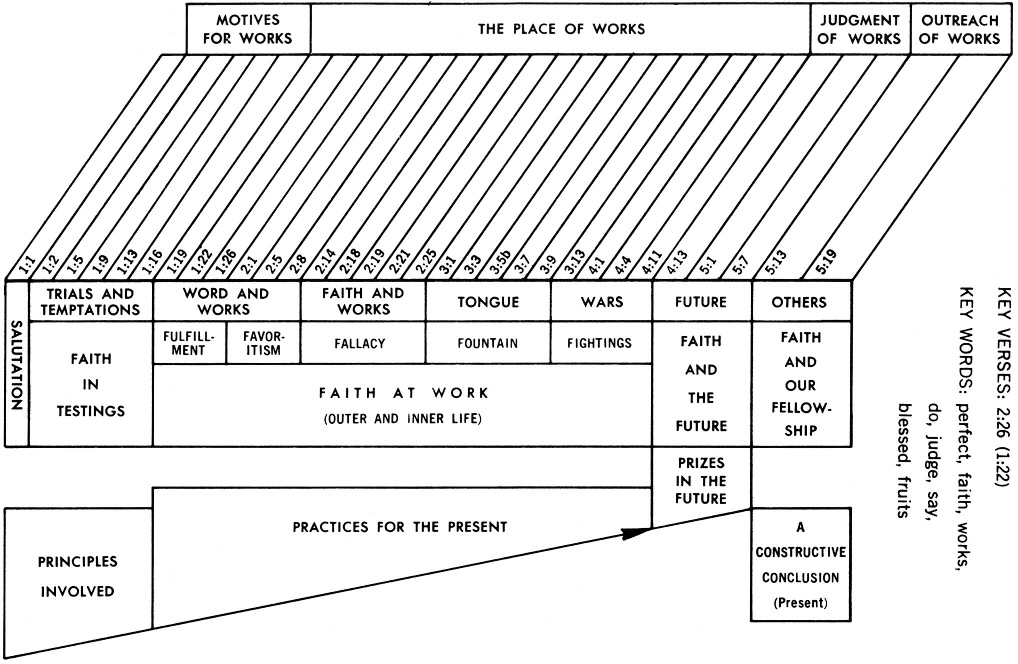
Click chart to enlarge
Chart from recommended resource Jensen's Survey of the NT - used by permission
See also Overview Chart by Charles Swindoll
|
JAMES |
|||||||
| Motives for Works |
The Place of Works: Outward Demonstration of Inner Faith |
Outreach of Works |
|||||
| Jas 1:1-18 | Jas 1:19-2:13 | Jas 2:14-25 | Jas 3:1-12 | Jas 3:13-4:12 | Jas 4:13-5:12 | Jas 5:13-19 | |
| Trials & Temptations |
Word & Works |
Faith & Works |
Tongue | Wars | Future | Others | |
|
Faith |
Fulfill |
Favor |
Fallacy |
Fountain |
Factions |
Faith |
Faith |
|
FAITH AT WORK |
|||||||
The Theme: The Testings of Personal Faith
The trials of the believer (James 1:2–12)
A. The proper attitude toward trials (James 1:2–4)
1. The attitude commanded (James 1:2)
2. The reason indicated (James 1:3)
3. The outcome to be realized (James 1:4)
B. The use of prayer amid trials (James 1:5–8)
1. The need for wisdom (James 1:5a)
2. The request for wisdom (James 1:5b)
3. The bestowal of wisdom (James 1:5c–8)
a. The divine response (James 1:5c)
b. The human obligation (James 1:6–8)
(1) The necessary attitude (James 1:6a)
(2) The rejected character (James 1:6b–8)
C. The correct attitude toward life by the tried (James 1:9–11)
1. The attitude of the lowly brother (James 1:9)
2. The attitude of the rich (James 1:10–11)
a. The reason for the attitude (James 1:10a)
b. The illustration from the flower (James 1:11a)
c. The application to the rich (James 1:11b)
D. The result of enduring trials (James 1:12)
1. The blessedness of endurance (v 12a)
2. The reward of endurance (James 1:12b)
The nature of human temptation (James 1:13–16)
A. The source of human temptation (James 1:13–14)
1. The repudiation of a divine source (James 1:13)
a. The rejection stated (James 1:13a)
b. The rejection vindicated (James 1:13b)
2. The reality of the human source (James 1:14)
B. The consequences of yielding to temptation (James 1:15)
C. The warning against being deceived (James 1:16)
The activity of God in human affairs (James 1:17–18)
A. The Giver of all good gifts (James 1:17)
B. The Author of the believer’s regeneration (James 1:18)
The Test Marks of a Living Faith
Faith tested by its response to the Word of God (James 1:19–27)
A. The reactions to the Word (James 1:19–20)
1. The knowledge possessed (James 1:19a)
2. The reaction demanded (James 1:19b)
3. The reason stated (James 1:20)
B. The reception of the Word (James 1:21)
1. The stripping off of sins (James 1:21a)
2. The appropriation of the Word (James 1:21b)
C. The obedience to the Word (James 1:22–27)
1. The demand for active obedience (James 1:22–25)
a. The statement of the requirement (James 1:22)
b. The illustration of the requirement (James 1:23–25)
(1) The negative portrayal (James 1:23–24)
(2) The positive portrayal (James 1:25)
2. The nature of acceptable obedience (James 1:26–27)
a. The futility of activity without inner control (James 1:26)
b. Acceptable service with inner control (James 1:27) (from Hiebert - James Commentary)
James 1:26 If anyone thinks himself to be religious, and yet does not bridle his tongue but deceives his own heart, this man's religion is worthless. (NASB: Lockman)
Greek: Ei tis dokei (3SPAI) threskos einai, (PAN) me chalinagogon (PAPMSN) glossan autou alla apaton (PAPMSN) kardian autou, toutou mataios e threskeia.
Amplified: If anyone thinks himself to be religious (piously observant of the external duties of his faith) and does not bridle his tongue but deludes his own heart, this person’s religious service is worthless (futile, barren). (Amplified Bible - Lockman)
ASV: If any man thinketh himself to be religious, while he bridleth not his tongue but deceiveth his heart, this man's religion is vain.
Barclay: If anyone thinks that he is a worshipper of God and yet does not bridle his tongue, his worship is an empty thing. (James 1 - Daily Study Bible)
Hiebert: If anyone considers himself religious and yet does not keep a tight rein on his tongue, he deceives himself and his religion is worthless.
KJV: If any man among you seem to be religious, and bridleth not his tongue, but deceiveth his own heart, this man's religion is vain.
NLT: If you claim to be religious but don't control your tongue, you are just fooling yourself, and your religion is worthless. (NLT - Tyndale House)
Phillips: If anyone appears to be "religious" but cannot control his tongue, he deceives himself and we may be sure that his religion is useless. (Phillips: Touchstone)
Wuest: If, as is the case, anyone imagines himself to be religious, not holding in check his tongue, but is deceiving his own heart, this person's religion is worthless.
Young's Literal: If any one doth think to be religious among you, not bridling his tongue, but deceiving his heart, of this one vain is the religion;
- Pr 14:12; 16:25; Lk 8:18; 1Co 3:18; Ga 2:6,9; 6:3
- James 1 Resources - Multiple Sermons and Commentaries
SO YOU THINK YOU'RE
REALLY RELIGIOUS!
If anyone thinks himself to be religious, and yet does not bridle his tongue but deceives his own heart, this man's religion is worthless.
One who is truly religious will
demonstrate it by controlled speech.
- Ronald Blue
Beware of religion! Religion is a sticky wicket and has entrapped many a soul in the snare of works rather than rest in the finished work of Jesus (Jn 19:30+). If you are doing ANYTHING in a "spiritual" manner (serving, teaching, preaching, resisting temptation, etc, etc) thinking that you can successfully do so in your own natural power and/or you are hoping to merit God's favor by so doing, then you are deceived. Religion always focuses on works I do. Relationship always focuses on the work Christ has done. There is an eternity of difference between these two extremes (pun intended)!
As Ropes warns "Careful attention to worship is no substitute for self-restraint (Ed: Be aware that Holy Spirit enabled "self" restraint is the only way one can restraint self [flesh]!), purity of life and good works (Ed: Emanating from a pure heart, empowered by the Spirit of Holiness, cp Ep 2:10). (A Critical and Exegetical Commentary)
In context recall that James has just rebuked hearing of the Word that does not lead to doing of the Word. Now, in a similar way, he rebukes religion that is external and for show, with religion that is internal and real in God's assessment, for it reflects a genuine change in one's heart or inner life. In this verse James describes an individual whose religious thinking and real speaking are discordant, self deceptive and futile, reflecting this individual's lack of internal heart control, for out the mouth comes that which fills the heart! (cp Mt 15:18, 19, 20). Then in next verse James goes on to contrast the worthless religion in Jas 1:26, giving two practical examples of personal application of God's Word which are a clear demonstration of pure and undefiled religion in the sight of our God and Father.
Hiebert sums up this section of James as "Faith Tested by Its Response to the Word of God (Jas 1:19–27) Since God’s Word is the means of regeneration (Jas 1:18), a right response to the Word is appropriately presented as the initial test of a vital faith. For the believer to accept regeneration through the Word is one thing; to permit the Word to work spiritual maturity in him is another. The necessary response is threefold: eagerness to hear it, restraint on any premature reaction, bridling of any angry rejection (Jas 1:19, 20). Before the Word can have full sway in the believer’s life, he must remove all that hinders its operation (Jas 1:21). Acceptance of the Word must be followed by persistent obedience to the Word (Jas 1:22–27). Hearing must be followed by active obedience; otherwise the hearing is useless (Jas 1:22, 23, 24, 25). But obedience to the Word is more than mere observance of outward forms of “religion” (church attendance, rote prayers, participation in the rites of religion) without the development of inner power to control the tongue (Jas 1:26). True obedience to the Word must reveal itself in beneficent social activity and stimulate personal self-control and purity in separation from worldly contamination (Jas 1:27). (The Unifying Theme of James - Excellent overview )
Steven Cole - In James 1:21, he talked about receiving “the word implanted, which is able to save your souls.” In James 1:22-27, he goes on to emphasize doing the word. In Jas 1:22-24, he shows that hearing the word without doing it leads to deception. He illustrates this in Jas 1:26 with the man who claims to be religious, but who does not bridle his tongue. He deceives himself and his religion is worthless. In Jas 1:25, he shows that hearing the word accompanied by doing it leads to blessing. He illustrates this with two examples in Jas 1:27: caring for orphans and widows; and, keeping oneself unstained by the world. James gives an example of someone who hears the word, but does not do it and so deceives himself. This man thinks that he is religious. “Religious” (and “religion”) are infrequently used words in the New Testament. James uses them here because he is describing a man who prides himself in the outward trappings of the faith, but who is not applying it to his heart. He is a religious Jew who now professes faith in Christ, but like many of the Jews, his religion is a matter of pride and outward performance. He prays, he fasts, he tithes, he goes through all of the rituals, but in James’ example, he doesn’t bridle his tongue. James says that this man deceives his own heart and his religion is worthless. James will deal more with the tongue in chapter 3, but it can encompass a multitude of sins: lying, half-truths, slander, gossip, angry words, hateful words, cursing, telling filthy jokes or stories, and much more. The Bible has very specific and practical commands on each of these areas. If you profess to follow Christ, but don’t apply the Bible to your speech, you’re fooling yourself if you think that you’re religious. Your religion is worthless and your profession is empty. (James 1:22-27 Doers of the Word)
If (1487) (ei) is a first class conditional conjunction which assumes that there is actually such an individual who considers himself religious. That couldn't be me or you could it, beloved? Hiebert draws an slight distinction in James' description of this person, noting that…
The picture is not that of a conscious hypocrite but of a self-deceived religionist.
Solomon wrote of similar self deception
There is a way which seems right to a man, but its end is the way of death. (Pr 14:12 cp Pr 16:25)
Paul adds that the warning …
Let no man deceive himself (present imperative + negative = command to stop deceiving one's self. Implication = he is being self deceived!). If any man among you thinks that he is wise in this age, let him become foolish that he may become wise (Ed: In context he becomes wise by seeking and receiving godly wisdom, which this present evil age regards as foolishness!) (1Cor 3:18)
In a parallel warning in the context of bearing one another's burdens ("real religion" in the sight of God and men!) Paul said…
Bear (present imperative = command to make this one's lifestyle or habitual practice.) one another's (Ed: The word "one another" is first in the Greek sentence to add emphasis! Real religion reaches outward away from self!) burdens, and thus fulfill the law of Christ. For if anyone thinks he is something when he is nothing, he deceives himself. (Gal 6:2, 3)
THOUGHT: Whose burden have you borne recently? Or ask another way, how long has it been since you've borne a brother or sister's burden even in a simple way by an encouraging phone call, an unexpected visit, an offer to aid physically, emotionally or financially? Beloved, redeem the time while today is still called today! This is real religion in the sight of God and men!
In Romans in the context of expressing one's spiritual gifts ("real religion") in the body of Christ, Paul sounded the alarm that…
through the grace given to me I say to every man among you (Ed: no believers excluded here) not to think more highly of himself than he ought to think; but to think so as to have sound judgment, as God has allotted to each a measure of faith. (Ro 12:3)
Anyone (5100) (tis) is a reference to someone, anyone, a certain one.
Thinks (1380) (dokeo) means to suppose or presume. To be of the opinion. Dokeo reflects the subjective mental estimate or opinion about some matter, in this case one's state of personal "religiosity". The present tense pictures this self deceived individual continually forming the opinion that he or she is religious. And it is important to remember that when a person is deceived, by definition they don't even know it! It's like walking around with food on your face until you spouse reaches up and wipes the crumbs off your lips. Another solution to reveal the "food on face" stigma is to look in the mirror, and by analogy, that is also the solution for "religion on one's face" (so to speak), the mirror of course being God's Word of Truth which reveals our true condition for it looks not only at the external actions but the internal attitudes, at the motives of our heart. Paul recalls this searching/cleansing/edifying action of the Word of God writing that…
All Scripture is inspired by God (Read the Bible as if God were speaking to you. He is!) and profitable for teaching (what is right), for reproof (what is not right), for correction (how to get right), for training in righteousness (how to stay right), that (What is the purpose for looking/hearing and doing the Word?) the man of God may be adequate (completely qualified in everything one is called to be or do and thus able to meet all the demands), equipped (This word pictures the saint who is completely outfitted, fully furnished, fully supplied) for every good work. (2Ti 3:16, 17)
Vincent - A man can scarcely seem to be religious, when, as Trench observes, “his religious pretensions are belied and refuted by the allowance of an unbridled tongue.” (James 1: Greek Word Studies)
To be (1511) (einai) is the present tense of eimi = continuous action (or in this case "thinking")
Religious (2357) (threskos which some say derives from threomai = to tremble, whereas more modern scholars link it with therap- = to serve) is used only in this verse and describes the individual who is preoccupied with religious observances.
Rogers has this note on threskos, used only here in Scripture…
The word denotes the scrupulous observance of religious exercise, in action or words, sincerely or hypocritically performed in the guise of devout religion. The word describes one who stands in awe of the gods and is tremendously scrupulous in regard to them. (Rogers, C L - originally by Fritz Rienecker: New Linguistic and Exegetical Key to the Greek New Testament. Zondervan. 1998)
Vincent observes that threskos is used…
Only here in New Testament, and nowhere in classical Greek. The kindred noun threskeia, religion, occurs Acts 26:5; Col 2:18; Jas 1:26, 27; and means the ceremonial service of religion. Herodotus (2:37) uses it of various observances practised by the Egyptian priests, such as wearing linen, circumcision, shaving, etc. The derivation is uncertain. Threomai, to mutter forms of prayer, has been suggested, as the followers of Wycliffe were called Lollards, from the old Dutch lullen or lollen, to sing. Hence the adjective here refers to a zealous and diligent performance of religious services. (James 1: Greek Word Studies)
Spurgeon - You know what that means; and there are some who do seem to be wonderfully religious. Butter would not melt in their mouths, as we say; they are so solemn
Three Types of Dogs - Dr. A. T. Schofield used to point out that there were three sorts of dogs in his city of London: the wild, masterless dog that roamed the streets at will, stole his meals from garbage pails, and often came to an inglorious end in the lethal chamber of the humane society; the chained dog, which could not be trusted for more than a few feet; and the dog that knew and loved his master and responded obediently to his voice. The first of these had liberty but no law; the second had law but no liberty; whereas the last enjoyed the perfect law of liberty.
All men seem to be like one of these three dogs. The masses are utterly lawless when it comes to the authority of God. They are dominated by sin, and “sin is lawlessness” (1 John 3:4). And then, there are many who are like the dog on the leash—they have law, but no liberty. These are legalists in the religious realm. The cheerless Pharisee is the representative of thousands who, “being ignorant of God’s righteousness, and going about to establish their own righteousness, have not submitted themselves unto the righteousness of God” (Rom. 10:3). But the Christian who knows the truth of New Testament deliverance is like the third dog. He needs no chain but is guided by his Master’s eye and his Master’s voice. (C. Ernest Tatham, from the book, “How May I.”, in Confident Living, January, 1988, p. 14)
AND YET DOES NOT BRIDLE HIS TONGUE BUT DECEIVES HIS [OWN] HEART: me chalinagogon (PAPMSN) glossan autou alla apaton (PAPMSN) kardian autou:
- Bridle - James 1:19; 3:2, 3, 4, 5, 6; Ps 32:9; 34:13; 39:1,2; 141:3; Pr 10:19,31; 13:2,3; 15:2; Pr 16:10; 19:1; 21:26; Ep 4:29; 5:4; Col 4:6; 1Pe 3:10
- Deceives - James 1:22; Deuteronomy 11:16; Isaiah 44:20; Galatians 6:3
- James 1 Resources - Multiple Sermons and Commentaries
HYPOCRISY OF ONE'S RELIGION
EXPOSED BY THEIR TONGUE
Spurgeon said that "An unbridled tongue indicates a godless heart."
Jamieson adds that "Discretion in speech is better than fluency of speech."
Have you ever ridden a horse without a bridle so that you were forced to hold on to the horse's mane to keep from falling off? I have, and once was tossed into a patch of prickly pair (picture)! That's what an unbridled tongue can in effect do to a person! And this person is so deceived by their "religious works" that they don't even realize they have been tossed into a prickly pair!

Bridle (5468) (chalinagogeo from chalinos = a bridle + ago = to lead) literally means to guide with a bridle. It signifies the picture of one leading or alternately restraining by use of a bridle, and in the present context the latter nuance being emphasized. The present tense indicates continuous action. In other words, James describes the one whose tongue is habitually unbridled! For anyone who has every been around horses and put a bridle in the horse's mouth in order to lead and guide this massive and powerful animal, the picture James draws is indeed striking! It says a great deal about the power of this little member of our body. See James 3:2 for the only other use of this verb.
David…
I said, "I will guard my ways, That I may not sin with my tongue; I will guard my mouth as with a muzzle, While the wicked are in my presence." (Ps 39:1)
Spurgeon comments on this verse: I said. I steadily resolved and registered a determination. In his great perplexity his greatest fear was lest he should sin; and, therefore, he cast about for the most likely method for avoiding it, and he determined to be silent. It is right excellent when a man can strengthen himself in a good course by the remembrance of a well and wisely formed resolve. "What I have written I have written," or what I have spoken I will perform, may prove a good strengthener to a man in a fixed course of right.
Unguarded ways are
generally unholy ones.
Heedless is another word
for graceless
I will take heed to my ways. To avoid sin one had need be very circumspect, and keep one's actions as with a guard or garrison. Unguarded ways are generally unholy ones. Heedless is another word for graceless. In times of sickness or other trouble we must watch against the sins peculiar to such trials, especially against murmuring and repining.
That I sin not with my tongue. Tongue sins are great sins; like sparks of fire ill words spread, and do great damage. If believers utter hard words of God in times of depression, the ungodly will take them up and use them as a justification for their sinful courses. If a man's own children rail at him, no wonder if his enemies' mouths are full of abuse. Our tongue always wants watching, for it is restive as an ill broken horse; but especially must we hold it in when the sharp cuts of the Lord's rod excite it to rebel.
I will keep my mouth with a bridle, or more accurately, with a muzzle. The original does not so much mean a bridle to check the tongue as a muzzle to stop it altogether. David was not quite so wise as our translation would make him; if he had resolved to be very guarded in his speech, it would have been altogether commendable; but when he went so far as to condemn himself to entire silence, "even from good," there must have been at least a little sullenness in his soul. In trying to avoid one fault, he fell into another. To use the tongue against God is a sin of commission, but not to use it at all involves an evident sin of omission. Commendable virtues may be followed so eagerly that we may fall into vices; to avoid Scylla we run into Charybdis (see explanation).
While the wicked is before me. This qualifies the silence, and almost screens it from criticism, for bad men are so sure to misuse even our holiest speech, that it is as well not to cast any of our pearls before such swine; but what if the psalmist meant, "I was silent while I had the prosperity of the wicked in my thoughts," then we see the discontent and questioning of his mind, and the muzzled mouth indicates much that is not to be commended. Yet, if we blame we must also praise, for the highest wisdom suggests that when good men are bewildered with sceptical thoughts, they should not hasten to repeat them, but should fight out their inward battle upon its own battlefield. The firmest believers are exercised with unbelief, and it would be doing the devil's work with a vengeance if they were to publish abroad all their questionings and suspicions. If I have the fever myself, there is no reason why I should communicate it to my neighbours. If any on board the vessel of my soul are diseased, I will put my heart in quarantine, and allow none to go on shore in the boat of speech till I have a clean bill of health.
Edward Reyner comments - Man's mouth, though it be but a little hole, will hold a world full of sin. For there is not any sin forbidden in the law or gospel which is not spoken by the tongue, as well as thought in the heart, or done in the life. Is it not then almost as difficult to rule the tongue as to rule the world?
Here is James' "handbook on tongue control"…
For we all stumble in many ways. If anyone does not stumble in what he says, he is a perfect man, able to bridle the whole body as well. 3 Now if we put the bits into the horses' mouths so that they may obey us, we direct their entire body as well.4 Behold, the ships also, though they are so great and are driven by strong winds, are still directed by a very small rudder, wherever the inclination of the pilot desires. 5 So also the tongue is a small part of the body, and yet it boasts of great things. Behold, how great a forest is set aflame by such a small fire! 6 And the tongue is a fire, the very world of iniquity; the tongue is set among our members as that which defiles the entire body, and sets on fire the course of our life, and is set on fire by hell. 7 For every species of beasts and birds, of reptiles and creatures of the sea, is tamed, and has been tamed by the human race. 8 But no one can tame the tongue; it is a restless evil and full of deadly poison. 9 With it we bless our Lord and Father; and with it we curse men, who have been made in the likeness of God; 10 from the same mouth come both blessing and cursing. My brethren, these things ought not to be this way. 11 Does a fountain send out from the same opening both fresh and bitter water? 12 Can a fig tree, my brethren, produce olives, or a vine produce figs? Neither can salt water produce fresh. (James 3:2-12)
James ties what we say to what/who we are in our innermost being, our control center if you will, our heart. When the doctor examines us, one of the first things he does to determine our physical condition is to say “Stick out your tongue!” James is saying in a sense "Stick out your tongue so I can assess the condition of your heart". This principle applies to the life of the person whose religion is pure and undefiled, for the tongue reveals what is in our heart. Inconsistent speech bears witness to a divided heart (cp passages on whole versus divided heart - 1Ki 8:61, 11:4, 15:3,14, 2Ki 20:3, 1Ch 12:38, 28:9, 29:19, 2Ch 15:17, 16:9, 19:9, 25:2), for it is “out of the abundance of the heart” that the mouth speaks (Mt 12:34). “Out of the same mouth proceed blessing and cursing,” James writes later in this same letter and adds “My brethren, these things ought not so to be” (Jas 3:10).
It follows from what James says and from each of our own experiences, that the tongue is indeed a restless evil and full of deadly poison and cannot be bridled. The question then arises is how can one practice pure religion or religion "worth" anything in the eyes of God? James gives part of the answer in the next verse. But in regard to the tongue the answer of course is that tongue control is not possible in our natural power but requires supernatural Holy Spirit power and amazing, life transforming grace. As you have undoubtedly heard some pastor articulate "The Christian life is not difficult… it's impossible!" And so is tongue control, short of Spirit control. God's Holy Spirit alone can enable a saint to bridle his tongue from unholy speech (cp Eph 4:29, where unwholesome speech = "rotten speech"!)
Tongue (1100) (glossa) is literally an organ of the body used for taste and also the pronunciation of words and thus is a metaphor for the act of speaking.
The idea of one "bridling" one's tongue is not uncommon in the Scriptures - James 1:26; 3:8; 1Pe 3:10; Jdg. 7:5; Job 29:10; 33:2. See Pastor Cole's message on Ephesians 4:29 dealing with our tongue -- Transformed Talk.
Richard Wolfe makes a good point observing that "To guide the tongue, hold it in check, restrain it, is a task so difficult that he who has the grace to accomplish it has grace to accomplish anything. Such self-control is a fruit of the Spirit (Gal 5:23)." (Wolfe, R: General Epistles of James and Jude)
Spurgeon - If religion does not salt your tongue, and keep it sweet, it has done nothing for you. If the doctor wants to know the state of your health, he says, “Let me see your tongue;” and there is no better test of the health of the mind than to see what is on the tongue. When it gets furred up with unkind words, when it turns black with blasphemy, when it is spotted with lasciviousness, there is something very bad inside the heart, you may be quite sure of that. A Warning To Waverers
Albert Barnes has an interesting comment on this verse writing that bridle "Restrains or curbs it not, as a horse is restrained with a bridle. There may have been some reason why the apostle referred to this particular sin which is now unknown to us; or he may perhaps have intended to select this as a specimen to illustrate this idea, that if there is any one evil propensity which religion does not control, or if there is any one thing in respect to which its influence is not felt, whatever other evidences of piety there may be, this will demonstrate that all those appearances of religion are vain. For religion is designed to bring the whole man under control, and to subdue every faculty of the body and mind to its demands. If the tongue is not restrained, or if there is any unsubdued propensity to sin whatever, it proves that there is no true religion. (ED: IN OTHER WORDS THEY ARE NOT REGENERATE, NOT BORN AGAIN, NO MATTER HOW RELIGIOUS THEY APPEAR! THIS IS A FRIGHTENING THOUGHT AND BRINGS TO MIND JESUS' DAMNING DECLARATION IN Mt 7:21-23 especially their words "‘Lord, Lord, did we not prophesy in Your name, and in Your name cast out demons, and in Your name perform many miracles?" THEY HAD RELIGIOUS WORKS WITHOUT THE REDEEMER'S REGENERATION!) (James 1)
The great Puritan author John Bunyan's description of Talkative in The Pilgrim’s Progress is an interesting commentary on Jas 1:26, 27…
FAITHFUL: Well, I see that saying and doing are two things, and hereafter I shall better observe this distinction.
CHRISTIAN: They are two things indeed, and are as diverse as are the soul and the body; for, as the body without the soul is but a dead carcass, so saying, if it be alone, is but a dead carcass also. The soul of religion is the practical part. “Pure religion and undefiled before God and the Father is this, to visit the fatherless and widows in their affliction, and to keep himself unspotted from the world.” James 1:27; see also Jas 1:22, 23,24, 25, 26. This, Talkative is not aware of; he thinks that hearing and saying will make a good Christian; and thus he deceives his own soul. Hearing is but as the sowing of the seed; talking is not sufficient to prove that fruit is indeed in the heart and life. And let us assure ourselves, that at the day of doom men shall be judged according to their fruits. Mt 13:23. It will not be said then, Did you believe? but, Were you doers, or talkers only? and accordingly shall they be judged. The end of the world is compared to our harvest, Mt 13:30, and you know men at harvest regard nothing but fruit. Not that any thing can be accepted that is not of faith; but I speak this to show you how insignificant the profession of Talkative will be at that day.” (Ed: Bunyan is not teaching "works based salvation" but that genuine salvation works or bears fruit.) (Pilgrim's Progress - Part I - The Fifth Stage)(John Bunyan: Pilgrim's Progress)
R C Sproul - a true Christian keeps a tight rein on the tongue. James will have much more to say about the tongue later on, but here he seems to refer to people who continually prattle. They say whatever pops into their head, without listening to or caring about what others are telling them. They are too full of their own self-important ideas. Such people are not open to the Word of God. They are not open to those God has appointed as teachers in his church. We must read the Scriptures ourselves, but we must also listen to teachers, or the Bible will come to simply mirror our preconceived ideas. The test of submission to the Word is openness to what is taught by those appointed to teach the Bible in the church. A person who is full of his own words will not be open to the words of others. ( Before the Face of God : Book Four)
R K Hughes writes that the words of James 1:26…
is a spiritually terrifying statement, to say the least, for it cuts like a hot knife through warm butter, dissecting the cant and piety of the self-satisfied religious. An out-of-control tongue suggests bogus religion, no matter how well one’s devotion is carried out. The true test of a man’s spirituality is not his ability to speak, as we are apt to think, but rather his ability to bridle his tongue.
The Lord Jesus Himself explained this in no uncertain terms in a heated exchange with the Pharisees: “Make a tree good and its fruit will be good, or make a tree bad and its fruit will be bad, for a tree is recognized by its fruit. You brood of vipers, how can you who are evil say anything good? For out of the overflow of the heart the mouth speaks” (Mt 12:33, 34). The tongue will inevitably reveal what is on the inside. This is especially true under stress, when the tongue is compulsively revealing.
A preacher with hammer in hand, doing some work on a church workday, noticed that one of the men seemed to be following him around. Finally the preacher asked why. The man answered, “I just want to hear what you say when you hit your thumb.” The curious parishioner understood that would be the existential moment of truth. The same could be said of the domestic stresses of the home, where the mouth unfailingly trumpets one’s essence.
James does not mean that those who sometimes fall into this sin have a worthless religion, for all are guilty at times. Rather, he is saying that if anyone’s tongue is habitually unbridled, though his church attendance be impeccable, his Bible knowledge envied, his prayers many, his tithes exemplary, and though he “considers himself religious … he deceives himself and his religion is worthless.”
The ever practical James has cut through all the religious decorum, but it is not butter that glistens under his knife, but the marrow of our souls. True religion controls the tongue. Men, how is your religion? How is mine? Do you talk too much? Do you pass along choice morsels for others to gleefully take in? Do you say to people’s faces what you would never say behind their backs? Do you have the “gift” of a sharp tongue? Are people elevated or diminished through your words? (see Disciplines of a Godly Man (Updated Edition or borrow Disciplines of a godly man)
“The boneless tongue, so small and weak,
Can crush and kill,” declares the Greek,
“The tongue destroys a greater horde,”
The Turk asserts, “than does the sword.”
The Persian proverb wisely saith,
“A lengthy tongue — an early death!”
Or sometimes takes this form instead,
“Do not let your tongue cut off your head.”
“The tongue can speak a word whose speed,”
Say the Chinese, “outstrips the steed.”
The Arab sages said in part,
“The tongue’s great storehouse is the heart.”
From Hebrew was the maxim sprung,
“Thy feet should slip, but ne’er the tongue.”
The sacred writer crowns the whole,
“Who keeps the tongue doth keep his soul.”
(From James S. Hewitt, ed., Illustrations Unlimited. Tyndale House)
But (alla) introduces a contrast (whenever you encounter a "but" pause to ponder what the author is contrasting? why? why now? what is the "change of direction of thought?, etc [see 5W/H'S] In so doing you are beginning to "chew the cud" so to speak - you are in a real sense practicing the lost art of Biblical Meditation, a discipline God promises to greatly bless - Ps 1:1, Ps 1:2, Ps 1:3, Joshua 1:8) between not reining in his tongue (what he does not do) and deceiving his own heart (what he does do)! Notice the nature of deception - he thinks he is religious and yet has a problem with tongue control which shows that he has managed to deceived himself (into thinking he is "okay" with God, that he is religious). Deception is a frightening thing especially when you don't recognize it! (Which you won't if you are truly deceived = one of most deadly effects of SIN is that it is deceptive - Heb 3:13). This person fails to see the illogic of his supposed "holiness" before God and his unholy words before men! The root of his deception lies in the fact that this person thinks that God is only interested in external worship, when in fact He is far more interested in the heart from which the worship flows. In this case the contrast is striking and essentially speaks of hypocrisy. When God takes the measure of a man, he does place the tape measure (so to speak) around his head to see how much he knows, but He puts it around his heart (so to speak) to see how much he obeys under grace and empowered by the Spirit.
Deceives (continually)(538) (apatao from apate = deceit, that which gives a false impression, whether by appearance, statement or influence) (Click in depth study of the root word apate) means to lead astray, mislead, cheat, delude, beguile, seduce into error. Apatao means to cause someone to have misleading or erroneous views concerning the truth. The chief sense in the NT is that of ethical enticement (or probably more accurately enticement to unethical thought, words, and deeds), specifically of enticing to sin.
The present tense indicates that this individual who persists in his or her failure to control their speech, is an individual who continually deceives their own heart. (cp Jer 17:9, 10; Eccl 9:3)
People's NT Commentary - He who professes religion and yet does not control his tongue is deceived. Unless he has grace enough to rule the unruly member, he has not enough for salvation.
The only other NT uses of apatao are found in…
Ephesians 5:6 () Let no one deceive (present imperative + negative = stop being deceived) you with empty words, for because of these things the wrath of God comes upon the sons of disobedience.
1 Timothy 2:14 And it was not Adam who was deceived (apatao), but the woman being quite deceived (exapatao), fell into transgression.
It is helpful to see the English definitions of the words by which one could translate apatao…
Deceive (from Latin decipere = ensnare, cheat) means to lead astray or frustrate usually by underhandedness; deceive implies imposing a false idea or belief that causes ignorance, bewilderment, or helplessness
Beguile means to lead astray by underhandedness & stresses the use of charm and persuasion in deceiving; deceive by wiles (tricks or stratagems intended to ensnare or deceive = attempts to entrap or deceive with false allurements)
Mislead means to lead in a wrong direction or into a mistaken action or belief often by deliberate deceit
Delude means to mislead the mind or judgment of; implies deceiving so thoroughly as to obscure the truth
Wayne Barber explains deceived writing that "First of all for me to be deceived, I am going to have to trust you. I am not going to be deceived by someone who I already have a question about. It is going to be someone who has my ear. It is going to be someone who has my time. When I am listening to them, then I am going to be deceived. The word "deceive" means to be led astray. You are walking on a path and all of a sudden something gets your ear. You trust what you are hearing and all of a sudden you start turning that way. That is what it means to be deceived." (Ephesians 5:6-7: Don't Be Deceived)
His own heart - It and the tongue act and react on one another (Jamieson). The tragedy is you deceive your own heart but certainly not God and in many cases not even the hearts of others who observe your "spiritual schizophrenia" of performance of religious rites juxtaposed with speaking of worthless words.
Heart (2588) (kardia) does not refer to the literal physical organ in Scripture but is always used figuratively to refer to the seat and center of human life. So while kardia does represent the inner person, the seat of motives and attitudes, the center of personality, in Scripture it represents much more than emotion, feelings. It also includes the thinking process and particularly the will. Jesus asked a group of scribes, “Why are you thinking evil in your hearts?” (Matthew 9:4). The heart is the control center of mind and will as well as emotion.The heart is the center of the personality, and it controls the intellect, emotions, and will. No outward obedience is of the slightest value unless the heart turns to God. Vine says that kardia "came to denote man’s entire mental and moral activities, and to stand figuratively for the hidden springs of the personal life, and so here signifies the seat of thought and feeling." ( Collected writings of W. E. Vine)
Hughes adds that "The heart is the wellspring of man’s spiritual life… (See Romans: Righteousness from Heaven)
MacArthur commenting on kardia - While we often relate heart to the emotions (e.g., “He has a broken heart”), the Bible relates it primarily to the intellect (e.g., “Out of the heart come evil thoughts, murders, adulteries, fornications, thefts, false witness, slanders,” Mt 15:19). That’s why you must “watch over your heart with all diligence” (Pr 4:23). In a secondary way, however, heart relates to the will and emotions because they are influenced by the intellect. If you are committed to something, it will affect your will, which in turn will affect your emotions." (See Drawing Near: Daily Readings for a Deeper Faith - Page 39)
MacArthur adds that "In most modern cultures, the heart is thought of as the seat of emotions and feelings. But most ancients—Hebrews, Greeks, and many others—considered the heart to be the center of knowledge, understanding, thinking, and wisdom. The New Testament also uses it in that way. The heart was considered to be the seat of the mind and will, and it could be taught what the brain could never know. Emotions and feelings were associated with the intestines, or bowels." (See Ephesians MacArthur New Testament Commentary - Page 45)
Spurgeon - That which is in the well will come up in the bucket, and that which is in the heart will come up on the tongue. An unbridled tongue denotes an unrenewed heart. Oh, that God would ever give us grace in our heart to move our tongue aright! Then, as the water guides the whole ship, our tongue will guide our whole body, and the whole of our manhood will be under holy government and control. Spurgeon's Sermons Volume 56: 1910
James 1:26–27 VISIT THE FATHERLESS AND AFFLICTED - John Bennett
As we noticed in our previous passage, James is supplying us with a series of robust tests of the maturity of our faith. Verses 26 and 27 show us the outcome of truly hearing and heeding the word of God, ‘the perfect law of liberty’, v. 25.
First, there will be a marked effect upon our speech; James will have a good deal more to say on this in chapter 3. The apostle uses the term ‘religious’ and ‘religion’ in these verses—a word group which is comparatively rare in the New Testament. According to W. E. VINE, it signifies ‘religion in its external aspect’, acts of public worship such as prayer and praise.
Verse 27 supplies further tests of true spiritual maturity: ‘To visit the fatherless and widows in their affliction’ and to ‘keep (oneself) unspotted from the world’. Again, we are reminded of the possibility of self-delusion: ‘thinketh himself to be religious’ v. 26 RV. James here reflects a common concern of the Old Testament prophets. Acceptable worship must be under-pinned by true practical holiness exemplified by love for one’s neighbour on the one hand and, on the other, radical separation from the evils of the world. In the absence of faith’s practical demonstration in acts of love, mercy, and personal sanctification, the most impressively executed act of public worship is valueless in God’s sight.
Moreover, verse 27 indicates that the true measure of piety is ‘before God’, recalling our Lord’s emphasis in the Sermon on the Mount on actions before the Father who ‘sees in secret’, Matt. 6:4, 18. Further, true ‘visitation’, in the biblical sense, is non-trivial. Luke indicates that God’s visiting His people required nothing less than the incarnation of His own Son, Luke 1:68, 78. In Luke chapter 10 comprehensive visitation was left to the despised Samaritan, whilst those concerned with the practice of religion had other priorities and probably feared the inconvenience of ceremonial defilement, Luke 10:30–37.
To summarise: in claiming us for Himself God has set us free to love and serve our neighbour, especially the destitute. Our associated worship will then be the authentic outflow of devoted lives, rich in good works, well-pleasing to God.
Adrian Rogers - We must watch what we say, because one word builds upon another, and it can get worse and worse. You have the snowball effect. You say, “Well, I can't control it.” You're a liar! You can control it, and I can prove it. For example, sometimes in a home a husband and wife are just snarling, fighting, snapping down one another's throat. Their voices are full of hostility. Then right in the middle of that kind of an argument, the phone rings. They answer the phone and say so sweet and nicely, “H-e-l-l-o…” You can control it. And you'd better learn to control it. If you don't, you're going to be out of control. This week, memorize Proverbs 29:20: “Do you see a man hasty in his words? There is more hope for a fool than for him.”
Adrian Rogers - The Dangers of Superficial Religion (full sermon)
Now, look at the scripture here. James chapter 1 and verse 26, and you will see the dangers of superficial religion. Look at verse 26: “If any man among you seem to be religious, and bridleth not his tongue, but deceiveth his own heart, this man’s religion is vain” (James 1:26).
The Squirrel that Shut Down New York
On September 11, 1995, a squirrel climbed on the Metro-North Railroad power lines near New York City. This set off an electrical surge, which weakened an overhead bracket, which let a wire dangle toward the tracks, which tangled in a train, which tore down all the lines. As a result, 47,000 commuters were stuck in Manhattan for hours that evening. As James 3:5-6 teaches us, even something as small as the tongue can cause a lot of damage.
—Sherman L. Burford in Fresh Illustrations for Preaching & Teaching (Baker), from the editors of Leadership.
See: Psalms 34:13; Proverbs 10:19; Proverbs 13:3; James 1:26.
Terse Words
British author and playwright George Bernard Shaw once sent Sir Winston Churchill two tickets to the opening night's performance of one of his plays. Accompanying the tickets was Shaw's terse note, "Bring a friend if you have one."
Churchill, also adept at saying a lot in a few words, replied: "I'll wait for the second night if there is one."
Cheap!
Traveling on a plane next to a salesman, Billy Graham asked him, "Are you paid anything for all the swearing you do?"
"No," was the startled reply, "I do it for nothing."
"Nothing?" cried the famous preacher. "You work cheap! You throw aside your character as a gentleman, inflict pain on your friends, break the Lord's commandments, and endanger your own soul—and all for nothing! You certainly work cheap—TOO CHEAP!" Yes, swearing is not only a "cheap" practice in many ways, but it is also a terrible sin which grieves the heart of God!
See: Matthew 12:34; James 1:26; 3:6-10; 1 Peter 3:10-12
TONGUE/SPEECH
The town council of the Dutch village of Staphorst has approved a ban stating that its residents can no longer take the name of the Lord in vain. They passed the ordinance despite earlier rulings in that country holding that such regulations could be a violation of the right to free speech. When the council voted 13-4 to enact the ban, they recognized that the ordinance might be hard to enforce because Dutch law does not ban swearing when it is an expression of the constitutional freedom of speech.
Staphorst is located in an area known as the Dutch "bible-belt' where the Bible carries a lot of weight. One other town in the region has a ban on swearing. When they passed the regulation, the town council proposal said, "a ban on swearing can be seen as a signal." They added a change in moral values was needed to address the underlying problem. In addition to swearing bans, the Dutch association against swearing is currently running a national billboard campaign admonishing the Dutch to avoid the use of foul language. —Reuters, Bible belt town bans blasphemy
When we mix religious talk with the practice of favoritism, we are really practicing an empty, worthless, self-deceptive religion (James 1:26). Even if we think we are obedient on every other count, we are still failing to live wisely in a way that demonstrates our faith (James 2:10).
James 1:26
On June 9, 1742, John Wesley made an interesting entry in his journal. He told of riding to a neighboring town to wait for a justice of the peace, whom he called "a man of candor and understanding." The magistrate was to hear the complaints of some angry citizens who had brought to him "a whole wagonload of these new heretics"—probably some of Wesley's converts. When the justice asked what they had done, one of the accusers replied, "Why, they pretended to be better than other people; and besides, they prayed from morning to night." "But have they done nothing else?" "Yes, sir," said an old man. "They have converted my wife. Till she went among them, she had such a sharp tongue! And now she is as quiet as a lamb." "Carry them back, carry them back," replied the justice, "and let them convert all the scolds in town."
Where no wood is, there the fire goeth out; so where there is no talebearer, the strife ceaseth.
HEALTHY LISTENING
“Be ye doers of the word and not hearers only.”
James 1:21-27.
WHEN we hear the word, but do not do it, there has been a defect in our hearing. We may listen to the word for mere entertainment. Or we may attach a virtue to the mere act of listening to the word. We may assume that some magical efficacy belongs to the mere reading of the word. And all this is perverse and delusive. No listening is healthy which is not mentally referred to obedience. We are to listen with a view to obedience, with our eyes upon the very road where the obedient feet will travel. That is to say, we are to listen with purpose, as though we were Ambassadors receiving instructions from the King concerning some momentous mission. Yes, we must listen with an eye on the road.
“Doing” makes a new thing of “hearing.” The statute obeyed becomes a song. The commandment is found to be a beatitude. The decree discloses riches of grace. The hidden things of God are not discovered until we are treading the path of obedience. “And it came to pass that as he went he received his sight.” In the way of obedience the blind man found a new world. God has wonderful treasures for the dutiful. The faithful discover the “hidden manna.”
This verse hit me pretty hard this morning: "Those who consider themselves religious and yet do not keep a tight rein on their tongues deceive themselves, and their religion is worthless" (James 1:26).
I have often said that gossip is the native tongue of the church, and what this means is that a large number of people who attend religious services Sunday morning need to be told that their "religion is worthless." But what does that mean?
So what are we to do with all this? What hit me when I first read it was the question of whether perpetual and consistent gossip was a sign of a person who was not truly converted. After all, Paul says that neither "thieves nor the greedy nor drunkards nor slanderers nor swindlers will inherit the kingdom of God" (1 Cor 6:10). And what made me really stop and look was v 27: imitating the character of God by defending those who cannot defend themselves, and a basic call to sanctification, are core, I believe, to what it means to be saved. So is James talking about worthless in the sense of non-existent, non-salvific? . . . .
But this is where word studies really do help. . . . Certainly, how we behave is an expression of who we are, but the emphasis here is on what we do. If this is right, then "worthless" means that gossips and slanderers may make a great show of religious behavior, but none of their general religiosity is of any significance. Their gossip invalidates everything else they do. Their outward show, their pretense of being religious (spiritual?), is worthless.
So gossips, hear this. You can go to church, sing loudly, give money, volunteer in the nursery, led a Bible study, wear your Christianity on your sleeve, be an elder — but no matter what you do, no matter what people think of you, it is all a sham, worthless. Your gossip invalidates everything you do. At least, that's what the Bible teaches.
When I was working on my view of church discipline, one of the real questions is what offenses are worthy of discipline. I was thinking through the normal answers, but someone challenged me that I was too focused. "The question," he asked, "is what sins are the most destructive of the church?" Gossip, in my mind, is number one. There is
nothing that tears down and destroys faster. Not divorce, Not sexual misconduct. As I said, I believe gossip is the native tongue of the church. It rips and shreds. The church should be the safest place of all, and yet most have found that it is one of the most dangerous. It is a place where knowledge is used as a weapon to pummel and destroy. It is a place where unity is destroyed by the quick jab of the tongue.
Is it of no wonder, then, that the church has, as a whole, failed to show the world that God has sent Jesus (John 17:23). [William D. [Bill] Mounce]
James Smith - James 1:16, 22, 26.
Three times over in this chapter does James warn God's people upon the possibility and danger of being deceived. Wise are we if we take heed to the warning.
I. About God (1:16). "Be not deceived" is the R.V. At first sight we are not sure whether this is a warning against (13) blaming God for our temptations to evil, or imagining changefulness in Him (17). On a second sight we decide that it has to do with verses 17 to 21.
1. God's Gifts are:
a. "Good."
b. "Perfect."
c. "From above" (17)
2. God Himself.
a. Source of all Light—like the sun, the centre and chief of all the glories of the visible universe.
b. Free from variableness—is to be relied upon.
c. "Free from shadow cast by turning" (R.).
II. About Ourselves (1:22).
1. If only a hearer and not a doer of the Word, we shall deceive ourselves (1:22).
2. Such are like most of us who have a habit of looking into the mirror in an absent-minded sort of way (1:23, 24).
III. About Religion (1:26).
1. The religion that does not influence the tongue is not a true or vital one.
2. True vital godliness leads to, and includes:
a. Control of tongue.
b. Purity of life—"Unspotted from the world."
c. Usefulness in life—"Visit the fatherless and widows."
ADDICTED TO HARMFUL WORDS
Rabbi Joseph Telushkin, author of Words That Hurt, Words That Heal, often lectures on the impact of words. He asks audiences if they can go twenty-four hours without saying any unkind words about another person or to another person. Invariably, a small number of listeners raise their hands, signifying yes. Others laugh, and quite a large number call out, "No!"
Telushkin says, "Those of you who can’t answer yes must recognize that you have a serious problem. If you cannot go twenty-four hours without drinking liquor, you are addicted to alcohol. If you cannot go twenty-four hours without smoking, you are addicted to nicotine. Similarly, if you cannot go twenty-four hours without saying unkind words about others, then you have lost control over your tongue."
—Rick Ezell,
Bits of Wisdom
Baltasar Gracian, in The Wisdom of Baltasar Gracian, disclosed these bits of wisdom. Here is the full context of those tidbits:
Perhaps God has chosen me in my time to detail what I learned from all the madness about.
I learned that often the false is made to look appealing.
I learned that witnesses today may be testifiers tomorrow.
I learned that one must be careful in helping others.
I learned that you do not proclaim another man's evil.
I learned that mediocrity within yourself is unacceptable.
I learned that the more one says the less he is heard.
I learned that one does not argue with an arguer.
I learned that anonymity can be valuable.
I learned that there is safety in moving with the crowd.
I learned that not all praise is meant well.
I learned that secrets should neither be heard nor spoken.
I learned that you do not divulge what you cannot reverse.
I learned that all has its day.
Verbal Abuse
The angry word is a blow struck at our brother, a stab at his heart: it seeks to hit, to hurt, and to destroy. A deliberate insult is worse, for we openly disgrace our brother in the eyes of the world, causing others to despise him. —Dietrich Bonhoeffer
The Enemy Is Us
A man's worst enemy, I tell you, will never do him the harm he does himself. - Scholem Alechem
Against Speaking in Anger
Speak when you're angry—and you'll make the best speech you'll ever regret. —Laurence J. Peter, Leadership, Vol. 1, no. 1.
See: Proverbs 13:3; Proverbs 21:23; James 1:26; James 1:19
Sins of the Tongue
Contentious tongues have hindered the work of God a thousand times over. Critical tongues have closed church doors. Careless tongues have broken the hearts and health of many pastors. The sins of the tongue have besmirched the pure white garments of the bride of Christ.
See: Proverbs 10:31; James 1:26; 3:8
Table-Talk Forbidden
Augustine encouraged conversation at meals—but with a strictly enforced rule that the character of an absent person should never be negatively discussed. He had a warning to this effect carved on a plaque attached to his table. —"St. Augustine," Christian History, no. 15.
See: Psalms 34:13; Proverbs 18:8; Proverbs 26:20; James 1:26.
No Four-Letter Words
I have a strong dislike for vulgar phrases and find that the terms "good grief" and "rats" will cover virtually anything that happens. —Cartoonist Charles Schultz interviewed in Vanity Fair (Oct. 1996). Christianity Today, Vol. 42, no. 5.
See: Psalms 34:13; Proverbs 13:3; Proverbs 21:23; James 1:26; 1 Peter 3:10.
HOLD THE CRITICISM
Topics: Acceptance; Criticism; Family; Sabbath; Spiritual Formation; Teens; Tongue; Words
References: Proverbs 12:18; James 1:26; 3:1–12
A family with teens decided that as part of their Sabbath commitments they would not criticize each other on Sundays.
As the months went on, they realized more and more of their children’s friends were coming over on Sundays just to hang around. No one in the family had talked about their commitment to withhold criticism, but somehow other teens knew this home was a good place to be.
THIS MAN'S RELIGION IS WORTHLESS: outou mataios e threskeia:
- Jas 2:20; Is 1:13; Mal 3:14; Mt 15:9; Mk 7:7; 1Co 15:2,15; Gal 3:4
- James 1 Resources - Multiple Sermons and Commentaries
EMPTY RELIGION
Religion without relationship is always empty!
Religion (2356) (threskeia) means worship or religious service (as in Col 2:18) and can refer to a system of external observances as in (Acts 26:5). BDAG says threskeia is the "expression of devotion to transcendent beings." In simple terms, religion in this context refers to external actions and patterns of behavior. Christianity as you undoubtedly have heard is best defined not as a religion but as a relationship with a Person, Jesus Christ the Lord.
Spurgeon - You know what that means; and there are some who do seem to be wonderfully religious. Butter would not melt in their mouths, as we say; they are so solemn: “If any man among you seem to be religious,” And bridleth not his tongue, —That little noisy troublesome member: “and bridleth not his tongue,” —But deceiveth his own heart, this man’s religion is vain. If religion does not salt your tongue, and keep it sweet, it has done nothing for you. If the doctor wants to know the state of your health, he says, “Let me see your tongue;” and there is no better test of the health of the mind than to see what is on the tongue. When it gets furred up with unkind words, when it turns black with blasphemy, when it is spotted with lasciviousness, there is something very bad inside the heart, you may be quite sure of that.
MacDonald explains religion as referring "to the outward forms rather than the inward spirit. It means the outer expression of belief in worship and service rather than the doctrines believed. (BORROW Believer's Bible Commentary)
Worthless (3152) (mataios) from maten = groundless, invalid) means vain, empty, devoid of force, nonproductive, useless, dead, fruitless, aimless, of no real or lasting value. This adjective describes an ineffectual attempt to do something or an unsuccessful effort to attain something. Mataios emphasizes aimlessness or the leading to no object or end and thus is used to describe false gods or idols in contrast to the true God.
This man's religion is vain, empty, devoid of power (cp 2Ti 3:5), lacking in content (not pure milk 1Pe 2:2; not solid food, He 5:14), nonproductive (in terms of producing true fruit that remains, Jn 15:5, 16, ), dead (orthodoxy without orthopraxy!) and of no eternal value (wood, hay, stubble, 1Co 3:12, cf Mt 12:36).
There are 6 uses of mataios in the NT - Acts 14:15; 1Co 3:20; 15:17; Titus 3:9; Jas 1:26; 1Pe 1:18 and they are translated (NAS) futile(1), useless(1), vain things(1), worthless(3). . In the Septuagint (LXX), mataios is used of pagan idols and idol worship (2Chr 11:15; Is 44:19; Je 2:5; 10:3; Ezek 8:10).
NIDNTT - The word mataios and its derivatives have an essentially more personal application. It is used in the sense of empty, useless, worthless, and futile. It denotes a person who falls short of God’s standard and human norms. His life is illusory, motiveless, aimless, scandalous and foolish (See this page for a few instructions on how to most efficiently utilize this incredible resource. )
Barclay - The word translated religion is threskeia, and its meaning is not so much religion as worship in the sense of the outward expression of religion in ritual and liturgy and ceremony. What James is saying is, "The finest ritual and the finest liturgy you can offer to God is service of the poor and personal purity." To him real worship did not lie in elaborate vestments or in magnificent music or in a carefully wrought service (Ed: One could apply it this way, but remember the cultural context - James is addresses Jews and would be alluding primarily to their mode of worship); it lay in the practical service of mankind and in the purity of one's own personal life. It is perfectly possible for a Church to be so taken up with the beauty of its buildings and the splendour of its liturgy that it has neither the time nor the money for practical Christian service; and that is what James is condemning. In fact James is condemning only what the prophets had condemned long ago. "God," said the Psalmist, "is a father of the fatherless, and protector of widows" (Psalms 68:5). It was Zechariah's complaint that the people pulled away their shoulders and made their hearts as adamant as stone at the demand to execute true justice, to show mercy and compassion every man to his brother, to oppress not the widow, the fatherless, the stranger and the poor, and not to entertain evil thoughts against another within the heart (Zechariah 7:6-10). It was Micah's complaint that all ritual sacrifices were useless, if a man did not do justice and love kindness and walk humbly before God (Micah 6:6-8). (James 1 - Daily Study Bible)
The prophet Micah spoke of OT religiosity sans internal/heart relationship…
5 "Then I will draw near to you for judgment; and I will be a swift witness against the sorcerers and against the adulterers and against those who swear falsely, and against those who oppress the wage earner in his wages, the widow and the orphan, and those who turn aside the alien, and do not fear Me," says the LORD of hosts.
6 With what shall I come to the LORD and bow myself before the God on high? Shall I come to Him with burnt offerings, With yearling calves?
7 Does the LORD take delight in thousands of rams, in ten thousand rivers of oil? Shall I present my first-born for my rebellious acts, the fruit of my body for the sin of my soul?
8 He has told you, O man, what is good; and what does the LORD require of you but to do justice, to love kindness, and to walk humbly with your God? (Micah 6:5-8-Commentary Note)
Hiebert strikes the right cord stating that "A professed Christianity that centers on the external expressions of faith—attendance at worship, rote prayers, church membership, participation in the ordinances—but is devoid of the regenerating power of the gospel—is as futile and unprofitable as idol worship. These outward aspects are important as expressions of personal faith, but they are useless apart from the Spirit's inner work. "James sees the unbridled tongue and the deceived heart as concomitants of an empty religion. Religion … requires a life."' A living religion is a life-changing force.
Theodore Epp has the following devotional on James 1:26-27…
When Jesus Christ is really indwelling a person, it will result in true religion. The word religion as used in James 1:26,27 is not synonymous with the word salvation. James used it in the sense of an outward expression of that which is inward. The inner faith in Jesus Christ as one's personal Saviour results in salvation; expressing that faith outwardly is one's religion, according to the way James used the word.
When one has faith in Jesus Christ, it is only normal and natural for this faith to express itself outwardly. There will be a new motivating power within, and that new desire is an evidence that you are a child of God.
The manifestation of Christ's life through an individual is proof that that person is rightly related to Jesus Christ by faith. In other words, faith in Christ will result in love for others, and this is what James referred to as pure religion.
The Lord Jesus Christ showered His love on those who could not help themselves and who could not, or would not, return His love at that time. When we know Him as personal Saviour, we will have this same kind of love. We will love those who are helpless and unable to return our expressions of love. It is relatively easy to be friends with those who are friends in return or to give to those who give in return. However, our Christianity is woefully deficient if we give in order to receive or if we give and expect an even larger gift in return. This is not pure religion. So when a person is rightly related to Jesus Christ--when he has pure and undefiled religion--he will express the love of Christ to those who are in dire circumstances and unable to return similar expressions of love. "My little children, let us not love in word, neither in tongue; but in deed and in truth" (1 Jn 3:18). (Ref) (Bolding added)
Henry Blackaby - Worthless Religion
If anyone considers himself religious and yet does not keep a tight rein on his tongue, he deceives himself and his religion is worthless. James 1:26
James, in his typically straightforward way, warns us about living under false assumptions. Over and over, James urges us, “Do not be deceived!” He understood how easy it is to become self-satisfied in the way we’re living the Christian life, when in reality there are some things that need to change radically. Here, James refers to the destructive power of our words. He comes on pretty strong; he’s actually saying that with careless words we can discredit everything we claim to believe!
The tongue, according to James, is “a world of evil among the parts of the body.” It is “a restless evil, full of deadly poison” (James 3:6, 8). That may sound pretty grim, but consider some of the ways that your words can be destructive. With one comment, you can devastate a friend. An angry outburst can destroy a relationship and betray a trust. It’s absolutely crucial to keep guard over what comes out of your mouth. You can talk all you want about your Christian faith, but if you are known as a liar, a gossip, or a betrayer, or if you constantly offend others by what you say, your reputation will drown out your Christian witness. The sad thing is, in your heart, you may genuinely care about others. That’s why James warns you so strongly not to live under any delusions.
There is a positive spin on James’s warning: the words we say also have the potential for much good. Our words can encourage someone who is down, challenge others to grow in their faith, share the good news of Christ, and praise God. The important thing is never to let our guard down when it comes to what we say. The consequences of speaking carelessly can be devastating. The choice is up to us. We can use our words to build up or to tear down our Christian witness.
An unknown author captured eloquently the way in which we so religiously fall short of Christ’s demand of service for others:
I was hungry and you formed a humanities club and discussed my hunger.
I was imprisoned and you crept off quietly to your chapel and prayed for my release.
I was naked and in your mind you debated the morality of my appearance.
I was sick and you knelt and thanked God for your health.
I was homeless and you preached to me of the spiritual shelter of the love of God.
I was lonely and you left me alone to pray for me.
You seem so holy, so close to God.
But I’m still very hungry and lonely and cold.
We must hear again the words of James: “But be ye doers of the word, and not hearers only” (James 1:22).--Source unknown
SPEAKING FROM A PURE HEART - John MacArthur
“If anyone thinks himself to be religious, and yet does not bridle his tongue but deceives his own heart, this man’s religion is worthless” (James 1:26).
✧✧✧
Your speech reveals the condition of your heart.
In verse 22 James talked about the delusion of hearing the Word without obeying it. Here he talks about the deception of external religious activity without internal purity of heart.
That’s a common deception. Many people confuse a love for religious activity with love for God. They may go through the mechanics of reading the Bible, attending church, praying, giving money, or singing songs, but in reality their hearts are far from God. That kind of deception can be very subtle. That’s why James disregards mere claims to Christianity and confronts our motives and obedience to the Word. Those are the acid tests!
James was selective in the word he used for “religious.” Rather than using the common Greek word that spoke of internal godliness, he chose a word that referred to external religious trappings, ceremonies, and rituals—things that are useless for true spirituality.
He focused on the tongue as a test of true religion because the tongue is a window to the heart. As Jesus said, “The mouth speaks out of that which fills the heart” (Matt. 12:34). Corrupt speech betrays an unregenerate heart; righteous speech demonstrates a transformed heart. It doesn’t matter how evangelical or Biblical your theology is, if you can’t control your tongue, your religion is useless!
You can learn much about a person’s character if you listen long enough to what he says. In the same way, others learn much about you as they listen to what you say. Do your words reveal a pure heart? Remember Paul’s admonition to “let no unwholesome word proceed from your mouth, but only such a word as is good for edification according to the need of the moment, that it may give grace to those who hear” (Eph. 4:29). Make that your goal each day, so you can know the blessing and grace of disciplined speech!
✧✧✧
Suggestions for Prayer: Ask the Lord to guard your tongue from speaking anything that might dishonor Him. Be aware of everything you say.For Further Study: Read James 3:1–12. ✧ What warning does James give? ✧ What analogies does he use for the tongue?
James 1:27 Pure and undefiled religion in the sight of our God and Father is this: to visit orphans and widows in their distress, and to keep oneself unstained by the world. (NASB: Lockman)
Greek: threskeia kathara kai amiantos para to theo kai patri aute estin, (3SPAI) episkeptesthai (PMN) orphanous kai cheras en te thlipsei auton, aspilon heauton terein (PAN) apo tou kosmou.
Amplified: External religious worship [religion as it is expressed in outward acts] that is pure and unblemished in the sight of God the Father is this: to visit and help and care for the orphans and widows in their affliction and need, and to keep oneself unspotted and uncontaminated from the world. (Amplified Bible - Lockman)
ASV: Pure religion and undefiled before our God and Father is this, to visit the fatherless and widows in their affliction, and to keep oneself unspotted from the world.
Barclay: This is pure and undefiled worship, as God the Father sees it, to visit the orphans and the widows, and to keep oneself unspotted from the world. (James 1 - Daily Study Bible)
Hiebert: Religion that God our Father accepts as pure and faultless is this: to look after orphans and widows in their distress and to keep oneself from being polluted by the world.
KJV: Pure religion and undefiled before God and the Father is this, To visit the fatherless and widows in their affliction, and to keep himself unspotted from the world.
NLT: Pure and lasting religion in the sight of God our Father means that we must care for orphans and widows in their troubles, and refuse to let the world corrupt us. (NLT - Tyndale House)
Phillips: Religion that is pure and genuine in the sight of God the Father will show itself by such things as visiting orphans and widows in their distress and keeping oneself uncontaminated by the world. (Phillips: Touchstone)
Wuest: Religion which is pure and undefiled in the sight of God, even the Father, is this: to look after orphans and widows in their affliction with a view to ascertaining their needs and supplying them, and to be keeping one's self unspotted from the world.
Young's Literal: religion pure and undefiled with the God and Father is this, to look after orphans and widows in their tribulation--unspotted to keep himself from the world.
PURE AND UNDEFILED RELIGION IN THE SIGHT OF OUR GOD AND FATHER IS THIS: threskeia kathara kai amiantos para to theo kai patri aute estin, (3SPAI):
- Jas 3:17; Ps 119:1; Mt 5:8; Lk 1:6; 1Ti 1:5; 5:4
- James 1 Resources - Multiple Sermons and Commentaries
RELIGION
THAT'S REAL!
Ironically it was the former "super religious" monk Martin Luther who said "The world needs not a definition but a demonstration!"
Guzik quipped that "There is a great deal of pure and undefiled religion in the sight of man that is not pure and undefiled religion before God."
Hiebert - James accepts the need for "religion," but insists that "religious observance pure and undefiled with our God and Father" (Rotherham) must unite the inner and outward effects of the gospel. A living religion must know the reality of the divine life within as well as experience its energizing activity in the production of deeds "pure and faultless" in daily conduct. (Ibid)
Barclay - All through history men have tried to make ritual and liturgy a substitute for sacrifice and service. They have made religion splendid within the Church at the expense of neglecting it outside the Church. This is by no means to say that it is wrong to seek to offer the noblest and the most splendid worship within God's house; but it is to say that all such worship is empty and idle unless it sends a man out to love God by loving his fellow-men and to walk more purely in the tempting ways of the world. (James 1 - Daily Study Bible)
Pure… religion - Religion which is free from wrong and unmixed with (unadulterated by) motives other than the desire be pleasing to God and to walk worthy of the Lord. Pure… religion is blameless, innocent, unstained by guilt. It denotes that which is intrinsically free from moral pollution or corruption.
A clean and undefiled religion is one in which one’s conduct and character
are disciplined in accordance with God’s Word..
- Ronald Blue
Spurgeon - Pure religion — might be rendered, “Pure ritualism “ — And undefiled before God and the Father is this, — What is pure ritualism according to the inspired apostle? To wear a white surplice, and to change it for a black gown? I do not see that in the Scriptures. To have little boys in white to sing for you? I do not see that; but what I do see is this, —To visit the fatherless and widows in their affliction, and to keep himself unspotted from the world. — I should like to have such a choir as this, a company of Christian men and women robed in unspotted holiness. We shall have such a choir as that around the eternal throne, so they who wish to be there had better begin to practice the music here. The Lord help you to do so, for Christ’s sake! Amen.
Jamieson - Pure is that love which has in it no foreign admixture, as self-deceit and hypocrisy. "Pure" expresses the positive, "undefiled" the negative side of religious service; just as visiting the fatherless and widow is the active, keeping himself unspotted from the world, the passive side of religious duty. This is the nobler shape that our religious exercises take, instead of the ceremonial offices of the law.
Pure (2513) (katharos; English = catharsis = purifying, cleansing, a term used in psychology and counseling for a cleansing of the mind or emotions - a "soul cleansing" if you will; cathartic = any substance used to induce purging or to cleanse a wound or infected are in order to make it pure; Cathar = member of a medieval sect which sought the purging of all evil from its members) literally describes that which is free of dirt and thus clean. It describes that which is free from admixture or adulteration and thus is pure. From a biblical standpoint the concept of cleansing is deeply rooted in both the Old and the New Testaments. As discussed more below under the Levitical laws heavy emphasis was placed on ceremonial cleansing and thus contact with any unclean animal, substance, person, or place was strictly forbidden. By the time Christ came this preoccupation with ceremonial cleanness had unfortunately displaced true worship with many of the Jews, most notably the Pharisees. It is not surprising then that the New Testament focuses mainly on an inward cleanness (heart, conscience), rather than on an external or ceremonial cleanness.
It is also worth noting that katharos is related to the Latin castus, from which we get chaste. The related word chasten refers to discipline given in order to cleanse from wrong behavior.
There are 7 uses of katharos in the NT - Mt. 27:59; Lk. 11:41; Ro 14:20; 1Ti 3:9; 2Ti 1:3; Titus. 1:15; James. 1:27
Katharos is blameless, innocent, unstained with the guilt and is used to describe that which is ceremonially or ritually pure or clean (in a "Levitical sense"). For example Moses records…
Leviticus 6:11 'Then he shall take off his garments and put on other garments, and carry the ashes outside the camp to a clean (LXX = katharos) place.
Exodus 25:11 "And you shall overlay it (the Ark of the Covenant) with pure (LXX = katharos) gold, inside and out you shall overlay it, and you shall make a gold molding around it.
Katharos is an adjective that figuratively is used in both the OT and the NT to describe the state of one's heart. When a person is pure in heart and mind, his or her perspective on all things is pure, and that inner purity produces outer purity. As discussed above, true purity lies not in adherence to external commandments of men but in the inner purity of the redeemed, regenerated heart.
MacArthur - katharos has two shades of meaning. Some suggest that it also means unmixed or unalloyed or unadulterated or sifted or cleansed of chaff. In other words, to be pure means you have no added mixture of any foreign element. Thus, what our Lord was really saying here is, “I desire a heart that is unmixed in its devotion and motivation. Pure motives from a pure heart.”Either way, it has to do with attitudes, integrity, and singleness of heart as opposed to duplicity and double mindedness (MacArthur, J. The Only Way to Happiness: The Beatitudes. Chicago: Moody Press)
Undefiled (283) (amiantos from a = negates what follows + miaino = to defile by staining, as with color) means without contamination, unpolluted, untainted, unstained (stainless), unsoiled, without uncleanness or impurity. The idea is free from that by which the nature of a thing is deformed or debased, or its force or vigor is impaired. In secular Greek writings amiantos was used to describe things such as unstained hands, heart, flesh or body. Aeschylus calls the sea simply "the undefiled".
James says undefiled religion is that which has not been soiled or stained by contact with moral evil, and thus is "of worth" to God and is acceptable to Him.
There are 4 uses of amiantos in the NT - Heb 7:26; He 13:4; James 1:27; 1Pet. 1:4
The following illustration serves to emphasize the great need all believers have to keep their garments pure and undefiled…
After a violent storm one night, a large tree, which over the years had become a stately giant, was found lying across the pathway in a park. Nothing but a splintered stump was left. Closer examination showed that is was rotten at the core because thousands of tiny insects had eaten away at its heart. The weakness of that tree was not brought on by the sudden storm; it began the very moment the first insect nested within its bark. With the Holy Spirit's help, let's be very careful to guard our hearts so that we remain pure and undefiled, "oaks of righteousness, the planting of the LORD, that He might be glorified." (Is 61:3, cp Ps 1:3 - see commentary notes on Psalm 1:3)
Here are some terms that might be considered as synonymous with religion in the sense that James uses that term in this the preceding passage - Pharisaism, Phariseeism, false piety, hypocrisy, insincerity, lip service, pietism, religiosity, sanctimoniousness, self-righteousness.
Epp remarks that "James was contrasting a religion that can fool others with a religion that God knows is genuine."
God’s emphasis is not on religious ritual
but on right living.
-- Ronald Blue
Religiosity describes excessive or affected religious zeal, especially an outward display of religious piety.
BDAG says threskeia is the "expression of devotion to transcendent beings."
A T Robertson notes that there are "Numerous examples in papyri and inscriptions of threskeia for ritual and reverential worship in the Roman Empire (Moulton and Milligan's Vocabulary; Deissmann, St. Paul, p. 251). As Hort shows, this is not a definition of religion or religious worship, but only a pertinent illustration of the right spirit of religion which leads to such acts."
Threskeia is used 4 times in the NT…
Acts 26:5 since they have known about me for a long time previously, if they are willing to testify, that I lived as a Pharisee according to the strictest sect of our religion.
Colossians 2:18 () Let no one keep defrauding you of your prize by delighting in self-abasement and the worship of the angels, taking his stand on visions he has seen, inflated without cause by his fleshly mind,
James 1:26 If anyone thinks himself to be religious, and yet does not bridle his tongue but deceives his own heart, this man's religion is worthless.
James 1:27 This is pure and undefiled religion in the sight of our God and Father, to visit orphans and widows in their distress, and to keep oneself unstained by the world.
Martin Luther had it right when he said that "The world does not need a definition of religion as much as it needs a demonstration."
John Calvin wrote that "We must observe that the knowledge of God which we are invited to cultivate is not that which, resting satisfied with empty speculation, only flutters in the brain, but a knowledge which will prove substantial and fruitful whenever it is duly perceived and rooted in the heart."
In the sight (3844) (para) is literally beside and so in the presence of God. Robertson says "By the side of (para) and so from God's standpoint (Mark 10:27)."
Father (3962) (pater) in this context refers to the supreme deity, Who is responsible for the origin and care of all that exists. Only believers can truly claim God as their Father (cp Jn 1:11, 12, 13, 1Jn 3:1, 3:23, 24, 2Co 6:18, Gal 3:26, 4:5, 6, Ro 8:14, 15, 16).
TO VISIT ORPHANS AND WIDOWS IN THEIR DISTRESS: episkeptesthai (PMN) orphanous kai cheras en te thlipsei auton:
- Visit - Job 29:12-13; Job 31:15-20; Ps 68:5; Is 1:16-17; Isa 58:6-7; Mt 25:34-46; Gal 5:6; 6:9,10; 1Jn 3:17-19
- James 1 Resources - Multiple Sermons and Commentaries
Related Passages:
Job 29:12-13 Because I delivered the poor who cried for help, And the orphan who had no helper. 13 “The blessing of the one ready to perish came upon me, And I made the widow’s heart sing for joy.
Psalm 68:5 A father of the fatherless and a judge for the widows, Is God in His holy habitation.
Isaiah 1:16-17 “Wash yourselves, make yourselves clean; Remove the evil of your deeds from My sight. Cease to do evil, 17Learn to do good; Seek justice, Reprove the ruthless, Defend the orphan, Plead for the widow.
Isaiah 58:6-7 “Is this not the fast which I choose, To loosen the bonds of wickedness, To undo the bands of the yoke, And to let the oppressed go free And break every yoke? 7 “Is it not to divide your bread with the hungry And bring the homeless poor into the house; When you see the naked, to cover him; And not to hide yourself from your own flesh?

REAL RELIGION
To visit (episkeptomai) orphans (orphanous) and widows (chera) in their distress (thlipsis) - This is real religion that really preaches! True religion is expressed by good intentions but by loving action. The word visit means far more than dropping by for a conversation. It pictures taking personal responsibility to care for those who cannot care for themselves. This is not making a casual social visit, but of intentionally seeking out those who are helpless, comforting them in their affliction, and providing practical care. Genuine faith moves beyond words to loving deeds (cf Jas 2:14ff) that reflect the heart of God. In sum, to visit orphans and widows in their distress is to intentionally seek out the vulnerable, enter into their affliction, and demonstrate God's love through compassionate, sacrificial care that meets both practical and spiritual needs.
Visit is in the present tense calls for this practice to be our habitual practice or our fundamental attitude and not just an isolated act of "do-goodism"! Our English word visit is from the Latin viso, to look steadfastly at, and thence to visit. We retain the original thought in the popular phrases go to see one, and to look in upon one.
THOUGHT - Have you ever visited an orphan/widow in their distress?
Oorphans (orphanous) and widows (chera) - It is interesting to note that in the Greek there is no connecting conjunction (no "and"). These two groups were some of the most needy classes of people in ancient (and modern) times. Orphans/widows are found together only here in the NT, but this combination is more frequently mentioned in the OT (Ex 22:21; Dt. 10:18; Is 1:17; Je 5:28; Ezek 22:7; Zech 8:10) to identify those who needed help and compassion.
Jamieson feels that this absence of and points out that "so close is the connection between active works of mercy to others, and the maintenance of personal unworldliness of spirit, word, and deed; no copula ( = something that connects) therefore is needed."
People's NT Commentary - Combining pure hearts and pure outward lives. This genuine religion has two elements: (1) Kind and loving deeds, exemplified especially in helping the helpless, such as widows and orphans, and (2) living pure, unsullied lives, unstained by the sins prevalent in this sinful world.To visit orphans - As you study the Greek verb episkeptomai, you will see that it conveys far more than just stopping by and saying hello (although that is certainly a good beginning!) As discussed this verb conveys the idea of caring for or showing concern. True religion cares for those who are weak and helpless and in the ancient world, widows and orphans were in a dire straits, since they had no protector or advocate.
Marvin Vincent - James strikes a downright blow here at ministry by proxy, or by mere gifts of money. Pure and undefiled religion demands personal contact with the world’s sorrow: to visit the afflicted, and to visit them in their affliction. “The rich man, prodigal of money, which is to him of little value, but altogether incapable of devoting any personal attention to the object of his alms, often injures society by his donations; but this is rarely the case with that far nobler charity which makes men familiar with the haunts of wretchedness, and follows the object of its care through all the phases of his life” (Lecky, “History of European Morals,” ii., 98). (James 1: Greek Word Studies)
Charity and purity
are the two great garments of Christianity.
-Spurgeon
Spurgeon writes that…
Charity and purity are the two great garments of Christianity.
I sometimes fear lest we should by no means insist too much on purity, but should certainly insist too little upon charity. The visitation of the fatherless and widows in their affliction is not left optional. It is not to be the privilege of a few worldly men who give all their substance to orphanages. Every Christian is bound to wear his part of the external dress of religion, that is, charity. This charity is to be manifested especially to those who need it most, whose need cannot be a matter of imposture, but must be real. These are the fatherless and widows, during the time of their destitution and affliction, when the orphans are not able to earn the bread that perishes, and the mother has her children weeping around her, and pining in poverty. Not only may this charity be shown, but it must be manifested if we would have pure and undefiled religion before God and the Father. The increase of charity, of careful and discreet consideration for the poor and needy, would bring a great blessing with it; and is what is greatly needed even in these times, when, perhaps, we fancy that we are doing almost enough in this direction, although we certainly are not.
Yet charity without purity will be of no avail. In vain should we give all our substance to the poor, and give our bodies to be burned, if we do not walk in the way of holiness, “without which no man shall see the Lord.” If we do not come out from the world, and keep ourselves from its polluting influence, we have not yet learned what pure and undefiled religion really is. We may be very orthodox in creed, or we may be very far advanced in our knowledge of religious matters, we may think ourselves to be Hebrews of the Hebrews, Pharisees of the Pharisees, and as touching the righteousness which is of the law, blameless; but we are in the sight of God only as sounding brass, or a tinkling cymbal, unless, by divine grace, we have learned to keep ourselves unspotted from the world. (Read the rest of Spurgeon's sermon on James 1:27, where you will note that he places most of his emphasis upon keeping oneself unstained by the world - Charity and Purity)
Steven Cole writes that God…
has a special concern for the helpless who could not provide for themselves.
(1) The applied word results in selfless conduct in the sight of God.
The word “visit” means more than dropping in for a social call, although it includes that. It comes from the same word that is translated “overseer,” describing the work of elders. It means to look out for, care for, and be concerned about. To show this concern for orphans and widows requires that a person take his focus off of himself and his needs and think about others and their needs. Usually, there is no payback when you care for orphans and widows. In that society, they were poor and not able to work.
What motivates you to care for them is, you know they have needs, you apply the golden rule (how you would want to be treated if you were in their situation), and you do it to please God, who sent His Son so that you could be adopted into His family. The point is that when God’s word takes root in our hearts, it shifts our focus from self to others.
One practical way that I’ve found to move from having good intentions to obey the word to actually doing it is, to put it in my schedule. It’s easy for me to think, “I need to go see so-and-so and encourage him in his faith.” Great thought, but if I don’t put it in my schedule, it won’t happen, because I don’t have a lot of spontaneous free time where I’m wondering what to do. (James 1:22-27 Doers of the Word)
To minister to orphans and widows is to be the hands, the feet, the heart of the Father, for as the psalmist records…
A father of the fatherless and a judge for the widows, is God in His holy habitation. (Ps 68:5)
Commenting on this verse, Spurgeon writes: In the wilderness the people were like an orphan nation, but God was more than a father to them. As the generation which came out of Egypt gradually died away, there were many widows and fatherless ones in the camp, but they suffered no want or wrong, for the righteous laws and the just administrators whom God had appointed, looked well to the interests of the needy. The tabernacle was the Palace of Justice; the ark was the seat of the great King. This was a great cause for joy to Israel, that they were ruled by the ONE who would not suffer the poor and needy to be oppressed. To this day and for ever, God is, and will be, the peculiar guardian of the defenseless. He is the President of Orphanages, the Protector of Widows. He is so glorious that he rides on the heavens, but so compassionate that he remembers the poor of the earth. How zealously ought His church to cherish those who are here marked out as Jehovah's especial charge. Does He not here in effect say, "Feed my lambs"? Blessed duty, it shall be our privilege to make this one of our life's dearest objects. The reader is warned against misquoting this verse; it is generally altered into "the husband of the widow," but Scripture had better be left as God gave it.
Andrew Bonar asks: Does not James 1:27 refer to this verse, for we have the fatherless, the widow, and then the holiness, of the God we serve?
In their distress - In their difficult, pressing circumstances. Hiebert says these circumstances include…
not only… their grief and loneliness but also… the unscrupulous exploitation of unprincipled individuals (Zech 7:10; Mk 12:40). As Epp points out, "Basically, this means doing something for those who cannot return the favor. If we express concern only for those who are able to reciprocate, we are not loving as Christ loved" (cf. Luke 14:12, 13, 14). Such love-prompted social concern has often been a means of furthering the gospel.
Morris rightly notes that "No one likes troubles of this kind, but they may be seen as difficulties to be overcome, as ways of opening up new possibilities. One who sees them in this light glories in them (Ibid)
Martin Luther - Whatever virtues tribulation finds us in, it develops more fully. If anyone is carnal, weak, blind, wicked, irascible, haughty, and so forth, tribulation will make him more carnal, weak, blind, wicked and irritable. On the other hand, if one is spiritual, strong, wise, pious, gentle and humble, he will become more spiritual, powerful, wise, pious, gentle and humble.
It was C S Lewis who said that "God whispers to us in our pleasures, speaks in our consciences, but shouts in our pains; it is his megaphone to rouse a deaf world."
Religion (2356) (threskeia from threskos = religious, devout used in Jas 1:26) means worship or religious service (as in Col 2:18) and can refer to a system of external observances as in (Acts 26:5). Threskeia expresses the worship of God, especially in religious service.
Visit (1980) (episkeptomai - see study of episkopeo from epí = upon or intensifying already existing idea in verb + skopeo = regard, give attention to, look at, contemplate) literally means to look upon, to go to see, to examine closely, to inspect, to examine the state of affairs of something, to look after or to oversee. The idea of visiting is more than just making a social call.
As Hiebert writes "In classical Greek, it was commonly used of visiting the sick, whether by a doctor or a friend.' In Jewish usage, it commonly denoted to visit with the aim of caring for and supplying the needs of those visited (Job 2:11; Jer. 23:2; Ezek. 34:11; Zech. 11:16; Mt. 25:36, 43). The term implies concern and personal contact with the needy; it involves more than a matter of charity by proxy."
This verb expresses careful regard of those in position of responsibility. It depicts one going to see another with the intent to render help. In some context it means to have regard for, care for or be concerned about (Acts 15:14, He 2:6). It is often used of visiting the sick. In the Septuagint it speaks of a visitation from God, most often a visitation for good.
TDNT writes that
1. In secular Greek episkeptomai has the following senses: a. “to look upon,” “consider,” “have regard to” (something or someone), with such references as inspecting, supervising, having a care to, looking down on, or watching over (the gods); b. “to reflect on,” “examine,” “investigate” (something), e.g., a document, or virtue; c. “to visit,” e.g., the sick (friends or the doctor).
2. The Septuagint (LXX) adds some new meanings and intensifies the religious reference. Thus we find a. “to visit,” b. “look on,” c. “investigate,” but also d. “care for” (Je 23:2), e. “find out” (Nu 14:34), f. “muster” (Ex 30:12), and g. “miss” or, passive, “be missed, absent” (1Sa 20:6). The term has a religious content only when God is subject, e.g., when he watches over the land (Dt 11:12) or visits his people in judgment or mercy (Zech 10:3). Visitation in judgment produces sense h. “to punish” (Ex 32:34; Job 35:15), and visitation in mercy sense i. “to accept” (Ge 21:1). A final sense j. is “to appoint,” “instal,” as in Nu 4:27; Neh 7:1. (BORROW Kittel's Theological Dictionary of the New Testament : abridged in one volume)
Episkeptomai 11X in the NT -
Matthew 25:36 naked, and you clothed Me; I was sick, and you visited Me; I was in prison, and you came to Me.'
Matthew 25:43 I was a stranger, and you did not invite Me in; naked, and you did not clothe Me; sick, and in prison, and you did not visit Me.'
Luke 1:68 "Blessed be the Lord God of Israel, For He has visited us and accomplished redemption for His people,
Luke 1:78 Because of the tender mercy of our God, With which the Sunrise from on high shall visit us,
Luke 7:16 And fear gripped them all, and they began glorifying God, saying, "A great prophet has arisen among us!" and, "God has visited His people!"
Acts 6:3 "But select from among you, brethren, seven men of good reputation, full of the Spirit and of wisdom, whom we may put in charge of this task.
Acts 7:23 "But when he was approaching the age of forty, it entered his mind to visit his brethren, the sons of Israel.
Acts 15:14 "Simeon has related how God first concerned Himself about taking from among the Gentiles a people for His name. (ESV - Acts 15:14 Simeon has related how God first visited the Gentiles, to take from them a people for his name.)
Acts 15:36 And after some days Paul said to Barnabas, "Let us return and visit the brethren in every city in which we proclaimed the word of the Lord, and see how they are."
Hebrews 2:6 () But one has testified somewhere, saying, "What is man, that Thou rememberest him? Or the son of man, that Thou art concerned about (ESV = care for) him?
James 1:27 This is pure and undefiled religion in the sight of our God and Father, to visit orphans and widows in their distress, and to keep oneself unstained by the world.
Episkeptomai is found 127 times in the non-apocryphal Septuagint (LXX) -Ge 21:1; 50:24, 25; Ex 3:16; 4:31; 13:19; 32:34; 38:25; Lv 13:36; Nu 1:3, 19, 44, 47; 2:4, 6, 8f, 11, 13, 15f, 19, 21, 23f, 26, 28, 30f; 3:15f, 39f, 42; 4:23, 27, 29f, 32, 34, 37f, 41f, 45f, 48f; 16:5; 26:54, 63f; 27:16; Jos. 8:10; Jdg. 15:1; 20:15, 17; 21:3, 9; Ru 1:6; 1Sa 2:21; 11:8; 13:15; 14:17; 15:4; 20:6, 18f, 25, 27; 2Sa 2:30; 18:1; 24:2, 4; 1Ki. 20:15, 26f; 2Ki. 3:6; 9:34; 10:19; 1 Chr. 26:31; 2Chr 24:6; Ezra 1:2; 4:15, 19; 5:17; 6:1; 7:14; Neh 7:1; 12:42; Job 2:11; 35:15; Ps. 8:4; 17:3; 27:4; 59:5; 65:9; 80:14; 89:32; 106:4; Jer. 3:16; 5:9, 29; 9:9, 25; 11:22; 13:21; 15:15; 23:2; 27:8; 29:10, 32; 30:20; 32:41; 36:31; 44:13, 29; 49:8; La 4:22; Ezek 20:40; 23:21; 34:11; Ho 4:14; Zeph 2:7; Zech 10:3; 11:16; Mal 3:10.
Genesis 21:1 (ESV) The LORD visited Sarah as he had said, and the LORD did to Sarah as he had promised.
Genesis 50:24 And Joseph said to his brothers, "I am about to die, but God will surely take care (Heb = paqad = attend, visit, search out; Lxx = episkeptomai) of you, and bring you up from this land to the land which He promised on oath to Abraham, to Isaac and to Jacob."
Exodus 13:19 And Moses took the bones of Joseph with him, for he had made the sons of Israel solemnly swear, saying, "God shall surely take care (Heb = paqad = attend, visit, search out; Lxx = episkeptomai) of you; and you shall carry my bones from here with you."
Exodus 32:34 But now go, lead the people to the place about which I have spoken to you; behold, my angel shall go before you. Nevertheless, in the day when I visit (Heb = paqad = attend, visit, search out; Lxx = episkeptomai), I will visit (Heb = paqad = attend, visit, search out; Lxx = episkeptomai) their sin upon them."
1 Samuel 2:21 And the LORD visited (Heb = paqad = attend, visit, search out; Lxx = episkeptomai) Hannah; and she conceived and gave birth to three sons and two daughters. And the boy Samuel grew before the LORD.
Ruth 1:6 () for she had heard in the land of Moab that the LORD had visited (Heb = paqad = attend, visit, search out; Lxx = episkeptomai) His people in giving them food.
Psalm 65:9 Thou dost visit the earth, and cause it to overflow; Thou dost greatly enrich it; The stream of God is full of water; Thou dost prepare their grain, for thus Thou dost prepare the earth.
Psalm 80:14 O God of hosts, turn again now, we beseech Thee; Look down from heaven and see, and take care of this vine,
Ps89:32 Then I will visit their transgression with the rod,
Psalm 106:4 Remember me, O LORD, in Thy favor toward Thy people; Visit me with Thy salvation,
Zephaniah 2:7 And the coast will be For the remnant of the house of Judah, They will pasture on it. In the houses of Ashkelon they will lie down at evening; For the LORD their God will care for them and restore their fortune (This promise will be fulfilled to Israel in the millennium).
Orphans (3737) (orphanos; Latin = orbus - bereaved) signifies bereft of parents or of a father (only other NT use = Jn 14:18) whether through death or abandonment (See Orphan)
Widows (5503) (chera) (See widow) is a woman who has lost her husband.
There are 26 uses in the NT - Mk. 12:40, 42, 43; Lk. 2:37; 4:25, 26; 7:12; 18:3, 5; 20:47; 21:2, 3; Acts 6:1; 9:39, 41; 1 Co. 7:8; 1 Tim. 5:3, 4, 5, 9, 11, 16; James 1:27; Rev 18:7 and is always translated widow or widows.
Distress (2347) (thlipsis from thlibo = to crush, press together, squash, hem in, compress, squeeze in turn derived from thláo = to break) originally expressed sheer, physical pressure on a man. Thlipsis is a strong term which does not refer to minor inconveniences, but to real hardships.
Medically thlipsis was used of the pulse (pressure). It is a pressing together as of grapes. It conveys the idea of being squeezed or placed under pressure or crushed beneath a weight. When, according to the ancient law of England, those who willfully refused to plead guilty, had heavy weights placed on their breasts, and were pressed and crushed to death, this was literally thlipsis. The iron cage was stenochoria. Thlipsis thus refers not to mild discomfort but to great difficulty.
Thlipsis is used 45 times in the NT - translated (NAS) as affliction(14), afflictions(6), anguish(1), distress(2), persecution(1), tribulation(16),tribulations(4), trouble(1). Matt. 13:21; 24:9, 21, 29; Mk. 4:17; 13:19, 24; Jn. 16:21, 33; Acts 7:10, 11; 11:19; 14:22; 20:23; Ro 2:9; 5:3; 8:35; 12:12; 1Co. 7:28; 2Co. 1:4, 8; 2:4; 4:17; 6:4; 7:4; 8:2, 13; Ep 3:13; Phil. 1:17; 4:14; Col. 1:24; 1Th 1:6; 3:3, 7; 2Th 1:4, 6; Heb 10:33; James. 1:27; Rev. 1:9; 2:9, 10, 22; 7:14 a
The story is told of Bishop Tucker of Uganda who left the artist’s studio for the work of the Lord. He had been painting the picture of a poor woman, thinly clad, pressing a babe to her bosom, wandering homeless through a dark street on a stormy night. As the picture grew, he suddenly threw down his brush, exclaiming, “Instead of painting the lost, I will go out and save them.” (Encyclopedia of 7700 Illustrations by Paul Lee Tan Rockville, Md., 1979)
Who Will Visit? - I read in “a Taste of Joy” by Calvin Miller about a wealthy woman who was found dead in her home. She had lived alone. The coroner found no organic reason for her death. Miller commented, “I think the cause was neglect. She was weary of setting a single plate at the table and fixing her coffee one cup at a time. The old woman had written on her calendar only one phrase, ‘No one came today.’” (Source Unknown)
Doug Nichols offers An Example From History
Fifty Christian agencies in Great Britain sought to rescue thousands of orphaned boys and girls on the streets and in work houses from the years 1870 to about 1920. The children were mainly in the major cities of London and Liverpool. Eighty thousand of these rough, sickly but needy boys and girls were taken from England to homes and farms in the new frontiers of Canada. Criticism was faced and many mistakes made, but the Christian agencies continued to do all they could to find homes and care for these 80,000 children!
Will there be fifty, fifteen, or even five evangelical mission agencies that will take on the task of caring for over 800,000 orphans in Malawi, Africa, and over 800,000 in Zambia who are destitute because of AIDS? It will not be possible to take these children from Africa to Christian homes in America, Austria, or Australia, but could we not trust God for Christians to be raised up from these countries to go (move) to Malawi and Zambia to deal with this crisis, a crisis which is one of the worst to ever face the world?
To keep the facts straight, USAID says there will be an estimated 1,230,000 orphans in Malawi by the end of 1999, and 1,656,000 in Zambia. This is a total of 2,886,000 children! Who knows how many thousands of widows there will be!
When the street children crisis hit Great Britain in 1870, it was not men who began ministry among these children, but women. Will there be a repeat in the history of the church of God again raising up women to do a job that men should do? Should we not trust our Sovereign Lord to raise up women and men to tackle this impossible task for His glory? In the words of Luke 1:37, "Nothing will be impossible with God." Related Resources: See 14 similar articles on orphans at Eternal Perspective Ministries (page loads very slow)
John Piper on James 1:27 - "Does It Pay to Visit Vermin"?
Pure and undefiled religion in the sight of our God and Father is this: to visit orphans and widows in their distress, and to keep oneself unstained by the world." (James 1:27)
Local businessmen in Brazil call them "vermin." Garbage. "If we let them grow up, they will be criminals, a blight on our society." There are an estimated twelve million homeless children on the streets of Brazil. Their parents lost them in the crowds, put them out, died. However they got there, they are there. They beg, they steal, they sell their bodies. They eat garbage. They start scared and end scarred, hard, and dead.
Some policemen and others moonlight by contracting to kill street children so that they will not menace the city. In 1992 an average of four hundred of these children were killed monthly in Brazil. It's the same in other big cities. The Philippine government estimates that there are fifteen thousand child prostitutes in Manila between the ages of nine and twelve. One estimate suggests that in Thailand there are eight hundred thousand girls between twelve and sixteen years old involved in prostitution.
Is your first thought merely human? Like, "If I can barely rear my own children to walk worthy of the gospel, what hope would there be to change the lives of these street kids?" Or, "If it takes ten thousand dollars' worth of Christian counseling to stabilize a mature American Christian who was sexually abused, what in the world would we do with thousands of adolescents who knew nothing but abuse and lawlessness and violence on the streets?" Do you find yourself looking (in good American fashion) at the bottom line and saying, "The turnaround on this investment would not be good"? Or, "The growth potential in planting churches among street kids is not very great. There are too many obstacles."
Shift your thinking a minute (or a lifetime). What about the widow who put in her last two pennies? Jesus said she gave more than anyone (Luke 21:3). What about John the Baptist who lost his head on a dancer's whim and never did a miracle? Jesus said, "Among those born of women there has arisen no one greater than John" (Matthew 11:11, RSV). What about the poor in spirit? Theirs is the kingdom of heaven. What about the meek? They inherit the earth. What about those who receive one child in the name of Jesus? At that moment they receive God (Mark 9:37). What effect does it have on your longings when you think that God says true religion is to visit orphans (James 1:27)?
The effect it has on me is to make me want to love like Jesus loved and not always be thinking of the earthly payoff. Face it. A few kids are cute, but most street kids will be thankless, rude, dirty, diseased, scar-faced, shifty-eyed, lice-infested, suspicious, smelly, and have rotten teeth. If we minister mainly for the earthly payoff, we will burn out in a year.
James did not say, "True religion is converting orphans." He did not say, "True religion is making orphans mature and successful adults." He said, "True religion is visiting orphans." Results are God's business alone. Obedience is ours by His grace. More specifically, by faith in future grace. Perhaps when we grasp this, we will be freed from our earthbound way of thinking and released to minister to the ones who are least likely to thank us.
John MacArthur - DEFINING TRUE RELIGION
“This is pure and undefiled religion in the sight of our God and Father, to visit orphans and widows in their distress, and to keep oneself unstained by the world” (James 1:27).
✧✧✧
True religion produces holiness and sacrificial love.
In this verse James continues his practical and penetrating assessment of true faith. So far he has said in effect, “Don’t just study the Bible—obey it! Don’t just dabble in external religion—have pure speech!” Now he adds, “Don’t just say you’re religious—demonstrate sacrificial love! Don’t just claim to love God—live a pure life!” Shallow claims to Christianity meant nothing to him. He wanted to see godly attitudes and righteous deeds.
The Apostle John used the same approach when he wrote, “The one who says he abides in [Christ] ought himself to walk in the same manner as He walked. … The one who loves his brother abides in the light and there is no cause for stumbling in him. But the one who hates his brother is in the darkness and walks in the darkness, and does not know where he is going because the darkness has blinded his eyes” (1 John 2:6, 10–11). “Light” in that passage represents truth and righteousness; “darkness” speaks of error and sin. If you are truly saved, you are in the light and will show it by your love for others.
In our society, the definition of religion is very broad. Almost any belief system qualifies. But to God, any religion that doesn’t produce holiness and sacrificial love is not true religion. That narrows the field considerably because anyone who isn’t saved through faith in Jesus Christ remains in bondage to sin and has no capacity to live a holy and selfless life.
How about you? Do you flee from sin and reach out to those in need? If so, you have true religion. If not, receive Christ now. He alone is the source of holiness and love.
✧✧✧
Suggestions for Prayer: If you are a believer, God’s love is already shed abroad in your heart through the indwelling Holy Spirit (Rom. 5:5). Ask God to increase your capacity to love others as Christ loves you.
For Further Study: Read 1 John 3:10–18, noting John’s comparison of the children of God with the children of the Devil.
DEMONSTRATING SACRIFICIAL LOVE - John MacArthur
“This is pure and undefiled religion in the sight of our God and Father, to visit orphans and widows in their distress” (James 1:27).
✧✧✧
Sacrificial love is the hallmark of true Christianity.
Recently a local newspaper reported the story of a young woman who had been brutally beaten, sexually assaulted, repeatedly stabbed, then dumped down a hillside and left for dead. Miraculously she survived the attack and crawled up the hill to a spot along the road where several people were parked enjoying the panoramic view of the city.
Covered with blood from head to foot, she went from car to car pleading for help, only to have one person after another roll up their windows and drive away. No one wanted to get involved. Finally someone came to her rescue and took her to a hospital where she was treated for her wounds. The article went on to describe the anger of her rescuer toward those who turned their backs on the woman’s cries for help.
That tragic story illustrates the lack of compassion so prevalent in our society. Many people won’t become involved—even when the lives of others are at stake. They’re unwilling to risk personal injury or inconvenience, or perhaps they’re just complacent and insensitive.
That should never be true of Christians! Jesus showed great compassion to those with special needs, and He expects us to do the same.
Just as James used the tongue to represent a pure heart (v. 26), so he uses widows and orphans to represent pure love. “To visit” means to bring love, pity, and care to them. Widows and orphans are an especially needy segment within the church. As such, they represent all who are destitute and unable to repay your kindness.
Let your love be sacrificial. Give with no intention of receiving anything in return. Generously invest your time and resources in ministering to those who have no resources of their own. That’s the essence of true religion!
✧✧✧
Suggestions for Prayer: Is there someone in your neighborhood or church whom you can help today? Ask God for wisdom and discernment on how you might best demonstrate His love to that person.
For Further Study: Read Exodus 22:22–24, Deuteronomy 14:28–29, Psalm 68:5, Acts 6:1–6, and 1 Timothy 5:3–16, noting God’s provisions for widows and orphans.
The Value Of 'Vermin' - Homeless children who wander the streets of the world’s great cities are often called “vermin.” They are branded as such because they beg, steal, sell their bodies; and if they survive, they grow up to be hardened criminals. To eliminate this social cancer, unscrupulous business leaders in some cities have even hired people to kill them. Imagine! Killing homeless children because they are a social problem!
How can children made in God’s image be considered vermin? Every child has great value in the sight of God. Christ suffered and died for them on Calvary, and they need to hear the good news of God’s grace!
We must do more than react with pity. We must support and pray for the agencies struggling to alleviate this overwhelming problem. We must ask the Lord to fill our hearts with love so that we will meet the needs of hurting children in our own cities. In that way, we will be practicing the “pure and undefiled religion” that cares for children in need (Jas. 1:27).
Jesus never viewed children as vermin. He saw them as immortal souls of incalculable value. He said, “Whoever receives one little child … in My name receives Me” (Mt. 18:5).-Vernon C. Grounds
SOME THINGS YOU CAN DO
Volunteer at an inner-city ministry or homeless shelter.
Support your local crisis pregnancy center.
Pray for God to help you love children in need.
Little children are a big concern to God.
AND TO KEEP ONESELF UNSTAINED BY THE WORLD: aspilon heauton terein (PAN) apo tou kosmou:
- Unstained by the world - James 4:4; Jn 17:14-15; Ro 12:2; Gal 1:4; Gal 6:14; Col 3:1, 2, 3; 1Jn 2:15-17; 1 John 5:4,5,18
- James 1 Resources - Multiple Sermons and Commentaries
Related Passages:
James 4:4 You adulteresses, do you not know that friendship with the world is hostility toward God? Therefore whoever wishes to be a friend of the world makes himself an enemy of God.
John 17:14-15 “I have given them Your word; and the world has hated them, because they are not of the world, even as I am not of the world. 15 “I do not ask You to take them out of the world, but to keep them from the evil one.
Romans 12:2 And do not be conformed to this world, but be transformed by the renewing of your mind, so that you may prove what the will of God is, that which is good and acceptable and perfect.
1 John 2:15-17 Do not love the world nor the things in the world. If anyone loves the world, the love of the Father is not in him. 16 For all that is in the world, the lust of the flesh and the lust of the eyes and the boastful pride of life, is not from the Father, but is from the world. 17 The world is passing away, and also its lusts; but the one who does the will of God lives forever.

SUBTLE STAINING ILLUSTRATED
(see explanation)
GUARDING OUR
HEART
To keep (tereo) oneself (heautou) unstained (aspilos) by the world (kosmos) - James is instructing his readers to refuse to let the world's sinful values shape their character. To keep oneself unstained by the world is to diligently guard one's heart and life from being contaminated by the values, priorities, attitudes, and sinful practices of this fallen world system, remaining morally pure and wholly devoted as one betrothed to Christ your Bridegroom.
James balances social concern with the need for personal purity, a fact too often forgotten in those who place heavy emphasis on the "social gospel". And so he speaks of spiritual purity, not ritual purity. Purity is about what "touches" or defiles our heart. We are all fallen in Adam and the heart of our problem is the problem of our heart. When we receive the Gospel of grace by faith an transferred to in Christ, God gives us "a new heart" (Ezekiel 36:26) and also gives us a new power to enable purity in an unholy world...
“I will put My Spirit within you and cause you to walk in My statutes (GOD'S SOVEREIGN GIFT OF THE SPIRIT), and you will be careful to observe My ordinances (OUR RESPONSIBILITY ENABLED BY THE SPIRIT). (Ezekiel 36:27)
In other words purity now becomes a possibility for believers, but a possibility that we are responsible to carry out (by the Spirit).
Who we are before God
determines what we do for others.
James concludes his definition of "pure and undefiled religion" with two inseparable marks of genuine faith. To visit orphans and widows in their distress emphasizes one's CONDUCT, the outward demonstration of Christlike compassion through sacrificial care for the helpless and vulnerable. To keep oneself unstained by the world emphasizes one's CHARACTER, the inward pursuit of holiness, moral purity, and separation from the world's corrupt values and sinful system. These two qualities are not competitors but companions. The latter makes the former possible. A life compromised by the world will inevitably lose both the desire and the (Spirit enabled) power to minister effectively to others. Conversely, a heart kept pure before God is freed to love others sincerely and selflessly. In other words, CHARACTER precedes and governs CONDUCT. Who we are before God determines what we do for others. In short, holiness is the root and compassion is the fruit. Purity of heart fuels purity of service. James teaches that authentic religion combines moral purity with practical mercy, a life unstained by the world and poured out in sacrificial love for the helpless.
As Solomon said you (and yours truly) are "Watch over your heart with all diligence, For from it flow the springs of life." (Proverbs 4:23). So the picture is of a "spiritual sentry" at the entry to our heart guarding from intruders that might stain our heart.
James has a parallel pithy proclamation later declaring…
You adulteresses (spiritually speaking, cp OT image - Ps 73:27, Is 57:3 addressing Jews, Jer 5:7, 9:2, Ho 3:1, Mt 12:39, 16:4), do you not know that friendship with the world (cp 1Jn 2:15, 16, 17) is hostility toward God (Ro 8:7)? Therefore whoever wishes to be a friend of the world makes himself an enemy of God. (James 4:4)
Robertson comments that tereo is in the "Present active infinitive, "to keep on keeping oneself un-specked from the world" (a world, kosmos, full of dirt and slime that bespatters the best of men)."
Oneself (heautou) (heautou) is a reflexive pronoun indicating the action exerting in the keeping or guarding is on ourselves not on others. Too many of us have a tendency to focus on the faults of others and forget what we look like in the mirror of God's Word!
The implication of this verse is that the world is morally/ethically "polluted".
Jamieson adds that to keep oneself calls for "jealous watchfulness, at the same time praying and depending on God as alone able to keep us (Jn 17:15; Jude 1:24)
Martyn Lloyd-Jones comments that "It is a right and a good thing to visit the fatherless and the widows, says James, but be very careful that you do not become spotted with the world as you do so. Have we not all, alas, known numbers of men called of God to be prophets and to preach the gospel who have ended as nice, but powerless men, whose congregations have been ruined. They have visited the fatherless and the widows in their affliction, but they have not been careful to keep themselves unspotted from the world. They have been affable and friendly and kind, but they have lost something. It was the world that did it, it came between the man and his calling, between this man and God and his Christ. (Assurance of Salvation)
Peter in the context of teaching about the destruction of the earth and all its works (will be burned up - 2Pe 3:10, 11, 12, 13) writes, based on this sobering, solemn truth "Therefore, beloved, since you look for these things, be diligent to be found by Him in peace, spotless (aspilos) and blameless." (2Pe 3:14)
Steven Olford writes that "The distinctive mark of the Lord Jesus throughout His earthly years was holiness. Even though He ate and drank with sinners and interacted to win them, He was “holy, harmless, undefiled, separate from sinners” (Heb 7:26). And Paul says in Romans 1:4 () that Jesus Christ was “declared to be the Son of God with power, according to the Spirit of holiness.” We live in a polluted, defiled, sin-laden atmosphere today, and yet God expects us to be holy in our spirits, souls, and bodies. Paul prays, “May your whole spirit, soul, and body be preserved blameless unto the coming of our Lord Jesus Christ” (1Th 5:23). So the cross gives us power to face the world with victory and with purity (cp Ga 6:14). (Olford, S. F. Inviting People to Christ : Evangelistic Expository Messages. Grand Rapids, Mich.: Baker Books)
Related Resource -
By the world (kosmos) - Not the material creation but the fallen world system headed by Satan (Jn 12:31, 14:30, 16:11, Ep 2:2; 1Jn 5:19, Re 12:9) and run primarily by unredeemed men and women who are alienated from God and hostile to His will and Word.
THOUGHT - Think of the world like an ocean filled with water. Believers are to be like boats -- the boat's purpose is fulfilled when it is in the water (cp "in the world"), but it's function and usefulness deteriorates when water gets in the boat. When too much of the world gets into believers they are defiled. Saints must keep their "vessels" firmly anchored in the water of God's holy word but not let the water of the world get into their "vessel"! Paul has a parallel thought writing to young Timothy to take of the truth that
if a man cleanses himself from these (things, people that have an unholy influence), he will be a vessel for honor, sanctified (hagiazo - verb form of saint), useful to the Master, prepared for every good work. (2Ti 2:21)
Obviously James is not giving the only two earmarks of genuine religion, but instead is giving a summary of a truly religious life as one characterized by charity and chastity. The transforming power of the gospel of Jesus Christ is such that it manifests itself in the saint's social and personal ethics. As Moffat observed a Gospel which wrought such transforming powers in regard to charity and chastity were "the two features of early Christian ethics which impressed the contemporary world."
THOUGHT - Beloved, should it not still be the case? Or could it be that much of our Christian religious activity lacks the supernatural power of the Gospel? Let us return to the ancient paths, for the sake of His name and out of Christ-like compassion for the multitudes of lost souls poised on the edge of a Christless eternity!
Guzik reminds us "From the book of Genesis, Lot is an example of a man who was spotted by the world. He started living towards Sodom, disregarding the spiritual climate of the area because of the prosperity of the area. Eventually he moved to the wicked city and became a part of the city's leadership (Ed: A little of Sodom "moved into" Lot! Many today are a lot like Lot!). The end result was that Lot lost everything - and was saved as by the skin of his teeth.
Comment: Lot was clearly a believer (cp "Righteous Lot" in 2Pe 2:7,8notes), but the description James gives in Jas 1:26 does at least raise the consideration that the man who deceives his own heart may not be a true believer.
Vance Havner - The measure of our discord with the world is the measure of our accord with Christ… The measure in which the world agrees with us and says we are really a fine type of Christian, we are so entirely broad, is the measure in which we are unlike Christ.
Spurgeon - This is not the secret part of religion. Of that we read elsewhere. But this is the very dress that true religion puts on; charitably caring for the most destitute of our fellow-creatures, and holy walking, that we be not as the men of the world are: “Pure religion and undefiled before God and the Father is this, To visit the fatherless and widows in their affliction, and to keep himself unspotted from the world.”
Matthew Henry rightly observes that "The world is apt to spot and blemish the soul, and it is hard to live in it, and have to do with it, and not be defiled; but this must be our constant endeavour…The very things of the world too much taint our spirits, if we are much conversant with them; but the sins and lusts of the world deface and defile them very woefully indeed. John comprises all that is in the world, which we are not to love, under three heads: the lust of the flesh, the lust of the eyes, and the pride of life; and to keep ourselves unspotted from all these is to keep ourselves unspotted from the world. May God by his grace keep both our hearts and lives clean from the love of the world, and from the temptations of wicked worldly men.
Steven Cole - The applied word results in separated character in the sight of God. James says that pure and undefiled religion is “to keep oneself unstained by the world.” The world refers to the evil system under Satan’s domain that is opposed to God. It is dirty and defiling. As God’s people, we are to be in the world, but not of the world (John 17:15, 16, 17, 18, 19). We are not to join monasteries to keep ourselves from being tainted by this evil world. James later says (Jas 4:4), if we make friends with the world, we have made ourselves enemies of God. He means that we are not to embrace the world’s goals, priorities, and temporal values. We should not find pleasure in the world’s entertainment if it mocks God and His word. To be more specific, most TV shows and movies will defile you. Avoid them! But, we are to go into the world and befriend sinners, as the Savior did, and yet not be stained by their evil thinking and evil deeds. Conclusion - A gray-haired old lady, long a member of her church, shook hands with the pastor after the service one Sunday morning. “That was a wonderful sermon,” she exclaimed, “just wonderful! Every-thing you said applies to someone I know.” James doesn’t want us applying the word to others. He doesn’t want us underlining all the commands in the Bible in blue. He wants us to apply it to ourselves. I ask you what I ask young couples, “Do you want God’s blessing in your life?” If you say yes, then James’ answer is clear: Don’t be a forgetful hearer of the word. Become an effectual doer and you will be blessed by God. (James 1:22-27 Doers of the Word)
How does one keep himself or unstained (separated from) by the world?
One answer is suggested in Jesus' prayer for His disciples…
Sanctify (aorist imperative) them in the truth; Thy word is truth. (Jn 17:17, cp 1Th 3:12,13, 5:23, 24)
Comment: Jesus prays for us to be set apart from the world and unto God and the primary agent producing this change is His Word of Truth (see role of the Holy Spirit - 1 Pe 1:2).
THOUGHT - Are you daily washing yourself with the pure water of God's Word (cp Ep 5:26)?
Paul gives us a command…
And do not be conformed (present imperative with a negative means stop an action already in progress) to this world, but be transformed present imperative = be continually transformed = proceeding from and being truly representative of one’s inward character and nature) by the renewing of your mind, that you may prove (see word study on dokimazo) what the will of God is, that which is good and acceptable and perfect. (Ro 12:2)
Comment: As we choose to be less and less poured into the mold of this world system which is opposed to God and allow God to change us from glory to glory as we take in and live out His sanctifying Word of truth, we are more and more enabled to put things to the test for the purpose of showing them to truly be God's will.
Paul writes to the saints at Corinth…
Therefore, having these promises (2Co 6:16, 17, 18 - identify the 7 promises!), beloved, let us cleanse ourselves from all defilement of flesh and spirit, perfecting (present tense = continually bringing about) holiness in the fear of God (cp Job 1:1, 1Pe 1:17) (2Corinthians 7:1)
D Edmond Hiebert sums up this section drawing an important distinction that "These verses must not be misread as teaching a religion of good works (see Good Deeds - word study) that assures acceptance with God and makes faith in the gospel unnecessary. Rather, James is insisting upon right conduct that results from a right relationship with God through the transforming Word of God. Sympathy with suffering and separation from sin demonstrate the operation of living faith in the heart. This first test mark of a living faith developed by James is foundational to the further tests to be presented. Such a living faith accepts God's Word as setting forth the objective content of its faith as well as the motivating power for Christian living. Faith's living appropriation of God's Word assures continuing growth in Christian faith and conduct and provides an effective measuring line for the testing of, and God-pleasing response to, the varied demands and experiences of daily life. (D Edmond Hiebert - James. Moody)
To keep (5083) (tereo from teros - a guard or warden) means to keep an eye on, keep something in view, to attend carefully, or to watch over it. Tereo speaks of guarding something which is in one’s possession. It means to watch as one would some precious thing. The idea is to observe attentively, to keep watch over and to retain in custody. James' use of the present tense calls for believers to exert constant vigilance to remain undefiled (Impossible when we walk according to the flesh but imminently possible when we walk by the Spirit!). And beloved, the world's (kosmos) influence can be quite subtle and pervasive!
TEREO IN JAMES - Jas. 1:27; Jas. 2:10
Unstained (784) (aspilos from a = without + spílos = spot) means without blemish or defect (outward condition) and figuratively in a moral sense, pure (inward character). James is calling for those who practice Spirit empowered, Christ-like (1Pe 1:19 [], aspilos used to describe Jesus, "unblemished and spotless" Lamb of God), God glorifying religion to manifest a practice of flawless integrity and uncompromising holiness. Thayer writes that metaphorically aspilos meant "free from censure, irreproachable (eg, see 1Ti 6:14), free from vice, unsullied (see 2Pe 3:14)."
ASPILOS - 4x - 1Ti 6:14; James 1:27; 1Pe 1:19; 2Pe 3:14 and is translated spotless (2), unstained(1), without stain(1). No uses in the Septuagint.
World (2889) (kosmos) first refers to an orderly arrangement but as used most often in the NT refers to this present evil man-centered (humanistic) world-system ruled directed by Satan (1Jn 5:19, Jn 12:31, the father of unbelievers Jn 8:44). The kosmos is this present world which is for the most part separated from God and opposed to Him.
KOSMOS IN JAMES - Jas. 1:27; Jas. 2:5; Jas. 3:6; Jas. 4:4;
ILLUSTRATION - Two theological students were walking along a street in the Whitechapel district of London, a section where old and used clothing is sold. What a fitting illustration all this makes!” said one of the students as he pointed to a suit of clothes hanging on a rack by a window. A sign on it read: SLIGHTLY SOILED— GREATLY REDUCED IN PRICE. “That’s it exactly,” he continued. “We get soiled by gazing at a vulgar picture, reading a course book, or allowing ourselves a little indulgence in dishonest or lustful thoughts; and so when the time comes for our character to be appraised, we are greatly reduced in value. Our purity, our strength is gone. We are just part and parcel of the general, shopworn stock of the world.”
Yes, continual slight deviations from the path of right may greatly reduce our usefulness to God and to our fellowman (see notes on "vessel of honor… useful to the Master" - 2 Timothy 2:21; 22). In fact, these little secret sins can weaken our character so that when we face a moral crisis, we cannot stand the test. As a result, we go down in spiritual defeat because we have been careless about little sins. (Source unknown)
(Ed: Secret sins reminds one of the verse in the Song of Solomon in which the beloved says to her lover "Catch the foxes for us, The little foxes that are ruining the vineyards, While our vineyards are in blossom." - Song of Songs 2:15)
Illustration - (See depiction above) I remember in medical school the picture of a person's white medical jacket examined under UV light to detect a substance visible only in that radiation. The substance (benign, non-toxic) was placed in subject's nasal cavity in the morning (when the white jacket was still pristine, unspotted under UV light). But by that afternoon, the same jacket was literally covered from top to bottom with varying sized spots (stains if you will) of the UV visible substance that had been placed in the nasal cavity. The godless, Satan controlled world system affects us in much the same way as make contact (eyes, ears, touch) and unknowingly are "stained" by the world's "spots," not visible to UV, but visible to the all seeing eye of God (cf Pr 15:3)!
John MacArthur - TAKING SPIRITUAL INVENTORY
“This is pure and undefiled religion in the sight of our God and Father … to keep oneself unstained by the world” (James 1:27).
✧✧✧
God doesn’t tolerate compromise with the world.
Keeping yourself “unstained by the world” is an important test of your spiritual condition. The Apostle John said, “Do not love the world, nor the things in the world. If anyone loves the world, the love of the Father is not in him” (1 John 2:15). At first glance that might sound contradictory since God Himself so loved the world that He gave His Son to die for it (John 3:16). But John 3:16 refers to the inhabited earth—the people for whom Christ died. First John 2:15 refers to the evil world system in which we live, which includes the lifestyles, philosophies, morality, and ethics of our sinful culture. That world and everything it produces is passing away (1 John 2:16–17).
James 4:4 says, “You adulteresses, do you not know that friendship with the world is hostility toward God? Therefore whoever wishes to be a friend of the world makes himself an enemy of God.” Those are strong words, but compromise is intolerable to God. You can’t be His friend and a friend of the world at the same time!
Separation from the world is the final element of true religion mentioned in James 1. Before progressing to chapter 2, take a final spiritual inventory based on the checklist provided in verses 26–27: 1. Do you control your tongue? Review the quality of your conversation often. What does it reveal about the condition of your heart? Are there speech habits you need to change? 2. Do you demonstrate love for others? Do you have a sincere desire to help those in need? When you do help, are your motives pure, or are you simply trying to soothe your conscience or make others think more highly of you? 3. Do you remain unstained by the world? What is your attitude toward the world? Do you want to win it for Christ and remain unstained by its evil influences, or do you want to get as much out of it as you possibly can?
✧✧✧
Suggestions for Prayer: If your spiritual inventory reveals any sinful motives or practices, confess them, and begin to change today.
For Further Study: Reread James 1:19–27, reviewing the principles you’ve learned from those verses.
ILLUSTRATION - Believers are to be like the ermine "In the forests of northern Europe and Asia lives little animal called the ermine, known for his snow-white fur in winter. He instinctively protects his white coat against anything that would soil it. Fur hunters take advantage of this unusual trait of the ermine. They don’t set a snare to catch him, but instead they find his home, which is usually a cleft in a rock or a hollow in an old tree. They smear the entrance and interior with grime. Then the hunters set their dogs loose to find and chase the ermine. The frightened animal flees toward home but doesn't enter because of the filth. Rather than soil his white coat, he is trapped by the dogs and captured while preserving his purity. For the ermine, purity is more precious than life.
Torrey's Topic
- Character of true -Luke 2:37; 1 Timothy 5:5,10
GOD
- Surely hears the cry of -Exodus 22:23
- Judges for -Deuteronomy 10:18; Psalms 68:5
- Relieves -Psalms 146:9
- Establishes the border of -Proverbs 15:25
- Will witness against oppressors of -Malachi 3:5
- Exhorted to trust in God -Jeremiah 49:11
SHOULD NOT BE
- Afflicted -Exodus 22:22
- Oppressed -Jeremiah 7:6; Zechariah 7:10
- Treated with violence -Jeremiah 22:3
- Deprived of raiment in pledge -Deuteronomy 24:17
SHOULD BE
- Pleaded for -Isaiah 1:17
- Honoured, if widows indeed -1 Timothy 5:3
- Relieved by their friends -1 Timothy 5:4,16
- Relieved by the Church -Acts 6:1; 1 Timothy 5:9
- Visited in affliction -James 1:27
- Allowed to share in our blessings -Deuteronomy 14:29; 16:11,14; 24:19-21
- Though poor, may be liberal -Mark 12:42,43
- When young, exposed to may temptations -1 Timothy 5:11-14
SAINTS
- Relieve -Acts 9:39
- Cause joy to -Job 29:13
- Disappoint not -Job 31:16
THE WICKED
- Do no good to -Job 24:21
- Send, away empty -Job 22:9
- Take pledges from -Job 24:3
- Reject the cause of -Isaiah 1:23
- Vex -Ezekiel 22:7
- Make a prey of -Isaiah 10:2; Matthew 23:14
- Slay -Psalms 94:6
- Curse for perverting judgment of -Deuteronomy 27:19
- Woe to those who oppress -Isaiah 10:1,2
- Blessings on those who relieve -Deuteronomy 14:29
- A type of Zion in affliction -Lamentations 5:3
- Were released from all obligation to former husbands -Romans 7:3
- Were clothed in mourning after the decease of husbands -Ge 38:14,19; 2Sa 14:2,5
- Reproach connected with -Isaiah 54:4
- Increase of, threatened as a punishment -Exodus 22:24; Jeremiah 15:8; 18:21
LAWS RESPECTING
- Not to be oppressed -Exodus 22:22; Deuteronomy 27:19
- Raiment of, not to be taken in pledge by creditors -Deuteronomy 24:17
- Bound to perform their vows -Numbers 30:9
- Not to intermarry with priests -Leviticus 21:14
- To be allowed to glean in fields and vineyards -Deuteronomy 24:19
- To have a share of the triennial tithe -Deuteronomy 14:28,29; 26:12,13
- To share in public rejoicings -Deuteronomy 16:11,14
- When daughters of priests and childless to partake of the Holy things -Leviticus 22:13
- When left childless, to be married by their husband’s Nearest of kin -Deuteronomy 25:5,6; Ruth 3:10-13; 4:4,5; Matthew 22:24-26
- Allowed to marry again -Romans 7:3
- Intermarrying with, of kings considered treason -1 Kings 2:21-24
- Not to be deplored by, considered a great calamity -Job 27:15; Psalms 78:64
- Were under the special protection of God -Deuteronomy 10:18; Psalms 68:5
- Were frequently oppressed and persecuted -Job 24:3; Ezekiel 22:7
- Specially taken care of by the Church -Acts 6:1; 1 Timothy 5:9
- Often devoted themselves entirely to God’s service -Luke 2:37; 1 Timothy 5:10
- Instances of great liberality in -1 Kings 17:9-15; Mark 12:42,43
ILLUSTRATIVE OF
- A desolate condition -Isaiah 47:8,9
- Zion in captivity -Lamentations 1:1
NAVE'S TOPIC WIDOW
- Vows of, binding, Nu 30:9.
- When daughters of priests, to be supported by their fathers, Lev. 22:13.
- Priests forbidden to marry, Lev. 21:14.
- Marriage of, authorized, Rom. 7:3; 1 Cor. 7:39.
Unclassified Scriptures Relating to -
Ex. 22:22-24; Deut. 10:18; Deut. 14:28, 29; Deut. 16:11-14; Deut. 24:17, 19-21; Deut. 25:5-10; Deut. 27:19; Job 22:5, 9; Job 24:3, 21; Job 29:13; Job 31:16, 22; Psa. 68:5; Psa. 94:6; Psa. 146:9; Prov. 15:25; Isa. 1:17, 23 Ezek. 22:7. Isa. 10:1, 2; Jer. 7:6, 7; Jer. 22:3; Jer. 49:11; Zech. 7:10; Mal. 3:5; Matt. 23:14 Mark 12:40; Luke 20:47. Acts 6:1; 1 Tim. 5:3-6, 9-12, 16; Jas. 1:27
Instances of
- Naomi, Ruth 1:3.
- Ruth, Ruth 1:5f
- The widow of Zarephath, who sustained Elijah during a famine, 1Ki 17.
- The woman whose sons Elisha saved from being sold for debt, 2Ki 4:1-7.
- Anna, Luke 2:36, 37.
- The woman who gave two pennies in the temple, Mark 12:41, 42, 43, 44; Lk 21:2;
- Of Nain, whose only son Jesus raised from the dead, Luke 7:11, 12, 13, 14, 15.
Topic Orphans Naves
General scriptures concerning Exodus 22:22-24; Deuteronomy 10:18; 14:28,29; 16:11,14; 24:17-22; 26:12,13; 27:19; Job 6:27; 22:9; 24:3,9; 29:12,13; 31:16-18,21; Psalms 10:14,17,18; 27:10; 68:5; 82:3; 94:6; 146:9; Proverbs 23:10; Isaiah 1:17,23; 10:1,2; Jeremiah 5:28; 7:6,7; 22:3; 49:11; Hosea 14:3; Malachi 3:5; James 1:27
INSTANCES OF
Lot -Genesis 11:27,28
Daughters of Zelophehad -Numbers 27:1-5
Jotham -Judges 9:16-21
Mephibosheth -2 Samuel 9:3
Joash -2 Kings 11:1-12
Esther -Esther 2:7
A figure of Zion in affliction -Lamentations 5:3
Thompson Chain Reference
Fatherless, Orphans
Admonitions in regard to - Exodus 22:22 Deuteronomy 14:29 Deuteronomy 24:17 Deuteronomy 26:12 Proverbs 23:10 Isaiah 1:17 Jeremiah 22:3 James 1:27
God's Care for -Deuteronomy 10:18 Psalms 10:14 Psalms 68:5 Psalms 146:9 Proverbs 15:25 Jeremiah 49:11 Hosea 14:3
GENERIC FAITH
If anyone among you thinks he is religious, and does not bridle his tongue but deceives his own heart, this one’s religion is useless. Pure and undefiled religion before God and the Father is this: to visit orphans and widows in their trouble, and to keep oneself unspotted from the world. JAMES 1:26-27
What is generic faith? Sometimes the generic brand seems just like the real thing. But what is a generic? It is an imitation of the original. When it comes to our Christian life, there is no substitute for authenticity.
James reminds us that many Christians think they engage in real religion, but they are actually fooling themselves. True faith —the real thing —requires the self-control, compassion, and clean heart that James talks about.
When we approach His Word with the right focus, God promises that it will change us. We must be willing to prepare ourselves completely, to examine His truths thoughtfully, and to apply His commands daily. Our faith must be authentic. God is challenging us to live a life of real faith —pure and undefiled.
God doesn’t take us out of the world; He wants us to live in it, but to change our thinking. RAY STEDMAN
The Lord watches over the strangers; He relieves the fatherless and widow. — Psalm 146:9
Today's Scripture : Psalm 146
A Christian knew he should visit a woman whose husband had recently died. He dreaded the idea because she had been despondent, yet he decided to go. He knew it was right “to visit orphans and widows in their affliction” (James 1:27).
When he arrived at her door, he was surprised to find her in a cheerful mood. “What has changed your attitude,” he asked. “Well,” she answered, “I’ve been reading my Bible more faithfully since John died, and I found in Psalm 146 that the Lord would take care of me. I’ve received new courage because I was so comforted by His promise.”
Those who saw that woman’s radiant face and renewed trust in God were impressed by the transformation He had brought about in her life. She was greatly encouraged when her church rallied to her support and supplied her needs.
The Bible tells us to honor widows and strongly condemns those who take advantage of them (Matt. 23:14). Again and again we are told of God’s special care and concern for bereaved women (Ex. 22:22; Prov. 15:25).
If you’ve recently lost your spouse, God’s words in Psalm 146 are clear and comforting. He cares about you and wants you to put your trust in Him as you face the future. By: Henry G. Bosch (Reprinted by permission from Our Daily Bread Ministries. Please do not repost the full devotional without their permission.)
Reflect & Pray
He will be your heart’s sure comfort,
Counselor Divine, and Friend;
Coming years need not distress you,
He will guard you to the end.
—Anon.
God’s comfort compensates for life’s losses.
Pure and undefiled religion before God and the Father is this: to visit orphans and widows in their trouble. James 1:27
Christian businessman heard his pastor tell about a widow who had been evicted from her home because she had no money to pay her rent. Her furniture was piled up on the lawn. She didn't know where she would go or what she would do. The pastor said that if someone would help her, he would have a "foretaste of heaven." The businessman went to the home to see what he could do. He returned to church that evening and said, "I have just been in heaven. I went to see that widow, paid her back rent, helped her move her belongings into the house again, and stocked her cupboards with food. It is the most joy I have experienced in many years."
Do you want to be in heaven without leaving this earth? Do something kind and unselfish for someone in need. The joy and gratitude you see on the faces of people you help will make you feel so good that you will wonder how heaven could be any better. —H. V L. (Reprinted by permission from Our Daily Bread Ministries. Please do not repost the full devotional without their permission.)
WHEN YOU LOOK UPON YOUR BROTHER'S NEED, LOVE DEMANDS THE LOVING DEED.
A W Tozer - Beware the File-card Mentality
Pure religion and undefiled … is this, To visit the fatherless and widows … and to keep himself unspotted from the world. —James 1:27
The essence of true religion is spontaneity, the sovereign movings of the Holy Spirit upon and in the free spirit of redeemed men. This has through the years of human history been the hallmark of spiritual excellency, the evidence of reality in a world of unreality.
When religion loses its sovereign character and becomes mere form, this spontaneity is lost also, and in its place come precedent, propriety, system—and the file-card mentality.
Back of the file-card mentality is the belief that spirituality can be organized. Then is introduced into religion those ideas which never belong there—numbers, statistics, the law of averages, and other such natural human things.
And creeping death always follows.
[T]here are churches so completely out of the hands of God that if the Holy Spirit withdrew from them, they wouldn’t find it out for many months.
JAMES 1:27 READ: James 1:19-27
IT was my responsibility as a deacon to take a fruit basket to Minnie, an eighty-six-year-old widow who lives across the street from our church. She's lame and nearly blind, so she can't get out anymore. I intended simply to drop off the basket and rush off to other responsibilities. But when Minnie invited me to be seated, I couldn't say no. It had been a difficult year for her because her oldest son had died. A delightful hour went by before we prayed and I got up to leave. "Tell the people at church I love them," Minnie said. "And ask them to stop and see me. I miss them." I felt a little sadness as I left. Minnie was doing all right, but she was lonely. She wanted visitors. And she lived right across the street from the church!
In A Taste of Joy, Calvin Miller told about a wealthy woman who was found dead in her home. The coroner found no organic reason for her death. Miller commented, "I think the cause was neglect. She was weary of setting a single plate at the table and fixing her coffee one cup at a time. The old woman had written on her calendar only one phrase, `No one came today."'
God cares about the solitary person. And He wants us to care too.—DCE (Reprinted by permission from Our Daily Bread Ministries. Please do not repost the full devotional without their permission.)
Lord, where have I stopped You from going when I wanted to go somewhere else? Whom have I stopped You from visiting when I wanted to spend time with someone else? What have I stopped You from doing when I wanted to do something else? For reasons I cannot understand. You have chosen to do Your work through me. And in a way I cannot comprehend, You have made Yourself dependent on me. Lord, make me sensitive to what You are trying to accomplish.
Anger Without Sin
Pure religion and undefiled before God and the Father is this, To visit the fatherless and widows in their affliction, and to keep himself unspotted from the world.—James 1:27.
One of the late Dr. Spencer’s parishioners, in Brooklyn, New York, met him hurriedly urging his way down the street one day; his lip was set, and there was something strange in that gray eye. “How are you to-day, doctor?” he said, pleasantly. He waked as from a dream, and replied, soberly, “I am mad!” It was a new word for a mild, true-hearted Christian; but he waited, and with a deep, earnest voice went on: “I found a widow standing by her goods thrown in the street; she could not pay the month’s rent; the landlord turned her out, and one of her children is going to die; and that man is a member of the church! I told her to take her things back again. I am on my way to see him.”
"THE WIDOW'S COMFORT"
The Lord watches over the strangers; He relieves the fatherless and widow. - Psalm 146:9
A Christian knew he should visit a woman whose husband had recently died. He dreaded the idea because she had been despondent, yet he decided to go. He knew it was right "to visit orphans and widows in their affliction" (James 1:27).
When he arrived at her door, he was surprised to find her in a cheerful mood. "What has changed your attitude," he asked. "Well," she answered, "I've been reading my Bible more faithfully since John died, and I found in Psalm 146 that the Lord would take care of me. I've received new courage because I was so comforted by His promise."
Those who saw the woman's radiant face and renewed trust in God were impressed by the transformation He had brought about in her life. She was greatly encouraged when her church rallied to her support and supplied her needs.
The Bible tells us to honor widows and strongly condemns those who take advantage of them (Matt. 23:14). Again and again we are told of God's special care and concern for bereaved women (Ex. 22:22; Prov. 15:25).
If you've recently lost your spouse, God's words in Psalm 146 are clear and comforting. He cares about you and wants you to put your trust in Him as you face the future. Henry G. Bosch (Reprinted by permission from Our Daily Bread Ministries. Please do not repost the full devotional without their permission.)
He will be your heart's sure comfort,
Counselor Divine, and Friend;
Coming years need not distress you,
He will guard you to the end.
-Anon.
Religion that God our Father accepts as pure and faultless is this: to look after orphans and widows in their distress. James 1:27
James 2:14–26
Sam’s father had to flee for his life during a military coup. With the sudden loss of income, the family could no longer afford the crucial medicine that kept Sam’s brother alive. Seething at God, Sam thought, What have we done to deserve this?
A believer in Jesus heard about the family’s troubles. Finding he had enough money to cover the medicine, he bought a supply and took it to them. The life-saving gift from a stranger had a profound impact. “This Sunday, we will go to this man’s church,” his mother declared. Sam’s anger began to subside. And eventually, one by one, each member of the family put their faith in Jesus.
When James wrote about the necessity of a lifestyle of integrity accompanying a profession of faith in Christ, he singled out the need to care for others. “Suppose a brother or a sister is without clothes and daily food,” James wrote. “If one of you says to them, ‘Go in peace; keep warm and well fed,’ but does nothing about their physical needs, what good is it?” (2:15–16).
Our actions demonstrate the genuineness of our faith. Significantly, those actions can influence the faith-choices of others. In Sam’s case, he became a pastor and church-planter. Eventually he would call the man who helped his family “Papa Mapes.” He now knew him as his spiritual father—the one who showed them the love of Jesus.
Reflect & Pray
How have you experienced the love of Jesus extended to you? What can you do to help someone in need?
Faithful God, help me to live out my faith in You. I want the way I serve others to honor You.
Today's Insights
James was the half-brother of Jesus (Mark 6:3). While Jesus’ siblings were slow in coming to faith, Paul tells us that Jesus appeared to James after the resurrection (1 Corinthians 15:7; Galatians 1:19). As a result, James and his brothers are listed among the believers in the upper room in Acts 1:14. Following the execution of James the son of Zebedee and the brother of John (Acts 12:2), Christ’s brother James would become a leader in the church (v. 17; 15:13–29). Sometimes called “James the Just,” he was martyred for his faith around ad 60.
Tim Gustafson (Reprinted by permission from Our Daily Bread Ministries. Please do not repost the full devotional without their permission.)
Pure and undefiled religion before God and the Father is this: to visit orphans and widows in their trouble. —James 1:27
After a group of high schoolers visited an orphanage during a ministry trip, one student was visibly upset. When asked why, he said it reminded him of his own situation 10 years earlier.
This young man had been living in an orphanage in another country. He said he recalled people coming to visit him and his friends—just as these students were doing—and then going away. Occasionally someone would come back and adopt a child. But each time he was left behind he would wonder, What’s wrong with me?
When the teenagers would visit an orphanage—and then leave—those old feelings came back to him. So the others in the group prayed for him—and thanked God that one day a woman (his new mother) showed up and chose him as her very own son. It was a celebration of an act of love that gave one boy hope.
Across the world are children who need to know of God’s love for them (Matt. 18:4-5; Mark 10:13-16; James 1:27). Clearly, we can’t all adopt or visit these children—and indeed we are not expected to. But we can all do something: Support. Encourage. Teach. Pray. When we love the world’s children, we honor our Father who adopted us into His family (Gal. 4:4-7).
Reflect & Pray
Father, You made each child in Your image. Help us to convey Your love to them with our hands, our help, and our hearts.
The more Christ’s love grows in us, the more His love flows from us.
Today's Insights
James emphasizes not only learning the Word of God but putting it into action. The Word is like a mirror that shows us where we are making spiritual progress and where we need improvement: “But he who looks into the perfect law of liberty and continues in it, and is not a forgetful hearer but a doer of the work, this one will be blessed in what he does” (v.25). The Scriptures clearly give us set boundaries, but it is obedience that brings us a sense of liberty and blessing.
Dave Branon (Reprinted by permission from Our Daily Bread Ministries. Please do not repost the full devotional without their permission.)
[God is] a father to the fatherless. Psalm 68:5
Psalm 68:1–10
Guy Bryant, single and with no children of his own, worked in New York City’s child welfare department. Daily, he encountered the intense need for foster parents and decided to do something about it. For more than a decade, Bryant fostered more than fifty children, once caring for nine at the same time. “Every time I turned around there was a kid who needed a place to stay,” Bryant explained. “If you have the space in your home and heart, you just do it. You don’t really think about it.” The foster children who've grown and established their own lives still have keys to Bryant’s apartment and often return on Sundays for lunch with “Pops.” Bryant has shown the love of a father to many.
The Scriptures tell us that God pursues all who are forgotten or cast aside. Although some believers will find themselves destitute and vulnerable in this life, He promises to be with them. God is “a father to the fatherless” (Psalm 68:5). If, through neglect or tragedy, we’re alone, God is still there—reaching out to us, drawing us near, and giving us hope. Indeed, “God sets the lonely in families” (v. 6). In Jesus, other believers comprise our spiritual family.
Whatever our challenging family stories, our isolation, our abandonment, or our relational dysfunction may be, we can know that we’re loved. With God, we’re fatherless no more.
Reflect & Pray
What does it mean for you to have a heavenly Father who loves you and will never leave you? How does He meet your deepest needs?
Father God, I need a good father, a true father, one who will not leave me. I’m grateful You’re this Father for me.
Today's Insights
Nearly forty times in the Old Testament the Hebrew word yāthom (the root word means “to be lonely”) is translated “fatherless,” as in Psalm 68:5. Though forgotten by others, the fatherless and widows aren’t overlooked by God. The social responsibility of God’s people included sensitivity to care for them. The first place in Scripture that explicitly points this out is Exodus 22:22–23: “Do not take advantage of the widow or the fatherless. If you do and they cry out to me, I will certainly hear their cry.” The words of James in the New Testament also reveal God’s heart for them: “Religion that God our Father accepts as pure and faultless is this: to look after orphans and widows in their distress” (James 1:27). God’s people of any era are to be His caregiving agents to those on the margins.
Winn Collier (Reprinted by permission from Our Daily Bread Ministries. Please do not repost the full devotional without their permission.)
How often I wanted to gather your children together, as a hen gathers her chicks under her wings, but you were not willing! —Matthew 23:37
Aradio advert for a church caught my attention:
“Because you’ve heard about Christianity, you might not be interested in religion. Well, it might surprise you—Jesus wasn’t interested in relationships either. But He was big on relationship and teaching us to love one another.” It continued, “You may not like everything about our church, but we offer genuine relationships, and we’re learning to love God and each other. You’re welcome to visit.”
This church may have overstated things about Jesus and religion because Scripture does speak of “true religion” in James 1:27 as helpful deeds towards others. But Jesus did have difficulties with religious people of His day. He said the Pharisees, guided by tradition and rules not by love for the Lord, “outwardly appear righteous to men, but inside [they] are full of hypocrisy and lawlessness” (Matt. 23:28). They didn’t have the love of God in their hearts (John 5:42). Jesus wanted relationship with them, but they were “not willing to come to [Him]” (v.40).
If being ‘religious’ means following a set of rules so we can look good—instead of enjoying a relationship with the Saviour—Jesus isn’t interested. He offers forgiveness and love to all who want a close relationship with Him. Anne Cetas (Reprinted by permission from Our Daily Bread Ministries. Please do not repost the full devotional without their permission.)
TRUE RELIGION IS PUTTING YOUR TRUST IN CHRIST.
Pure and undefiled religion before God and the Father is this: to visit orphans and widows in their trouble, and to keep oneself unspotted from the world. — James 1:27
Today's Scripture : James 1:19-27
I recently saw an ad for a brand of clothing geared toward youth. It consists of blue jeans and all the accessories designed to go with them. There is nothing novel about that. What got my attention, however, was the name of this clothing line. It is called “True Religion.” That caused me to stop and think. Why was that name chosen? Am I missing some deeper significance? What is the connection between a brand of jeans and true religion? What do they mean by it? My musings left me with questions for which I had no answers.
I am thankful that the book of James is clear when describing true religion or true faith: “Pure and undefiled religion before God and the Father is this: to visit orphans and widows in their trouble, and to keep oneself unspotted from the world” (1:27). That is refreshing. “True religion”—genuine faith—is an expression of how we relate to our God. One evidence of our new identity in Christ is the way we care for one another—reaching to the most frail and vulnerable among us, to those most in need of help.
True religion is not a garment to be taken on and off. It is a lofty challenge about how we live before a holy God and others. By: Bill Crowder (Reprinted by permission from Our Daily Bread Ministries. Please do not repost the full devotional without their permission.)
Reflect & Pray
True religion is to know
The love that Christ imparts;
True religion is to show
His love to burdened hearts.
—D. De Haan
You don’t advertise your religion by wearing a label—
you do it by living a life.
Look after orphans and widows in their distress. James 1:27
The phone rang in the night for my husband, a minister. One of the prayer warriors in our church, a woman in her seventies who lived alone, was being taken to the hospital. She was so ill that she was no longer eating or drinking, nor could she see or walk. Not knowing if she would live or die, we asked God for His help and mercy, feeling particularly concerned for her welfare. The church sprang into action with a round-the-clock schedule of visitors who not only ministered to her but showed Christian love to the other patients, visitors, and medical staff.
James’s letter to the early Jewish Christians encouraged the church to care for the needy. James wanted the believers to go beyond just listening to the Word of God and to put their beliefs into action (1:22–25). By citing the need to care for orphans and widows (v. 27), he named a vulnerable group, for in the ancient world the family would have been responsible for their care.
How do we respond to those who are at risk in our church and community? Do we see caring for the widows and orphans as a vital part of the exercise of our faith? May God open our eyes to the opportunities to serve people in need everywhere. Amy Boucher Pye (Reprinted by permission from Our Daily Bread Ministries. Please do not repost the full devotional without their permission.)
Reflect & Pray
Father God, Your heart beats for the vulnerable and for those who are alone. Help us to love Your people as You love them, for we are made in Your image.
True faith demands not only our words, but our actions.
Today's Insights - The Bible consistently portrays God as the defender of the weak, the poor, the outcast, and the marginalized. Solomon says, “Whoever oppresses the poor shows contempt for their Maker, but whoever is kind to the needy honors God. Whoever is kind to the poor lends to the Lord, and he will reward them for what they have done” (Prov. 14:31; 19:17). In today’s reading, James encourages believers to care for those in need and to “look after orphans and widows in their distress” (James 1:27). How would the church be different if all believers tried to provide for each other’s needs?
Pure and undefiled religion before God and the Father is this: to visit orphans and widows in their trouble, and to keep oneself unspotted from the world. —James 1:27
Today's Scripture : James 1:19-27
In Jewish legend, the ushpizzin are guests who visit the pious at Sukkot, the Feast of Tabernacles. They are supposedly the great Old Testament heroes who come offering comfort and encouragement to the faithful.
According to Jewish lore, these unseen guests only visit the sukkah (shelter) where the poor are welcome—a reminder of each person’s responsibility to care for others. It also reminds them that unseen watchers may be observing their conduct.
The story of the ushpizzin isn’t true, of course. But beyond the lore and legend we are reminded that we as Christ-followers are living observed lives. Others are watching us. And our concern for others, particularly the least among us, is an expression of the compassion Christ displayed to the hurting and outcast of His generation.
James, the half-brother of Jesus, challenged believers to put the love of Christ into practice. He wrote, “Pure and undefiled religion before God and the Father is this: to visit orphans and widows in their trouble, and to keep oneself unspotted from the world” (James 1:27).
The example of Christ and the words of Scripture inspire us to care for our hurting world. Who’s watching us? Our world is watching. And so is our Lord! By: Bill Crowder (Reprinted by permission from Our Daily Bread Ministries. Please do not repost the full devotional without their permission.)
Reflect & Pray
FOR FURTHER STUDY
The church is made up of needy people—including us! How are we to respond to each other’s needs? Read The Church We Need at www.discoveryseries.org/q0904
When people observe your life, do they see the love of Christ?
In Our Daily Homily F B Meyer has a devotional on this verse entitled Unspotted from the world…
“The white flower of a blameless life!”
The view of pure and undefiled religion presented in this definition was characteristic of James, surnamed the Just, who was revered even by the Jews for his austere piety, and whose vesture of simple white was emblematic of his stainless character. Whatever may be our views about the doctrines of Christianity, we must see to it that their outcome be in pure and holy living.
Orthodoxy of view is utterly worthless
unless it be combined with orthodoxy of life.
This was the side of truth on which James insisted.
What a beautiful conception is here! The unspotted life! No book is like the Bible in its conceptions of sin; indeed, we owe to it the thought of sin, and its evil in the sight of God. But there is no book with so lofty an ideal of what life may become when it is yielded to the grace of Christ. A cleansed heart, and an unspotted robe; no sin allowed and permitted in the soul, and no evil habit allowed to dominate and enthrall the life.
But how is it to be ours?
(1) Put the grave of Christ between you and your former life, and so reckon that you are dead to all solicitations that would induce you to live according to the lusts and passions that dominate the rest of the Gentiles,
(2) Seek by use to exercise your spiritual senses, that you may be quick to discern the first and most distant approach of temptation, that so it may find you hidden in the risen living Savior.
(3) Let the blood of Jesus be instantly applied, so that you may be immediately cleansed from the least spot that may have defiled your dress.
(4) Keep away your eyes, and speech, and feet, from all scenes and society that have a defiling influence. (Meyer, F. B. Our Daily Homily)