James 1:2 Commentary
James 1:3 Commentary
James 1:4 Commentary
James 1:5 Commentary
James 1:6 Commentary
James 1:7 Commentary
James 1:8 Commentary
James 1:9 Commentary
James 1:10 Commentary
James 1:11 Commentary
James 1:12 Commentary
James 1:13 Commentary
James 1:14 Commentary
James 1:15 Commentary
James 1:16 Commentary
James 1:17 Commentary
James 1:18 Commentary
James 1:19 Commentary
James 1:20 Commentary
James 1:21 Commentary
James 1:22 Commentary
James 1:23 Commentary
James 1:24 Commentary
James 1:25 Commentary
James 1:26 Commentary
James 1:27 Commentary
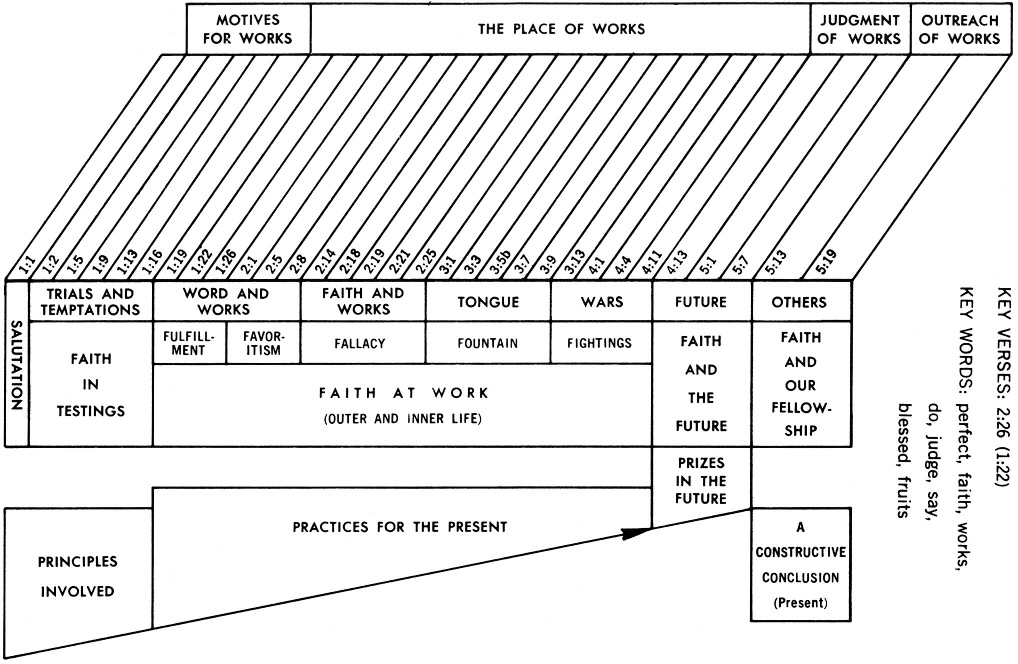
Click chart to enlarge
Chart from recommended resource Jensen's Survey of the NT - used by permission
See also Overview Chart by Charles Swindoll
|
JAMES |
|||||||
| Motives for Works |
The Place of Works: Outward Demonstration of Inner Faith |
Outreach of Works |
|||||
| Jas 1:1-18 | Jas 1:19-2:13 | Jas 2:14-25 | Jas 3:1-12 | Jas 3:13-4:12 | Jas 4:13-5:12 | Jas 5:13-19 | |
| Trials & Temptations |
Word & Works |
Faith & Works |
Tongue | Wars | Future | Others | |
|
Faith |
Fulfill |
Favor |
Fallacy |
Fountain |
Factions |
Faith |
Faith |
|
FAITH AT WORK |
|||||||
The Theme: The Testings of Personal Faith
The trials of the believer (James 1:2–12)
A. The proper attitude toward trials (James 1:2–4)
1. The attitude commanded (James 1:2)
2. The reason indicated (James 1:3)
3. The outcome to be realized (James 1:4)
B. The use of prayer amid trials (James 1:5–8)
1. The need for wisdom (James 1:5a)
2. The request for wisdom (James 1:5b)
3. The bestowal of wisdom (James 1:5c–8)
a. The divine response (James 1:5c)
b. The human obligation (James 1:6–8)
(1) The necessary attitude (James 1:6a)
(2) The rejected character (James 1:6b–8)
C. The correct attitude toward life by the tried (James 1:9–11)
1. The attitude of the lowly brother (James 1:9)
2. The attitude of the rich (James 1:10–11)
a. The reason for the attitude (James 1:10a)
b. The illustration from the flower (James 1:11a)
c. The application to the rich (James 1:11b)
D. The result of enduring trials (James 1:12)
1. The blessedness of endurance (v 12a)
2. The reward of endurance (James 1:12b)
The nature of human temptation (James 1:13–16)
A. The source of human temptation (James 1:13–14)
1. The repudiation of a divine source (James 1:13)
a. The rejection stated (James 1:13a)
b. The rejection vindicated (James 1:13b)
2. The reality of the human source (James 1:14)
B. The consequences of yielding to temptation (James 1:15)
C. The warning against being deceived (James 1:16)
The activity of God in human affairs (James 1:17–18)
A. The Giver of all good gifts (James 1:17)
B. The Author of the believer’s regeneration (James 1:18)
The Test Marks of a Living Faith
Faith tested by its response to the Word of God (James 1:19–27)
A. The reactions to the Word (James 1:19–20)
1. The knowledge possessed (James 1:19a)
2. The reaction demanded (James 1:19b)
3. The reason stated (James 1:20)
B. The reception of the Word (James 1:21)
1. The stripping off of sins (James 1:21a)
2. The appropriation of the Word (James 1:21b)
C. The obedience to the Word (James 1:22–27)
1. The demand for active obedience (James 1:22–25)
a. The statement of the requirement (James 1:22)
b. The illustration of the requirement (James 1:23–25)
(1) The negative portrayal (James 1:23–24)
(2) The positive portrayal (James 1:25)
2. The nature of acceptable obedience (James 1:26–27)
a. The futility of activity without inner control (James 1:26)
b. Acceptable service with inner control (James 1:27) (from Hiebert - James Commentary)
James 1:5 But if any of you lacks wisdom, let him ask of God, who gives to all generously and without reproach, and it will be given to him. (NASB: Lockman)
Greek: Ei de tis humon leipetai (3SPPI) sophias, aiteito (3SPAM) para tou didontos (PAPMSG) theou pasin haplos kai me oneidizontos, (PAPMSG) kai dothesetai (3SFPI) auto.
Amplified: If any of you is deficient in wisdom, let him ask of the giving God [Who gives] to everyone liberally and ungrudgingly, without reproaching or faultfinding, and it will be given him. (Amplified Bible - Lockman)
KJV: If any of you lack wisdom, let him ask of God, that giveth to all men liberally, and upbraideth not; and it shall be given him.
NLT: If you need wisdom—if you want to know what God wants you to do—ask him, and he will gladly tell you. He will not resent your asking. (NLT - Tyndale House)
WBC: But if there is one among you who does lack wisdom, let such a person ask from God who gives to all without hesitation or recrimination, and he will give it.”
Wuest: And if, as is the case, anyone of you is deficient in wisdom, let him keep on presenting his request in the presence of the giving God who gives to all with simplicity and without reserve, and who does not reproach, and it shall be given him.
Young's Literal: and if any of you do lack wisdom, let him ask from God, who is giving to all liberally, and not reproaching, and it shall be given to him;
- if any of you lacks wisdom - Ex 31:3,6; 36:1-4; 1Ki 3:7-12; Job 28:12-28; Pr 3:5-7; 9:4, 56; Je 1:6,7; 2Co 2:16
- Let him ask of God - Jas 1:17; 3:17; James 5:16; 1Chr 22:12; 2Chr 1:10; Pr 2:3, 4, 5, 6; Is 55:6,7; Je 29:12; Je 29:13; Da 2:18, 19, 20, 21, 22; Mt 7:7-11; Lk 11:9-13; Jn 4:10; 14:13; 15:7; Jn 16:23-24; 1Jn 3:22; 5:14,15
- Without reproach - Mt 11:20 Mk 16:14 Lu 15:20-22
- James 1 Resources - Multiple Sermons and Commentaries
Related Passages:
James 1:17+ Every good thing given and every perfect gift is from above, coming down from the Father of lights, with whom there is no variation or shifting shadow.
James 3:17-18+ Regarding God's wisdom (in contrast to earthly wisdom - Jas 3:15, 16) James says "But the wisdom from above is first pure, then peaceable, gentle, reasonable, full of mercy and good fruits, unwavering, without hypocrisy. And the seed whose fruit is righteousness is sown in peace by those who make peace.
GOD THE GENEROUS
GIVER OF WISDOM
Charles Swindoll - After giving a behind-the-scenes look at the ultimate purpose of trials and practical advice on how to endure them positively, James continues the theme by answering another lingering question, “Why do trials overwhelm us?” Why do we sometimes cave in? What things block the joy of enduring life in the crucible? The answer? Our lack of wisdom. (See Insights on James - Page 23)
But if any of you lacks (leipo) wisdom (sophia) - James is not suggesting that only some believers lack wisdom while others possess sufficient wisdom in themselves. IF introduces a first class conditional sentence, meaning the condition is assumed to be true from the author’s perspective. The idea could therefore be paraphrased, “Since any of you lacks wisdom.” James assumes that believers, especially in the midst of trials, continually need divine wisdom. Trials expose our inadequacy, weakness, and inability to respond rightly in our own strength. Left to ourselves, we naturally lack the spiritual discernment, heavenly perspective, and practical insight necessary to navigate suffering in a God honoring way. Trials often unsettle us and tempt us toward fear, discouragement, anger, self reliance, confusion, or doubt. Human wisdom is insufficient to properly interpret adversity or understand what God is accomplishing through it.
Help me, first, to see what I’m going through from Your viewpoint,
and then please give me faith not to give up.”
Swindoll comments that "when we feel ill-equipped to handle a trial, we have one option: Ask God for wisdom. In this context, wisdom can be defined as the ability to view life from God’s perspective. James says this kind of wisdom comes by prayer (1:5). It might be something as simple as, “Lord, in the midst of this loss or heartache or failure, I ask You for wisdom. Help me, first, to see what I’m going through from Your viewpoint, and then please give me faith not to give up.” (See Insights on James - Page 23)
Life Application Study Note - By "wisdom," James is talking not only about knowledge but about the ability to make wise decisions in difficult circumstances. Whenever we need wisdom, we can pray to God, and he will generously supply what we need. Christians don't have to grope around in the dark, hoping to stumble upon answers. We can ask for God's wisdom to guide our choices.The wisdom that we need has three distinct characteristics:
(1) It is practical. The wisdom from God relates to life even during the most trying times. It is not a wisdom isolated from suffering and trials. This wisdom is the tool by which trials are overcome. An intelligent person may have profound ideas, but a wise person puts profound ideas into action. Intelligence will allow someone to describe several reasons why the car broke down. The wise person chooses the most likely reason and proceeds to take action.
(2) It is divine. God's wisdom goes beyond common sense. Common sense does not lead us to choose joy in the middle of trials. This wisdom begins with respect for God, leads to living by God's direction, and results in the ability to tell right from wrong. It is a wisdom that James will describe at length in chapter 3.
(3) It is Christlike. Asking for wisdom is ultimately asking to be like Christ. The Bible identifies Christ as the "wisdom of God" (1 Corinthians 1:24; 2:1-7). (See Life Application Study Bible, Third Edition - Page 2161)
The wisdom James speaks of is not merely intellectual knowledge or theological information, but practical, God given insight enabling believers to view trials from heaven’s perspective and respond in a way that honors the Lord (cf. Pr 2:6+; Eph 1:17+; Col 1:9+). Wisdom from above is the Spirit enabled ability to apply God’s truth to everyday life. James understood that suffering is often wrongly interpreted as evidence of God’s displeasure or abandonment, but Scripture repeatedly teaches otherwise. Job’s suffering was not divine punishment but a testing permitted by God (Job 1–2). Asaph struggled in Psalm 73 to understand why the righteous suffer while the wicked prosper. The prophets suffered precisely because they were faithful to God. Above all, Jesus Himself, the perfectly righteous One, was “a man of sorrows and acquainted with grief” (Isaiah 53:3+). Thus trials are not necessarily signs of God’s anger, but are more often evidence of His refining work, spiritual training, and fatherly love (cf 1Pe 1:6-7+). God uses trials not to destroy faith, but to purify, strengthen, and mature it (Jas 1:2–4+).
David Guzik - In trials, we need wisdom a lot more than we need knowledge. Knowledge is raw information but wisdom knows how to use it.
Warren Wiersbe - When we are going through God-ordained difficulties, what should we pray about? James gives the answer: ask God for wisdom....Someone has said that knowledge is the ability to take things apart, while wisdom is the ability to put them together. Wisdom is the right use of knowledge. All of us know people who are educated fools: they have brilliant academic records, but they cannot make the simplest decisions in life....Why do we need wisdom when we are going through trials? Why not ask for strength, or grace, or even deliverance? For this reason: we need wisdom so we will not waste the opportunities God is giving us to mature. Wisdom helps us understand how to use these circumstances for our good and God’s glory. (Bible Exposition Commentary)
James’ point is that believers do not need to remain perplexed by trials or attempt to face them with their own natural and fallible wisdom. Instead, when trials expose our lack of understanding, our immediate reflex should be to turn to our heavenly Father and ask Him for wisdom. God alone can supply the spiritual insight necessary to endure trials with joy, perseverance, and growing maturity.
To reiterate, wisdom in the context of James 1 refers to spiritual insight and practical understanding that enable a believer to live sensibly, righteously and godly in the midst of trials (cf Titus 2:12+). In seasons of suffering, confusion, or testing, we often do not know how to respond rightly or understand what God is accomplishing through our adversity. Our natural perspective is limited, emotional, and often distorted by fear or discouragement. Therefore, if we lack the wisdom to see our trials from God’s perspective (which is very likely) James says we should ask God for it. He alone can give the discernment necessary to endure trials with faith, perseverance, yielding the blessed fruit of spiritual maturity.
J. B. Phillips offers a helpful paraphrase of James 1:5:
And if, in the process, any of you does not know how to meet any particular problem he has only to ask God - who gives generously to all men without making them feel foolish or guilty - and he may be quite sure that the necessary wisdom will be given him. (Phillips: Touchstone)
It should go without saying that trials
should enhance our prayer life....
--John MacArthur
D Edmond Hiebert explains that "The conditional statement "If any of you lacks wisdom" does not imply doubt concerning the reality of the need. Rather it assumes the reality of the need and views it as a standing fact." The first step in gaining such wisdom is the consciousness of our need for it. "If any of you" indicates that this consciousness of a wisdom shortage must come as an individual recognition. There is no suggestion that there were individual exceptions to this need. The degree of the need may vary, but all believers have a need for this wisdom. As Burdick notes, "James speaks of a period of testing before perseverance has completed its work." The believer needs wisdom to see his trials in a true light and to profit spiritually from them. James knew from Psalm 73 and the book of Job that the trials that often overwhelm the godly create struggles and require God-given wisdom to resolve them. For James, wisdom is more than wide knowledge or the mental sagacity that can express itself in subtle rhetorical distinctions or abstruse arguments. As a Jew, James viewed wisdom as related to the practice of righteousness in daily life. It is the moral discernment that enables the believer to meet life and its trials with decisions and actions consistent with God's will. Johnstone defines it as "that queenly regulative discretion which sees and selects worthy ends, and the best means of attaining them.' (James. Moody)
Ralph Martin adds that "The readers are facing some real problems arising from persecution, and it is the gift and application of wisdom to see these trials in their proper light and respond accordingly. (See James, Volume 48)
Manton writes that the wisdom referred to by James "is to be restricted to the text and not taken in a general way. This wisdom is for bearing afflictions."
Alexander Maclaren observes that with his "if" introduction, as James "gently and courteously puts, as a hypothesis, what is only too certain a fact in those to whom he is speaking; and says, not as he might have done, ‘since you all lack,’ but, with gracious forbearance, ‘if any of you lack wisdom, let him ask of God.’ Now, it seems to me that, in this hypothetical exhortation there are three points to be noted, two of them being somewhat unlike what we should have looked for. One is the great deficiency in the average Christian character—wisdom; another is the great means of supplying it—ask; and the third is the great guarantee of the supply—the giving God, whose gifts are bestowed on all liberally and without upbraiding.
Let him ask (aiteo) of God - Ask is in the present imperative, signifying a command calling for continual action. The idea is not merely “ask once,” but “keep on asking.” Whenever believers sense their need for wisdom in the midst of trials, they are to continually come before God in dependent, prayerful petition. As Rotherham translates it, “Let him be asking of God.” The present tense underscores an ongoing attitude of dependence upon the Lord rather than self reliance.
To fail to ask God for wisdom is, in one sense, to fail to recognize the depth of our need. Trials are designed to expose our insufficiency and drive us to God, teaching us that we do not possess within ourselves the wisdom necessary to respond rightly apart from divine help. God allows circumstances that humble our self confidence so that we might learn to lean wholly upon Him (cf 2Co 1:8–9+).
Thus believers must continually maintain a healthy awareness of their own spiritual poverty and dependence upon God. Jesus said “apart from Me you can do nothing.” (John 15:5+) Only when we recognize our inadequacy are we positioned to humble ourselves before God, the Giver of every good and perfect gift (James 1:17+). Such humble dependence is not weakness but spiritual wisdom, for God “is opposed to the proud, but gives grace to the humble.” (James 4:6+)
The command to ask also implies confidence in God’s character. He is not reluctant to receive needy saints, but delights when His children come to Him acknowledging their dependence and seeking His wisdom.
When life knocks you to your knees,
you're in a good position to pray.
Come, ye disconsolate, where'er ye languish—
Come to the mercy seat, fervently kneel;
Here bring your wounded hearts, here tell your anguish:
Earth has no sorrow that heav'n cannot heal.
—Moore
Hiebert reminds us that "For the Christian, divine wisdom is embodied in the Scriptures, but his study of those Scriptures must be connected with his constant prayer for divine illumination."
Of God (para… theou) literally means “from beside God” or “from the presence of God.” The preposition para conveys the beautiful picture of wisdom being found alongside God Himself, abundantly available in His presence and ready to be given to those who ask. James is reminding believers that true wisdom for enduring trials does not originate from human reasoning, worldly philosophy, or self confidence, but comes directly from God’s own presence. The wisdom we desperately need is not distant or inaccessible but resides “beside God” and is graciously available to every believer who comes to Him in humble dependence. What comfort this brings in times of testing, that the very wisdom needed for the trial is already fully present with God and ours simply for the asking! As Paul says of Christ, “in Whom are hidden all the treasures of wisdom and knowledge” (Colossians 2:3+).
- When trials bring you low, they place you where grace can lift you higher.
- Sometimes God allows us to hit rock bottom so we discover that Christ is the Rock at the bottom!
- The valley of trials is often the place where prayer grows deepest.
- When your strength runs out, God’s strength becomes most visible (2Co 12:9,10+).
- Hardship has a way of driving us to the throne of grace (or at least it should).
- Affliction often bends the knee in preparation for strengthening the soul.
- God sometimes breaks our self reliance to build our dependence on Him.
- Trials are God’s invitation to lean harder on His grace.
- The deepest prayers are often born in the darkest valleys.
- When earthly supports collapse, eternal arms are still underneath. (Underneath Are His Everlasting Arms Dt 33:27)
- Sometimes God puts us flat on our backs so we will finally look up.
- A crushed heart is often fertile soil for growth of one's faith.
- The storm that drives us to God is better than the calm that keeps us from Him.
- Desperation can become the doorway to dependence upon God.
- God often uses burdens to teach us how to lean on Him.
- Trials loosen our grip on earth and tighten our grip on heaven.
- Suffering may bow the head, but it can also lift the eyes toward heaven.
- When we reach the end of ourselves, we often find the beginning of God’s sufficiency.
C H Spurgeon writes - Wisdom for the Asking - IF any of you lack wisdom. There is no “if” in the matter, for I am sure I lack it. What do I know? How can I guide my own way? How can I direct others? Lord, I am a mass of folly, and wisdom I have none. Thou sayest, “Let him ask of God.” Lord, I now ask. Here at thy footstool, I ask to be furnished with heavenly wisdom for this day’s perplexities and for this day’s simplicities; for I know I may do very stupid things even in plain matters, unless thou dost keep me out of mischief. I thank thee that all I have to do is to ask. What grace is this on thy part, that I have only to pray in faith, and thou wilt give me wisdom! Thou dost here promise me a liberal education, and that, too, without an angry tutor or a scolding usher. This, too, thou wilt bestow without a fee—bestow it on a fool who lacks wisdom. O Lord, I thank thee for that positive and expressive word, “It shall be given him.” I believe it. Thou wilt this day make thy babe to know the hidden wisdom which the carnally prudent never learn. Thou wilt guide me with thy counsel, and afterwards receive me to glory. (Spurgeon, C. Faith's Checkbook)
When with expectancy we pray
According to God’s will,
We’ll see Him working in our lives
His purpose to fulfill.
—Sper
True wisdom consists principally of two parts:
the knowledge of God, and the knowledge of ourselves!
—John Calvin
WHO GIVES TO ALL GENEROUSLY AND WITHOUT REPROACH, AND IT WILL BE GIVEN TO HIM: para tou didontos (PAPMSG) theou pasin haplos kai me oneidizontos, (PAPMSG) kai dothesetai (3SFPI) auto:
- Without reproach - Mt 11:20; Mk 16:14; Lk 15:20-22
- James 1 Resources - Multiple Sermons and Commentaries
Related Passages:
James 1:17+ Every good thing given and every perfect gift is from above, coming down from the Father of lights, with whom there is no variation or shifting shadow.
Luke 11:9-13+ “So I say to you, ask, and it will be given to you; seek, and you will find; knock, and it will be opened to you. 10“For everyone who asks, receives; and he who seeks, finds; and to him who knocks, it will be opened. 11“Now suppose one of you fathers is asked by his son for a fish; he will not give him a snake instead of a fish, will he? 12“Or if he is asked for an egg, he will not give him a scorpion, will he? 13“If you then, being evil, know how to give good gifts to your children, how much more will your heavenly Father give the Holy Spirit to those who ask Him?”
GOD GIVES GENEROUSLY
TO ASKING BELIEVERS
Who gives to all generously (haplos) and without reproach (oneidizo), and it will be given to him - The verb gives (didōmi) is in the present tense, emphasizing God’s continual generosity. Giving is not an occasional act for God but is His gracious disposition as our loving Father. He continually and freely gives wisdom to His children who come seeking His help. The phrase to all means without exception. God is not selective, reluctant, or partial, favoring only a spiritual elite. Rather, He welcomes every believer who comes to Him in humble dependence and asks in faith (cf Mt 7:7–11).
James says God gives generously (haplos), a rich word conveying the idea of giving sincerely, openly, liberally, and with singleness of intent. God does not give sparingly or grudgingly, but bountifully and wholeheartedly. His wisdom is never dispensed in miserly portions. He delights to supply what His children need in order to endure trials rightly and walk in obedience.
R Kent Hughes - God is like a pitcher tilted toward his children, just waiting to pour wisdom over the trial-parched landscape of their lives, if they will but ask. Notice how James says God gives—“who gives generously to all without finding fault.” God will pour wisdom over us without putting us down or demeaning us. (See James: Faith That Works)
Equally encouraging is the phrase without reproach (oneidizo). The word oneidizo means to reproach, insult, disgrace, or humiliate someone but here it is preceded by the Greek negative (me), emphasizing that God gives wisdom without scolding, shaming, or humiliating the one who asks. Human beings often grow impatient when repeatedly asked for help, but God never responds that way. He does not shame us for our lack of wisdom, scold us for asking again, or remind us how many times we have failed before. He does not humiliate the believer who comes honestly seeking help. Instead, He invites needy saints to come boldly to Him again and again (Hebrews 4:16+). Furthermore, without reproach (oneidizo) (oneidizō) is in the present tense, indicating that God continually refrains from reproaching those who seek Him for wisdom.
And it will be given to him is a gracious promise from God Himself. When believers ask according to His will for wisdom to endure trials faithfully (cf 1Jn 5:14,15+), they can rest assured that God hears and answers their prayers. The answer may not always come immediately or dramatically, but God faithfully supplies the wisdom needed to respond to trials in a way that honors Him and produces spiritual maturity (Jas 1:2-4). Instead of responding with reproach or disparaging words, God gives divine wisdom generously and graciously. This promise rests on the character of God Himself, Who delights to respond favorably when His children seek Him in humble dependence, acknowledging their need (cf. Mt 7:7-11+; Mk 11:23-25+; Lk 11:9-13+).
As Blanchard so aptly states "It is characteristic of the unbeliever to see God with a clenched fist; it is characteristic of the believer to see Him with an open hand."
As Hiebert says "He does not respond to our petition and then heap insults upon us for asking. He "does not offensively recall the benefits already given, or rebuke the applicant who asks for more.' He does not give in a way that humiliates the receiver. He does not scold because we have inadequately used His former gifts or rebuke us for our repeated lack of wisdom. "God's generosity is measured by what He designs and not by what we deserve."" Rather, when we again ask His help, His gracious response makes us wonder why we were so tardy in asking Him. This does not mean that God never rebukes our sins. He never condones sin. He reproves us for our failure to depend upon Him in our need, and rebukes our distrust of His bounty in supplying our needs. (Ibid)
R Kent Hughes adds "The “trials of many kinds” (Jas 1:2) which come to us all are nothing less than gigantic opportunities to become wise. The geniuses among us have no head start on wisdom. If anyone has an edge, it is those who are undergoing testings with fortitude. You and I will become wise if we are open to the wisdom God offers us. “This is the assurance we have in approaching God: that if we ask anything according to his will, he hears us” (1 John 5:14). We need to learn to ask for wisdom instead of getting angry and saying, “Why me?” By God’s grace let us covenant to ask God for a large measure of that which he has promised. (See James: Faith That Works)
Lacks (3007)(leipo) (cf Jas 1:4+) means to fall short, be destitute or be in need. It pictures one not possessing something which is necessary. It means to be deficient in something that ought to be present for whatever reason. It can also mean to leave, fail or forsake.
LEIPO - 6V - Lk. 18:22; Tit. 1:5; Tit. 3:13; Jas. 1:4; Jas. 1:5; Jas. 2:15
Barclay on the meaning of leipo - it is used of the defeat of an army, of the giving up of a struggle, of the failure to reach a standard that should have been reached. If a man meets his testing in the right way, if day by day he develops this unswerving constancy, day by day he will live more victoriously and reach nearer to the standard of Jesus Christ himself. (Online Commentary - Daily Bible Study)
Wisdom (4678) (sophia) is the ability to judge correctly and to follow the best course of action, based on knowledge and understanding. Knowledge is the acquisition of facts. Wisdom is the ability to use this knowledge rightly. A person may acquire much knowledge, but without wisdom his acquired storehouse of facts will do him little good; in fact, it may even be spiritually harmful to him.
SOPHIA IN JAMES - Jas. 1:5; Jas. 3:13; Jas. 3:15; Jas. 3:17
Spiritual wisdom is godly wisdom (contrasting with worldly wisdom - study and make a list of the contrasts in Jas 3:13-18 and 1Cor 1,2) which involves living life in the light of the revelation of God’s Will in His Word and applying this knowledge to specific situations. Biblical wisdom is definable as skill for living. God's plan to redeem us destroyed the wisdom of the worldly wise men (1Co 1:19). In fact, human wisdom never could comprehend God's plan for salvation (1Co 1:21). Paul was not bound by the limits of human wisdom because the Holy Spirit conveyed spiritual wisdom through him (1Cor 2:13). Human wisdom is totally inadequate to accept God's salvation (1Co 3:18,19). Spiritual wisdom is given only by the Holy Spirit. In the Old Testament, Solomon exemplified this wisdom (Mt 12:42). When Jesus came, His wisdom also outshone the wisdom of the wisest among men (Mt 13:54). This wisdom was seen in the Lord Jesus, even when He was a small Boy (Lk 2:40,52). When leaders became necessary in the Jerusalem church, the apostles set about to select men who possessed this spiritual wisdom (Acts 6:3).
Wisdom is the right use of knowledge
Generously (574) haplos (adverb = haplous) means bountifully, liberally with singleness of heart, freely, simply. The adverb haplōs (ἁπλῶς) in James 1:5 is a rich and multifaceted word that conveys far more than the simple idea of giving “a lot.” Derived from the adjective haplous (ἁπλοῦς), meaning “single,” “simple,” or “undivided,” the term fundamentally carries the idea of singleness, openness, or uncomplicated sincerity. In classical Greek usage, haplōs could describe something done “simply,” “plainly,” “openly,” or “without ulterior motive.” It was used in contrast to duplicity, complexity, or divided intention. Depending on the context, it could also mean “sincerely,” “frankly,” “straightforwardly,” or even “briefly.” Thus the word often possessed ethical overtones, describing a person whose actions were unmingled with selfishness, hypocrisy, manipulation, or hidden agenda. Liddell-Scott notes usages such as “singly,” “in one way,” “frankly,” and “without reserve,” all of which contribute to the flavor of the term.
In the Septuagint, haplōs appears only a few times, primarily in wisdom contexts, which is significant given James’ emphasis on divine wisdom. In Proverbs 10:9, the Hebrew word tōm (“integrity,” “wholeness,” “blamelessness”) is translated by haplōs, highlighting the ethical idea of sincerity and uprightness. The one who walks “with integrity” walks openly, honestly, and without duplicity. The Wisdom of Solomon uses the word in the sense of “simply” or “merely” (Wisdom 16:27), while 2 Maccabees 6:6 uses it to express the inability of faithful Jews even “simply” to identify themselves as Jews under persecution. These usages collectively reinforce the ideas of simplicity, openness, sincerity, and singleness of action.
In the New Testament, haplōs occurs only once, in James 1:5 and most English translations render haplōs as “generously” or “liberally” because the context clearly concerns God’s gracious giving. Yet the word likely communicates more than mere quantity. James is not only saying that God gives abundantly, but that He gives with a simple, open, sincere, and ungrudging heart. God gives wisdom without mixed motives, reluctance, irritation, or hidden reservation. His giving is wholehearted and uncomplicated. Unlike fallen humans, whose giving may be calculated, self-serving, or resentful, God gives with perfect singleness of purpose and benevolence. The believer approaching God for wisdom in the midst of trials need not fear divine annoyance or reluctance. God is not stingy with wisdom, nor does He dispense it begrudgingly. He gives freely, openly, and graciously to those who ask in faith.
Trials expose human inadequacy and
drive believers to seek divine wisdom.This idea beautifully fits the broader context of James 1. Trials expose human inadequacy and drive believers to seek divine wisdom. James assures suffering Christians that God’s character is generous and sincere toward His children. The Lord does not shame believers for their weakness or mock them for repeatedly coming to Him in need. Instead, He continually gives wisdom with divine simplicity and liberality. In this sense, haplōs reveals not merely the manner of God’s giving, but the very character of God Himself. His giving flows from an undivided, gracious, and benevolent heart (cf. Matthew 7:7–11; Romans 8:32).
Without reproach (3679)(oneidizo from óneidos = disgrace, abuse, or object of disgrace or shame) means to assail with abusive words, to insult, to hurl an invective, to upbraid, to slander, to falsely accuse or to speak disparagingly of a person in manner not justified, to find fault in a way that demeans the other, to mock, to heap insults upon as a way of shaming. The main idea is to to find fault in a way that demeans the one being reproached. It means to upbraid, which in turn means to criticize severely, find fault with, reproach severely or scold vehemently. In short oneidizo refers to especially strong verbal abuse, something God will not do when we ask Him for wisdom. God is willing to hear and respond to His children’s call in their need, an encouraging truth well attested to by Jesus (Mt 7:7; 18:19; 21:22; cp Jn 14:13, 14; 15:7; 16:23). In Jeremiah (Jer 29:12,13) we see a similar willingness that God is ready to hear, and this should give all believers great assurance and encouragement to approach His Throne with boldness.
F. B. Meyer on value of trials...
“A bar of iron worth $2.50, when wrought into horseshoes is worth $5. If made into needles it is worth $175. If into penknife blades it is worth $1,625. If made into springs for watches it is worth $125,000. What a ‘trial by fire’ that bar must undergo to be worth this! But the more it is manipulated, and the more it is hammered and passed through the heat, beaten, pounded, and polished, the greater its value.”
Christian, are you wondering about the trials through which you are passing? With impatient heart are you saying, “How long, O Lord?” The heat of the flame and the blows of the hammer are necessary if you are to be more than an unpolished, rough bar of iron. God’s all-wise plan, though it calls for the fire, produces the valuable watch spring of maturity. His very best for your life has behind it His perfect timing. - P. R. Van Gorder (Our Daily Bread, Copyright RBC Ministries, Grand Rapids, MI. Reprinted by permission. All rights reserved)
Steven Cole sermon James 1:5-8 - How to Obtain Wisdom from God -
When I was in the Coast Guard, sometimes the skipper would ask me to steer the boat. He would tell me the compass course. My job was to keep the boat on that course. The wind and currents would cause the boat to drift, but I had to keep steering it back to the designated course. Eventually, we would come in sight of Long Beach Light, and right into the harbor. One day, we had to go out in a terrible storm to rescue a man and his daughter whose sailboat had become disabled. On that occasion, the skipper did not ask me to steer the boat, but gave the task to a more experienced man. It is relatively easy to steer the boat in calm seas, but it’s an altogether different matter to steer it in sixty mile-per-hour winds and thirty-foot waves.
As a veteran shepherd of souls, James knew that it’s relatively easy to live as a Christian when things are calm. But it’s a much more difficult prospect when the storms of life hit with full force. At such times, it’s easy to get off course or even to make shipwreck of your faith. His readers were facing various difficult trials. They were dispersed abroad (Jas 1:1), mostly due to persecution. They had suffered the loss of their homes and possessions. Many were not able to escape persecution even in the places to which they had fled. James wanted them to know how to navigate through these trials so that they could not only endure, but joyfully endure (Jas 1:2).
As we saw last time, James exhorts them (and us) to adopt a radical attitude when we encounter various trials: “Consider it all joy” (Jas 1:2). We can do this if we understand a reassuring truth, “that the testing of your faith produces endurance” (Jas 1:3). But it is necessary to submit to the refining process: “let endurance have its perfect result” (jas 1:4). But there is a further ingredient that we need to endure trials joyfully so as to bring glory to God, namely, God’s wisdom. So James tells us how to obtain wisdom from God: To obtain wisdom to endure trials joyfully, see your need, know your God, and then ask Him in faith to meet your need.
When James says, If any of you lack wisdom, he is not suggesting that some have it together so well that they have no need of wisdom. The Greek conditional sentence implies that we all lack wisdom when we face difficult trials. But, we don’t always see our need for God’s wisdom. Thus,
1. To obtain wisdom to endure trials joyfully, see your need. We need to be clear about the terms that James uses here:
A. James is talking about God’s wisdom that enables us to endure trials joyfully.
When you study the Bible, it is crucial to study the text in its context, and also to understand how the words are used in Scripture. In the context of James 1, wisdom refers to the wisdom that we need to endure trials with God’s joy, so that we will be “perfect and complete, lacking in nothing” (Jas 1:4). James realizes that in a time of trials, God’s people often do lack His wisdom on how to endure those trials with joy. Thus he adds verses 5-8. Of course, we can ask God for wisdom in any matter in life that we face, but in the context here, it is focused on asking God for the wisdom that we need to endure trials joyfully.
Enduring trials with joy goes against our natural inclination. When trials hit, we’re all prone to ask, “Why is this happening to me?” But that is usually the wrong question. Sometimes, God graciously reveals to us the reason for our suffering, but not always. Often the answer to why we suffer must wait until we’re in heaven. The important questions to ask when a trial hits are, “How can I understand this trial from God’s perspective? How can I navigate through this storm in such a way as to bring glory to God? How can this trial help me grow in maturity?”
Warren Wiersbe tells about a secretary of his who was going through difficult trials. She had had a stroke, her husband had gone blind, and then he had to be taken to the hospital where, as far as they knew, he would die. Wiersbe saw this woman in church one Sunday and assured her that he was praying for her.
She startled him by asking, “What are you asking God to do?” He replied, “I’m asking God to help you and strengthen you.” “I appreciate that,” she said, “but pray about one more thing. Pray that I’ll have the wisdom not to waste all of this!” Wiersbe observed, “She knew the meaning of James 1:5.” (Bible Exposition Commentary)
It also helps to understand the meaning of the Old Testament word for wisdom (my sources here include, see TWOT and New International Dictionary of New Testament Theology 3:1026-1029). James is steeped in the Old Testament.
The main idea of Old Testament wisdom is that of skill. It includes the skill of workers who made garments for the high priest and who were able to work with metal, stone and wood (Ex 28:3; 31:3, 4, 5; 36:1, 2). It also extends to those who are able to execute a battle plan (Isa. 10:13), lead in government (Dt. 34:9), and shrewdly assess a difficult situation and persuade others to take necessary action (2Sa 20:22). It refers to those who speak prudently (Ps 37:30) and use their time carefully (Ps 90:12). Rather than just theoretical understanding, biblical wisdom focuses on practical living in obedience to God’s revealed will. The fool in Proverbs is not the man who is mentally deficient, but rather the man who is morally deficient. He ignores God’s commandments and lives according to human wisdom. The wise man lives in obedience to God. Thus he skillfully puts together a life that is beautiful from God’s perspective. Thus the Bible affirms (Job 28:28), “The fear of the Lord, that is wisdom; and to depart from evil is understanding” (see also Ps 111:10)
So, by wisdom, James is talking about the skill that enables us to live obediently before God in the midst of trials. The result will be a truly beautiful life that glorifies God.
B. You must see your need for wisdom to drive you to God to supply the need.
By nature, all of us are self-sufficient know-it-alls: “Mother, please, I can do it by myself!” In America, it’s the spirit of rugged individualism, or the self-made man. But I’m sure that every culture idolizes the strong person who seems to have it all together by himself, because pride is endemic to the human heart.
To come to God, we must humble ourselves and admit that we do not know what we need to know in order to live joyfully in the face of trials. In fact, a main reason that God sends trials is to humble us from our pride, so that we look to Him. The proud Laodicean church thought that they were rich and had no needs, but God’s view was that they were “wretched and miserable and poor and blind and naked” (Rev. 3:17). So a prerequisite to obtaining wisdom from God is to recognize our lack of wisdom.
2. To obtain wisdom to endure trials joyfully, know your God.
Our text shows four ways in which we must know God in order to obtain His wisdom:
A. Know that God is the source for all wisdom.
To ask God for wisdom implies that He can deliver. The Bible plainly states, “For the Lord gives wisdom; from His mouth come knowledge and understanding” (Pr 2:6). It warns, “There is no wisdom and no understanding and no counsel against the Lord” (Pr 21:30). In other words, if worldly “wisdom” contradicts or goes against God, it is false “wisdom.” Only God’s wisdom stands.
I was a philosophy major in college. “Philosophy” comes from two Greek words meaning, “the love of wisdom.” But I discovered that worldly philosophers are not so much in love with wisdom as they are with their own wisdom! They are not so much interested in how to live wisely before God, whose existence they question or deny, but rather in showing how wise they are in being able to win arguments.
Writing to those who took pride in the great Greek philosophers, Paul contrasted the so-called wisdom of this world with God’s wisdom as seen in the cross of Christ (1Co 1:18-30). He sarcastically asks (1Co 1:20, 21), “Where is the wise man? Where is the scribe? Where is the debater of this age? Has not God made foolish the wisdom of the world? For since in the wisdom of God the world through its wisdom did not come to know God, God was well-pleased through the foolishness of the message preached to
save those who believe.”
The point is, if you have not come as a sinner to the cross of Christ to obtain God’s mercy through faith, you do not know God and thus you cannot obtain the wisdom that comes only from Him.
But, how does God impart the wisdom that we need?
B. Know that God reveals His wisdom by His Spirit through His Word.
God’s wisdom does not come as a sudden revelation or impression that hits out of nowhere. You won’t find it in “Dear Abby” or Readers Digest, unless they accidentally say something that coincides with God’s Word. God’s wisdom comes directly from God and is revealed in His Word. It especially centers in the knowledge of Christ, “in whom are hidden all the treasures of wisdom and knowledge” (Col 2:3; see also, Col 1:9; Ep 1:16, 17). God reveals His wisdom by the Holy Spirit to those who are spiritual (1Co 2:6-16). That wisdom has to do with knowing how to apply biblical truth to particular situations in life. Thus if you are not spending consistent time learning God’s Word, you will not have the wisdom that you need when trials hit. The time to seek wisdom from God is before the calamity hits (Prov. 1:20-33). C. Know that God reveals His wisdom by His Spirit through His Word to those whose hearts are fully His. James goes on to say that we must ask God for wisdom “in faith without any doubting” (Jas 1:6), and that the one who doubts is “a double-minded man, unstable in all his ways” (Jas 1:8). The Greek word, literally, is a “double-souled” man. It refers to a man whose heart is divided between allegiance to God and the allurements of the world. In other words, he’s not sure that he wants to know God’s wisdom, because he isn’t fully committed to submitting to it. It would be nice to know God’s wisdom for his situation, but before he commits to obeying it, he needs to find out if he likes it. In other words, he’s shopping for answers that fit what he wants to do. If God’s wisdom sounds good, he’ll follow it. But if worldly wisdom sounds better, he’ll follow that. James says that such a person will not receive anything from the Lord. I have counseled with women who profess to be Christians, but they are engaged to be married to unbelievers. I always ask, “Do you want God’s blessing on your marriage?” They always say, “Yes.” I’ve never had one say no. I show them in God’s Word that He commands us not to be unequally yoked with unbelievers. This creates a trial for the young woman! She wants to marry this nice (they’re all “nice”!) unbelieving man, but God’s Word says, “Don’t do it.” Not only would it be very difficult to break up with him, it would also mean being single with no prospect for marriage in sight. That’s a trial! The test is, “Will she obey God, or is she a double-minded woman, unstable in all her ways?”
One woman told me that she had prayed about marrying her unbelieving fiancé, and she “had a peace about it.” I told her that she had sinned by praying about this situation, because God has clearly revealed His will about marrying unbelievers. She didn’t
want to know God’s will; she only wanted to do her will. So if we want God’s wisdom in any decision or in any trial, we must be fully committed to obey Him.
D. Know that God gives generously and without reproach to all that ask Him in faith.
When verse 5 says that God “gives to all,” you need to define “all” by the context (as always). God does not give wisdom to everyone in the world, but rather to every believer in Christ who asks in faith. But James emphasizes that the manner in which God gives is “generously and without reproach.” “Generously” has the nuance of “simply,” or “without mental reservation” (Peter Davids, Commentary on James [Eerdmans], pp. 72-73). He gives because He delights to give to His children. “Without reproach” means that He does not say, “What? You again? I just gave you what you wanted and you’re back here bugging Me again?” God never makes you feel cheap or irresponsible for asking again and again. Rather, He invites you to ask for all the wisdom you need.
Some fathers are stingy and selfish. Their standard answer is, “No!” Or, if they grudgingly give you what you ask for, they never let you forget it. You have to budget your requests carefully, because if you get a yes on something, it will be a long, long time before you get another yes. I thank God that my Dad is not at all like that! He is a very generous, giving father, both with his money and his time. But if your dad was of the stingy type, you need to be careful not to view God in the same way. God is ready and willing to lavish His wisdom on His children who ask for it.
So to obtain wisdom from God to endure trials joyfully, the first thing is to recognize your need for it. Then know your God, who is the source of all wisdom. He reveals that wisdom chiefly in His Word through His Spirit to those whose hearts are ready to obey Him. He gives generously and without reproach to all that ask. That leads to the means of obtaining wisdom from God:
3. To obtain wisdom to endure trials joyfully, ask God in faith to meet your need.
There are three parts to this:
A. Ask.
The verb (Jas 1:5) is present tense, indicating that you probably will need to ask more than once to obtain what you need. But it’s a simple command, “Let him ask.” There is no magic formula or special incantation that you need to mutter while you sprinkle holy water on a consecrated altar. He does not say, “Let him work for or earn or buy wisdom.” It’s not for sale; it’s a gift. Just ask.
B. Ask God.
“Let him ask of God” (Jas 1:5). Every believer is a priest who can approach God directly. You do not need to go through a priest or a pastor. I am not saying that it is wrong to go to a spiritually mature counselor, who can help direct you to God’s Word for wisdom. But you don’t need to approach God through any human intermediary. If you know Christ, ask God directly.
The Bible never tells us to pray to the virgin Mary or to some other saint. It never tells us to look within ourselves and decide what to do based on subjective feelings. It certainly never tells us to consult with a worldly psychologist or with Dear Abby! I find it incredible at times to read in that column of pastors asking her for advice! Actually, I did write to her once with a question, but she didn’t respond. I asked her how she determines her moral standards, since she clearly rejects God’s Word as the standard. She dispenses all kinds of advice on moral issues, but it’s pure coincidence when her advice lines up with the Bible. But I digress!
Peter tells us that God’s “divine power has granted to us everything pertaining to life and godliness through the true knowledge of Him who called us by His own glory and excellence. For by these He has granted to us His precious and magnificent promises…” (2Pe 1:3, 4a). Paul assures us (Eph. 3:12) that in Christ “we have boldness and confident access through faith in Him.” So, when you need wisdom to endure a trial in a manner pleasing to God, go directly to God in prayer through the mediation of Jesus Christ. Ask Him to direct you to the wisdom in His Word that you
need. He promises to give it generously!
Some Christians make the mistake of saying, “But I’m not worthy for God to grant my request. I’ve sinned too many times. I’ve failed Him so often. So I can’t go to Him and ask for wisdom.”
But that’s an excuse for disobedience and unbelief. Every Christian has sinned. Every Christian has failed. Every Christian is unworthy. We do not come to God based on our worthiness. We come to God on the merit of Jesus Christ and His shed blood. Since God commands us to ask Him for wisdom, we are disobedient and unbelieving if we do not ask.
C. Ask God in faith, without doubting.
Faith is essential in approaching God, because as Hebrews 11:6 says, “Without faith it is impossible to please Him, for he who comes to God must believe that He is and that He is a rewarder of those who seek Him.” It would be silly to ask something of a Being
that you weren’t sure existed. Or, if He did exist, you weren’t sure if He cared about your request or if He had the power to grant it! So to ask from God, you must believe that He exists, that He personally cares for you, and He is able to give you the wisdom that you need to endure your trial with His joy.
If you doubt God’s existence or His ability to give you wisdom for your need, James says (1:6) that you’re “like the surf of the sea, driven and tossed by the wind.” The surf has no inner power or principle to direct itself. It is totally at the will of the wind. It is completely unstable and chaotic. And, it can be a destructive force as it batters a boat or drives it against the rocks. That’s a picture of the person who lacks faith in God.
As I said, at the root of this unbelief is being double-minded. The person who doubts God is not committed to obey God no matter what. His heart is not fully surrendered to do God’s will.
He’s curious about God’s wisdom, to find out if it agrees with him, but he’s not committed to do it if it involves suffering or inconvenience. That person, James says, “ought not to expect that he will receive anything from the Lord” (1:7). So the first thing in obtaining wisdom from God is to surrender your heart to Him.
Conclusion - Joni Eareckson Tada, as most of you know, was paralyzed from the neck down in a diving accident when she was 17. She wrote this about her suffering (Joni [Zondervan], p. 154):
God engineered the circumstances. He used them to prove Himself as well as my loyalty. Not everyone had this privilege. I felt there were only a few people God cared for in such a special way that He would trust them with this kind of experience. This understanding left me relaxed and comfortable as I relied on His love, exercising newly learned trust. I saw that my injury was not a tragedy but a gift God was using to help e conform to the image of Christ, something that would mean my ultimate satisfaction, happiness—even joy.
That is God’s wisdom on how to endure a major trial with joy! She did not get that wisdom from the world. She did not make it up herself. It came from God, through His Word. If you need God’s wisdom for how to endure any major or minor trial with joy, ask Him in faith and He will give it. (James 1:5-8 How to Obtain Wisdom from God)
The Lord searches all hearts and understands all the intent of the thoughts. —1 Chronicles 28:9
According to lie-detection experts, “Our natural tendency is to trust people.” However, not everyone is trustworthy all the time. Signs that someone may be lying include fidgeting, lack of eye contact, and noticeable pauses in speaking. Even with these clues, experts warn that it is still quite tough to tell deceivers from honest people.
Joshua needed to know if he could trust the Gibeonites. When they discovered that God wanted him to get rid of some neighboring nations (Josh. 9:24), they pretended to be from a faraway land. They arrived in worn-out tunics and patched sandals, claiming, “Our garments and our sandals have become old because of the very long journey” (v.13). The Israelites were suspicious (v.7), but they “did not ask counsel of the Lord” (v.14); and Joshua unwisely made a peace treaty with the deceivers.
Many want to gain our trust: salespeople, financial advisors, or estranged family members. If we wonder: “Can I trust you?” we shouldn’t decide quickly, based only on what seems right to us. It’s better to seek counsel from God’s Word (Ps. 119:105), godly people (Prov. 11:14), and God Himself (James 1:5).
Wisdom from above will help us decide who to trust.
Protect us from deceivers, Lord,
Who lie and plot to take
Advantage of us and confuse
Decisions we must make.
—Sper
A desire for discernment is God’s call to prayer.
We can defeat doubt when we remind ourselves that no matter what happens in life, He cares deeply about us and longs to give us the wisdom to handle what comes our way (1 Pet. 5:7; James 1:5). Our faith will grow stronger as we realize that our heavenly Father is gracious, delighting to give good gifts to His children (Mt. 7:11). Humbly but confidently, we can come to Him with our requests.
James 1:5,6
Kara, a converted orphan girl, lived in a part of India where wickedness and spiritual darkness were prevalent. Fearing she would be made a slave and suffer abuse, she appealed to a visiting missionary who taught in another village to take her into her home. The sympathetic woman replied, "I'm sorry, but we have no vacant rooms and no money to build any." Kara tried to hold back the tears as she said, "O Missionary, please pray that God will let you take me, and I'll pray too." When the woman reached home that night, she found a letter from America with a large sum of money. Encouraged, she decided to use it to build an extra little room for the child who so badly needed a place to stay. The next morning she sent a helper to fetch Kara. She didn't expect them to return until late that night, for the journey was long. So she was surprised when the messenger came back with the young girl at noon. "When I prayed," the child said simply, "God assured me that it was His will for me to come to your home, so I thought I might as well get started." "She was almost here when I met her," said the missionary's helper with an approving smile!
TODAY IN THE WORD
If any of you lacks wisdom, he should ask God, who gives generously to all without finding fault, and it will be given to him. - James 1:5
Waiting is never easy, but God can use waiting to accomplish great things. Following Jesus’ ascension, the disciples returned to Jerusalem and waited--just as Jesus had commanded them (Acts 1:4). They didn’t know how long they would have to wait, and as it turned out, it was only ten days.
Acts 1:14 tells us that Jesus’ followers prayed while they were waiting for God to reveal what would happen next. Notice how they prayed: in a unified way and constantly. Recall from yesterday’s study that Jesus had prayed for the unity of His followers. We see that prayer being answered. Only lives transformed by Jesus could have enabled a Jewish political activist like Simon to be unified in prayer with a Roman tax collector, Matthew, whom the Jews hated. In “volume one” of the gospel of Luke, we learn that after His resurrection and prior to His ascension, Jesus “opened [the disciples’] minds so they could understand the Scriptures” (Luke 24:45). It’s likely that the 120 who were waiting here in Acts were also studying God’s Word.
Perhaps it was this focus on God’s Word that led Peter to connect the situation regarding Judas with the Psalms. First, Peter acknowledged Judas’s original share in the ministry. The parenthetical note in verses 18 and 19 was probably inserted by Luke for the benefit of the letter’s recipient, Theophilus (Acts 1:1). It shows why Peter saw fulfillment of Psalm 69:25 in the terrible consequences of Judas’s betrayal. From Psalm 109:8, Peter understood the need to find a replacement for Judas.
APPLY THE WORD
All of us are interested in determining God’s will for our lives. At times, we might be tempted to cast lots!
"Now give me wisdom and knowledge, that I may go out and come in before this people" (2 Chronicles 1:10).
A Persian philosopher, when asked how he had acquired so much knowledge, answered, "By not being too proud to ask questions when I was ignorant."
Even though Solomon was Israel's mighty king, he too was willing to admit his ignorance. But he wanted more than mere knowledge. When the Lord said to him, "Ask! What shall I give you?" (2 Chronicles 1:7), Solomon made only one request. He asked for the insight and ability to judge God's people righteously. God gave him this, and He added wealth and honor as a bonus.
Solomon had his priorities right. He kept the people's welfare, not his own, in mind. Too often we want wisdom in order to achieve wealth and honor, but God doesn't work that way. He gives it to those who will honor Him whatever may happen.
Teenagers stand on the threshold of becoming adults and agonize over the question, "What should I do with my life?" Adults face job changes, family responsibilities, and many other far-reaching decisions. In times like these we need to search our hearts and ask, "Why do I want wisdom?" When we get our priorities straight, we can claim the promise of James 1:5, "If any of you lacks wisdom, let him ask of God, who gives to all liberally . . . and it will be given to him." It's always appropriate to ask God for wisdom when our heart's desire is to honor Him and do what's right. —D. J. De Haan (Reprinted by permission from Our Daily Bread Ministries. Please do not repost the full devotional without their permission.)
They are wise who take God for a teacher.
Growing Wise
Give to Your servant an understanding heart. -1 Kings 3:9
Solomon was a young man charged with the responsibility of governing one of the most prosperous kingdoms in the ancient Near East. Israel was a significant power then, her domain extending from the Euphrates River to the border of Egypt. Responsible for so much, Solomon knew he needed help. So when God asked the young king what He could do for him, Solomon did not ask to be healthy or wealthy. He asked to be wise (1 Kings 3:9). This request pleased the Lord.
God said to him, "Because you have asked this thing, . . . I have done according to your words; see, I have given you a wise and understanding heart" (1 Kings 3:11-12).
The word translated "understanding" in Solomon's request (v.9) actually means "hearing." God gave Solomon a hearing heart so he could judge the people, and "discern between good and evil."
Wise men and women hear God through His Book. They read other books, of course, but they judge them all by the Word of God. There is no greater wisdom.
If you want wisdom, ask God for it. The apostle James said, "If any of you lacks wisdom, let him ask of God, who gives to all liberally and without reproach, and it will be given to him" (James 1:5). -D H R (Reprinted by permission from Our Daily Bread Ministries. Please do not repost the full devotional without their permission.)
I scanned God's teachings thoughtlessly,
In haste I did not hear Him;
Then prayerfully I read once more,
This time my heart drew near Him.
-Gustafson
God opens the door of His wisdom
to those who open their Bibles
God reveals His mind to hearts that open His Word. (Ps 119:18; 1 Cor 2:10–12)
The Bible opened in humility becomes heaven’s classroom. (James 1:21; Ps 25:9)
God’s wisdom flows to those who linger in His Word. (Ps 1:2–3; Col 3:16)
The more we open the Scriptures, the more the Scriptures open us. (Heb 4:12–13)
An open Bible is often the doorway to an open heart. (Acts 16:14; Luke 24:32)
God shines His light on those who search His Word. (Ps 119:105, 130)
Scripture is the lamp God lights for willing hearts. (Ps 119:105; 2 Pet 1:19)
The treasures of God are uncovered by those who dig in His Word. (Pr 2:1–5; Mt 13:44)
God teaches those who take time to sit at His feet in Scripture. (Luke 10:39; Ps 32:8)
The Bible is not merely read; it reads the reader. (Heb 4:12)
Hearts grow wise when Bibles stay open. (2 Tim 3:15; Ps 19:7)
God’s guidance is usually found along the pathway of His Word. (Ps 119:105; Pr 3:5–6)
A neglected Bible often leads to a neglected soul. (Dt 8:3; Amos 8:11)
Those who walk in the Word will not wander long in darkness. (Ps 119:9–11; John 8:12)
God’s voice is most clearly heard through God’s Word. (2 Tim 3:16–17; Heb 1:1–2)
The opened Scriptures become windows to the heart of God. (Luke 24:27, 32)
Divine wisdom is discovered one verse at a time. (Josh 1:8; Ps 119:98–100)
The soul that feeds on Scripture learns to think God’s thoughts after Him. (Rom 12:2; Phil 2:5)
God plants wisdom in hearts cultivated by His Word. (Col 3:16; James 1:21)
An open Bible invites the transforming work of the Spirit. (2 Cor 3:18; John 17:17)
Is one of his attributes 1 Samuel 2:3 ; Job 9:4
DESCRIBED AS
- Perfect Job 36:4; 37:16
- Mighty Job 36:5
- Universal Job 28:24 ; Daniel 2:22 ; Acts 15:18
- Infinite Psalm 147:5 ; Romans 11:33
- Unsearchable Isaiah 40:28 ; Romans 11:33
- Wonderful Psalm 139:6
- Beyond human comprehension Psalm 139:6
- Incomparable Isaiah 44:7 ; Jeremiah 10:7
- Underived Job 21:22 ; Isaiah 40:14
- The gospel contains treasures of 1 Corinthians 2:7
- Wisdom of saints is derived from Ezra 7:25
- All human wisdom derived from Daniel 2:1
- Saints ascribe to him Daniel 2:20
EXHIBITED IN
- His works Job 37:16 ; Psalm 104:24; 136:5 ; Proverbs 3:19 ;Jeremiah 10:12
- His counsels Isaiah 28:29 ; Jeremiah 32:19
- His foreshadowing events Isaiah 42:9; 46:10
- Redemption 1 Corinthians 1:24 ; Ephesians 1:8; 3:10
- Searching the heart 1 Chronicles 28:9 ; Revelation 2:23
- Understanding the thoughts 1 Chronicles 28:9 ; Psalm 139:2
EXHIBITED IN KNOWING
- The heart Psalm 44:21 ; Proverbs 15:11 ; Luke 16:15
- The actions Job 34:21 ; Psalm 139:2,3
- The words Psalm 139:4
- His saints 2 Samuel 7:20 ; 2 Timothy 2:19
- The way of saints Job 23:10 ; Psalm 1:6
- The want of saints Deuteronomy 2:7 ; Matthew 6:8
- The afflictions of saints Exodus 3:7 ; Psalm 142:3
- The infirmities of saints Psalm 103:14
- The minutest matters Matthew 10:29,30
- The most secret things Matthew 6:18
- The time of judgment Matthew 24:36
- The wicked Nehemiah 9:10 ; Job 11:11
- The works, &c of the wicked Isaiah 66:18
Nothing is concealed from Psalm 139:12
The wicked question Psalm 73:11 ; Isaiah 47:10
Should be magnified Romans 16:27 ; Jude 1:25
James 1:6 But he must ask in faith without any doubting, for the one who doubts is like the surf of the sea, driven and tossed by the wind. (NASB: Lockman)
Greek: aiteito (3SPAM) de en pistei, meden diakrinomenos, (PMPMSN) o gar diakrinomenos (PMPMSN) eoiken (3SRAI) kludoni thalasses anemizomeno (PPPMSD) kai rhipizomeno; (PPPMSD)
Amplified: Only it must be in faith that he asks with no wavering (no hesitating, no doubting). For the one who wavers (hesitates, doubts) is like the billowing surge out at sea that is blown hither and thither and tossed by the wind. (Amplified Bible - Lockman)
KJV: But let him ask in faith, nothing wavering. For he that wavereth is like a wave of the sea driven with the wind and tossed.
ERV But when you ask God, you must believe. Don’t doubt him. Whoever doubts is like a wave in the sea that is blown up and down by the wind.
EASY But when you ask God for something, you must trust him completely. Do not have other ideas in your mind. People who are not sure that God will help them are like the waves in the sea. The wind blows the water one way and then it blows the water another way.
NLT: But when you ask him, be sure that you really expect him to answer, for a doubtful mind is as unsettled as a wave of the sea that is driven and tossed by the wind. (NLT - Tyndale House)
Phillips: But he must ask in sincere faith without secret doubts as to whether he really wants God's help or not. The man who trusts God, but with inward reservations, is like a wave of the sea, carried forward by the wind one moment and driven back the next. (Phillips: Touchstone)
Wuest: But let him be presenting his request in a trusting attitude, not in an expression of that hesitation which vacillates, for the person who vacillates is like the surf of the sea, driven and tossed by the wind;
Young's Literal: and let him ask in faith, nothing doubting, for he who is doubting hath been like a wave of the sea, driven by wind and tossed,
- Ask in faith - Mt 21:22; Mk 11:22-24; 1Ti 2:8; He 11:6
- James 1 Resources - Multiple Sermons and Commentaries
Related Passages:
Hebrews 11:1+ Now faith is the assurance of things hoped for (ED: IN THIS CASE THE THINGS "ASKED FOR"), the conviction of things not seen.
Matthew 7:7-11 Ask (present imperative see our need to depend on the Holy Spirit to obey), and it will be given to you; seek (present imperative), and you will find; knock (present imperative), and it will be opened to you. 8 “For everyone who asks (present tense) receives, and he who seeks finds, and to him who knocks it will be opened. 9 “Or what man is there among you who, when his son asks for a loaf, will give him a stone? 10“Or if he asks for a fish, he will not give him a snake, will he? 11“If you then, being evil, know how to give good gifts to your children, how much more will your Father who is in heaven give what is good to those who ask Him!
Matthew 21:21-22+ And Jesus answered and said to them, “Truly I say to you, if you have faith and do not doubt, you will not only do what was done to the fig tree, but even if you say to this mountain, ‘Be taken up and cast into the sea,’ it will happen 22 And all things you ask (aiteo) in prayer, believing (pisteuo), you shall receive.
Comment: As Morris rightly observes " There are other conditions for answered prayer, of course (1Jn 5:14; Jas 4:3), but true belief would be founded upon these other conditions.
Mark 11:22-24+ And Jesus answered saying to them, "Have (present imperative see our need to depend on the Holy Spirit to obey) faith in God. 23 "Truly I say to you, whoever says to this mountain, 'Be taken up and cast into the sea,' and does not doubt in his heart, but believes that what he says is going to happen, it shall be granted him. 24 "Therefore I say to you, all things for which you pray and ask, believe (present imperative) that you have received them, and they shall be granted you.
1 John 5:14-15+ (ANOTHER CONDITION FOR ANSWERED PRAYER) This is the confidence which we have before Him, that, if we ask anything according to His will, He hears us. 15 And if we know that He hears us in whatever we ask, we know that we have the requests which we have asked from Him.
Matthew 14:30-31+ (PETER'S DOUBTING AS HE LOOKED AT THE WAVES TOSSING - HE FIXED HIS EYES OF HIS CIRCUMSTANCES NOT ON CHRIST!) But seeing the wind, he became frightened, and beginning to sink, he cried out, “Lord, save me!” 31Immediately Jesus stretched out His hand and took hold of him, and *said to him, “You of little faith, why did you doubt?”
Romans 4:20+ (ABRAHAM'S EXAMPLE OF UNWAVERING FAITH) yet, with respect to the promise of God, he did not waver in unbelief but grew strong in faith, giving glory to God,
DANGER OF
DOUBTFUL ASKING
William Barclay has a comment on the flow of thought - There is a close connection between this passage and what has gone before. James has just told his readers that, if they use all the testing experiences of life in the right way, they will emerge from them with that unswerving constancy which is the basis of all the virtues. But immediately the question arises, "Where can I find the wisdom and the understanding to use these testing experiences in the right way?" James' answer is, "If a man feels that he has not the wisdom to use aright the experiences of this life--and no man in himself possesses that wisdom--let him ask it from God." (James 1)
But (de) (see term of contrast) introduces a qualification regarding God's promise in Jas 1:5 - "But when he asks, he must believe and not doubt." God is not a genie in a bottle or a dispensing machine into which we insert a prayer and out comes our selection. The promise of answered prayer makes its spiritual demands upon the one asking - it is not simple prayer that succeeds, but prayer with confidence. So the praying that receives answers from God is marked by faith and the absence of doubt.
He must ask (aiteo) in faith (pistis) -- The verb ask (aiteo) is in the present imperative, signifying a continual command to believers who desire God to answer their prayer for wisdom in the midst of trials. James is calling for an ongoing attitude of dependent, believing prayer. The verb ask is singular rather than plural, emphasizing that each individual believer must personally meet this requirement. No one can rely upon the faith of another; every child of God must come to the Father personally, asking with confidence and trust.
Swindoll comments that "James isn’t referring to saving faith in 1:6. He has in mind sustaining faith—the kind of faith that allows us to endure trials, to align our will and our attitude with a divine perspective, abandoning ourselves to God and His mighty hand. (See Insights on James - Page 23)
To ask “in faith” means to ask with full conviction and confidence in God’s character, promises, and willingness to answer. Faith is continued confidence in God despite the circumstances of the test and holds on to God during the tests! Faith is essential to the entire Christian life, and James makes clear that there can be no truly effectual prayer apart from faith. The writer of Hebrews echoes this principle “And without faith it is impossible to please Him, for he who comes to God must believe that He is and that He is a rewarder of those who seek Him.” (Hebrews 11:6+) In the context of James 1, the “reward” especially refers to God’s gracious answer to the believer’s sincere request for wisdom. To ask in faith, therefore, means to pray without doubting God’s promise to give the wisdom needed for the trial. James is not calling for faith in faith itself, but faith in a faithful God. The believer must trust that God hears, cares, and responds according to His perfect character. He is our Father, and as a good and gracious Father, He does not remain indifferent or silent toward the cries of His children (Matthew 7:7–11+).
When it comes to praying in faith,
most of us pray for rain but do not carry our umbrellas.
-- Vance Havner
Technical Note: Ask in faith is locative of sphere. You are probably asking "What's that?" or "So what?" The preposition "IN" in this context identifies the phrase as locative of sphere, which means the realm, atmosphere, or condition. Thus the idea is not merely “ask with faith” as if faith were a tool, but rather ask while living, standing, and operating in the realm of trusting dependence upon God. In other words, faith is the atmosphere in which the request is made. Think of a fish in your aquarium. Take him out of the "sphere" of the water and he does not function very well! That's the picture of praying in faith, in the atmosphere of trusting your Father to hear and to answer according to His good and acceptable and perfect will. Remember the old television program in the 1950's? Father Knows Best! To say it another way "ask in faith" is asking while remaining in the sphere of believing trust in God rather than in the sphere of divided doubting.
We must not only believe God,
we must believe we believe God.
-- Vance Havner
Faith (pistis) in this context does not refer to the body of doctrine one believes ("the faith"), but to a wholehearted attitude of trust, surrender, and dependence upon God as He has revealed Himself in Jesus Christ. It is the proper human response to the goodness, faithfulness, and trustworthiness of God. When believers approach God with their petitions, they must trust not only in His power to answer, but also in His wisdom to answer according to His perfect character, purposes, and timing. True believing prayer rests confidently upon who God is. It takes its stand upon the character of God, trusting that He is good, wise, faithful, and gracious in all that He does.
Life Application Study Note - We must believe not only in the existence of God but also in his loving care. This includes relying on God and expecting that he will hear and answer when we pray. We must put away our critical attitude when we come to him. God does not grant every thoughtless or selfish request. We must have confidence that God will align our desires with his purposes. For more on this concept, read the note on Matthew 21:22. They must ask God for it. Four facts about God encourage us to ask for this wisdom. First, God is a giving God. Giving to those who ask from him is natural for God. Second, God gives generously to all. He has no favorite recipients of his gifts, but gives to all classes, races, and types of people. Third, God gave without finding fault. God does not give in such a way as to humiliate us. He does not chastise us for our failures or hold our unworthiness against us. He is always ready to add new blessings to old ones without finding fault in us for our many shortcomings. Finally, God promises to answer those who come seeking wisdom. A request according to his will receives his answer (1 John 5:14-15). (See Life Application Study Bible, Third Edition - Page 2161)
Warren Wiersbe - James not only explained what to ask for (wisdom), but he also described how to ask. We are to ask in faith. We do not have to be afraid, for God is anxious to answer, and He will never scold us! “He giveth more grace” (James 4:6). He also gives more and more wisdom. The greatest enemy to answered prayer is unbelief. (Bible Exposition Commentary)
NO DOUBTING
ALLOWED!
Without any doubting (diakrino - present tense) - The phrase without any doubting uses the verb diakrino in the present tense, conveying the idea of not continually wavering or vacillating in one’s trust toward God. It pictures one whose mind is not "divided." The NLT paraphrases the idea well: “When you ask Him, be sure that you really expect Him to answer.” The issue is not intellectual difficulty or the occasional struggle with uncertainty, but a divided heart that hesitates between trusting God and relying on something else. Jesus expressed a similar principle when He said, “No one can serve two masters” (Matthew 6:24+). Doubting, in James’ context, refers to divided allegiance, an inner wavering in which a person is torn between confidence in God’s character and dependence upon human wisdom, circumstances, or self-reliance. James is calling believers to approach God with a sincere, settled confidence that He is good, wise, generous, and fully able to answer prayer according to His perfect will. This does not mean that a believer must possess flawless or perfect faith, but rather a genuine trust that rests upon God’s character and promises even in the midst of trials.
Bruce Barton adds that "Doubting here has nothing to do with doubting whether God can do something; rather, it describes a people "divided" between being self-centered and being God-centered. This is the reason why James adds the idea of the "wave," because it really means to be tossed to and fro between self and God. Doubting is trusting self more than God and being earth-centered rather than heaven-centered in our prayer requests and in handling the problems of this life. WHAT DOES AND NOT DOUBT MEAN? The phrase "without doubting" is not connected with new faith or weak faith or faltering faith. If it was, none of us would have our prayers answered. It is not honest intellectual doubt or lack of clarity about the solution. It is not confusion over whether it is right to ask. It is divided loyalty. It is doubting that God cares, that he is powerful, that he is good. (See Life Application New Testament Commentary - Page 1072)
Webster defines “to doubt” as “to lack confidence in,” “to waver or fluctuate in opinion,” “to hesitate,” or “to be in suspense and uncertainty respecting truth or fact.” Thus the doubting James condemns is not humble questioning or careful reflection, but spiritual indecision and instability. As Richard Hooker wisely observed, “Even in matters divine, concerning some things, we may lawfully doubt and suspend our judgment.” James therefore is not forbidding honest questions, but warning against a heart that vacillates between belief and unbelief, desiring God’s help while remaining unwilling to rely fully upon Him. It is the picture of a soul divided between two competing trusts. Ralph Martin notes that “the disposition of doubt places the character of God in question” (cf. Mt 21:21; Ro 4:20) and thereby hinders the believer’s reception of God’s gracious provision. In the context of James 1, such wavering especially obstructs the reception of divine wisdom needed to endure trials faithfully.
Are you sure?…
Are you sure you're sure?
-- Edith Bunker
The one who doubts asks the questions Edith Bunker did on the famous television show "All in the Family" - "Are you sure?… Are you sure you're sure?" Doubt is surely the hallmark of skeptics, but that is not who James is describing in this section. He is speaking of believers who are experiencing this nagging sensation in their soul which we call "doubt". To be sure sometimes a doubting believer is a good thing, when he or she armed with Biblical truth takes a stand against some doctrine which is biblically questionable (cf Acts 17:11+, Heb 5:14+). Such doubting is desirable in the believer. However, in the present context doubting is not desirable for optimal spiritual health. As discussed below, it is important to distinguish doubt from rank unbelief, although doubting can evolve into unbelief. We should differentiate doubting, which is common even within faith from unbelief which is not. Doubt arises from our human weakness which in itself lacks the confidence to trust fully in God especially when being fashioned by tests and afflictions.
The one who doubts continually asks questions like Edith Bunker’s famous line from the television show All in the Family: “Are you sure? … Are you sure you’re sure?” While doubt is often associated with skeptics and unbelievers, that is not primarily the kind of person James is describing in James 1:6. James is speaking to believers who experience a nagging wavering within their souls, an inner struggle to rest fully in God’s character and promises during trials. To be sure, there is a kind of doubting that can be healthy and even necessary. Believers should question teachings and claims that are biblically questionable, testing everything by the truth of Scripture, much like the noble Bereans who carefully examined the Scriptures daily to verify Paul’s teaching (Acts 17:11+), or mature believers who discern good from evil through spiritual maturity (Hebrews 5:14+). Such discernment is commendable. However, the doubting James warns against is spiritually unhealthy because it reflects a wavering trust toward God Himself.
It is also important to distinguish doubt from outright unbelief, although persistent doubt can eventually harden into unbelief if left unresolved. Doubt may exist within genuine faith, whereas unbelief rejects faith altogether. Even sincere believers may struggle with doubt because of human weakness, fear, confusion, or painful circumstances. Trials and afflictions often expose the frailty of our confidence and reveal how difficult it can be to trust God fully when His purposes are unclear. In that sense, doubt arises from the weakness of fallen humanity, which naturally hesitates to trust God completely. Yet James calls believers to move beyond this instability into a settled confidence in the goodness, wisdom, and faithfulness of God, especially in the midst of testing.
For (gar) (term of explanation) - Whenever you observe a FOR at the beginning of a sentence or clause, take a pause. Ask the Spirit what He is explaining. And you can know it is a term of explanation if you can substitute "because" and the sentenc still makes sense. By pausing to ask a question, you are developing the discipline of active reading (rather than how most folks read Scripture which is relatively "passive"). In addition you are learning the equally blessed discipline of meditating on the Scripture! (cf Joshua 1:8+, Ps 1:2-3+). As you learn to ask questions of the text, you will find yourself functioning like an interrogative reporter looking for the big story! You are becoming more like an explorer than a (Bible) tourist! (Read Mortimer Adler's analogy of pitching and catching a ball in his section entitled "Active Reading" - see page 21 in his online classic How to Read a Book)
KJV Bible Commentary writes that doubting…"suggests an anxious reevaluation, “second thoughts” about one’s prayer. This type of person compares to a wave which is driven and tossed by circumstances. Christians, by faith, should persistently avow under any circumstances that God is all He claims to be."
Os Guinness has an interesting analysis on doubt writing that…
Contrary to widespread misunderstanding, doubt is not the same as unbelief, so it is not the opposite of faith. Rather it is a state of mind in suspension between faith and unbelief. To believe is to be of one mind in accepting something as true; to disbelieve is to be of one mind in rejecting it; to doubt is to waver somewhere between the two, and thus to be of two minds. This important distinction uncovers a major misconception of doubt—the idea that a believer betrays faith and surrenders to unbelief by doubting.
This twoness or doubleness represents the deepest dilemma of doubt. The heart in doubt is a divided heart. Here is the essence of the biblical view of doubt, which is echoed in human language and experience from all around the world. All of the New Testament words for doubt—for example, dipsuchos, diakrinō, distazō, dialogizoma, and meteō rizomai—have this sense of doubleness. So also do many other languages. The Chinese speak of a person with “a foot in two boats” and the Navajo Indians of “that which is two with a person.”
An all-important difference exists, therefore, between the open-minded uncertainty of doubt and the closed-minded certainty of unbelief. Because faith is crucial, doubt is serious. But because doubt is not unbelief it is not terminal. It is a halfway stage that can lead on to a deepened faith as easily as it can break down to unbelief.
The doubleness or indecision of doubt can be described from the outside with high-noon clarity. But from the inside it is foggy, gray, and disorienting. The world of doubting feels like a world with no landmarks and no bearings. Thus a second tip for those who want to develop a view of doubt that strengthens faith is: Learn to anticipate and resist the confusions of doubt.
Followers of Christ are not simply fair-weather believers. They are realistically committed to truth, people who “think in believing and believe in thinking” as Augustine expressed it. They are, therefore, like experienced pilots who can fly in bad weather as easily as in good, by night as well as by day, and upside down as well as right side up. Faith’s rainy days will come and go and dark nights of the soul may threaten to overwhelm, but safe flying is possible for those who have a solid grasp of the instruments (God’s truth and promises) and a canny realism about the storm and stress of doubt.
Many common confusions about doubt can be cleared away with help. For example, doubt is confused with unbelief, which reinforces doubtfulness by adding guilt. Others divorce faith from knowledge. Knowledge becomes assigned strictly to the realm of certainty and faith to uncertainty. There is the confusion of thinking that, because God is the answer to all doubt, only answers that are theologically correct “God-talk” are sufficient. Such confusions are an aggravation of the doubt, not its real source.
The first two tips for handling doubt are vital but obviously preliminary. Without remembering the character of doubt, any outbreak of uncertainty can call faith into question before doubt ever specifically doubts anything. Without resisting doubt’s confusion, the symptoms can sidetrack a serious investigation of the root causes. But when these two steps have been followed the real job remains—the believer must tackle those root causes.
The third tip for those who want to strengthen faith through doubt is that they must resolve the specific challenges that underlie it.
Any attempt to draw up an exhaustive catalog of doubts would be overwhelming and depressing. But anyone who listens to doubters and studies doubt in the light of the Scriptures soon finds that there are “family resemblances” among doubts. It is, therefore, possible and helpful to discern a broad overview of the main types. Of course, these broad “families” are only generalizations. Doubting is specific, and doubts strike everyone differently. But, when used with sensitivity and compassion, the categories are anything but a straitjacket. They help people to see where they are, how they got there, and—most importantly—how they can get out.
It has been my privilege to talk to hundreds of individuals who have experienced different kinds of doubt and differing levels of pain and confusion. No one who understands the pain and perils of doubt can be blithe about it. Loss of trust in God is truly life’s ultimate loss. But such is the nature of faith in God through Christ, affirmed by countless Christians through history, that there can be a constructive side of doubt.
True, there is no believing without some doubting. But since belief strengthens as the Christian understands and resolves doubt, we can say that, if we doubt in believing, we nevertheless also believe in doubting. (If you would like more information on doubt from the perspective of some of the finest Christian minds of modern times I would strongly recommend procuring the book edited by R C Sproul Doubt & Assurance. Page 33. Grand Rapids: Baker Book House)
FOR THE ONE WHO DOUBTS IS LIKE THE SURF OF THE SEA, DRIVEN AND TOSSED BY THE WIND: o gar diakrinomenos (PMPMSN) eoiken (3SRAI) kludoni thalasses anemizomeno (PPPMSD) kai rhipizomeno; (PPPMSD):
- The one who doubts - Ge 49:4; Ep 4:14; He 10:23; 13:9; 2Pe 2:17; Jude 1:12,13
- James 1 Resources
Related Passages:
Ephesians 4:14+ As a result, we are no longer to be children, tossed here and there (kludonizomai - from kludon = surge of the sea, Lk 8:24, Jonah 1:4, 11, 12) by waves, and carried about by every wind (anemos) of doctrine, by the trickery (kubeia) of men, by craftiness in deceitful scheming
Hebrews 10:23+ Let us hold fast the confession of our hope without wavering,(EXPLAINS WHY WE ARE TO HOLD FAST) for He who promised is faithful;
SPIRITUAL INSTABILITY AND
THE DOUBTING HEART
For (gar) the one who doubts (diakrino) is like (eoika) the surf (kludon) of the sea (thalassa), driven (anemizo) and tossed (rhipizo) by the wind - For (gar) (see term of explanation) introduces a vivid illustration describing the character and condition of the doubting supplicant. James paints a dramatic picture of instability and inner turmoil in order to warn believers against wavering faith and to dissuade them from such doubt.
The one who doubts (diakrino) - The present tense participle describes a person who continually wavers or habitually doubts. This is not referring to a momentary struggle or an occasional question arising from human weakness, but to an ongoing pattern of inner instability and divided trust. Such a person fluctuates between confidence in God and reliance upon human reasoning, circumstances, or self-dependence. James is describing a settled disposition of spiritual vacillation rather than a temporary lapse of faith during a difficult trial.
Significantly, James himself would have understood the struggle with doubt firsthand. As the half-brother of Jesus, he initially struggled to believe fully in Jesus’ true identity during the Lord’s earthly ministry (John 7:5). However, after the resurrection, the risen Christ personally appeared to James (1 Corinthians 15:7), an encounter that profoundly transformed him from a skeptic into a devoted servant and leader in the early church. Because of his own experience, James writes not with harshness or cold condemnation, but with pastoral concern and practical realism. He understood both the weakness of wavering faith and the necessity of coming to settled trust in God. Thus, James speaks with both authority and compassion to believers who wrestle with doubts concerning divine truths and God’s dealings in their lives.
Hiebert - Doubting conveys the picture of a divided mind, being torn in two directions. The individual is in a state of oscillation between the competing desires within him. The present tense denotes that this "halting between two opinions" has become The present tense denotes that this "halting between two opinions" has become habitual, while the middle voice indicates that the conflict is rooted in his competing personal desires. Although he has given expression to his petition to God, he is not at rest in himself concerning what he has asked for, and then again he desires something else. His uttered request has not terminated the inner indecision between the competing desires. His inner yearnings are divided between God and the world (Jas 4:3,4). It is not merely a state of mental indecision but an inner moral conflict. He is divided between the desire to say yes to his request and the desire to say no to it, with the inclination to say no gaining the upper hand. It is an inner unwillingness to rely wholly upon God. As Stier aptly remarks, "A doubting petitioner offers not to God a steady hand or heart, so that He cannot deposit in it His gift.' (Ibid)
William MacDonald sums up this section writing "We must believe He loves and cares, and that nothing is impossible with Him. If we doubt His goodness and His power, we will have no stability in time of trouble. One minute we might be resting calmly on His promises, but the next we will feel that God has forgotten to be kind. We will be like the surge of the sea, rising to great heights, then falling back into valleys—troubled and tossed. God is not honored by the kind of faith that alternates between optimism and pessimism. He does not give divine insight to such vacillating, unstable men (Jas 1: 7, 8+). In Jas 1:5, 6, 7,8, the source of wisdom is God; it is obtained by prayer; it is available to everybody; it is given liberally and without reproach; the crucial condition is that we ask in faith, with no doubting. (Borrow Believer's Bible Commentary)
Hiebert concludes his comments on this section noting that "The passive voice of the participles (anemizo and rhipizo) further conveys the thought that the billows respond to forces from without. The water has no inner stability to stand against the outer forces. So also the doubter, lacking a firm inner will of his own, is deficient in his ability to attain any fixed goals. He is totally "untrustworthy with regard to gaining any end that needs determined perseverance in a certain course."' This picture of the instability of the sea is one that James would be familiar with from his acquaintance with the Sea of Galilee as well as the eastern shores of the Mediterranean. Being alert to spiritual lessons from nature, James saw in this scene of instability "a wonderfully apt symbol of a mind that cannot fix itself in belief." Divine wisdom cannot dwell in a personality so unstable and unable to carry-out a determined course of action. (Ibid)
Elijah gives us a picture of doubting in his address to the Israelites whose sin was not that of totally rejecting Yahweh, but of seeking to combine His worship with Baal worship…
And Elijah came near to all the people and said, "How long will you hesitate (KJV = How long halt ye between two opinions?) between two opinions? If the LORD is God, follow Him; but if Baal, follow him." But the people did not answer him a word. (1Ki 18:21)
Is like (eoika) the surf (kludon) of the sea (thalassa), driven (anemizo) and tossed (rhipizo) by the wind - Is like is the Greek word eoika (only here and Jas 1:23) which is the perfect tense form of eikō, meaning “to appear,” “to resemble,” or “to be like.” The verb describes a striking resemblance or likeness. The perfect tense emphasizes the abiding and continuing nature of the comparison. James is saying that the doubting person has become and remains like the surf of the sea, characterized by continual instability, restlessness, and agitation. The imagery vividly portrays the enduring condition of the one who habitually wavers in trust toward God.
Like the surf (kludon) Introduces a term of comparison, specifically a simile, the first of a number of similes James uses in his epistle (cp Jas 1:6, 10, 18, 23, 2:26, 5:3, 10). Recall that a simile is a figure of speech in which the subject is compared to another subject, for example, "You are acting as nervous as a long-tailed cat in a room full of rocking chairs". Frequently, similes are marked by use of the words "as" or "like". A simile is a word picture that draws a comparison between two things. The idea behind figures of speech is that a picture is worth a thousand words. But remember for accurate Biblical interpretation, one still needs to interpret the figure of speech in the context in which it is found. Figures of speech are not an encouragement to let your imagination run wild. Whatever "picture" the figure of speech is intended to paint is best evaluated by a careful examination of the context.
Bruce Barton "The behavior of sea waves is unsettled, going back and forth, driven by the varying winds, like the doubter's mind. Such a person wavers between choices and may, in the end, make no decision at all. Circumstances become the decision makers in that person's life. When God's promises and commands are given equal authority with our feelings, desires, and the world's ideas, the result is an unsettled sea of indecision and chaos. (See Life Application New Testament Commentary - Page 1072)
David Guzik - A wave of the sea is a fitting description of one who is hindered by unbelief and unnecessary doubts. A wave of the sea is without rest, and so is the doubter. A wave of the sea is unstable, and so is the doubter. A wave of the sea is driven by the winds, and so is the doubter. A wave of the sea is capable of great destruction, and so is the doubter
Warren Wiersbe - Many Christians live like corks on the waves: up one minute, down the next; tossed back and forth. This kind of experience is evidence of immaturity. (Bible Exposition Commentary)
Ralph Martin observes that "The point to be enforced is that the doubter is as insecure and unsteady as a boat rocked in turbulent seas."
Adam Clarke - The man who is not thoroughly persuaded that if he ask of God he shall receive, resembles a wave of the sea; he is in a state of continual agitation; driven by the wind, and tossed: now rising by hope, then sinking by despair.
R Kent Hughes - The doubter is completely out of control. He is on a wild ride to nowhere. (Ibid)
The Expositor's Greek Testament notes that like the surf of the sea is"a very vivid picture; the instability of a billow, changing from moment to moment, is a wonderfully apt symbol of a mind that cannot fix itself in belief."
Marvin Vincent says, “"Anyone who has watched the great ocean-swell throwing itself up into pointed waves, the tops of which are caught by the wind and fanned off into spray, will appreciate the vividness of the figure.....The emphasis falls on tossing; moving before the impulse of the wind, but not even moving in regular lines; tossed into rising and falling peaks.”
Ask (154) (aiteo) means to ask for something or make petition. It can mean to ask with a sense of urgency and even to the point of demanding. For example, Thayer notes that the use of aiteo in 1Cor 1:22 conveys a stronger sense of demand. One gets that same sense of aiteo in Mt 27:20 (in fact NJB translates it "demand.") Aiteo is sometimes combined with other prayer words like proseuchomai (Mt 21:22, Col 1:9), so the idea of aiteo is to be asking for something while praying (proseuchomai). Of children of God asking their Father (Mt 6:8). In Mt 7:8-11 three of the uses (Mt 7:8-9, 11) of aiteo are in the present tense picturing continued asking. Of the sons of Zebedee making request (present tense) of Jesus (Mt 20:20) In Mt 5:42 commands His readers to be generous with those asking (may allude to begging; giving alms was viewed highly in the ancient world). The derivative noun aitema (155) is used in Php 4:6 and 1Jn 5:15 of requests, in the sense of a petition of men to God, both NT uses in the plural. In Lk 23:24 aitema is used more in the sense of a demand by the Jews to Pilate.
Aiteo conveys the sense of asking with urgency, even to the point of demanding and refers to the seeking by the inferior from the superior (Acts 12:20), by a beggar from the giver (Acts 3:2 ), by the child from the parent (Mt 7:9-+) or by a man from God (Mt 7:7+; cf 1Jn 3:22). Aiteo emphasizes that the prayer is for something to be given rather than for something to be done.
Zodhiates - Ask, request, beg. The seeking by the inferior from the superior (Acts 12:20); by a beggar from the giver (Acts 3:2); by the child from the parent (Matt. 7:9); by man from God (Matt. 7:7; James 1:5; 1 John 3:22).(I) To ask, with the acc. of thing in pará (3844), from (with the gen. of person). (II) Generally (Matt. 5:42; 7:9, 10; Mark 6:22–25; Luke 11:9–13; 1 John 5:14–16; Sept.: Josh. 15:18; 19:50). Spoken in respect to God, to supplicate, to pray for (Matt. 6:8; 7:11; 18:19; James 1:5, 6). With the word Theós (2316), God, implied (Matt. 7:7, 8; Col. 1:9; James 4:2, 3; Sept.: Is. 7:11, 12). In His requests to the Father, the Lord never uses aitéō, to beg, but erōtáō, to ask as an equal of the Father on behalf of Himself or His disciples (John 14:16; 16:26; 17:9, 15, 20). (III) To ask or call for, require, demand (Luke 1:63; 12:48; 23:23; Acts 3:14; 25:15; 1 Pet. 3:15; Sept.: Job 6:22; Dan. 2:49). (IV) To desire (Acts 7:46; Sept.: 1 Kgs. 19:4; Eccl. 2:10; Deut. 14:26). (BORROW The Complete Word Study Dictionary: New Testament page 102
Faith (4102)(pistis) is synonymous with trust or belief and is the conviction of the truth of anything, and in Scripture usually speaks of belief respecting man's relationship to God and divine things, generally with the included idea of trust and holy fervor born of faith and joined with it. As pistis relates to God, it is the conviction that God exists and is the Creator and Ruler of all things well as the Provider and Bestower of eternal salvation through Christ. As faith relates to Christ it represents a strong and welcome conviction or belief that Jesus is the Messiah, through Whom we obtain eternal salvation and entrance into the Kingdom of Heaven. Stated another way, eternal salvation comes only through belief in Jesus Christ and no other way.
Expositor's Greek Testament adds that "pistis as used in this epistle (OF JAMES), refers to the state of mind in which a man not only believes in the existence of God, but in which His ethical character is apprehended and the evidence of His good-will towards man is acknowledged; it is a belief in the beneficent activity, as well as the personality, of God; it includes reliance on God and the expectation that what is asked for will be granted by Him (cp qualification 1Jn 5:14, 15). The word here does not connote faith in the sense of a body of doctrine. This idea of faith is not specifically Christian; it was, and is, precisely that of the Jews; with them 'emuwnah/'emunah (0530 Ed: key idea is faithfulness, certainty, fidelity, to remain in one place, firmness, steadiness, cp description of Moses' hands held up until sunset - Ex 17:12, describes God Himself Dt 32:4, totally dependable!) is just that perfect trust in God which is expressed in what is called the "Creed of Maimonides," or the "Thirteen principles of faith"; it is there said:
I believe with perfect faith that the Creator, blessed be His name, is the Author and Guide of everything that has been created, and that He alone has made, does make, and will make all things.
In Talmudic literature, which in this as in so much else, embodies much ancient material, the Rabbis constantly insist on the need of faith as being that which is "perfect trust in God". Those who are lacking in faith (cp Mt 6:30-+) are held up to rebuke…
Faith therefore in the sense in which it is used in this epistle, was the characteristic mark of the Jew as well as of the Christian. (Ed note: Not that Jews were saved by faith in God but only by faith in Messiah)… (Doubting, diakrino) means to be in a critical state of mind, which is obviously the antithesis to that of him who has faith; it excludes faith ipso facto (cp Mt 21:21 which uses the same verb diakrino). (James 1 - Expository Notes)
Doubting (1252) (diakrino from diá = separation, "thoroughly back and forth" + kríno = distinguish, decide, judge. From root kri- = separation) literally means "to separate throughout or wholly", to judge "back and forth" between two which can either (positively) refer to close-reasoning (discrimination) or negatively "over-judging" (going too far, vacillating). The context indicates which sense is meant. And so the primary idea of diakrino is that of differentiating by separating (Mt 16:3). Other meanings include making a distinction between persons by evaluation (Acts 15:9, 1Co 4:7, Acts 11:12+). To make an evaluation, to judge or to pass judgment (1Co 11:31, 14:29). Diakrino was a technical legal term meaning to render a legal decision (1Co 6:5). As used by James, et al (Mt 21:21, Mk 11:23, Ro 14:23, Jude 1:22) in the middle voice (reflexive, initiates and participates in the action) diakrino means in essence to be at odds with one's self and so to hesitate or waver. One author says it is pictured by the idea of divided in one's mind. This person is the one who is vacillating between two opinions or decisions.
Diakrino is translated in the NAS as - decide (1), discern (1), disputed (1), doubt (2), doubting (2), doubts(2), judge (1),judged (1), made distinction (1), made distinctions (1), misgivings (2), pass judgment (1), regards as superior (1), took issue (1),waver (1).
Diakrino is used 19 times in the NT…Matthew 16:3 Matthew 21:21 And Jesus answered and said to them, "Truly I say to you, if you have faith, and do not doubt, you shall not only do what was done to the fig tree, but even if you say to this mountain, 'Be taken up and cast into the sea,' it shall happen.
Mark 11:23 "Truly I say to you, whoever says to this mountain, 'Be taken up and cast into the sea,' and does not doubt in his heart, but believes that what he says is going to happen, it shall be granted him.
Acts 10:20+ "But arise, go downstairs, and accompany them without misgivings; for I have sent them Myself."
Acts 11:2+ And when Peter came up to Jerusalem, those who were circumcised took issue with him,
Acts 11:12+ "And the Spirit told me to go with them without misgivings. And these six brethren also went with me, and we entered the man's house.
Acts 15:9+ (Peter at the Jerusalem Council) and He made no distinction between us and them, cleansing their hearts by faith.
Romans 4:20 (+) yet, with respect to the promise of God, he did not waver in unbelief, but grew strong in faith, giving glory to God,
Comment: Vincent says diakrino here implies a mental struggle. Robertson translates, “He was not divided in his mind by unbelief.”
Romans 14:23 (+) But he who doubts is condemned if he eats, because his eating is not from faith; and whatever is not from faith is sin.
1 Corinthians 4:7 For who regards you as superior? And what do you have that you did not receive? But if you did receive it, why do you boast as if you had not received it?
1 Corinthians 6:5 I say this to your shame. Is it so, that there is not among you one wise man who will be able to decide between his brethren,
1 Corinthians 11:29 For he who eats and drinks, eats and drinks judgment to himself, if he does not judge the body rightly.
1 Corinthians 11:31 But if we judged ourselves rightly, we should not be judged.
1 Corinthians 14:29 And let two or three prophets speak, and let the others pass judgment.
James 1:6 But let him ask in faith without any doubting, for the one who doubts is like the surf of the sea driven and tossed by the wind.
James 2:4 have you not made distinctions among yourselves, and become judges with evil motives?
Jude 1:9 But Michael the archangel, when he disputed with the devil and argued about the body of Moses, did not dare pronounce against him a railing judgment, but said, "The Lord rebuke you."
Jude 1:22 And have mercy on some, who are doubting;
Diakrino is used 23 times in the Septuagint (LXX) -Ex 18:16; Lev. 24:12; Dt. 33:7; 1Ki. 3:9; 1Chr 26:29; Esther 8:12; Job 9:14; 12:11; 15:5; 21:22; 23:10; Ps 50:4; 82:1; Pr 31:9; Eccl 3:18; Je 15:10; Ezek 20:35, 36; 34:17, 20; 44:24; Joel 3:2, 12; Zech. 3:7
Surf (wave) (2830) (kludon related to kluzo = to wash against) from Homer onward describes a dashing or surging and thus a wave or violent agitation of the sea. Kludon is not just a single wave but a succession of waves, one long ridge of water after another being swept along by the wind. A billow. A stormy sea. Rough water. Raging water. A succession of waves. One Greek secular use was to picture "a sea of troubles" (we can probably all identify with that metaphor!). In medicine it was used to describe "splashing" in the stomach or in the chest (as in pleurisy, inflammation of the pleura lining the lungs). Only uses in Jas 1:6 and Lk 8:24.
Luke 8:24+ (DISCIPLES TESTED BY WAVES - JESUS' FIRST QUESTION WAS "WHERE IS YOUR FAITH?") They came to Jesus and woke Him up, saying, “Master, Master, we are perishing!” And He got up and rebuked the wind and the surging waves (kludon), and they stopped, and it became calm. 25 And He said to them, “Where is your faith?” They were fearful and amazed, saying to one another, “Who then is this, that He commands even the winds and the water, and they obey Him?”
Vincent - A wave, surge. Only here and Lk 8:24; though the kindred verb occurs at Eph 4:14+. The word is admirably chosen, as by a writer who lived near the sea and was familiar with its aspects. The general distinction between this and the more common kuma, wave, is that kludon describes the long ridges of water as they are propelled in horizontal lines over the vast surface of the sea; while kuma denotes the pointed masses which toss themselves up from these under the action of the wind. Hence the word kludon here is explained, and the picture completed by what follows: a billow or surge, driven by the wind in lines, and tossed into waves. Both here and in the passage in Luke the word is used in connection with the wind. It emphasizes the idea of extension, while the other word throws forward the idea of concentrating into a crest at a given point. Hence, in the figure, the emphasis falls on the tossing; not only moving before the impulse of the wind, but not even moving in regular lines; tossed into rising and falling peaks. (James 1: Greek Word Studies) (Bolding added)
Of the sea (2281) (thalassa) is the sea a great body of water nearly enclosed by land. Seas are properly branches of the ocean, and upon the same level. Large bodies of water inland, and situated above the level of the ocean, are lakes.
Driven (416) (anemizo from anemos = wind, used in Ep 4:14) means to be driven by the wind and is used only here in the NT.
Notice that both anemizo and rhipizo are in the present tense which pictures the continuing impact of the wind upon the sea. As Martin says these two "participles are alliterative and rhythmical… (like) a squall on Lake Galilee: “the light spray whisked from the curling wave,” offered as a picture of human instability"… The point to be enforced is that the doubter is as insecure and unsteady as a boat rocked in turbulent seas. The allusion draws on a familiar theme in Jewish literature, denoting the wicked or heretical or hypocritical people as those who are at the mercy of the unruly ocean (Isa 57:20) (Ibid).
Tossed (4494) (rhipizo from rhipis = fan, related to rhipto = to cast) means to stir up a fire by fanning, to move to and fro and thus to agitate as do the waves of the sea.
Robertson comments that rhipizo "is a picture of “the restless swaying to and fro of the surface of the water, blown upon by shifting breezes” (Hort), the waverer with slight rufflement.
When you experience unexpected trials, is not one of your first reactions to "listen" to the doubts which are latent in every person's soul? The next time you find yourself surrounded by variegated, multi-colored trials, consider the Great Physician's prescription for personal proclamation, as outlined in Psalm 42 and 43. Have you never preached to your own soul? Consider how the psalmist preached to his own soul -- No less than three times in these two great psalms…
"Hope in God"!
Psalm 42:5 Why are you in despair (Hebrew = "bowed down", the Greek [Septuagint] word used here = very sad, deeply grieved, afflicted beyond measure) , O my soul (Greek = psuche)? And why have you become disturbed (Hebrew = turbulent -- emphasizing unrest or uproar in one's soul. Septuagint uses a verb which means to throw continually into complete confusion ~ profoundly disturbed, greatly vexed) within me? (What is the psalmist's solution?) Hope in God, for I shall again praise Him For the help (Hebrew = Yeshua - speaks of salvation, the name used for Jesus! Greek word = soterion - pertains to salvation -- saving, delivering, preserving, bringing salvation and by metonymy, the Messiah Himself as mediating salvation or deliverance Lk 2:30) of His presence. 6 O my God, my soul is in despair within me; Therefore I remember Thee from the land of the Jordan, And the peaks of Hermon, from Mount Mizar. 7 Deep calls to deep at the sound of Thy waterfalls; All Thy breakers and Thy waves have rolled over me. 8 The LORD will command His lovingkindness in the daytime; And His song will be with me in the night, A prayer to the God of my life. 9 I will say to God my rock, "Why hast Thou forgotten me? Why do I go mourning because of the oppression of the enemy?" 10 As a shattering of my bones, my adversaries revile me, While they say to me all day long, "Where is your God?" 11 Why are you in despair, O my soul? And why have you become disturbed within me? Hope in God, for I shall yet praise Him, the help of my countenance, and my God.
Spurgeon comments: Ps 42:5 Why art thou cast down, O my soul? As though he were two men, the psalmist talks to himself. His faith reasons with his fears, his hope argues with his sorrows. These present troubles, are they to last forever? The rejoicings of my foes, are they more than empty talk? My absence from the solemn feasts, is that a perpetual exile? Why this deep depression, this faithless fainting, this chicken hearted melancholy? As Trapp says, "David chides David out of the dumps;" and herein he is an example for all desponding ones. To search out the cause of our sorrow is often the best surgery for grief. Self ignorance is not bliss; in this case it is misery. The mist of ignorance magnifies the causes of our alarm; a clearer view will make monsters dwindle into trifles. Why art thou disquieted within me? Why is my quiet gone? If I cannot keep a public Sabbath, yet wherefore do I deny my soul her indoor Sabbath? Why am I agitated like a troubled sea, and why do my thoughts make a noise like a tumultuous multitude? The causes are not enough to justify such utter yielding to despondency. Up, my heart! What aileth thee? Play the man, and thy castings down shall turn to up liftings, and thy disquietudes to calm. Hope thou in God. If every evil be let loose from Pandora's box, yet is there hope at the bottom. This is the grace that swims, though the waves roar and be troubled. God is unchangeable, and therefore his grace is the ground for unshaken hope. If everything be dark, yet the day will come, and meanwhile hope carries stars in her eyes; her lamps are not dependent on oil from without, her light is fed by secret visitations of God, which sustain the spirit. For I shall yet praise him. Yet will my sighs give place to songs, my mournful ditties shall be exchanged for triumphal paeans. A loss of the present sense of God's love is not a loss of that love itself; the jewel is there, though it gleams not on our breast; hope knows her title good when she cannot read it clear; she expects the promised boon though present providence stands before her with empty hands. For I shall yet praise him for the help of his countenance. Salvations come from the propitious face of God, and he will yet lift up his countenance upon us. Note well that the main hope and chief desire of David rest in the smile of God. His face is what he seeks and hopes to see, and this will recover his low spirits, this will put to scorn his laughing enemies, this will restore to him all the joys of those holy and happy days around which memory lingers. This is grand cheer. This verse, like the singing of Paul and Silas, looses chains and shakes prison walls. He who can use such heroic language in his gloomy hours will surely conquer. In the garden of hope grow the laurels for future victories, the roses of coming joy, the lilies of approaching peace.
Brian Duppa - Athanasius counseled his friend, that when any trouble should fall upon him, he should fall presently to the reading of this Psalm; for there was a way, he thought, of curing by the like, as well as by the contrary: for it is observed indeed that when two instruments are tuned to the same unison, if you touch the strings of the one, the strings of the other will move too, though untouched, if placed at a convenient distance. That therefore you may try the same experiments upon yourselves, do but set your affections for a tune in the same key in which these words were spoken; if really you feel none, imagine some affliction laid upon you; when you have done so, that you may be the more fully moved, place your attention at a convenient distance, look narrowly on this holy prophet, observe how he retires himself, shuts out the world, calls his sad soul to as sad a reckoning: Quare tam tristis? O my soul! thou that wert infused to give me life; nay, says Philo the Jew, a spark, a beam of the divinity, thou, which shouldest be to this dark body of mine as the sun is to the earth, enlightening, quickening, cheering up my spirits; tell me, why art thou clouded? why art thou cast down? … Brian Duppa (Bishop), 1588-1662, in a Sermon entitled "The Soule's Soloquie."
Condensed from William Gurnall. - Hope thou in God. I shall show what powerful influence hope hath on the Christian in affliction, and how. First, it stills and silences him under affliction. It keeps the king's peace in the heart, which else would soon be in an uproar. A hopeless soul is clamorous: one while it charges God, another while it reviles his instruments. It cannot long rest, and no wonder, when hope is not there. Hope hath a rare art in stilling a froward spirit, when nothing else can; as the mother can make the crying child quiet by laying it to the breast, when the rod makes it cry worse. This way David took, and found it effectual; when his soul was unquiet by reason of his present affliction, he lays it to the breast of the promise: "Why art thy cast down O my soul? and why art thou disquieted in me? hope thou in God." And here his soul sweetly sleeps, as the child with the breast in his mouth; and that this was his usual way, we may think by the frequent instances we find; thrice we find him taking this course in two Psalms, 42 and 43 … Secondly, this hope fills the afflicted soul with such inward joy and consolation, that it can laugh while tears are in the eye, sigh and sing all in a breath; it is called "the rejoicing of hope," Hebrews 3:6. And hope never affords more joy than in affliction. It is on a watery cloud that the sun paints those curious colours in the rainbow … There are two graces, which Christ useth above any other, to fill the soul with joy -- faith and hope, because these two fetch all their wine of joy without door. Faith tells the soul what Christ hath done for it; and so comforts it; hope revives the soul with the news of what Christ will do: both draw at one tap -- Christ and his promise.
H. March - Why art thou cast down?
1 The mind, even of a holy man, may be unduly cast down and disquieted.
2 In cases of undue dejection and disquietude, the proper remedy is to expostulate with the soul, and to direct it to the only true source of relief.
3 Expostulation with the soul in times of distress, is then productive of its proper end, when it leads to an immediate application to God.
Spurgeon - Hope thou in God. Let the anchor still keep its hold. God is faithful, God is love, therefore there is room and reason for hope. Who is the health of my countenance, and my God. This is the same hopeful expression as that contained in verse five, but the addition of and my God shows that the writer was growing in confidence, and was able defiantly to reply to the question, "Where is thy God?" Here, even here, he is, ready to deliver me. I am not ashamed to own him amid your sneers and taunts, for he will rescue me out of your hands. Thus faith closes the struggle, a victor in fact by anticipation, and in heart by firm reliance. The saddest countenance shall yet be made to shine, if there be a taking of God at his word and an expectation of his salvation.
"For yet I know I shall him praise
Who graciously to me,
The health is of my countenance,
Yea, mine own God is he."
Hope is like the sun, which, as we journey towards it,
casts the shadow of our burden behind us.
-- Samuel Smiles
Psalm 43:1 Vindicate me, O God, and plead my case against an ungodly nation; O deliver me from the deceitful and unjust man! 2 For Thou art the God of my strength; why hast Thou rejected me? Why do I go mourning because of the oppression of the enemy? 3 O send out Thy light and Thy truth, let them lead me; Let them bring me to Thy holy hill, And to Thy dwelling places. 4 Then I will go to the altar of God, To God my exceeding joy; And upon the lyre I shall praise Thee, O God, my God. 5 Why are you in despair, O my soul? And why are you disturbed within me? Hope in God, for I shall again praise Him, The help of my countenance, and my God.
Spurgeon - Why art thou cast down, O my soul? If God be thine, why this dejection? If he uplifts thee, why art thou so near the ground? The dew of love is falling, O withering heart, revive. And why art thou disquieted within me? What cause is there to break the repose of thy heart? Wherefore indulge unreasonable sorrows, which benefit no one, fret thyself, and dishonour thy God? Why overburden thyself with forebodings? Hope in God, or wait for God. There is need of patience, but there is ground for hope. The Lord cannot but avenge his own elect. The heavenly Father will not stand by and see his children trampled on for ever; as surely as the sun is in the heavens, light must arise for the people of God, though for awhile they may walk in darkness. Why, then, should we not be encouraged, and lift up our head with comfortable hope? For I shall yet praise him. Times of complaint will soon end, and seasons of praise will begin. Come, my heart, look out of the window, borrow the telescopic glass, forecast a little, and sweeten thy chamber with sprigs of the sweet herb of hope. Who is the health of my countenance, and my God. My God will clear the furrows from my brow, and the tear marks from my cheek; therefore will I lift up my head and smile in the face of the storm. The Psalm has a blessed ending, such as we would fain imitate when death puts an end to our mortal existence.
Richard Sibbes. Why art thou cast down, O my soul. He comes to his former remedy; he had stilled his grief once before with the same meditation and upbraiding of his own soul, and chiding himself; but he comes to it here as a probatum est, as a tried remedy; he takes up his soul very short, Why art thou so cast down, O my soul? and why art thou disquieted within me? You see how David's passions here are interlaced with comforts, and his comforts with passions, till at last he gets the victory of his own heart. Beloved, neither sin nor grief for sin, are stilled and quieted at the first. You have some short spirited Christians, if all be not quiet at the first, all is lost with them; but it is not so with a true Christian soul, with the best soul living. It was not so with David when he was in distemper; he checks himself, the distemper was not yet stilled; he checks himself again, then the distemper breaks out again; he checks himself again, and all little enough to bring his soul to a holy, blessed, quiet, temper, to that blessed tranquillity and rest that the soul should be in before it can enjoy its own happiness, and enjoy sweet communion with God. As you see in physic, perhaps one purge will not carry away the peccant humour, then a second must be added; perhaps that will not do it, then there must be a third; so when the soul hath been once checked, perhaps it will not do, we must fall to it again, go to God again. And then it may be there will be breaking out of the grief and malady again; we must to it again, and never give over, that is the right temper of a Christian.
Vance Havner "Nothing Doubting"…
1. We are to believe without doubting. "If ye have faith, and doubt not … " (Mt 21:21). We may be tempted to doubt. We may have to pray, "Lord, I believe; help Thou mine unbelief " But we can take sides with our faith and by the exercise of it give doubt no chance to grow. Such faith moves mountains.
2. We are to pray without doubting. I will therefore that men pray every where, lifting up holy hands, without wrath and doubting" (1Ti 2:8). The man who lacks wisdom must ask of God "but let him ask in faith, nothing wavering" (Jas 1:6). The doubting man, says James, is like a storm‑driven wave of the sea and he need not expect anything of the Lord.
3. We are to obey without doubting. Peter was told to go with the men from the house of Cornelius "nothing doubting" (Ac 10:20; 11:12). When the Holy Spirit sends us on a mission we are to ask no questions. Peter had his scruples on this occasion and sometimes we have to give up well‑established objections if we are to help Cornelius.
Doubting means wavering, double‑mindedness. Without faith it is impossible to please God (He 11:6). A man displeases God to the extent of his doubts. Doubt may assail you but do not pray, "Lord, I doubt; increase my faith"; pray, "Lord, I believe; help Thou mine unbelief."
Bruce Barton - STRENGTH FOR A WAVERING HEART How decisive are we when it comes to depending on God? To stabilize our wavering or doubtful mind, we must commit ourselves wholeheartedly to God. This means we must consider his advice and take it in every important detail of our life. If we want to stop being tossed about by our doubts, we should rely on God to show us what is best for us. To help us he has given us his Word, his Holy Spirit, and mature Christian companions. We can ask him for wisdom and trust that he will give it to us. Then our decisions will be sure and solid. (Ibid)
Vance Havner - "Nothing Wavering"
- And shall not doubt in his heart. Mark 11:23.
- Doubting nothing. Acts 10:20.
- But let him ask in faith, nothing wavering. James 1:6.
It is a powerful phrase, and the word shows up elsewhere (Mt. 21:21; Ro 4:20; 14:23). A. T. Robertson says, "It is a vivid picture of internal doubt."
We must not only believe God, we must believe we believe God. Like the silly habit of going back to see whether you really did lock that door, an unsettled state of spiritual indecision is developed by doubting souls. They never "close the gate" behind them, they are forever reconsidering their decisions. They are never sure of their conversion or their consecration. They are ever learning and never able to come to a knowledge of the truth.
When you have made any covenant with the Lord consider it final. If you did it honestly in the light you had you insult Him and your own intelligence by going over it all again. It becomes a vicious habit, and you can never be sure of anything. You never stand firmly on any point for fear you may be wrong.
Close your gates behind you and move on, "nothing doubting," "for he that wavereth is like a wave of the sea driven with the wind and tossed."
Vance Havner - Believe Your Beliefs
What things soever ye desire, when ye pray, believe that ye shall receive them, and ye shall have them. Mark 11:24.
Believe that you have and you shall have—that is the grammar of faith! We are to ask for wisdom but we must ask in faith, nothing wavering (James 1:6). The believer already has all things in Christ, and by faith he lays hold of what is already his.
We must not only believe that we receive, we must believe that we believe. We must believe our beliefs and doubt our doubts. Alas, we doubt our beliefs and believe our doubts! To be always examining our faith is to destroy it. There is a strange twist of mind that afflicts some harassed souls who can never be sure of anything. These are ever learning but never able to come to a knowledge of the truth.
We must give ourselves credit for such faith as we can muster. The father of the demonized boy said to our Lord, "Lord, I believe; help thou mine unbelief." His faith was weak and mixed with unbelief and he knew it, but he knew that he had at least a little faith and that faith he asserted. Of course, our faith, like every other good and perfect gift, is of God, but God expects us to use it, affirm it, not doubt it. "If thou canst believe" implies that we can if we will. God would not ask us to believe if we could not.
Related:
Gregg Laurie - IT DOESN’T HURT TO ASK
If any of you lacks wisdom, let him ask of God, who gives to all liberally and without reproach, and it will be given to him.
(James 1:5)
One of the first things that we ask when the bottom drops out, when trials come our way (and there can be so many ways they manifest themselves), is “Why Lord? Why are You allowing this to happen? What have I done to deserve such a fate?”
Maybe you’ve lost your job. Maybe you’ve suddenly become ill. Maybe you’ve lost a loved one. It has brought great anguish to you. It just goes on and on, and you wonder why. James 1:5 says, “If any of you lacks wisdom, let him ask of God, who gives to all liberally and without reproach, and it will be given to him.” Or, as another translation puts it, “If you need wisdom—if you want to know what God wants you to do—ask him, and he will gladly tell you. He will not resent your asking” (NLT).
When you are going through these times of hardship, there is nothing wrong with saying, “Lord, what are You trying to teach me? Lord, is there a lesson to be learned here? Because if there is, then I want to learn it. I want to get through this as quickly as possible. If this is going to go on for awhile and there is nothing I can do to change that, fine. But if there is something I need to learn that will cause this to come to an end, then tell me now, Lord.”
It’s important for us to know that God does have lessons He wants us to learn in times of trial. And many times, it is simply to see if we have learned the material.
Faith is not shelter against difficulties, but belief in the face of all contradictions.—Paul Tournier
Adrian Rogers
Pray, believe; you’ll receive. Pray and doubt; you’ll do without.
John MacArthur - ASKING IN FAITH
But let him ask in faith, with no doubting. JAMES 1:6
A believer should request wisdom in confident trust in God. If you lack wisdom, it’s not God’s fault. If you don’t understand your trial—why your spouse died, your health is deteriorating, your finances are a mess, or why you are having problems with your car, your job, or your children—then you probably haven’t asked God with unwavering faith to give you wisdom.
Perhaps you have prayed somewhat insincerely with wrong motives like those whom James condemned as praying for wisdom only to help with their lusts (4:3). Maybe you’re not praying in accord with 1 Timothy 2:8, which says to pray “without wrath or doubting,” and you doubt whether God is able or willing to help.
Unwavering faith simply believes that God is a sovereign, loving God who will supply everything needed for understanding the trial and being able to endure it. Whatever the trial is, you can believe that God allowed it for His purpose and your spiritual maturity.
A W Tozer - Armed with Courage - When entering the prayer chamber, we must come filled with faith and armed with courage. Nowhere else in the whole field of religious thought and activity is courage so necessary as in prayer. The successful prayer must be one without condition. We must believe that God is love and that, being love, He cannot harm us but must ever do us good. Then we must throw ourselves before Him and pray with boldness for whatever we know our good and His glory require, and the cost is no object! Whatever He in His love and wisdom would assess against us, we will accept with delight because it pleased Him. Prayers like that cannot go unanswered. The character and reputation of God guarantee their fulfillment.
We should always keep in mind the infinite loving-kindness of God. No one need fear to put his life in His hands. His yoke is easy; His burden is light.
Increase my faith; increase my courage. Amen.
Human nature is like a drunk peasant. Lift him into the saddle on one side, over he topples on the other side.—Martin Luther
D L Moody - SO faith is the golden key that unlocks the treasures of heaven. It was the shield that David took when he met Goliath on the field; he believed that God was going to deliver the Philistine into his hands. Some one has said that faith could lead Christ about anywhere; wherever He found it He honored it. Unbelief sees something in God’s hand, and says, “I cannot get it.” Faith sees it, and says, “I will have it.”
Imagine trying to listen to two symphonies at the same time. You turn on two stereo receivers. On one you have Stravinsky's Firebird Suite, and on the other, Beethoven's Ninth Symphony. Do you listen first to one, then the other? Or do you block out one symphony completely? Or end up with a big headache?
Sometimes we try to live the Christian life that way. In one ear, we hear the voice of God. In the other, we are tuned in to the voice of the world, telling us to make value judgments and solve problems by its standards. But soon we find it impossible to listen to both, and we shut out one of the voices.
Don't give attention to the voice of doubt. Pray in faith. Don't look for answers from another source. Tune in to God only. That's how to avoid hearing double. —D. C. Egner (Reprinted by permission from Our Daily Bread Ministries. Please do not repost the full devotional without their permission.)
YOU CAN'T TUNE IN ON HEAVEN'S MESSAGE
WHEN YOU'RE PICKING UP EARTHLY STATIC.
One Sunday, our minister spoke on faith. He told a story about a pastor who called his members to a prayer meeting to pray for rain, yet sent them home saying, "You came to pray for rain, but didn't bring umbrellas." Our minister's words on faith didn't go unheard. The following Wednesday evening, as he opened our Bible study with prayer, he heard a rustling sound. He looked up to see the smiling faces of our congregation—under open umbrellas. —Cheri Walters,
English is a strange language. You would think that full of faith and faithful would be the same thing. They are not. They are related, but they are not the same thing. To be full of faith is to have faith. To be faithful is to keep the faith. It is being true to the trust placed in us by others and by God. Everybody appreciates the person who is faithful, who will never betray a trust and never fail to keep a commitment. When we have not been faithful, it is because some doubt, however momentary or tentative, has crept in.
A convention was called in 1787 in America to revise the Articles of Confederation. For weeks delegates reviewed ancient history and analyzed governments of modern Europe in search of insights. But nothing suited the circumstances of this infant nation. Finally, one of the distinguished gentlemen, Benjamin Franklin, addressed the group. Referring to their meager progress, he said, "In this situation of this assembly, groping as it were in the dark to find political truth and scarcely able to distinguish it when it is presented to us, how has it happened that we have not hitherto once thought of humbly applying to the Father of lights to illuminate our understandings?" Those early leaders were not all evangelical Christians, yet many of them believed in a sovereign God and sought His wisdom in the affairs of state.
ED: Benjamin Franklin was most likely a Deist not an Evangelical, so he was probably not a genuine believer! In a famous 1790 letter to Ezra Stiles, president of Yale, shortly before his death, Franklin wrote regarding Jesus “I have… some doubts as to his Divinity.” He added “I see no harm, however, in its being believed…” That statement shows Franklin admired Jesus morally but was uncertain about Christ’s divine nature — a position inconsistent with historic biblical Christianity.
Vance Havner - CARRY YOUR UMBRELLA!
And all things, whatsoever ye shall ask in prayer, believing, ye shall receive. Matthew 21:22.
When it comes to praying in faith, most of us pray for rain but do not carry our umbrellas. We do not expect the answer according to Mark 11:24. One great Bible teacher was for a while perplexed by the grammar of that verse, "Believe that ye receive them, and ye shall have them." But finally he stopped worrying about the grammar and believed God! The mountain moves when we ask in faith (Matthew 21:21). "But let him ask in faith, nothing wavering" (James 1:6). "According to your faith be it unto you" (Matthew 9:29). Carry your umbrella!
Vance Havner - Believe Your Beliefs
What things soever ye desire, when ye pray, believe that ye shall receive them, and ye shall have them. Mark 11:24.
Believe that you have and you shall have—that is the grammar of faith! We are to ask for wisdom but we must ask in faith, nothing wavering (James 1:6). The believer already has all things in Christ, and by faith he lays hold of what is already his.
We must not only believe that we receive, we must believe that we believe. We must believe our beliefs and doubt our doubts. Alas, we doubt our beliefs and believe our doubts! To be always examining our faith is to destroy it. There is a strange twist of mind that afflicts some harassed souls who can never be sure of anything. These are ever learning but never able to come to a knowledge of the truth.
We must give ourselves credit for such faith as we can muster. The father of the demonized boy said to our Lord, “Lord, I believe; help thou mine unbelief.” His faith was weak and mixed with unbelief and he knew it, but he knew that he had at least a little faith and that faith he asserted. Of course, our faith, like every other good and perfect gift, is of God, but God expects us to use it, affirm it, not doubt it. “If thou canst believe” implies that we can if we will. God would not ask us to believe if we could not.
George Sweeting - When we are double-minded, we resemble a monster with two heads facing in opposite directions, or we are like rudderless boats, unable to steer straight, "driven and tossed by the wind"
Our English word worry is equivalent to the Greek word merimnao. It is a combination of two words: merizo, meaning "to divide," and nous, meaning "mind." Worry really means "to divide the mind." It means we are double-minded rather than single-minded. The apostle James warned, "A double-minded man [is] unstable in all his ways" (James 1:8).
James Smith - PRAYING
JAMES
In the first few verses of this Epistle, James touches on most of the things he later on elaborates. That is particularly true of the subject of prayer.
Prayer is one of the easiest subjects for speakers to preach, or authors to write upon, but not so easy to practice. After listening to an address on prayer, to ask the speakers how much time they devote to prayer might give them a very bad half-hour.
Now James has much to say on prayer. What about his practice! Ah, he did practice what he preached. The tradition concerning him is that, when on his death, the women came to bestow upon the body the last sad attentions, they found that his knees were worn hard as a camel’s through his constant habit of prayer.
I. Necessity. James, in common with other of the New Testament writers, points out the necessity, and extreme value of prayer.
II. For Whom? “For each other” (5:16), as well as for ourselves (1:5).
III. When? Of course at all times, in the common and everyday affairs of life, but especially when “afflicted” (5:13), or sick (5:14).
IV. How?
1. EARNESTLY (5:17).
2. FERVENTLY. “The fervent supplication.”
V. Requirement?
1. FAITH (1:6; 5:15). “Prayer of faith.”
2. ENERGY (5:16, 17). The energy of the Holy Spirit is required. “The supplication of a righteous man, when it is energised” (R.). “The fervent supplication” (J.N.D.).
3. RIGHTEOUSNESS. “Of a righteous man,” that is of a man who has discovered the worthlessness of his own righteousness, and the righteousness of God which becomes ours by faith.
4. WHOLEHEARTEDLY. “The heartfelt supplication of a righteous man” (W.).
VI. Success.
1. “VERY STRONG is a working supplication of a righteous man” (Y.). Prayer is strong with God.
2. “MUCH AVAILETH, the supplication of a righteous man” (R.),
3. “EXERTS A MIGHTY INFLUENCE” (W.).
VII. Exponent. Elijah (5:17, 18).
Charles Stanley - A SUCCESSFUL COMBINATION
SCRIPTURE READING: 2 CHRONICLES 6:1–10
KEY VERSE: JAMES 1:6 But let him ask in faith, with no doubting, for he who doubts is like a wave of the sea driven and tossed by the wind.
Imagine the billions of prayers that reach the throne of God each day: prayers for healing, help, favor, and honor. When you lift your personal prayers to God, do you have faith that He will respond? Faith combined with prayer is a successful combination.
The Bible tells us that we must pray in faith, without doubting, in order to have our requests answered (James 1:2–8). This concept often confuses new and seasoned believers alike. However, clarification can be gained from today’s Key Verse. James advises us to pray wholeheartedly unto the Lord. He does not say that when we pray without doubting we will automatically receive exactly what we asked for, in the exact moment we request it. The key is to pray with undivided trust. God always answers prayers, but His solutions and timelines may be different from ours.
Our responsibility is to rid our minds of doubt. Prayer-related doubt can occur when our problems takes precedence over God. Doubt can also stem from a lack of familiarity with God’s Word. God will fulfill His promises, even if it is not in the way we expect or in the time frame we want (2 Chronicles 6:1–4, 6–10).
Examine your level of faith the next time you have a need in your life. As you take your request to God, ask yourself, “Do I genuinely trust God, or am I allowing my mind to be divided by doubt?”
Lord, when my problems get so big that they block my view, it means I have forgotten to trust in You. Help me to leave my burdens with You.
Chris Tiegreen -
When you ask, you must believe and not doubt, because the one who doubts is like a wave of the sea, blown and tossed by the wind.
JAMES 1:6, NIV
Some people ask for God’s wisdom without any assurance that they might receive it. The result? They probably won’t. That’s because any genuine prayer must be accompanied by faith. Otherwise, we’ll second-guess the answer until it has hardly any power left.
This pattern is the unfortunate testimony of many. We ask; we hear; then we only think we heard; then we’re pretty sure it was just our own conscience/thoughts/desires; then we’re more confused on the matter than ever. And while it’s always important to be discerning, it’s never desirable to be overly analytical. Our minds and hearts can talk our spirits out of just about anything. The result is that we may hear God often but feel as if we rarely hear from Him. We’re blown and tossed by the winds and waves of doubt.
God is much more intentional about communicating with us than that, and much more willing to be heard than we think He is. He speaks through the deep fountain of His Spirit whom He has placed within us, through the fellowship of believers, through signs and messages and desires, and through many other means. And of course, He speaks above all through the counsel of His Word. What more do we want? A voice that thunders from heaven? He has been known to do that, too, though rarely. He prefers to converse with us in a deeply relational way, and surely laments that while we have an enormous capacity for having a relationship with Him, we constantly question that relationship. He urges us to come, to ask, and to believe.
When we ask to hear His voice, we must believe and not doubt. That’s His instruction to us, not our own imaginings. His Word never urges us to overanalyze; it practically pleads with us to believe. Those who ask with assurance are blessed with hearing ears.
Lord, I’ve asked to hear Your voice; now I’m choosing to believe. I’ll trust that You will keep me from error, and I’ll accept what I believe You’re saying. Guide me into truth.
Charles Stanley - In Times of Need
SCRIPTURE READING: James 1:2–8
KEY VERSE: James 1:6 Let him ask in faith, with no doubting, for he who doubts is like a wave of the sea driven and tossed by the wind.
Fall semester had come and gone without a hitch. However, spring semester was beginning on a different note. A federal grant would pay his college tuition, but he had no idea where he would get the money needed for books and other expenses.
He recalled how God had made it clear that he was to return to school and complete his degree. He prayed, “Lord, I know You have led me here. So I’m trusting You to meet this need in my life.”
He had two choices: give up or go forward by faith. When God leads us along a certain path, our only responsibility is obedience. His responsibility is to work out all the details.
F. B. Meyer wrote, “Believe that God is there between you and your difficulty, and what baffles you will flee before Him, as clouds before the gate.”
Later, at registration, the student was asked to sign a form for funds he was about to receive. He had been awarded a small scholarship, one that would pay for his books with extra to spare.
No matter how great or small the request may seem, God is always accessible to those who call out to Him in times of need.
Lord, I am so thankful that no matter how small my request, You are always accessible to me in times of need.
E.M. Bounds - God's promises are altogether too large to be mastered by desultory praying. When we examine ourselves, all too often we discover that our praying does not rise to the demands of the situation; is so limited that it is little more than a mere oasis amid the waste and desert of the world's sin.
Johnny Hunt - James 1:5-6
Father, I ask in faith for You to pour Your wisdom into my life. I must have it as I begin this new week and this new day. Thank You for the gracious gift of Your wisdom. You are such a great and generous Father. Amen.
Do you need wisdom? If you are breathing, then you do! We all face major decisions and seemingly unsolvable problems. Perhaps this describes you: your need is huge, your time is short, and your options are zero. If so, God gives an awesome invitation: “If you need wisdom, just ask Me and I will pour it into your life!”
Wisdom has been described as the best choice with the best result in every situation. This is life at its best, and this is the life God desires for you! God doesn’t want you living in confusion (1 Corinthians 14:33). He desires for you to have clarity in your life. This wisdom is a gift right from heaven and His heart. “Every good gift and every perfect gift is from above, and comes down from the Father” (James 1:17).
Do you want God’s wisdom? Then “ask of God.” We must admit our need and acknowledge our source. Confess to God: “I am inadequate and desperate. I must have Your wisdom to make the right choices in life. You have what I need, and I ask You to give it as You have promised.” Remember, we must “ask in faith, with no doubting.” God says, “Without faith it is impossible to please Him, for he who comes to God must believe that He is, and that He is a rewarder of those who diligently seek Him” (Hebrews 11:6). Instead of wringing our hands, we need only to bend our knees and request His wisdom. When you do, get ready for a heavenly outpouring from the Father!
EVENING
Father, thank You for Your Son and my Savior, the precious Lord Jesus, “in whom are hidden all the treasures of wisdom and knowledge” (Colossians 2:3). I am speechless. Amen.
Take the bow of faith and the arrow of prayer. MACDUFF.
God cares not for the length of our prayers, or the number of our prayers, or the beauty of our prayers, or the place of our prayers. It is the faith in them that tells. TALMAGE.
Never was faithful prayer lost at sea. No merchant trades with such certainty as the praying saint. Some prayers, indeed, have a longer voyage than others; but then they come with the richer lading at last. GURNALL.
Daily Light on the Daily Path - He . . . set my feet upon a rock.
The Rock was Christ.—Simon Peter replied, “You are the Christ, the Son of the living God.” . . . “On this rock I will build my church, and the gates of hell shall not prevail against it.”—“And there is salvation in no one else, for there is no other name under heaven given among men by which we must be saved.”
Full assurance of faith. . . . Hope without wavering.—Faith, with no doubting, for the one who doubts is like a wave of the sea that is driven and tossed by the wind.
Who shall separate us from the love of Christ? Shall tribulation, or distress, or persecution, or famine, or nakedness, or danger, or sword? . . . No, in all these things we are more than conquerors through him who loved us. For I am sure that neither death nor life, nor angels nor rulers, nor things present nor things to come, nor powers, nor height nor depth, nor anything else in all creation, will be able to separate us from the love of God in Christ Jesus our Lord.
Ps. 40:2; 1 Cor. 10:4; Matt. 16:16, 18; Acts 4:12; Heb. 10:22–23; James 1:6; Rom. 8:35, 37–39
James Smith - There is no stability about a wave; it is utterly purposeless, being driven about with the wind, a creature of mere circumstances. The prayer of persevering faith storms the fort of blessing. A prayer may be like a wave tossed up against the throne of God, through the force of some tempestuous trial, but this is not a wavering prayer. "All things, whatsoever ye ask in prayer, believing, ye shall receive."
James Smith - THE POWER OF PRAYER.
We have more need to be taught to pray than to preach. "Wireless" communication may be a mystery to many, but it is a great reality to those who make use of it. With regard to prayer, there is need for a rediscovery of the possibilities that have always existed, that of direct communication with eternal personalities.
I. Conditions of Power in Prayer.
1. THE WILL OF GOD. "This is the confidence that we have in Him, that if we ask anything according to His will, He heareth us, and if we know that He hears us we know that we have" (1 John 5:14, 15). The supreme source of all power in prayer belongeth unto God.
2. THE NAME OF JESUS. "Whatsoever ye shall ask in My Name, that will I do; that the Father may be glorified" (John 14:13, 14). His "Name" stands for all that Jesus Christ is in the eyes of His Father. When praying in His Name, think of His character and work. "No man can come unto the Father but by Me." "Abide in Me, then ask what ye will" (John 15:7).
3. THE MINISTRY OF THE HOLY SPIRIT. When we do not know how to pray as we ought, the Holy Spirit Himself maketh intercession for us (Rom. 8:26). When we cannot frame our words to express the deep yearnings of the soul, the Holy Spirit, who is a "discerner of the thoughts of the heart," helps our infirmities by making intercession for us
4. THE FAITH OF THE HEART. With the heart man believeth. "Let him ask in faith, nothing wavering" (James. 1:5, 6). It is the desire of the heart that is to be made known unto God (Mark 11:24), and the Word of God must be trusted. Asking in faith means receiving with joy (John 16:24). Thus we have a fourfold secret of power.
II. Hindrances to Effectual Prayer. These are numerous. Here are some that are common.
1. SELFISHNESS. "Ye ask and receive not because ye ask amiss: that ye might use it for your own pleasures" (Jas. 4:3). We ask amiss when we ask anything for the honour and exaltation of self. "God will not give His glory to another." To many this is a subtle and powerful temptation.
2. SECRET SIN. "If I regard iniquity in my heart, the Lord will not hear me" (Psa. 66:18). Let us see that, first of all, our own souls are "cleansed from secret fault." Remember the wandering, "searching eyes of the Lord" (2 Chron. 16:9).
3. UNBELIEF. "He that cometh to God must believe" (Heb. 11:6). "Let not that man that wavereth in his trust think that he shall receive anything of the Lord" (Jas. 1:7).
4. FORMALITY. Jesus said, "If ye ask anything in My Name, I will do it" (John 14:14). We may end our prayers with, "For Christ's sake, Amen," when there has been nothing for Christ's sake in the prayer. This holy and almighty Name is often used in heartless flippancy. This was the condemnation of the leading Pharisees. The angel prayers ascend and descend upon the Son of Man.
No use praying if harbouring
a grudge against any one.5. AN UNFORGIVING SPIRIT. When ye pray, forgive; if you do not forgive, neither will your heavenly Father forgive you (Mark 11:25, 26). No use praying if harbouring a grudge against any one. We must forgive one another, as Christ forgave us (Col 3:13).
6. IMPATIENCE. "He is the Rewarder of them that diligently seek Him" (Heb. 11:6). The reward may be lost for lack of perseverance. Abraham prevailed because he staggered not at the promise of God (Rom. 4:20). Jacob prevailed because he would not let go. Elijah prevailed in Mount Carmel because he continued in prayer when there was no sign of rain, saying, "Go again seven times." The widow prevailed with the unjust judge because of her importunity, and Jesus added: "Shall not God avenge His own which cry day and night unto Him, though He bare long with them?" (Luke 18:1-7). I tell you that He will (v. 8).
Doubt—uncertainty of mind
A. Objects of, Christ’s:
- Miracles- Matt. 12:24, 25, 26, 27, 28, 29, 30
- Resurrection- John 20:24, 25, 26, 27, 28, 29
- Messiahship- Luke 7:19, 20, 21, 22, 23
- Return- 2 Pet. 3:4
B. Causes of:
- Satan- Ge 3:4
- Unbelief -Lk 1:18, 19, 20
- Worldly wisdom- 1Co 1:18, 19, 20, 21, 22, 23, 24, 25
- Spiritual instability- James 1:6, 7
C. Removal of, by:
- Searching the Scriptures Acts 17:11, 12
- Believing God’s Word Luke 16:27, 28, 29, 30, 31
Momentary Doubts cloud the Skies of Believers
- Abraham, as to the Inheritance of Canaan- Ge 15:8
- Gideon, as to Victory over Midian- Jdg 6:17
- John the Baptist, as to the Messiahship of Jesus- Mt 11:3, 28:17
- Martha, as to the Resurrection of Lazarus- Jn 11:39
- Thomas, as to the Resurrection of Christ- Jn 20:25
- Early Christians, as to the Deliverance of Peter- Ac 12:14, 15
Naves Topic - General scriptures concerning
- Job 4:3, 4, 5, 6; 9:16, 17, 18, 19, 20, 21, 22, 23; 23:15, 16, 17; 30:20,21; Ps 22:2; 31:22; 42:5,6; 49:5; 73:13, 14, 15, 16, 17; 77:3,7, 8, 9; Pr 24:10; Is 40:27,28; 49:14,15; 50:2; Je 8:18; 15:18; 45:3; Lam 3:8,17,18; 5:20; Ho 10:3; Mt 8:26; 14:31; 17:17; Mk 4:38,40; 9:19; Lk 8:25; 9:40; 1Pe 1:6
EXEMPLIFIED
- Ge 12:12,13; 15:8; 18:12, 13, 14; 19:30; 20:2,11; 26:7; Ex 3:11; 4:1,10,13; 5:22,23; 6:12; 14:10, 11, 12,15; Nu 11:21,22; Jdg 6:13,15; 1Sa 16:1,2; 17:11,24; 22:3,4; 1Ki 18:7, 8, 9, 10, 11, 12, 13, 14; 19:13-18; 2Ki 13:18,19; Je 1:6; 32:24,25; Mt 8:23, 24, 25, 26, 27; 11:2,3; 14:29, 30, 31; 17:14-21; 28:17; Mk 9:14-29; 16:10,11; Jn 14:8, 9, 10, 11; Ac 9:13,14