James 1:2 Commentary
James 1:3 Commentary
James 1:4 Commentary
James 1:5 Commentary
James 1:6 Commentary
James 1:7 Commentary
James 1:8 Commentary
James 1:9 Commentary
James 1:10 Commentary
James 1:11 Commentary
James 1:12 Commentary
James 1:13 Commentary
James 1:14 Commentary
James 1:15 Commentary
James 1:16 Commentary
James 1:17 Commentary
James 1:18 Commentary
James 1:19 Commentary
James 1:20 Commentary
James 1:21 Commentary
James 1:22 Commentary
James 1:23 Commentary
James 1:24 Commentary
James 1:25 Commentary
James 1:26 Commentary
James 1:27 Commentary
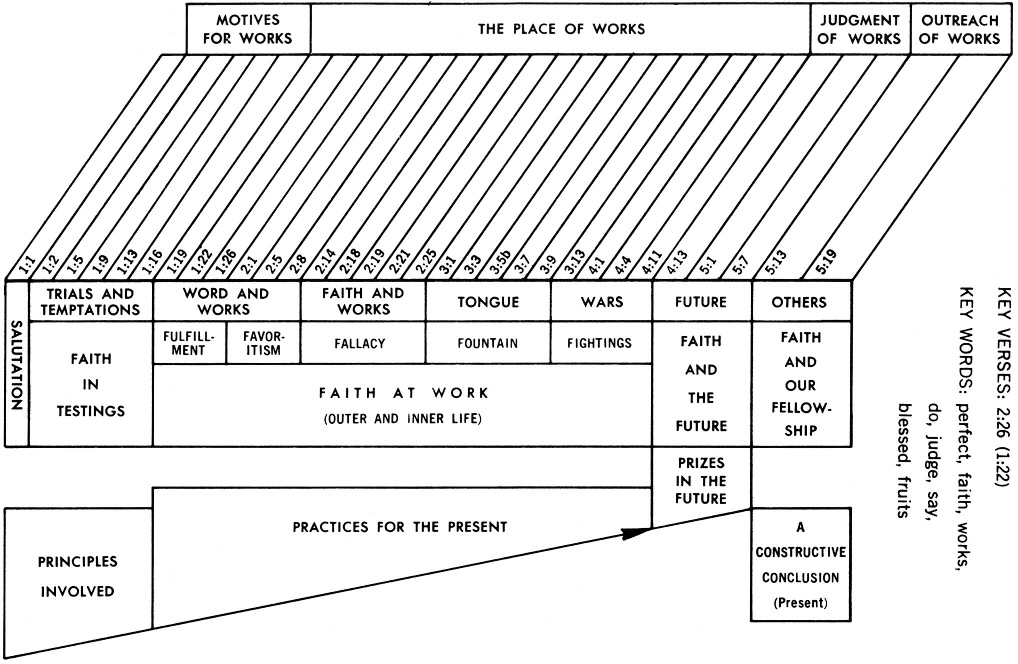
Click chart to enlarge
Chart from recommended resource Jensen's Survey of the NT - used by permission
See also Overview Chart by Charles Swindoll
|
JAMES |
|||||||
| Motives for Works |
The Place of Works: Outward Demonstration of Inner Faith |
Outreach of Works |
|||||
| Jas 1:1-18 | Jas 1:19-2:13 | Jas 2:14-25 | Jas 3:1-12 | Jas 3:13-4:12 | Jas 4:13-5:12 | Jas 5:13-19 | |
| Trials & Temptations |
Word & Works |
Faith & Works |
Tongue | Wars | Future | Others | |
|
Faith |
Fulfill |
Favor |
Fallacy |
Fountain |
Factions |
Faith |
Faith |
|
FAITH AT WORK |
|||||||
The Theme: The Testings of Personal Faith
The trials of the believer (James 1:2–12)
A. The proper attitude toward trials (James 1:2–4)
1. The attitude commanded (James 1:2)
2. The reason indicated (James 1:3)
3. The outcome to be realized (James 1:4)
B. The use of prayer amid trials (James 1:5–8)
1. The need for wisdom (James 1:5a)
2. The request for wisdom (James 1:5b)
3. The bestowal of wisdom (James 1:5c–8)
a. The divine response (James 1:5c)
b. The human obligation (James 1:6–8)
(1) The necessary attitude (James 1:6a)
(2) The rejected character (James 1:6b–8)
C. The correct attitude toward life by the tried (James 1:9–11)
1. The attitude of the lowly brother (James 1:9)
2. The attitude of the rich (James 1:10–11)
a. The reason for the attitude (James 1:10a)
b. The illustration from the flower (James 1:11a)
c. The application to the rich (James 1:11b)
D. The result of enduring trials (James 1:12)
1. The blessedness of endurance (v 12a)
2. The reward of endurance (James 1:12b)
The nature of human temptation (James 1:13–16)
A. The source of human temptation (James 1:13–14)
1. The repudiation of a divine source (James 1:13)
a. The rejection stated (James 1:13a)
b. The rejection vindicated (James 1:13b)
2. The reality of the human source (James 1:14)
B. The consequences of yielding to temptation (James 1:15)
C. The warning against being deceived (James 1:16)
The activity of God in human affairs (James 1:17–18)
A. The Giver of all good gifts (James 1:17)
B. The Author of the believer’s regeneration (James 1:18)
The Test Marks of a Living Faith
Faith tested by its response to the Word of God (James 1:19–27)
A. The reactions to the Word (James 1:19–20)
1. The knowledge possessed (James 1:19a)
2. The reaction demanded (James 1:19b)
3. The reason stated (James 1:20)
B. The reception of the Word (James 1:21)
1. The stripping off of sins (James 1:21a)
2. The appropriation of the Word (James 1:21b)
C. The obedience to the Word (James 1:22–27)
1. The demand for active obedience (James 1:22–25)
a. The statement of the requirement (James 1:22)
b. The illustration of the requirement (James 1:23–25)
(1) The negative portrayal (James 1:23–24)
(2) The positive portrayal (James 1:25)
2. The nature of acceptable obedience (James 1:26–27)
a. The futility of activity without inner control (James 1:26)
b. Acceptable service with inner control (James 1:27) (from Hiebert - James Commentary)
James 1:9 But the brother of humble circumstances is to glory in his high position; (NASB: Lockman)
Greek: Kauchastho (3SPMM) de o adelphos o tapeinos en to hupsei autou,
BGT Καυχάσθω δὲ ὁ ἀδελφὸς ὁ ταπεινὸς ἐν τῷ ὕψει αὐτοῦ,
Amplified: Let the brother in humble circumstances glory in his elevation [as a Christian, called to the true riches and to be an heir of God], (Amplified Bible - Lockman)
KJV: Let the brother of low degree rejoice in that he is exalted:
NET Now the believer of humble means should take pride in his high position.
NLT Believers who are poor have something to boast about, for God has honored them. (Revised Edition)
NLT: Christians who are poor should be glad, for God has honored them. (NLT - Tyndale House)
CSB The brother of humble circumstances should boast in his exaltation,
ESV Let the lowly brother boast in his exaltation,
NIV The brother in humble circumstances ought to take pride in his high position.
YLT James 1:9 And let the brother who is low rejoice in his exaltation,
Phillips: The brother who is poor may be glad because God has called him to the true riches. (Phillips: Touchstone)
Wuest: Moreover, let the brother who is in lowly circumstances be glorying in his exalted position.
Young's Literal: And let the brother who is low rejoice in his exaltation,
- Brother - James 2:5,6; Deut 15:7,9,11; Ps 62:9; Pr 17:5; 19:1; Lk 1:52
- Glory - Jer 9:23,24; Ro 5:2,3; Phil 3:3
- In high position - Jas 2:5; 1Sa 2:8; Ps 113:7-8; Lk 9:48; Lk 10:20; Ro 8:17; 2Co 6:10; Php 3:14; 1Pe 2:9; 1Jn 3:1-3; Re 2:9; Rev 5:9-10; Rev 7:9-10
- James 1 Resources - Multiple Sermons and Commentaries
James 2:5+ (HIGH POSITION & PARADOX OF THE "RICH POOR!") Listen, my beloved brethren: did not God choose the poor of this world to be rich in faith and heirs of the kingdom which He promised to those who love Him?
Romans 8:17+ (HIGH POSITION OF BELIEVERS) and if children, heirs also, heirs of God and fellow heirs with Christ, if indeed we suffer with Him so that we may also be glorified with Him.
2 Corinthians 6:10+ (NOTE THE 3 STRIKING PARADOXES) as sorrowful yet always rejoicing, as poor yet making many rich, as having nothing yet possessing all things.
1 Peter 2:9+ (HIGH POSITION OF BELIEVERS) But you are A CHOSEN RACE, A royal PRIESTHOOD, A HOLY NATION, A PEOPLE FOR God’s OWN POSSESSION, so that you may proclaim the excellencies of Him who has called you out of darkness into His marvelous light;
1 John 3:1-2+ (HIGH POSITION OF BELIEVERS) See how great a love the Father has bestowed on us, that we would be called children of God; and such we are. For this reason the world does not know us, because it did not know Him. 2 Beloved, now we are children of God, and it has not appeared as yet what we will be. We know that when He appears, we will be like Him, because we will see Him just as He is.
Revelation 2:9+ (PARADOX OF THE "RICH POOR!") ‘I know your tribulation and your poverty (but you are rich), and the blasphemy by those who say they are Jews and are not, but are a synagogue of Satan.
POOR SHOULD BOAST
IN THEIR EXALTATION
Keep the context in mind for in James 1:2–12, he is developing one continuous argument about how believers are to respond to trials. James 1:9–11 is therefore not a disconnected proverb about wealth and poverty, but an illustration of how trials expose, reveal, and test people living in very different circumstances, one group poor and the other rich. Trials are not limited merely to sufferings, afflictions, persecutions, or losses. As this section demonstrates, a trial can be any circumstance that challenges one’s trust in God and exposes the true condition of the heart. The poor man is tested by hardship, lack, need, and the temptation to despair or doubt God’s care. The rich man is tested by prosperity, self-sufficiency, pride, worldly security, and the temptation to trust in temporal wealth rather than in the eternal God. In both cases, the issue is fundamentally the same, begging the question will one continue to live “in faith” (James 1:6), wholly dependent upon God regardless of their external circumstances? In sum, James shows that both poverty and prosperity can become severe spiritual tests, because either condition can reveal whether one’s confidence rests in God or in earthly circumstances.
But the brother (adelphos) of humble (tapeinos) circumstances - Most translations do not translate see this as a contrast and so do not begin the sentence with "but." Brother of humble circumstances literally reads "the brother, the lowly one." He is not speaking about the brother's attitude as if he were a humble person, but he is speaking about the brother's circumstances, his lowly socioeconomic status.
The poor believer (“the brother of humble circumstances”) is to boast or rejoice in his exaltation meaning that, though he may lack material wealth, he is rich in Christ. His trial of poverty tests whether he will trust God’s provision and find his identity in Christ rather than in possessions.
One's lowly circumstances has no bearing on once worthiness as a brother in Christ, for both rich and poor are on the same level at the foot of the Cross. As an aside, it is notable that many poor believers were in the early churches (Acts 2:45; 4:35; 1Co 1:26, 27, 28; 2Co 8:1). James well knew how oppressive and disheartening such circumstances could be.
Thomas Lea - James wanted poor people to find delight in their spiritual position in God's kingdom and avoid the temptation to murmur about their material distress. The brother in humble circumstances is a Christian who lives in poverty. Depression, resentment, and selfish ambition may easily characterize their lives. Instead, they should glory in the prominent position to which God has elevated them as believers. Paul suggested that God has given the Holy Spirit as a down payment on all the good things he will do for believers throughout eternity (Eph. 1:14). Poor believers are to rejoice that they are "fellow citizens with God's people and members of God's household" (Eph. 2:19). (See Holman New Testament Commentary - Hebrews & James)
John Phillips on of humble (tapeinos) circumstances - The word for "low" can be rendered "low estate." The classic example is Mary, the mother of our Lord. In her great Magnificat, she exclaimed, "My spirit hath rejoiced in God my Saviour. For he hath regarded the low estate of his handmaiden" (Luke 1:47-48, emphasis added). The same word is used there as is used in James 1:9. Although Mary was a direct descendant of David, she was a poor peasant woman. She rejoiced in her unexpected exaltation: "[F]rom henceforth all generations shall call me blessed" (Luke 1:48).....There is nothing particularly spiritual about being poor, and there is nothing particularly sinful about being rich. Temptations exist at both extremes. (Exploring the Epistle of James)
R C H Lenski - Many poor Jews embraced Christianity; many had lost their property during the persecution that had been inaugurated by Saul (Acts 8:1+). We take it that not a few of the readers who were addressed by James were lowly in regard to money and in regard to their social position. (Borrow James)
Kurt Richardson - The man in the humblest condition should boast in the high position that will be his in the future with God (SEE RELATED PASSAGES ABOVE)
Is to glory in his high position - Glory is placed first in the Greek sentence for emphasis.
R Kent Hughes - The initial paradox of the rich poor—“The brother in humble circumstances ought to take pride in his high position”—powerfully emphasizes that the low are high because “The brother in humble circumstances” reads literally, “the brother, the lowly,” and “his high position” correspondingly reads, “in his height.” So we can translate it, The lowly brother ought to boast in his height! The low are high! Who are the low? The context demands that we understand them as poverty-stricken Jewish Christians who were poor because of their faith. And because they were economically low, they were low in the eyes of the world and, no doubt, in most instances low in their own eyes. Their poverty produced a lowliness of mind. But James paradoxically says such a person “ought to take pride in his high position.” James’ reasoning for this is implicit in the words of this verse: the man is a “brother.” He is part of God’s family, one of God’s children. “Now if we are children, then we are heirs—heirs of God and co-heirs with Christ” (Romans 8:17a) This lowly brother is in fellowship with God, his people, and even his angels, as the writer of Hebrews explains (Hebrews 12:22-24a). (See his excellent discussion of vv 9-11 James: Faith That Works or HERE)
Such an attitude is the best safeguard against
succumbing to despondency when assailed by trials
Hiebert writes that kauchaomai....denotes a strong personal reaction, a feeling of pride or exultation in the condition mentioned. It encompasses the individual's total reaction, both his inward feeling and the outward expression of exultation. Zodhiates remarks that the word means "to profess loudly something that you have a right to be proud of." The present imperative calls upon the believer to adopt this as his characteristic response. James did not agree that a gloomy downcast attitude is the normal and expected response of the believer to economic stringencies. "The pessimist," declares Robertson, "is not a representative of Christianity."...In this context, the verb (kauchaomai) denotes "not the arrogant boasting of the self-important, but the joyous pride possessed by the person who values what God values." Such an attitude is the best safeguard against succumbing to despondency when assailed by trials. (James Commentary)
Manton writes that...
The people of God are called “brothers” because the truest friendship is among the good and godly. Groups of wicked men are more of a conspiracy than a brotherhood. Therefore, when you find in Scripture the words “a brother,” you should understand “a saint.” In the same way here James does not say “a Christian” but the brother . See also Paul in 1Co 16:20 and 1Th 5:27+.
Not a man in humble circumstances, but a brother . It is not poverty but being poor and a Christian that brings joy and comfort. Matthew 5:3 says, “Blessed are the poor in spirit”; note it is “in spirit,” not “in purse.” (Manton, T. Exposition of James)
Thomas Manton feels that "the brother in humble circumstances is one who is humbled or made low on account of opposition for being religious. The poor have the greatest reason to be humble. A poor proud man is inexplicable; he has less temptation to be proud, and he has more reason to be humble. People often live in a way that is inappropriate to their circumstances, as if they can supply in pride what is lacking in their circumstances; whereas others who excel in abilities are most lowly in mind, just as the sun at its highest casts the least shadows. (Ibid)
Hiebert - A vivid example of this power of Christianity to transform one's evaluation of life may be seen in the story of the Cornish miner-preacher Billy Bray (1794-1868) (click brief biography;). Although often hungry and ill-clad, he was a forceful and colorful who constantly exulted in his high position as a son of the King. (James Commentary)
Brother (80) (adelphos from collative a = denoting unity + delphús = womb) is literally one born from same womb and so a male having the same father and mother as reference person. Figuratively, adelphos as in this verse refers to a close associate of a group of persons having well-defined membership, specifically here referring to fellow believers (including sisters!) in Christ who are united by the bond of affection.
Humble (external) circumstances (5011) (tapeinos) means literally low lying, low (not high) or not rising far from the ground. The literal use is not found in the NT, all the uses being figurative and referring either to a material ("low social status") or ethical aspect. One needs to examine the context to determine which meaning is favored. In the present passage, the context speaks not so much of the ethical aspect (a "humble" man) but of one's material and/or social condition as lowly or of little value.
There are only 8 uses of tapeinos in the NT - Mt 11:29; Lk. 1:52; Ro 12:16 (refers to material aspect); 2Co 7:6; 10:1; Jas. 1:9; Jas 4:6; 1Pe 5:5. Notice that James second use emphasizes the ethical aspect of tapeinos...
James 4:6 But He gives a greater grace. Therefore it says, "God is opposed to the proud, but gives grace to the humble."
To be humble or "low lying" in the ethical sense is clearly a "grace" of great value to sinners, but again in the present context the humility refers primarily to the individual's "low lying" circumstances. Note how the next passage contrasts this "low lying" brother's condition with the rich man's circumstances. A similar contrast is found in Proverbs 16...
Pr 16:19 It is better to be of a humble spirit with the lowly (lowly in condition, not in heart), than to divide the spoil with the proud.
Kennet Wuest writes that tapeinos was used in secular writings with the literal meaning explaining that "The word is found in an early secular document where it speaks of the Nile River in its low stage in the words, “It runs low.” The word means “not rising far from the ground.” (In the ethical sense tapeinos) describes the Christian who follows in the humble and lowly steps of his Lord. (Wuest's Word Studies from the Greek New Testament)
Larry Richards has some excellent comments on tapeinos writing that...In Greek culture, tapeinos and its derivatives were words of contempt. The Greeks saw man as the measure of all things. Thus, to be low on the social scale, to know poverty, or to be socially powerless was seen as shameful. Only seldom in classical Greek do these words have a positive tone, commending an unassuming or obedient attitude. Scripture, however, sees the universe as measurable only against God. Compared to him, human beings are rightly viewed as humble. Thus in Scripture tapeinos and its derivatives are nearly always used in a positive sense (exceptions are in 2Co 10:1; Col 2:18+, Col 2:23+). Tapeinos represents a person's proper estimate of himself in relation to God and to others. In this sense, Jesus himself lived a humble life, depending completely on God and relating appropriately to all around him (Mt 11:29). It is the humble, Jesus says, whom God will exalt in his good time (Lk 14:11; 18:14). While the thought of the OT about humility infuses the NT, we learn more about humility in the Gospels and the Epistles.
Mt 18:1, 2, 3, 4 helps us see humility expressed in relationship with God. The disciples asked Jesus who was greatest in the kingdom of heaven. The text tells us that Jesus "called a little child and had him stand among them." Jesus then told them that unless they were to "change and become like little children" they would be unable to enter heaven's kingdom. He explained, "Whoever humbles (tapeinoo - from tapeinos) himself like this child is the greatest in the kingdom of heaven." Just before this, Jesus had presented himself to Israel as God's Son and their promised Messiah. Israel refused to respond. But what of the child? When he was called, he came immediately, responding to Jesus' word. Humility in our relationship with God is seen when we refuse to stand in judgment on his Word but instead respond immediately, recognizing God as the ultimate authority in our life. The dependence and responsiveness of the child is to mark our attitude in our personal relationship with the Lord.
The NT often exhorts humility in relationships with other believers (e.g., Eph 4:2). Paul gives the example of Jesus' humility (Php 2:5, 6, 7, 8) to encourage compliance with his exhortation: "In humility consider others better than yourselves. Each of you should look not only to your own interests, but also to the interests of others" (Phil 2:3, 4).
This attitude is explored further in Ro 12:3, 4, 5, 6, 7, 8, 9, 10, 11, 12, 13, 14, 15, 16. The introductory instruction goes like this: "Do not think of yourself more highly than you ought, but rather think of yourself with sober judgment, in accordance with the measure of faith God has given you" (Ro 12:3). That faith is to find expression within the body of Christ, as each member of the body uses his gifts to serve his fellows. Moved by a sincere love, each is told, "Honor one another above yourselves" (Ro 12:10), and "Do not be proud, but be willing to associate with people of low position. Do not be conceited" (Ro 12:16).
It is in seeing others as persons of great worth because they are loved by God and in seeing ourselves as their servants that we find the fulfilling lifestyle of humility. (Borrow Expository Dictionary of Bible Words) (Bolding added)
Marvin Vincent on tapeinos - The word has a history. In the classics it is used commonly in a bad and degrading sense, of meanness of condition, lowness of rank, and cringing abjectness and baseness of character. Still, even in classical Greek, this is not its universal usage. It is occasionally employed in a way which foreshadows its higher sense. Plato, for instance, says, “To that law (of God) he would be happy who holds fast, and follows it in all humility and order; but he who is lifted up with pride, or money, or honor, or beauty, who has a soul hot with folly, and youth, and insolence, and thinks that he has no need of a guide or ruler, but is able himself to be the guide of others, he, I say, is left deserted of God” (“Laws,” 716). And Aristotle says: “He who is worthy of small things, and deems himself so, is wise” (“Nich. Ethics,” iv., 3). At best, however, the classical conception is only modesty, absence of assumption. It is an element of wisdom and in no way opposed to self-righteousness (see Aristotle above). The word for the Christian virtue of humility (tapeinophrosune), was not used before the Christian era, and is distinctly an outgrowth of the Gospel. This virtue is based upon a correct estimate of our actual littleness, and is linked with a sense of sinfulness. True greatness is holiness. We are little because sinful. Compare Luke 18:14. It is asked how, in this view of the case, the word can be applied to himself by the sinless Lord? “The answer is,” says Archbishop Trench, “that for the sinner humility involves the confession of sin, inasmuch as it involves the confession of his true condition; while yet for the unfallen creature the grace itself as truly exists, involving for such the acknowledgment, not of sinfulness, which would be untrue, but of creatureliness, of absolute dependence, of having nothing, but receiving all things of God. And thus the grace of humility belongs to the highest angel before the throne, being as he is a creature, yea, even to the Lord of Glory himself. In his human nature he must be the pattern of all humility, of all creaturely dependence; and it is only as a man that Christ thus claims to be lowly; his human life was a constant living on the fulness of his Father’s love; he evermore, as man, took the place which beseemed the creature in the presence of its Creator” (“Synonyms,” p. 145). The Christian virtue regards man not only with reference to God, but to his fellow-man. In lowliness of mind each counting other better than himself (Phil 2:3, Rev.). But this is contrary to the Greek conception of justice or righteousness, which was simply “his own to each one.” It is noteworthy that neither the Septuagint, the Apocrypha, nor the New Testament recognize the ignoble classical sense of the word. (Greek Word Studies - Comments on Mt 11:29)
R C Trench writing about tapeinos says that “The work for which Christ’s gospel came into the world was no less than to put down the mighty from their seat, and to exalt the humble and meek. It was then only in accordance with this its mission that it should dethrone the heathen virtue megalopsuchia (human magnanimity and great souledness), and set up the despised Christian grace tap., in its room, stripping that of the honor it had unjustly assumed, delivering this from the dishonor which as unjustly had clung to it hitherto; and in this direction advancing so far that a Christian writer has called this last not merely a grace, but the casket or treasure house in which all other graces are contained … And indeed not the grace only, but the very word tap., is itself a fruit of the gospel; no Greek writer employed it before the Christian era, nor, apart from the influence of Christian writers, after.” (Trench's Synonyms of the New Testament)
Glory (2744) (kauchaomai akin to aucheo = boast + euchomai = pray to God <> auchen = neck which vain persons are apt to carry in proud manner) means to boast over a privilege or possession. The idea is to take pride in something (in a bad sense - Ro 2:23+, in a good or legitimate sense - Ro 5:2+, Ro 5:3+; Ro 5:11+), in the present context in his high position in the eyes of God.
NIDNTT - In classical Greek the verb kauchaomai is found from Sappho onwards. Homer uses instead euchomai, pray, ask, wish. The tragedians and orators use aucheo, boast, plume oneself. Intrans. kauchaomai means to boast, vaunt oneself, be proud. With the prepositions en, epi, peri, huper, eis, or kata, it means to boast of a person or thing. The trans. form also occurs. The compound vb. enkauchaomai has the same meaning. katakauchaomai is used particularly with reference to the situation of an object, and may be translated to vaunt oneself against someone, to treat someone in a derogatory or contemptuous manner. Kauchema (Pindar) refers to the subject of boasting, to the words used by the boaster, and occasionally also to the act of boasting, although for the latter (especially in the NT) the noun kauchesis is more frequently found. Kauchesis (Epicurus) can likewise on occasion be used to denote the subject of boasting. Although the ancient Greeks recognize legitimate pride in oneself (e.g. Homer, Il., 6, 208), there is a clear appreciation of the distinction between this and unwarranted bragging, which was pilloried by the satirists and others. Plutarch also attacked ostentation in an essay on Self-praise without Envy. (Online - NIDNTT)
High position (5311) (hupsos/hypsos from húpsi = high, aloft) means elevation, altitude, the sky. As used figuratively in James (see below) it speaks of dignity or being exalted (as having a "high" position). Lowly circumstances and yet a lofty position is a paradox, but how so? In his low estate the brother of humble circumstance is in fact in high position in the eyes of Jehovah. The Bible teaches believers to think "other worldly" and "right side up" for the world's way of thinking is "upside down". Those things the world values aren't necessarily (usually) the things that God values. The brother of lowly circumstances does not need to become disheartened by his present material poverty, for he is the possessor of spiritual riches that more than counter his material poverty.
James Smith - THE RICH AND THE POOR
James in his Epistle shows characteristic disregard of, yea, almost contempt of, wealth. Whilst there were many poor folk in the early Christian assemblies, there were also the rich. Evidently there was a tendency to exaggerate the importance of wealth, and on the part of some to show undue regard and respect to the wealthy, to the detriment of the poor. James seeks to correct this mistake. There is a place for respect in daily life. To show respect for age, for weak, for women, for official position, for authority, is a Christian duty. For subjects to show respect to their King, Emperor, or President, is commended in Scripture. But the respect James denounces is quite different. Respect of persons is not only a breach of good manners, and discourteous to the poor, but sin against God (2:9). What James here forbids, the world does every day—worships the successful, strong, and wealthy; and despises the man who is poor. Believers must not follow the example of the world.
I. The Poor:
1. Should rejoice in being heirs of the Kingdom (Jas 2:5).
2. Should see that they are rich in faith (Jas 2:5).
3. Should humbly rejoice in any improvement in employment or wealth (Jas 1:9).
II. The Rich:
1. Should bow humbly to the various adverse allotments of Divine Providence (Jas 1:10).
2. Should not expect any preferential treatment in the assembly (Jas 2:2–4).
3. Should humbly remember injustices inflicted by some wealthy folk on the poorer members of Christ’s flock (Jas 2:6, 7).
Os Hillman - FROM ADVERSITY TO DESTINY - JAMES 1:9
Although God takes no pleasure in our pain, we have to acknowledge that He sometimes allows painful circumstances to occur in our lives in order to shape us and make us more like Christ. Sometimes our times of despair turn out to be a much-needed light into our soul.
I once came across the following poem written by an anonymous Confederate soldier, a devout young man who fought in the American Civil War. The lines of this poem express the soul of a man who has learned to view his times of adversity from a different perspective:
I asked God for strength, that I might achieve;
I was made weak, that I might learn humbly to obey.
I asked God for health, that I might do greater things;
I was given infirmity, that I might do better things.
I asked for riches, that I might be happy;
I was given poverty, that I might be wise.
I asked for power, that I might have the praise of men;
I was given weakness, that I might feel the need of God.
I asked for all things, that I might enjoy life;
I was given life, that I might enjoy all things.
I got nothing that I asked for but everything I had hoped for.
Almost despite myself, my unspoken prayers were answered. I am among men, most richly blessed.
Do we trust God to lead us even though we can't see the pathway in front of us? Do we trust Him to be all-knowing, all-loving and all-powerful? Do we believe He does all things well? As Paul wrote, “Everything that does not come from faith is sin” (Romans 14:23). That's why God leads us through the dark places.
Only in the darkness do we learn to walk by faith.
James 1:10 and the rich man is to glory in his humiliation, because like flowering grass he will pass away. (NASB: Lockman)
Greek: o de plousios en te tapeinosei autou, hoti os anthos chortou pareleusetai. (3SFMI)
BGT ὁ δὲ πλούσιος ἐν τῇ ταπεινώσει αὐτοῦ, ὅτι ὡς ἄνθος χόρτου παρελεύσεται.
Amplified: And the rich [person ought to glory] in being humbled [by being shown his human frailty], because like the flower of the grass he will pass away. (Amplified Bible - Lockman)
KJV: But the rich, in that he is made low: because as the flower of the grass he shall pass away.
NLT: And those who are rich should be glad, for God has humbled them. They will fade away like a flower in the field. (NLT - Tyndale House)
NLT And those who are rich should boast that God has humbled them. They will fade away like a little flower in the field. (Revised)
NET But the rich person's pride should be in his humiliation, because he will pass away like a wildflower in the meadow.
CSB but the one who is rich should boast in his humiliation because he will pass away like a flower of the field.
ESV and the rich in his humiliation, because like a flower of the grass he will pass away.
NIV But the one who is rich should take pride in his low position, because he will pass away like a wild flower.
Phillips: The rich may be glad that God has shown him his spiritual poverty. For the rich man, as such, will wither away as surely as summer flowers. (Phillips: Touchstone)
Wuest: But the one who is wealthy, let him be glorying in his humiliation, because as the flower of the grass he shall come to an end
Young's Literal: and the rich in his becoming low, because as a flower of grass he shall pass away;
- Glory in his humiliation - Is 57:15; 66:2; Mt 5:3; Php 3:8; 1Ti 6:17
- Because like flowering grass - Jas 4:14; Job 14:2; Ps 37:2,35,36; 90:5,6; 102:11; 103:15; Is 40:6; Mt 6:30; 1Co 7:31; 1Pe 1:24; 1Jn 2:17
- James 1 Resources - Multiple Sermons and Commentaries
Related Passages:
Isaiah 57:15 For thus says the high and exalted One Who lives forever, whose name is Holy, “I dwell on a high and holy place, And also with the contrite and lowly of spirit In order to revive the spirit of the lowly And to revive the heart of the contrite.
1 Timothy 6:17+ Instruct (present imperative = Paul command is in essence "Timothy keep preaching this sermon!") those who are rich (plousios) in this present world not to be conceited (high minded, arrogant = this mindset so often characterizes the materially rich) or to fix their hope (This is the deceptive danger of material riches) on the uncertainty of riches (ploutos - related word which describes the the deceitfulness of riches = Mt 13:22, Mk 4:19), but on God, Who richly (adverb = plousios = abundantly) supplies us with all things to enjoy (apolausis = a noun that describes the adherence of one's mind and/or affection to an object - in this context "the things above", "the things of eternal value").
James 5:1+ Come (present imperative = make it your lifestyle) now, you rich, weep (aorist imperative = command issued with a sense of urgency) and howl for your miseries which are coming upon you.
Revelation 3:17+ ‘Because you say, “I am rich, and have become wealthy, and have need of nothing,” and you do not know that you are wretched and miserable and poor and blind and naked.
2 Corinthians 8:9+ For you know the grace of our Lord Jesus Christ, that though He was rich, yet for your sake He became poor, so that you through His poverty might become rich (related verb = plouteo). (cp church at Smyrna which was materially poor but spiritually rich - Rev 2:9+)
1 Peter 1:24+ For, “ALL FLESH IS LIKE GRASS, AND ALL ITS GLORY LIKE THE FLOWER OF GRASS. THE GRASS WITHERS, AND THE FLOWER FALLS OFF,
1 John 2:17+ The world is passing away, and also its lusts; but the one who does the will of God lives forever.
Matthew 6:24+ “No one can serve two masters; for either he will hate the one and love the other, or he will be devoted to one and despise the other. You cannot serve God and wealth.
THE GLORY OF
HUMILIATION
And the rich (ploúsios) man is to glory in his humiliation (tapeinosis), because (hoti) like (os) flowering (anthos) grass (chortos) he will pass away (parerchomai) - The rich man is to boast in his humiliation, meaning he is to rejoice in the humbling realization that earthly wealth is temporary, fragile, and utterly incapable of saving him or securing his eternal destiny. His riches may give him status, comfort, influence, and a sense of independence in this life, but before God he stands spiritually naked and needy just like the poor person. Thus his humiliation is not primarily shame, but the willingness to humble himself and strips away self-reliance thus learning to depend wholly upon God.
It follows that the rich man’s trial is different from that of the poor believer. The poor are tempted toward discouragement and despair because of their lack of riches, while the rich are tempted toward pride, self-sufficiency, misplaced security, and trust in material possessions rather than trust in God. Wealth can easily deceive one's heart into believing that they are secure and even independent of God. For this reason James reminds the rich man that he is “like flowering grass” which is outwardly impressive and beautiful for a season, but which is quickly scorched by the heat and destined to fade away. Earthly riches, human glory, physical beauty, and worldly success are all temporary realities that vanish like a wildflower under the burning sun (Isa. 40:6-8; Ps. 103:15-16). Therefore the rich believer is called to glory not in his possessions, but in humbling himself so that he sees the fleeting nature of worldly prosperity and this drives him to find his true identity, security, and treasure in Christ alone (Jer. 9:23-24; 1Ti 6:17).
Thomas Lea - The rich person faces the temptation of glorying in wealth. In one sense the possession of wealth is a trial because it tempts rich people to rejoice in earthly treasures (Matt. 6:19-21). The wealthy are encouraged to glory in the humbling of soul which life's trials can bring them. They can learn that worldly riches pass away, while God's wisdom lasts for eternity. Wealthy people should exult in the privilege of learning that true treasures are located only in heaven. (See Holman New Testament Commentary - Hebrews & James)
Given the fact that James did not repeat the word "brother" has led some to conclude this rich man is not Christian, while other hold that both the rich and poor are Christians.
Thomas Manton comments that the rich man "may either be taken generally to mean the rich, whether godly or ungodly, or more specifically for the ungodly person who trusts in riches."
D Edmond Hiebert favors the man is a believer...
The poor believer’s high position refers to future exaltation with God—a spiritual standing that transcends their present economic circumstances. Rather than suggesting that poverty itself improves spirituality, James points toward promised exaltation in the life to come, and focusing on this future destiny can reframe perspectives on the present by allowing believers to see beyond their socioeconomic status through God’s eyes.
The poor person’s high position stems from being a “brother”—a member of God’s family. As children of God, they are heirs of God and co-heirs with Christ. In preparation for God’s coming kingdom, the church should encourage those poor and destitute—rejected and marginalized in everyday life—to lead the rejoicing in their future hope, having the “most important seats in the synagogue” of the Lord. These poor have exalted status because they are raised to dignified status by God, chosen by God to be rich in faith and heirs of God’s kingdom, and counted among those who love God.
The paradox is striking: poverty-stricken Jewish Christians were low in the world’s eyes and often in their own eyes, their poverty producing lowliness of mind. Yet this poverty produces a lowliness of spirit that keeps believers open to God. Although these poor had nothing visible to boast in, their boast was greater than those who boasted in themselves. The “high position” is thus an eschatological reality—a divinely-assured future status that inverts earthly hierarchies and calls the economically marginalized to recognize their supreme worth in God’s kingdom. (James Commentary)
John MacArthur on rich man [should] glory in his humiliation - The idea is that a believer who is materially well-off, healthy, and otherwise physically blessed should rejoice when trials come, for they teach him the transitory nature of those material things and their inability to give inner and lasting satisfaction or help, especially spiritual help. Both he and his possessions are like flowering grass and will pass away. (See James Commentary)
Humility is to make a right assessment of oneself....
Do not be proud of race, face, or grace.
-- C H Spurgeon
D Edmond Hiebert sums up this section writing that "It would seem that here to be "made low" is to find something of incomparably greater value than his wealth, something that by its greatness makes him feel small, so that disillusioned in his old ground of glorying, he attains a basis for a better glory.' The attitude of both the poor and the rich brother is the result of the spiritual wisdom each has attained. The results look in opposite directions. As the poor brother forgets all his earthly poverty, so the rich brother forgets all his earthly riches. By faith in Christ the two are equals. The rich brother has come to realize that at the cross he stands on a level with the poor brother. Both have been given a new status in Christ, and it is their true ground for glorying. The command to the poor brother is tersely stated, but the command to the rich brother receives strong amplification. James states a reason for the command to the rich brother (v. l0b), illustrates it from the fate of the field flower (v. 11a), and applies it to the end of the rich (v. 11b). (James Commentary)
He is a great man who is not lifted up
because of his greatness.
-- Augustine
Thomas Manton writes that the rich man...
includes the noble, the honorable, those who have outward excellence, and especially those who remain untouched by persecution. Some observe that James does not say “the rich brother,” as before, the brother in humble circumstances , but only generally the one who is rich . Few of that rank give their names to Christ. But this may be too fanciful an interpretation...
Riches are not altogether inconsistent with Christianity. But usually riches are a great snare. It is difficult to enjoy the world without being entangled in its pleasures. The moon is never eclipsed except when it is full, and it is usually in our fullness that we go wrong. That is why our Saviour says, “It is easier for a camel to go through the eye of a needle than for a rich man to enter the kingdom of God” (Mt 19:24). This is a Jewish proverb indicating an impossibility. Rich men should often think of this. A camel can go through a needle’s eye just as easily as you can enter into the kingdom of God. It would be a rare miracle of nature for a camel or an elephant to pass through a needle’s eye; and it is as rare a miracle of grace for a rich man to find Christ. They least of all perceive spiritual excellences. The heathen Plato says almost the same as Christ, that it is impossible for someone to be eminently rich and eminently good. The way of grace is usually so narrow that there is no room for those who want to enter with their great burdens of riches and honor.
But you will say, what do you want Christians to do then? Throw away their estates? I answer, no. There are two passages that qualify our Lord’s saying. One is: “With God all things are possible” (Mt 19:26). Difficulties on the way to heaven bring us to despair of ourselves, not of God. God can so loosen the heart from the world that riches are no impediment. The other passage is Mark 10:23, 24: “Jesus looked around and said to his disciples, ‘How hard it is for the rich to enter the kingdom of God!’ The disciples were amazed at his words. But Jesus said again, ‘Children, how hard it is [for those who trust riches— NIV footnote] to enter the kingdom of God!’” It is not having riches but trusting in them that poses the danger. Riches are not a hindrance to Christianity, but our abuse of them is. To sum up, it is impossible to trust in riches and enter into the kingdom of God; and it is nearly impossible for us to have riches and not to trust in them.
Note the four verbs applying to the comparison to flowers - pass away, withers, falls off, destroyed. This a vivid simile which should cause anyone who is rich to pause and ponder the picture presented (see terms of comparison = simile).
Thomas Manton- Even if we had security over our possessions, we would not have security over our lives. We pass away and they pass away with a turn of providence as the flower of the field fades (cf Jas 4:14).
Like (os) flowering (anthos) grass (chortos) - This clearly speaks of the brevity and uncertainty of life (cp Job 14:2; Ps 90:5, 6; 102:11; 103:15; Is 51:12, 1Pe 1:24). Obviously this statement would apply to the life of the poor man but here his focus is to awaken the conscience of the rich man, who because he has "plenty" of earth's riches, is prone to forget that these are passing riches and can never be the basis for one's eternal security. Isaiah records a passage that speaks to the transitory nature of life in general, whereas James applies it specifically to the rich...
Isa 40:6 A voice says, "Call out." Then he answered, "What shall I call out?" All flesh is grass, and all its loveliness is like the flower of the field. 7 The grass withers, the flower fades, When the breath of the LORD blows upon it; Surely the people are grass. 8 The grass withers, the flower fades, But the word of our God stands forever.
He will pass away (3928) (parerchomai from pará = near ~ proximity + érchomai = come, go) means literally to pass by as of persons (Mt 8:28), of things (Mt 26:39, 42) or of time, to be no longer available for use (Mt 14:15, Mk 14:35, Acts 27:9, 1Pe 4:3). James uses parerchomai metaphorically to mean to pass away and so to perish (cp similar uses in Mt. 5:18; 24:34, 35; Mk 13:30, 31; Lk 16:17; 21:32, 33; 2Co 5:17; Jas 1:10; 2Pe 3:10)
Rich (4145) (ploúsios from ploutos = wealth, abundance, riches) defines that which exists in a large amount with implication of its being valuable. This is the description of one who does not need to work for a living. In short this adjective means rich well-to-do, or wealthy in most of the NT uses. (Related dictionary topic - Riches)
The related adverb is plousíōs (4146) which means richly or abundantly and is used 4 times in the NT Col. 3:16+ (Let the word of Christ richly dwell [present imperative = as your lifestyle!] within you [not on your coffee table!]); 1Ti 6:17 (see below); Titus 3:6+ (describes the Holy Spirit Whom the Father "poured out upon us richly through Jesus Christ"); 2Pe 1:11+ (describes the entrance into the Lord's eternal kingdom which every Christian should diligently strive to attain [2Pe 1:10+] - one that is "abundantly supplied").
TDNT - This group (ploutos = wealth, plousios = wealthy, plouteo = to be rich; ploutizo = to make rich) is connected with a root meaning “to flow,” which is connected to “to fill.” The basic sense, then, is “fullness of goods,” and ploútos may mean either material wealth or spiritual wealth (of wisdom etc.). (Kittel, G., Friedrich, G., & Bromiley, G. W. Theological Dictionary of the New Testament. Eerdmans)
Plousios is used in a figurative sense of God being "rich in mercy" (Eph 2:4+), which conveys the wonderful truth that He has mercy in abundance (not giving us what we deserve and to which He adds grace, which is giving us what we do not deserve!)
James 2:5 uses plousios figuratively to describe the (materially) poor person who is (spiritually) "rich in faith",
The lost (unbelieving, unregenerate, unsaved) world (and sadly too often even the saved) has a misconception that to be materially "rich" is desirable, not realizing that being "rich" is a major impediment to receiving the free gift of eternal life (Mt 19:23, 24, Mk 10:25).
Jesus gave the correct estimate of the giving, when He describe the giving of large sums of money by the "rich people" (Mk 12:41), explaining to His disciples that the poor widow's two copper coins were a far greater contribution because that was not from her surplus (like the rich people) but was all she owned (Mk 10:42, 43, 44)! Are you as convicted as I am?
Jesus used the story of the rich man to explain the truth about Hades (OT = Sheol), the rich man ending up in the "hot" side of Hades and the poor man in the "cool" side (Read Lk 16:19-31 and draw a schematic diagram of Hades - Clue = place two rectangles side by side with a space between and label the compartments Jesus describes).
Plousios - 28x in 28v in NAS - people(1), rich(19), rich man(7), rich man's(1), rich people(1). Mt 19:23, 24; 27:57; Mark 10:25; 12:41; Luke 6:24; 12:16; 14:12; 16:1, 19, 21, 22; 18:23, 25; 19:2; 21:1; 2Cor 8:9; Eph 2:4+; 1Ti 6:17; Jas 1:10, Jas 1:11; 2:5, 6; 5:1; Rev 2:9+; Re 3:17+; Re 6:15+; Re 13:16+.
Plousios - 31x in the non-apocryphal Septuagint -Gen 13:2; Ruth 3:10; 1Sa 2:10; 2Sa 12:1f, 4; Esther 1:20; Job 27:19; Ps 10:8; 34:10; 45:11; 49:2; Pr 10:15; 14:20; 18:11; 19:22; 22:2, 7, 16; 23:4; 28:6, 11; Eccl 10:6, 20; Isa 5:14; 32:9, 13; 33:20; 53:9; Jer 9:23; 24:1
Humiliation (5014)(tapeinosis is the noun derived from adjective tapeinos; cp the related derivative tapeinophrosune) means low, not high, not rising far from the ground. James says the rich man is to boast about his condition as lowly or of low degree. He is to have proper opinion of passing, temporal wealth as that which is base, common, and of little value. The idea of this self abasement is to assume an unpretentious state or recognition of one's low estate. To paraphrase Thayer, the rich man is to boast in spiritual abasement, which leads him to perceive and even "to lament his (moral) littleness and guilt".
Because (3754) (hoti) has a number of meanings in the NT but in this context is used by James as a marker of causality. James explains the reason why the rich man should have a lowly mind in the midst of flourishing and plenty. And note that James does not say his riches pass away like a flower (but that is always possible), but that the rich man himself will pass away.
Like (5613) (os) is a term of comparison meaning even as, in the same manner as, etc. A proper understanding of terms of comparison is important for accurate interpretation of Scripture. While the Spirit clearly inspires these comparisons, one has to remember that He does not give us license to devise a plethora of imaginative interpretations. For more discussion see the topic terms of comparison - simile.
Flowering (438) (anthos - English "anthology" is literally "flower gathering" from anthos = flower + logia = collecting) refers specifically to the flower of a grape blossom and is a picture of something that does not last.
Anthos - 23 uses in the Scripture, 3 in the NT (Jas 1:10, 11; 1 Pet 1:24) and 20 in the Septuagint (Ex 28:14; 30:23; Nu 17:8; Job 14:2; 15:30, 33; Ps 103:15; Song 2:1, 12; Isa 5:24; 11:1; 18:5; 28:1, 4; 40:6, 7; 61:11; Ezek 19:10; Da 11:7; Zeph 2:2)
Grass (5528) (chortos) refers to small green plants and in the NT contexts primarily signifies green grass as one would find in a field or meadow.
David uses a similar simile describing the fate of evil men...
Ps 37:1 (A Psalm of David.) Do not fret because of evildoers, be not envious toward wrongdoers. 2 For they will wither quickly like the grass, and fade like the green herb...35 I have seen a violent, wicked man Spreading himself like a luxuriant tree in its native soil. 36 Then he passed away, and lo, he was no more; I sought for him, but he could not be found.
Spurgeon writes: The scythe of death is sharpening. Green grows the grass, but quick comes the scythe. The destruction of the ungodly will be speedy, sudden, sure, overwhelming, irretrievable. The grass cannot resist or escape the mower. And wither as the green herb. The beauty of the herb dries up at once in the heat of the sun, and so all the glory of the wicked shall disappear at the hour of death. Death kills the ungodly man like grass, and wrath withers him like hay; he dies, and his name rots. How complete an end is made of the man whose boasts had no end! Is it worth while to waste ourselves in fretting about the insect of an hour, an ephemeral which in the same day is born and dies? Within believers there is a living and incorruptible seed which liveth and abideth for ever; why should they envy mere flesh, and the glory of it, which are but as grass, and the flower thereof?
Ps 90:5 Thou hast swept them away like a flood, they fall asleep; In the morning they are like grass which sprouts anew. 6 In the morning it flourishes, and sprouts anew; Toward evening it fades, and withers away.
Spurgeon writes: In the morning they are like grass which groweth up. As grass is green in the morning and hay at night, so men are changed from health to corruption in a few hours. We are not cedars, or oaks, but only poor grass, which is vigorous in the spring, but lasts not a summer through. What is there upon earth more frail than we!
Ps 102:11 My days are like a lengthened shadow; and I wither away like grass.
Spurgeon writes: And I am withered like grass. He was like grass, blasted by a parching wind, or cut down with a scythe, and then left to be dried up by the burning heat of the sun. There are times when through depression of spirit a man feels as if all life were gone from him, and existence had become merely a breathing death. Heart-break has a marvelously withering influence over our entire system; our flesh at its best is but as grass, and when it is wounded with sharp sorrows, its beauty fades, and it becomes a shriveled, dried, uncomely thing.
Ps 103:15 As for man, his days are like grass; as a flower of the field, so he flourishes. 16 When the wind has passed over it, it is no more; and its place acknowledges it no longer.
Spurgeon writes: As for man, his days are as grass. He lives on the grass, and lives like the grass. Corn is but educated grass, and man, who feeds on it, partakes of its nature. The grass lives, grows, flowers, falls beneath the scythe, dries up, and is removed from the field: read this sentence over again, and you will find it the history of man. If he lives out his little day, he is cut down at last, and it is far more likely that he will wither before he comes to maturity, or be plucked away on a sudden, long before he has fulfilled his time.
As a flower of the field, so he flourisheth. He has a beauty and a comeliness even as the meadows have when they are yellow with the king-cups, but, alas, how short-lived! No sooner come than gone, a flash of loveliness and no more! Man is not even like a flower in the conservatory or in the sheltered garden border, he grows best according to nature, as the field-flower does, and like the unprotected beautifier of the pasture, he runs a thousand risks of coming to a speedy end. A large congregation, in many-coloured attire, always reminds us of a meadow bright with many hues; and the comparison becomes sadly true when we reflect, that as the grass and its goodliness soon pass away, even so will those we gaze upon, and all their visible beauty. Thus, too, must it be with all that comes of the flesh, even its greatest excellencies and natural virtues, for "that which is born of the flesh is flesh," and therefore is but as grass which withers if but a breath of wind assails it. Happy are they who, born from above, have in them an incorruptible seed which liveth and abideth for ever.
- The true riches -Ephesians 3:8; 1 Corinthians 1:30; Colossians 2:3; 1 Peter 2:7
- God gives -1 Samuel 2:7; Ecclesiastes 5:19
- To God belongs this world’s riches -Haggai 2:8
- God gives power to obtain -Deuteronomy 8:18
- The blessing of the Lord brings -Proverbs 10:22
- Give worldly power -Proverbs 22:7
DESCRIBED AS
- Temporary -Proverbs 27:24
- Uncertain -1 Timothy 6:17
- Unsatisfying -Ecclesiastes 4:8; 5:10
- Corruptible -James 5:2; 1 Peter 1:18
- Fleeting -Proverbs 23:5; Revelation 18:16,17
- Deceitful -Matthew 13:22
- Liable to be stolen -Matthew 6:19
- Perishable -Jeremiah 48:36
- Thick clay -Habakkuk 2:6
- Often an obstruction to the reception of the gospel -Mark 10:23-25
- Deceitfulness of, chokes the word -Matthew 13:22
- The love of, the root of all evil -1 Timothy 6:10
OFTEN LEAD TO
- Pride -Ezekiel 28:5; Hosea 12:8
- Forgetting God -Deuteronomy 8:13,14
- Denying God -Proverbs 30:8,9
- Forsaking God -Deuteronomy 32:15
- Rebelling against God -Nehemiah 9:25,26
- Rejecting Christ -Matthew 19:22; 10:22
- Self-sufficiency -Proverbs 28:11
- Anxiety -Ecclesiastes 5:12
- An overbearing spirit -Proverbs 18:23
- Violence -Micah 6:12
- Oppression -James 2:6
- Fraud -James 5:4
- Sensual indulgence -Luke 16:19; James 5:5
- Life consists not in abundance of -Luke 12:15
- Be not over-anxious for -Proverbs 30:8
- Labour not for -Proverbs 23:4
THEY WHO COVET
- Fall into temptation and a snare -1 Timothy 6:9
- Fall into hurtful lusts -1 Timothy 6:9
- Err from the faith -1 Timothy 6:10
- Use unlawful means to acquire -Proverbs 28:20
- Bring trouble on themselves -1 Timothy 6:10
- Bring trouble on their families -Proverbs 15:27
- Profit not in the day of wrath -Proverbs 11:4
- Cannot secure prosperity -James 1:11
- Cannot redeem the soul -Psalms 49:6-9; 1 Peter 1:18
- Cannot deliver in the day of God’s wrath -Zephaniah 1:18; Revelation 6:15-17
THEY WHO POSSESS, SHOULD
- Ascribe them to God -1 Chronicles 29:12
- Not trust in them -Job 31:24; 1 Timothy 6:17
- Not set the heart on them -Psalms 62:10
- Not boast of obtaining them -Deuteronomy 8:17
- Not glory in them -Jeremiah 9:23
- Not hoard them up -Matthew 6:19
- Devote them to God’s service -1 Chronicles 29:3; Mark 12:42-44
- Give of them to the poor -Matthew 19:21; 1 John 3:17
- Use them in promoting the salvation of others -Luke 16:9
- Be liberal in all things -1 Timothy 6:18
- Esteem it a privilege to be allowed to give -1 Chronicles 29:14
- Not to be high-minded -1 Timothy 6:17
- When converted, rejoice in being humbled -James 1:9,10
- Heavenly treasures superior to -Matthew 6:19,20
- Of the wicked laid up for the just -Proverbs 13:22
THE WICKED
- Often increase in -Psalms 73:12
- Often spend their day in -Job 21:13
- Swallow down -Job 20:15
- Trust in the abundance of -Psalms 52:7
- Heap up -Job 27:16; Psalms 39:6; Ecclesiastes 2:26
- Keep, to their hurt -Ecclesiastes 5:13
- Boast themselves in -Psalms 49:6; 52:7
- Profit not by -Proverbs 11:4; 13:7; Ecclesiastes 5:11
- Have trouble with -Proverbs 15:6; 1 Timothy 6:9,10
- Must leave, to others -Psalms 49:10
- Vanity of heaping up -Psalms 39:6; Ecclesiastes 5:10,11
- Guilt of trusting in -Job 31:24,28; Ezekiel 28:4,5,8
- Guilt of rejoicing in -Job 31:25,28
DENUNCIATIONS AGAINST THOSE WHO
- Get, by vanity -Proverbs 13:11; 21:6
- Get, unlawfully -Jeremiah 17:11
- Increase, by oppression -Proverbs 22:16; Habakkuk 2:6-8; Micah 2:2,3
- Hoard up -Ecclesiastes 5:13,14; James 5:3
- Trust in -Proverbs 11:28
- Receive their consolation -Luke 6:24
- Abuse -James 5:1,5
- Spend, upon their appetite -Job 20:15-17
- Folly and danger of trusting to-Illustrated -Luke 12:16-21
- Danger of misusing-Illustrated -Luke 16:19-25
Examples of saints possessing
- Abram -Genesis 13:2
- Lot -Genesis 13:5,6
- Isaac -Genesis 26:13,14
- Jacob -Genesis 32:5,10
- Joseph -Genesis 45:8,13
- Boaz -Ruth 2:1
- Barzillai -2 Samuel 19:32
- Shunammite -2 Kings 4:8
- David -1 Chronicles 29:28
- Jehoshaphat -2 Chronicles 17:5
- Hezekiah -2 Chronicles 32:27-29
- Job -Job 1:3
- Joseph of Arimathea -Matthew 27:57
- Zacchaeus -Luke 19:2
- Dorcas -Acts 9:36
Examples of those truly rich
- Mt 5:8; 8:10; 13:45,46; Lk 10:42; Jn 1:45; Php 3:8; James 2:5; 1Pe 2:7; Re 3:18
Examples of wicked men possessing
- Laban -Genesis 30:30
- Esau -Genesis 36:7
- Nabal -1 Samuel 25:2
- Haman -Esther 5:11
- Ammonites -Jeremiah 49:4
- People of Tyre -Ezekiel 28:5
- Young man -Matthew 19:22
John MacArthur - HUMBLING THE RICH
The rich in his humiliation. JAMES 1:10
Christians who don’t have to experience the trials of life related to poverty can rejoice in their “humiliation,” as today’s verse points out. When the trials they experience help them realize that their possessions can’t buy true happiness and contentment, they will understand that their dependence is on the true riches of God’s grace. The rich Christian can rejoice when he learns that material blessings are only temporary and that spiritual riches are eternal.
Trials humble all believers to the same level of dependency on God. Money doesn’t buy people out of their problems, although it may solve some economic ones. When you lose a daughter, son, wife, or husband, it doesn’t matter how much money you have. No amount is going to buy your way out of such a trial.
Whether to the poor or the rich, trials come into life to help us humbly recognize that our resources are in God.
James 1:11 For the sun rises with a scorching wind and withers the grass; and its flower falls off and the beauty of its appearance is destroyed; so too the rich man in the midst of his pursuits will fade away. (NASB: Lockman)
Greek: aneteilen (3SAAI) gar o elios sun to kausoni kai exeranen (3SAAI) ton chorton, kai to anthos autou exepesen (3SAAI) kai e euprepeia tou prosopou autou apoleto; (3SAMI) outos kai o plousios en tais poreiais autou maranthesetai. (3SFPI)
BGT ἀνέτειλεν γὰρ ὁ ἥλιος σὺν τῷ καύσωνι καὶ ἐξήρανεν τὸν χόρτον καὶ τὸ ἄνθος αὐτοῦ ἐξέπεσεν καὶ ἡ εὐπρέπεια τοῦ προσώπου αὐτοῦ ἀπώλετο· οὕτως καὶ ὁ πλούσιος ἐν ταῖς πορείαις αὐτοῦ μαρανθήσεται.
Amplified: For the sun comes up with a scorching heat and parches the grass; its flower falls off and its beauty fades away. Even so will the rich man wither and die in the midst of his pursuits. (Amplified Bible - Lockman)
KJV: For the sun is no sooner risen with a burning heat, but it withereth the grass, and the flower thereof falleth, and the grace of the fashion of it perisheth: so also shall the rich man fade away in his ways.
NLT: The hot sun rises and dries up the grass; the flower withers, and its beauty fades away. So also, wealthy people will fade away with all of their achievements. (NLT - Tyndale House)
NLT The hot sun rises and the grass withers; the little flower droops and falls, and its beauty fades away. In the same way, the rich will fade away with all of their achievements. (Revised)
NET For the sun rises with its heat and dries up the meadow; the petal of the flower falls off and its beauty is lost forever. So also the rich person in the midst of his pursuits will wither away.
CSB For the sun rises with its scorching heat and dries up the grass; its flower falls off, and its beautiful appearance is destroyed. In the same way, the rich man will wither away while pursuing his activities.
ESV For the sun rises with its scorching heat and withers the grass; its flower falls, and its beauty perishes. So also will the rich man fade away in the midst of his pursuits.
NIV For the sun rises with scorching heat and withers the plant; its blossom falls and its beauty is destroyed. In the same way, the rich man will fade away even while he goes about his business.
Phillips: One day the sunrise brings a scorching wind; the grass withers at once and so do all the flowers - all that lovely sight is destroyed. Just as surely will the rich man and all his extravagant ways fall into the blight of decay. (Phillips: Touchstone)
Wuest: for the sun arises with its scorching heat and the grass withers and its flower falls off and the beauty of its appearance is destroyed. So shall also the wealthy person fade away together with his undertakings.
Young's Literal: for the sun did rise with the burning heat, and did wither the grass, and the flower of it fell, and the grace of its appearance did perish, so also the rich in his way shall fade away!
- For the sun rises - Is 49:10; Jonah 4:7-8; Mt 13:6; Mk 4:6
- So too the rich man - Jas 5:1-7; Job 21:24-30; Ps 37:35,36; Ps 49:6-14; Ps 73:18-20; Eccl 5:15; Is 28:1,4; Is 40:7,8; Lk 12:16-21; Lk 16:19-25; 1Co 7:31; 1Pe 1:4; 1Pe 5:4
- James 1 Resources - Multiple Sermons and Commentaries
Related Passages:
Jonah 4:7-8 But God appointed a worm when dawn came the next day and it attacked the plant and it withered. 8 When the sun came up God appointed a scorching east wind, and the sun beat down on Jonah’s head so that he became faint and begged with all his soul to die, saying, “Death is better to me than life.”
Matthew 13:6+ “But when the sun had risen, they were scorched; and because they had no root, they withered away.
James 4:14+ Yet you do not know what your life will be like tomorrow. You are just a vapor that appears for a little while and then vanishes away.
Isaiah 40:6-8 A voice says, “Call out.” Then he answered, “What shall I call out?” All flesh is grass, and all its loveliness is like the flower of the field. 7 The grass withers, the flower fades, When the breath of the LORD blows upon it; Surely the people are grass. 8 The grass withers, the flower fades, But the word of our God stands forever.
Psalm 103:15-16 As for man, his days are like grass; As a flower of the field, so he flourishes. 16 When the wind has passed over it, it is no more, And its place acknowledges it no longer.

SUN & SCORCHING WIND
WITHER THE GRASS
For (gar) is a term of explanation, which should alway prompt a pause to ponder and ask what is being explained, etc?
The sun rises with a scorching wind and withers the grass; and its flower falls off and the beauty of its appearance is destroyed; so too the rich man in the midst of his pursuits will fade away. - James continues the explanation of his simile begun in the previous verse in his description of the state of the man who has earthly wealth. Here James vividly paints the picture of the transitory nature of the rich man's life. This imagery would have been immediately familiar to James’ readers. In Palestine, the hot eastern desert wind, often called the sirocco, could arise suddenly with intense heat, scorching vegetation in a matter of hours. Grass that appeared green and flourishing in the morning could become dry, brown, and lifeless by evening. Wildflowers that seemed beautiful and vibrant quickly lost their petals and beauty under the blazing heat. James uses this natural phenomenon as a metaphor for the fleeting character of human life, earthly success, and material riches.
The “grass” represents the frailty and brevity of human existence, while the “flower” symbolizes the outward beauty, prosperity, status, and attractiveness of worldly wealth. The rich man may appear strong, secure, influential, and prosperous, but James reminds us that earthly glory is remarkably fragile. Just as scorching heat suddenly strips a flower of its beauty, so circumstances, sickness, economic collapse, death, judgment, or the passing of time can quickly remove all that earthly wealth seems to provide. The rich man’s prosperity contains no permanence in itself.
James adds a particularly sobering phrase in the midst of his pursuits. The rich man fades away while actively occupied with his business, plans, investments, ambitions, and daily affairs. Life may seem stable and productive, yet death and human frailty continue advancing unnoticed. The picture is one of a man fully absorbed in earthly pursuits, perhaps confident in his achievements and resources, yet suddenly overtaken by the brevity of life. This echoes Jesus’ warning in the parable of the rich fool, whose life was required of him while he was planning bigger barns and greater prosperity (Luke 12:16–21).
Importantly, James is not condemning wealth itself, nor teaching that all rich people are ungodly. Rather, he is exposing the danger of placing confidence in riches, status, or earthly security. Wealth is uncertain and temporary. Trials reveal whether a person’s hope rests in material prosperity or in God alone. The poor believer must learn to rejoice in his spiritual exaltation in Christ, while the rich person must learn humility, recognizing that earthly riches fade like wildflowers under the desert sun.
In short, James reminds believers to interpret life from an eternal perspective. Earthly beauty, wealth, and achievement are temporary and passing, but those who endure trials in faith possess eternal riches that cannot fade away (James 1:12; 1 Peter 1:4).
Hiebert remarks this "is a strong reminder to the wealthy that permanence is not to be found in the material things of this world."
John MacArthur - The loss of material things is meant to drive the rich person to the Lord and to greater spiritual maturity, blessing, and satisfaction. And at that point, the rich and poor are exactly alike. Neither material possessions nor lack of them is of any ultimate consequence. What is of significance is a trusting relationship to the Lord, who showers all of His children with spiritual wealth that will never diminish or fail to satisfy.....When you lose a daughter, son, wife, husband, or other loved one, wealth is no comfort. When you lose your health, are betrayed by a friend, or are wrongfully maligned, money cannot buy peace of mind or decrease the pain. Trials are the great equalizer, bringing all of God’s children to dependence on Him. Wealth does not bring God closer, nor does poverty keep Him further away. (See James MacArthur New Testament Commentary - Page 41)
William Barclay -As James saw it, Christianity brings to every man what he needs. As Mayor put it "As the despised poor learns self-respect, so the proud rich learns self-abasement."
(i) Christianity brings to the poor man a new sense of his own value (Ed: Beloved, you may not see yourself this way. You may think "You don't know what I've done. He would never want to use me." You are wrong. Jesus came not for the healthy but the sick and He "fixes" and uses broken things [people]! Do not let the Accuser of your soul tell you you are of no worth to the King and His Kingdom work! You are of great value, beloved!) (a) He learns that he matters in the Church. In the early church there were not class distinctions. It could happen that the slave was the minister of the congregation, preaching and dispensing the sacrament, while the master was no more than a humble member. In the Church the social distinctions of the world are obliterated and none matters more than any other. (b) He learns that he matters in the world. It is the teaching of Christianity that every man in this world has a task to do. Every man is of use to God and even if he be confined to a bed of pain, the power of his prayers can still act on the world of men. (c) He learns that he matters to God.
As Muretus said long ago, "Call no man worthless for whom Christ died."
(ii) Christianity brings to the rich man a new sense of self-abasement. The great peril of riches is that they tend to give a man a false sense of security. He feels that he is safe; he feels that he has the resources to cope with anything and to buy himself out of any situation he may wish to avoid.
James draws a vivid picture, very familiar to the people of Palestine. In the desert places, if there is a shower of rain, the thin green shoots of grass will sprout; but one day's burning sunshine will make them vanish as if they had never been. The scorching heat is the kauson . The kauson was the south-east wind, the Simoon. It came straight from the deserts and burst on Palestine like a blast of hot air when an oven door is opened. In an hour it could wipe out all vegetation.
This is a picture of what a life dependent on riches can be like. A man who puts his trust in riches is trusting in things which the chances and changes of life can take from him at any moment. Life itself is uncertain. At the back of James' mind there is Isaiah's picture: "All flesh is grass, and all its beauty is like the flower of the field. The grass withers, the flower fades, when the breath of the Lord blows upon it; surely the people is grass" (Isaiah 40:6-7; compare Psalms 103:15).
James' point is this. If life is so uncertain and man so vulnerable, calamity and disaster may come at any moment. Since that is so, a man is a fool to put all his trust in things--like wealth--which he may lose at any moment. He is only wise if he puts his trust in things which he cannot lose. So, then, James urges the rich to cease to put their trust in that which their own power can amass. He urges them to admit their essential human helplessness and humbly to put their trust in God, who alone can give the things which abide for ever. ( Daily Study Bible)
Sun (2246) (helios from héle = shining, the splendor of the sun) is the star round which the earth orbits.
Rises (393)(anatello from aná = up + téllo = set out for a goal) means to arise as of things in the natural creation, here describing the rising of the sun. There are 7 uses of anatello in the NT (Mt 4:16, 5:45 Mk 16:2, Lk 12:54, He 7:14, Jas 1:11, 2Pe1:19) Scorching wind (2742) (kausoni from kaío = burn) of intense heat, fervent or scorching heat as of the sun
Withers (3583) (exeraneo from xeros = dry) literally means to dry up (cp Mk 5:29), to be parched, to cause to wither or shriveled (cp Jn 15:6).
Falls off (1601) (ekpipto from ek = from + pípto = to fall) literally means to fall out or down from and here is used literally of withered blossoms falling off the stem. Figuratively it means to fall away and to to fail, to drift or be blown off course and run aground (Acts 27:17) or to be without effect or to be in vain.
Beauty (2143)(euprepeia from eu = good, well + prepo = be fitting) describes a state of beauty or fine appearance with the implication of being attractive and well-suited. This is the only NT use of euprepeia but there are 10 uses in the Septuagint (LXX) -- 2Sa 15:25; Job 36:11; Ps 26:8; 50:2; 93:1; 104:1; Pr 31:25; Jer 23:9; Lam 1:6; Ezek 16:14
Appearance (4383) (prosopon from pros = toward + ops = the eye) is literally the part round the eye, the face, in a secondary sense the look, the countenance.
Destroyed (622) (apollumi from apo = away from or wholly + olethros = state of utter ruin <> ollumi = to destroy <> root of apollyon [Re 9:11] = destroyer) means to destroy utterly but not to caused to cease to exist. Apollumi then has the basic meaning of describing that which is ruined and is no longer usable for its intended purpose. In short, the beauty of the flowers offered no security against the adverse elements. The fate of the flowers pictured the fate of the physical life of all (here the rich) men.
So too (houtos kai) - Literally "thusly also". "In the same way" as the flower's fate was sealed, so too was that of the rich man.
In the midst of his pursuits (4197) (poreia from poreúomai = to go) is literally "in his goings". The phrase takes on the meaning of purpose, pursuit or undertaking. Kindred ideas are that of a journey (Lk 13:22 of Jesus on a journey to Jerusalem), a business activity or pursuit of business or wealth.
Will fade away (3133) (maraino) means to disappear gradually, die out, fade, disappear, wither. It is used literally of plants losing their vitality. James has the figurative meaning describing a person as wasting away, ending up with nothing, losing out. Thayer says it gives the meaning equivalent to having a miserable end.
John MacArthur - Strength for Today - TRIALS’ LESSONS: NO PARTIALITY
“But let the brother of humble circumstances glory in his high position; and let the rich man glory in his humiliation, because like flowering grass he will pass away.” JAMES 1:9–10
God does not exempt any believer,
rich or poor, from trials and suffering.
There is a basic principle of life that we all know to be true—namely, that trials and sufferings do not exclude privileged people. This is a humbling truth that we don’t always like to acknowledge, yet it operates before us regularly in such things as natural disasters. No one can deny that large–scale floods, hurricanes, or earthquakes affect both rich and poor, young and old, educated and uneducated; all races and classes are susceptible to pain, hardship, and even death during such events. After a major earthquake, for example, nearly everyone feels the effects of disruptions in transportation and communication. And the ground’s violent shaking can damage or destroy both modest bungalows and expensive mansions.
The realization that God does not show favoritism in sending trials and difficulties is also quite sobering and humbling for those in the Body of Christ. As today’s first verse suggests, the challenge for poor believers is in realizing that they can rejoice in their exalted spiritual position as Christians (1 Peter 1:3–6), no matter how lowly their earthly status might be. Current economic hardship does not diminish the glories of our future inheritance (see Eph. 1:11–14).
The challenge for wealthier believers is to accept the “humiliation” that trials bring, remembering that such tests will make them more dependent on God and His grace rather than on earthly riches. Such wealth is only temporary, and it fades away like the grass of the field.
Once we grasp the truth of this equalizing factor, we will be more inclined to declare with sincerity, “My resources are in God.” The divine impartiality revealed through trials also has a wonderful unifying effect on the church. The commentator R.C.H. Lenski summarized it this way: “As the poor brother forgets all his earthly poverty, so the rich brother forgets all his earthly riches. The two are equals by faith in Christ.”
Overcoming Ambition By Rev. Todd M. Kinde
SCRIPTURE: James 1:9–11
INTRODUCTION: There are varying degrees of success and failure. Some of us are driven by ambition and others seem to have no ambition at all. A proper view of our humanity will temper our ambitious drives.
1. Recognize the Modesty of Your Humanity (1:9, 10a).
2. Recognize the Mortality of Your Humanity (1:10b, 11a).
3. Recognize the Momentary Nature of Your Humanity (1:11b).
CONCLUSION: Whether we are rich or poor we are told to look to our spiritual identity as the measure of our success. We are to evaluate ourselves by spiritual postures rather than by material possessions.
John MacArthur - BURNED UP JAMES 1:11
Wealthy people usually do not realize that they can’t take their riches with them. Only those who have been humbled before God know that life is “a vapor that appears for a little time and then vanishes away” (James 4:14).
In today’s verse, James writes about the blooming grasses and flowers of Palestine that flourish with beautiful color in February and dry up by May. James also borrows part of his illustration from Isaiah 40:6–8. The burning heat, which could refer to the scorching wind known as a sirocco, destroys the vegetation in its path. It is illustrative of the fury of death and divine judgment that put an end to the rich man’s earthly life and his material possessions.
When the rich man’s possessions are burned up, he will have the true riches, just as the poor man does. If you are wealthy, make sure you have a true spirit of humility and don’t trust in the possessions of life.
Humble Circumstances - James 1:9–11, especially verses 9–10a Let the lowly brother glory in his exaltation, but the rich in his humiliation.
Introduction: The world says we have to have the right philosophy about money. For example, consider the philosophy of the great American thinker, Henry David Thoreau. The first chapter of his book about Walden Pond is titled “Economy.” You don’t have to read very far in Walden to know that rich people didn’t impress Thoreau. He believed the happiest life was the simplest life. He thought all of us should live so simply that if an enemy appeared at the outskirts of town, we could walk out of the gate empty-handed and without anxiety. That’s not a bad philosophy. But as Christians we have a theology about money (from theos—God + logos—logic). We have God’s logic on the subject. In the Bible, He reveals His thoughts about money and money-management, and the Bible is remarkably consistent in what it says. The epistle of James addresses this subject several times; and in today’s passage, James has something to say to two different groups in the church.
1. Poor Believers Should Be Aware of Their True Wealth (v. 9). Speaking to Christians (note the word “brother”), James addresses those who are “lowly” or in humble circumstances (NIV). He says that if you’re struggling financially, you should rejoice and become more aware of your high position. What does he mean by that? The best commentary on James 1:9 is James 2:5: Listen, my beloved brethren: Has God not chosen the poor of this world to be RICH IN faith and heirs of the kingdom which He promised to those who love Him? (my emphasis).
The two words I want you to notice are: RICH IN …
Compare 1 Timothy 6:17–18, where Paul commands those who are RICH IN this present age not to put their hope in wealth, but in God, who richly gives us all things to enjoy. Let them … be RICH IN good works.
In Luke 12, Jesus spoke of people who were RICH IN God’s sight (v. 21 GNT).
In 1 Corinthians 1:4–5 (HCSB), Paul spoke to those who … were made RICH IN everything—in all speaking and all knowledge (see also 2 Cor. 8:7 and 9:11).
So if you’re a Christian and don’t think you’re very rich, you’re not cognizant of the Bible’s valuation of your assets. The Bible says that in Christ we are RICH IN …
Good deeds
God’s sight
Knowledge—what we know
Speech—what we have to say
Faith
Every way
2. Rich Believers Should Be Aware of Their Transitory Lives (vv. 10–11). The next two verses warn rich believers to remember the brevity of life and the temporary nature of earthly wealth (see also James 4:14). Job said, “Naked I came from my mother’s womb, and naked I will depart.” Paul said, “We brought nothing into this life, and we can take nothing out of it.” So we shouldn’t become too enamored with the things of this world. We should use it and invest it and give it as faithful stewards who will have to give an account to God. Psalm 62:10 (NIV) says: Though your riches increase, do not set your heart on them (see also 1 Cor. 7:29–31).
Conclusion: CNN recently carried a story of a 62-year-old man who was rushed to Cholet General Hospital in France, suffering stomach pain. His family told doctors the man had a history of mental illness and a penchant for swallowing coins, but nothing could have prepared the doctors for X-rays of the man’s stomach. It was filled with 350 coins he had swallowed. The doctors performed surgery to remove the mass, but the man died of complications twelve days later. “What a sick man,” you say. But he’s illustrative of this world that is gorging itself sick on materialism. The commentator J. B. Mayor made a profound point when he said that this passage in James gives the poor self-respect and it gives the rich self-abasement. Christianity—the message of Jesus and the church and the family of God—obliterates class distinction. If you don’t have much money, rejoice in how rich you are in faith, in good deeds, in Christ, in eternal blessings. And if you’re getting along pretty well, think about how quickly it’s all going to be over and you’re going to face the Lord. Are you ready to meet the Lord? Are you laying up treasures in heaven?
Pastor Steven Cole exposition on James 1:9-12 Perspective for Perseverance...
James is giving us some tests of true faith. True faith has joy even when it faces trials (Jas 1:2, 3, 4). It seeks God for wisdom in such times (Jas 1:5, 6, 7, 8). Here (Jas 1:9, 10, 11, 12), James shows us that true faith adopts God’s eternal perspective regarding poverty and riches. To persevere in trials with joy, adopt God’s eternal perspective on poverty and riches. There is a contrast here between the permanent and the perishable. Until we live in light of this distinctive, we will not handle trials or persecution very well. If we get caught up with the world’s pursuit of wealth as the key to happiness, we will miss God’s way of true blessedness, which centers on eternal riches that cannot be taken from us by any circumstance, including death. First, James speaks to the poor Christian (Jas 1:9); then, to the rich (Jas 1:10, 11); and, finally, he offers hope to all who persevere under trials (Jas 1:12).
1. The poor believer must glory in his eternal riches in Christ (Jas 1:9).
James gives us a paradox that levels the playing field between the rich and the poor in the church. He says that the poor are rich and the rich are poor. He does not advocate some form of forced or voluntary redistribution of wealth, but he does show that in the church, the world’s distinctions—status for the rich and insignificance for the poor—do not hold true (see Jas 2:1-7). Also, note that contrary to a distinctively American heresy, which has spread to other countries, James does not say that the poor brother is to claim his Cadillac by faith. The “name it and claim it” or “health and wealth” heresy is a perversion of God’s Word that uses false promises to appeal to the greed of its victims.
The theme of the rich and the poor is woven throughout James (Jas 1:9, 10, 11; 2:1, 2, 3, 4, 5, 6, 7, 15, 16; 5:1, 2, 3,4, 5,6). He draws on the teaching both of the Old Testament and of Jesus. James brings together three elements (gleaned from Douglas Moo, The Letter of James [Eerdmans/Apollos], pp. 35-36; and Peter Davids, Commentary on James [Eerdmans], pp. 41-47).
First, God has a particular concern for the poor (Ps. 68:5; Deut. 10:18). Thus James points out (Jas 2:5), “Did not God choose the poor of this world to be rich in faith…?”
Second, because God has this concern for the poor, His people should reflect the same concern (Deut. 10:19). Thus James (Jas 1:27) says that one aspect of pure religion is “to visit the orphans and widows in their distress, …” A profession of faith that ignores
the physical needs of a brother is dead faith (Jas 2:15, 16).
Third, the Old Testament sometimes associates the poor with the humble and righteous, and the rich with the wicked oppressor, thus merging the economic with the spiritual (Ps 10; 37:8, 9, 10, 11, 12, 13, 14, 15, 16, 17; 72:2, 4). Jesus did this in the beatitudes, when He said, “Blessed are you who are poor… But woe to you who are rich…” (Luke 6:20, 24).
James does the same (Jas 2:5; 5:1, 2, 3, 4, 5, 6). He condemns the rich that take advantage of the poor. It would be wrong, however, to assume that the Bible automatically identifies the poor as being righteous and the rich as being wicked. The Bible tells of many wealthy men who followed God: Abraham, Job, David, Solomon, Zaccheus, and others.
Wealth is a blessing that God often confers on the wise man, whereas poverty often results from sin or laziness (Pr 3:16; 10:4; 14:23, 24). While the Bible shows that wealth may be a sign of God’s blessing, it also warns about its dangers. The man who desires to get rich falls into a spiritual trap (1Ti 6:9, 10). The rich are often prone to arrogance and greed (Prov. 28:11; 15:27). They often do not see their need for God, because they trust in their money (Pr 11:28). Life seems good, they have no needs, and they ignore the obvious fact that riches are of no value in the inevitable day of death (Pr 11:4).
The Bible also shows that poverty can be a mixed bag. It may result from ignoring God’s ways (Pr 13:8, 18). It can destroy the man (Pr 10:15), his relationships (Pr 19:4, 7), and his independence (Pr 22:7). It can tempt him to steal (Pr 30:7, 8, 9). But, poor people often have integrity and humility, which the rich often lack (Pr 19:1; 28:6, 11).
Commenting on Jesus’ first beatitude, “Blessed are you who are poor, for yours is the kingdom of heaven” (Luke 6:20), Leon Morris states (Luke [IVP/Eerdmans], p. 127):
[Jesus] is not blessing poverty in itself: that can as easily be a curse as a blessing. It is His disciples of whom Jesus is speaking. They are poor and they know that they are without resource. They rely on God and they must rely on Him, for they have nothing of their own on which to rely…. The rich of this world often are self-reliant. Not so the poor.
So poverty can be an advantage over wealth if it shows a person his need for God, who pours out spiritual blessings on all who call upon Him.
With that as an overview, James directs the poor man to glory in his high position, which refers to his spiritual wealth in Christ. When a poor man trusts in Christ as Savior and Lord, he instantly becomes the heir of a vast fortune. He is a child of the King of kings, with access to all of the King’s resources. Paul pictures the believer as seated with Christ in the heavenly places (Ep 2:6+).
Paul repeatedly refers to the believer as being “in Christ,” which means that everything that is true of Christ is true of us. He tells the Corinthians, “all things belong to you, whether … the world or life or death or things present or things to come…” (1Co 3:21, 22). He tells us (Ro 8:17+) that if we are children of God, then we are “heirs also, heirs of God and fellow heirs with Christ….”
James tells the poor believer to glory in these precious truths. Skeptics, who have no concept of the reality of spiritual truth, would no doubt mock James’ advice at this point. “What good is it to tell a poor man to glory in his spiritual riches in Christ? He’s still living in a shack. He still wears ragged clothes. He still eats meager meals. His children are still barefoot and lack good medical care. What good are these spiritual riches to this man?”
But that view stems from a materialistic mindset and ignores the fact that the basic need of every human heart is spiritual, not material. James will go on to say that true faith will supply a poor brother with the basic necessities of life (Jas 2:15, 16). But Paul says, “If we have food and covering, with these we shall be content” (1Ti 6:8). The Bible calls us to believe that our spiritual riches in Christ are reality. Material riches are illusory, a vapor that evaporates before our eyes.
What does it mean, to glory in our high position in Christ? The apostle Paul uses this word often, sometimes negatively, but sometimes positively. Negatively, we are not to boast in anything in ourselves. The Corinthians were boasting wrongfully in themselves, and Paul rebukes them, asking (1Co 4:7), “What do you have that you did not receive? And if you did receive it, why do you boast as if you had not received it?” If all that we have is because of God’s unmerited favor, then why do we exalt ourselves, as if our supposed superiority came from ourselves? The concept of “self esteem” that has flooded the church in the past 35 years, comes from worldly psychology, not from God’s Word. Christ did not die for you or me because we were worthy! Quite the opposite, He
died for us “while we were yet sinners” (Ro 5:8).
But, positively, we may boast or glory in the Lord, to bring glory to Him. As Paul argues (1Co 1:26, 27, 28, 29, 30, 31), God has chosen us who are foolish, weak, and despised in the eyes of the world “so that no man may boast before God.” He goes on to say, “But by His doing you are in Christ Jesus… so that, just as it is written, ‘Let him who boasts, boast in the Lord’” (1Co 1:29, 30, 31). This is why the doctrine of election is so important: it removes any ground for boasting in ourselves. If we are saved because of our choice, we have grounds for boasting. “I chose God because I’m so intelligent!” But if salvation is totally from God, beginning with His sovereign choice of me out of the cesspool of sin, then all I can do is glory or boast in the Lord (see Gal 6:14).
2. The rich believer must glory in his humiliation in Christ, knowing that it represents eternal riches that will never pass away (Jas 1:10, 11).
It is a thorny issue to decide whether the rich man here is a believer or an unbeliever. Commentators are pretty evenly divided. If it refers to a rich unbeliever, then Jas 1:10 is using strong irony or sarcasm, saying, “Let the rich man glory in the fact that he’s going
to be pushing daisies in a few short years!” He will be pursuing more wealth when, just like the spring wildflowers, he will fade away. In this view, the withering and fading of the flower is a reference to final judgment.
That view has much to commend it, but I lean toward the view that James is referring here to rich believers. He mentions rich men coming into their assembly (Jas 2:2) and those who travel in business and boast about their plans to make a profit (Jas 4:13, 14, 15, 16). In this view, the exhortation in its context views both poverty and wealth as tests of faith (Jas 1:12). The poor man is tempted by his poverty to devote himself to the pursuit of wealth. Or, he may be tempted to feel neglected by God because of his poverty. James tells him, rather, to focus on his spiritual riches in Christ. The rich man is tempted to glory in his wealth and the status and power that come from financial success. James tells him to glory, rather, in his humiliation as a believer. His wealth does not put him on a higher spiritual rung than the poor believer. His wealth pertains only to this fleeting life. He and his money will soon fade away. As someone has said, “When the game is over, the king and the pawn go back into the same box.” The rich man’s mansion, property holdings, and stock portfolio will mean nothing when he is in the grave. So the rich man must not follow the world by glorying in his riches. Rather, he must glory in his humiliation.
Most of us think, “This applies to Donald Trump, Bill Gates, and those type of guys.” But by the world’s standards, most of us qualify as “rich.” Many of us own our own homes. We have computers, TV’s, and dozens of other gadgets to make life more comfortable. Most families own more than one car. Our closets are bulging with so many clothes that it takes us a while to decide what we want to wear each day. Much of the rest of the world lives in crowded shacks with no indoor plumbing or electricity, and no clothes except those on their backs. So we need to apply Jas 1:10,11 to ourselves! How can we glory in our humiliation?
First, we can glory in the fact that God has opened our eyes to see the vanity of worldly wealth and status. I state this as if it is true of you! I hope that you agree! To live to accumulate the world’s junk and to strive after the world’s acclaim is futile! Right after the evening news, a program about all of the rich and famous in Hollywood comes on. Sometimes I catch the first minute or two of this program before I grab the remote and click it off. It’s thoroughly disgusting. All of these celebrities are stuck on their own glamour and fame. Many viewers probably think, “Wow, that’s the kind of life I would like to have!” Christians ought to think, “How tragic! These people are living for vanity—emptiness!” (cp Eccl 1:1,2, 3, 12:13, 14)
Second, we can glory in the fact that God has shown us the essence of true happiness and honor. True happiness is to know God. True honor is to be a servant of the Lord Jesus Christ. “Thus says the Lord, ‘Let not a wise man boast of his wisdom, and let not the mighty man boast of his might, let not a rich man boast of his riches; but let him who boasts boast of this, that he understands and knows Me, that I am the Lord who exercises lovingkindness, justice and righteousness on earth; for I delight in these things,’ declares the Lord” (Je 9:23,24).
Third, we can glory in the fact that we now have an eternal inheritance that will never be taken away. Psalm 49 mocks the rich man, who congratulates himself, naming his lands after himself, and thinks that his fame will endure forever. It says, bluntly (Ps. 49:12), “But man in his pomp will not endure; he is like the beasts that perish.” But believers have “an inheritance which is imperishable and undefiled and will not fade away, reserved in heaven for you” (1Pe 1:4+). As John Newton put it (Glorious Things of Thee Are Spoken - listen to this beautiful piano version),
“Solid joys and lasting treasure, none but Zion’s children know.”
Thus James tells the poor that they are rich in Christ and the rich that they are poor in their humiliation in Christ. (Read the entire sermon - Perspective for Perseverance)