John 21:15 So when they had finished breakfast, Jesus said to Simon Peter, "Simon, son of John, do you love Me more than these?" He said to Him, "Yes, Lord; You know that I love You." He *said to him, "Tend My lambs."
16 He said to him again a second time, "Simon, son of John, do you love Me?" He said to Him, "Yes, Lord; You know that I love You." He *said to him, "Shepherd My sheep ."
17 He said to him the third time, "Simon, son of John, do you love Me?" Peter was grieved because He said to him the third time, "Do you love Me?" And he said to Him, "Lord, You know all things; You know that I love You." Jesus *said to him, "Tend My sheep .
18 "Truly, truly, I say to you, when you were younger, you used to gird yourself and walk wherever you wished; but when you grow old, you will stretch out your hands and someone else will gird you, and bring you where you do not wish to go."
19 Now this He said, signifying by what kind of death he would glorify God. And when He had spoken this, He *said to him, "Follow Me!"
20 Peter, turning around, saw the disciple whom Jesus loved following them; the one who also had leaned back on His bosom at the supper and said, "Lord, who is the one who betrays You?"
21 So Peter seeing him said to Jesus, "Lord, and what about this man?"
22 Jesus said to him, "If I want him to remain until I come, what is that to you? You follow Me!"
23 Therefore this saying went out among the brethren that that disciple would not die; yet Jesus did not say to him that he would not die, but only, "If I want him to remain until I come, what is that to you?"
24 This is the disciple who is testifying to these things and wrote these things, and we know that his testimony is true.
25 And there are also many other things which Jesus did, which if they were written in detail, I suppose that even the world itself would not contain the books that would be written. (NASB: Lockman)
**Note: Verbs in red are imperative (all are present imperative = make this your habitual practice; your lifestyle)
John 21:15 So when they had finished breakfast, Jesus said to Simon Peter, "Simon, son of John, do you love Me more than these?" He said to Him, "Yes, Lord; You know that I love You." He said to him, " Tend My lambs.":
- son of: Jn 21:16,17 1:42, Jona, Mt 16:17, Bar-jona
- Do you love: Jn 8:42 14:15-24 16:27 Mt 10:37 25:34-45 1Co 16:21,22 2Co 5:14,15 Ga 5:6 Eph 6:24 1Pe 1:8 1Jn 4:19 5:1
- more: Jn 21:7 Mt 26:33,35 Mk 14:29
- You know: Jn 21:17 2Sa 7:20 2Ki 20:3 Heb 4:13 Rev 2:23
- Feed: Ps 78:70-72 Jer 3:15 23:4 Eze 34:2-10,23 Ac 20:28 1Ti 4:15,16 Heb 13:20 1Pe 2:25 5:1-4
- lambs: Ge 33:13 Isa 40:11 Mt 18:10,11 Lk 22:32 Ro 14:1 15:1 1Co 3:1-3 8:11 Eph 4:14 Heb 12:12,13 1Pe 2:2
- John 21 Resources - Multiple Sermons and Commentaries
PETER'S
RESTORATION
John MacArthur gives us the context for the following dialogue between Jesus and Peter…
since his denials were public knowledge, he needed to be publicly restored. The other disciples needed to hear Peter’s reaffirmation of his love for Christ and Christ’s recommissioning of him, so they would be willing to loyally support his leadership. As soon as they had finished breakfast (cf. Jn 21:12,13), Jesus initiated the restoration by confronting Peter. (MacArthur, J: John 12-21. Chicago: Moody Press)
John Montgomery Boice (source of the "title" above) has a superb, practical introduction to this concluding section of John's Gospel…
If each of us knew how sinful we really are, we would not be so shocked or subdued by our failures. But most of us do not know the depths of our own depravity. So we are shocked, particularly by a fall into serious moral sin or by our surprising ability to deny Jesus Christ. When we sin in such ways, it is a tactic of the devil to argue that, having sinned, we have forfeited our chance for a successful and happy Christian life and that we might as well go on sinning. Like most of the devil’s statements this is untrue. Though we sin, we have nevertheless not forfeited our chances for a full Christian life, nor dare we go on sinning. Instead, the Christian way is that of repentance and restoration. This is the point of the story of Peter’s restoration by Jesus in John 21. Peter had failed the Lord in his hour of apparent need. He had abandoned him and had compounded his cowardice by a threefold denial that he had ever known him. Yet Jesus loved Peter, and Peter knew that he loved Jesus. To understand the story of Peter’s restoration we need to understand something about Peter’s fall. Its cause was self-confidence… (Boice, J. M. The Gospel of John: An Expositional Commentary. Grand Rapids, Mich.: Baker Books)
Ed: See Jesus' command to the 12 - Jn 13:34, prompting Peter to declare Jn 13:37 to which Jesus replied Jn 13:38, and on the way to the Garden of Gethsemane Peter's self-confidence again came through - Mt 26:33 rebutted by Jesus Mt 26:34 prompting Peter to respond Mt 26:35!
Note: These application points are not in order (they don't necessarily go from verse 15 to verse 25). Some of the points of application overlap.
• Peter was grieved by the Lord's third question - Have you ever felt grief and pain like Peter felt, a pain directed by the Lord to the very core of your being, deep down in the most sensitive area of your life?
• How does Jesus speak to our heart today? The Word of God ("reproof, correction," etc)
• The probable meaning of what Jesus meant by “more than these” is discussed below. We could apply this question by personalizing it and asking “Who (what) do I love more than Jesus?”
• One lesson which our Lord teaches us here by His own example is, that we ought to take great pains in rebuking a friend for his fault (referring to Peter's denial). (Broadus)
• Jesus' piercing questions to Peter's surely are applicable to each of us today -- Jesus might ask this same question of each of us. Simply put, do you love the Lord Jesus Christ? Do you love Him? How do you know? Jesus said "if you love (agapao) Me, you will (not "might") keep My commandments" (Jn 14:15) Those who claim assurance yet have no desire to go on in obedience to the command of Christ are still dead in their sins. "He who has My commandments and keeps them, he it is who loves Me; and he who loves Me shall be loved by My Father, and I will love him, and will disclose (emphanizo = manifest openly, allowing Himself to be intimately known and understood) Myself to him." (Jn 14:21 cp Jn 14:23, 24, Jn 15:10)
• Have you like Peter "failed to stand by your Lord" at some moment of crisis? Perhaps you think you have sinned against Him so horribly that He would never forgive you. Are you in need of restoration of fellowship with Jesus? Then Peter's story in John 21 is your story. Observe the Master's restoring touch in this section. Note especially the absence of harsh censure (Words like "I told you so!", "How could you do that to Me Peter?", etc).
• Beware of spiritual self-confidence; self-righteous; believing you’re spiritually stronger or more devoted. Or because you’ve been on a missions trip; because you go door to door and evangelize; because you don’t own a TV set; because you drive a “humble mobile” Beware! (Brian Bell)
• Before we are sent for service, the Lord Jesus wants to ask us one question "Do you love Me?" When we can answer this question affirmatively without hesitation or equivocation, we are ready to hear His call to service.
• Are you motivated by love for Christ? What will keep you serving the Lord when the going gets tough? Although you may be sensitive to the needs of others, that alone isn’t enough. Nor should we be driven by a need that we have—a desire to be appreciated or loved by others. Our needs are deep, and only God can satisfy them. The more we try to satisfy them with anything else—even God’s work—the more dissatisfied we will become. In short, even love for God’s people, His sheep, won’t keep us going, because "sheep" can often be unlovable and insufferable and we may come to resent them. Oswald Chambers wrote “If we are devoted to the cause of humanity, we shall soon be crushed and brokenhearted,… but if our motive is to love of Christ, no ingratitude can hinder us from serving our fellowmen.” (Cp Paul's great motive for service - 2Co 5:14-note )
• Do you have John's way of viewing your Christian life? John 21:20 gives us one of the deepest truths of Christian life, one of the great secrets of Christian peace, an essential quality of faith: that our hope does not rest in our love for Christ--but in His love for us. People are often discouraged when they find in themselves so little that is good and beautiful. They cannot see that they love Christ any more this year, than they did last. They do not find in themselves the beautiful fruits of the Spirit which they wish they could find. But there is another way to look at our lives, which gives us more hope. It is John's way--not our love for Christ--but Christ's love for us! (J. R. Miller)
• We too like the early disciples are to be fishers of men - Are you engaged in winsome evangelism with friends, family, co-workers? If some have become believers (little lambs), are you seeking to shepherd them - feeding, guiding, protecting, as they take their first steps on yet slightly wobbly spiritual legs? While doubtless this charge speaks primarily to pastors, there is surely personal application for all followers of Christ, because Jesus' last command was to make disciples (learners) (Mt 28:18, 19, 20). Are you heeding our Chief Shepherd's call?
• Does your spiritual service proceed from your love and devotion to Christ? Love of Christ should always be the primary motivation for our service. Or are you placing service to Christ ahead of love to Christ? (See Oswald Chambers Devotional)
• Aren't we all a lot like Peter in Jn 21:21 asking "What about this man?" It is so easy to let our relationship with the Lord be overly influenced by the behavior and experiences of others. But we must not be concerned with what God has planned for anyone else. Through the conflicting voices that surround us, we must keep hearing the Savior’s clear command: “You follow Me.” Are you fixing your eyes on Jesus or on His work in and through other saints? The former focus will assure a race well done, while the latter focus often leads to frustration, envy, jealousy and failure to finish your (own, not someone else's) race.
• Take a moment to express your love to Jesus by playing (and singing) the beautiful old Maranatha chorus I Love You Lord
• Lesson from Jn 21:21, 22 - Resentment comes from looking at others. Contentment comes from looking to Jesus.
• What is the word for the church from Jn 21:15-17? Love Christ! We, as a church, must move beyond the phileo love that says, "I am fond of you, I live you like a brother", and must come to the place where we love the Lord with a genuine agape love. That is, we need a self-sacrificing, self-denying, unconditional, unchanging, unending love for Christ that pervades every area of our lives. When we come to this point, Mt 22:39 will pose no problems for us. Then we will be in a place to demonstrate to the lost world around us that Jesus is all that He claims to be - John 13:35 (Alan Carr)
• When you read the Words of Jesus and hear Him asking "Do you love Me?" how do you answer? 'Jesus, I admire You. Jesus, I think you are fascinating. Jesus, I have a great respect for You'? Or can you say with Peter, 'Lord, you know what is in my heart, You know that I love You'?
• Many can identify with Peter over their own sense of spiritual faltering and falling. How many have made good confessions, committed to firm resolutions of faithfulness, then have fallen into sin, spiritual coldness, and barrenness? How often have we done the very thing we said that we would not do in terms of spiritual commitment? The encouragement for all of us in this passage is that there is mercy with the Lord! He alone can restore the fallen to usefulness… The most striking element of this whole scene is that we see Jesus Christ pursuing the fallen. You make think "He would never pursue me." Then you don't understand the loving heart of Jesus to continually seek those who deny Him with their thoughts, words and actions… people just like Peter! (Phil Newton - The Fallen Restored)
• To follow (akoloutheo Jn 21:19, 20) is intimately linked to the life and ministry of Jesus. Indeed, He is the only One we should follow. Who are you following? A pastor, a sports hero, a famous writer, a successful relative, etc? May God grant us wisdom and grace that by His Spirit we may follow Jesus all the days of our life and unto a death that glorifies His Holy Name. Amen
• Have you heard and heeded Jesus' command "Follow Me?" Do you understand what it means to follow Jesus? Jesus' call to follow Him is in essence His call to be His disciple. (Study the verb "follow" in the Gospels - Mt 4:19, Mk 1:17, Mt 8:19, 20, 21, Mt 9:9, Lk 5:27, 28, Mt 10:37, 38, 39; Mt 16:24, 25, 26; Mk 8:34, 35, 36, 37, 38; Mt 19:21, 22, 23, 24; Lk 9:23, 24, 25, 26; Lk 9:59, 60, 61, 62; Lk 18:22, 23, 24, 25, 26, 27; Jn 10:4, 5, 27; Jn 12:26
• "Follow Me" are not the last words of Jesus before His ascension (see Acts 1:7, 8) but they are Jesus' last words in the Gospel of John (Jn 21:22). It is interesting that Jesus issued the same command (Follow Me) at the beginning of this Gospel (Jn 1:43). Clearly Jesus wants us to remember that being a Christian is not just believing in Him in an abstract sense, but that it constitutes believing in the Person of Jesus to the point that we turn our back on all else and choose to follow Him all the days of our life!
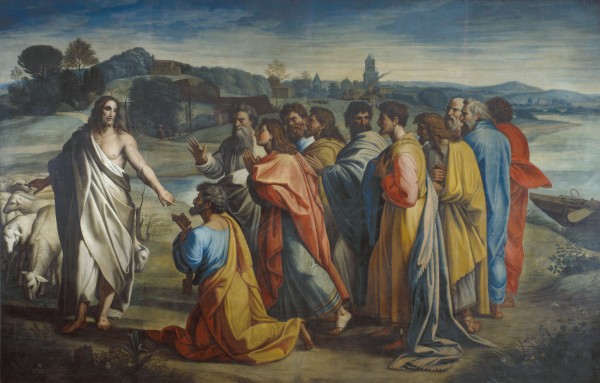
Feed My Sheep
(click to enlarge)
Background: Matthew records Simon Peter's first sea side encounter with Jesus, a memory which Peter surely must have recollected…
And walking by the Sea of Galilee, He saw two brothers, Simon who was called Peter, and Andrew his brother, casting a net into the sea; for they were fishermen. And He said to them, "Follow Me, and I will make you fishers of men. And they immediately left the nets, and followed Him. (Mt 4:18, 19, 20)
Comment: Imagine Peter's thoughts - This same seaside is where Jesus called Peter to follow Him. And he had left all to follow Him. And then he had declared his "unshakeable" loyalty. But then he failed and denied Him three times. And now he was back where he had began the journey with Jesus. Was this the end of the journey for Peter? Would He ever accept Peter? Would He ever forgive Peter? Could He ever use a failure like Peter? If we have followed Jesus for more than a few years, these are questions we've all probably mulled over in our mind at one time or another, which is why this personal, poignant interaction between Jesus and Peter is so powerful and so pertinent to our lives -- because we have all failed our Lord in one way or another and our failure has left us downcast and grieved in spirit. Go back and read the questions in green, this time substituting your name for Peter's!
Son of the living God! Oh, call us
Once and again to follow Thee;
And give us strength, whate’er befall us,
Thy true disciples still to be.
—MartinJesus calls us to follow Him—
and repeats His call when necessary!
PROPHECY & PRAYER
FOR PETER'S FAITH
Recall that Jesus had prophesied of Peter's fall in Luke 22, but He also prophesied His return and that is part of what Jesus is doing now in this interchange with Peter…
Simon, Simon, behold, Satan has demanded permission to sift you like wheat; 32 but I have prayed for you (singular pronoun), that your faith may not fail; and you, when once you have turned again, strengthen (sterizo in the aorist imperative = command issued with a sense of urgency) your brothers (Note: Once he had been emptied of his self-confidence)." (Lk 22:31, 32)
Luke records Peter's denial of Christ…
And having arrested Him (Jesus), they led Him away, and brought Him to the house of the high priest (Caiaphas); but Peter was following at a distance (Ed: All backsliding begins this way - instead of staying close to Jesus, we begin to follow from afar! We don't read the Word as often we once did. We seldom pray, etc. Do you need to rekindle the flame?) And after they had kindled a fire in the middle of the courtyard and had sat down together, Peter was sitting among them. And a certain servant-girl, seeing him as he sat in the firelight, and looking intently at him, said, "This man was with Him too." But he denied it, saying, "Woman, I do not know Him." And a little later, another saw him and said, "You are one of them too!" But Peter said, "Man, I am not!" And after about an hour had passed, another man began to insist, saying, "Certainly this man also was with Him, for he is a Galilean too." But Peter said, "Man, I do not know what you are talking about." And immediately, while he was still speaking, a cock crowed. And the Lord turned and looked (Not just a passing, chance look for the Greek verb = emblepo = to turn one's eyes on, to look straight at someone, to look in the face, to fix one's gaze upon, to look at someone directly and intently) at Peter. And Peter remembered the word of the Lord, how He had told him, "Before a cock crows today, you will deny Me three times." And he went out and wept bitterly (Ed: And so it is with every true child of God who walks away from the perfect will of God. Gone is the sense of God's presence, the peace of God and the power of God! Sin will make you miserable, and if it doesn’t, then you probably aren’t saved, Heb. 12:8-note!) (Lk 22:54, 55, 60, 61,62)
Comment: So Peter who had claimed extreme devotion to Jesus (Jn 13:36, 37), denies Him when the "chips were down." Peter's failure emphasizes that the best marker of genuine love is not our words but our obedience (cp Jn 14:15, 2Jn 1:6).
Peter's weeping marks the beginning of his return to restoration. The way back to God begins with a broken heart. God's forgiveness always comes with another chance. Preacher George Duncan said, “I don’t think many church-vacancy committees would have considered Peter a suitable candidate for a church!” Duncan pointed out that at Pentecost, however, God chose Peter to deliver the most vital sermon in church history. “It would seem,” Duncan said, “that some Christians have a message of forgiveness for the unbeliever, but no message of forgiveness for the believer. I’m glad that God does!” Because of that forgiveness, a new day of service dawned for Peter.
We’re thankful, Lord, that when we fall
We can begin anew
If humbly we confess our sin,
Then turn and follow You.
—Sper
In this last half of John 21, Jesus changes His metaphorical (figurative) description of His disciples from fishermen (think evangelism) to shepherds (think pastor/equipper/teacher)
Alan Carr describes Jn 21:15-17…
In these verses, we find the Lord Jesus re-commissioning Simon Peter for service. I am sure that Peter felt that his work and ministry was forever gone, but Jesus came to call him back into the fight! This was a time of unique fellowship and restoration between Jesus and Simon Peter. In these few verses, Jesus freed Peter from the bondage of his sin and failure and set him back about the business of serving the Lord and His church.
The same will be true for every backslidden child of God who returns to the Father’s house today. Not only will He forgive your sins, but He can restore you to a place of service for His glory. He will put you back on the battle field. He longs to meet with you today and to put you back into that place of service. You still have a Friend in Jesus regardless of how far you have fallen! (Tender Moment)
G Campbell Morgan…
Feed My Lambs… Tend My sheep… Feed My sheep. John 21:15, 16, 17
These words constitute our Lord's final commission to Peter, and as Peter stands ever before us as the representative man, the words were spoken through him to the Church. We need to rescue these words from an altogether too narrow interpretation. It has been said that, on the shores of the lake in the flush of the early morning, Jesus handed Peter the crozier, the staff of the pastoral office, and thus entrusted to him the oversight of the saints of God. This is undoubtedly true, but the whole truth is more than this. That narrow view of our Lord's meaning is due largely to the fact that our minds are obsessed almost by one particular utterance of our Lord, in which He drew a clear and sharp distinction between sheep and goats. It is well to remember that Christ only once made such distinction. (G. Campbell Morgan - My Lambs-My Sheep)
J Vernon McGee…
Jesus must have looked across the dying embers of that fire upon which He had prepared their breakfast and straight into the eyes of Simon Peter as He said, 'Simon, son of Jonah, do you love Me more than these?' (J. Vernon McGee - The Secret of Service)
Brian Bell's Outline of this John 21:15-25…
3 Lessons on the Beach!
Past Failure can be Forgiven in Love (Jn 21:15-17)
Present Lifestyle is no guarantee of the Same Future (Jn 21:18,19)
Personal Obedience is an Individual Matter (Jn 21:20-23)
Wrap up: There is so much More! (Jn 21:24,25)
F B Meyer introduces this next section with these comments…
THAT miraculous catch of fish on which we have dwelt was a parable to the disciples of the kind of work in which they were thenceforward to be engaged. They were to catch men. But there was one amongst them who must have wondered much how he would fare, and what part he would take when that work was recommenced. Might he have a share in it? He would seem to have forfeited all right. With oaths and curses he had thrice denied that he belonged to Jesus. He had given grievous occasion to the enemy to blaspheme. He had failed in a most important part of an apostle's character.
True, he had repented with bitter tears, and had received a message from the empty tomb; on that Easter morn he had heard his forgiveness spoken by the lips of his Lord, and he would not have exchanged that forgiveness for an imperial crown: but he was not quite at ease. His uneasiness betrayed itself in his plunge into the water to swim to Christ's feet, and in his rush to drag the net to the shore. He wished to be restored to the position in the Apostolate which his sin had forfeited; not because of the honour which it would bring, but because nothing less would assure him of the undiminished confidence and the entire affection of Jesus.
The Lord read his heart; and when the morning meal was done, He singled him out from the rest of his disciples, and asked him three times if he loved Him, and then thrice gave him the injunction to feed his flock. In addressing him our Lord calls him by his old name, Simon Bar Jonas, not by his new name, Peter; as if to remind him that he had been living the life of nature rather than of grace. (John 21:15 Peter's Love and Work)
PETER'S 3 DENIALS OF CHRIST
FOLLOWED BY
3 AFFIRMATIONS OF LOVE FOR CHRIST
So when they had finished breakfast - The context = Jesus Grilling the Fish (Read John 21:1-14 for part 1 of Peter's restoration by His Lord!) Ron Teed comments…
Think about what was going on here. Here is the God of the universe serving breakfast to His apostles. It was kind of like a cookout with Jesus working the grill. (Lesson) Jesus never considered any kind of service to others to be humiliating. In fact, He thoroughly enjoyed serving. Anyone who claims to be a follower of Christ should also enjoy serving others. (John 21 Commentary)
Jesus said to Simon Peter - Was this conversation in private or in the hearing of all the disciples? Also place yourself in Peter's position. What might Peter be expecting to hear from Jesus that he did not hear? How had Peter responded in the heat of the moment when His Lord was being falsely tried?
Simon Peter - Several have commented on Jesus' use of Peter's name before his call to follow Jesus. Several times Jesus referred to Peter as "Simon" when he did something that needed correction (see Mt 17:25, Mk 14:37, Lk 22:31). It is as if Jesus reverts to Peter's former name when he begins to act like his former self (self confident, impetuous, etc). Simon's old name meant something like "pebble" whereas his new name Peter meant "a rock." Using his old name would remind Peter of his weakness (see Jn 1:42KJV - Simon the "jellyfish" would be changed by Jesus into Peter the courageous rock. Little did Peter understand the fires of testing he must pass through to remove the old Simon and bring forth the new Peter! A similar rite of passage is seen in most of God's children. Message? Don't fight the fires of testing!)
Plumptre remarks…
Our Lord's words would seem to address him as one who had fallen from the steadfastness of the "Rock-man" and had been true rather to his nature than to his apostolic name. (cp Jn 1:42 and Mt 16:17). (A New Testament commentary for English readers)
J Vernon McGee…
Note the significance of his name. To begin with He called him Simon. That is interesting - Simon son of Jonah - why did He call him Simon? You may recall that when the Lord Jesus first met this man, his brother Andrew had brought him to Jesus, and when Jesus looked at him, He said in effect, 'You are Simon the son of Jonah. You shall be called Cephas.' Cephas is the Aramaic word for 'Rock Man.' In Greek it is Petros, and that name clung to him. We find that over in Caesarea Philippi, when he gave that marvelous testimony concerning the Lord Jesus Christ and said, 'You are the Christ, the Son of the living God,' the Lord Jesus said in effect, 'Blessed are you, Simon [He goes back to his old name] … you will be called Peter because you are going to be a Rock Man from here on. You will be a man who will stand for something, but right now there is still a question.' And so the Lord reminds him of his old name.
If you and I today think that we are somebody important, perhaps He would like to tell us just who we really are! Perhaps we are like Simon, the wishy-washy, mollycoddle fellow who tried to please everybody, who attempted to boast and was filled with pride. Our Lord dealt with him and settled him quietly when He said, 'Simon [his old name], do you love Me more than these?' (J. Vernon McGee - The Secret of Service)
Do you love Me more than these? - What or who is these? Fishing, fish breakfast (doubtful). More than you love these other disciples? Probably not. More than these (other disciples love Me)? That is probably the thrust of His intent.
G V Wigram…Our Lord searched the heart of Peter (in John 21:15-17) with three questions, which brought up to Peter's mind the roots of his failure, rather than the overt act of denial. And He graciously closed up each probing with a word of comfort: Feed my lambs (v. 15); Shepherd my sheep (v. 16); Feed my sheep (v. 17); thus breaking the self-confidence of His servant, both in himself and man, ere He confided the sheep and lambs of Israel to his care. (John 21:15-17 The Assembly of God and the Table of the Lords)
| COMPARISON OF John 21:15-17 NASB |
|||
| Jesus' Question |
Peter's Answer |
Jesus' Response |
|
| John 21:15 | Love - agapao | Know - oida Love - phileo |
Tend - bosko Lambs - arnion |
| John 21:16 | Love - agapao | Know - oida Love - phileo |
Shepherd - poimaino Sheep - probaton |
| John 21:17 | Love - phileo | Know - oida Know - ginosko Love - phileo |
Tend - bosko Sheep - probaton |
Note: Verbs for "know" = oida (know intellectually) and ginosko (know experientially).
For background recall Peter's bold claim not that many days prior…
But Peter answered and said to Him, "Even though all may fall away because of You, I will never fall away." Jesus said to him, "Truly I say to you that this very night, before a cock crows, you shall deny Me three times." Peter said to Him, "Even if I have to die with You, I will not deny You." All the disciples said the same thing too. (Mt 26:33, 34, 35, parallels passage = Mk 14:29, cp Jn 13:37)
TWO WORDS
FOR LOVE
Summary of the two words for "love" - Agapao is the word that describes God's love (Jn 3:16, 1Jn 4:8), the highest love, what might be referred to as "100% love" (from Boice), so that Jesus was asking Peter "Do you love Me with a 100% love?". The other word for love is phileo , human love as expressed in friendship, love we are incapable of apart from the New Birth and the Spirit's energizing effect, what might be referred to as "60% love" (from Boice). In the first query, Jesus adds more than these, undoubtedly referring to the disciples. Peter had once claimed he loved Jesus more than the others and would prove his love by his willingness to die for Him. So Peter answers saying that he loves Jesus with 60% love. This is the same Peter who had once boasted of a 100% love for Jesus. Peter has been greatly humbly by his denial which explains his refusal to claim 100% love. Jesus again asks if Peter loved Him with 100% love, mercifully leaving off the comparison with the other disciples. Again Peter answers that he loves Jesus with a 60% love. And then on the third query, Jesus drops down to Peter's level and asks him if he loves Him with a 60% love. Clearly this threefold repetition is a response to Peter's threefold denial. Boice comments on the threefold question, one which obviously grieved Peter…
Does it seem cruel to you that the Lord asked Peter three times in front of the others whether he loved Him, in clear reference to his earlier threefold denial? It seemed to be; it was certainly painful. Yet in the ultimate analysis it was not cruel. The truly cruel thing would have been to let the matter go on festering in Peter so that throughout his entire life both he and the others would think that he was somehow inferior and unworthy of office though he had undoubtedly repented of the sin with weeping, as the Bible tells us. The kind thing was the public restoration so that Peter and the others would henceforth know that Peter’s past was past and that the Lord had himself commissioned him to further service. That is why the Bible calls for public confession of sin. God does not wish to be cruel to us, though the experience of confession is painful. It is to end the matter so that we can pick up and go on with Jesus. (Boice, J. M. The Gospel of John: An Expositional Commentary. Grand Rapids, Mich.: Baker Books)
Love (25)(agapao - see related study of noun agape) means to love unconditionally and sacrificially as God Himself loves sinful men (John 3:16), the way He loves the Son (John 3:35, 15:9, 17:23, 24). Agapao is a verb which by its nature calls for action. Agapao is the purest, noblest form of love, which is volitionally driven, not motivated by superficial appearance, emotional attraction, or sentimental relationship.
In short, agapao is the highest love of one's will and a love that implies total commitment (cp Paul's "definition" in 1Cor 13:4-8). Peter fully aware of his recent failure (denial), refused to claim this high quality of love. Peter was now a broken man, humbled by his denial after boasting so strongly that he would never deny His Lord. And so he uses phileo (see below), the less lofty term for love. He was willing to say he had at least that quality of love and he even appealed to Jesus' omniscience ("You know that I love You") to support his affirmation of love (phileo type).
Vine writes that "Love can be known only from the actions it prompts. God’s love is seen in the gift of His Son, 1John 4:9, 10. But obviously this is not the love of complacency, or affection, that is, it was not drawn out by any excellency in its objects, Ro 5:8 (note). It was an exercise of the divine will in deliberate choice, made without assignable cause save that which lies in the nature of God Himself, cp. Deuteronomy 7:7, 8. Love had its perfect expression among men in the Lord Jesus Christ, 2Co 5:14-note; Ep 2:4 (note); Ep 3:19 (note); Ep 5:2 (note); Christian love is the fruit of His Spirit in the Christian, Galatians 5:22 (note). Christian love has God for its primary object, and expresses itself first of all in implicit obedience to His commandments, John 14:15, 21, 23; 15:10; 1Jn 2:5; 5:3; 2Jn 6. Self-will, that is, self-pleasing, is the negation of love to God. (Vine, W. Collected writings of W. E. Vine. Nashville: Thomas Nelson)
Vine goes on to offer a cogent explanation of why the two verbs agapao and phileo are used in this context "As to the change of verb in Peter’s reply to the Lord’s question (See preceding table), “Lovest thou Me?” Christ uses agapao in His first two questions; Peter uses phileo in all three answers. Phileo expresses a natural affection, and in this Peter is perfectly sure of himself and is keenly desirous of stating his affection, particularly after his denials. This the Lord fully appreciates; but He is thinking of the practical manifestations and effects as well, as is evident from His commands. And the verb agapao combines the two meanings: it expresses a real affection, but likewise raises it to the thought of an active and devoted exercise of it on behalf of others. Accordingly He first says “Feed My lambs” (showing that the love is the expression of mind in action). So again, when Peter adheres to phileo, Christ replies, “Tend My sheep.” Shepherd work (all that is involved in tending sheep) must exhibit the love. The commands show how fully reinstated Peter was. (Vine, W. Collected writings of W. E. Vine. Nashville: Thomas Nelson)
While not all see a clear significance in the change of verbs for "love", John MacArthur feels the change is significant…
The word Jesus used for love is agapao, the highest love of the will, love that implies total commitment (cf. 1Co 13:4–8). Peter, painfully aware of his disobedience and failure, felt too guilty to claim that type of love. The brash pronouncements were a thing of the past; broken and humbled and fully aware that his action precluded him from a believable claim to the highest love, Peter answered by using the word phileo, a less lofty term that signifies affection. He also appealed to Jesus’ omniscience, reminding Him, “You know that I love You.” Accepting Peter’s humble acknowledgement that his love was less than he had claimed and Christ deserved, Jesus still recommissioned him, graciously saying to him, “Tend My lambs.”
Thomas Watson relates our love of Jesus to our service for Jesus writing…
Love makes all our services acceptable, it is the musk that perfumes them. It is not so much duty, as love to duty, God delights in; therefore serving and loving God are put together. Isa 56: 6. It is better to love Him than to serve Him; obedience without love, is like wine without the spirit. O then, be persuaded to love God with all your heart and might.
It is nothing but your love that God desires. The Lord might have demanded your children to be offered in sacrifice; he might have bid you cut and lance yourselves, or lie in hell awhile; but he only desires your love, he would only have this flower. Is it a hard request, to love God? Was ever any debt easier paid than this? Is it any labour for the wife to love her husband? Love is delightful. Love must by definition be sweet -- Bernard. What is there in our love that God should desire it? Why should a king desire the love of a woman that is in debt and diseased? God does not need our love. There are angels enough in heaven to adore and love Him. What is God the better for our love? It adds not the least cubit to His essential blessedness. He does not need our love, and yet He seeks it. Why does He desire us to give Him our heart? Pr 23:26. Not that He needs our heart, but that He may make it better…
Our love to God is a sign of His love to us. We love him because he first loved us.' 1John 4: 19. By nature we have no love to God; we have hearts of stone. Ezek 36: 26. And how can any love be in hearts of stone? Our loving Him is from his loving us. If the glass burn, it is because the sun has shone on it; so if our hearts burn in love, it is a sign the Sun of Righteousness has shone upon us. (Thomas Watson - The Ten Commandments 2. Introduction Love)
Phil Newton comments on why Jesus would ask Peter something about which He knew the answer…
The question to Peter and to any of us who struggle with our relationship to Christ is meant to bring us to the place of recognizing the reality of the divine love placed within us through the new birth (Ro 5:5). This kind of love is unnatural to the sinner. It is a gift of grace born by the Holy Spirit within us. So, when our Lord asks, "Do you love Me?" He is pointedly asking whether there is the reality of the new birth in your life.
But we also see this question humbling us. We can only imagine the depth of humility cast upon Peter when he was questioned by Christ. Is that not what we need when in pride we have gone our own way and rebelled against the will of Christ? Do we not need to be humbled and broken in conviction concerning our own sinfulness? Jesus' question is meant to clear away the rubbish in our lives, to get down to the rock bottom of our affections. Do you love Jesus Christ?
The question examines us in our motives. It searches the true intentions of our hearts. Charles H. Spurgeon wrote,
It is well, especially after a foul sin, that the Christian should well probe the wound. It is right that he should examine himself; for sin gives grave cause for suspicion, and it would be wrong for a Christian to live an hour with a suspicion concerning his spiritual estate, unless he occupy that hour in examination of himself. Self-examination should more especially follow sin, though it ought to be the daily habit of every Christian, and should be practiced by him perpetually [New Park Street Pulpit, vol. III, 81].
"Do you love Me?" Jesus asked Peter. He sought through this question, pointedly asked three times, to arouse, awaken, and stir Simon Peter to see the gravity of his sin, while at the same moment resting in the greatness of Christ's mercy. When we fall into sin and come to the place of admitting our wretchedness, it should serve to keep us out of the same quicksand again… The searching question, "Do you love Me?" causes you to wring your heart out before the Lord, to see your own unworthiness, to feel the horror of your sin; yet to know that in spite of it all because He has given grace to you, you love Him. (The Fallen Restored)
The outstanding theme of this chapter is the public restoration of the Apostle Peter. He who had failed the Lord so sadly in the hour of need might have thought he would never again be recognized as one of the apostles. But he was just as tenderly loved by the Lord after his failure as before. I wish we could take that in.
I contact so many people who tell me more or less the same story. In some way or other they failed to stand the test, and they are conscious of having sinned against the Lord and though truly penitent, they feel that it is all over with them, that the Lord has given them up and that they are hopelessly lost. Some say,
“I wonder if I have committed the unpardonable sin? I cannot get the witness of the spirit any more. I have prayed and prayed but do not get peace.”
Such souls forget that the witness is the testimony of Holy Scripture and that the Word of God has told us that if we confess our sins He is faithful and just to forgive us our sins and to cleanse us from all unrighteousness (1Jn 1:9). That is the witness of the Spirit given through the Word of God, and no matter who the sinner is, when he comes to God confessing his failure, acknowledging and judging it ("owning it" like David as a sin against God and God alone, cp Ps 51:4-note) he may be absolutely certain that God will never go back on His declaration that the sin is put away, that the failing believer who has confessed his sins is cleansed from all unrighteousness, and that communion is restored. Happy is the soul who enters into that by faith and goes on rejoicing in fellowship with his Saviour. (Ironside, H. A. 1942. Addresses on the Gospel of John. Neptune, NJ: Loizeaux Brothers)
Plumptre…
Lovest thou Me more than these? -- i.e., (more) than these disciples who are present here with thee. It seems unnecessary to add this explanation, but not a few English notes on this verse explain the word "these" of the fishes, or of the boats and nets, as though the question was, "Lovest thou Me more than thy worldly calling? Art thou willing to give up all for Me?" The obvious reference is to Peter's own comparison of himself with others in the confidence of love which he thought could never fail. (Compare Mt 26:33, Mark 14:29). (A New Testament commentary for English readers)
John Broadus writes…
Simon Peter also gives us a lesson here, a lesson in humility to this effect. When a man is in a right mood about spiritual things he will shrink from all comparison between himself and others. Jesus said to him, "Simon, son of Jonah, do you love me more than these?" You know there is an ambiguity in this expression, and it exists in the Greek exactly as in the English. It may mean, more than these love, more than you love these men, or more than you love these pursuits.
But the circumstances of the story leave no doubt as to what is meant. Peter had professed a few weeks before that he did love the Lord more than the other disciples. He had distinctly declared it, and no doubt he was sincere. When Jesus predicted that they would forsake Him, Peter said, "Though all men forsake thee yet will I never forsake thee." (Mt 26:33) And so he singled himself out above the other disciples, as loving the Lord more than any of them. And of that he is here reminded.
But when Peter comes to answer, he leaves the comparison (more than) out this time. He says, "Lord, you know that I love You." He is in no mood for comparisons now. A truly humble man never is. He will be the last person to be thinking of such a thing, and if forced to make comparisons he will tell you that he is less than the least of all disciples (cp Paul's ever growing humility 1Co 15:9 [55AD], Eph 3:8 [61AD], 1Ti 1:15 [63-66AD]), but that he does love the Lord, and the Lord does love him and he means to be a better servant. (John A. Broadus - Loving Jesus Christ)
Brian Bell explains it this way…
Peter had boasted of his love for Christ and had even contrasted it with that of the other men. “I will lay down my life for Your sake!” (Jn 13:37) “Even if all are made to stumble because of You, I will never be made to stumble.” (Mt. 26:33)
1. There is more than a hint in these boastful statements that Peter believed that he loved the Lord more than did the other disciples. {as if to say, “I can see James/ John falling away; Thomas for sure; But not me! - I’m spiritually stronger & more devoted to you than they are. I can see their commitment won’t hold up, but mine will.”}
2. Beware of: spiritual self-confidence; self-righteous; believing you’re spiritually stronger or more devoted. Or because you’ve been on a missions trip; because you go door to door and evangelize; because you don’t own a TV set; because you drive a “humble mobile” Beware! (John 21:15-15 Three Lessons on the Beach)
Plumptre remarks on the thrice asked question…
The thrice-asked question has been generally understood to have special force in the restoration of him who had thrice denied his Lord, and now thrice declares his love for Him, and is thrice entrusted with a work for Him; and we feel that this interpretation gives a natural meaning to the emphasis of these verse. It may not be fanciful to trace significance, even in the external circumstances under which the question was asked. By the side of the lake after casting his net into the sea had Peter first been called to be a fisher of men (Mt 4:19). The lake, the very spot on the shore, the nets, the boat, would bring back to his mind in all their fulness the thoughts of the day which had been the turning point of his life. By the side of the "fire of coals" (See note on John 18:18 [note], the only other place where this Greek word occurs - in the Greek this phrase is expressed by one word… it means a glowing fire) he had denied his Lord. As the eye rests upon the "fire of coals" before him, and he is conscious of the presence of the Lord, Who knows all things (Jn 21:17), burning thoughts of penitence and shame may have come to his mind, and these may have been the true preparation for the words which follow. (A New Testament commentary for English readers)
J C Ryle comments on Jesus' question and Peter's response…
Ask him whether he is converted, whether he is a believer, whether he has grace, whether he is justified, whether he is sanctified, whether he is elect, whether he is a child of God--ask him any one of these questions and he may perhaps reply that he really does not know! But ask him whether he loves Christ and he will reply, 'I do.' He may add that he does not love him as much as he ought to do, but he will not say that he does not love him at all. The rule will be found true with very few exceptions...
Wherever there is true grace,
there will be a consciousness of love towards Christ
Yes, Lord; You know that I love You - Unlike our English language, the Greeks had more than one word for "love" and Peter responded with the verb phileo [word study], a "weaker" verb than the one His Lord had used (agapao [word study]). In this conversation between our Lord and Peter (John 21:15-19), our Lord uses agapao twice and phileo the third time, while Peter uses phileo three times.
Plummer on "You know"…
Peter will not venture anymore to compare himself with others (He drops the "more than these"). Moreover he makes no professions as to the future. Experience has taught him that the present is all that he can be sure of. The 'You' in 'You know' is emphatic. This time Peter will trust the Lord's knowledge of him rather than his own estimate of himself.
Love (5368) (phileo from phílos = loved, dear, friend) has to do with the affection and the emotion in a human relationship at its best usage. We get our word philanthropic from it, and Philadelphia comes from it - Philadelphia, the 'city of brotherly love.' Phileo means to be a friend to another, to be fond of (have a liking for) an individual or an object, to have or show affection for. In some contexts it means to kiss another as a mark of tenderness for that person. Phileo denotes personal attachment and is more a matter of sentiment or feeling. It is devotion based in the emotions distinguished from agapao which represents devotion based in the will. Stated another way phileo is chiefly of the heart whereas agape is chiefly of the head. Phileo is a love which is the response of the human spirit to what appeals to it as pleasurable. Phileo is a love which consists of the glow of the heart kindled by the perception of that in the object which affords us pleasure.
Phileo is the response of the human spirit to what appeals to it as pleasurable. The Greeks made much of friendship. Phileo was used to speak of a friendly affection. Phileo is a love called out of one in response to a feeling of pleasure or delight which one experiences from an apprehension of qualities in another that furnish such pleasure or delight.
Phileo is friendship love, this "friendship factor" sadly often missing in marriages. In Scripture phileo is used to describe the love of God the Father and the Son, of Jesus and Peter, and of Jonathan and David. Phileo love is basically emotional. Phileo cannot be commanded but it can be developed in relationships. Phileo is based on the qualities in another person that you find admirable or attractive. Phileo is a fellowship type love manifested in a living and growing relationship between two friends. Phileo love does feed on response, and it cannot survive long without response from the other. Friendship love requires attention. Phileo describes a warm affection which exists between those who are near and dear. It describes a fondness, a responsive type love. One might picture phileo by the declarations "I love you because you love me" or "I love you because you are a joy", both of these showing the reciprocal nature of phileo love. Phileo love gives as long as it receives and thus is a conditional love.
W A Criswell explains the changing of the verbs for love this way…
Important wordplay seems to have been introduced by John into his narrative at this point. Perhaps the exchange between Jesus and Peter can best be illustrated by examining the different Greek words used. Philos may be defined as "esteem" or "high regard," and in that sense, even "love." It contemplates a value in the object loved. Agape, however, is a self-giving, concerned commitment. The object of love need not yield pleasure to the lover… Peter's caution about his avowals has been bitterly learned from his promise never to deny the Lord, followed immediately by a succession of three repudiations. The point of the entire dialogue is to question not the extent of Peter's love for the Master, but the nature of his love. The Lord seeks to impress upon Peter the diverse responsibilities ("feed" and "tend") and the tenderness (for "sheep" and "lambs") demanded by his love for Jesus.
Plummer comments that phileo…
is the less exalted word. Peter is sure of the natural affection which it expresses. He will say nothing about the higher love implied in agapao.
As Plumptre explains…
Peter uses a less strong expression for love than that which had been used by our Lord. The question seems to ask, "Dost thou in the full determination of the will, in profound reverence and devotion, love Me?" The answer seems to say, "Thou knowest me; I dare not now declare this fixed determination of the will, but in the fulness of personal affection I dare answer, and Thou knowest that even in my denials it was true, 'I love Thee.'" (A New Testament commentary for English readers)
Ron Teed writes…
Some commentators maintain that after breakfast Jesus probably took Peter aside away from the others to talk privately with him, or perhaps took him for a walk along the beach. But we do not see that. We have checked a number of Bible translations and there is not a hint in any of them that Jesus took Peter away from the group to speak with him privately. We must take the Bible for what it says and never try to add anything to it. There are occasions, however, when we need to look at everything the Bible has to say about a specific subject or event, and then come to a conclusion based on all the evidence within the context in which it was presented. (John 21 Commentary)
JESUS
RECOMMISSIONS
PETER
Tend My lambs - This call to service after his time of failure indicates that Jesus accepted Peter's affirmation of phileo love. Perhaps you have failed your Lord and feel you are no longer of any use to him (so like Peter you have returned to "fishing", doing what you did before He called you). This interchange between Jesus and Peter however teaches that although we might feel like we are useless failures, Jesus is willing and able to take broken hearts, and restore them to His vital service. He is the Potter and we are the clay. Sometimes the Potter has to break the first molding in order to remold the clay into a vessel of honor, sanctified, useful to the Master and prepared for every good work (2Ti 2:21-note).
With what are we to feed the lambs and sheep? The only spiritually nutritious meal is the Word of God proclaimed and taught in the power of His Spirit. Not funny stories. Not testimonies. Not our our personal experiences (cp 2Co 4:5-note) Dear undershepherd, how are you doing? Are you preaching and teaching His supernatural Word which won't return void? Remember one day soon we will all give an account to the Chief Shepherd (2Co 5:10-note)
Illustration of Jesus Restoring Peter to Useful Service - There was a certain man who had been faithful in worshiping with other believers for many years. Then he became lax and stopped coming to the services. The pastor was burdened for his spiritual welfare, so one day he called in his home. The man invited him in and offered him a chair by the fire. The Pastor mentioned to the man how much missed seeing him in the worship services. The man replied that he was saved and saw no need to go to church. He felt that he could worship just fine at home. For several long moments they sat in silence and watched the burning embers. Then, taking the tongs, the pastor removed a hot coal and laid it by itself on the hearthstone. As it began to cool, its red glow soon faded. The man, who had been expecting a verbal rebuke, quickly caught the message. He was at church for the next service! Its tough being out of the Lord’s will, but it is possible to make things right again!
Tend (1006) (bosko) is used only in the Gospels and most often describe literal feeding of animals (especially the feeding of the swine) and twice is used figuratively where people are compared to lambs and sheep (Jn 21:15, 17).
The present imperative calls for this to be the "shepherds" lifestyle. He is to continually be about the business of feeding the lambs. Earlier Jesus had called Peter to evangelism (Lk 5:10), but now (even in the face of his triple denial) Jesus gives Peter an even greater responsibility of teaching those who have been caught. Why? What was the prerequisite? Moral perfection? Clearly not. An academic degree? No, none were available from the "University of the Sea of Galilee"!) The answer is clear in triplicate - Peter loved Jesus. Peter's loved issued forth in a desire to serve His Master, even as John described in his first epistle…
Little children, let us not love (agapao) with word or with tongue, but in deed and truth. (1Jn 3:18)
Bosko - 9x in 9v - feed(1), feeding(3), herdsmen(3), tend(2).
Mt 8:30 Mt 8:33 Mk 5:11 Mk 5:14 Lk 8:32 Lk 8:34 Lk 15:15 Jn 21:15 Jn 21:17
Bosko - 25v in the non-apocryphal Septuagint -
Ge 29:7, 9; 37:12, 16; 41:2; 1Ki 12:16; Job 1:14; Isa 5:17; 11:6, 7; 14:30; 30:23; 34:17; 49:9; 65:25; Jer 31:10; Ezek 34:2, 3, 8, 10, 13, 14,1 5, 16; Da 4:16
Isaiah 11:7 Also the cow and the bear will graze (Lxx = bosko), their young will lie down together, and the lion will eat straw like the ox… Isaiah 65:25 The wolf and the lamb will graze (Lxx = bosko) together, and the lion will eat straw like the ox; and dust will be the serpent's food. They will do no evil or harm in all My holy mountain" says the LORD.
Comment: The two preceding passages are descriptive of that glorious future time of worldwide peace, even in the animal kingdom, in the coming Millennium.
Jeremiah 31:10-note Hear the word of the LORD, O nations, and declare in the coastlands afar off, and say, "He who scattered Israel will gather him and keep him as a shepherd keeps (Hebrew = raah = pasture, tend, graze, feed; Lxx = bosko) his flock."
The prophet Ezekiel uses bosko in Jehovah's indictment of the Jewish "shepherds" who had failed to feed God's sheep…
Ezekiel 34:2 "Son of man, prophesy against the shepherds of Israel. Prophesy and say to those shepherds, 'Thus says the Lord GOD, "Woe, shepherds of Israel who have been feeding (Hebrew = raah = pasture, tend, graze, feed; Lxx = bosko) themselves! Should not the shepherds feed (Hebrew = raah = pasture, tend, graze, feed; Lxx = bosko) the flock. 3 (Explains with what the "shepherds" were feeding themselves) You eat the fat and clothe yourselves with the wool, you slaughter the fat sheep without feeding (Hebrew = raah = pasture, tend, graze, feed; Lxx = bosko) the flock.
Ezekiel 34:13 "I (Jehovah) will bring them (His sheep "Israel") out from the peoples and gather them from the countries and bring them to their own land; and I will feed (Lxx = bosko) them on the mountains of Israel (This will be fulfilled in the coming Millennium), by the streams, and in all the inhabited places of the land (of Israel). 14 "I will feed (Lxx = bosko) them in a good pasture, and their grazing ground will be on the mountain heights of Israel. There they will lie down on good grazing ground and feed (Lxx = bosko) in rich pasture on the mountains of Israel.15 "I will feed (Lxx = bosko) My flock and I will lead them to rest," declares the Lord GOD. 16 "I will seek the lost, bring back the scattered, bind up the broken and strengthen the sick; but the fat and the strong (Those in Israel who refuse to receive Messiah as their Chief Shepherd) I will destroy. I will feed (Lxx = bosko) them with judgment.
Thayer writes bosko in the figurative sense portrays…
the duty of a Christian teacher to promote in every way the spiritual welfare of the members of the church
Liddell-Scott…
I. of the herdsman, to feed, tend, Lat. pasco, Od. 2. generally, to feed, nourish, support, of earth, Ib.; of soldiers = to maintain (Hdt., Thuc). Metaphorically, to feed up troubles, i.e. children.
II. Pass., of cattle, to feed, graze, to feed on. 2. metaphorically to be fed or nurtured
Notice that Jesus thrice states that the lambs and sheep are "my" possession (doubly) first by creation (Col 1:16-note, Heb 1:2-note) and then by redemption (1Pe 1:18-note), cp His purchase Acts 20:28). And so those of us who have any shepherding role in the lives of other believers are simply stewards who are to faithfully represent their Master and we will be held accountable (cp Heb 13:17-note)
Clearly Peter got the message that he was merely an undershepherd of Christ's sheep writing years later…
Therefore, I exhort the elders among you, as your fellow elder and witness of the sufferings of Christ, and a partaker also of the glory that is to be revealed, shepherd (aorist imperative = command to do this effectively; poimaino) the flock of God among you, exercising oversight not under compulsion, but voluntarily, according to the will of God; and not for sordid gain, but with eagerness; nor yet as lording it over those allotted to your charge, but proving to be examples to the flock. And when the Chief Shepherd appears, you will receive the unfading crown of glory. (1Pe 5:1, 2, 3-note, 1Pe 5:4-note)
Jeremias writes…
“My lambs” of Jn. 21:15 are members of the community as the objects of Jesus’ loving care.
Some commentators interpretative Jesus' use of arnion (little lamb, lambkin) as an allusion to young converts, which is a reasonable interpretation, for they would certainly need to be fed with the pure milk of the Word of God in order to grow in grace and the knowledge of our Lord (1Pe 2:2-note, 2Pe 3:18-note).
MacArthur comments…
Jesus described believers as His lambs, emphasizing not only their immaturity, vulnerability, and need, but also that they are His (cf. Matt. 18:5-10). It is the same responsibility given to every pastor, as Paul pointed out in Acts 20:28 and as Peter himself exhorted in 1Pe 5:2-note. Paul instructed the young pastor Timothy that the means to doing this was to “preach the word; be ready in season and out of season; reprove, rebuke, exhort, with great patience and instruction” (2Ti 4:2-note). (MacArthur, J: John 12-21. Chicago: Moody Press)
Lambs (721)(arnion = diminutive form of aren = sheep, lamb, a word that speaks of the harmless nature of the animal) in simple terms means "a little lamb." Jesus describes believers as "little lambs" (Jn 21:15) but most often in Scripture, Jesus Himself is referred to as arnion! In is fascinating "paradox" that Jesus is called arnion most often in Revelation which chronicles His victorious return to defeat the devil and the forces of evil forever. In Revelation John records the picture of the risen, glorified Christ, who was slain as the sacrificial lamb on Calvary (cp Jn 1:29 which uses amnos), Who therefore is worthy to open the seals of the Revelation Scroll and worthy to be worshipped forever…
And I saw between the throne (with the four living creatures) and the elders a Lamb (arnion) standing, as if slain (perfect tense = past completed slaying, with ongoing effect ~ permanence of Jesus' sacrifice), having seven horns and seven eyes, which are the seven Spirits of God, sent out into all the earth. (Rev 5:6)
(Voices… Rev 5:11) saying with a loud voice, "Worthy is the Lamb that was slain (perfect tense speaks of permanent, efficacious effect of His slaying/crucifixion) to receive power and riches and wisdom and might and honor and glory and blessing."
NIDNTT - In the ancient world sheep together with other small livestock were kept in herds, and for that reason are usually referred to in the plural. The word probaton, which is relatively frequent in the NT, was originally a generic term for all four-legged animals, especially tame domestic animals, only later was it restricted to sheep. amnos denoted from the outset a young sheep, frequently a one-year-old lamb, especially as used for sacrifice on numerous cultic occasions. In non-sacrificial contexts, the lamb as an animal for slaughter was called arēn. The diminutive form arnion originally meant lambkin, but later simply a lamb. In a figurative theological context (especially in Matt. and Jn.) Israel and the Christian church are often referred to as sheep (probata), and occasionally (in Jn. and 1 Pet.) Jesus is likened to a lamb, amnos (in Jn.), arnion (in Rev.). (See NIDNTT for 3 page discussion on Lamb, Sheep)
Gess writes - It is important to note the observation by J. Jeremias (TDNT I 340) that by the NT period this word was no longer thought of as a diminutive. There is therefore no biblical basis for referring to Christ as a “lambkin”, however endearing the idea may be. The thought is rather that the judge of all the earth is he who died for us, and even as sovereign Lord he still bears the marks of his passion (Rev 5:6).
The use of arnion in Jn 21:15 conveys the implication of a follower of Christ who is helpless and dependent, like a little lamb!
Arnion - 30x in 28v - NAS = Lamb(27), lamb(1), Lamb's(1), lambs(1).
John 21:15; Rev 5:6-note, Rev 5:8-note, Rev 5:12-note, Rev 5:13-note; Rev 6:1-note, Rev 6:16-note; Rev 7:9, 10-note, Rev 7:14-note, Rev 7:17-note; Rev 12:11-note; Rev 13:8-note, Rev 13:11-note; Rev 14:1, 4-note, Rev 14:10-note; Rev 15:3-note; Rev 17:14-note; Rev 19:7-note, Rev 19:9-note; Rev 21:9-note, Rev 21:14-note, Rev 21:22, 21-note, Rev 21:27-note; Rev 22:1-note, Rev 22:3-note.
Arnion - 4x in the non-apocryphal Septuagint - Ps 114:4, 6; Jer 11:19; 50:45;
As noted, the Revelation repeatedly refers to Jesus as arnion, Tony Garland writing…
“When John turned, he saw, not a Lion, according to the Elder’s announcement, but a Lamb, according to the prior historical fact.” For the Lion of Judah must first be the Lamb of God in order to purchase redemption and earn the right to go forth as a Lion in judgment. Here we see the character of God—grace and mercy preceding judgment. “In one brilliant stroke John portrays the central theme of NT revelation—victory through sacrifice.”
Arnion originally meant little lamb or young sheep. “The imagery derives from the Passover, when Jewish families were required to keep the sacrificial lamb as a household pet for four days before sacrificing it (Ex 12:3, 4, 5, 6).” The only other occurrence of arnion in the entire NT is John’s gospel, where it is used of the Christian community (Jn 21:15)… “In Revelation the name ‘Lamb’ (arnion, literally, ‘little lamb’) is used more often than any other name or title of Christ. John called Him the Lamb twenty-eight times.”
Twice in John’s gospel, John the Baptist refers to Jesus as “the Lamb of God,” referring to His impending sacrifice which will atone for the sins of the world (Jn 1:29, 36). Isaiah also described the Messiah as a sacrificial lamb, a passage which Philip explained to the Ethiopian eunuch (Isa 53:7; Acts 8:32, 33, 34, 35). Peter describes the precious, sinless blood of Christ “as of a lamb without blemish and spot,” an allusion to the Passover lamb whose blood “covered” the Israelites from the destroying angel in the plague which took the firstborn of Egypt (1Pe 1:19 cf. Ex 11:5, 6; 12:3-13). In fulfillment of the requirement that no bones of the lamb may be broken (Ex. 12:46; Ps. 34:20), the Roman soldiers found Jesus already dead and did not break his legs as they did those of the thieves crucified beside him (John 19:33, 34, 35, 36). Paul clearly understood Jesus to be the Passover lamb. “For indeed Christ, our Passover, was sacrificed for us” (1Co 5:7). It is by “the blood of the Lamb” that believers overcome the diabolos who “throws-against” them accusations (Rev 12:11), for it is the blood which cleanses them of sin and provides their white robes. It is the blood of Christ which provides for their eternal life as those who are written in the “Book of Life of the Lamb slain from the foundation of the world” (Rev. 13:8).
The Lamb is to be contrasted with the beast throughout the Revelation. (See A Lamb and a Beast) (A Testimony of Jesus Christ - Revelation 5:6)
METAPHOR OF
LAMBS & SHEEP
Longman notes that…
Sheep (See also several other Bible Dictionary discussions on Sheep) are the most frequently mentioned animal in the Bible, with nearly 400 references if we include references to flocks. Additionally, the figure of the shepherd receives approximately 100 references. This prominence grows out of two phenomena—the importance of sheep to the nomadic and agricultural life of the Hebrews, and the qualities of sheep and shepherds that made them particularly apt sources of metaphor for spiritual realities…
A lamb is simply a young and therefore small sheep. Many of the nearly 200 biblical references to lambs are therefore synonymous with those for the broader category. Lambs are associated with gentleness, innocence and dependence…
The helplessness of sheep helps to explain the actions and qualities of a good shepherd, who in the Bible is a case study in care and compassion. It was the task of a shepherd to lead sheep from nighttime protection in a sheepfold on safe paths to places of grazing and watering. After morning grazing and watering, sheep typically lie down for several hours at midday in a shady or cool place (Song 1:7), returning at night to the sheepfold, where the shepherd would attend to fevered or scratched sheep. To protect sheep against predators, shepherds would carry two pieces of equipment, the "rod and staff" of Psalm 23:4, one of them a club-like weapon and the other the familiar crook used for protection, rescue and placing across the backs of sheep to count them as they entered the sheepfold (a process known as “the rodding of the sheep”; see Lev 27:32). Psalm 23, built around a typical day in the life of a shepherd, is a virtual handbook of these shepherding practices…
The metaphor of people as sheep draws in specific ways on the traits of sheep, which may be negative or positive. As sheep often do, the people are said to have gone astray, each one wandering in the direction he or she chooses (Is 53:6; 1 Pet 2:25). The passivity of sheep and their use in sacrifice make them metaphors of persecution and martyrdom (Ps 44:22; cf. Rom 8:36). In a typical flock of sheep there are domineering sheep who push the weaker sheep away from water and food, who tread the pasture down and foul the water. All of this enters Ezekiel’s picture of life in the religious community gone awry (Ezek 34:17-23)…
Shepherds were thus providers, guides, protectors and constant companions of sheep. They were also figures of authority and leadership to the animals under their care. So close is the connection between shepherd and sheep that to this day Middle Eastern shepherds can divide flocks that have mingled at a well or during the night simply by calling their sheep, who follow their shepherd’s voice. Shepherds are inseparable from their flocks, and their work is demanding, solitary and sometimes dangerous (Gen 31:38-40; 1Sa 17:34, 35). Shepherds were aided by their sons or daughters (Ge 37:12; 1Sa 16:11) or hired help (Jn 10:12,13), again placing them in a position of authority and responsibility. (Dictionary of Biblical Imagery)
Plummer on "Tend my lambs"…
Not only is Peter not degraded on account of his fall (thrice denial), but here he receives a fresh charge and commission. The work of the fisher gives place to that of the shepherd: the souls that have been brought together and won need to be fed and tended. And this Peter must do.
Alan Carr elaborates on Tend My lambs…
Supply The Saints - Peter is told to feed "my lambs", v. 15, these are the "little ones." Then, he is told to feed "my sheep.", v. 16. These would be those who are more mature. The point is clear. Jesus expected Peter to communicate the mind of God to all ages. Herein lies a problem that is ever growing in our churches. We have men who communicate their opinions. Men who communicate the course of politics and society. Men who communicate the mind of the Convention or denomination. There are those who communicate the mind of their favorite preacher. However, if we are going to feed the lambs and the sheep, then we must open the Word of God and communicate the mind of God to His people. When they receive a steady diet of "thus saith the Lord." They will grow! Some might say, "That is the preacher's job! What does that have to do with me?" I would answer, "Everything!" The duty of the child of God in this matter cannot be over stated. After all, there are many of you who teach in the church. When you stand before that Sunday School class or that Disciple Training class, have a word from God! For the rest, hold up the hands of those who are standing forth and communicating truth to the flock of God. Pray for God's men and for those who teach in our churches. May I remind you this evening that it takes every member of the body functioning in its appointed place to get the job done for Jesus? Let's do our duty! (How to Change Your Church Forever)
We may have denied Jesus exactly like Peter, but we have all failed Him many times in our spiritual lives. Our tendency is to grow downcast and feel He can no longer use us for His redemptive work. To the contrary, Jesus is willing to forgive our failures and call us into His service. After all, if only perfect people qualified to serve Him, He wouldn’t have anyone to choose from!
Although we are imperfect,
The Lord can use us still,
If we confess our sins to Him
And seek to do His will.
—Sper
Being imperfect doesn’t disqualify us from serving God;
it just emphasizes our dependence on His mercy.
Oswald Chambers - Service Of Passionate Devotion - 'Lovest thou Me? … Feed My sheep.' John 21:16
Jesus did not say - Make converts to your way of thinking, but look after My sheep, see that they get nourished in the knowledge of Me.
We count as service what we do in the way of Christian work;
Jesus Christ calls service what we are to Him, not what we do for Him.
Discipleship is based on devotion to Jesus Christ, not on adherence to a belief or a creed. "If any man come to Me and hate not… , he cannot be My disciple." (Lk 14:26) There is no argument and no compulsion, but simply -
If you would be My disciple,
you must be devoted to Me.
A man touched by the Spirit of God suddenly says - "Now I see Who Jesus is," and that is the source of devotion.
Today we have substituted creedal belief for personal belief, and that is why so many are devoted to causes and so few devoted to Jesus Christ. People do not want to be devoted to Jesus, but only to the cause He started. Jesus Christ is a source of deep offence to the educated mind of today that does not want Him in any other way than as a Comrade. Our Lord's first obedience was to the will of His Father, not to the needs of men; the saving of men was the natural outcome of His obedience to the Father. If I am devoted to the cause of humanity only, I will soon be exhausted and come to the place where my love will falter; but if I love Jesus Christ personally and passionately, I can serve humanity though men treat me as a door-mat.
The secret of a disciple's life is devotion to Jesus Christ,
and the characteristic of the life is its unobtrusiveness.
It is like a corn of wheat, which falls into the ground and dies, but presently it will spring up and alter the whole landscape (John 12:24). (Oswald Chambers - Service Of Passionate Devotion)
Payson has an interesting message on why the love of Christ is indispensable, for example writing that…
Love to Christ is indispensably necessary, because without it we cannot perform those duties which he requires of his disciples and which are necessary to salvation. For instance, we are required to repent of the sin we have committed against him; but to do this without love is evidently impossible. Can you, my hearers, mourn, can you feel truly grieved, in consequence of having offended a person whom you do not love? You may, indeed, feel a selfish sorrow, if you fear that punishment will follow the offence; but this is not that godly sorrow which works repentance, and which Christ requires. No; when a child mourns that he has grieved his parents, it is because he loves them. When you feel grieved in consequence of having offended a friend, it is because he is your friend. Love then, love to Christ, is an essential part of those emotions which the inspired writers call a broken heart and contrite spirit. (Love to Christ Indispensable - he lists 3 main reasons)
Illustration of Restoring the Fire (As Jesus Was Doing with Peter) - A pastor decided to visit a member who had stopped attending services. It was a chilly evening. The pastor found the man at home alone, sitting before a blazing fire. Guessing the reason for his pastor's visit, the man welcomed him, led him to a big chair near the fireplace and waited. The pastor made himself comfortable but said nothing. In the grave silence, he contemplated the play of the flames around the burning logs. After some minutes, the pastor took the fire tongs, carefully picked up a brightly burning ember and placed it to one side of the hearth all alone. Then he sat back in his chair, still silent. The host watched all this in quiet fascination. As the one lone ember's flame diminished, there was a momentary glow and then its fire was no more. Soon it was cold and "dead as a doornail." Not a word had been spoken since the initial greeting. Just before the pastor was ready to leave, he picked up the cold, dead ember and placed it back in the middle of the fire. Immediately it began to glow once more with the light and warmth of the burning coals around it. As the pastor reached the door to leave, his host said, "Thank you so much for your visit and especially for the fiery sermon. I shall be back in church next Sunday." - Jesus is ready to rekindle Peters ember!
Pour It Out! - The first youth group I attended was led by a woman who loved every one of us. She prayed for us by name every day. She tracked us down if we started to miss meetings. She advised us when our behavior became inappropriate and confronted us when we sinned. She was our advocate and confidante, and more than once she spoke up for us at church business meetings.
To me, she put into practice the principle taught in John 21:15-17. Three times the Lord asked Peter if he loved Him, and three times Peter answered that he did. Then Jesus said, “Feed My sheep.” This suggests that as we are filled with love for Christ, that love will pour out to others. It will be demonstrated in acts of compassion.
It does little good to tell the Savior we love Him if we never show any love for His sheep. It means little to say we have a burden for Christian prisoners, for example, if we never have any contact with them.
If we truly love Jesus, we will show it in deeds of compassion for His people. If we say that we love Christ and do nothing to serve other believers, the reality of our love must be called into question. Do you love Him? Then pour it out!— by David C. Egner (Our Daily Bread, Copyright RBC Ministries, Grand Rapids, MI. Reprinted by permission. All rights reserved)
Love demands a loving deed
When you see someone in need;
Don't just say you love him true,
Prove it by the deeds you do.
—Anon.
They truly love who show their love.
Turkish Delight - In C. S. Lewis’ The Lion, the Witch and the Wardrobe, the White Witch needed to know only one thing about Edmund to get him to betray his siblings. By asking a few simple questions, the witch learned that Edmund’s weakness was his love for a candy called Turkish Delight. The piece she gave to Edmund was more delicious than anything he had ever tasted. Soon Edmund could think only about “trying to shovel down as much Turkish Delight as he could, and the more he ate the more he wanted.”
Each of us has a vulnerability like Edmund’s that Satan is eager to exploit. It may be something addictive like drugs or alcohol, or it may be something seemingly harmless and perhaps even good like food, friendship, or work.
After His resurrection, Jesus asked Peter this personal and probing question: “Do you love Me more than these?” (John 21:15). Many have speculated as to what Jesus meant by the word “these,” but it’s probably better that we don’t know. It allows each of us to personalize the question and ask ourselves, “What do I love more than Jesus?”
When Satan finds out what we love more than God, he knows how to manipulate us. But he loses his power over us when we delight in the Lord. — by Julie Ackerman Link (Our Daily Bread, Copyright RBC Ministries, Grand Rapids, MI. Reprinted by permission. All rights reserved)
God takes delight in us—
how can we help but delight in Him?
Truth that Transforms - Truth is truth even if it doesn’t seem to affect our lives directly. But the truth that God gives us in the Bible not only opens heaven’s door for us, it also changes our lives.
Ron Sider, a leading evangelical advocate for the poor, tells about a conversation he had with German theologian Wolfhart Pannenberg. As they were discussing the resurrection of Jesus Christ from the dead, the theologian emphatically declared, “The evidence for Jesus’ resurrection is so strong that nobody would question it except for two things: It is a very unusual event, and second, if you believe it happened, you have to change the way you live.”
That’s a challenging statement. If we really believe Jesus rose again, that belief mandates a change of life. Peter’s life was turned upside-down after he saw the resurrected Christ. Once an impetuous fisherman-disciple who denied even knowing Christ after His arrest, he became a bold witness for Him (John 18:17,25,27; Acts 2:14-36).
Has belief in Jesus’ resurrection changed your life? Are your goals and priorities different than they were? Are you kinder, more patient, more forgiving? Ask God what He wants to do in you, and then cooperate with Him in that change. — by Vernon C. Grounds (Our Daily Bread, Copyright RBC Ministries, Grand Rapids, MI. Reprinted by permission. All rights reserved)
We want to do great things, O Lord,
To glorify Your name;
When You transform us by Your power,
We’ll never be the same. —Sper
The power that God used to raise Jesus from the dead
is the same power at work in you.
Lovest Thou Me'
Hark, my soul! it is the Lord;
‘Tis thy Saviour, hear His word;
Jesus speaks, and speaks to thee,
“Say, poor sinner, lovest thou me'
“I deliver’d thee when bound,
And when bleeding, heal’d thy wound;
Sought thee wandering, set thee right,
Turn’d thy darkness into light.
“Can a woman’s tender care
Cease towards the child she bare'
Yes, she may forgetful be,
Yet will I remember thee.
“Mine is an unchanging love,
Higher than the heights above.
Deeper than the depths beneath,
Free and faithful, strong as death.
“Thou shalt see my glory soon,
When the work of grace is done;
Partner of my throne shalt be;—
Say, poor sinner, lovest thou me?”
Lord, it is my chief complaint,
That my love is weak and faint;
Yet I love Thee and adore,—
Oh! for grace to love Thee more!
Olney Hymns, by William Cowper
John 21:16 He said to him again a second time, "Simon, son of John, do you love Me?" He said to Him, "Yes, Lord; You know that I love You." He said to him, " Shepherd My sheep .":
- Second: Jn 18:17,25 Mt 26:72
- My sheep: Jn 10:11-16,26,27 Ps 95:7 100:3 Zec 13:7 Mt 25:32 Lk 15:3-7 19:10 Ac 20:28 Heb 13:20 1Pe 2:25
- John 21 Resources - Multiple Sermons and Commentaries
Simon, son of John, do you love Me? - Now Jesus drops the comparison "more than these" but otherwise the question is identical to the first. Jesus is asking "Do you love with an unconditional commitment, "higher" kind of love?”
Alfred Plummer on the name Simon Peter…
Although Jesus gave Simon the name of Peter, yet, with one remarkable exception (see on Luke 22:34), He never addresses him as Peter, but always as Simon. Matt. 16:17, 17:25; Mark 14:37; Luke 22:31. The Synoptists generally call him Simon, sometimes adding his surname. John always gives both names, except in John 1:41, where the surname just about to be given would be obviously out of place. Contrast in this chapter Jn 21:2, 3, 7, 11 with Jn 21:16, 17. Should we find this minute difference observed, if the writer were any other than John? This being the general usage of our Lord, there is no reason to suppose that His calling him Simon rather than Peter on this occasion is a reproach, as implying that by denying his Master he had forfeited the name of Peter. That John should add the surname with much greater frequency than the Synoptists is natural. At the time when John wrote the surname had become the more familiar of the two. Paul never calls him Simon, but uses the Aramaic form of the surname, Cephas.
Yes, Lord; You know that I love You - Peter again responds with the weaker type of love using phileo [word study] and not agapao [word study] which Jesus had used.
Boice comments that there is joy in the awareness of Christ's omniscience…
First, God knows the worst about us and loves us anyway. If God did not know all things, we might fear that someday something evil in us would spring up to startle God and turn His affection from us. He would say, “Oh, look at that horrible sin! I didn’t know that was there. How terrible! That changes everything. I won’t have anything to do with that person anymore.” If God were not omniscient, that might well happen. But God knows all things. He knows the worst about us and loves us anyway. The Bible teaches that it was “while we were still sinners, Christ died for us” (Ro 5:8-note - Ed: It is interesting that "demonstrates" is present tense = God continually demonstrates this quality of love for sinners even after they are saved!).
Second, since God knows all things He also knows the best about us, though others do not. The disciples might have been startled by Peter’s defection. They might have said, “If Peter is capable of denying Jesus like that, who knows what other sins are lurking within him. He might even be a false disciple.” But Jesus knew better. He knew Peter’s heart and love. It is not surprising in view of this knowledge that Peter appeals to Him. Never say, “I can do it, Lord. I know I can. I know my heart.” Say rather, “Lord, you know what is there. You put it there. You know what love I have for you. Take it and make it into something that will abound to Your glory.” (Boice, J. M. The Gospel of John: An Expositional Commentary. Grand Rapids, Mich.: Baker Books)
Take a moment to express your love to Jesus in song. Play the beautiful old Maranatha chorus I Love You Lord
Shepherd My sheep - Note that the verb changes from bosko as in Jn 21:15, 17 (which emphasizes the feeding aspect of shepherding) to poimaino. It is notable that some writers feel the change is significant, while others do not.
W E Vine writes that…
In John 21:15, 16, 17, the Lord, addressing Peter, first uses bosko (Jn 21:15) then poimaino (Jn 21:16), and then returns to bosko (Jn 21:17). These are not simply interchangeable (nor are other variations in His remarks); a study of the above notes will show this. Nor, again, is there a progression of ideas. The lesson to be learnt, as Trench points out (Syn. Sec.xxv), is that, in the spiritual care of God’s children, the “feeding” of the flock from the Word of God is the constant and regular necessity; it is to have the foremost place. The tending (which includes this) consists of other acts, of discipline, authority, restoration, material assistance of individuals, but they are incidental in comparison with the “feeding.”
MacArthur comments that Jesus' use of poimaino…
is likely a synonym for the previous verb (bosko), both of which are suitable to express the full scope of responsibility that pastoral oversight entails (cf. Acts 20:28; 1Pe 5:2-note).
Shepherd (4165) (poimaino from poimen = take care of sheep) means to tend flocks like a shepherd - oversight, protecting, leading, guiding, feeding. I like to sum up the meaning of this verb as a call to "Graze, Guide, Guard". Poimaino is a comprehensive term encompassing the entire task of a shepherd.
MacArthur comments that…
the primary task of an undershepherd of the Lord’s flock is to feed the sheep. Sadly, many undershepherds today fail to do that, seemingly content to lead their sheep from one barren wasteland to another. The tragic result is a spiritually weak flock, ready to eat the poisonous weeds of false doctrine, or to follow false shepherds who deceitfully promise them greener pastures, while leading them to barren desert. Since sheep are followers, the shepherds’ task also involves leading the flock. They must set the direction for the sheep to follow. The New Testament knows nothing of congregational rule; instead it commands believers to “obey your leaders, and submit to them” (Heb. 13:17). (MacArthur, J: Acts 1-12; Acts 13-28 Moody Press)
The shepherd’s task is not to tell people only what they want to hear (2 Tim. 4:3–4), but to edify and strengthen them with the deep truths of solid spiritual food that produces discernment, conviction, consistency, power, and effective testimony to the greatness of the saving work of Christ. No matter what New Testament terminology identifies the shepherd and his task, underneath it all is the primacy of biblical truth. He is to feed the sheep. (MacArthur, J. 1 Peter. Chicago: Moody Press)
Poimaino - 11x in 11v in NT - Poimaino describes literal tending of sheep in Lk 17:7 and 1Co 9:7. Most of the NT uses are figurative - Mt 2:6 (prophecy to be fulfilled at the Second Coming of Messiah [Rev 2:27 is similar] combining quotes from Micah 5:2, 2Sa 5:2); Acts 20:28; 1Pe 5:2, Jude 1:12, Rev 2:27-note, Rev 7:17-note, Rev 12:5-note, Rev 19:15-note. Poimaino implies more guidance and government than feeding does (bosko Jn 21:15, 17).
NAS Translates poimaino - caring(1), rule(3), shepherd(5), tending sheep(1), tends(1).
Paul uses of poimaino in a similar sense as used in John 21…
(Paul is giving his last instructions and warnings to the Ephesian elders) Be on guard (present imperative = make this your habitual practice to be on high alert of danger to the flock, because if undetected it is very harmful to the spiritual health of the sheep) for yourselves (Note: Elders must FIRST be careful to guard their own spiritual health) and for all the flock, among which the Holy Spirit has made you overseers, to shepherd (poimaino in the present tense = calls for continual attention to this duty!) the church of God which He purchased with His own blood. (Acts 20:32)
Clearly Peter understood Jesus' command in John 21:16, for he uses the same verb poimaino in this first epistle in his instructions to the elders to…
Shepherd (aorist imperative = command issued with even a sense of urgency) the flock of God among you, exercising oversight not under compulsion, but voluntarily, according to the will of God; and not for sordid gain, but with eagerness (1Pe 5:2-note)
Comment: As an aside note what transpires when sheep have no shepherd or when the shepherd is not fulfilling his God ordained duty - Read Mt 9:36, Ezekiel 34:4, 5, 6.
Revelation 2:27-note AND HE SHALL RULE (poimaino) THEM WITH A ROD OF IRON, AS THE VESSELS OF THE POTTER ARE BROKEN TO PIECES, as I also have received authority from My Father;
Revelation 7:17-note for the Lamb (Glorified Lord Jesus Christ) in the center of the throne will be their shepherd, and will guide them to springs of the water of life; and God will wipe every tear from their eyes.
Revelation 12:5-note And she (In context ~ Nation of Israel) gave birth to a son, a male child (Messiah - fulfilled in His first coming), Who is to rule (poimaino) all the nations with a rod of iron (To be fulfilled at His Second Coming and establishment of the Millennial Kingdom); and her child was caught up to God (Ascension of glorified Jesus - Acts 1:9) and to His throne.
Revelation 19:15-note From His mouth comes a sharp sword, so that with it He may strike down the nations, and He will rule (poimaino) them with a rod of iron; and He treads the wine press of the fierce wrath of God, the Almighty. (To be fulfilled at His Second Coming and establishment of the Millennial Kingdom)
Poimaino - 52v in the non-apocryphal Septuagint -
Ge 30:31, 36; 37:2, 13; Ex 2:16; 3:1; 1Sa 16:11; 17:34; 25:16; 2Sa 5:2; 7:7; 1Chr 11:2; 17:6; Ps 2:9; 23:1; 28:9; 37:3; 48:14; 49:14; 78:71, 72; 80:1; Pr 9:12; 22:11; 28:7; 29:3; Song 1:7, 8; 2:16; 6:2, 3; Isa 40:11; 61:5; Jer 3:15; 6:3, 18; 22:22; 23:2, 4; Ezek 34:10, 23; Hos 13:5; Mic 5:4, 6; 7:14; Zech 11:4, 7, 9, 17.
Below are some representative uses of poimaino in the Septuagint.
Psalm 23:1 A Psalm of David. The LORD is my shepherd (Hebrew = raah = to pasture, tend, graze; Lxx = poimaino in the present tense = continually shepherds), I shall not want.
Psalm 78:71 From the care of the ewes with suckling lambs He brought him (David - see Ps 78:70). To shepherd (Hebrew = raah = to pasture, tend, graze; Lxx = poimaino) Jacob His people, and Israel His inheritance. So he (David) shepherded (Hebrew = raah = to pasture, tend, graze; Lxx = poimaino) them (Israel) according to the integrity of his (David's) heart, and guided them with his skillful hands.
Psalm 80:1 For the choir director; set to El Shoshannim; Eduth. A Psalm of Asaph. Oh, give ear, Shepherd (Hebrew = raah = to pasture, tend, graze; Lxx = poimaino) of Israel, You who lead Joseph like a flock; You who are enthroned above the cherubim, shine forth!
Hosea 13:5 I cared (Hebrew = yada = knew intimately; Lxx = poimaino) for you (Israel) in the wilderness, In the land of drought.
Alan Carr notes that in Jesus' use of the verb poimaino, He is saying…
Peter, the sheep need more than food. They are to be looked after and all their needs are to be supplied. Again, there is a message to Pastors here, but there is also an application to all the saints of God. This thought reminds us that Gal 6:2, "Bear ye one another's burdens and so fulfill the law of Christ." needs to become a reality in the modern church. When people enter the church they should know that they are part of a group that cares for them an that they are loved. We need to take every possible step to ensure that Mt 22:39 is fully realized. Illustration - A Zulu proverb says that when a thorn pierces the foot, the whole body must bend over to pull it out. This kind of interdependence is a basic characteristic of the church. That may mean putting aside petty differences and pointless squabbles, but when we genuinely love one another, the world will notice and God Himself will manifest His power and presence among His people once again. (How to Change Your Church Forever)
J Vernon McGee…
The third interrogation reveals an interesting dealing of the Lord with Simon Peter. Our Lord dropped down and used the same word that Simon had been obliged to use and said, 'simon, son of Jonah, do you have a human affection for Me?' It grieved Peter because the Lord asked him this for the third time, and with a burst of emotion he said in effect, 'You know that I love You. I wish with all my heart I could say that I have a divine love for You, and I think I do. But I have found out that I cannot trust myself anymore, for I make such big statements but do so little. Lord, I am sorry that it is necessary for You to come down to my plane of phileo love, but it is the best I can do. You know my heart. You know all things. You know I love You.' Then the Lord Jesus gives him the third imperative: ' Be grazing My sheep.
There is much church activity today, but why is there so little Bible study in the pulpit? Do not misunderstand me when I say this, but my conviction is that there is little study of the Word of God because we must first answer Christ's question, 'Do you love Me?' Until that is answered in the affirmative, the commission 'Feed My sheep' will not be given to us. We must remember that the Lord Jesus commissioned Simon Peter on one basis alone - 'Do you love Me?' This is the badge of Christianity. The Roman officials sent men to spy out the Christians, and Tertullian writes that when the spies returned, their report was that the Christians were strange folk; they had no idols, but they spoke of One who was absent by the name of Jesus, and how they loved Him! And how they loved one another! That is the report made of the Christians of that day. I wonder how a report made of the people in your church and my church would compare.
Listen to Paul writing to the Corinthians: 'If any man love not the Lord Jesus, let him be anathema. I can have all knowledge, but if I have not love, I am nothing' (1 Corinthians 16:22 and 13:2 KJV). You and I are under this acid test: Do we love Him?
The greatest drives in the world are not intellectual. Rather, they are drives of the heart. Christianity is a matter of the heart. And we must start right --'with the heart one believes unto righteousness.' The church today needs a baptism of emotion; it needs real and genuine tears coming from the heart that can say, 'Lord Jesus, You know that I love You.' Christianity is a love affair. Peter wrote, 'Whom having not seen, you love.'…
My friend, loving Him is a wonderful experience. It is, as Peter wrote in his first epistle, 'joy inexpressible and full of glory!' And it is the secret of having a ministry that God can and will use. (J. Vernon McGee - The Secret of Service)
G Campbell Morgan comments on Jesus' uses of the term sheep…
The note that first impresses the heart is that of infinite and tender compassion: "My lambs… My sheep." Let me illuminate this by reference again to the passage in Matthew. When He saw the multitudes, what effect did the vision produce upon Him? As God is my witness, I hardly know how to cite these words to you. I am afraid of harshness of tone. Yet I am also afraid that if I attempt to do other than recite them with the natural harshness of tone, I may but libel the exquisite tenderness that ought to be heard in them. "He was moved with compassion for them." (Mt 9:36KJV) How familiar we are with the words. Would that in the quiet hush of this moment, they might come to us with all their infinite meaning. "He was moved with compassion." The final outcome of that compassion was the cross.
Why was He moved with compassion? Because He saw them "distressed and scattered." Take the words and let them be pictures, as they really are, and in a moment we discover their true significance. I do no violence to them if I say that our Lord saw the sheep harried by wolves, bruised, wounded, flung to the ground, faint and weary; and it was that vision of humanity in its degradation, spoiled and ruined, that moved His heart with compassion. "My lambs… My sheep." We cannot hear these words, interpreted by the declaration of the Gospel of Matthew, without discovering in them the note of infinite tenderness and compassion.
Yet, there is infinitely more in them than the note of compassion. There is that of supremacy. It was Homer who once said that kings are the shepherds of the people. Perhaps it would have been more correct to have said kings ought to be the shepherds of the people. It is at least perfectly true that the master figure of kingship in the Old Testament is that of the Shepherd. All God's chosen, ordained kings and leaders were of the shepherd heart. If Moses was to lead the people, he had to learn the art of leading them by being a shepherd for long years. If David was to come to the throne, he had to discover the secrets of victory by slaying the lion and the bear that came against the sheep of his father's flock. The idea of kingship in the economy of God is always that of the shepherd, who feeds rather than is fed, who guards rather than seeks to be guarded. It is the true ideal of kingship.
'Twas a sheep, not a lamb, that strayed away,
In the parable Jesus told;
A grown-up sheep, that had gone astray,
From the ninety and nine in the fold.
Out on the hillside, out in the cold,
'Twas a sheep the Good Shepherd sought;
And back to the flock, safe into the fold,
'Twas a sheep the Good Shepherd brought.
Why for the sheep should we earnestly long,
And as earnestly hope and pray?
Because there is danger, if they go wrong,
They will lead the lambs astray.
For the lambs will follow the sheep, you know,
Wherever the sheep may stray;
When the sheep go wrong, it will not be long
Till the lambs are as wrong as they.
And so with the sheep we earnestly plead,
For the sake of the lambs today;
lf the sheep are lost, what terrible cost
Some lambs will have to pay.
- Author unknown
John 21:17 He said to him the third time, "Simon, son of John, do you love Me?" Peter was grieved because He said to him the third time, "Do you love Me?" And he said to Him, "Lord, You know all things; You know that I love You." Jesus said to him, "Tend My sheep:
- third (KJV): Jn 13:38 18:27 Mt 26:73,74 Rev 3:19
- grieved: 1Ki 17:18 La 3:33 Mt 26:75 Mk 14:72 Lk 22:61,62 2Co 2:4-7 2Co 7:8-11 Eph 4:30 1Pe 1:6
- Lord: Jn 2:24,25 16:30 18:4 Jer 17:10 Ac 1:24 15:8 Rev 2:23
- You know: Jn 21:15 Jos 22:22 1Ch 29:17 Job 31:4-6 Ps 7:8,9 17:3 2Co 1:12
- Feed: Jn 21:15,16 12:8 14:15 15:10 Mt 25:40 2Co 8:8,9 2Pe 1:12-15 3:1 1Jn 3:16-24 3Jn 1:7,8
- John 21 Resources - Multiple Sermons and Commentaries
Simon, son of John, do you love Me? - Instead of agapao Jesus now uses Peter's own word phileo which Plumptre paraphrases as "Dost thou, in personal affection and devotion, really love Me?" and adds that
"this time the love which Peter knows has ever filled his soul (phileo) seems to be doubted. The question cuts to the very quick, and in the agony of the heart smarting beneath the wound, he appeals in more emphatic words to the all-seeing eye that could read the very inmost secrets of his life, "Lord, Thou knowest all thing; Thou knowest that I love Thee." (A New Testament commentary for English readers)
David Roper comments…
Was Jesus unaware of Peter’s love? Of course not. His threefold question was not for Himself, but for Peter. He asked His questions to underscore the essential truth that only love for Christ would sustain Peter in the work that lay ahead—that arduous, demanding work of caring for people’s souls—perhaps the hardest work of all. Jesus did not ask Peter if he loved His sheep, but if he loved Him. Affection for God’s people in itself will not sustain us. His sheep can be unresponsive, unappreciative, and harshly critical of our efforts to love and to serve them. In the end, we will find ourselves defeated and discouraged. The “love of Christ”—our love for Him—is the only sufficient motivation that will enable us to stay the course, to continue to feed the flock of God. Thus Jesus asks you and me, “Do you love Me? Feed My sheep.” (Feed My Sheep)
Peter was grieved because He said to him the third time - John MacArthur explains that..
The reason for Peter’s grief was a change in the Lord’s vocabulary. Unlike His two previous questions, this third time Jesus used Peter’s word for love, phileo. He called into question even the less than total devotion Peter thought he was safe in claiming. The implication that his life did not support even that level of love broke Peter’s heart. All he could do was appeal even more strongly to Jesus’ omniscience, saying to Him, “Lord, You know all things (cf. Jn 2:24, 25; 16:30); You know that I love You.” For the third time Jesus accepted the apostle’s recognized failure and imperfection (cf. Isa. 6:1-8-notes) and graciously charged Peter to care for His flock, saying to him, “Tend My sheep.” Peter’s restoration was thus complete. (MacArthur, J: John 12-21. Chicago: Moody Press)
Oswald Chambers - The Undeviating Question - John 21:17 "Do you love Me?"
Peter’s response to this piercing question is considerably different from the bold defiance he exhibited only a few days before when he declared, "Even if I have to die with You, I will not deny You!" (Mt 26:35 ; also see Mt 26:33, 34). Our natural individuality, or our natural self, boldly speaks out and declares its feelings. But the true love within our inner spiritual self can be discovered only by experiencing the hurt of this question of Jesus Christ. Peter loved Jesus in the way any natural man loves a good person. Yet that is nothing but emotional love. It may reach deeply into our natural self, but it never penetrates to the spirit of a person. True love never simply declares itself. Jesus said, "Whoever confesses Me before men [that is, confesses his love by everything he does, not merely by his words], him the Son of Man also will confess before the angels of God" (Lk 12:8).
Unless we are experiencing the hurt of facing every deception about ourselves, we have hindered the work of the Word of God in our lives. The Word of God inflicts hurt on us more than sin ever could, because sin dulls our senses. But this question of the Lord intensifies our sensitivities to the point that this hurt produced by Jesus is the most exquisite pain conceivable. It hurts not only on the natural level, but also on the deeper spiritual level. "For the Word of God is living and powerful … , piercing even to the division of soul and spirit … "— to the point that no deception can remain (Hebrews 4:12). When the Lord asks us this question, it is impossible to think and respond properly, because when the Lord speaks directly to us, the pain is too intense. It causes such a tremendous hurt that any part of our life which may be out of line with His will can feel the pain. There is never any mistaking the pain of the Lord’s Word by His children, but the moment that pain is felt is the very moment at which God reveals His truth to us. (The Undeviating Question)
Grieved (3076) (lupeo from lupe = sorrow) signifies pain, of body or mind and means to cause one to experience severe mental or emotional distress or physical pain which may be accompanied by sadness, to feel or cause to feel great sorrow or distress. To grieve means to feel pain of mind or heart; to be in pain on account of an evil; to sorrow; to mourn. The King James' sometimes translates lupeo as heaviness which parallels our colloquial sayings such as "It weighs heavy on my soul" or "My soul is weighed down with affliction." or "My soul is so burdened." Lupeo is the verb Matthew used to describe the disciples grief when Jesus told them about His coming death and resurrection (Mt 17:22, 23). The rich young ruler was "grieved" (Mt 19:21) when Jesus explained what it would "cost" to truly follow Him (Mt 19:22, Mk 10:22 -- note that Jesus was [is] not teaching salvation is achieved by divesting oneself of his possessions [nothing can ever substitute for the precious blood of the Lamb], but he was teaching that if the ruler desired earthly riches over eternal life, he had not yet come to a point of genuine repentance and faith in Jesus.) At the last supper when Jesus prophesied that one of the 12 disciples would betray Him (Mt 26:21), they became grieved (Mt 26:22, Mk 14:19 -- If Judas Iscariot "grieved", his grief was doubtless a sham, a charade and not indicative of a broken heart.) Lupeo describes the grief of our Savior in the Garden of Gethsemane just prior to His arrest, mock trial and crucifixion (Mt 26:37). Jesus predicted His disciples would be sorrowful (lupeo) after His crucifixion. (Jn 16:20). Lupeo is a component of genuine repentance (2Co 7:9, 10). Lupeo is the effect sinning believers can have on the Holy Spirit of God (Eph 4:30-note). The sure truth of a future Rapture was Paul's "antidote" for the Thessalonian believers who were grieving (lupeo) over their fellow believers who had already "fallen asleep" (died) (1Th 4:13-note). Peter used lupeo in his first epistle to describe the effect of trials on believers (1Pe 1:6-note).
I would imagine Peter would have loved the words of the old favorite hymn by Elizabeth P Prentiss…
More love to Thee, O Christ, more love to Thee!
Hear Thou the prayer I make on bended knee;
This is my earnest plea: More love, O Christ, to Thee,
More love to Thee, more love to Thee!
Once earthly joy I craved, sought peace and rest;
Now Thee alone I seek, give what is best.
This all my prayer shall be: More love, O Christ to Thee;
More love to Thee, more love to Thee!
Let sorrow do its work, come grief or pain;
Sweet are Thy messengers, sweet their refrain,
When they can sing with me: More love, O Christ, to Thee;
More love to Thee, more love to Thee!
Then shall my latest breath whisper Thy praise;
This be the parting cry my heart shall raise;
This still its prayer shall be: More love, O Christ to Thee;
More love to Thee, more love to Thee!
Lord, You know all things - Peter fully acknowledges Jesus' divine omniscience with this statement (see below for more on the verb he used - eido/oida).
You know (1492) (eido) speaks of absolute knowledge (which is without a doubt true) rather than a progress in knowledge or knowledge that one obtains by experience (as with the following verb ginosko). Eido/oida speaks of knowledge with is more of an intuitive knowledge which in the case of believers can only be given by the Holy Spirit. In the case of Jesus it most likely alludes to His divine (supernatural) omniscience, certainly now that He had fulfilled His role as the perfect God-Man and was preparing to ascend to the right hand of His Father in heaven.
You know (1097)(ginosko) generally refers to knowledge obtained by experience or "experiential knowledge".
Vine notes that…The third time the Lord adopts Peter’s word (phileo), and this grieved Peter. It was not that Christ had asked three times, but that now the third time, in using Peter’s word, He should even seem to question the deeply felt, genuine (phileo) affection he felt for Him. This is confirmed by the statement Peter makes, “You know all things [“You know intuitively,” = eido]; You know [ginosko = “You recognize”, know from experience] that I love You [phileo]. (Vine, W. Collected writings of W. E. Vine. Nashville: Thomas Nelson)
Andreas Köstenberger comments that…
Perhaps at long last Peter has learned that he cannot follow Jesus in his own strength and has realized the hollowness of affirming his own loyalty in a way that relies more on his own power of will than on Jesus’ enablement…Likewise, we should soundly distrust self-serving pledges of loyalty today that betray self-reliance rather than a humble awareness of one’s own limitations in acting on one’s best intentions [cf. 2Cor 12:9-note, 2Co 12:10-note]. (John, Baker Exegetical Commentary on the New Testament [Grand Rapids: Baker, 2004], 598)
Oswald Chambers asks "Does He know me?"…
When I have sadly misunderstood Him? (John 10:17) It is possible to know all about doctrine and yet not know Jesus. The soul is in danger when knowledge of doctrine outsteps intimate touch with Jesus. Why was Mary weeping? Doctrine was no more to Mary than the grass under her feet. Any Pharisee could have made a fool of Mary doctrinally, but one thing they could not ridicule out of her was the fact that Jesus had cast seven demons out of her; yet His blessings were nothing in comparison to Himself. Mary "saw Jesus standing and knew not that it was Jesus . . ;" immediately she heard the voice, she knew she had a past history with the One who spoke. "Master!"
When I have stubbornly doubted? (John 10:27) Have I been doubting something about Jesus - an experience to which others testify but which I have not had? The other disciples told Thomas that they had seen Jesus, but Thomas doubted - "Except I shall see . . , I will not believe." Thomas needed the personal touch of Jesus. When His touches come, or how they come, we do not know; but when they do come they are in describably precious. "My Lord and my God!"
When I have selfishly denied Him? (John 21:15-17) Peter had denied Jesus Christ with oaths and curses, and yet after the Resurrection Jesus appeared to Peter alone. He restored him in private, then He restored him before the others. "Lord, Thou knowest that I love Thee."
Have I a personal history with Jesus Christ? The one sign of discipleship is intimate connection with Him, a knowledge of Jesus Christ which nothing can shake. (Does He Know Me)
G Campbell Morgan comments on Christ's commission noting first that our Lord says…
I am King. You have crowned Me King. They are My lambs, My sheep. My work as Shepherd is to feed them and gather them. Share it with me. Do it by My side. Prove your loyalty by fellowship in the exercise of My royalty.
Oswald Chambers - Tend My lambs John 21:17
This is love in the making. The love of God is not created--it is God's nature. When we receive the Holy Spirit He unites us with God so that His love is manifested in us. When the soul is united to God by the indwelling Holy Spirit, that is not the end; the end is that we may be one with the Father as Jesus was. What kind of oneness had Jesus Christ with the Father? Such a oneness that the Father sent Him down here to be spent for us, and He says - "As the Father hath sent Me, even so send I you." (Jn 20:21)
Peter realizes now with the revelation of the Lord's hurting question that he does love Him (at least with agapao love); then comes the point - "Spend it out (Pour yourself out)." Don't testify how much you love Me, don't profess about the marvelous revelation you have had, but - "Feed My sheep."
And Jesus has some extraordinarily funny sheep, some bedraggled, dirty sheep, some awkward, butting sheep, some sheep that have gone astray!
It is impossible to weary God's love, and it is impossible to weary that love in me if it springs from the one centre (His Spirit in me). The love of God pays no attention to the prejudices caused by my natural individuality. If I love my Lord I have no business being guided by natural temperament--I have to feed His sheep. There is no relief and no release from this commission to us. Beware of counterfeiting the love of God by working along the line of natural human sympathy (your own natural human emotions, sympathies, or understandings), because that will end in blaspheming ( revile and abuse) the love of God. (The Unrelieved Quest)
Feed My Sheep - Just before Jesus left this earth, He instructed Simon Peter to care for the dearest object of His love—His sheep. How could anyone care for them as Jesus cares? Only out of love for Him. There is no other way.
Three times Jesus asked Peter, “Do you love Me?” Peter answered, “Yes, Lord; You know that I love You.” Each time, Jesus answered, “Feed My sheep.”
Was Jesus unaware of Peter’s love? Of course not. His threefold question was not for Himself, but for Peter. He asked His questions to underscore the essential truth that only love for Christ would sustain Peter in the work that lay ahead—that arduous, demanding work of caring for people’s souls—perhaps the hardest work of all.
Jesus did not ask Peter if he loved His sheep, but if he loved Him. Affection for God’s people in itself will not sustain us. His sheep can be unresponsive, unappreciative, and harshly critical of our efforts to love and to serve them. In the end, we will find ourselves defeated and discouraged.
The “love of Christ”—our love for Him—is the only sufficient motivation that will enable us to stay the course, to continue to feed the flock of God. Thus Jesus asks you and me, “Do you love Me? Feed My sheep.” — by David H. Roper
More about Jesus would I know,
More of His grace to others show,
More of His saving fullness see,
More of His love who died for me.
—HewittIt is love for Christ
that will enable us to love His children.
Oswald Chambers "Have You Felt The Hurt Of The Lord?"…
'Jesus said unto him the third time, Lovest thou Me?' John 21:17 Have you felt the hurt of the Lord to the uncovered quick, the place where the real sensitiveness of your life is lodged? The devil never hurts there, neither sin nor human affection hurts there, nothing goes through to that place but the word of God. "Peter was grieved because Jesus said unto him the third time… " He was awakening to the fact that in the real true centre of his personal life he was devoted to Jesus, and he began to see what the patient questioning meant. There was not the slightest strand of delusion (or doubt) left in Peter's mind, he never could be deluded again. There was no room for passionate utterance, no room for exhilaration or sentiment. It was a revelation to Peter to realize how much he did love the Lord, and with amazement he simply said - "Lord, You know all things." Peter had begun to understand how much he did love Jesus; but he did not say - "Look at this or that to confirm it or as proof of my love." Peter was beginning to discover within himself how much he did love the Lord, and that there was no one in heaven above or upon earth beneath beside Jesus Christ. But he did not know it until the probing, hurting questions of the Lord were asked. The Lord's questions always reveal the true me to myself.
Oh, the wonder of the patient directness and skill of Jesus Christ with Peter! Our Lord never asks questions until the right time. Rarely, but probably once in each of our lives, He will get us into a corner where He will hurt us with His piercing questions. Then we will realize that we do love Him far more deeply than any profession can ever show.
My Jesus, I Love Thee
by William R Featherston
My Jesus, I love Thee, I know Thou art mine;
For Thee all the follies of sin I resign.
My gracious Redeemer, my Savior art Thou;
If ever I loved Thee, my Jesus, ’tis now.I love Thee because Thou has first loved me,
And purchased my pardon on Calvary’s tree.
I love Thee for wearing the thorns on Thy brow;
If ever I loved Thee, my Jesus, ’tis now.I’ll love Thee in life, I will love Thee in death,
And praise Thee as long as Thou lendest me breath;
And say when the death dew lies cold on my brow,
If ever I loved Thee, my Jesus, ’tis now.In mansions of glory and endless delight,
I’ll ever adore Thee in heaven so bright;
I’ll sing with the glittering crown on my brow;
If ever I loved Thee, my Jesus, ’tis now.
John 21:18 "Truly, truly, I say to you, when you were younger, you used to gird yourself and walk wherever you wished; but when you grow old, you will stretch out your hands and someone else will gird you, and bring you where you do not wish to go.":
- but: Jn 13:36 Ac 12:3,4
- another: Ac 21:11
- You do not wish: Jn 12:27,28 2Co 5:4
- John 21 Resources - Multiple Sermons and Commentaries
Truly, truly - Or "Amen, Amen" or "Verily, verily" - This introduction is only used by John and always introduces an important truth - John 1:51; 3:3, 5, 11; 5:19, 24f; 6:26, 32, 47, 53; 8:34, 51, 58; 10:1, 7; 12:24; 13:16, 20f, 38; 14:12; 16:20, 23; 21:18
When you were younger you used to gird yourself - You were in control of what happened.
But - Always stop and ask what is being contrasted (see contrasts)?
Stretch out ((1614)(ekteino from ek = out + teino = to stretch) means stretch out literally, as a gesture with one's hand stretched out. Jesus' stretched His hands out "toward His disciples" (Mt 12:49), to Peter drowning (Mt 14:31), to the leper (Mk 1:41, Mt 8:3, Lk 5:13, cf healing in Acts 4:30). Ekteino is used of the stretching out of Paul's hand as he prepared to offer his verbal defense (Acts 26:1). Ekteino refers to Jesus telling the lame man to stretch out his hand (Mt 12:13, Mk 3:5, Lk 6:10). Ekteino can mean stretching out one's hands with a hostile intent to lay hands on or arrest (Lk 22.53). As a euphemistic figure of speech referring to one's hands stretched out in crucifixion (Jn 21.18).
Gird (2224) (zonnumi) means to bind about, to gird, put on a belt. Only other use Acts 12:8.
In other words when Peter grew old, he would be be seized by others who would lead him away to execution, the stretching out of hands picturing crucifixion.
Wish (2309)(thelo) refers to a desire that comes from one’s emotions. It describes an active decision of the will, implying volition and purpose; conscious willing and denotes a more active resolution urging on to action.
Bring you where you do not wish to go - This should not be interpreted as an implication of Peter's unwillingness to die, but the natural shrinking anyone would have from a cruel death, especially death by agonizing crucifixion. If you knew you were to be crucified, how would it affect your actions. Peter was focused and for the next 3 decades faithfully served the Lord he loved, feeding the sheep, some of that food including two epistles that had exhortations such as…
If you are reviled for the name of Christ, you are blessed, because the Spirit of glory and of God rests on you. Make sure that none of you suffers as a murderer, or thief, or evildoer, or a troublesome meddler; but if anyone suffers as a Christian (the very thing that would happen to Peter), he is not to be ashamed (what a contrast to when he denied Jesus three times), but is to glorify God in this name (as Jn 21:19 says Peter's death would glorify God). (1Pet 4:14, 15, 16-note).
MacArthur comments…
Jesus’ prophecy of Peter’s martyrdom underscores the truth that commitment to Him may require paying the ultimate price. “He who does not take his cross and follow after Me is not worthy of Me,” Jesus had told the disciples when He commissioned them. Then He warned, “He who has found his life will lose it, and he who has lost his life for My sake will find it” (Mt. 10:38, 39; cf. Mt 16:24, 25, 26; Ro 14:8; Php 1:21).
You will stretch out your hands and someone else will gird you - A prophecy of Peter's death by crucifixion. When Jesus commanded Peter "Follow Me", it was literally to follow Jesus unto the death. Tradition (Eusebius) states that Peter was eventually put to death by being crucified upside down because he did not feel worthy to die like his Lord. If you return to the Lord, make a renewed commitment and be recommissioned, you need to realize that this is a serious decision! Peter is told that obedience to Jesus carries a price. God expects us to be serious about our decision and He expects us to follow Him in a sacrificial lifestyle that places His will above our own. That is the only formula for true success in the Christian life.
Thomas Watson…
We glorify God in a high degree when we suffer for God, and seal the gospel with our blood. John 21:18, 19. When thou shalt be old, another shall gird thee, and carry thee whither thou wouldest not: this spake he, signifying by what death he should glorify God.' God's glory shines in the ashes of his martyrs. Isa 24:15. Wherefore glorify the Lord in the fires.'
Micaiah was in the prison, Isaiah was sawn asunder, Paul beheaded, Luke hanged on an olive tree; thus did they, by their death, glorify God. The sufferings of the primitive saints did honor to God, and made the gospel famous in the world.
What would others say? See what a good master they serve, and how they love him, that they will venture the loss of all in his service. The glory of Christ's kingdom does not stand in worldly pomp and grandeur, as other kings'; but it is seen in the cheerful sufferings of His people. The saints of old loved not their lives to the death.' Rev 12:2: They embraced torments as so many crowns. God grant we may thus glorify him, if He calls us to it. Many pray, "Let this cup pass away," but few, "Thy will be done." (A Body of Divinity 3. Introduction Man's Chief End)
Oswald Chambers - After Surrender - What? -
'I have finished the work which Thou gavest Me to do.'John 17:4
Surrender is not the surrender of the external life, but of the will; when that is done, all is done. There are very few crises in life; the great crisis is the surrender of the will. God never crushes a man's will into surrender, He never beseeches him, He waits until the man yields up his will to Him. That battle never needs to be re-fought.
Surrender for Deliverance. "Come unto Me and I will give you rest." It is after we have begun to experience what salvation means that we surrender our wills to Jesus for rest. Whatever is perplexing heart or mind is a call to the will - "Come unto Me." It is a voluntary coming.
Surrender for Devotion. "If any man will come after Me, let him deny himself." The surrender here is of my self to Jesus, my self with His rest at the heart of it. "If you would be My disciple, give up your right to yourself to Me." Then the remainder of the life is nothing but the manifestation of this surrender. When once the surrender has taken place we never need "suppose" anything. We do not need to care what our circumstances are, Jesus is amply sufficient.
Surrender for Death. John 21:18-19. "… another shall gird thee." Have you learned what it means to be bound for death? Beware of a surrender which you make to God in an ecstasy; you are apt to take it back again. It is a question of being united with Jesus in His death until nothing ever appeals to you that did not appeal to Him.
After surrender - what? The whole of the life after surrender is an aspiration for unbroken communion with God. (Oswald Chambers - After Surrender - What)
John 21:19 Now this He said, signifying by what kind of death he would glorify God. And when He had spoken this, He *said to him, "Follow Me!":
- by: Php 1:20 1Pe 4:11-14 2Pe 1:14
- Follow: Jn 21:22 12:26 13:36,37 Nu 14:24 1Sa 12:20 Mt 10:38 16:21-25 19:28 Mk 8:33-38 Lk 9:22-26
- John 21 Resources - Multiple Sermons and Commentaries
Signifying what kind of death - Peter ran from a violent death at his first confrontation, but now would be willing to face it again for the glory of God.
Phil Newton writes that "Throughout the ages, we have had recorded for us the testimony of men, women, and even children who faced violent deaths for their faith in Jesus Christ. Some were burned to death, others were drown, still others faced the executioner's axe. In our own day there are multiplied thousands who face torture, imprisonment, and violent deaths because of their faith in Christ. This is our lot as God's people. The death of a Christian is never in vain but to glorify God. For in each death the believer is ushered from this life into the glories of eternity with Jesus Christ. He triumphs because Christ triumphed for him. His death is a testimony of Christ's triumph. The message to Peter and to all of us who know the Lord Jesus is be faithful unto death. (The Fallen Restored)
Glorify God - The purpose of Peter's life was to bring glory to God. The idea of "glorify" is to give a proper opinion of someone, in this case Peter's visible actions and choices would serve to give a proper opinion to others of the great invisible God.
Jesus repeatedly gave the call to follow Him and did not hide the cost…
If anyone wishes to come after Me, let him deny himself, and take up his cross, and follow Me. (Mt 16:24)
Comment: When we genuinely deny ourselves, take up our cross and follow Jesus, we will see our lives, our attitudes, or effectiveness and our churches changed forever. Again, often the price is high, but the payoff is priceless!
John Broadus comments on the significance of Jesus' prophecy of Peter's crucifixion…
Dimly and yet plainly it meant that he should be crucified. And was that all that the loving Lord had to promise as a reward for a man who professed that he did love him? You loves Me, then serve Me faithfully, and for so doing, when thou are old you shall be crucified. It sounds somewhat strange. But Jesus added "This he said, signifying by what death he should glorify God." Ah! that sheds light on it; a man that loves the Lord Jesus Christ is a man that means to live so as to glorify God. He promised Simon Peter a death of suffering and outward shame, but in that death he should glorify God.
My brethren, we live in a world of failures. How many businessmen in this city fail sometime or other. We live in a time of failures.
Everything in this world is in danger of failing except one thing: a man who is really living to glorify God-that man will not fail, that end will be accomplished.
It may not be in the way you had fancied or preferred, but in the way which He sees to be more for your good and more for His glory. You wanted to glorify Him in a long life crowded with useful deeds. He may appoint that you shall glorify Him by an early death. You wanted to glorify Him with ample means, which you would scatter far abroad with holy love; He may want you to bear poverty with dignity. You thought you would glorify Him in a life of health and strength, doing good in the world; and He may have thought to try you amid the sufferings of a sickbed.
It is not for a laborer in the vineyard to choose himself where he will work, but only to work where he is placed. We know not what awaits us, but if in simplicity and godly sincerity, in such calling and circumstances as providence assigns us, we do make it our aim to glorify God, then whatever crashes and falls around us, life will not be failure, but will show our love and glorify our Saviour! (John A. Broadus - Loving Jesus Christ)
Follow (190) (akoloutheo from a = expresses union/likeness + keleuthos = way, road ~ on going in the same way = walk the same road) literally means to go or walk after or along behind someone (Mt 9:19, 27, 20:29, Mk 10:52, Peter at Jesus' "trial" Mt 26:58, Mk 14:54) and can describe a crowd that goes along with (Mt 4:25, 8:1, 21:9). Take the same road as another does. Akoloutheo can also mean to accompany someone who takes the lead (Mt 4:25, 8:1, 12:15, 14:13, Mk 5:24, Lk 7:9, 9:11, Jn 6:2). Figuratively, akoloutheo means to follow someone as a disciple and thus it describes a commitment to discipleship (Mt 4:20, 22, 9:9, 8:19, 23, 9:9 (Matthew's call to follow), Mt 19:21, 27, Mk 1:18, 2:14, 8:34, Jn 8:12, 10:4, 5, 27.
In classic Greek usage, the figurative sense of akoloutheo conveyed the idea of imitating or following someone's example ("follow someone's opinion… adapt oneself" NIDNTT). This same sense was adopted by the NT writers especially when they used akoloutheo in the context of discipleship. A number of passages emphasize that some said they would follow Jesus, but the price put them off -- the man who had family responsibilities (Mt 8:18, 19, 20 ,21, 22); the rich young ruler (Mk 10:17, 18, 19, 20, 21; Lk 18:22, 23). Throughout the Gospels we see that the true disciples obeyed Christ's command to follow Him (without reservation, hesitation or rationalization). Matthew gave up his tax business (Mt. 9:9; Mk 2:14; Lk 5:27). Peter packed in his fishing and followed Jesus (Mt 4:18, 19, 20; Mk 1:16, 17, 18, 19, 20). This principal of wholeheartedly, fully following Jesus is the cornerstone of true discipleship (Lk 9:23).
It follows that discipleship is much more than simply strolling with the Saviour. It means following His lifestyle. Following the Lord means alignment with His kingdom (Mt 9:61, 62). Eternal life is defined as following Jesus (Mk 10:17, 21; Jn 8:12).
Wayne Detzler writes…
Jesus placed a high priority on following. Those who do not take up the cross and follow Him are not worthy of Him (Mt. 10:38). This involves counting the cost of discipleship before jumping in at the deep end (Lk 14:27-33). For the disciples of Jesus' day, following Him meant identification with Him in His entire life. Those who followed Jesus had no secure home; they were "transients" as He was (Mt 8:19, 20). Those who followed Jesus were committed to go forward and never look back (Luke 9:61, 62). Following Jesus meant taking the daily risk of losing one's life, or at least losing control over one's life (Mk 8:34). On the verge of His passion Jesus again underlined the total commitment involved in following Him (John 12:25, 26). In writing on the subject of following, the German theologian Gerhard Kittel said: [Following Jesus] is not in any sense an imitation of the example of Jesus… but exclusively a fellowship of life and suffering with the Messiah which arises only in the fellowship of His salvation (Theological Dictionary of the New Testament, I, p. 214). (New Testament Words in Today's Language)
THE COST OF
COMMITMENT TO FOLLOW CHRIST
It behooves all of us who call ourselves "followers of Christ" (note the believers in Acts were called disciples more than any other term! Acts 6:1, 2, 7; 9:1, 10, 19, 25, 26, 36, 38; 11:26 {= disciples called "Christians"}, Acts 11:29; 13:52; 14:20, 21, 22, 28; 15:10; 16:1; 18:23, 27; 19:1, 9, 30; 20:1, 30; 21:4, 16) to study and meditate on the cost of following Jesus, a truth that seems to have been minimized in the modern evangelical church - Mt 4:20, 22, 8:19, 22, 9:9 Mt 10:38 (cp Mt 10:39), Mt 16:24 (cp Mt 16:25, 26), Mt 19:21 (cp Mt 19:22), Mt 19:27, 28, Mk 1:18, 2:14 Mk 8:34 (cp Mk 8:35, 36, 37, 38), Mk 10:21 (cp Mk 10:22), Mk 10:28 (Mk 10:29, 30), Lk 5:11, 27, 28, 9:23 (Lk 9:24, 25, 26, 27), Lk 9:57, 59 (Lk 9:60, 61, 62), Lk 18:22, 28, Jn 12:26 (Jn 12:24, 25), Jn 21:19, 22, Rev 14:4.
Akoloutheo is linked firmly to the life and ministry of Jesus. Indeed, He is the One to follow.
Who are you following? A pastor, a sports hero, a famous writer, a successful relative, etc? May God grant us wisdom and grace that by His Spirit we may follow Jesus all the days of our life and unto a death that glorifies His Holy Name. Amen
Take a moment to look at a few excerpts from Dietrich Bonhoeffer's The Cost of Discipleship (the actual book) which expresses a belief that certainly runs counter to the modern evangelical church's teaching on the cost of following Jesus, for example…
Christianity without discipleship is always Christianity without Christ. It remains an abstract idea, a myth which has a place for the Fatherhood of God, but omits Christ as the living Son. … There is trust in God, but no following of Christ.[64]
The disciple places himself at the Master’s disposal, but at the same time retains the right to dictate his own terms. But then discipleship is no longer discipleship, but a program of our own to be arranged to suit ourselves… [66]
Jesus is a rejected Messiah. His rejection robs the passion of its halo of glory. It must be a passion without honor. Suffering and rejection sum up the whole cross of Jesus. To die on the cross means to die despised and rejected of men. Suffering and rejection are laid upon Jesus as a divine necessity, and every attempt to prevent it is the work of the devil, especially when it comes from his own disciples; for it is in fact an attempt to prevent Christ from being Christ. (Peter in Matthew 16) (Read more at The Cost of Discipleship = not the book but quotes from the book)
I want to walk with Jesus Christ,
All the days I live of this life on earth,
To give to Him complete control
Of body and of soul.Follow Him, follow Him; yield your life to Him.
He has conquered death; He is King of kings.
Accept the joy which He gives to those
Who yield their lives to Him.
Akoloutheo - 90x in 86v - Mt 4:20, 22, 25; 8:1, 10, 19, 22, 23; 9:9, 19, 27; 10:38; 12:15; 14:13; 16:24; 19:2, 21, 27f; 20:29, 34; 21:9; 26:58; 27:55; Mark 1:18; 2:14f; 3:7; 5:24; 6:1; 8:34; 9:38; 10:21, 28, 32, 52; 11:9; 14:13, 54; 15:41; Luke 5:11, 27f; 7:9; 9:11, 23, 49, 57, 59, 61; 18:22, 28, 43; 22:10, 39, 54; 23:27; John 1:37f, 40, 43; 6:2; 8:12; 10:4f, 27; 11:31; 12:26; 13:36f; 18:15; 20:6; 21:19f, 22; Acts 12:8f; 13:43; 21:36; 1 Cor 10:4; Rev 6:8; 14:4, 8f, 13; 19:14. NAS translates as follow(35), followed(36), following(17), follows(1).
As discussed above akoloutheo was often used as a call to discipleship…
And He (Jesus) summoned the crowd with His disciples, and said to them, “If anyone (not just the disciples who had been following Him already but "anyone") wishes to come after Me, he must deny (aorist imperative = command to do this effectively; arneomai = literally is the idea "say no" to) himself, and take up (also (aorist imperative) his cross and follow (present imperative = command to make this your lifestyle) Me. For (explains why the call to self denial, etc is important) whoever wishes to save his life (who is not willing/able to "say no" to self - something only possible when one has the indwelling Spirit) will lose it, but whoever loses his life for My sake and the Gospel’s will save it. (Mk 8:34, 35)
Wuest Comments: The word “follow” is akoloutheo “to take the same road as another does.” It is used with the associative instrumental case. It is, “Let him follow with Me.” The idea is not that of following behind another, but that of accompanying the other person, taking the same road that he takes and fellowshipping with him along that road. The first two imperatives are aorist, giving a summary command to be obeyed at once. The “coming after” and the “taking up” are to be obeyed at once and are to be a once-for-all act. That is, these acts are to be looked upon as a permanent attitude and practice of life. The whole life is to be characterized by an habitual coming after and taking up of the cross. After having once for all given over the life to the Lord, the believer must hence-forward count it ever so given over. He is not his own anymore. He belongs to the Lord. He is the Lord’s property. The word “follow” however, is in the present imperative, which commands the doing of an action and its habitual, moment by moment continuance. The first two imperatives give direction to the life. The last speaks of the actual living of that which has been given direction by two once-for-all acts. (Wuest, K. S. Wuest's Word Studies from the Greek New Testament: Eerdmans)
Akoloutheo - 7x in non-apocryphal Septuagint - Num 22:20; Ruth 1:14; 1 Sam 25:42; 1Ki 19:20; Isa 45:14; Ezek 29:16; Hos 2:5;
Ruth 1:14 And they lifted up their voices and wept again; and Orpah kissed her mother-in-law, but Ruth clung (Hebrew = dabaq = cleave, stick like glue!; Lxx = akoloutheo) to her.
Observe that akoloutheo is primarily used in the Gospels with a balance of literal and figurative meanings. I love the last use which pictures glorified followers (disciples) following Christ as He returns to smite the anti-God forces and Satan…
And the armies (this includes the saints - cp Rev 17:14 description which cannot be angels) which are in heaven, clothed in fine linen, white and clean, were following Him on white horses. (Rev 19:14-note)
John MacArthur writes that…Following Jesus Christ is the sine qua non of the Christian life. In John 12:26 Jesus put it simply: “If anyone serves Me, he must follow Me.” It is the mark of His sheep that they follow Him (Jn 10:27; cf. Jn 8:12), no matter what the cost (Mt. 16:24; 19:27; Lk 5:11, 27,28; 9:23, 24, 25; 18:28). To follow Jesus means not only to be willing to sacrifice everything in submission to His will, but also to obey His commands (Mt. 7:21; Lk 6:46) and to imitate Him (1Th. 1:6; 1 John 2:6; cf. 1Co 11:1). (MacArthur, J: John 12-21. Chicago: Moody Press)
John records one of Peter's impetuous responses to Jesus…
Simon Peter said to Him, "Lord, where are You going?" Jesus answered, "Where I go, you cannot follow (akoloutheo) Me now; but you shall follow (akoloutheo) later." Peter said to Him, "Lord, why can I not follow You right now? I will lay down my life for You." (Jn 13:36, 37)
John records the great multitude that was following Jesus, and ostensibly who were seeking to be His "disciples" but whose subsequent decision to turn away from Him proved they were not truly His disciples…
And a great multitude was following Him, because they were seeing the signs which He was performing on those who were sick… 64 "But there are some of you who do not believe." For Jesus knew from the beginning who they were who did not believe, and who it was that would betray Him. 65 And He was saying, "For this reason I have said to you, that no one can come to Me, unless it has been granted him from the Father."66 As a result of this many of His disciples withdrew, and were not walking with Him anymore. (Jn 6:2, 64, 65, 66)
Earlier Jesus had foretold Peter he would follow Him in the path of suffering…
Simon Peter said to Him, “Lord, where are You going?” Jesus answered, “Where I go, you cannot follow Me now; but you will follow later.” (alluding to the fact that Peter would also die by crucifixion) (Jn 13:36).
Yogi Berra is known for his oft-repeated quips like, “It ain’t over till it’s over” and “It’s like déjà vu all over again!” That's what Peter may have thought when he heard those words "Follow Me." Here we see Jesus repeat the call He first made to Peter in Mt 4:19. This should encourage all of us that Jesus calls us to follow Him and repeats His call when necessary.
Alan Carr comments on Jesus' call "Follow Me"…
When Jesus found Peter and called him the first time, this was His command, Mt 4:19. When he re-commissions Peter, He issues the same call. This tells us that the Lord hasn’t changed His mind about Peter or about Peter’s duty before the Lord. Regardless of how deep you may have fallen into sin, please know today that the Lord hasn’t changed His mind about you! You might want to repent and come home to Him, but feel that if you do you will be some kind of second class saint. That is just not true! God gives the same command to you today that He gave to Peter then, “Follow me!” All Jesus wants from you is a surrendered life; one that is lived for the glory of God; one that exalts Him and one that is lived in His will and service. He simply wants you to follow Him!) (Remember Jonah – God is the God is the second-chance! (Tender Moment)
Oswald Chambers comments that…
Between these times (follow Me - Mt 4:19 and Jn 21:19) Peter had denied Jesus with oaths and curses, he had come to the end of himself and all his self-sufficiency, there was not one strand of himself he would ever rely upon again, and in his destitution he was in a fit condition to receive an impartation from the risen Lord. "He breathed on them, and saith unto them, Receive ye the Holy Ghost." No matter what changes God has wrought in you, never rely upon them, build only on a Person, the Lord Jesus Christ, and on the Spirit He gives.
All our vows and resolutions end in denial because we have no power to carry them out. When we have come to the end of ourselves, not in imagination but really, we are able to receive the Holy Spirit. "Receive ye the Holy Ghost" - the idea is that of invasion. There is only one lodestar in the life now, the Lord Jesus Christ. (The Afterwards Of The Life Of Power)
Our Lord's Command - Jesus asked Simon Peter a heart-searching question long ago on the seashore in Galilee: “Do you love Me?” (John 21:15-17). Then the risen Lord told His disciple Peter that his future would lead to martyrdom. And Peter accepted that destiny without complaint.
But then Peter asked about the apostle John’s future (Jn 21:21). We can only guess what motivated his question. Was it brotherly concern? Was it fleshly curiosity? Was it resentment because he thought that John might be spared a martyr’s death?
Whatever Peter’s motive, Jesus responded with a counter-question that applied not just to Peter but to every follower of His: “If I will that he remain till I come, what is that to you? You follow Me” (Jn 21:22). In that question, Jesus was saying in essence, “Don’t worry about what happens in the life of anybody else. Your task is to keep following Me steadfastly.”
It is so easy to let our relationship with the Lord be overly influenced by the behavior and experiences of others. But we must not be concerned with what God has planned for anyone else. Through the conflicting voices that surround us, we must keep hearing the Savior’s clear command: “You follow Me.” — by Vernon C. Grounds (Our Daily Bread, Copyright RBC Ministries, Grand Rapids, MI. Reprinted by permission. All rights reserved)
Jesus calls us o'er the tumult
Of our life's wild, restless sea,
Day by day His sweet voice soundeth,
Saying, "Christian, follow Me." —Alexander
To find your way through life,
follow Jesus.
Feeding Jesus' Sheep - What will keep us serving the Lord in our church and community when the going gets tough? Although we may be sensitive to the needs of others, that alone isn’t enough. Nor should we be driven by a need that we have—a desire to be appreciated or loved by others. Our needs are deep, and only God can satisfy them. The more we try to satisfy them with anything else—even God’s work—the more dissatisfied we will become.
Even love for God’s people, His sheep, won’t keep us going. People can be unlovable and insufferable. We may come to resent them.
No, the only sufficient incentive for service is our love for the Lord, and it’s the love of Christ that compels us (2Corinthians 5:14-note). No other motivation will do. In My Utmost For His Highest, Oswald Chambers wrote,
“If we are devoted to the cause of humanity, we shall soon be crushed and brokenhearted,… but if our motive is to love God, no ingratitude can hinder us from serving our fellowmen.”
In one of His last conversations with Peter, Jesus asked him, “Simon, son of Jonah, do you love Me?” Peter answered, “Lord, You know all things; You know that I love You.” Jesus then said, “Feed My sheep” (John 21:17).
Are you motivated by love for Christ?— by David H. Roper (Our Daily Bread, Copyright RBC Ministries, Grand Rapids, MI. Reprinted by permission. All rights reserved)
More love to Thee, O Christ, more love to Thee!
Hear Thou the prayer I make on bended knee;
This is my earnest plea: More love, O Christ, to Thee,
More love to Thee, more love to Thee!
—Prentiss
To love Christ is to serve Christ.
John Broadus
Let me close as the Lord himself closed the conversation. After telling Simon Peter what he must do out of love for him, he said, "Verily, verily, I say unto thee; When thou wast young, thou girdest thyself, and walkedst whither thou wouldest: but when thou shalt be old, thou shalt stretch forth thy hands, and another shall gird thee, and carry thee whither thou wouldest not." Dimly, and yet plainly, it meant that he should be crucified. And was that all that the loving Lord had to promise as a reward for a man who professed that he did love him? Thou lovest me, then serve me faithfully, and for so doing, When thou art old thou shalt be crucified. It looks strange. "This spake he, signifying by what death he should glorify God." Ah! that sheds light on it; a man that loves the Lord Jesus Christ is a man that means to live so as to glorify God. He promised Simon Peter a death of suffering and outward shame, but in that death he should glorify God.
My brethren, we live in a world of failures. How many businessmen in this city fail sometime or other. We live in a time of failures. Everything in this world is in danger of failing except one thing: a man who is really living to glorify God-that man will not fail, that end will be accomplished. It may not be in the way you had fancied or preferred, but in the way which he sees to be more for your good and more for his glory. You wanted to glorify him in a long life crowded with useful deeds; he may appoint that you shall glorify him by an early death. You wanted to glorify him with ample means, which you would scatter far abroad with holy love; he may want you to bear poverty with dignity. You thought you would glorify him in a life of health and strength, doing good in the world; and he may have thought to try you amid the sufferings of a sickbed. It is not for a laborer in the vineyard to choose himself where he will work, but only to work where he is placed. We know not what awaits us, but if in simplicity and godly sincerity, in such calling and circumstances as providence assigns us, we do make it our aim to glorify God, then whatever crashes and falls around us, life will not be failure, but will show our love and glorify our Saviour!
James Smith on "Follow Me"…
Jesus says,"Follow Me!" and for all who follow, he provides everything necessary for the journey. He will feed with the finest of the wheat, and with honey out of the rock--all who cleave unto him with full purpose of heart. His promises are marrow and fatness; his presence is a delightful feast, which those often taste who live near him in the exercise of faith and fellowship.
He who follows Jesus may safely trust all his concerns in his hands--he will order, arrange, and manage all for him with infinite wisdom and unparalleled prudence. None walk so safely, so consistently, or so prosperously, as those who step, or endeavor to step in all the Savior's foot-marks. He will warn them of danger, protect them from harm, comfort them with tokens of his love, and bless them with the Spirit in their hearts. He will compass them with favor as with a shield, feed them with the heritage of Jacob their father, give them more grace--nor will he withhold one good thing from them.
But there can be no following Jesus to purpose, unless we are brought to resign ourselves and all that belongs to us, into his hands. Until we can bring all we have, and all we are--and lay it down at the Savior's feet, and write upon it with our own hand, guided by a willing heart, "This is the Lord's!" --we shall make but poor work of following Jesus. If we have many interests, each will call to us, have a claim on us, and a demand from us; but if our interests are all merged in the interests of Jesus, our interest being his, and his ours--then we shall proceed with pleasure, satisfaction and willingness.
Most men are willing to follow their treasures--but few are willing to leave them. Just so, unless Jesus becomes our treasure, our portion, our all--we shall not follow him heartily, cheerfully, or universally.
Reader, have you anything you have not resigned to Jesus? have you anything which you cannot deliberately and heartily give up into his hands? If so, you will find it a burden on the mind, a plague to the soul, a disease at the heart! You will make but sorry progress at any time, and no progress at all in stripping times: for he can never cheerfully give up for Jesus, who has not first given up to Jesus.
There will be no following Jesus to purpose, unless we believe in his revealed character. Unless we can believe he is wise, merciful, and faithful--we shall never follow him far or freely. How can I trust myself with an unwise, unmerciful, or treacherous person? It is impossible. One great reason why we do not follow Jesus fully, is founded in our ignorance of, or lack of faith in, what Jesus is. He who believes heartily that Christ is what the gospel says he is, and what saints in every age have proved him to be--can trust Jesus with all, and leave himself and all his concerns in his hands.
My brother, are you afraid to trust Jesus--to follow Jesus, or afraid you shall be a loser by Jesus? If so, you do not know him, or you do not fully believe the testimony God has given of his Son. O what comparatively happy lives we would live, if we practically believed Jesus to be what he really is--the kind, tender-hearted, gracious, faithful, and ever-loving Friend of sinners.
We shall never fully accept this invitation, until we are fully persuaded that our happiness, holiness, and safety are involved in it.
What can make me truly happy? The presence of Jesus and the light he graciously communicates. But how is this to be enjoyed? He tells me, "He who follows me, shall not walk in darkness--but shall have the light of life."
What can make me holy? Only the gracious work, teaching, and communications of the Holy Spirit. But what is the design of his work, teaching, and communications? To glorify Jesus; and herein is Jesus glorified, that his disciples forsake all and follow him wherever he goes. The holy flock always follow the sanctifying Shepherd.
In what consists my safety? In my Savior's watchful eye, potent arm, and loving heart. But when are the evidences of these being employed for us, enjoyed? Only when we are found following in his sacred footsteps.
But WHERE are we to follow Jesus? Wherever he goes, through evil report and good report. He is to be constantly set before us as our one grand object, and we are to run our race looking unto him. Follow him in all his holy institutions, and soul-feeding ordinances, in every self-denying path, in every arduous duty, and in every gracious privilege. Endeavor to imbibe his spirit. He was meek and lowly in heart. Prize and search his word--for there his footprints are to be discovered. Look to his fullness for wisdom, strength, and all necessary provision. Rely on his faithful promise, in the most unfavorable circumstances. Trust his veracity in the dark uncomfortable night of trial and trouble. Follow him in sighs, cries, groans, and prayers, when you feel unable to follow him in any other way, and remember that he is always at your right hand, that you may not be greatly moved.
Expect much opposition from Satan, self, the world, and many professors of religion; but always bear in mind Jesus, who bought you with his blood, quickened you by his grace, and has promised you glory, honor, immortality, and eternal life--your Jesus says, "follow Me--not them." (James Smith - Follow Me)
John 21:20 Peter, turning around, saw the disciple whom Jesus loved following them; the one who also had leaned back on His bosom at the supper and said, "Lord, who is the one who betrays You?":
- Saw: Jn 21:7,24 20:2
- Who: Jn 13:23-26 20:2
- John 21 Resources - Multiple Sermons and Commentaries
Turning around (1994)(epistrepho from epí = motion toward + strepho = twist, turn quite around or reverse) means to revert, to turn about, to turn around, to turn toward, to return and figuratively to convert. Apparently Jesus and Peter were walking along side by side when the preceding dialogue took place, but John (and possibly the other disciples) were following them.
Disciple (3101)(mathetes) is one who learns from another by instruction, whether formal or informal. This word carries the connotation of intentional learning by inquiry and observation. Mathetes simply means “learner” or “follower” and in Acts is the most common term for believers, however not ever use of mathetes describes a genuine follower of Christ (eg, Jn 6:66 describes "disciples" who choose to no longer follow Jesus). The Bible also speaks of the disciples of the Pharisees (Mk 2:18; Lk 5:33) and of John the Baptist (Mt. 9:14; 11:2; Lk 5:33; 7:18-19; 11:1; Jn 1:35; 3:25). In this present context clearly mathetes refers to a genuine follower of Christ.
The disciple whom Jesus loved… the one who also had leaned back on His bosom at the supper - Refers to the apostle John. See John 13:23, 24, 25.
J R Miller has a devotional on the phrase "the Disciple whom Jesus loved"…
The name of John is not once mentioned in all his gospel. Again and again the writer refers to himself as "the disciple whom Jesus loved." He has been criticized for this, as if he had been vain and self-conceited in thus speaking of his own distinction among the disciples. But no grace is more marked in John, than humility. He does not speak of himself as the disciple who loved Jesus. This would have been to claim preeminence among the disciples and would have shown a boastful and self-confident spirit. He said he was the disciple whom Jesus loved. He glorified the grace of Christ. He was what he was--only because Christ loved him.
Right here we have one of the deepest truths of Christian life, one of the great secrets of Christian peace, an essential quality of faith: that our hope does not rest in our love for Christ--but in His love for us. People are often discouraged when they find in themselves so little that is good and beautiful. They cannot see that they love Christ any more this year, than they did last. They do not find in themselves the beautiful fruits of the Spirit which they wish they could find. But there is another way to look at our lives, which gives us more hope. It is John's way--not our love for Christ--but Christ's love for us!
At the best our love is variable in its moods and experiences. Today it glows with warmth and affection for Jesus, and we say that we could die for our Master. We know we love Him. Tomorrow, in some depression, we question whether we really love Him at all, our feelings respond so feebly to His name. A peace which depends on our loving Christ--is as variable as our own moods. But when it is Christ's love for us that is our dependence, our peace is undisturbed by any earthly changes.
Betrays (3860)(paradidomi) conveys the basic meaning of to give over from one's hand to someone or something, especially to give over to the power of another (to give over Jesus to the authorities).
John 21:21 So Peter seeing him said to Jesus, "Lord, and what about this man?":
- Lord: Mt 24:3,4 Lk 13:23,24 Acts 1:6,7
- John 21 Resources - Multiple Sermons and Commentaries
Lord (2962)(kurios from kuros = might or power) is that of a supreme one, one who is sovereign and possesses absolute authority, absolute ownership and uncontested power. Kurios is not merely a name that composes a title, but signifies a call to action so that every saint should willingly, reverently bow down to Jesus Christ. If Christ is our Lord, we are to live under Him, consciously, continually submitting our wills to him as His loyal, loving bondservants ("love slaves"), always seeking first His Kingdom and His righteousness (Mt 6:33-note).
Lord what about this man? - Literally, "but this man, what?" We cannot be certain of Peter's motive for this question - brotherly concern? fleshly curiosity? resentment (that John would not be martyred)?, etc. Some favor that since Peter had just learned his future fate, he now wanted to know what was the lot in store for John. The verse does begin with "so" or 'therefore" which adds some support to this interpretation.
Father Knows Best - You know you’ve been at this parenting thing a while when your children are old enough to compare notes about how you’ve raised them.
Lisa and Julie take this sport to new heights as they match quips about the differences in how we’ve treated them with such things as driving the car and how late they can stay out. Of course Lisa, who is older, remembers that we were much, much harder on her. Naturally Julie disagrees.
We handle each of our children differently for a very good reason. They are different! What’s good for one may not be good for another.
In John 21, Jesus gave Peter a clue about some terrible things that would happen to him (Jn 21:18,19). Peter’s reaction was to ask what was going to happen to John. But Jesus said that even if John were to escape death entirely, “What is that to you? You follow Me” (Jn 21:22). Christ has very different yet equally perfect plans for His servants.
Sometimes we look at others and wonder, “Why has God done good things for that person but not for me? Why do I suffer when others don’t? Why are things hard for me?”
God places us in different situations for His perfect reasons. Instead of comparing ourselves to other believers, let’s acknowledge that our Father knows best.— by Dave Branon
God's way is the best way, though I may not see
Why sorrows and trials oft gather 'round me;
He ever is seeking my gold to refine,
So humbly I trust Him, my Savior divine.
—Leech
God gives His best
to those who leave the choice with Him.
The Cure for Resentment - We may readily agree with the statement that “all men are created equal.” But we don’t have to live long before discovering that life treats some people better than others. This is something we must learn to accept without resentment.
Life’s inequities show up on many levels. Cancer ravages the body of a child, while a hard-drinking chain-smoker lives to a ripe old age. Some people enjoy good health, others don’t. Some have no physical disabilities, others have severe limitations. Some work hard and remain poor, while others are born to wealth or seem to get all the breaks.
When Jesus informed the apostle Peter that he was going to die as a martyr for his faith, Peter asked what would happen to his fellow disciple John. He seemed to think that it wouldn’t be fair if John didn’t die the same way. But Jesus told him that what would happen to John was not to be Peter’s concern—that was God’s decision. Peter’s responsibility was simple: He was to follow Christ.
When looking at others makes you resent the unfairness of life, change your focus. Look to Jesus and follow Him. Life’s injustices are only for a little while. Perfect fairness will be ours to enjoy forever in heaven.
At times our path is rough and steep,
Our way is hard to see;
We ask God, "Why is life unfair?"
He answers, "Follow Me."
—D. De Haan
Resentment comes from looking at others.
Contentment comes from looking to God.
John 21:22 Jesus said to him, "If I want him to remain until I come, what is that to you? You follow Me!":
- If: Mt 16:27,28 24:3,27,44 25:31 Mk 9:1 1Co 4:5 11:26 Rev 1:7 2:25 Rev 3:11 22:7,20
- Follow: Jn 21:19
- John 21 Resources - Multiple Sermons and Commentaries
JESUS' LAST WORDS
IN JOHN'S GOSPEL:
FOLLOW ME!
Jesus as so often answers a question with a question of His own. In essence He is saying that Peter (and applicable to all believers) is not to worry about what happens in the life of another believer, but instead is to persevere in following Jesus!
If I want him to remain until I come - Jesus clearly predicts His Second Coming and with the phrase "if I want him to remain", He leaves open the possibility of returning in their lifetime. The early church lived in the light of eager expectancy of Christ's return. It is also notable that approximately one in every twenty verses in the NT alludes directly or indirectly to the return of Christ. This is the believer's blessed hope and serves as a strong motivation to live each day for His glory, for we know not what day He may choose to return. The apostle John puts it this way…
And now, little children, abide (present imperative = command to make this your lifestyle, your daily practice - tarry with Jesus, walk with Him as your best Friend, immerse yourself in His Word Jn 8:31, yield to His Spirit, make it your ambition to live in a manner pleasing to Him) in Him, so that when He appears, we may have confidence (parrhesia = literally "all speech" = freedom to say all, openness that stems from lack of fear [sins are confessed, you're walking in the light], boldness) and not shrink away from Him in shame at His coming (parousia = in context signifies His Second Coming). (1Jn 2:28, cp "love His appearing" in 2Ti 4:8-note, "eagerly wait for Him" in Heb 9:28-note)
Follow Me - These are not the very last words of Jesus before His ascension (see Acts 1:7, 8) but they are the last words of the Gospel of John. It is interesting that Jesus issued the same command (Follow Me) at the beginning of this Gospel (Jn 1:43). Clearly Jesus wants us to remember that being a Christian is not just believing in a Person in an abstract sense, but that it constitutes believing in the Person of Jesus to the point that we turn our back on all else and seek to follow Him!
James Montgomery Boice comments on "Follow Me"…
These… last words of Christ may be difficult to obey, as we will see. But they are not difficult to interpret if for no other reason than that Jesus himself supplies the interpretation in other places. The key passage is Luke 9:23, 24, 25 (and the parallel, Mark 8:34, 35, 36, 37). (Boice, J. M. The Gospel of John: An Expositional Commentary. Grand Rapids, Mich.: Baker Books)
G Campbell Morgan…
"Follow Me." That is to say: When I first named My cross you shunned it; you must come back to it, but "follow Me." You saw Me go to it; you lost hope. You have seen Me alive again. "Follow Me." The man who comes to the cross with Me comes to resurrection with Me. The man who comes along the pathway of suffering in fellowship for the doing of My work comes to the hour of absolute and assured victory with Me. The Lord challenges us still to follow Him to the cross, but to follow Him to the cross is to follow Him to resurrection and to triumph (cp Php 3:10, 11-note). (G. Campbell Morgan - My Lambs-My Sheep)
A C Gaebelein - The last word John reports in His Gospel, coming from the lips of our Lord, is "Follow thou me." And thus He speaks to all of His people. Wonderful Gospel it is, this Gospel of the Son of God and the Eternal Life! How full and rich each portion of it! And oh! the Grace which has sought us, saved us, made us one with Him, keeps us and which will soon bring us home to the Father's house with its many mansions. May we follow Him in loving obedience, till He comes.
In his first epistle Peter echoes Jesus' charge to follow Him writing…
For you have been called for this purpose, since Christ also suffered for you, leaving you an example for you to follow in His steps, WHO COMMITTED NO SIN, NOR WAS ANY DECEIT FOUND IN HIS MOUTH (We of course cannot follow Him exactly in this manner, for He was sinless, but we can imitate Him [enabled by His Spirit] in the description that follows); and while being reviled, He did not revile in return; while suffering, He uttered no threats, but kept entrusting Himself to Him who judges righteously (1Pe 2:21, 22, 23)
Peter's lot was to suffer, John's to wait.
John 21:23 Therefore this saying went out among the brethren that that disciple would not die; yet Jesus did not say to him that he would not die, but only, "If I want him to remain until I come, what is that to you?":
- what: Dt 29:29 Job 28:28 33:13 Da 4:35
- John 21 Resources - Multiple Sermons and Commentaries
This saying - John was quick to counter the "saying" that he would not die. If he did not, Jesus could be accused of making a false prediction when John did die.
Robert Wurtz - The words of Christ are clear when it comes to concerning ourselves with God's business in other peoples lives; 'What is that to thee, follow thou me.' (John 21:23) Just because you see someone else doing things that are worse than what you may be doing does not justify your sin. This is obviously not repentance. It is a self-defense/self-preservation maneuver. ( Seven Myths of Repentance)
John 21:24 This is the disciple who is testifying to these things and wrote these things, and we know that his testimony is true.:
- we know: Jn 19:35 1Jn 1:1,2 5:6 3Jn 1:12
- John 21 Resources - Multiple Sermons and Commentaries
This is the disciple who is testifying to these things… his testimony is true - Earlier John had emphasized the truth of the gospel…
And he who has seen (John giving first person witness) has testified, and his testimony is true; and he knows that he is telling the truth, so that (the purpose of speaking the truth about Jesus) you also may believe. (Jn 19:35, cp Jn 20:31)
Testifying (present tense = continually, indeed the written record fulfills this function) (3140) (martureo) means to be a witness, give evidence, bear record, to affirm that one has seen or heard or experienced something, to provide information about a person or an event concerning which the speaker has direct knowledge. In his first epistle John reiterated his first hand witness of Jesus…
What was from the beginning, what we have heard, what we have seen with our eyes, what we beheld and our hands handled, concerning the Word of Life (Great Name for Jesus)--and the life was manifested (phaneroo = external manifestation to the senses which is thus open to all), and we have seen and bear witness and proclaim to you the eternal life, which was with the Father and was manifested to us--what we have seen and heard we proclaim to you also, that you also may have fellowship with us; and indeed our fellowship is with the Father, and with His Son Jesus Christ. (1Jn 1:1, 2, 3)
Written (1125) (grapho from root graph- = primarily means to scratch on or engrave as on an ornament, reports, letters, etc; English = graph, graphic, etc) means to engrave or inscribe with a pen or stylus characters or letters on a surface which can be wood, wax, metal, leather, stone, parchment, dirt (John ), paper, etc
Testimony (3141) (marturia gives us our English word martyr) is evidence given. An affirmation. Proof of some fact. In modern English testimony is a solemn declaration usually made orally by a witness under oath in response to interrogation by a lawyer or authorized public official.
True (227) (alethes - see word study on aletheia) in simple terms is that which confirms to reality. Whatever God says is true. Whatever Scripture says is true.
As Chuck Swindoll says "The account is selective, not exhaustive. The events are actual, not theoretical. The purpose is specific, not vague.
John 21:25 And there are also many other things which Jesus did, which if they were written in detail, I suppose that even the world itself would not contain the books that would be written:
- there: Jn 20:30,31 Job 26:14 Ps 40:5 71:15 Ec 12:12 Mt 11:5 Ac 10:38 Ac 20:35 Heb 11:32
- that even: Nu 13:33; Dt 1:28; Da 4:11 Am 7:10 Mt 19:24
- John 21 Resources - Multiple Sermons and Commentaries
In explaining the purpose of his Gospel John gave a similar caveat earlier…
Many other signs therefore Jesus also performed in the presence of the disciples, which are not written in this book; but these have been written that you may believe that Jesus is the Christ, the Son of God; and that believing you may have life in His name. (John 20:30, 31)
Many other things - Some might consider this a hyperbole or exaggeration but Luke's statement suggests it is not unrealistic…
The first account I composed, Theophilus, about all that Jesus began to do and teach. (Acts 1:1)
World (2889)(kosmos) means essentially something that is well-arranged, that which has order or something arranged harmoniously. Kosmos refers to an ordered system or a system where order prevails.
Books (975) (biblion) is literally a little book and in the ancient world was usually a scroll made of parchment formed from papyrus. Pliny says that the pith of the papyrus plant was cut in slices and laid in rows, over which other rows were laid crosswise, and the whole was massed by pressure. The name for the blank papyrus sheets was charta paper.
Clearly the four Gospels contain only very limited and selected records of the events of Jesus. We can only imagine the plethora of holy teachings and miraculous demonstrations of His divinity which Jesus provided to His Chosen People and yet they still refused to receive Him as Savior and Lord (Jn 1:9, 10, 11). The upshot is that in view of their greater light, the people of Israel would be subject to far greater judgment than even such a wicked city as Sodom (see Jesus' declaration Mt 10:15, 11:20, 21, 22, 23, 24). What Jesus was teaching is that in hell there will degrees of punishment, a thought that is difficult for me to fully comprehend.
I like John MacArthur's concluding statement to this great Gospel…
Jesus had challenged Peter to love Him above all else. Faced with the prospect of sacrificing everything for Christ, from here on Peter did not back down. He learned the lesson that following Jesus was to be the singularly supreme objective of his love. Peter and his fellow apostles, empowered by the Holy Spirit, turned the world upside down through their fearless witness to Jesus Christ (cf. Acts 17:6) and in almost every case died as martyrs for the love of Christ and the truth of the gospel. (MacArthur, J: John 12-21. Chicago: Moody Press)