Judges 4:2
Judges 4:3
Judges 4:4
Judges 4:5
Judges 4:6
Judges 4:7
Judges 4:8
Judges 4:9
Judges 4:10
Judges 4:11
Judges 4:12
Judges 4:13
Judges 4:14
Judges 4:15
Judges 4:16
Judges 4:17
Judges 4:18
Judges 4:19
Judges 4:20
Judges 4:21
Judges 4:22
Judges 4:23
Judges 4:24
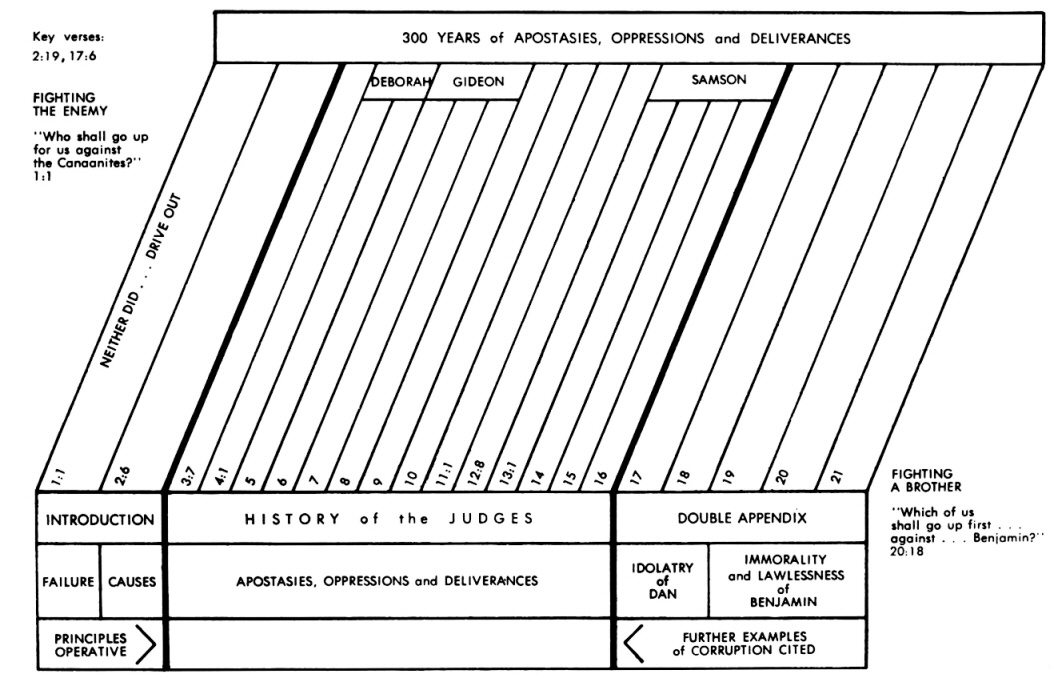
Chart from recommended resource Jensen's Survey of the OT - used by permission
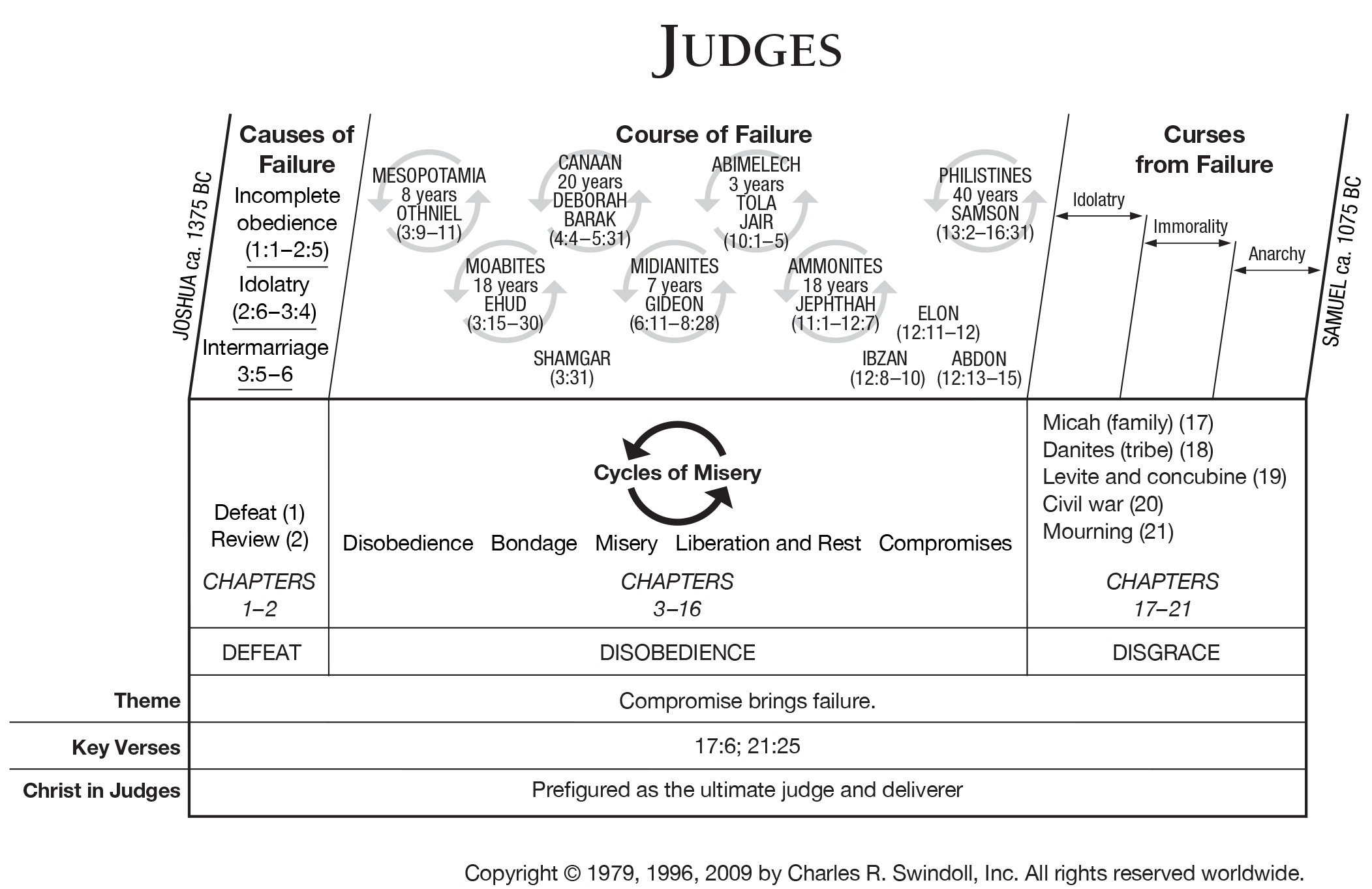
Chart on Judges - Charles Swindoll
|
RECYCLING SIN |
|||||
| Jdg 1:1-3:6 | Jdg 3:7-16:31 | Jdg 17:1-21:25 | |||
| Introduction | History of the Judges | Appendix | |||
| Causes of the Cycles THE REASON |
Curse of the Cycles THE RECORD |
Conditions in the Cycles THE RESULTS |
|||
| Failure to Complete Conquest Jdg 1:1-36 God's Judgment for Failure Jdg 2:1-3:6 |
Curse of the Cycles |
Conditions in the Cycles |
|||
| Living with Canaanites |
War with the Canaanites |
Living Like the Canaanites |
|||
| Religious Laxity |
Political Uncertainty |
Moral Anarchy |
|||
| About 350 Years of Israel's History - Almost 25%! From Compromise to Confusion! |
|||||

Another Timeline of Israel's History
Click to Enlarge
from Jensen's Survey of the OT
Click to Enlarge
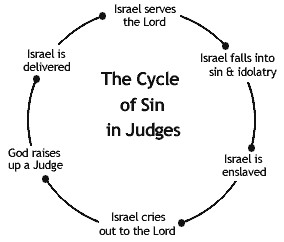
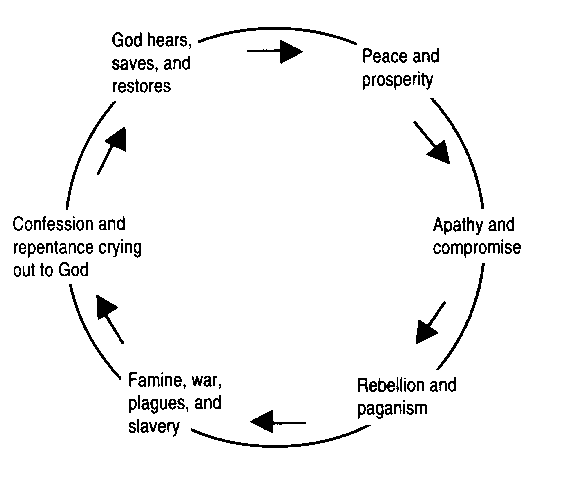
Other ways to describe Israel's cycle…
- Rest > Rebellion > Retribution > Repentance (?) > Restoration
- Sin > Suffering/Servitude > Supplication > Salvation
- Apathy > Apostasy > Affliction > Answered Prayer
- Disobedience > Desperation > Deliverance
- Disobedience > Bondage >Misery > Liberation and Rest > Compromises
FOLLOWING NOTES ARE COMPLETELY REVISED SPRING, 2022
Judges 4:1 Then the sons of Israel again did evil in the sight of the LORD, after Ehud died
- Did evil - Jdg 2:11,19,20; 3:7,12; 6:1; 10:6; Leviticus 26:23-25; Nehemiah 9:23-30; Ps 106:43, 44, 45; Jeremiah 5:3
Related Passages:
Leviticus 26:23-25 ‘And if by these things you are not turned to Me, but act with hostility against Me, 24 then I will act with hostility against you; and I, even I, will strike you seven times for your sins. 25 ‘I will also bring upon you a sword which will execute vengeance for the covenant; and when you gather together into your cities, I will send pestilence among you, so that you shall be delivered into enemy hands.
Jeremiah 5:3 O LORD, do not Your eyes look for truth? You have smitten them, But they did not weaken; You have consumed them, But they refused to take correction. They have made their faces harder than rock; They have refused to repent.
Judges 2:18-19 When the LORD raised up judges for them, the LORD was with the judge and delivered them from the hand of their enemies all the days of the judge; for the LORD was moved to pity by their groaning because of those who oppressed and afflicted them. 19 But it came about when the judge died, that they would turn back and act more corruptly than their fathers, in following other gods to serve them and bow down to them; they did not abandon their practices or their stubborn ways.
"THE CAT'S AWAY,
MICE WILL PLAY!"
Warren Wiersbe Outlines Judges 4-5
- Judges 4:1-3 Act one: A tragic situation
- Judges 4:4-7 Act two: A divine revelation
- Judges 4:8-10 Act three: A reluctant participant
- Judges 4:11-23 Act four: A victorious confrontation
- Judges 5:1-31 Act five: A glorious celebration
The apparent rapid relapse of Israel in their "sin addiction" to seductive, sensual idolatry reminds me of the old saying "When the cat's away the mice will play!" Note that some commentaries say Israel experienced repentance and revival during the years of rest. I don't think so as the only revival they repeatedly experienced was a revival of their sinful desires! Judges 4:1-3 give the setting of this dramatic account.
Judges 4-5 (4 in prose and 5 in poetry, a unique couplet in all of Scripture) introduce to two incredible OT woman. The poetic passages will give us more insight into the prose passages than we could get from just one account. Dave Roper said "I always think of these two women as lilies in the midst of a stagnant pond (ED: I MIGHT HAVE SAID "CESSPOOL!"), for the book of Judges describes an absolutely horrible time in the history of Israel."
Then the sons of Israel again - Then as noted below marks progression, and in this case might be more accurately described as "digression!" In this case then marks the beginning of the fourth cycle in the book of Judges. Sons of Israel speaks not of just some of the Israelites in just one of the 12 tribes, but the entire nation failing to follow the true, living God and falling for false, dead gods. Again is rendered in Lxx with the verb prostithemi which means to add to, as if to say they "added to" the evil that they had committed before Ehud arose and they experienced rest. The phrase "would turn back and act more corruptly than their father" seems to imply a progressive declension, so that the evil that they committed was greater than the preceding generation.
SUGGESTION - Always be alert to the word "Then" which marks sequential action. Something occurred, then something else followed. That's the idea. This word takes on special import in prophetic Scriptures, where it is an important clue of the timing of the prophetic events. For example in the incredible prophecy of Daniel in 9:24, 25, 26, 27 we read…"Then after the sixty-two weeks the Messiah will be cut off (Da 9:26). In this passage of course "then" is even more clear by the addition of the word "after".
Did evil in the sight of the LORD - Did in the LXX is poieo in the active voice indicating that they made a volitional choice to do evil and the word for evil in the LXX is poneros which means active evil, evil that seeks to do harm, in this case the harm done was to themselves!
Did evil is a repeated phrase in Judges - The phrase did evil is sadly also common in 1 and 2 Kings (24 times), increasing in frequency in second Kings
Jdg. 2:11; Jdg 3:12; Jdg 4:1; Jdg 6:1, Jdg 10:6; Jdg 13:1; 1 Ki. 14:22; 15:26, 34; 16:25, 30; 22:52; 2 Ki. 3:2; 8:18, 27; 13:2, 11; 14:24; 15:9, 18, 24, 28; 17:2; 21:2, 20; 23:32, 37; 24:9, 19; 2 Chr. 21:6; 22:4; 33:2, 22; 36:5, 9, 12; Jer. 52:2
It is as if the closer they got to judgment, the more evil they became or the more certain the judgment had to be. Just a thought to ponder. Note it is also interesting that this phrase did evil is not found in 1 and 2 Samuel. Could it be that the reason is that the leaders were godly men like Samuel and David? Note also that the evil began with Baalim (plural) but progressed to the point documented in Judges 10:6 (note)!
THOUGHT - If you are not overcoming temptations then the world is overcoming you. The worst enemy one has to overcome after all is one's self. Once again Israel would learn the truth of Jn 8:34…
Jesus answered them, "Truly, truly (amen amen), I say to you, everyone (NO EXCEPTIONS!) who commits (poieo - same verb as in Jdg 4:1 in present tense = habitually) sin is (present tense = continually) the slave (doulos) of sin (cf Ro 6:12, Ro 6:14, Ro 6:16)
(Similarly Peter speaking of the false teachers who are always) "promising them (their deceived victims who accept the false teaching) freedom while they themselves are slaves of corruption; for by what a man is overcome (hettao = overcome in battle, defeated in a conflict or contest - one over whom mastery has been gained. The perfect tense = speaks of permanence of their condition), by this he is enslaved (perfect tense = speaks of permanence of this condition. WOE!). (2Pe 1:19)
One of Satan's greatest lies is that sin is liberating. "Try it you'll like it"
D L Moody once quipped that "I had rather have 10,000 enemies outside than one inside."
After Ehud died - Judges 2:19 is an apt commentary declaring that "it came about when the judge died, that they would turn back and act more corruptly than their fathers, in following other gods to serve them and bow down to them; they did not abandon their practices or their stubborn ways." So when did they do evil? First note that it was after the land had rest for eighty years, which should have confirmed the in their faithfulness of God to protect them as His chosen people. Sadly this extended rest was not associated with revival of worship of Yahweh, but apparently made them secure (and probably also apathetic), so that they again immediately relapsed into indulging their lusts. The truth is that the prosperity of fools will destroy them.
Jamieson - The removal of the zealous judge Ehud again left his infatuated countrymen without the restraint of religion.
Israel as portrayed in the Book of Judges illustrates the difference between “religious reformation” and “spiritual revival.” Reformation temporarily changes outward conduct while revival permanently alters inward character. When Ehud removed the idols and commanded the people to worship only Jehovah, they obeyed him; but when that constraint was removed, the people obeyed the desires of their heart, which clearly were not for Yahweh but for self. The nation of Israel was like the man in Jesus’ parable who got rid of one demon, cleaned house, and then ended up with seven more wicked demons (Mt 12:43-45). Here is a principle we all must be aware of -- The empty heart is prey to every form of evil.
THOUGHT - Israel's failure to complete the occupation of the land once again came back to haunt them. Isn't that the nature of persistent sins we fail to eradicate by the power of the Spirit (Ro 8:13). Don't procrastinate if you have persistent pesky "pet" sins, and be like many people who have kept boa constrictors as pets only to one day have the snake coil around their neck or chest and be killed by what they thought was a "tame" pet. Sin is NEVER tame but ALWAYS kills! As John Owen rightly said "Be killing sin, lest it be killing you!" Take heed!
Ralph Davis comments on the efficacy of Ehud as a "savior" writing that "Ehud, sorry to say, is not a totally adequate savior, for though Yahweh brings a certain kind of salvation and help through Ehud, nothing Ehud did could change the hearts of Israel. He may have exerted some beneficial influence on them while he lived (See above), but he could not release Israel from the bondage of sin or rip the idols out of their hearts. Here is the tragedy of the people of God — slavery to sin (“again did evil”) — and no left–handed savior spilling the guts of foreign kings can release you from that bondage. Helplessness indeed! As noted before, it is what the apostle called being “under sin” (ED: under depicts sin as the master, the authority - see Ro 3:9). Note: not sins but sin. Sin is not merely, or primarily, act but power. Being “under sin” is to be held in its clutches, bound by its chain (Jdg 2:19). (Judges: Such a Great Salvation - Focus on the Bible) (Bolding added)
The drama of Deborah and Barak and Yahweh in Judges 4-5 might be subtitled Two Are Better than One, and Three Are Better Still.
The cast of characters in this drama includes
- Jabin: King of Hazor in Canaan; a tyrant
- Deborah: a Jewish judge; a woman of faith and courage
- Barak: a reluctant Jewish general
- Sisera: captain of Jabin’s army
- Heber: a Kenite neighbor, at peace with Jabin
- Jael: apparently a Gentile and wife of Heber; handy with a hammer
- Jehovah God: in charge of wars and weather
- Now let the drama unfold.
Judges 4:2 And the LORD sold them into the hand of Jabin king of Canaan, who reigned in Hazor; and the commander of his army was Sisera, who lived in Harosheth-hagoyim.
- And the LORD: Jdg 2:14,15 10:7 Isa 50:1 Mt 18:25 "It seems to concern only north Israel."
- Jabin king of Canaan, who reigned in Hazor: Jos 11:1,10,11 19:36
- Sisera: 1Sa 12:9 Ps 83:9
- Harosheth-hagoyim: Jdg 4:13,16
Related Passages:
1 Samuel 12:9 (SUMMARIZES THE EVENTS) “But they forgot the LORD their God, so He sold (makar) them into the hand of Sisera, captain of the army of Hazor (Hazor is the place, Jabin is the person, the king), and into the hand of the Philistines and into the hand of the king of Moab, and they fought against them.
HUMAN REBELLION QUICKLY
BROUGHT DIVINE RETRIBUTION
Yes, this title refers to the rebellious nation of Israel, but it also refers to the man or woman whose face you see each morning in the mirror! "Do not be deceived (literally stop being deceived [by sin Heb 3:13] = present imperative with a negative see our need to depend on the Holy Spirit to obey), God is not mocked; for whatever a man (OR WOMAN) sows, this he (SHE) will also reap. For the one who sows to his own flesh will from the flesh reap corruption, but the one who sows to the Spirit will from the Spirit reap eternal life." (Gal 6:7-8) What are you reaping today? The seeds of your fruit today (evil or good), you have sown in the past! We can choose to sin, but we cannot choose our consequences! Woe!
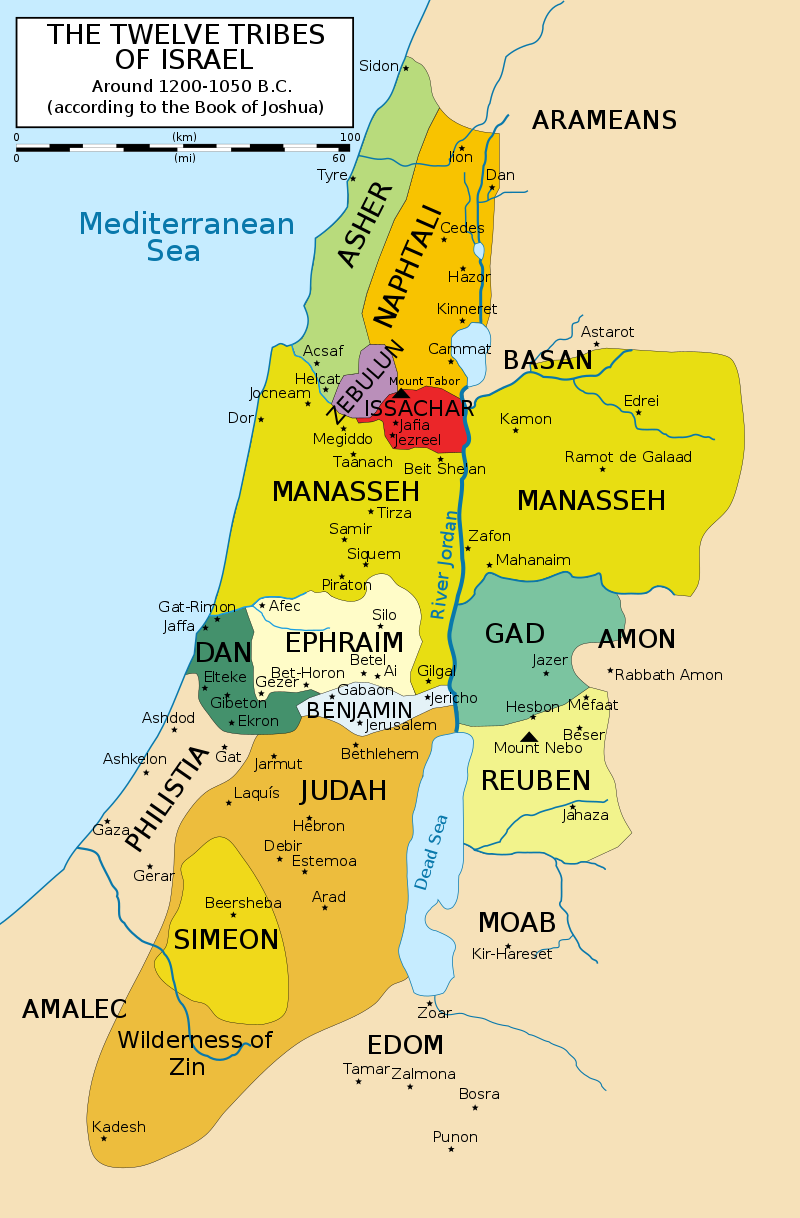
And the LORD sold them into the hand of Jabin king of Canaan, who reigned in Hazor - Don't miss the "and" which couples Israel's sinning with Yahweh's selling! Sold pictures transferring "ownership" and thus is a figurative way of describing coming under the control of another's power. Click this map and observe in the territory of Naphtali, noting the city of Hazor about 8-10 miles north of the Sea of Galilee at the south end of the Hulah Valley, a strategic city along the Via Maris (Way of the Sea - see map of Hazor on this route), which was the most important trade route of ancient times.

HISTORICAL CONTEXT: Jabin means "one who is intelligent," "discerning" and "may have been a hereditary royal title among the northern Canaanites (ED: Just as Pharaoh was a title for the kings of Egypt)...."The king of Hazor," the leading city in Northern Palestine, who led an alliance against Joshua. He was defeated at the waters of Merom, his city was taken and he was slain (Joshua 11:1-9). "The king of Canaan, that reigned (or had reigned) in Hazor (in Napthali)." It is not clear whether he dwelt in Hazor or Harosheth, the home of Sisera, the captain of his host at the time of the story narrated in Jgs." (ISBE)
Hazor (means enclosed; fortified) was a stronghold of the Canaanites in the mountains north of Lake Merom (Josh. 11:1-5). Jabin the king with his allied tribes here encountered Joshua in a great battle. Joshua gained a signal victory, which virtually completed his conquest of Canaan (Joshua 11:10-13). Although Joshua had destroyed Hazor, Israel failed to occupy it and so the Canaanites returned. (Which parenthetically is what sin does when it is not completely eradicated!) Hazor (in Napthali) was afterwards rebuilt by the Canaanites, and was ruled by a king with the same presumed hereditary name "Jabin." His army, under Sisera, swept down upon the south, aiming at the complete subjection of the Israelites. But he would meet his match in a God anointed woman named Deborah and her general named Barak! After the defeat of the Jabin and Sisera, the city of Hazor was occupied by the Israelites and fortified by Solomon to defend the entrance into the kingdom from Syria and Assyria. When Tiglath-pileser, the Assyrian king, invaded the land, Hazor was one of the first cities he captured, carrying its inhabitants captive into Assyria (2Ki 15:29).
About 200 years earlier the Lord had freed Israel from slavery in Egypt. Now, in contrast, He sold them back into slavery (in effect) in the hands of the Canaanites as punishment for their sins (cf. Jdg 2:14; Jdg 3:8; 1Sa 12:9).
The term Canaanite often refers to all non-Jews living west of the Jordan but here the focus is on a northern coalition of Canaanites united under Jabin. Under the leadership of Joshua, Israel had conquered and burned Hazor and killed "Jabin" (Josh 11:1,11 clearly refers to another "Jabin" not a resurrected one!) about 100-150 years earlier (Josh 11:1-13). Clearly Hazor (in Napthali) had been rebuilt by the Canaanites and regained its previous strategic dominance over the whole region of Galilee. Why? Because they did not drive them out and utterly destroy (Dt 7:2, 12:2, 20:17, Jos 11:20) them (cp Jdg 1:27 notes Judges 1:27; 28; 29; 30; 31; 32; 33). Another Jabin now ruled (probably this name was used like "Abimelech" as a hereditary title). Hazor has been confirmed archaeologically to have been an important city in Canaanite times.
How Depraved Were the Canaanites? Elwood McQuaid writes that "The Canaanites far surpassed all of their contemporaries in lust, cruelty, and degrading spiritual practices. Their religion consisted of adoration of the planets and worship of a pantheon of gods, El being the supreme deity (note that Satan loves to counterfeit the truth for El is the name of our majestic triune God, Elohim [the plural of El]). Baal was the chief underling of El and overlord of the lesser gods in the pantheon. Baal was identified as the god of rain and the storm, whose voice rode the heavens on wings of the thunderclaps (ED: cf the truth in Ps 104:3). His images depicted him holding a thunderbolt shaped into a spear. Their circle of gods also contained female figures. Astarte, Asherah (see discussion), and Anath were believed to possess the power to change their gender as the occasion dictated (ED: This sounds like America in 2022)! Without spelling out sensual details, it must be noted that this grouping of Canaanite gods and goddesses promoted the most detestable sexual excesses. Promiscuity, incest, and nudity were all glorified among the gods of Canaan. Sacred prostitution and sodomy were also prominent in the licentious practices of these false deities. Canaanite worship can only be characterized as a gross perversion of everything sacred to true people of God. One can, therefore, easily understand why God commanded Israel to drive out and utterly destroy the Canaanites—an act frequently condemned by liberals. How many times have you heard "The God of the OT is a God of wrath, of vengeance or anger?". In reality, it was an act of mercy for God was attempting to spare His people Israel the agonies they would, unfortunately choose to suffer, because they could not resist the temptation. (McQuaid's book Not to the strong can be borrowed for one hour).
THOUGHT - There is a powerful lesson for all believers of all ages - compromise with God's enemies soon evolves to becoming comfortable with their evil practices. Things that previously would have been revolting at just the mention, become "strange bedfellows" with those who have accommodated and rationalized their sin (there is nothing rational about sin!).
When we apply these facts to our present loose attitude in America regarding sin and its consequences, we can see that there is a major re-set needed in our thinking, and this includes Christians who are "playing" with the amoral mores of this godless culture. A culture which takes a flippant attitude toward sin, especially sexual sin, will eventually obliterate the boundaries of right and wrong unless our mind is daily renewed by the Word (Eph 4:23). Catchphrases that promise effortlessly to restore the errant believer to a place of blessing are a delusion. Sin in any form is an offense to God. To call this to the attention of believers is not to engage in sanctimonious legalism. It is a warning that must be sounded. We must develop a heightened sensitivity to sin and ask God for a Holy Spirit endued zeal to pursue holiness in the midst of an unholy, dying culture. In fact this is the essence of true revival, which is desperately needed in America in 2022. A new political leader cannot solve the problems of the heart. Only God can remedy this malady and only by Spirit wrought, Word centered, Christ exalting revival! Let us frequently pray Psalm 119:25 "My soul cleaves to the dust; Revive me according to Your word."
And the commander of his army was Sisera, who lived in Harosheth-hagoyim ("woodland of the gentiles"): Harosheth Haggoyim (Harosheth of the Gentiles) (cf. Jdg 4:13, 16) located by a narrow gorge where the Kishon River enters the Plain of Acre about 10 mi NW of Megiddo. Through the help of his general Sisera, Jabin exercised military control over 5-6 of the northern tribes (see map). So Harosheth Haggoyim is on the west next to the Mediterranean Sea and Hazor is on the east located 8-10 miles north of the Sea of Galilee.
Sisera - Jewish Encyclopedia has an interesting (albeit a bit exaggerated) note - According to the Midrash, Sisera hitherto had conquered every country against which he had fought. His voice was so strong that when he called loudly the most solid wall would shake and the wildest animal would fall dead. Deborah was the only one who could withstand his voice and whom it did not cause to stir from her place. Sisera caught fish enough in his beard when bathing in the Kishon to provision his whole army. (SERIOUSLY?) According to the same source, thirty-one kings followed Sisera merely for the opportunity of drinking, or otherwise using, the waters of Israel.
Related Resources:
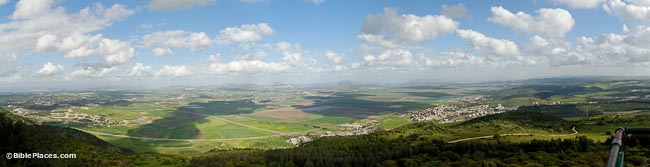
Sisera pushed down from Hazor (in Napthali) to occupy the Valley of Jezreel (see picture - Jezreel in Greek = Esdraelon, See longer ISBE article on Esdraelon), a strategic and fertile valley in the central portion of Israel. Note this new oppression was not brought about by a foreign invasion (external enemies) as the previous one had been but was instigated by the very Canaanites (internal enemies) whom the Israelites had failed to expel from the land (Jdg 1:30-33). Israel was reaping what they had sown, as disobedience always does! (Gal 6:7-8) As Hosea said "they sow the wind And they reap the whirlwind." (Hos 8:7) Israel thus continued to reap a bitter fruit from the seeds of disobedience she had sown by refusing to believe God and thus not utterly destroying the enemies in the land. First we saw C-R from without (Mesopotamia), then the enemy came closer in Eglon from Moab (and actually in their land near Jericho) and now the enemy arises from WITHIN!
THOUGHT - Like James exhorts us in regard to the deceitfulness of sin (See Deceitfulness of Sin) "Don't be deceived (present imperative with a negative see our need to depend on the Holy Spirit to obey) beloved brethren"! (Jas 1:16). The writer of Hebrews exhorts us to "encourage (present imperative = continually - which must mean we are each in continual "need" of encouragement! Are you a discourager or an encourager beloved? see our need to depend on the Holy Spirit to obey) one another day after day, as long as it is still called "Today," lest any one of you be hardened by the deceitfulness (apate) of sin. (Hebrews 3:13) Read that again and answer the question the "what" of sin? The deceitfulness of sin! And you can mark it down that when a person is deceived (even you or this writer), by definition they are not even aware that they are deceived! And this is the nature of sin! Beware!
Apply these truths to your life, reading and heeding Paul's warning to the church at Corinth...
Now these things happened as EXAMPLES for us, that we should not crave evil things, as they also craved. 7 And do not be idolaters as some of them were; as it is written, "THE PEOPLE SAT DOWN TO EAT AND DRINK, AND STOOD UP TO PLAY." 8 Nor let us act immorally, as some of them did, and twenty-three thousand fell in one day. 9 Nor let us try the Lord, as some of them did, and were destroyed by the serpents. 10 Nor grumble, as some of them did, and were destroyed by the destroyer. 11 Now these things happened to them as an EXAMPLE, and they were written for our INSTRUCTION, upon whom the ends of the ages have come. 12 Therefore (term of conclusion) let him who thinks he stands (see Pr 16:18) take heed (present imperative = continually - we are each in continual "need" of being on the lookout and can only obey this command by depending on the Holy Spirit!) lest he fall. (1Cor 10:6-12)
QUESTION - Who was Sisera in the Bible?
ANSWER - There are two men named Sisera in the Bible. One is mentioned briefly in Ezra 2:53 and Nehemiah 7:55; this Sisera was a temple servant who returned to Jerusalem when the Israelite exiles were allowed to leave Persia and go back to their own land.
The other Sisera—the infamous Sisera—lived in the time of the judges and was the commander of a Canaanite army. The Canaanites, led by King Jabin, had been God’s tool of judgment upon the Israelites for their idolatry (Judges 4:2).
Sisera had 900 iron chariots at his disposal, compared to the Israelites, who had no chariots. For twenty years Sisera “cruelly oppressed the Israelites” (Judges 4:3). As was their habit when they were in trouble, the Israelites called to God for deliverance. Deborah the prophetess, who was also judging at the time, received word from the Lord in answer to the Israelites’ call. She summoned a man named Barak and told him, “The Lord, the God of Israel, commands you: ‘Go, take with you ten thousand men of Naphtali and Zebulun and lead them up to Mount Tabor. I will lead Sisera, the commander of Jabin’s army, with his chariots and his troops to the Kishon River and give him into your hands’” (verses 6b–7).
Barak was hesitant and requested that Deborah accompany him. Because of this hesitation, Deborah prophesied that Sisera would fall at the hands of a woman and Barak would get none of the glory (Judges 4:9). But Deborah agreed to go with Barak to Mount Tabor, where Barak and his 10,000 men met Sisera in battle. God sent a flash flood that disabled Sisera’s chariots, and the Israelites routed their enemies (Judges 5:4, 20–21). In the face of defeat, Sisera fled on foot (Judges 4:15). As Barak and the Israelites tracked down and destroyed Sisera’s army, Sisera himself sought a hiding place. He came to the dwelling of Heber the Kenite, who was allied with King Jabin of Canaan (Judges 4:17). As Sisera approached, Heber’s wife, Jael, called him into her tent with the promise of safety (verse 18). Sisera accepted her offer. Since it was against social norms for a man to enter a woman’s tent, Jael seemed to be offering a perfect hiding place.
Sisera told Jael that he was thirsty, and she gave him some milk and covered him with a blanket (Judges 4:19). Feeling relatively safe, Sisera asked Jael to watch at the door of the tent and then fell asleep. As Sisera was sleeping, Jael took a tent peg and hammer, sneaked up on the sleeping commander, and drove the tent peg through his skull and into the ground (Judges 4:21). When Barak came looking for Sisera, Jael led him into the tent to show him Sisera’s body with his head pinned to the ground. Deborah’s prophecy that Sisera would be brought down by a woman had been fulfilled.
The death of Sisera and his army greatly weakened King Jabin’s grip on the Israelites, and God’s people were eventually able to overcome him and be free of the Canaanite oppression (Judges 4:23–24). On the day of Sisera’s death, Barak and Deborah sang a song of praise, which can be found in Judges 5, detailing God’s deliverance of the Israelites from the hands of the evil commander. Near the end of the song is a unique passage full of irony. Deborah takes the perspective of Sisera’s mother waiting for her fallen son:
“Through the window peered Sisera’s mother;
behind the lattice she cried out,
‘Why is his chariot so long in coming?
Why is the clatter of his chariots delayed?’
The wisest of her ladies answer her;
indeed, she keeps saying to herself,
‘Are they not finding and dividing the spoils:
a woman or two for each man,
colorful garments as plunder for Sisera,
colorful garments embroidered,
highly embroidered garments for my neck—
all this as plunder?’” (Judges 5:28–30).
The Canaanites, under Sisera’s military leadership, fully expected to defeat the Israelites, who were outgunned, outnumbered, and seemingly powerless. Sisera’s mother’s mention of rich spoils and the abuse of captured women indicate the greed and ruthless nature of the Canaanite army. What Sisera (and his mother) did not count on was the God of Israel, who intervened on behalf of His people.
So great was the triumph of Israel over Sisera and his army that King David would later remember it in one of his psalms: “Do to [your enemies] as you did to Midian, / as you did to Sisera and Jabin at the river Kishon” (Psalm 83:9).GotQuestions.org
Sisera - 21x in 19v in the OT - Jdg. 4:2; Jdg. 4:7; Jdg. 4:9; Jdg. 4:12; Jdg. 4:13; Jdg. 4:14; Jdg. 4:15; Jdg. 4:16; Jdg. 4:17; Jdg. 4:18; Jdg. 4:22; Jdg. 5:20; Jdg. 5:26; Jdg. 5:28; Jdg. 5:30; 1 Sam. 12:9; Ezr. 2:53; Neh. 7:55; Ps. 83:9
Judges 4:3 And the sons of Israel cried to the LORD; for he had nine hundred iron chariots, and he oppressed the sons of Israel severely for twenty years.
- And the sons of Israel cried to the LORD Jdg 3:9,15; 10:16; 1Sa 7:8; Ps 50:15; 78:34; Jer 2:27,28
- Chariots - Jdg 1:19; Josh 17:16
- Severely - Jd g5:8 De 28:29,33,47,48 Ps 106:42
Related Passages:
Judges 3:9, 15 When the sons of Israel cried to the LORD, the LORD raised up a deliverer for the sons of Israel to deliver them, Othniel the son of Kenaz, Caleb’s younger brother....15 But when the sons of Israel cried to the LORD, the LORD raised up a deliverer for them, Ehud the son of Gera, the Benjamite, a left-handed man. And the sons of Israel sent tribute by him to Eglon the king of Moab.
1 Samuel 7:8-9 Then the sons of Israel said to Samuel, “Do not cease to cry to the LORD our God for us, that He may save us from the hand of the Philistines.”Samuel took a suckling lamb and offered it for a whole burnt offering to the LORD; and Samuel cried to the LORD for Israel and the LORD answered him.
Psalms 107:27-28 They reeled and staggered like a drunken man, And were at their wits’ end. 28 Then they cried to the LORD in their trouble, And He brought them out of their distresses.
CHARIOT CRISIS CREATES
COURAGE CRISIS
And the sons of Israel cried (tsaaq) to the LORD - Note they did not cry out to their liveless, useless idols, but to God, which tells us that while they did not really "know" God (Jdg 2:10), they still retained a remembrance of Him and the power He had manifested for their ancestors. However as in the previous times of distress when Israel called on the Lord there was no evidence of repentance for her sin. Israel was like the passengers on an airplane that suddenly lost engine power and began to cry out to God for help. It is interesting that despite the plethora of so-called gods, in "crunch time" Israel cried out to the One God, Jehovah. This implies that deep inside they knew their so-called gods were not really God and had no power to save. It also shows how if men will not serve the One God, they are still so constituted that they must worship and will resort to gods of their own imagination to satisfy this deep inner need. It's true of all of us - we have been created with a "God shaped vacuum" and if we will not worship the One True God, we will worship the god of self, of money, of power, etc. These latter gods make no moral demands per se on us and thus we can do as we please, doing whatever seems right in our own eyes (Jdg 21:25). And so we conclude that much of the modern world like ancient Israel is in effect "polytheistic", the only difference being that the modern gods simply have different names.
For (term of explanation) he had nine hundred iron chariots - The writer explains why Israel cried out. They saw iron chariots which created fear and resulted in a cry to God. Fruchtenbaum notes that "The mention of 900 chariots is not out of character for, in the inscriptions of Thutmose III, he states that he captured nine hundred twenty-four chariots from the Canaanites in the Battle of Megiddo, and Megiddo plays a role in the battle of Judges as recorded in chapters 4 and 5." (Ariel's Bible Commentary)
The source of Jabin's strength, humanly speaking, lay in his 900 chariots of iron. These gave him an enormous technological edge over the Israelites on flat ground. But his real power over Israel lay in the fact that the Lord, seeking to punish His people, had sold them into his hand
Holman Study Bible: NKJV Edition.
Humanly speaking Israel's lot was hopeless and helpless (cf status of sinners in Ro 5:6 = "we were still helpless"). A nation without arms (Jdg 5:8) was indeed "helpless" before a nation "armed to the teeth." But Israel's real problem was not military but spiritual. Their real need was not an iron smelter but reliance on a living Savior. So in the face of this militarily impossible situation God does not raise up an Othniel or Ehud but a woman. Naturally speaking it was the last place Israel would have expected help from. It raises the question -- Where were the men?
THOUGHT - Where are the men today? Who is usually involved in serious Bible study in America? Is it the men? No, sadly for the most part, it is the women. There is nothing wrong with the latter, but there is much wrong with the former deficit. Men, if you're too busy for serious Bible study, you are too busy period! And we are not talking about touchy, feely "manhood" studies. The pure milk of the Word (1Pe 2:2) alone satisfies man's basic need, not studies filled with psychological pabulum (baby food - which Webster defines as that which is insipid, simplistic, or bland) and/or humanistic aphorisms. Man does not live by bread (or stock portfolios, or lake houses, or sailboats, etc) but by every (how many?) Word that proceeds from the mouth of God - This is the Scriptural truth (Deut 8:3, Mt 4:4, Lk 4:4, Job 23:12 , Jer 15:16, see Ps 1:2, 3 for God's formula for true God-honoring success in this short, fleeting life that is given to prepare us for eternity)
The military position of Israel was nothing short of appalling for they were out-manned, out-gunned, out-positioned!
And he (Sisera) oppressed (lachats; Lxx = thlibo) the sons of Israel severely (chozqah) for twenty years - One wonders why the oppression did not cause them to cry out sooner? Notice that the verb oppressed would have been enough to make the point, but the writer adds severely (chozqah) to emphasize how extremely heavy the oppression was! And notice also that this is the longest period of oppression to date (See chart - 8 yr before Othniel, 18 yr before Ehud) Sin will take you deeper and deeper and keep you longer and longer if you do not repent!
As Fruchtenbaum rightly observes "On the human side, the Canaanite ability to oppress Israel for so long was due to their chariot strength. On the divine side, it was God’s discipline due to Israel’s apostasy. (Ariel's Bible Commentary)
ISRAEL’S FAILURE TO BELIEVE and obey God created a slowly festering sore on the anatomy of the nation. Have you ever had an insect bite that you scratched and it became infected? And the red margin of infection begin to slowly, imperceptibly spread outward to the point that others begin to see what you had ignored? And then you needed a course of systemic antibiotics to cure the infection! Israel would ultimately fall beneath the weight of a canker that they had allowed to become far too large and painful to excise with their own hands. Sin is deceptive. The inhabitants of the land, whose presence among them seemed inconsequential at the beginning, soon produced Jabin, Sisera, and 900 chariots of iron. Consequently, the children of Israel found themselves terrorized, oppressed, and faced with 20 years of debilitating servitude.
THOUGHT - What "Jabin, Sisera or 900 chariots of iron" has God allowed to fester in your spiritual life beloved because of bad choices and/or failure to obey Him? It's time to cry out to Jehovah, but don't imitate Israel in the transience of their return to Him. Instead, cry out for revival even as did the Psalmist (who from the nature of his writing was undoubtedly one of the best men around… and yet he found it necessary to cry out for revival! You have not because you ask not beloved. Ask and it shall be given but ask in faith without any doubting. Don't be like the man who "buried the hatchet" of discord with a friend in the back yard and left the handle above the ground in case he needed it again! Cry out for the divine gift of genuine repentance and revival from the only One capable of giving it - "My soul cleaves** (sticks like glue is the picture) to the dust. Revive me (bring spiritual life again) according to Thy Word." (Ps 119:25 Spurgeon's Note)
THOUGHT - What is associated with genuine revival (cf Ps 119:25)? Clearly it is the Word of Life and Truth. It is not some emotional high but it is God in us working and willing to His good pleasure (Php 2:12, 13), even stimulating a heart hunger for His truth, whereby we might live again. When you experience physical hunger, you usually satisfy it at the first opportunity. Do the same when God sends this spiritual hunger. Don't procrastinate and say I'll get into His Word tomorrow. I'll join a serious Bible study next month or next semester. Today is the day of your salvation (present tense salvation [see Three Tenses of Salvation] - ongoing day to day salvation whereby we are gradually, continually being set apart by the Spirit from the profane world and unto God and for His use and glory.) And how does it happen? The intake of His Word is central, so don't delay another day beloved. Consider joining a serious Bible Study. Men's (Women's) Bible Study Fellowship (Welcome to BSF), which is the "vehicle" God used to save me some 36 years ago as I studied in the Minor Prophets (Jesus is on every page of the Scripture)! After BSF I was introduced to Precept Ministries International which God first used to save my marriage (which he supernaturally revived through the study of Covenant - see Covenant As It Relates to Marriage) and then used over the next 15+ years to prepare me for the ministry you are reading on this website. There is a gross misconception that Precept Ministries International Bible studies are only for women but that is not correct. They are for all saints and have as their primary objective the making and maturing disciples (Mt 28:19). In my opinion Precept Ministries' inductive Bible studies are without peer as a tool which the Spirit can use to edify and equip saints who are "created in Christ Jesus for good works, which God prepared beforehand, that we should walk in them." (Ep 2:10). But I don't want to mislead you… inductive Bible study is difficult work (more work than BSF but a great follow up to BSF - yes, there is "life" after BSF!), but the reward is simply incalculable as eternity future will clearly testify. Try a sample by downloading lesson one of Judges - Driving Out Your Enemies!
DO A PERSONAL INVENTORY AND NOTE WE NEED REVIVAL...
- when we do not love Him as we once did.
- when earthly interests and occupations are more important to us than eternal ones.
- when we would rather watch TV and read secular books and magazines than read the Bible and pray.
- when church dinners are better attended than prayer meetings.
- when we have little or no desire to pray.
- when we put people into leadership positions in our churches who do not meet scriptural qualifications.
- when our Christianity is joyless and passionless.
- when we know truth in our heads that we are not practicing in our lives.
- when we make little effort to witness to the lost.
- when we have time for sports, recreation, and entertainment, but not for Bible study and prayer.
- when we do not tremble at the Word of God.
- when we seldom think thoughts of eternity.
- when God's people are more concerned about their jobs and their careers, than about the Kingdom of God.
- when our church services are predictable and "business as usual."
- when believers can be at odds with each other and not feel compelled to pursue reconciliation.
- when Christian husbands and wives are not praying together.
- when our marriages are co-existing rather than full of the love of Christ.
- when our children are growing up to adopt worldly values, secular philosophies and ungodly lifestyles.
- when we are more concerned about our children's education, and their athletic activities than about the condition of their souls.
- when sin in the church is pushed under the carpet.
- when known sin is not dealt with through the Biblical process of discipline and restoration.
- when we tolerate "little" sins of gossip, a critical spirit and lack of love.
- when we watch things on television and movies that are not holy.
- when our singing is half-hearted and our worship lifeless.
- when our prayers lack fervency.
- when our hearts are cold and our eyes are dry.
- when we aren't seeing regular evidence of the supernatural power of God.
- when we have ceased to weep and mourn and grieve over our own sin and the sins of others.
- when we are bored with worship.
- when we have to be entertained to be drawn to church.
- when we don't long for the company and fellowship of God's people.
- when our giving is measured and calculated, rather than extravagant and sacrificial.
- when we are not seeing lost people drawn to Jesus on a regular basis.
- when we aren't exercising faith and believing God for the impossible.
- when we are more concerned about what others think about us than what God thinks about us.
- when we are unmoved by the thought of neighbors, business associated and acquaintances who are lost and without Christ.
- when the lost world around us doesn't know or care that we exist.
- when we are making little or no difference in the secular world around us.
- when the fire has gone out in our hearts, our marriages and the church.
- when we are blind to the extent of our need and don't think we need revival.Send a revival, O Christ, my Lord,
Let it go over the land and sea;
Send it according to Thy dear Word,
And let it begin in me.
--McKinney
Cried out (06817)(tsaaq) means to cry out, to summon. It refers to shouting, complaining loudly, to pleading for relief or justice, calling for help. It occurs nearly fifty times in the Qal stem with the sense of crying out for help and consolation from suffering or injustice (e.g., 2Ki. 8:3, 5; Job 19:7; Isa. 42:2). The Septuagint translates tsaaq with krazo here in Judges 4:3, referring to a loud cry expressing deep emotion (fear, pain) and is an onomatopoeic word, very pronunciation of which imitates the hoarse cry of the raven (listen).
Uses of tsaaq in Judges - Jdg. 4:3; Jdg. 7:23; Jdg. 7:24; Jdg. 10:12; Jdg. 10:17; Jdg. 12:1;
Oppressed (03905) lachats means to press, crush (of Balaam's donkey squeezing and crushing his foot - Nu 22:35) and thus to distress. Lachats in Jdg 4:3 is rendered in Lxx with thlibo which means to press upon (crowd in Mk 3:9), make narrow (Mt 7:14) and figuratively to afflict, oppress, cause trouble (2Th 1:6).
Walter Kaiser on lachats - The word finds its most important usage in the realm of ethical theology. Israelites were not to oppress foreigners or strangers (Ex 22:21; Ex 23:9), for they once had been strangers in Egypt, that great oppressor. Oppressive treatment was strictly forbidden to all and to Israel in particular. Israel experienced a whole wave of oppressors during the period of the judges (Jdg 1:34; Jdg 2:18; Jdg 4:3; Jdg 6:9; Jdg 10:12; 1 Sa 10:18). But the Lord sent deliverers in each situation. Later he sent oppressors, (the king of Syria and others; 2 Ki 13:4, 22) against Israel on account of sin (Amos 6:14). Other nations will face their oppressors (Isa 19:20), too. But God always hears the cry for mercy and deliverance, and he will then fight daily against those oppressors (Ps 56:1) (Borrow the Theological wordbook of the Old Testament)
Severely (02394)(chozqah) means strength or force. From the OT uses one notes that most refer to a harsh, cruel, and self-serving use of one’s strength and power. The Lxx of Jdg 4:3 translates with kratos which denotes the possession of force or strength that affords supremacy or control.
Baker on chozqah - A feminine noun meaning strength, force. It always occurs with the preposition be (with or by). It can be used to modify oppression (Jdg. 4:3); rebuke (Jdg. 8:1); capture (1Sa. 2:16); ruling (Ezek. 34:4); crying to God (Jon 3:8). Only the last of these references has a positive connotation. All the others connote a harsh, cruel, and self-serving connotation of the use of one's strength and power. (Complete Word Study Dictionary- Old Testament)
Chozqah 5x in OT - earnestly(1), force(2), severely(1), vigorously(1). - Jdg 4:3; Jdg 8:1; 1Sa 2:16; Ezek. 34:4; Jonah 3:8
Judges 4:4 Now Deborah, a prophetess, the wife of Lappidoth, was judging Israel at that time.
- Ex 15:20 2Ki 22:14 Ne 6:14 Joe 2:28,29 Mic 6:4 Lu 2:36 Ac 21:9 1Co 11:5 Ga 3:28
Exodus 15:20 Miriam the prophetess, Aaron’s sister, took the timbrel in her hand, and all the women went out after her with timbrels and with dancing.
2 Kings 22:14 So Hilkiah the priest, Ahikam, Achbor, Shaphan, and Asaiah went to Huldah the prophetess, the wife of Shallum the son of Tikvah, the son of Harhas, keeper of the wardrobe (now she lived in Jerusalem in the Second Quarter); and they spoke to her.
2Chr 34:22 So Hilkiah and those whom the king had told went to Huldah the prophetess, the wife of Shallum the son of Tokhath, the son of Hasrah, the keeper of the wardrobe (now she lived in Jerusalem in the Second Quarter); and they spoke to her regarding this.
Nehemiah 6:14 Remember, O my God, Tobiah and Sanballat according to these works of theirs, and also Noadiah the prophetess and the rest of the prophets who were trying to frighten me.
Isaiah 8:3 So I approached (EUPHEMISM FOR SEXUAL RELATION) the prophetess, and she conceived and gave birth to a son. Then the LORD said to me, “Name him Maher-shalal-hash-baz;
Luke 2:36 And there was a prophetess, Anna the daughter of Phanuel, of the tribe of Asher. She was advanced in years and had lived with her husband seven years after her marriage,
Acts 21:9 Now this man had four virgin daughters who were prophetesses. 10 As we were staying there for some days, a prophet named Agabus came down from Judea.
Revelation 2:20 ‘But I have this against you, that you tolerate the woman Jezebel, who calls herself a prophetess, and she teaches and leads My bond-servants astray so that they commit acts of immorality and eat things sacrificed to idols.

DEBORAH
Prophetess. Homemaker.
Judge. Leader
Now Deborah, a prophetess (nebiah/neviah), the wife of Lappidoth - A prophetess in Hebrew literally reads "a woman, a prophetess" (Lxx = gyne - woman + prophetes) the same term applied to 4 other women in the Old Testament (see passages above) (See also chart of Judges). Judges 5:7 adds that Deborah was a "a mother in Israel." Deborah's name means "bee" or "wasp" which prompted one Hebrew scholar to quip that "Deborah was a bee in peace and a wasp in war!" And so we see that Deborah held three positions of leadership in Israel (cf Jdg 5:2). She was a judge (only woman judge in Scripture), a military leader who successfully led a campaign against the Canaanites and finally a prophetess who delivered God's word to Barak and presumably to the people who came to her for her judgments (Jdg 4:5).
TECHNICAL NOTE - Lappidoth's name means torches or flames and Barak's name meant lightning or lightning flash. When Deborah was around "sparks flew!" (Please excuse my poor pun).
This extraordinary woman came into prominence when the men of Israel were paralyzed by fear. (Isa 3:12). As a prophetess she received Word from God and proclaimed it to Barak (Jdg 4:6-7). It is interesting that Scripture does not say that Lappidoth was the "husband of Deborah" but just the opposite, because this has always been God's order. Samuel is the only other judge who was expressly called a prophet (2Sa 3:30), though all of the judges received information from the Lord through special means.”
Deborah is remarkable in a male dominated society like Israel and reflects the declension of the nation. Isaiah writes
O My people! Their oppressors are children, And women rule over them. O My people! Those who guide you lead you astray And confuse the direction of your paths. (Isaiah 3:12)
When the leader arose, the people volunteered to battle the enemy against all odds (Jdg 5:2).
LORD God give us Deborahs and Baraks in these dark declining days of America's moral apathy and apostasy and inevitable coming anarchy, so that the people would "volunteer" and would be revived and take back the land given over to the enemy. Amen.
Barry Webb observes that "For the first time in Judges we are shown how God raised up a deliverer for his people. He used Deborah, “a prophetess” who “was judging Israel at that time” (v. 4)." (See context Judges and Ruth: God in Chaos)
This extraordinary woman seems to have come into prominence at a time when the men of Israel were paralyzed by fear. She inspired Barak to pursue God's plan, leading him into battle. God has raised up women in history for these unique opportunities of inspiration and leadership (Jdg 5:12).
Was judging (shaphat) Israel at that time - Deborah was clearly a most remarkable woman, to be accepted as judge of Israel at this low ebb in the nation's history. As far as is known, no other woman was ever so honored. Furthermore, she was a true "prophetess," a position accorded to only four other women named in the Bible [contrast the great number of men recognized therein as prophets]:
TECHNICAL NOTE - Judging in Hebrew shaphat is qal participle a verbal adjective in the active voice indicating continued, simple action.which expresses the permanence her serving as judge.
William MacDonald - It is not the norm for a woman to occupy such a place of spiritual authority, but this was a time of declension. She should not be used as an example of the woman's role in the church today, since she is the exception and not the rule. Also, this was Israel, not the church.) (Borrow Believer's Bible Commentary for 1 hour)
Someone has said there are only 3 kinds of people --(1) Those who watch what is happening (2) Those who make things happen(3) Those who scratch their heads and ask "What's happening? Deborah was type #2!
Leadership is the ability to get men to do what they don't want to do and like it.
Harry Truman
Gary Inrig - As I read the Word of God, I become convinced that God has called every Christian to exercise some kind of leadership responsibility. I do not mean that God calls each of us to serve in positions of leadership as elders or deacons in churches, leaders in ministry, or executives in business. Leadership is the exercise of influence, and none is more profound than what we have as parents. On a more individual basis, the Lord Jesus has called every believer to be a disciple maker. That task involves building into another’s life, usually in the most informal of ways. Leadership is a spiritual issue of great importance, and, therefore, we need to acquire a clear, biblical concept of God’s standards for leaders. (Borrow his excellent book on Judges - Hearts of Iron, Feet of Clay)
Prophetess (05031)(nebiah/neviah) is the feminine by-form of nābi, thus female spokesman, speaker, or prophet. Two prophetesses, Miriam and Deborah seem to have the gift of song (Ex 15:20, Jdg 5:1). It is generally assumed that female prophets had the same roles as male prophets, for some were consulted to receive a word from the Lord as in the case of Huldah (2Ki 22:14, 2Chr 34:22). As with the male prophets some of whom were false prophets, there were also false female prophets like Noadiah (Neh 6:14) The "prophetess" in Isaiah 8:3 has been interpreted indicating she was (1) a prophet in her own right or (2) that simply she was married to the prophet Isaiah. The context does not allow one to be dogmatic.
Nebiah - 6v - Ex. 15:20; Jdg. 4:4; 2 Ki. 22:14; 2 Chr. 34:22; Neh. 6:14; Isa. 8:3
PROPHETESS [ISBE] - prof'-et-es (nebhi'ah; prophetis): Women were not excluded from the prophetic office in the Old Testament, and were honored with the right of prophetic utterance in the New Testament. It should be noted, however, that women like Miriam (Ex 15:20), Deborah (Jdg 4:4) and Huldah (2 Ki 22:14) were not credited with the seer's insight into the future, but were called "prophetesses" because of the poetical inspiration of their speech. Among others mentioned as having the prophetic gift we find Hannah (1 Sam 2:1), Anna (Lk 2:36) and the four daughters of Philip (Acts 21:8,9).
Judging (08199) shaphat is a verb that means to judge or govern. While it frequently translated judge, this is somewhat misleading as shaphat is not typical of the modern concept of judge (as in a court of law), but is much more inclusive -- to function as ruler or governor - individuals (Jdg. 16:31; 1 Sa 7:16), king (1 Ki. 3:9); even God Himself (Ps. 50:6; 75:7) because He is the source of authority and will eventually conduct all judgments (Ps. 96:13). In a judicial sense shaphat could refer to the arbitration of civil, domestic, and religious disputes (Dt. 25:1), fulfilled by the congregation (Nu 35:24), by individual judges (Ex 18:16; Dt. 1:16), by the king (1 Sa 8:5, 6, 20) or by God Himself (Ge 16:5; 1 Sa 24:12, 15). (See also dictionary articles on Judge and Judges)
The Septuagint (LXX) uses the Greek krites = Judges.
Now Deborah, a prophetess … she judged Israel at that time. Judges 4.4
In the light of subsequent Jewish prejudice against women as leaders, the story of Deborah is full of interest, as it reveals the fact that there never was any such prejudice in the mind of God. Whereas motherhood in all the sanctity and beauty of that great word, is the special function and glory of womanhood, yet when a woman is specially gifted for the exercise of prophetic and administrative work, she is not barred by any Divine law from such work.
Deborah was a prophetess in the full sense of that word; that is, she was the inspired mouthpiece of the Word of God to her people.
She also judged Israel and whatever that meant in the case of the men who exercised that office, it also meant in her case.
She was a saviour, a deliverer; she administered the affairs of the people, and led them out of the circumstances of difficulty into which their sin had brought them.
One can imagine how this daughter of her people, true child of faith, had suffered under the consciousness of the degradation of the people.
There is a touch of poetry and romance in the story which is full of fascination. Ever and anon in the long history of God's patient dealing with men, we find Him raising up some woman to lead, to guide, to inspire; and always there is this same element of enthusiasm and force.
The one great message of the story seems to be that it warns us to take heed that we do not imagine ourselves to be wiser than God. When He calls and equips a woman to high service, let us beware lest we dishonour Him by refusing to recognize her, or co-operate with her. (Borrow Life applications from every chapter of the Bible) (Bolding added)
Robert Morgan - While Barak Trembled …
There have been many Deborahs since the original one, women strong and wise, effective leaders among God’s people. The first Deborah created a precedent that has often shielded the others from criticism. Consider, for example, Paula, born into a wealthy family in Rome in A.D. 347. She grew up aristocratic and respected, but at age 33 she encountered Jesus Christ in a way that changed her life.
She became friends with the great Bible translator Jerome and eventually left her family in Rome to settle near him in Bethlehem. Jerome was crusty and impatient, but Paula got on with him splendidly and aided him in his work. She established a nearby monastery where she and her co-workers ministered to the poor and hungry. “What poor man, as he lay dying, was not wrapped in blankets given by Paula?” wrote Jerome. “What bedridden person was not supported by money from her purse?”
Jerome and Paula worked side-by-side, unmarried, as brother and sister. As Jerome labored to exhaustion, translating the Bible into Latin, Paula paid his expenses from her family inheritance and gathered supplies for his work. She copied his manuscripts. She studied Greek and Hebrew and critiqued his work. Jerome, who needed intellectual and critical stimulation, found her conversations invaluable. She was strong, astute, kind, and committed.
When Jerome finished his translations of Job, Isaiah, Samuel, Kings, Esther, Galatians, Philemon, Titus, and the prophets, he dedicated them all to Paula. Almost at once, his reading public was offended. “Dedicating these books to a woman? What’s the meaning of this?”
But Jerome had a ready response: These people do not know that while Barak trembled, Deborah saved Israel.
And for that his critics had no reply. (From this Verse)
John Kitto - A Mother in Israel—Judges 4:4–5
Under the circumstances described yesterday, Israel was not destitute of a judge, and that judge was a woman, being the only one who ever held that high office, if office it may be called, being rather a function or position. In this instance, also, as in some others, the position was not, as generally the case, acquired by some warlike exploit tending to the deliverance of Israel, but seems to have grown out of the respect and honor paid to her as one taught of God, and eminent for her sagacity, her wisdom, and her high utterances. This led to her being much consulted and referred to, and to the eventual establishment of a recognized influence and position, which made her virtually the judge of the nation. She calls herself, “a mother in Israel,” which is in fact the most striking and emphatic description of her position which could be given.
She is called “Deborah the prophetess.” The name Deborah means a bee, being one of a class of names, such as are derived from material objects, not uncommon in Scripture.Thus we find Rachel, a lamb; Chasidah, a stork; Hadessah (Esther), a myrtle; Tamar, a palm-tree; Caleb, a dog; Nehushta, a serpent; Irad, wild ass; Achbor, a mouse; Agabus, a locust; Cephas, a rock or stone; and many others. Nor are such names unknown to us. Thus we have Margaret, a pearl; Agnes, a lamb; Phyllis, a green bough; Penelope, a species of bird (turkey-pheasant?); Rose; Giles, a little goat; Lionel, a little lion, etc. Then, still more analogously, there are our surnames, in which almost every material object is represented.
Of Deborah an old writer quaintly remarks that she was indeed a bee, having honey for the friends and a sting for the enemies of Israel. Then she was a “prophetess.” The words “prophet” and “prophetess” are of very extensive and somewhat ambiguous signification in Scripture, being sometimes applied to persons extraordinarily endowed by God with the power of foretelling future events, or of working miracles, or of chanting or singing forth the praises of God under supernatural influence, and sometimes to those who were remarkably instructed in divine knowledge by the immediate inspiration of the Spirit of God, and therefore appointed to act as interpreters of his will. The reader will easily call to mind personages in Scripture who class themselves under these different kinds, but who are all equally called “prophets.” To which of these classes does Deborah the prophetess belong? It seems to us that in her, as in some others, two or more of these different sorts of prophecy were united. The last formed, probably, the foundation of her credit, and led the people to resort to her for guidance. But that she was also a prophetess in the sense of a foreteller of things to come, is shown by the assurance of victory she gave to Barak, and more clearly by her prediction that the commander of the enemy’s forces would fall by a woman’s hand; while the high poetic inspiration, which is sometimes called prophecy, is not more clearly evinced in any portion of Scripture than in that most noble ode in which Deborah celebrates the praise of the Lord for the victory of Israel over king Jabin’s host. Of that fine hymn, which we find in Judges 5, it is impossible to speak in language adequate to the peculiar merits and beauties which render it one of the most illustrious examples of early Hebrew poesy. Even in a translation, which in a composition like this can be but a pale reflection of the original, its strong claims to our highest admiration are apparent to every reader. It abounds in traits, some of which we indicated yesterday, of the age in which it was written and the circumstances in which it originated, and is full of warmth and animation. The natural gradation and progress is more observed in this than in most other sacred songs, while the solemn and unexpected, though not abrupt close—“So let thine enemies perish, O Lord!” may be indicated as being, in the connection in which it stands, unsurpassed by anything of the kind that was ever written. “Her strains are bold, varied, and sublime; she is everywhere full of abrupt and impassioned appeals and personifications; she bursts away from earth to heaven, and again returns to human things. She touches now upon the present, now dwells upon the past, and closes at length with the grand promise and results of all prophecy and of all the dealings of God’s providence, that the wicked shall be overthrown, while the righteous shall ever triumph in Jehovah’s name.”
There is, as Dr. Chalmers well remarks, “a beautiful and antique simplicity” in the description of Deborah’s dwelling, under a remarkable and noted tree still known as “the palm-tree of Deborah,” at the time the book of Judges was written. The situation of this palm-tree is particularly pointed out, “between Ramah and Bethel, in Mount Ephraim.” But whether this is designed to intimate that her settled habitation was in this place, or that it was the spot in the open air, shaded by the tree, to which she repaired for hearing the applications that were made to her, it may not be quite easy to determine.
It is worthy of notice that Deborah is stated to have been a married woman and, probable, from her calling herself “a mother in Israel,” somewhat advanced in years. She is described as the wife of Lapidoth. Much curious consideration has been bestowed upon this. The word is in the feminine plural in Hebrew, whence some have doubted that it can be a man’s name. But those who thus doubt have not agreed what Lapidoth shall be. Some take it to be the name of a place, and apprehend the phrase to mean that Deborah was “a woman of Lapidoth,” while others look to the signification of the name, which is “lamps,” and therefrom infer that she was “a woman of lamps,” supposed to mean one who made wicks for the lamps of the tabernacle! Again, others, looking to the metaphorical sense of the word, which has the material sense of “lamps,” considers that we should translate the phrase into a “woman of lights, illuminations, or splendors,” that is to say, an enlightened woman; and we should be disposed to incline to this, did we see any good reason for questioning the common interpretation. The only objection has no solid foundation, seeing that there are other instances of men’s names with the feminine plural termination, such as Shelomith, in I Chronicles 23:9; Meremoth, in Ezra 8:33; and Mikloth, in I Chronicles 27:4.
Deborah’s position, in this respect, reminds one of another “mother in Israel,” “Huldah the prophetess, the wife of Shallum,” 2Ki 22:14. As the Hebrew word for wife may apply either to one who has been or is married, it may be, however, as some suppose, that Deborah was at this time a widow; and that the husband, although named, does not in any way appear, and that she seems to have an independent existence, are circumstances in favor of that conclusion—for under the ancient as well as under the modern notions, and institutions, and ideas of the East, the separate existence of a married woman is rarely apparent to the world. It has also been thought by some that Barak was the son of Deborah, but for this we are unable to see any evidence. It is a pure conjecture, which nothing in the history requires, and nothing sustains.
Judges 4:5 And she used to sit under the palm tree of Deborah between Ramah and Bethel in the hill country of Ephraim; and the sons of Israel came up to her for judgment.
- the palm tree - Ge 35:8
- between Ramah and Bethel (see map) - Jos 16:2 18:22,25 1Sa 1:1,19 6:16,17 25:1 Jer 31:15
- sons of Israel came up to her for judgment - Ex 18:13,16,19,26 De 17:8-12 2Sa 15:2-6

Red outline is area of "Deborah's palm tree"
HOLDING COURT UNDER
HER PALM TREE
And she used to sit under the palm tree of Deborah between Ramah and Bethel in the hill country of Ephraim: (Genesis 35:8) probably some 8 mi N of Jerusalem and about 60 miles south of Kedesh-Napthali (see below).
Donald Campbell - On a coin of the Roman Empire, Judea is pictured as a captive, weeping woman under a palm tree. In the time of Deborah too, the nation was captive to the Canaanites and many wept because of it, wringing their hands in sorrow but taking no action. Not so the woman judge and prophetess seated under the ancient palm tee in Ephraim. Deborah was not content to accept the status quo; she was determined by God's direction (ED: THE HOLY SPIRIT WAS "ALIVE AND WELL" IN THE OLD TESTAMENT!) to rouse the people (cf Jdg 5:2) and conquer the enemy." (Judges - Leaders in Crisis)
And the sons of Israel came up to her for judgment (mishpat; Lxx krino in present tense) - For judgment of disputes, not deliverance from oppression! "They were not coming to her asking her to save Israel from the enemy; they were coming to her asking her to solve their legal disputes. They were asking for divine answers to their cries, which are described in the following verses. They came to her because she was a prophetess, not because she was a judge. This shows that people had lost confidence in the priesthood to provide spiritual direction and answers. So while she was in the role of a judge in the traditional sense of settling disputes, in their specific case they did not come to her merely to settle their legal disputes between fellow Israelites, but they also came asking for divine answers, because they recognized her to be a prophetess. Again, this shows that instead of going to the priesthood to receive a divine answer, they went to her." (Fruchtenbaum - Ariel's Bible Commentary)
Judgment (justice) (04941) mishpat/mispat from shaphat = to judge, govern) is a masculine noun used over 400x in the OT and has general meanings including a judgment, a legal decision, a legal case, a claim, proper, rectitude. Vine writes that mishpat/mispat "has two main senses; the first deals with the act of sitting as a judge, hearing a case, and rendering a proper verdict. Eccl. 12:14 is one such occurrence. Mishpat can also refer to the “rights” belonging to someone (Ex 23:6). This second sense carries several nuances: the sphere in which things are in proper relationship to one’s claims (Ge 18:19—first occurrence); a judicial verdict (Dt. 17:9); the statement of the case for the accused (Nu 27:5); and an established ordinance (Exod. 21:1). (Vine's Expository Dictionary)
Judges 4:6 Now she sent and summoned Barak the son of Abinoam from Kedesh-naphtali, and said to him, "Behold, the LORD, the God of Israel, has commanded, 'Go and march to Mount Tabor, and take with you ten thousand men from the sons of Naphtali and from the sons of Zebulun.
CSB She summoned Barak son of Abinoam from Kedesh in Naphtali and said to him, "Hasn't the LORD, the God of Israel, commanded you: 'Go, deploy the troops on Mount Tabor, and take with you 10,000 men from the Naphtalites and Zebulunites?
ESV She sent and summoned Barak the son of Abinoam from Kedesh-naphtali and said to him, "Has not the LORD, the God of Israel, commanded you, 'Go, gather your men at Mount Tabor, taking 10,000 from the people of Naphtali and the people of Zebulun.
NET She summoned Barak son of Abinoam from Kedesh in Naphtali. She said to him, "Is it not true that the LORD God of Israel is commanding you? Go, march to Mount Tabor! Take with you ten thousand men from Naphtali and Zebulun!
NIV She sent for Barak son of Abinoam from Kedesh in Naphtali and said to him, "The LORD, the God of Israel, commands you: 'Go, take with you ten thousand men of Naphtali and Zebulun and lead the way to Mount Tabor.
- Barak- Jdg 5:1 Heb 11:32
- from Kedesh-naphtali - Jos 19:32,37 21:32
- has commanded - Jos 1:9 Ps 7:6 Isa 13:2-5 Ac 13:47
- Tabor - Jdg 8:18 1Sa 10:3 Ps 89:12 Jer 46:18 Ho 5:1
- ten thousand men from the sons of Naphtali and from the sons of Zebulun - Jdg 4:10 5:14-18

Red Marker = Location of Mt Tabor- click to enlarge
CAPTAIN LIGHTNING
SENT AND SUMMONED FOR SERVICE
Barak's name means "lightning" and would soon play a role as a "hero" in Israel's history.
Barry Webb observes that "Barak (“lightning”) is a very suitable name for a warrior in the Canaanite environment in which Israel found itself. In Canaanite mythology Baal was pictured as riding on the storm clouds, wielding a club (thunder) in one hand and a spear (lightning) in the other, doing battle with Yam, the chaos monster of the sea. It was quite a name for Barak to live up to. The comparison with Baal is interesting in view of the fact that the Lord (Yahweh), in whose name Barak is commissioned here, is described in storm imagery in the victory song that follows, where what turns the tide in the battle with Sisera is a divinely sent cloudburst that turns the river Kishon into a torrent that sweeps the enemy away (Jdg 5:4, 5, 19–21)" (See context Judges and Ruth: God in Chaos)
Judges 5 the prophetess Deborah herself delivered these Spirit inspired words describing the desperate condition of the people of Israel,
In the days of Shamgar the son of Anath, In the days of Jael, the highways were deserted, And travelers went by roundabout ways. 7 “The peasantry ceased, they ceased in Israel, Until I, Deborah, arose, Until I arose, a mother in Israel. (Jdg 5:6-7)
Now she sent and summoned Barak (see map) the son of Abinoam (“father of pleasantness”) from Kedesh-naphtali - Surely inspired by the Spirit she sent and summoned Barak. The name of Barak's hometown is interesting as Kedesh is related to qadash which means holy or set apart from profane use and for God's use and Naphtali means "wrestler." Barak was a man set apart, in effect God's "set apart wrestler!" Interesting! The exact location of Kedesh-naphtali is unclear (Click map in tribe of Naphtali see city Cedes which could be Kedesh), but is most likely about 17 miles north of the sea of Galilee (at the northern limits of the territory of Naphtali and Israelite settlements) and 60 miles north of where the palm tree of Deborah was located. Ponder this thought for a moment. How did Deborah know to send for a specific man named Barak some 60 miles away? Clearly, she was receiving her "marching orders" from Yahweh, Who was Personally orchestrating the battle plans through this prophetess/judge/mother who had been set apart "useful to the Master, prepared for every good work." (2Ti 2:21). Deborah did not go to Barak but called Barak to come to her. Clearly the order of command was clear - God, then Deborah, then Barak.
Wiersbe - It is interesting to contrast Barak and Samson. Both were associated with women, but in one case this led to victory, while in the other it led to defeat. (Borrow Wiersbe's expository outlines on the Old Testament for one hour)
God could have destroyed the enemy with one blow but He worked through 3 human beings to accomplish His will, 3 willing (even through Barak initially hesitated) and available individuals, both strong and weak, well-known and obscure.
THOUGHT - ILLUSTRATION - God uses people like Austin Gallaher, a young man whose name few people would even recognize today. He saved a young Abraham Lincoln from drowning in a creek. Today God still uses Jael's and Austin Gallahers to accomplish His purposes. Are you willing and available to be God's vessel? (2Ti 2:21, 22).
One possible location of Kedesh in Naphtali, was the city of refuge (Joshua 20:7), usually identified as Tel Qedesh, 5 mi W by NW of Lake Huleh (now drained but then just N of Sea of Galilee). An alternate site, and in my opinion more likely site for the Kedesh referred to in this context is Khirbet el-Kidish on the eastern edge of the Jabneel Valley, about a mile from the SW shore of the Sea of Galilee. This "Kedesh" is more closely located to Mt Tabor where the army of Israel was mustered by Barak.
And said to him, "Behold the LORD (Yahweh), the God of Israel, has commanded - The NAS had "behold" but this is not accurate and a more literal rendering is "Has not Jehovah, God of Israel, commanded." Yahweh is in charge of the battle plans and Deborrah functions as His mediatorial mouthpiece, His "prophetess) to pass on His Words to Barak. The text does not say why Deborah summoned Barak, but since she is a prophetess, one who hears from God and functions as His human mouthpiece, it is almost certain that she summoned Barak at the direction of Yahweh. In short, Barak is not being recruited by her but by God Himself! The fact that Barak was able to muster 10,000 men also suggests he was already a man of some influence and thus one who other men would respond to when he called them to war.
THOUGHT - Here we see the importance in warfare of clear chain of command and clear communication. When communication is cut off from an army in the field of combat, they are more vulnerable to defeat by the enemy. By the same token believers as spiritual soldiers of Christ, are in danger of defeat if they fail to communicate with the Captain of the Lord's Host! How are your lines of communication in the battle that is raging in your life today (we are all daily in battle, sometimes more intense than other times - I write this as I am going through the most intense spiritual battle of my 36 years as a believer and will admit I am becoming a bit weary and tending to lose heart.)
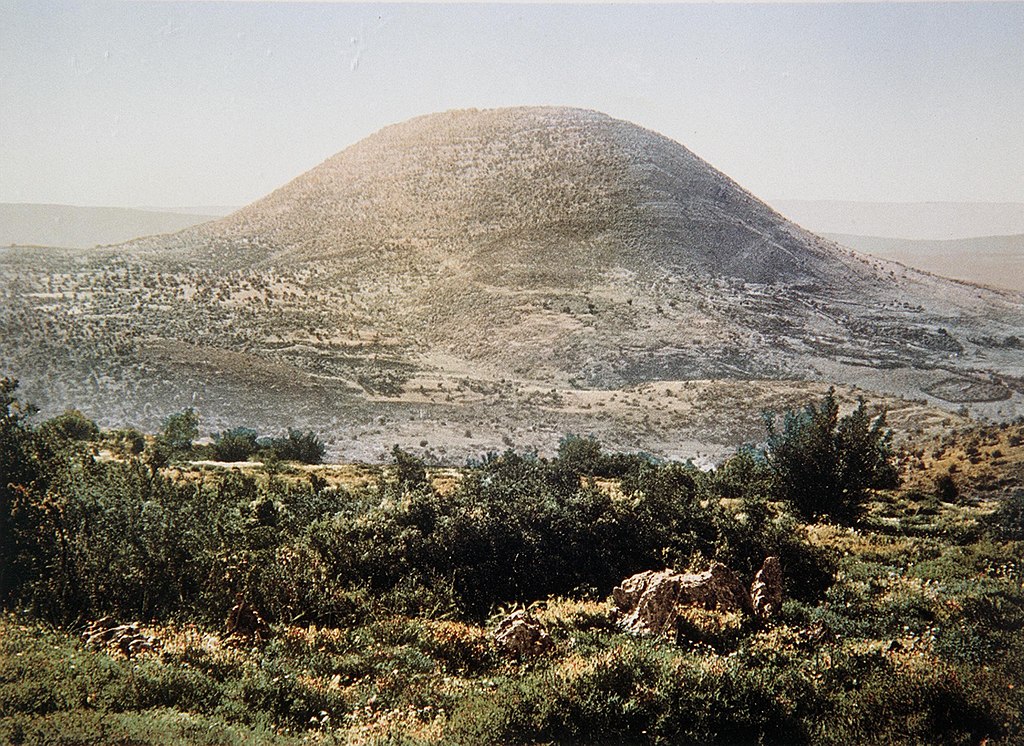
Mt Tabor - Israel gathers at base
The plain of Jezreel Valley is in the foreground.
Go and march to Mount Tabor - Go is a command from the LORD. March is translated deploy your troops or gather your men. Tabor is a conical mountain that rises 1,886 feet above the plain of the Jezreel Valley and was strategically located at the juncture of the tribes of Naphtali, Zebulun, and Issachar (see Mt Tabor at junction of 3 tribes) in the northeast portion of the Jezreel Valley which was assigned to Zebulun and Issachar (Joshua 19:10-23).
As the battle unfolds Barak gathered his forces on Tabor and descended to plain conquering Sisera on banks of Kishon (Judges 4:6-15). Here the brothers of Gideon were slain by Zebah and Zalmunna (Jdg 8:18, 19).
And take with you 10,000 men (3x - Jdg 4:6, 10, 14) from the sons of Naphtali and from the sons of Zebulun - Since this is an order from God (through Deborah) clearly God's Spirit had prepared the hearts of 10,000 men in Naphtali and Zebulun to be prepared to go to war. As we will see in the case of Gideon God used fewer men (22,000 down to 10,000 then 300 Jdg 7:3, 6) to accentuate the miraculous nature of Gideon's victory resulting in greater glory to God. It is also interesting that God had promised Israel that when the nation was obedient "a hundred of you will chase 10,000." (Lev 26:8, cf Dt 32:30) In Jdg 1:4 Judah defeated 10,000 men at Bezek. In Jdg 3:29 Israel under the leadership of Ehud "struck down at that time about 10,000 Moabites, all robust and valiant men; and no one escaped." Mt Tabor as shown on this map was at the junction of the land of Zebulun, Issachar and Napthali. Note that these are merely 10,000 men, not 10,000 strong, valiant, trained warriors, and so they are men who would be in need of divine aid against trained, equipped warriors!
THOUGHT - Beloved, we war against powerful invisible forces and are continually in need of divine aid to win the victory!
This map also has two other locations which are key to interpreting Judges 4-5…Kishon River - Easton's Dictionary - Kishon means "winding" and is a winter torrent of Central Palestine, which rises about the roots of Tabor and Gilboa, and passing in a northerly direction through the plains of Esdraelon and Acre, falls into the Mediterranean at the north-eastern corner of the bay of Acre, at the foot of Carmel. It is the drain by which the waters of the plain of Esdraelon and of the mountains that surround it find their way to the sea. It bears the modern name of Nahr el-Mokattah, i.e., "the river of slaughter" (cp. 1Ki 18:40). In the triumphal song of Deborah (Jdg. 5:21) it is spoken of as "that ancient torrent," either (1) because it had flowed on for ages, or (2), according to the Targum, because it was "the torrent in which were shown signs and wonders to Israel of old;" or (3) probably the reference is to the exploits in that region among the ancient Canaanites, for the adjoining plain of Esdraelon was the great battle-field of Palestine. This was the scene of the defeat of Sisera (Jdg. 4:7, 13), and of the destruction of the prophets of Baal by Elijah (1Ki 18:40). "When the Kishon was at its height, it would be, partly on account of its quicksands, as impassable as the ocean itself to a retreating army."
ESV Study Bible - At least six tribes participated in the battle: Naphtali and Zebulun (Jdg 4:6), Ephraim, Benjamin, Manasseh (Machir), and Issachar (Jdg 5:14-15). This is the nearest thing to an “all-Israelite” coalition in the book. (Borrow online ESV study Bible for 1 hour)
From Ephraim those whose root is in Amalek came down, Following you, Benjamin, with your peoples; From Machir commanders came down, And from Zebulun those who wield the staff of office. 15 “And the princes of Issachar were with Deborah; As was Issachar, so was Barak; Into the valley they rushed at his heels; Among the divisions of Reuben (SEE REUBEN IN NEXT VERSE BELOW) There were great resolves of heart. (Judges 5:14-15)
On the other hand Deborah's song names some of the tribes too cowardly to enter the battle (interestingly Judah and Simeon are not mentioned at all in Judges 4-5)...
“Why did you sit among the sheepfolds, To hear the piping for the flocks? Among the divisions of Reuben There were great searchings of heart. 17 “Gilead (ED: Gad and eastern Manasseh) remained across the Jordan; And why did Dan stay in ships? Asher sat at the seashore, And remained by its landings. (Judges 5:16-17)
BARAK—THE FACELESS
Comes Jabin like a foul plague
To smite the chosen seed,
And with him noxious Sisera
To consummate the deed.
Great chariots of iron roll,
Nine hundred by the count,
To turn Esdraelon’s comely plain
Into a bloody fount.
Far up on Tabor’s wooded slope
Waits Barak and his host.
A man quite ill equipped, it seems,
To stand a warrior’s post.
But this man holds the surest sword
God’s foes to recompense.
The tempered, twin-edged,
Heaven-forged blades—
FAITH and OBEDIENCE.
Tabor in Smith's Dictionary - Tabor means a mound, or Mount Tabor, one of the most interesting and remarkable of the single mountains in Palestine. It rises abruptly from the northeastern arm of the plain of Esdraelon, and stands entirely insulated, except on the west where a narrow ridge connects it with the hills of Nazareth. It presents to the eye, as seen from a distance, a beautiful appearance, being symmetrical in its proportions and rounded off like a hemisphere or the segment of a circle, yet varying somewhat as viewed from different directions. The body of the mountain consists of the peculiar limestone of the country. It is now called Jebel-et-Tur . It lies about six or eight miles almost due east from Nazareth. The ascent is usually made on the west side, near the little village of Deburieh --probably the ancient Daberath, (Joshua 19:12) --though it can be made with entire ease in other places. It requires three quarters of an hour or an hour to reach the to the top. The top of Tabor consists of an irregular platform, embracing a circuit of half an hour?s walk, and commanding wide views of the subjacent plain from end to end. Tabor does not occur in the New Testament, but makes a prominent figure in the Old. The book of Joshua (Joshua 19:22) mentions it as the boundary between Issachar and Zebulun, See ver. 12. Barak, at the command of Deborah, assembled his forces on Tabor, and descended thence, with "ten thousand men after him," into the plain, and conquered Sisera on the banks of the Kishon. (Judges 4:6-15) The brothers of Gideon each of whom "resembled the children of a king," were murdered here by Zebah and Zalmunna. (Judges 8:18,19) There are at present the ruins of a fortress round all the summit of Tabor. The Latin Christians have now an altar here at which their priests from Nazareth perform an annual mass. The Greeks also have a chapel, where, on certain festivals they assemble for the celebration of religious rites. The idea that our Saviour was transfigured on Tabor prevailed extensively among the early Christians, and still reappears often in popular religious works. It is impossible, however, to acquiesce in the correctness of this opinion. It can be proved from the Old Testament and from later history that a fortress or town existed on Tabor from very early times down to B.C. 53 or 50; and as Josephus says that he strengthened the fortifications there about A.D. 60, it is morally certain that Tabor must have been inhabited during the intervening Period that is in the days of Christ. Tabor, therefore, could not have been the Mount of Transfiguration [see HERMON]; for when it is said that Jesus took his disciples "up into a high mountain apart, and was transfigured before them (Matthew 17:1,2) we must understand that he brought them to the summit of the mountain, where they were alone by themselves.
QUESTION - What is the significance of Mount Tabor in the Bible?
ANSWER - Mount Tabor is a dome-shaped mountain in the Jezreel Valley situated 6 miles east of Nazareth and 11 miles southwest of the Sea of Galilee. Rising less than 2,000 feet (1886') above sea level, Mount Tabor appears loftier than it actually is in the otherwise flat Jezreel Valley. Visible all the way to Jerusalem, Mount Tabor was a familiar landmark to Jesus and the disciples, who would have seen it often during their travels around Galilee.
Mount Tabor played a prominent role in Israel’s history, marking a boundary between the tribes of Issachar (Joshua 19:22), Naphtali (Joshua 19:34), and Zebulun (Joshua 19:12). The Via Maris, an ancient international trade highway, passed near Mount Tabor and made use of the point as a navigational tool on its route from Megiddo in Israel toward Damascus in Syria.
Even though Mount Tabor is not as tall as the neighboring Mount Hermon, Psalm 89:12 compares the two peaks, and Jeremiah links Tabor’s prominence with that of Mount Carmel: “‘As surely as I live,’ declares the King, whose name is the LORD Almighty, ‘one will come who is like Tabor among the mountains, like Carmel by the sea’” (Jeremiah 46:18).
In the book of Judges, Deborah summoned Barak to gather an army from the tribes of Naphtali and Zebulun at Mount Tabor. From there the Israelites marched down to defeat Sisera, commander of the Canaanite army from Hazor (Judges 4:1–24). A little later in Judges, Gideon avenged the death of his brothers by executing the Midianite kings, Zebah and Zalmunna, who had slain Gideon’s brothers on Mount Tabor (Judges 8:18–21). Mount Tabor was also identified in the Old Testament as one of the high places where Israel’s rulers had set up altars for the worship of false gods (Hosea 5:1).
Since the fourth century, tradition has recognized Mount Tabor as the place of Jesus Christ’s transfiguration (Matthew 17:1–9). At the time of the transfiguration, Jesus took Peter, James, and John to the top of a high mountain to pray. The three disciples fell asleep, and when they awoke, they were astonished to see Jesus talking with Moses and Elijah. The Lord’s face was transformed, shining like the sun, and His clothes dazzled with light.
The actual “high mountain” where the transfiguration took place is not specified in the New Testament accounts. Scholars who question the traditional assignment of Mount Tabor argue that Mount Hermon is the highest peak in the area and fits better with the events just before and after the transfiguration.
Queen Helena, mother of Emperor Constantine the Great, was convinced that Mount Tabor was the site of Christ’s transfiguration. In AD 326, Helena built the first church on the mountain. Other shrines and monasteries were erected; however, all were destroyed in the twelfth century by Saladin, Sultan of Egypt and Syria. Today a nineteenth-century Greek Orthodox monastery and an early twentieth-century Roman Catholic church attract pilgrims from around the world to the top of Mount Tabor.GotQuestions.org
Judges 4:7 'And I will draw out to you Sisera, the commander of Jabin's army, with his chariots and his many troops to the river Kishon; and I will give him into your hand.'"
- And I will draw out to you Sisera Jdg 5:21,1Ki 18:40, Ps 83:9
- Kishon (note) - 5x in OT - Jdg. 4:7, 13; 5:21; 1 Ki. 18:40; Ps. 83:9
- I will give him into your hand. dg 4:14; Exodus 21:13; Joshua 8:7; 10:8; 11:6; 1Sa 24:10,18
Related Passages:
Judges 4:14 Deborah said to Barak, “Arise! For this is the day in which the LORD has given Sisera into your hands; behold, the LORD has gone out before you.” So Barak went down from Mount Tabor with ten thousand men following him.
Joshua 8:7 “And you shall rise from your ambush and take possession of the city, for the LORD your God will deliver it into your hand.
Joshua 10:8 The LORD said to Joshua, “Do not fear them, for I have given them into your hands; not one of them shall stand before you.”
Joshua 11:6 Then the LORD said to Joshua, “Do not be afraid because of them, for tomorrow at this time I will deliver all of them slain before Israel; you shall hamstring their horses and burn their chariots with fire.”

Red = Kishon R flowing into Jezreel Valley
THE BATTLE COMMANDER
IS THE LORD OF HOSTS
Barak's battle strategy is based on divine promises, not humane ingenuity.
THOUGHT - This is a good pattern for all of us to keep in mind as we war daily against the invisible forces being ever cognizant of the truth in 2Cor 10:3-5
For though we walk in the flesh, we do not war according to the flesh, 4 for the weapons of our warfare are not of the flesh, but divinely powerful for the destruction of fortresses. 5 We are destroying speculations and every lofty thing raised up against the knowledge of God, and we are taking every thought captive to the obedience of Christ,
Barry Webb - As it turns out, Barak is not left to his own devices but is given a ready-made battle plan. “Mount Tabor,” where he is told to assemble his men, was on the Naphtali-Issachar border, at the head of a valley leading down into the broad Jezreel plain where the battle would take place. Sisera could be expected to approach from his base in Harosheth-hagoyim in the west; so from Mount Tabor in the east, Barak and his men would be well-positioned to see before they were seen. They would also be ideally located to make a swift descent using the contours of the mountain itself for cover and so take the enemy by surprise. But as foot soldiers (if they could be called that) they would still be at a huge disadvantage against Sisera’s chariots on the flat country at the base of the mountain. At this point Barak would have exhausted all that mere strategy could do to help him. He would need a miracle. (See Judges and Ruth: God in Chaos)
And I will draw out (masak/mashak) to you Sisera - This is the first of two "I will" promises by God and both are unconditional, although there is an implied condition that Israel would need to obey in order to receive the blessing of the promises. Draw out is in the perfect conjugation which traditionally is considered to show the perfection or completed state of an action. In other words God said it. That settles it! It is as good as done! In the Septuagint draw out is translated with apago which means to move someone or lead away as leading an animal to water (Lk 13:15) and in this context a pun is intended!
THOUGHT - Does that statement about the promises of God sound familiar? God has given believers "every spiritual blessing" (Eph 1:3) and "everything necessary for life and godliness" (2Pe 1:3), and sadly it seems so many believers are living like "spiritual paupers." Why? There is only one reason and that is they are not living the lyrics of the hymn "Trust and Obey," for there is no other way to experience God's blessings and power than to "trust and obey."
Sisera, the commander of Jabin's army, with his chariots and his many troops to the river (nachal) Kishon - Under the influence of God, Sisera would be led to lead his army to the river Kishon which was to be his "Waterloo!" It is notable that in the eastern part of the Jezreel Valley closest to Mount Tabor where Barak would launch his attack the Kishon is only a small, shallow stream. Surely Barak must have wondered how this would be a strategic advantage to his forces. Barak had not yet heard Deborah's song in Judges 5! Isn't that they way God often works? He gives us some steps to take by faith and as we trust Him and walk forth, He gradually unfolds His plan (often also His purpose and power), which reminds me of Jesus' words in John 7:17 "If anyone is willing to do His will, he will know of the teaching, whether it is of God or whether I speak from Myself." Willingness to do will result in increased understanding of God's plan.
And I will give him into your hand - Barak is not given the details of how this will transpire, so he must act in faith, trusting God's promise and trusting God to work out the specific details. This is a good pattern for all of us to keep in mind. We may be clear on His will, but not fully understand His way of bringing about His will. This is called walking by faith, not sight (2Cor 5:7) Give...into...hand is a frequent idiom in the OT (Jos 2:24, Jos 6:2 Jos 8:1, 18, Jos 10:8 1Ch 5:20, 2Ch 18:14, Jdg 1:2 - Judah, Jdg 3:28 - Ehud). Hand symbolized power and so to be given into another's hand was to be given into their power. Even here we see the balance of God's giving and Israel's hand, God's sovereignty and Israel's responsibility. So Barak had a divine assurance for victory in the battle before it even begin!
The idiom of God's hand giving power is reversed in Jdg 2:23 for "the LORD allowed those nations to remain, not driving them out quickly; and He did not give them into the hand of Joshua."
Give (KJV = deliver) (Hebrew - nathan) is translated in the Septuagint (LXX) with the Greek verb paradidomi which signifies the giving of one over of someone or something to the power of another. See paradidomi in Ro 1:24, Ro 1:26, Ro 1:28 where those who suppress and exchange the truth about God are given over respectively to the "lusts of their hearts", "degrading passions" and "a depraved mind"! Jabin and Sisera were God rejecters who reaped the wages of their rejection of their Creator.
Barry Webb - For the moment we, like Barak himself, have just the bare command and promise that he was given: in essence, “Go there, and I will give you victory.” The challenge for Barak is to decide whether that is enough for him. Does he have faith strong enough to go forward against overwhelming odds with nothing but the promise of God to rely on? If he can, he will indeed be a hero, but of a rather different kind from that of popular imagination. He will be “given” victory rather than achieve it; and the real battle will be won before he goes to face Sisera, in his decision to stake everything on God’s being faithful to his promise. (See Judges and Ruth: God in Chaos)
The River Kishon is a perennial stream so it is technically not a wadi that is dry at some times of the year and it flows through the valley of Jezreel (means God will scatter or sow - See picture of valley of Jezreel = Esdraelon). Don't miss the strategic point that this large valley was flat was therefore was like a "race track" for iron chariots! Little wonder the Israelites were frightened! As shown on this map the River Kishon originates at the eastern end of the Jezreel Valley and terminates at the Mediterranean Sea. Mount Tabor was at the eastern end of the valley and is where Barak mustered his10,000 man army.

Wikipedia on Kishon - The Kishon River is a 70 kilometres (43 mi)-long perennial stream in Israel. Its farthermost source (ON EASTERN SIDE OF JEZREEL VALLEY) is the Gilboa mountains, and it flows in a west-northwesterly direction through the Jezreel Valley, emptying into the Haifa Bay in the Mediterranean Sea.[4] Its drainage basin, of 1,100 square kilometres (420 sq mi), includes much of Jezreel Valley (WADIS WOULD FEED INTO THE MAINSTREAM, BUT ONLY WHEN IT RAINED - LIKE Jdg 5:20-21) and the Western Galilee, and parts of Mount Carmel. (see origin and course through the Jezreel Valley with Mt Tabor to the north from which Barak led his troops)
Draw out (04900)(masak/mashak) is used of exertion and means to drag or to pull. The NIV and NLT render it as "lure" but "lure" implies a hint of trickery by offering some pleasure or gain and this is overstating the case. God does not need to entice people. Somehow He simply draws Sisera pointing of course to the Lord's sovereign control of people, places and events. He orchestrates the battle by leading Sisera's forces to their doom. Note how God gives men responsibility in but it is God's sovereign power that works out the plan of salvation of Israel from their enemies (Php 2:12, 13).
Gilbrant adds that masak/mashak "reflects the nuances of its cognates in Ugaritic, Middle Hebrew and Jewish Aramaic, "to stretch one's hand"; Arabic and Old South Arabic, "to seize"; Ethiopic, "to draw a bow"; and Tigre, "to saddle," "to harness." It means "to prolong" in reference to God's lovingkindness (Ps. 36:10), God's forbearance (Neh. 9:30), God's wrath (Ps. 85:5), the soon coming destruction of Babylon (Isa. 13:22) and God's coming judgment (Ezek. 12:25, 28). Māsak also means "to carry off" or "to drag off" (Job 24:22; Ps. 28:3) or "to drag along" (Isa. 5:18). God tried "to draw" or "lead" his people with kindness and love (Jer. 31:3; Hos. 11:4). In the battle led by Deborah and Barak, māshakh means "to proceed" or "to march" (Judg. 4:6) and "to draw out" to battle (v. 7). Joseph was "drawn up" out of the pit and sold to the Midianite traders (Gen. 37:28), and Jeremiah was "pulled up" with ropes and lifted out of the cistern (Jer. 38:13). Māshakh is also used for being "drawn into" a net (Ps. 10:9) and for "drawing out" the leviathan with a fishhook (Job 41:1). The noun is used for "extending" the hand (Hos. 7:5), and the psalmist wished that his adversary would find no one "to extend" steadfast love to him (Ps. 109:12). This verb also means "to draw after" or "to pull." It refers to a heifer that has not "pulled" in a yoke (Dt. 21:3) and to the Shulammite bride "drawn after" her lover (Song 1:4). In the account of the death of Ahab the Israelite king, it means "to draw" the bow (1 Kings 22:34). Māshakh also means "to sound" the horn (Ex. 19:13; Josh. 6:5). Māshakh denotes a "sower" of seed (Amos 9:13). The Pual stem of this verb occurs three times. It refers to hope "deferred" or "postponed" (Prov. 13:12), and twice it refers to a "tall" group of people (Isa. 18:2, 7).
Victor Hamilton on masak/mashak adds - The following meanings are attached to the verb māshak in the Qal: (1) To draw in the sense of to raise" (Ge 37:28, "They drew, and lifted (ʿālâ) up Joseph from the pit." Jeremiah 38:13 "So, they hauled up Jeremiah with ropes," again parallel to ʿālâ. (2) To draw in the sense of "to extend," Psalm 36:10 [H 11]; Psalm 85:5 [H 6] have already been noted. Cf. also Psalm 109:12 and Jeremiah 31:3, "For you have I prolonged kindness." (3) To draw in the sense of "to draw in, associate with"; Psalm 28:3, "Do not rank me with the wicked"; Hosea 7:5, "He stretched out his hand (māshak yādô) with scorners" possibly means, "He associated with scoffers." (See Gordon, UT 19: no. 1582 for the phrase yd mt̠kt.) (4) To draw in the sense of "to entice, allure, woo"; Job 24:22, "He lures the mighty with his power"; perhaps also Job 21:33, "After him (the deceased) all men will follow," if the phrase means that the surviving will seek consciously to imitate the deceased's life style, rather than simply a reference to a funeral procession. Into this category we could also place Hosea 11:4, "I drew them with cords of a man"; Judges 4:7, and at the level of human love, Song 1:4. (5) To draw in the sense of to draw on a weapon, a bow especially, 1 Kings 22:34; 2 Chron. 18:33; Isaiah 66:19; or blow extensively on a musical instrument, a trumpet: Exodus 19:13; Joshua 6:5. (6) To draw in the sense of "seize" or "drag away": Psalm 10:9 (possibly); Job 41:1 [H 40:25]. Tur-Sinai in his commentary on Job, in a footnote on p. 335 says that "nowhere in the Bible does māshak='draw' but always like Arabic maska "to take hold of, to snatch." The statement is highly debatable. (7) To draw, simply as a synonym for "go/march" Judges 4:6, or "take" (Exodus 12:21). (8) Finally we may note the phrase in Eccles. 2:3, "I sought in my heart 'to draw' (limshôk) my flesh with wine." The usual interpretation of this is seen in the rendering of this by the JB, "I resolved to have my body cheered with wine." Appeal, however, for this translation can only be made to a passage in the Babylonian Talmud, Hagigah 14a, bʿly ’gdh mwškyn lbw šl ʾdm kmym, "masters of the Aggada (homiletic discourse) refresh the heart of men like water." (Borrow the Theological wordbook of the Old Testament)
Mashak - 35x in OT - away(1), bore(1), continue(1), deferred(1), delayed(2), deployed(1), drag(1), drag me away(1), drags(1), draw(3), drawn(2), draws(1), drew(2), extend(1), follow(1), go(1), led(1), long blast(2), make a long blast(1), march(1), prolong(1), prolonged(1), pulled(3), sounds a long blast(1), sows(1), stimulate(1), stretched(1), tall(2), wield(1). Gen. 37:28; Exod. 12:21; Exod. 19:13; Deut. 21:3; Jos. 6:5; Jdg. 4:6; Jdg. 4:7; Jdg. 5:14; Jdg. 20:37; 1 Ki. 22:34; 2 Chr. 18:33; Neh. 9:30; Job 21:33; Job 24:22; Job 41:1; Ps. 10:9; Ps. 28:3; Ps. 36:10; Ps. 85:5; Ps. 109:12; Prov. 13:12; Eccl. 2:3; Cant. 1:4; Isa. 5:18; Isa. 13:22; Isa. 18:2; Isa. 18:7; Jer. 31:3; Jer. 38:13; Ezek. 12:25; Ezek. 12:28; Ezek. 32:20; Hos. 7:5; Hos. 11:4; Amos 9:13
River (Brook, torrent, wadi) (05158) nachal means torrent, torrent valley, wadi, a dry ravine that became a raging torrent during rainy season. See picture of a wadi that could turn into a torrent with a downpour of rain.

Vine - Nacḥal occurs about 139 times in biblical Hebrew and in all periods. This noun represents a dry valley in which water runs during the rainy season: "And Isaac departed thence, and pitched his tent in the valley of Gerar, and dwelt there" (Gen. 26:17, the first biblical appearance). The word can signify the "wady" when it is full of rushing water. Indeed, it appears to describe the rushing water itself: "And he took them, and sent them over the brook …" (Ge 32:23). Sometimes naḥal means a permanent stream or "river": "These shall ye eat of all that are in the waters: whatsoever hath fins and scales in the waters, in the seas, and in the rivers, them shall ye eat" (Lev. 11:9). Finally, the word represents a miner's shaft (only once in the Scripture): "They open shafts in a valley away from where men live" (Job 28:4, rsv). The Pentateuch consistently distinguishes between extra-Egyptian waterways (calling them naḥal, 13 times, and nāhār, 13 times) and inter-Egyptian waterways (calling them y(e)'or). This distinction demonstrates the kind of firsthand knowledge and historical concern expected from a mature eyewitness.
Nacḥal is used figuratively of many things that emerge and disappear suddenly or that have extreme onrushing power such as the pride of nations (Isa. 66:12), the strength of the invader (Jer. 47:2), and the power of the foe (Psa. 18:4). Torrents of oil do not please God if the offerer's heart is wrongly disposed (Mic. 6:7). God overfloods the godly with torrents of His good pleasure (Psa. 36:8). The eschaton is typified by streams, or torrents, in the desert (Ezek. 47:5-19; cf. Exod. 17:3ff.). (Vine's Expository Dictionary of Old Testament and New Testament Words)
Uses of Nachal in Judges - Jdg. 4:7; Jdg. 4:13; Jdg. 5:21; Jdg. 16:4
QUESTION - What is the meaning of Jezreel?
ANSWER - Jezreel was a city in the plain, or valley, of Esdraelon. The area surrounding the city was also called the Valley of Jezreel. The word Jezreel comes from two Hebrew root words meaning “to sow” and “almighty.” Put together, the two root words mean “God will sow.”
The Valley of Jezreel is a beautiful, broad plain, stretching from west to east from Mount Carmel and the sea to the Jordan, which it reaches through two arms between the mountains of Gilboa, Little Hermon, and Tabor; and from south to north from the mountains of Ephraim to those of Galilee. Nazareth lies in the hills on the northern side of the valley. Jezreel is also called the Great Plain and the Valley of Esdraelon.
The city of Jezreel has a long and varied history and figures prominently in many Bible events, most of them violent. King Jehu ordered that the heads of King Ahab’s 70 sons be placed in heaps at the gate of Jezreel (2 Kings 10:1–11). Ahab’s queen, Jezebel, met her death by being thrown from a window of the palace of Jezreel, and it was there that her body was eaten by dogs (2 Kings 9:30–35). Jezreel was the scene of the phony trial of Naboth, who owned a vineyard near Ahab’s palace and who was murdered by Jezebel for his refusal to give his land to Ahab (1 Kings 21:1–23). The Valley of Jezreel was the scene of some important battles as well: the victory of Barak over Sisera (Judges 4); a victory of Gideon over the Midianites, the Amalekites, and their allies from the east (Judges 6 – 8); the victory of the Philistines over Saul and his sons (1 Samuel 31); and the Egyptians’ victory over King Josiah (2 Kings 23:29).
Jezreel is also the name of a son of the prophet Hosea, so named because God had declared that He would avenge the blood of Jezreel on the house of Jehu (Hosea 1:4–5).
Today, the Jezreel Valley (SEE WIKIPEDIA) is a green, fertile plain, covered with fields of wheat, cotton, sunflowers, and corn, as well as grazing tracts for multitudes of sheep and cattle. Because of its location in the same valley as Megiddo, Jezreel is considered to be a likely spot for the future battle of Armageddon (Revelation 16:16–21). In fact, the Valley of Megiddo is also called the Valley of Jezreel. (see GotQuestions.org)
Jezreel - 44x - Jos. 15:56; Jos. 17:16; Jos. 19:18; Jdg. 6:33; 1 Sam. 25:43; 1 Sam. 27:3; 1 Sam. 29:1; 1 Sam. 29:11; 1 Sam. 30:5; 2 Sam. 2:2; 2 Sam. 2:9; 2 Sam. 3:2; 2 Sam. 4:4; 1 Ki. 4:12; 1 Ki. 18:45; 1 Ki. 18:46; 1 Ki. 21:1; 1 Ki. 21:4; 1 Ki. 21:6; 1 Ki. 21:7; 1 Ki. 21:15; 1 Ki. 21:16; 1 Ki. 21:23; 2 Ki. 8:29; 2 Ki. 9:10; 2 Ki. 9:15; 2 Ki. 9:16; 2 Ki. 9:17; 2 Ki. 9:21; 2 Ki. 9:25; 2 Ki. 9:30; 2 Ki. 9:36; 2 Ki. 9:37; 2 Ki. 10:1; 2 Ki. 10:6; 2 Ki. 10:7; 2 Ki. 10:11; 1 Chr. 3:1; 1 Chr. 4:3; 2 Chr. 22:6; Hos. 1:4; Hos. 1:5; Hos. 1:11; Hos. 2:22
Megiddo - 12x - Jos. 12:21; Jos. 17:11; Jdg. 1:27; Jdg. 5:19; 1 Ki. 4:12; 1 Ki. 9:15; 2 Ki. 9:27; 2 Ki. 23:29; 2 Ki. 23:30; 1 Chr. 7:29; 2 Chr. 35:22; Zech. 12:11
Judges 4:8 Then Barak said to her, "If you will go with me, then I will go; but if you will not go with me, I will not go."
English of Septuagint (LXX) adds a phrase - And Barak said to her, If thou wilt go with me, I will go; and if thou wilt not go, I will not go; for I do not know the day on which the Lord prospers (guides well) the messenger of the LORD with me.
Here is another English translation (NETS) - And Barak said to her, “If you will go with me, I will go, and if you will not go with me, I will not go, for (TERM OF EXPLANATION) I do not know the day in which the Lord will send his angel on a good journey with me.”
- Ex 4:10-14; Mt 14:30,31
Related Passages:
Hebrews 11:32-34 And what more shall I say? For time will fail me if I tell of Gideon, Barak, Samson, Jephthah, of David and Samuel and the prophets (DID YOU NOTICE WHO IS NOT IN THIS LIST? DEBORAH. SHE CLEARLY IS A HERO OF THE FAITH BUT THE POINT IS THIS - SO IS BARAK!) who by faith conquered kingdoms (BARAK'S FAITH MAY HAVE MOMENTARILY WAVERED AS WITH ALL SAINTS BUT IT RETURNED!), performed acts of righteousness, obtained promises, shut the mouths of lions, quenched the power of fire, escaped the edge of the sword, from weakness were made strong (THIS WOULD BE AN APT DESCRIPTION OF BARAK WHO WANTED A WOMAN TO GO WITH HIM BUT THEN LED THE CHARGE AGAINST SISERA!), became mighty in war, put foreign armies to flight (EXACTLY WHAT HAPPENED TO SISERA'S ARMY!)
BARAK'S CONDITIONAL
EQUIVOCATING RESPONSE
Observe Barak's two responses "I will go" and "I will not go!"
Then Barak said to her, "If you will go with me then I will go but if you will not go with me, I will not go - Think about what Barak had just been promised and the principle that the Divine call is always accompanied by God's Divine provision. At first glance it seems as if Barak is expressing doubt (and giving the honor to a woman to kill Sisera tends to support this) but the LXX adds a phrase (see above) that suggests this is not necessarily the case. And so we will wait until we meet Barak in heaven. One thing is for sure -- Barak did not shy away one iota when Deborah told him to arise (Jdg 4:14) but obeyed without hesitation and led the charge (Jdg 5:15) down the hill (Barak means "lightning") with 10,000 men who counted their life naught to serve their God ("despised their lives even to death" Jdg 5:18). Barak clearly was not a coward but a courageous leader (note the phrase Jdg 4:14 the 10,000 were "following him"!)
Some commentators feel that Barak either forgot or failed to lay hold of the truth that God's Divine call is always accompanied by His Divine provision (this interpretation is a possibility.) Thousands of years later we need to be careful judging Barak's motive for asking. In fact his action may reflect his wisdom. In other words Barak was hesitant to lead the armies of Israel without receiving guidance from God through Deborah. That this was indeed the case is substantiated by the Septuagint version (see above) . And let us not forget that Barak is listed as one of the “heroes of faith” (Heb. 11:32) because he trusted God and depended upon God’s spokesperson, Deborah. Personally, I give Barak a pass!
THOUGHT - There is a timeless principle that it not our strength we are to depend on in the battle lest God not receive the glory. Let us always have Paul's humble approach declaring "Not that we are adequate in ourselves to consider anything as coming from ourselves, but our adequacy is from God, who also made us adequate as servants of a new covenant, not of the letter, but of the Spirit; for the letter kills, but the Spirit gives life." (2Cor 3:5-6) God is faithful to fulfill His promises! Let us as believers not forget this immutable truth. Even in His victorious return at the end of the Great Tribulation Jesus is called Faithful and True (Re 19:11, cf Php 1:6, 1Th 5:24, He 10:23, He 11:11). Our faithful God is the same God today as He was in the lives of Deborah and Barak (He 13:8, Isaiah 46:4; Malachi 3:6). Let us lay hold of Him and His precious and magnificent promises by faith, a faith that obeys (2Pe 1:4)
Judges 4:9 And she said, "I will surely go with you; nevertheless, the honor shall not be yours on the journey that you are about to take, for the LORD will sell Sisera into the hands of a woman." Then Deborah arose and went with Barak to Kedesh.
- nevertheless, the honor shall not be yours on the journey 1Sa 2:30 2Chr 26:18
- for the LORD will sell Sisera Jdg 2:14
- into the hands of a woman: Jdg 4:17-22 Jdg 5:24-27 Jdg 9:54 2Sa 20:21,22
Related Passages:
Judges 5:24-27 “Most blessed of women is Jael, The wife of Heber the Kenite; Most blessed is she of women in the tent. 25 “He asked for water and she gave him milk; In a magnificent bowl she brought him curds. 26“She reached out her hand for the tent peg, And her right hand for the workmen’s hammer. Then she struck Sisera, she smashed his head; And she shattered and pierced his temple. 27 “Between her feet he bowed, he fell, he lay; Between her feet he bowed, he fell; Where he bowed, there he fell dead.
DEBORAH'S PROPHECY OF
HONOR TO A WOMAN
And she said, "I will surely go with you; nevertheless, the honor (tipharah) shall not be yours on the journey that you are about to take, for the LORD will sell Sisera into the hands of a woman - Surely go is literally "go, go" (halak, halak) which is the way of emphasizing this action. Notice her two part answer - first a promise and secondly a prophecy. In this context the Hebrew word tipharah refers to the honor associated with defeating the enemy and the subsequent honor attendant to the victor. The Septuagint (LXX) translates "honor" with proterema meaning "advantage" or "victory". Note the detail of this prophecy from Deborah that the LORD will sell Sisera into the hands of a woman. The prophecy proved true to the letter and emphasizes that God is faithful to keep His promises and is the One Who receives the glory even when He uses human instruments like Jael.
So it appears that Barak has indeed "missed out" on something that God would give him and yet clearly he is still "honored" by being mentioned in the Hebrews 11 "hall of faith"
And what more shall I say? For time will fail me if I tell of Gideon, Barak, Samson, Jephthah, of David and Samuel and the prophets who by faith conquered kingdoms, performed acts of righteousness, obtained promises, shut the mouths of lions, quenched the power of fire, escaped the edge of the sword, from weakness were made strong, became mighty in war, put foreign armies to flight. (see notes Hebrews 11:32; 33; 34)
Nevertheless, it is axiomatic that God honors prompt and unquestioning obedience to His command. And so the honor was taken from Barak and given to Jael.
Donald Campbell feels that "Barak paid a price for his reluctance to do God's will and leaves us with a lesson to remember. God honors prompt and unquestioning obedience to His commands." (Judges - Leaders in Crisis - borrow for one hour)
Brensinger has an interesting application that focuses on Barak's hesitation writing "If Only …Two of the strongest and most heartbreaking words in the English language are “If only ….” These words speak of painful regret, wasted opportunities, and an adversely affected future. Surely the builder who constructed a house upon the sand, only to watch it collapse during the first major storm (Mt 7:26, 27-see notes Mt 7:26; 27), later groaned “If only ….” So also sighed the criticized servant who buried his single talent rather than invest it (Matt. 25:24-30). To these could be added countless contemporary examples in which individuals, perhaps even we ourselves, ignored good advice, wasted important opportunities, or responded reluctantly—and lived to regret it. While sound judgment and wise counsel from the community of faith enable one to say “No” on appropriate occasions, dragging one’s feet with God leads frequently to forfeited blessings and deep sorrow… As many have learned, frequently with considerable pain, saying “Yes” today far surpasses saying “If only … ” tomorrow. (Brensinger, T. L. Judges. Believers Church Bible Commentary. Page 68. Scottdale, Pa.: Herald Press)
Beloved is God speaking to you,
telling you to go forth in His power and for His glory in some endeavor?
Then Deborah arose and went with Barak to Kedesh - To Barak's home town where the 10,000 would be mustered.
Honor (08597)(tipharah from paar = to beautify, glorify) often refers to physical beauty, glory, but it can also refer to royal splendor, fame, or God's glory.
Gilbrant - Coming from the root pāʾar, "to glorify," "to beautify," "to adorn," tiphʾereth means "that which is made glorious or beautiful." There is another related noun in Biblical Hebrew, peʾfir (HED #6527), "turban," referring to a headpiece used to adorn a man or woman (cf. Isa. 3:20; Ezek. 24:17).
The noun occurs fifty-one times in the OT with widespread usage but mostly in the later writings and the prophetic Books. The word can be translated variously as "glory," "beauty," "pride," "honor."
Tiphʾereth describes the priestly robes of Aaron and his sons (Exo. 28:2, 40) and the royal garments in Ezekiel's wayward-wife parable (Ezek. 16:12, 17, 39). The word takes on a negative connotation in Isaiah's portrayal of the pampered Judean women of wealth (Isa. 3:18). It also portrays royal and national glory (Assyrian in 10:12; Chaldean in 13:19; Egyptian in 20:5; cf. Jeremiah's referral to Judean royal splendor in Jer. 13:18). Xerxes (Ahasueras) displayed the glory of his realm in a year-long celebration (Est. 1:4).
As applied to personal characteristics in the Book of Proverbs, tiphʾereth describes what strength was to a young man (Prov. 20:29) or what years of experience are to an older person (16:31). The ability to forgive an offense is considered a "glory" to a person (19:11). Wisdom gives to its possessor a "crown of glory" (4:9).
Ultimate beauty belongs to God. The psalmists acknowledged that God was Israel's true glory and splendor (Pss. 71:8; 89:17) as did Isaiah (Isa. 63:12, 14). Because the Jerusalem temple built by Solomon housed the terrestrial presence of God, it was truly considered to be glorious and beautiful (1 Chr. 22:5; 2 Chr. 3:6; Ps. 96:6; Ezek. 24:25). The splendor of God's presence in the Temple is likened to his presence in heaven itself (cf. Isa. 63:15-64:11). The idol maker can but manufacture the beauty of human skill (44:13).
God's own people, Israel, were considered his glory. His deliverance of them from Egypt set them above all other nations' glory (Deut. 26:19; Ps. 78:61). Although the prophets announced that the glory of pre-exilic Israel/Judah was soon to be eclipsed (Isa. 28:1, 4; Lam. 2:1), God would restore them to a greater splendor (Isa. 4:2; 52:1; 62:3). (Complete Biblical Library)
Tipharah - 46x in OT - adornment(1), beautiful(8), beauty(7), boast(1), glorious(7), glory(17), honor(2), jewels*(1), pomp(1), pride(1), splendor(1). Exod. 28:2; Exod. 28:40; Deut. 26:19; Jdg. 4:9; 1 Chr. 22:5; 1 Chr. 29:11; 1 Chr. 29:13; Ps. 71:8; Ps. 78:61; Ps. 89:17; Ps. 96:6; Prov. 4:9; Prov. 16:31; Prov. 17:6; Prov. 19:11; Prov. 20:29; Prov. 28:12; Isa. 3:18; Isa. 4:2; Isa. 10:12; Isa. 13:19; Isa. 20:5; Isa. 28:5; Isa. 44:13; Isa. 46:13; Isa. 52:1; Isa. 60:7; Isa. 60:19; Isa. 62:3; Isa. 63:12; Isa. 63:14; Isa. 63:15; Isa. 64:11; Jer. 13:11; Jer. 13:18; Jer. 13:20; Jer. 33:9; Jer. 48:17; Lam. 2:1; Ezek. 16:12; Ezek. 16:17; Ezek. 16:39; Ezek. 23:26; Ezek. 23:42; Ezek. 24:25; Zech. 12:7
Sell ( 04376)(makar means to sell, to dispose of or transfer or be disposed of or transferred to a purchaser in exchange for money or other consideration. The first use is by Jacob calling on Esau to "sell me your birthright" (Ge 25:31, 33). The verb can be defined variously as "to sell," "to sell one's self," "to be given over" and "to abandon." As in this passage makar has the nuanced sense of handing over, surrendering something: God may give up His people (1Sa 12:9); or a person (Jdg. 4:9).
1Sa 12:9 “But they forgot the LORD their God, so He sold (makar) them into the hand of Sisera, captain of the army of Hazor (Hazor is the place, Jabin is the person, the king), and into the hand of the Philistines and into the hand of the king of Moab, and they fought against them.
C H Spurgeon wrote the following devotional entitled "A Woman's War" in Faith's Checkbook…
“The Lord shall sell Sisera into the hand of a woman.”—Judges 4:9
RATHER an unusual text, but there may be souls in the world that may have faith enough to grasp it. Barak, the man, though called to the war, had little stomach for the fight unless Deborah would go with him, and so the Lord determined to make it a woman’s war. By this means He rebuked the slackness of the man, and gained for Himself the more renown, and cast the more shame upon the enemies of His people.
The Lord can still use feeble instrumentalities. Why not me? He may use persons who are not commonly called to great public engagements. Why not you? The woman who slew the enemy of Israel was no Amazon, but a wife who tarried in her tent. She was no orator, but a woman who milked the cows and made butter.
May not the Lord use any one of us to accomplish His purpose? Somebody may come to the house today, even as Sisera came to Jael’s tent. Be it ours not to slay him, but to save him. Let us receive him with great kindness, and then bring forth the blessed truth of salvation by the Lord Jesus, our great Substitute, and press home the command, “Believe and live.”
Who knoweth but some stout-hearted sinner may be slain by the gospel today?
Judges 4:9 F B Meyer Our Daily Homily
The journey that thou takest shall not be for thine honour.
Barak preferred the inspiration of Deborah’s presence to the invisible but certain help of Almighty God. It was Jehovah who had commanded him to draw his forces towards the River Kishon, and had promised to deliver Sisera into his hand. But he seemed unable to rise to the splendor of the situation. If only he could have Deborah beside him he would go, but otherwise not. He is mentioned in Hebrews 11 as one of the heroes of faith; but his faith lay rather in Deborah’s influence with God than in his own. Thus he missed the crown of that great day of victory. (ED NOTE: While it sounds plausible, I am not fully convince that Meyer is correct in his assessment of Barak who went in front [not behind] his army of 10,000! We must wait for Heaven to see Barak's fate.)
It is the mark of the carnal Christian that he has no direct dealings with God for himself, but must needs deal with Him through the medium of another’s prayers, and words, and leadership. Barak must have Deborah. It is faith, though greatly attenuated and reduced by the opaqueness of the medium through which it passes. Such do not attain “unto the first three.” God cannot honor them as He does those who have absolutely no help or hope save in Himself.
“Them that honour Me, I will honour; and those that despise Me shall be lightly esteemed.” (1Sa 2:30)
If God tells you to go alone to a work, be sure and obey. Go, at whatever cost. Dare to stand by yourself if God is with you. In such hours we realize what Jesus meant when He said,
“Whosoever shall say unto this mountain, Be thou taken up and cast into the sea; and shall not doubt in his heart, but shall believe that what he saith cometh to pass, he shall have it.” (Mark 11:23)
Yet if you are unbelieving, your unbelief cannot make God’s faith of none effect. He abideth faithful. He cannot deny Himself. (2Ti 2:13) He will still deliver Israel. (Meyer, F. B. Our Daily Homily)
Judges 4:10 And Barak called Zebulun and Naphtali together to Kedesh, and ten thousand men went up with him; Deborah also went up with him.
- Zebulun: Jdg 4:6 5:18
- ten thousand men went up with him: Jdg 5:15 Ex 11:8 1Sa 25:27 1Ki 20:11

Barak Gathers Army - click to enlarge (Logos.com)
Orange - Naphtalites' route to Mount Tabor
Green - Zebulunites' route to Mount Tabor
Yellow - Asherites' route to Mount Tabor
Purple - Issacharites' route to Mount Tabor
Red - Benjaminites, Ephraimites, and Manassites' route to Mount Tabor
BARACK MUSTERS
THE MILITARY
And Barak called Zebulun and Naphtali together to Kedesh - Barak calls them to Kedesh which as stated earlier means "holy place" or "sanctuary." By looking at the map you can see (at least in theory) that these tribes geographically speaking had the most to lose. The third tribe that had property at risk so to speak was Issachar described in Jdg 5:15 which records "the princes of Issachar were with Deborah; As was Issachar, so was Barak; Into the valley they rushed at his heels; Among the divisions of Reuben There were great resolves of heart. "
Elsewhere we read this great description of the tribe of Issachar in the several hundred years later in the days of David when Saul was attempting to kill him…
And of the sons of Issachar (who in context are numbered among the mighty men of David), men who understood the times, with knowledge of what Israel should do, their chiefs were two hundred; and all their kinsmen were at their command. (1Chr 12:32)
THOUGHT - We in America (and the world for that matter) live in desperate times much like the days of Judges. May God raise up in His true church in America men like the "sons of Issachar", that we might once again experience the victorious wind of revival over God's arch enemies.
Ten thousand men went up with him; Deborah also went up with him - Deborah kept her promise to go with Barak. In a sense we can say she was also a warrior or soldier. Campbell in fact designates her as "the commander in chief of the military forces," a statement I am not sure is accurate. I see her more as Barak's advisor, for it is Barak who leads the men to battle, not Deborah.
Judges 4:11 Now Heber the Kenite had separated himself from the Kenites, from the sons of Hobab the father-in-law of Moses, and had pitched his tent as far away as the oak in Zaanannim, which is near Kedesh.
- Heber the Kenite: Jdg 1:16 Nu 10:29 24:21
- from the sons of Hobab: Ex 2:18 3:1 18:1
- as far away as the oak in Zaanannim: Jos 19:33,37
- which is near Kedesh: Jdg 4:6 Jos 19:37
PERTINENT PASSAGE
PROVIDES PARENTHETICAL PAUSE
This verse might be subtitled "The Parenthetical Providence of God," for He has already arranged the pieces on the chessboard in such a way that mighty Sisera would be checkmated literally by the hand of a woman, Jael!
Now Heber the Kenite - Kenites were a branch of the Midianite tribe (Nu 10:29; Jdg 1:16; Jdg 4:11) and had sided with Israel. The name Kenite means "smith', and the presence of copper SE of the Gulf of Aqabah, the Kenite-Midianite region, would nicely correlate with the meaning of this tribe's name. The Kenites first appear as inhabitants of patriarchal Canaan (Ge 15:19). Subsequently Moses becomes son-in-law of Reuel (Ex 2:18) and invites Hobab his son to accompany the Israelites, coveting his nomadic skill. In [Nu 10:29] the Kenites accompanied Judah into their inheritance.
Had separated himself from the Kenites, from the sons of Hobab the father-in-law of Moses, and had pitched his tent as far away as the oak in Zaanannim, which is near Kedesh - The Kenites were normally friendly to Israel, but Heber had separated from the majority of the Kenites and had allied himself with the Canaanites.
Davis adds an interesting analysis writing that "verse 11, dry as it seems, points to the providence of God. According to Jdg 1:16 (note), the Kenites settled in the south of Judah’s southern territory (near Arad). Heber separated from this group and moved north to Kedesh (like moving from Florida to Vermont, only not so far).Certainly, it appears to be nothing but a piece of geographical trivia to have Heber’s change of address inserted into the story. Nevertheless, we will soon discover that Jael, the woman who nailed Sisera, was Heber’s wife and that she was precisely where she needed to be when Israel’s oppressor ditched his chariot and ran for his life.The God of the Bible still injects those marvelous bits of providential minutiae into the lives of his people. In what a wonderful manner God prepares for our deliverance! Many Christians can see this as they look back and reflect on God’s ways with them. There has been some little piece of divine trivia, something that seemed at the time wholly unrelated to anything, something that even escaped human notice because it was so minuscule — yet it turned out to be the vehicle of God’s saving help. Not even Heber’s U–Haul was outside Yahweh’s plan; and a God like that surely ought to be adored. (Judges: Such a Great Salvation - Focus on the Bible) (Bolding added)
Judges 4:12 Then they told Sisera that Barak the son of Abinoam had gone up to Mount Tabor.
- mount Tabor Jdg 4:6 Jos 19:12,34 Ps 89:12 Jer 46:18
Mt Tabor - Israel gathers at base
The plain of Jezreel Valley is in the foreground.
SISERA'S SPIES
SOUND ALERT
Then they told Sisera that Barak the son of Abinoam had gone up to Mount Tabor - Who is "they" that gives Sisera the concerning Israel’s troop movement? In the context of the prior verse, it is possible that the report came from Heber, since his tent was near enough to Kedesh to know the movement of Barak’s army.
Judges 4:13 And Sisera called together all his chariots, nine hundred iron chariots, and all the people who were with him, from -Harosheth Haggoyim to the river Kishon.
JEHOVAH DRAWS SISERA
INTO HIS NET!
And Sisera called together all his chariots, nine hundred iron chariots, and all the people who were with him Remember the context. In we learn God say "I will give him into your hand" but here we see Sisera's actions in response to the report of Israel's troop movements. Sisera was totally unaware of the fact that the sovereign God of the universe was behind the scenes bringing Sisera's forces to the River Kishon! What a mighty God we serve beloved! Never lose sight (with eyes of faith) of His great and marvelous deeds of old. He is the same God for you today, and desires to glorify Himself in and through your life.
TSK on iron chariots - Probably chariots armed with iron scythes, projecting from the axle on each side, by which the infantry might be easily cut down or thrown into confusion. The ancient Britons are said to have had such chariots.
Picture the scene. Put yourself in Barak's sandals. In the distance he hears a rumble and sees dust. Then he begins to recognize the rattling of iron chariots and the neighing of more than a thousand horses. These must have been fearsome sights and sounds to Barak and the 10,000 on the side of Mt Tabor. But at the same time their very real fear was quenched by faith in the very sure prophetic promises of God, in this case the promise of complete victory over the enemy. (see first of a 4 part series on How To Handle Fear Part 1)
From Harosheth Haggoyim to the river Kishon - Sisera informed of the massing of Israelite troops on Mt. Tabor moves his massive army to a temporary base north of the Kishon River in the Plain of Esdraelon (Valley of Jezreel). (see origin and course through the Jezreel Valley with Mt Tabor to the north from which Barak led his troops)
Valley of Jezreel was a wide opening among the mountains which played a great part in the history of the land. This was due to the important avenues of communication between North and South that lay across its ample breadths. The narrow pass between the promontory of Mt Carmel and the sea was not suitable for the transport of great armies: the safer roads over the plain were usually followed. So it happened that here opposing hosts often met in Jezreel in deadly strife. Hardly an equal area of earth can so often have been drenched with the blood of men. No doubt many conflicts were waged here in far-off times of which no record remains. The first battle fought in the plain known to history was that in which Sisera's host was overthrown (Jdg 5:20). The children of the East were surprised and routed by Gideon's 300 chosen men in the stretches North of Zer`in (Jdg 7). Near the same place the great battle with the Philistines was fought in which Saul and his sons, worsted in the plain, retired to perish on the heights of Gilboa (1 Samuel 31). In the bed of the Kishon at the foot of Carmel Elijah slaughtered the servants of Baal (1Ki 18:40-note). Dark memories of the destruction of Ahab's house by the furiously driving Jehu linger round Jezreel. Ahaziah, fleeing from the avenger across the plain, was overtaken and cut down at Megiddo (2 Ki 9). In the vale by Megiddo Josiah sought to stay the northward march of Pharaoh-neco, and himself fell wounded to death (2Ki 23:30; 2Ch 35:20 ff). The army of Holofernes is represented as spreading out over all the southern reaches of the plain (Judith 7:18,19). Much of the fighting during the wars of the Jews transpired within the circle of these hills. It is not unnatural that the inspired seer should place the scene of war in "the great day of God" in the region so often colored crimson in the history of his people--the place called in the Hebrew tongue "Har-Magedon" (Re 16:14-16).
What a contrast - Sisera armed to the teeth. Deborah, Barak and 10,000 with no ostensible defense against the arrows and spears that would surely come at them. Hand-to-hand combat must have been their only thought. But then they had the mighty sword of the Spirit which is the spoken promise of God (Eph 6:17) in this case that He would deliver and defeat the enemy.
THOUGHT - Beloved, at this very moment, you may be facing impossible odds and implacable enemies (I HAVE NEVER EXPERIENCED SUCH FIERCE SPIRITUAL WARFARE AS I AM AS I WRITE THIS NOTE), but play the great vocal version "Standing on the Promises" and allow R. Kelso Carter's great words and glorious melody in this old hymn encourage your heart and soul in Christ Jesus the Captain of the Hosts (keeping in mind the truth of Romans 15:4)
Standing on the promises of Christ my King,
Through eternal ages let His praises ring,
Glory in the highest, I will shout and sing,
Standing on the promises of God.Refrain
Standing, standing,
Standing on the promises of God my Savior;
Standing, standing,
I’m standing on the promises of God.Standing on the promises that cannot fail,
When the howling storms of doubt and fear assail,"
By the living Word of God I shall prevail,
Standing on the promises of God.Refrain
Standing on the promises I now can see
Perfect, present cleansing in the blood for me;
Standing in the liberty where Christ makes free,
Standing on the promises of God.Refrain
Standing on the promises of Christ the Lord,
Bound to Him eternally by love’s strong cord,
Overcoming daily with the Spirit’s sword,
Standing on the promises of God.Refrain
Standing on the promises I cannot fall,
Listening every moment to the Spirit’s call
Resting in my Savior as my all in all,
Standing on the promises of God.
THOUGHT - Let us stand on the precious and magnificent promises (2Pe 1:4) our Trustworthy Lord has given us, no matter what the "odds makers" may say about our chances of victory. They simply do not know our faithful God or the certitude of His unfailing Word. Remember though that it is one thing for us to know these mighty deeds of our God such as described in Judges 4-5 but it is quite another thing to stand firm on the promises when all we see at the moment is the enemy amassing his humanly overpowering forces. Oh, let us as children of the living God, "Behold our God" with eyes of faith. He is mighty indeed and He will undertake for His beloved!
Judges 4:14 And Deborah said to Barak, "Arise! For this is the day in which the LORD has given Sisera into your hands; behold, the LORD has gone out before you." So Barak went down from Mount Tabor with ten thousand men following him.
- Arise - Jdg 19:28; Genesis 19:14; 44:4; Joshua 7:13; 1Sa 9:26
- Behold (more literally "is not the LORD gone out") - Dt 9:3 2Sa 5:24 Ps 68:7,8 Isa 52:12, Jos 1:5,9; Micah 2:13

1. (See #'s on diagram) Deborah and Barak (RED ARROWS) gather an army from some of the tribes to Mt Tabor, dominating the area. (Jdg 4:9,10)
2. Sisera (BLUE ARROWS), commander of Jabin’s army, brings his troops and 900 iron chariots to the foot of Tabor. (Jdg 4:12, 13)
3. Deborah gives the signal to attack (possibly after a heavy rainstorm). Barak’s forces sweep down the steep slopes of Mt Tabor. Sisera’s troops panic and head towards the marshy River Kishon. (Jdg 4:14)
4. The rainstorm floods the river. Sisera’s chariots are useless or are swept away (Jdg 5:21). His army is routed. (Jdg 4:15)
5. Local Canaanite kings try to aid Sisera’s men by Taanach, but they, too, are defeated (Jdg 5:19).
6. Barak pursues the retreating army as far as Harosheth. It is completely defeated. (Jdg 4:15a)
7. Sisera himself abandons his now-useless chariot. He flees for his life, but is killed while sleeping in a tent. (Jdg 4:15, 17-21)
BARAK'S IMMEDIATE COMPLIANCE
WITH DEBORAH'S COMMAND
And Deborah said to Barak, "Arise!" (Jdg 5:12) Arise (Quwm in the Qal Imperative = a command; Lxx anistemi in aorist imperative). Instead of Arise the KJV minces no words translating it "Up!" Rise up from prostrate position (Joshua 3:16). In many instances it refers to preparatory activity especially pursuant to traveling (Dt 17:8). In this passage Deborrah does in effect act as the commander in chief of the military forces initiating the charge against Sisera's forces.
"Lightning" (Barak's name) is about to strike Sisera!
For this is the day (Jdg 5:1) in which the LORD has given Sisera into your hands; behold, the LORD has gone out before you - Amplified "Is not the Lord gone out before you?" Deborah reiterates God's promise of (Jdg 4:7), but adds that there is One Who has already gone before Barak and his forces -- that One is none other than Jehovah Himself. THE BATTLE IS THE LORD'S! He is the Warrior Who fights for His people (cf same principle in Ro 8:13 where Spirit enables us to kill the enemy!). This is a vital truth which the young lad David well knew declaring to the giant Goliath (again the secular odds makers would be heavily against David for they do not know David's God)
This day the LORD will deliver you up into my hands, and I will strike you down and remove your head from you. And I will give the dead bodies of the army of the Philistines this day to the birds of the sky and the wild beasts of the earth, that all the earth may know that there is a God in Israel, and that all this assembly may know that the LORD does not deliver by sword or by spear; for the battle is the LORD'S and He will give you into our hands. (1 Sa 17:46-47)
Fruchtenbaum sums up these thoughts this way "The rhetorical prophetic declaration was intended to give Barak the encouragement: is not Jehovah gone out before you? The answer obviously was “Yes.” (Ariel's Bible Commentary)
So Barak went down from Mount Tabor with ten thousand men following him - Striking like lightning, Barak obeys Deborah because he believed the prophetic "I will's" of Jdg 4:7, charging forward even in face of impossible odds humanly speaking! This time Barak had no hesitation and it is Barak who leads takes the lead. Jehovah of course has already gone before him. He faithfully follows in the steps of the Captain of the Hosts (cp Joshua 5:14-15).
Judges 4:15 And the LORD routed Sisera and all his chariots and all his army, with the edge of the sword before Barak; and Sisera alighted from his chariot and fled away on foot.
- Jdg 5:20,21; Joshua 10:10; 2Ki 7:6; 2Chr 13:15, 16, 17; Ps 83:9,10; Heb 11:32

The Route of the Route: Click to Enlarge
Green - Sisera from Megiddo to Mt Tabor
Red & Yellow - Barak Slaughter's Sisera's Soldiers
Purple - Sisera Runs to Zaanannim (means "removal"!)
THE ROUTE IS ON!
THE LORD'S ROUTE!
And the LORD routed (hamam; Lxx = existemi = confused) Sisera and all his chariots and all his army, with the edge of the sword before Barak; and Sisera alighted from his chariot and fled away on foot - Yahweh Himself routed them meaning He threw them into confusion, fear and panic. Note the writer points out that it was not Barak or Deborah or the Israelite forces but Yahweh Who routed Sisera. This is the great truth of Judges 4.
Judges 5 gives some additional understanding of how the LORD routed Sisera...
“The stars fought from heaven, from their courses they fought against Sisera. The torrent of Kishon swept them away, The ancient torrent, the torrent Kishon. O my soul, march on with strength." (Jdg 5:20,21)
Note - (see origin and course through the Jezreel Valley with Mt Tabor to the north from which Barak led his troops)
Mark Dunn explains - We have a clue when verse 15 says, the Lord routed Sisera, for the verb translated routed sometimes describes situations in which God brings a thunderstorm [Joshua 10:10-11; 1Sa 7:10; Ps 18:14; 144:6]. That’s why the Wadi Kishon [Jdg 4:7,13] is so significant. We can see the matter more clearly if we cheat and run to chapter 5 for a moment, for it indicates that there was a rainstorm [Jdg 5:4,20] and that the Kishon swelled, overflowed, and flooded the area [Jdg 5:21], so that Sisera’s chariots became mired in the muck and mud. (see origin and course through the Jezreel Valley with Mt Tabor to the north from which Barak led his troops) Hence all Sisera’s tactical advantage went down the drain (ED: GOOD PUN!) as Barak’s infantry charged down from Mount Tabor. Knowing how the Lord delivered His people does not diminish in the least the fact that it was the Lord who delivered them. If anything, we marvel all the more as we ponder the precise timing of God in making the clouds His chariot [Ps. 104:3]. Again, though Yahweh is the source of salvation, He frequently uses human instruments to bring His saving help – but in such a way that the instrument reveals rather than obscures Yahweh as the Giver of salvation.
And so we note the wonderful truth expressed by the end of the last verse (Judges 4:14) and the beginning of this verse. Barak… with 10,000 men went down. Jehovah routed Sisera and all… chariots… army The first part pictures man's responsibility, while the second part pictures God's sovereignty.
THOUGHT - I am currently experiencing a level of spiritual warfare I have never experienced in my life and it is in the form of one of my children who has been abusing drugs (Adderall an amphetamine) and now is saying things and acting in such a that we believer she may be truly possessed by a demon (I don't say this lightly and it is possible that it is just the amphetamines but her words and actions suggest true dark, demonic deception). I share this with you (April/May, 2022) because this passage in Judges is the reminder I needed as I confront the "Sisera with 900 iron chariots" and am again convinced that while the battle is intense, the outcome is assured because Jesus the Captain of the Lord's host "routed" the enemy on that fateful day on the Cross at Calvary. Let us praise Him for the victory that is certain in the life of every one of His disciples, even when we feel overwhelmed by evil. Greater is He Who is in us than He Who is in the world and if He is for us who can be against us! Amen (1Jn 4:4, Ro 8:31).
GOD INTERVENED IN THE DAYS OF MOSES - God confused the the Egyptian army at the Red Sea as they pursued Israel
And it came about at the morning watch, that the LORD looked down on the army of the Egyptians through the pillar of fire and cloud and brought the army of the Egyptians into confusion. (hamam) (Ex. 14:24)
GOD INTERVENED IN THE DAYS OF JOSHUA - This same Hebrew word hamam is used to explain Joshua's defeat of the southern confederation of kings and their armies which had attacked Gibeon
And the LORD confounded (hamam/ Lxx = existemi = confused) them before Israel, and He slew them with a great slaughter at Gibeon, and pursued them by the way of the ascent of Beth-horon and struck them as far as Azekah and Makkedah. (Joshua 10:10)
GOD INTERVENED IN THE DAYS OF DEBORAH - In fact this routing of Israel's enemies by Yahweh was fulfillment of His promise to Moses....
I will send My terror ahead of you, and throw into confusion (hamam) all the people among whom you come, and I will make all your enemies turn their backs to you. (Ex 23:27)
"But the LORD your God shall deliver them before you, and will throw them into great confusion (mehuman - uproar, turmoil) until they are destroyed. (Deut 7:23)
Sisera was routed, and he fled on foot because the swollen waters of the Kishon (Jdg 4:13) made his chariots ineffectual in the rain (presumably God caused rain but He could have simply created more water in the Kishon) and mud of the plain of Esdraelon (cf. Jdg 5:19-22). (see origin and course through the Jezreel Valley with Mt Tabor to the north from which Barak led his troops)
What else God did and the other means He used are revealed in Judges 5 - The torrent of Kishon swept them away (Jdg 5:21, 22). It is not an accident that a torrent was used to sweep away Israeli's enemy. Remember that the Canaanite god Baal was the god of storms, and one can only imagine how the torrents swelling the brook Kishon (see origin and course through the Jezreel Valley with Mt Tabor to the north from which Barak led his troops) would have affected the superstitious Canaanites. Had their own god Baal turned against them? Was the God of Israel stronger than Baal? If so, then the battle was already lost, and the wisest thing the soldiers could do was flee.
A similar (albeit not as clearly sent by God as here in Judges) routing of the enemy transpired at The Battle of Abukir when Napoleon defeated the Turks in the same place in AD1799.
The Battle of Abukir (or Aboukir or Abu Qir)[2] was a battle in which Napoleon Bonaparte defeated Seid Mustafa Pasha's Ottoman army on 25 July 1799, during the French campaign in Egypt.[4] It is considered the first pitched battle with this name, as there already had been a naval battle on 1 August 1798, the Battle of the Nile. (A second pitched battle followed on 8 March 1801.) No sooner had the French forces returned from a campaign to Syria, than the Ottoman forces were transported to Egypt by Sidney Smith's British fleet to put an end to French rule in Egypt.[4][5]
Seid Mustafa Pasha was an experienced commander who had fought against the Russians. He knew that cavalry charges against the French squares were futile. So, he sought to avoid them by fortifying his beachhead with two defensive lines. From this beachhead Mustafa could carry out the invasion of Egypt. However, Napoleon immediately saw the flaw in the tactic as it meant that the Turks had nowhere to run if routed.[6]
The French attacked the Ottoman positions and quickly broke through the first defensive line before it was fully completed. The second line, however, proved tougher to defeat and the French withdrew for a while. At this point, cavalry general Murat saw his opportunity and attacked with his cavalry, quickly routing the exposed Turks.[6]
Murat's charge was so rapid that he burst inside Mustafa's tent and captured the Turkish commander, severing two of the Turk's fingers with his sabre. In return, Mustafa shot Murat in the jaw. Immediately, Murat was operated on and resumed his duties the next day.
The Turkish army fled in panic. Some Ottomans drowned trying to swim to the British ships two miles away from shore, while others fled to Abukir castle, but they surrendered shortly thereafter. The Turks suffered about 8,000 casualties and the French around 1,000.[7] News of the victory reached France before Napoleon arrived in October and this made him even more popular, an important asset considering the troubles brewing in the French Directory. This battle temporarily secured France's control over Egypt.[8]
Routed (02000)(hamam) means to make a noise, to move noisily, to confuse, to put into commotion. When it means to move noisily, it often refers to the wheels of wagons or chariots. The idea of moving noisily or with commotion carries over into the idea of confusion.
Gilbrant - This noun has cognates in Arabic meaning "to worry," and is attested in Mishnaic and Targumic with the idea of "to confound." Tigre cognates infer "to make a noise," or "to roar." All these nuances are evidenced in the semantic range of the Hebrew noun.
Hāmam is only found in the Qal stem in the OT. It is used in the perfect, imperfect and infinitive aspects with two ranges of meaning—"to bring into movement and confusion" (especially the Lord discomfiting his enemies) and "to move noisily" (e.g., an ox cart). God is the subject in all but three occurrences, and half of the time, God is putting a stupor on Israel's enemy.
Just before the Exodus, Pharaoh had the Israelites pinned down at the Red Sea (or Reed Sea). However, the Lord opened up a path through the sea and allowed the children of Israel to safely cross on dry ground. When the Egyptians tried to pursue them, the Lord threw them into confusion and drowned them. The Lord promised to deal similarly with the nations which Israel was to dispossess in Canaan (Exo. 23:27).
An example of the Lord's fulfillment of this promise is seen in the life of Joshua. When the king of Jerusalem, Adoni-Zedek, and his coalition attacked Gibeon, Israel's vassal nation, the Lord answered Joshua's prayer to extend the daylight hours and threw the Amorite kings into confusion, leading to victory (Josh. 10:10). The Lord acted similarly against Sisera (Judg. 4:15), the Philistines (1 Sam. 7:10), and against Saul in David's behalf (2 Sam. 22:15). See also Ps. 18:14; 144:6.
These uses of hāmam suggest its importance in holy war. The Lord promised to fight for his chosen people, and He fulfilled his promise. When nations opposed Israel, the Lord harassed them by causing confusion and panic in their ranks.
In one instance, Israel was the object of God's destruction. After the wanderings in the wilderness, Moses recounted the event of the dozen spies being sent out and bringing back a bad report, causing Israel to rebel against the Lord. In response, the Lord caused every male over the age of twenty to be destroyed (Deut. 2:15). Human subjects of hāmam include Nebuchadnezzar against Jerusalem (Jer. 51:34) and Hāman against Mordecai and the Jews (Est. 9:24). (Complete Biblical Library)
Carl Weber - The basic meaning of this word seems to be "to give attention to" in the negative sense, that is, "harass," "trouble," often with the purpose of creating panic. This verb is used thirteen times. Ten times God is the subject. Of these, five times the object is Israel's enemy whom God strikes with panic for their sake. (See 1 Samuel 7:10; Exodus 14:24; Exodus 23:27; Joshua 10:10; Judges 4:15; and also 2 Chron. 15:6 with a more general subject.) Thus it denotes an important aspect of holy war. The verb is used parallel to "scatter" in 2 Samuel 22:15; Psalm 18:14 [H 15], and Psalm 144:6 (parallel passages). God uses arrows and lightnings to trouble his enemies. (Some would translate hāmam as "set in motion" referring to the arrows and lightning.) The word is also used to indicate the effect of a cart wheel on grain (Isaiah 28:28). But some make wheel the object and translate "set in motion." The word describes God's treatment of the Israelites over forty until they died in the wilderness. He made sure of their death (Deut. 2:15). Other subjects of this verb are: Nebuchadnezzar, against Jerusalem (Jeremiah 51:34), and Haman against the Jews (Esther 9:24). (Theological wordbook of the Old Testament can be borrowed online)
13x in OT - brought(1), confounded(1), confuse(1), confused(1), confusion(1), crushed(1), damage(1), destroy(1), disturb(1), routed(3), throw into confusion(1), troubled(1). Exod. 14:24; Exod. 23:27; Deut. 2:15; Jos. 10:10; Jdg. 4:15; 1 Sam. 7:10; 2 Sam. 22:15; 2 Chr. 15:6; Est. 9:24; Ps. 18:14; Ps. 144:6; Isa. 28:28; Jer. 51:34
Psalm 18:14 He sent out His arrows, and scattered them, And lightning flashes in abundance, and routed them.
Psalm 144:6 Flash forth lightning and scatter them; Send out Your arrows and confuse them.
And He sent out arrows, and scattered them, Lightning, and routed (hamam) them. (2 Samuel 22:15)
Judges 4:16 But Barak pursued the chariots and the army as far as Harosheth-hagoyim, and all the army of Sisera fell by the edge of the sword; not even one was left.
- But Barak pursued Lev 26:7,8; Josh 10:19,20; 11:8; Ps 104:35; Ro 2:12; Jas 2:13
Related Passage:
Isaiah 43:17 Who brings forth the chariot and the horse, The army and the mighty man (They will lie down together and not rise again; They have been quenched and extinguished like a wick)
Psalm 83:9 (DAVID WROTE) Deal with them (ISRAEL'S ENEMIES) as with Midian, As with Sisera and Jabin at the torrent of Kishon,
James 2:13 For judgment will be merciless to one who has shown no mercy; mercy triumphs over judgment.
THE ROUTE
CONSUMMATED
But Barak pursued the chariots and the army as far as Harosheth-hagoyim - Is is surprising that the chariots could even be mobile at this point. In any event they would have gone back toward "home base" in the east (Harosheth-hagoyim) probably in the region of the foot of Mt Carmel where Sisera had originally set up "base camp." Sisera fled in the opposite direction.
And all the army of Sisera fell by the edge of the sword; not even one was left - So for about 15 miles from Mount Tabor to Harosheth-hagoyim the Israelites spilled Canaanite blood across the entire Jezreel valley! This passage fulfills God promise "I will give him into your hand.’” (Jdg 4:7) This was total annihilation of the enemy. As an aside how many of Barak's troops are reported as killed in battle?
God always makes good on His good (and punitive) promises!
Judges 4:17 Now Sisera fled away on foot to the tent of Jael the wife of Heber the Kenite, for there was peace between Jabin the king of Hazor and the house of Heber the Kenite.
English translation of one version of the Septuagint - And Sisara fled on his feet to the tent of Jael the wife of Chaber the Kenite his friend: (Greek = hetairos = a person who has something in common with others and enjoys association. - Mt 20:13 "friend") for there was peace between Jabin king of Asor and the house of Chaber the Kenite. (Jdg 4:17 LXE)
- Sisera fled away - Job 12:19, 20, 21; 18:7, 8, 9, 10, 11, 12; 40:11,12; Psalms 37:35,36; 107:40; Proverbs 29:23; Amos 5:19,20
- Jael - Jdg 5:6, 24
- Peace between - Ps 69:22; Isaiah 57:21
This verse picks up from Jdg 4:15. The account of Jael's bravery is supplemented, and her deed is praised in song in Judges 5:24-27.
“Most blessed of women is Jael, The wife of Heber the Kenite; Most blessed is she of women in the tent. 25“He asked for water and she gave him milk; In a magnificent bowl she brought him curds. 26“She reached out her hand for the tent peg, And her right hand for the workmen’s hammer. Then she struck Sisera, she smashed his head; And she shattered and pierced his temple. 27“Between her feet he bowed, he fell, he lay; Between her feet he bowed, he fell; Where he bowed, there he fell dead.
Now Sisera fled away on foot to the tent of Jael ("mountain goat") the wife of Heber the Kenite (Jdg 4:11) - Recall that Heber had broken away from the Kenites in the south with Judah (Jdg 1:16) and allied himself with Jabin the enemy of Israel. Sisera's chariots had been his pride and his confidence (cf Ps 20:7). Thus are those disappointed who rest on the works of men. Like a broken reed, it not only breaks under them, but pierces them with many sorrows.
It is probable that Jael really intended kindness to Sisera but by a Divine impulse (God had spoken this prophecy to Deborah in Jdg 4:9) she was afterwards led to consider him as the determined enemy of the Lord and of his people, and to destroy him. All our alliances and contacts with God's enemies must be broken off, if we would have the Lord as our Deliverer. Sisera had thought he would destroy Israel with his many iron chariots, but is himself destroyed with one tent peg. Thus God uses the weak things of the world to confound the mighty (1Cor 1:27). The Israelites would have prevented much mischief, if they had destroyed the Canaanites (Jdg 1:30-33), as God commanded and enabled them: but better be wise late, and buy wisdom by experience, than never be wise.
SISERA'S GREAT ESCAPE
IS NOT SO GREAT!
The narrative now shifts scenes from the bloody battlefield to a seemingly safe seclusion for Sisera! In fact now we see God's promised prophecy through the prophetess (Jdg 4:9) coming to consummation!
For there was peace between Jabin the king of Hazor and the house of Heber the Kenite - The LXX (see above) adds that Heber was "his friend", that is Sisera's friend. The phrase peace between is actually a Hebrew expression which refers to a formal agreement or treaty between two parties. Sisera fled to Heber's (remember Heber was a Kenite who had separated and changed sides so to speak - Jdg 4:11) clan because he assumed the latter was his ally.
ARCHAEOLOGICAL NOTE - Of the many standing stones found in and around Palestine the best examples are those at Hazor. An upright stone, with the top broken off, was found standing by the entrance to an important building in the Canaanite citadel, an offering before it. In the lower city lay a small shrine containing a row of several slabs about 45 cm high and many more stacked in a side room. (See related notes by borrowing the Archaeological Study Bible)
And the house of Heber the Kenite. And as just stated in this verse, Sisera knew there was peace between the King of Hazor and the Kenites. Weariness got the best of Sisera and providentially he was near the tents of Heber at the oak of Zaanannim (v11). This famous oak was on the border of Naphtali (Joshua 19:33) (see map), about 6 mi E of Mt Tabor.
Barry Webb - “The oak in Zaanannim,” where he set up camp (Jdg 4:11), is mentioned in Joshua 19:33 as a boundary marker on the edge of the tribe of Naphtali’s allotment and was “near Kedesh” (v. 11), where Barak had mustered his men back in verse 10. Heber was ideally positioned to observe Barak’s preparations for battle and may well have been the person who alerted Sisera to what was happening (v. 12). The point is that, given Heber’s alliance with Jabin, his encampment was a logical place for Sisera to flee to when things went against him in the battle (v. 17). Meanwhile, Barak had continued pursuing Sisera’s men westward toward Harosheth-hagoyim, not realizing that Sisera was no longer among them (v. 15). When he realized his mistake, he too headed east. But he’d lost valuable time. When Barak finally arrived at Heber’s camp, Jael came out and called to him, “Come, I will show you the man whom you are seeking” (v. 22). And there at last Barak found his quarry, already dead in Jael’s tent (v. 22). (See Judges and Ruth: God in Chaos)
Fruchtenbaum makes an interesting point of why Sisera would go to the Kenites noting that "The Kenites were nomadic, and the nomadic tradition was that whenever a stranger was admitted into the tent as a guest, his claim to be defended or concealed from his pursuers was established. (Ariel's Bible Commentary)
Judges 4:18 And Jael went out to meet Sisera, and said to him, "Turn aside, my master, turn aside to me! Do not be afraid." And he turned aside to her into the tent, and she covered him with a rug.
A WARM
WELCOME
And Jael went out to meet Sisera, and said to him - Notice that Jael takes the initiative to meet Sisera. Throughout Scripture, the responsibility of caring for the traveler and those in need is largely taken for granted. Comparison with modern bedouin tribes, among whom hospitality is very highly regarded, suggests that the prominence of hospitality in the OT is partly due to Israel's nomadic origins.
Turn aside (command), my master, Turn aside (command) to me! Do not be afraid." And he turned aside to her into the tent, and she covered him with a rug.: Usually a man in the cultures of the East will not enter a woman’s tent, but Jael's double command persuaded Jabin and presumably made him comfortable.
Judges 4:19 And he said to her, "Please give me a little water to drink, for I am thirsty." So she opened a bottle of milk and gave him a drink; then she covered him.
- Please give me a little water to drink Jdg 5:25,26; Ge 24:43; 1Ki 17:10; Isa 41:17; Jn 4:7
And he said to her, "Please give me a little water to drink, for I am thirsty so she opened a bottle of milk and gave him a drink; then she covered him: Milk was part of the staple diet of the Hebrews from patriarchal times, and where there was abundance of milk Isa 7:22 it was possible to enjoy the added delicacy of cream or curdled milk ("butter'). Hence the attraction of the land of Canaan as a land flowing with milk and honey Ex 3:8, for the rich supply of milk was an indication of the pasturage available.
Judges 4:20 And he said to her, "Stand in the doorway of the tent, and it shall be if anyone comes and inquires of you, and says, 'Is there anyone here?' that you shall say, 'No.'"
- Is there anyone here Joshua 2:3-5; 2Sa 17:20
SISERA SEES
JAEL AS A SENTRY
And he said to her, "Stand in the doorway of the tent, and it shall be if anyone comes and inquires of you, and says, 'Is there anyone here?' that you shall say, 'No.'" - Clearly Sisera fully trusted Jael and asked her to function like a sentry on guard duty. And then he beseeches her to lie in his behalf.
Warren Wiersbe makes a very interesting observation that I basically agree with "Sisera made the mistake of telling Jael to lie if anyone asked whether he was there. Being a wise woman, she concluded that Sisera was fleeing the battlefield, which meant that the Jews had won the battle and the Canaanite grip on the land was broken. If she protected Sisera, she’d be in trouble with the Jews, her own relatives. No doubt somebody was chasing Sisera, and whoever it was wouldn’t be satisfied until the captain was dead." Jael may have reasoned this way but ultimately what she did was in the sovereign direction of God or otherwise Deborah was a false prophetess (Jdg 4:9) For a captain to flee from a battle was embarrassing; for him to be killed while fleeing was humiliating; but to be killed by a woman was the most disgraceful thing of all (Jdg 9:54). (Be Available. Wheaton, IL: Victor Books)
Wiersbe goes on to discuss Jael: "Should we bless or blame Jael for what she did? She invited Sisera into her tent, treated him kindly, and told him not to be afraid; so she was deceitful. The Kenites were at peace with Jabin, so she violated a treaty. She gave Sisera the impression that she would guard the door, so she broke a promise. She killed a defenseless man who was under her protection, so she was a murderess. Yet Deborah sang, “Blessed above women shall Jael the wife of Heber the Kenite be, blessed shall she be above women in the tent” (Jdg 5:24). To begin with, let’s not read back into the era of the Judges the spiritual standards taught by Jesus and the apostles. Also, let’s keep in mind that the Jews had been under terrible bondage because of Jabin and Sisera; and it was God’s will that the nation be delivered. Both Jabin and Sisera had been guilty of mistreating the Jews for years; and if the Canaanite army had won the battle, hundreds of Jewish girls would have been captured and raped (Jdg 5:30). Jael not only helped deliver the nation of Israel from bondage, but also she helped to protect the women from the most vicious brutality. She wasn’t a Semitic “Lady Macbeth” who murdered her guest for her own personal gain. There was a war on, and this courageous woman finally stopped being neutral and took her stand with the people of God." (Be Available. Wheaton, IL: Victor Books)
Judges 4:21 But Jael, Heber's wife, took a tent peg and seized a hammer in her hand, and went secretly to him and drove the peg into his temple, and it went through into the ground; for he was sound asleep and exhausted. So he died.
- took a tent peg Jdg 3:21,31; 5:26; 15:15; 1Sa 17:43,49,50; 1Cor 1:19,27
- Drove the peg - Psalm 3:7
Related Passage:
Jdg 5:24-27 Most blessed of women is Jael, The wife of Heber the Kenite; Most blessed is she of women in the tent. 25 “He asked for water and she gave him milk; In a magnificent bowl she brought him curds. 26 “She reached out her hand for the tent peg, And her right hand for the workmen’s hammer. Then she struck Sisera, she smashed his head; And she shattered and pierced his temple. “Between her feet he bowed, he fell, he lay; Between her feet he bowed, he fell; Where he bowed, there he fell dead.
JAEL MAKES
HER POINT!
But Jael, Heber's wife, took a tent peg and seized a hammer in her hand: The mallet and tent peg were easily accessible, since pitching a tent was the woman's job.
And went secretly to him and drove the peg into his temple, and it went through into the ground; for he was sound asleep and exhausted. So he died first she smashed his head then pierced it thru. Drove is the same verb used to describe Ehud's sword thrust (cf. "plunged" in Jdg 3:21). This is one of several parallels between Jael and Ehud:
(1) Both masqueraded as loyal subjects and lured their victims into a defenseless position.
(2) Both killed the leader of the enemy behind closed doors.
(3) The fallen corpses of their victims are described in almost identical terms.
The narrator depicts Jael as a female version of Ehud, and in effect highlights the fact that Jael, not Barak, is the real hero of the story. Certainly her deed is praised in Deborah’s song (Jdg 5:24-27), although some people find it difficult to understand this deed.
Sisera died ignominiously at the hand of a woman. (cf similar fate recorded in Jdg 9:54). We may wince at the graphic details of this assassination but must remember that God was at work in these events (Jdg 4:9, Jdg 4:23). Furthermore, Jael is not condemned for her deed but is proclaimed "most blessed of women" for destroying Israel's (God's) enemy (Jdg 5:24). Jael was simply doing what many of the sons of Israel failed to do in Judges 1 in obedience to God's clear command. She utterly destroyed the Canaanite enemy as God had previously called Israel to do in Dt 7:2 and Dt 20:16.
Robert Morgan - Death by Tent Peg
For over a hundred years, ministers around the world have marveled over the sermons of Charles Haddon Spurgeon. He didn’t prepare manuscripts in advance, seldom knowing on Friday what he would speak about on Sunday. Yet when he stood to preach, audiences were entranced by his eloquence, insight, and authority. I’ve often been impressed, moreover, by his bluntness. The modern American pulpit seldom speaks of “hell, fire, and brimstone.” But Spurgeon had no qualms about it. He often used the starkest illustrations imaginable to press home the need for repentance. One Sunday as he waxed eloquent on this theme, his mind flew to the story of Deborah in Judges 4.
In that chapter, Deborah’s ragged army routed the forces of Sisera, the Canaanite king. Sisera escaped and ran for his life until he was exhausted. Coming to a friendly village, he sought refuge in the tent of a woman named Jael. She welcomed him, gave him nourishment, showed him where to lay his head, and promised to divert those seeking him.
Then while he slept, she took a hammer and drove a tent peg through his temple into the ground. “So he died,” says the Bible laconically. Spurgeon saw here a powerful warning to the unrepentant.
Such are many of you, sleeping in jeopardy of your souls; Satan is standing, the law is ready, vengeance is eager, and all saying, “Shall I smite him? I will smite him this once, and he shall never wake again.” Like Sisera, I tell thee, sinner, thou art sleeping in the tent of the destroyer; thou mayst have eaten butter and honey out of a goodly dish; but thou art sleeping on the doorstep of hell: even now the enemy is lifting up the hammer and the nail to smite thee through the temples and fasten thee to the earth, that there thou mayst lie forever in the death of everlasting torment. …
As usual, Charles Spurgeon had hit the nail on the head. (From This Verse)
Encyclopedia of Bible Difficulties (scroll down to page 167)
Exactly how did Sisera die? Judges 5:24–27 seems to disagree with Judges 4:21 at this point. And how could Jael be considered praiseworthy in this act of murder?
Judges 4:21 tells us that Jael, the wife of Heber, went up to her sleeping guest, placed a long, sharp tent-peg over his temple, and then drove it down into his skull with a single blow of her hammer. Presumably she had first made him comfortable on a cot, then placed a blanket over him to keep him warm. Judges 5:24–27 confirms the information that she had first given him a refreshing cup of yogurt before he settled down for his nap. Then, after he was fast asleep, she drove the tent peg into his skull in the same manner as Judges 4:21 had described it, thus killing him instantly. Verse 27 adds the graphic detail that after the impact of that blow his body convulsively lurched on the floor of the tent, right between Jael’s feet. There is no contradiction here at any level, and it is hard to see why this question should ever have been raised.
The more difficult question has to do with the moral evaluation of Jael’s act. She certainly was guilty of violation of the sacred duty of protecting a guest who had been received peaceably into her home. Technically she was guilty of first-degree murder. And even though the text of Judges nowhere says that God Himself approved of her deed, there can be no doubt that Deborah, God’s prophetess (4:4), regarded it as a praiseworthy act; and both she and her colleague Barak, who collaborated in the defeat of Sisera’s army and the liberation of Israel from Jabin’s oppression, gave dramatic expression in chapter 5 to their approval or admiration of her daring in thus dispatching this dreaded warrior.
In evaluating Jael’s act, there are several factors to be brought into focus. For one thing, after the defeat of Sisera’s army and the reestablishment of Israelite government, Jael would be liable to a charge of harboring a fugitive criminal if she did receive him as a guest into her tent. Furthermore, Jael, being apparently alone at the time, was in no position to refuse him entrance, armed and powerful warrior as he was, or to order him to go on and seek refuge somewhere else. Undoubtedly, had she attempted this, he would have forced his way into the tent anyway; and probably he would have killed her first, in order to keep her from betraying his whereabouts. Finally, Sisera represented a brutal and tyrannous oppression of God’s people that might well be renewed at a later time, if he were permitted to escape. This meant that Jael herself would have been involved in the guilt of the slaughter of many innocent lives in Sisera’s future career of aggression against the northern tribes of Israel. She was not ready to involve herself in complicity with this guilt. Nor was she willing to face the almost certain prospect that she and her husband would both be disgraced and put to death as traitors to Israel after the victorious troops of Deborah and Barak had traced Sisera’s flight to her home. Nor would Jael’s own sense of commitment to Yahweh and His people have permitted her to side with His enemy in this fashion. She therefore had little choice but to adopt the strategy that she did. Facing an anguishing alternative between two moral principles, she had to choose the lesser of two evils.
Norman Geisler - JUDGES 4:21—Was Sisera lying down when Jael killed him, or was he upright as Judges 5:27 seems to indicate?
PROBLEM: According to Judges 4:21, Sisera was lying down fast asleep when Jael approached him softly and drove the tent peg through his temple and into the ground. However, Judges 5:27 seems to indicate that Sisera fell down after Jael pierced his head with the tent peg. Was Sisera lying down or was he upright when Jael killed him?
SOLUTION: The poetic description of Judges 5:27 can be understood to describe possible convulsions which Sisera’s body exhibited after the blow to the head. Also, the term “fell” is frequently used in a figurative sense to indicate someone’s demise. This would be especially likely in the poetic structure of chapter 5. The poem is not describing a literal falling down to the ground, as if Sisera was upright. Rather, it is poetically picturing Sisera’s demise. At the hand of this maiden, the mighty Sisera, captain of the army of the Canaanite king, has fallen. There is no contradiction here, merely the difference between historical narrative accurately reporting the events in a literal manner, and poetic expression accurately reporting the events in a poetic figure. (When Critics Ask)
Judges 4:22 And behold, as Barak pursued Sisera, Jael came out to meet him and said to him, "Come, and I will show you the man whom you are seeking." And he entered with her, and behold Sisera was lying dead with the tent peg in his temple.
- Come, and I will show you - 2Sa 17:3,10-15
JAEL'S HONOR
BARAK'S MISSED HONOR
And behold (hinneh), as Barak pursued Sisera, Jael came out to meet him and said to him, "Come, and I will show you the man whom you are seeking." And he entered with her, and behold (hinneh) Sisera was lying dead with the tent peg in his temple - Webb writes "Sisera is shamed by being killed by a woman, and Barak is shamed by having the honor of slaying him man-to-man taken from him. Heber is nowhere to be seen. Jael alone stands tall; she has eclipsed all the supposedly powerful men around her. If Barak is a hero at all in this story, he is a very red-faced one. He has won a victory, but no glory." (See Judges and Ruth: God in Chaos)
IN the story of the world’s sufferings under different tyrants could all be written, there would be no man found who would be capable of reading it. I believe that even the despots themselves, who have committed the atrocities to which I refer, would not be sufficiently cold–blooded to sit down and read the account of the agonies which their own victims have endured. I have been struck in passing through many lands with the horrible sufferings which in the olden times were endured by the poor at the hands of the rich kings and lords who were their oppressors. In almost every town in which you enter, you either have shown to you the rack, the dark dungeon, the thumb–screw, or the infernal machine, or instruments too horrible to describe—that make one’s blood run chill at the very thought and sight of them. Verily, O earth, thou hast been scarred; thy back has been ploughed with many a furrow; from thy veins have gushed forth plenteous streams of blood, and thy sons and thy daughters have had to suffer agonies extreme! But oh! my brethren, I speak in sober earnestness when I declare that all the sufferings that have ever been exercised upon man have never been equal to the tyranny which man has brought upon himself—the tyranny of sin. Sin has brought more plagues upon this earth than all the earth’s tyrants. It has brought more pangs and more miseries upon men’s bodies and souls than the craftiest inventions of the most cold–blooded and diabolical tormentors. Sin is the world’s great Despot. It is the serpent in whose subtle folds earth’s inhabitants are crushed. It is such a tyranny that none but those whom God delivers have been able to escape from it. Nay, such a tyranny that even they have been scarcely saved; and they, when saved, have had to look back and remember the dreadful slavery in which they once existed, they have remembered the wormwood and the gall; and at the remembrance the iron has entered into their souls. We have before us, in this chapter, a picture of the children of Israel attacked by a very wicked and powerful king—Jaban, the king of Canaan. It is but a faint emblem, a very indistinct picture of the oppression which sin exercises upon all mankind—the oppression which our own iniquities continually bring upon us.
I want to picture to you to–night, if I can, three acts in a great history—three different pictures illustrating one subject. I trust we have passed through all three of them, many of us; and as we shall look upon them, while I paint them upon the wall, I think there will be many here who will be able to say, “I was in that state once;” and when we come to the last, I hope we shall be able to clap our hands, and rejoice to feel that the last is our case also, and that we are in the plight of the man with a description of whom I shall conclude.
First, I shall picture to you the sinner growing uneasy in his bondage and thinking about rebellion against his oppressors; secondly, the sinner putting to rout his sins and seeking their entire destruction; and, thirdly, I shall seek to bring to you that notable picture of the open door, and I shall stand at it and cry to those who are seeking the life of their sins—
”Come hither, and I will show you the man whom you seek; here he lies—dead; slain by the hammer and the nail; held not in the hand of a woman, but in the hand of the seed of the woman—the man Christ Jesus.”
I. First, then, let us try to picture the sinner growing uneasy under the yoke of his sins, and planning a revolt against his oppressors.
It is said that when a man is born a slave, slavery is not near so irksome as when he has once been free. You will have found it, perhaps, in birds and such animals that we keep under our control. If they have never known what it is to fly to and fro in the air from tree to tree, they are happy in the cage; but if, after having once seen the world, and floated in the clear air, they are condemned to live in slavery, they are far less content. This is the case with man—he is born a slave. The child in the cradle is born under sin, and as we grow up we wear our manacles and scarcely know that they are about us. Use, we say, is second nature, and certainly the evil nature we have received makes the usages of sin seem as if they were not so slavish as they are. Nay, some men have become so used to their bonds, that they live with no true idea of liberty, and yet think themselves free. Nay, they take the names of freedom, and call themselves libertines, and free–thinkers, and free–doers, when they are the very worst of slaves, and might hear their chains rattle if they had but ears to hear. Until the Spirit of God comes into the heart —so strange is the use of nature—we live contented in our chains; we walk up and down our dungeon, and think we are at large. We are driven about by our taskmasters, and imagine that we are free. Once let the Spirit of God come into us—once let a word of life and liberty sound in our ears—once let Jehovah Jesus speak, and we begin to be dissatisfied with our condition. Now the chain frets us; now the fetter feels too small; now we long for a wider march than we had before, and are not content to be fettered for ever to a sinful lust. We begin to have a longing for something better, though we know not what it is. Now it is that the man begins to find fault with what he at one time thought was so passing excellent. He finds that now the cup which seemed to be all honey has traces of bitter in it; the cane once so sweet and palatable has lost its lusciousness, and he says within himself “I wish I had some nobler food than these swine’s husks; this is not fit food for me.” He does not know that God has begun to kindle in him new life and a diviner nature; but he knows this, that he cannot be content to be what he was before. He frets and chafes like the lion in bonds that longs to range in the forest and wilderness. He cannot endure it. And now, I say, it is that the man begins to act. His first action is the action of the children of Israel; he begins to cry unto the Lord. Perhaps it is not a prayer, as we use the term in ordinary conversation. He cannot put many words together. It is a sigh—a sigh for he knows not what. It is a groan after something—an indescribable something that he has not seen or felt, but of the existence of which he has some idea. “Oh God, ‘’ saith he, “deliver me! Oh God, I feel I am not what I should be, I am not what I wish to be. I am discontented with myself.” And if the prayer does not take the actual shape of “God be merciful to me a sinner, ” yet it means all that, for he seems to say “Lord, I know not what it is—I know not whether it be mercy or grace, or what the name of it may be; but I want something. I am a slave. I feel it all. Oh that I could be free! Oh that I could be delivered!” The man begins now, you see, to look for something higher than he has seen before. After this prayer comes action. “Now, ” says the man, “I must begin to be up and doing.” And if the Spirit of God is truly dealing with him, he is not content with prayer; he begins to feel that though it is little enough that he can do, yet he can do at least something. Drunkenness he forsakes; at one blow he lays that enemy in the dust. Then there is his cursing and his swearing—he tries to overcome that enemy, but the oath comes out when he leasts expects it. Perhaps it gives him weeks of struggling, but at last that too is overcome. Then come the practices of his trade—these, he feels, hurt his conscience. Here is another chain to be filed off—another rivet to be torn off. He toils, he strives, still crying evermore to God, and at last he is free, and that enemy is overthrown. He is like Barak; the Lord is helping him, and his enemies flee before him. Oh my brethren, I speak from experience now. What a struggle that was which my young heart waged against sin! When God the Holy Ghost first quickened me, I scarcely knew of that strong armour whereon my soul could venture. Little did I know of the precious blood which has put my sins away, and drowned them in the seas for ever. But I did know this, that I could not be what I was; that I could not rest happy unless I became something better—something purer than I felt; and oh, how my spirit cried to God with groanings—I say it without any exaggeration—groanings that could not be uttered! and oh! how I sought in my poor dark way to overcome first this sin and then another, and so to do battle in God’s strength against the enemies that assailed me, and not, thank God, altogether without success, though still the battle had been lost unless he had come who is the Overcomer of sin and the Deliverer of his people, and had put the hosts to flight. Have I not some here to–night who are just in this position? They have not come to Mount Zion yet, but are fighting with the Amalakites in the wilderness. They have not come to the blood of sprinkling, but somehow or other—they don’t know exactly what condition theirs is, —they are fighting up hill against a dread something which they would overcome. They cannot renounce the struggle, they sometimes fear they will be vanquished in the end. Oh, my brother or sister, I am glad to find the Lord has done so much for thee. This is one of the first marks of divine life when we begin to fight against sin.
Then courage, brethren! There shall be another picture painted soon, and that shall be thy picture too, when thou shalt be more than a conqueror, through him that hath loved thee. But I dare say this is not the picture of all here. There are some of you who say you are not slaves, and, therefore, you do not wish to be freed. But I tell you, sirs, if any earthly potentate could command you to do what the devil makes you do, you would think yourselves the most oppressed beings in the world. If there should be a law passed in Parliament, and there should be power to put it into execution that you should go and sit several hours of the night until midnight, and drink some vile poisonous stuff that would steal away your brains, so that you have to be wheeled home, you would say, “What vile tyranny! to force men to destroy their souls and bodies in that way;” and yet you do it wilfully of yourselves. And of the one blessed day of rest—the only one in seven that we have to rest in—if there were an enactment passed that you should open your shops on that day, and pursue your trade, you would say, “This is a wretched land, to have such tyrants to govern it;” you would declare you would not do it, and yet the devil makes you, and you go and take down your shutters as greedily as if you would win heaven by your Sunday trading. What slaves do men make of themselves when they most think themselves free! I have seen a man work harder and spend more money in seeking pleasure in that which makes him sick and ill—which makes his eyes red and his whole body feverish—than he would have done if a thousand acts of parliament had tried to drive him to do so. The devil is indeed a cruel tyrant with his subjects, but he is such a tyrant that they willingly follow him. He rivets on them his chains, and whilst they think they are going of their own free will, he sits grinning all the while and thinking how when their laughter will change to bitterest tears, they shall be undeceived in the dread day in which hell’s fire shall burn up their delusion, and the flames of the pit shall scatter the darkness that has concealed the truth from their eyes. Thus much, then, concerning the first picture—the sinner discontented and going to war with his sins.
II. And now we have the second picture—The sinner having gone to war with his own sins, has, to a great extant, by god’s grace, overcome them; but he feels when this is done, that it is not enough—that external morality will not save the soul.
Like Barak, he has conquered Sisera; but, not content with seeing him flee away on his feet, he wants to have his dead body before him. “No, ” says he, “it is not enough to vanquish, I must destroy; it is not sufficient to get rid of evil habits, I must overcome the propensity to sin. It is not sufficient to put to flight this sin or the other, I must trample the roots of corruption beneath my feet, that sin itself may be slain.” Mark, my dear hearers, that is not a work of the Spirit which is not a radical work. If you are content merely to conquer your sins and not to kill them, you may depend upon it, it is the mere work of morality—a surface work—and not the work of the Holy Spirit.
Sirs, be not content with driving out thy foes, or they will come back again to thee; be not satisfied with wearing the sheep’s skin; be not content till thy wolfish nature is taken from thee, and the nature of the sheep imparted. It is not enough to make clean the outside of the cup and the platter, it must be broken and a new vessel must be given; be not satisfied with whitewashing the tomb. The charnel house must be empty, and where death reigned, life must reign. There is no mistake perhaps more common in these dangerous times than to mistake externals for internals, the outward sign for the inward grace, the painted imitation of mortality for the solid jewels of spirituality. Up, Barak! up, thou son of Abinoam! thou hast routed the Sisera of thy drunkenness; thou hast put the hosts of thy sins to flight: but this is not enough. Sisera will return upon thee with twice nine hundred chariots, and thou shalt yet be overcome. Rest not content till the blood of thine enemy stain the ground, until he be crushed, and dead, and slain. Oh, sinner, I beseech thee never be content until grace reign in thy heart, and sin be altogether subdued. Indeed, this is what every renewed soul longs for, and must long for, nor will it rest satisfied until all this shall be accomplished. There was a time when some of us thought we would slay our sins. We wanted to put them to death, and we thought we would drown them in floods of penitence. There was a time, too, when we thought we would starve our sins; we thought we would keep out of temptation, and not go and pander to our lusts, and then they would die; and some of us can recollect when we gagged our lusts, when we pinioned their arms, and put their feet in the stocks, and then thought that would deliver us. But oh, brethren all our ways of putting sin to death were not sufficient; we found the monster still alive, insatiate for his prey. We might rout his myrmidons, but the monster was still our conqueror. We might put to flight our habits, but the nature of sin was still in us, and we could not overcome it. Yet did we groan and cry daily, “Oh wretched man that I am, who shall deliver me from the body of this death?” It is a cry to which we are accustomed even at this day, and which we shall never cease to utter, till we can say of our sins, “They are gone, ” and of the very nature of sin, that it has been extinguished, and that we are pure and holy even as when the first Adam came from his Maker’s hands.
Well, I have some here, I have no doubt, who are like Barak pursuing after Sisera, but who are fainthearted. You are saying, “My sin can never be forgiven, it is too great, it must escape from me, and, even if it were put to flight it never could be overcome; I am so great a sinner, a sinner of such a double dye, a scarlet sinner I must always be. I was born in sin, and I have grown up in it; and as the twig is bent the tree is inclined. Who can make straight such a gnarled oak as I am? Can the Ethiopian change his skin, or the leopard his spots? if so, I, who am accustomed to do evil, may learn to do well.” You begin to think that rivers might sooner run up–hill than you could run to God and righteousness. You are tired of the battle, and ready to lay down your arms and die. But you cannot, you must not go back to be the drunkard and the swearer that you were before, and die in despair of ever overcoming the sin within; nor must you think, “Oh, I have entered upon a fight that is too much for me, I shall yet fall by the hands of mine enemy.”
III. Come hither, I bring you to the third picture.
I stand at the door today, not of a tent, but of a tomb, and as I stand here I say to the sinner who is anxious to know how his sins may be killed, how his corruption may be slain, “Come, and I will show thee the man whom thou seekest, and when you shall come in, you shall see your sins lain dead, and the nails in their temples.”
Sinner, the sin thou dreadest is forgiven, thou hast wept, sore before God, and thou hast cast thyself on Christ and on Christ alone. In the name of Him who is the Eternal God, I assure thee that thy sins are all forgiven. From the book of God’s remembrance they are blotted out. They are as clean gone as the clouds that floated through the sky last year, and distilled their showers on the ground. Thy sins are gone; every one of them; the sin over which thou hast wept, the sin which caused thee many a tear is gone, and is forgiven.
Further—dost thou ask where thy sin is? I tell thee thy sin is gone, so that it never can be recalled. Thou art so forgiven that thy sins can never have a resurrection. The nail is not driven through the hands of thy sins, but through their temples. If thou shouldest live twice ten thousand years no sin could ever be laid to thy charge again if thou believest in Christ Jesus. Thou hast no conscience of sin left. “As far as the east is from the west, ” so far hath he removed thy transgressions from thee. God hath spoken and said, —”Be of good cheer, thy sins are forgiven thee, ” and it is done; none can reverse the sentence. He has cast thy sins into the depth of the sea, and they can never be found again. Nay, further, sinner, for thy peace and comfort, thy sins are not only forgiven and killed so that they cannot rise again, but thy sins have ceased to be. Their dead bodies, like the body of Moses, are brought where they never can be found. More than this, they do not exist. Again, O child of God, there doth not remain so much as a shadow of sin: “Who shall lay anything to the charge of God’s elect?”— much less prove it against them. What dog can wag his tongue to accuse?—much less, what witness shall rise up to condemn? God hath justified thee, O sinner! if thou believest; and if thou art so justified, thou art as much accepted in God’s sight as if thou hadst never sinned. Had thy life been blameless and thy path been holy even to perfection, thou hadst not been more pure in the eyes of Divine justice than thou art to–night if thy faith is fixed on the cross of Christ. Right through the brain of all thy sins, the hammer has driven the nail of Christ’s grace. The spear that pierced the Saviour’s heart, pierced the heart of thine iniquity; the grave in which he was buried was the tomb of all thy sins; and his resurrection was the resurrection of thy spirit to light and joy unspeakable. “Come, and I will show thee the man whom thou seekest.” This is a refreshing sight, even to the child of God, who has seen it long ago, and it will ever be solemn for us to contemplate the sin. It must ever be a direful spectacle, for an enemy, even when dead, is a ghastly sight. The head of Goliath, even though it makes us smile when it is cut off, is yet the head of a grim monster, and he is a monster even when he is slain. God forbid we should ever glory in sin, but it is a theme for joy to a Christian when he can look upon his sins drowned in the blood of Jesus,
“Plunged, as in a shoreless sea;
Lost, as in immensity.”
My soul looks back to the days of my youth, and remembers her former transgressions, —she drops a tear of sorrow; she looks to the cross, and sees them all forgiven, and she drops there tears of gratitude. My eye runs along the days of manhood, and observes, with sorrow, omissions and commissions innumerable; but it lights up with a smile most rapturous when I see the flood of Jesus’ blood swelling over the sands of my sins till they are all covered and no eye can behold them. Oh! child of God, come and see the man whom thou seekest, here he lies slain before thee. Come and see all thy sins for ever dead; fear them not; weep for them; avoid them in days to come, and remember they are slain. Look at thy sins as vanquished foes, and always regard them as being nailed to his cross—to his cross who
“Sang the triumph when he rose.”
But I hear you say, “Well, I have faith enough to believe that my sins are overcome in that way, and that they are conquered and dead in that respect; but O, sir, as to this body of sin within me—I cannot get it killed, I cannot get it overcome.” Now, when we begin the divine life, we believe that we shall get rid of our old Adam entirely. I know most of you had a notion when you first started in the pilgrimage, that as soon as ever you received grace, depravity would be cast out—did you find it so, brethren? I have heard some preachers laugh at the theory of the two natures. I never answered them, for I dare say they would not have comprehended me if I had tried the experiment, but one thing I know—that the theory of the two natures in a Christian is no theory to me, but a truth which daily proves itself. I cannot say with Ralph Erskine
“To good and evil equal bent,
And both a devil and a saint;”
but if that is not the truth it is very near to it; it is next door to it; and while on the one hand I am able to see sin perishing within, on the other hand I cannot fail to see the struggle which my soul has to wage against it, and the daily warfare and fightings that necessarily ensue. I know that grace is the stronger principle, and that it must overcome at last; but there are times when the old man seems for a little to get the upper hand—Ishmael prevails, and Isaac is cast to the ground; though this I know, that Isaac has the promise and Ishmael must be driven out. Well, child of God, if you have to look upon the Sisera of your sin still fleeing from you—be of good cheer; it is the experience of all the people of God. Moreover, there have been many who have said they did not feel this; but, my dear brethren they did feel it, only that they did not use the same language as we do who have felt it. I know one or two good brothers who say they believe in perfection, but I find all the perfection they believe in is the very perfection that I preach. It is perfection in Christ, but they do not believe in perfection in themselves. Nor do I believe that any Christian who reads his own heart for a single day, can indulge the idea of being totally free from the risings of depravity, and the risings of the heart after sin. If there be such, I can only say, “I wish I could change places with thee, brother, for it is my hard lot to have wars and fightings day by day, and it seems difficult to say sometimes which way the matter will end, or how the battle will be decided.” Indeed, one could not know it at all except by faith, for sight seems to lead to an opposite opinion. Well, be of good cheer, Christian. Though the old man is not slain in you, as you know personally yet I would have you remember that as you are in Christ, the old man is crucified “Knowing that your old man is crucified with him.” And know this, that the day shall come when the angels shall open wide the door and ye that have been panting after your enemy, like Barak pressing after Sisera shall hear the welcome Spirit say. “Come, and I will show thee the man whom thou seekest, ” and there shall lie thine old inbred lusts, and he who is the father of them, old Satan himself, all chained and bound and cast into the lake of fire. Then will you sing indeed unto the Lord, “Oh! sing unto the Lord, for he has triumphed gloriously; his right hand and his holy arm hath gotten him the victory.” Till then, brethren, pursue after your sins. Spare them not, neither great nor small, and God speed you that you may fight valiantly, and by his aid utterly overcome them.
As for thee, poor sinner, whom I lately reminded that thou canst not slay thy sins, nor work out thy salvation, thou canst not be thine own deliverer. Trust in thy Master. Put thy soul into the hands of him who is able and willing to preserve and keep it, and to protect it; and mark me, if to–night thou wilt have nothing to do with thyself, but wilt give thyself to Christ entirely, then to–night thou art saved. What if my Master should give me to–night some fishes at the first shaking of the net, and what if some poor sinner should say within himself—
“I’ll go to Jesus, though my sin,
Hath like a mountain rose;
I know his courts, I’ll enter in,
Whatever may oppose.”
Come, sinner, come! Nay, do you say you cannot come? “My sins, my sins!” Come, and I will show thee thy sins nailed to the cross of Christ. “But I must not come, ” says one; “I have so hard a heart.” Come, and I will show thee thy hard heart dissolved in a bath of blood divine. “Oh! but, ” still thou sayest, “I dare not come.” Come, and I will show thee those fears of thine lulled into an eternal sleep, and thy soul resting on Christ shall never need to fear again, for thou shalt be his in time, his in life and death, and his in an eternity of bliss.
May the Lord add his blessing now, for Jesus’ sake. Amen.
Judges 4:23 So God subdued on that day Jabin the king of Canaan before the sons of Israel.
- 2Sa 8:1; 1Chr 17:10; Ps 81:14 1Chr 22:18; Neh 9:24; Ps 18:39,47; 47:3; 81:14; 1Cor 15:28; Heb 11:33
Related Passages:
1Chr 17:9-10 “I will appoint a place for My people Israel, and will plant them (PROPHECY YET FULFILLED), so that they may dwell in their own place and not be moved again; and the wicked will not waste them anymore as formerly, 10 even from the day that I commanded judges (shaphat) to be over My people Israel. And I will subdue (kana; Lxx - tapeinoo - humbled) all your enemies. (YET TO BE FULFILLED) Moreover, I tell you that the LORD will build a house for you.
Psalms 81:13-14 (YAHWEH DECLARES) “Oh that My people would listen to Me, That Israel would walk in My ways! “I would quickly subdue (kana; Lxx - tapeinoo - humbled) their enemies and turn My hand against their adversaries.
THOUGHT - OBEY YAHWEH AND HE WILL SUBDUE YOUR ENEMIES BELOVED!
Psalm 118:23 (GREAT COMMENTARY ON Jdg 4:23) This is the LORD’S doing; It is marvelous in our eyes.
Psalm 98:1 O Sing to the LORD a new song, For He has done wonderful things, His right hand and His holy arm have gained the victory for Him.
THE VICTORY IS
THE LORD'S
So God subdued (kana; Lxx - tapeinoo - humbled) on that day Jabin the king of Canaan before the sons of Israel - This passage is a foretaste of what Yahweh will do when all is said and done, for then all things will be subjected to Him! (1Cor 15:28). God used a judge and a commander of 10,000, but as is always the case God gets the victory (1Chr 11:29).
THOUGHT - The ultimate enemy of man is death and it is God through Christ Who gives us the victory (Hallelujah!)...
O DEATH, WHERE IS YOUR VICTORY? O DEATH, WHERE IS YOUR STING?” 56 The sting of death is sin, and the power of sin is the law; 57 but thanks be to God, Who gives us the victory through our Lord Jesus Christ. (1Cor 15:55-57)
Barry Webb - The story ends by reminding us how it began and points out what a mighty reversal has taken place. “Jabin the king of Canaan” has been so much in the background that we might almost have forgotten he exists. But the story has never been fundamentally about Barak and Sisera; it has been about Jabin and Israel—and God. When Israel sinned, the Lord “sold them into the hand of Jabin king of Canaan” (v. 2). Jabin, not Sisera, was the real oppressor of Israel. But now without Sisera his power is broken, and his eventual subjugation by Israel follows as a matter of course. (See Judges and Ruth: God in Chaos)
Subdued (03665)(kana) means to cause humility or to subject. is a verb which has the basic meaning of being lowly, meek. In the OT there are two main senses in the OT, and is frequently used in the sense of "subduing, humbling," enemies (2Sa 8:1; 1Chr 17:10; Ps 81:14). The second meaning to humble oneself (Lev 26:41, 1Ki 21:29 twice, 2Ki 22:19, 2Chr 7:14, 2Chr 12:5-7, 12:12, 30:11, 32:26, 33:12, 19, 23, 34:27, 36:12). In regard to nations being subdued Jdg 3:30 says "So Moab was subdued that day under the hand of Israel. And the land was undisturbed for eighty years." But then we see that they power to subdue is from God for Judges 4:23 says "So God subdued on that day Jabin the king of Canaan before the sons of Israel." This is a wonderful truth and comforting thought for all God's people living in a world where evil seems to be out of control, but it is not out of control because God is sovereign and in control and as Paul says "And the God of peace will soon crush Satan under your feet. The grace of our Lord Jesus be with you." (Ro 16:20)!
Kana is used 32x in the OT - becomes humbled(1), done(1), humble(4), humbled(12), humbled yourself(3), subdue(4), subdued(11). - Lev 26:41; Dt. 9:3; Jdg. 3:30; Jdg. 4:23; Jdg. 8:28; Jdg. 11:33; 1Sa 7:13; 2Sa 8:1; 1Ki. 21:29; 2Ki. 22:19; 1Chr. 17:10; 1Chr. 18:1; 1Chr. 20:4; 2Chr. 7:14; 2Chr. 12:6; 2Chr. 12:7; 2Chr. 12:12; 2Chr. 13:18; 2Chr. 28:19; 2Chr. 30:11; 2Chr. 32:26; 2Chr. 33:12; 2Chr. 33:19; 2Chr. 33:23; 2Chr. 34:27; 2Chr. 36:12; Neh. 9:24; Job 40:12; Ps. 81:14; Ps. 106:42; Ps. 107:12; Isa. 25:5
Judges 4:24 And the hand of the sons of Israel pressed heavier and heavier upon Jabin the king of Canaan, until they had destroyed Jabin the king of Canaan.
KJV And the hand of the children of Israel prospered, and prevailed against Jabin the king of Canaan, until they had destroyed Jabin king of Canaan.
BBE And the power of the children of Israel went on increasing against Jabin, king of Canaan, till he was cut off.
CSB The power of the Israelites continued to increase against Jabin king of Canaan until they destroyed him.
ERV And the hand of the children of Israel prevailed more and more against Jabin the king of Canaan, until they had destroyed Jabin king of Canaan.
ESV And the hand of the people of Israel pressed harder and harder against Jabin the king of Canaan, until they destroyed Jabin king of Canaan.
GWN The Israelites became stronger and stronger until they destroyed him.
And the hand of the sons of Israel pressed heavier and heavier (qasheh) upon Jabin the king of Canaan, until they had destroyed (karath) Jabin the king of Canaan - KJV = "prospered and prevailed against Jabin" about which Henry Morris comments "The so-called "Merneptah Stele" found in Egypt and referring to the campaigns of Pharaoh Mernepta in Canaan, is believed to date from about the time of Deborah and Barak. While Merneptah's boasts of victory are somewhat hollow, the stela does indicate Israel as the strongest nation in Canaan at that time. It is believed to be the oldest archaeological monument containing the actual name of Israel."
Again note the combination in Verse 23 of God's sovereignty (subdued Jabin) and Verse 24 of Israel's responsibility (pressed heavy upon Jabin). This pattern of God's sovereignty and Man's responsiblity is repeatedly seen in the Scriptures.
They had won the battle of "Kishon" but there were still Canaanite enemies that must be destroyed… utterly destroyed. Moses records…
and when the LORD your God shall deliver them before you, and you shall defeat them, then you shall utterly destroy them. You shall make no covenant with them and show no favor to them. (Dt 7:2)
Let us not become complacent when God gives us a clear victory over His enemies which are also our enemies… but press on the battle until every last enemy is rooted out and destroyed. There can be no perfect peace until we obey God's command to utterly drive out and destroy whatever the Canaanites are in our life, such as "immorality, impurity, sensuality, idolatry, sorcery, enmities, strife, jealousy, outbursts of anger, disputes, dissensions, factions, envying, drunkenness, carousing, and things like these". (Galatians 5:19-21)
Until they had destroyed (karath; Lxx = exolothreuo) Jabin the king of Canaan - Note the time phrase until (see importance of expressions of time in inductive Bible study) indicating that it was not an immediate defeat for Hazor and the Canaanites but this time they destroyed the enemy. It is notable that The Canaanites never oppressed Israel again militarily, as far as Scripture records. Their detestable false idolatrous religion, however, continued to ensnare God’s people and in one sense this warfare is an even more dangerous war for it is a spiritual struggle for our souls and purity of our hearts!
Remember Paul's words…
Now these things happened as examples for us, that we should not crave evil things, as they also craved… Now these things happened to them as an example, and they were written for our instruction (admonition = nouthesia), upon whom the ends of the ages have come. (1Co 10:6, 11, cf 1Co 10:12-14)
Jesus' words of admonition call for continual vigilance "Keep watching and praying, that you may not enter into temptation; the spirit is willing, but the flesh is weak." (Mt 26:41)
Peter rightly warned us
"Beloved, I urge you as aliens and strangers (cf Php 3:20, 21) to abstain (Lk 21:34 Acts 15:20, 29 Ro 8:13, Ro 13:13,14 2Co 7:1 Gal 5:16, Ga 5:17-21 2Ti 2:22 1Jn 2:15-17) from fleshly (see flesh) lusts (epithumia), which wage war (strateuomai = continually [present tense] carry on a military campaign) against the soul. (1Pe 2:11)
This world is not my home, I'm just a passin' through,
My treasures are laid up somewhere beyond the blue.
D L Moody recognized this spiritual struggle especially that which comes from our old flesh nature. He once said ""I have more trouble with D. L. Moody than with any man I know."
I like what John Piper said "We must cultivate the mindset of exiles. What this does mainly is sober us up and wake us up so that we don't drift with the world and take for granted that the way the world thinks and acts is the best way. We don't assume that what is on TV is helpful to the soul; we don't assume that the priorities of advertisers is helpful to the soul; we don't assume that the strategies and values of business and industry are helpful to the soul. We don't assume that any of this glorifies God. We stop and we think and we consult the Wisdom of our own country, heaven, and we don't assume that the conventional wisdom of this age is God's wisdom. We get our bearings from God in his word. When you see yourself as an alien and an exile with your citizenship in heaven, and God as your only Sovereign, you stop drifting with the current of the day. You ponder what is good for the soul and what honors God in everything: food, cars, videos, bathing suits, birth control, driving speeds, bed times, financial savings, education for the children, unreached peoples, famine, refugee camps, sports, death, and everything else. Aliens get their cue from God and not the world." (The War Against the Soul and the Glory of God Desiring God Christian Resource Library)
Heavier (07186) qasheh means hard, harsh, cruel, severe, strong, violent, fierce. This term's basic function is to describe something as hard. In Judges it is used in Judges 2:19 and Judges 4:24.
Destroyed (03772) karath literally means to cut, to cut off or to sever an object from its source or cut into parts and implies a violent action. For example, Zipporah "cut off her son’s foreskin." (Ex 4:25) or the Jews "cut down a branch with a single cluster of grapes." (Nu 13:2-24, cf Dt 19:5, 20:19-20, Jdg 9:48-49, 1Sa 5:4, 17:51, 24:4-5,11, 31:9, 2Sa 10:4, 2Sa 20:22) In another literal use as punishment to Israel for breaking the Mosaic covenant (cf Dt 29:25, 31:16), God says He will "cut down (karath) your incense altars" (Lev 26:30, cf Jdg 6:25-26, cf 1Sa 28:9). A sacrificial animal was not to be offered if it was "cut" (karath) (Lev 22:24). Karath means "chewed" (cutting food with teeth) in Nu 11:3
Barry Webb has an interesting summary statement on Barak - We haven’t finished with Barak yet. Judges 5 will revisit his story and elaborate on some of the details we have passed over here. But even then we won’t have heard all that Scripture has to say about him. A further reference to him occurs in Samuel’s farewell address to Israel in 1 Samuel 12:11ESV: “And the LORD sent Jerubbaal and Barak and Jephthah … and delivered you out of the hand of your enemies on every side.” And the final comment on Barak comes, as we have seen, in Hebrews 11:32–34:
And what more shall I say? For time would fail me to tell of Gideon, Barak, Samson, Jephthah, of David and Samuel and the prophets—who through faith conquered kingdoms, enforced justice, obtained promises, stopped the mouths of lions, quenched the power of fire, escaped the edge of the sword, were made strong out of weakness, became mighty in war, put foreign armies to flight.
Which brings us back to the question we posed at the beginning of this chapter: was Barak a superhero? Now, looking back, we can see that the whole way Barak’s story is told in Judges 4 tends to downplay his hero status. He equivocated. He refused to go with nothing but the promise of God. By insisting that Deborah go with him he forfeited the glory that could have been his. He arrived too late at Jael’s tent and found that Jael had already done what he should have had the honor of doing. God sold Sisera into the hand of a woman.
However, the references in 1 Samuel and Hebrews highlight three important things about Barak that we would do well to note:
First, the LORD “sent” Barak, and used him to “deliver” Israel (1 Samuel 12:11). In other words, Barak was God’s man—called and commissioned by him and used mightily by him for Israel’s good. That’s no small honor! He may have forfeited the lesser honor of being the one to kill Sisera, but not the far greater honor of being God’s agent to rescue his people. That places Barak despite his shortcomings in an elite category of servants of God, from Moses through Joshua and the judges to David and beyond.
Second, he won a major battle. The next chapter of Judges has much more to say about this, but even here in chapter 4 the few details that are given are impressive. This was no minor skirmish. A militia force of ten thousand footmen fought against a professional army equipped with nine hundred war chariots reinforced with iron. And the result was not just a decisive win, with the enemy left to fight another day, but a rout, all the way back to Harosheth-hagoyim. Every enemy soldier was slain, including their general. Jabin’s hold over Israel was broken, and he himself was eventually destroyed. It’s the only battle in Judges celebrated with a victory song (Judges 5). Barak certainly ranks with those who “put foreign armies to flight” (Hebrews 11:34).
Third, and most important of all, he did what he did “through faith” (Hebrews 11:33). Barak’s faith was a cautious, qualified one at first, but when the command to “go” came a second time he did not hesitate. Down from Tabor he went, with ten thousand men following him. That is true, manly leadership, the kind of leadership that inspires others and rouses them to action. The biggest challenge faced them, though, when they reached the valley floor. At that point they had to break cover and advance twelve miles or more across open country to the river Kishon to confront Sisera’s seemingly invincible chariotry in open battle. That took nerves of steel, a leader who would not falter, and men who would follow him into the very jaws of death. But most of all it took faith—an unwavering trust in God who had promised them victory. This is where we see Barak at his very best, a man of faith indeed, faith that acts, faith that stakes everything on God and gives a man tremendous courage, and faith that God honored by giving Barak a victory he could not have achieved without God’s help. That is why Barak deserves the honorable mention he gets in Hebrews 11. Barak was certainly a hero, but a hero with a difference. He was not a professional soldier or mighty warrior in the traditional sense. He did not prevail by raw strength or prowess in battle. His victory was a gift rather than a personal achievement. Nor was he naturally a man of great faith. His faith was faltering at first, but matured under testing to become the kind of faith that God honors.
Barak is by no means the greatest of Biblical heroes. Much, much more space is given in the Old Testament to Abraham, for example, or Moses, Joshua, or David. And the passing reference to him in Hebrews 11:32 does not begin to compare with the eight whole verses in that chapter devoted to Abraham or the six to Moses. Like us, Barak was no superhero. That title, if it is appropriate to use it at all in this context, belongs to God alone. Judges 5 will make this very clear. And among human beings there is only One whose faith was perfect (Hebrews 12:2, 3). Nevertheless, Barak is among a great “cloud of witnesses” (Hebrews 12:1) whose courageous faith can and should inspire us to trust in God too, whatever our misgivings and whatever challenges obedience to him requires us to face. (See Judges and Ruth: God in Chaos)
F B Meyer…JUDGES 4 JABIN AND SISERA
These chapters of the Judges are full of encouragement to such as are discouraged by repeated failures; those whose experience has been one long series of endeavors after a better life, interrupted and darkened by transgression and relapse. They have gone back to God so often with the same tale that they are almost ashamed to go any more. Let these take heart; His mercy endureth for ever. Their remorse, and yearning to be different, are a clear proof that He has not withdrawn His favor from them. Let them look again towards His holy temple (Jonah 2:4).
Judges 4:1-3 Jabin's oppression. -- In this chapter Israel had again rebelled against God; and this time Jabin, King of Hazor, was the oppressor permitted to bring them to repentance. His city had been razed once (Josh. 11:1-14); but, through the inactivity of Israel, had been built again, and his kingdom partially re-established. He must have been a very formidable foe, and his tyranny was very bitter (Judges 4:3). Mighty oppression like that of Jabin and Sisera, is a type of vehement hatred of our spiritual foes, but it is the foil on which God displays the might of His deliverance.
Judges 4:4-9 Deborah and Barak. -- Deborah, the heroine of her time, was the prime mover in their deliverance. She was a prophetess, living in communion with God, possessed of remarkable insight into His will, and able to communicate it in glowing words. She was full of patriotic ardor, which she infused into others.
Barak, the soldier. How lamentable that Barak should have pinned his faith to a woman, instead of to the eternal God! If only he had said these words (Judges 4:8) to God, he might have achieved a more wonderful deliverance, and his rule established on a more settled basis. We must beware lest we imitate his fault, and trust more in those who are around us than in the living God. There cannot be failure in our faith without our suffering in some way the results.
Judges 4:10-16 The defeat of Sisera's host. -- The tribes of Zebulun and Naphtali chiefly bore the brunt of this conflict, which set them free from the tyranny which had lain especially heavily upon the luxuriant plain of Esdraelon. How sweet it is to know when the Lord is going before us; though this does not make our best efforts superfluous (Judges 4:14). The Lord will ever defeat the foes of those who follow Him.
Judges 4:17-24 Jael was the heroine of the day. At first she doubtless intended to show true Eastern hospitality, and then was seized by the impulse of ridding the land of her adoption of the instrument of Jabin's authority. A tent-peg sufficed for the grim deed of vengeance. Those were wild days, matched by the Border wars of Scottish and British history; and through all a Divine purpose ran, which, though not condoning these deeds of violence, wrought through all for the people, beloved for their fathers' sakes. (F. B. Meyer. CHOICE NOTES ON JOSHUA THROUGH 2 KINGS)