Matthew 6:2
Matthew 6:3
Matthew 6:4
Matthew 6:5
Matthew 6:6
Matthew 6:7
Matthew 6:8
Matthew 6:9
Matthew 6:10
Matthew 6:11
Matthew 6:12
Matthew 6:13
Matthew 6:14
Matthew 6:15
Matthew 6:16
Matthew 6:17
Matthew 6:18
Matthew 6:19
Matthew 6:20
Matthew 6:21
Matthew 6:22
Matthew 6:23
Matthew 6:24
Matthew 6:25
Matthew 6:26
Matthew 6:27
Matthew 6:28
Matthew 6:29
Matthew 6:30
Matthew 6:31
Matthew 6:32
Matthew 6:33
Matthew 6:34
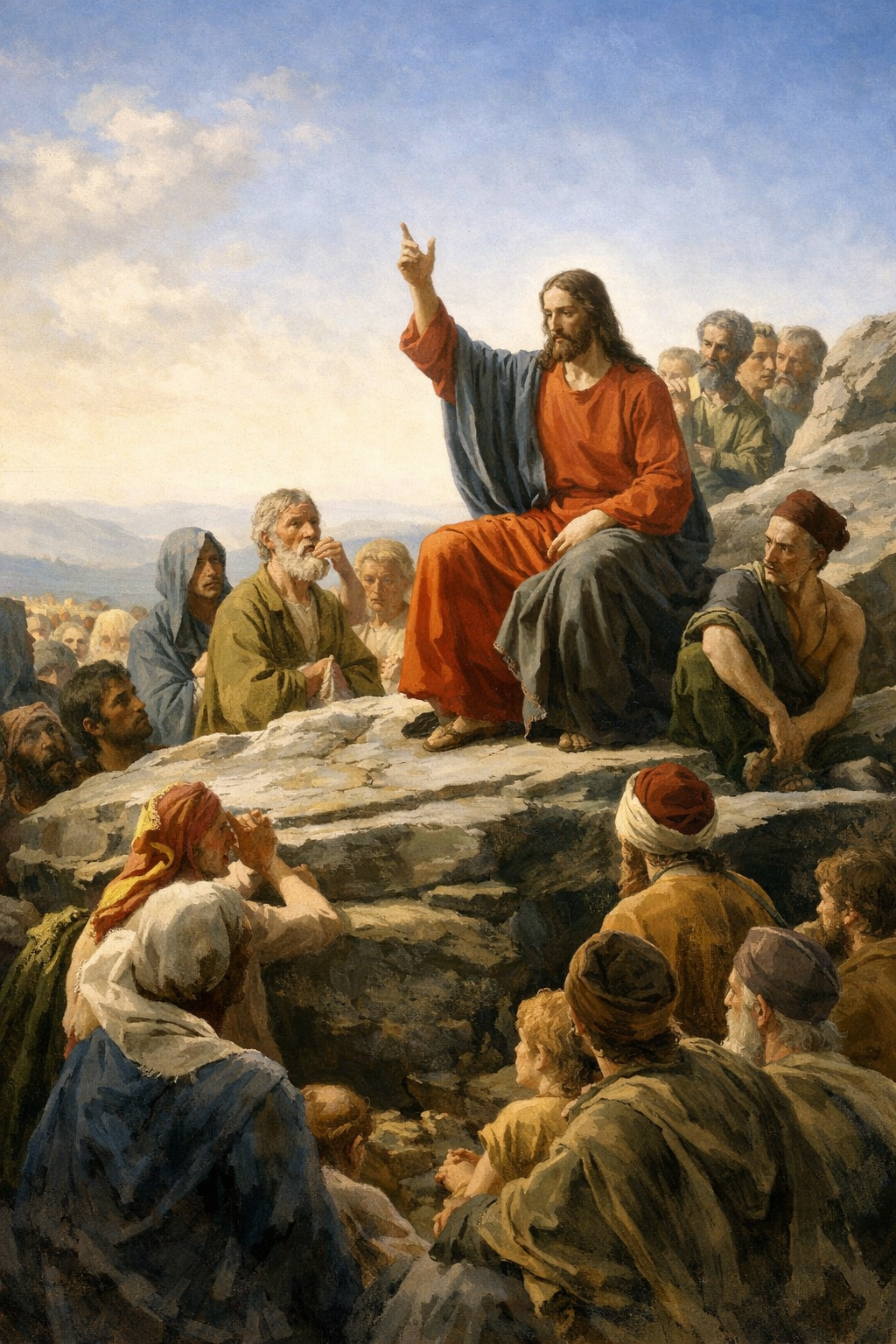
Sermon on the Mount
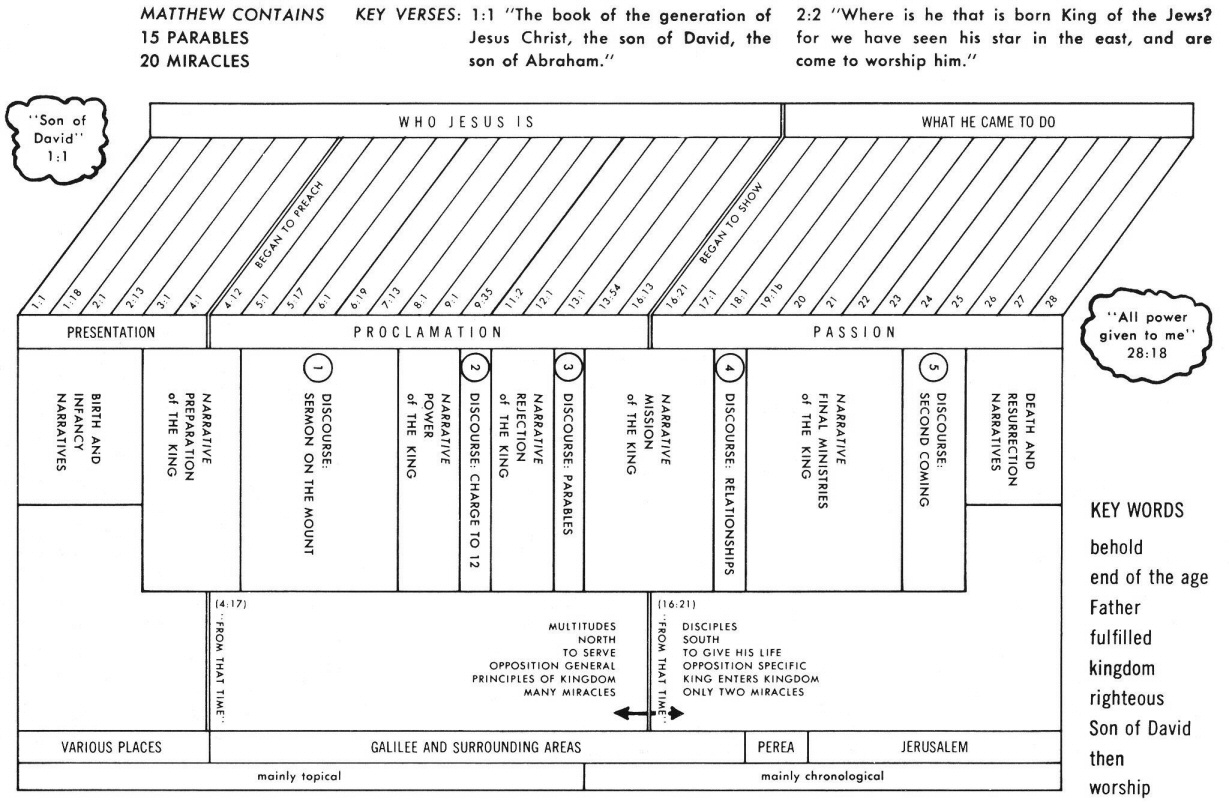
Click chart to enlarge
Charts from Jensen's Survey of the NT - used by permission
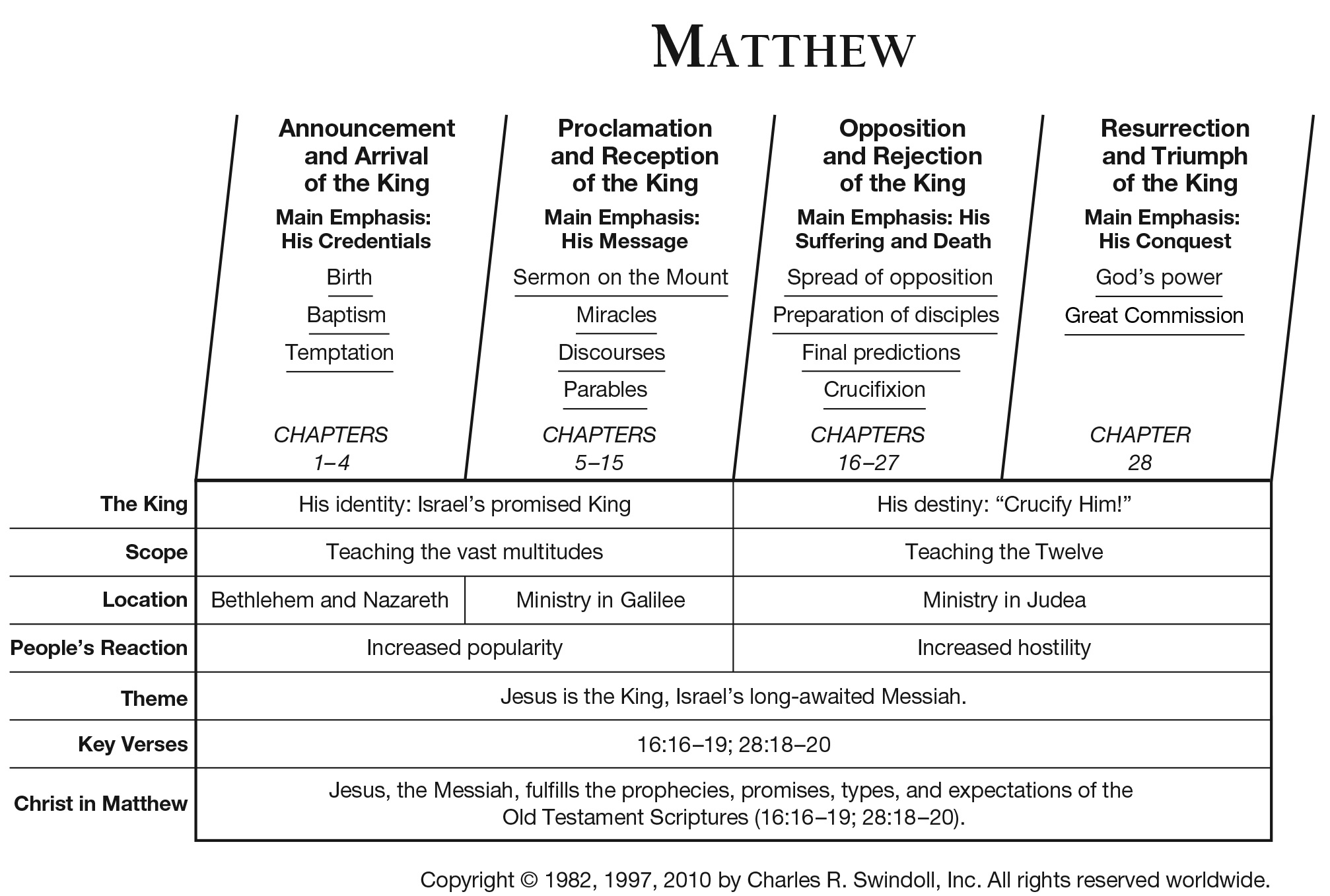
Another Chart from Charles Swindoll
THE LIFE OF JESUS AS COVERED
BY MATTHEW (shaded area)
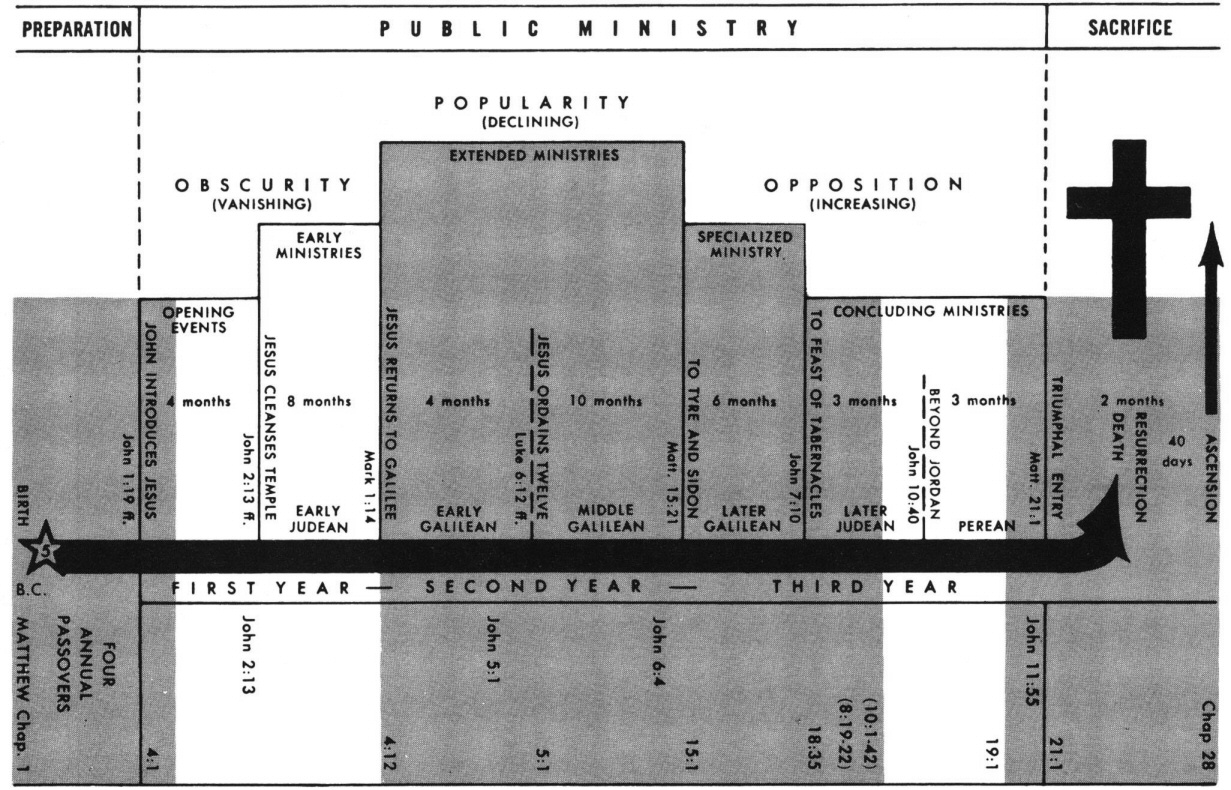
Click chart to enlarge
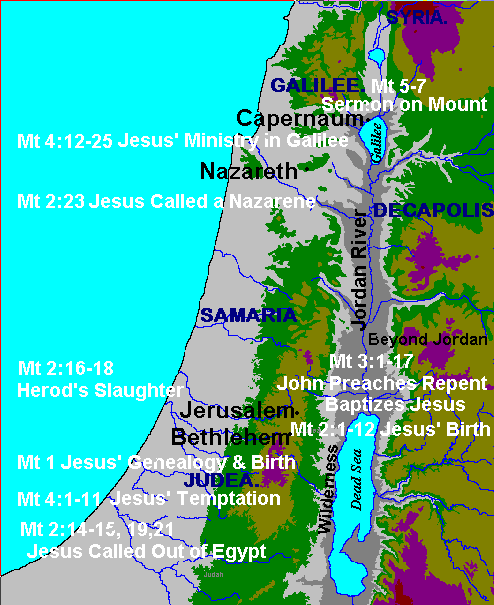
Jesus Birth and Early Years
Leading up to the Sermon on the Mount
Matthew 1-7
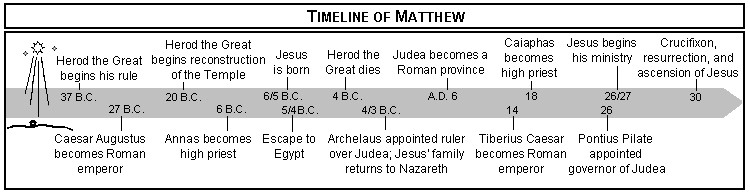
Source: Ryrie Study Bible
Matthew 6:16 "Whenever you fast, do not put on a gloomy face as the hypocrites do, for they neglect their appearance so that they will be noticed by men when they are fasting. Truly I say to you, they have their reward in full. (NASB: Lockman)
Greek: Hotan de nesteuete, (2PPAS) me ginesthe (2PPMM) hos hoi hupokritai skuthropoi, aphanizousin (3PPAI) gar ta prosopa auton hopos phanosin (3PAPS) tois anthropois nesteuontes; (PAPMPN) amen lego (1SPAI) humin apechousin (3PPAI) ton misthon auton.
Amplified: And whenever you are fasting, do not look gloomy and sour and dreary like the hypocrites, for they put on a dismal countenance, that their fasting may be apparent to and seen by men. Truly I say to you, they have their reward in full already. (Amplified Bible - Lockman)
My Amplified Paraphrase: And whenever you fast—not as a rare or theatrical event but as a genuine act of devotion—do not put on a gloomy, sad, or attention-seeking appearance. Don’t advertise your sacrifice or make yourself look miserable in order to earn sympathy or impress others. Those who fast to be noticed by people already have all the reward they will ever receive—the fleeting approval of men.
KJV: Moreover when ye fast, be not, as the hypocrites, of a sad countenance: for they disfigure their faces, that they may appear unto men to fast. Verily I say unto you, They have their reward.
NLT: And when you fast, don't make it obvious, as the hypocrites do, who try to look pale and disheveled so people will admire them for their fasting. I assure you, that is the only reward they will ever get. (NLT - Tyndale House)
Philips: Then, when you fast, don't look like those miserable play-actors! For they deliberately disfigure their faces so that people may see that they are fasting. Believe me, they have had all their reward. (New Testament in Modern English)
Wuest: Moreover, whenever you are fasting, stop being like the actors on the stage of life, of a sad and gloomy countenance, for they mask their faces in order that they may appear to men as those who are fasting. Assuredly, I am saying to you, they have their reward and the receipt for the same in full.
Young's Literal: And when ye may fast, be ye not as the hypocrites, of sour countenances, for they disfigure their faces, that they may appear to men fasting; verily I say to you, that they have their reward.
ESV "And when you fast, do not look gloomy like the hypocrites, for they disfigure their faces that their fasting may be seen by others. Truly, I say to you, they have received their reward.
ASV Moreover when ye fast, be not, as the hypocrites, of a sad countenance: for they disfigure their faces, that they may be seen of men to fast. Verily I say unto you, They have received their reward.
CSB "Whenever you fast, don't be sad-faced like the hypocrites. For they make their faces unattractive so their fasting is obvious to people. I assure you: They've got their reward!
NIV "When you fast, do not look somber as the hypocrites do, for they disfigure their faces to show men they are fasting. I tell you the truth, they have received their reward in full.
NKJ "Moreover, when you fast, do not be like the hypocrites, with a sad countenance. For they disfigure their faces that they may appear to men to be fasting. Assuredly, I say to you, they have their reward.
NRS "And whenever you fast, do not look dismal, like the hypocrites, for they disfigure their faces so as to show others that they are fasting. Truly I tell you, they have received their reward.
NAB "When you fast, do not look gloomy like the hypocrites. They neglect their appearance, so that they may appear to others to be fasting. Amen, I say to you, they have received their reward.
NJB 'When you are fasting, do not put on a gloomy look as the hypocrites do: they go about looking unsightly to let people know they are fasting. In truth I tell you, they have had their reward.
GWN "When you fast, stop looking sad like hypocrites. They put on sad faces to make it obvious that they're fasting. I can guarantee this truth: That will be their only reward.
BBE And when you go without food, be not sad-faced as the false-hearted are. For they go about with changed looks, so that men may see that they are going without food. Truly I say to you, They have their reward.
WHENEVER YOU FAST: Hotan de nesteuete (2PPAS)
- Mt 9:14,15; 2Sa 12:16,21; Neh 1:4; Esther 4:16; Ps 35:13; 69:10; 109:24; Da 9:3; Lk 2:37; Acts 10:30; 13:2,3; 14:23; 1Co 7:5; 2Co 6:5; 11:27
- Matthew 6 Resources - Multiple Sermons and Commentaries
Before you read the notes consider Meditating on these passages on FASTING - Specifically what practice is clearly associated with fasting? Interesting! Are you practicing (under grace, enabled by the Spirit) this Biblical truth in your spiritual life (or will you? will I?)?
Matt 9:14 Then the disciples of John came to Him, saying, “Why do we and the Pharisees fast, but Your disciples do not fast?” 15 And Jesus said to them, “The attendants of the bridegroom cannot mourn as long as the bridegroom is with them, can they? But the days will come when the bridegroom is taken away from them, and then they will fast.
2Sa 12:16 David therefore inquired of God for the child; and David fasted and went and lay all night on the ground. 2Sa 12:21 Then his servants said to him, “What is this thing that you have done? While the child was alive, you fasted and wept; but when the child died, you arose and ate food.”
Neh 1:4 Now it came about when I heard these words, I sat down and wept and mourned for days; and I was fasting and praying before the God of heaven.
Esther 4:16 “Go, assemble all the Jews who are found in Susa, and fast for me; do not eat or drink for three days, night or day. I and my maidens also will fast in the same way. And thus I will go in to the king, which is not according to the law; and if I perish, I perish.”
Ps 35:13 But as for me, when they were sick, my clothing was sackcloth; I humbled my soul with fasting; And my prayer kept returning to my bosom.
Ps 69:10 When I wept in my soul with fasting, It became my reproach.
Ps 109:24 My knees are weak from fasting; And my flesh has grown lean, without fatness.
Dan 9:3 So I gave my attention to the Lord God to seek Him by prayer and supplications, with fasting, sackcloth, and ashes.
Luke 2:37 and then as a widow to the age of eighty-four. And she never left the temple, serving night and day with fastings and prayers.
Acts 10:30 (cf Acts 10:9, 10 = Peter) And Cornelius said, “Four days ago to this hour, I was praying in my house during the ninth hour; and behold, a man stood before me in shining garments,
Acts 13:2 And while they were ministering to the Lord and fasting, the Holy Spirit said, “Set apart for Me Barnabas and Saul for the work to which I have called them.”
Acts 13:3 Then, when they had fasted and prayed and laid their hands on them, they sent them away.
Acts 14:23 And when they had appointed elders for them in every church, having prayed with fasting, they commended them to the Lord in whom they had believed.
1Cor 7:5 (A different genre of "fasting") Stop depriving one another, except by agreement for a time that you may devote yourselves to prayer, and come together again lest Satan tempt you because of your lack of self-control.

HOW NOT
TO FAST!
As Jesus continues the Sermon on the Mount, He turns from giving to praying—and now to fasting. In each case, the issue is not the practice itself, but the motive behind it. Fasting was a normal part of Jewish devotion, yet in Jesus’ day it had often become a stage for public display rather than a means of humble dependence on God. Matthew 6:16 confronts the subtle danger of spiritual showmanship. Jesus warns that religious acts done to be seen by people may impress crowds, but they receive no reward from the Father. True fasting is not about appearance, reputation, or ritual—it is about a heart bowed before God, seeking Him rather than human approval. Before Jesus tells us how to fast, He reminds us why we fast—and warns us whom we are really trying to please.
Whenever - Notice Jesus does not say "if" you fast but "when" you fast. The implication is not subtle is it? Have you ever fasted? Jesus takes for granted that his disciples will observe the custom of fasting. Clearly, Jesus assumed that fasting was good and that it would be done by His disciples. Jesus mentioned this discipline later in Matthew 9:15 declaring
The days will come when the bridegroom is taken away from them, and then they will fast.”
So Jesus is not teaching on whether we should fast or not. He is assuming we will fast and teaching us how to do it and, especially, how not to do it.
Rishel has an interesting thought…
Tertullian defended the practice of fasting in the third century A.D., protesting against the psychics of his day. These people denied fasting on the basis of the “Christian liberty” principle in Galatians 5 and 1 Corinthians 8:8. Tertullian traced the principle of fasting back to Adam who was commanded not to eat of the tree of knowledge of good and evil, thus making it an everlasting ordinance of God’s creation.1 1 St. Isaac the Syrian agreed: “As the first commandment imposed upon our nature in the beginning was against the tasting of the food, and in this point the head of our race fell, therefore those who strive for the fear of God begin the building where the first injury originated.” Whether or not fasting can be traced back to Adam as a creation ordinance may be debated. But it was certainly given as part of the Mosaic Law for the Day of Atonement—the only prescribed day of fasting…
Dissenting Christians will still insist that fasting in the Old Testament has nothing to do with us today. Surprisingly, though, fasting is given no less emphasis in the New Testament, which contains seventeen instances of fasting. It is predicted by Christ for New Testament Christians in the Parable of the Bridegroom (Matthew 9:14–15; Mark 2:18–20; Luke 5:33–35), “But the days will come when the Bridegroom will be taken from them, and then they will fast.” Despite those who say otherwise, the removal of the Bridegroom is an obvious reference to the ascension of Christ.3 Calvin agrees citing the apostles who interpreted the Bridegroom passages as mandating fasting after the ascension. “The apostles, therefore, followed what was not new to the people of God, and what they foresaw would be useful to them.” In response to those who insist that fasting was only for the Old Testament, Calvin continues: “If anyone declines to accept the testimonies which can be cited from the Old Testament, as if inappropriate to the Christian church, the fact remains that the apostles also followed the same practice.”4
The intent of Jesus’ teaching in the Parable of the Bridegroom is that fasting is an expression of a real desire for the presence of Christ. So much so that fasting is not necessary when Christ is present, but when he is absent, then those who love him will fast. Their fasting gives evidence to the fact that they yearn, ache, and long for spiritual realities, which are too easily obscured by the shadows of this world…
An important point to notice in the Sermon on the Mount is that fasting is paralleled with benevolent giving and with prayer. Christ spoke on these three subjects using exactly the same wording: “When you give alms” (Matthew 6:3); “And when you pray” (Matthew 6:5); “Moreover when you fast… ” (Matthew 6:16). Just as giving and prayer are ordinances of God, so is fasting.
It is certainly true that fasting is especially united to prayer. Andrew Murray states in his book on prayer that Christ gives the cure for little faith in Matthew 17:19, 20, 21: “But this kind does not go out except by prayer and fasting.” Murray concludes that faith depends entirely upon the state of the spiritual life. And he draws two lessons: “One, that faith needs a life of prayer in which to grow and to keep strong. The other, that prayer needs fasting for its full and perfect development… Prayer is the one hand with which we grasp the invisible; fasting, the other with which we let loose and cast away the visible.”…
Now if fasting is to be performed by Christians today, we must understand the proper motivation to be obedient to this duty. As with all the spiritual disciplines, it is not the mere performance that God desires, but the proper motive of the heart…
As with all the spiritual disciplines, it is not the mere performance that God desires, but the proper motive of the heart. In the Sermon on the Mount Christ teaches us what would be an improper and hypocritical motive—”that you may not appear unto men to fast, but unto your Father which is in secret; and your Father who sees in secret will reward you openly” (Matthew 6:16, 17, 18). Several other false motives are delineated in God’s chapter on fasting (Isaiah 58) which include afflicting the soul to attract God (Is 58:3), to do fleshly pleasures (Is 58:3), or to be seen in public (Is 58:4). Even the rigor and the formality of habitual fasting are destructive if that becomes the motive (Luke 18:12, 13, 14).
Actually there is only one motivation that can be the proper basis for religious fasting. That motive is simply to humble yourself before God (Isaiah 58; Joel 2:12; Psalm 35:13; 69:10; Ezra 8:21; Daniel 9:3; Nehemiah 9:1–2). Conversely it can be said from the multitude of scriptural examples that a true desire to humble yourself before God ought to result in a life characterized by prayer and fasting. This motivation to humble yourself before God contains two aspects. First, humbling yourself involves confession and repentance of sin. Second, the requirement that it be done before God implies seeking God’s face to know him and to discern his will. (Why God’s People Should Fast )
Dietrich Bonhoeffer wrote that…
Jesus takes it for granted that his disciples will observe the pious custom of fasting. Strict exercise of self-control is an essential feature of the Christian’s life. Such customs have only one purpose—to make the disciples more ready and cheerful to accomplish those things which God would have done… When the flesh is satisfied it is hard to pray with cheerfulness or to devote oneself to a life of service which calls for much self-renunciation… We have to practice strictest daily discipline; only so can the flesh learn the painful lesson that it has no rights of its own. (The Cost of Discipleship)
J C Ryle explains that…
Fasting, or occasional abstinence from food in order to bring the body into subjection to the spirit, is a practice frequently mentioned in the Bible, generally in connection with prayer. David fasted when his child was sick (2 Samuel 12:16); Daniel fasted when he sought special light from God (Daniel 9:3); Paul and Barnabas fasted when they appointed elders (Acts 14:23); Esther fasted before going in to Ahasuerus (Esther 4:16). It is a subject about which we find no direct command in the New Testament. It seems to be left to everyone’s discretion, whether he will fast or not. In this absence of direct command we may see great wisdom. Many a poor man never has enough to eat, and it would be an insult to tell him to fast: many sick people can hardly be kept well with the closest attention to diet, and could not fast without bringing on illness. It is a matter in which each person must be persuaded in their own mind, and not rashly condemn others who do not agree. One thing only must never be forgotten: those who fast should do it quietly, secretly and without ostentation. Let them not “show men they are fasting.” Let them not fast to man, but to God.
C H Spurgeon's comments…
Having dealt with prayer, our King now instructs us as to fasting. Fasting took a leading place in devotion under the Law, and it might profitably be more practiced even now under the Gospel. The Puritans called it “soul-fattening fasting”, and so many have found it. We must, by order of our King, avoid all attempt at display in connection with this form of devotion. Hypocrites went about with faces unwashed, and dolorous, that all might say, “See how rigidly those men are fasting. What good men they must be!” To look miserable in order to be thought holy- is a wretched piece of hypocrisy; and as it makes fasting into a trick to catch human admiration, it thereby destroys it as a means of grace. We cannot expect to get a reward both from the praise of our fellows and the pleasure of God.
We have our choice; and if we snatch at the minor reward, we leave the major. May it never be said of us, “They have their reward. ” (Commentary)
Fast (3522) (nesteuo from ne- = not + esthío = to eat) means to abstain from food for a certain length of time. Fasting consisted of abstinence from food to express dependence on God and submission to His will.
Thayer - to abstain as a religious exercise from food and drink:
NIDNTT - says Nesteuo is from ne-, particle of negation, and edo, eat, i.e. not eating) means, having an empty stomach.
Manser - Abstaining from food, and possibly drink, for a limited period of time as a mark of religious commitment and devotion or as an expression of repentance for sins.
Zodhiates - Pharisees practiced often, sometimes twice a week (cf. see notes on Luke 18:12; Sept.: Is. 58:3ff.; Dan. 9:3). In their longer fastings they abstained only from better kinds of food. The Jews used to call such a fast “The great annual public fast of the great Day of Atonement” which occurred in the month Tisri, corresponding to the new moon of October. It thus served to indicate the season of the year after which the navigation of the Mediterranean became dangerous (Acts 27:9 [cf. Lev. 16:29ff.; 23:27ff.]). (Complete Word Study Dictionary- New Testament- Spiros Zodhiates)
Rothenberg --To fast is to abstain for a limited period from any kind of food. (Total and permanent abstinence from particular, “forbidden” foods is a quite separate matter.) What is the real motive for fasting? In the pagan religions of the ancient world, it was clearly fear of demons and the idea that fasting was an effective means of preparing oneself for an encounter with the deity, since it created the right kind of openness to divine influence. For this reason it belonged in the mystery religions to the ritual of initiation for novices. In magic and with the oracles fasting was also often regarded as a preparation necessary to success. The custom of fasting following a death was widespread. While the soul of the dead person is still near, there is danger of demonic infection in eating and drinking. Fasting was also required, for instance, in certain fertility rites. Thus at Athens he Nesteia is the name given to the fast-day in the women’s fertility festival in the month of sowing (October). Abstinence, here including particularly sexual abstinence, makes a person readier to receive the divine powers of fertility. In practice, fasting in the setting of religious rites and as a defence against trouble was common in the whole of the ancient world, but not fasting for ethical motives (asceticism).
In the LXX the Greek words represent the Heb. sûm, fast. Along with this the MT has 'innâh nepes, afflict oneself (lit., humble one’s soul), referring to a purification rite in which fasting played a part (Lev. 16:29, 31; 23:27, 32; Num. 29:7; Isa. 58:3; Ps. 35:13). Frequently too we read simply of “eating no bread and drinking no water” (e.g. Ex 34:28).
The forms and purposes of fasting are many. Fasting is practised in Israel as a preparation for converse with God (Exod. 34:28; Deut. 9:9; Dan. 9:3):
(a) It was practised by the individual, when oppressed by great cares (2 Sam. 12:16-23; 1 Ki. 21:27; Ps. 35:13; 69:10).
(b) It was practised by the nation in imminent danger of war and destruction (Jdg. 20:26; 2 Chr. 20:3; Est. 4:16; Jon. 3:4-10; Jud. 4:9, 13); during a plague of locusts (Joel 1 and 2); to bring success to the return of the exiles (Ezr. 8:21-23); as an expiatory rite (Neh. 9:1); and finally in connection with mourning the dead (2 Sam. 1:12).
Fasting and prayer go constantly together (Jer. 14:11-12; Neh. 1:4; Ezr. 8:21, 23). Fasting usually lasts from morning to evening (Jdg. 20:26; 1 Sam. 14:24; 2 Sam. 1:12), although Est. 4:16 tells of a 3-day fast. In the description in Ps. 109:24 the torments of fasting during the period of accusation are at the same time a reflection of the inward torments suffered by the suppliant.
The Israelite law ordained fasting only on the day of atonement (Lev. 6:29-30; 23:27-32; Num. 29:7). After the destruction of Jerusalem (587 B.C.) four fast-days were laid down as days of remembrance (Zech. 7:3-5; 8:19). (See online The New International Dictionary of New Testament Theology)
Lowery - Fasting consisted of abstinence from food to express dependence on God and submission to his will (cf. Mt 4:1). The fasting Jesus refers to is private fasting, probably done as an aid to prayer (cf. Luke 2:37). Although the early church collectively fasted and prayed (e.g., Acts 13:3, 14:23), it seems to have been done primarily by Jewish Christians. The practice is never mentioned in any of the NT letters and while Jesus is with them the disciples do not fast (Mt 9:14). Like alms and prayer, fasting is to be done as an act of devotion to God and not to win the approval of anyone else. (Matthew - The Bible Knowledge Key Word Study).
Comfort - The New Testament Christians regularly prayed and fasted (Acts 13:3, nesteuo in Greek). Jesus fasted for forty days and forty nights without food or water, just as Moses had—an impossible human feat in each case; but God empowered each one (compare Ex. 24:18; 34:28; Matt. 4:2). We see in these cases that God’s presence and word was more life-giving than food Jesus Himself indicated that the time after His ascension would properly be a time of fasting, for He would be gone (Mark 2:19). But He clearly instructed His followers to fast with the heart, in secret to God, and not as a show for other people (Matt. 6:16–18). When fasting, keep your focus on the Lord and His will for you. (Holman Treasury of Key Bible Words- 200 Greek and 200 Hebrew Words Explained and Defined- Philip W. Comfort, Eugene E. Carpenter)
Nesteuo - 20x in 15v but in seven major segments emphasizing fasting…
Matthew 4:2 And after He had fasted forty days and forty nights, He then became hungry.
Matthew 6:16 "Whenever you fast, do not put on a gloomy face as the hypocrites do, for they neglect their appearance so that they will be noticed by men when they are fasting. Truly I say to you, they have their reward in full. 17 "But you, when you fast, anoint your head and wash your face 18 so that your fasting will not be noticed by men, but by your Father who is in secret; and your Father who sees what is done in secret will reward you.
Matthew 9:14 Then the disciples of John came to Him, asking, "Why do we and the Pharisees fast, but Your disciples do not fast?" 15 And Jesus said to them, "The attendants of the bridegroom cannot mourn as long as the bridegroom is with them, can they? But the days will come when the bridegroom is taken away from them, and then they will fast.
Spurgeon: But Jesus was to go. He says himself, “The Bridegroom shall be taken from them.” Here first He speaks about His death. Did His disciples note the warning word? When their Beloved was gone, they would have fasting enough. How true was this! Sorrows crowded in upon them when He was gone. It is the same with us. Our Lord is our joy: His presence makes our banquet; His absence is our fast, black and bitter. All Ritualistic fasting is the husk: the reality of fasting is known only to the child of the bride chamber when His Lord is no more with Him. This is fasting indeed, as some of us know full well. There is no wedding without a Bridegroom, no delight without Jesus. In his presence is fulness of joy; in his absence is depth of misery. Let but the heart rest in his love and it desireth nothing more. Take a way a sense of his love from the soul, and it is dark, empty, and nigh unto death.
John MacArthur: The Old Testament prescribed only one fast, the one on Yom Kippur, the Day of Atonement (see Lev. 16:29, 31, where the phrase “humble your souls” [from the Heb. ˓āna, “to afflict or humble”] commonly included the idea of refraining from food). But Jewish tradition had come to require fasting twice a week (see Luke 18:12), and these disciples were careful to follow that practice.
Along with alms giving and certain prescribed prayers, twice-weekly fasting was one of the three major expressions of orthodox Judaism during Jesus’ day. The scribes and Pharisees looked on these practices with great seriousness and were careful not only to follow them faithfully but to do so as publicly and ostentatiously as possible-ostensibly as a testimony to true godliness but in reality as a testimony to their own self-styled piety. When they gave alms, they blew trumpets “in the synagogues and in the streets” in order to “be honored by men” (Matt. 6:2). When they prayed “in the synagogues and on the street corners,” they did so “to be seen by men” (Mt 6:5). And when they fasted, they “put on a gloomy face” and neglected their “appearance in order to be seen fasting by men” (Mt 6:16). They did not see religion as a matter of humility, repentance, or forgiveness, but as a matter of ceremony and proud display. And therefore the external rituals which they paraded as badges of godly righteousness actually marked them as ungodly hypocrites, as Jesus declared in each of the three verses just cited (cf. Mt 5:20).
Religious ritual and routine have always been dangers to true godliness. Many ceremonies, such as praying to saints and lighting a candle for a deceased relative are actually heretical. But even if it is not wrong in itself, when a form of praying, worshiping, or serving becomes the focus of attention, it becomes a barrier to true righteousness. It can keep an unbeliever from trusting in God and a believer from faithfully obeying Him. Even going to church, reading the Bible, saying grace at meals, and singing hymns can become lifeless routines in which true worship of God has no part…
The days will come, Jesus explained, when the bridegroom is taken away. Taken away is from apairō, which can carry the idea of sudden removal, of being snatched away violently. Jesus was obviously referring to His crucifixion, which would abruptly and violently take Him away from His followers, His faithful attendants. That will be the time for mourning, and then they will fast. But for the present time, He was saying, fasting was inappropriate. When there is no reason to mourn there is no reason to fast. Fasting springs naturally from a broken and grieving heart, but fasting as a shallow spiritual ritual apart from such brokenness is an affront to God. (MacArthur, J: Matthew 1-7 Chicago: Moody Press)
Mark 2:18 John's disciples and the Pharisees were fasting; and they came and said to Him, "Why do John's disciples and the disciples of the Pharisees fast, but Your disciples do not fast?" 19 And Jesus said to them, "While the bridegroom is with them, the attendants of the bridegroom cannot fast, can they? So long as they have the bridegroom with them, they cannot fast. 20 "But the days will come when the bridegroom is taken away from them, and then they will fast in that day. 21 "No one sews a patch of unshrunk cloth on an old garment; otherwise the patch pulls away from it, the new from the old, and a worse tear results.
J C Ryle has some interesting comments: These words, we must of course see, were a parable. They were spoken with a special reference to the question which the Pharisees had just raised--"Why do the disciples of John fast, but your disciples do not FAST?" Our Lord's reply evidently means, that to enforce fasting among His disciples would be inexpedient and unseasonable. His little flock was as yet young in grace, and weak in faith, knowledge, and experience. They must be led on softly, and not burdened at this early stage with requirements which they were not able to bear. Fasting, moreover, might, be suitable to the disciples of Him who was only the Bridegroom's friend, who lived in the wilderness, preached the baptism of repentance, was clothed in camel's hair, and ate locusts and wild honey. But fasting was not equally suitable to the disciples of Him, who was the Bridegroom Himself, brought glad tidings to sinners, and came living like other men. In short, to require fasting of his disciples at present, would be putting "new wine into old bottles." It would be trying to mingle and amalgamate things that essentially differed.
Luke 5:33 And they said to Him, "The disciples of John often fast and offer prayers, the disciples of the Pharisees also do the same, but Yours eat and drink." 34 And Jesus said to them, "You cannot make the attendants of the bridegroom fast while the bridegroom is with them, can you? 35 "But the days will come; and when the bridegroom is taken away from them, then they will fast in those days."
Luke 18:12 'I fast twice a week; I pay tithes of all that I get.'
Comment: Perfect example of "bad" fasting. Pride puffed up fasting.
Acts 13:2 While they were ministering to the Lord and fasting, the Holy Spirit said, "Set apart for Me Barnabas and Saul for the work to which I have called them." 3 Then, when they had fasted and prayed and laid their hands on them, they sent them away.
Nesteuo: 19x in the Septuagint
Ex 38:8; Jdg 20:26; 1Sa7:6; 31:13; 2Sa 1:12; 12:16, 21, 22, 23; 1Kgs 21:9, 27; 1 Chr 10:12; Ezra 8:23; Neh 1:4; Esther 4:16; Isa 58:3, 4; Jer 14:12; Zech 7:5;
Fasting is a valid discipline and one which Jesus did not annul. The only fast God commanded was once per year on the Day of Atonement. The Jewish religious teachers had added two fasts to be performed each Monday and Thursday, a practice which was observed ritualistically by the "pious" Pharisees.
Phil Newton writes that…
Fasting has been practiced by many different religions for centuries. It is personal self-discipline in which a person denies himself a normal need in order to learn to restrain his passions and desires, and to express his devotion. Often God’s people have fasted in order to express humility before the Lord, and to show an earnest desire for the Lord to work in a particular way. Most commonly, fasting involves denying oneself a meal or meals in order to give oneself to the purpose of seeking God’s face. But fasting is never to be used for drawing attention to one’s spirituality or devotion… The gloomy, sullen looks on their faces give the pretentious fasters a ready audience. The language suggests an almost unrecognizable look, as they leave their hair disheveled, neglect bathing, and maybe even accentuate a strange pallor to the skin.
In our day it seems the most common thing is for people to announce that they are fasting or to tell about their fast. I received a booklet from a Baptist pastor several years ago telling about his 40-day fast, and how that became the key to his spiritual growth and his church’s growth. Then he outlined in true-Baptist program fashion how to institute such a fast in one’s own life. But Jesus tells us… Let this be between you and the Lord. The Lord sees in secret and rewards accordingly. (Sermon)
What principles for fasting are given in Matthew 6:16-18? Don't fast like a hypocrite, putting on a gloomy face to impress men - that's your entire reward! If you give, pray or fast for the admiration of man, you will lose the smile and reward of your Father! When you fast take care of your appearance so men don't know you are fasting - then your Father will repay you. Notice that Jesus says "when you fast" not "if you fast" indicating it is expected by our Lord. However, He does not command fasting. Thus fasting is a choice we each must make. It is a voluntary spiritual discipline.
Fasting is a Christian’s voluntary, non-coerced abstinence from food or water for spiritual purposes.
Fasting by a non-Christian has no eternal value since the discipline’s motives and purposes are to be God-centered.
Fasting runs counter to America's self-indulgent, "me, my, mine" mindset, and thus it is not surprising that many Christians have not given serious consideration to the discipline of fasting. The act of fasting directly opposes the desires of our fallen flesh, which are continually appealed to by the world and the tempter. Of course, there are some people who cannot and should not fast because of medical reasons. However, for the majority of Christians, it be prudent to consider engaging in the practice of fasting, as saints have done throughout the Old Testament and in the early church (cf Acts 13:2, 3, 14:23).
Fasting is not to impress God not to earn His acceptance, our acceptance having been made full and complete on the basis of the finished work of the Lord Jesus Christ. Fasting does not earn God’s favor! Like alms and prayer, fasting is to be done as an act of devotion to God and not to win the approval of anyone else. When we fast, we must not do anything that will draw attention to our appearance, our hungry state or our dedication to God. Fasting is between the saint and his God.
Fasting is mentioned in Scripture more than several other important doctrines including such teachings as baptism (about 77 times for fasting, 75 for baptism). Most believers have been baptized but how many have fasted?
Fasting in Scripture is almost always associated with prayer. Some feel that fasting helps one focus our prayers of intercession and supplication. We should not however assume that fasting is like a "spiritual hunger strike" that in any way compels or manipulates God. Clearly, if we petition for something out of God’s will, fasting does not incline Him produce an affirmative response. In short, fasting does not change God’s hearing so much as it changes our praying.
Fasting for God's guidance is clearly seen in Scripture (see Jdg 20, Acts 14:23), but fasting does not ensure certainty that we will receive clear guidance. On the other hand, fasting rightly motivated does make us more receptive to our Father Who seeks to guide us.
Fasting is often a manifestation of grief or mourning, as when King Saul was killed by the Philistines resulting in the men of Jabesh Gilead fasting seven days (cf 1Sa 31:13)
Martyn Lloyd-Jones wrote that…
Fasting, if we conceive of it truly, must not… be confined to the question of food and drink; fasting should really be made to include abstinence from anything which is legitimate in and of itself for the sake of some special spiritual purpose. There are many bodily functions which are right and normal and perfectly legitimate, but which for special peculiar reasons in certain circumstances should be controlled. That is fasting. (Lloyd-Jones, D. M. Studies in the Sermon on the Mount)
David R Smith adds that…
A selfish person is unable to enjoy the gospel; a Christian is someone who has begun to deny himself, and is in the continuous process of denying himself. Jesus said “If any man will come after Me, let him deny himself, and take up his cross, and follow Me.” Self-denial is not limited to one particular kind of giving; it embraces all personal disciplines. Fasting is only one discipline; nevertheless, it is self-denial. This does not mean that to fast is to embrace legalism; it is gospel liberty which encourages us to deny ourselves…
Nobody can maintain a desired state of mind whilst his bodily condition is not in accordance with it. If a man is anxious to devote himself to spiritual things, for a time, he is obliged to ensure that his body is in similar environment, or else he may not succeed. He cannot be reverent in the midst of his own physical irreverence. Fasting ensures the correct environment for sorrowful and serious considerations. Asterius wrote, in the 4th Century, that one role of fasting is to ensure that the stomach does not make the body boil like a kettle, to the hindering of the soul…
FAITH
AND FASTING
Fasting does not create faith, for faith grows in us as we hear, and read, and dwell upon, God’s Word; it is a work of the Holy Spirit to bring faith to God’s people. However, fasting has the capacity to encourage faith in the one who is involved in this discipline. It seems as though the neglect of self feeds the faith which God has implanted in the hearts of born-again believers. This doesn’t mean that those who eat the least have the most faith; such a view is not only untrue, it is extremist. It is simply that regular self-denial has its benefits, and one of these is seen in a personal increase in faith. (Fasting: A Neglected Discipline. Christian Literature Crusade, 1954)
Fasting in the Old Testament was commonly associated with seeking of God's deliverance and/or protection before one made a critical decision or pursued a potentially dangerous or difficult course of action (cf 2Chr 20:1, 2, 3, 4-29, 2Chr 30:3, 4, Ezra 8:21, 22, 23, Neh 1:4). Queen Esther called for a "cooperative fast" from the Jews of Susa as she prepared for an uninvited and therefore potentially dangerous entrance into the presence of King Xerxes. In this hour of great need, Queen Esther requested Mordecai to…
Go, assemble all the Jews who are found in Susa, and fast for me; do not eat or drink for three days, night or day. I and my maidens also will fast in the same way. And thus I will go in to the king, which is not according to the law; and if I perish, I perish. So Mordecai went away and did just as Esther had commanded him. (Esther 4:16, 17)
Fasting can be associated with confession and repentance (see Da 9:3, 4+). In First Samuel 7 we read a study of national revival (read the entire chapter 1Sa 7:1-17) in which God raised up Samuel, who called the people to repentance, confession, and cleansing. Intercession was made through the blood of a lamb, and there was victory over the Philistines. Fasting was a component of this "revival"…
And they (the Israelites) gathered to Mizpah, and drew water and poured it out before the LORD (this was a sacrificial act in the arid land of Israel, symbolic of their repentant hearts as described in 1Sa 7:3-4 where Samuel called them to return to the LORD and they responded by removing their idols and serving Jehovah), and fasted on that day, and said there, "We have sinned against the LORD." And Samuel judged the sons of Israel at Mizpah. (1Sa 7:6, 1-17)
The prophet Joel in light of impending judgment (The Day of the Lord) asked "Who can endure it?" and then provided the "way of escape"…
"Yet even now," declares the LORD, "Return to Me with all your heart, and with fasting, weeping, and mourning; and rend your heart and not your garments." Now return to the LORD your God, for He is gracious and compassionate, slow to anger, abounding in lovingkindness, and relenting of evil. (Joel 2:12, 13)
Here God Himself associates fasting with a changed heart (repentance) and a return to Him. This passage also warns that fasting without a changed heart is a meaningless dead work. Beloved, is God calling you to deal with a specific sin in your hardened heart, so that you might return to Him in brokenness and repentance with fasting, weeping and mourning? Jesus promised that blessed are those mourn over their sins for they shall be comforted (see Mt 5:4-+) Don't try to substitute a spiritual discipline such as fasting, for God' clear call to confess and forsake that sin which so easily entangles you (cf Pr 28:13). It is a perversion of fasting from food or drink when we refuse God's "chosen fast" (cf Isaiah 58:3, 4, 5, 6, 7, 8, 9, 10, 11, 12, especially v6-7) to cease feeding a sin we want to continue feeding.
Fasting, rightly motivated, is a physical expression of humility before God, just as kneeling or prostrating yourself in prayer can reflect humility before Him. For example first Kings records that one of the most wicked men in Israel's history, King Ahab, eventually humbled himself before God and demonstrated it by fasting…
And it came about when Ahab heard these words, that he tore his clothes and put on sackcloth and fasted, and he lay in sackcloth and went about despondently. Then the word of the LORD came to Elijah the Tishbite, saying, "Do you see how Ahab has humbled himself before Me? Because he has humbled himself before Me, I will not bring the evil in his days, but I will bring the evil upon his house in his son's days." (1Kings 21:27-29)
David, a man after God's Own heart, illustrates the relationship between prayer, fasting and humility recording that…
as for me, when they (David's enemies!) were sick, my clothing was sackcloth; I humbled my soul with fasting; and my prayer kept returning to my bosom. (Psalm 35:13)
Fasting is not always associated with humility, as illustrated by the self-righteous Pharisee who boasted…
'I fast twice a week; I pay tithes of all that I get.' (Luke 18:12)
The Jews of Jesus' day had a teaching that Moses went up on Mount Sinai to receive the Law on a Thursday, and returned with it on a Monday. Consequently, the Pharisees considered fasting on those two days was considered a special mark of holiness.
Fasting can be the work of God in a place that has experienced tragedy, disappointment, or apparent defeat as seen with Nehemiah when he heard that despite the return of many Jewish exiles to Jerusalem, the city still had no wall…
Now it came about when I heard these words, I sat down and wept and mourned for days; and I was fasting and praying before the God of heaven. (Nehemiah 1:4)
Nehemiah had a deep sense of Jerusalem’s significance to God and was greatly distressed that affairs there had not advanced the cause and glory of God. Note that Nehemiah's focus was toward the God of heaven and for the glory of God. When I fast is that my focus and my goal?
Fasting can be an act of sheer devotion to God as we see with the godly prophetess Anna, Luke recording that…
there was a prophetess, Anna the daughter of Phanuel, of the tribe of Asher. She was advanced in years, having lived with a husband seven years after her marriage, and then as a widow to the age of eighty-four. And she never left the temple, serving night and day with fastings and prayers. (Luke 2:36-37)
Anna is one of those people that I cannot wait to meet. Luke gives details of her life which suggest that for well over half a century she was at the Temple serving God with “fastings and prayers.” Clearly for Anna, her fasting as an incredible expression of worship to her Lord. Here we see fasting can be an expression of finding one's greatest pleasure and enjoyment in God.
🙏 THOUGHT - May you and I, dear reader, long—like Anna—for those sacred moments when God stirs in us a craving for the spiritual banquet of His presence more than any physical, temporal meal. And remember: Jesus promises that our Father in heaven will reward the fast that is rightly motivated, pure in heart, and offered for His eyes alone. Let it be Lord. Amen.
Happy would it be if both churches and their individual members, were more frequently to set apart special seasons of fasting and prayer to seek a renewed communication of divine influence - John Angell James (The Church in Earnest)
Spurgeon
Prayer and fasting produce an elevated condition of heart; and if this can be maintained, we escape the injurious tendency of our surroundings, and in a sense this corruptible puts on incorruption. (The Salt Cellar)
THE church of God would be far stronger to wrestle with this ungodly age if she were more given to prayer and fasting. There is a mighty efficacy in these two gospel ordinances. The first links us to heaven, the second separates us from earth. Prayer takes us into the banqueting-house of God; fasting overturns the surfeiting tables of earth. Prayer gives us to feed on the bread of heaven, and fasting delivers the soul from being encumbered with the fulness of bread which perishes. When Christians shall bring themselves up to the uttermost possibilities of spiritual vigor, then they will be able, by God’s Spirit working in them, to cast out devils which to-day, without the prayer and fasting, laugh them to scorn. (Flashes of thought)
Complete Gathered Gold Quotes on Prayer and Fasting…
Since this is a holy exercise both for the humbling of men and for their confession of humility, why should we use it less than the ancients did? - John Calvin
Prayer is one hand with which we grasp the invisible; fasting the other, with which we let loose and cast away the visible. - Andrew Murray
By fasting, the body learns to obey the soul; by praying the soul learns to obey the body. - William Secker
Fasting is calculated to bring a note of urgency and importance into our praying, and to give force to our pleading in the court of heaven. The man who prays with fasting is giving heaven notice that he is truly in earnest. - Arthur Wallis
Few disciplines go against the flesh and the mainstream of culture as this one. - Donald S. Whitney
Without a purpose, fasting can be a miserable, self-centered experience. - Donald S. Whitney
Related Resources:
- A Hunger for God - Desiring God Through Fasting and Prayer Dr John Piper's entire book (Pdf)
- See also Why Do Christians Fast? | Desiring God
- What does the Bible say about fasting? | Bible.org
- Why God’s People Should Fast - 9 page article by Joel Rishel
- A Biblical Perspective on Fasting - 19 page article by Kent Berghuis (Bibliotheca Sacra 158: page 86-103)
- Fasting That Is Pleasing To The Lord: A NT Theology Of Fasting - Sigurd Grindheim
- Did Jesus’ Disciples Fast? -- George C. Gianoulis
- Fast, Fasting - Baker's Evangelical Dictionary of Biblical Theology
- Fast; Fasting - International Standard Bible Encyclopedia
- Fasting - Article by Archibald Alexander
- The Practice of Fasting in the New Testament Curtis C. Mitchell (annual fee required for full view)
Here is a summary from Gotquestions.org on Biblical Fasting -
Biblical fasting is a deliberate, spiritual discipline through which a person chooses to abstain from food—or at times from other worldly comforts—in order to seek God with a humble and repentant heart. It is not a means of earning God’s favor or punishing the body, but rather of denying physical desires so that one’s heart and mind may focus more completely on prayer, worship, and dependence upon the Lord. As GotQuestions.org explains, fasting “denies our flesh what it wants so that we can focus more clearly on strengthening our spirits” (“Why did Jesus fast?”). Jesus Himself fasted in the wilderness for forty days (Matthew 4:1–2) as He prepared for ministry, demonstrating that fasting can be a time of spiritual preparation and victory over temptation.
Scripturally, fasting has often been associated with repentance and humility before God. In Joel 2:12–13, the Lord commands, “Return to me with all your heart, with fasting, with weeping, and with mourning… for he is gracious and merciful.” Similarly, when the people of Nineveh fasted in response to Jonah’s message, God saw their repentance and withheld judgment (Jonah 3:5–10). Isaiah 58:6–7 clarifies that genuine fasting is not mere abstinence from food but a heartfelt turning from sin and an active pursuit of righteousness, justice, and mercy.
In the New Testament, believers fasted when seeking God’s guidance for important decisions (Acts 13:2–3; 14:23), and Jesus taught that fasting should be done privately and sincerely, not as a public display of piety (Matthew 6:16–18). The purpose, then, is always relational—drawing nearer to God, aligning the heart with His will, and admitting one’s dependence on Him. As GotQuestions.org further notes (“Christian fasting — what does the Bible say?”), fasting is not commanded but commended as a “good, profitable, and beneficial” practice that helps turn attention from the world toward Christ. Ultimately, biblical fasting expresses hunger for God Himself, reminding believers that “man shall not live by bread alone, but by every word that comes from the mouth of God” (Matthew 4:4 ESV).
QUESTION: What is the connection between prayer and fasting? | GotQuestions WATCH VIDEO
ANSWER: Although the connection between prayer and fasting is not specifically explained in Scripture, a common thread connecting the two seems to run through all the instances of prayer and fasting recorded in the Bible. In the Old Testament, it appears that fasting with prayer had to do with a sense of need and dependence, and/or of abject helplessness in the face of actual or anticipated calamity. Prayer and fasting are combined in the Old Testament in times of mourning, repentance, and/or deep spiritual need.
The first chapter of Nehemiah describes Nehemiah praying and fasting, because of his deep distress over the news that Jerusalem had been desolated. His many days of prayer were characterized by tears, fasting, confession on behalf of his people, and pleas to God for mercy. So intense was the outpouring of his concerns that it’s almost inconceivable he could “take a break” in the middle of such prayer to eat and drink. The devastation that befell Jerusalem also prompted Daniel to adopt a similar posture: “So I turned to the Lord God and pleaded with him in prayer and petition, in fasting, and in sackcloth and ashes” (Daniel 9:3). Like Nehemiah, Daniel fasted and prayed that God would have mercy upon the people, saying, “We have been wicked and have rebelled; we have turned away from your commands and laws” (v. 5).
In several instances in the Old Testament, fasting is linked with intercessory prayer. David prayed and fasted over his sick child (2 Samuel 12:16), weeping before the Lord in earnest intercession (vv. 21-22). Esther urged Mordecai and the Jews to fast for her as she planned to appear before her husband the king (Esther 4:16). Clearly, fasting and petition are closely linked.
There are instances of prayer and fasting in the New Testament, but they are not connected with repentance or confession. The prophetess Anna “never left the temple but worshiped night and day, fasting and praying” (Luke 2:37). At age 84, her prayer and fasting were part of her service to the Lord in His temple as she awaited the promised Savior of Israel. Also in the New Testament, the church at Antioch was fasting in connection with their worship when the Holy Spirit spoke to them about commissioning Saul and Barnabas to the Lord’s work. At that point, they prayed and fasted, placed their hands on the two men and sent them off. So, we see in these examples that prayer and fasting are components of worshiping the Lord and seeking His favor. Nowhere, however, is there any indication that the Lord is more likely to answer prayers if they are accompanied by fasting. Rather, fasting along with prayer seems to indicate the sincerity of the people praying and the critical nature of the situations in which they find themselves.
The more critical the situation, the more appropriate the fasting and prayer. In Mark 9, Jesus casts a demon from a boy. The disciples had been unable to perform the exorcism, although they had previously been given authority over unclean spirits (Mark 6:7). Later, the disciples asked Jesus why they failed in their attempts to free the boy from the demon, and Jesus said, “This kind can come out only by prayer” (Mark 9:29). Matthew’s account adds the phrase “and fasting” (Matthew 17:21, KJV). In this particular case, the demon was exceptionally malicious and obdurate (Mark 9:21-22). Jesus seems to be saying that a determined foe must be met with an equally determined faith. Prayer is a ready weapon in the spiritual battle (Ephesians 6:18), and fasting helps to focus prayer and give it resolve.
The theology of fasting is a theology of priorities in which believers are given the opportunity to express themselves in an undivided and intensive devotion to the Lord and to the concerns of spiritual life. This devotion will be expressed by abstaining for a short while from such normal and good things as food and drink, so as to enjoy a time of uninterrupted communion with our Father. Our “confidence to enter the Most Holy Place by the blood of Jesus” (Hebrews 10:19), whether fasting or not fasting, is one of the most delightful parts of that “better thing” which is ours in Christ. Prayer and fasting should not be a burden or a duty, but rather a celebration of God’s goodness and mercy to His children.
QUESTION: What are the different types of fasting? | GotQuestions.org
ANSWER: Usually, fasting is the abstaining from food for a certain period of time. There are different types of fasting in the Bible, however, and not all of them involve food. Many people in the Bible fasted, including Moses, David, and Daniel in the Old Testament and Anna, Paul, and Jesus Christ in the New Testament. Many important figures in Christian history attested to fasting’s value, as do many Christians today.
Biblical fasting is often closely linked to repentance, as in the examples of David, the nation of Israel, and the city of Nineveh. Fasting is also related to passionate prayer, as in the examples of King Jehoshaphat and Queen Esther. Biblical fasting comes from a humble heart seeking God (Isaiah 58:3–7). John MacArthur comments on Isaiah 58: “The people complained when God did not recognize their religious actions, but God responded that their fastings had been only half-hearted. Hypocritical fasting resulted in contention, quarreling, and pretense, excluding the possibility of genuine prayer to God. Fasting consisted of more than just an outward ritual and a mock repentance, it involved penitence over sin and consequent humility, disconnecting from sin and oppression of others, feeding the hungry, and acting humanely toward those in need.”
The regular fast is done by abstaining from all food, both solid and liquid, except for water. This is the type of fasting Judah’s King Jehoshaphat called for when his country was confronted with invasion (2 Chronicles 20:3). The Lord defeated their enemies, and the men of Judah blessed the Lord (2 Chronicles 20:24–27). After the Babylonian Captivity, the people returning to Jerusalem prayed and fasted, asking God for His protection on their journey (Ezra 8:21). The Lord Jesus fasted during His forty days in the wilderness being tempted by Satan (Luke 4:2). When Jesus was hungry, Satan tempted Him to turn the stones into bread, to which Jesus replied, “Man shall not live by bread alone” (Luke 4:4).
Another type of biblical fasting is the partial fast. The prophet Daniel spent three weeks fasting from certain foods. In Daniel 10, the prophet says, “I, Daniel, mourned for three weeks. I ate no choice food; no meat or wine touched my lips; and I used no lotions at all until the three weeks were over” (Daniel 10:2–3). Note that Daniel’s fast to express his grief on this occasion only omitted “choice” food, and it also involved relinquishing the use of oils and “lotions” for refreshment. Today, many Christians follow this example and abstain from certain foods or activities for a short time, looking to the Lord for their comfort and strength.
Also mentioned in the Bible is the absolute fast, or the full fast, where no food or water is consumed. When Esther discovered the plan for all the Jews to be killed in Persia, she and her fellow Jews fasted from food and water for three days before she entered the king’s courts to ask for his mercy (Esther 4:16). Another example of an absolute fast is found in the story of Saul’s conversion. The murderous Saul encountered Jesus in His glory on the road to Damascus. “For three days he was blind, and did not eat or drink anything” (Acts 9:9). Immediately following that time of blindness and fasting, Saul dedicated his life to preaching Jesus Christ.
In the cases of Esther and Saul, the absolute fast only lasted three days. However, Moses and Elijah took part in miraculous, forty-day absolute fasts. When Moses met God on the mountaintop to receive the tablets of stone, he ate no bread and drank no water (Deuteronomy 9:9). And, after Elijah defeated the prophets of Baal on Mt. Carmel, infuriating Queen Jezebel, Elijah fled for his life and spent forty days of fasting in the wilderness (1 Kings 19).
The Bible also mentions a sexual fast, although not by that name. In Exodus 19:15, the people of Israel were to prepare for their encounter with the Lord at Mt. Sinai, and part of their preparation was to abstain from sexual relations for three days. And in 1 Corinthians 7:5 Paul says that a married couple can mutually agree to abstain from sex for a short period of time in order to devote themselves to prayer. But then they are to “come together again so that Satan will not tempt you because of your lack of self-control.”
The purpose of fasting is not to get God to respond as a genie in a bottle to grant our every wish. Fasting, whether it is regular, partial, absolute, or sexual, is a seeking after God’s heart, all other blessings and benefits being secondary to God Himself. This is what sets apart biblical fasting from other religious and cultural practices around the world.
QUESTION: Christian fasting — what does the Bible say? | GotQuestions.org WATCH VIDEO
ANSWER: Scripture does not command Christians to fast. God does not require or demand it of Christians. At the same time, the Bible presents fasting as something that is good, profitable, and beneficial. The book of Acts records believers fasting before they made important decisions (Acts 13:2; 14:23). Fasting and prayer are often linked together (Luke 2:37; 5:33). Too often, the focus of fasting is on the lack of food. Instead, the purpose of fasting should be to take your eyes off the things of this world to focus completely on God. Fasting is a way to demonstrate to God, and to ourselves, that we are serious about our relationship with Him. Fasting helps us gain a new perspective and a renewed reliance upon God.
Although fasting in Scripture is almost always a fasting from food, there are other ways to fast. Anything given up temporarily in order to focus all our attention on God can be considered a fast (1 Corinthians 7:1-5). Fasting should be limited to a set time, especially when fasting from food. Extended periods of time without eating can be harmful to the body. Fasting is not intended to punish the flesh, but to redirect attention to God. Fasting should not be considered a “dieting method” either. The purpose of a biblical fast is not to lose weight, but rather to gain deeper fellowship with God. Anyone can fast, but some may not be able to fast from food (diabetics, for example). Everyone can temporarily give up something in order to draw closer to God.
By taking our eyes off the things of this world, we can more successfully turn our attention to Christ. Fasting is not a way to get God to do what we want. Fasting changes us, not God. Fasting is not a way to appear more spiritual than others. Fasting is to be done in a spirit of humility and a joyful attitude. Matthew 6:16-18 declares, “When you fast, do not look somber as the hypocrites do, for they disfigure their faces to show men they are fasting. I tell you the truth, they have received their reward in full. But when you fast, put oil on your head and wash your face, so that it will not be obvious to men that you are fasting, but only to your Father, who is unseen; and your Father, who sees what is done in secret, will reward you.”
QUESTION: How to fast—what does the Bible say? | GotQuestions.org
ANSWER: The New Testament nowhere commands followers of Jesus Christ to fast. In fact, even in the Old Testament, the Jews were only commanded to fast on one day out of the year, the Day of Atonement (Leviticus 23:27, 29, 32). Any religious leader who commands a fast or restricts certain foods is doing so without biblical warrant. However, Jesus sometimes fasted (Matthew 4:2), and He assumed that His followers would also fast on occasion (Matthew 6:16–18; Mark 2:20). So, if fasting is something that Christians do, what is the proper way to fast? What does the Bible say about how to fast?
The Bible mentions different types of fasting. There is limiting yourself to a certain type of food (Daniel 1:8–14). There is fasting from food entirely (Daniel 10:2–3). There is fasting from food and water (Luke 4:2; Acts 9:9). There is also “fasting” from a certain activity, such as a husband and wife abstaining from sex for a predetermined period (Exodus 19:15; 1 Corinthians 7:5). With the different types of fasting in mind, how to fast depends greatly on what type of fasting you are doing.
Always ask God for wisdom (James 1:5) in regards to how and for how long He wants you to fast. Setting a time frame seems to be the biblical approach (Esther 4:16). Also, fasting should have a clear purpose. People in the Bible fasted and prayed because they wanted something specific to happen. They either wanted God to change them, to change their circumstances, or to reveal something to them. Ultimately, fasting is far more about focus than food. Fasting is taking your focus off of the things of this world in order to focus more on the things of God. Fasting can thus be a means of growing closer to God.
A note of caution concerning fasting: those with medical conditions, especially conditions involving dietary restrictions (diabetes, for example), should consult a doctor before fasting. Remember, there is no biblical command that followers of Jesus Christ must fast. Therefore, it is not wrong to take a medical condition into account when determining how to fast.
Also, it is good to examine your motives for fasting. Fasting is not about manipulating God. Fasting will not cause God to do something that is outside of His will. Fasting is about changing yourself to be in agreement with God’s plan and to be prepared to carry out your role in His plan. When you are deciding how to fast, it is crucially important to remember what fasting is all about—changing yourself, not changing God.
Related Resources:
- What are some Bible verses about fasting? | GotQuestions.org
- Why did Jesus fast? | GotQuestions.org
- Why don't Christians fast the same as Muslims? | GotQuestions.org
There are a number of books available on this discipline but many are less than spiritually sound and border on the mystical. In his Preface to A Hunger for God (I highly recommend this excellent resource which is generously made available at no charge online) Dr John Piper gives believers wise counsel regarding the spiritual discipline of fasting writing. Note especially his first warning!!!
Beware of books on fasting. The Bible is very careful to warn us about people who “advocate abstaining from foods, which God created to be gratefully shared in by those who believe and know the truth” (1Ti 4:1, 2, 3). The apostle Paul asks with dismay, “Why … do you submit yourself to decrees, such as ‘Do not handle, do not taste, do not touch’?” (Colossians 2:20, 21+). He is jealous for the full enjoyment of Christian liberty. Like a great declaration of freedom over every book on fasting flies the banner,
“Food will not commend us to God; we are neither the worse if we do not eat, nor the better if we do eat” (1Co 8:8).
There once were two men. One said, “I fast twice a week”; the other said, “God be merciful to me a sinner.” Only one went down to his house justified (Luke 18:12, 13, 14+).
The discipline of self-denial is fraught with dangers— perhaps only surpassed by the dangers of indulgence. These also we are warned about:
“All things are lawful for me, but I will not be mastered by anything” (1Corinthians 6:12).
What masters us has become our god; and Paul warns us about those “whose god is their appetite” (Php 3:19+). Appetite dictates the direction of their lives. The stomach is sovereign. This has a religious expression and an irreligious one. Religiously “persons … turn the grace of our God into licentiousness” (Jude 1:4) and tout the slogan,
“Food is for the stomach and the stomach is for food” (1 Corinthians 6:13).
Irreligiously, with no pretext of pardoning grace, persons simply yield to “the desires for other things [that] enter in and choke the word” (Mark 4:19).
“Desires for other things”—there’s the enemy. And the only weapon that will triumph is a deeper hunger for God.
The weakness of our hunger for God is not because he is unsavory,
but because we keep ourselves stuffed with “other things.”
Perhaps, then, the denial of our stomach’s appetite for food might express, or even increase, our soul’s appetite for God. (Piper, John. available in Pdf online - A Hunger for God)
DO NOT PUT ON A GLOOMY FACE AS THE HYPOCRITES DO, FOR THEY NEGLECT THEIR APPEARANCE SO THAT THEY WILL BE NOTICED BY MEN WHEN THEY ARE FASTING: me ginesthe (2PPMM) hos hoi hupokritai skuthropoi, aphanizousin (3PPAI) gar ta prosopa auton hopos phanosin (3PAPS) tois anthropois nesteuontes; (PAPMPN)
NLT: And when you fast, don't make it obvious, as the hypocrites do, who try to look pale and disheveled so people will admire them for their fasting. I assure you, that is the only reward they will ever get. (NLT - Tyndale House)
Philips: Then, when you fast, don't look like those miserable play-actors! For they deliberately disfigure their faces so that people may see that they are fasting. Believe me, they have had all their reward. (New Testament in Modern English)
- Mt 6:2,5; 1 Kings 21:27; Isaiah 58:3, 4, 5; Zechariah 7:3, 4, 5; Malachi 3:14; Mark 2:18; Luke 18:12
- Matthew 6 Resources - Multiple Sermons and Commentaries
Related Passages:
Matthew 6:2 “When therefore you give alms, do not sound a trumpet before you, as the hypocrites do in the synagogues and in the streets, that they may be honored by men. Truly I say to you, they have their reward in full. 5 “And when you pray, you are not to be as the hypocrites; for they love to stand and pray in the synagogues and on the street corners, in order to be seen by men. Truly I say to you, they have their reward in full.
1Kgs 21:27 And it came about when Ahab heard these words, that he tore his clothes and put on sackcloth and fasted, and he lay in sackcloth and went about despondently.
REFUSE THEATRICAL FASTING
AND PERFORMANCE PIETY
Jesus exposes a danger as old as religion itself—the temptation to turn devotion into display. When He says, “Do not put on a gloomy face as the hypocrites do…” He warns us that fasting can be twisted into a stage performance rather than a sincere act of worship. The hypocrites weren’t seeking God; they were seeking an audience. They intentionally neglected their appearance so others would notice—and admire—their “spirituality.”Christ’s message is clear: fasting was never meant to elevate us in the eyes of people, but to humble us before the eyes of God. True fasting hides self and highlights God. It seeks His pleasure, not man’s praise. In the kingdom of heaven, secret obedience is sweeter than public recognition, and unseen devotion is the worship God treasures most.
Do not put on a gloomy face - Young's rendering is more literal "be ye not as the hypocrites, of sour countenances". The present imperative is a command that is coupled with a negative particle (Greek = "me") which calls for them to stop this practice. The Pharisees deliberately put on “a gloomy face” to broadcast their fasting and proudly advertise their piety to everyone they met. And what was their reward? The applause of men—but not the approval of God.
🙏 THOUGHT - Do we ever try to appear “holy” in order to impress others? We’d like to say, “Not me!”—but honesty tells a different story. The flesh loves the spotlight, which is why we must continually walk by the Spirit to resist the sinful desires of our fallen nature (Gal 5:16+).
Gloomy (4659) (skuthropos from skuthros = sullen, grim, serious, sad + ops = eye, face, countenance) means to look sad, somber, downcast, gloomy, grim faced, with a stern, gloomy, sad countenance, either because one is a hypocrite (Mt 6:16) or is truly sad like the two disciples on the road to Emmaus (Lk 24:17+) These two were sad” or “depressed” because they believed in the hopelessness of Jesus’ crucifixion rather than believing in “all that the prophets have spoken” (Lk 24:25+). The only Septuagint (Lxx) uses are Da 1:10+ and Genesis 40:7 = "He (Joseph in prison) asked Pharaoh’s officials who were with him in confinement in his master’s house, “Why are your faces so sad today? (THEN HE INTERPRETED THEIR DREAM = Ge 40:8-13!)”"
Do not imagine that the appearance of sadness indicates sanctity
—it often means hypocrisy.
--C H Spurgeon
Spurgeon writes that…I heard persons speak of certain emaciated ecclesiastics as being such wonderfully holy men. “How they must have fasted! They look like it. You can see it in their faces.” Probably produced by a fault in their digestion much more likely, than by anything else and if not — if we are to suppose that the spareness of a man a person is to be the token of his holiness — then the living skeleton was a saint to perfection. But we are not beguiled by such follies as these. The Christian man fasts but he takes care that no one shall know it. He wears no ring or token even when his heart is heavy. Full often he puts on a cheerful air, lest by any means he should communicate unnecessary sorrow to others, and he will be cheerful and happy, apparently, in the midst of company, to prevent their being sad, for it is enough for him to be sad himself, and sad before his Father’s face.
Noticed by men - This is the reward the hypocrites desire. The verb for noticed is phaino which literally means to shine or produce light and in their case means to appear to be something.
🙏 THOUGHT - If we’re honest, there’s something in us that finds it “rewarding” when others notice our zeal, discipline, or devotion. But the true cry of the heart—not merely the lips—must echo Psalm 115:1: “Not to us, O LORD, not to us, but to Your name give glory, because of Your lovingkindness, because of Your truth.” How you fast reveals on whom you want to impress. If your fasting is aimed at spiritual growth and God’s glory, then you don’t need anyone’s applause. God’s approval is enough.
Fasting for attention starves the soul;
fasting for God fills it.
Harry Ironside reminds us that our Lord Jesus "was guileless in all His ways, and He calls for absolute honesty in the behavior of His disciples. Let him who is abstaining from food or other things in order to have more time with God, cultivate a cheerful manner as becomes one who enjoys communion with the Father.
John Piper adds that "Few things feel more gratifying to the heart of fallen man than being made much of for our accomplishments, especially our moral and religious accomplishments… All of this we are prone to do because of our seemingly insatiable appetite for the praise of men. We want to be made much of. We want people to like us and admire us and speak well of us. It is a deadly drive. Jesus warned us, “Whoever exalts himself shall be humbled; and whoever humbles himself shall be exalted” (Matthew 23:12). (Ibid)
TRULY I SAY TO YOU, THEY HAVE THEIR REWARD IN FULL: amen lego (1SPAI) humin apechousin (3PPAI) ton misthon auton
NLT: I assure you, that is the only reward they will ever get. (NLT - Tyndale House)
Philips: Believe me, they have had all their reward. (New Testament in Modern English)
- Matthew 6 Resources - Multiple Sermons and Commentaries
HYPOCRITES' PAYDAY
HAPPENS TODAY
Truly or Amen (281)(amen) is used in an assertive sense with the words of Jesus. It is a strong affirmation of what He states. The other uses in Sermon on Mount = Matt. 5:18; Matt. 5:26; Matt. 6:2; Matt. 6:5; Matt. 6:13; Matt. 6:16. I love the last use of "Amen" in the last verse of the Bible - "He who testifies to these things says, “Yes, I am coming quickly.” Amen. Come, Lord Jesus." Indeed, Maranatha!
ALL other NT uses of amen - Matt. 8:10; Matt. 10:15; Matt. 10:23; Matt. 10:42; Matt. 11:11; Matt. 13:17; Matt. 16:28; Matt. 17:20; Matt. 18:3; Matt. 18:13; Matt. 18:18; Matt. 19:23; Matt. 19:28; Matt. 21:21; Matt. 21:31; Matt. 23:36; Matt. 24:2; Matt. 24:34; Matt. 24:47; Matt. 25:12; Matt. 25:40; Matt. 25:45; Matt. 26:13; Matt. 26:21; Matt. 26:34; Mk. 3:28; Mk. 8:12; Mk. 9:1; Mk. 9:41; Mk. 10:15; Mk. 10:29; Mk. 11:23; Mk. 12:43; Mk. 13:30; Mk. 14:9; Mk. 14:18; Mk. 14:25; Mk. 14:30; Lk. 4:24; Lk. 12:37; Lk. 18:17; Lk. 18:29; Lk. 21:32; Lk. 23:43; Jn. 1:51; Jn. 3:3; Jn. 3:5; Jn. 3:11; Jn. 5:19; Jn. 5:24; Jn. 5:25; Jn. 6:26; Jn. 6:32; Jn. 6:47; Jn. 6:53; Jn. 8:34; Jn. 8:51; Jn. 8:58; Jn. 10:1; Jn. 10:7; Jn. 12:24; Jn. 13:16; Jn. 13:20; Jn. 13:21; Jn. 13:38; Jn. 14:12; Jn. 16:20; Jn. 16:23; Jn. 21:18; Rom. 1:25; Rom. 9:5; Rom. 11:36; Rom. 15:33; Rom. 16:24; Rom. 16:27; 1 Co. 14:16; 1 Co. 16:24; 2 Co. 1:20; Gal. 1:5; Gal. 6:18; Eph. 3:21; Phil. 4:20; 1 Tim. 1:17; 1 Tim. 6:16; 2 Tim. 4:18; Heb. 13:21; 1 Pet. 4:11; 1 Pet. 5:11; 2 Pet. 3:18; Jude 1:25; Rev. 1:6; Rev. 1:7; Rev. 3:14; Rev. 5:14; Rev. 7:12; Rev. 19:4; Rev. 22:20
Reward in full - Jesus is saying that that if you love to be "rewarded" with praise and admiration from people, you will receive that "reward" today but nothing more and nothing in the future. And it would appear that this truth applies to both believers and non-believers alike (we know what the "reward" of the latter will be - this life is as good as it will get for them, while it is as bad as it will get for believers!).
Reward (wage) (3408)(misthos) literally refers to pay which is due for labor performed or dues paid for work. Misthos is used in the New Testament in two primary ways: (1) to describe wages, and (2) to describe reward, recognition, or recompense. In its figurative sense, misthos refers to the reward God grants based on the moral quality of one’s actions—most often pointing to rewards in the future, eternal realm. But in this context, Jesus speaks not of God’s eternal reward, but of a temporary “reward” from men—a fleeting approval that stands in stark contrast to God’s lasting reward. The difference could not be greater. Notably, this word recurs throughout the Sermon on the Mount, marking it as a key term in Jesus’ teaching.
Jesus wants to get across to men the concept of rewards, primarily doing so by giving a warning (cf "Beware" in Mt 6:1), for only one use is in a positive sense (Mt 5:12+). I also like John's warning in 2 John 1:8 which is a great word for all believers to "Watch (present imperative - See discussion of the Need for the Holy Spirit to obey these commands) yourselves, that you do not lose what we have accomplished, but that you may receive a full reward (misthos)."
Matthew 5:12+ “Rejoice (present imperative - See discussion of the Need for the Holy Spirit to obey these commands) and be glad (present imperative - See discussion of the Need for the Holy Spirit to obey these commands), for your reward in heaven is great; for in the same way they persecuted the prophets who were before you.
Matthew 5:46+ “For if you love those who love you, what reward do you have? Do not even the tax collectors do the same?
Matthew 6:1+ “Beware (present imperative - See discussion of the Need for the Holy Spirit to obey these commands) of practicing your righteousness before men to be noticed by them; otherwise you have no reward with your Father who is in heaven.
Matthew 6:2+ “So when you give to the poor, do not sound a trumpet before you, as the hypocrites do in the synagogues and in the streets, so that they may be honored by men. Truly I say to you, they have their reward in full.
Matthew 6:5+ “When you pray, you are not to be like the hypocrites; for they love to stand and pray in the synagogues and on the street corners so that they may be seen by men. Truly I say to you, they have their reward in full.
Matthew 6:16 “Whenever you fast, do not put on a gloomy face as the hypocrites do, for they neglect their appearance so that they will be noticed by men when they are fasting. Truly I say to you, they have their reward in full.
The following Topical summary is modified from Torrey's Topical Textbook (See also Dictionary articles on fasting)
- Spirit of, explained- Isaiah 58:6,7
- Not to be made a subject of display -Matthew 6:16, 17, 18
- Should be to God -Zechariah 7:5; Matthew 6:18
- For the chastening of the soul -Psalms 69:10
- For the humbling of the soul -Psalms 35:13
OBSERVED ON OCCASIONS OF
- Judgments of God-Joel 1:14; Joel 2:12, 13
- Public calamities -2Samuel 1:12
- Afflictions of the Church -Luke 5:33, 34, 35
- Afflictions of others -Psalms 35:13; Daniel 6:18
- Private afflictions - David over illness of infant son by Bathsheba 2 Samuel 12:16
- Desire for God's protection-Ezra 8:21
- Approaching danger- Esther 4:16
- Approaching judgment of God-Jonah 3:5-8
- Sorrow of Hannah over her barrenness 1 Samuel 1:6, 7, 8
- Death of friends or enemies David -Saul & Jonathan died 2Sa 1:12
- Desire to serve God -Anna serving w/ fasting & prayers Lk 2:37
- Ordination of ministers-seeking wisdom & guidance -Acts 13:3; 14:23
ACCOMPANIED BY
- Prayer-Ezra 8:23; Daniel 9:3
- Confession of sin -1Samuel 7:6; Nehemiah 9:1,2
- Mourning -Joel 2:12
- Humiliation -Deuteronomy 9:18; Nehemiah 9:1
- Promises connected with -Isaiah 58:8, 9, 10, 11, 12; Matthew 6:18
OF HYPOCRITES
- Described -Isaiah 58:4,5
- Ostentatious -Matthew 6:16
- Boasted of, before God -Luke 18:12
- Rejected -Isaiah 58:3; Jeremiah 14:12
Extraordinary Exemplified
- Our Lord -Matthew 4:2
- Moses-Exodus 34:28; Deuteronomy 9:9,18
- Elijah -1 Kings 19:8
National Exemplified
- Israel -Judges 20:26; Ezra 8:21; Esther 4:3,16; Jeremiah 36:9
- Men of Jabesh-gilead-1 Samuel 31:13
- Ninevites -Jonah 3:56, 7, 8
Of Saints Exemplified
- David -2 Samuel 12:16; Psalms 109:24
- Nehemiah -Nehemiah 1:4
- Esther -Esther 4:16
- Daniel -Daniel 9:3
- Disciples of John -Matthew 9:14
- Anna -Luke 2:37
- Cornelius -Acts 10:30
- Christians -Acts 13:2
- Apostles -2 Corinthians 6:5
- Paul -2 Corinthians 11:27
Of the wicked-Exemplified
- Elders of Jezreel -1Kings 21:12
- Ahab -1Kings 21:27
- Pharisees -Mark 2:18; Luke 18:12
The following summary on FASTING is from Easton's, Smith's Bible Dictionaries and other resources…
The sacrifice of the personal will, which gives to fasting all its value, is expressed in the old term used in the law, afflicting the soul . Fasting is usually born out of a need (approaching danger, approaching judgment, death of someone, ordination of ministers) as shown especially in the occasions mentioned above.
Fasting can be sincere and for proper reasons. It can also be done for selfish purposes. The first is pleasing to God, the latter isn't. In Zechariah 7:5, God asks His people the question,
"When you fasted and mourned in the fifth and seventh months these seventy years, was it actually for Me that you fasted?" (Zechariah 7:5)
The question one must always ask when fasting deals with our motive for fasting
Are you seeking God or seeking to manipulate God?
Fasting calls us from the preoccupations of body and soul in the day-by-day pressures of life. It summons us into such serious communion with our Lord that we voluntarily abstain from our normal absorption with such needs as food and drink.
Fasting although national at times is predominantly a private matter, an expression of personal devotion linked to three major crises lamentation/penitence, mourning, and petition. Without exception fasting has to do with a sense of need and dependence, of abject helplessness in the face of actual or anticipated calamity.
As an expression of lamentation and/or penitence, fasting nearly always is associated with weeping (Judges 20:26; Esther 4:3; Psalm 69:10; Joel 2:12), confession (1Sam 7:6; Da 9:3), and the wearing of sackcloth (1Ki 21:27; Neh 9:1; Esther 4:3; Psalm 69:10; Da 9:3).
Fasting was frequently associated with supplication (prayer). David prayed and fasted over his sick child (2Sa 12:16), weeping before the Lord in earnest intercession (2Sa 12:21, 22). Nehemiah, having heard of Jerusalem's desolation, wept, fasted, and prayed that God would give him favor with King Artaxerxes of Persia so that he might return to his homeland and repair its ruins (Neh 1:4-11). Esther, under similar circumstances, urged Mordecai and the Jews to fast for her as she planned to appear before her husband the king (Esther 4:16). Clearly, fasting and petition are here one and the same (cf. Jer 14:12).
It is interesting that the purpose of fasting is never explicitly stated in Scripture. From the Scriptural examples connecting fasting to penitence, mourning, and supplication it appears that fasting is a means of self-denial that opens one to God. Fasting is a spiritual practice in which believers are given the opportunity to express themselves in an undivided and intensive devotion to the Lord.
There are several types of fasts
1) Partial: as seen in Daniel 10:2,3
2) Total: as seen with our Lord's 40 day fast in the wilderness Matthew 4:2
3) Absolute (no food or water): for 3 days in Esther 4:16
4) Voluntary: Daniel 9:3
5) Involuntary: because of grief or no desire Daniel 6:18 or no food available 2Cor 6:5
The sole fast required by the law of Moses was that of the great Day of Atonement, Leviticus 23:26, 27, 28, 29, 30, 31, 32. It is called "the fast" (Acts 27:9).
The only other mention of a periodical fast in the Old Testament is in Zechariah 7:1-7; 8:19, from which it appears that during their captivity the Jews observed four annual fasts. (Ed note: But these were not prescribed by God)
The fast of the fourth month, kept on the seventeenth day of Tammuz, the anniversary of the capture of Jerusalem by the Chaldeans; to commemorate also the incident recorded Exodus 32:19. (Compare Jeremiah 52:6,7)
The fast of the fifth month, kept on the ninth of Ab (Compare Numbers 14:27), to commemorate the burning of the city and temple (Jeremiah 52:12,13).
The fast of the seventh month, kept on the third of Tisri (Compare 2Kings 25), the anniversary of the murder of Gedaliah (Jeremiah 41:1,2).
The fast of the tenth month (Compare Jeremiah 52:4; Ezekiel 33:21; 2KIngs 25:1), to commemorate the beginning of the siege of the holy city by Nebuchadnezzar.
There was in addition to these the fast appointed by (Esther 4:16).
By the ninth century BC fasting had become institutionalized or formalized to the extent that days or other periods of fasting were called as occasions for public worship. The usual way of describing such convocation is "to call for" or "proclaim" a fast.
Thus, Jezebel, to provide an occasion whereby Naboth would be unjustly accused and condemned, proclaimed a fast (1Kings 21:9,12). Jehoshaphat later, and with much nobler motives, called for such an assembly in order to implore God's intercession on Judah's behalf (2Chr 20:3). The same formula appears in Ezra 8:21 and Jonah 3:5, in the last instance initiated by the people of Nineveh as an expression of their repentance at Jonah's preaching.
Public national fasts on account of sin or to supplicate divine favour were sometimes held.
- 1 Samuel 7:6;
- 2 Chronicles 20:3;
- Jeremiah 36:6, 7, 8, 9, 10;
- Nehemiah 9:1 (Three days after the feast of tabernacles, when the second temple was completed, "the children of Israel assembled with fasting, and with sackcloth and earth upon them," to hear the law read and to confess their sins. (Nehemiah 9:1)
There were also local fasts.
- Judges 20:26;
- 2Samuel 1:12;
- 1Samuel 31:13;
- 1Kings 21:9, 10, 11, 12;
- Ezra 8:21, 22, 23:
- Jonah 3:5, 6, 7, 8, 9.
There are many instances of private occasional fasting (1Samuel 1:7: 20:34; 2Sa 3:35; 12:16; 1Ki 21:27; Ezra 10:6; Ne 1:4; Da 10:2,3). The instances given of individuals fasting under the influence of grief, vexation or anxiety are numerous. Moses fasted forty days (Exodus 24:18; 34:28), and so also did Elijah (1Kings 19:8). Our Lord fasted forty days in the wilderness (Matthew 4:2).
In the lapse of time the practice of fasting was lamentably abused (Isaiah 58:4; Jeremiah 14:12; Zechariah 7:5). Our Lord rebuked the Pharisees for their hypocritical pretences in fasting (Matthew 6:16). He himself appointed no fast. The early Christians, however, observed the ordinary fasts according to the law of their fathers (Acts 13:3; 14:23; 2Cor 6:5).
In the New Testament the only reference to the Jewish fasts are the mention of "the fast" in (Acts 27:9) (generally understood to denote the day of atonement) an the allusions to the weekly fasts. (Matthew 9:14; Mark 2:18; Luke 5:33; 18:12; Acts 10:30) These fasts originated some time after the captivity.
John Calvin wrote the following on fasting…
Throughout its course, the life of the godly indeed ought to be tempered with frugality and sobriety, so that as far as possible it bears some resemblance to a fast. But, in addition, there is another sort of fasting, temporary in character, when we withdraw something from the normal regimen of living, either for one day or for a definite time, and pledge ourselves to a tighter more severe restraint in diet than ordinarily. (Institutes of Christian Religion)
Matthew Henry (1662-1714) wrote that…
If the solemnities of our fasting, though frequent, long and severe, do not serve to put an edge upon devout affections, to quicken prayer, to increase Godly sorrow, and to alter the temper of our minds, and the course of our lives, for the better, they do not at all answer the intention, and God will not accept them as performed to Him.
William Law (1668-1761) said that…
If religion requires us sometimes to fast and deny our natural appetites, it is to lessen that struggle and war that is in our nature; it is to render our bodies fitter instruments of purity, and more obedient to the good motions of divine grace; it is to dry up the springs of our passions that war against the soul, to cool the flame of our blood, and render the mind more capable of divine meditations. So that although these abstinences give some pain to the body, yet they so lessen the power of bodily appetites and passions, and so increase our taste of spiritual joys, that even these severities of religion, when practiced with discretion, add much to the comfortable enjoyment of our lives. (William Law-A serious Call To A Devout and Holy Life)
The great American Theologian Jonathan Edwards wrote…
One thing more I would mention concerning fasting and prayer, wherein I think there has been a neglect in ministers; and that is that although they recommend and much insist on the duty of secret prayer, in their preaching; so little is said about secret fasting. It is a duty recommended by our Savior to his followers, just in like manner as secret prayer is; as may be seen by comparing the 5th and 6th vs of the 6th chap. of Matt. with vs 16-18. Though I don’t suppose that secret fasting is to be practiced in a stated manner and steady course as secret prayer, yet it seems to me ’tis a duty that all professing Christians should practice, and frequently practice. There are many occasions of both a spiritual and temporal nature that do properly require it; and there are many particular mercies that we desire for ourselves or friends that it would be proper, in this manner, to seek of God. (Some Thoughts Concerning the Revival)
Phillip Brooks (1835-1893)…
This, then, is the philosophy of fasting. It expresses repentance, and it uncovers the life to God. “Come down, my pride; stand back my passions; for I am wicked, and I wait for God to bless me.”
Andrew Murray (1828-1916)…
Prayer needs fasting for its full growth.
Prayer is the one hand with which we grasp the invisible.
Fasting is the other hand, the one with which we let go of the visible.
In nothing is man more closely connected with the world of sense than in this need for, and enjoyment of, food. It was the fruit with which man was tempted and fell in Paradise. It was with bread that Jesus was tempted in the wilderness. But He triumphed in fasting… Fasting helps to express, to deepen, and to confirm the resolution that we are ready to sacrifice anything, even ourselves, to attain the Kingdom of God. And Jesus, Who Himself fasted and sacrificed, knows to value, accept, and reward with spiritual power the soul that is thus ready to give up everything for Him and His Kingdom. (With Christ in the School of Prayer)
Fasting loses its power when it seeks applause.
If people are your audience, God is not your reward.
A showy fast earns nothing but a showy reward.
Fasting for attention starves the soul.
Don’t advertise humility.
True fasting is seen by God, not staged for man.
The moment you seek notice, you lose reward.
Fasting is self-denial—not self-promotion.
If the goal is to be seen, you’ve already been paid.
Hide the fast; seek the Father.
Matthew 6:17 But you, when you fast, anoint your head and wash your face (NASB: Lockman)
Greek: su de nesteuon (PAPMSN) aleipsai (2SAMM) sou ten kephalen kai to prosopon sou nipsai, (2SAMM)
Amplified: But when you fast, perfume your head and wash your face, (Amplified Bible - Lockman)
My Amplified Paraphrase: But when you fast—when you choose to humble yourself before God—tend to yourself in a normal, presentable way: wash your face, groom yourself, and carry on with your ordinary appearance, so that nothing about you suggests hardship or draws attention to your sacrifice. Do not advertise your devotion or seek sympathy or admiration from others. Instead, let your outward look remain calm, clean, and composed, while your heart quietly seeks your Father.
KJV: But thou, when thou fastest, anoint thine head, and wash thy face;
NLT: But when you fast, comb your hair and wash your face. (NLT - Tyndale House)
Philips: No, when you fast, brush your hair and wash your face (New Testament in Modern English)
Wuest: But as for you, when fasting, massage your head with olive oil and wash your face
Young's Literal: 'But thou, fasting, anoint thy head, and wash thy face,
BUT YOU, WHEN YOU FAST, ANOINT YOUR HEAD AND WASH YOUR FACE
- Ruth 3:3; 2 Samuel 14:2; Ecclesiastes 9:8; Daniel 10:2,3
- Matthew 6 Resources - Multiple Sermons and Commentaries
JESUS' WAY
TO FAST
Jesus' point is that when a hypocrite fasts, not only does he not conceal it but he makes it plain to others that he is fasting. It is interesting that given that hypocrisy means "putting on a mask", it would seem at first glance that anointing your face, etc, is hiding from others what you are doing. Isn't hypocrisy trying to look different on the outside from what you really are on the inside? Jesus says that hypocrites demonstrate to others that they are fasting, because as in all of the Sermon on the Mount, He is gazing into our hearts! Ouch!
But you is a deliberate contrast with the hypocrites (Mt 6:16). Your approach must be different.
Anoint your head (aleipsai - aorist imperative see our need to depend on the Holy Spirit to obey) It is a command to fast before God, not before people. Hide your fasting from public display; reveal it only to God. It is not a ritual act, but calls for normal grooming—oil used as everyday refreshment and hygiene. In short, look healthy, normal, and unpretentious.
Wash your face (nipsai - aorist imperative see our need to depend on the Holy Spirit to obey) Clean up; avoid a gloomy or neglected appearance. Do not "manufacture" misery to gain notice!
True fasting is God-focused, not people-focused.
Its power lies in humility before the Father, not visibility before others.
Biblical fasting is often connected with vigilant, passionate prayer (cf. Neh. 1:4; Ps. 35:13; Dan. 9:3; Matt. 17:21; Luke 2:37), and includes either a loss of desire for food or the purposeful setting aside of eating to concentrate on spiritual issues
John Piper explains that "the heart that motivates fasting is supposed to be a heart for God. Fasting, in Jesus’ way of seeing things, is a hunger for God, or it is worse than nothing. But the heart that motivates their fasting is a hunger for human admiration. So they are being open and trans-parent about what they are doing, yes, but that very openness is deceptive about what’s in their heart. If they wanted to be really open, they would have to wear a sign about their necks that said, “The bottom-line reward in my fasting is the praise of men.” Then they would not be hypocrites. They would be openly, transparently, unhypocritically vain. But as it is, they hide their vanity and cloak it with fasting. This is their hypocrisy. So there are two dangers that these fasting folks have fallen into. One is that they are seeking the wrong reward in fasting, namely, the esteem of other people. They love the praise of men. And the other is that they hide this with a pretense of love for God. Fasting means love for God—hunger for God. So with their actions they are saying that they have a heart for God. But on the inside they are desperate to be admired and approved by other people. (Ibid)
C H Spurgeon - Use diligence to conceal what it would be foolish to parade. Leave off no outward act of personal cleanliness or adornment; “anoint thine head, and wash thy face. ” If your fasting is unto God, keep it for him. Act in seasons of extraordinary devotion as you do at other times, that those with whom you come in contact may not know what special devotion you are practicing. You may fast, and that lasting may, be discovered; but let it be no intent of, yours that you should “appear unto men to fast. ” Fast from vainglory, ambition, pride, and self-glorification. Fast in secret before the Seer of secrets. Secret fasting shall have an open reward from the Lord; but that which is done out of mere ostentation shall never be reckoned in the books of the Lord. Thus our King has taught us both how to give alms, how to pray, and how to fast; and he will now proceed to legislate for the concerns of daily life. (Commentary)
J C Ryle (1816-1900) - Let us learn from our Lord’s instruction about fasting, the great importance of cheerfulness in our religion. Those words, “anoint thy head, and wash thy face,” are full of deep meaning. They should teach us to aim at letting men see that we find Christianity makes us happy. Never let us forget that there is not religion in looking melancholy and gloomy. Are we dissatisfied with Christ’s wages, and Christ’s service? Surely not! Then let us not look as if we were.
Matthew 6:18 so that your fasting will not be noticed by men, but by your Father who is in secret ; and your Father who sees what is done in secret will reward you. (NASB: Lockman)
Greek: hopos me phanes (2SAPS) tois anthropois nesteuon (PAPMSN) alla to patri sou to en to kruphaio; kai o pater sou o blepon (PAPMSN) en to kruphaio apodosei (3SFAI) soi.
Amplified: So that your fasting may not be noticed by men but by your Father, Who sees in secret; and your Father, Who sees in secret, will reward you in the open (Amplified Bible - Lockman)
My Amplified Paraphrase: Fast in such a way that no one else can tell—so that people around you remain unaware, and your devotion is kept quietly between you and God. Let your fasting be hidden from human eyes, free from display, performance, or the desire to impress. Instead, offer it privately to your Father, the One Who sees every secret motive and every unseen act of worship. And your Father—the God Who watches what is done quietly, sincerely, and without applause—will reward you openly, blessing what was offered to Him Alone.
KJV: That thou appear not unto men to fast, but unto thy Father which is in secret: and thy Father, which seeth in secret, shall reward thee openly.
NLT: Then no one will suspect you are fasting, except your Father, who knows what you do in secret. And your Father, who knows all secrets, will reward you (NLT - Tyndale House)
Philips: so that nobody knows that you are fasting - let it be a secret between you and your Father. And your Father who knows all secrets will reward you. (New Testament in Modern English)
Wuest: in order that you may not appear to men to be fasting but to your Father who observes in the sphere of the secret, and your Father who observes in the sphere of the secret will reward you.
Young's Literal: that thou mayest not appear to men fasting, but to thy Father who is in secret, and thy Father, who is seeing in secret, shall reward thee manifestly.
SO THAT YOUR FASTING WILL NOT BE NOTICED BY MEN, BUT BY YOUR FATHER WHO IS IN SECRET; AND YOUR FATHER WHO SEES WHAT IS DONE IN SECRET WILL REWARD YOU
- 2Co 5:9; 2Co 10:18; Col 3:22-24; 1Pe 2:13
- Matthew 6 Resources - Multiple Sermons and Commentaries
THE PURPOSE OF FASTING
THE JESUS WAY
Noticed by men - Let's all be honest. Whether we have walked with Christ 1 year or 30 years, is this not a challenge in ever area of Christian endeavor, be it preaching, teaching, ushering, etc? O, how easy it is to do religious things if other people are watching! Preaching, praying, serving, etc all take on a certain pleasantness of the ego if we know that others will find out about our spiritual accomplishments and think well of us.
Fasting loses its spiritual value
when it seeks human approval.
The natural human tendency in all of us is that deadly addiction for the esteem of others. We all of us a latent desire to be noticed by men! Why? The explanation is simple -- believers still live mortal bodies of frail flesh which house our fallen nature, the "Sin virus" inherited from Adam (Ro 5:12+). But now because we have said "Yes" to Jesus, we have His power in us to say "No" to the old Sin nature that once dominated and contaminated everything we said and did. Now believers can live each new day as more than conquerors in Christ. And yet the battle between the flesh and the spirit is very real, intense and incessant. And thus Paul exhorts us (in the context of believers having difficulty loving one another as they loved themselves - see prior verses)…
But I say, walk (present imperative) by the Spirit, and you will not carry out the desire of the flesh. For the flesh sets its desire against the Spirit, and the Spirit against the flesh; for these are in opposition to one another, so that you may not do the things that you please. But if you are led by the Spirit, you are not under the Law. (Gal 5:16+, Gal 5:17+)
The "secret of spiritual success" whether in fasting or any other supernatural endeavor of course is a lifestyle of surrender to our Resident Guide and Teacher, the Spirit of Christ, Who leads us into all righteousness. Because of the believer's identification or union with Christ in His death, burial and resurrection. (See discussion of "Crucified with Christ - Galatians 2:20), we now have His potential within us to enable us to "walk in newness of life" (resurrection power) (Ro 8:4+), energized by the indwelling Holy Spirit (Eph 3:16+; Ep 5:18+). And when we allow Him to fill us and control us, we can fast for the glory of God, caring less for the notice (and praise) of men. Hallelujah, what a great salvation!
In secret...in secret - Fast with the clear intention of being seen by your Father, not by men. God dwells in the unseen realm. He meets His children not on the stage, but in the secret place of the heart. He sees in secret signifies continuous seeing. God is always, constantly observing the heart (1Sa 16:7+)
Will reward you - A promised response, not a possibility. God Himself becomes the Rewarder, including a reward of spiritual strength, joy, intimacy, and grace.
Will reward (repay, give back) (591)(apodidomi from apó = from + didomi = give and so to "give off” from one’s self) literally means to give back, then to put away by giving and then in a more figurative sense to pay back or recompense. Apodidomi can mean to give back or pay back (implying a debt and conveying the idea of obligation and responsibility for something that is not optional) and was a technical term for repaying a debt (Mt 18:25, 20:8, 21:41) It means to pay back, implying a debt. The papyri uses apodidomi to describe the paying of debt or restoring of a due of any kind. As in the present context the idea is to repay or recompense (divine), for example as a reward, where such a reward could be either positive or negative, depending upon what the individual deserves (Mt 6:4, 6, 18; 16:27; Ro 2:6; 12:17; 1Th 5:15; 1Ti 5:4; 2Ti 4:8, 14; 1Pe 3:9; Rev 18:6; 22:12)
Uses of apodidomi in Sermon on the Mount -
Matthew 5:26 “Truly I say to you, you will not come out of there until you have paid up the last cent.
Matthew 5:33 “Again, you have heard that the ancients were told, ‘YOU SHALL NOT MAKE FALSE VOWS, BUT SHALL FULFILL YOUR VOWS TO THE LORD.’
Matthew 6:4 so that your giving will be in secret; and your Father who sees what is done in secret will reward you.
Matthew 6:6 “But you, when you pray, go into your inner room, close your door and pray to your Father who is in secret, and your Father who sees what is done in secret will reward you.
Matthew 6:18 so that your fasting will not be noticed by men, but by your Father who is in secret; and your Father who sees what is done in secret will reward you.
Piper reminds us that…
As Jesus teaches it, fasting is an intensely Godward act. Do it toward God, who sees when others don’t. Jesus is testing the reality of God in our lives. Do we really have a hunger for God himself, or a hunger for human admiration?…
What Jesus is doing with these words in Matthew 6 is testing our hearts to see if God himself is our treasure. He is pressing fasting from the external to the radically internal, and making it a sign of our true Godwardness. “To Judaism, a fast was an outward sign of an inward condition. To Jesus, a fast was an inward sign of an inward condition.” He is testing to see if the admiration of other people or even the spiritual effect on others of our piety has become the God-supplanting food that entices our soul. How do we feel when nobody else knows what we are doing? How is it when no one is saying, “How goes the fast?” Are we content in God when no one but God knows that we have done what we ought to have done?
Jesus is calling for a radical orientation on God himself. He is pushing us to have a real, utterly authentic, personal relationship with God. If God is not real to us—personally, vitally real to us—it will be miserable to endure something difficult with God alone as the One Who knows. It will all seem very pointless, because the whole range of horizontal possibilities will be nullified since no one knows what we are going through. All that matters is God, and Who He is, and what He thinks, and what He will do. (Ibid)
AND YOUR FATHER WHO SEES WHAT IS DONE IN SECRET WILL REWARD YOU
Matt 6:4 that your alms may be in secret; and your Father who sees in secret will repay you.
Matt 6:6 “But you, when you pray, go into your inner room, and when you have shut your door, pray to your Father who is in secret, and your Father who sees in secret will repay you.
Rom 2:6 who WILL RENDER TO EVERY MAN ACCORDING TO HIS DEEDS:
1Pet 1:7 that the proof of your faith, being more precious than gold which is perishable, even though tested by fire, may be found to result in praise and glory and honor at the revelation of Jesus Christ;
Rev 22:12 “Behold, I am coming quickly, and My reward is with Me, to render to every man according to what he has done.
Will reward you - Is not the fact that we are pleasing to our Father reward enough? And yet Jesus says He will reward us. It is good and right to want and to seek the reward of God in fasting. Jesus would not have offered this to us if it were wrong to reach for it. Seeking the reward of the Father is not irreverent or unloving or contrary to true virtue.
Who measures how we’ve done in life
And judges our success?
Our God, who gives rewards to those
Who live in righteousness.
—Branon
God wants you to spend your time and treasure
building His kingdom, not your own.
Spurgeon wrote that…When you serve God, do not expect a reward. Be prepared instead to be misunderstood, suspected, and abused. An evil world cannot speak well of holy lives. The sweetest fruit is most pecked at by the birds. The tallest mountains are most battered by the storms. The loveliest character is the most assailed. If you succeed in bringing many to Christ, you will be charged with self-seeking, or popularity hunting, or some such crime. You will be misrepresented, belied, caricatured, and counted as a fool by the ungodly world. If you serve God, the probabilities are that the crown you win in this world will contain more spikes than sapphires, more briers than emeralds. When it is put on your head, pray for grace to wear it, and count it all joy to be like your Lord. Say in your heart, “I feel no dishonor in this dishonor. The world may attribute shameful things to me, but I am not ashamed. People may degrade me, but I am not degraded. They may look on me with contempt, but I am not contemptible.”
C. S. Lewis wrote that
There are rewards that do not sully motives. A man’s love for a woman is not mercenary because he wants to marry her, nor his love for poetry mercenary because he wants to read it, nor his love for exercise less interested because he wants to run and leap and walk. Love, by definition, seeks to enjoy its object.
Piper adds that…
Doing right “just because it is right” is not the Christian ideal. Doing right to enlarge our delight in God is…
So for the sake of your own soul, and in response to Jesus, and for the advancement of God’s supremacy in all things for the joy of all peoples, comb your hair, and wash your face, and let the Father who sees in secret observe how hungry you are for Him with fasting. The Father Who sees in secret is brimming with rewards for your joy and for his glory. (Ibid)
Luke describes Anna, a woman who was hungering for God and His glory…
And there was a prophetess, Anna the daughter of Phanuel, of the tribe of Asher. She was advanced in years, having lived with a husband seven years after her marriage, and then as a widow to the age of eighty-four. And she never left the temple, serving night and day with fastings and prayers. And at that very moment (as Simeon was talking with Mary and Joseph) she came up and began giving thanks to God, and continued to speak of Him to all those who were looking for the redemption of Jerusalem. (Luke 2:36-38+)
What was Anna's reward? Because of Anna's hunger for God (fastings and prayers), He granted to her the gracious insight of recognizing His Son, her Messiah.
John Piper explains Anna's reward this way "I think Luke tells us about Simeon and Anna to illustrate the way holy and devout people feel about the promise of Christ’s coming, and how God responds to their longings. They see more than others see. They may not understand fully all the details about how the Messiah is coming—Simeon and Anna surely didn’t—but God mercifully gives them, before they die, a glimpse of what they so passionately wanted to see… Shall we long for him less than Anna longed for him? Does the fact that we have watched him live and love for three years and even now have his Spirit—does this make us feel Anna’s longing less or more? Oh, what an indictment of our blindness or our dullness if the answer is: less. (Ibid)
Matthew Henry has an interesting comment related to Anna's fastings and prayers writing that "The Pharisees fasted often, and made long prayers, but they served themselves, and their own pride and covetousness, in their fastings and prayers; but this good woman not only did that which was good, but did it from a good principle, and with a good end; she served God, and aimed at his honour, in fasting and praying. Note … Those that are diligent and faithful in improving the light and means they have shall have further discoveries made them. Anna is now at length abundantly recompensed for her attendance so many years in the temple.
F B Meyer (Our Daily Homily) has the following devotional on this passage…
Thy Father which is in secret,… which seeth in secret.
How fondly Jesus repeats these words (Matthew 6:4, 6, 18). Though compelled to live so much in the public gaze of men, his heart was always sighing for the secret place of fellowship with his Father, who waited for Him there.
Of course, the main object of those paragraphs was to withdraw his disciples from the excessive outwardness of the age in which He spoke, and which necessarily detracted from the singleness, directness, and simplicity of the religious life. It is impossible to perform our religious duties before men, without insensibly considering what impression we are producing, and how far their estimation of us is being enhanced. And in so far as we seek these things, the stream is contaminated with mud and silt, and becomes turbid. We have just as much religious life as we show to God in secret — just that, no less, no more. Whatever is not wrought between thee and God, with no record but his eye, is chaff which the wind driveth away.
Here is a test for our alms, our prayers, and our fasting from sin and self-indulgence. If we do any of these to maintain or increase the consideration that men have of us, they count for nothing in the eve of God. But whatever is done for Him alone will secure his inevitable notice and reward. Dwell on that very definite assurance: “Shall recompense thee.” There is no doubt about it. For every petition breathed into his ear; for every sigh and tear; for every abstinence from sin and self there will be a certain recompense, after the Divine measure. Such seeds shall have a prolific harvest. Seek then the secret place, where prying eyes cannot follow, and curious ears cannot overhear.
A Place To Grow: “I’m limited,” you say. You are frustrated by the cramping restrictions of age, illness, a difficult child, or an uncooperative spouse. Perhaps you are housebound or bedridden and feel you have no place to serve.
Your limited place need not limit you. Embrace it as a place to grow. Don’t worry about what people around you may think. God sees what is done “in secret” and He will reward you in due time (Matthew 6:18).
In fact, our restrictions are part of God’s plan to mature us—to draw us away from our preoccupation with being seen and heard by others. If we pray, give, or fast to increase others’ estimation of us, we will miss God’s blessing. If we are concerned about enhancing our reputation, we lose the good that God has promised to give us.
God always rewards hidden spirituality. He hears every private prayer; He recognizes every secret gift; He notes and richly rewards each unseen act of devotion. You will be strengthened, and the Lord will make you all that He wants you to be.
The bottom line is this: The things that are done for God’s eyes are the things that matter. So, settle into that secret place where God alone sees and knows. — by David H. Roper (A Place To Grow - Our Daily Bread)
Jesus has called me to be at my best,
Living for Him when at work or at play;
He knows my heart, and in that I can rest—
Why should I worry what others may say? —HessTo know that God sees us brings both conviction and comfort.