Matthew 6:2
Matthew 6:3
Matthew 6:4
Matthew 6:5
Matthew 6:6
Matthew 6:7
Matthew 6:8
Matthew 6:9
Matthew 6:10
Matthew 6:11
Matthew 6:12
Matthew 6:13
Matthew 6:14
Matthew 6:15
Matthew 6:16
Matthew 6:17
Matthew 6:18
Matthew 6:19
Matthew 6:20
Matthew 6:21
Matthew 6:22
Matthew 6:23
Matthew 6:24
Matthew 6:25
Matthew 6:26
Matthew 6:27
Matthew 6:28
Matthew 6:29
Matthew 6:30
Matthew 6:31
Matthew 6:32
Matthew 6:33
Matthew 6:34
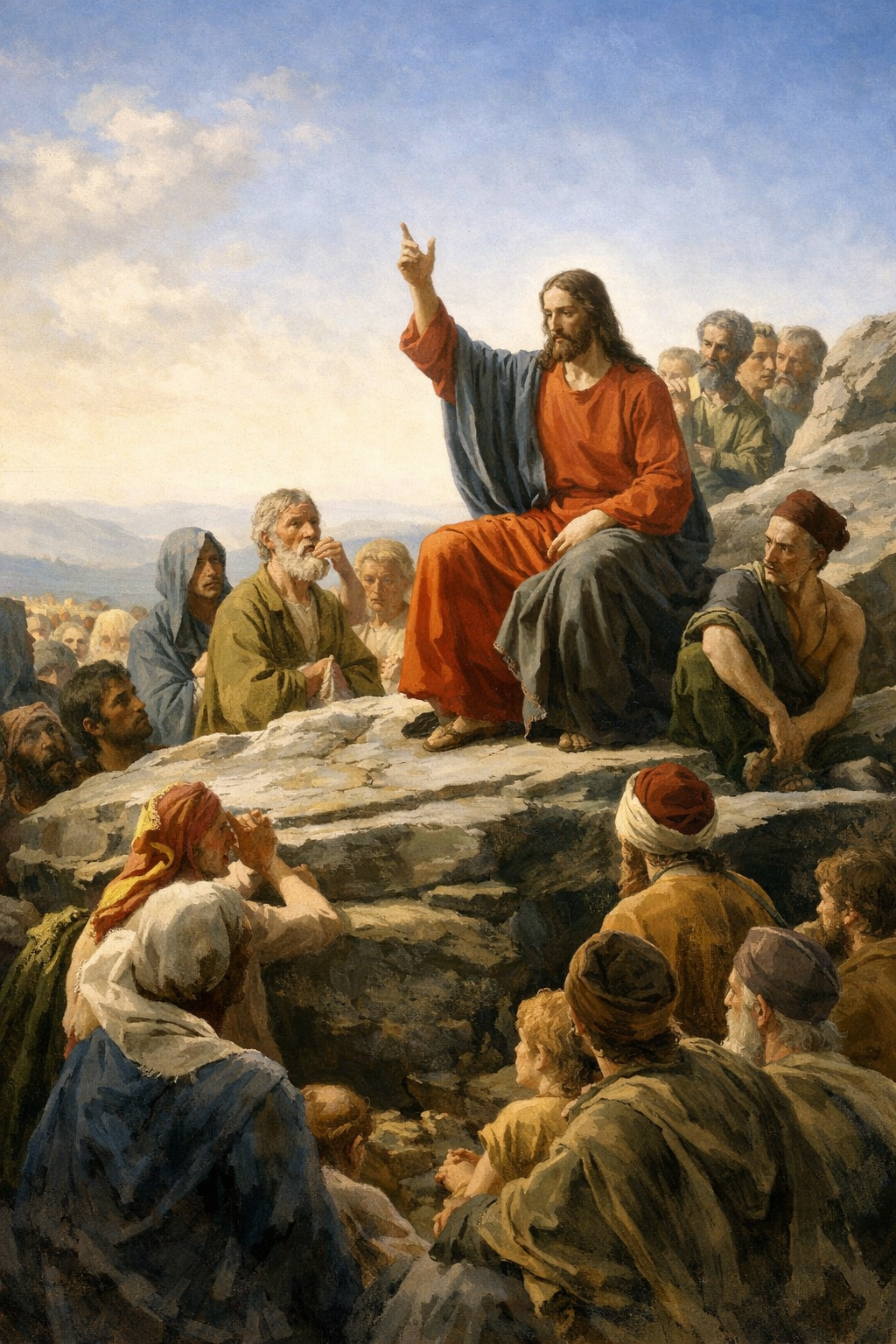
Sermon on the Mount
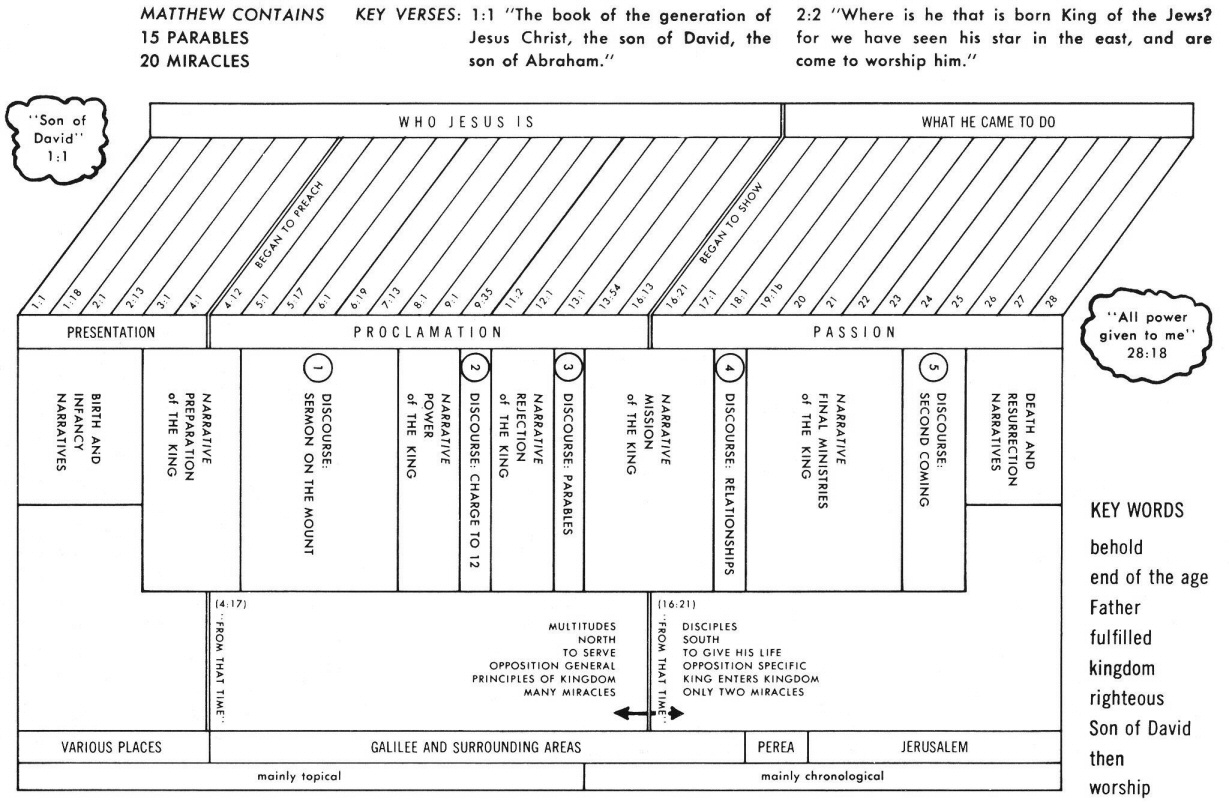
Click chart to enlarge
Charts from Jensen's Survey of the NT - used by permission
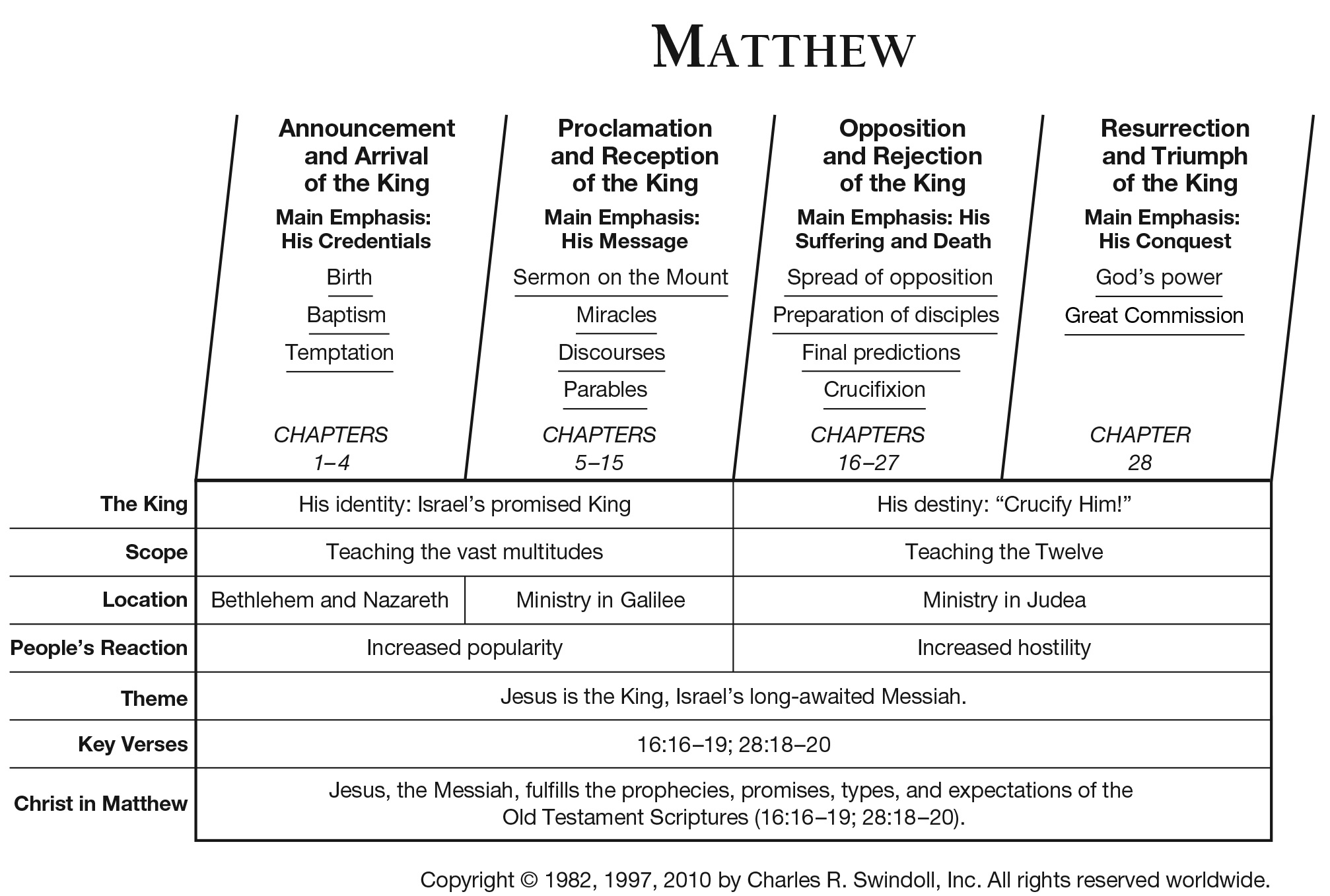
Another Chart from Charles Swindoll
THE LIFE OF JESUS AS COVERED
BY MATTHEW (shaded area)
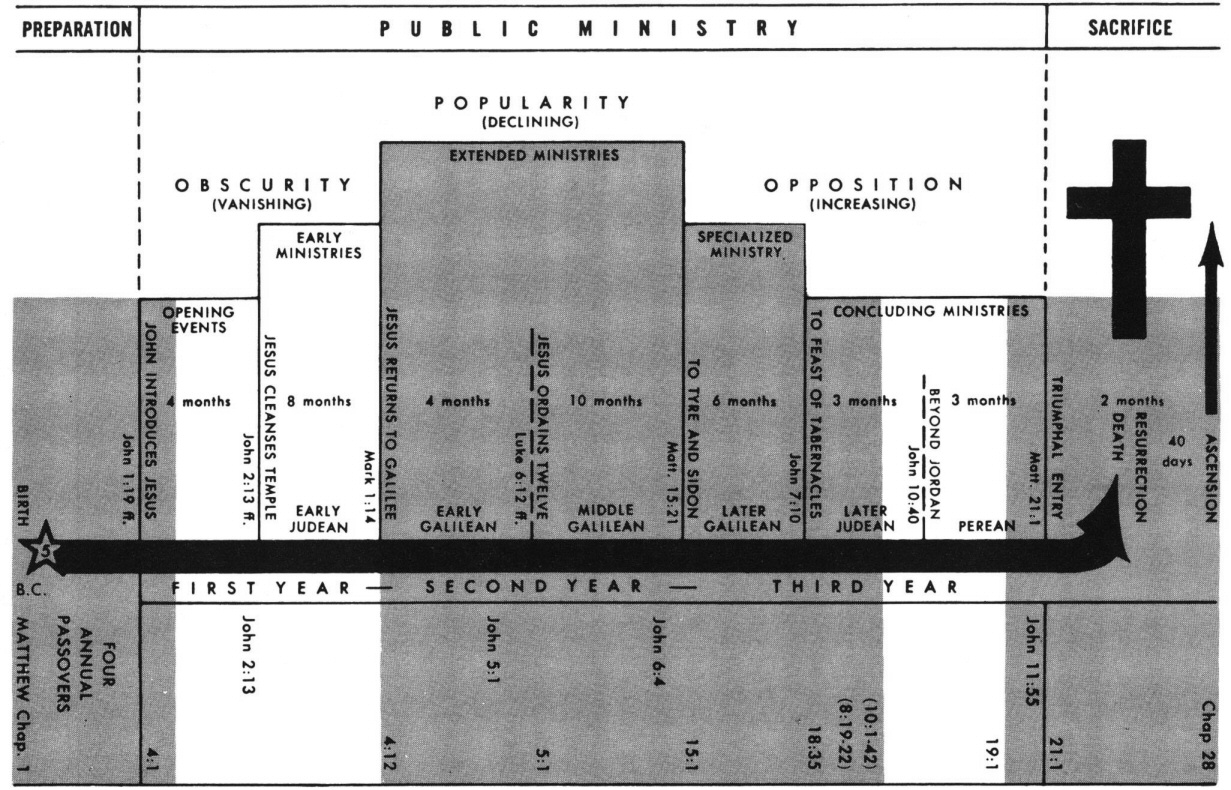
Click chart to enlarge
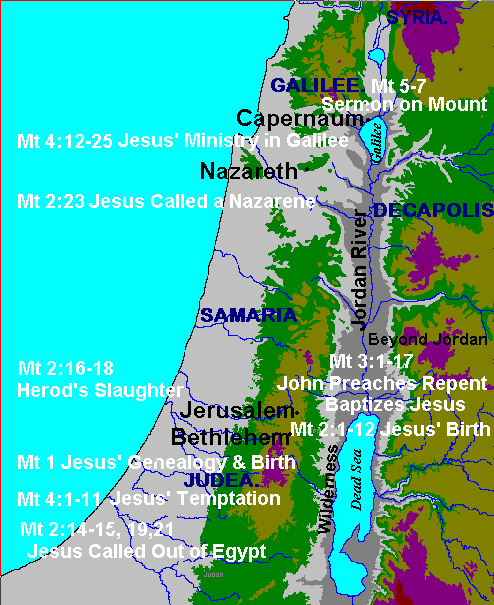
Jesus Birth and Early Years
Leading up to the Sermon on the Mount
Matthew 1-7

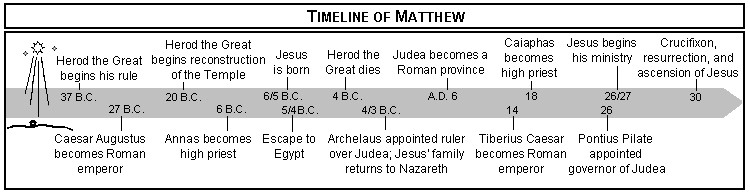
Source: Ryrie Study Bible
Matthew 6:22 "The eye is the lamp of the body; so then if your eye is clear, your whole body will be full of light. (NASB: Lockman )
Greek: O luchnos tou somatos estin (2SPAI) ho ophthalmos. ean oun e (3SPAS) ho ophthalmos sou aplous, holon to soma sou photeinon estai; (3SFMI)
Amplified: The eye is the lamp of the body. So if your eye is sound, your entire body will be full of light. (Amplified Bible - Lockman)
KJV: The light of the body is the eye: if therefore thine eye be single, thy whole body shall be full of light.
NLT: Your eye is a lamp for your body. A pure eye lets sunshine into your soul. (NLT - Tyndale House)
Philips: "The lamp of the body is the eye. If your eye is sound, your whole body will be full of light. But if your eye is evil, your whole body will be full of darkness. (New Testament in Modern English)
Wuest: The lamp of the body is the eye. If therefore your eye be in single focus, pure, sound, your whole body will be well lighted.
Young's Literal: The lamp of the body is the eye, if, therefore, thine eye may be perfect, all thy body shall be enlightened
The eye is the lamp of the body; so then if your eye is clear, your whole body will be full of light (photeinos: ho luchnos tou somatos estin (2SPAI) ho ophthalmos. ean oun e (3SPAS) ho ophthalmos sou aplous, holon to soma sou photeinon estai (3SFMI)
- Luke 11:34, 35, 36
- Acts 2:46; 2Corinthians 11:3; Ephesians 6:5; Colossians 3:22
- Matthew 6 Resources - Multiple Sermons and Commentaries

THE "EYE GATE" OF THE BODY
SANCTIFIED SIGHT
Mt 6:22-23 expands the pericope of Mt 6:19-21, so that the eye becomes an illustration of one's heart.
The eye is the lamp (luchnos/lychnos) of the body; so then (term of conclusion or consequence - what is the conclusion or consequence?) if your eye is clear (haplous), your whole body will be full of light (photeinos) - Note that eye now takes the place of the heart in Matthew 6:21. In Matthew 6:22-23 Jesus is looking at the same general subject from a slightly different perspective. Jews considered the eye to be the window of one's soul. It follows that what one allows into his or her mind and thought-life produces desires, which in turn produce action and it is one's actions (or conduct) that reveal who that person truly is. Lamp is figurative and refers to the lamp of the body, the eye, the only channel through which light enters into the human body. I like to think of the eye as a gate or door, so that what we open the gate or door to, has ready access to our body.
As Sinclair Ferguson affirms "fixing the eye and fixing the heart amount to the same thing - focusing our attention and concentrating all our energies on something" (Sermon on the Mount)
If your eye is clear (single) - The eye, to be useful, was to be "single," not characterized by double vision (cf Luke 11:34). What does an eye do? It enables one to see their way, but it must be a "clear eye" to fulfill this function. Jesus uses the term "bad eye" in a figurative sense, teaching that such an eye tries to focus on worldly possessions (material gain) and on God at the same time which confuses the person ("spiritual double vision") and they cannot see their way clearly as they walk through life. Jesus' main point is that believers must maintain a clear, single eye, giving God our sole attention. "Bad eyes" are stingy and covet money and wealth and produce spiritual darkness, which Jesus warns is great!
Phil Newton - The previous pericope (Mt 6:19-21) explains that those things on which one place most value will identify the Christian (HIS/HER FOCUS OR PRIORITY). Rather than finding material goods, public honor, prestige, or attention to be most valued, the Christian values his relationship to Christ above all else. He finds his greatest pleasure in those things that are pleasing to God. His heart can be found in love, devotion, obedience, and worship of Christ. Now the metaphor shifts but the same basic theme remains: Christ as our all in all. (Matthew 6:22-24 One Master)
C H Spurgeon's comments on Matthew 6:22-23: The motive is the eye of the soul, and if it be clear, the whole character will be right; but if it be polluted, our whole being will become defiled. The eye of the understanding may also be here understood: if a man does not see things in a right light, he may live in sin and yet fancy that he is doing his duty. A man should live up to his light; but if that light is itself darkness, what a mistake his whole course (LIFE) will be! If our religion leads us to sin, it is worse than irreligion. If our faith is presumption, our zeal selfishness, our prayer formality, our hope a delusion, our experience infatuation, the darkness is so great that even our Lord holds up his hands in astonishment and says — “How great is that darkness! “ Oh, for a single eye to God’s glory, a sincere consecration unto the Lord This alone can fill my soul with light. (Commentary)
John Butler - Christ uses figurative language here to speak about how we evaluate our treasures. The eye figure addresses how we look at things, how we view and evaluate our treasures and other things of life. (Analytical Bible Expositor)
Fleming offers an interesting explanation that "To illustrate the results of right and wrong attitudes to material things, Jesus referred to a local belief about the results of good and bad eyesight. People believed that eyes were like windows that allowed light to enter the body and keep it in good health. Healthy eyes meant a healthy body (light); diseased eyes meant a diseased body (darkness). A healthy view of material things will result in a healthy spiritual life; but an unhealthy view will mean that the natural spiritual darkness already in the heart will become even darker (Matt 6:22, 23). A person can be a slave of only one master at a time. If people devote their attention to increasing their prosperity and comfort, they can no longer claim to be loyal to God (Matt 6:24).
Wiersbe - Wealth not only enslaves the heart, but it also enslaves the mind (Matt. 6:22, 23). God’s Word often uses the eye to represent the attitudes of the mind. If the eye is properly focused on the light, the body can function properly in its movements. But if the eye is out of focus and seeing double, it results in unsteady movements. It is most difficult to make progress while trying to look in two directions at the same time. If our aim in life is to get material gain, it will mean darkness within. But if our outlook is to serve and glorify God, there will be light within. If what should be light is really darkness, then we are being controlled by darkness; and outlook determines outcome. (Wiersbe, W: Bible Exposition Commentary. 1989. Victor)
John Butler on "sanctified seeing" - The term “single” (clear) in this context emphasizes good, true, pure, and righteous in contrast to “double” which emphasizes evil, deception, false, and corrupt. The single eye sees things properly. It evaluates things properly. It puts great value on heavenly treasures and little value on earthly treasures. (Ibid)
SPIRITUAL DIPLOPIA
So then (term of conclusion or consequence - what is the conclusion or consequence?) if your eye is clear (haplous), your whole body will be full of light (photeinos) - The phrase if your eye is clear is translated variously as - "if therefore thine eye is single" (KJV), " If then your eye is healthy" (NET, ESV), " If your eye is good" (CSB), " if, therefore, thine eye may be perfect" (Young's Literal). The key word Jesus used is the adjective "clear" (NAS) which is the Greek word haplous which strictly speaking means single (as rendered in the KJV) or without folds which came to mean simple, sincere, innocent, healthy, clear ("clear vision" - cp spiritual vision discussed above) and finally conveying the sense of generous. The one use in the Septuagint uses haplous with the sense of generous - "The generous (Hebrew = berakah = a blessing; Lxx = haplous) man will be prosperous, And he who waters will himself be watered." (Proverbs 11:25)
BDAG says haplous "pertains to being motivated by singleness of purpose so as to be open and aboveboard -- single, without guile, sincere, straightforward i.e. without a hidden agenda."
Marvin Vincent says "The picture underlying this adjective (haplous) is that of a piece of cloth or other material, neatly folded once, and without a variety of complicated folds. Hence the idea of simplicity or singleness (compare simplicity from the Latin simplex; semel, once; plicare, to fold). So, in a moral sense, artless, plain, pure. Here sound, as opposed to evil or diseased. Possibly with reference to the double-mindedness and indecision condemned in Mt 6:24."
Referring to the eye, haplous means clear, sound, healthy. Haplous refers to singleness, simplicity, absence of folds and describes an eye which does not see double as it does when it is infected. When the eye accomplishes its purpose of seeing things as they are, then it is "haplous", single, healthy. In this verse the eye is called "single" in a moral sense and so the eye that is clear represents a heart that has single-minded devotion. Piling up earthly treasures "blurs" heavenly vision. Test yourself - cross your eyes and try to read this text. You might be able to make out parts of the words but it is certainly not clear! Our spiritual eyesight is the same way and thus heavenly things are seen with a blur if we are also eyeing earthly things!
Wiersbe suggests that we "Compare Abraham and Lot in Ge 13:5-18 for an illustration of the “single eye.” The eye here speaks of the outlook of the heart. A single eye means one that is fixed on the spiritual. It is the opposite of the double-minded person in James 1:8; Jas 4:4, Jas 4:8. (Borrow Wiersbe's Expository Outlines on the New Testament )
Harry Ironside explains the single eye this way - What we need to be concerned about, therefore, is a single eye for the glory of God, an eye that discerns His will in order that we may walk in it. If we turn away to paths of self-will, we go into willful darkness and will soon lose our way.
If you think you are immune to "spiritual diplopia" then here is a little test - take a look at this picture - how many watches do you see? There are two. Carrying the analogy forward, if you "see more than one watch" in your spiritual walk than you are afflicted with spiritual diplopia and must daily depend on the Great Physician, the Holy Spirit, to enable you to see with single vision (Mt 6:22-23)! Brethren the heart is more deceitful than all else and is desperately sick (Jer 17:9) and the same can be said of our spiritual vision!

There is another meaning that is possible in view of the fact that this word family (haplo-) can mean holding nothing back and thus refers to generosity or liberality in giving. See MacArthur's explanation below.
Zodhiates - Haploús stands in contrast to diploús (double or many). Even though we have two eyes, they are designed to pick up a single object, preferably the Lord Himself, as David counseled. Jesus connected the purity of the body with the holy character of an eye that does not vacillate between treasures on earth and treasures in heaven. Similarly, in James 1:8 we read that the "double minded [dipsuchos] man is unstable [akatastatos from a = without, not; and kathistemi = to settle] in all his ways" (cf. James 4:8). A circularity of "unsettling" effects exists between the soul and the physical eye. Just as double-minded ("two-souled") persons can direct their physical eyes between good and bad objects, so physical eyes can transmit good and bad signals into the soul. If we think about the blurred and conflicting (double vision) messages our brains attempt to process when we merely cross our eyes, we can understand how our physical eyes can destabilize our souls when they receive and transmit conflicting data. The "eyes of [our] understanding" (Eph. 1:18)-our spiritual eyes-work in conjunction with our physical eyes to our good or to our detriment. (Exegetical Commentary on Matthew)
William MacDonald applies these truths writing that "The good eye belongs to the person whose motives are pure, who has a single desire for God's interests, and who is willing to accept Christ's teachings literally. His whole life is flooded with light. He believes Jesus' words, he forsakes earthly riches, he lays up treasures in heaven, and he knows that this is the only true security. On the other hand, the bad eye belongs to the person who is trying to live for two worlds. He doesn't want to let go of his earthly treasures, yet he wants treasures in heaven too. (Ed: cp a "divided heart") The teachings of Jesus seem impractical and impossible to him. He lacks clear guidance since he is full of darkness." (Borrow Believer's Bible Commentary - excellent).
Phil Newton - The word "clear" can be translated as clean, pure, single-minded, and even generous as opposed to stingy. It seems that the meaning in this case is single-mindedness that affects purity and generosity in the whole of our lives. Such single-mindedness means devotion to Jesus Christ. By that I do not mean merely having devotional time with Jesus Christ, but passionate, focused, burning, unalloyed love for Jesus Christ. Maybe I should put it another way: you have eyes for Jesus Christ alone. Your love and loyalty is not set upon the world but upon Christ. Here is where we can be quite presumptuous. As long as we show up for church now and then, and drop a little money in the offering plate, and whisper an occasional prayer, we may think that is adequate. Meanwhile we carelessly indulge our minds and energies into whatever our desires might set before us. But that is not a "clear"eye, and that is not kingdom citizenship. The clear eye functions properly as the organ that receives the truth of God for the whole of life. The clear eye is not interested in masquerading as a Christian but only in steadfast devotion and obedience to Christ. It was the clear eye that opened the understanding of William Tyndale to the gospel so that he turned from the opportunity to be a scholar in King Henry VIII's court - in order to give himself to translating the Scriptures into the English language so that the simplest person could read the Word for himself. He spent fourteen years of being hunted like a wild animal for the sake of the gospel because of his single-minded devotion to Jesus Christ. It is the clear eye - the single-minded devotion to Christ - that causes a Christian in the workplace to stand upon that which is ethically right even if it means he gets a demotion or loses his job. It is the clear eye that emboldens a student to stand for Christ in school even if he has to stand alone. (Matthew 6:22-24 One Master)
Spurgeon writes that…
A heart professedly set upon heaven but held in bondage to earth is like an eye blinded by the intrusion of a foreign substance, involving the unfortunate owner of it in darkness. There is no such thing as seeing spiritual things while the soul's windows are fastened up with shutters of worldliness.
If thy motive be single — if thou hast only one motive, and that a right one — the master one of glorifying God — if thy eye be single. When a man’s highest motive is himself, what a dark and selfish nature he has; but when his highest motive is his God, what brightness of light will shine upon all.
Two leading principles cannot rule in one heart; they cannot both be master. Either sin or grace will engross the whole heart; neither will submit to compromise.
John MacArthur explains the meaning of a "clear" eye versus an "bad" eye wring that…
Words that are closely related to haplous mean “liberality” (Ro 12:8; 2Cor. 9:11) and “generously” (James 1:5). The implication in the present verse is that if our heart, represented by the eye, is generous (clear), our whole spiritual life will be flooded with spiritual understanding, or light. If our eye is bad, however, if it is diseased or damaged, no light can enter, and the whole body will be full of darkness. If our hearts are encumbered with material concerns they become “blind” and insensitive to spiritual concerns. The eye is like a window which, when clear, allows light to shine through, but, when dirty, or bad, prevents light from entering.
Poneros (bad) usually means evil, as it is translated here in the King James Version. In the Septuagint (Greek Old Testament) it is often used in translating the Hebrew expression “evil eye,” a Jewish colloquialism that means grudging, or stingy (see Deut. 15:9, “Beware, lest there is a base thought in your heart, saying, 'The seventh year, the year of remission, is near,' and your eye is hostile [verbal form of poneros, ponereuo = to be evil or in a bad state - LXX translates "thine eye shall be evil"] toward your poor brother, and you give him nothing; then he may cry to the LORD against you, and it will be a sin in you”; Pr. 23:6 "Do not eat the bread of a selfish man [literally an "evil eye"], Or desire his delicacies"”). “A man with an evil eye,” for example, is one who “hastens after wealth” (Pr. 28:22 "A man with an evil eye hastens after wealth, And does not know that want will come upon him.").
The eye that is bad is the heart that is selfishly indulgent. The person who is materialistic and greedy is spiritually blind. Because he has no way of recognizing true light, he thinks he has light when he does not. What is thought to be light is therefore really darkness, and because of the self-deception, how great is the darkness! The principle is simple and sobering: the way we look at and use our money is a sure barometer of our spiritual condition. (See Matthew Commentary)
Piling up earthly treasures blurs one's spiritual vision.
John Philips - Most of my life I have suffered from astigmatism, a problem with the lens of the eye that causes rays of light to fail to converge in one point. As a result my vision is blurred. The Lord was saying that it is possible to have spiritual astigmatism. It is possible not to have things clearly in focus in our spiritual vision. He urged us to have a "single" eye, an eye that does not see blurred images, an eye that sees through the folly of laying up treasure on earth and keeps the next world in proper focus. (See Exploring the Gospel of Matthew)
Matthew Henry - The eye… that be single—haplous—free and bountiful (so the word is frequently rendered, as Ro 12:8; 2Co. 8:2, 9:11, 13; Jas 1:5, and we read of a bountiful eye, Pr 22:9) (and) liberally affected and inclined to goodness and charity, will direct the man to Christian actions, the whole conversation will be full of light, full of evidences and instances of true Christianity, that pure religion and undefiled before God and the Father (Jas 1:27), full of light, of good works, which are our light shining before men; but if the heart be evil, covetous, and hard, and envious, griping and grudging (such a temper of mind is often expressed by an evil eye, Mt 20:15; Mk. 7:22; Pr 23:6, 7), the body will be full of darkness, the whole conversation will be heathenish and unchristian.
Keener - If we justify valuing material possessions because “everyone does it” or “other people do it more,” our self-justification will blind us to the truth of our disobedience and affect our whole relationship with God. Jesus’ illustration about the “single” (NIV = good) eye and the evil eye would immediately make sense to his hearers: a “good” eye was literally a healthy eye, but figuratively also an eye that looked on others generously (Sirach 32:8). In the Greek text of the Gospels, Jesus literally calls the eye a “single” eye, which is a wordplay: the Greek version of the Hebrew Bible also uses this word for “single” to translate the Hebrew term for “perfect”—thus “single-minded” devotion to God, with one’s heart set on God alone. An “evil eye,” conversely, was a stingy, jealous or greedy eye; yet it also signifies here a bad eye (Mt 6:23), one that cannot see properly. Jesus uses the “single” eye as a transition to his next point, for the “single” eye is literally undivided, having the whole picture: thus one is not divided between two masters, as the text goes on to explain (Mt 6:24). (Showing Righteousness to God Alone Mt 6:1-18)
Hendriksen has the following explanation of haplous noting that "The basic meaning of the adjective haplous, is simple, single, uncomplicated. However, as is true of words in general, various shades of meaning develop from this primary sense. Thus, for example, the noun haplotes in Eph.6:5 ("Slaves, be obedient to those who are your masters according to the flesh, with fear and trembling, in the sincerity of your heart, as to Christ") and Co. 3:22 ("Slaves, in all things obey those who are your masters on earth, not with external service, as those who merely please men, but with sincerity of heart, fearing the Lord.") refers to singleness of heart; hence, sincerity, integrity, uprightness (cf. 1Chron. 29:17 "Since I know, O my God, that Thou triest the heart and delightest in uprightness, I, in the integrity of my heart, have willingly offered all these things; so now with joy I have seen Thy people, who are present here, make their offerings willingly to Thee"). See also 2Cor. 11:3: sincere devotion. It is not difficult to understand that the disposition of heart and mind that is “single,” in the sense that it is unmixed with ulterior or selfish motivations, would be “generous.” Hence in Ro 12:8 ("he who exhorts, in his exhortation; he who gives, with liberality;"); 2Cor. 8:2 ("that in a great ordeal of affliction their abundance of joy and their deep poverty overflowed in the wealth of their liberality.") 2Cor 9:11, 13 the meaning is generosity, liberality; and in James 1:5 ("But if any of you lacks wisdom, let him ask of God, who gives to all men generously and without reproach, and it will be given to him.") the adverb haplos means generously. So also the transition from “simple” or “single” to “unmixed with any defect,” “speckless,” hence clear, sound, healthy, is easy to understand… And the evident contrast here (in Mt. 6:22, 23) indicated between the adjectives haplous and poneros (evil, bad) is probably best interpreted by sound versus in poor condition (or bad)… (Hendriksen, W., & Kistemaker, S. J. Exposition of the Gospel According to Matthew Grand Rapids: Baker Book House)
Hindson - The concept here is based on the ancient idea that the eyes were the windows through which light entered the body. If the eyes were in good condition the body could receive such light. Tasker (p. 75) notes that Jesus, using this language metaphorically, affirms that if a man’s spiritual sight is healthy and his affections directed toward heavenly treasure, his whole personality will be without blemish. The phrase if … thine eye be single indicates devotion to one purpose. The “single eye” refers to a single, fixed vision or goal. (Online Hindson, E, Woodrow Kroll: KJV Bible Commentary. Nashville: Thomas Nelson.)
R Kent Hughes - The idea here is simple but beautiful. The eye is pictured as the window through which light comes into the body. If a window is clean and the glass is clear, the light that comes in will properly light every part of the room. If the window is dirty, or if the glass is uneven or tinted or discolored, the light will be hindered, and the room will not receive the full benefit of the light. The amount and quality of the light that comes into a room depends on the condition of the window through which it comes. So it is with the eye. The condition of the eye determines the quality of the light that enters the body. If you are color-blind, all the reds and greens of Christmas decorations are lost to you. If you have cataracts, you may sit next to someone and perceive only a shadow. If your eye is blind, "how great is that darkness." There are no colors, no forms, no motion. Of course, Jesus is not giving us a lesson on optics. He is saying that the light that comes into a man's soul depends on the spiritual condition of the eye though which it has to pass because the eye is the window of the body. (See The Sermon on the Mount: The Message of the Kingdom)
A BODY
FULL OF LIGHT
Phil Newton on full of light - The lights are on within the mind so that the way you think, your interests, your passions, your attitudes, your affections are governed by your understanding of Christ. Please don't miss the implication. Being "full of light" does not mean that you are really smart, and have amassed great quantities of knowledge. Some of the most misdirected, miserable, and despondent people in the world have lots of knowledge but they have little light. We can make do with little knowledge but we cannot do with little light. As important as it surely is, knowledge of Christ in a purely academic sense cannot replace being "full of light" by your understanding being informed and enlightened by single-minded devotion to Christ.
Earlier Jesus had declared "Blessed are the pure (single minded focus) in heart for they shall see God" (Mt 5:8)
Singleness of purpose is one great secret of spiritual prosperity.
-- J C Ryle
Whole (3650) (holos) means whole or all complete in extent, amount, time or degree. Holos is used frequently in the Septuagint to modify "heart" ("whole heart")
G Campbell Morgan…
And then, as though the Lord turned from these things to give an exposition of the meaning and urgency of it all, He says, "The light of the body is the eye." The light is outside it, beating all round about it, but it is the lamp which catches the light, and enables us to see and to realize. "The light of the body is the eye: if therefore thine eye be single, thy whole body shall be full of light. But if thine eye be evil, thy whole body shall be full of darkness."
The word "evil" here does not mean wicked, but out of order.
Evil is a larger word than sin. Evil includes sorrow, and affliction, and calamity, and fault, as well as definite and positive and willful sin. "If thine eye be evil" - out of order - "thy whole body shall be full of darkness."
Here JESUS seems to say, the thing of utmost importance is that you should have a right view of these things in satisfying the passion for possession. You must have a true view, and that is what He has been attempting to give. The single eye. The evil eye. These are the contrasts.
- The single eye is the eye that is unified or simple.
- The evil eye is the eye that is not simple.
An oculist will tell you that there is such a thing as astigmatism a malformation of the lenses, of such a nature that rays of light proceeding from one center do not converge in one point. The single eye is the eye without astigmatism. It is the eye with the lenses properly adjusted, of such a nature that rays of light proceeding from one center do converge at one point.
JESUS was not using the word here carelessly when He said "single."
It is the eye which has no obliquity, which sees everything true, and in proper proportion. If the eye be evil, then how great is the darkness, what misunderstanding of life, what dire and disastrous failure!
In Modern Painters John Ruskin says: "Seeing falsely is worse than blindness. A man who is too dim-sighted to discern the road from the ditch may feel which is which; but if the ditch appears manifestly to be the road, and the road to be the ditch, what shall become of him? False seeing is unseeing, or the negative side of blindness."
That is the modern method of saying what JESUS said in far more remarkable language: If your eye is single your body is full of light. If it is evil, suffering from malformation, distorted in its view, then your conceptions will be false. The single eye is the eye that looks always toward the infinite, and answers the passion of the soul to possess, in the light of it. The evil eye is the eye that suffers from astigmatism, or obliquity, and has varying centers, and varying reasons, and no focused light, and consequently produces a degraded conception of things. (Matthew 6:19-24 Commentary)
Lamp (3088) (luchnos/lychnos from leukos = brilliant, shining white) refers to a portable lamp fed with oil, not a candle. Friberg - (1) literally lamp other than a candle, light (Mt 5.15); figuratively, of the eye as the organ that admits light and enables understanding (Mt 6.22); (2) metaphorically, of people or things that enable spiritual understanding: of prophecies ( 2Pe 1.19); of John the Baptist (Jn 5.35); of Christ (Rev 21.23); of the lives of believers (Lk 12.35) (Borrow Analytical Lexicon of the Greek New Testament)
Eye (3788) (ophthalmos) is the physical organ of sight, one of the chief channels of information for man. A cruel custom sanctioned among heathen nations was the putting out of the eyes of an enemy or a rival, because in this way his power was most effectually shattered (Judges 16:21; 2Ki 25:7; Jer 39:7).
Lamp (3088) (luchnos/lychnos from leukos = brilliant, shining white) refers to a portable lamp fed with oil, not a candle. Friberg - (1) literally lamp other than a candle, light (Mt 5.15); figuratively, of the eye as the organ that admits light and enables understanding (Mt 6.22); (2) metaphorically, of people or things that enable spiritual understanding: of prophecies (2Pe 1.19); of John the Baptist (Jn 5.35); of Christ (Rev 21.23); of the lives of believers (Lk 12.35) (Borrow Analytical Lexicon of the Greek New Testament)
Full of light (5460)(photeinos from phos = light) means shining, bright, full of light, radiant (Mt 17:5). Full of light, illuminated (Mt 6:22; Lk 11:34, 36). Friberg - (1) as describing what is composed of or full of light illuminated, well-lit, clear (Mt 6.22); (2) as what is characterized by light bright, shining, radiant (Mt 17.5) (Borrow Analytical Lexicon of the Greek New Testament)
Gilbrant - This adjective is related to the noun phōs, “light,” and can be found in classical Greek from the Fourth Century B.C. meaning “shining, bright” (Liddell-Scott). It appears five times in the New Testament, four of which are located in the parallel accounts of Jesus’ teaching on the sound eye (Mt 6:22, 23; Lk 11:34–36). Through the eye gate proceeds light or darkness, depending on the person’s spiritual outlook. The other instance is in Matthew’s description of the scene on the Mount of Transfiguration where “a bright cloud overshadowed them” (Mt 17:5). A cloud like this often accompanied the presence of God (cf. Ex 40:34f.; Nu 9:15f.; 1 Ki 8:10, 11). (Complete Biblical Library)
Photeinos in the NT - 5x/4v - bright(1), full of light(3), illumined(1). Mt. 6:22; Mt. 17:5; Lk. 11:34; Lk. 11:36. No uses in the Septuagint.
Clear (single) (573) (haplous from a = negation + pleko = twine, braid, weave, knit) means single (as translated by the KJV), simple, uncomplicated. It pertains to being motivated by singleness of purpose so as to be open and aboveboard, single, without guile, sincere, straightforward, i.e. without a hidden agenda.
THE LAMP OF THE BODY - JESUS made a seemingly contradictory statement when He called light darkness.
By comparing two kinds of light, we can better understand what He meant.
Consider first the flickering glow of a lightning bug. Two rare chemicals, luciferase and luciferin, produce the lightning bug's light. Both terms are related to the word lucifer, which means "light-bearing." (Lucifer is also one of the names for Satan.)
Now consider the sun's light. Its brilliance is blinding. In comparison, the lightning bug's light is darkness.
In Matthew 6, Jesus cautioned His hearers about living for earthly riches and urged them to store treasures in heaven instead. He illustrated His warning by referring to "the lamp of the body," the eye. If we focus on spiritual things, we will be full of light. But if we focus on earthly things, we will be filled with what He described as great darkness. Only Christ can illumine lives with the light of salvation. All lesser lights inevitably leave us in darkness.—D J De Haan (Our Daily Bread, Copyright RBC Ministries, Grand Rapids, MI. Reprinted by permission. All rights reserved)
The Divided Heart - F. B. Meyer has the following devotional based on passages from Matthew 6 and James 1… THE DIVIDED HEART
"Where your treasure is, there will your heart be also. If thine eye be single, thy whole body shall be full of light."--Matt. 6:21, 22.
"A double minded ("two souled") man is unstable in all his ways."--Jas 1:8.
THE CLOSING paragraphs of Matthew 6. are full of instances of a divided heart. The Greek word for care means that which divides.
Some are divided by anxiety. The anxious soul cannot take a strong straight course, any more than a man can sleep who is wondering whether he has bolted the front door or wound up his watch. Some are divided by contrariness--a most difficult and complicated disposition of soul. We would like to be pleasant, helpful, agreeable, and amiable, but are conscious of cross-currents that restrain and make us awkward and disagreeable, and we find ourselves rent between two strong influences, the one to be Christlike and gracious, the other to be distant and angular. Others are divided by fitful and passionate impulses. Happy are they who can hold them well in check. Even St. Paul tells us that he was conscious of these two wills--the better serf which longed to do the will of God, and the lower, selfish, passionate self, which brought him into subjection. St. Augustine tells us that, though the prayers of Monica, his mother, greatly affected him, he was constantly swept back from his ideal by an outbreak of passion.
Bunyan also illustrates the same condition, saying that two selves were at war within him. The Devil came and said, "Sell Him!" But he resisted, even to blood, saying, "I won't!" But, as the Tempter continued urging, "Sell Him!" Bunyan finally yielded, and suffered an agony of remorse, as, on the one hand, he accepted Christ as his only Hope, and on the other, was prepared to barter Him away.
A divided heart lacks the first element of strength--it is unstable. The men who leave their mark on the world are those who can say: "This one thing I do." But we need more than concentration, we need consecration. We must not only be united in ourselves, we must be united in God. Let us make the prayer of Psalm 86:11, our own: "O knit my heart unto Thee, that I may fear Thy name." Yield yourself to God that He may disunite you from the world, and weave you into His own life.
PRAYER - O Faithful Lord, grant to us, we pray Thee, faithful hearts devoted to Thee, and to the service of all men for Thy sake. AMEN. (Our Daily Walk)
See also F B Meyer's Sermon below on Matthew 6:22 entitled "Intention of the Soul".
Rod Mattoon has a message entitled "Fixing Your Focus" -
Jesus has been dealing with the issue of our priorities in this portion of His message by speaking about what we value or what we treasure in our lives. We all treasure something. Our treasures may involve people, places, positions, or possessions. The challenge from the Lord Jesus Christ is to lay up our treasures in Heaven. In other words, we are to place value and invest in eternal, spiritual things. We are to treasure and value those things that God values which include the souls of men and glorifying Jesus Christ. The benefit of doing so is the fact that our heavenly treasures cannot be stolen or ruined.
In verses 22 and 23, Jesus continues to expand on the issue of our priorities and treasures. When you have a camera, sometimes you have to adjust the lens to focus the picture properly. In this segment, Jesus gives us insights that will help us make adjustments in our lives to fix our focus so that we will clearly see that which is truly valuable and important and not have a distorted, deceived view of unimportant, unprofitable affairs in this life. Notice verse 22. THE SINGLE EYE—Mt 6:22
Jesus said, "The light of the body is the eye." What does this mean? The eye in this context is an illustration of the heart of a person. What goes on in our heart or mind is going to affect our vision or view of life. It is going to affect how we evaluate or look at things. Our heart is the eye of our soul. It is through our hearts that God's truth, love, peace, and every other spiritual blessing come to us. Our heart is also a garage door in which Satan can store his debris of discouragement, depression, doubt, and depravity into our lives. Our heart reveals our character which in turn, will be the key factor in determining our priorities and what we consider important and worthless.
For this reason, there is a battle for your heart. If God has your heart, He has you and you have His calm. If you are stingy with your heart, then you will be in conflict with Him. This is why we are challenged repeatedly to surrender all of our heart to the Lord.
Proverbs 23:26—My son, give me thine heart, and let thine eyes observe my ways.
Proverbs 4:23—Keep thy heart with all diligence; for out of it are the issues of life.
The word "keep" means "to guard."
Mark 12:30—And thou shalt love the Lord thy God with all thy heart, and with all thy soul, and with all thy mind, and with all thy strength: this is the first commandment.
We tend not to yield our heart to the Lord. For this reason we are commanded to love Him.
Psalm 9:1—I will praise thee, O Lord, with my whole heart; I will shew forth all thy marvelous works.
Psalm 119:2—Blessed are they that keep his testimonies, and that seek him with the whole heart.
Psalm 119:10—With my whole heart have I sought thee: O let me not wander from thy commandments.
2 Corinthians 8:5—And this they did, not as we hoped, but first gave their own selves to the Lord, and unto us by the will of God.
God used these Macedonian Christians in a great way because they had given their hearts to the Lord first, which motivated them to give themselves to others.
No matter how many good things you do, if the Lord does not have your heart, if your genuine focus and desire is really not upon Him, He does not have you. Jesus addressed this problem.
Matthew 15:8—This people draweth nigh unto me with their mouth, and honoureth me with their lips; but their heart is far from me.
When the Lord does not have all of you, you will be spiritually weakened and a target for Satanic attack. One of the reasons a tribe of lions on an African plain will walk along the herds of animals is to keep the herds moving. When the animals are grazing and still, it is difficult to see those animals that are weak or injured. When the herds are running, it is much easier to see the lame, the sick, or the young which are prime targets for attack. Satan and his forces roam this world to see which Christians are weak and prime targets for temptation and destruction. As in Job's life, he may stir up circumstances in our lives to see how strong we are in our faith. Notice what Peter said.
1 Peter 5:8—Be sober, be vigilant; because your adversary the devil, as a roaring lion, walketh about, seeking whom he may devour:
Does Satan have his eyes on you? Are you spiritually weak because you have yet to surrender your heart and life to the Lord? If so, you are a target for Satan and have a big bull's eye on your life with Satan taking aim at you. Why not make the decision today to turn your life, your family, your job, your health, your finances, and your future over to Him.
The Lord wants our eye or our heart to be "single" and clearly focused on doing and being what pleases Him. What is this all about? In the Bible, single or singleness represents or is associated with that which is good and steadfast when speaking about our heart or eyes.
Colossians 3:22—Servants, obey in all things your masters according to the flesh; not with eyeservice, as menpleasers; but in singleness of heart, fearing God:
Ephesians 6:5—Servants, be obedient to them that are your masters according to the flesh, with fear and trembling, in singleness of your heart, as unto Christ;
Acts 2:46—And they, continuing daily with one accord in the temple, and breaking bread from house to house, did eat their meat with gladness and singleness of heart,
This word "single" comes from the Greek word haplous {hap-looce'} which means that God wants our eye or heart to be "clear, sincere, open and aboveboard, honest, with no 'hidden agendas, without folds." It is a word that reflects our attitude and treatment of other people. Words that are closely related to haplous mean "liberality" and "generosity." The single eye or heart is a generous one.
Romans 12:8—... he that giveth, let him do it with simplicity;...
James 1:5a—If any of you lack wisdom, let him ask of God, that giveth to all men liberally,
Proverbs 11:25—The liberal soul shall be made fat: and he that watereth shall be watered also himself
The person with a single eye is devoted to treating other people right. The single heart, the single eye has integrity and is full of the light of God's truth because it is not cloaked with deception that darkens the soul by cover ups and selfishness. The single heart has nothing to hide because everything is out in the open. The single heart can see clearly and has discernment because it is full of God's light. The single eye sees properly and is clearly focused. It views treasures, especially wealth, with the right evaluation. It sees the great value of heavenly treasures and the worthless value of earthly treasures.
The eye that is single has the ability to discern good from evil, to know that all that glitters is not gold and glamorous. People with a single eye are concerned about others. They are focused and alert to needs that people may have and they do something about it by meeting those needs with their assistance, encouragement or generosity. They realize that loving and caring for others in the name of Christ is "heavenly treasure" that pleases God.
Matthew 10:42—And whosoever shall give to drink unto one of these little ones a cup of cold water only in the name of a disciple, verily I say unto you, he shall in no wise lose his reward.
The singe eye or heart is just like the heart of God who also loves and cares for others. When we, as Christians, have a single heart of purity and integrity, generosity and liberality, our heart in a way becomes knit with God. We become just like Him because we are following His example. In fact, this truth is seen in the Greek root word for haplous.
The word haplous is formed from the root word pleko {plek'-o} which means "to plait, braid, weave together." Like many strands of the long, beautiful hair of a young lady that are woven together in a beautiful braid, our hearts are braided with God's when we have a single heart or eye that is focused on doing what is right and cares for other people. When we have a single heart, a single eye, our heart is knit with God and also with others that love the Lord. This was true of the early church.
Colossians 2:2a—That their hearts might be comforted, being knit together in love,...
Acts 4:32—And the multitude of them that believed were of one heart and of one soul: neither said any of them that ought of the things which he possessed was his own; but they had all things common.
Psalm 57:7—My heart is fixed, O God, my heart is fixed: I will sing and give praise.
David's heart was resolved and determined to serve the Lord. This is the idea behind the word "fixed." His heart was one with God. His mind was made up. This is the attitude of an eye that is single, fixed, or focused on a goal. When we make up our mind to serve and love others and show them the love of Christ, we will be a huge encouragement and blessing to people that need to be blessed. Our focus will give us a purpose in life and good, godly spiritual goals. Just having a purpose for living is a treasure in itself because many people don't have one. They don't know why they exist, but the Christian does know.
Loving people is a treasure we will enjoy now and one that cannot be taken away when we do it for the Lord Jesus Christ. The people in North Platte, Nebraska, understood the treasure of sacrificial giving and love for others during WW 2. Many of these folks were Christians that demonstrated the love of Christ to those who needed encouragement. They had a single eye. Let me tell what they did. Ten days after the attack on Pearl Harbor, a group of citizens in North Platte, Nebraska, a little town of just over 12,000, heard a rumor that soldiers from their town, who were part of the Nebraska National Guard, Company D, would be coming through on a troop train on their way to the West Coast. So five hundred people showed up at the train depot with food, letters, and love to give to the boys. When the train showed up, however, it was not the Nebraska National Guard Company D boys on board; it was the soldiers from the Kansas National Guard Company D. After a few awkward moments, a woman handed a young man she'd never seen, the gifts intended for her very own son. Everyone else followed that lead, and there were hugs and prayers and love shared all around. It was a spontaneous act of genuine devotion that touched both the soldiers and the 500 people who came to the depot that day. That alone would have been a beautiful illustration of the willingness to sacrifice for others or to treasure people, but the story continues. It doesn't end here. It begins. A few days later, a 26-year-old Christian woman named Rae Wilson wrote a letter to the editor of the local paper recounting the powerful, profound experience they'd shared that night. She then suggested the town organize a canteen, so they could do something similar for every troop train that came through the town. She offered to lead the effort as a volunteer. A few days later, on Christmas Eve, 1941, the canteen opened and for every day of the war, every troop train from the first, which arrived at 5:00 a.m. until the last after midnight, was met by the people of North Platte and the surrounding towns. In that ten minute stop, they managed to distribute cookies, cakes, cupcakes, pies, coffee, sandwiches, soft drinks, doughnuts, candy, magazines, books, and lots of love and good cheer. There were even birthday cakes for anyone having a special day. This went on for four and a half years. Just to get perspective on the size of the task, each train had three hundred to five hundred soldiers on it and each day they saw eight to twelve trains come through the depot, and sometimes up to twenty. That would mean they would serve anywhere from 2400 to 10,000 soldiers and sailors every day. All this food was home-made and all at the expense of the people whose lives were severely impacted by war-time rationing. Of course, being farming communities, they could contribute what they raised. By Christmas of 1943, more than 55 towns had monthly work-dates. Many traveled by car or train provided by the Union Pacific railroad from towns as far as 200 miles away. By war's end, almost 125 communities in the western half of Nebraska, the northeastern portion of Colorado, and the northwestern area of Kansas contributed a total of 55,000 volunteers at one time or another during the 51 months. Of all the money that was donated, not one dime came from any government organization. The funds came from private donations. Voluntary cash gifts during the canteen's entire existence were about $137,000 (an amount estimated to be equal to buying power of $1.3 million in the year 2000). The final statistics are staggering. By the time the last train arrived on April 1, 1946, six million soldiers had been blessed by the North Platte Nebraska Canteen. Most of the troops had only ten minutes to sprint from the train, grab some food, hear the appreciation of those present, and sprint back before the train left without them, but in those ten minutes, they got more than a meal. They received a dose of unconditional love that they remembered later during the heat of battle as well as decades after the war was over.
Bob Greene's book, Once Upon a Town, made the North Platte Canteen story known to the world. He wrote that as he interviewed those few surviving soldiers who had experienced the canteen firsthand, there was a universal reaction from the men, who were by that time in their late seventies and eighties. They all cried as they remembered the smiles and the love of these people and how they made them feel at home and appreciated. To this day, North Platte is remembered for what they did. They were honored by the Congress in 2004 for their contributions in WW2. You could say that many of these people had a single eye. They discovered the great joy in giving and investing their lives in the lives of other people. Do you treasure people and their souls? Do you have a concern for those in full-time ministry and try to encourage them? In contrast to the word "single" is the word "double" which in the Bible represents or carries the idea of that which is impure, bad, defective, false, and corrupt when it is used in reference to our heart, mind, or speech.
James 1:8—A double minded man is unstable in all his ways.
James 4:8—Draw nigh to God, and he will draw nigh to you. Cleanse your hands, ye sinners; and purify your hearts, ye double minded.
1 Timothy 3:8—Likewise must the deacons be grave, not doubletongued, not given to much wine, not greedy of filthy lucre;
Psalm 12:2—They speak vanity every one with his neighbour: with flattering lips and with a double heart do they speak.
When we are seeing double, we are not seeing clearly. We are dizzy and disoriented and our walk is unstable. Does that describe your life? Are you dizzy and staggering in your walk with God? Are you having difficulty being faithful to the Lord? Do you need to fix your focus back on Him? Remember that the single eye is the one that is focused on God and can see clearly. It knows how to have proper priorities and treasure that which is valuable to God. So how is your spiritual focus? Are your eyes on the Lord, looking to Him for direction in your life? May we follow the challenge and example of Paul.
Philippians 1:20—According to my earnest expectation and my hope, that in nothing I shall be ashamed, but that with all boldness, as always, so now also Christ shall be magnified in my body, whether it be by life, or by death.
Paul makes some personal decisions that were among life's choicest. Paul has one expectation and hope. His focus was fixed upon the Lord as indicated by this verse. The word for "expectation" is rich in meaning. It is the word apokaradokia. It is formed from three Greek words.
apo which means "looking away from; ignoring other interests"
kara which means "the head"
dokein which means "to look or watch"
This word means "the eager, intense look which turns away from everything else to fix on the one object of desire; to watch with head outstretched." The word was used of watchmen looking into the darkness for a beacon of light. Paul fixed his eyes on Christ and was determined that in nothing he would be ashamed by the way he lived. He would be a witness and servant for Jesus Christ. The apostle knew he must appear before the Lord someday and did not want to be ashamed.
Philippians 3:14—I press toward the mark for the prize of the high calling of God in Christ Jesus.
Acts 20:24—But none of these things move me, neither count I my life dear unto myself so that I might finish my course with joy, and the ministry, which I have received of the Lord Jesus, to testify the gospel of the grace of God.
Do you have the same attitude? Do you have a single eye? Are you determined to finish your course and faithfully live your life for Christ?
Bill Broadhurst was running in the Omaha, Nebraska, Pepsi 10k, a race of 6.2 miles. Broadhurst, who is a Christian, was slowed by a brain aneurism he suffered as a young man, leaving him partially paralyzed on the left side. He wanted to finish the 10k despite this handicap and obstacle. He was determined to run because Bill Rogers, his hero, was in the race that day. Rogers is a great runner and ran the race that day in 29 minutes and 37 seconds. The other runners finished in 30 to 50 minutes. The joggers crossed the line in 60 or 70 minutes. It would take Bill Broadhurst much longer. As he ran, some kids didn't understand that he was competing and said, "Hey mister, you missed a good race." As he ran, his left side got so numb he wanted to quit. He wanted to drop out. After two hours, the cars were back in the streets, it was getting dark on Saturday afternoon, and running through intersections became difficult. One policeman stopped cars to let him across; a nice lady handed him some water.
At two hours and twenty minutes he said the pain and throbbing were bad. He said, "I didn't want to make it; I didn't want to go on," but then he saw the end. He saw the finish line. They had already taken the banner down. Broadhurst ran down the street on the sidewalk, saw the banner had gone, and his heart sank because everybody had left. He thought, "Man, what's the use?" But he decided to finish the race anyway. When he got to the end, out of the alleyway stepped his hero Bill Rogers and a gang of people. They were waiting for him at the finish line. Rogers opened his arms, and welcomed the crippled, suffering, yet determined Broadhurst across the finish line and hugged him. After Broadhurst willed his partially paralyzed body the last few steps to the end of the race, Bill Rogers took the gold medal from around his own neck that he won that day, and put it around the neck of the last runner to cross the finish line. Rogers said, "Broadhurst, you're the winner; you take the gold."
When I read this story, I couldn't help but feel that the Lord would be doing the same thing for those believers who are faithful in serving the Lord. Many believers go through life and spiritually stumble, fall, and want to quit, but they get back up and keep trying to go forward for Christ. They get beat up by Satan and suffer affliction, but they do their best to finish their course for the Lord. If this describes you, I believe it is possible that the Lord and even our loved ones in the Lord will be waiting for us at the finish line when we are called home to Heaven's shores, ready to reward us for serving Him and finishing our race. Notice the comments of the writer of Hebrews and what Paul said in 2 Timothy chapter four.
2 Timothy 4:7-8—I have fought a good fight, I have finished my course, I have kept the faith: [8] Henceforth there is laid up for me a crown of righteousness, which the Lord, the righteous judge, shall give me at that day: and not to me only, but unto all them also that love his appearing.
Hebrews 12:1—Wherefore seeing we also are compassed about with so great a cloud of witnesses, let us lay aside every weight, and the sin which doth so easily beset us, and let us run with patience the race that is set before us,
If you faithfully serve the Lord and finish your course, you are a winner. Have you fallen down? If so, then get back up and keep doing your best to make your life count for Christ.
Proverbs 24:16—For a just man falleth seven times, and riseth up again....
The just or righteous man does fall sometimes. The word "falleth" is from the Hebrew word naphal {naw-fal'}. It means "to fail, fall short, waste away, to be inferior, to be attacked and thrown or knocked down." A righteous man may fall, but he gets back up! He may get knocked down, but he is not knocked out. Have you failed, wasted your life, or been spiritually knocked down? Get back up! Fix your focus on God. (Sermon on the Mount)(See The Sinful Eye)
Matthew 6:23 But if your eye is bad, your whole body will be full of darkness. If then the light that is in you is darkness, how great is the darkness! (NASB: Lockman )
Greek: ean de ho ophthalmos sou poneros e, (3SPAS) holon to soma sou skoteinon estai. (3SFMI) ei oun to phos to en soi skotos estin, (3SPAI) to skotos poson.
Amplified: But if your eye is unsound, your whole body will be full of darkness. If then the very light in you [your conscience] is darkened, how dense is that darkness! (Amplified Bible - Lockman)
KJV: But if thine eye be evil, thy whole body shall be full of darkness. If therefore the light that is in thee be darkness, how great is that darkness!
NLT: But an evil eye shuts out the light and plunges you into darkness. If the light you think you have is really darkness, how deep that darkness will be! (NLT - Tyndale House)
Philips: But if your eye is evil, your whole body will be full of darkness. If all the light you have is darkness, it is dark indeed!" (New Testament in Modern English)
Wuest: But if your eye be diseased, your whole body will be full of darkness. If therefore the light which is in you is darkness, the darkness, how great.
Young's Literal: but if thine eye may be evil, all thy body shall be dark; if, therefore, the light that is in thee is darkness--the darkness, how great!
- Your eye - Mt 20:15; Isa 44:18-20; Mk 7:22; Eph 4:18; 5:8; 1Jn 2:11
- If therefore the light that is in you is darkness - Mt 23:16-28; Pr 26:12; Isa 5:20,21; 8:20; Jer 4:22; 8:8,9; Lk 8:10; Jn 9:39, 40, 41; Ro 1:22; 2:17, 18, 19, 20, 21, 22, 23; 1Cor 1:18, 19, 20; 2:14; 3:18,19; Rev 3:17,18
- Matthew 6 Resources - Multiple Sermons and Commentaries
SINFUL SEEING
But (de) - Jesus introduces a clear contrast (see value of observing terms of contrast). But always signals a change of direction and in this case highlights the opposite condition to what Jesus has just described. In other words it marks a direct contrast with the “good eye” (Mt 6:22). So Jesus is contrasting:
| GOOD EYE | BAD EYE |
|---|---|
|
healthy, single, generous |
evil, greedy, corrupt |
|
leads to light |
leads to darkness |
|
God-focused |
self- and money-focused |
The BUT signals a complete moral and spiritual reversal. The contrast marks two inner conditions (light vs. darkness), two spiritual trajectories, and two masters (God vs. Money) Jesus is drawing a line of division between devotion to God and devotion to materialism, which prepares the reader for His final declaration in Mt 6:24 that “You cannot serve God and wealth.” The argument flows from Good eye as light, BUT bad eye as darkness, therefore (Mt 6:24) you must choose your master. Thus the contrasting BUT pushes the reader toward Jesus’ climactic point. Stated another way this BUT highlights a radical difference between a God-centered life and a money-dominated life, emphasizing that there is no neutral middle ground. In light of this truth Joshua gives us a good application calling on Israel (and all of us to) "choose for yourselves today whom you will serve: whether the gods which your fathers served which were beyond the River, or the gods of the Amorites in whose land you are living; but as for me and my house, we will serve the LORD.” (Joshua 24:15) Which eye do I have? What fills me—light or darkness? Who is my master—God or wealth?
Keep in mind the context of this section which focuses on material possessions (Mt 6:19 = "treasures" = thesauros, Mt 6:24 = "mammon" = mammonas) and anxiety (Mt 6:25-34 - "anxiety" = verb = merimnao)., noun = merimna).
If your eye is bad (poneros), your whole body will be full of darkness (skoteinos - spiritual blindness, moral confusion, loss of discernment) - IF is a third class condition which describes a potential action. The idea is “If this should happen…” (not certain, but possible, even likely). It is the condition of uncertainty but is also the condition of real possibility. Jesus is not stating that His hearers already have a “bad eye.” He is warning of a real spiritual possibility that depends on the choice of their focus. The thought is “If (at any point) your eye becomes bad …” or “If you let your inward focus corrupt …” This is not guaranteed, but it is entirely possible. In other words, IF at any point, if you allow your inner focus to become corrupted by greed, covetousness, envy, or divided loyalty, then your entire inner life will be impacted. It is guaranteed! This could happen to you if you look the wrong way (so to speak).
The verb is in the present tense speaks of this individual's eye as continually bad. Eye is bad in context denotes spiritual illness arising from coveting "mammon," i.e., money (Matthew 6:24). When your eye is bad (poneros) your inner world loses clarity, your spiritual reasoning becomes confused, your desires become disordered (or distorted), your priorities collapse (or are re-arranged), your moral compass becomes unreliable, your worldview becomes distorted, and your life decisions begin to reflect darkness, not light. And IF this is one's lifestyle it suggests such a person is not a genuine believer.
What you choose to look at, long for, and focus on
determines what will fill you.
🙏 THOUGHT - We all know folks that fit this description -- their "whole body" is "full of darkness," and when we are around them we are uncomfortable because their darkness is, as it were, almost palpable! Now before we are too judgmental, we all would acknowledge that there are times when we as genuine believers can manifest a bad eye. And as believers we know how this affects our entire inner being and our communion with God. Ouch!
IF you let your focus become money-centered, world-centered, or self-centered, you will slide into spiritual darkness, and ultimately you will serve the wrong master. This is not just a potential danger. It is an inevitable outcome if the condition is met! If at any time your inner focus becomes corrupt (through greed, envy, materialism, or divided loyalty), the result will be that your entire inner life will be filled with spiritual darkness, with loss of discernment, with distorted priorities, and with moral confusion. A bad focus ("bad eye") inevitably produces a darkened life. So as Paul warns "Do not be deceived (planao in present imperative with a negative see our need to depend on the Holy Spirit to obey), God is not mocked; for whatever a man sows, this he will also reap. 8 For the one who sows to his own flesh (cf "eye is bad") will from the flesh reap corruption, but the one who sows to the Spirit (your eye is clear - Mt 6:22) will from the Spirit reap eternal life." (Gal 6:7-8)
John Butler on "sinful seeing" - This is the eye whose vision is blurred, distorted, and diminished. It views earthly treasures as valuable but sees heavenly treasures as worthless. It is the vision of so many folk today, for so many folk have poor vision spiritually. All they value is earthly and temporal. They care little for eternal things.
Zodhiates - The worst condition, of course, is the single-souled, single-eyed person who focuses on evil without wavering (Ed: compare the present tense). This is not, indeed it cannot be, the true believer in Christ. At this ultra-low level of depravity, the whole body, Jesus said, becomes dark (Exegetical Commentary on Matthew)
Phil Newton adds that "True Christians have but one Master - Jesus Christ the Lord. Can your life be explained in terms of single-minded devotion to Jesus Christ?" (Matthew 6:22-24 One Master)
Ryrie adds that "When our spiritual eyes are clouded by greed, there is nothing but darkness."
J C Ryle applies Jesus' teaching in Matthew 6:22-23 - Let us learn from our Lord’s caution about worldliness what immense need we all have to watch and pray against an earthly spirit. What are the vast majority of professing Christians round us doing? They are “laying up treasure on earth.” There can be no mistake about it. Their tastes, their ways, their habits tell a fearful tale. They are not “laying up treasure in heaven.” Oh! let us all beware that we do not sink into hell by paying excessive attention to lawful things. Open transgression of God’s law slays its thousands, but worldliness its tens of thousands. (Woe!) Let us learn from our Lord’s words about the “single eye,” the true secret of the failures, which so many Christians seem to make in their religion. There are failures in all quarters. There are thousands in our churches uncomfortable, ill at ease, and dissatisfied with themselves, and they hardly know why. The reason is revealed here. They are trying to keep in with both sides. They are endeavoring to please God and please man, to serve Christ and serve the world at the same time. Let us not commit this mistake. Let us be decided, thoroughgoing, uncompromising followers of Christ. Let our motto be that of Paul, “One thing I do.” (Phil. 3:13.) Then we shall be happy Christians. We shall feel the sun shining on our faces. Heart, head, and conscience will all be full of light. Decision is the secret of happiness in religion. Be decided for Christ, and “thy whole body shall be full of light.” (Matthew 6 Commentary)
John Butler on eye that is bad - This is the eye whose vision is blurred, distorted, and diminished. It views earthly treasures as valuable but sees heavenly treasures as worthless. It is the vision of so many folk today, for so many folk have poor vision spiritually. All they value is earthly and temporal. They care little for eternal things. (Ibid)
The idea of haplous in Mt 6:22 is "singleness of purpose". Thus one who has a "clear" eye looks with singleness of purpose to fulfilling God's will whereas a person with an evil eye focuses not on what God wants, but what he wants. He relies upon himself rather than trusting God. Instead of experiencing God's light, he wanders in darkness, seeking his own way rather than God's revelation (See also MacArthur's discussion below).
J I Packer wrote that "laying up treasure on earth is dangerous because such treasure destroys spiritual awareness. If your eyes are filled with light and working properly, your body will be able to move easily and safely. If you can’t see clearly, you will lack physical ease and poise. Similarly, if your heart is possessed by what this world and this life offers, you will not be able to see spiritual issues clearly, and when you read the Bible, its full meaning will escape you. (Packer, J: our Father Loves You: Daily Insights for Knowing God. 1986. Harold Shaw Pub)
Phil Newton - The bad eye is out for himself. It has no single-minded devotion to Christ because of embracing the pursuits of one's own desires apart from Christ. Consequently, the understanding is corrupted. Jesus' assessment is that if the "eye is bad," then every part of one's being will be affected. If the light of understanding that comes through the gospel and steadfast devotion to Christ is clouded or corrupted, then every part of that person's understanding is influenced. The way he looks at life, circumstances, tragedies, disappointments, relationships cannot be done with godly understanding. His "whole body" is "full of darkness." It is certainly not that such a person is non-religious or that he is unintelligent. He may be very religious and extremely bright, but his heart is set on the wrong kind of treasures. He is earthbound, and has no consciousness of storing up treasures in heaven. His heart is found treasuring his own sinful desires, and he probably does not even recognize that anything is wrong with the condition of his heart. (Matthew 6:22-24 One Master)
A WARNING AGAINST
SELF-DECEPTION!
If then the light (phos) that is in you is darkness (skotos), how great is the darkness (skotos) - The "IF" here is a first class conditional statement, which is assumed to be true and thus characterizes the spiritually blind who think they have spiritual vision! Light (phos) here refers to a person’s inner moral compass, perspective, worldview, and understanding, i.e. what someone thinks is true, good, and right. If what a person believes to be light (turning to money for life, trusting in wealth, pursuing earthly treasure) is actually darkness (skotos), then they are living in deep spiritual deception. This is not just ignorance, but far worse it is misguided confidence. Instead of letting light (phos) give you moral clarity, truth, spiritual insight, you let darkness (skotos) give you moral blindness, and spiritual confusion. The frightening truth is that if the guiding “light” inside someone is actually false (i.e., darkness), then the darkness is total because the person does not even realize they are blind! WOE!
This person experiences the darkness (skotos) by calling evil good and good evil (Isa 5:20), by thinking greed is wisdom, by pursuing wealth as if it’s light, by believing wrong values are right (sounds like many in America circa 2025!), and by trusting illusions while thinking they are truths (again America 2025!). Paul gives us the "pathogenesis" (I am a pathologist) in Romans 1:21 (really the entire section - Ro 1:18-32) explaining that "even though they KNEW (ginosko - see what they knew Ro 1:20) God (DID YOU CATCH THAT? SO MUCH FOR SO-CALLED "ATHEISTS!" - they KNOW God exists, but choose to suppress that knowledge), they did not honor Him as God or give thanks, but they became futile in their speculations, and their foolish (asunetos - without understanding, senseless, lacking discernment) heart was darkened (skotizo - passive voice - the subject is acted on - spiritual darkness is allowed by God by withdrawing "light," a combination of the divine passive and the judicial passive!). And the result? This is the deepest darkness of all—the darkness that believes it is light! WOE!
A T Robertson has an interesting description of how great is the darkness as "Dark inside and the window shut." In other words if the inner light you depend on is actually darkness, your darkness is far deeper than you realize.
Zodhiates on the paradoxical statement of light that is darkness - How can light within one be darkness? Is this a contradiction? No, it is the same kind of light Paul speaks about: "Satan himself is transformed into an angel of light" (2 Cor. 11:14). The most hideous form of darkness wraps itself with a garment of light, like the wolf that puts on sheep's clothing for the purpose of deception and destruction. The devil apparently is so malevolent he cannot face anyone directly-possibly not even unbelievers who were made in the image of God (James 3:9). He must deceive-which is what hypocrisy is-if he plans to stab in the back. Why risk a fair fight? Thus, Jesus' very applicable warning: "Beware of false prophets, which come to you in sheep's clothing, but inwardly they are ravening wolves" (Matt. 7:15). Here, however, Jesus was not warning against some external enemy: "If... the light that is in [en = within, inside] thee be darkness." This is about the strongest warning against self-deception imaginable. We must always check what we believe against the Holy Scriptures as our objective norm for revelation. We cannot trust any form of self-examination: "The heart is deceitful above all things, and desperately wicked: who can know it?" (Jer. 17:9). The way we "examine [ourselves] to see if we be of the faith" (2 Cor. 13:5) is by checking the content of our beliefs against God's Word. This is why the Word of God is called "the Light, the true [from alethinos] one" (a.t., cf. John 1:9; 1 John 2:8). This is not redundant (as, e.g., true truth). A false light merely gives an appearance of light. At his very best, Satan can only appear as an angel of light. A logic, thank God, operates against the potential mix of light and darkness in the self-deceived soul, and it is this: No man can serve two masters (Matthew 6:24) (Exegetical Commentary on Matthew)
William MacDonald explains the somewhat enigmatic verses (Mt 6:22-23) writing that "The good eye belongs to the person whose motives are pure, who has a single desire for God’s interests, and who is willing to accept Christ’s teachings literally. His whole life is flooded with light. He believes Jesus’ words, he forsakes earthly riches, he lays up treasures in heaven, and he knows that this is the only true security. On the other hand, the bad eye belongs to the person who is trying to live for two worlds. He doesn’t want to let go of his earthly treasures, yet he wants treasures in heaven too. The teachings of Jesus seems impractical and impossible to him. He lacks clear guidance since he is full of darkness. Jesus adds the statement that if therefore the light that is in you is darkness, how great is that darkness! In other words, if you know that Christ forbids trusting earthly treasures for security, yet you do it anyway, then the teaching you have failed to obey becomes darkness—a very intense form of spiritual blindness. You cannot see riches in their true perspective. (Borrow Believer's Bible Commentary - excellent).
Phil Newton on light being darkness and the spiritual implications - This is where Jesus sets forth a most interesting oxymoron: "If then the light that is in you is darkness, how great is the darkness!" Keep in mind that "light," in this context, refers to understanding that governs one's life. If the"eye is bad," if that part of the person that should be single-minded in devotion to Christ has mixed motives and double-minded desires, then the whole understanding is "darkness." Jesus did not say that the understanding was 'in darkness', but rather it "is darkness." Sin affects the motives and desires and pursuits of life. Such a person's life is governed by sin and not by Christ. What makes it worse is that this person is convinced that he understands the gospel, Christianity, and righteous living. You cannot tell him anything. His understanding is "darkness," but he does not know it. He is totally blind to truth. He may know lots of facts and may have the ability to discuss theological issues, but his understanding is"darkness" so that he does not profit by what he knows in terms of how he behaves or deals with life-issues. He has embraced a form of Christianity that Christ does not approve. He has sought to straddle the fence of the gospel and the world, or he has created his own form of religion that satisfies him, and he does not realize that everything that he sees is bound by darkness. Like the hypocrites that Jesus has already exposed, he does his religious duty with selfish motives - to be noticed by others. He thinks he sees. He is convinced that he understands. But Jesus declares that the light of his understanding is darkness. I talked with a pastor this week that told me about preaching a sermon recently on what it means to think like a Christian. He applied this to the lottery issue that our state voted on last Tuesday. In doing so, he pointed to what the Scriptures taught regarding games of chance, and how the Christian's mind is informed by the Word of God, so that he acts in obedience to the light of God's revelation instead of the influences of the world. It was clear and simple. But, as he told me, one hundred people left his church because of that application of thinking like a follower of Christ. The light in them was darkness, so the darkness governed their reaction to the simple teaching of Scripture. Do you see the issues of life with a clear eye or a cloudy eye? Quite possibly, if you have a cloudy eye, you do not even realize that you are governed by "darkness." You probably are a complainer that appears never to be satisfied with the teaching of Scripture. You delight in finding something wrong in everyone else but you cannot see that your own understanding is darkness. Why has it happened? You have embraced a form of Christianity that the Bible does not teach. You are double-minded. You have never known the single-minded devotion to Christ that comes through recognizing your own sinfulness and trusting in Christ alone as your Redeemer and Lord. Therefore, you cannot see as a kingdom citizen until you cast yourself upon the saving mercy of God. As has been the case throughout the Sermon on the Mount, the Lord probes each subject of this sermon from every angle. He looks at our values, and declares that the things that we treasure reveal the condition of our hearts. He looks at our vision - the way we understand the issues of life and obedience, and declares that either we have the light of single-mindedness or the darkness of double-mindedness (Matthew 6:22-24 One Master)
John MacArthur sums up spiritual eyesight writing that "If our eye is bad, however, if it is diseased or damaged, no light can enter, and the whole body will be full of darkness. If our hearts are encumbered with material concerns they become “blind” and insensitive to spiritual concerns. The eye is like a window which, when clear, allows light to shine through, but, when dirty, or bad, prevents light from entering. Poneros (bad) usually means evil, as it is translated here in the King James Version. In the Septuagint (Greek Old Testament) it is often used in translating the Hebrew expression “evil eye,” a Jewish colloquialism that means grudging, or stingy (see Deut. 15:9, “hostile”; Pr 23:6, “selfish”). “A man with an evil eye,” for example, is one who “hastens after wealth” (Pr 28:22). The eye that is bad is the heart that is selfishly indulgent. The person who is materialistic and greedy is spiritually blind. Because he has no way of recognizing true light, he thinks he has light when he does not. What is thought to be light is therefore really darkness, and because of the self-deception, how great is the darkness! The principle is simple and sobering: the way we look at and use our money is a sure barometer of our spiritual condition. (See Matthew Commentary)
William Barclay applies this text concluding that "there are three great evils of the ungenerous spirit, of the eye that is grudging.
(i) It makes it impossible to live with ourselves. If a man is for ever envying another his success, grudging another his happiness, shutting his heart against another’s need, he becomes that most pitiable of creatures—a man with a grudge. There grows within him a bitterness and a resentment which robs him of his happiness, steals away his peace, and destroys his content.
(ii) It makes it impossible to live with other people. The mean man is the man abhorred by all; the man whom all men despise is the man with the miser’s heart. Charity covers a multitude of sins, but the grudging spirit makes useless a multitude of virtues. However bad the generous man may be, there are those who will love him; and however good the mean man may be, all men will detest him.
(iii) It makes it impossible to live with God. There is no one so generous as God, and, in the last analysis, there can be no fellowship between two people who guide their lives by diametrically opposite principles. There can be no fellowship between the God whose heart is afire with love, and the man whose heart is frozen with meanness. (Daily Study Bible)
Bad (4190)(poneros from pónos = labor, sorrow, pain)) is not just evil but speaks of active evil which seeks to injure and thus it comes as no surprise that Satan is called poneros (1 Jn 3:12, 1 Jn 5:18-19). Friberg - (1) adjectivally; (a) as what is physically disadvantageous = bad, harmful, evil, painful (Eph 5.16; Rev 16.2); (b) of persons and things, as of little worth to anyone = useless, unprofitable, unserviceable (Mt 7.18; 18.32; perhaps Mt 6.23 and Lk 11.34); (c) in a moral sense of persons and things characterized by ill will = evil, wicked, malicious (Mt 12.35; probably Mt 6.23 and Lk 11.34); (2) substantivally; (a) of persons = evildoer, wicked person, bad person (Mt 13.49); (b) as a term for the devil = the evil or wicked one (Mt 13.19) (c) neuter = generally evil (MT 5.11) (Borrow Analytical Lexicon of the Greek New Testament)
Darkness (4652) (skoteinos from skotos from skia = shadow) refers to physical darkness or as used here figuratively spiritual or intellectual darkness. When our spiritual eyes are clouded by greed, there is nothing but darkness. Friberg on skoteinos - in the dark; figuratively, as characterized by lack of moral and spiritual perception full of darkness, i.e. unable to know the difference between right and wrong. (Borrow Analytical Lexicon of the Greek New Testament)
The three uses in the NT are all by Jesus in a similar context - Mt. 6:23; Luke 11:34, 36.
Skoteinos - 15x in the Septuagint - Ge 15:12 ("great darkness fell" upon Abram when Jehovah cut the covenant with him); 2 Ki. 5:24; Job 10:21 ("land of darkness" - in this context referring to Sheol);Job 15:23; Ps. 18:11; 88:6; 143:3; Prov. 1:6; 4:19 ("The way of the wicked is like darkness"); Isa. 45:3, 19; 48:16; Jer. 13:16; Lam. 3:6; Dan. 2:22 ("It is He who reveals the profound and hidden things; He knows what is in the darkness, And the light dwells with Him.")
Darkness (4655)(skotos) is derived from skia which describes a shadow thrown by an object. Skia can assume the meaning of skotos and indicate the sphere of darkness. Skotos is literally that sphere in which light is absent. Skotos can refer to literal darkness as occurred on the day of Jesus' crucifixion (Mt 27:45) or darkness as opposed to light in the creation (2Cor 4:6). Skotos is used as another name for the place of punishment, eternal misery and eternal separation from God. Skotos figuratively can refer to spiritual or moral darkness (including a lack of understanding) as in the following examples
"(Jesus declared) And this is the judgment, that the light is come into the world, and men loved the darkness rather than the light; for their deeds were evil. (John 3:19)
"(the gospel would) to open their eyes so that they may turn from darkness to light and from the dominion of Satan to God, in order that they may receive forgiveness of sins and an inheritance among those who have been sanctified by faith in Me.' (Acts 26:18)
If we say that we have fellowship with Him and yet walk in the darkness, we lie and do not practice the truth (truth is not only something we should believe and teach but also something we should practice, otherwise our life is a "lie") (1John 1:6)
And do not participate in the unfruitful deeds of darkness, but instead even expose them; (Ephesians 5:11)
For He delivered us from the domain of darkness, and transferred us to the kingdom of His beloved Son, (Col 1:13)
The night is almost gone, and the day is at hand. Let us therefore lay aside the deeds of darkness and put on the armor of light. (Ro 13:12)
Spurgeon preaching on Mt 6:22,23 observes that…
THIS sentence has in it the nature of a proverb. It is well worthy of frequent quotation, as it is applicable to such various circumstances. It is one of the most pithy, sententious (characterized by or full of aphorisms, terse pithy sayings, or axioms) utterances of our Saviour. So full of meaning is it, that it would be utterly impossible for us to draw out all its analogies. It is capable of adaptation to so many different things, that the ablest commentators despair of being able to give you the whole of its fulness. But remark, that very much of the meaning is to be discovered by the use; as the varieties of our personal experience, furnish varieties of practical reflection.
For example, we may interpret the passage of conscience as the eye of the soul, —conscience must be clear and simple. If the conscience, which is the candle of the Lord, and which searcheth the secret parts of the belly, be not light but darkness, how great must the darkness be! If a man has not enough conscience to know darkness from light and light from darkness, and he puts bitter for sweet and sweet for bitter; if that only power, on which seem to tremble some rays of the ancient light of manhood, be darkened, —if the lighthouse be quenched, if the windows be sealed up, —how great, indeed, must be the darkness of man! We cannot wonder, when once a man has a depraved and seared conscience, that he runs into iniquity willingly, commits sin with both hands, and goes from step to step till he obtains the highest seat in the scale of sin.
The symbol of the eye here may also refer to the understanding, taken in a yet broader sense than as the conscience; for, I suppose, that conscience is, after all, but the understanding exercised about moral truth. If the understanding of man be dark, how dark must be man’s soul! If that which judges, and weighs, and tests; if that which is to us the teacher, the recorder of the town of Mansoul; if that be amiss, if the recorder make wrong entries, if the understanding hath bad scales and useth divers weights, how gross, indeed, must be the ignorance of man! What! Seal up the windows of the house; surely the thickness of the walls will not so much keep away the light as the sealing up of the windows.
Let but the understanding be enlightened, and the rays will diffuse themselves, and illuminate every faculty of the whole man: but, ah, if it be darkened, man is in darkness as respects all his powers.
Yet again, the term “eye” may also respect the heart; for, in some sense, the heart is the eye of the soul. The affections turn the man in a certain direction, and whither the affections go the eye is turned. There is such a connection between the heart and the eye of man, that well might this text have such a reference. If the affections be pure, the man will be pure; but if the affections themselves be perverted, debased, degraded, we need not marvel that the man’s whole life should be degraded, debased, and filthy too.
You see the aptness of the proverb by the numerous moral truths it may serve to illustrate; but time will only allow me to take it in more than one or two aspects, and may God bless what I shall have to say to all our hearts. (Read the rest of his message on Matthew 6:22, 23 A Single Eye and Simple Faith - Pdf)
Rod Mattoon has a message on The Sinful Eye in Matthew 6:23 -
Jesus said, "If your eye is evil your whole body is full of darkness." Again we are still talking about the condition of our heart. What does it mean to have an evil eye? The word "evil" here is from the Greek word poneros {pon-ay-ros'}. This word poneros can mean "evil, vicious, malicious, deceitful, worthless, or degenerate." When it was used to describe a bad tree it was translated as "worthless or rotten." In the New Testament and in the Septuagint, however, the word poneros regularly meant "stingy or grudging." An evil eye was a phrase in use, among the ancient Jews, to denote an envious, covetous man or disposition; a man who was miserable at his neighbor's prosperity, loved his own money, and would do nothing in the way of charity for God's sake. I believe this is the idea of this word in the context of this passage since Jesus is dealing with the issue of treasure and mammon.
The book of Deuteronomy speaks of the duty of lending to a brother who is in need, but the matter was complicated by the fact that every seventh year was a year of release when debts were cancelled. Some men were hesitant or refused to lend to those in need because they could take advantage of the debt cancellation law. Their eye or heart was considered evil, ungenerous or stingy.
Deuteronomy 15:9—Beware that there be not a thought in thy wicked heart, saying, The seventh year, the year of release, is at hand; and thine eye be evil against thy poor brother, and thou givest him nought; and he cry unto the Lord against thee, and it be sin unto thee.
We are warned in God's word to avoid selfish, stingy, greedy people.
Proverbs 23:6—Eat thou not the bread of him that hath an evil eye, neither desire thou his dainty meats:
We are not to crave or covet the delicacies of a selfish man.
Proverbs 28:22—He that hasteth to be rich hath an evil eye, and considereth not that poverty shall come upon him.
There is nothing like generosity for giving you a clear and undistorted view of life and of people; there is nothing like a grudging and ungenerous spirit for distorting your view of life and of people.
When we look in Luke 16, we find an example of a man with an evil eye. In Luke 16:19-31, Jesus tells a story about a rich man who refused to show any mercy to a beggar at his gate. His self-centered, stingy spirit never thought of aiding poor Lazarus, who longed to be fed with crumbs from the man's table. Ultimately death came to them both, and the rich man was plunged into the darkness that had long been in his soul. In torment, he begged for a messenger to go and tell his living relatives about the truths he had failed to see during his life.
Beloved, materialism and greed shut out the light of Christ, because things tend to become more important than spiritual matters. Such was the case with Esau, Solomon in later years, and Demas, who forsook Paul "because he loved this world" (2 Timothy 4:10). If we are not careful, we can adopt the same grasping attitude of people with an evil eye. Such a spirit clouds the way we look at life and distorts our vision and focus to what truly is and is not treasure. It sees great value in earthly treasures and little in heavenly treasures. Thus, you will waste your life because you got distracted and invested your life in the wrong treasures.
Eighty years ago, as Notre Dame was preparing to play the USC Trojans in college football, Fighting Irish coach Knute Rockne was aware that his opponent had a far better team. So he devised a plan to intimidate the opposing players. Rockne scoured the city of South Bend, Indiana, which is the hometown of Norte Dame. He hand-picked 100 of the largest men he could find. These guys were monsters, each at least six-foot-five and 300 pounds. He put the men in Fighting Irish uniforms and, at game time, marched them onto the field ahead of the real team. (Obviously, this was before the days of limited rosters and eligibility restrictions.) As USC watched those giants line up on the sidelines, they forgot about their talent and their undefeated record, and they began mentally preparing themselves for a beating. Though none of the specially recruited men played during the game, their presence on the sidelines was enough to knock Southern Cal's concentration off balance. Knute Rockne's trick had worked. He had intimidated the Trojan players into giving up before the game even started.
Does this story describe you? Do you suffer from the same attitudes in your own life? If you are a Christian, have you given up on serving the Lord? Is the passion for Jesus Christ gone and been replaced with a quest for earthly treasures? If you have lost your first love for the Lord, then get it back. Beloved, don't go through life trying to fit the mold of this world and crave for that which is worthless in eternity. Make your life count for Christ.
Romans 12:1-2—I beseech you therefore, brethren, by the mercies of God, that ye present your bodies a Hying sacrifice, holy, acceptable unto God, which is your reasonable service. [2] And be not conformed to this world: but be ye transformed by the renewing of your mind, that ye may prove what is that good, and acceptable, and perfect, will of God.
When the things of this world are our focus and our treasures, we believe we cannot be happy without them. That's the unrelenting gospel of Hollywood and the majority of people believe it. Christians need to learn the lesson a certain unhappy king learned. The story is told of a poor king who was so discontented with life that he called in his wise men and asked if they could help him. Their consensus was that if the king could find a happy man, borrow his shirt, and wear it for his garment, he would be happy. So a delegation was sent out to find a happy man. They searched and searched and almost gave up, but at last they found a happy man. There was only one problem—he had no shirt! He had given it away to someone in need.
Greed, selfishness, and covetousness cloud our vision of genuine joy and happiness. It also clouds our vision of genuine success. Because of our grasping spirits, some of us have defined success in financial terms and have thereby condemned ourselves to perpetual failure because we never quite reach our goal. What a tragedy! Many men and women have sacrificed everything to accumulate money, thinking this is what makes them a success. Yet, in the process, they have lost friends, ruined their families and their testimonies by the compromises they have made to gain "things." Beloved, this is not success at all. Success is to be based on God's standards of success, not men's. Believe me, those standards are totally different. True success is following God's will and obeying God's Word. It involves us having a single eye, not an evil one.
Joshua 1:8—This book of the law shall not depart out of thy mouth; but thou shalt meditate therein day and night, that thou mayest observe to do according to all that is written therein: for then thou shalt make thy way prosperous, and then thou shalt have good success.
Multitudes of people today have poor spiritual vision because they do not know the Lord at all. Scripture speaks of the unregenerate heart or the unsaved person as blinded and filled with darkness.
Ephesians 4:18—Having the understanding darkened, being alienated from the life of God through the ignorance that is in them, because of the blindness of their heart:
2 Corinthians 4:4—In whom the god of this world hath blinded the minds of them which believe not, lest the light of the glorious gospel of Christ, who is the image of God, should shine unto them.
Do the above verses describe you? Have you shut the Lord out of your life because of your selfishness? Do you have the attitude that says, "It is my life and I will do as I wish. I don't need God telling me what to do!" If so, your life is filled with darkness. Two brothers were arguing about the wisdom of their parents. "Father is very wise," said the first brother. "We should listen to him and do what he says." The second brother disagreed. "Father is not so wise! Why, we are just as smart as he is. I'll prove it to you!" The next day the second brother went into the woods near his home and captured a small bird. He brought the bird home and said to his brother, "Let's go find our father. I will show you that he isn't so smart!"
The two brothers went into their father's study, the second one holding the small bird between his cupped hands. "Father, I have a question for you," he said. "I hold a small bird in my hands. Tell me, is this bird dead or alive?" The boy was confident that his father would not answer correctly because if he said that the bird was dead, the boy would simply open his hands and show that the bird was alive. If his father answered that the bird was alive, he would crush the bird between his hands and reveal that the bird was dead. Then he would prove to his brother that his father was not so wise after all. The boys' father considered the question for a moment and said, "My son... the answer is in your hands."
Beloved, you must make the decision to accept or reject Christ or to serve Him or neglect Him. The decision is in your hands. Your only hope for Heaven is in the Lord Jesus Christ. Men without the Lord see only a hopeless end, but the Christian rejoices in an endless hope. May the Lord help us all to keep our focus upon Him! (Sermon on the Mount)
See also F B Meyer's sermon on Matthew 6:19-24 - The Disciples' Use of Money
The eye is the most striking and important feature of the face. Blue as the azure of heaven, brown as hazel, black as jet, it gives expression and beauty to the countenance, fills with tears of pity, sparkles with the radiance of affection, and flashes with the fire of anger. By the eye we are able, therefore, to discern much of the thoughts and intents of the heart. The eye is also urgently needed to enable us to do the work of life. It is by the eye that we are lighted to our toils, discover the path in which we must tread, and look upon the faces of our friends or the beauty of God's creation. Each time we see a blind person or pass institutions devoted for the recovery of sight, let us lift up our hearts to thank God for this priceless boon.
It is interesting to notice the comparison which our Lord employs, He speaks of the eye as the "light of the body;" in other places the same Greek word is rendered "lamp," or "candle." In the fifth chapter of Matthew we discover the same expression: "Neither do men light a lamp and put it under the bushel." The same word is used in Luke 12: "Let your loins be girded about, and your lamps burning." It is the word by which John the Baptist is designated in John 5--"He was a burning and a shining light"---in contradistinction to the other term, applied to our Lord alone, "That was the true Light, which lighteth every man that cometh into the world." The ministry of John was the lamp that lighteth the steps of men until "the Sun of Righteousness arose with healing in his wings." The eye, our Lord says, is the lamp of the house of the body. It is as though He thought of the eye as hanging in the vestibule of the palace of life, casting its rays outward to the busy thoroughfare, and inward to the recesses of the soul.
It is obvious that there must be something in our inner life which corresponds to the eye, for our Lord adverts to the eye as the emblem and symbol of something within. He is not speaking of the eye of the body only, but of its correlative, the eye of the soul. What is that inner eye? Some have supposed that it is the power of a concentrated affection, for truly love sheds a warm glow over all the furniture of the inner life, as well as upon the great world without. Others have affirmed that the intellect is the eye of the soul, by which we are able to behold the ordered process of the world and to consider the processes of thought within us. A truer conception of our Lord's meaning, however, will lead to the conclusion that the eye of the body corresponds to the inward intention and purpose of the soul.
If, for a moment, you will examine your inner life, descending to the profound depths that lie beneath the surface of your being, you will discover that there is one deep aim or purpose which is the real intention of your life. Deep down below the play of emotion and intellect, and of engagement in various interests, there is one strong stream or current running perpetually through the dark ravines of your nature. It may be that you are hardly aware of it; your nearest and dearest friends do not realize it. You would be startled if it were stated in so many words, but it is none the less true that there is a unity in each human character which God perceives. In each of us tie can read a unity of purpose and a unity of will. This is the intention of the soul and distinguishes each of us from every one beside.
The eye may, of course, be healthy or unhealthy. If healthy, a tiny curtain which hangs at the back of the organism is adjusted to receive the focused rays which come from the external objects. On this tiny curtain is formed an invested image of all things which are visible. If you look into the eye of another, and especially into the eye of a little babe, you will see the whole panorama of the world presented as in a cinematoscope. This curtain is perpetually being readjusted, so that the unblurred image of the outer world may be cast upon it. When we are travelling in a railway train it is probable that in a single hour the focus is altered thousands of times, for at every jolt and oscillation of the vehicle there must be a readjustment of the lens.
When the eye is in an unhealthy condition the image is doubled or blurred. There are two ways in which it may become evil. To use a common expression, there may be the obliquity, called a squint, such as disfigured the noble face of Edward Irving. Mrs. Oliphant tells us that, as a babe, he was laid in a wooden cradle, through a whole in which he was able to watch the light with one eye, whilst the other retained its usual straightforward direction. His eyes, therefore, were not parallel, and it was impossible to focus them upon a given object. The soul's intention may be diverted from a single purpose in a double direction. We may pray with the object of gaining an answer from God, and at the same time of receiving credit from man. We may try to amass the treasures of this world, and at the same time to be rich toward God. We may endeavour to serve two masters--God and mammon. This is the counterpart in the spiritual life of a squint in the eye. Another source of ill-health with the eye is when the little vesicles which supply blood for the tiny curtain become overcharged, so that it is impossible for the delicate nerves to adjust the lens, and the vision becomes blurred and indistinct. Yet another source of the evil eye is when a film forms over the surface of the pupil, so that the light cannot enter.
In contradistinction to all these evils, how good it is to have a clear eye, with its distinct vision; and how much more good it is when the purpose and intention of the soul is so undivided that the whole of life is illumined by the glow of a clear and beautiful radiance! All through this chapter our Lord is arguing against this double vision. He says: "Do not profess to belong to the kingdom of heaven while your hearts are buried in the earth; do not have two masters; do not be divided by anxious care; seek first the kingdom of God." All through this chapter He is, in fact, bidding us to make our constant prayer the cry of the psalmist, "Unite my heart to fear thy name." Our Lord sets His whole force against any duplication of character so inimitably described by John Bunyan in "Mr. Facing-both-ways," who, with one eye on heaven and another on earth, sincerely professed one thing and sincerely did another, and, from the inveteracy of his unreality, was unable to see the contradiction of his life. "tie tried to cheat both God and the devil, and in reality he only cheated himself and his neighbours."
There are three kinds of men. First, those who have no intention; second, those who have a double intention; third, those whose intention is pure and simple.
1. Some have no intention.
They live day by day without purpose; the eye of the mind is fixed definitely and intently upon nothing. They take each day as it comes, getting from it anything it may bring, doing the duty it demands; but their existence is from hand to mouth, at haphazard, with no aim, no ambition, no godly purpose. They cannot say, with the apostle, that they are leaving the things which are behind, and pressing forward to the things which are before, or that one thing they are ever engaged in doing. It is quite true that in many cases there may be no great cause to be championed, no subjects to be explored, no object in making money, because already there is an ample competence. Some may read these words who are daughters in a wealthy home, or young men the heirs of a considerable fortune, or people in humble life who have no urgent need to look beyond the day or week with its ordinary routine; but even these should have a supreme purpose--to bring down the New Jerusalem out of heaven, to establish the Kingdom of God amongst men, to hasten the coming of the day of Christ, or to be themselves purer and holier. To become may always be the supreme purpose and intention of the soul; to be a little more like Christ; to know and love Him better; to be able to shed more of His sweetness and strength upon others. There is no life so contained within the high walls of circumstances, but it may reach up toward the profound light of the azure sky that arches above.
Do not be content to drift through life; do not be satisfied to be a piece of flotsam, swept to and fro by the ebb and flow of the stream; do not be a creature of circumstance, because it is certain that if you are not living with a divine purpose for God and eternity you are certainly living for yourself, for your ease, for mere indolent enjoyment, or to get through the years with as little fret and friction as possible. This, at the heart of it, and in such a world as this so abject and needy, is undiluted selfishness. To have no purpose is to have the worst purpose; to have no ambition is to be living for self; to have no intention is to be drifting through the wide gate, in company with the many that go in thereat, to their own destruction.
2. Some have a double intention.
They have heard the call of Christ and have received the seed of the Kingdom; but so soon as it reached their hearts two strong competitors endeavoured to share with it the nutriment of the soul. On the one hand, there were the cares of the world--these largely have place in the poor and struggling; on the other hand, was the deceitfulness of riches--these principally are found among the opulent and well-to-do. For a brief interval there was a struggle as to which of these should be master, but the strife soon ended in the victory of the sturdy thorn; those ruthless brigands seized for themselves all the sustenance that the soil of the heart could supply, and grew ranker and taller until the tiny grain withered and failed to bring forth fruit to perfection.
Will you not examine yourself? You think that you are whole-hearted, whereas you may be double-hearted; or, to use the apt simile of the prophet, baked on one side and not on the other; or, to use the simile of the great dreamer, looking one way and rowing another. You seem to be very earnest in Christian work, but are you quite sure that your apparent devotion does not arise from a masterfulness of disposition that likes to be independent and rule? May it not be due to a fussy activity, which must be engaged in many directions that the soul may escape from itself; or to a natural pity and sympathy for men, which would incite you to a similar deed, even though you had never heard of Christ? Of course, you say to yourself that your motive is pure and single, and that you only desire to glorify God; but in His sight it may be that you are really actuated by the natural propensities of your nature, by your desire to be first, or by your appetite for notoriety or money. The heart is so deceitful that it becomes us to examine ourselves with all carefulness, lest at the end of life we shall find that, whilst we appeared to be doing God's work, we were really doing our own; and that, whilst our friends gave us credit for great religious devotion, we were really borne along by a vain, proud and unworthy purpose, which robbed our noblest service of all value in the sight of eternity. As the apostle says, the one supreme intention of every child of God should be to please Him. How few of us can say, with the apostle: "Whose I am and whom I serve!" "It is a very small thing that I should be judged of you, or of man's judgment; he that judgeth me is the Lord."
3. Let us see to it that we have a pure and simple intention.
Our aim should be to set our whole soul upon one thing only--to do the will of God, so that the whole of our religious life may be spent before the Father, who seeth in secret; that our alms, our prayers, our fastings, should be for His eye, and His alone; and that the whole of our life should emanate from hidden fountains where God's Spirit broods, like those fountains of the Nile concealed in the heart of the great mountains, the secret of .which for so long defied the research of the explorer. The lamp of a holy life is the pure intention of the soul which seeks to gain nothing for itself, which has no desire to please men or to receive their commendation, which does not shirk adversity or court the sunshine, but which sets before it as its all-sufficient goal that God may be well pleased and that at the close of life's brief pilgrimage it may be said of each of us, as it was said of Enoch, "He had this testimony, that he pleased God."
How blessed such a life is! The light of the soul's pure intention illuminates God, duty, human love, the glory of creation, and the significance of history, literature and art. I remember once in my life, at a most important crisis, when for weeks I was torn between two strong, conflicting claims, that at last I was compelled to put aside all engagements and to go alone into the midst of nature, where I carefully examined my heart ¢o its very depths. I found that the cause of the difficulty to ascertain God's will arose because I allowed so many personal considerations to conflict with the inner voice; and when I definitely put these aside, and stilled and quieted my life so that I became conscious of being impelled by one purpose only --to know and to do God's will--then the lamp of a pure intention sheds its glow upon the path which I became assured was the chosen path for me. And since I dared from that moment to follow, all other things have been added. It was when Solomon asked that he might have a wise and understanding heart, that he might know God's purpose, that God gave him honour, wealth and length of days. Again and again these words of Christ ring out as amongst the deepest that He ever spoke: "Seek ye first the kingdom of God and his righteousness, and all these things shall be added unto you."
If the lamp of the pure intention of the soul is not kept pure and clean, "how great is the darkness!" Our Lord alludes, of course, to the fact that when darkness settles upon the forest, the beasts steal forth, the glades resound to the roar of the lion, the cry of the jackal, the laugh of the hyena. Multitudes of beasts that have lain quiet in their lairs whilst the sun was shining, creep forth; and our Lord says that when a man's heart is set on doing God's will the lower and baser passions of his nature--like so many beasts of prey--remain in their hiding places; but as soon as the blur comes, and the soul ceases to live for the one intense purpose of pleasing God, then darkness steals upon the house of life, and all manner of evil and unclean things, that otherwise would be shamed into silence and secrecy, begin to reveal themselves. "How great is that darkness!" If any are conscious that there is a darkness upon life, upon truth, upon the Word of God; if they are perplexed and plagued by the intrusion of evil things which fill them with misgiving--let me urge them to ask God to "cleanse the thoughts of their hearts by the inspiration of his Holy Spirit, that they may perfectly love him and worthily magnify his holy name." (From F. B. Meyer: The Directory of the Devout Life)
THERE are two things which distort our eye-sight, i, e., which hinder the pure intention of the soul: the one is the temptation of the prosperous and well-to-do; the other of the poor, reminding us of the seed that was sown among the thorns. "This is he that heareth the word, and the cares of this world (this is the temptation of the poor and struggling), and the deceitfulness of riches (this is the temptation of those who are endeavouring or beginning to obtain property), choke the word, and it becometh unfruitful."
It is of the temptations which accrue in dealing with money that we have now to speak. Our message is to those who, to use the words of the Apostle, desire to be rich. These are they who "fall into temptation and a snare, and into many foolish and hurtful lusts, which drown men in destruction and perdition" (1 Tim. 6:9).
Our Lord, first, alludes' to the ephemeral 'and destructible character of earthly riches. Oriental wealth consisted largely of magnificently embroidered dresses; and in a land where there were no banks (in our sense of the term), coin would be buried in the earth, often, as in the case of Achan, in a hole dug within the precincts of the house. We are reminded also of the parable of our Lord about the hidden treasure in the field, the owner of which had no idea of the buried wealth that lay beneath the surface of the soil, until the ploughshare came into collision with it, and the metallic ring indicated that he should stay his oxen in order to disentomb the jar of coins, hidden when invasion swept the country, and which the proprietor never returned to claim.
Our Lord remands His hearers that moth or rust will destroy all earthly treasures, and that thieves may at any moment break through the slight clay walls of their homes and carry off their hoarded stores. And surely His words are capable of an extended reference to that "crowned and sceptred thief," who shall one day dig through the clay walls of our mortal house, and take from us the raiment in which we have been attired, the wealth we may have amassed, the shares that stand in our name, the lands that we have purchased at such cost, sending us forth naked and despoiled, stripped of everything, into a world where we shall land as paupers, because we shall have failed to lay up treasure there.
Our Lord could not for a moment have meant to denounce every kind of saving. For instance, the Apostle Paul enjoins on parents the duty of laying up for their children (2Cor 12:14). It is surely right for us to take advantage of the great laws of life insurance that we may make a reasonable and moderate provision against old age, and especially that we should, by a small annual payment, secure for those who may survive us an adequate competence. I seriously think that every young man and woman should, in the early years of their life, commence to pay into one of our large insurance offices, so that at the age of fifty-five, or sixty, a sum may be forthcoming which will be of use to them in their declining years, the same sum being paid to mother, wife, or sister, in case of their premature death; and I cannot for a moment believe that the spirit or letter of our Lord's words contradict this item of Christian economics.
It seems also certain that there is nothing in these words of the Master to prohibit the setting apart of a certain sum as capital, which may be used for the development of business, and therefore in the employment of a large number of operatives. Nothing seems to me more beneficent than that a manufacturer should add to his capital, and therefore to his machinery and yearly output, for all this means the widening of his influence and the provision of work to larger numbers of men, women, girls, and lads, the more especially if he contributes to the building up of some garden city, free from the facilities of drink, free from the confinement of the great city, free from the vices which are incident to every great aggregation of humanity, where every home is within sight of trees and flowers, where every working man has his plot of land, and where the children breathe fresh health-giving air.
But neither of these methods of laying aside money is contrary to our Lord's injunction, "Treasure not treasures upon the earth." What He forbids is the amassing of money, not for the use we make of it, not for the securing of our loved ones from anxiety, but for its own sake, to such an extent as that the endeavour to hoard engrosses affections which ought to be fixed on nobler and diviner things, and leads to the concentration of the whole being upon the growing balance in the bank or the increase of Real Estate. In the judgment of eternity it is altogether unworthy of an immortal being to imperil his highest interests, his vision of God, his spiritual power, his peace and blessedness, for things which are so lightly held and easily lost as riches. Granted that the things for which men strive are no longer to be destroyed by moth and rust, or stolen by the night thief, yet the uncertainty of riches is proverbial; at any moment they may take to themselves wings and fly away. A panic on the Stock Exchange, depreciation in the value of securities, some new invention, the diversion of trade from one port to another, or the competition of the foreigner, may in a very brief space cause the carefully hoarded winnings of our lifetime to crumble and subside like the Venice Campanile.
Our Lord might with good reason have denounced the practice of laying up treasure because of the temptation which the desire to gain it involves. When a young man enters life with the one intention of making a fortune as quickly as he can, he is almost sure to begin making it according to the maxims and practices which prevail in the world around him. From afar he sees the goal that beckons, and he is tempted to take the shortest cut to reach it, along a road strewn thick with lies and roguery, with lost reputations and blasted characters. That road is taken by myriads in the mad rush to become rich, irrespective of the misery which may be involved to others, and the injury which is being wrought for themselves. Well may our Lord describe riches as "the unrighteous mammon" (Luke 16:11). Therefore, with the utmost urgency one would reiterate to all who are commencing life, in the words with which the great Apostle to the Gentiles closed one of the last Epistles: "Charge them that are rich in this present world, that they be not high-minded, nor have their hope set on the uncertainty of riches, but on God, who giveth us richly all things to enjoy."
The amassing of treasure by His disciples
Let us turn now to the reasons which our Lord adduces for His urgent prohibition against the amassing of treasure by His disciples.
First, the hoarding of money induces an inordinate love for it.
"Where thy treasure is, there will thy heart be also." There is a strong temptation to the most devout man who begins his life consecrated to God and to the best service of his fellows, when he sees money beginning to accumulate in his possession, to be attracted from the main object of life to his rising pile. Let young business men who bear the name of Christ test themselves, and ask whether their hearts are not being insensibly stolen away. They may not be aware of what is happening. Grey hairs are becoming plentifully strewn upon their heads without their knowing it. The fascination of money is one of the strongest in the whole world. It is almost impossible to handle it, whether it has come down as an inheritance from the past, or has been gained by successful trading in the present, without coming to like it for its own sake, to congratulate oneself when it increases, and to scheme for its further accumulation. Thus the heart becomes unconsciously bound by ever-tightening chains, as the balloon filled with the light gas, and meant to hold commerce with the clouds, chafes at the strong hawsers by which it is held to the earth.
It is not difficult for onlookers to discern the process by which the heart is being weaned away from the Unseen and the Eternal to the temporal and transient. There is a slackening of interest in religious worship and Christian service; an absorption amid the home-circle which shows that the heart is no longer there; a reluctance to part with money that used once to be freely given for home and foreign missions. It becomes increasingly difficult to engage the attention in anything which involves the diversion of time or thought from the bank, the factory, or the store. The process is very subtle; but, on the comparison of years, those who love the tempted and fascinated nature, shake their heads gravely as they realize that the heart is being betrayed to its ruin, and that another life will soon be cast beneath the wheels of the terrible Juggernaut Car of worldly ambition and success.
There are five tests by which we may become aware whether this parasite is wrapping itself around us. Let us dare to question our hearts, and ask God to search them by His Holy Spirit. These five will suffice:
(1) Do we find our mind going towards the little store of money which we have made, with a considerable amount of complacency, casting up again and again its amount, and calculating how much more may be added in the course of another year? When we are sleepless at night, or sit back in the corner of our railway carriage, do we find ourselves habitually going in the one direction of that growing competence? If so, is it not clear that our heart is being fascinated and attracted?
(2) Does the thought constantly intrude in our mind that there is now less likelihood than ever of our spending the end of our days in a respectable workhouse, or being dependent upon others, even upon God Himself? Do we look back upon the days of early manhood and compare them with the present, feeling that we are becoming independent? Is our trust in God less complete than it used to be? Is there not danger, therefore, of our weak and deceitful heart trusting in these uncertain riches, and being robbed of that simple faith which used to be the charm of earlier days, when we were content to do His work and trust Him for all that was necessary?
(3) Do we envy other men who are making money more rapidly than we are, and count ourselves ill-used if we cannot keep pace with them?
(4) Do we look at every service we perform, at our extending knowledge of men, at every new piece of information that we gather, in the light of their monetary advantage?
(5) Is it our habit to measure the gains of the year simply by what we have made, and with no reference to what we are, to the money we have accumulated, rather than the good we have done?
It becomes us to ask ourselves such questions as these reverently, as in the sight of God, and thoughtfully for our own highest interests, for they will reveal to us almost certainly whether the slow poison of an absorbing love of money may not he stealing through our heart, robbing it of its noblest attributes. It is a terrible thing for us to love gold for its own sake, rather than for the use that we may make of it, because the heart is liable to become like that which it loves. Not only is the heart buried in the place where the treasure is, but the heart becomes like the treasure. Ossification is a terrible physical disease, when the heart turns to a hard, bony substance; but it has a spiritual counterpart for those beneath whose love for gold the heart shrivels into something little better than metal.
The second reason, hoarding money diverts the pure intention of the soul.
It is not necessary for us to dwell at length on the second reason which our Lord adduces against treasuring our treasures, viz., that hoarding money diverts the pure intention of the soul and blinds all spiritual light. We all know that faith is only possible for the pure heart. The faculty of spiritual vision and receptivity depends upon the simplicity and integrity of our moral life. When, therefore, the heart is filled with thoughts of its earthly riches, it becomes gross and insensible to the spiritual and eternal realm. Things of God fade from the vision, the love of God declines from the heart, the soul is no longer single in its purpose, the eye becomes dim, the, spiritual force abated, moral paralysis sets in, and the whole body becomes full of darkness, under the cover of which evil things creep forth. Oh, do not let your spiritual eyes become dazzled by the glitter of this world's goods, lest you be unable, like Bunyan's man with the muck-rake, to see the angel who, with golden crown in hand, waits to bless you. Instead of crouching over the heap of transient treasure, rise to your full stature, and claim the crown that fadeth not away!
Third reason, hoarding money enslaves.
The third reason that our Lord adduces is that hoarding money finally enslaves. He says that "No man can serve two masters, for either he will hate the one and love the other, or else he will hold to the one and despise the other. Ye cannot serve God and Mammon." He employs two significant words, the one, Mammon (an old Chaldaic word for the god of wealth); the other, to serve, the subjection of the slave to the caprice of an owner. Our Lord puts in juxtaposition the two masters, God the Beneficent Father, and Mammon the god of wealth, and says everyone must choose between them. Whichever you elect to serve will become the supreme dominating force in your life, giving you no option, save the obedience of a slave.
Notice then the peril of the Christian man who is falling under the sway of covetousness which the Apostle calls idolatry (Col. 3:5; Eph. 5:5). At the end of the process, be it longer or shorter, he will renounce entirely the service of God, and become the slave of money-making. The slightest acquaintance with commercial circles will give evidence of the tyranny of Mammon, which compels its abject slaves to toil day and night, demands the sacrifice of love and health, of home enjoyments and natural pleasures, insists that every interest shall be subordinate to its all-consuming service, and at the end of life casts its votary, bankrupt and penniless, upon the shores of eternity. Drink itself, stripping men of everything worth living for, is not more to be dreaded.
What then is the alternative to this prohibited hoarding of money? Are we to give away promiscuously and to everyone that asks? I confess I have no faith in this indiscriminate giving which demoralizes him who gives and him who receives; which creates a plentiful harvest of loafers and ne'er-do-wells, to the detriment of the thrifty and industrious poor, and which satisfies the sentiment of pity by a lazy dole, when it ought to set itself to a radical amelioration of the suppliant beggar. It is comparatively fruitless to give a meal here and there, without endeavouring, by practical sympathy and helping hand, to assist families by putting them in the way of helping themselves. This is what is needed; and to put one individual, or houseful, in the way of standing upon their own feet and securing their own livelihood, is immensely more important than to furnish temporary relief, that supplies the need of to-day, but makes no permanent alteration in the circumstances of to-morrow or of the future. It is much more difficult to use our money thoughtfully and thriftily to help others than to place half-a-crown or a sovereign in their hands. Here, for instance, is a poor woman, whose case appeals to your sympathy.
It is, of course, quite easy to give her a few shillings and to dismiss her from your mind, but the noblest thing would be to secure her a sewing-machine or a mangle, thus furnishing her with the opportunity of self-help. It is quite as important not to give money indiscriminately as it is not to hoard. The ideal method of life is to use what you have to help others, to regard your possession of money as a stewardship for the welfare of the world, and to consider yourself a trustee for all who need. Instead of letting your dresses hang in the wardrobe, give them to the respectable poor whose own are threadbare, that they may be able to occupy suitably the position on which their livelihood depends. This is the best way of keeping them free from moth. Whatever you have in the way of books, recreation, spare rooms, elegantly furnished homes, look upon them all as so many opportunities of helping and blessing others.
If you are in business, at the end of the year put aside what is needed for the maintenance of your family in the position to which God has called them; next, put aside what may be required for the development of your business; third, be sure that by a system of life insurance you are providing for the failure of old age; but when all this is done, look upon the remainder as God's, to be used for Him. Never give God less than a tenth, but give Him as much more as possible. If you have money by inheritance, you have no right to give that away or squander it; but pass it down as you received it, always considering, if you will, that the interest is God's, awaiting your administration as His steward and trustee.
Let every Christian adopt the principle of giving a certain proportion of the income to the cause of Christ, and whenever the fascination of money begins to assert itself, instantly make a handsome donation to some needy cause. Every time the temptation comes to look at money from a selfish standpoint, meet it by looking up to God and saying, "I thank Thee that Thou hast given me these things richly to enjoy, and desire wisdom and grace to use them for Thee and Thine."
What will be the result of a spiritual attitude like this? Ah, the full blessedness cannot be put in words, but this you will find, you will have treasure in heaven, for what you invest in ministering to others is capital laid up in God's Bank, the interest of which will always be accruing to you. I have a very distinct belief that actual interest comes from money which is being invested in doing good; and at last those we have helped will welcome us into the eternal mansions (Luke 16:9). Moreover, your heart will be increasingly fixed where your treasure is, in the Unseen and the Eternal. Your eye will be single, your life harmonious, your hold upon earthly things slender, your love for your Master, Christ, becoming a passion. Ultimately you will find that the yearning which you used to have for selfish satisfaction and comfort will pass away, as the blessing of Him that was ready to perish falls upon your head, and the thanks of the widow and orphan anticipate the "Well done!" of your Lord. (1.1) (The Directory of the Devout Life)