Romans 7:2
Romans 7:3
Romans 7:4
Romans 7:5
Romans 7:6
Romans 7:7
Romans 7:8
Romans 7:9
Romans 7:10
Romans 7:11
Romans 7:12
Romans 7:13
Romans 7:14
Romans 7:15
Romans 7:16
Romans 7:17
Romans 7:18
Romans 7:19
Romans 7:20
Romans 7:21
Romans 7:22
Romans 7:23
Romans 7:24
Romans 7:25

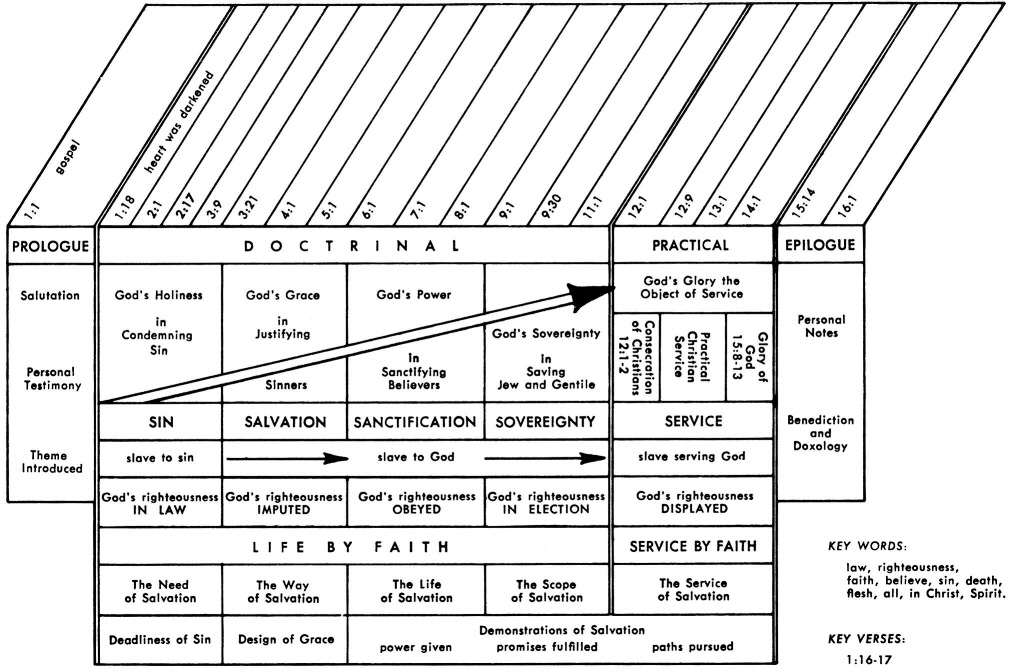
Click chart to enlarge
Chart from recommended resource Jensen's Survey of the NT - used by permission
Romans Overview Chart - Charles Swindoll
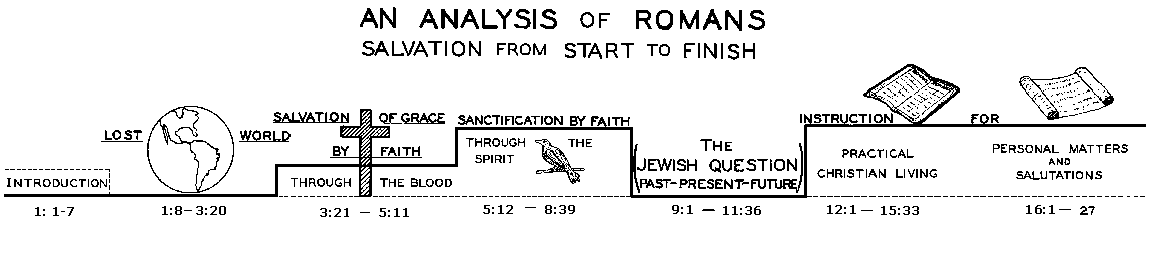
Source: Dr David Cooper
Click to Enlarge
| ROMANS ROAD to RIGHTEOUSNESS |
||||
| Romans 1:18-3:20 | Romans 3:21-5:21 | Romans 6:1-8:39 | Romans 9:1-11:36 | Romans 12:1-16:27 |
| SIN | SALVATION | SANCTIFICATION | SOVEREIGNTY | SERVICE |
| NEED FOR SALVATION |
WAY OF SALVATION |
LIFE OF SALVATION |
SCOPE OF SALVATION |
SERVICE OF SALVATION |
| God's Holiness In Condemning Sin |
God's Grace In Justifying Sinners |
God's Power In Sanctifying Believers |
God's Sovereignty In Saving Jew and Gentile |
Gods Glory The Object of Service |
| Deadliness of Sin |
Design of Grace |
Demonstration of Salvation | ||
| Power Given | Promises Fulfilled | Paths Pursued | ||
| Righteousness Needed |
Righteousness Credited |
Righteousness Demonstrated |
Righteousness Restored to Israel |
Righteousness Applied |
| God's Righteousness IN LAW |
God's Righteousness IMPUTED |
God's Righteousness OBEYED |
God's Righteousness IN ELECTION |
God's Righteousness DISPLAYED |
| Slaves to Sin | Slaves to God | Slaves Serving God | ||
| Doctrine | Duty | |||
| Life by Faith | Service by Faith | |||
|
Modified from Irving L. Jensen's chart above |
||||
R Ruin (Romans 1:17 – 3:20) – The utter sinfulness of humanity
O Offer (Romans 3:21-31) – God’s offer of justification by grace
M Model (Romans 4:1-25) – Abraham as a model for saving faith
A Access (Romans 5:1-11) – The benefits of justification
N New Adam (Romans 5:12-21) – We are children of two “Adams”
S Struggle w/ Sin (Romans 6:1-8:39) Struggle, sanctification, and victory
Romans 7:1 Or do you not know, brethren (for I am speaking to those who know the law), that the law has jurisdiction over a person as long as he lives ? (NASB: Lockman)
Greek: e agnoeite, (2PPAI) adelphoi, ginoskousin (PAPMPD) gar nomon lalo, (1SPAI) hoti o nomos kurieuei (3SPAI) tou anthropou eph' oson chronon ze? (3SPAI)
Amplified Do you not know, brethren--for I am speaking to men who are acquainted with the Law--that legal claims have power over a person only for as long as he is alive? (Amplified Bible - Lockman)
Barclay: You are bound to know, brothers—for I speak to men who know what law means—that the law has authority over a man only for the duration of his life. (Westminster Press)
NLT: Now, dear brothers and sisters – you who are familiar with the law – don't you know that the law applies only to a person who is still living? (NLT - Tyndale House)
Phillips: You know very well, my brothers (for I am speaking to those well acquainted with the subject), that the Law can only exercise authority over a man so long as he is alive. (Phillips: Touchstone)
Wuest: Or, are you ignorant, brethren, for I am speaking to those who have an experiential knowledge of law, that the law exercises lordship over the individual as long as he lives?
Young's Literal: Are ye ignorant, brethren -- for to those knowing law I speak -- that the law hath lordship over the man as long as he liveth?
OR DO YOU NOT KNOW, BRETHREN: he agnoeite (2PPAI) adelphoi:
- Know: Ro 6:3, 11
- Brethren: Ro 9:3, 10:1
- Romans 7 Resources - Multiple Sermons and Commentaries
Wayne Barber introduces this section writing ...
I believe Paul, in Romans 7, is vividly portraying for us the "frustration of trying to go back and live under law." For years, I did not realize it, but not only was I living as if I was under the law, but I’m sure that I also put others under it through my preaching.
I was miserable so much of the time and could not understand why. I was also critical of those who did not live up to my convictions. For example, we were convicted that TV had become an obsession to our whole family and so we gave it up for over a year. I can still remember how proud I felt when I heard others who watched what I wouldn’t watch. How spiritually superior I sometimes felt. You see, living under the law makes you quick to judge anyone but yourself.
Living under the law doesn’t necessarily mean that you are under the Law of Moses, the Ten Commandments, but you can be bound by the law of the denomination you belong to, or the law that you impose on yourself.
Living under the law doesn’t mean that you are not determined, or self disciplined. It means that you measure your spirituality by these things and if they are not done, then you think you have failed to win the love and favor of God in your life.
We must understand the difference of living "under law" and living "under grace." In Romans 7:1-5, if you look carefully, Paul clearly shows us how it was when we had no choice but to be under the law. In verses 1-4 we see that the law ruled over us to control and condemn the works of our flesh when we were in union with Adam. We were not married to the law before our union with Christ. We were in union with Adam, and the LAW had jurisdiction over us as long as we were in this union with Adam. (Romans 7:1-5: Frustration...Under Law )
Regarding the little word "or" William Newell writes that...
The King James, by its failure to translate the chapter’s opening word “Or,” ( "Ro 7:1KJV Don't you realize, brothers and sisters") to which God gives the emphatic position in this argument, obscures the whole meaning of the passage and context. Unless we connect Ro 7:1 with Ro 6:14, (as the proper translation “or” does), we cannot properly understand the passage. (Romans 7)
Do you not know (50) (agnoeo from a = not + noéo = perceive, understand) not have information about, to not know, to not understand (Mk 9:32, Lk 9:45), to be unaware of, to not recognize (Ac 13:27), to be ignorant of (to lack information concerning something). Agnoeo conveys the nuance of lacking the ability to understand in He 5:2 and of inexcusable moral/ethical ignorance (even disregard) in Ro 10:3).
Know (ginosko) which is the converse of agnoeo is a key word in Romans (Ro 1:21-note; Ro 2:18-note; Ro 3:17-note; Ro 6:6-note; Ro 7:1-note, Ro 7:7-note, Ro 7:15-note; Ro 10:19-note; Ro 11:34-note) and "not knowing" is also a key in this great epistle, where Paul uses agnoeo to introduce a spiritual truth his readers should be aware of (Ro 2:4, 6:3, 7:1, 10:3, 11:25, cp 1Co 10:1, 12:1, 2Co 2:11, 1Th 4:13-note).
Someone has quipped that when Paul begins a sentence with "do you not know" (or "are ye ignorant") concerning the saints, it often turns out that they are ignorant!
Agnoeo: 22x/21 verses in NAS rendered: have no knowledge(1), ignorance(1), ignorant(2), ignorantly(1), not know(2), not knowing(2), not recognize(1), not recognized(1), not understand(2), recognizing not(1), unaware(4), uninformed(2),unknown(2).
Mark 9:32 But they did not understand this statement, and they were afraid to ask Him.
Luke 9:45 But they did not understand this statement, and it was concealed from them so that they might not perceive it; and they were afraid to ask Him about this statement.
Acts 13:27 "For those who live in Jerusalem, and their rulers, recognizing neither Him nor the utterances of the prophets which are read every Sabbath, fulfilled these by condemning Him.
Acts 17:23 "For while I was passing through and examining the objects of your worship, I also found an altar with this inscription, 'TO AN UNKNOWN (agnostos) GOD.' What therefore you worship in ignorance (not knowing Ac 17:23YTL, this I proclaim to you.
Romans 1:13-note And I do not want you to be unaware, brethren, that often I have planned to come to you (and have been prevented thus far) in order that I might obtain some fruit among you also, even as among the rest of the Gentiles.
Romans 2:4-note Or do you think lightly of the riches of His kindness and forbearance and patience, not knowing that the kindness of God leads you to repentance?
Romans 6:3-note Or do you not know that all of us who have been baptized into Christ Jesus have been baptized into His death?
Romans 7:1-note Or do you not know, brethren (for I am speaking to those who know the law), that the law has jurisdiction over a person as long as he lives?
Romans 10:3-note For not knowing about God's righteousness, and seeking to establish their own, they did not subject themselves to the righteousness of God.
Romans 11:25-note For I do not want you, brethren, to be uninformed of this mystery, lest you be wise in your own estimation, that a partial hardening has happened to Israel until the fulness of the Gentiles has come in;
1Corinthians 10:1 For I do not want you to be unaware, brethren, that our fathers were all under the cloud, and all passed through the sea;
1Corinthians 12:1 Now concerning spiritual gifts, brethren, I do not want you to be unaware.
1Corinthians 14:38 But if anyone does not recognize this, he is not recognized.
2Corinthians 1:8 For we do not want you to be unaware, brethren, of our affliction which came to us in Asia, that we were burdened excessively, beyond our strength, so that we despaired even of life;
2Corinthians 2:11 in order that no advantage be taken of us by Satan; for we are not ignorant of his schemes.
2 Corinthians 6:9 as unknown yet well-known, as dying yet behold, we live; as punished yet not put to death,
Galatians 1:22 And I was still unknown by sight to the churches of Judea which were in Christ;
1Thessalonians 4:13-note But we do not want you to be uninformed, brethren, about those who are asleep, that you may not grieve, as do the rest who have no hope.
1Timothy 1:13 even though I was formerly a blasphemer and a persecutor and a violent aggressor. And yet I was shown mercy, because I acted ignorantly in unbelief;
Hebrews 5:2-note he can deal gently with the ignorant and misguided, since he himself also is beset with weakness;
2 Peter 2:12-note But these, like unreasoning animals, born as creatures of instinct to be captured and killed, reviling where they have no knowledge, will in the destruction of those creatures also be destroyed,
Agnoeo is used 21x in the non-apocryphal Septuagint (LXX) - Gen. 20:4; Lev. 4:13; 5:18; Num. 12:11; 1 Sam. 14:24; 26:21; 2Chr. 16:9; Dan. 9:15; Hos. 4:15
William Newell observes in Romans 7 "we have a chapter of two sections, (1) Ro 7:1-6 and (2) Ro 7:7-25: both of which we are prone to misunderstand and misapply, unless we exercise much prayerful care...The King James, by its failure to translate the chapter's opening word "Or, " to which God gives the emphatic position in this argument, obscures the whole meaning of the passage and context. Unless we connect Romans 7.1 with Romans 6.14, (as the proper translation "or" does), we cannot properly understand the passage." (Romans 7)
FOR I AM SPEAKING TO THOSE WHO KNOW THE LAW: ginoskousin (PAPMPD) gar nomon lalo (1SPAI):
- Those who know the law: Ro 2:17,18; Ezra 7:25; Pr 6:23; 1Cor 9:8; Gal 4:21
- Ro 7:6; 6:14
- Romans 7 Resources - Multiple Sermons and Commentaries
For (gar) introduces an explanation. Whenever you encounter a term of explanation, always consider performing the 4P's (pause to ponder and practice the passage) stop, which is facilitated by interrogating the text with the 5W/H'S, asking questions like "What is being explained?". As you perform the 4P's, you will find that you are in essence engaging in the discipline of Biblical Meditation which God promises to richly reward (See Ps 1:2-note, Ps 1:3-note, Joshua 1:8-note).
Know (1097)(ginosko) has the basic meaning of taking in knowledge in regard to something or someone, knowledge that goes beyond the merely factual. By extension, the term frequently was used of a special relationship between the person who knows and the object of the knowledge. It was often used of the intimate relationship between husband and wife and between God and His people.
Law (3551) (nomos, torah in Hebrew) is related etymologically to something parceled out, allotted, what one has in use and possession; hence, usage, custom. Generally, "the Law" refers to the Pentateuch, the first five books of the OT. More generally however, the law can mean a wide variety of things – a commandment, a principle, an instruction, etc. The meaning of the law, therefore, is best determined by examining its use in context.
Paul speaks to those who have a knowledge of a general principle of ALL law (definite article "the" is not present in the Greek. In other words there is no "the" preceding "nomos" in the Greek sentence, indicating that Paul is not just referring to "The Law" of Moses although it certainly would include that). It is quite possible that Paul is not interested so much in identifying the law he has in mind as in pointing to its character as law, that which has binding force which is the fundamental character of any law or regulation.
Guzik comments that "law" (without a definite article) in this context is...
broader than the Mosaic Law. The law that has dominion over us includes the Law of Moses, but there is a broader principle of law communicated by creation and conscience, and these also have dominion over a man.
MacArthur adds...
Although Paul intends to include God’s written law, he is not referring to any specific law code, but to a principle that is true of all law—Greek, Roman, Jewish, or biblical.
THAT THE LAW HAS JURISDICTION OVER A PERSON AS LONG AS HE LIVES: hoti o nomos kurieuei (3SPAI) tou anthropou eph oson chronon ze (3SPAI):
- Romans 7 Resources - Multiple Sermons and Commentaries
That the law has jurisdiction - While a criminal is alive, he is subject to prosecution and punishment. When he dies he obviously can no longer be prosecuted or punished.
Jurisdiction (2961) (kurieuo from noun kurios = master - power of control rather than physical strength) means to rule or have dominion over and speaks of individuals who exercise authority or have control over others (Lk 22:25, Ro 14:9, 2Co 1:24). To be lord of, to rule over, to have dominion over or to exercise lordship over. Scripture personifies various things which control human life including law (Ro 7:1), Sin (Ro 6:14) and death (Ro 6:9). Here clearly Paul personifies the Law as that which controls human life.
What Paul is saying is that the law (speaking of law in general, not just the "Ten Commandments") is like a lord who rules over a man and that man remains subject to the lordship of the law as long as he lives (in Adam). The only thing that can severe a man's relationship with "Lord Law" is a death! And that death came about when the believer died with Christ on the Cross (Ro 6:6-11, cp Gal 2:20, Col 2:20). Since the believer has died with Christ, the power of the old ruler "Lord Law" has been broken (forever)! The law can no longer "prosecute or punish" us so to speak. This freedom from the ruling power which law previously exercised over us (When we were still "in Adam" and were not yet believers alive "in Christ" 1Cor 15:22), is one of the great truths of the Good News, the Gospel.
Ironside comments that Paul's
argument here is that the law has dominion over men until death ends its authority or ends their relationship to it. But he has just been showing us in the clearest possible way that we have died with Christ; therefore we died not only to sin, but we have died to the law as a rule of life. Is this then to leave us lawless? Not at all: for we are now, as he shows elsewhere (1Cor 9:21), "under the law to Christ", or "enlawed" - that is, legitimately subject - to Christ our new Head. He is husband as well as Head, even as Ephesians 5 so clearly shows. (Romans Commentary)
Though freed from the LAW with its stern demands--
No longer ruled by its harsh commands--
I'm bound by Christ's love and am truly free
To live and to act responsibly
- D J De Haan
Romans 7 depicts the law as actually awakening rebellious desires ("sinful passions") within (See Ro 7:5-note). Being told not to do something excites our old man, our flesh, to desire to express itself. By daily walking and talking with Christ, we can go from ''NO'' power in the law to ALL power in Christ, specifically His Spirit Who indwells us (and as explained in Romans 8, e.g, see Ro 8:13-note). Remember that walking by the Spirit (Gal 5:16-note) is simply placing one foot before another and then repeating the process. That is how believers can learn to walk in the Spirit of Christ and in His supernatural power rather than their natural ability to obey. In Christ, God's love was expressed (Ro 5:8, Jn 3:16, 1Jn 4:10) and His law was satisfied (Gal 3:13) and our responsibility now is to work out our salvation in Christ with fear and trembling (Php 2:12-note) And then Paul explains how believers can work it out in Phil 2:13NLT-note - in short, it is possible because of what God "works in" us -- His Spirit in us continually giving us both the desire and the power to work out and walk forth (by the Spirit). Our responsibility. His enablement. Is this mysterious? Yes! But is it the Scriptural way to a life of freedom from the power of law and the power of sin.
As long as a person lives - This simply means that when the person dies, the power of law dies! Believers however have died with Christ and to Sin (as a Principle) and to the power of the law, because the law works through sin. In other words the law says don't covet. What this does in effect is "stir up" the old Sin nature to want to do what the law says not to do. Romans 7:5 says "while we were in the flesh, the sinful passions, which were aroused by the Law." Ro 7:7 says "I would not have come to know sin except through the Law; for I would not have known about coveting if the Law had not said, “YOU SHALL NOT COVET. But sin, taking opportunity through the commandment, produced in me coveting of every kind; for apart from the Law sin is dead.” Do you see it? Law arouses the sinful desires (of our Sin nature), and stimulates us to covet. 1Cor 15:56+ says "The sting of death is sin, and the power of sin is the law." Where does Paul say Sin gets its power from? From the law! Here is a simple illustration I once heard from Charles Swindoll - Put a sign in your beautiful front yard saying "No riding bikes on this lawn," and before you know it kids are riding their bikes on the lawn. The fallen flesh (our Sin nature) in a sense gets power from the law. The law in effect arouses our sinful nature.
THOUGHT- So we need to be careful -- the law can be very subtle. Take for example, making a list of "Do's and don'ts" - this seems to be a good thing. Your reason for making the list is so you will not do those things and thus might walk in greater victory. Wrong! The very act of "trying" to keep these rules is a form of legalism and can actually have the reverse effect of stirring your old Sin nature (yes, made inoperative [Ro 6:6+ - "done away with" implies it is gone, but it is NOT], but still alive) to commit that sin! In short, without recognizing what has happened, we have chosen to place ourselves back up under ("under" implies we are submitting to the authority of) the law, the very thing from which Jesus' death on the Cross has freed us (Ro 6:14+). The net effect is that we blunt the work of grace (God's power to transform our behavior, by His Spirit and Word). And we wonder why we find ourselves failing and being so frustrated! We need to learn to surrender or yield our will each morning to the Lordship of the Spirit of Christ. Enabled by the Spirit (He gives us the desire to obey and the power to obey as taught in Php 2:13NLT+) we are to die to self efforts to keep the law. We are not lawless, but now we are enabled to keep the law because the Spirit gives us the desire to keep it and the power to keep it. Trust the Spirit Who Alone can give you the abundant life in Christ (Jn 10:10b). An excellent parallel on this important spiritual truth is Galatians 5:16+ which commands us (present imperative see our need to depend on the Holy Spirit even to obey this command) to "Walk by the Spirit, and you will not carry out the desire of the flesh." Do not miss the order - Spirit first. It is the Spirit in us Who gives us the holy desire and holy power to not carry out the desire of the flesh (which is still present in our mortal bodies and will be until we die or are raptured!) One man I was discipling reasoned - I will not carry out the desire of my flesh and in so doing I will be able to walk by the Spirit. Do you see his fatal flaw? It is the personal pronoun "I." He was trusting in his own nature, which ultimately is fallen and sinful. Little wonder that he had experienced such futility in his battle against a persistent sin! He needed to learn to rely wholly on the Holy Spirit to defeat that sin. Romans 8:13+ (Lloyd-Jones calls this the most important verse in the Bible regarding progressive sanctification) says "if by the Spirit (HIS POWER) you are putting to death (OUR PRACTICE - present tense = calls us to do this every day of our life!) the deeds of the body, you will live." Notice the pattern again -- reliance on the Spirit giving us the desire and power and then our responsibility to "kill the sin." Note that it is never "Let go, let God." That is absolutely not Biblical. The Biblical pattern is "Let God, let's go!" His power, our participation! God's sovereignty, man's responsibility. (Related resource - great sermon by Ray Stedman - Legalism)
Long (5550) (chronos) means a space of time. Chronos is a period of measured time, not a period of accomplishment as kairos. Chronos refers to chronological time, to clock time or calendar time, to a general space or succession of time.
Live (2198) (zao noun = zoe) means to be alive physically and refers to existence as opposed to death or nonexistence. Figuratively zao means to enjoy real life or to have true life, that is life as God meant it to be lived, although that is not the primary meaning in this context.
Romans 7:2 For the married woman is bound by law to her husband while he is living; but if her husband dies, she is released from the law concerning the husband. (NASB: Lockman)
Greek: e gar hupandros gune to zonti (PAPMSD) andri dedetai (3SRPI) nomo; ean de apothane (3SAAS) o aner, katergetai (3SRPI) apo tou nomou tou andros.
Amplified For [instance] a married woman is bound by law to her husband as long as he lives; but if her husband dies, she is loosed and discharged from the law concerning her husband. (Amplified Bible - Lockman)
Barclay: Thus, a married woman remains bound by law to her husband as long as he is alive; but, if her husband dies, she is completely discharged from the law concerning her husband. (Westminster Press)
NLT: Let me illustrate. When a woman marries, the law binds her to her husband as long as he is alive. But if he dies, the laws of marriage no longer apply to her. (NLT - Tyndale House)
Phillips: A married woman, for example, is bound by law to her husband so long as he is alive. But if he dies, then his legal claim over her disappears. (Phillips: Touchstone)
Wuest: For the woman subject to a husband is permanently bound by law to her husband during his lifetime. But if her husband dies she is released from the law of her husband.
Young's Literal: for the married woman to the living husband hath been bound by law, and if the husband may die, she hath been free from the law of the husband;
FOR THE MARRIED WOMAN IS BOUND BY LAW TO HER HUSBAND WHILE HE IS LIVING: e gar hupandros gune to zonti (PAPMSD) andri dedetai (3SRPI) nomo:
- Ge 2:23,24; Nu 30:7,8; 1Cor 7:4,39
- Romans 7 Resources - Multiple Sermons and Commentaries
For (gar) introduces an explanation. Whenever you encounter a term of explanation, always consider performing the 4P's (pause to ponder and practice the passage) stop, which is facilitated by interrogating the text with the 5W/H'S, asking questions like "What is being explained?". As you perform the 4P's, you will find that you are in essence engaging in the discipline of Biblical Meditation which God promises to richly reward (See Ps 1:2-note, Ps 1:3-note, Joshua 1:8-note).
Married (5220) (hupandros from hupo = under + aner = a husband) literally means "under (subject to) a husband" which is God's ordained design to assure proper order. But these husbands are to love their wives enough to die for them (Ep 5:25-note) so this does not make the wife a "doormat"! So if you are telling your wife "Woman you need to submit" then you need to understand submission in the whole context of scripture and not use isolated passages out of context which results in a pretext and an improper application. (See related topic: word study on hupotasso: be subject to or submit to)
Woman (1135) (gune) can mean wife or woman.
Bound (1210) (deo) means literally to tie objects together tie up. In this context the use is figurative and means to cause someone to be under authority of someone or something else, to restrict, to place under (the jurisdiction of). It means to put under obligation. Deo is in the perfect tense meaning that she “has been bound and remains bound " The perfect tense pictures "permanence" until he dies. They are "tied together" for life until death parts them (Mt 19:5, 6).
Deo -43x in 40v - Matt. 12:29; 13:30; 14:3; 16:19; 18:18; 21:2; 22:13; 27:2; Mk. 3:27; 5:3f; 6:17; 11:2, 4; 15:1, 7; Lk. 13:16; 19:30; Jn. 11:44; 18:12, 24; 19:40; Acts 9:2, 14, 21; 12:6; 20:22; 21:11, 13, 33; 22:5, 29; 24:27; Rom. 7:2; 1 Co. 7:27, 39; Col. 4:3; 2 Tim. 2:9; Rev. 9:14; 20:2.
The NAS renders deo as bind(7), binding(1), binds(2), bound(23), imprisoned(4), prisoners(m)(1), put in chains(1), tied(4).
Living (2198) (zao) (Click word study of noun form zoe) means to be alive physically and refers to existence as opposed to death or nonexistence. Figuratively zao means to enjoy real life or to have true life, as God meant it to be lived, although that is not the primary meaning in this context.
BUT IF HER HUSBAND DIES SHE IS RELEASED FROM THE LAW CONCERNING THE HUSBAND: ean de apothane (3SAAS) o aner katergetai (3SRPI) apo tou nomou tou andros:
- Romans 7 Resources - Multiple Sermons and Commentaries
But - In contrast to the state of marriage (which bespeaks of permanence in one's life), death of the wife's husband brings about a new relationship.
If = Subjunctive used in 3rd-class condition = this condition is a real possibility.
Newell remarks that "Here Paul uses the fundamental law of domestic relationship to illustrate the fact that only death breaks a legal bond. This is the evident, simple meaning in this passage. This husband-and-wife illustration is marvelously chosen. It is of world-wide application—instantly understood everywhere; and it sets forth perfectly what the apostle desired—that is, to describe the dissolution of a relationship by death, thus making possible a new relationship." (Romans 7)
Dies (599) (apothnesko from apo = marker of dissociation implying a rupture from a former association, separation, departure, cessation + thnesko = die) literally means to die off and can speak of physical (as here) or literal death.
Released (2673) (katargeofrom kata = intensifies meaning + argeo = be idle) means to make the power or force of something ineffective. It means to render powerless. To reduce to inactivity. Do away with. To put out of use. The basic idea of katargeo is to cause something to be idle or useless, inoperative or ineffective and in this verse is translated "released".
Katargeo is in the perfect tense which means that the wife has been released and continues in this state of release, thus speaking of the fact that she is permanently released. She is bound to him by marriage as her husband while he lives, and his death frees her from that marriage. This is Paul's main point in this section, which is not a "treatise" on marriage and re-marriage. Death breaks the old relationship and permanently makes possible a new relationship.
Katargeo - 27x in 26v in NAS -abolished(4), abolishing(1), bring to an end(1), did away(1), do away(1), done away(4),fades away(1), fading(1), fading away(1), nullified(1), nullify(4), passing away(1), released from(2), removed(1), render powerless(1), severed from(1), use up(1). Lk 13:7; Ro 3:3, 31; 4:14; 6:6; 7:2, 6; 1Co 1:28; 2:6; 6:13; 13:8, 10, 11; 15:24, 26; 2Co 3:7, 11, 13, 14; Ga 3:17; 5:4, 11; Ep 2:15; 2Th 2:8; 2Ti 1:10; He 2:14
From the law concerning the husband - literally “from the law of the man”
Romans 7:3 So then, if while her husband is living she is joined to another man, she shall be called an adulteress; but if her husband dies, she is free from the law, so that she is not an adulteress though she is joined to another man. (NASB: Lockman)
Greek: ara oun zontos (PAPMSG) tou andros moichalis chrematisei (3SFAI) ean genetai (3SAMS) andri hetero; ean de apothane (3SAAS) o aner, eleuthera estin (3SPAI) apo tou nomou, tou me einai (PAN) auten moichalida genomenen (AMPFSA) andri hetero
Amplified Accordingly, she will be held an adulteress if she unites herself to another man while her husband lives. But if her husband dies, the marriage law no longer is binding on her [she is free from that law]; and if she unites herself to another man, she is not an adulteress. (Amplified Bible - Lockman)
Barclay: Accordingly, she will be called an adulteress if she marries another man while her husband is still alive; but, if her husband dies, she is free from the law, and she is no longer an adulteress if she marries another man. (Westminster Press)
International Children's Bible: But if she marries another man while her husband is still alive, the law says she is guilty of adultery. But if her husband dies, then the woman is free from the law of marriage. So if she marries another man after her husband dies, she is not guilty of adultery.
NLT: So while her husband is alive, she would be committing adultery if she married another man. But if her husband dies, she is free from that law and does not commit adultery when she remarries. (NLT - Tyndale House)
Phillips: This means that, if she should give herself to another man while her husband is alive, she incurs the stigma of adultery. But if, after her husband's death, she does exactly the same thing, no one could call her an adulteress, for the legal hold over her has been dissolved by her husband's death. (Phillips: Touchstone)
Wuest: So then, while her husband is living, an adulteress she will be called if she is married to another man. But if her husband is dead, she is free from the law, so that she is not an adulteress, though being married to another man.
Young's Literal: so, then, the husband being alive, an adulteress she shall be called if she may become another man's; and if the husband may die, she is free from the law, so as not to be an adulteress, having become another man's.
SO THEN IF, WHILE HER HUSBAND IS LIVING: ara oun zontos (PAPMSG) tou andros:
- Ex 20:14; Lev 20:10; Nu 5:13-31; Dt 22:22, 23, 24; Mt 5:32; Mk 10:6-12; John 8:3, 4, 5
- Romans 7 Resources - Multiple Sermons and Commentaries
So then (ara oun) introduces an inference drawn from that which precedes and means so, therefore, then, now, consequently. Ara marks transition to what naturally follows from the preceding.
Alive (2198) (verb zao; noun form = zoe) means to be alive physically and refers to existence as opposed to death or nonexistence. Figuratively zao means to enjoy real life or to have true life, as God meant it to be lived, although that is not the primary meaning in this context.
SHE IS JOINED TO ANOTHER MAN, SHE SHALL BE CALLED AN ADULTERESS: moichalis chrematisei (3SFAI) ean genetai (3SAMS) andri hetero:
- Romans 7 Resources - Multiple Sermons and Commentaries
Joined (1096) (ginomai) means to cause to become or to come into existence and in this verse is more literally "having become another man's".
Adulteress (3428) (moichalis related to moichos = "married and impure", literally adulterer, "unlawful" lover, 1Co 6:9, He 13:4, Lk 18:11; Lxx = Job 24:15, Pr 6:32) pertains to being unfaithful to one to whom one should remain faithful and here is used literally of a wife who does not remain faithful to her husband.
Figuratively moichalis is used to describe one who is unfaithful (in Lxx of His "wife" Israel [cp this idea in the OT [but these passages do not use moichalis] Je 2:2, Je 3:14, Je 3:14KJV, Je 3:14NIV, Je 31:32, Isa 54:5, Hos 2:16YLT] Ezek 16:38, 23:45) toward God even as an adulteress is unfaithful toward her husband (Mt 12:39, 16:4, Mk 8:38 - observe how Jesus links adulterous with evil and sinful and the serious consequences for this state of unfaithfulness!) (See Israel The Wife of Jehovah)
Moichalis occurs in 6v in the NAS...
Matthew 12:39 But He answered and said to them, "An evil and adulterous generation craves for a sign; and yet no sign shall be given to it but the sign of Jonah the prophet; (Mt 12:40) for just as Jonah was three days and three nights in the belly of the sea monster, so shall the Son of Man be three days and three nights in the heart of the earth.
MacArthur explains the concept of "adulterous generation" - The scribes and Pharisees (Mt 12:24, 38) represented the nation of Israel, which had wandered far from God’s Word and fellowship and which had become enmeshed in the superficial, self-righteous, and legalistic religion those leaders epitomized. The unbelieving Jews were not only physically and mentally but spiritually adulterous because they had breached the vows of their unique covenant relationship with God, a relationship the Old Testament frequently speaks of in terms of marriage (see Ps. 73:27; Isa. 50:1; Jer. 3:6–10; 13:27; Hos. 9:1). Their idolatry, immorality, unbiblical traditions, and hardness of heart marked them as an evil people. During the Babylonian captivity Jews had forsaken formal idolatry, in the sense of worshiping physical objects carved from wood, stone, or metal. But in its place they erected idols of man-made tradition in which they trusted and put their hope. They had abandoned the Canaanite gods for ones of their own making and in doing so were just as much in rebellion against the true God as when they offered sacrifices to Baal or Molech. A Jew who faithfully served God under the covenant given to Moses would accept His Son when He came, because anyone rightly related to the Father could not fail to recognize the Son-just as did the godly Simeon and Anna (Luke 2:25–38), John the Baptist (Matt. 3:14), and the twelve disciples, except Judas (Carl Bloch's famous painting of Judas retiring from the Last Supper)(Mt 4:20–22; Mark 3:13; Luke 5:27–28; John 1:41, 49). Because they knew the Father, they knew the Son and did not need a sign to verify His identity. (MacArthur NT Commentary)

Matthew 16:4 "An evil and adulterous generation seeks after a sign; and a sign will not be given it, except the sign of Jonah." And He left them, and went away.
MacArthur - The sign of Jonah (Jonah 1:17) was the final sign Jesus gave to the world, the sign of His victory over sin, death, and Satan through His resurrection. As He had declared to a group of scribes and Pharisees on an earlier occasion, “Just as Jonah was three days and three nights in the belly of the sea monster, so shall the Son of Man be three days and three nights in the heart of the earth. The men of Nineveh shall stand up with this generation at the judgment, and shall condemn it because they repented at the preaching of Jonah; and behold, something greater than Jonah is here” (Mt. 12:39-41). That sign, too, would be rejected by the Jewish religious leaders. When they heard of Jesus’ resurrection, they bribed the soldiers who guarded His tomb to say that His body was stolen by His disciples (Matt. 28:11-15).
Mark 8:38 "For whoever is ashamed of Me and My words in this adulterous and sinful generation, the Son of Man will also be ashamed of him when He comes in the glory of His Father with the holy angels."
Romans 7:3 So then if, while her husband is living, she is joined to another man, she shall be called an adulteress; but if her husband dies, she is free from the law, so that she is not an adulteress, though she is joined to another man.
James 4:4-note You adulteresses (noun although feminine applies to spiritually unfaithful women and men; anything that you put in your heart and mind in the place of the Living God equates with idolatry and leads one to behave to unfaithfully against the one true God Who Himself remains faithful!), do you not know that friendship with the world is hostility toward God? Therefore whoever wishes to be a friend of the world makes himself an enemy of God.
2 Peter 2:14-note having eyes full of adultery (i.e. always on the lookout for a woman with whom to commit adultery - beware of these surreptitious, smooth-talking snakes in the ministry beloved - Peter warns us!) and that never cease from sin, enticing unstable souls, having a heart trained in greed (an incredible statement - literally "trained" = gymnazo = work out in the gym and in the perfect tense identifies this flaw as their permanent condition), accursed children;
Moichalis is used 6x in the non-apocryphal Septuagint (LXX) - Prov. 18:22; 30:20; Ezek. 16:38; Ezek 23:45; Hos. 3:1; Mal. 3:5
Proverbs 30:20 This is the way of an adulterous (Heb = naaph; Lxx = moichalis) woman: She eats and wipes her mouth, And says, "I have done no
Ezekiel 16:38-note "Thus I shall judge you, like women who commit adultery (Heb = nāʾap̱); Lxx = moichalis) or shed blood are judged; and I shall bring on you the blood of wrath and jealousy.
Ezekiel 23:45 "But they, righteous men, will judge them with the judgment of adulteresses (Heb = nāʾap̱); Lxx = moichalis), and with the judgment of women who shed blood, because they are adulteresses and blood is on their hands.
Hosea 3:1 Then the LORD said to me, "Go again, love a woman who is loved by her husband, yet an adulteress (Heb = nāʾap̱); Lxx = moichalis), even as the LORD loves the sons of Israel, though they turn to other gods and love raisin cakes."
Malachi 3:5-note "Then I will draw near to you for judgment; and I will be a swift witness against the sorcerers and against the adulterers (Heb = naaph; Lxx = moichalis) and against those who swear falsely, and against those who oppress the wage earner in his wages, the widow and the orphan, and those who turn aside the alien, and do not fear Me," says the LORD of hosts.
John Witmer on adultery - VOLUNTARY SEXUAL RELATIONS by either a man or a woman in violation of the marriage bond constitutes adultery, a specific form of fornication forbidden by the seventh commandment in the Mosaic Law (Exod. 20:14; Deut. 5:18; Luke 18:20). Adultery was punishable by death by stoning (Lev. 20:10-12; Deut. 22:20-27). The seriousness of the sin of adultery and the severity of its punishment spring from the sanctity of the marital relationship established by God with His creation of Eve as a “helper suitable” for Adam (Gen. 2:18, 20-23), and also from the intimacy of this union (2:23-24; Matt. 19:4-6; 1 Cor. 6:16). The sanctity and intimacy of the marital relationship also explain the seriousness of any form of illicit relations in God's sight, because in sexual union a man and a woman “become one flesh” (Gen. 2:24; Matt. 19:5; 1 Cor. 6:16). For this reason Jesus listed adultery as a sin as serious as murder, theft, or slander (Matt. 15:19). The unfaithfulness to the marriage vow displayed in adultery illustrates the spiritual unfaithfulness of Israel to God. Israel's covenantal relationship to God (Exod. 19:3-8; 24:3-8) is described as a marriage between God as the “husband” (Isa. 54:5; Jer. 31:32) and Israel as the “wife” (Isa. 54:6). Israel's unfaithfulness in forsaking the Lord to worship false gods was called adultery (Jer. 3:6, 8-9, 20), and Israel was called an “adulterous wife” (Ezek. 16:32). Because of Israel's spiritual adultery God will forsake and punish her (16:38), but only temporarily (Isa. 54:6-7; Ezek. 16:59-60). God's dealings with Israel in her spiritual adultery are illustrated by the prophet Hosea and his unfaithful wife Gomer (Hos. 1:2; 2:2; 3:1). Any forsaking of the Lord God is spiritual adultery (James 4:4). (Theological Wordbook)
Related Resources:
- American Tract Society Adultery
- Bridgeway Bible Dictionary Adultery
- Baker Evangelical Dictionary Adultery
- Easton's Bible Dictionary Adultery
- Fausset Bible Dictionary Adultery
- Holman Bible Dictionary Adultery
- Hastings' Dictionary of the Bible Adultery
- Hastings' Dictionary of the NT Adultery Adultery
- Smith Bible Dictionary Adultery
- Vines' Expository Dictionary Adulterer, Adulterous, Adultery
- Wilson's Bible Types Adultery
- Watson's Theological Dictionary Adultery
- 1911 Encyclopedia Britannica Adultery
- International Standard Bible Encyclopedia Adultery
- Kitto Biblical Cyclopedia Adultery
- McClintock and Strong's Bible Encyclopedia Adultery
- The Jewish Encyclopedia Adultery
Called (5537) (chrematizo from chrema = an affair, business, sum of money, Ac 4:37, 8:18, 24:26, property Mt 19:22) in the NT means to impart a divine message (an injunction or warning). Chrematizo in this sense speaks of a divine oracle or declaration (Lk 2:26), as well as a divine warning (He 12:25, 8:5, Mt 2:12, 22). In a second usage in the NT chrematizo means to bear a title and so to be called as in Acts 11:26 where "the disciples were first called Christians". (used with this sense here in Ro 7:3). In the Greek papyri chrematizo meant to transact business, of official pronouncements by magistrates and of a royal reply to a petition as well as an answer of an oracle or as describing a revelation from a deity. Josephus uses chrematizo in the sense of to receive a response from God.
Chrematizo according to Thayer was used "in prose writings from Herodotus down; to transact business, especially to manage public affairs; to advise or consult with one about public affairs; to make answer to those who ask advice, present inquiries or requests," etc.; used of judges, magistrates, rulers, kings.
In other uses (not used this way in the NT but in the Septuagint) chrematizo includes the basic meaning of to do or transact business (1Ki 18:27 - used 8 times in the Septuagint - 1 Ki. 18:27; Job 40:8; Jer. 25:30; 26:2; 29:23; 30:2; 36:2, 4)
Here is an example from the Septuagint...
Jeremiah 26:2 "Thus says the LORD, 'Stand in the court of the LORD's house, and speak (Heb = dabar - to speak; Lxx = chrematizo - declare) to all the cities of Judah, who have come to worship in the LORD's house, all the words that I have commanded you to speak to them. Do not omit a word!
There are 9 uses of chrematizo in the NAS and is translated as called(2), directed(1), revealed(1), warned(5).
Matthew 2:12 And having been warned by God in a dream not to return to Herod, they departed for their own country by another way.
22 But when he heard that Archelaus was reigning over Judea in place of his father Herod, he was afraid to go there. And being warned by God in a dream, he departed for the regions of Galilee,
Luke 2:26 And it had been revealed to him by the Holy Spirit that he would not see death before he had seen the Lord's Christ.
Acts 10:22 And they said, "Cornelius, a centurion, a righteous and God-fearing man well spoken of by the entire nation of the Jews, was [divinely] directed by a holy angel to send for you to come to his house and hear a message from you."
Acts 11:26 and when he had found him, he brought him to Antioch. And it came about that for an entire year they met with the church, and taught considerable numbers; and the disciples were first called Christians in Antioch.
Romans 7:3 So then if, while her husband is living, she is joined to another man, she shall be called an adulteress; but if her husband dies, she is free from the law, so that she is not an adulteress, though she is joined to another man.
Hebrews 8:5 who serve a copy and shadow of the heavenly things, just as Moses was warned by God when he was about to erect the tabernacle; for, "See," He says, "that you make all things according to the pattern which was shown you on the mountain."
Hebrews 11:7 By faith Noah, being warned by God about things not yet seen, in reverence prepared an ark for the salvation of his household, by which he condemned the world, and became an heir of the righteousness which is according to faith.
Hebrews 12:25 See to it that you do not refuse Him who is speaking. For if those did not escape when they refused him who warned them on earth, much less shall we escape who turn away from Him who warns from heaven.
BUT IF HER HUSBAND DIES SHE IS FREE FROM THE LAW: ean de apothane (3SAAS) o aner eleuthera estin (3SPAI) apo tou nomou:
- Romans 7 Resources - Multiple Sermons and Commentaries
But (de) is a term of contrast and is always a great opportunity to pause and ask what is being contrasted?
If (ean) is a conjunction which is used as a marker of condition, with probability of activity expressed in the verb left open and thereby suited especially for generalized statements (BDAG). Death decisively changes a person's relationship to the law.
Dies (599) (apothnesko from apo = marker of dissociation implying a rupture from a former association, separation, departure, cessation + thnesko = die) literally dies off and speaks of physical here.
Free (1658) (eleutheros) (See related verb eleutheroo) is an adjective which means freedom to go wherever one likes, at liberty, possessing the capability of movement, exempt from restraint, obligation or liability, unconstrained, unfettered. In the Greek culture this word pictured one who can go wherever they please) (from Homer down). For example, in one secular writing we find this statement "the temple of Artemis at Ephesus is open (free) to all".
The opposite idea of eleutheros is that which depicts or characterizes a state of enslavement.
Chuck Swindoll has an excellent illustration of the meaning of the verb eleutheros....
Back in the nineteenth century our sixteenth president realized something radical must be done about slavery in our country. Unwilling to look the other way any longer, on September 22, 1862, he presented what came to be known as the Emancipation Proclamation, an official document condemning human slavery. Abraham Lincoln, realizing that slavery is completely against human dignity, officially abolished it from the United States on that day. Tragically, little changed in the daily life of our nation, even though the slaves were officially declared free. You know why; you’ve read the stories. The Civil War was still going on. The plantation owners never informed their slaves. The vast majority of the former slaves couldn’t read, so they had no idea what the news was carrying. There was no mass media then to announce those kinds of presidential pronouncements. And so for the longest time, slavery continued even though it had been officially brought to an end. The war ended in April 1865. Do you know when Lincoln’s declaration was officially enacted? When the people finally began to leave their enslaved lives and make their way toward freedom? December 18, 1865—more than three years after he first released his proclamation. Lincoln had been dead for months. The word traveled out of the streets of Washington and down into the Shenandoah Valley of Virginia, across the back roads of the Carolinas and into Georgia, then Alabama, then Mississippi, then Louisiana, then Texas, then Arkansas, announcing what had been true for more than a thousand days. Even then the word somehow either wasn’t believed or wasn’t acted upon. Those officially emancipated people, thinking slavery was the way they were condemned to exist, continued to live in bondage though they had been declared free men and women since the fall of 1862. (Embraced by the Spirit The Untold Blessings of Intimacy with God)
BDAG (ref) gives two primary meanings for eleutheros as (1) pert. to being free socially and politically, free and (2) pertaining to being free from control or obligation, independent, not bound (1Co 9:1, Ro 6:20, 7:3). Zodhiates adds that eleutheros describes "One who is not dependent upon another, for the most part in a social and political sense. In a relative sense, free, separate from or independent of (Ro 7:3; 1 Cor. 9:19)." (Ref)
Eleutheros is used of literal freedom from slavery (1Co 7:21) and of literal freedom as one who is not a slave (1Co 7:22, 1Co 12:13, Re 6:15, 13:16, 19:18, Ep 6:8, Col 3:11). Here in Romans 7:3, Paul uses eleutheros of the death of a spouse bringing freedom from the laws governing marriage.
More often we find eleutheros used figuratively speaking of spiritual freedom (Jn 8:33, 36, 1Co 9:1, 19), as from enslavement to sin (Ro 6:20) or the yoke of the law (Ro 7:3). Peter teaches that spiritual freedom does not connote the freedom to do as we please (lawless) but to do as we should (obedience, pleasing God, 1Pe 2:16).
As Schlier writes
Faced with a lost existence, we can come to ourselves only by subjecting our own will to the will of another. We achieve self-control by letting ourselves be controlled (Ed: cp Ep 5:18-note). (Kittel, G., Friedrich, G., & Bromiley, G. W. Theological Dictionary of the New Testament. Eerdmans)
The related verb eleutheroo (the ending " -oo" means not only will it be set free but it will be seen as set free) means to cause someone to be freed from domination. The picture is that of the emancipation of slaves. The idea is that the one set free is at liberty, capable of movement, exempt from obligation or liability, and unfettered. Although the act of setting free results in freedom and liberty we must understand that this new freedom is not a license to sin. In fact true liberty for the believer is now living as we should and not as we please. Along this same line, note the paradox in 1Co 7:22 of the free person who is a slave! Praise God that believers serve such a perfect Master.
Eleutheros is used 23x in 23v in the NT...
Matthew 17:26 And upon his saying, "From strangers," Jesus said to him, "Consequently the sons are exempt. (in context free from tax from kings of the earth Mt 17:25)
John 8:33 They answered Him, "We are Abraham's offspring, and have never yet been enslaved to anyone; how is it that You say, 'You shall become free '?"
John 8:36 "If therefore the Son shall make you free (eleutheroo), you shall be free indeed.
Comment: What a great truth. I would strongly encourage you to memorize it and to meditate on what Jesus is saying, and to ask the Spirit of Christ to make this truth a practical reality in your life, especially if you are "struggling" with a particular besetting sin. This great promise is "Yea and Amen in Christ"!)
Romans 6:20-note For when you were slaves of sin, you were free in regard to righteousness.
Romans 7:3-note So then if, while her husband is living, she is joined to another man, she shall be called an adulteress; but if her husband dies, she is free from the law, so that she is not an adulteress, though she is joined to another man.
1 Cor 7:21 Were you called while a slave? Do not worry about it; but if you are able also to become free, rather do that.
1 Cor 7:22 For he who was called in the Lord while a slave, is the Lord's freedman; likewise he who was called while free, is Christ's slave.
1 Cor 7:39 A wife is bound as long as her husband lives; but if her husband is dead, she is free to be married to whom she wishes, only in the Lord.
1 Cor 9:1 Am I not free? Am I not an apostle? Have I not seen Jesus our Lord? Are you not my work in the Lord?
1 Cor 9:19 For though I am free from all men, I have made myself a slave to all, that I might win the more.
1 Corinthians 12:13 For by one Spirit we were all baptized into one body, whether Jews or Greeks, whether slaves or free, and we were all made to drink of one Spirit.
Galatians 3:28 There is neither Jew nor Greek, there is neither slave nor free man, there is neither male nor female; for you are all one in Christ Jesus.
Gal 4:22 For it is written that Abraham had two sons, one by the bondwoman and one by the free woman.
Gal 4:23 But the son by the bondwoman was born according to the flesh, and the son by the free woman through the promise.
Gal 4:26 But the Jerusalem above is free; she is our mother.
Gal 4:30 But what does the Scripture say? "Cast out the bondwoman and her son, For the son of the bondwoman shall not be an heir with the son of the free woman."
Gal 4:31 So then, brethren, we are not children of a bondwoman, but of the free woman.
Ephesians 6:8-note knowing that whatever good thing each one does, this he will receive back from the Lord, whether slave or free.
Colossians 3:11-note -- a renewal in which there is no distinction between Greek and Jew, circumcised and uncircumcised, barbarian, Scythian, slave and freeman, but Christ is all, and in all.
1Peter 2:16-note Act as free men, and do not use your freedom as a covering for evil, but use it as bondslaves of God.
Revelation 6:15-note And the kings of the earth and the great men and the commanders and the rich and the strong and every slave and free man, hid themselves in the caves and among the rocks of the mountains;
Revelation 13:16-note And he causes all, the small and the great, and the rich and the poor, and the free men and the slaves, to be given a mark on their right hand, or on their forehead,
Revelation 19:18-note in order that you may eat the flesh of kings and the flesh of commanders and the flesh of mighty men and the flesh of horses and of those who sit on them and the flesh of all men, both free men and slaves, and small and great."
Eleutheros is used 18 times in the non-apocryphal Septuagint (LXX) - Ex 21:2, 5, 26, 27; Deut. 15:12, 13, 18; 21:14; 1Ki. 21:8, 11; Neh. 13:17; Job 39:5; Ps. 88:4; Eccl. 10:17; Jer. 29:2; 34:9, 14, 16, all these uses speaking in the context of literal freedom, as illustrated by this passage...
Deuteronomy 15:12 "If your kinsman, a Hebrew man or woman, is sold to you, then he shall serve you six years, but in the seventh year you shall set him free.
TDNT (abridged) informs us of the concept of freedom politically and philosophically...
A. The Political Concept of Freedom in the Greek World.
By definition, freedom means self-disposing in independence of others.
1. This sense is partly fashioned by the contrast to slavery. Slaves belong to others, not themselves. Slavery is accepted as an institution; hence freedom arises both theoretically and practically only for those who are politically free. It is the freedom of the politeía as an association of the free.
2. Freedom, for Plato and Aristotle, is essential to a state. The best constitution guarantees the greatest freedom (Thucydides). This freedom is freedom within the law, which establishes and secures it. As an embodiment of the claim of the politeía, law protects freedom against the caprice of the tyrant or the mass. But freedom means alternation of government as free people both rule and are subjects. Democracy achieves this best by allowing the same rights to all citizens (cf. Plato, Aristotle, Herodotus). It implies equality of voice, honor, dignity, and power. It comes vividly to expression in freedom of speech. As Demosthenes says, there is no greater misfortune for free citizens than to lose this. Yet the concept of freedom in Attic democracy contains the seeds of its own decay, for by promoting individual development it undermines the law on which it rests. Freedom becomes the freedom to do as one likes. The law of the self replaces the law of the politeía. Plato perceives this clearly (Laws 3.701b/c). It leads to the rise of demagogues and opens the door to tyranny.
3. Freedom also has to be secured against external foes. It means independence and hence the defense of the politeía against “barbarians.” eleuthería can thus be a general expression for the autonomy of the state. At a later stage it becomes a slogan for the common “freedom” of the states which the individual states all claim to champion even in their inner struggles. In this regard it is hardly distinguishable from autonomía.
B. The Philosophical Concept of Freedom in Hellenism (Stoicism).
1. In Hellenism, and especially Stoicism, the extolling of freedom increases. The true Cynic prefers freedom to all else. He persistently criticizes tyrants and bewails their fear and misery, which make them slaves too. He also attacks their courtier-parasites.
2. Freedom, however, is now much more than political freedom. It is that of the individual under the law of nature. This is regarded as a reversion to the original meaning. The formal sense is the same, but freedom now takes the form of independent self-determination (Ed: This is a good description of unsaved men and women). To find freedom we must explore our nature. We cannot control body, family, property, etc., but we do control the soul (Ed: The deception of philosophy!). External things seek to impose a false reality on us. Hence we have to withdraw from them in a restriction of desires and an abandonment to pressures. This might seem to bring bondage but in fact results in liberation. For true liberation of this kind, there has to be liberation from the passions that represent the world in us (Ed: Something only found in Christ, Jn 8:36). In particular, we must be rid of the dominant fear of death (Ed: Impossible for all outside of Christ!). We find freedom as we neutralize passions and surrender to the ineluctable power of circumstances (Ed: In truth as the believer surrenders to the Spirit of Christ, cp Gal 5:16-note). That this freedom can seldom be fully attained is recognized. Its fruit is assurance of soul (Ed: Again, impossible outside of a saving knowledge of Christ, cp 1Jn 5:12, 13). Those who seek flight in inwardness enjoy the freedom of impassibility and in so doing fulfil what they are as parts of God, or children of God, or God himself (Ed: As we see in the deadly deceptive teachings of the modern New Age movement, a return to the ancient lie regarding "spirituality" that "You can be like God" - Ge 3:4, 5!). (Kittel, G., Friedrich, G., & Bromiley, G. W. Theological Dictionary of the New Testament. Eerdmans) (Borrow Kittel's Theological Dictionary of the New Testament : abridged in one volume)
From (575) (apo) is a marker of dissociation, implying a rupture from a former association and thus a cessation or completion, reversal. It describes any separation of one thing from another by which the union or fellowship of the two is destroyed.
To illustrate the binding character of the law, Paul presents the case of a woman who is married to a husband and remains bound by law in this relationship as long as the husband is living. During this time she is not free to seek another attachment. This may be done only in the event that the husband dies. By design, the status of the wife as subject to the husband is presented by the term hupandros, a rather rare word meaning literally "under a husband." This pictures more readily than "married woman" what Paul is seeking to bring out. Particularly in Jewish life this was the actual legal status of the wife, for she could not divorce her husband; divorce was a privilege granted only to the man. If the husband died, she was then released from "the law of marriage" (literally, "the law of the husband"). This may sound as though the husband instituted the marriage law, but this is not the idea intended.
Ironside - In the same way (as the wife's husband's death freed her), death has ended the relationship of the believer to the law, not the death of the law but our death with Christ, which has brought the old order to an end. We are now free to be married to another, even to the risen Christ in order that we might bring forth fruit to God...Death has dissolved the former relationship, and the one who once looked to the law for fruit now looks to the risen Christ. As the heart is occupied with Him, spiritual fruit is produced in the life in which God delights. (Romans Commentary) (See Ro 7:4, 5, 6+)
SO THAT SHE IS NOT AN ADULTERESS THOUGH SHE IS JOINED TO ANOTHER MAN: tou me einai (PAN) auten moichalida genomenen (AMPFSA) andri hetero:
- Ru 2:13; 1Sa 25:39, 40, 41, 42; 1Ti 5:11, 12, 13, 14
- Romans 7 Resources - Multiple Sermons and Commentaries
So that - This phrase (991x in NAS95) introduces a purpose clause and begs the question "What is the purpose?" and "How is this purpose achieved?" which will usually force you to examine the context.
Adulteress (3428) (moichalis from moichos = "married & impure")
Joined (1096) (ginomai) means to cause to become or to come into existence. This verse therefore reads more literally "having become another man's".
Barnes - As the woman that is freed from the law of her husband by his death, when married again comes under the authority of another, so we who are made free from the law and its curse by the death of Christ, are brought under the new law of fidelity and obedience to him with whom we are thus united. The union of Christ and his people is not infrequently illustrated by the most tender of all earthly connexions--that of a husband and wife, Eph 5:23-30; Re 21:9, "I will show thee the bride, the Lamb's wife;" Re 19:7. (Albert Barnes. Barnes NT Commentary).