Philippians 1:2
Philippians 1:3
Philippians 1:4
Philippians 1:5
Philippians 1:6
Philippians 1:7
Philippians 1:8
Philippians 1:9
Philippians 1:10
Philippians 1:11
Philippians 1:12
Philippians 1:13
Philippians 1:14
Philippians 1:15
Philippians 1:16
Philippians 1:17
Philippians 1:18
Philippians 1:19
Philippians 1:20
Philippians 1:21
Philippians 1:22
Philippians 1:23
Philippians 1:24
Philippians 1:25
Philippians 1:26
Philippians 1:27
Philippians 1:28
Philippians 1:29
Philippians 1:30

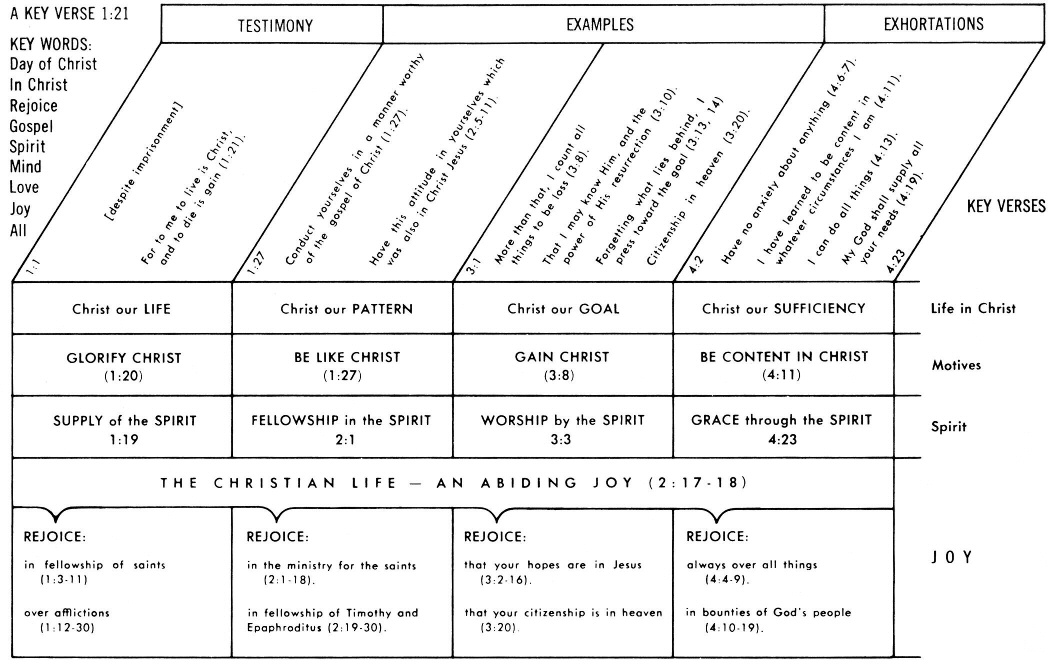
LIFE IN CHRIST
Click chart to enlarge
Charts from Jensen's Survey of the NT - used by permission
Philippians - Charles Swindoll = Chart on right side of page
| Account of Paul's Circumstances Php 1:1-30 |
Have the Mind of Christ Php 2:1-30 |
Have the Knowledge of Christ Php 3:1-21 |
Have |
| Partakers of Christ | People of Christ | Pursuit of Christ | Power of Christ |
| Suffering | Submission | Salvation | Sanctification |
| Experience | Examples | Exhortation | |
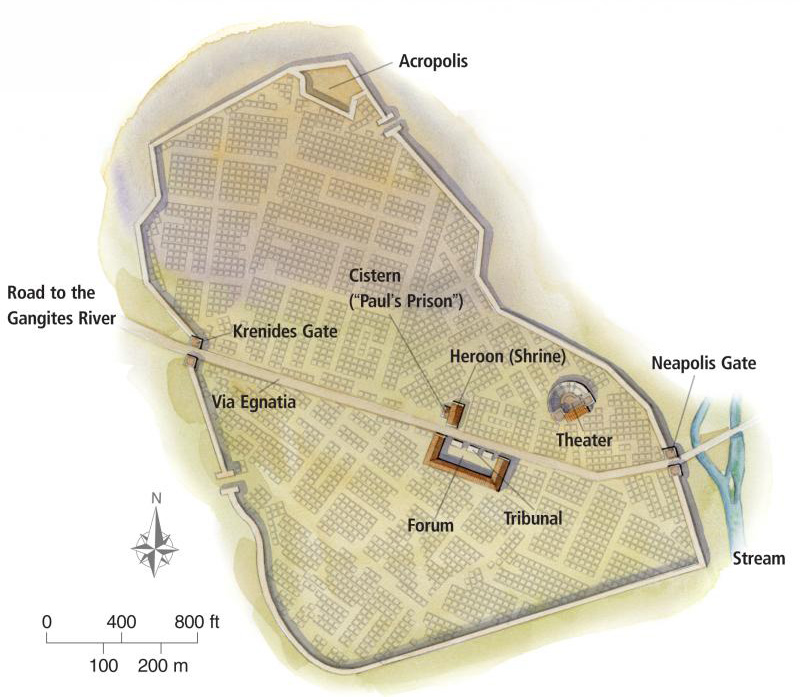
Philippi in the Time of Paul
The city plan above shows those features of the city of Philippi that archaeologists have so far identified as dating from the time of Paul. “Paul’s Prison” is not believed to be an authentic site, but was a cistern later associated with Christian worship. (ESV.org)
Philippians 1:12 Now I want you to know brethren, that my circumstances have turned out for the greater progress of the gospel, (NASB: Lockman)
Greek: Ginoskein (PAN) de humas boulomai, (1SPMI) adelphoi, hoti ta kat' eme mallon eis prokopen tou euaggeliou eleluthen, (3SRAI)
Amplified: Now I want you to know and continue to rest assured, brethren, that what [has happened] to me [this imprisonment] has actually only served to advance and give a renewed impetus to the [spreading of the] good news (the Gospel). (Lockman)CSB Now I want you to know, brothers, that what has happened to me has actually resulted in the advancement of the gospel,
ESV I want you to know, brothers, that what has happened to me has really served to advance the gospel,
KJV: But I would ye should understand, brethren, that the things which happened unto me have fallen out rather unto the furtherance of the gospel;
NET I want you to know, brothers and sisters, that my situation has actually turned out to advance the gospel:
NLT: And I want you to know, dear brothers and sisters, that everything that has happened to me here has helped to spread the Good News. (Tyndale House)
Wuest: But after mature consideration I desire you to gain this knowledge from (my) experience, that my circumstances have come to result rather in the pioneer advance of the gospel. (Eerdmans Publishing - used by permission)
Young's Literal: And I wish you to know, brethren, that the things concerning me, rather to an advancement of the good news have come,
Now I want you to know, brethren: Ginoskein (PAN) de humas boulomai, (1SPMI) adelphoi:
- Multiple resources on Luke 1
- Philippians Commentary - Verse by Verse Comments - Kenneth Wuest (good word studies)
Lest you should be misinformed, I would have you know (Lightfoot)
But after mature consideration I desire you to gain this knowledge from (my) experience, (Wuest)
Now it is my purpose to make clear to you, brothers (BBE)
Now I want you to know and continue to rest assured, brethren. (Amp)
John Hannah's Outline of Philippians 1:1-30
- Introduction (Phil 1:1-2)
- The servants and the saints (Phil 1:1)
- The salutation (Phil 1:2)
- Joy in the furtherance of the Gospel (Phil 1:3-30)
- Paul's praise and prayer for the believers (Phil 1:3-11)
- His praise (Phil 1:3-8)
- For their participation in the Gospel (Phil 1:3-5)
- For the confidence of a completed salvation (Phil 1:6)
- For his affection (Phil 1:7-8)
- His prayer (Phil 1:9-11)
- For abounding love (Phil 1:9)
- For approving the excellent and for blamelessness (Phil 1:10)
- For fruit (Phil 1:11)
- His praise (Phil 1:3-8)
- Paul's attitude toward afflictions (Phil 1:12-26)
- Afflictions promote the Gospel (Phil 1:12-18)
- Provides new opportunities for ministry (Phil 1:12-13)
- Causes the weak to witness (Phil 1:14)
- Causes many to preach (Phil 1:15-18)
- Afflictions promote the exaltation of Christ (Phil 1:19-26)
- His resolution (Phil 1:19-21)
- His resignation (Phil 1:22-26)
- The desire (Phil 1:22-23)
- The decision (Phil 1:24-26)
- Afflictions promote the Gospel (Phil 1:12-18)
- Paul's exhortations to the afflicted (Phil 1:27-30)
- To steadfastness (Phil 1:27)
- To courage (Phil 1:28-30)
- Paul's praise and prayer for the believers (Phil 1:3-11)
PAUL'S ADVERSE CIRCUMSTANCES
ADVANCE THE GOSPEL
Jowett calls this section “The Fortune of Misfortune.” John MacArthur entitles for Phil 1:12-18 - The Joy of Ministry in Spite of Trouble and Detractors
In his last letter, Paul reminds us why he is in jail
Remember Jesus Christ, risen from the dead, descendant of David, according to my gospel, for which I suffer hardship even to imprisonment as a criminal; but the word of God is not imprisoned. (2 Ti 2:8-9)
J Vernon McGee suggests the background for Paul's comments in Phil 1:12-20 - Paul is speaking very emphatically to them. When the believers in Philippi heard that Paul was in prison, they sent a message to him by their pastor, Epaphroditus, and it probably went something like this: "Oh, poor brother Paul, we feel so sorry for you. Now your great missionary journeys are curtailed; you are in prison, and the gospel is not going out!" Paul said, "Look, I want you to know that the gospel is going out, and the things that have happened to me have not curtailed but have actually furthered the gospel." (Thru The Bible)
Stephen Olford - With an eye on the letter he had just received by the hand of Epaphroditus (Phil 2:25, 4:18) from the church at Philippi, Paul now begins to answer some of the questions which were perplexing the Philippians. They had become greatly distressed by the apostle’s prolonged imprisonment and wondered what was going to happen to the extension work of the Gospel of Jesus Christ. Surely this ends it all, they thought. But Paul reminds them in Phil 1:12 that “the things which happened unto [him had] fallen out rather unto the furtherance of the gospel.” The imprisonments and trials had only served to advance the Gospel. (Expository Preaching Outlines - Volume 2)
Warren Wiersbe reminds us that "More than anything else, Paul’s desire as a missionary was to preach the Gospel in Rome. The hub of the great Empire, Rome was the key city of its day. If Paul could conquer it for Christ, it would mean reaching millions with the message of salvation. It was critically important on Paul’s agenda, for he said, “After I have been there [Jerusalem], I must also see Rome” (Acts 19:21). From Corinth he wrote, “So, as much as in me is, I am ready [eager] to preach the Gospel to you that are at Rome also” (Ro 1:15). Paul wanted to go to Rome as a preacher, but instead he went as a prisoner! He could have written a long letter about that experience alone. Instead, he sums it all up as “the things which happened unto me” (Phil. 1:12). "
MacArthur on I want you to know - translates a common Greek expression often found in ancient letters. Similar expressions—such as “I want you to get this” or “I want you to understand this”—are used today to call attention to an important point, especially one that might easily be missed, misunderstood, or hard to accept. (Philippians Commentary)
I want (1014)(boulomai) speaks of a desire that has purpose and intention back of it. It is “will” with determination. The desire came after mature consideration. The prayer is ended. Paul next rehearses his blessings, that is, the benefits that have resulted from his imprisonment.
Phil 1:12-26 all refer to what is happening to Paul and then in Phil 1:27-30 we see what happens to the Philippians. Paul wants them to know (and experience) the truth that he is learning in prison so that when they go through those difficult times, they will be victorious.
To know (1097)(ginosko) means to know by experience. The present tense indicates that Paul wants them to know and to keep on knowing. I don't want you to forget what I am getting ready to write. The Philippian saints, he desired, should learn something from his experience so that they then might experience what he was experiencing. Paul had experienced difficult circumstances,in his journey to Rome where he was imprisoned (Read this story in Acts 21-28). Paul did not complain about his circumstances or his chains but instead consecrated them to God and asked God to use them for the pioneer advance of the Gospel. And God answered his prayers. Nothing ever "just happens" to a saint. Things either come directly from God or they reach us from some other source by His permissive will ("filtered" though His hands of love).
Paul assures the Philippian saints that his circumstances have not only failed to curtail his missionary work, but they have advanced it, and not only that, they have brought about a pioneer advance in regions where otherwise it could not have gone. It is so in our lives. Our God-ordained or God-permitted circumstances can be used by God to provide a pioneer advance of the Gospel.
Wuest - Epaphroditus had told Paul that the Church at Philippi was was afraid that his imprisonment was curtailing his missionary work (cf Php 2:25). Paul assures them that the contrary has been the case. The Gospel has made pioneer advances by reason of his circumscribed activities. The word "want" speaks of a desire that has purpose and intention back of it. It is "will" with determination. The desire came after mature consideration. "Know" is from the word meaning "to acquire knowledge by experience." The Philippian saints, he desired, should learn something from his experience. (Wuest Word Studies - Eerdman Publishing Company Volume 1, Volume 2, Volume 3 - used by permission)
Brethren (80)(adelphos from a = denotes unity + delphus = a womb) means brother or near kinsman. "Adelphós generally denotes a fellowship of life based on identity of origin, e.g., members of the same family (Mt. 1:2; Lk 3:1, 19; 6:14); members of the same tribe, countrymen, and so forth (Acts 3:22; 7:23; Ro 9:3)." (Zodhiates) Figuratively, adelphos describes members of the Christian community, spiritual brother, fellow Christian, fellow believer (Ro 8.29). Jews used adelphos to describe fellow countrymen (Acts 3:22).
that my circumstances have turned out for the greater progress of the Gospel: hoi hoti ta kat' eme mallon eis prokopen tou euaggeliou eleluthen, (3SRAI):
- Acts 21:28-36; 22:1-30; 28:1-31
- Ex 18:11; Esther 9:1; Ps 76:10; Acts 8:4; 11:19, 20, 21; Ro 8:28, 37; 2Ti 2:9
that what has happened to me has, in effect, turned out to the advantage of the Gospel (Phillips)
that what has happened to me has really served to advance the gospel. (Lightfoot 1)
that my sufferings and restraints, so far from being prejudicial to the Gospel, have served to advance it. (Lightfoot 2)
that my circumstances have come to result rather in the pioneer advance of the gospel (Eerdmans Publishing - used by permission)
that what has happened to me has really served to advance the gospel (NIV)
the things which happened to me have actually turned out for the furtherance of the gospel (NKJV)
what has happened to me has actually helped to spread the gospel, (NRSV)
that the cause of the good news has been helped by my experiences (BBE)
that what [has happened] to me [this imprisonment] has actually only served to advance and give a renewed impetus to the [spreading of the] good news (the Gospel). (Amp)
that what I have gone through has turned out to the furtherance of the Good News rather than otherwise (Weymouth)
my situation has actually turned out to advance the gospel (NET)
OUR DISAPPOINTMENTS MAY ACTUALLY
BE GOD'S APPOINTMENTS!
That my circumstances (what has happened to me, literally the Greek "ta kata eme" means "the things pertaining or relating to me" - the same phrase is rendered "my circumstances" in Eph 6:21 and "my affairs" in Col 4:7) - We have already seen that in spite of his adverse circumstances, Paul continues to manifest a prayerful, thankful, joyful attitude. And here he takes the "lemon" so to speak of imprisonment and by God's Spirit and grace makes "lemonade." Instead of the advance of the Gospel coming to a standstill because of his imprisonment, the Gospel actually advanced! In short, Paul's adverse circumstances actually opened up new areas to preach Christ and the Gospel in the very place he had earlier written he desired to preach (Ro 1:15). To be sure his desire was not realized in the way he had envisioned, for instead of coming to Rome as a preacher, he came as a prisoner who would be given a pulpit in a prison to preach to Praetorian guards! God's ways are ALWAYS higher than our ways!
In a sense Paul changed one letter in the word "Disappointment" and came to recognize his imprisonment as "His Appointment!" Instead of focusing on what looked like disappointment to the saints at Philippi, he set his mind on the things above and was enabled by the Spirit to recognize His appointment! Paul's Christ centered, Gospel centered mindset allowed him to turn lemons into lemonade (so to speak)!
Paul gives us a wonderful example to follow ("Brethren, join in following my example" Phil 3:17). We need like Paul to be continually filled with the Spirit Who enables us to maintain an eternal perspective by keeping our eyes fixed on Jesus (Heb 12:2). And so we need to note that Paul's approach to his adverse circumstances is to "accentuate the positive." He could have easily cried "Woe is me!" His letter to the Philippians could have gone on and on about how bad the prison food was, how the chains rubbed on his wrists, how horrible is was to be chained to a Roman soldier so despised by the Jews, and on. Not Paul! Instead of fixating on his adversity, he makes a Spirit filled, conscious choice to focus on Christ (Phil 1:13 is literally "in Christ) and the Good News about His salvation by grace through faith. Paul took a divine perspective. I like to call it "Vertical Vision" (in contrast to "Horizontal Vision" which focuses on the circumstances). And so he encourages the church at Philippi (who had invested in him by sending funds) that their investment was still yielding eternal dividends!
The New Jerusalem Bible paraphrases it as "the circumstances of my present life are helping rather than hindering the advance of the gospel."
Warren Wiersbe says "The secret of his joy is the single mind; he lives for Christ and the Gospel. (Christ is named eighteen times in Philippians 1, and the Gospel is mentioned six times.) “For to me to live is Christ, and to die is gain” (Phil. 1:21). But what really is “the single mind”? It is the attitude that says, “It makes no difference what happens to me, just as long as Christ is glorified and the Gospel shared with others.” Paul rejoiced in spite of his circumstances, because his circumstances strengthened the fellowship of the Gospel (Phil. 1:1–11), promoted the furtherance of the Gospel (Phil. 1:12–26), and guarded the faith of the Gospel (Phil. 1:27–30)." (Bible Exposition Commentary)
Have turned out (2064) (erchomai) means to come or go, to fall out. In the present verse it means to happen, with the implication of the event being directed to someone or something. Perfect tense means it happened at a point in time in the past and the effects or results are still present and the effect in this context is that the Gospel was being advanced into unexplored territory. There is a corollary truth here - Don't be fooled by the fallacy that life will be easy if you obey God (It did not go easy for Paul but got him arrested and imprisoned!). While God does note always remove the difficulties in our lives, He is able to use them for our good and for His glory. Are you experiencing adverse circumstances as you read this note? Is the God Paul still able to take your "obstacles" and turn them into "opportunities?" (That's a rhetorical question, expecting an affirmative answer!)
MacArthur - Instead of hindering and restricting his ministry, Paul’s difficult circumstances had done the very opposite (cf. 2 Cor. 12:9–10).
God can turn obstacles
into opportunities.
For the greater progress of the Gospel - ("to advance the Gospel" ESV, NET) Paul uses a Greek military term (see prokope below) which referred to the corps of army engineers who went out in front of the advancing army to open up (e.g., cutting down trees of an otherwise impenetrable forest) in new territory for the troops to march through. Without the pioneer advance, the troops would have a difficult time marching through the territory.
"Paul’s imprisonment for Christ did not bind the gospel; rather it helped to release it. This has been the case throughout history. The suffering of Christians increases the cause of Christ." (Cornerstone Bible Commentary)
Paul's passion for the proclamation (and progress) of the Gospel writing in Acts
“But I do not consider my life of any account as dear to myself, so that I may finish my course and the ministry which I received from the Lord Jesus, to testify solemnly of the gospel of the grace of God. (Acts 20:24-note)
In 2 Timothy 4 (his last know writing) Paul said
At my first defense no one supported me, but all deserted me; may it not be counted against them. 17 But the Lord stood with me and strengthened me, so that through me the proclamation might be fully accomplished, and that all the Gentiles might hear; and I was rescued out of the lion’s mouth. 18 The Lord will rescue me from every evil deed, and will bring me safely to His heavenly kingdom; to Him be the glory forever and ever. Amen. (2 Timothy 4:16-18-note)
Progress (advance of, spread of, promotion of)(4297) (prokope from prokopto = to cut forward [a way], advance from pró =before or forward + kópto = cut, strike, impel) describes not merely moving ahead but doing so against obstacles. Prokope refers to an explorer or an advance team hacking a path through dense trees and underbrush for the marching army to follow. Resistance is inherent to that sort of progress. The progress goes forward through obstacles, dangers, and distractions. The idea of prokope is blazing a trail before a marching army. Paul's chains were "blazing a trail" for the presentation of the Gospel to elite Roman soldiers. Imagine Paul the captive having a captive audience!
BDAG - a movement forward to an improved state = progress, advancement, furtherance
Prokope was also a technical term in Stoic philosophy for “progress toward wisdom". Paul’s imprisonment proved to be no hindrance to spreading the message of salvation and in fact created new opportunities.
The opposite idea is expressed by the related word egkopto (en = in + kópto = cut) which in classic Greek was used as a military metaphor meaning to cut in on, throw obstacles in the way of or to cut up the road so that normal movement was impossible. Paul wrote to the Galatians "You were running well. Who hindered (egkopto) you from obeying the truth?" (Gal 5:7).
Prokope was used to describe an army of pioneer wood cutters preceding the regular army, cutting a road through an otherwise impenetrable forest, thus making possible the pioneer advance of the regulars into regions where they otherwise could not have marched. And so too it was with Paul's imprisonment in Rome - his sufferings removed obstacles allowing the Gospel to be presented in arenas that would otherwise have been "impenetrable".
Prokope used only 3x in the NT and elsewhere only in Apocrypha - 2Ma 8:8, Sir 51:17
Philippians 1:25 Convinced of this, I know that I will remain and continue with you all for your progress and joy in the faith,
1 Timothy 4:15 Take pains with these things; be absorbed in them, so that your progress will be evident to all.
Persecution in one place has often been the means of advancing and spreading the Gospel in other places, a classic illustration being the dispersion of the church in Acts 8 where Luke writes that
Saul (Paul before regeneration) was in hearty agreement with putting him (Stephen) to death. And on that day a great persecution arose against the church in Jerusalem; and they were all scattered throughout the regions of Judea and Samaria, except the apostles. (Acts 8:1)
The results of this "progress" have continued to reverberate throughout the world ever since. God declares in Isaiah
My thoughts are not your thoughts, neither are your ways My ways (Isaiah 55:8)
Obstacles that seem to be "roadblocks" are but stepping stones to opportunities in the providential outworking of our omnipotent, omniscient God.
Wiersbe gives an illustration of how God uses adverse circumstances to open up new areas of ministry - Everyone has heard of Charles Haddon Spurgeon, the famous British preacher, but few know the story of his wife, Susannah. Early in their married life, Mrs. Spurgeon became an invalid. It looked as though her only ministry would be encouraging her husband and praying for his work. But God gave her a burden to share her husband’s books with pastors who were unable to purchase them. This burden soon led to the founding of the “Book Fund.” As a work of faith, the “Book Fund” provided thousands of pastors with tools for their work. All this was supervised by Mrs. Spurgeon from her home. It was a pioneer ministry.
John MacArthur gives an illustration of difficult circumstances in the life of John Bunyan furthering the progress of the Gospel - John Bunyan’s preaching was so popular and powerful, and so unacceptable to leaders in the seventeenth-century Church of England, that he was jailed in order to silence him. Refusing to be silent, he began to preach in the jail courtyard. He not only had a large audience of prisoners, but also hundreds of the citizens of Bedford and the surrounding area would come to the prison daily and stand outside to hear him expound Scripture. He was silenced verbally by being placed deep inside the jail and forbidden to preach at all. Yet in that silence, he spoke loudest of all and to more people than he could have imagined. It was during that time that he wrote The Pilgrim’s Progress, the great Christian classic that has ministered the Gospel to tens of millions throughout the world. For several centuries, it was the most widely read and translated book in the world after the Bible. Bunyan’s opponents were able to stop his preaching for a few years, but they were not able to stop his ministry. Instead, they provided opportunity for it to be extended from deep within a jail in the small town of Bedford to the ends of the earth.
J Ligon Duncan on difficult circumstances in our lives - God never wastes those circumstances. You are too precious to your heavenly Father for Him to waste pain and suffering. He always has gospel purposes in your pain, suffering, difficulties, your hard circumstances. He always has gospel purposes.
Tony Merida - As Paul lived and taught, the Roman guards were hearing the good news. There were about 9,000 of them (O’Brien, Epistle, 93), and Paul’s message apparently impacted many of them, and probably many others in Rome, including officials and pagans. In this short book the term gospel appears as a noun nine times (Bruce, Philippians, 82, n. 47). Paul is consumed with the gospel. He has put the gospel first in his affections and priorities. What a lesson for us! Put the gospel first in your relationships, in your circumstances, and in your love for your neighbors. Talk about the good news of Jesus’ death, resurrection, reign, and return all the time. Because Paul prized the gospel, he could praise Christ with joy despite being imprisoned. (Christ-Centered Exposition – Exalting Jesus in Philippians.
D. A. Carson writes, What ties us together? What do we talk about when we meet, even after a church service? Mere civilities? The weather? Sports? Our careers and our children? Our aches and pains? None of these topics should be excluded from the conversation of Christians, of course. In sharing all of life, these things will inevitably come up. But what must tie us together as Christians is this passion for the gospel, this fellowship of the gospel. On the face of it, nothing else is strong enough to hold together the extraordinary diversity of people who constitute many churches. (Basics, 19) (Quoted in Christ-Centered Exposition– Exalting Jesus in Philippians)
The Gospel (2098) (euaggelion from eú = good + aggéllo = proclaim, tell) means good news, glad tidings, Saxon = gōd-spell = lit. "good tale, message". Euaggelion originally referred to a reward for good news and later became the good news itself. The word euaggelion was in just as common use in the first century as our words good news today. “Have you any good news for me today?” would have been a common question. In this secular use euaggelion described good news of any kind and prior to the writing of the New Testament, had no definite religious connotation in the ancient world until it was taken over by the "Cult of Caesar" which was the state religion and in which the emperor was worshipped as a god (see more discussion of this use below). The writers of the New Testament adapted the term as God's message of salvation for lost sinners.
The writers of the New Testament adapted the term as God's message of salvation for lost sinners. Euaggelion is found in several combination phrases, each describing the gospel like a multifaceted jewel in various terms from a different viewpoint (from the NASB, 1977):
- the gospel of the kingdom (Mt 4:23)
- the gospel of Jesus Christ, the Son of God (Mk 1:1) because it centers in Christ
- the gospel of God (Mk 1:14) because it originates with God and was not invented by man
- the gospel of the kingdom of God (Lk 16:16)
- the gospel of the grace of God (Acts 20:24),
- the gospel of His Son (Ro 1:9-note)
- the gospel of Christ (Ro 15:19-note)
- the gospel of the glory of Christ (2Co 4:4)
- the gospel of your salvation (Ep 1:13-note)
- the gospel of peace (Ep 6:15-note)
- the gospel of our Lord Jesus (2Th 1:8)
- the glorious gospel of the blessed God (1Ti 1:11)
In Ro 16:25, 26 (note) Paul called it “my Gospel” indicating that the special emphasis he gave the gospel in his ministry.
The gospel is succinctly and accurately stated by Paul in 1Corinthians 15:1-5…
Now I make known to you [since it seems to have escaped you], brethren, the gospel which I preached to you, which also you received, in which also you stand, 2 by which also you are saved, if you hold fast the word which I preached to you, unless you believed in vain (does not teach that true believers are in danger of losing their salvation, but it is a warning against non–saving faith -- could be translated "unless your faith is worthless" -- holding fast was the result and evidence of genuine salvation). 3 For I delivered to you as of first importance what I also received, that Christ died for our sins according to the Scriptures, 4 and that He was buried, and that He was raised on the third day according to the Scriptures, 5 and that He appeared to Cephas, then to the twelve. (See notes 1Cor 15:1; 15:2; 15:3; 15:4; 15:5; 15:6; 15:7 ;15:8)
Wuest (KJV - But I would ye should understand, brethren, that the things [which happened] unto me have fallen out rather unto the furtherance of the gospel) "The things which happened unto me," are literally, "the things dominating me." The words "which happened" are not in the Greek text and are not needed. Nothing ever just happens to the saint. Things either come directly from God or they reach us from some other source by His permissive will. The things that were then dominating Paul's life were those connected with his imprisonment. "Have fallen out" is literally, "have come to result." The use of "rather" tells us that the Philippians were thinking that Paul's ministry was being curtailed. The word "furtherance" is from a Greek word which means "to cut before," and is thought to have been used of an army of pioneer wood cutters which precedes the regular army, cutting a road through an impenetrable forest, thus making possible the pioneer advance of the latter into regions where otherwise it could not have gone. Paul assures the Philippian saints that his circumstances have not only failed to curtail his missionary work, but they have advanced it, and not only that, they have brought about a pioneer advance in regions where otherwise it could not have gone. It is so in our lives. Our God-ordained or God-permitted circumstances are used of God to provide for a pioneer advance of the Gospel in our Christian service. (Wuest Word Studies - Eerdman Publishing Company Volume 1, Volume 2, Volume 3 - used by permission)
The Example of John and Betty Stam - … e.g. In a church in New Jersey a young man was baptized and later married to a dedicated Christian girl. Together this couple went to China, where they served Christ in such a way that the whole countryside knew them. Then came a momentous day—December 8, 1934—when these two young missionaries were caught by bandits and cruelly murdered. The manner in which they died did more for the gospel work in that area than years of missionary endeavor. The last letter that the young missionary wrote included these words: “God knows what our end is, but we have decided that, by life or death, He shall be magnified.” The names of these two young people are John and Betty Stam, who through consecrated dying continue to speak to us today.
Keith Brooks writes…
One who is sheltered under His love finds God’s worst better than the devil’s best. Disappointment is His appointment. Glorious victory is assured those who love Him—in His good time. (Essential Themes)
We never know how God might use suffering to advance the gospel. For example, I recently heard about the faith journey of Peter O’Brien (renowned Bible scholar—quoted often in the present work) in a sermon preached by D. A. Carson on the story of Joseph. When he was a youth, neither of O’Brien’s parents were Christians. But his mother became greatly impacted by the faithful witness of a neighbor. This neighbor was a simple lady with sincere faith in Christ, who unfortunately lived with an incurable disease and suffered day after day. But she never complained. Her attitude and witness made a tremendous impact on O’Brien’s mother, who eventually trusted Christ as Savior. Humanly speaking, it was because of this simple lady’s faith that O’Brien’s mother became a Christian. Because of that, O’Brien later believed. He would then go to seminary and get a PhD. Then he would go to India and make the gospel known for years. Then he would go to Australia, teach, and write several extraordinary commentaries. Now, suppose you had said to this simple, suffering woman: “Here’s the deal: If you will glorify Christ in your suffering, then as a consequence Indians will be converted, pastors will be trained to teach the Bible, and countless sermons will be preached. Will you now suffer faithfully every day?” I’m sure she would have said, “Yes! Of course! I can endure for these reasons!” But she didn’t know all of this would happen. When we’re in the middle of our suffering, we never know what will happen, but we must trust that God is sovereign and that He can and often does advance the gospel through great personal hardships, such as imprisonment or cancer. Our job is to stay faithful, joyful, and Christ-centered through the suffering, confidently trusting in His wise, sovereign will (D. A. Carson, “The Temptation of Joseph”).
Christ-Centered Exposition - Christ-Centered Exposition Commentary – Exalting Jesus in Philippians.
Divine Appointments - Have you ever been stuck in an airport? For 24 hours? In a city where you can’t speak the language? Four thousand miles from home? It happened to a friend recently, and we can learn from his response. While most of us would find such an inconvenience intolerable, my friend John saw God’s hand in his delay. As he waited out his forced stay, he looked for opportunities to connect with fellow passengers. He “happened” (Ed comment: "Happen" from hap = luck and means to occur by chance - Providence says absolutely nothing occurs "by chance"!) to find some fellow Christians from India—and in talking to them he heard about a ministry they were involved with. In fact, because John’s interests matched his new friends’ ministry, they invited him to India to participate in a short-term project.
How often do we experience delays, changes of plans, and redirections and treat them as intrusions? It could be that God is detouring us so we can do something different or new for Him. Consider Paul’s trip to Philippi in Acts 16. He had gone to Macedonia because of a God-directed vision (Acts 16:9-10). How could he know that he would end up in prison there? But even that trip to jail was God-led, because He used Paul to bring salvation to a jailer and his family (Acts 16:25-34, cp Romans 8:28, Genesis 50:20).
God can use inconveniences in our lives if we look at them as divine appointments. — by Dave Branon
“Disappointment—His appointment,”
Change one letter, then I see
That the thwarting of my purpose
Is God’s better choice for me.
—Young
Jon Courson on how God uses the "chains" (burdens) in our life for His purposes - Just as God used a sling in David's hand, a pitcher in Gideon's hand, and a rod in the hand of Moses, He used chains on Paul's hands. That's not surprising, for chains are what open the door to speak to people who would not otherwise give us the time of day. You see, it's when a wife hangs in there with her difficult husband; it's when an employee refuses to talk behind his boss's back; it's when a high-schooler willingly submits to his parents that people take note, thereby opening opportunity for the wife, the employee, the high-schooler to share the reason why. I'm convinced that the troubles, challenges, and problems we face are custom-designed to do one thing: to allow us to draw others to Jesus Christ and to encourage them in Jesus Christ. "But my burden is too heavy," you say. Listen, God will not tempt you above what you are able (1 Corinthians 10:13). God doesn't play favorites—and if He has put you in a certain imprisonment, it's because He has prepared you for it and given you everything you'll need to go through it. (Jon Courson's Application Commentary)
When Trouble Strikes (Our Daily Bread) Dave Dravecky had pitched with remarkable success for the San Diego Padres and the San Francisco Giants baseball teams. But his pitching arm developed an unusual soreness. Medical tests identified the problem--cancer. Surgery and months of rehabilitation followed. Then, after pitching for a time in the minor leagues, Dave made a widely applauded comeback to the majors. But in Montreal, as he was delivering a pitch, his arm snapped. The cancer had not gone away. To save his life, doctors removed his arm and much of his shoulder. A committed Christian, Dave didn't wallow in self-pity. He said, "There is no struggle about feeling sorry for myself. The question is not, 'Why me, God?' The question is, 'What is Your plan for me?' " Then he said, "I see this as God giving me the opportunity to share the gospel with a lot of people."
Just as Paul saw how adversity could lead to opportunity (Phil. 1:12), Dave has seen God open doors to speak about his faith in Christ. Audiences are willing to listen because he is a living testimony of human grit and divine grace. When trouble strikes, destroying our dreams or crippling our bodies, do we react with self-pity? Or do we see an opportunity to demonstrate the sufficiency of God's grace? --V C Grounds
He Giveth More Grace
He giveth more grace when the burdens grow greater,
He sendeth more strength when the labors increase;
To added affliction He addeth His mercy,
To multiplied trials, His multiplied peace.
--Annie Johnson Flint (play hymn)
Trouble and the grace to bear it
come in the same package.
"The Power of Chains" "To begin with, these chains gave Paul contact with the lost. He was chained to a Roman soldier twenty-four hours a day! The shifts changed every six hours, which meant Paul could witness to at least four men each day! Imagine yourself as one of those soldiers, chained to a man who prayed “without ceasing,” who was constantly interviewing people about their spiritual condition, and who was repeatedly writing letters to Christians and churches throughout the Empire! It was not long before some of these soldiers put their faith in Christ. Paul was able to get the Gospel into the elite Praetorian Guard, something he could not have done had he been a free man. But the chains gave Paul contact with another group of people: the officials in Caesar’s court. He was in Rome as an official prisoner, and his case was an important one. The Roman government was going to determine the official status of this new “Christian” sect. Was it merely another sect of the Jews? Or was it something new and possibly dangerous? Imagine how pleased Paul must have been knowing that the court officials were forced to study the doctrines of the Christian faith!
Sometimes God has to put “chains” on His people to get them to accomplish a “pioneer advance” that could never happen any other way. Young mothers may feel chained to the home as they care for their children, but God can use those “chains” to reach people with the message of salvation. Susannah Wesley was the mother of nineteen children, before the days of labor-saving devices and disposable diapers! Out of that large family came John and Charles Wesley, whose combined ministries shook the British Isles. At six weeks of age, Fanny Crosby was blinded, but even as a youngster she determined not to be confined by the chains of darkness. In time, she became a mighty force for God through her hymns and Gospel songs.
The secret is this: when you have the single mind, you look on your circumstances as God-given opportunities for the furtherance of the Gospel; and you rejoice at what God is going to do instead of complaining about what God did not do.
Paul’s chains not only gave contact with the lost, but they also gave courage to the saved. Many of the believers in Rome took fresh courage when they saw Paul’s faith and determination (Phil. 1:14). They were “much more bold to speak the word without fear.” That word speak does not mean “preach.” Rather, it means “everyday conversation.” No doubt many of the Romans were discussing Paul’s case, because such legal matters were of primary concern to this nation of lawmakers. And the Christians in Rome who were sympathetic to Paul took advantage of this conversation to say a good word for Jesus Christ. Discouragement has a way of spreading, but so does encouragement! Because of Paul’s joyful attitude, the believers in Rome took fresh courage and witnessed boldly for Christ. " (Warren Wiersbe)
Fanny Crosby who are blinded by a quack medicine man as a young girl saw with eyes of faith this Disappointment as God's Appointment and though totally blind composed literally 1000's of hymns such as the beloved Blessed Assurance that God has used to minister to countless numbers of believers. Here is a poem she once wrote published in a book called Fanny Crosby Speaks Again that picks up on this theme of Our Disappointments are God's Appointments...
God does not give me all I ask,
Nor answer as I pray;
But, O, my cup is brimming o’er
With blessings day by day.
How oft the joy I thought withheld
Delights my longing eyes,
And so I thank Him from my heart,
For what His love denies.
How tenderly He leadeth me
When earthly hopes are dim;
And when I falter by the way,
He bids me lean on Him.
He lifts my soul above the clouds
Where friendship never dies;
And so I thank Him from my heart
For what His love denies.
It's Contagious: A close friend of mine was confronted by a sign-carrying street preacher at Michigan State University. My friend, who was a student at the school and had been a Christian for only 2 years, had mixed feelings about the situation. He had encountered street preachers before. They had shouted the message of salvation in a style and spirit that seemed to do more harm than good to the testimony of Christ. But this man was different from the rest. My friend gradually became confident that this brother in Christ was speaking the truth in love. Soon he found himself offering to hold the sign for the tiring evangelist. This meant that my friend became the target of insults from fellow students. Another student asked him why he was carrying the sign. She expressed the same misgivings he had experienced earlier. He explained that the message and the spirit of this brother seemed right. A short time later, the woman asked my friend if she could hold the sign.
The street preacher's conviction was contagious. Does our willingness to identify with the Savior encourage others to do the same? Our commitment needs to be strong enough to be contagious. --M R De Haan II (Our Daily Bread, Copyright RBC Ministries, Grand Rapids, MI. Reprinted by permission. All rights reserved)
Consider Praying the following poem…
Set us afire, Lord,
Stir us we pray!
While the world perishes,
We go our way
Purposeless, passionless,
Day after day;
Set us afire, Lord,
Stir us we pray.
--Ralph Spaulding Cushman.
Enthusiasm for Christ is contagious.
Has anyone caught it from you?
The Fallacy: Once we resolve to obey God completely, it's easy to assume that life will go more smoothly. When it does, we think this proves that we're in God's will. If we run into obstacles, however, we're apt to conclude that both we and what we're doing are out of God's will. Rather than question our measuring stick, we question our dedication, and sometimes even God. A mature Christian once said, "It's a fallacy to believe that if we obey God, everything will go well. Being dedicated to God means going with Him even when things go wrong. In fact," he said assuredly, "the gospel advances on disaster and suffering."
Although Paul was imprisoned when he wrote to the Philippians, his hardships didn't alarm him. His goal was to preach the gospel, and he didn't question that goal just because he had been arrested. He made the most of the circumstances and proclaimed Christ to his captors. His chains had furthered the gospel (Phil. 1:12-14). Consider your spiritual gifts and goals. Do you believe they're from God when they flourish but question them when they lead to difficulties? Don't be fooled by the fallacy that life will be easy if you obey God. God doesn't remove difficulties; He uses them for your good and for His glory. --J E Yoder (Our Daily Bread, Copyright RBC Ministries, Grand Rapids, MI. Reprinted by permission. All rights reserved)
The difficulties in our lives,
The obstacles we face,
Give God the opportunity
To show His power and grace. --Sper
Smooth seas don't make skillful sailors.
Finding Gain In Loss: Evil men, not God, threw the apostle Paul into prison, hoping to put an end to his ministry. But their plan backfired, and the gospel spread (Phil. 1:12-13). Paul didn't know why God allowed his imprisonment, but he saw how God used it for good. When All-Star baseball player Dave Dravecky lost his pitching arm to cancer, he struggled to find the reason for his loss by adding up the positive gains in his life. He eventually realized that he had been confusing the results of his loss with trying to understand God's unknowable purposes.
To illustrate the difference, Dave refers to his amputated arm. One result of his radical surgery was that medical researchers had cancerous tissue to study that could advance their knowledge of the disease. This is something good. "It wouldn't be such a good thing, though," Dave writes, "if the purpose for my surgery was to provide an arm so that the pathology department would have a specimen to study." That may be one result, but it doesn't explain God's higher purpose. Instead of trying to discover God's hidden purpose for his cancer, Dave now focuses on a result that he has seen: "I used to depend on myself. Now I depend more on God." That may be his biggest gain of all. --J E Yoder (Our Daily Bread, Copyright RBC Ministries, Grand Rapids, MI. Reprinted by permission. All rights reserved)
O Lord, I would not ask You why
Some trial comes my way,
But what there is for me to learn
Of Your great love, I pray.
--DJD
We cannot control the wind,
but we can adjust our sails.
A young pitcher who entered the major leagues had such a blazing fastball that he didn't think he needed to work on his control, his changeup, or his curve. Consequently, he failed to make the grade and was sent back to the minor leagues. Though disappointed, he worked on these pitches, and in time became a superstar. Winston Churchill failed twice to win an elected office during the early 1920s and had little political influence all through the 1930s. But he kept developing his talents, and in 1940 he became the Prime Minister of England. Today he is acclaimed as a great hero. The apostle Paul planned to go to Rome to preach the gospel as a free man, but he was taken there as a prisoner instead. It looked as if he had failed to achieve his noble ambition. In his place of confinement, however, he witnessed to the guards with such persuasion that most of them were converted, and from his prison he wrote some of his outstanding epistles. That's why he could write to the Christians in Philippi that everything had turned out for the advancement of the gospel. When our carefully laid plans fizzle, it's time to analyze our failure and take appropriate action. If we discover that we blundered, we can correct our mistakes. If we trace our seeming lack of success to circumstances beyond our control, we can ask God to teach us what He wants us to learn and trust Him to bring good out of our disappointments. A failure then becomes a steppingstone to success. —H V Lugt (Our Daily Bread, Copyright RBC Ministries, Grand Rapids, MI. Reprinted by permission. All rights reserved)
Most successes follow many failures.
Philippians 1:13 so that my imprisonment in the cause of Christ has become well known throughout the whole praetorian guard and to everyone else, (NASB: Lockman)
Greek: hoste tous desmous mou phanerous en Christo genesthai (AMN) en hole to praitorio kai tois loipois pasin,
Amplified: So much is this a fact that throughout the whole imperial guard and to all the rest [here] my imprisonment has become generally known to be in Christ [that I am a prisoner in His service and for Him]. (Amplified Bible - Lockman)
KJV: So that my bonds in Christ are manifest in all the palace, and in all other places;
NET The whole imperial guard and everyone else knows that I am in prison for the sake of Christ,
NLT: For everyone here, including all the soldiers in the palace guard, knows that I am in chains because of Christ. (NLT - Tyndale House)
NLT (revised) For everyone here, including the whole palace guard, knows that I am in chains because of Christ.
Wuest: So that it has become plainly recognized that my bonds are because of Christ, throughout the whole Praetorian Guard and to all the rest. (Eerdmans Publishing - used by permission)
Young's Literal: so that my bonds have become manifest in Christ in the whole praetorium, and to the other places -- all,
SO THAT MY IMPRISONMENT IN THE CAUSE OF CHRIST HAS BECOME WELL KNOWN THROUGHOUT THE WHOLE PRAETORIAN GUARD: hoste tous desmous mou phanerous en Christo genesthai (AMN) en hole to praitorio:
- Acts 20:23, 24; 21:11, 12, 13; 26:29; 31; 28:17, 20; Eph 3:1; 4:1; 6:20; Col 4:3-18
- 1Pe 4:12, 13, 14, 15, 16) (Phil 4:22, 1Th 1:8, 9
"As a result, it has become clear throughout the whole palace guard and to everyone else that I am in chains for Christ." (Lightfoot 1)
"My bonds have borne witness to Christ, not only among the soldiers of the imperial guard, but in afar wider circle" (Lightfoot 2)
"So that it has become plainly recognized that my bonds are because of Christ, throughout the whole Praetorian Guard and to all the rest" (Eerdmans Publishing - used by permission)
"For, first of all, my imprisonment means a personal witness for Christ before the palace guards" (Phillips),
THE CAUSE OF CHRIST
SPREAD
So that (hoste) explains how the seemingly negative circumstances of confinement proved actually to be a vehicle for furthering the spread of the gospel. Thus Paul puts a new spin on the meaning of "Prison Ministry". See discussion of importance of pausing to ponder terms of purpose or result .
Vine on my imprisonment in the cause of Christ has become well known - Paraphrased "it became manifest that my bonds were the consequence of my allegiance to Christ.” Paul’s enthusiasm for Christ, which his sufferings had not quenched, set all doubts at rest as to the reason of his incarceration. It was for “the mystery of the Gospel” that he was “an ambassador in a chain,” Ephesians 6:19, 20. Those who came into contact with him soon learned that he was neither lawbreaker nor political delinquent, but that he suffered for his devotion to Christ, the Master whose claims he unweariedly urged upon them.
Phil 1:13 describes the furtherance of the Gospel outside the church (soldiers at Rome) and Phil 1:14 describes the furtherance of the Gospel in side the church (saints at Rome).
NET Note on so that - "so that the whole imperial guard." The hoste clause that begins Phil 1:13 indicates two results of the spread of the Gospel: Outsiders know why Paul is imprisoned (Phil 1:13) and believers are emboldened by his imprisonment (Phil 1:14).
MacArthur - Paul could say to his persecutors what Joseph said to his brothers after they sold him into slavery: “It was not you who sent me here, but God; and He has made me a father to Pharaoh and lord of all his household and ruler over all the land of Egypt.… As for you, you meant evil against me, but God meant it for good” (Gen. 45:8; 50:20).
Paul wanted to go to Rome as a PREACHER,
but instead he went as a PRISONER!
Jon Courson - "My plan was to go to Rome," (cf Ro 1:15, 15:14-17 written from Corinth about 2 years earlier) Paul said, "but God had a better idea. He brought Rome to me in the form of the soldiers chained to me round the clock. Every six hours, a different one comes on duty—and they're all getting saved! Members of the Praetorian Guard, they return to the palace, where they influence the very heart of the Roman system." (Jon Courson's Application Commentary)
AND CAN IT BE
-Charles Wesley
Long my imprisoned spirit lay,
Fast bound in sin and nature’s night;
Thine eye diffused a quickening ray—
I woke, the dungeon flamed with light;
My chains fell off, my heart was free,
I rose, went forth, and followed Thee.
My chains fell off, my heart was free,
I rose, went forth, and followed Thee.
Imprisonment speaks of bonds and was used of any forced restriction. While Paul does not use the exact word here in Philippians, he was not only in forced restriction (house arrest) but also literally chained to a Roman soldier causing him to write that he was "an ambassador in chains" (Eph 6:20).
John MacArthur describes Paul's chains - Paul’s “chains” (see word study on halusis) were somewhat longer than a modern handcuff, about eighteen inches long. One end was attached to the prisoner’s wrist, the other to the guard’s. The chain was not removed from the prisoner as long as he was in custody, making both escape and privacy impossible. Although the apostle was allowed to live in private quarters (Acts 28:30), he was chained in that manner to a series of soldiers for a period of two years....The faithful believers in the church at Rome had no doubt long prayed that the Lord would open a way to witness to the elite and influential praetorian guard. In His sovereign wisdom, He answered that prayer by making members of that guard captive to Paul for two years.
THE "ROMANS 8:28" OF
PHILIPPIANS
Ron Daniel - Paul didn't let his imprisonment devastate him like many of us would. Instead, he reminded himself of this truth: Ro. 8:28 "And we know that God causes all things to work together for good to those who love God, to those who are called according to {His} purpose." Although Paul's circumstances were beyond difficult, he knew that God was in control, and that He was working these difficulties together for good. Paul actively looked for the good that was resulting, and he found it. The same will be true for us - if we look for the good that results, we will see it. But if we spend our time whining and complaining about how tough it is, how stretched we are, we will never see it. Paul could already see a couple of immediate examples of that "good" happening: Number one, because he was in prison, the guards that watched over him had heard the gospel many times. Can you imagine being an unbeliever chained at the wrist to an evangelist like Paul?...A lot of us have gone through or even now are going through incredibly difficult times. There are trials that we are overwhelmed by, life circumstances that we can't imagine being able to survive. Times that we don't know how we're going to carry on even one more minute. Seasons where we're ready to just completely give up and check out.But the victory comes when we stop and get the proper perspective, the view that Paul had. "God's working my bad circumstances for good!"...No matter how out-of-control things seem, if you are one of God's children, you have not been abandoned. God is working it out, whether you can see that or not. Paul, sitting in prison, knew this to be true, and encouraged the Philippians of the good things already coming out of his difficult circumstances. (Sermon)
Bob Deffinbaugh - We must admit that being arrested does not usually enhance the status of a person, and particularly a preacher. His situation in Rome might have shaken the faith of some who had become believers in Christ through Paul’s preaching, or who had been taught by the apostle. His enemies and the enemies of the gospel would surely use this to oppose Paul and the gospel he declared and defended. Even some who were jealous of Paul might have used his incarceration to discredit him and to enhance their own status. Verses 12-18 set the record straight. They inform us how Paul’s situation actually enhanced the cause of the gospel. They also inform us of Paul’s response to adversity and abuse, even when it came from fellow believers. (Paul's Perspective on Pain and Pettiness - Phil 1:12-18)
Imprisonment (1199) (desmos from deo = to bind, fasten with chains) literally refers to bonds or the means of restraint such as by tying or fastening like a fetter (chain or shackle for the feet) speaks of "restriction of movement in the literal sense of "chains," and the metaphorical sense of "imprisonment" or "crippling disease." (Renn) Desmos in Jude 6 refers to "eternal chains" that keep fallen angels bound in darkness until the judgment day. As a physician, I love the picture of desmos in our English word desmosome which describes the material that binds one cell to another. In the early church fathers desmos was used of the "bond of love" (1 Cl 49:2), describing something that held people together in a common interest.
The same God Who had in the past used unpredictable means and unlikely people, like Moses’ rod, Gideon’s pitchers, and David’s sling, now used Paul’s chains in a mighty Spirit filled ministry. Little did the Romans realize that the chains they affixed to his wrists would release Paul instead of bind him! (2Ti 2:9-note)
Liddell- Scott - anything for binding, a band, bond, Homer, etc.: a halter, Il.: a mooring-cable, Od.: a door-latch, Ib.; a yokestrap, Xen. 2. in plural bonds, fetters, Aesch., Thuc.: in sing., collectively, bonds, imprisonment, Hdt., etc.
Vine on desmos means "a band, fetter, anything for tying" and is usually found in the plural, ether masculine or neuter; (a) it stands thus for the actual "bonds" which bind a prisoner, as in Luke 8:29; Acts 16:26; Acts 20:23 (the only three places where the neuter plural is used); Acts 22:30; (b) the masculine plural stands frequently in a figurative sense for "a condition of imprisonment," Phil. 1:7, 13, 1:14, 16; Col. 4:18; 2 Ti 2:9; Philem. 1:10, 13; Heb. 10:34. In Mark 7:35 "the bond (AV string)" stands metaphorically for "the infirmity which caused an impediment in his speech." So in Luke 13:16, of the infirmity of the woman who was bowed together. Used in the Septuagint of binding Samson (Jdg. 15:13; 14; 16:11)
Gilbrant on desmos - Classical Greek from Homer (ca. 800-700 B.C.) to Roman times treats desmos as “bond” or “fetter.” In the singular form it generally describes an impediment or infirmity which afflicts a person. The more common plural form desma usually applies to a person’s captivity or bondage, as in a prison or to a binding power. (Complete Biblical Library Greek-English Dictionary)
Desmos - 18x in 18v - Usage: bond(1), bonds(3), chains(3), impediment(1), imprisonment(10).
Mk. 7:35; Lk. 8:29; Lk. 13:16; Acts 16:26; Acts 20:23; Acts 23:29; Acts 26:29; Acts 26:31; Phil. 1:7; Phil. 1:13; Phil. 1:14; Phil. 1:17; Col. 4:18; 2 Ti 2:9; Philemon 1:10; 1:13; Heb 11:36; Jude 1:6 (of angels " kept in eternal bonds")
Desmos - 52x in 50v -
Ge. 42:27; Gen. 42:35; Lev. 26:13; Num. 19:15; Num. 30:13; Jdg. 15:13; Jdg. 15:14; Jdg. 16:11; 1 Sam. 25:29; 2 Chr. 33:11; Ezr. 7:26; Job 38:31; Job 39:5; Ps. 2:3; Ps. 107:14; Ps. 116:16; Pr. 7:22; Eccl. 7:26; Isa. 28:22; Isa. 42:7; Isa. 49:9; Isa. 52:2; Jer. 2:20; Jer. 5:5; Jer. 27:2; Jer. 30:8; Ezek. 3:25; Ezek. 4:8; Dan. 4:15; Dan. 4:23; Hos. 11:4; Nah. 1:13; Hab. 3:13; Hag. 1:6; Mal. 4:2
Desmos in the Septuagint has meanings that range from “bond,” “fetter,” “restraint” (e.g., Lev 26:13), to a “pouch” used for carrying silver (Ge 42:35). The more specific idea of “chains” or “bonds” is also present (Ps 2:3; cf. Isa 28:22). (Gilbrant) In Ps 116:16 desmos is figurative, the psalmist declaring to God "You have loosed my bonds." In another figurative use in Ps 107:14 we read that God "brought them out of darkness and the shadow of death And broke their bands apart." Desmos speaks of the dangers of being "chained" to an adulterous woman (Pr 7:22, Eccl 7:26).
When Christ is your Life (Col 3:4, cf Jn 20:31) a prison cell can become a mighty pulpit. Paul's imprisonment became plainly recognized and clearly associated with Christ. It was understood to be for Christ’s sake. His bonds were not hidden as though he were an ordinary prisoner. His very captivity proclaimed Christ. Paul had been living in his own rented quarters near these barracks, guarded by soldiers twenty-four hours a day. He lived for two years with a Roman soldier chained to his wrist. As the different soldiers would take their turn guarding Paul, they would hear the conversations he had with his visitors, conversations full of the gospel and of the Savior of sinners. They would hear the apostle pray, and would listen as he dictated the epistles he wrote. The noble prisoner would talk to them about their souls, talking in the international Greek so common in those days. Thus, the gospel went through the barracks of the Roman soldiers, a place where it would not otherwise have readily gone, if Paul had not been in a Roman prison.
F B Meyer describes how Paul's imprisonment in Christ had become so well-known -At times the hired room would be thronged with people, to whom the Apostle spoke words of life; and after they withdrew the sentry would sit beside him, filled with many questionings as to the meaning of the words which this strange prisoner spoke. At other times, when all had gone, and especially at night, when the moonlight shone on the distant slopes of Soracte, soldier and Apostle would be left to talk, and in those dark, lonely hours the Apostle would tell soldier after soldier the story of his own proud career in early life, of his opposition to Christ, and his ultimate conversion, and would make it clear that he was there as a prisoner, not for any crime, not because he had raised rebellion or revolt, but because he believed that He whom the Roman soldiers had crucified, under Pilate, was the Son of God and the Saviour of men. As these tidings spread, and the soldiers talked them over with one another, the whole guard would become influenced in sympathy with the meek and gentle Apostle, who always showed himself so kindly to the men as they shared, however involuntarily, his imprisonment. The Witness of the Consistent Life. How absolutely consistent the Apostle must have been! If there had been the least divergence, day or night, from the high standard which he upheld, his soldier-companion would have caught at it, and passed it on to others. The fact that so many became earnest Christians, and that the Word of Jesus was known far and wide throughout the praetorian guard, indicates how absolutely consistent the Apostle's life was. Do you not see how this applies to your own life? (Philippians 1:12-18 The Furtherance of the Gospel)
Deffinbaugh - I can tell you from a number of years of experience in prison ministry that there is no one more cynical about a prisoner’s innocence than a prison guard. In their experience, almost no one on the inside thinks they deserve to be there. They also watch inmates “using” religion for self-serving reasons. They “meet Jesus at the gate,” and they leave Him there “at the gate” when they leave. And even during their time in prison, many “talk the talk” in chapel, and fail to “walk the walk” in their cell. I’ve watched a prison guard explode, shaking his finger in an inmate’s face, telling him what a hypocrite he is. Gratefully, there are also those who have truly come to faith in prison, and their lives are different. At the beginning of an in-prison seminar, I’ve seen men who would not lift their eyes to meet yours. As some of these men come to grasp the grace of God in Jesus Christ, their eyes lift, and they look you in the face with joy and gratitude. For those who have never experienced serving Christ in prison ministry, I would encourage you to consider this wonderful opportunity to serve our Lord “on the inside.”....Paul tells the Philippians that even the most cynical and hardened group—the imperial guard and many others19—has come to realize that Paul is no “hardened criminal” or “revolutionary,” as he was charged by the Jewish religious leaders. Surely word of Paul’s conduct—in Jerusalem, in Caesarea, and on board the ill-fated ship—had circulated widely among the imperial guard. They must have taken note of Paul’s prayer life in prison and of those who came to visit him. If his confinement was anything like prison life today, all of his correspondence would have been read. From Paul’s words here, we know that most of the guards realized the charges against him were trumped up and that the issue was really a religious one. Certainly Paul’s “good reputation” among the imperial guard and by those who dealt with him enhanced his stature, and thus enhanced the gospel that he proclaimed. Paul’s imprisonment had not damaged his testimony among those who did not believe in Christ; Paul’s imprisonment enhanced his standing in the eyes of unbelievers, and paved the way for the proclamation of the gospel to them. (Paul's Perspective on Pain and Pettiness - Phil 1:12-18)
Well known (5318) (phanerós) literally is that which has shone forth (cf Lk 8:17), that which is apparent, manifest, plain & includes the ideas of being known & of being public or open. People around Paul recognized the light of Christ shining forth in spite of his adverse circumstance and that this was no usual "criminal", but had become a prisoner because of preaching about a man named Jesus Christ and a message referred to as the gospel (cf. Ep 6:20-note). (see Torrey's Topic "Holy Boldness") One can imagine the scene: Someone surely raised the question of why this man was in prison and the word spread around that it was because of his relationship to Christ. The next question would be, “Who is Christ?” And the gospel story would be told. And souls were undoubtedly born into the Kingdom of God. We all need the attitude of looking at our obstacles as opportunities not adversities. Compare to the exhortation Paul wrote to young Timothy to encourage him to stand fast
Remember (present imperative - command to keep on continually remembering - Why? We are a forgetful folk. The world is an alluring foe.) Jesus Christ, risen from the dead, descendant of David , according to my gospel, for which I suffer hardship even to imprisonment as a criminal; but the word of God is not imprisoned. For this reason I endure all things for the sake of those who are chosen, so that they also may obtain the salvation which is in Christ Jesus and with it eternal glory." (2Ti 2:8, 9, 10-note)
On January 9, 1985 Pastor Hristo Kulichev, a Congregational pastor in Bulgaria was arrested and put in prison. His crime was that he preached in his church even though the state had appointed another man the pastor whom the congregation did not elect. His trial was a mockery of justice. And he was sentenced to eight months imprisonment. During his time in prison he made Christ known every way he could. When he got out he wrote,
Both prisoners and jailers asked many questions, and it turned out that we had a more fruitful ministry there than we could have expected in church. God was better served by our presence in prison than if we had been free. (Herbert Schlossberg, Called to Suffer, Called to Triumph, p. 230)
His imprisonment became known as connected with Christ. It was understood to be for Christ's sake. His bonds were not hidden as though he were an ordinary prisoner. His very captivity proclaimed Christ.
Even professional guards could not resist speaking of this remarkable prisoner and the reason for his imprisonment. See Wiersbe's note above (Power of Chains) W. Drury writes in "The Prison Ministry of St Paul" that
"The very chain which Roman discipline riveted on the prisoner’s arm secured to his side a hearer who would tell the story of patient suffering for Christ, among those who, the next day, might be in attendance on Nero himself."
Luke records
When we entered Rome, Paul was allowed to stay by himself, with the soldier who was guarding him. (Acts 28:16)
J Vernon McGee: Paul was chained to a member of the Praetorian Guard, and these men were the Roman patricians, members of Caesar's household. When Paul was converted, the Lord Jesus said that Paul would "...bear my name before the Gentiles, and kings, and the children of Israel" (Acts 9:15). Well, up to this time Paul had taken the gospel largely to the common, vegetable variety of citizens in the Roman Empire. But now he has members of the royalty chained to him! Every four hours, at the change of the guard, one guard would leave and be replaced by a new guard who would be chained to Paul. What do you think Paul talked about during those four hours? Can you imagine having your congregation chained to you? My guess is that some of them were happy to see their relief guard come. They would say, "Boy, am I glad to see you! This man Paul is trying to make a Christian out of me." Many of them did come to know Christ. The Gospel penetrated Caesar's household. Later Tertullian wrote that the Roman government became disturbed when it was discovered that Christians were in positions of authority. Many of these men later died for their faith in the Lord Jesus Christ. (Thru The Bible)
Throughout the whole praetorian guard - Paul had a captive audience of one and so what did he do but preach Christ and Him crucified. Paul's Gospel was like a rock thrown into a pond sending out ripples of waves until the entire praetorian guard had heard the Gospel.
NET Note - The whole imperial guard (Greek "praetorium") can refer to the elite troops stationed in Rome or the headquarters of administrators in the provinces (cf. Mt 27:27; Mk 15:16; Jn 18:28, 33; 19:9; Acts 23:35). In either case a metonymy is involved, with the place (the praetorium) put for those (soldiers or government officials) who were connected with it or stationed in it.
Guy King on the whole praetorian guard - the word will include the whole soldiery of Caesar forming the praetorian guard. Paul would all the time be chained at the wrist to one of these military men, who would be relieved in constant succession, and who would go out on the conclusion of their term of guard duty to tell the tale of this remarkable prisoner who, rather than succumbing to his misfortunes, was happily spending his time preaching, and praying, and penning a deal of correspondence. Something of the picture is in Acts 28:30-31. (Philippians 1:12-26 The Happiness of a Humble Spirit)
How effective was Paul's spread of the Gospel? The spread of this influence would be rapid and wide and effective. so that at the end of this very Epistle (Phil 4:22) Paul is able to speak of "All the saints greet you, especially those of Caesar’s household."
Praetorian (model)(4232)(praitorion from Latin praetorium) refers to a detachment of soldiers serving as the palace guard. Praetorium was originally the praetor’s tent in camp, with its surroundings. Some commentators interpret praetorian in Philippians 1:13 as the barracks of the praetorian guard. But the next phrase and to everyone else indicates persons, not a place.

Wikipedia on praetorium - The Latin term praetorium — or prœtorium or pretorium — originally signified a general's tent within a Roman castra, castellum, or encampment. It derived from the name of one of the chief Roman magistrates, the praetor. Praetor (Latin, "leader") was originally the title of the highest-ranking civil servant in the Roman Republic, but later became a position directly below the rank of consul.
Zodhiates on praetorium - Originally the general’s tent in a camp, the house or palace of a governor of a province. Any large house, palace. In the NT a governor’s house, palace. Spoken of:
(I) The great and magnificent palace of Herod at Jerusalem built at the northern part of the upper city, westward of the temple and overlooking it, to which there was also access from the palace over the open place called Xystus, and a bridge across the Cheesemongers’ Valley or Tyropoieion Valley. With the palace were connected the three towers Hippias, Phasael, and Mariamne. In this palace the Roman procurators, whose headquarters were probably at Caesarea Maritime (Acts 23:23; 25:1), took up their residence when they visited Jerusalem. This was their tribunal (bḗma [968]) which was set up in the area of the open court before it (John 18:28, 33; 19:9). In Matt. 27:27; Mark 15:16, it seems to refer to the court or part of the palace where the procurator’s guards were stationed.
(II) The palace of Herod at Caesarea Maritime, perhaps in like manner the residence of the procurator (Acts 23:35).
(III) The praetorian camp at Rome, meaning the camp or quarters of the praetorian cohorts (Phil. 1:13). These were a body of select troops instituted by Augustus to guard him and to have charge of the city. (BORROW The complete word study dictionary : New Testament page 1206)
Praetorium - 8x in 7v - Usage: praetorian guard(1), Praetorium(7).
Matthew 27:27 Then the soldiers of the governor took Jesus into the Praetorium and gathered the whole Roman cohort around Him.
Mark 15:16 The soldiers took Him away into the palace (that is, the Praetorium), and they called together the whole Roman cohort.
John 18:28 Then they led Jesus from Caiaphas into the Praetorium, and it was early; and they themselves did not enter into the Praetorium so that they would not be defiled, but might eat the Passover.
John 18:33 Therefore Pilate entered again into the Praetorium, and summoned Jesus and said to Him, "Are You the King of the Jews?"
John 19:9 and he entered into the Praetorium again and said to Jesus, "Where are You from?" But Jesus gave him no answer.
Acts 23:35 he said, "I will give you a hearing after your accusers arrive also," giving orders for him to be kept in Herod's Praetorium.
Philippians 1:13 so that my imprisonment in the cause of Christ has become well known throughout the whole praetorian guard and to everyone else,
In Acts 28 Luke describes the setting for
And he stayed two full years in his own rented quarters and was welcoming all who came to him, preaching the kingdom of God and teaching concerning the Lord Jesus Christ with all openness, unhindered. (Acts 28:30-31)
Praetorian guard (see in depth article on Praetorian guard) is described by Marvin Vincent…
"The Praetorians, forming the imperial guard, were picked men, ten thousand in number, and all of Italian birth. The body was instituted by Augustus and was called by him "praetoriae cohortes, praetorian cohorts," in imitation of the select troop which attended the person of the praetor or Roman general. Augustus originally stationed only 3000 of them, 3 cohorts, at Rome, and dispersed the remainder in the adjacent Italian towns. Under Tiberius they were all assembled at Rome in a fortified camp. They were distinguished by double pay and special privileges. Their term of service was originally 12 years, afterward increased to 16 years. Upon completing his term, each soldier received a little over $800 (value circa 1880's). They all seem to have had the same rank as centurions in the regular legions. They became the most powerful body in the state; the emperors were obliged to court their favor, and each emperor on his accession was expected to bestow on them a liberal donative. After the death of Pertinax (A.D. 193) they put up the empire at public sale, and knocked it down to Didius Julianus. They were disbanded the same year on the accession of Severus, and were banished; but were restored by that emperor on a new plan, and increased to four times their original number. They were finally suppressed by Constantine. The apostle (Paul) was under the charge of these troops, the soldiers relieving each other in mounting guard over the prisoner, who was attached to his guard's hand by a chain. In the allusion to his bonds, (Eph 6:20-note "an ambassador in chains") he uses the specific word for "the coupling-chain." His contact with the different members of the corps in succession, explains the statement that his bonds had become manifest throughout the praetorian guard." (Vincent)
John MacArthur adds "The praetorian guard was originally composed of some ten thousand handpicked soldiers. It had been established by Caesar Augustus, who was emperor at the time of Jesus’ birth (Luke 2:1). These men were dispersed strategically throughout the city of Rome to keep the general peace and especially to protect the emperor. Later emperors greatly increased their numbers, and Tiberius built them a conspicuous fortified camp to make sure they had a high-profile presence in Rome. Members of the praetorian guard served for twelve (later sixteen) years, after which they were granted the highest honors and privileges, including very generous severance pay. Eventually they became so powerful that they were considered “king-makers,” who not only protected but also chose the emperors." (Philippians Commentary)
As the late T. W. Drury said, "The very chain which Roman discipline riveted on the prisoner's arm secured to his side a hearer who would tell the story of patient suffering for CHRIST among those who, the next day, might be in attendance on Nero himself."
Guy King - Let us, at least, take this lesson to heart, ere we pass on: that wherever we find ourselves, and whatever our circumstances, there is opportunity for service; that however we may be hindered and hampered by our conditions, there is some opening for testimony - and that all the more effectual as it is to be seen that we refuse to undergo our trials, but resolve to overcome them. How Paul would have hated our all-too-frequent use of the phrase, "under the circumstances"! He never allowed them to get on top of him - in the circumstances, of course; but not "under" them.
AND TO EVERYONE ELSE: kai tois loipois pasin:
"not to mention others who come and go" (Phillips)
"but in a far wider circle." (Lightfoot)
Everyone else in the city of Rome who met and heard him (cf. Acts 28:23, 24, 30, 31).
Vincent notes Paul's
"imprisonment became known as connected with Christ. It was understood to be for Christ’s sake. His bonds were not hidden as though he were an ordinary prisoner. His very captivity proclaimed Christ."
This is another wonderful illustration of how God overrules the wicked plans of evil men and brings triumph out of seeming tragedy and to turn "mourning into dancing" (Ps 30:11).
As one has written “Man has his wickedness, but God has His way.”
ILLUSTRATION - … e.g. “Anthony Zeoli, though a Roman Catholic, faithful in attendance at Mass, was also a dope fiend and all-around crook who would pick the pockets of his kneeling fellow worshipers. He says, ‘I used to pray morning and night. I would not pull off a job with any other criminal except I first prayed about it. I would tell my pals to pray before we robbed a house. When they said they knew no prayer I told them the prayer to pray.’ Zeoli’s career as gangster and gunman in the Philadelphia underworld brought him finally to prison. There a New Testament fell into his hands, which two [black] youths, also converts, expounded to him. As a result he fell on his knees, crying, ‘God, be merciful to me a sinner!’ … In a moment the old life and its appetites passed away forever and Convict 9924 was a new creature in Christ Jesus. The next day he went into the prison yard to preach the gospel, and the first person he met was the prison chaplain. ‘I asked him why he didn’t tell the prisoners about Jesus and how to get rid of sin. I started immediately to witness to all the convicts, 1,600 of them, and most of all to my companion in crime.’ The latter was obstinate and refused. Both he and Zeoli left prison at the same time, one to die of an overdose of dope, and the other to become a flaming evangelist” (Sunday School Times, from Encyclopedia of 7700 Illustrations). (Anthony Zeoli had a son who was named Billy Zeoli who also became an evangelist! Billy's obituary "He spent his life sharing the Good News of Christ, following in the path of his parents, Evangelist Anthony Zeoli and Elizabeth Hoffman." Anthony Zeoli who had once been in prison wrote a biography aptly entitled "Free Forever").
VICTORIOUS OVER LIMITATIONS (Our Daily Walk - F B Meyer):
AT THE close of his dictation (referring to Colossians), St. Paul took the stylus from the hand of his amanuensis, and appended his signature to the letter, which was awaiting that necessary endorsement. As he did so, he contrasted his irregular and clumsy writing with the flowing current-hand of his scribe, and in excuse, said pathetically, "Remember my bonds!" It was as though he said, "You cannot expect a man who for thrice years has had his wrist fettered by an iron chain to write as well as when he was a student at Gamaliel's feet!" He makes reference to the same subject in Gal 6:11, where he speaks of the "large letters" which he had written with his own hand; but in this case it was caused by his failing eyesight rather than the iron fetter.
There are other bonds than iron chains which impose on us their straits and limitations. Many of us, as we review our work at the close of the day, are overwhelmed with the sense of failure. As we kneel before our Lord, we are constrained to say, "Alas, we have inscribed Thy Name on the hearts which lay open to us, as paper the hand, in very clumsy and unworthy style. Forgive us, and remember our bonds."
Let us accept our limitations as from the Will of God. There is no way to peace or power, save in accepting the Will of God, making no distinction between what He appoints or permits, but believing that in either we are in contact with the Eternal purpose for us. Paul never forgot that he was the prisoner of Jesus Christ. He believed that for every limitation on the earthward side there would be enlargement on the other and spiritual side. Weakness here, added strength there; the being hourly delivered unto the cross, and from the ground the blossoming of endless life.
Let us do all the good we can in spite of fetters. St. Paul could not continue his travels over the world, but there were many avenues of service open to him. He could pray, and he did (Col 1:3; Col 2:1; Col 4:12). He could influence others (Phil 1:11-14). He employed his leisure in writing the epistles that have been the perennial solace of sorrowful hearts. There is a door, nearer to you than you think, opening out of your prison, through which God will enable you to render helpful service for Him.
PRAYER: Our Father, we thank Thee Thou canst make no mistakes. We believe that all things are working together for our good, and we trust Thy guiding hand. AMEN.
Philippians 1:14 and that most of the brethren, trusting in the Lord because of my imprisonment, have far more courage to speak the word of God without fear. (NASB: Lockman)
Greek: kai tous pleionas ton adelphon en kurio pepoithotas (RAPMPA) tois desmois mou perissoteros tolman (PAN) aphobos ton logon lalein. (PAN)
Amplified: And [also] most of the brethren have derived fresh confidence in the Lord because of my chains and are much more bold to speak and publish fearlessly the Word of God [acting with more freedom and indifference to the consequences]. (Amplified Bible - Lockman)
KJV: And many of the brethren in the Lord, waxing confident by my bonds, are much more bold to speak the word without fear.
NLT: And because of my imprisonment, many of the Christians here have gained confidence and become more bold in telling others about Christ. (NLT - Tyndale House)
Wuest: And the great majority of the brethren having come to a state of settled confidence in the Lord by reason of the fact that they have been persuaded by my bonds, are more abundantly bold, fearlessly breaking their silence and speaking the Word. (Eerdmans Publishing - used by permission)
Young's Literal: and the greater part of the brethren in the Lord, having confidence by my bonds, are more abundantly bold -- fearlessly to speak the word.
AND THAT MOST OF THE BRETHREN TRUSTING IN THE LORD BECAUSE OF MY IMPRISONMENT: kai tous pleionas ton adelphon en kurio pepoithotas (RAPMPA) tois desmois mou:
- Phil 4:1; Col 4:7
"Then, it means that most of our brothers, somehow taking fresh heart in the Lord from the very fact that I am a prisoner for Christ's sake" (Phillips)
"Because of my chains, most of the brothers in the Lord have been encouraged" (NIV)
"And most of the brothers in the Lord, taking heart because of my chains" (BBE)
"and so most of the brothers in the Lord have gained confidence from my chains" (NJB)
"And my being in prison has given most of the believers more confidence in the Lord" (TEV)
"And [also] most of the brethren have derived fresh confidence in the Lord because of my chains" (Amp)
Most of the brethren, trusting in the Lord because of my imprisonment - Obviously they had already trusted in the Lord Jesus for salvation. This "trusting" speaks of a confidence in Him as they go out and boldly witness. The Amplified Version phrases it this way they "derived fresh confidence in the Lord." Wuest paraphrases it "the great majority of the brethren having come to a state of settled confidence in the Lord." Wuest goes on to explain that trusting comes from "come from peitho a word which means "to persuade." These Christians had been persuaded by the brave and fearless example of Paul in prison, and had come to a state of settled confidence in the Lord."
Steven Cole on how our lives "proclaim Christ" - Our walk (especially, our attitude) always has an effect, not only on the lost, but also on the Lord’s people. If we’re cheerfully trusting in the loving sovereignty of God in the midst of trials, as Paul did, we proclaim the reality of faith in Christ both to the lost and to the saved. Lost people will want to know why we’re different, why we don’t complain like everyone else. The Lord’s people who are discouraged will see our faith in God in the midst of trials and be encouraged to trust Him and bear witness for Him. (Sermon)
J Vernon McGee explains "In the early church there were many men who were willing to go out as witnesses for Christ, but after hearing Paul speak, they would say something like this, "Man, I'd like to witness for the Lord, but I can't tell it like Paul tells it." So long as Paul was out preaching the Gospel, others would feel unworthy, not competent or sufficiently trained. They considered Paul so much more effective than they could be. But then one day the word went down the Roman roads to all those centers where churches had been established that Paul was in prison in Rome. In many of those churches men would say, "Look, Paul's in prison. He can't go out anymore. I'll go." As a result many men started to preach the gospel. I am confident that hundreds and maybe even thousands of men hit the Roman roads and moved out from door to door to tell people about Christ." (Ibid)
Trusting (3982)(peitho) means to be persuaded to believe. It speaks of being fully persuaded and thus having confidence in something or in this case in some One, the Lord. He is the ultimate trustworthy Source! And the use of the perfect tense speaks of this trust as lasting or enduring, not vacillating, not on and off. God give us all a trust in You like that! Amen
In addition to the Gospel making a "pioneer advance" throughout the Praetorian Guard, Paul speaks of the increase of preaching in the city of Rome itself through his believing brethren who were “infected with the contagion of Paul’s heroism” (Expositor's)
Paul writing from prison reminded Timothy that "God has not given us a spirit of timidity, but of power and love and discipline. 8 Therefore do not be ashamed of the testimony of our Lord (especially His Gospel), or of me His prisoner; but join with me in suffering for the gospel according to the power of God, 9 Who has saved us, and called us with a holy calling, not according to our works, but according to His own purpose and grace which was granted us in Christ Jesus from all eternity, 10 but now has been revealed by the appearing of our Savior Christ Jesus, who abolished death, and brought life and immortality to light through the gospel, 11 for which I was appointed a preacher and an apostle and a teacher. 12 For this reason (because of the proclamation and teaching of the Gospel) I also suffer these things, but I am not ashamed; for I know Whom (Truth is important but ultimately it is a Person, Christ Jesus, the Living Word) I have believed and I am convinced that He is able to guard what I have entrusted to Him until that day. (See notes 2 Timothy 1:7; 1:8; 1:9; 1:10; 1:11; 1:12)
Gilbrant - Too many times Christians allow opposing forces to discourage them from doing what God has called them to do. Circumstances sometimes can be changed, but sometimes they cannot be. If God does not see fit to change them, He must have some purpose for them. (Complete Biblical Library Commentary)
Tony Merida - I heard of Matt Chandler coming to faith in Jesus in high school through a football teammate whose locker was providentially placed beside Matt’s. The teammate said something like, “I’m going to share the gospel with you; just let me know when you’re ready.” When I (Tony) was in college, I went simply to play baseball and graduate with a degree. I had no spiritual life. But God used my double-play partner, the second baseman, Stephen, to lead me to Jesus. You may well have been converted through someone who was near to you. Embrace this pattern. Perhaps you will be used by God to make the gospel known to someone this week. See your circumstances as opportunities to speak the gospel. (Christ-Centered Exposition - Exalting Jesus in Philippians)
HAVE FAR MORE COURAGE TO SPEAK THE WORD OF GOD WITHOUT FEAR: perissoteros tolman (PAN) aphobos ton logon lalein. (PAN):
- Acts 4:23-31; 2 Cor 1:3, 4, 5, 6, 7; Eph 3:13; 6:19, 20; Col 4:4; 1Th 2:2
- LK 1:74; 12:5, 6, 7
- Torrey's Topic Holy Boldness
And are much more bold to speak and publish fearlessly the Word of God [acting with more freedom and indifference to the consequences]. (Amp)
have shown far more courage in boldly proclaiming the Word of God (Phillips)
Because of my chains, most of the brothers in the Lord have been encouraged to speak the word of God more courageously and fearlessly. (Lightfoot 1)
The same bonds too have through my example inspired most of the brethren with boldness, so that trusting in the Lord they are more zealous than ever, and preach the Word of God courageously and unflinchingly. (Lightfoot 2)
are more abundantly bold, fearlessly breaking their silence and speaking the Word (Eerdmans Publishing - used by permission)
to speak the word of God more courageously and fearlessly. (NIV) are all the stronger to give the word of God without fear. (BBE)
dare more than ever to proclaim the word fearlessly (NAB)
and are getting more and more daring in announcing the Message without any fear. (NJB)
so that they grow bolder all the time to preach the message fearlessly (TEV)
Have far more courage to speak the word of God without fear - Tonly Merida writes that "Persecuted Christians often inspire otherwise timid believers. After Jim Elliot and his four missionary friends were brutally killed by the Auca Indians (Jan 8, 1956), a large number of Wheaton College graduates offered themselves as missionaries in the years following (Carson, Basics, 24). A similar thing was happening through Paul’s sufferings. Christians were becoming more confident, more bold, and were speaking “fearlessly.” (Ibid)
Francis Chan asks "Why are we cowards when it comes to speaking the gospel? Could it be because there’s a deeper conflict going on? Could it be that speaking the gospel is warfare? I think so (see 2 Cor 4:3-4). Let us pray for great courage as we make the Gospel known to people. Let us think on the affliction of other missionaries and pray for God to grant us boldness in making the gospel known. (Christ-Centered Exposition)
Have courage(present tense = continually)(5111) (tolmao from tólma = courage in turn from tlao = to sustain, support, endure) means to have courage, to be bold, to dare to do something. To be courageous enough to try or to do something. Louw-Nida - "to be so bold as to challenge or defy possible danger or opposition." BDAG says tolmao means "to show boldness or resolution in the face of danger, opposition, or a problem." The meaning "dare" is used mostly in the negative, indicating the sense of "being unwilling to act through moral conviction, fear, or embarrassment." In order to avoid public humiliation, people often "dared not" ask Jesus any more questions.
Courage is the ability to confront fear, pain, danger, uncertainty, or intimidation. To dare means to be brave enough or to have the courage required to do something. Venture speaks of an undertaking that is dangerous, daring, or of uncertain outcome.
Friberg on tolmao - as being bold enough to defy danger or opposition; (1) predominately with an infinitive following; (a) in a negative sense, with a component of fear or anxiety dare to, be brave enough to, have courage to (Jn 21.12); (b) in a negative sense, with a component of boldness or insolence dare to, presume to (1 Cor 6.1); (c) in a weakened sense, as possibly doing something beyond normal expectation dare to, might be prepared to ( Ro 5.7); (d) in a positive sense dare, have courage to, be brave enough to ( Php 1.14); (2) absolutely summon up courage, venture (Mk 15.43)
Vine on tolmao - signifies "to dare," (a) in the sense of not dreading or shunning through fear, Mt 22:46; Mk 12:34; 15:43, "boldly," lit., "having dared, went in;" Lk 20:40; Jn 21:12; Acts 5:13; Acts 7:32; Ro 15:18; 2 Cor. 10:2, RV, "show courage," (AV, "be bold"); 2 Cor. 10:12, RV, "are (not) bold;" 2 Cor. 11:21; Phil. 1:14, "are bold;" Jude 1:9; (b) in the sense of bearing, enduring, bringing oneself to do a thing, Ro 5:7; 1 Cor. 6:1. Cp. apotolmaō, "to be very bold," Tolmao signifies "to dare to do, or to bear, something terrible or difficult;" hence, "to be bold, to bear onself boldly, deal boldly;"
Liddell-Scott - to undertake, take heart either to do or bear anything terrible or difficult, Hom., etc.: to hold out, endure, be patient, submit, Id., Att.:-c. to endure, undergo, Theogn., Eur. II. c. inf. to have the courage, hardihood, effrontery, cruelty, or the grace, patience, to do a thing in spite of any natural feeling, to venture, dare to do, Hom., Att. 2. sometimes c. part., he submitted to be struck, Od.; 3. c. acc. to undertake, venture on it, Od.; such things as my father had dared (or done) against him, Eur.
Gilbrant - In classical usage tolmaō has several usages. It can mean “to endure, to bear with,” or it can mean “to dare” in either a positive or negative sense. Positively it can mean “to have courage” or “to be courageous” (Fitzer, “tolmaō,” Kittel, 8:182). The emphasis here is on boldness. Negatively tolmaō can mean “to presume, be rash.” In the Septuagint tolmaō appears seven times, usually in a very negative sense. Thus, when Esther related the schemes of Haman to King Xerxes, Xerxes replied, “Where is the man who has dared to do such a thing?” (7:5, NIV). The emphasis is upon presumption; i.e., an individual has misdirected courage based on assumptions he had made about a certain situation. (Complete Biblical Library Greek-English Dictionary)
Tolmao - 16x in 15v - am… bold(1), bold(2), courageous(1), dare(4), dared(1), gathered up courage(1), have courage(1), have… courage(1), presume(1), venture(2), ventured(1). In Septuagint found in Esther 1:18, 7:5, Job 15:12.
Matthew 22:46 No one was able to answer Him a word, nor did anyone dare from that day on to ask Him another question.
Mark 12:34 When Jesus saw that he had answered intelligently, He said to him, "You are not far from the kingdom of God." After that, no one would venture to ask Him any more questions.
Mark 15:43 Joseph of Arimathea came, a prominent member of the Council, who himself was waiting for the kingdom of God; and he gathered up courage and went in before Pilate, and asked for the body of Jesus.
Luke 20:40 For they did not have courage to question Him any longer about anything.
John 21:12 Jesus said to them, "Come and have breakfast." None of the disciples ventured to question Him, "Who are You?" knowing that it was the Lord.
Acts 5:13 But none of the rest dared to associate with them; however, the people held them in high esteem.
Acts 7:32 'I AM THE GOD OF YOUR FATHERS, THE GOD OF ABRAHAM AND ISAAC AND JACOB.' Moses shook with fear and would not venture to look.
Romans 5:7 For one will hardly die for a righteous man; though perhaps for the good man someone would dare even to die.
Romans 15:18 For I will not presume to speak of anything except what Christ has accomplished through me, resulting in the obedience of the Gentiles by word and deed,
1 Corinthians 6:1 Does any one of you, when he has a case against his neighbor, dare to go to law before the unrighteous and not before the saints?
2 Corinthians 10:2 I ask that when I am present I need not be bold with the confidence with which I propose to be courageous against some, who regard us as if we walked according to the flesh.
2 Corinthians 10:12 For we are not bold to class or compare ourselves with some of those who commend themselves; but when they measure themselves by themselves and compare themselves with themselves, they are without understanding.
2 Corinthians 11:21 To my shame I must say that we have been weak by comparison. But in whatever respect anyone else is bold-- I speak in foolishness-- I am just as bold myself.
Philippians 1:14 and that most of the brethren, trusting in the Lord because of my imprisonment, have far more courage to speak the word of God without fear.
Jude 1:9 But Michael the archangel, when he disputed with the devil and argued about the body of Moses, did not dare pronounce against him a railing judgment, but said, "The Lord rebuke you!"
Paul’s example of bearing witness to the gospel despite being in prison demonstrated to others that God was faithful to watch over His persecuted children and that their imprisonment would not halt the progress of the gospel. The result was that others were encouraged to be bold in their witness.
In his last letter Paul could testify personally that despite suffering hardship for the gospel…
even to imprisonment as a criminal (that) the Word of God (in context the Gospel) is not imprisoned. (2Ti 2:9-note)
It is interesting to see how persecution often has the effect of transforming otherwise reticent believers into bold courageous witnesses for the sake of the Gospel of Christ.
Vincent comments on why one might have been fearful to speak the Word of God in Rome:
The boldness required to profess Christ within the precincts of the palace is illustrated by the graffito or wall-scribble discovered in 1857 among the ruins on the Palatine. It is a caricature of Christ on the cross, with an donkey's head, while on the left appears a Christian youth in an attitude of adoration. Underneath are scrawled the words Alexamenos worships God.
Speak the word of God without fear - This is a picture is of brothers and sisters in Christ who were brave, unafraid and oblivious to the dangers or perils of speaking the truth about Jesus in the capital of the Roman Empire where emperor worship was widely practiced. Thus they calmly and resolute spoke out, their fearlessness undoubtedly stirred by Paul's example under house arrest. Wuest says they were "fearlessly breaking their silence and speaking the Word."
The word of God - In this context speaks of the Gospel.
See the topic
ILLUSTRATION OF SAINTS EMBOLDENED TO SPEAK THE GOSPEL - From Christian history this principle has been operative in the lives of great men of God, e.g., the work of Martin Luther was founded on the courage of John Huss, who died at the stake for his faith; the ministries of John Wesley and George Whitefield were built on the courage of John Bunyan, who wrote Pilgrim’s Progress. Bunyan suffered thirteen years in prison for preaching the gospel on the streets of Bedford. When asked if he would cease to preach, his valiant reply was, “Release me today and I will preach in the streets tomorrow.” So his enemies kept him in prison.
Kenneth Wuest on boldness - The boldness required to profess Christ in Rome is illustrated by a wall scribble. A caricature of Christ on the Cross with an ass' head is portrayed, while on the left appears a Christian youth in an attitude of adoration. Underneath are the words, "Alexamenos worships God."(Wuest Word Studies - Eerdman Publishing Company Volume 1, Volume 2, Volume 3 - used by permission)
Spurgeon on the effect of suffering and the growth of the Church - The Church has never lost her numbers. Persecutions have winnowed her and driven away the chaff; but not one grain of wheat has been taken away from the heap. Nay, not even in visible fellowship has the Church been decreased by persecution. She is like Israel in Egypt; the more they were afflicted the more they multiplied. Was a bishop put to death to-day? Ten young men came the next morning before the Roman proctor and offered themselves to die, having that very night been baptised for the dead bishop, having made their confession of faith that they might occupy his position. “I fill up the vacancy in the Church, and then die as he did.” Was a woman strangled or tortured publicly? Twenty women appeared the next day and craved to suffer as she suffered, that they might honor Christ. Did the Church of Rome in more modern times burn one of our glorious reformers — John Huss — yet did not Martin Luther come forward as if the ashes of Huss had begotten Luther? When Wycliffe had passed away, did not the very feet of Wycliffe being persecuted help to spread his doctrines, and were there not found hundreds of young men who in every market-town in England read the Lollard’s Scriptures and proclaimed the Lollard’s faith? And so depend upon it, it shall ever be. (Fire! Fire! Fire!)
A Prisoner’s Triumph
Phil 1:12–20
PAUL’S writings are full of autobiography, that is partly owing to temperament, partly to the profound interpenetration of his whole nature with his religion. His theology was but the generalization of his experience. He has felt and verified all that he has to say. But the personal experiences of this sunny letter to his favourite church have a character all their own. In that atmosphere of untroubled love and sympathy a shyer heart than Paul’s would have opened: his does so in tenderness, gladness, and trust. We have here the unveiling of his inmost self in response to what he knew would be an eager desire for news of his welfare. This whole section appears to me to he a wonderful revelation of his prison thoughts, an example of what we may call the ennobling power of a passionate enthusiasm for Christ. Remember that he is a prisoner, shut out from his life’s work, waiting to be tried before Nero, whose reign had probably, by this time, passed from its delusive morning of dewy promise to its lurid noon. The present and the future were dark for him, and yet in spite of them all comes forth this burst of undaunted courage and noble gladness. We simply follow the course of the words as they lie, and we find in them.
I. An Absorbing Purpose Which Bends All Circumstances To Its Service And Values Them Only As Instruments.
The things which happened unto me; that is Paul’s minimizing euphemism for the grim realities of imprisonment, or perhaps for some recent ominous turns in his circumstances. To him they are not worth dwelling on further, nor is their personal incidence worth taking into account; the only thing which is important is to say how these things have affected his life’s work. It is enough for him, and he believes that it will be enough even for his loving friends at Philippi to know that, instead of their being as they might have feared, and as he sometimes when he was faithless expected, hindrances to his work, they have turned out rather to ‘the furtherance of the gospel.’ Whether he has been comfortable or not is a matter of very small importance, the main thing is that Christ’s work has been helped, and then he goes on to tell two ways in which his imprisonment had conduced to this end.
‘My bonds became manifest in Christ.’ It has been clearly shown why I was a prisoner; all the Praetorian guard had learned what Paul was there for. We know from Acts that he was ‘suffered to abide by himself with the soldier that kept him.’ He has no word to say of the torture of compulsory association, night and day, with the rude legionaries, or of the horrors of such a presence in his sweetest, sacredest moments of communion with his Lord. These are all swallowed up in the thought as they were in the fact, that each new guard as he came to sit there beside Paul was a new hearer, and that by this time he must have told the story of Christ and His love to nearly the whole corps. That is a grand and wonderful picture of passionate earnestness and absorbed concentration in one pursuit. Something of the same sort is in all pursuits, the condition of success and the sure result of real interest. We have all to be specialists if we would succeed in any calling. The river that spreads wide flows slow, and if it is to have a scour in its current it must be kept between high banks. We have to bring ourselves to a point and to see that the point is red-hot if we mean to bore with it. If our limitations are simply enforced by circumstances, they may be maiming, but if they come of clear insight and free choice of worthy ends, they are noble. The artist, the scholar, the craftsman, all need to take for their motto ‘This one thing I do.’ I suppose that a man would not be able to make a good button unless he confined himself to button-making. We see round us abundant examples of men who, for material aims and almost instinctively, use all circumstances for one end and appraise them according to their relations to that, and they are quoted as successful, and held up to young souls as patterns to be imitated. Yes! But what about the man who does the same in regard to Christ and His work? Is he thought of as an example to be imitated or as a warning to be avoided? Is not the very same concentration when applied to Christian work and living thought to be fanatical, which is welcomed with universal applause when it is directed to lower pursuits? The contrast of our eager absorption in worldly things and of the ease with which any fluttering butterfly can draw us away from the path which leads us to God, ought to bring a blush to all cheeks and penitence to all hearts. There was no more obligation on Paul to look at the circumstances of his life thus than there is on every Christian to do so. We do not desire that all should be apostles, but the Apostle’s temper and way of looking at ‘the things which happened unto’ him should be our way of looking at the things which happen unto us. We shall estimate them rightly, and as God estimates them, only when we estimate them according to their power to serve our souls and to further Christ’s kingdom.
II. The Magnetism Or Contagion Of Enthusiasm.
The second way by which Paul’s circumstances furthered the gospel was ‘that most of the brethren, being confident through my bonds, are more abundantly bold to speak the word of God.’ His constancy and courage stirred them up. Moved by good-will and love, they were heartened to preach because they saw in him one ‘appointed by God for the defense of the gospel.’ A soul all on flame has power to kindle others. There is an old story of a Scottish martyr whose constancy at the stake touched so many hearts that ‘a merry gentleman’ said to Cardinal Beaten, ‘If ye burn any more you should burn them in low cellars, for the reek (smoke) of Mr. Patrick Hamilton has infected as many as it blew upon.’
It is not only in the case of martyrs that enthusiasm is contagious. However highly we may estimate the impersonal forces that operate for ‘the furtherance of the gospel’ we cannot but see that in all ages, from the time of Paul down to to-day, the main agents for the spread of the Gospel have been individual souls all aflame with the love of God in Christ Jesus and filled with the life of His Spirit. The history of the Church has largely consisted in the biographies of its saints, and every great revival of religion has been the flame kindled round a flaming heart. Paul was impelled by his own love; the brethren in Rome were in a lower state as only reflecting his, and it ought to be the prerogative of every Christian to be a centre and source of kindling influence rather than a mere recipient of it. It is a question which may well be asked by each of us about ourselves—would anybody find quickening impulses to divine life and Christian service coming from us, or do we simply serve to keep others’ coldness in countenance? It was said of old of Jesus Christ, ‘He shall baptize you in the Holy Ghost and in fire,’ and that promise remains effective to-day, however little one looking on the characters of the mass of so-called Christians would believe it. They seem rather to have been plunged into ice-cold water than into fire, and their coldness is as contagious as Paul’s radiant enthusiasm was. Let us try, for our parts, to radiate out the warmth of the love of God, that it may kindle in others the flame which it has lighted in ourselves, and not be like icebergs floating southwards and bringing down the temperature of even the very temperate seas in which we find ourselves.
III. The Wide Tolerance Of Such Enthusiasm.
It is stigmatised as ‘narrow,’ which to-day is the sin of sins, but it is broad with the true breadth. Such enthusiasm lifts a man high enough to see over many hedges and to be tolerant even of intolerance, and of the indifference which tolerates everything but earnestness. Paul here deals with a class amongst the Roman Christians who were ‘preaching of envy and strife,’ with the malicious calculation that so they would annoy him and ‘add affliction’ to his bonds. It is generally supposed that these were Judaising Christians against whom Paul fulminates in all his letters, but I confess that, notwithstanding the arguments of authoritative commentators, I cannot believe that they are the same set of men preaching the same doctrines which in other places he treats as destructive of the whole gospel. The change of tone is so great as to require the supposition of a change of subjects, and the Judaisers with whom the Apostle waged a never-ending warfare, never did evangelistic work amongst the heathen as these men seem to have done, bug confined themselves to trying to pervert converts already made. It was not their message but their spirit that was faulty.
With whatever purpose of annoyance they were animated, they did ‘preach Christ,’ and Paul superbly brushes aside all that was antagonistic to him personally, in his triumphant recognition that the one thing needful was spoken, even from unworthy motives and with a malicious purpose. The situation here revealed, strange though it appears with our ignorance of the facts, is but too like much of what meets us still. Do we not know denominational rivalries which infuse a bitter taint of envy and strife into much evangelistic earnestness, and is the spectacle of a man preaching Christ with a taint of sidelong personal motives quite unknown to this day? We may press the question still more closely home and ask ourselves if we are entirely free from the influence of such a spirit. No man who knows himself and has learned how subtly lower motives blend themselves with the highest will be in haste to answer these questions with an unconditional ‘No,’ and no man who looks on the sad spectacle of competing Christian communities and knows anything of the methods of competition that are in force, will venture to deny that there are still those who preach Christ of envy and strife.
It comes, then, to be a testing question for each of us, have we learned from Paul this lesson of tolerance, which is not the result of cold indifference, but the outcome of fiery enthusiasm and of a clear recognition of the one thing needful? Granted that there is preaching from unworthy motives and modes of work which offend our tastes and prejudices, and that there are types of evangelistic earnestness which have errors mixed up with them, are we inclined to say ‘Nevertheless Christ is proclaimed, and therein I rejoice, Yea, and will rejoice’? Much chaff may be blended with the seeds sown; the chaff will lie inert and the seed will grow. Such tolerance is the very opposite of the carelessness which comes from languid indifference. The one does not mind what a man preaches because it has no belief in any of the things preached, and to it one thing is as good as another, and none are of any real consequence. The other proceeds from a passionate belief that the one thing which sinful men need to hear is the great message that Christ has lived and died for them, and therefore, it puts all else on one side and cares nothing for jangling notes that may come in, if only above them the music of His name sounds out clear and full.
IV. The Calm Fronting Of Life And Death As Equally Magnifying Christ.
The Apostle is sure that all the experiences of his prison will turn to his ultimate salvation, because he is sure that his dear friends in Philippi will pray for him, and that through their prayers he will receive a ‘supply of the Spirit of Jesus Christ,’ which shall be enough to secure his steadfastness, His expectation is not that he will escape from prison or from martyrdom, both of which stand only too clearly before him, but that whatever may be waiting for him in the future, ‘all boldness’ will be granted him, so that whether he lives he will live to the Lord, or whether he dies, he will die to the Lord. He had so completely accepted it as his life’s purpose to magnify Jesus, that the extremest possible changes of condition came to be insignificant to him. He had what we may have, the true anaesthetic which will give us a ‘solemn scorn of ills’ and make even the last and greatest change from life to death of little account. If we magnify Christ in our lives with the same passionate earnestness and concentrated absorption as Paul had, our lives like some train on well-laid rails will enter upon the bridge across the valley with scarce a jolt. With whatever differences—and the differences are to us tremendous—the same purpose will be pursued in life and in death, and they who, living, live to the praise of Christ, dying will magnify Him as their last act in the body which they leave. What was it that made possible such a passion of enthusiasm for a man whom Paul had never seen in the flesh? What changed the gloomy fuliginous fanaticism of the Pharisee, at whose feet were laid the clothes of the men who stoned Stephen, into this radiant light, all aflame with a divine splendour? The only answer is in Paul’s own words, ‘He loved me and gave Himself for me.’ That answer is as true for each of us as it was for him. Does it produce in us anything like the effects which it produced in him?