Philippians 1:2
Philippians 1:3
Philippians 1:4
Philippians 1:5
Philippians 1:6
Philippians 1:7
Philippians 1:8
Philippians 1:9
Philippians 1:10
Philippians 1:11
Philippians 1:12
Philippians 1:13
Philippians 1:14
Philippians 1:15
Philippians 1:16
Philippians 1:17
Philippians 1:18
Philippians 1:19
Philippians 1:20
Philippians 1:21
Philippians 1:22
Philippians 1:23
Philippians 1:24
Philippians 1:25
Philippians 1:26
Philippians 1:27
Philippians 1:28
Philippians 1:29
Philippians 1:30

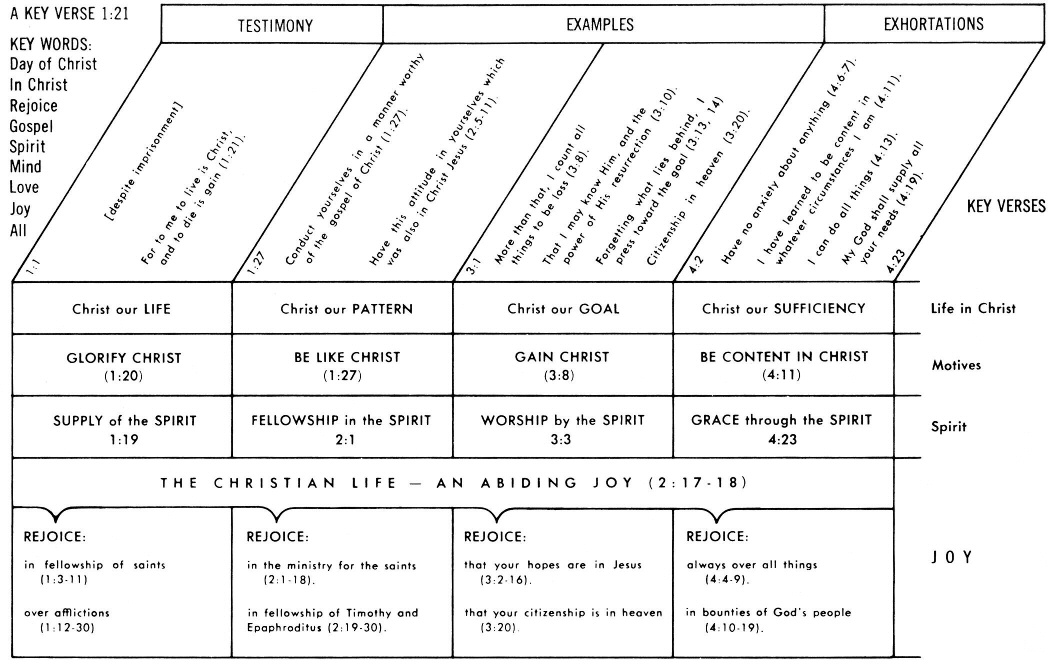
LIFE IN CHRIST
Click chart to enlarge
Charts from Jensen's Survey of the NT - used by permission
Philippians - Charles Swindoll = Chart on right side of page
| Account of Paul's Circumstances Php 1:1-30 |
Have the Mind of Christ Php 2:1-30 |
Have the Knowledge of Christ Php 3:1-21 |
Have |
| Partakers of Christ | People of Christ | Pursuit of Christ | Power of Christ |
| Suffering | Submission | Salvation | Sanctification |
| Experience | Examples | Exhortation | |

Philippi in the Time of Paul
The city plan above shows those features of the city of Philippi that archaeologists have so far identified as dating from the time of Paul. “Paul’s Prison” is not believed to be an authentic site, but was a cistern later associated with Christian worship. (ESV.org)
Philippians 1:29. for to you it has been granted (graciously conferred) for (on behalf of) Christ's sake, not only to believe in Him, but also to suffer for (on behalf of) His sake, (NASB: Lockman)
Greek: hoti humin echaristhe (3SAPI ) to huper Christou, ou monon to eis auton pisteuein (PAN) alla kai to huper autou paschein, (PAN)
Amplified: For you have been granted [the privilege] for Christ's sake not only to believe in (adhere to, rely on, and trust in) Him, but also to suffer in His behalf. (Amplified Bible - Lockman)
NIV: For it has been granted to you on behalf of Christ not only to believe on him, but also to suffer for him, (NIV - IBS)
NLT: For you have been given not only the privilege of trusting in Christ but also the privilege of suffering for him. (NLT - Tyndale House)
Phillips: You are given, in this battle, the privilege not merely of believing in Christ but also of suffering for his sake (Phillips: Touchstone)
Wuest: And the reason why you should not be terrified is because to you that very thing was given graciously as a favor for the sake of Christ and in His behalf, not only to be believing on Him but also to be suffering for His sake and in His behalf, (Eerdmans Publishing - used by permission)
Young's Literal: because to you it was granted, on behalf of Christ, not only to believe in him, but also on behalf of him to suffer;
FOR TO YOU IT HAS BEEN GRANTED FOR CHRIST'S SAKE: hoti humin echaristhe (3SAPI ) to huper Christou:
- Acts 5:41; Ro 5:3; Jas 1:2; 1Pe 4:13
For it has been granted to you on behalf of Christ " (Lightfoot 1)
for it is his grace, his privilege bestowed upon you, that for Christ (Lightfoot 2)
For to you has been given the privilege of doing something for Christ (Barclay)
You are given, in this battle, the privilege (Phillips)
And the reason why you should not be terrified is because to you that very thing was given graciously as a favor for the sake of Christ and in His behalf, not only to be believing on Him but also to be suffering for His sake and in His behalf" (Wuest)
DOUBLE ASSURANCE
For (hoti) (see term of explanation) explains the reason the saints at Philippi did not need to be terrified by their opponents. Why? Because the opposition had been granted to them from God as a gift of grace as explained below!
Gene Getz - Christians need not experience persecution at the hands of the opponents of Christianity to be assured of the reality of their faith. But when they do, Paul implied, it is "double assurance" and a privilege. Hence Paul wrote, "For it has been granted to you on behalf of Christ not only to believe on him, but also to suffer for him...." Belief is enough to be assured of heaven. "Since we have been justified through faith, we have peace with God through our Lord Jesus Christ," Paul wrote to the Romans (5:1). But, he said, when you suffer too, be doubly assured you are in God's family.
Vincent writes that (hoti) for "justifies the preceding statement, but with special reference to soteria. The evidence that your courage is a divine token of salvation lies in the fact that God has graciously bestowed on you, along with faith in Christ, the privilege of suffering with Him. For faith implies oneness with Christ, and therefore fellowship with His sufferings (Ro 8:17; 2Th 1:5; 2Ti 2:12; Php 3:10). That you suffer with Christ proves your union with Him, and your union with Christ insures your salvation. (Philippians 1:29-30 Commentary)
Lange's Commentary "For unto you it was given confirms the statement in Php 1:28, the last words of which (apo theou = from God) led the Apostle to adopt the passive form here. It is just you who are struggling and suffering together, to whom this grace [or undeserved favor] has been granted (charizomai) by God. Hence "you" (humin) has the emphatic position. (Philippians 1:27-30 Commentary)
You (humin) is emphatic by position and corresponds with the humon in Php 1:28.
Brian Bill - In our American Christian subculture, where we often speak of blessings, prosperity and God’s favor, Php 1:29 provides a good corrective for us: “For it has been granted to you on behalf of Christ not only to believe on Him, but also to suffer for Him.” The Greek word translated “granted” is derived from a word meaning “grace” or “favor.” The noun form is used for spiritual gifts, and has the idea of “bestowing graciously.” Everything comes from God. I want you to notice that we have been “granted” two things: salvation and suffering. We are quick to attribute our salvation to God’s grace but slow to realize that suffering is also a gift. Do you see your problems as a privilege? The apostles had this perspective in Acts 5:41. Some of us think we suffer because of our sins, and maybe we do bear the consequences of our actions, but suffering is also part of God’s plan for each of us. 2 Timothy 3:12. Friends, salvation comes from the Lord, and so does suffering. When you go through a tough time it doesn’t mean that God let something get through while He was asleep. Everything comes to you through the filter of His faithfulness. And suffering is part of his plan for each of us. Some of us are surprised and then become angry when we go through tough times. It’s almost like we say, “Hey, what happened here? I didn’t ask for this. This isn’t what I signed up for. I have a right to be happy and blessed.” When you’re being tossed around by trials remember the words of 1 Peter 4:12-13: “Dear friends, do not be surprised at the painful trial you are suffering, as though something strange were happening to you. But rejoice that you participate in the sufferings of Christ…” Here’s the deal: we are blessed up when we’re messed up.
TWO DIVINE GIFTS
Granted (5483) (charizomai from charis = grace, unmerited favor) signifies a gift of grace and is the same verb Paul used in Php 2:9 (note) to describe the "bestowal" of the Name above every name upon Jesus. Suffering for the sake of Christ is the gift of grace or as both Barclay and Phillips put it "the privilege".
Charizomai is notes especially a grant of free favor or of kindness and thus is often used of free forgiveness (Lk 7:42, 2Co 2:7, 10, Ep 4:32, Col 3:13), sometimes of the work of free grace and salvation (Ro 8:32, 1Co 2:12), of an arbitrary, extra-legal, giving up of a prisoner to others, either for their freedom or penalty (Ac 3:14, 25:11, 16).
H C G Moule says that charizomai in this context speaks of "associations of sovereignty, favor, boon, (and) forms a noble paradox."
Marvin Vincent - ‘it hath been granted’; freely bestowed as a gracious gift. The word is significant as opening the conception of suffering from the Christian point of view. God rewards and indorses believers with the gift of suffering. In Paul’s bonds the Philippians are partakers with him of grace (Php 1:7. cp Acts 5.41). The aorist points to the original bestowment of the gift. (See Mt 5:11; Mk 10:38, 39.) (Philippians 1:29-30 Commentary Online)
Eadie observes that "The aorist is used, as the apostle refers indefinitely to an early period of their past Christian history; but that the suffering continued, also, to the moment of his writing, is evident from the following echontes (experiencing - present tense = continuously)…Faith in Christ is the means of salvation; but suffering is the evident token of salvation. The one secures it, the other foreshows it. The martyr is not saved, indeed, because he suffers; but his undaunted suffering betokens a present Saviour and a near salvation. (Philippians 1 Commentary)
Note the two gifts: (1) The gift of faith which enables us to believe in Christ in the first place. Without this gift from the Lord, we would never be saved in the first place. (2) Then there is the gift of suffering—but it is the gift no one wants.
Entering into the new covenant and becoming one with Christ brings believers into a unique fellowship, one that carries with it the privilege of sharing in His suffering (Php 3:10), or as some have referred to it as "The Fellowship of the Unashamed."
Although our flesh shrinks from this genre of teaching (when was the last time you preached a sermon on God has granted you a gift… to suffer!?), the clarion call to suffer is not unique to the writings of Paul, for Jesus also warned His disciples (and us) that
you will be hated by all on account of My name" (Mt 10:22) for "If the world hates you, you know that it has hated Me before it hated you. If you were of the world, the world would love its own; but because you are not of the world, but I chose you out of the world, therefore the world hates you. Remember the word that I said to you, 'A slave is not greater than his master.' If they persecuted Me, they will also persecute you. But all these things they will do to you for My name's sake, because they do not know the One who sent Me. (Jn 15:18,19, 20, 21)
Keep in mind the Scriptural principle that the cross always precedes the crown -- temporal suffering now but eternal glory in the hereafter. The meaning and value of the suffering lay in the fact that it is for Christ's sake. A lot of suffering is self-made, the result of sinful behavior or actions and is not the "quality" of suffering Paul is referring to here.
Suffering for the Name of Christ develops our spiritual muscles and gives us fresh courage to face whatever foe we may encounter. And let us never forget that our side ultimately wins! We need the attitude of the early Christians one of whom was addressed by a scoffer
"What is your Carpenter doing now?"
And the answer of the unperturbed Christian was bold
"Making a coffin for your Emperor!"
When you suffer, apply this litmus test -- for whose sake am I suffering? for my name's sake or His? And remember you are not alone…
Peter writes that when we are be attacked by the devil we are to…
resist (aorist imperative = a command from our Commander in chief calling for immediate attention, acquiescence and action!) him, firm in your faith, knowing that the same experiences of suffering are being accomplished by your brethren who are in the world. And after you have suffered for a little while (relative to eternity!), the God of all grace (How much grace? cp 2Co 12:9), Who called you to His eternal glory in Christ, will Himself (cp Php 1:6, 1Th 5:24) perfect, confirm, strengthen and establish you. (1Pe 5:9, 1Pe 5:10)
All suffering not for Christ's sake, albeit very real, is but worthless wood, hay and stubble at the judgment seat of Christ. Don't suffer for the wrong reason.
Paul describing the privilege the Macedonia churches had to suffer for Christ wrote that in a
great ordeal of affliction their abundance of joy and their deep poverty overflowed in the wealth of their liberality. (2Cor 8:2)
Lightfoot adds that
When God has granted one the High privilege of suffering for His Name it is one of the surest signs that He looks upon you with favor because to suffer for Christ (in the interest of His cause) is a favor granted only to those who believe in him. (Philippians 1:27-30 Commentary Online)
Dr. Griffith John wrote that once when he was surrounded by a hostile heathen crowd and was beaten, he put his hand to his face and when he withdrew it, saw that it was bathed in blood.
He was possessed by an extraordinary sense of exaltation, and he rejoiced that he had been counted worthy to suffer for His Name.
Is it not remarkable that even suffering is exalted by Christianity to such a lofty plane? As someone has said even “an apparent trifle burns with the fire immortal when it is in communion with the Infinite.” The cross dignifies and ennobles.
Spurgeon has an interesting thought..
What an honor this is to be conferred upon any follower of Christ,—”not only to believe on him, but also to suffer for his sake”! It is not every Christian who receives this mark of honor. There are some believers who have peculiarly tender places in their hearts, and who are wounded and gashed by the unkind remarks of those who love them not because they love the Lord Jesus Christ. To you, my brother, my sister, it is given—and you may well rejoice in such a gift,—”not only to believe on him, but also to suffer for his sake.” (Spurgeon on Philippians)
Gordon Fee has a pithy commentary on the modern evangelical church writing that…
One of the reasons most of us in the West do not know more about the content of Philippians 1:29-30 is that we have so poorly heeded the threefold exhortation that precedes (Phil 1:27) (Fee, Gordon D. Paul’s Letter to the Philippians. New International Commentary on the New Testament series. Page 173. Grand Rapids: Wm. B. Eerdmans Publishing Co., 1995)
NOT ONLY TO BELIEVE IN HIM BUT ALSO TO SUFFER FOR HIS SAKE: ou monon to eis auton pisteuein (PAN) alla kai to huper autou paschein (PAN):
- Mt 16:17; Jn1:12, 13; 6:44; 6:45 Act 13:39; 14:27; Ep 2:8; Col 2:12; Jas1:17 18
yea, that ye should not only believe on him, but also should suffer for him (Lightfoot 2)
the privilege of not only believing in him, but also of suffering for him, for you have the same struggle as that in which you have seen me engaged, and which now you hear that I am undergoing. (Barclay)
not merely of believing in Christ but also of suffering for his sake. It is now your turn to take part in that battle you once saw me engaged in, and which, in point of fact, I am still fighting. (Phillips)
TWO GIFTS OF
GOD'S GRACE
Believe in Him - Is literally "continually believing into Him" which H C G Moule says suggests
the directness and holdfast of saving faith. But this specialty of meaning must not be pressed too far, for the phrase occurs here and there in connections not naturally adapted to such thought (eg, Jn 2:23, 12:42 - The Greek verb is in the present tense, and points to the continuousness of the action of faith. The Christian, having once believed, lives by still believing. See Ro 11:20, Gal 2:20, He 10:38 (Ed: In other words we are saved by faith alone at the inception, but day by day in our progress along the path of sanctification or holiness, we are STILL saved by the same faith, now being exercised continually and being manifest as our Spirit filled, grace enabled obedience -- faith shows itself real and effective by obeying without hesitation when the Spirit moves us one direction or another! See related discussion on Obedience of faith - Roman 1:5, 16:25 - What does it mean?) -- Faith in Christ is here incidentally spoken of as a grant of Divine grace. See further on this, Eph 2:8, and note in this series. (The Epistle to the Philippians Online)
FIRST BELIEVE IN HIM
THEN SUFFER FOR HIM
Believe (4100) (pisteuo) means to be persuaded of, to place confidence in, to trust in, to place reliance upon. There is an active staking of one's life on the claims of God. In other words Biblical, saving belief denotes more than passive intellectual assent to the facts about Jesus. The demons believe (pisteuo) that God is one and yet they are clearly not saved (Jas 2:19;)! The faith in and reliance upon Jesus involves not only the consent of one's intellect or mind, but also involves a surrender of one's heart and will to the truth about Jesus (cp Jn 14:6, Acts 4:12, Jn 8:24, Ro 10:9, 10:10, et al).
Note that the verb is in the present tense. indicating that this belief is the saint's "lifestyle", so that not only did faith alone bring about justification, faith alone "energizes" our day by day sanctification. We begin this new life in Christ by faith and we continue in faith (in contrast to trying to merit sanctification by our "works", cf Ga 3:1-4:10 [= "legalism"], Ga 5:1, 5, 7, 13, 16; 2 Co 5:7). To say it another way our belief in Jesus is not something static, but it is dynamic, it never ends or fizzles out. Sure, the flame of our faith may grow dim at times, but it never goes completely out. So if you hear someone say "I believed in Jesus 20 years ago but don't believe in Him now," you can know that he never truly believed. He may have intellectually comprehended, but he did not genuinely believe, because belief is continuing and dynamic until the day we die. This is not to say genuine believers will not experience times in their life when they find it difficult to believe. Many will, but at some point the "reset" button of their heart brings them back to dynamic belief. Here in Php 1:29 Paul emphasizes that this capacity to keep on believing is a grace gift of God, not something we stir up in our heart. We continue to believe because it has been granted to us by God.
Repentance is also God's gift (cp Acts 5:31, 11:18, 2Ti 2:25, Ro 2:4) like faith (Eph 2:8, 9), so that from the beginning to the end, our salvation is a gracious gift from a loving God. Jonah after being delivered from the belly of a fish declared "Salvation is from Jehovah" (Jonah 2:9)
W E Vine has the following definition of Biblical belief writing that it is…
(1) A firm conviction which produces full acknowledgment of God's revelation of Truth (2Th 2:11,12 )
(2) a personal surrender to the Truth (Jn1:12) and
(3) a conduct inspired by and consistent with that surrender (2Co 5:7). Prominence is given to one or other of these elements according to the context.
All this stands in contrast to belief in its purely natural exercise, which consists of an opinion held in good "faith" without necessary reference to its proof. The object of Abraham's "faith" was not God's promise (that was the occasion of its exercise); his "faith" rested on God Himself, Ro 4:17, Ro 4:20,21. (Vine's Expository Dictionary of New Testament Words Online)
The Greek scholar Marvin Vincent adds that pisteuo "means to persuade, to cause belief, to induce one to do something by persuading, and so runs into the meaning of to obey, properly as the result of persuasion." (Vincent's Word Studies)
Barnes - It is represented here as a privilege to be permitted to believe on Christ. It is so.
(1.) It is an honour to a man to believe one who ought to be believed, to trust one who ought to be trusted, to love one who ought to be loved.
(2.) It is a privilege to believe on Christ, because it is by such faith that our sins are forgiven; that we become reconciled to God, and have the hope of heaven.
(3.) It is a privilege, because it saves the mind from the tortures and the deadly influence of unbelief—the agitation, and restlessness, and darkness, and gloom of a skeptic.
(4.) It is a privilege, because we have then a Friend to whom we may go in trial, and on whom me may roll all our burdens. If there is anything for which a Christian ought to give unfeigned thanks, it is that he has been permitted to believe on the Redeemer. Let a sincere Christian compare his peace, and joy, and hope of heaven, and support in trials, with the restlessness, uneasiness, and dread of death, in the mind of an unbeliever, and he will see abundant occasion for gratitude. (Philippians 1 Commentary)
Hendriksen writes that we are "to believe in him, that is, to rest on Christ, surrendering oneself to his loving heart, depending on his accomplished mediatorial work. The form of the expression as used in the original shows that here genuine, personal trust in the Anointed One is meant. Whether or not one regards Eph. 2:8 as proof for the proposition that such faith is God’s gift, the conclusion is at any rate inescapable that here in Phil. 1:29 faith — not only its inception but also its continued activity — is so regarded. It is at one and the same time God’s gift and man’s responsibility." (NT Commentary Baker)
PERSECUTION IS A
BELIEVER'S PRIVILEGE
Dwight Edwards - Paul is giving another reason for not shirking back from those that would oppose and persecute us. Suffering for Christ is our birthright. God has not only graciously allowed us to believe in the name of Christ, He has also graciously allowed us to suffer on behalf of Christ. Interesting that Paul uses "granted" here, showing that suffering for Christ is a privilege. And he was not the only one who was to be sharing in this privilege--so were the Philippians as well as us. When suffering for Christ is properly understood it is most certainly a privilege, a gracious grant. Because of these sufferings, eternity becomes a richer experience.
“Blessed are you when people insult you and persecute you, and falsely say all kinds of evil against you because of Me. “Rejoice and be glad,(agalliao from agan = much + hallomai = jump; gush, leap, spring up means literally "jump for joy") for your reward in heaven is great; for in the same way they persecuted the prophets who were before you. . (Mt 5:11-12)
Remember that to suffer for Jesus is a spiritual gift from God. We love to talk about spiritual gifts, but this is one that is usually not on the list!
"GRACE THAT COMES
FROM GRIEF"
Brian Bill - There are a number of purposes behind suffering. We could call this the grace that comes from grief or the promises that come from our problems:
- Suffering matures us. James 1:2-4: “Consider it pure joy, my brothers, whenever you face trials of many kinds, because you know that the testing of your faith develops perseverance. Perseverance must finish its work so that you may be mature and complete, not lacking anything.”
- Suffering weans us from self-reliance. 2 Corinthians 1:9: “Indeed, in our hearts we felt the sentence of death. But this happened that we might not rely on ourselves but on God, who raises the dead.”
- Suffering is an evangelistic tool. Philippians 1:12: “Now I want you to know, brothers, that what has happened to me has really served to advance the gospel.”
- Suffering increases our eternal reward. Matthew 5:12: “Rejoice and be glad, because great is your reward in heaven, for in the same way they persecuted the prophets who were before you.”
- Suffering helps us minister to others. 2 Corinthians 1:3-4: “Praise be to the God and Father of our Lord Jesus Christ, the Father of compassion and the God of all comfort, who comforts us in all our troubles, so that we can comfort those in any trouble with the comfort we ourselves have received from God.”
- Suffering helps keep down pride. 2 Corinthians 12:7: “To keep me from becoming conceited because of these surpassingly great revelations, there was given me a thorn in my flesh, a messenger of Satan, to torment me.”
- Suffering shows we belong to Christ. Phil 3:10: “I want to know Christ and the power of his resurrection and the fellowship of sharing in his sufferings, becoming like him in his death.”
THREE ILLUSTRATIONS OF SUFFERING:
E Stanley Jones, who has been called “Missionary Extraordinary,” ministered on multiple continents and knew how to impact cultures. I love his perspective on how we should respond to our increasing non-Christian culture: “The early Christians did not say in dismay: ‘Look what the world has come to,’ but in delight, ‘Look what has come to the world.’ They saw not merely the ruin, but the resources for the reconstruction of that ruin. They saw not merely the sin that did abound, but that grace did much more abound. On that assurance the pivot of history swung from blank despair, loss of moral fervor, and fatalism, to faith and confidence that at last sin had met its match, that something new had come into the world…” (“Abundant Living,” Page 183).Before missionary Karen Watson went to Iraq, she counted the cost. She left a letter with her pastor that said: “You’re only reading this if I died.” She was martyred a little over a year ago. Her letter included gracious words to family and friends and this simple summary of what it means to follow Christ: “To obey was my objective, to suffer was expected, His glory my reward.”
John Wesley was riding on his horse once when it dawned on him that he had not been persecuted for three days. He got off his horse, got down on his knees and said,“Maybe I’ve sinned or been disobedient.” Just then a man on the other side of the road recognized him and heaved a rock at him. It bounced off the road, just missing Wesley’s head. He then leapt to his feet and shouted, “Thanks be to God! Everything’s all right. I still have God’s presence with me.”
Suffer (3958) (pascho) means essentially what happens to a person experience. It means to undergo something; to experience a sensation, to experience an impression from an outside source, to undergo an experience (usually difficult) and normally with the implication of physical or psychological suffering.
Pascho can refer to experiencing something pleasant, but in the present context (and most NT contexts) it refers to experiencing something trying, distressing or painful.
In context, our present suffering for Christ is viewed paradoxically as a gift of grace or unmerited divine favor (charizomai [word study]), for we as sinful men no more deserve to suffer for Christ than we deserve to be saved by His precious blood! But now, dearly beloved, chosen saint of God, have you ever considered your suffering for the Savior in the light of this holy truth? Remember truth renews our mind and transforms our thinking, and in this case the truth about suffering should serve to prepare us to persevere with praise when persecution comes in its variegated forms! Contrast the "before and after" attitude of Peter in Acts 5:41 with his response resulting from his failure to understand the high calling and privilege of suffering with and for the Savior - Mt 26:71, 72, 73, 74, 75! Truth received and assimilated transforms a man from cowardice to courage!
Webster (1828) says that to suffer is "To feel or bear what is painful, disagree able or distressing, either to the body or mind. We suffer pain of body; we suffer grief of mind. The criminal suffers punishment; the sinner suffers the pangs of conscience in this life, and is condemned to suffer the wrath of an offended God. We often suffer wrong; we suffer abuse; we suffer injustice… To feel or undergo pain of body or mind; to bear what is inconvenient. We suffer with pain, sickness or sorrow. We suffer with anxiety. We suffer by evils past and by anticipating others to come. We suffer from fear and from disappointed, hopes.
Of mental suffering (Pilate's wife Mt 27:19), of one suffering from epilepsy (Mt 17:15), of the events in Jesus' life leading up to and including the Cross (Mt 16:21, 17:12, Mk 8:31, 9:12, 22, Lk 17:25, 22:15, 24:26, 46, Acts 1:3, 3:18, 17:3, He 13:12, 1Pe 2:21, 23, 4:1), of physical harm as from poison (Acts 28:5), of suffering for what is right (Php 1:29, 1Th 2:14, 1Pe 2:19, 20, 3:14, 17), of suffering according to the will of God (1Pe 4:9). Pascho in the NT describes suffering that has a termination (1Pe 5:10) and is not to be feared by believers (Re 2:10).
Paul understood this divine gift (cp 2Ti 1:12 - notice why he suffered [2Ti 1:11] and how he was enabled to suffer - it was not just what he knew but Who he knew!). Jesus understands your suffering for He has walked this road as no other man (see passages above on events leading to the Cross, cp He 2:18, He 5:8, 1Pe 2:21)
Gromacki rightly observes that "Most Christians (Ed: Especially those in the ease and comfort and relative prosperity of American Christianity) are like Peter in his earlier discipleship. They want the glory of the kingdom without the sufferings of the cross. They do not consider any suffering to be a gift. They want faith without conflict. These reactions show a great lack in their understanding of God’s dealings with His children. (Gromacki, R., Dr. Stand United in Joy: An Exposition of Philippians. The Woodlands, TX: Kress Christian Publications)
Thayer on pascho…
from Homer down; to be affected or have been affected, to feel, have a sensible experience, to undergo -- used in either a good or a bad sense; of perils and deliverance from them (Esther 9:26); o stiffer sadly, be in bad plight, of a sick person, (Mt 17:15)
1. (majority of the NT uses) In a bad sense, of misfortunes, to suffer, to undergo evils, to be afflicted (so everywhere in Homer and Hesiod; also in the other Greek writings where it is used absolutely): absolutely
2. In a good sense, of pleasant experiences with only one possible such use in NT (Gal 3:4)
TDNT…
The basic meaning of pascho is “to experience something that comes from outside,” At first the “something” is usually bad, and while a neutral use develops, the idea of suffering evil remains so strong that an addition is needed to show that good is meant unless the context is very plain.
2. The forensic use “to suffer punishment” is fairly old, and occurs especially for corporal of capital punishment.
3. Evils suffered are misfortune and disfavor (human of divine). In the case of sickness the idea is that of suffering from it rather than under it. The stress is always on the experience of evil rather than painful feelings. When pascho denotes emotions, the reference is more to moods than to sufferings. The group raises the question of suffering, and to this many answers are attempted. Tragedy suggests learning through suffering, Stoicism aims at freedom in its negation (apatheia), the Hermetic writings promise redemption from it, at first by initiation and definitively, after death, by deification. (Kittel, G., Friedrich, G., & Bromiley, G. W. Theological Dictionary of the New Testament. Eerdmans)
NIDNTT…
The basic meaning of the verb (pascho), in use from Homer onwards, is that of experiencing something which stems from outside of myself but which affects me, either for good or ill. The opposite idea is expressed by vbs. denoting freedom of action… pascho originally meant nothing more than “to be affected by”, but how one was affected had to be expressed by additional words, e.g. kakos paschein, to be in a bad situation (Homer, Od. 16, 275); eu paschein, to be in a good situation (Sophocles, OC 1489). However, since such additions tended to be negative, the verb itself came to have a negative meaning, unless there were clear indications to the contrary. Thus the idea of being affected is replaced by that of suffering… In most cases it is a matter of being delivered up to an adverse fate or to malevolent gods and men (Diogenes Laertius, 5, 61; Diodorus Siculus, 13, 98, 2), and only rarely refers to enduring a punishment. (Brown, Colin, Editor. New International Dictionary of NT Theology. 1986. Zondervan)
BDAG - to experience something, be treated’ (pascho expresses the passive idea corresponding to the active idea in poieo [to do]) of everything that befalls a person, whether good or ill. Yet its usage developed in such a way that pascho came to be used less and less frequently in a good sense, and never thus without some clear indication, at least from the context, that the good sense is meant… In all other places, as always in LXX, in an unfavorable sense suffer, endure. (Arndt, W., Danker, F. W., & Bauer, W. A Greek-English Lexicon of the New Testament and Other Early Christian Literature)
Pascho - 42x in 41v - NAS = endured(1), endured… sufferings(1), suffer(22), suffered(10), suffering(4), suffers(2). Notice that First Peter is clearly a major "treatise" on suffering!
Matthew 16:21 From that time Jesus began to show His disciples that He must go to Jerusalem, and suffer many things from the elders and chief priests and scribes, and be killed, and be raised up on the third day.
Matthew 17:12 but I say to you that Elijah already came, and they did not recognize him, but did to him whatever they wished. So also the Son of Man is going to suffer at their hands."
Matthew 17:15 "Lord, have mercy on my son, for he is a lunatic (literally = "he is moonstruck," possibly meaning "lunatic" although now the term is generally regarded as referring to some sort of seizure disorder such as epilepsy - NET Bible Note) and is very ill ("suffers terribly"); for he often falls into the fire and often into the water.
Matthew 27:19 While he was sitting on the judgment seat, his wife sent him a message, saying, "Have nothing to do with that righteous Man; for last night I suffered greatly in a dream because of Him."
Mark 5:26 and had endured ("suffered") much at the hands of many physicians, and had spent all that she had and was not helped at all, but rather had grown worse--
Mark 8:31 And He began to teach them that the Son of Man must suffer many things and be rejected by the elders and the chief priests and the scribes, and be killed, and after three days rise again.
Mark 9:12 And He said to them, "Elijah does first come and restore all things. And yet how is it written of the Son of Man that He will suffer many things and be treated with contempt?
Luke 9:22 saying, "The Son of Man must suffer many things and be rejected by the elders and chief priests and scribes, and be killed and be raised up on the third day."
Luke 13:2 And Jesus said to them, "Do you suppose that these Galileans were greater sinners than all other Galileans because they suffered this fate?
Luke 17:25 "But first He must suffer many things and be rejected by this generation.
Luke 22:15 And He said to them, "I have earnestly desired to eat this Passover with you before I suffer;
Luke 24:26 "Was it not necessary for the Christ to suffer these things and to enter into His glory?"
Luke 24:46 and He said to them, "Thus it is written, that the Christ would suffer and rise again from the dead the third day,
Acts 1:3 To these He also presented Himself alive after His suffering, by many convincing proofs, appearing to them over a period of forty days and speaking of the things concerning the kingdom of God.
Acts 3:18 "But the things which God announced beforehand by the mouth of all the prophets, that His Christ would suffer, He has thus fulfilled.
Acts 9:16 (context Acts 9:15 Jesus speaking of Paul's "race" of faith) for I will show him how much he must suffer for My name's sake."
Acts 17:3 explaining and giving evidence that the Christ had to suffer and rise again from the dead, and saying, "This Jesus whom I am proclaiming to you is the Christ."
Acts 28:5 However he shook the creature off into the fire and suffered no harm.
1 Corinthians 12:26 And if one member suffers, all the members suffer with (sumpascho = speaks of an intimate sharing with another, feeling their pain - see the prefix used in this verb = sun/syn) it; if one member is honored, all the members rejoice with it.
2 Corinthians 1:6 But if we are afflicted, it is for your comfort and salvation; or if we are comforted, it is for your comfort, which is effective in the patient enduring of the same sufferings which we also suffer;
Galatians 3:4 Did you suffer so many things in vain-- if indeed it was in vain?
Philippians 1:29 For to you it has been granted for Christ's sake, not only to believe in Him, but also to suffer for His sake,
1 Thessalonians 2:14 For you, brethren, became imitators of the churches of God in Christ Jesus that are in Judea, for you also endured the same sufferings at the hands of your own countrymen, even as they did from the Jews,
2 Thessalonians 1:5 This is a plain indication of God's righteous judgment so that you will be considered worthy of the kingdom of God, for which indeed you are suffering.
2 Timothy 1:12 For this reason I also suffer these things, but I am not ashamed; for I know whom I have believed and I am convinced that He is able to guard what I have entrusted to Him until that day.
Hebrews 2:18 For since He Himself was tempted in that which He has suffered, He is able to come to the aid of those who are tempted.
Hebrews 5:8 Although He was a Son, He learned obedience from the things which He suffered.
Hebrews 9:26 Otherwise, He would have needed to suffer often since the foundation of the world; but now once at the consummation of the ages He has been manifested to put away sin by the sacrifice of Himself.
Hebrews 13:12 Therefore Jesus also, that He might sanctify the people through His own blood, suffered outside the gate.
1 Peter 2:19 For this finds favor, if for the sake of conscience toward God a person bears up under sorrows when suffering unjustly.
1 Peter 2:20 For what credit is there if, when you sin and are harshly treated, you endure it with patience? But if when you do what is right and suffer for it you patiently endure it, this finds favor with God.
1 Peter 2:21 For you have been called for this purpose, since Christ also suffered for you, leaving you an example for you to follow in His steps,
1 Peter 2:23 and while being reviled, He did not revile in return; while suffering, He uttered no threats, but kept entrusting Himself to Him who judges righteously;
1 Peter 3:14 But even if you should suffer for the sake of righteousness, you are blessed. AND DO NOT FEAR THEIR INTIMIDATION, AND DO NOT BE TROUBLED,
1 Peter 3:17 For it is better, if God should will it so, that you suffer for doing what is right rather than for doing what is wrong.
1 Peter 3:18 For Christ also died (apothnesko - see note below) for sins once for all, the just for the unjust, so that He might bring us to God, having been put to death in the flesh, but made alive in the spirit;
Comment: Note that some manuscripts have apothnesko (to die) in place of pascho. The NET note says that "Although the external evidence slightly favors apothnesko, such may be a secondary reading. Intrinsically, pascho both fits the context better… "
NET rendering = 1Peter 3:18 Because Christ also suffered once for sins, the just for the unjust, to bring you to God, by being put to death in the flesh but by being made alive in the spirit.
1 Peter 4:1 Therefore, since Christ has suffered in the flesh, arm yourselves also with the same purpose, because he who has suffered in the flesh has ceased from sin,
1 Peter 4:15 Make sure that none of you suffers as a murderer, or thief, or evildoer, or a troublesome meddler;
1 Peter 4:19 Therefore, those also who suffer according to the will of God shall entrust their souls to a faithful Creator in doing what is right.
1 Peter 5:10 After you have suffered for a little while, the God of all grace, who called you to His eternal glory in Christ, will Himself perfect, confirm, strengthen and establish you.
Revelation 2:10 'Do not fear what you are about to suffer. Behold, the devil is about to cast some of you into prison, so that you will be tested, and you will have tribulation for ten days. Be faithful until death, and I will give you the crown of life.
The suffering of a saint for the sake of Christ can take many forms: physical pain, isolation, loneliness, grief, anxiety, etc. Because so many saints do not understand the benefits of suffering, few of them view suffering for their testimony as a blessing, even though Scripture clearly teaches that is what it is. Suffering is one of the tools God uses to mold his children into vessels that bring glory to His Son (cf. Jas 1:3, 4; 1Pe 1:6, 7). Suffering even perfected the Lord Jesus (Heb 2:10).
Sam Storms - God does not witness to the world by taking His people out of suffering, but rather by demonstrating His grace though them in the midst of pain.
Guzik - The Philippians didn’t need to fear that their present trial (and Paul’s present trial) meant that God abandoned them. Their present difficulty was granted to them, not as a punishment, but as a tool in God’s hand. (Philippians 1 Commentary)
In his last words to Timothy Paul alerted him to the same truth…
Indeed, all who desire to live godly in Christ Jesus will be persecuted. (2Ti 3:12)
Lehman Strauss - The very fact that a man identifies himself with Jesus Christ will result in his suffering for his Lord. Jesus said: "If they have persecuted Me, they will also persecute you" (John 15:20)… To believe in Christ in our day means the very opposite of hardship and suffering. It has come to mean that the believer now has a place in a church pew where he can sit snugly and smugly. But when the child of God takes his place in the battle against evil, the devil will see to it that he has plenty of opposition. Paul speaks of such suffering as a favor granted of God. Actually it is a part of the grace of God bestowed on Christians when we are called to share the sufferings of Christ. The apostle realized this when called upon to suffer. "And they departed from the presence of the council, rejoicing that they were counted worthy to suffer shame for His name" (Acts 5:41). Suffering may differ today in meaning from its meaning in the earlier days of the Church. By that I mean that it may not mean bodily torment, imprisonment, starvation, and even a torturous death, but it will always be the price one pays when he sincerely and uncompromisingly identifies himself with Jesus Christ.
Constable - All believers have received a gracious gift from God. It is the privilege of suffering for Jesus Christ. Few Christians view suffering for their testimony as a blessing, but that is really what it is. Suffering is one of the tools God uses to mold his children into vessels that bring glory to His Son (cf. James 1:3–4; 1 Pet. 1:6–7). Suffering even perfected the Lord Jesus (Heb. 2:10). (Philippians Commentary Notes)
Adam Clarke - To you it is graciously given; it is no small privilege that God has so far honored you as to permit you to suffer on Christ's account. It is only his most faithful servants that he thus honors. Be not therefore terrified by your enemies; they can do nothing to you which God will not turn to your eternal advantage. We learn from this that it is as great a privilege to suffer for Christ as to believe on him; and the former in certain cases (as far as the latter in all cases) becomes the means of salvation to them who are thus exercised. (Philippians 1 Commentary)
Lange's Commentary - The faith which works such steadfast endurance of suffering clearly proves that both are from God. (Philippians 1:27-30 Commentary Online)
Albert Barnes…
It is a privilege thus to suffer in the cause of Christ, because
(1.) we then resemble the Lord Jesus, and are united with Him in trials;
(2.) because we have evidence that we are His, if trials come upon us in His cause;
(3.) because we are engaged in a good cause, and the privilege of maintaining such a cause is worth much of suffering; and
(4.) because it will be connected with a brighter crown and more exalted honour in heaven. (Philippians 1 Commentary)
Hendriksen adds that…
There are adversaries who cause believers to suffer. Now suffering is not a privilege in itself. One should not court suffering. But suffering in behalf of Christ, in the interest of him and his gospel is different. Such suffering is indeed a blessing, a gracious privilege (Acts 5:41), because:
a. It brings Christ nearer to the soul of the Christian. In his suffering for Christ’s sake the believer begins to understand the One who suffered redemptively for him and receives the sweetness of his enduring fellowship. It is “without the gate” that God’s child, reproached by the enemy, meets his Lord (Heb 13:13). See also such other wonderful passages as Job 42:5, 6; Ps 119:67; 2Cor. 4:10; Gal. 617; Heb. 12:6.
b. Accordingly, it brings assurance of salvation, the conviction that the Spirit of glory and the Spirit of God rests upon the sufferer (1Pe 4:14; cf. Jn 15:19, 20, 21).
c. It will be rewarded in the hereafter (Ro 8:18; 2Cor 4:17, 18; 2Ti 2:12; 2Ti 4:7, 8-noter; 1Pe 4:13).
d. It is often a means of winning unbelievers for Christ and of encouraging fellow-believers (that thought is stressed in the very context; Php 1:12, 13,1 4).
e. By means of all these avenues it leads to the frustration of Satan (book of Job) and the glorification of God (Acts 9:16). (Hendriksen, W., & Kistemaker, S. J. NT Commentary Set. Baker Book)
John Phillips encourages all suffering saints reminding us that…
Christians should feel honored when they are chosen to suffer with Christ (cp Mt 5:10, 11, 12), for their reward in Heaven will be commensurate with their sacrifice. If believers share in Christ's cross, they will share in His crown. Someone… might justly ask, "Well, what about you? What have you suffered for Christ?" I would have to confess, "Very little." The reader might then ask me, "Would you be able to stand torture and a painful martyrdom?" I don't know. I trust I would be faithful unto death; I would certainly want to be. Doubtless God would give the necessary grace if the time of testing should ever come. Dying grace is for dying, not living. Grace to suffer persecution is for those who are suffering persecution, not for those who are at ease in Zion. (Phillips, John: Exploring Philippians: An Expository Commentary)
FOR HIS SAKE:
SUFFERING IS A PRIVILEGE
So not only is suffering a gift from God ("granted"), it is also a privilege! Ask the Spirit to drill these truths deep into your heart, so that the next time you suffer, you realize it is not something our loving Father sends or allows to steal our joy! When you have this supernatural perspective that suffering for Christ is a high and holy honor, you can truly "Give thanks in all things!" (1 Thes 5:18)
Suffering on behalf of Christ is one of God's gifts to us
So they (Peter, et al) went on their way from the presence of the Council, rejoicing that they had been considered worthy to suffer shame for His name. (Acts 5:41)
Comment: Note that "considered worthy" is a verb that is related to our word axios in Php 1:27 ("worthy of the Gospel of Christ"). Suffering shame for Jesus' Name is a high and holy calling, a "weighty" calling.
The saints at Thessalonica understood what Paul was saying…
For you, brethren, became imitators of the churches of God in Christ Jesus that are in Judea, for you also endured the same sufferings at the hands of your own countrymen, even as they did from the Jews (1Th 2:14)
You also became imitators of us and of the Lord (including His suffering!), having received the word in much tribulation (see thlipsis) with the joy of the Holy Spirit (explaining how a believer is empowered to suffer = the indwelling Spirit Who dispenses sufficient grace - cp 2Co 12:9, note especially Paul's heart in 2Co 12:10), so that you became an example to all the believers in Macedonia and in Achaia. For the word of the Lord has sounded forth from you, not only in Macedonia and Achaia, but also in every place your faith toward God has gone forth, so that we have no need to say anything (Why? Or How? Surely one aspect is that the lost saw these transformed saints suffering victoriously thus giving irrefutable evidence of the life changing power of the Gospel of Jesus Christ. Are others seeing the Gospel lived out in and through you beloved? cp 2Co 4:11). (1Th 1:6, 7, 1Th 1:8)
Mark it down whether you know it or not, whether you like it or not…
You are writing a Gospel,
A chapter each day,
By the deeds that you do
And the words that you say.Men read what you write,
Whether faithful or true:
Just what is the Gospel
According to you?
- Anonymous
Walvoord on suffering…
The particular problem to which Paul addresses himself is not that of suffering in general, but suffering in the life of a child of God. It is not too difficult to understand why those who are ungodly, who have rejected Christ and Biblical standards, should suffer. The more pointed question is why a child of God who has received divine grace and forgiveness of sins should nevertheless suffer. Here again we are shut up to Scripture for a sure answer. In this portion of Paul’s letter to the Philippians he is dealing with this precise question.
It should be clear to all that Paul is not suffering because he is a sinner. Nor has he transgressed the law of God in such a way as to have brought the suffering upon himself. It is rather that his suffering springs from his dedication to Christ and because he had been faithful in preaching the gospel. In the performance of the will of God he had run into conflict with the desires of evil men, and this explains his imprisonment. Because the principles of human suffering affect the lives of so many, Paul wants the Philippian church to understand that his suffering has a proper cause and is being used by God to His glory. The discussion of Paul should be seen in the light of the general answer that the Word of God gives to the reasons for suffering in the lives of His children.
There are a number of differing causes for suffering in the life of a child of God. Paul himself bears witness to this fact, and some of the other reasons can be observed elsewhere in Scripture. In some instances God allows suffering in the lives of His children to encourage in them a life of close fellowship with Himself and as a means of reminding them of their place of dependence upon the power and grace of God. The practical effect of this type of suffering is that it keeps the Christian from sinning and prevents departure from God that otherwise might have eventuated. This is illustrated in Paul’s own experience of having a thorn in the flesh. In 2 Corinthians 12:7-9 the apostle reveals that he had a “thorn in the flesh, the messenger of Satan to buffet me.” He also explains that though he had besought the Lord three times in a formal way that this thorn in the flesh might be removed, God had replied to him: “My grace is sufficient for thee: for my strength is made perfect in weakness.” The necessity of the thorn in the flesh was to keep him from being “exalted above measure” because of the great revelations given him when he was caught up into the third heaven. Paul’s experience, therefore, is an illustration of preventive sufferings.
Another type of suffering is in the form of chastening or discipline of a child of God by his Heavenly Father. In this case the child of God has wandered from the will of God and the discipline in the form of suffering is designed to bring him back into a state of righteous living. This type of suffering illustrated in the life of David is corrective in principle and designed to restore a sinning saint to a life of fellowship.
Still another kind of suffering revealed in Scripture is that which is permitted to instruct the saint. The Book of Job is an outstanding illustration of this. Though described as a perfect man and a righteous man by God, suffering is permitted in the life of Job, not only to demonstrate his faithfulness to God, but also to teach Job many lessons that otherwise he would not have learned. The fruits of such suffering are declared in Romans 5:3-4; “And not only so, but we glory in tribulations also: knowing that tribulation worketh patience; and patience, experience; and experience, hope.” The lessons learned in suffering often can be achieved in no other way.
Suffering is sometimes allowed in the life of a child of God as a means for increasing his testimony. The Apostle Paul himself, when he first trusted in the Lord, was informed that he was called to a life of suffering and that through this suffering he would be a testimony for Jesus Christ. Often the presence of suffering in the life of a believer is an occasion for demonstrating his own trust in the Lord and encouragement of others who are in need. The sustaining grace of God manifested in Paul is a testimony to the grace and faithfulness of God in upholding him in his hour of need.
It is in the light of this Scriptural revelation concerning the reasons for permission of suffering in the life of a child of God that Paul presents his own testimony of God’s dealings with him. He writes the Philippian church beginning in verse twelve: “But I would ye should understand, brethren, that the things which have happened unto me have fallen out rather unto the furtherance of the gospel.” In other words, instead of hindering his preaching of the gospel God had used his imprisonment as a means of bringing the gospel where otherwise it would not have been heard. (Philippians 1 Christ Shall Be Magnified)
ILLUSTRATION: John Wesley was riding on his horse when it dawned on him he had not been persecuted for three days. "Maybe I've sinned or been disobedient." He got off his horse, got on knees. A redneck on the other side of road recognized the evangelist and heaved a rock at him. It bounced off the road, just missing Wesley. He leaped to his feet and shouted, "Thanks be to God! Everything's all right. I still have God's presence with me." May his tribe increase to the glory of God. Amen.
Fashioned In The Fire By Mrs. Charles E. Cowman (Streams in the Desert)
"Unto you it is given . . .to suffer" (Phil. 1:29).
God keeps a costly school. Many of its lessons are spelled out through tears. Richard Baxter said, "O God, I thank Thee for a bodily discipline of eight and fifty years"; and he is not the only man who has turned a trouble into triumph.
This school of our Heavenly Father will soon close for us; the term time is shortening every day. Let us not shrink from a hard lesson or wince under any rod of chastisement. The richer will be the crown, and the sweeter will be Heaven, if we endure cheerfully to the end and graduate in glory.--Theodore L. Cuyler
The finest china in the world is burned at least three times, some of it more than three times. Dresden china is always burned three times. Why does it go through that intense fire? Once ought to be enough; twice ought to be enough. No, three times are necessary to burn that china so that the gold and the crimson are brought out more beautiful and then fastened there to stay.
We are fashioned after the same principle in human life. Our trials are burned into us once, twice, thrice; and by God's grace these beautiful colors are there and they are there to stay forever.--Cortland Myers
Earth's fairest flowers grow not on sunny plain,
But where some vast upheaval rent in twain The smiling land . . . .
After the whirlwinds devastating blast,
After the molten fire and ashen pall,
God's still small voice breathes healing over all.
From riven rocks and fern-clad chasms deep,
Flow living waters as from hearts that weep,
There in the afterglow soft dews distill
And angels tend God's plants when night falls still,
And the Beloved passing by that way
Will gather lilies at the break of day.--J.H.D.
Donald English rightly said that "There is no authentic Christian service that does not have suffering written into it."
How did the Apostles respond to this illegal treatment from their nation’s religious leaders? (Acts 5:40-41) They rejoiced! William Temple said that Christians are "called to the hardest of all tasks: to fight without hatred, to resist without bitterness, and in the end, if God grant it so, to triumph without vindictiveness."
When Jesus called Saul to be His apostle, He declared "I will show him how much he must suffer for My Name’s sake (Acts 9:16)
Paul and Barnabas on their first missionary journey returned back through the cities (where they had spoken the gospel and made disciples)
"strengthening (Literally, they were placing firmly upon) the souls of the disciples, encouraging them to continue in the faith (Continuance is a proof of true faith in Jesus Christ and was an exhortation especially important in light of the next statement), and saying, ”Through many tribulations (troubles, afflictions, situations that crush, press and squeeze us) we must enter the kingdom of God (its future aspect, when believers will share Christ’s glory) (Acts 14:22)
Paul made it very clear that living the Christian life was not an easy thing and that they would all have to expect trials and sufferings before they would see the Lord in glory. Christians therefore need to be reminded to expect hardships and persecution and not be dismayed by them.
Paul teaches that believers are God's "children, heirs also, heirs of God and fellow heirs with Christ, if indeed we suffer with Him in order that we may also be glorified with Him (Ro 8:17)
Proof of the believer’s ultimate glory is that he suffers because of His Lord, whether this suffering comes as mockery, ridicule, or physical persecution. The sufferings in this life create reactions in us that reflect the genuine condition of our soul. God allows suffering to drive believers to dependence on Him-an evidence of their true salvation. Suffering because of our faith not only gives evidence that we belong to God and are destined for heaven but also is a type of preparation for heaven. That is why Paul was so eager to experience “the fellowship of [Christ’s] sufferings, being conformed to His death” (Php 3:10)
J Vernon McGee
"My friend, what are you enduring for Him today? Whatever it is, Paul makes it clear that it is just a light thing we are going through now. But there is a weighty thing, an “eternal weight of glory” that is coming someday (2 Cor 4:17) In eternity we will wish that we had suffered a little more for Him, because that is the way He schools and trains us." (McGee, J V: Thru the Bible Commentary: Thomas Nelson)
SYNOPSIS ON SUFFERING
FROM SIMON PETER
Summary of Peter's perspective on suffering - Note first that Peter is describing the suffering believer's experience and emphasizes that we must suffer grief in all kinds of trials in this present life (1Pe 1:6) but that these trials demonstrate the genuineness of our faith and also result in praise and glory when Jesus comes (1Pe 1:7). As we live godly in this present evil age (1Pe 2:13-25), suffering may come and thus Peter exhorts us to bear up under unjust suffering because we are conscious of God (1Pe 2:19) remembering that Jesus suffered and left us His example to follow in His steps (1Pe 2:21). And so our attitude is to be one of trust in these truths and in the ultimate justice of God (1Pe 2:22, 23). When the believer does good and yet still suffers for it, he or she is not to fear (1Pe 3:14), but must remember it is God's will to do right regardless of the consequences (1Pe 3:17), and that Jesus is Lord and is in charge of all events, and despite the suffering, must display so much hope that others will ask about it (1Pe 3:15), all the while keeping a good conscience in the suffering (1Pe 3:16).
To encourage his readers, Peter points to the fact that although Jesus did only good, he, not the unrighteous men who were his opponents, suffered (1Pe 3:18) and that God used Jesus' suffering to bring us to himself (1Pe 3:18). Peter's point is that when we suffer despite doing good, we too can be sure that God has some good purpose in view. Peter goes on to remind us of Christ's suffering and triumph so that we might have the same attitude He had to suffering and that such an attitude would not only make us ready to suffer but influence us to stop sinning (1Pe 4:1) We are not to be surprised when we begin to experience suffering (1Pe 4:12) and that when we suffer it is not the consequences of evil behavior (1Pe 4:15). When we live by the will of God, we "suffer as a Christian" (1Pe 4:16), and this is a cause for praise rather than shame. And so when we suffer in God's will, we are to keep on trusting in the sovereign God, the Creator (for if He can create everything, surely I can trust Him with my momentary suffering). (1Pe 4:19). Finally, we need to keep firmly fixed in our mind the truth that suffering is only for "a little while" and after the "cross" comes the "crown" and the entering into our eternal destiny of share "his eternal glory" (1Pe 5:10).
In Col 1:23 (note) Paul says that he fills "up that which is behind of the afflictions of Christ" in his flesh "for His body's sake."
Our Lord's sufferings for righteousness' sake which He endured as a result of human antagonism against Himself, ended with His death on the Cross. He has left with the Church the message of God's righteousness demand and gracious provision of salvation, the preaching and teaching of which draws the antagonism of the world. Thus, as the saints suffer for righteousness'' sake, they substitute for their absent Lord not only in the task of preaching the message He has given them but also in suffering for His sake and in His stead. Don't misunderstand… our suffering for Christ's sake has no atoning value for the full price for complete atonement of sins and redemption of men from bondage thereof has been paid at Calvary by our Lord (Jn 19:30)
In sum, the presence of suffering in the believer's life is a divine gift! (And recall the truth of Jas 1:17) If we were suffering for ourselves, it would be no privilege, but because we are suffering for and with Christ, it is a high and holy honor. After all, He suffered for us, and a willingness to suffer for Him is the very least we can do to show our love and gratitude.
An anonymous poet once penned the following words which speak to the issue of suffering in a Christian's life…
Not till each loom is silent,
And the shuttles cease to fly,
Shall God reveal the pattern
And explain the reason why
The dark threads were as needful
In the weaver's skillful hand
As the threads of gold and silver
For the pattern which He planned
ILLUSTRATION: A Few Blessed "Dividends" of the Gift of Suffering
We do not by nature consider suffering a privilege. Yet when we suffer for Christ’s sake, if we faithfully represent Christ, our message and example will affect us and others for good. Suffering has these additional benefits:
(1) it shifts our eyes off of earthly comforts;
(2) it sifts out superficial believers;
(3) it strengthens the faith of those who endure; and
(4) it serves as an example to others who may follow us.
When we suffer for our faith, it doesn’t mean that we have done something wrong. In fact, it may achieve the opposite effect by verifying that we have been faithful. Use suffering to build your character. Don’t resent it or let it tear you down. (Modified from Life Application Commentary)
ILLUSTRATION - The worlds finest china is fired in ovens at least 3 times & some many more. The famous Dresden china is always fired 3 times. Why so many times with such intense heat? This makes the colors brighter, more beautiful, & permanently attached. Metal bends best when softened with fire. Marble take shape only under the splintering blows of a chisel. Wood is smoothed with the abrasive scrape of sandpaper. We are fashioned after the same principle! Suffering is a gift because the trials of life are allowed by our Father so that through His grace, beautiful colors are formed in us and made to shine forever!
F B Meyer (Our Daily Homily) wrote that…
The child of God is often called to suffer, because nothing will convince onlookers of the reality and power of true religion as suffering will do, when it is borne with Christian resignation and fortitude. And how great the compensations are!
He can keep in such perfect peace. He can make lonely times, when no one is near the couch, to be so full of sweet fellowship and communion. He can put such strong, soft hands under the tired limbs, resting them. He can give refreshment to the spirit when the body is deprived of sleep.
Every one cannot be trusted with suffering. All could not stand the fiery ordeal. They would speak rashly and complainingly, So the Master has to select with careful scrutiny the branches which can stand the knife; the jewels which can bear the wheel. It is given to some to preach, to others to work, but to others to suffer. Accept it as a gift from his hand. Look up and take each throb of pain, each hour of agony, as his gift. Dare to thank Him for it. Look inside the envelope of pain for the message it enfolds. It is a rough packing-case, but there is treasure in it.
And can you not minister to other sufferers? Can you not dictate letters of comfort, or pray for them, or devise little alleviations and surprises for those who have not what you have? Suffering is on Christ’s behalf; it must, then, be intended as part of that great ministry for the world in which He, with his saints, is engaged. There is a sense in which all suffering, borne in the spirit of Calvary, helps men, not in the way of atonement or propitiation, of course, but by the exhibition of the power of God’s grace in the sufferer.
G Campbell Morgan writes that…
This is Paul's great singing letter. It was at Philippi that he had sung in prison at midnight, in the company of Silas. Now he was again in prison, this time in Rome, and writing to "the saints in Christ Jesus that are at Philippi." This letter thrills to the tireless music of a psalm. It is a glorious revelation of how life in fellowship with Christ triumphs over all adverse circumstances. The triumph, moreover, is not that of stoical indifference. It is rather that of a recognition of the fact that all apparently adverse conditions are made allies of the soul and ministers of victory, under the dominion of the Lord. "The things which happened unto me have fallen out rather unto the progress of the Gospel" exclaimed the Apostle. His very bonds opened the door of opportunity throughout the Praetorian guard. It was this sense of the power of life in Christ which inspired the particular words which arrest us. In them, suffering on the behalf of Christ is referred to as an honour conferred, rather than a burden to be endured. It is something granted to the saint, as a privilege, the very granting of which is a favour, a gift of grace. To this conception all will agree who have ever really known what it is actually to suffer on behalf of Christ. They are not callous; the suffering is very real, very acute; but it brings a sense of joy and gladness which finds no equal in human experience. (Morgan, G. C. Life Applications from Every Chapter of the Bible).
The late Ethel Waters, a performer who often sang at Billy Graham crusades was best known before she became a Christian for her rendition of the popular song, “Stormy Weather.” Later as a Christian she was once asked to sing this song, but replied, “No Sir, I’ll never sing ‘Stormy Weather again, since Jesus came into my heart I’ve never had stormy weather like I had before I knew him.”
Or as someone has well said we can sometimes see more through a tear than through a telescope.
Or ponder the perspective on suffering by the Puritan saint Richard Baxter who said "Weakness and pain helped me to study how to die; that set me on studying how to live. (and) Suffering so unbolts the door of the heart that the Word hath easier entrance.
Suffering times are teaching times. - William Bridge
D A Carson on suffering "The sovereign and utterly good God created a good universe. We human beings rebelled; rebellion is now so much a part of our make-up that we are all enmeshed in it. Every scrap of suffering we face turns on this fact… There is a certain kind of maturity that can be attained only through the discipline of suffering… The staying power of our faith is neither demonstrated nor developed until it is tested by suffering.
A W Tozer - Willingness to suffer for Jesus' sake—this is what we have lost from the Christian church. We want our Easter to come without the necessity of a Good Friday. We forget that before the Redeemer could rise and sing among His brethren He must first bow His head and suffer among His brethren!
We forget so easily that in the spiritual life there must be the darkness of the night before there can be the radiance of the dawn. Before the life of resurrection can be known, there must be the death that ends the dominion of self. It is a serious but a blessed decision, this willingness to say, "I will follow Him no matter what the cost. I will take the cross no matter how it comes!"
Suffering - Southern Baptist Journal of Theology - SBJT 4:2 - Summer 2000 8 articles related to suffering
- Editorial: Suffering and the Sovereignty of God - Thomas R Schreiner
- To Live upon God That IS Invisible: Suffering And Service of John Bunyan - John Piper
- A Call to Pastoral Suffering: The Need for Recovering Paul’s Model of Ministry in 2 Corinthians - Scott Hafemann
- Job: Mystery and Faith - D. A. Carson
- Despair Amidst Suffering and Pain: A Practical Outworking of Open Theism’s Diminished View of God - Bruce A. Ware
- The Importance of Nature of Divine Sovereignty for Our View of Scripture - Stephen J. Wellum
- Sermon: Never Alone in Suffering: Protected by God’s Sustaining Grace - Bill Haynes
- Biblical Perspectives on Suffering - The SBJT Forum
SBJT: From what perspective should Christians view suffering? C. Ben Mitchell responds
"On my bookshelf is a favorite two-frame cartoon strip. In the first frame a little man is shown standing in a torrential downpour, eyes lifted toward heaven, wailing, “Why me?” In the last frame, the voice of God calls down from the dark sky, “Why not?” I saved that cartoon strip because it reminds me of a profound biblical principle about suffering. The classical theodicy problem begins with the question, “Why is there suffering in the world?” Yet, this little cartoon evokes what I take to be an even more profound question, “Why shouldn’t there be suffering in the world?” Given that we live in a universe that has been compromised by the effects of human sinfulness, is this not a more appropriate question? The question may be focused even more pointedly, “Why shouldn’t Christians suffer?”
Doubtless many Christians have and will suffer intensely. Whether from the ravages of disease, persecution, or disaster, Christians are not exempt from the pangs of living in a fallen world. A Christian wife of unflagging devotion to her husband learns that he is cheating on her and plans to move in with his adulterous partner. Faithful Christians are laid off in corporate downsizing, despite their hard work and loyalty. A godly nurse who has given her life in service to the weak and ill finds herself the victim of Lou Gehrig’s disease. A spiritually mature couple pray to have a baby for 10 years and invest more than one hundred thousand dollars in infertility treatments, all with no results. Christians in other countries find themselves tortured, raped, and murdered for their faith. When tragedy strikes, the almost knee-jerk reaction seems to be, “Why me?” Instead, it seems to me, Christians ought always to ask when they learn of the suffering of others, “Why not me?” Why shouldn’t Christians suffer?
Christians are better prepared than anyone else to endure suffering. First, Christians alone understand the cause of suffering. We know that, in a deep sense, this is not the way it is supposed to be. That is, prior to the entrance of sin into the world there was no pain, suffering, or trouble. God’s refrain over his creation was “it was good.” Everything conformed to his purpose. After the disobedience of our first parents, Adam and Eve, the refrain changed to “curse,” “pain,” and “toil” (Genesis 3:17, 18, 19). Thorns and thistles grew where once the gracious fruit had grown. Where once abundant life thrived, the report now is, “in Adam all die … ” (1Cor 15:22). Where once the creation rejoiced in God’s goodness, it now “waits in eager anticipation for the sons of God to be revealed” when “the creation itself will be liberated from its bondage to decay and brought into the glorious freedom of the children of God” (Ro 8:18, 19, 20, 21, 22, 23). Much of the suffering and many of the trials we experience are endemic to life in a fallen world. Christians acknowledge God’s justice in responding to sin in this way. We understand that God’s own holy character demands that the rebellion of Adam and Eve be rewarded with punishment. Christians, of all people, should understand why we suffer.
Second, Christians alone know the Father’s love and purpose in suffering. We know that our gracious heavenly Father never does anything to harm us. Just as it is his character to punish sin, it is his nature to love his children. Since he is the sovereign God, nothing can happen to us that he does not superintend or control for his good purpose. What is that purpose? It is at least twofold: to glorify himself and to make his children more like Jesus. Through Christ, the Father’s heart is turned toward us in love, not anger. When we ask for bread he does not give us a stone. When we ask for fish he does not give us a serpent. Or as the hymn-writer put it: “the flames shall not harm you, I only design, thy dross to consume and thy gold to refine.” Since the Father is animated by love toward his children, Christians should endure suffering knowing that God’s purpose is good and that he will not place more upon us than he will equip us to handle.
Third, Christians alone have been granted faith to trust God and believe his loving purposes will prevail. Suffering evokes either doubt of God’s goodness or trust in God’s goodness. Some respond to suffering by rejecting God himself or by repudiating his goodness. Not Christians! With eyes of faith we can see (dimly sometimes, more clearly at other times) that while we may not understand the suffering now, we will see God’s goodness in it in the future.
The apostle Peter reminds believers who were suffering intensely that the events which resulted in their suffering “have come so that your faith—of greater worth than gold, which perishes even though refined by fire—may be proved genuine and may result in praise, glory and honor when Jesus Christ is revealed” (1Pet 1:7). By faith we see through the suffering to the shining face of our gracious Father. Perseverance in the face of suffering is made possible through faith (cf. Heb 11:32, 33, 34, 35, 36, 37, 38, 39).
Finally, Christians have hope; hope that enables them to see through the suffering to the goal of suffering. Why shouldn’t they suffer, seeing that they have an inheritance that far surpasses what this world has to offer? Twice in a passage filled with pathos, the apostle Paul remarks that “we do not lose heart” during these “light and momentary troubles” (2Cor 4:16, 17, 18, 2Co 5:15:21). Note the images of suffering in this passage. “We are hard pressed on every side, but not crushed; perplexed, but not in despair; persecuted, but not abandoned; struck down, but not destroyed. We always carry around in our body the death of Jesus, so that the life of Jesus may also be revealed in our body” (2Co 4:8, 9, 10). “Though outwardly we are wasting away, yet inwardly we are being renewed day by day” (2Co 4:16). “Meanwhile we groan, longing to be clothed with our heavenly dwelling” (2Co 5:2). “For while we are in this tent, we groan and are burdened … ” (2Co 5:4). These are powerful exclamations of the suffering Paul and his brother and sisters were experiencing. At the same time, he (and they) can be “always confident” (2Co 5:6), living by faith, not by sight (2Co 5:7), longing to be at home with the Lord (2Co 5:8).
Or consider the apostle Peter’s encouragement to suffering Christians when he sets before them the hope of their inheritance “that can never perish, spoil or fade—kept in heaven for you, who through faith are shielded by God’s power until the coming of the salvation that is ready to be revealed in the last time” (1 Pet 1:4–5). Even though “now for a little while you may have had to suffer grief in all kinds of trials” (1 Pet 1:6). Their palpable experience of suffering was to be kept in perspective by viewing it in light of the hope of eternal life yet to come.
The Westminster Shorter Catechism asks, “What is the chief end of man?” The answer is, of course, “To glorify God and enjoy him forever.” Most contemporary Christians emphasize the assertion that precedes the conjunction—viz., to glorify God. The hope held out for us in the gospel of Christ is that those who have embraced Jesus by faith will benefit through the assertion following the conjunction— viz., enjoying him forever. Why shouldn’t Christians suffer, since they have laid up for them such a blessed hope?
One of the most mysterious passages of the Bible for contemporary Western Christians is the book of Philippians. The fellowship of sharing Christ’s sufferings (Phil 3:10) is a fellowship no one wants. Nevertheless, Paul’s exhortation to the church in Philippi was that “it has been granted to you on behalf of Christ not only to believe on him, but also to suffer for him … ” (Phil 1:29).
SBJT: In what way is our suffering an opportunity to display the goodness of God? Mark Dever responds…
In the fall of 1984, I was preaching through the book of Job in the evening services of a Congregational Church in New England. I was in seminary, and my wife and I were committed to minister in the town we lived in. After having been involved in the church a couple of years, what I and others thought was particularly needed was expositional preaching. So we began an evening service, and every Sunday night for months I preached from Jude, 1 Peter, Genesis, and Job.
It was in that series on Job that God taught me something new about suffering. In some ways, I feel a bit ashamed to say I know about suffering, when I consider what eyes may read these words, but I know that the Great Sufferer not only reads but knows my heart.
As I was preaching through the book of Job, I began to notice something new about Job’s sufferings, namely, God’s marvelous sovereignty in his sufferings, and even God’s pleasure in choosing Job to suffer. For Job to suffer as he did was an honor. That was an amazing thought to me. Job had many reasons to trust God— God had been good to him by giving him life and caring for him all those years. But Job did not have what he probably desperately wanted. He did not know the reason for his suffering. What you and I know from reading the beginning of the book remained hidden from Job.
Satan wrongly accused Job, charging that Job was only serving God for his own selfish ends. Satan said that Job was only serving God because God had made him wealthy. But when all the material trappings were taken away, Job still worshipped God.
Satan will try to find fault with us even in our obedience to God! So Satan then accused Job of only serving God because his health remained. Satan switched his tactics, suggesting that health was Job’s only concern. God disagreed with Satan, but He allowed him to take away Job’s health, yet preserving his life. But Satan was still wrong. Even in the midst of his ever-present physical suffering, with his own body decaying and his skin erupting into boils, Job still worshipped God.
Job’s changing circumstances revealed that as wealthy as he was, he was not worshipping God because of his wealth. And Job’s changing circumstances revealed that as healthy as he was, he was not worshipping God because of his health. A life of true devotion to God is not dependent on our circumstances; it is not a life devoted to God’s blessings.
Job’s friends suggested that he suffered because of some sin he refused to confess. But far from being right, we the readers know that Job’s friends got it all wrong. Job’s trials were not because of his vices at all, but because of his virtue! God had bragged on Job! The amazing divine boast comes in Job 1:8, and again in Job 2:3: “Have you considered my servant Job?”
Not so many months ago, I sat securely on a plane as we taxied for take-off from the Dallas-Fort Worth Regional Airport. With terminals, parking garages, runways and support roads, DFW covers roughly the same area as Manhattan Island. Hundreds and thousands of planes take off from there every day. As I sat securely on the plane, we taxied for take-off. Knowing the great mass of air traffic around that airport, I could have become nervous and untrusting. As we taxied away from the gate and began to prepare for departure, I suppose I could have simply stood up and said, “Stop the plane!” I could have gone to the cockpit and demanded from the captain copies of the taxiing route, the runway we would be using, and the timetable for other flights, in order to satisfy myself that we would, in fact, be safe. As I say, I could have done that. Regardless of the response I would likely have received, I could have tried to satisfy myself. Or, I could do what I did—more habit than virtue—and trust the controllers. I recognized the care and order with which this whole apparently chaotic, potentially disastrous operation was run. And I sat back as we accelerated and lifted off the ground.
How many times do we want to stop the plane in order to understand all the variables before we go? How much do we trust the True Controller, who makes no errors, who never sleeps nor slumbers, nor in whom is the slightest touch of evil.
I wonder if Job, in this life, ever learned that God had bragged on him. I wonder if, in this life, he ever understood his sufferings to be an opportunity from God, a strange compliment. As far as we know, Job simply had to trust the character of God, His very goodness.
When I think about the preaching I did through Job those years ago, I am reminded of how dangerous it can be for us to try to think casually about how God may use this or that tragedy in others’ or even our own lives. To a point, seeking to understand how God may be using a tragedy in our lives is a good and natural practice. It comes out of our human desire for coherence and meaning. It is cognitive breathing. But at a still deeper level, there is no doubt that in all of our lives, times will come in which we are certainly called to trust God when we cannot understand the reason for our suffering. We must all finally rely on His character and purposes, rather than thinking that we have figured out the specifics of His plans. We know His ultimate purposes are good, even if His immediate goodness is sometimes hidden to us in the darkness of His plans: “Behind a frowning providence there hides a smiling face.”
Remember the story of Jesus and his disciples meeting the blind man, recorded in John 9? The disciples asked Jesus, “Who sinned, this man, or his parents that he was born blind?” “Neither this man nor his parents sinned,” replied Jesus, “but this happened so that the work of God might be displayed in his life” (John 9:3).
I realize that Job is someone that we would rather meet than emulate. But we may consider Job’s experience and be encouraged! I remember reading some years ago about an actress, who already having a hard year, found out, on the same day, that she had lost her television show and that her husband had left her. She said, “I know the Lord won’t send me more trouble than I have the strength to bear, but I do wish He didn’t have quite such a good opinion of me.” We may feel like that lady some days.
If I am going to be a follower of the Crucified One, I must know that when I suffer, I am being called on to display— perhaps even exquisitely—the glory of God as I continue to serve Him in the midst of my trials.
Do you think that God is speaking to Satan about you today, “Have you considered my servant?”
If so, like Job, you can be confident of God’s goodness, even if you do not know His immediate plans. As Christians, we may often suffer. We only sometimes understand, but we can always trust.
If you are God’s child, suffering has or will come your way. That is a certainty and so it behooves every saint to understand the following truths regarding suffering…
Reasons for suffering
1. A Gift of Sharing in Christ’s Affliction
You are going to suffer with Him so that you might be glorified with Him. In one sense the affliction of the Lord is still going on in His children. (cp Ro 8:15, Ro 8:16, 17, Php 3:10). The gospel is a gospel of affliction or of suffering and because we are in covenant with Christ we join in and share His affliction, which Paul amplifies in Col 1:24 writing that "I now rejoice in my sufferings for you, and fill up in my flesh what is lacking in the afflictions of Christ, for the sake of His body, which is the church"
Why Christ’s afflictions lacking? Recall that the kingdom of God is still a spiritual kingdom. His kingdom now is not of this world and neither is our citizenship (Php 3:20). Thus now believers are aliens and strangers, living in a world that has another prince (Satan) rather than the Prince or Jesus. And so we are in a spiritual war (Ep 2:2, Ep 6:12) against a Satanic hierarchy bent on destroying the children of God and determined to impede the going forth of the gospel. And in this spiritual warfare believers suffer and as they do so we are filling up in our body the afflictions of Jesus Christ. We see this even from the inception of the church (Acts 5:34, 35, 36, 37, 38, 39, 40, 41). We can know that anytime that we suffer for righteousness and holiness and the kingdom of Christ, that those who fight against us are in reality fighting against God. Of course they cannot see God, but they can see us and Christ in us if we are walking worthy of the gospel, and consequently they persecute us. And as they attack us we are filling up the afflictions of Christ.
2. Suffering Purifies Believers - to make you more like Jesus (cp 1Pe 1:6, 7). When suffering comes and it does not destroy your faith, but causes you to stand firm, it shows the reality of your faith. (Php 1:28).
When silver is refined it is purified in the fire seven times (Psalm 12:6) and each time the temperature is made hotter by the silversmith who knows when the sliver is purified. How? When he looks in the silver he sees a perfect image of himself. (cp Jas 1:2, Jas 1:3, 4). When you begin to experience suffering don’t run, but remain under the suffering remembering that suffering purifies and proves to us that we belong to Jesus Christ (Ro 5:3, Ro 5:4, 5), The corollary is that you will doubt your salvation when you are walking "your way" and not God's way.
Illustration - Looking on the Wrong Side - Dr. G. F. Pentecost was once trying to comfort a woman who had passed through sore trials. Failing in his efforts to cheer her and dispel her doubts, he took up some embroidery upon which she had been working and said, "What a confusion of threads! Why waste time on a thing like that?" Turning the embroidery over, she said, "Now look at it. You were seeing it from the wrong side." "That's it, exactly," said Dr. Pentecost. "You are looking at your trials from the wrong side. Turn them over and look at them from the right side—that is, from God's side. The Lord is working out a design of His own for your life, and you must look at things from His point of view, and trust His workmanship."—Edwin M. Kerlin
In sum, God uses suffering in our lives to expose our sin because (a) Suffering deters from going astray and leads to obedience. (Psalm 119:67); (b) Suffering produces repentance that leads us to salvation from sin.(2Co 7:10); (c) Suffering makes us more inclined to reject sin and to resist fulfilling our selfish desires. Suffering can lead to our living for the will of God. (1Pe 4:1, 2)
Illustration - The Ministry of Storm - We were going through a great furniture factory, when our guide, the superintendent, pointed out to us a superbly grained and figured sideboard in the natural wood. "I want you to observe the beauty of this oak," he said. "It is the finest selected timber of its kind, and the secret of the intricate and beautiful graining is just this: that the trees from which it was taken grew in a spot where they were exposed to almost constant conflict with storms." What a suggestive fact! The storm-beaten tree develops the closest and finest and most intricately woven fibers. When it is cut down and the saws lay bare its exquisitely figured grain, the cabinetmaker selects it as the material for his finest work. So with the human life beset by sorrows, tests and trials. If it stands the storm, how the wind of God strengthens and beautifies it! We need life's stress. Character cannot be developed into its strongest and most beautiful forms without it.—B. J., in Elim Evangel
3. Suffering Testifies to the Reality of Your Faith -
Believers have received the ministry of the new covenant and are responsible to walk worthy of this high privilege. We have turned from a life that is opposed to Jesus Christ. (cp 2Cor 4:1, 2, 3). Now our very lifestyle speaks of the reality of Jesus Christ. Death works in you – but life and salvation come to others because suffering testifies to the reality of your faith to those that are watching. (cp 2Co 4:7-12)
Realities of suffering
1. That Suffering Will Never Be More Than You Can Bear -
There is always the way of escape so that in the midst of every trial His grace is sufficient (1Co 10:13, 2Co 12:9, 2Co 12:10)
Illustration - Sometimes we are helped by. being hurt. A skilled physician about to perform a delicate operation upon the ear said reassuringly, "I may hurt you, but I will not injure you." How often the great Physician speaks to us the same message if we would only listen! Richer life, more abundant health for every child of his, is his only purpose. Why defeat that purpose?
2. The Lord Will Never Abandon You in the Midst of That Suffering
Hebrews 13:5 (In the Greek = 4 negatives “I will never never never leave you nor never forsake you”), Heb 13:6, 2Ti 4:16, 17, Acts 9:15, 16. You may (you will) suffer, but the Lord will never abandon you
Spurgeon - "I Will Not Leave Thee!" - God is with us in sorrows. There is no pang that rends the heart, I might almost say, not one which disturbs the body, but what Jesus Christ has been with you in it all (cp He 2:18). Feel you the sorrows of poverty? He "had not where to lay His head." Do you endure the griefs of bereavement? Jesus wept at the tomb of Lazarus. Have you been slandered for righteousness' sake and has it vexed your spirit? He said, "Reproach hath broken Mine heart." Have you been betrayed? Do not forget that He, too, had His familiar friend who sold Him for the price of a slave. On what stormy seas have you been tossed which have not roared about His boat? Never glen of adversity so dark, so deep, apparently so pathless, but what, in stooping down, you may discover the footprints of the crucified One! In the fires and in the rivers, in the cold of night and under the burning sun, He cries, "I am with you; be not dismayed; for I am both thy Companion and thy God!"
3. Your Life Cannot Be Taken Without God’s Permission
The greatest fear that man has is the fear of death, but believers do not need to be afraid because no man can take our life from you without God's permission (cp He 2:14, 15, Mt 10:16,26,28,31, cp Rev 2:10). Jesus has in His hands the keys to hell and to death (Revelation 1:18). Moses affirms that God is sovereign over life and death…
Dt 32:39 - 'Now see that I, even I, am He, and there is no God besides Me; I kill and I make alive; I wound and I heal; nor is there any who can deliver from My hand.' (cp 1Sa 2:6, 7, 8)
Believers belong to God. We are His possession and the enemy cannot take our life without His permission, so don't fear (cp Rev 2:10). In fact for believers death only marks the end of temporal life and the beginning of eternal life, the beginning of all that life is meant to be.
Response in suffering
1. Response toward God -
In a word, rejoice! (cp 1Pe 4:12, 13, Jas 1:2, always = Php 4:4, all circumstances = 1Th 5:18, with thanks = Eph 5:20 - which is in context of being filled with the Spirit explaining how this supernatural response is even possible).
"God often digs wells of joy with the spade of sorrow!" (Anonymous)
Illustration - Learning in the Dark - We have read that during World War 1, when it was no longer possible to import those beautiful singing canaries from the Harz Mountains, Germany, a dealer in New York decided to start a system of training canaries to sing. He had bird songs put on records, and these proved of value. But one day he made a real discovery which meant success. He found that if he covered the cages with thick cloths, completely shutting out the light, the birds learned their song. The song of the Christian originates in the heart, and many a Christian has learned that God sometimes teaches His children to sing in darkness. Verily, "He giveth songs in the night."—Moody Monthly
2. Response toward the person causing the suffering -
When God's enemies are persecuting you, you are not to be terrified but instead should respond to them with gentleness and reverence (Php 1:28, 1Pe 3:14, 15, 16). We are to respond to our (God's) enemies the way He responds -- in love (Mt 5:44, 45). We are to bless them and do good to them (Ro 12:14, Ro 12:17, Ro 12:18, 19, 20, 21)
3. Response toward believers -
Believers are to be of one mind and one heart, united in spirit knowing that the enemy wants to separate believers from the fold (cp Php 2:1)
Results of suffering
- God is glorified
- Believers are purified
- Lost may be justified because they see that you are not terrified by your suffering and to them it is an evidence of the fact that they are lost
A FEW MORE TRUTHS
ABOUT CHRISTIAN SUFFERING
Suffering develops contentment even when we are in need. (Php 4:12) Suffering produces steadfastness, which in turn makes us emotionally mature and morally complete. (Jas 1:2, 3, 4) Suffering produces endurance, which is a catalyst to refine our character and renew our hope. (Ro 5:3, Ro 5:4) Suffering, will be used by God for our good. (Ro 8:28, cp Ge 50:20) Suffering gives Christians the opportunity to show care toward other Christians who suffer. (1Cor 12:25, 26) Suffering endured, produces compassion that equips us to comfort others. (2Co 1:3, 4) Suffering is used by God to change our perspective, for it can reveal Jesus, who is living within us.(2Co 4:8, 9, 10) Suffering prepares great eternal glory for us. (2Co 4:16, 17) Suffering creates a hunger in us for heaven, where there will be no more suffering. (Rev 21:4) Suffering for living right in God's sight promises great future Divine blessing (Mt 5:10) Suffering proves our faith is genuine. (1Pe 1:6, 7) Suffering with perseverance will be repaid with the crown of life. (Jas 1:12)
A W Tozer - History reveals that times of suffering for the Church have also been times of looking upward. Tribulation has always sobered God's people and encouraged them to look for and yearn after the return of their Lord. Our present preoccupation with this world may be a warning of bitter days to come. God will wean us from the earth some way—the easy way if possible, the hard way if necessary. It is up to us.
Bridges Of Grace (Read: Acts 5:33-42) - They departed … , rejoicing that they were counted worthy to suffer shame for His name. —Acts 5:41
Imagine for a moment that you are driving through the desert in Southern California and you see the magnificent Golden Gate Bridge spanning the dried-up bed of "Three Frogs Creek" on the outskirts of "Turtle Soup Junction." What a ridiculous sight that would be! So too, the Lord never displays His power and grace at an inappropriate time or place, but He always provides according to the difficulty of the hour. He does not impart strength until it is needed. We shudder when we think of what some of God's children are enduring because of their faithfulness to the Savior. Many have chosen the path of intense suffering rather than following the line of least resistance. I wonder, would we do the same? Of course, the Lord does not ask us to make such a commitment before it is necessary. And we can be sure that when we "suffer for His sake" (Philippians 1:29), He will provide whatever we need to endure the pain. As servants of Christ, we can take one step at a time and be confident that whether we come to a dried-up gulch or a surging river, the Lord's bridges of grace will be just right to allow us safe passage to the other side. —Mart De Haan (Our Daily Bread, Copyright RBC Ministries, Grand Rapids, MI. Reprinted by permission. All rights reserved)
Each day God sends His loving aid
To strengthen you and me;
We need to use today's supply
And let tomorrow be. —Anon.
God gives enough grace
For each trial we face
Dr. Lambie, medical missionary, formerly of Abyssinia, has forded many swift and bridgeless streams in Africa. The danger in crossing such a stream lies in being swept off one's feet and carried down the stream to greater depths or hurled to death against the hidden rocks. Dr. Lambie learned from the natives the best way to make such a hazardous crossing. The man about to cross finds a large stone, the heavier the better, lifts it to his shoulder, and carries it across the stream as "ballast." The extra weight of the stone keeps his feet solid on the bed of the stream and he can cross safely without being swept away. Dr. Lambie drew this application: While crossing the dangerous stream of life, enemies constantly seek to overthrow us and rush us down to ruin. We need the ballast of burden-bearing, a load of affliction, to keep us from being swept off our feet.—Christian Victory
A Bumpy Road (Philippians 1:27-30) To you it has been granted on behalf of Christ, not only to believe in Him, but also to suffer for His sake. —PHILIPPIANS 1:29
When people tell me life is hard, I always reply, "Of course it is." I find that answer more satisfying than anything else I can say. Writer Charles Williams said, "The world is painful in any case; but it is quite unbearable if anybody gives us the idea that we are meant to be liking it." The path by which God takes us often seems to lead away from what we perceive as our good, causing us to believe we've missed a turn and taken the wrong road. That's because most of us have been taught to believe that if we're on the right track God's goodness will always translate into a life free of trouble. But that's a pipe dream far removed from the biblical perspective. God's love often leads us down roads where earthly comforts fail us. Paul said, "To you it has been granted on behalf of Christ, not only to believe in Him, but also to suffer for His sake" (Philippians 1:29). When we come to the end of all our dark valleys, we'll understand that every circumstance has been allowed for our ultimate good. "No other route would have been as safe and as certain as the one by which we came," Bible teacher F. B. Meyer said. "If only we could see the path as God has always seen it, we would have selected it as well."—David H. Roper (Our Daily Bread, Copyright RBC Ministries, Grand Rapids, MI. Reprinted by permission. All rights reserved)
If some darker lot be good,
Lord, teach us to endure
The sorrow, pain, or solitude
That makes the spirit pure. —Irons
No trial would cause us to despair
if we knew God's reason for allowing it.
"Afterwards"
After the sorrow, after the strife,
After the gruelling cares of life,
After the strain, after the stress,
"The peaceable fruit of righteousness."
After the chastening, after the rod,
After the pruning, the yielding to God,
After the darkness, the grief and distress,
"The peaceable fruit of righteousness."
After the storm, the peace of His power;
After the drought the lifegiving shower;
After surrender, the life made selfless;
In "Peaceable fruit of righteousness."
After the roaming, the refuge and Tower;
After the weakness, the sense of new power;
After the waiting, His presence to bless,
In "Peaceable fruit of righteousness."
Fruit of the Spirit, produced by His Hand,
In watching, in waiting, His word of command,
In loving, in serving, in patience and power
Till full is the fruitage and perfect the flower.
—Annie E. Hitt
Related Resources on Suffering
- Notes and quotes on suffering and trials - 1Peter 1:6; 1Peter 1:7
- Discussion of suffering as a Divine Gift!
- Exposition related to suffering - Romans 8:18
- Exposition related to tribulations - Romans 5:3
- Exposition on how the Savior Succors Suffering Saints - Hebrews 2:18
- Discussion of what the God of All Grace Promises when we suffer- 1Peter 5:10
- Exposition on how God uses suffering in the life of a saint - 2Cor 12:9; 2Co 12:10
- Exposition on Trials - James 1:2
- Exposition on present pain versus future joy - Matthew 5:10, 11, 12- notes
- Don't forget to do a Site Search - Enter the word SUFFERING in Preceptaustin Search
Philippians 1:30 experiencing the same conflict which you saw in me and now hear to be in me. (NASB: Lockman)
Greek: ton auton agona echontes (PAPMPN) oion eidete (2PAAI) en emoi kai nun akouete (2PPAI) en emoi.
Amplified: So you are engaged in the same conflict which you saw me [wage] and which you now hear to be mine [still]. (Amplified Bible - Lockman)
NIV: since you are going through the same struggle you saw I had, and now hear that I still have. (NIV - IBS)
NLT: We are in this fight together. You have seen me suffer for him in the past, and you know that I am still in the midst of this great struggle. (NLT - Tyndale House)
Phillips: It is now your turn to take part in that battle you once saw me engaged in, and which, in point of fact, I am still fighting. (Phillips: Touchstone)
Wuest: having the same struggle which you saw in me and now hear to be in me. (Eerdmans Publishing - used by permission)
Young's Literal: the same conflict having, such as ye saw in me, and now hear of in me.
EXPERIENCING THE SAME CONFLICT WHICH YOU SAW IN ME AND NOW HEAR TO BE IN ME: ton auton agona echontes (PAPMPN) hoion eidete (2PAAI) en emoi en emoi kai nun akouete (2PPAI) en emoi:
- Jn 16:33; Ro 8:35, 36, 37; 1Co 4:9, 10, 11, 12, 13, 14; 15:30, 31, 32; Ep 6:11, 12, 13, 14, 15, 15, 16, 17, 18; Col 2:1; 1Th 2:14 2:15; 3:2, 3, 4; 2Ti 2:10, 11, 12; 4:7; Heb 10:32;10:33 12:4; Rev 2:10 2:11 12:11) (Acts 16:19-40; 1Th 2:2
since you are going through the same struggle you saw I had, and now hear that I still have." (Lightfoot 1)
For ye have entered the same lists, ye are engaged in the same struggle, in which you saw me contending then at Philippi, in which you hear of my contending now in Rome." (Lightfoot 2)
for you have the same struggle as that in which you have seen me engaged, and which now you hear that I am undergoing." (Barclay)
It is now your turn to take part in that battle you once saw me engaged in, and which, in point of fact, I am still fighting." (Phillips)
Fighting the same fight which you saw in me, and now have word of in me" (BBE)
since you are going through the same struggle you saw I had, and now hear that I still have" (NIV)
We are in this fight together. You have seen me suffer for him in the past, and you know that I am still in the midst of this great struggle." (NLT)
When I was with you, you saw the struggles I had. And you hear about the struggles I am having now. You yourselves are having the same kind of struggles" (ICB)
Now you can take part with me in the battle. It is the same battle you saw me fighting in the past, and as you hear, the one I am fighting still" (TEV)
When I was with you, you saw the struggles I had, and you hear about the struggles I am having now. You yourselves are having the same kind of struggles" (NCV)
You saw me suffer, and you still hear about my troubles. Now you must suffer in the same way" (CEV)
having the same struggle which you saw in me and now hear to be in me" (Eerdmans Publishing - used by permission)
STRIVING AND SUFFERING
WITH OTHERS
The New Living Translation says, “We are in this fight together…” J.B. Phillips paraphrases it this way: “It is now your turn to take part in the battle…”
Paul reminds the Philippians of his own persecution when he was first with them—his imprisonment and beatings at the hands of the magistrates (Acts 16:22-30).
Peter writing to persecuted, tested Christians scattered as aliens (1Pe 1:1) encourage them in their spiritual struggles against Satan who prowled around like a roaring lion with these words...
But resist him, firm in your faith, knowing that the same experiences of suffering are being accomplished by your brethren who are in the world. 10 After you have suffered for a little while (IT'S MAY SEEM LIKE A LONG TIME BUT NOT RELATIVE TO ETERNITY!), the God of all grace, Who called you to His eternal glory in Christ, will Himself perfect, confirm, strengthen and establish you. (1 Pe 5:9, 1 Pe 5:10)
Dwight Edwards - Paul now concludes this first discourse on how they are to live. This is the fourth in the progression beginning with "stand fast." They are to (1) stand firm in the faith, (2) launch out into aggressive evangelism, (3) not be intimidated by those opposing their efforts, and (4) continue in the battle for men's souls regardless of the cost. The phrase "having the same conflict" (agona) probably refers to Paul's persecution for the gospel. The Philippian believers had "seen" his persecution previously (Acts 16:19-34) and now they "hear" of it once again (Phil 1:13). Thus we have seen in Php 1:27-30 a synopsis or summary of the "countercultural lifestyle" we are to live while stationed here on earth. We are to be a unified, advancing army; unwavering in our assault upon the gates of hell, enduring any and all of Satan's opposition in God's global conquest of fallen earth.
NET Note on experiencing ("having") - most likely as an instrumental participle. Thus their present struggle is evidence that they have received the gift of suffering.
Experiencing (2192) (echo) means to have or possess. Literally this verse reads "the same conflict having", the present tense indicating that conflict is their continual experience! The Philippians were in the same basic conflict he was in from those who opposed the gospel.
Spurgeon on the "same conflict" - “The same agony” it is in the Greek, as if every Christian must, in his measure, go through the same agony through which the apostle went, striving and wrestling against sin, groaning under its burden, agonising to be delivered from it and laboring to bring others out of its power. (Spurgeon on Philippians)
Brian Bill - The Philippians remembered the stuff that Paul went through at Philippi as recorded in Acts 16, and they know a little bit about his current situation. Paul tells them that their struggles are the same. The topic and intensity might be different, but every believer is struggling in some way. Look around. You may think you’re alone in your agony. You’d be surprised to know the amount of suffering right here, right now. Are you tired of struggling? I have some good news and some bad news and then some more good news. The good news for believers is that your struggles will be over when you’re in heaven. The bad news is that you will struggle until you get there. The good news is that you don’t have to agonize alone. Jesus is our model and He provides the power for us to persevere through our problems.
Conflict (73) (agon our English "agony") was a familiar term in Paul's day which pictured the well-known struggle of athletes in Greek Olympiad (boxing, running, wrestling). All believers still experience opposition from enemies both within (variously known as the old man, the old Adam, our flesh or the sin nature) and without (the rulers… the powers… the world forces of this darkness… the spiritual forces of wickedness in the heavenly places… the world which is passing away). Furthermore, this "wrestling match" will continue either until we fall "sleep" (the NT word for a believer's death) or are raptured at the return of the Lord Jesus. In the meantime we are to fight the good fight of faith (1Ti 6:12) This phrase pictures the Christian life as a life long contest (although our victory has been won at Calvary 1Jn 5:4, 5 our task now is to stand firm, holding fast to His Victory, by FAITH (which equates with obedience).
Warren Wiersbe reminds us in the American church of a truth we are so prone to forget…
The Christian life is not a playground; it is a battleground. We are sons in the family, enjoying the fellowship of the Gospel (Php 1:1-11); we are servants sharing in the furtherance of the Gospel (Php 1:12-26); but we are also soldiers defending the faith of the Gospel. And the believer with the single mind can have the joy of the Holy Spirit even in the midst of battle…
There is an enemy who is out to steal the treasure from God's people. Paul had met the enemy in Philippi, and he was now facing him in Rome. If Satan can only rob believers of their Christian faith, the doctrines (Ed: cp Paul on the verge of death like a commanding general in wartime giving Timothy his last exhortations and warnings re the vital importance of "sound doctrine" - 2Ti 1:13, 2Ti 4:2, 2Ti 4:3, 4) that are distinctively theirs, then he can cripple and defeat the ministry of the Gospel. It is sad to hear people say, "I don't care what you believe, just so long as you live right." What we believe determines how we behave, and wrong belief ultimately means a wrong life. Each local church is but one generation short of potential extinction. No wonder Satan attacks our young people in particular, seeking to get them away from "the faith."
How can a group of Christians fight this enemy? "For the weapons of our warfare are not of the flesh" (2Co 10:4). Peter took up a sword in the Garden, and Jesus rebuked him (John 18:10, 11). We use spiritual weapons—the Word of God and prayer (Eph. 6:11-18; Heb 4:12); and we must depend on the Holy Spirit to give us the power that we need. But an army must fight together, and this is why Paul sends these admonitions to his friends at Philippi. (Wiersbe, W: Bible Exposition Commentary. 1989. Victor)
Marvin Vincent says agon "applied originally to a contest in the arena, but used also of any struggle, outward or inward. For the latter see Col. 2:1, and comp. Col. 4:12. The reference here is to his experience in his first visit to Philippi, and to his latest experience in Rome. Their conflict is the same (ton auton). They too have suffered persecutions, and for the same reason, and from the same adversaries. (Philippians 1:29-30 Commentary Online)
Agon speaks of intensity (think of the effort expended by the athletes who compete in the Olympics). Agon could also signify the place of assembly for the Olympic and Pythian games and the contest of athletes [2Ti 4:7,8, He 12:1) where ''agon'' is ''race'' and the inward conflict of the soul which is often the result of outward conflict. [1Th 2:2]. The word was used in later Greek of an inward struggle. Paul uses it to describe his own life in the midst of his untiring work for the Lord Jesus.
Wuest writes "Life is in reality an Olympic festival. We are God’s athletes to whom He has given an opportunity of showing what stuff we are made of."(Wuest Word Studies - Eerdman Publishing Company Volume 1, Volume 2, Volume 3 - used by permission)
A derivative of agon is used in [Lk 22:44] to describe our Lord Jesus Christ:
And being in agony He was praying very fervently; and His sweat became like drops of blood, falling down upon the ground."
So don't underestimate the intensity of the struggle (agon). On the other hand don't forget to
"striving according to His power, which mightily works within" each of us as believers! (Col 1:29)
Remember Peter's exhortation: [1Pe 2:21] that you
have been called for this purpose, since Christ also suffered for you, leaving you an example for you to follow in His steps!"
Acts describes the "conflict" they had seen in Paul -- The Philippian jailer witnessed the example of Paul and Silas who were unfairly imprisoned in (Acts 16:16-40, 1Th 2:2) and it radically changed his eternal destiny (Acts 16:30, 31, 32, 33, 34)
Saw (3708) (horao) means to see, perceive with the eyes, look at, trans. implying not the mere act of seeing, but also the actual perception of some object.
The conflict which you saw in me - Imagine the Philippian jailer reading these words being reminded of the opposition and persecution Paul and Silas had faced in Philippi (Acts 16:16-40).
And now hear to be in me - Paul's present imprisonment in Rome mentioned in (Phil 1:12, 13, 14, 15, 16, 17, 18).
Paul recounts his time in Philippi in his first letter to the Thessalonians writing
but after we had already suffered and been mistreated (been insulted, injuriously treated, shamefully mistreated, spitefully mistreated, cruelly attacked) in Philippi, as you know, we had the boldness (dared, had courage) in our God to speak to you (Thessalonians) the gospel of God amid much (strong, great) opposition (Greek = agon, much contention, much conflict, much agony)." (1Th 2:2)
We shall overcome, we shall overcome,
We shall overcome some day.
Oh, deep in my heart I do believe
We shall overcome some day.
--Albert Tindley
Gene Getz applies this text to modern American Christianity - More applicable to the average situation today, perhaps, is our attitude as Christians toward the "minor persecutions" that come our way. How easy it is to shrink back from even casual rejection by the non-Christian world. Or, how many Christians there are who are easily hurt by feeling they are neglected, even by other Christians. How self-centered and supersensitive we have become!
THE chief obstacles to a holy and consistent conduct arise perhaps from within, from the evil propensities of our own hearts. But very serious difficulties are occasioned by the frowns and menaces of an ungodly world. We are naturally afraid of suffering; and are easily deterred from those things which would subject us to heavy trials. But if we considered the cross as a badge of honour, as a source of good, and as a high favour conferred upon us by God himself, we should feel less anxious to avoid it, and be more emboldened to walk as becometh the Gospel of Christ. It is by this view of sufferings, that the Apostle encourages the Philippians to hold fast their profession without wavering. His expressions are singularly bold and striking: they shew us,
I. That suffering for Christ’s sake, is a favour conferred on us by God himself—
Believers are called to suffer for Christ’s sake—
[In addition to the sufferings which are common to others, the believer is called to endure contempt, and reproach, and persecution, for the Gospel’s sake. He is taught to expect them: and experience proves, that however amiable, or useful, or discreet he may be, he cannot avoid the odium attaching to true religion.]
But his sufferings are a gift from God himself—
[As far as respects his persecutors, his trials arise from a malignant effort of men and devils to obstruct the establishment of the Redeemer’s kingdom: but as far as respects God, they are a special gift from him. As the faith, on account of which he suffers, is given him, so also are the sufferings themselves, together with the ability to endure them patiently. They are bestowed purely for Christ’s sake; and are appointed in number, weight, and duration, so as to conduce most effectually to his eternal welfare.]
We may observe further concerning his cross,
II. That it is a richer gift than even faith itself—
Faith is certainly an inestimable gift; yet the gift of suffering for Christ’s sake is far greater—
1. It is a higher privilege in itself—
[In believing, we receive from God all the blessings which we stand in need of: but in suffering, we give to God: we give our name, our property, our liberty, our life, to be disposed of in any way which may tend most to his glory. What an honour is this, for a poor creature, a worm of the earth, to confer a gift on God himself! Surely, much as we are indebted to God for the gift of faith, the giving us an opportunity to honour him should be esteemed a far richer obligation, nor should any thing that we possess be of any value in our sight, if we may but have the honour of sacrificing it for his sake.]
2. It is a nobler testimony for God—
[When we believe, we bear testimony for God that his word is true, and that not one jot or tittle of it shall ever fail. But when we suffer for him, that testimony is far more plain and unequivocal. We then declare, not only that God is good and true, but that he is deserving of all that we can possibly do for him; that there is no service so hard, but we should cheerfully engage in it; no suffering so severe, but we should cheerfully endure it for his sake. Hence it is said, that while “by his enemies God is evil spoken of, on the part of his suffering friends he is glorified.”]
3. It is a more instructive lesson to the world—
[We cannot exercise faith in Christ, but we must by that very act convey instruction to those around us. We exhibit somewhat of that change which takes place in the converted; and are, as it were, “epistles of Christ, known and read of them” who would not read the Scriptures themselves. But by suffering patiently for Christ’s sake, we speak more loudly in their ears: we force them to inquire, what inducements we can have to make such sacrifices? and, whence we derive our ability to sustain such trials? And so efficacious have been the examples of many while enduring the torments of martyrdom, that their very persecutors have been overcome, and converted to God.]
4. It is a clearer evidence of grace—
[Many have believed the Gospel, while yet their hearts were not upright before God. They have been convinced in their judgment, but not converted in their souls. The same observation may apply also to some who have suffered for the Gospel’s sake. But a patient enduring of trials for Christ’s sake is certainly a very strong test of sincerity. It gives reason to hope, that we have attained some measure of conformity to Christ, and that “the Spirit of glory and of God resteth on us, There may indeed be some corruptions yet remaining to be mortified, which leave room for doubt respecting the present safety of the soul; but if we combine a zealous endeavour to mortify them, with a cheerful submission to the cross of Christ, we shall have a favourable testimony from God, and a happy issue to our present conflicts.]
5. It is a richer mean of glory—
[The smallest portion of real faith has the promise of eternal life: and in this view it may be thought superior in value to every thing else. But suffering for Christ’s sake is the means of augmenting that glory: it brings a recompence proportioned to the sufferings that are endured, and “works out for us, light and momentary as it is, a far more exceeding and eternal weight of glory.” Now as health is a richer blessing than life, because it implies well-being as well as mere existence, so a patient suffering for Christ’s sake must be accounted of more value than faith, because of the super-eminent degrees of happiness to which it eventually exalts the soul.]
Address—
1. To those who fear sufferings—
[It is painful to flesh and blood to bear the cross: but what must be the consequence of shunning it? Will not our case be dearly purchased? Ah! think of the fate that awaits “the fearful,” and tremble lest the preservation of your life for a season issue in the loss of it to all eternity.]
2. To those who feel them—
[Faint not, nor be discouraged. Would you deprecate what Christ has asked of you, and what is given you in his behalf! He who confers on you the honour of suffering for him, will endue you with strength to bear your trials, yea, to rejoice and glory in them. Only view your sufferings in their true light, and you will rejoice that you are counted worthy to bear them. And, when you shall be joined to that blessed company “who came out of great tribulation,” you shall not regret one loss that you sustained, or one pain that you endured. The approbation of your judge, and the increased weight of glory which shall be awarded to you, shall soon wipe away your tears, and turn all your sorrows into joy.]
3. To those who occasion them—
[Little do you think against whom you fight. You imagine that you are only opposing weak enthusiasts; but so thought Saul, when, in fact, he was persecuting Christ himself. Know, that “whosoever toucheth the Lord’s people, toucheth the apple of his eye;” and that “it were better for you to have a millstone hanged about your neck, than that you should cause one of his little ones to stumble.” Be sensible then of your guilt and danger: embrace the doctrine which you have been labouring to destroy: and, instead of opposing, labour to advance, the interests of the Redeemer’s kingdom.]