Philippians 2:2
Philippians 2:3
Philippians 2:4
Philippians 2:5
Philippians 2:6
Philippians 2:7
Philippians 2:8
Philippians 2:9
Philippians 2:10
Philippians 2:11
Philippians 2:12
Philippians 2:13
Philippians 2:14
Philippians 2:15
Philippians 2:16
Philippians 2:17
Philippians 2:18
Philippians 2:19
Philippians 2:20
Philippians 2:21
Philippians 2:22
Philippians 2:23
Philippians 2:24
Philippians 2:25
Philippians 2:26
Philippians 2:27
Philippians 2:28
Philippians 2:29
Philippians 2:30

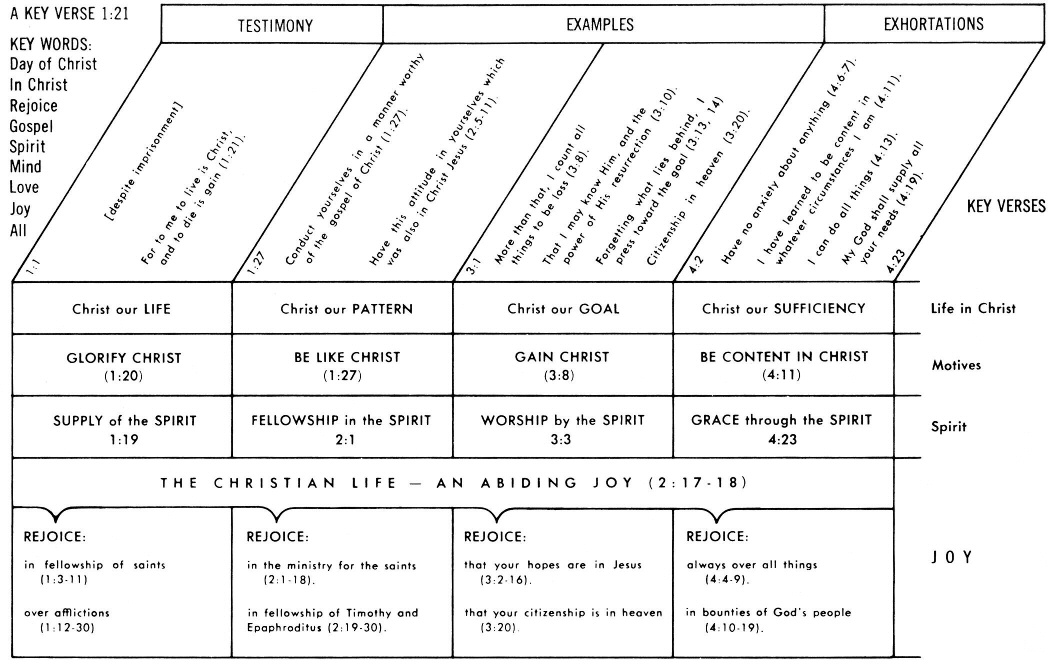
LIFE IN CHRIST
Click chart to enlarge
Charts from Jensen's Survey of the NT - used by permission
Philippians - Charles Swindoll = Chart on right side of page
| Account of Paul's Circumstances Php 1:1-30 |
Have the Mind of Christ Php 2:1-30 |
Have the Knowledge of Christ Php 3:1-21 |
Have |
| Partakers of Christ | People of Christ | Pursuit of Christ | Power of Christ |
| Suffering | Submission | Salvation | Sanctification |
| Experience | Examples | Exhortation | |
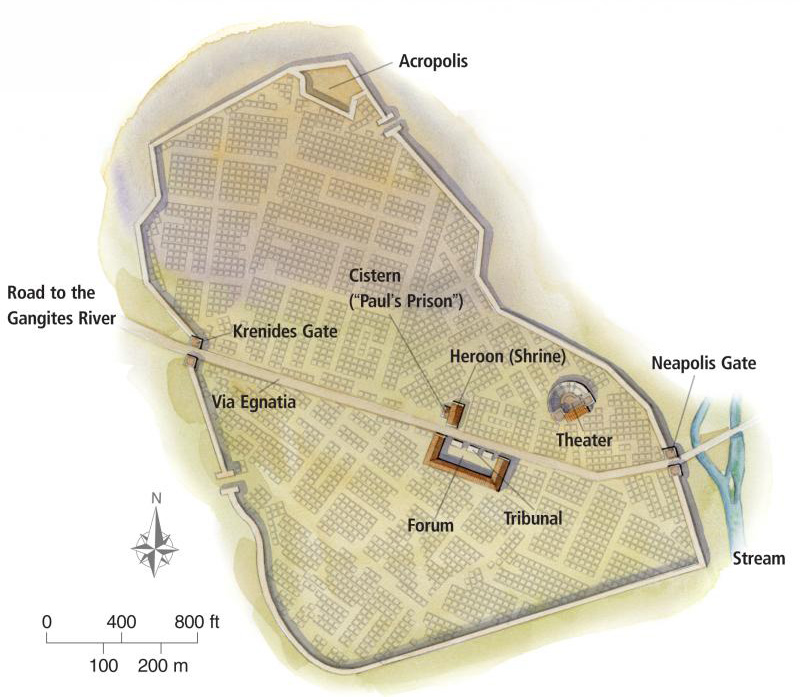
Philippi in the Time of Paul
The city plan above shows those features of the city of Philippi that archaeologists have so far identified as dating from the time of Paul. “Paul’s Prison” is not believed to be an authentic site, but was a cistern later associated with Christian worship. (ESV.org)
Philippians 2:1 Therefore if there is any encouragement in Christ, if there is any consolation of love, if there is any fellowship of the Spirit, if any affection and compassion (NASB: Lockman)
Greek: Ei tis oun paraklesis en Christo, ei ti paramuthion agapes, ei tis koinonia pneumatos, ei tis splagchna kai oiktirmoi,
Amplified: So by whatever [appeal to you there is in our mutual dwelling in Christ, by whatever] strengthening and consoling and encouraging [our relationship] in Him [affords], by whatever persuasive incentive there is in love, by whatever participation in the [Holy] Spirit [we share], and by whatever depth of affection and compassionate sympathy, (Amplified Bible - Lockman)
Barclay: If the fact that you are in Christ has any power to influence you, if love has any persuasive power to move you, if you really are sharing in the Holy Spirit, if you can feel compassion and pity, (Philippians 2 Commentary)
KJV: If there be therefore any consolation in Christ, if any comfort of love, if any fellowship of the Spirit, if any bowels and mercies,
Phillips: Now if your experience of Christ's encouragement and love means anything to you, if you have known something of the fellowship of his Spirit, and all that it means in kindness and deep sympathy (Phillips: Touchstone)
Wuest: In view of the fact that there is a certain ground of appeal in Christ which exhorts, since there is a certain tender persuasion that comes from divine love, in view of the fact that there is a certain joint-participation with the Spirit in a common interest and activity, since there are certain tender heartednesses and compassionate yearnings and actions. (Eerdmans Publishing - used by permission)
Young's Literal: If, then, any exhortation is in Christ, if any comfort of love, if any fellowship of spirit, if any bowels and mercies,
THE FOUNDATION STONES
FOR SPIRIT ENERGIZED UNITY
- Philippians 2:1-2 The Motives for Spiritual Unity - John MacArthur
- Philippians 2:2 The Marks of Spiritual Unity - John MacArthur
- Philippians 2:3-5 The Means to Spiritual Unity - John MacArthur
- Philippians 2:1-4 Harmonious Relationships - Steven Cole
- Philippians Commentary - Verse by Verse - Kenneth Wuest
Paul gives us a very important spiritual principle in this section - he first gives the "Information" (the Gospel truths about the saints - Php 2:1) BEFORE he gives them the "exhortation" (what they are to do). To give exhortation without the "information" (the spiritual resources to carry out the exhortation) puts the hearer under a burden. As Tony Merida says Paul is "quick to first mention the blessings of the Gospel before giving certain exhortations. If all you ever do is tell people what they’re supposed to be doing, then they will get burned out. Remind people of the blessings while giving them the imperatives (Php 2:2 "make...complete" = aorist imperative). Do this for your own soul, and do this for other Christians." (Christ-Centered Exposition Commentary – Exalting Jesus in Philippians)
John MacArthur sets the context for Paul's call to unity in the church at Philippi - Perhaps the greatest danger facing the church is an attack on its source of authority, namely, the Word of God. Spiritual apathy and a general coldness and indifference to biblical truth and God's standards of righteousness also pose serious risks. Such indifference is usually denied, often with an aura of self-deceptive sincerity, but it attacks the spirituality of the church. Equally to be feared is whatever attacks the unity of the church. All of these can disrupt, weaken, and destroy a church by causing discord, disharmony, conflict, and division. When Paul closed his last letter to the Corinthians, he expressed his fear of sins that destroy unity: "For I am afraid that perhaps when I come I may find you to be not what I wish and may be found by you to be not what you wish; that perhaps there will be strife, jealousy, angry tempers, disputes, slanders, gossip, arrogance, disturbances" (2 Cor. 12:20). He also feared sins that destroyed the purity of the church: "I am afraid that when I come again my God may humiliate me before you, and I may mourn over many of those who have sinned in the past and not repented of the impurity, immorality and sensuality which they have practiced" (v. 21)....True spiritual unity is grounded in the unfathomable unity of the Trinity itself....The foundation for believers' oneness is the unity God granted in answer to Jesus' prayer that His people "may all be one; even as You, Father, are in Me and I in You, that they also may be in Us, so that the world may believe that You sent Me" (John 17:21). That prayer was answered when the Holy Spirit came at Pentecost and afterward to indwell all believers, bringing to them the eternal life in which all believers are partakers (cf. 1 Cor. 6:17, 19; 12:12-14). That essential unity of all believers in the body of Christ should be lived out in practice....Because fracturing Christ's church is one of Satan's major objectives, the challenge to preserve the unity of the spirit is constant. A divided, factious, and bickering church is spiritually weak. It therefore offers little threat to the devil's work and has little power for advancing the gospel of Christ. Endeavoring to maintain, or to restore, the spiritual unity of a congregation is easily the most pressing, difficult, and constant challenge for its leaders.....Paul's concern here is not about doctrines, ideas, or practices that are clearly unbiblical. It is about interpretations, standards, interests, preferences, and the like that are largely matters of personal choice. Such issues should never be allowed to foment controversy within the body of Christ. To insist on one's own way in such things is sinful, because it senselessly divides believers.....to humbly defer to one another on secondary issues is a mark of spiritual strength, not weakness (cf. Ro 14:1-15:7). It is a mark of maturity and love that God highly honors, because it promotes and preserves harmony in His church. (MacArthur New Testament Commentary – Philippians)
William Barclay adds that "the one danger which threatened the Philippian church was that of disunity. There is a sense in which that is the danger of every healthy church. It is when people are really in earnest, when their beliefs really matter to them, that they are apt to get up against each other. The greater their enthusiasm, the greater the danger that they may collide. It is against that danger Paul wished to safeguard his friends. (Philippians 2 Commentary)
Here is Barclay's translation of Phil 2:1-4 -
If the fact that you are in Christ has any power to influence you, if love has any persuasive power to move you, if you really are sharing in the Holy Spirit, if you can feel compassion and pity, complete my joy, for my desire is that you should be in full agreement, loving the same things, joined together in soul, your minds set on the one thing. Do nothing in a spirit of selfish ambition, and in a search for empty glory, but in humility let each consider the other better than himself. Do not be always concentrating each on your own interests, but let each be equally concerned for the interests of others.
Word Biblical Commentary - This verse has four brief clauses, each of which begins with εἰ, “if,” and contains two nouns and no verbs. As a result it presents the translator with unusual difficulties and the commentator with a bewildering number of possibilities of interpretation.
Phil 2:1-4 is one of the classic passages on Christian unity. Paul has alluded to unity in Php 1:27 (in one spirit, one mind) in his description of how the church was to stand and strive against outside pressure. Now he shifts his focus to internal unity and the attitudes and actions they are to practice in order to counter the tendency for divisions in the body. In four compact conditional clauses Paul gives us powerful motives to pursue harmony in the Christian community.
The “therefore” (oun) is probably connected with the exhortations to unity in Php 1:27. Paul now proceeds to enumerate the resources they can tap into to maintain and maximize unity in their local body at Philippi and which can fulfill his command in Phil 2:2 to "make my joy complete".
Guzik - "Therefore draws back to what Paul has built on in Php 1:27, 29, 30, telling the Philippians how to stand strong for the Lord against external conflicts. Now he tells them how to act against internal conflicts in the body of Christ."
Vincent says that the "therefore" is there for it is both the saint's "duty and privilege (to) fulfill my joy, and show yourselves to be true citizens of God's kingdom by your humility and unity of spirit."
Edwards sets the context "Having stated the theme of the epistle in Phil 1:27 (Earthly Conduct of Heavenly Citizens), Paul now launches into the body of the letter (Phil 2:1-4:1). The first major section runs from Phil 2:1-30 and deals with the central theme of SELFLESSNESS. Paul begins by appealing to they relationship in Christ. All four terms for affection appear are fairly similar and all four (really five) are peculiar to believers. Based on the encouragement which is in Christ, the comfort which comes from divine love, the oneness (fellowship) of an those drinking from the same Spirit, and the tender mercies of these believers, they are to live a certain way. They are to live in love and harmony, not because of their natural fondness for one another (though that may be there), but because of they divine responsibilities as members of the household of God. This unity is not the result of natural oneness but supernatural bonding. This is why Paul's appeal for unity begins by focusing upon their relationship in Christ, not their relationship towards one another. (Philippians)
Swindoll - These opening lines conclude with the theme of what is on his mind—“others.” As we read Paul’s initial plea, it is obvious that his major concern is that there not be disunity or conflict among his friends. It is as if he is pleading: Whatever else may happen, my friends, don’t let a selfish attitude sneak in like a thief and steal your joy or interrupt your closeness. Living Bible Php 2:1-4 "Is there any such thing as Christians cheering each other up? Do you love me enough to want to help me? Does it mean anything to you that we are brothers in the Lord, sharing the same Spirit? Are your hearts tender and sympathetic at all? Then make me truly happy by loving each other and agreeing wholeheartedly with each other, working together with one heart and mind and purpose." What a wonderful way to live one’s life! That “one heart and mind and purpose” suggests unity, a genuine Spirit-filled unselfishness that breeds strength and spreads cheer. Is this suggesting uniformity? Does it mean we always have to agree on everything? Is that what harmony is all about? No. There is a difference between unity and uniformity. Uniformity is gained by pressure from without. The English word uniformity has within it the word uniform. We dress alike, look alike, sound alike, think alike, act alike. But that is neither healthy nor biblical. Unity comes from deep within (Ed: Spirit energized - cf Eph 4:3). It is the inner desire to conduct oneself in a cooperative manner, to be on the same team, to go for the same objectives, for the benefit of one another. As Harry A. Ironside said, "It is very evident that Christians will never see eye to eye on all points. We are so largely influenced by habits, by environment, by education, by the measure of intellectual and spiritual apprehension to which we have attained, that it is an impossibility to find any number of people who look at everything from the same standpoint. How then can such be of one mind? The apostle himself explains it elsewhere when he says, “I think also that I have the mind of Christ.” (1 Cor 2:16KJV) The “mind of Christ” is the lowly mind. And, if we are all of this mind, we shall walk together in love, considering one another, and seeking rather to be helpers of one another’s faith, than challenging each other’s convictions." (Laugh Again)
James Montgomery Boice - "If believers will conduct themselves in a manner that leads to Christian unity, then they will find that this also leads them to strive together to advance the Christian Gospel. And the result will be an aggressive Christianity. The Christians at Philippi knew what it meant to stand fast as Romans at the frontiers of the Roman world. They knew the obligation that was theirs to advance Roman rule in the face of barbarism. In the same way, Paul would have them united for an aggressive advancement of the faith. How we need to recover an aggressive faith today! For the most part Christianity in our day has retreated into spiritual ghettos, and believers seem content to have it that way so long as they are safe and their children never wander beyond the barricades."
Lehman Strauss - The apostle's message in the opening verses of the second chapter of Philippians is closely related to the closing appeal in chapter one. The kinship between the two passages is obvious. The opening words of this chapter, "If there be therefore… " are intimately connected with what has gone before. Here Paul is pressing on in his appeal for unity and humility. The appeal is fourfold, each commencing with the words "If any":
- If there be any consolation in Christ…
- If any comfort of love…
- If any fellowship of the Spirit…
- If any bowels and mercies
Here are four reasons why the members of the Church should live in close harmony. Now the "if" does not imply that there might not be any consolation in Christ, comfort of love, fellowship of the Spirit, bowels and mercies. The four things mentioned in verse one are not hypothetical; they are four existing facts. The word "if" can be translated "since" or "in view of the fact." The basis of Paul's appeal for unity among these believers is this fourfold experience (Philippians Commentary)
"If” in each of the 4 uses in this verse is the same Greek word "ei" which is what is referred to as a first class conditional particle which means that what follows equates with a fulfilled condition. It follows that the first class conditional particle can usually be accurately translated with “since”, "so then", "in view of the fact” or “If such-and-such is true―and I know that it is …”, "If, as is indeed the case." (O'Brien) In short the "IF" statements all refer to certainties, not possibilities.
"Four reminders of their resources"
One could envision this section as a short course in the spiritual math of how a church attains and maintains unity:
Adequate Spiritual Resources + Appropriate Spirit enabled Response = Unity
All four characteristics in this verse are indisputable facts - certainties not "maybes" and are reminders of the resources God has provided for us. There was not a hint of doubt in Paul's mind as he penned these thoughts. In these four succinct clauses Paul sets forth a powerful motive for harmony in the Christian community. Because the saints at Philippi are each recipients of these 4 benefits (four foundation stones), they have the resources as well as the responsibility to carry out what Paul is about to command in the next verse, the end result being unity which makes Paul's joy full. Parenthetically this order (provision provided before practice commanded) illustrates how God never asks us to do what He does not also enable us to do. God is good and wise. In sum, because these four things are true the Philippian believers, they can be "of the same mind".
Why is Christian unity so important? In John 17, Jesus prayed for unity four times for His disciples clearly emphasizing the importance our Lord Jesus placed on unity. Jesus asked His Father to "keep them in Thy name, the name which Thou hast given Me, that they may be one, even as We are" (Jn 17:11) and that His disciples "may all be one; even as Thou, Father, art in Me, and I in Thee, that they also may be in Us; that the world may believe that Thou didst send Me. And the glory which Thou hast given Me I have given to them; that they may be one, just as We are one, I in them, and Thou in Me, that they may be perfected in unity, that the world may know that Thou didst send Me, and didst love them, even as Thou didst love Me." (Jn 17:21-23)
Why did Jesus hold Christian unity in such high esteem? Read the verses again.
Matthew Henry sums up this section stating that Paul "presses them largely to like-mindedness and lowly-mindedness, in conformity to the example of the Lord Jesus, the great pattern of humility and love."
Christ-Centered Exposition - The “if” refers to certainties, not possibilities. Together, these motivations remind believers of the cords of love that bind them together as God’s people (Hanson, Letter, 106).
The first reminder is that there is encouragement in Christ. We have the blessing of knowing Christ (Php 3:10) and being found in Him (Php 3:9). We have been given the gift of faith (Php 1:29). Does anything lift our spirits more than knowing we are in Christ? In the midst of trial and suffering, find encouragement in your relationship with Jesus.
Second, we have the consolation of love. This is presumably a reference to the love of Christ that comforts us. He is ours, and we are His. What comfort! It may also be a reference to mutual love for one another that flows from this relationship with Jesus. This connection was made in Philippians 1:7-8. Paul loves the church “with the affection of Christ Jesus” (Php 1:8). We know God’s love, and His love makes us love others.
Third, we’re reminded that we share in the fellowship with the Spirit. The Greek word translated “fellowship” (koinonia) is the same word as in Php 1:5. The Spirit unites us as brothers and sisters (Php 1:27), partners in the gospel, and the Spirit helps in our weaknesses (Rom 8:26). Later Paul says that Christians worship God “by the Spirit” (Phil 3:3). Paul is aware that disunity threatened the Philippian congregation, so he reminds them of the Spirit-produced fellowship they share.
Fourth, we share affection and mercy. This affection (cf. Php 1:8) or “tenderness” (NIV) flows from our union with Christ. Christ has loved us with amazing tenderness. He has shown us infinite affection. Mercy or “sympathy” (ESV) or “compassion” (NIV) has also come to us from the source of all compassion, our great God (see Ps 103; Rom 12:1; 2 Cor 1:3). We share in a common experience of being the objects of God’s compassion. This tender care should cause us to look out for the interests of others (Phil 2:4) and serve sacrificially as illustrated by the life of Epaphroditus (Php 2:25-30; 4:18).
We enjoy these amazing blessings as fellow believers. Notice Paul’s approach with the Philippians. He’s not only warm and pastoral, but he’s also quick to first mention the blessings of the gospel before giving certain exhortations. If all you ever do is tell people what they’re supposed to be doing, then they will get burned out. Remind people of the blessings while giving them the imperatives. Do this for your own soul, and do this for other Christians. (Christ-Centered Exposition Commentary – Exalting Jesus in Philippians)
if there is any encouragement in Christ: paraklesis en Christo:
- Php 3:3; Lk 2:10,11,25; Jn 14:18,27; 15:11; 16:22, 23, 24; 17:13; Ro 5:1,2; Ro 15:12,13; 2Co 1:5,6; 2:14; 2Th 2:16,17; Heb 6:18; 1Pe 1:6, 7, 8)
The first foundation stone for unity
ENCOURAGEMENT IN CHRIST
So if in Christ there is anything that will move you, (NJB)
Is there any encouragement from belonging to Christ? (NLT),
Now if your experience of Christ's encouragement and love means anything to you (Phillips),
In view of the fact that there is a certain ground of appeal in Christ which exhorts (Wuest),
SO BY whatever [appeal to you there is in our mutual dwelling in Christ (Amp),
If the fact that you are in Christ has any power to influence you (Philippians 2 Commentary)
Spurgeon introduces this section writing that…
the Holy Spirit, during the present dispensation, is revealed to us as the Comforter. It is the Spirit's business to console and cheer the hearts of God's people. He does convince of sin; he does illuminate and instruct; but still the main part of his business lies in making glad the hearts of the renewed, in confirming the weak, and lifting up all those that be bowed down. Whatever the Holy Ghost may not be, he is evermore the Comforter to the Church; and this age is peculiarly the dispensation of the Holy Spirit, in which Christ cheers us not by his personal presence, as he shall do by-and-bye, but by te indwelling and constant abiding of the Holy Ghost the Comforter. Now, mark you, as the Holy Spirit is the Comforter, Christ is the comfort. The Holy Spirit consoles, but Christ is the consolation. If I may use the figure, the Holy Spirit is the Physician, but Christ is the medicine. He heals the wound, but it is by applying the holy ointment of Christ's name and grace. He takes not of his own things, but of the things of Christ. We are not consoled to-day by new revelations, but by the old revelation explained, enforced, and lit up with new splendour by the presence and power of the Holy Ghost the Comforter. If we give to the Holy Spirit the Greek name of Paraclete, as we sometimes do, then our heart confers on our blessed Lord Jesus the title of the Paraklesis. If the one be the Comforter, the other is the comfort. (Spurgeon's Sermon on "Consolation in Christ")
Lord, Thy death and passion give
Strength and comfort in my need,
Every hour while here I live,
On Thy love my soul shall feed.
Word Biblical Commentary on encouragement - Paraklesis is capable of conveying at least two very different ideas: (1) “comfort” or “consolation,” on the one hand, and (2) “exhortation” or “encouragement,” on the other. See the full discussion in O’Brien (167–70), who finally comes down on the side of “comfort."
Encouragement (3874) (paraklesis from parakaléo = beseech <> pará = side of + kaléo = call) refers to calling to one's side or one's aid which can be for the purpose of providing solace, comfort, consolation, exhortation, encouragement.
Encouragement is from en = in + corage from Latin cor = heart. It describes the act of inspiring one with confidence and/or hope, filling with strength, and suggests that the raising of one’s confidence is accomplished especially through an external agency.
Comfort is from Latin com = with + fortis = strong, and means to invigorate, to enliven, to cheer, to strengthen one's mind when depressed, to give new vigor to one's spirits, to give strength or hope to another, to ease their grief or trouble.
Exhortation is from ex = out + hortari = to urge or incite and means incitement by argument or advice, a strong urging, an urgent appeal, an earnest persuasion, giving strong advisement, animation by arguments to a good deed or laudable conduct or course of action.
MacArthur - Paraklēsis (encouragement) has the root meaning of coming alongside someone to give assistance by offering comfort, counsel, or exhortation. It is precisely the kind of assistance exemplified by the Good Samaritan, who, after doing everything he could for the robbed and beaten stranger, “took out two denarii and gave them to the innkeeper and said, ‘Take care of him; and whatever more you spend, when I return I will repay you’ ” (Luke 10:35; cf. Lk 10:30, 31, 32, 33, 34). (MacArthur, J. Philippians. Chicago: Moody Press)
Wuest on paraklesis - The word has various meanings; “a calling near, a summons, imploration, supplication, entreaty, exhortation, admonition, encouragement, consolation, solace.” The well-rounded all-inclusive idea is that of encouragement, of aid given the needy person, whether it be consolation, exhortation, or supplication. (Philippians Commentary - Verse by Verse Comments online)
Paraklesis - 29x in 28v - Luke 2:25; 6:24; Acts 4:36; Acts 9:31 (Note Who gives comfort?); Acts 13:15; 15:31; Ro 12:8-note; 15:4-note, Ro 15:5-note (Who gives encouragement in this verse?); 1 Cor 14:3; 2 Cor 1:3, 4, 5; 7:4, 7, 13; 8:4, 17; Phil 2:1; 1Th 2:3-note; 2Th 2:16 (Note the Source of the saint's comfort and its longevity. How does it come to us? [by what?]); 1Tim 4:13; Philemon 1:7; Heb 6:18-note; Heb 12:5-note; Heb 13:22-note. NAS = appeal(1), comfort(13), consolation(1), encouragement(6), exhortation(7), urging(1). Below are a few of the NT uses of paraklesis…
Luke 2:25 And there was a man in Jerusalem whose name was Simeon; and this man was righteous and devout, looking (prosdechomai in the present tense = looking expectantly which motivated living righteously and devoutly, cp the charge in Titus 2:12 with the motivating Blessed Hope in Titus 2:13-note) for the consolation (Paraklesis in this context is not a concept but a living Person, the Messiah, the One Who is the ultimate Source of encouragement, comfort and consolation. Why do so often when in distress, run everywhere but to Him? Let us run quickly and often to the Consolation of Israel, Yeshua, the one Who saves us the first time [justification] and then Who is able to save us daily [sanctification], e.g. When in distress, when afflicted, when downcast, etc, let us take a moment and meditate on Him as our Refuge in Ps 2:12-note, Ps 5:11-note, Ps 11:1-note, Ps 14:6-note, Ps 16:1-note, Ps 17:7-note; Ps 18:2-note, Ps 18:30-note; Ps 25:20-note; Ps 31:1-note, Ps 31:19-note; Ps 34:8-note, Ps 34:22-note; Ps 36:7-note; Ps 37:40-note; Ps 46:1-note; Ps 52:7-note; Ps 55:8-note; Ps 57:1-note; Ps 59:16-note; Ps 61:3, 4-note, Ps 62:7,8-note, Ps 64:10-note; Ps 71:1-note, Ps 71:7-note; Ps 73:28-note; Ps 91:2-note, Ps 91:4-note, Ps 91:9-note; Ps 94:22-note; Ps 104:18-note; Ps 118:8, 9-note, Ps 141:8-note; Ps 142:5-note; Ps 143:9-note; Ps 144:2-note. (Note: All notes are C H Spurgeon's excellent commentary) Hide yourself in Him beloved!) of Israel; and the Holy Spirit was upon him.
Comment: Note that the context of this passage is the "hope" of the Jews (who were true believers) to realize the final and ultimate fulfillment of the Abrahamic covenant promises, which Messiah will in fact bring to pass in the Millennium. In this way, Jesus to the Jews who were looking for Him was envisioned as their Consolation.
Acts 4:36 Now Joseph, a Levite of Cyprian birth, who was also called Barnabas by the apostles (which translated means Son of Encouragement), (Clearly as in here in Philippians, God uses godly men and women as His arms and feet, to go to those in need of encouragement, comfort and uplifting. Are you known as a "Barnabas" in your sphere of influence, or as a "son of discouragement"?!)
Romans 12:8-note or he who exhorts, in his exhortation; he who gives, with liberality; he who leads, with diligence; he who shows mercy, with cheerfulness. (Paul's point is to "stay" within the sphere of your gift.)
Ro 15:4-note For whatever was written in earlier times was written for our instruction, so that through perseverance and the encouragement of the Scriptures we might have hope.
Comment: In one sense the entire Bible is a paraklesis, exhorting, admonishing and encouraging us to be strong in our faith.
2Cor 1:3 Blessed be the God and Father of our Lord Jesus Christ, the Father of mercies and God of all comfort (How much? cp Isa 40:1, 51:3; 52:9; 66:13); 4 Who comforts (parakaleo in the present tense = continually!) us in all our affliction (thlipsis - word study) (Note if we don't "feel" comforted, what might be the source of the feeling? Cp 2Co 5:7) so that (What is one purpose of any affliction God allows into our life beloved?) we may be able (dunamai [think "dynamic", "dynamo"!] the present tense = continually ready to come alongside our brethren!) to comfort (parakaleo) those who are in any affliction with the comfort with which we ourselves are comforted by God. 5 For just as the sufferings of Christ are ours in abundance, so also our comfort is abundant through Christ.
1Th 2:3-note For our exhortation does not come from error or impurity or by way of deceit.
Comment: John MacArthur writes that here "The word exhortation (paraklesis) means an urgent cry, appeal, or call, with an emphasis on judgment. Such usage stressed for Paul’s readers the urgency and directness of his preaching. He did not stray from the truth or operate apart from the standard of divine revelation. Paul assured them there was no false teaching or living—in other words, error—in his ministry. 1 & 2 Thessalonians. Moody Press)
1Ti 4:13 Until I come, give attention to the public reading of Scripture, to exhortation and teaching.
Comment: Clearly paraklesis as manifest by encouragement was to be a major focus of Timothy's ministry in Ephesus. It follows that Biblical exhortation. As the Pastor MacArthur observes "Exhortation challenges people to apply the truths they have been taught. It warns people to obey, in light of the blessing to come on them if they do, and the judgment if they do not. Exhortation may take the form of rebuke, warning, counsel, or comfort, but always involves a binding of the conscience." (1Timothy Moody Press)
Heb 12:5-note and you have forgotten the exhortation which is addressed to you as sons, “My son, do not regard lightly the discipline of the Lord, Nor faint when you are reproved by Him
Comment: "Turning to Scripture is listening to God, for Scripture is His Word. For believers, it is the Word of their Father. This forgotten exhortation tells us of two perils of discipline—regarding it lightly, and fainting because of it." (MacArthur, John: Hebrews. Moody Press)
Heb 13:22-note But I urge you, brethren, bear with this word of exhortation, (referring to the epistle to the Hebrews - see Acts 13:15 where this same phrase is used as the designation for a sermon) for I have written to you briefly.
Comment: MacArthur "The book of Hebrews is a great treatise preached with a pen. It is an urgent call to the readers to come to single-minded devotion to the Lord Jesus Christ and to complete satisfaction with the New Covenant. The high and lofty doctrinal themes are the foundation for this primary exhortation." (Ibid)
Marvin Vincent has a detailed note on this word group writing that parakaleo literally means…
a calling to one’s side to help; and therefore entreaty, passing on into the sense of exhortation, and thence into that of consolatory exhortation; and so coming round to mean that which one is summoned to give to a suppliant—consolation. Thus it embodies the call for help, and the response to the call. Its use corresponds with that of the kindred verb , to exhort or console… In some instances, the meaning wavers between console and exhort.
In the sense of exhortation or counsel, the noun (paraklesis) may be found in Acts13:15; Ro 12:8; Heb 13:22. The verb, in Acts 2:40; 11:23; 14:22; Ro 12:8; Titus 2:15. Neither the noun nor the verb appear in the writings of John, but the kindred word the Paraclete, Comforter, or Advocate, is peculiar to him. It should be noted, however, that the word comfort goes deeper than its popular conception of soothing. It is from the later Latin , to make strong. Thus Wycliffe renders Lk 1:80, “the child waxed, and was comforted in spirit” and Tyndale, Lk 22:43, “there appeared an angel from heaven comforting him” (AV., strengthening).
The comfort which Christ gives is not always soothing. The Holy Spirit, the Comforter, is to convince of sin and of judgment. Underlying the word is the sense of a wise counsel or admonition which rouses and braces the moral nature and encourages and strengthens it to do and to endure. When, therefore, Christ says “they that mourn shall be comforted,” he speaks in recognition of the fact that all sorrow is the outcome of sin, and that true comfort is given, not only in pardon for the past, but in strength to fight and resist and overcome sin. The atmosphere of the word, in short, is not the atmosphere of the sick-chamber, but the tonic breath of the open world, of moral struggle and victory; the atmosphere for him that climbs and toils and fights. (Word Studies in the NT - Notes on Luke 6:24)
Robertson writes that "If one's own life in Christ does not stimulate the soul to the noblest effort, it is useless to go on with the appeal."
Two of the paraphrases pick up this same thought -- "If the fact that you are in Christ has any power to influence you" (Barclay) "If then your experiences in Christ appeal to you with any force.." (Lightfoot)
Christ-Centered Exposition - We have the blessing of knowing Christ (Php 3:10) and being found in Him (Php 3:9). We have been given the gift of faith ( "believe in Him" - Php 1:29). Does anything lift our spirits more than knowing we are in Christ? In the midst of trial and suffering, find encouragement in your relationship with Jesus. (Christ-Centered Exposition Commentary – Exalting Jesus in Philippians)
William Barclay - The fact that we are all in Christ should keep us in unity. No man can walk in disunity with his fellow-men and in unity with Christ. If he has Christ as the companion of his way, he is inevitably the companion of every wayfarer. A man's relationships with his fellow-men are not a bad indication of his relationship with Jesus Christ. (Philippians 2 Commentary)
Is there encouragement in Christ? Of course there is. Godly Simeon called Jesus the "the Consolation (paraklesis) of Israel" (Lk 2:25-note)
Paul taught that "just as the sufferings of Christ are ours in abundance, so also our COMFORT (paraklesis) is abundant through Christ." (2 Co 1:5)
If there be any encouragement in Christ - Not "if" but "since", for this is comfort in Christ! (cp 2Co 1:3-5) Every believer has received encouragement, exhortation, and comfort from and through Christ Who is like an artesian well (see Artesian Well diagram) that effortlessly, endlessly flows through us as we surrender our will to His sweet will and in the context as the saints at Philippi enter into the reality of Christ Who is now their life, and the result of this common experience will serve to draw them together and unite them.
G C Willis - In the last verse but one of the First Chapter we read that to them it was given in the behalf of Christ, not only to believe on Him, but also to suffer for His sake. Immediately, in the first verse of Chapter Two, the Apostle reminds them of the Encouragement there is in Christ. When we are suffering, especially suffering for Christ's sake: what a thing it is to have encouragement: and when that encouragement is in Christ, how sure and blessed it is! You remember when Paul was in prison in Jerusalem: perhaps through his own self-will, perhaps grieving over the dishonour done to the Name of Christ that day in the Council (Acts 23): very likely greatly discouraged and cast down: that night, following all this trouble, the Lord Himself, not an angel, came and stood by him: not to remind him of his failure, but to say: "Be of Good Cheer, Paul!" That is indeed encouragement in Christ. Paul could speak from well-tried experience, when he says: "If, then, there is any encouragement in Christ." (Philippians 2)
F B Meyer writes regarding the bonds of unity in a local body that "The first bond is the consolation which is in Christ. For consolation let us substitute exhortation, or, better still, persuasiveness, so that we might put it that the first bond of Christian fellowship is Christ's persuasiveness. That Jesus Christ is interested in every Church fellowship is obvious, but we do not always realise how much He is always doing to persuade us to main-rain it. Have there not been times in your life when you have been greatly incensed, but have realised that there was a voice speaking within your heart, and a gentle influence stealing over you, a yearning towards the brother about whom you had cherished hard and unkind feelings? That has been the persuasiveness of Christ. It is He who has besought you to check that word, to refrain from writing that letter, to abandon that bitter and offensive way which had seemed so befitting a method of repaying your enemy to his face. It was Christ who was persuading you to drop the weapon from your hand, and to reach it out in brotherhood, and this because He was so eager to keep the unity of the Spirit unbroken in the bond of peace. (The Epistle to the Philippians )
One of the best summary verses of who believers are in Christ is found in 2 Cor 5:17
Therefore if anyone is in Christ, he is a new (brand new) creature; the old things passed away; behold, new things have come.
The phrase in Christ is found 10x in 10v in Philippians:
Philippians 1:1 Paul and Timothy, bond-servants of Christ Jesus, To all the saints in Christ Jesus who are in Philippi, including the overseers and deacons:
26 so that your proud confidence in me may abound in Christ Jesus through my coming to you again.Philippians 2:1 Therefore if there is any encouragement in Christ, if there is any consolation of love, if there is any fellowship of the Spirit, if any affection and compassion,
5 Have this attitude in yourselves which was also in Christ Jesus,Philippians 3:3 for we are the true circumcision, who worship in the Spirit of God and glory in Christ Jesus and put no confidence in the flesh,
9 and may be found in Him, not having a righteousness of my own derived from the Law, but that which is through faith in Christ, the righteousness which comes from God on the basis of faith,
14 I press on toward the goal for the prize of the upward call of God in Christ Jesus.Philippians 4:7 And the peace of God, which surpasses all comprehension, will guard your hearts and your minds in Christ Jesus.
19 And my God will supply all your needs according to His riches in glory in Christ Jesus.
21 Greet every saint in Christ Jesus. The brethren who are with me greet you.
Brian Bill on preventing disunity and promoting unity -
(First thing we should do is) Fathom the excellence of what we have (Php 2:1). Many of us forget what we’ve been given....
• Since you have encouragement from being united with Christ. The word “encouragement” means “to come alongside to support and help.” This consolation that comes from Christ was predicted by Simeon in Luke 2:25: “He was waiting for the consolation of Israel…” We should be encouraged because we are commended by Christ and never have to face condemnation from Him as Romans 8:1 states: “Therefore, there is now no condemnation for those who are in Christ Jesus.”
• Since you have comfort from his love. The word “comfort” means the “alleviation of suffering and misery.” Knowing that He lavishes His love on us should give us great comfort and security because He will never abandon us as promised in Hebrews 13:5: “Never will I leave you; never will I forsake you.”
• Since you have fellowship with the Spirit. Knowing that we have immediate access to the Almighty gives us confidence that He is always available as Hebrews 4:16 states: “Let us then approach the throne of grace with confidence, so that we may receive mercy and find grace to help us in our time of need.”
• Since you have tenderness and compassion. The word “compassion” literally refers to feeling something in your gut, to be moved in your intestines, if you will. MacArthur writes that the Hebrews expressed attitudes and emotions in terms of physiological symptoms, not in abstractions. And, recognizing that Christ is compassionate toward us should fill us with that same kind of compassion and tenderness toward others as stated in Colossians 3:12: “Therefore, as God’s chosen people, holy and dearly loved, clothe yourselves with compassion, kindness, humility, gentleness and patience.” Paul had this kind of feeling toward the Philippians in 1:8: “…I long for all of you with the affection of Christ Jesus.”
Every Christian has received these blessings. This is similar to what is said in
Ephesians 1:3: “Praise be to the God and Father of our Lord Jesus Christ, who has blessed us in the heavenly realms with every spiritual blessing in Christ” and
2 Peter 1:3: “His (Jesus our Lord - 2 Pe 1:2) divine power has given us everything we need for life and godliness through the true knowledge of Him who called us by His own glory and excellence.”
Friends, we have been blessed way beyond what we deserve. Paul’s point is this: Since you’ve been given all this, shouldn’t you grant grace to others and do whatever it takes to promote peace and embrace unity? (Sermon)
if there is any consolation of love: ei ti paramuthion agapes:
- Ps 133:1; Jn 15:10, 11, 12; Acts 2:46; 4:32; Gal 5:22; Eph 4:30, 31, 32; Col 2:2; 1Jn 4:7,8,4:12, 4:16)
The second foundation stone for unity
CONSOLATION OF LOVE
Love is agape which ultimately is God's love (cf the quality & quantity of that love in Jn 3:16 Torrey's Topic "Love of God")
since there is a certain tender persuasion that comes from divine love (Wuest)
by whatever persuasive incentive there is in love (Amp),
if there is any persuasive power in love (Weymouth),
If love has any power by its tenderness to stir your hearts, then listen to me. (Robertson)
Pentecost phrases it this way…
The fact that Christ loved me ought to move me to love the brethren. We could paraphrase the phrase, “if any comfort of love,” with these words, “if the love of Christ exerts any persuasive power, if love supplies an incentive or gives encouragement,” then fulfill my joy by loving one another. The fact that God loved me, as unlovely as I was, ought to move me to love the brethren. (Pentecost, J. D. The Joy of Living: A study of Philippians. Kregel Publications)
Consolation (3890) (paramuthion from para = towards + muthéomai = to speak, which is from múthos = a tale, myth, speech) literally describes speaking closely to someone. The idea is to speak to someone coming close to their side. The basic sense speaking to someone in a friendly way. It refers to that which causes or constitutes the basis for consolation and encouragement.
Paramuthion "indicates a greater degree of tenderness than" the preceding word "encouragement" (paraklesis).
One Greek lexicon defines paramuthion as an assuagement ( = lessening the intensity of something that pains or distresses).
Friberg defines paramuthion…
as persuasive power that points to a basis for hope and provides incentive. (Analytical Lexicon of the Greek New Testament)
Consolation is the attribute of agape love of God that alleviates grief, the sense of loss, trouble, etc.
Vine says that "consolation" is
"that tender cheer, imparted as the effect of “love” (agape practical love)." (Vine, W. Collected writings of W. E. Vine. Nashville: Thomas Nelson )
Rienecker adds intriguing note that the preposition (para = beside) may have the force of aside and pictures consolation that draws one's mind "aside" from their cares and concerns.
MacArthur adds that paramuthion
"portrays the Lord coming close and whispering words of gentle cheer or tender counsel in a believer’s ear."
Wuest has an excellent note
"We have here the subjective genitive construction, in which the noun in the genitive case, “love,” produces the action in the noun of action, “consolation.” That is,
the tender persuasion and encouragement which exhorts to unity among the Philippians, comes from God’s love for them.
Their realization of divine love which reached down and saved them, should urge them to live in a spirit of unity with one another. In addition to that, this divine love produced in the hearts of the Philippian saints by the Holy Spirit (cf Ro 5:5, Gal 5:16), should cause them to so love each other with a love that impels one to sacrifice one’s self for the one loved, that their little differences will be ironed out, and they will live in unity with one another.” (Wuest Word Studies - Eerdman Publishing Company Volume 1, Volume 2, Volume 3 - used by permission)
F B Meyer writes regarding the bonds of unity in a local body that…
The second bond is the comfort of love. The Greek word will bear this rendering--if you know the tender cheer that love gives; that is, see to it that you maintain the bond of Christian fellowship by meeting your fellow Christians with the tender cheer of love. We all know what tender cheer is, when men have been out all day and tried, almost beyond endurance. As they come out of the storm, the depression of their spirit and their health may have conspired to reduce them to the lowest depth of darkness--then as the door opens, and they see the ruddy glow of the fire, and the wife comes to meet them, and the child is there with its prattle, for a moment it seems almost worth while having known the weariness and depression because of the contrasted cheer that greets them. All around us in the world are Christian hearts which are losing faith; many hands hang down, and knees shake together. Let us see to it that by the kindly cheer of a smile, the grasp of a hand, the welcome of a word, we do something to draw those people into the inner circle of Christian love. (The Epistle to the Philippians )
if there is any fellowship of the Spirit: ei tis koinonia pneumatos:
- Ro 5:5; 8:9, 10, 11, 12, 13, 14, 15, 16; 8:26; 1Co 3:16; 6:19,20; 12:13; 2Co 13:14; Gal 4:6; Eph 1:13,14; 2:18, 19, 20, 21, 22; 4:4; 1Pet 1:2;1Pet 1:22,23; 1Jn 3:24)
The third foundation stone for unity
FELLOWSHIP OF THE SPIRIT
in view of the fact that there is a certain joint-participation with the Spirit in a common interest and activity (Wuest),
if your fellowship in the Spirit is a living reality. (Lightfoot)
if you really are sharing in the Holy Spirit (Barclay)
Paul says, in effect, “If there is any such thing as communion with the indwelling Spirit, or if your consciousness of fellowship with the Holy Spirit who dwells within is a reality in your life, and it most certainly is, then fulfill my joy by your love for one another.”
Adrian Rogers - Fellowship is not coffee and donuts. Fellowship is not as some people cutely say two people, two fellows in the same ship.
Fellowship of the Spirit - The NET Bible has this technical note…
Or "spiritual fellowship" if pneumatos is an attributive genitive; or "fellowship brought about by the Spirit" if pneumatos is a genitive of source or production.
Fellowship (2842) (koinonia from koinos = common, shared by all) (Click for an in depth word study of koinonia) means a close association involving mutual interests and sharing (communion, fellowship, partnership).
Koinonia is an intimate partnership, a common eternal life or joint participation with common interests and mutual, active participation. This dynamic is effected by Holy Spirit’s working in and through individual saints in the body to produce unity (1Co 3:16, 12:13, 2Co 13:14,cf 1Jn 1:4-6)
Koinonia - 19x in 17v - Acts 2:42; Rom 15:26; 1 Cor 1:9; 10:16; 2 Cor 6:14; 8:4; 9:13; 13:13; Gal 2:9; Phil 1:5; 2:1; 3:10; Phlm 1:6; Heb 13:16; 1 John 1:3, 6, 7. NAS = contribution(2), fellowship(12), participation(2), sharing(3).
One translation has
If communion with the Spirit of love is not a mere idle name, but a real thing
Robertson says that
If we have any partnership in the life and blessings of the Holy Spirit, then we are ready to listen to Paul's plea for unity.
Paul is reminding them that the fellowship of the Holy Spirit is a blessed reality, not merely a beautiful idea. Remember every genuine believer at Philippi (and in the body of Christ today) has received the Holy Spirit for as Paul writes in his epistle to the saints at Rome…
the love of God has been poured out within our hearts through the Holy Spirit Who was given to us. (Ro 5:5-note)
However, you are not in the flesh but in the Spirit, if indeed the Spirit of God dwells in you. But if anyone does not have the Spirit of Christ, he does not belong to Him. And if Christ is in you, though the body is dead because of sin, yet the spirit is alive because of righteousness. 11 But if the Spirit of Him who raised Jesus from the dead dwells in you, He who raised Christ Jesus from the dead will also give life to your mortal bodies through His Spirit who indwells you. 12 So then, brethren, we are under obligation, not to the flesh, to live according to the flesh-- 13 for if you are living according to the flesh, you must die; but if by the Spirit you are putting to death the deeds of the body, you will live. 14 For all who are being led by the Spirit of God, these are sons of God. 15 For you have not received a spirit of slavery leading to fear again, but you have received a spirit of adoption as sons by which we cry out, "Abba! Father!" 16 The Spirit Himself bears witness with our spirit that we are children of God, 17 and if children, heirs also, heirs of God and fellow heirs with Christ, if indeed we suffer with Him in order that we may also be glorified with Him. (see notes Ro 8:9, 8:10-11; 8:12-13; 8:14-15; 8:16-17)
Thus each and every believer has personal fellowship with the Holy Spirit in his or her private life and in turn all believers are united by the same Spirit in fellowship. The practical application of this truth is that factions or divisiveness should have no place in the body of Christ.
F B Meyer writes regarding the bonds of unity in a local body that…
The third bond is the fellowship of the Spirit. The word means to share the Spirit, the going in common with the Spirit. They who live near God know what that fellowship is; they know that they are always accompanied; that they are never for one moment by themselves; can never enter a room with the consciousness of vacancy; can never travel in an empty car with a sense of isolation and solitude: there is always the fellowship of the Spirit. Whatever any one man knows of this fellowship every other knows. Each Christian person is conscious of the same Presence, making evident and obvious to us the same Jesus Christ. The same atmosphere is lighted by the same sun; and in proportion as we have fellowship with the same Spirit we cannot lose our temper with each other, or be hard, cross, and unkind. (The Epistle to the Philippians)
Pastor Adrian Rogers on fellowship - What is fellowship? Fellowship is not coffee and donuts. Fellowship is not as some people cutely say two people, two fellows in the same ship. What is fellowship? This is a very technical word, "that you may have fellowship with us." It is the Greek word koinonia. Now get that word in your heard and in your mind. That needs to be in your vocabulary. It is the Greek word koinonia and it means to hold things in common. That is, this Jesus, this established fact, because of this established fact that is established, there is a fellowship that is experienced that we can have fellowship one with another. It literally means to have something in common. Now notice who we have fellowship with. Notice he says in 1 John 1:3: "Our fellowship is with the Father and with his Son, Jesus Christ." Well, that brings up a real question. How, what do I have in common with the Father? Nothing, nothing. He's holy, I'm unholy; He is almighty, I am a worm. And, how can Adrian have fellowship with God? But yet the apostle John says, "Our fellowship is with the Father." I have nothing in common with the Father. Notice in 1 John 1:5, 6. "This then is the message which we have heard from him and declare unto you, that God is light and in him is no darkness at all. If we say that we have fellowship with him and walk in darkness we lie and do not the truth." We're in the dark, he's in the light. I mean there's a great chasm between us and almighty God, so how can I have fellowship with almighty God? Here's how. This God, who knows that there's a chasm between Adrian and himself and between you and himself, sent the Lord Jesus Christ to take something that is common between us, human flesh. Jesus becomes a man and now he never discards his deity, but now he takes humanity and now we begin to have likeness, we become together. He takes on the nature of man that I might take on the nature of God and he says in Second Peter 1:4, you're gonna love this, "We have now become partakers of the divine nature." Now, partakers of the divine nature, and the word partaker that is translated there, Peter translates it there, is exactly the same word that is translated fellowship over here in First John. Huh, we have the fellowship of the divine nature. You see, Jesus took humanity and, and therefore he became like I am that I might become like he is that we might have that he took the very nature of man that we might take the nature of God and so I have fellowship with God through the Lord Jesus Christ. I mean, a worm like I am can walk and talk and can fellowship with him and can sing, I come to the Garden alone, when the dew is still on the roses and the voice I hear, falling on my ear, the Son of God discloses, and he walks with me and he talks with me and he tells me I am his own. That's the fellowship, the koinonia that we have with him because of the incarnation and that's the reason old John is saying, Look, he's a man, he's a man, we saw him, we touched him, we hurt him. He took the nature of man that we might take the nature of God. And, and we have become partakers of the divine nature and then you see, look. Not only then do we have fellowship with God, but it follows as night follows day, that we must have fellowship with one another because when I am born of God and you are born of god, the same nature that's in Adrian is in you and the Jesus in me is gonna love the Jesus in you. We have the same nature, we're born from the same womb, from the womb of grace and that's so important. That's the reason why the Bible calls that in Philippians 1:5 the koinonia of the gospel or the fellowship of the gospel. That's the reason in Philippians 2:1 it's called the koinonia or the fellowship of the spirit.
Adrian Rogers - Look in Philippians 2:1: "If there be therefore any consolation in Christ, if any comfort of love, if any fellowship of the Spirit" (Philippians 2:1). There again, not only fellowship of the gospel, but koinonia of the Spirit. You say, "I feel like an outsider. I'm not a part of Bellevue. I don't have that warm fellowship." I'll tell you how to get it. Try some fellowship of the Spirit. Get a prayer partner. Get somebody that you meet with. Study the Word of God with that person. Get in a Sunday School class, and get somebody out of that Sunday School class, where you two get some people on your heart, and begin to pray for those people. Let the Spirit of God just melt you together. So many churches are wired together, or rusted together, or frozen together. They need to be melted together by the Holy Spirit. It's a fellowship of the Spirit. I'm going to tell you something else, dear friend. Two people who pray together are never, ever the same. There's something about it—I'll just guarantee it. If you say it's not true, you don't have a prayer partner. You just get a prayer partner. You get down on your prayer bones with somebody, and really begin to pray with them, and you're going to find out there is something called the koinonia of the Spirit.
GREAT ILLUSTRATION OF FELLOWSHIP OF THE SPIRIT - Adrian Rogers elaborates on the tuning of instruments...
Now, we have a piano here, and we have a piano here. Those pianos ought to be in tune. And, Jim, I was listening this morning—they are; you'll be happy to know that. Those pianos ought to be in tune. Now, I don't know a lot about tuning pianos, but I've read this, and I believe it to be true: that it is virtually impossible to tune one piano to another piano. But, if you get a tuning fork, and tune that piano to the tuning fork, and tune this piano to the tuning fork, do you know what happens? Ipso facto—they're in tune with one another—isn't that true? When you're in tune with Jesus, and I'm in tune with Jesus, then, friend, you're going to be in tune with me, and I'm going to be in tune with you. I mean, that's what happens when we pray—we're seeking God together.
(Ed: Bring a tuning instrument to show what happens to the sound of a piano or guitar that is out of tune! Now think about the "music" made by a local Body of Christ which is OUT OF TUNE! Instead of a "symphony" [a harmony of sounds!] it becomes a "cacophony [loud confusing disagreeable sounds]!" Woe!)
if any affection and compassion: ei tis splagchna kai oiktirmoi:
- Php 1:8; Col 3:12
The fourth foundation stone for unity
AFFECTION AND COMPASSION
The KJV reads "if any bowels and mercies". God has extended His deep affection (Php 1:8-note) and compassion to every believer and that reality should stimulate and empower saints toward unity.
if any bowels and mercies, (Young's Literal),
any warmth or sympathy -- I appeal to you, (NJB),
Are your hearts tender and sympathetic? (NLT),
all that it means in kindness and deep sympathy (Phillips),
since there are certain tenderheartednesses and compassionate yearnings and actions. (Wuest),
by whatever depth of affection and compassionate sympathy (Amp),
if you have any affectionate yearnings of heart. (Lightfoot)
Matthew Henry adds
How cogent are these arguments! One would think them enough to tame the most fierce, and mollify the hardest, heart.
Affection (4698) (splagchnon or splanchna) originally referred to the upper abdominal viscera especially the intestines, which the ancients regarded as the seat of affections and emotions, such as anger and love. This word is always in the plural in the NT. The phrase "I feel it in the pit of my stomach" is a modern parallel. And we all know how that feels! So splagchnon refers to that deep, internal caring comparable to the modern expressions of deep feeling such as “broken-hearted” or “gut-wrenching”.
Zodhiates - In Class. Gr. writers, it is chiefly spoken of the upper viscera of animals, as the heart, lungs, and liver which were eaten during or after the sacrifice… Figuratively, the inward parts indicating the breast or heart as the seat of emotions and passions. In the NT, of the gentler emotions as compassion, tender affection indicating the mind, soul, the inner man (2Co 6:12, Philemon 1:7, 20; 1Jn 3:17; Sept.: Pr 12:10 (cf. Ge 43:30; 1Kgs. 3:26) The Complete Word Study Dictionary: New Testament. AMG)
Earlier Paul speaking from his heart had said "For God is my witness, how I long for you all with the affection of Christ Jesus." Philippians 1:8-note
Splagchnon in classical Greek referred to the inward parts and somewhat ironically is used of the literal bowels of Judas Iscariot who betrayed our Lord (he lacked figurative "splagchnon"!) (Acts 1:18)
Splagchnon - 11x in 11v - Luke 1:78; Acts 1:18; 2Cor 6:12; 7:15; Phil 1:8; 2:1; Col 3:12; Philemon 1:7, 12, 20; 1John 3:17. NAS = affection, 3; affections, 1; heart, 4; hearts, 1; intestines, 1; tender, 1.
Luke 1:78-note Because of the tender (splagchnon) mercy (eleos) of our God, With which the Sunrise from on high will visit us, (Great verse - God the Father is the ONLY source of affection, won for us by Jesus' on Calvary and dispensed to us by His Spirit - affection is a work of the entire Trinity!)
Acts 1:18 (Now this man acquired a field with the price of his wickedness, and falling headlong, he burst open in the middle and all his intestines gushed out.
2 Corinthians 6:12 You are not restrained by us, but you are restrained in your own affections.
2 Corinthians 7:15 His affection abounds all the more toward you, as he remembers the obedience of you all, how you received him with fear and trembling.
Philippians 1:8 For God is my witness, how I long for you all with the affection of Christ Jesus.
Philippians 2:1 Therefore if there is any encouragement in Christ, if there is any consolation of love, if there is any fellowship of the Spirit, if any affection and compassion,
Colossians 3:12 So, as those who have been chosen of God, holy and beloved, put on (aorist imperative = command calling for urgency. Just do it is the idea. Beloved do not try to obey this in your own natural strength! If you do you will fail, not to mention you place yourself under the law [subtle legalism!] You need supernatural dunamis [power] from the Spirit Who enables you in your inner man - Eph 3:16, Acts 1:8, Lk 24:45, etc) a heart of compassion, kindness, humility, gentleness and patience;
Philemon 1:7 For I have come to have much joy and comfort in your love, because the hearts of the saints have been refreshed through you, brother.
Philemon 1:12 I have sent him back to you in person, that is, sending my very heart,
Philemon 1:20 Yes, brother, let me benefit from you in the Lord; refresh my heart in Christ.
1 John 3:17 But whoever has the world's goods, and sees his brother in need and closes his heart against him, how does the love of God abide in him?
One of the most precious uses of splagchnon is found in the Gospel of Luke where he quotes Zacharias' beautiful description of Jesus, prophesying that the Child Jesus will
"give to His people (Jews) the knowledge of salvation by the forgiveness of their sins, because of the tender mercy (splagchnon) of our God, with which the Sunrise (speaking of the Son Who rose!) from on high shall visit (episkeptomai) us, to shine upon those who sit in darkness and the shadow of death (Gentiles), to guide our feet into the way of peace." (Lk 1:77, 78, 79)
Here are some other representative uses…
Philemon 1:7 For I have come to have much joy and comfort (paraklesis) in your love, because the hearts (splagchnon) of the saints have been refreshed (anapauo, a military term that speaks of an army resting from a march - to cause one to cease from any movement or labor in order to recover and collect his strength) through you, brother… 12 And I have sent him back to you in person, that is, sending my very heart… 20 Yes, brother, let me benefit from you in the Lord; refresh my heart in Christ.
Comment: MacArthur "Hearts translates splanchna, which literally means “bowels.” It refers to the seat of the feelings. People struggling, suffering, and hurting emotionally, had been refreshed by Philemon.
1John 3:17 But whoever has the world's goods, and beholds his brother in need and closes (kleio = shut) his heart (splagchnon - In other words he clearly sees a need in a believer and shuts that need out of his heart! Woe!) against him, how does the love of God abide in him?
Comment: NET Bible note: "Note the vivid contrast with Jesus' example in the preceding verse 1Jn 3:16: He was willing to lay down His very life, but the person in view in 1Jn 3:17 is not even willing to lay down part of his material possessions for the sake of his brother."
Splagchnon - 3x in the Septuagint - Pr 12:10; 26:22; Jer 51:13;
The derivative verb splagchnízomai (found only in the Gospels most often descriptive of Jesus) means to feel deeply or viscerally, to yearn, have compassion or to show pity (Study the following 12 uses of splagchnízomai gleaning for precious insights into the heart of our Lord -- Mat 9:36; Mat 14:14; Mat 15:32; Mat 18:27; Mat 20:34; Mark 1:41; Mark 6:34; Mark 8:2; Mark 9:22; Luke 7:13; Luke 10:33; Luke 15:20) If our bodies literally ache in pain and nausea when we experience great agony, remorse, or sympathy, we can be sure that the Son of Man felt them even more. Matthew tells us that, in order to fulfill the prophecies of Isaiah, Jesus "Himself took our infirmities, and carried away our diseases" (Mt 8:17).
It was not, of course, that Jesus Himself contracted the diseases or infirmities, but that in sympathy and compassion He physically as well as emotionally suffered with those who came to Him for healing-just as a parent can become physically ill from worry and concern over a child who is desperately sick or in trouble or danger. The Son of God was not remote or coldly calculating and analytical concerning men’s needs but was deeply moved by the suffering, confusion, despair, and spiritual lostness of those around Him. Jesus felt pain, experiencing genuine anguish for the suffering of others, whether they were believer or unbeliever, Jew or Gentile, man or woman, young or old, wealthy or poor.
As John MacArthur astutely comments "Jesus also felt compassion because of His perfect perception of hell and the torment those would face who did not receive Him. Even as He lovingly healed their bodies, He had infinitely greater concern to heal their souls. Even after Jesus healed a body, it could become sick or crippled again. But when He heals a sin-diseased soul, it is forever freed from sin’s dominion and penalty." (MacArthur, J: Romans 1-8. Chicago: Moody Press)
KJV translates splagchnon 9 times as "bowels" as a reference to the emotions because of the way our emotions can affect how our intestinal organs feel. This translation may sound strange to modern ears but in fact even we use words that would sound strange to the ancients. For example we have the word "melancholy" which is literally "black bile"!
In a manuscript from 5BC splagchnon was used figuratively in the phrase “for pity’s sake.” The Hebrews regarded the splagchnon as the seat of the most tender affections, especially kindness, benevolence, compassion. In the NT splagchnon is only found in the plural (tá splágchna = the viscera), and with the exception noted above, is always used figuratively, referring to what we in the West commonly refer to as "the heart", the seat of the tender affections and of deepest human emotions. The Hebrews expressed their feelings in terms of what they felt in their stomach. When they really had some emotion, it turned their stomach, so to speak.
John MacArthur has an interesting notation on splagchnon writing that "The Hebrews, like many other ancient peoples, expressed attitudes and emotions in terms of physiological symptoms, not in abstractions. As most of us know from personal experience, many intense emotions-anxiety, fear, pity, remorse, and so on-can directly, and often immediately, affect the stomach and the digestive tract. Upset stomach, colitis, and ulcers are a few of the common ailments frequently related to emotional trauma. It is not strange, then, that ancient people associated strong emotions with that region of the body. The heart, on the other hand, was associated more with the mind and thinking (see Pr 16:23; Mt 15:19; Ro 10:10; Heb 4:12). The heart was the source of thought and action, whereas the bowels were the responder, the reactor." (MacArthur, J. Matthew. Chicago: Moody Press)
Paul longed after the Philippians with the tender-heartednesses of Jesus Christ, a tenderness that was produced by the Holy Spirit in the heart of this bondservant who was fully yielded to His Lord. The Spirit filled believer's pulse beats with the pulse of Christ. His heart throbs with the heart of Christ. When we are walking in the Spirit, really one with Jesus, His compassion and affection (splagchnon) flows through us to our fellow men whom Jesus loves and for whom He died. Paul is saying in this verse that the believer has the privilege of being a "partner" in exhibiting the compassion of Christ! Do we really understand this profound truth?
Splagchnon is the strongest Greek word for expressing compassionate love or tender mercy and involves one’s entire being. It describes the compassion which moves a man to the deepest depths of his being. In the gospels, apart from its use in some of the parables, it is used only of Jesus
If there was one thing the ancient world needed it was more splagchnon or tender mercy. The sufferings of animals were nothing to it. The maimed and the sickly went to the wall. There was no provision for the aged and they were left to die. The treatment of the idiot and the simple-minded was unfeeling. Christianity brought splagchnon into this world.
The English word compassion (see the next section) is taken from the Latin, which means to "bear with" or to "suffer with", but it has come to mean much more than that. According to one definition, compassion is “a feeling of deep sympathy and sorrow, accompanied by a strong desire to alleviate the pain and remove its cause.”
Compassion (3628) (oiktirmos [word study] from oikteiro = to have compassion {used only in Ro 9:15-note} in turn derived from oiktos = compassion or pity which in turn is said to be derived from the interjection oi = "Oh!") denotes the inward feeling of compassion which abides in the heart. It represents the display of concern over or compassion with another’s misfortune. (See also Consolation)
Compassion (from Latin com = with + pati = to bear, suffer - thus literally to "bear with" or "to suffer with") is a sympathetic consciousness of other's distress together with a desire to alleviate it and in the case of God, with the ability to in fact do so!
The meaning of oiktirmos is like splagchnon and is related primarily the viscera, which were thought to be the seat of compassion. The word came to signify manifestations of pity and refers to the pity that is aroused by the sight of another's suffering. Lightfoot says
By splagchnon is signified the abode of tender feelings, by oiktirmos the manifestation of these in compassionate yearnings and actions
The related word eleos [word study] which is also often translated mercy is similar in meaning but Thayer discussing the corresponding verb forms (eleeo, oikteiro) makes the following distinction…
Eleeo—to feel sympathy with the misery of another, especially such sympathy as manifests itself in act, less frequently in word; whereas oikteiro denotes the inward feeling of compassion which abides in the heart. A criminal begs eleos of his judge; but hopeless suffering is often the object of oiktirmos (p. 203).
The Baker Encyclopedia of the Bible has an interesting note on compassion explaining that "In the OT, compassion describes one aspect of God’s covenantal relationship with his people (Ed note: In the examples of the use of oiktirmos in the Septuagint [see below] compassion is frequently found with "lovingkindness" or hesed/chesed/heced a word integrally associated with the manifestation of God's covenantal love - see related resource Covenant - Why Study It?) One of the Hebrew words translated compassion is derived from a root word meaning “womb,” thus comparing God’s love with maternal love. God’s compassion, however, went beyond simply feeling the emotion; it was always demonstrated by definite acts that testified to his covenant with Israel. In spite of Israel’s rebellions God still had compassion on his people (2Ki 13:23; 2 Chr 36:15; Ps 78:38), as well as on all his creation (Ps 145:9). When Israel was chastised, the nation often feared that God had permanently withdrawn his favor (Ps 77:9; Is 27:11; 63:15; Jer 13:14; 21:7; Ho 13:14). Yet God’s compassion would revive, and he would restore his people (Dt 30:3; Ps 135:14; Is 14:1; 49:13; 54:7, 8; Jer 12:15; 30:18; Micah 7:19; Zech 12:10), especially when they returned to him and cried out for deliverance (1 Ki 8:50; Ps 79:8). (Elwell, W. A., & Beitzel, B. J. Baker Encyclopedia of the Bible. Grand Rapids, Michigan: Baker Book House)
Here are the 5 NT uses of oiktirmos
Romans 12:1-note I urge (parakaleo) you therefore, brethren, by the mercies of God, to present (paristemi) your bodies a living and holy sacrifice, acceptable to God, which is your spiritual service of worship (latreia).
2 Corinthians 1:3 Blessed be the God and Father of our Lord Jesus Christ, the Father of mercies and God of all comfort;
Philippians 2:1 If therefore there is any encouragement in Christ, if there is any consolation of love, if there is any fellowship of the Spirit, if any affection and compassion,
Colossians 3:12 And so, as those who have been chosen (eklektos) of God, holy (hagios) and beloved (Note the motivation that our vaunted position should incite - how can we not follow through with his command), put on (enduo) (aorist imperative = Do this now. Do it motivated by an understanding of who you now are and Whose you are!) a heart of compassion (Col 3:12KJV = bowels of mercy = splagchnon of oiktirmos), kindness (chrestotes), humility (tapeinophrosune), gentleness (prautes) and patience (makrothumia);
Hebrews 10:28-note Anyone who has set aside the Law of Moses dies without mercy on the testimony of two or three witnesses.
Vincent adds that oiktirmos "is that feeling which expresses itself in the exclamation "Oh!" on seeing another’s misery."
Berry's Synonyms - Eleos, oiktirmos - Both words denote sympathy, fellow-feeling with misery, mercy, compassion. Eleos, however, manifests itself chiefly in acts rather than words, while oiktirmos is used rather of the inward feeling of compassion which abides in the heart. A criminal might ask for Eleos, mercy, from his judge; but hopeless suffering may be the object of oiktirmos , compassion
These benefits or graces present in the lives of the Philippian saints should move them to live at peace with one another, resolving minor differences, healing estrangements, etc, all toward the goal of a unified body of Christ and should have the same effect on churches today. Are you living in these truths that you might be enabled to live them out to the glory of God.
Ray Pritchard sums up Phil 2:1 this way…
The “ifs” of verse 1 express truths that the Philippians would readily assent to:
Yes, they had been encouraged by their union with Christ.
Yes, they had experienced God’s love.
Yes, they had enjoyed the fellowship of God’s Spirit.
Yes, they had received an outpouring of mercy from God.
Well, then, says Paul, in light of all that, it shouldn’t be such a great thing to ask that you maintain the unity God has given you. The underlying principle here should be noted. All Christian duties flow naturally from God’s kindness to us. It’s not as if God says, “Do this and I will bless you” but rather “I have blessed you, now do this.” (Philippians 2:1-4: Getting Along)
F B Meyer writes regarding the bonds of unity in a local body that "The fourth bond is, "Bowels of Mercies." The old Greek word stands for humanness and pity. In the former clause we were called upon to manifest the kindly cheer, that welcomes the weary soldier on his return from the campaign, for equals of whose heart-sorrow we have some inkling; but now we are to show fellowship for our dependants and subordinates, for the fallen, the weak, the weary, for those whose spirits cry out in agony. And in acting thus we are doing what we can to co-operate with Christ in His consolation, and with the Holy Ghost in His fellowship, to build up and compact the Church into a living unity. (The Epistle to the Philippians )
- Compassion - Baker's Evangelical Dictionary of Biblical Theology
- Compassion and Sympathy - Torrey's Topical Textbook
- Compassion - The Topical Concordance
- Compassion - Thompson Chain Reference
- Compassion - Nave's Topical Bible
- Compassion - Holman Bible Dictionary
- Compassion - International Standard Bible Encyclopedia
- Compassion - The 1901 Jewish Encyclopedia
A Circle Of Compassion -Following the death of our 17-year-old daughter in a car accident in June 2002, each member of our family handled the loss differently. For my wife, among the most helpful sources of comfort were visits from moms who had also lost a child in an accident.
Sue found strength in their stories, and she wanted them to tell her how God had been faithful in their lives, despite the deep sorrow that comes with losing a precious child. Soon Sue became part of a circle of compassion, a small group of moms who could weep, pray, and seek God's help together. That cadre of grieving moms formed a bond of empathy and hope that provided encouragement in the face of her daily sorrow.
Each person grieves uniquely, yet we all need to share our hearts, our burdens, our questions, and our sadness with someone else. That's why it's vital that we find others with whom to discuss our pain and sorrow. In our relationship with Christ, we find encouragement, consolation, love, fellowship, affection, and mercy (Philippians 2:1). God comforts us so that we can comfort others (2Corinthians 1:4). So let's "rejoice with those who rejoice, and weep with those who weep" (Romans 12:15). Then others will find a circle of compassion too. —Dave Branon (Our Daily Bread, Copyright RBC Ministries, Grand Rapids, MI. Reprinted by permission. All rights reserved)
A heartfelt tear can show our love
As words can never do;
It says, "I want to share your pain—
My heart goes out to you." —D. De Haan
We must learn to weep before we can dry another's tears.
Long lines of cars were filling up the huge parking lot of a church where I was attending a conference. As I parked, I noticed the word Love on a light post in one section. In another area, I saw the word Faithfulness. The next day I pulled into a different lot at the same church and saw Patience on another sign. Like numbers in a mall parking lot, these words help people find their cars.
No doubt these signs served another purpose. After each session, some people were in a hurry to get home—even cutting others off to get out of the lot. Patience wore thin and tempers flared. How appropriate those signs are! I thought. It's amazing how quickly the love we have for our brothers and sisters in Christ can disappear in a parking lot!
The testing of our faith may come through heavy burdens, but it's just as likely to occur in a checkout line, on the expressway, or in a parking lot. —D. C. Egner (Our Daily Bread, Copyright RBC Ministries, Grand Rapids, MI. Reprinted by permission. All rights reserved)
The clear sign of your faith is not what you say but what you do.
Philippians 2:2 make my joy complete by being of the same mind, maintaining the same love, united in spirit, intent on one purpose. (NASB: Lockman)
Greek: plerosate (2PAAM) mou ten charan hina to auto phronete, (2PPAS) ten auten agapen echontes, (PAPMPN) sumpsuchoi, to en phronountes, (PAPMPN)
Amplified: Fill up and complete my joy by living in harmony and being of the same mind and one in purpose, having the same love, being in full accord and of one harmonious mind and intention (Amplified Bible - Lockman)
Barclay: complete my joy, for my desire is that you should be in full agreement, loving the same things, joined together in soul, your minds set on one thing (Philippians 2 Commentary)
Darby: fulfil my joy, that ye may think the same thing, having the same love, joined in soul, thinking one thing;
KJV: Fulfil ye my joy, that ye be likeminded, having the same love, being of one accord, of one mind.
Phillips: do make my best hope for you come true! Live together in harmony, live together in love, as though you had only one mind and one spirit between you. (Phillips: Touchstone)
Wuest: Fill full my joy by thinking the same thing, having the same love, being in heart agreement, thinking the one thing. (Eerdmans Publishing - used by permission)
Young's Literal: fulfil ye my joy, that ye may mind the same thing -- having the same love -- of one soul -- minding the one thing,
make my joy complete: plerosate (2PAAM) mou ten charan:
- cf similar sentiment 1Th 3:8, 9) (Phil 2:16; 1:4, 26,27; John 3:29; 2Corinthians 2:3; 7:7; Colossians 2:5; 1Thessalonians 2:19,20; 3:6, 7, 8, 9, 10; 2Thessalonians 2:13; 2Timothy 1:4; Philemon 1:20; 1John 1:3,4; 2John 1:4; 3John 1:4
You have given me joy hitherto. Now fill my cup of gladness to overflowing. (Lightfoot)
complete my joy (Barclay)
Fill full my joy by thinking the same thing (Wuest)
fulfill ye my joy (Young's)
I pray you to give me the utter joy of knowing… (Moffatt)
Fill up and complete my joy by… (Amp)
Make…complete (4137) (pleroo) means fill full to the point that nothing is wanting to complete it.
The aorist tense, active voice (calls for a volitional choice of one's will) and imperative mood (command) taken together are a military like command to fill full Paul's joy and do so immediately and without delay. The aorist imperative can also express a sense of urgency.
Williams' translation pictures the thrust of Paul's desire Fill up my cup of joy! Do this now!
Paul was already experiencing joy because of his association with this these saints (cf Phil 1:3-5; 4:10)…
I thank my God in all my remembrance of you, always offering prayer with joy in my every prayer for you all, in view of your participation in the gospel from the first day until now. (see notes Philippians 1:3-5)
But I rejoiced in the Lord greatly, that now at last you have revived your concern for me; indeed, you were concerned before, but you lacked opportunity. (see note Philippians 4:10)
One thing was yet needed to make his joy "complete". Paul says that his cup of joy would be filled to the brim if the saints would maintain unity, work together harmoniously and clear up their petty quarrels. In the context of this letter Paul particularly had in mind the apparent schism between, Euodia and Syntyche (Php 4:2-note). Note that it was not money, acclaim, possessions, etc. that could fulfill Paul's joy, but the unity and spiritual maturity of the saints at Philippi.
John made a similar statement writing…
I have no greater joy than this, to hear of my children (spiritual children in the faith) walking in (implies a course of conduct or life = "living in the truth") the truth. (3 John 1:4)
Once again in this verse we find the golden thread of joy that is so masterfully interwoven throughout this epistle (Click for all 12 verses)
Paul will now describe four essential marks of spiritual unity. The New Jerusalem Translation summarizes these…
"being of a single mind, one in love, one in heart and one in mind."
ILLUSTRATION - Unity does not eliminate diversity. The absence of diversity is not unity; it is uniformity, and uniformity is dull. It is fine when the choir sings in unison, but I prefer that they sing in harmony.
by (continually) being of the same mind: hina to auto phronēte (2PPAS) :
- Php 1:27-note
- Phil 2:20; 3:15,16; 4:2; Ro 12:16; 15:5,6; 1Co 1:10; 2Co 13:11; 1Pe 3:8,9)
Live in unity among yourselves (Lightfoot)
for my desire is that you should be in full agreement (Barclay)
by being like-minded (NIV, NKJV)
that ye may think the same thing (Darby)
Live together in harmony… (Phillips)
by… living in harmony and being of the same mind and one in purpose (Amp)
Being of the same mind (5426) (phroneo - word study) is literally "thinking the same thing", being like minded. Right thinking is essential to spiritual unity.
The present tense calls for this to be their habitual mindset, continually living in unity—oneness of mind, common cause, common purpose, common love.
Being like-minded touches what we believe. Unity begins with a shared statement of faith. We can be of the same mind because of the truths in (Phil 2:1). Paul is calling for unity -- not at the expense of truth but because of the truth. In other words, "the same thing" must also be "the right thing."
John MacArthur explains that "Paul is not talking here about doctrine or moral standards. In this context, being of the same mind means to actively strive to achieve common understanding and genuine agreement. A few verses later, the apostle declares that the only way to have such harmony is to “have this attitude in yourselves which was also in Christ Jesus” (Phil 2:5). Through God’s Word and the indwelling Holy Spirit, believers can know the very “mind of Christ” (1Co 2:16). (MacArthur, J. Philippians. Chicago: Moody Press)
Paul is calling for unity not uniformity in thought. He desires the saints to have a common disposition to work together and serve one another, which is ultimately the humble servant heart "attitude" of Christ which Paul discusses in the next section. (cf Php 4:2, Ro 12:16; 15:5; 2Co 13:11).
Robertson adds that "Paul’s cup of joy will be full if the Philippians will only keep on having unity of thought and feeling (to auto phronēte, present active subjunctive, keep on thinking the same thing).
Wuest comments that "being of the same mind" is "defined and shown in its three constituent elements, “having the same love,” unity of affection, “being of one accord,” literally, “soul with soul,” unity of sentiment, and “of one mind,” literally, “thinking the one thing,” the last expression being repetition in stronger terms. Here we have what is called “the tautology (repetition of an idea) of earnestness. (Philippians Commentary - Verse by Verse Comments Online)
It is notable that each of the following expressions is in the present tense calling for continuous action (lifestyle) and by habitually complying with these instructions, the readers would create a climate wherein true unity would flourish.
Paul gave a similar exhortation to the saints at Rome…
Be of the same mind (present tense) toward one another; do not be haughty in mind, but associate with the lowly. Do not be (present imperative) wise in your own estimation. (Ro 12:16-note)
Paul prays for unity in the church at Rome writing…
Now may the God who gives perseverance and encouragement grant you to be of the same mind with one another according to Christ Jesus; (see note Romans 15:5)
In his first epistle to the Corinthians Paul wrote…
Now I exhort you, brethren, by the name of our Lord Jesus Christ, that you all agree, and there be no divisions among you, but you be made complete in the same mind and in the same judgment. (1Cor 1:10)
At the conclusion of his second epistle to the Corinthians Paul gives the saints a similar charge:
Finally, brethren, rejoice, be made complete, be comforted, be like-minded, (be thinking the same thing, be of one mind) live in peace; and the God of love and peace shall be with you. (2Cor 13:11)
maintaining the same love: ten auten agapen echontes, (PAPMPN):
- Torrey has a great topic "Love to Man"
animated by an equal and mutual love (Lightfoot)
loving the same things (Barclay)
with the same feelings of love (Moffatt)
live together in love (Phillips)
Fill full my joy by … having the same love (Wuest)
Fill up and complete my joy by… having the same love (Amp)
Maintaining (2192) (echo) means to have or hold, implying continued possession. Paul calls on the saints to continually (present tense) keep holding to a mutual love. Though the opinions of the saints might differ on certain points, they are to continually be united in love which "endures all things" (1 Cor 13:7-note) .
In essentials unity;
In non-essentials, liberty;
In all things, charity.
Love (26) (agape) is first and foremost is the love that God is (Jn 3:16) and has bestowed on us (Ro 5:5-note, Gal 5:22-note). We are to bestow the same kind of sacrificial, loving service on one another just as was shown to us by Christ (Jn 15:13; Ro 12:10-note; 1Jn 3:17).
Jesus taught how important this was declaring that "By this all men will know that you are My disciples, if you have (2192 = echo) love (agape) for one another." (Jn 13:35)
This love is not sentimental or emotional but is obedient, being an manifestation of the act of one's will that desires another's highest good. It is unconditional so that if given and not returned then the "giver" doesn't stop giving. Agape gives and gives and gives. Agape takes "slaps in the face" and still gives with the attitude of Jesus Who said "Father forgive them".
MacArthur - To have the same love is to love others equally. On a purely emotional level, having equal love for others is impossible, because people are not equally attractive. Agape (love), however, is the love of will, not of preference or attraction. It is based on an intentional, conscious choice to seek the welfare of its object. It is because agape (love) is based on the will that it can be commanded… Minds governed by selfless humility (Phil. 2:3) produce lives that overflow with genuine, practical love for fellow believers. On the other hand, sinful, self-centered thinking inhibits love and unity. Dissension and lack of unity in the church inevitably stem from lack of love. (Ibid)
Tertullian an "early church father" described this love as "our care for the helpless, our practice of lovingkindness, that brands us in the eyes of many of our opponents. 'Look!' they say, 'How they love one another!' Look how they are prepared to die for one another."'
People do not care how much we know until they know how much we care. Paul had prayed for their love to abound in (Phil 1:9-note), had explained in Phil 2:1 that they had "consolation of love" and here exhorts them to keep having this very same love so they might remain united.
Two Ways of Being United - There are two ways of being united—one is by being frozen together, and the other is by being melted together. What Christians need is to be united in brotherly love, and then they may expect to have power. Moody’s Anecdotes, p. 53
united in spirit: sumpsuchoi :
knit together in all your sympathies and affections. (Lightfoot)
joined together in soul (Barclay)
Fill full my joy by … being in heart agreement (Wuest)
being one in spirit and purpose (NIV)
joined in soul (Darby)
your hearts beating in unison (Williams)
Live together… as though you had only one mind and one spirit between you (Phillips)
Robertson translates
being of one accord (KJV) as "harmonious in soul, souls that beat together, in tune with Christ and with each other."
United in spirit (4861) (sumpsuchos from sun = with, together speaks of intimate union + psuche = soul) literally means "one-souled", joined together in soul, harmonious (musically concordant, marked by accord in sentiment or action) in soul, unanimous (Latin from unus = one + animus = mind), being of one spirit. It means a union of soul; or an acting together as if but one soul actuated them. Each saint should be the other's "consummate soul mate" in the highest spiritual sense! This harmony is to pervade their mind and their emotions.
In Philippians 1 Paul had a given similar call for oneness in the saints writing…
Only conduct (present imperative) yourselves in a manner worthy of the gospel of Christ; so that whether I come and see you or remain absent, I may hear of you that you are standing firm in one spirit, with one mind striving together for the faith of the gospel (Php 1:27-note)
intent on one purpose: to en phronountes, (PAPMPN):
- Acts 1:14; 2:1,46; 5:12
of one mind (KJV)
united in all your thoughts and aims (Lightfoot)
your minds set on the one thing (Barclay)
Fill full my joy by … thinking the one thing. (Wuest)
being one in spirit and purpose (NIV)
living in harmony, and keeping one purpose in mind (GWT)
Live together in harmony… as though you had only one mind and one spirit between you (Phillips)
by… being… of one harmonious mind and intention (Amp)
The Greek literally is one thing thinking or think the one thing.
The KJV Bible Commentary adds that this idea of "thinking one thing" speaks to a…
Unity of thought and purpose. Unity is defined as something far deeper than: (1) consent to a common creed; (2) union in a form of worship; and (3) participation in a common task. It is unity of heart, soul, and mind. This is what Christ can and will do. (Dobson, E G, Charles Feinberg, E Hindson, Woodrow Kroll, H L. Wilmington: KJV Bible Commentary)
Intent (thinking) (5426) (phroneo) means to set one's mind or heart upon something and denotes the whole action of the affections and will as well as the reason. Note again the Paul calls on the saints to continually present tense calling for this to be their continual mindset.
One (1520) (heis) means that which is united as one in contrast to being divided or consisting of separate parts. Again, this speaks to unity in the body.
Robertson adds that Paul desires the saints to be "like clocks that strike at the same moment. Perfect intellectual telepathy. Identity of ideas and harmony of feelings."
Are you contributing to the unity of the body of believers that you attend? Or conversely are you playing "Out of Tune" ?
Lehman Strauss - He seems to be saying, "You have caused my heart to rejoice before (Phil 1:4), now fill my cup of rejoicing to the brim. Do this favor for me." He then proceeds with a fourfold approach.
First, "be likeminded." They are to set before them the same goals and contemplate the same things and be unanimous in their decisions. True Christian unity is like-mindedness, thinking the same things.
Secondly, "having the same love." Here unity commences. Dr. R. L. Laurin emphasizes love, rather than knowledge, as the starting place if there is to be unity. He cites the mighty leaders of the Reformation as men of great intellect and unfaltering courage but failing in their love, thus producing a group of quibbling theologians. There must be unity of affection for God's Word, God's work, God's workmen, and most certainly we must share God's love for the world of lost mankind.
Thirdly, "being of one accord." The hearts of believers in every local assembly must be knit together and mutually constrained by the same urge and desire. Any group inspired by the same love will have a common accord.
Fourthly, "of one mind." Four times in five verses this word "mind" occurs. The idea is not so much that of one's intellectual apprehension as of one's mental attitude. It is not the difference of viewpoint that makes for disunity among us, but rather a wrong attitude toward others whose viewpoint differs from our own. If we were more willing to face the problem from our brother's viewpoint, there would be fewer differences among us.
It is not to be expected that Christians will see eye to eye on every detail. Our thoughts and actions are largely influenced by heredity, environment, and education; hence it is well nigh impossible to find a group of Christians who will see everything from the same viewpoint. How then shall we dissolve our differences and solve our problems? Paul gives a satisfactory solution in verses three and four (Ibid).
Brian Bell (Calvary Murrietta) - If (4x’s) - since Paul was affirming these qualities in the Philippians, not questioning them
B. (Phil 2:1,2) Fulfill or, Fill-Full my Joy!
C. Look at how the 4 Incentives (Phil 2:1) link with the 4 Directives (Phil 2:2).
1. Since there is consolation in Christ - be like-minded.
2. Since there is comfort of Love - having the same love.
3. Since there is fellowship of the Spirit - being of one accord {accord = “harmony of
souls”, souls that beat together in tune w/Christ & w/each other}
4. Since there is affection & mercy- be of 1 mind{like clocks that strike at the same time}
D. He calls for Unity not Uniformity!
1. Quote - “Everybody repeat after me..."We are all individuals."
2. You can achieve Unity, amidst Diversity!
E. (Phil 2:3) Nothing - How many things?
F. (Phil 2:4) Paul doesn’t promote self-hate, but advocates self-forgetfulness!
1. As Billy Graham says, "We hurt people by being too busy. Too busy to notice
their needs. Too busy to drop that note of comfort or encouragement or
assurance of love. Too busy to listen when someone needs to talk. Too busy
to care."
2 G. Paul shows us Christ’s humble attitude Before!(Phil 2:5,6) During!(Phil 2:7,8) & After!(Phil 2:9-11) His
coming to earth!
ILLUSTRATION - "OUT OF TUNE" - Here's an illustration of the effect you are are having on the body of Christ if you are playing "out of tune": A high school orchestra was preparing for a concert that featured a pianist in a rendition of Grieg’s A-minor concerto. Before the performance, it was customary for the orchestra to tune up with an “A” sounded by the oboe player. But the oboist was a practical joker, and he had tuned his instrument a half step higher than the piano. You can imagine the effect. After the pianist played a beautiful introduction, the members of the orchestra joined in. What confusion! Every instrument was out of tune with the piano. What would it have been like if half the orchestra insisted on playing in one key and the other half in a different key? How much worse is it when everyone in a local body is "doing their own thing"?
In Paul's letter to the church at Philippi, the apostle mentioned two members who were "out of tune." In an otherwise peaceful and growing assembly of believers, Euodia and Syntyche were spiritually "off key." This prompted Paul to write, "I implore Euodia and I implore Syntyche to be of the same mind in the Lord (Philippians 4:2). He wanted them to know that unity among the Christians was important to the ongoing work of that church.
Porcupines
The German philosopher Schopenhauer compared the human race to a bunch of porcupines huddling together on a cold winter’s night. He said, “The colder it gets outside, the more we huddle together for warmth; but the closer we get to one another, the more we hurt one another with our sharp quills. And in the lonely night of earth’s winter eventually we begin to drift apart and wander out on our own and freeze to death in our loneliness.”
Christ has given us an alternative—to forgive each other for the pokes we receive. That allows us to stay together and stay warm.
Wayne Brouwer, Holland, Michigan, quoted in Leadership - — 10,000 Sermon Illustrations
Bishop Burnet’s preface to the classic work The Life of God in the Soul of Man, written by Henry Scougal in the latter part of the seventeenth century. Here is what Burnet wrote:
“There is scarce a more unaccountable thing to be imagined, than to see a company of men professing a religion, one great and main precept whereof is mutual love, forbearance, gentleness of spirit, and compassion to all sorts of persons, and agreeing in all the essential parts of its doctrine, and differing only in some less material and more disputable things, yet maintaining those differences with zeal so disproportional to the value of them, and prosecuting all that disagree from them with all possible violence; or if they want means to use outward force, with all bitterness of spirit. They must needs astonish every impartial beholder, and raise great prejudices against such persons’ religion, as made up of contradictions; professing love, but breaking out in all the acts of hatred.”— 10,000 Sermon Illustrations
Calvin, who saw that the Devil’s chief device was disunity and division and who preached that there should be friendly fellowship for all ministers of Christ, made a similar point in a letter to a trusted colleague:
“Among Christians there ought to be so great a dislike of schism, as that they may always avoid it so fast as lies in their power. That there ought to prevail among them such a reverence for the ministry of the word and the sacraments that wherever they perceive these things to be, there they must consider the church to exist...nor need it be of any hinderance that some points of doctrine are not quite so pure, seeing that there is scarcely any church which has not retained some remnants of former ignorance.”
The Body, Charles W. Colson, 1992, Word Publishing pp. 107-108 — 10,000 Sermon Illustrations
Support
In the Cambridge, Minn., Star:
“Isanti County Commissioner Tom Pagel has 100-percent support from his family, not 10 percent, as was stated in last week’s article on Pagel’s announcement to seek re-election.”
Reader’s Digest — 10,000 Sermon Illustrations
Eccumenicalism
“To remain divided is sinful! Did not our Lord pray, that they may be one, even as we are one”? (John 17:22). A chorus of ecumenical voices keep harping the unity tune. What they are saying is, “Christians of all doctrinal shades and beliefs must come together in one visible organization, regardless... Unite, unite!”
Such teaching is false, reckless and dangerous. Truth alone must determine our alignments. Truth comes before unity. Unity without truth is hazardous. Our Lord’s prayer in John 17 must be read in its full context. Look at verse 17: “Sanctify them through thy truth; thy word is truth.” Only those sanctified through the Word can be one in Christ. To teach otherwise is to betray the Gospel.
Charles H. Spurgeon, The Essence of Separation, quoted in The Berean Call, July, 1992, p. 4
We Were Just One
During World War II, Hitler commanded all religious groups to unite so that he could control them. Among the Brethren assemblies, half complied and half refused. Those who went along with the order had a much easier time. Those who did not, faced harsh persecution. In almost every family of those who resisted, someone died in a concentration camp.
When the war was over, feelings of bitterness ran deep between the groups and there was much tension. Finally they decided that the situation had to be healed. Leaders from each group met at a quiet retreat. For several days, each person spent time in prayer, examining his own heart in the light of Christ’s commands. Then they came together.
Francis Schaeffer, who told of the incident, asked a friend who was there, “What did you do then?” “We were just one,” he replied. As they confessed their hostility and bitterness to God and yielded to His control, the Holy Spirit created a spirit of unity among them. Love filled their hearts and dissolved their hatred.
When love prevails among believers, especially in times of strong disagreement, it presents to the world an indisputable mark of a true follower of Jesus Christ.
Our Daily Bread, October 4, 1992
Five Fingers Make a United Fist
In a Peanuts cartoon Lucy demanded that Linus change TV channels, threatening him with her fist if he didn’t. “What makes you think you can walk right in here and take over?” asks Linus. “These five fingers,” says Lucy. “Individually they’re nothing but when I curl them together like this into a single unit, they form a weapon that is terrible to behold.” “Which channel do you want?” asks Linus. Turning away, he looks at his fingers and says, “Why can’t you guys get organized like that?” Source unknown
What You Mean We
Tonto and the Lone Ranger were riding through a canyon together when all of a sudden both sides were filled with Indian warriors on horses, dressed for battle. The Lone Ranger turned to Tonto and asked, “What are we going to do?” Tonto replied, “What you mean ‘we,’ Whiteman?”
In Search of Unity, Edward Dobson, pp. 20-27
There can be union without unity: tie two cats together by their tails and throw them over a clothesline. - Anon
Snowflakes are one of nature’s most fragile things, but just look at what they can do when they stick together. - Vesta Kelly
Unity
Has it ever occurred to you that one hundred pianos all tuned to the same fork are automatically tuned to each other? They are of one accord by being tuned, not to each other, but to another standard to which each one must individually bow. So one hundred worshipers [meeting] together, each one looking away to Christ, are in heart nearer to each other than they could possibly be, were they to become ‘unity’ conscious and turn their eyes away from God to strive for closer fellowship.
A. W. Tozer, The Pursuit of God — 10,000 Sermon Illustrations
You Got to be Together - The Atlantic Monthly (11/94) told about superstar tenors Jose Carreras, Placido Domingo, and Luciano Pavarotti performing together in Los Angeles. A reporter tried to press the issue of competitiveness between the three men.
“You have to put all of your concentration into opening your heart to the music,” Domingo said. “You can’t be rivals when you’re together making music.”
That’s also true in the church.
— 10,000 Sermon Illustrations
One
Children of one family -- one Father --John 20:17
Disciples in one school -- one teacher -- John 13:13–35
Sheep in one flock -- one shepherd -- John 10:16
Members of one body -- one head -- Eph. 4:15
Stones in one building -- one foundation -- 1 Peter 2:3, 1 Cor. 3:11–12
— 10,000 Sermon Illustrations
Of One Accord - The following cute saying was sent as a clipping with no indication of the name of the publication. It is entitled, "Of One Accord." "My granddaughter was telling me that she and her three playmates all attended different churches. Then she added, 'It really doesn't matter if we go to different churches, does it Grandma—just as long as we're all Republicans?'"
THE UNITY OF SEQUOIA TREES - the sequoia trees in California tower as high as 300 feet above the ground. You would think they have a deep root system but they do not. In fact these giant trees have unusually shallow root systems that reach out in all directions to capture the greatest amount of surface moisture. Their intertwining roots also provide support for each other against the storms. That's why Sequoias usually grow in clusters. Seldom will you see a redwood standing alone, because high winds would quickly uproot it! That's what "one another" means!
Unity of the Spirit in the EFCM (Evangelical Free Church Missions)
We must rejoice over unity as a precious gift from God, while protecting it as a valued treasure. Here are some practical ways we are committed to keeping the unity of the Spirit in the EFCM:
1. I will recognize the call and gifts from God in all of my co-workers.
2. I will exercise vigilance over our unity.
3. I commit to speaking well of my coworker brothers and sisters and will publicly express appreciation for them.
4. I will pray diligently and fervently for the blessing of God on my teammates.
5. I will affirm the co-equal importance of planting, watering and supporting ministries.
6. I will shoulder responsibility for the ministry assigned to me and at the same time exercise prayerful concern for the field’s ministry in its entirety.
7. I understand that in the “heat of battle” there will be misunderstandings, conflicts and offenses.
8. I will deal with offenses promptly and appropriately
9. I will listen intently in order to understand the other person’s perspective.
10. I will avoid judging the motives of a fellow worker, because I cannot see my brother or sister’s heart.
11. I will forgive others on the team without hesitation or precondition, knowing that I, too, will need frequent forgiveness for my offenses.
12. I will commit myself to becoming better acquainted with the members of my team.
Jesus Himself said that believers and non-believers alike are watching, and our love for each other is the evidence that our faith is real. Join with me in guarding the precious unity of our faith. Dr. Benjamin A. Sawatsky, Executive Director, EFCM, in Beacon, July, 1998 — 10,000 Sermon Illustrations
Demonstrate It! - Shortly after the close of the Civil War, in a fashionable Richmond church, members of the congregation were invited to come to the altar rail to receive Holy Communion.
After several rows of worshipers came and left after receiving Communion side by side, a black man walked down the aisle toward the altar. A tense silence gripped everyone. No one got up to come down to receive the bread and wine, although many had not yet received Communion. The black man started to kneel alone.
Quietly, a tall, graying man with a military bearing stood up and strode down the aisle to the black man's side. Together, they knelt.
Before the officiating clergyman could continue, people recognized that the person kneeling beside the black man without showing any distinction was General Robert E. Lee. Although Lee said nothing, everyone realized he had shown his faith through his act of joining that lonely black worshiper at the altar.
Lee's example is an example for all. We must not be content with any system that divides us as fellow Christians. We must seek to demonstrate our essential unity. Only then can we say truly: "We are one in Christ."
ILLUSTRATION OF UNITY - The May 1987 edition of National Geographic included a feature about the arctic wolf. Author L. David Mech described how a seven-member pack had targeted several musk-oxen calves who were guarded by eleven adults. As the wolves approached their quarry, the musk-oxen bunched in an impenetrable semicircle, their deadly rear hooves facing out, and the calves remained safe during a long standoff with the enemy. But then a single ox broke rank, and the herd scattered into nervous little groups. A skirmish ensued, and the adults finally fled in panic, leaving the calves to the mercy of the predators. Not a single calf survived. Paul warned the Ephesian elders in Acts 20 that after his departure wolves would come, not sparing the flock. Wolves continue to attack the church today but cannot penetrate and destroy when unity is maintained. When believers break ranks, however, they provide easy prey. (750 Engaging Illustrations)
ILLUSTRATION OF UNITY - As an analogy, consider a bag filled with marbles. There are many marbles of various colors, sizes, and composition packed closely together. But they are bound together exclusively by the container. If the bag is opened or ripped, the marbles spill out in all directions, because there is nothing internal that binds them to each other. In contrast, consider a magnet placed into a pile of iron shavings. By their nature, the shavings respond to the power of the magnet and are drawn together. If some outside force causes them to be pulled apart, the attractive force remains and they will reunite as soon as the separating cause is removed. In the same way, faithful Christians who are separated by circumstances beyond their control will maintain their mutual attraction through the "magnetic" power of the Spirit working within them. Like a close human family that is tragically divided by war or natural disaster, they will continually seek to be reunited as the spiritual family they are. That divinely empowered internal unity of spirit is essential to the church's joy and effectiveness. (MacArthur New Testament Commentary – Philippians)
Long lines of cars were filling up the huge parking lot of a church where I was attending a conference. As I parked, I noticed the word Love on a light post in one section. In another area, I saw the word Faithfulness. The next day I pulled into a different lot at the same church and saw Patience on another sign. Like numbers in a mall parking lot, these words help people find their cars.
No doubt these signs served another purpose. After each session, some people were in a hurry to get home—even cutting others off to get out of the lot. Patience wore thin and tempers flared. How appropriate those signs are! I thought. It's amazing how quickly the love we have for our brothers and sisters in Christ can disappear in a parking lot!
The testing of our faith may come through heavy burdens, but it's just as likely to occur in a checkout line, on the expressway, or in a parking lot. —D C Egner (Our Daily Bread, Copyright RBC Ministries, Grand Rapids, MI. Reprinted by permission. All rights reserved)
The clear sign of your faith is not what you say but what you do.
F B Meyer in his devotional commentary on Philippians…
THE ENTWINING OF CHRISTIAN HEARTS
Php 2:1-4
Fellowship is Essential to Growth of Character. Fellowship is essential to the true development of character. Ever since the Creation it has not been good for man to be alone. The Swiss Family Robinson was always more interesting to me than Robinson Crusoe, because the latter was alone on the island, whilst the former was a family group. No man can be satisfied to live by himself. It may be necessary, but he will not attain his full growth. He needs fellowship with those above him, with those beside him, and with those below him, in order to attain his full maturity.
Such Fellowship is Communion. Such fellowship must be inward rather than outward. It must be communion rather than communication; it must be in spirit and sympathy more than in outward form. If a man is only conscious that he is in sympathy with kindred souls he does not so much mind if they be silent. If there be at this moment some noble angel who has been commissioned by the Almighty to undertake a distant errand to one of the environs of the universe, and who at this moment is plying his mighty fight through ether, intent on executing the purpose of the Most High, his noble bosom heaving with adoration, devotion, and praise, even though his back should be turned to the metropolis of the universe from which he has started, in those distant seas of space, from which no answering angel voice responds to his, and where his voice alone awakens the echoes with the praise of the Eternal, he probably is not conscious of solitude, or loneliness, or isolation, because his heart is beating in sympathy with the great host of beings he has left behind him. It is not necessary, therefore, that we should have outward contact with people to derive the development of character, which comes from sympathy; if the contact is inner and heart to heart, it is enough for the achieving of the Divine purpose.
It must Come Through a Common Medium. This fellowship will best come to us through a common medium. Of course, there are many cases of affinity in which man is drawn to man, and woman to woman, and man to woman, by a sort of inward attraction and approximation of heart to heart. But this is not so strong for the most part as their common adherence to a common interest. There may be the aggregation of sand-grains, which have been moistened and compressed until they appear to cohere, but directly they become dry they disintegrate and fall apart, atom from atom; whereas, supposing a number of grains of iron dust to accumulate around a common magnet, because the iron attracts them to itself it attracts them also to one another, and there is no disintegration, but a perpetual welding. So it is with groups of men. Men may be pressed together from without, whose union is but temporary. But again, other men may embrace one common principle, and become compacted into a cohesive whole. For the most part it is better, therefore, for us to adhere to one another because of their adhesion to a common centre or medium.
The Medium may be a Common Sentiment. This knitting medium may be a common sentiment. For instance, take the children of a home--a brother and sister. Their spirits came, God alone knows whence, but they met together in this common family circle. The common life of the father, of the mother, of the dear old ancestral residence, of the antique furniture, of the garden, or farm,--these create the common sentiments that yield for those two a medium of unusual attractiveness. So it is with two artists. Their common interest in the beautiful, that they catch bewitching nature in her shyest moods, that they are students together of the secrets of creation--these common sentiments will draw them together. They may have met in some little village, never having known each other before, but from that week which they spend together, they become welded by a common sentiment. So it is with two reformers, men who have come from different parts of England, who speak different dialects of English; they meet in a common council chamber, hear some great programme unfolded, and leap to their feet with enthusiastic acclamation. Then, as they leave the hall by the same staircase, talking casually, the two men find themselves drawn together; and from that moment a tie is wrought between them which will unite them like Cobden and Bright--brothers for the remainder of their existence.
Better Still, a Common Devotion. Higher and better than the adhesion to a sentiment is a common devotion to a person. That is what made the unity of the Cave of Adullam. David's followers had come from all parts of Israel; they were, many of them, men of rude and rough character; some were debtors, some outlaws; but as soon as they reached that spot and gathered around the magnetic personality of David, they became consolidated into a fellowship, before the impact of which the kingdom of Saul fell. He could not resist the mighty impulse of that united band of brothers, that gathered each to the other, because they gathered around David. And in our own English story, what made the unity of the Round Table, which drove out the heathen and righted wrong throughout the whole country, except the fact that King Arthur was there, the leader, the prince, the centre, in whom each of the units found union and cohesion with every other?
What is it that makes the British Empire? Is it not because distant colonies, countries, cities, and vast extended territories find their centre of unity in the personality of the Sovereign? In the old village life of England, the fact that men, women, and children came for water to the common well, that stood in the centre of the village green, made the whole village become one by its common attraction to that moss-grown well.
Best of All: God the Medium. It is best of all when that medium is God Himself.--God in the person of Christ. You can see that in a minute, if you have noticed the change that comes over a family when religion enters it. Before religion came the father, mother, and children were bound by a certain bond to each other; there were no jars, no jealousy, no strife; but when a revival comes over the Church, and the larger number, if not all, in the household become truly regenerate, there is a new depth, a new blessedness in the family life. God is in the meals, God is in the play and recreation; the thought of God persuades and permeates the whole house. The presence of God gives a new meaning to every affection, pursuit, engagement, and faculty--a new wealth and beauty pour into them all.
Two men may have been drawn to each other by a common sentiment. After a while they become religious, each begins to love God. They love one another better, touch one another at deeper points, become in every way more to one another. Those two men have taken the bulb of friendship, which could hardly thrive in the cold atmosphere to which it was exposed, and have planted it amid the kindly atmosphere of the love of God, and the poor sickly plant has unfurled a fragrance and beauty of colour which had never before been possible. So you see, however great the drawings we have to one another on the same and lower platform of common interests or sentiments towards a given centre, there is no such fellowship as that which is born in us when we are welded together in a common love to Jesus Christ and a common devotion to the interests of His kingdom. This is the basis of closest fellowship, when our souls are bound together by a strong deep attachment to God in Christ.
According to this passage there are five bonds of union and fellowship in the Gospel.
Bonds of Union: Consolation. The first bond is the consolation which is in Christ. For consolation let us substitute exhortation, or, better still, persuasiveness, so that we might put it that the first bond of Christian fellowship is Christ's persuasiveness. That Jesus Christ is interested in every Church fellowship is obvious, but we do not always realise how much He is always doing to persuade us to main-rain it. Have there not been times in your life when you have been greatly incensed, but have realised that there was a voice speaking within your heart, and a gentle influence stealing over you, a yearning towards the brother about whom you had cherished hard and unkind feelings? That has been the persuasiveness of Christ. It is He who has besought you to check that word, to refrain from writing that letter, to abandon that bitter and offensive way which had seemed so befitting a method of repaying your enemy to his face. It was Christ who was persuading you to drop the weapon from your hand, and to reach it out in brotherhood, and this because He was so eager to keep the unity of the Spirit unbroken in the bond of peace.
The Comfort of Love. The second bond is the comfort of love. The Greek word will bear this rendering--if you know the tender cheer that love gives; that is, see to it that you maintain the bond of Christian fellowship by meeting your fellow Christians with the tender cheer of love. We all know what tender cheer is, when men have been out all day and tried, almost beyond endurance. As they come out of the storm, the depression of their spirit and their health may have conspired to reduce them to the lowest depth of darkness--then as the door opens, and they see the ruddy glow of the fire, and the wife comes to meet them, and the child is there with its prattle, for a moment it seems almost worth while having known the weariness and depression because of the contrasted cheer that greets them. All around us in the world are Christian hearts which are losing faith; many hands hang down, and knees shake together. Let us see to it that by the kindly cheer of a smile, the grasp of a hand, the welcome of a word, we do something to draw those people into the inner circle of Christian love.
The Fellowship of Spirit. The third bond is the fellowship of the Spirit. The word means to share the Spirit, the going in common with the Spirit. They who live near God know what that fellowship is; they know that they are always accompanied; that they are never for one moment by themselves; can never enter a room with the consciousness of vacancy; can never travel in an empty car with a sense of isolation and solitude: there is always the fellowship of the Spirit. Whatever any one man knows of this fellowship every other knows. Each Christian person is conscious of the same Presence, making evident and obvious to us the same Jesus Christ. The same atmosphere is lighted by the same sun; and in proportion as we have fellowship with the same Spirit we cannot lose our temper with each other, or be hard, cross, and unkind.
"Bowels of Mercies." The fourth bond is, "Bowels of Mercies." The old Greek word stands for humanness and pity. In the former clause we were called upon to manifest the kindly cheer, that welcomes the weary soldier on his return from the campaign, for equals of whose heart-sorrow we have some inkling; but now we are to show fellowship for our dependants and subordinates, for the fallen, the weak, the weary, for those whose spirits cry out in agony. And in acting thus we are doing what we can to co-operate with Christ in His consolation, and with the Holy Ghost in His fellowship, to build up and compact the Church into a living unity.
A Common Mind and Purpose. The fifth bond is one common mind and purpose--"That ye be like-minded, being of one accord and of one mind." It recalls the sentence in the book of Chronicles which tells us that every day men came from all Israel with one mind to make David king. So the deepest thought in Christian fellowship, and that which makes us truly one, is the desire to make Jesus King, that He may be loved and honoured, that thousands of souls may bow the knee and confess that He is Lord. Oh! that this were ever the prominent thought among us.
In such an atmosphere, where all love one another and live for the common object of the glory of Jesus, three things follow:
Three Results.
(1) Party spirit dies.--"Let nothing be done through strife or partisanship." One cannot say, I am of Apollos; another, I am of Cephas; because all are of Christ.
(2) There is absolute humility. Each thinks the other better than himself. Why? Because each looks upon the best things in another and the worst things in himself; and it is only when you compare what you know yourself to be with what you think others are, that you become absolutely humble. By comparing what we sadly deplore in ourselves with what we admire in others it is not difficult to think everybody better than ourselves. Out of this there comes:
(3) The habit is formed of looking upon other men's things and not upon our own. We acquire a wide sympathy. When we know God we begin to see something of Him in people who have been accustomed to very different surroundings from ourselves. We realise that those who do not belong to our fold may yet belong to the same flock. When we love Christ best it is wonderful how soon we discover Him in people who do not belong to our Church, or denomination, or system, but who also love Him best, are living the same life, and filled with the same spirit. We never relax our loyalty to our special Church, but we enlarge our sympathy to embrace the great Church, the Body of Christ.
Perhaps you have not yet entered the life of love! You do not know what the love of God is--your sin has made you evil and selfish. But if you are willing to abandon your selfish, sinful life, and kneel at the foot of the Cross, asking for forgiveness and salvation, step by step you will enter that experience which we have been describing, and which is in this world as an oasis amid wastes of wilderness sand. (F. B. Meyer. The Epistle to the Philippians)
Explanation - These are notes organized by verse that you might find of help in preparing your sermon on Philippians 2:1-4.
SEVERAL TITLES ON PHILIPPIANS 2:1-4
- THE FOUNDATION STONES FOR SPIRIT ENERGIZED UNITY
- ONE IN THE SPIRIT
- HARMONIOUS RELATIONSHIPS
- UNITY THROUGH (CHRIST-LIKE) HUMILITY
- AN APPEAL TO THEIR CHRISTIAN EXPERIENCE
- UNITY THROUGH HUMILITY
- UNITY THROUGH CONFORMITY
- CONFORMED TO UNITY
PRAYER
- Every Christian has the choice of being humble & being humbled. Lord You never crushed a soul that was laying prostrate at Your feet.
OUTLINE - Brian Bill
- Phil 2:1 Fathom the Excellence of what we have
- Phil 2:2-4 Fulfill the Expectations of what we must do
(a) Resolve to pull together (Php 2:2).
Strong appeal to unity.
(b) Resist selfishness (Php 2:3a).
“…but in humility consider others better than yourselves.” This is a tough one because most of us secretly believe that we’re better than those around us and that our music preference should be prescribed for everyone. But humility is a prerequisite for unity. “To consider others better” is a mathematical term which means, “Think about it and come to a conclusion.” We are to count what is really there, add it up, and find out what is true. A wonderful biblical example is found in Genesis 13 where we read that Abraham allowed Lot to choose whatever land he wanted. He thought more highly of his nephew than he thought of himself and verse 8 says Abraham did it for the sake of unity: “Let’s not have any quarreling between you and me, or between your herdsmen and mine, for we are brothers.” When’s the last time you specifically did something to avoid an argument?
(c) Remember the needs of others (Php 2:4) -
“Each of you should look not only to your own interests, but also to the interests of others.” To“look” is to fix one’s attention on, with great interest in. Some of us need to take our eyes off ourselves and literally lift them to look at others.
ANOTHER OUTLINE - Jack Arnold
- Appeal for Unity - Php 2:1-2
- Appeal for Humility - Php 2:3-4
ANOTHER OUTLINE - Adrian Rogers
I. The Motive for Unity
A. Our Common Lord - Php 2:1a
B. Our Common Love - Php 2:1b
C. Our Common Life - Php 2:1c
D. Our Common Load - Php 2:1d
II. The Method of Unity Phil 2:2-4
A. Harmony
B. Humility
C. Helpfulness
III. The Model for Unity: The Mind of Christ - Phil 2:5-11
A. The Mind of Voluntary Service
B. The Mind of Vicarious Sacrifice
C. The Mind of Victorious Significance
ANOTHER OUTLINE - Brian Bell
- 4 - Fold Incentive for Unity (Php 2:1)
- 4 - Fold Directive for Unity (Php 2:2)
Look at how the 4 Incentives (Php 2:1) link with the 4 Directives (Php 2:2).
[1] Since there is consolation in Christ - be like-minded.
[2] Since there is comfort of Love - having the same love.
[3] Since there is fellowship of the Spirit - being of one accord. {accord = ”harmony of souls”, souls that beat together in tune w/Christ & w/each other}
[4] Since there is affection & mercy - be of one mind. {like clocks that strike at the same time}
ANOTHER OUTLINE - Chris Benfield - Title - CONFORMED TO UNITY
1. Admonition for Unity (Php 2:1-2a)
(a) The Lord we serve - consolation in Christ
(b) The Love we Share - comfort of love
(c) The Life we Live - fellowship of the Spirit
(d) The Load we Bear (1) – if any bowels and mercies.
2. Attributes of Unity (Php 2:2-4)
(a) Harmony - Php 2:2
(b) Humility - Php 2:3
(c) Hospitality - Php 2:4
(Source - has more detail under each point and subpoint - Conformed to Unity)
ANOTHER OUTLINE - J B Phillips - Paul's Approach to the Example of Christ (Php 2:1-4)
A) His Distress (Php 2:1-2a)
1) The Basis of His Appeal (Php 2:1)
First there is the supreme basis - "Consolation in Christ... comfort of love."
Second there is the supernatural basis: "Fellowship of the Spirit"—
Third there is the supporting basis: "Bowels and mercies"—
2) The Burden of His Appeal (Php 2:2) "Make my joy complete"
B) Their Discord (Php 2:2b-4)
1) The Need for Likemindedness (Php 2:2b)
2) The Need for Lowliness (Php 2:3)
The Cause of their Discords - Php 2:3a
The Cure for Their Discords (Php 2:3b)
3) The Need for Largeness (Php 2:4)
INTRODUCTORY THOUGHTS
An ad in the Lawrence, Kansas, Journal-World, purported: “We will oil your sewing machine and adjust the tension in your home for only $1.” (In Reader’s Digest [5/85], p. 190.) Who cares if they oil the sewing machine--if only someone could adjust the tension in our homes, I’ll bet we’d all gladly pay $100! We all crave harmonious relationships, but they seem to be a rare commodity. We enter marriage with high hopes for harmony: “This adorable creature I’m marrying is so easy to get along with! We’re in love, so we won’t have any serious problems!” But then a few months into reality, I discover that she’s not quite as adorable as I had thought! In fact, she’s got a few problems that I need to help her work on. One of her main problems is that she doesn’t see things my way! As I seek to help her with her problems, I discover that she has another problem, namely, that she is stubborn and won’t change.
We want harmonious relationships with our children, and yet the alienation between parents and their teenagers is proverbial. We want harmony in our church, but those people at church are so unloving! “Why, do you know what so-and-so said to me? I don’t know who she thinks she is! After all the times I’ve helped her, and then she acts like that toward me! See if I ever do anything for her again!”
I’m glad that the Bible was written to real people with real problems. It doesn’t paper over their problems and offer superficial answers. The church at Philippi was a good church, but it wasn’t perfect. None is. If its first three converts were any gauge, it was a motley crew that gathered for worship in Philippi: a sophisticated, wealthy businesswoman; a career Roman military man; and, a former slave girl who had been into the occult. It was a built-in formula for conflict, and some tensions were surfacing among the members (Phil 4:2). So Paul gently urges them to work through their differences and he gives some principles for har-monious relationships that apply both to the church and to the home.
But, I’ll warn you: It’s a painful, difficult cure! Like chemotherapy, you may wonder at times if the cure is worth it. But it’s the only cure and if you don’t take it, the disease will ultimately cause great suffering and result in death. Briefly stated, the principle is: The key to harmonious relationships is to put self to death and to regard others more highly than myself for Jesus’ sake. (Source: Pastor Steven Cole)
INTRODUCTION TO CHAPTER 2 - The apostle Paul was a menace to the devil. Satan did not know What to do with him. Lock him up in prison, the evil one may have thought, and he will win his jailers to Christ and write letters that will influence the thinking of millions for ages to come. Set him free and he will win whole continents to Christ. Kill him and he will win a martyr's crown. Paul's triumphant spirit rang out in the first chapter of Philippians as he pealed the bells of our joy in Christ. In the second chapter he introduced other triumphant figures into his letter. (John Phillips Commentary Series – Exploring Philippians: An Expository Commentary)
Adrian Rogers description of UNITY - – You know, there are three words that sound alike: one is unity; one is union; and one is uniformity. Now, it's unity that we're looking for, not union. Somebody has well said, "You can take two tomcats, tie their tails together, and hang them over a clothesline, and you have union, but you don't have unity." And, you can kind of conjure up that picture in your mind. We want more than union. We want to be more than wired together, or rusted together, or frozen together—that's union. And then, uniformity. What is uniformity? Uniformity comes from without—everybody saying the same thing, looking alike, and doing the same things. That uniformity comes by pressure from without. Unity comes from within, where we have the same Spirit and the same Lord. We're not brought together by rules. We're not brought together by threats. We are bound together by love of the Lord Jesus. And so, there's to be harmony. i
OPENING ILLUSTRATION ON HUMILITY - Dr. Harry Ironside was once convicted about his lack of humility. A friend recommended as a remedy, that he march through the streets of Chicago wearing a sandwich board, shouting the scripture verses on the board for all to hear. Dr. Ironside agreed to this venture and when he returned to his study and removed the board, he said “I’ll bet there’s not another man in town who would do that.”
1. Our pride is as silly as the donkey that had Jesus on his back, thinking that they put garments & palm fronds on the ground for him!
2. Perspective: How to stay humble? Picture yourself as simply a kite in a hurricane. When Jesus is the hurricane, it’s kinda hard not to fly!
Last Chapter - Good Ol Paul: Lock him up in prison - & he’ll win his jailers to Christ & write letters that will influence the thinking millions for ages to come! Set him free - & he’ll win whole continents to Christ! Kill him - & he’ll win a martyr’s crown! (Phillips)
This Chapter - Paul’s goal here is Unity for the Philippian church.
To get Unity you need Humility! To get Humility, you need an Example…the best example is Jesus!
The words of Jesus from John 17:20-23: “I pray also for those who will believe in me through their message, that all of them may be one, Father, just as you are in me and I am in you. May they also be in us so that the world may believe that you have sent me. I have given them the glory that you gave me, that they may be one as we are one: I in them and you in me. May they be brought to complete unity to let the world know that you sent me and have loved them even as you have loved me.”
Ephesians 4:2-6: “Be completely humble and gentle; be patient, bearing with one another in love. Make every effort to keep the unity of the Spirit through the bond of peace.
There is one body and one Spirit- just as you were called to one hope when you were called- one Lord, one faith, one baptism; one God and Father of all, who is over all and through all and in all” and verse 13: “Until we all reach unity in the faith and in the knowledge of the Son of God and become mature, attaining to the whole measure of the fullness of Christ.”
By way of background, the Philippian Church had very few problems. There was no doctrinal heresy or immoral conduct. However, if the Devil cannot reach Christians one way, he will try another. In the church at Philippi, there were some insipient forms of fighting and feuding among the congregation so that their testimony to the world was being hindered. In 1:27, Paul appeals to these Christians to stop wrangling and “stand firm in one spirit, contending as one man for the faith of the gospel.” Christian unity is not an option but a necessity if the local church is going to make an impact upon the world for Christ. NOTE: As much as we Christians intellectually know we should be striving for unity, many of us are not doing much about it. We somehow rationalize that our critical attitude is all right, our negative spirit is acceptable, and our gossip is not so bad as long as we are doing it against someone else but not he to us. Unity comes when there is one mind, one spirit, one heart and one bond in the gospel cause. Fighting within the local church destroys the power of Christ in the midst of His people, and the outside world mocks Christ because of the carnal actions of Christians.
H. A. Ironside used to tell a story that is appropriate to the rights question. When he was a boy of only eight or ten years of age, his mother took him to a business meeting of Christians. Two men were having a quarrel -- he didn’t remember what it was about -- but one of them stood up and pounded on the desk and said, “I don’t care what the rest of you do, all I want is my rights.” sitting in the front row was a dear old Scottish man, somewhat hard of hearing, who cupped his hand behind his ear, leaned forward and said, “Aye, brother, what’s that you say? What do you want?” The fellow said, “Well, I just said that all I want is my rights, that’s all.” And the old Scot replied, “Your rights, brother, is that what you want, your rights? If you had your rights, you’d be in hell. The Lord Jesus didn’t come to get his rights, he came to get his wrongs. And he got them.” The fellow who had been bickering stood transfixed for a moment. Then he sat down and said, “You’re right. Settle it any way you like.”
In Philippians 1:27 Paul makes a major shift in this letter, going from information to exhortation. Prior to this he has been explaining to the the worried saints at Philippi that prison has not hindered him, but to the contrary has provided and opportunity for the progress of the Gospel. Paul was imprisoned but as he wrote in 2 Ti 2:9 "word of God (Gospel) is not imprisoned." Prison became his pulpit for proclamation of Jesus. In fact in the first 26 verses Paul mentions Jesus or Christ some 15 times out of a total of 36 times in the entire letter. Clearly Paul's focus in prison was on the Person of Christ and as we have seen in the mnemonic for "J.O.Y." Philippians 2 then moves to the "O" of JOY - Others!
DEFINITION OF UNITY AND DISTINCTION FROM UNIFORMITY:
Unity - an undivided or unbroken completeness or totality with nothing wanting. The quality of being united into one. When there is unity, people are in agreement and act together for a particular purpose.The quality of being one in spirit and purpose. Harmony. We are to be like a symphony, composed of many different instruments, but all focused on one goal or purpose -- to create a beautiful sound to the hearer. The church is to be like that because the world is listening, and sadly they hear (and see) much disharmonious music coming from churches because of divisions and discord.
Unity is not uniformity. Think about this -- the word Uniformity has within it the word uniform. The idea then of that word is we dress alike, look alike, sound alike, think alike, act alike. But that is neither healthy nor biblical. Unity comes from deep within as Paul writes in Ephesians exhorting the church at Ephesus to be "diligent to preserve the unity of the Spirit in the bond of peace. (Eph 4:3). It is the inner desire to conduct oneself in a cooperative manner, to be on the same team, to strive together for the same objectives, for the benefit of one another. Phil 1:27
That “one heart and mind and purpose” suggests unity, a genuine Spirit-filled unselfishness that breeds strength and spreads cheer. Is this suggesting uniformity? Does it mean we always have to agree on everything? Is that what harmony is all about? No. There is a difference between unity and uniformity. Uniformity is gained by pressure from without. As Harry A. Ironside said, "It is very evident that Christians will never see eye to eye on all points. We are so largely influenced by habits, by environment, by education, by the measure of intellectual and spiritual apprehension to which we have attained, that it is an impossibility to find any number of people who look at everything from the same standpoint. How then can such be of one mind? The apostle himself explains it elsewhere when he says, “I think also that I have the mind of Christ.” (1 Cor 2:16KJV) The “mind of Christ” is the lowly mind. And, if we are all of this mind, we shall walk together in love, considering one another, and seeking rather to be helpers of one another’s faith, than challenging each other’s convictions."
APPLICATION QUESTIONS:
- What types of attitudes threaten the unity and solidarity of our local assembly?
- Are we secure enough in our unity together that we can be aggressive in reaching out to others with the gospel and contending for the faith or are we primarily passive and focused on protecting ourselves?
- What difference is there between union and unity?
- Think of the parallel to a soccer team … what types of attitudes make for a good player vs. a player who actually hurts the team?
Steven J. Cole Philippians 2:1-4 Harmonious Relationships
1. In any conflict, I need to look to my own relationship with Christ: Am I motivated by His great love (Php 2:1)?
2. In any conflict, I must look to my attitude: Am I seeking unity or am I seeking my own way (Php 2:2)?
3. In any conflict, I must look to my view of myself: Am I being selfish and conceited or humble (Php 2:3)?
4. In any conflict, I must look to my view of others: Am I putting their interests above my own (Php 2:4)?
A secular psychologist did a study in which he asked his subjects to list ten people he knew best and to label them as happy or not happy. Then they were to go through the list again and label each one as selfish or not selfish, using the following definition of selfishness: “A stable tendency to devote one’s time and resources to one’s own interests and welfare--an unwillingness to inconvenience one’s self for others.” The results showed that all of the people labeled happy were also labeled unselfish. He wrote that those “whose activities are devoted to bringing themselves happiness ... are far less likely to be happy than those whose efforts are devoted to making others happy” (emphasis in original, cited by Martin & Deidre Bobgan, How to Counsel from Scripture [Moody Press], p. 123).
The key to harmonious relationships is not to esteem self, assert self, or stand up for self. It is, rather, to put self to death and to regard others more highly than myself for Jesus’ sake. If we would apply this to our homes and church, we would experience much more harmony and much less conflict. It’s a painful cure; but it’s the only cure given by God’s Word of truth. (Philippians 2:1-4 Harmonious Relationships)
PHILIPPIANS 2:1 Therefore if there is any encouragement in Christ, if there is any consolation of love, if there is any fellowship of the Spirit, if any affection and compassion,
Other translations:
Amplified - Therefore if there is any encouragement and comfort in Christ [as there certainly is in abundance], if there is any consolation of love, if there is any fellowship [that we share] in the Spirit, if [there is] any [great depth of] affection and compassion,
Barclay - If the fact that you are in Christ has any power to influence you, if love has any persuasive power to move you, if you really are sharing in the Holy Spirit, if you can feel compassion and pity,
The key to understanding this and other statements about love is to know that this love (the Greek word agape) is not so much a matter of emotion as it is of doing things for the benefit of another person, that is, having an unselfish concern for another and a willingness to seek the best for another.
Encouragement in Christ
In Christ is a key Pauline doctrine, one that is intensely practical. When you see this phrase ("in Christ Jesus") in many of Paul's uses, the first thought that should pop in your mind is your "union with the Lord." When the Father looks at you, He sees your "position" in His Son. You are in oneness with His Son Christ Jesus. You are in covenant with Jesus today and throughout eternity. Nothing can change that great truth. He is the Vine and we are the branches and just as His very life flows through us via His indwelling Spirit, we have the glorious potential to do everything in total dependence upon His power. This is a learning process, but it is our privileged position. In total dependence on the Spirit of Christ is the only way to life a supernatural life, a life on a "higher plane!" There is simply no possibility apart from practicing this simple phrase of “in the Lord” – don’t want you to leave frustrated or discouraged … what we are talking about is totally unrealistic and unattainable apart from being plugged into the Lord’s grace and power and mindset and purposes
Examples of in Christ in Philippians
Php 1:1 - Paul and Timothy, bond-servants of Christ Jesus, to all the saints in Christ Jesus who are in Philippi,
Chris Benfield on Encouragement in Christ - That is very simple and yet strikingly profound. An awareness of the Lord should be reason enough to strive for unity among the church. We too have received great consolation from the Lord. He has been faithful to meet our needs and continually deals with us according to His grace and mercy. Our love for the Lord ought to create a burning desire to serve alongside fellow believers in unity. We cannot please our Lord apart from unity. He remained committed to the will of the Father, going all the way to the cross, bearing our sin and securing our salvation. There was no rebellion or lack of unity within Christ. That alone should motivate our unity!
b. The Love we Share (1) – If there be therefore any consolation in Christ, if any comfort of love. Paul also mentions the comfort of love possessed by those in Christ. Here the word comfort speaks of “strength.” Paul admonishes – if your love is strong, if it is real for one another, then unity will come natural. Those who share a common love, being strengthened by that love, would strive to maintain unity, and grow together! This presents a great challenge to the church today. I fear that far too many of our churches lack genuine love for one another. If our love is lacking, we will not possess unhindered unity. If our love is strong, and we are being strengthened through that love, we will possess unity. Our love for one another will dictate our lives and unity will be a natural by-product of our love. Genuine love will create an atmosphere of unity among the church. 1 John 4:11 – Beloved, if God so loved us, we ought also to love one another. John 15:12 – This is my commandment, That ye love one another, as I have loved you.
c. The Life we Live (1) – If there be therefore any consolation in Christ, if any comfort of love, if any fellowship of the Spirit…Next Paul mentioned their fellowship in the Spirit. As believers they all shared the same Spirit, not a similar spirit, but they all possessed the Spirit within. Such a common bond would create a common fellowship through the Spirit and directly affect the lives they lived. With the Spirit abiding within, and guiding their lives, He would keep them united in fellowship. When one experienced pain, the others felt it too. When one rejoiced, the others were compelled to rejoice as well. As long as they walked in fellowship with the Lord, they would enjoy fellowship with one another. Sadly it doesn’t always work this way because we tend to allow sin into our lives which clouds our vision and creates division, but I am thankful for the fellowship I have experienced within the church. As we walk in awareness of the Lord, focusing on our love for one another, the Spirit leads us according to the divine will of God. As we follow His lead, we enjoy fellowship with one another and great unity in the faith. We have the guidance and help necessary to possess continual fellowship and unity if we will follow the Spirit.
d. The Load we Bear (1) – If there be therefore any consolation in Christ, if any comfort of love, if any fellowship of the Spirit, if any bowels and mercies. Finally Paul deals with our compassion and care for one another. He refers to a phrase – bowels and mercies. This literally speaks of “our tender mercies for one another.” It deals with being so united in our zeal for the Lord and love for one another that we feel the hurts and burdens of fellow believers. When they are under a heavy load, we are compelled to come alongside them and help carry their load. It is motivated action generated by love. There are those outside the church who seek to help others when they are burdened, but this is amplified within the church. We are united within the family of God, being filled with the Spirit, and walking together in the faith. Such a close relationship creates a heart that is moved with tender mercies toward those who are struggling. I have experienced it many times in my life and witnessed such mercies being shown from you. When others hurt, we hurt; when they are under a heavy load, we feel the weight as well and want to lighten their load if possible. Gal.6:2 – Bear ye one another's burdens, and so fulfil the law of Christ. (For full exposition see Conformed to Unity)
To paraphrase Wiersbe, the secret of joy in spite of circumstances (Chapter 1 Paul in prison) is maintaining a single mind (focused on Christ) and in Chapter 2 the secret of joy in spite of people is maintaining a submissive mind. In chapter 1 we find “Christ first” and in chapter 2 we see “others next.” Using "J.O.Y." as an acrostic we see "J" for Jesus first, "O" for others next and finally "Y" for yourself last. A good order in order to maintain order but a "tall order" to carry out consistently. (cf Php 4:13 for how it is possible) Let this formula rule in your life (enabled by Php 2:13) and the "fruit" you will bear (Gal 5:22) will be supernatural "J.O.Y."!
Every Christian, regardless of their praise preferences, has received these blessings. Paul’s point is this:
Since you’ve been given all this, shouldn’t you grant grace to others and do whatever it takes to promote peace and embrace unity?
PHILIPPIANS 2:2 make my joy complete by being of the same mind, maintaining the same love, united in spirit, intent on one purpose.
Make my joy complete - this is a command (aorist imperative) which conveys the sense of urgency and can be rendered "Do this now!" "Don't delay!" "The need is urgent!") The spiritual wealth Paul reminds them of Philippians 2:1 calls for a "worthy walk" (same thing we say in Php 1:27). Our spiritual privileges call for appropriate spiritual practice. The revelation in 2:1 gives us the responsibility of Php 2:2-4. Remember that the only way to obey God's commandments (like make my joy complete) is by rejecting our tendency to do it in our natural strength and to learn to rely wholly on the Holy Spirit's supernatural power.
So Phil 2:1 gives "Four reminders of their resources". After telling the saints their spiritual resources, then Paul issues the command in Php 2:2. In essence Paul was saying in Php 2:1 these 4 items are the grounds on which you will be able to fulfill my command to make my joy complete.
When believers are not rejoicing in the Lord they will be marked by divisiveness, pride, and selfishness. To correct the situation, Paul issued a direct command: 'Fulfill ye my joy' (Php 2:2)."
- Phil 2:1 = How God sees us in Christ
- Phil 2:2-4 = How the world should see Christ in us
Joy - A good definition of joy is this: it's the flag that flies on the castle of the heart when the King is in residence.
What kind of church pleases God and man? A church where there is harmony, love and fellowship among the Christians. This can happen in a small church or a large church because it is a matter of attitude not circumstances.
Robertson on being of the same mind – (Ed: sumpsuche - makes me think of a symphony") “harmonious in soul, souls that beat together, in tune with Christ and with each other” (Ed: Bring a tuning instrument to show what happens to the sound of a piano or guitar that is out of tune! Now think about the "music" made by a local Body of Christ which is OUT OF TUNE! Instead of a "symphony" [a harmony of sounds!] it becomes a "cacophony [loud confusing disagreeable sounds]!" Woe!)
To have the “same love” gets to our feelings and our unconditional commitment to every Christian, whether we like them or not – and whether we like their music or not. To be “one in spirit and purpose” touches on how we relate to one another. The Greek is helpful here because this phrase literally means, “same-souled.”
Henry adds that we need to "be severe upon our own faults and charitable in our judgments of others, be quick in observing our own defects and infirmities, but ready to overlook and make favourable allowances for the defects of others. We must esteem the good which is in others above that which is in ourselves; for we best know our own unworthiness and imperfections.
Wiersbe sums up this section with the thought that "Paul is saying to the church, “Your disagreements reveal that there is a spiritual problem in your fellowship. It isn’t going to be solved by rules or threats; it’s going to be solved when your hearts are right with Christ and with each other.” Paul wanted them to see that the basic cause was selfishness, and the cause of selfishness is pride. There can be no joy in the life of the Christian who puts himself above others.
Illustration We need to be a team
Lee Iacocca once asked legendary football coach Vince Lombardi what it took to make a winning team. The book Iacocca records Lombardi’s answer: There are a lot of coaches with good ball clubs who know the fundamentals and have plenty of discipline but still don’t win the game. Then you come to the third ingredient: if you’re going to play together as a team, you’ve got to care for one another. You’ve got to love each other. Each player has to be thinking about the next guy and saying to himself “If I don’t block that man, Paul is going to get his legs broken. I have to do my job well in order that he can do his.” The difference between mediocrity and greatness, Lombardi said that night, is the feeling these guys have for each other.
In the healthy church, each Christian learns to care for others. As we take seriously Jesus’ command to “love one another,” we contribute to a winning team.
-- Christopher Stinnett, Leadership Magazine, Vol. 15:3,Walled Lake, Michigan, Summer 1994, p. 49.
PHILIPPIANS 2:3 Do nothing from selfishness or empty conceit, but with humility of mind regard one another as more important than yourselves;
NOTHING! - How many? Now just try to accomplish this relying on your own power! Flesh will not cast out flesh! We absolutely must depend on the Spirit's supernatural power to "do nothing..."!
The phrase “selfish ambition” means strife that comes from ugly self-promotion and a competitive spirit that destroys unity by dividing the church into groups and cliques. Selfishness and pride are at the root of every sin.
Paul doesn’t promote self-hate, but advocates self-forgetfulness!
Illustration - Cross-country Drive
Four men are driving cross-country together: one from Idaho, one from Iowa, one from Florida, and the last one is from New York. A bit down the road the man from Idaho starts to pull potatoes from his bag and throws them out the window. The man from Iowa turns to him and asks, “What are you doing?” The man from Idaho says, “Man, we have so many of these darned things in Idaho. They’re laying around on the ground, I’m sick of looking at them!” A few miles down the road, the man from Iowa begins pulling ears of corn from his bag and throwing them out the window. The man from Florida asks “What are you doing that for?” The man from Iowa replies, “Man, we have so many of these darned things in Iowa. I’m sick of looking at them!” Inspired by the others, the man from Florida opens the car door and pushes the New Yorker out.
Many commentators feel that from the nature of Paul's exhortation (against selfishness) one can infer that there were budding factions among the saints at Philippi. In a gracious way, Paul is saying to the church, “Your disagreements reveal that there is a spiritual problem in your fellowship. It isn’t going to be solved by rules or threats. It’s going to be solved when your hearts are right with Christ and with each other.”
D. L. Moody said, “Selfishness is tearing others down and vain conceit is building ourselves up.”
J B Phillips on with humility of mind regard one another as more important than yourselves - Paul was not saying that we should consider everyone else to be more gifted or more capable than we are. It is a false humility that depreciates any acknowledgment of one's gifts. C. S. Lewis showed that true humility is evident when a man who designs the most beautiful cathedral in the world—and knows it is the most beautiful cathedral in the world—would have been just as pleased if someone else had designed it (Screwtape's Letter XIV).
To pretend not to have abilities we know we do have is not humility, but hypocrisy. If we esteem others better than ourselves, we do not consider everyone else to be superior to ourselves, but we do want everyone else to have preferential treatment.
Humility is the opposite of conceit and selfish ambition. Humility is concern for the advancement of others. The man who reigns in the affections of God's people is not the bossy, pushy man, but the quiet, godly, unassuming man who is always seeking the good of other people. Barnabas was such a man. (The John Phillips Commentary Series – Exploring Philippians: An Expository Commentary)
Humility of mind - Do you know how to forget others' faults? By remembering your own! Woe!
Humility you might say, “that’s for weasels, I’m an eagle!” Then this quotes for you {“Eagles may soar,…but weasels aren’t sucked into jet engines!”}
Here in Php 2:3 Paul gives us practical advice on how to integrate a Christlike Attitude into every day living.
[1] Never let selfishness or conceit be your motive!
[2] Regard others as more important than yourself.
- Php 2:3 deals w/our Attitude;
- Php 2:4 deals w/our Actions!
Don't misinterpret what Paul is saying. His exhortation does not mean that we are to have a denigrating or disparaging view of our own gifts or talents. For example, you may be a much better singer than someone else. Paul is not saying to think of yourself as an inferior singer but to consider the other person as deserving of preferential treatment in general. The upshot is that our consideration for others must precede our concern for ourselves. You've probably seen the little acronym for "joy" - J (Jesus) O (others) Y (yourself).
The local church which pleases God must have a spirit of oneness, unity and harmony. This is a oneness around the gospel or the work of Jesus Christ. If all are submitted to Christ, there will be submission to one another. Paul is calling for unity of thought, unity of feeling, unity of Spirit and unity of purpose.
We have all heard the saying, “Idle hands are the Devil’s tools.” This can apply to spiritual activity as well. Christians soaking in God’s Word and not giving it out will become the Devil’s tool, for they will develop a stagnate and critical attitude. Christians should be very active in spiritual works such as praying studying the Bible, teaching, visiting, witnessing and socializing.
Empty conceit (kenodoxia from kenos = empty, vain, hollow, groundless + doxa = glory, praise or opinion) is used only here in the NT and literally means “vain glory”, "empty praise" or "hollow opinion" all describing in essence something which has an appearance but lacks the reality. It is a graphic description of the glory this world affords us which to the natural man appears "beautiful" and desirable, but which is literally devoid of any good or any eternal value. Kenodoxia describes the person who is conceited without reason, deluded, ambitious for his own reputation, challenging others to rivalry, jealous himself and willing to fight to prove his idea is right.
The idea of kenodoxia includes a highly exaggerated self-view. It is a passion for empty personal glory which contrasts sharply with humility.
Illustration - Merv Griffin and the body builders – what do they do with all that muscle?
One afternoon on the Merv Griffin Show, years ago, Merv interviewed some body builders. Merv was standing there, looking at those guys who had muscles on their muscles, and he asked the obvious question, “What do you use all these muscles for?” One guy answered by flexing his muscles in a typical body-building pose. Merv, taken back by the response, replied “You don’t understand me. I asked, what do you use all those muscles for?” The same guy said, “Here, I’ll show you.” And he posed again for the camera. For the third time Merv asked the question again. He was obviously growing irritated. “No, No. You still don’t understand my question. Read my lips. What do you use those muscles for.” And for a third time the guy posed again. -- Tim Hansel, Holy Sweat, p. 26-27.
Be careful when you find yourself seeking attention. Attention really doesn’t do that much for you. It’s just something to show off. - Rich Cather
Wuest on humility of mind "The word is used in an early secular manuscript of the Nile River at its low stage, “It runs low.” Expositors defines it: “the lowliness of mind which springs from a true estimate of ourselves—a deep sense of our own moral smallness and demerit.” (Wuest Word Studies - Eerdman Publishing Company Volume 1, Volume 2, Volume 3 - used by permission)
John gives us a good pattern in Jn 3:30 "He must (present tense - continually) increase, but I must (present tense - continually) decrease." The order is important for as we see Jesus higher and higher we get a proper perspective of our self. True humility is not putting ourselves down but rather lifting up others. If we concentrate on lifting up others, putting down ourselves will take care of itself. As we go through life exalting Christ and others, then genuine humility will be inevitable. If we exalt ourselves then God will take care of our humiliation for He promises to humble the proud. It is much less painful to do it the first way. The true way to be humble is not to stoop until you are smaller than yourself, but to stand at your real height against some higher nature that will show you what the real smallness of your greatness is. Humility is not simply feeling small and useless—like an inferiority complex. It is sensing how great and glorious God is, and seeing myself in that light.
Illustration - Key to unity - humility
R.C. Chapman, a pastor and teacher back in 19th century England, wrote a book called “Agape Leadership”. He has a couple of great quotes about “unity”:
“Pride nourishes the remembrance of injuries: humility forgets as well as forgives them.”
“When mutual intercession takes the place of mutual accusation, then will the differences and difficulties of brethren be overcome.”
“Humility is the secret of fellowship, and pride the secret of division”. - Rich Cather
Illustration - regard one another as more important - Honor others Leave your crown at home.
At a reception honoring musician Sir Robert Mayer on his 100th birthday, elderly British socialite Lady Diana Cooper fell into conversation with a friendly woman who seemed to know her well. Lady Diana’s failing eyesight prevented her from recognizing her fellow guest, until she peered more closely at the magnificent diamonds and realized she was talking to Queen Elizabeth! Overcome with embarrassment, Lady Diana curtsied and stammered, “Ma’am, oh, ma’am, I’m sorry ma’am. I didn’t recognize you without your crown!” “It was so much Sir Robert’s evening,” the queen replied, “that I decided to leave it behind.”
Illustration
President Reagan used to have a sign on his desk that read: “There is no limit to what a man can do or where he can go if he doesn’t mind who gets the credit.” - Rich Cather
Selfishness kills relationships It’s what separates marriages.
Illustration
A reader of People Magazine wrote a letter to the editor about actor Kevin Costner’s plans for divorce from his wife Cindy after 16 years of marriage. She wrote: Kevin is quoted as saying, “I wish I could stop and raise my family, but this is my time.” Poor Kevin. When was Cindy’s time? When she helped him form his career, when she had his three kids, or when she raised them by herself?
-- Sally Wood, People Magazine, November 28, 1994, p. 6.
God wants to stretch our hearts, not shrink them.
Illustration
The widest thing in the universe is not space; it is the potential capacity of the human heart. Being made in the image of God, it is capable of almost unlimited extension in all directions. And one of the world’s greatest tragedies is that we allow our hearts to shrink until there is room in them for little besides ourselves. -- A.W. Tozer in The Root of the Righteous. Christianity Today, Vol. 34, no. 3. - Rich Cather
D. Martyn Lloyd-Jones - The way to become poor in spirit is to look at God.
Andrew Murray quipped that "The humble person is not one who thinks meanly of himself; he simply does not think of himself at all! Humility is that grace that, when you know you have it, you have lost it.
Humility is that grace that, when you know you have it, you have lost it! The truly humble person knows himself and accepts himself (Ro 12:3-note). He yields himself to Christ to be a servant, to use what he is and has for the glory of God and the good of others. “Others” is a key idea in this section as the believer’s eyes are turned away from himself and focused on the needs of others.
ILLUSTRATION - Think of others
The greatest illustration of this is the Lord Jesus Christ.
He thought more of our needs than His own.
He saw that we needed someone to deal with our sin, and He stepped in and paid the price by dying on the cross in our place.
It’s actually a very healthy thing for us.
Illustration -
Years ago, Dr. Karl Menninger of the Menninger Clinic was asked, “If someone felt a nervous breakdown coming on, what would you suggest that he do?” “If you feel a nervous breakdown coming on, I would urge you to find somebody else with a problem—a serious one—and get involved with that individual, helping him solve his problem.” In helping him to solve his problem, then in reality your own problem is going to disappear. You’re no longer thinking internally. You’re no longer letting things gnaw at your stomach. You’re no longer getting disturbed about yourself because you’re not thinking about yourself. You’re thinking about others. I don’t know what your objective in life might be, but there is something each one of us can do.
I think this is one of the keys to a healthy marriage, learning to think more of the other person’s needs than of your own. - Rich Cather
Illustration - Dr. Willard Harley in his book entitled His Needs, Her Needs points out the priorities of the sexes in the order of importance:
A man desires:
1. Sexual fulfillment
2. Recreational companionship
3. An attractive spouse
4. Domestic support
5. Admiration of his wife
A woman desires:
1. Affection
2. Conversation
3. Honesty and Openness
4. Financial Support
5. Family Commitment
I find it interesting that none of the “needs” on “his list” are the same as the “needs” on “her list”. If these were your spouse’s needs, how well are you doing at meeting them? What do you think your spouse would say? These may not be your spouse’s exact needs, but do you know what your spouse’s needs are? We must learn to understand each other’s needs and work to meet those needs. - Rich Cather
It should also be remembered that the minds of different believers are not to be pressed into a single mold of thinking--this is not what is meant by being "likeminded" (Phil. 2:2).
Rather, God imparts to us the matchless mastermind of Christ, so each believer will be a distinct person in himself.
Believers will be likeminded inasmuch as they will seek to reach similar goals, but they will not each seek the same way, and they may not always agree as to how a particular goal can best be reached.
"Let us therefore follow after the things which make for peace, and things wherewith one may edify another" (Rom. 14:19).
Christ's solution for pride is the only cure:
consider others better than ourselves.
HUMILITY - The word “humility” really means “lowliness of mind.” In lowliness of mind, Christians are to consider others better than themselves. How do we interpret the thought of “better?” Obviously, some Christians are smarter than others, some are more educated than others, some are more talented than others. Are we to ignore these facts? No, because Paul is talking about “importance.” The NASB translates this, “Do nothing from selfishness or empty conceit, but with humility of mind let each one regard one another as more important than himself.” We are to view every other Christian as more important to the body of Christ than we are. It is very difficult to say, “That person is better than me” when he may not be in various ways, but we can say, “That person’s interests are more important than mine.” NOTE: Each Christian must realize that all he has is by the grace of God and if he is in any way superior to another Christian, it is all God’s doing (1 Cor. 4:7: For who makes you different from anyone else? What do you have that you did not receive? And if you did receive it, why do you boast as though you did not?). Each Christian is to think of himself as the least important Christian in the church. This is what real humility is. Humility is not, “Ah, shucks, I’m really nothing. I’m nobody. I’m a worm.” NOTE: A mind of humility is giving up personal rights and wants for the rights and wants of others. So often we hear Christians say or imply, “I have my rights and I’m going to cling to my rights no matter what any other Christian does or says!” That is not a mind of humility.
Unselfish - who comes to mind when you here that word? Maybe this “unknown man in the water” from 1982. As disasters go, this one was terrible but not unique, certainly not among the worst on the roster of U.S. air crashes. There was the unusual element of the bridge, of course, and the fact that the plane clipped it at a moment of high traffic, one routine thus intersecting another and disrupting both. Then, too, there was the location of the event. Washington, the city of form and regulations, turned chaotic, deregulated, by a blast of real winter and a single slap of metal on metal. The jets from Washington National Airport that normally swoop around the presidential monuments like famished gulls were, for the moment, emblemized by the one that fell; so there was that detail. And there was the aesthetic clash as well—blue-and-green Air Florida, the name a flying garden, sunk down among gray chunks in a black river. All that was worth noticing, to be sure. Still, there was nothing very special in any of it, except death, which, while always special, does not necessarily bring millions to tears or to attention. Why, then, the shock here? But the person most responsible for the emotional impact of the disaster is the one known at first simply as “the man in the water.” (Balding, probably in his 50s, an extravagant mustache) He was seen clinging with 5 other survivors to the tail section of the airplane. This man was described by Usher and Windsor as appearing alert and in control. Every time they lowered a lifeline and flotation ring to him, he passed it on to another of the passengers. “In a mass casualty, you’ll find people like him,” said Windsor. “But I’ve never seen one with that commitment.” When the helicopter came back for him, the man had gone under. His selflessness was one reason the story held national attention.
Rich Cathers on Becoming “other” centered. - The sad thing about marriage counseling is that you rarely ever get to talk to people who are having a happy marriage. Instead, you always get to talk to people who are having trouble in their marriage.
One of the common things that I come across whenever there is conflict is that usually one or both parties are thinking strictly about their own needs.
If I ask a husband and a wife to write down what they think they need in a marriage, they can fill up a couple of sheets of paper with their own needs. But if I ask them what their partner needs in the marriage, there is usually a lot of silence and scratching of the head.
Do you know what the needs of your partner are? Do you REALLY know, or would your list of things just be what you hoped they would be?
For example, husbands, what would you say your wife’s needs are? Would you tell me that she has this great need to cook you a great supper every night, to have it ready when you come home from work, that she needs to greet you with a great big wet, juicy kiss and just stare silently at you with goo-goo eyes all night while you watch football? Those might be some of your wife’s needs, but more likely they’re just your needs.
If we played that old “Newlywed Game”, and I had each of you make up a list of what the wife’s needs were in a marriage, would your two lists agree at all? How about the husbands needs?
This is much great than just dealing with marital problems. Paul is talking about people in the church getting along with each other.
When you have a conflict with any other person, how often do you stop and think to yourself, “What is that person needing right now?”
Rich Cathers on Put others ahead of you. Think of others first.
It goes against our nature to think of others. We all tend to be by nature very selfish people. We tend to be mostly concerned about one person – “me”.
They say that if you want to be successful in learning to carry on a conversation with another person, just learn to get them to talk about themselves. Ask them to tell you all about themselves.
Yet doing this is pretty hard, especially when you want to be talking about yourself!
God wants us to be concerned for the other person and not just thinking about what we’re going to get out of a relationship.
Illustration
A story is told of Jesus and His disciples walking one day along a stony road. Jesus asked each of them to choose a stone to carry for Him. John, it is said, chose a large one while Peter chose the smallest. Jesus led them then to the top of a mountain and commanded that the stones be made bread. Each disciple, by this time tired and hungry, was allowed to eat the bread he held in his hand, but of course Peter’s was not sufficient to satisfy his hunger. John gave him some of his.
Some time later Jesus again asked the disciples to pick up a stone to carry. This time Peter chose the largest of all. Taking them to a river, Jesus told them to cast the stones into the water. They did so, but looked at one another in bewilderment.
“For whom,” asked Jesus, “did you carry the stone?”
One of the scary things about selfishness is to think that others are watching me and copying me.
Illustration
There’s a story told of a pastor who was officiating at a funeral. When he was done, he was asked to lead the funeral procession as it made its way to the cemetery. So he got into his car, and he started driving at the head of the funeral procession. He flipped on his radio and became preoccupied, lost in thought; he forgot where he was going. About that time, he passed a K-Mart and thought about something he needed to pick up.
So he turned into the parking lot. As he was looking for a parking space, he just happened to glance into the rear-view mirror—and saw a string of cars following, all with their lights on! So self-absorbed, and then so humbled.
-- Mary Graves, "Getting Sober for Christmas," Preaching Today, Tape No. 135.
Are there people following your example? Jesus gave us the example that we ought to follow.
Pastor Brian Bill on Humility - Humility - tough subject.
1. I don’t claim to be there, nor as having been there.
2. So like Paul, I’ll use Jesus as our example this evening.
3. Let’s commit to Pursue humility together; Practice humility together; Grow in Humility together.
4. We cannot attain full Humility here. The best we can say is, “as a proud person I am pursuing humility.”
5. Augustine said, Pride is the mother of all sin. It is pregnant w/all sin. a) Pride is the root sin that leads to the fruit of sin.
6. Conversely then Humility is the mother of all Joy!
SOME QUOTES ON HUMILITY
- Humility is to the Christian what ballast is to the ship; it keeps him in his proper position and regulates all his thoughts and feelings.
- Swallowing of pride seldom leads to indigestion.
- The easiest way to dignity is humility.
- God can only fill valleys, not mountains. (Think of filling with His Spirit)
- If we learned humility it might spare us humiliation.
- The lowliest Christian is the loveliest Christian.
- The true secret of spiritual strength is selfdistrust and deep humility. J. C. Ryle
- It was pride that changed angels into devils; it is humility that makes men as angels. - Augustine
- Humble hearts lie in the valleys where streams of grace are flowing, and hence they drink of them. C. H. Spurgeon
- The higher a man is in grace, the lower he will be in his own esteem. C. H. Spurgeon
- Nothing sets a person so much out of the devil’s reach as humility. Jonathan Edwards
- All God’s thrones are reached by going downstairs. C. Campbell Morgan
- Not until we have become humble and teachable, standing in awe of God’s holiness and sovereignty … acknowledging our own littleness, distrusting our own thoughts, and willing to have our minds turned upside down, can divine wisdom become ours. J. I. Packer
- I sometimes think that the very essence of the whole Christian position and the secret of a successful spiritual life is just to realize two things … I must have complete, absolute confidence in God and no confidence in myself. D. Martyn Lloyd-Jones
- Think as little as possible about yourself. Turn your eyes resolutely from any view of your influence, your success, your following. Above all speak as little as possible about yourself. Samuel Wilberforce
APPLICATION
“Ambition” - You may get to the very top of the ladder and find it has not been leaning against the right wall.
Q: Do these 2 verses go against our natural tendencies?
Q: How do they go against the spirit of society?
WOULD MAKE A GOOD CLOSING ILLUSTRATION - DO WE HAVE AS MUCH SENSE AS BIRDS? (We often hear the term "bird brain" - well, here is a story that counters that statement! It's called Geese Sense! “Why the V formation?”
As each bird flaps its wings, it creates an uplift for the bird immediately following. By flying in a V formation, the whole flock adds at least 71 percent greater flying range than if each bird flew on its own. Whenever a goose falls out of formation, it suddenly feels the drag and resistance of trying to go it alone, and quickly gets back into formation to take advantage of the lifting power of the bird immediately in front. (If we have as much sense as a goose, we will stay in formation with those who are headed the same way we are going.) When the lead goose gets tired, he rotates back in the wing and another goose flies point. The geese honk from behind to encourage those up front to keep up their speed. (What do we say when we honk from behind?) Finally, when a goose gets sick, or is wounded by a shot and falls out, two geese fall out of formation and follow him down to help and protect him. They stay with him until he is either able to fly, or until he is dead, and then they launch out on their own or with another formation to catch up with their original group.
ILLUSTRATION - When F. B. Meyer pastored Christ Church in London, Charles Spurgeon was preaching at Metropolitan Tabernacle, and G. Campbell Morgan was at Westminster Chapel. Meyer said, "I find in my own ministry that supposing I pray for my own little flock, ‘God bless me, God fill my pews, God send my a revival,” I miss the blessing; but as I pray for my big brother, Mr. Spurgeon, on the right-hand side of my church, ‘God bless him’; or my other big brother, Campbell Morgan, on the other side of my church, ‘God bless him’; I am sure to get a blessing without praying for it, for the overflow of their cups fills my little bucket."
ILLUSTRATION - The opposite of humility of mind is illustrated by the story of the young Scottish minister who walked proudly into the pulpit to preach his first sermon. He had a brilliant mind and a good education and was confident of himself as he faced his first congregation. But the longer he preached, the more conscious everyone was that “the Lord was not in the wind.” He finished his message quickly and came down from the pulpit with his head bowed, his pride now gone. Afterward, one of the members said to him, “If you had gone into the pulpit the way you came down, you might have come down from the pulpit the way you went up.”
Below are six ways to encourage someone - When was the last time you encouraged someone in any of the following ways? Have you ignored some gentle promptings by the Spirit to encourage someone? Perhaps today you might ask God to whom you might send a note or make a call? Yes, dear brother or sister in Christ, it does cost to encourage another (eg, it always costs our time, our "agenda", etc), but it might just be the most wisely invested moment of your day!
1) Provide materially – meet their material needs.
2) Drop a line – send notes of encouragement.
3) Reach out and touch – give an appropriate touch such as a pat, hug, etc.
4) Listen up – listen actively. (Oh my, I need to heed this one!)
5) Empathize – comfort others in their pain.
6) Give of your time – give your undivided attention.
ILLUSTRATION - After being married for over 50 years, a man revealed the secret to his successful marriage. He said, “Well, the wife and I had this agreement when we first got married. When she was bothered about something, she jus’ tell me and git it off her chest. And if I was mad about somethin’, I was to take a long walk. I ‘s’ppose you could attribute our successful marriage to the fact that I have mostly led an outdoor life.” This man was committed to unity!
If we are looking after the interests of others, we would have very few conflicts. What is strife? It is conflict of interests. Two parties wanting their rights, their way, their desires, their goals. Why conflict in the local church? Because Christians are doing their own thing which ultimately results in a spiritual collision. We cannot collide with another Christian if we put his interests first. NOTE: Each Christian has the same position before God, each is loved equally by God and each is equally precious to God. Christians differ only in personality, cultural status and IQ. But, even these are from God, so we can’t boast about them. God wants us to use these things to glorify Him and to serve others. We are basically what we are and that cannot be changed. Our personality can be refined and mellowed by the Holy Spirit but not changed. NOTE: Christians also differ in spiritual gifts and each Christian needs the gift of the other Christian. One time I heard a man speak and he opened his sermon with the words,, “Every Christian is in some way my superior.” That hit me like a ton of bricks, for it is true. Every other Christian has something to teach me. (Jack Arnold)
NOTHING THROUGH SELFISH AMBITION - The aquatic creature called the blowfish has no particular value to the one who catches it—except that it may help to develop the angler's patience because it often seizes bait intended for better fish. The blowfish is unattractive; it has a large mouth and a wrinkled body that looks like worn-out leather. When you turn it over and tickle it, the flabby fish puffs up until it is swollen like a globe.
People can be like that. A little flattery, a little tickling of their vanity and they swell up, giving the semblance of greatness. Pride inflates them, and they puff up like the blowfish. But there's nothing substantial about them; they are all air.
This condition takes other forms with more serious consequences. For example, the Christians to whom Paul wrote in 1Corinthians 5 were tolerating immorality. Instead of being grieved over sin in their midst, they were actually "puffed up" (1Cor 5:2). Here was a sure sign of carnality and immaturity—they were proud when they should have been mourning. God desires that we be "built up" in Christ—never "puffed up" with pride.
The continual attitude of God's children should be the one Paul recommended to the Philippians. He said, "Let nothing be done through selfish ambition or conceit, but in lowliness of mind let each esteem others better than himself" (Phil. 2:3). If we take this seriously, we won't have the characteristics of the puffed-up blowfish. —P. R. Van Gorder
The smaller we become, the more room God has to work.
Running For Others - Tom Knapp never won a race during his entire high school track career. Tom was a "pusher." It was his task to set the pace for his fellow team members, who would then beat him to the finish line. When he ran a successful race, he was enabling a fellow teammate to win. Even though Tom never had enough reserve energy for the final sprint to victory, the coach considered him a valuable member of the team.
In a similar way, the New Testament tells us to run our race of faith with the success of others in mind. "Let nothing be done through selfish ambition or conceit, but in lowliness of mind let each esteem others better than himself. Let each of you look out not only for his own interests, but also for the interests of others" (Philippians 2:3, 4). Our example of such living is Jesus Christ, who left the glory of heaven to share our humanity and die on the cross so that we can have eternal life (Php 2:5-8).
If the encouragement of our example helps another person to flourish and be successful, we should rejoice. When the eternal prizes are awarded for faithful service to God, a lot of "pushers" will be wearing blue ribbons. Until then, let's keep running so that others can win. —David C. McCasland
Oh, to see the needs of others
More important than our own,
Following our Lord's example
When He left His heavenly throne. —Sper
You can't lose when you help others win
GAIN BY GIVING - "The generous soul will be made rich, andhe who waters will also be watered himself."-- Proverbs 11:25
A visitor to a lighthouse said to the keeper, "Aren't you afraid to live here with the storms and high winds constantly lashing the walls?"
"Oh, we have to be more concerned about those out on the sea," the man replied. "We think only of having our lamps burning brightly and keeping the reflectors clear so that those in greater danger may be saved."
We too are to be more concerned about others than we are about ourselves (Phil. 2:3, 4). Generosity and selflessness produce an abundant life of joy and rich reward. According to the Scriptures, if we give freely to others, we will receive abundant blessing.
Proverbs 11 teaches that a person who gives to others will gain even more (Pr 11:24, 25). Pr 11:25 paints a word picture to make the point. It states that "he who waters will also be watered himself."
EACH year a small number of baseball superstars think they aren't being properly appreciated by their teams' owners. They are dissatisfied with their salaries even though they make more money in one year than most of us do in a lifetime. Their discontent is based on comparison. Each player considers him-self the best at his position and therefore thinks he should receive the largest salary.
Before the advent of multimillion dollar sports contracts, C. S. Lewis made this insightful, almost prophetic, comment: "We say that people are proud of being rich, or clever, or good-looking, but they are not. They are proud of being richer, or cleverer, or better looking than others. If everyone else became equally rich, or clever, or good-looking, there would be nothing to be proud about."
Pride afflicts all of us, not just the rich and famous. It is pride that causes us to feel hurt when someone snubs us, ignores us, or takes credit for something we did. Pride is behind the envy we feel toward people who are more successful than we are.
Christ's solution for pride is the only cure: consider others better than ourselves.
PHILIPPIANS 2:4 do not merely look out for your own personal interests, but also for the interests of others.
Matthew Henry - a selfish spirit is destructive of Christian love. We must be concerned not only for our own credit, and ease, and safety, but for those of others also; and rejoice in the prosperity of others as truly as in our own. We must love our neighbour as ourselves, and make his case our own
Edwards observes "What hard words these are! Our souls know they are true but plead with us not to take them seriously. If we followed these injunctions it appears that all we hold precious would be thrown out the window. After all, if we no longer exalted ourselves then who would there be to exalt us? And if we lived only for the benefit of others, who would watch out for us? Our problem is that we want to be called a "living sacrifice" without dying on the altar of servanthood."
John Phillips on Php 2:4 - To seek one's own advancement is worldly. To seek the prosperity, good, and promotion of others is divine. Philippians 2:4 expresses the essence of the spirit of the Lord Jesus. Those who heed these words of Paul have the larger view of life. The view that seeks one's own things tends to narrowness, selfishness, bigotry, smallness, and meanness of soul. The view that seeks to promote the interests and well-being of others leads to largeness of life both here and hereafter.
Lot sought to promote his own interests when he chose the well-watered plains of Jordan. How shortsighted he was in his selfish desire to take the best and most fertile part of the country for himself. God could already see those green valleys and prosperous cities buried in salt and sulfur, a smoking ruin of desolation. Lot lost fortune and family in Sodom and almost lost his faith; certainly he lost his testimony.
All the land of Canaan had been deeded by God to Abraham, yet that noble unselfish servant of God simply stood there saying, "We be brethren," while Lot took what looked like the best. But when the separation was accomplished, who was the bigger man? Who was marked by largeness of heart?
And Abraham did not lose anything because of his largeness. Lot journeyed east and once his caravan had gone over the hill and down into the valley toward those well-watered plains, God spoke. He said to Abraham, "Lift up now thine eyes, and look from the place where thou art northward, and southward, and eastward, and westward: For all the land which thou seest, to thee will I give it, and to thy seed for ever" (Genesis 13:14-15, italics added).
All the comments in Philippians 2:1-4 are merely Paul's approach to the example of Christ. Php 2:5-11 present the example itself, by far the greatest example of all. (The John Phillips Commentary Series – Exploring Philippians: An Expository Commentary)
John Phillips - To seek one's own advancement is worldly. To seek the prosperity, good, and promotion of others is divine. Philippians 2:4 expresses the essence of the spirit of the Lord Jesus. Those who heed these words of Paul have the larger view of life. The view that seeks one's own things tends to narrowness, selfishness, bigotry, smallness, and meanness of soul. The view that seeks to promote the interests and well-being of others leads to largeness of life both here and hereafter. ii
Are you looking out for the interests of others? A young nurse's story illustrates Paul's point…
"During my second month of nursing school, our professor gave us a pop quiz. I was a conscientious student and had breezed through the questions, until I read the last one: 'What is the first name of the woman who cleans the school?" Surely this was some kind of joke. I had seen the cleaning woman several times. She was tall, dark-haired and in her 50's, but how would I know her name? I handed in my paper, leaving the last question blank. Before class ended, one student asked if the last question would count toward our quiz grade. Absolutely, said the professor. "In your careers you will meet many people. All are significant. They deserve your attention and care, even if all you do is smile and say hello". I've never forgotten that lesson. I also learned her name was Dorothy." Who is the "Dorothy" in your life who needs your attention?
Others, Lord, yes, others,
Let this my motto be;
Help me to live for others,
That I might live like Thee.
— Charles D. Meigs
Love Speaks Loudest - Missionary Doug Nichols was a patient in a tuberculosis ward in India in 1967. Patients and staff saw him as a rich American taking up space in their hospital. Their hostility was evident as they refused the gospel tracts he offered them.
One morning at 2 o'clock, a very sick Indian man struggled to get out of bed to go to the bathroom, but he was too weak to make it. Soon the stench from his bed filled the room. Other patients yelled at him. Nurses showed their anger for having to clean up the mess. One slapped him.
The next night the old man tried again to get up, but again fell backward. He began to cry. Doug, weak himself, went over, picked him up, and carried him to the bathroom and back to his bed.
What a change came over that hospital ward! One patient gave Doug a steaming cup of Indian tea, motioning that he wanted a tract. Nurses, interns, and doctors asked for booklets or gospels of John. And several eventually received Christ.
What changed their attitude? Doug had exemplified the Savior, who "made Himself of no reputation" but took "the form of a bondservant" and "humbled Himself" (Phil. 2:7, 8).
We are called to do the same. Sometimes loving is unpleasant, but that's when it speaks the loudest. --D J De Haan
Add to your believing, deeds that prove it true--
Knowing Christ as Savior, make Him Master too;
Follow in His footsteps, go where He has trod,
In the world's great trouble, risk yourself for God. --Leech
Love without action is not love.
CONCLUSIONS:
The key to harmonious relationships is not to esteem self, assert self, or stand up for self. It is, rather, to put self to death and to regard others more highly than myself for Jesus’ sake. If we would apply this to our homes and church, we would experience much more harmony and much less conflict. It’s a painful cure; but it’s the only cure given by God’s Word of truth.
Adrian Rogers on unity in the Church - Philippians 2:1-11
I. The Motive for Unity
And, I want us to think, first of all, of the motive for unity in our church. Why should we at Bellevue Baptist Church strive with all of our hearts to preserve this unity? Let me give you four reasons for unity that come right out of this passage. I'm in Philippians 2, and look in verse 1: "If there be therefore any consolation in Christ, if any comfort of love, if any fellowship of the Spirit, if any bowels and mercies, fulfil ye my joy, that ye be likeminded, having the same love, being of one accord, of one mind" (Philippians 2:1-2).
A. Our Common Lord
Now, let's just stop there and say, "What is the motive for unity?" Number one: our common Lord. He says: "If there be therefore any consolation in Christ..." That literally means—the word consolation means—"encouragement." "If there's any encouragement that comes from God." And, he's saying if; he's not saying like "there may be or there may not." That word if may be translated "since." "Since the Lord Jesus encourages us"—that's what he's saying—"Since the Lord Jesus encourages us, then we are to be of the same mind." It is Jesus, not Paul, who is encouraging Bellevue Baptist Church to be of the same mind.
And, any disunity is disloyalty to Jesus Christ. Do you believe that? If we do not love one another, then it is because we do not properly love the Lord Jesus. The highest motivation for unity in our church is not because of our reputation, not because of the congregation, and not because of the denomination; it is because of Jesus. So, here's the first reason for this reason. Here's the first motive: our common Lord. His name is Jesus.
B. Our Common Love
Number two: our common love. Look again in this verse—he says, "If there be any encouragement from Christ, any comfort of love..." That is, if our love is real—and the word comfort means, "with strength"—then we're going to have this tender love one for another. We just had a wonderful deacons' meeting tonight. And, a great part of the deacons' meeting was where the deacons were telling one another how much they love one another, and it brought tears to my eyes. Because, the Bible says, "If God so loved us, we ought also to love one another" (1 John 4:11). And, Jesus said, in John 15:12, "This is my commandment, That ye love one another, as I have loved you." So, why should we stay together as a church? Our common Lord—Jesus encourages us to do it. Our common love—we love one another, because Jesus first loved us.
C. Our Common Life
And then, here's a third reason: He mentions, in verse 1, "the fellowship of the Spirit." Now, that word fellowship is koinonia; it means that the Holy Spirit that's in me is the same Holy Spirit that's in you. And, the Holy Spirit that's in her is the same Holy Spirit that's in him. This is the fellowship of the Spirit—the koinonia of the Spirit. We have a common Lord, a common love, and a common life. The Holy Spirit of God that dwells in me dwells in you. The Holy Spirit of God keeps us from being just an organization and makes us an organism. He is the life of the church. He puts the life of Christ in us. And, the same Spirit that's in me is in you, because we're in the same Body and share one Spirit—the Holy Spirit. Therefore, if I hurt you, then I hurt me. If I encourage you, then I encourage me, for we are in this together.
Years and years ago, as a young preacher, I read a story about two ships that were in a naval battle, and they were shelling one another in the fog. And, when the fog lifted, they found out they were both on the same side. And, I think sometimes that happens in churches where people who share a common life turn on one another to feed and devour on one another.
D. Our Common Load
And then, here's the fourth reason that we need unity in the church: our common Lord. Our common love, our common life, and the common load that we're all carrying. Look, if you will, here, in verse 1: He speaks of "bowels and mercies." What does that mean? It literally means "tender mercies." Why does he say—why does the old King James say—the "bowels and mercies"? Have you ever hurt so bad that you just felt it in the pit of your stomach? That's what he's talking about. He's saying, "Oh, if you really love Jesus, then you're going to love down so deep that you're going to have this tender mercy for those who are hurting."
Now, every one of us is sitting on a row in this church. And, I can say this, and I believe I'm correct: On every row tonight there's a heartache—if you only knew it—on every row. Everybody is sitting near somebody, most likely, who has a heartache. And, folks, they're carrying a load, and they need your love, because they share your life, and they know your Lord. And, that's the motive for unity.
II. The Method of Unity
Now, let's talk a little bit about the method of unity. What is it? Look in Phil 2:2-4—we're in chapter 2. He says here:
"Fulfil ye my joy, that ye be likeminded, having the same love, being of one accord, of one mind. Let nothing be done through strife or vainglory; but in lowliness of mind let each esteem other better than themselves. Look not every man on his own things, but every man also on the things of others" (Philippians 2:2-4).
A. Harmony
So, first of all, he says we're to be likeminded; that means we're to be in harmony. Now, here, at Bellevue Baptist Church, we have people from all walks of life. We have young and old, educated and uneducated. We have people who are financially well off; we have people who are impoverished. We have people who are white, people who are black, and people who are Asian. We have people who are from the North and people from the South. We have people who have different ideas and who have different political persuasions. And yet, we are to be in harmony. We are to be, according to this verse, likeminded. Now, that doesn't mean that we all have to be carbon copies. That doesn't mean that we all have to think alike. It doesn't mean that we can't have various ideas about various subjects. But yet, there must be that harmony.
A well-known music teacher said—and I've used this illustration many times: "It's virtually impossible to tune one piano to another piano—virtually impossible. But, if you'll take one piano and tune it to a tuning fork, and take another piano and tune it to the same tuning fork, then rather than having cacophony, you can have harmony, because both pianos are tuned to the same tuning fork. As a matter of fact, you could take one of these pianos, and take it downtown, and tune it to the same tuning fork. It could be in a completely different place, and yet, it would be in harmony with the piano here." And, that's the way it is with us. When I'm in tune with Jesus, and you're in tune with Jesus, we may be different on some subjects, but folks, in our core—in our heart—we're going to be likeminded. We'll have as many different ideas as there are people here tonight—several thousand of us—but we're all going to be in agreement on this one: His name is Jesus. Amen? Jesus. We are likeminded about the Lord Jesus.
Now, you see, folks, we're talking, tonight, about unity. You know, there are three words that sound alike: one is unity; one is union; and one is uniformity. Now, it's unity that we're looking for, not union. Somebody has well said, "You can take two tomcats, tie their tails together, and hang them over a clothesline, and you have union, but you don't have unity." And, you can kind of conjure up that picture in your mind. We want more than union. We want to be more than wired together, or rusted together, or frozen together—that's union. And then, uniformity. What is uniformity? Uniformity comes from without—everybody saying the same thing, looking alike, and doing the same things.
That uniformity comes by pressure from without. Union comes from within, where we have the same Spirit and the same Lord. We're not brought together by rules. We're not brought together by threats. We are bound together by love of the Lord Jesus. And so, there's to be harmony.
B. Humility
And, right with that harmony there's to be humility. Look in verse 3: "Let nothing be done through strife or vainglory; but in lowliness of mind let each esteem other better than themselves" (Philippians 2:3). Now, the word strife refers to a party spirit. You say, "Well, I'm a Democrat," or, "I'm a Republican," or, "I went to this high school," or, "I went to that high school," or, "I belong to this class," or, "I belong to that class." And, if you have a party spirit, then your group will come first, rather than the Church of the Lord Jesus.
And, sometimes, I see churches with a party spirit. And, sometimes, it keeps a church from growing. You see, for example, a growing church might need space. We might move you out of your Sunday School class to another Sunday School class. And, you say, "Now, wait a minute. You're not going to move us. This is our department. This is our Sunday School class." No, it's not! It belongs to Jesus. And, when we get that class spirit—when we get that party spirit—that's dangerous. Sometimes, people want to follow different pastors. The Apostle Paul had that problem with the Corinthian church. One said, "I am of Paul"; another: "I am of Apollos" (1 Corinthians 3:4). No, folks. We're of Jesus. We belong to the Lord Jesus Christ. And so, strife speaks of a party spirit.
Vainglory speaks of a proud spirit. And, pride is a hurtful thing in any church. And, the reason we don't have unity in churches is because of pride, because, the Bible says: "Only by pride cometh contention" (Proverbs 13:10). You see, the party spirit is putting someone else down; the prideful spirit is lifting yourself up. And, either one of these will hurt the fellowship of the church. And so, what do we need? What is the method of this unity? What is the method of this fellowship? It is humility. It is, my dear friend, harmony.
C. Helpfulness
Here's the third thing: It is helpfulness. Look, if you will, in verse 4: "Look not every man on his own things, but every man also on the things of others" (Philippians 2:4). William Booth founded the Salvation Army. They were having a great convention. They wanted the old general to come, and he was too sick and worn to come. They said, "Well, send us a letter. Send us a telegram. Send us something that we can read to the convention." He sent a one-word telegraph. You know what that one word was? "Others." Others—that's what keeps a church together—when we're thinking of other people. We sing a song:
Others, Lord, yes others,
Let this my motto be,
Help me to live for others,
That I may live like Thee. (Charles D. Meigs)
III. The Model for Unity: The Mind of Christ - Phil 2:5-11
Now, here's the third and final thing before we have the Lord's Supper. I've talked to you about the motive for our unity. I've talked to you about the method for our unity, and what it is—this method that comes right out of the Word of God is harmony, humility, and helpfulness. Now, last of all, before we have the Lord's Supper, let me talk to you a little bit about the model for unity.
Now, Paul is asking for unity, but now, he's going to give an illustration of what he is talking about. Begin now, if you will, in verse 5—he says, "Let this mind be in you, which was also in Christ Jesus"—now, that's the model—"who, being in the form of God, thought it not robbery to be equal with God: but made himself of no reputation, and took upon him the form of a servant, and was made in the likeness of men: and being found in fashion as a man, he humbled himself, and became obedient unto death, even the death of the cross. Wherefore God also hath highly exalted him, and given him a name which is above every name: that at the name of Jesus every knee should bow, of things in heaven, and things in earth, and things under the earth; and that every tongue should confess that Jesus Christ is Lord, to the glory of God the Father" (Philippians 2:5-11).
Now, to have the kind of unity that I'm talking about, we must admit that we do not have what it takes, because our minds are carnal. So, what we need is the mind of Christ. And, we can have the mind of Christ, because the Apostle Paul says: "Let this mind be in you" (Philippians 2:5). And, if you're willing, then you can let the mind of the Lord Jesus be in you. That means that His mental and moral attitude will be ours, supernaturally. Now, we just allow the mind of the Lord Jesus to be in us.
A. The Mind of Voluntary Service
What is the mind of Jesus? Well, first of all, it is the mind of voluntary service. Look at it right here, if you will—verse 7: "But made himself of no reputation, and took upon him the form of a servant" (Philippians 2:7)—voluntary service.
In our Love Offering this year, we're not asking you merely to give your money. We are asking you to give your voluntary service. Now, you may think you're too good, too big, or too important to serve in our children's department and our pre-school department. I'm glad the Lord Jesus, who was "in the form of God [and] thought it not robbery to be equal with God" (Philippians 2:6), didn't think He was too good to leave Heaven to come to this Earth and to gird Himself with a towel and wash His disciples' feet. "Let this mind be in you, which was also in Christ Jesus" (Philippians 2:5). His service was voluntary service. And, this church ought to be crowded with volunteers who say, "Here I am. You don't have to beg me to serve Jesus by serving these little children." Now, service does not demean you—it exalts you. And, you didn't get saved and put in Bellevue Baptist Church to sit, soak, and to sour, but to serve.
B. The Mind of Vicarious Sacrifice
Now, here's the second thing; here's the second thing in this model: not only voluntary service, but also vicarious sacrifice—vicarious sacrifice. Look again, if you will, in verse 8 of this same chapter: "And being found in fashion as a man, he humbled himself, and became obedient unto death, even the death of the cross" (Philippians 2:8). Jesus died upon that cross, in agony and blood, for the Church.
We're going to ask you in the Love Offering not only to serve, but to sacrifice. And, very frankly, most of us know very little about sacrifice. Very frankly, most of our giving does not change our lifestyle. We do the same things we would have done had we not given. We go to the same places, eat the same food, wear the same things, drive the same car, and live in the same house. It does not affect our lifestyle. But, Jesus did voluntary service. He did vicarious sacrifice; that is, He died for others. You might say, "Well, you know, I've done my time in the nursery. My children are up and grown. Why should I go in there and sacrifice my time and my effort for others?" I'll tell you why: because Jesus is your model. Jesus is your model.
C. The Mind of Victorious Significance
Now, here's the third thing before we have the Lord's Supper: Not only do we see Jesus as this model in voluntary service, and not only do we see Jesus as the model in vicarious sacrifice, but we also see Jesus as the model in victorious significance.
What was the significance of what Jesus did? Well, I want you to look at it here very carefully. And, the Bible says, in verse 9: "Wherefore God also hath highly exalted him, and given him a name which is above every name: that at the name of Jesus every knee should bow, of things in heaven, and things in earth, and things under the earth; and that every tongue should confess that Jesus Christ is Lord"—now, here it is; here's the significance—"to the glory of God the Father" (Philippians 2:9-11)—to the glory of God the Father. When a church is filled with people who, in harmony and humility and helpfulness, love and serve one another—when we serve voluntarily and when we give sacrificially—here is the significance: God is glorified! He was glorified in the life of His Son, the Lord Jesus. And, I want Him to be glorified in my life, and I want Him to be glorified in your life. And, I want to say this: that unity in the church glorifies the Lord Jesus. Jesus prayed, in John 17, that we might be one that the world might believe (John 17:20-21).
Conclusion
C.S. Lewis was a brilliant and a gifted British writer. He wrote a book that is very interesting; it's called The Screwtape Letters. Screwtape was his name for the devil himself. And, in C.S. Lewis' mind, he imagines Screwtape speaking to his nephew. His nephew's name, this demon, is Wormwood. And, Wormwood was Screwtape's favorite recruiter on Earth. And, what Screwtape is trying to do is to get division in the Church. And, here's what he says to Wormwood: "The church is a fertile field. If you just keep them bickering over details, structure, organization, money, property, personal hurts, and misunderstandings. The one thing you must prevent: Don't ever let them look up and see the banners flying. For, if they ever see the banners flying, you have lost them forever. Just keep them on these details." He's saying, "Don't let them see the blood-stained banner of Prince Emmanuel over their heads." That's the idea. And, friend, I want Bellevue Baptist Church always to see the banners flying. I want this to be a glorious church.
In 1917, the bishops of the Orthodox Church in Russia were holding a meeting, and they were having a heated debate—the bishops of the church. Just a few blocks down the street, the Bolsheviks, the young revolutionaries, were also having a meeting. They were going to put into implementation a plan that would overthrow the Czar of Russia, that would decimate the church, and that would put in its place godless atheism. Over here, the bishops were arguing; over here, the Communists were plotting. The year was 1917. And, by the way, would you like to know what the bishops were arguing about? Would you like to know what was causing such bitter division? They were arguing about whether they were going to use 18-inch or 22-inch candles in the church, when, right down the road, the Communists were at work, plotting to overthrow the government.
Now, folks, when we have the Lord's Supper—when we come together—do you know the significance of the Lord's Supper? Well, of course, it speaks of His body, and it speaks of His blood. Do you know what else it speaks of? It speaks of our unity. Paul, when he spoke of the Lord's Supper, said: "We are all to be together in one place," for, he said, "you are one loaf of bread baked together" (1 Corinthians 10:16-17). That's what he's talking about.
Look up here, and let me ask you something: Will you pledge your heart to my heart, and let us, together, pledge our hearts to Heaven, that we will do all within our power, always, to preserve the unity of the Church? Will you? Just bow your heads and nod your heads "amen."