Philippians 2:2
Philippians 2:3
Philippians 2:4
Philippians 2:5
Philippians 2:6
Philippians 2:7
Philippians 2:8
Philippians 2:9
Philippians 2:10
Philippians 2:11
Philippians 2:12
Philippians 2:13
Philippians 2:14
Philippians 2:15
Philippians 2:16
Philippians 2:17
Philippians 2:18
Philippians 2:19
Philippians 2:20
Philippians 2:21
Philippians 2:22
Philippians 2:23
Philippians 2:24
Philippians 2:25
Philippians 2:26
Philippians 2:27
Philippians 2:28
Philippians 2:29
Philippians 2:30
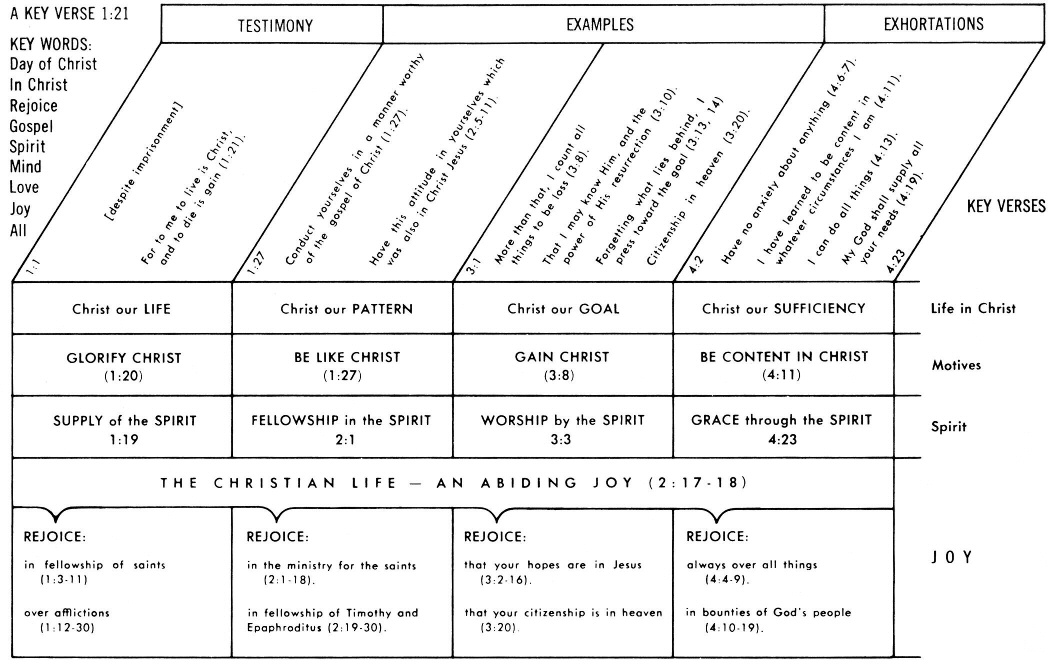
LIFE IN CHRIST
Click chart to enlarge
Charts from Jensen's Survey of the NT - used by permission
Philippians - Charles Swindoll = Chart on right side of page
| Account of Paul's Circumstances Php 1:1-30 |
Have the Mind of Christ Php 2:1-30 |
Have the Knowledge of Christ Php 3:1-21 |
Have |
| Partakers of Christ | People of Christ | Pursuit of Christ | Power of Christ |
| Suffering | Submission | Salvation | Sanctification |
| Experience | Examples | Exhortation | |
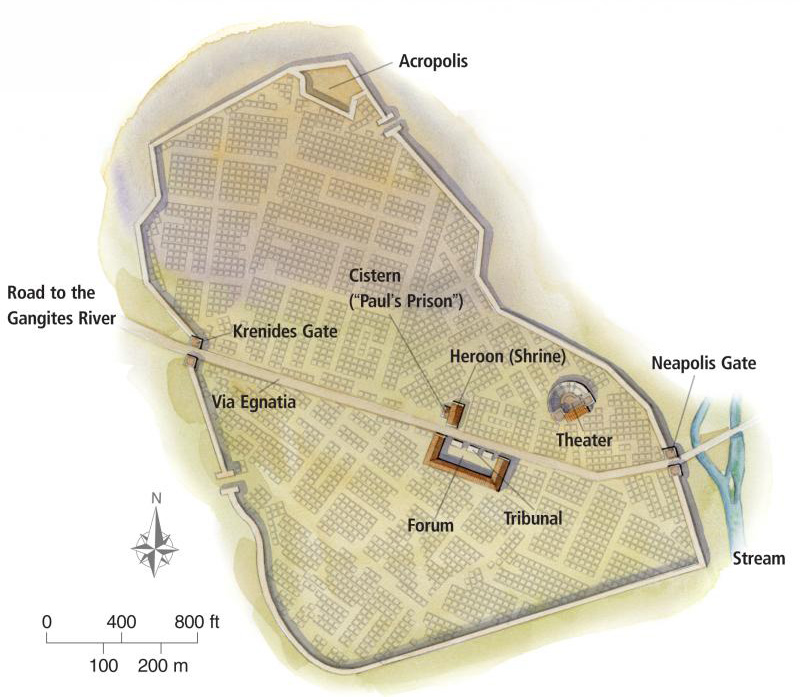
Philippi in the Time of Paul
The city plan above shows those features of the city of Philippi that archaeologists have so far identified as dating from the time of Paul. “Paul’s Prison” is not believed to be an authentic site, but was a cistern later associated with Christian worship. (ESV.org)
Philippians 2:16 holding fast the word of life, so that in the day of Christ I will have reason to glory because I did not run in vain nor toil in vain (NASB: Lockman)
Greek: logon zoes epechontes, (PAPMPN) eis kauchema emoi eis hemeran Christou, hoti ouk eis kenon edramon (1SAAI) oude eis kenon ekopiasa. (1SAAI)
Amplified: Holding out [to it] and offering [to all men] the Word of Life, so that in the day of Christ I may have something of which exultantly to rejoice and glory in that I did not run my race in vain or spend my labor to no purpose. (Amplified Bible - Lockman)
ESV: holding fast to the word of life, so that in the day of Christ I may be proud that I did not run in vain or labor in vain.
NET: by holding on (holding out, holding forth) to the word of life so that on the day of Christ I will have a reason to boast that I did not run in vain nor labor in vain.
KJV: Holding forth the word of life; that I may rejoice in the day of Christ, that I have not run in vain, neither laboured in vain.
NLT: Hold tightly to the word of life, so that when Christ returns, I will be proud that I did not lose the race and that my work was not useless. (NLT - Tyndale House)
Phillips: For you hold in your hands the very word of life. Thus can you give me something to be proud of in the day of Christ, for I shall know then that I did not spend my energy in vain. (Phillips: Touchstone)
Wuest: holding forth the word of life, to the end that I may have a ground for glorying reserved for the day of Christ, this glorying being because of the fact that I did not run in vain nor did I labor to the point of exhaustion in vain. (Eerdmans Publishing)
Young's Literal: the word of life holding forth, for rejoicing to me in regard to a day of Christ, that not in vain did I run, nor in vain did I labour
HOLDING FAST THE WORD OF LIFE: logon zoes epechontes (PAPMPN):
- Phil 1:27; Ps 40:9; 71:17; Mt 10:27; Lk 12:8; Ro 10:8-16; Rev 22:17) (Jn 6:63,68; Acts 13:26; 2Ti 2:15, 16, 17; Heb 4:12; 1Pet 1:23; 1John 1:1)
Lightfoot has “holding out” (as offering) whereas other translations render it “holding fast” in the sense of faithfully persevering in the Christian faith.
John MacArthur notes that "Holding fast is from epecho, which is perhaps better rendered “holding forth,” as in the King James Version. The terms Paul normally used for the idea of holding fast, or holding on to, were echo or katecho (cf. 1Co 11:2; 15:2; 1Th 5:21; 1Ti 1:19; 3:9; 2Ti 1:13). The context of the present text also makes clear that the point is not believers’ remaining faithful to (i.e., holding onto) God’s truth, but rather their sharing with others (holding out) the redeeming word that brings eternal life. (MacArthur, J. Philippians. Chicago: Moody Press)
Rainy writes that hold forth the word of life may mean that the saints at Philippi were to "hold by it and to hold it out,--the expression used in verse 16 may have either meaning; and virtually both senses are here. In order to give light there must be life. And Christian life depends on having in us the Word, quick and powerful, which is to dwell in us richly in all wisdom and spiritual understanding. This must be the secret of blameless Christian lives; and so those who have this character will give light, as holding forth the Word of life. The man's invisible character itself does this. For while the word and message of life is to be owned, professed, in fit times proclaimed, yet the embodiment of it in the man is the main point here, the character being formed and the practice determined by the "word" believed. So also we are said to live by the faith of the Son of God. The life of faith on Him, is the life of having and holding forth His Word. (Read the rest of his note in The Epistle to the Philippians)
James Draper makes a good point - We often think that some Christians do not witness, but they all do witness! The trouble is, some give the wrong kind of witness. They give a witness that says, "God is insignificant and unimportant in my life." As God's salvation is worked out through us, we will offer the Word of Life to those around us, expecting them to take it.
It seems to me that holding fast to the Word (and thereby being held fast by it) and holding out the Word of life are not incompatible interpretations. You can hardly hold it out unless you are holding it fast! The latter then implies the former.
Holding fast (1907) (epecho from epí = upon + écho = have, hold) means literally have or hold upon. To hold fast. To hold firmly to (hold firmly to a particular belief) To direct towards. To give attention to. To hold out, then to hold one's mind toward. To observe.
It is found in the phrase in secular Greek "held straight for the beach".
In this verse the present tense calls for them to hold fast to the Word continually, continuing to believe it. The context also allows for the interpretation of the continuing to hold forth the Word of Life as described in next section.
Epecho can also mean to have hold out towards as an offer (e.g., as used in secular Greek of offering someone food or wine). Holding out like a torch.
When used of the mind it mean to fix the mind upon, give heed to, keep close watch on, pay attention (cf 1Ti 4:16). In this use the idea is that of a constant state of readiness.
In some contexts epecho means to direct one's mind or attention to a particular object or event, to notice or to watch (cf Luke 14:7, Acts 3:5) direct one’s mind to a thing,
Finally epecho can mean to stay or remain in a place beyond some point of time and so to stay on or remain. It can also mean to keep back or detain a person = hold oneself back. (cf Acts 19:22; Ge 8:10; 2Chr 8:5)
Epecho is found 5 times in the NAS (Luke; Acts 2x; Philippians;1 Timothy) and is translated: give… attention, 1; holding fast, 1; noticed, 1; pay close attention, 1; stayed, 1.
Here are the NT uses of epecho…
And He began speaking a parable to the invited guests when He noticed how they had been picking out (epecho) the places of honor at the table; saying to them, (Lk 14:7)
And he began to give (epecho) them his attention, expecting (epecho) to receive something from them. (Acts 3:5)
(Paul's 2nd Missionary Journey) And having sent into Macedonia two of those who ministered to him, Timothy and Erastus, he (Paul) himself stayed (epecho) in Asia for a while. (Acts 19:22) (Comment: here the meaning of epecho conveys the idea of to hold upon a place, to wait in a place, and so to stay)
Pay close attention (present imperative) (hold himself to strict account) to yourself and to your teaching (Comment: note personality before teaching); persevere (present imperative) in these things, for as you do this you will ensure salvation both for yourself and for those who hear you. (1Ti 4:16)
Epecho is found 12 times in the Septuagint (LXX) :Gen. 8:10, 12; Jdg. 20:28; 1 Ki. 22:6, 15; 2 Ki. 4:24; 2 Chr. 18:5, 14; Job 18:2; 27:8; 30:26; Jer. 6:11
See discussion of “Hold Fast” Versus “Hold Out” In Philippians 216 -- By Vern Poythress
Spurgeon - You are to hold forth the Word of life as men hold forth a torch. Your shining is largely to consist in holding forth the Word of life.
Note that in Phil 2:14-16, Paul emphasizes three characteristics of those who would be "lights" in the midst of this crooked and perverse generation.
(1) Uncomplaining spirit
(2) In contact with the people of this world, but not contaminated by them
(3) Holding to and holding forth the word of God
H C G Moule -Holding forth - as offering it for acceptance; presenting it to the notice, enquiry, and welcome, of others. The metaphor of the luminary is dropped.—It is intimated that the faithful Christian will not be content without making direct efforts, however humble and unobtrusive, to win attention to the distinctive message of his Lord. (The Epistle to the Philippians)
Vance Havner - Hold forth the word of life. We are not depositories but dispensers, stewards, and witnesses, not just to enjoy the gospel but to share it. It is not a secret to be hidden, but a story to be heralded.
Adam Clarke on Holding forth the word of life—An allusion, some think, to those towers which were built at the entrance of harbors, on which fires were kept during the night to direct ships into the port. Genuine Christians, by their holy lives and conversation, are the means of directing others, not only how to escape those dangers to which they are exposed on the tempestuous ocean of human life, but also of leading them into the haven of eternal safety and rest. That I have not run in vain—This appears to be a part of the same metaphor; and alludes to the case of a weather-beaten mariner who has been long tossed on a tempestuous sea, in hazy weather and dark nights, who has been obliged to run on different tacks, and labor intensely to keep his ship from foundering, but is at last, by the assistance of the luminous fire on the top of the tower, directed safely into port. Live so to glorify God and do good to men, that it shall appear that I have not run and labored in vain for your salvation.
Life Application Commentary - Christians can develop a "fortress mentality" about surviving in a depraved world. Such a mind-set prefers to withdraw into church or family, away from the evil world, shutting it out. But Paul didn't support a fortress mentality. Instead, he required believers to take the gospel out into the culture. It is a waste of energy just to leave a light on. Church people must help illuminate the way so that others can find Christ. (Barton, B, et al: The NIV Life Application Commentary Series: Tyndale)
Ron Mattoon - He, who would shine as a light, must burn. No candle can give light without the wax being consumed. If we are going to shine for Christ, we must give of ourselves. Don't be surprised if the Lord does not use you if you are unwilling to give of yourself and be used of God. (Mattoon's Treasures from Philippians)
Steven Cole - Our lives shine as we put off grumbling and disputing and live in joy, especially during trials. But, also, we have a message we hold forth: “the word of life” (Phil 2:16). The gospel--that Christ died for our sins, that He arose victorious over sin and death, that He offers a full pardon from the wages of sin to all who will receive it by faith-- that good news is the power of God to salvation for all who believe. The gospel is not just a set of propositions or doctrines to subscribe to, although it involves certain non-negotiable doctrines. The gospel brings the very life of God to those who are dead in their transgressions and sins (Ep 2:1-10). Those apart from Christ are not pretty good people who just need a little help to solve some of their problems. According to Scripture, they are spiritually dead, separated from the life of God. But when we hold forth to them the word of life, God can use it to raise them from the dead, to give them eternal life. (Read the entire excellent message)
Word of Life - In Greek this phrase is placed first for emphasis. It is a beautiful descriptive name for the Scripture and in context refers to the Gospel which, when believed, produces spiritual and eternal life (cf. Eph 2:1-note, Jn 3:3, 5 5:24 6:63 12:48).
Word of Life means that it is the Word which is life (genitive of apposition) and which gives life (genitive of source). In other words the Gospel is not like just any word but is a word which has life in itself and which leads to life. Paul makes it clear that this "Word of life", the gospel, is unique and supernatural writing to the Colossians that…
the word of truth, the gospel, which has come to you, just as in all the world also it (the gospel) is constantly bearing fruit (What is constantly bearing fruit?) and increasing, even as it (the gospel) has been doing in you also since the day you heard of it (the gospel) and understood the grace of God in truth (Col 1:5b-note, Col 1:6-note).
When the angel released Peter from prison (where he was being held for preaching the gospel), the angel commanded Peter…
Go (present imperative) your way, stand and speak (present imperative) to the people in the temple the whole message of this Life." (Acts 5:20)
Comment: Regardless of opposition or difficulties, the Lord expected Peter -- and all His spiritual children --to take a stand once and for all and to speak all the words of this life with boldness -- cf Acts 4:31.
Vine feels that "The word of life is not here the Living Word, the Person (as in 1John 1); only John uses logos in that sense; it is the (living and life giving) message, the gospel. It is called the Word of life because it ministers spiritual life and imparts the knowledge of God and of His Son Jesus Christ, which the Lord said “is eternal life” (John 17:3). (Collected writings of W. E. Vine)
Vincent adds that the word of life is…
the word ‘which has in itself a principle as well as a message of life’; or, as Meyer, “the divinely efficacious vehicle of the spirit of life.” (Regarding the Greek word for "life", zoe, Vincent adds)… "Zoe is the correlative of salvation. With quickening from the death of sin the believer enters upon ‘newness of life’ (Ro 6:4-note, Ro 6:11-note). This life, as to its quality, is that which shall be lived with the exalted Christ. Now it is hidden with Christ, because the exalted Christ is still hidden (Col 3:4-note; cp Col 1:5-note). But it will be manifested in glory when Christ, who is our life, shall be manifested (Col 3:4-note). Then will come the change into ‘the likeness of the body of his glory’ (note Philippians 3:21), and “mortality” will be “swallowed up of life” (2Cor. 5:4) (Online - A Critical and Exegetical Commentary on the Epistles to the Philippians and to Philemon. New York: C. Scribner's Sons)
Jesus said that "It is the Spirit who gives life; the flesh profits nothing; the words that I have spoken to you are spirit and are life. (Jn 6:63)
Peter added "Lord, to whom shall we go? You have words of eternal life." (Jn 6:68)
Scripture has numerous descriptions of The Word as shown in the following list (based on the NASB translation) which is worth studying if you have time… (This list would be a fruitful Meditation [See also Primer on Biblical Meditation])
THE WORD IS A "WORD… "
- … of all the good words Jos 23:14, 15
- … of Thy lips Ps 17:4-note
- … of the kingdom Mt 13:19
- … of this salvation Acts 13:26, 13:44
- … of God 1Sa 9:27, et al
- … of the Lord Acts 13:48, et al
- … of His Grace Acts 14:3, 20:32
- … of the Gospel Acts 15:7
- … of promise Ro 9:9-note
- … of faith Ro 10:8-note
- … of Christ Ro 10:17-note
- … of the Cross 1Cor 1:18
- … of reconciliation 2Cor 5:19-note
- … of truth 2Co 6:7, Col 1:5-note, 2Ti 2:15-note, Jas 1:18-note
- … of life Php 2:16-note
- … of Life 1Jn 1:1
- … of God's message 1Th 2:13-note
- … of His power Heb 1:3-note
- … of righteousness Heb 5:13-note
- … of the oath Heb 7:28-note
- … of exhortation Heb 13:22-note
- … living and abiding 1Pe 1:23-note
- … of My perseverance Rev 3:10-note
Metaphors (what is a metaphor?) for the Word of God…
- Scripture Is like a Counselor - Ps. 119:24-note
- Scripture Is like Fire - Jer 5:14; 23:29
- Scripture Is like Gold - Ps 19:9, 10-note
- Scripture Is like a Hammer - Jer 23:29
- Scripture Is like a Heritage - Ps 119:111-note
- Scripture Is like Honey - Ps 19:9, 10-note; Ps 119:103-note
- Scripture Is like a Lamp - Ps 119:105-note
- Scripture Is like a Light - Ps 119:105, Ps 119:130-note; 2 Pe 1:19-note
- Scripture Is like Milk - 1Cor 3:1, 2, 3; Heb 5:11, 12, 13-note; 1Pe 2:2-note
- Scripture Is like a Mirror - Jas 1:23, 24, 25-note (cp 2Co 3:18-note)
- Scripture Is like Rain - Isa 55:10, 11
- Scripture Is like a Seed - 1Pe 1:23-note
- Scripture Is like Snow - Isa 55:10,11
- Scripture Is like Solid Food - Heb 5:11, 12-note, Heb 5:14-note
- Scripture Is like a Sword - Eph 6:17-note; Heb. 4:12-note
- Scripture Is like Water - Eph 5:25, 26-note
Related Resources:
- Memorizing His Word
- Delighting in the Word of God - See discussion of delight
- Quotations - Scripture or the Word of God
- Inductive Study on the Power of God's Word
- Memory Verses by Topic - consider bookmarking this page
SO THAT IN THE DAY OF CHRIST I HAVE CAUSE TO GLORY: eis kauchema emoi eis hemeran Christou :
- Phil 1:26; 2Cor 1:14; 1Th 2:19
CAUSE TO GLORY
So that - Expresses the purpose of their (the Philippians saints) walking (conducting their lives) by either holding fast or forth the Word of life (Other descriptions of the Word). Either way (remaining faithful to the Word or giving out the Word) will be a praiseworthy situation for their "spiritual mentor" Paul when he stands before the Righteous Judge, Christ Jesus, at the Bema Seat.
THOUGHT - Are you so redeeming your short time on earth (Jas 4:14, Job 7:7, 14:1,2, Ps 37:2-note, Ps 90:9-note, 1Pe 1:17-note), pouring your life into others, intentionally discipling them, equipping them to be steadfast in the faith, so that you too might have cause to glory at the Judgment Seat of Christ? To ask it another way, are you so living in a manner worthy of the Lord that you are not looking forward to your personal appearance at the Bema Seat of Christ? Let me encourage you to forget what lies behind and reach forward to what lies ahead (Phil 3:13-note), consciously, prayerfully (Pray Ps 90:12-note) determining to redeem the time you have left (Ep 5:15, 16-note, Col 4:5KJV, Col 4:6KJV-note), motivated not by guilt but by His promise of a reward for faithful, Spirit energized, grace endued labor for the Lord and His renown (cp Rev 22:12-note, Col 3:23, 24, 25-note Mt 25:21, 23, Lk 19:17). As someone has well said "You can’t control the length of your life, but you can control its depth." (from The Brevity Of Life - Our Daily Bread)
Lehman Strauss - Paul did not live to please himself. He lived and labored in the light of "the day of Christ." In that day he wanted to rejoice in abiding fruit. So he held forth the Word of life. To waste his time in performing works that have no lasting spiritual qualities, and that would be burned up, would be to labor in vain. He who would shine as a light must burn. No candle can give light without the wax being consumed. No lamp can give light if its oil is not being consumed. John the Baptist was "a burning and a shining light" (John 5:35). So was Paul! (Ed: And so too can you be dear saint!) (Lehman Strauss Commentary - Devotional Studies in Philippians)
John Phillips - Paul wanted to be as successful as possible in spreading the gospel. He wanted to persuade people to accept Christ, and he wanted his converts to do the same. And he wanted his converts to teach their converts to spread the gospel. At the judgment seat of Christ their reward would be his reward. Paul's cup of rejoicing would overflow if those he had won to Christ were to hear the Lord say to them, "Well done." Then he would know he had not labored in vain. (John Phillips – Exploring Philippians: An Expository Commentary)
Day of Christ (see discussion of this "day" at note 1 and/or note 2, See also Second Coming) in the present context refers to Christ's return and His subsequent judgment of believers (see note on Bema Seat of Christ)…
Therefore we also have as our ambition, whether at home or absent, to be pleasing to Him (Why should we seek to walk in a manner worthy of the Lord to please Him in all respects? See Scriptural description of a "Worthy Walk" that pleases God), for we must all appear before the judgment seat of Christ, so that each one may be recompensed for his deeds in the body, according to what he has done, whether good or bad. (2Co 5:9-note, 2Co 5:10-note) (Compare Ro 14:10, 11, 12-note)
Paul voiced a similar thought in other letters…
(To the Corinthian saints) just as you also partially did understand us, that we are your reason to be proud (kauchema; KJV = "we are your rejoicing")) as you also are ours, in the day of our Lord Jesus. (2Cor 1:14)
Comment: "A crown of rejoicing" awaits those who will be greeted by people won to Christ, in part through their witness, in the day when Christ returns.
(To the saints in Thessalonica) For who is our hope or joy or crown of exultation (kauchesis)? Is it not even you (those who had become believers), in the presence of our Lord Jesus at His coming? (1Th 2:19-note)
Comment: Paul is alluding to the wreath given to winners in the Olympic games. Since the Thessalonian believers had come to Christ as a result of Paul's ministry there, their presence in the Christian host when Christ returns would be a great reward to Paul--his crown of rejoicing. The same, no doubt, will apply for all who have the joy of seeing those whom they have had a part in leading to Christ -- via praying, giving, sending, going, witnessing, etc -- in our Lord's presence when He comes again.
H C G Moule commenting on cause to glory writes "Literally, "to (be a) rejoicing for me."… He looks forward to a special recognition of his converts at Philippi, at the Lord's Coming, and to a special "joy of harvest" over them. (The Epistle to the Philippians)
To glory (2745) (kauchema akin to aucheo = boast + euchomai = pray to God <> auchen = neck which vain persons are apt to carry in proud manner) strictly speaking describes either a boast (the act) or the ground or the matter of glorying or boasting (the object). The boast can be either proper or improper (sinful, as in 1Co 5:6), and whether it is a good or bad sense is determined by the context.
Webster's 1828 definition of "boast" nicely summarizes the good and bad sense of boast…
(Bad sense) To brag, or vaunt one’s self; to make an ostentatious display, in speech, of one’s own worth, property, or actions. (Good sense) To glory; to speak with laudable pride and ostentation of meritorious persons or things… Usually, it is followed by of; sometimes by in.
If you would glorify your God
And thus His name adorn,
Be sure you keep your heart from pride;
Self-praise and boasting scorn. —Anon.
People who sing their own praises
usually do so without accompaniment.
(From Boast Roast - Our Daily Bread)
Those who sing their own praise are usually off key
and usually do so without accompaniment!
Tozer once said of boasting (in the bad sense)…
is an evidence that we are pleased with self; belittling, that we are disappointed in it. Either way, we reveal that we have a high opinion of ourselves.
The related verb is kauchaomai which means to boast over a privilege or possession. The idea is to take pride in something (in a bad sense - Ro 2:23-note, in a good or legitimate sense - Ro 5:2-note, Ro 5:3-note; Ro 5:11-note - in Romans 5 kauchaomai = "exult")
The related word kauchesis is the act of glorying as in Ro 3:27-note, but Ro 4:2 kauchema speaks of the grounds for boasting. In 2Co 8:24 kauchesis describes Paul's act of boasting about the Corinthians whereas in 2Co 9:3 kauchema refers to the ground on which Paul boasted.
Kenneth Wuest commenting on Gal 6:4KJV writes "The word rejoicing is kauchema which means “that of which one glories or can glory, matter or ground of glorying.” The word is not connected with the word glory (doxa [word study]) which is used of God’s glory. It means glory in the sense of exultation, self-congratulation. It does not however have the idea of an excessive or unjustified estimate of one’s self that the English word boasting has.(Word Studies - Eerdman Publishing Company Volume 1, Volume 2, Volume 3)
BDAG - (1) act of taking pride in something or that which constitutes a source of pride (Ro 4:2, Gal 6:4), (2) expression of pride, boast, what is said in boasting (2Cor 9:3)
NIDNTT - kauchēma (Pindar) refers to the subject of boasting, to the words used by the boaster, and occasionally also to the act of boasting, although for the latter (especially in the NT) the noun kauchēsis is more frequently found. kauchēsis (Epicurus) can likewise on occasion be used to denote the subject of boasting. Although the ancient Greeks recognize legitimate pride in oneself (e.g. Homer, Il., 6, 208), there is a clear appreciation of the distinction between this and unwarranted bragging, which was pilloried by the satirists and others. Plutarch also attacked ostentation in an essay on Self-praise without Envy. (Brown, Colin, Editor. New International Dictionary of NT Theology. 1986. Zondervan n)
EBC - kauchēma, means something one can boast about, rather than kauchēsis, the act of boasting. (Gaebelein, F, Editor: Expositor's Bible Commentary 6-Volume New Testament. Zondervan Publishing)
Kauchema - 11x in 11v in NAS - Translated in NAS as - boast(3), boast about(1), boasting(3), proud(1), proud confidence(1), reason to be proud(1), reason to glory(1), something to boast about(1). The KJV renders kauchema as --- rejoicing 4, to glory 3, glorying 2, boasting 1, rejoice 1.
Romans 4:2-note For if Abraham was justified (dikaioo [word study] - declared righteous) by works, he has something to boast about, but not before God.
Comment: In other words if Abraham could save himself by what he could do (his works, his keeping of the law), he would have grounds for boasting. Paul's point is that Abraham found nothing according to the flesh, for if he had, he would have had something to boast about.
A T Robertson: The rabbis had a doctrine of the merits of Abraham who had a superfluity (a quantity in excess of what he needed for salvation) of "credits" to pass on to the Jews (Lk 3:8) (Study Notes on 4:2)
David Guzik: For if Abraham was justified by works, he has something to boast about: If anyone could be justified by works, they would have something to boast about. Nevertheless such boasting is nothing before God (but not before God).. This boasting is nothing before God because even if works could justify a man he would still, in some way, fall short of the glory of God. (Ro 3:23) This boasting is nothing because before God, every pretense is stripped away and it is evident that no one can really be justified by works. (Romans - Chapter 4)
Illustration of "Salvation by Works": A preacher, long-departed from the truth of the gospel, told the following story to summarize the faith he taught. It seems that a frog one day fell into a pail of milk, and though he tried every conceivable way to jump out, he always failed. The sides were too high, and because he was floating in the milk he could not get enough leverage for the needed leap. So he did the only thing he could do. He paddled and paddled and paddled some more. And oila!—his paddling had churned a pad of butter from which he was able to launch himself to freedom. The preacher’s message was: “Just keep paddling, keep on working, keep on doing your best, and you will make it.” We smile at this exaggerated simplification, but this actually describes our American “man on the street” folk religion quite well. Despite the fact that “Amazing Grace” is our favorite hymn, most people think that if you just do your best you will somehow make it to Heaven. Modern man is, as a matter of fact, deeply hostile to the concept of justification by faith alone through God’s grace. He is much more comfortable with the motto: “We get our salvation the old-fashioned way. We earn it!”
A survey by the Barna Research Group suggests widespread confusion about the gospel - even among churchgoers who feel responsible to spread the gospel. Almost half of the respondents (46%) say they have a personal responsibility to explain their beliefs to others. Most of those “evangelizers” (81%) believe that the Bible is accurate in all its teachings and that Jesus Christ was crucified and resurrected (94%). But 48% of the evangelizers also believe that “if people are generally good, or do enough good things for others… they will earn places in heaven.” “There is plenty of reason for churches to worry if nearly one-half of their people who believe in evangelism also believe in salvation by works,” says George Barna, president of the Barna Research Group. “The central message of Protestantism is in salvation by faith alone in Christ, yet (many) Protestant evangelizers seem to be preaching a different message.” Respondents from “mainline” Protestant churches tended to believe in salvation by works more frequently than those from “evangelical” churches. Yet pastors from mainline churches seemed more confident in their members’ ability to evangelize. Almost half (46%) of mainline pastors believe their congregations are qualified to present the gospel, while only one-fourth (24%) of Baptist pastors do.
In a 1992 survey ~1/3 of born-again Christians (and 54% of all respondents including so called "born again") stated that all good people will go to heaven whether they have embraced Jesus Christ or not. (They need to read Ro 3:19,20 and then Ro 3:21-4:25) Furthermore almost 25% of "born again" respondents said that while Jesus was on earth He sinned like other men!
As G. K. Chesterton has said, “Merely having an open mind is nothing. The object of opening the mind, as of opening the mouth, is to shut it again on something solid.”
BOTH WERE WRONG - A businessman well known for his ruthlessness once announced to writer Mark Twain, "Before I die I mean to make a pilgrimage to the Holy Land. I will climb Mount Sinai and read the 10 Commandments aloud at the top." "I have a better idea," replied Twain. "You could stay in Boston and keep them."
The Thief on the Cross - Dwight L Moody : "The thief had nails through both hands, so that he could not work; and a nail through each foot, so that he could not run errands for the Lord; he could not lift a hand or a foot toward his salvation, and yet Christ offered him the gift of God; and he took it. Christ threw him a passport, and took him into Paradise.
How Do You Get to Heaven? This question will bring a variety of answers. A confusion of views is evident in the following sampling of opinions gathered for the Radio Bible Class program ‘Sounds of the Times’
• “God wouldn’t send you to hell.” (New York)
• “I’ll cross that bridge when I get there.” (Boston)
• “You have to believe in God.” (Miami)
• “There is nothing I can do about it.” (New York)
• “I don’t dare say that I know I’m going.” (Los Angeles)
• “Keep the Ten Commandments.” (San Francisco)
• “How I live my life… being kind to other people.” (Boston)
• “Jesus gave His life for my salvation.” (Los Angeles)
• “I couldn’t care less.” (Boston)
• “Be a good person.” (Gainesville)
• “I feel I’d go to hell.” (San Francisco)
1 Corinthians 5:6 Your boasting is not good. Do you not know that a little leaven leavens the whole lump of dough?
Comment: The idea is that the Corinthians boast that they be the holy body of Christ and can still hold to the world's profane moral standard and do so without being affected by the profanity - Paul says "no" this boasting is not good for the body. The Corinthian church was actually proud that they were ignoring the immoral man's notorious sin! "They thought it showed the whole world how "loving" they were. But you don't show "love" to a body by being kind to a cancer!" (Guzik) The "little leaven" was Paul's metaphor describing the evil in the church, specifically the immoral person he had just described in 1Cor 5:1, 2,3, 4, 5 and mentioned again in 1Cor 5:13).
John MacArthur paraphrases this as follows: “Look where your arrogance and your boasting have brought you. Because you still love human wisdom and human recognition and the things of this world, you are completely blinded to the blatant sin that will destroy your church if you don’t remove it.”… In a more modern figure he was saying, “Don’t you know that one rotten apple can spoil the whole barrel?… A large congregation, an impressive Sunday school, active witnessing and visitation and counseling, and every other sort of good program give no protection or justification to a church that is not faithful in cleansing itself. When sin is willingly, or even neglectfully, allowed to go unchallenged and undisciplined, a larger church will be in danger of a larger malignancy! (MacArthur, J: 1Corinthians. Chicago: Moody Pres)
Guzik on a "little leaven": The leaven mentioned isn't merely yeast, but a pinch of dough left over from the previous batch, as in the making of sourdough bread. This is how bread was commonly leavened in the ancient world, and little pinch of dough from the old lump could make a whole new lump of dough rise and "puff up" – so the work of leaven was thought to be an illustration of the work of sin and pride. The presence of a little can corrupt a large amount. In this light, the Passover command to purge the leaven had a health purpose. This method of fermentation, used week after week, increased the danger of infection or food poisoning, so at least once a year, the Israelites started from scratch. (Guzik)
1 Corinthians 9:15 But I have used none of these things. And I am not writing these things so that it will be done so in my case; for it would be better for me to die than have any man make my boast an empty one.
John MacArthur comments: Kauchema refers to that in which one glories or to the basis for glorying. It also carries the idea of rejoicing or reveling. Because it is frequently done in pride, boasting is usually a sin; but it need not be proud and sinful. Paul’s boast was not intended to convey arrogance but joy. He was so glad for that spiritual privilege and commitment in which he rejoiced that he would rather die than contradict it. He had his priorities right, receiving his joy from exercising his privilege to restrict his freedoms rather than from using them. His boasting was far different from boasting of his accomplishments, as he immediately makes clear. (MacArthur, J: 1Corinthians. Chicago: Moody Press)
David Guzik: Paul's boasting wasn't that he preached the gospel (he had to do that: for necessity is laid upon me), but that he was able to do it without asking his hearers for support. Remember that Greek culture, which the Corinthian Christians were so approving of, looked its nose down upon all manual labor. Even though the Corinthian Christians seemed to think less of Paul because he worked with his own hands to support himself, Paul was not embarrassed by this at all. He will boast about it! (Guzik)
1 Corinthians 9:16 For if I preach the gospel (euaggelizo/euangelizo [word study]), I have nothing to boast of, for I am under compulsion (anagke [word study]); for woe is me if I do not preach the gospel.
MacArthur: He gloried (boasted) in the gospel but not for it. He had absolutely nothing to do with the giving or the content of the gospel. He simply received the revelation. Nor was he boasting of his commitment to or ability in preaching the gospel. He did preach the gospel, more diligently than anyone of whom we know, but for this he was under compulsion (Ed: Paul was "constrained" in light of Christ's clear call on his life -- see Acts 9:3, 4, 5, 6, 26:13, 14,15, 16, 17, 18, Ro 11:13, Acts 26:19).
2 Corinthians 1:14 (Read context= 2Co 1:12, 13 - where "proud confidence" = the related noun kauchesis) just as you also partially did understand us, that we are your reason to be proud as you also are ours (Ed: our reason to be proud), in the day of our Lord Jesus (Ed: Second Coming).
Comment: This verse is somewhat difficult to understand. The NET Bible says "that we are your boast even as you are our boast."
Here is the NLT paraphrase of 2Cor 1:13-14NLT to help understand this passage:
Our letters have been straightforward, and there is nothing written between the lines and nothing you can't understand (Ed: That is, he really was telling the truth, and he wasn't communicating with manipulative hidden meanings). I hope someday you will fully understand us, even if you don't understand us now. Then on the day when the Lord Jesus returns, you will be proud of us in the same way we are proud of you.
Henry Morris: "A crown of rejoicing" (see 2Co 1:14KJV) awaits those who will be greeted by people won to Christ, in part through their witness, in the day when Christ returns (compare 1Th 2:19-note). (Defender's Study Bible Notes - online)
2 Corinthians 5:12 We are not again commending ourselves to you but are giving you an occasion (aphorme [word study] = base of operations, material with which to glory) to be proud (KJV = glorying) of us, so that you will have an answer for those who take pride (kauchaomai = boast) in appearance (externals ~ reputation = what others see) and not in heart (internals ~ character = what God sees! 1Sa 16:7).
MacArthur comments that kauchema: "here it refers to their confidence in his spiritual integrity (cf. 2Co 1:14; 9:3; Gal 6:4; Php 1:26; Php 2:16; Heb. 3:6). Turning the tables on his accusers, Paul denounced them as those who take pride in appearance and not in heart. Because their outward religious appearance did not match the corruption that was in their hearts they, not Paul, were the hypocrites lacking integrity. (MacArthur, J: 2Corinthians. Chicago: Moody Press)
2 Corinthians 9:3 (Context = 2Cor 9:1,2 where "boast" in v2 = kauchaomai) But I have sent the brethren (Ed: Titus and two unnamed Christians), in order that our boasting about you may not be made empty (kenos [word study] = without content, hollow) in this case, so that, as I was saying, you may be prepared;
MacDonald: They (Titus and the other 2 brothers) were being sent (to the Corinthians) so that Paul’s boasting concerning the Corinthians would not be in vain with regard to the collection. The mission of the three brethren would be to ensure that the collection was prepared by the time that Paul got there. (MacDonald, W & Farstad, A. Believer's Bible Commentary: Thomas Nelson)
Galatians 6:4 (Context = Gal 6:1, 2, 3) But (contrast = what's being contrasted?) each one must examine (dokimazo - used of assaying metals or testing money - see word study) his own work, and then (assuming he passes the test) he will have reason for boasting ("rejoicing" in Gal 6:4KJV) in regard to himself alone, and not in regard to another.
Comment: Paul's point is that we need to test ourselves to be sure our motives are pure and our purpose is to bring glory to the Father (Mt 5:16) when we consider giving spiritual help to someone cause in a trespass! If we "pass this test" then we have a ground for glorying, rejoicing or boasting.
John Stott on Gal 6:1-4: Notice the assumption which lies behind this command, namely that we all have burdens and that God does not mean us to carry them alone.
David Guzik: But let each one examine his own work: Instead of deceiving ourselves, we must take a careful and a sober examination of our works before God. If we don't, and if we carry on under our self-deception, then we may think our works are approved before God, when really they aren't. We want to have our work approved before God, so that our rejoicing on the day of reward can be for our own work (himself alone), and not in the work of another. There is another aspect to rejoicing (boasting) in himself. It means having joy at your own walk with the Lord, instead of feeling spiritual because some around you perhaps are overtaken in any trespass. (Guzik)
William MacDonald adds: This seems to be a warning against the habit of comparing ourselves with others, and finding cause for satisfaction. The apostle points out that we will be examined individually and not in comparison with others at the Judgment Seat of Christ. Therefore, we should take heed to ourselves, so that we might be able to rejoice in our work rather than in others’ failures. (MacDonald, W & Farstad, A. Believer's Bible Commentary: Thomas Nelson)
Philippians 1:26-note (Phil 1:25) so that your proud confidence in me may abound in Christ Jesus through my coming to you again.
John MacArthur: So that translates hina, which, when used with a subjunctive verb, introduces a purpose clause. Paul’s continuing to serve the Philippian church would be for the purpose of causing their proud confidence in him to abound in Christ Jesus through his coming to them again. In the Greek text, the phrase in Christ Jesus precedes the phrase in me, and that is the order Paul must have had in mind, the idea being: “in order that your proud confidence may abound in Christ Jesus, as He is seen in me.” (MacArthur, J. Philippians. Chicago: Moody Press)
Philippians 2:16-note holding fast the word of life, so that in the day of Christ I will have reason to glory because I did not run in vain nor toil in vain.
Hebrews 3:6-note but Christ was faithful as a Son over His house-- whose house we are, if we hold fast our confidence (parrhesia = literally bold speech, freedom of speech) and the boast of our hope (In Scripture "hope" not = "hope so" but is an absolute assurance that God will do good to me in the future. See elpis [word study]) firm until the end.
Comment: Be aware what this verse DOES NOT teach - It does not mean that one is saved by hanging on the to the end! It does mean that continuation to the end is the proof of the reality of one's faith.
MacDonald: At first this might seem to imply that our salvation is dependent on our holding fast. In that case, salvation would be by our endurance rather than by Christ’s finished work on the cross. The true meaning is that we prove we are God’s house if we hold fast. Endurance is a proof of reality. Those who lose confidence in Christ and in His promises (boast in our hope) and return to rituals and ceremonies show that they were never born again. It is against such apostasy that the following warning is directed. (MacDonald, W & Farstad, A. Believer's Bible Commentary: Thomas Nelson)
EBC - The Christian looks forward eagerly, expecting God’s triumph. To be God’s house, then, means to persevere in quiet confidence, knowing that one has matter for pride in the Christian hope. (Gaebelein, F, Editor: Expositor's Bible Commentary 6-Volume New Testament. Zondervan Publishing)
I Howard Marshall has the following summary in answer to his article entitled "Should Christians Boast?"…
Zmijewski suggests that the verb kauchaomai (and by extension kauchema) has two meanings, depending on the object. One is positive: “to take pride in”; the other is negative: “to brag.” The former usage has the meaning of “to rejoice, exult or express confidence in someone or something.” It would be better not to use the term “pride” (or certainly not the term “boasting”) in that context since it is so open to misunderstanding.
The positive usage arises when one is rejoicing about other people and about what God is doing rather than about oneself or one’s own successes, although believers can also exult in what God is doing in their own lives. The negative usage tends to be about oneself and to involve elements of comparison with other people. It may also be “empty” in the sense that the pride is misplaced, and it is always so when it takes place in relation to one’s spiritual status and expresses self-sufficiency without the need for God and His grace.
Further, human boasting tends almost inevitably to involve comparison with other people and establishing one’s superiority to them. For the New Testament, however, there is an expression of joy and confidence in what God does in a person that involves no sense of superiority to or comparison with others. Yet the risk is particularly great even at this point. A person may be tempted to take the credit for what God does and to think he or she is better than others even when thinking of what God has done.
The New Testament teaching, then, is clear. There is a boasting in things human, and there is a rejoicing and confidence in God and what He does. The former is illegitimate and sinful, and the latter is appropriate and good. It follows that “boasting” is often used in a negative way, and even when it is being used in a positive way, a person runs the risk of that exultation or rejoicing sliding over into pride and comparison with other people.
There is only one thing in which Christians can glory and that is the cross of Christ, by which they are crucified to the world and its standards and achievements (Gal. 6:14). (Should Christians Boast -- By I. Howard Marshall - BSac 159:635 July 02)
Kauchema - 15x in the non-apocryphal Septuagint (LXX) - Dt 10:21; 26:19; 33:29; 1Chr 16:27; 29:11; Ps 89:17; Pr 11:7; 17:6; 19:11; Jer 13:11; 17:14; 51:41; Zeph 3:19-20; Zech 12:7. Below are some of these uses…
Deuteronomy 10:21 "He is your praise (Heb = tehillah = praise, song, adoration; Lxx = kauchema) and He is your God, who has done these great and awesome things for you which your eyes have seen.
Deuteronomy 26:19 (Context = speaking of Israel - Dt 29:18) and that He will set you high above all nations which He has made, for praise (Heb = tehillah = praise, song, adoration; Lxx = kauchema), fame, and honor; and that you shall be a consecrated people to the LORD your God, as He has spoken."
1 Chronicles 29:11 (David's prayer) "Yours, O LORD, is the greatness and the power and the glory (Heb = tipharah = beauty; Lxx = kauchema) and the victory and the majesty, indeed everything that is in the heavens and the earth; Yours is the dominion, O LORD, and You exalt Yourself as head over all.
Psalm 89:17 For You are the glory (Heb = tipharah = beauty; Lxx = kauchema) of their strength, and by Your favor our horn is exalted.
Spurgeon explains: Surely in the Lord Jehovah have we both righteousness and strength. He is our beauty and glory when we are strong in him, as well as our comfort and sustenance when we tremble because of conscious weakness in ourselves. No man whom the Lord makes strong may dare to glory in himself, he must ascribe all honour to the Lord alone; we have neither strength nor beauty apart from him. (Ed: That is the Lord is the ground of any and all boasting in the life of a believer.)
Proverbs 17:6 Grandchildren are the crown of old men, and the glory (Heb = tipharah = beauty; Lxx = kauchema) of sons is their fathers.
Proverbs 19:11 A man's discretion makes him slow to anger, and it is his glory (Heb = tipharah = beauty; Lxx = kauchema) to overlook a transgression.
Jeremiah 13:11 'For as the waistband clings to the waist of a man, so I made the whole household of Israel and the whole household of Judah cling to Me,' declares the LORD, 'that they might be for Me a people, for renown, for praise (Heb = tehillah = praise, song, adoration; Lxx = kauchema) and for glory; but they did not listen.'
Jeremiah 17:14 Heal me, O LORD, and I will be healed; Save me and I will be saved, For You are my praise (Heb = tehillah = praise, song, adoration; Lxx = kauchema) .
Zephaniah 3:19 (Zeph 3:17 God is actually singing) "Behold, I am going to deal at that time with all your oppressors, I will save the lame And gather the outcast, And I will turn their shame into praise and renown In all the earth (Context = The end of the Great Tribulation and beginning of the Millennium) - Zeph 3:15 describes Messiah dwelling in their midst! see Ezekiel 34:24; Zechariah 14:9,16; Matthew 19:28). 20 At that time I will bring you in, even at the time when I gather you together; Indeed, I will give you renown and praise Among all the peoples of the earth, When I restore your fortunes before your eyes," Says the LORD.
Henry Morris comments: For thousands of years, including today, the name Israelite or Jew has been a reproach and a byword in all nations. In the day when the Lord will "turn back your captivity," however, it will not be a reproach but "a praise!" (Defender's Study Bible online - see all Dr Morris' interesting comments on Zephaniah 3)
Zechariah 12:7 "The LORD also will save the tents of Judah first, so that the glory (Heb = tipharah = beauty; Lxx = kauchema) of the house of David and the glory (Heb = tipharah = beauty; Lxx = eparsis = lifting up, elation, pride) of the inhabitants of Jerusalem will not be magnified above Judah.
This word study on kauchema in the context of Philippians 2:16 begs the practical question we each need to answer…
WILL YOU HAVE CAUSE TO GLORY
AT THE BEMA SEAT?
(See Note)
Edwards writes "Rejoice" or "boast" can speak of a pride which is not sinful; rather the satisfaction of a job well done for the Lord. I think this is the thought here. As these believers continue down the path of maturity, fulfilling their design in life, Paul will have great satisfaction in the day of Christ. The satisfaction will stem from the fact that he has not labored or run "for emptiness."
In this section although not specifically stated, Paul clearly has in mind the Judgment Seat of Christ (Bema or Judgment Seat of Christ for believers), where he would see the fruits of his ministry.
He feels a responsibility not only to see souls saved but also to present every man perfect in Christ (Col 1:28-note). The success of the saints at Philippi in working out their own salvation and proclaiming the gospel to others will be a cause of boasting to Paul.
Alexander Maclaren discusses the relationship between the faithfulness of the saints at Philippi and Paul's glorying in the Day of Christ…
The Apostle strikes a solemn note, which was always sounding through his life, when he points to that great Day of Christ as the time when his work was to be tested (cp 1Co 3:8, 9, 10, 11, 12, 13, 14, 15). The thought of that gave earnestness to all his service, and in conjunction with the joyful thought that, however his work might be marred by failures and flaws, he himself was ‘accepted in the beloved,’ (Ep 1:6KJV-note) was the impulse which carried him on through a life than which none of Christ’s servants have dared, and done, and suffered more for Him.
Paul believed that, according to the results of that test, his position would in some sort be determined. Of course he does not here contradict the foundation principle of his whole Gospel, that salvation is not the result of our own works, or virtues, but is the free unmerited gift of Christ’s grace.
But while that is true, it is none the less true, that the degree in which believers receive that gift depends on their Christian character, both in their life on earth and in the day of Christ. (E.g., see 1Ti 4:7, 8-note)
One element in that character is faithful work for Jesus. Faithful work indeed is not necessarily successful work, and many who are welcomed by Jesus, the Judge (2Ti 4:1-note), will have the memory of many disappointments and few harvested grains. It was not a reaper, ‘bringing his sheaves with him,’ (Ps 126:6) who stayed himself against the experience of failure, by the assurance, ‘Though Israel be not gathered yet shall I be glorious in the eyes of the Lord.’ (Is 49:5KJV) If our want of success, and others’ lapse, and apostasy or coldness has not been occasioned by any fault of ours, there will be no diminution of our reward. But we can so seldom be sure of that, and even then there will be an absence of what might have added to gladness. (Philippians 2:16 A Willing Sacrifice)
BECAUSE I DID NOT RUN IN VAIN NOR TOIL IN VAIN: hoti ouk eis kenon edramon (1SAAI) oude eis kenon ekopiasa (1SAAI):
- Isa 49:4; 1Co 9:26; Gal 2:2; 4:11; 1Th 3:5
ARE YOUR
RUNNING IN VAIN?
Paul like any good spiritual financier desires that his costly "investments" will yield a good return. He does not want his investment in their lives to yield nothing and so he appeals to them. He cannot run their race but in a sense is seeking to motivate them out of love for him to run their race with endurance, to fight the good fight, to keep the faith and to finish their course that they might receive the award awaiting all those who have loved the Lord's appearing and have lived accordingly (2Ti 4:8-note)
Spurgeon - The apostle was the founder of the church at Philippi; he had watched over them with all the anxiety of one who had planted and watered, and who looked for the increase. He therefore appealed to the affection that he knew they had for him. “I have run,” argues the apostle, “with all men looking on and gazing, many of them hating and scoffing. I have run with all my might; would you have me run in vain? I have labored more than they all,” the apostle could say, “would you have me labor for nothing?” He knew the answer they would give him would be, “No, beloved Paul, we would see you win the prize for which you ran, and reap the fruit for which you labored.” “Well,” argues the apostle “but I cannot, except you shine as lights in the world; you disappoint my hopes, you snatch the prize from my grasp, you fill me with anguish, if you are not holy, heavenly minded witnesses for Christ.” God’s ministers cannot bear the thought of having labored in vain. And yet if some of us were to die, what would remain of all we have done? We do not wish to rob faithful ministers of the result of their labors, and yet we shall do so unless we join heartily with our brothers in spreading the gospel, and do our best to live in holiness and Christian love.
Henrietta Mears - Paul shows us, too, that there is a sacrificial side of the Christian life. That which costs nothing amounts to nothing. Paul feared his work might be “in vain” (Philippians 2:16). So much in life is done in vain. Are we running in vain, or working in vain? So many days are spent in vain! So many books are written in vain! So many sermons are printed in vain! So many gifts are given in vain! The Christian life should be a sacrifice if we are to follow Christ. Does your faith cost anything? (What the Bible is All About)
Gene Getz - A strong motivation in Paul's life was the prospect of meeting his Christian converts in heaven someday. To stand before the Father with these fellow-believers was all the reward he asked. This, implied Paul, is legitimate pride—not his human accomplishments, but in the fact that others are in heaven and that he would be able to present them to Christ in an act of worship and love. Paul conveyed the same attitude when he wrote to the Thessalonians, "For what is our hope, our joy, or the crown in which we will glory in the presence of our Lord Jesus Christ when he comes? Is it not you? Indeed, you are our glory and joy" (1 Thess. 2:19). But Paul's rejoicing was not going to be related to their presence only, but also to the fact that they had "worked out their salvation" in an honorable and fruitful way. They had truly shone like "stars in the universe" as they boldly and clearly "held out the word of life"—the message of truth about Jesus Christ. Consequently Paul said, I will be able legitimately to "boast on the day of Christ that I did not run or labor for nothing" (2:16). Their obedience was a sure sign of the reality of the Christian experience (2:12).
Adolf Deissmann alluding to the fact that Paul was a weaver of tent-cloth has the following thought regarding Paul's frequent use of the word "labor" writing that the
frequent references to “labour in vain” are a trembling echo of the discouragement resulting from a width of cloth being rejected as badly woven and therefore not paid for." (Deissmann, A., & Strachan, L. R. M. Light From the Ancient East. Page 317 - Online)
Run (5143) (trecho) literally refers to moving forward rapidly and so to run. In the Septuagint it was used to describe the running of a warrior in battle. Trecho means to progress freely and advance rapidly. The idea is to spend one’s strength in performing or attaining something.
Trecho - 20x in 17v - Matt 27:48; 28:8; Mark 5:6; 15:36; Luke 15:20; 24:12; John 20:2, 4; Rom 9:16; 1 Cor 9:24, 26; Gal 2:2; 5:7; Phil 2:16; 2 Thess 3:1; Heb 12:1; Rev 9:9. NAS = ran(7), run(7), running(3), runs(1), rushing(1), spread rapidly(1).
In the phrase "I did not run in vain… " Paul speaks as if looking back over his life from that future day when he is standing at the Judgment Seat in the Day of Christ. The word picture ("run in vain") is an athletic metaphor taken from the Greek stadium in which races were run in order to receive a temporal prize. Here Paul alludes to the eternal prize even as he did in his letter to the Corinthians where he wrote…
Do you not know that those who run in a race all run, but only one receives the prize? Run in such a way that you may win. And everyone who competes in the games exercises self-control in all things. They then do it to receive a perishable wreath, but we an imperishable. Therefore I run in such a way, as not without aim; I box in such a way, as not beating the air; but I buffet my body and make it my slave, lest possibly, after I have preached to others, I myself should be disqualified. (1Cor 9:24-27) (click note on "Running to Win")
Vain (2756) (kenos) means empty, fruitless, without usefulness, of things that will not succeed and that are to no purpose
In Galatians Paul spoke of the possibility of "running in vain" writing that…
it was because of a revelation that I went up (Christ sent him to Jerusalem, see Gal 1:12); and I submitted to them the gospel which I preach among the Gentiles, but I did so in private to those who were of reputation, for fear that I might be running, or had run, in vain. (Galatians 2:2)
Comment: Paul's fear was that the Galatians might compromise with the teaching of the Judaizers and their "gospel" which was really not the true gospel. He feared that he might discover he was like an athlete who had run in vain by seeing that all the spiritual effort in his ministry past and present as futile
Toil (2872) (kopiao from kópos = strike or cut and then to labor, fatigue. Kopos is used in secular Greek of “a beating,” “weariness” as though one had been beaten and “exertion” was the proper word for physical tiredness induced by work, exertion or heat) means to to exhibit great effort and exertion, to the point of sweat and exhaustion. To physically become worn out, weary or faint. To engage in hard work and can imply difficulties and trouble. Kopiao was sometimes used to refer to athletic training and was a word in common use among the down-trodden masses of the Roman world.
Paul voiced a similar concern over those in Galatia writing…
I fear for you, that perhaps I have labored over you in vain. (Galatians 4:11)
Comment: Paul was unable to fathom how the Galatians could so quickly forget their former bondage in unbelief and so easily surrender their new freedom and blessings in Christ which would make all the life-threatening, sacrificial service he had given on their behalf utterly worthless! Everything he had done -- all the travel, illness, loneliness, struggles, even stoning at Lystra, was for nothing if they reverted to their old slavery!
On the other hand Paul also wrote to the church at Corinth…
Therefore, my beloved brethren, be (present imperative) steadfast, immovable, always abounding in the work of the Lord, knowing that your toil is not in vain in the Lord. (1Cor 15:58-note)
Comment: Our work for the Lord, if it is truly for Him and done in His power -- "in the Lord" -- cannot fail to accomplish what He wants accomplished. Every good work believers do in this life abiding in the Lord, the Vine -- Jn 15:5 -- has eternal benefits that the Lord Himself guarantees
Paul mentions a related idea --“shared my struggle” -- in Phil 4:3 (see note) using a different word, sunathleo.
The work described by kopiao was left one so weary it was as if the person had taken a beating. Kopiao speaks not so much of the actual exertion as the weariness which follows the straining of all one's powers to the utmost.
Lightfoot says that kopiao
“is used especially of the labor undergone by the athlete in his training… "
In a figurative use kopiao means to become emotionally fatigued and discouraged and so to give up or lose heart. For example, Jesus addressing the church at Ephesus says "you have perseverance and have endured for My name’s sake, and have not grown weary (have not fainted or become exhausted)." (Rev 2:3)
This church had not yielded to disappointment, ingratitude, or criticism, but had remained faithful to the Lord, loyal to His Word and to the work to which He had called them.
Paul uses kopiao to describe the quality of labor involved in ministering for the Lord (Ro 16:6,12, 1Co 4:12, 15:10, 16:16, Gal 4:11 Php 2:16 Col 1:29 1Thes 5:12 1Ti 4:10 5:17).
Paul wanted to look back on his ministry and see that all his efforts were worthwhile
If the Philippians would continue to hold forth the Word, Paul would have ground for glorying when the Lord Jesus comes for His saints, for he would not have run his Christian race in vain nor would he have bestowed exhausting labor on the Philippians in vain, for the results of his efforts in Philippi would be apparent in the soul-winning activities of the saints there.
A Crooked Generation
Read: Philippians 2:12-16
Do all things without complaining and disputing, that you may become blameless and harmless . . . in the midst of a crooked and perverse generation. —Philippians 2:14-15
You could call today’s generation “crooked and perverse,” just as Paul described his own generation in Philippians 2:15. Even Moses would have understood what Paul was talking about, for he said of Israel, “They have corrupted themselves; they are not His children, because of their blemish: a perverse and crooked generation” (Deuteronomy 32:5).
Crookedness refers to the means by which people accomplish their objectives—doing whatever it takes to get what they want. Shortcuts to success are applauded. Some even boast about how they circumvent the law.
Perversion refers to the way people distort the truth. For example, I heard about three teenagers who wanted to end their stay in a youth hostel long before their expected departure. They angrily insisted that the manager return their nonrefundable deposit. When he finally gave in and the three teens were on their way out, they exclaimed to the hostel’s other guests that they had been forced to leave.
We may sometimes get hurt by the crooked behavior and distorted thinking of people. But we are called to be “blameless and harmless” and to “shine as lights in the world” (Philippians 2:15).
Let’s show the world a different way of living. By Albert Lee (Our Daily Bread, Copyright RBC Ministries, Grand Rapids, MI. Reprinted by permission. All rights reserved)
We are called with a holy calling
The light of the world to be,
To lift up the lamp of the Savior
That others His light may see. —Anon.
The straight and narrow way is God's way for a crooked generation.
Stand Fast
Read: 1 Kings 11:1-13
Shine as lights in the world, holding fast the word of life. —Philippians 2:15-16
As I waited to make a right-hand turn at a busy intersection, an ambulance appeared over the crest of a hill, speeding in my direction. Someone behind me honked, urging me into the crossroads. I knew the ambulance would be unlikely to stop and that it could have been disastrous to make my turn. So I kept my foot on the brake pedal and stayed put.
Spiritually speaking, we need to “stay put” and remain faithful to God despite pressure from others. King Solomon had to learn this the hard way. He began his reign by asking God for wisdom (1 Kings 3:9), and his prayer at the dedication of the temple revealed his loyalty (8:23,61). But he did not remain committed. He married many foreign women who eventually influenced him to worship other gods. By the end of his life, his “heart was not loyal to the Lord” (11:1-6; Neh. 13:26).
Today, just as in ancient times, people may prompt us to shift our loyalty away from God and His truth. Yet with God’s help we can hold fast to the word of life (Phil. 2:16). If you feel pressured to enter a dangerous intersection of beliefs, study God’s Word, put on His armor (Eph. 6:10-18), and ask the Holy Spirit for help (1 Cor. 2:10-12). Then stand fast with your fellow believers in Christ.
Stand up, stand up for Jesus,
Stand in His strength alone;
The arm of flesh will fail you—
Ye dare not trust your own. —Duffield
To avoid being pulled into error, keep a firm grip on the truth.
By Jennifer Benson Schuldt (Our Daily Bread, Copyright RBC Ministries, Grand Rapids, MI. Reprinted by permission. All rights reserved)
Just Do What’s Right
Read: Philippians 2:12-18
That you may become . . . children of God without fault in the midst of a crooked and perverse generation. —Philippians 2:15
On a trip out of the country, I happened to meet an attorney who was from my hometown in New Jersey. We were surprised at how much we had in common. In the course of the conversation, he asked, “Did you say your name was Stillwell?” I said, “No, it’s Stowell.” He then mentioned that he had a client named Stillwell. “Is it Art Stillwell?” I asked, and, to my surprise, he said yes. Art Stillwell attended my church and was an influential businessman in the community.
The attorney admitted that he had no client quite like Art. He explained that most of his clients want him to do whatever it takes to get them out of their problems, but Art was different. Whenever he asked Art what to do in any given situation, Art always replied, “Just do what’s right!” Obviously it had made an impression on the attorney.
Yielding to Christ in all of our desires and decisions regardless of the outcome is what sets us apart in a world full of people consumed by their own interests. When we live blameless lives “without fault”—courageously reflecting the integrity, love, and grace of Jesus—we clearly “shine as lights in the world” (Phil. 2:15).
So, if you want to light up your world in a compelling way, just do what’s right!
Dim not, little candle, Show Jesus through me! Glow brightly till others The Light clearly see! —Adams
Light up your world by reflecting the light of Jesus.By Joe Stowell (Our Daily Bread, Copyright RBC Ministries, Grand Rapids, MI. Reprinted by permission. All rights reserved)
Finding Our Way Home
Read: Philippians 2:1-4,12-16
. . . you shine as lights in the world. —Philippians 2:15
Author Anne Lamott tells about a 7-year-old girl who got lost in a big city. The girl frantically ran up and down several streets, looking for a familiar landmark. A policeman saw the girl, realized something was wrong, and offered to help. So she got in the car and he slowly drove through nearby neighborhoods. Suddenly the girl pointed to a church and asked the policeman to let her out. She assured him, “This is my church, and I can always find my way home from here.”
Many people think the church is an archaic institution, no longer relevant in our modern world. Yet I am convinced that a church that faithfully teaches the Bible and proclaims the good news of salvation through Christ provides exactly what we all need to “find our way home.”
When our churches are fulfilling their God-given function, believers humbly serve and care for one another, encouraging each other to follow Christ’s example (Philippians 2:1-11). Those groups of believers, by their words and lives, also point a lost world to Jesus. They serve “as lights in the world, holding fast the word of life” (vv.15-16).
A church that teaches the truth about Christ is not only relevant but desperately needed in our world. It can help people of all ages to find their way home. By Vernon Grounds (Our Daily Bread, Copyright RBC Ministries, Grand Rapids, MI. Reprinted by permission. All rights reserved)
Christ builds His church and makes it strong
By using you and me;
And if we all will do our part,
The world His love will see. —Sper
A church helps the lost to find their way home when its light shines brightly.
The Drinking Gourd
Read: Philippians 2:12-18
Shine as lights in the world, holding fast the word of life. —Philippians 2:15-16
Prior to the American Civil War (1861–1865), fugitive slaves found freedom by following the Underground Railroad, a term for the secret routes from the South to the North and the abolitionists who helped them along the way. Slaves would travel at night for many miles, keeping on track by following the light of the “Drinking Gourd.” This was a code name for the collection of stars known as the Big Dipper, which points to the North Star. Some believe the fugitives also used encoded directions in the lyrics of the song “Follow the Drinking Gourd” to keep them from getting lost as they traveled.
Both the abolitionists and the “drinking gourd” served as points of light directing the slaves to freedom. The apostle Paul says that believers are to shine as “lights in the world” to show the way to those seeking God’s truth, redemption, and spiritual liberation (Phil. 2:15).
We live in a dark world that desperately needs to see the light of Jesus Christ. Our calling is to shine forth God’s truth so that others can be directed to the One who redeems and is the path to liberty and life. We point the way to Jesus, the One who is the way, the truth, and the life (John 14:6).
Dear Lord, thank You for redeeming me and giving
me new life. Give me compassion for those who are
still lost in spiritual darkness. Use me to be a light
that points others to You, the Light of the world.
Light up your world by reflecting the light of Jesus.
By Dennis Fisher (Our Daily Bread, Copyright RBC Ministries, Grand Rapids, MI. Reprinted by permission. All rights reserved)
In Our Daily Walk F B Meyer has the following devotional entitled "Shining Lights"…
THE SPIRIT of man, says the wise man, is the candle of the Lord (Pr 20:27). By nature we are like so many unlit lamps and candles. As the wick is adapted for the flame, but stands dark and cold until it is ignited, so we are unable to shed forth any light until our nature is kindled from the Eternal Nature of Him who "is Light, and in whom is no darkness at all." Has the candle of your life been lit by contact with Christ, the Sun of Righteousness?
Our Lord says: "Let your light shine before men." He shows how absurd it is to light a lamp, and then obscure its rays by placing it under a bushel. The purpose of ignition is frustrated if the light is covered. Ah! how many of us place bushels on the light of our testimony for God--the bushel of uncharitable speech! Of ill-temper! Of a discontented and querulous spirit! These as well as more conspicuous failings will prevent us from shining forth as light in a dark world. It is not for us to ignite the flame or supply the oil. All we have to do is to keep our lamps clean and bright, to guard against anything that may obstruct the out-shining of the Love and Life of God through the soul. If we are careful to see that anything which might hinder the effect of our testimony and mar our influence is put away, Christ will see to it that our light shall effect the full measure of His purpose.
In contrast to the bushel is the stand or candlestick. The Master of the House may place you in a very small dark corner, and on a very humble stand, but some day, as He passes by, you shall light His footsteps as He goes forth to seek and save that which is lost. What is your stand?--your place in society, your position in the home, your situation in some business house, factory, or school--wherever it be, it doesn't Matter, so long as your light is shining forth, steady and clear, warning and directing men and women in the path of life.
PRAYER - O Christ, may the fire of Thy Divine Love burn up our bushels; help us to shine forth as lights in this dark world. AMEN.
The Power Of Light - Some of us may not especially enjoy poetry. But often a few lines of verse will grip our imagination, as do the following by Francis Thompson: “The innocent moon, which nothing does but shine, moves all the laboring surges of the world.”
The moon is nearly 240,000 miles from Earth and is only 1/400th the size of the sun. With no light or heat of its own, it reflects the radiance of that greater heavenly body. It appears to be relatively insignificant. Yet, the moon quietly and almost imperceptibly moves the oceans of the world by its gravitational pull.
Most of us may not seem all that influential or well-known. We don’t have the giftedness, the wealth, or the position to make much of an impact on our society. Our names don’t appear in the newspaper, nor are they mentioned on television. We may think that all we can do is practice our faith in the humdrum routines of everyday life. But perhaps, unnoticed by us, we are having an influence on the people around us by our Christlike attitudes and actions.
Let’s not be concerned, then, about our seeming lack of influence. Instead, do what Jesus commanded: “Let your light so shine before men, that they may see your good works and glorify your Father in heaven” (Matthew 5:16). --Vernon C. Grounds (Our Daily Bread, Copyright RBC Ministries, Grand Rapids, MI. Reprinted by permission. All rights reserved)
Jesus bids us shine with a clear, pure light
Like a little candle burning in the night;
In this world of darkness we must shine—
You in your small corner, and I in mine. —ExcellEven the smallest light
can make a difference in the darkest night.
Pilot Lights - In 1982, a London pastor watched as a man stood on the church steps and witnessed to passersby about Jesus. The pastor had never seen anything like it. He admitted that before that day he had considered himself an evangelist because he preached evangelistic sermons. But that night a fire was kindled in his heart. He promised God he would begin talking to people outside his church as well as inside.
The pastor invited members of the church to join him, and the weekly venture became known as Pilot Lights. Just as a pilot light stays lit and ready to be used, members of the Pilot Lights commit themselves to be faithful to God and available for Him to use to tell others about Christ. After a time of training and prayer, they walk the sidewalks near the church every Saturday morning, talking with people about Jesus.
Our churches are to be places of wonderful friendship and support. But perhaps, like the pastor in London, we need to raise our eyes to see people just beyond the walls of our traditional practice. It’s important to share the glow of worship together, but the sidewalks of life are filled with people who need to see the light of Christ shining through us (Phil 2:15).
Let’s step outside and be “pilot lights” burning with God’s love today. --David C. McCasland (Our Daily Bread, Copyright RBC Ministries, Grand Rapids, MI. Reprinted by permission. All rights reserved)
Is your life a channel of blessing?
Is the love of God flowing through you?
Are you telling the lost of the Savior?
Are you ready His service to do? —SmythA world in darkness
needs the light of the gospel.
Moody's Anecdotes - I remember hearing of a man at sea who was very sea-sick. If there is a time when a man feels that he cannot do any work for the Lord it is then -- in my opinion. While this man was sick he heard that a man had fallen overboard. He was wondering if he could do anything to help to save him. He laid hold of a light, and held it up on the port-hole.
The drowning man was saved. When this man got over his attack of sickness he was up on deck one day, and was talking to the man who was rescued. The saved man gave this testimony. He said he had gone down the second time, and was just going down again for the last time, when he put out his hand. Just then, he said, some one held a light at the port-hole, and the light fell on his hand. A man caught him by the hand and pulled him into the lifeboat.
It seemed a small thing to do to hold up the light; yet it saved the man's life. If you cannot do some great thing you can hold the light for some poor, perishing drunkard, who may be won to Christ and delivered from destruction. Let us take the torch of salvation and go into these dark homes, and hold up Christ to the people as the Savior of the world.
Some people change their ways when they see the light, others only when they feel the heat.
When Benjamin Franklin wished to interest the people of Philadelphia in street lighting, he didn't try to persuade them by just talking about it. He hung a beautiful lantern on a long bracket in front of his home. He kept the glass highly polished. Every evening at the approach of dusk, he carefully lit the wick. People saw the light from a distance and when they walked in its light, found that it helped them to avoid sharp stones on the pavement. Others placed light at their homes, and soon Philadelphia recognized the need for street lighting.
As others learn of the peace and joy you have in your life in Christ, they will recognize their need for Him. Your witness through personal testimony may be just what someone is waiting for!
Lights in the Midst of Darkness - In U.S. Navel Institute Proceedings, the magazine of the Naval Institute, Frank Koch illustrates the importance of obeying the Laws of the Lighthouse. Two battleships assigned to the training squadron had been at sea on maneuvers in heavy weather for several days. I was serving on the lead battleship and was on watch on the bridge as night fell. The visibility was poor with patchy fog, so the captain remained on the bridge keeping an eye on all activities.
Shortly after dark, the lookout on the wing reported, "Light, bearing on the starboard bow."
"Is it steady or moving astern?" the captain called out.
The lookout replied, "Steady, Captain," which meant we were on a dangerous collision course with that ship.
The captain then called to the signalman, "Signal that ship: 'We are on a collision course, advise you change course twenty degrees.'"
Back came the signal, "Advisable for you to change course twenty degrees."
The captain said, "Send: "I'm a captain, change course twenty degrees.'"
"I'm a seaman second-class," came the reply. "You had better change course twenty degrees."
By that time the captain was furious. He spat out, "Send: 'I'm a battleship. Change course twenty degrees.'"
Back came the flashing light, "I'm a lighthouse."
We changed course.
Hugh Latimer was an English martyr, a light to the world, who said to his fellow martyr to be, Nicholas Ridley, as the the fire was lit to burn them at the stake "Be of good cheer, Master Ridley, and play the man. We shall this day light such a candle by God's grace in England as shall never be put out. (click for more detail)
The Light of Boris Kornfeld - One is reminded of the Russian Jewish doctor, Boris Kornfeld, who one night in prison in Siberia sat up with a man who was desperately ill and told him the story of his conversion to Christ, shining forth the light and love of Jesus. That listening man's name? The future Nobel Prize winner, Alexander Solzhenitsyn, who later came to saving faith in Christ. In his modern classic The Gulag Archipelago Solzhenitsyn recalls the Dr Kornfeld's lightand how it paradoxically shown forth in an almost completely dark room …
Fervently he tells me the long story of his conversion from Judaism to Christianity. I am astonished at the conviction of the new convert, at the ardor of his words.
We know each other very slightly, and he was not the one responsible for my treatment, but there was simply no one here with whom he could share his feelings. He was a gentle and well-mannered person. I could see nothing bad in him, nor did I know anything bad about him. However, I was on guard because Kornfeld had now been living for two months inside the hospital barracks, without going outside. He had shut himself up in here, at his place of work, and avoided moving around camp at all.
This meant that he was afraid of having his throat cut. In our camp it had recently become fashionable to cut the throats of stool pigeons. This has an effect. But who could guarantee that only stoolies were getting their throats cut? One prisoner had had his throat cut in a clear case of settling a sordid grudge. Therefore the self-imprisonment of Kornfeld in the hospital did not necessarily prove that he was a stool pigeon.
It is already late. The whole hospital is asleep. Kornfeld is finishing his story:
"And on the whole, do you know, I have become convinced that there is no punishment that comes to us in this life on earth which is undeserved. Superficially it can have nothing to do with what we are guilty of in actual fact, but if you go over your life with a fine-tooth comb and ponder it deeply, you will always be able to hunt down that transgression of yours for which you have now received this blow."
I cannot see his face. Through the window come only the scattered reflections of the lights of the perimeter outside. The door from the corridor gleams in a yellow electrical glow. But there is such mystical knowledge in his voice that I shudder.
Those were the last words of Boris Kornfeld. Noiselessly he went into one of the nearby wards and there lay down to sleep. Everyone slept. There was no one with whom he could speak. I went off to sleep myself.
I was wakened in the morning by running about and tramping in the corridor; the orderlies were carrying Kornfeld's body to the operating room. He had been dealt eight blows on the skull with a plasterer's mallet while he slept. He died on the operating table, without regaining consciousness.
That very night Kornfeld had shone so brightly the light of Christ, he was clubbed to death. We must shine wherever and whenever the Lord gives us a venue, redeeming the precious moments for the days are evil (cf notes Ephesians 5:15; 5:16; 5:17; 5:18)
Beloved, have you ever had someone who saw the light of Christ in you later turn to the Lord? It is a wonderful, glorious, mysterious gift of grace to experience. Dr Kornfeld knows this today in glory in a way that we cannot even imagine.
Darkness is the absence of light; and darkness alone cannot dispel the light, but the smallest light can dispel the greatest darkness. One match in a dark football coliseum can easily be seen from the opposite side of the building.
Letting the light of God shine through - One Sunday on their way home from church, a little girl turned to her mother and said, "Mommy, the preacher's sermon this morning confused me." The mother said, "Oh? Why is that?" The little girl replied, "Well, he said that God is bigger than we are. Is that true?" The mother replied, "Yes, that's true honey." "And he also said that God lives in us? Is that true, Mommy?" Again the mother replied, "Yes." "Well," said the little girl, "if God is bigger than us and He lives in us, wouldn't He show through?" (Amen! or Oh my!)
The story is told of the time when the great missionary to Burma, Adoniram Judson, (or here) was home on furlough, and happened to pass through the city of Stonington, Connecticut. A young boy playing about the wharves at the time of Judson’s arrival was struck by the man’s appearance. Never before had he seen such a light on any human face. He ran up the street to a minister to ask if he knew who the stranger was. The minister hurried back with him, but became so absorbed in conversation with Judson that he forgot all about the impatient youngster standing near him. Many years afterward that boy—who could never get away from the influence of that wonderful face—became the famous preacher Henry Clay Trumbull. In a book of memoirs Trumbull penned a chapter entitled: "What a Boy Saw in the Face of Adoniram Judson"
That lighted countenance had changed his life. Even as flowers thrive when they bend to the light, so shining, radiant faces come to those who constantly turn toward Christ!
SEND OUT A LIGHT
Mary Bernstecher
Send out a light as you go your way,
A beacon of hope when shadows are gray;
Send out a light that for Jesus will shine,
Proving to others God’s mercy divine.
Refrain
Send out a light, a radiant light,
That will pierce thro’ the gloom
Of someone’s dark night,
Send out a light, a bright beaming light,
Send out a light for Jesus.
Send out a light when your burdens press,
And show to the world that Jesus will bless;
Thro’ darkest sorrows and bitterest pain,
Send out a light—it will not shine in vain.
Refrain
Send out a light unto those who stray,
All heedless along destruction’s highway;
Point them to pathways of purer delight,
And let your life daily send out a light.
Refrain
The renowned American evangelist, D. L. Moody, once said "A Christian is the world's Bible — and some of them need revising… It is a great deal better to live a holy life than to talk about it. We are told to let our light shine, and if it does we won't need to tell anybody it does. The light will be its own witness. Lighthouses don't ring bells and fire cannons to call attention to their shining--they just shine.
Dr. Oswald J. Smith used to say “The light that shines the farthest will shine the brightest at home.”
One question you might be asking is this - I understand Christians are light in the Lord and that we are not to hide our light from the world, but is there any way we can assure that we stay bright, clear beacons of light? Kent Hughes tells the following story that illustrates how this is possible writing that…
A man returning from a journey brought his wife a matchbox that would glow in the dark. After he gave it to her, she turned out the light, but it could not be seen. Both thought they had been cheated. Then the wife noticed some French words on the box and asked a friend to translate them. The inscription said:
"If you want me to shine in the night, keep me in the light."
So it is with us! We must expose ourselves to Jesus, delight in his Word, and spend time in prayer soaking up His rays. (Hughes, R. K. Sermon on the Mount: The Message of the Kingdom. Crossway Books)
Kent Hughes explains how believers are lights noting that "Dr. Barnhouse, the master of illustration, used to explain it this way. He said that when Christ was in the world, he was like the shining sun that is here in the day and gone at night. When the sun sets, the moon comes up. The moon, the church, shines, but not with its own light. It shines with reflected light. When Jesus was in the world he said, "I am the light of the world." But as he contemplated leaving this world, he said, "You are the light of the world." At times the church has been at full moon, dazzling the world with an almost daytime light. These have been times of great enlightenment, times such as those of Paul and Luther and Wesley. And at other times the church has been only a thumbnail moon, with very little light shining upon the earth. Whether the church is a full moon or a new thumbnail moon, waxing or waning, it reflects the light of the sun. (Hughes, R. K. Sermon on the Mount: The Message of the Kingdom. Crossway Books)
Think of the believer's light this way - When Jesus walked the earth, He was the light of the world (Jn 8:12, 9:5, 12:35, 36, 1:4, 9). He was like the sun. He was the Source of all spiritual light. But just as the sun goes down and is followed by the rising moon which reflects the light of the sun, so too believers are now to be "moons" who reflect the light of the Son! His light shines on us and in us and we shine forth His light to a spiritually dark world (Php 2:15). Jesus left, but He did not leave us alone. He sent His Spirit to "energize" His light in and through us. Believers should be like the veritable "energizer bunnies" as portrayed in the classic Eveready battery commercial!
W A Criswell explained it this way - "A small problem confronts the interpreter who discovers that Jesus said to His disciples in Matthew 5:14, “Ye are the light of the world.” Yet in John 8:12, Jesus said, “I am the light of the world.” What appears to be a contradiction is not one at all. The moon provides light for the earth just as the sun does. Yet, the actual source of light for both the sun and the moon is the sun. The moon only reflects the light of the sun. By the same token, Jesus, the God-man, is the source of all light. His disciples become reflectors in a darkened world, transmitting through their lives the true light of the eternal Son of God. (LIGHT OF THE WORLD)
Flight 401
It was Flight 401 bound for Miami from New York City with a load of holiday passengers. As the huge aircraft approached the Miami Airport for its landing, a light that indicates proper deployment of the landing gear failed to come on. The plane flew in a large, looping circle over the swamps of the Everglades while the cockpit crew checked out the light failure. Their question was this, had the landing gear actually not deployed or was it just the light bulb that was defective?
To begin with, the flight engineer fiddled with the bulb. He tried to remove it, but it wouldn't budge. Another member of the crew tried to help out...and then another. By and by, if you can believe it, all eyes were on the little light bulb that refused to be dislodged from its socket. No one noticed that the plane was losing altitude. Finally, it dropped right into a swamp. Many were killed in that plane crash. While an experienced crew of high-priced and seasoned pilots messed around with a seventy-five-cent light bulb, an entire airplane and many of its passengers were lost. The crew momentarily forgot the most basic of all rules of the air -- "Don't forget to fly the airplane!"
The same thing can happen to the local church. The preacher and elders can be so busy fighting petty fires and focusing so much of their attention on insignificant issues that they lose sight of what church is all about. The church can have so many activities, programs, projects, committee meetings, banquets, and community involvements -- so many wheels spinning without really accomplishing anything of eternal significance -- that the congregation forgets its primary objective.
Many churches are like that impressive invention which had hundreds of wheels, coils, gears, pulleys, belts, bells and lights which all went around and around and flashed at the touch of a button. When the inventor was asked about the function of the weird machine, he replied, "What does it do? Oh, it doesn't do anything, but doesn't it run beautifully?"
Let's not be like Flight 401 or the invention that doesn't do anything! Our primary objective is to win this lost world to Jesus Christ ("lights in the midst of a crooked and perverse generation") - Charles R. Swindoll, Dropping Your Guard.
Fanny Crosby
O let your light, tho’ little, shine out,
Our Lord’s command fulfilling,
To live for Him wherever we go,
And seek His will to do.
Refrain
Shine on, little light, shine on,
Shine on so bright and clear;
Shine on, little light, and bring
A smile for ev’ry tear.
O let your light shine steadily on,
That all the world, beholding,
May glorify your Father above,
And praise His boundless love.
Refrain
O let your light shine cheerfully on,
When cloud and storm are breaking,
Its beams may lead some sorrow-oppressed
To yonder Ark of Rest.
Refrain
O let your light shine peacefully on
Till earthly cares are ended,
And night and gloom shall vanish away
In joy’s eternal day.
Refrain
Shine! - Author Anne Lamott once wrote that the people she admires have “purpose, heart, balance, gratitude, joy… They follow a brighter light than the glimmer of their own candle; they are part of something beautiful.”
In my experience, such people are not simply religious. They are committed disciples of Christ. Jesus explained why His followers have a sort of luminous quality. “I am the light of the world. He who follows Me shall not walk in darkness, but have the light of life” (John 8:12). Believing in Jesus as our Savior, we now can light up the world. We are told, “Let your light so shine before men, that they may see your good works and glorify your Father in heaven” (Matthew 5:16).
This doesn’t mean we must always display an artificial cheerfulness. Many of us don’t possess a sunny disposition. We may struggle with moods of depression. We may have to battle melancholy. But in the Holy Spirit’s power, we can be like the Christians to whom Paul wrote, “You shine as lights in the world” (Philippians 2:15). As Francis of Assisi put it: “Lord, make me an instrument of Your peace! Where there is hatred, let me sow love; … where there is darkness, light.”
Just as the moon reflects the radiance of the sun, so we who believe and follow the Savior can reflect Him who is the light of the world. -- Vernon Grounds (Our Daily Bread, Copyright RBC Ministries, Grand Rapids, MI. Reprinted by permission. All rights reserved)
There is sunshine in my soul today,
More glorious and bright
Than glows in any earthly sky,
For Jesus is my light. —HewittA world in darkness needs the light of the gospel.
Finding Our Way Home - Author Anne Lamott tells about a 7-year-old girl who got lost in a big city. The girl frantically ran up and down several streets, looking for a familiar landmark. A policeman saw the girl, realized something was wrong, and offered to help. So she got in the car and he slowly drove through nearby neighborhoods. Suddenly the girl pointed to a church and asked the policeman to let her out. She assured him, “This is my church, and I can always find my way home from here.”
Many people think the church is an archaic institution, no longer relevant in our modern world. Yet I am convinced that a church that faithfully teaches the Bible and proclaims the good news of salvation through Christ provides exactly what we all need to “find our way home.”
When our churches are fulfilling their God-given function, believers humbly serve and care for one another, encouraging each other to follow Christ’s example (Philippians 2:1-11). Those groups of believers, by their words and lives, also point a lost world to Jesus. They serve “as lights in the world, holding fast the word of life” (Php 2:15, 16).
A church that teaches the truth about Christ is not only relevant but desperately needed in our world. It can help people of all ages to find their way home. Vernon Grounds (Our Daily Bread, Copyright RBC Ministries, Grand Rapids, MI. Reprinted by permission. All rights reserved)
Christ builds His church and makes it strong
By using you and me;
And if we all will do our part,
The world His love will see. —SperA church helps the lost to find their way home
when its light shines brightly.
Send The Light
Read: Philippians 2:12-18
Become blameless and harmless, children of God without fault in the midst of a crooked and perverse generation, among whom you shine as lights in the world. —Philippians 2:15
American businessman Mark Bent has spent $250,000 to develop and manufacture an affordable solar-powered flashlight. Thousands have been distributed free or at low cost to people living in African refugee camps. One daily solar charge provides 7 hours of life-giving illumination for people in homes, schools, and medical clinics where darkness had encouraged crime and violence.
The contrast between darkness and light is a prominent image in the Bible’s presentation of Jesus the Messiah. “The people who walked in darkness have seen a great light; those who dwelt in the land of the shadow of death, upon them a light has shined” (Isa. 9:2). “In [Jesus] was life, and the life was the light of men. And the light shines in the darkness, and the darkness did not comprehend it” (John 1:4-5).
It’s our privilege as followers of Jesus to be His light-bearers today. Paul urged the Christians in Philippi to become “blameless and harmless, children of God without fault in the midst of a crooked and perverse generation, among whom you shine as lights in the world” (Phil. 2:15).
Instead of being afraid or oppressed by the spiritual darkness around us, we can rely on the grace that God gives His children to shine for Him.By David C. McCasland (Our Daily Bread, Copyright RBC Ministries, Grand Rapids, MI. Reprinted by permission. All rights reserved)
Lord, may I be a shining light
For all the world to see
Your goodness and Your love displayed
As You reach out through me. —Sper
Jesus came to give light to a dark world.
Twinkle
Read: Philippians 2:14–16
Shine among them like stars in the sky as you hold firmly to the word of life. Philippians 2:15–16
“Twinkle, Twinkle, Little Star” is an English lullaby. Its lyrics, originally a poem by Jane Taylor, capture the wonder of God’s universe where stars hang “up above the world so high.” In the rarely published later stanzas, the star acts as a guide: “As your bright and tiny spark lights the traveler in the dark.”
In Philippians, Paul challenges believers in Philippi to be blameless and pure as they “shine . . . like stars in the sky” while offering the good news of the gospel to all around them (2:15–16). We wonder how we can shine like stars. We often feel inadequate and struggle to think our “light” is bright enough to make a difference. But stars don’t try to be stars. They just are. Light changes our world. And it changes us. God brought physical light into our world (Genesis 1:3); and through Jesus, God brings spiritual light into our lives (John 1:1–4).
We who have God’s light in us are to shine in such a way that those around us see light and are drawn to its source. As effortlessly as a star hanging in the night sky, our light makes a difference because of what it is: Light! When we simply shine, we follow Paul’s directive to “hold firmly to the word of life” in a world in deep darkness, and we draw others to the source of our hope: Jesus.
Dear God, may Your light shine out of the very cracks of our beings as we hold out the Word of life to others.
Jesus brings light into our life.
By Elisa Morgan (Our Daily Bread, Copyright RBC Ministries, Grand Rapids, MI. Reprinted by permission. All rights reserved)
As Alistair Begg once quipped "If you can't shine, at least twinkle!"
Shine Where You Are - The name of Peter Carter is probably unknown to most people today. He was a 19th-century American Presbyterian pastor. He wasn’t as famous a pulpiteer as Charles Haddon Spurgeon. He didn’t write great works of theology like his contemporary Charles Hodge. He never achieved the international recognition of Henry Ward Beecher of the Brooklyn Tabernacle. But he lived his faith in such a way that he encouraged hundreds of people to trust and serve Jesus Christ. Carter radiated the Savior’s love to children as well as to adults.
For example, a visitor asked some of the children in Carter’s Sunday school if they knew the Good Shepherd. “Oh, yes,” they answered. “He’s Pastor Peter Carter.” Missionary-statesman Robert E. Speer said, “If all the reasoned arguments in support of Christianity were destroyed, Peter Carter and the two or three men like him I have known would remain for me as its impregnable basis and defense.”
Even if we think of ourselves as rather ordinary believers, all of us can by God’s grace be shining lights that “glorify [our] Father in heaven” and point people to the Savior (Matthew 5:16; Philippians 2:14, 15, 16). We too can be flesh-and-blood evidence that the gospel is true. --Vernon Grounds (Our Daily Bread, Copyright RBC Ministries, Grand Rapids, MI. Reprinted by permission. All rights reserved)
I want my life to shine for Jesus
So that everywhere I go
The watching world will see He loves them
And His saving grace will know. —HessGod put us on earth to shine as lights,
not to get used to the dark.
Humble Stars
Read: Philippians 2:1-18
You shine as lights in the world. —Philippians 2:15
Our culture elevates certain people to the category of “star” because of their ability in sports, music, acting, or some other talent. The stars who are often appreciated and loved the most, though, are those who accept their popularity graciously and maintain humility despite their greatness. They are humble stars.
Followers of Christ are to be stars of another kind. Jesus said that He is “the light of the world” (John 8:12). We too are to shine “as lights in the world” by being “blameless and harmless, children of God without fault” (Philippians 2:15). That’s how we stand out in the dark, sinful world around us.
We can also look to Jesus as our model of humility. Although He had every right to hold on to His high position in heaven with God, He “made Himself of no reputation,” the apostle Paul wrote (v.7). He became not only a man but a servant. What a lowly position for the Creator of heaven and earth!
Jesus is our example of genuine servanthood, yet He is the brightest Star of the universe. As we become like Him, we will be bright and shining stars, and people will be drawn to Christ through our humble service.
Is your light shining brightly? —Dave Branon (Our Daily Bread, Copyright RBC Ministries, Grand Rapids, MI. Reprinted by permission. All rights reserved)
I want my life to shine for Jesus
So that everywhere I go
The watching world will see He loves them
And His saving grace will know. —Hess
You can be too big for God to use, but you can't be too small.
Lights In The Darkness - I once read about a woman who felt very much alone at her workplace because she was the only Christian. She was often ridiculed for her faith and accused of being narrow-minded. Finally she became so discouraged that she considered quitting her job. Before doing that, however, she talked with her pastor. After listening to her complaints, the minister asked, “Where do people usually put lights?” “In dark places,” she replied.
She quickly recognized that her place of work was indeed a “dark place” where “light” was vitally needed. So she decided to stay where she was and become a stronger influence for Christ. It wasn’t long before a number of her fellow employees—13 of them, in fact—came to know Christ as their Savior.
As “lights in the world” (Philippians 2:15), we who are believers in Christ have the privilege of illuminating its dark places. Although we are not of the world, we are in the world. We must not allow ourselves to be shaped by its pressures; instead, we are to exert our influence on it.
If you are in an unusually difficult and ungodly atmosphere, call to mind Christ’s words, “Let your light so shine before men” (Matthew 5:16). Remember, it’s the dark places that need the light. —R W De Haan (Our Daily Bread, Copyright RBC Ministries, Grand Rapids, MI. Reprinted by permission. All rights reserved)
If you were in the dark,
You'd surely welcome light;
That's why we share God's Word
With souls in darkest night. —HessTo lead others out of the darkness of sin,
let them see your light.
Lights in the World - It’s easy to see that we live “in the midst of a crooked and perverse generation” (Phil. 2:15). We are continually reminded that we live in a fallen world by our own sinful tendencies, by newspaper headlines that report horrifying crimes, and by a society that is growing accustomed to gross immorality.
Against this backdrop of darkness, followers of Jesus are told to be “lights in the world” (Phil. 2:15). Yet our conduct often reflects a dim and distorted image of Him. That’s why Paul warned us against “complaining and disputing” (Php 2:14) and urged us to put our salvation to work with reverence for God (Php 2:12, 13).
We may wonder why the apostle didn’t mention something more scandalous than complaining. But relatively few of us are guilty of “headline” sins, while all of us have been guilty of the smugness, pride, and self-centeredness that erupts in murmuring and quarreling. And these “lesser” sins can be just as destructive.
Paul knew that we need to be spiritually alert to evil and nip it in the bud. By heeding these exhortations we will “become blameless and harmless, children of God without fault” (v.15). Then we will be sure to shine as lights in this dark world. --Herbert Vander Lugt (Our Daily Bread, Copyright RBC Ministries, Grand Rapids, MI. Reprinted by permission. All rights reserved)
Darkness seems so overpowering
In our world today;
Help us, Lord, to keep on shining
Till the break of day. —HessIt's the life behind our words
that makes our testimony ring true.
Light of the world - C H Spurgeon makes the point that…
THIS title had been given by the Jews to certain of their eminent Rabbis. With great pomposity they spoke of Rabbi Judah, or Rabbi Jochanan, as the lamps of the universe, the lights of the world. It must have sounded strangely in the ears of the Scribes and Pharisees to hear that same title, in all soberness, applied to a few bronzed-faced and horny-handed peasants and fishermen, who had become disciples of Jesus. Jesus, in effect, said, — not the Rabbis, not the Scribes, not the assembled Sanhedrim, but ye, my humble followers, ye are the light of the world.
He gave them this title, not after he had educated them for three years, but at almost the outset of his ministry; and from this I gather that the title was given them, not so much on account of what they knew, as on account of what they were. Not their knowledge, but their character made them the light of the world. They were not yet fully trained in his spiritual school, and yet he saith to them, “Ye are the light of the world;” the fact being, that wherever there is faith in Christ there is light, for our Lord has said “I am come a light into the world, that whosoever believeth in me should not walk in darkness.” “The entrance of thy word giveth light.”
Genuine faith in Christ turns a man from darkness to marvellous light, and transforms him into “light in the Lord”; his aims and objects, his desires, his speech, his actions, become full of divine light, which illuminates all the chambers of his soul, and then pours forth from the windows so as to be seen of men.
The believer is appointed to be a lighthouse to others, a cheering lamp, a guiding star. It is true that his light will be increased as he learns more of Christ, he will be able to impart more instruction to others when he has received more, but even while he is yet a beginner, his faith in Jesus is in itself a light; men see his good worlds even before they discover his knowledge.
The man of faith who aims at holiness is a light of the world, even though his knowledge may be very limited, and his experience that of a babe.
I mention this at the outset in order that every Christian may see the application of the text to himself. It is not spoken to the apostles, or to ministers exclusively, but to the entire body of the faithful — “Ye are the light of the world.” Ye humble men and women whose usefulness will be confined to your cottages, or to your work-shops, ye whose voices will never be heard in the streets, whose speech will only be eloquent in the ears of those who gather by your firesides, you, even you, noiseless and unobserved as your lives will be, — ye are the true light of the world. Not alone the men whose learned volumes load our shelves, not alone the men whose thundering tones startle the nations, or who with busy care for God’s glory compass sea and land to find subjects for the kingdom of Jesus, but you, each one of you, who are humbly resting upon the Savior, and lovingly carrying out your high vocation as the children of God, and followers of his dear Son.
Let us never forget that light must first be imparted to us, or it can never go forth from us. We are not lights of the world by nature; at best we are but lamps unlit until the Spirit of God comes. Enquire, therefore, my hearer, of thyself whether God has ever kindled thee by the flame of his Spirit. Hast thou been delivered from the power of darkness and translated into light? Has the flame immortal of the divine life touched thee? If so, thou hast light in thyself, and light towards others, and thy light will work effectually in many ways. It will reveal the darkness of those who are round about thee. Thy light will show the darkness how dark it is.
Even as Christ’s life judged upon the men of his age, so does the faith of Christians expose the evils of unbelief, and the holiness of believers reveals the wickedness of sin.
Our light also reproves the deeds of darkness, and condemns them. Even though we were never to use a severe word, a godly life would be a stern rebuke of sin.
Hence it comes to pass that we must expect to be opposed, for “he that doeth evil hearth the light.” The world does not understand us, “for the light shineth in darkness, and the darkness understandeth it not”; and, therefore, it misrepresents us, and rages against us. In a certain sense the saints are day by day the judges of mankind; they avoid all censoriousness, for they know who has said, “judge not, that ye be not judged,” but unconsciously to themselves their godly, holy, and devout lives accuse and condemn the wicked, and the Spirit of God through them full often convinces the world of sin, of righteousness, and of judgment…
Why doth God make men to be lights to other men? There are three answers; first, it averts from the light-givers themselves many evils; secondly, it bestows upon them many benefits; and, thirdly, it has an encouraging aspect towards the light receivers — those who are meanwhile sitting in darkness and needing the light. (See Spurgeon's entire sermon for amplification of each of these points The Light of the World)