Philippians 4:2
Philippians 4:3
Philippians 4:4
Philippians 4:5
Philippians 4:6
Philippians 4:7
Philippians 4:8
Philippians 4:9
Philippians 4:10
Philippians 4:11
Philippians 4:12
Philippians 4:13
Philippians 4:14
Philippians 4:15
Philippians 4:16
Philippians 4:17
Philippians 4:18
Philippians 4:19
Philippians 4:20
Philippians 4:21
Philippians 4:22
Philippians 4:23

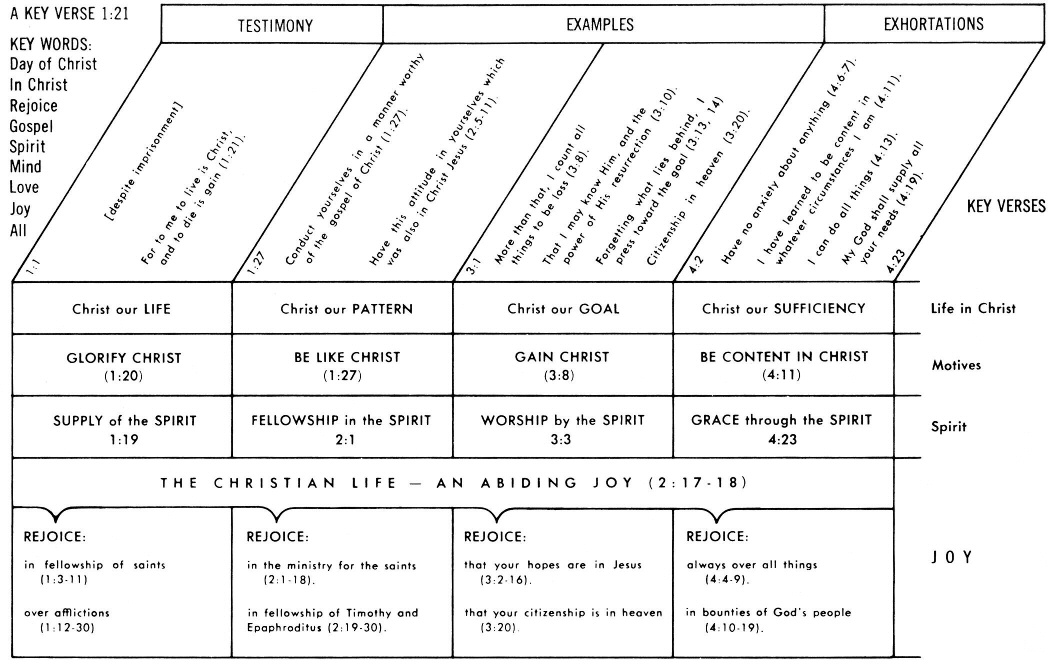
LIFE IN CHRIST
Click chart to enlarge
Charts from Jensen's Survey of the NT - used by permission
Philippians - Charles Swindoll = Chart on right side of page
| Account of Paul's Circumstances Php 1:1-30 |
Have the Mind of Christ Php 2:1-30 |
Have the Knowledge of Christ Php 3:1-21 |
Have |
| Partakers of Christ | People of Christ | Pursuit of Christ | Power of Christ |
| Suffering | Submission | Salvation | Sanctification |
| Experience | Examples | Exhortation | |
Philippians 4:1 Therefore, my beloved brethren whom I long to see, my joy and crown, in this way stand firm (2PPAM) in the Lord, my beloved (NASB: Lockman)
Greek: Oste, adelphoi mou agapetoi kai epipothetoi, chara kai stephanos mou, houtos stekete (2PPAM) en kurio, agapetoi
Amplified: THEREFORE, MY brethren, whom I love and yearn to see, my delight and crown (wreath of victory), thus stand firm in the Lord, my beloved (Amplified Bible - Lockman)
NLT: Dear brothers and sisters, I love you and long to see you, for you are my joy and the reward for my work. So please stay true to the Lord, my dear friends. (NLT - Tyndale House)
Phillips: So, my brothers whom I love and long for, my joy and my crown, do stand firmly in the Lord, and remember how much I love you (Phillips: Touchstone)
Wuest: Therefore, my brethren, individually loved ones, and individually and passionately longed for, my joy and my victor’s festal garland, thus be standing firm in the Lord, beloved ones. (Eerdmans Publishing - used by permission)
Young's Literal: So then, my brethren, beloved and longed for, my joy and crown, so stand ye in the Lord, beloved.
THEREFORE MY BELOVED BRETHREN WHOM I LONG TO SEE MY JOY AND CROWN: Hoste, adelphoi mou agapetoi kai epipothetoi chara kai stephanos mou:
- Philippians 3:20 21; 2Pe 3:11, 12, 13, 14
- Philippians 2:16; 2Co 1:14
- Philippians 4 Resources - Multiple Sermons and Commentaries
- Philippians 4:1-9 Leave Me Alone; I Can't Cope - John MacArthur
- Philippians 4:1-19 Contentment - John MacArthur
- Philippians 4:1-19 Seven Keys to Contented Living - John MacArthur
- Philippians 4:2-4 Spiritual Stability - Harmony and Joy - John MacArthur
Therefore is a term of conclusion which Dwight Pentecost explains as follows…
It is unfortunate that in our text the chapter break comes between Phil 3:21 and 4:1 for we miss Paul’s implication. Because Jesus Christ is the Savior of the body, and because Jesus Christ has an eternal destiny for this body, and because this body throughout all eternity will serve a purpose in the plan of God and will be an instrument through which God will manifest His glory forever, we have a responsibility to God as to how we use this body now. Whereas these false teachers are telling the Philippians that it doesn’t matter how they live, that it doesn’t matter what they do with their bodies, Paul says it does matter in the light of the purpose God has for this body in the redemption that is provided by the Savior. (Pentecost, J. D. The Joy of Living: A study of Philippians)
Eadie on therefore (hoste) - We might conclude that hoste is generally and in spirit an inference from the entire chapter, and in form and more especially from its last paragraph, which describes such power as believers hope to be realized at the second advent. (The Epistle to the Philippians - Online)
Beloved brethren - This same phrase in 1Cor 15:58; Phil 4:1; Jas 1:16, Jas 1:19; Jas 2:5 Brethren = adelphos (from the same womb)
Eadie - The apostle's mind turns away from the enemies of the cross to the genuine believers; and his heart opens itself to them, and opens all the more unreservedly from the contrast. He weeps over the one party, as he thinks of their awful destiny; but his soul is filled with holy rapture when he turns to the other party, and as he contemplates their coming glory. The epithets are the coinage of a jubilant spirit. The accumulation of them proceeds from his conscious inability to express all his ardor. Indeed, the language of endearment is fond of such repetitions… The apostle terms them “brethren beloved”—children of one spiritual Parent—forming one happy family—and rejoicing to meet at length in the Father's house of “many mansions.” They were spiritually dear to him; his heart clasped them with special fondness— epipothetos. See Php 1:8; 2:26. (The Epistle to the Philippians - Online)
Beloved (27) (agapetos from agape) is a word that describes one who is very dear to another or who is very much loved. It is the very word the Father uses of His Son declaring "This is My beloved Son, in whom I am well-pleased." (Mt 3:17 )
By addressing the saints as beloved, Paul is speaking of the deep feeling he has in his heart toward them. He adds that they are his joy and his crown, accentuating the deep contentment which the Philippians as a body of believers bring to his heart.
Long (1973) (epipothetos from epi = intensifies + pothéō = to yearn) (Click for study of related word epipotheo) is an adjective which describes a strong desire, an intense craving of possession, a great affection for, a deep desire, an earnest yearning for something with implication of need. Here it describes the natural yearning of personal affection. Paul loved the saints at Philippi and had a longing for the joy of renewed fellowship with them face to face.
Eadie notes that epipothetos "occurs only here in the New Testament. The apostle's heart yearned toward them, and there was reason for this indescribable longing,— they were his “joy and crown” (cp 1Th 2:19)… They were a source of gladness to him, in their rescue from sin and danger, in their spiritual change, and in its visible development. Nay, as he had been so instrumental in their conversion, they were to him even now a wreath of honor. (The Epistle to the Philippians - Online)
Joy (5479) (chara) is like a golden thread Paul interweaves throughout this letter (Joy is a repeated emphasis in this letter- Php 1:4, 1:18, 1:25, 2:2, 2:17, 2:18, 2:28, 2:29, 3:1, 4:1, 4:4, 4:10). Joy is the deep-down sense of well-being that abides in the heart of the person who knows all is well between himself/herself and his/her Creator. It is not an experience that comes from favorable circumstances and in fact can still be manifest when those circumstances are even painful and severe (Jn 16:20-22). Emotional fluctuations do not trouble this source of joy for it is a gift of God to believers who manifest it as they cultivate the fruit of His Spirit (Gal 5:22). Paul speaks here of something that is more than a mood or what we might call a "frame of mind." While supernatural joy may include a feeling, it is more than that, because feelings depend too often on circumstances. Feelings come and feelings go as they say. The "feeling" of joy produced by the Spirit as stated earlier is independent of one's circumstances, whether pleasant or painful. This paradoxical pattern (joy in face of pain) reminds me of the Gentile converts in Thessalonica, Paul writing "you also became imitators of us and of the Lord, having received the word in much (not little, but much) tribulation (thlipsis = pressing, even crushing circumstances) with the joy of the Holy Spirit.." (1 Th 1:6) Clearly joy and tribulation are not mutually incompatible in the Spirit filled/empowered believer. And recall the apostles who had been flogged (Greek = dero = literally remove the skin, flay - this was not just a "love tap! = Acts 5:40) after which Luke records their remarkable Spirit enabled response = "So they went on their way from the presence of the Council, rejoicing that they had been considered worthy to suffer shame for His name." (Acts 5:41, cf similar patterns in Hebrews 10:34, 1 Peter 4:13)
Crown (4735) (stephanos from stepho = to encircle, twine or wreathe) refers to the crown of victory (often a laurel wreath) in the Greek athletic games, to the runner who crossed the goal first, to the disc thrower with the longest toss, etc. Obviously this "crown" would bring great contentment and a sense of accomplishment to the victor, but these feeling would fade because the laurel wreath had already become to wilt the moment it was picked from the tree! What a contrast with the "crown" Paul exults in! The Philippian believers were his crown which were a source of immeasurable joy and a justifiable sense of accomplishment.
Stephanos - 25x in 25v - Matt 27:29; Mark 15:17; John 19:2, 5; Acts 6:5, 8f; 7:59; 8:2; 11:19; 22:20; 1 Cor 9:25; Phil 4:1; 1 Thess 2:19; 2 Tim 4:8; Jas 1:12; 1 Pet 5:4; Rev 2:10; 3:11; 4:4, 10; 6:2; 9:7; 12:1; 14:14
Eadie - The term stephanos is often used in a similar sense (wreath of honor). See also Pr. 4:9, 12:4, 14:24, 16:31, 17:6; Isa. 28:5. The expression was a common one. The scene of the first introduction of the gospel to Philippi recurred for a moment to his memory—the preaching of the truth, the impression made, the anxious inquiries put, the decided change produced, the organization of the church, and its growth and prosperity, as the result of his labors, prayers, and sufferings. His success he wore as a garland of imperishable verdure. If he who saved in battle the life of a Roman citizen received from his grateful countrymen an oaken garland, ob civem servatum, how much more might their apostle call them saved and blessed by his ministry, “my crown”! He was not insensible to the high honor of being the founder and guardian of such a community. That this joy might not fail, and that this crown might not wither, he adds in earnest and loving tone— “so stand in the Lord.” (The Epistle to the Philippians - Online)
The Philippian believers like a crown testified to the genuineness of Paul's ministry. This idea of genuineness of his ministry was alluded to earlier in this letter Paul describing the saints as those who continually were…
holding fast the word of life, so that in the day of Christ I may have cause to glory because I did not run (as the runners did in the ancient Olympics) in vain nor toil in vain (uselessly, without success). (Php 2:16)
What Paul was saying is that on that day when he stands before the Judgment Seat of Christ, the genuineness of the Philippian saints lives and testimony would be a cause for Paul to exult for it would bring forth the approval of His Lord regarding the race that he had run. And so he "wore" the Philippians as if they were his "joy and crown", testifying to the authenticity of His ministry and the efficacy of the gospel.
In a similar display of affection for the Thessalonian saints Paul wrote
who is our hope or joy or crown of exultation? Is it not even you, in the presence of our Lord Jesus at His coming? For you are our glory and joy (1Th 2:19, 20)
Paul later added in the same letter
what thanks can we render to God for you in return for all the joy with which we rejoice before our God on your account as we night and day keep praying most earnestly that we may see your face, and may complete what is lacking in your faith?. (1Th 3:9, 10)
Is there some brother or sister in Christ who will be your joy and crown in the presence of our Lord Jesus at His coming? If you cannot answer in the affirmative, then empowered by His Spirit and the authoritative command of our Lord Jesus
Go therefore and make disciples (aorist imperative = command to be obeyed immediately. Conveys a sense of urgency. It's like a military command from the "Captain of the Hosts" [Josh 5:14, 15]. Disciples = "learners"!) of all the nations, baptizing them in the name of the Father and the Son and the Holy Spirit teaching them to observe all that (Jesus) commanded", in full confidence that you will succeed for He Himself promised "lo, I am with you always, even to the end of the age." (Mt 28:18, 19, 20)
Daniel records that
those who have insight will shine brightly like the brightness of the expanse of heaven, and those who lead the many to righteousness (right living before God and man), like the stars forever and ever. (Daniel 12:3)
Beloved, redeem this brief moment in eternity (see Redeem the Time), God has graciously allotted you to perform good works (see study of Good Deeds), works that bring Him glory throughout the ages to come.
SO STAND FIRM IN THE LORD, MY BELOVED: houtos stekete (2PPAM) en kurio, agapetoi :
- Ps 27:14; Mt 10:22; John 15:3; 15:4; Acts 2:42; 11:23; Ro 2:7 Col 4:12; 1Th 3:13; 2Ti 2:1; Heb 3:14; 4:14; 10:23, 35; 36; Jude 1:20; 21 Rev 3:10,11
- Philippians 4 Resources - Multiple Sermons and Commentaries
- Philippians 4:1-9 Leave Me Alone; I Can't Cope - John MacArthur
- Philippians 4:1-19 Contentment - John MacArthur
- Philippians 4:1-19 Seven Keys to Contented Living - John MacArthur
- Philippians 4:2-4 Spiritual Stability - Harmony and Joy - John MacArthur
So (houtos) means - in this way, in this manner, thus, so. The reference is to what precedes.
From the context, why would they need to "stand firm"? Paul has just exposed some men in their midst who were enemies of the Cross of Christ and were living solely to please self not Savior (Php 3:18, 19). He knows that it would be tempting to follow their example, falsely believing that it does not really matter what one does with his or her body. He countered this aberrant thinking reminding them of the truth concerning their glorious future. It is in this context that Paul calls on his beloved saints to continue standing firm in the power and Person of the Lord Jesus Christ, Who is now their life (cf Col 3:4)
Eadie agrees writing that houtos relates "especially to the two preceding verses, and as being in virtual contrast with the description of Phil 3:18, 19. In opposition to those who were sunk in sensuality and earthliness, and on whom the cross of Christ exercised no spiritualizing power, they were to live as the citizens of a better country (Php 3:19), their mind lifted above the world by such an ennobling connection, and thrilled at the same time with the prospect of the Savior's advent, to transform and prepare their physical nature for that realm in which they should have an ultimate and a permanent residence (Php 3:20). And he concludes with a second beloved,—so great is the reaction from kai klaion ("even weeping")), and so great his attachment to his Philippian converts. (The Epistle to the Philippians - Online)
Dwight Pentecost explains it this way - By “stand fast in the Lord” Paul means realizing experientially in your daily life the purpose God has for this body. As He purposes that throughout eternity it (the body) should be an instrument to His glory, so now, too, it should be an instrument to His glory. It must not become a vehicle through which lust and sin manifest themselves. It must be a vehicle through which righteousness and holiness are manifested, through which God is glorified in the believer’s life. This is the theme that the apostle has emphasized over and over again. (Pentecost, J. D. The Joy of Living: A study of Philippians. Kregel Publications)
Writing to the church at Corinth Paul commanded them…
Flee (present imperative = command to continually run from. Why present tense? Because we live in a fallen world and walk around with a fallen flesh nature and at any moment are vulnerable [when He is not our shield and strength] to being seduced by the deceptive [He 3:13] passing pleasures of sin [He 11:25]) immorality (porneia = fornication = misuse of their body). Every other sin that a man commits is outside the body, but the immoral man sins against his own body. Or do you not know that your body is a temple of the Holy Spirit Who is in you, Whom you have from God, and that you are not your own? (Any habit that a believer has that in any way destroys this temple is meddling with God’s property and has no place in the life of a believer) For you have been bought with a price: therefore glorify God in your body. (1Cor 6:18, 1Cor 6:19, 1Cor 6:20)
As discussed in Php 3:20, 21 (see notes) God has both a temporal and an eternal purpose for our body. It follows that believers have no right to pervert or distort God's purpose by using their bodies as instruments to serve self and sin. As Paul explained to the Corinthians, the body is presently the instrument through which God is glorified. Corinth was a city well known for abuse of one's body in various forms of sexual sin and it may have been tempting to invoke the modern axiom "Well everyone else is doing it so it can't be that bad!" Paul is saying that it matters what believers do with their bodies because both our souls and our bodies have been redeemed by the blood of Christ and therefore our bodies must not be used as instruments of sin but as instruments of righteousness (right living). It is only as those who call themselves "Christian" live supernatural lives that they present to the lost world a proper opinion of the Creator and His power and purpose for mankind.
Paul taught the same truth in Romans exhorting the saints to present, not their minds or their hearts, but their bodies to God…
I urge you therefore, brethren, by the mercies of God, to present your bodies a living and holy sacrifice (AND DON'T "CRAWL OFF THE ALTAR" DURING THE DAY!), acceptable to God, which is your spiritual service of worship. (Ro 12:1)
Stand firm (4739) (steko) can mean to stand literally ("whenever you stand praying… " Mk 11:25) but in the other NT uses steko is used figuratively meaning in a positive sense of to stand firm in faith and duty, to be constant, to persevere, to remain steadfast, to continue in a state. It can mean to be firmly committed in conviction or belief. In Jn 8:44 Jesus uses steko in a negative sense describing the fact that the devil absolutely does not stand in the truth.
The present imperative in the present passage is a command calling for the saints to continue to persevere and remain firm in their faith in the Lord, especially as it is manifest in what they do with their bodies!
Early Paul had declared I press on toward the goal for the prize... (Php 3:14) which presents an interesting paradox. Believers can only stand firm in the Lord by pressing on to become more like the Lord. A Christian who is not moving forward is falling backward whether he or she realizes it or not!
Steko occurs 11 times in the NT in the NASB: (Mark 3:31; 11:25; John 8:44; Rom 14:4; 1 Cor 16:13; Gal 5:1; Phil 1:27; 4:1; 1 Thess 3:8; 2 Thess 2:15; Rev 12:4) and is translated: stand, 2; stand firm, 4; standing, 1; standing firm, 2; stands, 2.
Paul used steko in a similar way in his letter to the Thessalonians…
1Th 3:8 (note) for now we really live, if you stand firm in the Lord.
And again in his second epistle Paul writes…
2Th 2:15 So then (In view of their high and holy calling explained in 2Th 2:13, 14, the saints are exhorted), brethren, stand firm (present imperative) and hold to (present imperative) the traditions which you were taught, whether by word of mouth or by letter from us.
Paul used (steko) exhorting the Philippian saints to
conduct (present imperative) yourselves in a manner worthy of the gospel of Christ; so that whether I come and see you or remain absent, I may hear of you that you are standing firm (steko) in one spirit, with one mind striving together for the faith of the gospel. (Php 1:27)
How does one stand firm? In context first it is by doing so "in the LORD", in the strength He supplies and abiding in His word (Jn 8:31, 32).
Jesus reminded His disciples to
Abide (aorist imperative - Do this now! Don't delay!) in Me, and I in you. As the branch cannot bear fruit of itself, unless it abides in the vine, so neither can you, unless you abide in Me. (Jn 15:4, cp why abiding is so critical -- Jn 15:5)
The Psalmist adds that
Those who trust in the LORD are as Mount Zion (God's holy city firmly set by Him on the hill), which cannot be moved, but abides forever." (Ps 125:1)
Spurgeon's comment - They that trust in the LORD shall be as mount Zion. The emphasis lies upon the object of their trust, namely, Jehovah the Lord. What a privilege to be allowed to repose in God] How condescending is Jehovah to become the confidence of his people! To trust elsewhere is vanity; and the more implicit such misplaced trust becomes the more bitter will be the ensuing disappointment; but to trust in the living God is sanctified common sense which needs no excuse, its result shall be its best vindication. There is no conceivable reason why we should not trust in Jehovah, and there is every possible argument for so doing; but, apart from all argument, the end will prove the wisdom of the confidence. The result of faith is not occasional and accidental; its blessing comes, not to some who trust, but to all who trust in the Lord. Trusters in Jehovah shall be as fixed, firm, and stable as the mount where David dwelt, and where the ark abode. To move mount Zion was impossible: the mere supposition was absurd.
In Acts we see the role of encouragement in standing firm as Paul and Barnabas were
"strengthening the souls of the disciples, encouraging them to continue in the faith, and saying, "Through many tribulations we must enter the kingdom of God" (Acts 14:22)
Forewarned
is
Forearmed
Paul exhorted his beloved Corinthian saints to
be (present imperative) steadfast (solidly in place, seated, firm, settled in one's belief. Used in secular Greek to describe the horse's back on which a rider sits!), immovable (firmly persistent), always abounding in the work of the Lord, knowing that your toil is not in vain in the Lord" (1Co 15:58)
In the same letter Paul later exhorted them to
Be on the alert, stand firm (steko) in the faith, act like men, be strong. (1Cor 16:13) (Each verb in red is a command - all present imperatives)
To the Galatian church in danger of falling into the fleshly trap of legalism (cp Gal 3:1-3, Gal 5:7) Paul wrote that
It was for freedom that Christ set us free; therefore keep standing firm (present imperative) (steko) and do not be subject again to a yoke of slavery. (Gal 5:1)
To the Ephesian church in the midst of intense spiritual warfare (see culture of Ephesus in Acts 19:19) Paul wrote
be strong (present imperative) in the Lord, and in the strength of His might. Put on (aorist imperative - Do this now! Don't delay!) the full armor of God, that you may be able to stand firm against the schemes of the devil… (and) take up (aorist imperative - Do this now! Don't delay!) the full armor of God, that you may be able to resist in the evil day, and having done everything, to stand firm. Stand firm (aorist imperative - Do this now! Don't delay!) therefore, HAVING GIRDED YOUR LOINS WITH TRUTH, and HAVING PUT ON THE BREASTPLATE OF RIGHTEOUSNESS, and having shod YOUR FEET WITH THE PREPARATION OF THE GOSPEL OF PEACE in addition to all, taking up the shield of faith with which you will be able to extinguish all the flaming missiles of the evil one. And take (aorist imperative - Do this now! Don't delay!) THE HELMET OF SALVATION, and the sword of the Spirit, which is the word of God. With all prayer and petition pray at all times in the Spirit, and with this in view, be on the alert with all perseverance and petition for all the saints." (Ep 6:10, 11, 12, 13, 14, 15, 16, 17, 18-see notes on spiritual warfare Ephesians 6:10; 11; 12; 13; 14; 15; 16; 17;18)
Did you note the repetition of standing firm in the context of spiritual warfare?
Paul shows us the role of prayer in standing firm reminding the saints at Colossae that
Epaphras, who is one of your number, a bondslave of Jesus Christ, sends you his greetings, always laboring earnestly for you in his prayers, that (purpose clause -- the purpose of his intense praying) you may stand perfect and fully assured in all the will of God. (Col 4:12)
Paul reminded the Thessalonians of the impact their walk had on him, writing
for now we really live, if you stand firm (steko) in the Lord." (1Th 3:8) encouraging them in his second letter to "stand firm (steko) and hold to the traditions which you were taught (not "traditions of men" but the truths taught by Paul as he received them from the Lord), whether by word of mouth or by letter from us." (2Th 2:15)
Peter also emphasizes the importance of truth in assuring that one stands firm reminding and exhorting them that
"knowing this beforehand (that "untaught and unstable" people will "distort… the Scriptures to their own destruction"), be on your guard lest, being carried away by the error of unprincipled men, you fall from your own steadfastness" (2Pe 3:17)
In the Lord - This defines the sphere or element in which (in Whom) they (and we) are to stand firm. He is our Rock ON Whom we stand, yea, even IN Whom we hide, in the cleft of the Rock. (See Christ Our Rock)
Eadie adds that "To stand, or stand fast, in the Lord, is neither to wander out of Him, nor even to waver in connection with Him, but to remain immoveable in fellowship with Him (Ed: cp "abide in Him" 1Jn 2:24, 27, 28, 4:13, Jn 15:4, 7, 9 - How do we "abide in Him"? One way is seen in Jn 8:31, cp 1Jn 2:24, Jn 15:7 - the Word is critical - not just for information, but transformation),—to live in Him without pause—to walk in Him without digression—to love Him without rival—and serve Him without compromise. It is here to be untouched by the ceremonial pride of the concision, and especially to be proof against the sensualism of the enemies of the cross. (The Epistle to the Philippians - Online)
Jude eloquently sums up this topic of standing firm in the Lord, with this beautiful benediction
Now to Him who is able to keep you from stumbling, and to make you stand in the presence of His glory blameless with great joy, to the only God our Savior, through Jesus Christ our Lord, be glory, majesty, dominion and authority, before all time and now and forever. Amen." (Jude 1:24, 25)
So now dear beloved of Jehovah,
Stand firm in the Lord
F B Meyer in his book The Epistle to the Philippians, a devotional commentary writes…
STEADFASTNESS. Phil. 4:1
Steadfastness. The man who is backwards and forwards, mercurial, easily up to boiling point, and as soon down to zero, who is on the hooks and off ten times a week, now like a seraph flashing with zeal, now like a snail crawling in lethargy, who is everything by fits and starts and nothing long, will not have a happy Christian experience, nor will his influence tell in the Church or on the world. He may be a genius, but he will be a meteor dying in the dark. It is better to have for a friend and fellow-worker a man of less brilliance and with fewer ideas, who will be occupied by one thought, and give it regular and patient expression. In life, as in war, it is not the man that makes brilliant dashes, but he who can pursue a plan of strategy, week after week, that succeeds.
In the Lord. The source of stability is to stand fast in the Lord. Our only hope of stability is in union with "the Rock."
There is a sculpture in Spain of the Crucifixion, which is the only one of the kind. A fierce light falls on it from a hidden window.
One hand is nailed to the Cross, the other is stretched out. The story is that lovers plighted their troth there, and afterwards, when the man was faithless, the woman came back to plead her case beneath the Cross, and the hand disengaged itself, and stretched towards her, whilst a voice said: "I was witness." Probably, however, the old sculptor meant that if one hand is nailed to the Cross in atonement, the other hand is quick to help; and if you want help to be stable, you will find a very present help in the thought that He is near. (F. B. Meyer. The Epistle to the Philippians - A Devotional Commentary)
Philippians 4:2 I urge Euodia and I urge Syntyche to live in harmony in the Lord (NASB: Lockman)
Greek: Euodian parakalo (1SPAI) kai Suntuchen parakalo (1SPAI) to auto phronein (PAN) en kurio
Amplified: I entreat and advise Euodia and I entreat and advise Syntyche to agree and to work in harmony in the Lord (Amplified Bible - Lockman)
Lightfoot: I appeal to Euodia, and I appeal to Syntyche, to give up their differences and live at peace in the Lord.
NLT: And now I want to plead with those two women, Euodia and Syntyche. Please, because you belong to the Lord, settle your disagreement. (NLT - Tyndale House)
Phillips: Euodius and Syntache I beg you by name to make up your differences as Christians should! (Phillips: Touchstone)
Wuest: Euodia I exhort, please, and Syntyche, I exhort, please, to be of the same mind in the Lord. (Eerdmans Publishing)
Young's Literal: Euodia I exhort, and Syntyche I exhort, to be of the same mind in the Lord;
I URGE EUODIA AND I URGE SYNTYCHE: Euodian parakalo (1SPAI) kai Suntuchen parakalo (1SPAI)
- Philippians 4 Resources - Multiple Sermons and Commentaries
- Philippians 4:1 Spiritual Stability - John MacArthur
HEALING THE BREACHES
IN THE BODY
After mentioning his joy and crown, now Paul addresses the two "thorns", so to speak, in the crown! The fact that he urges them to live in harmony, strongly implies they were at odds with each other. And they were such "thorns" in the body of believers at Philippi that Paul had even received word of it all the way back in his Roman prison cell! How often we discount what we think are "small squabbles" between believers in a local body because we assume they are of such little spiritual consequence! Paul's example tells us that when we identify a "Euodia" and "Syntyche" in our midst, we must seek to foster reconciliation and harmony between them for the sake of the overall health of our body. "Small squabbles" are clearly no small matter to the Lord!
It is also noteworthy as Paul explains in Phil 4:3, that this squabble is between believers who "shared (his) struggle in the cause of the gospel" indicating that these were mature believers who were actively involved in the ministering the gospel at Philippi. It is sad but true that spiritual maturity does not guarantee freedom from the manifestations of the flesh nature that still resides in every believer.
Urge (3870) (parakaleo from para = side of + kaléo = call) conveys the basic idea of calling one alongside to help or give aid. Because a person can be called alongside for many purposes, the word has a wide range of meanings including to entreat, appeal to, summon, comfort, exhort, or encourage. Note that the present tense points to Paul's continuous urging regarding this matter.
Literally the Greek reads Euodia I exhort, and Syntyche I exhort - Paul uses "urge" (exhort) (parakaleo) twice implying that he went to Euodia and urged her and then went to Syntyche and urged her, which in turn suggests that they were not exactly seeing "eye to eye" as the saying goes.
Eadie adds that Euodia and Syntyche - had laboured in the gospel with earnestness and success. The apostle does not say on whose side the fault lay, but he repeats the parakaleo, not simply, as Alford limits it, to “hint at their present separation,” but to show that he placed the like obligation on each of them. He does not exhort the one to be reconciled to the other, for they might have doubted who should take the initiative, and they might wonder, from the position of their names and construction of the sentence, to which of them the apostle attached the more blame. But he exhorts them both, the one and the other, to think the same thing—not only to come to a mutual understanding, but to preserve it. See Php 2:2. Van Hengel needlessly supposes that they had laboured with the apostle at Rome, and were now about to proceed to Philippi with Epaphroditus—this counsel to them being, that in all things they did for the gospel they should act in concert. But the previous intimations in the epistle prove that there had been tendencies to disunion in the church, and the second verse of the second chapter these women might read with a special and personal concern. The cause of quarrel might be some unworthy question about priority or privilege even in the prosecution of the good work—vainglory leading to strife, as already hinted by the apostle toward the commencement of the second chapter. It does not seem to have been any difference in creed or practice, and wholly groundless is the hypothesis of Baur and Schwegler, that the names represent two parties in the church at Philippi—Euodia the Jewish, and Syntyche the heathen party. (The Epistle to the Philippians - Online)
Euodia (eu = to be well off + hodos = a way) means "prosperous journey", fine traveling, or in some sources has the meaning of "fragrant".
Syntyche (sún = together with + tugcháno = to happen, chance) means fortunate, with fate, happy chance, pleasant acquaintance, affable depending on which reference source one consults.
God wants Christians to live in harmony. Paul asked his “loyal yokefellow” to be a peacemaker (Matthew 5:9), helping restore unity between them. But he urged the women themselves to agree and suggested the basis—in the Lord. We may not always see things alike, but we can treat one another as brothers or sisters.
Christ-Centered Exposition Commentary – The most striking thing about Paul’s appeal is its directness. So far his appeals for unity have been general, but here he calls out specific people! Can you imagine these two ladies sitting in the congregation, listening attentively to the letter being read to the church corporately, when all of a sudden—“I urge Euodia and I urge Syntyche to agree in the Lord.” Talk about an awkward moment! Apart from the Pastoral Epistles and the book of Philemon, the only other personal exhortation like this is found in Colossians 4:17, where Arichippus is encouraged to complete his ministry, which suggests an indirect criticism from Paul. Unlike that example, however, Paul expresses a clear rebuke to these ladies (Silva, Philippians, 192). This is a serious issue for Paul. He can’t speak in vague generalities. He cuts right to it and to them. Why? Because he loves them and he loves the church.
Spurgeon - These two women had fallen out with one another; they evidently differed upon some question or other so that they were not “of the same mind in the Lord;” and Paul thought it so important that there should be perfect unity and love in the church at Philippi, as well as everywhere else, that he besought these two women, of whom we know nothing else, that they would be “of the same mind in the Lord.” Notice that he beseeches each of them in exactly the same way: “I beseech Euodias, and beseech Syntyche.” He has a “beseech” for each of them. Perhaps, if he had written, “I beseech Euodias and Syntyche,” the latter lady might have fancied that he was not quite so earnest about her as he was about Euodias, so he puts it, “I beseech Euodias, and beseech Syntyche, that they be of the same mind in the Lord.” Have any of you fallen out, my dear friends? I do not know of any of you who have done so; but if you have, I say to all you, men or women, “I beseech you, that you be of the same mind in the Lord.” There is nothing like perfect unity in a Christian church; if there is even a little division, it will grow to something much worse by-and-by; so I beseech you “be of the same mind in the Lord.”
Tim Keller on Php 4:2-3 - He says, “Sisters, remember where you’re from. You’re citizens of heaven. Remember where you’re going, the glory. Realize and remember what Christ has done so this could be true. If your minds are filled with that, where’s the pettiness coming from? How could there be divisiveness in the presence of those ideas. If you think about that, how could you be petty? How could you be divisive? How the moroseness? Lift up your thoughts,” he says. “Lift up your eyes. You’re not seeing the big picture. That’s the only possible way you could be so upset with each other.”
He doesn’t say, “Agree,” by the way. Did you notice that? Oh no, how awful. Paul is not a person who says, “You must agree. You have to believe all of the same things. You have to believe in all of the same policies.” He doesn’t say that. What does he say? You must agree in the Lord. What he says is, “Don’t you remember what you have in common? Don’t you see the big picture? Lift up your thoughts.” That’s what he does, and that is what Paul does to everything. That’s how he is a rock, and that’s how you can be a rock too.
He brings the big things to bear. He brings eternity and judgment day and meaning in life. He brings it all. Every moment is about eternity. Every incident is about God, light, darkness, grace, truth, heaven, hell, the infinities, and the immensities. They’re all brought to bear. Somebody says, “Well, that’s intense.” Yes, of course, but it works. I have to digress just for a second before I move on to the method now. That’s the principle. (Peace in Church and Heart)
D A Carson on Phil 4:2-3 - What he’s after in this chapter is a whole stance, a heart attitude, that ought to shape everything we do and everything we touch. The burden of Philippians 4, then, is never give up the Christian walk. We may usefully unpack the theme in seven components.
1. Resolve to pursue like-mindedness with other true believers. Phil 4:2-3. The concrete case immediately before Paul is two women, Euodia and Syntyche, who cannot seem to get along. What is shocking about this situation is these two women are not peripheral people known for their bad tempers and wagging tongues and little else. No. They are (verse 3) women who have worked with Paul in the cause of the gospel. They have been at the forefront of evangelism. These are not backseat busybodies. “They have contended at my side in the cause of the gospel,” Paul says. There’s no hint or heresy or immorality in them. They simply cannot get on.
What does Paul do? You probably have never seen a situation like this (two people who can’t get on), but if it should ever arise in your church, here is what you do.
A. Paul pleads with them. That’s rather nice, in and of itself. He doesn’t begin with heavy-handed authority. He doesn’t cite his apostolic credentials and tear a strip off them. Indeed, for all that the appeal is personal and impassioned; it really isn’t calculated to shame them.
B. Paul asks the person who is to receive this letter to intervene and help the two women sort it out. Sometimes friction between believers becomes so severe that the wise course is for a third party to mediate between the two sides and try to help both sides see things from the other’s perspective and think through what faithful Christian attitudes should be in such circumstances. Who the person is in this case we just don’t know.
When a letter was sent to a church like this one, doubtless it had to be sent to some specific individual who would read it to the whole church. It may well have been an elder in the church. It may even have been Luke, but the truth is we don’t know. Whoever this person is, Paul wants him to intervene.
C. The substance of Paul’s plea to this pair of women, the aim of the intervention he wants from this yokefellow, is that the two women agree with each other in the Lord. What exactly is Paul asking for?
First, this is not an appeal for unity at the expense of truth. It is not as if he’s saying, “Regardless of what is coming between you, bury the hatchet. Don’t let doctrine stand in the way of unanimity. Doctrine doesn’t matter. Just love one another and everything will be all right.”
This is the same Paul, after all, who writes Galatians 1, where he makes a distinction between those who are faithful to the gospel and those who are not. Such a Paul is unlikely now to be slipping into relativistic sentimentality. When fundamental gospel interests are at stake, sometimes Paul is willing to divide, but that’s not what’s going on here.
Secondly, in the light of the argument of Philippians as a whole, this is not a hopeless demand for perfect agreement on every subject. I love the answer of Billy Graham’s wife when she was asked by a reporter if she ever disagreed with her husband. She said it was her opinion that if two people always agreed, one of them wasn’t necessary.
This is not an appeal, therefore, to that kind of perfect unanimity so that everything is shaped exactly the same way. Paul is not saying to Euodia and Syntyche, “Ladies, on every single point of doctrine in life I expect you to thrash out your differences and arrive at perfection.” In fact, the verb that is used for this unity, this agreement of mind, is used again and again and again in Philippians.
It’s found in Philippians 2. “If you have any encouragement from being united with Christ, if any comfort from his love, if any tenderness and compassion, then make my joy complete by being like-minded …” Same verb. “… having the same love, being one in spirit and purpose.” In other words, Paul is appealing for a kind of mental attitude that adopts the same direction as other believers, the same fundamental aim, the same orientation and priorities, and these are gospel priorities.
Some honest differences of opinion amongst genuine believers could easily be resolved if the believers would take the time to sort out why they disagreed, listen to each other, and bow together to Scripture. For a number of years, I worked with the World Evangelical Fellowship, which brought theologians together from different denominations and around the world to hash out various questions.
What always surprised me (it surprised me every time we did it, and we did it five times) was the degree of unanimity we could achieve provided … provided … first, that we all held a high view of Scripture not merely in theory but in fact; secondly, that we all had enough training to discern a good argument from a bad argument; thirdly, that we had enough humility of mind to say we were wrong; and fourthly, that we had enough time.
The reason why you need enough time is, because in all kinds of issues, the issue is tied to other issues through the structures of theology, and where you think you’re disagreeing about A and B, in fact, the A and B are each connected to massive structures that have to be untangled before you can come back exactly to why you’re disagreeing on this verse.
Granted those four elements, it has always astonished me and delighted me to no end in these sorts of conferences what degree of unanimity people can find around the Word of God. Clearly, Paul wants that kind of thing, but what he really wants is the kind of unanimity around the truth, this like-mindedness to the gospel that shows each side is pulling in the same direction.
The truth is sometimes neither side wants to be corrected or sharpened. Both sides are so convinced they are right that mere facts will not correct them, and in any case, all they want to do is win. In that frame of mind, they easily forget it is always inappropriate at best and, frankly, sinful at worst to try to manipulate people into changing their minds.
You know the kind of comments I have in mind? “Your stance hurts my feelings.” “Don’t you trust me?” Emotional blackmail is never a mark of godliness. Christians should not try to manipulate one another. Usually, what is being exposed in that kind of an interchange is merely embarrassing immaturity.
When there are disagreements of principle, argue them out. Take out your Bibles and argue them out. Think things through. Find out why you are disagreeing, but be willing to be corrected. Do it with a certain kind of humility of mind. Be prepared to say, “Yes, you have a good argument there. I hadn’t thought of that. I need to think it over. If that is what Scripture says, I bow to it.” Be willing to be corrected.
In every case, whether you can reach agreement on this detail or that, identify always what takes absolute priority. Begin with that. Focus on what you have in common. Make sure you agree over the gospel. Work hard to develop perfect agreement on matters of the greatest importance: the gospel, the Word of God, the glory of Christ, the good of the church, the beauty of holiness, the ugliness of sin, the satisfaction of Christ. Work on those things!
Personal differences should never become an occasion for advancing your party. It should not be a place for stroking bruised egos. It should not be a place for resorting to cheap triumphalism, for trimming the gospel by appealing to pragmatics. Focus on what unites you, the gospel. Be like-minded. Think the same things.
“Agree with one another,” Paul is saying. Work hard and humbly on these central issues and in most instances the peripheral will take care of itself. Resolve to pursue like-mindedness with other believers. This will ennoble and strengthen all sides so that you will never abandon the Christian walk. (From D A Carson's sermon on Philippians 4 - Never Give Up the Christian Way).
TO LIVE IN HARMONY IN THE LORD: to auto phronein (PAN) en kurio:
- Phil 3:16; Ge 45:24; Ep 4:1-8; 1Th 5:13; Heb 12:14; Js 3:17; 18
- Philippians 4 Resources - Multiple Sermons and Commentaries
- Philippians 4:1-9 Leave Me Alone; I Can't Cope - John MacArthur
- Philippians 4:1-19 Contentment - John MacArthur
- Philippians 4:1-19 Seven Keys to Contented Living - John MacArthur
- Philippians 4:2-4 Spiritual Stability - Harmony and Joy - John MacArthur
to be of the same mind in the Lord; (YLT)
make up your differences as Christians should! (Phillips)
give up their differences and live at peace in the Lord (Lightfoot)
I urge Euodia and Syntyche to iron out their differences and make up. God doesn’t want his children holding grudges. (Message)
be of one mind, as sisters in Christ (WNT)
The Living Bible renders this verse…
And now I want to plead with those two dear women, Euodia and Syntyche. Please, please, with the Lord’s help, quarrel no more—be friends again.
Live in harmony (present tense = continually) - Is more literally "continually be of the same mind" something that is possible only in the Lord. If the Lord is in control, there cannot (assuming the parts of the body are in submission to the Head, Christ Jesus) be division. The only way genuine harmony can exist is when the Lord is in control. When the Head is in control, the parts of the body function as they should. And remember that the way Jesus enables us today (in the New Covenant) is by His indwelling Spirit, the Spirit of grace and of power, the power to accomplish supernaturally what we simply cannot accomplish naturally. Recall what Paul had said in Phil 2:12 - "Work out your salvation in fear and trembling." And here that means "live in harmony." But he then used the little word "for" (gar = term of explanation) in the next passage. What is he explaining? What has he just commanded? How can we obey what he commanded? In Phil 2:13 Paul explains that they can obey by yielding to the desire and power provided by God, the Spirit, Who indwells them. Are you learning this truth? Or are you still trying to life the CHRISTian life in your own strength? A Christian has Christ within, specifically the Spirit of Christ within. We must be continually filled with (controlled by) Him (Eph 5:18), in order to continually walk by Him (Gal 5:16) and when we do we will be walking supernaturally and will not carry out the desires of the flesh. Is this a bit of a mystery? Of course it is. But it is truth. It is God's provision for every believer. We will spend the rest of our life "practicing" this principle which will one day be fully and perfectly realized when we are glorified and no longer have to contend with our contentious flesh! O Glorious Day!
Live in harmony (5426) (phroneo) refers to the basic orientation, bent, and thought patterns of one's mind, rather than to the intellect per se.
Paul used this same verb phroneo earlier exhorting the saints
make my joy complete by being of the same mind (also the verb phroneo), maintaining the same love, united in spirit, intent on one purpose. Do nothing from selfishness or empty conceit, but with humility of mind let each of you regard one another as more important than himself. (Php 2:2, 3-see notes Php 2:2; 2:3)
So even as Paul had exhorted the saints at Philippi to have the mind of Christ, so now he exhorts Euodia and Syntyche to have the same mind in the Lord.
As Dwight Pentecost observes that "Two who are rightly related to the Head are not obedient to the Head and have come into conflict, refused reconciliation, and permitted the quarrel to continue. No consent to true doctrine can take the place of obedience to His word and manifestation of His love. (Ibid)
Christians at war with each other
cannot be at peace with their heavenly Father.
Jesus emphasizes this truth declaring "By this (By what?) all men will know that you are My disciples, if you have love for one another. (John 13:35)
In his first epistle John adds several similar exhortations…
Little children, let us not love with word or with tongue, but in deed and truth. (1 John 3:18)
Beloved, let us love one another, for love is from God; and everyone who loves is born of God and knows God… And this commandment we have from Him, that the one who loves God should love his brother also. (1 John 4:7, 21)
The NASB translation of this verse as harmony gives us a word picture of what Paul is calling for. Harmony represents the combination of simultaneous musical notes in a chord, producing a pleasing or congruent arrangement. The Greeks had a separate word for "harmony", "symphoneo" (although it is not the word used here) from which we derive our English word "symphony."
Paul desires that even though these two believers are different instruments or are playing different notes so to speak, they should seek to come together in the Lord and produce a symphony rather than a cacophony (harshness in the sound of words or phrases)! Unity in diversity.
Jesus using the metaphor of salt told His disciples that "Salt is good; but if the salt becomes unsalty, with what will you make it salty again? Have salt in yourselves, and be at peace with one another. (Mk 9:50)
Apparently the disciples had argued over which of them was the greatest (read Mark 9 for context especially Mk 9:33, 34) and Jesus is implying that all such tension between fellow believers must be put aside and replaced by humble service in order that the salt fulfill its function "salty salt" which flavors, purifies and preserves the environment in which it is placed! For maximum "saltiness" Euodia and Syntyche were to live at peace with each other.
Paul encourages the saints at Rome to
Be of the same mind (phroneo in the present tense - see related note above on how we can obey this instruction) toward one another (thus this passage then is speaking primarily to the interactions between believers) and then hints at what might disturb the harmony by exhorting them not to
"be haughty in mind, but associate with the lowly. Do not be wise in your own estimation. Never pay back evil for evil to anyone (so Paul broadens the exhortation from interactions between believers to application to everyone). Respect what is right in the sight of all men. If possible, so far as it depends on you, be at peace with all men." (see notes Romans 12:16-17, 12:18)
The NLT has a pithy paraphrase of Romans 12:16
Don't try to act important, but enjoy the company of ordinary people. And don't think you know it all!
Paul explains why it is so critical for Euodia and Syntyche to harmonize their differences in his letter to the Corinthian church where he writes (quoting from NLT)
"Now, dear brothers and sisters, I appeal to you by the authority of the Lord Jesus Christ to stop arguing among yourselves. Let there be real harmony so there won't be divisions (Greek = schisma = schisms, splits, rents, gaps, or tears!) in the church. I plead with you to be of one mind, united in thought and purpose." (1Cor 1:10NLT)
This harmonization of diversity in the body united by one Spirit does not come "automatically" but as Paul exhorts the church at Ephesus (quoting the International Children's Bible)
You are joined together with peace through the Spirit. Do all you can (Greek = spoudazo = do this earnestly with a ready spirit and with intense effort and motivation… it's that important!) to continue together in this way. Let peace hold you together." (Eph 4:3)
Peter gives a nice synopsis of the behavior conducive to a "spiritual symphony" among "scrapping saints" writing
To sum up, let all be harmonious, sympathetic, brotherly, kindhearted, and humble in spirit not returning evil for evil, or insult for insult, but giving a blessing instead; for you were called for the very purpose that you might inherit a blessing. For, "LET HIM WHO MEANS TO LOVE LIFE AND SEE GOOD DAYS REFRAIN HIS TONGUE FROM EVIL AND HIS LIPS FROM SPEAKING GUILE. AND LET HIM TURN AWAY FROM EVIL AND DO GOOD; LET HIM SEEK PEACE AND PURSUE IT. (1Pe 3:8, 9, 10, 11 -see notes 1 Peter 3:8-11)
The sweet psalmist David extols the virtues of harmony writing
"Behold, how good and how pleasant it is For brothers to dwell together in unity! It is like the precious oil upon the head, coming down upon the beard, even Aaron's beard, coming down upon the edge of his robes. It is like the dew of Hermon, coming down upon the mountains of Zion; for there the LORD commanded the blessing-- life forever." (Ps 133:1-3)
Spurgeon comments For brethren according to the flesh to dwell together is not always wise; for experience teaches that they are better a little apart, and it is shameful for them to dwell together in disunion. They had much better part in peace like Abraham and Lot, than dwell together in envy like Joseph's brothers. When brethren can and do dwell together in unity, then is their communion worthy to be gazed upon and sung of in holy Psalmody. Such sights ought often to be seen among those who are near of kin, for they are brethren, and therefore should be united in heart and aim; they dwell together, and it is for their mutual comfort that there should be no strife; and yet how many families are rent by fierce feuds, and exhibit a spectacle which is neither good nor pleasant!
As to brethren in spirit, they ought to dwell together in church fellowship, and in that fellowship one essential matter is unity. We can dispense with uniformity if we possess unity: oneness of life, truth, and way; oneness in Christ Jesus; oneness of object and spirit -- these we must have, or our assemblies will be synagogues of contention rather than churches of Christ. The closer the unity the better; for the more of the good and the pleasant there will be. Since we are imperfect beings, somewhat of the evil and the unpleasant is sure to intrude; but this will readily be neutralized and easily ejected by the true love of the saints, if it really exists. Christian unity is good in itself, good for ourselves, good for the brethren, good for our converts, good for the outside world; and for certain it is pleasant; for a loving heart must have pleasure and give pleasure in associating with others of like nature. A church united for years m earnest service of the Lord is a well of goodness and joy to all those who dwell round about it. (Note)
ILLUSTRATION: Shooting the Saints --It is said that when the British and French were fighting in Canada in the 1750s, Admiral Phipps, commander of the British fleet, was told to anchor outside Quebec. He was given orders to wait for the British land forces to arrive, then support them when they attacked the city. Phipps’ navy arrived early. As the admiral waited, he became annoyed by the statues of the saints that adorned the towers of a nearby cathedral, so he commanded his men to shoot at them with the ships’ cannons. No one knows how many rounds were fired or how many statues were knocked out, but when the land forces arrived and the signal was given to attack, the admiral was of no help. He had used up all his ammunition shooting at the “saints.”
F B Meyer in his book The Epistle to the Philippians, a devotional commentary writes…
LIKE-MINDEDNESS. Phil. 4:2, 3:
Be of the same mind. These two women, Euodia and Syntyche, had fallen out; two women of whom the Apostle says: "They laboured with me in the Gospel," and the Greek word is--they agonised by my side. What a tribute to women! All through the centuries they have wrought beside their ministers. Compute what the churches owe to women. Many of them must have been disbanded if holy women had not bound them together by their presence and their prayer. Think of all the children like Chrysostom--"golden-mouthed"--who have been reared by Christian mothers; of all the hymns in our hymn-books we owe to women. But Euodia and Syntyche had fallen out. They were of different dispositions, and could not understand each other. They had been made on a different plan. Paul knew that neither Clement nor his fellow-labourers could put them right, but that if those two women came into the presence of Jesus they would find it easy to be of one mind. In the presence of the sun hard icicles flow together.
Rejoicing. Phil. 4:4: Rejoice always. When your children are around you, and when crepe is on your knocker; when your books show a good profit on the year's trading, and when your best schemes have miscarried; "Rejoice always." Amid your tears keep a trustful, restful, joyful heart, not rejoicing in your gifts, in your successes, in your friends, but in Him--rejoice in the Lord, in the presence of the Lord, for He is always there. The secret of perennial joy is in the realised companionship of the Redeemer. (F. B. Meyer. The Epistle to the Philippians - A Devotional Commentary)
Philippians 4:3 Indeed, true companion, I ask (1SPAI) you also to help (2SPMM) these women who have shared my struggle (3PAAI) in the cause of the gospel, together with Clement also and the rest of my fellow workers, whose names are in the book of life (NASB: Lockman)
Greek: nai eroto (1SPAI) kai se, gnesie suzuge, (yolk fellow) sullambanou (2SPMM ) autais, aitines en to euaggelio sunethlesan (3PAAI) moi meta kai Klementos kai ton loipon sunergon mou, on ta onomata en biblo zoes
Amplified: And I exhort you too, [my] genuine yokefellow, help these [two women to keep on cooperating], for they have toiled along with me in [the spreading of] the good news (the Gospel), as have Clement and the rest of my fellow workers whose names are in the Book of Life. (Amplified Bible - Lockman)
Lightfoot: Yes, I ask you, my faithful and true yokefellow, who are now by my side, who will deliver this letter to the Philippians, to reconcile them again: for I cannot forget how zealously they seconded my efforts on behalf of the Gospel. I invite Clement also, with the rest of my fellow-laborers, whose names are enrolled in the book of life, the register of God’s faithful people, to aid in this work of reconciliation.
NLT: And I ask you, my true teammate, to help these women, for they worked hard with me in telling others the Good News. And they worked with Clement and the rest of my co-workers, whose names are written in the Book of Life. (NLT - Tyndale House)
Phillips: And, my true fellow-worker help these women. They both worked hard with me for the Gospel, as did Clement and all my other fellow-workers whose names are in the book of life. (Phillips: Touchstone)
Wuest: Even so, I make request of you also, you who are a genuine yokefellow in deed as well as in name [knowing how to work harmoniously with others], lend a hand with these women in their efforts at settling the differences which they have between themselves, women of such a character that in the good news they labored and contended in perfect co-operation with me as a team of athletes would, together also with Clement and the rest of my fellow workers whose names are in the book of life. (Eerdmans Publishing)
Young's Literal: and I ask also thee, genuine yoke-fellow, be assisting those women who in the good news did strive along with me, with Clement also, and the others, my fellow-workers, whose names are in the book of life.
INDEED TRUE COMRADE I ASK YOU ALSO TO HELP THESE WOMEN WHO HAVE SHARED MY STRUGGLE IN THE CAUSE OF THE GOSPEL : nai eroto (1SPAI) kai se gnesie suzuge nai eroto (1SPAI) … sullambanou (2SPMM) autais aitines en to euaggelio sunethlesan (3PAAI) moi meta kai Klementos:
- Php 1:27; Acts 9:36, 37, 38, 39, 40, 41; 16:14, 15, 16, 17, 18; Ro 16:2, 3, 4,9,12; 1Ti 5:9,10
- Philippians 4 Resources - Multiple Sermons and Commentaries
- Philippians 4:1 Spiritual Stability - John MacArthur
- Philippians 4:2-4 Spiritual Stability - Harmony and Joy - John MacArthur
- Philippians 4:1-9 Leave Me Alone; I Can't Cope - John MacArthur
- Philippians 4:1-19 Contentment - John MacArthur
- Philippians 4:1-19 Seven Keys to Contented Living - John MacArthur
- Brian Bill's message on Conflict Resolution at bottom of page
Wuest paraphrases this verse - Even so, I make request of you also, you who are a genuine yokefellow in deed as well as in name [knowing how to work harmoniously with others], lend a hand with these women in their efforts at settling the differences which they have between themselves, women of such a character that in the good news they labored and contended in perfect co-operation with me as a team of athletes would… (Online) (Wuest Word Studies - Eerdman Publishing Company Volume 1, Volume 2, Volume 3 - used by permission)
In light of the disharmony between Euodia and Syntyche, Paul makes a request of someone he calls a "true comrade", but he does not name this individual.
Eadie - “Yea, I ask thee too, true yoke-fellow.” A third party is appealed to, to interpose his good offices—a proof that the apostle reckoned the harmony of these two women a matter of no small importance… The verb eratao, as different from aiteo, carries in it the idea of authority. (The Epistle to the Philippians - Online)
Paul sends him word, “You help these women to reconcile their difference.” It is imperative in Paul’s thinking that this difference be reconciled. It goes far beyond the two who are involved. It is affecting the life and the testimony of the entire church before the world.
True (1103) (gnesios from génos = born) was used to describe children as those legitimately or lawfully born. In the present passage gnesios means a true believer who was intimately yoked with Paul.
Companion (only NT use)(4805) (suzugos from sun/syn = intimately together + zeúgos yoke, pair) means to those joined or yoked together and in extra biblical Greek referred to a companion in any enterprise, a marriage partner, a comrade in arms or a business associate. This word describes a close companion (yokefellow). The prefix sun/syn speaks of an intimate union and gives us English words like synergy (see sunergos below) which describes the interaction of two or more agents or forces so that their combined effect is greater than the sum of their individual effects, which is a great picture for spiritual workers who work together rather than competing with one another! And of course ultimately every believer is in effect a suzugos with the Lord Jesus Christ Who gave the great invitation "Come to Me, all who are weary and heavy-laden, and I will give you rest. 29 “Take (aorist imperative see our need to depend on the Holy Spirit to obey) My yoke (zugos or zygos) (HAVE YOU TAKEN HIS YOKE?) upon you and learn (aorist imperative) from Me, for (TERM OF EXPLANATION) I am gentle and humble in heart, and YOU WILL FIND REST FOR YOUR SOULS. 30 “For My yoke is easy and My burden is light.”." (Mt 11:28-30) And so the picture is that of two oxen yoked together pulling equally in order to plough effectively. In the ancient world, they would put a yoke upon the necks of a new married couple, or chains on their arms, to show that they were to be closely united, functioning as one person. Metaphorically suzugos describes one individual subjected to another.

Wuest comments that Paul using his authority makes a request of the “true yokefellow” "for the “true yokefellow,” in fellowship with the Lord, is like an obedient soldier who expects just such orders given with a military curtness, and is willing to snap right into the action demanded and obey the order." (Wuest Word Studies - Eerdman Publishing Company Volume 1, Volume 2, Volume 3 - used by permission)
Some commentaries and some translations (Vine's Lexicon, NJB, Jewish NT = "Syzygus") feel that the term "suzugos" was actually a proper name, Syzygus,
Rod Mattoon - Paul refers to the Philippians as "true yokefellows." The word "true" means that which is genuine compared to that which is counterfeit. The word "yokefellow" comes from the Greek word suzugos (sood'-zoo-gos). This word means "comrade, teammate, or fellow worker, of those united by the bond of marriage, relationship, office, labor, study, business, or the like, a comrade, colleague, or partner." The need here is for a true friend, a yokefellow, to intervene and help those who are quarreling.Some scholars think the word "yokefellow" may be the proper name of an individual in the church, Suzuge, who received this name when he was baptized. It was a common practice in that day to give new names to believers when they were baptized to symbolize their new birth. Who this person in the church was, we don't know for sure, but he was evidently respected. His name refers to the yoke or collar that was fitted around the neck of oxen for plowing. The collar held two oxen together so they would pull the plow together and get the work done more quickly. Thus, a "yokefellow" means a person who pulls and works cooperatively with others. God uses this person to bring reconciliation and peace to the church if division rears up its ugly head. (Mattoon's Treasures – Treasures from Philippians)
To help (4815) (sullambano from sun/syn = an intensifier or together with + lambáno = take, receive) means to take hold of together with, to take or seize all together. It has the idea of clasping together or grasping with the hands, seizing and holding fast to someone. The present imperative calls for this to be their continual endeavor. Vincent writes that sullambano literally means "take hold with. Compare Luke 5:7. The verb is used of conception, Luke 1:24; arrest, Matt. 26:55; Acts 12:3; catching, as fish, Luke 5:9."
Warren Wiersbe on being a peacemaker (to help these two women) - As you and I seek to be peacemakers, men will treat us as they did Jesus. They will misunderstand us and not honestly seek for the truth. They will criticize us and accuse us. Eventually they will condemn us and crucify us. Hatred blinds, while love sharpens the vision. Hatred looks for a victim, while love seeks a victory. The man of war throws stones, and the peacemaker builds a bridge out of those stones. The man of war comes with a sword, and the peacemaker disarms him with love and beats that sword into a plowshare. The man of war throws his spear, and the peacemaker beats it into a pruning hook. The peacemaker does not avoid the battle; instead, he transforms the battle into a ministry of reconciliation. How does he do this? Certainly not in his own strength! “The love of God is shed abroad in our hearts by the Holy Spirit who is given unto us” (Ro. 5:5). “But the fruit of the Spirit is...peace” (Gal. 5:22) (Live Like a King! p. 135).
John Stott reminds us "true reconciliation can be degraded into cheap peace." Visible peace in the church must never be obtained at the expense of doctrine. "We have no mandate from Christ to seek unity without purity, purity of both doctrine and conduct." There are shortcuts to peace that we dare not take. They not only cheapen peace, they also cheapen grace.
Shared (my) struggle (4866) (sunathleo from sun/syn = intimately together with + athléo = to strive, contend for a prize, compete in the games = English "athletic") means to strive together with. In secular Greek it referred to an athletic contest in which a group of athletes co-operated as a team against another team (the world, the flesh and the devil), working in perfect co-ordination against a common opposition and for a common cause, in this case the propagation of the gospel. Paul's point as alluded to earlier is that Euodia and Syntyche were mature believers actively involved in the struggle for men's and women's souls. As emphasized earlier this fact points out that even the most mature, faithful, and committed people can become selfish and be embroiled in bitter conflict if they do not diligently seek to maintain the unity.
It therefore is not surprising that in the only other NT use of this verb (sunathleo), he exhorted the saints at Philippi to seek unity in the body writing…
Only (present imperative = command to continually) conduct yourselves in a manner worthy (axios) of the gospel of Christ (idea is that the conduct of the saints "weighs" as much as the character of Christ); so that whether I come and see you or remain absent, I may hear of you that you are standing firm in one spirit, with one mind striving together (sunathleo) for the faith of the gospel (see note Philippians 1:27)
Eadie says Paul calls upon this third person to “help these women, as being persons who (or because they) have striven along with me in the gospel.” The first middle verb (sullambano) signifies to assist—“Take them up together.” Luke 5:7. It was not to help them pecuniarily (financially), as Justinian absurdly imagines, but he, whoever he was, was to be a mediator, and to use all his influence with them, so that they should make advances to each other. And there was the more reason for his benign interference, for these women had been specially useful. They had striven side by side with (sunathleo) Paul in the gospel. The verb contains an idea more intense than that represented by “laboured,” (See sunathleo in Php 1:27). In the place now referred to, the object for which agonistic (Webster = relating to aggressive social interaction as fighting between individuals) exertion is made is placed in the simple dative—here the sphere of the striving is represented by the preposition en. They strove together in the gospel, and for its furtherance. They had rendered the apostle essential assistance in his evangelical efforts and toils, and if they were so laboring still in their own spheres, they must be reconciled. From their past efforts, their misunderstanding was the more unseemly, and the more necessary it was to heal the breach. Spheres of labour for females were specially open in such cities as Philippi, and among their own sex, to whom they might have access (for the gunaikonitis was kept in jealous seclusion), and whose delicacies and difficulties they could instinctively comprehend or remove. Ro 16:3-12. Women were the first who received the gospel at Philippi. Acts 16:13. These women were not the apostle's only fellow-workers, for he adds, that they laboured "along with Clement, too, and my fellow-laborers.” (The Epistle to the Philippians - Online)
Gospel (2098) (euaggelion from eú = good + aggéllo = proclaim, tell) originally referred to a reward for good news and later became the good news itself. The word euaggelion was in just as common use in the first century as our words good news today. “Have you any good news for me today?” would have been a common question. The good news of course is that Christ's death, burial and resurrection assures victory over sin and death for all who by grace through faith accept the message of salvation and eternal life.
Euaggelion - 76x in 73v -
Matt 4:23; 9:35; 24:14; 26:13; Mark 1:1, 14f; 8:35; 10:29; 13:10; 14:9; 16:15; Acts 15:7; 20:24; Rom 1:1, 9, 16; 2:16; 10:16; 11:28; 15:16, 19; 16:25; 1 Cor 4:15; 9:12, 14, 18, 23; 15:1; 2 Cor 2:12; 4:3f; 8:18; 9:13; 10:14; 11:4, 7; Gal 1:6f, 11; 2:2, 5, 7, 14; Eph 1:13; 3:6; 6:15, 19; Phil 1:5, 7, 12, 16, 27; 2:22; 4:3, 15; Col 1:5, 23; 1 Thess 1:5; 2:2, 4, 8f; 3:2; 2 Thess 1:8; 2:14; 1 Tim 1:11; 2 Tim 1:8, 10; 2:8; Philemon 1:13; 1 Pet 4:17; Rev 14:6
TOGETHER WITH CLEMENT ALSO AND THE REST OF MY FELLOW WORKERS WHOSE NAMES ARE IN THE BOOK OF LIFE: meta kai Klementos kai ton loipon sunergon mou, on ta onomata en biblo zoes :
- Ex 32:32; Ps 69:28; Isa 4:3; Ezek 13:9; Da 12:1; Lu 10:20; Rev 3:5; 13:8; 17:8; 20:12,15; 21:27
- Philippians 4 Resources - Multiple Sermons and Commentaries
- Philippians 4:1-9 Leave Me Alone; I Can't Cope - John MacArthur
- Philippians 4:1-19 Contentment - John MacArthur
- Philippians 4:1-19 Seven Keys to Contented Living - John MacArthur
- Philippians 4:2-4 Spiritual Stability - Harmony and Joy - John MacArthur
Clement - Clement is mentioned nowhere else.
Eadie writes that "All we know of him is, that in fellowship with those women he had laboured along with the apostle at Philippi, in diffusing the gospel and building up the church. Euodia, Syntyche, and Clement must have been hearty and prominent in their co-operation; and Clement is mentioned as if the apostle had such a cordial recollection of him, that he could not but mention him. Others are also referred to, but not named. (The Epistle to the Philippians - Online)
Fellow workers (4904) (sunergos from sun/syn = intimately together with + érgon = work) describes those who work together. Can you see in sunergos (synergos) the origin of our English word "synergy" which describes the interaction or cooperation of two or more individuals, organizations, substances, etc, to produce a combined effect greater than the sum of their separate effects. In the fight to spread the "good news" no man is an island, a truth Paul was quick to acknowledge, even as gifted and energetic as he was.
Sunergos - 13x in 13v -Ro 16:3, 9, 21; 1 Cor 3:9; 2 Cor 1:24; 8:23; Phil 2:25; 4:3; Col 4:11; 1Th 3:2; Philemon 1:1, 24; 3Jn 1:8
The book of life (see ISBE Article) - This is the register where God keeps the names of the redeemed (Exodus 32:32; Psalms 69:28 (Spurgeon's comment); Daniel 12:1; Malachi 3:16-17; Luke 10:20; Rev 3:5, 13:8, 20:12, 20:15, 21:27-see notes Rev 3:5; 13:8; 20:12, 20:15; 21:27).
Related Resources:
- Book of Life - Its Ultimate Purpose. When are Names Written? When are Names Blotted Out?
- Is there a difference between the book of life and the Lamb's book of life?
- Is it possible for a person's name to be erased from the Book of Life?
- What is the Book of Life?
- Is eternal security biblical?
Their names were written there in eternity past (Mt 25:34; Ep 1:4; 2Ti 1:9). At the end of time (Rev. 20:11, Rev. 20:12, Rev. 20:13, Rev. 20:14, Rev. 20:15), those whose names are not written in the Book of Life will be “cast into the lake of fire” (Rev 20:15). But those whose names appear there (Rev 21:27) will be allowed to enter the New Jerusalem.
In Acts 13:48 Luke writes "When the Gentiles heard this, they began rejoicing and glorifying the word of the Lord; and as many as had been appointed (ordained - tasso) to eternal life believed."
Notice how Paul does not go into detail on the nature of the disagreement (or who was right or wrong) but affirms the positive aspects of these two women:
- They labored with Paul in the cause of the Gospel
- They worked with Clement and the rest of the believers in their church
- They struggled against opposition. The word picture is gladiators fighting side by side.
- Their names are written in the book of life. In Biblical times, each city had a roll that contained all the names of individuals who had the right of citizenship. The book of life (see Rev 3:5; 13:8; 17:8; 20:12;21:27; 22:19) symbolizes God’s intimate knowledge of all who belong to Him. Paul points out that Euodia and Syntche are both believers and he strongly encourages them to act like it!
Eadie comments on the book of life - The book of life is a figure, sometimes having reference to present life, as in Athens, where the catalogue of living citizens was scrupulously kept. Ps 69:28; Ezek. 13:9. See also Ex. 32:32; Isa. 4:3. Then it came to be used in reference to life beyond the grave. Dan. 12:1-8; Rev. 3:5, 13:8, 20:15, 21:27; and somewhat differently, Luke 10:50; Heb. 12:23. This inscription of their names shows the certainty of their future happiness, for those names will not be erased. The image of such a register presents to us the minuteness and infallibility of the divine omniscience, and the assured glory of Christ's followers and servants. The relative has ton loipon for its antecedent, and probably the phraseology was suggested by the fact that their names are unnoticed in the epistle. The apostle does not name them, they are summed up in a brief and anonymous ton loipon; but they are not forgotten, for their names are written by no human hand in the register of that blessed assemblage which shall inherit eternal life. A greater honor by far than being mentioned even in the list of an apostle's eulogy. (The Epistle to the Philippians - Online)
RELATED RESOURCES ON CONFLICT RESOLUTION:
- See booklet - What Do You Do with a Broken Relationship?
- See devotional - Agreeing in the Lord - Php 4:2-3 (Ligonier Ministry)
- How should conflict in the church be handled?
- How can the church achieve a true, biblical unity?
- How does one handle conflict in a marriage (or any relationship for that matter)?
- What does the Bible say about conflict resolution?
- How should Christians handle disputes (Matthew 18:15-17)?
Stephen Olford - Thinking Together
“I beseech Euodias, and beseech Syntyche, that they be of the same mind in the Lord (4:2). Fellowship never be enjoyed as long as dissension exists between individuals. Euodias and Syntyche were two women of influence and esteem in the church at Philippi. They had labored with Paul (literally, “agonized by his side”) in the gospel. But for some reason they had fallen out with one another. Paul knew there was only one way to bring them together again, and that was to unite their thinking in the Lord (literally, “to think the same thing”).
Already Paul has unveiled what is meant by “the mind of Christ” (Phil. 2:5–8)—an attitude of love, an activity of lowliness, leading to an ascendancy of life. The person who shares this divine disposition has the lovingness of mind which gladly gives and forgives, the lowliness of mind which simply trusts and obeys, and the livingness of mind which ably serves and succeeds. Thinking together in this way will settle any conflict or contention.
Working Together
“I entreat thee also, true yokefellow, help those women which labored with me in the gospel, with Clement also, and with other my fellow laborers, whose names are in the book of life” (4:3). It is difficult to see who is intended here. Whoever he is, Paul entreats him to help Euodias and Syntyche to work together in the gospel, and so find steadfastness in the Lord. There is nothing like the gospel for uniting Christians who are at variance with one another.
The apostle also speaks of Clement and his fellow laborers, whose names are in the book of life. The “book of life” must not be taken to represent a material scroll in heaven. It figuratively denotes God’s knowledge and memory of all those who through faith have obtained eternal life and belong to Him. Let us work together in the gospel so that more names shall be recorded there.
Ray Pritchard - Settle Your Differences Philippians 4:2-3 - sermon How to Have Joy All Year Long
Paul next deals with a difficult and delicate problem inside the Philippian church. It seems that two leading women couldn’t get along with each other. One was named “Euodia” ( “sweet smell") and the other was named “Syntyche” (“friendly"). We don’t know much about these women or the precise nature of their dispute. They were evidently well-known leaders in the church who had a serious falling out. For whatever reason, “Sweet smell” and “Friendly” weren’t very sweet or very friendly to each other.
I wonder how these two women felt when they heard their names read in public. Two thousand years later they stand for women who couldn’t stand each other.
I find it instructive that Paul doesn’t give us very many details. We can’t tell from his words the background of the problem, and nothing he says lets us know who was right and who was wrong. Instead of taking sides, he simply exhorts these two Christian women to settle their differences.
That’s a useful principle to remember because in most disputes it usually doesn’t matter who started it. Once animosity builds up, there is generally plenty of blame on every hand.
We do know this much. Paul regards these women as genuine believers (their names are written in the Book of Life, v. 3). They are evidently personal friends of his who worked with him in founding the church at Philippi. The word “contended” in verse 2 means to engage in competition and indicates that these women were strong, determined, hard-working, and probably opinionated. They had their own views of how things should be done. With that background, it’s easy to see how a rift might develop.
Instead of focusing on the causes, Paul exhorts these two women to “agree"—which literally means to come to one mind. It doesn’t mean seeing eye to eye on every detail; instead it indicates a personal choice to focus on the things that united them in Christ.
As we ponder this short section of Scripture, here are six principles for handling our interpersonal problems:
- Separate convictions from opinions
- Be willing to ask forgiveness
- Look for opportunities to show kindness in small ways
- Pray for the success of the other person
- Ask God to remove bitterness from your heart
- Ask a friend to hold you accountable in this area
In his book What They Never Told Us About How to Get Along With One Another, Judson Edwards lists six rules for healthy relationships:
- Agree more … Argue less
- Listen more … Talk Less
- Produce more … Advertise less
- Confess more … Accuse less
- Laugh more … Fret less
- Give more … Receive less
These are all good words we need to take to heart. I exhort all my readers to consider the state of your relationships.
ILLUSTRATIONS OF BIBLE TRUTH by Harry A. Ironside - HELP THOSE WOMEN - "And I entreat thee also, true yokefellow, help those women" (Phil. 4:3). He was unschooled, and trying to give a word of exhortation. He fumbled through the opening verses of Philippians 4, but became confused over the names of the two women referred to in Php 4:2, and so he read, "I beseech Odious and I beseech Soontouchy that they be of the same mind in the LORD." He then proceeded to attempt an application of the truth according to the names as he had misunderstood them.
When World War I broke out, the War Ministry in London sent a coded message to one of the British outposts in a very remote part of Africa. The secret message said: "War has been declared. Arrest all enemy aliens in your district." Soon after this the War Ministry received a message back: "We have arrested ten Germans, six Belgians, four Frenchmen, two Italians, three Austrians and an American. Please tell us immediately who we're at war with."
ILLUSTRATION - Two eighteenth-century giants of the faith, George Whitefield and John Wesley, once had a dreadful disagreement. The depth of the animus that enveloped them led to many years of discord and lack of communication. Both of these men were great evangelists. John Wesley began open-air preaching at the invitation of Whitefield. When Whitefield left for America after years of itinerant ministry throughout England, he had asked Wesley to travel his open-air preaching circuit to continue to spread the gospel of Jesus Christ to the lower classes in English society. What led them to the point of broken relationship when they had been co-laborers for the cause of Christ?
Paul discussed two coworkers in his letter to the Philippians. The case of Euodia and Syntyche, recorded in Philippians 4:2–3, presents a familiar dilemma. Two people who loved the Lord and who labored side by side with Paul were now at odds. Paul doesn’t let us know what the nature of the conflict was. Yet he calls upon a trusted leader in the church to help these women to resolve their differences and “agree in the Lord.”
Like Euodia and Syntyche, Whitefield and Wesley allowed something other than the gospel to tear at the very fabric of their relationship in Christ. In this case a difference regarding a point of peripheral theology, not core or central to the faith, had driven a wedge between them, isolating them and in the process diminishing the ministries of both men. Although both were called to preach the gospel, they had allowed their views concerning free will and divine election to separate them. Their personal theological differences made it into print and divided evangelicals in Great Britain. It was not until just before Whitefield’s death in 1770 that a rapprochement was accomplished. Numerous British Christians had attempted to aid in bringing the two together. Finally, after years of acrimony it was accomplished. Wesley preached Whitefield’s funeral sermon. Despite the eventual union, their years of enmity seriously injured the evangelical cause.
“For years two monks lived together in concord and amity. The monotony of their manner of life finally moved one of them to say, ‘Let us get out of the groove of our humdrum round of daily tasks and do something different: let us do as the world does.’ Having lived the sequestered life so long, the monk inquired, ‘What does the outside world do?’ ‘Well, for one thing, the world quarrels.’ Having lived together so long in the bondage of a holy love, he had forgotten how to quarrel, so he queried, ‘How does the world quarrel?’ So the other monk replied, ‘See that stone. Place it between us and say, ‘The stone is mine.’ Willing to accommodate his friend, he said, ‘The stone is mine.’ Pausing for reflection, and feeling the compulsion of their years of friendship, the monk who suggested the quarrel concluded, ‘Well, brother, if the stone is thine, keep it.’ And thus ended the quarrel” (John R. Riebe, Encyclopedia of 7700 Illustrations).
Out of Tune
A high school orchestra was preparing for a concert that featured a pianist in a rendition of Grieg's A-minor concerto. Before the performance, it was customary for the orchestra to tune up with an "A" sounded by the oboe player. But the oboist was a practical joker, and he had tuned his instrument a half step higher than the piano. You can imagine the effect. After the pianist played a beautiful introduction, the members of the orchestra joined in. What confusion! Every instrument was out of tune with the piano.
In Paul's letter to the church at Philippi, the apostle mentioned two members who were "out of tune." In an otherwise peaceful and growing assembly of believers, Euodia and Syntyche were spiritually "off key." This prompted Paul to write, "I implore Euodia and I implore Syntyche to be of the same mind in the Lord (Philippians 4:2). He wanted them to know that unity among the Christians was important to the ongoing work of that church.
CHURCH ATTENDANCE
According to Rob Parsons, the author of Bringing Home the Prodigals, more people leave churches because of small issues than important ones. He said: "It is not big doctrinal issues. Typical arguments take place over types of buildings, styles of worship, youth work. If not that, then they argue over the flower rota."
A survey of 500 people conducted by Spring Harvest and Care for the Family show that "74 per cent of respondents thought that people had left the church because of disagreements with other church members."
ILLUSTRATION How much trouble is made among Christians by women like Odious, who are so unpleasant to get on with, and Soontouchy, who get offended over every little trifle! The application was good, thought the interpretation was faulty.
A W TOZER once wrote “ Some misguided Christian leaders feel that they must preserve harmony at any cost, so they do everything possible to reduce friction. They should remember that there is no friction in a machine that has been shut down for the night. Turn off the power, and you will have no problem with moving parts. Also remember that there is a human society where there are no problems—the cemetery. The dead have no differences of opinion. They generate no heat, because they have no energy and no motion. But their penalty is sterility and complete lack of achievement. What then is the conclusion of the matter? That problems are the price of progress, that friction is the concomitant of motion, that a live and expanding church will have a certain quota of difficulties as a result of its life and activity. A Spirit-filled church will invite the anger of the enemy.”
Conflict Resolution
I implore Euodia and I implore Syntyche to be of the same mind in the Lord. —Philippians 4:2
Today is observed in many countries as International Conflict Resolution Day. Its purpose is to encourage people to use mediation and arbitration rather than the legal system to settle their differences. Because we as followers of Christ are not immune to conflict, we need to learn how to resolve our disagreements in ways that honor the Lord.
It has been said that “church fights are the worst fights,” perhaps because they break out among people who profess to believe in unity and love. Many Christians have been so hurt by a fellow believer that they walk away from the church and never return.
Euodia and Syntyche are mentioned by name in the Bible and urged to resolve their differences: “Be of the same mind in the Lord” (Phil. 4:2). Instead of leaving them alone to settle their dispute, Paul appealed to a trusted fellow worker to “help these women who labored with me in the gospel” (v.3). In this same context, Paul urged the Philippians to bring their requests to God, noting that prayer brings the peace of God (v.7) and a sense of His abiding presence (v.9).
Fractured relationships in a Christian community are a community responsibility. In the midst of hurts and differences, we can encourage, listen, and pray. By David C. McCasland
For Further Study For biblical advice on reconciling relationships, read What Do You Do With A Broken Relationship? on the Web at www.discoveryseries.org/q0703
Forgiveness is the glue that repairs broken relationships.
Break The Cycle
I implore Euodia and I implore Syntyche to be of the same mind in the Lord. —Philippians 4:2
I have no idea why Euodia and Syntyche were fussing at each other. Knowing human nature, I suppose it was something minor that had put them at odds. Whatever it was, their disagreement had apparently become a distraction to the whole church.
What we do know, however, is that unless the women were willing to break the cycle by apologizing and offering forgiveness, the feud would continue. It was already serious enough to have been called to Paul’s attention.
We’re not much different today. I once attended a church where feuding families sat on opposite sides of the sanctuary. They didn’t speak to one another and avoided any kind of contact. The issue? They were split on the matter of whether to serve coffee in the foyer or in the church basement!
It’s sad, but all too many times, brothers and sisters in Christ have taken sides and waited months or even years for the other to make the first move —and neither has.
It’s hard to take that first step. It takes humility and grace. But God, who gives us grace for all things, will enable us to make the first move toward reconciliation. Be the first to break the cycle! By David C. Egner
Have you hurt a friend or brother?
Go at once and make things right;
From your heart say, "I am sorry."
How these words bring God delight! —DJD
There is no heavier load than a chip on the shoulder.
Broken Relationships
Read: Philippians 4:2-7
Let nothing be done through selfish ambition or conceit. —Philippians 2:3
I watched from my balcony as a 20-story apartment building was demolished. The demolition took barely a week to complete. In its place a new building is being constructed. It’s been months now, and despite construction activities going on nights and weekends, it is still incomplete. How much easier it is to tear down than to build up!
What is true for demolition and construction of buildings is also true for personal relationships. In Philippians 4:2, Paul wrote to two women in the church, saying, “I implore Euodia and I implore Syntyche to be of the same mind in the Lord.” The quarrel between these two women threatened to tear down the witness of the Philippian church if left unresolved. So Paul urged a “true companion” (v.3) to help rebuild that relationship.
Sadly, Christians do quarrel, but we should seek to “live peaceably” with all (Rom. 12:18). Unless our conflicts are resolved, the Christian witness so painstakingly built up can be destroyed. It takes much effort and time to reconcile broken relationships. But it is worth it. Like a new building rising from the ruins, reconciled believers can emerge stronger.
May we seek to build each other up through our words and actions today!
We have a common enemy
Who wants to scar the life
Of Jesus’ precious bride, the church,
Through worldliness and strife. —Sper
Two Christians are better than one— when they’re one.
Faithful Christians don’t always agree. Sometimes their personal preferences don’t align perfectly, and that can cause stress and contention. It doesn’t mean that either has given up the faith. But all believers need to “agree to disagree in love,” as John Wesley said. Their personal preferences should not cause damage to the Gospel.
In Essentials Unity, In Non-Essentials Liberty, In All Things Charity (See "Safety in Unity")
Philip Schaff, the distinguished nineteenth-century church historian, calls the saying in our title “the watchword of Christian peacemakers” (History of the Christian Church, vol. 7, p. 650). Often attributed to great theologians such as Augustine, it comes from an otherwise undistinguished German Lutheran theologian of the early seventeenth century, Rupertus Meldenius. The phrase occurs in a tract on Christian unity written (circa 1627) during the Thirty Years War (1618–1648), a bloody time in European history in which religious tensions played a significant role. The saying has found great favor among subsequent writers such as Richard Baxter, and has since been adopted as a motto by the Moravian Church of North America and the Evangelical Presbyterian Church. Might it serve us well as a motto for every church and for every denomination today?
BUNDLE ILLUSTRATION - A man asked his young son to break a bundle of sticks. He returned a little later to find the lad frustrated in the task. He had raised the bundle high and smashed it on his knee, but he only bruised his knee. He had set the bundle against a wall and stomped hard with his foot, but the bundle barely bent.
The father took the bundle from the child and untied it. Then he began to break the sticks easily—one at a time.
So it is with the church: united we are strong, divided we can fail or be broken.
PORCUPINE CHRISTIANS - Two porcupines found themselves in a blizzard and tried to huddle together to keep warm. But because they were pricked by each other’s quills, they moved apart. Soon they were shivering again and had to lie side by side once more for their own survival. They needed each other, even though they needled each other!
There are many “porcupine” Christians running around. They have their good points, but you can’t get near them because the bad points prick too hard.
The story is told of a time when a little child in an African tribe wandered off into the tall jungle grass and could not be found, although the tribe searched all day. The next day the tribal members all held hands and walked through the grass together. This enabled them to find the child, but due to the cold night he had not survived. In her anguish and through tears, the mother cried, “If only we would have held hands sooner.” It is not enough that we all share a common goal. We must all work together to accomplish it without hesitation.
The story is told that during the American Civil War, when the rival armies were encamped on the opposite banks of the Potomac River, the Union’s band played one of its patriotic tunes, and the Confederate musicians quickly struck up a melody dear to any Southerner’s heart. Then one of the bands started to play “Home, Sweet Home.” The musical competition ceased, and the musicians from the other army joined in. Soon voices from both sides of the river could be heard singing, “There is no place like home.”
In a similar way, the church, in spite of its many divisions, is bound together by that one strong link—we are all going home, and to the same home. We have a common destiny.
As members of the body of Christ, we can be compared to pieces in a jigsaw puzzle. Each piece has protrusions and indentations. The protrusions represent our strengths (gifts, talents, abilities), and the indentations represent our weaknesses (faults, limitations, shortcomings, undeveloped areas). The beautiful thing is that the pieces complement one another and produce a beautiful whole.
Just as each piece of a puzzle is important, so each member of the body of Christ is important and can minister to the other members of the body.
Just as, when one piece is missing from the puzzle, its absence is very obvious and damages the picture, so also is the whole weakened when we are absent from the body of Christ.
Just as, when each piece of a puzzle is in place, any one piece is not conspicuous but blends in to form the whole picture, so it should be in the body of Christ.
Have you ever wondered what makes the difference between a spotlight and a laser beam? How can a medium-power laser burn through steel in a matter of seconds, while the most powerful spotlight can only make it warm? Both may have the same electrical power requirements. The difference is unity.
A laser can be simply described as a medium of excited molecules with mirrors at each end. Some of the excited molecules naturally decay into a less excited state. In the decay process they release a photon, a particle of light. It is here that the unique process of the laser begins. The photon moves along and “tickles” another molecule, inviting another photon to join him on his journey. Then these two photons “tickle” two more molecules and invite two more photons to join the parade. Soon there is a huge army of photons marching in step with each other. It is this unity that gives the laser its power. A spotlight may have just as many photons, but each is going its own independent way, occasionally interfering with other photons. As a result, much of its power is wasted and cannot be focused to do any useful work. However, the laser, because of its unity, is like an army marching in tight formation and is able to focus all its power on its objective.
Many years ago, two students graduated from the Chicago-Kent College of Law. The highest ranking student in the class was a blind man named Overton, and when he received his honor, he insisted that half the credit should go to his friend, Kaspryzak. They had first met one another in school when the armless Kaspryzak had guided the blind Overton down a flight of stairs. This acquaintance ripened into friendship and a beautiful example of interdependence. The blind man carried the books that the armless man read aloud in their common study, and thus the deficiency of each individual was compensated for by the other’s ability.
ILLUSTRATION: In an issue of National Geographic there was a photograph of the fossil remains of two saber-tooth tigers locked in combat with this caption: “One had bitten deep into the leg bone of the other, a thrust that trapped both in a common fate.” The cause of the death of the two cats is as clear as the reason for their extinction. They could not survive because they were too busy fighting each other. That would never happen to a church would it?
ILLUSTRATION OF UNITY (OR LACK OF) from Max Lucado’s description of Christians “In the Grip of Grace”
Though different, we are the same. Each can tell of a personal encounter with the Captain, for each has received a personal call. We each followed him across the gangplank of His grace onto the same boat. There is one Captain and one destination. And we will make it, for the ship is safe under the navigating care of the Captain, our Lord. For that there is no concern.
But there IS concern about the disharmony of the crew. As we wander the decks we find others wearing uniforms we’ve never seen. The variety of dress is not nearly so disturbing as the plethora of opinions. There is a group, for example, who clusters every morning for serious study. They promote rigid discipline and somber expressions. It’s no coincidence that they tend to congregate around the stern.
There is another group deeply devoted to prayer. Not only do they believe in prayer, they believe in prayer by kneeling. For that reason you can find them at...you guessed it...the bow. And then there are a few who staunchly argue that only real wine can be used at communion. They’re on the port side. How we cluster.
Still another group is in the engine room. They spend hours examining the nuts and bolts of the ship. They’ve been known to go below deck and not come up for days. They are criticized by those who linger on the top deck, feeling the wind in their hair and the sun on their face. “It’s not what you learn,” those on the topside argue. “It’s what you feel that matters.” Oh, how we cluster.
All agree on the importance of the weekly meeting where the Captain is thanked and His words are read. But some want it loud, others quiet. Some want ritual, others spontaneity. Some want a meeting for those who are overboard. Others want to reach those who are overboard, but without going overboard and neglecting those on board!
The result is a rocky ship. Even fighting. Sailors refusing to speak to each other; not even acknowledging that others are on the ship. And, most tragically, some adrift at sea have chosen not to board the boat because of the quarreling of the sailors.
ILLUSTRATION OF THE UNITY AND DIVERSITY OF THE BODY - I picked this up: The carpenter's tools were holding a conference. Brother Hammer presided. Someone suggested that he leave, because he was too noisy. He said, "Well, if I go, Brother Screw must go also. You have to turn him around and around to get him to do anything." Brother Screw said, "Okay, but Brother Plane must leave. All his work is on the surface. He has no depth." Brother Plane: "Okay, if I go, Brother Yardstick's got to go also. He's always measuring folks, as if he were the only one who's right." Brother Yardstick complained against Brother Sandpaper: "Well, he ought to leave too, because he's always so rough; he rubs people the wrong way." And, of course, the Saw was making cutting remarks, and the drill was kind of boring. And so, all of these carpenter tools are kind of in an argument with one another. And then, in walks the Carpenter of Nazareth. He starts His day's work. He puts on His apron, and He goes to the bench to make a pulpit from which to proclaim the gospel. He uses the hammer, the screw, the plane, the yardstick, the sandpaper, the saw, the drill. And, when He's finished, Brother Saw stands up and says, "Brethren, I have observed that all of us are workers together with the Lord."
ILLUSTRATION - There was a great basketball coach that many of you know about: Coach John Wooden. Coach Wooden was formerly the basketball coach at UCLA, and he, indeed, was a legend in his own time. And, somebody asked this coach, "Coach, what does it take to have a winning team?" Now, you would expect that he might give some great explanation or some convoluted answer, but his answer was so simple that it sounds simplistic. But yet, if you think about it, you can understand why he was such a great coach. He said, "There are three things that are essential to have a great team: number one—you must get the team into condition; number two—you must teach them to play together; and number three—you must teach them the fundamentals of the game." It's that simple. Get them in condition; teach them to play together; and teach them the fundamentals of the game.
SAFETY IN UNITY - For safety reasons, mountain climbers rope themselves together when climbing a mountain. That way, if one climber should slip and fall, he would not fall to his death. He would be held by the others until he could regain his footing. The church ought to be like that. When one member slips and falls, the others should hold him up until he regains his footing. We are all roped together by the Holy Spirit.
Strawberry Mess
Philippians 4:1-5
Be of the same mind in the Lord. — Philippians 4:2
My husband and I had recently moved into our house when a man dropped off a large box of strawberries on our front sidewalk. He left a note saying he wanted us to share them with our neighbors. He meant well, but some children discovered the box before any adults did and had a strawberry-throwing party at our white house. When we returned home, we saw children we knew watching us from behind a fence. They had “returned to the scene of the crime” to see how we would react to the mess. We could have just cleaned it up ourselves, but to restore our relationship, we felt it was important to talk with them and require their help in cleaning our strawberry-stained house.
Life can get messy with relationship struggles. This was the case in the Philippian church. Two faithful servants, Euodia and Syntyche, were in sharp disagreement. The apostle Paul wrote to the church to encourage them to work through their problems (Phil. 4:2). He also wanted another person to come alongside them with a spirit of gentleness. He wrote, “I urge you also, true companion, help these women who labored with me in the gospel” (Phil 4:3). Realizing we’ve all made messes in life, we can trust the Lord to help us deal gently with others. — Anne Cetas
Dear Lord, please give me discernment and courage in my relationships. Help me by Your power to be gentle and show the same love to others that You have shown to me.
True love both confronts and restores.
ILLUSTRATION - The German philosopher, Schopenhauer, compared the human race to a bunch of porcupines huddling together on a cold winter's night. He said, "The colder it gets outside, the more we huddle together for warmth; but the closer we get to one another, the more we hurt one another with our sharp quills." We need each other, but we needle each other. If we are not careful, in the lonely night of earth's winter, eventually we begin to drift apart and wander out on our own and freeze to death in our loneliness. Christ has given us an alternative—to forgive each other for the pokes we receive. That allows us to stay together and stay warm.
Brian Bill in his sermon on Romans 14
Sam once went up to his friend Nate and said, “You get along so well with just everybody - how do you do it?” Nate answered, “It’s easy: I never disagree with anyone, no matter what.” Sam didn’t really believe him and exclaimed, “Oh, that’s impossible!” To which Nate replied, “You’re absolutely right.”
Is that what Paul is talking about here? Do we just agree with everyone? No, that’s not it. How is it that we should relate to others on the boat? Note: These principles come from a sermon by Ray Pritchard called, “Overcoming a Judgmental Spirit,”
1. Make up your own mind.
If you know what you believe after studying and praying about an issue, it will be easier to talk kindly with those who hold differing points of view. Anger is often a mark that a person has adopted a position without thinking it through carefully.
2. Give others the right to do the same.
Pastor Jeff sent me a link to a blog this week where this question was asked, “When you disagree strongly, and it matters to you deeply – how do you discuss the subject in such a manner that it doesn’t escalate into verbal fisticuffs?” I appreciated the title of his post because it says it all – “A Matter of Tone and Approach” Here are some questions to ponder. What’s your tone towards someone who has a different opinion than you? How do you approach a brother or sister with a contrary view? Don’t forget that opposite beliefs and behaviors can both show the worth of Christ.
3. Refuse to criticize those who see things differently.
Would you notice in Ro 14:1 that we’re called to “accept him” and again in 15:7 Paul bookends the section with a similar phrase: “accept one another?” We’d all benefit from taking a “chill pill” and not make such a big deal over differences.
4. Enlarge your circle of friends.
It’s important to hang out with people who see things differently than you do.
5. Focus on things that unite us, not on things that divide us.
If a discussion of an issue does not bring one closer to Christ and build unity, then maybe the conversation needs to conclude. This passage fits in the larger context where the theme is to love one another. Do you love those that are difficult for you to like?
6. Live so that no one can criticize your decisions.
Live with gracious humility, kindness, compassion, love for others, integrity and trust in the midst of life’s trials. Then when someone disagrees with something you believe about a secondary issue, they will at least know that you love Jesus.
7. Get your own house in order.
Some day we’re all going to stand before God. Someone has said that if we spend our time doing the “dos” of the Bible we won’t have the time or the desire to do the “don’ts.” And we won’t worry so much about what others are doing or not doing either.
ILLUSTRATION - RAY PRITCHARD - Christians love to fight over our deeply-held beliefs. Unfortunately, sometimes we fight for things that don’t matter very much.
Once upon a time a man took a walk and came to a bridge. When he got to the middle of the bridge, he saw a man standing on the rail, obviously about to jump. The man was distraught so he said, “Don’t jump. I can help you.” “How can you help me?” asked the man on the rail. The first man replied with a question of his own: “Are you a Christian?” “Yes, I am.” “That’s wonderful. So am I. Are you Catholic or Protestant?” “I’m Protestant.” “That’s great. So am I. What sort of Protestant are you? Are you Baptist, Methodist, Lutheran, Presbyterian, or something else?” “I’m a lifetime Baptist,” said the man on the rail. “Praise the Lord,” came the reply. “So am I. Let me ask you this. Are you Northern Baptist or Southern Baptist?” “I’m Northern Baptist.” “Are you Northern Conservative Baptist or Northern Liberal Baptist?” “I’m Northern Conservative Baptist.” “Well, call Ripley’s. This is amazing. So am I. Are you Northern Conservative Baptist Fundamental or Northern Conservative Baptist Reformed?” The man on the rail thought for a moment and then declared, “My father raised me as a Northern Conservative Baptist Reformed.” “It’s a miracle,” said the first man. “Put ’er there, pal. So am I.” Then he asked, “Are you Northern Conservative Baptist Reformed Great Lakes Region or Northern Conservative Baptist Reformed Great Plains Region?” The man on the rail said, “That’s easy. My family has always been Northern Conservative Baptist Reformed Great Lakes Region.” “This is a miracle of miracles. I don’t often meet a brother who shares my own heritage. One final question: Are you Northern Conservative Baptist Reformed Great Lakes Region Council of 1855 or Northern Conservative Baptist Reformed Great Lakes Region Council of 1872?” The man on the rail replied instantly, “Since the days of my great-grandfather, we have always been Northern Conservative Baptist Reformed Great Lakes Region Council of 1872.” This statement was followed by an awkward pause. Looking up, the first man cried out, “Die, heretic!” And he pushed him off the bridge.
We laugh at that story because in many ways it is so close to the truth. If two Christians agree on 79 out of 80 points, they will usually focus on the area where they disagree. And often, the smaller that final point, the more likely they are to argue about it. I don’t know what it is, maybe just human nature, that causes us to focus on the small things that don’t matter while ignoring the large areas where we agree 100%.
ILLUSTRATION - Someone has written this satirical poem which sadly is not too far from the truth in many churches:
Believe as I believe,
No more, no less;
That I am right,
And no one else, confess;
Feel as I feel,
Think only as I think;
Eat what I eat,
And drink but what I drink;
Look as I look,
Do always as I do;
Then, and only then,
Will I fellowship with you.
In The Presence of The Enemy
"I plead with Euodia and I plead with Syntyche?to agree with each other in the Lord."—Philippians 4:2
Napoleon's fleet was gathering off the coast of Spain. Britain immediately dispatched her best admiral, Lord Horatio Nelson, to command their fleet in battle.
In a letter prior to arriving off of Trafalgar, Nelson wrote his friend Admiral Collingwood: "My dear Coll: I shall be with you in a very few days, and I hope you will remain as second-in-command. You will change the Dreadnought for the Royal Sovereign, which I hope you will like."
Collingwood was unhappy with this change and argued openly with the captain of his flagship. Nelson implored them, "In the presence of the enemy all men should be brothers. We are one and I hope always will be." Prior to the battle, Nelson addressed his fleet: "In our several stations we must all put our shoulders to the wheel, and make the great machine of the fleet, entrusted to our charge, go on smoothly." On October 21, 1805, the British fleet scored a resounding victory at Trafalgar. Not all of those in Nelson's fleet agreed with each other, but they followed his encouragement to fight together against a greater enemy.
Often disagreements occur within the church. But we must remember that there is a much larger battle going on for the souls of men and women. Are you in a disagreement with another Christian? Ask the Lord for wisdom so you can find common ground to spread the good news about Jesus Christ.
"Yet far from letting the disagreement harm the outreach of the gospel, God providentially used it to double the missionary force, with Barnabas taking Mark and returning to Cyprus."—Richard N. Longenecker
Corrie ten Boom’s example of how she became a peacemaker - She tells of an experience while speaking at a church in Munich, Germany.
It was at a church service in Munich, Germany, that I saw him, the former S. S. man who had stood guard at the shower room door in the processing center at Ravensbruck. He was the first of our actual jailers that I had seen since that time. And suddenly it was all there––the room full of mocking men, the heaps of clothing, my sister's pain-blanched face. As the church was emptying, he came up to me. "How grateful I am for your message, Fraulein. To think that, as you say, [God] has washed my sins away!" His hand was thrust out to shake mine. And I, who had preached so often the need to forgive, kept my hand at my side. Even as the angry, vengeful thoughts boiled through me, I saw the sin of them. Jesus Christ had died for this man; was I going to ask for more? "Lord Jesus," I prayed, "forgive me, and help me to forgive him." I tried to smile; I struggled to raise my hand. I could not. I felt nothing, not the slightest spark of warmth or charity. And so again I breathed a silent prayer: "Jesus, I cannot forgive him. Give me your forgiveness." As I took the man's hand, the most incredible thing happened. From my shoulder along my arm and through my hand a current seemed to pass from me to him, while into my heart sprang a love for this stranger that almost overwhelmed me. And so I discovered that it is not on our forgiveness any more than on our goodness that the world's healing hinges, but on God's. When God tells us to love our enemies, he gives, along with the command, the love itself ("When We Can't, God Can," Decision, May 1992, p. 34).
David Holwick - Conflict and Conciliation Philippians 4:2-7KJV
When World War I broke out, the War Ministry in London sent a coded message to one of the British outposts in a very remote part of Africa. The secret message said: "War has been declared. Arrest all enemy aliens in your district." Soon after this the War Ministry received a message back: "We have arrested ten Germans, six Belgians, four Frenchmen, two Italians, three Austrians and an American. Please tell us immediately who we're at war with."
Conflict is a fact of life. Some historians have figured out that since 3600 BC the world has known only two hundred and ninety-two years of peace. Conflict is even more common on the personal level. There isn't a person here who hasn't had a fight with a parent, a neighbor or a friend. Most fights are relatively minor but some can become serious. Even Christians are not immune. Back in the 1920's the leading fundamentalist preacher in Texas was J. Frank Norris. Norris loved conflict. He ran an on-going verbal war with the Southern Baptist Convention. He called one preacher, "the Old Baboon." One of his sermons was entitled, "The Ten Biggest Devils in Ft. Worth, Names Given." The sermon lived up to its title. Norris especially liked to attack the Roman Catholic mayor of Ft. Worth. After Norris said the mayor wasn't fit to be a manager of a hog-pen, a friend of the mayor's threatened Norris by phone then came to his study in the church. After a heated argument Norris pulled out a revolver and shot him dead. They jury let him off the hook by ruling it was self-defense but it didn't help Rev. Norris' reputation. To many people, his behavior is what can be expected of any conservative Christian.
Nevertheless, most Christians hate conflict, especially in a church. We want everything to be peaceful and harmonious. We avoid conflict at all costs. I personally don't pack a gun to settle arguments but I think some conflict is necessary in a church. If a church is attempting anything important, and if anyone has strong feelings about it, then a curtain level of conflict or tension is unavoidable.
Lynn Buzzard who spoke at our Baptist state convention two years ago is a Christian who has spent his career analyzing conflict. He believes a church with no conflicts is one that is suffering from weak pastoral leadership. Either the pastor is failing to inspire anyone enough to care, or he's repressing conflict, or he's encouraging an avoidance of it. Buzzard believes the last option is the most common.
Since conflict is always present, a smart church will try to manage it productively. It's what we do with conflict that counts. Look at the great moments in church history. The greatest moments - the kind that we make movies and write books about - are full of angry, bitter conflict. Maybe I'm prejudiced but it seems to me that Baptists engage in more than our fair share of conflict. We feud, we fight, we split. If we're not mad at each other then we're mad at the denomination. In fifty years the American Baptist denomination has had two major splits. Among Southern Baptists, one out of five pastors leaves a church because they fire him.
I think there are several reasons for our combativeness. First, our goal is to be as pure and dynamic as the church in the New Testament. That's a very high standard to live up to and everyone has their own idea how to attain it. Being a democracy, your idea carries as much weight as anyone else's. Since Baptist churches are controlled on the local level and we have different views on how to attain a high ideal, conflict results. The fact that we're sinners doesn't help either.
The New Testament itself contains a great deal of conflict. Jesus battled Jewish leaders. Paul had run-ins with Jews, pagans and even other believers. Philippians 4 describes a situation we can all identify with - two church women were fighting. One of them was named Euodia (the KJV has it Euodias but that's a man's name). Euodia means "pleasing" in Greek but she wasn't pleased with Syntyche. Both of them were Christians - Paul says their names are recorded in God's book of life. In addition, they must have been fairly spiritual because he calls them fellow-laborers in the gospel. Whatever they were fighting about is not described. My hunch is that Syntyche criticized Euodia's lemon meringue pie at the love feast, or something just as earth-shattering. The result was they were focusing on their problem instead of on the Lord.
Even though conflict is always present in a dynamic church it should not be taken for granted. Conflict becomes very dangerous if it is not resolved. This is why Paul pleads with them to be like-minded. Unity is a major them in the New Testament. In John 17:21 Jesus himself says:
"I pray ... that they may be one, as thou, Father, art in me, and I in thee, that they also may be one in us: that the world may believe that thou hast sent me."
Unity does not mean everyone agrees 100% on every point. Unity comes from agreement in the crucial issues and compromise on the lesser ones.
Christians should be more peaceable and agreeable than those in the world but often we are not. Being a Christian has a way of complicating conflict. First, we don't like to acknowledge it exists - conflict is so unspiritual. When we can't avoid conflict we rephrase it in religious terms. Christians can't bring themselves to say, "That ticks me off!" Instead we say, "I don't think it's the Lord's will that . . ." or, "God won't be able to bless us if we . . . ."
If we still don't get our way, we inflate the issue. Let's say the denomination holds a view we don't agree with. We don't mumble, "I have serious reservations about their position." Instead we scream: "The denomination has abandoned the faith - there are hardly any Christians left at headquarters - they're going to bust hell wide open - we must take a stand for righteousness!!" This kind of approach doesn't leave much room for compromise.
If the conflict is over a legal matter, most serious Christians see only two options. One option is to forget it. We don't really forget it, we resent it. But we're not going to do anything about it. "I'm not going to sue you. You ripped me off but I'm going to let you get away with it." "I'm going to think about it once a month." "I really hate your guts!"
The other option is - "I'm going to sue you for all you're worth!" I have my lawyer and you have yours. The whole process drives us farther apart. The only positive thing about suing is that everyone has an opportunity to give their side. The negatives are much more numerous. Once you go to court most of the process is out of your control: the lawyers and judges take over. Whether you win or lose, your relationship with the other person is probably ruined forever. Even if you win, your only compensation will be money. If they robbed you, that may help, but if the issue involves libel or pain, money isn't very appropriate.
These problems help explain why the Apostle Paul tells Christians not be bring lawsuits against each other in 1 Corinthians 6. There are better ways for Christians to resolve personal conflict. One of these ways is to get help from other believers. Paul takes this route with Euodia and Syntyche. In verse 3 he says:
"And I entreat thee also, true yokefellow (comrade is a good modern equivalent) help those women which labored with me in the gospel."
No one knows who this yokefellow guy (or gal?) was but he was fulfilling an honorable task. In the Sermon on the Mount, Jesus calls it being a "peacemaker." A true peacemaker tries to get both sides together, lets them each give their version of what happened, then sees if everyone can arrive at common ground. Justice may require that restitution in the form of money should be made. However, restitution in the form of public apology may be more appropriate. Christian peace-making involves more than justice. The ultimate goal is always reconciliation, the mending of relationships.
Reconciliation is at the center of the gospel. The Bible says all people are in conflict with God. We sin against the rules he has established for our lives and we pay for it in shattered relationships and a nagging empty feeling in our souls. If God were only concerned about justice he could zap us on the spot but he doesn't. He loves us enough that he wants to bring us back into a relationship of peace with him. Do you have this peace? ...
Philippians 4:2-3 (Also, Mt. 5:23-24; Mt 18:15-17; Acts 15:36-41; Gal. 6:1)
ILLUSTRATION: There’s a story about six men who were stranded on a deserted island. Two were Jewish, two were Catholic, and two were Baptists. The two Jews got together and founded the Temple Immanuel. The two Catholics established the Church of the Holy Name. The two Baptists formed two Baptist churches and got into a squabble over who got to use the name, “First Baptist”!
If you’ve never had the “wonderful” experience of having a conflict with someone in the church or having your feelings hurt by another Christian, either you’re a new believer or you’ve never gotten involved in serving. I can guarantee that if you get involved, you will have a conflict with another Christian, probably sooner than later. I don’t say that to discourage you from getting involved, but rather to help you think realistically and to be prepared for the inevitable. We all tend to think idealistically that since we’re all Christians, living by the Bible, filled with the Holy Spirit, obeying the command to love one another, that there won’t be any conflicts among us. Such idealism is not realistic, whether in a church or in a Christian family. To quote again the ditty:
To dwell above with the saints we love, O that will be glory;
But to dwell below with the saints we know, that’s a different story!
As we’ve seen, the first church at Philippi was made up of people from diverse backgrounds. There was the mature, probably widowed, business woman from Asia, Lydia, with a Jewish background. There was the career military man, the jailer, with a pagan background. And, probably there was the slave girl from the occult background. It is the glory of the church to be composed of different racial and cultural groups. But that also sets the stage for conflict. Two women in the Philippian church, of whom we know nothing except what is written here, were having a conflict. By looking at what Paul writes here and at a few other verses on the same topic, we can learn how to get along with one another. It’s of vital importance that we do so, not only so that we can be at peace, but for the sake of the gospel.
Christians must work at resolving conflicts so that the church can focus on the work of the gospel.
1. Resolving conflicts is work.
It’s never easy. It’s always easier to avoid it. We all have a tendency to shrink from confrontation. We feel anxious about how the other person will take it. We’re not sure if it will escalate the conflict to try to deal with it. Because of these factors, the most common way people deal with conflict with another church member is to leave and find another church. In New Testament times they didn’t have that option, since there was only one church per city. It would be better if we couldn’t just hop to another church, because we take the easy way out and miss the growth and the testimony that can come through working things out in a biblical manner. But we need to recognize that it is work and commit ourselves to at least attempt to work through the problems before we consider separating.
2. Resolving conflicts is first the job of those involved in the conflict.
Paul repeats the verb with each woman: “I urge Euodia and I urge Syntyche to think the same in the Lord” (literal translation). In Matthew 18:15, Jesus says, “If your brother sins [many manuscripts add, “against you”], go and reprove him in private; if he listens to you, you have won your brother.” In Matthew 5:23-24, the situation is reversed in that your brother has something against you. Yet in both situations it is incumbent on you to take the initiative to go to your brother.
Many relational problems in churches would be quickly resolved if we would follow this simple guideline, to take the initiative in going to the other person to try to clear up the problem between us. One common mistake (or, sin!) is for the one who feels wronged to talk to many others about the person who wronged him rather than going directly to the person. It is fine to go to a mature spiritual leader who can be trusted to keep confidences in order to gain their wisdom on how to approach the person who wronged you. But it is not okay to talk to several others! This is gossip or slander and just compounds the problem. When you go or, if you can, before you go, ...
(1) Identify the true problem or source of the conflict.
We don’t know what the root problem was between Euodia and Syntyche. Most problems between Christians can be grouped under several heads: A personal wrong (someone sinned against you or did something to offend you); a personality clash (the person just “rubs you the wrong way”); a methodology difference (you don’t agree with how they’re doing something); a doctrinal difference; or, (most commonly) some combination of the above.
I’ve often found that Christians tend to label problems as doctrinal differences because it sounds spiritual and makes me look right: “I’m defending THE TRUTH!” But often the doctrinal difference is just a covering for a personal problem or sin (which doesn’t make me look so good!). Also, it’s possible to hold correct doctrine in an insensitive, proud manner that results in relational conflict. You can be right doctrinally, yet sinning in the way you use your correct view to think you’re better than your brother. Or, you use it to put him down for being wrong rather than gently to correct him and build him up.
We have to be careful not to compromise the truth, but also to be sensitive and gentle in how we try to lead others to the truth (2 Tim. 2:24-26). We need to evaluate the magnitude of the doctrine in question. If it’s essential, so that the other person will be in heresy or will suffer greatly in his walk with the Lord if he doesn’t correct it soon, we need to be more strong than if it is not so serious. Timing is important. Sometimes a person will say something that I know is wrong doctrinally, but either I don’t have a strong enough relationship or I sense it isn’t the right time to offer correction. We must be patient (1 Th 5:14).
It’s embarrassing to admit, but quite often some degree of self-love is at the root of my problem with someone else. I don’t mean a lack of self-love (as is erroneously taught, “you must love yourself to love your neighbor”), but rather that I love myself more than I love my neighbor. So I need to humble myself and be open to what God wants to teach me through the conflict situation. Maybe I need to learn more about the Scriptures. I may need to judge myself and grow in humility or sensitivity to others. Quite often, I failed to communicate properly (both in what I said or didn’t say, or how I said it; and in what I heard or didn’t hear), and so I need to grow there. So first, identify the true source of the conflict.
(2) Remind yourself of the goal.
“Be of the same mind in the Lord,” is the same phrase Paul used in Phil 2:2, “being of the same mind, maintaining the same love, united in spirit, intent on one purpose.” As we saw there, Paul does not mean that we all are supposed to think exactly the same about every issue. Nor are we supposed to set aside essential truth for the sake of unity. Rather, he means that we must have our minds geared toward Christian love, seeking the highest good for one another; and, that we must be growing to experience what we possess--the mind of Christ, revealed to us in His Word (1 Cor. 2:16).
Note Ephesians 4:3, 13: There are two types of Christian unity. There is the unity of the Spirit (Eph 4:3), created by the Holy Spirit when He baptizes all true believers into the one body of Christ. This is a reality we must be diligent to preserve. Then there is the unity of the faith (Eph 4:13), which we are to attain to. We attain unto it as we grow to understand Scripture (in part, through the ministry of preaching, Eph 4:11-12) and to know the Lord Jesus Christ in a deeper way.
Our goal in any relational conflict is not to win or to put the other person in his place. Our goal is to honor Christ by growing in maturity and by helping our brother or sister grow in maturity through the resolution of the conflict in line with biblical truth. So we need to ask prayerfully: What does God want to teach me in this situation? What does He want to teach the other person? What does He want to accomplish in the larger picture of His church in this community? The honor of Christ and the testimony of the gospel should be at the forefront as we seek to resolve any conflict.
(3) Go to the other person in a spirit of gentleness and humility, seeking to restore the relationship.
If the other person has sinned, you don’t go to blast him or give him a piece of your mind. You check yourself, making sure that you are spiritual (i.e., in submission to the Holy Spirit, Gal. 6:1) and that your motive is to restore the person, not blow him away. You “look to yourself lest you, too, be tempted.”
This means that you recognize that you, too, are a sinner. Deal with any anger or bitterness that you may feel. Spend time in prayer, waiting on God for the right attitude, timing, and place. Think through the proper wording that will be winsome and not communicate arrogance or self-righteousness. Your manner and attitude must be gentle, not abrasive or caustic. Don’t go in an accusing spirit, trying to convince him of how wrong he was. When you go, it’s good to ask questions first, to make sure that you understand the situation.
ILLUSTRATION: I heard a brother share how he was supposed to stop and pick up some chairs to bring to an evangelistic Bible study at someone’s home. He had a lot on his mind that day and completely forgot. When he got there and the host found out that he forgot, the host said, “It figures.” He didn’t say anything at the time, but those words really stung him. So later he went to the host and asked, “When I forgot the chairs and you said, ‘It figures,’ what did you mean?” The host explained that it didn’t have anything to do with him, but it was just that it had been one of those days where nothing had gone right. By asking for clarification, it cleared up what could have been a strained relationship.
So the first thing in any conflict is for those involved to get together in a spirit of love, in submission to God, and seek to work it out.
If that fails,
3. Resolving conflicts sometimes requires the help of an outside party.
Paul calls on his “true comrade” (“loyal yokefellow,” NIV) to help these women. Commentators make many suggestions as to who this might have been, but the bottom line is, nobody knows. Some think that the man’s name was Syzygus (the Greek for “comrade”). In favor of this view is that a proper name makes more sense in the midst of all these other names. Also, it would be a play on words, much as in Philemon 10, 11, where Paul tells Philemon that his runaway slave, Onesimus (whose name meant “useful”) was formerly useless to him, but now, as a Christian, was useful both to Paul and to Philemon. Here, “Yokefellow,” whose name points to someone who brings two people together, should be true to his name and help these women. The major objection to this view is that this name has not been found in any Greek literature of the time.
Others have suggested that Paul meant Epaphroditus, the bearer of the letter, who did not need to be named (since Paul told him personally to do this), but who is mentioned here so that the church knew he was acting under Paul’s direction. But, whoever it was, we can learn that it often is helpful for an outside party to help resolve a conflict. Not just “yokefellow,” but also Paul was involved in trying to help these women get things worked out. We can learn several things about such a mediator:
(1) The outside party should be a mature, committed Christian.
The title, “true comrade,” shows that Paul considered whoever this was as a mature Christian who was committed to the work of the gospel. The same principle is stated in Galatians 6:1, “you who are spiritual,” that is, spiritually mature.
(2) The outside party should be objective.
Paul’s objectivity is hinted at in his double use of the verb, “I urge ... I urge.” He doesn’t take sides or imply that one person is right and the other is wrong. The outside party needs to hear both sides before he makes any judgments about who is most at fault. Proverbs 18:17 states, “The first to plead his case seems just, until another comes and examines him.” If there’s clearly a sin or doctrinal error on the part of one side, it’s relatively easy to bring resolution, assuming that the erring party is repentant and teachable.
Speaking from experience, it gets sticky when both sides are saying contradictory things and neither party will admit to lying. When that happens, about all you can do is put the past out of the way and deal with the wrong attitudes and words that you perceive in the present. But you need to be as objective toward both sides as you can be.
(3) The outside party should be open, direct, and truthful.
Can you imagine how these two women felt when this letter was read in the assembly? Here they are, known in church history for one thing, the quarrel they had! But Paul didn’t beat around the bush. He named names. In several other places he corrects people by name or directly names his source of information: “Say to Archippus, ‘Take heed to the ministry which you have received in the Lord, that you may fulfill it’” (Col. 4:17). “For I have been informed concerning you, my brethren, by Chloe’s people, that there are quarrels among you” (1 Cor. 1:11). (See also 1Ti 1:20; 2Ti 2:17; 4:10, 14). Sometimes we are so careful to tiptoe around so as not to offend anyone that we end up being vague and confusing. Paul didn’t drop hints. He was direct, specific, and truthful.
(4) The outside party should be affirming and positive where possible.
Paul didn’t scold or berate these women. He affirms them by mentioning how they had shared in his struggle in the cause of the gospel, along with Clement and others not named (we know nothing more about Clement). He acknowledges that the names of all these dear people are known to God, written in the book of life, that book in heaven that contains the names of all of God’s elect (see Ex 32:32; Ps. 69:28; Da 12:1; Luke 10:20; Rev. 3:5; 13:8; 17:8; Rev 20:12, 15; 21:27).
Paul affirms these women by referring to them as fellow workers with himself. This does not mean that they had the same ministry role that Paul had. He makes it clear in other Scriptures that women are not allowed to teach or exercise authority over men in the church (1 Tim. 2:11-15; see also, 1 Cor. 11:3-16; 14:34- 35). He was gifted as an apostle and preacher of the gospel. These women had other gifts. But each Christian is gifted by God and is vital to the cause of Christ. We should lift up the giftedness and ministry of each person and not make anyone feel despised or belittled, even if they are a part of a conflict. We should affirm each person and express appreciation for their ministry.
Recognizing and affirming differing gifts is a key to conflict resolution, especially in the work of the gospel. I believe that if Paul and Barnabas had stopped long enough to affirm their differing gifts, while they still may have parted, they could have parted more amicably. Paul was gifted as a pioneer missionary, ready to endure hardship and forge into unreached territory. Barnabas was gifted as an encourager, one who picked up hurting or broken people and nurtured them back to health and usefulness in the Lord’s work. Both gifts are needed. Paul was right: It would have been a mistake to take Mark back to the front lines after his failure. Barnabas was also right: Mark deserved another chance. He needed to be restored.
In any conflict resolution, we need to keep in mind that our overall goal isn’t just to have peace. Peace is nice and we all feel better when everyone is getting along. But there’s a greater goal:
4. Resolving conflicts is necessary so that the church can focus on the work of the Gospel.
When Paul says that these women have shared his struggle in the gospel, the word he uses means to be on the same team in an athletic contest. Team members have to work together; if they start fighting each other, the other team will make easy work of them. Lord Nelson once came on deck and found two of his officers quarreling. He whirled them about, pointed to the enemy ships, and exclaimed, “Gentlemen, there are your enemies!” We need to remember that the enemy is out there, the prince of darkness, who wants nothing more than to divide God’s people into quarreling factions so that lost people do not hear the good news that Christ the Savior has come. Quarreling church members are not witnessing church members.
Often conflicts come in the context of working together in ministry. Workers with different gifts and personalities have opposing views of how to go about the work. While every effort should be made to resolve the differences and while there should be reconciliation on a personal level, sometimes you end up spending too much time trying to bring about harmony. At that point, as with Paul and Barnabas, it’s better to agree to go your separate ways and get on with the work. But if it comes to that, we must never bad-mouth the other person. Paul was always affirming toward Barnabas and Mark. We need to remember that we’re on the same team with everyone who is proclaiming the gospel. Their name as well as mine is in that book of life, which means that we’ll all be spending eternity together. The enemy is out there. We need to focus on the work of the gospel.
CONCLUSION
I want us all to ask ourselves two questions:
(1) Am I at odds with anyone else in this church? If so, I need to work at getting the problem resolved. The answer isn’t just to pick up and move to another church. It may be hard work, it may require some painful self-confrontation, it may require the help of an outside party. But you need to resolve it. “If possible, so far as it depends on you, be at peace with all men” (Rom. 12:18). This includes family members!
(2) Am I involved in the work of the gospel? You say, “I’m not gifted in evangelism!” It doesn’t matter. If you know Christ, you’re on the team, and there are no bench warmers on His team. God has gifted you to do something toward the cause of the gospel. Euodia, Syntyche, Clement, and all the others who aren’t named were not seminary graduates, with “Reverend” before their names. They were just people in Philippi who had met Jesus as Savior and Lord. That qualified them as team members and fellow workers with Paul in the cause of the gospel. If you know Christ as Savior, you’re on the same team! Get off the bench and into the game!
DISCUSSION QUESTIONS
1. What doctrines are significant enough to divide over? How much doctrinal unity if required to work effectively together?
2. What is the most difficult aspect about going to someone who has wronged you? Is it always required, or do some problems just work themselves out over time if left alone?
3. Does the Bible support particular methods, or is one method as good as another as long as it works?
4. Are denominations sinful divisions? Should we drop all denominational distinctives and meet together as one church?
Philippians 4:4 Rejoice in the Lord always; again I will say rejoice! (NASB: Lockman)
Greek: chairete. (2PPAM) en kurio pantote; palin ero, (1SFAI) chairete. (2PPAM)
BGT Χαίρετε ἐν κυρίῳ πάντοτε· πάλιν ἐρῶ, χαίρετε.
Amplified: Rejoice in the Lord always [delight, gladden yourselves in Him]; again I say, Rejoice! (Amplified Bible - Lockman)
NLT: Always be full of joy in the Lord. I say it again--rejoice! (NLT - Tyndale House)
KJV Rejoice in the Lord alway: and again I say, Rejoice.
NET Rejoice in the Lord always. Again I say, rejoice!
ESV Rejoice in the Lord always; again I will say, rejoice.
CSB Philippians 4:4 Rejoice in the Lord always. I will say it again: Rejoice!
NIV Philippians 4:4 Rejoice in the Lord always. I will say it again: Rejoice!
Phillips: Delight yourselves in God, yes, find your joy in him at all times. (Phillips: Touchstone)
Wuest: Be rejoicing in the Lord always. Again I say, Be rejoicing. (Eerdmans Publishing)
Young's Literal: Rejoice in the Lord always; again I will say, rejoice;
- Ps 34:1,2; Ps 145:1,2; 146:2; Mt 5:12; Acts 5:41; 16:25; Ro 5:2,3; 1Th 5:16, 18; Jas 1:2, 3, 4; 1Pe 4:13
- Php 3:1; 2 Co 13:1,2; Gal 1:8
- Philippians 4 Resources - Multiple Sermons and Commentaries
- Philippians 4:1-9 Leave Me Alone; I Can't Cope - John MacArthur
- Philippians 4:1-19 Contentment - John MacArthur
- Philippians 4:1-19 Seven Keys to Contented Living - John MacArthur
- Philippians 4:2-4 Spiritual Stability - Harmony and Joy - John MacArthur
Related Passages:
Proverbs 17:22 A joyful heart is good medicine, But a broken spirit dries up the bones.
Psalm 16:11 You will make known to me the path of life; In Your presence is fullness of joy; In Your right hand there are pleasures forever.
Psalm 32:11 Be glad in the LORD and rejoice, you righteous ones; And shout for joy, all you who are upright in heart.
Habakkuk 3:17-19 Though the fig tree should not blossom And there be no fruit on the vines, Though the yield of the olive should fail And the fields produce no food, Though the flock should be cut off from the fold And there be no cattle in the stalls, 18 Yet I will exult (LXX = AGALLIAO + CHAIRO) in the LORD, I will rejoice (LXX = CHAIRO) in the God of my salvation. 19 The Lord GOD is my strength, And He has made my feet like hinds’ feet, And makes me walk on my high places. For the choir director, on my stringed instruments.
John 15:9-11 “Just as the Father has loved Me, I have also loved you; abide in My love. 10 “If you keep My commandments, you will abide in My love; just as I have kept My Father’s commandments and abide in His love. 11 “These things I have spoken to you so that (TERM OF PURPOSE/RESULT) MY JOY (CHARA) may be in you (cf Joy as fruit of Spirit of Christ - Gal 5:22), and that your joy (CHARA) may be made full.
Romans 12:12 rejoicing in hope, persevering in tribulation, devoted to prayer,
2 Corinthians 6:10 as sorrowful yet always rejoicing, as poor yet making many rich, as having nothing yet possessing all things.
Galatians 5:22-23 But the fruit of the Spirit is love, joy, peace, patience, kindness, goodness, faithfulness, 23 gentleness, self-control; against such things there is no law.
Philippians 1:18 What then? Only that in every way, whether in pretense or in truth, Christ is proclaimed; and in this I rejoice. Yes, and I will rejoice,
Philippians 2:17-18 But even if I am being poured out as a drink offering upon the sacrifice and service of your faith, I rejoice and share my joy with you all. 18 You too, I urge you, rejoice (present imperative see our need to depend on the Holy Spirit to obey) in the same way and share your joy with me.
Philippians 2:28 Therefore I have sent him all the more eagerly so that when you see him again you may rejoice and I may be less concerned about you.
Philippians 3:1 Finally, my brethren, rejoice (present imperative see our need to depend on the Holy Spirit to obey) in the Lord. To write the same things again is no trouble to me, and it is a safeguard for you.
Philippians 4:10 But I rejoiced in the Lord greatly, that now at last you have revived your concern for me; indeed, you were concerned before, but you lacked opportunity.
1 Thessalonians 5:16 Rejoice (present imperative see our need to depend on the Holy Spirit to obey) always;
James 1:2-4 Consider (aorist imperative see our need to depend on the Holy Spirit to obey) it all joy, my brethren, when you encounter various trials, 3 knowing that the testing of your faith produces endurance. 4 And let endurance have its perfect result, so that you may be perfect and complete, lacking in nothing.
1 Peter 1:6-8 In this you greatly rejoice, even though now for a little while, if necessary, you have been distressed by various trials, 7 so that (TERM OF PURPOSE/RESULT) the proof of your faith, being more precious than gold which is perishable, even though tested by fire, may be found to result in praise and glory and honor at the revelation of Jesus Christ;
THE SECRET OF
UNSHAKABLE JOY
Rejoice (chairo) in the Lord and again I say rejoice(chairo) - This is the second mention of Rejoice (chairo) (9x in 7 verses - Phil. 1:18; Phil. 2:17; Phil. 2:18; Phil. 2:28; Phil. 3:1; Phil. 4:4; Phil. 4:10) Take a moment to read these verses and make a simple list of the things God's Spirit teaches you about "rejoicing" including in what Paul "rejoiced".
Don't miss the context of the call to rejoice (chairo) - First, remember that Paul issued this command as a prisoner (Phil 1:7, 13)! Second, notice that Paul's command (exhortation) to rejoice is mentioned in the immediate context of quarreling saints called to settle their differences (Phil 4:2,3).The present imperative constant, habitual rejoicing, but Christians are rarely rejoicing while they are at odds with one another. In fact, disunity is a destroyer of joy, because it grieves the Holy Spirit (Eph 4:30,31), who works to produce unity in the Body of Christ (Eph 4:3). So Paul commands us to rejoice in the Lord always, and just in case we missed it, he adds, “again I will say, rejoice!” One of the best ways to extinguish problems in the church is to count our blessings and rejoice in the Lord. It’s hard to stay angry when you are filled with joy, isn’t it? Rejoicing is “medicine” for the soul (cf. Pr 17:22), an antidote for discouragement, depression, division, and disunity.
Paul knew firsthand the reality of suffering, opposition, disappointment, and uncertainty, yet he had discovered a source of joy that circumstances could neither create nor destroy. The secret of Christian joy is not found in what happens around us, but in the unchanging Lord Who dwells within us. Happiness rises and falls with circumstances. Christian joy rests upon the unchanging character of Christ.
When the Lord Himself is the source of our joy,
changing circumstances cannot remove the foundation of our rejoicing.
This does not mean Christians must constantly feel cheerful or deny the reality of sorrow. Paul himself knew profound grief and emotional distress (2 Cor 2:4; Php 2:27). Rather, he calls believers to cultivate a joy that remains anchored in Christ even when sorrow is present.
Rejoice (chairo) is present imperative calling for a lifestyle of joy that emanates from an active choice (active voice) of our will regardless of whether confronted with joyful or adverse circumstances and/or people (see our need to depend on the Holy Spirit to obey). We are to continually work out this command empowered by God in us (the Spirit of Christ) Who energizes us to carry it out (Php 2:12, Php 2:13NLT) and Who brings forth the fruit of the Spirit which is joy (Gal 5:22, 23). (See related note above.)
Paul exhorted the Romans saints (in light of the liberating and empowering truths in Romans 1-11 about who they now were in Christ) to keep on "rejoicing in hope, persevering in tribulation, devoted to prayer". (Ro 12:12)
The idea behind Rejoice describes a physical change in your countenance, so it's not something you can fake. Rejoicing involves a physical expression of joy and something that radiates from within (fruit of the Holy Spirit) to people around you. You can walk around and say that you are rejoicing but if it's not seen then you are not rejoicing.
Are you suffering unjustly (for His Name)? Then "Rejoice and be glad, (both verbs are present imperative. How is this possible? #1 Right motivation by treasure in heaven but #2 ultimately possible only as the Spirit strengthens us in our inner man) for your reward in heaven is great; for in the same way they persecuted the prophets who were before you." (Mt 5:12, cf Jn 16:22, 20:20, Col 1:24, 1Pe 4:13)
One of the most convicting verses in all of Scripture in regard to rejoicing is after Peter and the apostles were flogged and released by the Jewish "religious" leaders they "went on their way from the presence of the Council, rejoicing that they had been considered worthy to suffer shame for His name. (Acts 5:41)
In spite of their "deep poverty" (2Co 8:2) as well as their "great trial of affliction," the Philippian church exhibited an "abundance of joy."
John Eadie - “Rejoice in the Lord always; again will I say, rejoice.” The apostle reverts to what he had started with in the Php 3:1. There is no need to suppose any connection between this and the preceding verse. The adverb pantote, which refers to time and not to place, belongs to the first clause. Kurios as usual, designates Christ, while en points to Him as the element or sphere of this joy. The joy was to be continual (present tense)—not a fitful rapture, but a uniform emotion . And the apostle repeats the injunction… The apostle wished them to come to a full appreciation of their position and their connection with Christ. Could they but judge truly their condition and prospects, and contrast them with their past state of gloom and unhappiness—could they but realize the nobleness and power of the truth they had embraced, and the riches and certainty of the hopes they were cherishing—could they estimate the saving change effected in their souls, and picture too that glorification which was to pass over their bodies (Php 3:20)— then, as they traced all blessing to Christ and to union with Him, they would rejoice in the Lord, not in themselves as recipients, but in Him as Source, not only in the gifts conferred, but in Him especially as the gracious benefactor. To rejoice in Him is to exult in Him, not as a dim abstraction, but as a living Person—so near and so loving, so generous and so powerful, that the spirit ever turns to Him in admiring grateful homage, covets His presence as its sunshine, and revels in fellowship with Him. Despondency is weakness, but joy is strength. Is it rash to say, in fine, that the churches of Christ are strangers by far too much to this repeated charge of the apostle—that the current ideas of Christ are too historic in their character, and want the freshness of a personal reality—that He is thought of more as a Being in remoteness and glory, far above and beyond the stars, than as a personal and sympathizing Saviour—that salvation is regarded more as a process a man thankfully submits to, than a continuous and happy union with Jesus— and that therefore, though Christians may run and are not weary, and may walk and are not faint (Isa 40:31), they seldom mount up with wings as eagles, and then, if they do, is not their flight brief and exhaustive? On the reduplication of the precept… The earnest English expositor of this epistle thus writes—
“Now see how it pleaseth the Lord, that as the Apostle comes againe and againe unto this holy exhortation, and leaves it not with once or twice, but even the third time also exhorteth them to rejoyce in the Lord; so I should come unto you againe and againe, even three severall times with the same exhortation to rejoyce in the Lord. Againe, saith the Apostle, I say rejoyce, even in the Lord alwayes, for that is to be added, and resumed to the former place. From which doubling and redoubling of this exhortation, I observe both how needful and withall how hard a matter it is to perswade this constant rejoycing in the Lord, to rejoyce in the Lord alwayes. For to this end doth the Holy Ghost often in the Scriptures use to double and redouble His speech even to shew both the needfulness of His speech, and the difficultie in respect of man of enforcing His speech. In the Psalme, how often doth the Prophet exhort the faithful unto the praises of the Lord, even before all the people, that they and their posteritie might know them, saying, O that men would therefore praise the Lord for His goodnesse, and declare the wonders that He doth for the children of men! Even foure several times in that one Psalme. And wherefore? but to shew how needfull it was they should do so, and how hardly men are drawne to do so. How often likewise doth our Saviour exhort His disciples unto humilitie and meekness? sometimes saying unto them, Learne of Me that I am meeke and lowly in heart; sometimes telling them, that whosoever among them would be great, should be servant unto the rest; sometimes washing their feete, etc., thereby to teach them humilitie. And wherefore doth He so often beate upon it, but to shew how needfull it was they should be humble and meeke, and likewise how hard a thing it is to draw men unto humilitie and meeknesse? How often likewise doth the Holy Ghost exhort to the putting off of the old man, and the putting on of the new man! No part of Scripture throughout the whole Bible, wherein the Holy Ghost doth not speake much, though not haply in these words, yet to this purpose. And wherefore else is it, but to imply both how needfull a matter it is to be perswaded, and how hard a matter it is to perswade the mortification of the old man, and the quickening of the new man? And to let other instances passe, in the point whereof we now speake, how oft doth our Saviour exhort to rejoyce and be glad in persecution, because of the reward laid up for us by God in heaven; to rejoyce because our names are written in heaven by the finger of God's own hand; to be of good comfort, because He hath overcome the world, that is, to rejoyce in the Lord! And wherefore, but to show how needfull it is to rejoyce in the Lord, and how hard it is to perswade this rejoicing? So that by the usuall course of the Scripture it appeareth, that our Apostle doubling and redoubling this his exhortation, thereby sheweth both how needfull, and withall how hard a matter it is to perswade this constant rejoycing in the Lord, to rejoyce in the Lord alwayes: so needfull, that it must be perswaded again and again, and withall so hard to be perswaded, that it cannot be too much urged and beaten upon. “But it will not be amisse yet a little more particularly to looke into the reasons why it is so needfull to rejoyce in the Lord alwayes, and why we are so hardly perswaded to rejoyce in the Lord alwayes. Who seeth not, that considereth anything, what mightie enemies we have alwayes to fight withall, the flesh within us to snare and deceive us, the world without us to fight and wage warre against us, and the devil ever seeking like a roaring lion whom he may devour? Who seeth not, what fightings without, what terrors within, what anguishes in the soul, what griefes in the bodie, what perils abroade, what practices at home, what troubles we have on every side? When then Satan that old dragon casts out many flouds or persecutions against us; when wicked men cruelly, disdainfully, and despitefully speake against us; when lying, slandering, and deceitful mouthes are opened upon us; when we are mocked and jested at, and had in derision of all them that are about us; when we are afflicted, tormented, and made the world's wonder; when the sorrowes of death compasse us, and the flouds of wickednesse make us afraid, and the paines of hell come even unto our soule: what is it that holds up our heads that we sinke not? how is it that we stand either not shaken, or if shaken, yet not cast downe? Is it not by our rejoycing which we have in Christ Jesus?” (Philippians 4 Commentary)
The phrase "in the Lord" has been used by in his exhortations to exhorted to "stand firm" in the Lord, to be of "one mind" in the Lord; and here to "rejoice" in the Lord (also found in Phil 3:1 ). The phrase “in the Lord” (en kuriō) defines both the sphere and the source of this joy.
Rejoice (chairo) is repeated again because Spirit enabled joy is such a vitally important factor in believers’ spiritual stability. Again this is a command (present imperative) calling for a lifestyle of joy.
It is important to understand that this is not "joy" as the world defines joy, envisioning it as an emotion evoked by well-being, success, or good fortune or by the prospect of possessing what one desires. This secular definition hardly describes Christian joy which is not a feeling but it is the deep-down confidence that God is in control of everything for the believer’s good and His own glory, and thus all is well no matter the circumstances.
Spurgeon on rejoice - People who are very happy, especially those who are very happy in the Lord, are not apt either to give offense or to take offense. Their minds are so sweetly occupied with higher things that they are not easily distracted by the little troubles that naturally arise among such imperfect creatures as we are. Joy in the Lord is the cure for all discord. Should it not be so? What is this joy but the concord of the soul, the accord of the heart, with the joy of heaven? Joy in the Lord, then, drives away the discords of earth.
If believers are to represent heaven to earth, then joy should be one of our trademarks, for in Christ's presence is fullness of joy. We obtain (and maintain) this joy by rejoicing in the right object. We rejoice not in our situation but in our Savior, not in circumstances, but in Christ.
WHY IS TRUE JOY FOUND
ONLY IN THE LORD?
The Biblical definition of this joy is distinct from the world's definition of "joy" for it is IN the Lord ("in" = locative of sphere) and not IN the world or IN our changing circumstances! The Lord is the immutable (unchanging), inexhaustible source of this supernatural joy, and it is only by maintaining close union with Him that a Christian will be able to experience this supernatural joy. Jesus said it this way "I am the vine, you are the branches; he who abides (meno in present tense - habitually, continually) in Me and I in him, he bears much fruit, for apart from Me you can do nothing. (oude - And "nothing" includes experiencing supernatural joy!) (John 15:5). To abide in Him we must be continually filled (controlled by) His Spirit (Eph 5:18). If we would daily purpose (enabled by the Spirit) to set our minds on the things above and not on the temporal trinkets of this passing world (Col 3:1, Col 3:2), we would be much more likely to be rejoicing in Christ and so much of life would fall into place. We would be transformed in our thinking by the Spirit (2 Cor 3:18, Ro 12:2) from worriers into worshippers.
Spurgeon on the sphere of our joy (locative of sphere) - in the Lord - “Rejoice in the Lord.”
We read in Scripture that children are to obey their parents “in the Lord.” (Eph 6:1) We read of men and women being married “only in the Lord.” (1 Cor 7:39) Now, no child of God must go outside that ring, “in the Lord.” There is where you are, where you ought to be, where you must be. You cannot truly rejoice if you get outside that ring; therefore, see that you do nothing which you cannot do “in the Lord.” Mind that you seek no joy which is not joy in the Lord (cf Neh 8:10b); if you go after the poisonous sweets of this world, woe be to you! Never rejoice in that which is sinful, for all such rejoicing is evil. Flee from it; it can do you no good. That joy which you cannot share with God is not a right joy for you. No; “in the Lord” is the sphere of your joy. But I think that the apostle also means that God is to be the great object of your joy: “Rejoice in the Lord.” Rejoice in the Father, your Father Who is in heaven, your loving, tender, unchangeable God. Rejoice, too, in the Son, your Redeemer, your Brother, the Husband of your soul, your Prophet, Priest, and King. Rejoice also in the Holy Ghost, your Quickener, your Comforter, in Him who shall abide with you forever. Sometimes, brothers and sisters, you cannot rejoice in anything else, but you can rejoice in the Lord; then, rejoice in Him to the full. Do not rejoice in your temporal prosperity, for riches take to themselves wings, and fly away. Do not rejoice even in your great successes in the work of God. If the Lord be your joy, your joy will never dry up. All other things are but for a season; but God is forever and ever. Make Him your joy, the whole of your joy, and then let this joy absorb your every thought. Be baptized into this joy; plunge into the deeps of this unutterable bliss of joy in God.
Adrian Rogers (from his excellent sermon How to Control Your Thought Life, Part 2 on page 264) -
You are to Find Your Joy in the Lord - He says, first of all, in verse 4, that you're to find your joy in the Lord. Now, he doesn't say, "Rejoice always." That would be silly, if he just said that. But, it's not silly, when he says, "Rejoice in the Lord always" (Philippians 4:4). Rejoice in the Lord. Find your joy in the Lord. Every Christian who is controlling his thought life will have a conscious joy; he will have a continual joy; he will have a conspicuous joy; and he will have a contagious joy, if he finds his joy in the Lord. Did you know that I stay busy? I have been very, very, very busy the last two or three years. And, I work long hours. Even when we have time away, as we recently had, I still find myself very, very busy. But I have found the secret of strength. I really have. The joy of the Lord is my strength. Really. That's not a slogan, it's not a song; it is a downright reality. There are times when I leave my office to come up here to preach, and I find my body getting weary, and I find my mind getting tired. I just stop, and I say, "Jesus, I love You. I thank You for who You are, and what You mean to me." And, I'll quote this verse: "The joy of the LORD is [my] strength" (Nehemiah 8:10). And folks, honest injun, I feel power and strength that comes into my mortal body. "The joy of the Lord is my strength." You see, we are to rejoice in the Lord. Jesus said, in John 15:11: "These things have I spoken unto you, that my joy might remain in you, and that your joy might be full" (John 15:11). And, by the way, it's only joy in Him that remains. If you get your joy any other place, something can take it away. I'm glad Paul didn't get his joy in his freedom, because, if he got his joy in his freedom, he wouldn't have had it, when he was in prison.
Don't get your joy out of circumstance. Don't get your joy out of amusements. Don't get your joy out of business. Don't get your joy out of friends. Don't get your joy out of your health, only. Those things can give you joy, well and good; but don't let them be the ultimate source of your joy. "Rejoice in the Lord always." Joy in him is full, and it is complete....
Adrian Rogers gives an ILLUSTRATION (from his excellent sermon Five Steps to Mental Health see page 281) The joy of the Lord is a thermostat, not a thermometer. A thermometer registers conditions; a thermostat controls them. Happiness is related to the thermometer. If your hap is good, you're happy; if your hap is bad, you're unhappy. And, your condition of happiness goes up and down with your circumstances (Ed: Like a thermometer). But, joy remains constant, because Jesus is constant (Ed: He is our "Thermostat" that never changes - Heb 13:8). You know what most of us need to learn to do? Practice the presence of God—I mean, to understand that He is always there (Heb 13:5-6) and, in no matter what circumstance we find ourselves, not to become a thermometer, but to set the thermostat.
Now, listen to these verses. I'm going to give you some verses from the Old Testament, and I want you to listen to them. Don't turn to them, because the book you'll be looking for until I'm finished—Habakkuk 3:17-18—listen to what Habakkuk said. Now, he's a man of God; he says, "Although the fig tree shall not blossom, neither shall fruit be in the vines; the labour of the olive shall fail, and the fields shall yield no meat; the flock shall be cut off from the fold, and there shall be no herd in the stalls:"—that is, it's a time of economic depression and deprivation—"yet I will rejoice in the LORD, I will joy in the God of my salvation" (Habakkuk 3:17-18).
And friend, if you don't have any joy, it's because Jesus is not real to you. I don't care how sick you may be; I don't care what agony there may be. There is Jesus, and He is always there. You can set the thermostat (cf Ps 16:11)....Now, that's what the Apostle Paul said: "They have locked me in, but they can't lock Jesus out"—"Rejoice in the Lord always... The Lord is at hand" (Philippians 4:4-5). Now, that's number one. If you want to have a good mental attitude, find joy in Jesus, not in circumstances. Circumstances change; He never changes. You can never be shut away from Him. Rejoice in the Lord always, because He's always with you. He will never leave you nor forsake you. Set the Lord before your face. Consider Him; contemplate Him; praise Him; love Him; enjoy Him. Don't rejoice in circumstances; rejoice in the Lord. Have you got that one?
Rod Mattoon - One of the best ways to extinguish problems in the church is to count your blessings and rejoice in the Lord. It's hard to get mad when you are happy, isn't it? Rejoicing is a great antidote for discouragement, depression, division, and disunity. In spite of our trials, we can still rejoice.
Habakkuk 3:17-18 Though the fig tree should not blossom And there be no fruit on the vines, Though the yield of the olive should fail And the fields produce no food, Though the flock should be cut off from the fold And there be no cattle in the stalls, 18Yet I will exult in the LORD, I will rejoice in the God of my salvation.
The joy that the Lord provides also gives us enough strength to face trials and suffering.
Acts 5:41—And they departed from the presence of the council, rejoicing that they were counted worthy to suffer shame for his name.
Nehemiah 8:10—Then he said unto them, Go your way, eat the fat, and drink the sweet, and send portions unto them for whom nothing is prepared: for this day is holy unto our Lord: neither be ye sorry; for the joy of the Lord is your strength.
ILLUSTRATION The joy of the Lord is our strength. Joy and laughter are good for your health. A November 15, 2000, article in Reuters News Service and CBS radio news submitted by Greg Asimakoupoulos stated: The old axiom "Laughter is the best medicine" holds true when it comes to protecting your heart, according to a study conducted by the University of Maryland in Baltimore. Dr. Michael Miller, who conducted the study, says that laughter releases chemicals into the bloodstream that relax the blood vessels. In addition, hearty laughter reduces blood-pressure and heart-rate. Miller, who is the director of the Center for Preventive Cardiology at the university, interviewed 150 patients who had suffered heart troubles and 150 who had not. Each patient was asked questions to measure their response in typical day-to-day situations. The results showed that individuals with heart problems were 40 percent less likely to respond with laughter.
ILLUSTRATION - At a conference at a Presbyterian church in Omaha, people were given helium-filled balloons and told to release them at some point in the service when they felt like expressing the joy in their hearts. Since they were Presbyterians, they weren't free to say "Hallelujah, Praise the Lord." All through the service balloons ascended, but when it was over one-third of the balloons were unreleased. Beloved, let your balloon go.
Joy is not an accident of temperament or an unpredictable providence; joy is a matter of choice. J. I. Packer (Ed: Yes, I agree, but while it is a choice of our will, the effect of joy is the supernatural fruit of the Spirit and not the rotten fruit of our flesh. The point is we cannot just choose to rejoice in our own strength!) (Treasures from Philippians)
As John MacArthur emphasizes…
"The Lord is the only sure, reliable, unwavering, unchanging source of joy. Spiritual stability is directly related to how a person thinks about God. No one has stated that truth more clearly than A. W. Tozer. In his classic book on the attributes of God, The Knowledge of the Holy, Tozer wrote
What comes into our minds when we think about God is the most important thing about us.
The history of mankind will probably show that no people has ever risen above its religion, and man’s spiritual history will positively demonstrate that no religion has ever been greater than its idea of God. Worship is pure or base as the worshiper entertains high or low thoughts of God.
For this reason the gravest question before the Church is always God Himself, and the most portentous fact about any man is not what he at a given time may say or do, but what he in his deep heart conceives God to be like. We tend by a secret law of the soul to move toward our mental image of God. This is true not only of the individual Christian, but of the company of Christians that composes the Church. Always the most revealing thing about the Church is her idea of God, just as her most significant message is what she says about Him or leaves unsaid, for her silence is often more eloquent than her speech. She can never escape the self-disclosure of her witness concerning God.
Were we able to extract from any man a complete answer to the question, “What comes into your mind when you think about God?” we might predict with certainty the spiritual future of that man. (Reprint; New York: Harper & Row, 1975, 9)
Knowledge of God is the key to rejoicing.
Those who know the great truths about God find it easy to rejoice
Knowledge of God is the key to rejoicing. Those who know the great truths about God find it easy to rejoice; those with little knowledge of Him find it difficult to rejoice. God gave the Psalms to Israel in poetic form so they could be easily memorized and set to music. (SEE Philippians Commentary - Page 274)
Joy Is Not the Same as Happiness
There is an important distinction between ordinary happiness and biblical joy. This does not mean Christians never experience ordinary happiness. Rather, biblical joy provides a deeper foundation that can sustain us when happiness fades. Christian joy is not merely the product of positive thinking or human determination. It is a Spirit-produced response to the reality of our relationship with Christ.
|
Happiness |
Christian joy |
|---|---|
|
Often depends on favorable circumstances |
Rooted in the Lord |
|
May disappear when circumstances change |
Can endure through suffering |
|
Frequently connected with earthly blessings |
Grounded in spiritual and eternal blessings |
|
Often arises from what happens to us |
Arises from knowing Whose we are |
|
Temporary and variable |
Can remain steadfast through life's changes |
Takeaways:
Joy is not the absence of trouble, but the presence of the Lord in the midst of trouble.
Happiness depends on what happens; joy depends on Whom we know.
We are not commanded to rejoice because everything is good, but because God is good in everything and can bring forth good (Ro 8:28).
Paul's prison could restrict his movements, but it could not imprison his joy.
Circumstances may steal our comfort, but they cannot steal the Christ Who is our joy.
The secret of continual rejoicing is not continually favorable circumstances, but an eternally faithful Savior.
When Christ is your greatest treasure, you always have a reason to rejoice.
Christian joy does not ignore life's storms but rests in the Savior Who rules over them.
🙏 THOUGHT — Where is My Joy Rooted - In my Circumstances or in Christ?
Dear brother/sister in Christ, Paul commands us to rejoice in the Lord always, not merely when life is pleasant, our health is good, our family is flourishing, or our circumstances unfold according to our plans. What happens to our joy when life takes an unexpected turn? Does it disappear with changing circumstances, or does it remain anchored in our unchanging Savior? And none of us are going to perfectly obey Paul's command to rejoice always! There will be moments when anxiety overwhelms us, sorrow weighs heavily upon us, and our hearts struggle to rejoice. But remember, the Christian life is not about perfection, but about direction! The question is not whether we ever lose sight of our joy, but whether we continually return to the One Who is the Source of our joy. Even the apostle Paul acknowledged that he had not yet become perfect, but continued pressing on toward the goal (Php 3:12–14). Our failures should drive us not to despair, but back to Christ, Who graciously restores and strengthens us. And remember, rejoicing in the Lord does not mean denying our tears. Paul himself could be sorrowful and yet always rejoicing (2 Cor 6:10). Christian joy is not the absence of sorrow, but the abiding assurance that our Savior is greater than our sorrow.
Remember that Paul wrote these words as a prisoner, demonstrating that genuine Christian joy is not dependent upon earthly freedom or favorable conditions. Habakkuk resolved to rejoice in the LORD even when every visible source of provision had failed (Hab 3:17–19). James reminds us that trials can become instruments of spiritual maturity (Jas 1:2–4), and Peter declares that believers can rejoice with inexpressible joy even while distressed by various trials (1 Pe 1:6–8). The command to rejoice is not a command to deny our sorrow, but an invitation to look beyond our sorrow to the Savior Who will never forsake us. Whatever burden we carry today, remember that our circumstances may change, but our Lord never will (Heb 13:5–8). So rejoice, not because everything is right, but because your Savior is forever righteous (always right), faithful (always trustworthy), loving, and sovereign (always in control).
Related Resource:
- Christian Contentment - in depth discussion
Rob Morgan in his on Philippians 4:4-9 (click for full message).
The first antidote for worry is here in Php 4:4: Rejoice in the Lord always; I will say it again: Rejoice.
One commentary rendered this verse as saying: Be completely happy in the Lord. Let me repeat that: Be completely happy in the Lord.
Perhaps you’re thinking: “You can’t just tell someone to be happy. You can’t just command joy.” Why not? Why can’t we choose our own attitudes? I read somewhere that when you make yourself smile, the very act of smiling lifts your spirits and makes it easier for you to pull out of discouragement. But notice that this is a qualified statement. This isn’t like the song that says: “Don’t worry! Be happy!” It doesn’t just say “Rejoice.” It tells us to rejoice in the Lord.
Now, we can say that joy and rejoicing are the subthemes of this book of Philippians. Paul wrote this letter from prison. He had lost his liberty. He had lost his freedom to travel. He was carrying a lot of burdens, cares, and concerns. And yet we can read through this book with a highlighter or a red pencil and mark time after time after time when he inserts the words joy and rejoicing into the text of Philippians. And his joy and rejoicing were based on his relationship with the Lord Jesus, which nothing could take from him. That’s why he said, “Rejoice in the Lord!”
We may not be able to rejoice in our load, but we can rejoice in our Lord. You may have no joy in your situation, but you can rejoice in your Savior. You may be encased in shadows, but you can still walk in the light as He is in the light. To rejoice in the Lord means that we rejoice in our unassailable, unchanging relationship with the Sovereign Lord and in his qualities, gifts, promises, and attributes.
Deuteronomy 26:11 says we should rejoice in all the Lord’s good gifts. 2 Chronicles 6:41 says we should rejoice in God’s goodness. Psalm 9:14 says we should rejoice in His salvation. Psalm 31:7 says we should rejoice in His love. Psalm 89:16 says that we can rejoice in His name all day long. Psalm 119:14 tells us to rejoice in following His statutes as one rejoices in great riches. Psalm 119:162 tells us to rejoice in God’s promises. Isaiah 65:18 tells us to rejoice forever in what God has created. Jeremiah 31:12 tells us to rejoice in the bounty of the Lord. And Romans 5:2 tells us to rejoice in the hope of the glory of God. And so Paul tells us that the first step to overcoming the stranglehold of worry in our lives is to make up our mind to rejoice in the Lord always.
Rejoice (5463)(chairo) means to be "cheer" full, calmly happy or well-off. Chairo implies and imparts joy. Chairo is used in a whole range of situations in which the emotion of joy is evoked. To be in a state of happiness and well being (often independent of what is happening when the Source is the Spirit!). Chairo means to enjoy a state of gladness, to be delighted. Click chairo for more detailed definition of chairo.
1. To rejoice or be glad.
In its basic sense, chairō describes the inner gladness of a heart that has received good news. The magi “rejoiced exceedingly with great joy” when they saw the star (Mt 2:10), and the father rejoiced over the recovered lost sheep (Mt 18:13; Lk 15:5). The participle often works like an adverb meaning “gladly” or “joyfully.” Zaccheus received Jesus gladly (Lk 19:6), and the Ethiopian eunuch went on his way rejoicing (Acts 8:39). Paul also uses the word morally: love “does not rejoice in unrighteousness, but rejoices with the truth” (1 Co 13:6).
2. As a greeting.
Like the English “Hello” or “Farewell,” chairō became a common salutation. The infinitive chairein, “greetings,” opens letters (Acts 15:23; 23:26; Jas 1:1), and John forbids giving that greeting to false teachers (2 Jn 1:10–11). The imperative chaire, “Hail!,” is used with tragic irony in the passion narratives. Judas greeted Jesus with it as he betrayed Him (Mt 26:49), and the soldiers used it to mock Him as “King of the Jews” (Mt 27:29; Jn 19:3). Gabriel’s greeting to Mary, “Greetings (chaire), favored one (kecharitōmenē)” (Lk 1:28), plays on the related word for grace. The risen Christ greeted the women with “Greetings (chairete)” (Mt 28:9), restoring the word to its full meaning.
3. The grounds of Christian joy.
The New Testament gives a rich list of reasons believers rejoice. They rejoice in the Lord Himself (Phil 3:1; 4:4); in His coming (Lk 1:14), His mighty works (Lk 13:17), His presence (Jn 16:22; 20:20), and His ultimate triumph (Jn 8:56); in hearing the gospel (Acts 13:48) and receiving salvation (Acts 8:39); in their liberty in Christ (Acts 15:31); in hope (Ro 12:12); in the prospect of heavenly reward (Mt 5:12); and in the obedience, faithfulness, and fellowship of other believers (Ro 16:19; Phil 2:28; 2 Jn 1:4; 3 Jn 1:3). Jesus warned His disciples to rejoice not in spiritual power but in their eternal standing, “that your names are recorded in heaven” (Lk 10:20). Christian joy is also meant to be shared: “Rejoice with those who rejoice” (Ro 12:15).
4. Joy in suffering.
The most distinctive use of chairō is joy amid persecution. Jesus told His followers to rejoice when they were persecuted for His sake (Mt 5:11–12; Lk 6:23). The apostles left the Council after being flogged “rejoicing that they had been considered worthy to suffer shame for His name” (Acts 5:41). Peter calls believers to keep on rejoicing as they share Christ’s sufferings, looking ahead to the joy of His revealed glory (1 Pe 4:13). Paul could say, “I rejoice in my sufferings for your sake” (Col 1:24), describing himself “as sorrowful yet always rejoicing” (2 Co 6:10). As TDNT observes, believers rejoice not merely in spite of suffering for Christ but even because of it.
5. Joy that cannot be taken away.
In John’s Gospel, joy is tied to the person of Jesus. John the Baptist rejoiced greatly at the Bridegroom’s voice (Jn 3:29), and Abraham rejoiced to see Christ’s day (Jn 8:56). On the night before the cross, Jesus promised that the world’s rejoicing would be brief and that the disciples’ sorrow would be turned to joy: “No one will take your joy away from you” (Jn 16:20–22). That promise was fulfilled when “the disciples rejoiced when they saw the Lord” (Jn 20:20). Its source is the risen Christ, so circumstances cannot remove it.
6. Chairō in Philippians.
In this letter written from prison, chairō occurs nine times in seven verses (Phil 1:18 [twice]; 2:17, 18, 28; 3:1; 4:4 [twice]; 4:10). The theme reaches its climax in Philippians 4:4, “Rejoice in the Lord always; again I will say, rejoice!” Both verbs are present imperatives, commanding a continual lifestyle of joy rather than an occasional feeling. “Always” (pantote) allows no exceptions based on circumstances, and the repetition shows both how necessary and how difficult this command is. Some have suggested translating chairete “farewell” here, but “in the Lord always” makes that unlikely. “In the Lord” (en kuriō) is both the sphere and the source of this joy. It parallels Paul’s commands to “stand firm in the Lord” (4:1) and “live in harmony in the Lord” (4:2), and it comes immediately after his appeal to Euodia and Syntyche. As Spurgeon observed, “Joy in the Lord is the cure for all discord.” This joy is not produced by the flesh. It is the fruit of the Spirit (Gal 5:22), worked out as God works in us (Phil 2:12–13). Habakkuk captures the same spirit when, with every outward support gone, he resolves, “Yet I will exult in the LORD, I will rejoice in the God of my salvation” (Hab 3:17–18; cf. Neh 8:10; 1 Th 5:16).
Vine's discussion of chairo (Vine's Expository Dictionary of NT Words) - "to rejoice," is most frequently so translated. As to this verb, the following are grounds and occasions for "rejoicing," on the part of believers…
- in the Lord, Php 3:1; 4:4 ;
- His incarnation, Lk 1:14;
- His power, Luke 13:17
- His presence with the Father, Jn 14:28
- His presence with them, Jn 16:22 ; 20:20
- His ultimate triumph, Jn 8:56
- hearing the gospel, Acts 13:48
- their salvation, Acts 8:39
- receiving the Lord, Lk 19:6
- their enrollment in Heaven, Lk 10:20
- their liberty in Christ, Acts 15:31
- their hope, Ro 12:12 (cp. Ro 5:2 ; Rev 19:7)
- their prospect of reward, Mt 5:12
- the proclamation of Christ, Php 1:18
- the gospel harvest, Jn 4:36
- suffering with Christ, Acts 5:41 1Pe 4:13
- suffering in the cause of the gospel, 2Cor 13:9 Php 2:17 Col 1:24
- in persecutions, trials and afflictions, Mt 5:12 ; Lk 6:23 2Cor 6:10
- the manifestation of grace, Acts 11:23
- meeting with fellow believers, 1Cor 16:17 Php 2:28
- receiving tokens of love and fellowship, Php 4:10
- the "rejoicing" of others, Ro 12:15 ; 2Cor 7:13
- learning of the well-being of others, 2Cor 7:16
- obedience & godly conduct of fellow believers-Ro 16:19 2Co 7:7,9,13:9 Col 2:5 1Th 3:9 2Jn 1:4 3Jn 1:3
In his sermon Joy, a Duty based on Philippians 4:4 Spurgeon writes…
There is a marvelous medicinal power in joy. Most medicines are distasteful; but this, which is the best of all medicines, is sweet to the taste, and comforting to the heart. We noticed, in our reading, that there had been a little tiff between two sisters in the church at Philippi;—I am glad that we do not know what the quarrel was about; I am usually thankful for ignorance on such subjects;—but, as a cure for disagreements, the apostle says, "Rejoice in the Lord always." People who are very happy, especially those who are very happy in the Lord, are not apt either to give offence or to take offence. Their minds are so sweetly occupied with higher things, that they are not easily distracted by the little troubles which naturally arise among such imperfect creatures as we are.
Joy in the Lord is the cure for all discord.
Should it not be so? What is this joy but the concord of the soul, the accord of the heart, with the joy of heaven? Joy in the Lord, then, drives away the discords of earth.
Further, brethren, notice that the apostle, after he had said, "Rejoice in the Lord always," commanded the Philippians to be careful (anxious) for nothing, thus implying that joy in the Lord is one of the best preparations for the trials of this life.
The cure for care is joy in the Lord.
No, my brother, you will not be able to keep on with your fretfulness; no, my sister, you will not be able to weary yourself any longer with your anxieties, if the Lord will but fill you with his joy. Then, being satisfied with your God, yea, more than satisfied, overflowing with delight in him, you will say to yourself,
"Why art thou cast down, O my soul? And why art thou disquieted in me? Hope thou in God: for I shall yet praise him for the help of his countenance."
What is there on earth that is worth fretting for even for five minutes? If one could gain an imperial crown by a day of care, it would be too great an expense for a thing which would bring more care with it. Therefore, let us be thankful, let us be joyful in the Lord.
I count it one of the wisest things that, by rejoicing in the Lord, we commence our heaven here below.
It is possible so to do, it is profitable so to do, and we are commanded so to do. (Joy, a Duty)
Arranging Your Mind - Several years ago I read a story about a 92-year-old Christian woman who was legally blind. In spite of her limitation, she was always neatly dressed, with her hair carefully brushed and her makeup tastefully applied. Each morning she would meet the new day with eagerness.
After her husband of 70 years died, it became necessary for her to go to a nursing home where she could receive proper care. On the day of the move, a helpful neighbor drove her there and guided her into the lobby. Her room wasn't ready, so she waited patiently in the lobby for several hours.
When an attendant finally came for her, she smiled sweetly as she maneuvered her walker to the elevator. The staff member described her room to her, including the new curtains that had been hung on the windows. "I love it," she declared. "But Mrs. Jones, you haven't seen your room yet," the attendant replied. "That doesn't have anything to do with it," she said. "Happiness is something you choose. Whether I like my room or not doesn't depend on how it's arranged. It's how I arrange my mind."
The Bible says, "Rejoice in the Lord" (Philippians 4:4). Remind yourself often of all that Jesus has given to you and be thankful. That's how to arrange your mind. —David H. Roper (Our Daily Bread, Copyright RBC Ministries, Grand Rapids, MI. Reprinted by permission. All rights reserved)
God takes delight when we rejoice
In all that He has done
And when we thank Him for the love
He shows us through His Son. —DDH
The happiness of your life depends on the quality of your thoughts.
Self-Pity Or Rejoicing? -- Temperament seems to be something that each of us is born with. Some of us have upbeat dispositions, while others play the music of life in a minor key. Yet how we respond to life's trials also affects our overall disposition.
For example, Fanny Crosby lost her sight when she was only 6 weeks old. She lived into her nineties, composing thousands of beloved hymns. On her 92nd birthday she cheerfully said, "If in all the world you can find a happier person than I am, do bring him to me. I should like to shake his hand."
What enabled Fanny Crosby to experience such joy in the face of what many would term a "tragedy"? At an early age she chose to "rejoice in the Lord always" (Philippians 4:4). In fact, Fanny carried out a resolution she made when she was only 8 years old:
"How many blessings I enjoy that other people don't. To weep and sigh because I'm blind, I cannot and I won't."
Let's remember that "the joy of the Lord is [our] strength" (Nehemiah 8:10). Let's also take comfort in the teachings of Jesus, who in John 15:11 said, "These things I have spoken to you, that My joy may remain in you, and that your joy may be full." When faced with the choice of self-pity or rejoicing, let's respond with rejoicing. —Vernon C Grounds
Be this the purpose of my soul,
My solemn, my determined choice:
To yield to God's supreme control,
And in my every trial rejoice. —Anon.
Rather than complain about the thorns on roses,
be thankful for roses among the thorns.
Sermon Notes
Philippians 4:4
C H Spurgeon
Joy drives out discord. See how our text follows as a remedy upon the case of disagreement in the church, Php 4:1,2.
Joy helps against the trials of life. Hence it is mentioned as a preparation for the rest of faith which is prescribed in Php 4:6.
I. The grace commanded.
"Rejoice."
1. It is delightful: our soul's jubilee has come when joy enters.
2. It is demonstrative: it is more than peace; it sparkles, shines, sings. Why should it not? Joy is a bird; let it fly in the open heavens, and let its music be heard of all men.
3. It is stimulating, and urges its possessor to brave deeds.
4. It is influential for good. Sinners are attracted to Jesus by the joy of saints. More flies are caught with a spoonful of honey than a barrel of vinegar.
5. It is contagious. Others are gladdened by our rejoicing.
6. It is commanded. It is not left optional, but made imperative. We are as much commanded to rejoice as to keep the Sabbath.
It is commanded because joy makes us like God.
It is commanded because it is for our profit.
It is commanded because it is good for others.
II. The joy discriminated.
"In the Lord."
1. As to sphere. "In the Lord." This is that sacred circle wherein a Christian's life should be always spent.
2. As to object. "In the Lord."
We should rejoice in the Lord God, Father, Son, and Spirit.
We should rejoice in the Lord Jesus, dead, risen, etc.
Not in temporals, personal, political, or pecuniary.
Nor in special privileges, which involve greater responsibility.
Nor even in religious successes. "In this rejoice not, that the devils are subject unto you through my word, but rather rejoice that your names are written in heaven": Luke 10:20.
Nor in self and its doings. Phil. 3:3.
III. The time appointed.
"Always."
1. When you cannot rejoice in any other, rejoice in God.
2. When you can rejoice in other things, sanctify all with joy in God.
3. When you have not before rejoiced, begin at once.
4. When you have long rejoiced, do not cease for a moment.
5. When others are with you, lead them in this direction.
6. When you are alone, enjoy to the full this rejoicing.
IV. The emphasis laid on the command.
"Again I say, Rejoice."
Paul repeats his exhortation,
1. To show his love to them. He is intensely anxious that they should share his joy.
2. To suggest the difficulty of continual joy. He twice commands, because we are slow to obey.
3. To assert the possibility of it. After second thoughts, he feels that he may fitly repeat the exhortation.
4. To impress the importance of the duty. Whatever else you forget, remember this: Be sure to rejoice.
5. To allow of special personal testimony. "Again I say, Rejoice."
Paul rejoiced. He was habitually a happy man.
This epistle to the Philippians is peculiarly joyous.
Let us look it through. The apostle is joyful throughout:
- He sweetens prayer with joy: Php 1:4.
- He rejoices that Christ is preached: Php 1:18.
- He wishes to live to gladden the church: Php 1:25.
- To see the members like-minded with his joy: Php 2:2.
- It was his joy that he should not run in vain: Php 2:16.
- His farewell to them was, "Rejoice in the Lord": Php 3:1.
- He speaks of those who rejoice in Christ Jesus: Php Php 3:3.
- He calls his converts his joy and his crown: Php 4:1.
- He expresses his joy in their kindness: Php 4:4, 10, 18.
To all our friends let us use this as a blessing: "Rejoice in the Lord."
This is only a choicer way of saying, Be happy; Fare ye well.
Fare ye well, and if for ever
Still for ever fare ye well.
Joy-bells
It is not an indifferent thing to rejoice, or not to rejoice; but we are commanded to rejoice, to show that we break a commandment if we rejoice not. Oh, what a comfort is this, when the Comforter himself shall command us to rejoice! God was want to say, Repent, and not Rejoice, because men rejoice too much; but God here commandeth to Rejoice, as though some men did not rejoice enough: therefore you must understand to whom he speaketh. In Ps. 149:5, it is said, "Let the saints be glad"; not, let the wicked be glad. And in Isa. 40:1, he saith, "Comfort my people," not, comfort mine enemies, showing to whom this commandment of Paul is sent, "Rejoice evermore." —Henry Smith.
The thing whereunto he exhorteth, as ye see, is to rejoice; a thing which the sensual man can quickly lay hold on, who loves to rejoice, and to cheer himself in the days of his flesh; which yet might now seem unreasonable to the Philippians, who lived in the midst of a naughty and crooked nation, by whom they were even hated for the truth's sake which they professed. Mark, therefore, wherein the apostle would they should rejoice, namely, in the Lord; and here the sensual man, that haply would catch hold when it is said, Rejoice, by-and-by when it is added, in the Lord, will let go his hold. But they that by reason of the billows and waves of the troublesome sea of this world, cannot brook the speech when it is said, Rejoice, are to lay sure holdfast upon it when it is added, Rejoice in the Lord; which holdfast once taken, that they might for ever keep it sure, in the third place it is added, Rejoice in the Lord alway, to note the constancy that should be in Christian joy. —Henry Airay.
Another note to distinguish this joy in the Lord from all other joys is the fulness and exuberancy of it; for it is more joy than if corn and wine and oil increased. Else what needed the apostle, having said, "Rejoice in the Lord alway," to add, "and again I say, Rejoice"? What can be more than always, but still adding to the fulness of our joy, till our cup do overflow?
Upon working days rejoice in the Lord, who giveth thee strength to labor, and feedeth thee with the labor of thy hands. On holidays rejoice in the Lord, who feasteth thee with the marrow and fatness of his house. In plenty, rejoice again and again, because the Lord giveth; in want rejoice, because the Lord taketh away, and as it pleaseth the Lord, so come things to pass.—Edward Marbury.
The calendar of the sinner has only a few days in the year marked as festival days; but every day of the Christian's calendar is marked by the hand of God as a day of rejoicing.—Anon.
'Tis impious in a good man to be sad.—Edward Young.
Napoleon, when sent to Elba, adopted, in proud defiance of his fate, the motto, "Ubicunque felix." It was not true in his case; but the Christian may be truly "happy everywhere" and always.
Philippians 4:5 Let your gentle spirit be known (3SAPM) to all men. The Lord is near (NASB: Lockman)
Greek: to epieikes humon gnostheto (3SAPM) pasin anthropois. o kurios eggus
Amplified: Let all men know and perceive and recognize your unselfishness (your considerateness, your forbearing spirit). The Lord is near [He is acoming soon] (Amplified Bible - Lockman)
Lightfoot: Let your gentle and forbearing spirit be recognized by all men. The judgment is drawing near.
NLT: Let everyone see that you are considerate in all you do. Remember, the Lord is coming soon. (NLT - Tyndale House)
Phillips: Have a reputation for gentleness, and never forget the nearness of your Lord. (Phillips: Touchstone)
Wuest: Let your sweet reasonableness, your forbearance, your being satisfied with less than your due, become known to all men. The Lord is near [in that His coming may occur at any moment]. (Eerdmans Publishing)
Young's Literal: let your forbearance be known to all men; the Lord is near;
LET YOUR GENTLE SPIRIT BE KNOWN TO ALL MEN: to epieikes humon gnostheto (3SAPM) pasin anthropois:
- Mt 5:39, 40, 41, 42; 6:25,34; Lk 6:29, 30, 31, 32, 33, 34, 35; 12:22, 23, 24, 25, 26, 27, 28, 29, 30; 21:34; 1Co 6:7; 7:29, 30, 31; 1Co 8:13; 9:25; Titus 3:2; Heb 13:5,6; 1Pe 1:11
- Philippians 4 Resources - Multiple Sermons and Commentaries
- Philippians 4:1-9 Leave Me Alone; I Can't Cope - John MacArthur
- Philippians 4:1-19 Contentment - John MacArthur
- Philippians 4:1-19 Seven Keys to Contented Living - John MacArthur
- Philippians 4:2-4 Spiritual Stability - Harmony and Joy - John MacArthur
- Philippians 4:2-7 Spiritual Stability - Thankful Prayer - John MacArthur
- Philippians 4:6-8 Spiritual Stability - Godly Thinking - John MacArthur
your unselfishness (your considerateness, your forbearing spirit) (Amp)
have a reputation for gentleness (Phillips)
Let your sweet reasonableness, your forbearance, your being satisfied with less than your due, become known to all men. (Eerdmans Publishing)
Mattoon on gentleness - There is a deeper meaning found here in this word. There was division between Euodias and Syntyche because they were determined to have their own way. One woman insisted on her rights and the other would not yield ground. Paul was saying that for the sake of peace, we should be willing and ready to yield what we call our rights, our position, pride, and preference. Moderation involves the yielding of our rights and showing consideration and gentleness to others. Sweet reasonableness and gentleness subdue explosive tempers and stubborn wills. It generates peace in our lives.
Gentle (Forbearing) (1933) (epieikes) describes a person who does not always insist on every right of letter of law or custom. It stands for the spirit or attitude that does not seek to retaliate. It denotes one’s willingness to give and take instead of always standing rigidly on one’s rights. This is the person who is yielding his rights and is therefore gentle, kind, courteous, tolerant or as one has described it exhibits a "sweet reasonableness" or an ability to extend to others the kindly consideration one would wish to receive themselves. The forbearing person is not spineless but selfless.
Epieikes - 5x in 5v - Phil 4:5; 1 Tim 3:3; Titus 3:2; Jas 3:17; 1 Pet 2:18. Always translated "gentle" in NAS, but in the KJV also translated as moderation. The ESV renders epieikes as "Reasonableness" in this verse.
Eadie writes that epieikes "signifies originally what is meet or fitting, or characterizes any object or quality as being what it should be. It also describes what is proper or fair, or what is kind and reasonable, especially in the form of considerateness and as opposed to the harshness of law. That it should at length settle down into the meaning of gentleness, or rather forbearance, was natural; and this is a meaning found in Plato, Polybius, Plutarch, and also in Philo… It does not insist on what is its due; it does not stand on etiquette or right, but it descends and complies. It is opposed to that rigor which never bends nor deviates, and which, as it gives the last farthing, uniformly exacts it. It is not facile pliability—a reed in the breeze—but that generous and indulgent feeling that knows what is its right, but recedes from it, is conscious of what is merited, but does not contend for strict proportion. It is, in short, that grace which was defective in one or other, or both of the women, who are charged by the apostle to be of one mind in the Lord. For, slow to take offence, it is swift to forgive it. Let a misunderstanding arise, and no false delicacy will prevent it from taking the first step towards reconciliation or adjustment of opinion. And truly such an element of character well becomes a man who expects a Saviour in whom this feeling was so predominant. This grace was to be notorious among them— gnostheto (ginosko), “let it be known” to all men—not simply to the enemies of the cross, or of the gospel, or to one another, as many allege, but to all without exception. It was so to characterize them, that if any one should describe their behavior, he could not overlook it, but must dwell upon it. Our life is seriously defective without it; and let a man be zealous and enterprising, pure and upright, yet what a rebuke to his Christianity, if he is universally declared to be stiff, impracticable, unamiable, and austere in general deportment! If this joy in the Lord were felt in its fulness, the spirit so cheered and exalted would cease to insist on mere personal right, and practise forbearance. (A Commentary on the Greek Text - Online)
Be known (1097) (ginosko) speaks of knowledge that goes beyond the merely factual. Paul is saying that others are to realize our yieldedness "experientially." We are to be sure that they realize by seeing us in action that we are a people who do not cling to our rights as do non-Christians. The aorist imperative is a command calling for this to be done now and to be done effectively so that other come to know by their experience (by their interactions with you!). The NET Bible conveys this sense rendering it "Let everyone see your gentleness"
Kenneth Wuest comments that "The word known refers to knowledge gained by experience. The exhortation is therefore, “Do not keep this sweet reasonableness in your heart. Let it find expression in your conduct. Thus others will experience its blessings also.” (Philippians Commentary) (Wuest Word Studies - Eerdman Publishing Company Volume 1, Volume 2, Volume 3 - used by permission)
The difficulty does not lie in understanding what is meant by the difficult to translate word epieikes but in obeying the precept to all men.
Epieikes defines the individual who knows when it is actually wrong to apply the strict letter of the law, knows how to forgive when justice would otherwise give then the right to condemn, knows how to make allowances, knows when not to stand upon his or her rights, knows how to temper justice with mercy and remembers that there are more important things in world than rules and regulations. Clearly these things are not possible for the natural man but only one controlled by the Spirit and thereby enabled to speak "to one another in psalms and hymns and spiritual songs, singing and making melody with your heart to the Lord, always giving thanks for all things in the name of our Lord Jesus Christ to God, even the Father" (Eph 5:18, 19, 20-notes)
How was your "spirit" this morning when offended or misunderstood or mistreated? Did you defend or forbear, even able to give thanks for all (how many?) things?
Bishop Trench comments on the meaning of epieikes writing that "The mere existence of such a word as epieikeia, is itself a signal evidence of the highest development of ethics among the Greeks. It expresses exactly that moderation which recognizes the impossibility cleaving to all formal law, of anticipating and providing for all cases that will emerge and present themselves to it for decision; which with this, recognizes the danger that ever waits upon the assertion of legal rights, lest they should be pushed to moral wrongs … which, therefore urges not its own rights to the uttermost, but, going back in part or in the whole from these, rectifies and redresses the injustices of justice. It is thus more truly just than strict justice would have been.” The word could be translated, “sweet reasonableness, being satisfied with less than is due you.”
Thayer defines epieikes as “mildness, gentleness, fairness, sweet reasonableness.”
Rob Morgan - Gentleness means staying calm in conflicts and kind in conduct, and when we learn to do that it reduces anxiety, reflects Christ, gets things done, and pleases God.
Vincent says, “not unduly rigorous, not making a determined stand for one’s just due.” Aristotle defines epieikes as that "which is just beyond the written law… justice and better than justice… which steps in to correct things when the law itself becomes unjust"
ILLUSTRATION - Recently I’ve been reading a book by the famous basketball coach John Wooden, who was head coach for many years at UCLA. He was one of the most revered coaches in the nation. He credited much of his success to his father. He said, for example, that once when he was a boy he watched his father deal with a certain situation. Scattered around the farmland near the Wooden home in Indiana were gravel pits. The county would pay local farmers to take teams of mules or horses into the pits and haul out loads of gravel. Some pits were deeper than others, and sometimes it was hard for a team to pull a wagon filled with gravel out through the wet sand and steep incline. One steamy summer day, wrote Wooden, a young farmer was trying to get his team of horses to pull a fully loaded wagon out of the pit. He was whipping and cursing those beautiful plow horses, which were frothing at the mouth, stomping, and pulling back from him. “Dad watched for a while and then went over and said to the farmer, ‘Let me take ‘em for you….’ “First Dad started talking to the horses, almost whispering to them, and stroking their noses with a soft touch. Then he walked between them, holding their bridles and bits while he continued talking—very calmly and gently—as they settled down. Gradually he stepped out in front of them and gave a little whistle to start them moving forward while he guided the reigns. Within moments, those two big plow horses pulled the wagon out of the gravel pit as easy as could be. As if they were happy to do it.” John Wooden said, “I’ve never forgotten what I saw him do and how he did it. Over the years I’ve seen a lot of leaders act like that angry young farmer who lost control…. So much more can usually be accomplished by Dad’s calm, confident, and steady approach.” And then John Wooden said something in his book that sums up what I’ve been trying to say on these pages: “It takes strength inside to be gentle on the outside.” Gentleness does not imply weakness. Just the opposite. It implies strength, maturity, self-control, and a desire to be productive in life. It requires a strong self-image. Insecure people get their dander up; they feel threatened; they feel slighted and offended and they compensate by over-reacting. But as we mature in Christ, we exchange our low image of ourselves with a high image of Christ. The Holy Spirit forms His personality within us, and unleashes the incredible power of a gentle spirit. And that pleases the Lord. A gentle spirit reduces anxiety, reflects Christ, gets things done, and pleases the Lord. - Rob Morgan
THE LORD IS NEAR: Ho kurios eggus:
- Mt 24:48, 49, 50; 1Th 5:2, 3, 4; 2Th 2:2; Heb 10:25; 2 P 3:8, 9, 10, 11, 12, 13, 14; Rev 22:7, 22:20
- Philippians 4 Resources - Multiple Sermons and Commentaries
- Philippians 4:1-9 Leave Me Alone; I Can't Cope - John MacArthur
- Philippians 4:1-19 Contentment - John MacArthur
- Philippians 4:1-19 Seven Keys to Contented Living - John MacArthur
- Philippians 4:2-4 Spiritual Stability - Harmony and Joy - John MacArthur
- Philippians 4:2-7 Spiritual Stability - Thankful Prayer - John MacArthur
- Philippians 4:6-8 Spiritual Stability - Godly Thinking - John MacArthur
The Lord is near [in that His coming may occur at any moment]. (Eerdmans)
Near (1451) (eggus) is an adverb which means near (or close) and can describe a physical position relatively close to another position (Lk 19:11 or also a temporal position of one point of time relatively close to another point of time (Mt 26:18 - referring to His Crucifixion).
Joel uses eggus 3x to describe the Day of the LORD as near (Joel 1:15, 2:1, 3:14, cp Ezek 30:3).
Matthew and Mark describe Jesus' imminent return as “at the doors” (Mt. 24:33; Mk 13:29) which means it is near. The Passover is described as near (Jn 2:13, 6:4, 11:55) Ro 10:18 describes the Lord as near or close at hand, meaning ready to help (quoting Dt. 30:14).
Thayer defines eggus as “near,” adding that it speaks of "things imminent and soon to come to pass.”
Related Resources - imminency
The coming of the Lord has always been ‘near’ and remains so.
In Eph. 2:17 those who are near are the Jews, because they have the knowledge of the true God, in contrast to the Gentiles who are far away (spiritually speaking). Eggus is used in the Septuagint of Isa 57:19 in a similar sense "Creating the praise of the lips. Peace, peace to him who is far and to him who is near,” Says the LORD, “and I will heal him.”.
In Eph 2:13 to "brought near by the blood of Christ" means to receive and believe the Gospel (Eph. 2:13).
Most commentators on Php 4:5 (cf Wuest's rendering above) feel Paul is making reference to the the nearness of the Lord's return but one cannot be dogmatic. If the meaning of near is chronological, the idea is that Christ's return could be at any moment or a believer's death could occur ushering them instantly into His presence. Knowing this will motivate believers to give up their rights and be gentle for Christ will rectify all injustices. We see a similar use of eggus in Mt 24:33 which definitely refers to a chronological nearness of Christ's return as it is used in Mt 24:32 of the summer being near when one sees the fig tree put out leaves. (cp Mk 13:28, 29, Lk 21:30-31)
Zodhiates adds that eggus is used metaphorically in Php 4:5 "meaning near, nigh (Phil. 4:5, “the Lord is near” [a.t.] means He is ready to help [cf. Phil. 4:6 {see also Ps. 34:18; 145:18]})"
Friberg - adverb; (1) of space near, close to (Jn 3.23); absolutely close by, near at hand, neighboring (Jn 19.42); (2) of time near, imminent, close (Mt 26.18); (3) figuratively, of close or intimate relationship near, close to (Eph 2.17); (4) comparative egguteron nearer (Ro 13.11); superlative eggista nearest, closest
Eggus in NAS = close (1), near (27), nearby (1), nearer (1), ready (1).
Eggus - 31x in 31v -
Matthew 24:32 "Now learn the parable from the fig tree: when its branch has already become tender and puts forth its leaves, you know that summer is near;
33 so, you too, when you see all these things, recognize that He is near, right at the door.
Matthew 26:18 And He said, "Go into the city to a certain man, and say to him, 'The Teacher says, "My time is near; I am to keep the Passover at your house with My disciples."
Mark 13:28 "Now learn the parable from the fig tree: when its branch has already become tender and puts forth its leaves, you know that summer is near.
29 "Even so, you too, when you see these things happening, recognize that He is near, right at the door.
Luke 19:11 While they were listening to these things, Jesus went on to tell a parable, because He was near Jerusalem, and they supposed that the kingdom of God was going to appear immediately.
Luke 21:30 as soon as they put forth leaves, you see it and know for yourselves that summer is now near.
31 "So you also, when you see these things happening, recognize that the kingdom of God is near.
John 2:13 The Passover of the Jews was near, and Jesus went up to Jerusalem.
John 3:23 John also was baptizing in Aenon near Salim, because there was much water there; and people were coming and were being baptized--
John 6:4 Now the Passover, the feast of the Jews, was near.
19 Then, when they had rowed about three or four miles, they saw Jesus walking on the sea and drawing near to the boat; and they were frightened.
23 There came other small boats from Tiberias near to the place where they ate the bread after the Lord had given thanks.
John 7:2 Now the feast of the Jews, the Feast of Booths, was near.
John 11:18 Now Bethany was near Jerusalem, about two miles off;
54 Therefore Jesus no longer continued to walk publicly among the Jews, but went away from there to the country near the wilderness, into a city called Ephraim; and there He stayed with the disciples.
55 Now the Passover of the Jews was near, and many went up to Jerusalem out of the country before the Passover to purify themselves.
John 19:20 Therefore many of the Jews read this inscription, for the place where Jesus was crucified was near the city; and it was written in Hebrew, Latin and in Greek.
42 Therefore because of the Jewish day of preparation, since the tomb was nearby, they laid Jesus there.
Acts 1:12 Then they returned to Jerusalem from the mount called Olivet, which is near Jerusalem, a Sabbath day's journey away.
Acts 9:38 Since Lydda was near Joppa, the disciples, having heard that Peter was there, sent two men to him, imploring him, "Do not delay in coming to us."
Acts 27:8 and with difficulty sailing past it we came to a place called Fair Havens, near which was the city of Lasea.
Romans 10:8 (Quoting Dt 30:14) But what does it say? "THE WORD IS NEAR YOU, IN YOUR MOUTH AND IN YOUR HEART "-- that is, the word of faith which we are preaching,
Romans 13:11 Do this, knowing the time, that it is already the hour for you to awaken from sleep; for now salvation is nearer to us than when we believed.
Ephesians 2:13 But now in Christ Jesus you who formerly were far off have been brought near by the blood of Christ.
17 AND HE CAME AND PREACHED PEACE TO YOU WHO WERE FAR AWAY, AND PEACE TO THOSE WHO WERE NEAR;
Philippians 4:5 Let your gentle spirit be known to all men. The Lord is near.
Hebrews 6:8 but if it yields thorns and thistles, it is worthless and close to being cursed, and it ends up being burned.
Hebrews 8:13 When He said, "A new covenant," He has made the first obsolete. But whatever is becoming obsolete and growing old is ready to disappear.
Revelation 1:3 Blessed is he who reads and those who hear the words of the prophecy, and heed the things which are written in it; for the time is near.
Revelation 22:10 And he said to me, "Do not seal up the words of the prophecy of this book, for the time is near. (And O how we thank God that this is a true word! Maranatha!)
Eggus - 48v in Septuagint (Lxx) -
Gen 19:20 ("this town is near to flee to"); Ge 45:10; Ex 13:17; 32:27; Lev 21:2; 25:25; Nu 27:11; Deut 2:19; 4:46; 30:14; 32:35; 34:6; Jdg 3:20; Ruth 3:12; 1 Kgs 8:46; 2Chr 6:36; Esther 1:14; 9:20; Job 6:15; 13:18; 17:12; 19:14; Ps 15:3; 22:11; 34:18; 38:11; 85:9; 119:151; 145:18; Pr 27:10 ("Better is a neighbor who is near than a brother far away."); Eccl 5:1; Isa 13:6; 57:19; Jer 12:2; 25:26; 35:4; 48:16, 24; Ezek 6:12; 23:12; 30:3; Da 9:7; Joel 1:15; 2:1; 3:14; Obad 1:15; Zeph 1:7, 14.
Below are some great uses of eggus in the Psalms…
(Ps 34:18) The LORD is near to the brokenhearted, And saves those who are crushed in spirit.
(Ps 85:9) Surely His salvation is near to those who fear Him, That glory may dwell in our land.
(Ps 119:151) Thou art near, O LORD, And all Thy commandments are truth.
(Ps 145:18) The LORD is near to all who call upon Him, To all who call upon Him in truth.
In a parallel passage James says "You too be patient; strengthen your hearts, for the coming of the Lord is at hand. (eggizo - cognate verb of eggus) Do not complain, brethren, against one another, that you yourselves may not be judged; behold, the Judge is standing right at the door. (Jas 5:8,9)
If the meaning of near is spatial, we can forbear or give up our rights knowing that He is at hand to take care of us in whatever way He decides is best.
Eadie writes that eggus "may be used either of place or time—“The Lord is at hand,” either in position or approach. If the clause be connected with the preceding counsel, the meaning might be—“Let your forbearance be known to all men,” and one great motive is, “the Lord is at hand.” Or the clause may be connected with the following admonition. Meyer adopts this view—that is, the near coming of Jesus ought to prevent all His people from cherishing an undue anxiety. “ (Philippians 4 Commentary)
Peter comments on the nearness of the Lord's return (make a list of what saints should do in light of Jesus' imminent return) writing that
The end of all things is at hand (verb form eggizo) therefore (term of conclusion), be of sound judgment and sober spirit for the purpose of prayer. Above all, keep fervent in your love for one another, because love covers a multitude of sins. Be hospitable to one another without complaint. As each one has received a special gift (don't miss this - if you are born from above by His Spirit, He has also given you a spiritual gift - click chart), employ it in serving one another, as good stewards of the manifold grace (1Pe 1:6 [note] has "manifold" or various sized and shaped trials - so God provides manifold, variegated grace in just the right shape and size for manifold trials!) of God. Whoever speaks, let him speak, as it were, the utterances of God; whoever serves, let him do so as by the strength which God supplies; so that in all things God may be glorified through Jesus Christ, to whom belongs the glory and dominion forever and ever. Amen." (Are you using the spiritual gift or gifts God has graciously given you? (1Pe 4:7, 8, 9, 10, 11-see notes 1Peter 4:7; 4:8; 4:9; 4:10; 4:11)
Don't waste your gift or your time (see John Piper's convicting message Don't Waste Your Life) for
you do not know what your life will be like tomorrow. You are just a vapor that appears for a little while and then vanishes away." (Jas 4:14)
Be careful (present imperative = command to continually exercise spiritual perception, being aware of, taking heed. Why continually? Because the danger of taking a spiritual misstep is ever present - cp Mt 26:41) how you walk, not as unwise men, but as wise, making the most of (exagorazo = redeeming - buying up and utilizing every second you can for God's kingdom and His glory. Cp the Latin phrase "Carpe Diem" = Seize the Day!) your time, because the days are evil (cp Gal 1:4 = present evil age, 2Ti 3:1). (Ep 5:15, 16-notes)
See Related Resources:
- Redeem the Time
- Blog post REDEEM THE TIME
ILLUSTRATION on The Lord is Near - There were some Christians who were persecuted in Stalin's Russia. And, the secret police came in there, and they were worshipping. And, the secret police counted, and said, "There are 30 Christians in this place," as he made his list. And, one of them, who was very bold, said, "No, there are not 30 here; there are 31 here." He was talking about the Lord Jesus. He is here with us. Now, just everywhere, every moment, be aware that Jesus is your joy and that He's present with you. He will never leave you, nor forsake you (Hebrews 13:5).
Rob Morgan on The Lord is Near - “The Lord is near.” Now there are two possible ways to interpret this. It could refer to either time or space. Paul may have meant that the Lord’s coming is near in terms of time. This could be a reference to the Second Coming. Or he might have meant that the Lord’s presence is near us all the time. Both are true, but it seems to me that the second is preferable. We don’t need to worry, for our Lord is with us, near us, all around us.
Sir William Dobbie was a British hero of both World Wars who was known as “Old Dob Dob” by his men. He’d been born to British parents living in Madras, India, and sent to England as a boy for schooling. Dobbie excelled in military engineering and first saw action in the Boer War of 1901 and 1902. Along the way, he became a devoted follower of Christ. During World War I,Dobbie served in France and Belgium and became General Staff Officer No. 1 under Field Marshal Sir Douglas Haig. In that role, it became Dobbie’s duty to compose and issue the “ceasefire” telegram on November 11, 1918, which said: “Hostilities will cease at 11:00 hours today. Troops will stand fast at the line reached at that hour.” (Afterward when anyone asked him what he had done in World War I, he said, “I stopped it!”)
After the war, Dobbie retired from military life; but when World War II burst across Europe, he offered his services to the Government and was given command of Malta, a strategic island 900 miles in any direction from the nearest friendly base. It was crucially located, and Mussolini boasted he would take the island in a matter of days. He hadn’t counted on Old Dob Dob. Dobbie told the islanders that God was a Very Present Help in trouble, and he prepared the island for war. At first, his “air force” consisted of just four planes, only three of which could fly. They were dubbed “Faith,” “Hope,” and “Charity.”
Against all odds, Malta did not fall. Allied battleships sailed into its harbor for repairs and were sitting ducks for the enemy, but somehow the ships were never hit. An Axis bomb fell through the roof of the village church (it was the third largest dome in the world), but for some reason it didn’t go off. Under Dobbie’s command, 275 German and Italian planes were destroyed, and 600 others badly damaged. Allied forces in Malta became a constant threat to the Axis supply line and prevented thousands of Axis planes from reaching Europe. All the while, Dobbie was praying, trusting God, quoting Scripture, and teaching the Bible. One of his officers later recalled, “There is in him an inner calm hard to explain.” After the war, Dobbie wrote a book about his experiences and the Miracle of Malta. He entitled his account: A Very Present Help.
The title is from Psalm 46, which begins: God is our refuge and strength, a very present help in trouble.
That has always been of the greatest comfort for the people of God. That has always been their greatest secret, their deepest comfort, their strongest weapon. The Lord is near, the Lord is here; He is our refuge and strength, a very present help in trouble.
><>><>><>
A man told me the other day that he used to worry himself sick over his brother in another state who is drinking heavily and in trouble. Finally he found the verse in Isaiah 59 that says, "Surely the arm of the Lord is not too short to save, nor his ear too dull to hear." God seemed to say, "I know you’re worried about your brother, but I am omnipresent, and I can be where you cannot be. My arm is not too short to save. Remain concerned for your brother and pray for him; but leave the worrying to me."
A woman who lives alone recently told me that she has little sense of living alone, for the presence of the Lord is so constant. "I never feel that the house is empty. I never come home to an empty house, for the Lord lives there with me," she said. "He is always near, and I talk to him whenever I feel like it, frequently, throughout the day."
Recently I found a hymnbook that contained an old prayer by St. Patrick, the famous British missionary to Ireland in the fourth century. It became such a famous petition that Irish Christians have prayed it now for 1600 years, believing that its words, honored by God, protect from demons, human enemies, and the like. A part of the prayer refers to the Lord Jesus Christ in this way:
Christ be with me, Christ within me,
Christ behind me, Christ before me,
Christ beside me, Christ to win me;
Christ to comfort and restore me;
Christ beneath me, Christ above me,
Christ in quiet, Christ in danger,
Christ in hearts of all that love me,
Christ in mouth of friend and stranger.
Ponder these passages (among many others) speaking of the nearness of our God:
- The Psalmist referred to God as one who hemmed him in before and behind (Ps 139:5)
- Moses spoke of God as the one who went before and who followed (Ex 13:21).
- Paul said that our lives are hidden with Christ in God (Col 3:3)
- Jesus said, "I am with you always." (Mt 28:20)
- James said, "Draw near to God and he will draw near to you." (James 4:8)
- One of the great secrets of overcoming anxiety is to practice the presence of the Lord, day by day, moment by moment. And, of course, the primary way of practicing God’s presence is to pray.
- Deuteronomy 4:7 says, "What other nation is so great as to have their gods near them the way the Lord our God is near us whenever we pray to him?"
Arranging Your Mind - Several years ago I read a story about a 92-year-old Christian woman who was legally blind. In spite of her limitation, she was always neatly dressed, with her hair carefully brushed and her makeup tastefully applied. Each morning she would meet the new day with eagerness.
After her husband of 70 years died, it became necessary for her to go to a nursing home where she could receive proper care. On the day of the move, a helpful neighbor drove her there and guided her into the lobby. Her room wasn't ready, so she waited patiently in the lobby for several hours.
When an attendant finally came for her, she smiled sweetly as she maneuvered her walker to the elevator. The staff member described her room to her, including the new curtains that had been hung on the windows. "I love it," she declared. "But Mrs. Jones, you haven't seen your room yet," the attendant replied. "That doesn't have anything to do with it," she said. "Happiness is something you choose. Whether I like my room or not doesn't depend on how it's arranged. It's how I arrange my mind."
The Bible says, "Rejoice in the Lord" (Philippians 4:4). Remind yourself often of all that Jesus has given to you and be thankful. That's how to arrange your mind. —David H. Roper (Our Daily Bread, Copyright RBC Ministries, Grand Rapids, MI. Reprinted by permission. All rights reserved)
God takes delight when we rejoice
In all that He has done
And when we thank Him for the love
He shows us through His Son. —D. De Haan
The happiness of your life depends on the quality of your thoughts.
Self-Pity Or Rejoicing? - Temperament seems to be something that each of us is born with. Some of us have upbeat dispositions, while others play the music of life in a minor key. Yet how we respond to life's trials also affects our overall disposition.
For example, Fanny Crosby lost her sight when she was only 6 weeks old. She lived into her nineties, composing thousands of beloved hymns. On her 92nd birthday she cheerfully said, "If in all the world you can find a happier person than I am, do bring him to me. I should like to shake his hand."
What enabled Fanny Crosby to experience such joy in the face of what many would term a "tragedy"? At an early age she chose to "rejoice in the Lord always" (Philippians 4:4). In fact, Fanny carried out a resolution she made when she was only 8 years old: "How many blessings I enjoy that other people don't. To weep and sigh because I'm blind, I cannot and I won't."
Let's remember that "the joy of the Lord is [our] strength" (Nehemiah 8:10). Let's also take comfort in the teachings of Jesus, who in John 15:11 said, "These things I have spoken to you, that My joy may remain in you, and that your joy may be full." When faced with the choice of self-pity or rejoicing, let's respond with rejoicing. —Vernon C Grounds (Our Daily Bread, Copyright RBC Ministries, Grand Rapids, MI. Reprinted by permission. All rights reserved)
Be this the purpose of my soul,
My solemn, my determined choice:
To yield to God's supreme control,
And in my every trial rejoice. —Anon.
Rather than complain about the thorns on roses,
be thankful for roses among the thorns.
Paul and the Lord's Advent. That has generally been thought to indicate the Apostle's belief in the Lord's imminent advent, which, as we know, was a prevalent motive with the early Church. If a missionary left his native land, and crossed the ocean with the Evangel, as the burnished mirror of the water shone with the path of the sunbeams, it seemed to him that at any moment, down those sunbeams, the Lord might come. When the primitive Christian said good-bye to his fellow-Christian, it was without too great a pang of regret, because they expected soon to meet in the presence of Christ. Every tremor in the air, every catastrophe, every political change appeared to them like the first note of the archangel's trumpet, like the footfall of the coming Prince. This consciousness of the imminent advent was a mighty lever, by which to lift the whole state of thought and feeling in the early Church to those higher levels, the best and most glorious levels, which the Church of God has ever attained.
But for one or two reasons such does not appear to be the meaning here.
First, the Greek word does not lend itself to that significance. The better rendering undoubtedly would be "the Lord is near."
Secondly, at the end of the third chapter, the Apostle had been dilating upon the expectant attitude in which we wait for the Saviour, and it would be hardly compatible with that to find him immediately saying, The Lord is here. Thirdly, it is interesting to notice that the Apostle's anticipation of the advent of Christ was, as the years passed, largely affected by his growing conception of the nearness of Christ, so that all life was to be lived "in Him." He never gave up his hope of the advent, but he became gloriously influenced by the larger thought that all life must be ensphered in Christ.
The Lord Ever Near. Whilst inditing this paragraph he became suddenly overshadowed with the consciousness that the Lord Jesus Christ was literally present in his hired room, nearer to him than the sentry, nearer to him than Epaphroditus, nearer to him than Timothy, his beloved son, and he burst out with this exclamation, which his amanuensis at once wove into the fabric of the Epistle: "The Lord is near; He is with me in my room, and He is with you in Philippi; and we are all included and encircled in the golden fence of His presence."
There is a similar instance of this in Psalm 119, where the holy author stays in the midst of the royal sweep of his work, and cries: "Thou art near, O God." We all know times like that. We have been walking in the midst of some beautiful landscape, the river rushing past, flowers dipping their cups silently into its brink, the gentle air moving through the quivering leaves above, the insect life humming its varied music, and all nature suffused with the smile of the sun. Then, all suddenly, there has been borne in on us the consciousness of a spiritual presence; we have felt a breath on our faces, a thrill in our hearts, and, behold, He who came to John on the Isle of Patmos has come to us; and, lo, the radiant glory of Christ has excelled that of the sun. "Thou art near, O God; the Lord is near."
To Every One of us. In the church, when saying your prayers mechanically, falling in with the murmur of repetition as you have done a thousand times, standing listlessly listening to the people singing, or joining with them without much heart; sitting apparently intent on the words of the minister whilst your thoughts have been far away on your business or pleasure, suddenly there has been as it were the music of golden bells, and you have realised that the old promise was being fulfilled: "There am I in the midst." Without opening the door, without the sound of a footfall, the Lord Jesus has glided into the shut apartment of your nature, and you have said, "The Lord is near."
The Power of Presence. What a mighty power a presence is to some of us! To a man, the presence of a pure and noble woman has often put a cool hand upon a fevered forehead, stayed the throb of passion, and called him back to sanity and manhood. And to a woman how much there is in the presence of her husband, lover, brother, or friend! How strong and calm she becomes when she is made conscious of that presence! With some of us there is the radiant vision given by memory of a beloved parent, of the sainted minister of our childhood, or of the servant of God whose fragrant biography we have read. How many of us have been calmed, quieted, and restrained by the presence through memory and recollection of someone whom we have loved and lost! How pathetic it was when our late beloved Queen in dying called thrice, "Albert, Albert, Albert!" How certainly those words revealed the presence in which she had lived! Probably there are many men and women whose lives are lived in the consciousness of the presence of the Angel of their pilgrimage. How often we have been restrained from things we are glad we never did, and words we are thankful we never said, by the thought that the angels were at hand, and we knew that they would blush, that their holy natures would be hurt, unless we were strong, gentle, and pure.
But, oh! if every one of us would live, not in the presence of the beloved wife or noble woman; of the strong, brave husband; of the holy memory, or of the peerless angel, but in the presence of the Lord Jesus, saying perpetually to ourselves, "The Lord is near, the Lord is at hand," there is not one of us that would not spring up into an altogether new life, as flowers do when from the arctic they are removed to the tropic soil, and instead of being environed by frost become the nurslings of the sunny air. If every one of us could do as the late Mr. Spurgeon did, who said that he did not recollect spending a quarter of an hour without the distinct thought of the presence of Christ, life would become ever so much better, brighter, and stronger than it is.
The Presence of Christ. The presence of Jesus Christ is brought home to us by the Holy Ghost, who is the Spirit of Remembrance, making Him real, recalling our wandering thoughts, and concentrating them on Him until He stands out luminous and kingly in our life. That is Christianity. With too many the Christian religion consists in living back in the past. They linger in Gethsemane rather than in Joseph's garden with its empty grave. This is the life of the Roman Catholic, or of those who have been nursed in Protestant schools of thought, but have never learnt the meaning of the Lord's Ascension. But true Christianity does not postpone the presence of Christ to the future, or recall it from the past, but lives in the sense that He is. Hence the Gospel by St. John contains such recurring phrases as: I am the Vine; I am the Good Shepherd; I am the Door; I am the Resurrection and the Life. Christ lives in the present tense, and blessed is the soul that has learnt that lesson.
The whole of this paragraph (Php 4:1, 2, 3, 4, 5, 6, 7) crystallizes around this thought.
Moderation. The Revised Version says forbearance. We should say in modern English sweet reasonableness. Luther, in his translation, renders it yieldingness. Of course, we can never yield principle; we can never yield to men who are doing the devil's work in the world; but a good many have edges and corners which concern temperament rather than principle, and we who know them ought to yield, just as the boat in descending a very narrow streamlet has to take the course of the stream. It is easy to bear all, to endure all, to believe all, when the overshadowing presence of the Lord Jesus is realised. (F. B. Meyer. The Epistle to the Philippians - A Devotional Commentary)
BRIAN BILL | SERIES: JOURNEY TO JOY
A Fork in the Hand…
When I was in junior high school, I witnessed a fight that I will never forget. Two girls were arguing in the cafeteria and a crowd gathered to watch. One girl sat calmly, another towered over her with both hands on the table. As the one girl ranted, the other one seated at the table quickly grabbed a fork and slammed it into her hand. I will never forget the sight of that fourteen year old girl running around the cafeteria with the fork sticking out of her hand, screaming like a wild animal. As an eighth grade boy, I found this very entertaining. As an adult and a parent, the memory disturbs me and makes me sad.
Let’s Get Ready to Rumble!
From the hurried halls of our junior high schools to the hallowed halls of the United Nations, from the floor of Senate to the floor of the preschool, from the boardroom to the bedroom, from the highway to the subway, conflict is a part of our human existence. Nations fight over land and boys fight over girls. Husbands and wives fight over money and brothers and sisters fight over toys. Cain killed Abel. Oswald killed Kennedy. Churches fight over the color of the carpet, the nature of their worship, and whether to have real coffee or decaf. Television shows like COPS and the Jerry Springer Show celebrate our propensity to pummel each other. When two professional basketball teams became involved in a melee this past fall that resulted in the injury of fans, a team owner actually said he thought the fight was “great” and would raise ratings. As Rodney King cried out nearly twenty years ago, “Why can’t we all just get along?”
The answer to that haunting question is found in the book of James:
“What causes fights and quarrels among you? Don't they come from your desires that battle within you? You want something but don't get it. You kill and covet, but you cannot have what you want. You quarrel and fight. (James 4:1-3)
Conflict happens when we allow our sin nature to rule. When we let selfishness, personal preferences and our own opinions take priority, chaos and conflict are inevitable. We want to do things our way and our motives are often suspiciously self-centered. We are quick to point out other’s faults and ignore the “log in our own eye.” We quarrel and fight and often we enjoy it!
Chuck Swindoll pointedly states, “If a disagreement should be resolved and could be resolved, but is not, then our stubbornness and selfishness are at the core of the failure.”
Maybe you feel like someone has stuck a fork in you lately and you really do not know how to handle it. This morning we will learn together from God’s Word how to handle conflict in a Biblical way.
Three Ways to Handle Conflict
Ken Sande, who wrote the book “Peacemakers,” proposes three different ways that we handle conflict. You may remember this from the Peacemakers Seminar we hosted last year. Much of the material I will be presenting today comes from his book.
First, we can be “peace-fakers.” We can deny that there is conflict or actually run away to avoid dealing with the problem. Second, we can be “peace-breakers.” These are people who are more interested in winning the argument than saving a friendship. They can be rude, physically abusive, and even violent. These people seem to thrive on conflict and will create problems, even in the midst of peace.
We often learn our conflict resolution skills from our parents. What happens when one parent is a peace-faker and another is a peace-breaker? That’s the house I grew up in. I was frightened of my mother’s temper and frustrated by my dad’s passiveness. I was afraid of conflict and felt paralyzed in the face of problems. May I ask a personal question? Are in of you in the same boat? Are you unsure of yourself when it comes to handling conflict?
There is another way, a middle ground in the continuum of conflict resolution. Jesus calls us to be “peace-makers,” proactively seeking peace in order to preserve unity:
“Blessed are the peacemakers, for they will be called sons of God…” (Matthew 5:9)
There are consequences for such actions. Listen to James, the brother of Jesus:
“Peacemakers who sow in peace raise a harvest of righteousness.” (James 3:18)
Peace is to personify God’s people. As disciples, we are to known as peace-makers. It is to permeate every interaction and ultimately leads to unity.
The United Way
Turn with me to our text for this morning Philippians 4:2-3. Before we dive into our discussion, let’s look at some Scriptures that give us a glimpse of God’s heart on the subject of unity. Paul wrote to the church of Corinth, which was racked by divisions and disagreement:
“I appeal to you, brothers, in the name of our Lord Jesus Christ, that all of you agree with one another so that there may be no divisions among you and that you may be perfectly united in mind and thought.” (I Corinthians 1:10)
There are times when divisions over the fundamental truths of Scripture will occur. But even during these debates and discussions, the unity of the church should be our highest concern:
“Make every effort to keep the unity of the Spirit through the bond of peace.” (Ephesians 4:3)
Paul gives us an example in Philippians of how to handle conflict in a Biblical, Christ-honoring manner.
Two Women at War
Throughout the letter to the church at Philippi, Paul stresses unity. No less than six times, he encourages the believers to abandon their selfishness and serve others. Remember Philippians 1:27?
“Whatever happens, conduct yourselves in a manner worthy of the gospel of Christ.” (Phil 1:27)
And how about Philippians 2:2-5:
“If you have any encouragement from being united with Christ, if any comfort from his love, if any fellowship with the Spirit, if any tenderness and compassion, then make my joy complete by being like-minded, having the same love, being one in spirit and purpose. Do nothing out of selfish ambition or vain conceit, but in humility consider others better than yourselves. Each of you should look not only to your own interests, but also to the interests of others. Your attitude should be the same as that of Christ Jesus: (Phil 2:2-5)
Paul moves from the theoretical to the practical. He discusses doctrinal errors in chapter three and relational ruptures in chapter four.
Let’s read this Scripture together:
“I plead with Euodia and I plead with Syntyche to agree with each other in the Lord. Yes, and I ask you, loyal yokefellow, help these women who have contended at my side in the cause of the gospel, along with Clement and the rest of my fellow workers, whose names are in the book of life. (Philippians 4:2-3)
Imagine sitting in the congregation listening to Paul’s letter being read. There are two women, sitting on opposite sides of the room, listening intently. Each of them is surrounded by their supporters. They both gave a hearty amen when Paul said that he was “confident that He who began a good work in you would carry it on to completion to the day of Christ Jesus.” (Phil 1:6) Both women dabbed their eyes with tissues when the great Christ-hymn of chapter two was read (Phil 2:5-11) and they both nodded resolutely when Paul told them beware false teachers (see Php 3:18-21).
But Paul starts chapter four by calling each of these women out by name. Paul has left teaching and now he’s gone to meddling! I am sure each of them wanted to crawl under their seat. Paul does not mean to embarrass them, but does not hesitate to deal with this divisiveness head on.
I love the way that Eugene Peterson paraphrases these verses:
“I urge you Euodia and Syntyche to iron out their differences and make up. God doesn’t want his children holding grudges.” (Phil 4:2, The Message)
Let’s look closely at these verses and see what we can learn:
These two names are feminine in the Greek so we can rightly assume they are women who were prominent in the church at Philippi. Perhaps they were with Lydia when Paul first shared the Gospel at the river prayer meeting. (see Acts 16)
Because they were important, their fight was highly visible.
We are not told what the conflict was about but it was obviously hindering the unity and effectiveness of the church.
Paul “pleads” (beseeches, begs, implores) with both of them. Rather than take sides, Paul treats them both tenderly and equally.
Paul does not pull a power play but appeals to their hearts.
Paul implores both of these women to “agree with each other in the Lord.” The word “agree” in the Greek has to do with harmony, like musical notes in a chord. In other words, Paul tells them to stop making noise and start making some music. He urges them to live in one accord with each other. Notice that they are to come to resolution “in the Lord.” Paul uses this pithy phrase nine times in four chapters. They do not have to agree on every detail but they do have to, for the sake of unity in the church, discard their disagreements. This takes spiritual maturity, humility, and a close walk with the Lord. Paul assumes both of these women have what it takes to solve this crisis.
Look at verse three with me. Paul encourages the believers at Philippi not just to ignore the problem or sweep it under the rug but to be proactively engaged in resolving the dilemma. The identity of the “loyal yokefellow” is a mystery. It could have been Epaphroditus, who Paul was sending back to them with this letter in hand. It could have actually been a proper name. Paul could be using a play on words – “act like your name -true companion.” We are not really sure who this individual was but we can assume, by Paul’s faith in him, his goal would be building bridges and seeking peace.
Also observe how Paul describes these two women in positive terms:
- They labored with Paul in the cause of the Gospel
- They worked with Clement and the rest of the believers in their church
- They struggled against opposition. The word picture is gladiators fighting side by side.
- Their names are written in the book of life. In Biblical times, each city had a roll that contained all the names of individuals who had the right of citizenship. The book of life (see Rev 3:5; 13:8; 17:8; 20:12;21:27; 22:19) symbolizes God’s intimate knowledge of all who belong to Him. Paul points out that Euodia and Syntche are both believers and he strongly encourages them to act like it!
There will be PEACE in the Valley
If it is true that we are called to be peacemakers, not just peacekeepers, then how do we do it? If peace is something that does not come naturally, how do we learn it? I believe the answers are found in the pages of the love letter God wrote us. I would like to use the word PEACE as our guide. Write this down in the margins of your Bibles or in your notes.
P = Pursue peace at all costs.
Paul, writing to the church at Rome, who had plenty of their own problems, gives us a verse that will mess with our heads. Once you hear it you are responsible for it. Do you really want me to read it? Actually, let’s all read it together:
“If it is possible, as far as it depends on you, live at peace with everyone.” (Romans 12:18)
Who is responsible for seeking peace? You and I are! It is on our shoulders to do whatever we can to bring peace. We are to make “every effort”:
“Let us therefore make every effort to do what leads to peace and to mutual edification.” (Romans 14:19)
God is Jehovah Shalom, the God of peace (Romans 15:13; 16:20; cf. 1 Cor 14:33; 2 Thes 3:16) and he expects us to be about the business of peacemaking. Why is this so important? The unity of the church and the effectiveness of our witness is at stake. It is our commitment to Jesus, the Prince of Peace (Isaiah 9:6; cf. Eph 2:14-17) that gives us the desire to live in peace. Paul wrote to the church in Colosse:
“Let the peace of Christ rule in your hearts, since as members of one body you were called to peace.” (Col 3:15)
It does not matter if you have something against someone else or you find out that some one is mad at you, it is your responsibility to seek peace. Listen to Jesus:
"Therefore, if you are offering your gift at the altar and there remember that your brother has something against you, leave your gift there in front of the altar. First go and be reconciled to your brother; then come and offer your gift. (Matthew 5:23-24)
As I mentioned earlier, I really had no clue how to Biblically handle conflict until about four year ago. I mentioned to Pastor Brian that I thought someone might be mad at me. He encouraged me to call them and talk them about it. I said I would, hoping to put it off for a year or two. Then he said, “I want you to call them by 7:00 tonight. I will call at 7:15 to see how it went.” That wasn’t fair! I remember picking up the phone, with my hands trembling and voice shaking, and discovering that they were not mad at me at all. It was a complete misunderstanding. I learned a valuable lesson that day. It is always better to deal with conflict immediately than put it off indefinitely.
Action step: Are you in a conflict right now? Maybe it is someone in the church or a family member. It could be with a friend or a coworker. Here is the action step – deal it with today. Listen to the writer of the book of Hebrews:
“But encourage one another daily, as long as it is called Today, so that none of you may be hardened by sin's deceitfulness.” (Hebrews 3:13)
Putting off resolving conflict actually leads to sin and a hard heart. Do not delay or doubt God’s ability to help you resolve the problem.
E = Express yourself Biblically
In seminary, I took a class in which Maxine and I had to “learn to fight fair.” We actually had mats we stood on during disagreements that reminded to tell each other what we were thinking and feeling at the time. [socks on floor] We felt stupid, but we really did learn how to disagree with being disagreeable. By the way, just in case you think your pastors are perfect, Maxine and I could have really used that mat this past week.
When we are in conflict, it is easy to lose control of our tongue. Cursing, insulting, or name calling is completely inappropriate for God’s people. We have several students who use the Ephesians 4:29 grid:
“Do not let any unwholesome talk come out of your mouths, but only what is helpful for building others up according to their needs, that it may benefit those who listen. (Ephesians 4:29)
Avoid accusing comments, sweeping generalizations, and becoming historical. Use words that “build others up” by being gentle and kind. Listen to the words of Solomon the wise:
“A gentle answer turns away wrath, but a harsh word stirs up anger. (Proverbs 15:1)
Paul encouraged the believers at the church at Colosse to “let your conversation be always full of grace…and be seasoned with salt…” (Col 4:6)
This week, the Air Force Academy issued a report on religious discrimination. The findings should trouble us all. The investigators found evidence of evangelical Christians making derogatory and obscene comments to cadets of other religious and ethnic backgrounds. Somewhere along the line, these individuals lost sight of our ultimate goal.
As disciples of Jesus Christ, our words have the power to point people toward the love of God.
Action Step: Do your words wound or bring healing? Is your vocabulary vicious or do your adjective affirm? Try this tomorrow. Try to go one entire day without saying anything negative about anyone. Make a deal with someone that every time you slip you have to pay them a dollar. Ask the Holy Spirit to help you apply the “Ephesians 4:29 grid” to your mouth.
Ask yourself the question – “Is this worth it?”
In many situations, the best way to resolve conflict is to simply overlook an offense.
There are some of us that need to learn this skill. But how do you learn it? You learn the skill of overlooking by applying God’s Word to your situation.
“A man's wisdom gives him patience; it is to his glory to overlook an offense.” (Proverbs 19:11)
Starting a quarrel is like breaching a dam; so drop the matter before a dispute breaks out (Proverbs 17:14)
“Above all, love each other deeply, because love covers over a multitude of sins.” (I Peter 4:8)
“Be completely humble and gentle; be patient, bearing with one another in love.” (Ephesians 4:2)
“Bear with each other and forgive whatever grievances you may have against one another. Forgive as the Lord forgave you. And over all these virtues put on love, which binds them all together in perfect unity. (Col 3:13-14)
This past week at the “War of the Worlds” opening, Tom Cruise was talking to reporters as he was strolling down the red carpet. A “journalist” asked Cruise a question and the microphone turned out to be a squirt gun. After being doused, Cruise lost his temper and berated the man and his fake crew. In reality, they were filming a television show in which practical jokes are played on celebrities. The four men were arrested but Tom dropped the charges several days later.
Honestly, when I was younger I was pretty sensitive. I seemed to be hurt by others often and held grudges. When I met Maxine she taught me “GOI theology.” No, this is not Greek. It stands for “Get Over It!” To this day, Maxine will lean over a simply say GOI and I smile and move on.
Action Step: For the most part, people do not get out of bed in the morning thinking, “I think I’ll go hurt someone’s feelings today.” Let me encourage you to give a little grace to that person that hurt you by what they said, what they did, what they didn’t do. In the name and power of Jesus Christ, who has forgiven you and me of so much, let it go. Forgive, GOI, and move on.
C = Confess Your Sins
In Matthew 7:5, Jesus gives us this warning:
"Why do you look at the speck of sawdust in your brother's eye and pay no attention to the plank in your own eye? How can you say to your brother, 'Let me take the speck out of your eye,' when all the time there is a plank in your own eye? You hypocrite, first take the plank out of your own eye, and then you will see clearly to remove the speck from your brother's eye. (Matthew 7:3-5)
Jesus calls us to confess our part in the problem before calling others out for their faults. We have enough holy hypocrites; we are in desperate need of Christ-following confessors. As Pastor Brian says, “We don’t like people who sin differently than we do!”
First we confess our sins to our Savior. I encourage you to put this verse to memory:
“If we confess our sins, he is faithful and just and will forgive us our sins and purify us from all unrighteousness.” (I John 1:9)
Once our hearts are right with God, we then confess to others.
Ken Sande lists the “Seven A’s of Confession”:
- Address everyone involved
- Avoid the words “if, but, or maybe”
- Admit specifically (both attitudes and actions)
- Acknowledge the hurt
- Accept the consequences
- Alter your behavior
- Ask for forgiveness and allow time
Let me make one comment about this last point. Maxine and I discourage our boys from saying, “I’m sorry.” What exactly does that mean? You are sorry you got caught? You are sorry that you’re in trouble? Instead, we instructed them to say, “I was wrong, will you forgive me?” That allows the other person to grant forgiveness and the relationship to be restored.
James tells us that confession is good for more than just the soul:
“Therefore confess your sins to each other and pray for each other so that you may be healed. The prayer of a righteous man is powerful and effective.” (James 5:16)
God is able to heal relationships through confession, humility, and prayer.
When Jennifer Wilbanks, the runaway bride, returned to Georgia, she had to go before a judge. She tearfully apologized to the court and everyone who had helped look for her and confessed she was wrong. This happens every day, on a much smaller stage, as husband and wives, brother and sisters, coworkers, and church members confess their part in conflict and ask forgiveness.
Action Step:
- Take these seven steps and write out each one in regards to your conflict.
- Then take a deep breath and go to confess to who you need to.
- Make no excuses.
- It takes two to tango and you have had wrong attitudes and said and done things that have made the situation worse.
- Remember, whose responsibility is it to seek peace? Yours!
E = Engage a mediator
Finally, if none of these steps work, we are to engage a mediator to help us resolve the issues. That’s what the “loyal yokefellow” was to do in the church at Philippi and that is what God calls us to when we have conflict. Listen to some pretty intimidating words from Jesus:
"If your brother sins against you, go and show him his fault, just between the two of you. If he listens to you, you have won your brother over. But if he will not listen, take one or two others along, so that 'every matter may be established by the testimony of two or three witnesses.' (Matthew 18:15-17)
First, you are to go to the person “just between the two of you.” This means you should not be talking to anyone else about the situation, not even a “prayer request.” If a student comes to me to talk to me about another student, my first response is, “Have you talked to them directly?” Most of the time, they need some gentle nudging to handle the situation “face to face.”
Second, notice that the goal is reconciliation, not punishment. The prayer is that you would “win your brother over.”
If that does not work, then engage a mediator. Find a wise person you can sit down with both parties and help you sort everything out.
Chuck Swindoll writes “if you chose mediation remember,
- the ultimate goal is restoration not discipline
- the right attitude is grace not force
- the common ground is Christ not logic, politics, tradition, or your will.”
Anyone who tells you being a Christian is easy probably has some beachfront property in Montana to sell you! Being a disciple is difficult but Christ calls us to be conformed to His image.
Action Step: Identify a Godly leader within this church and asked them to mediate for you. Stop talking about it to anyone except the individual and begin to pray that God would bring peace.
Thank you God for this Fight!
We know that in “all things God works together for the good of those who love Him,” (Romans 8:38) even in conflict. Ken Sande says we should be thankful for conflict because it allows the opportunity to:
Glorify God by trusting, obeying, and imitating Him (I Cor 10:31)
Serve other people by helping them to bear burdens or confronting them in love. Here is a great reminder, people are not our enemies. We have an enemy who would like to divide us in order to distract us. Paul reminds us of our true foe –
“For our struggle is not against flesh and blood, but against the rulers, against the authorities, against the powers of this dark world and against the spiritual forces of evil in the heavenly realms.” (Eph 6:12)
Grow to be like Christ by confessing sin and turning from attitudes that promote conflict.
I received some great advice from a mentor that I try to remember whenever conflict rears its ugly head – “Be God’s man! No matter what others are doing or saying, you seek to honor Christ with every word and action.”
When’s the last time you praised God for your problems? Have you asked the question, “How can I please and honor God in this situation?”
Playing Church
ILLUSTRATION: Recently I heard of a pastor who was working in the basement and could hear his children and some of their friends playing in the back yard. Although he could not understand everything they were saying, he became worried when their voices got louder and louder. All he could hear was “red carpet…blue…red…blue.” That disagreement died down and then his heart warmed as several of the neighborhood kids began to sing “Open the Eyes of my Heart.” Abruptly, other voices began to warble, slightly out of tune, “Amazing Grace.” Each side grew louder and louder until the singing was interrupted by a shrill scream, “That’s my chair!” At this, the pastor jumped up and ran up the stairs and out into the backyard. He discovered the gaggle of children on top of one boy. After pulling each one off, he sat them down and asked them exactly what they were doing. His youngest daughter spoke up, “Daddy, please don’t make us stop playing our game, we’re having fun.” Bewildered, the dad asked what the name of their game. The little blonde-haired girl answered, “Don’t be mad daddy, we were just playing church!”
ILLUSTRATION: The story is told of a church in Kentucky that has roof that is half green and half red. It seems that the church members fought for years about what color the roof would be painted and finally each side got their way. In the end, the surrounding community wondered, “If they can not even get along with other, what good is the Gospel?”
How will this lost and dying world know that Jesus is real? Will they know by our Christian t-shirts, bumper stickers, best-selling books, concerts, and CDs? Will they know that the cross in the hope of the world by our boycotts, our political party affiliation, or our complaining on talk shows about being terribly persecuted?
No, no, a thousand time NO! Jesus said that the world will know we are Christians by our love expressing itself through unity:
"My prayer is not for them alone. I pray also for those who will believe in me through their message, that all of them may be one, Father, just as you are in me and I am in you. May they also be in us so that the world may believe that you have sent me. I have given them the glory that you gave me, that they may be one as we are one: I in them and you in me. May they be brought to complete unity to let the world know that you sent me and have loved them even as you have loved me. (John 17:20-23)
As your lost friends see you handling conflict differently, as the see you seeking to be a peacemaker instead of being a peace-faker or peace-breaker, as they see you obeying the Biblical instructions on conflict, they will somehow understand the love of Christ through us.
Did you notice the new members insert in your bulletin? Many of those individuals came to Christ because a Christian in their lives toook the time to love and care for them.
Steven Curtis Chapman wrote these lyrics for the song, “It’s all about love”:
“Now they're fighting in the middle east /And they're fighting down on Seventh Street /And there are fights in my own house on given days/ It's like something's lurking deep inside/That can't seem to be satisfied/ But life was not meant to be lived this way /'Cause it's true for every man and woman/ Every boy and girl/ That our only hope for living here together in this world/it’s all about Love.”
There is only one prerequisite for being able to put these peace principles into place -you must be a Christian. A Christian is simply someone who has peace with God. They have admitted they are a sinner (Romans 3:23), acknowledged Christ as Savior (Romans 5:8), and surrendered their lives and wills to Him (John 1:12). Then, with the Holy Spirit’s help, we can live at peace and show the world the Prince of Peace!
Let’s end this morning’s worship by singing “They will know we are Christians” as a declaration of our dependence on our Savior. We are not Christians just in name, but we will live out the Gospel so that others might know that there is hope and joy to be found in a relationship with god through Christ.
They will know we are Christians by our Love
We are one in the Spirit, we are one in the Lord
We are one in the Spirit, we are one in the Lord
And we pray that all unity may one day be restored
And they'll know we are Christians by our love, by our love
They will know we are Christians by our love
We will work with each other, we will work side by side
We will work with each other, we will work side by side
And we'll guard each one's dignity and save each one's pride
And they'll know we are Christians by our love, by our love
They will know we are Christians by our love
By our love, by our love
And they'll know we are Christians by our love, by our love
They will know we are Christians by our love
We will walk with each other, we will walk hand in hand
We will walk with each other, we will walk hand in hand
And together we'll spread the news that God is in our land
And they'll know we are Christians by our love, by our love
They will know we are Christians by our love
By our love, by our love
And they'll know we are Christians by our love, by our love
They will know we are Christians by our love