Philippians 4:2
Philippians 4:3
Philippians 4:4
Philippians 4:5
Philippians 4:6
Philippians 4:7
Philippians 4:8
Philippians 4:9
Philippians 4:10
Philippians 4:11
Philippians 4:12
Philippians 4:13
Philippians 4:14
Philippians 4:15
Philippians 4:16
Philippians 4:17
Philippians 4:18
Philippians 4:19
Philippians 4:20
Philippians 4:21
Philippians 4:22
Philippians 4:23

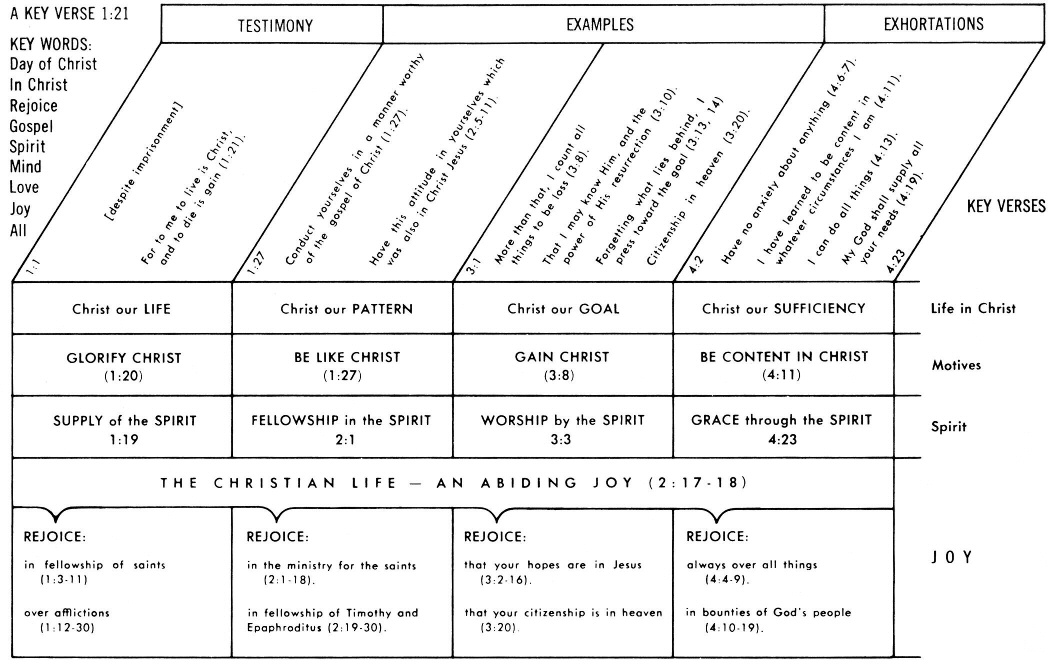
LIFE IN CHRIST
Click chart to enlarge
Charts from Jensen's Survey of the NT - used by permission
Philippians - Charles Swindoll = Chart on right side of page
| Account of Paul's Circumstances Php 1:1-30 |
Have the Mind of Christ Php 2:1-30 |
Have the Knowledge of Christ Php 3:1-21 |
Have |
| Partakers of Christ | People of Christ | Pursuit of Christ | Power of Christ |
| Suffering | Submission | Salvation | Sanctification |
| Experience | Examples | Exhortation | |
Philippians 4:6 Be anxious (2PPAM) for nothing, but in everything by prayer and supplication with thanksgiving let your requests be made known (3SPPM) to God (NASB: Lockman)
Greek: meden merimnate, (2PPAM ) all' en panti te proseuche kai te deesei meta eucharistias ta aitemata humon gnorizestho ( 3SPPM ) pros ton theon
Amplified: Do not fret or have any anxiety about anything, but in every circumstance and in everything, by prayer and petition (definite requests), with thanksgiving, continue to make your wants known to God. (Amplified Bible - Lockman)
Barclay: Do not worry about anything; but in everything with prayer and supplication, with thanksgiving, let your requests be made known to God.
Lightfoot: Entertain no anxious cares, but throw them all upon God. By your prayer and your supplication make your every want known to him.
NLT: Don't worry about anything; instead, pray about everything. Tell God what you need, and thank him for all he has done. (NLT - Tyndale House)
Phillips: Don't worry over anything whatever; tell God every detail of your needs in earnest and thankful prayer,
Weymouth: Do not be over-anxious about anything, but by prayer and earnest pleading, together with thanksgiving, let your request be unreservedly made known in the presence of God (New Testament in Modern English)
Wuest: Stop perpetually worrying about even one thing, but in everything by prayer whose essence is that of worship and devotion and by supplication which is a cry for your personal needs, with thanksgiving let your requests for the things asked for be made known in the presence of God, (Eerdmans)
Young's Literal: for nothing be anxious, but in everything by prayer, and by supplication, with thanksgiving, let your requests be made known unto God
BE ANXIOUS FOR NOTHING: meden merimnate (2PPAM):
- Da 3:16; Mt 6:25, 26, 27, 28, 29, 30, 31, 32, 33-see notes; Mt 10:19; 13:22; Lk 10:41; 12:29; 1Co 7:21,32; 1Pe 5:7
- Php 4:6, 1 Peter 5:7 How Can We Put Our Worries to Work for Us?
- What Worry Can Do for You
- See Quotes on Anxiety or Worry Below
- See Topic Anxiety-Worry - Illustrations, Devotionals (some duplication of those on this page)
- Philippians 4 Resources - Multiple Sermons and Commentaries
The Living Bible puts it this way
"Don’t worry about anything; instead, pray about everything; tell God your needs and don’t forget to thank him for his answers. If you do this you will experience God’s peace, which is far more wonderful than the human mind can understand."
Note: All verbs in bold red indicate commands, not suggestions! The ONLY way we can keep these supernatural commands is by learning to lean on the indwelling Spirit's supernatural power! If you try to keep them in your own (natural) strength you experience futility and may drift into legalism (see Gal 3:3) God's commandments always include His enablements, specifically the "Enabler!" What do I mean by using a term that society often uses in a negative sense? I am referring to the indwelling Spirit Who Alone can enable us to obey these commands. Yes, we still have to make a volitional choice to obey, but we can only do so successively as we rely on His supernatural power, not our frail ("fallen") natural power. See related discussions - "Paradoxical Principle of 100% Dependent and 100% Responsible" (100/100) (See also the related discussion of God's commands and our need for the Spirit)
See related topics:
- In Depth Discussion of Spirit filled Gratitude - Ephesians 5:20
- Fear, How to Handle It
- Jesus' admonition "do not be worried" Mt 6:25ff
- Anxious People and A Sovereign God - Gregg Herrick
Here are some other renderings of Philippians 4:6 to help give you a feel for what Paul is commanding...
- Stop being anxious about anything (ALT)
- for nothing be anxious (YLT)
- stop being anxious (Literal)
- Don't worry over anything whatever (Phillips)
- Stop perpetually worrying about even one thing (Wuest)
- Do not fret or have any anxiety about anything (Amp)
- Entertain no anxious cares, but throw them all upon God (Lightfoot)
- dismiss all anxiety from your minds (NAB)
In context, Paul just reminded the saints about God’s nearness (His presence and/or His parousia), and follows with the exhortation that believers should not be fearful, anxious, or wavering. There is no greater source of spiritual stability than the confidence that the Lord is near, not only to hear our cry for help but also able to provide help and strength (cf Paul's dire straits and confession in his last letter that "the Lord stood with me? - 2 Ti 4:16, 17, 18). The psalmist declares “The nearness of God is my good” (Asaph whose feet came close to stumbling, but came into God's presence in Ps 73:17 and was able to say the words of Ps 73:28 see Spurgeon's note). Because of God’s nearness, believers should stop being fearful, fretful, anxious, or worried. As a corollary, if you don't feel near to God, guess who moved? Confess, repent, return and He will exalt you as described by James (James 4:7-10).
You can write these words down in gold ink -
We lose the joy of living in the present when we worry about the future.
And we lose the joy of living for the future when we focus on the present.
Dwight Pentecost puts this famous passage in proper perspective asking...
Do you ever find yourself worrying? Do you know that Scripture calls worry a sin? When you realized that you were worrying, did you go to God and confess it as a sin? Worry is just as much a sin as adultery, or murder, or theft. Yet how often we as believers treat it lightly when we find our stomachs tied in knots because we have worried ourselves into a nervous frenzy. We don’t realize that we have fallen into sin. (Pentecost, J. D. The Joy of Living: A study of Philippians. Kregel Publications)
The Greek places nothing at the beginning of the sentence for emphasis. The verb be anxious (see below) is present imperative which is a command, not just an exhortation and not something optional that would be nice to do if we decide to do it. The present tense in fact calls for this to be the habitual practice in the life of believers. The negative preceding the command means they are to stop doing something, implying they are already worrying! Paul says in essence
"Stop worrying and do not under any circumstances worry about anything.”
As discussed more below Paul tells them to stop letting their stomach being tied into knots so that they cannot even eat. Get the crease off of your brows Paul says. This is no small matter because worry makes us irritable and hard to get along with because of the inner pressures we've allowed to build up inside. Paul is not saying that there are not reasons to worry, but he is saying that believers are to avoid this subtle and debilitating sin.
Jesus gave the same command do not worry ("do not be anxious")
Do not be anxious (present imperative with a negative = stop doing this) for your life, as to what you shall eat, or what you shall drink; nor for your body, as to what you shall put on. Is not life more than food, and the body than clothing?... 31 "Do not be anxious (conveys the force of a command) then, saying, 'What shall we eat?' or 'What shall we drink?' or 'With what shall we clothe ourselves?'... 34 "Therefore do not be anxious (conveys the force of a command) for tomorrow; for tomorrow will care for itself. Each day has enough trouble of its own. (see commentary notes on in Matthew 6:25-26, 6:27-29, 6:30-32, 6:33-34)
Peter offered similar advice writing...
Humble yourselves, therefore, under the mighty hand of God, that He may exalt you at the proper time, casting all your anxiety upon Him, because He cares for you. (see notes 1 Peter 5:6-7)
Nothing (medeis from mede = and not, also not + heis = one) literally means "not even one thing" and is placed first in the Greek construction for emphasis. Now apply this truth - what are saints permitted to worry about?
J Vernon McGee explains that
Nothing is a very interesting word. If you have something, it’s not nothing—that is not correct grammar, but it is an accurate statement. Nothing is nothing, and you are to worry about nothing. Does this mean we are to look at life through rose-colored glasses, that we are not to face reality? Are we to believe that sin is not real, that sickness is not real, that problems are not real? Are we to ignore these things? No. Paul says that we are to worry about nothing because we are to pray about everything. Nothing is the most exclusive word in the English language. It leaves out everything. “Worry about nothing.” I confess that this is a commandment I sometimes break—I worry." Which of us hasn't fallen into this pit of despond to one degree or other. (McGee, J V: Thru the Bible Commentary: Thomas Nelson)
Why might the saints at Philippi have been prone to anxiety? In chapter 1 Paul had encouraged them to "in no way (be) alarmed by (their) opponents" reminding them that to them it had actually "been granted for Christ’s sake, not only to believe in Him, but also to suffer for His sake" and even at the time of this writing they were "experiencing the same conflict (strife, contention)" they had seen in him. (Php 1:28, 29, 30- see notes Ph1:28, 29-30) Paul is not making light of the troubles which they face, but he knows that God is greater than all their troubles
The "joyful" saints at Philippi were habitually worrying (see below), continually forfeiting their joy. All saints need to keep a lofty view of the character and attributes of their God and remember that nothing is outside of His sovereign control or is too difficult for Him to handle (See Name of the LORD is a Strong Tower- Summary and Summary - The Attributes of God). A low view of God leads to spiritual instability with a predisposition toward anxiety and worry.
A. W. Tozer warned years ago that "the Church has surrendered her once lofty concept of God and has substituted for it one so low, so ignoble, as to be utterly unworthy of thinking, worshiping men. This she has done not deliberately, but little by little and without her knowledge; and her very unawareness only makes her situation all the more tragic. The low view of God entertained almost universally among Christians is the cause of a hundred lesser evils everywhere among us. A whole new philosophy of the Christian life has resulted from this one basic error in our religious thinking." (Online version of Knowledge Of The Holy)
The result of the church’s failure to equip believers with "The knowledge of the Holy" character and works of God leads ultimately to a lack of confidence in Him (cp a sad example of the "negative" outworking of this vital spiritual principle in Jdg 2:8, 9, 10, 21:25 - note esp Jdg 2:10 - What did they not know [Hebrew = yada = speaks of an intimate, experiential knowing, used in ["had relations" = yada] Genesis 4:1, 25 of Adam "knowing" his wife] the next generation did not know [1] Jehovah or [2] His works! They did not know His Person nor His power! What was the result in context? See Jdg 2:11, 12, 13, 14-see notes on Judges 2). The shifting sands of shallow, even faulty theology provide no stable footing for the souls (and soles) of the believer, who is then vulnerable to the burden of anxiety and worry not to mention the wiles (Ep 6:11- note - wiles = schemes = Greek word methodeia) of the devil (diabolos) and the fallen flesh. (cp Jas 1:13, 14-notes).
A study on the Names of God would be a great way (more "palatable", less "theological" sounding than "attributes") to introduce a body of believers to the attributes of God (For sermon ideas, see notes on the Names of the LORD is a Strong Tower- Summary)
Be anxious (3309) (merimnao from merimna [word study] = anxious care from meris = part, in turn from [Sources: Vine's Expository Dictionary, Ralph Earle - Word Meanings in the NT] the verb merizo = to distract, to divide, to draw different directions - which is exactly what anxiety does to most of us!) expresses a strong feeling for something or someone, often to the point of being burdened. Although this can be a "positive" concern, in most of the NT uses it refers to an anxious concern, based on apprehension about possible danger or misfortune, and so it means to be worried about, to be anxious about, to be apprehensive (viewing the future with anxiety or alarm), to be unduly concerned, to be burdened with anxious care or cumbered with many cares and in simple terms to worry.
Larry Richards offers a well reasoned assessment of merimnao explaining that...
The verb originally meant "to care," or "to be concerned about." When used by the Greeks concerning the future, both words came to connote anxious expectation. When used of the present, the words expressed an aching sense of grief. The meaning of any term, however, is defined by the way it is used. It is the way that Jesus and the writers of the Gospels and Epistles, guided by the Holy Spirit, used words that filled them with their biblical meaning...
According to the Bible, anxiety is often legitimate. The word indicates first of all a sense of concern for self and/or for others. In 1Co 7, for instance, it is used to express the commendable concern of a person for his or her spouse (1Co 7:33, 34) and the concern of each "about the Lord's affairs," that is, how to "please the Lord" (1Co 7:32). Paul speaks of the daily "pressure of [his] concern [merimna] for all the churches" (2Co 11:28) and states that God's purpose in the body is that each part have "equal concern [merimnao] for each other" and that "if one part suffers, every part suffers with it" (1Co 12:25, 26). Even in speaking of the "worries of this life" (Mt 13:22; Mk 4:19), Jesus is simply stating a fact of life. We are living in this present world, and there are necessary concerns that each individual must attend to.
But while it is legitimate to have concerns that we will at times experience as demanding pressures, there is a limit to their legitimacy. The "worries of this life" may so dominate our attention that they make God's Word unfruitful in our lives (Mt 13:22; Mk 4:19). The pressures of legitimate concerns can cause us to so focus on worldly matters that we forget to relate our needs and our worries to the Lord. (Richards, L O: Expository Dictionary of Bible Words: Regency)
Merimnao is used 17 times in the NT is translated in the NAS as "concerned, 4; have...care, 1; be anxious, 11; worry, 1.
Matthew 6:25 (note) "For this reason I say to you, do not be anxious for your life, as to what you shall eat, or what you shall drink; nor for your body, as to what you shall put on. Is not life more than food, and the body than clothing?
Matthew 6:27 (note) And which of you by being anxious can add a single cubit to his life's span?
Matthew 6:28 (note) And why are you anxious about clothing? Observe how the lilies of the field grow; they do not toil nor do they spin,
Matthew 6:31 (note) Do not be anxious then, saying, 'What shall we eat?' or 'What shall we drink?' or 'With what shall we clothe ourselves?'
Matthew 6:34 (note) Therefore do not be anxious for tomorrow; for tomorrow will care for itself. Each day has enough trouble of its own.
Matthew 10:19 "But when they deliver you up, do not become anxious about how or what you will speak; for it shall be given you in that hour what you are to speak.
Luke 10:41 But the Lord answered and said to her, "Martha, Martha, you are worried and bothered about so many things;
Luke 12:11 "And when they bring you before the synagogues and the rulers and the authorities, do not become anxious about how or what you should speak in your defense, or what you should say;
Luke 12:22 And He said to His disciples, "For this reason I say to you, do not be anxious for your life, as to what you shall eat; nor for your body, as to what you shall put on.
Luke 12:25 "And which of you by being anxious can add a single cubit to his life's span?
Luke 12:26 "If then you cannot do even a very little thing, why are you anxious about other matters?
1 Corinthians 7:32 But I want you to be free from concern (amerimnos). One who is unmarried is concerned about the things of the Lord, how he may please the Lord;
1 Corinthians 7:33 but one who is married is concerned about the things of the world, how he may please his wife,
1 Corinthians 7:34 and his interests are divided. And the woman who is unmarried, and the virgin, is concerned about the things of the Lord, that she may be holy both in body and spirit; but one who is married is concerned about the things of the world, how she may please her husband.
1 Corinthians 12:25 that there should be no division in the body, but that the members should have the same care for one another.
Philippians 2:20 (note) For I have no one else of kindred spirit who will genuinely be concerned for your welfare. (Comment: An example of "good worry")
Philippians 4:6 (note) Be anxious for nothing, but in everything by prayer and supplication with thanksgiving let your requests be made known to God.
Here are the 7 uses of merimnao in the non-apocryphal Septuagint (LXX) (Ex 5:9 - twice; 2Sa 7:10; 1Chr 17:9; Ps 38:18; Pr 14:23; Ezek.16:42). Here are 2 representative uses...
2 Samuel 7:10 "I will also appoint a place for My people Israel and will plant them, that they may live in their own place and not be disturbed (Hebrew = ragaz = be agitated, quiver, quake, perturbed; Lxx = merimnao) again, nor will the wicked afflict them any more as formerly
1 Chronicles 17:9 "And I will appoint a place for My people Israel, and will plant them, that they may dwell in their own place and be moved (ESV = disturbed) (Hebrew Ragaz = to be agitated, to quiver, to quake, to be perturbed/disturbed; Lxx = merimnao) no more; neither shall the wicked waste them anymore as formerly,
Psalm 38:18 For I (DAVID) confess my iniquity; I am full of anxiety (Hebrew = daag = to be anxious, concerned, fearful; Lxx = merimnao) because of my sin. (Spurgeon's note)
Worry has a fascinating etymology which can be traced back to the Old High German "wurgen" which means "to strangle" which is what worry does to our joy! Webster adds that in "dialect British" worry means to "choke" or to "strangle". The first definition of "worry" in Webster is "to harass by tearing, biting, or snapping especially at the throat", and then "to subject to persistent or nagging attention or effort" and "to afflict with mental distress or agitation = make anxious". (Merriam-Webster's Collegiate Dictionary. 10th ed. Springfield, Mass)
Merimnao in the present context means to have an anxious concern, based on apprehension about possible danger or misfortune and is characterized by extreme uneasiness of mind or brooding fear about some contingency and emphasizes a fear of frustration, failure or disappointment.
The idea inherent in merimnao is of an individual attempting to carry the burden of the future by themselves and expressing an unreasonable anxiety (especially) about things over which one has no control.
TDNT says that the word group which includes merimnao...
"...covers much the same range of meaning as the English “care”: a. “to care for someone or something,” b. “to be concerned or anxious,” c. “to be intent on or strive after,” d. “to be anxiously expectant,” e. “to be solicitous,” and f. “to brood, speculate, or inquire.”
The plural mérimnai is often used for the cares of life which disturb sleep, from which refuge is sought in love or drink, and which only death can end...
The NT realizes that life is swayed by care. Concern is unavoidable but it is given a new orientation. Liberation from it comes as one casts it upon God, not because God grants every wish, but because prayer grants freedom from care. To be anxious about food or clothing is opposed to concern for the kingdom of God (see note Matthew 6:25-26). Naturally we have to work (see note 1Thessalonians 2:9), but we cannot secure life by care; our concern must be for the kingdom. To care for the world is to fall victim to it. If care gains control over us, it leads to apostasy (Lk 21:34). We must focus on the one thing needful ("Martha, Martha, you are worried and bothered about so many things"! Lk 10:41,42), confronting worldly ties with a hōs me [Ed note: "as though they had none" attitude] (1 Cor. 7:29ff). We belong to the coming aeon and must be ready for it (Lk 21:34). But this entails care for others as members of the same body (1Co 12:25).(Kittel, G., Friedrich, G., & Bromiley, G. W. Theological Dictionary of the New Testament. Eerdmans)
The New International Dictionary of NT Theology writes that...
"merimna (in depth study) can mean both care in the sense of an anxious fear and also caring for, providing for, and merimnao can mean being anxious, worried, and care, take responsibility for someone or something. In keeping with this meaning, the words are usually concerned with objects in the future (Brown, Colin, Editor. New International Dictionary of NT Theology. 1986. Zondervan)
Lawrence Richards writes that merimnao...
originally meant "to care," or "to be concerned about." When used by the Greeks concerning the future, both words came to connote anxious expectation. When used of the present, the words expressed an aching sense of grief. The meaning of any term, however, is defined by the way it is used. It is the way that Jesus and the writers of the Gospels and Epistles, guided by the Holy Spirit, used words that filled them with their biblical meaning. Either merimnao or merimna is used in each NT passage where "anxiety" or "worry" appears...These words are not always translated "anxiety" or "worry," but the thought of anxious concern is expressed in each context." (Richards, L O: Expository Dictionary of Bible Words: Regency)
Barclay gives some examples of use in secular Greek writings explaining that merimnao means...
means to worry anxiously. Its corresponding noun is merimnan, which means worry. In a papyrus letter a wife writes to her absent husband: “I cannot sleep at night or by day, because of the worry (merimna) I have about your welfare.” A mother, on hearing of her son’s good health and prosperity writes back: “That is all my prayer and all my anxiety (merimna).” Anacreon, the poet, writes: “When I drink wine, my worries (merimna) go to sleep.” (Ed note: this is not true in the Bible however!) In Greek the word is the characteristic word for anxiety, and worry, and care. (Barclay, W: The Daily Study Bible Series. The Westminster Press)
Marvin Vincent - The cognate noun is merimna, care, which was formerly derived from meris, a part; merizo , to divide; and was explained accordingly as a dividing care, distracting the heart from the true object of life. This has been abandoned, however, and the word is placed in a group which carries the common notion of earnest thoughtfulness. It may include the ideas of worry and anxiety, and may emphasize these, but not necessarily." (Vincent, M. R. Word Studies in the New Testament Vol. 1, Page 3-48)
Vine writes that "merimnao denotes to have a distracting care. This is to be absent entirely from the believer. Anxiety harasses the soul; it enfeebles, irritates, ruffles the temper, is a sign of mistrust and of failing obedience, and distracts the mind from communion with God (Collected writings of W. E. Vine)
Guzik has an interesting insight stating that "Undue care is an intrusion into God's arena. It makes us the father of the household instead of being a child."
Anxiety is a very picturesque word, pictures to be pulled in different directions. Our hopes pull us in one direction; our fears (see topic: How To Handle Fear) pull us the opposite direction; and we are pulled apart! The English word "anxious" has a very "telling" derivation from the Latin word Latin anxius which is akin to Latin angere which means to strangle (compare with "worry" above)! Isn't that what anxiety does to most of us...strangle us and render us ineffective in God's kingdom work?
Here is an illustration of the divided mind of the anxious person - Tepee vs. Wigwam - A man went to his psychiatrist and he said, “Sometimes I think I’m a tepee and sometimes I think I’m a wigwam.” The psychiatrist said, “Your problem is you’re too tents.” The Bell, the Clapper, and the Cord: Wit and Witticism
Be anxious is a command (imperative mood = not a suggestion) not a suggest or an option and is in the present tense which calls for continuous action. Paul says that the habit of our life is to not be anxious. The Greek construction indicates that Paul is giving a prohibition which forbids the continuance of an action already habitually going on. In other words, the Philippian saints were habitually worrying and Paul exhorts them to stop.
Paul uses merimnao in a positive light in chapter 2 extolling the virtues of his young protégée Timothy reminding the Philippians "I have no one else of kindred spirit who will genuinely be concerned (merimnao) for your welfare." (notes Philippians 2:20)
Mattoon - In the Navajo Indian translation of the Bible, the word for "care or worry" is a word which means "that which prickles and irritates, like a pin sticking into the flesh." This verse then reads, "The things that are continually sticking into you, turn them over to me, for I am caring about you." The Philippians were continuously worrying and were told to stop. Worry robs our hearts of peace. We may encounter trials and troubles, but it is wrong to brood over them. Worry is the interest we pay on the debt of unbelief with which we have mortgaged our lives. God gives us a warning about worry. The heart of Matthew 6:25-34 is don't worry. Don't worry about money, things, food, clothing, etc. The phrase "take no thought" is a command that appears three times (Mt 6:25, 31, 34). This phrase means "to be drawn in a different direction or to be torn apart." Worry pulls a person apart because the person is trying to live a life without a dependence and trust in God. The average person crucifies himself between two thieves: 1) the regrets of yesterday, 2) the worries of tomorrow. Worry is wrong because it demonstrates distrust in God's promises and providence. It says, "God is not big enough to handle the problems and circumstances in my life." It is in essence "practical atheism." Worry is the interest we pay on tomorrow's troubles. If we worry, we can't trust; if we trust, we can't worry. Worry is like a rocking chair. It requires an investment of your energy, but it does not get you anywhere. Worry never moves you one inch closer to a solution. In fact, it creates more problems. Worry cannot change the past or control the future; it makes you miserable today.
How You Can Tell When It's Going to Be a Rotten Day
• You wake up face down on the pavement.
• You call Suicide Prevention and they put you on hold.
• You see a "60 Minutes" news team waiting in your office.
• Your birthday cake collapses from the weight of the candles.
• You turn on the news and they're showing emergency routes out of the city.
• Your twin sister forgot your birthday.
• Your car horn goes off accidentally and remains stuck as you follow a group of Hell's Angels on the freeway.
• Your boss tells you not to bother to take off your coat.
• The bird singing outside your window is a buzzard.
• You wake up and your braces are locked together.
• You call your answering service and they tell you it's none of your business.
• Your income tax check bounces.
• You put both contact lenses in the same eye.
• Your wife says, "Good morning, Bill," and your name is George. (Rod Mattoon)
Eadie writes that "The solicitude (anxiety) guarded against is that state of mind in which one frets himself to know more than he is able, or reach something too far beyond him, or is anxious to make provision for contingencies, to guard against suspected evils, and nerve himself against apprehended failures and disasters. The spirit is thrown into a fever by such troubles, so that joy in the Lord is abridged, and this forbearance would be seriously endangered. Not that the apostle counsels utter indifference, for indifference would preclude prayer; but his meaning is, that no one of them should tease and torment himself about anything, when he may get what he wants by prayer. There is nothing any one would be the better of having, which he may not hopefully ask from God. Why then should he be anxious?— why, especially, should any one prolong such anxiety, or nurse it into a chronic distemper?"
Warren Wiersbe - From the spiritual point of view, worry is wrong thinking (the mind) and wrong feeling (the heart) about circumstances, people, and things. Worry is the greatest thief of joy. It is not enough for us, however, to tell ourselves to “quit worrying” because that will never capture the thief. Worry is an “inside job,” and it takes more than good intentions to get the victory. The antidote to worry is the secure mind: “And the peace of God... shall keep [garrison, guard like a soldier] your hearts and minds through Christ Jesus” (Phil. 4:7). When you have the secure mind, the peace of God guards you (Phil. 4:7) and the God of peace guides you (Phil. 4:9). With that kind of protection—why worry? (Wiersbe, W: Bible Exposition Commentary. 1989. Victor)
Charles Spurgeon once said that "our anxiety does not empty tomorrow of its sorrow, but only empties today of its strength."
Rob Morgan on Php 4:6 - According to the commentaries I consulted, the construction of this sentence in the original language as Paul wrote it contains the emphasis that the Philippians had been anxious, they had been worried, and they were to stop.2 This could literally be translated, “Stop being worried. Stop living a life of worry. You’ve been anxious over many things, but do not live that way from now on. Stop this life of worrying.” How is this possible? Fretting comes to us as naturally as breathing. Some of our earliest memories are the anxieties that we encountered in childhood, and we seem to never outgrow our capacity to worry. I should know, because I’m an expert on the subject. But the Bible believes in replacement therapy. It tells us to replace worry with prayer.
The NT realizes that life is swayed by care. Concern is unavoidable but it is given a new orientation. Liberation from it comes as one casts it upon God. How do we "cast" our burdens upon God? Somewhat paradoxically by continually making our anxieties known to Him in thankful prayer. God obviously knows, but our act of declaring our anxious thoughts to Him represents a humbling of one's self beneath His mighty hand. And we know that although He opposes the proud, He gives grace to the humble and exalts them at the appropriate time.
See J R Miller's article - "Don't Worry"
Peter contrasts two types of care in the following exhortation to humble ourselves under the mighty hand of God...
casting (vivid verb used only one other time to describe the disciples casting their coats on a colt in Lk 19:35) all (no exceptions) (our) cares (noun merimna = anxieties, worries, concerns) upon Him for He cares (picture of God exercising watchful care, interest and affection over His children, cf Lk 21:18) for you (see note 1 Peter 5:7)
The psalmist writes
Cast (in Hebrew = a command) your burden upon the LORD (releasing the weight of if) and He will sustain you. He will never allow the righteous to be shaken. (Ps 55:22)
Matthew Henry comments - we must cast it upon God by faith and prayer, commit our way and works to him; let him do as seemeth him good, and we will be satisfied. To cast our burden upon God is to stay ourselves on his providence and promise, and to be very easy in the assurance that all shall work for good. If we do so, it is promised, 1. That he will sustain us, both support and supply us, will himself carry us in the arms of his power, as the nurse carries the sucking-child, will strengthen our spirits so by his Spirit as that they shall sustain the infirmity. He has not promised to free us immediately from that trouble which gives rise to our cares and fears; but he will provide that we be not tempted above what we are able, and that we shall be able according as we are tempted. 2. That he will never suffer the righteous to be moved, to be so shaken by any troubles as to quit either their duty to God or their comfort in him. However, he will not suffer them to be moved for ever (as some read it); though they fall, they shall not be utterly cast down.
Spurgeon comments - Thy burden, or what thy God lays upon thee, lay thou it upon the Lord. His wisdom casts it on thee, it is thy wisdom to cast it on him. He cast thy lot for thee, cast thy lot on him. He gives thee thy portion of suffering, accept it with cheerful resignation, and then take it back to him by thine assured confidence.
He shall sustain thee. Thy bread shall be given thee, thy waters shall be sure. Abundant nourishment shall fit thee to bear all thy labours and trials. As thy days so shall thy strength be.
He shall never suffer the righteous to be moved. He may move like the boughs of a tree in the tempest, but he shall never be moved like a tree torn up by the roots. He stands firm who stands in God. Many would destroy the saints, but God has not suffered it, and never will. Like pillars, the godly stand immoveable, to the glory of the Great Architect.
Wiersbe writing on Psalm 55:22 adds this reminder...
This promise tells us that Christians do have burdens. David is not talking about concern for others, although it's good to bear one another's burdens. Instead, he means the burdens that the Lord allows each one of us to bear. One translation reads, "Cast what he has given thee upon the Lord." Burdens are not accidents but appointments. The burdens you have in your life today are what God has ordained for you--unless they are the result of your own rebellious sin against Him. Burdens help us grow; they help us exercise the muscles of our faith. They teach us how to trust God and live a day at a time. This promise also tells us that we can cast these burdens on the Lord. Peter said, "Casting all your care upon Him, for He cares for you" (notes 1 Peter 5:7). The Lord gives us the burden, and then He says,
"Now give that burden back to Me. But don't stop there; give Me yourself as well."
If we try to give Him our burdens without giving Him ourselves, He really can't help us. It's like stepping onto an elevator with many heavy packages and failing to put them down on the floor until you reach your destination. Let the elevator carry both you and your packages. Notice that the verse doesn't say He'll keep you from problems all the time. He's going to use problems to build your character. But he'll make sure the righteous will not be moved. Cast your burden on the Lord. Let Him sustain you today. Giving your burden to God is an act of faith. But giving yourself to Him and letting Him use that burden to help you grow is taking an extra step of faith. He will invest that burden in building your character. Give your burdens to the Lord today. (Prayer, Praise and Promises)
What's the cure for worry? Spiritually stable people react to trials with thankful prayer. Such prayer is the antidote to worry and the cure for anxiety. The theology of prayer is not in view here, but rather its priority and the attitude the believer brings to it.
Oh, to live exempt from care
By the energy of prayer:
Strong in faith, with mind subdued,
Yet elate with gratitude!
ILLUSTRATIONS ON
WORRY/ANXIETY
Adrian Rogers - Rely on the Power of God
All right, number two: Not only rejoice in the presence of the Lord—the Lord is at hand; but rely on the power of the Lord. Now, look, if you will, at the next verse—He says, "Be careful for nothing; but in every thing by prayer and supplication with thanksgiving let your requests be made known unto God" (Philippians 4:6). Now, what does that mean? It means, if you've got a problem, tell God about it. "In every thing by prayer and supplication with thanksgiving..." (Philippians 4:6). Don't worry about anything. "Be careful..." (Philippians 4:6). Don't be full of care about anything.
Do you know one of the most damaging emotions that can come to you is worry? I've often told you from this pulpit that worry will do the same thing to you mentally that sand will do to machinery. There are few forms of dissipation that hurt your body more than worry. And, don't look down your long nose at the man who overeats, or the man who smokes cigarettes, or the man who drinks alcohol or takes drugs, if you're given over to worry, because worry is a form of dissipation. The word—the very word worry—means—it has the idea of—division; it has the idea of being pulled apart. Over here, on the one hand, is hope; and, over here, on the other hand, is fear. And, you're just pulled between hope and fear.
And, Jesus, in Matthew 6, emphatically warned us against worry. He said that worry is absolutely useless. He said, "Which of you by taking [anxious] thought can add one cubit unto his stature?" (Matthew 6:27). I mean, the very best thing you could say about worry is that it doesn't do any good. Four times in that passage He says, "Take no thought." And, the word literally means, "no anxious thought." It's not foresight, but foreboding—worrying about things that are out there in the future, that you don't know what's going to transpire. He says it does no good. It's like a rocking chair—it gives you something to do, but it doesn't get you anywhere. That's what worry is like.
Behavioral psychologists have told us this about worry: 40% of what we worry about never happens; 30% has already gone past, and worry can't change it; 12% is needless worry about health; 10% of the things we worry about are miscellaneous matters that don't deserve worry; only about 8% of the things that remain could be counted worthy of worry, if you were a worrier, but of those they could be divided into two categories—those you can do something about, and those you can't do anything about. Now, if you can do something about it, do it, and quit worrying. If you can't do anything about it, worry is not going to change it.
For every evil under the sun
Either there's a cure, or there is none.
If there be none, never mind it;
If there be one, seek till you find it. (Author unknown)
Now, what does all this mean? It means Jesus said worry is not... You can't make yourself taller by worry. "Which of you can add one cubit to his stature by worry?" (Matthew 6:27). Mark Twain said, "I'm an old man, and I've known many troubles—most of which never happened." Worry is useless; it's wasteful. Jesus said, "Sufficient unto the day is the evil thereof" (Matthew 6:34). Worry doesn't take the sorrow out of tomorrow; it takes the joy out of today. Worry pulls tomorrow's clouds over today's sunshine. Worry doesn't help you to get ready for tomorrow, because God doesn't give you strength for tomorrow. "As your days are, so shall your strength be" (Deuteronomy 33:25).
So, when you bring tomorrow's troubles into today, you overload today. And, worry is the interest you pay on borrowed trouble. And, when you get to tomorrow, you're not more ready when you get to tomorrow—you're less ready, because you get to tomorrow out of breath, because you're trying to live today's strength with tomorrow's troubles; and, you're overloaded today, and you're worn out before you get to tomorrow. Worry is useless. Worry is wasteful. Worry is wicked. Jesus said this is the way the Gentiles act: "After all these things do the Gentiles seek" (Matthew 6:32). You're acting like a pagan.
Now, you say, "Fine, Pastor, fine. You make me feel worse now. Tell me not to worry. Now, I'm going to worry about that." But now, listen. He doesn't just say, in a cavalier way, "Don't worry." He tells you exactly what to do. Look at it, in verse 6: "Be careful for nothing; but in every thing by prayer and supplication with thanksgiving let your requests be made known unto God" (Philippians 4:6). Worry about nothing; pray about everything. You say, "Well, what do you know about it? You've never known any troubles." But, number two: I didn't write this; the Apostle Paul wrote it. It's written by divine inspiration.
Now, the cure for worry, very simply, is prayer to that God who is right there with you, who will never leave you. It is prayer that is a place of power, provision, and peace. And, I love these lines:
I met God in the morning
When my day was at its best,
And His presence came like sunrise
Like a glory in my breast.
All day long the presence lingered,
All day long it stayed with me,
And we sailed in perfect calmness
O'er a very troubled sea.
Other ships were blown and battered,
Other ships were sore distressed,
But the winds that seemed to drive them
Brought to us a peace and rest.
Then I thought of other mornings
With a keen remorse of mind,
When I, too, had loosed the moorings
With the Presence left behind.
So I think I know the secret
Learned from many a troubled way:
You must seek Him in the morning
If you want Him through the day. (Ralph Cushman)
Pray about everything, but unlock the morning with prayer. Refuse to worry. "In every thing by prayer and supplication..." (Philippians 4:6). If it's big enough to concern you, it's big enough to concern God. Don't get the idea that there are some things that are too small to tell God about. Pray about it.
We have these missionaries here tonight. And, my favorite story is of a missionary who met a voracious lion, and he prayed and asked God for deliverance. And, God delivered him from the mouth and paw of that lion, and he gave God great praise. And, that night, when he tried to sleep, there was a mosquito in the room. It kept him awake all night long; and, when he woke up with dark circles under his eyes, the Holy Spirit said to him, "You asked the Father to deliver you from that lion, but you thought you could handle that mosquito by yourself, didn't you?"
Now, think about it. I mean, we think, "Well, you know, I need God for the big things." You need God for everything—for everything. "Be careful for nothing; but in every thing by prayer and supplication with thanksgiving..." (Philippians 4:6). You say, "Well, I don't want to bother Him about the little stuff." Can you think of anything that's big to God? It's all little stuff to Him, and He's concerned about that.
There was an article in the news the other day, and the headline caught my eye. It said that we are living in the United States of Anxiety. According to this article:
• Anxiety is now an epidemic in the United States.
• More Americans suffer from anxiety (in proportion to national population) than any other country in the world.
• Anxiety disorders affect 40 million Americans.
• Three of the top ten bestselling drugs sold in America are for mental illness.
• $42 billion a year is spent on anxiety-related disorders.
This illustration is from Rob Morgan's sermon on Philippians 4:4-9 (click for full message). He writes:
We can accurately call this: “God’s Six-Step Program to Overcoming Worry in Your Life.” This passage tells us what to do: Bam, bam, bam, bam, bam. It gives us an enumerated list, and so I’d just like to go over it as it’s written.
ILLUSTRATION OF THE EFFECT OF ANXIETY - Paul Martin revealed the consequences and destructiveness of worry in the book, The Sickening Mind. He said, "During the Gulf War of 1991, Iraq launched a series of Scud missile attacks against Israel. Many Israeli citizens died as a result of these attacks. After the war was over, Israeli scientists analyzed the official mortality statistics and found something remarkable. Although the death rate had jumped among Israeli citizens on the first day of the Iraqi attacks, the vast majority of them did not die from any direct physical effects of the missiles. They died from heart failure brought on by fear, worry, and stress associated with the bombardment. Psychological studies conducted on Israelis at the time showed that the most stressful time was the first few days leading up to the outbreak of war on January 17, and peaking on the first day of the Scud missile attacks. There was enormous and well-founded concern about possible Iraqi use of chemical and biological weapons. The government had issued to the entire Israeli population gas masks and automatic atropine syringes in case of chemical attack, and every household had been told to prepare a sealed room. After the first Iraqi strike turned out to be less cataclysmic than feared, levels of stress declined markedly. As in other wars, the people adapted to the situation with surprising speed. Then as the fear and anxiety subsided, the death rate also declined. There were 17 further Iraqi missile attacks over the following weeks, but Israeli mortality figures over this period were no higher than average. It was fear and the psychological impact of the missiles, not the physical impact, that claimed the majority of victims." Beloved
MIND GUARDING - Paul counsels us to take everything to God in prayer. "Don't worry about anything, but pray about everything!" (Php 4:6) is his admonition. We are prone to pray about the "big things" in life and forget to pray about the so-called "little things"—until they grow and become big things! Talking to God about everything that concerns us and Him is the first step toward victory over worry. The result is that the "peace of God" guards the heart and the mind. You will remember that Paul is chained to a Roman soldier, guarded day and night. In like manner, "the peace of God" stands guard over the two areas that create worry—the heart (wrong feeling) and the mind (wrong thinking). When we give our hearts to Christ in salvation, we experience "peace with God" (Ro 5:1); but the "peace of God" takes us a step further into His blessings. This does not mean the absence of trials on the outside, but it does mean a quiet confidence within, regardless of circumstances, people, or things.
Applying God's Truth: 1. What are some "little things" in your life that concern you, yet that you may feel are too insignificant to pray about? (Whatever you think of, commit it to prayer and trust God to deal with the little things as well as the big ones.) 2. We tend to think of peace as an inner emotion. How do you feel when you envision God's peace as something that can protect you from outside influences? 3. What requests do you need to present to God today? What reasons do you have to offer thanksgiving today? - Pause for Power - Warren Wiersbe
THE ANTIDOTE TO WORRY - If anybody had an excuse for worrying, it was the Apostle Paul. His beloved Christian friends at Philippi were disagreeing with one another, and he was not there to help them. We have no idea what Euodia and Syntyche were disputing about, but whatever it was, it was bringing division into the church. Along with the potential division at Philippi, Paul had to face division among the believers at Rome (Phil. 1:14-17). Added to these burdens was the possibility of his own death! Yes, Paul had a good excuse to worry— but he did not! Instead, he takes time to explain to us the secret of victory over worry. The Old English root from which we get our word "worry" means "to strangle." If you have ever really worried, you know how it does strangle a person! In fact, worry has definite physical consequences: headaches, neck pains, ulcers, even back pains. Worry affects our thinking, our digestion, and even our coordination. The antidote to worry is the secure mind: "The peace of God . . . will guard your hearts and your minds in Christ Jesus" (Phil. 4:7). When you have the secure mind, the peace of God guards you and the God of peace guides you! With that kind of protection—why worry?
Applying God's Truth: 1. What are three things you are worried about right now? If you begin to rejoice about other, more positive things, how do you think your worries would be affected? 2. Do you think it's really possible to rejoice always? Explain. 3. How might you reduce your amount of worrying in the future? - Pause for Power - Warren Wiersbe
Do not be anxious about anything! (James Smith, "Daily Food for the Lord's Flock!" 1848)
"Do not be anxious about anything, but in everything, by prayer and petition, with thanksgiving, present your requests to God!" Philippians 4:6
Prayer is . . .
- always seasonable
- always necessary
- and always profitable!
We should do with our cares as we do with our sins — carry them to Jesus, and cast them on Him. In every place the throne of grace is near — at all times God is accessible to us. Every trouble furnishes us with a message to Him! "Cast all your care upon Him, for He ever cares for you!" 1 Peter 5:7
Bengel - Care (anxious) and prayer are as mutually opposed as fire and water.
Barnes says that Paul "does not mean that we are to exercise no care about worldly matters - no care to preserve our property, or to provide for our families (cf 1Ti 5:8); but that there is to be such confidence in God as to free the mind from anxiety, and such a sense of dependence on him as to keep it calm.
Spurgeon - There is no more blessed way of living than a life of dependence upon a covenant-keeping God. We have no care, for He cares for us; we have no troubles, because we cast our burdens upon the Lord.
Edward Everett Hale (1822-1909), former US Senate chaplain, said, "Never attempt to bear more than one kind of trouble at once. Some people bear three kinds--all they have had, all they have now, and all they expect to have."
The venerable D L Moody once quipped that saints should be "Careful for nothing, prayerful for everything, thankful for anything."
Calvin writes that saints "are not made of iron so as not to be shaken by temptations. But this is our consolation, this is our solace --to deposit, or (to speak with greater propriety) to disburden in the bosom of God everything that harasses us. Confidence, it is true, brings tranquility to our minds, but it is only in the event of our exercising ourselves in prayers. Whenever, therefore, we are assailed by any temptation, let us betake ourselves forthwith to prayer, as to a sacred asylum.
Ray Pritchard - Worry is stewing without doing. Worry is wrong because it assumes that God can’t take care of you. He promised to care for you, but when you worry, you are saying, “Lord, I don’t believe you can take care of me so I’m going to take matters into my own hands.”
Paul has three pieces of advice for worriers:
A. Pray about everything—"in everything by prayer”
B. Pray with thanksgiving—"with thanksgiving”
C. Pray with expectation—"present your requests to God”
An old hymn says it this way:
Thou art coming to a king
Large petitions with thee bring
For his grace and power are such
None can ever ask too much.
When you take your burdens to the Lord, he replaces your worries with something much greater: the peace that passes all human understanding.
Corrie Ten Boom sage had several wise thoughts regarding anxiety and worry...
Look around and be distressed.
Look inside and be depressed.
Look at Jesus and be at rest.
Never be afraid to trust an unknown future to a known God
Any concern too small to be turned into a prayer is to small to be made into a burden
WHAT IS WORRY?
Worry...
-
...gives a small thing a big shadow
-
...is the interest we pay on tomorrow's troubles.
-
...over tomorrow pulls shadows over today's sunshine.
-
...is like a rocking chair; it will give you something to do, but it won't get you anywhere.
-
...is an indication that we think God cannot look after us. (O. Chambers)
-
...is putting question marks where God has put periods. (J R Rice)
-
...is the interest we pay on tomorrow’s troubles. (E S Jones)
-
...is an intrusion into God's providence. (J Haggai)
-
...is a guest admitted which quickly turns to be master.
-
... never robs tomorrow of its sorrow, it only saps today of its strength (A J Cronin)
-
... is the interest paid by those who borrow trouble (G W Lyon)
-
...is practical atheism and an affront to God (R. H. Mounce)
Søren Kierkegaard (bio) put worry and anxiety in an poignant perspective writing that...
No Grand Inquisitor has in readiness such terrible tortures as anxiety
Ray Pritchard writes that
Worry is excessive concern over the affairs of life. The key obviously is the word "excessive." Worry happens when you are so concerned about the problems of life that you can think of nothing else. It is an all-consuming feeling of uncertainty and fear. And it is a sin. Worry is a sin for two reasons: First, because it displaces God in your life. When you commit the sin of worry, you are living as though God did not exist. And you are living as though you alone can solve your problems. Second, because it distracts you from the things that really matter in life. As long as you are worrying, you can't do anything else. You are strangled by worry.
But how can we tell when the legitimate concerns of life have become sinful worries? Here are three practical guidelines. You are probably well into worry...
1. When the thing you are concerned about is the first thing you think about in the morning and the last thing you think about at night.
2. When you find yourself thinking about it during every spare moment.
3. When you find yourself bringing it up in every conversation you have.
Seen in that light, most of us worry a lot more than we would like to admit! (Matthew 6:25-34 Three Things Not To Worry About ) (Bolding added)
Someone has written that worry is a small trickle of fear that meanders through the mind until it cuts a channel into which all other thoughts are drained.
Illustration of how worry affects one's sleep...
Today if you visit Thomas Carlyle’s famous home in London, they will show you an almost soundproof chamber that Carlyle had built so the noise of the street could be shut out and he could work in silence. One of his neighbors, however, kept a rooster that several times in the night and in the early morning gave way to vigorous self-expression. When Carlyle protested to the owner of the rooster, the man pointed out to him that the rooster crowed only three times in the night, and that after all could not be such a terrible annoyance. “But,” Carlyle said to him, “if you only knew what I suffer waiting for that rooster to crow!” (Clarence Macartney, Macartney’s Illustrations Nashville: Abingdon, 1945)
Worry and anxiety is the plague of our modern age as observed by Time magazine (in 1961) which said...
Not merely the black statistics of murder, suicide, alcoholism, and divorce betray anxiety … but almost any innocent everyday act: the limp or overhearty handshake, the second pack of cigarettes or the third martini, the forgotten appointment, the stammer in mid-sentence, the wasted hour before the TV set, the spanked child, the new car unpaid for. (Time Magazine, March 31, 1961)
Think about it - Never be afraid to trust an unknown future to a known God. Any concern too small to be turned into a prayer is too small to be made into a burden.
A Strategy For Winning Over Worry =
(1) Identify specific worries.
(2) Work to change what you can.
(3) Leave what you can't change with God.
When we put our cares in God's hands, He puts His peace in our hearts. (ODB)
I like D L Moody's strategy for confronting worry...
Be careful for nothing, prayerful for everything, thankful for anything.
Corrie Ten Boom also had some similar advice on worry stating that...
If a case is too small to be turned into a prayer it is too small to be made into a burden.
Take courage: if God doesn't choose to remove an obstacle, He will help you plow around it!
Even though you can't control your circumstances, you can control your attitude.
Anxiety is a thin stream of fear trickling through the mind. If encouraged, it cuts a channel into which all others thoughts are drained. - Arthur Somers Roche
Never attempt to bear more than one kind of trouble at once. Some people bear three kinds—all they have had, all they have now and all they expect to have. - Edward Everett Hale
As we refuse to worry about the "tomorrows" and begin to thank and trust God for the "todays," we find grace and guidance for each step of the way.
We don't need to see beyond what God shows us today.
When we follow His leading, we have enough light for each step of the way
June Hunt has an excellent summary of the worthlessness of worry based on the parallel passage in Luke 12:22-34...
Worry Is Worthless! If you worry...
-
Remember, life is more than food and clothes (Luke 12:22)
-
You'll miss the meaning of life (Luke 12:23)
-
Remember, God feeds the birds and will be sure to feed you (Luke 12:24)
-
You can't extend the length of your life (Luke 12:25)
-
It is an exercise in futility (Luke 12:26)
-
You waste your time and energy (Luke 12:27)
-
You exhibit a lack of faith (Luke 12:28)
-
You set your heart on tangibles instead of trust (Luke 12:29)
-
You are like unbelievers, refusing faith in God (Luke 12:30)
-
You are not making God's kingdom your priority (Luke 12:31)
-
You are forgetting what the Father has already given you (Luke 12:32)
-
You are thinking more of yourself than of others (Luke 12:33)
-
You are treasuring the temporal over the eternal (Luke 12:34)
From a work I would highly recommend because it tends to stay close to Scriptural wisdom with a minimum of secular wisdom (June Hunt's collection of 100 Biblical Counseling Keys)
Author A. B. Simpson told about an old farmer who plowed around a large rock in his field year after year. He had broken one cultivator and two plowshares by hitting it. Each time he saw that obstacle, he grumbled about how much trouble the rock had caused. One day he decided to dig it up and be done with it. Putting a large crowbar under one side, he found to his surprise that the rock was less than a foot thick. Soon he had pried it out of the ground and was carting it away in his wagon. He smiled to think how that "big" old rock had caused him so much needless frustration. Not every trouble can be removed as easily as that stone. But prayer is an effective way to handle difficulties of all sizes. Using the leverage of prayer with our problems can keep us from becoming victims of worry. —D. J. De Haan (Our Daily Bread, Copyright RBC Ministries, Grand Rapids, MI. Reprinted by permission. All rights reserved)
FERVENT PRAYER DISPELS ANXIOUS CARE.
How Will My Worry Look? - Hans Christian Andersen, author of such well-known fairy tales as "The Emperor's New Clothes," had a phobia of being buried alive. As a result, he always carried a note in his pocket telling anyone who might find him unconscious not to assume he was dead. He often left another note on his bedside table stating, "I only seem dead." Such was his anxiety until he finally succumbed to cancer in 1875.
We may think such a fear is strange, but do we have fears that will someday look just as irrational? Is it possible that the day will come when we look back and marvel at our own anxieties? Will we one day wonder at that foolish person who chose to worry rather than to pray? Will time eventually cast us as a pitiful person who was plagued by fear because we did not face life with the resources lavished on us by the Almighty Lord of the universe?
Worrying doesn't change anything. But trusting the Lord changes everything about the way we view life.
Forgive us, Lord, for our inclination to worry. Help us to see how foolish it is for us to worry about what You have promised to provide. Don't let us bury ourselves alive with fears. — Mart De Haan
A Strategy For Winning Over Worry
Identify specific worries.
Work to change what you can.
Leave what you can't change with God.
When we put our cares in God's hands, He puts His peace in our hearts.
TOO WET OR TOO DRY: While waiting for a tire to be repaired, I began talking with a man who farmed nearby. "Sure need rain," he said. "Don't know what we're gonna do if it doesn't rain."
"A lot different from last year," I said.
"A year ago it was so wet I couldn't get in the field," the man replied. Then he paused and said, "You know, I've been farming around here for 41 years and its always the same—either too wet or too dry. I don't know why I bother to talk about it in the first place!"
We laughed together and I went on my way, pondering what he had said and its relation to all the things I was worried about that day For every essential element in our lives today, God would be pleased to have us trade worry for trust and say, "Thank You, kind heavenly Father. You already know what I need. So I'll trust You to take care of me." —D. C. McCasland (Ibid)
The way to be anxious about nothing is to be prayerful about everything.
ILLUSTRATION - When I was a little boy," wrote H. P. Barker, "I used to help my mother store away apples. Putting my arms around ever so many, I tried to carry them all at once. I managed for a step or two, but then out fell one, and then another, and two or three more, till the apples were rolling all over the floor. Mother laughed. Putting my tiny hands around one apple, she then suggested that I take that one and then carry the others in the same way"
Mr. Barker made the following application: "Don't try to put your arms around a year or even a week. Rather say, `Here is another day begun. Lord, help me to live it for You. Give me just now the help and strength that I need.
What good advice! How foolish it is to borrow trouble from tomorrow! We can trust God to meet our needs every day. So let's take just one "apple" at a time. —R. W. De Haan (Ibid)
Worry is carrying a burden God never intended us to bear.
AWAKE ALL NIGHT!: A was story is told of a man who raised chickens. Among them was a rooster whose occasional crowing greatly annoyed a neighbor. Early one morning the disgruntled neighbor called the farmer and complained, "That miserable bird of yours keeps me up all night!"
"I don't understand," came the reply "He hardly ever crows; but if he does, it's never more than two or three times."
That isn't my problem," retorted the neighbor. "It's not how often he crows that irritates me! What keeps me awake is not knowing when he might crow!"
Many of us are like that man. We worry about the difficulties and distressing circumstances that could arise tomorrow. Rather than living a day at a time and rejoicing in the Lord's sufficiency for the present, we become anxious by borrowing trouble from the future. Friend, stop foolishly "waiting for the rooster"! —R. W De Haan (Ibid)
Worrying is paying interest on troubles that may never come due!
Worry is wrong and is in essence sin. Worry is unnecessary (cp "the birds"). Worry is useless (it cannot add an hour to your life or an inch to your height). Worry is blind (to the lessons taught by God's providential care of the birds and flowers). Worry is at its very core being, a failure to trust God.
- When worry is present, trust cannot crowd its way in. (Billy Graham)
- Only one type of worry is correct: to worry because you worry too much. (Jewish Proverb)
- Worms eat you when you’re dead; worries eat you when you’re alive. (Jewish Proverb)
- Happy is the man who is too busy to worry by day, and too sleepy to worry at night.
- To carry care to bed is to sleep with a pack on your back. (T C Halliburton)
- Don’t tell me that worry doesn’t do any good. I know better. The things I worry about don’t happen. (Anon)
- Worry is a species of myopia—nearsightedness. (E. Stanley Jones)
- If we bring into one day’s thoughts the evil of many, certain and uncertain, what will be and what will never be, our load will be as intolerable as it is unreasonable. (Jeremy Taylor)
- So shaken as we are, so wan with care. (William Shakespeare)
- Worry is a small trickle of fear that meanders through the mind until it cuts a channel into which all other thoughts are drained.
- Winston Churchill said: Worry is an emotional spasm which occurs when the mind catches hold of something and will not let it go.>
- A church sign said: Worry is the darkroom where negatives are developed.
- George Washington reportedly said: Worry is the interest paid by those who borrow trouble.
- Worry is today’s mice nibbling on tomorrow’s cheese.
- Worry is a complete cycle of inefficient thought revolving around a pivot of fear.
- The American physician, Charles Mayo, called worry the disease of doubt. He said it affects the circulation, the heart, the glands, the whole nervous system. I have never known a man who died from overwork, but many who have died from doubt.
- But the great Christian leader, George Müller, knew the antidote: Many times when I could have gone insane from worry, I was at peace because my soul believed the truth of God’s promises.
ILLUSTRATION OF NO WORRY - Michael Green records the following story from the life of the fourteenth-century German Johann Tauler, which aptly demonstrates something of the attitude Jesus is calling His disciples to maintain...
One day Tauler met a beggar. ‘God give you a good day, my friend,’ he said.
The beggar answered, ‘I thank God I never had a bad one.’
Then Tauler said, ‘God give you a happy life, my friend.’
‘I thank God’, said the beggar, ‘that I am never unhappy.’
In amazement Tauler asked, ‘What do you mean?’
‘Well,’ said the beggar, ‘when it is fine I thank God. When it rains I thank God. When I have plenty I thank God. When I am hungry I thank God. And, since God’s will is my will, and whatever pleases him pleases me, why should I say I am unhappy when I am not?’
Tauler looked at the man in astonishment. ‘Who are you?’ he asked.
‘I am a king,’ said the beggar.
‘Where, then, is your kingdom?’ asked Tauler.
The beggar replied quietly, ‘In my heart.’ (Ed: Case closed on the need to worry!)
E. E. Wordsworth wrote that...
There is a little motto that hangs on the wall in my home that again and again has rebuked me: "Why worry when you can pray?" We have often been reminded of the words of the Psalmist, "Fret not thyself because of evildoers, neither be thou envious against the workers of iniquity" (Ps. 37:1 - see Spurgeon's note). Mr. Wesley used to say that he would just as soon swear as to worry. Worrying is evidence of a serious lack of trust in God and His unfailing promises. Worry saddens, blights, destroys, kills. It depletes one's energies, devitalizes the physical man, and enervates the whole spiritual nature. It greatly reduces the spiritual stature and impoverishes the whole spirit.
DO YOU WORRY LIKE "CLOCKWORK"?: Did you hear about the clock that had a nervous breakdown? At first everything was fine—it was keeping good time and operating in excellent fashion. But then it started to think about how many ticks would go through its mechanism before it died of old age. Two ticks a second would add up to 120 ticks a minute, 7,200 per hour, 172,800 per day, 1,209,600 per week, and 62,899,200 ticks for the year. Troubled by these staggering statistics, the poor clock collapsed from nervous exhaustion. The owner took it to a clock doctor who probed until he learned what was worrying the timepiece. "I have to tick so much," said the clock. "But just a minute," replied the doctor, "how many ticks do you have to produce at a time?" "Oh, I operate one tick at a time," responded the clock.
A fanciful story? Yes, but many of us think that way We borrow trouble from tomorrow rather than trusting God for each day. Faith in the ability of our Heavenly Father to supply every need and meet every emergency will enable us to live triumphantly (Ed: Paul learned this secret Phil 4:11, 12, Phil 4:13) We can confidently place tomorrow in His hands. —Paul R. Van Gorder (Ibid)
Put your cares in God's hands. He'll put His peace in your heart!
(cp Ps 55:22)
Unopened Tomorrows - (Read - Matthew 6:25-34) We often wish we could see what lies around the corner in life. Then we could prepare for it, control it, or avoid it.
A wise person has said, "Though we can't see around corners, God can!" How much better and more reassuring that is!
Recently my 10-year-old granddaughter Emily and I were boiling eggs for breakfast. As we stared into the boiling water and wondered how long it would take to get the eggs just right, Emily said, "Pity we can't open them up to see how they're doing." I agreed! But that would have spoiled them, so we had to rely on guesswork, with no guarantee of results.
We began talking about other things we would like to see but can't--like tomorrow. Too bad we can't crack tomorrow open, we said, to see if it's the way we would like it. But meddling with tomorrow before its time, like opening a partly cooked egg, would spoil both today and tomorrow.
Because Jesus has promised to care for us every day--and that includes tomorrow--we can live by faith one day at a time (Mt. 6:33, 34).
Emily and I decided to leave tomorrow safely in God's hands. Have you? — Joanie Yoder
Though I know not what awaits me,
What the future has in store,
Yet I know the Lord is faithful,
For I've proved Him oft before. --Anon.
You're only cooking up trouble when you stew about tomorrow.
THE SIN OF ANXIETY: Matthew 6:25, 32 Phil 4:6 Of all God's creatures, only people are full of worry concerning the future. Animals show no indication of this inner tension. A few years ago in one of its bulletins, the United States Public Health Service declared:
"No fox ever fretted because he had only one hole in which to hide. No squirrel ever died of anxiety over the possibility that he should have laid up more food for winter. And no dog ever lost any sleep over the fact that he had not enough bones laid aside for his declining years."
In a way it isn't fair to use this argument to praise animal behavior, because such creatures do not have the intelligence it takes to be a worrier. However, the fact remains that to engage our more fertile brains with such anxious care is both foolish and sinful. It is foolish for the Christian because it doesn't help the situation, and it is sinful because all anxiety is practical atheism, a lack of genuine trust in God. Jesus pointed out that we have a Heavenly Father who provides for birds and lilies, and that He places a far greater value upon us than upon them. Therefore, the antidote to anxiety is a childlike trust in God which enables us to live one day at a time. We are not to be heedless about tomorrow, but we are to be free from undue concern over it (Mt 6:34)
Unfortunately, the more a person possesses of material blessings, the more prone he is to worry. I have seen emaciated Haitian Christians smile with genuine gratitude when given only a small portion of grain. Even when supplies are meager, they do not faithlessly worry about tomorrow's food. However, their American brothers and sisters in Christ are frequently overanxious and concerned about whether they will be able to live on a pension they expect to receive forty years hence!
Are you a "worrier"? Confess it as sin — as unbelief — and start trusting. Remember, "your heavenly Father knows that you have need of all these things." (Mt 6:32)--H G Bosch (Ibid)
For all His children, God desires
A life of trust, not flurry!
His will for them each day is this:
That they should trust, not worry!
—Anon.
Have you ever noticed that "I" is always found in the center of anx-I-ety?
THE WORRY BOX: I heard about a woman who kept a box in her kitchen that she called her "Worry Box." Every time something arose that troubled her, she would write it down on a piece of paper and place it in that box. She resolved that she would give these problems no thought as long as they were in the box. Every so often she would open it, take out the slips of paper, and review the concerns written on them. Following this procedure enabled the woman to put troubles out of her mind completely. She knew that they could be dealt with later. Then, because she had not been drained by anxiety over her difficulties she was in a relaxed frame of mind and better able to find solutions to her problems. Many times, however, she discovered to her delight that most of the troubles she had been worried about no longer existed.
Writing your worries on paper and putting them in a box may be helpful, but how much better to place them in the hands of God and forget about them! Worry robs us of joy, drains us of our energy, stunts our spiritual growth, stifles our testimony, and worst of all, dishonors God. —R. W De Haan (Ibid)
GOD CAN HANDLE MOSQUITOS! - Now, many of us have learned to carry the big things to God in prayer, but we haven't learned to carry the little things. I think I told you about a missionary—a story I heard about a missionary—who was out in the jungle, and a ferocious man-eating lion attacked him, and he prayed, and said, "Oh God, Oh God, deliver me from this lion," and, by a miracle, he was delivered. He praised God, thanked God, and went home that night to the missionary compound to sleep. All night long, there was a mosquito buzzing in his room, and he got up, and would light the light, and would try and find the mosquito. And, you know, I don't know where they go; but you know, they evaporate when you turn on the light. And then, he turned the light back off, and the mosquito buzzed. And, all night long, he fought that mosquito. When he awakened, the Lord rebuked him, and said, "Now, you prayed and asked me to take care of the lion, and I did; but, you thought you could handle that mosquito by yourself."
Our anxiety does not empty tomorrow of its sorrow, but only empties today of its strength. -- Charles Spurgeon
A WORRY FILLED VACATION: When a couple left for vacation, their newly married son and daughter-in-law promised to watch the house, take in the mail, and keep the lawn mowed. The couple hadn't been gone very long before they began to worry. What if the young people were careless about locking the doors, and all their possessions were stolen? What if they didn't pick up the mail, and some checks were stolen? And what if the lawn weren't mowed? What would the neighbors think? The couple nearly ruined their vacation with worry, and they even cut it short a couple days. When they returned, however, they found the lawn mowed, the mail taken care of, and the house in perfect order. They realized how foolish they had been, because their children had kept their word.
So it is with God. He keeps His word. (Nu 23:19, Titus 1:2, He 6:18, Ps 89:35) This brings us great comfort and can free us from worry. Why? Because it means that every promise of God will be kept. (Josh 21:45, 23:14) Here are just a few...
Many are the afflictions of the righteous, but the LORD delivers him out of them all (Ps. 34:19) .
No weapon formed against you shall prosper (Isa. 54:17).
I will strengthen you, yes, I will help you (Isa. 41:10).
No good thing will He withhold from those who walk uprightly (Ps. 84:11).
Are you fretting or doubting unnecessarily? If so, it's time you laid hold of a promise and reminded yourself that God always keeps His word. (2Pe 1:4) Those who tend to fret or doubt unnecessarily, can lay hold of a promise and remind themselves that God always keeps His word. —D. C. Egner (Ibid)
Worry means we believe more in our PROBLEMS than in God's PROMISES!
ADVICE TO THE ANXIOUS: Those things which ye have both learned, and received, and heard, and seen in me, do. Philippians 4:9
One should never reject the advice and example of a truly godly person. Paul, though a humble follower of Christ, urged the Philippian Christians to listen to him and to emulate his conduct. You see, he was in prison when he wrote this letter, and had experienced the peace of God that results when one casts his care upon the Lord through "prayer and supplication with thanks-giving." (Phil 4:6) He also knew the blessing that came to his own heart when he meditated upon things that are true, honest, just, pure, lovely, and of good report.
Are you a worrier? If you are, let me tell you something that may add to your list of anxieties. Worry is a major factor in the breakdown of personal health and may shorten your life! It is also a sin to brood over your troubles, for you are implying that the Lord is either unable or unwilling to meet your needs.
When worrisome thoughts cloud your mind, why not take the tested and proven advice of the apostle Paul? Talk to the Lord and trust Him to do what He knows is best for you. The old adage is still true
The devil trembles when he sees the weakest Christian on his knees. (cp Jas 4:8)
Then after you have prayed, proceed to empty your mind of your worries by setting your thoughts upon "whatever things are true,... honest,... pure,... lovely,... [and] of good report" (Phil. 4:8). This is the kind of "positive thinking" that pleases the Lord, and He will give peace, strength, joy, and victory to all who will obey Paul's inspired injunction. H G Bosch (Ibid)
For all His children, God desires
A life of trust, not flurry;
His will for them each day is this:
That they should trust, not worry!
—Anon.
It is comforting to know that the Lord Who guides us
sees tomorrow more clearly than we see yesterday!
The story is told about a man whose store was destroyed by fire. And to make matters worse, he had failed to renew his fire insurance. Later that day, an old friend asked how he was coping with the shocking loss. The answer was both surprising and pleasing.
"I'm getting along just fine," he said.
"I had breakfast this morning, and it isn't time to eat again."
With a thankful heart for his previous meal, that man wasn't worried about the next one. Not only was he taking one day at a time as he faced the seemingly impossible task of starting all over, but he was also taking one hour at a time.
Jesus said, ". . . do not worry about tomorrow" (Matt. 6:34).
He doesn't want us to be burdened with the needless weight of anxiety about the future. We have enough to do to deal with the present. We must refuse to fret about things over which we have no control. Then we can rejoice in God's sustaining grace—one day at a time. —R. W De Haan (Ibid)
God never asks us to bear
tomorrows burdens with todays grace!
VICTORY OVER WORRY: I once read about an unusual woman who had learned the secret of victory over worry. Although a widow for years, she had successfully raised not only her own six children but twelve adopted ones as well. When a reporter asked how she managed to remain so calm and poised with her busy schedule, she said, "Oh, I'm in a partnership." "What kind of partnership?" he asked. She replied, "One day, a long time ago, I said,
`Lord, I'll do the work, and You do the worrying.' I haven't had a worry since.
What a wonderful partnership! Our daily duties and responsibilities won't be a burden if we let God do His part. When we give Him the "worrying," we become free from fear and anxiety. When we allow Him to be part of all we do, our weak efforts are supported by His divine power. When we are willing to do what He has assigned, we can present our need to Him and trust Him for His help. We can let Him do the worrying! —R. W De Haan (Ibid)
If we worry, we cannot trust.
If we trust we won't worry.
Fretting Is A Waste -- Fret (derived from an Old English word fretan meaning "to eat") means to affect something as if by gnawing or biting, to cause to suffer emotional strain, to become vexed or worried, (of a road surface) to become loose so that potholes develop (think about that definition as a word pix of what happens to the one who frets and worries); a state of irritation or anxiety. To corrode, rub, chafe, fray, vex, agitate, ripple, grate, stew, fume, brood, eat one's heart out, agonize, anguish, lose sleep over, obsess about, upset or distress oneself, worry, erode, gall, wear, wear away, annoy, bother, disturb, chagrin, goad, grieve, harass, irk, irritate, nag, nettle, provoke, rankle with, rile, ruffle, torment, trouble. Whew!!!
Cease from anger, and forsake wrath.
Do not fret, it leads only to evildoing (Psalm 37:8) (Note)
The older we get, the shorter life seems. Author Victor Hugo said, "Short as life is, we make it still shorter by the careless waste of time." There's no sadder example of wasted time than a life dominated by fretting. Take, for example, an American woman whose dream of riding a train through the English countryside came true. After boarding the train she kept fretting about the windows and the temperature, complaining about her seat assignment, rearranging her luggage, and so on. To her shock, she suddenly reached her journey's end. With deep regret she said to the person meeting her, "If I'd known I was going to arrive so soon, I wouldn't have wasted my time fretting so much." It's easy to get sidetracked by problems that won't matter at life's end—difficult neighbors, a tight budget, signs of aging, people who are wealthier than you. Moses acknowledged the brevity of life and prayed, "Teach us to number our days, that we may gain a heart of wisdom" (Psalm 90:12 - Spurgeon's comment). Instead of fretting, feed on God's Word and apply it to yourself. Strive to grow in God's wisdom every day. Stay focused on eternal values. Make it your goal to greet your waiting Savior one day with a heart of wisdom, rather than a heart of care. —Joanie Yoder (Our Daily Bread, Copyright RBC Ministries, Grand Rapids, MI. Reprinted by permission. All rights reserved)
See booklets
Day by day and with each passing moment,
Strength I find to meet my trials here;
Trusting in my Father's wise bestowment,
I've no cause for worry or for fear. —Berg
Worry casts a big shadow behind a small thing.
BUT IN EVERYTHING BY PRAYER AND SUPPLICATION WITH THANKSGIVING: all en panti te proseuche kai te deesei meta eucharistias:
- Ge 32:7, 8, 9, 10, 11,12; 1Sa 1:15; 30:6; 2Chr 32:20; 33:12,13; Ps 34:5, 6, 7; 51:15; Ps 55:17,22; 62:8; Pr 3:5,6; 16:3; Jer 33:3; Mt 7:7,8; Lk 18:1,7; 12:22; Ep 6:18; Col 4:2; 1Th 5:17,18; 1Pe 4:7; Jude 1:20,21
- Philippians 4 Resources - Multiple Sermons and Commentaries
but in every circumstance and in everything, by prayer and petition (definite requests), with thanksgiving, continue to make your wants known to God (Amp)
instead, pray about everything. Tell God what you need, and thank him for all he has done. (NLT)
tell God every detail of your needs in earnest and thankful prayer (Phillips)
but by prayer and earnest pleading, together with thanksgiving (Weymouth)
but in everything by prayer whose essence is that of worship and devotion and by supplication which is a cry for your personal needs with thanksgiving (Wuest)
Worry about nothing; pray about everything (McGee)
GOD'S PRESCRIPTION
FOR WORRY
Related Resources:
- Exposition of Ephesians 5:20 (Eph 5:20)
- Exposition of 1Thessalonians 5:18 (1Th 5:18)
Now it is one thing to forbid worry and quite another thing to keep from worry. After Paul gives the command to stop worrying, he then shows us the solution. What is the solution? The essence of worry is that we do not trust God to handle the circumstance, etc. In a sense we take "responsibility" for what rightly should be His responsibility. God as our Father has promised (as Jesus taught in the Sermon on the Mount) to providentially care for His children. If God is faithful to keep this promise then why should His child worry? The secret is replacing worry with prayer. The Psalmist had learned the secret exhorting us to "Cast your burden upon the LORD, and He will sustain you. He will never allow the righteous to be shaken" (Psalm 55:22 - see discussion above)
Don't try to carry the heavy burden on your faint shoulders. When the burdens become unbearable, cast them on Jehovah (study of this name) The solution to the problem of anxiety and worry, the solution to the problem of those burdens too heavy to bear is to transfer them onto the shoulders of the One Who Alone is able to bear them. Is your stomach in a knot from worry, causing you irritability and nervous frustration? Then cast them on the Lord.
Everything (whatever the matter) (pas) means everything without exception! Not just those "crisis" prayers. No time, no subject, no place is off limits for prayer. In everything; in each emergency, little or great, as it arises, pray; cultivate the habit of referring all things, great or small, to God in prayer.
Barclay comments
it has been beautifully put: “There is nothing too great for God’s power; and nothing too small for his fatherly care.” A child may take anything, great or small, to a parent, sure that whatever happens to him is of interest there, his little triumphs and disappointments, his passing cuts and bruises; we may in exactly the same way take anything to God, sure of his interest and concern. (Daily Study Bible )
Henry adds that
We must not only keep up stated times for prayer, but we must pray upon every particular emergency: In every thing by prayer. When any thing burdens our spirits, we must ease our minds by prayer; when our affairs are perplexed or distressed, we must seek direction and support.
When we pray, we must always remember three things.
- Remember the love of God which desires the best for us.
- Remember the wisdom of God which alone knows what is best for us.
- Remember the power of God which can bring to pass that which is best for our lives. (Rod Mattoon)
Prayer (4335) (proseuche from pros = toward or immediately before + euchomai = to pray or vow) is the more general word for prayer and is used only of prayer to God. The prefix pros would convey the sense of being immediately before Him and hence the ideas of adoration, devotion, and worship. The basic idea is to bring something, and in prayer this pertains to bringing up prayer requests. In early Greek culture an offering was brought with a prayer that it be accepted. Later the idea was changed slightly, so that the thing brought to God was a prayer. In later Greek, prayers appealed to God for His presence.
Proseuche is used 37 times in the NT (see below). Note the concentration of prayer in the early church! (Acts) What has happened to us as a church in America? How might this relate to how infrequently we see the power of the Lord at work in our midst? Below are the NT uses...
Matthew 21:13 And He said to them, "It is written, 'My house shall be called a house of prayer'; but you are making it a robbers' den."
Comment: Where is His house today? Yes the local church building, but where else? Paul says our physical body is a temple of the Holy Spirit. How might Jesus' exhortation regarding His house, the Temple in Jerusalem, relate to believers in the NT? Are you as convicted as I am? Notice this is one of those passages that is repeated in all 3 synoptic gospels, which makes it even more convicting.
Matthew 21:22 "And all things you ask in prayer, believing, you shall receive."
Comment: All things in the will of God, not our whims!
Mark 9:29 And He said to them, "This kind (of unclean spirit ~ demon) cannot come out by anything but prayer."
Comment: Interesting!
Mark 11:17 And He began to teach and say to them, "Is it not written, 'My house shall be called a house of prayer for all the nations '? But you have made it a robbers' den."
Luke 6:12 And it was at this time that He went off to the mountain to pray, and He spent the whole night in prayer to God.
Comment: This prayer was just before He chose His 12 disciples.
Luke 19:46 saying to them, "It is written, 'And My house shall be a house of prayer,' but you have made it a robbers' den."
Luke 22:45 And when He rose from prayer, He came to the disciples and found them sleeping from sorrow,
Comment: This prayer was just before He was taken captive by the Romans, falsely tried and Crucified.
Acts 1:14 These all with one mind were continually devoting themselves to prayer, along with the women, and Mary the mother of Jesus, and with His brothers.
Acts 2:42 And they were continually devoting themselves to the apostles' teaching and to fellowship, to the breaking of bread and to prayer.
Acts 3:1 Now Peter and John were going up to the temple at the ninth hour, the hour of prayer.
Acts 6:4 "But we will devote ourselves to prayer, and to the ministry of the word."
Acts 10:4 And fixing his gaze upon him and being much alarmed, he said, "What is it, Lord?" And he said to him, "Your prayers and alms have ascended as a memorial before God....31 and he said, 'Cornelius, your prayer has been heard and your alms have been remembered before God.
Acts 12:5 So Peter was kept in the prison, but prayer for him was being made fervently (from a verb picturing one laying or stretching out!) by the church to God.
Acts 16:13 And on the Sabbath day we went outside the gate to a riverside, where we were supposing that there would be a place of prayer; and we sat down and began speaking to the women who had assembled... 16 And it happened that as we were going to the place of prayer, a certain slave-girl having a spirit of divination met us, who was bringing her masters much profit by fortunetelling.
Romans 1:10 (note) always in my prayers making request, if perhaps now at last by the will of God I may succeed in coming to you.
Comment: Note how Paul "qualifies" his prayer request.
Romans 12:12 (note) rejoicing in hope, persevering in tribulation, devoted to prayer,
Romans 15:30 (note) Now I urge you, brethren, by our Lord Jesus Christ and by the love of the Spirit, to strive together (sun + agonizomai) with me in your prayers to God for me
Comment: Strive indicates prayer is agonizing hard work...but you knew that didn't you!
1 Corinthians 7:5 Stop depriving one another, except by agreement for a time that you may devote yourselves to prayer, and come together again lest Satan tempt you because of your lack of self-control.
Ephesians 1:16 (note) do not cease giving thanks for you, while making mention of you in my prayers;
Ephesians 6:18 (note) With all prayer and petition pray at all times in the Spirit, and with this in view, be on the alert with all perseverance and petition for all the saints,
Philippians 4:6 Be anxious for nothing, but in everything by prayer and supplication with thanksgiving let your requests be made known to God.
Colossians 4:2 (note) Devote (present imperative = make this your habitual practice!) yourselves to prayer, keeping alert in it with an attitude of thanksgiving... 12 Epaphras, who is one of your number, a bondslave of Jesus Christ, sends you his greetings, always laboring earnestly for you in his prayers, that you may stand perfect and fully assured in all the will of God.
1Thessalonians 1:2 (note) We give thanks to God always for all of you, making mention of you in our prayers;
1 Timothy 2:1 First of all, then, I urge that entreaties and prayers, petitions and thanksgivings, be made on behalf of all men,
1 Timothy 5:5 Now she who is a widow indeed, and who has been left alone has fixed her hope on God, and continues in entreaties and prayers night and day.
Philemon 1:4 I thank my God always, making mention of you in my prayers... 22 And at the same time also prepare me a lodging; for I hope that through your prayers I shall be given to you.
James 5:17 Elijah was a man with a nature like ours, and he prayed earnestly (proseuche - literally "he prayed prayer") that it might not rain; and it did not rain on the earth for three years and six months.
1 Peter 3:7 (note) You husbands likewise, live with your wives in an understanding way, as with a weaker vessel, since she is a woman; and grant her honor as a fellow heir of the grace of life, so that your prayers may not be hindered.
1 Peter 4:7 (note) The end of all things is at hand; therefore, be of sound judgment and sober spirit for the purpose of prayer.
Revelation 5:8 (note) And when He had taken the book, the four living creatures and the twenty-four elders fell down before the Lamb, having each one a harp, and golden bowls full of incense, which are the prayers of the saints.
Revelation 8:3 (note) And another angel came and stood at the altar, holding a golden censer; and much incense was given to him, that he might add it to the prayers of all the saints upon the golden altar which was before the throne. 8:4 And the smoke of the incense, with the prayers of the saints, went up before God out of the angel's hand.
Proseuche is used 62 times in the Septuagint (LXX) (Note concentration in the psalms which is not surprising - many of the uses are in the context of asking God to give ear to or to heed his prayer)
2Sa 7:27; 1Ki. 8:29, 38, 45, 54; 9:3; 2Ki. 19:4; 20:5; 2Chr. 6:19f, 29, 35, 39; 7:12, 15; 30:27; 33:18, 19; Neh. 1:6, 11; Ps. 4:1; 6:9; 17:1; 35:13; 39:12; 42:8; 54:2; 55:1; 61:1; 65:2; 66:20; 69:13; 80:4; 84:8; 86:1, 6; 88:2, 13; 90:1; 102:1, 17; 109:7; 141:2, 5; 142:1; 143:1; Pr 28:9; Isa. 38:5, 9; 56:7; 60:7; Jer. 11:14; Lam. 3:8, 44; Da 9:3, 17, 18, 20, 21; Jon. 2:7; Hab 3:1, 16)
Psalm 84:8 O LORD God of hosts, hear my prayer; (Hebrew = tephillah = prayer; Lxx = proseuche) Give ear, O God of Jacob! Selah.
Spurgeon comments on this Psalm: Give me to go up to thy house, or if I may not do so, yet let my cry be heard. Thou listenest to the united supplications of thy saints, but do not shut out my solitary petition, unworthy though I be.
Give ear, O God of Jacob. Though Jehovah of hosts, thou art also the covenant God of solitary pleaders like Jacob; regard thou, then, my plaintive supplication. I wrestle here alone with thee, while the company of thy people have gone on before me to happier scenes, and I beseech thee bless me; for I am resolved to hold thee till thou speak the word of grace into my soul. The repetition of the request for an answer to his prayer denotes his eagerness for a blessing. What a mercy it is that if we cannot gather with the saints, we can still speak to their Master. Selah. (Selah = pause. A pause was needed after a cry so vehement, a prayer so earnest.)
Paul is saying believers are to present worries in prayer, going to God with a sense of conscious dependence upon Him (like the psalmist in Psalm 84 above) to fulfill His responsibility toward us, pleading with Him even as Jacob did. God has promised to take care of us so we are not trying to get God to assume an obligation that is not His.
Lawrence Richards writes that proseuche (and the verb form Proseuchomai)...
In classical Greek was the technical term for calling on a deity. The NT transforms the classical stiffness into the warmth of genuine conversation. Such entreaty in the NT is addressed to God or Jesus and typically is both personal and specific. (Richards, L O: Expository Dictionary of Bible Words: Regency)
Wuest picks up on this meaning translating it
by prayer whose essence is that of worship and devotion
The idea is setting one's focus on God (Read Hezekiah's response to a potentially "big" anxiety producing problem) and so of exhibiting a worshipful attitude.
The first priority when we find ourselves worrying, should be to get alone with God and express our love, and adoration to Him, focusing on His glorious and majestic attributes such as His unchangeable character (Immutable), His sovereign control (Sovereign) and His omnipotence (Omnipotent). Then God Who may have seemed too "small" or "indifferent" is seen as Jehovah (Jehovah), the great "I Am"..."I Am anything and everything you will ever need!" (See also - Name of the LORD is a Strong Tower- Summary and Summary - The Attributes of God)
Too often we rush into His presence, blurting out our supplications and requests, instead of approaching His throne of grace with the sense of wonder and reverential fear pictured by the use of the noun proseuche. So the first thing Paul instructs the saints at Philippi to do is focus on God. A fruitful discipline is to take some time to study His names (click) or His attributes (click).
We are to worry about nothing because we can pray about everything.
C H Spurgeon succinctly summed up Paul's words saying that we should have...
No care but all prayer.
No anxiety but much joyful communion with God.
Spurgeon goes on to exhort us...
Carry your desires to the Lord of your life, the guardian of your soul. Go to Him with two portions of prayer and one of fragrant praise. Do not pray doubtfully but thankfully. Consider that you have your petitions, and, therefore, thank God for His grace.
Henrietta Mears - Yes, the way to be anxious about nothing is to be prayerful about everything. The prayer of faith must be a prayer of thanksgiving because faith knows how much it owes to God. Put your prayers into God’s hands and go off and leave them there. Do not worry about them. If you do this, then the peace of God will stand guard over your heart and mind. (What the Bible is All About)
POWERFUL ILLUSTRATION OF IN EVERYTHING PRAY - Charles Wilson, who was the president of General Electric, once recalled being in Union Station in Washington, D.C., on the morning of June 6, 1944. Thousands of people were coming and going, crisscrossing the great hall, headed to their respective trains. For weeks, there had been rumors of D-Day, a moment when Allied Forces would invade Western Europe to begin turning the tide of World War II. On this morning, something incredible happened. No announcement was made from the loudspeakers, and there were no radios or newsboys shouting the message. But suddenly everyone just stopped. Conversations ceased. The news passed from person to person that the invasion had begun. American boys were storming the beaches in Normandy. Wilson later described the beam of sunlight that pierced room like a cathedral. A woman dropped to her knees and folded her hands; near her a man knelt down. “Then another, then another, until all around me people knelt in prayer before the hard wooden benches of Union Station.” A hush filled that cavernous station as multitudes spontaneously fell to their knees in prayer. Then slowly the woman rose to her feet. The man beside her rose, too, and within seconds Union Station was alive with motion and sound again. “But for those of us who witnessed the hush,” wrote Charles Wilson, “Union Station will always have a special meaning: we were there on the day the railroad station in Washington, D.C. became a house of worship.”
But that’s not all. That night, President Franklin Roosevelt went on the radio to address the nation, and he gave what I consider the most moving speech in American history. Earlier this year, I visited the Roosevelt home and library in Hyde Park, New York, and I saw the original copy of this speech on display. It was typed out, but Roosevelt had been editing it with a pen until the moment of the broadcast. I don’t have time to read the entire thing, but it was a prayer. The whole speech was in the form of a prayer. Although I’ve read it many times and heard the recording of it over and over, I still get choked up when I read or hear it.
My Fellow Americans, Last night, when I spoke with you about the fall of Rome, I knew at that moment that troops of the United States and our Allies were crossing the Channel in another and greater operation. It has come to pass with success thus far. And so, in this poignant hour, I ask you to join with me in prayer: Almighty God: Our sons, pride of our nation, this day have set upon a mighty endeavor, a struggle to preserve our Republic, our religion, and our civilization, and to set free a suffering humanity. Lead them straight and true; give strength to their arms, stoutness to their hearts, steadfastness in their faith. They will need Thy blessings….
After praying for the men in the Armed Forces, he went on:
And for us at home—fathers, mothers, children, wives, sisters, and brothers of brave men overseas, whose thoughts and prayers are ever with them— help us, Almighty God, to rededicate ourselves in renewed faith in Thee in this hour of great sacrifice. And he ended with the words of our Lord Jesus: Thy will be done, Almighty God. Amen.
Would that we had a president, a statesman, a leader in our nation who would have the courage and conviction in these days to lead us in prayer; but such leaders have left the stage, and it remains uncertain if any more will arise. But we can arise. From time to time, each of us faces our own individual D-Day. We have burdens that arise against us, an enemy who comes against us, storm winds that blow against us. But we’ll never have a burden that we cannot take to the Lord and leave it there. We can always come boldly to the throne of grace, and find grace to help in time of need (see Hebrews 4:16).
Ray Stedman
I think there is nothing more prevalent in the age in which we live than the increasing problem of tension. It isn't for nothing that the ulcer has become the badge of modern life. Worry is a powerful force to disintegrate the human personality, leaving us frustrated, puzzled, baffled, bewildered by life. Sometimes you hear the expression: "sick with worry", and anyone who has experienced it knows it is no empty expression. You can be literally sick with worry. Paul's answer to this is a blunt, "Have no anxiety about anything." These are not just Paul's words. This reflects the position of scripture from Genesis through Revelation. The entire Word of God is a constant exhortation to believers to stop worrying. It is everywhere forbidden to those who believe in Jesus Christ, and I think one of the most serious areas of unbelief is our failure as Christians to face the problem of worry as sin. Because that is what it is. Worry is not just something everyone does and therefore it must be all right. It is definitely labeled a sin in the scriptures, and the exhortation is everywhere: stop it! Have no anxiety about anything.
I frequently have people come to me about this problem and in talking with them I sometimes detect that they are looking for some way for the circumstances that cause worry to be removed from their lives. God never promises that. I find frequently people are justifying their worry, finding excuses for it, covering them over with the idea that if they don't worry someone else will have to, or the circumstance will somehow get out of control so they can't properly handle it. So we continually justify the sin of worry. I sometimes have to say, "Look, you'll never get over this until you face it for what it is, a sin for a believer to worry. It is a sign of unbelief, and calling God a liar." That is why scripture says, "have no anxiety about anything."
Well you say, this is all very well to say don't worry, but how do you stop it? Every time I try to stop worrying I worry all the more. Some has said, "I've joined the new Don't Worry Club, and now I hold my breath. I'm so scared I'm going to worry that I'm worried half to death." You can't stop it just by the exercise of will power. No, take a good grip on the cable. That's the secret of running the race. Here it is: "In everything by prayer and thanksgiving let your requests be made known unto God."
I love that word "everything". That means there is nothing too small to bring to him. Someone asked, "Is it all right to bring small things before the Lord? Is he concerned about the small things in our lives?" The answer is: is there anything that looks big to God? Everything is small to him, so take everything to him in prayer. Prayer is the expression of our dependence upon His promises. It isn't necessarily on your knees, or in the closet, but it can be just that quiet, arrow prayer of the heart, in continual recognition that you need to lean back upon His grace and strength. In everything constantly relating to that indwelling life of God the Son in you.
"Supplication" means, keep it up, over and over again. Whenever problems develop lean back again in prayer to the one who is able and competent within you through His indwelling life. Thanksgiving is that forward look of faith that thanks God for the answer before you see it. Knowing His character, you know something will be done.
I think we can use instruction in the practice of prayer. God is not saying we should ask for everything we want. We're to ask for everything we need. Frequently we find ourselves praying for things He never promises. For instance, if you are up against some kind of trial, some catastrophe strikes in your life, our perfectly understandable, natural human reaction is to say, "Lord, take this away." But God never said He would do that. He does not always want us to have it taken away. Sometimes he will, sometimes not. That kind of prayer must always have appended to it what our Lord prayed in the Garden of Gethsemane, "Father, if it be possible, let this cup pass from me. Nevertheless, not my will but thine be done."
But there are things for which we can immediately ask, and know that we will receive. His grace, his strength, insight, wisdom , patience, love and compassion. And as we lean back upon him in that inner dependence of faith which is prayer, we can also begin to give thanks that the answer has come, and in our thanksgiving we discover the experience of it as well. So as in everything we let our requests be made known to God, the result is peace. The peace of God that passes all understanding will keep your hearts and your minds in Christ Jesus.
I'm not sure whether or not I related this story to you, but it bears repeating. Just the other day a new Christian, a business man, was telling me of the peace that he is enjoying in resting upon the competency of Christ within to handle his problems. He said that the one thing an American business man fears more than anything else is a call from the Internal Revenue Department. He said the other day the phone rang, the secretary picked it up and said, "It's the Internal Revenue Department. What will I tell them?" He said his immediate reaction was what he once would have said: "Tell them anything-tell them I'm not here, I'm out of town." Then he remembered Christ within, and that he was there to meet the problems of life through him. He said his second reaction was well, what an interesting time this will be to see how he solves this problem. I don't know what they will ask me about, but it will be interesting to find out. So he took the phone, and when he did he found it was a friend playing a joke on him. He said if he hadn't taken the phone he would have been all week dodging up alleys and hiding behind cars, afraid someone would put a subpoena on him. Ah, but you see that rest upon one who is adequate brings peace.
Sometimes it is a peace that grips you in the midst of the most distressing circumstances, and you ask how can you explain it. The answer is you can't. It's a peace that passes understanding. I don't understand it. I've experienced it many times. There is something about it that undergirds, sustains and strengthens, and the heart is quiet and peaceful even in the midst of the pressures, demands and harassments of life. It comes from committing our way unto Him.
Supplication (1162) (deesis from deomai = to want, to beg, to pray) refers to making known of one's specific needs, even conveying a sense of an urgent request to meet that need.
Deesis is used in the NT for prayer for particular benefits and gives prominence to one's personal needs. Deesis emphasizes the fact that the suppliant is in need of the thing ask for. Webster says that to supplicate (from Latin supplic-, supplex = entreating for mercy) means to make humble entreaty.
Deesis - 18x in 16v - Lk 1:13; Lk 2:37; Lk 5:33; Ro 10:1; 2Co 1:11; 2Co 9:14; Eph 6:18; Php 1:4, 19; Php 4:6; 1Ti 2:1; 5:5; 2Ti 1:3; Heb 5:7; Jas 5:16; 1Pet 3:12. Translated entreaties(2), petition(3), prayer(6), prayers(6), supplication(1).
Dwight Pentecost adds that...
Supplication concerns a specific request for special needs. Paul is saying that to be relieved of worry we ought to move in our praying from the general to the specific. How often we pray, “God, bless me today. Bless my loved ones”; and that is as specific as we ever get. The antidote to worry is to recognize a specific need, realize that it is God’s responsibility, and charge God with the responsibility. That is how worry can be relieved. This will work for every area of a believer’s life — not just his spiritual life, but his business life, his financial responsibilities, his home, his children, everything. Put yourself in a place of dependence upon God, and expect Him to do what He has promised. Then be specific about what is worrying you, and expect Him to do something about that very thing. (Pentecost, J. D. The Joy of Living: A study of Philippians. Kregel Publications)
ALWAYS SEASON YOUR PRAYERS
WITH THANKSGIVING!
Thanksgiving (2169) (eucharista from eú = well, + charizomai = to grant, give freely; English = Eucharist as related to Lord's Supper) is the expression of thanks or gratitude for favor and mercy shown. Thankfulness from one conscious of benefit received.
See Related Studies on Thanksgiving:
- Giving Thanks = The Fruit of a Spirit Filled Saint (Eph 5:20)
- Exposition of 1Thessalonians 5:18 (1Th 5:18)
- Thanksgiving-Quotes, Devotionals, Illustrations - 100's of resources
Thanksgiving expresses what ought never to be absent from any of our devotions. We should always be ready to express our grateful acknowledgement of past mercies as distinguished form the earnest seeking of future mercies.
It is notable that one the chief traits of unregenerate men is the absence of gratitude to God. Paul uses the related verb in Romans 1, explaining that..
even though they knew God, they did not honor Him as God, or give thanks (eucharisteo); but they became futile in their speculations, and their foolish heart was darkened. (Ro 1:21)
BDAG says it is the quality of being grateful, with implication of appropriate attitude, noting that it was an important component of Greco-Roman reciprocity; e.g., it is found in the copy of a letter written by the Emperor Claudius to a Gymnastic Club expressing his gratification at games performed in his honour. Eucharista was also common on ancient inscriptions.
As John Piper asks
How can we not be thankful when we owe everything to God? (A Godward Life)
TDNT adds that
The Greek world holds thanksgiving in high esteem. With the ordinary use we find a public use (gratitude to rulers) and a religious use (thanksgiving to the gods for blessings). Thanks are also a constituent part of letters. (Kittel, G., Friedrich, G., & Bromiley, G. W. Theological Dictionary of the New Testament. Eerdmans)
Eucharista is found 15 times in the NT (and only in Esther 8:12)...
Acts 24:3 we acknowledge this in every way and everywhere, most excellent Felix, with all thankfulness.
1 Corinthians 14:16 Otherwise if you bless in the spirit only, how will the one who fills the place of the ungifted say the "Amen " at your giving of thanks, since he does not know what you are saying?
2 Corinthians 4:15 For all things are for your sakes, that the grace which is spreading to more and more people may cause the giving of thanks to abound to the glory of God.
2 Corinthians 9:11 you will be enriched in everything for all liberality, which through us is producing thanksgiving to God. 12 For the ministry of this service is not only fully supplying the needs of the saints, but is also overflowing through many thanksgivings to God.
Ephesians 5:4 (note) and there must be no filthiness and silly talk, or coarse jesting, which are not fitting, but rather giving of thanks.
Philippians 4:6 Be anxious for nothing, but in everything by prayer and supplication with thanksgiving let your requests be made known to God.
Colossians 2:7 (note) having been firmly rooted and now being built up in Him and established in your faith, just as you were instructed, and overflowing with gratitude.
Colossians 4:2 (note) Devote yourselves to prayer, keeping alert in it with an attitude of thanksgiving;
1Thessalonians 3:9 (note) For what thanks can we render to God for you in return for all the joy with which we rejoice before our God on your account,
1Timothy 2:1 First of all, then, I urge that entreaties and prayers, petitions and thanksgivings, be made on behalf of all men,
1Timothy 4:3 men who forbid marriage and advocate abstaining from foods, which God has created to be gratefully shared in by those who believe and know the truth. 4 For everything created by God is good, and nothing is to be rejected, if it is received with gratitude;
Revelation 4:9 (note) And when the living creatures give glory and honor and thanks to Him who sits on the throne, to Him who lives forever and ever,
Revelation 7:12 (note) saying, "Amen, blessing and glory and wisdom and thanksgiving and honor and power and might, be to our God forever and ever. Amen."
Thanksgiving implies that the grateful person is in perfect submission to the will of God, however His will is manifest. Why? Because it is only when one is fully convinced that God is working all things together for good that he or she can really give God being truly thankful. Paul is cautioning against a whining, complaining, murmuring spirit which is really an expression of one's lack of faith in God's goodness and faithfulness to His word in Romans 8:28 (cp Ge 50:20).
James in the context of asking God for wisdom in trials writes that we are to
ask in faith (in context belief in God's goodness and kindness even in trials) without any doubting, for the one who doubts is like the surf of the sea driven and tossed by the wind. For let not that man expect that he will receive anything from the Lord, being a double-minded man (a man of two minds - hesitating, irresolute), unstable (uncertain, unreliable) in all his ways. (Js 1:6-8)
Robertson - "In all the forms of prayer here named thanksgiving should appear."
Paul reiterates the importance of a thankful heart, exhorting the Colossians:
Devote (present imperative - calls for this to be our continual attitude/action - only possible as we rely on the power of the indwelling Spirit) yourselves (earnestly, unwearied, steadfastly) to prayer, keeping alert (and intent) in it with an attitude of thanksgiving. (notes Colossians 4:2)
Paul himself is an example of constant thanksgiving for all of his Epistles (except Galatians, 1Timothy, and Titus) open with thanksgiving. And how could the Philippians forget Paul's example in the dungeon at Philippi when at
about midnight Paul and Silas were praying and singing hymns of praise to God, and the prisoners were listening to them (Acts 16:25).
MacArthur explains that God’s promises support the reasonableness of saints always praying with thanksgiving irregardless of the circumstances for God
has promised that no trial believers face will be too difficult for them to handle (1Co10:13). He has also promised to use everything that happens in believers’ lives for their ultimate good (Ro 8:28)...People become worried, anxious, and fearful because they do not trust in God’s wisdom, power, or goodness. They fear that God is not wise enough, strong enough, or good enough to prevent disaster. It may be that this sinful doubt is because their knowledge of Him is faulty, or that sin in their lives has crippled their faith. Thankful prayer brings release from fear and worry, because it affirms God’s sovereign control over every circumstance, and that His purpose is the believer’s good (cf Ge 50:20).
Hawthorne in the Word Biblical Commentary writes that
To begin by praising God for the fact that in this situation, as it is, He is so mightily God—such a beginning is the end of anxiety. To be anxious means that we ourselves suffer, ourselves groan, ourselves seek to see ahead. Thanksgiving means giving God the glory in everything, making room for him, casting our care on him, letting it be His care. The troubles that exercise us then cease to be hidden and bottled up. They are, so to speak, laid open to God, spread out before Him
J Vernon McGee shares
an admonition by Fenelon, one of the mystics of the Middle Ages, which seems to encompass what Paul meant when he said, “Pray about everything. (Thru the Bible Commentary)
Hiebert writes that...
The Christian should meet adverse circumstances of life not with a spirit of stoic resignation but with a spirit of unfailing gratitude. Paul and Silas had exemplified this spirit when imprisoned at Philippi (Acts 16:25). Such an attitude is made possible only by the grace of God (Ed: Dispensed by the Spirit of God! Corollary = only believers continually filled with/controlled by/empowered by the Holy Spirit can be continually thankful!). It can become a vital reality only when the truth of Ro 8:28 is experienced (Ed: I would add, only when we truly believe God will be faithful to fulfill Ro 8:28 100%!). When we realize that God works all things out for good to those who love Him and are yielded to His will, thanksgiving under all circumstances becomes a glorious possibility "He who can say `Amen' to the will of God in his heart will be able to say 'Hallelujah' also."' It is typical of a life of unbelief that it lacks thanksgiving (Ro 1:21), but a life united with God in Christ Jesus is characterized by a spirit of thanksgiving (Hiebert, D. Edmond: 1 & 2 Thessalonians: BMH Book. 1996)
Barnes commenting on 1Thes 5:18 notes that believers...
can always find something to be thankful for, and there may be reasons why we ought to be thankful for even those dispensations which appear dark and frowning. Chrysostom, once the archbishop of Constantinople, and then driven into exile, persecuted, and despised, died far away from all the splendours of the capital, and all the comforts and honours which he had enjoyed, uttering his favourite motto -- glory to God for all things. Bibliotheca Sacra, i. 700. So we may praise God for everything that happens to us under His government. A man owes a debt of obligation to Him for anything which will recall him from his wanderings, and which will prepare him for heaven. Are there any dealings of God towards men which do not contemplate such an end? Is a man ever made to drink the cup of affliction when no drop of mercy is intermingled? Is he ever visited with calamity which does not in some way contemplate his own temporal or eternal good? Could we see all, we should see that we are never placed in circumstances in which there is not much for which we should thank God. And when, in his dealings, a cloud seems to cover his face, let us remember the good things without number which we have received, and especially remember that we are in the world of redeeming love, and we shall find enough for which to be thankful.
For this is the will of God. That is, that you should be grateful. This is what God is pleased to require you to perform in the name of the Lord Jesus. In the gift of that Saviour he has laid the foundation for that claim, and he requires that you should not be unmindful of the obligation. (cf Hebrews 13:15). (Barnes' Notes on the New Testament)
J Vernon McGee writes that give thanks in everything means...
in all circumstances, not just once a year, but all the time. This "is the will of God in Christ Jesus concerning you." If you come to me and ask what is the will of God for you, I can tell you three specific things that are the will of God for you: Rejoice always, pray without ceasing, and give thanks in everything. That is the will of God for you. (McGee, J V: Thru the Bible Commentary: Thomas Nelson)
BBC wrote that even the...
Pagans who recognized that Fate or some god was sovereign over everything acknowledged that one should accept whatever comes or even give thanks for it. For Paul, those who trust God’s sovereignty and love can give thanks in every situation. (Bible Background Commentary)
Merrill Unger wrote that thanksgiving is...
A duty of which gratitude is the grace. This obligation of godliness is acknowledged by the universal sentiment of mankind; but as a Christian grace it has some blessed peculiarities. It is gratitude for all the benefits of divine Providence, especially for the general and personal gifts of redemption. The very term most in use shows this; it is charis, which is the grace of God in Christ, operating in the soul of the believer as a principle and going back to Him in gratitude: “Thanks be to God for His indescribable gift!” (2Co 9:15). The ethical gratitude of Christianity connects every good gift and every perfect gift with the gift of Christ. Moreover, it is a thanksgiving that in the Christian economy, and in it alone, redounds to God for all things: in everything give thanks. This characteristic flows from the former. The rejoicing that we have in the Lord, and the everlasting consolation we possess in Him, makes every possible variety of divine dispensation a token for good. The Christian privilege is to find reason for gratitude in all things: “for this is God’s will for you in Christ Jesus” (1 Thessalonians. 5:18). (Unger, M. F., Harrison, R. K., Vos, H. F., Barber, C. J., & Unger, M. F. The New Unger's Bible Dictionary. Chicago: Moody Press)
Fenelon who was admittedly a bit mystical gives some good advice regarding honest prayer:
Tell God all that is in your heart, as one unloads one’s heart, its pleasures and its pains, to a dear friend. Tell Him your troubles, that He may comfort you; tell Him your joys, that He may sober them; tell Him your longings, that He may purify them; tell Him your dislikes, that He may help you to conquer them; talk to Him of your temptations, that He may shield you from them; show Him the wounds of your heart, that He may heal them; lay bare your indifference to good, your depraved tastes for evil, your instability. Tell Him how self-love makes you unjust to others, how vanity tempts you to be insincere, how pride disguises you to yourself as to others. If you thus pour out all your weaknesses, needs, troubles, there will be no lack of what to say. You will never exhaust the subject. It is continually being renewed. People who have no secrets from each other never want subjects of conversation. They do not weigh their words, for there is nothing to be held back; neither do they seek for something to say. They talk out of the abundance of the heart, without consideration, just what they think. Blessed are they who attain to such familiar, unreserved intercourse with God."
McGee goes on to add that
For many years I have carried this quotation in my Bible, and every now and then I take it out and read it. (McGee, J V: Thru the Bible Commentary: Thomas Nelson)
Pentecost points out that
Thanksgiving looks back to previous answers to prayer and gives thanks because God has worked in similar situations before. If there is something that is a burden to me today, I can go to God and remind Him that yesterday or last week or last month I was in the same situation, with the same gnawing anxiety, and I asked Him to do something, and He did it; so I thank Him for what He has done. Confidence for the future is based on what God has done in the past. If I go into the Word of God and find that some saint of God had the same burden that I bear today and God met their need, I can thank God that He met the needs of whomever it may be, and now I can expect God to do the same for me. To many people this seems bold. “Of course God worked for Moses, and David, and Paul,” they say. “Why shouldn’t He? Look who they were.” Do you realize that you have just as much claim on God as Moses or David or Paul or any of the saints had? God’s promise is to you as it was to them, and what He did for them He will do for you. That is what Paul is trying to share with us. We must take a place of utter dependence, present a specific need, give thanks for fulfillment of similar promises, and then present our requests to God. God’s command is, “Do not worry.” The solution: “Commit your way to the Lord, trust in the Lord.” The means by which we do it: “Prayer and supplication with thanksgiving.” (Pentecost, J. D. The Joy of Living: A study of Philippians. Kregel Publications) (Bolding added)
Will Hansen writes on "The Answer to Anxiety" (Php 4:6,7) (Ref)...
It has been estimated that there are more theories, and therefore more books, on the subject of anxiety than any other area in the entire field of medicine. While many try to dominate this field, no one has come up w/the answer...except God...the key is in these 2 verses...
1. THE FIRST KEY: YOU MUST HAVE A PRAYER LIFE. Php 4:6
a. Notice these two words: prayer and petitions.
Prayer is addressing God...reverently...on face...
Petition or supplication is making your requests known (to Him). it is telling Him what you need
b. One of the greatest problems in the Ch today: Christians don't pray! We don't communicate with the God we claim to know...we teach we preach we sing, but we cant spare God 5 min. Until we learn to pray, truly pray, we WILL have anxieties...because prayer is where we get peace
c. To have a prayer life, you MUST be comfortable in talking to God. This requires that you build a relationship w/Him (time) learn to trust Him (time) be consistent (time)
KEY : TIME
Spend time in His Word and talking to Him. Nothing will change until you do this...
d. To have a prayer life, you MUST make your needs known to God. Not that He doesn't already know your needs...but this admission counters self-reliance. Much anxiety comes from the "I can do it myself" syndrome -or- "I don't need anyone's help." Oh yes you do!!
2. THE SECOND KEY: YOUR LIFE MUST BE FILLED WITH PRAISE.
a. Praise is connected with prayer. The idea is: how can we address God without feeling the need to also praise Him? If we could see His face now, I guarantee you, you would praise Him over and over but we should be able to see enough of Him through our other senses to be filled with praise to Him!
b. There is victory in praise! When we praise Him, we are taking our eyes off of ourselves and putting them fully on God...our hearts are overflowing with love and adoration towards Him! One of causes of anxiety is self pity...praising God cures that!!
c. For you to have a life of praise, you may have to do some self-re-evaluation. Have the mercies of God become dull to you? Have you become spiritually spoiled? This is easy to do with all the conveniences we have today. But God deserves our praise! Your life will drastically change if and when you begin doing it! That is a promise from God!
3. NOTICE THIS WONDERFUL PROMISE: Read Php 4:7
a. Notice the peace OF God, not peace WITH God. Perfect peace is a promise, not a dream!
b. Notice the word guard: an army (that protects from invasion) Understand this: God's peace will guard your heart and your mind like an army guards a country...
You can have the peace of God inside of you
no matter what is happening on the outside.
In his book FOLK PSALMS OF FAITH, Ray Stedman tells of an experience H. A. Ironside had in a crowded restaurant. Just as Ironside was about to begin his meal, a man approached and asked if he could join him. Ironside invited his to have a seat. Then, as was his custom, Ironside bowed his head in prayer. When he opened his eyes, the other man asked, "Do you have a headache?" Ironside replied, "No, I don't." The other man asked, "Well, is there something wrong with your food?" Ironside replied, "No, I was simply thanking God as I always do before I eat."
The man said, "Oh, you're one of those, are you? Well, I want you to know I never give thanks. I earn my money by the sweat of my brow and I don't have to give thanks to anybody when I eat. I just start right in!"
Ironside said, "Yes, you're just like my dog. That's what he does too!" (Ray Stedman, Folk Psalms of Faith)
Richard and Arlene Baughman were married in 1940, just before America entered World War II. Richard was drafted in 1942, and he left for the war just a few weeks after the birth of their first son. He was unable to communicate very much with his family for over a year, and when he returned to his Wisconsin home he bore the scars of post-traumatic stress from combat experiences. He had a lot of bad dreams. But he and Arlene picked up where they left off, and in the years since they have faced everything together. Richard worked as a mail carrier and farmer. Arlene was a schoolteacher. They lived a busy life and raised six children, one of whom has passed away. Over the years the Baughmans have encountered all the stresses and strains that come with life—just like you and me. But here’s what sets them apart. Recently this couple celebrated their seventy-fifth anniversary. Richard is now 97 and Arlene is 96. Somehow their story got out, and they’ve been in the news—especially because of something almost unbelievable testimony. In seventy-five years of marriage, they said, they have never had one single argument. Not one. “If we had differences we just talked about it,” they said. “We didn’t have dishes to throw or shoes to throw because we couldn’t afford it. So, we had to get along.”1 They explained that whenever they felt angry they would give themselves time to cool off before talking it through; and they’ve always taken time for regular dates and for occasional trips and vacations. They’ve worked hard, lived simply, not coveted too much, and have tried not to complain to each other. “The couple’s advice for a happy marriage,” said a reporter who interviewed them, “is to not fret over the small things and to keep faith in the Lord alive.”
ILLUSTRATION - God has His own way of taking care of us. James Montgomery Boice shared the story of a man named Hotchkiss that went to Nigeria for forty years as a missionary. One day he was late for a service he was to conduct in a village located across a large plain. There was a rule in Nigeria in those days that no one ever crossed a large open space for fear of stampedes by the herds of wild animals that grazed the country side. A safe path could always be taken within a short run of the trees.
Hotchkiss was late, and he knew the quickest way to the village was across the plains. He started out and sure enough, about half way across the plain, he was caught in the path of a rhinoceros stampede. He was trapped with nowhere to go or hide. The rumbling thunder and dust cloud continued to approach the faithful missionary who hugged his Bible to his chest, and knelt in prayer saying, "Lord, I'm coming home." It seemed like eternity as the missionary waited for the inedible. The roar intensified and his heart beat faster and faster, but then, the roar began to soften and fade away until all was quiet. Hotchiss got up and found himself in the midst of footprints from over one hundred rhinoceros. He was actually alive, and went on to the church service in the village. It was a miracle and a tribute to God's protection.
Years later, a couple from Ohio visited Hotchkiss in Nigeria. In the course of their conversation, the husband said to the missionary, "I had a most unusual experience once that involved you. One night I woke up suddenly with an irresistible urge to pray for you. I did, committing you to God's safekeeping." Hotchkiss asked if he remembered when this took place. The man had written the event down in his Bible that very night. When they compared the times, it was on the same day and at the same hour that Hotchkiss had been miraculously spared on the Nigerian plain. Never underestimate the power of prayer and do not ignore the urges of the Holy Spirit to pray for others. (Mattoon's Treasures)
ILLUSTRATION - When Franklin Graham, the oldest son of Billy and Ruth Graham, was living a wild and dangerous life, Ruth found herself torn apart by worry. One night while she was abroad, she suddenly awoke in the middle of the night worrying about Franklin. A current of worry surged through her like an electric shock. She lay in bed and tried to pray, but she suffered from galloping anxiety, one fear piling upon another. She looked at the clock and it was around three o’clock. She was exhausted, yet she knew she would be unable to go back to sleep. Suddenly the Lord seemed to say to her, "Quit studying the problems and start studying the promises."
She turned on the light, got out her Bible, and the first verses that came to her were these, Philippians 4:6-7. As she read those words, she suddenly realized that the missing ingredient in her prayers had been thanksgiving. "...in everything by prayer and petition, with thanksgiving, present your requests to God."
She put down her Bible and spent time worshipping God for who and what he is. She later wrote, "I began to thank God for giving me this one I loved so dearly in the first place. I even thanked him for the difficult spots which had taught me so much. And you know what happened? It was as if someone turned on the light in my mind and heart, and the little fears and worries that had been nibbling away in the darkness like mice and cockroaches hurriedly scuttled for cover. That was when I learned that worship and worry cannot live in the same heart. They are mutually exclusive."
ILLUSTRATION - Talk about a sign from heaven! Not long ago a New Zealand pilot named Owen B. Wilson wanted to do something special for his friend, Grant Stubbs, who was having a birthday. Wilson offered to take his friend flying. Wilson was part of a flight club had access to a tiny twoseat, micro-light airplane. They took off after church on Sunday from the South Island town of Blenheim in the Marlborough region, flying northeast over the spectacular Golden Bay, around the hills and over the gorgeous landscapes and seascapes of the northern tip of the island. The weather was crystal clear. Below them were vineyards, beaches, and huge mountains descending into the ocean. But as they ascended over one particularly tall mountain, the engine sputtered and died. With no engine, the plane began to quickly lose altitude. The beaches were behind them, and Wilson could see nothing but steep mountainsides descending into a treacherous sea. Both men were Christians, and they did what any of us would do in that situation. They prayed—instantly and earnestly. Stubbs, who had grown up in a minister’s home and had been very involved in Youth for Christ and Campus Life, prayed aloud as Wilson manhandled the controls. When it appeared the two would fly into a mountain, Stubbs cried: “Lord, please help us to get over that steep ledge!” They skimmed over the ridge, and Grant begin praying, “Lord, we need to find somewhere to land!” It seemed hopeless, but then in the distance the men saw a little flat strip of land. It was almost hidden between two ridges. Somehow Wilson managed to steer the plane in that direction. They gilded into the narrow valley and touched down, bouncing to a stop. They both shouted, “Thank You, Lord!” And then they looked up and just in front of them was a huge water pump tower bearing a large twenty-foot sign that said: “Jesus is Lord!” Come to find out, the field belonged to a Christian retreat center, which explains the giant billboard. The owners came out to greet the men and told them the field was usually full of livestock, but on this day all the animals were standing along the edge of the field, as though giving them room to land.1 That story exemplifies this message. Many times we encounter anxious moments in life. Our engines stall. We encounter turbulence. Maybe we’re in a nosedive. Perhaps we’re bracing for a crash. But that’s the moment when we learn to pray, and that’s how we discover the incredible truth that Jesus is Lord.
ILLUSTRATION - EFFECT OF ANXIETY - It’s the U.S. Open, which takes place in late August and early September in Flushing Meadow in New York City. One of the major contenders this year is a tennis player named Mardy Fish, and a lot of people are rooting for him because he’s had a difficult time battling anxiety. At the 2012 U.S. Open he walked away from a showdown with Roger Federer because of anxiety. His anxiety attack really began while he was playing a earlier match against another player. In the fourth set, he felt a wave of anxiety come over him and he said it felt like his heart was racing out of control. He rushed to the locker room and was hooked up to a heart monitor, but his heart was fine. It was his mind that had gotten out of rhythm. “My heart wasn’t even beating that fast,” he later said. “It was just me, my mind.” The next day he was scheduled to play a dream match against Federer, but as he drove to the tournament he broke down in tears. Once there, he broke down again. He couldn’t go through with it. He went to the airport and boarded a plane for California, but as the plane taxied toward the runway he had another panic attack, forcing the plane to return to the terminal. For the last three years, he has been working hard to overcome anxiety in his life, and in a couple of weeks he’s returning to the U.S. Open for what he says is his final competition. After that he’s planning to retire from profession tennis. A lot of times our minds get out of rhythm. We feel overwhelmed. We buckle under the stress of life. - Rob Morgan
In a sermon at Immanuel Presbyterian Church in Los Angeles, Gary Wilburn said: "In 1636, amid the darkness of the Thirty Years' War, a German pastor, Martin Rinkart, is said to have buried five thousand of his parishioners in one year, and average of fifteen a day. His parish was ravaged by war, death, and economic disaster. In the heart of that darkness, with the cries of fear outside his window, he sat down and wrote this table grace for his children:
'Now thank we all our God
With heart and hands and voices
Who wondrous things had done
In whom His world rejoices.
Who, from our mother's arms,
Hath led us on our way
With countless gifts of love
And still is ours today
Here was a man who knew thanksgiving comes from love of God, not from outward circumstances. (Don Maddox)
Scottish minister Alexander Whyte was known for his uplifting prayers in the pulpit. He always found something for which to be grateful. One Sunday morning the weather was so gloomy that one church member thought to himself...
Certainly the preacher won't think of anything for which to thank the Lord on a wretched day like this.
Much to his surprise, however, Pastor Whyte began by praying...
We thank Thee, O God, that it is not always like this.
That's the habitual attitude of gratitude Paul is calling for in all of God's children, beloved. Gratitude is an attitude that like all spiritual disciplines, needs to be consciously developed and deliberately cultivated in the dependence on the Holy Spirit (cp Ep 5:18, 19, 20) and the grace in which we stand (Ro 5:2). There are some practical steps that can cultivate the gracious attribute of gratitude. For example, you can make thanksgiving a priority in your prayer life (Col 4:2) rather than focusing only on petitions and requests. There may even be blessed times when your prayer time consists of nothing but gratefulness to the Almighty. You can always thank Him for the various wonderful aspects of your salvation (adoption & sovereign care, forgiveness, inheritance, the gift of His Spirit, freedom from sin's power and Satan's authority, etc) Have you had any prayer times like that recently?
And you can thank Him for the "smaller" blessings of life, those things we all to often take for granted. You can ask Him to make you very sensitive to grumbling and mumbling complaints which are the polar opposite of a thankful spirit. You can utilize spiritual songs (Eph 5:20) to cultivate an attitude of thankfulness, allowing the words of a wonderful hymn to lift your eyes and heart in a way that nothing else can. Thank people who bless you in even the smallest ways. It will complete your enjoyment of the blessing, and it will increase your capacity to thank God. Reflect on and serve those less fortunate than you. This will remind you of how gracious God has been to you, how far He has brought you, and how much He has blessed you—which will in turn motivate you to be grateful to God.
LET YOUR REQUESTS BE MADE KNOWN TO GOD: ta aitemata humonon gnorizestho (3SPPM) pros ton theon:
- 1Sa 7:12; 2Co 1:11; Ep 5:20; Col 3:15,17)
- Spurgeon on Prayer Perfumed with Praise
- Pr 15:8; Song 2:14; Mt 6:8
let your request be unreservedly made known in the presence of God" (Weymouth)
let your requests for the things asked for be made known in the presence of God" (Wuest)
YOU ARE GOING TO THE KING!
LARGE PETITIONS WITH YOU BRING!
Requests (155) (aitema from aiteo = ask for with urgency to the point of demanding, even as demanding one's share) are petitions that in general are from one who is in a lesser position than the one to whom the petition is made. Vincent says that aitema refer to the specific details of supplication.
Friberg writes that aitema is " what has been requested or demanded request, petition, demand; as distinct from deesis (plea, entreaty)."
Zodhiates writes that aitema refers to "particular requests of which prayer (proseuche [4335]) may consist, e.g., in the Lord’s Prayer there are seven aitemata, petitions, although some have regarded the first three as euchaí (2171), wishes. Aítēma is used in Luke 23:24 in the sense of petition by the Jews for releasing Barabbas." (Complete Word Study Dictionary).
The two other uses of aitema are...
Luke 23:24 And Pilate pronounced sentence that their demand be granted.
1 John 5:15 And if we know that He hears us in whatever we ask, we know that we have the requests which we have asked from Him.
Be made known (Let God know what is troubling you) (1107)(gnorizo from ginosko = acquire information often with implication of personal experience) means to cause information to be known by someone communicating things before unknown or reasserting things already known (Jn 15:15, Acts 7:13).
Be made known is a command (imperative) in the present tense (continually do this, make it the habit of your life). In other words keep praying and don't lose heart. Jesus gave a similar exhortation to His disciples "telling them a parable to show that at all times they ought to pray and not to lose heart" (read the parable in Lk 18:1-6)
Guzik addresses the question of "Doesn't God already know our requests before we pray them? (Mt 6:8-note) Of course He does; yet He will often wait for our participation through prayer before granting that which we request."
Vine adds that although "God knows all our needs before we ask Him, He delights to have that expression of our confidence in Him which intelligently utters our needs in detail in communion with Him."
Paul is saying, in effect, that prayer is a conversation with, a plea directed to, a request made of, information given to a person, in this case the supreme Person of the universe Who can hear, know, understand, care about and respond to the concerns that otherwise would sink you in despair.
To God (in the presence of God) (immediately before God) is the preposition pros which as noted above conveys the idea of motion toward or of being immediately before another. Pros depicts us as "face to face" with God! Coram Deo!
This picture reminds one of King Hezekiah who upon receiving a potentially anxiety producing letter from the Assyrians (in which Israel's destruction was predicted)
"took the letter from the hand of the messengers and read it, and he went up to the house of the LORD and spread it out before the LORD. And Hezekiah prayed before the LORD and said, "O LORD, the God of Israel, who art enthroned above the cherubim, Thou art the God, Thou alone, of all the kingdoms of the earth. Thou hast made heaven and earth. (the preceding would be the adoration portion of his prayer, the proseuche portion as discussed above. Then note that Hezekiah begins the "supplication" portion of his prayer). Incline Thine ear, O LORD, and hear; open Thine eyes, O LORD, and see; and listen to the words of Sennacherib, which he has sent to reproach the living God. Truly, O LORD, the kings of Assyria have devastated the nations and their lands and have cast their gods into the fire, for they were not gods but the work of men's hands, wood and stone. So they have destroyed them. (finally Hezekiah begins to offer up specific requests, the aitema portion of his prayer) And now, O LORD our God, I pray, deliver us from his hand that all the kingdoms of the earth may know that Thou alone, O LORD, art God. Then Isaiah the son of Amoz sent to Hezekiah saying, "Thus says the LORD, the God of Israel, 'Because you have prayed to Me about Sennacherib king of Assyria, I have heard you.' (2Ki 19:14-20)
This is a beautiful pattern of prayer that can relieve even the highest level of anxiety or the heaviest of burdens. Note how Hezekiah begins with his focus on God's attributes and character. May his tribe increase to the glory of God!
MacArthur illustrates thankful praying with an event in the life of the prophet Jonah writing that
"Jonah had a predicament that is unimaginable...Somebody sent me a little sign this week...a picture of two penguins. They were standing like this, facing forward and one of them was consumed down to the middle by a huge fish and the other one was saying, "Remember God is in control." That's easy for you to say. And I couldn't help but think of Jonah. That was exactly his predicament...."Then Jonah prayed to the Lord his God from the stomach of the fish." Now if you were in the stomach of a fish what would your prayer be like? Maybe...a lot of screaming and crying out..."What are You doing, God? Where are You? Where have You gone? Why is this happening?" That was not Jonah's approach... this is what he said, Jonah 2:2,
"I called out of my distress to the Lord and He answered me. I cried for help from the depths of Sheol, Thou didst hear my voice for Thou hast cast me into the deep, into the heart of the seas and the current engulfed me, all Thy breakers and billows passed over me." ..."So I said, I have been expelled from Thy sight, nevertheless I will look again toward Thy holy temple. Water encompassed me to the point of death. The great deep engulfed me, weeds were wrapped around my head. I descended to the roots of the mountains. The earth with its bars was around me forever, but Thou hast brought up my life from the pit, O LORD my God. While I was fainting away, I remembered the LORD; and my prayer came to Thee, Into Thy holy temple. Those who regard vain idols forsake their faithfulness, but I will sacrifice to Thee With the voice of thanksgiving."
Wow! He said all of this in the fish's stomach. He says, "I will sacrifice to Thee with the voice of thanksgiving." There's one thing a fish can't stand, it's a thankful prophet that made him sick and he vomited Jonah out in verse 10. Here was a man who was in the direst imaginable circumstance, an unthinkable trauma who in the midst of it all expressed his great prayer of thanksgiving. Now that in spite of Jonah's other weaknesses reflects a great amount of spiritual stability. And then he says, "Salvation is from the Lord." There never was a wavering in his confidence of God's ability to deliver, should He choose to do so."
Spurgeon gives this advice on letting your requests be known to God: "Cast your troubles where you have cast your sins; you have cast your sins into the depth of the sea, there cast your troubles also. Never keep a trouble half an hour on your own mind before you tell it to God. As soon as the trouble comes, quick, the first thing, tell it to your Father. Remember, that the longer you take telling your trouble to God. the more your peace will be impaired. The longer the frost lasts, the more thick the ponds will be frozen. Your frost will last till you go to the sun; and when you go to God — the sun, then your frost will soon become a thaw, and your troubles will melt away. But do not be long, because the longer you are in waiting, the longer will your trouble be in thawing afterwards. Wait a long while till your trouble gets frozen thick and firm, and it will take many a day of prayer to get your trouble thawed again. Away to the throne as quick as ever you can. Do as the child did, when he ran and told his mother as soon as his little trouble happened to him; run and tell your Father the first moment you are in affliction. Do this in everything, in every little thing... take them all to God; pour then all out at once. And so by an obedient practice of this command in everything making known your wants unto God, you shall preserve that peace “which shall keep your heart and mind through Jesus Christ.”
Charles Swindoll in Laugh Again - A PRINCIPLE . . . A PARROT
What is it, in the final analysis, that makes worry such an enemy of joy? Why does anxiety addiction take such a devastating toll on us? I have been thinking about that for months, and I believe I have the answer, which we might call a principle. At first it may seem simplistic, but this is the crux of the problem. This is exactly why anxiety holds us in such bondage.
WORRY FORCES US TO FOCUS ON THE WRONG THINGS
Instead of essentials, we worry about nonessentials. Rather than looking at the known blessings that God provides today—so abundantly, so consistently—we worry about the unknown and uncertain events of tomorrow. Invariably, when we focus on the wrong things, we miss the main thing that life is all about.
That fact is vividly illustrated by one of my favorite stories. After more than forty years of marriage, this woman’s husband suddenly died. For several months she sat alone in her house with the shades pulled and the door locked. Finally she decided she needed to do something about her situation. The loneliness was killing her.
She remembered that her husband had a friend who owned a nice pet store—a pet might be good company. So she dropped in one afternoon to look over the selection. She looked at dogs, cats, goldfish—even snakes! Nothing seemed quite right. She told the store owner she wanted a pet that could be a real companion—“almost like another human being in the house.”
Suddenly he thought of one of his prized parrots. He showed her the colorful bird.
“Does it talk?”
“Absolutely . . . a real chatterbox. Everybody who comes in the store is astounded by this parrot’s friendly disposition and wide vocabulary. That’s why it’s so expensive.”
“Sold!” She bought the expensive parrot and hauled it home in a large, elegant cage. At last she had a companion she could talk to, who could answer back. Perfect!
But there was a problem. A full week passed without the bird’s saying one word. Beginning to worry, she dropped by the pet shop.
“How’s the parrot doing? Quite a talker, huh?”
“Not one word. I haven’t been able to get a sound out of that bird. I’m worried!”
“Well, did you buy a mirror when you got the parrot and the cage last week?”
“Mirror? No. There’s no mirror in the cage.”
“That’s your problem. A parrot needs a mirror. It’s funny, but while looking at itself, a parrot starts to feel comfortable. In no time it will begin to talk.” So she bought the mirror and put it into the cage.
Time passed, still nothing. Each day the woman talked to the bird, but not a peep came out of its beak. For hours on end she would talk as the parrot stared in silence. Another week passed without a word. By now she was really getting worried.
“The parrot isn’t talking,” she told the pet store owner. “I’m worried. All that money, the mirror—and still nothing.”
“Say, did you buy a ladder when you got the cage?”
“A ladder? No. I didn’t know it needed a ladder. Will that make it talk?”
“Works like a charm. The parrot will look in the mirror and get a little exercise, climbing up and down this ladder several times. Before long you won’t believe what you hear. Trust me, you need the ladder.”
She bought the ladder and put it into the cage next to the mirror . . . and waited. And waited. Another seven, eight days, still nothing. By now her worry was approaching the panic stage. “Why doesn’t it talk?” That was all she could think about. She returned to the store in tears . . . with the same complaint.
“Did you buy a swing? ”
“A swing! No. I have the cage, a mirror, and a ladder—I thought I had everything. I had no idea I needed a swing.”
“Ya gotta have a swing. A parrot needs to feel completely at home. It glances in the mirror, takes a stroll up and down the ladder, and before long it’s on the swing enjoying itself—and bingo! I’ve found that parrots usually talk when they are perched on a swing.”
The woman bought the swing. She attached it to the top of the cage near the ladder and coaxed the parrot up the ladder and onto the swing. Still, absolute silence. For another ten days not one sound came from the cage.
Suddenly she came bursting into the pet store, really steaming. The owner met her at the counter.
“Hey, how’s the parrot? I’ll bet—”
“It died! My expensive bird is dead in the bottom of the cage.”
“Well, I can’t believe that. I’m just shocked. Did it ever say anything at all?”
“Yes, as a matter of fact, it did. As it lay there taking its last few breaths, it said very faintly, ‘Don’t they have any food down at that store?’ ”
There is no greater waste of our time and no greater deterrent to our joy than worry. By turning our attention to the wrong things, worry leads us to live our lives for the wrong reasons . . . and God is grieved. As I mentioned earlier in the book, God gives to His beloved even in our sleep. As we rejoice, relax, and rest, He relieves, renews, and restores.
A weary Christian lay awake one night trying to hold the world together by his worrying. Then he heard the Lord gently say to him, “Now you go to sleep, Jim; I’ll sit up.”
The following devotionals are from Our Daily Bread (Copyright RBC Ministries, Grand Rapids, MI. Reprinted by permission. All rights reserved)
Related Resource:
Five-Finger Prayers - Prayer is a conversation with God, not a formula. Yet sometimes we might need to use a "method" to freshen up our prayer time. We can pray the Psalms or other Scriptures (such as The Lord's Prayer), or use the ACTS method (Adoration, Confession, Thanksgiving, and Supplication). I recently came across this "Five-Finger Prayer" to use as a guide when praying for others:
* When you fold your hands, the thumb is nearest you. So begin by praying for those closest to you--your loved ones (Philippians 1:3, 4, 5).
* The index finger is the pointer. Pray for those who teach--Bible teachers and preachers, and those who teach children (1Thessalonians 5:25).
* The next finger is the tallest. It reminds you to pray for those in authority over you--national and local leaders, and your supervisor at work (1Timothy 2:1, 2).
* The fourth finger is usually the weakest. Pray for those who are in trouble or who are suffering (James 5:13, 14, 15, 16).
* Then comes your little finger. It reminds you of your smallness in relation to God's greatness. Ask Him to supply your needs (Philippians 4:6,19).
Whatever method you use, just talk with your Father. He wants to hear what's on your heart. --Anne Cetas
Our prayers ascend to heaven's throne
Regardless of the form we use;
Our Father always hears His own
Regardless of the words we choose. --D. De Haan
It's not the words we pray that matter, it's the condition of our heart.
DO YOU REALLY BELIEVE IN PRAYER? - The story is told of a man who got a permit to open the first tavern in a small town. The members of a local church were strongly opposed to the bar, so they began to pray that God would intervene. A few days before the tavern was scheduled to open, lightning hit the structure and it burned to the ground. The people of the church were surprised but pleased—until they received notice that the would-be tavern owner was suing them. He contended that their prayers were responsible for the burning of the building. They denied the charge. At the conclusion of the preliminary hearing, the judge wryly remarked, "At this point I don't know what my decision will be, but it seems that the tavern owner believes in the power of prayer and these church people don't." Lord, thank You for answering our prayers even when our faith is weak. Increase our faith and help us to pray more expectantly! —H V Lugt
Prayer without expectancy may be unbelief in disguise.
PHILIPPIANS 4:6 - Author A. B. Simpson told about an old farmer who plowed around a large rock in his field year after year. He had broken one cultivator and two plowshares by hitting it. Each time he saw that obstacle, he grumbled about how much trouble the rock had caused. One day he decided to dig it up and be done with it. Putting a large crowbar under one side, he found to his surprise that the rock was less than a foot thick. Soon he had pried it out of the ground and was carting it away in his wagon. He smiled to think how that "big" old rock had caused him so much needless frustration. Not every trouble can be removed as easily as that stone. But prayer is an effective way to handle difficulties of all sizes. Using the leverage of prayer with our problems can keep us from becoming victims of worry. —D. J. De Haan
Fervent prayer dispels anxious care.
Say "Mercy!" - You may have played the game when you were a child. You interlace your fingers with someone else's and try to bend the other's hands back until one or the other cries "Mercy!" The winner is the one who gets the other person to surrender.
Sometimes we try to play "Mercy" with God when we pray. We have a request that we desperately want answered in a certain way, so we try to "bend His fingers back" and get Him to give in. When it seems we aren't winning, we try a little harder to convince Him by begging or bargaining. We may even give up grudgingly and say, "Lord, You always win! That's not fair!"
God does want honesty of heart. But occasionally in our honesty a demanding spirit comes out. Deep down we know that prayer is not meant to be a contest with God that we try to win. In our wiser moments, we make our requests known to our Lord, surrender them to Him, rely on His grace, and wait for His answers (Philippians 4:6-7). Author Hannah Whitall Smith said, "Be glad and eager to throw yourself unreservedly into His loving arms, and to hand over the reins of government to Him."
Instead of praying with grudging resignation, "Lord, You always win," surrender to Him. Say "Mercy!"—Anne Cetas
In Jesus' name we voice our prayers—
The Bible tells us to;
But may we never use that name
To tell God what to do. —D. De Haan
Prayer isn't a time to give orders but to report for duty!
The Leverage Of Prayer - Pastor and author A. B. Simpson told about an old farmer who plowed around a large rock in his field year after year. He had broken one cultivator and two plowshares by hitting it. Each time he saw that obstacle, he grumbled about how much trouble the rock had caused.
One day he decided to dig it up and be done with it. Putting a large crowbar under one side, he found to his surprise that the rock was less than a foot thick. Soon he had pried it out of the ground and was carting it away in his wagon. He smiled to think how that "big" old rock had caused him so much needless frustration.
Not every trouble can be removed as easily as that stone. But prayer is an effective way to handle difficulties of all sizes. Paul told us to use prayer in every situation (Phil. 4:6).
Sometimes when we pray, God dispels difficulty as easily as the sun burns off a morning mist. At other times He shows us that our problems are much smaller than we had thought. But some obstacles are immovable, and we must learn to live with them. Prayer then becomes the channel through which God's wisdom, strength, and patience flow.
Using the leverage of prayer with our problems can help keep us from becoming victims of worry. --D J De Haan
O what peace we often forfeit,
O what needless pain we bear,
All because we do not carry
Everything to God in prayer! --Scriven
Fervent prayer dispels anxious care
Pressuring God - Under General George Patton's command in World War II, the Third Army had been driving back the Nazis until fog and rain forced the troops to stop. Patton telephoned a chaplain to ask, "Do you have a good prayer for weather?" Immediately the chaplain complied with the general's request. He wrote a prayer, which Patton ordered to be printed and distributed to the 250,000 soldiers under his command, directing them to pray for clear weather.
The Scriptures teach us that God wants us to bring our requests to Him, and we can be confident that He cares and will answer (Philippians 4:6;1John 5:14,15). But He is never obligated to answer in the way we want or just because many people are praying.
When the Son of God was agonizing in Gethsemane, He made His request in humble submission to His Father by saying, "Your will be done" (Matthew 26:42). That Gethsemane principle ought to govern all our praying.
The Father's will is always infused with infinite love and wisdom. So instead of trying to pressure God because we think He's obligated to us, we as trustful children gladly commit to Him our desires. Whatever He grants will prove in the end to be the best of blessings. —Vernon C Grounds
So lift up your heart to the heavens;
There's a loving and kind Father there
Who offers release and comfort and peace
In the silent communion of prayer. —Anon.
Instead of trying to twist God's arm, put yourself in His hands
Is It Time To Pray? - When people face trials, they often turn to prayer only as a last resort. I knew a man who was fighting a valiant battle with cancer. As people observed the gradual effect on his body and lifestyle, one person said, "Well, they've tried everything else. I guess it's time to begin praying."
Another man was going through an extremely difficult time at work. It was a crisis of major proportions that had ominous implications for him and for the future of his company. He just couldn't resolve it. Finally he said, "I've tried everything I know to get through this situation and nothing has worked. It's time to start praying."
In both of these instances, prayer was seen as a last-ditch effort to resolve the problem. Only after all other options were eliminated did the person decide to pray. It was a desperate "grasping at straws."
Instead of prayer being a last resort, it should be one of the first things we do. The Lord answers prayer, and He wants us to come to Him continually with all of our needs (1Thessalonians 5:17). The Bible tells us to "be anxious for nothing, but in everything by prayer . . . let your requests be made known to God" (Philippians 4:6). So don't wait. It's always time to pray. —David C. Egner
Any hour when helping others
Or when bearing heavy care
Is the time to call our Father—
It's the proper time for prayer. —Zimmerman
Prayer should be our first response rather than our last resort.
PHILIPPIANS 4:6 - A friend of mine took his small son with him one day to run some errands. When lunchtime arrived, the two of them went to a familiar diner for a sandwich. The father sat down on one of the stools at the counter and lifted the boy up to the seat beside him. They ordered lunch, and when the waiter brought the food the father said, "Son, we'll just have a silent prayer." Dad got through praying first and waited for his son to finish his prayer, but he just sat with his head bowed for an unusually long time. When he finally looked up, his father asked him, "What in the world were you praying about all that time?" "How do I know?" the child replied. "It was a silent prayer."
A lot of our praying is like that, whether silent or aloud. We don't say anything to the Lord. We call words to mind, but they are repetitious or insincere. What the Lord needs to hear from us is earnest, heartfelt prayer—prompted by the Holy Spirit and offered in the name of the Lord Jesus. The result, according to Paul, is "the peace of God, which surpasses all understanding," that "will guard [our] hearts and minds through Christ Jesus" (Phil. 4:7).
We need to take prayer seriously. Closing our eyes, bowing our heads, and repeating nice-sounding words is insufficient. Our requests must be in line with God's Word, and they must come from sincere hearts. —P. R. V.
True prayer does not require eloquence but earnestness.
More Than Wishing - As a child, C. S. Lewis enjoyed reading the books of E. Nesbit, especially Five Children and It. In this book, brothers and sisters on a summer holiday discover an ancient sand fairy who grants them one wish each day. But every wish brings the children more trouble than happiness because they can't foresee the results of getting everything they ask for.
The Bible tells us to make our requests known to God (Philippians 4:6). But prayer is much more than telling God what we want Him to do for us. When Jesus taught His disciples how to pray, He began by reminding them, "Your Father knows the things you have need of before you ask Him" (Matthew 6:8). What we call "The Lord's Prayer" is more about living in a growing, trusting relationship with our heavenly Father than about getting what we want from Him. As we grow in faith, our prayers will become less of a wish list and more of an intimate conversation with the Lord.
Toward the end of his life, C. S. Lewis wrote, "If God had granted all the silly prayers I've made in my life, where should I be now?"
Prayer is placing ourselves in the presence of God to receive from Him what we really need.—David C. McCasland
We grasp but a thread of the garment of prayer;
We reel at the thought of His infinite care;
We cannot conceive of a God who will say:
"Be careful for nothing; in everything pray." —Farrell
Our highest privilege is to talk to God; our highest duty is to listen to Him.
Have You Prayed? - Several years ago I moved to England, but I have traveled back to the USA many times, often staying with the same families. One family lived in a farmhouse where a tiny upstairs room always awaited me.
I will never forget one visit when, as usual, I lugged my suitcase up the familiar stairs. This time, however, a secret burden on my heart felt heavier than my luggage. As I neared the top of the steps, I saw an old plaque that I had forgotten. It read:
Have You Prayed About It?
Panting physically and spiritually, I had to admit, "No, I haven't!" So I slipped to my knees and finally talked to God about the problem.
Instead of being anxious for nothing, I had become anxious about everything. Instead of praying about everything, I had prayed about nothing. But now, through prayer, my heavy load of worry became God's, and His lightweight gift of peace became mine.
In his book Tyranny of the Urgent, Charles Hummel writes that if we are prayerless, "we are saying, with our actions if not our lips, that we do not need God." The deciding factor on how we carry our burdens lies in our answer to the question on that old-fashioned plaque: Have you prayed about it? --J E Yoder
Give Him each perplexing problem,
All your needs to Him make known;
Bring to Him your daily burdens--
Never carry them alone! --Adams
A prayerless Christian is a powerless Christian
Fretting Is A Waste - Fret (derived from an Old English word fretan meaning "to eat") means to affect something as if by gnawing or biting, to cause to suffer emotional strain, to become vexed or worried, (of a road surface) to become loose so that potholes develop (think about that definition as a word pix of what happens to the one who frets and worries); a state of irritation or anxiety. To corrode, rub, chafe, fray, vex, agitate, ripple, grate, stew, fume, brood, eat one's heart out, agonize, anguish, lose sleep over, obsess about, upset or distress oneself, worry, erode, gall, wear, wear away, annoy, bother, disturb, chagrin, goad, grieve, harass, irk, irritate, nag, nettle, provoke, rankle with, rile, ruffle, torment, trouble. Whew!!!
"Cease from anger, and forsake wrath. Do not fret, it leads only to evildoing." (Ps 37:8)
The older we get, the shorter life seems. Author Victor Hugo said, "Short as life is, we make it still shorter by the careless waste of time." There's no sadder example of wasted time than a life dominated by fretting. Take, for example, an American woman whose dream of riding a train through the English countryside came true. After boarding the train she kept fretting about the windows and the temperature, complaining about her seat assignment, rearranging her luggage, and so on. To her shock, she suddenly reached her journey's end. With deep regret she said to the person meeting her, "If I'd known I was going to arrive so soon, I wouldn't have wasted my time fretting so much." It's easy to get sidetracked by problems that won't matter at life's end—difficult neighbors, a tight budget, signs of aging, people who are wealthier than you. Moses acknowledged the brevity of life and prayed, "Teach us to number our days, that we may gain a heart of wisdom" (Psalm 90:12). Instead of fretting, feed on God's Word and apply it to yourself. Strive to grow in God's wisdom every day. Stay focused on eternal values. Make it your goal to greet your waiting Savior one day with a heart of wisdom, rather than a heart of care. —Joanie Yoder
Day by day and with each passing moment,
Strength I find to meet my trials here;
Trusting in my Father's wise bestowment,
I've no cause for worry or for fear. —Berg
Worry casts a big shadow behind a small thing.
FAITH OR FEAR — WHICH? Be anxious for nothing. Philippians 4:6 - Worry is merely unbelief parading in disguise! The Scriptures repeatedly warn us against this grievous sin. Ian Maclaren ex-claims, "What does your anxiety do? It does not empty tomorrow of its sorrow, but it does empty today of its strength. It does not make you escape the evil; it makes you unfit to cope with it when it comes. God gives us the power to bear all the sorrow of His making, but He does not guarantee to give us strength to bear the burdens of our own making such as worry induces."
An experienced physician decided to analyze the "worriers" who were his patients. He found that 40 percent of them were apprehensive over things that never happened. About 30 percent concerned themselves with past matters now beyond their control. Another 12 percent anxiously feared the loss of their health, although their only illness was in their imagination. And the rest worried about their families, friends, and neighbors, but in most cases he discovered no basis for their fears.
A bassoon player once came to the great conductor Toscanini with furrowed brow and complained that his instrument would not sound the high E flat. Toscanini smiled and replied, "Don't worry. There is no E flat in your music tonight." The musician had been needlessly apprehensive. Many of our worries are like that — unfounded and unnecessary.
Worry is both unprofitable and ungodly. God's grace will be sufficient for each day's need. Take comfort in this thought, and tread the pathway of life with faith, not fear!
I walked life's path with "Worry,"
Disturbed and quite unblessed,
Until I trusted Jesus;
Now "Faith" has given rest. — G.W.
Satan seeks to crush our spirit by getting us to bear tomorrow's burdens with only today's grace!
Adrian Rogers on Thanksgiving - Did you know that there's no higher expression of faith than thanksgiving, and worry is the highest expression of unbelief? Now, you think about it: Thanksgiving is the highest expression of faith; worry is perhaps the greatest expression of unbelief. Refuse to worry. Tell God about it, and thank God for what He has done and for what He's already going to do. Now, Paul is encouraging a spirit of thanksgiving when he's in a slimy dungeon. Why? Because of the blessing that he had. Sometimes, we just have to get things in focus. We get to feeling sorry for ourselves, and we fail to understand the blessings of God.
The word think and the word thank are related. Don't take things for granted; take them with gratitude. Psalm 68:19—it ought to be on the dashboard of your car: "Blessed be the Lord, who daily loadeth us with benefits, even the God of our salvation. Selah" (Psalm 68:19). Selah means, "There—think about that." Lamentations 3:22, 23: "It is of the LORD'S mercies that we are not consumed, because his compassions fail not. They are new every morning: great is thy faithfulness" (Lamentations 3:22-23).
Thank Him. If you are in a dungeon, thank Him for your spiritual blessings. If you are in a dungeon, thank Him for the simple blessings. I've learned this, as I've gone through life: Unthankful people are always unhappy people. Some people, rather than being humbly grateful, are grumbly hateful. I think we've all met them. They are filled with bitterness, and fear, and negativism, and selfishness, and self-pity.
ILLUSTRATIONS OF BIBLE TRUTH by Harry A. Ironside - SIMPLICITY IN PRAYER
"Be careful for nothing; but in everything by prayer and supplication with thanksgiving let your requests be made known unto God. And the peace of God, which passeth all understanding, shall keep your hearts and minds through Christ Jesus" (Phil. 4:6-7)
We need to realize that our GOD takes a Fatherly interest in every detail of our lives and bids us bring everything to Him in prayer. Nothing is too small for His concern and nothing is too great for His power.
Years ago, the Free Kirk of Scotland was holding a synodical meeting in the granite city of Aberdeen and worshippers were flocking in from all nearby towns to participate in the services. An aged man was wending his way to the city on foot, when he was overtaken by a young theological student; the two walked on in company. Despite the difference in their ages, they had much in common, and so they enjoyed chatting together as they jogged on toward their intended goal.
At noontime they turned aside to a crassy copse and sat down to eat the lunch which each had brought with him, first giving GOD thanks for His gracious provision. Afterwards the aged pilgrim suggested that they pray together before continuing their journey. The young theologue was a bit embarrassed, but agreed, intimating that the elder man should pray first, which he did. Addressing GOD as His FATHER in all simplicity, he poured out his heart in thanksgiving, then uttered three specific requests: he reminded the LORD that he was very hard of hearing and if he did not get a seat well up to the front in the kirk he would get little out of the sermon that evening, so he asked that a seat be kept for him near enough to the pulpit so he could get the benefit of the message; secondly, he told the LORD that his shoes were badly worn and not fit for city streets; he pleaded for a new pair though he had not the "siller" to purchase them; last of all, he asked for a place to stay for the night, as he knew no one in Aberdeen and did not know where to look for accommodations.
By the time the student's eyes were wide open as he looked upon the old man with mingled disgust and amazement, thinking it the height of impertinence to burden Deity with such trivialities. When his turn came to pray, he delivered himself of an eloquent, carefully composed discourse, which in turn amazed his older companion, who saw in it nothing that indicated a making known of his needs to GOD the FATHER.
Proceeding on their way, they reached the kirk just as the people were crosing in; it was soon evident that there was no longer even standing room left. The student thought, "Now we shall see what becomes of his presumptuous prayers. He'll see that GOD has more to do than to use His time saving a seat for a poor, old, country man." However, someone came out and the old man was just able to squeeze inside the door, where he stood with his hand up to his ear trying to hear what was going on.
Just then, it happened that a young lady in a front pew turned and saw him. She called a sexton and said, "My father told me to hold our pew for him until time for the sermon; then, if he did not get there, to give it to someone else. Evidently, he has been detained. Will you please go back and bring up that old man who has his hand to his ear and is standing just inside the door." In a few moments, petition number one was fully answered.
Now, in Scotland, some folks always kneel for prayer, as the minister leads; others reverently rise to their feet. The old man was the kneeling kind and the young woman always stood. As she looked down, she could not help observing the worn soles on the feet of the kneeling worshipper. Her father was a shoe-dealer! At the close of the service, she delicately approached the subject of the need of a better pair of shoes, and asked if she might take him to her father's store, though closed for the night, and present him with a pair. Needless to say, her offer was accepted as graciously as it was made. So petition number two was answered.
At the store the lady inquired where he was to stay for the night. In all simplicity he answered, "I dinna ken yet. My FATHER has a room for me, but He has no' told me whar it is." Puzzled for a moment, she exclaimed, "O, you mean your FATHER -- GOD! Well, I believe we have that room for you. We were saving our guestroom for the Rev. Dr. Blank, but a telegram came this morning saying he could not come, so now you must just come home with me and be our guest." And so the third petition was granted.
The next day the student inquired as to the outcome of the prayer and was astonished to find that GOD had heard and answered each particular plea. He is never too busy to heed the cries of His needy people. What we all require is more confidence in His love and more earnestness and directness in prayer.
Paul and the Lord's Advent. That has generally been thought to indicate the Apostle's belief in the Lord's imminent advent, which, as we know, was a prevalent motive with the early Church. If a missionary left his native land, and crossed the ocean with the Evangel, as the burnished mirror of the water shone with the path of the sunbeams, it seemed to him that at any moment, down those sunbeams, the Lord might come. When the primitive Christian said good-bye to his fellow-Christian, it was without too great a pang of regret, because they expected soon to meet in the presence of Christ. Every tremor in the air, every catastrophe, every political change appeared to them like the first note of the archangel's trumpet, like the footfall of the coming Prince. This consciousness of the imminent advent was a mighty lever, by which to lift the whole state of thought and feeling in the early Church to those higher levels, the best and most glorious levels, which the Church of God has ever attained.
But for one or two reasons such does not appear to be the meaning here.
First, the Greek word does not lend itself to that significance. The better rendering undoubtedly would be "the Lord is near."
Secondly, at the end of the third chapter, the Apostle had been dilating upon the expectant attitude in which we wait for the Saviour, and it would be hardly compatible with that to find him immediately saying, The Lord is here. Thirdly, it is interesting to notice that the Apostle's anticipation of the advent of Christ was, as the years passed, largely affected by his growing conception of the nearness of Christ, so that all life was to be lived "in Him." He never gave up his hope of the advent, but he became gloriously influenced by the larger thought that all life must be ensphered in Christ.
The Lord Ever Near. Whilst inditing this paragraph he became suddenly overshadowed with the consciousness that the Lord Jesus Christ was literally present in his hired room, nearer to him than the sentry, nearer to him than Epaphroditus, nearer to him than Timothy, his beloved son, and he burst out with this exclamation, which his amanuensis at once wove into the fabric of the Epistle: "The Lord is near; He is with me in my room, and He is with you in Philippi; and we are all included and encircled in the golden fence of His presence."
There is a similar instance of this in Psalm 119, where the holy author stays in the midst of the royal sweep of his work, and cries: "Thou art near, O God." We all know times like that. We have been walking in the midst of some beautiful landscape, the river rushing past, flowers dipping their cups silently into its brink, the gentle air moving through the quivering leaves above, the insect life humming its varied music, and all nature suffused with the smile of the sun. Then, all suddenly, there has been borne in on us the consciousness of a spiritual presence; we have felt a breath on our faces, a thrill in our hearts, and, behold, He who came to John on the Isle of Patmos has come to us; and, lo, the radiant glory of Christ has excelled that of the sun. "Thou art near, O God; the Lord is near."
To Every One of us. In the church, when saying your prayers mechanically, falling in with the murmur of repetition as you have done a thousand times, standing listlessly listening to the people singing, or joining with them without much heart; sitting apparently intent on the words of the minister whilst your thoughts have been far away on your business or pleasure, suddenly there has been as it were the music of golden bells, and you have realised that the old promise was being fulfilled: "There am I in the midst." Without opening the door, without the sound of a footfall, the Lord Jesus has glided into the shut apartment of your nature, and you have said, "The Lord is near."
The Power of Presence. What a mighty power a presence is to some of us! To a man, the presence of a pure and noble woman has often put a cool hand upon a fevered forehead, stayed the throb of passion, and called him back to sanity and manhood. And to a woman how much there is in the presence of her husband, lover, brother, or friend! How strong and calm she becomes when she is made conscious of that presence! With some of us there is the radiant vision given by memory of a beloved parent, of the sainted minister of our childhood, or of the servant of God whose fragrant biography we have read. How many of us have been calmed, quieted, and restrained by the presence through memory and recollection of someone whom we have loved and lost! How pathetic it was when our late beloved Queen in dying called thrice, "Albert, Albert, Albert!" How certainly those words revealed the presence in which she had lived! Probably there are many men and women whose lives are lived in the consciousness of the presence of the Angel of their pilgrimage. How often we have been restrained from things we are glad we never did, and words we are thankful we never said, by the thought that the angels were at hand, and we knew that they would blush, that their holy natures would be hurt, unless we were strong, gentle, and pure.
But, oh! if every one of us would live, not in the presence of the beloved wife or noble woman; of the strong, brave husband; of the holy memory, or of the peerless angel, but in the presence of the Lord Jesus, saying perpetually to ourselves, "The Lord is near, the Lord is at hand," there is not one of us that would not spring up into an altogether new life, as flowers do when from the arctic they are removed to the tropic soil, and instead of being environed by frost become the nurslings of the sunny air. If every one of us could do as the late Mr. Spurgeon did, who said that he did not recollect spending a quarter of an hour without the distinct thought of the presence of Christ, life would become ever so much better, brighter, and stronger than it is.
The Presence of Christ. The presence of Jesus Christ is brought home to us by the Holy Ghost, who is the Spirit of Remembrance, making Him real, recalling our wandering thoughts, and concentrating them on Him until He stands out luminous and kingly in our life. That is Christianity. With too many the Christian religion consists in living back in the past. They linger in Gethsemane rather than in Joseph's garden with its empty grave. This is the life of the Roman Catholic, or of those who have been nursed in Protestant schools of thought, but have never learnt the meaning of the Lord's Ascension. But true Christianity does not postpone the presence of Christ to the future, or recall it from the past, but lives in the sense that He is. Hence the Gospel by St. John contains such recurring phrases as: I am the Vine; I am the Good Shepherd; I am the Door; I am the Resurrection and the Life. Christ lives in the present tense, and blessed is the soul that has learnt that lesson.
The whole of this paragraph (Phil. 4:1-7) crystallizes around this thought.
STEADFASTNESS. Phil. 4:1:
Steadfastness. The man who is backwards and forwards, mercurial, easily up to boiling point, and as soon down to zero, who is on the hooks and off ten times a week, now like a seraph flashing with zeal, now like a snail crawling in lethargy, who is everything by fits and starts and nothing long, will not have a happy Christian experience, nor will his influence tell in the Church or on the world. He may be a genius, but he will be a meteor dying in the dark. It is better to have for a friend and fellow-worker a man of less brilliance and with fewer ideas, who will be occupied by one thought, and give it regular and patient expression. In life, as in war, it is not the man that makes brilliant dashes, but he who can pursue a plan of strategy, week after week, that succeeds.
In the Lord. The source of stability is to stand fast in the Lord. Our only hope of stability is in union with "the Rock."
There is a sculpture in Spain of the Crucifixion, which is the only one of the kind. A fierce light falls on it from a hidden window.
One hand is nailed to the Cross, the other is stretched out. The story is that lovers plighted their troth there, and afterwards, when the man was faithless, the woman came back to plead her case beneath the Cross, and the hand disengaged itself, and stretched towards her, whilst a voice said: "I was witness." Probably, however, the old sculptor meant that if one hand is nailed to the Cross in atonement, the other hand is quick to help; and if you want help to be stable, you will find a very present help in the thought that He is near.
LIKE-MINDEDNESS. Phil. 4:2-3:
Be of the same mind. These two women, Euodia and Syntyche, had fallen out; two women of whom the Apostle says: "They laboured with me in the Gospel," and the Greek word is--they agonised by my side. What a tribute to women! All through the centuries they have wrought beside their ministers. Compute what the churches owe to women. Many of them must have been disbanded if holy women had not bound them together by their presence and their prayer. Think of all the children like Chrysostom--"golden-mouthed"--who have been reared by Christian mothers; of all the hymns in our hymn-books we owe to women. But Euodia and Syntyche had fallen out. They were of different dispositions, and could not understand each other. They had been made on a different plan. Paul knew that neither Clement nor his fellow-labourers could put them right, but that if those two women came into the presence of Jesus they would find it easy to be of one mind. In the presence of the sun hard icicles flow together.
REJOICING. Phil. 4:4:
Rejoice always. When your children are around you, and when crepe is on your knocker; when your books show a good profit on the year's trading, and when your best schemes have miscarried; "Rejoice always." Amid your tears keep a trustful, restful, joyful heart, not rejoicing in your gifts, in your successes, in your friends, but in Him--rejoice in the Lord, in the presence of the Lord, for He is always there. The secret of perennial joy is in the realised companionship of the Redeemer.
FORBEARANCE. Phil. 4:5:
Moderation. The Revised Version says forbearance. We should say in modern English sweet reasonableness. Luther, in his translation, renders it yieldingness. Of course, we can never yield principle; we can never yield to men who are doing the devil's work in the world; but a good many have edges and corners which concern temperament rather than principle, and we who know them ought to yield, just as the boat in descending a very narrow streamlet has to take the course of the stream. It is easy to bear all, to endure all, to believe all, when the overshadowing presence of the Lord Jesus is realised.
GARRISONED IN CHRIST. Phil. 4:7:
The peace of God, which passeth all understanding, shall guard your hearts and your thoughts in Christ Jesus. It is only in the presence of Christ that this peace becomes Ours.
Worded and anxious with the fluctuation of stock and share markets, his employees and subordinates trying him; the master unreasonable; affairs in a tangle; a man comes home from his day's work feeling thoroughly out of heart. His wife meets him at the door, her face calm and restful; there is a sense of peace and serenity, like the scent of flowers, in the room where she had been awaiting him. She knows that the frost has gathered about him, as the frost gathered on the Majestic one winter day when it came into New York harbour, after battling with the Atlantic. She ministers to his needs, and presently elicits, without seeming to do it, the story of the day. Without realising the change which is transpiring, he pours his confidence into her ear, and as he does so, the thaw sets in, his heart softens, and by and by it seems as though the white-robed Angel of Peace passes from her heart to his to keep its affections and thoughts. We all know something like that; and that is the idea of the Apostle, to live in the presence of Jesus, and to turn to Him from every anxiety and worry, so as to allow His presence to saturate and soothe the soul.
The Lord is at hand. Say it when you need to be stable. Say it when Euodia has quarrelled with Syntyche. Say it when your joy threatens to fail. Say it when you are irritated and think there is no reason you should yield so persistently to another. Say it when you are worded and anxious. Until you come into that presence many things will seem impossible, which beneath the light of those deep tender eyes will become easy as newly mown lawns to tired feet.
Are you one to whom the presence of Jesus is dreadful? Then Heaven can be no place for you, where He is Lord. Bring your strong will to Him; ask Him to break or bend it; give yourself to Him, and ask the Holy Spirit that from this moment, in temptation, in sin, when torn with conviction, when smarting with pain, in perplexity, in death, and in judgment, the one thought of your life may be that the Lord is at hand. (F. B. Meyer. The Epistle to the Philippians - A Devotional Commentary)
- Seen on a church sign - Worry is the darkroom where negatives are developed.
- The devil would have us continually crossing streams that do not exist.
- Don’t tell me that worry doesn’t do any good. I know better. The things I worry about don’t happen.
- Worry casts a big shadow behind a small thing.
- Worry is today’s mice nibbling on tomorrow’s cheese.
- Take courage: if God doesn't choose to remove an obstacle, He will help you plow around it!
- Even though you can't control your circumstances, you can control your attitude.
- Worry is a complete cycle of inefficient thought revolving around a pivot of fear. (Think about that one a moment!)
- As we refuse to worry about the "tomorrows" and begin to trust God for the "todays," we find grace and guidance for each step of the way. We don't need to see beyond what God shows us today. When we follow His leading, we have enough light for each step of the way
- Happy is the man who is too busy to worry by day, and too sleepy to worry at night.
- If we worry, we cannot trust. If we trust we won't worry.
- Satan seeks to crush our spirit by getting us to bear tomorrow's burdens with only today's grace!
- God never asks us to bear tomorrows burdens with todays grace!
- It is comforting to know that the Lord Who guides us sees tomorrow more clearly than we see yesterday!
- Worry means we believe more in our PROBLEMS than in God's PROMISES!
- Have you ever noticed that "I" is always found in the center of anx-I-ety?
- Why worry when you can trust. It is like a rocking chair, it give you something to do but doesn’t get you anywhere.
- "Worry comes through human interference with the divine plan.
- You cannot change the past, but you ruin a perfectly good present by worrying about the future.
- Why worry when you can pray?"
- You're only cooking up trouble when you stew about tomorrow.
- Put your cares in God's hands. He'll put His peace in your heart! (cp Ps 55:22)
- Worrying is paying interest on troubles that may never come due!
- To worry about tomorrow is to be unhappy today.
- Only one type of worry is correct: to worry because you worry too much.
- Misfortunes hardest to bear are those which never happen.
- Anxiety springs from the desire that things should happen as we wish rather than as God wills.
- Worry is merely unbelief parading in disguise
- Leave tomorrow’s trouble to tomorrow’s strength; tomorrow’s work to tomorrow’s time; tomorrow’s trial to tomorrow’s grace and to tomorrow’s God.
- Life’s too short for worrying. Yes, that’s what worries me.
- Worry is carrying a burden God never intended us to bear.
- Worry pulls tomorrow’s cloud over today’s sunshine.
- The way to be anxious about nothing is to be prayerful about everything.
- When we put our cares in God's hands, He puts His peace in our hearts.
- Worry is a small trickle of fear that meanders through the mind until it cuts a channel into which all other thoughts are drained.
- Worry is like a rocking chair; it will give you something to do, but it won't get you anywhere.
- Worry is the interest we pay on tomorrow's troubles.
- God is a help in trouble. In worry you are on your own.
- Your ship is equal to the load of today; but when you are carrying yesterday’s worry and tomorrow’s anxiety, lighten up or you will sink.
- Worms eat you when you’re dead; worries eat you when you’re alive.
- Worry is wasting today’s time to clutter up tomorrow’s opportunities with yesterday’s troubles.
- Worry often gives a small thing a big shadow.
- You can't change the past, but you can ruin a perfectly good present by worrying about the future.
- Learn the art of patience. Apply discipline to your thoughts when they become anxious over the outcome of a goal. Impatience breeds anxiety, fear, discouragement and failure. Patience creates confidence, decisiveness, and a rational outlook, which eventually leads to success. - Brian Adams
- When you worry, which do you worry about, what might happen or what might not happen? Whichever, turn it around, to relieve anxiety. That’s common advice in Scotland. For worriers, the Scots have a proverb: “What may be, may not be.”
- Lord Jesus, make my heart sit down. - African Proverb
- Care (anxious) and prayer are as mutually opposed as fire and water. -J. A. Bengel
- Anxiety is the poison of human life.- Hugh Blair
- Worry is to life and progress what sand is to the bearings of perfect engines. - Roger Babson
- Fretting is the caressing of the old nature.- Donald Grey Barnhouse
- It is not work that kills men. It is worry. Work is healthy. . . . Worry rusts upon the blade. - Henry Ward Beecher
- There are people who are always anticipating trouble; they manage to enjoy many sorrows that never really happen to them.- Josh Billings
- Worry and worship are mutually exclusive.- John Blanchard
- Anxiety never strengthens you for tomorrow; it only weakens you for today.- John Blanchard
- Care admitted as a guest quickly turns to be master. - Christian N Bovee
- There are two days in the week about which I never worry. Two carefree days kept sacredly free from fear and apprehension. One of these days is yesterday—and the other day I do not worry about is tomorrow. - Robert Burdette
- Anxiety is a word of unbelief or unreasoning dread. We have no right to allow it. Full faith in God puts it to rest.-Horace Bushnell
- People who do not know how to fight worry, die young. - Alexis Carroll
- Un-belief is a fretful, worrying, questioning, annoying, self-centred spirit. To believe is to stop all this and let God work.- Oswald Chambers
- Worry is an indication that we think God cannot look after us.- Oswald Chambers
- Our yesterdays present irreparable things to us; it is true that we have lost opportunities which will never return but God can transform this destructive anxiety into a constructive thoughtfulness for the future. Let the past sleep, but let it sleep on the bosom of Christ.- Oswald Chambers
- The one thing that keeps us from the possibility of worrying is bringing God in as the greatest factor in all our calculations.- Oswald Chambers
- Quick is the succession of human events; the cares of today are seldom the cares of tomorrow; and when we lie down at night, we may safely say to most of our troubles, “You have done your worst, and we shall meet no more. - William Cowper
- Worry never robs tomorrow of its sorrow, it only saps today of its strength. - A J Cronin
- Every evening I turn worries over to God. He’s going to be up all night anyway. - Mary C. Crowley
- God never built a Christian strong enough to carry today’s duties and tomorrow’s anxieties piled on top of them. - T L Cuyler
- Only man clogs his happiness with care, destroying what is, with thoughts of what may be. - John Dryden
- Anxiety is the rust of life, destroying its brightness and weakening its power. A childlike and abiding trust in providence is its best preventative and remedy.- Tryon Edwards
- Do not anticipate trouble, or worry about what may never happen. Keep in the sunlight. - Benjamin Franklin
- Anxiety is the fundamental phenomenon and the central problem of neurosis.- Sigmund Freud
- Seventy percent of all patients who come to physicians could cure themselves if they only got rid of their fears, worries, and bad eating habits. - O F Gober
- Anxiety is the natural result when our hopes are centered in anything short of God and his will for us.- Billy Graham
- Worries flee before a spirit of gratitude.- Billy Graham
- Jesus used the carefree attitude of the birds to underscore the fact that worrying is unnatural. I am learning in my own life, day by day, to keep my mind centered on Christ.- Billy Graham
- As long as you look only at the situation in the world today, it will be very hard . . . to overcome your worries because it is true that there are many problems and the future is unknown to us.- Billy Graham
- Lift your eyes beyond your circumstances and learn instead to trust God. Worrying . . . won’t change anything.- Billy Graham
- When worry is present, trust cannot crowd its way in.- Billy Graham
- Man has always been beset by worry, and the pressures of modern life have aggravated the problem . . .Many . . . are filled with a thousand anxieties. Bring them to Jesus Christ by faith. He will bring peace to your soul and your mind.- Billy Graham
- Memorizing the Bible is most important. “Thinking God’s thoughts” will take the place of worried, anxious concerns.- Billy Graham
- Only the Holy Spirit can give us peace in the midst of the storms of restlessness and despair. We should not grieve our Guide by indulging in worry or paying undue attention to self.- Billy Graham
- Pray for wisdom to deal with whatever is worrying you. Pray that God will act to change the circumstances according to His will. He doesn’t always do what we want Him to—but He knows what’s best for us, and He can be trusted.- Billy Graham
- Some people spend so much time worrying about what might happen that they never enjoy what is happening [now] . . . Today is the tomorrow you worried about yesterday.- Billy Graham
- Anxiety in the heart of a man causes depression, but a good word makes it glad.—Proverbs 12:25NKJV
- Though we have less to worry about than previous generations, we have more worry. Though we have it easier than our forefathers, we have more uneasiness. Though we have less real cause for anxiety than our predecessors, we are inwardly more anxious. .- Billy Graham
- Historians will probably call our era “the age of anxiety.” Anxiety is the natural result when our hopes are centered in anything short of God and His will for us. .- Billy Graham
- Hypochondriacs who have a fanciful anxiety about their health will never be well regardless of their physical condition..- Billy Graham
- Is it any wonder that fear and anxiety have become the hallmarks of our age?.- Billy Graham
- Anxiety and fear are like baby tigers: The more you feed them, the stronger they grow. .- Billy Graham
- God’s star promised peace to the whole world . . .too often man’s synthetic stars bring fear and anxiety. Our gadget-filled paradise, suspended in a hell of international insecurity, certainly does not offer us the happiness of which the last century dreamed. But there is still a star in the sky. .- Billy Graham
- No situation is beyond God’s control. Over my wife’s desk are these words: “Fear not the future; God is already there.” .- Billy Graham
- Men and women who give [Christ] first place find that there is no need for anxiety about this world’s goods..- Billy Graham
- Undue care is an intrusion into God's arena. It makes us the father of the household instead of being a child. - David Guzik
- Worry is an intrusion into God's providence.- John Edmund Haggai
- To carry care to bed is to sleep with a pack on your back.- Thomas Haliburton
- Never attempt to bear more than one kind of trouble at once. Some people bear three kinds—all they have had, all they have now and all they expect to have.- Edward Everett Hale
- It is not work but worry that kills, and it is amazing how much wear the human mind and body can stand if it is free from friction and well oiled by the Spirit.- Vance Havner
- Worry a little bit every day and in a lifetime you will lose a couple of years. If something is wrong, fix it if you can. But train yourself not to worry. Worry never fixes anything. - Mary Hemingway
- Disquieting care is the common fruit of an abundance of this world, and the common fault of those that have abundance.- Matthew Henry
- Anxiety is the interest paid on trouble before it is due. - William R. Inge
- How much have cost us the evils that never happened! - T. Jefferson
- Tain’t worthwhile to wear a day all out before it comes. Sarah O Jewett
- Worry is sin against the loving care of the Father.- E. Stanley Jones
- Worry is the traitor in our camp that dampens our powder and weakens our aim.- William Jordan
- When I don’t have anything to worry about, I begin to worry about that. - Walter Kelly
- The essence of worry... is the absence of thought, a failure to think.- D. Martyn Lloyd-Jones
- Worry has an active imagination.- D. Martyn. Lloyd Jones
- One is given strength to bear what happens to one, but not the one hundred and one different things that might happen. - C S Lewis
- A day of worry is more exhausting than a week of work.- John Lubbock
- Anxiety is not only a pain which we must ask God to assuage but also a weakness we must ask him to pardon—for he's told us to take no care for the morrow. -C. S. Lewis
- Worry is the interest paid by those who borrow trouble. - George Lyons
- No man ever sank under the burden of the day. It is when tomorrow’s burden is added to the burden of today that the weight is more than a man can bear. Never load yourself so. - George MacDonald
- Anxious care rests upon a basis of heathen worldly-mindedness and of heathen misunderstanding of the character of God.- Alexander Maclaren
- What does your anxiety do? It does not empty tomorrow of its sorrow, but it does empty today of its strength. It does not make you escape the evil; it makes you unfit to cope with it when it comes. God gives us the power to bear all the sorrow of His making, but He does not guarantee to give us strength to bear the burdens of our own making such as worry induces. - Ian Maclaren
Not work, but worry makes us weary.- S. L. McMillen - Two things come between our souls and unshadowed fellowship—sin and care. We must be as resolute to cast our care upon the Lord as to confess our sins to him. - F. B.Meyer
- Careful for nothing, prayerful for everything, thankful for anything. - D L Moody
- I read somewhere that when you make yourself smile, the very act of smiling lifts your spirits and makes it easier for you to pull out of discouragement. But notice that this is a qualified statement. This isn’t like the song that says: “Don’t worry! Be happy!” It doesn’t just say “Rejoice.” It tells us to rejoice in the Lord. - Robert Morgan
- The great American doctor, Charles Mayo, said that worry is the disease of doubt. He said it affects the circulation, the heart, the glands, the whole nervous system. I have never known a man who died from overwork, but many who have died from doubt. - Robert Morgan
- In his book, In the Arena, President Nixon quoted Winston Churchill as saying: Worry is an emotional spasm which occurs when the mind catches hold of something and will not let it go.” (Quoted by Richard Nixon in In the Arena, p. 163.) - Robert Morgan
- Since worry and anxiety are conditions of the mind, one of the best remedies is to push them aside with healthier thoughts. Romans 12 says that we are transformed by the renewing of our minds. Isaiah said, "Thou will keep him in perfect peace whose mind is stayed on thee." (Isaiah 26:3) Learn to memorize and meditate on Scripture. - Robert Morgan
- The beginning of anxiety is the end of faith, and the beginning of true faith is the end of anxiety. - George Mueller
- It is distrust of God to be troubled about what is to come; impatience against God to be troubled with what is present; and anger at God to be troubled for what is past. - Simon Patrick
- It ain’t no use putting up your umbrella till it rains. - Alice C Rice
- Cares are more difficult to throw off than sorrows; the latter die with time; the former grow upon it. - Johann P F Richter
- Anxiety is a thin stream of fear trickling through the mind. If encouraged, it cuts a channel into which all others thoughts are drained. - Arthur Somers Roche
- Worry is a thin stream of fear trickling through the mind. If encouraged, it cuts a channel into which all other thoughts are drained.- A. S. Roche
- Half our miseries are caused by things that we think are coming upon us.- J. C. Ryle
- All the care in the world will not make us continue a minute beyond the time God has appointed. - J. C. Ryle
- For one that big misfortunes slay,Ten die of little worries. - George R Sims
- So shaken as we are, so wan with care. - Shakespeare
- Where care lodges, sleep will never lie. - Shakespeare
- Our anxiety does not empty tomorrow of its sorrow, but only empties today of its strength. -- Charles Spurgeon
- Can we gain anything by fearing and fuming? Do we not unfit ourselves for action, and unhinge our minds for wise decision? We are sinking by our struggles when we might float by faith. - C. H. Spurgeon
- Psalm 31:15 "My times are in Thy hand" - A full belief in the statement of our text is a cure for present worry. - C. H. Spurgeon
- There is no more blessed way of living than a life of dependence upon a covenant-keeping God. We have no care, for He cares for us; we have no troubles, because we cast our burdens upon the Lord. - C. H. Spurgeon
- In the multitude of my anxieties within me, Your comforts delight my soul” (Ps. 94:19). Turn your eyes to the deep things of God. Cease from an anxious consideration of seen things, which are temporary, and gaze by faith on things that are eternal. - C. H. Spurgeon
- It does not matter how heavy troubles are if you can cast them on the Lord. The heavier they are, so much the better, for the more you have gotten rid of, and the more there is laid on the rock.- C. H. Spurgeon
- Spurgeon speaks of an evening when he was riding home after a heavy day’s work. He felt weary and depressed, when as suddenly as a lightning flash came this verse, “My grace is sufficient for thee.” He said, “I should think it is, Lord,” and he burst out laughing. It seemed to make unbelief so absurd. “It was as if some little fish, being very thirsty, was troubled about drinking the river dry, and the river says, ‘Drink away, little fish, my stream is sufficient for thee.’ “Or, it seemed like a little mouse in the granaries of Egypt after seven years of plenty fearing it might die of famine, and Joseph might say, ‘Cheer up, little mouse, my granaries are sufficient for thee.’ “Again, I imagined a man away up on yonder mountain saying to himself, ‘I fear I shall exhaust all the oxygen in the atmosphere. ‘But the earth might say, ‘Breathe away, oh man, and fill thy lungs ever; my atmosphere is sufficient for thee.'” - C H Spurgeon
- If a case is too small to be turned into a prayer it is too small to be made into a burden.- Corrie ten Boom
- Unquiet minds and hearts will be uncertain in decision and unsettled in grace.- J. Charles Stern
- Bishop William Quayle, awake at night, because of fruitless worrying, heard God say to him, "Quayle, you go to bed; I'll sit up the rest of the night." Whimsically put, that experience symbolizes a matter of major importance in the cure of worry. - George Sweeting
- Our English word worry is equivalent to the Greek word merimnao. It is a combination of two words: merizo, meaning "to divide," and nous, meaning "mind." Worry really means "to divide the mind." It means we are double-minded rather than single-minded. The apostle James warned, "A double-minded man [is] unstable in all his ways" (James 1:8). When we are double-minded, we resemble a monster with two heads facing in opposite directions, or we are like rudderless boats, unable to steer straight, "driven and tossed by the wind" (James 1:6). - George Sweeting
- Charles Haddon Spurgeon, the great nineteenth-century preacher, once said that he worried for weeks before a speaking engagement, even to the extent of hoping he would break a leg and miss the event. When he finally entered the pulpit to give the speech, he was exhausted! Then Spurgeon faced up to his fear. He asked himself, What is the worst thing that could happen to me during my sermon? Whatever it was, he decided, the heavens would not collapse. He knew that he had been magnifying his fears. Once he faced his worries for what they were, he relaxed, simply because his mind was no longer divided.- George Sweeting
- Let us give up our work, our plans, ourselves, our lives, our loved ones, our influence, our all, right into [God’s] hand; and then, when we have given all over to Him, there will be nothing left for us to be troubled about. - Hudson Taylor
- If we bring into one day’s thoughts the evil of many, certain and uncertain, what will be and what will never be, our load will be as intolerable as it is unreasonable. - Jeremy Taylor
- If only we would stop lamenting and look up. God is here. Christ is risen. The Spirit has been poured out from on high. All this we know as theological truth. It remains for us to turn it into joyous spiritual experience. - A W Tozer
- The Bible pictures God as a very careful, tenderhearted Father, busying Himself about the troubles of His people. He looks after them, goes ahead of them, cares for them and guides them all the way through.
There you see the problem of worry and anxiety is solved by the assurance that while there are things about which to be concerned, why should you worry, when Somebody is taking care of you! - A W Tozer - Truth is just truth—it never has to worry about its image. Truth never worries about the effect it will have, about who is going to hate it or who is going to accept it or what there is to lose and what there is to gain. - A W Tozer
- Peace of heart does not come from denying that there is trouble, but comes from rolling your trouble on God. By faith you have the right to call on One who is your brother, the Son of Man who was also the Son of God. And if He’s going to look after you, why should you worry at all!- A W Tozer
- Anxiety harasses the soul; it enfeebles, irritates, ruffles the temper, is a sign of mistrust and of failing obedience, and distracts the mind from communion with God. - W E Vine
- Worry in faith in the negative, trust in the unpleasant, assurance of disaster and belief in defeat.- William A. Ward
- Man, like the bridge, was designed to carry the load of the moment, not the combined weight of a year at once.- William A. Ward
- I dare not fret any more than I dare curse and swear.- John Wesley
- Anxiety is a self-contradiction to true humility.- Kenneth Wuest
- Anxious care is out of place in a heavenly Father's presence.- Kenneth Wuest