Romans 1:2
Romans 1:3
Romans 1:4
Romans 1:5
Romans 1:6
Romans 1:7
Romans 1:8
Romans 1:9
Romans 1:10
Romans 1:11
Romans 1:12
Romans 1:13
Romans 1:14
Romans 1:15
Romans 1:16
Romans 1:17
Romans 1:18
Romans 1:19
Romans 1:20
Romans 1:21
Romans 1:22
Romans 1:23
Romans 1:24
Romans 1:25
Romans 1:26
Romans 1:27
Romans 1:28
Romans 1:29
Romans 1:30
Romans 1:31
Romans 1:32


Click chart to enlarge
Chart from recommended resource Jensen's Survey of the NT - used by permission
Romans Overview Chart - Charles Swindoll
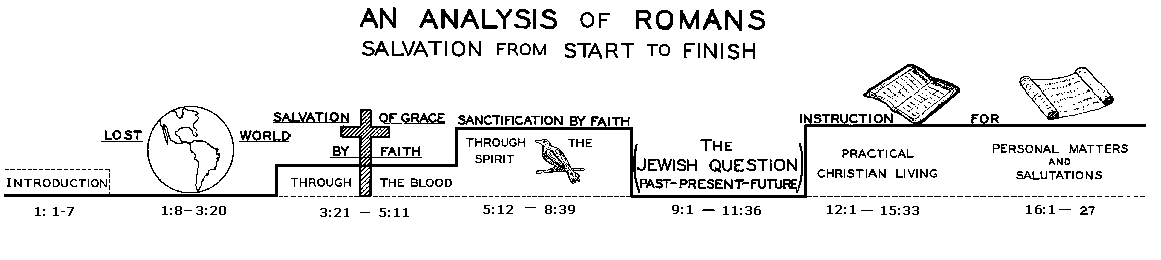
Source: Dr David Cooper
Click to Enlarge
R Ruin (Romans 1:17 – 3:20) – The utter sinfulness of humanity
O Offer (Romans 3:21-31) – God’s offer of justification by grace
M Model (Romans 4:1-25) – Abraham as a model for saving faith
A Access (Romans 5:1-11) – The benefits of justification
N New Adam (Romans 5:12-21) – We are children of two “Adams”
S Struggle w/ Sin (Romans 6-8) Struggle, sanctification, and victory
|
ROMANS ROAD |
||||
| Romans 1:18-3:20 | Romans 3:21-5:21 | Romans 6:1-8:39 | Romans 9:1-11:36 | Romans 12:1-16:27 |
| SIN | SALVATION | SANCTIFICATION | SOVEREIGNTY | SERVICE |
| NEED FOR SALVATION |
WAY OF SALVATION |
LIFE OF SALVATION |
SCOPE OF SALVATION |
SERVICE OF SALVATION |
| God's Holiness In Condemning Sin |
God's Grace In Justifying Sinners |
God's Power In Sanctifying Believers |
God's Sovereignty In Saving Jew and Gentile |
Gods Glory The Object of Service |
| Deadliness of Sin |
Design of Grace |
Demonstration of Salvation | ||
| Power Given | Promises Fulfilled | Paths Pursued | ||
| Righteousness Needed |
Righteousness Credited |
Righteousness Demonstrated |
Righteousness Restored to Israel |
Righteousness Applied |
| God's Righteousness IN LAW |
God's Righteousness IMPUTED |
God's Righteousness OBEYED |
God's Righteousness IN ELECTION |
God's Righteousness DISPLAYED |
| Slaves to Sin | Slaves to God | Slaves Serving God | ||
| Doctrine | Duty | |||
| Life by Faith | Service by Faith | |||
|
Modified from Irving L. Jensen's chart above |
||||
Romans 1:11 For I long (1SPAI) to see (AAN) you so that I may impart (1SAAS) some spiritual gift to you, that you may be established (APN) (NASB: Lockman)
Greek: epipotho (1SPAI) gar idein (AAN) humas, hina ti metado (1SAAS) charisma humin pneumatikon eis to sterichthenai (APN) humas,
Amplified: For I am yearning to see you, that I may impart and share with you some spiritual gift to strengthen and establish you; (Amplified Bible - Lockman)
NLT: For I long to visit you so I can share a spiritual blessing with you that will help you grow strong in the Lord. (NLT - Tyndale House)
Wuest: for I long to see you in order that I may impart some spiritual gift to you resulting in your being stabilized
Young's Literal: for I long to see you, that I may impart to you some spiritual gift, that ye may be established;
FOR I LONG TO SEE YOU: epipotho (1SPAI) gar idein (AAN) humas:
- 2Ti 1:4 Ro 15:23,32; 2Cor 9:14; Php 1:8; 2:26; 4:1
- Romans 1 Resources - Multiple Sermons and Commentaries
For (1063) (gar) is a subordinating conjunction expressing cause or explanation and thus introduces an explanation. In simple terms for is a term of explanation and its occurrence should always prompt one to pause and ponder the text and context, asking what the author is explaining, how does he explain it, etc. While not every "for" in the Bible is a term of explanation, most are and since there are over 7500 uses of for (NAS), you will have ample opportunity to observe and interrogate the text. As you practice this discipline of pausing to ponder, you are establishing the context (which leads to more accurate interpretation and thus more apropos application) and you are in effect engaging in the blessed activity of Biblical Meditation (See Ps 1:2+, Ps 1:3+ and Joshua 1:8+ for the blessed benefits of meditation). When for is used at the beginning of a passage it is usually a term of explanation.
Paul expresses similar sentiment expressing to Timothy "(I am) longing to see you, even as I recall your tears, so that I may be filled with joy." (2 Ti 1:4-note)
Long (1971) (epipotheo from epi = intensifies meaning of + potheo = to yearn) (Click discussion of epipotheo) describes a strong desire, an intense craving of possession, a great affection for, a deep desire, an earnest yearning for something with implication of need. Note the present tense indicating Paul continually longed to see the believers in Rome. Paul makes it clear that it is no selfish desire in the next clause. He is not seeking to get something out of them but to give them something - some spiritual gift.
Here are the 9 NT uses of epipotheo - Ro 1:11; 2Co. 5:2; 9:14; Phil. 1:8; 2:26; 1Th 3:6; 2Ti 1:4; James 4:5; 1Pe 2:2
See (3708) (horao) literally refers to perception by sight as in this verse.
What Paul is saying in essence is that "My heart aches to see you." The idea is that one wants something so bad it makes your heart hurt on the inside. Have you ever wanted something so badly it made your heart hurt when you thought about it? Paul is saying "I want to see you so badly that it makes my heart hurt when I think about it."
Kent Hughes writes that "Paul’s spirit was for all practical purposes duplicated in the life of General Booth, founder of the Salvation Army. Once when General Booth stood before Queen Victoria and she asked what she might do for him, the rugged old man replied, “Your Majesty, some people’s passion is money, and some people’s passion is fame, but my passion has been men.” (Hughes, R. K. Romans: Righteousness from heaven. Preaching the Word)
What is the passion of your life? What are you living for? What are you indebted to? What are you eager to do? Are you still twiddling your thumbs and wasting your life on things that don’t really matter? Or have you gotten excited about the most important thing in the world—sharing Jesus Christ with those who don’t know him? Are you involved in sharing God’s love heart to heart to heart? Two things will last forever—the Word of God and people. Everything else fades away. What are you doing this week that will last forever?
We see this same idea expressed by Paul in Acts Luke recording that...
"after these things (read prior verses for context to answer the question "what things?") were finished, Paul purposed in the spirit to go to Jerusalem after he had passed through Macedonia and Achaia, saying, "After I have been there, I must also see Rome." (Acts 19:21)
In the end of this epistle Paul reiterates that...
I have had for many years a longing (noun = epipothia = earnest desire) to come to you (Ro 15:23+)
Mounce notes that "Commitment to a common Lord draws people together. To be servants of the same master is to be in harmony with one another. (Mounce, R. H. Romans: The New American Commentary. Broadman & Holman Publishers)
This is the pastor’s heart in Paul the great missionary. Some of the saints in Rome were very dear to Paul, such as Priscilla and Aquila (Ro 16:3, 4-note), who risked their lives for him; “the beloved Persis” (Ro 16:12-note); and others who had labored and suffered with Paul. But he also loved the believers that he did not know, and he longed to be able to share some spiritual gift with them. He was looking forward to a time of mutual blessing in the love of Christ. A mark of spiritual service is a loving spirit (cp 1Th 2:7, 8, 9-note). Paul wanted to visit the Roman believers in order to serve them lovingly in God’s name. He did not want to go as a tourist to see the famous Appian Way or the Forum or the Coliseum or the chariot races. He wanted to go to Rome to give of himself, not to entertain or indulge himself.
"My heart aches to see you." The word epipotheo means to want something so bad it makes your heart hurt on the inside. Have you ever wanted something so badly it made your heart hurt when you thought about it? Paul is saying in essence "I want to see you so badly that it makes my heart hurt when I think about it."
Pastor Ray Pritchard relates the following story - In one of his books Henri Nouwen talks about the time pressure he felt when he was a university professor. Although he enjoyed teaching, he never felt he had the time to concentrate on his work because of all the interruptions. Even when he put a "Do Not Disturb" sign on his door, the students interrupted him anyway. He said, "Everywhere I went, people wanted to talk to me." By his own testimony, he was upset because he felt like all the interruptions were messing up his work. But that changed one day when God said to him, "My son, be at peace. Those interruptions are your work." That’s a key to heart to heart ministry—understanding that the interruptions of life are part of the work God has given you to do. But some of us are so driven, so work-focused, so goal-oriented, so workaholic that we resent people because people keep us from what we call "our work." If only we could see that people are our work. Have you ever known anyone who came to the end of life and said, "I wish I had spent more time at the office" or "I wish I had been away from my family more" or "I should have been more of a workaholic." I doubt it. But we've all known men and women who said, "I should have spent more time with the people who really mattered to me." "I wish I hadn’t been so obsessed with working that I forgot to build some relationships." What would they say about you if you died today? "He was busy." "She got her degree." "He climbed the ladder." "She made it in a man’s world." "He was too busy for people." "We’re glad she’s gone." (Romans 1:8-15 A Heart to Heart Ministry)
Be imitators of Paul. Long to see those whom God has given to you as your field of ministry.
The Christian who looks on his service to the Lord as a means of receiving appreciation and personal satisfaction is inevitably subject to disappointment and self-pity (cf Matthew 6:1-note). But the one who focuses on giving never has such problems. Remember the old maxim
"No one cares how much you know, ‘til they know how much you care."
Real ministry is heart to heart, or it is not real ministry at all. Paul was no shallow sentimentalist. The deepest theology ever written flows from his pen. But don’t ever think Paul didn’t care about people. Everything he did, he did for people. Paul’s ministry goal was to “present every man complete in Christ. And for this purpose also I labor,” he said, “striving according to His power, which mightily works within me” (see Col 1:28-note, Col 1:29-note).
SO THAT I MAY IMPART SOME SPIRITUAL GIFT TO YOU: hina ti metado (1SAAS) charisma humin pneumatikon:
- Romans 1 Resources - Multiple Sermons and Commentaries
So that (3708) (hina) marks a purpose for something, in this case the purpose of Paul's coming personally to see the Roman saints. His purpose was to share some spiritual gift. (See terms of purpose or result )
I may impart (3330) (metadidomi from metá = with suggest the idea of sharing as distinguished from giving + dídomi = to give) means to share, give a part of. It carries the additional meaning of sharing and imparting that which is one’s own.
Paul uses metadidomi later as he encourages the Romans to live out the truths of Romans 1-11, writing that...
he who exhorts, in his exhortation; he who gives, (metadidomi) with liberality; he who leads, with diligence; he who shows mercy, with cheerfulness. (see note Romans 12:8)
John the Baptist when asked by the multitudes what they should do to
“bring forth fruits in keeping with repentance" said “Let the man who has two tunics share (metadidomi) with him who has none; and let him who has food do likewise (Luke 3:8, 11).
Here are the other uses of metadidomi in the NT:
Ephesians 4:28 Let him who steals steal no longer; but rather let him labor, performing with his own hands what is good, in order that he may have something to share with (metadidomi) him who has need. (Comment: And in his letter to Ephesus he makes clear that, whether or not a believer has the gift of giving, he is to have the spirit of generosity that characterizes this gift.)
1 Thessalonians 2:8 Having thus a fond affection for you, we were well-pleased to impart (metadidomi) to you not only the gospel of God but also our own lives, because you had become very dear to us. (Comment: So deep was his affectionate concern for them, he was anxious to share with them rather than to receive from them.)
Metadidomi 5x - gives, 1; impart, 2; share, 2. - Lk 3:11; Ro 1:11 12:8; Eph 4:28; 1Th 2:8 and is translated: Uses in Septuagint (LXX) - Job 31:17, Pr 11:26
Spiritual (4152) (pneumatikos from pneuma = spirit + -ikos = speaks of the willingness to do that which the spirit stands for. -Ikos means adapted to or fitted for the spirit. It conveys idea of pertaining to the spirit or with the characteristics of the Spirit) relates to the human spirit, as the part of man which is akin to God and serves as his instrument or organ. It refers to that which belongs to the supernatural world as distinguished from what belongs to the natural world.
Here are the 26 uses of pneumatikos in the NT - Rom. 1:11; 7:14; 15:27; 1 Co. 2:13, 15; 3:1; 9:11; 10:3f; 12:1; 14:1, 37; 15:44, 46; Gal. 6:1; Eph. 1:3; 5:19; 6:12; Col. 1:9; 3:16; 1 Pet. 2:5
Gift (5486) (charisma from charis = grace + the ending --ma in Greek indicates the result of something, in this case the result of grace) means “gift of grace” or “free gift,” and in sixteen of its seventeen New Testament uses is connected to God as the Giver. In this verse charisma refers to that which is imparted through Paul's instruction.
Here are the 17 NT uses of charisma in the NT - Rom. 1:11; 5:15f; 6:23; 11:29; 12:6; 1 Co. 1:7; 7:7; 12:4, 9, 28, 30f; 2 Co. 1:11; 1 Tim. 4:14; 2 Tim. 1:6; 1 Pet. 4:10
Morris comments that "spiritual gift" in this verse is used "in the more general sense of anything that builds up the spiritual life. Paul wanted the Roman Christians to be strengthened in the faith as a result of the gift God would give them through his ministry. He speaks of strengthening them (and gives that as the purpose of his proposed visit—he was not aimless in anything he did). Life was not easy for first-century Christians. At Rome, as elsewhere, it was important that they be strong. (Morris, L. The Epistle to the Romans. W. B. Eerdmans; Inter-Varsity Press)
Paul was burdened for the physical welfare of the Roman believers, but his overriding concern was for their spiritual well-being, and therefore his principal purpose for longing to see them was that he might impart to them some spiritual gift. What is the spiritual gift?
John MacArthur - The gift Paul wanted to impart was spiritual not only in the sense of being in the spiritual realm but in the sense that it had its source in the Holy Spirit. Because he was writing to believers, Paul was not speaking about the free gift of salvation through Christ about which he speaks in Ro 5:15-16. Nor could he have been speaking about the gifts he discusses in Ro 12:4ff-note , because those gifts are bestowed directly by the Spirit Himself, not through a human instrument. He must therefore have been using the term spiritual gift in its broadest sense, referring to any kind of divinely-empowered spiritual benefit he could bring to the Roman Christians by preaching, teaching, exhorting, comforting, praying, guiding, and disciplining. Whatever particular blessings the apostle had in mind, they were not of the superficial, self-centered sort that many church members crave today. He was not interested in tickling their ears or satisfying their religious curiosity. (MacArthur, J: Romans 1-8. Chicago: Moody Press)
Charles Hodge - By spiritual gift is not to be understood a gift pertaining to the soul in distinction from the body, but one derived from the Spirit. (Commentary on the Epistle to the Romans)
MacDonald - There is no thought here of his conferring some “second blessing” on them, nor did he intend to impart some spiritual gift by the laying on of his hands (though he did this for Timothy in 2Ti 1:6-note). It was a matter of helping their spiritual growth through the ministry of the Word. (Believer's Bible Commentary)
THAT YOU MAY BE ESTABLISHED: eis to stericthenai (APN) humas:
- Ro 16:25; 2Chr 20:20; Lk 22:32, Acts 16:5; 18:23, 2Cor 1:21; 1Th 3:2 ,13 2Th 2:17; 3:3; Heb 13:9;James 5:8, 1Pe 5:10,12; 2Pe 1:12; 3:17,18, Re 3:2
- Romans 1 Resources - Multiple Sermons and Commentaries
The purpose of Paul's visit to Rome was not for personal advantage or pleasure but to strengthen the saints. How? He had just stated it would be by imparting some spiritual gift to them and I agree with MacDonald that in some way it was related to the Word of Truth (cf Jn 17:17, 1Pe 2:2-note), see also Jn 6:63 and note association of the Spirit and the Word - "words that I have spoken to you.", Mt 4:4). Ro 16:25 (note) shows that it is God Who strengthens and He uses the Gospel and the proclamation of Jesus Christ. God uses Paul's good news of Romans (the Gospel is not something that just saves you one time, but saves you everyday in the realm of progressive sanctification) to stabilize them and make them resolute.
THOUGHT - Has the pattern for strengthening saints changed over the last 2000 years? Dear pastor or teacher, what are you using to strengthen the flock under your charge? If it is not Word centered, it is Word-less and next to being Worth-less!
Matthew Henry - He received, that he might communicate. Never were full breasts so desirous to be drawn out to the sucking infant as Paul's head and heart were to be imparting spiritual gifts, that is, preaching to them. A good sermon is a good gift, so much the better for being a spiritual gift.To the end you may be established. Having commended their flourishing he here expresses his desire of their establishment, that as they grew upward in the branches they might grow downward in the root. The best saints, while they are in such a shaking world as this, have need to be more and more established; and spiritual gifts are of special use for our establishment.
Established (4741) (sterizo from histemi = to stand) means to make firm or solid, to set fast, to fix firmly in a place, to establish (make firm or stable), to cause to be inwardly firm or committed, to strengthen. The basic idea is that of stabilizing something by providing a support or buttress (a projecting structure of masonry or wood for supporting or giving stability to a wall or building), so that it will not totter. Clearly Paul's use here is figurative - he does not want these saints to totter in their faith.
Here are the 13 uses of sterizo - Lk. 9:51; 16:26; 22:32; Rom. 1:11; 16:25; 1 Thess. 3:2, 13; 2 Thess. 2:17; 3:3; James. 5:8; 1 Pet. 5:10; 2 Pet. 1:12; Rev. 3:2
Paul had performed a similar work in the churches he had planted on his first missionary journey Luke recording that on the second missionary journey...
the churches were being strengthened (related verb steroo from stereos = solid or stable) in the faith, and were increasing in number daily. (Acts 16:5+)
Vincent observes that "The modest use of the passive voice leaves out of view Paul’s personal part...The word shows that he had in view their Christian character no less than their instruction in doctrine.
Paul wanted his spiritual brothers and sisters “to grow up in all aspects into Him, who is the head, even Christ” (Eph 4:15+).
In the last chapter of Romans Paul elaborates on how they were to be established writing "Now to Him Who is able to establish (sterizo) you according to my gospel and the preaching of Jesus Christ, according to the revelation of the mystery which has been kept secret for long ages past (Ro 16:25+)
Vine adds - To establish is to cause to lean by supporting. Ministry of God’s Word which leads us into fuller dependence on God, is ministry which establishes us. The Hebrew word for “believe” literally means “to lean upon” (2Chr 20:20 -- “put your trust {believe -- Hebrew word "aman"} in Jehovah your God and you will be established,” where “believe” and “established” represent the same word (aman). The means of this constant confirmation, then, is the impartation of spiritual benefit, and the response of faith." (Collected Writings)
Romans 1:12 that is, that I may be encouraged together with (APN) you while among you each of us by the other's faith, both yours and mine. (NASB: Lockman)
Greek: touto de estin (3SPAI) sumparaklethenai (APN) en humin dia tes en allelois pisteos humon te kai emou.
Amplified: That is, that we may be mutually strengthened and encouraged and comforted by each other’s faith, both yours and mine. (Amplified Bible - Lockman)
NLT: I'm eager to encourage you in your faith, but I also want to be encouraged by yours. In this way, each of us will be a blessing to the other. (NLT - Tyndale House)
Wuest: that is, moreover, that I may be strengthened by you through the mutual faith which is both yours and mine.
Young's Literal: and that is, that I may be comforted together among you, through the faith in one another, both yours and mine.
THAT IS, THAT I MAY BE ENCOURAGED TOGETHER WITH YOU WHILE AMONG YOU: touto de estin (3SPAI) sumparaklethenai (APN) en humin:
- Ro 15:24 ,32 Acts 11:23; 2Cor 7:4, 5, 6, 7,13; 1Th 2:17, 18, 19, 20; 3:7, 8, 9, 10; 2Ti 1:4; 2Jn 1:4; 3Jn 3,4)
- Romans 1 Resources - Multiple Sermons and Commentaries
ENCOURAGEMENT
OF FELLOWSHIP
Paul goes on to give more detail concerning his visit, to avert the possibility that someone might accuse him of boasting or of patronizing the saints at Rome.
Matthew Henry - What he heard of their flourishing in grace was so much a joy to him that it must needs be much more so to behold it. Paul could take comfort in the fruit of the labours of other ministers
Encouraged together with (4837) (sumparakaleo from sun = together, speaks of an intimate association + parakaleo = to encourage and strengthen by consolation, to comfort, to strengthen) means to to call upon or invite or exhort at the same time or together. To be encouraged at the same time with someone else.
Pritchard asks "How do you think that made them feel? Paul the great Apostle said, "I’m looking forward to seeing you, not just so that I can give you something but so that you can minister to me." This is the ministry of concurrent encouragement. It’s what happens when I minister to you and you minister to me. It’s the heart of what the Christian ministry is all about. You give something to me and I give something back to you. Ministry is not a one-way street. It’s a two-way street, with blessings and encourage-ment constantly being shared both ways. (Romans 1:8-15 A Heart to Heart Ministry)
Hodge writes that the root word (parakaleo) of the verb encouraged with "is used in such a variety of ways in the New Testament that it is not easy to determine the precise meaning that should be given to it here. It means literally “to call near,” “to invite” (Acts 28:20: “I have asked”), “to call upon,” and more generally “to address,” either for instruction, admonition, exhortation, confirmation, or consolation. The translators of the King James Version, and the majority of commentators, choose the last mentioned sense and translate it here “that I may be comforted.” This is probably too narrow. The word expresses all that excitement and strengthening of faith and pious feeling, as well as consolation, which flows from the communion of saints. This appears from the context, and especially from the words (Commentary on the Epistle to the Romans)
Kent Hughes - This mutuality is always one of the grand underlying motivations for ministry. When you experience it, you long for more. Paul could not get enough! (Romans: Righteousness from heaven. Preaching the Word)
Toward the end of Romans Paul alludes to one aspect of this mutual encouragement exhorting them to strive together in prayer for him...
so that I may come to you in joy by the will of God and find refreshing rest in your company (literally = may be refreshed with you). (Ro 15:32-note)
In a similar way Paul wrote to his young disciple Timothy explaining that he was...
longing (continually = present tense = epipotheo) to see you, even as I recall your tears, so that (one purpose Paul earnestly desired to see Timothy) I may be filled with joy. (2Ti 1:4-note)
Establishing (preceding verse) produces comfort, both for those who are ministering and for those who are ministered to. As the saints in Rome were strengthened, Paul's faith would also be encouraged.
Robertson writes that "be encouraged together with" means...
“My being comforted in you together (sun-) with you,” a mutual blessing to each party (you and me).
John Calvin draws our attention "to what degree of modesty his pious heart submitted itself, so that he did not disdain to seek confirmation from inexperienced beginners. He means what he says, too, for there is no one so void of gifts in the Church of Christ who is unable to contribute something to our benefit. Ill will and pride, however, prevent our deriving such fruit from one another.”
When he was about to board a ship to India to begin missionary service there, some of William Carey’s friends asked if he really wanted to go through with his plans. Expressing his great desire for their support in prayer, he is said to have replied, “I will go down [into the pit itself] if you will hold the rope”
Encouragers - Discouragement is a problem for many Christians. While they may not be distressed about health, family, or work, they’re discouraged about their spiritual service. They compare themselves to others who are gifted with musical talents or the ability to teach the Bible. They see people who are able to give generously and pray with evident effectiveness, but they think they can’t do these things. As a result, they feel they are useless to God. They need to realize, however, that every Christian is qualified to carry on at least one helpful ministry—the ministry of encouragement.
Renowned preacher Robert Dale was walking one day in Birmingham, England, where he was pastoring the great Carr’s Lane Church. He was under a dark cloud of gloom when a woman came up to him and exclaimed, “God bless you, Dr. Dale. If you could only know how you have made me feel hundreds of times!” Then off she hurried. Dale later testified, “The mist broke, the sunlight came, and I breathed the free air of the mountains of God.”
The apostle Paul knew how important it was not only to be encouraged by others (Phil. 2:19) but to be an encourager (Acts 20:2; 27:35-36). That’s a ministry all of us can be involved in. — by Vernon C. Grounds (Our Daily Bread, Copyright RBC Ministries, Grand Rapids, MI. — Reprinted by permission. All rights reserved)
It may seem insignificant
To say a word or two,
But when it is encouragement,
What wonders it can do!
—K. De Haan
Even if you have nothing else to give,
you can always give encouragement.
EACH OF US BY THE OTHER'S FAITH, BOTH YOURS AND MINE: dia tes en allelois pisteos humon te kai emou:
- Romans 1 Resources - Multiple Sermons and Commentaries
MUTUAL
ENCOURAGEMENT
Each of us - Matthew Poole writes "This is added to qualify what he had said before, lest he should seem to arrogate too much to himself; he tells them, he hoped not only to comfort them, but to be comforted by them. The meanest of Christ's members may contribute somewhat to the edifying even of an apostle. The apostle John did hope to be quickened and comforted by the graces of a woman and her children, 2Jo 1:12. Great is the benefit of the communion of saints."
Faith (4102)(pistis) is synonymous with trust or belief and is the conviction of the truth of anything, but in Scripture usually speaks of belief respecting man's relationship to God and divine things, generally with the included idea of trust and holy fervor born of faith and joined with it. Note that this discussion of pistis is only an overview and not a detailed treatise of this vitally important subject. Those interested are directed to respected, conservative books on systematic theology for more in depth discussion (eg, Dr Wayne Grudem's book Systematic Theology: An Introduction to Biblical Doctrine is an excellent, uncompromising, imminently readable resource for the lay person. See especially Chapter 35 which addresses the question "What is saving faith?" in an easy to understand manner.) Much of this "definition" deals with the general word group for faith (pistis = noun, pistos = adjective, pisteuo = verb)
Although he was a highly-gifted and greatly-used apostle, having received revealed truth directly from God, Paul never thought that he was above being spiritually edified by other believers. The truly thankful, concerned, willing, submissive, and loving spirit is also a humble spirit. The person with such a spirit never has a feeling of spiritual superiority and never lords it over those he serves in Christ’s name.
Vine has an interesting thought on the phrase (each of us by the other's faith) -- "The evidence of faith in another believer is a means of comfort to the one who witnesses it." (Collected writings of W. E. Vine)
J Vernon McGee gives an example of this spiritual dynamic...
In other words, Paul would communicate something, but the believers in Rome would also communicate something to him. They would be mutually blessed in the Word. Not too long ago I had the privilege of speaking to a conference of over a thousand students. I laid it on the line for those folks and was a little hard on them at the beginning. Then I saw how wonderfully they responded, and it opened my eyes to a new world. I left that conference singing praises to God for the privilege of being there. While I was ministering to them, they were ministering to me. This is what Paul is talking about here. (Thru the Bible Commentary)
Commenting on this passage in Romans, John Calvin said of Paul,
“Note how modestly he expresses what he feels by not refusing to seek strengthening from inexperienced beginners. He means what he says, too, for there is none so void of gifts in the Church of Christ who cannot in some measure contribute to our spiritual progress. Ill will and pride, however, prevent our deriving such benefit from one another”
Paul, the greatest theologian who ever lived, was also one of the most humble men of all. He was blessed beyond measure, yet he had no spiritual pride or intellectual arrogance. Because he had not attained spiritual perfection but genuinely pursued it (cf. Phil. 3:12, 13, 14-note), he was eager to be spiritually helped by all the believers in the Roman church, young as well as old, mature as well as immature. IS THAT YOUR ATTITUDE?
Romans 1:13 I do not want (1SPAI) you to be unaware,(PAN) brethren, that often I have planned (1SAMI) to come (AAN) to you (and have been prevented (1SAPI) so far) so that I may obtain (2SAAS) some fruit among you also, even as among the rest of the Gentiles (NASB: Lockman)
Greek: ou thelo (1SPAI ) de humas agnoein, (PAN) adelphoi, hoti pollakis proethemen (1SAMI) elthein (AAN) pros humas, kai ekoluthen (1SAPI) achri tou deuro, hina tina karpon sco (2SAAS) kai en humin kathos kai en tois loipois ethnesin.
Amplified: I want you to know, brethren, that many times I have planned and intended to come to you, though thus far I have been hindered and prevented, in order that I might have some fruit (some result of my labors) among you, as I have among the rest of the Gentiles. (Amplified Bible - Lockman)
NLT: I want you to know, dear friends, that I planned many times to visit you, but I was prevented until now. I want to work among you and see good results, just as I have done among other Gentiles. (NLT - Tyndale House)
Wuest: Moreover, I do not desire you to be ignorant, brethren, that often I proposed to myself to come to you, but I was prevented up to this time, in order that I might procure some fruit also among you even as also among the rest of the Gentiles. (Eerdmans)
Young's Literal: And I do not wish you to be ignorant, brethren, that many times I did purpose to come unto you -- and was hindered till the present time -- that some fruit I might have also among you, even as also among the other nations.
AND I DO NOT WANT YOU TO BE UNAWARE, BRETHREN THAT OFTEN I HAVE PLANNED TO COME TO YOU AND HAVE BEEN PREVENTED THUS FAR: ou thelo (1SPAI) de humas agnoein (PAN) adelphoi hoti pollakis proethemen (1SAMI) elthein (AAN) pros humas kai ekoluthen (1SAPI) achri tou deuro:
- Ro 15:22;Acts 16:6,7;1Th 2:18; 2Th 2:7
- Romans 1 Resources - Multiple Sermons and Commentaries
To be unaware (50) (agnoeo from a = not + noéo = perceive, understand) means to be unaware of or to be ignorant of. It also conveys the sense to refuse to think about or pay attention to and so to ignore. Men knew of God’s Being through natural revelation (Romans 1:19-21, 28), but did not know the purpose of His kindness. Why are people ignorant of God’s intention to be kind? Paul explains in the next verse that begins with "but because".
Agnoeo 22x in NT- Mark. 9:32; Lk. 9:45; Acts 13:27; 17:23; Ro 1:13; 2:4; 6:3; 7:1; 10:3; 11:25; 1Co. 10:1; 12:1; 14:38; 2Co. 1:8; 2:11; 6:9; Gal. 1:22; 1Th. 4:13; 1Ti 1:13; Heb. 5:2; 2Pe 2:12
From the preceding list of uses of agnoeo you can observe that Paul frequently used a phrase such as I do not want you to be unaware as a means of calling attention to something of great importance he was about to say.
He used it to introduce his teaching about such things as the mystery of God’s calling Gentiles to salvation (Ro 11:25-note), spiritual gifts (1Cor 12:1), and the second coming (1Thes 4:13-note). Here he uses it to introduce his determined plan to visit the saints at Rome.
Paul, by writing that he had often planned to come, is revealing to the believers in Rome that his interest in and love for them had been a reality for some time, a truth that surely would encourage them.
An interesting thought is that in God’s providence, Paul’s inability to visit Rome gave the world this inspired masterpiece of gospel doctrine.
Brethren (80) (adelphos from a = connective particle + delphus = the womb) refers to one from the same womb. Paul adds a note of warmth with this term as adelphos generally denotes a fellowship based on the fact that they are members of the same family. In this verse Paul is not referring to unregenerate brethren but to his brothers in Christ.
Hendriksen agrees noting that “All men are brothers” is a common saying. Though in a certain sense this cannot be denied, it is not what Paul had in mind. He is speaking about “brothers in Christ,” about “those who together belong to The Family of God.”... In the vocabulary of Paul the word “brothers” occurs with great frequency; in fact, slightly more than 100 times. In Romans it is found 14 times. The fact that what the apostle generally has in mind when he uses the term is “those who are united in a common bond of Christian fellowship” is especially clear from such passages as I Cor. 15:58; Col 1:2-note; 1Ti 6:2. (Hendriksen, W., & Kistemaker, S. J. New Testament Commentary)
IN ORDER THAT I MIGHT OBTAIN SOME FRUIT AMONG YOU ALSO, EVEN AS AMONG THE REST OF THE GENTILES: hina tina karpon sco (echo: 2SAAS) kai en humin kathos kai en tois loipois ethnesin:
- Ro 15:18, 19, 20; Ro 15:28, Acts 14:27; 15:12; 21:19; 1Cor 9:2; 2Cor 2:14; 1Th 1:9,10; 2:13,14; 2:13,14 2Ti 4:17
- Romans 1 Resources - Multiple Sermons and Commentaries
In order that (See terms of purpose or result) - Expresses purpose which should always prompt us to pause and ponder the purpose. What purpose, etc?
Fruit (2590) (karpos) is the product or outcome of something as in a physical sense in which a tree bears literal fruit. In a figurative sense it is the result of procreation and thus the fruit of the womb. Also in a figurative sense, it describes the result of one's words or actions and would reflected in the consequences. Karpos is also used figuratively to convey the idea of that which gives advantage, gain or profit.
Karpos 67xin NT - Mt. 3:8, 10; 7:16,17; 12:33; 13:8, 26; 21:19, 34, 41, 43; Mark. 4:7, 8, 29; 11:14; 12:2; Lk. 1:42; 3:8, 9; 6:43, 4; 8:8; 12:17; 13:6, 7, 9; 20:10; Jn. 4:36; 12:24; 15:2, 4, 5, 8, 16; Acts 2:30; Ro 1:13; 6:21, 22; 15:28; 1 Co. 9:7; Gal. 5:22; Eph. 5:9; Phil. 1:11, 22; 4:17; 2Ti 2:6; 4:13; Heb. 12:11; 13:15; James. 3:17, 18; 5:7, 18; Rev. 22:2
Utley sums up what Paul's specific reference to "fruit" might signify noting that "In this context “fruit” may refer to converts, but in John 15:1-8 and Gal. 5:22 it referred to Christian maturity. Matthew 7 says “by your fruit you shall be known,” but it does not define the term fruit. The best parallel is probably Phil. 1:22 (see note), where Paul uses this same agricultural metaphor. (Utley, R. J. D. The Gospel According to Paul: Romans. Study Guide Commentary Series. Marshall, Texas: Bible Lessons International)
His intent was not to make a social call but to obtain some fruit among the believers in Rome. Paul’s ministry was an unending quest for spiritual fruit. His preaching, teaching, and writing were not ends in themselves. The purpose of all true ministry for God is to bear fruit in His name and with His power and for His glory.
Jesus taught his disciples on the critical importance of spiritual fruit in their ministry (Jn 15:8)
My Father is glorified by this, that you bear much fruit, (Present tense=continuously, as habit of your life) and so prove to be My disciples
In this same section Jesus also taught that
You (DISCIPLES) did not choose Me but I chose you and appointed you that you would go and bear fruit (present tense = continuously, as habit of your life) and that your fruit would remain, so that whatever you ask of the Father in My name He may give to you (Jn 15:16).
In regard to spiritual life, the Bible uses the term "FRUIT" in 3 ways -- as a metaphor for the attitudes that characterize the Spirit-led believer (Galatians 5:22-note; Galatians 5:23-note).
Secondly Paul uses "spiritual fruit" to refer to an action as in the following verse
But now having been freed from sin and enslaved to God, you derive your benefit (karpos = "fruit"), resulting in sanctification (holiness) and the outcome, eternal life” (see note Romans 6:22) (Comment: So "fruit" or "benefit" here refers to holy living = sanctification).
The active fruit of a Christian’s lips is praise the writer of Hebrews exhorting his readers...
Through Him (Christ our Great High Priest) then, let us continually offer up a sacrifice of praise to God, that is, the fruit of lips that give thanks to His name. (see note Hebrews 13:15)
The active fruit of Paul's hands is giving (contributions) Paul writing to the saints at Philippi to encourage them in their giving...
"for even in Thessalonica you sent a gift more than once for my needs. Not that I seek the gift itself, but I seek for the profit (karpos = "fruit") which increases to your account." (see note Philippians 4:16, 4:17)
Finally spiritual fruit speaks of converts to Christ and the increase of their spiritual growth in Him. Paul spoke of Epaenetus as being “the first convert [lit., first-fruit] to Christ from Asia” (Ro 16:5-note). Hold your mouse over the cross references at the end of v13 above for more insights into "spiritual fruit" & then go out and bear much fruit to the glory of of our heavenly Father & so prove yourself to be one of His disciples. Nothing is more encouraging to pastors, Sunday School teachers, youth leaders, and other Christian workers (that would be all the rest of us called out of darkness to proclaim His excellencies, to be ambassadors of reconciliation, to give an answer to everyone who asks us about the hope that is within us) than to see spiritual results in the lives of those to whom they minister.
Romans 1:14 I am (1SPAI) under obligation both to Greeks and to barbarians, both to the wise and to the foolish (NASB: Lockman)
Greek: Hellen te kai barbarois, sophois te kai anoetois opheiletes eimi; (1SPAI)
Amplified: Both to Greeks and to barbarians (to the cultured and to the uncultured), both to the wise and the foolish, I have an obligation to discharge and a duty to perform and a debt to pay. (Amplified Bible - Lockman)
NLT: For I have a great sense of obligation to people in our culture and to people in other cultures, to the educated and uneducated alike. (NLT - Tyndale House)
Phillips: I feel myself under a sort of universal obligation, I owe something to all men, from cultured Greek to ignorant savage. (Phillips: Touchstone)
Wuest: Both to Greeks and to those who do not possess Greek culture, both to wise and unwise, I am debtor
Young's Literal: Both to Greeks and to foreigners, both to wise and to thoughtless, I am a debtor,
I AM UNDER OBLIGATION BOTH TO GREEKS AND TO BARBARIANS: Hellen te kai barbarois...opheiletes eimi (1SPAI):
- Ro 8:12; 13:8; Acts 9:15; 13:2, 3, 4; 22:21; 26:17,18; 1Cor 9:16, 17; 2Ti 2:10 Eph 3:2, 7, 89 Acts 20:24 2Ti 4:7
- Greeks. Ac 28:4 1Co 14:11 Col 3:11
- Romans 1 Resources - Multiple Sermons and Commentaries
I OWE A DEBT
This is the first of the three "I Am" statements of Paul...
"I AM UNDER OBLIGATION" (Romans 1:14)
"I AM EAGER" (Romans 1: 15)
"I AM NOT ASHAMED" (Romans 1:16)
Ray Stedman comments that...
These three are the marks of Christian maturity. He says "I am" three times:
"I am under obligation," that is, "I am concerned about others."
"I am eager," that is, "I am committed, ready to fling myself without reserve into the work."
And, third, "I am not ashamed," that is, "I am confident, resting on unshakable experience in Christ."
Now, these are the three marks of the man that God uses: The mature Christian is concerned, committed, and confident.
The minute the Spirit of God begins to really work in your life and mine, these marks begin to show themselves, in this order. I have seen this so many times in talking to somebody just at the very threshold of Christian faith, a person who has been brought to the sense of his need for Christ. After a person has yielded his life to Christ, almost invariably the first thing he says is, "You know, I have a friend I would like to tell this to." Or, "I want you to meet my mother" (or my father, or my brother, or my sister). Or, "I want to bring somebody else to talk with you."
The first mark of the Spirit's work in our lives is that he begins to create a concern for someone else.
I have learned to recognize this as the sign of a genuine transformation, a regeneration. Normally our lives are built around self, and the longer we live that way the more self-centered we get. But, at the moment of personal encounter with Jesus Christ, this vicious circle of self-involvement is broken into, and, for the first time, there comes a gleam of light that begins to manifest itself in a concern for somebody else. As that Christian life develops, that concern deepens until, like Paul, it encompasses the whole of the world and every kind of person in it. It makes no difference to Paul who it is, because his heart has been captured by the Spirit of God, who creates a concern for someone else. (Romans 1:1-17 Simple Christianity) (Bolding added)
I am (1510) (eimi) is in the present tense indicating this is Paul's continuing obligation. He cannot shirk from this responsibility he feels so deeply. Here the apostle is breathing out his desire to be used to reach others. You see the beating of his heart for other people. He feels under compulsion to reach them and to help them and change them. Is this my heartbeat? Sadly, so many of us in America live for ourselves -- what we want and hope to get. How different is the spirit of the apostle Paul who longs to risk his life, his health, and his fortune for the sake of others. He was most serious about it. Believers in the western nations have become much too comfortable with their Christianity. We need more believers with a spirit like Paul possessed.
Under obligation (3781) (opheiletes from opheílo = owe, be in debt, conveys basic meaning of owing a debt) means one who owes another (e.g., think of someone who owes another a sum of money) and speaks of a strong moral obligation and personal duty. It means a debtor, one who is bound by some duty, one who owes anything to another.
Opheiletes - 7s - Matt. 6:12; 18:24; Lk. 13:4; Ro 1:14; 8:12; 15:27; Gal. 5:3
In summary, opheiletes can refer to a literal debt or as used here by Paul figuratively to express his personal, moral obligation, which contrast to to a necessity in the nature of the case as would have been the case if he had used the Greek verb dei = Click word study of dei) (E.g., the nature of our bodies and the health thereof dictates that we must -- dei -- eat or we will starve).
John Piper explains being "under obligation" writing that...
the best thing about grace is that it pays debts. We are debtors to God ("Forgive us our debts as we forgive our debtors," see notes Matthew 6:12). God's grace forgives debts. We are debtors to God not because he has given us grace, but because we have stolen his glory. Stealing also makes you a debtor. Instead of seeing the glory of God as a treasure to enjoy, we exchanged it for other things that we really like better (see notes Romans 1:23; 3:23). And so we stole it. That is the essence of sin. And that is the kind of debt we have toward God. So when grace comes to us from God in the gospel, it comes to pay our debts that we have to him. Grace does not make you a debtor to God; but it does make you a debtor to others who need grace just as you did. That is what Paul focuses on here in verse 14. "I received grace and apostleship" (see note Romans 1:5). So now I am a debtor to Greeks and barbarians. And what I owe them is the gospel of grace. That's my debt. (Romans 1:8-15 Gospel For Obedience of Faith)
I'm In Debt - A shopper underestimated the total cost of her groceries. When the cashier added up the items, the woman was $4 short. Then something unusual happened. The man behind her in the checkout lane saw her digging through her purse and motioned to the clerk to put the amount on his bill. He modestly refused to give the woman his name.
A few days later, the local newspaper reported that a charity organization had received a $4 check with the following note: “This check is for the man who helped me out of a tight spot. I came up with the idea of giving it to you as a thank-you to him.”
This incident illustrates a vital spiritual principle. We should feel an obligation to pass along to others the kindnesses shown to us. That’s how the apostle Paul responded to God’s mercy. Of course, he could never repay the Lord for salvation, but that didn’t stop him from openly showing his gratitude. Because of what he had received, he showed the highest kind of charity—sharing the gospel with others.
Let’s not think that because we can’t repay God for saving us, we owe Him nothing. We are indebted to Him for everything. And the least we can do is show our appreciation by telling others about Him.— by Mart De Haan
Lord, speak to me, that I may speak
In living echoes of Thy tone;
As Thou hast sought, so let me seek
Thine erring children lost and lone.
—Havergal
How can we give only a little when Christ gave His all?
Greeks (1672) (hellen) were the civilized, cultured people around the Mediterranean Sea. Alexander the Great had Hellenized the known world and when the Romans conquered these lands they assimilated the Greek culture. Greeks were highly sophisticated and were often looked upon as being on a higher level than others and they certainly looked upon themselves in that way. The Greek language was thought to be the language of the gods, and Greek philosophy was thought to be little less than divine. People of many different nationalities who had embraced the Greek language, culture, and education. Greeks were the sophisticated elite of Paul’s day. Because of their deep interest in philosophy, they were considered “wise.” Because of this prevalence of Greek culture, Paul sometimes used this word to describe all Gentiles (see Ro 3:9-note).
Hellen 25x in the NT - Jn. 7:35; 12:20; Acts 14:1; 16:1, 3; 17:4; 18:4; 19:10, 17; 20:21; 21:28; Ro 1:14, 16; 2:9, 10; 3:9; 10:12; 1Co 1:22, 24; 10:32; 12:13; Gal 2:3; 3:28; Col. 3:11
What an uplifting view Paul had for his life! What a purpose-filled life, a life purpose that far surpasses the daily grind which encompasses the limits of most our lives. Paul saw himself as under an obligation to preach the good news, as one to whom a stewardship had been committed .
Commenting upon Paul's obligation or "indebtedness" Vincent comments,
“All men, without distinction of nation or culture, are Paul’s creditors. ‘He owes them his life, his person, in virtue of the grace bestowed upon him, and of the office which he received’ (Godet).”
Barbarians (915) (barbaros) refers to one whose speech is rude, rough, harsh, as if repeating the syllables bar bar. It also meant one who speaks a foreign or strange language which is not understood by another. This (onomatopoeia) term meant the uneducated or uncultured peoples usually to the north of Rome and was used of people who did not speak Greek. Although in the narrowest sense “barbarian” referred to the uncultured, uneducated masses, it was often used to describe all non-Greeks, the foolish of the world.
Here are the 6 uses of barbaros in the NT - Acts 28:2, 4; Rom. 1:14; 1 Co. 14:11; Col. 3:11
The combination of "Greeks and Barbarians" then refers to the whole human race from the Greek point of view. Paul’s point is that God is no respecter of persons—the gospel must reach both the world’s elite and its outcasts (Jn 4:4-42 , Ja 2:1-9).
As William MacDonald reminds us "Anyone who has Christ has the answer to the world’s deepest need. He has the cure to the disease of sin, the way to escape the eternal horrors of hell, and the guarantee of everlasting happiness with God. This puts him under solemn obligation to share the good news with people of all cultures." (Believer's Bible Commentary)
BOTH TO THE WISE AND TO THE FOOLISH: sophois te kai anoetois:
- Ro 1:22, 11:25, 12:16, 16:19 Mt 11:25 Lk 10:21 1Co 1:19, 20, 21, 22; 2:13 3:18 9:16 2Co 10:12 11:19 Eph 5:15, 16, 17 James 3:17,18
- to the unwise. Pr 1:22; 8:5 Is 35:8 1Co 14:16,23, 14:24 Titus 3:3
- Romans 1 Resources - Multiple Sermons and Commentaries
Wise (4680) (sophos) in general referred to acquired intelligence characterized by the ability to use knowledge for correct behavior. Sophos refers to the learned or those having intelligence and education above the average and speaks in Scripture of wisdom in the moral sphere not just the intellectual sphere. It's one thing to "know" but quite another to "do!"
Here are the 20 uses of sophos in the NT - Mt. 11:25; 23:34; Lk. 10:21; Rom. 1:14, 22; 16:19, 27; 1Co. 1:19, 20, 25,26; 3:10, 18, 19; 6:5; Eph. 5:15; James 3:13
Foolish (453) (anoetos from a + noeo = perceive with the mind or nous) means literally “not having a mind” and so describes one without understanding or with a unwillingness to use one's mental faculties to understand. It is not a lack of intelligence but describes a mental laziness and carelessness.
Anoetos 6x in the NT - Lk. 24:25; Ro 1:14; Gal. 3:1, 3; 1 Ti 6:9; Titus 3:3
The Greek term frequently carried the idea of a wrong attitude of heart, a lack of faith that clouds judgment. Paul wrote of greedy people who think that a lot of money will enhance their lives and bring happiness and fulfillment - "But those who want to get rich fall into temptation and a snare and many foolish and harmful desires which plunge men into ruin and destruction." (1Ti 6:9).
Paul wrote that before salvation anoetos characterized all of us "For we also once were foolish ourselves, disobedient, deceived, enslaved to various lusts and pleasures, spending our life in malice and envy, hateful, hating one another." (see note Titus 3:3)
It is possible that wise and foolish is parallels “Greeks and to barbarians” but not necessarily so. They may be another way of referring to all people groups and individuals.
Paul is using "wise and foolish" to describe the difference between the cultured and uncultured and between the educational and philosophic. It makes no difference in what strata of culture one gravitates. The gospel is the great equalizer, because every human being is equally lost without it and equally saved by it.
John Piper explains that "Culture and intelligence and education do not qualify you for the gospel of grace. And being unrefined and uneducated and illiterate do not disqualify you for the gospel of grace. There are no qualifications for this grace. Paul is not a debtor to anybody because they qualify. Nobody qualifies for grace. For then grace would not be grace. Paul is a debtor to Greek and barbarian precisely because he didn't qualify either, yet grace came to him -and it keeps on coming to him day after day in endless waves of future grace breaking over his life (1 Corinthians 15:10). So there is no one who is any less or more deserving than he. And that makes him a debtor to all. O, to be gripped by the reality of radically free grace in our lives -past and future! What a difference it would make! Dwell on this today, would you? Ponder what it means about racism, ethnic slurs, and all kinds of self-righteousness, demandingness in marriage. Ponder what it means about how freely you share the gospel of grace. O Lord, open our hearts more and more to feel the wonder of being called of Christ and the loved of God (forever!)- not because he found something special in us, but because this grace is utterly and absolutely free." (Romans 1:8-15 Gospel For Obedience of Faith)
William Newell for example writes that "Wise and foolish is more personal, not meaning merely educated and uneducated, but of all degrees of intelligence. Since Paul is debtor to all, he is enumerating all. And he must begin to pay his debt by setting forth the guilt of all; which he does (Romans 1:18-3:20)...In the words "I am debtor" we have the steward's consciousness, -of being the trusted bearer of tidings of infinite importance directly from heaven; and Paul was "debtor" to all classes. He does not here mention Jews, because, although full of longing toward them, he had been sent distinctly to Gentiles: "The Gentiles unto whom I send thee, to open their eyes, " etc., (Acts 26:17). (Romans 1)
It is notable that Paul did not look with utter disdain on the pagans of his day. Believers today are no less "indebted" than Paul and we too need to be on guard lest we look down on the neo-pagans, hedonists, etc. Not so with Paul, though he hated their sin, he knew God loved the sinner enough to send His only Son to die a shameful, painful, cruel death for them. Paul was so overwhelmed with undeserved grace that he considered himself to be a debtor to all men.
Paul had a debt to pay to Jews and Greeks and barbarians, but most of them as is true in our "post-Christian society" did not want Christ's message of love and grace and hope and life. Nevertheless we are to have the heart of Paul who wrote...
"we preach Christ crucified, to Jews a stumbling block, and to Gentiles foolishness" (1Cor 1:23)
William Wilberforce - There was, accordingly, among the nations of antiquity, one system for the learned and another for the illiterate. An opposite mode of procedure belongs to true Christianity. Without distinction, it professes an equal regard for all human beings and its message is characterized as “glad tidings to the poor.” Paul owed the gospel to every member of the human race. At one point in his life Paul (Saul of Tarsus) felt an obligation to persecute every Christian; but now Paul felt an obligation to preach to every creature (Paul was probably familiar with Mark 16:15). What obligation or gospel duty do you have (see 2Co 5:17-21)? Those who are recipients of God’s good news feel burdened and obligated to pass it on to others! If you were a medical researcher and you discovered a cure for cancer, would you keep it a secret? Life is short; death is sure; sin the cause, CHRIST THE CURE!
Romans 1:15 So, for my part, I am eager to preach the gospel (AMN) to you also who are in Rome. (NASB: Lockman)
Greek: houtos to kat' eme prothumon kai humin tois en Rome euaggelisasthai. (AMN)
Amplified: So, for my part, I am willing and eagerly ready to preach the Gospel to you also who are in Rome (Amplified Bible - Lockman)
NLT: So I am eager to come to you in Rome, too, to preach God's Good News. (NLT - Tyndale House)
Phillips: That is why I want, as far as my ability will carry me, to preach the Gospel to you who live in Rome as well. (Phillips: Touchstone)
Wuest: in such a manner that to the extent of my ability I am eager to proclaim the good news also to you who are in Rome. (Eerdmans)
Young's Literal: so, as much as in me is, I am ready also to you who are in Rome to proclaim good news,
THUS, FOR MY PART, I AM EAGER TO PREACH THE GOSPEL TO YOU ALSO WHO ARE IN ROME:: houtos to kat eme prothumon euaggelisasthai (AMN) kai humin tois en Rome::
- Ro 12:18 1Ki 8:18 Mark 14:8 2Co 8:12) (Is 6:8 Mt 9:38 Jn 4:34 Ac 21:13 1Co 9:17 2Co 10:15,16
- Romans 1 Resources - Multiple Sermons and Commentaries
So, for my part, I am willing and eagerly ready (Amplified)
"so, as much as in me is, I am ready" (Young's Literal)
PAUL'S PASSION:
TO PREACH THE GOSPEL
THOUGHT - This section begs the question of all of us who are in one way or another "preaching" the Gospel daily by our words and by our actions (by our "lips and life"). Is the goal of my life to preach the Gospel passionately and persistently? Paul charged us to "Imitate him, just as he imitated Christ Jesus!" (1 Cor 11:1-note)
Eager (4289) (prothumos from pró = before + thumós = passion) denotes a willingness, a predisposition, a readiness, or an inclination. It means to be eager (and prompt) to be of service. Prothumos is a strong word. It means something like "ready, willing and able." It also can include the idea of passionate.
Prothumos is used 3 times in the NAS (Matt 26:41; Mark 14:38; Ro 1:15) and 3 times in the Septuagint (LXX) (1 Chr 28:21; 2 Chr 29:31; Hab 1:8)
Jesus used prothumos in His famous charge to His disciples to...
Keep watching (present imperative) and praying (present imperative), that you may not enter into temptation; the spirit is willing, but the flesh is weak." (Mt 26:41+, cf Mk 14:38+)
Stedman comments on Paul's eagerness paraphrasing it...
"Not only are my emotions moved by love for the Lord Jesus," says Paul, "but my will is engaged as well. I am not only drawn, I am ready to act." I love this, because it emphasizes a time to stop talking and start doing.
I read years ago of D. L. Moody who said to a man on one occasion, "Why don't you try doing so-and-so?" The man replied, "I've been aiming to do that for a long time." In his blunt way, Moody replied, "Well, brother, it's about time you quit aiming and started firing."
It is not enough to talk, to think, or to dream. There must come moments of action. That is what Paul says. I'm ready to go, I'm eager to preach to you. It is action that turns belief into faith. You haven't exercised faith if you have simply believed the truth. You have exercised faith only when you have acted on the truth you have believed. (Romans 1:13-16 The Man God Uses)
Paul was so eager to come to Rome that he couldn’t wait to get there. Life had but one value for Paul: to do God’s work. He was consumed by an eager desire to serve God, which included serving others in His name. That absolute commitment was shared by Epaphroditus, who
“because he came close to death for the work of Christ, risking his life ” (Php 2:30-note).
Such godly servants are like eager racehorses in the gate or sprinters at the starting blocks. They cannot wait to get on with the race of serving Christ. What God gave you, He didn’t give for you to keep to yourself. Just like Paul and Epaphroditus, you are under a holy obligation to share the gospel at your job, in your neighborhood, wherever God has placed you. You are under just as much obligation as any of the missionaries in your church. You don’t have to go where they go, but you do have to do what they do. The obligation is laid on you just as much as it is laid on them.
Ray Stedman sees eagerness as a second mark of a maturing believer and feels that...
this is where the great struggle comes. Paul could say, "I am eager to fling myself into this thing." Most Christians are not ready to make that statement. The Christian life is very predictable. In a sense, you can trace its workings: It begins with the non-Christian, who says, in great, large, capital letters: "I." This is the trouble with men -- "I" trouble.
Then, as one becomes a Christian, another note is added. It becomes: "Christ and I." But that is still not right.
As that Christian life grows and develops, the "I" becomes smaller and smaller until, at last, there is just "Christ" -- "Not I, but Christ" (Galatians 2:20-note). This describes the committed person, who is no longer thinking about what he is going to get out of it, or what blessings are going to be given to him, or what glory, admiration, or advancement he can get out to the Christian cause -- but only "Christ."
This is an interesting thing: Commitment always means excitement. A lady came to me recently, and said,
"I have been to you with problems before in which I needed an answer to a spirit of depression and despondency, but this time I have come to ask if it is wrong for me to be so excited about the Christian life."
I wish more would come with that kind of problem -- I love to have that kind. Of course, I told her, "No, it isn't wrong!"
We need to temper our zeal with knowledge, and we can become overzealous very easily, but to feel and sense the excitement of Christian living is only the normal thing for a Christian. It means that here is a committed heart, a life that is wholly Christ's. (Romans 1:1-17 Simple Christianity) (Bolding added)
Preach the gospel (2097) (euaggelizo/euangelizo from eu = good, well + aggelos = messenger - aggéllo = to bring tidings) means to bring or announce good news, to "evangelize", to bring glad tidings. In the NT, it means making known God's message of salvation with authority and power.
Euaggelizo 54x- Matt. 11:5; Lk. 1:19; 2:10; 3:18; 4:18, 43; 7:22; 8:1; 9:6; 16:16; 20:1; Acts 5:42; 8:4, 12, 25, 35, 40; 10:36; 11:20; 13:32; 14:7, 15, 21; 15:35; 16:10; 17:18; Rom. 1:15; 10:15; 15:20; 1 Co. 1:17; 9:16, 18; 15:1f; 2 Co. 10:16; 11:7; Gal. 1:8, 19, 11, 16, 23; 4:13; Eph. 2:17; 3:8; 1Th 3:6; Heb. 4:2, 6; 1 Pet. 1:12, 25; 4:6; Rev. 10:7; 14:6.
There are about 21 uses of Euaggelizo in the non-apocryphal Septuagint (observe especially the uses in Isaiah) - 1 Sam. 31:9; 2 Sam. 1:20; 4:10; 18:19, 20, 26, 31; 1 Ki. 1:42; 1 Chr. 10:9; Ps. 40:9; 68:11; 96:2; Is 40:9; 52:7; 60:6; 61:1; Jer. 20:15; Joel 2:32; Nah. 1:15
Notice that the Greek word euaggelizo is closely related to our English word evangelize and evangelical church. One might ask -- What is an evangelical church supposed to be? If it is related to the verb evangelize (which it is), a church that carries this name is a church that believes God’s good news and faithfully proclaims this message of salvation! The question that remains is this -- Is your evangelical church evangelizing the lost?
But I thought Paul's readers were born again believers! Why would Paul want to "preach the gospel" to Christians? Isn't the gospel for the lost? Yes but Paul longed to share this new life in Christ with the Roman believers. Good news is not just that we have a new life, but that Christ Himself is our life. That's radical!
Ray Stedman makes an interesting comment about the Roman believers writing that...
They had become Christians by an encounter with Jesus Christ, face to face, and that encounter has transformed their lives so that their faith was known throughout the world. Notice, they did not become Christians by understanding the plan of salvation (nobody ever becomes a Christian that way). Rather, now that they had become Christians, they need to have the plan of salvation explained to them so that they might grow to maturity...Throughout this letter, in the background, are these men and women of great need, just like you and me -- normal human beings who need to be transformed by grace into the likeness of Jesus Christ. That is why this letter was written, and why it is so wonderfully instructive to us today. (Romans 1:1-17 Simple Christianity)
Wuest has some interesting insights on the word "gospel" (euaggelion)...
"Gospel” comes from Saxon word "gode-spell" [gode meaning good, & spell = a story, a tale]. Euaggelion was in just as common use in the first century as our words good news. “Have you any good news (euaggelion) for me today?” must have been a common question. Our word gospel today has a definite religious connotation. In the ordinary conversation of the first century, it did not have such a meaning. However, it was taken over into the Cult of the Caesar where it acquired a religious significance. The Cult of the Caesar was the state religion of the Roman empire, in which the emperor was worshipped as a god. When the announcement of the emperor’s birthday was made, or the accession of a new Caesar proclaimed, the account of either event was designated by the word euaggelion. Thus, when the Bible writers were announcing the good news of salvation, they used the word euaggelion which word meant to the 1st century readers “good news.”
Rome (4516) (rhome) was the heart of the empire. It was a city of philosophers and poets. It was home to every conceivable idol. It was a city given over entirely to paganism. It was the seat of emperor-worship. It was the center of intellectual arrogance. It was a city built on war. It was the greatest city in the world. And for all her power and prestige, Rome was still a weak nation. The philosopher Seneca called the city of Rome “a cesspool of iniquity”; and the writer Juvenal called it a “filthy sewer into which the dregs of the empire flood.”
Rhome 8x in the NT - Acts 18:2; 19:21; 23:11; 28:14, 16; Rom. 1:7, 15; 2 Tim. 1:17
It follows that for Paul, the city of Rome represented danger, opposition, persecution and death. But it also represented opportunity unlimited. To Paul, the opportunity far outweighed the potential danger. So he was "ready, willing and eager" to go there.
What a contrast Rome was with the gospel which was the power of God! No wonder Paul was not ashamed: he was taking to sinful Rome the one message that had the power to change men’s lives! He had seen the Gospel work in other wicked cities such as Corinth and Ephesus; and he was confident that it would work in Rome. It had transformed his own life, and he knew it could transform the lives of others. Rome was the city of the world. Her law was the foundation for all that followed, her art was borrowed but appreciated, her military system was the wonder of the world. Yet: How pitiless she was!...Amid all the ruins of her cities we find none of a hospital, none... of an orphan school in an age that made many orphans. The pious aspirations and efforts of individuals never seem to have touched the conscience of the people. Rome had no conscience; she was a lustful, devouring beast, made more bestial by her intelligence and splendor.
Stedman comments that...
If Paul is going to reach the nations, why does he preach the gospel to the Christians at Rome? It is by means of the Christians that the nations are to hear. It is the changes God works in the lives of his people that cause others to begin to take note. That is how evangelism occurs. Paul says, "that is why I want to preach the gospel to you at Rome."
Now, by the gospel, Paul does not mean simply explaining how to become a Christian. That is what we often think it means, but that isn't what Paul means here, because these Romans were already Christians. The gospel is all the great facts about humanity and about God that God wants to impart to us and that will enable us to be whole persons. (Romans 1:1-17 Introduction To Life) (Bolding added)