Romans 1:2
Romans 1:3
Romans 1:4
Romans 1:5
Romans 1:6
Romans 1:7
Romans 1:8
Romans 1:9
Romans 1:10
Romans 1:11
Romans 1:12
Romans 1:13
Romans 1:14
Romans 1:15
Romans 1:16
Romans 1:17
Romans 1:18
Romans 1:19
Romans 1:20
Romans 1:21
Romans 1:22
Romans 1:23
Romans 1:24
Romans 1:25
Romans 1:26
Romans 1:27
Romans 1:28
Romans 1:29
Romans 1:30
Romans 1:31
Romans 1:32
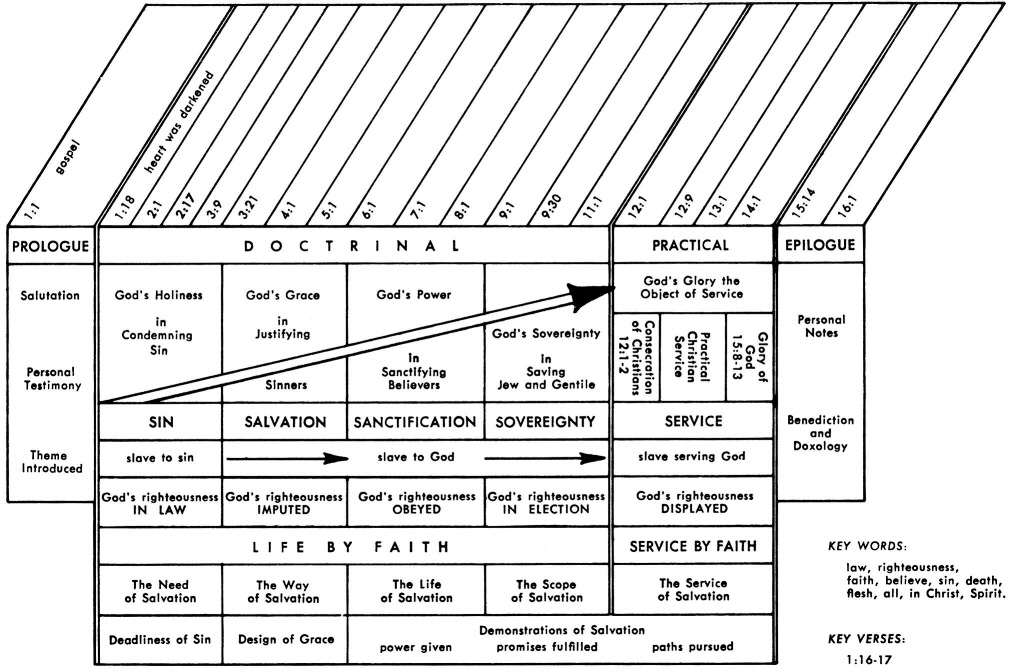
Click chart to enlarge
Chart from recommended resource Jensen's Survey of the NT - used by permission
Romans Overview Chart - Charles Swindoll
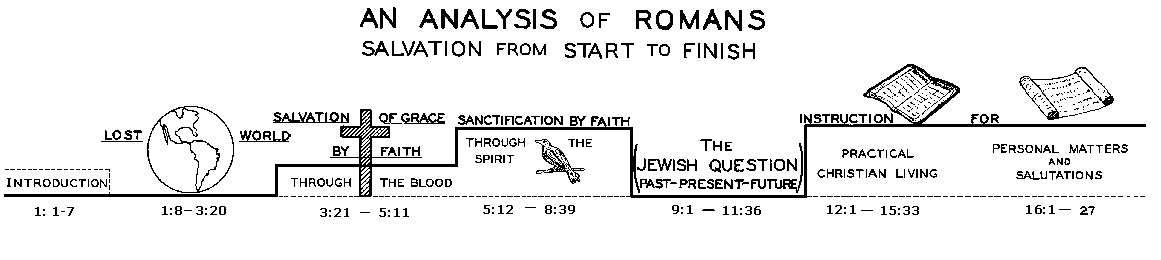
Source: Dr David Cooper
Click to Enlarge
R Ruin (Romans 1:17 – 3:20) – The utter sinfulness of humanity
O Offer (Romans 3:21-31) – God’s offer of justification by grace
M Model (Romans 4:1-25) – Abraham as a model for saving faith
A Access (Romans 5:1-11) – The benefits of justification
N New Adam (Romans 5:12-21) – We are children of two “Adams”
S Struggle w/ Sin (Romans 6-8) Struggle, sanctification, and victory
|
ROMANS ROAD |
||||
| Romans 1:18-3:20 | Romans 3:21-5:21 | Romans 6:1-8:39 | Romans 9:1-11:36 | Romans 12:1-16:27 |
| SIN | SALVATION | SANCTIFICATION | SOVEREIGNTY | SERVICE |
| NEED FOR SALVATION |
WAY OF SALVATION |
LIFE OF SALVATION |
SCOPE OF SALVATION |
SERVICE OF SALVATION |
| God's Holiness In Condemning Sin |
God's Grace In Justifying Sinners |
God's Power In Sanctifying Believers |
God's Sovereignty In Saving Jew and Gentile |
Gods Glory The Object of Service |
| Deadliness of Sin |
Design of Grace |
Demonstration of Salvation | ||
| Power Given | Promises Fulfilled | Paths Pursued | ||
| Righteousness Needed |
Righteousness Credited |
Righteousness Demonstrated |
Righteousness Restored to Israel |
Righteousness Applied |
| God's Righteousness IN LAW |
God's Righteousness IMPUTED |
God's Righteousness OBEYED |
God's Righteousness IN ELECTION |
God's Righteousness DISPLAYED |
| Slaves to Sin | Slaves to God | Slaves Serving God | ||
| Doctrine | Duty | |||
| Life by Faith | Service by Faith | |||
|
Modified from Irving L. Jensen's chart above |
||||
Romans 1:22 Professing (PAPMPN) to be wise, they became fools (3SPAPI) (NASB: Lockman)
Greek: phaskontes (PAPMPN) einai (PAN) sophoi emoranthesan, (3SPAPI)
Amplified: Claiming to be wise, they became fools [professing to be smart, they made simpletons of themselves]. (Amplified Bible - Lockman)
NLT: Claiming to be wise, they became utter fools instead. (NLT - Tyndale House)
Phillips: Behind a facade of "wisdom" they became just fools (Phillips: Touchstone)
Wuest: Asserting themselves to be wise, they became fools (Eerdmans Publishing)
Young's Literal: professing to be wise, they were made fools,
PROFESSING (alleging, asserting, affirming) TO BE WISE: phaskontes (PAPMPN) einai (PAN) sophoi: (
- Ro 11:25; Pr 25:14; 26:12; Is 47:10; Jer 8:8,9; 10:14; Mt 6:23; 1Co 1:19, 20, 21; 3:18,19
- Romans 1 Resources - Multiple Sermons and Commentaries
- Romans 1:18-23: Is God’s Wrath Justified? - Steven Cole
- Romans 1:21-22 Reasons for the Wrath of God, Pt. 2 - John MacArthur
- Romans 1:22 Reasons for the Wrath of God, Pt. 3 - John MacArthur
- Romans 1:23 Reasons for the Wrath of God, Pt. 4 - John MacArthur
Professing (5335) (phasko from phemi = to say or affirm) means to affirm, allege, pretend, profess. The idea conveyed by this verb is that one is speaking with an air of certainty, stating something with a high degree of confidence. The NAS translates phasko with the English word assert which means to affirm or declare positively or with assurance and often even forcefully or aggressively. The idea of assert implies stating confidently without need for proof or regard for evidence.
Marvin Vincent writes that phasko "is used of unfounded assertion."
Thinking they are wise, they have become fools because their own speculations cannot replace the revelation they reject.
Here are the three NT uses of phasko -- Acts 24:9; 25:19; Ro 1:22
Vincent says phasko “is used of unfounded assertion.” (Webster adds that "assert implies stating confidently without need for proof or regard for.")
Vine adds this pithy comment: "Mere profession of wisdom is spiritual hallucination. The condition of heathenism is the consequence of departure from the primitive acknowledgment of God and the recognition of His attributes as revealed in creation; it is not a state from which men have advanced by stages to attain the knowledge of God."
Man rationalizes his sin and proves his utter foolishness by devising and believing his own philosophies about God, the universe, and himself. The next stage of downfall consists, as in Orwell’s novel, 1984, in asserting as truth its opposite—darkness is really light, futility is really wisdom.
See related word
God warned faithless Israel and by way of application all of sinful mankind in Isaiah 5:20, 21...
Woe to those who call evil good, and good evil; Who substitute darkness for light and light for darkness; Who substitute bitter for sweet, and sweet for bitter! Woe to those who are wise in their own eyes, And clever in their own sight! (cp Mal 2:17, 3:15, Jdg 21:25= they did wrong and because of their deception thought it was right [!], see warning in Pr 17:15, Jesus also warned against this danger in Lk 11:35, 36, cp Lk 16:15)
Frederick Louis Godet writes that ...
Paul does not mean to stigmatize ancient philosophy absolutely; he only means that all that labor of the sages did not prevent the most civilized nations, Egyptians, Greeks, Romans, from being at the same time the most idolatrous of antiquity. The popular imagination, agreeably served by priests and poets, did not allow the efforts of the wise to dissipate this delirium. When good is omitted, there always comes in its place an evil committed. As, in respect of the understanding, the refusal of adoration ( they did not glorify ) became a vain laboring of the mind ( they became vain ), and, finally, complete estrangement from truth, folly ( they became fools ); so in respect of the heart , ingratitude was first transformed into darkness; and, finally—such is the last term described ver. 23-into monstrous and debasing fetishism. The ungrateful heart did not stop short at not thanking God, it degraded and dishonored Him, by changing Him into His opposite. (Romans 1:18-32 The Wrath of God on Gentiles)
Sinners are fools for they think they are "safe" and there is no Holy One to judge them. Isaiah records these words to foolish, idol worshipping Babylon...
"And you felt secure in your wickedness and said, 'No one sees me,' Your wisdom and your knowledge, they have deluded you; For you have said in your heart, 'I am, and there is no one besides me.' (Isaiah 47:10)
Spurgeon - The way to be a fool is to pretend to be wise. A shortcut to wisdom is the confession of folly. The near way to folly is the profession of wisdom.
THEY BECAME FOOLS: emoranthesan (3PAPI):
- Romans 1 Resources - Multiple Sermons and Commentaries
- Romans 1:18-23: Is God’s Wrath Justified? - Steven Cole
- Romans 1:21-22 Reasons for the Wrath of God, Pt. 2 - John MacArthur
- Romans 1:22 Reasons for the Wrath of God, Pt. 3 - John MacArthur
- Romans 1:23 Reasons for the Wrath of God, Pt. 4 - John MacArthur
Newell comments...
Rejecting the light of God’s knowledge in their consciences, men now arrogated to themselves wisdom, and became—what? Fools! “The fear of the Lord is the beginning”—of both knowledge and wisdom (Pr 1:7; 9:10; 15:33; Ps 111:10; Job 28:28). (Romans 1 Commentary)
They became fools - Compare Psalm 14:1 (note)
All of creation screams in glorious harmony the resounding chorus...
"There is a Creator! Observe His handiwork! Believe My awesome testimony!" (cp Ps 19:1, 2, 3, 4, 5, 6 - literally every sunrise testifies to the truth "I am the LORD, and there is no other; Besides Me there is no God." Isa 45:5, 14, 21, 46:9, see esp Isa 45:22 the verse God used to save Charles Haddon Spurgeon- see Spurgeon's testimony)
And yet despite overwhelming evidence, men had made a choice of their will to deny the irrefutable, indescribably glorious truth of natural revelation, not to mention the special revelation found in God's love letter (Ro 5:8, cp 1Jn 3:16, 4:10, 11, 19, Ep 5:1, 2), the Holy Scriptures.
Became fools (3471) (moraino from morós = foolish and root of our English moron = very stupid person) can refer to physical sloth or dullness, but mainly is a reference (and especially in the present context) to one's intellectual life. It means to cause content of certain thoughts to become devoid of meaning or even to cause them to become nonsense.
Moraino is used only 4 times in the NT- Mt 5:13; Lk. 14:34; Ro 1:22; 1Co. 1:20. Below are all the uses in the non-apocryphal Septuagint and the NT...
2 Samuel 24:10 Now David's heart troubled him after he had numbered the people. So David said to the LORD, "I have sinned greatly in what I have done. But now, O LORD, please take away the iniquity of Thy servant, for I have acted very foolishly."
Isaiah 19:11 The princes of Zoan are mere fools; The advice of Pharaoh's wisest advisers has become stupid. How can you men say to Pharaoh, "I am a son of the wise, a son of ancient kings "?
Jeremiah 10:14 Every man is stupid, devoid of knowledge; Every goldsmith is put to shame by his idols; For his molten images are deceitful, And there is no breath in them.
Jeremiah 51:17 All mankind is stupid, devoid of knowledge; Every goldsmith is put to shame by his idols, For his molten images are deceitful, And there is no breath in them.
Matthew 5:13 "You are the salt of the earth; but if the salt has become tasteless, how will it be made salty again? It is good for nothing anymore, except to be thrown out and trampled under foot by men. (Ed: What an interesting use of moraino by our Lord! See further discussion below)
Luke 14:34 "Therefore, salt is good; but if even salt has become tasteless, with what will it be seasoned?
Romans 1:22 Professing to be wise, they became fools,
1 Corinthians 1:20 Where is the wise man? Where is the scribe? Where is the debater of this age? Has not God made foolish the wisdom of the world (even as He did those here in Romans who professed to be wise)? (Comment: Keep the context in mind for Paul was writing to the Corinthian saints in one of the intellectual centers of the ancient world!)
The greatest fool in all the world is the person who exchanges God’s wisdom of truth and light for man’s wisdom of deceit and darkness. (See the tragic example of the "brilliant" fool Voltaire)
Moraino has a variety of secular Greek uses depending on the context. And so moraino can mean “insipid” in reference to insufficiently seasoned foods. Jesus used moraino in this sense declaring to His audience that
You are the salt of the earth; but if the salt has become tasteless, how can it be made salty again? It is no longer good for anything, except to be thrown out and trampled under foot by men. (Mt 5:13)
The lexicographer Photius bears witness to this secular use of moraino in the sense of meaning "insipid", documenting this use in writings of both physicians and comedians. Thus the physician Dioscurides Medicus, who was a contemporary of Paul and also from Cilicia, speaks of insipid roots (medicinal). Elsewhere in medicine moraino is used of the slackness, fatigue or dulling of the nerves. Moraino is also used in respect of the sluggishness of animals in winter. With reference to men the use of moraino is predominantly psychological. In this context, moraino implies censure on man himself; his acts, thoughts, counsels, and words are not as they should be. The weakness may be due to a specific failure in judgment or decision, but a general deficiency of intellectual and spiritual capacities may also be asserted. The charge of folly does not have to be a definitive judgment. In many cases it is more in the nature of an admonition or warning, or it expresses the impossibility of understanding or following the thinking or acts of someone. But the judgment of one as a fool can also imply condemnation of their whole personality. In other cases it is implied that there is not just a deficiency, a mere stupidity or irrationality, which would not occur if there were better mental equipment, but that man is controlled by a power which confuses his understanding, causes him to do mad things, and hides the right path from him.
ILLUSTRATION: For a modern example of men professing to be wise but really being fools, see the September 1976 National Geographic article entitled "The Awesome Worlds Within a Cell" . On page 358 the authors describe the utter complexity of the cell. There is no such thing as a "simple one-celled organism"! Even the simplest cell has turned out to be "a micro-universe" (p.358). Then on p.388 we read, "...this really is the major problem of biology. How did this complexity arise?...biologists still confront the deep, basic mystery of science: How did it all begin?" Then on page 390 the "experts" answer this by crediting it all to CHANCE and saying that given enough time even the IMPOSSIBLE can happen! With time, chance and evolution all things are possible! "They have become fools" -- Romans 1:21, 22. (Middletown Bible Church)
Godet writes their "Futility of thought has reached the character of folly. What, in fact, is Polytheism, except a sort of permanent hallucination, a collective delirium...And this mental disorder (ironically) rose to a kind of perfection among the very peoples who, more than others, laid claim to the glory of wisdom. (Romans Commentary)
Those who deny the God of creation are fools and "without a defense" (Ro 1:20) Yet they come to such a foolish decision in the belief that they are scientific in trying to explain the infinitely complex, majestic, beautiful creation without a Creator. The ancient pagans did this, with immeasurably tragic results in the history of the human race. Modern evangelicals, compromising with evolutionism and increasingly flirting with New Age pantheism, feminism and occultism, are in serious danger of starting down that same slippery slope (2Ti 3:1, 2, 3, 4, 5, 6, 7, 8, 9, 10, 11, 12, 13).
The fact is, once a man rejects the truth of God in Christ, he will fall for anything foolish, and trust far more tenuous and fanciful systems (eg look at evolution, mythology, etc) that what he has rejected from God. This futility of thinking, darkening of the heart, and folly must be seen as one manifestation of God's righteous wrath against those who have rejected His revelation
J C Philpot has a brief note entitled "Utter fools!"..."Claiming to be wise, they became utter fools instead." Romans 1:22
What am I by nature? A fool! All my wisdom, outside of Christ, is nothing but the height of foolishness—and all my knowledge nothing but the depth of ignorance! (Ed: Does Philpot's conclusion make you mad? Are you insulted? If so, you desperately need to study the epistle to the Romans, especially Romans 1-3. When we see our state outside of Christ, we are horrified, humbled and amazed that He would deign to save wretches like us [cp Ro 7:23, 24, 25]!) Left to ourselves we are utter fools! We have no wisdom whatever to direct our feet. We are . . .
- blind,
- ignorant,
- weak,
- helpless, and
- utterly unable to find our way to God.
All wisdom which does not come down from the Father is folly (Jas 3:13, 14, 15, 16, 17, 18). All strength not divinely wrought in the soul is weakness. All knowledge that does not spring from the Lord's own teaching in the conscience is the depth of ignorance.
We must know the value of the gem before we can really prize it. When diamonds were first discovered in Brazil, nobody knew that they were diamonds. They were handed about as pretty, shining pebbles. But as soon it was discovered they were diamonds, they were eagerly sought, and their value rose a thousand fold. (Ed: Amen! May God be pleased to cause the value of our priceless Christ to continually "rise in value" in our hearts!)
So spiritually. Until we can distinguish between the "pebble of man's teaching" and the "diamond of divine illumination" we shall neglect, we shall despise (Ed: Even David "despised the word of Jehovah" when he sinned with Bathsheba, see the prophet Nathan's comments - 2Sa 12:9, 10), we shall not value divine wisdom (Ed: Ultimately a Person - see 1Cor 1:24, 30, 2:6, 7, Col 2:3, cp Job 28:28, Lk 21:14, 15).
An aristocratic woman who was old and blind wrote to Voltaire in the hopes that he could dispel her pessimistic view of life and offer some comfort. He replied, "I think we [human beings] are indeed contemptible creatures.... I exhort you to enjoy as much as you can life, which isn't much" (Norman L. Torrey, The Spirit of Voltaire [N.Y.: Columbia University, 1938, p. 216).
Voltaire once made a despicable, desecrating execration against our precious Lord and Savior, Jesus Christ (a quote I hesitate to even record because it is so heinous, and yet it so dramatically depicts the depths to which a man's depravity can plummet when he begins to suppress the truth of God in order to justify his unrighteous behavior!). Voltaire said..."Curse the wretch!" (And yet despite this horrible blasphemy, Voltaire could have been forgiven had he not persisted in resisting the Holy Spirit - see Mt 12:32. How amazing is God's forgiveness and grace!!!).
In the midst of that period of intellectual history called The "Enlightenment" (Ed: In regard to what transpired during this time regarding Christianity and the Holy Word, what a sad oxymoron - the "age of reason" gave birth in fact to the "age of fools"!), a philosophy known as deism (note) was sweeping Europe. In the midst of this development, the famous skeptic, Voltaire, proclaimed that within 50 years, the Bible would be forgotten and Christianity would be a thing of the past. Voltaire wrote..."I’ll show how just one Frenchman can destroy it within 50 years. In twenty years Christianity will be no more. My single hand shall destroy the edifice it took twelve apostles to rear."
However, ironically some 20 years after Voltaire’s death in 1778, the Geneva Bible Society purchased his house for printing the Bible and other Christian literature! And it later became the Paris headquarters for the British and Foreign Bible Society. The Bible is still a best-seller; an entire 6-volume set of Voltaire’s works was once sold for 90¢ (Ed: "Methinks God has a sense of humor"!). Voltaire claimed to be a believer in God, but it was a "God" of his own imagination and not of the Holy Scriptures, for Voltaire clearly rejected the God of Holy Writ even to the point of ridiculing the idea of life after death. (Ed: Like the Russian cosmonaut who said something like this - "I went into space and I did not see Him!" Wrong! Had he opened his cockpit and stepped out into eternity, he would have met Him. And so did Voltaire when he breathed his last breath, even that breath being a gift from the God he despised, derided and decried!) On his deathbed Voltaire had some of his most intelligent revelations as he began to doubt his doubts! Would many skeptics follow his suit, but do so long before they draw their last breath! Voltaire apparently began to question (this time correctly) whether there might in fact be a heaven and a hell after all is said and done. He was indeed wise in one regard, for he clearly understood what would be his "eternal address". Just before his death, the noted atheist swore "I wish I had never been born!"
Voltaire, on his deathbed, addressed his apparently Christian physician Trochim..."I am abandoned by God and man. I will give you half of what I am worth, if you will give me six months’ life." The doctor replied "Sir, you cannot live six weeks." Voltaire replied "Then I shall go to hell, and you will go with me." And so, as almost his last utterance, he cried out, "I am abandoned by God and man! I shall go to hell! O Christ! O Jesus Christ!"
Apparently not long after the preceding declarations Voltaire breathed his last. The nurse who attended Voltaire on his death bed said "For all the wealth in Europe I would not see another infidel die." What a tragic mixed up life Voltaire led as inferred from quotes during his life
- If God did not exist, it would be necessary to invent Him...The world embarrasses me, and I cannot think that this watch exists and has no watchmaker.
- To one who claimed to have gotten rid of hell, Voltaire replied "I congratulate you, for I have not been able to do that myself."
- Voltaire, true to the spirit of skepticism, said "Now look at the mighty mind of Newton, who discovered gravitation; when he began to study the Book called the Bible, it seems in order to credit its fabulous nonsense, he believed that the knowledge of mankind will be so increased that we shall be able to travel fifty miles an hour! The poor dotard!"
Today even a skeptic should be able to look at Voltaire's life and his philosophy and say "Newton was a wise philosopher; Voltaire a poor old dotard. (The foolishness of God is wiser than man)."
Voltaire is reported to have said "If a miracle occurred in the market place of Paris and in the presence of two thousand men, I would rather disbelieve my own eyes than the two thousand." (IS THAT NOT SIMILAR TO WHAT THE PHARISEES SAID WHEN THEY WITNESSED JESUS' MIRACLES?)
It is sad but true that no matter how many facts (truths) we present to skeptics/agnostics (I don't believe men can be atheists in the truest sense, because that would require that they have all knowledge, including the knowledge that there is no supreme being. And since they are not omniscient, they cannot in truth know with absolute certainty that there is no God. Upshot? Know God!) are not sufficient to bring a man to Christ (cp 1 Cor 2:4, 5), for only God's Spirit can do that (Jn 3:5, 6, 7, 8, Jn 6:63, 8:24). And yet we should not grow weary in proclaiming the truth of the gospel (2Ti 2:9, 10), for we do not know which of the hearers will receive the Word implanted which will save their soul from eternal separation (2Th 1:9, Mt 25:41, cp the first "separation" Ge 3:8, Mt 7:21, 22, 23; Mt 22:13, cp Re 6:16) from their Creator (Jas 1:18; , Jas 1:21 ; Ro 1:16 -- see the power of the Gospel in Col 1:5, 6;cp 1 Cor 1:17,18, 2:1, 2, 3, 4, 5, Acts 6:7, Acts 12:24, Acts 19:20, 1Th 2:13)
Peter McKenzie, the famous Methodist preacher, was being shown over Madame Tussaud’s Waxworks in London. Coming to one object, his guide said "This is the chair in which Voltaire sat and wrote his atheistic blasphemies." To which McKenzie replied..."Is that the chair?" Then, Peter McKenzie, without seeking permission, he stepped over the cord, sat down on the chair, and sang as only a real believer could
Jesus shall reign where’er the sun
Doth His successive journeys run;
His kingdom stretch from shore to shore
Till moons shall wax and wane no more.
(Take a moment of respite and worship at His throne by singing this great Hymn to Him)
The Christian physician Trochim who attended Voltaire during the last illness gave the following testimony in a letter to a friend "When I compare the death of a righteous man, which is like the close of a beautiful day, with that of Voltaire, I see the difference between bright, serene weather and a black thunderstorm. It was my lot that this man should die under my hands. Often did I tell him the truth.’Yes, my friend,’ he would often say to me, ’you are the only one who has given me good advice. Had I but followed it I would not be in the horrible condition in which I now am. I have swallowed nothing but smoke. I have intoxicated myself with the incense that turned my head. You can do nothing for me. Send me a mad doctor! Have compassion on me-I am mad!’
Trochim went on to say "I cannot think of it without shuddering. As soon as he saw that all the means he had employed to increase his strength had just the opposite effect, death was constantly before his eyes. From this moment, madness took possession of his soul. He expired under the torments of the furies. (Ed: May this tragic story of a "brilliant" man, motivate us to speak forth the gospel of Christ boldly to those who are in danger today of stepping into a Christless eternity. Amen) I cannot help but pause after writing these somber notes on Voltaire and be reminded of Paul's great truth that even the intractably rebellious infidel Voltaire will one day bow before the precious Lamb of God and proclaim that Jesus is Lord...
Therefore also God highly exalted Him, and bestowed on Him the name which is above every name, that at the name of Jesus EVERY KNEE SHOULD BOW, of those who are in heaven, and on earth, and under the earth, and that every tongue should confess that Jesus Christ is Lord, to the glory of God the Father. (Amen!) (Php 2:9, 10, 11)
Consider another man who professed to be wise, Thomas Paine (note), the renowned American author and enemy of Christianity who exerted considerable influence against belief in God and the Scriptures. And yet Paine, like Voltaire, came to his last hour (June 8,1809), a disillusioned and unhappy man and during his final moments on earth said...
I would give worlds, if I had them, that Age of Reason had not been published. O Lord, help me! Christ, help me! O God what have I done to suffer so much? But there is no God! But if there should be, what will become of me hereafter? Stay with me, for God’s sake! Send even a child to stay with me, for it is hell to be alone. If ever the devil had an agent, I have been that one. (Ed: Woe! We would all be wise to listen to the last words of men, both sinners and saints, for the former should shock us into reality of a Christless eternity and the latter would comfort us with the true reality of an eternity with Christ!)
The world's theology by James Montgomery Boice
The world's theology is easy to define.
It is the view . . .
that human beings are basically good,
that no one is really lost,
that belief in Jesus Christ is not necessary for salvation.
"Professing themselves to be wise, they became fools." Romans 1:22
John Newton writes in his treatise (note)
Man is a FOOL. "Professing themselves to be wise, they became fools." Romans 1:22. He can indeed measure the earth, and almost count the stars; he abounds in arts and inventions, in science and policy—and shall he then be called a fool? The ancient Heathens, the inhabitants of Egypt, Greece, and Rome, were eminent for this kind of wisdom. They are to this day studied as models by those who aim to excel in history, poetry, painting, architecture, and other exertions of human genius, which are suited to polish the manners without improving the heart. But their most admired philosophers, legislators, logicians, orators, and artists, were as destitute as infants or idiots of that knowledge which alone deserves the name of true wisdom. Professing themselves to be wise, they became fools. Ignorant and regardless of God, yet conscious of their weakness, and of their dependence upon a Power above their own, and stimulated by an inward principle of fear, of which they knew neither the origin nor right application, they worshiped the creature instead of the Creator, yes, placed their trust in stocks and stones, in the works of men's hands, in non-entities and chimeras. An acquaintance with their mythology, or system of religious fables, passes with us for a considerable branch of learning, because it is drawn from ancient books written in languages not known to the vulgar; but in point of certainty or truth, we might receive as much satisfaction from a collection of dreams, or from the ravings of lunatics.
Through Jeremiah God declares that...
Every man is stupid, devoid of knowledge; Every goldsmith is put to shame by his idols; for his molten images are deceitful, and there is no breath in them. They are worthless, a work of mockery; In the time of their punishment they will perish. (Jer 10:14, 15)
Jesus speaking in the context of not placing one's trust in earthly treasures declared that...
"if your eye (the ancient idea was that the eye was the window through which light entered the body. If the eye was in good condition the body could receive such light) is bad (With their eyes they were coveting money and wealth), your whole body will be full of darkness (an internal corruption of one’s whole nature). If therefore the light that is in you is darkness, how great is the darkness (darkness actually emanates from within and affects one’s whole being)! (Mt 6:23)
Paul writes to the "wise" Corinthians warning them...
"Let no man deceive himself (a severe warning to any who would try to interfere with or destroy the building of the church on the foundation of Christ). If any man among you thinks that he is wise in this age, let him become foolish that he may become wise. For the wisdom of this world is foolishness before God. For it is written, "He is THE ONE WHO CATCHES THE WISE IN THEIR CRAFTINESS" (1Co 3:18,19)
Charles Churchill, who died in 1764, was the English poet and satirist given to every kind of loose living, and whose literary productions were rough, ironical and insolent in tone. In his last hours, conscience-stricken, he regretted his lost life and the prostitution of his craft and died saying:
What a fool I have been.
Pritchard writes:
"Here is the divine estimate of the great philosophers of Greece and Rome. In God’s eyes they were fools because their philosophy was based on a rejection of God’s truth. Dr. R. A. Torrey used to read Ro 1:22 this way,
"Professing themselves to be wise, they became philosophers? No, Foolosophers."
That’s what God thinks of the world’s intellectuals. Although possessing great intelligence, they are moral and spiritual pygmies. Have you ever ridden a see-saw? It works on a very simple principle: If one person is up, the other person must be down. Both people can’t be up at the same time. It’s the same in the spiritual realm. If God is up, then man is down. If man is up, then God is down. Both can’t be up at the same time. When God is up in his rightful place, man will be down in his rightful place. But when the roles are reversed reality itself is distorted."
William Newell writes that
"The silliness of these "modern" shallow-pan days! How men are rushing back to the old pagan pit out of which God’s Word and His gospel would have delivered them! They suck up sin; they welter in wickedness; they profess to be wise! They sit at the feet of "professors" whose breath is spiritual cyanide. They idolize the hog-sty doctrines of a rotten Freud: and count themselves "wise"! They say, "God is not a person; men evolved from monkeys; morals are mere old habits; self- enjoyment, self-expression, indulgence of all desires—this, " they say, "is the path of wisdom." It is the path of those who go quickly down to the pit and on to judgment! The very morals of Sodom, as our Lord foretold, are rushing fast upon us, and God will bring again the awful doom of Sodom (Lk 17:28, 29, 30, 31). This is a strange introduction to the gospel of God’s grace, we answer, It lies here before us, this awful indictment of Romans One, and cannot be evaded! Moreover, until man knows his state of sin, he wants no grace. Shall pardon be spoken of before the sinner is proved a sinner? While the evidence is being brought in, the whole attention of the court is upon that. If the evidence of guilt be insufficient or inconclusive, there is no necessity for a pardon! Preachers and teachers have soft pedaled sin, until the fear Of God is vanishing away. McCheyne used to Say, "A holy minister is an awful weapon in the hands of God" A preacher who avoids telling men the truth about their sin as here revealed, is the best tool of the devil. (2Ti 4:3, 4, Acts 20:30, Heb 13:9)"
A FAIRY TALE
Frog + Princess = Handsome prince (this is called a “fairy tale”)
Frog + 10 billion years = Handsome prince (this is called “science”)
Here is an illustration from Middletown Bible...
The jungle native is wise enough to know that the one who makes something is greater than the thing made. What does he do? He cuts down a tree and with half of the trunk makes a canoe. He knows that as the maker of the canoe he is greater than the canoe. He then uses the same tree to make an idol and he worships it! Instead he should have cried out from his heart, "I want to come to know the One who made this tree and this world!" Does God honor the seeking heart (Jer 29:13; Heb 11:6)? For a modern example of men professing to be wise but really being fools, see the September 1976 National Geographic article entitled "The Awesome Worlds Within a Cell" . On page 358 the authors describe the utter complexity of the cell. There is no such thing as a "simple one-celled organism"! Even the simplest cell has turned out to be "a micro-universe" (p.358). Then on p.388 we read, "...this really is the major problem of biology. How did this complexity arise?...biologists still confront the deep, basic mystery of science: How did it all begin?" Then on page 390 the "experts" answer this by crediting it all to CHANCE and saying that given enough time even the IMPOSSIBLE can happen! With time, chance and evolution all things are possible !!! "They have become fools" -- Romans 1:21, 22. (Romans 1)
Dr. Stephen Jay Gould wrote the following futile foolish rumination...
Humans arose, rather, as a fortuitous and contingent outcome of thousands of linked events, any one of which could have occurred differently and sent history on an alternate pathway that would not have led to consciousness." - Scientific American, October 1994, p. 86)
As another evolutionist logically but sadly concluded
"I refuse to believe in God, so what other alternative do I have but evolution?”
No evidence for evolution led to disbelief in God
But rejection of God led to evolution!
The French Mathematician, Lecompte de Nouy, examined the laws of probability for a single molecule of high dissymmetry to be formed by the action of chance. De Nouy found that, on an average, the time needed to form one such molecule of our terrestrial globe would be about 10 to the 253 power billions of years.
“But,” continued de Nouy ironically, “let us admit that no matter how small the chance it could happen, one molecule could be created by such astronomical odds of chance. However, one molecule is of no use. Hundreds of millions of identical ones are necessary. Thus we either admit the miracle or doubt the absolute truth of science.” (Quoted in; “Is Science Moving Toward Belief in God?”)
G. K. Chesterton wrote that...:
It is absurd for the Evolutionist to complain that it is unthinkable for an admittedly unthinkable God to make everything out of nothing, and then pretend that it is more thinkable that nothing should turn itself into anything.
Foolish Knowledge - In the past few years, millions of people have discovered a fascinating new world of communication. By linking their computers to the electronic web known as the Internet, they now have at their fingertips vast resources of information and entertainment. No wonder Internet addicts are perhaps the fastest-growing segment of our culture.
But as we zoom into the Information Age, let's not lose our perspective. A glut of factual data and visual experiences doesn't guarantee an increase in wisdom.
A century ago, British poet Alfred, Lord Tennyson lamented, "Knowledge grows but wisdom lingers." The Bible highlights this crucial difference between mere knowledge and authentic wisdom. The book of Proverbs emphasizes that it's not enough to acquire information; we need to gain the understanding that is based on a healthy respect of the Lord (Pr 1:7). The apostle Paul pointed out that some people are always learning, yet never coming to a grasp of truth that really matters (2Ti 3:7).
Information and technology can be wonderful tools. But don't get so caught up in gaining knowledge that you fail to put it to good use. Only the Book that tells us about Jesus Christ brings ultimate wisdom (Col 2:3). — Vernon C. Grounds (Our Daily Bread, Copyright RBC Ministries, Grand Rapids, MI. Reprinted by permission. All rights reserved)
O Word of God incarnate,
O Wisdom from on high,
O truth unchanged, unchanging,
O light of our dark sky.
--William How
Wisdom gives wings to knowledge.
The Main Goal in Life - In 1636, a group of Puritans founded Harvard University. Its motto was Christo et Ecclesiae, which means "For Christ and the Church." One of the school's guiding principles was this: "Everyone shall consider the main end of his life and studies, to know God and Jesus Christ, which is eternal life. John 17:3."
That prestigious center of learning and culture has long since abandoned its original spiritual intent. Even many Harvard Divinity School faculty members now regard its Christ-centered goal as narrow-minded and outdated. In fact, not long ago a group of Harvard students staged a mock funeral procession through the Divinity School. They carried a coffin and proclaimed, "Our God, the Father, is dead."
Those students were as far from the truth as east is from west. The everlasting Father, who has created all life (including those who mock Him), is as immune to death as He is to sin.
Three hundred fifty years after the establishment of Harvard, the chief purpose of life is still and always will be, in the words of those colonial Puritans, "to know God and Jesus Christ, which is eternal life." Let us make that the main goal of our lives. — Vernon C. Grounds (Our Daily Bread, Copyright RBC Ministries, Grand Rapids, MI. Reprinted by permission. All rights reserved)
My heart's desire is to know You, Lord,
To walk close to You today;
To know Your grace, Your love, Your power,
For You are my life and my way. --Bierema
To know life's purpose, we must know life's Creator.
Lewis Thomas in Harvard Magazine, 1981:
I cannot make peace with the randomness doctrine; I cannot abide the notion of purposelessness and blind chance in nature. And yet I do not know what to put in its place for the quieting of my mind. It is absurd to say that a place like this is absurd, when it contains, in front of our eyes, so many billions of different forms of life, each one in its way absolutely perfect, all linked together to form what would surely seem to an outsider a huge, spherical organism. We talk—some of us, anyway—-about the absurdity of the human situation, but we do this because we do not know how we fit in, or what we are here for. The stories we used to make up to explain ourselves do not make sense anymore, and we have run out of new stories, for the moment.
Three Monkeys
Three monkeys sat in a coconut tree
Discussing the things that are said to be—
Said one to another: “Now listen you two
There’s a certain rumor, but it can’t be true,That man descended from our noble race—
Why, the very idea; it’s a disgrace!
“No monkey ever deserted his wife,
Starved her babies and ruined her life.Nor did ever a mother-monkey
Leave her babies with others to bunk,
Or pass them on from one to another
‘Till they scarcely knew who was their mother.“And another thing you’ll never see
A monkey building a nest around a coconut tree,
And let the coconuts go to waste,
Forbidding all other monkeys to have a taste.Why, if I build a fence around a coconut tree,
Starvation would cause me to distribute to you.
“Here’s another thing that a monkey won’t do:
Go out at night and get on a stew;Or use a gun, a club, or a knife
To take another monkey’s life.
Yes, Man descended, the ornery cuss!
But Brother, he didn’t descend from us.”
Romans 1:23 and exchanged (3PAAI) the glory of the incorruptible God for an image in the form of corruptible man and of birds and four-footed animals and crawling creatures. (Click Wayne Barber's Sermon) (NASB: Lockman)
Greek: kai ellaxan (3PAAI) ten doxan tou aphthartou theou en homoiomati eikonos phthartou anthroupou kai peteinon kai tetrapodon kai herpeton
Amplified: And by them the glory and majesty and excellence of the immortal God were exchanged for and represented by images, resembling mortal man and birds and beasts and reptiles. (Amplified Bible - Lockman)
NLT: And instead of worshiping the glorious, ever-living God, they worshiped idols made to look like mere people, or birds and animals and snakes. (NLT - Tyndale House)
Phillips: fools who would exchange the glory of the eternal God for an imitation image of a mortal man, or of creatures that run or fly or crawl. (Phillips: Touchstone)
Wuest: and exchanged the glory of the incorruptible God for a likeness of an image of corruptible man and of birds and of quadrupeds and of snakes. (Eerdmans Publishing)
Young's Literal: and changed the glory of the incorruptible God into the likeness of an image of corruptible man, and of fowls, and of quadrupeds, and of reptiles.
AND EXCHANGED THE GLORY OF THE INCORRUPTIBLE GOD:kai ellaxan (3PAAI) ten doxan tou aphthartou theou:
- Ro 1:25; Ps 106:20; Jeremiah 2:11, 12, 13
- Romans 1 Resources - Multiple Sermons and Commentaries
- Romans 1:18-23: Is God’s Wrath Justified? - Steven Cole
- Romans 1:21-22 Reasons for the Wrath of God, Pt. 2 - John MacArthur
- Romans 1:22 Reasons for the Wrath of God, Pt. 3 - John MacArthur
- Romans 1:23 Reasons for the Wrath of God, Pt. 4 - John MacArthur
A VERY BAD
EXCHANGE!
From Paul's divinely inspired "pattern of moral/ethical devolution" here in Romans 1, notice how suppression and rejection of the knowledge of the true God [Ro 1:18, 19, Ro 1:20, 21, Ro 1:22] naturally "devolves" into worship of false gods and how this false worship in turn is intimately associated with the practice of sexual immorality in all forms! [Ro 1:24, 25, Ro 1:26, 27, Ro 1:28, 29, 30, 31, Ro 1:32] Upshot? Knowledge of the one true and living God and growing intimacy with the Lord Jesus Christ and His Spirit [2Pe 3:18; Gal 5:16-see notes] in daily quiet times of worshipful fellowship (including memorization and meditation on His Word, Ps 119:9, 10, 11 , But Caution: Beware of these "spiritual" disciplines becoming "legalistic" tendencies) are the BEST preventative measures and cures for so-called addiction to sexual immorality, better than all the Christian books and programs that are flooding the marketplace! Let us return to the "ancient paths" (Jer 6:16, 18:15), the "highway of holiness" and as Christian men begin to experience a freedom in this area that heretofore we never even thought was possible in light of the pervasive permeation of American culture by sensuality and sexual seduction.
In first Thessalonians Paul teaches that "knowing God" is vital for countering our natural, instinctual, flesh driven "lustful passion" as he writes...
For this is the will of God, your sanctification (holiness - hagiasmos); that is, that you abstain (present tense = speaks of our continual need, this is to be our habitual practice; the verb is apechomai - see use in 1Pe 2:11) from sexual immorality (porneia > English "pornography", cp uses in 1Co 5:1, Ep 5:3, Col 3:5); that each of you know how to possess his own vessel in sanctification and honor, not in lustful passion, (an exceedingly strong expression, emphasizing the strength of unbridled desire) like the Gentiles who do not know God (cp 2Co 4:6, Gal 4:8, 2Pe 1:3, 4 [notes] = note in context where this gift comes from - true knowledge of Him!). (1Th 4:3, 1Th 4:4, 5)
Comment: "Not in lustful passion" clearly stands opposed to knowing God. Know God and no lustful passions is the take home message. Of course, because we as believers still live in this physical flesh and possess the "fallen flesh" until glory, we will have to fight continually to know God that we might have continual victory in this area of sexual sin to which so many of God's choice saints are falling prey in these last days because of the prevalence, "privacy" (God still sees! And often the wife discovers!) and ease of internet pornography. So men, let us seek God in His Word that we might know Him, that we might grow in the grace (not legalism, not rules, not a list of "I won't do this" or "I will do that") and the knowledge of our Lord and Savior Jesus Christ. If we make that the bent of our life, we will walk in the power of His Spirit (cp Ro 8:13, Gal 5:16, Ep 3:16, Ep 5:18) and will experience and walk in the will of God for our lives, our sanctification (holiness), manifest in part by our abstention from sexual immorality (and especially internet pornography).
Exchanged (236) (allasso from állos = another numerically but of the same kind Acts 4.12, contrasted with heteros another of a different kind) has the literally meaning of to make otherwise. The basic sense is “to make other than it is." It means to to change, to cause one thing to cease and another to take its place, to exchange one thing for another. To make something different. To alter. Allasso is used 6 times in the NT - Acts 6:14 (Stephen accused of changing the customs of the law); Ro 1:23 (exchanged the glory of the incorruptible God for an image in the form of corruptible man and of birds and four-footed animals and crawling creatures); 1Co 15:51, 52 (speaking of our future "change" of our bodies, exchanging "earth suits" for "heavenly suits"! = glorification); Gal 4:20 (change tone of speaking); Heb 1:12 (speaking of changing of creation as we now know it for "the heavens will be destroyed by burning, and the elements will melt with intense heat!" 2 Peter 3:12 and be followed by a "a new heaven and a new earth; for the first heaven and the first earth passed away." Rev 21:1).. In the Septuagint allassō describes Laban’s “changing” of Jacob’s wages (Ge 31:7), or of someone’s changing clothes (Ge 35:2, note the cultic significance, cf. Ge 41:14). The Hebrew of Ex 13:13 suggests allassō denotes “exchange” in the sense of “redeem” (cf. Lev 27:27). Apostate Israel exchanged their glory for idols (Jer 2:11; cf. Ps 106:20)
Classic Greek - The verb allassō denotes “I change, transform, become another,” or “exchange.” Allassō is quite common in classical Greek, where it can have as many as five distinct uses (Liddell-Scott). Basically it refers to “change, alter,” but this could carry over into different areas of life. Thus it could mean “to trade or exchange” in the language of commerce, or “to have dealings” in general. A sense of “replacement” seems possible in some cases. One thing can be “given in exchange” for something else. Passively, perhaps related to this last sense, it means “be reconciled.” (Complete Biblical Library - Incredible Resource)
Allasso is used for 8 different words in the Septuagint - הָפַךְ hāphakh (2015), Change (Jer 13:23). חֲלִיפָה chălîphāh (2487), Change of clothing, set of clothing (Gn 45:22, Jgs 14:13). חָלַף chālaph (2498), Qal: pass away quickly, transgress (Ps 102:26, Isa 24:5); piel: to change (Gen 41:14, 2 Sa 12:20); hiphil: change (Ge 31:7, 35:2). מוּר mûr (4171), Substitute (Lev 27:10,33). מָנָה mānāh (4487), Muster, raise (1 Ki 20:25 [21:25]). פָּדָה pādhâh (6299), Redeem (Ex 13:13, Lv 27:27). שָׁנָה shānâh (8138), To change (Jer 52:33). שְׁנָה shᵉnāh (8133), To change, alter (Ezra 6:11,12 — Aramaic).
Allasso is used 6 times in the NT alter(1), change(1), changed(3), exchanged(1) - Acts 6:14 (changing the customs of the law); Ro 1:23; 1Co 15:51, 52 (speaking of our future "change" of our bodies, exchanging "earth suits" for "heavenly suits"! = glorification); Gal 4:20 (change tone of speaking); Heb 1:12 (speaking of changing of creation as we now know it).
Allasso is used 28 times in the Septuagint (LXX) -Ge. 31:7; 35:2; 41:14; Ex 13:13; Lev. 27:10, 27, 33; Jdg 14:13; 2Sa 12:20; 1Ki. 5:14; 20:25; 2Ki. 5:5, 22, 23; Ezra 6:11, 12; Neh 9:26; Ps 102:26; 106:20; Is 24:5; 40:31; 41:1; Je 2:11; 13:23; 52:33; Da 4:16, 25, 32
Notice the fallen flesh never improves, for ancient Israel (cp 1Cor 10:6, 11), chosen by God and privileged to have access to His holiness (Shekinah glory cloud would or should have been an ever present reminder of His holy presence) and His holy Word fell prey to the wooing of the corrupt nature that is opposed to God and ever seeks us to make this "bad exchange"...
They made a calf in Horeb, And worshiped a molten image. 20 Thus they exchanged (Heb = muwr/mur = alter, barter, dispose of, exchange; Lxx = allasso) their glory For the image of an ox that eats grass. 21 They forgot God their Savior, Who had done great things in Egypt, 22 Wonders in the land of Ham, And awesome things by the Red Sea. 23 Therefore He said that He would destroy them, Had not Moses His chosen one stood in the breach before Him, To turn away His wrath from destroying them. 24 Then they despised the pleasant land; They did not believe in His word, 25 But grumbled in their tents; They did not listen to the voice of the LORD. 26 Therefore He swore to them, That He would cast them down in the wilderness, 27 And that He would cast their seed among the nations, And scatter them in the lands. 28 They joined themselves also to Baal-peor, And ate sacrifices offered to the dead.29 Thus they provoked Him to anger with their deeds; And the plague broke out among them. (Ps 106:19-29)
Webster says that exchange is "the act of giving or taking one thing in return for another" or "the act or process of substituting one thing for another."
The aorist tense indicates that this is a historical fact, a past completed action. The active voice indicates that men volitionally or willfully choose to make this unspeakably tragic exchange. God did not force men into this act. It did not happen by accident but by choice.
Men could not actually change the glory of God into anything. His glory is immutable. They made an exchange like Israel at Mt Horeb (while Moses was on the mountain)
They made a calf in Horeb & worshiped a molten image. Thus they exchanged (Septuagint uses very same Greek verb allasso) their glory for the image of an ox that eats grass (Ps 106:20).
The Septuagint also uses allasso in Jer 2:11 (twice in this verse)
Has a nation changed gods When they were not gods ? But My people have changed their glory for that which does not profit.
Notice that this exchange does not bring about evolution, but devolution (degeneration, a passing onwards or downwards from one stage to another). Man is not progressing but regressing, going backwards, not forwards. The direction is not man going up, up up, but it is man going down, down, down. Man is not man getting better and better but getting worse and worse. Man is not man reaching the heights, but is plummeting to the depths.
Glory (1391) doxa from dokeo = to think) in simple terms means to give a proper opinion or estimate of something and thus the glory of God expresses all that He is in His Being and in His nature, character, power and acts. He is glorified when He is allowed to be seen as He really is. To be where God is will be glory. To be what God intended will be glory. To do what God purposed will be glory. Charles Ryrie says that the glory of God "is the manifestation of any or all of His attributes. In other words, it is the displaying of God to the world. Thus, things which glorify God are things which show the characteristics of His being to the world." All uses of doxa in Romans - Rom. 1:23; Rom. 2:7; Rom. 2:10; Rom. 3:7; Rom. 3:23; Rom. 4:20; Rom. 5:2; Rom. 6:4; Rom. 8:18; Rom. 8:21; Rom. 9:4; Rom. 9:23; Rom. 11:36; Rom. 15:7; Rom. 16:27
I like the way Puritan writer Thomas Watson described God's glory "Glory is the sparkling of the Deity... We may see God's glory blazing in the sun and twinkling in the stars (Ps 19:1)...A sight of God's glory humbles. The stars vanish when the sun appears."
Incorruptible (862) (aphthartos from a = not, + phtheiro = to shrivel or wither, spoil, ruin , deprave, to destroy by corrupting and so to bring into a worse state) is an adjective which describes that which is not subject or liable to decay and death and thus is in a sense immortal. Aphthartos is that which is not corruptible or not liable to corruption or decay. It describes that which is impervious to corruption. Synonyms include immortal, incorruptible, imperishable. God is not liable to corruption or decay, especially when compared to man-made idols which are liable to decay and corruption. Aphthartos is used 8 times in the NT - Mark 16:8; Ro 1:23; 1Co 9:25; 1 Cor 15:52; 1Ti 1:17; 1Pe 1:4, 23; 3:4
1 Corinthians 15:52 in a moment, in the twinkling of an eye, at the last trumpet; for the trumpet will sound, and the dead will be raised imperishable, and we will be changed.
Paul used aphthartos to describe the imperishable wreath (crown) believers will be awarded for finishing the race and not being disqualified! (read and ponder the comments on our once in a lifetime race! described in 1 Cor 9:24-27, cf Heb 12:1-2+ - be motivated to run by listening to this Scriptural song "Run like Heaven")
The words incorruptible and corruptible are inserted in order to expose more vividly in the contrast the folly of the exchange. Incorruptibility is of the essence of God’s being Who is not liable to corruption or decay, but is imperishable in dramatic contrast to the man-made idols which are liable to decay and corruption. From the beginning less eternity past to the endless eternity to come, He is the glorious self-existent One. Now came the high insult: having rejected knowledge of God, but unable to escape the consciousness that He exists, men, like Israel later, (Ps 106:20). The more you reflect upon the infinite glory and majesty of the eternal God, the more hideous will the unspeakable insult to Him of any kind of idolatry appear to you! Men first likened God to man; but, being given over, they rushed rapidly downwards: a bird, a quadruped; and finally, a reptile!
It is a dangerous thing to change the glory of the incorruptible God for an eikon (image) of your own choosing. It is absolutely essential that we constantly compare our own concept of God against the reality of Who God is as revealed in His Word lest we become guilty of worshipping a self-made "god".
Because man is incurably "religious", if he will not worship God, he will find (or make) something to worship. When man makes this exchange and turns away from God, he creates an "image" to worship. First the images look human, then the images begin to degrade into those of birds, then four-footed animals and finally images of snakes and bugs. When man exchanges the truth about God, he begins by worshiping himself, but he doesn’t stay there. The course is always downward. There is a practical point here for all of us to remember: When you turn away from God, you always turn to something else. No man lives in a vacuum. You either worship God or replace him with a god of your own making!
It cannot be denied that even some believers treat images as idols or magical amulets—superstition, like any other sin, unless guarded against, can find its way into God’s people. In the same way, Jewish customs such as touching the Torah scroll as it is carried around the synagogue or kissing the mezuzah on the doorpost can be subjectively converted from reminders of God into superstitious practices. And so believers still have the latent propensity to worship idols and have the need to constantly
Watch over your heart with all diligence, For from it flow the springs of life. (Pr 4:23).
Plutarch wrote, "you may find cities without walls, or literature, or kings, or houses, or wealth, or money, without gymnasia or theaters. But no one ever saw a city without temples and gods.
Man cannot seem to resist the temptation to create God into his own corrupt image, or even in an image beneath himself. The great tragedy in this is that we inescapably become like the "god" (or God) we serve.
Although the present passage is referring primarily to the heathens or pagans, it is clearly applicable to those who should know better as exemplified by Israel who had been set free from Egyptian bondage and were awaiting Moses' return from Mt Sinai. What did they do while they waited? They came to Aaron and said to him
Come, make us a god who will go before us; as for this Moses, the man who brought us up from the land of Egypt, we do not know what has become of him." And Aaron said to them, "Tear off the gold rings which are in the ears of your wives, your sons, and your daughters, and bring them to me." Then all the people tore off the gold rings which were in their ears, and brought them to Aaron. And he took this from their hand, and fashioned it with a graving tool, and made it into a molten calf; and they said, "This is your god, O Israel, who brought you up from the land of Egypt." Now when Aaron saw this, he built an altar before it; and Aaron made a proclamation and said, "Tomorrow shall be a feast to the LORD. (Exodus 32:1-5)
How quickly Israel played the fool and exchanged the glory of Jehovah for that of a lifeless golden calf?
Religion is really just another system devised by man to replace the truth and the worship of the One God. Empiric evidence supports the statement that man is not naturally godly, but he is naturally religious! Witness for example the fact that most people in the world claim to be religious.
Hindus have 330 million gods!
Millions of Buddhists revere a tooth said to have belonged to Buddha!
The development of religion is not evidence of man’s progress but of his depravity and rejection of God. Fallen man wants and need a god but one they like better than the one True God.
The Gentiles substituted the worship of idols for the worship of the true God.
Historians report that many ancient gentile cultures did not originally have idols. For example, Persia (Herodotus; The Histories, 1:31), Rome (Varro in Augustine; The City of God, 4:31), even Greece and Egypt (Lucian; The Syrian Goddess, 34) had no idolatry at their founding!
The fourth-century a.d. historian Eusebius reported that the oldest civilizations had no idols. The earliest biblical record of idolatry was among Abram’s family in Ur (Joshua 24:2). The first commandment forbids it (Ex 20:3, 4, 5), and the prophets continually ridiculed those who foolishly practiced it (Isa 44:13; cf. 2Ki 17:13, 14, 15, 16). Although the false gods which men worship do not exist, demons often impersonate them (1Co 10:20).
Today it seems that many even in the Church have exchanged God's glory for an image in the form of corruptible man. What little "g" god are they worshipping? The god of self (unbiblical self-esteem...self image...self, self, self!) and also the "god" name Mammon (see depiction "The Worship of Mammon")(Mt 6:24).

FOR AN IMAGE IN THE FORM (likeness) OF CORRUPTIBLE MAN: en homoiomati eikonos phthartou anthropou:
- Dt 4:15, 16, 17, 18; 5:8; Ps 115:5, 6, 7, 8; 135:15, 16, 17, 18; Is 40:18,26; 44:13; Ezek 8:10; Ac 17:29; 1Co 12:2; 1Pe 4:3; Re 9:20
- Romans 1 Resources - Multiple Sermons and Commentaries
- Romans 1:18-23: Is God’s Wrath Justified? - Steven Cole
- Romans 1:21-22 Reasons for the Wrath of God, Pt. 2 - John MacArthur
- Romans 1:22 Reasons for the Wrath of God, Pt. 3 - John MacArthur
- Romans 1:23 Reasons for the Wrath of God, Pt. 4 - John MacArthur
A DECAYING IMAGE
Image (1504) (eikon) is an artistic representation, as one might see on a coin or statue (an image or a likeness, as in Mt 22.20). Eikon can also refer to a visible manifestation of an invisible and heavenly reality form (see note Hebrews 10:1) As used here in Colossians eikon speaks of an embodiment or living manifestation of God.
Here are the 23 uses of eikon in the NT - Matt. 22:20; Mark. 12:16; Lk. 20:24; Rom. 1:23; 8:29; 1 Co. 11:7; 15:49; 2 Co. 3:18; 4:4; Col. 1:15; 3:10; Heb. 10:1; Rev. 13:14f; 14:9, 11; 15:2; 16:2; 19:20; 20:4
Eikon is in the Greek translation of the Hebrew OT, the Septuagint (LXX) in Genesis where
God said "Let Us make man in Our image (LXX = eikon) (Genesis 1:26)
The story is told of the slave who saluted General George Washington and to whom Washington returned the salute. When ask about this seemingly unusual behavior, Washington answered that the slave bore the image of God, and thus was worthy of respect.
Paul in fact confirmed that man
is the image (eikon) and glory of God (1Cor 11:7).
Paul went on to add that
just as we have borne the image (eikon) of the earthy, we shall also bear the image of the heavenly. (1Cor 15:49)
Eikon is the basis for such English terms as icon ( a conventional religious image typically painted or engraved on a small wooden panel and venerated in Eastern Orthodox Churches), "iconography" (the illustration of a subject by drawing), or "iconoclast" (the medieval zealots who broke up religious statues and then anyone who attacks cherished beliefs or practices).
Wayne Detzler explains that "God created us in His image, and we are to be a living testimony to our Creator. Only one image is ordained by God to represent Him. This is the crown of His Creation, human beings. To form any other image as a representation of God is a violation of the Ten Commandments. Furthermore, it is sheer blasphemy. This was the sin which Paul condemned so strongly in the prologue to his Roman Epistle (see note Romans 1:23)." (Detzler, Wayne A: New Testament Words in Today's Language)
In early Greek the eikon was an engraving of the Emperor's head on a coin but soon was also attached to a statue or a metal image. Likewise eikon was the copy of a picture or the embodiment of a certain virtue. This idea is seen in English phrases such as, "She is the `image' of loveliness."
The Jews rejected all images of God. The Ten Commandments forbade any casting of images, which was the sin into which Aaron fell at the foot of Sinai. In fact, the only image of God which is depicted in Scripture is man (Genesis 1:26). In this connection the New Testament uses the word eikon.
Eikon expresses two ideas. First, likeness, as in the image on a coin or the reflection in a mirror. Second, manifestation, with the sense that God is fully revealed in Jesus. Eikon does not denote mere likeness or resemblance. Eikon conveys the meaning that Christ is whatever God is--spiritual, omnipotent, omniscient, holy--all the attributes of the eternal God.
Eikon is used in Revelation in multiple references to the Antichrist or beast who will demand worship from non-believing earth dwellers during Daniel's Seventieth Week, the seven year period preceding the return of Christ to defeat the Antichrist and set up His 1000 year millennial kingdom on earth. An image (eikon) of the beast will be erected as the object of idolatrous worship (Rev 13:14). Participation in the society of the day will be limited to those who worship the image of the beast (Rev 14:9, Rev 14:11). God will summarily condemn those who have bowed before the beast's image (Rev 16:2, Re 19:20). On the other hand, God's eternal glory will be reserved for those who do not fall down before the beast's image (Rev 20:4).
Likeness (3667)(homoíoma from homoios = similar) means resemblance or similitude (correspondence in kind or quality = a visible likeness, a thing or sometimes a person that is like or the counterpart of another). Correspondence in details.
Notice that the first creature man substitutes for God is himself! Man is the first false god! This exchange fulfilled Satan’s purpose when he told Eve “Ye shall be as God!” (Ge 3:5) which is like saying “Glory to man in the highest!”. Extreme examples are Nebuchadnezzar, Belshazzar, the Caesars, Hitler, Jim Jones, etc. Voltaire sarcastically observed that “God made man in His own image and man returned the favor!"
Harry Ironside calls the reader to..."Observe the downward steps on the toboggan-slide of idolatry: God first thought of as an idealized man, then likened to the birds that soar into the heavens, next to the beasts that prowl over the earth, and finally to serpents and other detestable creeping things, whether reptilian or insectivorous. Even the Egyptian worshiped the serpent and the scarabeus (Ed note: Family of beetles, including the dung beetle! The Scarabeus sacer was revered by the ancient Egyptians as the symbol of resurrection) and yet back of all Egyptian mythology is hidden the original revelation of one true and living God. What degradation does this imply on the part of one of the most enlightened nations of antiquity! And other empires bear similar marks of declension and deterioration. (Romans 1 Commentary).
Man is essentially constituted to be a worshiper. If he abandons the worship of God, some other object will be found to take the place of the Creator. If man will not worship the true God, he will worship a false god, even if he has to manufacture it himself! This fact about man accounts for his propensity to idolatry. Instead of man being made in God’s image, man made gods in his own image—and then descended so low as to worship birds, beasts, and bugs! And remember that from idolatry to immorality is just one short step. If man is his own god, then he can do whatever he pleases and fulfill his desires without fear of judgment. The result of this self-deification was self-indulgence. And modern man has not outgrown or become too sophisticated. Astrology, wealth, health, pleasure, sex, sports, entertainment, celebrities, all at an all time high!
Early in Israel's history God warned the chosen people who had seen even more than "natural revelation" but had seen first hand His great and mighty deeds in delivering them from Egyptian bondage:
"You shall not make for yourself an idol, or any likeness of what is in heaven above or on the earth beneath or in the water under the earth. "You shall not worship them or serve them; for I, the LORD your God, am a jealous God, visiting the iniquity of the fathers on the children, on the third and the fourth generations of those who hate Me (Exodus 20:4-5)
"So watch yourselves carefully, since you did not see any form on the day the LORD spoke to you at Horeb from the midst of the fire, lest you act corruptly and make a graven image for yourselves in the form of any figure, the likeness of male or female, the likeness of any animal that is on the earth, the likeness of any winged bird that flies in the sky, the likeness of anything that creeps on the ground, the likeness of any fish that is in the water below the earth. (Deuteronomy 4:15-18)
In the Old Testament the voices of the prophets are continually raised against the folly of idolatry, for God is remonstrating with His own people for turning from Him and falling to the level of the nations around them. The Gentiles, though originally turning from the worship of the Creator, were not guilty of folly to the same extent as Israel. Gentiles are brought up in idolatry. Hence sarcasm is not used in appeal to, or remonstrance with, them.
How far did Israel wander from the light and God's revelation and His clear warning? Ezekiel describes an incredible scene in the confines of God's Holy Temple in Jerusalem (where His glory was still manifest as the "shekinah" glory cloud over the Temple!) just prior to the final destruction by Babylon writing...
"Son of man (the Spirit is speaking to Ezekiel = 8:3 "the Spirit lifted me up between earth and heaven and brought me [from Babylon] in the visions of God to Jerusalem, to" the holy Temple grounds), do you see what they are doing, the great abominations which the house of Israel are committing here, that I should be far from My sanctuary? But yet you will see still greater abominations."
7 Then He brought me to the entrance of the court, and when I looked, behold, a hole in the wall.
8 And He said to me, "Son of man, now dig through the wall." So I dug through the wall, and behold, an entrance.
9 And He said to me, "Go in and see the wicked abominations that they are committing here."
10 So I entered and looked, and behold, every form of creeping things and beasts and detestable things, with all the idols of the house of Israel, were carved on the wall all around. (remember this is in the Temple area where God's holy presence was still manifest! Talk about sinning against greater light!)
11 And standing in front of them were seventy elders of the house of Israel, with Jaazaniah the son of Shaphan standing among them, each man with his censer in his hand, and the fragrance of the cloud of incense rising.
12 Then He said to me, "Son of man, do you see what the elders of the house of Israel are committing in the dark, each man in the room of his carved images? For they say, 'The LORD does not see us; the LORD has forsaken the land.'"
13 And He said to me, "Yet you will see still greater abominations which they are committing."
14 Then He brought me to the entrance of the gate of the LORD'S house which was toward the north; and behold, women were sitting there weeping for Tammuz ( = a Babylonian "deity", husband of Ishtar, who after his death supposedly became god of the underworld. Some have understood him as a vegetation-deity, dying in the heat of the summer and rising in the spring. Base immorality was connected with his worship as is always the case with idolatry!).
15 And He said to me, "Do you see this, son of man? Yet you will see still greater abominations than these." (note rejection of the revelation of the true God leads to sin is progressively downward...to greater and greater abominations)
16 Then He brought me into the inner court of the LORD'S house. And behold, at the entrance to the temple of the LORD, between the porch and the altar, were about twenty-five men with their backs to the temple of the LORD and their faces toward the east; and they were prostrating themselves eastward toward the sun (Do you see this upside down picture? Backs toward the "shekinah glory cloud", a manifestation of the true God, the Creator, and faces bowing down in worship to the creation, the sun! God's people had rejected truth of natural revelation and of special revelation - His written word - and like many ancient civilization had become base sun worshippers!)
17 And He said to me, "Do you see this, son of man? Is it too light a thing for the house of Judah to commit the abominations which they have committed here, that they have filled the land with violence and provoked Me repeatedly? For behold, they are putting the twig to their nose.
18 "Therefore, I indeed shall deal in wrath. My eye will have no pity nor shall I spare; and though they cry in My ears with a loud voice, yet I shall not listen to them." (Ezekiel 8:6-18)
Romans 1:18ff gives ample proof that the heathen are lost. Dan Crawford, British missionary to Africa, phrased it this way:
“The heathen are sinning against a flood of light.”
There is a desperate need for us to carry the Gospel to all men, for this is the only way they can be saved. The ultimate irony in humanity’s refusal to glorify the true God is the insanity or stupidity of idolatry. Isaiah speaks of this "insanity" writing that...
9 Those who fashion a graven image are all of them futile (Septuagint translates the Hebrew word with the Greek word mataios Strong # 3152 = idea of an ineffectual attempt to do something, an unsuccessful effort to attain something. Paul, used it to depict the meaninglessness that pervades the thought life of fallen human beings. The ideas of the unregenerate are futile and aimless because they lack divine insight; they produce a life of purposelessness and ineffectiveness), and their precious things are of no profit; even their own witnesses fail to see or know, so that they will be put to shame.
10 Who has fashioned a god or cast an idol to no profit?
11 Behold, all his companions will be put to shame, for the craftsmen themselves are mere men. Let them all assemble themselves, let them stand up, let them tremble, let them together be put to shame.
12 The man shapes iron into a cutting tool, and does his work over the coals, fashioning it with hammers, and working it with his strong arm. He also gets hungry and his strength fails; he drinks no water and becomes weary.
13 Another shapes wood, he extends a measuring line; he outlines it with red chalk. He works it with planes, and outlines it with a compass, and makes it like the form of a man, like the beauty of man, so that it may sit in a house.
14 Surely he cuts cedars for himself, and takes a cypress or an oak, and raises it for himself among the trees of the forest. He plants a fir, and the rain makes it grow.
15 Then it becomes something for a man to burn, so he takes one of them and warms himself; he also makes a fire to bake bread. He also makes a god and worships it; he makes it a graven image, and falls down before it.
16 Half of it he burns in the fire; over this half he eats meat as he roasts a roast, and is satisfied. He also warms himself and says, "Aha! I am warm, I have seen the fire."
17 But the rest of it he makes into a god, his graven image. He falls down before it and worships; he also prays to it and says, "Deliver me, for thou art my god."
18 They do not know, nor do they understand, for He has smeared over their eyes so that they cannot see and their hearts so that they cannot comprehend.
19 And no one recalls, nor is there knowledge or understanding to say, "I have burned half of it in the fire, and also have baked bread over its coals. I roast meat and eat it. Then I make the rest of it into an abomination, I fall down before a block of wood!"
20 He feeds on ashes; a deceived heart has turned him aside. And he cannot deliver himself, nor say, "Is there not a lie in my right hand?"
21 "Remember these things, O Jacob, And Israel, for you are My servant; I have formed you, you are My servant, O Israel, you will not be forgotten by Me." (Isaiah 44:9-21)
Man cannot seem to resist the temptation to create God into his own corrupt image, or even in an image beneath himself; the great tragedy in this is that we inescapably become like the God we serve. The Greeks made their gods like men. Many statues still exist that were taken from old Greek or Roman temples. The Egyptians worshiped the bull Apis, the ibis, the cat, the crocodile, etc. At first, idols were probably designed as only representations, but they finally became objects of worship.
It is absolutely essential that we constantly compare our own concept of God against the reality of who God is as revealed in His Word; we can also be guilty of worshipping a self-made God.
Paul on Mars Hill declares...
Being then the offspring of God (all people were created and given life by God), we ought not to think that the Divine Nature is like gold or silver or stone, an image formed by the art and thought of man. (Acts 17:29)
Writing to the Corinthian Christians Paul reminded them...
You know that when you were pagans, you were led astray to the dumb idols, however you were led (1 Corinthians 12:2)
John in the Revelation makes it clear that man's propensity toward idolatry will persist until the very end writing that in context of horrible plagues (read Revelation 9)...
"the rest of mankind, who were not killed by these plagues, did not repent of the works of their hands, so as not to worship demons, and the idols of gold and of silver and of brass and of stone and of wood, which can neither see nor hear nor walk; (Rev 9:20)
John MacArthur explains that. "Every form of idolatry is a form of self-worship, just as every form of idolatry is a form of demon, or Satan, worship. Whether his idols are fashioned out of his own depraved thinking or are inspired by Satan, every false god appeals to man’s fallen nature and entices him to glorify and indulge himself. In one way or another, all idolatry is worship of self and service of Satan. (MacArthur, J: Romans 1-8. Chicago: Moody Press )
AND OF BIRDS AND FOUR-FOOTED ANIMALS AND CRAWLING CREATURES: kai peteinon kai tetrapodon kai herpeton:
- Romans 1 Resources - Multiple Sermons and Commentaries
- Romans 1:18-23: Is God’s Wrath Justified? - Steven Cole
- Romans 1:21-22 Reasons for the Wrath of God, Pt. 2 - John MacArthur
- Romans 1:22 Reasons for the Wrath of God, Pt. 3 - John MacArthur
- Romans 1:23 Reasons for the Wrath of God, Pt. 4 - John MacArthur
Notice the downward progression — man, birds, animals, creeping things. Instead of evolving from lower forms, “early man” was of a high moral order. By refusing to acknowledge the true, infinite, incorruptible God, he devolved to the stupidity & emptiness of idol worship. This whole passage gives the lie to evolution. Man is instinctively religious. He must have some object to worship. When he refused to worship the living God, he made his own gods of wood and stone.
Godet adds an interesting note...
Thus idolatry, according to Paul, is not a progressive stage reached in the religious thought of mankind, starting from primeval fetishism. Far from being a first step toward the goal of Monotheism, Polytheism is on the contrary the result of degeneracy, an apostasy from the original Monotheism, a darkening of the understanding and heart, which has terminated in the grossest fetishism. The history of religions, thoroughly studied as it is nowadays, fully justifies Paul's view. It shows that the present heathen peoples of India and Africa, far from rising of themselves to a higher religious state, have only sunk, age after age, and become more and more degraded. It proves that at the root of all pagan religions and mythologies, there lies an original Monotheism, which is the historical starting-point in religion for all mankind. (Godet, F: The Epistle of St Paul to the Romans)
Charles Hodge adds that
All who bowed down to sticks and stones are denounced as worshiping gods which had been made with their own hands. Idolatry includes not merely the worship of false gods, but the worship of the true God through images. The universal prevalence of idolatry among the heathen, despite the revelation which God had made of himself in his deeds, is the evidence which Paul adduces to prove that they are ungodly and consequently exposed to that wrath which is revealed against all ungodliness. (Click Torrey's Topic on Idolatry)
John MacArthur elaborating on creature idolatry writes that...
Among the many birds worshiped in the ancient world were the eagle in Rome, and the stork and hawk in Egypt. It was because eagles were often deified by Romans that the Jews so vehemently opposed their being displayed in any form in Israel, especially in the holy city of Jerusalem. Some American Indians still worship various birds, as seen in their totem poles. The stylized Indian thunderbird has become a popular symbol in modern society. Ancient idols in the form of four-footed animals were almost too numerous to count. The Egyptians worshiped the bull-god Apis, the cat-goddess Bubastis, the cow-goddess Hathor, the hippopotamus-goddess Opet, and the wolf-god Ophois. As already noted, even the ancient Israelites were guilty of fashioning and then worshiping a golden calf, which was intended to represent the true God! Many Egyptians and Canaanites worshiped bulls, some of which were buried with great riches just as were the pharaohs. Diana, or Artemis, a popular Greek goddess in New Testament times (Acts 19:27), did not have the form of a beautiful woman but rather that of a gross, ugly female beast with countless nipples hanging beneath her, supposedly enough to suckle the world. Other ancient idols were in the form of such diverse objects as mice and rats, elephants, crocodiles, monkeys, and the sun and moon. We also know from secular sources and well as from Scripture about many kinds of crawling creatures that were worshiped, many of which are still deified in parts of the world today. Among their many idols, the ancient Egyptians worshiped the scarab beetle, likenesses of which are sold as souvenirs in that country today. The insect lives in manure piles and is commonly referred to as the dung beetle. The Assyrians became fond of worshiping snakes, as did many Greeks. (MacArthur, J: Romans 1-8. Chicago: Moody Press )
As his concept of deity degenerates, his morals degenerate also. If his god is a reptile, then he feels free to live as he pleases. Remember too that a worshiper generally considers himself inferior to the object of worship. Created in the image and after the likeness of God, man here takes a place lower than that of serpents! When man worships idols, he worships demons. Paul states clearly that the things which the Gentiles sacrifice to idols they sacrifice to demons and not to God (1Cor 10:20).
The result was an empty mind and a darkened heart. Man the worshiper became man the philosopher, but his empty wisdom only revealed his foolishness. Paul summarized all of Greek history in one dramatic statement: “the times of this ignorance” (Acts 17:30, cp 1Co 1:18, 19, 20, 21, 22, 23, 24, 25, 26, 27, 28, 29, 30, 31)
Vincent says, "Deities of human form prevailed in Greece, those of bestial form in Egypt; and both methods of worship were practiced in Rome. Serpent-worship was common in Chaldea, and also in Egypt.… The priests of Isis contrived that the silver images of serpents kept in her temple should move their heads to the suppliant.… The vestal virgins were entrusted with the attendance upon a holy serpent, and were charged with supplying his table with meats on festival days.
Though herpeton is often interpreted as referring only to snakes, it also includes in biblical contexts (as the result of the influence of classifications based on Hebrew terminology, as in Ge 1.25, 26, 30) a number of small four-footed animals as well as snakes, for example, rats, mice, frogs, toads, salamanders, and lizards. However, in various NT contexts it does appear to refer primarily to snakes.
Mahatma Gandhi, he of the horrible, toothless, diabolical grin of conceited folly; having been educated in England, and having heard the gospel and read the Scriptures, and rejected their light: sits on the deck of the steamer returning from India—doing what? Forming mud images with his own hands! A self-advertising illustration of the idolater’s heart-conception (deception) of the glorious incorruptible God.
Read Hosea 4:1. Why are people without the knowledge of the true God? Did they never have this knowledge or did they have it and reject it? See Hosea 4:6 for the answer. And just as this was true of Israel the same principle is brought out in Romans 1:19, 20, 21, 22.
Compare Romans 1:23 with Psalm 106:20 and Jeremiah 2:11 -- It is no surprise that they "became fools"-- Ro 1:22.
Embracing Eternity - STRANGE IDOLS
Instead of worshiping the glorious, ever-living God, they worshiped idols made to look like mere people. Romans 1:23
“As a brilliant and reasonable man, you will not be able to refute the evidence I have for Jesus as Messiah.” Apollyon, 90
“GOD SHOWS his anger from heaven against all sinful, wicked people who push the truth away from themselves,” says the apostle Paul. “For the truth about God is known to them instinctively. God has put this knowledge in their hearts.… They can clearly see his invisible qualities—his eternal power and divine nature. So they have no excuse whatsoever for not knowing God” (Romans 1:18–20).
In spite of the evidence and the fact that creation screams out the truth of God’s existence, that the Scriptures have proven their own authenticity, that the fulfilled prophecies easily bear out the accuracy of God’s Word, there are still people who choose not to acknowledge or obey God. In spite of his warnings to those who would deny him, people still turn their hearts away in defiance.
Sometimes it seems that people will do almost anything to keep from acknowledging Jesus as their Savior. Even when faced with undeniable evidence, they refuse to believe. “They knew God, but they wouldn’t worship him as God or even give him thanks,” continues Paul. “And they began to think up foolish ideas of what God was like.… Claiming to be wise, they became utter fools instead. And instead of worshiping the glorious, ever-living God, they worshiped idols made to look like mere people, or birds and animals and snakes” (1:21–23).
Just this morning I read of a church in Denver made up of die-hard Elvis Presley fans. They don’t just listen to his music—they actually worship him. The congregation is called the Church of the Risen Elvis, and they hold regular meetings, where they sing songs of worship, raise their hands and chant his name, even pray to him for guidance and protection. They revere the king of rock and roll as their god, and are convinced that the spirit of Elvis watches over them.
I admit that I like “The King’s” music, but I certainly wouldn’t put my faith in him. I trust instead in the One who created us all—the one true God, who has made himself known to every person on earth.
REFLECTION Have you put your faith in God for your salvation? In what ways have you denied him and put your trust in lifeless idols?
The Fear of God And exchanged the glory of the immortal God for images made to look like mortal man and birds and animals and reptiles. [Rom. 1:23]
Throughout history some compelling psychological reasons have been given for denying the existence of God, or at least the existence of the God of the Bible. The reason is no surprise: The God of the Bible can be the most threatening Being in this universe.
Modern rationalists deny that humans have a built-in dread of God. Freud argued that the idea of God was invented to deal with a fear of nature. However, the New Testament shows that there is one thing people fear more than nature itself—the holiness of God. As the author of Hebrews says, “It is a dreadful thing to fall into the hands of the living God” (Heb. 10:31).
Do you remember the Gospel account (Matt. 8:23–27; Mark 4:37–41; Luke 8:22–25) of a sudden, violent storm that threatened to capsize the boat in which Jesus and the disciples were crossing the Sea of Galilee? The frightened disciples shook Jesus awake with the desperate cry, “Jesus, do something, or we perish!” Jesus awoke, looked at the raging sea, and commanded, “Quiet! be still!” Instantly the sea became as glass, and the air calmed.
Now, wouldn’t we expect the next verse to read something like this: “And the disciples rejoiced at the power of Jesus to deliver them from the threat of nature”? Instead we find these words recorded in Scripture: “They were terrified and asked each other, ‘Who is this? Even the winds and the waves obey him!’” (Mark 4:41).
Rather than being reassured by this awesome display of Jesus’ power, the disciples became more fearful. Suddenly they realized that Jesus was not a normal human being. He was transcendent … awesome … holy. Perhaps for the first time they realized that to be in relationship with Jesus is to be in relationship with God. Perhaps for the first time they realized how profoundly he would change their lives.
Coram Deo The Bible says people invent false religions because they are afraid of the biblical God. Somehow he must be “defanged,” made less potent, and stripped of his awesomeness. Is it possible that you have exchanged the true character of God for a substitute which is less threatening? In what ways might you have done this? (Before the Face of God)
Romans 1:23–25 The Irrationality of Idolatry
They … exchanged the glory of the immortal God for images made to look like mortal man and birds and animals and reptiles … They exchanged the truth of God for a lie, and worshiped and served created things rather than the Creator—who is forever praised. Amen. [Rom. 1:23, 25]
Imagine it: A man buys a costly block of wood, brings it back to his workshop, and then uses all his artistic skills to carve that block of wood into the likeness of an animal or person. He sands, polishes, and varnishes it, and when he is done he cleans his tools, returns them to their places, and sweeps the wood shavings from the floor.
He then takes his carving to a religious leader for consecration, returns home, sets the statue in a prominent place, spreads a mat, and bows before it in prayer. There he implores the very wood he has carved with his own hands to help him through difficulties and bring him safely into the afterlife.
Can you imagine anything more irrational than for a man to worship the product of his own hands? That’s what idolatry is. It substitutes the corrupt things of this world for the majesty of God. The glory of God is traded in for the “glory” of a snake, or of a crocodile, or of a block of wood.
What would we think of a woman who, after receiving a new mink coat as a gift, stuffed it into a garbage can and pulled soiled rags from the can to wear instead?
Of course we would be appalled. Onlookers might whisper, “What’s wrong with this nut? Doesn’t she have any taste, any idea of glory?” Yet, in many respects, that is how irreverently humankind has treated God’s glory.
But the analogy is a poor one, for the difference between the glory of God and the glory of the crocodile is an infinite gulf.
There is no comparison. God alone deserves worship. He will not share his glory with another.
Coram Deo In what way do you worship and serve created things rather than the Creator? Have material possessions, human opinion, idle speculation, or cultural standards undermined your single-minded love for God? Meditate on Exodus 20:1–4 and ask God to reveal and remove any taint of idolatry from your life. (Before the Face of God)