Romans 1:2
Romans 1:3
Romans 1:4
Romans 1:5
Romans 1:6
Romans 1:7
Romans 1:8
Romans 1:9
Romans 1:10
Romans 1:11
Romans 1:12
Romans 1:13
Romans 1:14
Romans 1:15
Romans 1:16
Romans 1:17
Romans 1:18
Romans 1:19
Romans 1:20
Romans 1:21
Romans 1:22
Romans 1:23
Romans 1:24
Romans 1:25
Romans 1:26
Romans 1:27
Romans 1:28
Romans 1:29
Romans 1:30
Romans 1:31
Romans 1:32

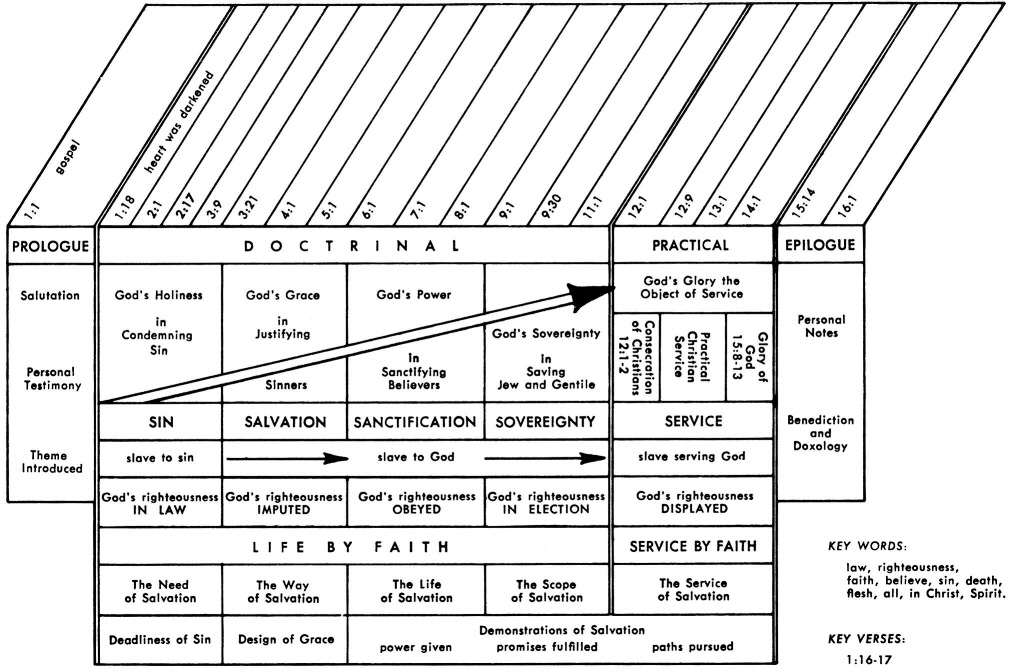
Click chart to enlarge
Chart from recommended resource Jensen's Survey of the NT - used by permission
Romans Overview Chart - Charles Swindoll
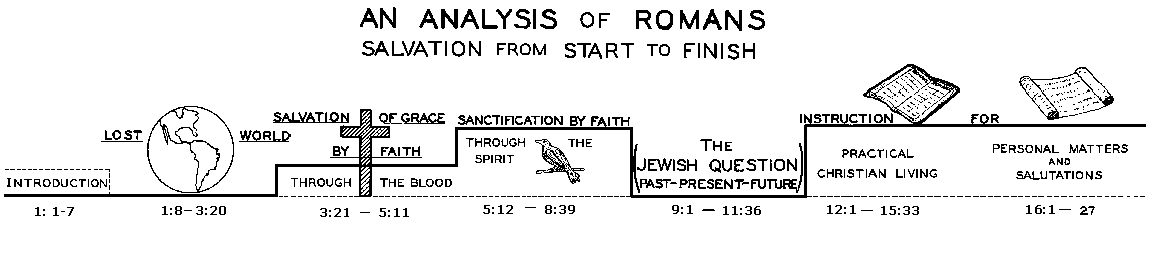
Source: Dr David Cooper
Click to Enlarge
R Ruin (Romans 1:17 – 3:20) – The utter sinfulness of humanity
O Offer (Romans 3:21-31) – God’s offer of justification by grace
M Model (Romans 4:1-25) – Abraham as a model for saving faith
A Access (Romans 5:1-11) – The benefits of justification
N New Adam (Romans 5:12-21) – We are children of two “Adams”
S Struggle w/ Sin (Romans 6-8) Struggle, sanctification, and victory
|
ROMANS ROAD |
||||
| Romans 1:18-3:20 | Romans 3:21-5:21 | Romans 6:1-8:39 | Romans 9:1-11:36 | Romans 12:1-16:27 |
| SIN | SALVATION | SANCTIFICATION | SOVEREIGNTY | SERVICE |
| NEED FOR SALVATION |
WAY OF SALVATION |
LIFE OF SALVATION |
SCOPE OF SALVATION |
SERVICE OF SALVATION |
| God's Holiness In Condemning Sin |
God's Grace In Justifying Sinners |
God's Power In Sanctifying Believers |
God's Sovereignty In Saving Jew and Gentile |
Gods Glory The Object of Service |
| Deadliness of Sin |
Design of Grace |
Demonstration of Salvation | ||
| Power Given | Promises Fulfilled | Paths Pursued | ||
| Righteousness Needed |
Righteousness Credited |
Righteousness Demonstrated |
Righteousness Restored to Israel |
Righteousness Applied |
| God's Righteousness IN LAW |
God's Righteousness IMPUTED |
God's Righteousness OBEYED |
God's Righteousness IN ELECTION |
God's Righteousness DISPLAYED |
| Slaves to Sin | Slaves to God | Slaves Serving God | ||
| Doctrine | Duty | |||
| Life by Faith | Service by Faith | |||
|
Modified from Irving L. Jensen's chart above |
||||
Romans 1:32 and although they know (AAPMPN) the ordinance of God, that those who practice (PAPMPN) such things are worthy of death, they not only do (3PPAI) the same, but also give (3PPAI) hearty approval to those who practice (PAPMPN) them. (NASB: Lockman)
Greek: hoitines to dikaioma tou theou epignontes, (AAPMPN) hoti oi ta toiauta prassontes (PAPMPN) axioi thanatou eisin, (3PPAI) ou monon auta poiousin (3PPAI) alla kai suneudokousin (3PPAI) tois prassousin. (PAPMPD)
Amplified: Though they are fully aware of God’s righteous decree that those who do such things deserve to die, they not only do them themselves but approve and applaud others who practice them. (Amplified Bible - Lockman)
Barclay: They are the kind of men who are well aware that those who do such things deserve death, and yet they not only do them themselves, but also heartily approve of those who do them (Daily Study Bible)
NCV: They know God's law says that those who live like this should die. But they themselves not only continue to do these evil things, they applaud others who do them.
NLT: They are fully aware of God's death penalty for those who do these things, yet they go right ahead and do them anyway. And, worse yet, they encourage others to do them, too. (NLT - Tyndale House)
Phillips: More than this - being well aware of God's pronouncement that all who do these things deserve to die, they not only continued their own practices, but did not hesitate to give their thorough approval to others who did the same (Phillips: Touchstone)
Wuest: such are those who, knowing the judgment of God that these who practice such things are worthy of death, not only habitually do the same things but also take pleasure in those who practice them. (Eerdmans Publishing)
Young's Literal: who the righteous judgment of God having known -- that those practicing such things are worthy of death -- not only do them, but also have delight with those practicing them.
AND, ALTHOUGH THEY KNOW THE ORDINANCE OF GOD: hoitines to dikaioma tou theou epignontes (AAPMPN):
- Ro 1:18,21; 2:1, 2, 3, 4, 5,21, 22, 23
- Romans 1 Resources - Multiple Sermons and Commentaries
- Romans 1:28-32: Going Down, Down, Down, Part 2 - Steven Cole
- Romans 1:26-32 Abandoned by God, Part 2 - John MacArthur
- Romans 1:26-32 - John MacArthur
THEY CANNOT
CLAIM IGNORANCE
The late Dr. R. H. Graves of Canton, China, said that a Chinaman who read these verses declared that Paul could not have written it, but only a modern missionary who had been to China. It was such a perfect description of Chinamen! (Romans 1)
Know (1921) (epiginosko [Epiginōskō] from epí means upon but is used here to intensify the force of the following verb + ginosko = to know) (See related noun epignosis) means to know fully, to know with certainty, to become thoroughly acquainted with or to know thoroughly, exactly, fully, or completely. Epiginosko means to possess more or less definite information about, and can imply a degree of thoroughness. It speaks of full or added knowledge. To be fully acquainted in a discerning, recognizing manner. (e.g., 1Co 13:12 twice uses "fully known," Lk 1:4; Col 1:6; 2Cor 6:9, et al) To ascertain (find out with certainty) (Acts 23:28, 24:8). To recognize a thing to be what it really is.
The following passage gives a good sense of the distinction between the simple (gnosis, ginosko) and the compound (epignosis, epiginosko) words. Paul writes "For now we see in a mirror dimly, but then face to face; now I know (ginosko) in part, but then I will know fully (epiginosko) just as I also have been fully known (epiginosko)." (1Cor 13:12)
In fairness, it should be noted that a few sources (J. Armitage Robinson in his commentary on Greek text of Ephesians) see no significant difference in meaning between epiginosko and ginosko and thus do not favor the idea of a more thorough or complete knowledge with the epiginosko/epignosis word group. Friberg (Analytical Lexicon of the Greek New Testament. Baker Academic) in fact divides the definitions of epiginosko as follows...
(1) with no emphasis on the epi-prefix;
(a) recognize, know (Mt 11.27; cf. Lk 10.22);
(b) perceive, notice, become aware of (Mk 5.30; cf. Lk 8.46);
(c) learn of, find out (Lk 7.37)
(d) acknowledge, understand (2Co 1.13);
(2) with the preposition (epi) intensifying the meaning;
(a) know exactly, fully, completely (Lk 1.4);
(b) especially in relation to higher and spiritual knowledge received through revelation fully know, perfectly know (Col 1.6)
Wuest explains that epiginosko is “knowledge gained by experience,” thus, a personal knowledge. This is the meaning of the simple verb (ginosko). The prefixed preposition epi is perfective in meaning, intensifying the already existing idea in the verb. Thus, the compound verb means, “personal knowledge gained by experience and which is clear.” (Wuest Word Studies - Eerdman Publishing Company Volume 1, Volume 2, Volume 3 - used by permission)
Epiginosko also means to recognize a thing to be what it really is, to acknowledge, to understand (1Co 14:37, 16:18; 2Co 1:13, 14)
Here in Romans 1:32 epiginosko denotes the clear discernment which these suppressors of the truth about God in fact had of God's regulations of "right and wrong".
Robertson writes that "The heathen knows that God condemns such evil practices."
Why did they know "beyond a shadow of a doubt"? Paul explained...
that which is known about God is evident within them; for God made it evident to them...so that they are without excuse...they knew God, they did not honor Him as God, or give thanks; but they became futile in their speculations, and their foolish heart was darkened. (see exposition of Romans 1:21ff)
For when Gentiles who do not have the Law do instinctively the things of the Law, these, not having the Law, are a law to themselves, in that they show the work of the Law written in their hearts, their conscience bearing witness, and their thoughts alternately accusing or else defending them, (Romans 2:14,15)
Epiginosko in Ro 1:32 is in the aorist tense which indicates that they had been effectively made aware of God's ordinance. These men have a full experiential knowledge not only that the things they practice are wrong but also that they themselves are deserving of death. They know this is God’s verdict, however much they seek to rationalize or even legalize these sins (cp states sanctioning gay marriage in the United States!). But this knowledge does not deter them from indulging in these forms of ungodliness (which speaks to the power of the fallen flesh!) In fact these truth rejecters unite with others to promote ungodly behavior and feel a sense of camaraderie with their partners-in-sin.
Ralph Earle (Word Meanings in the New Testament) has several notes on epiginosko...
Arndt and Gingrich feel that in some cases (e.g., 1Co 13:12) epiginosko means "know completely," but that most of the time it is simply equivalent to ginosko. The same would go for the nouns epignosis and gnosis.
Thayer puts the case more strongly. After noting that "epi denotes mental direction towards, application to, that which is known," he gives as the first definition for epiginosko: "to become thoroughly acquainted with, to know thoroughly; to know accurately, know well" (p. 237).
For epignosis he gives: "precise and correct knowledge."
Trench agrees with this when he writes
Of epignosis, as compared with gnosis, it will be sufficient to say that epi must be regarded as intensive, giving to the compound word a greater strength than the simple possessed (p. 285)
Likewise Cremer says that epignosis signifies
clear and exact knowledge, more intensive than gnosis, because it expresses a more thorough participation in the object of knowledge on the part of the knowing subject (p. 159).
Lightfoot concurs. Commenting on this passage (Col 1:9 - which uses the noun epignosis), he writes
The compound epignosis is an advance upon gnosis, denoting a larger and more thorough knowledge (p. 138).
Alford quotes Delitzsch as saying:
When epignosis is used, there is the assumption of an actual direction of the spirit to a definite object and of a real grasping of the same: so that we may speak of a false gnósis, but not of a false epignosis. And the Writer (of Hebrews - referring to He 10:26)
Wuest commenting on Peter's use of the noun epignosis in 2 Peter 1:2 writes that "Knowledge” or epignosis is full, perfect, precise knowledge as opposed to gnósis, imperfect, partial knowledge. Strachan says: “epígnōsis, ‘involving the complete appropriation of all truth and the unreserved acquiescence in God’s will, is the goal and crown of the believer’s course’ (Lightfoot) … epignosis implies a more intimate and personal relationship than gnósis. It would be a useful word, seeing that gnósis had become associated with Gnosticism, then incipient in the Church.… Grace and peace are multiplied in and through this more intimate heart knowledge of Jesus Christ, in contrast to a mere barren gnósis.” (Wuest Word Studies - Eerdman Publishing Company Volume 1, Volume 2, Volume 3 - used by permission)
Epiginosko - 44 times in the NT --Mt 7:16, Mt 7:20; Mt 11:27; 14:35; 17:12; Mk 2:8; 5:30; 6:33, 6:54; Lk 1:4, 22; 5:22; 7:37; 23:7; 24:16, 31; Acts 3:10; 4:13; 9:30; 12:14; 19:34; 22:24, 29; 23:28; 24:8, 11; 25:10; 27:39; 28:1; Ro 1:32; 1Co 13:12; 14:37; 16:18; 2Co 1:13, 14; 6:9; 13:5; Col 1:6; 1Ti 4:3; 2Pe 2:21
In the NAS epiginosko is translated -- acknowledge(1), ascertain(2), aware(2), find out(1), found out(2), fully known(1),know(7), know fully(1), known(2), knows(1), learned(3), perceiving(1), realized(1), recognize(5), recognized(6), recognizing(1),take note(1), taking note(1), understand(3), understood(1), well-known(1).
Matthew 7:16 "You will know them by their fruits. Grapes are not gathered from thorn bushes nor figs from thistles, are they?
Matthew 7:20"So then, you will know them by their fruits.
Matthew 11:27 "All things have been handed over to Me by My Father; and no one knows the Son except the Father; nor does anyone know the Father except the Son, and anyone to whom the Son wills to reveal Him.
Matthew 14:35 And when the men of that place recognized Him, they sent word into all that surrounding district and brought to Him all who were sick;
Matthew 17:12 but I say to you that Elijah already came, and they did not recognize him, but did to him whatever they wished. So also the Son of Man is going to suffer at their hands."
Mark 2:8 Immediately Jesus, aware in His spirit that they were reasoning that way within themselves, said to them, "Why are you reasoning about these things in your hearts?
Marvin Vincent: The preposition epi gives the force of fully. He was not only immediately aware of their thought, but clearly and fully aware.
Mark 5:30 Immediately Jesus, perceiving in Himself that the power proceeding from Him had gone forth, turned around in the crowd and said, "Who touched My garments?"
Mark 6:33 The people saw them going, and many recognized them and ran there together on foot from all the cities, and got there ahead of them.
Mark 6:54 When they got out of the boat, immediately the people recognized Him,
Comment: to know fully by experience, to recognize Jesus, knowing full as nearly all did by now
Luke 1:4 so that you may know the exact truth about the things you have been taught.
Luke 1:22 But when he came out, he was unable to speak to them; and they realized that he had seen a vision in the temple; and he kept making signs to them, and remained mute.
Luke 5:22 But Jesus, aware of their reasonings, answered and said to them, "Why are you reasoning in your hearts?
Luke 7:37 And there was a woman in the city who was a sinner; and when she learned that He was reclining at the table in the Pharisee's house, she brought an alabaster vial of perfume,
Luke 23:7 And when he learned (having gained full knowledge) that He belonged to Herod's jurisdiction, he sent Him to Herod, who himself also was in Jerusalem at that time.
Luke 24:16 But their eyes were prevented from recognizing Him.
Luke 24:31 Then their eyes were opened and they recognized Him; and He vanished from their sight.
Acts 3:10 and they were taking note of him as being the one who used to sit at the Beautiful Gate of the temple to beg alms, and they were filled with wonder and amazement at what had happened to him.
Acts 4:13 Now as they observed the confidence of Peter and John and understood that they were uneducated and untrained men, they were amazed, and began to recognize them as having been with Jesus.
Acts 9:30 But when the brethren learned of it, they brought him down to Caesarea and sent him away to Tarsus.
Acts 12:14 When she recognized Peter's voice, because of her joy she did not open the gate, but ran in and announced that Peter was standing in front of the gate.
Acts 19:34 But when they recognized that he was a Jew, a single outcry arose from them all as they shouted for about two hours, "Great is Artemis of the Ephesians!"
Acts 22:24 the commander ordered him to be brought into the barracks, stating that he should be examined by scourging so that he might find out (might know) the reason why they were shouting against him that way.
Acts 22:29 Therefore those who were about to examine him immediately let go of him; and the commander also was afraid when he found out that he was a Roman, and because he had put him in chains.
Acts 23:28 "And wanting to ascertain the charge for which they were accusing him, I brought him down to their Council;
Acts 24:8 ordering his accusers to come before you. By examining him yourself concerning all these matters you will be able to ascertain the things of which we accuse him."...11 since you can take note of the fact that no more than twelve days ago I went up to Jerusalem to worship.
Acts 25:10 But Paul said, "I am standing before Caesar's tribunal, where I ought to be tried. I have done no wrong to the Jews, as you also very well know.
Acts 27:39 When day came, they could not recognize the land; but they did observe a bay with a beach, and they resolved to drive the ship onto it if they could.
Acts 28:1 When they had been brought safely through, then we found out that the island was called Malta.
Romans 1:32 and although they know the ordinance of God, that those who practice such things are worthy of death, they not only do the same, but also give hearty approval to those who practice them.
Comment: These individuals are like the false teachers in 2Peter 2:21 who in an intellectual sense fully knew that way of salvation was by grace through faith and yet they stubbornly refused to receive that truth as a gift. This is an amazing realization that there are people who have a full understanding of what God requires and STILL REFUSE Him. How hard can a heart be! We probably all know some of these folks and they literally break our hearts. There is nothing we can do except live the Christ life before them and pray that God's Spirit might one day penetrate their stony hearts.
1 Corinthians 13:12 For now we see in a mirror dimly, but then face to face; now I know in part, but then I will know fully just as I also have been fully known.
1 Corinthians 14:37 If anyone thinks he is a prophet or spiritual, let him recognize that the things which I write to you are the Lord's commandment.
1 Corinthians 16:18 For they have refreshed my spirit and yours. Therefore acknowledge such men.
MacArthur comments: Epiginōskō (acknowledge) signifies recognition of something for what it really is. In 14:37 Paul uses the term to tell the Corinthians to “recognize that the things which I write to you are the Lord’s commandment.” Now he tells them to recognize faithful, godly workers for what they are.
2 Corinthians 1:13 For we write nothing else to you than what you read (Related verb = anaginosko) and understand (epiginosko), and I hope you will understand until the end; 14 just as you also partially did understand us, that we are your reason to be proud as you also are ours, in the day of our Lord Jesus.
Comment: There is clearly a play on words as both verbs have ginosko as their root. Anaginosko refers to what the Corinthians read in his letters and epiginosko to what they know through personal contact with him. The Corinthians are being assured that the two are in complete harmony.
2 Corinthians 6:9 as unknown yet well-known, as dying yet behold, we live; as punished yet not put to death,
2 Corinthians 13:5 Test yourselves to see if you are in the faith; examine yourselves! Or do you not recognize this about yourselves, that Jesus Christ is in you-- unless indeed you fail the test?
Colossians 1:6 which has come to you, just as in all the world also it is constantly bearing fruit and increasing, even as it has been doing in you also since the day you heard of it and understood the grace of God in truth;
1 Timothy 4:3 men who forbid marriage and advocate abstaining from foods which God has created to be gratefully shared in by those who believe and know the truth.
2 Peter 2:21 For it would be better for them not to have known the way of righteousness, than having known it, to turn away from the holy commandment handed on to them.
Comment: Peter's use of epiginosko indicates these false teachers had no excuse but fully knew and understood the way of righteousness, the path through Jesus that alone leads to salvation but they refused to receive, believe and be saved by that full knowledge. Woe! They will be held that much more accountable at the judgment of unbelievers because they knew the right way.
Epiginosko - More than 90 uses in the non-apocryphal Septuagint (Lxx)-
Gen. 27:23; 31:32; 37:32f; 38:15, 25f; 41:31; 42:7f; Deut. 1:17; 16:19; 21:17; 33:9; Jdg. 18:3; Ruth 2:10, 19; 3:14, 18; 1 Sam. 26:17; 2 Sam. 19:7; 1 Ki. 20:41; Ezr. 3:13; Neh. 6:12; 13:24; Esther 1:1; 3:5; 4:1; Job 2:12; 4:16; 6:17; 7:10; 24:13, 16f; 34:27; Ps. 103:16; 142:4; Prov. 14:8; 24:23; 27:23; 30:18; Is 61:9; 63:16; Jer. 4:22; 5:5; 24:5; Lam. 4:8; Ezek. 5:13; 6:7, 10, 14; 7:4, 9; 11:10, 12; 12:20; 13:14, 21; 14:8, 23; 15:7; 16:62; 17:21; 20:38, 42, 44, 48; 21:5; 22:22; 24:24, 27; 25:5, 7, 11, 14, 17; Dan. 2:3; 4:31; 6:10; 11:39; Hos. 2:20; 5:4; 7:9; 14:9; Joel 2:27; 3:17; Jon. 1:7; Hab. 3:2; Hag. 2:19; Zech. 2:11; 4:9; 6:10, 14; Malachi 2:4
John Piper notes that "This is an astonishing affirmation about human nature. Everybody has knowledge of God and the moral law of God, whether they have seen a Bible or not, or whether they live in America or in an undiscovered people group of Irian Jaya...The second observation is that this knowledge means people are without excuse before God not only because of the way they treat God, but also because of the way they treat each other. (Romans 1:28-32 Doing and Endorsing Evil)
Haldane writes that "This the heathens knew, from the work of the law written in their hearts. Although they had almost entirely stifled in themselves the dictates of conscience, it did not cease, in some measure, to remonstrate against the unworthiness of their conduct, and to threaten the wrath of God, which their sins deserved. They recognized it by some remains they had of right notions of the Godhead (Editorial note: One example is the worldwide existence of the remnants of covenant - see H Clay Trumbull's fascinating work "The Blood Covenant" the second edition published in 1885) and by which they still understood that God was judge of the world; and this was confirmed to them by examples of Divine vengeance which sometimes passed before their eyes. They knew it even by the false ideas of the superstition in which they were plunged, which required them to seek for expiations. That they knew it in a measure is evident by their laws, which awarded punishments to some of those vices of which they were guilty. (Haldane, R. An Exposition of Romans.)
Albert Barnes writing about their knowledge of God's ordinance says that this is substantiated by the secular writings - Livy says of the age of Augustus, in some respects the brightest period of the Roman history, "Rome has increased by her virtues until now, when we can neither bear our vices nor their remedy." (Preface to his History.) Seneca, one of the purest moralists of Rome, who died A. D. 65, says of his own time, "All is full of criminality and vice; indeed much more of these is committed than can be remedied by force. A monstrous contest of abandoned wickedness is carried on. The lust of sin increases daily; and shame is daily more and more extinguished. Discarding respect for all that is good and sacred, lust rushes on wherever it will. Vice no longer hides itself. It stalks forth before all eyes. So public has abandoned wickedness become, and so openly does it flame up in the minds of all, that innocence is no longer seldom, but has wholly ceased to exist," Seneca de Ira, ii. 8. Further authorities of this kind could be easily given, but these will show that the apostle Paul did not speak at random when he charged them with these enormous crimes. (Romans 1)
Ordinance (1345) (dikaioma from dikaióo = to justify <> díkaios = just, righteous <> dike = right) refers to what God has declared to be right and here referring to His decree of retribution which has the force of law.
Dikaioma is used elsewhere in this Epistle with its other meaning of “righteousness” (see table below). Strictly speaking dikaioma is what God establishes as just.
Friberg's summary of dikaioma (see also table below) - (1) of God's requirements ordinance, regulation, commandment (Lk 1:6); (2) of fulfillment of a legal requirement righteous deed, act of justice, by Christ (Ro 5:18) by God (Rev 15:4), by saints (Rev 19:8); (3) as an act of justification equivalent to dikaiosis removal of guilt, acquittal (Ro 5:16)
In simple terms, as used here by Paul dikaioma is God’s declaration about what is right and just.
Kenneth Wuest - Primarily that which is deemed right, so as to have the force of law; hence an ordinance. (Wuest Word Studies - Eerdman Publishing Company Volume 1, Volume 2, Volume 3 - used by permission)
Paul's point in this verse is that these men with depraved minds were aware of God's regulations for right living and had an innate knowledge that the things they were doing were wrong and deserving of His retribution. Simply put they knew they were doing wrong and justly deserving of punishment but they simply don't care!
Dikaioma - 10 times in the NT translated as - act of righteousness, 1; justification, 1; ordinance, 1; regulations, 2; requirement, 1; requirements, 2; righteous acts, 2 (NASB)
Luke 1:6 They were both righteous in the sight of God, walking blamelessly in all the commandments and requirements of the Lord.
Romans 1:32 and although they know the ordinance of God, that those who practice such things are worthy of death, they not only do the same, but also give hearty approval to those who practice them.
Romans 2:26 So if the uncircumcised man keeps the requirements of the Law, will not his uncircumcision be regarded as circumcision?
Romans 5:16 The gift is not like that which came through the one who sinned; for on the one hand the judgment arose from one transgression resulting in condemnation, but on the other hand the free gift arose from many transgressions resulting in justification.
Romans 5:18 So then as through one transgression there resulted condemnation to all men, even so through one act of righteousness there resulted justification of life to all men.
Romans 8:4 so that the requirement of the Law might be fulfilled in us, who do not walk according to the flesh but according to the Spirit.
Hebrews 9:1 Now even the first covenant had regulations of divine worship and the earthly sanctuary.
Hebrews 9:10 since they relate only to food and drink and various washings, regulations for the body imposed until a time of reformation.
Revelation 15:4 "Who will not fear, O Lord, and glorify Your name? For You alone are holy; For ALL THE NATIONS WILL COME AND WORSHIP BEFORE YOU, FOR YOUR RIGHTEOUS ACTS HAVE BEEN REVEALED."
Revelation 19:8 It was given to her to clothe herself in fine linen, bright and clean; for the fine linen is the righteous acts of the saints.
Dikaioma - 137x in the non-apocryphal Septuagint - Ge 26:5; Ex 15:25f; 21:1, 9, 31; 24:3; Lev 25:18; Num 15:16; 27:11; 30:16; 31:21; 35:29; 36:13; Deut 4:1, 5f, 8, 14, 40, 45; 5:1, 31; 6:1f, 4, 17, 20, 24; 7:11f; 8:11; 10:13; 11:1; 17:19; 26:16f; 27:10; 28:45; 30:10, 16; 33:10; Ruth 4:7; 1 Sam 2:13; 8:3, 9, 11; 10:25; 27:11; 30:25; 2 Sam 19:28; 22:23; 1 Kgs 2:3; 3:28; 8:45, 59; 2 Kgs 17:8, 13, 19, 34, 37; 23:3; 2 Chr 6:35; 19:10; Job 34:27; Ps 18:22; 19:8; 50:16; 89:31; 105:45; 119:5, 8, 12, 16, 23f, 26f, 33, 48, 54, 56, 64, 68, 71, 80, 83, 93f, 112, 117f, 124, 135, 141, 145, 155, 171; 147:19; Prov 2:8; 8:20; 19:28; Jer 11:20; 18:19; Ezek 5:6f; 11:20; 18:9; 20:11, 13, 16, 18f, 21, 24f; 36:27; 43:11; 44:24; Hos 13:1; Mic 6:16; Mal 4:4;
Godet writes that because of God's workings men had "moral light...produced in them as well as religious light (see Ro 1:21). The words following indicate the contents of that sentence which God had taken care to engrave on their heart. What appeals to God's justice do we not find in the writings of Gentile historians and philosophers! What a description in their poets of the punishment inflicted on malefactors in Tartarus! (Godet, F: The Epistle of St Paul to the Romans)
Vine writes that dikaioma refers to "what God has declared to be right (dikaioma), here referring to His decree of retribution. The relative pronoun “who,” as in verse 25, suggests that what is now to be stated concerning the sinners mentioned is the cause of the evils just enumerated. The evils are the effect of the refusal to accept and follow what they know to be right. Man’s conscience and experience tell him of the evil character and effects of impurity and cruelty, and their Divine condemnation. (Vine, W. Collected writings of W. E. Vine. Nashville: Thomas Nelson)
Dikaioma has 3 basic meanings in the NT:
(1) Dikaioma most often refers to a regulation relating to a just or right action, especially in reference to God's requirements, ordinances or regulations. In other words, dikaioma is used to refer to an act which is in accordance with what God requires. It is an appointment of God having the force of law.
And they [Zacharias and Elizabeth, parents of John the Baptist] were both righteous in the sight of God, walking blamelessly in all the commandments and requirements (dikaioma) of the Lord." Luke 1.6
If therefore the uncircumcised man keeps the requirements (dikaioma) of the Law, will not his uncircumcision be regarded as circumcision? Romans 2:16
For what the Law could not do, weak as it was through the flesh, God did: sending His own Son in the likeness of sinful flesh and as an offering for sin, He condemned sin in the flesh, 4 in order that the requirement (dikaioma) of the Law might be fulfilled in us, who do not walk according to the flesh, but according to the Spirit. Romans 8:3-4
Now even the first covenant had regulations (dikaioma) of divine worship and the earthly sanctuary. Hebrews 9:1
since they (Jewish gifts and sacrifices called for under the Old Covenant) relate only to food and drink and various washings, regulations (dikaioma) for the body imposed until a time of reformation.
(2) Dikaioma can refer to the fulfillment of a legal requirement, a righteous deed or an act of justice, by Christ (Ro 5.18), by God (Rev 15.4) or by saints (Rev 19.8).
So then as through one transgression there resulted condemnation to all men, even so through one act of righteousness (dikaioma - here a reference to the Death of Christ, an act accomplished and consistent with God's character) there resulted justification of life to all men." Romans 5:18 Here the a righteous act is that of our Lord Jesus Christ in satisfying the demands of the law which mankind broke.
"Who will not fear, O Lord, and glorify Thy name? For Thou alone art holy; For ALL THE NATIONS WILL COME AND WORSHIP BEFORE THEE, For Thy righteous acts have been revealed." Rev 15.4
And it was given to her to clothe herself in fine linen, bright and clean; for the fine linen is the righteous acts of the saints.
(3) Dikaioma is used once to signify the clearing of someone of a violation as an act of justification. In this use it equates with the removal of guilt or granting of an acquittal.
And the gift is not like that which came through the one who sinned; for on the one hand the judgment arose from one transgression resulting in condemnation, but on the other hand the free gift arose from many transgressions resulting in justification (dikaioma = here refers to a "declaration of righteousness"). Romans 5.16
THAT THOSE WHO PRACTICE SUCH THINGS: hoti oi ta toiauta prassontes (PAPMPN):
- Romans 1 Resources - Multiple Sermons and Commentaries
- Romans 1:28-32: Going Down, Down, Down, Part 2 - Steven Cole
- Romans 1:26-32 Abandoned by God, Part 2 - John MacArthur
- Romans 1:26-32 - John MacArthur
PRACTICE DOES NOT
MAKE PERFECT!
Practice...practice - The first verb is prasso and the second verb is poieo. See discussion of these verbs under prasso below. We see a similar combination in Romans 7:15 ( "I am not practicing [prasso] what I [would] like to [do], but I am doing [poieo] the very thing I hate.") and Romans 7:19 ("For the good that I want, I do not do [poieo], but I practice [prasso]the very evil that I do not want.").
Practice (4238) (prasso) means doing something as a regular practice or as a routine habit, and is distinguished from poieo which means "to do" which focuses more on the end/achievement of the action. In contrast prasso focuses on the process or habitual effort to arrive at the end/achievement, and thus refers more to the course of conduct. (even the present tense of poieo expresses a series of repeated acts -- see note by Vine below). The predominant idea conveyed by prasso in its NT uses is to bring about or accomplish an objective through some activity (Ro 1:32, 2:3, Ac 5:35, 26:20, 2Co 5:10, etc). Prassō focuses on the activity (continued process) that brings the needed end.
Prasso has an rare meaning of to collect what is due in Lk 3:13, 19:23.
Thayer - poieō ("to make") focuses on producing an end-result. Prássō ("to practice") highlights the process to get there, i.e. the practice (habit, routine) which brings the result.
Henry Alford (in comments on John 3:20-21) says "prassō is more the habit of action (Jn 3:20); so that we might say 'he that practices evil;' but poiéō the true doing of good" (Jn 3:21).
Pulpit Commentary at Ro 7:15 - prassō is the more emphatic (marked) term than 4160 (poiéō). "The distinction between the verbs poiēō, prassō, is not observed in the English Version...Attention to the places where they occur, will show their appropriateness in each case, denoting [respectively] single acts, [or] habitual practice".
Vine adds that prasso...
signifies to practise, though this is not always to be pressed. The Apostle John, in his Epistles, uses the continuous tenses (present tense ) of poieō, to indicate a practice, the habit of doing something, e.g., 1Jn 3:4 (cp poieo in 1 Jn 3:8, 9 where the sense of practising is the meaning). John uses prasso twice in the Gospel, Jn 3:20 and Jn 5:29. The Apostle Paul uses prasso in the sense of practising, and the R.V. so renders the word in Ro 1:32; 2:2...
Generally speaking, in Paul’s Epistles poieō denotes an action complete in itself, while prassō denotes a habit. The difference is seen in Ro 1:32.
Again, poieō stresses the accomplishment, e.g., “perform,” in Ro 4:21; prassō stresses the process leading to the accomplishment, e.g., “doer,” in Ro 2:25.
In Ro 2:3 he who does, poieō, the things mentioned, is warned against judging those who practise them, prassō.
The distinction in John 3:20, 21 is noticeable: “Every one that does (prassō, practises) ill … he that does (poieō) the truth,” While we cannot draw the regular distinction, that prassō speaks of doing evil things, and poieō of doing good things, yet very often “where the words assume an ethical tinge, there is a tendency to use the verbs with this distinction” (Trench, Syn., § xcvi). (Vine, W E: Vine's Complete Expository Dictionary of Old and New Testament Words. 1996. Nelson)
Prasso in Romans 1:32 is in the present tense which emphasizes that this is the habitual practice of these individuals! The old adage "practice makes perfect" takes on an ironic twist in Ro 1:32. Their practice makes them perfectly fit for God's righteous judgment!
Friberg writes that prasso has the following nuances...
(1) transitively (Ed: In grammar, a transitive verb is one which is or may be followed by an object; a verb expressing an action which passes from the agent to an object);
(a) of pressing through on an action carry out, do, accomplish (Ac 26.20);
(b) predominately with a negative evaluation commit, do (Ac 5.35);
(c) as denoting intense preoccupation with something busy oneself with, practice (Ac 19.19); in regard to law practice, observe (RO 2.25); in regard to taxes, interest, toll duties collect, demand, exact (Lk 19.23);
(2) intransitively, (Ed: In grammar, an intransitive verb is one which expresses an action or state that is limited to the agent, or in other words, an action that does not pass over to, or operate upon an object) with a qualifying adverb or phrase;
(a) to qualify how someone is acting do (Ac 3.17; perhaps 15.29);
(b) to denote one’s condition be, be situated, be faring (Ep 6.21; perhaps Ac 15.29) (Friberg, T., Friberg, B., & Miller, N. F. Analytical Lexicon of the Greek New Testament. Baker Academic)
Thayer has this entry for prasso (abbreviated) --
1. “to exercise, practise, be busy with, carry on”: Acts 19:19; to mind one’s own affairs, 1Th 4:11; used of performing the duties of an office, 1Co 9:17. “to undertake to do,” Acts 19:36.
2. “to accomplish, to perform”: has been accomplished, “has taken place,” Acts 26:26; 2Cor 5:10; Ro 9:11, Acts 26:20; add, Romans 7:15,19; Philippians 4:9; to do, i.e. keep the law, Ro 2:25; of unworthy acts, “to commit, perpetrate” is more common in reference to bad conduct; Acts 26:9; 2Co 12:21; “this (criminal) deed,” 1Co 5:2, Lk 22:23; Ac 3:17; 5:35; Ro 7:19; such nameless iniquities, Ro 1:32; Ro 2:1-3; Galatians 5:21; Jn 3:20; 5:29;, Lk 23:15; Ac 25:11,25; 26:31; Ro 7:19; 13:4; Lk 23:41; to bring evil upon one, Acts 16:28.
3. “to manage public affairs, transact public business” (Xenophon, Demosthenes, Plutarch); from this use has come a sense met with from Pindar, Aeschylus, Herodotus down, viz. “to exact” tribute, revenue, debts: Luke 3:13 (here R.V. “extort”); το αργυριον, Luke 19:23 (so agere in Latin, cf. the commentators on Suetonius, Vesp. 1; (cf. Winer’s Grammar, sec. 42, 1 a.)).
4. intransitive, “to act”: contrary to a thing, Acts 17:7.
5. from Aeschylus and Herodotus down reflexively, how I do, the state of my affairs, Ephesians 6:21; Acts 15:29
There are 39 uses of prasso in the NT - Lk 3:13; Luke 19:23; Luke 22:23; Luke 23:15, 41; Jn 3:20; 5:29; Acts 3:17; 5:35; 15:29; 16:28; 17:7; 19:19, 36; 25:11, 25; 26:9, 20, 26, 31; Ro 1:32; Ro 2:1, Ro 2:2, Ro 2:3-notet, Ro 2:25; Ro 7:15, Ro 7:19; Ro 9:11; Ro 13:4; 1Co 5:2; 9:17; 2Co 5:10; 12:21; Gal 5:21; Ep 6:21; Php 4:9; 1Th 4:11
There are 19 uses of prasso in the Septuagint - Ge 31:28; Jos. 1:7; Job 5:27; 7:20; 24:20; 27:6; 34:21; 35:6; 36:21, 23; Pr. 10:23; 13:10, 16; 14:17; 21:7; 25:28; 26:19; 30:20; Isa. 57:10; Da 6:3; 11:20
ARE WORTHY OF DEATH: axioi thanatou eisin (3PPAI):
- Romans 1 Resources - Multiple Sermons and Commentaries
- Romans 1:28-32: Going Down, Down, Down, Part 2 - Steven Cole
- Romans 1:26-32 Abandoned by God, Part 2 - John MacArthur
- Romans 1:26-32 - John MacArthur

CRIME AND PUNISHMENT
Regarding the idea of worthy, Middletown Bible suggests...
(think of weighing scales being balanced) The penalty must balance the crime, the penalty must weigh as much as the crime.
THE CRIME = see verses 29-31
THE PENALTY = "worthy of DEATH" (verse 32 and see also Romans 5:12 end 6:23)
Note: The good news of the gospel is that Jesus Christ paid this penalty when He died on the cross -- see Romans 5:6-9. Compare Romans 1:18 with Romans 5:6 as you think about the word "ungodly". Compare Romans 1:18 with Romans 5:9 as you think about the word "wrath".
Worthy (514) (axios [see word study]) means weighing as much as, of like value, worth as much. It means having the weight of another thing and so being of like value or worth as much. In other words axios has the root meaning of balancing the scales—what is on one side of the scale should be equal in weight to what is on the other side. In the present context these depraved men and women are fully aware of the fact that when their unrighteous deeds are weighed in the balance, they warrant only one thing...death, not simply the natural termination of life, but the execution of the divine penalty upon sin.
Death (2288) (thanatos from thnesko = to die) refers to physical or spiritual death. In either event thanatos in the NT is treated not as a natural process but always as a destroying power related to sin and its consequences.
In a parallel passage Paul repeats this thought asking...
Therefore what benefit were you then deriving from the things of which you are now ashamed? For the outcome of those things is death (Ro 6:21)
Godet comments that
Death...here denotes death as God only can inflict it, the pains of Hades, which the Gentiles also recognized, and which Paul, designating things from his own point of view, calls death. (ibid)
Hodge explains that death "here, as is frequently the case, means punishment, in the general meaning of that word. It expresses the penalty of the law and includes all evil inflicted for the satisfaction of justice. Paul therefore teaches that the heathen knew they deserved punishment for their crimes, or in other words, that they were justly exposed to God’s wrath, which was revealed against all human ungodliness and unrighteousness. In verse 15 of the following chapter (see exposition of Romans 2:15) Paul explains the source of this knowledge. It was a knowledge written in their hearts, as part of their nature, and it was implied in their being moral agents. As Paul had already shown that the godlessness of the heathen had no excuse, since they knew about the true God, so here he shows that their immorality had no excuse, since they did not sin in ignorance of the nature or consequences of their sin. This passage also shows that God’s judicial giving up of mankind does not destroy man’s freedom of choice or his responsibility. Men give themselves over to do evil, and yet know that they deserve death for what they do. The stream which carries them away is not outside but within them. It is their own corrupt nature. It is themselves." (Commentary on the Epistle to the Romans -online)
Those who either practice or approve of these things are worthy of death; they are the worth objects of the wrath of God. Not simply the natural termination of life, but the execution of the divine penalty upon sin. This statement is explanatory of “the ordinance of God.” That ordinance is next stated. It is that those who do such deeds are worthy of death. The heathen moralists admitted this. Yet in spite of this knowledge they not only continued in their vile sins, but took pleasure in them. No deeper degree of depravity can be found than when men call evil good, and cherish it. The conclusion, from these facts, is that all such guilty persons are under condemnation.
THEY NOT ONLY DO THE SAME BUT ALSO GIVE HEARTY APPROVAL TO THOSE WHO PRACTICE THEM: ou monon auta poiousin (3PPAI) alla kai suneudokousin (3PPAI) tois prassousin (PAPMPD):
- Ps 50:18; Hosea 7:3; Mark 14:10,11
- Romans 1 Resources - Multiple Sermons and Commentaries
- Romans 1:28-32: Going Down, Down, Down, Part 2 - Steven Cole
- Romans 1:26-32 Abandoned by God, Part 2 - John MacArthur
- Romans 1:26-32 - John MacArthur
DOERS ARE ALSO
APPROVERS!
Do (4160) (poieo) expresses action which is continued and not yet completed as emphasized by the present tense.
The same (846) (monon) means only or alone and with the negative (ou) as in this case means "not only".
What a description of this world of sinners, this race alienated from the life of God, —at enmity with Him, and at strife with one another! But all in a hellish unity of evil!
Romans 1 gives ample proof that the heathen are lost. Dan Crawford, British missionary to Africa, said:
The heathen are sinning against a flood of light.
There is a desperate need for us to carry the Gospel to all men, for this is the only way they can be saved.
But - Always pause and ponder (interrogate) this term of contrast.
Give hearty approval (4909) (suneudokeo from sun = together with + eu = good + dokéo = think) literally means to "think well with", and so to consent or to give hearty approval to something (cf Lk 11:48). It means to join in approval, agree with, approve of, consent to or sympathize with.
Suneudokeo is used 6 times in the NT and is translated -- approve, 1; approving, 1; consents, 2; give hearty approval, 1; hearty agreement, 1 (NAS) as shown in the following verses:
Luke 11:48 "Consequently, you are witnesses and approve the deeds of your fathers; because it was they who killed them, and you build their tombs.
Acts 8:1 And Saul was in hearty agreement with putting him to death. And on that day a great persecution arose against the church in Jerusalem; and they were all scattered throughout the regions of Judea and Samaria, except the apostles.
Acts 22:20 'And when the blood of Thy witness Stephen was being shed, I also was standing by approving, and watching out for the cloaks of those who were slaying him.'
Romans 1:32 and, although they know the ordinance of God, that those who practice such things are worthy of death, they not only do the same, but also give hearty approval to those who practice them.
1 Corinthians 7:12 But to the rest I say, not the Lord, that if any brother has a wife who is an unbeliever, and she consents to live with him, let him not send her away. 13 And a woman who has an unbelieving husband, and he consents to live with her, let her not send her husband away.
The idea is that these men and women continually (present tense) express a hearty approval of those who continually (present tense) practice these nefarious deeds and even take pleasure with them! Such is the mind given over to depravity & self. Not only is the voice of a reasonable conscience stifled, but the mind has become absolutely hardened & callous regarding the moral degradation and ruin of others, and so naturally takes "wicked" pleasure in their sinfulness.
So their sins are not sins of ignorance, but of blatant rebellion. Where does all this violence, immorality, cruelty and degradation come from? Men have abandoned the true knowledge of God, and the state of society is a reflection of God's judgment upon them for this In summary in this section we are confronted with three terrible realities: (1) Men have complete inner knowledge from God that their ways deserve and must have Divine condemnation and judgment; (2) they persist in their practices despite the clear witness of their conscience and (3) they are in a fellowship of evil with other evil-doers! Paul has painted a picture of man in desperate, dire straits morally speaking and only the gospel of Jesus Christ can set men free from the ensnaring bonds of such evil.
The premier example of evil men giving hearty approval is found in the betrayal of Jesus where we read that...
Judas Iscariot, who was one of the twelve, went off to the chief priests, in order to betray Him to them. And they were glad when they heard this, and promised to give him money. And he began seeking how to betray Him at an opportune time. Mark 14:10,11
The psalmist has a similar accusation writing that...
"When you see a thief, you are pleased with him (you join with him, you help him), and you associate with adulterers." Psalms 50:18
Godet has an interesting comment writing that "The "not only", "but even" (NAS = "but also"), rightly assumes that there is more guilt in approving in cold blood of the evil committed by others, than in committing it oneself under the force and blindness of passion. Such a mode of acting is therefore the last stage in the corruption of the moral sense. (Ibid)
John Piper refers to this section as "Committing Spiritual Suicide and Taking Others Along... In other words, the end-point of depravity is not just the suicidal love affair with sin, but the desire to bring others with you to destruction. It's not just that people choose death for themselves in the passion of sin, but that they become Dr. Kevorkians (a medical doctor who advocated "euthanasia") at the spiritual level, and assist others in eternal self-destruction by approving their sin."! (Doing and Endorsing Evil)
Pastor Ray Stedman - Knowing that harm is coming from their wickedness, nevertheless they attempt to spread it more fully. They invade the field of education; they dominate the media; they seek legal status for their wickedness and defy all attempts at control. As you can well recognize, this is what is going on today. (Romans 1:24-32 The Deepening Darkness)
Newell - What a description of this world of sinners, this race alienated from the life of God, at enmity with Him, and at strife with one another! But all in a hellish unity of evil! (Romans 1)
DISASTER AND DEGENERACY
GO HAND IN HAND!
Barclay - Paul says one last thing about these people who have banished God from life. It usually happens that, even if a man is a sinner, he knows it, and, even if he allows something in himself, he knows that it is to be condemned in others. But in those days men had reached such a level that they sinned themselves and encouraged others to do so. George Bernard Shaw once said (Ed: albeit still an aberration of truth with "little g" gods!), "No nation has ever survived the loss of its gods." Here Paul has given us a terrible picture of what happens when men deliberately banish God from the reckoning, and, in due time, Rome perished. Disaster and degeneracy went hand in hand. (Romans 1 - William Barclay's Daily Study Bible - Commentaries)
Haldane explains that their giving "hearty approval"...
is added to mark the depth of their corruption. For when men are not entirely abandoned to sin, although they allow of it in their own circumstances and practice, yet they condemn it in their general notions, and in the practice of others, because then it is not connected with their own interest and self–love. But when human corruption has arrived at its height, men not only commit sins, but approve of them in those who commit them. While this was strictly applicable to the whole body of the people, it was chargeable in the highest degree on the leaders and philosophers, who, having more light than the others, treated in their schools some of those things as crimes of which they were not only guilty themselves, but the commission of which they encouraged by their connivance, especially in the abominable rites practiced in the worship of their gods."
And so "By these conclusive proofs Paul substantiates his charge, in Romans 1:18, against the whole Gentile world, first of ungodliness, and then of unrighteousness as its consequence, against which the wrath of God is revealed.
It is impossible to add anything to the view here given of the reign of corruption among the heathens; even the most celebrated and civilized, which is fully attested by their own historians. Nothing can be more horrible than this representation of their state; and as the picture is drawn by the Spirit of God, who is acquainted not only with the outward actions, but with the secret motives of men, no Christian can suppose that it is exaggerated. The Apostle, then, had good reason to conclude in the sequel, that justification by works is impossible, and that in no other way can it be obtained but by grace. From the whole, we see how terrible to his posterity have been the consequences of the sin of the first man; and, on the other hand, how glorious in the plan of redemption is the grace of God by His Son. (Exposition of the Epistle to the Romans) (Bolding added)
In Romans chapter 1 Paul in fact has given us a terrible picture of what happens when men deliberately banish the only true and living God from their reckoning. In due time, Rome perished. Disaster and degeneracy went hand in hand as they always, inevitably do when men or women place God far from their minds and replace Him with so-called "gods" of their own making.
John MacArthur presents an interesting illustration of man apart from God writing that "A certain species of ants in Africa builds its nests in deep subterranean tunnels, where its young and its queen live. Although they may be great distances from the nest foraging for food, worker ants of that species are able to sense when the queen is being molested and they become extremely nervous and uncoordinated. If she is killed, they become frantic and rush around aimlessly until they die. What better illustration could there be of fallen man. Even in his sinful rejection and rebellion, he cannot function properly apart from God and is destined only for death. (MacArthur, J. Romans. Chicago: Moody Press)
Pastor Ray Pritchard (see his entire sermon entitled When God Gives Up) graphically and poignantly summarizes this section of Paul's introductory statements writing that...
"We have now reached the bottom, and it is not a nice place to be. The bottom is where you are when evil becomes good and good becomes evil. (cf Isa 5:20) The bottom is where you are when the wrongdoers are publicly praised while defenders of morality are reviled. The bottom is where you are when truth is on the scaffold and wrong is on the throne.
The Living Bible has a striking translation of the first part of this verse:
"They were fully aware of God’s death penalty for these crimes, yet they went right ahead and did them anyway."
That, my friends, is the bottom—when evil is celebrated publicly! At this point you have the total reversal of values in society. I do not think it unfair to say that we have essentially reached this point in America. The wrongdoers have nearly taken control of two key areas of modern society—education and the media. Now they seek legal status for their iniquity. And they defy all attempts at control. When a major magazine argues that homosexuality is "normal" and when a public figure is chastised for speaking out against it, when the churches are ordaining homosexuals and those who object are mercilessly vilified, when Baptist ministers rally in support of a boxing champion convicted of rape, when all those things are true, what you have is the final loss of public morality. No one knows the difference between right and wrong because the values of society have been turned upside down." (5 uses of the phrase "right in his own eyes"! Dt 12:8, Jdg 17:6, Jdg 21:25, Pr 12:15, Pr 21:2) ...
Let us understand something at this point. God’s judgment on sin is generally not of the fire and brimstone variety. That rarely happens. When God wants to judge a community or a nation, he simply lets sin take its natural course. If we insist on destroying ourselves, God says,
"OK, go ahead and destroy yourselves. I won’t stop you."
He simply lets us go our merry way. The true judgment on the human race is that man has turned away from God and does not realize it. What is the judgment of God when men turn away from him? God "gives them up" to their own devices. He lets them follow their own desires. He doesn’t try to stop their meteoric descent into the abyss.
God "abandons" the human race by letting men reap what they sow. Nothing more terrible could ever be contemplated. When men "abandon" God in their thinking, God "abandons" them. Why? Because God is a perfect gentleman. He respects the freedom of the human will. If a man or a woman decides to live without Him, he says,
"Fine. You can live without me. In the end, you’ll be sorry. But if that’s your decision, I’ll respect it."
On the evening news, a commentator’s brief description of Mardi Gras in New Orleans summed up the spirit of our age (aka "The Zeitgeist"). Quoting one young person he said: “It is sin and degradation, and we love it!” "AKA" - Hearty approval even though they know God's ordinances!
Hughes writes that "Man reaches the nadir of depravity when he heartily applauds those who give themselves to sin. To delight in those who do evil is a sure way to become even more degraded than the sinners one observes. This, I think, was one of the supreme horrors of the Roman Coliseum. Those committing the mayhem were supremely guilty, but those watching and applauding were perhaps even more wretched."
What a telling application this has on our media-captivated society. Millions sit in their living rooms watching debauchery, violence, deceit and many other vices—and applaud what they see! It makes little difference whether the vices are real or portrayed, the effect is much the same—an increasingly depraved mind on the part of the viewer. Approving another’s sin or encouraging another’s sin is a sign that life has reached its lowest dimension.
We Christians are not exempt from this. Satan knows that if he can get us to laugh at things we believe we would never do, our defenses will fall. Maybe someday our unwitting approval will give way to action. We need to be careful what we watch and applaud
As Thomas Aquinas pointed out, according to Psalm 8 man is made a little lower than the angels. This suggests that man is in a position somewhere between the angels above and the beasts below. Angels are spirits without bodies. (Sometimes they take on bodies, but they are spirit beings.) Animals are bodies without spirits. Man is in between because he is body and spirit. This puts man in a mediating position. It has always been man’s prerogative to move upward toward the spiritual or downward toward the animal, and we become like that upon which we focus. This is why we cannot sin “a little bit.” All sin moves us downhill individually, nationally, and culturally. As our society has moved downward toward the beast, no one seems able to say, “This far and no further.” No one can put a limit on sensuality. Our culture has been unable to draw the line on pornography. Such are the depths and dimensions of depravity.
Why does God give a civilization over to this kind of thing? He does it because when darkness prevails, and despair and violence are widespread, men and women are most ready to come to the light. He gives mankind up so that in their despair they might give themselves to his grace. Do you remember Isaiah’s prediction?
The people who walk in darkness
Will see a great light;
Those who live in a dark land,
The light will shine on them. (Isaiah 9:2)
In the first century mankind was sunk in the darkness of despair. Idolatry had penetrated the whole world. Men had turned from the true God, whom they could have known. In that hour, in the darkness of the night, over the skies of Bethlehem the angels broke through, and a great light of hope shone forth. From that hope all light streams. The angels’ message was the coming of the Lord Jesus, the availability of the gift of “righteousness from God”. Against the growing darkness of our own time we need to make this message as clear as we possibly can—by our testimony, by our lives, by the joy and peace of Heaven in our hearts. God has found a way to break through human weakness, arrogance, despair, and sinfulness to give us peace, joy and gladness. Just as Jesus was born in Bethlehem so long ago, so he can be born in any person’s heart now. This is the good news of the gospel. In this decaying world in which we live, we can see again the glory of this truth as it delivers people from their sins.
“You are to give him the name Jesus, because he will save his people from their sins” (Matthew 1:21).
Christ came in the darkest night, and he can meet us even in the midnight of our souls.
Ray Stedman writes that...
If we were to stop right here, we would say that God's attitude is one ending in wrath and hatred against these people. This is why so many people have the idea that God is just sitting up there as the judge, ready to cut off their heads if they get near him, because of the follies they have perpetrated. But you have read only half the letter in this case, because, as we read on, the amazing revelation in this letter is that these people who have insulted and offended and blasphemed God by their actions, who have refused his grace, and, in utter thanklessness, have wasted their lives that he is giving them -- these very people are the ones whom God loved and whom Christ came to die for.
I read recently of a young man -- a modern prodigal son -- who had left home and then came back home after his father died. He was very kindly received by his mother. The day came for the reading of the father's will, and the family gathered, and the lawyer began to read the document. To the surprise of all who were present, the will told in detail all the wayward career of the prodigal son. As the boy sat and listened to the account of his evil, he arose in anger and left the house. Nobody heard from him for about three years. When, eventually, they found him, he was told that the will, after telling of his waywardness, had gone on to bequeath him $15,000.
This illustrates the way that men and women read the Bible today. They read this opening chapter of Romans, they read of this terrible condemnation, and they know how true it is. They know the guilt in their own lives -- there isn't one of us who hasn't participated to some degree in some of these things which Romans mentions -- then they stop there. Or, in anger, they get up in a huff and slam their Bibles shut, and say, "I don't want to have anything to do with a God like that!"
But, if they read on, they discover that the whole purpose of this is simply to show them the love of God set against the dark background of human rebellion, for it is for this kind of people that Jesus Christ came. It was for them that he gave his life. It was for them that he poured himself out in death, that they might have restoration and harmony and be brought back into fellowship with God. For, of these very selfsame people that Paul describes here, it is written, "while we were yet sinners, Christ died for us," (Romans 5:8b KJV). This is the proof of God's amazing love. (Romans 1:18-32: When Everyone Knows God)