
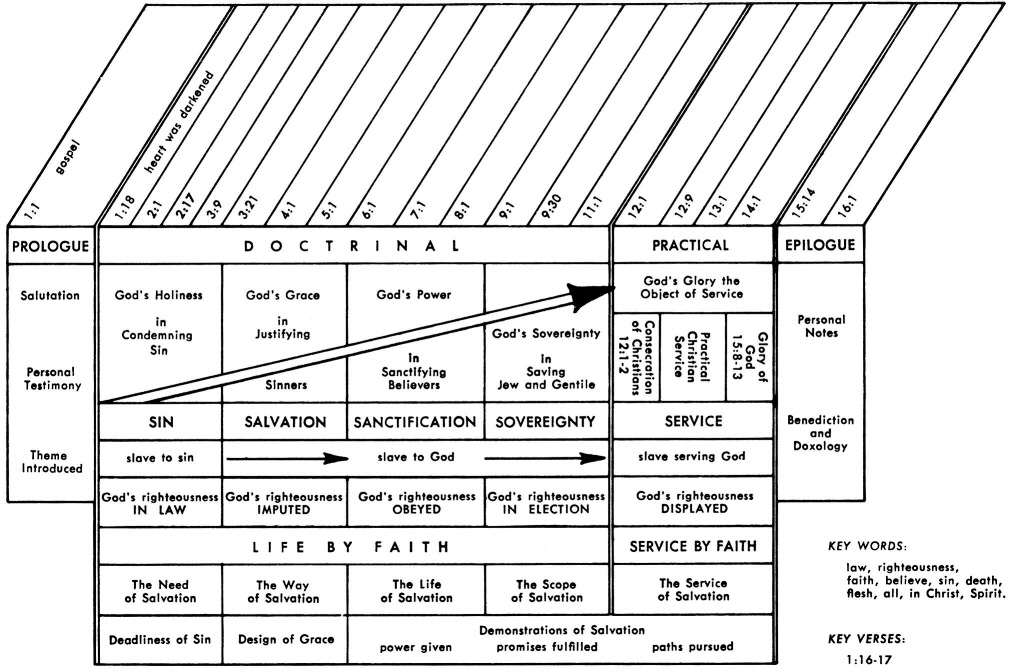
Click chart to enlarge
Chart from recommended resource Jensen's Survey of the NT - used by permission
Romans Overview Chart - Charles Swindoll
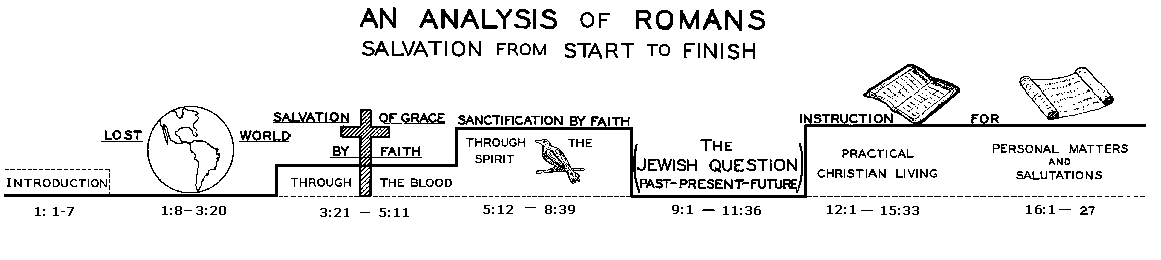
Source: Dr David Cooper
Click to Enlarge
R Ruin (Romans 1:17 – 3:20) – The utter sinfulness of humanity
O Offer (Romans 3:21-31) – God’s offer of justification by grace
M Model (Romans 4:1-25) – Abraham as a model for saving faith
A Access (Romans 5:1-11) – The benefits of justification
N New Adam (Romans 5:12-21) – We are children of two “Adams”
S Struggle w/ Sin (Romans 6-8) Struggle, sanctification, and victory
|
ROMANS ROAD |
||||
| Romans 1:18-3:20 | Romans 3:21-5:21 | Romans 6:1-8:39 | Romans 9:1-11:36 | Romans 12:1-16:27 |
| SIN | SALVATION | SANCTIFICATION | SOVEREIGNTY | SERVICE |
| NEED FOR SALVATION |
WAY OF SALVATION |
LIFE OF SALVATION |
SCOPE OF SALVATION |
SERVICE OF SALVATION |
| God's Holiness In Condemning Sin |
God's Grace In Justifying Sinners |
God's Power In Sanctifying Believers |
God's Sovereignty In Saving Jew and Gentile |
Gods Glory The Object of Service |
| Deadliness of Sin |
Design of Grace |
Demonstration of Salvation | ||
| Power Given | Promises Fulfilled | Paths Pursued | ||
| Righteousness Needed |
Righteousness Credited |
Righteousness Demonstrated |
Righteousness Restored to Israel |
Righteousness Applied |
| God's Righteousness IN LAW |
God's Righteousness IMPUTED |
God's Righteousness OBEYED |
God's Righteousness IN ELECTION |
God's Righteousness DISPLAYED |
| Slaves to Sin | Slaves to God | Slaves Serving God | ||
| Doctrine | Duty | |||
| Life by Faith | Service by Faith | |||
|
Modified from Irving L. Jensen's chart above |
||||
Romans 16:25 Now to Him who is able to establish you according to my gospel and the preaching of Jesus Christ, according to the revelation of the mystery which has been kept secret for long ages past, (NASB: Lockman)
Greek: To de dunameno (PPPMSD) humas sterixai (AAN) kata to euaggelion mou kai to kerugma Iesou Christou, kata apokalupsin musteriou chronois aioniois sesigemenou (RPPNSG)
Amplified: Now to Him Who is able to strengthen you in the faith which is in accordance with my Gospel and the preaching of (concerning) Jesus Christ (the Messiah), according to the revelation (the unveiling) of the mystery of the plan of redemption which was kept in silence and secret for long ages (Amplified Bible - Lockman)
NLT: Now all glory to God, who is able to make you strong, just as my Good News says. This message about Jesus Christ has revealed his plan for you Gentiles, a plan kept secret from the beginning of time. (NLT - Tyndale House)
Phillips: "Now to him who is able to set you on your feet as his own sons - according to my Gospel, according to the preaching of Jesus Christ himself, and in accordance with the disclosing of that secret purpose which, after long ages of silence (Phillips: Touchstone)
Wuest: Now, to the One who is of power to establish you according to my gospel, even the proclamation concerning Jesus Christ, according to the uncovering of the mystery which during eternal times has been kept in silence
Young's Literal: God is able to make you strong, just as the Good News says. It is the message about Jesus Christ and his plan for you Gentiles, a plan kept secret from the beginning of time.
NOW TO HIM WHO IS ABLE : To de dunameno (PPPMSD):
- Ro 14:4; Acts 20:32; Ephesians 3:20,21; 1Thessalonians 3:13; 2Thessalonians 2:16,17; 3:3; Hebrews 7:25; 1Peter 5:10; Jude 1:24,25
- Romans 16 Resources - Multiple Sermons and Commentaries
Paul praises God for the gospel that establishes men.
Him Who is able - God is continually (present tense) able. How able is He? Paul elaborates in Ephesians 3 exalting…
Now to Him Who is able to do exceeding abundantly beyond all that we ask or think, according (proportionate to His power not a portion of it!) to the power that works within us, to Him be the glory in the church and in Christ Jesus to all generations forever and ever. Amen. (See notes Ephesians 3:20; 3:21)
Able (1410) (dunamai [word study]) (See study of related word dunamis) has sufficient power by virtue of His own inherent ability to establish those who trust in Him according to the true gospel that Paul, and every true preacher and teacher, have clearly set forth.
MacArthur notes: There is a remarkable relationship between the last three verses of Romans and the first eleven. In (see note Romans 16:25)] Paul speaks of Him who is able to establish you, and in (see note Romans 1:11) he talks of his readers being established. He speaks of my gospel, and in (see note Romans 1:1) of “the gospel of God.” He speaks of the mystery of God which has been kept secret for long ages past, and in (see note Romans 1:2) of the gospel “which He promised beforehand.” He mentions the preaching of Jesus Christ, and in Romans 1:3 the gospel concerning God’s Son. He speaks of the Scriptures of the prophets, just as he does in (Romans 1:2). He speaks of the gospel being made known to all the nations, leading to obedience of faith, and in (see note Romans 1:5) of bringing “about the obedience of faith among all the Gentiles.” (MacArthur, J: Romans 9-16. Chicago: Moody Press)
TO ESTABLISH YOU: humas sterixai (AAN):
- 2Th 2:17, 3:3, Ro 1:11, 1Th 3:2 3:13, Jas 5:8 1Pe 5:10 2Pe 1:12 Rev 3:2, Lk 22:32 cp Ro 5:2
- Romans 16 Resources - Multiple Sermons and Commentaries
"Now to him who is able to set you on your feet" (Phillips)
Establish (4741) (sterizo [word study] from histemi = to stand) means to put or place something firmly in a location, cause it to be fixed or establish it in a place. Sterizo - 14v - Lk. 9:51; Lk. 16:26; Lk. 22:32; Acts 18:23; Rom. 1:11; Rom. 16:25; 1 Thess. 3:2; 1 Thess. 3:13; 2 Thess. 2:17; 2 Thess. 3:3; Jas. 5:8; 1 Pet. 5:10; 2 Pet. 1:12; Rev. 3:2
For example in Luke Jesus explains the fixed state of the chasm that separated the two sides of Sheol declaring…
'And besides all this, between us and you there is a great chasm fixed (sterizo) in order that those who wish to come over from here to you may not be able, and that none may cross over from there to us.' (Luke 16:26)
Sterizo then means to place something firmly in a location, so as to make it firm and stable. In the present context sterizo refers to steadfastness in mind, reflecting a mental state that is settled and firmly rooted in the truth of the "gospel and the preaching of Jesus Christ".
Denney remarks that sterizo "takes us back to the beginning of the epistle (Ro 1:11). Paul wished to impart to them some spiritual gift, to the end that they might be established; but only God is able (cf Ro 14:4) to effect this result. The establishing is to take place ‘according to my gospel:’ in agreement with the gospel Paul preached. When it was achieved, the Romans will be settled and confirmed in Christianity as it was understood by the apostle.
Ray Stedman paints the following picture of "establish": "Have you ever had the desire to be established? Many people think they are established when actually they are simply stuck in the mud. Most of us think that being established means that all progress ceases. We sit down, camp there, and that is it. In that sense, there are a lot of Christians who are established. But when Paul speaks of our being established, he means putting us on solid, stable ground. Have you ever erected a picnic table and tried to find a place where all four legs touched the ground at the same time? You tried to establish it so that it would not rock, or become shaky, or uncertain. That is the idea that Paul has in mind in this word establish. God wants to bring you and me to a place where we are no longer rocking or shaky or unstable, but solid and secure. The idea is basically what all human beings look for -- an inner security from which you can handle all the problems of life. You become dependable, and have a true sense of worth, so that nothing gets to you, or shakes you up, or throws you off balance. This is the goal of all Christian teaching in the New Testament (and especially the goal of the letter to the Romans) that we believers might be brought to that place of security where we are not shaken by things, so that we do not lose our tempers easily, or get frustrated, angry, resentful or hostile; where we do not scream at our children, or yell at our mates, or get upset at the neighbors. Notice the resource that the apostle counts on to make that happen: "Now to him who is able to establish you… " It is God himself who is responsible for this. You and I are not given the final responsibility to bring this about. Isn't that encouraging? " (Read his full sermon The Great Mystery) (See also Daily Devotion: Established! Romans 16:25-27)
William Newell adds "The Greek word [sterizo] translated establish is used about 10 times in the NT concerning a settled, stable spiritual condition. We find this first in our Lord’s words to Peter: "When once thou hast turned again, establish thy brethren" (Lk 22:32). It includes not only a knowledge of the truth, and a settled persuasion in Christ of that truth; but also obedience in the power of the Spirit, to the truth: "to the end He may establish your hearts unblamable in holiness before our God and Father, at the coming of our Lord Jesus with all His saints" (1Th 3:13) ; and it also involves our testimony: "establish your hearts in every good word and work" (2Th 2:17). (Romans 16)
Who establishes? God. How? He uses men who preach the Way, the Truth, the Life in clear exposition of the gospel & of Jesus Christ. (cp same thought in Ro 1:11 [see note] where Paul wanted to impart a spiritual gift to them that they might be established, firm in their faith). Preachers are to feed the sheep pure food, which alone can equip & firmly ground them in the truth that alone sets men free & keeps them from being blown about by every wind of doctrine (Ep 4:14-ntoe). Saints who are not in the Word of God ("ain'ts') are open to deception. All saints stand in continual need of "every word that proceeds from the mouth of God" (Matt 4:4) to maintain spiritual stability. Compare Paul's prayer for the Ephesian saints (Ep 3:16, 17, 18, 19-see notes Ep 3:16; 17; 18; 19).
ACCORDING TO MY GOSPEL AND THE PREACHING OF JESUS CHRIST: kata to euaggelion mou kai to kerugma Iesou Christou:
- Ro 2:16; 2Corinthians 4:3; Galatians 2:2; 2Thessalonians 2:14; 2Timothy 2:8
- Acts 9:20; 1Corinthians 1:23; 2:2; 2Corinthians 4:5
- Romans 16 Resources - Multiple Sermons and Commentaries
My gospel - Paul says that is what God will use to establish you: "My gospel -- that which was given to me." He possessed the Gospel, because he had allowed the Gospel to possess his heart. Have you dear reader?
Some teachers have mistakenly interpreted these words to suggest that Paul had a unique gospel, and thus they have concluded that the Apostle Paul was giving a special revelation that no one else possessed -- not even Peter, James and John! This is absurd, but sadly has been taught, and people have followed bought into that lie. Paul spoke to such aberrant teaching in First Corinthians writing
"Some of you are following me; some are following Apollos; some are following Cephas, and this is wrong. We are not different; we all have the same gospel. You are making too much of men. The message is always the same," {1Cor 1:11 ff}.
He rebuked them for tending to divide and to follow certain leaders and teachers. The practical impact is that the test of all true Christian messages is that they be in line with the apostolic writings. The apostles are the ones who tell us the truth about the gospel. That is why we must always check what we hear today that claims to be Christian and see if it fits with what the apostles gave us.
Gospel (2098) (euaggelion [word study]) means good news for sinners. Through His dynamic gospel (see the "living" supernatural aspect of the gospel in Col 1:6), God is able to establish the minds and hearts of believers in the truth, to settle us, ground us, and make us firm in Him. The only gospel of God that establishes men is the gospel that proclaims Jesus Christ, which is how Paul began this letter
gospel of God which He promised beforehand through His prophets in the holy Scriptures concerning His Son. (Ro 1:1, 2-notes)
Theology was not the heart of Paul's gospel. The heart of his gospel was the revelation of a Person, Jesus Himself. All through this letter Paul has emphasized that fact again and again -- everything centers in & on Christ. He is the heart of it all. Therefore a gospel that leaves out Christ is a phony gospel.
The writers of the New Testament adapted the term Gospel as God's glorious message of salvation for lost otherwise hopeless, helpless sinners. Euaggelion is found in several combination phrases, each describing the gospel like a multifaceted jewel in various terms from a different viewpoint (from the NASB, 1977):
- the gospel of the kingdom (Mt 4:23, Mt 9:35, Mt 24:14)
- the gospel of Jesus Christ, the Son of God (Mk 1:1) because it centers in Christ
- the gospel of God (Mk 1:14, Ro 15:16, 2Co 11:7, 1Th 2:2, 1Th 2:8,9, 1Pe 4:17) because it originates with God and was not invented by man
- the gospel of the kingdom of God (Lu 16:16)
- the gospel of the grace of God (Acts 20:24, Ro 1:1),
- the gospel of His Son (Ro 1:9)
- the gospel of Christ (Ro 15:19, 2Co 2:12, 2Co 9:13, 2Co 10:14, Gal 1:7, Phil 1:27, 1Th 3:2)
- the gospel of the glory of Christ (2Co 4:4)
- the gospel of your salvation (Eph 1:14)
- the gospel of peace (Eph 6:15)
- the gospel of our Lord Jesus (2Th 1:8)
- the glorious gospel of the blessed God (1Ti 1:11)
- In Ro 16:25, 26 Paul called it “my Gospel” indicating that the special emphasis he gave the gospel in his ministry.
- An eternal gospel - Rev 14:6 (Some writers such as C I Scofield interpret this as a "different gospel" than the other "gospels" mentioned above but I think such a distinction is incorrect and is poorly substantiated).
For a rewarding study, study the preceding references in context making notation of the truth you observe about the gospel. If you would like a special blessing, take an afternoon to go through all 76 uses of euaggelion in context making a list of what you learn about the gospel. The Spirit of God will enlighten your heart and encourage your spirit in a very special way...and you'll want to share the "good news" with someone because of your "discoveries"!
Euaggelion - Matt. 4:23; Matt. 9:35; Matt. 24:14; Matt. 26:13; Mk. 1:1; Mk. 1:14; Mk. 1:15; Mk. 8:35; Mk. 10:29; Mk. 13:10; Mk. 14:9; Mk. 16:15; Acts 15:7; Acts 20:24; Rom. 1:1; Rom. 1:9; Rom. 1:16; Rom. 2:16; Rom. 10:16; Rom. 11:28; Rom. 15:16; Rom. 15:19; Rom. 16:25; 1 Co. 4:15; 1 Co. 9:12; 1 Co. 9:14; 1 Co. 9:18; 1 Co. 9:23; 1 Co. 15:1; 2 Co. 2:12; 2 Co. 4:3; 2 Co. 4:4; 2 Co. 8:18; 2 Co. 9:13; 2 Co. 10:14; 2 Co. 11:4; 2 Co. 11:7; Gal. 1:6; Gal. 1:7; Gal. 1:11; Gal. 2:2; Gal. 2:5; Gal. 2:7; Gal. 2:14; Eph. 1:13; Eph. 3:6; Eph. 6:15; Eph. 6:19; Phil. 1:5; Phil. 1:7; Phil. 1:12; Phil. 1:16; Phil. 1:27; Phil. 2:22; Phil. 4:3; Phil. 4:15; Col. 1:5; Col. 1:23; 1 Thess. 1:5; 1 Thess. 2:2; 1 Thess. 2:4; 1 Thess. 2:8; 1 Thess. 2:9; 1 Thess. 3:2; 2 Thess. 1:8; 2 Thess. 2:14; 1 Tim. 1:11; 2 Tim. 1:8; 2 Tim. 1:10; 2 Tim. 2:8; Phlm. 1:13; 1 Pet. 4:17; Rev. 14:6
ACCORDING TO THE REVELATION OF THE MYSTERY WHICH HAS BEEN KEPT SECRET FOR LONG AGES PAST: kata to euaggelion mou kai to kerugma Iesou Christou, kata apokalupsin musteriou chronois aioniois sesigemenou (RPPNSG):
- 1Corinthians 2:7; Ephesians 1:9; Colossians 1:26,27) (Psalms 78:2; Daniel 2:22; Amos 3:7; Matthew 13:17,35; Luke 10:23,24; Ephesians 3:3, 4, 5,9,11; 1Peter 1:10, 11, 12,20
- Romans 16 Resources - Multiple Sermons and Commentaries
GOD HAS REVEALED
THE MYSTERY TO US
Revelation (6028) (apokalupsis [word study] from apó = from + kalúpto = cover, conceal) literally pictures an unveiling or uncovering of something hidden, this uncovering providing "light and knowledge" to those who behold it. The idea is exposing to full view what heretofore was hidden, veiled or secret. Revelation is a disclosure. In short what was once unknown, is now revealed.
Apokalupsis - 18x in 18v - Luke 2:32; Rom 2:5; 8:19; 16:25; 1 Cor 1:7; 14:6, 26; 2 Cor 12:1, 7; Gal 1:12; 2:2; Eph 1:17; 3:3; 2 Thess 1:7; 1 Pet 1:7, 13; 4:13; Rev 1:1. NAS = revealed(1), revealing(1), revelation(14), revelations(2).
Mystery(3466) (musterion [word study] from mustes = one initiated [as into the Greco-Roman religious "mystery" cults] from mueo = to close or shut) was a common Greek word which in its classic use referred to the secrets imparted only to initiates in the famous "mystery cults" of that day. In modern vernacular "mystery" continues to imply something hidden & unknown & even unknowable! In contrast, the NT uses musterion to describe truth previously hidden but now divinely revealed.
Musterion - 28x in 28v - Matt 13:11; Mark 4:11; Luke 8:10; Rom 11:25; 16:25; 1 Cor 2:1, 7; 4:1; 13:2; 14:2; 15:51; Eph 1:9; 3:3f, 9; 5:32; 6:19; Col 1:26f; 2:2; 4:3; 2 Thess 2:7; 1 Tim 3:9, 16; Rev 1:20; 10:7; 17:5, 7
When Paul uses musterion (and his is the major use 20 out of 27x in NT) he does so to describe a spiritual truth which has been long hidden but has been revealed to man by God in His time.
The "mystery" Paul is referring to is the fact that God intends to unite both Jews and Gentiles into one body (cf "mystery" in [see notes Romans 11:25; 11:26] "… mystery… that a partial hardening has happened to Israel until the fulness of the Gentiles has come in & thus all Israel will be saved… ").
Thus as Paul has already taught for the two to become one body in Christ (the "church"), the Jews are now partially blinded for a while, in order to allow the Gentiles to see. This partial blindness of Israel has been going on for about 2,000 years. This mystery of the Gentiles joining the Jews in salvation is also discussed in [see notes Ephesians 3:1; 3:2; 3:3; 3:4; 3:5; 3:6] where Paul explained
that the Gentiles are fellow heirs and fellow members of the body & fellow partakers of the promise in Christ Jesus through the gospel". (see notes Ephesians 3:6)
Ray Stedman adds the following insight to help understand the profound truths of the "mystery":
"The heart of the mystery is given to us in the opening chapter of Colossians. Here is one of the clearest statements on it (Col 1:24, 25, 26, 27-See notes Col 1:24; 25; 26; 27) "… this mystery among the Gentiles which is Christ in you the hope of glory"). There is the mystery. All that God is, wrapped up in a Person and given to you and to me -- the only hope we have of ever discovering the glory that God intended for us as human beings: Christ in you, the hope of glory… Jesus himself is the mystery (see 1 Tim 3:16). By means of the virgin birth of Jesus, by means of his holy, sinless life, by means of his substitutionary death upon a violent and cruel cross, by means of his startling break-out from the prison of death, and by means of the gift of the Holy Spirit on the day of Pentecost, God has given Jesus -- all that he is and all that he has -- to you and to me. This enables us to do two things: To deny our natural abilities and strengths, and to rely wholly on Jesus' ability & strength -- & thus to live our lives today as though Jesus Himself was living them. That is the mystery. That is the radical, powerful secret of authentic Christianity: Christ in you, the hope of glory. Do you know that mystery? Do you know it, not only in your mind, but do you live it? It is the knowledge of it and the living of it that turns Christianity into an exciting adventure. It may be demanding, it may even be scary, but I can guarantee you one thing: It will never be boring, because the mystery is at work. If you are filled with the secret, the indwelling Christ, it does not make any difference if you are a Jew or a Gentile. All the divisions of class and sex and national origin are eliminated by that secret. It does not make any difference whether you are rich or poor, slave or free, all are one in Christ Jesus by that mystery. And whenever a Christian lives on that basis, really trusting the fact that God is in him through Jesus Christ to be his wisdom, his power, his strength; when he attempts things only on the basis of expecting God to fulfill that promise, and moves out to do things by His grace, he finds himself established. If you want a place of security, it is not going to come by your reckoning on what you can do for God. That will never work. It is going to depend on how much you believe God is ready to do something through you. That is the radical promise… What a change happens when people really capture this and begin to operate on it… by the death of Jesus, God cut off all the natural abilities and strengths that we have, and rendered them worthless. The New Testament teaches us that the flesh cannot please God… Jesus himself, the bread that came down from heaven, is available to us. His strength, His power, operating through the channel of our gifts, can accomplish what we could never do by ourselves. God at work within us; that is the mystery… in every situation throughout the week, every moment of pressure and every demand upon us are simply opportunities to respond by realizing again the validity of the mystery. " Jew & Gentile one in Christ & Christ in us the hope of glory. What a note to end the book of Romans on! (Read his full sermon The Great Mystery) ) (Bolding added)
Ray Stedman makes a piercing comment regarding the revelation of the mystery
Here is the ultimate test of any Christian message: Does it proclaim the mystery? There are thousands of places in this land today where people are meeting, as we are, in Christian churches. They are singing the same hymns we sing, and reading the same Bible, and praising God in the same way. And yet, in thousands and thousands of those churches, there is nothing exciting happening, nothing that reaches out and touches the community. Do you know why? Because the mystery is not being proclaimed. After the early service this morning someone told me of a town in California of about 8,000 people, where there are 22 churches. And, according to this individual, almost all of these churches are lifeless. Nothing is happening because they do not understand the mystery. Here is the heart of the gospel, this amazing mystery. The question we need to ask about any church is,
"Does it ask men and women to live on the basis of that fantastic secret, which was once hidden but is now fully revealed?" (The Great Mystery) ) (Bolding added)
Stedman adds that
"It is God who does the strengthening in our lives, and, Paul says, it will always be… by three particular means:
(1) "according to my gospel, and the preaching of Jesus Christ." That is, it will be right along the lines that the Holy Spirit has led me to set before you, and no other way. God will not move in different ways in your life than he has recorded in the Scriptures. If you want to know how God will work for you, study your Bible -- that is how he will work with you. It is according to the gospel, and along these lines, and above all, "according to the preaching of Jesus Christ, because he is the one whose life, indwelling us, makes possible strength in our experience.
(2) Strengthening will be "according to the revelation of the mystery which was kept secret." What was the mystery? Simply the mystery that God would call out from Jew and Gentile alike the people who would belong to him and to each other. This is important because, if you are going to be strengthened in your Christian life, it means that it will be in connection with other believers as well. It is impossible for a Christian to grow strong all by himself. We need each other, and we need all the others who belong to the body of Christ. This is the great mystery -- as we share together in the life of our Lord Jesus and in each other, we grow strong in the Lord.
(3) strengthening is "according to the command of God to bring about obedience to the faith," i.e., the final great foundation upon which all our Christian growth and strength rests is the fact that God has set about a task which he will perform. As Paul writes to the Philippians, "being confident that he who has begun a good work in you will perform it until the day of Jesus Christ," {cf, notes Philippians 1:6}. (The Great Mystery) )
Kept secret (4601) (sigao sigao from sige = silence) mean to be silent, to "hold one's peace", to keep in silence or keep secret. The idea is to say nothing, keep still, keep silent (eg, Lk 9:36) or to stop speaking (eg, Lk 18:39). In the passive voice sigao means to be kept in silence. Finally, sigao can convey idea of keeping something from becoming known, to be concealed or to be kept secret (the only NT use with this meaning being here in Ro 16:25)
Sigao is in the perfect tense emphasizing the state of silence or kept in a state of silence
There are 10 uses of sigao in the Septuagint (LXX) (Exod. 14:14; Ps. 32:3; 39:2; 50:21; 83:1; 107:29; Eccl. 3:7; Isa. 32:5; Lam. 3:49; Amos 6:10) and here are some representative uses…
Exodus 14:14 "The LORD will fight for you while you keep silent."
Psalm 32:3 When I kept silent about my sin, my body wasted away through my groaning all day long. (Spurgeon's note)
Sigao is used 10 in the NT…
Luke 9:36 And when the voice had spoken, Jesus was found alone. And they kept silent, and reported to no one in those days any of the things which they had seen.
Luke 18:39 And those who led the way were sternly telling him to be quiet; but he kept crying out all the more, "Son of David, have mercy on me!"
Luke 20:26 And they were unable to catch Him in a saying in the presence of the people; and marveling at His answer, they became silent.
Acts 12:17 But motioning to them with his hand to be silent, he described to them how the Lord had led him out of the prison. And he said, "Report these things to James and the brethren." And he departed and went to another place.
Acts 15:12 And all the multitude kept silent, and they were listening to Barnabas and Paul as they were relating what signs and wonders God had done through them among the Gentiles. 13 And after they had stopped speaking, James answered, saying, "Brethren, listen to me.
Romans 16:25 Now to Him who is able to establish you according to my gospel and the preaching of Jesus Christ, according to the revelation of the mystery which has been kept secret for long ages past,
1Corinthians 14:28 but if there is no interpreter, let him keep silent in the church; and let him speak to himself and to God… 30 But if a revelation is made to another who is seated, let the first keep silent… 34 Let the women keep silent in the churches; for they are not permitted to speak, but let them subject themselves, just as the Law also says.
Long ages past - "in the times of the ages"
Romans 16:26 but now is manifested, and by the Scriptures of the prophets, according to the commandment of the eternal God, has been made known to all the nations, leading to obedience of faith; (NASB: Lockman)
Greek: phanerothentos (AAPNSG) de nun dia te graphon prophetikon kat' epitagen tou aioniou theou eis hupakoen pisteos eis panta ta ethne gnoristhentos, (AAPNSG)
Amplified: But is now disclosed and through the prophetic Scriptures is made known to all nations, according to the command of the eternal God, [to win them] to obedience to the faith (Amplified Bible - Lockman)
NLT: But now as the prophets foretold and as the eternal God has commanded, this message is made known to all Gentiles everywhere, so that they too might believe and obey him (NLT - Tyndale House)
Phillips: has now been made known (in full agreement with the writings of the prophets long ago), by the command of the everlasting God to all the Gentiles, that they might turn to him in the obedience of faith (Phillips: Touchstone)
Wuest: but now has been made known through prophetic writings according to the mandate of the eternal God, having been made known with a view to the obedience to the Faith among all nations
Young's Literal: But now as the prophets foretold and as the eternal God has commanded, this message is made known to all Gentiles everywhere, so that they might believe and obey Christ.
BUT NOW IS MANIFESTED: phanerôthentos (AAPNSG) de nun:
- Ephesians 1:9; Colossians 1:26; 2Timothy 1:10; Titus 1:2,3
- Romans 16 Resources - Multiple Sermons and Commentaries
But now emphasizes the contrast - now there is a difference.
Manifested (5319) (phaneroo from phanerós = manifest, visible, conspicuous in turn derived from phaino = give light or become visible and finally derived from the root word phos = light) means become visible, revealed and known. The verb is in the "divine passive."
Phaneroo means to make visible that which has been hidden & to cause it to be seen, uncovered, laid bare or revealed. Therefore phaneroo means more than to just appear. A person may appear in a false guise or without a disclosure of what he truly is. To be manifested is to be revealed in one's true character; this is esp meaning in [cf John 3:21, 1Cor 4:5, 2Cor 5:10, 11]. So this "mystery" is now no longer a mystery in the usual secular sense but is open for all to see, having been clearly made visible in the gospel Paul expounds in this great epistle.
The mystery has been revealed and Paul uses the aorist tense to point to a definite event, specifically the first coming (or in context the manifestation or appearance) of Christ. This manifestation is clearly seen in the Gospel of God concerning His Son (Ro 1:1, 2, 3, 4-see notes Ro 1:1; 1:2; 1:3; 1:4) & has been made known to the Gentiles (Ro 1:5). In Creation God has manifested (phaneroo) His glory (Ro 1:19) but He most fully made His glory manifest in Christ -- as clearly taught in each of the following Scriptures, where each uses the same Greek verb, "phaneroo", found in this verse (Ro 3:21, John 2:11, John 17:3, see esp Col 1:26, 1Ti 3:16, 2Ti 1:10, Titus 1:3, Heb 9:26, 1Pe 1:20, 1John 1:2, 1John 3:8, 1John 4:9)
AND BY THE SCRIPTURES OF THE PROPHETS: dia te graphôn prophêtikôn:
- Ro 1:2; 3:21; 15:4; Acts 8:32,33, 34, 35; 10:43; 26:22,23; Galatians 3:8; Ephesians 2:20; Revelation 19:10
- Romans 16 Resources - Multiple Sermons and Commentaries
Scriptures (1124)(see in depth study of graphe) which is used 51x in 51v and in 50 uses refers to the Old Testament, the one exception being Peter's reference in 2 Peter 3:16 to Paul's letters.
by the Scriptures of the prophets - This phrase clearly refers to the OT Scriptures. What does Paul mean? His point is that in developing the great doctrines of the Gospel, as in Romans, Paul did so within the prophetic framework of the Old Testament Scriptures. In Romans Paul quoted from the Old Testament, directly or indirectly some 50 times using the OT to buttress and reinforce his arguments. And discussed below the gospel was present in the OT, Paul writing to the Galatians…
And the Scripture, foreseeing that God would justify the Gentiles by faith, preached the gospel beforehand to Abraham, saying, "ALL THE NATIONS SHALL BE BLESSED IN YOU." (Gal 3:8)
The mystery that now is manifested had been predicted in veiled words in many of the Scriptures of the prophets (cf Isa 53:11, Jer 31:31, 33, Ezek 11:19, etc). The full meaning of the OT prophecies has become apparent in the coming of the Messiah. The tragedy is that Jews had always thought that these OT predictions, applied only to them, the chosen race of God. But even to God’s inspired prophets under the Old Covenant, the full meaning of their prophecies was a "mystery" as taught by Peter (1Pe 1:10, 11-notes).
Yet, when God first made His covenant with Abraham, the father of His chosen people Israel, He alluded to His offering of grace to the whole world.
“In you (Abraham) all the families of the earth shall be blessed” (Ge 12:3 cf Gal 3:8 "the Scripture, foreseeing that God would justify the Gentiles by faith, preached the gospel beforehand to Abraham")
When God made the covenant with His people through Moses at Mt. Sinai, He said,
“You shall be to Me a kingdom of priests and a holy nation” (Ex 19:6).
In other words, it was God’s design that Israel, as a nation, was to be a priest, a mediator of God, for the rest of the world. And so Paul clearly showed these aspects of the gospel in the third major section of Romans (Rom 9-16).
Paul taught that God made
“known the riches of His glory upon vessels of mercy,… not from among Jews only, but also from among Gentiles. As He says also in Hosea, ‘I will call those who were not My people, “My people,” and her who was not beloved, “beloved’ ” (See notes Romans 9:23; 9:24; 9:25).
For the Scripture says, ‘Whoever believes in Him will not be disappointed.’ For there is no distinction between Jew and Greek; for the same Lord is Lord of all” (see note Romans 10:11; 10:12).
ACCORDING TO THE COMMANDMENT OF THE ETERNAL GOD: kat epitagên tou aiôniou theou:
- commandment - Matthew 28:19,20; Mark 16:15; Luke 24:44, 45, 46, 47; Acts 13:46,47; 26:17,18
- eternal God - Ro 1:20; Genesis 21:33; Deuteronomy 33:27; Isaiah 9:6; 40:28; Micah 5:2; 1Timothy 1:17; Hebrews 9:14; 13:8; 1John 5:20; Revelation 1:8, 9, 10, 11,17
- Romans 16 Resources - Multiple Sermons and Commentaries
The manifestation of the mystery of Christ took place by divine commandment.
Abraham referred to the eternal God in Genesis 21:33
Abraham planted a tamarisk tree at Beersheba, and there he called on the name of the LORD, the Everlasting God. (see El Olam: Everlasting God)
Eternal (1668) (aionios) (Click study of eternal one of glorious Attributes of God) emphasizes God's changeless character, the point being that although the "mystery" was revealed only lately, it was not because God had changed His mind. See additional discussion of aionios in study of eternal punishment, specifically the importance of an accurate understanding of aionios as a refutation of the false teaching of universalism (everyone will be saved).
Part of the essence of the revealed mystery of the Gospel is that the God of creation is the everlasting God and has always been concerned with "all nations" any of whom can be saved by "the obedience of faith".
Eternal means that God existed before He created anything. Time dwells within God. He causes, affects, and controls it, but time has no hold on Him. Everything about God is "always"
Ps 102:12 "Thou, O Lord, dost abide forever and Thy name to all generations." (Spurgeon's Comment)
God’s nature is without beginning and without end, free from all succession of time. God dwells in eternity. Eternal does not just refer to an extended period of time but rather is existence above and apart from time. God contains in Himself the cause of time! Time has no control over God and He does not have to work within the strictures of time unless He so pleases. Being eternal, He is free to bestow eternality on His creation in His good pleasure. All of God’s attributes bask in His eternality. Since eternity neither wears out nor runs out, neither do His attributes.
Do you not know? Have you not heard? The Everlasting God, the Lord, the Creator of the ends of the earth does not become weary or tired. His understanding is inscrutable." (Isaiah 40:28)
Man's life is short and the universe too is perishable but God is eternal. Be encouraged dear suffering saint. The night is almost over and your day is at hand. Take heart, for you will soon spend eternity with the Eternal God!
The eternal God sovereignly works out His eternal purpose and in so doing the mystery is revealed. The same adjective aiônios that is here applied to God, is also used to modify eternal life and eternal punishment (Mt 25:46) which should silence the false notion that perdition or the lake of fire (gehenna) is transitory!
HAS BEEN MADE KNOWN TO ALL THE NATIONS: eis panta ta ethnê gnôristhentos (AAPNSG):
- Romans 16 Resources - Multiple Sermons and Commentaries
Has been made known (1107) (gnorizo) means to cause information to be known by someone communicating things before unknown or reasserting things already known, in this case referring to spiritual insight and understanding. Paul is explaining that God has not forgotten anyone, Jews or Gentiles. The aorist tense (and divine passive) describes a definitive action effectually performed though not stating necessarily when.
All (all) (pas) means all without exception, therefore all are without excuse.
Nations (1484) (ethnos - English "ethnic") defines a body of persons united by kinship, culture, and common traditions. In this verse Nations is preceded by the definite article ("the") in the Greek text, marking Gentiles out as a distinct class. Basically all of mankind can be divided into Jew and Gentile and thus "Gentile" is a synonym for anyone who is non-Jew, who is not a member of the "chosen people". The Hebrew word corresponding to Gentile is goyim.
From Genesis 12 onward the majority of the Scriptures are about the Jews, with the Gentiles mentioned as they interface with the Jews. The NT does have more mention of the Gentiles after the formation of the Church (and Acts was written by a Gentile, Dr Luke), but the last book, the book of Revelation is predominantly Jewish with over 200 OT quotes or allusions to OT passages.
To all the nations - that is to all the Gentiles, to whom Jesus had appointed Paul as an apostle. Paul was faithful to fulfill the work his Lord entrusted to him. What will be written at the end of your "letter"? Faithful to the end having accomplished the goal for which He set you aside? May, we all be found as faithful to our calling as was the apostle Paul. Amen.
The purpose of the revelation of the mystery is ultimately to bring about the obedience found in genuine faith among "all the nations" which speaks of this truth being available throughout the world.
LEADING TO OBEDIENCE OF FAITH: eis hupakoên tês pisteôs:
- Ro 1:5; 15:18; Acts 6:7
- Romans 16 Resources - Multiple Sermons and Commentaries
Related Resource:
Obedience of faith - This repeated phrase forms a pair of emphatic "bookends" enclosing Paul's magnum opus on the gospel of Jesus Christ…
through Whom we have received grace and apostleship to bring about the obedience of faith among all the Gentiles, for His name's sake (see note Romans 1:5)
The discerning reader should be aware that some otherwise evangelical resources make statements which acknowledge that genuine faith generally issues in obedience to God, but go on to add the dangerous exception clause stating that Paul is not teaching that saving faith always results in ongoing (habitual) obedience to God, not perfection and not occasions and even seasons of carnality, but not a continuing lifestyle of carnality. It a person never exhibited any change in their behavior after "accepting Christ", how would you ever know they were a brand new creation with a new power source (the indwelling Spirit Who gives us both the desire and the power to obey). In other words some of these evangelical teachers say once you are saved by faith alone (this part is absolutely correct) it does not make any difference how you live the rest of your life (this is not correct or otherwise John was in error when he wrote his first letter - see below). This surreptitious teaching is potentially misleading as it comes very close to the old heresy of anti-nomianism (that says you can be saved and live any way you want!) that John addressed head on in his first short but very pithy epistle warning the saints…
Little children, let no one deceive you (present imperative with a negative = stop an action already going on in the body - notice from the context what they would be being deceived concerning); the one who practices (present tense = habitually, as their lifestyle, not perfection but the general direction of one's life is "heaven-ward", not "hell-ward"!) righteousness is righteous, just as He is righteous 8 the one who practices (present tense = habitually, as their lifestyle; i.e., the general direction of their life is not "heaven-ward", but "hell-ward"!) sin is of the devil; (Listen, if you know someone who says they prayed a prayer, walked an aisle, made a profession, etc to Jesus but you can see from their life that they are living like the devil, you are obligated to warn them that their faith may not be genuine and they might be in grave danger of missing heaven because someone has presented them a watered down gospel - and don't be dissuaded by the objection that you are being judgmental Mt 7:1, which Barna surveys have recently reported as the most well known Bible verse replacing John 3:16!) for the devil has sinned from the beginning. The Son of God appeared for this purpose, that He might destroy the works of the devil. 9 No one (How many? No one - the Greek word indicating absolute negation - no exceptions!) who is born of God practices (present tense = habitually, as their lifestyle) sin, because His seed (it is a Holy seed, the promised Holy Spirit) abides in him; and he cannot (present tense = continually, as a lifestyle) sin, because he is born of God. 10 By this the children of God and the children of the devil are obvious: anyone who does not practice (present tense = habitually, as their lifestyle) righteousness is not of God, nor the one who does not love his brother. (1John 3:7-10)
Comment: Clearly John refutes the dangerous statement that so-called "saving faith" does not always lead to ongoing obedience. In fact genuine faith does lead to ongoing obedience. No, clearly none of us manifest perfect ongoing obedience, but the general tenor and direction of our spiritual life is Godward, toward heaven, and not devilishly toward hell! Sure someone can be "backslidden" for a period of time, even a relatively long period, but not for their entire life! Do not let anyone deceive you, even if they have a Thd after their name! (Although I am an "MD", I'm not against "Thd's", just reminding you ot to not let go of your discernment - even Paul was checked out by the Bereans - Acts 17:11!)
Obedience (5218) (hupakoe [word study] from hupó = under + akoúo = hear) literally means "hearing under", that is, listening from a subordinate position in which compliance with what is said is expected and intended. Hupakoe speaks of the one hearing as being under the authority of some one else. Thus, hupakoe comes to mean compliance (disposition to yield to another) with the demands or requests of someone over us. Obedience is submission or hearkening to a command. Obedience is the carrying out the word and will of another person, in the context of the book of Romans clearly the will of God the Father and our Lord Jesus Christ.
Hupakoe conveys the picture of one listening and following instructions. Submitting to that which is heard involves a change of attitude, forsaking the tendency of the fallen nature to rebel against Divine instructions and commands (synonymous with repentance) and a sincere seeking of God's will, not one's self will. Someone has said that a "proof" that we are of the elect is not an empty prating about how secure we are once we believed, but rather how sensitive we are to the principle and practice of obedience to Jesus.
Thomas Watson…Faith makes God ours! Other graces make us like Christ—faith makes us one with Him. And this faith is known by its virtue. Precious faith has virtue in it; it quickens and ennobles; it puts worth into our services
Faith (4102) (pistis) is synonymous with trust or belief and is the conviction of the truth of anything, but in Scripture usually speaks of belief respecting man's relationship to God and divine things, generally with the included idea of trust and holy fervor born of faith and joined with it.
Faith is relying on what God has done rather than on one’s own efforts. In the Old Testament, faith is rarely mentioned. The word trust is used frequently, and verbs like believe and rely are used to express the right attitude to God. The classic example is Abraham, whose faith was reckoned as righteousness (Ge 15:6). At the heart of the Christian message is the story of the cross: Christ’s dying to bring salvation. Faith is an attitude of trust in which a believer receives God’s good gift of salvation (Acts 16:30,31) and lives in that awareness thereafter (Gal 2:20; cf. Heb 11:1).
Wayne Grudem defines faith that saves one's soul…Saving faith is trust in Jesus Christ as a living person for forgiveness of sins and for eternal life with God. This definition emphasizes that saving faith is not just a belief in facts but personal trust in Jesus to save me… The definition emphasizes personal trust in Christ, not just belief in facts about Christ. Because saving faith in Scripture involves this personal trust, the word “trust” is a better word to use in contemporary culture than the word “faith” or “belief.” The reason is that we can “believe” something to be true with no personal commitment or dependence involved in it. (Grudem, W. A. Systematic Theology: An Introduction to Biblical Doctrine Zondervan) (Bolding added)
Wuest in his study of pistis and the related words in this family, pisteuo and pistos, explains that…When these words refer to the faith which a lost sinner must place in the Lord Jesus in order to be saved, they include the following ideas; the act of considering the Lord Jesus worthy of trust as to His character and motives, the act of placing confidence in His ability to do just what He says He will do, the act of entrusting the salvation of his soul into the hands of the Lord Jesus, the act of committing the work of saving his soul to the care of the Lord. This means a definite taking of one’s self out of one’s own keeping and entrusting one’s self into the keeping of the Lord Jesus.
William Barclay notes that…Faith begins with receptivity. It begins when a man is at least willing to listen to the message of the truth. It goes on to mental assent. A man first hears and then agrees that this is true. But mental assent need not issue in action. Many a man knows very well that something is true, but does not change his actions to meet that knowledge. The final stage is when this mental assent becomes total surrender. In full-fledged faith, a man hears the Christian message, agrees that it is true, and then casts himself upon it in a life of total yieldedness. (Barclay, W: The Daily Study Bible Series, Rev. ed. Philadelphia: The Westminster Press)
When missionary John Paton was translating the Scripture for the South Sea islanders, he was unable to find a word in their vocabulary for the concept of believing, trusting, or having faith. He had no idea how he would convey that to them. One day while he was in his hut translating, a native came running up the stairs into Paton's study and flopped in a chair, exhausted. He said to Paton,
“It’s so good to rest my whole weight in this chair.”
John Paton had his word: Faith is resting your whole weight on God. That word went into the translation of their New Testament and helped bring that civilization of natives to Christ. Believing is putting your whole weight on God. If God said it, then it’s true, and we’re to believe it.
Nothing before, nothing behind,
The steps of faith
Fall on the seeming void, and find
The rock beneath -- Whittier
The following translations favor the interpretation that this is a faith which leads to obedience:
"so that they might believe and obey Christ" (NLT);
"so that all nations might believe and obey him" (NIV)
"to the obedience that is associated with faith" (GWT)
The following section includes comments from a number of evangelical sources regarding the phrase "obedience of faith". The motivation for this more in depth analysis is a modern day teaching that seems to be present even in evangelical circles and which flatly states that a person can be saved at a moment in time and then for the remainder of their life live precisely the same as they did before they were "saved". This website strongly disagrees with this interpretation and as you can see many other able commentators also disagree with this interpretation. The fact that this phrase "obedience of faith" is present in the first and last chapters should also not go unnoticed and indicates that this truth is important to Paul in his presentation of the gospel.
John Piper comments on the critical importance of understanding the phrase obedience of faith asking "How then does our own obedience—“the obedience of faith”—relate to justification? The answer is: Our obedience is not the ground or the basis of our justification. Nor is it any part of the instrument or means by which we are united to Christ who alone is the ground and the basis of our justification. Faith alone unites us to Christ and Christ alone is the ground of our justification. Our obedience is the fruit of that faith. The faith that justifies is the kind of faith that, by the Holy Spirit (Ro 8:13), changes us. If your faith in Christ leaves you unchanged, you don’t have saving faith. Obedience—not perfection, but a new direction of thought and affections and behavior—is the fruit that shows that the faith is alive. James put it this way, “So also faith by itself, if it does not have works, is dead” (James 2:17). Faith alone justifies, but the faith that justifies is never alone. It is always accompanied by “newness of life” (Ro 6:4). Live in the Joy and Assurance of the Gospel - When Paul begins and ends his letter with the goal of “the obedience of faith,” he means for us to live in the joy and the assurance of the first five chapters of Romans, where he shows that we are “justified by faith apart from works of the law” (Ro 3:28). And then out of that faith and peace and assurance and boldness, a new mind and a new man emerge and the fruit of obedience grows. And the reality of justifying faith is made manifest. I pray that you will trust in Christ alone as the ground and basis of your justification before God, present and future, and that this faith prove its life and truth by producing a passion for obedience to God—the obedience of faith. (See further relevant texts: Ro 14:23 (note); Galatians 5:6; 1Th 1:3 (note); 2Thessalonians 1:11; Hebrews 11:4, He 11:7, 8, He 11:17, He 11:24) (See full sermon Command of God: The Obedience of Faith)
Hendriksen writes that obedience was "the purpose or goal of the indicated clarification. God delights to see in an person the kind of obedience that is based on childlike trust in him."… "Such obedience is based on faith and springs from faith. In fact, so very closely are faith and obedience connected that they may be compared to inseparable identical twins. When you see the one you see the other. A person cannot have genuine faith without having obedience, nor vice versa." (Hendriksen, W., & Kistemaker, S. J. New Testament Commentary Set, 12 Volumes. Grand Rapids: Baker Book House) (Bolding added)
The Life Application Commentary writes (on the same phrase in Romans 1:5) "(Obedience) was the desired response to the gospel message and the goal of Paul’s ministry to the Roman Christians—that they would obey God because of their faith in God. The only source for the kind of obedience expected is faith in the one true God and in Jesus Christ, his Son. Faith and obedience are inseparable. Where one is lacking, the other will not be found either. Real faith will always lead to obedience; real obedience comes from faith." ((Barton, B. B., et al. Life Application Bible Commentary. Romans: Tyndale House Publishers) (Bolding added)
Jack Cottrell explains the "obedience of faith" - "The goal of all Christian preaching and witnessing, including the goal of this very letter to the Romans, is to bring about heartfelt obedience that springs from faith in Jesus as Savior and Lord." Commenting on the same phrase in Romans 1:5 he writes that in his opinion "the obedience which results from faith” … is Paul’s intended meaning (and) a wide range of commentators agree. Though it is not a strict translation, the NIV rendering is on target exegetically: “the obedience that comes from faith.” According to this understanding “faith” is the subjective act of believing, and “obedience” is the whole scope of Christian good works." (Cottrell, J. Romans: Volume 2. College Press NIV commentary. Joplin, Mo.: College Press)
Robert Mounce in The New American Commentary on the phrase "obedience of faith" writes that…
The gospel is good news for all who will respond in faith. But faith inevitably issues in obedience. Faith is not intellectual assent to a series of propositions but surrender to the one who asks us to trust him. To surrender is to obey. Biblical faith is not some mild assent to a collection of ethical maxims but an active commitment of one’s life. Obedience is the true measure of a person’s faith.
E. Best comments that
“faith and obedience go inextricably together. Only in obedience is there faith, for faith is not emotional feeling or intellectual acceptance but active response to a person.”
Paul’s desire was to take the gospel to the entire world and see the nations turn to God in a faith that changes conduct. Any other response would be inadequate. Apart from a changed life there is no real faith." (Mounce, R. H. Romans: The New American Commentary. Broadman & Holman Publishers)
The UBS Handbook (on "obedience of faith" in Romans 1:5) writes that "This is not “obedience to the faith” (Moffatt), but obedience that is caused by faith (NEB “to faith and obedience”; Goodspeed “obedience and faith”). Although “obedience” and “faith” are nouns in Greek, they describe events rather than objects, and so are better rendered by verbs." (The United Bible Societies' New Testament Handbook Series )
A T Robertson commenting on the phrase "obedience of faith" in Romans 1:5 writes that it is "Subjective genitive as in Romans 16:26, the obedience which springs from faith (the act of assent or surrender). (Robertson, A. Word Pictures in the New Testament) (Bolding added)
Marvin Vincent writes that "Obedience of faith is the obedience which characterizes and proceeds from faith." (Vincent, M. R. Word studies in the New Testament Vol. 3, Page 1-5)
Geneva Study Bible writes that "obedience of faith" indicates "both the obedience that flows from faith and the fact that faith implies obedient submission to the call of God (New Geneva study Bible. Nashville: Thomas Nelson)
J Vernon McGee writes that "Here we see the obedience of faith. When you trust Christ, you will obey Him, my friend. The Lord Jesus said, “My sheep hear My voice, and I know them, and they follow Me” (John 10:27). Obedience is the work and fruit of faith… Obedience to the faith is very important to God. God saves us by faith, not by works; but after He has saved us, He wants to talk to us about our works, about our obedience to Him (Ed note: E.g., see note Ephesians 2:10). I hear many people talk about believing in Jesus, then they live like the Devil and seem to be serving him. My friend, saving faith makes you obedient to Jesus Christ." (McGee, J V: Thru the Bible Commentary: Thomas Nelson) (Bolding added)
Matthew Henry - The gospel is revealed, not to be talked of and disputed about, but to be submitted to (Ed note: This is the idea inherent in the Greek word hupakoe - obedience). The obedience of faith is that obedience which is paid to the word of faith (see that phrase, Acts 6:7), and which is produced by the grace of faith. See here what is the right faith-even that which works in obedience; and what is the right obedience-even that which springs from faith; and what is the design of the gospel-to bring us to both. (Matthew Henry's commentary on the whole Bible)
Expositor's Bible Commentary - The desired response to the gospel message is "obedience that comes from faith. (Gaebelein, F, Editor: Expositor's Bible Commentary 6-Volume New Testament. Zondervan Publishing)
Charles Ryrie writes that this phrase could be "Either obedience that leads to initial faith (as in Acts 6:7) or obedience that results from faith. (The Ryrie Study Bible: New American Standard Translation: 1995. Moody Publishers)
D. B. Garlington in a lengthy article on the phrase obedience of faith comes to the following conclusion…
In Ro 1:5; 16:26 Paul has chosen to coin an ambiguous phrase which expresses two ideas at the same time: the obedience which consists in faith and the obedience which is the product of faith… For Paul then there could be no higher commendation of his Christian readers than that voiced by Rom 1:8—”Your faith is proclaimed in all the world”—and Rom 16:19—”Your obedience is known to all.” (Westminster Theological Seminary Journal. Vol. 52, Page 223-224, Fall, 1990)
D B GARLINGTON - Excellent Discussion of Faith and Obedience (cf "obedience of faith" in Ro 1:5)
- The Obedience of Faith in the Letter to the Romans Part I: The Meaning of Hupakoen pisteos (Ro 1:5; 16:26);
- The Obedience of Faith in the Letter to the Romans Part II- The Obedience of Faith and Judgment by Works
- The Obedience of Faith in the Letter to the Romans — Part III- The Obedience of Christ and the Obedience of the Christian
- The Obedience of Faith in the Letter to the Romans — Part III Continued
John MacArthur has a lengthy comment (actually on the same phrase "obedience of faith" - see Romans 1:5)…
A person who claims faith in Jesus Christ but whose pattern of life is utter disobedience to God’s Word has never been redeemed and is living a lie. Faith that does not manifest itself in obedient living is spurious and worthless (Jas 2:14-26-notes). We are not saved in the least part by works, no matter how seemingly good; but as already noted, we are saved to good works. That is the very purpose of salvation as far as our earthly life is concerned (Ep 2:10). The message of the gospel is to call people to the obedience of faith, which is here used as a synonym for salvation.
Although Paul does not use the definite article before faith in this passage (although the definite article is present in Ro 16:26), the idea is that of the faith, referring to the whole teaching of Scripture, especially the New Testament. It is what Jude refers to as “the faith which was once for all delivered to the saints” (Ro 1:3). That faith is the Word of God, which is the only divinely-constituted authority of Christianity. Affirmation of that faith leads to the practical, lived-out faithfulness without which a professed faith is nothing more than dead and useless (Jas 2:17; Jas 2:20). Genuine faith is obedient faith. To call men to the obedience of faith is to fulfill the Great Commission, to bring men to Jesus Christ and to the observance of everything He commands in His Word (Matt 28:20).
It is not that faith plus obedience equals salvation but that obedient faith equals salvation. True faith is verified in obedience. Obedient faith proves itself true, whereas disobedient faith proves itself false. It is for having true faith, that is, obedient faith, that Paul goes on to commend the Roman believers. “I thank my God through Jesus Christ for you all,” he says, “because your faith is being proclaimed throughout the whole world” (Ro 1:8). He gives a similar commendation at the end of the letter. To his beloved brothers and sisters in Christ, most of whom he had never met, he says, “The report of your obedience has reached to all; therefore I am rejoicing over you” (Ro 16:19). In the first instance Paul specifically commends their faith, and in the second he specifically commends their obedience. Together, faith and obedience manifest the inseparable two sides of the coin of salvation, which Paul here calls the obedience of faith." (MacArthur, J: Romans 1-8. Chicago: Moody Press)
Adam Clarke comments that…
obedience (is) the necessary consequence of genuine faith. (Clarke, A. Clarke's Commentary)
If one is not obedient (1Pe 3:1,6, 1Pet 4:17, Acts 6:7, Ro 1:5, Ro 2:8, Ro 15:18, 19, Ro 16:26, Gal 5:7, 2Th 1:8, Heb 5:9, Heb 11:8), then he or she needs to read (2Co 13:5).
Romans 16:27 to the only wise God, through Jesus Christ, be the glory forever. Amen (NASB: Lockman)
Greek: mono sopho theo dia Iesou Christou o e doxa eis tous aionas; amen
Amplified: To [the] only wise God be glory forevermore through Jesus Christ (the Anointed One)! Amen (so be it). (Amplified Bible - Lockman)
NLT: All glory to the only wise God, through Jesus Christ, forever. Amen. (NLT - Tyndale House)
Phillips: to him, I say, the only God who is wise, be glory for ever through Jesus Christ!" (Phillips: Touchstone)
Wuest: to God alone wise, through Jesus Christ, to Him [God alone wise] be the glory for ever and ever. Amen.
Young's Literal: To God, who alone is wise, be the glory forever through Jesus Christ. Amen.
TO THE ONLY WISE GOD THROUGH JESUS CHRIST BE THE GLORY FOREVER. AMEN: mono sopho theo dia Iesou Christou, o e doxa eis tous aionas, amen:
- Ro 11:36; Galatians 1:4,5; Ephesians 3:20,21; Philippians 4:20; 1Timothy 1:17; 6:16; 2Timothy 4:18; Hebrews 13:15,21; 1Peter 2:5; 5:10,11; 2Peter 3:18; Revelation 1:5,6; 4:9, 10, 11; 5:9, 10, 11, 12, 13, 14; Revelation 7:10, 11, 12; 19:1, 2, 3, 4, 5, 6
- Romans 16 Resources - Multiple Sermons and Commentaries
God is "only wise," (for discussion of "Wise" one of the Attributes of God) the only omniscient and only omnipotent one, knowing and planning and implementing all things, to accomplish His purpose in creating all things (1Ti 1:17; Jude 25).
THE IMPORTANCE OF
PREPOSITION "THROUGH"
Don't miss the importance of the preposition "through" which emphasizes that we go to the Father only through our great High Priest, Jesus.
Paul had at the outset emphasized this critical dynamic pointing out that even his authority and power was from "Jesus Christ our Lord through Whom" he had "received grace & apostleship." (Ro 1:5-ntoe).
In (Ro 1:8) he thanked God "God through Jesus Christ".
In (Ro 2:16) Paul said that "God will judge the secrets of men through Christ Jesus." In probably one of the greatest truths fallen man could ever ear, Paul explained that because of our having been justified by faith, "we have peace with God through our Lord Jesus Christ" (Ro 5:1-ntoe) and "through (Christ) also we have obtained our introduction by faith into this grace in which we stand" (Ro 5:2-ntoe).
In (Ro 5:9) Paul brought us the great news that "we shall be saved from the wrath of God through Him" because we "were reconciled to God through the death of His Son" (Ro 5:10) and for this reason we can now "exult in God through our Lord Jesus Christ, through Whom we have now received the reconciliation." (Ro 5:11-ntoe). In (Ro 5:17) Paul showed us that we "will reign in life through the One, Jesus Christ." In (Ro 5:21) he taught us that "grace might reign through righteousness to eternal life through Jesus Christ our Lord".
Again in (Ro 7:25 ) Paul thanks God "through Jesus Christ our Lord". In (Ro 8:37) "we overwhelmingly conquer through Him who loved us." is Christianity is a "through " relationship, which Christ functioning as our "conduit" for grace, reconciliation, peace, etc one one hand and as our means through which we can approach God in prayer and praise on the other.
Jude offers up a beautiful sacrifice of praise writing that "to the only God our Savior, through Jesus Christ our Lord, be glory, majesty, dominion and authority, before all time and now and forever. Amen." (Jude 25).
William Tyndale drew the following application of Romans…
“Now go to, reader, and according to the order of Paul’s writing, even so do thou. First behold thyself diligently in the law of God, and see there thy just damnation. Secondarily turn throe eyes to Christ, and see there the exceeding mercy of thy most kind and loving Father. Thirdly remember that Christ made not this atonement that thou shouldest anger God again: neither cleansed he thee, that thou shouldest return (as a swine) unto thine old puddle again: but that thou shouldest be a new creature and live a new life after the will of God and not of the flesh. And be diligent lest through thine own negligence and unthankfulness thou lose this favour and mercy again.”
Through Jesus Christ - see the study below.
Consider the following simple study - observe and record the wonderful truths that accrue through Him - this would make an edifying, easy to prepare Sunday School lesson - then take some time to give thanks for these great truths by offering up a sacrifice of praise… through Him.
John 1:3 [NIV reads "through Him"], John 1:7, John 1:10,Jn 3:17, Jn 14:6, Acts 3:16, Acts 7:25, Acts 10:43, Acts 13:38-39, Romans 5:9 [note], Romans 8:37 [note], Ro 11:36 [note]; 1Cor 8:6, Ep 2:18 [note], Php 4:13 [note], Col 1:20 [note], Col 2:15 [note], Col 3:17 [note], He 7:25 [note], He 13:15 [note],1Pe 1:21 [note], 1John 4:9
Would you like more study on the wonderful topic of through Him? Click the NT uses of the parallel phrase through Jesus or see (John 1:17, Acts 10:36, Ro 1:8, Ro 5:1,2-note v1; v2 Ro 5:21, Ro 7:25, Ro 16:27, Gal 1:1, Ep 1:5, Php 1:11, Titus 3:6, He 13:21, 1Pe 2:5, 1Pe 4:11, Jude 1:25)
All things are from Him, through Him and to Him. To Him be the glory forever. Amen.