Romans 2:2
Romans 2:3
Romans 2:4
Romans 2:5
Romans 2:6
Romans 2:7
Romans 2:8
Romans 2:9
Romans 2:10
Romans 2:11
Romans 2:12
Romans 2:13
Romans 2:14
Romans 2:15
Romans 2:16
Romans 2:17
Romans 2:18
Romans 2:19
Romans 2:20
Romans 2:21
Romans 2:22
Romans 2:23
Romans 2:24
Romans 2:25
Romans 2:26
Romans 2:27
Romans 2:28
Romans 2:29

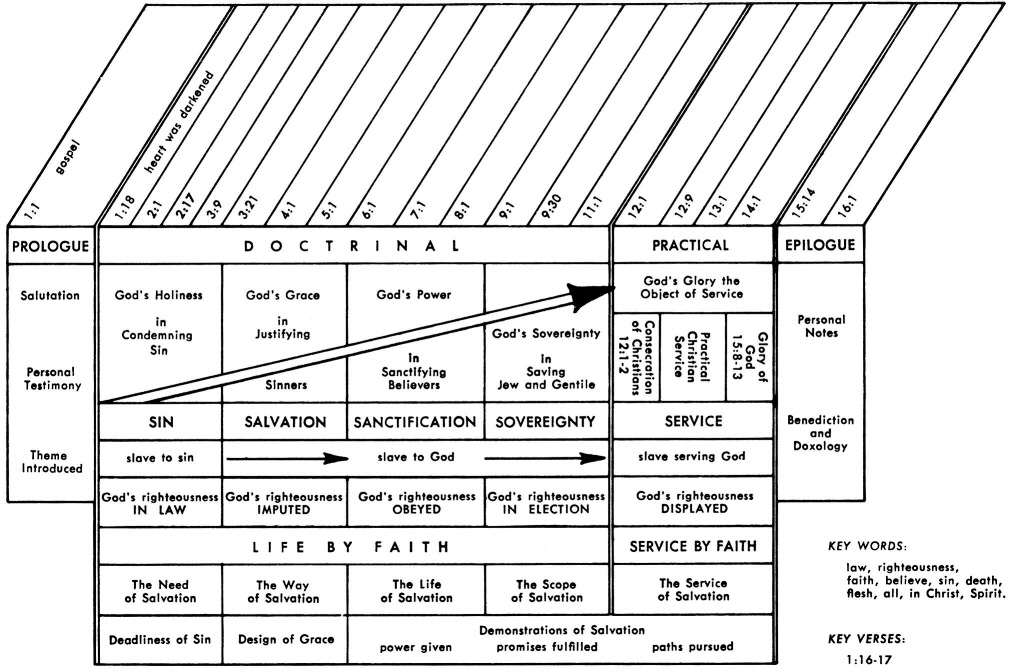
Click chart to enlarge
Chart from recommended resource Jensen's Survey of the NT - used by permission
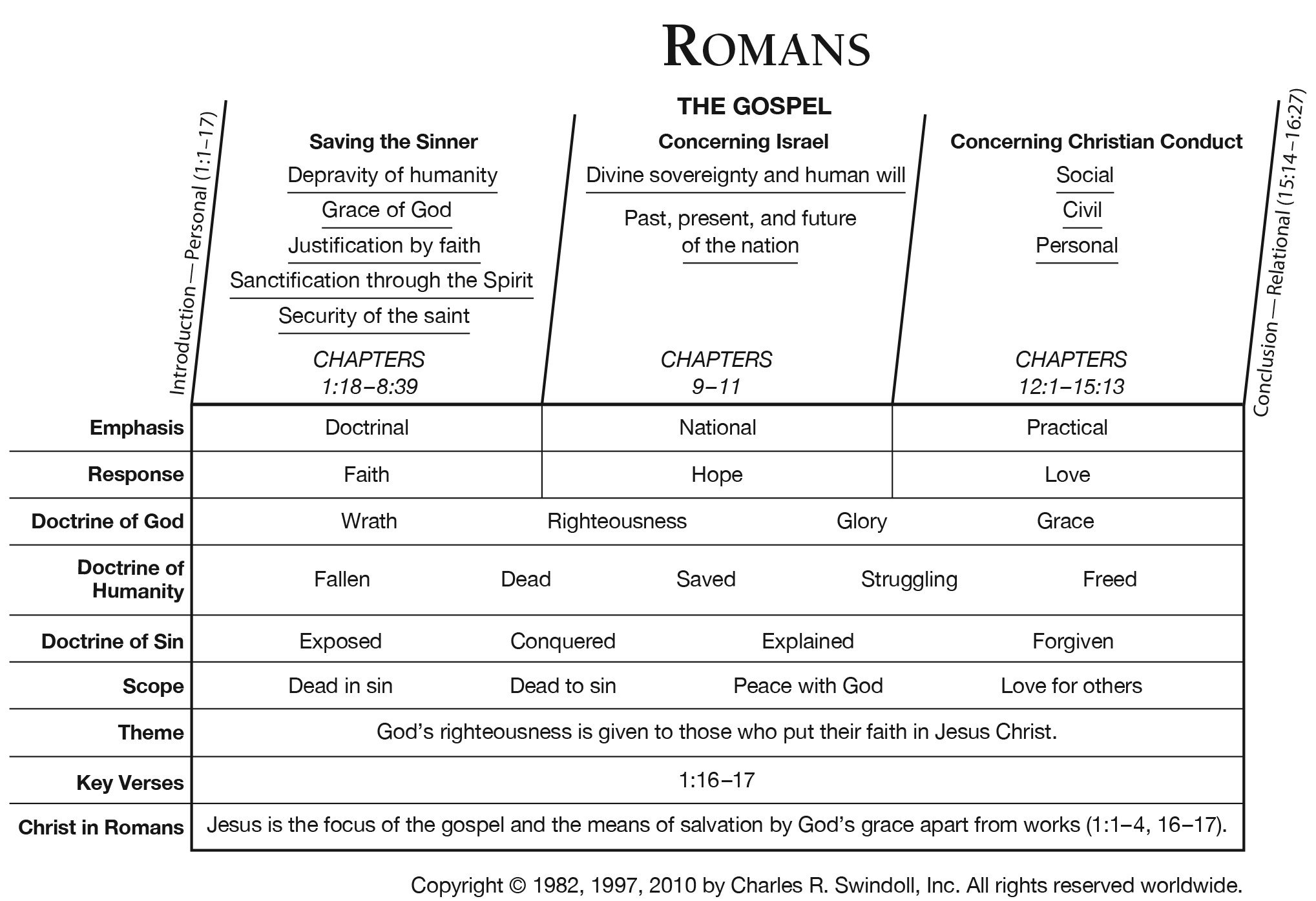
Click Charles Swindoll's overview chart
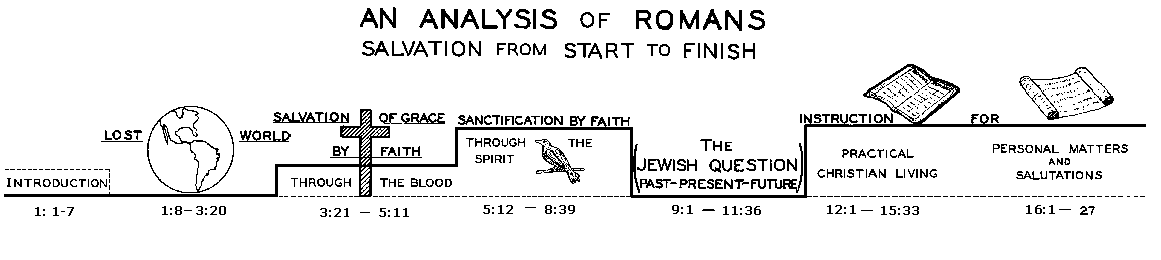
Source: Dr David Cooper
Click to Enlarge
| ROMANS ROAD to RIGHTEOUSNESS |
||||
| Romans 1:18-3:20 | Romans 3:21-5:21 | Romans 6:1-8:39 | Romans 9:1-11:36 | Romans 12:1-16:27 |
| SIN | SALVATION | SANCTIFICATION | SOVEREIGNTY | SERVICE |
| NEED FOR SALVATION |
WAY OF SALVATION |
LIFE OF SALVATION |
SCOPE OF SALVATION |
SERVICE OF SALVATION |
| God's Holiness In Condemning Sin |
God's Grace In Justifying Sinners |
God's Power In Sanctifying Believers |
God's Sovereignty In Saving Jew and Gentile |
Gods Glory The Object of Service |
| Deadliness of Sin |
Design of Grace |
Demonstration of Salvation | ||
| Power Given | Promises Fulfilled | Paths Pursued | ||
| Righteousness Needed |
Righteousness Credited |
Righteousness Demonstrated |
Righteousness Restored to Israel |
Righteousness Applied |
| God's Righteousness IN LAW |
God's Righteousness IMPUTED |
God's Righteousness OBEYED |
God's Righteousness IN ELECTION |
God's Righteousness DISPLAYED |
| Slaves to Sin | Slaves to God | Slaves Serving God | ||
| Doctrine | Duty | |||
| Life by Faith | Service by Faith | |||
|
Modified from Irving L. Jensen's chart above |
||||
Romans 2:13 for it is not the hearers of the Law who are just before God, but the doers of the Law will be justified. (3PFPI). (NASB: Lockman)
Greek: ou gar hoi akroatai nomou dikaioi para (to) theo, all hoi poietai nomou dikaiothesontai (3PFPI)
Amplified: For it is not merely hearing the Law [read] that makes one righteous before God, but it is the doers of the Law who will be held guiltless and acquitted and justified. (Amplified Bible - Lockman)
NLT: For it is not merely knowing the law that brings God's approval. Those who obey the law will be declared right in God's sight. (NLT - Tyndale House)
Phillips: It is not familiarity with the Law that justifies a man in the sight of God, but obedience to it (Phillips: Touchstone)
Wuest: For not those who are instructed in the law are righteous in the presence of God but those who are doers of the law shall be justified.
Young's Literal: for not the hearers of the law are righteous before God, but the doers of the law shall be declared righteous:--
FOR NOT THE HEARERS OF THE LAW ARE JUST BEFORE GOD : gar ou gar hoi akroatai nomou dikaioi para (to) theo :
- For it is not the hearers - Ro 2:25; Dt 4:1; 5:1; 6:3; 30:12, 13, 14; Ezek 20:11; 33:30, 31, 32, 33; Mt 7:21; Mt 7:22, 23; Mt 7:24,25; Mt 7:26, 27; Mt 7:28,29; Lk 8:21; Jas 1:19; Jas 1:22, 23, 24, 25; 1Jn 2:29; 3:7
- But the doers of the Law - Ezek 33:30, 31, 32; Mt 7:13,14 -note; Mt 7:15,16; Mt 7:17, 18, 19, 20; Mt 7:21 Mt 7:22, 23 ; Lk 6:49; Lk 8:11, 12, 13, 14, 15
- Romans 2 Resources - Multiple Sermons and Commentaries
Remember that in this section (see chart), Paul is NOT explaining the WAY of salvation (justification) but the NEED for salvation. He is in effect presenting a "tight argument" to "paint the religious moralists" (whether they be Jew or Gentile) into a "proverbial corner," with no excuse, no escape, EXCEPT to run to Jesus and take refuge in the Gospel of the grace of God (Acts 20:24).
PROFESSIONAL HEARERS
OR
PROFICIENT DOERS?
Jews attended their synagogues, week after week hearing the law read and explained to them. They were professional hearers but should have been proficient doers! (cf Jas 1:22)
Middletown Bible - Romans 2:13-15 are parenthetical (to see this, read verse 12 and then go directly to verse 16). The structure here is that of inverted parallelism (also known as CHIASM) and can be simply explained as follows:
A1 Verse 12a -- refers to the Gentiles (who do not have the law)
B1 Verse 12b -- refers to the Jews (who have the law)
B2 Verse 13 -- refers to the Jews
A2 Verses 14-15 -- refers to the Gentiles
This verse refers to the Jews who had the law and who heard the law. It is not enough just to have the law. It is not enough just to hear the law. A person must DO (keep, obey) the law. Paul’s argument is very simple: The Jews had the law (possessed it), they heard the law, but they did not do the law, and therefore the Jews are condemned!
For (gar) is a marker of cause or reason (See term of explanation) positioned after a preceding clause and introducing the reason or cause for what has just been stated) looks at the last clause of Ro 2:12 and explains why the Jews shall be judged by the Law. Whenever you spot a "for" (there are over 7000 in Scripture, and most are used as a term of explanation), pause and ponder, what is being explained, why now, to whom, etc.
Not - Note that "NOT" is the Greek word "ou" which signifies absolute negation of what follows. Paul is saying that merely "hearing" the Law justifies absolutely no one. The Jew boasted in knowing the Law, but Christ said, "None of you keep the Law." Applying this passage to the modern church, in the opinion of many evangelical pastors there are many individuals who upon hearing the gospel preached have made an outward "profession" but whose lives fail to exhibit fruit in keeping with genuine repentance (Mt 3:8) or good works (Eph 2:10) that indicate that they have been truly born again.
Just (1342)(dikaios from dike = right, just) is an adjective which describes the one who is in right relation to another, the one who is morally and ethically righteous, upright or just the man who is in accordance with what God requires. God is totally righteous because He is totally as He should be. The righteousness of God which He requires is all that God is, all that He commands, all that He demands, all that He approves and ultimately all that He provides (through Christ).
Mere knowledge of the Law ("hearers") will not satisfy requirement for perfect righteousness. It is not the hearers, but the doers, that are justified (cf Jas 1:22). God’s righteous judgment is not withheld because someone has heard the Law. It is only held back if someone has done the Law. Ultimately only One has "done" the Law perfectly and we must run to Him and be covered by His imputed righteousness.
The Jew may think that he is saved because he has the Law. Paul is saying that the question he needs to address "Have I kept the Law?" The Jews may have possessed the Law but they did not practice the Law. And of course no man can "practice the law" unless they are given a divine "heart transplant" (cp Ezek 36:26-27) which is exactly what Paul is building up to in his indictment of everyone still in Adam and dead in their trespasses and sins. In a similar manner, a Gentile might suppose that he is saved because he has kept the dictates of his own conscience. When they say this, they are showing the "work of the Law written in their" hearts. Paul is arguing logically that clearly it is not possible to be justified by keeping the law, whether in a "Jewish" sense (they had the law) or a "Gentile" sense (they had conscience which showed they knew the principles stated in the written Law). And ultimately both groups "will be condemned, not because they have the Law or do not have (a written copy of) the Law, but because they have sinned." (Morris)
HCSB - Deuteronomy 6:4 calls Israel to "listen" ("Hear, O Israel! The LORD is our God, the LORD is one." Lxx uses a different verb akouo in the aorist imperative, not akroates which does not call for associated obedience) to the declaration of God's identity, but Dt 6:5 follows up by saying that merely listening is not enough. One must love God with the whole heart, which entails obedience. And yet no one will be declared righteous by obeying the law, for no one obeys the law perfectly (Ro 3:20,23; Gal 2:16; Jas 2:8-11). The only incorrupt doer of the law was Jesus, the Righteous One.
Hearers (202) (akroates from the verb akouo = hear with attention) first describes one who hears referring primarily to the perception of sounds by the sense of hearing. It was used to describe those who sat passively in an audience and listened to a singer or speaker. The use of this term by Paul implies that in ancient times their was frequent public reading of the Scriptures along with oral instruction.
James writes - But prove (present imperative = command to make this your lifestyle, the habit of your life) yourselves doers of the word, and not merely hearers (akroates) who delude themselves. (James 1:22)
In light of the fact that Paul is addressing his Jewish brethren, Rogers' note is interesting...
In the Jewish home, the education process, and in the synagogue worship, the hearing of the Law read aloud played an important part in Jewish life. The rabbis also stressed very strongly the necessity of keeping the Law (Rogers, C L - New Linguistic and Exegetical Key to the Greek New Testament)
Denney - No degree of familiarity with the law avails if it is not done. (Ed: But the only way it can be "done" is empowered by the Holy Spirit - Php 2:13).
Vincent writes that "hearers" are those...
Like the Jews...heard it regularly in the synagogues. (Akroates is found) Only here in Paul. Three times in James. It brings out, better than the participle hoi akouontes those that hear, the characteristic feature; those whose business is hearing.
Hiebert - Among the Greeks, akroates was a common term for persons who were attendants at a lecture but not disciples of the lecturer. They were hearers who in life did not follow the instructions given. It is a common human failing from which Christians are not exempt. If all who are auditors of the Word on Sunday would put it into practice during the week, what a difference that would make! Roberts tartly remarks, "Our churches are filled with spiritual sponges who soak up the information, sit, sour, and eventually stink!" (Ibid)
Henry Alford - This is to explain to the Jew the fact, that not his mere hearing of the law read in the synagogue (his being by birth and privilege a Jew) will justify him before God, but (still keeping to general principles and not touching as yet on the impossibility of being thus justified) the doing of the law.
MacArthur - Paul here does not use the usual Greek term for hearing (akouo) but the word akroates, which was used of those whose business it is to listen. The idea is much like that of a college student. His primary purpose in class is to listen to the teacher’s instruction. Normally, he also has the responsibility of being accountable for what he hears and is tested on it. If he is simply auditing, however, he is required only to attend the class sessions. He takes no tests and receives no grade. In other words, he listens without being held accountable for what he hears. In many synagogues during Paul’s time, teaching did not focus on Scripture but on the system of man-made traditions that the rabbis had developed over the centuries since the Exile. Frequently, God’s Word in the OT was merely read and listened to, without explanation or application. Most Jews, therefore, were simply “auditing the course,” hearers of the Law and nothing more. But God recognizes no mere “auditors” of His Word. The more a person hears His truth, the more he is responsible for believing and obeying it. Unless there is obedience, the greater the hearing, the greater the judgment."
BUT THE DOERS OF THE LAW WILL BE JUSTIFIED: all hoi poietai nomou dikaiothesontai (3PFPI):
- Ro 3:20,23; 10:5; Lk 10:25, 26, 27, 28, 29; Gal 3:11,12
- Doers Mt 7:21; 12:50; Lk 11:28; 2Co8:11; Jas 1:22, 23, 24, 25, 26, 27; 4:11
- justified Ro 3:30; 4:2, 3, 4, 5; Ps 143:2; Lk 18:14; Acts 13:39; Gal 2:16; 5:4; James 2:21, 22, 23, 24, 25-see notes
- See Torrey's Topic Justification before God, see articles in ISBE Easton
- Romans 2 Resources - Multiple Sermons and Commentaries
ARE DOERS OF THE LAW
REALLY JUSTIFIED?
But (alla) introduces a strong contrast (see term of contrast) which should always prompt one to pause and ponder, asking questions like "What is being contrasted?," etc. The contrast is easy to discern in this case--hearers versus doers.
John Piper - “Doers of the Law will be justified.” It does not say, “By doing works of the Law you will be justified.” It simply says that the ones who will be justified are also those who are doers of the law. There is no causal connection asserted. So the verse is not a contradiction of Romans 3:20 which says, “By the works of the Law no flesh will be justified.” There is nothing in Romans 2:13b that keeps us from believing in justification by faith alone. Faith is required by the Law, and faith is the sole means of union with Christ whose righteousness vindicates us at the judgment. All the other obedience that comes from faith is the fruit of that union (cp Ro 1:5, Ro 16:26, James 2:14-26), not the means of it. So Romans 2:13b is not a contradiction of Paul’s teaching of justification by faith alone. (There Is No Partiality With God, Part 2)
Justified (1344) (dikaioo from dike = right, expected behavior or conformity, not according to one’s own standard, but according to an imposed standard with prescribed punishment for nonconformity) primarily means to deem to be right.
Dikaioo describes the act (note an act, not a process!) by which a man is brought into a right state of relationship to God. Dikaioo is a legal term having to do with the law and the the courtroom, where it represented the legally binding verdict of the judge. This is the sense in which Paul uses dikaioo in this section in Romans (Ro 3:21-5:11) in which he unfolds the doctrine of justification.
The meaning of dikaioo depends on the context and depending on which lexicon you consult you will come up with a variety of definitions so the following is an attempt as classifying most of the NT uses, but please be a Berean and do you own study of this word.
(1) To cause someone to be in a proper or right relation with someone else. This use corresponds to the vitally important truth imputed righteousness and thus means to justify or to declare righteous, which is only accomplished by faith and not by works as explained in definition #2.
Romans 3:24-note being justified (declared righteous and in proper or right relation to God) as a gift by His grace through the redemption which is in Christ Jesus
Titus 3:7-note that being justified (declared righteous and in proper or right relation to God) by His grace we might be made heirs according to the hope of eternal life.
(2) To show to be right or righteous. (James uses dikaioo in this sense - to show to be righteous. - James 2:21, James 2:24, 25)
Matthew 11:19 "The Son of Man came eating and drinking, and they say, 'Behold, a gluttonous man and a drunkard, a friend of tax-gatherers and sinners!' Yet wisdom is vindicated (dikaioo - shown to be right, proved to be in the right and accepted by God) by her deeds."
Luke 7:35 "Yet wisdom is vindicated (dikaioo - shown to be right) by all her children."
Dikaioo - 39x in the NT -
Mt 11:19; 12:37; Lk. 7:29, 35; 10:29; 16:15; 18:14; Acts 13:38, 39; Ro 2:13; 3:4, 20, 24, 26, 28, 30; 4:2, 5; 5:1, 9; 6:7; 8:30, 33; 1Co. 4:4; 6:11; Gal. 2:16f; 3:8, 11, 24; 5:4; 1Tim. 3:16; Titus 3:7; Jas. 2:21, 24, 25.
John MacArthur - Dikaioo "means to declare the rightness of something or someone. Justification is God’s declaration that all the demands of the law are fulfilled on behalf of the believing sinner through the righteousness of Jesus Christ. Justification is a wholly forensic, or legal, transaction. It changes the judicial standing of the sinner before God. In justification, God imputes the perfect righteousness of Christ to the believer’s account, then declares the redeemed one fully righteous. Justification must be distinguished from sanctification, in which God actually imparts Christ’s righteousness to the sinner. While the two must be distinguished, justification and sanctification can never be separated. God does not justify whom He does not sanctify." (MacArthur, J: Romans 1-8. Chicago: Moody Press)
The Law demands perfect (cf James 2:10) and continuous obedience for one to be "justified". Paul has clearly stated that no one is accounted righteous simply because he hears or knows what the Law says. The only conceivable way of being justified under the Law would be to keep it in its entirety. But since all men are sinners, it is impossible for them to do this. So this verse is really setting forth an ideal (and literally impossible) condition rather than stating something that is capable of human attainment (except for the God-Man, Christ Jesus! cf Mt 5:17).
Constable - It is not hearing the law that makes a person acceptable to God, but doing what it commands (Ro 2:13). “Justified” is a legal term that is suitable in this discussion of law observance. Justification is a legal verdict. It reflects a person’s position under the law. The justified person is one whom God sees as righteous in relation to His law (cf. Dt 25:1). The justified person is not necessarily blameless; he may have done things that are wrong. Nevertheless in the eyes of the law he is not culpable. He does not have to pay for his crimes. Paul said in Ro 2:13 that God would declare righteous the person who did not just listen to the Mosaic Law but did what it required. The Law warned that anything short of perfect obedience to it (James 2:10), even reading or studying it or hearing it preached and taught, which Jews relied on, made a person guilty before God (Dt 27:26; cf. Gal 3:10). Moses therefore urged the Israelites to accept and believe in the promised Messiah (e.g., Deut 18:15). (Constable's Expository Notes on the Bible) (Bolding added)
Paul will bring the truth about justification to fruition in Romans 3. In this chapter he is making it clear that no man in his own strength cab be justified before God.
MacDonald has a nice summary of this section
"The NT teaches emphatically that it is impossible for man to be justified by law-keeping (Acts 13:39; Ro 3:20; Gal 2:16, 21; 3:11). It was never God’s intention that anyone be saved by the law. Even if a person could keep it perfectly from this day forward, he still would not be justified, because God requires that which is past. So when verse 13 says that doers of the law will be justified, we must understand it as meaning that the law demands obedience, and if anyone could produce perfect obedience from the day he was born, he would be justified. But the cold, hard fact is that no one can produce this." (MacDonald, W., & Farstad, A. Believer's Bible Commentary : Old and New Testaments. Nashville: Thomas Nelson)
William Newell writes
"Yet it is deeply instructive here to quote a passage like that of [Lu 1:6], concerning Zacharias and Elizabeth: "They were both righteous in the sight of God, walking blamelessly in all the commandments and requirements of the Lord." Now their walk was not the ground of their acceptance (Ed note: but is was the fruit of their faith), although only such as they are accepted! For they were subject to God’s Word, not mere hearers, but doers. (Ed note: again the only way Zacharias & Elizabeth could have been righteous "doers" is because they had at some point in time believed God's promises concerning the Messiah and God had reckoned their faith to them as righteousness [cf Ro 4:5] Luke does not tell us when they believed but from Romans & Galatians there is no other way they could have been declared righteous). The first verse of the book of Job (Job 1:1) describes another such person. Indeed, at heart all God’s saints are such." (Romans 2)
Newell's point is that genuine saving faith results in a declaration of their righteousness and a consequent obedient and godly lifestyle, even though punctuated with fleshly failure from time to time. When God measured the deeds of the Jews, He found them to be as wicked as those of the Gentiles. The fact that the Jews occasionally celebrated a feast or a Sabbath did not change the fact that their consistent daily life was one of disobedience to God and to His perfect Law. God’s blessings did not lead them to repentance. The majority of them heard the Law but did not do the Law (the righteous remnant like Zacharias and Elizabeth being exceptions) and so were not justified or declared righteous (in right standing) before God.
CAN I GET TO HEAVEN BY
KEEPING THE LAW?
Middletown Bible - Consider the expression: "THE DOERS OF THE LAW SHALL BE JUSTIFIED" (v.13). Does this mean that a person can get to heaven by keeping God’s law? Consider the following facts:
(1) Don’t forget the purpose of these early chapters in Romans. Paul is demonstrating that all men (Jews and Gentiles alike) are lost and condemned before God. Paul is showing that all men are condemned. Later in Romans he will show what a person must do to be saved (compare Romans 3:28; 5:1; 10:9-13 etc.).
(2) Later in the book of Romans Paul makes it very clear that a person is not saved by keeping the law (see Romans 3:20).
(3) "THE DOERS OF THE LAW SHALL BE JUSTIFIED" -- let’s admit that this is a true statement. Those who keep the law will be saved. Theoretically this is true but practically it will never happen! As men stand before the holy Judge, all lawkeepers will be justified and all lawbreakers will be condemned. The problem is that there is no person who is a lawkeeper, no, not one (compare Romans 3:10-12).
It is possible (theoretically) to gain eternal life by keeping the law. Let’s consider what the Bible says about this:
A) In Romans 10:5 we learn that the person who does the things contained in the law shall live (compare Leviticus 18:5).
B) In Matthew 19:16-19 the Lord Jesus taught that to have eternal life you must keep the commandments. In Luke 10:25-28 we have a similar message: Keep the commandments and you will have eternal life.
The problem: Is it possible for a sinful man to keep God’s holy law? Has anyone ever kept the Ten Commandments perfectly? Has anyone loved God and loved his neighbor perfectly (compare Matthew 22:36-40)? Is anyone truly a lawkeeper or are we all guilty lawbreakers?
C) Galatians 3:10-13. The man who keeps God’s law perfectly is blessed. The man who fails to keep God’s law perfectly is cursed and condemned and worthy of death. The good news of the gospel is that Christ died for lawbreakers (Gal. 3:13) and He took our curse upon Himself.
Thus, Paul’s argument: "Listen my Jewish brothers, it is not enough to hear the law. You must obey the law perfectly or else you are under the curse and condemnation of God!" Those who wish to be justified by the law must keep the entire law and must keep it perfectly. (Romans Chapter 2)
- Promised in Christ -Isaiah 45:25; 53:11
- Is the act of God -Isaiah 50:8; Romans 8:33
UNDER LAW
- Requires perfect obedience -Leviticus 18:5; Romans 10:5; 2:13; James 2:10
- Man cannot attain to -Job 9:2,3,20; 25:4; Psalms 130:3; 143:2; Romans 3:20; 9:31,32
UNDER THE GOSPEL
- Is not of works -Acts 13:39; Romans 8:3; Galatians 2:16; 3:11
- Is not of faith and works united -Ac 15:1-29; Ro 3:28; 11:6; Ga 2:14, 15,16, 17, 18, 19, 20, 21; 5:4
- Is by faith alone -John 5:24; Acts 13:39; Romans 3:30; 5:1; Galatians 2:16
- Is of grace -Romans 3:24; 4:16; 5:17-21
- In the name of Christ -1Cor 6:11
- By imputation of Christ’s righteousness -Is 61:10; Je 23:6; Ro 3:22; 5:18; 1Co 1:30; 2Co 5:21
- By the blood of Christ -Romans 5:9
- By the resurrection of Christ -Romans 4:25; 1 Corinthians 15:17
- Blessedness of -Psalms 32:1,2; Romans 4:6-8
- Frees from condemnation -Isaiah 50:8,9; 54:17; Romans 8:33,34
- Entitles to an inheritance -Titus 3:7
- Ensures glorification -Romans 8:30
- The wicked shall not attain to -Exodus 23:7
BY FAITH
- Revealed under the Old Testament age -Habakkuk 2:4; Romans 1:17
- Excludes boasting -Romans 3:27; 4:2; 1 Corinthians 1:29,31
- Does not make void the law -Romans 3:30,31; 1 Corinthians 9:21
- Typified -Zechariah 3:4,5
- Illustrated -Luke 18:14
Exemplified
- Abraham -Genesis 15:6
- Paul -Philippians 3:8,9
Romans 2:14 For when Gentiles who do not have (PAPNPN) the Law do (3SPAS) instinctively the things of the Law, these, not having (PAPMPN) the Law, are (3PPAI) a law to themselves (NASB: Lockman)
Greek: hotan gar ethne ta me nomon echonta (PAPNPN) phusei ta tou nomou poiosin (3SPAS), outoi nomon me echontes (PAPMPN) heautois eisin (3PPAI) nomos
Amplified: When Gentiles who have not the [divine] Law do instinctively what the Law requires, they are a law to themselves, since they do not have the Law. (Amplified Bible - Lockman)
GWT: For example, whenever non-Jews who don't have laws from God do by nature the things that Moses' Teachings contain, they are a law to themselves even though they don't have any laws from God.
NLT: Even when Gentiles, who do not have God's written law, instinctively follow what the law says, they show that in their hearts they know right from wrong. (NLT - Tyndale House)
Phillips: When the Gentiles, who have no knowledge of the Law, act in accordance with it by the light of nature, they show that they have a law in themselves, for they demonstrate the effect of a law operating in their own hearts. (Phillips: Touchstone)
Wuest: For whenever Gentiles, who do not have law, do habitually by nature the things of the law, these not having law, are a law to themselves
Young's Literal: For, when nations that have not a law, by nature may do the things of the law, these not having a law -- to themselves are a law
FOR WHEN: hotan gar:
- Romans 2 Resources - Multiple Sermons and Commentaries
For (gar) is a marker of cause or reason positioned after a preceding clause and introducing the reason or cause for what has just been stated (see term of explanation) and here looks back not to Ro 2:13 but to Ro 2:12. Paul is explaining that the Gentiles also have a law so to speak by which they will be judged. Paul explains in this section that the Gentiles can be condemned without the law because their conscience (which is the work of the law written in their hearts) is enough to condemn them. As testimony to the truth of this principle, it is interesting to note that many of the unsaved pagan writers of Paul’s day referred to the "unwritten law" within man. Even these pagans recognized that there was something instinctively present within a man or a woman which tries to direct us in the right way. Remember that although all men are totally depraved in the sense that they cannot do anything that is righteously good, they can do a "man kind of good" like honoring their parents, paying their debts, etc. But every time they do that they prove that there is a law within them that points to that as good. Are they lost? Yes. Can they claim ignorance? No. As Paul pointed out in Romans 1, creation is around them proclaiming that God exists. In Romans 2 Paul is piling up the evidence against them, showing that by their conduct they prove that they have an inner moral law.
Ray Stedman - Now, men are continually charging God with injustice because, they say, He condemns men to hell who have never heard of Jesus Christ. This is the most frequently voiced charge against the Christian gospel. We are always hearing somebody say, "Well, what about the heathen who never hear about Christ? How can a just God condemn them to hell without their hearing about Christ?" But, you see, God never condemns anybody on that basis. As we are told right here...That is, if you disobey the truth that you have, even though you have never heard of Moses or of Christ, you perish, not because you didn't hear of Moses or of Christ, but because you have disobeyed truth that you already know -- that is the whole point. If you know of Moses and of Christ, and you still disobey the truth, you perish also, because your condemnation is even greater -- because of the greater light involved. (Ed note: See above for discussion of the principle of judgment proportionate to light received) But, as it says here, even pagans have a form of basic law written on their hearts, and this is the basis of God's just condemnation of man. It is because they are not what they themselves know they ought to be. In other words, God judges you, not by some artificial standard of His, but by your own standard. (The Secrets of Men)
Stedman goes on to give an illustration of Paul's point - "Recently, I was down in Newport Beach, teaching a Bible Class in a home. Quite a number of non-Christians were there, and one of them was a man from just across the street. He was a very charming individual, but he had made it known in the neighborhood already that he had no use for Christianity. As he came in the door, the first thing he said was, "I have come to be the Devil's advocate. I think the Devil needs a representative here tonight." We welcomed him, and told him to curl his tail around a chair, and sit down. As I began to speak on the opening chapter of Genesis, dealing with God's word to man, I could see in his face that this man had let down his guard. I don't think he was aware of how much he was revealing, but in that man's eyes I saw hunger written like I had never seen it before. At the question time, he, of course, came up with the usual question: "How about those that God condemns who never hear about Christ?" I answered (to all in the room), "Let me ask you this: Which of you has lived up to your own ideals? -- because God won't judge you on the basis of something that you have never heard, but on the basis of what you already know. Now tell me: Who of you has lived up to his own ideals? Which of you has never deliberately done wrong? Which of you can say that you measure up to your own standard of what you ought to be?" You could just hear the silence in that room! You see, it is not by some artificial standard that we stand condemned before God; it is because of what we know in our hearts about ourselves. This indicates that God measures us by our own yardstick." (The Secrets of Men)
GENTILES WHO DO NOT HAVE THE LAW DO INSTINCTIVELY THE THINGS OF THE LAW: ethne ta me nomon echonta (PAPNPN) phusei ta tou nomou poiosin (3SPAS):
- The Gentiles who do not have the Law - Ro 2:12; 3:1,2; Dt 4:7; Ps 147:19,20; Acts 14:16; 17:30; Ep 2:12)
- Do instinctively Ro 2:27; Ro 1:19,20; 1Co 11:14; Php 4:8
- Romans 2 Resources - Multiple Sermons and Commentaries
HCSB - The Gentiles do not have the Mosaic law as a moral guide, but they do have an inner law that informs their conscience. All humans have this instinctively as a component of their being created in God's image (Gen 1:26). Kant, the philosopher, spoke of "the starry heavens above and the moral law within." This moral law will accuse or excuse daily moral choices, but ultimately demonstrates that all people fall short of God's holiness.
Gentiles who do not have the Law - That is they do not have the written Law as did the Jews (Ro 9:4). Without knowing the written Law of God, men and women in pagan societies by nature ("instinctively"), instinctively value and attempt to practice justice, honesty, compassion, goodness toward others, etc, this practice testifying to the fact that the divine law has been written in the heart of even the most primitive tribesman. While Paul says that a Gentile may by nature do the things contained in the law, he is very careful not to say that a Gentile could fulfill the requirements of the law by nature.
Gentiles (1484) (ethnos) refers to non-Jews or the heathen and when preceded by the definite article ("the") in Greek, means "the nations" which is synonymous with the Gentiles a description implying those who practice idolatry and are ignorant of the true and living God.
All of mankind can be divided into Jew and Gentile and thus Gentile is a synonym for anyone who is non-Jew or who is not a member of the "chosen people". The Hebrew word corresponding to Gentile is goyim. From Genesis 12 onward the majority of the Scripture deals with Israel and the Jews, with the Gentiles mentioned primarily as they interface with the Jews. The NT does have more mention of the Gentiles after the formation of the Church, but the last book, the book of Revelation is very "Jewish" with over 200 OT quotes or allusions to OT passages!
Do instinctively the things of the law - In Romans 1 Paul had clearly taught that Gentiles were "without excuse (defense)" because that which can be known about God was evident within them (cp "conscience.")
Related Resources:
- Baker Evangelical Dictionary Gentiles
- Easton's Bible Dictionary Gentiles
- Fausset Bible Dictionary Gentiles
- Holman Bible Dictionary Gentiles
- Hastings' Dictionary of the Bible Gentiles
- Hastings' Dictionary of the NT Gentiles (2) Gentiles
- International Standard Bible Encyclopedia Gentiles
- Kitto Biblical Cyclopedia Gentiles
- McClintock and Strong's Bible Encyclopedia Gentile
- The Jewish Encyclopedia Gentile
Do (poieo) is in the present tense which speaks of continual action.
Instinctively ("by nature") (5449) (phusis/physis from phuo = to bring forth. Physis gives us our root for the English word physics, study of the laws of nature) means natural condition, nature, natural order, being, essence, kind, species. Natural disposition (Eph 2:3). Phusis is “that which belongs to a person or thing by virtue of its origin,” then, “its essential character.” Nature speaks of the inherent character or basic constitution of a person or thing.
As A T Robertson says "Phusis from old verb phuō, to produce, like our word nature (Latin natura), is difficult to define," which explains quotes from a number of different resources.
Vincent says phusis is "The recognized constitution of things. (In 1Cor 11:14 phusis is) the natural distinction of the woman’s long hair."
In Ephesians 2:3 Paul calls all men "by nature (phusis) children of wrath" because we have sinful natures. However, when we are saved by God's grace, we are "partakers of His divine nature [phúsis]" (2Pe 1:4). The wonder and miracle of grace is that it effects our very being, our essence.
Physis is used in the classical sense of origin in Gal 2:15 “Jews by nature” or “Jews by birth” (Gal 2:15).
Liddell-Scott - the nature, natural qualities, powers, constitution, condition, of a person or thing
Vine - (a) “the nature” (i.e., the natural powers or constitution) of a person or thing, Eph. 2:3; Jas. 3:7 (“kind”); 2 Pet. 1:4; (b) “origin, birth,” Rom. 2:27, one who by birth is a Gentile, uncircumcised, in contrast to one who, though circumcised, has become spiritually uncircumcised by his iniquity; Gal. 2:15; (c) “the regular law or order of nature,” Ro 1:26, against “nature” (para, “against”); Ro 2:14, adverbially, “by nature” (In Rom. 11:21, 24 the preposition kata, “according to,” with the noun phusis, “nature,” is translated “natural,” of branches, metaphorically describing members of the nation of Israel); 1 Cor. 11:14; Gal. 4:8, “by nature (are no gods),” here “nature” is the emphatic word, and the phrase includes demons, men regarded as deified, and idols; these are gods only in name (the negative, me, denies not simply that they were gods, but the possibility that they could be).
Zondervan Encyclopedia of the Bible - Of the words often translated “nature” and “natural,” physis denotes (a) a condition, endowment, or status inherited from one’s ancestors, as in reference to those who “by nature” are Jews (Gal. 2:15), heathen (Ro 2:27), “children of wrath” (Eph. 2:3 NRSV), or the “natural” and “wild” branches of the olive tree (Ro 11:21, 24); (b) innate characteristics and instinctive dispositions, as of false gods (Gal. 4:8), men (Ro 2:14; Jas. 3:7b), or even God (2 Pet. 1:4); (c) the established order within nature, as of sexual relations (Ro 1:26b) or decorum (1Cor 11:14); and (d) a creature or product of nature (Jas. 3:7a). The cognate adjective physikos G5879 is employed with reference to natural human instincts (Ro 1:26–27), and in a deprecatory sense of only the natural instincts (2Pet. 2:12).
BDAG - 1. condition or circumstance as determined by birth, natural endowment/condition, nature, esp. as inherited from one’s ancestors, in contrast to status or characteristics that are acquired after birth 2. the natural character of an entity, natural characteristic/disposition 3. the regular or established order of things, nature
Complete Biblical Library - (1) one’s natural condition as that which is inherited from one’s ancestors: Ro 11:21; Ro 11:24; “uncircumcision which is by nature” Romans 2:27; “graffed contrary to nature” (Romans 11:24); “the natural branches” (Romans 11:24); “we who are Jews by nature” (Galatians 2:15); and “by nature the children of wrath” (Ephesians 2:3). In Romans 11:24 phusis is that which has grown “naturally” and with no artificial intervention. (2) The disposition or natural characteristics: Galatians 4:8 and “partakers of the divine nature” 2 Peter 1:4) (3) Nature as the regular natural order: Romans 1:26, that is, unnatural intercourse. Plato also held that homosexuality was unnatural [para phusin, “beside nature”] since animals do not engage in it [Laws 8.836c]); “when the Gentiles, which have not the law, do by nature the things contained in the law” (Romans 2:14); and “Doth not even nature itself teach you, that, if a man have long hair, it is a shame unto him?” (1 Corinthians 11:14). (4) The product of nature, the creature, or the natural being: “every kind (phusis) of beasts” (James 3:7), thus species. The term continued in use down through the patristic era. It was used to describe theologically the divine nature shared equally by the three Persons of the Trinity.
NIDNTT (Uses in Classical Greek) 1. physis denotes source, commencement, origin, descent and also the lineage of adults or of children (kata phusin huion, “his son in the line of descent”). Aristotle regards it as the primal substance compounded from the elements. 2. From the basic understanding of presence and existence due to growth, physis denotes the natural condition, quality or state (e.g. of the air, of blood, or the physical features of a land); outward form and appearance; and stamp or character. 3. physis can further denote the → creation, the world of nature, e.g. the creatures who live in the sea. 4. physis is also the efficacious generative power, the charm which causes plants to appear and (e.g.) hair to grow. 5. physis also stands for the regular order of nature. Among the Stoics, physis became a god of the universe, as in the famous quotation from Marcus Aurelius, “O Nature, from you comes everything, in you is everything, to you goes everything.” There is no Heb. equivalent in the OT for physis. The Hebrews lacked the Greek conception of nature.
Jay Adams - Personality is the sum total of all that one is by nature and nurture (1) phusis, i.e., inherited nature and (2 acquired habits). While the phusis is genetic and largely unchangeable, one may radically change the ways in which he uses his nature. Temperament, for instance, may be attributable to a given trait (there may well be in Tom inherited traits of persistence). But how this temperament develops and is used (on the one hand Tom may develop these traits as stubbornness, hardheadedness, etc., while on the other hand, the Spirit of God may develop them into patience and endurance) is his responsibility before God. So then, the counselee is responsible in this way even for the phusis (inherited nature). (The Christian counselor’s manual)...Many habits become so strongly ingrained that it is often difficult to separate them from the natural (phusis) or instinctual drives. (Competent to counsel: introduction to Nouthetic counseling)
James B Deyoung - The Linguistic Setting Of Physis It is necessary to consider first the possible meanings that physis may have in Rom 1:26-27. 1. Greek usage. The word physis is used profusely in secular Greek. Any citation of uses must necessarily be selective, but I believe that they are representative. The word has these meanings: (1) origin, including birth and growth;8 (2) the natural form or constitution of a person, animal or thing, including nature or character of a person; (3) the regular order of nature; (4) philosophically, nature as an originating power (parallel to theos among the stoics), Nature personified, elementary substance (fire, water, air, earth11), the concrete idea of the creation; (5) creature or mankind; (6) kind, sort, species; (7) sex; and (8) approximately equal to law (nomos). (The Meaning of "Nature" in Romans 1...)
Physis is a component of the heresy of Monophysitism (monos = one + physis = nature) regarding the person of Christ. It is often associated with Eutyches (378-454) (leader of a monastery at Constantinople who espoused the heretical teaching that the human nature of Christ absorbed into the divine nature and something entirely new resulted (greater than human, less than divine). The problem with this heresy is that both His humanity and His deity are lost!
Collins English Dictionary - physio- or before a vowel phys- combining form 1 of or relating to nature or natural functions: physiology 2 physical: physiotherapy [from Greek phusioo, from phusis nature, from phuein to make grow]
Phusis - 14x in 11v in NAS - Translated - instinctively(1), natural(1), natural*(1), nature(7), physically(1), race(1), species(1), unnatural*(1).
Romans 1:26 For this reason God gave them over to degrading passions; for their women exchanged the natural function (physikos) for that which is unnatural, ("against nature").
Comment: Physis describes the normal arrangement of the created order, especially regarding the differences between the sexes. "Unnatural" is a combination of para (meaning against) and phusis, and so means in essence "against nature." This is against “the nature of things, the force, laws, order of nature.” Phúsis in this verse, refers to the true nature of things as God established them.
Romans 2:14 For when Gentiles who do not have the Law do instinctively the things of the Law, these, not having the Law, are a law to themselves,
Comment: Human beings have an "implanted" moral sense. This capacity does not save, but it does prove human moral responsibility.
Romans 2:27 And he who is physically uncircumcised, if he keeps the Law, will he not judge you who though having the letter of the Law and circumcision are a transgressor of the Law?
Romans 11:21 for if God did not spare the natural branches, He will not spare you, either.
Comment: Phusis is a metaphor for the Jews.
Romans 11:24 For if you were cut off from what is by nature a wild olive tree, and were grafted contrary to nature into a cultivated olive tree, how much more will these who are the natural branches be grafted into their own olive tree?
Comment: Phusis is a metaphor for the Gentiles.
1 Corinthians 11:14 Does not even nature itself (literally "the nature itself," implying nature as God formed it) teach you that if a man has long hair, it is a dishonor to him,
MacArthur - Nature (phusis) also carries the idea of instinct, an innate sense of what is normal and right. This is an appeal to human consciousness. Paul is saying that as man looks around himself he recognizes that, but for rare exceptions, both nature and human instinct testify that it is normal and proper for a woman’s hair to be longer than a man’s.
Vincent says phusis is "The recognized constitution of things. In this case the natural distinction of the woman’s long hair."
A T Robertson - Here phusis means native sense of propriety (cf. Ro 2:14) in addition to mere custom, but one that rests on the objective difference in the constitution of things.
Galatians 2:15 "We are Jews by nature and not sinners from among the Gentiles
Comment: By nature = by birth. So here phusis means birth (family lineage) and refers to those who are Jews “by birth” yet who also realize that to be a true child of God requires faith in Jesus Christ (cf. Gal 2:16).
Galatians 4:8 However at that time, when you did not know God, you were slaves to those which by nature are no gods.
Wuest - The word nature is from phusis which means, “that which belongs to a person or thing by virtue of its origin,” then, “its essential character.” It is used even of the divine nature which is without origin. Paul does not deny their existence, but their deity. Yet while the apostle did not think of them as deity by nature, yet at the same time he did not class them as being of mere mundane matter. They belonged to a world not human but demoniac, a point which must have been well known to the Galatians from Paul’s oral instruction.
Barber - The word for “nature” is phusis, and which means that the idols (to which they were slaves) did not originate from God. Paul says those gods they served before they became believers did note have the nature of God in them. There was nothing divine about them!
Ephesians 2:3 Among them we too all formerly lived in the lusts of our flesh, indulging the desires of the flesh and of the mind, and were by nature children of wrath, even as the rest.
Wuest - The term phusis (nature), though it may occasionally be applied to what is habitual or to character as developed, means properly what is innate, implanted in one by nature, and this with different shades of meaning (compare Rom. 2:14; Gal. 2:15, 4:8 etc.). The clause means, therefore, that in their pre-Christian life those meant by the hemeis pantes (we all) were in the condition of subjection to the divine wrath; and that they were so not by deed merely, nor by circumstance, nor by passing into it, but by nature. Their universal sin has already been affirmed. This universal sin is now described as sin by nature. Beyond this, Paul does not go in this present passage. But the one is the explanation of the other. Universal sin implies a law of sinning, a sin that is of the nature; and this, again, is the explanation of the fact that all are under the divine wrath, for the divine wrath operates only where sin is. Here is the essential meaning of the doctrine of original sin.”
James 3:7 For every species (phusis) of beasts and birds, of reptiles and creatures of the sea, is tamed and has been tamed by the human race (phusis).
Bible Knowledge Commentary - Every kind or all nature (phusis) of wild beasts...have been tamed by man (lit., “human nature,” phusis; thus “beastly nature” is tamed by “human nature”). But no human is able to tame the tongue!
Vincent - Says the KJV translation of phusis as "kind" in this verse is "Wrong. James is not speaking of the relation between individual men and individual beasts, but of the relation between the nature of man and that of beasts, which may be different in different beasts....By mankind (to phusei te anthropine). Rather, by the nature of man, phusis, as before, denoting the generic character. Every nature of beasts is tamed by the nature of man.
A T Robertson - Old word from phuo, order of nature (Ro 1:26), here of all animals and man, in 2Pet. 1:4 of God and redeemed men.
2Peter 1:4 For by these He has granted to us His precious and magnificent promises, so that by them you may become partakers of the divine nature, having escaped the corruption that is in the world by lust.
Comment: The statement in 2 Pet. 1:4 that Christians have become “partakers of the divine nature” has been grossly misunderstood by some interpreters. God’s nature here refers not to His essence but to certain of His attributes, i.e., divine qualities. (Zodhiates)
NET Note - Some (e.g. C. E. B. Cranfield, Romans [ICC], 1:135–37) take the phrase phusei, "by nature" to go with the preceding "do not have the law," thus: "the Gentiles who do not have the law by nature," that is, by virtue of not being born Jewish.
The Law In The Heart - Marilyn Laszlo dedicated her life to giving the Hauna people of New Guinea the Bible in their own language. As she worked on the translation, she came to the word for “sin.” When Marilyn asked the people what they thought sin was, they told her, “It’s when you lie.” “It’s when you steal.” (Ed note: cp Ex 20:15) “It’s when you kill.” (cp Ex 20:13) “It’s when you take another man’s wife.” (cp Ex 20:14) Marilyn was astounded. They were giving her God’s standards as spelled out in the Ten Commandments. “God’s law is written on the heart of man,” she later commented, underscoring the truth found in Romans 2:14-15.
What a remarkable verification of biblical truth! Our faith is strengthened by accounts like this. But there’s something else. If each person on earth is aware of sin (which is true even though some deny it), we need to make sure everyone hears the remedy. Jesus paid the penalty for sin and offers all sinners a life free from bondage.
God put His law in our heart, but we can never live up to its requirements (Ro 3:23; Jas 2:10; 1Jn 1:8). The law shows us how enslaved we are by sin, but God’s grace to us through Christ brings liberty. If we have experienced that forgiveness and freedom, it’s up to us to share the good news with others.
The perfect Law of God reveals
The dreadful state we're in;
But when we put our faith in Christ,
We're cleansed from all our sin.
—Sper
God's law shows us a need
that only God's grace can supply.
THESE, NOT HAVING THE LAW, ARE A LAW TO THEMSELVES: houtoi nomon me echontes (PAPMPN) heautois eisin (3PPAI) nomos:
- Are a law to themselves - Ro 2:12, Ro 1:32
- Romans 2 Resources - Multiple Sermons and Commentaries
"The Gentiles do not have the Law; but whenever they do by instinct what the Law commands, they are their own law, even though they do not have the Law" (TEV),
"Even when Gentiles, who do not have God's written law, instinctively follow what the law says, they show that in their hearts they know right from wrong." (NLT)
"For example, whenever non-Jews who don't have laws from God do by nature the things that Moses' Teachings contain, they are a law to themselves even though they don't have any laws from God." (GWT)
The Gentile's practice of some good deeds and their aversion to some evil ones demonstrate an innate knowledge of God’s law and this knowledge will actually witness against them on the day of judgment.
John Calvin adds that here Paul "shows that ignorance is in vain pretended as an excuse by the Gentiles, since they prove by their own deeds that they have some rule of righteousness."
To reiterate, Paul is simply saying that God has written on the heart of every man a basic moral code. That code is similar to the things contained in the Ten Commandments. This universal moral code consists of things like "Do not steal," "Do not cheat," "Tell the truth," "Honor your parents," "Keep your word," "Help the poor," "Do not kill," etc. It would be hard to find a culture anywhere in the world where those moral values are not honored. The Greek poet Sophocles spoke of "the unwritten and indelible laws of the gods." The Platonic philosopher Plutarch called it "a law which is not written in books, but implanted in the heart of man." In fact, this concept of a universal moral code was widely discussed by the Greeks and Romans. Paul simply picks up that concept and applies it to the Gentiles.
Don't misunderstand what Paul is saying with the phrase "a law to themselves". He is not implying that these "obedient Gentiles" made up their own law (as we often use the expression in modern parlance describing a rebel as a "law unto himself"), but that they were obedient to conscience, the work of the law residing in themselves.
Note also that while Paul that a Gentile, may, by nature do the things contained in the law; he does not say that a Gentile could fulfill the requirements of the law by nature (i.e., he could not be justified).
One other thought to keep in mind when reading Paul is that the word “Law” can be confusing, and can refer to the Pentateuch, to the entire Old Testament, to the Ten Commandments, to the whole body of God’s requirements for Israel, or to the way of life adopted by the covenant community. In Romans 2-3 the basic meaning of “law” is “God’s revealed requirements for righteous living.”
Dirty Hands - One of William Shakespeare’s most intriguing characters is Lady Macbeth. Having heard a prophecy that her husband would become king, she convinced him to assassinate the reigning monarch. When the bloody deed was done, Macbeth was conscience-stricken. His wife rebuked his squeamishness and helped him cover up the crime. Her husband was crowned king. But that wasn’t the end. Lady Macbeth’s initial resolve turned to remorse. She grew mentally unstable, and couldn’t stop washing her hands. “Will these hands ne’er be clean?” she asked. Finally, the guilt drove Lady Macbeth to suicide.
Guilt is an emotion that can weigh us down whenever we cross a moral boundary. All of us are capable of feeling guilty when we violate the law of God written in our hearts (Ro 2:14, 15). If we continue to sin willfully, however, we will dull our conscience.
Lady Macbeth is a good reminder of a biblical principle: Whatever we sow, we will certainly reap (Galatians 6:7, 8). When we feel temptation, we need to listen to our conscience—not try to silence it. It’s far better to avoid committing an act we will later regret than to live with the consequences. —Dennis Fisher (Our Daily Bread, Copyright RBC Ministries, Grand Rapids, MI. Reprinted by permission. All rights reserved)
Sometimes there’s just one step to go
Before we yield to sin,
But God will help us to say "No"
If we trust His power within.
—Hess
Only Jesus’ blood
can wash away the stain of sin.
WHO SAYS THAT'S RIGHT? - Romans 2:14-15 Gentiles, who do not have the law ... show the works of the law written in their hearts. - People who reject absolute standards of right and wrong are often inconsistent When they think they are being treated unfairly, they appeal to a standard of justice that they expect everyone to adhere to. A philosophy professor began each new term by asking his class, "Do you believe it can be shown that there are absolute values like justice?" The free-thinking students all argued that everything is relative and no single law can be applied universally. Before the end of the semester, the professor devoted one class period to debate the issue. At the end, he concluded, "Regardless of what you think, I want you to know that absolute values can be demonstrated. And if you don't accept what I say, I'll flunk you!" One angry student got up and insisted, "That's not fair!" "You've just proved my point," replied the professor. "You've appealed to a higher standard of fairness." God has given everyone a conscience to tell right from wrong (Ro 2:1415), and His moral standards are written in the Bible. Every time we use the words good and bad, we imply a standard by which we make such judgments. Biblical values are true for any age, because they originate with an eternal, unchanging God. - Dennis De Haan
God has not left us in the dark
About what's wrong or right,
For through His works and in His Word
His Spirit gives us light.
D. De Haan
ONLY GOD HAS THE RIGHT
TO DEFINE WHAT'S WRONG.
Romans 2:15 in that they show (3PPMI) the work of the Law written in their hearts, their conscience bearing witness (PAPFSG), and their thoughts alternately accusing (PAPMPG) or else defending (PMPMPG) them (NASB: Lockman)
Greek: hoitines endeiknuntai (3PPMI) to ergon tou nomou graphton en tais kardiais auton, summarturouses (PAPFSG) auton tes suneideseos kai metaxu allelon ton logismon kategorounton (PAPMPG) e kai apologoumenon (PMPMPG)
Amplified: They show that the essential requirements of the Law are written in their hearts and are operating there, with which their consciences (sense of right and wrong) also bear witness; and their [moral] decisions (their arguments of reason, their condemning or approving thoughts) will accuse or perhaps defend and excuse [them] (Amplified Bible - Lockman)
CSB They show that the work of the law is written on their hearts. Their consciences testify in support of this, and their competing thoughts either accuse or excuse them
KJV Which shew the work of the law written in their hearts, their conscience also bearing witness, and their thoughts the mean while accusing or else excusing one another;)
NAB They show that the demands of the law are written in their hearts, while their conscience also bears witness and their conflicting thoughts accuse or even defend them
NIV since they show that the requirements of the law are written on their hearts, their consciences also bearing witness, and their thoughts now accusing, now even defending them.)
NJB They can demonstrate the effect of the Law engraved on their hearts, to which their own conscience bears witness; since they are aware of various considerations, some of which accuse them, while others provide them with a defense . . . on the day when,
NLT: They demonstrate that God's law is written within them, for their own consciences either accuse them or tell them they are doing what is right. (NLT - Tyndale House)
Phillips: Their own consciences endorse the existence of such a law, for there is something which condemns or commends their actions (Phillips: Touchstone)
Wuest: they being such that they show the work of the law written in their hearts, their conscience bearing joint-witness and their reasonings in the meanwhile accusing or also excusing one another
Young's Literal: who do shew the work of the law written in their hearts, their conscience also witnessing with them, and between one another the thoughts accusing or else defending
IN THAT THEY SHOW THE WORK OF THE LAW WRITTEN IN THEIR HEARTS: hoitines endeiknuntai (3PPMI) to ergon tou nomou graphton en tais kardiais auton:
- Show the work of the Law written - Ro 1:18, 19
- Romans 2 Resources - Multiple Sermons and Commentaries
In that they show - “inasmuch as they show.” How do they show? It has to be by being doers (Ro 2:14), not perfect and not in any sense meriting justification (which is ONLY by faith apart from works).
They show - The idea is that they demonstrate. In other words, they show clearly. They prove it to be certain, even beyond the possibility of doubt.
Karl Barth holds that Gentile Christians are in view here, but this scarcely suits the context.
Show (1731) (endeíknumi from en = in, to + deíknumi = explain meaning or significance of something by demonstration) means to indicate by word or act. The idea is to show forth, demonstrate, prove, whether by arguments or acts. The signifies that they continually show by their instinctive doing of the law that it is written in their heart.
Bengel comments on this verb in the middle voice signifies - " they show) [demonstrate] to themselves, to others, and, in some respects, to God Himself."
The work of the Law - The Amplified version helps understand this phrase - "They show that the essential requirements of the Law are written in their hearts and are operating there." Denney says this phrase refers to "the work which the law prescribes, collectively."
The Pulpit Commentary: Seeing that graptos implies evident reference to the tables of the Law, it seems best to take ergon as denoting the efficacy of the Law, as opposed to the letter, which alone was written on the tables....The very possibility of their doing this is evidence of an innate moral sense in the human heart, which, however it may often be obscured or perverted, remains as a characteristic of humanity, and is more or less operative in all communities.
Written (only used here) (1123) (graptos) is an adjective which pertains to that which is written, marked with letters, inscribed. Lxx uses 2Chr 36:22, Ezra 1:1.
Hearts (2588) (kardia) does not refer to the physical organ but is always used figuratively in Scripture to refer to the seat and center of human life. It represents the inner person, the seat of motives and attitudes, the center of personality. In Scripture kardia is much more than emotion or feelings, but includes the thinking process and particularly the will.
Kardia as stated above refers not to the physical organ (over 800 mentions and none refer to the physical organ!), but is always used figuratively to center of our personality, to so to speak to our "control center" (compare our heart to the "air traffic control center" at the airport which carefully guards and guides what flies in and what flies out. How applicable to our "hearts" which are so prone to wander!). In short kardia refers to the the affective center of our being wherein lies the capacity of moral preference and volitional desire. The kardia generates thoughts that make the decisions which the mind works out. In other words, our logic flows out of our heart-decisions and not vice versa. Gleason Archer called the kardia, the "desire-producer that makes us tick" for it is the place where our "desire-decisions" occur, and which establish who we really are. WHO ARE YOU? HAVE YOU HAD A HEART CHECK UP RECENTLY? We are assiduous to do this medically, but woefully lax in doing it spiritually (beloved, I speak from experience!). At regeneration God reverses the spiritual atherosclerosis of our old sinful heart by giving us a total heart transplant! Daily confession and repentance are thereafter necessary to avoid "spiritual atherosclerosis" and gradual, subtle hardening (and becoming cold to the things of God) of our heart! (Read and practice daily "preventative maintenance" = 1 Jn 1:9, Pr 28:13).
Barclay commenting on the "Work of the Law" writes that "We would call it the instinctive knowledge of right and wrong. The Stoics said that in the universe there were certain laws operative which a man broke at his peril—the laws of health, the moral laws which govern life and living. The Stoics called these laws phusis, which means nature, and urged men to live kata phusin, according to nature. It is Paul’s argument that in the very nature of man there is an instinctive knowledge of what he ought to do. The Greeks would have agreed with that. (Barclay, W: The Daily Study Bible Series, Rev. ed. Philadelphia: The Westminster Press)
People who have never heard God's word directly still have a moral compass that they are accountable to. E.g., all men know it is wrong to lie, steal, and murder. Mankind recognizes that there is a code of ethics. In fact man has a guilty conscience because he violates that very code of ethics within him.
William Newell (Romans 2) asked Chinese who had never heard the Law or the gospel if they knew these things were wrong; they all admitted they did. Even those persons who have never heard of the Bible have still been preached to with sufficient clarity (God has made it evident within them - Ro 1:19, as well as without - Ro 1:20) to remove every excuse from their hearts forever. He is not- saying that the Law of Moses is written on their hearts, as people often say, but that the work of the law, i.e., what the law requires of people, is written there.
MacArthur makes an interesting observation noting that...
The fact that such people did good things, knowing they were ethically good, proves they had knowledge of God’s Law written in their hearts. Therefore if those people never come to trust in the true God, their good deeds will actually witness against them on the day of judgment. (MacArthur, J: Romans 1-8. Moody)
Unregenerate people do relative human good, but they don't do good in terms of spiritual righteousness. Their good is not based on the right motive because nothing is truly good unless it is done for the glory of God. But they do good in a relative human sense. When they do that they show the law of God at work in them. They do good in the right manner if not for the right motive. (Romans 2-11-16 Principles of God's Judgment)
Thus Paul explains why the Gentile can be condemned without the law...how it is that God is fair in condemning those who have never even had a Bible. Paul clearly demonstrates that their conscience (the work of the law written in their hearts) is enough to condemn. Many pagan authors of Paul's day referred to the "unwritten law" within man; something which points us to the right way.
People who have never heard God’s word directly still have a moral compass that they are accountable to.
"God is describing how He has constituted all men: there is a ‘work’ within them, making them morally conscious." (William Newell) " (Romans 2)
Morris observes that Paul "is not saying that the law is written on their hearts, as people often say, but that the work of the law, what the law requires of people, is written there."
THEIR CONSCIENCE: auton tes suneideseos:
- Their conscience - Ro 9:1; John 8:9; Acts 23:1; 24:16; 2 Cor 1:12; 5:11; 1Ti 4:2; Titus 1:15
- Click 2Timothy Notes or Titus Notes for more on "conscience"
- Romans 2 Resources - Multiple Sermons and Commentaries
EVERYONE HAS
A CONSCIENCE
F F Bruce - Paul uses conscience (and perhaps he was the first to do so) in the sense of an independent witness within, which examines and passes judgment on one’s conduct. In Christians this examination and judgment should be especially accurate because their conscience is enlightened by the Holy Spirit (cf. Ro 9:1).
Conscience (4893) (suneidesis from sun = with + oida = know) means literally "a knowing with" or a co-knowledge (with oneself) and represents the witness borne to one's conduct by one's own indwelling, instinctive sense of right and wrong that produces guilt when violated ("alternately accusing").
Suneidesis - 30x in 29v -
Acts 23:1; 24:16; Rom 2:15; 9:1; 13:5; 1 Cor 8:7, 10, 12; 10:25, 27ff; 2 Cor 1:12; 4:2; 5:11; 1 Tim 1:5, 19; 3:9; 4:2; 2 Tim 1:3; Titus 1:15; Heb 9:9, 14; 10:2, 22; 13:18; 1 Pet 2:19; 3:16, 21
Conscience has been succinctly described as the "soul distinguishing between what is morally good and bad, prompting to do the former and shun the latter."
In addition to an innate awareness of God’s law, men have a warning system that activates when they choose to ignore or disobey that law. It's that instinctive, built-in sense of right and wrong that activates guilt.
All mankind has an innate inner sense of right and wrong which Scripture refers to as conscience. And so sociologist have encountered in all cultures a sense of sin and fear of judgment which leads that culture to make some attempt to appease whatever gods are feared and this built in "moral/ethical radar detector" (so to speak) is what Paul is alluding to here in Romans 2.
Conscience is like an inner judge that accuses and condemns us when we have done wrong and approves and commends us when we have done right. The conscience varies in sensitivity, depending on the degree of one’s knowledge of and feeling about right and wrong. The person who has considerable knowledge of God’s Word will have a more sensitive conscience than someone who has never had opportunity to know Scripture. Furthermore, repeated sinning hardens the conscience so that it becomes “seared” like scar tissue (1Ti 4:2). To continually reject God’s truth causes the conscience to become progressively calloused, hardened and less sensitive to sin, as if covered with layers of unspiritual scar tissue. There is an interesting parallel in tropical medicine which has discovered that the gross disfigurement so commonly seen in individuals with leprosy is not due to the leprosy bacterium per se, but is secondary to the organism's destruction of the nerve fibers that convey a sense of pain and touch. Unprotected by the body's natural warning signals the leper repeatedly injures the extremity with cuts, burns, infections, etc, all without even realizing that he is injured! This is exactly the picture of the seared conscience which becomes insensitive to sin and may eventually cease sending warning signals. Thus, though God has His work within every man resulting in conscience, man can corrupt that work, so that the "sin sensitivity" rating of the conscience varies from person to person.
Ray Stedman has some interesting thoughts on conscience writing that "We each have a conscience. We may not be able to analyze it, and we certainly cannot control it, but we know we all possess one. Conscience has been defined as "that still, small voice that makes you feel smaller still," or, as one little boy put it, "It is that which feels bad when everything else feels good." Conscience is that internal voice that sits in judgment over our will. There is a very common myth abroad that says that conscience is the means by which we tell what is right and what is wrong. But conscience is never that. It is training that tells us what is right or wrong. But when we know what is right or wrong, it is our conscience that insists that we do what we think is right and avoid what we think is wrong. That distinction is very important and needs to be made clear. Conscience can be very mistaken; it is not a safe guide by itself. It accuses us when we violate whatever moral standard we may have, but that moral standard may be quite wrong when viewed in the light of God's revelation. But conscience also gives approval whenever we fulfill whatever standard we have, though that standard is right or wrong. And conscience, we have all discovered, acts both before and after the fact -- it can either prod or punish. (A Clear Conscience)
Franklin P. Jones wrote that "Conscience is a small, still voice that makes minority reports."
Someone added "Conscience is also what makes a boy tell his mother before his sister does."
Christopher Morley said about conscience "Pop used to say about the Presbyterians, 'It don't prevent them committing all the sins there are, but it keeps them from getting any fun but of it.'
The late General Omar Bradley was more serious in commenting on conscience "The world has achieved brilliance without conscience," he conceded. "Ours is a world of nuclear giants and ethical infants."
On the subject of conscience Martin Luther declared before the court of the Roman Empire at Worms in 1521 "My conscience is captive to the Word of God. ... I am more afraid of my own heart than of the pope and all his cardinals. I have within me the great pope, Self."
When a person comes to faith in Christ, his conscience becomes acutely sensitive to sin. No longer as a Christian can he sin with impunity. The story is told about an old Indian chief who was converted. Later a missionary asked him:
"Chief, how are you doing spiritually? Are you experiencing victory over the devil?"
"It's like this," the chief replied. "I have two dogs inside me: a good dog and a bad dog. They are constantly fighting with each other."
"Which dog wins?" asked the puzzled missionary.
"Whichever one I feed the most," retorted the wise old man. His conscience was being shaped by the Scriptures.
Billy Graham set out the importance of a clear conscience "To have a guilty conscience is a feeling. Psychologists may define it as a guilt complex, and may seek to rationalize away the sense of guilt, but once it has been awakened through the application of the law of God, no explanation will quiet the insistent voice of conscience."
MacArthur recounts an interesting illustration of the human conscience: It is reported that a tribe in Africa had an unusual but effective way to test the guilt of an accused person. A group of suspects would be lined up and the tongue of each would be touched with a hot knife. If saliva was on the tongue the blade would sizzle but cause little pain. But if the tongue was dry, the blade would stick and create a vicious, searing burn. The tribe knew that a sense of guilt tends to make a person’s mouth dry, and a seared tongue therefore was taken as proof of guilt. The making of such a dry mouth is, of course, the work of the conscience. (MacArthur, J: Romans 1-8. Chicago: Moody Press)
Pritchard offers a hypothetical illustration: This week I read an ancient tale about a court magician who wanted to give his king a very special gift. After much work, he designed a magic ring which had a very special property. Every time the king had an evil thought or an unworthy ambition, the ring began to shrink tightly around his finger, thus warning him of impending danger. The human conscience is like that. It is a ring around the heart, which tightens every time we begin to violate our own standards. It warns of impending danger. We disregard our conscience at our own peril. And, Paul says, every man has a conscience, a "ring around the heart." No one can say, "I've never done wrong," because every man has violated his conscience at least once, and most of us many times. That's why God can fairly judge the Gentiles. The law "written in their hearts" will be the standard by which they will be judged. Their guilty consciences will one day rise up to condemn them." (Romans 2:1-16: Mr. I.M. Okay Meets His Maker)
A W Tozer - Conscience singles you out as though nobody else existed. God has given us a faithful witness inside of our own being...It is able to single a man out and reveal his loneliness, the loneliness of a single soul in the universe going on to meet an angry God. That’s the terror of the conscience. Conscience never deals with theories. Conscience always deals with right and wrong and the relation of the individual to that which is right or wrong. Remember the conscience is always on God’s side! It judges conduct in the light of the moral law, and as the Scripture says, excuses or accuses."
Barclay gives an interesting historical perspective on "conscience" referring to it as "the instinctive knowledge of right and wrong. The Stoics said that in the universe there were certain laws operative which a man broke at his peril—the laws of health, the moral laws which govern life and living. The Stoics called these laws phusis, which means nature, and urged men to live kata phusin, "according to nature". It is Paul’s argument that in the very nature of man there is an instinctive knowledge of what he ought to do. The Greeks would have agreed with that. Aristotle said: “The cultivated and free-minded man will so behave as being a law to himself.” Plutarch asks: “Who shall govern the governor?” And he answers: “Law, the king of all mortals and immortals...which is not written on papyrus rolls or wooden tablets, but is his own reason within the soul, which perpetually dwells with him and guards him and never leaves his soul bereft of leadership." (Barclay, W: The Daily Study Bible Series. The Westminster Press)
Unless of course it becomes seared as did the "inner moral compass" of the Roman Emperor Nero, whose evil exploits are too despicable to even be reviewed in these notes.
Thomas Brooks - Conscience is God's deputy, God's spy, God's notary, God's viceroy...Conscience is God's preacher in the bosom.
BEARING WITNESS: summarturouses (PAPFSG):
- Romans 2 Resources - Multiple Sermons and Commentaries
JOINT WITNESS OF
DEEDS AND CONSCIENCE
Bearing witness (4828) (summartureo from sún = together, with, + marturéo = to witness) means to witness with another or to testify with. This verb was used in the Greek secular writings where the signature of each attesting witness is accompanied by the words "I bear witness with and I seal with". The present tense indicates the activity of their conscience (with preceding doing or deeds) is continually providing evidence by testifying.
Pulpit Commentary - Conscience is not the Law in the heart, but rather our consciousness, whereby wittingly, in accordance with that Law, we approve or condemn. The compound verb summartureo seems to denote a joint witness of conscience. In Ro 8:16 and Ro 9:1, where alone the word occurs elsewhere, it is followed by a dative, and means certainly concurrent witness. But, if so here, with what? Probably with the show (demonstration) already spoken of. Right conduct on principle (Ro 2:14), and conscience approving, witness together to the inward law; or, conduct and conscience together witness to a man’s merits or demerits in accordance with that law. Then, what is added about the logismos shows how conscience operates. Reason (logic) comes into play, evoked by conscience, to reflect on its witness, and definitely condemn or approve what has been done. A kind of court of judicature is supposed. Man calls himself to the bar of his own moral judgment; his conscience adduces witness to the character of his deeds, or rather, with his deeds bears witness for or against himself; his thoughts are as advocates on both sides, arguing for condemnation or acquittal.
Summartureo - 3x in Bible - all in Romans -
Romans 8:16 The Spirit Himself bears witness with our spirit that we are children of God,
Romans 9:1 I am telling the truth in Christ, I am not lying, my conscience testifies with me in the Holy Spirit
Mark Twain quipped that you can tell if something you did was morally good if you "felt good afterward." But if it left you "feeling bad," it was morally wrong. This statement can be understood in two ways. One is that good or bad conduct can produce good or bad feelings. This is true. The other is that feelings determine what is good or bad. A secular writer showed the fallacy of this interpretation when he said, with tongue in cheek, that he liked Twain's statement because it implied that you've got to try something at least once to know whether it's good or bad.
Beware that feelings are not a reliable indicator of moral conduct. The only trustworthy standard is God's Holy Inerrant Fully Sufficient Word. To obey the Lord's commands sometimes goes against our emotions (or feelings). To forgive others, for example, isn't our natural tendency. Yet we know that is what God wants us to do. And when you've either forgiven someone or sought forgiveness, haven't you experienced an inner relief and release after obeying your conscience? Sure you have.
Spurgeon (speaking of believers but an apt description for the most part to unbelieving Gentiles) describes - "a wind which sometimes blows upon men—a penetrating, searching, cutting wind—which may bring good with it, but which, at the time it is blowing, is a truly terrible wind to endure! I mean that of spiritual distress on account of discovered sin when, looking into your soul, you have spied out what you could not have believed was there. Sins and iniquities which had long hidden their heads, have suddenly appeared before you and you have been almost swept off your feet as by a tornado! I recollect when that wind blew through and through my soul. No comfort could I get by day or by night. My transgressions haunted and hunted me (Ed: cf "accusing..."). I had not been worse than other young men, nor as bad as many whom I knew, but I seemed so to myself. It appeared to me as if I had become the very chief of sinners and the most surely condemned of all who ever lived! Remembering the experience I then passed through, I can truly say that I know of no pain that can be felt by the body which is comparable to the terrible pangs of conscience when the searching breath of the Eternal Spirit goes through the soul and withers up all the comeliness of our own righteousness and spoils all the supposed beauty of our own good works! That is a wind which I trust we all have felt, or shall yet feel, but, still, while it blows, it is dreadful to endure." (Our Hiding Place)
AND THEIR THOUGHTS ALTERNATIVELY ACCUSING OR ELSE DEFENDING THEM: kai metaxu allelon ton logismon kategorounton (PAPMPG) e kai apologoumenon (PMPMPG):
- Their thoughts - Genesis 3:8, 9, 10, 11; 20:5; 42:21,22; 1Kings 2:44; Job 27:6; Eccl 7:22; 1John 3:19, 20, 21
- Romans 2 Resources - Multiple Sermons and Commentaries
ESV Romans 2:15 They show that the work of the law is written on their hearts, while their conscience also bears witness, and their conflicting thoughts accuse or even excuse them
Thoughts (3053)(logismos from logizomai = process of careful study or reasoning and arriving at a conclusion) represents the product of cognition and thus means consideration, reasonings, reflections, calculations. The Greeks used logismos to describe the consideration and thought which preceded and determined one's conduct. Based on their instinctive knowledge of right and wrong that comes from their conscience, unbelievers still possess the ability to determine things as basically right or wrong. In each unregenerate person is the ability to contemplate or reason what someone does as right or wrong. For example, a person without Christ hears about someone who murdered a child. What is his reaction? Unless he's completely given over to evil, he's going to accuse the murderer.
Here the logismos or thoughts are personified (see Pulpit Commentary note above) as both a prosecuting attorney and defense attorney!
Another way to look at this verse is to note that whether unbelievers kept or broke these natural laws determined whether their thoughts acquitted or condemned them.
That unbelievers could know enough to do right some of the time renders them without excuse for ever doing wrong.
Alternately (3342) (metaxu) means "in the middle of."
Accusing (2723)(kategoreo from kata = against + agora = the assembly, a place of public speaking. Other sources have agoreuo = to speak. The prefixed preposition suggests animosity!) means to speak against a person before a public tribunal or bring an accusation in court. To accuse formally and before a tribunal, to bring a charge publicly. The idea is to speak openly against, to condemn or accuse mainly in a legal sense. The cognate word kategoria was a legal technical term that referred to the content of the accusation or charge made against someone. Note that all of the Gospel uses involve accusing Jesus (except John 5:45).
The present tense indicates this accusation is on ongoing activity.
Richards - These words (kategoria, kategoreo) were in everyday use as legal terms, involving criminal charges and accusations. When we read of Jesus or of Paul being accused at their trials, a word from this group is used in the original. Jesus used such a word when he warned the unbelieving Jewish leaders of his day that Moses through the OT law is the one who was bringing charges against them (Jn 5:45). Satan will still scream his vindictive charges against the saints at history’s end, even though he has been overcome by the blood of the Lamb (Rev 12:11). Today the conscience of the pagan generates thoughts that charge him with wrongdoing (Ro 2:15), for it is only those who have been reconciled to God and thus made holy who can be pronounced unblemished in God’s court (Col 1:22). (New international encyclopedia of Bible words)
Kategoreo - 23x in 22v - accusation against(1), accuse(10), accused(3), accuses(2), accusing(3), bring against(1), charges they bring against(1), charges you make(1), make accusation(1), prosecute(1).
Matthew 12:10 And a man was there whose hand was withered. And they questioned Jesus, asking, "Is it lawful to heal on the Sabbath?"-- so that they might accuse Him.
Matthew 27:12 And while He was being accused by the chief priests and elders, He did not answer.
Mark 3:2 They were watching Him to see if He would heal him on the Sabbath, so that they might accuse Him.
Mark 15:3 The chief priests began to accuse Him harshly. 4 Then Pilate questioned Him again, saying, "Do You not answer? See how many charges they bring against You!"
Luke 6:7 The scribes and the Pharisees were watching Him closely to see if He healed on the Sabbath, so that they might find reason to accuse Him.
Luke 23:2 And they began to accuse Him, saying, "We found this man misleading our nation and forbidding to pay taxes to Caesar, and saying that He Himself is Christ, a King."
Luke 23:10 And the chief priests and the scribes were standing there, accusing Him vehemently.
Luke 23:14 and said to them, "You brought this man to me as one who incites the people to rebellion, and behold, having examined Him before you, I have found no guilt in this man regarding the charges which you make against Him.
John 5:45 "Do not think that I will accuse you before the Father; the one who accuses you is Moses, in whom you have set your hope.
John 8:6 They were saying this, testing Him, so that they might have grounds for accusing Him. But Jesus stooped down and with His finger wrote on the ground.
Acts 22:30 But on the next day, wishing to know for certain why he had been accused by the Jews, he released him and ordered the chief priests and all the Council to assemble, and brought Paul down and set him before them.
Acts 24:2 ¶ After Paul had been summoned, Tertullus began to accuse him, saying to the governor, "Since we have through you attained much peace, and since by your providence reforms are being carried out for this nation,
Acts 24:8 ordering his accusers to come before you. By examining him yourself concerning all these matters you will be able to ascertain the things of which we accuse him."
Acts 24:13 "Nor can they prove to you the charges of which they now accuse me.
Acts 24:18 in which they found me occupied in the temple, having been purified, without any crowd or uproar. But there were some Jews from Asia--
Acts 25:5 "Therefore," he said, "let the influential men among you go there with me, and if there is anything wrong about the man, let them prosecute him."
Acts 25:11 "If, then, I am a wrongdoer and have committed anything worthy of death, I do not refuse to die; but if none of those things is true of which these men accuse me, no one can hand me over to them. I appeal to Caesar."
Acts 25:16 "I answered them that it is not the custom of the Romans to hand over any man before the accused meets his accusers face to face and has an opportunity to make his defense against the charges.
Acts 28:19 "But when the Jews objected, I was forced to appeal to Caesar, not that I had any accusation against my nation.
Romans 2:15 in that they show the work of the Law written in their hearts, their conscience bearing witness and their thoughts alternately accusing or else defending them,
Revelation 12:10 Then I heard a loud voice in heaven, saying, "Now the salvation, and the power, and the kingdom of our God and the authority of His Christ have come, for the accuser (kategor) of our brethren has been thrown down, he who accuses (present tense = continually) them before our God day and night.
Defending (626) (apologeomai from apó = from + lógos = speech) literally means to speak oneself off, hence to plead for oneself, to defend or speak or plead for oneself before a tribunal or elsewhere
The derivative word anapológetos is used in Ro 1:20 of the Gentiles who have "no excuse" (no defense) and in Ro 2:1 of the Jews and religious folks who likewise have no excuse (no defense). Their "case" is indefensible and inexcusable.
Apologeomai - 10x in 10v - defend(1), defending(2), make a defense(1), make...defense(3), said in...defense(1), saying in...defense(1), speak in...defense(1).
Luke 12:11 "When they bring you before the synagogues and the rulers and the authorities, do not worry about how or what you are to speak in your defense, or what you are to say;
Luke 21:14 "So make up your minds not to prepare beforehand to defend yourselves;
Acts 19:33 Some of the crowd concluded it was Alexander, since the Jews had put him forward; and having motioned with his hand, Alexander was intending to make a defense to the assembly.
Acts 24:10 ¶ When the governor had nodded for him to speak, Paul responded: "Knowing that for many years you have been a judge to this nation, I cheerfully make my defense,
Acts 25:8 while Paul said in his own defense, "I have committed no offense either against the Law of the Jews or against the temple or against Caesar."
Acts 26:1 ¶ Agrippa said to Paul, "You are permitted to speak for yourself." Then Paul stretched out his hand and proceeded to make his defense:
Acts 26:2 ¶ "In regard to all the things of which I am accused by the Jews, I consider myself fortunate, King Agrippa, that I am about to make my defense before you today;
Acts 26:24 ¶ While Paul was saying this in his defense, Festus said in a loud voice, "Paul, you are out of your mind! Your great learning is driving you mad."
Romans 2:15 in that they show the work of the Law written in their hearts, their conscience bearing witness and their thoughts alternately accusing or else defending them,
2 Corinthians 12:19 ¶ All this time you have been thinking that we are defending ourselves to you. Actually, it is in the sight of God that we have been speaking in Christ; and all for your upbuilding, beloved.
ROMANS 2:14-15
SUMMARIZED
The Gentiles do not have the written law of God. They do not have the law of Moses. But according to these verses they have God’s law WITHIN THEM, "written in their hearts." Although they have never seen a copy of the Ten Commandments, they know that it is wrong to murder, steal, lie, etc. And their conscience condemns them when they do such things. Here are two examples:
1) Acts 28:3,4. These barbarians never saw the Ten Commandments but somehow they knew that murder was wrong and that it was punishable by death!
2) Genesis 26:6, 7, 8, 9, 10, 11. This heathen king had never seen the Ten Commandments yet he knew that adultery was wrong.
"Accusing" = "You’re guilty! What you did is wrong!"
"Excusing" = "You’re not guilty! What you did is right!"
When they do RIGHT their conscience applauds and cheers. When they do WRONG their conscience condemns them and says "You are guilty!"
Thus, the Jew sinned by failing to do what the law of Moses commanded him to do. The Gentile sinned by failing to do what his conscience told him to do. Both Jew and Gentile failed to live up to the light God had given. Both are condemned before God. (Middletown Bible Church)
A Cleansed Conscience - The much-loved children's story Pinocchio is about a wooden puppet whose nose grows long when he tells a lie. His friend Jiminy Cricket chirps, "Let your conscience be your guide." Pinocchio follows his advice, repents, and returns to Geppetto his creator, where he is given a heart of flesh and is freed from his strings. There's a principle in this story for God's children. If we don't listen to that voice deep down inside that tells us what we should and should not do, we live in bondage. But a cleansed conscience brings freedom. Some people have no strong basis for making godly decisions. Their conscience is weak, and they can be easily swayed by the behavior of others. Then there are those whose conscience is defiled. The standard by which they measure good and evil is corrupted, polluted, and impure (Titus 1:15). But saddest of all are those who have a "seared" conscience (1Timothy 4:2). They have resisted that inner voice for so long that they no longer hear what it has to say. But you ask, "How can we have a cleansed conscience?" We must repent of our sin and return to our Creator. We must ask Him to conform our desires and behavior to His Word and then be careful to obey it. —David Roper (Our Daily Bread, Copyright RBC Ministries, Grand Rapids, MI. Reprinted by permission. All rights reserved)
There is a treasure you can own
That's greater than a crown or throne;
This treasure is a conscience clear
That brings the sweetest peace and cheer.
—Isenhour
Conscience is a trustworthy compass
when God's Word is your true north.
THE WITNESS OF CONSCIENCE (F B Meyer, Our Daily Walk) - CONSCIENCE HOLDS the mirror to the inner life, and shows us just what we are in the light of God's infinite purity and righteousness. The word is derived from the Latin con, with; scio, I know. Conscience is what a man knows with or against himself.
Sometimes we can meet ourselves with a smile; this is what we term a good conscience; at other times we do not like to meet ourselves, but feel ashamed--we cannot deceive ourselves, or hoodwink conscience. We know, and we know that we know, that this is right and that wrong; this is good, and that evil. Conscience is an ill bed-fellow, says the old proverb, and when we are troubled with evil dreams, turning, tossing, starting up in fear, rest becomes impossible. It is very necessary to keep on good terms with your conscience, and we do not wonder that the Apostle made it his aim to preserve a conscience void of offence towards God and man (Act 24:16).
All men have a conscience, else God could not judge them; there would be no standard by which to try or convict, but in most cases conscience is uninstructed. It judges rightly, so far as it knows, but its knowledge is scant, and its power of making accurate distinctions is limited. The Christian conscience is illumined and instructed by the light that falls on it from the face of Christ. See to it that your conscience is constantly corrected by Christ's standard. Never tamper with conscience, nor gag her protestations, nor drown her voice. Never say it does not matter for once in a way. Never dare to let her voice wear itself out. To behave thus is to tamper with the most delicate moral machinery in the universe. Let us see that our hearts are sprinkled from an evil conscience in the blood of Jesus, so that we may draw near with a true heart in full assurance of faith (Heb 10:19, 20, 21, 22, 23).
PRAYER: O Lord, give me Thy Holy Spirit in greater measure, that His saving presence may cleanse my conscience, and His holy inspiration enlighten my heart. AMEN.
Our Daily Homily (F B Meyer) - The law written in their hearts, their conscience bearing witness therewith. (r.v.) This is a great announcement, and shows how God can judge men who have never heard of the Bible or the Decalogue. The latter is engraven on their hearts, and is witnessed to by conscience.
Conscience is an original faculty. We are no more called upon to investigate its origin than the mathematician to inquire how the mind can add, or multiply, or divide; or than the artist to ask why we can appreciate the beautiful. It is part of the make-up and constitution of our moral nature. The word ought lies behind conscience, investing it with the certainty and irresistibleness of the throne of God.
Conscience is the judgment-seat of God set up within our nature. You may always know when conscience speaks. She never hesitates, or questions, or pronounces on the expediency of a course; but, as any case is presented to her, she pronounces absolutely and directly upon it as right or wrong. And as she speaks, she anticipates the verdict of the great white throne.
Doubtless conscience may be impaired in its action by long neglect, or by the determined preference of human maxims as our rule of action; but it is always liable to resurrection when the voice of God is sounding. The office of the minister, like “Old Mortality” in the story, is to go through the world, chisel in hand, clearing the inscriptions of the law from the grit of growth which has rendered them almost illegible in too many cases. The Prince, in the old fairy story, sounded a blast at the gate of the Sleeping Palace, and broke the spell, so that all its inmates sprang up into alert vitality; and similarly the Spirit. of God, through the Truth, appeals to the human conscience, which is his ally in the heart of man.
Romans 2:16 on the day when, according to my gospel, God will judge (3SPAI) the secrets of men through Christ Jesus (NASB: Lockman)
Greek: en hemera hote krinei (3SPAI) o theos ta krupta ton anthropon kata to euaggelion mou dia Christou Iesou.
Amplified: On that day when, as my Gospel proclaims, God by Jesus Christ will judge men in regard to the things which they conceal (their hidden thoughts). [Eccl. 12:14.] (Amplified Bible - Lockman)
NLT: The day will surely come when God, by Jesus Christ, will judge everyone's secret life. This is my message. (NLT - Tyndale House)
Phillips: We may be sure that all this will be taken into account in the day of true judgment, when God will judge men's secret lives by Jesus Christ, as my Gospel plainly states (Phillips: Touchstone)
Wuest: in the day when God judges the hidden things of men according to my gospel through Jesus Christ.
Young's Literal: in the day when God shall judge the secrets of men, according to my good news, through Jesus Christ.
ON THE DAY WHEN ACCORDING TO MY GOSPEL: en hemera hote kata to euaggelion mou:
- my gospel - Ro 16:25; 1Ti 1:11; 2Ti 2:8
- Torrey's Topic Gospel
- Romans 2 Resources - Multiple Sermons and Commentaries
NIV - This will take place on the day when God will judge men's secrets through Jesus Christ, as my gospel declares.
On that day- the day of judgment, "the day of wrath and revelation of the righteous judgment of God" Paul had first mentioned in Ro 2:5. Remember that Romans 2 is not about how to be saved, but to convince religious people (especially the Jews), that they desperately need the Gospel, an intrinsic component of which is judgment (cp Ro 1:18).
Spurgeon describes the judgement of God...
A judgment is going on daily. God is continually holding court, and considering the doings of the sons of men. Every evil deed that they do is recorded in the register of doom, and each good action is remembered and laid up in store by God. That judgment is reflected in a measure in the consciences of men. Those who know the gospel, and those who know it not, alike, have a certain measure of light, by which they know right from wrong; their consciences all the while accusing or else excusing them. This session of the heavenly court continues from day to day, like that of our local magistrates; but this does not prevent but rather necessitates the holding of an ultimate great assize (verdict rendered). (Sermon)
Saints (saved sinners) will stand at the Judgment seat (bema - see note) of Christ and unsaved sinners at the Great White Throne judgment (described in Rev 20:11, 12, 13, 14,15) and all be be judged according to "my gospel." On the day when God will judge the secrets of men, no man can find refuge from God’s judgment by claiming ignorance of His written revelation for violation of God’s internal revelation is enough to condemn us all. Notice that the day of judgment was a part of Paul's gospel and he did not shrink from declaring man's absolute accountability to God.
Vincent comments that the expression, “my gospel” distinguished Paul's message
“from false teaching. Paul’s assurance of the truth of the gospel is shown in his confident assertion that it will form the standard of judgment in the great day.” Cranfield interprets this phrase more generally as “My gospel declares that the judge will be Christ Jesus”
Spurgeon - "My gospel" saith he, with a rapture of delight, as he presses to his bosom the sacred deposit of truth. "My gospel" Does not this show his courage? As much as to say, "I am not ashamed of the gospel of Christ: for it is the power of God unto salvation to every one that believeth." He says, "My gospel" as a soldier speaks of "my colors," or of "my king." He resolves to bear this banner to victory, and to serve this royal truth even to the death. "My gospel" There is a touch of discrimination about the expression. Paul perceives that there are other gospels, and he makes short work with them, for he saith, "Though we, or an angel from heaven, preach any other gospel unto you than that which we have preached unto you, let me be accused." (Gal 1:6ff) (Sermon)
Pastor Ray Stedman writes some sobering, convicting words at the conclusion of his message entitled "The Secrets of Men":
Christ will be the judge, we are told. The Gospel will be the prosecuting attorney. The charge will be the secrets of the heart that no one knows about but you -- and God. Samuel Johnson once said, "Every man knows thoughts of himself that he would not tell to his dearest friend." That is true, isn't it? And you know it is not so much the thoughts that come to our mind, because these are often temptations we are powerless to stop, but it is the reception we give them. We sometimes open the door and welcome them, don't we? Instead of driving these thoughts away when they come, we usher them into our living room, and set them down, and ask them to be comfortable and stay with us, and we invite them back again and again; we allow them to dwell there. These are the secret things that we don't want to tell anybody about -- even our dearest friend. Let me tell you part of the secrets of my own heart, if I may. I catch myself, every now and then (and I have for years), trying to figure out a way to perform a certain sin (which is particularly alluring to me) without paying the consequences. Don't look so shocked, because you do the same thing! I have worked out many ingenious ways by which I can make it "look good" to men, so nobody will blame me if I do this. It is amazing, the variety of ways that a matter can be approached to make it look acceptable to others. But the thing that stops me dead in my tracks is that, though I know I can make it look good to others, God knows my evil heart. And, someday, the thing that I can make look good to men will be seen in all its filth and depravity in his sight, and I will have to acknowledge that this is what it was all the time. Because I know that God knows the secrets of my heart, I am continually checked on this thing.
Now, this the ministry of the Spirit in our lives. Jesus spoke of the day when that which is uttered in secret shall be shouted from the housetops {cf Lk 8:17} -- and God knows our hearts now, but he will judge them then. I was in a class last week talking about Noah and the flood. What a wonderful story that is! What a remarkable man Noah was! And, really, the only difference between Noah and the others of his day was that Noah made room in his life for God. That is all. It's wonderful to notice that. This man walked with God, and talked with God about everything in his life -- all the little things and all the big things. And, for 120 years, as the ark was being built, God talked to him about the details of that ark as they went over the blueprints together. God would tell him were to put the window, and the door, and so on, as they worked and walked together.
Now, we read that Noah was a righteous man, but he didn't make himself righteous and then go looking for God. He just let God in, and God made him righteous. (cf Heb 11:7) That is the whole secret. But then the flood came. Suddenly the delicate balance of nature was tipped by the evil of man, and the violence that was in the earth. The flood began to form. "The windows of heaven were opened," {Ge 7:11KJV}, "the fountains of the great deep" were opened; the waters began to rise. Calamity came upon the world of Noah's day, but Noah was safe in the ark -- where God had shut him in. And I said to the people of the class, "This is exactly what everyone in the room faces!" And this is true for all of us. Every one of us lives in exactly the same relationship in which the people of Noah's day lived. There is a great calamity coming, that we cannot escape, that will sweep away everything we have. It is as certain and sure as tomorrow morning's sun. It is what we call "death." When it strikes, it will be too late to build an ark. But God is talking to us; God is trying to reach us; God is dealing with us. God is trying to break into our lives in order that we might begin building our ark now. It was really God who built Noah's Ark, not Noah. Noah just obeyed what God told him. God built the ark, and, in the moment of disaster, it was a place of safety for Noah. Now, this is what our Lord is telling us he doing today.
Why does God tell you this that is recorded here in Romans 2? Is it because he wants you to despair? Is it because he wants you to realize that, when you stand before him, there is no chance? Obviously that is true, isn't it? We have no chance of standing in God's sight on our own merits. Is anyone prepared to stand up, and say, "If God is going to deal with me on this basis, I am prepared to meet him on these terms"? Of course not, all of us know we don't have a ghost of a chance. But does God tell us this to torment us? Of course not! He tells us this in order that we might give serious considerations to the gospel of his Son, Jesus Christ, because, in that gospel, God has made a way by which he can offer us righteousness which is perfectly acceptable in his sight -- a righteousness that we have nothing to do with ourselves, but which has been obtained for us by the work of another. In the gospel there is a way by which we may stand before God -- perfectly acceptable to Him, without any doubt, without any possibility of failure. Now, that is why God tells us the truth about ourselves. I watched the faces of the men during those recent breakfast meetings and saw them listening to men like themselves tell how they became aware of the great, empty vacuum in their lives, and how Christ came in and filled their lives. Some of these were men who had not given serious consideration to the claims of Jesus Christ perhaps for years. I saw them grow sober, quiet, reverent, respectful, as they realized that this was what God wanted them to hear.
This is God's message, you see. He tells us how hopeless is our condition in order that we might see how hopeful is the condition in Jesus Christ -- and here he has once for all revealed the utter folly of attempting any other approach. He wants us to see the wonderful completeness of the approach that God himself offers us in Jesus Christ. This is why he brings us to this place, because, here in the gospel of the Son of God, we have the perfect answer to all that God tells us we need.
Prayer: Our Father, what folly to try to come in any other way! How foolish we would be -- we poor, mortal men -- to try stand in that august judgment day and know that you are dealing with us on the terms outlined here, when our own heart condemns us, when our own life, our own conscience, writes the word "guilty" against us! Lord, how dare we stand on any other basis than that which is in Jesus Christ -- righteousness made without any works of our own, without any merit of ours, but freely offered to us in him! As we come to Christ just as sinners, needing him, we can be saved. Lord, we thank Thee for this. May this be the day of the beginning of life to many who are yet without Christ. May some speak that word of invitation which says, "Lord Jesus, here is my life, here is my heart, I give it to you. Come and enter and save me, for your name's sake." We pray in his name, Amen." (The Secrets of Men)
GOD WILL JUDGE THE SECRETS OF MEN: krinei (3SPAI) o theos ta krupta ton anthropon:
- God will judge - Ro 2:5; Ro 3:6; Ro 14:10, 11, 12; Genesis 18:25; Ps 9:7,8; 50:6; 96:13; 98:9; Eccl 3:17; 11:9; 12:14; Mt 16:27; 25:31-46; Lk 8:17; Jn 12:48; 1Co 4:5; 2Co 5:10; He 9:27; 1Pe 4:5; 2Pe 2:9; Rev 20:11, 12, 13, 14,15
- Romans 2 Resources - Multiple Sermons and Commentaries
Heb 4:12 For the word of God is living and active and sharper than any two-edged sword, and piercing as far as the division of soul and spirit, of both joints and marrow, and able to judge the thoughts and intentions of the heart. 13 And there is no creature hidden from His sight, but all things are open and laid bare to the eyes of Him with whom we have to do ("to Whom we must give an account" ESV).
Secrets (2927) (kruptos from verb krúpto = keep secret, keep safe) refers to that which is hidden, concealed, and kept in secret where no one else can see.
You've probably heard the statement - Secret sin on earth is open scandal in heaven.
As a believer I often cringe at the thought of the parallel truth in 1Co 4:5...
Therefore do not go on passing judgment before the time, but wait until the Lord comes who will both bring to light the things hidden in the darkness and disclose the motives of men's hearts; and then each man's praise will come to him from God. (Eg, why am I writing these notes?)
TDNT writes that krupto (krypto)...
has the basic sense “to cover,” “to conceal” (either protectively or for selfish reasons). It then means a. “to bury,” and b. “to set” (of constellations, also used in eclipses). Figuratively it means “to keep secret” (with accusative, double accusative, or preposition, often shameful things), but also “to overlook” and hence “to pardon.”
Kruptos - 17x - Matt 6:4, 6; 10:26; Mark 4:22; Luke 8:17; 12:2; John 7:4, 10; 18:20; Rom 2:16, 29; 1 Cor 4:5; 14:25; 2 Cor 4:2; 1 Pet 3:4. NAS = hidden, 5; inwardly, 1; secret, 7; secrets, 2; things hidden, 2;
Here Paul is referring primarily to the motives that lie behind men’s actions. The only way to truly judge a person is to judge the secrets of the heart, conscience, and thoughts. Some actions that appear good may be wrongly motivated; other, less visible actions may be done with good intentions. Secret services shall be rewarded, secret sins shall be then punished, and brought to light. To Christians this principle means that God knows everything and that one day we will stand before him to give account of our lives (cf 2Co 5:10).
Alva McAllaster suggested something of this when she wrote a satirical ditty personifying "Envy"...
Envy went to church this morning. Being legion he sat in every pew. Envy fingered wool and silk fabrics, hung price tags on suits and neckties. Envy paced through the parking lot scrutinizing chrome and paint. Envy marched to the chancel with the choir during the processional. Envy prodded plain Jane wives, and bright wives … and kind men … envy stared.
Do you find her words convicting? If not perhaps you should read them again, this time very slowly. The truth is that envy is not the only "sin" that goes to church. So do sensuality and pride and malice and judgmentalism and many others. And what Paul is saying here is that God knows all of these things.
THROUGH CHRIST JESUS: dia Christou Iesou .
- Through Christ Jesus - Jn 5:22, 23, 24, 25, 26, 27, 28, 29; Acts 10:42; 17:31; 2Ti 4:1; 2Ti 4:8
- Romans 2 Resources - Multiple Sermons and Commentaries
Francis Schaeffer - Let me stress this warning. It (the judgment through Christ Jesus) is more than just. It is the only message that is able to speak into the 20th-century mentality because it is the only message which really gives an answer to the two great problems of all men—modern man and man throughout the ages. First, man needs absolutes, universals, something by which to judge. If one has no basis on which to judge, then reality falls apart, fantasy is indistinguishable from reality, there is no value for the human individual and right and wrong have no meaning. There are two ways to get away from God’s judgment of men. One is to say that there is no absolute. But one must be aware that if God does not judge on a 100% basis, he is indeed like an old man in the sky. And worse—not only is man left in relativism, but God himself is bound by relativism. God must be the judge whose own character is the law of the universe or we have no absolute. We do not need to be embarrassed as we speak of the individual coming to God to be judged in the full historic sense of judgment. It is quite the other way. If this is not true, then we no longer have an absolute, and we no longer have an answer for 20th-century man. (The Church at the End of the 20th Century, pp. 49-50)
Through Christ Jesus - Scripture repeatedly attest to the truth that the Son Who is the Savior of all men will one day be the Judge of all men who refuse His gracious offer of salvation while it is still called "Today"...
"For not even the Father judges anyone, but He has given all judgment to the Son,
23 in order that all may honor the Son, even as they honor the Father. He who does not honor the Son does not honor the Father who sent Him.
24 "Truly, truly, I say to you, he who hears My word, and believes Him who sent Me, has eternal life, and does not come into judgment, but has passed out of death into life.
25 "Truly, truly, I say to you, an hour is coming and now is, when the dead shall hear the voice of the Son of God; and those who hear shall live.
26 "For just as the Father has life in Himself, even so He gave to the Son also to have life in Himself;
27 and He gave Him authority to execute judgment, because He is the Son of Man.
28 "Do not marvel at this; for an hour is coming, in which all who are in the tombs shall hear His voice,
29 and shall come forth; those who did the good deeds to a resurrection of life, those who committed the evil deeds to a resurrection of judgment. (Jn 5:22, 23, 24, 25, 26, 27, 28, 29) (See also The Two Resurrections - "First" and "Second" - on a timeline)
And He ordered us to preach to the people, and solemnly to testify that this is the One who has been appointed by God as Judge of the living and the dead. (Acts 10:42)
because He has fixed a day in which He will judge the world in righteousness through a Man whom He has appointed, having furnished proof to all men by raising Him from the dead." (Acts 17:31)
I solemnly charge you in the presence of God and of Christ Jesus, Who is to judge the living and the dead, and by His appearing and His kingdom... 8 in the future there is laid up for me the crown of righteousness, which the Lord, the righteous Judge, will award to me on that day; and not only to me, but also to all who have loved His appearing. (2Ti 4:1,8-See notes 2Ti 4:1; 4:8)
The idea that God will judge the secrets of men by Jesus Christ was distinctively Christian. The Jews taught that God the Father Alone would judge the world, committing judgment to no one - not even the Messiah
Beet notes that Paul ''reminds his readers that the Gospel he everywhere preaches implies that God will judge the secrets of men at the great day. The doctrine of retribution beyond the grave must ever accompany, as a safeguard, the announcement of present salvation.''