Romans 2:2
Romans 2:3
Romans 2:4
Romans 2:5
Romans 2:6
Romans 2:7
Romans 2:8
Romans 2:9
Romans 2:10
Romans 2:11
Romans 2:12
Romans 2:13
Romans 2:14
Romans 2:15
Romans 2:16
Romans 2:17
Romans 2:18
Romans 2:19
Romans 2:20
Romans 2:21
Romans 2:22
Romans 2:23
Romans 2:24
Romans 2:25
Romans 2:26
Romans 2:27
Romans 2:28
Romans 2:29

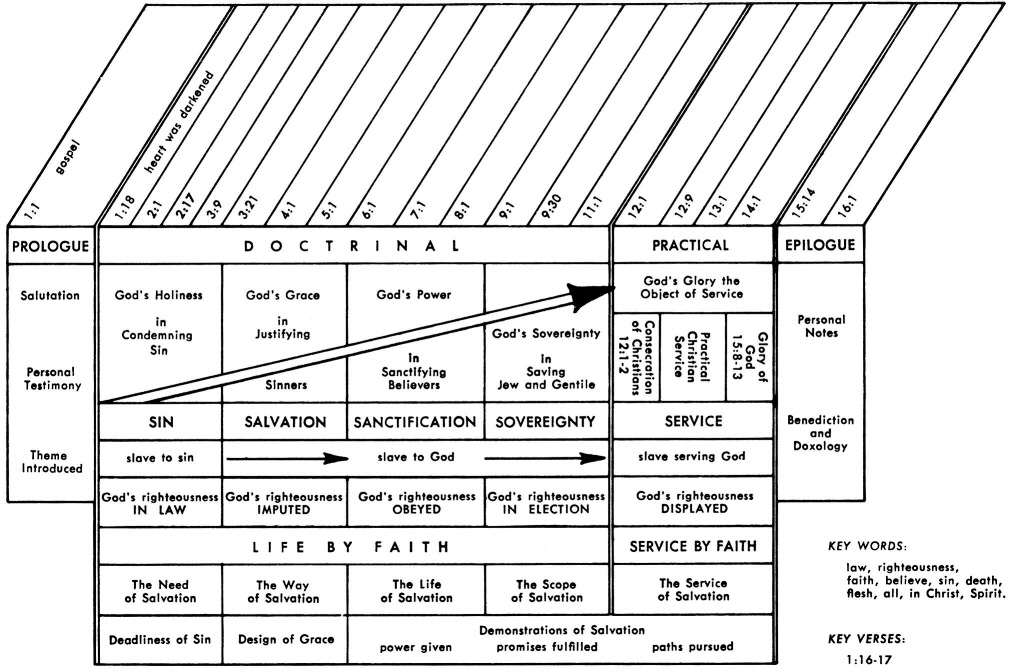
Click chart to enlarge
Chart from recommended resource Jensen's Survey of the NT - used by permission
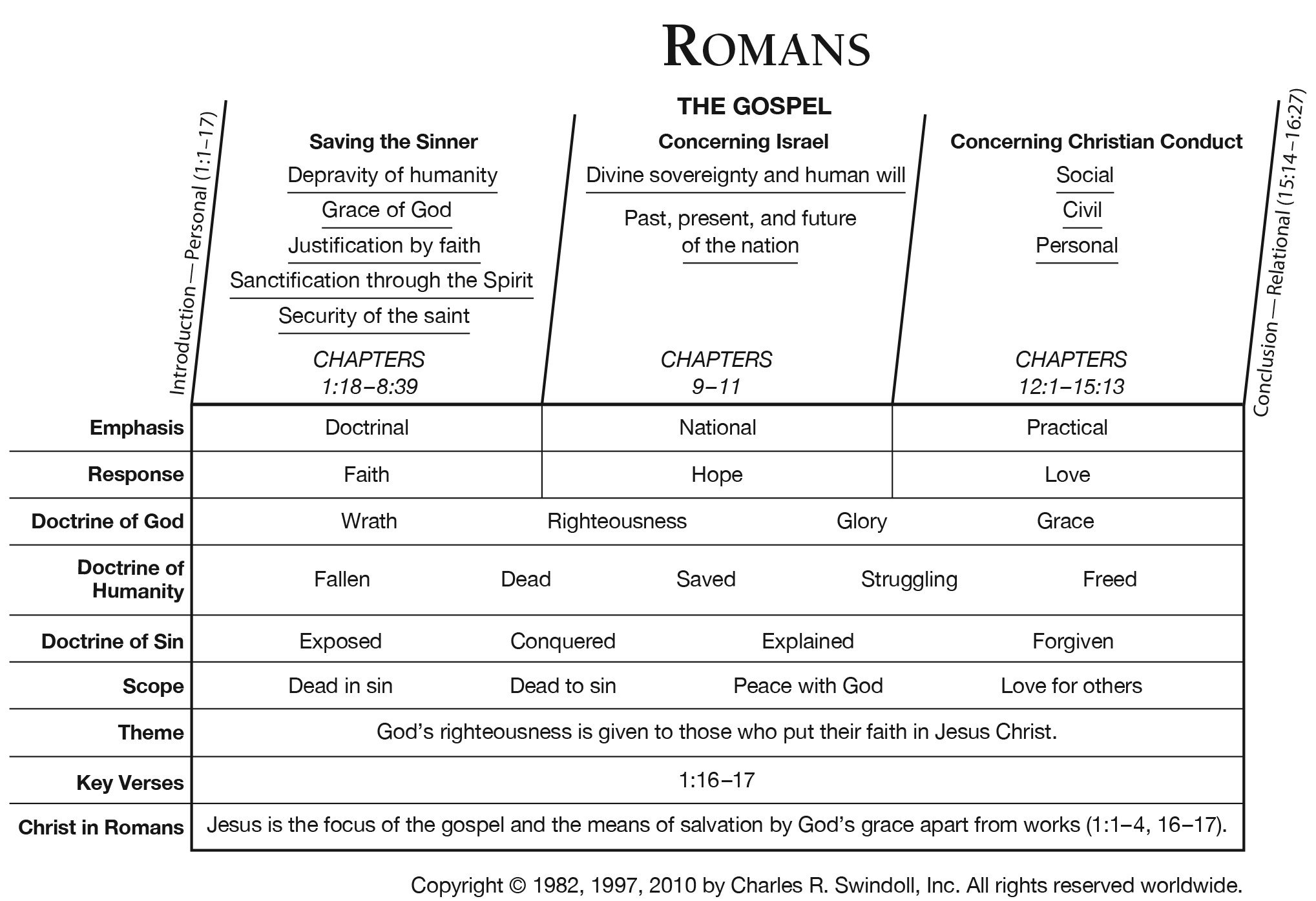
Click Charles Swindoll's overview chart
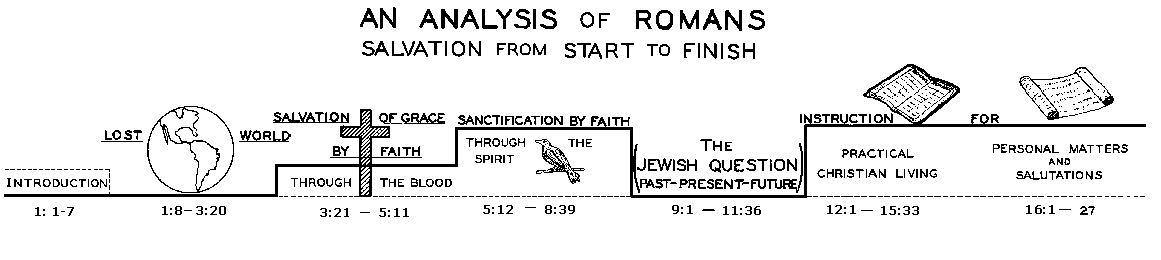
Source: Dr David Cooper
Click to Enlarge
| ROMANS ROAD to RIGHTEOUSNESS |
||||
| Romans 1:18-3:20 | Romans 3:21-5:21 | Romans 6:1-8:39 | Romans 9:1-11:36 | Romans 12:1-16:27 |
| SIN | SALVATION | SANCTIFICATION | SOVEREIGNTY | SERVICE |
| NEED FOR SALVATION |
WAY OF SALVATION |
LIFE OF SALVATION |
SCOPE OF SALVATION |
SERVICE OF SALVATION |
| God's Holiness In Condemning Sin |
God's Grace In Justifying Sinners |
God's Power In Sanctifying Believers |
God's Sovereignty In Saving Jew and Gentile |
Gods Glory The Object of Service |
| Deadliness of Sin |
Design of Grace |
Demonstration of Salvation | ||
| Power Given | Promises Fulfilled | Paths Pursued | ||
| Righteousness Needed |
Righteousness Credited |
Righteousness Demonstrated |
Righteousness Restored to Israel |
Righteousness Applied |
| God's Righteousness IN LAW |
God's Righteousness IMPUTED |
God's Righteousness OBEYED |
God's Righteousness IN ELECTION |
God's Righteousness DISPLAYED |
| Slaves to Sin | Slaves to God | Slaves Serving God | ||
| Doctrine | Duty | |||
| Life by Faith | Service by Faith | |||
|
Modified from Irving L. Jensen's chart above |
||||
Romans 2:27 And he who is physically uncircumcised, if he keeps (PAPFSN) the Law, will he not judge (3SFAI) you who though having the letter of the Law and circumcision are a transgressor of the Law? (NASB: Lockman)
Greek: kai krinei (3SFAI) e ek phuseos akrobustia ton nomon telousa (PAPPSN) se ton dia grammatos kai peritomes parabaten nomou.
GNT καὶ κρινεῖ ἡ ἐκ φύσεως ἀκροβυστία τὸν νόμον τελοῦσα σὲ τὸν διὰ γράμματος καὶ περιτομῆς παραβάτην νόμου.
Amplified: Then those who are physically uncircumcised but keep the Law will condemn you who, although you have the code in writing and have circumcision, break the Law. (Amplified Bible - Lockman)
NLT: In fact, uncircumcised Gentiles who keep God's law will be much better off than you Jews who are circumcised and know so much about God's law but don't obey it. (NLT - Tyndale House)
NET And will not the physically uncircumcised man who keeps the law judge you who, despite the written code and circumcision, transgress the law?
NLT In fact, uncircumcised Gentiles who keep God's law will condemn you Jews who are circumcised and possess God's law but don't obey it.
KJV And shall not uncircumcision which is by nature, if it fulfil the law, judge thee, who by the letter and circumcision dost transgress the law? (
ESV Then he who is physically uncircumcised but keeps the law will condemn you who have the written code and circumcision but break the law.
NIV The one who is not circumcised physically and yet obeys the law will condemn you who, even though you have the written code and circumcision, are a lawbreaker.
ASV and shall not the uncircumcision which is by nature, if it fulfil the law, judge thee, who with the letter and circumcision art a transgressor of the law?
CSB A man who is physically uncircumcised, but who fulfills the law, will judge you who are a lawbreaker in spite of having the letter of the law and circumcision.
NKJ And will not the physically uncircumcised, if he fulfills the law, judge you who, even with your written code and circumcision, are a transgressor of the law?
NRSV Then those who are physically uncircumcised but keep the law will condemn you that have the written code and circumcision but break the law.
Phillips: Moreover, is it not plain to you that those who are physically uncircumcised, and yet keep the Law, are a continual judgment upon you who, for all your circumcision and knowledge of the Law, break it? (Phillips: Touchstone)
Wuest: And the uncircumcision which by nature is fulfilling the law will judge you who with the advantage of the letter and of circumcision are a transgressor of law.
Young's Literal: and the uncircumcision, by nature, fulfilling the law, shall judge thee who, through letter and circumcision, art a transgressor of law.
AND HE WHO IS PHYSICALLY UNCIRCUMCISED: kai krinei (3SFAI) e ek phuseos akrobustia:
- Romans 2:25-29: Ritual Versus Reality - Steven Cole
- Romans 2:19-29 False Security, Part 2 - John MacArthur
- Romans 2 Resources - Multiple Sermons and Commentaries
LITERAL PHYSICAL
CIRCUMCISION
And He who is physically (phusis/physis) uncircumcised (akrobustia) - This is a synonym for Gentiles in this context. In the OT Gentiles are often referred to as "the peoples" (eg, Ex 15:14, 19:5, Lev 20:24 "separated you from the peoples", Lev 20:26 "set you apart from the peoples", etc) "the nations" (Ge 17:4 - Abraham would be "the father of a multitude of nations", Ge 22:18 - "in your seed all the nations of the earth shall be blessed", Psalm 2:1, etc)
Here is Paul's reasoning. If a physically uncircumcised Gentile were to keep the work of the law within his heart, would he not be justified, instead of the physically circumcised Jew who did not keep the law? A Gentile who obeys what the Law requires, even though he does not know the Law (Ro 2:14) is in God’s sight similar to a circumcised Jew. This thought would be revolutionary for Jews (and revolting to some) who considered themselves far superior to Gentiles (cf. Ro 2:17-21).
Denney explains Paul's logic this way...“Here the inference is drawn from the principle laid down in verse 25. This being so, Paul argues, if the uncircumcision maintain the just requirements of the law, shall not his uncircumcision be accounted circumcision, because it has really done what circumcision pledged the Jew to do?… As he has done what circumcision bound the Jew to do, he will be treated as if in the Jew’s position: his uncircumcision will be reckoned as circumcision.”
Douglas Moo - The belief that the righteous would sit in judgment over the unrighteous was widespread (Cf., in Paul, 1 Cor. 6:2; and note, e.g., 1 Enoch 91:12; 98:12; Apoc. Abr. 29:19–21; Wis. 3:8; additional examples in Str-B, 3.124.). But the Jewish tradition naturally cast Jews in the role of the righteous and Gentiles in that of the unrighteous. Paul reverses this customary scheme and, continuing his argument from v. 26, asserts that “the uncircumcised person by nature who completes the law will judge (The Greek verb krino clearly has a negative, condemnatory, sense.) you [e.g., the Jew] who, though having the letter and circumcision, are a transgressor of the law.” (Borrow The Epistle to the Romans )
Fred Stallan - The Jew who had the privileges and the greater light would be condemned by the Gentile who had none of the benefits conferred upon the Jew. In the public ministry of the Lord He taught that the men of Nineveh would rise in judgment on the generation of His day and condemn them because the Ninevites repented at the preaching of Jonah, and a greater than Jonah was there in grace. In the same way the queen of Sheba would rise up in judgment on the same generation because she came from the uttermost parts of the earth to hear the wisdom of Solomon and a greater than Solomon was there in their midst (Matt 12:41, 42). (What the Bible teaches – Romans)
Physically (5449) (phusis/physis from phúo = to bring forth) refers to a condition or circumstance as determined by birth and thus a natural condition. Phusis is the nature of something as the result of its natural development or condition. 1. natural endowment or condition Ro 2:27; 11:21, 24; Gal 2:15; Eph 2:3.—2. natural characteristics or disposition Gal 4:8; 2 Pt 1:4; perh. Jas 3:7b (see 4 below).—3. nature as the regular natural order Ro 1:26; 2:14; 1 Cor 11:14.—4. (natural) being, creature, species, kind Jas 3:7a; probably 3:7b (see 2 above).* [physi-, physio-, combining forms in a number of words]
Physis - 11v - instinctively(1), natural(1), natural*(1), nature(7), physically(1), race(1), species(1), unnatural*(1). Rom. 1:26; Rom. 2:14; Rom. 2:27; Rom. 11:21; Rom. 11:24; 1 Co. 11:14; Gal. 2:15; Gal. 4:8; Eph. 2:3; Jas. 3:7; 2 Pet. 1:4
Uncircumcision (203) (akrobustia from ákron = the extreme + búo = cover) means uncircumcised or uncircumcision and thus referred to the prepuce or foreskin. What Paul is picturing is that the physical rite of circumcision without any internal transformation equates with a foreskin! Akrobustia was also used as a term of scorn and derision by Jews, for they equated "uncircumcision" with being a pagan Gentiles. Can you imagine how a self-righteous Jew must have felt when he read Paul's argument! Friberg - (1) as a state, of the male sexual organ with the foreskin not cut off (Acts 11.3); (2) by metonymy, of the state of an uncircumcised man uncircumcision (Gal 5.6), opposite peritome, (circumcision); (3) with the abstract for concrete Gentiles, non-Jewish people, pagans (Ro 3.30); (4) figuratively, in a negative sense of lack of relationship with God and righteousness uncircumcision (Col 2.13) (Borrow Analytical Lexicon of the Greek New Testament)
Akrobustia - 17v - uncircumcised(10), uncircumcised man(1), uncircumcision(8), without being circumcised(1). Acts 11:3; Rom. 2:25; Rom. 2:26; Rom. 2:27; Rom. 3:30; Rom. 4:9; Rom. 4:10; Rom. 4:11; Rom. 4:12; 1 Co. 7:18; 1 Co. 7:19; Gal. 2:7; Gal. 5:6; Gal. 6:15; Eph. 2:11; Col. 2:13; Col. 3:11
IF HE KEEPS THE LAW, WILL HE NOT JUDGE YOU WHO THOUGH HAVING THE LETTER OF THE LAW AND CIRCUMCISION ARE A TRANSGRESSOR OF THE LAW: kai krinei (3SFAI) e ek phuseos akrobustia ton nomon telousa (PAPFSN) se ton dia grammatos kai peritomes parabaten nomou::
- Ro 8:4; 13:10; Mt 3:15; 5:17, 18, 19, 20; Acts 13:22; Gal 5:14
- judge: Ezekiel 16:48, 49, 50, 51, 52; Mt 12:41,42; He 11:3
- Ro 2:20,29; 7:6, 7, 8; 2Cor 3:6
- Romans 2:25-29: Ritual Versus Reality - Steven Cole
- Romans 2:19-29 False Security, Part 2 - John MacArthur
- Romans 2 Resources - Multiple Sermons and Commentaries
AN IMPOSSIBLE
"IF"
If he keeps (tereo) will not he judge (krino) you who though having the letter of the Law (nomos) and circumcision (peritome) are a transgressor (parabates) of the Law (nomos)? - This is the proverbial "big" (impossible) if! These are third class conditional "ifs" in Ro 2:25-26, referring to possible future action. And note keeps is in the present tense which means one keeps the law continually, as one's lifestyle, which of course is impossible (unless you are Jesus!) Paul is making a dramatic statement that if a Gentile (even though uncircumcised) is obedient, the Gentile will condemn the Jew who is a lawbreaker even though he had the privilege of the law and bore covenant mark of circumcision. The Gentile's obedience to the law will constitute the ‘evidence of what the Jew ought to have been and could have been’. (Cranfield) To say it another way, a Gentile’s humble obedience to the law should serve as a stern rebuke to a Jew who, in spite of his great advantages, lives in disobedience. Circumcision (or baptism - or any ritual in itself) doesn't save anyone; Egyptians circumcised their boys, and Ishmael, the son of the flesh, was circumcised
This argument is hypothetical. Paul is not saying that uncircumcised Gentiles can keep the Law, but rather that if they do they will be reckoned as "circumcised" in a spiritual sense. Moreover, they then could be called to bear witness in judgment against the circumcised (the Jews) who have transgressed the Law. Paul’s argument was devastating! One of the greatest insults in Judaism was to call another Jew “an uncircumcised one,” and this is what Paul had done in no uncertain terms. Circumcision alone does not justify a man. His actions or behavior must be in keeping with his profession of faith.
THOUGHT - In applying this truth to ourselves, all we have to do is substitute for the word “circumcision” any of the following: Church membership —baptism— confirmation— Methodist— Baptist— Presbyterian— and so on. The great mistake of Catholics, Protestants, and Jews when asked about their relationship to God is to cite their religious affiliation as evidence of their relationship.
- “Are you a believer?” “Of course. I’ve been a member of First Church for twenty-five years.”
- “Are you a believer?” “I’m a ____(name of denomination)! Does that answer your question?”
- “Are you a believer?” “Why yes, I was baptized right here in Christian Church.”
There are as many answers as there are affiliations and rites, but none will convince God—they are all outward "circumcisions" so to speak.
Paul speaking of the letter of the Law writes "Not that we are adequate in ourselves to consider anything as coming from ourselves, but our adequacy is from God, who also made us adequate as servants of a new covenant, not of the letter, but of the Spirit; for the letter kills, (the Mosaic Law kills because, of itself, it could not give life was meant to make men conscious of sin - see Purpose of the Law) but the Spirit gives life. (2Cor 3:5-6+)
Keeps (5055) (teleo from telos = goal, an end, a purpose, an aim, a fulfillment, an achievement; See discussion of related words - Mature = teleios; Maturity [perfect] = teleiotes) means to bring to an end (e.g., Jesus finished speaking - see below) as one brings a process, a course, a task or an undertaking to the end. It means to make an end or to accomplish and complete something, not merely by bringing it to end but bringing it to perfection, in the context of Romans 2:27 signifying that one keeps the law perfectly. Teleo means to accomplish an obligation or demand in the sense of to bring about a result by effort. The idea is to achieve a goal or to conclude it successfully. This meaning is especially poignant in the context of Jesus' life purpose which was to die on the Cross, the purpose He pointed to and which He accomplished ("It is finished" John 19:30). This same meaning of fulfilling or bringing about the completion or achievement of a goal or objective is also a prominent meaning in the Revelation (e.g. Re 11:7+; Re 17:17+) Teleo in some contexts (Mt 17:24, Ro 13:6+) means to pay, and in the NT uses refers to payment of obligatory taxes or tolls. Secular uses of teleo include the idea of carrying out instructions, of fulfilling obligations and religiously of carrying out religious acts including consecrating initiates (as into a mystery cult). This latter sense is not used in the NT but is used in the LXX translation of Numbers 25:3, 5 where Israel joined themselves to (consecrated themselves) the pagan idol Baal peor. See Resources related to teleo: (1) "It is finished" = tetelestai = perfect tense of teleo (2) Commentary on John 19:30
Here are the 28 NT uses of teleo...
Matthew 7:28 (note) The result was that when Jesus had finished these words, the multitudes were amazed at His teaching;
Matthew 10:23 "But whenever they persecute you in this city, flee to the next; for truly I say to you, you shall not finish going through the cities of Israel, until the Son of Man comes.
Matthew 11:1 And it came about that when Jesus had finished giving instructions to His twelve disciples, He departed from there to teach and preach in their cities.
Matthew 13:53 And it came about that when Jesus had finished these parables, He departed from there.
Matthew 17:24 And when they had come to Capernaum, those who collected the two-drachma tax came to Peter, and said, "Does your teacher not pay (teleo) the two-drachma tax?"
Matthew 19:1 And it came about that when Jesus had finished these words, He departed from Galilee, and came into the region of Judea beyond the Jordan;
Matthew 26:1 And it came about that when Jesus had finished all these words, He said to His disciples,
Luke 2:39 And when they had performed everything according to the Law of the Lord, they returned to Galilee, to their own city of Nazareth.
Luke 12:50 "But I have a baptism to undergo, and how distressed I am until it is accomplished!
Luke 18:31 And He took the twelve aside and said to them, "Behold, we are going up to Jerusalem, and all things which are written through the prophets about the Son of Man will be accomplished.
Luke 22:37 "For I tell you, that this which is written must be fulfilled in Me, 'And He was numbered with transgressors'; for that which refers to Me has its fulfillment."
John 19:28 After this, Jesus, knowing that all things had already been accomplished, in order that the Scripture might be fulfilled, said, "I am thirsty."
John 19:30 When Jesus therefore had received the sour wine, He said, "It is finished!" And He bowed His head, and gave up His spirit.
Acts 13:29 "And when they (the Jews in Jerusalem and their rulers) had carried out all that was written concerning Him, they took Him down from the cross and laid Him in a tomb.
Romans 2:27 (note) And will not he who is physically uncircumcised, if he keeps the Law, will he not judge you who though having the letter of the Law and circumcision are a transgressor of the Law?
Romans 13:6 (note) For because of this you also pay (teleo - present tense = continually!) taxes, for rulers are servants of God, devoting themselves to this very thing.
2 Corinthians 12:9 And He has said to me, "My grace is sufficient for you, for power is perfected (teleo - present tense = this principle is continually active; passive voice = this effect [empowerment] is brought about by an a source other than the subject, in this case the Spirit of Christ) in weakness." Most gladly, therefore, I will rather boast about my weaknesses, that the power of Christ may dwell in me.
Galatians 5:16 (note) But I say, walk by the Spirit, and you will not carry out the desire of the flesh.
2 Timothy 4:7 (note) I have fought the good fight, I have finished the course (dromos = a race track or course), I have kept the faith
Comment: Paul pictures his Christian life as a race and is saying he has broken the barrier at the finish line, having fulfilled the purpose for which he was created and then "re-created" in Christ. The perfect tense points to the permanent effect of his finish. The finish line has been crossed and the results would last forever. He has now entered his eternal rest.
James 2:8 If, however, you are fulfilling the royal law, according to the Scripture, "You shall love your neighbor as yourself," you are doing well.
Revelation 10:7 (note) but in the days of the voice of the seventh angel, when he is about to sound, then the mystery of God is finished (accomplished), as He preached to His servants the prophets.
Revelation 11:7 (note) And when they have finished their testimony, the beast that comes up out of the abyss will make war with them, and overcome them and kill them.
Comment: From a timing perspective, this is one of the most important events in the Revelation as it occurs in the middle of the 7 year Tribulation and marks the beginning of the Great Tribulation.
Revelation 15:1 (note) And I saw another sign in heaven, great and marvelous, seven angels who had seven plagues, which are the last, because in them the wrath of God is finished.
Comment: When the bowl judgments are poured out in the Great Tribulation, God's wrath against Israel is over, for it has accomplished the refining and purifying that He desired, and the one third of the Jews who have believed in Messiah will enter the Millennial Kingdom.
Revelation 15:8 (note) And the temple was filled with smoke from the glory of God and from His power; and no one was able to enter the temple until the seven plagues of the seven angels were finished.
Comment: Another allusion to the completion of the horrendous 3.5 year period known as the Great Tribulation.
Revelation 17:17 (note) "For God has put it in their hearts to execute His purpose (Do not miss this faith buoying truth that God is sovereign and in control even of the drama of these evil players! Absolutely nothing happens outside of His control! And this is true in your life beloved child of God!) by having a common purpose, and by giving their kingdom to the beast, until the words of God should be fulfilled (accomplished).
Revelation 20:3 (note) and threw him into the abyss, and shut it and sealed it over him, so that he should not deceive the nations any longer, until the thousand years were completed; after these things he must be released for a short time.
Revelation 20:5 (note) The rest of the dead did not come to life until the thousand years were completed. This is the first resurrection.
Revelation 20:7 (note) And when the thousand years are completed, Satan will be released from his prison
Teleo is used 14 times in the Septuagint (LXX) (Nu 25:3, 5; Ruth 2:21; 3:18; Ezr. 1:1; 5:16; 6:15; 7:12; 9:1; 10:17; Neh. 6:15; Ps. 106:28; Dan. 4:33; Hos. 4:14)
Ruth 2:21 (note) Then Ruth the Moabitess said, "Furthermore, he said to me, 'You should stay close to my servants until they have finished (Hebrew = kalah = to be complete, at an end, finished, accomplished; Lxx = teleo) all my harvest.'"
Ruth 3:18 (note) Then she said, "Wait, my daughter, until you know how the matter turns out; for the man will not rest until he has settled (KJV = "have finished"; Hebrew = kalah = to be complete, at an end, finished, accomplished; Lxx = teleo) it today."
Ezra 6:15 And this temple was completed (Hebrew = yetsa = to bring to an end, to finish; Lxx = teleo) on the third day of the month Adar; it was the sixth year of the reign of King Darius.
Ezra 10:17 And they finished (Hebrew = kalah = to be complete, at an end, finished, accomplished; Lxx = teleo) investigating all the men who had married foreign wives by the first of the first month.
Nehemiah 6:15 So the wall was completed (Hebrew = shalem = to be complete or sound, to be at peace {related noun = shalom}; Lxx = teleo) on the twenty-fifth of the month Elul, in fifty-two days.
Law (3551) (nomos from némo = divide among, parcel out, allot) is etymologically something parceled out, allotted, what one has in use and possession; hence, usage, custom. 1. rule, principle, norm Ro 7:21, 23; 8:2b; Heb 7:16.—2. of any kind of law Ro 3:27; perh. 7:1f.—3. of the Mosaic law Mt 22:36 ; Lk 2:22; 16:17; Jn 7:23, 51; 18:31; Ac 13:38; 18:13; 21:24; Ro 2:25; 3:19; 4:14; 7:2; Gal 3:12f, 17, 19; 5:23; 1 Ti 1:9; Heb 7:19. Almost equivalent to (Jewish) religion Ac 23:29. Specifically of the written law, the Pentateuch Mt 7:12; 12:5; Lk 2:23; 24:44; 1 Cor 9:9; Gal 3:10; 4:21b. Of the scriptures generally Mt 5:18; Jn 10:34; Ro 3:19.—4. of Christianity as a ‘new law’ Ro 3:27b; 8:2a; Gal 6:2; Jas 1:25; 2:8f, 12.
- Moral, ceremonial, and judicial law - a brief study
- What is the difference between the ceremonial law, the moral law, and the judicial law in the Old Testament?
Judge (2919) (krino) primarily signifies to distinguish, separate or discriminate and then, to distinguish between good and evil, right and wrong, without necessarily passing an adverse sentence, though this is usually involved. Krino means to sift out and analyze evidence. Passing judgment, by implication, means condemning. Gingrich - 1. separate, distinguish, then select, prefer Ro 14:5a; in 14:5b k) prob. means hold in esteem.—2. judge, think, consider, look upon Lk 7:43; Acts 4:19; 13:46; 16:15; 26:8; 1 Cor 11:13; 2 Cor 5:14.—3. reach a decision, decide, propose, intend Acts 3:13; 16:4; 20:16; 21:25; 27:1; 1 Cor 2:2; 5:3; 7:37; Ro 14:13.—4. as legal term, of human or divine courts judge, decide, hale before a court, condemn, sentence, hand over for punishment Mt 5:40; 7:1b, 2b; Lk 19:22; Jn 5:30; 7:51; 18:31 ; Ac 13:27; 17:31; 23:3; 25:9; 26:6; Ro 2:16, 27; 1 Cor 5:12f ; 6:2f, 6; 2 Ti 4:1; Jas 2:12; 1 Pet 1:17; Rev 6:10; 20:12f. Condemn, punish Jn 3:17f; 12:47f; 16:11; Ro 2:12; 1 Cor 11:31f; Heb 10:30; Rev 18:8.—5. judge, pass judgment on, express an opinion about Mt 7:1a, 2a; Lk 6:37a; Jn 7:24; 8:15. In an unfavorable sense find fault with, condemn Ro 2:1, 3; 14:3f, 10, 13a, 22; 1 Cor 4:5; 10:29; Col 2:16; Jas 4:11f.
Krino in Romans - Rom. 2:1; Rom. 2:3; Rom. 2:12; Rom. 2:16; Rom. 2:27; Rom. 3:4; Rom. 3:6; Rom. 3:7; Rom. 14:3; Rom. 14:4; Rom. 14:5; Rom. 14:10; Rom. 14:13; Rom. 14:22;
Circumcision (4061) (peritome from perí = around + témno = cut off) refers literally to cutting and removal of the foreskin. (See related discussion on Circumcision) In Ro 2:29 Paul is referring to a figurative circumcision as mentioned several times in the Old Testament (click), so this is a truth concerning which the Jews should not have been ignorant. Friberg - circumcision; (1) literally, as a religious rite signifying covenant participation with God (Jn 7.22); figuratively, as spiritual circumcision denoting separation from sin and consecration to God in covenant relationship (Ro 2.29); (2) by metonymy, for those who are circumcised; literally the circumcised, i.e. Jews ( Ro 3.30), opposite akrobustia (literally the uncircumcised, i.e. Gentiles); figuratively, of Christians (Php 3.3) (Borrow Analytical Lexicon of the Greek New Testament)
Peritome 36x in the NT --Jn. 7:22, 23; Acts 7:8; 10:45; 11:2; Ro 2:25, 26-notes, Ro 2:27, 28, 29-notes; Ro 3:1-note, Ro 3:30-note; Ro 4:9, 10, 11, 12-notes; Ro 15:8-note; 1 Co. 7:19; Gal 2:7, 8, 9, 12; 5:6, 11; 6:15; Ep 2:11; Php 3:3, Php 3:5; Col 2:11; 3:11; 4:11; Titus 1:10.
There are only 4 uses in the Septuagint (LXX) - Ge 17:13; Ex 4:25, 26; Je 11:16.
Transgressor (3848) (parabates from from pará = beyond or contrary to + baíno = to go) (see study of related word parabasis) describes one who goes beyond and thus is a violator of the law. A transgressor is one who goes beyond the line. So, also, trespass, which is transpass, from the Latin trans, across, and passus, a step.
Parabates - 5v - Ro 2:25, 27; Gal 2:18; Jas 2:9, 11.
Romans 2:28 For he is (3SPAI) not a Jew who is one outwardly *, nor is circumcision that which is outward in the flesh. (NASB: Lockman)
Greek: ou gar o en to phanero Ioudaios estin, (3SPAI) oude e en to phanero en sarki peritome;
BGT Romans 2:28 οὐ γὰρ ὁ ἐν τῷ φανερῷ Ἰουδαῖός ἐστιν οὐδὲ ἡ ἐν τῷ φανερῷ ἐν σαρκὶ περιτομή,
KJV Romans 2:28 For he is not a Jew, which is one outwardly; neither is that circumcision, which is outward in the flesh:
NET Romans 2:28 For a person is not a Jew who is one outwardly, nor is circumcision something that is outward in the flesh,
CSB Romans 2:28 For a person is not a Jew who is one outwardly, and true circumcision is not something visible in the flesh.
ESV Romans 2:28 For no one is a Jew who is merely one outwardly, nor is circumcision outward and physical.
NIV Romans 2:28 A man is not a Jew if he is only one outwardly, nor is circumcision merely outward and physical.
NLT Romans 2:28 For you are not a true Jew just because you were born of Jewish parents or because you have gone through the ceremony of circumcision.
NRS Romans 2:28 For a person is not a Jew who is one outwardly, nor is true circumcision something external and physical.
YLT Romans 2:28 For he is not a Jew who is so outwardly, neither is circumcision that which is outward in flesh;
GWN Romans 2:28 A person is not a Jew because of his appearance, nor is circumcision a matter of how the body looks.
NKJ Romans 2:28 For he is not a Jew who is one outwardly, nor is circumcision that which is outward in the flesh;
NAB Romans 2:28 One is not a Jew outwardly. True circumcision is not outward, in the flesh.
MIT Romans 2:28 For Jewishness does not derive from externals, and certainly not from the exterior circumcision of the flesh.
NJB Romans 2:28 Being a Jew is not only having the outward appearance of a Jew, and circumcision is not only a visible physical operation.
ASV Romans 2:28 For he is not a Jew who is one outwardly; neither is that circumcision which is outward in the flesh:
Phillips: I have come to the conclusion that a true Jew is not the man who is merely a Jew outwardly, and a real circumcision is not just a matter of the body. (Phillips: Touchstone)
Wuest: For, not he who is so in an outward fashion is a Jew, nor even that which is in an outward fashion in flesh is circumcision.
Young's Literal: For he is not a Jew who is so outwardly, neither is circumcision that which is outward in flesh;
FOR HE IS NOT A JEW WHO IS ONE OUTWARDLY NOR IS (physical) CIRCUMCISION THAT WHICH IS OUTWARD IN THE FLESH: ou gar o en to phanero Ioudaios estin (3SPAI) oude e en to phanero en sarki peritome:
- For he is not a Jew - Ro 9:6-8; Ps 73:1; Isa 1:9-15; 48:1,2; Ho 1:6, 8, 9; Mt 3:9; Jn 1:47; Jn 8:37-39; Gal 6:15; Rev 2:9
- Nor - Jer 9:26; Ro 4:10-12; 1Pe 3:21
- Romans 2 Resources - Multiple Sermons and Commentaries
- Romans 2:25-29: Ritual Versus Reality - Steven Cole
- Romans 2:19-29 False Security, Part 2 - John MacArthur
Related Passages:
Romans 9:6-8 But it is not as though the word of God has failed. For they are not all Israel who are descended from Israel; 7 nor are they all children because they are Abraham’s descendants, but: “THROUGH ISAAC (OFFSPRING OF FAITH IN GOD'S PROMISE) YOUR DESCENDANTS WILL BE NAMED.” 8 That is, it is not the children of the flesh who are children of God, but the children of the promise are regarded as descendants.
Matthew 3:9 and do not suppose that you can say to yourselves, ‘We have Abraham for our father’; for I say to you that from these stones God is able to raise up children to Abraham.
John 8:37-39 “I know that you are Abraham’s descendants; yet you seek to kill Me, because My word has no place in you. 38 “I speak the things which I have seen with My Father; therefore you also do the things which you heard from your father.” 39 They answered and said to Him, “Abraham is our father.” Jesus *said to them, “If you are Abraham’s children, do the deeds of Abraham.
Galatians 6:15 For neither is circumcision anything, nor uncircumcision, but a new creation.
Revelation 2:9 ‘I know your tribulation and your poverty (but you are rich), and the blasphemy by those who say they are Jews and are not, but are a synagogue of Satan.
Jeremiah 9:26 Egypt and Judah, and Edom and the sons of Ammon, and Moab and all those inhabiting the desert who clip the hair on their temples; for all the nations are uncircumcised, and all the house of Israel are uncircumcised of heart.”
Romans 4:10-12 How then was it credited? While he was circumcised, or uncircumcised? Not while circumcised, but while uncircumcised; 11 and he received the sign of circumcision, a seal of the righteousness of the faith which he had while uncircumcised, so that he might be the father of all who believe without being circumcised, that righteousness might be credited to them, 12 and the father of circumcision to those who not only are of the circumcision, but who also follow in the steps of the faith of our father Abraham which he had while uncircumcised.
EXTERNAL JEWISHNESS
IS OF NO VALUE BEFORE GOD
NLT gives a good paraphrase - For you are not a true Jew just because you were born of Jewish parents or because you have gone through the Jewish ceremony of circumcision.
For (gar) he is not a Jew (ioudaios) who is one outwardly (phaneros - visibly, clearly seen), nor is circumcision (peritome) that which is outward (phaneros) in the flesh (sarx) - For is a is a term of explanation. In other words being a true or genuine Jew is not a matter of outward or external things that are clearly seen (such as wearing phylacteries, paying tithes, or being circumcised).
Dr. Barnhouse's paraphrase as it applies to the church - For he is not a Christian who is one outwardly, nor is that “church membership” which is outward in the flesh; but he is a Christian who is one inwardly; and “church membership” is that of the heart, in the Spirit, not in the letter, whose praise is not of men, but of God.
They are not all Israel who are descended from Israel! In other words, not all the physical descendents of Abraham are automatically "spiritual" descendents. (cf Gal 3:29). As John the Baptist had pronounced many years earlier, God could raise up physical descendants of Abraham from stones if He so chose (Mt 3:9).
Be careful who you read in any commentary (including the one you are reading! Acts 17:11+). Below is a comment from the well known (and generally very good writer) commentary by Adam Clarke regarding who the "Jew" is in this passage. Clarke writes that the Jew is "A member of the Church of God, who has only an outward profession." Note that there is not one mention of the church in this entire epistle until Ro 16:1! Can you see the error Clarke made and which so many still continue to make? His mistake was to interpret Ro 2:28-29 in light of what he has been taught to believe about Israel and the Church and not let the text speak in context - Paul's context in Romans 2, especially in the last section, is clearly directed primarily at the Jews. Clarke "replaces" the Jew with the Church (a false theology referred to as "replacement theology"). The point is that one must be a Berean, (Acts 17:11+) when reading the commentaries, no matter how well known the commentary is. A safe rule in inductive study is to always carefully observe the Scriptures and allow the context to guide the interpretation. (See related resources - What is replacement theology / supersessionism? | GotQuestions.org; What is New Israel? | GotQuestions.org; What is spiritual Israel? | GotQuestions.org).
The highly respected expositor, Dr John Piper, makes as similar statement "By faith in Christ, through the blood of the covenant, you can be a true Jew (Romans 2:29)."(See The Pleasures of God: Meditations on God's Delight in Being God) Beloved, I beg to differ. If you are a Gentile, you will always be a Gentile even after you are saved. You will not suddenly become a "true Jew" when you are born again. It is this genre of teaching which leads many to believe that the Church has replaced Israel in God's plan of redemption. Nothing could be further from the truth. You can write it down with a diamond stylus that God is not finished with the nation of Israel! Read the yet to be fulfilled prophecies of Zechariah 12-14+.
THOUGHT - Now by way of application one might ask how do we see this truth today? And it might be some who say they are saved by having godly parents and knowing what they taught them, or because they have been faithful members of the corner church all their life, or because they have received water baptism as an infant, a child or an adult. In each of these situations they are in need of a circumcision of their hearts by God's Spirit Who alone births new life from above. Let us warn those around us (in love) to flee from the wrath to come lest they be deceived as so many of the Jews in Paul's day were. We must each consider the question, "Where does our confidence lie?" Does it rest on our knowledge of God’s Word, our religious affiliation, our experience of baptism, etc? If so, we are deluded, dead and doomed to eternal destruction unless we come to repentance and faith in the Gospel! True salvation and eternal life is a matter of the heart. God’s Word is surgical. It is meant to pierce hearts (He 4:12,13-note; Heb 4:13-note). If God has spoken to you and revealed your need and your heart is troubled, there is hope for you. Now receive the Word implanted which is able to save your soul (James 1:21).
J. C. Ryle has some pithy comments from his sermon entitled Formalism (see entire sermon below):
"[I.] We learn, first, that formal religion is not true religion, and a formal Christian is not a true Christian in God's sight.
[II.] We learn, secondly, that the heart is the seat of true religion, and that the true Christian is the Christian in heart.
[III.] We learn, thirdly, that true religion must never expect to be popular. It will not have the "praise of man, but praise from God....
Two hundred years have passed away since a mighty Puritan preacher said, "Formalism, formalism, formalism is the great sin of this day, under which the whole country groans. There is more light than there was, but less life; more profession, but less holiness." (Thomas Hall, on 2Ti 3:5 [see note] the year was 1658). What would this good man have said if he lived in our times?"
Outward in the flesh - God had instituted circumcision as a mark of His covenant with Abraham and his descendants, declaring that “every male among you who is eight days old shall be circumcised throughout your generations” (Ge 17:10, 11, 12). Many commentators feel that this "surgical procedure" was symbolic of the sinfulness of man that was passed from generation to generation (by the seed of man), so that the very organ needed to be cleansed of a covering. So man at the very center of his nature is sinful and needs cleansing of the heart. This graphic symbol of the need for removing sin became the sign of being a Jew. But as important as circumcision was as an act of obedience to God and as a reminder to Jews of their covenant relation to Him, the rite had no spiritual power and was only an outward symbol. And rather than freeing Jews from God’s law, circumcision made them even more responsible for obeying it, because that ritual testified to their greater knowledge of sin, of God, and of His will in regard to them.
Paul contrasts their physical circumcision with circumcision of the heart, a teaching which should not have been "new" to any Jew well-schooled in the Law and the Prophets, as shown in the passages below...
Deuteronomy 10:16+ “So circumcise your heart, and stiffen your neck no longer.
Deuteronomy 30:6+ “Moreover the LORD your God will circumcise your heart and the heart of your descendants, to love the LORD your God with all your heart and with all your soul, so that you may live.
Jeremiah 4:4 “Circumcise yourselves to the LORD And remove the foreskins of your heart, Men of Judah and inhabitants of Jerusalem, Or else My wrath will go forth like fire And burn with none to quench it, Because of the evil of your deeds.”
Stephen sums up the reason most of the Jews failed to receive and at on these truths declaring boldly that "You (JEWISH) men who are stiff-necked and uncircumcised in heart and ears are always resisting the Holy Spirit (THIS IS THEIR HEART PROBLEM!); you are doing just as your fathers did." (Acts 7:51+).
Jew (2453)(ioudaios) means Jew, Jewish. Friberg - (1) as an adjective Jewish (Acts 10.28); (2) predominately substantivally; (a) Jew in respect to race or religion as opposed to non-Jews - nations, Gentiles) ( Col 3.11); (b) e Ioudaia = the Jew (Acts 24.24); (c) hoi Ioudaioi = the Jews, the people of Palestine, especially as known by foreigners (Mt 2.2); (d) in John's Gospel occasionally in a narrower sense of those hostile to Jesus, especially the national leaders (Jn 2.18) (Borrow Analytical Lexicon of the Greek New Testament) Jew is summarized in Easton's Bible Dictionary as follows...
The name derived from the patriarch Judah, at first given to one belonging to the tribe of Judah or to the separate kingdom of Judah (2 Kings 16:6; 25:25; Jeremiah 32:12; 38:19; 40:11; 41:3), in contradistinction from those belonging to the kingdom of the ten tribes, who were called Israelites.
During the Captivity, and after the Restoration, the name, however, was extended to all the Hebrew nation without distinction (Esther 3:6,10; Daniel 3:8,12; Ezra 4:12; 5:1,5).
Originally this people were called Hebrews (Genesis 39:14; 40:15; Exodus 2:7; 3:18; 5:3; 1 Samuel 4:6,9, etc.), but after the Exile this name fell into disuse. But Paul was styled a Hebrew (2Corinthians 11:22; Phil 3:5).
The history of the Jewish nation is interwoven with the history of Palestine and with the narratives of the lives of their rulers and chief men. They are now [1897] dispersed over all lands, and to this day remain a separate people, "without a king, and without a prince, and without a sacrifice, and without an image [RSV 'pillar,' marg. 'obelisk'], and without an ephod, and without teraphim" (Hosea 3:4). Till about the beginning of the present century [1800] they were everywhere greatly oppressed, and often cruelly persecuted; but now their condition is greatly improved, and they are admitted in most European countries to all the rights of free citizens. In 1860 the "Jewish disabilities" were removed, and they were admitted to a seat in the British Parliament. Their number in all is estimated at about six millions, about four millions being in Europe.
There are three names used in the New Testament to designate this people,
Jews, as regards their nationality, to distinguish them from Gentiles.
Hebrews, with regard to their language and education, to distinguish them from Hellenists, i.e., Jews who spoke the Greek language.
Israelites, as respects their sacred privileges as the chosen people of God. "To other races we owe the splendid inheritance of modern civilization and secular culture; but the religious education of mankind has been the gift of the Jew alone."
(Smith's Bible Dictionary adds that) The force of the title "Jew" is seen particularly in the Gospel of St. John, who very rarely uses any other term to describe the opponents of our Lord. At an earlier stage of the progress of the faith it was contrasted with Greek as implying an outward covenant with God, (Romans 1:16; 2:9,10; Colossians 3:11) etc., which was the correlative of Hellenist [HELLENIST], and marked a division of language subsisting within the entire body, and at the same time less expressive than Israelite , which brought out with especial clearness the privileges and hopes of the children of Jacob. (2 Corinthians 11:22; John 1:47)
Outwardly (5318) (phaneros from phaino = give light; make to shine or to cause to appear) pertains to that which is clearly and easily known and thus is manifest, plain or apparent
Phaneros in Romans - Rom. 1:5; Rom. 1:6; Rom. 1:8; Rom. 1:12; Rom. 1:13; Rom. 1:19; Rom. 1:24; Rom. 2:12; Rom. 2:24; Rom. 2:28; Rom. 3:4; Rom. 3:7; Rom. 3:19; Rom. 5:5; Rom. 8:23; Rom. 8:29; Rom. 9:7; Rom. 9:17; Rom. 11:17; Rom. 12:3; Rom. 15:9; Rom. 16:7;
Flesh (4561) (sarx) is used 147 times in the NT and has a range of meanings but in the present context refers to the physical part of the human body.
Sarx in Romans (with several different meanings) - Rom. 1:3; Rom. 2:28; Rom. 3:20; Rom. 4:1; Rom. 6:19; Rom. 7:5; Rom. 7:18; Rom. 7:25; Rom. 8:3; Rom. 8:4; Rom. 8:5; Rom. 8:6; Rom. 8:7; Rom. 8:8; Rom. 8:9; Rom. 8:12; Rom. 8:13; Rom. 9:3; Rom. 9:5; Rom. 9:8; Rom. 11:14; Rom. 13:14
Romans 2:29 But he is a Jew who is one inwardly; and circumcision is that which is of the heart, by the Spirit, not by the letter; and his praise is not from men, but from God. (NASB: Lockman)
Greek: all' o en to krupto Ioudaios, kai peritome kardias en pneumati ou grammati, ou o epainos ouk ex anthropon all' ek tou theou.
BGT Romans 2:29 ἀλλ᾽ ὁ ἐν τῷ κρυπτῷ Ἰουδαῖος, καὶ περιτομὴ καρδίας ἐν πνεύματι οὐ γράμματι, οὗ ὁ ἔπαινος οὐκ ἐξ ἀνθρώπων ἀλλ᾽ ἐκ τοῦ θεοῦ.
Amplified: But he is a Jew who is one inwardly, and [true] circumcision is of the heart, a spiritual and not a literal [matter]. His praise is not from men but from God. (Amplified Bible - Lockman)
KJV Romans 2:29 But he is a Jew, which is one inwardly; and circumcision is that of the heart, in the spirit, and not in the letter; whose praise is not of men, but of God.
NET Romans 2:29 but someone is a Jew who is one inwardly, and circumcision is of the heart by the Spirit and not by the written code. This person's praise is not from people but from God.
CSB Romans 2:29 On the contrary, a person is a Jew who is one inwardly, and circumcision is of the heart-- by the Spirit, not the letter. That man's praise is not from men but from God.
ESV Romans 2:29 But a Jew is one inwardly, and circumcision is a matter of the heart, by the Spirit, not by the letter. His praise is not from man but from God.
NIV Romans 2:29 No, a man is a Jew if he is one inwardly; and circumcision is circumcision of the heart, by the Spirit, not by the written code. Such a man's praise is not from men, but from God.
NLT Romans 2:29 No, a true Jew is one whose heart is right with God. And true circumcision is not merely obeying the letter of the law; rather, it is a change of heart produced by God's Spirit. And a person with a changed heart seeks praise from God, not from people.
NRS Romans 2:29 Rather, a person is a Jew who is one inwardly, and real circumcision is a matter of the heart-- it is spiritual and not literal. Such a person receives praise not from others but from God.
YLT Romans 2:29 but a Jew is he who is so inwardly, and circumcision is of the heart, in spirit, not in letter, of which the praise is not of men, but of God.
GWN Romans 2:29 Rather, a person is a Jew inwardly, and circumcision is something that happens in a person's heart. Circumcision is spiritual, not just a written rule. That person's praise will come from God, not from people.
NKJ Romans 2:29 but he is a Jew who is one inwardly; and circumcision is that of the heart, in the Spirit, not in the letter; whose praise is not from men but from God.
NAB Romans 2:29 Rather, one is a Jew inwardly, and circumcision is of the heart, in the spirit, not the letter; his praise is not from human beings but from God.
MIT Romans 2:29 Instead, Jewishness is an internal condition; circumcision is of the heart, performed by the spirit, not by the written document. The commendation of that Jew is not provided by men but comes from God.
NJB Romans 2:29 The real Jew is the one who is inwardly a Jew, and real circumcision is in the heart, a thing not of the letter but of the spirit. He may not be praised by any human being, but he will be praised by God.
ASV Romans 2:29 but he is a Jew who is one inwardly; and circumcision is that of the heart, in the spirit not in the letter; whose praise is not of men, but of God.
DBY Romans 2:29 but he is a Jew who is so inwardly; and circumcision, of the heart, in spirit, not in letter; whose praise is not of men, but of God.
BBE Romans 2:29 But he is a Jew who is a secret one, whose circumcision is of the heart, in the spirit and not in the letter; whose praise is not from men, but from God.
NAS Romans 2:29 But he is a Jew who is one inwardly; and circumcision is that which is of the heart, by the Spirit, not by the letter; and his praise is not from men, but from God.
NIRV Romans 2:29 No, a man is a Jew only if he is a Jew on the inside. And true circumcision means that the heart has been circumcised. It is done by the Holy Spirit. It is more than just obeying the written Law. Then a man's praise will not come from others. It will come from God.
RSV Romans 2:29 He is a Jew who is one inwardly, and real circumcision is a matter of the heart, spiritual and not literal. His praise is not from men but from God.
RWB Romans 2:29 But he is a Jew, who is one inwardly; and circumcision is that of the heart, in the spirit, and not in the letter; whose praise is not from men, but from God.
Phillips: The true Jew is one who belongs to God in heart, a man whose circumcision is not just an outward physical affair but is a God-made sign upon the heart and soul, and results in a life lived not for the approval of man, but for the approval of God. (Phillips: Touchstone)
Wuest: But he who is so in the sphere of the inner man is a Jew, and circumcision is of the heart, in the sphere of the spirit, not in the sphere of the letter, concerning whom the praise is not from men but from God.
Young's Literal: but a Jew is he who is so inwardly, and circumcision is of the heart, in spirit, not in letter, of which the praise is not of men, but of God.
BUT HE IS A JEW WHO IS ONE INWARDLY: all o en to krupto Ioudaios:
- 1Chr 29:17; Ps 45:13; Jer 4:14; Mt 23:25-28; Lk 11:39; Lu 17:21; Jn 4:23; 1 Peter 3:4
- Romans 2 Resources - Multiple Sermons and Commentaries
- Romans 2:25-29: Ritual Versus Reality - Steven Cole
- Romans 2:19-29 False Security, Part 2 - John MacArthur
- Romans 2:28-29 He Is a Jew - Henry Mahan
THE ONE WHO IS
TRULY A JEW
But he is a Jew who is one inwardly - But (alla) is a strong term of contrast. Jesus alluded to the external which was not reflective of the internal (a true heart transformation, a new heart, a new birth, a regeneration, a circumcision of the heart - see Jn 3:3+) when he declared "“Now you Pharisees clean the outside of the cup and of the platter (COMPARE EXTERNAL CIRCUMCISION); but inside of you (COMPARE LACK OF INTERNAL CIRCUMCISION OF THE HEART), you are full of robbery and wickedness." (Lk 11:39+)
Inwardly (2927) (kruptos from krúpto = keep secret) means hidden, concealed, and thus secret where one cannot be seen by others. The phrase "en to krupto" literally reads in the hidden part and thus inwardly.
God has always been more interested in the inward than the outward...even as He explained to Samuel declaring
the LORD said to Samuel, "Do not look at his appearance (the man who God would select as king of Jesse's sons) or at the height of his stature, because I have rejected him; for God sees not as man sees, for man looks at the outward appearance, but the LORD looks at the heart." (1Sa 16:7)
Comment: God's method is clearly not that commonly followed by either pulpit committees or political parties, but it ultimately is the best method and selects the best man.
A true Jew in the fullest sense is one who is a physical Jew but who has been born again and thus has become a child of God (Jn 1:11, 12, 13+. Jn 3:3+) and is now not just a physical descendant of Abraham but now is the true spiritual seed of Abraham. (Ro 4:16+, Gal 3:29+). All who do not have this "mark" are "uncircumcised" and God gives a dire warning to all those Jews (and Gentiles of course) who are spiritually uncircumcised declaring
“Behold, the days are coming,” declares the LORD, “that I will punish all who are circumcised and yet uncircumcised–26 Egypt and Judah, and Edom and the sons of Ammon, and Moab and all those inhabiting the desert who clip the hair on their temples; for all the nations are uncircumcised, and all the house of Israel are uncircumcised of heart.”(Jer 9:25,26
Stephen got himself stoned by his unregenerate Jewish audience when he declared...
You men who are stiff-necked and uncircumcised in heart and ears are always resisting the Holy Spirit; you are doing just as your fathers did. 52 “Which one of the prophets did your fathers not persecute? They killed those who had previously announced the coming of the Righteous One, whose betrayers and murderers you have now become; 53 you who received the law as ordained by angels, and yet did not keep it.” 54 Now when they heard this, they were cut to the quick, and they began gnashing their teeth at him. 55 But being full of the Holy Spirit, he gazed intently into heaven and saw the glory of God, and Jesus standing at the right hand of God; 56 and he said, “Behold, I see the heavens opened up and the Son of Man standing at the right hand of God.” 57 But they cried out with a loud voice, and covered their ears and rushed at him with one impulse. 58 When they had driven him out of the city, they began stoning him; and the witnesses laid aside their robes at the feet of a young man named Saul. 59 They went on stoning Stephen as he called on the Lord and said, “Lord Jesus, receive my spirit!” 60 Then falling on his knees, he cried out with a loud voice, “Lord, do not hold this sin against them!” Having said this, he fell asleep. (Acts 7:51-60+]
EXPLANATORY NOTE: Paul does not intend that national and ethnic distinctions are eliminated by the Gospel so that one no longer distinguishes between Israel and the church. Otherwise, Paul would not have so lucidly affirmed a continuing place for Israel in the redemptive purpose of God (Ro 9:4, 5+; Ro 10:1, 2+; Ro 11:1, 2+, Ro 11:25, 26+). Rather, the apostle's design is to provoke physical, unregenerate Israel to a recognition of its dire plight by warning that the true essence of being right with God (and gaining entrance into the Kingdom of God) is an inward reality of the heart wrought by the Spirit of God (John 3:8+), not an outward cutting of the physical flesh. The physical Jew who believes in his Messiah for salvation becomes part of the remnant of born again Jews who compose what Paul termed the true Israel of God (Gal 6:16), a phrase which many misinterpret as "the church" (see topic Israel of God)
Related Resources:
- Are Israel and the church the same thing? Does God still have a plan for Israel?
- What is New Israel?
- What is replacement theology / supersessionism?
AND CIRCUMCISION IS THAT WHICH IS OF THE HEART: kai peritome kardias:
- Dt 10:16; 30:6; Jer 4:4; Col 2:11,12
- Torrey's Topic Character of the Renewed Heart
- Romans 2 Resources - Multiple Sermons and Commentaries
- Romans 2:25-29: Ritual Versus Reality - Steven Cole
- Romans 2:19-29 False Security, Part 2 - John MacArthur
- Romans 2:28-29 He Is a Jew - Henry Mahan
CIRCUMCISION OF THE HEART
EQUIVALENT OF THE NEW BIRTH
And circumcision (peritome) is that which is of the heart - Clearly this is figurative language. A man cannot "circumcise" (cut) his own heart and live, but the wonder of wonders is that he can experience Spirit's "cutting" his heart and live eternally! See discussion of born again in John 3 commentary (See also regeneration which is the synonym for born again). Note that circumcision is used in three senses in this passage: (1) it stands for the Jews (notice that the "uncircumcised" in Ro 2:27 means Gentiles; see also Ge 17:10); (2) it indicates the physical rite commanded in the law (Ro 2:25a and Lev. 12:3); (3) it represents, as here, a life that is separated from the flesh and unto God (Ro 2:27 and Dt. 10:16).
THOUGHT - For the purposes of applying Paul's teaching in these verses note that in the place of "circumcision", one can substitute a number of equivalent activities such as baptism, confirmation, church membership, communion, mother's prayers, godly family, etc. Just as literal circumcision does not bring about present salvation nor guarantee future salvation, neither do any of these activities unless accompanied by a heart circumcised by the Spirit (i.e., regeneration, salvation)
SPIRITUAL
RED HERRINGS!
Ray Stedman - "I have often said to someone, "Well, are you a Christian?" And the answer I get is, "Well, I am a Catholic," or, "I am a Baptist," or "I was raised a Methodist," or, "I've been baptized." In the case of the Jews, it was circumcision. But, as Paul is pointing out here, God isn't fooled one bit by this. There are many uncircumcised (as Paul also points out), and also many unbaptized, unconfirmed, unpasteurized, unsimonized individuals who behave just as well as those who have been baptized, circumcised, simonized, or whatever it is. Do you see? These things do not add anything to a person -- that is the point -- they don't do a thing for you. Regardless of what you have been taught, there is no value in an outward ordinance or outward ritual -- none whatsoever. "Well," you say, "what is a religious ritual, anyway? Why are these things here?" And the answer is: A ritual or rite is saying something to God in actions instead of words... Don't insult the God who loves you by muttering some meaningless mumbo-jumbo before him, or play-acting some religious hocus-pocus that leaves you uninvolved, and, therefore, unchanged -- this is what Paul is saying." (Read the full sermon text Red Herrings)
BY THE SPIRIT, NOT BY THE LETTER: en pneumati ou grammati:
- Ro 2:27; Ro 7:6; Ro 14:17
- Romans 2 Resources - Multiple Sermons and Commentaries
- Romans 2:25-29: Ritual Versus Reality - Steven Cole
- Romans 2:19-29 False Security, Part 2 - John MacArthur
Related Passage:
Romans 7:6 But now we have been released from the Law, having died to that by which we were bound, so that we serve in newness of the Spirit and not in oldness of the letter.
Galatians 3:2-3 This is the only thing I want to find out from you: did you receive the Spirit by the works of the Law, or by hearing with faith? Are you so foolish? Having begun by the Spirit, are you now being perfected by the flesh?
SPIRITUAL HEART
SURGERY
By the Spirit (pneuma), not by the letter (gramma) - This miraculous transaction requires supernatural surgery by the Holy Spirit! It has nothing to do with trying to keep the law or by being physically circumcised. God's totally unmerited favor (grace) is the only way this supernatural surgery can be carried out. As Paul said later "For by grace you have been saved through faith; and that not of yourselves, it is the gift of God; not as a result of works, so that no one may boast." (Eph 2:8-9) While the Jews might boast in their physical circumcision, no man can boast in his spiritual circumcision, "For from Him and through Him and to Him are all things. To Him be the glory forever. Amen." (Romans 11:36)
Jesus explained to Nicodemus declaring...
Truly, truly, I say to you, unless one is born of water and the Spirit, he cannot enter into the kingdom of God. 6 That which is born of the flesh is flesh, and that which is born of the Spirit is spirit. 7 Do not marvel that I said to you, 'You must be born again.' 8 "The wind blows where it wishes and you hear the sound of it, but do not know where it comes from and where it is going; so is everyone who is born of the Spirit." (John 3:5-8+)
Jesus' declaration and Paul's affirmation are both a fulfillment of God's prophetic promise in Ezekiel 36 where He declares...
Moreover, I will give you a new heart and put a new spirit within you; and I will remove the heart of stone from your flesh and give you a heart of flesh. 27 And I will put My Spirit within you and cause you to walk in My statutes, and you will be careful to observe My ordinances. (Ezekiel 36:26,27+)
And I will give them one heart, and put a new spirit within them. And I will take the heart of stone out of their flesh and give them a heart of flesh, 20 that they may walk in My statutes and keep My ordinances and do them (THEY WILL BE ENABLED TO OBEY FOR NOW THEY HAVE A NEW POWER, THE SPIRIT). Then they will be My people, and I shall be their God. (Ezekiel 11:19-20+ )
See also the passages on Circumcision in the preceding table most of which speak of a circumcision by the Spirit and not by the Letter (the Law).
Paul gives a passage which parallels Romans 2:29 writing...
Not that we are adequate in ourselves to consider (here Paul disdains his own ability to reason, judge, or assess truth) anything as coming from ourselves, but our adequacy is from God (Our service is really the Spirit of God initiating and empowering and working through us rather than us working to please God with our feeble, fleshly efforts), Who also made us adequate as servants of a New Covenant, not of the letter (not of the Law = referring to the Old Covenant, the Covenant God cut with the nation of Israel at Sinai), but of the Spirit; for the letter kills (the Law kills because it cannot give life), but the Spirit gives life (cf John 6:63). (2 Corinthians 3:5-6+)
Salvation is all of God and results from the work of His Spirit in a dead, "uncircumcised", lifeless heart and is not based on men's efforts in the flesh (fallen flesh at that) to conform to God's law.
Writing to the church at Philippi Paul explained that believers now...
are the true circumcision, who worship in the Spirit of God and glory in Christ Jesus and put no confidence in the flesh (INCLUDING NO CONFIDENCE IN EXTERNAL CIRCUMCISION) (Php 3:3+)
MacDonald (on "circumcision made without hands") "This circumcision speaks of death to the fleshly nature. It is true positionally of every believer (the moment we receive Jesus as Lord and Savior), but should be followed by a practical mortifying of the sinful deeds of the flesh (Col 3:5-note). The apostle speaks of believers as the true circumcision (Phil. 3:3), in contrast to a party of Jewish legalists known as “the circumcision” (Gal. 2:12).(Believer's Bible Commentary : Old and New Testaments. Nashville: Thomas Nelson) (Bolding added)
ILLUSTRATION - Ray Stedman writes: "I will never forget an incident that occurred a number of years ago here at the church. A young man came to my office carrying a thick Bible under his arm, which he had been reading. Looking at me very earnestly, he said to me, "Would you circumcise me?" After I had picked myself up from the floor, I explained to him why, one, he did not need physical circumcision, and, two, what circumcision meant. I pointed out that it was an eloquent symbol when it was properly understood." (Beware! Colossians 2:8-15)
AND HIS PRAISE IS NOT FROM MEN BUT FROM GOD: ou o epainos ouk ex anthropon all ek tou theou:
- Praise - Jn 5:44; 12:43; 2Co 10:18; 1Th 2:4; 1Pe 3:4
- Romans 2 Resources - Multiple Sermons and Commentaries
- Romans 2:25-29: Ritual Versus Reality - Steven Cole
- Romans 2:19-29 False Security, Part 2 - John MacArthur
- Romans 2:28-29 He Is a Jew - Henry Mahan
Related Passages:
John 5:44NET+ (Jesus alludes to the praise that the religious Jews desired from men) “How can you (Jews in Jn 5:18) believe, if you accept praise from one another and don't seek the praise that comes from the only God?
Comment - "Praise" is literally doxa which refers to glory "in the sense of respect or honor accorded to a person because of their status)." (NET Note)
John 12:43 for they (Jn 12:42) loved the approval (doxa) of men rather than the approval (doxa) of God. (NET = "For they loved praise from men more than praise from God.")
PRAISE FROM THE
MOST HIGH GOD
And his praise (epainos) is not from men but from God - This is a further description of inward (man centered) religion as Paul rebukes the vainglory (excessive or ostentatious pride especially in one’s achievements) which prompted so much of the outward religion of the Jews (e.g., see Jesus' parable describing the two men praying in the Temple - one a proud Pharisee and the other a tax-gatherer - Luke 18:9-14+; cp the scribes and Pharisees who did all their deed to be noticed by men - Mt 23:5). Only that which obtains praise from God will be what men long to hear ("well done" Mt 25:21, 23,)
Those who thus combine the outward sign and the inward grace receive God’s praise, if not man’s. There is a play on words in this last verse that is not apparent in the English. The word “Jew” comes from “Judah,” meaning praise in Hebrew. A real Jew is one whose character is such as to receive praise from God.
Jesus in explaining to His disciples that He had not come the first time to wear a crown but a cross told a story that illustrates future praise of those with circumcised hearts...
"And he (a "certain nobleman") said to him (one of the nobleman's ten slaves who had been told to do business with 10 minas -- each mina worth 3 months salary in Jesus' day -- until he came back), 'Well done, good slave, because you have been faithful in a very little thing, be in authority over ten cities.' (Luke 19:17+)
Paul alluded to this future praise in his letter to the Corinthians exhorting them...
Therefore do not go on passing judgment before the time (the time of the bema or Judgment Seat of Christ - only for believers), but wait until the Lord comes who will both bring to light the things hidden in the darkness and disclose the motives of men's hearts; and then each man's praise (epainos) will come to him from God. (1Co 4:5+)
Comment: Note carefully that at the judgment seat of Christ all believers will receive some praise from God!
Praise (1868) (epainos from epí = upon + aínos = praise) is an expression of high evaluation. It is excellence spoken of a person, object or event. It refers to the the act of expressing admiration, approval or recognition. Friberg - (1) as an expression of high evaluation; (a) from people praise, approval, commendation (Ro 2.29); (b) from God commendation, praise (1Co 4.5); (c) to God praise (Phy 1.11); (2) by metonymy, of an object of praise something praiseworthy, what deserves to be praised (Php 4.8) (Borrow Analytical Lexicon of the Greek New Testament)
Epainos - 11v - fame(1), praise(9), worthy of praise(1). Rom. 2:29; Rom. 13:3; 1 Co. 4:5; 2 Co. 8:18; Eph. 1:6; Eph. 1:12; Eph. 1:14; Phil. 1:11; Phil. 4:8; 1 Pet. 1:7; 1 Pet. 2:14
William Newell says that we should apply this same teaching to Christianity today writing...
So much for the Jew who was the "religious" man, when Paul wrote Romans. But the "religious" man today is the "professing Christian, " and "church-membership" as they call it, has taken the place, in the thought of Christendom, of the Jew's consciousness of belonging to the favored Israelitish race. If we should thus apply this passage (Romans 2:17-29), must it not read something like this?-
"If thou bearest the name of a Christian, and restest on having the gospel, and gloriest in God, and knowest His will, and approvest the things that are excellent, being instructed out of the gospel; and art confident that thou thyself art a guide of the blind, having in the gospel the form of knowledge and of the truth"-
Then would follow the searching questions of Romans 2:21, 22; for do we not know teachers that teach others, but refuse to follow their own teaching? And preachers that denounce stealing, but are accused by the world of being themselves money-grabbers? So it would read, "Thou who gloriest in the gospel, through thy disobedience to the gospel, dishonorest thou God? The name of God is blasphemed among non 'church-members' because of you! Church-membership indeed profiteth if thou be an obeyer of the gospel; but if thou be a refuser of a gospel-walk, thy 'church-membership' is become non 'church-membership.' If therefore a non 'church-member' obey the gospel, shall not his non 'church-membership' be reckoned for 'church-membership'? And shall not non 'church-members, 'if they obey the gospel, judge thee, who with the letter and 'church-membership' art a refuser of a gospel-walk? For he is not a Christian who is one outwardly, nor is that 'church-membership' which is outward in the flesh; but he is a Christian who is one inwardly; and 'church-membership' is that of the heart, in the spirit not in the letter, whose praise is not of men, but of God." (Romans 2)
Related Resources:
Heart, Character of the Renewed
1. Prepared to seek God. 2 Ch 19:3; Ezr 7:10; Ps 10:17.
2. Fixed on God. Ps 57:7; 112:7.
3. Joyful in God. 1 Sa 2:1; Zec 10:7.
4. Perfect with God. 1 Ki 8:61; Ps 101:2.
5. Upright. Ps 97:11; 125:4.
6. Clean. Ps 73:1.
7. Pure. Ps 24:4; Mt 5:8.
8. Tender. 1 Sa 24:5; 2 Ki 22:19.
9. Single and sincere. Ac 2:46; Heb 10:22.
10. Honest and good. Lu 8:15.
11. Broken, contrite. Ps 34:18; 51:17.
12. Obedient. Ps 119:112; Ro 6:17.
13. Filled with the law of God. Ps 40:8; 119:11.
14. Awed by the word of God. Ps 119:161.
15. Filled with the fear of God. Jer 32:40.
16. Meditative. Ps 4:4; 77:6.
17. Circumcised. De 30:6; Ro 2:29.
18. Void of fear. Ps 27:3.
19. Desirous of God. Ps 84:2.
20. Enlarged. Ps 119:32; 2 Co 6:11.
21. Faithful to God. Ne 9:8.
22. Confident in God. Ps 112:7.
23. Sympathising. Jer 4:19; La 3:51.
24. Prayerful. 1 Sa 1:13; Ps 27:8.
25. Inclined to obedience. Ps 119:112.
26. Wholly devoted to God. Ps 9:1; 119:10, 69, 145.
27. Zealous. 2 Ch 17:6; Jer 20:9.
28. Wise. Pr 10:8; 14:33; 23:15.
29. A treasury of good. Mt 12:35.
Heart, Character of the Unrenewed
1. Hateful to God. Pr 6:16, 18; 11:20.
2. Full of evil. Ec 9:3.
3. Full of evil imaginations. Ge 6:5; 8:21; Pr 6:18.
4. Full of vain thoughts. Jer 4:14.
5. Fully set to do evil. Ec 8:11.
6. Desperately wicked. Jer 17:9.
7. Far from God. Isa 29:13; Mt 15:8.
8. Not perfect with God. 1 Ki 15:3; Ac 8:21; Pr 6:18.
9. Not prepared to seek God. 2 Ch 12:14.
10. A treasury of evil. Mt 12:35; Mr 7:21.
11. Darkened. Ro 1:21.
12. Prone to error. Ps 95:10.
13. Prone to depart from God. De 29:18; Jer 17:5.
14. Impenitent. Ro 2:5.
15. Unbelieving. Heb 3:12.
16. Blind. Eph 4:18.
17. Uncircumcised. Le 26:41; Ac 7:51.
18. Of little worth. Pr 10:20.
19. Deceitful. Jer 17:9.
20. Deceived. Isa 44:20; Jas 1:26.
21. Divided. Ho 10:2.
22. Double. 1 Ch 12:33; Ps 12:2.
23. Hard. Eze 3:7; Mr 10:5; Ro 2:5.
24. Haughty. Pr 18:12; Jer 48:29.
25. Influenced by the devil. Joh 13:2.
26. Carnal. Ro 8:7.
27. Covetous. Jer 22:17; 2 Pe 2:14.
28. Despiteful. Eze 25:15.
29. Ensnaring. Ec 7:26.
30. Foolish. Pr 12:23; 22:15.
31. Froward. Ps 101:4; Pr 6:14; 17:20.
32. Fretful against the Lord. Pr 19:3.
33. Idolatrous. Eze 14:3, 4.
34. Mad. Ec 9:3.
35. Mischievous. Ps 28:3; 140:2.
36. Proud. Ps 101:5; Jer 49:16.
37. Rebellious. Jer 5:23.
38. Perverse. Pr 12:8.
39. Stiff. Eze 2:4.
40. Stony. Eze 11:19; 36:26.
41. Stout. Isa 10:12; 46:12.
42. Elated by sensual indulgence. Ho 13:3.
43. Elated by prosperity. 2 Ch 26:16; Da 5:20.
44. Studies destruction. Pr 24:2.
45. Often judicially stupefied. Isa 6:10; Ac 28:26, 27.
46. Often judicially hardened. Ex 4:21; Jos 11:20.
- See Related Study - has all of the material below with some additional material
Genesis 17:9 God said further to Abraham, "Now as for you, you shall keep My covenant, you and your descendants after you throughout their generations. 10 "This is My covenant, which you shall keep, between Me and you and your descendants after you: every male among you shall be circumcised. 11 "And you shall be circumcised in the flesh of your foreskin; and it shall be the sign of the covenant between Me and you. 12 "And every male among you who is eight days old shall be circumcised throughout your generations, a servant who is born in the house or who is bought with money from any foreigner, who is not of your descendants. 13 "A servant who is born in your house or who is bought with your money shall surely be circumcised; thus shall My covenant be in your flesh for an everlasting covenant. 14 "But an uncircumcised male who is not circumcised in the flesh of his foreskin, that person shall be cut off from his people; he has broken My covenant."
Circumcision (cutting away the male foreskin) was not entirely new in this period of history, but the special religious and theocratic significance then applied to it was entirely new, thus identifying the circumcised as belonging to the physical and ethnical lineage of Abraham (cf. Acts 7:8; Ro 4:11). Without divine revelation, the rite would not have had this distinctive significance, thus it remained a theocratic distinctive of Israel (cf. v13). There was a health benefit, since disease could be kept in the folds of the foreskin, so that removing it prevented that. Historically, Jewish women have had the lowest rate of cervical cancer. But the symbolism had to do with the need to cut away sin and be cleansed. It was the male organ which most clearly demonstrated the depth of depravity because it carried the seed that produced depraved sinners....This cleansing of the physical organ so as not to pass on disease... was a picture of the deep need for cleansing from depravity, which is most clearly revealed by procreation, as men produce sinners and only sinners. Circumcision points to the fact that cleansing is needed at the very core of a human being, a cleansing God offers to the faithful and penitent through the sacrifice of Christ to come. (MacArthur, J. J. The MacArthur Study Bible. Nashville: Word Pub) (Bolding added)
Circumcision was God’s appointed “sign of the covenant” (Ge 17:11), which signified Abraham’s covenanted commitment to the Lord—that the Lord alone would be his God, whom he would trust and serve. It symbolized a self-maledictory oath (analogous to the oath to which God had submitted himself; see Ge 15:17): “If I am not loyal in faith and obedience to the Lord, may the sword of the Lord cut off me and my offspring (Ge 17:14) as I have cut off my foreskin.” Thus Abraham was to place himself under the rule of the Lord as his King, consecrating himself, his offspring and all he possessed to the service of the Lord. (NIV Study Bible. Zondervan)
Leviticus 26:41+ I also was acting with hostility against them, to bring them into the land of their enemies-- or if their uncircumcised heart becomes humbled so that they then make amends for their iniquity, 42 then (Don't miss these critical expressions of time in your Bible reading!) I will remember My covenant with Jacob, and I will remember also My covenant with Isaac, and My covenant with Abraham as well, and I will remember the land.
Deuteronomy 10:16 "Circumcise then your heart, and stiffen your neck no more."
Physical circumcision was important as the sign of the covenant (cf. Gen. 17:10 and Gen. 17:9, note), and was intended as an outward act bearing eloquent witness to the cutting away of the hardness of sin from the heart of man (cf. Jer. 6:10; Ex. 6:12). (Criswell, W A. Believer's Study Bible: New King James Version. 1991. Thomas Nelson)
The proper response to their election by the sovereign Lord was to circumcise their hearts (cf. Dt 30:6). An uncircumcised heart means a will that is hardened against God’s commands. It is another way of saying the person is stiff-necked or stubborn (cf. Dt 9:6KJV, Dt 9:13KJV; Dt 31:27KJV). Thus the command to circumcise their hearts assumes that human hearts are naturally rebellious and need correction. Though human hearts are slow to change, Moses warned the nation that no bribe or anything less than an inward transformation could satisfy the Lord, who is the great God. God’s treatment of the helpless (the fatherless . . . the widow, and the alien) further illustrates His absolutely just character (showing no partiality) and highlights His requirement for Israel to be just. (Walvoord, J. F., Zuck, R. B., & Dallas Theological Seminary. The Bible knowledge commentary : An Exposition of the Scriptures. Wheaton, IL: Victor Books) (Bolding added)
Deuteronomy 30:6+ "Moreover the LORD your God will circumcise your heart and the heart of your descendants, to love the LORD your God with all your heart and with all your soul, in order that you may live.
(Deut 30:1-5 prophesies of) The gathering of Jews out of all the countries of the earth (that) will follow Israel’s final redemption. Restoration to the Land will be in fulfillment of the promise of the covenant given to Abraham (see Ge 12:7; 13:15; 15:18, 19, 20, 21; 17:8) and so often reiterated by Moses and the prophets. (Circumcision of their heart is a) work of God in the innermost being of the individual is the true salvation that grants a new will to obey Him in place of the former spiritual insensitivity and stubbornness (cf. Jer. 4:4; 9:25; Ro 2:28, 29). This new heart will allow the Israelite to love the Lord wholeheartedly, and is the essential feature of the New Covenant. (MacArthur, J. J. The MacArthur Study Bible. Nashville: Word Pub) (Bolding added)
The promise that the Lord your God will circumcise your hearts (cf. Dt 10:16) means that God will graciously grant the nation a new will to obey Him in place of their former spiritual insensitivity and stubbornness. After returning to the Promised Land with a new heart they will remain committed to the Lord and therefore will experience abundant blessing (live). Loving Him wholeheartedly (cf. Dt 30:16, 20; see Dt 6:5), they would not fall back into apostasy as they had done before. A new heart is an essential feature of the New Covenant (cf. Ezek. 36:24, 25, 26, 27, 28, 29, 30, 31, 32-see notes), which will not be fulfilled for Israel as a nation until the return of Jesus Christ (cf. Jer. 31:31, 32, 33, 34). (Walvoord, J. F., Zuck, R. B., & Dallas Theological Seminary. The Bible knowledge commentary : An Exposition of the Scriptures. Wheaton, IL: Victor Books) (Bolding added)
Jeremiah 4:4 "Circumcise yourselves to the LORD and remove the foreskins of your heart, men of Judah and inhabitants of Jerusalem, lest My wrath go forth like fire and burn with none to quench it, because of the evil of your deeds."
Here the meaning of circumcision is the idea of purifying, separating from the sinful tendency of the flesh, that propensity inherited from Adam in which the unregenerate seeks only to please self, never God. In other words, God desires that the inward condition match one's outward profession, which pf course is not just an OT idea related to circumcision. God's intent has always been that the outward symbols (e.g., circumcision, baptism) should be signs of an inward reality of a new heart willing to and now able to obey Him. Mere outward conformity to the standards of the covenant does not please God
(MacArthur writes) This surgery (Ge 17:10, 11, 12, 13, 14) was to cut away flesh that could hold disease in its folds and could pass the disease on to wives. It was important for the preservation of God’s people physically. But it was also a symbol of the need for the heart to be cleansed from sin’s deadly disease. The really essential surgery needed to happen on the inside, where God calls for taking away fleshly things that keep the heart from being spiritually devoted to Him and from true faith in Him and His will. Jeremiah later expanded on this theme (Jeremiah 31:31, 32, 33, 34; cf. Deut. 10:16; 30:6; Ro 2:29). God selected the reproductive organ as the location of the symbol for man’s need of cleansing for sin, because it is the instrument most indicative of his depravity, since by it he reproduces generations of sinners. (The MacArthur Study Bible. Nashville: Word Pub) (Bolding added)
Jeremiah 9:25 "Behold, the days are coming," declares the LORD, "that I will punish all who are circumcised and yet uncircumcised (now he lists several examples of ancient nations that practiced circumcision and to Judah's dismay placed her right in the middle of the loathed Gentiles!)--26 Egypt, and Judah, and Edom, and the sons of Ammon, and Moab, and all those inhabiting the desert who clip the hair on their temples; for all the nations are uncircumcised, and all the house of Israel are uncircumcised of heart."
Conformity to the external standard of circumcision must be accompanied by "circumcision" of the heart to please God. To see how one can "circumcise the heart" see the teaching by Paul in Romans 2 and Colossians 2 (below).
Bible Knowledge Commentary - If personal achievement or ability would not please God (Jer 9:23), neither would outward conformity to religious rituals. God would punish those circumcised only in the flesh whether they were near or far (Ed: near = Jew; far = Gentile). Judah’s faith in her covenant sign (Ed: cp Ge 17:11) was a misplaced faith because people in some other nations also practiced this ritual-and they were not under God’s covenant. Judah’s actions exposed the fact that the nation was really uncircumcised of heart (cf. Jer 4:4).
Ezekiel 44:6 "And you shall say to the rebellious ones, to the house of Israel, 'Thus says the Lord GOD, "Enough of all your abominations, O house of Israel, 7 when you brought in foreigners, uncircumcised in heart (spiritual circumcision, a new heart) and uncircumcised in flesh, (physical circumcision) to be in My sanctuary to profane it, even My house (the Temple in Jerusalem), when you offered My food, the fat and the blood; for they made My covenant void-- this in addition to all your abominations. 8 "And you have not kept charge of My holy things yourselves, but you have set foreigners to keep charge of My sanctuary." 9 'Thus says the Lord GOD, "No foreigner, uncircumcised in heart and uncircumcised in flesh, of all the foreigners who are among the sons of Israel, shall enter My sanctuary.
Romans 2:28 For he is not a Jew who is one outwardly; neither is circumcision that which is outward in the flesh. 29 But he is a Jew who is one inwardly; and circumcision is that which is of the heart, by the Spirit, not by the letter; and his praise is not from men, but from God.
Due to the passing down of teaching from one rabbi to another over the centuries ("traditions of men") the true meaning and requirement of circumcision had been lost. And so by the 1st century we find rabbinical "traditions" teaching such fallacies as:
“No circumcised Jewish man will see hell” and “Circumcision saves us from hell.”
The Midrash says
“God swore to Abraham that no one who was circumcised would be sent to hell. Abraham sits before the gate of hell and never allows any circumcised Israelite to enter.”
Here Paul Paul corrects this serious error in rabbinical interpretation and also explains the somewhat enigmatic OT passages alluding to "circumcision of the heart", clearly stating that it is a spiritual circumcision performed by the Holy Spirit at the time one receives the Messiah as Savior. It is salvation by grace through faith -- in the OT it was placing one's faith in a prophesied, promised Deliverer as one looked forward to the Cross of Messiah and in the NT it is looking back to Messiah's finished work of redemption at Calvary. Colossians 2:11 (below) also amplifies the true meaning of the circumcision that God has always desired.
Colossians 2:9 (see notes Colossians 2:9-10, 2:11-12) For in Him all the fulness of Deity dwells in bodily form, 10 and in Him you have been made complete, and He is the head over all rule and authority; 11 and in Him you were also circumcised with a circumcision made without hands, in the removal of the body of the flesh by the circumcision of Christ; 12 having been buried with Him in baptism, in which you were also raised up with Him through faith in the working of God, who raised Him from the dead.
Circumcision is a cutting away of something and therefore signifies a removal of that which has been cut away. In this verse Paul is clearly using the well known procedure of circumcision not to describe the physical act but ["without hands"] to describe spiritual circumcision. Here Paul uses the circumcision metaphor to explain the same spiritual transaction he discussed in Romans 6:1-11(notes) which describes in detail of the events that occurred when we placed our faith in Christ. At that very moment we were "circumcised with a circumcision made without hands", we were "baptized into Christ" (Galatians 3:27 = identified with Christ) and we experienced a death, burial and resurrection by virtue of our very real spiritual union with Christ. (Col 2:11, 12, 13-notes)
Regarding the "removal of the body of the flesh" the Greek verb gives us the picture of taking off and putting away clothes. And so by analogy "the body of the flesh" is taken off like an old garment (by the Spirit at the time of salvation when Galatians 3:27 teaches we "clothed ourselves with Christ", we exchanged our filthy rags of righteousness for His garment of righteousness). At the moment of salvation, the "body of the flesh" was put off in the sense that it was rendered inoperative (Ro 6:6-note) and now can no longer reign like a cruel dictator over believers as it did when we were unregenerate. The ruling power of this old sinful nature has been broken (Ro 6:7-note, Ro 6:12,13, 14-note , Ro 6:18-note, Ro 6:22- note). Note that the evil nature is not eradicated, for we still sin, but the power of Sin (our old "dictator") has been broken, and as we yield to and are led by the Spirit of Christ (Ro 8:14- note Romans 8:14) we are enabled to walk in the power of the Spirit (Ro 8:4, 5, 6- notes 8:4, 8:5, 8:6) and "by the Spirit" to put "to death the deeds of the body" (note on Ro 8:13). "The flesh" now can exert no more power over a believer than he or she allows it to have.
In short the distinguishing features of the circumcision made without hands are:
(1) not external but internal and not made with hands,
(2) It divests not of part of the flesh, but of the whole body of carnal affections (the power of sin has been rendered inoperative so now we truly can say "no") and
(3) this circumcision is not of Moses nor of Abraham but of Christ.
Below are notes from Deuteronomy 10:16 (see commentary) where Israel was charged to "circumcise your
So circumcise (mul) your heart, and stiffen your neck no longer - While this is not actually a command in the Hebrew, the instruction nevertheless conveys that sense and a parallel passage in Jer 4:4 is definitely a command to the Jews to "circumcise yourselves." Clearly the reference to circumcision of one's heart signifies that this is a figure of speech and not literal circumcision as described and prescribed in Genesis 17. In short, this passage calls for "spiritual surgery," and of the type that only Yahweh Himself could accomplish. Keep in mind that God had given the Israelites five commandments in Dt 10:12+. However God never gives commandments without providing the means to obey His commandments. To say it another way God's commandments always include His enablements! In Dt 30:6+ we see it is the LORD Who says He will "circumcise" their heart. While this latter passage is a prophecy that will be filled at the end of this age, one can deduce that the call for Israel to circumcise their hearts in Dt 10:16 is a call for them to trust God to carry out this transaction. How does this take place? Look first at Stephen's sermon in Acts 7:51+ addressed to his non-believing Jewish persecutors...
“You men who are stiff-necked and uncircumcised in heart and ears are always resisting the Holy Spirit; you are doing just as your fathers did.
Notice how Stephen's words parallel the words of Moses in Dt 10:16. Specifically notice that they both passages allude to the heart, either uncircumcised and or as a call to circumcise your heart. Notice also that both passages speak of stiff-necked ("stiffen your neck no longer"). So what can we conclude from Stephen's words that helps explain the charge in Dt 10:16? Note that Stephen states that his hearers were always resisting the Holy Spirit and says this is what their fathers had also done. In context the phrase "as your fathers did" is a reference to their Jewish "fathers" in the Old Testament. Compare the continual resistance of the fathers to the Holy Spirit in Nehemiah 9:30 ("You bore with them for many years, and admonished them by Your Spirit through Your prophets, yet they would not give ear.") and Isaiah 63:10 ("they rebelled and grieved His Holy Spirit"). Based on these observations, one can deduce that in the Old Testament it was the Holy Spirit Who was active in performing the radical spiritual surgery necessary to circumcise a heart. Paul supports the premise that was the Holy Spirit Who was the active Agent in spiritual circumcision, writing in Romans 2:29+ (cf Col 2:11+)
"But he is a Jew who is one inwardly; and circumcision is that which is of the heart, by the Spirit, not by the letter; and his praise is not from men, but from God."
And since we know from Genesis 1:2 (among many other OT passages) that the Holy Spirit was active in the OT, it follows that the charge to circumcise their hearts was a charge that only the Holy Spirit could accomplish. Further, it would seem to fair when comparing spiritual circumcision with other Scriptures, that circumcision of the heart is synonymous with genuine salvation. And so if we look at the "salvation" of Abraham in Genesis 15:6+ we read...
Then he believed in the LORD; and He reckoned it to him as righteousness.
Abraham was declared righteous by God by faith. It therefore is Biblically logical to say that Abraham had a "circumcised heart" and that the only way the Israelites could "circumcise their hearts" in Dt 10:16 would be by faith, a faith just like Abraham's faith. How many of the Israelites received circumcised hearts? It is difficult to say with certainty but OT history supports that most of the nation had uncircumcised hearts (were not saved, cf Dt 32:20+). One other point that should be made is that while the Spirit was active in the OT and in bringing about "salvation," the Spirit did not permanently indwell OT believers as He does every NT believer. As an aside we know the Spirit did occasionally indwell men in the OT including Joshua of whom God Himself said he was "a man in whom is the Spirit." (Nu 27:18) Did the Spirit indwell Joshua for all or most of his life? The Bible does not say so we will have to wait until we arrive in Heaven to answer questions like that (cf Dt 29:29).
Related Resource:
Question: "What is circumcision of the heart?" (from Gotquestions)
Answer: The idea of “circumcision of the heart” is found in Romans 2:29. It refers to having a pure heart, separated unto God. Paul writes, “A Jew is one inwardly, and circumcision is a matter of the heart, by the Spirit, not by the letter.” These words conclude a sometimes confusing passage of Scripture regarding circumcision and the Christian. Verses 25-29 provide context:
“For circumcision indeed is of value if you obey the law, but if you break the law, your circumcision becomes uncircumcision. So, if a man who is uncircumcised keeps the precepts of the law, will not his uncircumcision be regarded as circumcision? Then he who is physically uncircumcised but keeps the law will condemn you who have the written code and circumcision but break the law. For no one is a Jew who is merely one outwardly, nor is circumcision outward and physical. But a Jew is one inwardly, and circumcision is a matter of the heart, by the Spirit, not by the letter. His praise is not from man but from God.”
Paul is discussing the role of the Old Testament Law as it relates to Christianity. He argues that Jewish circumcision is only an outward sign of being set apart to God. However, if the heart is sinful, then physical circumcision is of no avail. A circumcised body and a sinful heart are at odds with each other. Rather than focus on external rites, Paul focuses on the condition of the heart. Using circumcision as a metaphor, he says that only the Holy Spirit can purify a heart and set us apart to God. Ultimately, circumcision cannot make a person right with God; the Law is not enough. A person’s heart must change. Paul calls this change “circumcision of the heart.”
This concept was not original with the apostle Paul. As a Jew trained in the Law of Moses, he was certainly aware of this discussion from Deuteronomy 30. There, the Lord used the same metaphor to communicate His desire for a holy people: “And the LORD your God will circumcise your heart and the heart of your offspring, so that you will love the LORD your God with all your heart and with all your soul, that you may live” (Deuteronomy 30:6). Physical circumcision was a sign of Israel’s covenant with God; circumcision of the heart, therefore, would indicate Israel’s being set apart to love God fully, inside and out.
John the Baptist warned the Pharisees against taking pride in their physical heritage and boasting in their circumcision: “Do not think you can say to yourselves, 'We have Abraham as our father.' I tell you that out of these stones God can raise up children for Abraham” (Matthew 3:9).
True “children of Abraham” are those who follow Abraham’s example of believing God (Genesis 15:6). Physical circumcision does not make one a child of God; faith does. Believers in Jesus Christ can truly say they are children of “Father Abraham.” “If you belong to Christ, then you are Abraham’s seed, and heirs according to the promise” (Galatians 3:29).
God has always wanted more from His people than just external conformity to a set of rules. He has always wanted them to possess a heart to love, know and follow Him. That’s why God is not concerned with a circumcision of the flesh. Even in the Old Testament, God’s priority was a spiritual circumcision of the heart: “Circumcise yourselves to the LORD, circumcise your hearts, you men of Judah and people of Jerusalem, or my wrath will break out and burn like fire because of the evil you have done” (Jeremiah 4:4).
Both Testaments focus on the need for repentance and inward change in order to be right with God. In Jesus, the Law has been fulfilled (Matthew 5:17). Through Him, a person can be made right with God and receive eternal life (John 3:16; Ephesians 2:8-9). As Paul said, true circumcision is a matter of the heart, performed by the Spirit of God.
- It is according to truth (Ro 2:2-note).
- It is according to accumulated guilt (Ro 2:5-note).
- It is according to works Ro 2:6-note).
- It is without partiality (Ro 2:11-note).
- It is according to performance, not knowledge (Ro 2:13-note).
- It reaches the secrets of the heart (Ro 2:16-note).
- It is according to reality, not religious profession (Ro 2:17-29-note)
Source: Romans 2
“Having a form of godliness, but denying the power thereof.”—2 Ti 3:5.
“He is not a Jew, which is one outwardly; neither is that circumcision, which is outward in the flesh: “But he is a Jew, which is one inwardly; and circumcision is that of the heart, in the spirit, and not in the letter; whose praise it not of men, but of God.”—Ro 2:28, 29.
THE texts which head this page deserve serious attention at any time. But they deserve especial notice in this ago of the Church and world. Never since the Lord Jesus Christ left the earth, was there so much formality and false profession as there is at the present day. Now, if ever, we ought to examine ourselves, and search our religion, that we may know of what sort it is. Let us try to find out whether our Christianity is a thing of form or a thing of heart.
I know no better way of unfolding the subject than by turning to a plain passage of the Word of God. Let us hear what St. Paul says about it. He lays down the following great principles in his Epistle to the Romans: “He is not a Jew, which is one outwardly; neither is that circumcision, which is outward in the flesh: but he is a Jew, which is one inwardly; and circumcision is that of the heart, in the spirit, not in the letter; whose praise is not of men, but of God.” (Rom. 2:28, 29.) Three most instructive lessons appear to me to stand out on the face of that passage. Let us see what they are.
I. We learn, firstly, that formal religion is not religion, and a formal Christian is not a Christian in God’s sight.
II. We learn, secondly, that the heart is the seat of true religion, and that the true Christian is the Christian in heart.
III. We learn, thirdly, that true religion must never expect to be popular. It will not have the “praise of man, but of God.”
Let us thoroughly consider these great principles. Two hundred years have passed away since a mighty Puritan divine said, “Formality, formality, formality is the great sin of England at this day, under which the land groans.—There is more light than there was, but less life; more shadow, but less substance; more profession, but less sanctification.” (Thomas Hall, on 2 Tim. 3:5, 1658.) What would this good man have said if he had lived in our times?
I. We learn first, that formal religion is not religion, and a formal Christian is not a Christian in God’s sight.
What do I mean when I speak of formal religion? This is a point that must be made clear. Thousands, I suspect, know nothing about it. Without a distinct understanding of this point my whole paper will be useless. My first step shall be to paint, describe, and define.
When a man is a Christian in name only, and not in reality,—in outward things only, and not in his inward feelings,—in profession only, and not in practice,—when his Christianity in short is a mere matter of form, or fashion, or custom, without any influence on his heart or life,—in such a case as this the man has what I call a “formal religion.” He possesses indeed the form, or husk, or skin of religion, but he does not possess its substance or its power.
Look for example at those thousands of people whose whole religion seems to consist in keeping religious ceremonies and ordinances. They attend regularly on public worship. They go regularly to the Lord’s table. But they never get any further. They know nothing of experimental Christianity. They are not familiar with the Scriptures, and take no delight in reading them. They do not separate themselves from the ways of the world. They draw no distinction between godliness and ungodliness in their friendships, or matrimonial alliances. They care little or nothing about the distinctive doctrines of the Gospel. They appear utterly indifferent as to what they hear preached. You may be in their company for weeks, and for anything you may hear or see on a week day you might suppose they were infidels or deists. What can be said about these people? They are Christians undoubtedly, by profession; and yet there is neither heart nor life in their Christianity. There is but one thing to be said about them.—They are formal Christians. Their religion is a FORM.
Look in another direction at those hundreds of people whose whole religion seems to consist in talk and high profession. They know the theory of the Gospel with their heads, and profess to delight in Evangelical doctrine. They can say much about the “soundness” of their own views, and the “darkness” of all who disagree with them. But they never get any further! When you examine their inner lives you find that they know nothing of practical godliness. They are neither truthful, nor charitable, nor humble, nor honest, nor kind-tempered, nor gentle, nor unselfish, nor honourable. What shall we say of these people? They are Christians, no doubt, in name, and yet there is neither substance nor fruit in their Christianity. There is but one thing to be said.—They are formal Christians. Their religion is an empty FORM.
Such is the formal religion against which I wish to raise a warning voice this day. Here is the rock on which myriads on every side are making miserable shipwreck of their souls. One of the wickedest things that Machiavel ever said was this: “Religion itself should not be cared for, but only the appearance of it. The credit of it is a help; the reality and use is a cumber.” Such notions are of the earth, earthy. Nay, rather they are from beneath: they smell of the pit. Beware of them, and stand upon your guard. If there is anything about which the Scripture speaks expressly, it is the sin and uselessness of FORMALITY.
Hear what St. Paul tells the Romans: “He is not a Jew which is one outwardly, neither is that circumcision which is outward in the flesh.” (Rom. 2:28.) These are strong words indeed! A man might be a son of Abraham according to the flesh,—a member of one of the twelve tribes,—circumcised the eighth day,—a keeper of all the feasts,—a regular worshipper in the temple,—and yet in God’s sight not be a Jew!—Just so a man may be a Christian by outward profession,—a member of a Christian Church,—baptized with Christian baptism,—an attendant on Christian ordinances,—and yet, in God’s sight, not a Christian at all.
Hear what the prophet Isaiah says: “To what purpose is the multitude of your sacrifices unto Me? saith the Lord: I am full of the burnt offerings of rams, and the fat of fed beasts; and I delight not in the blood of bullocks or of lambs, or of he-goats. When ye come to appear before Me, who hath required this at your hand, to tread my courts? Bring no more vain oblations: incense is an abomination unto Me; the new moons and sabbaths, the calling of assemblies, I cannot away with; it is iniquity, even the solemn meeting Your new moons and your appointed feasts my soul hateth: they are a trouble unto Me: I am weary to bear them. And when ye spread forth your hands I will hide mine eyes from you; yea, when ye make many prayers I will not hear: your hands are full of blood.” (Isaiah 1:10–15.) These words, when duly weighed, are very extraordinary. The sacrifices which are here declared to be useless were appointed by God Himself! The feasts and ordinances which God says He “hates,” had been prescribed by Himself! God Himself pronounces His own institutions to be useless when they are used formally and without heart in the worshipper! In fact they are worse than useless; they are even offensive and hurtful. Words cannot be imagined more distinct and unmistakeable. They show that formal religion is worthless in God’s sight. It is not worth calling religion at all.
Hear, lastly, what our Lord Jesus Christ says. We find Him saying of the Jews of His day, “This people draweth high unto Me with their mouth, and honoureth Me with their lips; but their heart is far from Me. But in vain do they worship Me.” (Matt. 15:8.) We see Him repeatedly denouncing the formalism and hypocrisy of the scribes and Pharisees, and warning His disciples against it. Eight times in one chapter (Matt. 23:13) He says to them, “Woe unto you, scribes and Pharisees, hypocrites!” For sinners of the worst description He always had a word of kindness, and held out to them an open door. But formalism, He would have us know, is a desperate disease, and must be exposed in the severest language. To the eye of an ignorant man a formalist may seem to have a very decent quantity of religion, though not perhaps of the best quality. In the eye of Christ, however, the case is very different. In His sight formality is no religion at all.
What shall we say to these testimonies of Scripture? It would be easy to add to them. They do not stand alone. If words mean anything, they are a clear warning to all who profess and call themselves Christians. They teach us plainly that as we dread sin and avoid sin, so we ought to dread formality and avoid formality. Formalism may take our hand with a smile, and look like a brother, while sin comes against us with sword drawn, and strikes at us like an open enemy. But both have one end in view. Both want to ruin our souls; and of the two, formalism is far the most likely to do it. If we love life, let us beware of formality in religion.
Nothing is so common. It is one of the great family diseases of the whole race of mankind. It is born with us, grows with us, and is never completely cast out of us till we die. It meets us in church, and it meets us in chapel. It meets us among rich, and it meets us among poor. It meets us among learned people, and it meets us among unlearned. It meets us among Romanists, and it meets us among Protestants. It meets us among High Churchmen, and it meets us among Low Churchmen. It meets us among Evangelicals, and it meets us among Ritualists. Go where we will, and join what Church we may, we are never beyond the risk of its infection. We shall find it among Quakers and Plymouth Brethren, as well as at Rome. The man who thinks that, at any rate, there is no formal religion in his own camp, is a very blind and ignorant person. If you love life, beware of formality.
Nothing is so dangerous to a man’s own soul. Familiarity with the form of religion, while we neglect its reality, has a fearfully deadening effect on the conscience. It brings up by degrees a thick crust of insensibility over the whole inner man. None seem to become so desperately hard as those who are continually repeating holy words and handling holy things, while their hearts are running after sin and the world. Landlords who only go to church formally, to set an example to their tenants,—masters who have family prayers formally, to keep up a good appearance in their households,—unconverted clergymen, who are every week reading prayers and lessons of Scripture, in which they feel no real interest,—unconverted clerks, who are constantly reading responses and saying “Amen,” without feeling what they say,—unconverted singers, who sing the most spiritual hymns every Sunday, merely because they have good voices, while their affections are entirely on things below,—all, all, all are in awful danger. They are gradually hardening their hearts, and searing the skin of their consciences. If you love your own soul, beware of formality.
Nothing, finally, is so foolish, senseless, and unreasonable. Can a formal Christian really suppose that the mere outward Christianity he professes will comfort him in the day of sickness and the hour of death? The thing is impossible. A painted fire cannot warm, and a painted banquet cannot satisfy hunger, and a formal religion cannot bring peace to the soul.—Can he suppose that God does not see the heartlessness and deadness of his Christianity? Though he may deceive neighbours, acquaintances, fellow-worshippers, and ministers with a form of godliness, does he think that he can deceive God? The very idea is absurd. “He that formed the eye, shall He not see?” He knows the very secrets of the heart. He will “judge the secrets of men” at the last day. He who said to each angel of the seven Churches, “I know thy works,” is not changed. He who said to the man without the wedding garment, “Friend, how earnest thou in hither?” will not be deceived by a little cloak of outward religion. If you would not be put to shame at the last day, once more I say, beware of formality. (Psalm 94:9; Rom. 2:16; Rev. 2:2; Matt. 22:11.)
II. I pass on to the second thing which I proposed to consider. The heart is the seat of true religion, and the true Christian is the Christian in heart.
The heart is the real test of a man’s character. It is not what he says or what he does by which the man may be always known. He may say and do things that are right, from false and unworthy motives, while his heart is altogether wrong. The heart is the man. “As he thinketh in his heart, so is he.” (Prov. 23:7.)
The heart is the right test of a man’s religion. It is not enough that a man holds a correct creed of doctrine, and maintains a proper outward form of godliness. What is his heart?—That is the grand question. This is what God looks at. “Man looketh at the outward appearance, but the Lord looketh at the heart.” (1 Sam. 16:7.) This is what St. Paul lays down distinctly as the standard measure of the soul: “He is a Jew, which is one inwardly; and circumcision is that of the heart.” (Rom. 2:28.) Who can doubt that this mighty sentence was written for Christians as well as for Jews? He is a Christian, the apostle would have us know, which is one inwardly, and baptism is that of the heart.
The heart is the place where saving religion must begin, It is naturally irreligious, and must be renewed by the Holy Ghost. “A new heart will I give unto you.”—It is naturally hard, and must be made tender and broken. “I will take away the heart of stone, and I will give you a heart of flesh.” “The sacrifices of God are a broken spirit; a broken and contrite heart, O God, thou wilt not despise.”—It is naturally closed and shut against God, and must be opened. The Lord “opened the heart” of Lydia. (Ezek. 36:26; Psalm 51:17; Acts 16:14.)
The heart is the seat of true saving faith. “With the heart man believeth unto righteousness.” (Rom. 10:10.) A man may believe that Jesus is the Christ, as the devils do, and yet remain in his sins. He may believe that he is a sinner, and that Christ is the only Saviour, and feel occasional lazy wishes that he was a better man. But no one ever lays hold on Christ, and receives pardon and peace, until he believes with the heart. It is heart-faith that justifies.
The heart is the spring of true holiness and steady continuance in well-doing. True Christians are holy because their hearts are interested. They obey from the heart. They do the will of God from the heart. Weak, and feeble, and imperfect as all their doings are, they please God, because they are done from a loving heart He who commended the widow’s mite more than all the offerings of the wealthy Jews, regards quality far more than quantity. What He likes to see is a thing done from “an honest and good heart.” (Luke 8:15.) There is no real holiness without a right heart.
The things I am saying may sound strange. Perhaps they run counter to all the notions of some into whose hands this paper may fall. Perhaps you have thought that if a man’s religion is correct outwardly, he must be one with whom God is well pleased. You are completely mistaken. You are rejecting the whole tenor of Bible teaching. Outward correctness without a right heart is neither more nor less than Pharisaism. The outward things of Christianity,—baptism, the Lord’s Supper, Church-membership, almsgiving, and the like,—will never take any man’s soul to heaven, unless his heart is right. There must be inward things as well as outward,—and it is on the inward things that God’s eyes are chiefly fixed.
Hear how St. Paul teaches us about this matter in three most striking texts: “In Jesus Christ neither circumcision availeth anything, nor uncircumcision; but faith that worketh by love.”—“In Christ Jesus neither circumcision availeth anything, nor uncircumcision, but a new creature.”—“Circumcision is nothing, and uncircumcision is nothing, but the keeping of the commandments of God.” (1 Cor. 7:19; Galat. 5:6; Galat. 6:15.) Did the Apostle only mean in these texts, that circumcision was no longer needed under the Gospel? Was that all? No indeed! I believe he meant much more. He meant that true religion did not consist of forms, and that its essence was something far greater than being circumcised or not circumcised. He meant that under Christ Jesus, everything depended on being born again,—on having true saving faith,—on being holy in life and conduct. He meant that these are the things we ought to look at chiefly, and not at outward forms. “Am I a new creature? Do I really believe on Christ? Am I a holy man?” These are the grand questions that we must seek to answer.
When the heart is wrong all is wrong in God’s sight. Many right things may be done. The forms and ordinances which God Himself has appointed may seem to be honoured. But so long as the heart is at fault God is not pleased. He will have man’s heart or nothing.
The ark was the most sacred thing in the Jewish tabernacle. On it was the mercy-seat. Within it were the tables of the law, written by God’s own finger. The High Priest alone was allowed to go into the place where it was kept, within the veil, and that only once every year. The presence of the ark with the camp was thought to bring a special blessing. And yet this very ark could do the Israelites no more good than any common wooden box, when they trusted to it like an idol, with their hearts full of wickedness. They brought it into the camp, on a special occasion, saying, “Let us fetch the ark, that it may save us out of the hand of our enemies.” (1 Sam 4:3.) When it came in the camp they showed it all reverence and honour. “They shouted with a great shout, so that the earth rang again.” But it was all in vain. They were smitten before the Philistines, and the ark itself was taken. And why was this? It was because their religion was a mere form. They honoured the ark, but did not give the God of the ark their hearts.
There, were some kings of Judah and Israel who did many things that were right in God’s sight, and yet were never written in the list of godly and righteous men. Rehoboam began well, and “for three years walked in the way of David and Solomon.” (2 Chron. 11:17.) But afterwards “he did evil, because he prepared not his heart to seek the Lord.” (2 Chron. 12:14.)—Abijah, according to the book of Chronicles, said many things that were right, and fought successfully against Jeroboam. Nevertheless the general verdict is against him. We read, in Kings, that “his heart was not perfect with the Lord his God.” (1 Kings 15:3.)—Amaziah, we are expressly told, “did that which was right in the sight of the Lord, but not with a perfect heart.” (2 Chron. 25:2.)—Jehu, King of Israel, was raised up, by God’s command, to put down idolatry. He was a man of special zeal in doing God’s work. But unhappily it is written of him: “He took no heed to walk in the law of the Lord God of Israel with all his heart: for he departed not from the sins of Jeroboam, which made Israel to sin.” (2 Kings 10:31.) In short, one general remark applies to all these kings. They were all wrong inwardly. They were rotten at heart.
There are places of worship in England at this very day where all the outward things of religion are done to perfection. The building is beautiful. The service is beautiful. The singing is beautiful. The forms of devotion are beautiful. There is everything to gratify the senses. Eye, and ear, and natural sentimentality are all pleased. But all this time God is not pleased. One thing is lacking, and the want of that one thing spoils all. What is that one thing? It is heart! God sees under all this fair outward show the form of religion put in the place of the substance, and when He sees that He is displeased. He sees nothing with an eye of favour in the building, the service, the minister, or the people, if He does not see converted, renewed, broken, penitent hearts. Bowed heads, bended knees, loud amens, crossed hands, faces turned to the east, all, all are nothing in God’s sight without right hearts.
When the heart is right God can look over many things that are defective. There may be faults in judgment, and infirmities in practice. There may be many deviations from the best course in the outward things of religion. But if the heart is sound in the main, God is not extreme to mark that which is amiss. He is merciful and gracious, and will pardon much that is imperfect, when He sees a true heart and a single eye.
Jehoshaphat and Asa were Kings of Judah, who were defective in many things. Jehoshaphat was a timid, irresolute man, who did not know how to say “No,” and joined affinity with Ahab, the wickedest king that ever reigned over Israel. Asa was an unstable man, who at one time trusted in the King of Syria more than in God, and at another time was wroth with God’s prophet for rebuking him. (2 Chron. 16:10.) Yet both of them had one great redeeming point in their characters. With all their faults they had right hearts.
The passover kept by Hezekiah was one at which there were many irregularities. The proper forms were not observed by many. They ate the passover “otherwise than the commandment” ordered. But they did it with true and honest hearts. And we read that Hezekiah prayed for them, saying, “The good Lord pardon every one that prepareth his heart to seek God,—though he be not cleansed according to the purification of the sanctuary. And the Lord hearkened to Hezekiah, and healed the people.” (2 Chron. 30:20.)
The passover kept by Josiah must have been far smaller and worse attended than scores of passovers in the days of David and Solomon, or even in the reign of Jehoshaphat and Hezekiah. How then can we account for the strong language used in Scripture about it? “There was no passover like to that kept in Israel from the days of Samuel the prophet; neither did all the Kings of Israel keep such a passover as Josiah kept, and the Priests, and the Levites, and all Judah and Jerusalem that were present.” (2 Chron. 35:18.) There is but one explanation. There never was a passover at which the hearts of the worshippers were so truly in the feast. The Lord does not look at the quantity of worshippers so much as the quality. The glory of Josiah’s passover was the state of people’s hearts.
There are many assemblies of Christian worshippers on earth at this very day in which there is literally nothing to attract the natural man. They meet in miserable dirty chapels, so-called, or in wretched upper-rooms and cellars. They sing unmusically. They hear feeble prayers, and more feeble sermons. And yet the Holy Ghost is often in the midst of them! Sinners are often converted in them, and the kingdom of God prospers far more than in any Roman Catholic Cathedral, or than in many gorgeous Protestant Churches. How is this? How can it be explained? The cause is simply this, that in these humble assemblies heart-religion is taught and held. Heart-work is aimed at. Heart-work is honoured. And the consequence is that God is pleased and grants His blessing.
I leave this part of my subject here. I ask men to weigh well the things that I have been saying. I believe that they will bear examination, and are all true. Resolve this day, whatever Church you belong to, to be a Christian in heart. Whether Episcopalian or Presbyterian, Baptist or Independent, be not content with a mere form of godliness, without the power. Settle it down firmly in your mind that formal religion is not saving religion, and that heart-religion is the only religion that leads to heaven.
I only give one word of caution. Do not suppose, because formal religion will not save, that forms of religion are of no use at all. Beware of any such senseless extreme. The misuse of a thing is no argument against the right use of it. The blind idolatry of forms which prevails in some quarters is no reason why you should throw all forms aside. The ark, when made an idol of by Israel and put in the place of God, was unable to save them from the Philistines. And yet the same ark, when irreverently and profanely handled, brought death on Uzza; and when honoured and reverenced, brought a blessing on the house of Obed-edom. The words of Bishop Hall are strong, but true: “He that hath but a form is a hypocrite; but he that hath not a form is an Atheist.” (Hall’s Sermons, No. 28.) Forms cannot save us, but they are not therefore to be despised. A lantern is not a man’s home, and yet it is a help to a man if he travels towards his home in a dark night. Use the forms of Christianity diligently, and you will find them a blessing. Only remember, in all your use of forms, the great principle, that the first thing in religion is the state of the heart.
III. I come now to the last thing which I proposed to consider. I said that true religion must never expect to be popular. It will not have the praise of man, but of God.
I dare not turn away from this part of my subject, however painful it may be. Anxious as I am to commend heart-religion to every one who reads this paper, I will not try to conceal what heart-religion entails. I will not gain a recruit for my Master’s army under false pretences. I will not promise anything which the Scripture does not warrant. The words of St. Paul are clear and unmistakable. Heart-religion is a religion “whose praise is not of men, but of God.” (Rom. 2:29.)
God’s truth and Scriptural Christianity are never really popular. They never have been. They never will be as long as the world stands. No one can calmly consider what human nature is, as described in the Bible, and reasonably expect anything else. As long as man is what man is, the majority of mankind will always like a religion of form far better than a religion of heart.
Formal religion just suits an unenlightened conscience. Some religion a man will have. Atheism and downright infidelity, as a general rule, are never very popular. But a man must have a religion which does not require much,—trouble his heart much,—interfere with his sins much. Formal Christianity satisfies him. It seems the very thing that he wants.
Formal religion gratifies the secret self-righteousness of man. We are all of us more or less Pharisees. We all naturally cling to the idea that the way to be saved is to do so many things, and go through so many religious observances, and that at last we shall get to heaven. Formalism meets us here. It seems to show us a way by which we can make our own peace with God.
Formal religion pleases the natural indolence of man. It attaches an excessive importance to that which is the easiest part of Christianity,—the shell and the form. Man likes this. He hates trouble in religion. He wants something which will not meddle with his conscience and inner life. Only leave conscience alone, and, like Herod, he will “do many things.” Formalism seems to open a wider gate, and a more easy way to heaven. (Mark 6:20.)
Facts speak louder than assertions. Facts are stubborn things. Look over the history of religion in every age of the world, and observe what has always been popular. Look at the history of Israel from the beginning of Exodus to the end of the Acts of the Apostles, and see what has always found favour. Formalism was one main sin against which the Old Testament prophets were continually protesting. Formalism was the great plague which had overspread the Jews, when our Lord Jesus Christ came into the world.—Look at the history of the Church of Christ after the days of the apostles. How soon formalism ate out the life and vitality of the primitive Christians!—Look at the middle ages, as they are called. Formalism so completely covered the face of Christendom that the Gospel lay as one dead.—Look, lastly, at the history of Protestant Churches in the three last centuries. How few are the places where religion is a living thing! How many are the countries where Protestantism is nothing more than a form! There is no getting over these things. They speak with a voice of thunder. They all show that formal religion is a popular thing. It has the praise of man.
But why should we look at facts in history? Why should we not look at facts under our own eyes, and by our own doors? Can any one deny that a mere outward religion, a religion of downright formality, is the religion which is popular in England at the present day? It is not for nothing that St. John says of certain false teachers, “They are of the world: therefore speak they of the world, and the world heareth them.” (1 John 4:5.) Only say your prayers,—and go to church with tolerable regularity,—and receive the sacrament occasionally,—and the vast majority of Englishmen will set you down as an excellent Christian.—“What more would you have?” they say: “If this is not Christianity, what is?”—To require more of anyone is thought bigotry, illiberality, fanaticism, and enthusiasm! To insinuate a doubt whether such a man as this will go to heaven is called the height of uncharitableness! When these things are so it is vain to deny that formal religion is popular. It is popular. It always was popular. It always will be popular till Christ comes again. It always has had and always will have “the praise of man.”
Turn now to the religion of the heart, and you will hear a very different report. As a general rule it has never had the good word of mankind. It has entailed on its professors laughter, mockery, ridicule, scorn, contempt, enmity, hatred, slander, persecution, imprisonment, and even death. Its lovers have been faithful and ardent,—but they have always been few. It has never had, comparatively, “the praise of man.”
Heart-religion is too humbling to be popular. It leaves natural man no room to boast. It tells him that he is a guilty, lost, hell-deserving sinner, and that he must flee to Christ for salvation. It tells him that he is dead, and must be made alive again, and born of the Spirit. The pride of man rebels against such tidings as these. He hates to be told that his case is so bad.
Heart-religion is too holy to be popular. It will not leave natural man alone. It interferes with his worldliness and his sins. It requires of him things that he loathes and abominates,—conversion, faith, repentance, spiritual-mindedness, Bible-reading, prayer. It bids him give up many things that he loves and clings to, and cannot make up his mind to lay aside. It would be strange indeed if he liked it. It crosses his path as a kill-joy and a marplot, and it is absurd to expect that he will be pleased.
Was heart-religion popular in Old Testament times? We find David complaining: “They that sit in the gate speak against me; and I was the song of the drunkards.” (Psalm 69:12.) We find the prophets persecuted and ill-treated because they preached against sin, and required men to give their hearts to God. Elijah, Micaiah, Jeremiah, Amos, are all cases in point. To formalism and ceremonialism the Jews never seem to have made objection. What they did dislike was serving God with their hearts.
Was heart-religion popular in New Testament times? The whole history of our Lord Jesus Christ’s ministry and the lives of His apostles are a sufficient answer. The scribes and Pharisees would have willingly received a Messiah who encouraged formalism, and a Gospel which exalted ceremonialism. But they could not tolerate a religion of which the first principles were humiliation and sanctification of heart.
Has heart-religion even been popular in the professing Church of Christ during the last eighteen centuries? Never hardly, except in the early centuries when the primitive Church had not left her first love. Soon, very soon, the men who protested against formalism and sacramentalism were fiercely denounced as “troublers of Israel.” Long before the Reformation, things came to this pass, that anyone who cried up heart-holiness and cried down formality was treated as a common enemy. He was either silenced, excommunicated, imprisoned, or put to death like John Huss.—In the time of the Reformation itself, the work of Luther and his companions was carried on under an incessant storm of calumny and slander. And what was the cause? It was because they protested against formalism, ceremonialism, mockery, and priestcraft, and taught the necessity of heart-religion.
Has heart-religion ever been popular in our own land in days gone by? Never, excepting for a little season. It was not popular in the days of Queen Mary, when Latimer and his brother-martyrs were burned.—It was not popular in the days of the Stuarts, when to be a Puritan was worse for a man than to get drunk or swear.—It was not popular in the middle of last century, when Wesley and Whitfield were shut out of the established Church. The cause of our martyred Reformers, of the early Puritans, and of the Methodists, was essentially one and the same. They were all hated because they preached the uselessness of formalism, and the impossibility of salvation without repentance, faith, regeneration, spiritual-mindedness, and holiness of heart.
Is heart-religion popular in England at this very day? I answer sorrowfully that I do not believe it is. Look at the followers of it among the laity. They are always comparatively few in number. They stand alone in their respective congregations and parishes. They have to put up with many hard things, hard words, hard imputations, hard treatment, laughter, ridicule, slander, and petty persecution. This is not popularity!—Look at the teachers of heart-religion in the pulpit. They are loved and liked, no doubt, by the few hearers who agree with them. They are sometimes admired for their talents and eloquence by the many who do not agree with them. They are even called “popular preachers,” because of the crowds who listen to their preaching. But none know so well as the faithful teachers of heart-religion that few really like them. Few really help them. Few sympathize with them. Few stand by them in any time of need. They find, like their Divine Master, that they must work almost alone. I write these things with sorrow, but I believe they are true. Real heart-religion at this day, no less than in days gone by, has not “the praise of man.”
But after all it signifies little what man thinks, and what man praises. He that judgeth us is the Lord. Man will not judge us at the last day. Man will not sit on the great white throne, examine our religion, and pronounce our eternal sentence. Those only whom God commends will be commended at the bar of Christ. Here lies the value and glory of heart-religion. It may not have the praise of man, but it has “the praise of God.”
God approves and honours heart-religion in the life that now is. He looks down from heaven, and reads the hearts of all the children of men. Wherever He sees heart-repentance for sin,—heart-faith in Christ,—heart-holiness of life,—heart-love to His Son, His law, His will, and His Word,—wherever God sees these things He is well pleased. He writes a book of remembrance for that man, however poor and unlearned he may be. He gives His angels special charge over Him. He maintains in him the work of grace, and gives Him daily supplies of peace, hope, and strength. He regards him as a member of His own dear Son, as one who is witnessing for the truth, as His Son did. Weak as the man’s heart may seem to himself, it is the living sacrifice which God loves, and the heart which He has solemnly declared He will not despise. Such praise is worth more than the praise of man!
God will proclaim His approval of heart-religion before the assembled world at the last day. He will command His angels to gather together His saints, from every part of the globe, into one glorious company. He will raise the dead and change the living, and place them at the right hand of His beloved Son’s throne. Then all that have served Christ with the heart shall hear Him say, “Come, ye blessed of my Father, inherit the kingdom prepared for you from the foundation of the world:—you were faithful over few things, and I will make you rulers over many things; enter into the joy of your Lord.—Ye confessed Me before men, and I will confess you before my Father and His holy angels.—Ye are they who continued with Me in my temptations, and I appoint unto you a kingdom as my Father hath appointed unto Me.” (Matt. 25:21–34; Luke 12:8; 22:28, 29.) These words will be addressed to none but those who have given Christ their hearts! They will not be addressed to the formalist, the hypocrite, the wicked, and the ungodly. They will, indeed, stand by and see the fruits of heart-religion, but they will not eat of them. We shall never know the full value of heart-religion until the last day. Then, and only then, we shall fully understand how much better it is to have the praise of God than the praise of man.
If you take up heart-religion I cannot promise you the praise of man. Pardon, peace, hope, guidance, comfort, consolation, grace according to your need, strength according to your day, joy which the world can neither give nor take away,—all this I can boldly promise to the man who comes to Christ, and serves Him with his heart. But I cannot promise him that his religion will be popular with man. I would rather warn him to expect mockery and ridicule, slander and unkindness, opposition and persecution. There is a cross belonging to heart-religion, and we must be content to carry it. “Through much tribulation we must enter the kingdom.”—“All that will live godly in Christ Jesus shall suffer persecution.” (Acts 14:22; 2 Tim. 3:12.) But if the world hates you, God will love you. If the world forsakes you, Christ has promised that He will never forsake and never fail. Whatever you may lose by heart-religion, be sure that the praise of God will make up for all.
And now I close this paper with three plain words of application. I want it to strike and stick to the conscience of every one into whose hands it falls. May God make it a blessing to many a soul both in time and eternity!
(1) In the first place, Is your religion a matter of form and not of heart? Answer this question honestly, and as in the sight of God. If it is, consider solemnly the immense danger in which you stand.
You have got nothing to comfort your soul in the day of trial, nothing to give you hope on your death-bed, nothing to save you at the last day. Formal religion never took any man to heaven. Like base metal, it will not stand the fire. Continuing in your present state you are in imminent peril of being lost for ever.
I earnestly beseech you this day to know your danger, to open your eyes and repent. Churchman or Dissenter, High Church or Low Church, if you have only a name to live, and a form of godliness without the power, awake and repent. Awake, above all. if you are an Evangelical formalist. “There is no devil,” said the quaint old Puritans, “like a white devil.” There is no formalism so dangerous as Evangelical formalism.
I can only warn you. I do so with all affection. God alone can apply the warning to your soul. Oh, that you would see the folly as well as the danger of a heartless Christianity! It was sound advice which a dying man, in Suffolk, once gave to his son: “Son,” he said, “whatever religion you have, never be content with wearing a cloak.”
(2) In the second place, if your heart condemns you, and you wish to know what to do, consider seriously the only course that you can safely take.
Apply to the Lord Jesus Christ without delay, and spread before Him the state of your soul. Confess before Him your formality in time past, and ask Him to forgive it. Seek from Him the promised grace of the Holy Ghost, and entreat Him to quicken and renew your inward man.
The Lord Jesus is appointed and commissioned to be the Physician of man’s soul. There is no case too hard for Him. There is no condition of soul that He cannot cure. There is no devil He cannot cast out. Seared and hardened as the heart of a formalist may be, there is balm in Gilead which can heal him, and a Physician who is mighty to save. Go and call on the Lord Jesus Christ this very day. “Ask, and it shall be given you; seek, and you shall find; knock, and it shall be opened to you.” (Luke 11:9.)
(3) In the last place, if your heart condemns you not, and you have real well-grounded confidence towards God, consider seriously the many responsibilities of your position.
Praise Him daily who hath called you out of darkness into light, and made you to differ. Praise Him daily, and ask Him never to forsake the work of His own hands.
Watch with a jealous watchfulness every part of your inward man. Formality is ever ready to come in upon us, like the Egyptian plague of frogs, which went even into the king’s chamber. Watch, and be on your guard.—Watch over your Bible-reading,—your praying,—your temper and your tongue,—your family life and your Sunday religion. There is nothing so good and spiritual that we may not fall into formal habits about it. There is none so spiritual but that he may have a heavy fall. Watch, therefore, and be on your guard.
Look forward, finally, and hope for the coming of the Lord. Your best things are yet to come. The second coming of Christ will soon be here. The time of temptation will soon be past and gone. The judgment and reward of the saints shall soon make amends for all. Rest in the hope of that day. Work, watch, and look forward.—One thing, at any rate, that day will make abundantly clear. It will show that there was never an hour in our lives in which we gave our hearts too thoroughly to Christ.
Rom. 2:28, 29. He is not a Jew, which is one outwardly; neither is that circumcision, which is outward in the flesh: but he is a Jew, which is one inwardly; and circumcision is that of the heart, in the spirit, and not in the letter; whose praise is not of men, but of God.
IF we were to estimate men’s religion by the degree of confidence which they expressed, we should be ready to think that the glory of the latter day were already arrived, so universal are men’s claims to Christian knowledge and experience. But it is often found, that, where there is the strongest confidence, there is the least ground for it. None could ever be more firmly persuaded of their acceptance with God than the carnal Jews; yet were they fatally mistaken: for though they enjoyed many privileges, and abounded in outward observances, they were destitute of that vital principle, without which their religion was a vain ceremony, an empty form.
In the preceding context the Apostle is proving to the Jews that they stood in need of a Saviour no less than the idolatrous Gentiles: and, knowing what a stress they laid upon their outward privileges, he tells them, that it was not an outward and carnal, but an inward and spiritual service that God required, and that was necessary to justify their pretensions to the Divine favour.
His words naturally lead us to shew,
I. The vanity of a mere outward and nominal religion—
All are apt to rest in external forms—
[There is nothing in mere forms, which does not gratify, rather than counteract, our natural tendency to self-righteousness, and self-applause. Hence arises that universal readiness to substitute something that is of an external nature, in the place of vital godliness. The Jews valued themselves on their descent from Abraham, and on their admission into covenant with God by the right of circumcision: they also boasted of the law in which they were instructed, and of the ordinances wherein they drew nigh to God: and such was their dependence on these things, that they would not suffer themselves to doubt one moment their title to heaven. Precisely such also are the grounds on which the generality of Christians hope to obtain eternal happiness: they have been born of Christian parents, devoted to God in baptism, instructed in the truths of the Gospel, and brought up in a constant attendance, if not on the Lord’s supper, at least on the other ordinances of religion. If they can boast thus far, they will conclude that all is well with them, and that their salvation is quite secure.]
But the form of godliness without its power is of no avail—
[Testimonies to this effect are exceeding numerous and strong. John the Baptist particularly cautioned the Jews against trusting in their descent from Abraham: our Lord also warned his hearers, that though they were Abraham’s children after the flesh, they could not be considered as the seed to whom the promises were made, because they did not the works of Abrahamb. St. Paul also, having enumerated the great and glorious privileges to which the Jews were entitled, yet declares that “all were not Israel who were of Israel,” and that the spiritual seed alone should be partakers of the promises.
However therefore our knowledge of divine truth be enlarged, or our outward services be multiplied, we can never be admitted into God’s sanctuary, unless we have a better righteousness than the Scribes and Pharisees attained: we may indeed, “have a name to live; but we are really deade.”]
In confirmation of this point we proceed to state,
II. The nature and excellence of true religion—
True religion extends its influence to the inmost dispositions of the soul—
[Circumcision and baptism are mere signs and shadowy representations of something inward and spiritual; they are intended to lead our minds to “the circumcision of the heart,” and “the washing of regeneration.” True religion rests not “in the letter of the law,” but goes to “the spirit” of it; and inclines the heart to an uniform, unreserved compliance with the will of God. God himself has informed us fully upon this point; “Neither circumcision availeth any thing nor uncircumcision, but a new creationg. The renovation of our inward man after the Divine image, is that which alone constituted a person a Jew in God’s estimation; nor is any thing less than this necessary to constitute us Christians in the sight of God. Without this, the circumcision of the Jew was a mere concision; and the baptism of the Christian is a worthless ablution.]
Wherever this operates, God looks upon it with pleasure and delight—
[Man’s approbation is confined to the outward forms of religion; the life and power of which are reprobated by him as hypocrisy and enthusiasm. But God, who sees the emptiness of mere outward services through the specious veil that is put upon them, beholds also the intrinsic worth of those dispositions which are cultivated by the true Christian. The sighs and groans of a penitent are as a sweet-smelling savour unto God; while the self-exalting thoughts and expressions of a proud Pharisee are as an offensive “smoke in his nose,” which excites nothing but disgust and abhorrence. Nor is there a good desire rising in the bosom from a principle of pure religion, but it is instantly noted in the book of God’s remembrancek, and shall be recorded to the Christian’s honour in the great day of our Lord’s appearing]
ADDRESS—
1. Those who are resting in outward forms—
[Persons who are diligent in external duties, never doubt but that they are true Christians: but if they be not equally attentive to their inward motives and principles, God himself tells us that they are no Christians. Let us then inquire, not whether we be descended from Christian ancestors, but whether we he born of God? Let us ask, not whether we have “cleansed the outside of the cup and platter;” but whether we are “purified from all spiritual as well as fleshly filthiness?” And let us remember, that “the King’s daughters are all glorious within;” and that their brightest ornament is “the hidden man of the heart:” nor is it he who commendeth himself that is approved of God, “but he whom the Lord commendetho.”]
2. Those who disregard religion entirely—
[It has already been seen that persons may be Christians in appearance, and very observant of all the ordinances of religion, while yet they are no Christians in the sight of God: how far then must they be from deserving this appellation, who habitually violate the commandments of their Divine Master, and live in a constant neglect of the most acknowledged duties! Surely “their circumcision is become uncircumcision;” instead of being Jews “they are of the synagogue of Satan:” and the unbaptized heathen, who walk agreeably to the light of nature, shall condemn them, who, having been baptized into the faith of Christ, are yet despising his authority, and trampling on his laws. Let then the very name of Christian be renounced at once, or let the spirit of Christianity be made apparent in our lives.]
3. Those who are cultivating a spiritual and heavenly mind—
[Amidst the abounding of iniquity there yet are many who are devoted to God both in heart and life: and unspeakably blessed is their state. “Their praise indeed is not of men:” by men they are derided as enthusiasts and fanatics: but they have “praise of God.” God beholds them with pleasure, and forbears to destroy the world for their sake. He accounts them his servants, his children, his gloryr; and in a little time he will welcome them to his bright abodes, saying, “Well done, good and faithful servants, enter ye into the joy of your Lord.” At the day of judgment too will the Lord Jesus Christ confess them before his Father and his holy angels; “These were Christians indeed; they followed me in the regeneration, and shall therefore now be seated on thrones of glory: as I have already shewn my mercy to them, so will I now evince my righteousness in them; they shall walk with me in white, for they are worthy.” Go on then, beloved, from grace to grace: never think that you have yet attained, or that you are already perfect; but forget all that is behind, and press forward for that which is before, knowing assuredly, that “to him who worketh righteousness shall he a sure reward.”]
Romans 2:28, 29, "For he is not a Jew who is one outwardly, neither is that circumcision which is outward in the flesh. But he is a Jew who is one inwardly, and circumcision is that of the heart, in the spirit, and not in the letter, whose praise is not of men, but of God."
THESE words are a reason why no man ought to value himself on the externals of religion, for they will go but short way. However they please men, they will never please God. The scope of them is, to show who are the people of God. The Jews of old were the people of God; the Christians are so now, being come in their room. The apostle here distinguishes the people of God into nominal and real ones, calling them Jews, because he was speaking to Jews; the case is the same as to Christians.—In these words, he shows two things.
1. Who are not true Jews, real Christians, or saints indeed, verse 28; for these are they whom he means by Jews, saying, "He is not a Jew." Not those who are Jews outwardly, Christians and saints by profession, that is, who are only so, and no more; for God requires externals of religion as well as internals, though the former, separate from the latter, avail nothing. But those who have no more religion than what is outward, namely, what men see or may see, they have nothing of the reality of it.
The Jews valued themselves on circumcision, as Christians on baptism; but true circumcision is not what is outward in the flesh, nor baptism what is by water; that is only so. These external rites signify an inward grace, without which they signify nothing before God. Circumcision was in a hidden part of the body, yet it was on the body, and what might be seen; so religion might be in saints; yet being only what may be seen, will not constitute a person truly religious.—He shows,
2. Who are true Jews, real Christians, or saints indeed? There are two characters of these, which distinguished them from the other. They are,
(1.) Those who are so inwardly, or in the hidden part, which is open to God alone, as well as in the outward part, which appears to the world. These who have the hidden part of religion, which being hidden from the world's view, they cannot certainly judge of. Those who have the true circumcision, the spiritual baptism, that is, the circumcision of the heart, Deuteronomy 10:16, by which corrupt lusts are cut off, and the body of sin put off, Colossians 2:11. This is the spiritual, not fleshly circumcision only. It touches on, reforms, and renews our spirit, our soul, the hidden, but most valuable part of a man. The carnal is but the cutting off a bit of the flesh of the body, which might be done while the spirit remained overgrown with unmodified lusts, and the soul quite defiled. The spirit is here opposed to the letter, which last cannot be well understood of the body, but of circumcision, and therefore the spirit also; and circumcision of the heart, which is circumcision in the spirit or grace of it, (not in the letter, or external rite of circumcision), is the true circumcision. So they have the spirituality of it, which is as the soul thereof, as well as the letter, which is as the body thereof. The spirit of circumcision is the invisible grace signified by it, and joined with it, when it is effectual; the letter of it is the sensible sign or external rite.
(2.) They are such as have God's approbation, commendation, and praise, whether they have men's or not. There is an allusion here to the word Judah, from whom that people, now called Jews, had their name; it signifies praised, Genesis 48:8. These are the true Judahs, whom not only their brethren, but their Father, even God, praises. Outward religion may gain praise of men, who cannot discern what is within; but the true Jew the real Christian, is one approved even by the heart-searching God, according to the reality, and not the appearance.—From this subject I take this
DOCTRINE, That he is not a true Christian, who only in the outward part, and in the letter of religion, approves himself to men; but he who, by the inner part of religion, and the spirituality thereof, also approves himself to the heart-searching God.
In illustrating this important truth, I shall,
I. Speak to this point generally.
II. Consider it more particularly.—I shall,
I. Speak to this point more generally.—Here I propose,
I. To show that there is such a difference in the visible church, that there are some who are only Christians outwardly, and that there are others who are also Christians inwardly.
II. To inquire what are the causes of this difference?
III. To point out what is the outside and letter of religion, which only makes an outside Christian, and what the inside and spirit of religion is which makes a genuine Christian.
IV. To confirm the doctrine.—I am,
I. To show that there is such a difference in the visible church, that there are some who are only Christians outwardly, and that there are others who are also Christians inwardly.
This difference appears many ways. It appears,
1. In the very different characters given those who profess the same faith and true religion. The preachers of the gospel are fishers of men, but they are not all good that come by profession into the net, Matthew 13:47, 48. The tares and the wheat grow together in the field of the church, the goats and the sheep go together all the day, until the great Shepherd separate them. And as to virgin-professors, some are wise, and have oil in their vessels, with their lamps; others are foolish, Matthew 25 who mock God with fair promises, befool even the godly, who looked well upon them, and, worst of all, befool themselves in the latter end, when the Bridegroom cometh.—This appears,
2. In the very different effects religion has on the lives of those who are called Christians. There are some whose religion has a powerful efficacy on their hearts and lives to make them holy, others who have nothing but an idle form, having no more sanctifying power with it, than a painted fire has to burn: 2 Timothy 3:5, "Having a form of godliness, but denying the power thereof. The knowledge of some is confined to their heads, it never gets down to their hearts: Titus 1:16, "They profess that they know God, but in works they deny him." Others, by reason of their light, dare not venture on an ill thing, more than on a precipice. Religion makes some persons godly, sober, and righteous, binds powerfully on them their duty to God, to themselves, and to their neighbor. The pretended religion of others, leaves them loose as to all those things. It never checks them when neglecting secret prayers, or prayers in the family, or when disposed to swear, drink, lie, defraud, &c.—This appears,
3. In the very different acceptance with God which persons' prayers get. There are some whose duties are very pleasing to God, they have a sweet savor in his nostrils: their words are registered before him, their tears are bottled, their sighs and groans are regarded, their will is accepted for the deed. But there are others whom God abhors, and also their duties. The word is preached to them, but it never reforms them; yet they hold on with their attendance on ordinances, and it may be also with their prayers. What says the Lord of all such? "He who turns away his ear from hearing the law, even his prayer shall be an abomination." "For all these things has my hand made, and all those things have been, says the Lord; but to this man will I look, even to him that is poor, and of a contrite spirit, and trembles at my word. He who kills an ox is as if he slew a man; he who sacrifices a lamb, as if he cut off a dog's neck; he that offers an oblation, as if he offered swine's flesh; he who burns incense, as if he blessed an idol. Yes, they have chosen their own ways, and their soul delights in their abominations." "To what purpose is the multitude of your sacrifices to me? says the Lord; I am full of the burnt-offerings of rams, and the fat of fed beasts, and I delight not in the blood of bullocks, or of lambs, or of he-goats," Proverbs 28:9; Isaiah 66:2, 3, and 1:11.—This appears,
4. From the very different sense and feeling which those have of the advantage of religion, the ordinances and duties thereof. Some are acquainted with the gain of religion, and, from their own experience, can give a solid reason why they follow it: 1 Timothy 6:6, "But godliness with contentment is great gain." They have tasted of communion with God in duties, and of access to him, of the sanctifying influences of the Spirit in ordinances: Micah 2:7, "O you that are named the house of Jacob, is the spirit of the Lord straitened? are these his doings? do not my words do good to him that walks uprightly?" But unto others all these things are in very deed but as empty husks: Proverbs 14:10, "The heart knows his own bitterness, and a stranger does not intermeddle with his joy." They abide in the outer court of religion all their days; they see not its intrinsic glory, nor taste of its kernel or marrow. They keep up a form of duties from custom, and an unenlightened conscience; but they feel nothing in them kindly to draw their hearts towards God.—This appears,
5. In the very different effects of the religion which those profess. Grace is of a growing nature, and it will grow, though not visible at all times: Proverbs 4:18, "But the path of the just is as the shining light, that shines more and more unto the perfect day." And the longer that saints have a standing in religion, they will be the more firmly rooted; though perhaps their affections be not always so vigorous, yet solid tenderness will display itself with them: Psalm 92:13, 14, "Those that are planted in the house of the Lord, shall grow up and flourish in the courts of our God. They shall still bring forth fruit in old age: they shall be fat and flourishing." And if they fall, they will not lie still, but recover again: Psalm 37:24, "Though be fall, he shall not be utterly cast down; for the Lord upholds him with his hand." But what are the effects which the religion of many has? Some grow up to their false pitch, and there they stand without motion: Proverbs 26:14, "As the door turns on his hinges, so does the slothful upon his bed." They think they are right, and they seek no farther. Some, instead of growing better, grow worse and worse; the longer they live, they are the more unholy, more untender in the substantials of moral duties; and some throw aside the mask altogether, and, in sight of the world, desert to the devil's camp, by falling into some profane course, apostatizing upon some temptation or other, and so, as they were before loathsome before God, they become also loathsome before his people: Revelation 3:16, "So, then, because you are lukewarm, and neither cold nor hot, I will spew you out of my month." This appears,
Lastly, In the very different passage which those have out of time into eternity. True, all must die, that is the point in which we all meet; but as true is it, that it is the point where outside and inside Christians part forever: Psalm 37:37, 38, "Mark the perfect man, and behold the upright, for the latter end of that man is peace. But the transgressors shall be destroyed together; the end of the wicked shall be out off." Though they have lived in the same church together, under the same ordinances, gone to prayers together, to one communion-table, when they come to that step where their ways part, they separate never to meet more. The one goes to the society of God, angels, and saints; and their unseen religion terminates in a glorious open reward, their grace in glory, their inward beauty in shining as stars in the firmament. The other gets his portion with reprobates, and those who had as little of the show, as of the reality of religion: Psalm 125:5, "As for such as turn aside unto their crooked ways, the Lord shall lead them forth with the workers of iniquity."—I shall point out,
II. What are the causes of this difference which obtains between Christians and others.—Among others, there is,
1. The very different way that persons come by their religion; if we examine outside and inside Christians, how they came by the religion they severally have, it will be found, that the religion which they have is answerable to the way they came by it.—Thus,
(1.) There is a difference in the weight which their entering on their religion had on their spirits. Some come very lightly by their religion; hence it sits lightly upon them, and often goes as lightly from them. They venture upon building a tower, without deliberately counting the cost. To others it is not so easy, but they are brought to the utmost seriousness in the matter, Luke 14:28, 29; hence they go to the bottom of the matter, while others satisfy themselves with superficial work.
(2.) There is a difference in the depth of their conviction and humiliation: Luke 6:48, 49, "He is like a man which built an house, and dug deep, and laid the foundation on a rock, and when the flood arose, the stream beat vehemently upon that house, and could not shake it, for it was founded on a rock. But he who hears, and does not, is like a man that, without a foundation, built an house on the earth, against which the stream beat vehemently, and immediately it fell, and the ruin of that house was great." The plough of conviction lightly going over the fallow ground of the heart, is sufficient to make an outside Christian: Matthew 13:5, 20, "Some fell upon stony places, where they had not much earth, and forthwith they sprung up, because they had no deepness of earth. But he who received the seed into stony places, the same is he who hears the word, and anon with joy receives it." If he have as much of it as to let him see the evil and danger of a life quite profane, without so much as the form of godliness, it is sufficient to make him put on the form. But it must be carried deeper, to make an inside Christian, even to the root of the most inward beloved lust, to the sin of one's nature, and to the discovery of Christ for sanctification, as well as justification.
(3.) There is a vast difference in their light and illumination in the knowledge of Christ: John 4:10, "Jesus answered, and said unto her, If you knew the gift of God, and who it is that says unto you, Give me to drink, you would have asked of him, and he would have given you living water." This is plainly intimated in the wise and foolish builders and virgins; so that an outside Christian has never been right in the head. All their insight into the excellency of Christ and religion, has left them fools, while others have been made really wise, their judgment rectified, their taste purified, so as to be capable to discern things concerning their souls in their native colors. Hence that glory in Christ has been seen by the one, which has darkened all created glory, made them content to part with all for him, while the other has always some lust or other more dear to them than Christ and religion.—There is,
(4.) A difference in the outcome of their exercises about their soul's case. In the one they have issued in the change of their nature, the taking away of the heart of stone, Ezekiel 36:26, the making of them new creatures, putting off the old man, and putting on the new. But in the other, whatever stir has been made in the affections, whatever griefs or joys they have had, the stony heart has remained untaken away, Matthew 13:5; so, though they have become other men than they were before, yet not new men.—Another cause of difference is,
2. The different ways in which professors follow religion. This, if attended to, cannot fail to make a mighty difference.
(1.) Some make religion their business, their main business, in the world: Genesis 5:24, "And Enoch walked with God, and he was not, for God took him." Religion is their all. They see nothing they have to do in the world, but it is either their salvation-work or their generation-work, so that they must observe God in all things. And this makes an inside Christian: Psalm 119:6, "Then shall I not be ashamed, when I have respect unto all your commandments." Others make religion but a bye-work; their main business is on another kind, how to please themselves, how to advance their temporal interest; and this makes an outside Christian. In regard to the one, all things else about him bow to his religion, he cuts and carves them as may best suit God's honor, and his soul's welfare; whereas, as to the other, he makes his religion bow to his other designs, takes so much of it, and no more, as may leave him in quiet possession of some lust or other.
(2.) They follow religion from different principles, motives and ends.
[1.] Some follow it from natural principles and motives; that which moves them to it is a natural conscience, in some sort enlightened by the word and providence, which will give them no rest in the utter neglect of religion. Fear of punishment, or hope of reward, are powerful enough to make an outward Christian. But an inside Christian has a gracious principle of love to God and holiness implanted in him, the law is written in his heart, he has a new nature, which inclines him unto universal holiness, and thereby he is kindly drawn to follow religion, upon a view of its inward beauty; and thus he fills up his character.
[2.] Some aim at approving themselves to men in their religion. They seek a name by it, they desire thus to advance their credit and reputation among the sober part of the world, Matthew 6:2; and seeming to be religious will satisfy, because men can judge no farther than the outward appearance. But others study to approve themselves to God: 2 Corinthians 5:9, "Wherefore we labor, that whether present or absent, we may be accepted of him." Now, since God cannot be deceived with outward appearances, this engages them to be careful of the hidden man of the heart, and to value no approbation of any, if the Master approve them not.—From what has been observed, we may learn,
That there is something in religion above nature's reach. O study to attain it! The mystery of godliness is a great mystery. It is no easy thing to be a Christian. The difference between the godly and others lies not in externals, but in internals, things removed out of the view of the world, and open to God only. O labor to study internal religion, and to approve yourselves to God who searches the hearts!—Try yourselves. Consider to which of the two sorts you belong, whether you be real Christians or not. Never value yourselves on the outward part or letter of religion, for you may have that and be stripped of all by apostasy to which you lie open, and will be turned out with the workers of iniquity at last, though you still keep on the mask. We must all appear before the tribunal of Christ. Study that religion which will be approved by him there.—I now proceed to consider,
III. What is the outside and letter of religion, which only makes an outside Christian, and what is the inside and spirit of it, which makes a Christian?—Here I observe,
1. That the outside of religion is that part of it which lies open to the view of the world, by which men form their estimate, not God: 1 Samuel 16:7, "But the Lord said unto Samuel, Look not on his countenance, or on the height of his stature, because I have refused him; for the Lord sees not as man sees; for man looks on the outward appearance, but the Lord looks on the heart." It comprehends all church privileges, duties, whether of doing or suffering, and attainments lying open to the view of men. Men may come a great length in this, and yet be nothing in God's esteem.—I observe
2. That the letter of religion is that part of it which is agreeable to the letter of the law, whether in externals or internals. And it comprehends not only the outside, which is open to man's view, but also internal dispositions, exercises and attainments, as to the matter of them; for example, Judas's sorrow for sin, the stony ground's joy at receiving the seed of the word, and the hypocrite's delight in approaching to God, Isaiah 58 which have the matter, but not the form and manner, and so is like a body without the soul.—I observe,
3. That the inside of religion is that part of it which is open to the all-seeing eye of God, Matthew 6:4, "That your alms may be in secret, and your Father which sees in secret, himself shall reward you openly." What persons go about, out of mere conscience towards God, as knowing that the world either is not, or cannot be witness to it, and though it was a witness, it does not know right or wrong; but such setting themselves in the presence of God, are carried to their duty as if the eyes of all the world were upon them, Acts 24:16. But this is not all.—I observe,
Lastly, That the spirit or spirituality of religion is the internal grace, joined to the external performance; it is the right manner, joined to the right matter of religion: John 4:24, "God is a Spirit, and they that worship him must worship him in spirit and in truth." 1 Timothy 1:5, "Now, the end of the commandment is charity out of a pure heart, and of a good conscience, and of faith sincere," as when heart-humiliation is joined with bending of the knees to God in prayer, and the duty is gone about from right principles, and directed to a right end.—It remains that,
IV. I confirm the doctrine,
That not the former, but the latter sort of religion, marks a true Christian, is evident, if we consider,
1. That there is nothing in the outside or letter of religion, but what one may reach in an unregenerate state, in which no man can ever please God, Romans 3:8. The hypocrite's mask may take in the whole outward man, and the devil's goats may resemble Christ's sheep, in all but the hidden man of the heart. All these are but acts of moral discipline, not requiring a new nature from whence to spring, but may arise from the old corrupt nature, assisted by external revelation, and the common influences of the Spirit.—It will be farther evident, if we consider,
2. That the outside and letter of religion may be without any true love to God in the heart, which yet is the substance of practical holiness, and the comprehensive duty of the whole law: Ezekiel 33:31, "And they come unto me, as the people comes, and they sit before you as my people, and they hear your words, but they will not do them; for with their mouth they show much love, but their heart goes after their covetousness." Love to God makes all duties run in a right channel; but how can this be found, when the natural enmity is not overcome by regenerating grace? Self-love may supply its place, so far as the outside and letter of religion go, and that upon this principle, Job 3. "Skin for skin, yes, all that a man has will he give for his life."—This will also be evident, if we consider,
3. That the outside and letter of religion may consist with the reign of sin in the heart: 2 Timothy 3:5, "Having a form of godliness, but denying the power of it." Such in themselves are weak, and can never turn sin off the throne in the soul. Hence it is that every hypocrite is a slave to some lust or other; whatever be his attainments, this always remains true of him, Mark 10:21. This kind of religion is ever like the legs of the lame, unequal.—This will be evident, if we consider,
4. That men are in religion only what they are before God, not what they are before men. When God directs Abraham to a holy walk, he says, "Walk before me," Genesis 17:1. If God did not observe the hearts, the insides of men, the principles of their actions, an outside religion would be sufficient. But what does it avail before the all-seeing God, to cleanse the outside of the platter, while the inside is full of ravening, while that is wanting which God chiefly requires and delights in? Psalm 51:6, how is it possible that the man should be approved of God?—This will be evident, if we consider,
Lastly, That the great difference of accepted and unaccepted performances, dispositions, &c., does not lie in the letter but in something else. Cain and Abel both offered, the one acceptably, the other not. Genesis 4:3, 4, 5, where lay the difference? The apostle shows it, Hebrews 11:4, "By faith Abel offered unto God a more excellent sacrifice than Cain, by which he obtained witness, that he was righteous, God testifying of his gifts; and by it he being dead yet speaks." Peter and Judas both mourned, and we need not hesitate to say, that the mourning of the latter in itself was fully as hearty as that of the former, but they differed in their kind, the one was godly sorrow, the other was the sorrow of the world. The trial of men's works is not only by what they have wrought, but how they have wrought: John 3:21, "But he who does truth comes to the light, that his deeds may be made manifest, that they are wrought in God."
V. I now come to make some brief improvement.—We infer,
1. What are those Christians, who do not so much as approve themselves to men, by the outside, and letter of religion. Those surely have nothing of God, and shall never see Heaven, if they change not their course of life: Matthew 5:20, "Except your righteousness shall exceed the righteousness of the Scribes and Pharisees, you shall in no case enter into the kingdom of Heaven." How many are there among us this day, whose way of life is a scandal to Christianity, who are in the church, as boils, botches, and sores, are in the body, serving for nothing but to grieve the spirits of others who have any concern in them? What sort of Christians are prayerless persons, liars, Sabbath-breakers who loiter away whole Sabbaths, unclean persons? etc. 1 Peter 4:18, "And if the righteous scarcely be saved, where shall the ungodly and sinners appear?" The day will come, when such will see that it had been their happiness to have lived and died among Pagans.—We infer,
2. That those also are a sad sort of Christians, who, if they can approve themselves to men, make it none of their business to approve themselves to God: Revelation 3:1, "I know your works, that you have a name that you live, and are dead." How many are there, with whom their credit goes farther than their conscience! And therefore, if they can carry their wickedness, so as none but God may see it, they value not his eye on them: Numbers 32:23, "But if you will not do so, behold you have sinned against the Lord; and be sure your sin will find you out." This practical atheism will be bitterness in the end, when the day comes, when God shall judge the secrets of men by Jesus Christ according to the gospel, Romans 11:16. Ah! how many cast a fair cloak of profession over reigning lusts; but behold their end: Psalm 125:5, "As for such as turn aside unto their crooked ways, the Lord shall lead them forth with the workers of iniquity; but peace shall be upon Israel."
II. I shall consider this point more particularly, and show, in some particulars, how far one may go, and yet be an outside Christian, and in what respects the inside Christian goes beyond him, and these jointly, in the following propositions.
I. That he is not a true Christian who only bears the visible badges of Christianity, but he who, with the visible badges, also partakes of the invisible grace.
II. That he is not a true Christian, whose outward man is only cleansed from the gross pollutions of the world, but he whose inward man is also cleansed.
III. That he is not a true Christian who only performs the duties of external obedience, but he who, with them, joins the duties of internal obedience.
IV. That he is not a true Christian, who has inside religion only in the letter, but he who has it also in its spirituality.—These I shall illustrate in their order.—I observe,
I. That he is not a true Christian, who only bears the visible badges of Christianity, but he who, with the visible badges, also partakes of the invisible grace.—Mark 16:16, "He who believes, and is baptized, shall be saved; but he who believes not shall be damned." The visible badges of Christianity are the sacraments, baptism, and the Lord's Supper; by partaking of these, we are distinguished from Pagans; but there is an invisible grace, without which these avail nothing to salvation.—For,
1. One may be baptized in the name of Christ, and yet be no true Christian, but even at the last only an outside one; as in our text, "For he is not a Jew which is one outwardly, neither is that circumcision which is outward in the flesh." We find some have been bred Jews or pagans, and, by their own free choice, have turned Christians, and received the seal of the covenant, and after all been naught: Acts 8:13, 21, "Then Simon himself believed also; and when he was baptized, he continued with Philip, and wondered, beholding the miracles and signs that were done. But Peter said to him, You have neither part nor lot in this matter, for your heart is not right in the sight of God!" How much more may persons among us be such, who were baptized in their infancy with water, which was not their choice, but a benefit they had by their parents' care, and from Christianity's being the religion of our country! And how little it avails many, and what good they make of it, may be learned from this, that the impressions of their baptismal engagements are so slight on them that they never mind them, many baptized persons pass year after year, without preparing themselves for the Lord's table. But he is a true Christian, who has the invisible grace signified by baptism. See the difference between outside and inside Christians in this, Matthew 3:11, "I indeed baptize you with water unto repentance: but he who comes after me is greater than I, whose shoes I am not worthy to bear; he shall baptize you with the Holy Spirit, and with fire." 1 Peter 3:21, "The like figure whereunto even baptism does also now save us, (not the putting away of the filth of the flesh, but the answer of a good conscience towards God), by the resurrection of Jesus Christ." The outside Christian may be baptized with water, but the inside is baptized with the Holy Spirit, working like fire, burning up the lusts of the flesh. He is born of water, and the Spirit, working like water, to the washing away of the natural filthiness of the spirit with which he was born, on whose conscience Christ's blood is sprinkled, on whose soul Christ's spirit has savingly operated to his spiritual cleansing. In this the inside goes beyond the outside Christian.
2. In like manner, persons may be admitted to the Lord's table, and yet not be true Christians. Though this be only the privilege of saints, yet a person may be a communicant, who is nothing more than an outside Christian. While others are debarred, they may be admitted to an external partaking of the children's bread, and yet be but dogs in the sight of the heart-searching God: Luke 12:26, "Then shall you begin to say, We have eaten and have drunk in your presence, and you have taught in our streets." Matthew 22:13, "And he says unto him, Friend, how came you in hither, not having a wedding-garment? and he was speechless. Then said the king to the servants, bind him hand and foot, and take him away, and cast him into outer darkness, there shall be wailing and gnashing of teeth." A competency of knowledge, with an appearance of seriousness of a holy life, will entitle persons to this privilege before the church, who can judge only by the outward appearance; but he is a true Christian who is admitted to communion with God in that ordinance: Canticles 5:1, "I am come into my garden, my sister, my spouse, I have gathered my myrrh with my spice, I have eaten my honeycomb with my honey. Eat, O friends, drink, yes, drink abundantly, O beloved." In this matter, the inside Christian goes beyond the outside one. The outside Christian gets the token from men, the inside Christian has also the Lord's token. The one only eats the bread of the Lord, the other, with it, eats that bread which is the Lord: John 6:57, "He who eats me, he shall live by me;" he feeds by faith on a crucified Christ, unites with him, as partaking of his Spirit, of all the benefits of his purchase, to his spiritual nourishment, and growth in grace. The one is held in the outer court, the other is admitted into the inner, and is there feasted in greater or lesser measures. The lusts of the former are strengthened by the abuse of that ordinance, those of the latter are weakened by the holy use of it.—I observe,
II. That he is not a true Christian, whose outward man only is cleansed from the gross pollutions of the world, but he whose inward man is also cleansed. Saving grace penetrates to the inside, and stays not in the outside only: Psalm 24:3–4, "Who shall ascend into the hill of the Lord? and who shall stand in his holy place? He who has clean hands, and a pure heart, who has not lifted up his soul unto vanity, nor sworn deceitfully." A person may be clean from gross pollutions of the outward man, and yet be but an outward Christian; no swearer, liar, Sabbath-breaker, fornicator, &c., and yet no Christian, Luke 14:1. Negative holiness and outside religion, though the want of it will damn the profane, 1 Corinthians 6:9, 10, yet the having it will not keep the outside Christian from ruin. A blameless life in the world, though good in itself, yet comes not the length of true Christianity. There are several things beside saving grace, that may in some measure cleanse the conversation from gross pollutions.—Among others, there is,
1. Good education, and good company, as in the case of Joash under the tutorage of Jehoiada. This may chain men's lusts, though it cannot change their nature; their heart is of an apish nature, apt to follow example. Though readily the worst example is the most taking, yet good example has a mighty influence, especially when persons are brought up with it from their childhood.—There is,
2. A good natural temper and disposition. Many a person is more indebted to his natural temper, than to the tenderness of his conscience, for his cleanness from gross pollutions. It is evident, that several persons who have no real religion, nay, nor even the form of it, may be sober, as it would be a pain and a torment to them to go to the extravagant courses in which others indulge themselves. But no man is born a true Christian, as he is with his natural temper; religion in reality is a supernatural temper: 2 Peter 1:4, "Whereby are given unto us exceeding great and precious promises, that by these you may be partakers of the divine nature, having escaped the corruption that is in the world through lust."—There is,
3. Their being kept out of the way of temptation. It is a mercy to be so kept; but while people's corruptions are not tried with a suitable bait, they cannot so well know what influence the commandment has or has not upon them. The cleanness of the outward conversation of many is owing more to those circumstances in which they were placed in the world, than to any gracious disposition; as may appear from the case of some who kept right as long as they were not tried, but so soon as the trial of their corruptions comes they give way.—There is,
4. The workings of a natural conscience under the common influences and convictions of the Spirit, and a rousing ministry: Mark 6:20, "For Herod feared John, knowing that he was a just man, and a holy , and observed him: and when he heard him, he did many things, and heard him gladly." The preaching of the word sometimes serves to embalm dead souls, who are never by it quickened. It also sets the natural conscience a-working to purify the outward man, while the inner is never renewed. It brings on many so far, as that they are not far from the kingdom of God, who yet never have power to go forward to it.
5. Self-love may do it, in so far as a regard to their soul or body, credit or reputation, may move men to all this. Fear of punishment, and hope of reward, are powerful incentives, where God's authority is but little valued; nay, some reigning lust, as covetousness, pride, or ambition: Matthew 6:2, "Therefore, when you do your alms, do not sound a trumpet before you, as the hypocrites do in the synagogues, and in the streets, that they may have glory of men. Truly, I say unto you, they have their reward." But what avails all this to salvation, while the hidden man of the heart is sunk in pollutions before the all-seeing God, while the man is as a painted sepulcher, fair without, but within full of rottenness: Ezekiel 8:12, "Then said he unto me, Son of man, have you seen what the ancients of the house of Israel do in the dark, every man in the chambers of his imagery? for they say, the Lord sees us not; the Lord has forsaken the earth." It is a weak evidence to lean to outward religion. But the true Christian has this cleanness of the outward conversation, and besides goes farther than the outward Christian in that point, in two particulars.
(1.) The inside Christian joins internal purity to external: Psalm 24:4, "He who has clean hands, and a pure heart, who has not lifted up his soul to vanity, nor sworn deceitfully." Matthew 5:8, "Blessed are the poor in heart, for they shall see God." He does not sit down contented with outside purity, as the other does, but his chief concern is the heart, the fountain of all impurity of life. And though the world cannot charge him with any gross pollutions, he finds he has work enough to do with the blind mind, the rebellious will, and the carnal corrupt affections. He accordingly strives to get them mortified: Galatians 5:24, "And they that are Christ's have crucified the flesh, with its affections and lusts." Though the world sees not, yet, since God sees the disorder of his heart, that is enough to humble him, and give him new errands to Christ for his blood and Spirit.
(2.) Even his external purity is from religious motives, springs, and principles. Thus Joseph, Genesis 39:9, "How can I do this great wickedness, and sin against God?" In this he serves God, while in it the outward Christian does but serve himself. It is God's authority that sways him to it; though his natural inclinations be to break out, yet the fear of God in his heart does restrain him. And if he be surprised into temptations, the offence and dishonor to God weighs more with him than all the shame and loss in the world which he incurs.
From all which we may learn, that certainly they are not true Christians, who are profane in their walk, whose conversation is not so much as cleansed from gross pollutions, such as cursors and swearers, drunkards, mockers at religion, obscene speakers, unclean persons, etc. Galatians 5:19, 20, 21. These bear the devil's mark on their foreheads, Isaiah 3:19; and have not so much as the rude draughts of the form of godliness.—Hence,
Let no man value himself on the cleansing of the outward man from those pollutions, for a person may go all that length, and much farther, and yet be a cast-away. Religion is much deeper than this is, and is more inward. What the world observes least, God looks most to. Therefore study the inwards of religion, truth and purity in the inward parts.
THE SAME SUBJECT CONTINUED
HAVING, in the preceding discourse, considered the two first propositions which I laid down for illustrating the second doctrinal point, I go on to the
III. That he is not the true Christian who only performs the duties of external obedience, bat he who also with them joins the duties of internal obedience. It is not the outward duties of obedience, but those which are inward, which constitute a true Christian. A hypocrite may go the whole round of outward duties, and thus have a form of godliness, so as, to the View of the world, he appears nothing short of the true Christian.—Thus, for instance,
1. A man may perform the external duties of righteousness and morality towards his neighbor, and yet be no more than an outward Christian. He may be just in his dealings with men: Luke 18:11, "The Pharisee stood and prayed thus with himself, God, I thank you that I am not as other men are, extortioners, unjust, adulterers, or even as this publican." He may be liberal and abundant in mercy towards the needy, 1 Corinthians 13:3, and yet after all no true Christian. True Christianity makes a good neighbor, makes him abhor every unjust and dishonest thing, it renders him true to his word, and upright in his dealings in the world; but when a man has this and no more, he has but one half, and hardly the half, of what is necessary to make a true Christian.—Besides this,
2. A man may perform the outward duties of piety towards God, yet after all be but an outside Christian. For pointing out the hypocrite's attainments in this respect, I would have you consider,
(1.) That persons may attend public ordinances, and not only so, but they may be very punctual in their attendance; they may be far from loitering away Sabbaths at home, or from satisfying themselves with a partial attendance, as in Isaiah 58:2, "Yet they seek me daily, and delight to know my ways, as a nation that did righteousness, and forsook not the ordinance of our God." They may behave themselves gravely and attentively, and neither be sleepers nor gazers, far less laughers at ordinances, and yet after all nothing in God's esteem: Ezekiel 33:31, "And they come unto you as the people comes, and they sit before you as my people, and they hear your words, but they will not do them; for with their month they show much lore, but their heart goes after their covetousness." They may be at much pains in following ordinances from place to place: John 6:24, 26, "When the people, therefore, saw that Jesus was not there, neither his disciples, they also took shipping, and came to Capernaum, seeking for Jesus.—Jesus answered and said unto them, Truly, truly, I say unto you, you seek me, not because you saw the miracles, but because you did eat of the loaves, and were filled." They may talk well of what they hear, and after all be but outside Christians: 1 Corinthians 13:1, "Though I speak with the tongues of men or of angels, and have not charity, I am become as a sounding brass or a tinkling cymbal."—Consider,
(2.) That they may be praying persons, and so carry religion into their families, and into their closets: Jeremiah 12:2, "You have planted, yes, they have taken root; they grow, yes, they bring forth fruit; you are near in their mouth, and far from their reins." Even secret prayers, where no eye but the Lord's does see, is a piece of bodily exercise, not beyond the walk of a hypocrite, which an awakened conscience may put a person upon at first, and other selfish principles may keep them at it. They may be persons of many prayers, not like those who pray some, but who indeed pray much: Hebrews 12:17, "For you know how that afterwards, when he would have inherited the blessing, he was rejected, for he found no place of repentance, though he sought it carefully with tears."—Consider,
(3.) That they may not only do much, but they also may be sufferers for religion, suffering not only to the spoiling of their goods, but even unto death, and yet be naught in God's esteem; 1 Corinthians 13:3, "And though I give my body to be burned, and have not charity, it profits me nothing." Hypocrisy is such a salamander, as can live in the fire of persecution, of which there have been many instances; namely, of such whom the violent wind of persecution has not been able to drive off the Lord's way, but the warm sun of prosperity has done their business, to their undoing.
3. They may join both the outward of the first and second tables, and yet be but outside Christians. There are some who are very upright in their dealings with men, yet have not so much as a form in regard to the duties of piety. Others who do not neglect duties of piety towards God, but they make no conscience of their duty to their neighbor, but where they apprehend their worldly interest will drive to it, right or wrong. Persons may even join both together, and yet be naught in God's esteem. "The Pharisee stood and prayed thus with himself, God I thank you that I am not as other men are, extortioners, unjust, adulterers, or even as this Publican; I fast twice in the week, I give tithes of all I possess," Luke 18:12, "Concerning zeal, persecuting the church; touching the righteousness which is in the law, blameless," Philippians 3:6.—All this may be, and yet not beyond the boundaries of Pharasaical righteousness: Matthew 5:20, "Except your righteousness exceed the righteousness of the Scribes and Pharisees, you shall in no case enter into the kingdom of Heaven." The reason of this is manifest, namely, that all these things being but bodily exercises, are within the compass of nature, and do not require any supernatural grace to the bare performance of them; if the conscience be in any measure awakened, persons may thus be influenced to perform them; and custom may so habituate them, that the performance may be consistent enough with the reign of sin in the heart. But he only is a true Christian who joins internal to external obedience: spiritual exercise to bodily exercise in religion. The inside exceeds the outside Christian in various particulars.—As,
(1.) The inside Christian performs the duties of evangelical obedience, in subjecting his whole heart and soul to the Lord, as well as the outward man. This is the spiritual service which declares a man to be a true Christian: "God is a Spirit, and they that worship him must worship him in spirit and in truth," John 4:23, "For we are the circumcision, that worship God in the spirit, and rejoice in Christ Jesus, and have no confidence in the flesh," Philippians 3:3. The bulk of the hypocrite's religion lies in externals, but that of the true Christian's lies in internals, in faith, love, resignation, and other parts of unseen religion. Their chief labor is with the heart, to notice the risings of corruptions, their bewailing the defects which the world cannot perceive, and mourning over the sin of their nature, the spring of all evil: Galatians 5:24, "And they that are Christ's have crucified the flesh, with its affections and lusts."
(2.) The inside Christian is unreserved and universal in his obedience, which the outside Christian never is. They have still some lusts with which they can never part, they reign in them.—Enmity against the power of godliness: 1 John 3:12, "Not as Cain, who was of that wicked one, and slew his brother; and wherefore slew he him? because his own works were evil, and his brother's righteous."—Self-seeking: John 5:44, "How can you believe, who seek honor one of another, and seek not the honor that comes from God only?"—Bitterness of spirit, which cannot digest the gospel command, of doing good for evil: Titus 3:3, "For we also ourselves were sometime foolish, disobedient, deceived, serving divers lusts and pleasures, living in malice and envy, hateful and hating one another."—Reigning love to the pleasures of this world, and covetousness: Ezekiel 33:31, "And they come unto you as the people comes, and they sit before you as my people, and they hear your words, but they will not do them; for with their mouth they show much love, but their heart goes after their covetousness." But the gracious soul's obedience is universal; all such in so far sincerely aim at every known duty, approve the holy law in every point; desiring their spirits to be conformed to it, not it to be brought down to them; lamenting from the heart their shortcoming in all points.
3. The inside Christian's obedience is son-like obedience, the other is servile and slavish. The highest principle with the hypocrite is fear of punishment, and hope of reward, Hosea 10:11; their highest end is themselves, Hosea 10:1. Jehu professed zeal for the Lord, but in effect it was but zeal for a kingdom. The inside Christian serves God as a son does his father.—Prompted by love to him, next to his command: 1 Timothy 1:5, "Now, the end of the commandment is charity, out of a pure heart, and of a good conscience, and of faith unfeigned."—Leaning on him for strength to perform his duty: Colossians 3:17, "And whatever you do in word or deed, do all in the name of the Lord Jesus, giving thanks to God and the Father by him."—Aiming at his honor: 1 Corinthians 10:31, "Whether, therefore, you eat or drink, or whatever you do, do all to the glory of God."
From this learn, that those are inevitably exposed to death, who come not the length of the outward duties of religion, of mercy towards their neighbors, or of piety towards God. Lay this to heart, you unrighteous, you slighters of religion, prayerless persons, etc. You come not even the length of some who will fall short, and never see Heaven. O! if those who do all these things be lost, what will become of you?—You that even come that length, lay no stress upon it, it will be but a broken reed to trust to. Duties are by no means sufficient confidences: nor in themselves, without internals joined to them, can they even be evidences of your safety. Examine not only what you do, but how you do it, for this last is that to which God chiefly looks.—I now come to the
IV. And last proposition, That he is not a true Christian, who has inside religion only in the letter of it, but he who also has it in its spirituality. We have pursued the nominal Christian through his outside religion, but we may not leave him here; for, as an hypocrite may go farther than mere externals, so the text pursues him for discovery, even in internals in the letter.—For explaining which, I observe,
1. That a man may carry his religion into internals, and yet be but a Christian in the letter. He may do and have that in religion which no eye but God sees or can see, and yet be no true Christian: Jeremiah 17:9, 10, "The heart is deceitful above all things, and desperately wicked, who can know it? I the Lord search the heart, I try the reins, even to give every man according to his ways, and according to the fruit of his doings." A person may form such a fine thread of hypocrisy, as to beguile every eye but the all-seeing eye: Jeremiah 3:10, "And yet for all this, her treacherous sister Judah has not turned unto me with her whole heart, but insincerely, says the Lord." Do not think that all hypocrisy is gross dissimulation, or yet that all a hypocrite's religion lies only in his outside, and in nothing within.—For,
(1.) A natural conscience may check for heart-sins, and sins that no eye sees but God's, Romans 2:15, "Which show the work of the law written on their hearts, their conscience also bearing witness, and their thoughts the mean time accusing, or else excusing, one another;" and consequently must press to inward duties, according to the light. Hence there may be sorrow and grief for what is hidden from all the world; since the conscience perceives that God sees it, and that he will write his indignation on it. This fire has burned in many an unsanctified breast, yet it behooved it to have a vent, though to their own shame and loss.
(2.) An unsanctified desire of salvation, in the way of the covenant of works, may carry a man to internals in religion: Romans 10:3, "For they being ignorant of God's righteousness, and going about to establish their own righteousness, have not submitted themselves unto the righteousness of God."—The covenant of works is engraved on man's heart naturally, and under the influence of it a man may do his utmost to conform to the letter of the law, in the inward as well as outward duties of it. Observe the case of the young man in Matthew 19:16–20. It is no rare thing to see men eager to purchase Heaven by their works.
(3.) Light may be strong, and kept strong by the common operations of the Holy Spirit, in an unholy heart. Thus, Balaam dared not entertain a thought of cursing Israel; though he would gladly have gained the wages of unrighteousness, if his light would have suffered him. Our Lord Christ breaks up the outer door of our understanding often while the inner remains shut. This cannot miss to have some bond on the heart, as well as on the outer man.
(4.) Even in the internals of religion, there is a letter and a spirit; there is the body or matter of the thing, and the soul and spirit of it lying in the right manner of doing it. The former is not beyond the power of nature, but the latter is; and therefore a hypocrite may come the length of the letter of internals of religion. He may have desires of good; Proverbs 13:4, "The soul of the sluggard desires," etc., though not holy desires; so in other cases.
2. The true Christian has inside religion, not in the letter only, but in the spirituality thereof: Philippians 3:3, "We—worship God in the spirit, and—have no confidence in the flesh." He does not satisfy himself with the thing itself, but labors to get it, and maintain it as of the right stamp, such as God will approve. Here lies sincerity, that ornament of all religion, or rather the spirit and life of all, John 1:47. Now, this spirituality consists in two things.
(1.) In the graciousness of the principle, 1 Timothy 1:5. Their inward religion is the fruit of their new nature influenced by the Lord the Spirit; it is natural, and not violent or forced out by terrors, or from necessity, as screening them from the wrath of God. The new nature makes it their absolute choice, in whatever circumstances they may be: whereas it is the choice of others, only because they cannot otherwise act safely.—It consists,
(2.) In the holiness of their aim: their chief aim is to please the Lord, Colossians 1:10. The stress of their salvation is laid on the obedience of Christ, not their own, whether outward or inward; and hence their aim in all their duties, is not to please themselves, but him who has called them to be partakers of his glory. The hypocrite is servile in his aims to please God, as he is mercenary for his own profit, so that himself, and not God, is his chief end; but the sincere soul acts like a son, by virtue of the spirit of adoption.—From all this we may learn,
That this shows they are not true Christians, whose religion lies all in externals, and have no concern about their hearts, Matthew 23:25. A whited sepulcher is the emblem of a hypocrite, not of a true Christian. Persons also may be at much pains inwardly, who yet never come the length of the spirit of religion. What, then, will become of these, whose case is entirely confined to the outward man?—Let those who carry religion inwardly also examine well, what are the principles and ends they act from, lest their inside religion be found a spiritless, lifeless corpse of religion, the mere product of their own exertions. Such may perceive whether or not they have the spirit of religion, by,
1. Their endeavoring to approve themselves to the Lord, as an all-seeing holy God, not in some things only, but in all things, Colossians 1:10. Being content to know the whole Word of God as to duty, and what they know not to be discovered to them, in order to their setting about it, Job 34:32; Psalm 139:23, 24. They will know it by,
2. Their endeavoring to purge their inward, as well as their outward religion, of all carnal and selfish motives, principles, and ends, John 3:21. Self is an insinuating thing, and much of our spirituality lies in persons endeavoring to be spiritual in what they do. So short length do most come, we must be concerned to be purged from hypocrisy; it is a good sign with those who are unsatisfied with their performance of duty, and are lamenting that they are not spiritual in it, Romans 7:22, 23.—They will know it,
3. By being denied to their outward, and also their inward religion, Philippians 3. Though they endeavor to do all as if they were to gain Heaven by doing, yet they renounce all in point of confidence before the Lord, as naked and bare. This is a good sign, Matthew 5:3.
In pursuance of this point touching inside religion, I shall offer the following observations touching the hypocrite's attainments in this respect, and at the same time show wherein the true Christian goes beyond him.
1. A person may be under heavy exercise of soul after the commission of some sin, especially a gross sin, and yet be but a Christian in the letter. This is manifest in the case of Judas. Though there are some sins, which every unsanctified heart makes no bones of yet there are some which may stick in the throat even of a person void of the grace of God; nay, more, in this exercise of soul there may be,
(1.) Great restlessness and anxiety of mind, which the person cannot divert, as he was accustomed to do.
(2.) Indignation at himself, for doing as he has done.
(3.) A taking shame to himself before men, by a plain and open confession of guilt, Matthew 27:3, 4. Lastly, Strong resolutions to guard against that sin in all time to come. Thus, Exodus 9:27, in which Pharaoh was morally serious, speaking as he thought in the time.—But here there are four things wanting, which are to be found in the exercises of true Christians after their falls into sin.—There is,
(1.) Kindly humiliation of soul before the Lord. The Christian in spirit sees not only an evil in sin which affrights him, but a loathsomeness in it which turns his stomach at it, as being contrary to God's holy nature and will: Job 42:5, 6, "I have heard of you by the hearing of the ear, but now mine eye sees you: wherefore I abhor myself, and repent in dust and ashes. He owns himself unworthy of God's grace, and casts himself down at the Lord's feet, stopping his mouth from quarreling with God, however he dispose of him, Psalm, 51:4.
(2.) The dishonor done to God, and the grieving his Spirit, is what does most touch the heart of the true Christian: Psalm 51:4, "Against you, you only have I sinned, and done this evil in your sight; that you might be justified when you speak, and be clear when you judge." The consideration of God's glorious majesty, his loving-kindness and gracious benefits towards the person, furnish a quiver of arrows to pierce his heart, and he calls himself beast and fool for thus requiting the Lord.
(3.) No peace will that person have, but that which God himself speaks, and what flows from the application of the Redeemer's blood, Romans 1:5. Others may be for peace at any rate, build up their peace on their sorrows, repentance, and confession; but no peace for the true Christian, until he get it under the covert of the blood of Christ, Hebrews 9:14.
(4.) Their exercises under their trials drive them out of themselves to Christ for sanctification: Psalm 51:10, 11, "Create in me a clean heart, O God; and renew a right spirit within me. Cast me not away from your presence; and take not your holy Spirit from me;" whereas trials drive others into themselves, as resolved, that if God, for Christ's sake, will but pardon their sin, they will see to their own holiness of life; after which, in some, they issue in faithless blind vows against such and such sins, not sensible of their own weakness, and not fleeing to Christ under a sense of it. But the true Christian will be equally concerned for sanctification of his spirit, as justification of his person by blood, knowing he equally needs both.—In like manner,
2. A person may have a great struggle in himself against sin, and against temptation to it, and yet be but only a Christian in the letter. It is a dangerous mistake to think, that every inward struggle against sin is the combat between the flesh and the spirit. Herod had no small struggle with himself, before he could yield to the beheading of John, Matthew 14:9. Pilate also, before he could yield to the condemning of Christ. Nay, a hypocrite may not only have this struggle, but may carry the day against the temptation, in so much that he will not yield to it. This is clear in the case of Balaam, when all Balak's entreaties and rewards could not engage him to curse Israel.—There are five things wherein the true Christian goes beyond the hypocrite in this respect.—As,
(1.) His struggle arises from the new nature, with which he is endowed; he has an habitual bent to holiness, and an aversion to evil: Galatians 5:17, "For the flesh lusts against the spirit, and the spirit against the flesh; and these are contrary the one to the other, so that you cannot do the things that you would." The hypocrite's struggle does arise only from a slavish fear, or at best from a civil disposition, which is easily overcome, as being but a part of the old nature, and so reaches but to some things.—Which brings me to observe,
(2.) That a true Christian's struggle is against all sin, everything which is discovered by him to be sin, of whatever sort it be, whether it be of those which are more gross or more subtle, those that are brought to the light by some external action, or those that are in the soul or spirit only: thus the psalmist: Psalm 119:128, "Therefore I esteem all your precepts concerning all things to be right, and I hate every false way." Hence the struggle of the true Christian is against unbelief, the actings and workings of self in the various shapes which it assumes, and against predominant idols. But the struggle of others is confined to the grosser kinds of sin, and is never taken up against all known sin, but only against someone lust or other, which has often at length a respite given to, or rather league concluded with it. A hypocrite gives evidence that the cause of this war is not a natural antipathy, as in the true Christian, but an accidental quarrel.
(3.) The Christian's struggle tends to the mortification and extirpation of sin, the plucking up of it by the roots, the destroying of the tree with its fruit, Galatians 5:24. It tends to no less than the perfection of sanctification, and the utter abolition of sin as the cause of this war. This the new nature lusts and longs after, and cannot be satisfied to lay down the sword while there is a Canaanite in the land; and since it is not obtained in this life, the war is continued until death make the sword drop, and victory is obtained: Philippians 3:13, 14, "Brethren, I count not myself to have apprehended; but this one thing I do, forgetting those things which are behind, and reaching forth unto those things which are before, I press toward the mark, for the prize of the high calling of God in Christ Jesus." The other is not so violent, but strives only to repress certain lusts which are troublesome or dishonorable.
(4.) The Christian's struggle prevails, to the constituting of the habitual course of his life, a holy course. This is the chief strain in which he runs on, although mixed with many slips, John 3:9, 10; so that he has that noble testimony with the apostle, "that with simplicity, and godly sincerity, not with fleshly wisdom, but by the grace of God, we have had our conversation in the world," 2 Corinthians 1:12. But the other still lives a life habitually unholy.
(5.) The Christian's struggle is between a new and gracious quality in the will, and the old corrupt inclinations, its neighbors there, whose reign is broken, though their molestation still continue; Galatians 5:17, "For the flesh lusts against the spirit, and the spirit against the flesh: and these are contrary the one to the other; so that you cannot do the things that you would." But the struggle of the hypocrite is between his will and his partially enlightened conscience, which takes up the cudgels against the corrupt will, and fights against it with the fire and terror of a holy law; or, at most, between a slight inclination of the will, and the reigning corrupt inclinations.—There is farther to be considered,
3. That a person may be in great concern about his state, and yet be but a Christian only in the letter. How is it possible that men living under the clear light of the gospel, can but have some touches of this? Felix was so troubled with it, that he trembled, Acts 24:25. Simon Magus, Acts 8:24. Conversion begins here in the work of conviction; but oftentimes it stops here, and goes no farther, Hosea 13:13. But I will say more than this: a person may have such an exercise on his spirit about his state, and it may be carried on from one step to another, in so much that, in his own eyes, and the eyes of others, it may be taken for the work of conversion, and yet after all he be a Christian only in the letter, and not in the spirit.—Thus, for instance,
(1.) He may have a law-work on his spirit, and yet may be no true Christian. Had not Pharaoh and Felix deep conviction? and was not Judas stung and pricked at the heart under the sense of his guilt? Legal qualms of conscience may fill a man with terrors, sorrow, and anxiety, on account of sin, who notwithstanding is never brought to Christ. The apostle tells us, Galatians 4:24, that "the law genders to bondage." The covenant of works brings forth children; but they are only bond-children, that is, slaves, not sons, in their obedience to God. There are many pangs of conscience in the world, which, though they may be taken for pangs of the new birth, are nothing other than pangs of the second death. The matter lies here: either the wound which the hypocrite gets, is over deep, as is the case when it drives the person to utter despair, as it did Judas, so that he neither closed, nor pretended to close, with Christ; or else it is not deep enough, so that the work is marred, being but superficial; and he is like the person who, without a foundation, built his house upon the sand, and the storm, whenever it arose, swept it away, Luke 6:48. Between these two extremes, in the middle way, the work is carried on for making a Christian in spirit, and not in the letter only. The case of utter despair is manifest; but to show that deepness of the soul's wound, which issues in conversion, which is wanting in that which only issues in a person's becoming a Christian in the letter, consider the nature of that wound which is given in the work of grace.
[1.] It brings the soul to be content to part with all sin, and to take Christ on any terms: Hosea 14:2, "Take with you words, and turn to the Lord; say unto him, Take away all iniquity, and receive us graciously; so will we render the calves of our lips." Acts 9:6, "Lord, what will you have me to do?" said Paul, trembling and astonished. The man is content to expose the right-eye sin, that the Lord may pluck it out, and the right hand, that it may be cut off. But the hypocrite, with all his soul-exercise, is never brought this length. There is still someone bias of the heart or other he is never content to have corrected. There is always some idol of jealousy to be spared, some particular or other in Christ's terms of salvation to which he cannot submit, Mark 10:21.
[2.] The wound goes to the root of sin in the soul, namely, the sin of our nature; Jeremiah 4:3, 4, "For thus says the Lord to the men of Judah and Jerusalem, Break up your fallow ground, and sow not among thorns. Circumcise yourselves to the Lord, and take away the foreskins of your hearts, you men of Judah, and inhabitants of Jerusalem." He who is only humbled for the sins of a wicked life, and some particular lusts in the heart, which is the utmost of the hypocrite's attainment, in him the serpent's heel may be bruised, but not his head. The sin of our nature is the great reigning sin, and in the work of grace the Lord strikes at that particularly, and makes the soul feel the intolerable weight of it: Romans 7:24, "O wretched man that I am! who shall deliver me from the body of this death?" But as long as heart-corruption is untouched, as the man recovers his peace, his sin will recover its strength.
(3.) The wound brings the soul to a sense of its absolute need of Christ, and his whole salvation, for justification and also for sanctification. This is the issue of kindly soul-exercise, namely, that thus a person becomes poor in spirit, which the exercise of the hypocrite never brings him to: Matthew 5:3, "Blessed are the poor in spirit for theirs is the kingdom of Heaven." Right soul-exercise carries a man out of himself to Christ for righteousness, roots up his confidence in himself, in his best duties and dispositions, etc., breaks the marriage between him and the law, that he may be married to Christ, without anything whatever to recommend him: Galatians 2:19, 20, "For I, through the law, am dead to the law, that I might live unto God. I am crucified with Christ; nevertheless I live, yet not I, but Christ lives in me; and the life which I now live in the flesh, I live by the faith of the Son of God, who loved me, and gave himself for me." He also depends on Christ for sanctification, being persuaded of his utter inability to do any good: Romans 7:18, "For I know that in me (that is, in my flesh) dwells no good thing." And under the sense of this, the soul lies down at the Lord's feet, as in Jeremiah 31:18, "You have chastised me, and I was chastised, as a bullock unaccustomed to the yoke; turn you me, and I shall be turned, for you are the Lord my God."
(2.) A person may have a common illumination in the knowledge of Christ, and yet be but a Christian only in the letter: Hebrews 6:4, "For it is impossible for those who were once enlightened, and have tasted of the heavenly gift, &c., if they fall away, to renew them again to repentance." They may have such knowledge of Christ in his natures, person and offices, as may enable them even to teach others, and edify them in the knowledge of Christ, and yet be no true Christians themselves. Such were Judas, Demas, and thousands of others in other ages of the Church. Great gifts may be without grace; and there may be much heat, where there is no sanctified warmth.—But there is a saying illumination, communicated to all true converts, of which others never partake: John 4:10, "Jesus answered and said unto her, If you knew the gift of God, and who it is that says to you, Give me to drink; you would have asked of him, and he would have given you living water." And it has these three characters.
(1.) Saving illumination discovers to the soul such a suitableness in the mystery of Christ to the divine perfections and the sinner's case, that the soul heartily falls in with, and acquiesces in the glorious device of salvation by infinite wisdom: 1 Corinthians 1:24, "But unto them which are called, both Jews and Greeks, Christ the power of God, and the wisdom of God." They see that there is nothing wanting in it, which is necessary to promote God's honor, or to answer their own miserable case, but that it has a perfect suitableness to both; so that their awakened consciences may find complete rest there; and hence they lay themselves wholly for rest upon it, while the consciences of others, being awakened, and their minds being still blinded, they never go to him only for rest, but at best mix their own righteousness with his, and dare not trust to his righteousness alone.—Saving illumination,
(2.) Discovers such a transcendent glory and excellence in him, as that the soul is made content and determined to part with all for him: Philippians 3:8, "Yes, doubtless, and I count all things but loss, for the excellence of the knowledge of Jesus Christ my Lord, for whom I have suffered the loss of all things, and do count them but dung, that I may win Christ." It is a sad, but common question in the hearts, though, it may be, not in the mouths, of unrenewed sinners, Song 5:9, "What is your beloved more than another beloved, O you fairest among women? what is your beloved more than another beloved, that you do so charge us?" Certain it is, that the most refined hypocrite has always something that to him is dearer than Christ, and which has more of his heart than He has. But the soul enlightened with the light of life, beholds that in him which darkens all created excellence, as the rising sun makes the stars hide their heads; so that they will part with all lawful, as well as unlawful enjoyments, to win him, Luke 14:26.
[3.] Saving illumination discovers such a fullness in him, that the heart takes up its everlasting rest in him: Psalm 73:25, "Whom have I in Heaven but you, and there is none upon earth that I desire besides you." The returning prodigal sees bread enough and to spare in his father's house; and the true convert sees a rest to his heart, as well as for his conscience, in Christ, so that he is brought to be content with him alone, as seeing him to be all in all. But this the hypocrite never comes to; the divided heart must have Christ, and also some lust or other, or else no contentment.
(3.) A person may give a consent to the covenant, and in some sort close with the Lord in his covenant, while, after all, he may be only a Christian in the letter; and thus the work of conversion may seem to be completed, as it would really be if they were sincere in so doing. A hypocrite may expressly and solemnly covenant with God, by word or by writ, and thus engage to be the Lord's. This is evident from the practice of the Israelites: Exodus 14:8, "And all the people answered and said, All that the Lord has spoken, we will do. And Moses returned the words of the people unto the Lord."—Here we may observe, how full they are in their consent and engagement, "All that the Lord has spoken, we will do." See also Exodus 20:19. But mark the Lord's own verdict on this covenanting; Deut 5:29, "O that there were such an heart in them, that they would fear me, and keep my commandments always, that it might be well with them, and their children forever!" Not only may all this be classed among the externals of religion, but I shall add, for illustration, that persons may be morally serious in their consent to the covenant, that is, thinking and resolving in the time to do as they say. Moral seriousness is opposed to gross dissimulation, which there was no place for here, Deuteronomy 5:24. Yet it may be where there is no sincerity, Psalm 78:37. Of the same people it is said, "For their heart was not right with him, neither were they steadfast in his covenant." Hypocrites, in this case, are like those who, out of mere simplicity, and ignorance of the worth of a thing, offer to buy it; but if they really knew what it could not be sold under, they would never once bid for it.—They may also consent to the covenant out of a real sense of their sin and misery, and a conviction of their need of a Mediator, as in Exodus 20:19, "And they said unto Moses, Speak you with us, and we will hear; but let not God speak with us, lest we die." There was the mountain on fire, for a tribunal; the voice of a trumpet, summoning the criminals; terrible thunders, to pronounce the sentence of death against them. This filled them with horror and fear of death, and showed them the need of a Mediator. But there are three things in which the Christian in spirit goes beyond the Christian in the letter, in this point,
[1.] He engages freely and heartily to the Lord in his whole covenant. The hypocrite is but dragged and forced into it, when the matter is seriously considered. They are not a willing people: Psalm. 78:34, 36, 37, "When he slew them, then they sought him; and they returned and inquired early after God. Nevertheless they did flatter him with their mouth, and they lied unto him with their tongues. For their heart was not right with him, neither were they steadfast in his covenant." I doubt not but a hypocrite may be very hearty in his consent to receive the comforts of the covenant: Matthew 13:20, 21, "But he who received the seed into stony places, the same is he who hears the word, and anon with joy receives it. Yet he has not root in himself, but endures for a while." But if he consider the duties of the covenant, there he sticks, and can come no other way to the whole covenant, but as he is dragged: Romans 8:7, "Because the carnal mind is enmity against God, for it is not subject to the law of God, neither indeed can be."
When the Spirit enters into a person's heart, he takes such hold of it, that the person is overcome by grace into willingness. Thus it is said, Jeremiah 31:3, "Yes, I have loved you with an everlasting love; therefore, with loving-kindness have I drawn you." Then the person pours out his heart like water: Psalm 62:8, "Pour out your heart before him: God is a refuge for us." Terror may begin the work, but love crowns it: Hosea 2:14, "Therefore, behold I will allure her, and bring her into the wilderness, and speak comfortably unto her."
(2.) While the person's heart consents to the covenant with the Lord, it is divorced from sin; but the hypocrite consents to the covenant with a heart glued to his lusts: Psalm 45:10, "Hearken, O daughter, and consider, and incline your ear; forget also your own people and your father's house." It is an ill-made second marriage, where there is neither death nor divorce from the first husband; and this is the cause of apostasy, men going back to their lusts, because they never freely parted with them. What makes a man and his lusts one, is, the greedy hold the heart takes of them; the heart cleaves to them: Jeremiah 8:5, "Why, then, is the people of Jerusalem slidden back by a perpetual backsliding? they hold fast deceit, they refuse to return." But the bond is loosed by divine grace, and their liking is turned to loathing; though sin cleaves to them, they cleave not to it: Romans 7:21, 22, "I find then a law, that when I would do good, evil is present with me. For I delight in the law of God after the inward man." In which case, it is not only put out of the life, but out of the heart.
(3.) In covenanting with God, the person resigns himself absolutely to the Lord, the hypocrite never without reserves. The sincere soul absolutely gives up itself,
(1.) To the yoke of his commandments, Psalm 119:128, "Therefore, I esteem all your commandments, concerning all things to be right, and I hate every false way." But there is someone duty or other the hypocrite's heart cannot digest, as in Mark 10:21.
(2.) The soul gives up itself to the providential will of God, Luke 14:26. He is content to bear his cross, as well as to wear his crown; but there is always something in the cross to which the hypocrite cannot submit.
(4.) And lastly, A person may be in the exercise of religious duties, may be much enlarged and affected, and yet only a Christian in the letter, Hebrews 6:4. Many get a taste of gospel-benefits, who never digest them, this taste arising only from common operations of the Spirit on an unrenewed heart; and a person may, at a time, get another heart, who never gets a new heart. Thus it was with Saul, 1 Samuel 10:9.—As to this, I would observe,
1. In the general, that a hypocrite may have a mighty enlargement in duties, and be much affected in them. That there may be a great stir and motion among the affections, while the stony heart does yet remain, is plain from the case of the stony-ground hearers, Matthew 13:20, and the many instances of joys and sorrows raised in unrenewed hearts by the word. Many lay a great deal of weight on this, that they are not always alike in duties: Sometimes they are bound up, sometimes enlarged; sometimes they drive heavily in them, sometimes they have a great deal of comfort and pleasure in them. But, do not such swallow down this as an evidence of the grace of God without examination?—To understand this, consider, that there is an enlargement in the exercise of a gift, as well as in the exercise of a grace; and the one may be mistaken for the other, 2 Corinthians 2:13–15. Thus also God both enlarged and straitened king Saul in gifts: And as the gifts of others, well exercised in holy things, may greatly delight a man, as in Ezekiel 33:32, "And Io, you are unto them as a very lovely song of one that has a pleasant voice, and can play well on an instrument;" so much more may the exercise of one's own gift with ease and readiness, delight the person's self.—Consider also, that the power of a deluded fancy may produce this, as in the stony ground hearers, Matthew 13:20. As a man may have a great deal of pleasure in a dream, or in a misconception, so a deceived heart may make a person feed very sweetly upon ashes, and never suspect that there is a lie in his right hand, Isaiah 44:20. Do we not read of a fire of men's own kindling, which, though it may mightily comfort them for a time, yet ends in sorrow and darkness, Isaiah 1:11.—Consider, in a word, that there are common influences of the Spirit which are not sanctifying, which may produce a mighty commotion among the affections, Hebrews 6:4, 5, 6. Even signal providences will have this effect on unrenewed hearts, whether they he in mercy or in judgment: Psalm 78:34. When he slew them, then they sought him; and they returned and inquired early after God." These things come like a summer-shower, which wets the surface of the earth, and makes every channel run for a while, but is quickly again dried up.—Now, the difference between the Christian in the spirit in his gracious enlargement in duties, and the Christian in the letter in his delusive enlargements in duty, may be seen in these two particulars—
(1.) Gracious enlargements tend always to the killing and mortifying of self, that grand competitor with Christ: 1 Chronicles 29:14, "But who am I, and what is my people, that we should be able to offer so willingly after this sort? for all things come of you, and of your own have we given you." The hypocrite's enlargements feed and nourish it, swelling the heart with pride and self-conceit: Isaiah 58:3, "Wherefore have we fasted, say they, and you see not? Wherefore have we afflicted our soul, and you take no knowledge? Behold, in the day of your fast, you find pleasure, and exact all your labors." The more a person is graciously enlarged in duties, the more his sinfulness, weakness, wants, and nothingness appear, notwithstanding all his meltings, mournings, humiliations, etc. But the hypocrite, the more he is enlarged, appears to himself the more worthy that Christ should do great things for him; and he becomes the less self-denied.
(2.) Gracious enlargements are sanctifying; they promote holiness in heart and life: Zechariah 12:10, "And I will pour upon the house of David, and upon the inhabitants of Jerusalem, the spirit of grace and supplications; and they shall look upon me whom they have pierced, and they shall mourn for him, as one mourns for his only son, and shall be in bitterness for him, as one that is in bitterness for his first-born." They are a burning, as well as a shining light, and make persons more tender in all moral duties to God and man. If one has been taken into the temple of God in duties, it will appear about him in the substantials of morality. He will fear sin more, and be more exercised to keep a conscience void of offence towards God and towards men. But delusive enlargements have not this effect. On the contrary, they readily leave people more proud, peevish, and selfish, often making them such sons of Belial, that a person cannot speak to them; and never strike at inward beloved lusts to mortify them.
2. But to be more particular,
(1.) A hypocrite may be mach affected with sorrow for sin in his duties. All mourners are not true mourners, Zechariah 7:3. One may hear the word, or pour out a prayer with wet cheeks, and yet have a whole heart, a heart far from being broken for sin. Esau was in a flood of tears, seeking the blessing. Many times, where water goes out in their case, wind enters in. It is not always humbling grace that produces tears. Some are of soft dispositions, and easily wrought upon by a melancholy object, without any efficacy of grace, like the daughters of Jerusalem, Luke 23:27, and downwards. Some, of most rugged dispositions, because their affections are vehement in any case, may be thus touched and affected, and yet there be nothing more than the product of nature. Thus, when David showed him mercy, even Saul lifted up his voice, and wept, 1 Samuel 24:16. But the difference between the Christian and the hypocrite lies here,
(1.) That the chief ground of the true Christian's sorrow for sin is, the offence and dishonor done to a holy gracious God, as a sincere child is moved with his father's displeasure and dishonor: Psalm 51:4, "Against you, you only, have I sinned, and done this evil in your sight: that you might be justified when you speak, and be clear when you judge." But the hypocrite's chief ground is selfish, because of the evils to which he has thereby exposed himself, whether in time or eternity.
(2.) The hypocrite's sorrow is soon over; it is but a flash, and away: and he goes back again, if not to the same sins, yet to others no less offensive to God. His sorrow never goes the length to loose the bonds of wickedness; Isaiah 58:5, 6, "Is it such a fast that I have chosen? a day for a man to afflict his soul? Is it to bow down his head as a bulrush, and to spread sackcloth and ashes under him? will you call this a fast, and an acceptable day to the Lord? Is not this the fast that I have chosen? to loose the bands of wickedness, to undo the heavy burdens, and to let the oppressed go free, and that you break every yoke?" It is not so with the godly: Lamentations 3:49, 50, "My eye trickles down, and ceases not, without any intermission: until the Lord look down, and behold from Heaven." Their sorrow for sin is habitual, because the body of sin still remains, and this sorrow influences them to war against all sin.
(2.) A hypocrite may have a kind of love to God and Christ, and a desire after grace and good things. Hence Paul prays for grace to "them that love our Lord Jesus Christ in sincerity," Ephesians 6:24. The Christian in the letter may say, "Lord, evermore give us this bread," John 6:34, and join the foolish virgins in their desire to partake of the oil of the wise. But the difference between the Christian and the hypocrite here lies—
[1.] That a hypocrite may love God as his benefactor, as one who does him good every day, and from whose hands he looks for good in time coming, either for time or for eternity, Malachi 3:1. This is to love God for one's self. But the true Christian loves him, not only because of his benefits, but because of his lovely nature, his perfect holiness, truth, hatred of sin, etc. This is to love God for himself: Psalm 30:4, "Sing unto the Lord, O you saints of his, and give thanks at the remembrance of his holiness." And this the unholy heart can never do, Romans 8:7, "Because the carnal mind is enmity against God." Now, they that love God thus, they love his image, wherever it appears, and particularly in the holy law even where it strikes against that sin which most easily besets them: Romans 7:22, "For I delight in the law of God after the inward man."—The difference lies,
[2.] That they may desire grace, for its necessity in order to save them, but not for its intrinsic beauty and likeness to the Lord: Matthew 5:7, "Blessed are they which do hunger and thirst after righteousness, for they shall be filled." It is the chief thing the true Christian desires, grace to be holy, as well as grace to be justified and pardoned: Psalm 27:4, "One thing have I desired of the Lord, that will I seek after, that I may dwell in the house of the Lord all the days of my life, to behold the beauty of the Lord, and to inquire in his temple."—The difference lies,
Lastly, That a hypocrite may have much joy and delight in the duties of religion; so had the stony ground hearers, Matthew 13:20—Isaiah 58:2, "Yet they seek me daily, and delight to know my ways, as a nation that did righteousness, and forsook not the ordinances of their God; they ask of me the ordinances of justice; they take delight in approaching to God." There may be delusive raptures of joy, as well as unsound floods of sorrow. I showed very lately the difference between genuine joy and these delusive raptures. True joy rises orderly, after a preceding rending effect on the heart, etc; delusive joy more quickly, &c.—I now come,
III. To make some short improvement.—I have endeavored to lay before you the differences between the hypocrite and the sincere Christian; and from the whole, I think you may carry away these lessons.—We may hence see,
1. That it is no easy thing to be a Christian. A parcel of external performances do not make a Christian, nay nor even internal things also, without the genuine spirit of duties, performances, and attainments: that the great thing which makes the difference is, not so much what is done, as how it is done, the principles, ends, manner, etc. of doing it.—We may learn,
2. That a man may go a very great length in religion, and notwithstanding be naught in God's esteem. A person may look so like a true Christian, that he may deceive both saints and sinners like him who is said to have made an image with such motion, that others thought it had life. Nay, I know not but he may deceive the devil himself: Jeremiah 17:9, "The heart is deceitful above all things, and desperately wicked; who can know it?" like him who is said to have painted grapes so lively, that the birds came and picked at them. He may deceive himself like the Laodiceans, and go to death with the delusion, like the foolish virgins.—We may learn,
3. That however far the hypocrite goes, the true Christian goes beyond him; and therefore we must not, we ought not, to satisfy ourselves as to the point of sincerity, unless there be something in us which is not to be found in hypocrites. And therefore I exhort you to put yourselves to the trial. Try yourselves whether you be in Christ or not, whether you be sincere Christians or not.—Consider,
(1.) True religion is very rare at all times: Matthew 7:14, "Strait is the gate, and narrow is the way, which leads unto life, and few there be that find it." The miserable decay and untenderness among all sorts of persons, show it to be especially rare at this time, in which we may say, "Help, Lord, for the godly man ceases; for the faithful fail from among the children of men," Psalm 12:1.—Consider,
(2.) That we are like to see trying times, in which the Lord will set his furnace in Zion. God has appeared often seasonably and wonderfully for our deliverance; but the generation is not bettered, but rather growing worse and worse in all points. This is a forerunner of a fearful stroke. Now, Sirs, a show of religion may do in a time of ease and peace, but when that trial comes, it will be hard to bear up without the reality.—Consider,
(3.) That death and judgment will try us all. We may put off the trial as we will for a time, there is however no shifting of it altogether. God will not be mocked.—Consider,
Lastly, That it will be a terrible disappointment to be awakened out of dreams of Heaven, by falling into Hell. It will be no time to seek oil, when the Bridegroom is come, and has shut the door. We have in view an ordinance that calls to self-examination: 1 Corinthians 11:28, "But let a man examine himself, and so let him eat of that bread, and drink of that cup." Therefore bestir yourselves, and consider your state. Study the spirituality of religion, that you may thus approve yourselves to the heart-searching God. Amen.