Romans 2:2
Romans 2:3
Romans 2:4
Romans 2:5
Romans 2:6
Romans 2:7
Romans 2:8
Romans 2:9
Romans 2:10
Romans 2:11
Romans 2:12
Romans 2:13
Romans 2:14
Romans 2:15
Romans 2:16
Romans 2:17
Romans 2:18
Romans 2:19
Romans 2:20
Romans 2:21
Romans 2:22
Romans 2:23
Romans 2:24
Romans 2:25
Romans 2:26
Romans 2:27
Romans 2:28
Romans 2:29

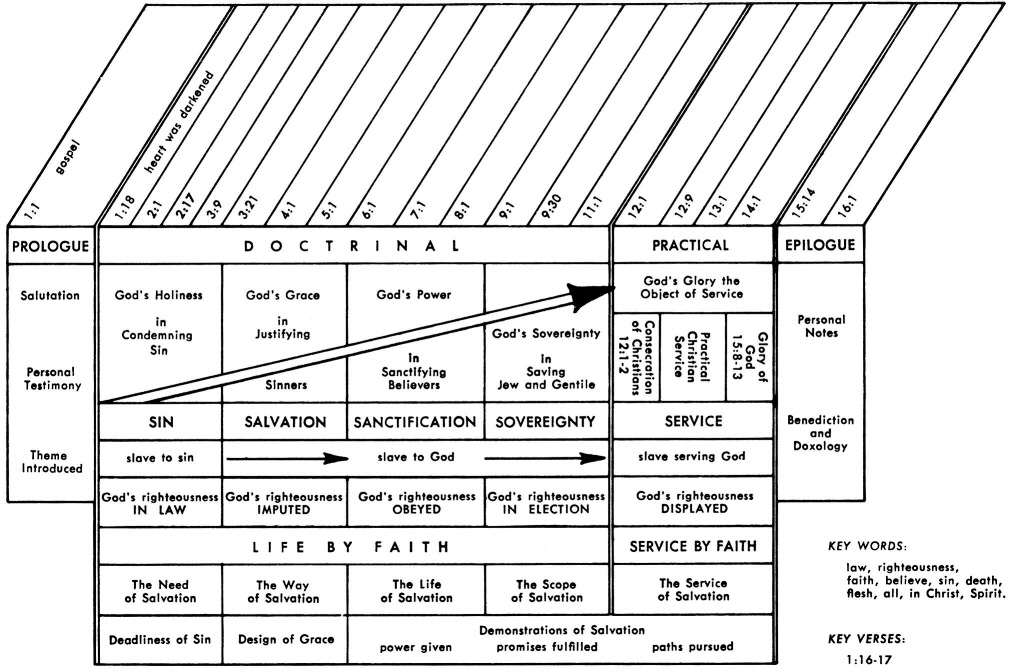
Click chart to enlarge
Chart from recommended resource Jensen's Survey of the NT - used by permission
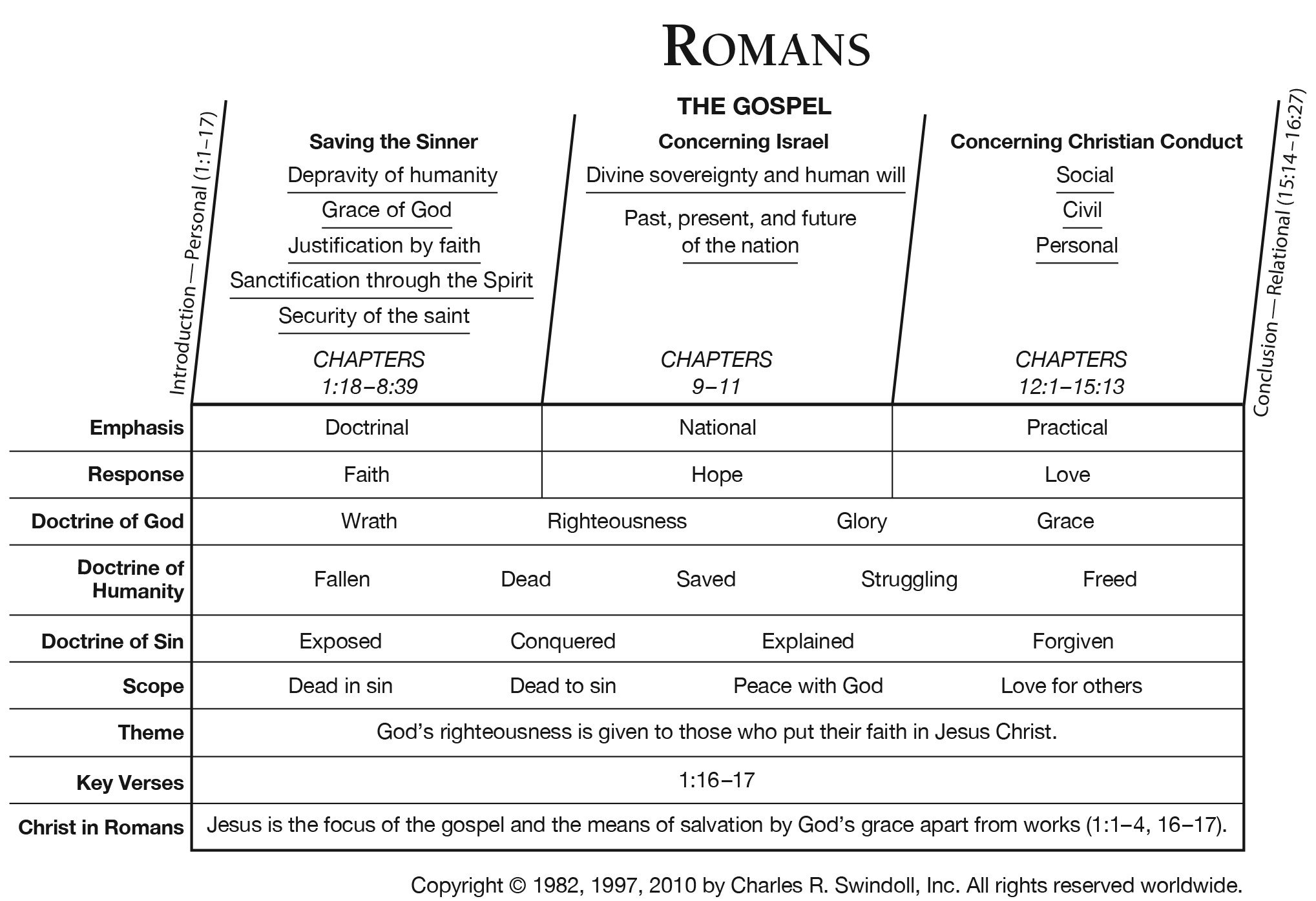
Click Charles Swindoll's overview chart
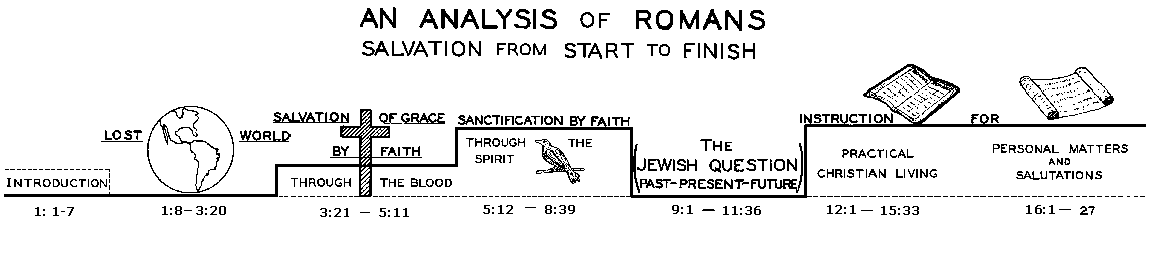
Source: Dr David Cooper
Click to Enlarge
| ROMANS ROAD to RIGHTEOUSNESS |
||||
| Romans 1:18-3:20 | Romans 3:21-5:21 | Romans 6:1-8:39 | Romans 9:1-11:36 | Romans 12:1-16:27 |
| SIN | SALVATION | SANCTIFICATION | SOVEREIGNTY | SERVICE |
| NEED FOR SALVATION |
WAY OF SALVATION |
LIFE OF SALVATION |
SCOPE OF SALVATION |
SERVICE OF SALVATION |
| God's Holiness In Condemning Sin |
God's Grace In Justifying Sinners |
God's Power In Sanctifying Believers |
God's Sovereignty In Saving Jew and Gentile |
Gods Glory The Object of Service |
| Deadliness of Sin |
Design of Grace |
Demonstration of Salvation | ||
| Power Given | Promises Fulfilled | Paths Pursued | ||
| Righteousness Needed |
Righteousness Credited |
Righteousness Demonstrated |
Righteousness Restored to Israel |
Righteousness Applied |
| God's Righteousness IN LAW |
God's Righteousness IMPUTED |
God's Righteousness OBEYED |
God's Righteousness IN ELECTION |
God's Righteousness DISPLAYED |
| Slaves to Sin | Slaves to God | Slaves Serving God | ||
| Doctrine | Duty | |||
| Life by Faith | Service by Faith | |||
|
Modified from Irving L. Jensen's chart above |
||||
Romans 2:9 There will be tribulation and distress for every soul of man who does (PMPMSG) evil, of the Jew first and also of the Greek, (NASB: Lockman)
Greek: thlipsis kai stenochoria epi pasan psuchen anthropou tou katergazomenou (PMPMSG) to kakon, Ioudaiou te proton kai Hellenos
Amplified: [And] there will be tribulation and anguish and calamity and constraint for every soul of man who [habitually] does evil, the Jew first and also the Greek (Gentile). (Amplified Bible - Lockman)
NLT: There will be trouble and calamity for everyone who keeps on sinning--for the Jew first and also for the Gentile. (NLT - Tyndale House)
Phillips: Yes, it means bitter pain and a fearful undoing for every human soul who works on the side of evil, for the Jew first and then the Greek. (Phillips: Touchstone)
Wuest: Tribulation and anguish upon every soul of man who works out to a finish the evil, both upon the soul of a Jew first and also upon the soul of a Gentile
Young's Literal: tribulation and distress, upon every soul of man that is working the evil, both of Jew first, and of Greek;
TRIBULATION AND DISTRESS: thlipsis kai stenochoria:
- Pr 1:27,28; 2 Th 1:6
- See tribulation in ISBE, EASTON
- Torrey's Topic Punishment of the Wicked
- Romans 2 Resources - Multiple Sermons and Commentaries
- Romans 2:6-11: Judged by Your Deeds - Steven Cole
- Romans 2:6-10 Principles of God's Judgment 3 - John MacArthur
Tribulation (2347) (thlipsis from thlibo = to crush, press together, compress, squeeze in turn derived from thláo = to break) (see in depth study of thlipsis) originally expressed sheer, physical pressure on a man. It conveys the idea of being squeezed or placed under pressure or crushed beneath a weight. Thlipsis is literally a pressing together. When, according to the ancient law of England, those who willfully refused to plead guilty, had heavy weights placed on their breasts, and were pressed and crushed to death, this was literally thlipsis. The iron cage was stenochoria (see below).
Figuratively in the NT, thlipsis usually refers to suffering brought on by outward circumstances affliction, oppression, trouble as Paul described elsewhere in Romans writing…
And not only this, but we also exult in our tribulations, knowing that tribulation brings about perseverance (see notes Romans 5:3).
Who shall separate us from the love of Christ? Shall tribulation, or distress, or persecution, or famine, or nakedness, or peril, or sword? (see notes Romans 8:35)
Rejoicing in hope, persevering in tribulation, devoted to prayer, (see notes Romans 12:12)
Thlipsis is seen experienced when believers participate in the sufferings of Christ (Col 1:24). of sufferings of the end-time tribulation, trouble, distress (MK 13.19); Thlipsis refers to a specific three and one half years which Jesus referred to as the Great Tribulation (click description including table of synonyms) a time of great trouble for the world, and especially for Israel (Mt 24:15, 21, 22; Revelation 7:14)
Clearly in the present context thlipsis is referring to eternal destruction in gehenna. In a similar use of thlipsis (and the related verb thlibo) Paul assures the believer who were suffering temporal affliction as the result of their stand for the gospel of Jesus Christ that…
"after all it is only just for God to repay with affliction (thlipsis) those who afflict (verb thlibo) you, and to give relief to you who are afflicted (verb thlibo) and to us as well when the Lord Jesus shall be revealed from heaven with His mighty angels in flaming fire dealing out retribution to those who do not know God and to those who do not obey the gospel of our Lord Jesus." (2Thes 1:6-8)
Figuratively thlipsis pictures one being "crushed" by intense pressure, difficult circumstances, suffering or trouble pressing upon them from without. Thus persecution, affliction, distress, opposition or tribulation, all press hard on one's soul. Thlipsis does not refer to mild discomfort but to great difficulty. In Scripture the thlipsis is most often used of outward difficulties, but it is also used of emotional stress and sorrows which "weighs down" a man’s spirit like the sorrows and burden his heart. Thlipsis then includes the disappointments which can "crush the life" out of the one who is afflicted.
The English word "tribulation" is derived from the Latin word tribulum (literally a thing with teeth that tears), which was a heavy piece of timber with spikes in it, used for threshing the corn or grain. The tribulum was drawn over the grain and it separated the wheat from the chaff.
Marvin Vincent has the following note explaining that the root thlibo means…
"to press or squeeze. Tribulation is perhaps as accurate a rendering as is possible, being derived from tribulum, the threshing-roller of the Romans. In both the idea of pressure is dominant, though thlipsis does not convey the idea of separation (as of corn from husk) which is implied in tribulatio." (Vincent, M. R. Word studies in the New Testament Vol. 1, Page 3-80)
Thlipsis is used 45 times in the NT -
Matt. 13:21; 24:9, 21, 29; Mk. 4:17; 13:19, 24; Jn. 16:21, 33; Acts 7:10f; 11:19; 14:22; 20:23; Rom. 2:9; 5:3; 8:35; 12:12; 1 Co. 7:28; 2 Co. 1:4, 8; 2:4; 4:17; 6:4; 7:4; 8:2, 13; Eph. 3:13; Phil. 1:17; 4:14; Col. 1:24; 1 Thess. 1:6; 3:3, 7; 2 Thess. 1:4, 6; Heb. 10:33; Jas. 1:27; Rev. 1:9; 2:9f, 22; 7:14
Distress (4730) (stenochoria from stenos = narrow + chora = place) is literally a narrow place, a confined space and then the painfulness of associated with this condition. Vincent comments that the “dominant idea is constraint." Stenochoria pictures finding oneself in a "tight corner", hemmed in with no way out, in a narrow strait without the possibility of escape.
Stenochoria might be used of an army caught in a narrow, rocky defile with space neither to maneuver nor to escape. It might be used of a ship caught in a storm with no room either to ride it or to run before it. There are moments when a man seems to be in a situation in which the walls of life are closing round him -- that is the picture inherent in stenochoria. The opposite state, of being in a large place, was metaphorically used to describe a state of joy as in Ps 118:5 (Spurgeon's note) where the psalmist writes
From my distress I called upon the LORD. The LORD answered me and set me in a large place.
Stenochoria occurs 4 times in the NT…
Romans 2:9 (note) There will be tribulation (thlipsis) and distress for every soul of man who does evil, of the Jew first and also of the Greek,
Romans 8:35 (note) Who shall separate us from the love of Christ? Shall tribulation (thlipsis) , or distress, or persecution, or famine, or nakedness, or peril, or sword?
2Corinthians 6:4 but in everything commending ourselves as servants of God, in much endurance, in afflictions (thlipsis) , in hardships, in distresses,
2Corinthians 12:10 Therefore I am well content with weaknesses, with insults, with distresses, with persecutions, with difficulties, for Christ's sake; for when I am weak, then I am strong.
In Septuagint (LXX), the Greek translation of the Hebrew (LXX), stenochoria is used to picture the horrors of confinement by a siege, Moses recording
Then you shall eat the offspring of your own body, the flesh of your sons and of your daughters whom the Lord your God has given you, during the siege and the distress by which your enemy shall oppress you. (Dt 28:53)
The other 7 uses of stenochoria in the LXX are found in Deut 28:55, 57, Esther 1:1, 4:17, Isa 8:22, 9:1, 30:6.
Albert Barnes writes that stenochoria
means literally narrowness of place, lack of room, and then the anxiety and distress of mind which a man experiences who is pressed on every side by afflictions, and trials, and want, or by punishment, and who does not know where he may turn himself to find relief. It is thus expressive of the punishment of the wicked. It means that they shall be compressed with the manifestations of God’s displeasure, so as to be in deep distress, and so as not to know where to find relief.
Stenochoria metaphorically refers to great anxiety and distress of mind, such as arises when a man does not know where to turn himself or what to do for relief. It conveys the idea of anguish (which Webster defines as extreme pain; distress of mind and suggests torturing grief or dread ), dire calamity, extreme affliction or distress. In three of the four NT uses (Ro 2:9; 8:35; 2 Co 6:4) stenochoria is found with thlipsis. Whereas tribulation (thlipsis) emphasizes troubles pressing upon us from without (e.g., persecution, etc). Stenochoria has in view the distress which arises from within (usually caused by thlipsis), such as anguish or discomfort. Trench concludes that stenochoria is the "stronger" of the two words.
Besides capital punishment, solitary confinement has long been considered the worst form of punishment, being the absolute, lonely confinement of a prisoner who is already strictly confined. Part of hell’s torment will be its absolute, isolated, lonely, and eternal confinement, with no possible hope of release or escape.
Four terrifying words in (Romans 2:8, 9) suggest a series of cause and effect. The first wrath (orge) indicates God’s attitude toward sin, the second indignation (thumos) the expression of that attitude, the third affliction (thlipsis) the result there from, the fourth distress (stenochoria) the realization of entire helplessness. These four descriptions stand in dramatic contrast to eternal life. If this picture of contrasting destinies does not get a sinner's attention, what will? In each contrasting destiny there is a conscious experience either of woe or of blessedness!
William Newell sums this section up noting that in the tribulation…
the visitation strikes its object. The false peace (cf 1Thes 5:3) of his hardened, impenitent earth-life is now horribly broken up by direct visitation from God in vengeance. Finally, anguish: which sets forth the result of that tribulation which meets the lost directly from an angry, indignant Creator and Judge. "I am in anguish in this flame, " cried lost Dives, in Hades (God's prison for the lost until the Day of Judgment). What unspeakable horrors, then, will that Day bring! (Romans 2)
FOR EVERY SOUL OF MAN WHO DOES EVIL: epi pasan psuchen anthropou tou katergazomenou (PMPMSG) to kakon:
- soul Ezek 18:4; Mt 16:26
- for evil click kakia
- soul in ISBE, evil in ISBE)
- Romans 2 Resources - Multiple Sermons and Commentaries
- Romans 2:6-11: Judged by Your Deeds - Steven Cole
- Romans 2:6-10 Principles of God's Judgment 3 - John MacArthur
For (epi) - Here the preposition epi is more literally translated upon, which more dramatically pictures the tribulation and distress as if they were coming down upon every rebellious soul.
In Ezekiel God declares…
Behold, all souls are Mine; the soul of the father as well as the soul of the son is Mine. The soul who sins will die. (Ezekiel 18:4)
Jesus speaking of men's souls asked one of the most piercing question in all eternity…
"For what will a man be profited, if he gains the whole world, and forfeits his soul? Or what will a man give in exchange for his soul?" (Mt 16:26)
This future aspect of God's wrath is dramatically illustrated by John who describes
"huge hailstones, about one hundred pounds each, (coming) down from heaven UPON men and men (blaspheming) God because of the plague of the hail, because its plague was extremely severe." (Rev 16:21 )
John gives us a similar picture of this aspect of God's wrath even in the present age of grace noting that
"He who believes in the Son has eternal life; but he who does not obey the Son will not see life, but the wrath of God abides (continually = present tense) UPON him." (John 3:36)
Every soul of man - This phrase expresses the equality and universality of the treatment dealt out by the just Judge of all mankind.
Does (2716) (katergazomai from kata = intensifies meaning of + ergazomai = engage in an activity involving considerable expenditure of effort) means to work out fully.
The idea of katergazomai is to finish what one has begun. This verb clearly indicates the thoroughness of their evil behavior. And so we see that men's evil works betray their evil heart which in turn is a heart of unbelief and disobedience. Works are always the outward expression of a person’s heart attitude toward the Lord.
The Roman scholar Strabo uses the verb katergazomai to describe the extraction of silver from mines with the implication being that intense effort is required to carry mine for precious metal and in this case is motivated by a potential reward.
Paul uses katergazomai to emphasize that these individuals work with effort to bring their evil deeds to fulfillment or completion. The present tense indicates that they continuously, habitually are performing these deeds with "success"! It is ironic that Paul chose this same verb (Katergazomai) in (Philippians 2:12) calling believers to
Work out (katergazomai in the present imperative = command to believers to continually do this) salvation with fear and trembling" (see discussion)
This verse emphasizes the effort called for to accomplish the specified task (in this case "salvation" refers not to the first time event which would be "justification" but to the everyday working out of our salvation which is referred to as "sanctification" or "present tense salvation" - see discussion of Three Tenses of Salvation).
Here are the 22 uses of katergazomai in the NT -
Rom. 1:27; 2:9; 4:15; 5:3; 7:8, 13, 15, 17, 18, 20; 15:18; 1 Co. 5:3; 2 Co. 4:17; 5:5; 7:10, 11; 9:11; 12:12; Eph. 6:13; Phil. 2:12; Jas. 1:3; 1 Pet. 4:3
Evil (2556) (kakos) (related word kakia) speaks of lack of goodness, of a bad nature, not such as it ought to be and defines one who is evil in himself, wicked, vicious, bad in heart, conduct, and character and, as such, gets others in trouble. Kakos is found from Homer on in a large variety of associations and means bad in the sense of lacking something, always in contrast to agathos which is good.
Kakos was descriptive of a soldier who was cowardly. It is seen in several English words, such as "cacophony" (a discordant, bad sound), "cacography" (illegible writing), and "cacodemon" (an evil demon—as if there were "good" demons). The very sound of the word kakos suggests the idea in the word “reprehensible.”
Here are the 50 uses of kakos in the NT -
Matt. 21:41; 24:48; 27:23; Mk. 7:21; 15:14; Lk. 16:25; 23:22; Jn. 18:23, 30; Acts 9:13; 16:28; 23:9; 28:5; Rom. 1:30; 2:9; 3:8; 7:19, 21; 12:17, 21; 13:3, 4, 10; 14:20; 16:19; 1 Co. 10:6; 13:5; 15:33; 2 Co. 13:7; Phil. 3:2; Col. 3:5; 1 Thess. 5:15; 1 Tim. 6:10; 2 Tim. 4:14; Titus 1:12; Heb. 5:14; Jas. 1:13; 3:8; 1 Pet. 3:9, 10, 11; 3 Jn. 1:11; Rev. 2:2; 16:2
Larry Richards explains that…
one passage in Romans is theologically definitive in explaining the kakos done by human beings who know what is good and who want to do it. Romans 7:7-25 contains Paul's report of his personal struggle with sin. In this passage he links the law of God, expressed in commandments, with "another law [principle] at work in the members of [his] body" (Ro 7:23).
Paul sees in Scripture the divine revelation of righteousness and agrees that God's will is both right and beautiful. But when Paul tries to do what this revelation unveils, he discovers that he cannot. "I know that nothing good lives in me, that is, in my sinful nature" is the apostle's agonized confession (Ro 7:18). Thus he says, "What I do is not the good I want to do; no, the evil [kakos] I do not want to do--this I keep on doing… When I want to do good, evil [kakos] is right there with me" (Ro 7:19, 21).
This is Paul's explanation of the moral gap that exists between what human beings recognize as good and what they actually do. The problem is that sin has warped human nature: "kakos is right there with me." There is a flaw within us that keeps the best of us from being what we should be and what we want to be. (Richards, L O: Expository Dictionary of Bible Words: Regency)
And so we see that one can chose to do (work out) evil deeds or salvation, the evil path terminating in tribulation and distress, the righteous path of sanctification leading to eternal life.
Could the choice between blessing and cursing be more clear? This picture reminds us of Jehovah's warning through Moses to Israel just prior to entering the "land of milk and honey" declaring
"I call heaven and earth to witness against you today, that I have set before you life and death, the blessing and the curse. So choose life in order that you may live, you and your descendants, by loving the LORD your God, by obeying His voice, and by holding fast to Him; for this is your life and the length of your days, that you may live in the land which the LORD swore to your fathers, to Abraham, Isaac, and Jacob, to give them." (Dt 30:19-20)
The words of Paul's warning here in Romans 2 are not identical to those in Deuteronomy , but the message is the same - choose life and blessing that come only from loving and obeying the Gospel of Jesus Christ, not from works of the flesh, of self effort..
OF THE JEW FIRST AND ALSO OF THE GREEK: Ioudaiou te proton kai Hellenos:
- Ro 2:10; 1:16; 3:29,30; 4:9, 10,11, 12; 9:24; 10:12; 15:8,9; Am 3:2; Mt 11:20, 21, 22, 23, 24; Lk 2:30, 31, 32; 12:47,48; 24:47; Acts 3:26; 11:18; 13:26,46,47; 18:5,6; Acts 20:21; 26:20; 28:17,28; Gal 2:15,16; 3:28; Eph 2:11, 12, 13, 14, 15, 16, 17; Col 3:11; 1Pet 4:17
- Romans 2 Resources - Multiple Sermons and Commentaries
- Romans 2:6-11: Judged by Your Deeds - Steven Cole
- Romans 2:6-10 Principles of God's Judgment 3 - John MacArthur
- See Jew in Smith, ISBE, Easton
- See Greek/Gentile in Easton, Smith, ISBE, Torrey's Topical
Jew (2453) (Ioudaios) occurs first in 2Ki 16:6 (ESV - men from Judah, NAS - Judeans, KJV - Jews) the Hebrew word yehudiy which is derived from yehudah meaning Judah or "praise". And so strictly speaking Jew means a member of the tribe of Judah, but with common usage came to be used as a designation of all Israelites. Israel readily received the appellation of Jew and took great pride in this name and its association with praise (cp Ro 2:17; see probable play on words by Paul in Ro 2:29 where he uses the word "praise"!). The Jewish expectation was that the Gentiles would be judged by God, while they would escape, but Paul quickly dissolves their false assertions.
First (4413)(proton) means first in time, place, order or importance. In the present context Paul is emphasizing priority not chronology per se. (See also note on use of first in Ro 1:16). Be careful to note that Paul's prioritizing the Jews in no way impugns God's partiality (Ro 2:11), for His judgment will still be impartial for all offending parties, irregardless of whether they are Jew or Gentile.
Greek (1672) (hellen) refers to Greeks by birth but in this context refers to Gentiles.
Jew… and… Greek - Encompasses the totality of mankind. No exclusions. No partiality. No favorites. (Ro 2:11)
Mounce observes that…
Ironically, priority in blessing (Ro 1:16) results in priority in judgment. Israel was privileged to be the first to receive the revelation of God. But spiritual privilege carried with it spiritual responsibility. Failure brought “trouble and distress.” Concerning Israel, God said, “You only have I chosen of all the families of the earth; therefore I will punish you for all your sins” (Amos 3:2).(Mounce, R. H. Romans: The New American Commentary. Broadman & Holman Publishers)
Cottrell agrees adding that…
Here for the first time in this chapter Paul actually mentions the Jews, and he does so in a way that drives home his main point: the righteous judgment of God falls equally on both Jews and Gentiles. (Ed note: In other words God's judgment will be impartial) This is enough to expose the fallacy of the myth of divine partiality toward the Jews, but Paul goes even further. Not only does God apply the principle of judgment equally to the two groups; He will actually pour out His wrath on the “Jew first.” This is an application of Jesus’ principle, “From everyone who has been given much, much will be demanded; and from the one who has been entrusted with much, much more will be asked” (Lk 12:48). (Cottrell, J. Romans : Volume 1. College Press NIV commentary. Joplin, Mo.: College Press)
Haldane writes that…
In this place, “the Jew first” must mean the Jew principally, and implies that the Jew is more accountable than the Gentile, and will be punished according to his superior light; for as the Jew will have received more than the Gentile, he will also be held more culpable before the Divine tribunal, and will consequently be more severely punished. His privileges will aggravate his culpability, and increase his punishment. (Romans 2 Commentary)
The judgment of God will be according to privilege or light received. The Jews were first in privilege as God’s earthly chosen people and they will be first in responsibility. Israel will receive severer punishment because she was given greater light and blessing (Ro 9:3-4). Jesus taught this principle in the gospel of Matthew declaring to the Jewish audience:
Woe to you, Chorazin! Woe to you, Bethsaida! For if the miracles had occurred in Tyre and Sidon which occurred in you, they would have repented long ago in sackcloth and ashes. Nevertheless I say to you, it shall be more tolerable for Tyre and Sidon in the day of judgment, than for you. (Matthew 11:21-22)
MacArthur adds that…
God had indeed chosen Israel above other peoples to be His elect nation. “You only have I chosen among all the families of the earth,” He declared to Israel (Amos 3:2a). But He immediately went on to say, “Therefore, I will punish you for all your iniquities” (v. 2b). Israel will receive severer punishment because she was given greater light and greater blessing. As Paul here makes clear, the Jew first means that being first in salvation opportunity also means being first in judgment responsibility. (MacArthur, J: Romans 1-8. Chicago: Moody Press)
It is truly tragic that God’s bountiful blessings failed to lead the majority of the Jews to repentance. Here in Romans 2 Paul's desire is for the Jew (and all so-called religious and self-righteous persons) to be confronted with their evil, empty works which warrant God's judgment. Paul's goal is that they might see their empty works and their doomed condition and turn to truth of the gospel which is the power of God for salvation.
God doesn't want big talkers but "big doers" (enabled by grace and the indwelling Spirit of the new birth) because anyone can say "I keep the law" but what God wants is men and women who actually live the Law from a (circumcised) heart that obeys God out of love not legalism. That's where most of the Old and New Testament Jews fell short. They did not understand that it is not the possession of the law but the practice of the law (empowered by grace and the Holy Spirit) that pleases God.
- Descended from Abraham -Isaiah 51:2; John 8:39
- Divided into twelve tribes -Genesis 35:22; 49:28
CALLED
- Hebrews -Genesis 14:13; 40:15; 2 Corinthians 11:22
- Israelites -Exodus 9:7; Joshua 3:17
- Seed of Abraham -Psalms 105:6; Isaiah 41:8
- Seed of Jacob -Jeremiah 33:26
- Seed of Israel -1 Chronicles 16:13
- Children of Jacob -1 Chronicles 16:13
- Children of Israel -Genesis 50:25; Isaiah 27:12
- Jeshurun -Deuteronomy 32:15
- Chosen and loved by God Deuteronomy 7:6,7
- Circumcised in token of their covenant relation -Genesis 17:10,11; Acts 7:8
- Separated from all other nations -Exodus 33:16; Leviticus 20:24; 1 Kings 8:53
DESCRIBED AS
- A peculiar people -Deuteronomy 14:2
- A peculiar treasure -Exodus 19:5; Psalms 135:4
- A holy nation -Exodus 19:6
- A holy people -Deuteronomy 7:6; 14:21
- A kingdom of priests -Exodus 19:6
- A special people -Deuteronomy 7:6
- The Lord’s portion Deuteronomy 32:9
- Sojourned in Egypt -Exodus 12:40,41
- Brought out of Egypt by God -Exodus 12:42; Deuteronomy 5:15; 6:12
- In the desert forty years -Numbers 14:33; Joshua 5:6
- Settled in Canaan -Numbers 32:18; Joshua 14:1-5
- Under the theocracy until the time of Samuel -Exodus 19:4, 5, 6; 1 Samuel 8:7
- Desired and obtained kings -1 Samuel 8:5,22
- Divided into two kingdoms after Solomon -1 Kings 11:31,32; 12:19,20
- Often subdued and made tributary -Judges 2:13,14; 4:2; 6:2,6; 2 Kings 23:33
- Taken captive to Assyria and Babylon -2 Kings 17:32; 18:11; 24:16; 25:11
- Restored to their own land by Cyrus -Ezra 1:1, 2, 3, 4
- Had courts of justice -Deuteronomy 16:18
- Had an ecclesiastical establishment -Exodus 28:1; Numbers 18:6; Mal 2:4, 5, 6, 7
- Had prophets to promote national reformation-Je 7:25; 26:4,5; 35:15; 44:4; Ezek 38:17
- The only people who had knowledge of God -Ps 76:1; 1Th 4:5; Ps 48:3; Ro 1:28
- The only people who worshipped God -Exodus 5:17; Psalms 96:5; 115:3,4; John 4:22
- Religion of, according to rites prescribed by God -Lv 18:4; Dt 12:8, 9, 10, 11; He 9:1
- Religion of, typical -Hebrews 9:8-11; 10:1
- Their national greatness -Genesis 12:2; Deuteronomy 33:29
- Their national privileges -Romans 3:2; 9:4,5
- Their vast numbers -Genesis 22:17; Numbers 10:36
NATIONAL CHARACTER OF
- Pride of descent, &c -Jeremiah 13:9; John 8:33,41
- Love of country -Psalms 137:6
- Fondness for their brethren -Exodus 2:11,12; Romans 9:1, 2, 3
- Attachment to Moses -John 9:28,29; Acts 6:11
- Attachment to customs of the law -Acts 6:14; 21:21; 22:3
- Fondness for tradition-Jeremiah 44:17; Ezekiel 20:18,30,21; Mark 7:3,4
- Stubborn and stiff-necked -Exodus 32:9; Acts 7:51
- Prone to rebellion -Deuteronomy 9:7,24; Isaiah 1:2
- Prone to backsliding -Jeremiah 2:11-13; 8:5
- Prone to idolatry -Isaiah 2:8; 57:5
- Prone to formality in religion -Isaiah 29:13; Ezekiel 33:31; Matthew 15:7-9
- Self-righteous -Isaiah 65:5; Romans 10:3
- Unfaithful to covenant engagements -Jeremiah 3:6-8; 31:32; Ezekiel 16:59
- Ungrateful to God -Deuteronomy 32:15; Isaiah 1:2
- Ignorant of the true sense of Scripture -Acts 13:27; 2 Corinthians 3:13, 14, 15
- Distrustful of God -Numbers 14:11; Psalms 78:22
- Covetous -Jeremiah 6:13; Ezekiel 33:31; Micah 2:2
- Cowardly -Exodus 14:10; Numbers 14:3; Isaiah 51:12
- Trusted to their privileges for salvation -Jeremiah 7:4; Matthew 3:9
- Distinction of castes among, noticed Isaiah 65:5; Luke 7:39; 15:2; Acts 26:5
- Degenerated as they increased in national greatness -Amos 6:4
- Often displeased God by their sins -Nu 25:3; Dt 32:16; 1 Kings 16:2; Isaiah 1:4; 5:24,25
- A spiritual seed of true believers always among -1Ki 19:18; Is 6:13; Ro 9:6,7; 11:1,5
MODERN, DIVIDED INTO
- Hebrews or pure Jews -Acts 6:1; Philippians 3:5
- Hellenists or Grecians -Acts 6:1; 9:29
- Many sects and parties -Matthew 16:6; Mark 8:15
- An agricultural people -Genesis 46:32
- A commercial people -Ezekiel 27:17
- Obliged to unite against enemies -Nu 32:20, 21, 22; Jdg 19:29; 20:1-48; 1Sa 11:7,8
- Often distinguished in war -Jdg 7:19-23; 1Sa 14:6-13; 17:32,33; Neh 4:16, 17, 18, 19, 20, 21, 22
- Strengthened by God in war -Leviticus 26:7,8; Joshua 5:13,14; 8:1,2
- Under God’s special protection -Dt 32:10,11; 33:27-29; Ps 105:13, 14, 15; 121:3-5
- Enemies of, obliged to acknowledge them as divinely protected -Josh 2:9, 10, 11; Esther 6:13
PROHIBITED FROM
- Associating with others -Acts 10:28
- Covenanting with others -Exodus 23:32; Deuteronomy 7:2
- Marry with others -Deuteronomy 7:3; Joshua 23:12
- Following practices of others -Deuteronomy 12:29, 30, 31; 18:9-14
- Despised all strangers -1 Samuel 17:36; Matthew 16:26,27; Ephesians 2:11
- Held no intercourse with strangers -John 4:9; Acts 11:2,3
- Condemned for associating with other nations -Judges 2:1-3; Jeremiah 2:18
- Received proselytes from other nations -Acts 2:10; Ex 12:44,48
- Gentiles made one with, under the gospel -Acts 10:15,28; 15:8,9; Gal 3:28; Ep 2:14, 15, 16
ALL OTHER NATIONS
- Envied -Nehemiah 4:1; Isaiah 26:11; Ezekiel 35:11
- Hated -Psalms 44:10; Ezekiel 35:5
- Oppressed -Exodus 3:9; Judges 2:18; 4:3
- Persecuted -Lamentations 1:3; 5:5
- Rejoiced at calamities of -Psalms 44:13,14; 80:5,6; Ezekiel 36:4
- None hated or oppressed with impunity -Ps 137:8,9; Ezek 25:15,16; 35:6; Ob 1:10,11, 12, 13, 14, 15,16
CHRIST
- Promised to -Genesis 49:10; Daniel 9:25
- Expected by -Psalms 14:7; Matthew 11:3; Luke 2:25,38; John 8:56
- Regarded as the restorer of national greatness -Mt 20:21; Lk 24:21; Acts 1:6
- Sprang from -Romans 9:5; Hebrews 7:14
- Rejected by -Isaiah 53:3; Mark 6:3; John 1:11
- Murdered by -Acts 7:52; 1 Thessalonians 2:15
- Imprecated the blood of Christ upon themselves and their Children -Matthew 27:25
- Many of, believed the gospel -Acts 21:20
- Unbelieving, persecuted the Christians -Acts 17:5,13; 1Th 2:14, 15, 16
- Cast off for unbelief -Romans 11:17,20
- Scattered and peeled -Isaiah 18:2,7; James 1:1
- Shall finally be saved -Romans 11:26,27
- Punishment of, for rejecting Christ, illustrated -Mt 21:37, 38, 39, 40, 41, 42, 43
- Descendants of Abraham -Psalms 105:6; Isaiah 51:2; John 8:33; Romans 9:7
- The people of God -Deuteronomy 32:9; 2 Samuel 7:24; Isaiah 51:16
- Separated to God -Exodus 33:16; Numbers 23:9; Deuteronomy 4:34
- Beloved for their father’s sake -Deuteronomy 4:37; 10:15; Romans 11:28
- Christ descended from -John 4:22; Romans 9:5
THE OBJECTS OF
- God’s love -Deuteronomy 7:8; 23:5; Jeremiah 31:3
- God’s choice -Deuteronomy 7:6
- God’s protection -Psalms 105:15; Zechariah 2:8
- The covenant established with -Exodus 6:4; 24:6-8; 34:27
PROMISES RESPECTING MADE TO
- Abraham -Genesis 12:1, 2, 3; 13:14, 15, 16, 17; 15:18; 17:7,8
- Isaac -Genesis 26:2, 3, 4, 5,24
- Jacob -Genesis 28:12, 13, 14, 15; 35:9-12
- Themselves -Exodus 6:7,8; 19:5,6; Dt 26:18,19
- Privileges of -Psalms 76:1,2; Romans 3:1,2; 9:4,5
PUNISHED FOR
- Idolatry -Psalms 78:58-64; Isaiah 65:3, 4, 5, 6,7
- Unbelief -Romans 11:20
- Breaking covenant -Isaiah 24:5; Jeremiah 11:10
- Transgressing the law -Isaiah 1:4,7; 24:5,6
- Changing the ordinances -Isaiah 24:5
- Killing the prophets -Matthew 23:37,38
- Imprecating upon themselves the blood of Christ -Matthew 27:25
- Scattered among the nations -Deuteronomy 28:64; Ezekiel 6:8; 36:19
- Despised by the nations -Ezekiel 36:3
- Their country trodden under foot by the Gentiles -Dt 28:49, 50, 51, 52; Lk 21:24
- Their house left desolate -Matthew 24:38
- Deprived of civil and religious privileges -Hosea 3:4
DENUNCIATIONS AGAINST THOSE WHO
- Cursed -Genesis 27:29; Numbers 24:9
- Contended with -Isaiah 41:11; 49:25
- Oppressed -Isaiah 49:26; 51:21, 22, 23
- Hated -Psalms 129:5; Ezekiel 35:5,6
- Aggravated the afflictions of -Zechariah 1:14,15
- Slaughtered -Ps 79:1, 2, 3, 4, 5, 6, 7; Ezekiel 35:5,6
- God, mindful of -Psalms 98:3; Isaiah 49:15,16
- Christ was sent to -Matthew 15:24; 21:37; Acts 3:20,22,26
- Compassion of Christ for -Matthew 23:37; Luke 19:41
- The gospel preached to, first -Matthew 10:6; Luke 24:47; Acts 1:8
- Blessedness of blessing -Genesis 27:29
- Blessedness of favoring -Genesis 12:3; Psalms 122:6
- Pray importunately for -Psalms 122:6; Isaiah 62:1,6,7; Jeremiah 31:7; Romans 10:1
- Saints remember -Psalms 102:14; 137:5; Jeremiah 51:50
PROMISES RESPECTING
- The pouring out of the Spirit upon them -Ezekiel 39:29; Zechariah 12:10
- The removal of their blindness -Romans 11:25; 2 Corinthians 3:14, 15, 16
- Their return and seeking to God -Hosea 3:5
- Their humiliation for the rejection of Christ -Zechariah 12:10
- Pardon of sin -Isaiah 44:22; Romans 11:27
- Salvation -Isaiah 59:20; Romans 11:26
- Sanctification -Jeremiah 33:8; Ezekiel 36:25; Zechariah 12:1,9
- Joy occasioned by conversion of -Isaiah 44:23; 49:13; 52:8,9; 66:10
- Blessing to the Gentiles by conversion of -Isaiah 2:1-5; 60:5; 66:19; Ro 11:12,15
- Reunion of -Jeremiah 3:18; Ezekiel 37:16,17,20-22; Hosea 1:11; Micah 2:12
- Gentiles assisting in their restoration -Isaiah 49:22,23; 60:10,14; 61:4, 5, 6
- Subjection of Gentiles to Isaiah 60:11,12,14
- Future glory of -Isaiah 60:19; 62:3,4; Zephaniah 3:19,20; Zechariah 2:5
- Future prosperity of -Isaiah 60:6,7,9,17; 61:4-6; Hosea 14:5,6
- That Christ shall appear amongst -Isaiah 59:20; Zechariah 14:4
- That Christ shall dwell amongst -Ezekiel 43:7,9; Zechariah 2:11
- That Christ shall reign over -Ezekiel 34:23,24; 37:24,25
- Restoration to land-Is 11:15,16; 14:1, 2, 3; 27:12,13; Je16:14,15; Ezek36:24; 37:21,25; 39:25,28; Lk 21:24
- Conversion of, illustrated -Ezekiel 37:1-14; Romans 11:24
- Comprehend all nations except the Jews -Romans 2:9; 3:9; 9:24
CALLED
- Heathen -Psalms 2:1; Galatians 3:8
- Nations -Psalms 9:20; 22:28; Isaiah 9:1
- Uncircumcised -Isaiah 14:6; 52:1
- Uncircumcision -Romans 2:26
- Greeks -Romans 1:16; 10:12
- Strangers -Isaiah 14:1; 60:10
- Ruled by God -2 Chronicles 20:6; Psalms 47:8
- Chastised by God -Psalms 9:5; 94:10
- Counsel of, brought to nought -Psalms 33:10
CHARACTERISED AS
- Ignorant of God -Romans 1:21; 1 Thessalonians 4:5
- Refusing to know God -Romans 1:28
- Without the law -Romans 2:14
- Idolatrous -Romans 1:23,25; 1 Corinthians 12:2
- Superstitious -Deuteronomy 18:14
- Depraved and wicked -Romans 1:28, 29, 30, 31, 32; Ephesians 4:19
- Blasphemous and reproachful -Nehemiah 5:9
- Constant to their false gods -Jeremiah 2:11
- Hated and despised the Jews -Esther 9:1,5; Psalms 44:13,14; 123:3
- Often ravaged and defiled the holy land and sanctuary -Ps 79:1; La 1:10
THE JEWS
- Not to follow the ways of -Leviticus 18:3; Jeremiah 10:2
- Not to intermarry with -Deuteronomy 7:3
- Permitted to have, as servants -Leviticus 25:44
- Despised, as if dogs -Matthew 15:26
- Never associated with -Acts 10:28; 11:2,3
- Often corrupted by -2 Kings 17:7,8
- Dispersed amongst -John 7:35
- Excluded from Israel’s privileges -Ephesians 2:11,12
- Not allowed to enter the temple -Acts 21:28,29
- Outer court of temple for -Ephesians 2:14; Revelation 11:2
- Given to Christ as His inheritance -Psalms 2:8
- Christ given as a light to -Isaiah 42:6; Luke 2:32
- Conversion of, predicted Isaiah 2:2; 11:10
- United with the Jews against Christ -Acts 4:27
- The gospel not to be preached to, till preached to the Jews -Mt 10:5; Lk 24:47; Acts 13:46
- First special introduction of the gospel to -Acts 10:34-45; 15:14
- First general introduction of the gospel to -Acts 13:48,49,52; 15:12
- Paul the apostle of -Acts 9:15; Galatians 2:7,8
- Jerusalem trodden down by, &c -Luke 21:24
- Israel rejected till the fulness of -Romans 11:25
Romans 2:10 but glory and honor and peace to everyone who does (PMPMSD) good, to the Jew first and also to the Greek. (NASB: Lockman)
Greek: doxa de kai time kai eirene panti to ergazomeno (PMPMSD) to agathon, Ioudaio te proton kai Helleni:
Amplified: But glory and honor and [heart] peace shall be awarded to everyone who [habitually] does good, the Jew first and also the Greek (Gentile). (Amplified Bible - Lockman)
NLT: But there will be glory and honor and peace from God for all who do good--for the Jew first and also for the Gentile. (NLT - Tyndale House)
Phillips: But let me repeat, there is glory and honour and peace for every worker on the side of good, for the Jew first and then the Greek. (Phillips: Touchstone)
Wuest: but glory and honor and peace to everyone who works out to a finish that which is good, both to a Jew first and also to a Gentile.
Young's Literal: and glory, and honor, and peace, to every one who is working the good, both to Jew first, and to Greek.
BUT GLORY AND HONOR AND PEACE TO EVERY MAN WHO DOES GOOD: doxa de kai time kai eirene panti to ergazomeno (PMPMSD) to agathon:
- See Glory in Easton, ISBE, Torrey, Naves
- glory: Ro 2:7 9:21,23 1Sa 2:30 Ps 112:6-9 Pr 3:16,17 4:7-9 8:18 Lk 9:48 Lk 12:37 Jn 12:26 1Pe 1:7 5:4
- peace: Ro 5:1 8:6 14:17 15:13 Nu 6:26 Job 22:21 Ps 29:11 37:37 Isa 26:12 Isa 32:17 48:18,22 55:12 57:19 Jer 33:6 Mt 10:13 Lk 1:79 22:14 Lu 19:42 Jn 14:27 16:33 Gal 5:22 Php 4:7
- every: Ps 15:2 Pr 11:18 Isa 32:17 Ac 10:35 Gal 5:6 Jas 2:22 3:13
- Romans 2 Resources - Multiple Sermons and Commentaries
- Romans 2:6-11: Judged by Your Deeds - Steven Cole
- Romans 2:6-10 Principles of God's Judgment 3 - John MacArthur
Glory (1391) (doxa from dokeo = to think) means to give a proper opinion or estimate of something and thus the glory of God expresses all that He is in His Being and in His nature, character, power and acts. Doxa is used repeatedly in the Greek Septuagint (LXX) to describe the (Shekinah) glory of God.
Doxa is used 166 times in the NT -
Matt. 4:8; 6:29; 16:27; 19:28; 24:30; 25:31; Mk. 8:38; 10:37; 13:26; Lk. 2:9, 14, 32; 4:6; 9:26, 31f; 12:27; 14:10; 17:18; 19:38; 21:27; 24:26; Jn. 1:14; 2:11; 5:41, 44; 7:18; 8:50, 54; 9:24; 11:4, 40; 12:41, 43; 17:5, 22, 24; Acts 7:2, 55; 12:23; 22:11; Rom. 1:23; 2:7, 10; 3:7, 23; 4:20; 5:2; 6:4; 8:18, 21; 9:4, 23; 11:36; 15:7; 16:27; 1 Co. 2:7f; 10:31; 11:7, 15; 15:40f, 43; 2 Co. 1:20; 3:7ff, 18; 4:4, 6, 15, 17; 6:8; 8:19, 23; Gal. 1:5; Eph. 1:6, 12, 14, 17f; 3:13, 16, 21; Phil. 1:11; 2:11; 3:19, 21; 4:19f; Col. 1:11, 27; 3:4; 1 Thess. 2:6, 12, 20; 2 Thess. 1:9; 2:14; 1 Tim. 1:11, 17; 3:16; 2 Tim. 2:10; 4:18; Tit. 2:13; Heb. 1:3; 2:7, 9f; 3:3; 9:5; 13:21; Jas. 2:1; 1 Pet. 1:7, 11, 21, 24; 4:11, 13f; 5:1, 4, 10; 2 Pet. 1:3, 17; 2:10; 3:18; Jude 1:8, 24f; Rev. 1:6; 4:9, 11; 5:12f; 7:12; 11:13; 14:7; 15:8; 16:9; 18:1; 19:1, 7; 21:11, 23f, 26
Honor (5092) (time from tío = pay honor, respect) describes the worth or merit of some object.
Honor denotes the exalted status which the proclamation of sonship implies while glory points to the ethereal radiance of the transfigured Jesus and in which believers will share (1Jn 3:2)
There are 41 uses of the Greek noun time in the NT -
Matt. 27:6, 9; Jn. 4:44; Acts 4:34; 5:2, 3; 7:16; 19:19; 28:10; Ro 2:7, 10; 9:21; 12:10; 13:7; 1 Co. 6:20; 7:23; 12:23, 24; Col. 2:23; 1Thess. 4:4; 1 Tim. 1:17; 5:17; 6:1, 16; 2Ti 2:20, 21; Heb. 2:7, 9; 3:3; 5:4; 1Pet. 1:7; 2:7; 3:7; 2 Pet. 1:17; Rev. 4:9, 11; 5:12, 13; 7:12; 21:26
The following Scriptures speak of glory and honor bestowed on the righteous man or women -
Ro 2:7; 9:21,23; 1Sa 2:30; Ps 112:6, 7, 8, 9; Pr 3:16,17; 4:7, 8, 9; 8:18; Lk 9:48;12:37; Jn 12:26; 1Pe 1:7; 5:4
Peace (1515) (eirene from verb eiro = to join or bind together that which has been separated) (see also related notes) ) literally pictures the binding or joining together again of that which had been separated or divided and thus setting at one again, a meaning convey by the common expression of one “having it all together”. It follows that peace is the opposite of division or dissension. Peace as a state of concord and harmony is the opposite of war. Peace was used as a greeting or farewell corresponding to the Hebrew word shalom - "peace to you".
Eirene can convey the sense of an inner rest, well being and harmony. The ultimate peace is the state of reconciliation with God, effected by placing one's faith in the gospel. In eschatology, peace is prophesied to be an essential characteristic of the Messianic kingdom (Acts 10:36).
Peace is a condition of freedom from disturbance, whether outwardly, as of a nation from war or enemies or inwardly, as in the current context, within the soul. Peace implies health, well-being, and prosperity.
I hear the words of love,
I gaze upon the blood,
I see the mighty sacrifice,
And I have peace with God.
Horatius Bonar
(Play Hymn)
Wuest adds that "by His (Messiah's) death, (Jesus) satisfied the just demands of the law which we broke, thus making it possible for a righteous and holy God to bestow mercy upon a believing sinner and do so without violating His justice. Our Lord thus bound together again the believing sinner and God (in an indissoluble, living union), thus making peace. There is therefore a state of untroubled, undisturbed wellbeing for the sinner who places his faith in the Saviour. The law of God has nothing against him, and he can look up into the Father’s face unafraid and unashamed. This is justifying peace."
Here are the 91 uses of eirene in the NT
Matt. 10:13, 34; Mk. 5:34; Lk. 1:79; 2:14, 29; 7:50; 8:48; 10:5f; 11:21; 12:51; 14:32; 19:38, 42; 24:36; John. 14:27; 16:33; 20:19, 21, 26; Acts 7:26; 9:31; 10:36; 12:20; 15:33; 16:36; 24:2; Ro 1:7; 2:10; 3:17; 5:1; 8:6; 10:15; 14:17, 19; 15:13, 33; 16:20; 1 Cor 1:3; 7:15; 14:33; 16:11; 2 Cor 1:2; 13:11; Gal. 1:3; 5:22; 6:16; Eph. 1:2; 2:14, 15, 17; 4:3; 6:15, 23; Phil. 1:2; 4:7, 9; Col. 1:2; 3:15; 1 Thess. 1:1; 5:3, 23; 2 Thess. 1:2; 3:16; 1 Tim. 1:2; 2 Tim. 1:2; 2:22; Titus 1:4; Philemon 1:3; Heb. 7:2; 11:31; 12:14; 13:20; Jas. 2:16; 3:18; 1 Pet. 1:2; 3:11; 5:14; 2 Pet. 1:2; 3:14; 2 Jn. 1:3; 3 Jn. 1:14; Jude 1:2; Rev. 1:4; 6:4)
Later in this same letter (Romans) Paul emphasizes the peace available to all who have ears to hear writing
Therefore having been justified by faith, we have peace with God through our Lord Jesus Christ, 2 through whom also we have obtained our introduction by faith into this grace in which we stand; and we exult in hope of the glory of God. (see note Romans 5:1-2)
For the mind set on the flesh is death, but the mind set on the Spirit is life and peace, (see note Romans 8:6)
for the kingdom of God is not eating and drinking, but righteousness and peace and joy in the Holy Spirit. (see note Romans 14:17)
Now may the God of hope fill you with all joy and peace in believing, that you may abound in hope by the power of the Holy Spirit. (Romans 15:13)
Does (2038) (ergazomai from ergon = work) means to engage in an activity with considerable expenditure of effort, energy and diligence. (note that this verb is the root verb used to describe those "working out" evil in the prior verse - see katergazomai) These men and women of course are not perfect and are sinners just like those described in the preceding verse, but the difference is that there is undeniable evidence of righteousness (God wrought righteousness not man wrought which is "filthy rags" Isaiah 64:6) in their lives (see James 2:14-26).
A person’s habitual conduct (ergazomai is present tense indicating habitual activity), whether good or evil, reveals the condition of their heart.
Good (18) (agathos) (Click in depth study of agathos) (Click here for related study of what constitutes "good deeds") means profitable, benefiting others, whereas the related word kalos means constitutionally good, but not necessarily benefiting others. Saints are made adequate and equipped for these "agathos" works by God's Word for
"All Scripture is inspired by God and profitable for teaching, for reproof, for correction, for training in righteousness that the man of God may be adequate, equipped for every good (agathos) work." (See note 2 Timothy 3:16-17).
Consider the fruit tree. It is not "conscious" of the bearing process. We are to be like the fruit tree for it is God Who is causing fruit be borne in good works which blossom and ripen as we are walk obedient to His revealed will.
Do not misunderstand what Paul is saying here. Eternal life is not rewarded for good living for if that were true, it would contradict many other Scriptures which clearly teach that salvation is not by works, but is solely by God’s grace "activated" by a personal faith (see Eph 2:8-10 where you note "good works" follow saving faith).
In a sense Paul is reiterating the same truth James amplifies in (see James 2:14-26);i.e., works (even "good works") don't save a man but they do demonstrate that a man has been genuinely saved. In other words, a person’s doing good shows that his heart is regenerate, that he is truly a new creation in Christ (2Cor 5:17, Mt 3:8). Conversely a person who continually does evil and rejects the truth shows that he is unregenerate, and therefore will be an object of God’s wrath.
TO THE JEW FIRST AND ALSO TO THE GREEK: Ioudaio te proton kai Helleni:
- Isa 62:11) (Ps 15:2; Pr 11:18; Isa 32:17; Acts 10:35; Gal 5:6; James 2:22; 3:13
- Romans 2 Resources - Multiple Sermons and Commentaries
- Romans 2:6-11: Judged by Your Deeds - Steven Cole
- Romans 2:6-10 Principles of God's Judgment 3 - John MacArthur
Note the repetition of this phrase for emphasis (Ro 2:9).
All mankind will be judged by works—and found guilty (cf Jn 3:18). Only those who have sought another way, the way of faith, will find righteousness (Click for 17 verses combining "faith" & "righteousness"). To reiterate, Paul is in no way denying salvation by faith. He has in mind particularly the legal sin of the Jew who possessed knowledge of God, covenants, etc (Ro 9:4-5), but he did not practice what he knew (he did not "live by faith" Hab 2:4). He had a covenant and laws given by God in heaven, but he cared little for a conduct that reflected it (cf James1:22). He had in mind the kind of self-righteousness (cf Php 3:9) and pride of privilege that brought forth such statements as, “All Israelites will have part in the world to come”
Romans 2:11 For there is (3SPAI) no partiality with God (NASB: Lockman)
Greek: ou gar estin (3SPAI) prosopolempsia para to theo
Amplified: For God shows no partiality [undue favor or unfairness; with Him one man is not different from another]. (Amplified Bible - Lockman)
NLT: For God does not show favoritism. (NLT - Tyndale House)
Phillips: For there is no preferential treatment with God. (Phillips: Touchstone)
Wuest: For there is not partiality in the presence of God.
Young's Literal: For there is no acceptance of faces with God,
FOR THERE IS NO PARTIALLY WITH GOD: ou gar estin (3SPAI) prosopolempsia para to theo:
- Dt 10:17; 16:19; 2Chr 19:7; Job 34:19; Pr 24:23,24; Mt 22:16; Lk 20:21; Acts 10:34; Gal 2:6; Eph 6:9; Col 3:25;1Pe 1:17
- Romans 2 Resources - Multiple Sermons and Commentaries
- Romans 2:6-11: Judged by Your Deeds - Steven Cole
- Romans 2:6-10 Principles of God's Judgment 3 - John MacArthur
- Romans 2:11-16 Principles of God's Judgment 4 - John MacArthur
- Romans 2:11-16 Principles of God's Judgment 4b - John MacArthur
No (3756) (ou) is the Greek word for "no" indicating absolutely not! God absolutely does not and will not "play favorites" and thus ethnicity, race, etc will not deter God from blessing those who do good and punishing those who do evil.
No is the Greek word "ou" which conveys the sense of absolute negation of what follows. God is a lot like the ideal portrayed in the Greco-Roman statue of "Justice" whose eyes were blindfolded and who had no hands. Why? So that "Justice" would not be able to see or to receive. In other words, "Justice" could not judge on the basis of appearance and it could not take bribes or be bought off. And Paul is saying neither can the Righteous Judge of all mankind. God is righteously impartial. He is not looking at the person on the outside, He is looking at the conduct to see whether it represents righteousness or unrighteousness.
God does NOT give consideration to anyone because of bloodline, position, wealth, influence, popularity, or appearance. All those "criteria" are externals but God looks at the heart (1Sa 16:7) and even judges the motives of men (1Co 4:5), no matter how "righteous" their actions may appear to other men (cf Mt 6:1).
The Jewish rabbis falsely taught (cf Jer 14:13) that God did show partiality towards the Jews saying that "God will judge the Gentile dogs with one measure and the Jews with another." In one ironic sense the rabbis were correct. Their greatest Rabbi Himself had taught that "… it will be more tolerable for the land of Sodom and Gomorrah in the day of judgment, than for that city (Jews who rejected the gospel)." (Mt 10:15) In fact the Jews would be judged with a "different standard" then the pagans and that standard was the amount of "light" they had received. The Jew's access to greater "light" would in fact result in an even harsher judgment then the despicable Sodomites would receive!
Impartiality is one of God's great attributes (See impartial), the Scriptures recording…
"For the LORD your God is the God of gods and the Lord of lords, the great, the mighty, and the awesome God Who does not show partiality, nor take a bribe. (Dt 10:17)
"Now then let the fear of the LORD be upon you; be very careful what you do, for the LORD our God will have no part in unrighteousness, or partiality, or the taking of a bribe." (2Chr 19:7)
(God) shows no partiality to princes, nor regards the rich above the poor, for they all are the work of His hands (Job 34:19)
And opening his mouth, Peter said: "I most certainly understand now that God is not one to show partiality, (Acts 10:34)
But from those who were of high reputation (what they were makes no difference to me; God shows no partiality) -- well, those who were of reputation contributed nothing to me. (Gal 2:6)
And if you address as Father the One who impartially judges according to each man's work, conduct yourselves in fear during the time of your stay upon earth; (1Pe 1:17)
Partiality (4382) (prosopolepsia or prosopolempsia -- from prósopon = face + lambáno = receive) literally means "face taking", “receive face”, the accepting of one's person. The idea is or looking to see who someone is before deciding how to treat him. The idea is judging by appearance and on that basis giving special favor and respect. It pertains to judging purely on a superficial level, without consideration of a person’s true merits, abilities, or character.
The Oriental custom of greeting was to bow one's face to the ground. If the one greeted accepted the person, he was allowed to lift his head again. The accepting of the appearance of a person was a Hebraic term for "partiality". The idea behind prosopolepsia is that one judges on the basis of externals or pre-conceived notions, and shows partiality or favoritism. It meant to make unjust distinctions between people by treating one person better than another.
Prosopolepsia is found 4 times in the NAS and is translated: partiality, 3; personal favoritism, 1; KJV (4) = respect of persons, 4.
And masters, do the same things to them, and give up threatening, knowing that both their Master and yours is in heaven, and there is no partiality with Him. (Eph 6:9)
For he who does wrong will receive the consequences of the wrong which he has done, and that without partiality. (Col 3:25)
My brethren, do not hold your faith in our glorious Lord Jesus Christ with an attitude of personal favoritism. (James 2:1)
Here describes the fault of one who when called on to give judgment has respect of the outward circumstances of man and not to their intrinsic merits, and so prefers, as the more worthy, one who is rich, high born, or powerful, to another who does not have these qualities.
Partiality is the fault of one who gives judgment with respect to the outward circumstances and not the inward merit. To have respect of a person's appearance is to rule in their favor for what you see on the surface, rather than what you know to be true in the heart. And only the vice of an evil judge would so violate justice. God cannot and will not do that. Young's Literal translation gives an accurate rendering - "For there is no acceptance of faces with God"
One of God's unchangeable attributes is that He is JUST and so it is impossible for Him to be anything but impartial (Acts 10:34; Gal 2:6; Ep 6:7,8; Col 3:25; 1Pe 1:17). In human courts of law, preference is shown to the good-looking, wealthy, and influential; but God is strictly impartial. No considerations of race, place, or face will ever influence Him. God does not "receive face" and so is not moved by external appearances. Nobody breaks His rules and gets away with it, no matter how powerful or clever or wealthy or networked. He sees through them and goes to the heart of the matter and is not partial to appearance and circumstance. All are judged by the same measure.
Hiebert adds a helpful note on prosopolepsia - This compound noun that literally means "a receiving of face" is based on the Septuagint rendering of a Hebrew phrase meaning "to lift up the face" (Lev 19:15; Ps. 82:2). The compound noun does not occur in secular Greek or the Septuagint and is apparently a term developed early in the Christian church. It came to be a well-known term to denote the partiality of a judge raising the face of someone to his unjust advantage. It denotes "a biased judgment based on external circumstances such as rank, wealth, or race, disregarding the intrinsic merit of the person involved." This was a common failing of Oriental judges, and the Old Testament strictly prohibited it (Lev 19:15; Deut. 1:17; 2 Chr 19:6-7; Pr. 24:23). The early church, with its strong sense of justice and personal worth, was keenly aware of this evil practice. (Hiebert's Commentary – James).
Stedman notes that…
You cannot buy His influence at all; you cannot influence Him in any way. Somebody was telling me about a traffic policeman who pulled a motorist over to the side of a road, and asked to see his license. When he showed his license to him, the cop said, "This license says you have to wear glasses while you are driving. Where are your glasses?" The man said, "I have contacts." The cop said, "I don't care who you know, you are going to get a ticket anyway. Do you remember Rev3, where Christ is speaking to the seven churches, and he calls one of them "lukewarm" (Rev 3:15, 16 17)? Now, these portrayed here are religious sinners. I was reading in a thesaurus some time ago the synonyms of this word "lukewarm." One synonym is, "to be indifferent," another is, "to be respectable." That is "lukewarm." What is it to be lukewarm? It is to say, "I am rich, I have prospered, and I need nothing." This is what it is to be respectable -- to think that you have no needs. The man who thinks he has need of nothing is the one by far the worst off, for, as God sees him, God says, "You do not know that you are "wretched and miserable and poor and blind and naked." And God treats the respectable sinner just as he does the notorious one. (The Secrets of Men)
William Newell - Among men, there is almost nothing else but what James and Jude denounce as "showing respect of persons"-"for the sake of advantage." The rich, the educated, the traveled, the cultured, the prominent, the influential, the pleasing, the strong, are all sought after. The poor, the ignorant, the weak, are despised and neglected. But not so with God. He sees men through His own eyes of holiness and truth always. He "seeth not as man seeth." It is a terrifying thought to earth's great, but an infinitely comforting thought to every humble God-fearing soul, that there is an impartial One, with no respect of persons, with whom they have to do! (Romans 2)
Romans 2:12 For all who have sinned without the Law will also perish without the Law, and all who have sinned under the Law will be judged by the Law; (NASB: Lockman)
Greek: Hosoi gar anomos hemarton (3PAAI), anomos kai apolountai (3PFMI), kai hosoi en nomo hemarton (3PAAI), dia nomou krithesontai (3PFPI)
Amplified: All who have sinned without the Law will also perish without [regard to] the Law, and all who have sinned under the Law will be judged and condemned by the Law. (Amplified Bible - Lockman)
NLT: God will punish the Gentiles when they sin, even though they never had God's written law. And he will punish the Jews when they sin, for they do have the law. (NLT - Tyndale House)
Phillips: All who have sinned without knowledge of the Law will die without reference to the Law; and all who have sinned knowing the Law shall be judged according to the Law. (Phillips: Touchstone)
Wuest: For as many as without law sinned, without law shall also perish. And as many as in the sphere of law sinned, through law shall be condemned.
Young's Literal: for as many as without law did sin, without law also shall perish, and as many as did sin in law, through law shall be judged,
FOR: Hosoi gar:
- Ro 2:14,15; 1:18, 19, 20, 21,32; Ezek 16:49,50; Mt 11:22,24; Lk 10:12, 13, 14, 15; 12:47,48; Jn 19:11; Acts 17:30,31
- Romans 2 Resources - Multiple Sermons and Commentaries
- Romans 2:6-11: Judged by Your Deeds - Steven Cole
- Romans 2:6-10 Principles of God's Judgment 3 - John MacArthur
- Romans 2:11-16 Principles of God's Judgment 4 - John MacArthur
- Romans 2:11-16 Principles of God's Judgment 4b - John MacArthur
-
No (3756) (ou) is the Greek word for "no" indicating absolutely not! God abs
For (gar) is a marker of cause or reason positioned after a preceding clause and introducing the reason or cause for what has just been stated - for more discussion regarding the potential value of observing and interrogating "for" see term of explanation) refers to Ro 2:11 and introduces the explanation of the principle. Stated perhaps more plainly, we see from the previous verse that God is not partial and here is the reason -- for He will judge men according to the knowledge of Him (the "amount of light") to which they have been exposed. Religious "connections" will not avail in the final day of judgment be they false religions or Judaism. But it is important "Who" you know, if the One you know is the sacrificial Lamb of God. Then your "connections" count for eternity.
If you disobey the truth that you have, even though you have never heard of Moses or of Christ, you will perish. But you won't perish simply because you didn't hear of Moses or of Christ, but because you have disobeyed truth that you know. Now, if you know of Moses and of Christ, and you still disobey the "light" of that truth, you will perish also, but your condemnation is even greater -- because of the greater light you were exposed to (Mt 11:20-24). But, as Paul explains in this section, even the Gentiles (pagans) have a form of basic law written on their heart, and this truth forms the basis for God's impartial and just condemnation.
William Newell writes that…
Distinction in responsibility, according to privilege enjoyed, is constantly carried through Scripture. But light is light, not darkness at all. Light is an absolute quality. If persons were lost in a forest at night, the least glimmer of light seen somewhere would attract those who desired deliverance from darkness, and they would hasten toward it; while those that feared light because of works of evil in which they desired to persist, would shrink back farther into the darkness; loving darkness not for its own sake, but, as our Lord said, "because their works are evil."
In both cases, whether of those that do not have the (Mosaic) Law, or of those living, as the Jews did, under it if they choose sin, there is doom. There will be no respect of persons at all. Those "without law" choosing sin "shall perish": those "choosing sin under law shall be judged by that law, " and consequently go into more terrible damnation. (Romans 2)
ALL WHO HAVE SINNED WITHOUT THE LAW: Hosoi gar anomos hemarton (3PAAI) :
- See Torrey's Topics Law of God; Law of Moses
- Romans 2 Resources - Multiple Sermons and Commentaries
- Romans 2:6-11: Judged by Your Deeds - Steven Cole
- Romans 2:6-10 Principles of God's Judgment 3 - John MacArthur
- Romans 2:11-16 Principles of God's Judgment 4 - John MacArthur
- Romans 2:11-16 Principles of God's Judgment 4b - John MacArthur
-
No (3756) (ou) is the Greek word for "no" indicating absolutely not! God abs
All - All without exception. This word is repeated for both Jews and Gentiles. There are no exception clauses, except of course finding refuge in Christ Jesus by grace through faith.
Wayne Barber - Paul appears to be talking about the Gentiles. Luke 12:47, 48 talks about those who will receive many stripes and how others will receive less stripes because they did not have the benefit of knowing. Even though they will perish, their judgment will be just. Psalm 147:20 says that the Gentile nations of the world have never known "My precepts." So these without the Law seem to be the Gentiles. (Romans 2:1-14 Man's Desperation/God's Good News-3)
Sinned (264)(hamartano) means to miss the mark, to swerve from the truth, or to act contrary to the will and law of God. Hamartano means to err (err is from Latin errare = to wander or to stray!) which means to wander from the right way, to deviate from the true course or purpose and so to violate an accepted standard of conduct. To err is to miss the right way. To err means to deviate from the path or line of duty. To stray by design or mistake. To err is to stray from God and/or His commandments. In short hamartano means to miss the mark of God's perfect standard.
Newell comments on "sinned" writing that "the tense of the verb sinned, in both cases is the aorist; and cannot refer to the mere fact that they committed sin; for "all have sinned." The word "sinned" must refer to the general choice of sin as against righteousness and holiness. Therefore have we translated it "life-choice of sin," because the whole life is here looked at as a unit, and that life was a choice of sin, whether by Gentiles without the Mosaic law, or "Jews under it"… Always remember that the contemplation of an especially heinous degree of iniquity and consequent judgment is accompanied in the deceitful human heart by the delusion that those not chiefly guilty shall somehow wholly escape. But Romans 2:12 distinctly says as many as chose sin, even though they be "without the law" (anomos, cf.1Co 9:21 without externally declared divine revelation), shall also perish. (Romans 2) (Bolding added)
Augustine wrote that "Sin comes when we take a perfectly natural desire or longing or ambition and try desperately to fulfill it without God. Not only is it sin, it is a perverse distortion of the image of the Creator in us. All these good things, and all our security, are rightly found only and completely in him.
Susannah Wesley defined “sin” to her young son, John Wesley declaring “If you would judge of the lawfulness or the unlawfulness of pleasure, then take this simple rule: Whatever weakens your reason, impairs the tenderness of your conscience, obscures your sense of God, and takes off the relish of spiritual things—that to you is sin.”
According to sociologist Robert Bellah, “One of our current psychological gurus says that 98 percent of Americans are dysfunctional."
No doubt he is right. He has just discovered original sin, though he is mistaken if he thinks 2 percent are without sin.
An illustration of the subtle nature of sin - Scores of people lost their lives. The world’s mightiest army was forced to abandon a strategic base, property damage approached a billion dollars. All because the sleeping giant, Mount Pinatube in the Philippines, roared back to life after 600 years of quiet slumber. When asked to account for the incredible destruction, caused by this volcano, a research scientist from the Philippine department of volcanology observed,
“When a volcano is silent for many years, our people forget that it’s a volcano and begin to treat it like a mountain."
Like Mount Pinatube, our sinful nature always has the potential to erupt, bringing great harm both to ourselves and to others. The biggest mistake we can make is to ignore the volcano and move back onto what seems like a dormant “mountain.”
Sin is like the Tiny Insect in this illustration - It was reported recently that an enormous pine tree in the mountains of Colorado had fallen victim to a pine beetle and died. According to locals, up to that point the tree was thought to be indestructible. It had survived fourteen lightning strikes and many years of Colorado winters, including avalanches and fires. But it was eventually brought down from within by a tiny insect that did its work silently. That's the way it is with sin in a person's life, be they a Christian or a non-Christian. Watch over your heart with all diligence.
Clearly in context, "without the law" refers to Gentiles who were never exposed to God’s special revelation in His moral Law (e.g., Ex 20:1ff.). Paul will explain below that they do have another "law", but that is one written in every man's heart, not on tablets for all to read. Therefore the judgment of those without the written Mosaic Law will be based upon exposure to "less light" so to speak. They will still be judged for their disobedience (as discussed in the verses below) but that judgment will be based upon and proportional to their lesser knowledge of God's specific commandments. One could sum it up this way: Jews: More light, more accountability. Gentiles: Less light, less accountability. Nevertheless sin is still sin and "whoever keeps the whole law and yet stumbles in one point, he has become guilty of all" (Js 2:10) and "… to one who knows the right thing to do, and does not do it, to him it is sin." (Js 4:17) The more one knows something is the right thing to do and yet still sins, the more accountable he will be. There is no partiality with God.
Without the Law - This phrase describes the Gentiles to whom the written Law ("Ten Commandments") were not given.
Law - Why does Paul mention this for the first time in Romans at this juncture? (Romans 2 uses Law some 22x in 11v beginning in Ro 2:12!). For one thing, Jews saw the Law as key in the distinguishing them from the Gentile "dogs" who had no written law. Additionally, they would say "We have our Law. We don't need your Gospel, Paul!" Using incisive logic Paul shows that the Law does not save a person but that both Gentiles and Jews break the law (written on stone or in the conscience) and their sin will condemn them. And in the judgment, the possession of a written law will be a basis of judgment, and although he does not specifically say it he implies that they will incur greater condemnation because of the light they possessed (Mt 11:20-24).
WILL ALSO PERISH WITHOUT THE LAW: anomos kai apolountai (3PFMI):
FATE OF THE
GENTILES
Perish (622) (apollumi from apo = away from or wholly + olethros = state of utter ruin <> ollumi = to destroy <> root of apollyon [Re 9:11] = destroyer) means to destroy utterly but not to cause one to cease to exist.
Apollumi as it relates to men, is not the loss of being per se, but is more the loss of well-being. It means to ruin so that the person (or thing) ruined can no longer serve the use for which he (it) was designed. To render useless. The gospel promises everlasting life for the one who believes. The failure to possess this life will result in utter ruin and eternal uselessness (but not a cessation of existence).
Apollumi then has the basic meaning of describing that which is ruined and is no longer usable for its intended purpose.
Related Resource:
Detzler writes that "In early Greek writings the word apollumi spoke of eternal loss or annihilation, which reflected the Greek concept of the afterlife. Later the word came to mean "violent injury" or "destruction." Finally in the writings of Plato it is mentioned: "Evil is everything that corrupts [apollyon] and destroys, and good is that which preserves and strengthens" (Republic). Among the destructive forces which Plato mentioned were sickness for the body, rot for wood, and rust in iron (BORROW New Testament words in today's language PAGE 116)
Thayer’s Greek-English Lexicon defines apollumi as “to be delivered up to eternal misery” (p. 36). Since Thayer himself was a Unitarian who did not believe in eternal punishment, his definition could only be the result of his knowledge of the meaning of this Greek word. There is no lexicographical evidence for the annihilationist’s position that apollumi means “to annihilate” or “to pass into nonexistence.”
Robert Morey - That apollumi cannot mean “nonexistence” is clear from the way it is consistently used in the New Testament (Matt. 9:17; Luke 15:4, 6, 8, 9; John 6:12, 27; 2 Cor. 4:9; etc.). Do people pass into nonexistence when they are killed by a sword (Matt. 26:52) or a snake? (1 Cor. 10:9). Do people become nonexistent when they are hungry? (Luke 15:17). Do wineskins pass into nonexistence when they are destroyed by bursting? (Matt. 9:17). Is food annihilated when it spoils? (John 6:27). In every instance where the word apollumi is found in the New Testament, something other than annihilation is being described. Indeed, there isn’t a single instance in the New Testament where apollumi means annihilation in the strict meaning of the word. (Death and the Afterlife)
Apollumi is translated as follows in the NAS {bring to an end(1), destroy(17), destroyed(9), dying(1), lose(9), loses(7), lost(14),passed away(1), perish(16), perishable(1), perished(5), perishes(1), perishing(6), put to death(1), ruined(3)} and has the following range of meanings
(1) To cause or experience destruction -- In the active voice = to ruin or destroy - Mk 1:24, Lk 4:34, Mt 10:28; with an impersonal object = destroy or bring to nothing as the wisdom of the wise -1Co 1:19.
(2) In the middle voice = to be ruined, to perish or be lost, to be destroyed, as of persons = to die, perish, lose one's life (Mt 8:25, 9:17; destroyed by serpents 1Co 10:9; a nation perish-Jn 11:50; God does not want anyone to perish 2Pe 3:9, perish or be lost in sense of eternal death Jn 3:16, 17:12, 10:28, 2Th 2:10-describing non-believers who are deceived by the Satanic powers of the Antichrist) Oepke says that apollumi indicates "definitive destruction… in the sense of… an eternal plunge into Hades {Ed note: More accurately "gehenna" for Hades will actually be thrown into gehenna or the lake of fire!} and a hopeless destiny of death" (TDNT, 1:396). To reiterate the Bible teaches that a person who rejects Christ will not simply cease to exist but endure eternal, conscious punishment (John 5:29; Rev. 14:9, 10, 11). Simply because this is not a popular teaching, one rejected even by so called "scholars", does not make it any less true!
(3) To fail to obtain what one expects or anticipates and so to lose out or to lose (Mt 10:42, 2Jn 1:8, Mk 9:41). (Greek writers record of disaster that the stormy sea brings to the seafarer)
(4) To lose something that one already has or to be separated from a normal connection (Mt 10:39, 16:25, Mk 8:35, Lk 9:24, 17:33, Jn 12:25, Mt 5:29, 30, Lk 15:24) (A Greek writer records "One who risks his life in battle has the best chance of saving it; one who flees to save it is most likely to lose it")
Apollumi is the term Jesus used to speak of those who are thrown into hell (Mt 10:28). As He makes clear elsewhere, hell is not a place or state of nothingness or unconscious existence, as is the Hindu Nirvana but is the place of everlasting torment, the place of eternal death, where there will be “weeping and gnashing of teeth” (Mt 13:42, 50).
John MacArthur writes that "Apollumi (destroy) refers to utter devastation. But as the noted Greek scholar W. E. Vine explains, “The idea is not extinction but ruin, loss, not of being, but of well-being” (An Expository Dictionary of New Testament Words [Westwood, N.J.: Revel, 1940]). The term is often used in the New Testament to indicate eternal damnation (see, e.g., Mt 10:28; Lk 13:3; Jn 3:16; Ro. 2:12), which applies to unbelievers. But even with that meaning the word does not connote extinction, as annihilationists claim, but rather spiritual calamity that will continue forever. (Romans 9-16. Chicago: Moody Press)
Apollumi is used 93 times in the NT in the NASB (notice the concentration in the Gospels) -
Mt 2:13; 5:29, 30-notes; Mt 8:25; 9:17; 10:6, 28, 39, 42; 12:14; 15:24; 16:25; 18:14; 21:41; 22:7; 26:52; 27:20; Mk. 1:24; 2:22; 3:6; 4:38; 8:35; 9:22, 41; 11:18; 12:9; Lk. 4:34; 5:37; 6:9; 8:24; 9:24, 25; 11:51; 13:3, 5, 33; 15:4, 6, 8, 9, 17, 24, 32; 17:27, 29, 33; 19:10, 47; 20:16; 21:18; Jn. 3:16; 6:12, 27, 39; 10:10, 28; 11:50; 12:25; 17:12; 18:9; Acts 5:37; 27:34; Ro 2:12; Ro 14:15; 1Co. 1:18, 19; 8:11; 10:9, 10; 15:18; 2Co. 2:15; 4:3, 9; 2Th 2:10; He 1:11; Jas 1:11; 4:12; 1Pe 1:7; 2Pe 3:6, 2Pe 3:9; 2Jn. 1:8; Jude 1:5, 11; Re 18:14
Apollumi is used some 265 times in the Greek translation of the Hebrew OT (the Septuagint). For example in Psalm 1 we read that
the LORD knows the way of the righteous, but the way of the wicked will perish (Lxx = apollumi) (Ps 1:6-see notes)
Jesus used apollumi to remind His disciples what happened when men "put new wine into old wineskins" for they knew that this would make "the wineskins burst… and the wineskins are ruined (apollumi)". (Mt 9:17). The point is that these wineskins did not cease to exist but they did cease to fulfill the function for which they were created. In short they were rendered useless. In a similar way, the noun form, apoleia, is used to describe the reaction of the disciples when they saw the woman anointing Jesus' head with "costly perfume" (Mt 26:8). They became "indignant when they saw this and said "Why this waste (noun form = apoleia)" In essence they were asking Jesus why are You letting the precious oil perish and be rendered useless? The ointment did not go out of existence, but was used for what they judged to be a useless purpose (were they ever wrong!). In a similar way all men and women are created by God for fellowship with Him and for His glory (cf Isa 43:7), but when they individually refuse to come to Him for salvation they lose their opportunity for redemption and for becoming what God originally created them for. Their lives are wasted and useless (eternally)! They are fit only for everlasting condemnation and destruction away from the presence and the glory of the Father. This is the awful picture of what it means to "perish". This is not the desire of God for as Peter writes "The Lord is not slow about His promise, as some count slowness, but is patient toward you, not wishing for any to perish but for all to come to repentance." (2Pe 3:9)
Salvation Word Studies has the following entry on apollumi…
Jesus stated the purpose of His coming to this world in Luke 19:10: "For the Son of man is come to seek and to save that which was lost." The question for this inquiry is, What does it mean to be "lost"? The Greek word used to describe this condition is apollumi (sometimes apolluo), which is a stronger form of ollumi, and means to utterly destroy.
In Homer's writings it is used to describe death in battle. Similarly, other classical writers use it to mean to demolish, or lay waste. Additional uses include to waste one's substance, to talk or bore someone to death, to ruin a woman, or to lose one's life (Liddell and Scott). Some argue that the primary meaning is to cease to exist. However, that is only one meaning. It can mean to be undone or simply to be lost, such as water that is poured out on the ground.
In the secular papyruses of New Testament times apollumi commonly speaks of the loss of money. One document speaks of the loss of two pigs because of the difficulty of a journey. Other documents use this term in reference to the loss of money or goods due to robbery (Moulton & Milligan).
The word lost (apollumi) has several shades of meaning in the New Testament.
First, it means to be "ruined or rendered useless." This is illustrated by the old wineskins that cannot be used for new wine again lest they break and therefore perish (Mt 9:17).
In the second place, "lost" may refer to things "wasted or allowed to spoil," such as food. After the feeding of the five thousand Jesus was careful that the "fragments" be collected "that nothing be lost" (Jn 6:12).
Next, apollumi may refer to items that may be lost, either physical or spiritual. Jesus promised the disciples that not one "hair of your head" shall perish (Lk 21:18). But, it is better for an eye or a hand to perish than for the whole person to go to hell (Mt 5:29). It is also used in warnings to believers to be careful lest they lose the things they have worked for, instead of receiving a full reward (2Jn 8; Mt 10:42).
The word apollumi is sometimes used with the meaning "kill" or "destroy." Mt 10:28 says,
Fear not them which kill the body, but are not able to kill the soul: but rather fear him which is able to destroy both soul and body in hell.
One should remember that the New Testament does not refer to cessation of existence when it speaks of eternal death. Rather than death, which lasts forever, it refers to dying eternally. There is quite a difference. It is an eternal punishment, not one that lasts only for a moment and then is over forever (Mt 25:46).
Not only do people who are lost bring loss upon themselves, but it should be noted that one of the chief results is that they are lost to another, namely God. The sheep that wanders away brings loss to the shepherd. He leaves "the ninety and nine" and goes after the one that is lost (Lk 15:4). Jesus came to seek and to save the lost (Lk 19:10), and He commanded the disciples to go to the "lost sheep of the house of Israel" (Mt 10:6). Of the twelve disciples, Jesus said,
Those that you gave me I have kept, and none of them is lost, but the son of perdition (Jn 17:12)
God does not want to "lose" any of His creation.
Finally, the word lost is applied to those who "fail to be saved." Peter said, "[God is] not willing that any should perish, but that all should come to repentance" (2Pe 3:9).
It is also translated "perish" in John 3:16, where to "perish" is the opposite of obtaining eternal life. In 1 Corinthians 1:18 "to perish" is contrasted with being "saved." Paul gave a solemn warning to believers to make sure the gospel was not obscured by ungodly living, because "if our gospel be hid, it is hid to them that are lost" (2Co 4:3). Let us make sure that we are never guilty of causing anyone to fail to be saved, because it is a terrible thing to be lost.
Newell comments that…
the word perish here is a terrible word! When used in Scripture regarding human beings it never hints of annihilation, but rather the contrary:
"And be not afraid of them that kill the body, but are not able to kill the soul: but rather fear Him who is able to destroy both soul and body in Gehenna" (Mt 10:28).
What "destroy both soul and body in Gehenna" means as to time, is shown in Mt 25:41, 42, 43, 44, 45, 46:
"Then shall He say unto them on the left hand, 'Depart from me, ye cursed, into the eternal fire which is prepared for the devil and his angels.' And these shall go away into eternal punishment: but the righteous into eternal life, "
Compared with Revelation 20:10:
"And the devil that deceived them was cast into the lake of fire and brimstone, where are also the Beast and the False Prophet; and they shall be tormented day and night unto the ages of the ages."
Note the same word, aionios, eternal, concerning life and concerning punishment. "The ages of the ages" is God's constant phrase for the duration of His own endless existence; and for that of Christ, the Son; and for that of His saints. See Galatians 1:5 (the first instance of this phrase, used 21 times in the New Testament. Rev 4:9; 1:18; 22.5, need to be compared with Rev 20:10, as examples. (Romans 2) (Bolding added)
AND ALL WHO HAVE SINNED UNDER THE LAW WILL BE JUDGED BY THE LAW: kai hosoi en nomo hemarton (3PAAI), dia nomou krithesontai (3PFPI):
- Ro 2:16; 3:19,20; 4:15; 7:7, 8, 9, 10, 11; 8:3; Dt 27:26; 2Co 3:7, 8, 9; Gal 2:16, 17, 18, 19; 3:10,22; Jas 2:10; Rev 20:12, 13, 14, 15
- Romans 2 Resources - Multiple Sermons and Commentaries
- Romans 2:6-11: Judged by Your Deeds - Steven Cole
- Romans 2:6-10 Principles of God's Judgment 3 - John MacArthur
- Romans 2:11-16 Principles of God's Judgment 4 - John MacArthur
- Romans 2:11-16 Principles of God's Judgment 4b - John MacArthur
FATE OF THE JEWS
All who have sinned under the Law will be judged by the Law - Here Paul refers to the Jews. God is a perfect, righteous Judge. He will judge according to how much light one has. This is the indictment to Israel. From Scripture observe how much light they have had and how much light they have rejected! They will be judged accordingly.
Under the law - literally "in the law" which means within the sphere of (or influence of) the law.
See above discussion for judgment in proportion to the amount of "light" received. Jews will be judged according to the amount of truth they received. A similar principle is taught in the following Scriptures (Mt 10:15, 11:20, 21, 22, 23, 24, 12:41, 42, 43, Jn 19:11, Lk 10:12, 13, 141, 15, 16, 11:31,32, 12:47,48, Heb 10:29) Judgment for sin can come with or without the law. Possession of the law no advantage to the Jew in the day of judgment.
Those who do not have the law (Gentiles) are not excused from God’s judgment, but they will not be judged according to the standard (the Mosaic Law) that was not given to them.
William Barclay writes that "A man will be judged by what he had the opportunity to know. If he knew the Law, he will be judged as one who knew the Law. If he did not know the Law, he will be judged as one who did not know the Law. God is fair. And here is the answer to those who ask what is to happen to the people who lived in the world before Jesus came and who had no opportunity to hear the Christian message. A man will be judged by his fidelity to the highest that it was possible for him to know. (Romans 2 Commentary)
Commenting on "will be judged by the law" Vincent adds that "The antithesis shall perish suggests a condemnatory judgment. There is no doubt that the simple krino is used in the New Testament in the sense of condemning. See John 3:18; 2Th 2:12; He 13:4. The change from perish to judge is suggested by by the law. “The Jews alone will be, strictly speaking, subjected to a detailed inquiry such as arises from applying the particular articles of a code” (Godet). Both classes of men shall be condemned; in both the result will be perishing, but the judgment by the law is confined to those who have the law.
Godet writes that…
if the Gentile perishes, he will not perish for not having possessed the law, for no judgment will cause him to be sifted by the Decalogue and the Mosaic ordinances; and if the Jew should sin, the law will not exempt him from punishment, for the code will be the very standard which judgment will apply to all his acts. Thus the want of the law no more destroys the one than its possession saves the other…
The very thing the apostle wishes is by this antithesis to emphasize the idea that the Jews alone shall be, strictly speaking, subjected to a judgment, a detailed inquiry, such as arises from applying the particular articles of a code. The Gentiles shall perish simply in consequence of their moral corruption; as, for example, ruin overtakes the soul of the vicious, the drunken, or the impure, under the deleterious action of their vice. The rigorous application of the principle of divine impartiality thus brings the apostle to this strange conclusion: the Jews, far from being exempted from judgment by their possession of the law, shall, on the contrary, be the only people judged (in the strict sense of the word). It was the antipodes of their claim, and we here see how the pitiless logic of the apostle brings things to such a point, that not only is the thesis of his adversary refuted, but its opposite is demonstrated to be the only true one.—Thus all who shall be found in the day of judgment to have sinned shall perish, each in his providential place, a result which establishes the divine impartiality…
And why cannot the possession of the law preserve the Jews from condemnation, as they imagine? The explanation is given in Romans 2:13, and the demonstration in Romans 2:14-16 (see notes). (Romans 2 Commentary) (Bolding added)
Ray Pritchard offers some sobering thoughts regarding "religion" and "light" reminding us that "Since judgment is according to light, religious people have the most to fear. We who know so much stand in much greater danger than the heathen who know so little. Forget about the heathen! What about you? If you are trusting in your good works and your basic nice-guy morality to get you to heaven, you will be sadly disappointed. You're not as good as you think you are. You're not as nice as you pretend to be. You don't live up to your own standards. The day is coming when you will be condemned by your own words. Your alternatives are very simple. Either face Jesus Christ now… or face Him later. Today He is your Savior; tomorrow He will be your Judge. Today you can be forgiven; tomorrow you will only be condemned. Today your record can be wiped clean; tomorrow your record will be used against you. Run to the cross! Run and do not walk. Run, make haste to the bleeding cross of Jesus Christ. Don't just stand there looking religious. Religion can only damn you! If you are Mr. I.M. Okay, then drop everything and run to Jesus. Drop your morality, drop your pretense, drop your hypocrisy, drop your excuses, drop it all and run to the Son of God. The good news is this: Jesus is ready to meet you. When Mr. I.M. Okay finally comes to the cross, there he encounters the power that will transform him into Mr. I.M. Forgiven." (Mr. I.M. Okay Meets His Maker)
D A Carson - In Ro 2:12 Paul makes the general point that God judges people by what they know, not by what they do not know. Hence: “All who sin apart from the law will also perish apart from the law, and all who sin under the law will be judged by the law” (Ro 2:12). Jesus had similarly tied human responsibility to human privilege: the more we know, the more severely we are held accountable (Mt 11:20–24). Mere possession of the law isn’t worth anything. Those (Jews) are righteous who obey the law. Then Paul adds, “Indeed, when Gentiles, who do not have the law, do by nature things required by the law, they are a law for themselves, even though they do not have the law, since they show that the requirements of the law are written on their hearts, their consciences also bearing witness, and their thoughts now accusing, now even defending them” (Ro 2:14–15). Many writers take this to mean that some Gentiles may be truly saved without ever having heard of Jesus, since after all, Paul says that some Gentiles “do by nature things required by the law,” and insists their consciences are “even defending them.” Others try to avoid this implication by arguing that the positive option is for Paul purely hypothetical. But Paul is not arguing that there is a subset of Gentiles who are so good that their consciences are always clean, and therefore they will be saved. Rather, he is arguing that Gentiles everywhere have some knowledge of right and wrong, even though they do not have the law, and that this is demonstrated in the fact that they sometimes do things in line with the law, and have consciences that sometimes accuse them and sometimes defend them. His argument is not that some are good enough to be saved, but that all display, by their intuitive grasp of right and wrong, an awareness of such moral standards, doubtless grounded in the imago Dei, that they too have enough knowledge to be held accountable. For Paul is concerned to show that “Jews and Gentiles alike are all under sin” (Ro3:9).