Romans 3:2
Romans 3:3
Romans 3:4
Romans 3:5
Romans 3:6
Romans 3:7
Romans 3:8
Romans 3:9
Romans 3:10
Romans 3:11
Romans 3:12
Romans 3:13
Romans 3:14
Romans 3:15
Romans 3:16
Romans 3:17
Romans 3:18
Romans 3:19
Romans 3:20
Romans 3:21
Romans 3:22
Romans 3:23
Romans 3:24
Romans 3:25
Romans 3:26
Romans 3:27
Romans 3:28
Romans 3:29
Romans 3:30
Romans 3:31

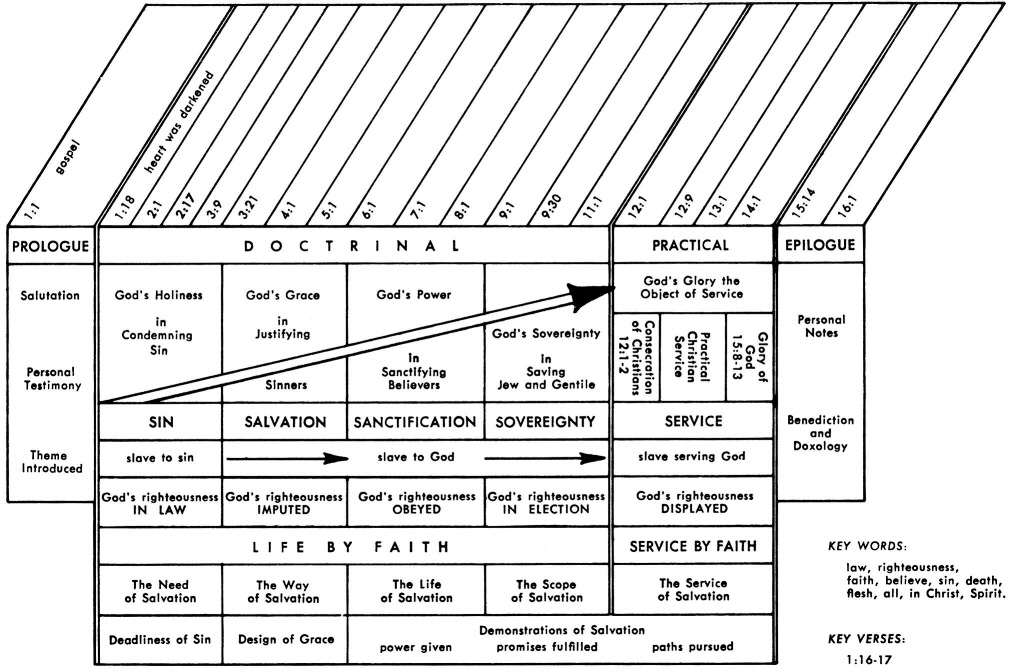
Click chart to enlarge
Chart from recommended resource Jensen's Survey of the NT - used by permission
Romans Overview Chart - Charles Swindoll
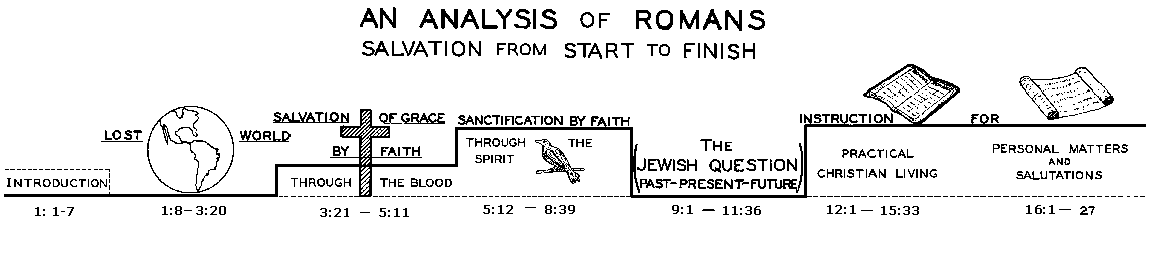
Source: Dr David Cooper
Click to Enlarge
| ROMANS ROAD to RIGHTEOUSNESS |
||||
| Romans 1:18-3:20 | Romans 3:21-5:21 | Romans 6:1-8:39 | Romans 9:1-11:36 | Romans 12:1-16:27 |
| SIN | SALVATION | SANCTIFICATION | SOVEREIGNTY | SERVICE |
| NEED FOR SALVATION |
WAY OF SALVATION |
LIFE OF SALVATION |
SCOPE OF SALVATION |
SERVICE OF SALVATION |
| God's Holiness In Condemning Sin |
God's Grace In Justifying Sinners |
God's Power In Sanctifying Believers |
God's Sovereignty In Saving Jew and Gentile |
Gods Glory The Object of Service |
| Deadliness of Sin |
Design of Grace |
Demonstration of Salvation | ||
| Power Given | Promises Fulfilled | Paths Pursued | ||
| Righteousness Needed |
Righteousness Credited |
Righteousness Demonstrated |
Righteousness Restored to Israel |
Righteousness Applied |
| God's Righteousness IN LAW |
God's Righteousness IMPUTED |
God's Righteousness OBEYED |
God's Righteousness IN ELECTION |
God's Righteousness DISPLAYED |
| Slaves to Sin | Slaves to God | Slaves Serving God | ||
| Doctrine | Duty | |||
| Life by Faith | Service by Faith | |||
|
Modified from Irving L. Jensen's chart above |
||||
Romans 3:25 whom God displayed publicly as a propitiation in His blood through faith. This was to demonstrate His righteousness, because in the forbearance of God He passed over the sins previously committed; (NASB: Lockman)
Greek: on proetheto (3SAMI) o theos hilasterion dia (tes) pisteos en to autou haimati eis endeixin tes dikaiosunes autou dia ten paresin ton progegonoton (RAPNPG) hamartematon
Amplified: Whom God put forward [before the eyes of all] as a mercy seat and propitiation by His blood [the cleansing and life-giving sacrifice of atonement and reconciliation, to be received] through faith. This was to show God’s righteousness, because in His divine forbearance He had passed over and ignored former sins without punishment. (Amplified Bible - Lockman)
Phillips: God has appointed him as the means of propitiation, a propitiation accomplished by the shedding of his blood, to be received and made effective in ourselves by faith. God has done this to demonstrate his righteousness both by the wiping out of the sins of the past (the time when he withheld his hand) (Phillips: Touchstone)
Wuest: whom God placed before the eyes of all as an expiatory satisfaction through faith in His blood for a proof of His righteousness in view of the pretermission of the sins previously committed (Eerdmans)
Young's Literal: God presented him as a sacrifice of atonement, through faith in his blood. He did this to demonstrate his justice, because in his forbearance he had left the sins committed beforehand unpunished
WHOM GOD DISPLAYED PUBLICLY: on proetheto (3SAMI) o theos:
- Acts 2:23; 3:18; 4:28; 15:18; 1Pet 1:18, 19, 20; Rev 13:8
- Romans 3 Resources - Multiple Sermons and Commentaries
Related Passages:
Acts 2:22-23+ “Men of Israel, listen to these words: Jesus the Nazarene, a man attested to you by God with miracles and wonders and signs which God performed through Him in your midst, just as you yourselves know–this Man (JESUS CHRIST) delivered over by the predetermined plan and foreknowledge of God, you nailed to a cross by the hands of godless men and put Him to death.
Acts 3:17-18+ And now, brethren, I know that you acted in ignorance, just as your rulers did also, But the things which God announced beforehand by the mouth of all the prophets, that His Christ would suffer, He has thus fulfilled.
Acts 4:27-28+ “For truly in this city there were gathered together against Your holy servant Jesus, whom You anointed, both Herod and Pontius Pilate, along with the Gentiles and the peoples of Israel, to do whatever Your (GOD THE FATHER'S) hand and Your purpose predestined to occur.
GOD DISPLAYED HIS SON
ON THE OLD RUGGED CROSS
God displayed publicly - God refers to God the Father. As emphasized by the related passages above, clearly God the Father. He is the sovereign God Who ordained the magnificent plan of redemption it was if He displayed His Son publicly.
Remember to study Romans 3:23, 24, 25, 26 as a unit for in the Greek text these 4 verses in our Bible are actually a single sentence.
Calvin wrote “There is not probably in the whole Bible a passage which sets forth more profoundly the righteousness of God in Christ.”
The Amplified Bible renders this verse as…Whom God put forward [before the eyes of all] as a mercy seat and propitiation by His blood [the cleansing and life-giving sacrifice of atonement and reconciliation, to be received] through faith. This was to show God’s righteousness, because in His divine forbearance He had passed over and ignored former sins without punishment. (Amplified Bible - Lockman)
Robertson - God set before himself (purposed) and did it publicly before (pro) the whole world. (Greek Word Studies)
Displayed publicly (4388) (protithemi from pró = before, forth + títhemi = place) means literally place before oneself, to set forth, to set before the eyes, to set forth so as to be looked at and to expose to public view. In secular Greek this word was the technical term referring to the bodies of the dead that were to be lain in state. The idea is that Christ was placed before the eyes of all unlike the ark of the covenant which was veiled and approached only by the high priest.
Gilbrant - Classical Greek Protithēmi is a combination of the prefix pro (4112), meaning “before” with reference to place or time, and tithēmi, meaning “to put” or “place”; so protithēmi means “to place before” and consequently “to display” or “place before the public for display.” It is widely used in classical literature and has many uses including “to propose, to set up, to put forward,” and “to convene” (Liddell-Scott). Septuagint usage is varied with references to the showbread being placed before the Lord (Exodus 29:23) and the act of “setting out” treasures (2 Maccabees 1:15). In the New Testament, usage is limited to Paul’s letters to the Romans and the Ephesians. In Romans 1:13 Paul referred to having planned to come to Rome. In agreement with secular usage of placing before the public for display, Paul used protithēmi in reference to Jesus being presented by God as a sacrifice to demonstrate His justice (Romans 3:25). In Ephesians 1:9 Paul mentioned the mystery of God’s will which He “purposed” in Christ. Paul used prothesis, a noun related to protithēmi, to refer to God’s having set before himself the plan for salvation from the beginning (cf. Romans 8:28). (Complete Biblical Library)
Vine comments on protithemai in this verse writing that it "may mean either “to determine,” to “purpose” or “to set forth,” so as to be manifest. Either sense would convey a scriptural view here, but the context bears out the latter meaning. The verb is in the middle voice, which lays stress upon the personal interest which God had in doing what is said, as predetermined in His eternal purpose. The aorist tense indicates the definiteness of the act in the past. (Vine, W. Collected writings of W. E. Vine. Nashville: Thomas Nelson )
Protithemai is found 3 times in the NT (Ro 1:13; 3:25; Eph 1:9) and is translated in the NASB as displayed publicly, 1; planned, 1; purposed, 1 Protithemai is found 8 times in the non-apocryphal Septuagint (LXX) - Ex 29:23; 40:4, 23; Lev 24:8; Ps 54:3; 86:14; 101:3; Pr 29:24.
Paul used protithemai earlier in Romans writing…
And I do not want you to be unaware, brethren, that often I have planned (protithemai) to come to you (and have been prevented thus far) in order that I might obtain some fruit among you also, even as among the rest of the Gentiles. (Ro 1:13+)
In Ephesians Paul writes…
He (God the Father) made known to us the mystery of His will (we could never have learned these things. We did not desire to learn these things. In fact, we hated God.), according to His kind intention which He purposed (protithemai) in Him (Eph 1:9+)
Vincent says this word means "Publicly, openly, correlated with to declare. He brought Him forth and put Him before the public." Bengel, “placed before the eyes of all;” unlike the ark of the covenant which was veiled and approached only by the high-priest. The word is used by Herodotus of exposing corpses (5:8); by Thucydides of exposing the bones of the dead (2:34). Compare the shew-bread, the loaves of the setting-forth (tes protheseos. See on Mark 2:26. Paul refers not to preaching, but to the work of atonement itself, in which God’s righteousness is displayed. Some render purposed or determined, as Ro 1:13; Eph 1:9, and according to the usual meaning of prothesis, purpose, in the New Testament. But the meaning adopted here is fixed by to declare.
John Piper writes that:
Ro 3:25,26 are, perhaps, the most central or most important words in the Bible - especially if you consider them along with Ro 3:23,24… What happens in Ro 3:25-26 is that we penetrate through the issue of "justification" (v24) and through the issue of "redemption" or ransom (v24) to what C. E. B. Cranfield calls "the innermost meaning of the cross"
"Whom God displayed publicly [put forth] as a propitiation [in context means "the turning away of… wrath"] in His blood through faith. This was to demonstrate His righteousness [Note: this is the purpose of Christ's death that hasn't been mentioned yet - to demonstrate God's righteousness. Now why does God need to demonstrate his righteousness?], because in the forbearance of God He passed over the sins previously committed; [then he repeats this aim lest we miss it] for the demonstration, I say, of His righteousness at the present time, so that He would be just and the justifier of the one who has faith in Jesus." Why did God face the problem of needing to give a public vindication of his righteousness? The answer is in the last phrase of v25 and at the end of v26:
"because in his divine forbearance he had passed over the sins previously committed;" and because he is "the justifier of the one who has faith in Jesus."
Now what do those two phrases mean? They mean that now and for centuries God has been doing what Ps 103:10 says,
"He does not deal with us according to our sins or repay us according to our iniquities."
He has been passing over thousands of sins… not punishing them as fully as they justly deserve.
King David is a good example. In 2 Sa 12:1-31 he is confronted by the prophet Nathan for committing adultery with Bathsheba and then having her husband killed. Nathan says, "Why have you despised the word of the Lord?" (2Sa 12:9).
David feels the rebuke of Nathan, and in (2 Sa 12:13) he says, "I have sinned against the Lord." To this, Nathan responds, "The Lord also has put away your sin; you shall not die." Just like that! Adultery and murder are "PASSED OVER" It is almost incredible. Our sense of justice screams out, "No! You can't just let it go like that. He deserves to die or be imprisoned for life!" But Nathan does not say that. He says, "The Lord has PUT AWAY your sin; you shall not die." (Read full sermon text Did Christ Die for Us or for God?)
The prophet Micah (name = "Who is like Jehovah?") uses the same Hebrew verb (put away) in Mic 7:18
"Who is a God like Thee, who pardons iniquity And PASSES OVER the rebellious act of the remnant of His possession? He does not retain His anger forever, Because He delights in unchanging love"
AS A PROPITIATION: hilasterion: (Ex 25:17-22; Lev 16:15; Heb 9:5:; 1Jn 2:2; 4:10) (see dictionary articles Propitiation; Expiation, Propitiation)
"WE COME O CHRIST TO YOU"
You are the Way to God,
Your blood our ransom paid;
In You we face our Judge and Maker unafraid.
Before the throne absolved we stand,
Your love has met Your law's demand.
---E. Margaret Clarkson
Propitiation (2435) (hilasterion from hilaskomai = propitiate, expiate <> from hileos = appeased, merciful, propitious) to appease and render favorable, to conciliate. Hilasterion can refer to the place of propitiation (see mercy seat below). Although some might say that Jesus Christ is the "mercy seat" per se, most authorities agree that Paul's intended meaning of hilasterion in Romans 3:25 is the means of gaining the favor of God through Jesus Christ.
Hilasterion is used twice in the NAS (Ro 3:25; Heb 9:5) and is translated once as mercy seat and once as propitiation.
Hilasterion is used 16 times in the non-apocryphal Septuagint (LXX) (Ex 25:17, 18, 19, 20, 21, 22; 31:7; 35:12; 37:6, 8, 9; Day of Atonement > Lv 16:2, 13, 14, 15, Nu 7:89; Ezek 43:14, 17, 20; Am 9:1) and all 16 times are translated "mercy seat" (note) .
Note that hilasterion although used only twice in the NT is one of four closely related words used in the NT:
(1) hilaskomai (2433) propitiate, conciliate, make gracious, be gracious in Lk 18:13 and Heb 2:17-note;
(2) hileos (2436) gracious, merciful Mt 16:22 and Heb 8:12-note;
(3) hilasmos (2434) propitiation, propitiatory sacrifice (1Jn 2:2, 4:10)
(4) hilasterion (2435) that which propitiates, means of propitiation, mercy-seat in Ro 3:25, Heb 9:5-note.
See Dictionary of Biblical Imagery discussion of imagery associated with Atonement.
Satisfaction is used as a synonym for propitiation, the concept of satisfaction being that the moral requirement of God has been completely met by the death of His Son on behalf of the believer and therefore has satisfied or propitiated God.
Hilasterion means a sacrifice that bears God's wrath to the end and in so doing changes God's wrath toward us into favor. God has set the sinner free through Christ, but He has not done so by setting aside the rules. He has set the sinner free in Christ by satisfying the demands of God’s justice in Christ. Due to sin, a penalty was to be meted out and a price was to be paid. Christ paid that price and suffered that penalty (“redemption”). God’s divine wrath had to be appeased, due to man’s sin; Christ has appeased that wrath (“propitiation”).
A closely related word is hilasmos which refers to that which propitiates or that which appeases. John uses this word writing that Jesus
"Himself is the propitiation (hilasmos - appeasement, satisfaction) for our sins… " (1 Jn 2:2-+)
The sacrifice of Jesus on the cross satisfied the demands of God’s holiness for the punishment of sin. So Jesus propitiated or satisfied God.
MacDonald - This means that by dying for us, He freed us from the guilt of our sins and restored us to God by providing the needed satisfaction and by removing every barrier to fellowship (Ed note: compare to "atonement" = "at-one-ment"). God can show mercy to us because Christ has satisfied the claims of justice. It is not often that an advocate (or lawyer) pays for his client’s sins; yet that is what our Lord has done, and most remarkable of all, He paid for them by the sacrifice of Himself. (Borrow Believer's Bible Commentary)
Propitiation is not placating a vengeful God but, rather, it is satisfying the righteousness and just wrath of a holy God, thereby making it possible for Him to show mercy righteously. God can now be just (His law says sin demands death) and can at the same time be the Justifier dealing with men graciously and benevolently. The concepts of “redemption” and “propitiation” are used to demonstrate and draw our attention to the justice of God. God has set the sinner free through Christ (justified by grace through faith), but He has not done so by setting aside the rules (His justice). Instead, God has set the sinner free in Christ by satisfying the demands of His justice in Christ. Sin incurs a penalty which must be meted out. Christ paid the price of the "debt" our sins had accrued on our personal account and suffered the required penalty in our place. Thus He paid the price to secure our redemption or liberation as the result of paying the price in full (cp Jn 19:30). God’s divine wrath had to be appeased, due to our sin and Christ appeased God's wrath (“propitiation”).
The only other NT use of hilasterion is found in Hebrews where the writer records that above the ark of the covenant
were the cherubim of glory overshadowing the mercy seat (hilasterion) but of these things we cannot now speak in detail. (Heb 9:5+)
Moses records God's instruction to Israel regarding the ark of the covenant to cover it with
"a mercy seat (Hebrew = click kapporet for 27 uses or click here for explanatory note; Septuagint = hilasterion) of pure gold, two and a half cubits long and one and a half cubits wide. And you shall make two cherubim of gold, make them of hammered work at the two ends of the mercy seat. And make one cherub at one end and one cherub at the other end; you shall make the cherubim of one piece with the mercy seat at its two ends. And the cherubim shall have their wings spread upward, covering the mercy seat with their wings and facing one another; the faces of the cherubim are to be turned toward the mercy seat. And you shall put the mercy seat on top of the ark, and in the ark you shall put the testimony which I shall give to you. And there I will meet with you; ("I will keep an appointment with you there” for the word has idea of prearranged meeting) and from above the mercy seat, from between the two cherubim which are upon the ark of the testimony, I will speak to you about all that I will give you in commandment for the sons of Israel." (Ex 25:17-22+; cf Nu 7:89)
God added the promise that
there I will meet with you ; and from above the mercy seat (kapporet, Lxx = hilasterion) , from between the two cherubim which are upon the ark of the testimony, I will speak to you about all that I will give you in commandment for the sons of Israel. (Ex 25:22+).
Hilasterion describes the "mercy seat" or cover of the ark of the covenant in the Holy of Holies. It was upon this "mercy seat" that the High Priest would sprinkle the blood of the sacrifice once each year on the Day of Atonement (described in Lev 16:1-34-note), which corresponds to the modern day Jewish holiday of Yom Kippur that is held on the tenth day of the seventh month, Tishri (7th month of the Jewish year corresponding to September/October). On that day only would the high priest enter within the inner veil bearing the blood of the sin offering (cf. Heb 9:7-note).
A second goat was released as an escape goat to symbolize the total removal of sin (aza'zel = scapegoat). This solemn day was the only day of fasting prescribed for Israel. It was celebrated by a special sin offering for the whole nation. All the sins of the people were brought symbolically to the Holy of Holies, where blood was sprinkled on the mercy seat as a sacrifice to atone (supply satisfaction for - atonement = making of God and sinners “at one” by the offering of sacrifice and providing a way for humankind to come back into harmonious relation with Him) for them.
Atonement is the act by which God restores a relationship of harmony and unity between Himself and human beings. The word can be broken into three parts that express this great truth in simple but profound terms: “at-one-ment.” Although Old Testament believers were truly forgiven and received genuine atonement through animal sacrifice, the New Testament clearly states that during the Old Testament period God’s justice was not served
“For it is not possible that the blood of bulls and goats could take away sins” (Heb 10:4-note).
Atonement was possible "because in the forbearance of God He passed over the sins previously committed (Ro 3:25).
See Dictionary of Biblical Imagery discussion of imagery associated with Atonement.
However, God’s justice was served in the death of Jesus Christ as a substitute, Hebrews recording that
not through the blood of goats and calves, but through His own blood, He (both as our Substitute Sacrifice and as our Great High Priest) entered the holy place once for all, having obtained eternal redemption (lutrosis - ransoming and release from penalty, power and ultimately some day from the presence and pleasure of sin) (Heb 9:12 - note).
And for this reason He (Jesus Christ our Great High Priest) is the Mediator of a new covenant, in order that since a death has taken place for the redemption (apolutrosis - payment of a price to ransom and emancipate slaves of sin) of the transgressions that were committed under the first covenant, those who have been called may receive the promise of the eternal inheritance. (Heb 9:15-note)
We see a parallel teaching by Jesus Who describes
"Two men went up into the temple to pray, one a Pharisee, and the other a tax-gatherer. The Pharisee stood and was praying thus to himself, ‘God, I thank Thee that I am not like other people: swindlers, unjust, adulterers, or even like this tax-gatherer. ‘I fast twice a week; I pay tithes of all that I get.’ “But the tax-gatherer, standing some distance away, was even unwilling to lift up his eyes to heaven, but was beating his breast, saying, ‘God, be merciful to me, the sinner!’ “I tell you, this man went down to his house justified rather than the other; for everyone who exalts himself shall be humbled, but he who humbles himself shall be exalted." (Lk 18:10-14)
The verb for "be merciful" is hilaskomai, which is of the same word group as hilasterion and means be merciful, make reconciliation for, be propitious, be gracious or be favorably inclined. The idea in this verb is to show compassion and concern for someone in difficulty despite that person having committed a moral offense.
Constable - There are two possible meanings of “propitiation” (NASB) or “sacrifice of propitiation” (NIV). The Greek word (hilasterion) is an adjective that can substitute for a noun. It means having placating or expiating force. It could refer to Jesus Christ as the place where God satisfied His wrath and removed our sins. This is the substantival usage translated “propitiation.” In favor of this interpretation is the use of this Greek word to translate the mercy seat on the ark of the covenant (Ex 25:17, LXX; Heb. 9:5). However, it seems more natural to take hilasterion as referring to Jesus Christ as the sacrifice that satisfied God’s wrath and removed our sins. This is the normal adjectival use translated “sacrifice of atonement” (cf. 1 John 2:2; 4:10). Jesus Christ was the sacrifice, but the place where God made atonement was the Cross. (Romans 3 Commentary)
Vine adds that hilaskomai "was used amongst the Greeks with the significance to make the gods propitious, to appease, propitiate, inasmuch as their good will was not conceived as their natural attitude, but something to be earned first. This use of the word is foreign to the Greek Bible, with respect to God, whether in the Sept. or in the N. T. It is never used of any act whereby man brings God into a favorable attitude or gracious disposition. It is God who is propitiated by the vindication of His holy and righteous character, whereby, through the provision He has made in the vicarious and expiatory sacrifice of Christ, He has so dealt with sin that He can shew mercy to the believing sinner in the removal of his guilt and the remission of his sins. (Vine's Complete Expository Dictionary)
The Hebrew word for "mercy seat", kapporet, "is not related to mercy and of course was not a seat. The word is derived from the root “to atone.” The Greek equivalent in the LXX is usually hilasterion, “place or object of propitiation,” a word which is applied to Christ in Ro 3:25. The translation “mercy seat” does not sufficiently express the fact that the lid of the ark was the place where the blood was sprinkled on the day of atonement. “Place of atonement” would perhaps be more expressive." (Harris, R. L., Harris, R. L., Archer, G. L., & Waltke, B. K. Theological Wordbook of the Old Testament Moody Press)
Related Resources:
- What is propitiation?
- What is the mercy seat?
- Why would the aroma of a sacrifice be important to God?
Hugh Stowell caught a vision of the sublime privilege we have to come before the mercy seat and find comfort in time of need. In 1828, he penned the words to a hymn that he originally entitled “Peace at the Mercy Seat,” but the title was later changed to…
From Every Stormy Wind — Click to play
From every stormy wind that blows,
From every swelling tide of woes,
There is a calm, a sure retreat:
’Tis found beneath the mercy seat.
There is a place where Jesus sheds
The oil of gladness on our heads;
A place than all besides more sweet:
It is the blood-bought mercy seat.
There is a scene where spirits blend,
Where friend holds fellowship with friend;
Though sundered far, by faith they meet
Around one common mercy seat.
There, there, on eagles’ wings we soar,
And time and sense seem all no more;
And heaven comes down, our souls to greet,
And glory crowns the mercy seat.
Oh, let my hand forget her skill,
My tongue be silent, cold, and still,
This bounding heart forget to beat,
If I forget the mercy seat!
Marvin Vincent in his comments on hilasterion in Romans 3:25 has a long note on this word group…
Propitiation (hilasterion [word study]). This word is most important, since it is the key to the conception of Christ’s atoning work. In the New Testament it occurs only here and Heb 9:5; and must be studied in connection with the following kindred words: Hilaskomai which occurs in the New Testament only Luke 18:13, God be merciful, and Heb. 2:17, to make reconciliation. Hilasmos, twice, 1Jn 2:2; 4:10; in both cases rendered propitiation. The compound exilaskomai, which is not found in the New Testament, but is frequent in the Septuagint and is rendered purge, cleanse, reconcile, make atonement.
Septuagint usage. These words mostly represent the Hebrew verb kaphar to cover or conceal, and its derivatives. With only seven exceptions, out of about sixty or seventy passages in the Old Testament, where the Hebrew is translated by atone or atonement, the Septuagint employs some part or derivative of hilaskomai or exilaskomai. Hilasmos or exilasmos is the usual Septuagint translation for kippurim covering for sin, AV, atonement. Thus sin-offerings of atonement; day of atonement; ram of the atonement. See Ex 29:36; 30:10; Lv. 23:27; Nu 5:8, etc. They are also used for chattath sin-offering, Ezek 44:27; 45:19; and for selichah forgiveness. Ps 129:4; Da 9:9.
These words are always used absolutely, without anything to mark the offence or the person propitiated.
Hilaskomai which is comparatively rare, occurs as a translation of kipher to cover sin, Ps. 64:3; 77:38; 78:9; AV, purge away, forgive, pardon. Of salach, to bear away as a burden, 2Ki 5:18; Ps 24:11: AV, forgive, pardon. It is used with the accusative (direct objective) case, marking the sin, or with the dative (indirect objective), as be conciliated to our sins.
Exilaskomai mostly represents kipher to cover, and is more common than the simple verb. Thus, purge the altar, Ezek 43:26; cleanse the sanctuary, Ezek 45:20; reconcile the house, Da 9:24. It is found with the accusative case of that which is cleansed; with the preposition peri = concerning, as “for your sin,” Ex 32:30; with the preposition huper = on behalf of, AV, for, Ezek 45:17; absolutely, to make an atonement, Lv 16:17; with the preposition apo = from, as “cleansed from the blood,” Nu 35:33. There are but two instances of the accusative of the person propitiated: appease him, Ge 32:20; pray before (propitiate) the Lord, Zech 7:2.
Hilasterion AV, propitiation, is almost always used in the Old Testament of the mercy-seat or golden cover of the ark, and this is its meaning in Heb. 9:5, the only other passage of the New Testament in which it is found. In Ezek 43:14, 17, 20, it means a ledge round a large altar, and is rendered settle in AV; Rev., ledge, in margin.
This term has been unduly pressed into the sense of expiatory sacrifice. In the case of the kindred verbs, the dominant Old-Testament sense is not propitiation in the sense of some. thing offered to placate or appease anger; but atonement or reconciliation, through the covering, and so getting rid of the sin which stands between God and man. The thrust of the idea is upon the sin or uncleanness, not upon the offended party. Hence the frequent interchange with hagiazo to sanctify, and katharizo = to cleanse. See Ezek 43:26, where exilasontai = shall purge, and kathariousin = shall purify, are used coordinately. See also Ex 30:10, of the altar of incense: “Aaron shall make an atonement (exilasetai) upon the horns of it — with the blood of the sin-offering of atonement” (katharismou = purification). Compare Lv 16:20. The Hebrew terms are also used coordinately.
Our translators frequently render the verb kaphar by reconcile, Lv 6:30; 16:20; Ezek 45:20. In Lv 8:15, Moses put blood upon the horns of the altar and cleansed (ekatharise) the altar, and sanctified (hagiasen) it, to make reconciliation (ton exilasasthai) upon it. Compare Ezek 45:15, 17; Da 9:24.
The verb and its derivatives occur where the ordinary idea of expiation is excluded. As applied to an altar or to the walls of a house (Lv 14:48, 49, 50, 51, 52, 53), this idea could have no force, because these inanimate things, though ceremonially unclean, could have no sin to be expiated. Moses, when he went up to make atonement for the idolatry at Sinai, offered no sacrifice, but only intercession. See also the case of Korah, Num. 16:46; the cleansing of leprosy and of mothers after childbirth, Lev. 14:1-20; 12:7; 15:30; the reformation of Josiah, 2Chr 34; the fasting and confession of Ezra, Ezra 10:1-15; the offering of the Israelite army after the defeat of Midian. They brought bracelets, rings, etc., to make an atonement (exilasasthai) before the Lord; not expiatory, but a memorial, Nu 31:50, 51, 52, 53, 54. The Passover was in no sense expiatory; but Paul says,
“Christ our Passover was sacrificed for us; therefore purge out (ekkatharate) the old leaven. Let us keep the feast with sincerity and truth;” 1Co 5:7, 8.
In the Old Testament the idea of sacrifice as in itself a propitiation continually recedes before that of the personal character lying back of sacrifice, and which alone gives virtue to it. See 1Sa 15:22; Ps 40:6, 7, 8, 9, 10; 50:8, 9, 10, 11, 12, 13, 14, 23; 51:16, 17; Is 1:11-18-note; Jer 7:21, 22, 23; Amos 5:21, 22, 23, 24; Mic 6:6, 7, 8. This idea does not recede in the Old Testament to be re-emphasized in the New. On the contrary, the New Testament emphasizes the recession, and lays the stress upon the cleansing and life giving effect of the sacrifice of Christ. See John 1:29; Col. 1:20, 21, 22-note; Heb. 9:14-note; Heb 10:19, 20, 21-note; 1Pe 2:24-note; 1Jn 1:7; 4:10, 11, 12, 13.
The true meaning of the offering of Christ concentrates, therefore, not upon divine justice, but upon human character; not upon the remission of penalty for a consideration, but upon the deliverance from penalty through moral transformation; not upon satisfying divine justice, but upon bringing estranged man into harmony with God. As Canon Westcott remarks:
“The scripture conception of hilaskesthai is not that of appeasing one who is angry with a personal feeling against the offender, but of altering the character of that which, from without, occasions a necessary alienation, and interposes an inevitable obstacle to fellowship” (Commentary on St. John’s Epistles, p. 85).
In the light of this conception we are brought back to that rendering of hilasterion which prevails in the Septuagint, and which it has in the only other New-Testament passage where it occurs (He 9:5) — mercy-seat; a rendering maintained by a large number of the earlier expositors, and by some of the ablest of the moderns. That it is the sole instance of its occurrence in this sense is a fact which has its parallel in the terms Passover, Door, Rock, Amen, Day-spring, and others, applied to Christ. To say that the metaphor is awkward counts for nothing in the light of other metaphors of Paul. To say that the concealment of the ark is inconsistent with set forth is to adduce the strongest argument in favor of this rendering. The contrast with set forth falls in perfectly with the general conception. That mercy-seat which was veiled, and which the Jew could approach only once a year, and then through the medium of the High-Priest, is now brought out where all can draw nigh and experience its reconciling power (He 10:19, 22; compare Heb. 9:8). “The word became flesh and dwelt among us. We beheld His glory. We saw and handled’ (Jn 1:14; 1Jn 1:1, 2, 3). The mercy-seat was the meeting-place of God and man (Ex 25:17, 18, 19, 20, 21, 22; Lv 16:2; Nu 7:89); the place of mediation and manifestation. Through Christ, the antitype of the mercy-seat, the Mediator, man has access to the Father (Ep 2:18). As the golden surface covered the tables of the law, so Christ stands over the law, vindicating it as holy and just and good, and therewith vindicating the divine claim to obedience and holiness. As the blood was annually sprinkled on the golden cover by the High-Priest, so Christ is set forth “in His blood,” not shed to appease God’s wrath, to satisfy God’s justice, nor to compensate for man’s disobedience, but as the highest expression of divine love for man, taking common part with humanity even unto death, that it might reconcile it through faith and self-surrender to God. (Romans 3 Greek Word Studies)
Ray Pritchard says that
To propitiate means to "turn away wrath by offering a gift." Pagan religions are built on the concept of propitiation, whereby a devotee brings a chicken, a goat, a lamb, or a plate of food and offers it to his god. I saw that very thing happen in Haiti and also in India. By bringing the blood of a chicken, the followers of voodoo hope to appease the evil spirits and turn away their wrath. On a completely different level, a husband does this after having a fight with his wife when he stops at the freeway off ramp and buys flowers on the way home. He hopes the offering of flowers will turn away wrath and restore a right relationship. In the Old Testament the High Priest would enter the Holy of Holies once a year—on the Day of Atonement—bringing with him the blood of a bull. When he sprinkled the blood on the Mercy Seat—the lid of the Ark of the Covenant—that blood was accept by God as an "atonement" or a "covering" for the sin of the people.
The New Testament picks up this idea of propitiation in 1Jn 2:2,
"He is the atoning sacrifice for our sins, and not only for ours but also for the sins of the whole world."
The phrase "atoning sacrifice" translates the normal Greek word of propitiation. By the offering of himself, Jesus turned away God’s wrath forever. Let me give you three truths to summarize the effects of propitiation: (1) Because Jesus Christ died, God’s justice is now satisfied.
(2) Because Jesus Christ died, God’s wrath has now been turned away. The price for sin has been paid.
(3) Because Jesus Christ died, God’s mercy is now freely available to anyone who wants it. Justice satisfied … the price paid … mercy available. What an awesome thought. God’s wrath is real, but so is his mercy. He satisfied His Own wrath by offering his own Son on the cross. "Amazing love, how can it be, that thou, my God, shouldst die for me?" (Read full Sermon)
A WORD OF CAUTION REGARDING
"PROPITIATION"
Note that many theologians of the "liberal persuasion" strongly object to the truth that Jesus bore God's wrath against sin. In general, they tend to be uncomfortable with the truth of wrath, judgment, and hell, and so have fallaciously reasoned that "propitiation" is a translation that relegates theology to the mythology of the Greeks and slanders the character of God. This thinking has led these liberal theologians to translate hilasterion as "expiation", as for example in the Revised Standard Version ("whom God put forward as an expiation by his blood,"). Expiation means an action that cleanses from sin but includes no concept of appeasing God's wrath! To be sure the truth conveyed by "expiation" is certainly included in hilasterion, but as you can discern, expiation is not an adequate or accurate rendering of the truth conveyed by this Greek word.
It is also notable that the NIV misses the true meaning, choosing to translate hilasterion as "atonement". In fairness, the NIV does have a marginal note which is more accurate - it reads
"as the one who would turn aside his wrath, taking away sin".
The difference between the doctrines of propitiation in Christianity and in Greek mythology is bound up in the character of God Himself. Being holy, perfect, and immutable, the living God is never ruled by changing moods as were the so-called gods of Greco-Roman mythology. Consequently, God's wrath is a settled disposition against evil. The just demands of God's holiness for the punishment and exclusion of sin must be satisfied or propitiated.
Propitiation is the work of Christ on the Cross in which He met the demands of the righteousness of God against sin, satisfying the requirements of God's justice and canceling the guilt of man's sin!
When I Survey the Wondrous Cross
Isaac Watts, 1707
When I survey the wondrous cross
On which the Prince of glory died,
My richest gain I count but loss,
And pour contempt on all my pride.
Forbid it, Lord, that I should boast,
Save in the death of Christ my God!
All the vain things that charm me most,
I sacrifice them to His blood.
See from His head, His hands, His feet,
Sorrow and love flow mingled down!
Did e’er such love and sorrow meet,
Or thorns compose so rich a crown?
His dying crimson, like a robe,
Spreads o’er His body on the tree;
Then I am dead to all the globe,
And all the globe is dead to me.
Were the whole realm of nature mine,
That were a present far too small;
Love so amazing, so divine,
Demands my soul, my life, my all.
IN HIS BLOOD THROUGH FAITH: dia (tes) pisteos en to autou haimati
- Ro 5:1,9,11; Isa 53:11; Jn 6:47,53, 54, 55, 56, 57, 58; Col 1:20, 21, 22, 23; Heb 10:19,20)
Blood (1298) (haima) is the basis of individual life, as the fluid that circulates in the heart, arteries, capillaries, and veins of a vertebrate animal carrying nourishment and oxygen to and bringing away waste products from all parts of the body. Blood carries life-sustaining elements to all parts of the body; therefore it represents the essence of life. In contrast, the shedding of blood represents the shedding of life, i.e., death (cf. Ge 9:4). Note that "blood" is used here to indicate a violent death.
Moses records that…
"the life of the flesh is in the blood, and I have given it to you on the altar to make atonement (from an Anglo-Saxon word which means ‘a making at one’ = it points to a process of bringing those who are estranged into a unity) for your souls; for it is the blood by reason of the life that makes atonement (the act by which God restores a relationship of harmony and unity between Himself and human beings)." (Lv 17:11+)
Comment: The principle behind atonement is life for life. Since the wages of sin is death, symbolized by the shedding of blood, so “without the shedding of blood is no remission.” Shed blood (death) from a substitute atones for or covers the sinner, who is then allowed to live. Forgiveness does not come because the penalty of sin is excused, but because it is transferred to a sacrifice whose lifeblood is poured out.
When Jesus inaugurated the New Covenant He announced that…
this is My blood of the covenant, which is poured out for (huper = on behalf of = implies substitution = He died both for us and in our place!) many for forgiveness of sins. (Mt 26:28)
In Romans 5 Paul reiterates that justification is based on the blood of Jesus Christ writing…
Therefore having been justified by faith (past), we have peace with God (present) through our Lord Jesus Christ… Much more then, having now been justified by His blood, we shall be saved from the wrath of God through Him (future). (see notes Romans 5:1, Ro 5:9)
Through (1223) (dia) is a marker of instrument by which something is accomplished, and so conveys the idea of "by means of". The sacrifice of Christ becomes effective through the faith which appropriates it.
Faith (1298) (pistis) (Click in depth study of pistis) is synonymous with trust or belief and is the conviction of the truth of anything, but in Scripture usually speaks of belief respecting man's relationship to God and divine things, generally with the included idea of trust and holy fervor born of faith and joined with it. As pistis relates to God, it is the conviction that God exists and is the Creator and Ruler of all things well as the Provider and Bestower of eternal salvation through the sacrifice of His only Son Jesus Christ. As faith relates to Christ it represents a strong and welcome conviction or belief that Jesus is the Messiah, through Whom we obtain eternal salvation and entrance into the Kingdom of Heaven. Stated another way, eternal salvation comes only through belief in Jesus Christ and no other way.
Wayne Grudem defines faith that saves one's soul…
Saving faith is trust in Jesus Christ as a living person for forgiveness of sins and for eternal life with God. This definition emphasizes that saving faith is not just a belief in facts but personal trust in Jesus to save me… The definition emphasizes personal trust in Christ, not just belief in facts about Christ. Because saving faith in Scripture involves this personal trust, the word “trust” is a better word to use in contemporary culture than the word “faith” or “belief.” The reason is that we can “believe” something to be true with no personal commitment or dependence involved in it. (Scroll to page 617 in Systematic Theology: An Introduction to Biblical Doctrine) (Bolding added)
- We cannot become righteous on his own, and thus God graciously provided for our redemption through the atoning sacrifice of His own Son, Jesus Christ.
- Explained -Ro 5:8, 9, 10, 11; 2Co 5:18,19; Gal 1:4; 1Jn 2:2; 4:10
- Foreordained -Ro 3:25; 1Pe 1:11,20; Re 13:8
- Foretold -Isa 53:4, 5, 6,8, 9, 10, 11, 12; Da 9:24, 25, 26, 27; Zech 13:1,7; Jn 11:50,51
- Effected by Christ alone -Jn 1:29,36; Ac 4:10,12; 1Th 1:10; 1Ti 2:5,6; He 2:9; 1Pe 2:24
- Was voluntary -Psalms 40:6-8; He 10:5-9; Jn 10:11,15,17,18
EXHIBITS THE
- Grace and mercy of God -Ro 8:32; Ep 2:4,5,7; 1Ti 2:4; He 2:9
- Love of God -Romans 5:8; 1 John 4:9,10
- Love of Christ -John 15:13; Gal 2:20; Ep 5:2,25; Re 1:5
- Reconciles the justice and mercy of God -Isaiah 45:21; Ro 3:25,26
- Necessity for -Isaiah 59:16; Luke 19:10; Hebrews 9:22
- Made but once -Hebrews 7:27; 9:24, 25, 26, 27, 28; 10:10,12,14; 1Pe 3:18
- Acceptable to God -Ephesians 5:2
- Reconciliation to God effected by -Ro 5:10; 2Co 5:18, 19, 20; Ep 2:13, 14, 15, 16; Col 1:20, 21, 22; He 2:17; 1Pe 3:18
- Access to God by -Hebrews 10:19,20
- Remission of sins by -Jn 1:29; Ro 3:25; Ep 1:7; 1 Jn 1:7; Re 1:5
- Justification by -Romans 5:9; 2Corinthians 5:21
- Sanctification by -2Co 5:15; Ep 5:26,27; Titus 2:14; He 10:10; 13:12
- Redemption by -Mt 20:28; Acts 20:28; 1Ti 2:6; He 9:12; Re 5:9
HAS DELIVERED SAINTS FROM THE
- Power of sin -Romans 8:3; 1 Peter 1:18,19
- Power of the World -Galatians 1:4; 6:14
- Power of the devil -Colossians 2:15; Hebrews 2:14,15
- Saints glorify God for -1 Corinthians 6:20; Galatians 2:20; Philippians 1:20,21
- Saints rejoice in God for -Romans 5:11
- Saints praise God for -Revelation 5:9-13
- Faith in, indispensable -Romans 3:25; Galatians 3:13,14
- Commemorated in the Lord’s supper -Matthew 26:26-28; 1 Co 11:23-26
- Ministers should fully set forth -Acts 5:29, 30,31,42; 1Co 15:3; 2Co 5:18, 19, 20, 21
Typified - Genesis 4:4; Hebrews 11:4; Genesis 22:2; Hebrews 11:17,19; Exodus 12:5,11,14; 1 Corinthians 5:7; Exodus 24:8; Hebrews 9:20; Leviticus 16:30,34; Hebrews 9:7,12,28; Le 17:11; Heb 9:22|
THIS WAS TO DEMONSTRATE HIS RIGHTEOUSNESS: eis endeixin tes dikaiosunes:
- Ro 3:26; Ps 22:31; 40:10; 50:6; 97:6; 119:142; 1Jn 1:10
Here we see God's purpose in setting forth Christ as a propitiation in His blood -- it was done with a view to demonstrate His righteousness.
Demonstrate (1732) (endeixis from endeíknumi = show forth <> en = in, to + deíknumi = expose to eyes and give proof, make known by visual, auditory, or linguistic means) means a pointing out (particularly with the finger). It is something that points to or serves as an indicator of something else and hence is synonymous with a sign, an indication, evidence, verification. It describes the means by which one knows that something is a fact. It is something that compels acceptance of something mentally or emotionally and thus serves as a demonstration or a proof.
In secular Greek endeixis meant a pointing out and was used as a legal term, meaning a laying out of information against one who discharged public functions for which he was legally disqualified.
Endeixis is found 4 times in the NT (see below), not in the Septuagint = LXX
Romans 3:25 whom God displayed publicly as a propitiation in His blood through faith. This was to demonstrate His righteousness, because in the forbearance of God He passed over the sins previously committed;
Romans 3:26 for the demonstration, I say, of His righteousness at the present time, that He might be just and the justifier of the one who has faith in Jesus.
2Cor 8:24+ Therefore openly before the churches show them the proof of your love and of our reason for boasting about you.
Philippians 1:28+ in no way alarmed by your opponents-- which is a sign of destruction for them, but of salvation for you, and that too, from God.
Righteousness (1343) (dikaiosune from dikaios = being proper or right in the sense of being fully justified being or in accordance with what God requires) is the quality of being upright. In its simplest sense dikaiosune conveys the idea of conformity to a standard or norm. In this sense righteousness is the opposite of hamartia (sin), which is defined as missing of the mark set by God. In this sense righteousness is the opposite of hamartia (sin), which is defined as missing of the mark set by God.
Dikaiosune is rightness of character before God and rightness of actions before men. The word “righteousness” comes from a root word that means “straightness.” It refers to a state that conforms to an authoritative standard. Righteousness is a moral concept. God’s character is the definition and source of all righteousness. God is totally righteous because He is totally as He should be. The righteousness of God could be succinctly stated as that which is all that God is, all that He commands, all that He demands, all that He approves, all that He provides (through Christ). (Click here to read Pastor Ray Pritchard's interesting analysis of righteousness in the Gospel of Matthew).
In this particular verse Wuest feels that righteousness "is God’s righteous character as seen in His antagonism against sin."
A T Robertson agrees with Wuest writing that "to show His righteousness" means “For showing of his righteousness,” the God-kind of righteousness. God could not let sin go as if a mere slip. God demanded the atonement and provided it.
Wayne Grudem agrees writing that "God had not simply forgiven sin and forgotten about the punishment in generations past. He had forgiven sins and stored up his righteous anger against those sins. But at the Cross the fury of all that stored-up wrath against sin was unleashed against God’s own Son. (Scroll down to page 498 in Systematic Theology: An Introduction to Biblical Doctrine)
It should be noted that there are some (eg, Marvin Vincent) who feel the demonstration of God's righteousness refers less to His righteous wrath or antagonism against sin (Vincent calls this God's "judicial" or "punitive" righteousness) and more to His demonstration of
His righteous character, revealing its antagonism to sin in its effort to save man from his sin, and put forward as a ground of mercy, not as an obstacle to mercy. (eg, Marvin Vincent)
BECAUSE IN THE FORBEARANCE OF GOD HE PASSED OVER: autou dia ten paresin:
- Ro 3:23,24; 4:1, 2, 3, 4, 5, 6, 7, 8; Acts 13:38,39; 17:30; 1Ti 1:15; Heb 9:15, 16, 17, 18, 19, 20, 21, 22,25,26; 10:4; Heb 11:7,14,17,39,40; Rev 5:9; 13:8; 20:15
THE AMAZING GRACE OF
GOD'S FORBEARANCE
Spurgeon - God holds back the axe which, were it not for his forbearance, would cut down the barren tree. He still forbears, and He is ready to pardon and blot out all the past if you will but believe in His dear Son.
Regarding God's forbearance Jamieson explains that God was "not remitting but only forbearing to punish them, or passing them by, until an adequate atonement for them should be made. In thus not imputing them, God was righteous, but He was not seen to be so; there was no “manifestation of His righteousness” in doing so under the. ancient economy. But now that God can “set forth” Christ as a “propitiation for sin through faith in His blood,” the righteousness of His procedure in passing by the sins of believers before, and in now remitting them, is “manifested,” declared, brought fully out to the view of the whole world. (Our translators have unfortunately missed this glorious truth, taking “the sins that are past” to mean the past sins of believers—committed before faith—and rendering, by the word “remission,” what means only a “passing by”; thus making it appear that “remission of sins” is “through the forbearance of God,” which it certainly is not).
Forbearance (463) (anoche from the verb anécho = be patient with sense of enduring possible difficulty or in regard to errors or weaknesses of = idea of holding one's self back from) means self-restraint, tolerance, a holding back, a delaying (of punishment), a postponement of divine punishment. Forbearance describes a refraining from the enforcement of something (as a debt, right, or obligation) that is due. It implies something temporary which may pass away under new conditions. Hence anoche is used in connection with the passing by of sins before Christ. God withheld punishment of sinners when He might have inflicted it. Anoche was frequently used for an armistice or truce and implied something temporary which might pass away under new conditions. God’s forbearance represents His ‘truce with the sinner’. (See note below)
The only other NT use of anoche is Romans 2 where Paul asks…
Or do you think lightly of the riches of His kindness and forbearance (anoche) and patience, not knowing that the kindness of God leads you to repentance? (Ro 2:4+)
Trench says that anoche "is that forbearance or suspension of wrath, that truce with the sinner, which by no means implies that the wrath will not be executed at the last; nay, involves that it certainly will, unless he be found under new conditions of repentance and obedience."
God had not simply forgiven sin and forgotten about the punishment in generations past. He had forgiven sins and stored up His righteous wrath against those sins. Then in the fullness of time, at the Cross, the full fury of His stored up wrath against sin was unleashed against God the Son!
In a sense the sacrifices of the OT are the demonstration of God’s toleration of sin while the blood of Christ is the demonstration of the love and justice of God in that He took the initiative to send His Son into the world to shed His blood.
Thompson Chain Reference- Forbearance
- Divine - Genesis 18:32 Neh 9:30 Jn 4:11 Acts 17:30 Romans 2:4, 3:25, 10:21
- Enjoined - 1 Corinthians 13:7 Ephesians 4:2 Ephesians 6:9 Colossians 3:13
Here is a simple diagram that helps understand how one was saved by grace through faith in Christ in the Old Testament
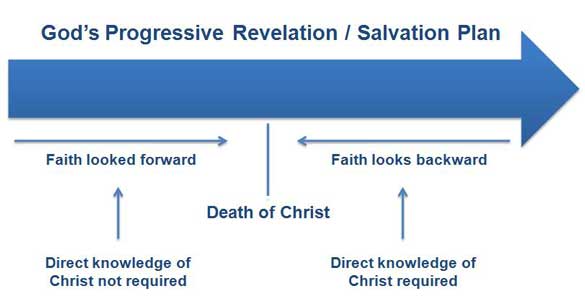
See the full article below from Gotquestions - What is progressive revelation as it relates to salvation?
Passed over (3929) (paresis from paríemi = let pass by, let go, to relax <> pará = aside + híemi = send) means intentionally not regard or be concerned about certain events. Overlooking for the time being. Deliberate disregard.
Friberg writes that paresis means "passing over, letting go, overlooking (for the time being); of sins letting go unpunished; used of God's way of dealing with sins committed during Old Testament times and only symbolically atoned for by sacrifices until Christ should come and offer up Himself as the adequate sacrifice; distinguished from aphesis (word study) (release, pardon), which is a doing away with sins through an adequate atonement. (Borrow Analytical Lexicon of the Greek New Testament )
Bypassing here does not mean remission of sins. Paresis was temporary. God passed over the sins of the people because of their animal sacrifices, this overlooking resulting in a temporary suspension of His wrath. Paresis is closed related but distinct from aphesis (word study) (apo = from + hiemi = send) which means remission, the forgiveness of sins or taking them away, and is more than paresis, which means bypassing or skirting their sins. God did not forgive or take away the sins of Old Testament saints finally until Jesus died on the cross. The blood of the animal sacrifices of all the OT sacrifices only covered them temporarily. God did not exact a full penalty for sin until Jesus died.
Thomas Constable - Passed over (NASB) or “left… unfinished” (NIV) is not the same as “forgave.” Two different though related Greek words describe these two ideas, paresis and aphesis (word study) respectively. God did not forgive the sins of Old Testament saints finally until Jesus died on the cross. The blood of the animal sacrifices of Judaism only covered them temporarily. God did not exact a full penalty for sin until Jesus died. It is as though the Old Testament believers who offered the sacrifices for the expiation of sin that the Mosaic Law required paid for those sins with a credit card. God accepted those sacrifices as a temporary payment. However the bill came due later, and Jesus Christ paid that off entirely. (Expository Notes)
God had forbore and passed over their sins not out of weakness or sentimentality but because He planned to provide the final sacrifice in the future, at the Cross.
Wuest - There are two words closely allied in meaning, aphesis and paresis. The former means literally “to put off” or “put away” and is used in such places as Matthew 26:28; Ephesians 1:7; Colossians 1:14; Hebrews 9:22, and is translated correctly “remission.” Paresis, used only here in the New Testament, means “passing over, letting pass,” and should be translated “pretermission.” Trench defines and explains the usage of the word in this context, “the pretermission or passing by of sins for the present, leaving it open in the future either entirely to remit, or else adequately punish them, as may seem good to Him who has the power and right to do the one or the other.” It was this passing by of sin before the Cross in the sense that God saved believing sinners without having their sins paid for, thus bestowing mercy without having justice satisfied, which would make God appear as if He condoned sin, that had to be set right in the thinking of the human race. The matter was always right in God’s eyes, for He looked forward to the satisfaction of the broken law at the Cross. It makes no difference with God whether He saves sinners before or after the Cross. The Cross is an eternal fact in the reckoning of God. Of course, the Cross had to come, for a righteous God could not pass by sin, but must require that sin be paid for. His justice must be satisfied and His government maintained.(Wuest Word Studies - Eerdman Publishing Company Volume 1, Volume 2, Volume 3 - used by permission)
The root verb paríemi is used in the Apocryphal book Sir 23:2 which reads…
Who will set scourges over my thoughts, and the discipline of wisdom over mine heart? that they spare me not for mine ignorances, and it pass not by (paríemi) my sins (from the KJA - Apocrypha)
God has passed over sins during the former times in His divine forbearance until the perfect substitutionary sacrifice should be offered by His Son Jesus Christ. His passing over sin is seen in various times and places with the most dramatic illustration of this passing over of man’s sins is seen in the annual Day of Atonement (Click note), when punishment for the sins of the nation Israel was delayed yet another year.
Guzik explains that "God, in His forbearance, had passed over the sins of those Old Testament saints who trusted in the coming Messiah. At the cross, those sins were no longer passed over, they were paid for. The idea is that through the animal sacrifice of the Old Testament, those who looked in faith to the coming Messiah had their sins "covered" by a sort of an "IOU" or promissory note (cp Acts 17:30). That temporary covering was redeemed for full payment at the cross. The work of Jesus on the cross freed God from the charge that He passed over sin committed before the cross lightly. They were passed over for a time, but they were finally paid for.
Matthew Henry commenting on "passing over" sins writes that "It is owing to the master’s goodness and the dresser’s mediation that barren trees are let alone in the vineyard; and in both God’s righteousness is declared, in that without a mediator and a propitiation He would not only not pardon, but not so much as forbear, not spare a moment. It is owning to Christ that there is ever a sinner on this side hell."
Horatio Bonar wrote the following hymn…
Not what my hands have done
Can save my guilty soul;
Not what my toiling flesh has borne
Can make my spirit whole.
Not what I feel or do
Can give me peace with God;
Not all my prayers and sighs and tears
Can bear my awful load.
Thy grace alone, O God,
To me can pardon speak;
Thy power alone, O Son of God,
Can this sore bondage break.
No other work save thine,
No other blood will do;
No strength save that which is divine
Can bear me safely through.
QUESTION - What does the Bible say about forbearance?
ANSWER - Forbearance is a word found mostly in the King James Version of the Bible. It has two meanings. One is to delay repayment of a debt, as in “The borrowers requested forbearance until they could provide the proper documents.” In the Bible, however, forbearance usually refers to a godly character trait. To forbear is to abstain or hold back; forbearance is akin to patience and self-control. Colossians 3:12–13 is one example: “Put on therefore, as the elect of God, holy and beloved, bowels of mercies, kindness, humbleness of mind, meekness, longsuffering; Forbearing one another, and forgiving one another” (KJV). The New Living Translation words it this way: “Make allowance for each other’s faults, and forgive anyone who offends you.”
God shows forbearance in that He holds back the judgment the world deserves: “Or do you show contempt for the riches of his kindness, forbearance, and patience, not realizing that God’s kindness is intended to lead you to repentance?” (Romans 2:4, KJV). In this instance, forbearance refers to God’s mercy, kindness, and longsuffering in delaying rightful judgment. Paul is warning mankind not to take God’s delay in dealing with sin as a sign that He is uninterested or that man is innocent. Paul warns the moralist not to be hasty in judging others since God will judge everyone some day. The fact that God is so forbearing in judging the world should cause us to forbear to judge others.
Forbearance is a quality God holds in high regard. Whether manifest as patience, endurance, gentleness, tolerance, or moderation, forbearance is woven throughout the Bible (Proverbs 25:15; Ephesians 4:2). Several of the qualities listed as the fruit of the Spirit in Galatians 5:22 have an element of forbearance reflected in them, including love, peace, patience, gentleness, kindness, and self-control. God is patient, and He desires those who seek Him to be patient as well.
An oft-repeated command in Scripture is “wait on the Lord” (Psalm 27:14; Proverbs 20:22; 1 Corinthians 4:5; Isaiah 40:31). It could be that God requires us to wait upon Him in order to help us develop forbearance. When we’ve learned to wait upon the Lord, we find it easier to forbear with our brothers and sisters (1 Peter 3:8). GotQuestions.org
QUESTION - What is progressive revelation as it relates to salvation?
ANSWER - The term “progressive revelation” refers to the idea and teaching that God revealed various aspects of His will and overall plan for humanity over different periods of time, which have been referred to as “dispensations” by some theologians. To dispensationalists, a dispensation is a distinguishable economy (i.e., an ordered condition of things) in the outworking of God’s purpose. Whereas dispensationalists debate the number of dispensations that have occurred through history, all believe that God revealed only certain aspects of Himself and His plan of salvation in each dispensation, with each new dispensation building upon the prior one.
While dispensationalists believe in progressive revelation, it is important to note that one does not have to be a dispensationalist to embrace progressive revelation. Nearly all students of the Bible recognize the fact that certain truths contained in Scripture were not fully revealed by God to prior generations. Anyone today who does not bring an animal sacrifice with him when he wishes to approach God or who worships on the first day of the week rather than the last understands that such distinctions in practice and knowledge have been progressively revealed and applied throughout history.
In addition, there are weightier matters concerning the concept of progressive revelation. One example is the birth and composition of the Church, which Paul speaks of: “I, Paul, a prisoner for Christ Jesus on behalf of you Gentiles— assuming that you have heard of the stewardship of God’s grace that was given to me for you, how the mystery was made known to me by revelation, as I have written briefly. When you read this, you can perceive my insight into the mystery of Christ, which was not made known to the sons of men in other generations as it has now been revealed to his holy apostles and prophets by the Spirit. This mystery is that the Gentiles are fellow heirs, members of the same body, and partakers of the promise in Christ Jesus through the gospel” (Ephesians 3:1-6).
Paul states nearly the same thing in Romans: “Now to him who is able to strengthen you according to my gospel and the preaching of Jesus Christ, according to the revelation of the mystery that was kept secret for long ages but has now been disclosed and through the prophetic writings has been made known to all nations, according to the command of the eternal God” (Romans 16:25-26).
In discussions of progressive revelation, one of the first questions people have is how it applies to salvation. Were those living before the first advent of Christ saved in a different way than people are saved today? In the New Testament era, people are told to place their faith in the finished work of Jesus Christ and believe that God raised Him from the dead, and they will be saved (Romans 10:9-10; Acts 16:31). Yet Old Testament expert Allen Ross notes, “It is most improbable that everyone who believed unto salvation [in the Old Testament] consciously believed in the substitutionary death of Jesus Christ, the Son of God.” John Feinberg adds, “The people of the Old Testament era did not know that Jesus was the Messiah, that Jesus would die, and that His death would be the basis of salvation.” If Ross and Feinberg are correct, then what exactly did God reveal to those who lived before Christ, and how were the Old Testament saints saved? What, if anything, changed in the salvation of the Old Testament to the salvation of the New Testament?
Progressive Revelation - Two Ways or One Way of Salvation?
Some charge that those holding to progressive revelation espouse two different methods of salvation—one that was in place before the first coming of Christ, and another that came after His death and resurrection. Such a claim is refuted by L. S. Chafer who writes, “Are there two ways by which one may be saved? In reply to this question it may be stated that salvation of whatever specific character is always the work of God in behalf of man and never a work of man in behalf of God. . . . There is, therefore, but one way to be saved and that is by the power of God made possible through the sacrifice of Christ.”
If this is true, then how can the revelations in the Old and New Testaments concerning salvation be reconciled? Charles Ryrie sums up the matter succinctly in this way: “The basis of salvation in every age is the death of Christ; the requirement for salvation in every age is faith; the object of faith in every age is God; the content of faith changes in the various ages.” In other words, no matter when a person has lived, their salvation is ultimately dependent on the work of Christ and a faith placed in God, but the amount of knowledge a person had concerning the specifics of God’s plan has increased through the ages via God’s progressive revelation.
Regarding the Old Testament saints, Norman Geisler offers the following:
“In short, it appears that at most, the normative Old Testament salvific requirements (in terms of explicit belief) were (1) faith in God’s unity, (2) acknowledgment of human sinfulness, (3) acceptance of God’s necessary grace, and possibly (4) understanding that there would be a coming Messiah.”
Is there evidence in Scripture to support Geisler’s claim? Consider this passage, which contains the first three requirements, in Luke’s Gospel:
“Two men went up into the temple to pray, one a Pharisee and the other a tax collector. The Pharisee stood and was praying this to himself: ‘God, I thank You that I am not like other people: swindlers, unjust, adulterers, or even like this tax collector. ‘I fast twice a week; I pay tithes of all that I get.’ But the tax collector, standing some distance away, was even unwilling to lift up his eyes to heaven, but was beating his breast, saying, ‘God, be merciful to me, the sinner!’ I tell you, this man went to his house justified rather than the other; for everyone who exalts himself will be humbled, but he who humbles himself will be exalted” (Luke 18:10-14).
This event took place before the death and resurrection of Christ, so it clearly involves a person who has no knowledge of the New Testament gospel message as it is articulated today. In the tax collector’s simple statement (“God be merciful to me, the sinner!”) we find (1) a faith in God, (2) an acknowledgement of sin, and (3) an acceptance of mercy. Then Jesus makes a very interesting statement: He says the man went home “justified.” This is the exact term used by Paul to describe the position of a New Testament saint who has believed the gospel message and put his trust in Christ: “Therefore, since we have been justified by faith, we have peace with God through our Lord Jesus Christ” (Romans 5:1).
The fourth on Geisler’s list is missing in Luke’s account—the understanding of a coming Messiah. However, other New Testament passages indicate that this may have been a common teaching. For example, in John’s account of Jesus and the Samaritan woman at the well, the woman says, “I know that Messiah is coming (He who is called Christ); when that One comes, He will declare all things to us” (John 4:25). However, as Geisler himself acknowledged, faith in Messiah was not a “must have” for Old Testament salvation.
Progressive Revelation - More Evidence from Scripture
A quick search of Scripture reveals the following verses in both the Old and New Testaments that support the fact that faith in God has always been the avenue of salvation:
• “Then [Abraham] believed in the Lord; and He reckoned it to him as righteousness” (Genesis 15:6)
• “And it will come about that whoever calls on the name of the Lord will be delivered” (Joel 2:32)
• “For it is impossible for the blood of bulls and goats to take away sins” (Hebrews 10:4).
• “Now faith is the assurance of things hoped for, the conviction of things not seen. For by it the men of old gained approval” (Hebrews 11:1-2).
• And without faith it is impossible to please him, for whoever would draw near to God must believe that he exists and that he rewards those who seek him” (Hebrews 11:6).
Scripture plainly states that faith is the key to salvation for all people down through history, but how could God save people without their knowing of Christ’s sacrifice for them? The answer is that God saved them based on their response to the knowledge that they did have. Their faith looked forward to something that they could not see, whereas today, believers look back on events that they can see. The following graphic depicts this understanding:
Scripture teaches that God has always given people enough revelation to exercise faith. Now that Christ’s work is accomplished, the requirement has changed; the “times of ignorance” are over:
• “In the generations gone by He permitted all the nations to go their own ways; and yet He did not leave Himself without witness” (Acts 14:16).
• “Therefore having overlooked the times of ignorance, God is now declaring to men that all people everywhere should repent” (Acts 17:30).
• “All have sinned and fall short of the glory of God, and are justified by his grace as a gift through the redemption that is in Christ Jesus whom God displayed publicly as a propitiation in His blood through faith. This was to demonstrate His righteousness, because in the forbearance of God He passed over [literally “let go unpunished”] the sins previously committed” (Romans 3:25).
Prior to Christ’s coming, God was foreshadowing Jesus’ death via the sacrificial system and conditioning His people to understand that sin leads to death. The Law was given to be a tutor to lead people to the understanding that they were sinners in need of God’s grace (Galatians 3:24). But the Law did not revoke the prior Abrahamic Covenant, which was based on faith; it is Abraham’s covenant that is the pattern for salvation today (Romans 4). But as Ryrie stated above, the detailed content of our faith—the amount of revelation given—has increased through the ages so that people today have a more direct understanding of what God requires of them.
Progressive Revelation – Conclusions
Referring to God’s progressive revelation, John Calvin writes, “The Lord held to this orderly plan in administering the covenant of his mercy: as the day of full revelation approached with the passing of time, the more he increased each day the brightness of its manifestation. Accordingly, at the beginning when the first promise of salvation was given to Adam (Gen. 3:15) it glowed like a feeble spark. Then, as it was added to, the light grew in fullness, breaking forth increasingly and shedding its radiance more widely. At last – when all the clouds were dispersed – Christ, the Sun of Righteousness, fully illumined the whole earth” (Institutes, 2.10.20).
Progressive revelation does not mean that God’s people in the Old Testament were without any revelation or understanding. Those living before Christ, says Calvin, were not “without the preaching that contains the hope of salvation and of eternal life, but . . . they only glimpsed from afar and in shadowy outline what we see today in full daylight” (Institutes, 2.7.16; 2.9.1; commentary on Galatians 3:23).
The fact that no one is saved apart from the death and resurrection of Christ is clearly stated in Scripture (John 14:6). The basis of salvation has been, and will always be, the sacrifice of Christ on the cross, and the means of salvation has always been faith in God. However, the content of a person’s faith has always depended on the amount of revelation that God was pleased to give at a certain time. GotQuestions.org
THE SINS PREVIOUSLY COMMITTED: ton progegonoton (RAPNPG) hamartematon:
Sin (265) (hamartema from hamartano = to sin) is a deed of disobedience to a divine law, a mistake, miss, error, transgression, sin. It describes that which one has done in violating the will and law of God. Nouns that end in "-ma" signify that they are the result of a certain action, in this case the act of disobedience to divine law.
Vincent explains that hamartema (sin) "is the separate and particular deed of disobedience, while hamartia (266) includes sin in the abstract — sin regarded as sinfulness."
Gingrich - In the ages before the cross, God, upon the basis of animal sacrifices (shadow sacrifices), covered believers’ sins and did not execute judgment upon them. Was not God unjust in passing over these sins and not judging them? No, these sins were uncovered and borne away in the death of Christ, Hebrews 9:15 (note). Christ’s death cleared God of any charge of injustice. All the sins of all past ages (and of all future ages) were punished in Christ’s death. (Gingrich, R. E.. The Book of Romans)
Previously committed (4266) (proginomai from pro = before + ginomai = to come into existence) is literally that which before has come into existence and means to become or arise before or happen before. This verse is the only NT uses of proginomai.
The finished work of Christ declares God’s righteousness for the remission of sins that are past. This refers to sins committed before the death of Christ. From Adam to Christ, God saved those who put their faith in Him on the basis of whatever revelation He gave them. Abraham, for example, believed God, and it was reckoned to him for righteousness (Gen. 15:6). But how could God do this righteously? A sinless Substitute had not been slain. The blood of a perfect Sacrifice had not been shed. In a word, Christ had not died. The debt had not been paid. God’s righteous claims had not been met. How then could God save believing sinners in the OT period?
The answer is that although Christ had not yet died, God knew that He would die, and He saved men on the basis of the still-future work of Christ. Even if OT saints didn’t know about Calvary, God knew about it, and He put all the value of Christ’s work to their account when they believed God. In a very real sense, OT believers were saved on credit. They were saved on the basis of a price still to be paid. They looked forward to Calvary; we look back to it.
So the OT period was a time of the forbearance of God. For at least 4000 years He held back His judgment on sin. Then in the fullness of time He sent His Son to be the Sin-bearer. When the Lord Jesus took our sins upon Himself, God unleashed the full fury of His righteous, holy wrath on the Son of His love. The whole OT is a testimony to the truth that God is "slow to anger and abounding in steadfast love and faithfulness, keeping steadfast love for thousands, forgiving iniquity and transgression and sin" (Ex 34:6-7).
As an aside Newell observes that…
In every great revival in church history, as in the Old Testament, there has been a coming back into the consciousness of being guilty, lost sinners, dependent on the shed blood of a Redeemer. If the world has gotten past being recalled to that blessed sinner-consciousness in the presence of a God of mercy at the cross-there is nothing left but judgment! (Romans: Verse by Verse)
Romans 3:26 for the demonstration, I say, of His righteousness at the present time, so that He would be just and the justifier of the one who has faith in Jesus. (NASB: Lockman)
Greek: en te anoche tou theou (NAS translates this section in Ro 3:25), pros ten endeixin tes dikaiosunes autou en to nun kairo, eis to einai (PAN) auton dikaion kai dikaiounta (PAPMSA) ton ek pisteos Iesou.
Amplified: It was to demonstrate and prove at the present time (in the now season) that He Himself is righteous and that He justifies and accepts as righteous him who has [true] faith in Jesus. (Amplified Bible - Lockman)
KJV: To declare, I say, at this time his righteousness: that he might be just, and the justifier of him which believeth in Jesus.
NLT: And he is entirely fair and just in this present time when he declares sinners to be right in his sight because they believe in Jesus.
Phillips: and by showing in the present time that he is a just God and that he justifies every man who has faith in Jesus Christ. (Phillips: Touchstone)
Wuest: this pretermission being in the sphere of the forbearance of God, also for a proof of His righteousness at the present season, with a view to His being just and the justifier of the one whose faith is in Jesus. (Eerdmans)
Young's Literal: he did it to demonstrate his justice at the present time, so as to be just and the one who justifies those who have faith in Jesus.
FOR THE DEMONSTRATION I SAY, OF HIS RIGHTEOUSNESS AT THE PRESENT TIME: pros ten endeixin tes dikaiosunes autou en to nun kairo:
For (pro) is used here “of the goal aimed at or striven toward with conscious purpose, for, for the purpose of” (BAGD).
The demonstration (ten endeixin) - Note that the article (ten = the) used here signifies “the demonstration just mentioned”.
Demonstration (1732) (endeixis from endeíknumi = show forth <> en = in, to + deíknumi = expose to eyes and give proof, make known by visual, auditory, or linguistic means) means a pointing out (particularly with the finger). It is something that points to or serves as an indicator of something else and hence is synonymous with a sign, an indication, evidence, verification. It describes the means by which one knows that something is a fact. It is something that compels acceptance of something mentally or emotionally and thus serves as a demonstration or a proof.
Righteousness (1343) (dikaiosune from díkaios = being proper or right in the sense of being fully justified being in accordance with what God requires) conveys the idea of conforming to a standard or norm. In Biblical terms it is that which is acceptable to God and in keeping with what God is in His holy character. For more detail click related discussion on the righteousness of God.
Present (3568) (nun) now or at the actual present time.
Leon Morris - At the present time stands over against “the sins committed beforehand”. The sins were done at an earlier time, but the demonstration of God’s righteousness is present. The saving act, Paul says, is in order to bring about the demonstration. God’s righteousness (or justice) is manifested in order that he may be (and, of course, be seen to be) just and the one who justifies. We should take and in the sense “and also” rather than “and yet”, “although” (as Shedd, Hodge, Cranfield). There is no antithesis between God’s justice and his mercy. Paul is saying that it is not simply the fact that God forgives that shows him to be just. Indeed, that fact by itself raises a question about God’s justice. As Barclay puts it, “The natural things to say, the inevitable thing to say, would be ‘God is just, and, therefore, condemns the sinner as a criminal.’ ” But if God had simply punished sinners, while that would have left no doubts about his justice, it would have raised questions about his mercy, and the God of the Bible is both just and merciful. What Paul is saying is that the cross shows us both. It is the fact that he forgives by way of the cross that is conclusive. Grace and justice come together in this resounding paradox (cf. Ps. 85:10; Isa. 45:21; Zech. 9:9). God saves in a manner that is right as well as powerful. The claims of justice as well as the claims of mercy are satisfied. (Morris, L. The Epistle to the Romans. Page 183. Grand Rapids, Mich.; Leicester, England: W. B. Eerdmans; Inter-Varsity Press)
Time (2540) (kairos) means a point of time or period of time, time, period, frequently with the implication of being especially fit for something and without emphasis on precise chronology. It means a moment or period as especially appropriate the right, proper, favorable time (at the right time). Kairos can refer to a fixed and definite time, the time when things are brought to crisis, the decisive epoch waited for or a strategic point in time.
Present time is literally "the now season". In this context it probably refers to this present age of grace (also called by some the church age) preceding the Messianic Kingdom where the Righteous One, King Jesus Christ, reigns (see Jer 23:5) from the Holy City, Jerusalem.
Newell adds that in using the present time Paul
directs our gaze back to the Cross, where Christ was publicly set forth and judged for our sin; and also He covers this whole "season" (kairos) of mercy the present dispensation. Old Testament believers looked forward: they were forgiven on credit. But "this present season, " is better. It is characterized by a righteousness already displayed in God's judging our sin at the cross; and therefore by God as the righteous Justifier of all who believe. (Romans: Verse by Verse)
THAT HE MIGHT BE JUST AND THE JUSTIFIER: eis to einai (PAN) auton dikaion kai dikaiounta (PAPMSA):
- Dt 32:4; Ps 85:10,11; Isa 42:21; 45:21; Zeph 3:5,15; Zec 9:9; Acts 13:38,39; Rev 15:3)
- Ro 3:30; 4:5; 8:33; Gal 3:8, 9, 10, 11, 12, 13, 14)
William Newell writes that…
From Adam to Christ God had passed over, not judged and put away, sin. The word translated "passed over" (paresis) in Ro 3.25, is not the word for "remission, " of Mt 26:28, which is used fifteen times for the active pardon of sins; whereas the present word (paresis) is used in Romans 3.25 only. This word carries, in a sense, almost the same thought as the word "overlooked, " in Acts 17:30.
"Therefore having overlooked (hupereido from huper = over + eidon = to see > act as if one did not see, wink at, bear with) the times of ignorance, God is now declaring to men that all everywhere should repent"
Of course there had to be, before the cross, such displays of Divine government as the Flood, the destruction of Sodom and Gomorrah, the plagues in Egypt, and the dispersion of rebellious Israel. Nevertheless, God did not take up man's sin for judgment according to His own being, until the cross. There He held the public Judgment Day of human sin, displaying His absolute righteousness in not sparing His own Son. Before the cross, as Bengel says, "the righteousness of God was not so apparent, for He seemed not to be so exacting with sin as He is, but to leave the sinner to himself, to regard not." But in the atoning death of Christ, God's righteousness was fully exhibited in His wrath against sin as it was in His holy sight. He was shown righteous, at the very moment He was, in love, working out the deliverance of the sinner from the wrath due. He was the Justifier, and yet just! (Romans: Verse by Verse)
Just (1342) (dikaios - word study) is used in its basic sense of “conforming to a norm” or being in accordance with God's compelling standards. Upright, righteous, virtuous. By not allowing the earlier sins to be left forever unpunished but placing them upon Christ, God demonstrated that He was, is, and forevermore just. Because of the death of Christ, God can remain just when declaring righteous the one who believes in Jesus.
Justifier (1344) (dikaioo from dike = expected behavior or conformity, not according to one’s own standard, but according to an imposed standard with prescribed punishment for nonconformity) (Click more discussion of dikaioo in Romans 3:20) (Click another discussion of dikaioo) means to show or declare the rightness of something or someone. As used in this passage dikaioo refers to God as the One Who declares a sinner (who places their faith in Christ) righteous or justified. This verb (which is used as a noun) is in the present tense, signifying God is continually manifests justice.
Vine - The two words “just” and “Justifier” express, first, the character of God as judge, and then the pronouncement of His sentence consistently with His character as judge. Stress is laid upon His character by the word “Himself.” ("He" in the NASB) The word “and” should not be taken to mean “and yet,” as if the two thoughts of the righteousness of God and His act in justifying were set in contrast. Instead, what is set forth is that His act is consistent with His character. No act more fully displays His righteousness than His justification of the believing sinner. (Collected writings of W. E. Vine. Nashville: Thomas Nelson)
Morris - The mystery of how God can be both "just" (or "righteous") and "justifier" (or "Ascriber of righteousness" to the unrighteous) can be solved only in Christ. It is "His righteousness," not ours, by which we are "justified" (that is, "declared righteous") by God, through receiving Christ by faith. (Morris, Henry: Defenders Study Bible. World Publishing)
Criswell explains that "The entire significance of the atonement is nowhere more succinctly or wonderfully stated than in this verse (Ro 3:26). The divine dilemma consisted of the love and grace of God leading to God's pardon of man, while at the same time providing this pardon without a catastrophic breach of justice in the universe. Christ's death on the cross propitiated ("satisfied") God and reconciled man. Because of that atoning death, God is the "Justifier" of those who believe in Jesus, and He has maintained justice in the pardon by paying the price of sin's punishment Himself." (Believer's Study Bible) Is this not the quintessence of Amazing Grace?! (Believer's Study Bible: New King James Version. 1991. Thomas Nelson)
In summary, the wisdom of God’s plan allowed Him to punish Jesus in the place of sinners and thereby justify those who are guilty without compromising His justice. God made His statement about sin at the cross. He not only said something about it, He did something about it. The righteousness of God was declared by atoning for present and future sins as well as past sins. Therefore God is the Justifier of any man, past, present, or future, who places his faith in the blood of Jesus Christ.
A T Robertson - To pronounce the unrighteous righteous is unjust by itself (Rom. 4:5). God’s mercy would not allow him to leave man to his fate. God’s justice demanded some punishment for sin. The only possible way to save some was the propitiatory offering of Christ and the call for faith on man’s part.
Marvin Vincent - It is of the essence of divine righteousness to bring men into perfect sympathy with itself. Paul’s object is not to show how God is vindicated, but how man is made right with the righteous God. Theology may safely leave God to take care for the adjustment of the different sides of His own character. The very highest and strongest reason why God should make men right lies in His own righteousness. Because He is righteous He must hate sin, and the antagonism can be removed only by removing the sin, not by compounding it.
Jamieson notes that God as both just and Justifier is a…
Glorious paradox! “Just in punishing,” and “merciful in pardoning,” men can understand; but “just in justifying the guilty,” startles them. But the propitiation through faith in Christ’s blood resolves the paradox and harmonizes the discordant elements. For in that “God hath made Him to be sin for us who knew no sin,” justice has full satisfaction; and in that “we are made the righteousness of God in Him,” mercy has her heart’s delight! Note, (1) One way of a sinner’s justification is taught in the Old Testament and in the New alike: only more dimly during the twilight of Revelation; in unclouded light under “its perfect day” (Ro 3:21). (2) As there is no difference in the need, so is there none in the liberty to appropriate the provided salvation. The best need to be saved by faith in Jesus Christ; and the worst only need that. On this common ground all saved sinners meet here, and will stand for ever (Ro 3:22–24). (3) It is on the atoning blood of Christ, as the one propitiatory sacrifice which God hath set forth to the eye of the guilty, that the faith of the convinced and trembling sinner fastens for deliverance from wrath. Though he knows that he is “justified freely, by God’s grace,” it is only because it is “through the redemption that is in Christ Jesus” that he is able to find peace and rest even in this (Ro 3:25). (4) The strictly accurate view of believers under the Old Testament is not that of a company of pardoned men, but of men whose sins, put up with and passed by in the meantime, awaited a future expiation in the fulness of time (Ro 3:25, 26; see on Lu 9:31; Heb 9:15; Heb 11:39,40).
Wuest explains it this way…
It was this passing by of sin before the Cross in the sense that God saved believing sinners without having their sins paid for, thus bestowing mercy without having justice satisfied, which would make God appear as if He condoned sin, that had to be set right in the thinking of the human race. The matter was always right in God’s eyes, for He looked forward to the satisfaction of the broken law at the Cross. It makes no difference with God whether He saves sinners before or after the Cross. The Cross is an eternal fact in the reckoning of God. Of course, the Cross had to come, for a righteous God could not pass by sin, but must require that sin be paid for. His justice must be satisfied and His government maintained.
The Cross not only exonerated God from the charge that He passed by sin before the crucifixion, but also demonstrated that when He declared a believing sinner righteous, He all the time maintained His righteousness. It was a just as well as a merciful act for God to save a sinner, for mercy was bestowed upon the basis of justice satisfied. The demands of the broken law were satisfied. Sin was paid for, not condoned. Thus, the believing sinner is saved not only by the mercy of God, but by the righteousness of God, for his salvation rests upon the fact that his sins are paid for and justice has been maintained. Thus, God is just and at the same time the One who justifies the believing sinner. (Wuest, K. S. Wuest's Word Studies from the Greek New Testament: Eerdmans)
Spurgeon's Morning and Evening Devotional on Romans 3:26
Being justified by faith, we have peace with God. Conscience accuses no longer. Judgment now decides for the sinner instead of against him. Memory looks back upon past sins, with deep sorrow for the sin, but yet with no dread of any penalty to come; for Christ has paid the debt of his people to the last jot and tittle, and received the divine receipt; and unless God can be so unjust as to demand double payment for one debt, no soul for whom Jesus died as a substitute can ever be cast into hell. It seems to be one of the very principles of our enlightened nature to believe that God is just; we feel that it must be so, and this gives us our terror at first; but is it not marvellous that this very same belief that God is just, becomes afterwards the pillar of our confidence and peace! If God be just, I, a sinner, alone and without a substitute, must be punished; but Jesus stands in my stead and is punished for me; and now, if God be just, I, a sinner, standing in Christ, can never be punished. God must change his nature before one soul, for whom Jesus was a substitute, can ever by any possibility suffer the lash of the law. Therefore, Jesus having taken the place of the believer-having rendered a full equivalent to divine wrath for all that his people ought to have suffered as the result of sin, the believer can shout with glorious triumph, "Who shall lay anything to the charge of God's elect?" Not God, for he hath justified; not Christ, for he hath died, "yea rather hath risen again." My hope lives not because I am not a sinner, but because I am a sinner for whom Christ died; my trust is not that I am holy, but that being unholy, he is my righteousness. My faith rests not upon what I am, or shall be, or feel, or know, but in what Christ is, in what he has done, and in what he is now doing for me. On the lion of justice the fair maid of hope rides like a queen.
OF THE ONE WHO HAS FAITH IN JESUS: ton ek pisteos Iesou:
Of the one who has faith in Jesus - The Greek reads more literally "him who is of the faith of Jesus" (cp similar statement "of faith" in Gal 3:7, 9). As Denney notes Paul is simply describing "every one who is properly and sufficiently characterized as a believer in Jesus." Those which are of the faith are believers.
Morris writes that the one who has faith in Jesus…
means not simply the person who believes, but the person whose characteristic is faith, whose whole position proceeds from faith. Paul has no patience with people who want to mix up faith and law or add faith to law. Those who are saved are those “of faith”. (Ibid)
Charles Hodge explains that…
Faith in Jesus means the faith of which Jesus is the object; see Ro 3:22 (note). The person whom God is just in justifying is the man who relies on Jesus as a propitiatory sacrifice. That justification is a forensic act is of necessity implied in this passage. If “to justify” meant to make subjectively just or righteous, there would be no necessity for the sacrifice of Christ. Why should he die in order to make God just when God made men holy? It was a merciful act to make the vilest criminal good, but to justify such a criminal would be to trample justice underfoot. Therefore the doctrine of subjective justification perverts the whole Gospel.
Faith (4102) (pistis) (Click word study of pistis) means a firm persuasion, conviction, belief in the truth, veracity, reality or faithfulness. Saving faith is not just mental assent but firm conviction, surrender to the truth and conduct emanating from that surrender. In sum, faith shows itself genuine by a changed life.
Albert Midlane has expressed the truth of God as both Just and Justifier in the following poem…
The perfect righteousness of God
Is witnessed in the Savior’s blood;
’Tis in the cross of Christ we trace
His righteousness, yet wondrous grace.
God could not pass the sinner by,
His sin demands that he must die;
But in the cross of Christ we see
How God can save, yet righteous be.
The sin is on the Savior laid,
’Tis in His blood sin’s debt is paid;
Stern justice can demand no more,
And mercy can dispense her store.
The sinner who believes is free,
Can say, “The Savior died for me”;
Can point to the atoning blood,
And say, “That made my peace with God.”