Romans 9:2
Romans 9:3
Romans 9:4
Romans 9:5
Romans 9:6
Romans 9:7
Romans 9:8
Romans 9:9
Romans 9:10
Romans 9:11
Romans 9:12
Romans 9:13
Romans 9:14
Romans 9:15
Romans 9:16
Romans 9:17
Romans 9:18
Romans 9:19
Romans 9:20
Romans 9:21
Romans 9:22
Romans 9:23
Romans 9:24
Romans 9:25
Romans 9:26
Romans 9:27
Romans 9:28
Romans 9:29
Romans 9:30
Romans 9:31
Romans 9:32
Romans 9:33

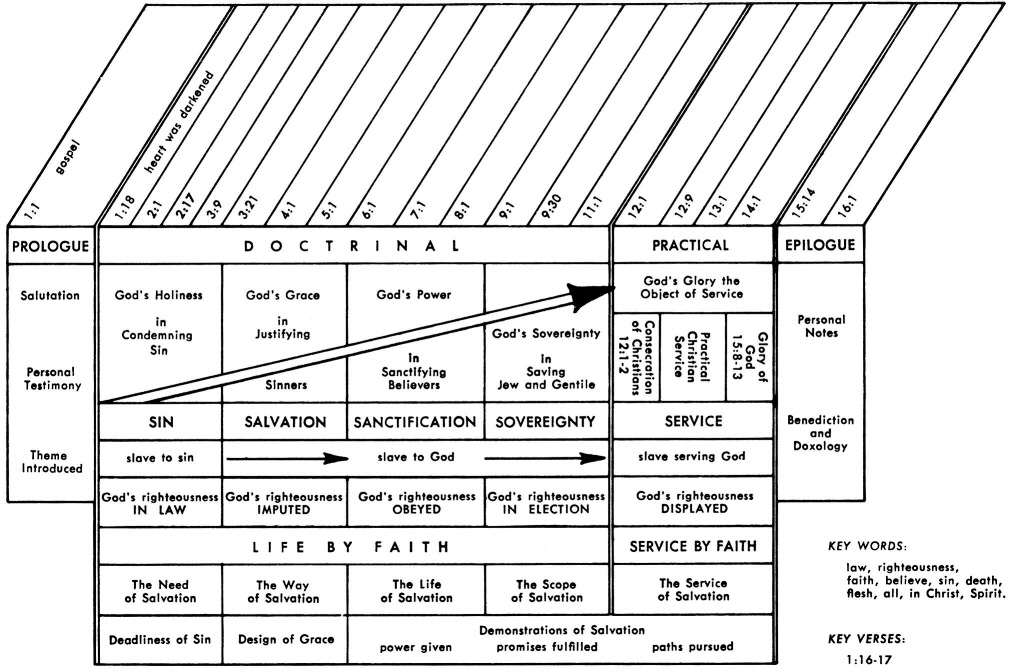
Click chart to enlarge
Chart from recommended resource Jensen's Survey of the NT - used by permission
Romans Overview Chart - Charles Swindoll
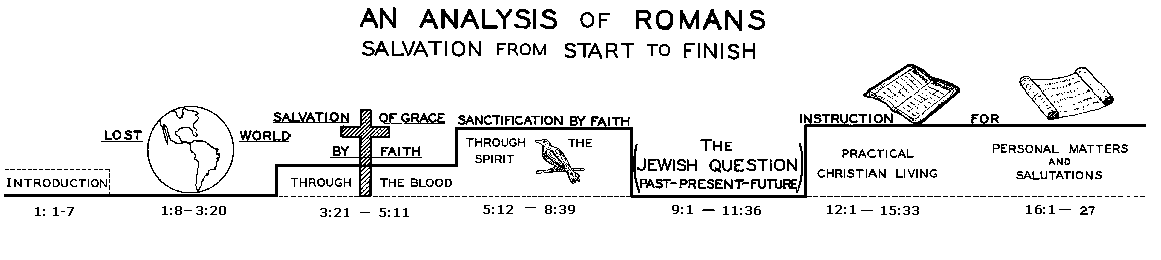
Source: Dr David Cooper
Click to Enlarge
| ROMANS ROAD to RIGHTEOUSNESS |
||||
| Romans 1:18-3:20 | Romans 3:21-5:21 | Romans 6:1-8:39 | Romans 9:1-11:36 | Romans 12:1-16:27 |
| SIN | SALVATION | SANCTIFICATION | SOVEREIGNTY | SERVICE |
| NEED FOR SALVATION |
WAY OF SALVATION |
LIFE OF SALVATION |
SCOPE OF SALVATION |
SERVICE OF SALVATION |
| God's Holiness In Condemning Sin |
God's Grace In Justifying Sinners |
God's Power In Sanctifying Believers |
God's Sovereignty In Saving Jew and Gentile |
Gods Glory The Object of Service |
| Deadliness of Sin |
Design of Grace |
Demonstration of Salvation | ||
| Power Given | Promises Fulfilled | Paths Pursued | ||
| Righteousness Needed |
Righteousness Credited |
Righteousness Demonstrated |
Righteousness Restored to Israel |
Righteousness Applied |
| God's Righteousness IN LAW |
God's Righteousness IMPUTED |
God's Righteousness OBEYED |
God's Righteousness IN ELECTION |
God's Righteousness DISPLAYED |
| Slaves to Sin | Slaves to God | Slaves Serving God | ||
| Doctrine | Duty | |||
| Life by Faith | Service by Faith | |||
|
Modified from Irving L. Jensen's chart above |
||||
R Ruin (Romans 1:17 – 3:20) – The utter sinfulness of humanity
O Offer (Romans 3:21-31) – God’s offer of justification by grace
M Model (Romans 4:1-25) – Abraham as a model for saving faith
A Access (Romans 5:1-11) – The benefits of justification
N New Adam (Romans 5:12-21) – We are children of two “Adams”
S Struggle w/ Sin (Romans 6:1-8:39) Struggle, sanctification, and victory
Romans 9:1 I am telling the truth in Christ, I am not lying, my conscience testifies with me in the Holy Spirit, (NASB: Lockman)
Greek: Aletheian lego (1SPAI) en Christo, ou pseudomai, (1SPMI) summarturouses (PAPFSG) moi tes suneideseos mou en pneumati hagio
Amplified: I AM speaking the truth in Christ. I am not lying; my conscience [enlightened and prompted] by the Holy Spirit bearing witness with me (Amplified Bible - Lockman)
ESV: I am speaking the truth in Christ--I am not lying; my conscience bears me witness in the Holy Spirit-- (ESV)
ICB: I am in Christ, and I am telling you the truth. I do not lie. My feelings are ruled by the Holy Spirit, and they tell me that I am not lying. (ICB: Nelson)
NKJV: I tell the truth in Christ, I am not lying, my conscience also bearing me witness in the Holy Spirit,
NIV: I speak the truth in Christ--I am not lying, my conscience confirms it in the Holy Spirit-- (NIV - IBS)
NLT: In the presence of Christ, I speak with utter truthfulness--I do not lie--and my conscience and the Holy Spirit confirm that what I am saying is true. (NLT - Tyndale House)
Philips: Before Christ and my own conscience I assure you that I am speaking the plain truth when I say that there is something that makes me feel very depressed, like a pain that never leaves me. (Phillips: Touchstone)
Wuest: Truth I speak in Christ. I am not lying, my conscience bearing joint-testimony with me in the Holy Spirit
Young's Literal: Truth I say in Christ, I lie not, my conscience bearing testimony with me in the Holy Spirit,
Related resources:
- Summary on the Attributes of God
- Spurgeon on the Attributes of God
- Israel of God - Is God "Finished" with Israel in His prophetic plan?
- Off Site - Table Comparing/contrasting Israel & Church
- Off Site - Does the Church Fulfill Israel's Program? - John Walvoord
- The Jewish People, Jesus Christ and World History - S Lewis Johnson
Are you confused about God's plan for Israel? Then I highly recommend Tony Garland's 12 Hour Course on Romans 9-11 in which he addresses in depth the question of What Will Happen to Israel? (click) or see the individual lectures below)
- Romans 9:1-5 Paul's Sorrow Concerning Israel
- Romans 9:6-13 Children of the Promise
- Romans 9:14-24 The Potter and the Clay
- Romans 9:25-33 A Remnant Will be Saved
- Romans 10:1-13 The Righteousness of God
- Romans 10:14-21 Has Israel Not Heard?
- Romans 11:1-6 God Has Not Cast Away The Jews
- Romans 11:7-15 Life from the Dead
- Romans 11:16-24 Two Olive Trees
- Romans 11:25-36 The Salvation of Israel
Note that when you click the preceding links, each link will in turn give you several choices including an Mp3 message and brief transcript notes. The Mp3's are long (avg 70+ min) but are in depth and thoroughly Scriptural with many quotations from the Old Testament, which is often much less well understood than the NT by many in the church today. Tony Garland takes a literal approach to Scripture, and his love for the Jews and passion to see them saved comes through very clearly in these 12 hours of teaching! Take your home Bible Study group through this series if you dare! Take notes on the tapes as the transcripts are a very abbreviated version of the audio messages. This course is highly recommended for all who love Israel! I think you will agree that Tony Garland, despite coming to faith after age 30 as an engineer, clearly has been given a special anointing by God to proclaim the truth concerning Israel and God's glorious future plan for the Jews. Garland has also produced more than 20 hours of superb audio teaching in his verse by verse commentary on the Revelation (in depth transcripts also available) which will unravel (in a way you did not think was possible considering the plethora of divergent interpretations) God's final message of the triumph and return of the our Lord Jesus Christ as the King of kings and Lord of lords! Maranatha!
I AM TELLING THE TRUTH IN CHRIST: Aletheian lego (1SPAI) en Christo:
- Ro 1:9; 2 Cor 1:23; 11:31; 12:19; Galatians 1:20; Philippians 1:8; 1 Th 2:5; 1 Ti 2:7; 5:21
- Romans 9 Resources - Multiple Sermons and Commentaries
Telling truth… not lying… my conscience - Literally in Greek it is "Truth telling!" Truth is first for emphasis. Note Paul's reiteration of his sincerity - this is like a triple oath. Do you think Paul is passionate for his unsaved Jewish brethren?!
Observe also that Romans 9 begins with a cry of grief and ends Romans 11 with a eulogy of praise as the truth of God's faithfulness to His covenant promises to Israel unfolds. (Ro 11:33, 34, 35, 36-see notes Ro 11:33; 34; 35; 36)
Truth (225)(aletheia from a = indicates following word has the opposite meaning ~ without + lanthano = to be hidden or concealed, to escape notice, cp our English "latent" from Latin = to lie hidden) has the literal sense of that which contains nothing hidden. Aletheia is that which is not concealed. Aletheia is that which that is seen or expressed as it really is.
As noted in the table above, one can summarize these three chapters with the word "sovereignty". Is is a sad commentary on modern day Christianity that God's sovereignty is not a very popular topic.
Ray Stedman for example wrote that "When I preached this message (on Romans 9) at the 8:30 service this morning, a man walked out the door cursing God because He treated men this way."
Wayne Barber introduces Romans 9-12 emphasizing that…
We are going into a very difficult passage of Scripture… Paul… moves from our salvation, which we have in Christ Jesus, to… Israel. And immediately there is a change here in his message. I feel like it would be very important for us at this point to look at the Attributes of God. If we don’t understand God, the character of God, then it is going to be very difficult to grasp how He is going to do what Paul says in chapters 9, 10 and 11. From 8:35 through 9:5 there is a mood swing. You go from the pinnacle of joy and ecstasy when it comes to your salvation into the very depths of despair of 9:1-5… It is incredible the mood swing that Paul goes through. Now why? Because you see, Paul is a Jew, a converted Jew. But as a converted Jew, he now understands what the Old Testament was teaching all along. He understands that the only way his Jewish brethren, the people whom he loves with all of his heart, can ever be justified is by faith in Jesus Christ and Him alone. And he is beginning to deal now with his people. And when he thinks of Israel, knowing that Israel has rejected Jesus as their Messiah, knowing the fact that they were His special people in the Old Testament, knowing all of these things, his heart turns from joy to sorrow as he realizes they are blinded. They cannot realize that Jesus is the Messiah, the one they have been looking for. (The Attributes of God)
Anticipating the doctrine of election in this chapter Martin Luther wrote…
Who hath not known passion, cross, and travail of death, cannot treat of foreknowledge (election of grace) without injury and inward enmity toward God. Wherefore take heed that thou drink not wine while thou art yet a sucking child. Each doctrine hath its own reason and measure and age.
James Denney (Romans 9 - The Expositor's Greek Testament) describing Paul’s opening words writes that…
This solemn asseveration (a positive, earnest affirmation) is meant to clear him of the suspicion that in preaching to the Gentiles he is animated by hostility or even indifference to the Jews.
Paul is going to explain why the Jews as a nation have not embraced the Gospel and salvation by grace through faith Christ. Paul shows the relationship of the Jews to the gospel in 2 major ways:
First in (Ro 9:1-10:21) he explains that the word of God has not failed. The gospel has not failed but the Jew has failed.
Second (Ro 11:1-32) he explains that God has not rejected Israel but that there is (and always has been) a remnant even as he writes his letter. Israel's' rejection is the Gentile's salvation. "All Israel" (all that place their faith in Christ) will be saved because the gifts and calling of God are irrevocable.
So in these three great chapters from Romans Paul explains that not only does God's Word not fail, but God's Promises do not fail. The sad fact is that regardless of the Jew's claim to be "chosen" by God (His "elect") many are not of the elect as used in the NT sense. Paul goes on to teach that God's elective purposes include the Gentiles and that God's sovereignty does not obligate Him to anyone. Paul explains that God has established that righteousness is by faith alone and that He has the sovereign right to do this. And so Paul explains that the Jew cannot disagree with God's sovereign choosing of Isaac and Jacob. He then show explains that they cannot disagree with the election of Jew and Gentile. In this section Paul explains the truths that although God sovereignly chooses, man is still responsible. Finally, Paul emphasizes that God's purpose for Israel will be fulfilled because His will is never thwarted.
I AM NOT LYING MY CONSCIENCE BEARING ME WITNESS IN THE HOLY SPIRIT: ou pseudomai (1SPMI) summarturouses (PAPFSG) moi tes suneideseos mou en pneumati hagio:
- Romans 9 Resources - Multiple Sermons and Commentaries
Not lying - He uses the word (ou) that signifies absolute negation.
Lying (5574) (pseudomai from pseudo = to cheat, defraud, falsify, cp study of pseudos) means to utter an untruth, attempt to deceive by falsehood or to speak deceitfully.
The Greek more literally reads, “my conscience bearing joint-testimony with me” and this is done “within the sphere of the Holy Spirit” or in the control of the Holy Spirit. The New Century Version translates it as
My conscience is ruled by the Holy Spirit, and it tells me that I am not lying.
Conscience: (4893) (suneidesis [word study] from sun = with + eido = know) (Click for in depth word study of suneidesis) (Click for more notes on on this website on "conscience") literally means a "knowing with", a co-knowledge with oneself or a being of one's own witness in the sense that one's own conscience "takes the stand" as the chief witness, testifying either to one's innocence or guilt. It describes the witness borne to one's conduct by that faculty by which we apprehend the will of God. Webster defines "conscience" as the sense or consciousness of the moral goodness or blameworthiness of one’s own conduct, intentions, or character together with a feeling of obligation to do right or be good. The Greek noun Suneidesis is the exact counterpart of the Latin con-science, “a knowing with,” a shared or joint knowledge. It is our awareness of ourselves in all the relationships of life, especially ethical relationships. We have ideas of right and wrong; and when we perceive their truth and claims on us, and will not obey, our souls are at war with themselves and with the law of God Suneidesis is that process of thought which distinguishes what it considers morally good or bad, commending the good, condemning the bad, and so prompting to do the former and avoid the latter.
Suneidesis - 30x in 29v -
Acts 23:1; 24:16; Ro 2:15; 9:1; 13:5; 1 Cor 8:7, 10, 12; 10:25, 27ff; 2 Cor 1:12; 4:2; 5:11; 1 Tim 1:5, 19; 3:9; 4:2; 2Ti 1:3; Titus 1:15; Heb 9:9, 14; 10:2, 22; 13:18; 1 Pet 2:19; 3:16, 21
This is no phony protest on Paul's part, like some people who say, "I'm only telling you this because I love you," and then proceed to cut us to pieces. "No," Paul says, "my conscience supports me in this, and the Holy Spirit himself confirms that my anguish is genuine and real. It is deep and lasting."
What a lesson this is on how to approach someone you want to help, someone who isn't very eager to receive what you have to say. You never come on -- Paul never does -- with accusations, or with bitter words, or denunciations, or even with the issues that separate you. Paul first identifies with their deep hurt; he feels with them.
This is like the story of the two preachers…
"I hear you dismissed your pastor. What was wrong?" The friend said, "Well, he kept telling us we were going to hell." The man said, "What does the new pastor say?" The friend said, "The new pastor keeps saying we're going to hell too." "So what's the difference?" "Well," the friend said, "the difference is that when the first one said it, he sounded like he was glad of it, but when the new man says it, he sounds like it is breaking his heart."
Bearing witness (4828)(summartureo from sun/syn = with, together, speaks of intimacy + martureo = witness) literally means to bear witness with (or in support of another), to provide credible supporting evidence to one's case by giving testimony or by testifying. To show to be true, give evidence in support of.
Charles Spurgeon when asked how he reconciled divine sovereignty and human responsibility regarding the mystery of election, replied…
I never try to reconcile friends.
In Romans 9-11, Paul's discussion of Israel is not an interruption but an illustration of his theme. He explains Israel's history in these chapters as outlined in the following table…
| Summary of Romans 9-11 | ||
| Romans 9 | Romans 10 | Romans 11 |
| Past Election |
Present Rejection |
Future Restoration |
| God's Sovereignty Israel's Election by God |
Man's responsibility Israel's Rejection of God |
God's Ways Higher God Not Rejecting Israel |
In Romans 9-11 Paul proves that God has been righteous in all His dealings with Israel and has not failed to work out His divine promise to or purpose for the Jews and that likewise He will not fail to work out His purposes for the church.
As you observe and meditate on these weighty passages in Romans 9-11 keep the following considerations in mind…
Remember that one doctrine never "outweighs" another doctrine. Just because the Scripture speaks more about the responsibility of man than it does about predestination does not mean you can ignore the latter as "unimportant". There is perfect harmony between all the doctrines of God and to reiterate you do not need to "reconcile friends." It is as if both doctrines are on either side of a plumbline that perfectly separates the two teachings. When men begin to move that "plumbline" toward one doctrine or the other, inevitably and unavoidably, distortion will occur. Stated in another way, remember that using our finite intelligence, we can carry the doctrines to what seems to us to be a logical conclusion, but is one that God never intended. When God drops the plumb line beloved, let it hang. Some would say that if God chooses some for salvation then logically He chooses others to go to eternal damnation. You have just moved the plumb line!
Remember that there are only four Scriptures that specifically address predestination of man, Romans 8:29, 30 (see notes) which speaks of becoming conformed to the image of His Son, Ephesians 1:5 (see sermon) which deals with our adoption as sons and Ephesians 1:11 (see sermon) which addresses God's purpose for having obtaining an inheritance. And who are these addressing? Unbelievers or believers? Clearly these are addressed to the children of God, those who by grace through faith have been saved, regenerated and born again. How do men distort these passages? They come along and say that if God predestined some men to adoption as His sons, then He must have predestined others to condemnation. Where does the Bible make that declaration? The Bible does not make that assertion. The point is that we can reach erroneous conclusions when we reason that if "A" is true and "B" is true, then it equals "C" and we try to put this together in our finite minds but the conclusion cannot be validated from the Scriptures.
The fourth mention of predestination is found in Acts 4:27,28 where God predestined the trial and crucifixion of His only Son, Jesus Christ.
In summary, as you observe Romans 9-11, allow God to speak for Himself and do not attempt to take the passage beyond what it says nor attempt to diminish what it says. For example, don't say "Surely God doesn't really mean that." Don't speculate. Be aware that the Bible does not give any clue why God choose and predestined those He did. This is holy ground which we must not profane. As you study these passages, remember what God's Word teaches about God Himself (incomprehensible, transcendent, loving, just, holy, omniscient, etc). Since God is not like man, man is in no position to judge God's sovereign interactions with man. God is holy and is total and absolute purity. God is just and absolutely fair. Eternally just. Eternally fair. God is righteous. Whatever He does is what is right. God is abounding in love and infinite in mercy. When you feel yourself beginning to question God's ways and integrity, consider taking a "time out" and "washing" your mind with the water of His Word concerning His glorious attributes (see Attributes of God or read Spurgeon on the Attributes of God) or if you prefer run into the strong tower of His matchless Names (Studies on the Names of the LORD), which are in their essence a reflection of His character and His attributes.
F B Hole (Plymouth Brethren) summarizes Romans 9…
CHAPTER NINE OPENS another section of the Epistle, a very clearly defined one. In Ro 1-8 the apostle had unfolded his Gospel, in which all distinction between Jew and Gentile is seen to be non-existent. He knew however that many might regard his teaching as indicating that he had no love for his nation and no regard for God's pledged word relating to them. Consequently we now have three dispensational chapters in which the mystery of God's ways concerning Israel are explained to us.
In Ro 9:1, 2, 3 Paul declares his deep love for his people. His affection for them was akin to that of Moses, who prayed, "Blot me, I pray Thee, out of Thy book" (Ex.32: 32). Then in Ro 9:4, 5 he recounts the great privileges which had been accorded to them. Last of these, but not least, there sprang out of them the Christ, whose Deity he plainly states.
How then came it that Israel was in so sorry a plight? Had the Word of God failed? Not for one moment; and the first great fact brought forward to explain the situation is that of the sovereignty of God.
Now Israel were the last people in the world who could afford to quarrel with the divine sovereignty, for again and again it had been exercised in their favour. This point comes very clearly before us up to Ro 9:16. God made a sovereign choice in regard to the sons of both Abraham and Isaac. He chose Isaac and Jacob, and set aside Ishmael and Esau. If any wished to object to God making a choice, they would have to obliterate all distinction between themselves and both Ishmaelites and Edomites. This they would not contemplate for one moment. Well then, God was only continuing to do as He had already done, and hence not all who were of Israel by natural descent were the true Israel of God.
Moreover when Israel made the golden calf in the wilderness they would have been blotted out in judgment had the law had its way. Instead God fell back upon His sovereign mercy, according to words from Exodus 33: 19, quoted here in Ro 9:15. Thus is a third case of God exercising His sovereignty in their favour, even as Ro 9:17 supplies us with an example of God exercising His sovereignty against Pharaoh.
The plain facts are these: —
(1) God has a will.
(2) He exercises it as He pleases.
(3) No one can successfully resist it.
(4) If challenged, the rightness of His will can always be demonstrated when the end is reached. God is like the potter and man is like the clay.
How often God's will is challenged! How much reasoning has taken place on the facts stated in our chapter! How slow we are to admit that God has a right to do as He likes, that in fact He is the only one that has the right, inasmuch as He alone is perfect in foreknowledge, wisdom, righteousness and love. Things may often appear inexplicable to us, but then that is because we are imperfect.
Ro 9:13 has given rise to difficulty. But that statement is quoted from the book of Malachi; words written long after both men had fully shown what was in them; whereas Ro 9:12 records what was said before their birth. Others have objected to God's words to Pharaoh as quoted in Ro 9:17. The answer to such objections lies in our chapter, Ro 9:21, 22, 23. Men pit themselves against God, hardening their hearts against Him, and in result God makes a signal example of them. He has a right so to do; while others become vessels of mercy, whom beforehand He prepares for glory.
Consequently if any object to what God is doing today, in calling out by the Gospel an elect people both from Jews and Gentiles, the answer simply is, that God is only doing again in our days what He has done in the past. Moreover the prophets had anticipated that He would act thus. Both Moses and Isaiah had foretold that only a remnant of Israel should be saved, and that a people formerly not beloved would be called into favour. This is stated in Ro 9:25, 26, 27, 28, 29.
The matter is briefly summed up for us in the closing verses, Ro 9:30, 31, 32, 33. Israel stumbled at that stumbling-stone, which was Christ. Further they misused the law, treating it as a ladder by which they might climb into righteousness, instead of a plumb-line by which all their supposed righteousness might be tested. Israel had missed righteousness by law, and Gentiles had reached righteousness by faith. (Romans 9 - F.B. Hole's Old and New Testament Commentary)
Middletown Bible's introductory comments…
Romans 9-11 of Romans form a unit. The subject matter of these three chapters is the nation Israel (see Ro 9:3, 4; 10:1,21; 11:1, 2, 26, 28). These chapters are also somewhat parenthetical. The flow of thought could have gone from Romans 8 right into Romans 12. In the first eight chapters Paul has set forth THE GOSPEL OF GOD, that is, the good news of JUSTIFICATION (Romans 1-5), SANCTIFICATION (Romans 6-8) and GLORIFICATION (Romans 8). In chapter 12 he deals with the practical implications of the gospel (how the truth of the gospel ought to affect our daily living toward God and toward our neighbor). Thus Romans 8 would flow naturally into Romans 12, but instead of doing that Paul gives us a three-chapter parenthesis in which he helps us to understand where the nation Israel fits into the purpose and plan of God.
This section begins with GREAT SORROW (Ro 9:1, 2, 3) and it ends with a GREAT DOXOLOGY to God (Ro 11:33, 34, 35, 36). One simple way to think of the three chapters is as follows:
Romans 9 deals primarily with Israel’s PAST (as God’s chosen and privileged people).
Romans 10 deals primarily with Israel’s PRESENT (as a nation which has refused to submit to God’s gospel).
Romans 11 deals primarily with Israel’s FUTURE (a nation which someday will be saved and which will enjoy the fulfillment of the new covenant promises).
In order to understand this section we need to try to put ourselves in the shoes of those who lived in the first century and to try to understand the JEWISH PROBLEM.
Fact #1--The Israelites are God’s chosen people (Dt 7:6, 7, 8, 9; Ro 11:28).
Fact #2--God promised His chosen people that they would enjoy a glorious kingdom under their Messiah (Da 7:13, 14; Isaiah 2:1, 2, 3,4, 5; 9:6, 7; 11:1-9; Jer 23:5, 6, 7, 8; 31:31-37; 33:14, 15, 16; Luke 1:32, 33).
Fact #3--The nation Israel (at least the great majority in the nation) rejected their Messiah when He came to earth (John 1:11; Matthew 12:22, 23, 24; Matthew 21:33-46; 27:22, 23, 25; John 19:15; Acts 22:22; 1Th.2:14,15).
Fact #4--When the church first began it was made up entirely of Jewish believers (Acts 2:1ff, the Day of Pentecost). But gradually this changed. As the years went by more and more Gentiles entered the church and less and less Jews (we see this as we travel through the book of Acts and also as we span the years of church history). Today (and this has been true for most of church history) the church is made up almost entirely of Gentile believers. We thank God for Jews who have believed on Christ as Messiah and as Saviour, but their numbers are few. The nation as a whole is blind though, thankfully, there are a few exceptions (see Ro 11:25).
Are you beginning to see the problem?
Fact #1 and Fact #2 seem to be contradicted by Fact #3 and y Fact #4.
What has happened to Israel’s glorious kingdom? What has happened to all of the promises which God has given to the Jews? God’s program for the present (the church) involves primarily the Gentiles and not the Jews. Why is this so? Has God cast away His people (Compare Ro 11:1)? Is God all through with the nation Israel? Does the nation have any future in God's program at all?
Put yourself in the shoes of a first century Jew. The gospel that Paul preached was either true or false. Jesus Christ, whom Paul preached, was either the true Messiah or He was not. Thus we have two alternatives:
(1) The gospel that Paul preached is not true, and hence Jesus Christ is not the true Messiah and we must still await the coming of the true Messiah. If this is so, then the reason the Kingdom has not yet come is because the true Messiah has not yet come.
(2) The gospel Paul preached is true and hence Jesus Christ is indeed the true Messiah.
If this is so, then why is there no kingdom? Why do the Jewish people continue to suffer in this world? Why aren’t the Old Testament kingdom promises being fulfilled? Has God cast away His people?
GOD HAS GIVEN TO US
ROMANS 9-11 TO ANSWER THESE QUESTIONS.
These issues are very relevant to our day as well. There are numerous professing Christians today, especially those under the influence of Reformed/Covenant Theology, who deny that the nation Israel has any hope of a future kingdom on earth under their Messiah as predicted in hundreds of Old Testament prophecies. Some teach that the CHURCH has inherited the promises that were made to ISRAEL. Others teach that the kingdom is here and now and that Christ is spiritually reigning in the hearts of His believers. Even though there is a sense in which this is true, it still does not solve the problem of hundreds of specific kingdom promises and predictions which have not yet been fulfilled. Did God really mean what He said about the kingdom and the coming Messiah or not? Romans chapters 9-11 are thus vitally important chapters in rightly understanding the place of Israel in God's program.
What is God doing with the nation Israel? The answer is basically twofold:
God has a wonderful plan and purpose for the Jew TODAY, but this plan and purpose cannot be realized until the Jewish person believes on the Lord Jesus Christ. See Romans 10:9, 10, 11, 12, 13; 11:1, 2, 3, 4, 5.
God has a wonderful plan and purpose for the Jew TOMORROW, but this plan and purpose cannot be realized until the true Messiah of the Jews comes to this earth a second time. See Romans 11:25, 26, 27, 28. Israel’s present unbelief and rejection of the gospel will not keep God from fulfilling any of His kingdom promises to this nation (Ro 11:28).
It should be noted that this present church age (which has lasted about 2000 years) was not revealed in the Old Testament. The Old Testament Jew looked ahead into the distant future and saw a mountain peak which was the coming of the Messiah and the great kingdom age. He did not realize that what he was seeing was actually two mountain peaks with a valley in between:
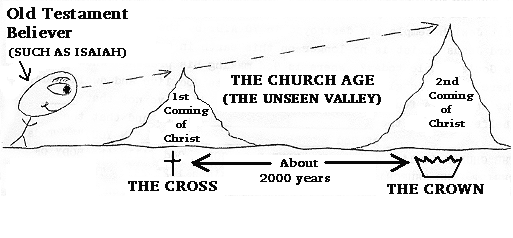
Let’s consider some Old Testament passages which illustrate this:
1) ISAIAH 9:6-7
Isa 9:6 speaks of Messiah’s birth and Isa 9:7 speaks of His kingdom but no hint is given that these two events are separated by hundreds of years.
2) MICAH 5:2
Messiah must be born in Bethlehem and He must be ruler in Israel (Mic 5:2). Only the first of these was fulfilled at His first coming.
3) ISAIAH 61:1, 2 (compare Luke 4:18, 19)
The Lord Jesus knew where to stop reading because He knew what part of this passage was fulfilled at His first coming (Isa 61:1,2a) . The day of judgment awaits His second coming (Isa 61:2b).
4) ZECHARIAH 9:9, 10
Which part of this prophecy (Zech 9:9, 10) was fulfilled at the Lord’s first coming? (Compare Mt 21:4, 5.) Which part of this prophecy must await future fulfillment?
5) LUKE 1:31, 32, 33
Luke 1:31, 32, 33 is a New Testament prophecy similar to the Old Testament prophecies given above in that part pertains to His first coming and part must await future fulfillment at His second coming.
When the Old Testament Jew read His Bible he could only see one coming of the Messiah. Today we are living in the period between the two comings of Christ during which time He is building HIS CHURCH (Mt. 16:18) and taking out of the nations a people for His Name (Acts 15:14). As we read our Bible today we have the advantage of being better able to see two distinct comings of Christ--one is now history and one is still prophecy (He has come and He will come again)! (Romans 9) (See related topic: Table comparing Rapture vs Second Coming)
Romans 9:2 that I have great sorrow and unceasing grief in my heart. (NASB: Lockman)
Greek: hoti lupe moi estin (3SPAI) megale kai adialeiptos odune te kardia mou.
Amplified: That I have bitter grief and incessant anguish in my heart. (Amplified Bible - Lockman)
ESV: that I have great sorrow and unceasing anguish in my heart. (ESV)
ICB: I have great sorrow and always feel much sadness for the Jewish people. (ICB: Nelson)
NKJV: that I have great sorrow and continual grief in my heart.
NIV: I have great sorrow and unceasing anguish in my heart. (NIV - IBS)
NLT: My heart is filled with bitter sorrow and unending grief (NLT - Tyndale House)
Philips: when I say that there is something that makes me feel very depressed, like a pain that never leaves me. (Phillips: Touchstone)
Wuest: that I have a consuming grief, a great one, and intense anguish in my heart without a let-up.
Young's Literal: that I have great grief and unceasing pain in my heart--
THAT I HAVE GREAT SORROW AND UNCEASING GRIEF IN MY HEART: hoti lupe moi estin (3SPAI) megale kai adialeiptos odune te kardia mou:
- Ro 10:1; 115:35; Psalms 119:136; Isaiah 66:10; Jeremiah 9:1; 13:17; Lamentations 1:12; Lamentations 3:48,49,51; Ezekiel 9:4; Luke 19:41, 42, 43, 44; Philippians 3:18; Revelation 11:3
- Romans 9 Resources - Multiple Sermons and Commentaries
Literally "my sorrow is great and the anguish in my heart is unceasing."
Phillips paraphrases Paul's pain - " I am speaking the plain truth when I say that there is something that makes me feel very depressed, like a pain that never leaves me.
I have great sorrow - Not just sorrow but a deep, abiding sorrow (have is present tense = continually). This was a continual great burden on the heart of the great apostle.
Sorrow (3077) (lupe; see verb form lupeo) means sadness, grief, pain, sorrow. Lupe is used in Septuagint of Ge 3:16 (twice) of literal pain in childbirth, but most NT uses are figurative of pain in one's heart ("heartache"). Lupe is a word that describes that which is grievous or produces an emotional "heaviness". Lupe was a word used of persons mourning. In secular Greek lupe was sometimes used to describe pain experienced by the physical body, but more often was used figuratively for mental and/or emotional anguish. The King James' translation of the verb form (lupeo) as heaviness parallels our colloquial sayings like -- "It weighs heavy on my soul" or "My soul is weighed down with affliction." or "My soul is so burdened." Ek lupe is a phrase used as an adverb in 2Cor 9:7 and means "with a grieved spirit, reluctantly, grudgingly." Paul used lupe 4x in a negative sense (as here in Ro 9) to express his deep concern over spiritual matters - Israel's unbelief (Ro 9:2), other's attitudes toward his ministry (2Cor 2:1,3), the near death of a beloved fellow worker (Php 2:27). Lupe describes the grief caused by sin in the life of a believer (2Co 2:7). Our giving to the Lord should never be motivated by regret (lupe) but in dramatic contrast by a cheerful heart (2Cor 9:7). In 2Cor 7:10 Paul "qualifies" what defines true repentance, making a contrast between false grief that the lost world express versus "godly grief" that the Spirit uses to lead the broken person to repentance.
Sorrow = distress of mind especially implying a sense of loss - deep distress, sadness, or regret especially for the loss of someone or something loved; resultant unhappy or unpleasant state. One dictionary says sorrow is derived from the German sorge = care, concern, uneasiness which is in turn from the same root as sore, heavy. Interesting word picture of this word! The 1828 Webster's Dictionary has this entry for sorrow - The uneasiness or pain of mind which is produced by the loss of any good, real or supposed, or by disappointment in the expectation of good; grief; regret. The loss of a friend we love occasions sorrow; the loss of property, of health or any source of happiness, causes sorrow. We feel sorrow for ourselves in misfortunes; we feel sorrow for the calamities of our friends and our country.
Grief = deep and poignant distress caused by or as if by bereavement. 1828 Webster = The pain of mind produced by loss, misfortune, injury or evils of any kind; sorrow; regret. We experience grief when we lose a friend, when we incur loss, when we consider ourselves injured, and by sympathy, we feel grief at the misfortunes of others. The pain of mind occasioned by our own misconduct; sorrow or regret that we have done wrong; pain accompanying repentance. We feel grief when we have offended or injured a friend, and the consciousness of having offended the Supreme Being, fills the penitent heart with the most poignant grief.
Anguish (Interesting etymology - from Latin angustiae, plural, straits, distress, from angustus narrow) = Extreme pain, either of body or mind. As bodily pain, it may differ from agony, which is such distress of the whole body as to cause contortion, whereas anguish may be a local pain as of an ulcer, or gout. But anguish and agony are nearly synonymous. As pain of the mind, it signifies any keen distress from sorrow, remorse, despair and the kindred passions. ANGUISH suggests torturing grief or dread, such as the anguish felt by the parents of the kidnapped child (Lindbergh's child in 1932 - the "crime of the century").
Paul is saying literally that he continually (present tense) has great sadness. Why? because of Jewish rejection of their Messiah.
Lupe - 16x in 14v - NAS = grief (2), grudgingly* (1), pain (1), sorrow (10), sorrowful (1), sorrows (1).
Luke 22:45 When He rose from prayer, He came to the disciples and found them sleeping from sorrow,
John 16:6 "But because I have said these things to you, sorrow has filled your heart.
John 16:20 "Truly, truly, I say to you, that you will weep and lament, but the world will rejoice; you will grieve, but your grief will be turned into joy.
John 16:21 "Whenever a woman is in labor she has pain, because her hour has come; but when she gives birth to the child, she no longer remembers the anguish because of the joy that a child has been born into the world.
John 16:22 "Therefore you too have grief now; but I will see you again, and your heart will rejoice, and no one will take your joy away from you.
Romans 9:2 that I have great sorrow and unceasing grief in my heart.
2 Corinthians 2:1 But I determined this for my own sake, that I would not come to you in sorrow again.
2 Corinthians 2:3 This is the very thing I wrote you, so that when I came, I would not have sorrow from those who ought to make me rejoice; having confidence in you all that my joy would be the joy of you all.
2 Corinthians 2:7 so that on the contrary you should rather forgive and comfort him, otherwise such a one might be overwhelmed by excessive sorrow.
2 Corinthians 7:10 For the sorrow that is according to the will of God produces a repentance without regret, leading to salvation, but the sorrow of the world produces death.
2 Corinthians 9:7 Each one must do just as he has purposed in his heart, not grudgingly or under compulsion, for God loves a cheerful giver.
Philippians 2:27-note For indeed he was sick to the point of death, but God had mercy on him, and not on him only but also on me, so that I would not have sorrow upon sorrow.
Hebrews 12:11-note All discipline for the moment seems not to be joyful, but sorrowful; yet to those who have been trained by it, afterwards it yields the peaceful fruit of righteousness.
1 Peter 2:19-note For this finds favor, if for the sake of conscience toward God a person bears up under sorrows when suffering unjustly.
Lupe - 49x in 46v in the non-apocryphal Septuagint - Ge 3:16, 17; Ge 5:29; 42:38; 44:29; Pr 10:1, 10, 22; 14:13; 15:13; 25:20; 31:6; Isa 1:5; 35:10; 40:29; 50:11; 51:11; Jonah 4:1
Rick Renner has this note on the word group lupe/lupeo
Many years ago, when I first studied the word "grieve" in Ephesians 4:30, I ran to my bookshelf and pulled out my Greek New Testament to discover exactly what the word "grieve" meant. I found that this word was taken from the Greek word lupete. This surprised me, because the word lupete is from the word lupe, which denotes a pain or grief that can only be experienced between two people who deeply love each other. This word lupe would normally be used to picture a husband or wife who has discovered his or her mate has been unfaithful. As a result of this unfaithfulness, the betrayed spouse is shocked, devastated, hurt, wounded, and grieved because of the pain that accompanies unfaithfulness. This tells us, first of all, that the relationship that exists between us and the Holy Spirit is precious! The Holy Spirit is deeply in love with us. Just as someone in love thinks about, dreams of, and cherishes the one he loves, the Holy Spirit longs for us, thinks about us, desires to be close to us, and wants to reveal Himself to us. But when we act like the world, talk like the world, behave like the world, and respond the same way the world does, we cause the Spirit of God to feel shock, hurt, and grief. You see, when we deliberately do what is wrong, we drag Him right into the mire of sin with us, because He lives in us and goes wherever we go. The Holy Spirit convicted us of sin and brought us to Jesus; then He indwelt us, sanctified us, empowered us, and faithfully remains alongside to help us. So when we deliberately enter into sin, it grieves Him. Just as a husband or wife would feel who has just discovered that his or her spouse has committed adultery, the Holy Spirit is shocked when we dishonor His Presence in our lives.
One scholar has translated Ephesians 4:30 in the following way: "Stop deeply wounding and causing such extreme emotional pain to the Spirit of God, by whom you have been sealed until the day of your redemption."
We need to realize how precious the Holy Spirit is in our lives and honor Him by making sure we live holy and upright lives. If our behavior has been wrong, we should confess our sin and receive cleansing by the blood of Jesus so we can be restored to fellowship with the Spirit of God. So before you get started with your daily duties today, stop and ask, "Holy Spirit, is there anything in my life that causes You grief? If there is, please reveal it to me so I can change." (Sparkling Gems from the Greek)
Spurgeon gives an apt illustration a great benefit of sorrow, an intruder which few of us would otherwise welcome (!)…
Two seeds lie before us—the one is warmed in the sun, the other falls from the sower's hand into the cold dark earth, and there it lies buried beneath the soil. That seed which suns itself in the noontide beam may rejoice in the light in which it basks, but it is liable to be devoured by the bird; and certainly nought can come of it, however long it may linger above ground; but the other seed, hidden beneath the clods in a damp, dark sepulchre, soon swells, germinates, bursts its sheath, upheaves the mould, springs up a green blade, buds, blossoms, becomes a flower, exhales perfume, and loads the wings of every wind. Better far for the seed to pass into the earth and die, than to lie in the sunshine and produce no fruit; and even thus for thee the future in its sorrow shall be as a sowing in a fertile land; tears shall moisten thee, grace shall increase within thee, and thou shalt grow up in the likeness of thy Lord unto perfection of holiness, to be such a flower of God's own planting as even angels shall delight to gaze upon in the day of thy transplanting to celestial soil.— Feathers for Arrows
Unceasing (88) (adialeiptos [word study] from a = without + dialeípo = intermit, leave an interval or gap) means without ceasing, unintermitting, continual, without intermission, incessant. The only other NT use is 2Ti 1:3-note)
Grief (3601) (odune related to the verbal form odunaō = cause intense pain, to be in anguish, to be tormented; see verb form - odunao) literally refers to physical pain but in the NT (only one other time = 1Ti 6:10-note) is used only figuratively to refer to a state of severe emotional anxiety and distress. It implies anguish of the heart which is the result of sorrow.
Heart (2588) (kardia) does not refer to the physical organ but is always used figuratively in Scripture to refer to the seat and center of human life, the wellspring of one's spiritual life. While kardia does represent the inner person, the seat of motives and attitudes, the center of personality, in Scripture it represents much more than emotion, feelings. It also includes the thinking process and particularly the will.
John MacArthur commenting on kardia writes that ""While we often relate heart to the emotions (e.g., “He has a broken heart”), the Bible relates it primarily to the intellect (e.g., “Out of the heart come evil thoughts, murders, adulteries, fornications, thefts, false witness, slanders,” Matt 15:19). That’s why you must “watch over your heart with all diligence” (Proverbs 4:23-note). In a secondary way, however, heart relates to the will and emotions because they are influenced by the intellect. If you are committed to something, it will affect your will, which in turn will affect your emotions." (Drawing Near. Crossway Books)
Paul starts this section with great sorrow (Romans 9:1, 2, 3) and it ends with a great praise to God (Romans 11:33, 34, 35, 36).
How much of a burden does Paul have? He could wish himself accursed. Why would he need to do this? Because the unbelieving Jews might say that his gospel was only for the Gentiles since he was an apostle to the Gentiles. Can you remember anyone else who was willing to be accursed for the sake of His brethren? Obviously it was Messiah. So Paul has the heart of Christ toward his people.
Do I Care? - Why would Richard Gilder install a fire department gong in his bedroom? As the Tenement House Commissioner in New York City, he wondered what was causing so many fires. But he did more than wonder—he showed genuine concern. Whenever a fire broke out in one of the tenement houses, the alarm sounded and Gilder would rush off to investigate.
Do we have the same kind of concern for people who are starving, sick, and suffering from cruel oppression? And what about the multitudes who, without Jesus Christ, will spend eternity in hell? How concerned are we about their future? Do we share the compassion that motivated our Savior? (Matthew 9:36).
The apostle Paul had that kind of concern. He wrote in Romans 9:2, "I have great sorrow and continual grief in my heart." He yearned for his fellow Jews to be saved.
Are we concerned enough to pray? We can all do that. Do we care enough to give? We can be faithful stewards and contribute to the ongoing work of the gospel. And what about witnessing? We can speak about our faith to a friend. We can write a letter, give out a tract, or perhaps send a book to some non-Christian acquaintance.
If we care, we'll do something. —Vernon C. Grounds (Our Daily Bread, Copyright RBC Ministries, Grand Rapids, MI. Reprinted by permission. All rights reserved)
Lord, give me a burden for the dying,
For the lost, where'er they be;
Help me to care that they are heading
For a dark eternity. —Fitzhugh
Loving the lost is the first step in leading them to Christ.
Romans 9:3 For I could wish that I myself were accursed, separated from Christ for the sake of my brethren, my kinsmen according to the flesh, (NASB: Lockman)
Greek: euchomen (1SIMI) gar anathema einai (PAN) autos ego apo tou Christou huper ton adelphon mou ton suggenon mou kata sarka,
Amplified: For I could wish that I myself were accursed and cut off and banished from Christ for the sake of my brethren and instead of them, my natural kinsmen and my fellow countrymen.(1) (Amplified Bible - Lockman)
ESV: For I could wish that I myself were accursed and cut off from Christ for the sake of my brothers,[1] my kinsmen according to the flesh. (ESV)
ICB: I wish I could help my Jewish brothers, my people. I would even wish that I were cursed and cut off from Christ if that would help them. (ICB: Nelson)
NKJV: For I could wish that I myself were accursed from Christ for my brethren, my countrymen according to the flesh,
NIV: For I could wish that I myself were cursed and cut off from Christ for the sake of my brothers, those of my own race, (NIV - IBS)
NLT: for my people, my Jewish brothers and sisters. I would be willing to be forever cursed--cut off from Christ!--if that would save them. (NLT - Tyndale House)
Philips: It is the condition of my brothers and fellow-Israelites, and I have actually reached the pitch of wishing myself cut off from Christ if it meant that they could be won for God. (Phillips: Touchstone)
Wuest: For I could wish that I myself were accursed from Christ on behalf of my brethren, my kindred according to the flesh,
Young's Literal: for I was wishing, I myself, to be anathema from the Christ -- for my brethren, my kindred, according to the flesh,
FOR I COULD WISH THAT I MYSELF WERE ACCURSED: euchomen (1SIMI) gar anathema einai (PAN) autos ego:
- I could wish Exodus 32:32
- Were accursed - Deut 21:23; Joshua 6:17,18; 1Sa 14:24,44; Gal 1:8; 3:10,13
- Romans 9 Resources - Multiple Sermons and Commentaries
For (gar) - Notice the little preposition "for" (there are over 7000 "for's" in Scripture) and if the context indicates, as it does in this passage, that the "for" is a term of explanation, pause and ask yourself what is the Spirit seeking to explain?
Disciple's Study Bible has a note on sincerity in prayer related to Ro 9:3 - "Wish'' (euchomai ) is literally "pray.'' Paul knew God could not grant his wish. He used hyperbole to indicate the intensity of his yearning for his Jewish brothers. Such intensity marks Christian faith and prayer.
Wish (2172) (euchomai ; euche = a vow in Acts 18:18, a prayer in Jas 5:15) literally meant to speak out or utter aloud and came to mean as used by to express a wish. The idea can be to desire something, with the implication of a pious wish. To vow (this sense is primarily found in the Septuagint uses but is found in Acts 26:29). To pray, but in the NT the derivative proseuchomai is the more common verb for pray. Euchomai and proseuchomai are more general terms for prayer, while deomai conveys the sense of seeking to have a need met.
Paul uses the imperfect tense which pictures a repeated action or a continual action in the past. The Greek scholar A T Robertson says it is an idiomatic imperfect "I was on the point of wishing".
Wish = to have a desire for something. Webster's 1828 - To have a desire, or strong desire, either for what is or is not supposed to be obtainable. It usually expresses less than long; but sometimes it denotes to long or wish earnestly. We often wish for what is not obtainable.
Vow (ISBE article) = A solemn promise made to God, or by a pagan to his deity. The Roman generals when they went to war, sometimes made a vow that they would build a temple to some favorite deity, if he would give them victory. A vow is a promise of something to be given or done hereafter.
TDNT - In non-biblical Greek the most comprehensive term for invocation of the deity. The sense “to vow” is present as well as “to ask, pray.” The LXX has the word, but here, and even more so in the NT, proseuchomai becomes the main term… The cultic connection weakens with time and euchomai can thus take on the more general sense of “to wish” or “to ask.” ("pray" - 3Jn 2)
Euchomai - 7x/7v - Usage: pray(3), wish(1), wished(1), would wish(1).
Acts 26:29 And Paul said, "I would wish to God, that whether in a short or long time, not only you, but also all who hear me this day, might become such as I am, except for these chains."
Acts 27:29 Fearing that we might run aground somewhere on the rocks, they cast four anchors from the stern and wished for daybreak.
Romans 9:3 For I could wish that I myself were accursed, separated from Christ for the sake of my brethren, my kinsmen according to the flesh,
2 Corinthians 13:7 Now we pray to God that you do no wrong; not that we ourselves may appear approved, but that you may do what is right, even though we may appear unapproved.
9 For we rejoice when we ourselves are weak but you are strong; this we also pray for, that you be made complete.
James 5:16 Therefore, confess your sins to one another, and pray for one another so that you may be healed. The effective prayer of a righteous man can accomplish much.
3 John 1:2 Beloved, I pray that in all respects you may prosper and be in good health, just as your soul prospers.
Euchomai - 86x/80v in non-apocryphal Septuagint where it means to pray (Ex 8:4), to vow
Nu 6:20, Ge 28:20) - Ge 28:20; 31:13; Ex 8:8f, 28ff; 9:28; 10:18; Lev 27:2, 8; Num 6:2, 5, 13, 18ff; 11:2; 21:2, 7; 30:2f, 9; Deut 9:20, 26; 12:11, 17; 23:21ff; Jdg 11:30, 39; 1 Sam 1:11; 2:9; 2 Sam 15:7f; 2 Kgs 20:2; Job 22:27; 33:26; 42:8, 10; Ps 76:11; 132:2; Pr 20:25; Eccl 5:4f; Isa 19:21; Jer 7:16; 22:27; Dan 6:5, 7, 11ff; Jonah 1:16; 2:9; Acts 26:29; 27:29; Rom 9:3; 2 Cor 13:7, 9; Jas 5:16; 3 John 1:2
Henry Alford as an note on "I could wish" commenting that…
“The imperfect is not historical, alluding to his days of Pharisaism, as Pelagius and others, but quasi-optative, as in I was wishing had it been possible… the sense of the imperfect in such expressions is the proper and strict one: “the act is unfinished, an obstacle intervening.”
Marvin Vincent explains that the "imperfect here has a tentative force, implying the wish begun, but stopped at the outset by some antecedent consideration which renders it impossible, so that, practically, it was not entertained at all. So Paul of Onesimus: “Whom I could have wished to keep with me,” if it had not been too much to ask (Phile 13). Paul would wish to save his countrymen, even at such sacrifice, if it were morally possible. Others, however, explain the imperfect as stating an actual wish formerly entertained." (Vincent, M. R.. Word Studies in the New Testament Vol. 3, Page 1-100)
Accursed (331) (anathema from aná = up + títhemi = to set and so something set up in the temple as a votive [consisting of a vow, wish, desire] offering) means something devoted or given up to the curse and destruction and so accursed. In the present context anathema refers to estrangement from Christ and His salvation. The word does not denote punishment intended as discipline but being given over or devoted to divine condemnation. For Paul anathema is an "expression of deep devotion. “It is not easy to estimate the measure of love in a Moses and a Paul. For our limited reason does not grasp it, as the child cannot comprehend the courage of warriors” (Bengel). (Marvin Vincent)
Wayne Barber explains that Paul is not saying…
"I wish I was accursed." He is saying, "If it were proper, if it were even possible (and it is not), if somehow I could be the one separated from Christ and all of my brethren come to know Him, if I could do that, I would do that." He is expressing a grief that is in his heart for his people. He had his people so much on his mind that when he moved from that last verse of chapter 8, he realizes they have rejected the very Christ Who offers us the salvation that is so wonderful. But he is going to give hope for Israel in chapters 9, 10 and 11. You have to understand that God is not through with Israel yet. But before we get into this, we have to realize the integrity and the character of the God that we are dealing with. Before you can get into chapters 9, 10 and 11, you need to realize that, yes, Jesus is the only way. Paul says back in chapter 4 that Abraham, had to be justified. How was he justified? He believed. In whom did he believe? The very same Christ we believe in, Abraham believed in. The same method of salvation was in the Old Testament that is in the New Testament. They looked forward to a coming redeemer. We look back to a redeemer who has already come. It is the same Christ.
Paul understands that many of his brethren will perish and never, ever have everlasting life. But he also knows the promises that God has made to Israel in the Old Testament, and he wants to make sure that we understand the character of the God that is dealing with both Gentiles and Jews on this earth.
That is why I think it is very important that we start talking about the attributes of God. Who is this that we are talking about? What is God like? If you understand this, I think it will help you as we move carefully through chapters 9 through 11. There are three things I want you to see about the attributes of God. First of all, I want you to look at the fact that God is omnipotent. Now what does it mean to be omnipotent? It means to be all-powerful, that God can do anything. As much as we would like to be like God, we are not. This is why we have to be overwhelmed a little bit with the characteristic of who God really is. (for continuation see The Attributes of God)
SEPARATED FROM CHRIST FOR THE SAKE OF MY BRETHREN, MY KINSMEN ACCORDING TO THE FLESH: apo tou Christou huper ton adelphon mou ton suggenon mou kata sarka:
- My brethren - Ro 11:1; Genesis 29:14; Esther 8:6; Acts 7:23, 24, 25, 26; 13:26
- Romans 9 Resources - Multiple Sermons and Commentaries
Separated is added by the translators
From (575) (apo) is a marker of dissociation and implies a rupture from a former association. This preposition apo conveys the ideas of away from, separation, departure, cessation, completion. Apo refers to any separation of one thing from another by which the union or fellowship of the two is destroyed.
Romans 8:1 which begins with no condemnation in the saint in Christ Jesus and ends with no separation of the saint from Christ Jesus (Ro 8:38, 39; Jn10:28). So to wish what Scripture plainly makes impossible, would be futile.
Compare Paul's heart with that of God's friend and servant Moses' who when confronted with the expectation of God's just wrath against Israel's making of and bowing down to an idolatrous golden calf…
"But now, if Thou wilt, forgive their sin-- and if not, please blot me out from Thy book which Thou hast written!" (Exodus 32:32)
According to the flesh - This is not the fallen flesh (that anti-God tendency in all of us, inherited from Adam), but in this context clearly speaks of the physical lineage (Jews). According to the flesh occurs 19x in NT but you need to check the context to derive the accurate interpretation - John 8:15; Ro 1:3; 4:1; 8:4-5, 12-13; 9:3, 5; 1Cor 1:26; 2Cor 1:17; 5:16; 10:2-3; 11:18; Gal 4:23, 29; Eph 6:5
Spurgeon - I have sometimes felt willing to go to the gates of hell to save a soul, but the Redeemer went further, for he suffered the wrath of God for souls. What would be the result, if we felt as Paul did? Likeness to Christ. After that manner he loved. He did become a curse for us (Gal. 3:13). He did enter under the awful shadow of Jehovah's wrath for us. He did what Paul could wish.
Romans 9:4 who are Israelites, to whom belongs the adoption as sons, and the glory and the covenants and the giving of the Law and the temple service and the promises, (NASB: Lockman)
Greek: hoitines eisin (3PPAI ) Israelitai, on e huiothesia kai e doca kai ai diathekai kai e nomothesia kai e latreia kai ai epaggeliai,
Amplified: For they are Israelites, and to them belong God's adoption [as a nation] and the glorious Presence (Shekinah). With them were the special covenants made, to them was the Law given. To them [the temple] worship was revealed and [God's own] promises announced. (Amplified Bible - Lockman)
ESV: They are Israelites, and to them belong the adoption, the glory, the covenants, the giving of the law, the worship, and the promises. (ESV)
ICB: They are the people of Israel. They were God's chosen children. They have the glory of God and the agreements that God made between himself and his people. God gave them the law of Moses and the right way of worship. And God gave his promises to them. (ICB: Nelson)
NKJV: who are Israelites, to whom pertain the adoption, the glory, the covenants, the giving of the law, the service of God, and the promises;
NIV: the people of Israel. Theirs is the adoption as sons; theirs the divine glory, the covenants, the receiving of the law, the temple worship and the promises. (NIV - IBS)
NLT: They are the people of Israel, chosen to be God's special children. God revealed his glory to them. He made covenants with them and gave his law to them. They have the privilege of worshiping him and receiving his wonderful promises. (NLT - Tyndale House)
Philips: Just think what the Israelites have had given to them. The privilege of being adopted as sons of God, the experience of seeing something of the glory of God, the receiving of the agreements made with God, the gift of the Law, true ways of worship, God's own promises (Phillips: Touchstone)
Wuest: who in character are Israelites, who are possessors of the position of a son by having been placed as such, and of the glory, and of the covenants, and to whom was given the law, and who are possessors of the sacred service and the promises,
Young's Literal: who are Israelites, whose is the adoption, and the glory, and the covenants, and the lawgiving, and the service, and the promises,
WHO ARE ISRAELITES: hoitines eisin (3PPAI) Israelitai:
- Israelites - Ro 9:6; Genesis 32:28; Exodus 19:3-6; Deuteronomy 7:6; Psalms 73:1; Isaiah 41:8; 46:3; 2453
- Romans 9 Resources - Multiple Sermons and Commentaries
Israelites (2475) refers to the descendants of Abraham through Jacob, whose name God was changed when Jacob had "striven with God and with men and (had) prevailed." (Genesis 32:28) Name changes were often associated with the covenant in the Old Testament.
Israelite is a name of honor to be distinguished from both Hebrew (1445) being, at least in NT times, a Jew with purely national sympathies who spoke the native Hebrew or Aramaic dialect of Palestine, and "Jew (2453), one who belonged to the ancient race wherever he might be settled and whatever his views. However, every Jew regarded himself as a true Israelite and prided himself on the privileges which he as a member of the favored nation had received when other nations had been passed by. Paul refers to these privileges (see below) in this verse. He knows the way in which the Jew boasts of them and claims that he can share in that boasting as well as any of his detractors. "Are they Israelites? So am I. Are they the seed of Abraham? So am I" (2Co11:22). Paul applies the term in its natural sense to himself in Romans 11:1, "I also am an Israelite," in order to show that not all the members of the race have been rejected by God. There is a remnant according to the election of grace-Israelites who are Israelites indeed, not merely by outward physical connection, but regenerated by grace through faith.
TO WHOM BELONGS THE ADOPTION AS SONS: on e huiothesia:
- The adoption as sons - Exodus 4:22; Deut 14:1; Jeremiah 31:9,20; Hosea 11:1
- Romans 9 Resources - Multiple Sermons and Commentaries
Adoption as sons (5206) (huiothesia from huiós = son + títhemi = to place) is literally the placing of one as a son which is a picture of what transpires in adoption. In the NT, huiothesia is used figuratively meaning adoption or sonship which refers to the state of those whom God through Christ adopts as His sons and thus makes heirs of His covenanted salvation. That is not however the way Paul uses huiothesia in this specific context because all Israel clearly was not a "son" in the sense that they were regenerate, born again individuals.
Moses describes the "sonship" of Israel recording
"Then you shall say to Pharaoh, 'Thus says the LORD, "Israel is My son, My first-born." (Exodus 4:22)
"You are the sons of the LORD your God; you shall not cut yourselves nor shave your forehead for the sake of the dead." (Deuteronomy 14:1) (As God's chosen people in the OT, the Jews were considered His sons in that they were distinguished from and in a sense "extracted out" from amongst all the rest of the world, which the Bible refers to generically as the Gentiles. As sons their conduct was to bear a "family resemblance" and thus this specific ordinance about not cutting themselves, etc. Their OT sonship however did not indicate they were saved by grace through faith as does the NT use of the word "son")
(Jehovah speaking) When Israel was a youth I loved him, and out of Egypt I called My son. (Hosea 11:1)
Even though they were "sons" in the OT sense, Paul emphasizes in the following verses that he is not using the term to refer to them in the NT sense (eg, see notes on "sons of God" in Ro 8:14, 15-note)
neither are they all children because they are Abraham's descendants, but: "THROUGH ISAAC YOUR DESCENDANTS WILL BE NAMED." (Romans 9:7)
In short, sons in this verse refers to God's sovereignly selecting an entire nation to receive His special calling, covenants, and blessings and to serve as His witness to a godless world as emphasized by God's charge to Moses at Mt Sinai…
you (Israel) shall be to Me a kingdom of priests and a holy nation. 'These are the words that you shall speak to the sons of Israel." (Ex 19:6)
AND THE GLORY: kai e doxa:
- The glory Nu 7:89; 1Sa 4:21,22; 1Kings 8:11; Ps 63:2; 78:61; 90:16; Isaiah 60:19
- See Overview: The Glory of the LORD
- Romans 9 Resources - Multiple Sermons and Commentaries
Glory (1391) (doxa from dokeo = to think) means to give a proper opinion or estimate of something and thus the glory of God expresses all that He is in His Being and in His nature, character, power and acts.
Doxa - 166x in 149v - approval(2), brightness(1), glories(1), glorious(5), glory(155), honor(1), majesties(2).
Matt 4:8; 6:29; 16:27; 19:28; 24:30; 25:31; Mark 8:38; 10:37; 13:26; Luke 2:9, 14, 32; 4:6; 9:26, 31f; 12:27; 14:10; 17:18; 19:38; 21:27; 24:26; John 1:14; 2:11; 5:41, 44; 7:18; 8:50, 54; 9:24; 11:4, 40; 12:41, 43; 17:5, 22, 24; Acts 7:2, 55; 12:23; 22:11; Rom 1:23; 2:7, 10; 3:7, 23; 4:20; 5:2; 6:4; 8:18, 21; 9:4, 23; 11:36; 15:7; 16:27; 1 Cor 2:7f; 10:31; 11:7, 15; 15:40f, 43; 2 Cor 1:20; 3:7ff, 18; 4:4, 6, 15, 17; 6:8; 8:19, 23; Gal 1:5; Eph 1:6, 12, 14, 17f; 3:13, 16, 21; Phil 1:11; 2:11; 3:19, 21; 4:19f; Col 1:11, 27; 3:4; 1 Thess 2:6, 12, 20; 2 Thess 1:9; 2:14; 1 Tim 1:11, 17; 3:16; 2 Tim 2:10; 4:18; Titus 2:13; Heb 1:3; 2:7, 9f; 3:3; 9:5; 13:21; Jas 2:1; 1 Pet 1:7, 11, 21, 24; 4:11, 13f; 5:1, 4, 10; 2 Pet 1:3, 17; 2:10; 3:18; Jude 1:8, 24f; Rev 1:6; 4:9, 11; 5:12f; 7:12; 11:13; 14:7; 15:8; 16:9; 18:1; 19:1, 7; 21:11, 23f, 26.
Doxa is used repeatedly in the Greek Septuagint (LXX) to describe the (Shekinah) glory of God.
For example at Mt Sinai
the appearance of the glory (LXX = doxa) of Jehovah was like a consuming fire on the mountain top" (Ex 24:17)
It was there that God showed them
"His glory (LXX = doxa) and His greatness" (Dt 5:24).
Moses records that upon completion of the tabernacle,
the cloud covered the tent of meeting, and the glory (LXX = doxa) of the LORD filled the tabernacle." (Ex 40:34 see also Nu 14:10, 16:19 16:42).
The prophet Ezekiel described the departure (Ezekiel 10:4) and then foretold of the future return (Ezek 43:4 43:5) of the glory (doxa) of Jehovah from the Temple in Jerusalem.
In Exodus 33 Moses asks God
I pray Thee show me Thy glory (LXX = doxa)!" And He said, "I Myself will make all My goodness pass before you… but… "You cannot see My face, for no man can see Me and live!" Then the LORD said, "Behold, there is a place by Me, and you shall stand there on the rock and it will come about, while My glory is passing by, that I will put you in the cleft of the rock and cover you with My hand until I have passed by. Then I will take My hand away and you shall see My back, but My face shall not be seen." (Ex 33:18; 19; 20; 21; 22; 23)
Jewish readers who would be very familiar with these OT descriptions of the glory (doxa) of Jehovah would have a clear understanding of the intent of the author's description of Jesus as the radiance of His glory but unlike Moses could look at the glorious face of God for
"the glory of God" is "in the face of Christ." (2Cor 4:6)
Jesus gives a correct opinion of all that God is, so that to see Jesus is to see God, for in Jesus Himself is the out shining of the majesty of the Father. The Son, being one with the Father (Jn 10:30), is in Himself, and ever was, the shining forth of the glory, manifesting in Himself all that God is and does.
Jesus' Own testimony was that
"he who beholds Me beholds the One who sent Me." (Jn 12:45)
Phillip queried Jesus
show us the Father and it is enough for us (Jn14:8)
Jesus replied that
He who has seen Me has seen the Father" (Jn14:9) Explaining that "the Father is in Me" and "the words that I say to you I do not speak on My own initiative, but the Father abiding in Me does His works." (Jn 14:10)
John gives us the marvelous description of Jesus as
"the Word (Who) became flesh, and dwelt among us, and we beheld His glory, glory as of the only begotten from the Father, full of grace and truth" (Jn1:14).
John went on to say that
No man has seen God at any time; the only begotten God, who is in the bosom of the Father, He has explained Him." (Jn 1:18)
Comment: The Greek word for explained is exegeomai [ek = out + hegéomai = tell, lead forward] means that Jesus as the God Man leads out or provides detailed information in a systematic manner of the glory of the Father. This word exegeomai gives us our English word "exegesis" which describes the exposition of God's word, unfolding the interpretation through teaching. Jesus then is the preeminent "Expositor" declaring the Father's glory thoroughly and particularly. "O come let us adore Him" "fixing our eyes on Jesus" (Heb 12:2-note)
Want to know what God says? Listen to Jesus. Want to know what God does? Watch Jesus. He is God incarnate in man.
Let's give an analogy realizing that it will be imperfect and can even distort the truth of the radiance of His glory if pressed too far. Jesus relates to God the way the rays of sunlight relate to the sun. There is no time that the sun exists without the beams of radiance. They cannot be separated. If you put a solar-activated calculator in the sunlight, numbers appear on the face of the calculator. These are energized by the sun's radiance, but they are not what the sun is. The rays of the sun however are an extension of the sun. We see the sun by means of seeing the rays of the sun. So too we see God the Father by seeing Jesus for they are one God.
Vincent writes that the glory here in Romans 9:4 refers to
the visible, luminous appearance of the divine presence called by the Israelites the glory of Jahveh, or, in rabbinical phrase, the Shekinah (see Shekinah glory cloud)
It was that luminous cloud that led Israel out of Egypt, that rested over the Mercy Seat in the Holy of Holies, the visible manifestation of God’s presence with His Chosen People. His glory was supremely present in the Holy of Holies in both the tabernacle and the temple, which served as the throne room of Yahweh, Israel’s King (Ex 25:22 40:34 1Ki8:11).
AND THE COVENANTS: kai ai diathekai:
- The covenants - Genesis 15:18; 17:2,7,10; Exodus 24:7,8; 34:27; Deuteronomy 29:1; 31:16; Nehemiah 13:29; Psalms 89:3,34; Jeremiah 31:33; 33:20-25; Acts 3:25; Hebrews 8:6, 7, 8, 9, 10
- Romans 9 Resources - Multiple Sermons and Commentaries
God made no covenants with the Gentiles. He made these covenants with Israel because that nation was to be used as a channel to bring salvation to the human race.
Covenants (1242) (diatheke [word study] from diatíthemi = set out in order, dispose in a certain order in turn derived from tithemi = “place” + dia = “two!” thus picturing the placing between two) was literally a something placed between two and so an arrangement between two parties. In the NT, OT and Septuagint (LXX) diatheke referred to a declaration of the will of God concerning His self-commitment, promises, and conditions by which he entered into relationship with man
Diatheke - 33x in 30v -
Matt 26:28; Mark 14:24; Luke 1:72; 22:20; Acts 3:25; 7:8; Rom 9:4; 11:27; 1 Cor 11:25; 2 Cor 3:6, 14; Gal 3:15, 17; 4:24; Eph 2:12; Heb 7:22; 8:6, 8ff; 9:4, 15ff, 20; 10:16, 29; 12:24; 13:20; Rev 11:19
The corresponding OT term is beriyth which defined a legally binding promise, agreement, or contract and was the most solemn, binding, intimate contract known in the ancient world.
Three times in the NT the word covenants is used in the plural (Ga 4:24 Ep2:12). All but one of God’s covenants with man are eternal and unilateral—that is, God promised to accomplish something based on His own character and not on the response or actions of the promised beneficiary.
Related Resources:
- Covenant: Abrahamic versus Mosaic
- Covenant: New Covenant in the Old Testament
- Covenant: Why the New is Better
- Covenant: Abrahamic vs Old vs New
- Walter Kaiser - The Old Promise and the New Covenant - Jeremiah 31:31-34
- 11 Part Study of Covenant
AND THE GIVING OF THE LAW: kai e nomothesia:
- Ro 3:2; Nehemiah 9:13,14; Ps 147:19; Ezekiel 20:11,12; John 1:17
- Romans 9 Resources - Multiple Sermons and Commentaries
Giving of the Law (nomothesia from nomos = law + tithemi = to put, place or set) means literally "law giving", and so the legislation or code of laws. TDNT writes that it…
denotes the result rather than the act of legislation, i.e., the law, constitution, etc. The one NT instance is in where one of Israel's privileges is the possession (not the giving) of the law.
The Mosaic law was given to Israel to be their schoolmaster (see related topic Purpose of the Law).
Nehemiah summarizes the "giving of the Law" as follows…
Then You came down on Mount Sinai, and spoke with them from heaven; You gave them just ordinances and true laws, good statutes and commandments. So You made known to them Your holy Sabbath, and laid down for them commandments, statutes and law, through Your servant Moses (Nehemiah 9:13,14)
AND THE TEMPLE SERVICE: kai e latreia:
- Exodus 12:25; Isaiah 5:2; Matthew 21:33; Hebrews 9:3,10
- Romans 9 Resources - Multiple Sermons and Commentaries
Temple service- "temple" is not in the original Greek
Service (2999) (latreia [word study] from latreuo [word study] = work for wages > render religious homage) means to perform sacred services or religious rites as part of worship and includes service and worship of God according to requirements of law.
Latreia - 5x in 5v - John 16:2; Ro 9:4; 12:1; Heb 9:1, 6. NAS = divine worship(2), service(2), service of worship(1).
Paul is referring to the service as seen in the tabernacle, offerings, and priesthood as found in Exodus and Leviticus, Moses recording for example God's promise…
"And I will meet there with the sons of Israel, and it shall be consecrated by My glory. And I will consecrate the tent of meeting and the altar; I will also consecrate Aaron and his sons to minister as priests to Me. And I will dwell among the sons of Israel and will be their God. And they shall know that I am the LORD their God who brought them out of the land of Egypt, that I might dwell among them; I am the LORD their God. (Ex 29:43, 44, 45, 46)
AND THE PROMISES: kai ai epaggeliai:
- Luke 1:54,55,69 70, 71, 72, 73, 74, 75; Acts 2:39; 3:25,26; 13:32,33; Ephesians 2:12; Hebrews 6:13, 14, 15, 16, 17
- Romans 9 Resources - Multiple Sermons and Commentaries
Promises (1860) (epaggelia/epangelia from epí = upon or to intensify the meaning of aggello + aggéllo = tell, declare announce upon) describes an announcement made with certainty as to its performance. In secular Greek it was primarily a legal term denoting summons. In the NT, epaggelia is with rare exception used only of the promises of God, referring to a thing promised, gift or graciously given, and not a pledge secured by negotiation.
Epaggelia - 52x in 50v - NAS = promise(37), promised(1), promises(12), what was promised(2).
Luke 24:49; Acts 1:4; 2:33, 39; 7:17; 13:23, 32; 23:21; 26:6; Rom 4:13f, 16, 20; 9:4, 8f; 15:8; 2 Cor 1:20; 7:1; Gal 3:14, 16ff, 21f, 29; 4:23, 28; Eph 1:13; 2:12; 3:6; 6:2; 1 Tim 4:8; 2 Tim 1:1; Heb 4:1; 6:12, 15, 17; 7:6; 8:6; 9:15; 10:36; 11:9, 13, 17, 33, 39; 2 Pet 3:4, 9; 1 John 2:25.
The promises were made to Abraham, Isaac, and Jacob (and their seed or descendants) and as with all Biblical promises were laid hold of by faith or belief.
Luke records some of these promises…
"He has given help to Israel His servant, in remembrance of His mercy, as He spoke to our fathers, to Abraham and his descendants forever." (see Covenant: Abrahamic versus Mosaic)
And has raised up a horn of salvation for us In the house of David His servant-- As He spoke by the mouth of His holy prophets from of old-- Salvation FROM OUR ENEMIES, And FROM THE HAND OF ALL WHO HATE US; To show mercy toward our fathers, And to remember His holy covenant, the oath which He swore to Abraham our father, to grant us that we, being rescued from the hand of our enemies, Might serve Him without fear, In holiness and righteousness before Him all our days" (Luke 1:54,55+,Lk 1:69, 70, 71, 72, 73, 74, 75+)
Romans 9:5 whose are the fathers, and from whom is the Christ according to the flesh, who is over all, God blessed forever. Amen. (NASB: Lockman)
Greek: on hoi pateres, kai ex hon o Christos to kata sarka; o on (PAPMSN) epi panton theos eulogetos eis tous aionas, amen.
Amplified: To them belong the patriarchs, and as far as His natural descent was concerned, from them is the Christ, Who is exalted and supreme over all, God, blessed forever! Amen (so let it be). (Amplified Bible - Lockman)
ESV: To them belong the patriarchs, and from their race, according to the flesh, is the Christ who is God over all, blessed forever. Amen. (ESV)
ICB: They are the descendants of our great ancestors, and they are the earthly family of Christ. Christ is God over all. Praise him forever! Amen. (ICB: Nelson)
NKJV: of whom are the fathers and from whom, according to the flesh, Christ came, who is over all, the eternally blessed God. Amen.
NIV: Theirs are the patriarchs, and from them is traced the human ancestry of Christ, who is God over all, forever praised! Amen. (NIV - IBS)
NLT: Their ancestors were great people of God, and Christ himself was a Jew as far as his human nature is concerned. And he is God, who rules over everything and is worthy of eternal praise! Amen. (NLT - Tyndale House)
Philips: all these are theirs, and so too, as far as human descent goes, is Christ himself, Christ who is God over all, blessed for ever. (Phillips: Touchstone)
Wuest: of whom are the fathers, and out from whom is the Christ according to the flesh, the One who is above all, God eulogized forever. Amen.
Young's Literal: whose are the fathers, and of whom is the Christ, according to the flesh, who is over all, God blessed to the ages. Amen.
WHOSE (to them belong, of whom) ARE THE FATHERS:
- Are the fathers - Ro 11:28; Deuteronomy 10:15
- Romans 9 Resources - Multiple Sermons and Commentaries
The fathers - This refers to the patriarchs or forefathers, specifically Abraham, Isaac, and Jacob.
Moses records God's Word to Israel that…
"The LORD did not set His love on you nor choose you because you were more in number than any of the peoples, for you were the fewest of all peoples, but because the LORD loved you and kept the oath which He swore to your forefathers, the LORD brought you out by a mighty hand, and redeemed you from the house of slavery, from the hand of Pharaoh king of Egypt. Know therefore that the LORD your God, He is God, the faithful God, who keeps His covenant and His lovingkindness to a thousandth generation with those who love Him and keep His commandments" (Deuteronomy 7:7, 8, 9)
And again Moses reminds Israel that…
"on your fathers did the LORD set His affection to love them, and He chose their descendants after them, even you above all peoples, as it is this day." (Deuteronomy 10:15)
AND FROM WHOM IS THE CHRIST ACCORDING TO THE FLESH WHO IS OVER ALL GOD BLESSED FOREVER AMEN: on oi pateres kai ex on o Christos to kata sarka o on (PAPMSN) epi panton theos eulogetos eis tous aionas, amen:
- From whom is the Christ - Ro 1:3; Ge 12:3; 49:10; Isa 7:14; 11:1; Mt 1:1-17; Lk 3:23-38; 2Ti 2:8; Rev 22:16
- Who is over all - Ro 10:12; Ps 45:6; 103:19; Isa 9:6,7; Jer 23:5,6; Mic 5:2; Jn 1:1, 2, 3; Jn 10:30; Acts 20:28; Php 2:6, 7, 8, 9, 10, 11; Col 1:16; 1Ti 3:16; Heb 1:8, 9, 10, 11, 12, 13; 1Jn 5:20
- Blessed forever - Ro 1:25; Ps 72:19; 2Co 11:31; 1Ti 6:15) (Dt 27:15-26; 1Ki 1:36; 1Chr 16:36; Ps 41:13; 89:52; 106:48; Jer 28:6; Mt 6:13; 28:20; 1Co 14:16; Rev 1:18; 5:14; 22:20
- Romans 9 Resources - Multiple Sermons and Commentaries
From Whom is the Christ - The Messiah was to be born a Jew (Mt 1:1-2). Imagine the potential "advantage" to Israel of having first exposure to the King of kings in the flesh! Paul makes a definitive declaration regarding the humanity of Christ ("according to the flesh" ) and His deity ("God blessed forever").
According to the flesh - Speaking of the Jewish Messiah born in the flesh and in the line of David
Flesh (4561) (see in depth study of sarx) here refers to Jesus' incarnation, "God con carne" so to speak. God in the Flesh. O mystery of mysteries!
So Paul is saying don't think that I have a one sided gospel that neglects the Jews. I love the Jews. I am a Jew.
Who is over all God - Christ is Sovereign. Christ is God. Who says the Bible never says that Jesus is God?
Blessed (2128)(eulogetos from eulogeo = to bless <> eú = good, well + logos = word. English = eulogize, eulogy = commendatory formal statement or set oration; high praise; to extol) means to be well spoken of or inherently worthy of praise
Amen (4243)(amen [OT = Amen = 0543 amen]) is a transliteration of the Hebrew noun amen and then into Latin and into English and many other languages, so that it is practically a universal word. Amen has been called the best-known word in human speech. To say “Amen” confirms a statement by someone else. Amen is a response to something that has just been said, except in Jesus' teachings. Jesus, the ultimate "Amen" (Rev 3:14-note), is the supreme authority and so it is clearly apropos that His teachings be introduced by amen. John's Gospel has 25 uses of "amen" and every use is a double amen (or double "truly" in the NAS - 25 times). None of the other 3 Gospels use a "double amen." It is also notable that in the four Gospels, amen is used only by our Lord Jesus Christ, almost always "to introduce new revelations of the mind of God." (Vine) Every use of "amen" or "truly" by Jesus serves to affirm what follows and by extension to cause us to pay close attention to the teaching. The Pauline uses of amen occur primarily at the close of his prayers or doxologies, and as such serve to confirm them as "it is firm" (or "so let it be").
Related Resource