Ruth 2:2
Ruth 2:3
Ruth 2:4
Ruth 2:5
Ruth 2:6
Ruth 2:7
Ruth 2:8
Ruth 2:9
Ruth 2:10
Ruth 2:11
Ruth 2:12
Ruth 2:13
Ruth 2:14
Ruth 2:15
Ruth 2:16
Ruth 2:17
Ruth 2:18
Ruth 2:19
Ruth 2:20
Ruth 2:21
Ruth 2:22
Ruth 2:23
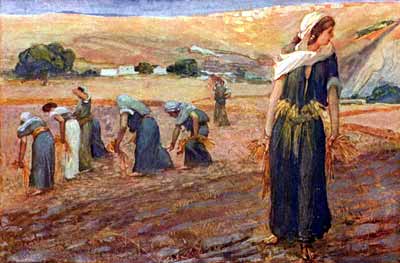
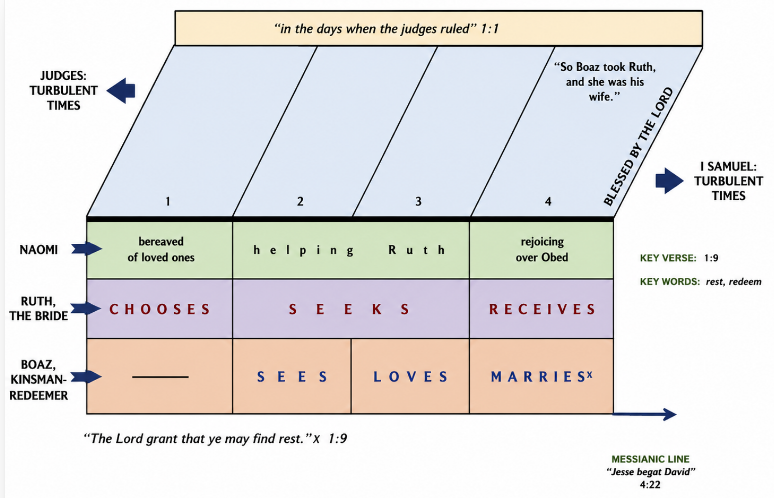
Irving Jensen's Survey of Bible (see his summary of Ruth online - page 392)
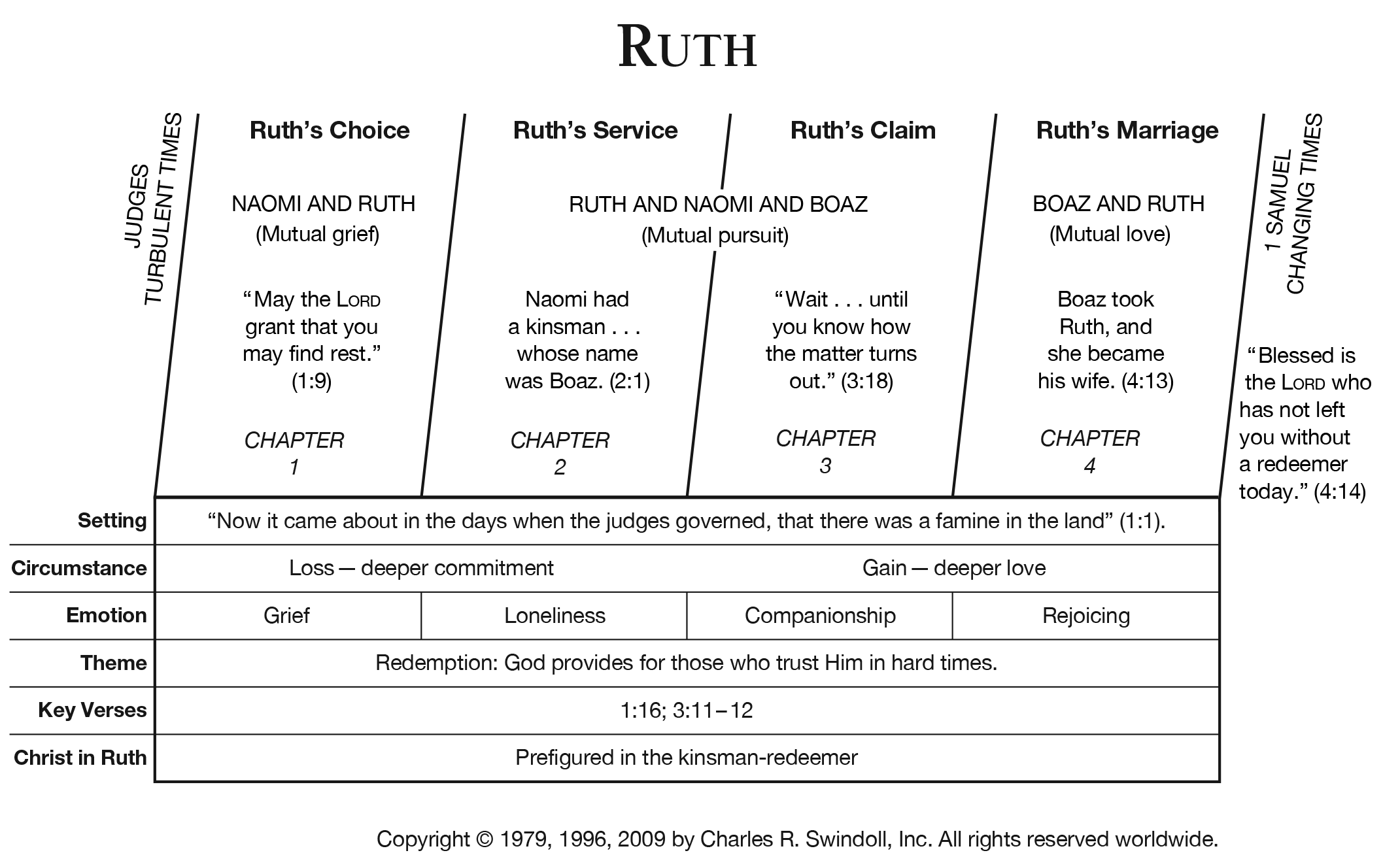
See Swindoll's summary chart of Ruth See Ruth Devotionals
|
RUTH: GOD PROVIDES |
|||
| Ruth 1 | Ruth 2 | Ruth 3 | Ruth 4 |
| Ruth's Choice | Ruth's Service | Ruth's Claim | Ruth's Marriage |
| Ruth's Resolve | Ruth's Rights | Ruth's Request | Ruth's Reward |
| Naomi and Ruth Mutual Grief |
Ruth and Naomi and Boaz Mutual Pursuit |
Boaz and Ruth Mutual Love |
|
| Ruth's Decision: Return with Naomi |
Ruth's Devotion: Provide for Naomi |
Ruth's Request: Redemption by Boaz |
Ruth's Reward: Relative of Messiah |
| Ruth and Naomi |
Ruth and Boaz |
||
| Death of Naomi's Family |
Ruth Cares for Naomi |
Boaz Cares for Ruth |
God Blesses with New Birth |
| Grief | Loneliness | Companionship | Rejoicing |
| Location: Plains of Moab |
Location: Fields of Bethlehem |
Location: Threshing floor of Bethlehem |
Location: Little town of Bethlehem |
| Time Lapsed: About 30 Years See Timeline |
|||
| Setting: Ru 1:1 Now it came about in the days when the judges governed Jdg 21:25 In those days there was no king in Israel; everyone did what was right in his own eyes. |
|||

Ruth 2:1 Now Naomi had a kinsman of her husband, a man of great wealth, of the family of Elimelech, whose name was Boaz. (NASB: Lockman)
Amplified: NOW NAOMI had a kinsman of her husband’s, a man of wealth, of the family of Elimelech, whose name was Boaz. (Amplified Bible - Lockman)
GWT: Naomi had a relative. He was from Elimelech's side of the family. He was a man of outstanding character named Boaz. (GWT)
KJV: And Naomi had a kinsman of her husband's, a mighty man of wealth, of the family of Elimelech; and his name was Boaz.
Young's Literal: And Naomi hath an acquaintance of her husband's, a man mighty in wealth, of the family of Elimelech, and his name is Boaz.
Septuagint (LXX): kai te Noemin aner gnorimos to andri autes o de aner dunatos ischui ek tes suggeneias Abimelech kai onoma auto Boos - Click here for explanation of verb parsing abbreviations in parentheses after each verb
English of Septuagint: And Noemin had a friend an acquaintance of her husband, and the man was a mighty man of the kindred of Elimelech, and his name was Booz
NOW NAOMI HAD A KINSMAN:
I. A Famine - Ruth 1
A. A Disturbed Family - Ruth 1:1-5
B. A Decided Future - Ruth 1:6-14
C. A Declared Faith Ruth 1:15-22
II. A Field - Ruth 2
A. Expecting Grace Ruth 2:1-3
B. Experiencing grace Ruth 2:4-17
C. Expressing grace Ruth 2:18-23
III. A Floor - Ruth 3
A. Preparation Ruth 3:1-5
B. Presentation Ruth 3:6-13
C. Proclamation Ruth 3:14-18
IV. A Family - Ruth 4
A. Arrangements (redeemed) Ruth 4:1-8
B. Announcements (respected) Ruth 4:9-17
C. Accomplishments (related) Ruth 4:18-22
A few chapter titles for Ruth 2:
- Ruth Gleaning in the Redeemer's Field
- The Character of Two Characters!
- Ruth Gleans for Grace ("Favor" - Ru 2:2, 10, 13)
- A Chance Romance - It "Happened" One Fine Spring Day
- Ruth's Resolve, Boaz's Reputation, Naomi's Revival
- A "Grace Full" Chapter - The Greek word for grace (charis - word study) is used only 3 times in the Septuagint (LXX) translation of Ruth, all in chapter 2 - Ru 2:2, 10, 13 (= "favor" Favor is defined as -- Kind regard; kindness; countenance; propitious aspect; friendly disposition).
Ryrie Study Bible Summary of Ruth 2
Ruth's Rights, 2:1-23
A. Her Right to Glean, 2:1-3
B. The Results of Her Gleaning, 2:4-17
1. Boaz meets Ruth, 2:4-7
2. Boaz protects Ruth, 2:8-13
3. Boaz provides for Ruth, 2:14-16
C. The Report of Her Gleaning, 2:17-23
| Preview in the Narrative |
Parallel in the Genealogy |
|
1. Days of the judges (Ru 1:1) |
Salmon to Jesse (Ru 4:20–22) |
|
2. Famine (Ru 1:1) |
Reason to go to Egypt: Perez, Hezron (Ru 4:18) |
|
3. Bethlehem in Judah (Ru 1:1) |
Boaz to David (home of family; Ru 4:21–22) |
|
4. Leaving the land (Ru 1:1) |
Perez, Hezron (Ru 4:18) |
|
5. Returning to the land (Ru 1:6–22) |
Exodus & conquest: Nahshon Salmon (Ru 4:20-21) |
|
6. Emphasis on Boaz in central chiastic layer (Ru 2–3) |
Boaz in honored seventh position in family tree (Ru 4:21) |
|
7. Child by levirate relationship after kinsman’s reneging (Ru 4:6, 13) |
Birth of Perez (4:18) after Judah’s reneging (see Genesis 38) |
|
8. Become famous in Bethlehem (Ru 4:11) |
Boaz and David (Ru 4:21–22) |
|
9. Fame in Israel (Ru 4:14) |
Obed and David (Ru 4:21–22) |
|
10. Obed, Jesse, David (Ru 4:17) |
Obed, Jesse, David (Ru 4:21–22) |
From paper - An Adjusted Symmetrical Structuring Of Ruth - A Boyd Luter
SUMMARY THOUGHT - Ruth 2 takes place predominantly in the backdrop of a Bethlehem barley field and masterfully weaves together the lives of 3 ordinary people (Naomi, Ruth and Boaz) and one extraordinary God, Who is purposefully, providentially working out His redemptive plan for all of mankind in the ordinary events of life. Amazing grace indeed! The events that occur during what otherwise seems to be just another humdrum 24 hour day would prove to have eternal, extraordinary consequences! (cp Ru 4:21, 22, Mt 1:1, 5, 6) Although you may not agree with all of Boaz's character traits I have gleaned from the text (or you may have additional traits), certainly it is clear that the writer in Ruth 2 is painting a poignant picture of a passionate pursuer of Jehovah and one that all men whether single (and dating/courting) or married, would do well to emulate and imitate (cp He 6:12) in their interpersonal relationship with the "Ruth" God has brought into their life. And notice how Ruth responds to Boaz's gracious (grace-filled) words and actions (Ru 2:10, 13 - although do not expect your "Ruth" to literally fall down at your feet!). Men here is a truth you must remember (the integrity and joy of your marriage depends on it), women are by nature responders ("incubators") and they will give us back what we give them in our words (including our prayers for them) and actions... only their return comes later and fully "baked"! This might be considered a variant of the immutable principle of reaping and sowing, so do not be deceived! (cf Gal 6:7-8) As wise, godly men we need to continually seek (only possible as we are continually filled and enabled by the Holy Spirit - Eph 5:18) to speak and act with grace (see especially Eph 4:29) toward the "Ruth" God has given us. Indeed, as Peter exhorts us "You husbands in the same way, live with your wives in an understanding way, as with someone weaker, since she is a woman; and show her honor as a fellow heir of the grace of life, so that your prayers will not be hindered." (1Pe 3:7). Are you experiencing just another "ordinary" day? There are no "ordinary" days for disciples of Christ! Remember, you serve a God Who takes the ordinary and makes it extraordinary (even though you may not always be aware of His providential working)! So be encouraged and be motivated to redeem the time (Eph 5:16, Col 4:5, Ro 13:11, Ro 13:12, Ro 13:13, 14) which He has graciously given you, living it out with wisdom (Ps 90:12) and "disciplined godliness" (1Ti 4:7, 4:8, 1Ti 4:9, 4:10) as did Boaz, Ruth and Naomi, for you do not know what extraordinary consequences this ordinary day might have in the eternal plan of our extraordinary God! As you review these characteristics of Boaz, who would soon prove to be Ruth and Naomi's kinsman-redeemer, let your mind project ahead and ponder how each of these traits is perfectly fulfilled in our own Kinsman-Redeemer, the Lord Jesus Christ (Mk 10:45).
|
Godly |
Ruth 2:4+ |
|
Initiates |
Ruth 2:8+ |
|
Provides |
Ruth 2:8, 9+ |
|
Protects |
Ruth 2:9+ |
|
Shows Hospitality |
Ruth 2:9+ |
|
Bestows Favor |
Ruth 2:10+ |
|
Praises |
Ruth 2:11+ |
|
Prays Audibly |
Ruth 2:12+ |
|
Spoke Kindly |
Ruth 2:13+ |
|
Serves |
Ruth 2:14+ |
|
Exhibits Generosity |
Ruth 2:15+ |
|
Protects |
Ruth 2:15, 16+ |
Note that in this chapter the first and last verses are the comments of the narrator who is giving us context so that we can understand the significance of the events in the next few verses. The story really begins to unfold in verse 2.
Now Naomi had a kinsman of her husband, a man of great wealth, of the family of Elimelech, whose name was Boaz - The Hebrew literally reads "and [there was] to Naomi a relative, to her husband, a man mighty in substance, from the clan of Elimelech, and his name [was] Boaz." The narrator is carefully holding back the key information that Boaz is far more than just a family acquaintance and a relative until near the end of this chapter when he is unveiled as one of their kinsman-redeemers (Gaal = Ru 2:20NIV) (Note kinsman-redeemers is plural so clearly Naomi knew there was more than one "candidate"!). For now we know that Boaz was Naomi's kin on her husband's side and yet it is interesting that she does not appear to make any appeal to him for assistance even though the term used here (moda) indicates Boaz was well known to her. Conversely, it is also intriguing that this very generous kinsman had not sent for Naomi although he too was clearly aware of her arrival (cf Ru 2:11). Interesting! Also interesting that there was a relative in town but why hadn’t Naomi remembered that earlier? Could it be that her bitter circumstances blinded her perspective?
There is not a more winsome character presented in the Old Testament than Boaz,
and there is not a more lovely woman in the Bible than Ruth
-- J Vernon McGee
Zeisler observes "that chapter 2 is the story of just one twenty-four hour period. In the first five verses of the book, ten years whizzed by. A famine started and ended, a family migrated, two marriages were made, and three men died. Now we have an entire chapter that covers just one day. That also ought to persuade us to listen very carefully to the details, to observe the scene, to wonder and enter into what these people experienced. For three thousand years people have been blessed by reading what took place on this particular day when Ruth and Boaz began their relationship. (Ruth 2:1-16: One Fine Day)
Kinsman (04129)(moda from yadah = to know) is not the Hebrew word Goel (word study) (kinsman redeemer) but the Hebrew noun moda or "mowda" which means simply a relative (used of Boaz once more in Ruth 3:2) and is derived from the Hebrew verb yada which means to know. Young's Literal translation conveys the meaning of the root word (to know someone) referring to Boaz as merely an "acquaintance." (Ru 2:1YLT) It denotes the person with whom one is intimately acquainted and thus one’s near relation. Solomon has the only other OT use of moda in Proverbs instructing us to "call understanding your intimate friend (moda)" (Pr 7:4) (Good advice!)
The Greek word (Septuagint - LXX) used to translate kinsman is gnorimos (4x in Scripture = Ruth 2:1; 3:2; 2Sa 3:8 [translates Hebrew merea = friend or companion]; Pr 7:4) which means acquainted with and when speaking of persons describes one who is well known sometimes with the meaning of known to all, notable, distinguished. In some contexts gnorimos means notables or wealthy class (Liddell-Scott).
A MAN OF GREAT WEALTH:
- Dt 8:17, Dt 8:18; Job 1:3; 31:25
- Ruth 2 Resources - Sermons and Commentaries
a rich and influential man (TEV)
a rich relative (NCV)
a prominent kinsman (NAB)
He was a wealthy, prominent man (NET)
well–to–do (NJB)
a man of standing (NIV)
The Chaldee reads "mighty in the law."
GOD'S GODLY MAN
COMES ON THE SCENE
A man of great (gibbor) wealth (chayil) - The Hebrew word used to describe Boaz (gibbor) is actually one of the Names of God See El Gibbor-Mighty God. God's Word Translation renders it "a man of outstanding character". I especially like the last translation because reputation is what others think about you, but character is what those really know you, know you to be. Boaz is prominent (influential) and wealthy which well suits him for his role as a "redeemer" and "restorer". The Hebrew for great wealth is a combination two Hebrew words. This same Hebrew phrase (gibbor hayil) is used to refer to Gideon (Jdg 6:12) and Jephthah (Jdg 11:1) and is variously translated as valiant warrior, mighty man of valor, mighty hero and mighty warrior. One gets the picture of an man of renown who in Medieval England would have been called a "knight" -- indeed Boaz would soon prove to be Ruth's "knight in shining armor".
Hubbard - While gibbôr ḥayil most often means “war hero” (Josh. 6:2–3; Jdg. 6:12; 2 Sam. 17:8; 2 K. 24:16; etc.), it also connotes “capable person” (1 Sam. 9:1; 1 K. 11:28; 2 K. 5:1; Neh. 11:14; etc.) and “wealthy man” (2 K. 15:20). The last text explains the connection among the three nuances: military prowess and wealth go together because the capable military man must have the resources to equip and maintain himself.10 Since there is no military background here, however, the term is simply a title of high social standing. The following scene (vv. 2–17) confirms his wealth, the later legal process (4:1–12) his high social status. In short, he was a “powerful person”—someone whose wealth and high reputation in Bethlehem gave him strong influence among his peers. This is not an unimportant detail, for the description contrasts Boaz with the rather weak males of ch. 1, and his stature and influence might be significant later in the story (See context in The Book of Ruth)
Gill sums up the description of Boaz as a "man of great wealth and riches, and of great power and authority, which riches give and raise a man to, and also of great virtue and honour, all which the word "wealth" signifies; to which may be added the paraphrase the Targumist gives, that he was mighty in the law; in the Scriptures, in the word of God, a truly religious man, which completes his character."
Great (mighty) (01368) (gibbor) is an adjective which means brave, strong, might and is commonly associated with warfare and has to do with the strength and vitality of the successful warrior. In some context gibbor emphasizes excellence. Gibbor is used to describe God in 2 contexts ("mighty God" Isa 10:21, Jer 32:18) and also describes the Messiah who will rule God's kingdom (Isa 9:6). Gibbor describes God in Deut. 10:17, Ps 24:8, Zeph 3:17.
Gibbor - 150v in OT - The NAS renders gibbor as - another(1), champion(2), great(1), helpers(1), heroes(3), men(2), mighty(26), Mighty(1), mighty man(15), mighty men(57), mighty one(2), Mighty One(1), mighty ones(3), mighty warrior(1), mighty warriors(2), outstanding men(1), strong(1), strong man(1), valiant(1), valiant men*(1), warrior(15), warrior's(1), warriors(18), who is mighty(1). Uses in Judges and Ruth - Jdg. 5:13; Jdg. 5:23; Jdg. 6:12; Jdg. 11:1; Ruth 2:1
Wealth (02428) (chayil) which means might, strength, power, valiant, virtuous, riches, wealth and is the same word used in the next chapter to describe Ruth as a woman of excellence (Ru 3:11).
The two Greek words the Septuagint (LXX) uses to translate great wealth are dunatos (an ischus - see below) which has several meanings that might apply to the man Boaz, including one who possesses power, who has the ability to perform some function, and thus who is able, strong or "influential" (this latter meaning found in Acts 25:5). The other Greek word is ischus meaning strength or ability and discussed in the section below. It's great to have a rich and influential relative isn't it? And indeed every believer has such a Kinsman in Christ Jesus, who quite clearly is pictured in the character of godly Boaz.
OF THE FAMILY OF ELIMELECH WHOSE NAME WAS BOAZ:
- Ru 4:21, 22; 1Chr 2:10-12; Mt 1:1, 4-6; Lk 3:32
- Ruth 2 Resources - Sermons and Commentaries
Related Passages:
Matthew 1:1 The record of the genealogy of Jesus the Messiah, the son of David, the son of Abraham:
Matthew 1:4-6 Ram was the father of Amminadab, Amminadab the father of Nahshon, and Nahshon the father of Salmon. 5 Salmon was the father of Boaz by Rahab, Boaz was the father of Obed by Ruth, and Obed the father of Jesse. 6 Jesse was the father of David the king. David was the father of Solomon by Bathsheba who had been the wife of Uriah.
BOAZ IN FAMILY
OF ELIMELECH
Of the family (clan) of Elimelech - We have almost forgotten about him, but the author deftly brings him back into the storyline as he lays the foundation for the revelation of the kinsman-redeemer, who has to be a near relative in order to function in the capacity of kinsman redeemer.
Hubbard on family (clan) - A clan (Heb. mišpāḥâ) was the kinship category between the larger “tribe” (Heb. šēḇeṭ or maṭṭeh; here, Judah) and the smaller “extended family” (bêṯ ʾāḇ). The clan consisted of families descended from a common ancestor and was the most important single group in Israelite society. Clans enjoyed inalienable ownership of specific lands (Josh. 13–17), ownership which the gōʾēl, among other duties, was obligated to protect (Lev. 25). In this case, the clan was probably that of the Ephrathites (see 1:1). Again, mention of his relationship to Elimelech was important: it implied that clan loyalty and its incumbent duties might cause the man to use his influence at some later time. (See context in The Book of Ruth)
Whose name is Boaz - "Since the OT lacks a root bʿz, the name’s meaning is obscure." (Hubbard) Remember that in Scripture, an individual's name often conveyed something about their character. So let us study the meaning of Boaz. First, let's briefly study Boaz's family tree. Notice that his mother was a Gentile harlot from Jericho, who became a believer (justified by works = shown to be righteous by her good works which demonstrated that her faith was alive!) in Jehovah (Jas 2:25).
Salmon
+
Rahab the Harlot
(Mt 1:5, Jas 2:25)
v
Boaz
(Ru 4:21, Mt 1:5)
+
Ruth the Moabitess
(Ru 1:22, 2:2, 21, 4:4, 10)
v
Obed
(Ru 4:22, Mt 1:5)
v
Jesse
(Mt 1:6)
v
David
(Mt 1:1)
v
Messiah
(Mt 21:9, 22:42, Mk 10:47, Mk 12:35)
In summary, although we can speculate with some support about the meaning of his name, Boaz's character and conduct shine though in the remainder of this story and clearly demonstrate his moral strength as well as his alacrity or promptness to respond appropriately.
J Vernon McGee adds that "On the canvas of God’s Word, Boaz is drawn with noble features. He fulfilled in his life all that the Latin suggests in the great word virtus . Boaz was a man of virtue in the literal sense of that word. There is not a more winsome character presented in the Old Testament than Boaz, and there is not a more lovely woman in the Bible than Ruth. She compares favorably with her descendant Mary, the mother of Jesus. These two, Ruth and Boaz, stand out like stars on the black background of that corrupt day. Boaz was a wealthy kinsman of Naomi. The first verse uses a word that does not convey that strong meaning, but a word used later, which we will consider, does so. We shall reserve for a succeeding chapter the consideration of Boaz as the kinsman-redeemer. His position of wealth made it possible for him to redeem the estate of Elimelech. (Thru the Bible Commentary see also Ruth, the romance of Redemption)
GOD MOVES
IN A MYSTERIOUS WAY
William Cowper (bio by John Piper)
(Hauntingly beautiful Pictures w/ lyrics & guitar vocal-watch it in full screen)
(Beautiful vocal by Lori Sealy! Close your eyes. Ponder, even pray Cowper's profound lyrics!)
Judge not the Lord by feeble sense,
But trust Him for His grace;
Behind a frowning providence
He hides a smiling face.
His purposes will ripen fast,
Unfolding every hour;
The bud may have a bitter taste,
But sweet will be the flower.
Here is a story that is said to be behind these incredibly insightful and beautiful words of Cowper's hymn. Reportedly this is the last hymn William Cowper ever wrote, and here is the story that is said to be behind it. Cowper often struggled with depression and doubt. One night he decided to commit suicide by drowning himself. He called a cab and told the driver to take him to the Thames River. However, thick fog came down and prevented them from finding the river (another version of the story has the driver getting lost deliberately). After driving around lost for a while, the cabby finally stopped and let Cowper out. To Cowper’s surprise, he found himself on his own doorstep: God had sent the fog to keep him from killing himself. Even in our blackest moments, God watches over us. Yes, whether this story is true or not, in either case we can rest assured that our God ever watches over us dear tried and afflicted saints.
Here is another version of the story of Cowper's last hymn "God Moves in a Mysterious Way..." - Whatever form the pressures toward matrimony were taking, they were obviously causing deep psychological problems for Cowper, for on Friday, January 1, 1773, an hour or two after hearing Newton preach at the morning service in church, Cowper was walking in the fields around Olney when he was struck by a terrible premonition that the curse of madness was about to fall on him again. Struggling to make a declaration of his faith in poetic form before his mind was enclosed in the darkness of depression, he struggled home, picked up his pen, and wrote a hymn that many regard as a literary and spiritual masterpiece....Soon after writing these memorable lines, the “dreaded clouds” arrived, and Cowper’s mind plunged into an abyss of madness. During the night of January 1–2, he had terrible dreams and hallucinations. In the middle of these nocturnal terrors he came to the insane conclusion that God had commanded him to take his own life in the manner of Abraham wielding his knife against his son Isaac. Apparently ignoring the point that in the Bible God intervened to prevent the fatal blow from being struck, Cowper attempted to obey this imaginary command. His suicide was thwarted by the action of Mary Unwin. She sent for Newton in the small hours of the morning. On arrival at Orchard Side, Newton was appalled by his friend’s condition. (John Newton From Disgrace to Amazing Grace by Jonathan Aitken and Philip Yancey - a book that is difficult to put down and one I highly recommend)
Boaz (01162) (bo'az) name meaning depends on which source you consult. Nelsons' New Illustrated Bible Dictionary records that Boaz means "in him is strength" but The New Unger's Bible Dictionary says that Boaz possibly means fleetness as from the Arab word baaza which means to be nimble and most other references record similar meanings such as alacrity (promptness in response or cheerful readiness) or quickness. As King Solomon was building God's Temple in Jerusalem, he "erected the pillars in front of the temple, one on the right and the other on the left, and named the one on the right Jachin and the one on the left Boaz." (2Chr 3:17, 1Ki 7:21)
Boaz appears like a bright ray of light piercing through the dark cloud of bitterness hanging over Naomi and this little ray of sunshine is going to grow bigger and bigger as the story unfolds. In this chapter the mercy of God becomes so obvious that even Naomi will recognize it. From the first verse we recognize that the situation is not as bleak as Naomi suggested back in Ru 1:11, 12, 13 (see notes Ru 1:11, 12, 13) where she gave the impression that there was no one for Ruth and Orpah to marry to carry on the line of their husbands. Had she simply forgotten about the kinsman-redeemers in Bethlehem or had she forgotten the law of Levirate marriage? We can only speculate for God has not revealed this to us.
One needs to avoid being too fanciful in the interpretation of the significance of the pillar named "Boaz", but it is worth noting that a pillar was an ancient symbol of security and strength. When all else has fallen, the pillar often remained standing strong and erect (we see this in some of the archaeological remains ancient empires). In ancient times, a distinguished citizen would in fact have a pillar erected in his honor and his name would be inscribed upon the massive pillar to document his contribution for future generations to come. In Revelation Jesus says that "He who overcomes, I will make him a pillar in the temple of My God..." (Rev 3:12) So the faithful service of a believer on earth will not be forgotten.
Related Resources:
- Boaz - International Standard Bible Encyclopedia
- Boaz - Kitto's Popular Cyclopedia of Biblical Literature
- Boaz - Cyclopedia of Biblical, Theological and Ecclesiastical Literature
- Boaz - Hastings' Dictionary of the Bible
- Boaz - The 1901 Jewish Encyclopedia
- Boaz - Bridgeway Bible Dictionary
Boaz - 22v in OT - Ruth 2:1, 3, 4, 5, 8, 11, 14, 15, 19, 23; 3:2, 7; 4:1, 5, 8f, 13, 21; 1Ki. 7:21; 1Chr. 2:11, 12; 2Chr. 3:17
The Septuagint (LXX) translation of this passage in Second Chronicles is intriguing and gives a possible clue to the meaning of Boaz, the English translation of the Septuagint reading that Solomon "set up the pillars in front of the temple, one on the right hand and the other on the left: and he called the name of the one on the right hand 'Stability,' and the name of the one on the left Strength (Greek word ischus is used here to translate the Hebrew word Boaz.) (2Chr 3:17) Strength (2479) (ischus) (see note by Wayne Barber ischus) refers to “power as an enduement.” Ischus is the inherent ability which stresses the factuality of the ability, not necessarily the accomplishment. Ischus is inherent power or force. A muscular man’s big muscles display his might, even if he doesn’t use them. It is the reserve of strength. Ischus therefore conveys the sense of endowed power or ability. The idea is that it is the active efficacy of the might that is inherent in God, His indwelling strength. Ischus is that strength which one has in possession or ability. One might think of ischus as God's latent power. It is His capability to function effectively. He is able!
Ischus is used of the ability of human beings in Mark "AND YOU SHALL LOVE THE LORD YOUR GOD WITH ALL YOUR HEART, AND WITH ALL YOUR SOUL, AND WITH ALL YOUR MIND, AND WITH ALL YOUR STRENGTH.' (Mark 12.30) Ishus is used of angelic power Peter writing "whereas angels who are greater in might and power do not bring a reviling judgment against them before the Lord. (2Pe 2:11) and finally as an attribute of Christ in the Revelation - "Worthy is the Lamb that was slain to receive power and riches and wisdom and might and honor and glory and blessing." (Re 5:12)
Ruth 2:2 And Ruth the Moabitess said to Naomi, "Please let me go to the field and glean among the ears of grain after one in whose sight I may find favor." And she said to her, "Go, my daughter." (NASB: Lockman)
Amplified: And Ruth the Moabitess said to Naomi, Let me go to the field and glean among the ears of grain after him in whose sight I shall find favor. Naomi said to her, Go, my daughter. (Amplified Bible - Lockman)
BBE: And Ruth the Moabitess said to Naomi, Now let me go into the field and take up the heads of grain after him in whose eyes I may have grace. And she said to her, Go, my daughter
GWT: Ruth, who was from Moab, said to Naomi, "Please let me go to the field of anyone who will be kind to me. There I will gather the grain left behind by the reapers." Naomi told her, "Go, my daughter." (GWT)
ICB: One day Ruth, the woman from Moab, said to Naomi, "Let me go to the fields. Maybe someone will be kind and let me gather the grain he leaves in his field." Naomi said, "Go, my daughter." (ICB: Nelson)
KJV: And Ruth the Moabitess said unto Naomi, Let me now go to the field, and glean ears of corn after him in whose sight I shall find grace. And she said unto her, Go, my daughter.
Young's Lit: And Ruth the Moabitess saith unto Naomi, 'Let me go, I pray thee, into the field, and I gather among the ears of corn after him in whose eyes I find grace;' and she saith to her, 'Go, my daughter.'
Septuagint (LXX): kai eipen (3SAAI) Routh e Moabitis pros Noemin poreutho (1SAPS) de eis agron kai sunaxo (1SFAI) en tois stachusin katopisthen ou ean heuro (1SAAS) charin en ophthalmois autou eipen (3SAAI) de aute poreuou (2SPMI) thugater
English of Septuagint: And Ruth the Moabitess said to Noemin, Let me go now to the field, and I will glean among the ears behind the man with whomsoever I shall find favor (grace -charis): and she said to her, Go, daughter
AND "RUTH THE MOABITESS" SAID TO NAOMI PLEASE LET ME GO TO THE FIELD AND GLEAN AMONG THE EARS OF GRAIN:
- Lv 19:9; 23:22; Dt 24:19, 20, 21, 22
- Ruth 2 Resources - Sermons and Commentaries
- See ISBE article on Gleaning
to gather leftover grain behind anyone who will let me do it (NLT)
pick up the leftover grain (NIV).
RUTH'S REQUEST
HER VOLITIONAL CHOICE
And Ruth the Moabitess said to Naomi, "Please let me go to the field and glean (laqat) among the ears of grain after one in whose sight I may find favor." And she said to her, "Go, my daughter - Naomi does not tell Ruth to head for the fields to provide food for me, a widow. No, Ruth takes the initiative because she is a woman of excellence (Ru 3:11) and practically because the harvest may last only a few days. There was no time to waste! That's what men and women of excellence do when they discern a need -- they do not need to be prompted by anyone except the Holy Spirit! Are you being prompted right now to carry out a "Ruth-like" act or action? Then move out. Don't procrastinate, prevaricate or hesitate! Note that the author makes a point to use the descriptive phrase Ruth the Moabitess 5 times (out of a total of 12 uses of the name Ruth) in this short drama (Ruth 1:22; 2:2, 21; 4:5, 10, cf "Moabite" in Ru 1:4, 2:6; cf "Ruth" in Ru 1:14, 16; 2:8, 22; 3:9, 4:13). What the writer is doing is reminding us of Ruth's status as a foreigner and a Gentile, one outside of the covenant promises of Israel and a stranger to Israel's God, Jehovah (cf Eph 2:11-12). So every time we see Ruth's designation it reminds us that it was Ruth, the one who did not belong, a Gentile who the Jews often despised as in the same category as dogs, a misfit, an outcast, etc, etc. Do we not see God's amazing accepting grace even in the repetition and reminders of her name as Ruth the Moabitess! Were we not all just like "Ruth the Moabitess?" Amazing God! Amazing mercy! Amazing grace indeed!
I like what Cyril Barber says about Ruth - She is appropriately assertive and at the same time willingly subordinate to her mother-in-law. She is a stranger and naturally looks to Naomi for guidance in matters of local custom. But this has not made her passive. Her ability to see needs and try to meet them indicates her freedom of thought and decisiveness. (Ruth: A Story of God's Grace: An Expositional Commentary)
Hubbard - "Setting aside possible fears at being a Moabitess (see 2:21), she took incredible risks in order to implement the devotion affirmed earlier (Ru 1:16–17)." The Book of Ruth
As a side note it is intriguing that one of the definitions of the noun "ruth" (did you realize it was a word in our English language?) in Merriam-Webster's Collegiate Dictionary is "compassion for the misery of another" (look it up)! Interesting!
THOUGHT - Most believers today are Gentiles and as alluded to above we should be able to closely identify with Ruth and her predicament as a Moabitess. It is good to remember how hopeless our situation was as Gentiles. As the apostle Paul exhorted the church at Ephesus we would should all...
Remember (present imperative = command to keep this memory fresh. Don't forget where you came from and how great are the mercies of God) that formerly you the Gentiles in the flesh, who are called "Uncircumcision" (Gentiles) by the so-called "Circumcision," (Jews) which is performed in the flesh by human hands...were at that time separate from Messiah, excluded from the commonwealth of Israel, and strangers to the covenants of promise, having no hope and without God in the world. But now in Messiah Jesus you who formerly were far off have been brought near by the blood of Messiah." (Ep 2:11, 12)
As Ruth enters into this Bethlehem field, she is being providentially brought not only near to the Messiah but into the actual bloodline of the coming Messiah.
Please let me go - It is easy to overlook this phrase but as explained below Ruth was not just making a casual request. She was completely committed to carry out what she was asking of Naomi! This introductory phrase then speaks volumes about Ruth's heart and her desire to obey the fifth commandment to honor your father and mother (Ex 20:12, Dt 5:16). And what was the promise for obedience?
Deuteronomy 5:16 ‘Honor your father and your mother, as the Lord your God has commanded you, (Promise #1) that your days may be prolonged and (Promise #2) that it may go well with you on the land which the Lord your God gives you.
Or as Paul writes "Honor your father and mother (which is the first commandment with a promise), SO THAT IT MAY BE WELL WITH YOU, AND THAT YOU MAY LIVE LONG ON THE EARTH (NB: all caps in the NT of the NAS always signifies a direct quotation from the OT). (Ep 6:2, 3)
Did things go well with Ruth? If you don't know the answer stop and read through all four chapters of Ruth which will only take you about 30 minutes.
Please (04994) (na') is a marker of emphasis with a focus on the desire of the speaker to heighten the sense of urgency or to add intensity to what follows. The idea is something like "I beg you", "I beseech thee", "I pray thee"
Was Ruth under obligation to supply food for the family? Not by any Biblical regulation or law. But Ruth has committed herself to Naomi with amazing devotion and she takes the initiative to work and provide for them both. Ruth took advantage of the gleaning laws (Lv 19:9, Dt 24:19) which she may have learned from Naomi. The Scripture repeatedly appeals to the importance which God places on work, e.g., Paul writing to the saints at Thessalonica says "For even when we were with you, we used to give you this order: if anyone will not work, neither let him eat. (2Th 3:10, 1Th 4:11, cp Ge 2:15, 3:19, Pr 13:4, 20:4, 21:25, 26, Pr 24:30-34)
Guzik adds that "Ruth, on her own initiative, sets out to glean fields to support her and her mother-in-law Naomi. This shows a wonderfully hard-working spirit in Ruth, and spiritual also - she would not have been more spiritual to sit back at home and pray for food." (Ruth 2 Commentary)
Zeisler has an interesting comment on Ruth's initiative writing that "Ruth had to say, "Naomi, there is one open door for people like us. Do you know what we are? We're poor. The law says that poor people may go into the field and pick up enough grain to eat. I'm going to trust that the one door that God has opened is the door we ought to go through. I'm going to trust that He loves us enough that this is the right thing to do." It was actually dangerous to do so, because the time of the judges was a lawless time (Jdg 21:25). Poor people would take some risks to access even something that was rightfully theirs (Lv 19:9, Dt 24:19). But Ruth believed that she lived in her Father's world, the Scriptures were trustworthy, and God would be faithful to His promises. (Ruth 2:1-16: One Fine Day)
Two widows with no visible means of support (but one invisible all Sufficient God, EL Shaddai - God Almighty - Shaddai used by Naomi in Ru 1:20, 21) still need the basics of life and so Ruth volunteers (and as explained earlier, essentially begs Naomi) for permission to glean, which reflects her willingness to submit her will to the will of the one in authority, even in this small detail demonstrating her submission to God's authority as specified in the fifth of the ten commandments...
Honor (imperative mood = a command to be obeyed, not a suggestion to be side-stepped - it is still in force - a good reminder for all young people reading this!) your father and your mother, that your days may be prolonged in the land which the LORD your God gives you. (Ex 20:12)
Ruth's desire to glean reflects her commitment to Naomi and to true worship of Jehovah, for as James explained over one thousand years later...
This is pure and undefiled religion in the sight of our God and Father, to visit (to care for - same Greek word, episkeptomai, used in the LXX translation of Ru 1:6 = "Jehovah had visited His people" - episkeptomai is not simply a casual visit but a visit with the aim of relieving one's distress!) orphans and widows in their distress (external acts of goodness), and to keep oneself unstained by the world (internal acts of holiness). (Jas 1:27).
Note that Ruth is not seeking permission to go to a "picnic", because in ancient times a hard day's work under the hot Palestinian sun (and also during a dark and dangerous times of Jdg 21:25) frequently netted only a small amount of grain. We learn later that Ruth's gleaning in the barley field of Boaz (her kinsman-redeemer "in waiting"), was productive of an ephah of grain (Ru 2:17-) after it had been beaten out (separating the worthless husks from the nutritious grain).
How much was an ephah? Probably somewhere between 20 and 40 pounds or enough to sustain the two widows for up to ten days! Yes, gleaning the corners of the fields (Lev 19:9) usually netted only a pittance, but gleaning in the fields of the benevolent, generous and wealthy Goel (kinsman redeemer) Boaz, yielded "exceeding abundantly above all that we ask or think" (Eph 3:20).
THOUGHT - By way of application, dear child of the King, when we like Ruth choose to obediently glean in the fields of our Beloved Kinsman Redeemer, Christ Jesus, we like Ruth experience our Goel's abundant provision (and of course, we as NT believers are speaking primarily of spiritual blessednesses). Why then do we so often wander into other fields to glean for that which can never nourish or satisfy our hungry souls? (cp Mt 5:6) Let us learn from Ruth's simple but deep trust in Jehovah, under Whose wings she had fled for refuge.
Ruth the Moabitess (an alien) had every right to look to God for His help and provision, for our trustworthy God "executes justice for the orphan and the widow and shows His love for the alien by giving him food and clothing." (Dt 10:18) (see Torrey's Topic "Widows")
The field - This field turns out to be not just any field but the field belonging to Boaz (Ru 2:3). In this same area David would tend his father’s sheep (1Sa 17:12, 15), and Joseph would bring a young wife named Mary, to deliver her baby, the Messiah, born in the line of Boaz and Ruth (Lk 2:1-6, see esp Lk 2:4) And it is most likely in the hills above these fields shepherds were tending to their flocks on the night the Messiah was born (Lk 2:8-20). God's providential outworking of events in this "little town of Bethlehem" (Micah 5:2) over the years that followed this fateful day in Ruth 2 should be a source of awe and wonder to us all.
THOUGHT - If our great God can orchestrate such monumental events on the stage of a simple field, what can He do with the seemingly mundane circumstances or events in my life?
Glean after the reapers - This phrase even suggests the meaning of gleaning which is picking up the leftovers, including the grain in the corners of the fields (Lv 19:9) and sheaves (stalks tied together) that had been forgotten (Dt 24:19).
Hubbard on after the reapers - - Since Ruth specifically plans to follow the reapers (Ru 2:3, 7, 9; cf. Isa. 17:5; 27:12), the ears of grain (šibbolîm) were ones already cut but accidentally dropped to the ground by reapers. In Bible times, the reaper grasped the stalk with his left hand and cut off the grain with a sickle in his right. When the armload of accumulated ears became unmanagable, he laid them in rows beside the standing stalks for women to tie in bundles. Since prudent reapers worked carefully, the gleaning of fallen grain was mere subsistence living, much like trying to eke out survival today by recycling aluminum cans. (See context in The Book of Ruth)
At the outset it is worth noting that in all the descriptions of Ruth, there is not one description of external beauty, but all descriptions deal with her internal beauty. God sees not as man who looks as the external appearance but He looks at the heart (1Sa 16:7). The writer of proverbs summed it up this way...
Charm (a pleasing manner developed by painstaking drill and discipline which invites the favor of family and friends) is deceitful and beauty is vain, but a woman who fears the LORD, she shall be praised. (Pr 31:30)
And thus we see that the key to Ruth is not her external beauty (which she may well have had) but her beautiful character. Physical beauty quickly fades and is transitory. Ruth's praise from Boaz (Ru 2:11) as we shall see comes from her godly character rather than from such external appearance. Although the author does not specifically state it, Ruth's attitude and actions indicate that she clearly possesses the "fear of the Lord," which is the foundation of all wisdom and the principle (Pr 1:7, 9:10, cp Eccl. 12:13, Ps 25:14)
Centuries later Peter summed up the godly woman (and wife) writing "In the same way, you wives, be submissive to your own husbands so that even if any of them are disobedient to the word, they may be won without a word by the behavior of their wives, as they observe your chaste and respectful behavior. And let not your adornment be merely external-- braiding the hair, and wearing gold jewelry, or putting on dresses; but let it be the hidden person of the heart, with the imperishable quality of a gentle and quiet spirit, which is precious in the sight of God. (1Pe 3:1-4)
GOD'S
WELFARE PROGRAM:
"CUT CORNERS"!
Most business owners instruct their employees not to cut corners. God however had instructed Jewish landowners in fact to “cut corners” in harvesting, and always leave some behind (Lv 19:9)! Deuteronomy adds that
"When you reap your harvest in your field and have forgotten a sheaf in the field, you shall not go back to get it; it shall be for the alien (foreigner, stranger), for the orphan, and for the widow, in order that the LORD your God may bless you in all the work of your hands." (Dt 24:19)
These benevolent laws provided a divinely initiated “welfare” program for Israel, and were an efficient and positive way of helping the poor (Lv 19:9, 10, Dt 24:19, 20, 21, 22 - John Newton had Dt 24:22 printed in large letters and hung over his mantle piece so that he would not forget God's amazing grace to save a wretched slave trader such as he! We would all do well to remember our wretched state before Christ, our Kinsman Redeemer showed us favor [grace]) (As previously noted Ep 2:11, 12) (See Torrey's Topic The Poor). On the one hand this practice encouraged the landowners to have a generous heart and on the other, it encouraged the poor to be active in laboring for their food and thus providing for their own needs without losing their dignity. What a far cry from many modern day government initiated welfare programs! Sadly the Jewish religious leaders fell out of step with God's heart and began to tie heavy burdens upon the people by specifically designating gleaning as one of thirty-nine kinds of work that was forbidden on the Sabbath! God's will and way is always the best way!

THOUGHT - One English dictionary defines "glean" as to gather something slowly and carefully in small pieces. What a wonderful harvest would we each receive if we always approached God's Word with the definite intention to "glean" in the "fields" of His precious truth.
Ruth had the desire and the initiative to take full advantage of God's provision in Leviticus and Deuteronomy, indicating that she knew this truth and that she was willing to step out in faith and act upon it. What a challenging example she presents for all believers who have access to the gleanings, yea, even the bountiful harvest of God, having been "granted...everything pertaining to life and godliness" and having access to the "fields" of all of God's "precious and magnificent promises". (2Pe 1:3, 4 )
Yet there they lie, untouched and of no value to the believer who does not reach out and lay hold of these precious provisions and promises from the very mouth and hand of God Himself! Unlike God's "fields", human owners could still refuse gleaning on his land. In the days of the Judges one would not be surprised if more than one landowner refused to allowed gleaning. Would Ruth be refused this privilege?
Devotional from Today in the Word - A 1980s British sitcom called To the Manor Born told the story of a woman living on an estate that had been in her family for generations. The problem was that the lady of the manor was basically penniless, although her financial condition wasn’t widely known. Many of the show’s episodes dealt with the woman’s attempts to keep the manor running and to hold on to her estate on a shoestring budget. This could have been Naomi’s story upon her return to Bethlehem with Ruth. Naomi was penniless, although apparently she was able to move back onto the family property in Bethlehem. That may have included a house and some land, but judging from the women’s financial condition, they had no way to make a real living.
The Handbook on the Book of Ruth notes that "It is also important that the theme of restoration and “filling” be brought about by the event of harvest, which, in a sense, is a kind of celebration of the fertility of the earth and therefore an implied abundance. (Waard, J. d., & Nida, E. A. A translator's Handbook on the Book of Ruth. New York: United Bible Societies)
Glean (03950) (laqat) means to pick up, to gather various things like manna, lilies, firewood, and people (Ex. 16:4, 5; Judg. 11:3; Song 6:2; Jer. 7:18). The most important use is to gather food (Lev 19:10). Almost 50% of the uses of laqat relate to the provision in the Law to take care of the needy by allowing them to glean the fields (Lev. 19:9, 10; 23:22; Ruth 2:2, 3, 7, 8, 15-19, 23) Laqat is a key word in Ruth 2 (used 12x in 10 verses - Ru 2:2, 3, 7, 8, 15, 16, 17, 18, 19, 23) and describes the process of gathering grain or other produce left in the fields by the reapers. The basis for this practice in Israel is found in Leviticus where Moses records God's desire that "when you reap the harvest of your land, you shall not reap to the very corners of your field, neither shall you gather the gleanings of your harvest... you shall leave them for the needy and for the stranger. I am the LORD your God." (Lev 19:9, 10, cp Lv 19:34)
Walter Kaiser - The objects of this verb vary as much as the subjects, e.g. they gather stones (Genesis 31:46), manna (Exodus 16:4-5, 26), money (Genesis 47:14), grain (Ruth 2:3, 7; Isaiah 17:5), fallen grapes (Leviticus 19:10), arrows (1 Samuel 20:38), firewood (Jeremiah 7:18), food off the ground (Judges 1:7), or a bunch of ruffians (Judges 11:3). Not only men, but also occasionally animals gathered (food, Psalm 104:28). A theologically important verse is Leviticus 19:9 (see also Leviticus 23:22) in which Israel is warned not to reap the corners of their fields or gather the gleanings of [the] harvest. The gleanings were to be left for the poor and the resident alien, as illustrated in Ruth 2:15-18; cf. Leviticus 19:10; Leviticus 23:22b. Israel's final restoration to her land is depicted by Isaiah under the figure of grains picked up after being threshed by the Lord's judgment: "And you shall be gathered one by one, O you sons of Israel" in that day (Isaiah 27:12). (See TWOT)
Laqat - 37x in 34v in OT - gather(15), gathered(8), glean(8), gleaned(4), gleaning(1), picked(1). Gen. 31:46; Gen. 47:14; Exod. 16:4; Exod. 16:5; Exod. 16:16; Exod. 16:17; Exod. 16:18; Exod. 16:21; Exod. 16:22; Exod. 16:26; Exod. 16:27; Lev. 19:9; Lev. 19:10; Lev. 23:22; Num. 11:8; Jdg. 1:7; Jdg. 11:3; Ruth 2:2; Ruth 2:3; Ruth 2:7; Ruth 2:8; Ruth 2:15; Ruth 2:16; Ruth 2:17; Ruth 2:18; Ruth 2:19; Ruth 2:23; 1 Sam. 20:38; 2 Ki. 4:39; Ps. 104:28; Song 6:2; Isa. 17:5; Isa. 27:12; Jer. 7:18
Gleaning the Fields
Ruth the Moabite said to Naomi, “Let me go to the fields and pick up the leftover grain behind anyone in whose eyes I find favor.” Ruth 2:2
Today's Scripture: Ruth 2:1–12
A Tanzanian friend has a vision for redeeming a piece of desolate land in the capital city of Dodoma. Recognizing the needs of some local widows, Ruth wants to transform these dusty acres into a place to keep chickens and grow crops. Her vision to provide for those in need is rooted in her love for God, and was inspired by her biblical namesake, Ruth.
God’s laws allowed the poor or the foreigner to glean (harvest) from the edges of the fields (Leviticus 19:9–10). Ruth (in the Bible) was a foreigner, and was therefore allowed to work in the fields, gathering food for her and her mother-in-law. Gleaning in Boaz’s field, a close relative, led to Ruth and Naomi ultimately finding a home and protection. Ruth used her ingenuity and effort in the work of the day—gathering food from the edges of the field—and God blessed her.
The passion of my friend Ruth and the dedication of the biblical Ruth stir me to give thanks to God for how He cares for the poor and downtrodden. They inspire me to seek ways to help others in my community and more broadly as a means of expressing my thanks to our giving God. How might you worship God through extending His mercy to others? By: Amy Boucher Pye (Our Daily Bread, Copyright RBC Ministries, Grand Rapids, MI. — Reprinted by permission. All rights reserved)
Jesus, You desire that no one would go hungry. Open our eyes to the ways we can help those in need. May we share Your love, for Your glory.
God cares for the vulnerable.
Two Sides of Work -
Ruth was facing serious problems. Her husband had died, and she had come to a foreign land with her widowed mother-in-law.
Many women find themselves in similar situations today. For various reasons, they must care for a family without the assistance of a husband.
So what did Ruth do? She went to work. It wasn't glamorous or easy. She walked the barley fields, picking up grain the reapers left behind. And she met the landowner, Boaz, who would become her husband.
Of course, not all stories of hard-working people turn out as well. Yet what happened with Ruth points out two important principles. First, God wants us to be compassionate. The needs of Ruth and Naomi were met because landowners followed God's instructions to leave excess grain in the fields for the poor and the widows (Dt 24:19, 20, 21, 22).
Second, the Lord rewards those who work (Ge 1:28, 29, 30; 2:15; Pr 22:29; 2Th. 3:10, 11, 12). In this case, Ruth received a special blessing from the Lord (Ruth 2:12).
Both laborers and those who are in positions of authority have obligations to each other and to the Lord. No matter what our situation is, we need to follow godly principles. Any other approach to labor doesn't work. — Dave Branon (Our Daily Bread, Copyright RBC Ministries, Grand Rapids, MI. — Reprinted by permission. All rights reserved)
Man's work can make of him a slave
And lead him to an early grave;
But if it's done as to the Lord,
His work will bring him great reward.
--DJD
Life works better when we do.
AFTER ONE IN WHOSE SIGHT I MIGHT FIND FAVOR:
- Ruth 2 Resources - Sermons and Commentaries
SEEKING FOR
GRACE
"to gather leftover grain behind anyone who will let me do it" (NLT)
"in the field of anyone who will allow me that favor" (NAB)
"behind someone who permits me to do so" (NET)
"in the footsteps of some man who will look on me with favor" (NJB)
"after him in whose eyes I may have grace" (BBE)
After one in whose sight I might find favor (chen/hen; Lxx - charis = grace) - For what is Ruth seeking? Is it not what all Gentile (as well as Jewish) sinners need to seek for desperately? Indeed, she went out looking for grace ("favor"), and encountered her earthly "lord" (Ru 2:13) and in his words and deeds found abundant, amazing undeserved grace ("favor", Ru 2:10).
THOUGHT - Do we not see the clear portrayal of a greater Lord of the Harvest here? Indeed, the Lord of grace (2Ti 2:1), is He Whom we seek, in order that we too like Ruth might come into the fruitful fields and the experiential knowledge (not just head knowledge) of His abundant provision of amazing, transforming, energizing grace (e.g., notice the practical effect of "grace" as the believer's "instructor" to energize and lead us to live a different life in Christ - see Titus 2:11, Titus 2:12).
Favoer (chen/hen; Lxx - charis = grace) is used three times in Ruth (Ruth 2:2, 10, 13) all three in Ruth 2 (here, verse 10 - "Why have I found favor in your sight" and in verse 13 -"I have found favor in your sight") Grace is favor bestowed on someone who doesn’t deserve it and can’t earn it. As a woman, a poor widow, and an alien, Ruth was in need of grace and she sought it in the form of a field in which she could glean. This was completely an act of faith (cp 2Co 5:7) because, being a stranger, she didn’t know who owned the various parcels of ground that made up the fields. There were boundary markers for each parcel, but no fences or family name signs as seen on our farms today. Her great faith reminds us that "without faith it is impossible to please Him, for he who comes to God must believe that He is, and that He is a rewarder of those who seek Him." (Heb 11:6)
Favor (grace) (02580) (chen/hen from verb chanan = to favor) means favor (acts which display one’s fondness or compassion for another), grace (acts of kindness displaying one’s pleasure with an object, which benefit the object of pleasure), acceptance. The idea is that a person finds favor in the sight of another person or acceptance by the person. This word plays a major role in helping us understand God's relationship with sinful men as shown in the first use in Genesis 6:8 with those wonderful words "And Noah found favor (grace) in the eyes of the Lord." The result of this favor was that he was delivered by God from His judgment of the world through the Flood. In a similar vein, the nation of Israel was granted by God to receive "favor in the sight of the Egyptians." (Ex 3:21, 11:3, 12:36). Meanings include - Favor, grace, charm, graciousness, kindness, beauty, pleasantness, attractiveness, loveliness, affectionate regard. Chen is translated in the Septuagint by the Greek word charis which is usually translated grace in the NT.
Chen occurs... 43x as "matsa chen" = "find favor in the eyes of," 7x with verb "to give," 3x with verb "to obtain"
The essence of chen is that it speaks of an "unmerited favor or regard in God’s sight. Beyond this, however, the word conveys a sense of acceptance or preference in a more general manner as well, such as the enticement of a woman (Pr. 31:30; Nah. 3:4); elegant speech (Eccl. 10:12); and some special standing or privilege with God or people (Nu 32:5; Esther. 5:2; Zech. 12:10). (Baker)
The basic meaning of chen is “favor.” Whatever is “pleasant and agreeable” can be described by this word. Chen conveys a sense of acceptance or preference. The related verb chanan depicts a heartfelt response by someone who has something to give to one who has a need.
In contrast with the verb chanan, the focus of attention is not on the giver, but on the recipient, of what is given. In contrast with the frequent occurrences of the verb and other derivatives, in the Psalms chen occurs but twice in Ps 84:11,45:2 of grace. Chen appears thirteen times in Proverbs, often with an aesthetic significance of charm or beauty. Many passages concern relations of superior to inferior, king to subject. A crucial passage on the justification of divorce is found in Dt 24:1 which forms the basis for the debate between Hiliel and Shammai. Rabbi Akiba held that a man might divorce his wife "even if he found another fairer than she, for it is written: 'if she find no favor in eyes.' "
Chen is used 13x in Proverbs, often with an aesthetic significance of charm or beauty or an attractive personality which creates a favorable impression. The classic passage is the description of the "Proverbs 31 Woman" in Pr 31:30 where "charm" is chen.
Gilbrant - Derived from the Hebrew verb chānan, "to favor," the noun chen means "grace" or "favor," in the sense that a person finds favor in the sight of another person or acceptance by the person. The term can also mean "popularity," or "charm." The word is used some sixty-six times in the OT and forms a major role in the understanding of God's relationship with his people. Noah found "grace" and was delivered by God from the destruction of the Flood (Gen. 6:8ff). Israel received this favor from God in the Exodus as well as favor from the Egyptians (Exo. 3:21; 11:3; 12:36). The person who gives the favor may not necessarily have pleasant feelings for the recipient. Therefore, grace is not an emotion or an abstract quality but is a principle of personal relationship (Girdlestone, 107). One Greek translation of chen is charis, which enlightens us further about its development. "If ye love them that love you, what grace (charis) have you?" (Luke 6:32ff). Charis here indicates thanks or reward, which is not grace if the expectation of such reward prompts the "gracious" action. Peter also indicates that grace (acceptability or reward) is received by the Christian who endures unjust suffering (1 Pet. 2:19). Favor is a factor in the personal relationships of human beings to each other. Such examples include Laban asking favor from Jacob, since God had so blessed his son-in-law (Gen. 30:27); Jacob's request for grace from his brother Esau (Gen. 32:5; 33:8, 10, 15); and Shechem, the Canaanite, asking for favor from Jacob and his sons in the gift of their sister to him for a wife after his son's rape of her, a crime normally worthy of death. The brothers deceitfully agreed (Gen. 34:11), and Joseph found grace in the sight of his master Potiphar in Egypt (Gen. 39:4). There are many other such relational examples of this concept. People looked for favor, not always pleasant feelings, but acts of kindness and assistance from others. Esther asked for favor from her husband King Ahasuerus when she believed herself in great danger (Est. 2:15ff; 5:2-8) and Ruth asked for favor from Boaz, that he would rescue her and her mother-in-law (Ruth 2:2-13).
Chen also can carry the connotation of physical beauty, such as an "ornament of grace" in Prov. 1:9; 3:22; 4:9. A wife is called a pleasant (gracious) deer, i.e., pleasant to behold and someone appreciated (Prov. 5:19). A gracious woman, one who is pleasant to look at, is honorable (Prov. 11:16), but physical beauty (favor) is deceitful and lasts for a short time (Prov. 31:30).
A gift is called a "grace," like a precious stone, in the eyes of the recipient (Prov. 17:8), but the favor, especially loving favor, is a better gift from someone than precious jewels (Prov. 22:1). Words from a wise person are considered favor (Ecc. 10:12).
The NT further emphasizes that human beings are recipients of "unmerited" favor, i.e., grace, in salvation (Rom. 11:6; Eph. 2:5; Col. 1:6). The gospel itself, the good news of the mercy of God toward people, is called grace (John 1:17; Rom. 6:14; 1 Pet. 5:12). Gifts of God for his people, so that they may minister his mercy and love to each other and the world, are called grace (Rom. 15:15; 1 Cor. 15:10; Eph. 3:8). Christian virtues such as holiness, charity, faith, knowledge and diligence are grace (2 Cor. 8:7; 2 Pet. 3:18). Building up each other spiritually is called grace, because the favor of God on his creation is displayed to the universe (Eph. 4:29).
Thus, chen and charis exemplify the granting of favor, by helpful and beneficial actions, as well as indicating the favorable appearance and wise speech of admirable or important people. Spiritually, we recognize the highest admirable, important Person Who grants good things to humanity and allows us to share in the dispensation of such favor. (Complete Biblical Library Hebrew-English Dictionary)
Vine - chen (חֵן, 2580), “favor; grace.” The root with the meaning “to favor someone” is a common Semitic term. In Akkadian, the verb enenu (“to have compassion”) is related to hinnu (“favor”), which occurs only as a proper noun. The Hebrew noun chen occurs 69 times, mainly in the Pentateuch and in the historical books through Samuel. The word’s frequency increases in the poetic books, but it is rare in the prophetic books. The first occurrence is in Gen. 6:8: “But Noah found grace in the eyes of the Lord.” The basic meaning of chen is “favor.” Whatever is “pleasant and agreeable” can be described by this word. When a woman is said to have chen, she is a “gracious” woman (Pr. 11:16); or the word may have the negative association of being “beautiful without sense” (Pr. 31:30). A person’s speech may be characterized by “graciousness”: “He that loveth pureness of heart, for the grace of his lips the king shall be his friend” (Prov. 22:11; cf. Ps. 45:2). Chen also denotes the response to whatever is “agreeable.” The verbs used with “favor” are: “give favor” (Ge 39:21), “obtain favor” (Ex. 3:21), and “find favor” (Ge 6:8, RSV).
Semantic Domains - חֵן (chēn): n.masc.; —1. favor, i.e., acts which display one’s fondness or compassion for another (Ge 39:20); 2. grace, kindness, kindheartedness, compassion, i.e., acts of kindness displaying one’s pleasure with an object, which benefit the object of pleasure (Pr 3:34); 3. charm, beauty, grace, i.e., an act. or object which gains a favorable response, beautiful to see or hear (Pr 31:30; Na 3:4); 4. ornament, i.e., an artifact which one wears as a beautiful, charming object (Pr 3:22); 5. מָצָא חֵן בְּ־ עַיִן (mās·ār hēn b- ǎ·yin = be pleased, be favorably disposed, formally, find grace in the eyes (Ex 33:13); 6. יָטַב חֵן בְּ־ עַיִן (yā·tǎb hēn b- ǎ·yin) = be pleased, be favorably disposed, formally, be good in the eyes (Ge 41:37); 7. ָשָׂא חֵן בְּ־ עַיִן (nā·śār hēn b- ǎ·yin) = win favor, cause to be favorably disposed, formally, lift up in the eyes, i.e., cause one to be pleased with (Esther 2:15, 17) (A Dictionary of Biblical Languages w/ Semantic Domains)
Chen - 43 of the 68 uses of chen are found in the phrase “to find favor in the sight of" as in our current verse -
Chen - 69x in 67v - adornment(1), charm (1), charm(1), charming (1), favor(51), grace(8), graceful(2), gracious(3), pleases(1). Gen. 6:8; Gen. 18:3; Gen. 19:19; Gen. 30:27; Gen. 32:5; Gen. 33:8; Gen. 33:10; Gen. 33:15; Gen. 34:11; Gen. 39:4; Gen. 39:21; Gen. 47:25; Gen. 47:29; Gen. 50:4; Exod. 3:21; Exod. 11:3; Exod. 12:36; Exod. 33:12; Exod. 33:13; Exod. 33:16; Exod. 33:17; Exod. 34:9; Num. 11:11; Num. 11:15; Num. 32:5; Deut. 24:1; Jdg. 6:17; Ruth 2:2; Ruth 2:10; Ruth 2:13; 1 Sam. 1:18; 1 Sam. 16:22; 1 Sam. 20:3; 1 Sam. 20:29; 1 Sam. 25:8; 1 Sam. 27:5; 2 Sam. 14:22; 2 Sam. 15:25; 2 Sam. 16:4; 1 Ki. 11:19; Est. 2:15; Est. 2:17; Est. 5:2; Est. 5:8; Est. 7:3; Est. 8:5; Ps. 45:2; Ps. 84:11; Prov. 1:9; Prov. 3:4; Prov. 3:22; Prov. 3:34; Prov. 4:9; Prov. 5:19; Prov. 11:16; Prov. 13:15; Prov. 17:8; Prov. 22:1; Prov. 22:11; Prov. 28:23; Prov. 31:30; Eccl. 9:11; Eccl. 10:12; Jer. 31:2; Nah. 3:4; Zech. 4:7; Zech. 12:10
The KJV renders chen far more often as grace than the NAS - grace 38, favour 26, gracious 2, pleasant 1, precious 1, well favoured. -
Here are the verses in KJV that are translated as grace -Ge 6:8KJV; Ge 19:19KJV; Ge 32:5KJV; Ge 33:8KJV, Ge 33:10KJV, Ge 33:15KJV; Ge 34:11KJV; Ge 39:4KJV; Ge 47:25KJV, Ge 47:29KJV; Ge 50:4KJV; Ex 33:12KJV, Ex 33:13KJV, Ex 33:16KJV, Ex 33:17KJV; Ex 34:9KJV; Nu 32:5KJV; Jdg 6:17KJV; Ruth 2:2KJV, Ru 2:10KJV; 1Sa 1:18KJV; 1Sa 20:3KJV; 1Sa 27:5KJV; 2Sa 14:22KJV; 2Sa 16:4KJV; Ezra 9:8KJV; Esther 2:17KJV; Ps 45:2KJV; Ps 84:11KJV; Pr 1:9KJV; Pr 3:22KJV, Pr 3:34KJV; Pr 4:9KJV; Pr 22:11KJV; Jer 31:2KJV; Zech 4:7KJV; Zech 12:10KJV.
THOUGHT- The next time someone tells you the God of the OT is a God of wrath and of the NT a God of grace (or love), you refer them to these passages in the KJV, which I think is an accurate rendering in light of the fact that the Jewish translators of the Hebrew into the Greek (Septuagint) used charis or grace. God has always and will forever be the God of great undeserved Grace! Thank You Lord.
The first use of chen was in Noah's day which was like "the days of the judges" for God saw that "the wickedness of man was great on the earth, and that every intent of the thoughts of his heart was only evil continually. But Noah found favor (chen, LXX = charis = grace) in the eyes of the LORD. (Ge 6:5,6:8, cp Noah's righteousness by faith He 11:7, a preacher of righteousness 2Pe 2:5, mentioned with Daniel and Job, Ezek 14:14, 20)
(Zech 4:7) ‘What are you, O great mountain? Before Zerubbabel you will become a plain; and he will bring forth the top stone with shouts of “Grace, grace to it!”’”
(Zech 12:10) “I will pour out on the house of David and on the inhabitants of Jerusalem, the Spirit of grace and of supplication (Targum ="a spirit of mercy and compassion") so that (purpose statement - see importance of interrogating terms of purpose) they will look on Me Whom they have pierced; and they will mourn for Him, as one mourns for an only son, and they will weep bitterly over Him like the bitter weeping over a firstborn. (Comment - God’s grace poured out upon Jerusalem enables them to look longingly and beseechingly toward their pierced King. God’s grace will result in Israel’s seeing Jesus as someone of infinite beauty. His goodness enables them to repent.)
A few more selected occurrences of CHEN:
Ge 39:4 So Joseph found favor in his sight,
Ge 39:21 But the LORD...gave him favor in the sight of the chief jailer.
Ex 11:3 the LORD gave the people favor in the sight of the Egyptians.
Ru 2:2 in whose sight I may find favor."
Ru 2:10 "Why have I found favor in your sight
Ru 2:13 Then she said, "I have found favor in your sight,
Ex 12:36 LORD had given the people favor in the sight of the Egyptians
Ex 33:13 I pray Thee, if I have found favor in Thy sight (READ THIS ONE!!!)
1Sa 1:18 And she said, "Let your maidservant find favor in your sight."
1Sa16:22 And Saul sent to Jesse, saying, "Let David now stand before me; for he has found favor in my sight."
Est 2:15 Esther found favor in the eyes of all who saw her. (8x in Esther)
Ps 84:11 LORD gives grace & glory; No good thing does He withhold fr those
Pr 3:3 Do not let kindness and truth leave you
Pr 3:34 Though He scoffs at t scoffers, Yet He gives grace to t afflicted.
Pr 12:2 A good man will obtain favor from the LORD,
Pr 18:22 He who finds a wife finds a good thing, & obtains favor fr t LORD.
Da 1:9 Now God granted Daniel favor and compassion in the sight of the
C H Spurgeon (From "Morning and Evening - Morning, Aug 1) draws a wonderful personal application from Ruth's appeal to Naomi...
Downcast and troubled Christian, come and glean today in the broad field of promise. Here are abundance of precious promises (2Pe 1:4, Ep 1:3, Col 2:3), which exactly meet thy wants (Php 4:19). Take this one: “He will not break the bruised reed, nor quench the smoking flax.” (Mt 12:20KJV) Doth not that suit thy case? A reed, helpless, insignificant, and weak, a bruised reed, out of which no music can come; weaker than weakness itself; a reed, and that reed bruised, yet, He will not break thee; but on the contrary, will restore and strengthen thee. Thou art like the smoking flax: no light, no warmth, can come from thee; but He will not quench thee; He will blow with His sweet breath of mercy till He fans thee to a flame. (cp 2Ti 1:6)
Wouldst thou glean another ear? “Come unto me all ye that labour and are heavy laden, and I will give you rest.” (Mt 11:28-30) What soft words! Thy heart is tender, and the Master knows it, and therefore He speaketh so gently to thee. Wilt thou not obey Him, and come to Him even now? Take another ear of corn: “Fear not, thou worm Jacob, I will help thee, saith the Lord and thy Redeemer, the Holy One of Israel.” (Isa 41:14KJV) How canst thou fear with such a wonderful assurance as this? Thou mayest gather ten thousand such golden ears as these! “I have blotted out thy sins like a cloud, and like a thick cloud thy transgressions.” (Isa 44:22KJV, cp Mic 7:19, Ps 103:12, Isa 38:17, 43:25, Jer 31:34, 50:20, Da 9:24, He 8:12, 10:17)) Or this, “Though your sins be as scarlet, they shall be as white as snow; though they be red like crimson, they shall be as wool.” (Isa 1:18) Or this, “The Spirit and the Bride say, Come, and let him that is athirst come, and whosoever will let him take the water of life freely.” (Re 22:17KJV)
Our Master’s field is very rich; behold the handfuls. See, there they lie before thee, poor timid believer! Gather them up, make them thine own, for Jesus bids thee take them. Be not afraid, only believe!
Grasp these sweet promises,
Thresh them out by meditation and
Feed on them with joy.
AND SHE SAID TO HER "GO MY DAUGHTER":
- Ruth 2 Resources - Sermons and Commentaries
And she said to her "Go my daughter" - Naomi granted Ruth's request and instead of referring to Ruth as her daughter-in-law, she added an affectionate my (possessive pronoun) daughter (8X - Ru 2:2; 2:8; 2:22; 3:1; 3:10; 3:11; 3:16; 3:18). There is no reason given for Naomi not joining Ruth in the fields as might have been expected of one who was in such her dire circumstances but notice that Ruth does not grumble, murmur or complain saying "I've got to stoop over in the hot sun all day. Why aren't you going?"
THOUGHT- Ruth did all things without grumbling or disputing and proved herself blameless and innocent, a child of God above reproach in the midst of a crooked and perverse generation (the days of the judges), among whom she appeared as a light. (Php 2:14, 15) And one man certainly noticed her "light"! Does your Christ-like non-grumbling attitude make you a lighthouse like Ruth in your home, your family, your neighborhood, your workplace, your school, your church?
Ruth 2:3 So she departed and went and gleaned in the field after the reapers; and she happened, to come to the portion of the field belonging to Boaz, who was of the family of Elimelech. (NASB: Lockman)
Amplified: And [Ruth] went and gleaned in a field after the reapers; and she happened to stop at the part of the field belonging to Boaz, who was of the family of Elimelech.(Amplified Bible - Lockman)
GWT: So Ruth went. She entered a field and gathered the grain left behind by the reapers. Now it happened that she ended up in the part of the field that belonged to Boaz, who was from Elimelech's family. (GWT)
KJV: And she went, and came, and gleaned in the field after the reapers: and her hap was to light on a part of the field belonging unto Boaz, who was of the kindred of Elimelech.
NAB: and she went. The field she entered to glean after the harvesters happened to be the section belonging to Boaz of the clan of Elimelech.
Young's Literal: And she goeth and cometh and gathereth in a field after the reapers, and her chance happeneth -- the portion of the field is Boaz's who is of the family of Elimelech.
Septuagint (LXX): kai eporeuthe (3SAPI) kai sunelexen (3SAAI) en to agro katopisthen ton therizonton (PAPMGP) kai periepesen (3SAAI) periptomati te meridi tou agrou Boos tou ek suggeneias Abimelech
English of Septuagint: And she went; and came and gleaned in the field behind the reapers; and she happened by chance to come on a portion of the land of Booz, of the kindred of Elimelech
So Ruth went. She entered a field and gathered the grain left behind by the reapers (GWT)
And she went, and came and took up the heads of grain in the field after the cutters (BBE)
So Ruth went to the fields. She followed the workers who were cutting the grain. And she gathered the grain that they had left (ICB)
- 1Th 4:11, 4:12; 2Th 3:12
- Ruth 2 Resources - Sermons and Commentaries

A "Chance" Romance
(It Happened One Spring)
So she departed and went and gleaned in the field after the reapers - This statement is essentially a summary of Ruth's action of following behind the reapers during this eventful day. Recall that this day was at the beginning of barley harvest (March/April) (Ru 1:22).
Hubbard - The reapers were not slaves but free Israelites who hired themselves out to work a certain time period for wages agreed upon. (See The Book of Ruth )
Spurgeon applies this truth writing that "When Ruth went to glean in the fields of Boaz, it was the most gracious circumstance in her life that Boaz turned out to be her next of kin; and we who have gleaned in the fields of mercy praise the Lord that his only begotten Son is the next of kin to us, our brother, born for adversity. (from his sermon The Man of Sorrows, March 2, 1873).
In another comment on this verse Spurgeon writes "I have now to invite you to other fields than these. I would bring you to the field of gospel truth. My Master is the Boaz. See here, in this precious Book is a field of truthful promises, of blessings rich and ripe. The Master stands at the gate and affords us welcome. Strong men full of faith, like reapers, reap their sheaves and gather in their armfuls. O that you were all reapers, for the harvest truly is plenteous! But if not reapers, may you be as the maidens of Boaz. I see some servants who do not so much reap themselves as partake of that which others have reaped."
AND HAPPENED TO COME TO THE PORTION OF THE FIELD BELONGING TO BOAZ, WHO WAS OF THE FAMILY OF ELIMELECH:
her hap was to light on a part of the field belonging unto Boaz (KJV)
As it turned out, she found herself working in a field belonging to Boaz (NIV)
It just so happened that the field belonged to Boaz. He was a close relative from Elimelech's family (ICB)
Now it happened that she ended up in the part of the field that belonged to Boaz (GWT)
It just so happened that the field belonged to Boaz (NCV)
She just happened to end up in the portion of the field that belonged to Boaz (NET)
she happened to stop at the part of the field belonging to Boaz (AMP)
Chance led her to a plot of land belonging to Boaz of Elimelech’s clan. (NJB)
by chance she went into that part of the field which was the property of Boaz (BBE)
as luck would have it, it was the piece of land belonging to Boaz (Tanakh)
"Keil & Delitzsch translate it as "her chance chanced to hit upon the field" (not the best translation for there was no element of "chance" [as used in modern vernacular] involved in this event!)
- 2Ki 8:5; Esther 6:1;6:2 Mt 10:29; Lk 10:31
- Ruth 2 Resources - Sermons and Commentaries
And she happened, to come to the portion of the field belonging to Boaz, who was of the family of Elimelech - I do not like the Tanakh translation "as luck would have it!" There is no such thing as "luck" in God's providence. It may look like "luck" or "chance" from a human perspective but from His sovereign vantage point, He is in total control! Happened to come - More literally this reads "she happened to a happening!" There are two Hebrew words here - happened is the verb qarah and a second word which is the noun miqreh which means a chance event or a happening. Just a coincidence, right? Not if God is sovereign and providentially in control of even the numbers of hairs on our head or the demise of a lowly sparrow. The English dictionary says that coincidence is the occurrence of events that happen at the same time by accident but seem to have some connection. Or a chance occurrence of events remarkable either for being simultaneous or for apparently being connected. Or a remarkable concurrence of events or circumstances without apparent causal connection. And as you might surmise, there is not a single use of the word coincidence in all of Scripture! This happening did not happen by accident, chance, luck, good fortune or any other similar term the unbelieving world might ascribe.
Happened is translated in the Septuagint (LXX) with the verb parapipto (para = beside + pipto = to fall) which describes coming onto a situation accidentally and becoming innocently involved. The Greek historian Herodotus uses parapipto to describe ships meeting by chance at sea! Now imagine two people (Ruth and Boaz) from such different backgrounds, being directed and drawn irrevocably like two ships into the same harbor!
George Muller could well have been referring to the superintendence of Jehovah on every line of the book of Ruth writing "If our circumstances find us in God, we shall find God in our circumstances."
Given the fact that Ruth could little have understood the significance of the truth that "her hap was to light" (KJV), what John Flavel said is such an apt commentary "Sometimes providences, like Hebrew letters, must be read backwards." Martin Luther had as similar insight noting that "Our Lord God doeth work like a printer, who setteth the letters backwards; we see and feel well his setting, but we shall see the print yonder—in the life to come.
Indeed to recognize the hand of God in our life does require the exercise of faith, for as Thomas Watson wrote "God is to be trusted when his providences seem to run contrary to his promises."
God is behind the scenes and controls the scenes He is behind.
God not only orders our steps. He orders our stops.
--George Muller
Great things can come from small beginnings when you have a great God. And in this first scene of Ruth 2 we see 2 divine providences - Ruth's happening on Boaz's field (no signs, no fences) and Boaz happening upon Ruth in his field.
Solomon eloquently sums up what "happened" to Ruth explaining that "The mind of man (woman) plans his (her) way, but the LORD directs his (her) steps. (Pr 16:9)
This proverb is a magnificent expression of the sovereignty of God (see discussion of God's Sovereignty), whereby Jehovah inevitably and without exception accomplishes His will and purpose through free-willed agents acting freely but responsibly. Permitting or overruling the acts of man or woman without infringing upon his or her freedom or interrupting his or her responsibility is an awesome expression of God's providence. (cf, free will of Joseph's brothers and God's providence in Ge 37:26, 27, 28 and His sovereign purpose in Ge 45:5)
Dear brother or sister in Christ, this great truth can be like a balm of Gilead for your soul when the winds of adversity begin to blow, for you can be certain that God even "makes the winds His messengers"! (Ps 104:4) God is altogether sovereign. He is not a God of chance. A faithful believer, seeking honestly to know and do the will of God, especially in relation to His already revealed will in Scripture, can be confident that the circumstances around him are not dictated by the laws of probability but by the will and purpose of God.
A field (7704) in Palestine was not enclosed and signifies that portion of the open ground which lay within the landmarks of the owner, but remember that there were no signs saying ...
"This way to Boaz's field"
God moves in a mysterious way
His wonders to perform;
He plants his footsteps in the sea,
And rides upon the storm.
--William Cowper
The truth is that Ruth was thoughtful and obedient to take care of her widowed mother, Naomi, and Jehovah was going to bless her unselfish obedience! One wonders what would have "happened" had she chosen instead to sit with Naomi but that is speculation because either way God was in control and what He purposed would come to pass.
Jack Sasson writes that in Ruth 2:3b "the narrator observes that Ruth ‘happened to come to the part of the field belonging to Boaz.’ In view of the story’s stress on God’s providential guiding of the lives of this family, it is surprising to find such a crucial item in the pattern of events that brought Ruth and Boaz together attributed to chance. Such a secular point of view is startling, to say the least. How can the same writer trace a chain of events whose beginning (Ru 1:6) and ending (Ru 4:13) are found in God’s all-causality, and then describe one of the links in the middle of that chain as accidental? The answer, of course, lies in the subtlety of the writer’s style. Surprising as it may seem at first glance, the author’s real meaning in 2:3b is actually the opposite of what he says. The labeling of Ruth’s meeting with Boaz as ‘chance’ is nothing more than the author’s way of saying that no human intent was involved. For Ruth and Boaz it was an accident, but not for God. The tenor of the whole story makes it clear that the narrator sees God’s hand throughout. In fact, the very secularism of his expression here is his way of stressing that conviction. It is a kind of underplaying for effect. By calling this meeting an accident, the writer enables himself subtly to point out that even the ‘accidental’ is directed by God. (See Ruth: A New Translation)
The IVP Bible Background Commentary explains that "Since land was apportioned by tribe and clan and family, what would have looked like a single field may have had delineated tracts that belonged to various clan or family members. Stone markers would have identified the boundaries, and it would be very easy to pass from one family holding to another in what looked like one field. Indeed, it would have been easiest for the poor to roam over the whole field to improve their chances of adequate returns. In contrast, Boaz has intentions that Ruth be more than adequately provided for. (See context in The IVP Bible Background Commentary)
William M. Taylor adds that "The field to which Ruth went, though apparently one large and undivided area, was really made up of the aggregate portions of land possessed by those who dwelt in Bethlehem. Just as, even at the present day, in some parts of Switzerland, the agricultural population live in villages round which their several patches of land lie--not cut up by hedges or fenced off by stone walls but forming what appears to be one immense field, though it is actually very carefully mapped out and divided by landmarks which are perfectly recognizable by the inhabitants themselves; so it was, long ago, in Bethlehem. To a casual visitor there would seem to be but one field, but yet the portion of each proprietor was marked sometimes by heaps of small stones, and sometimes by single upright stones placed at short but regular intervals from each other. This enables us to understand the precept against the removal of a neighbor's landmark (Dt 19:18, 27:17, Pr 22:28, 23:10, Ho 5:10), and explains why in the narrative before us the word "field" is in the singular, and why it is said that Ruth found her place of privilege in the "part of the field which belonged to Boaz." (Ruth the gleaner and Esther the queen )
This scene is very practical in understanding how we are to discern God's will. A faithful believer, seeking honestly to know and do the will of God, especially in relation to God's will revealed in Scripture, can be confident that the circumstances and events that transpire are not dictated by the laws of probability but by the will and purpose of God who truly is causing "all things to work together for good to those who love God, to those who are called according to His purpose." (Ro 8:28). And so circumstances although not the primary factor, are nevertheless, valid aids in discerning the will of God in our life. The point is that there is no such thing as "chance" or "fate."
McGee adds some very practical comments on discerning the will of God in one's life writing that "It’s amazing today how many people interpret God’s will as being the easy way. Well, it’s not always the easy way. It certainly wasn’t for Ruth." He goes on to add that "One of the glorious things, as we go through this world today, is to know that our times are in His hands; to know that He is ordering the events of this universe; and to know that God has said that nothing can come to a child of His without His permission. You must remember that there was a hedge around Job, and even Satan couldn’t touch him until God gave permission. God will not give permission unless it serves some lofty and worthy purpose. It did serve a lofty and worthy purpose in the life of Job...For the child of God today who is frustrated because he’s looking for some sign, some experience, some light, some voice, some vision, some dream, he must realize that God is not speaking to us in that way today. God today is speaking to us through His Word. And the child of God who walks in fellowship with God, with no unconfessed sin in his life, and has not grieved the Holy Spirit, can commit his life to God. And when he gets to a place where he isn’t clear just what God’s will is for him, he can make a decision and move into the situation. Now maybe he makes a wrong decision, but God has permitted it for a purpose. As I look back on my life, there is one instance where I expected God to open up a door for me, and He didn’t open up that door. In fact He slammed the door, as it were, in my face, and I felt very bad about it. But I thank God that He did it, because now I can look back and see that it was best. It’s like what Joseph said to his brethren when they came to him after the death of old Jacob, their father. He said in Genesis 50:20 , “But as for you, ye thought evil against me; but God meant it unto good.” How wonderful that is, and may it be an encouragement to you today. Perhaps you are actually biting your fingernails and are wondering why you don’t get clear leading. You know Christians who act like they have a hotline to heaven. Now it’s wonderful that all of us have access to God, but I’m not sure that He always talks right back to us. So let’s be very careful today about the way we banter about the statement, “I know this is the Lord’s will.” We just can’t always be sure. But we can commit our way to Him, have no unconfessed sin in our lives, not grieve the Holy Spirit, and be in the center of the Lord’s will as best we know. Yes, my friend, you can commit yourself to Him in a wonderful way. And even if you got into the same predicament that Joseph did, or even that Job did, say with him, “Though he slay me, yet will I trust in him” (Job 13:15). My friend, that’s the glorious truth that brings a joy and an expectancy to life. The providence of God makes every day a thrill for the child of God. I’m glad that He didn’t give me a blueprint because, frankly, I like to take a trip over a new road, going into an area I’ve never been before. I did that one autumn when we were in the Ozarks. My, how that road twisted and turned. And every twist and turn was a thrill—the autumn leaves were a riot of color. Nature seemed lavish, covering every hillside with polychrome pictures. And I’m so glad that God didn’t send me pictures of it all ahead of time. What a thrill life can become for us! " A proper understanding of the Lord's will can truly set you free to be all He desires you to be, without worrying over every detail or everything you perceive as a mistake. Someone might say it was a mistake for Joseph to have told his brothers about the dream he had of ruling over them because that just served to insight their envy into action. Let the truth of Genesis 50:20 and Romans 8:28 and of the real events in Ruth's life encourage you to walk out in full assurance that your God is bigger than any circumstance and so you can be confident that "confident of this very thing, that He who began a good work in you will perfect it until the day of Christ Jesus." (Php 1:6)(See context in Thru the Bible)
God was the Matchmaker exercising divine providence, even as He had "guided (Eliezar) in the way to the house of (Abraham's) brothers" (Ge 24:27) to find Rebekah, the wife prepared for Abraham's son, Isaac. God was moving all events in the life of Ruth that she might occupy a strategic position and be an important link in the scarlet chain running through Scripture.
Of the family of Elimelech - This phrase is repeated by the writer to remind the reader that Boaz was from the family of Elimelech and thus was "eligible" to be a kinsman-redeemer.
A Mere Happening?
In all your ways acknowledge Him, and He shall direct your paths. —Proverbs 3:6
Today's Scripture: Ruth 2:1-12
Huang, a nonbeliever, was a visiting scientist at the University of Minnesota in 1994. While there, he met some Christians and enjoyed their fellowship. So when they learned he would be returning to Beijing, they gave him the name of a Christian to contact who was also moving there.
On the flight back to Beijing, the plane encountered engine trouble and stopped in Seattle overnight. The airline placed Huang in the same room with the very person he was to contact! Once they arrived in Beijing, the two began meeting weekly for a Bible study, and a year later Huang gave his life to Christ. This was not just a mere happening; it was by God’s arrangement.
In Ruth 2, we read that Ruth came “to the part of the field belonging to Boaz” (v.3). Boaz asked his servants who she was (v.5), which prompted his special consideration toward her. When Ruth asked him the reason for such kindness, Boaz replied, “It has been fully reported to me, all that you have done for your mother-in-law . . . . The Lord repay your work, and a full reward be given you” (vv.11-12).
Did the events in the lives of Ruth and Huang just happen? By: Albert Lee (Our Daily Bread, Copyright RBC Ministries, Grand Rapids, MI. — Reprinted by permission. All rights reserved)
I know who holds the future, And I know who holds my hand; With God things don’t just happen— Everything by Him is planned. —Smith
A “mere happening” may be God’s design.
Happening (04745)(miqreh derived from qarah - see below) refers to a chance event, happenstance, fortune. It is something that occurs without human planning or intervention. Miqreh is used with the sense of fate especially in Ecclesiastes where the preacher insists that the same lot (death) happens to everyone and life's efforts are all vain (Eccl 2:14-15, 3:19, 9:2-3).
Fate refers to a predetermined state, end or outcome. Oxford English dictionary definition - the development of events outside a person’s control, regarded as predetermined by a supernatural power.
Miqreh - 8v in the OT - Ruth 2:3; 1Sa 6:9; 20:26; Eccl 2:14-15; 3:19; 9:2-3 - Usage: accident(1), chance(1), fate(6), happened*(1). 1Sa 6:9 (Context = Philistines returning the stolen Ark of the Covenant being sent back to Israel on the cattle cart) “Watch, if it goes up by the way of its own territory to Beth-shemesh, then He has done us this great evil. But if not, then we will know that it was not His hand that struck us; it happened to us by chance.”
Happened (07136) (qarah) means to have happen, to ordain, to meet with (i.e., without pre-arrangement), to befall, to encounter. It describes something that happens or comes about, whether good or bad. Qarah can also mean to build beams.
NIDOTTE - Description of the general happenings of life. Among the 27× קָרָה occurs (Note: Only 22 uses in the NAS below), several passages describe miscellaneous happenings of life without an explicit indication of causation (see הָיָה, hayah, for other instances of “happen, come to pass”). This use of קָרָה depicts the events it describes as accidental, i.e., unplanned. Upon the return from a trying time in Egypt, Jacob’s twelve sons told him “all that had happened to them” (Ge 42:29). Mordecai (Esther 4:7) and Haman (Esther 6:13) also provide a summary of unexpected events they had encountered. Jacob expresses concern that his son Benjamin might encounter harm on an upcoming trip to Egypt (Ge 44:29; cf. קָרָא in Ge 42:4, 38), and Saul assured the witch of Endor that no harm would happen to her (1Sa 28:10)....After Saul’s death an Amalekite claimed that he “just happened” to be on Mount Gilboa when he discovered King Saul (2Sa 1:6; notice the unique combination of qara (07122) and qarah (o7136) {קָרָא and קָרָה} in an inf. abs. + finite verb construction). As Ruth sought for a field in which to glean, “she found herself” working in a field belonging to Boaz (Ruth 2:3). Only here and one other passage (Eccl 2:14–15, where the verb and nom. occur twice) do the verb קָרָה and its cognate nom. (miqreh - מִקְרֶה) occur together to underscore the unexpected or unplanned nature of Ruth’s choice. Rather than emphasizing the accidental nature of this event, the expression highlights the lack of human intent. This event happened to Ruth, not because of her. In fact, the expression constitutes hyperbolic understatement to stress divine, rather than human, involvement. (New international dictionary of Old Testament theology & exegesis)
Theological Lexicon of the Old Testament - All manner of events and vicissitudes of human life “oppose” and “encounter” one more-or-less accidentally or with no explicit indication of the author; these situations are discussed either in general summaries (Gen 42:29 “everything that he had encountered”; cf. Esther 4:7; 6:13; Gen 49:1 “everything that you will encounter in the future”; cf. Da 10:14; Nu 11:23; Isa 41:22 “what will occur”) or in specific statements concerning pleasant (Isa 41:2, edeq “well-being”; Prov 27:16 txt?; Ruth 2:3 with miqreh “it so happened that she came to Boaz’s plot of ground”) and less pleasant occurrences (āsôn “misfortune”: Ge 42:4, 38; 44:29; rāâ “misfortune”: Dt 31:29; Jer 44:23; milhāmâ “war,” Ex 1:10; āwōn “guilt,” 1Sam 28:10; further, Lev 10:19; Isa 51:19; Jer 13:22; Job 4:14;
Qarah -22v - befall(1), befalls(2), come(3), come true(1), grant me success(1), happen(2), happened(4), happened*(1), meet(1), met(4), overtake(1), select(1), take place(1). Ge 24:12; 27:20; 42:29; 44:29; Ex 3:18; Nu 11:23; 23:3-4, 15-15; 35:11; Dt 25:18; Ruth 2:3; 1Sa 28:10; 2Sa1:6; Esther 4:7; 6:13; Eccl 2:14-15; 9:11; Isa 41:22; Da 10:14
Qarah in the present context refers to something that happens out of human or self control. This does not express the modern idea of “chance” or “luck,” for that is foreign to OT thought. (See booklet How Much Does God Control? Loving a God who is all-powerful and good) The verb qarah is used in cases where divine providence is the cause (Ge 24:12, cp Ge 27:20), expressing the thought that the event in question is beyond human control. It is clear that Ruth was providentially led by God for there were at least two men in Bethlehem who could permanently deliver Ruth and Naomi from their poverty and loneliness, and Ruth was specifically led to the field belonging to Boaz. Thus Ruth, without any intention to do so, ended up gleaning in the field that belonged to Boaz. The translation “as it happened she came upon” expresses nicely the absence of volition on Ruth’s part. Truly God "works all things (how many?) after the counsel of His will." (Ephesians 1:11)
ILLUSTRATION - God's sovereignty overrules every calamity. Let's take a brief look at His sovereignty over historical events. Did you know that two great leaders, Prime Minister Winston Churchill and President Franklin Roosevelt, almost died before the World War II began? In December 1931, Churchill was struck by a car as he crossed Fifth Avenue in New York City. In Miami in December 1933, an assassin's bullet barely missed Roosevelt and killed the man standing beside him. Both leaders survived and contributed mightily to the defeat of Hitler. Why did they survive to lead their nations in this time of crisis? Because God was in control back then and He is still in control. God is sovereign over nations causing their leaders to rise and to fall (Da 2:21; 4:32, 33, 34, 35; 5:21). The prophet Habakkuk complained that it didn't seem right for God to use wicked Babylon to discipline Israel, but God assured him that this did not mean evil would triumph. God was in control and would one day bring about perfect justice "Is it not indeed from the LORD of hosts That peoples toil for fire, And nations grow weary for nothing? For the earth will be filled With the knowledge of the glory of the LORD, As the waters cover the sea. (Hab 2:13, 14).
THOUGHT - Dear brother or sister in Christ, rest assured that your times are also in the omnipotent, omniscient God's hands. No matter what may happen in this world, He is always in control!
This Is My Father’s World—
Oh, let me ne'er forget
That though the wrong seems oft so strong,
God is the Ruler yet.
--M D Babcock
Job spoke of God's sovereignty (and omnipotence) when he declared "I know that you can do all things, and that no purpose of yours can be thwarted." (Job 42:2)
David wrote that "The LORD has established His throne in the heavens; and His sovereignty rules over all." Psalm 103:19
William Cowper wisely said that "Happy the man who sees a God employed in all the good and ill that chequers (Ed: a pattern of alternately coloured squares) life.
Sovereignty is defined by Webster's as supreme power especially over a body politic. It describes freedom from external control or of other controlling influences. God is the ultimate authority in every sphere and place. It follows that all creation is subject to Him and that all creation is answerable to Him. As an aside, what verb do you see in the word sovereign? "Reign" of course, and this verb captures the essence of this divine attribute. Our God Reigns! (Play vocal).
Easton's Bible Dictionary says Sovereignty is God's "absolute right to do all things according to His own good pleasure (Da 4:25, 35; Ro 9:15-23; 1Ti 6:15; Re 4:11).
Ray Pritchard tells a humorous story related to sovereignty noting that "this is a clarifying doctrine. It teaches us that there is no such thing as luck, chance, fate or coincidence. You can have God or chance, but you can’t have both. When a cowboy applied for health insurance, the agent routinely asked if he had had any accidents during the previous year. The cowboy replied, “No. But I was bitten by a rattlesnake, and a horse kicked me in the ribs. That laid me up for a while.” The agent said, “Weren’t those accidents?” “No,” replied the cowboy, “They did it on purpose.” The cowboy realized that there are no such things as “accidents.” How about you, Christian? Do you believe that some things catch God by surprise? In the words of a good friend, “God is too sovereign to be lucky." (He's Got the Whole World in His Hands)
C H Spurgeon said that "There is no attribute more comforting to His children than that of God’s Sovereignty. Under the most adverse circumstances, in the most severe trials, they believe that Sovereignty has ordained their afflictions, that Sovereignty overrules them, and that Sovereignty will sanctify them all. There is nothing for which the children ought more earnestly to contend than the doctrine of their Master over all creation—the Kingship of God over all the works of His own hands—the Throne of God and His right to sit upon that Throne. On the other hand, there is no doctrine more hated by worldings, no truth of which they have made such a football, as the great, stupendous, but yet most certain doctrine of the Sovereignty of the infinite Jehovah. Men will allow God to be everywhere except on His throne. They will allow Him to be in His workshop to fashion worlds and make stars. They will allow Him to be in His almonry to dispense His alms and bestow His bounties. They will allow Him to sustain the earth and bear up the pillars thereof, or light the lamps of heaven, or rule the waves of the ever-moving ocean; but when God ascends His throne, His creatures then gnash their teeth. And we proclaim an enthroned God, and His right to do as He wills with His own, to dispose of His creatures as He thinks well, without consulting them in the matter; then it is that we are hissed and execrated, and then it is that men turn a deaf ear to us, for God on His throne is not the God they love. But it is God upon the throne that we love to preach. It is God upon His throne whom we trust. (Divine Sovereignty )
QUESTION - What does the Bible say about luck?
ANSWER - The American Heritage Dictionary defines “luck” as follows: 1. The chance happening of fortunate or adverse events. 2. Good fortune or prosperity; success....to gain success or something desirable by chance: “I lucked out in finding that rare book.”
The main question is, do things happen by chance? If they do, then one can speak of someone being lucky or unlucky. But if they do not happen by chance, then it is inappropriate to use those terms. Ecclesiastes 9:11-12 states, “I have seen something else under the sun: The race is not to the swift or the battle to the strong, nor does food come to the wise or wealth to the brilliant or favor to the learned; but time and chance happen to them all. Moreover, no man knows when his hour will come: As fish are caught in a cruel net, or birds are taken in a snare, so men are trapped by evil times that fall unexpectedly upon them.” Much of what Ecclesiastes shares is from the perspective of a person who looks at life on earth without God, or life “under the sun.” From such a perspective—leaving God out of the picture—there seems to be good luck and bad luck.
A runner in a race may be the swiftest, but because someone in front of him stumbles, he trips over him and falls and does not win the race. How unlucky for him? Or a warrior king may have the strongest army but some “chance” arrow shot up into the air at random by a no-name enemy soldier just happens to pierce his armor in its most vulnerable location (2 Chronicles 18:33) resulting in that king’s death and the loss of the battle. How unlucky for King Ahab? Was it a matter of luck? Reading the whole of 2 Chronicles 18, we find that God had His hand in the matter from the beginning. The soldier who shot the arrow was totally unaware of its trajectory, but God in His sovereignty knew all along it would mean the death of wicked King Ahab.
A similar “chance” occurrence takes place in the book of Ruth. Ruth, a widow who was caring for her widowed mother-in-law, seeks a field to glean grain to provide for them. “So she went out and began to glean in the fields behind the harvesters. As it turned out, she found herself working in a field belonging to Boaz, who was from the clan of Elimelech” (Ruth 2:3). Elimelech had been the husband of her mother-in-law, Naomi, so Boaz was a relative of hers and was generous to Ruth. As Ruth returns home with a great deal more grain than Naomi expected, “her mother-in-law asked her, ‘Where did you glean today? Where did you work? Blessed be the man who took notice of you!’ Then Ruth told her mother-in-law about the one at whose place she had been working. ‘The name of the man I worked with today is Boaz,’ she said. ‘The LORD bless him!’ Naomi said to her daughter-in-law. ‘He has not stopped showing his kindness to the living and the dead.’ She added, ‘That man is our close relative; he is one of our kinsman-redeemers.’" (Ruth 2:19-20). So Naomi did not see it as a “chance” occurrence but as the providence of God, as do others later on (Ruth 4:14).
Proverbs 16:33 states a general principle: “The lot is cast into the lap, But its every decision is from the Lord.” This refers to the use of casting lots (similar to the tossing of a coin or the rolling of dice) to settle certain judicial cases. The case involving Achan in Joshua 7 is an example in which the principle of Proverbs 16:33 is used to find the guilty party. Proverbs 18:18 states something similar: “Casting the lot settles disputes and keeps strong opponents apart.” Again, the idea is that God’s providence plays the determining role in the results of the casting of lots so that judicial conflicts can be resolved no matter how great the contention. Proverbs 16:33 would indicate that something as random as the rolling of dice or the tossing of a coin is not outside of God’s sovereign control. And, therefore, its results are not merely of chance.
God’s sovereignty involves two aspects. God’s active will or sovereignty would involve something He causes to happen such as the leading of wicked King Ahab into battle (2 Chronicles 18:18-19). Ahab’s death was not merely the result of a randomly shot arrow, but as 2 Chronicles 18 reveals, God actively directed the events that led Ahab into battle and used that randomly shot arrow to accomplish His intended will for Ahab that day.
God’s passive will involves Him allowing, rather than causing, something to happen. Chapter 1 of the book of Job illustrates this in what God allowed Satan to do in the life of Job. It is also involved in the evil that God allowed Joseph’s brothers to do to Joseph in order to accomplish a greater good, a good not apparent to Joseph until years later (Genesis 50:20).
Because we do not have the curtains drawn back to see what is taking place in heaven, we cannot always determine whether God’s active or passive will is involved in the events of our lives, but we do know that all things that take place are under the umbrella of His will, whether active or passive, and, therefore, nothing is a matter of mere chance. When a person rolls the dice to play a board game, God may sometimes cause the dice to land a certain way, but more often than not in such inconsequential matters, He may allow the dice to land as His laws of nature would determine without any active involvement. But even when He is not actively involved, how the dice land is still under His sovereignty.
So it is for any event of life; no matter how small (Matthew 10:29-31) or how large (Daniel 4:35; Proverbs 21:1), God is sovereign over all (Ephesians 1:11; Psalm 115:3; Isaiah 46:9-10), and thus nothing is merely the matter of chance.
From an earthly perspective, things may seem to happen at random, but throughout the whole of Scripture, it is clear that God is in control of all of His creation and is somehow able to take the random acts of natural law, the free will of both good and evil men, and the wicked intent of demons and combine them all to accomplish His good and perfect will (Genesis 50:20; Job chapters 1 and 42; John 9:1-7). And Christians, specifically, are given the promise that God works all things, whether seemingly good or bad, together for good to those who love Him and are called according to His purpose (Romans 8:28).GotQuestions.org
Taylor notes that "the historian (writer of Ruth) would not have us to believe that it was all by chance. On the contrary, the great lesson of the book is that "the Lord is mindful of His own," and that He leads them through ways that they know not, to the end which He has designed for them. But the writer speaks here after the manner of men. He describes all that men see. They cannot trace the workings of the divine hand; they perceive only what takes place before their eyes; and so he says here of Ruth that "her hap happened," "her lot met her," "her hap was to light" on the part of the field belonging to Boaz, but he means every reader to infer that God had turned her steps thither. (Ruth the gleaner and Esther the queen)
In Matthew Jesus reminds His audience of the providential watchcare of the Father for His children asking and answering a rhetorical question "Are not two sparrows sold for a cent? And yet not one of them will fall to the ground apart from your Father." (Matthew 10:29)
I like the way John Blanchard phrased it "God's providence will fulfil all His promises."
Calvin may have been correct when he uttered the following statement but the men he describes never read (understood) the book of Ruth "There is nothing of which it is more difficult to convince men than that the providence of God governs this world."
Naomi and Ruth would both agree with Stephen Charnock who said that "Providence is crowned by the end of it."
Matthew Henry wrote that "Either directly or indirectly, every providence has a tendency to the spiritual good of those who love God (cp Ro 8:28, Ge 50:20).
A J Gordon must have read John Flavel and phrased it this way "God's providence is like the Hebrew Bible; we must begin at the end and read backward in order to understand it.
Providence is derived from the Latin word providere meaning to foresee or to attend to. The English word providence according to Noah Webster's 1828 dictionary entry means...
Foresight; timely care; particularly active foresight or foresight accompanied with the procurement of what is necessary for future use, or with suitable preparation.
In theology, the care and superintendence which God exercise over His creatures. He that acknowledges a creation and denies a providence, involves himself in a palpable contradiction; for the same power which caused a thing to exist is necessary to continue its existence. Some persons admit a general providence, but deny a particular providence, not considering that a general providence consists of particulars. A belief in divine providence, is a source of great consolation to good men. By divine providence is often understood God himself
The Puritan writer Thomas Watson has the following notes on providence writing that...There is no such thing as chance or blind fate—but there is a providence which guides and governs the world. (see Pr 16:33) Providence is God's ordering all outcomes and events of things, after the counsel of his will, to his own glory.
[1] I call providence—God's ordering things, to distinguish it from his decrees. God's decree ordains things that shall happens, God's providence orders them.
[2] I call providence the ordering of things after the counsel of God's will.
[3] God orders all events of things, after the counsel of his will, to his own glory; his glory being the ultimate end of all his actings, and the center where all the lines of providence meet. The providence of God is "the queen and governess of the world." It is the eye which sees, and the hand which turns all the wheels in the universe. God is not like an artificer who builds a house, and then leaves it—but like a pilot, he steers the ship of the whole creation...
God's providence reaches to all places, persons, and affairs...providences, which are casual and accidental to us, are pre-determined by the Lord...providence is greatly to be observed—but we are not to make it the rule of our actions...Divine providence is irresistible...God is to be trusted when his providences seem to run contrary to his promises...The providences of God are chequer-work, they are intermingled...The same action, as it comes from God's providence, may be good; and as it comes from men, may be evil...ADMIRE God's providence...Learn quietly to SUBMIT to divine providence...You who are Christians, believe that all God's providence shall conspire for your good at last...Let it be an antidote against immoderate FEAR, that nothing comes to pass but what is ordained by God's decree, and ordered by his providence... Let the merciful providence of God cause THANKFULNESS... (For more detailed discussion see - Body of Divinity - Scroll Down to "14. The PROVIDENCE of God")
Nelson's New Illustrated Bible Dictionary explains that providence is...the continuous activity of God in His creation by which He preserves and governs. The doctrine of providence affirms God’s absolute lordship over His creation and confirms the dependence of all creation on the Creator. It is the denial of the idea that the universe is governed by chance or fate.
Through His providence God controls the universe (Ps 103:19); the physical world (Mt 5:45); the affairs of nations (Ps 66:7); human birth and destiny (Gal 1:15); human successes and failures (Lk 1:52); and the protection of His people (Ps 4:8).
God preserves all things through His providence (1Sa 2:9; Acts 17:28). Without His continual care and activity the world would not exist. God also preserves His people through His providence (Ge 28:15; Lk 21:18; 1Cor. 10:13; 1Pe 3:12).
Divine government is the continued activity of God by which He directs all things to the ends He has chosen in His eternal plan. God is King of the universe who has given Christ all power and authority to reign (Matt. 28:18, 19 20; Acts 2:36; Eph. 1:20–23). He governs insignificant things (Matt. 10:29–31), apparent accidents (Prov. 16:33), and good (Phil. 2:13) and evil deeds (Acts 14:16).
God acts in accordance with the laws and principles that He has established in the world. The laws of nature are nothing more than our description of how we perceive God at work in the world. They neither have inherent power nor work by themselves.
We are not free to choose and act independently of God’s will and plan; we choose and act in accordance with them. In His sovereignty, God controls people’s choices and actions (Gen. 45:5; Deut. 8:18; Prov. 21:1). God’s actions, however, do not violate the reality of human choice or negate our responsibility as moral beings.
God permits sinful acts to occur, but He does not cause us to sin (Gen. 45:5; Rom. 9:22). He often overrules evil for good (Gen. 50:20, Acts 3:13) (Youngblood, R. F., Bruce, F. F., Harrison, R. K., & Thomas Nelson Publishers. Nelson's New Illustrated Bible Dictionary)
Providence (Easton's Bible Dictionary)...Literally means foresight, but is generally used to denote God's preserving and governing all things by means of second causes (Ps. 18:35; 63:8; Acts 17:28; Col. 1:17; Heb. 1:3). God's providence extends to the natural world (Ps. 104:14; 135:5, 6, 7; Acts 14:17), the brute creation (Ps 104:21, 22, 23, 24, 25, 26, 27, 28, 29; Mt. 6:26; 10:29), and the affairs of men (1Chr. 16:31; Ps. 47:7; Pr 21:1; Job 12:23; Da 2:21; 4:25), and of individuals (1Sa 2:6; Ps 18:30; Luke 1:53; James 4:13, 14, 15). It extends also to the free actions of men (Ex. 12:36; 1Sa 24:9, 10, 11, 12, 13, 14, 15; Ps. 33:14, 15; Pr 16:1; 19:21; 20:24; 21:1), and things sinful (2Sa 16:10; 24:1; Ro 11:32; Acts 4:27, 28), as well as to their good actions (Phil. 2:13; 4:13; 2Cor. 12:9, 10; Eph. 2:10; Gal. 5:22, 23, 24, 25).
As regards sinful actions of men, they are represented as occurring by God's permission (Gen. 45:5; 50:20. Comp. 1Sa 6:6; Ex. 7:13; 14:17; Acts 2:3; 3:18; 4:27, 28), and as controlled (Ps. 76:10) and overruled for good (Ge 50:20; Acts 3:13). God does not cause or approve of sin, but only limits, restrains, overrules it for good.
The mode of God's providential government is altogether unexplained. We only know that it is a fact that God does govern all his creatures and all their actions; that this government is universal (Ps. 103:17, 18, 19), particular (Matt. 10:29, 30, 31), efficacious (Ps. 33:11; Job 23:13), embraces events apparently contingent (Pr 16:9, 33; 19:21; 21:1), is consistent with his own perfection (2Ti 2:13), and to his own glory (Ro 9:17; 11:36).
A MERE HAPPENING? - Huang, a nonbeliever, was a visiting scientist at the University of Minnesota in 1994. While there, he met some Christians and enjoyed their fellowship. So when they learned he would be returning to Beijing, they gave him the name of a Christian to contact who was also moving there.
On the flight back to Beijing, the plane encountered engine trouble and stopped in Seattle overnight. The airline placed Huang in the same room with the very person he was to contact! Once they arrived in Beijing, the two began meeting weekly for a Bible study, and a year later Huang gave his life to Christ. This was not just a mere happening; it was by God’s arrangement.
In Ruth 2, we read that Ruth came “to the part of the field belonging to Boaz” (Ru 2:3). Boaz asked his servants who she was (v.5), which prompted his special consideration toward her. When Ruth asked him the reason for such kindness, Boaz replied, “It has been fully reported to me, all that you have done for your mother-in-law . . . . The Lord repay your work, and a full reward be given you” (Ru 2:11, 12).
Did the events in the lives of Ruth and Huang just happen? No, for none of God’s people can escape God’s plans to guide and to provide. (Our Daily Bread, Copyright RBC Ministries, Grand Rapids, MI. Reprinted by permission. All rights reserved)
I know who holds the future,
And I know who holds my hand;
With God things don’t just happen—
Everything by Him is planned.
—Smith
A “mere happening” may be God’s design.
I. Providence Defined. -- ISBE
The word "provide" (from Latin providere) means etymologically "to foresee." The corresponding Greek word, pronoia, means "forethought." Forethought and foresight imply a future end, a goal and a definite purpose and plan for attaining that end. The doctrine of final ends is a doctrine of final causes, and means that that which is last in realization and attainment is first in mind and thought. The most essential attribute of rational beings is that they act with reference to an end; that they act not only with thought but with forethought. As, therefore, it is characteristic of rational beings to make preparation for every event that is foreseen or anticipated, the word "providence" has come to be used less in its original etymological meaning of foresight than to signify that preparation care and supervision which are necessary to secure a desired future result. While all rational beings exercise a providence proportioned to their powers, yet it is only when the word is used with reference to the Divine Being who is possessed of infinite knowledge and power that it takes on its real and true significance.
The doctrine of divine providence, therefore, has reference to that preservation care and government which God exercises over all things that He has created in order they may accomplish the ends for which they were created.
"Providence is the most comprehensive term in the language of theology. It is the background of all the several departments of religious truth, a background mysterious in its commingled brightness and darkness. It penetrates and fills the whole compass of the relations of man with his Maker. It connects the unseen God with the visible creation, and the visible creation with the work of redemption, and redemption with personal salvation, and personal salvation with the end of all things. It carries our thoughts back to the supreme purpose which was in the beginning with God, and forward to the foreseen end and consummation of all things, while it includes between these the whole infinite variety of the dealings of God with man" (W. B. Pope, Compendium of Christian Theology, I, 456).
II. Different Spheres of Providential Activity Distinguished.
The created universe may be conveniently divided, with reference divine providence, into three departments: first, the inanimate or physical universe, which is conserved or governed by God according to certain uniform principles called the laws of Nature; secondly, animate existence, embracing the vegetable and animal world, over which God exercises that providential care which is necessary to sustain the life that He created; and thirdly, the rational world, composed of beings who, in addition to animate life, are possessed of reason and moral free agency, and are governed by God, not necessitatively, but through an appeal to reason, they having the power to obey or disobey the laws of God according to the decision of their own free wills. This widespread care and supervision which God exercises over His created universe is commonly designated as His general providence which embraces alike the evil and the good, in addition to which there is a more special and particular providence which He exercises over and in behalf of the good, those whose wills are in harmony with the divine will.
III. Biblical Presentation of the Doctrine of Providence.
The word "providence" is used only once in the Scriptures (Acts 24:2), and here it refers, not to God, but to the forethought and work of man, in which sense it is now seldom used. (See also Rom 13:14, where the same Greek word is translated "provision.") While, however, the Biblical use of the word calls for little consideration, the doctrine indicated by the term "providence" is one of the most significant in the Christian system, and is either distinctly stated or plainly assumed by every Biblical writer. The Old Testament Scriptures are best understood when interpreted as a progressive revelation of God's providential purpose for Israel and the world. Messianic expectations pervade the entire life and literature of the Hebrew people, and the entire Old Testament dispensation may not improperly be regarded as the moral training and providential preparation of the world, and especially of the chosen people, for the coming Messiah. In the apocryphal "Book of Wisdom" the word "providence" is twice used (Wisd 14:3; 17:2) in reference to God's government of the World. Rabbinical Judaism, according to Josephus, was much occupied with discussing the relation of divine providence to human free will. The Sadducees, he tells us, held an extreme view of human freedom, while the Essenes were believers in absolute fate; the Pharisees, avoiding these extremes, believed in both the overruling providence of God and in the freedom and responsibility of man (Ant., XIII, v, 9; XVIII, i, 3; BJ, II, viii, 14). See PHARISEES. The New Testament begins with the announcement that the "kingdom of heaven is at hand," which declaration carries along with it the idea of a providential purpose and design running through the preceding dispensation that prepared for the Messiah's coming. But the work of Christ is set forth in the New Testament, not only as the culmination of a divine providence that preceded it, but as the beginning of a new providential order, a definite and far-reaching plan, for the redemption of the world, a forethought and plan so comprehensive that it gives to the very idea of divine providence a new, larger and richer meaning, both intensively and extensively, than it ever had before. The minutest want of the humblest individual and the largest interests of the world-wide kingdom of God are alike embraced within the scope of divine providence as it is set forth by Christ and the apostles.
While providence supports,
Let saints securely dwell;
That hand which bears all nature up
Shall guide his children well.
-- Philip Doddridge
Samuel Ridout observes that...We see how everything is ordered of God, not by Ruth. She does not know in whose field she is gleaning: “Her hap was to light on a part of the field belonging unto Boaz.” Humanly speaking, it was Rebekah’s hap to be at the well when Abraham’s servant came in search for a bride for his master’s son; it was the hap of the woman of Samaria to meet the Stranger from Judea, who had such words of life and grace to tell her. But we know that what is man’s “hap” is God’s purpose, the purpose of love of Him who sees the end from the beginning and plans it all. His eye was upon Rebekah, and He made her go out to the well the first to meet the servant of Abraham. He constrained the woman of Samaria to go where she would meet the Son of God, and have her life transformed by the message He brought her. He knows and He draws each of us, at the appointed time and in the appointed way, to the place of blessing. How wonderful are His ways, and what love there is behind what seem to be the merest incidents. God is absolutely sovereign. All our blessings are from Him alone. The work of grace, from beginning to end, is His. Therefore to Him alone is all the praise. (Ridout, S. Gleanings from the Book of Ruth. Pleasant Places Press)
He Is In Control -
The lot is cast into the lap, but its every decision is from the Lord. --Pr 16:33
(Ed: Casting lots was a method often used to reveal God’s purposes in a matter -- Jos 14:1,2 1Sa 14:38, 39, 40, 41, 42, 43 1Chr 25:8-31 Jonah 1:7 Acts 1:26 - What was the practice of casting lots? | GotQuestions.org)
Flipping a coin, drawing straws, or taking a number out of a hat have long been ways of resolving disputes. I once read of an election in an Oklahoma town where the two leading candidates each received 140 votes. Rather than go through the expense of another election, city officials used a chance method to decide the winner, and everyone accepted the outcome. What the writer of Proverbs said proved to be true: Casting lots causes contentions to cease, and keeps the mighty apart (Pr 18:18).
Many people view all of this as nothing more than a matter of chance. But the amazing thing about what the Word of God calls "casting lots" is that the Lord is ultimately the One who controls the outcome. This was true in the story of Jonah, where God showed Himself to be Lord even through the actions of superstitious, unbelieving sailors. So, what does all of this say to us as believers?
From the Christian's perspective, there is no such thing as chance. God is either directly or indirectly involved in everything that happens to us. He can therefore be trusted and obeyed in any circumstance, because even the smallest details are under His control. --M R De Haan II (Our Daily Bread, Copyright RBC Ministries, Grand Rapids, MI. Reprinted by permission. All rights reserved)
Things don't just happen to those who love God,
They're planned by His own dear hand,
Then molded and shaped, and timed by His clock;
Things don't just happen--they're planned.
--Fields
God is behind the scenes and controls the scenes He is behind.
God not only orders our steps. He orders our stops.
--George Muller
G Campbell Morgan writes the following note regarding Ruth's "hap to light on the portion of the field belonging to Boaz"...
The home-coming of Naomi and Ruth was to poverty, and they were faced by very practical problems. These were rendered more difficult by the fact that Ruth was a Moabitess. Yet, she it was who faced the fight, and went forth as a gleaner to gather what would suffice for immediate sustenance. The human side of things is expressed in these words. But the statement is by no means a pagan one. The Hebrew word rendered "hap" does not necessarily mean that the thing that occurred was accidental, although often used in that way. It literally means, that which she met with, and the statement is that it was that portion of the field which belonged to Boaz. All the issues reveal the Divine overruling. That which she met with, was that to which she was guided by God—if all unconsciously, yet none the less definitely. God led this woman, who had given up everything on the principle of faith, to a man, completely actuated by the same faith. The lines of his portrait are few, but they are strong, and a man of the finest quality is revealed. It is a radiant illustration of the truth that God does guide those who confide in Him and in the most definite way. Some experience is often so simple that we are tempted to say it happened, and to mean that it was a sort of accident. Yet the long issues make it certain that it was no accident, but part of a covenant, ordered in all things and sure. When in loyalty we make the venture of faith in God, we are ever choosing the path that is safe and sure. There are no accidents in the life of faith. In its music, the accidentals perfect the harmony. (Life applications from every chapter of the Bible)
F B Meyer has the following notes on ...
RUTH 2 RUTH, THE GLEANER - Our first experiences when we have chosen Christ are not always sunny ones. We have to glean in the fields of strangers. Testing times like these develop our nobler qualities, and make it clear that we have chosen God for Himself, and not for the wages that He pays.
Ruth 2:-3 Ruth, the gleaner. -- The noblest natures are noble in the simplest of things. Those who are faithful in least, approve themselves worthy of being promoted to be faithful in much. Imitate Ruth, by doing the thing that lies next to your hand, and you will be probably promoted to a wider sphere. We must die in little acts of self-denial before we can bring forth much fruit. It is not in seeking great things for ourselves, but in doing little acts of service for those near to us, that we commend ourselves for usefulness and blessedness.
Those who glean in the fields of the Land of Promise will have enough and to spare, will meet their great Kinsman, and will become prepared to enter upon the higher experience of that union with Him, of which marriage is a shadow. Glean on, oh my soul! and gather after the reapers among the sheaves! Beat out what you glean with patient care! Do not hesitate to bring forth and give to those who need to abide at home! The time will come when those fair fields of Bible truth shall become your own, by union with their owner.
Ruth 2:4-17 Boaz, the master. -- Would that language like this was more frequently heard in harvest fields and factories! The speech of the employed is generally an echo of that of the employer (4). We should beware, however, of degenerating into a formality which speaks God's name thoughtlessly. How much good might we do if we were more careful to notice those who serve us, and speak kindly to servant-girls. Little acts and words of kindness do not cost much, but they mean much to a lonely soul (Matt. 25:40). Note the significant synonym for trust (Ruth 2:12; Ps. 63:7; Matt. 23:37).
Boaz (strength) the near kinsman, is a glimpse of Him who, centuries later, was born in this same Bethlehem, and who appeals to each who does the will of His Father, as brother, sister, or mother. He takes knowledge of strangers; He is quick to see every trait of natural grace, and all kindly actions done to the least that belong to Him; He provides bread and wine; He causes handfuls to be dropped on purpose; He screens from annoyance and harm; He comforts and speaks to the heart; He blesses, and the humble, stooping spirit is blessed forever.
Ruth 2:18-23 Naomi, the anxious mother. -- How gladdened were those aged eyes with ephah (between three and four pecks) of barley, and with the reserves from the mid-day meal. We ought to bring home from every service the reserves of what we have heard (Ruth 2:18). Man's kindness will sometimes soften a hard and weary heart, and enable it again to believe in the love of God (Ruth 2:20). An over-ruling Providence had guided the young stranger to the field of a kinsman, though she knew it not (Ruth 2:19). God remembers the prayers of the dead long after they have been offered, and answers them by mysterious providences, which show the eternal permanence and steadfastness of His love (Isa. 54:8-10; Rom. 8:28). (F. B. Meyer. CHOICE NOTES ON JOSHUA THROUGH 2 KINGS)
C H Spurgeon - Her hap was (Ruth "happened to come")
Yes, it seemed nothing but an accident, but how divinely was it overruled! Ruth had gone forth with her mother’s blessing, under the care of her mother’s God, to humble but honourable toil, and the providence of God was guiding her every step. Little did she know that amid the sheaves she would find a husband, that he should make her the joint owner of all those broad acres, and that she a poor foreigner should become one of the progenitors of the great Messiah.
God is very good to those who trust in Him, and often surprises them with unlooked for blessings. Little do we know what may happen to us tomorrow, but this sweet fact may cheer us, that no good thing shall be withheld.
Chance is banished from the faith of Christians, for they see the hand of God in everything. The trivial events of today or tomorrow may involve consequences of the highest importance.
O Lord, deal as graciously with thy servants as thou didst with Ruth. How blessed would it be, if, in wandering in the field of meditation tonight, our hap should be to light upon the place where our next Kinsman will reveal Himself to us!
O Spirit of God, guide us to Him. We would sooner glean in His field than bear away the whole harvest from any other.
O for the footsteps of His flock, which may conduct us to the green pastures where He dwells!
This is a weary world when Jesus is away—we could better do without sun and moon that without Him—but how divinely fair all things become in the glory of His presence! Our souls know the virtue which dwells in Jesus, and can never be content without Him. We will wait in prayer this night until our hap shall be to light on a part of the field belonging to Jesus wherein He will manifest Himself to us." (Spurgeon Morning and evening October 25 PM)
Selwyn Hughes - Maximizing time
"Naomi had a relative on her husband's side — a man of standing, whose name was Boaz." (Ruth 2:1)
This one verse is like a window through which light floods to illuminate Naomi's family background. It tells us that her deceased husband, Elimelech, came from a wealthy family, and that now most of that wealth was in the hands of a young relative of Elimelech's - Boaz. We know from the preceding verse (Ruth 1:22) that Naomi and Ruth have arrived in Bethlehem just as the harvest is about to begin. Ruth sets about the task of finding something to do. People of character always have a mind to work. Continued laziness, unless physiologically based, is evidence that a person's character is flawed. He or she is non-contributive and thus will not discover, as one of the laws of life says, that "It is more blessed to give than to receive." If you want some interesting hours in the Bible, look up the passages where God appears to people and calls them to special service. You will find that in most cases, if not in every case, when He came to them they were already busily engaged in some task. Moses was tending the sheep. Amos received his call while walking behind a plow. Peter, James, John and Andrew were called to Christ's service when mending their nets. Some idly sit around waiting for God to call them to special service and wonder why they never hear His voice. God is looking to see how we are handling ordinary tasks of life before He entrusts us with the special things. Put your whole energy into every task that comes your way and will give you the opportunity to do bigger and greater things.
My Father and my God, help me see that the little tasks, when done well, qualify me for the bigger tasks that may be up ahead. May I turn to today's duties with enthusiasm and dedication. For today may be the day when I am called to bigger things. Amen.
Selwyn Hughes - Unconscious guidance -
"So she went out and began to glean in the fields behind the harvesters." (Ruth 2:3)
Ruth has no difficulty in finding a task to gainfully occupy her for, as we read in Ruth 1:22, they arrived in Bethlehem "as the barley harvest was beginning." At harvest time there was always work to be found in the fields, even if it was only gathering up after the reapers. When the workers went through the fields reaping the harvest, often, because of the speed at which they worked, they would leave behind small unreaped sections. These unreaped areas were then covered by "gleaners," who would walk behind and reap the grain that was still standing. Jewish law stated that the gleanings must be left for the poor, and the grain collected by the gleaners became theirs (Lev. 19:9-10; Deut. 24:19). During the harvest, all the fields were open to be gleaned. No employment agency. No special selection system. No union cards. Those who had the need and desire to glean simply went and worked wherever the inclination took them. As Ruth takes up the role of gleaner, she happens to find herself reaping in one of the fields which belonged to Boaz. The term used in the second half of our text for today, "as it turned out," is filled with deep spiritual meaning. Divine guidance was at work here. Ruth might not have realized it or sensed it, for most divine guidance takes place when we are not conscious of it.
Father, forgive me for the times I have thought things have happened to me because of luck, when really it has been the Lord. How glad I am that I am being guided not by the stars but by the Savior. I am truly thankful. Amen.
Nothing too trivial
"As it turned out, she found herself working in a field belonging to Boaz —" (Ru 2:3)
We spend another day considering how Ruth finds herself gleaning a field which belonged to Boaz, not by chance but by divine guidance. Eliezer, Abraham's servant, you remember, experienced similar leading when he went to search for a bride for Isaac: "I being in the way, the Lord led me" (Gen. 24:27, KJV). The fact that God should condescend to guide us in this life is wonderful, but nothing can be more wonderful than guidance of which we are not conscious. How reassuring it is to know that even when we are not seeking it, God is guiding us still. I am sure that almost every one of you can look back and recollect a time when, because of a "chance" occurrence, your ife took a completely different turn. The world explains these things as coincidences, and sometimes they are no more than that, but there are special times when seeming coincidences are really God-instances. The Almighty is at work, bringing His wondrous purposes to pass. This is because, as the theologians tell us, God not only has a general providence - one in which all His creation benefits - but a special providence which involves only those who have a personal relationship with God through His Son Jesus Christ (Rom. 8:28). After a lifetime of knowing God's special providence, the great Samuel Chadwick, one-time principal of Cliff College in Derbyshire, England, said: "The divine attention to detail is amazing. Nothing is too trivial for Omnipotence." Though the universe revolves at His word, He means it when He says to you and me: "I will guide thee with mine eye" (Psa. 32:8, KJV).
O Father, how humbling yet how encouraging it is to know that You guide me even when I am not conscious of it. Forgive me that I do not thank You enough for this. But I do so now. Thank You dear Father. Thank You. Amen. (Every Day Light)
Ruth 2:1-12 A Mere Happening?
In all your ways acknowledge Him, and He shall direct your paths. —Proverbs 3:6
Huang, a nonbeliever, was a visiting scientist at the University of Minnesota in 1994. While there, he met some Christians and enjoyed their fellowship. So when they learned he would be returning to Beijing, they gave him the name of a Christian to contact who was also moving there.
On the flight back to Beijing, the plane encountered engine trouble and stopped in Seattle overnight. The airline placed Huang in the same room with the very person he was to contact! Once they arrived in Beijing, the two began meeting weekly for a Bible study, and a year later Huang gave his life to Christ. This was not just a mere happening; it was by God’s arrangement.
In Ruth 2, we read that Ruth came “to the part of the field belonging to Boaz” (v.3). Boaz asked his servants who she was (v.5), which prompted his special consideration toward her. When Ruth asked him the reason for such kindness, Boaz replied, “It has been fully reported to me, all that you have done for your mother-in-law … The Lord repay your work, and a full reward be given you” (vv.11-12).
Did the events in the lives of Ruth and Huang just happen? by Albert Lee (Our Daily Bread, Copyright RBC Ministries, Grand Rapids, MI. Reprinted by permission. All rights reserved)
I know who holds the future,
And I know who holds my hand;
With God things don’t just happen—
Everything by Him is planned.
—Smith
A “mere happening” may be God’s design.
Ruth 2:1-23
A 1980s British sitcom called To the Manor Born told the story of a woman living on an estate that had been in her family for generations. The problem was that the lady of the manor was basically penniless, although her financial condition wasn’t widely known. Many of the show’s episodes dealt with the woman’s attempts to keep the manor running and to hold on to her estate on a shoestring budget. This could have been Naomi’s story upon her return to Bethlehem with Ruth. Naomi was penniless, although apparently she was able to move back onto the family property in Bethlehem. That may have included a house and some land, but judging from the women’s financial condition, they had no way to make a real living. That’s where the comparison between the TV show and the Bible story ends. There was one very important difference in Naomi’s situation: God looked upon her and Ruth with favor and arranged circumstances to provide them with a secure future. And in the process, Ruth was introduced into the godly line from which King David and Jesus Christ, the Redeemer-King, would come.
The story begins to unfold quickly once Boaz enters the drama. He was a descendant of Judah (Ruth 4:18-21), which qualified him to be in God’s righteous line. Boaz was a righteous man in his own right, someone who along with Ruth deserves mention as a shining exception to the corruption and spiritual decline of that era. Boaz not only helped accomplish God’s will in his own generation, but he also served as a type or example of the future Redeemer by fulfilling the duties of a “kinsman-redeemer” in his family (v. 20). This included redeeming property that had been sold due to poverty and marrying the childless widow of a dead relative. Many Bible teachers believe this ancient provision was a picture of Jesus, the Kinsman-Redeemer of Israel.
APPLY THE WORD It’s great to read about the amazing ways God provided for His people in biblical times. (Today in the Word)
Ruth 2:1-23 TODAY IN THE WORD
The Lord bless him! … He has not stopped showing his kindness to the living and the dead. - Ruth 2:20
Booker T. Washington was born into slavery, and as a child after emancipation, he worked in coal and salt mines to support his destitute family. Yet he always believed that former slaves and their children and grandchildren were capable of succeeding in education, science, and business, and he went on to found the Tuskegee Institute. He left a legacy of hard work, initiative, and opportunities that has inspired millions of people.
Today we will see another theme in the book of Ruth: initiative. Ruth arrived in Bethlehem having made the choice to leave the comfort of food and family and home. While Naomi proclaimed her bitterness, Ruth showed initiative and got right to work (v. 2).
An interesting little phrase sits in the middle of verse 3; the niv translates it, “As it turned out.” It's almost a little wink from the writer, as if to alert us that something that seemed so random, so coincidental, was really a demonstration of God's direction. When Ruth took the initiative to glean in the fields, she had no idea what would follow. But God blessed that step by leading her to the fields of Boaz.
Boaz models faithfulness in our passage today through his extraordinary kindness to a stranger, a foreign-born widow with a lower social rank than even servants (v. 13). To appreciate fully Boaz's generosity, remember the examples we have just read in Judges.What a contrast to the men of Gibeah who offered no hospitality, generosity, or protection to the visitors in their city! The text also indicates that not all field owners were so kind as Boaz; others might embarrass or even mistreat the women who gleaned (v. 22).
In the dramatic arc of this short story, verse 20 is the turning point. Upon hearing that Boaz is the man showing such kindness to Ruth, Naomi roused from her gloominess. She seemed to recall that indeed, the Lord was good and had not abandoned her. Perhaps her emptiness would not be the end of her story.
TODAY ALONG THE WAY Boaz might have felt justified in removing Ruth from his fields. He could have instructed his workers to harass her. He lived in the time of Judges—he could have just fit in with the culture around him and sought to maximize his own gain. But Boaz chose faithfulness, kindness, and generosity instead. We may be surrounded by a culture that promotes greed, self-absorption, and rudeness, but we can still choose to live differently. We can still choose to reflect God's character to those around us.
John Kitto - Wednesday. Gleaning—Salutations—Ruth 2:1–4.
It was the commencement of the barley harvest when the two women came to Bethlehem. In that part of the country this is usually in the middle of April. We are thus at once introduced into the most engaging scenes of the active season of agricultural labor. The fact suggested to Ruth that she might contribute something to their mutual subsistence by going forth to glean. Naomi cheerfully consented to this—knowing that the law of Moses, and the usage founded on it, gave the poor a right to glean in the harvest fields: and they were poor indeed. This right of gleaning was one of the legal provisions for the poor of Israel—and as the landholders were not subject to money taxes for the support of the poor, this claim was liberally construed by them. Yet still, as its rude assertion by the poor as a right, might subject the operations of the field to serious inconvenience, and occasion undue pressure upon particular fields, it appears that the proprietor retained the power of nominating the persons who were to glean after his reapers. In other words, the poor applied to the proprietors for permission to glean in their fields. Hence Ruth did not enter abruptly, and commence gleaning where she chose; but asked permission of the overseer, who very kindly and readily gave it. Some have thought this right of gleaning so absolute, that they incline to ascribe Ruth’s demeanor to her being a foreigner, not well acquainted with the nature of this right in Israel; but it is to be observed that Naomi herself sanctioned her impression that she was going to glean in the fields of him “in whose sight she should find grace;” and that on Ruth’s return, she herself ascribed the success of her daughter-in-law to the favor of the master of the field.
This Mosaical institution, founded upon the absence of any regular legal provision for the poor, no doubt gave rise to the popular notion as to the right of the poor to glean the fields after the harvest in this country also, which did formerly, and does still to a great extent, prevail in our rural districts. It is probable that, had no compulsory provision for the poor by rates been made, the right of gleaning would never have been questioned. But since then it has been questioned in the courts of law; and the decision has been against it as a matter of right. A case, which has been regarded as settling question, is reported in the law books. It was a solemn judgment in the Court of Common Pleas, that no such right could be claimed at common law. Mr. Justice Gould, however, dissented, quoting the passages in the Levitical law which bore on the subject, together with a recognition of the custom or privilege in the private enclosure act of Basingstoke parish. The other judges, however, were of opinion, that it would be dangerous and impolitic to admit gleaning to be a right, and would, in fact, be prejudicial to the poor themselves, now provided for under various positive statutes. They also remarked, that the custom of gleaning was various in different places, and was in many places restricted to particular kinds of corn, and could not, therefore, be set up as a universal common-law right; that it would be opening a tempting door to fraud and idleness, and had never been specially recognized by any judicial determination.
Nevertheless, gleaning seems to be still regarded by the rural poor as one of their rights, and is generally exercised, by consent of the farmer as to the persons. Some farmers, however, resist it, excluding the gleaners, and after the harvest raking the fields themselves. We have had occasion to witness the resentment, amounting to animosity, felt and expressed against the one farmer, in a rural district not more than twenty-five miles from London, who followed this practice.
It is said that not “the field,” but “the part of the field,” to which Ruth was providentially directed, belonged to Boaz, a near kinsman of Naomi’s late husband. This is explained by what we have already had occasion to mention, that the lands of the respective proprietors are not separated by enclosures, but the whole cultivated in one unbroken field, the separate lots being distinguished only by land-marks and narrow trenches, seldom visible when the corn is grown up.
By-and-bye the master himself came to the field from Bethlehem. The salutations exchanged between him and his reapers, strike us forcibly as beautiful indications of the pious and simple courtesy of a people brought up under the Law. The manner in which this impresses us, arises much from the unhappy lack of similar usages among ourselves; for in the East such salutations, both between equals, and between superiors and inferiors, are still common. Under the same circumstances, a master in the same land would still say to his men—“Peace be to you;” and they would answer—“To thee be peace, and the mercy of God, and his blessing.” It is to be regretted that we, whose law enjoins us to “be courteous,” should suffer even Mohammedans to outdo us in this respect. These common courtesies, especially when clothed in the expression of a pious wish, are of more real importance than we are apt to suppose. They are in fact of more real importance to us than they would be to any people. The tendency of our civilization—and it is a great evil among the many benefits this civilization has produced—is to segregate the classes, and widen the distance between them; and it therefore the more behooves us to cultivate the amenities which may keep before the mind a consciousness of the fact, that there is a link between man and man in the brotherhood of a common faith and a common nature. It would do no harm. The servile demeanor of the poor in this country is hateful to every well-ordered mind. It has grown out of circumstances which there has been too little effort to resist; and we may go to the East to learn how the poor may be treated with courtesy and attention, and be continually reminded, in every passing form of speech, of their natural and religious brotherhood, without being thereby encouraged to disrespect or insubordination, but by which rather a cheerful and willing character is imparted to their obedience.
Among the Moslems, the salutation, as above given, is used by all classes, and is a sign of their brotherhood in religion, and their actual equality before God. It is therefore not in the same form used to those who are known to be of another religion. Whether this restriction exited among the Hebrews or not, there is no authority that informs us directly; but it is probable, from the nature of things, that it did. We find among the Mohammedan books, that the Jews of Arabia in Mohammed’s time, always used a different salutation to Moslems from that in use among themselves, often changing it into a malediction. Hence Mohammed directs—“When a Jew makes a salam to you, and he says, Al-sámo âlaica; then do you answer, O-âlaica.” When a Moslem discovers that he has inadvertently given the salutation of peace to one not a Moslem, he usually revokes the salutation, saying, “Peace be on us, and on [all] the right worshippers of God.” The giving it by one Moslem to another is a duty; but one that may be omitted without sin, though the returning the salutation of another is absolutely obligatory. The chief rules respecting salutation, given by Mohammed, and usually followed by modern Moslems, are—The person riding is to salute first him who is on foot; and he who passes by, the persons who are sitting down or standing still; and a small party, or one belonging to such a party, should give the salutation to a large party; and the young to the aged. It may be observed, that these rules are irrespective of any social difference between the persons. The Orientals have modes of indicating such differences; but not in the salutation of peace, which is the same for all. We have before us a book of the acts and sayings of Mohammed, as reported by his associates, from which one or two illustrations of his own views and practice, which regulate those of his followers, may be drawn—“A man asked his majesty [Mohammed], ‘What quality is the best of a Musleman?’ he said, ‘Giving food to others, and returning the salutation of acquaintance or strangers.’” “Anas said, Verily his majesty passed by some boys, and made a salam to them.” The khalif Ali reports, that he heard Mohammed say—“There are six duties from one Musleman to another: To salute each other when they meet; to accept each other’s invitations to dinner; to say, God have mercy upon you, after sneezing; to visit the sick; to follow each other’s biers when dead; and for one Musleman to wish for to another what he wishes for himself.” Jabir reports: “Verily, his highness passed by a party of women, and made a salam to them;” but on this the commentators add—“This practice was peculiar to his highness; for it is bad for a man to make a salam to a stranger woman, or a woman to a strange man, unless it be an old woman.” Abuhurairah reports that he heard Mohammed say—“You will not enter into paradise until you believe; and you will not complete your faith until you love one another; and that is shown by making salam to friends and strangers.” A Moslem generally accompanies the verbal salutation, whether as given or returned, by the very graceful motion of laying his right hand upon his breast; or else by touching his lips, and then his forehead or turban by the same hand. This was not the custom of the Jews, though they had some equivalent motion; for Mohammed says—“That person is not of us who likens himself to another. Do not copy the Jews or Christians; because a Jew’s salam is making a sign with his fingers; and that of a Christian with the palm of his hand.”
Fanny Crosby had a "Chance Meeting" with the Redeemer - listen to her own words below...
REDEEMED, How I Love to Proclaim It! By Fanny Crosby & William Kirkpatrick
Fanny Crosby was probably the most prolific hymnist in history. Though blinded by an incompetent doctor at six weeks of age, she wrote over 8,000 hymns. About her blindness, she said:
It seemed intended by the blessed providence of God that I should be blind all my life, and I thank him for the dispensation. If perfect earthly sight were offered me tomorrow I would not accept it. I might not have sung hymns to the praise of God if I had been distracted by the beautiful and interesting things around me.
Her grandmother spent much time teaching her the beautiful truths of her Redeemer in His Word.
Redeemed, how I love to proclaim it!
Redeemed by the blood of the Lamb;
Redeemed through His infinite mercy,
His child and forever I am.
Refrain
Redeemed, redeemed,
Redeemed by the blood of the Lamb;
Redeemed, redeemed,
His child and forever I am.
Redeemed, and so happy in Jesus,
No language my rapture can tell;
I know that the light of His presence
With me doth continually dwell.
Refrain
I think of my blessèd Redeemer,
I think of Him all the day long:
I sing, for I cannot be silent;
His love is the theme of my song.
Refrain
I know I shall see in His beauty
The King in whose Law I delight
Who lovingly guardeth my footsteps
And giveth me songs in the night
Refrain
I know there’s a crown that is waiting,
In yonder bright mansion for me,
And soon, with the spirits made perfect,
At home with the Lord I shall be.
Refrain
My Redeemer By Philip Bliss & James McGranahan
This is perhaps the last hymn Bliss wrote before he died in a train wreck. He survived the initial crash, but died trying (unsuccessfully) to rescue his wife. The lyrics were found in his belongings on the train after the accident. This song is also one of the first ever recorded on a phonograph. George Stebbins made the recording during a demonstration of Thomas Edison’s new invention in New York City.
I will sing of my Redeemer,
And His wondrous love to me;
On the cruel cross He suffered,
From the curse to set me free.
Refrain
Sing, oh sing, of my Redeemer,
With His blood, He purchased me.
On the cross, He sealed my pardon,
Paid the debt, and made me free.
I will tell the wondrous story,
How my lost estate to save,
In His boundless love and mercy,
He the ransom freely gave.
Refrain
I will praise my dear Redeemer,
His triumphant power I’ll tell,
How the victory He giveth
Over sin, and death, and hell.
Refrain
I will sing of my Redeemer,
And His heav’nly love to me;
He from death to life hath brought me,
Son of God with Him to be.
Refrain
I owed a debt I could not pay
He paid the price He did not owe
I needed someone just to wash my sins away
And now I sing a brand new song, “Amazing Grace”
Christ Jesus paid the debt,
That I could never pay.
Related Resources:
- Providence - Study of the Doctrine of Divine Providence
- The Providence of God- Ten-Part Course from John Piper
- Listen to, watch and be encouraged by the great truth Our God Reigns.
- William Arnot - Laws from heaven for life on earth - Providence
Ruth 2 and other Scriptures
We’re nearing the end of our series of sermons entitled Miracle Man on the life and ministry of the prophet Elisha. Next Sunday will be our final message on this subject; and looking back on the material we’ve covered, it seems to me that the theme of this series is about everyday miracles.
The record of Elisha is simply a series of stories about the miracles he performed. We don’t have many of his sermons recorded for us—none of them in fact. We have a few words of utterance from him; but for the most part the record of Elisha in the Bible is the story of his signs and wonders; and those miracles, by and large, were quiet, quaint little miracles. Lovely little practical miracles. Everyday miracles—like a widow’s little pot of oil, a cook’s poisonous kettle of soup, and a worker’s axe head that fell into the river.
One of the lessons we can learn is that for God’s children, our lives are tinged by the powerful miracle-working hand of the Lord. All who are in Christ Jesus experience a scattering of miracles around our lives—and this includes a category of miracles that we sometimes call coincidences.
Do you know what a coincidence is? Here’s one definition from the dictionary: A sequence of events that although accidental seems to have been planned or arranged.
For the Christian, we have a definite theology about it. We don’t believe that these events are accidental at all. They are, in fact, planned and arranged in advance by the hidden hand of God’s personal providence. There is not a better example in all the Bible than the story we’re coming to today in our study of Elisha; but to really understand it we need to go back and review just a little from a few Sundays ago. So would you turn with me to 2 Kings 4:8.
One day Elisha went to Shunam. And a well-to-do woman was there, who urged him to stay for a meal. So whenever he came by, he stopped there to eat. She said to her husband, “I know that this man who often comes our way is a holy man of God. Let’s make a small room on the roof and put in it a bed and a table, a chair and a lamp for him. Then he can stay there whenever he comes.”
And so they built a little guest room for Elisha’s use. Now, the story goes on to say that this couple was infertile and had no children; and so Elisha prayed for them and announced that God would give them a child, a son, a little boy. A year later, that little boy was born and he lit up their lives like a Roman candle. But one day when he was, perhaps five or six years old, he was out in the field and he cried out, “My head! My head!” He collapsed and died.
The Shunammite woman saddled up her donkey and went to Mount Carmel where Elisha was, and she begged him to come help her. Elisha returned with her, took the dead boy into the upstairs guest room, stretched out over the body, and prayed with great anguish and earnestness. And the boy’s body grew warm and he suddenly sneezed seven times and was restored to life.
All of that is in 2 Kings 4, and we studied that passage a few weeks ago. But now in today’s sermon, several chapters have passed and several years have passed, and suddenly this Shunammite woman shows up again. She makes an encore appearance in the Bible. And this is the passage we’re coming to today; this is our subject. It’s found in 2 Kings, chapter 8:
Now Elisha had said to the woman whose son he had restored to life, “Go away with your family and stay for a while wherever you can, because the Lord has decreed a famine in the land that will last seven years.” The woman proceeded to do as the man of God said. She and her family went away and stayed in the land of the Philistines seven years.
At the end of the seven years she came back from the land of the Philistines and went to the king to beg for her house and land. The king was talking to Gehazi, the servant of the man of God, and had said, “Tell me all about the great things Elisha has done.” Just as Gehazi was telling the king how Elisha had restored the dead to life, the woman whose son Elisha had brought back to life came to beg the king for her house and land.
Gehazi said, “This is the woman, my lord the king, and this is her son whom Elisha restored to life.” The king asked the woman about it, and she told him. Then he assigned an official to her case and said to him, “Give back everything that belonged to her, including all the income from her land from the day she left the country until now.”
Here is one of Elisha’s simplest miracles. It’s so simple that we question whether it’s even a miracle at all; and technically it isn’t, but practically it is. It’s the miracle of coincidence. A coincidence, remember, is a sequence of events that although accidental seems to have been planned or arranged.
Here’s what happened. Elisha had warned this woman and her family to move away for a period of time because a devastating famine was going to ravage their region. The woman moved away for seven years; and when they returned their property had fallen into the hands of others and only the king could restore it.
But the king of Israel wasn’t known for being a fair and godly and benevolent man. I can imagine it was a stressful thing for this woman to come before his presence. She had been defrauded, but would the king of Israel even care? She must have spent hours gathering her documents and preparing her arguments, but the result was in jeopardy. But at length, she stuffed everything into her briefcase, rehearsed her presentation one last time, prayed to the Lord, and set off for the palace. It must have been nerve-wracking for her.
Just imagine how you would feel if someone had stolen your identity, was living in your house, was spending your money, and harvesting your crops. And the only person who could help you was a crooked politician.
But when she got to the palace and went in to see the king, imagine her surprise to discover that she walked into the room at the very moment when the king was talking about her with Elisha’s old servant, Gehazi. The servant was telling the king aboutElisha’s unusual ministry and all his miracles; and just as he related the story of the Shunammite woman, in she walked with her son—as if on cue. “Look, here she is right now,” said Gehazi. “This is the woman. And this is the young man who was raised from the dead. Look, he can tell you about the experience himself.”
And as a result of that remarkable timing—that coincidence—the king instantly assigned a palace official to make sure that all the woman’s property was restored to her, along with all the income from the past seven years. God orchestrated the events with impeccable timing so that the circumstances turned for good in the woman’s life.
Now, why did God include this story in the Bible? It wasn’t a spectacular miracle. It didn’t contain a prophecy, prediction, or sermon. The prophet Elisha wasn’t even present in the story. Why does the Bible devote six precious verses to this incident?
It’s to show us that miracles occur every day for God’s people under the guise of coincidence. Behind this little story is an enormous doctrine which I’d like to call the doctrine of personal providence, which is this: God in His grace orchestrates apparently random incidents and events in our lives into a series of everyday miracles which, taken together, fulfill for us His preplanned and precious will.
I’ve never seen this as clearly as when I read an editorial written some years ago by A. W. Tozer. I’ve quoted it many times, but I want to do so again today because it speaks to this very issue:
To the child of God, there is no such thing as an accident. He travels an appointed way. The path he treads was chosen for him when as yet he was not, when as yet he had existence only in the mind of God.
Accidents may indeed appear to befall him and misfortune stalk his way; but these evils will be so in appearance only and will seem evils only because we cannot read the secret script of God’s hidden providence and so cannot discover the ends at which He aims.
When true faith enters, chance and mischance go out for good. They have no jurisdiction over them that are born of the Spirit…. The man of true faith may live in the absolute assurance that his steps are ordered by the Lord. [A. W. Tozer, We Travel an Appointed Way (Camp Hill, PA: Christian Publications 1988), pp. 3-4).
I could devote the rest of today’s message by telling you how this has been born out in my own life. So many unlikely events have happened to me, and all of them have been arranged by God as representative of His will for my life. But my story isn’t unique in this. All of us who are followers of Jesus Christ can say the same; and we see the same truth at work in one another.
Last year, for example, Reader’s Digest told the story of Jerry and Jennifer Sneed, who suffered a life-shattering tragedy during the Christmas holidays. They live in eastern North Carolina where it seldom snowed; but on this particular evening, the roads were slick and as the family returned from the grocery store, a car careened across the center line of US 264 and slammed head-on into their Ford Explorer. The entire family was rushed to the hospital with various injuries, but it was little Derek, their blond and blue-eyed five-year-old, who didn’t survive the crash. The anguish was so great that there were times when Jerry and Jennifer didn’t think they would emotionally survive.
And then, Jennifer became pregnant again. Everything went well until the holiday period, almost exactly one year after the accident. Jennifer, whose due date was still three weeks away, woke up with full-blown labor pains, and her contractions were two minutes apart.
Another freak snowstorm had hit Greenville, and the snow was coming down hard. The Sneeds piled into their Ford Expedition at 1:15 with visibility at nearly zero. When they got to US 264, the snow was coming down so hard and the road was so slick that Jerry stopped the car in the middle of the road and called 911. The operator urged him to keep driving, but there was no time. The baby was coming.
Dropping the phone, Jerry raced around to the passenger side and within seconds the baby began coming into the world. Then another complication arose. The umbilical cord was wrapped around her neck. Somehow Jerry managed to untangle it and there, on the same road near the same spot where the accident had occurred on year before, little Madison was born, during a snowstorm on US 264. And suddenly they heard the sound of an ambulance siren. Ordinarily it would have taken a good half-hour to get an ambulance there, but they emergency crew had been out on a call that had been cancelled and were only three minutes away.
“There were a lot of miracles that night,” Jennifer said later, “And I felt that DJ, looking down, had a hand in them all.” [“Looking Down” by Gail Cameron Wescott, in Reader’s Digest, December 2005].
The old Bible commentator, Matthew Henry, wrote: “There is a God who governs the world, so that things do not come to pass by chance, no, not the smallest event, but all by Divine direction.” { Henry, M., & Scott, T. (1997). Matthew Henry's Concise Commentary (Ac 28:1). Oak Harbor, WA: Logos Research Systems.]
Oswald Chambers said: “The things that happen do not happen by chance, they happen entirely in the decree of God. God is working out His purposes. [Chambers, O. (1993, c1935). My Utmost for His Highest : Selections for the Year (August 5).Grand Rapids, MI: Discovery House Publishers.]
I’d like to show you some other examples and verses in the Bible that spotlight this same truth regarding the personal providence of God.
In the book of Genesis, the patriarch Abraham sent his servant to Mesopotamia to find a bride for his son, Isaac. The servant arrived in a Mesopotamian town with his caravan of camels, and at the village well he prayed a very specific prayer, asking God to lead him to just the women appointed to be Isaac’s wife. At that very moment—the Bible says “before he had finished praying”—Rebekah arrived at the well with her water jar to draw the water for her household. She had no idea when she went to the water jar in her house and found it empty and when she hoisted it up and started off for the well that she was moments away from a Divine Appointment. But the unseen hand of God was there, manipulating the circumstances, working behind the scenes, bringing about His perfect will.
Or do you remember in the book of Ruth when Ruth returned to Bethlehem with her mother-in-law, Naomi? One morning when they were short on food she decided to go outside of town to the harvest fields and glean among the sheaves. It was the custom of the day that when the harvesters gathered in the grain, they would leave some along the edges for the poor people and the destitute. Ruth and Naomi were nearly destitute, and Ruth went out to do that; and the Bible says she happened to choose the field of a man named Boaz, and that Boaz happened to show up at about the same time, and that he noticed her, and the rest is history—one of the sweetest love stories in the Bible. From their union came the Messianic line.
Or do you remember when a man named Kish went out to the corral and discovered that four of his donkeys had gotten out. He called his son, a tall young man named Kish, and sent him after the donkeys. That set up an unlikely chain of circumstances that led to Saul’s becoming the first king of Israel.
Or we could go to the book of Esther. On the very night when the evil Haman was plotting the murder of Mordecai, the might emperor of the Persian Empire suffered a bad case of insomnia. He called for an attendant who went into the royal achieves and selected a scroll to read. He randomly read to the king an account of the exploits of Mordecai, who had previously happened to overhear an assassination plot against the emperor. Learning afresh of the story, King Xerxes said, “What have we done to thank Mordecai?” The next morning, when Haman walked into the palace to arrange for Mordecai’s death, the king said, “Haman, what should be done for the man the king wants to honor?” Haman thought to himself, “He’s talking about me!” And he said, “Well, hold a grand parade in his honor and do this and that.” The king said, “Yes, that’s a good idea—let’s honor Mordecai like that!” And what happened was that Haman was hanged on the very gallows he had built for Mordecai. Mordecai became the Prime Minister of Persia. And the Jewish people were saved from annihilation, all because the king of Persia had a sleepless night.
The Bible is full of these stories, and so are our lives. John Calvin, in his famous Institutes, wrote:
For we know certainly: 1) That God takes care of the whole human race, but especially of His Church. 2) That God governs all things by His will, and regulates them by His wisdom. 3) That He has most abundant power of doing good; for in His hand are heaven and earth, all creatures are subject to His sway, the godly rest on His protection, and the power of hell is restrained by His authority. That nothing happens by chance, though the causes may be concealed, but by the will of God; by his secret will which we are unable to explore, but adore with reverence. [Calvin, J., & Beveridge, H. (1997). Institutes of the Christian religion. Translation of: Institutio Christianae Religionis.; Reprint, with new introduction. Originally published: Edinburgh : Calvin Translation Society, 1845-1846. (i). Oak Harbor, WA: Logos Research Systems, Inc.]
We have a lot of men and women in our congregation who are connected with the Gideons International, a ministry that distributes one million copies of the Scriptures somewhere in the world every six days. Do you know how the Gideon’s began? It was a coincidence.
On a fall evening of 1898, a man named John Nicholson arrived in a hotel in Wisconsin about nine o’clock, needing a room. Every room was taken, but in those days sometimes people shared rooms; and the clerk asked Mr. Nicholson if he would mind sharing Room 19 with a stranger named Samuel Hill.
Nicholson agreed, he was taken to the room, and he crawled into his bed. Then he opened his Bible. The man in the other bed, Samuel Hill, awoke and looked over at the stranger. Nicholson apologized and asked if he could keep the light on just a little longer because that at age 19, he had promised his dying mother he would read the Bible every night.
Hill replied, “Read it aloud. I’m a Christian, too.” Nicholson read John 15 and the two knelt for prayer. Then they stayed up till2 a.m. discussing the needs of traveling Christians. And out of that “chance” meeting was eventually born this worldwide ministry. Who can doubt the Unseen Hand in those circumstances? The hotel full. Only one bed remaining.
There are some words that just are not found in God’s dictionary, words like accident, chance, oops, and coincidence. He orders and ordains the events of our lives. I like the little poem by Anna Waring that says:
I love to think that God appoints
My portion day by day.
Events of life are in His hand,
And I can only say,
“Appoint them in Thine own good time,
and in Thine own best way.”
The Psalmist said, “Our times are in His hands.” The Bible teaches that the steps of God’s people are ordered of the Lord. Jesus said that the hairs of our heads are all numbered. Think of that! God is more concerned about us than we are concerned about ourselves, more concerned about us than a mother or father is about his or her child. Experts tell us that the average person has over 100,000 hairs growing on their head. But who among us has ever cared enough to try to count every hair? What mother in all history has ever loved her child enough to count the hairs on his or her head? But God is so concerned about the details of our lives that He counts the hairs on our head. He sees every sparrow that falls, and nothing is hidden from His sight. He orders and arranges and leads and guides and works all things for good.
And our lives become a daily series of small miracles, and His care is seen in the so-called coincidences that occur every day. God in His grace orchestrates apparently random incidents and events in our lives into a series of everyday miracles which, taken together, fulfill for us His preplanned and precious will.
If thou but suffer God to guide thee
And hope in Him through all thy ways,
He’ll give thee strength, whate’er betide thee,
And bear thee through the evil days.
Who trust in God’s unchanging love
Builds on the rock that naught can move.
Be patient and await His leisure
In cheerful hope, with heart content
To take whatever thy Father’s pleasure
And His discerning love hath sent,
Nor doubt our inmost want are known
To Him who chose us for His own
By James Smith in Handfuls of Purpose
“Naomi had a kinsman, a mighty man of wealth” (v. 1). Then why did she go to Moab instead of coming to her wealthy kinsman? Why do many in the time of trial forsake the Fountain of living water and go to broken cisterns? Boaz means strength. What foolishness it is then in the hour of weakness to forget the friend that is strong. Our kinsman Redeemer is a mighty man of wealth, and if I speak of strength, lo! He is strong.
Perhaps the spirit of independence and self-will restrained Elimelech and his wife from asking help from Boaz. They would shift for themselves rather than bow to beg; but what disappointment it brought, what a sorrowful failure it proved. It is always so if we are too proud to let our requests be made known unto God. He may allow us to follow our own stubborn way until we have spent all the strength and energy we had. Then shall we be glad to come back in our emptiness, and be thankful for the gleanings from the fields of our rich kinsman. “Ye have not, because ye ask not” (James 4:2).
Ruth said to Naomi, “Let me go to the field and glean” (v. 2). Ruth may here represent an anxious soul in search of the truth. She has forsaken her old companions and her gods. “Left all,” but she has not yet found rest to her soul; but like an earnest seeker, she is not ashamed to gird herself with the gleaner’s apron. Those who are ashamed of the truth of God’s Word are those who don’t know its sacred worth. Many would be glad to get the corn of the heavenly Bethlehem for their souls, but they are ashamed to confess their anxiety by appearing as a gleaner or a seeker. Rather than seek they starve. They deem it prudent that no one should know their need. Ruth did not need to be driven to it, or even persuaded; she went because she desired to go. When any one is really anxious about their souls they will not need to be compelled to search the Scriptures.
Notice also that Ruth knew where to go to glean. “Among the reapers” (v. 3). This is the most likely place to find. Where is a troubled honest seeker most likely to find the needed blessing? Is it not by following after the ministry of those who are “reapers,” those who know what to bring in, and what to leave out. As in Leviticus 19:19 some, heedless of this command, gather in all, they don’t rightly divide the Word.
“Her hap was to light on a part of the field belonging to Boaz; … and behold Boaz came” (v. 3, 4). “The steps of a good man are ordered of the Lord” (Psa. 37:23). Many a seeker has been constrained to use language like this. “They happened just to light on a part of Scripture that talked about Jesus, and as they went on, wondrous revelations were made.” Behold the Master comes and talks with them. While Ruth was gleaning Boaz appeared, and after saluting his servants (for there is mutual love and confidence between Boaz and his workers; he comes with grace in his heart and a blessing on his lips, and his servants bless him; so is it with the willing servants of Jesus, mutual confidence and mutual blessing) he inquires, “Whose damsel is this?” (v. 5) “The Master is come and calleth for thee” (John 11:28). His compassionate eye rests kindly on the anxious stranger. He draws near, he speaks, “Hearest thou not, my daughter” (v. 8). It is quite possible for one to be so busy seeking that they do not at first hear the voice of the Master. His words to the seeker are full of grace. “Go not to glean in another field, but abide here.”
The law allowed her to glean (Lev. 19:9), but only grace would say, “Abide here.” Here the Master has found the seeking one. The Good Shepherd seeks till He finds. When a seeking sinner is earnestly following the “reapers” and searching the field of revelation the Master is sure to meet him, and bless him with that grace that fills His heart, and constantly flows from His lips. His grace is good news to the weary gleaner. Grace came to Ruth by Boaz. He knows how to speak a word to the weary.
“Go not to glean in another field” (v. 8). The field of carnal reason will offer you only chaff and stubble. If ye abide in Me, ye shall ask what ye will, and it shall be done unto you. Grace brought to Ruth far above what she could ask or think. Not only “liberty,” but “protection.” “He charged them not to touch her” (v. 9). Such is the privilege of all those who share this grace “wherein we stand.”
Now, what effect had this manifestation of grace upon Ruth, did it make her self-confident and boastful? Oh, no!
“She fell on her face, and bowed herself to the ground” (v. 10). When a weary, heavy laden soul sees the exceeding riches of His grace self is bowed to the ground. When Saul met the Lord he fell to the earth. It is not the wrath of God that leads us to repentance, but His goodness. The hammer of the law may break the icy heart in pieces, only grace can melt it, but it is easiest melted when broken.
After being bowed down with a mighty sense of unworthiness, she asks, “Why have I found grace in thine eye, I a poor stranger, thou a mighty man of wealth” (v. 10). “Grace,” and oh, such grace! “Why?” Just because He is gracious. It is a sure sign that grace is received and enjoyed when this question is so spontaneously asked, “Why have I?” There is astonishment that such unworthiness should be so highly favoured. These are the first feelings of the new born soul. “Herein is love” (1 John 3:1).
And Boaz said, “It hath been fully showed me all that thou hast done unto thy mother” (v. 11). “I know thy works” (Rev. 2:2). It hath been fully showed Him (Jesus) all we have done, whether good or bad. “Inasmuch as ye did it unto these, ye did it unto Me” (Matt. 25:40). Naomi was the friend of Boaz. Is it not comforting to remember that He knows all the little deeds of kindness we do, no matter how much the blinded world may misjudge our acts?
“Where He may lead I’ll follow,
My trust in Him repose;
And every hour in perfect peace,
I’ll sing He knows, He knows.”
OUTLINE OF RUTH 2:1–12
I. Her Great Humility (v. 2). In desiring to become a gleaner she shows her willingness to take the place of a poor one. But she would rather do that than go back to Moab. Her separation from her old life was complete. She is not ashamed to take the place of a seeker.
II. Her Good Fortune. “Her hap was” (v. 3). She may have gone out trembling, but the guiding Spirit of God was with her, as He is ever with those who have turned their backs upon the far country and its gods. It was while she was seeking that she met the mighty man of wealth.
III. Her Character Searched Out (vv. 5–7). The master considers her case. Nothing is hid from him. “It has been fully showed me,” he said. “I know thy works, and labour of love.”
IV. Her Path Made Plain (v. 8). “Go not, abide here.” All fear is now dispelled by the assurance of his grace. Truth-seekers in the field of His Word will find grace upon grace.
V. Her Grateful Acknowledgment. “She fell, and bowed, and said,” etc. (v. 10) “Why have I?” Just because he is gracious. She could not plead that she deserved such grace, but she thankfully acknowledged it.
VI. Her Heart Comforted. (1) Comforted with the assurance that he knows all about her (v. 11). (2) Comforted with the assurance that he is in full sympathy with her (v. 12). He desired for her refuge and rest under the wings of Jehovah. All this our heavenly Boaz (Jesus) gives to them that trust Him (Matt. 23:37)