Ruth 2:2
Ruth 2:3
Ruth 2:4
Ruth 2:5
Ruth 2:6
Ruth 2:7
Ruth 2:8
Ruth 2:9
Ruth 2:10
Ruth 2:11
Ruth 2:12
Ruth 2:13
Ruth 2:14
Ruth 2:15
Ruth 2:16
Ruth 2:17
Ruth 2:18
Ruth 2:19
Ruth 2:20
Ruth 2:21
Ruth 2:22
Ruth 2:23
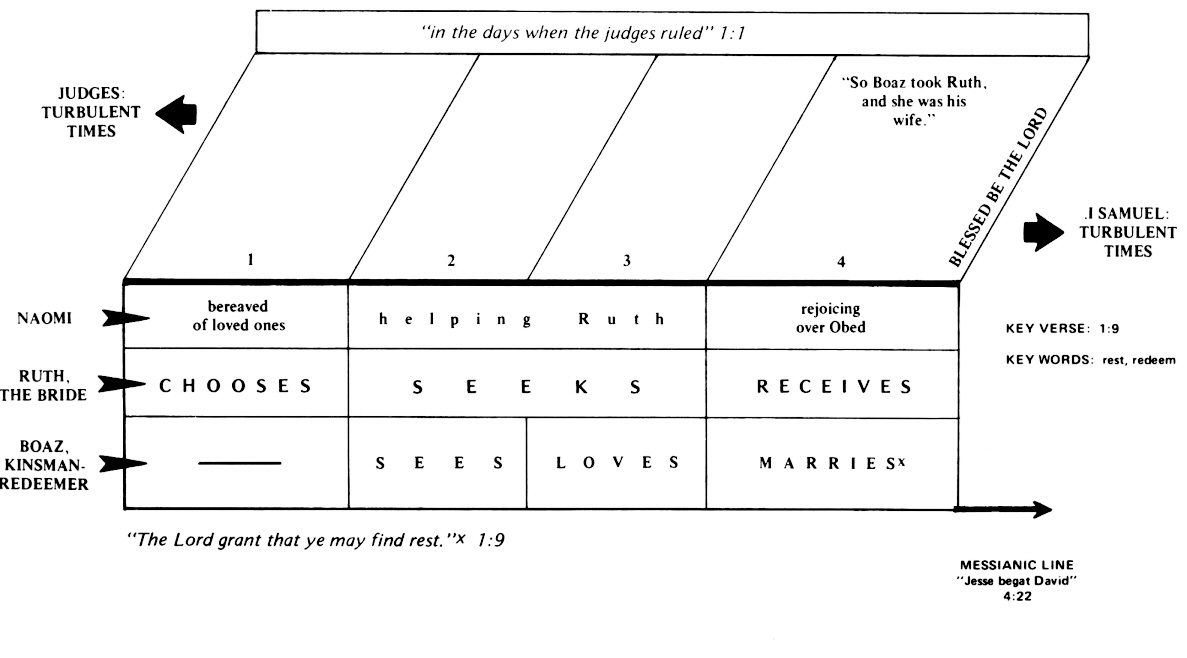
Irving Jensen's Survey of Bible (see his summary of Ruth online - page 392)
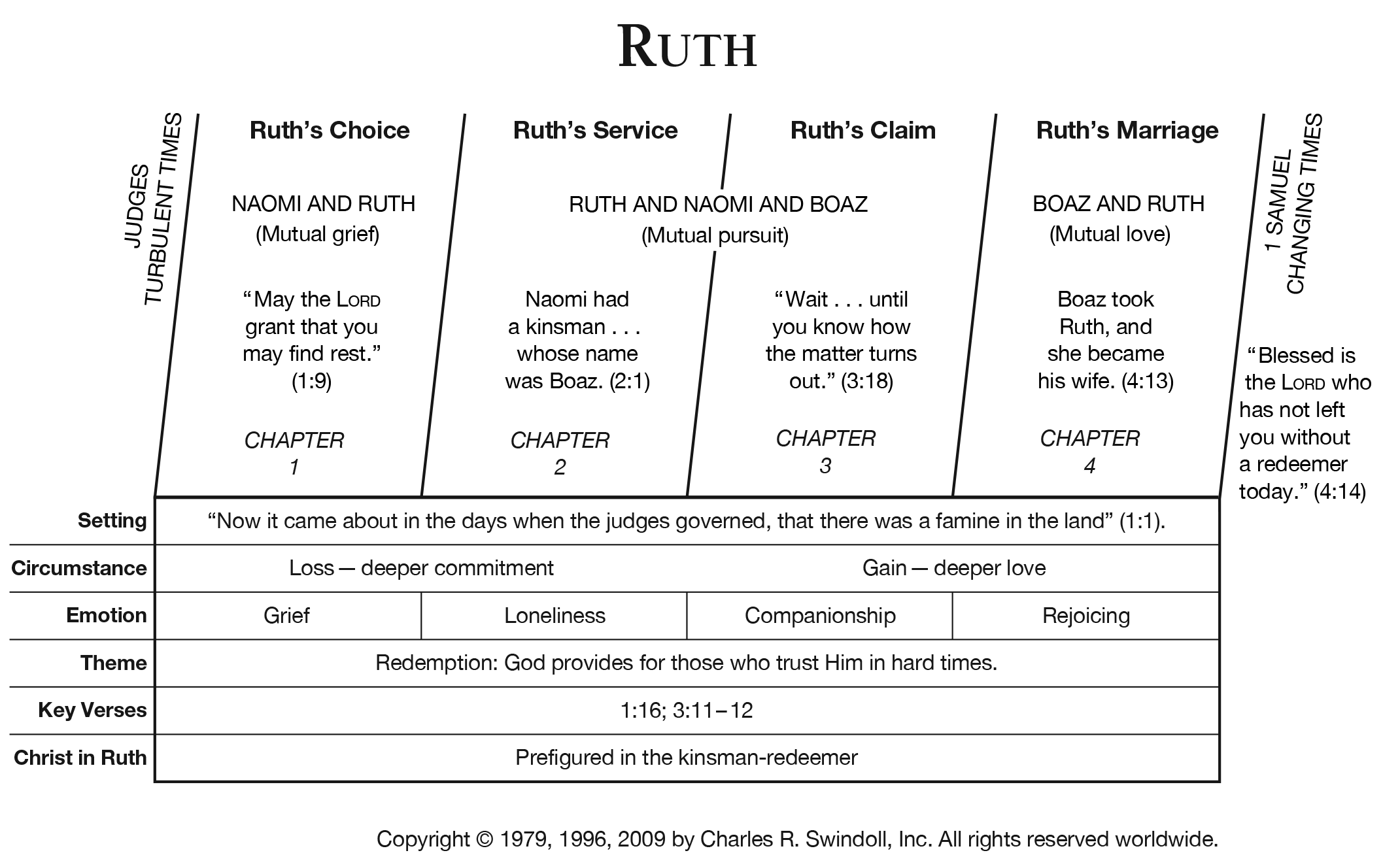
See Swindoll's summary chart of Ruth See Ruth Devotionals
|
RUTH: GOD PROVIDES |
|||
| Ruth 1 | Ruth 2 | Ruth 3 | Ruth 4 |
| Ruth's Choice | Ruth's Service | Ruth's Claim | Ruth's Marriage |
| Ruth's Resolve | Ruth's Rights | Ruth's Request | Ruth's Reward |
| Naomi and Ruth Mutual Grief |
Ruth and Naomi and Boaz Mutual Pursuit |
Boaz and Ruth Mutual Love |
|
| Ruth's Decision: Return with Naomi |
Ruth's Devotion: Provide for Naomi |
Ruth's Request: Redemption by Boaz |
Ruth's Reward: Relative of Messiah |
| Ruth and Naomi |
Ruth and Boaz |
||
| Death of Naomi's Family |
Ruth Cares for Naomi |
Boaz Cares for Ruth |
God Blesses with New Birth |
| Grief | Loneliness | Companionship | Rejoicing |
| Location: Plains of Moab |
Location: Fields of Bethlehem |
Location: Threshing floor of Bethlehem |
Location: Little town of Bethlehem |
| Time Lapsed: About 30 Years See Timeline |
|||
| Setting: Ru 1:1 Now it came about in the days when the judges governed Jdg 21:25+ In those days there was no king in Israel; everyone did what was right in his own eyes. |
|||

Ruth 2:12 "May the LORD reward your work, and your wages be full from the LORD, the God of Israel, under whose wings you have come to seek refuge." (NASB: Lockman)
Amplified: The Lord recompense you for what you have done, and a full reward be given you by the Lord, the God of Israel, under Whose wings you have come to take refuge! (Amplified Bible - Lockman)
BBE: The Lord give you a reward for what you have done, and may a full reward be given to you by the Lord, the God of Israel, under whose wings you have come to take cover.
GWT: May the LORD reward you for what you have done! May you receive a rich reward from the LORD God of Israel, under whose protection you have come for shelter." (GWT)
KJV: The LORD recompense thy work, and a full reward be given thee of the LORD God of Israel, under whose wings thou art come to trust.
Young's Literal: Jehovah doth recompense thy work, and thy reward is complete from Jehovah, God of Israel, under whose wings thou hast come to take refuge.'
Septuagint (LXX): apoteisai (3SAAO) kurios ten ergasian sou kai genoito (3SAMO) o misthos sou pleres para kuriou theou Israel pros on elthes (2SAAI) pepoithenai (RAN) hupo tas pterugas autou
English of Septuagint: The Lord recompense thy work; may a full reward be given thee of the Lord God of Israel, to whom thou hast come to trust under his wings
MAY THE LORD REWARD YOUR WORK AND YOUR WAGES BE FULL FROM THE LORD THE GOD OF ISRAEL:
- 1Sa 24:19; Ps 19:11; 58:11; Pr 11:18; 23:18; Mt 5:12; 6:1, 10:41, 10:42; Lk 6:35; 14:12, 13, 14; Col 2:18; 2Ti 1:18; 4:8; Heb 6:10; 11:6, 11:26
- Ruth 2 Resources - Multiple Sermons and Commentaries
BOAZ PRAYS
AUDIBLY FOR RUTH
May the LORD (Jehovah/Yahweh) reward (salam/shalam) your work - Boaz prays for Ruth and he himself becomes part of God’s answer! In Ruth 3:9+ we see a similar metaphor used by Ruth as she appeals to Boaz to assume the role of her kinsman redeemer…
And he said, "Who are you?" And she answered, "I am Ruth your maid. So spread your covering (Hebrew = kanaph = wing here in Ru 2:12) over your maid, for you are a close relative (Goel = a Kinsman-Redeemer)."
And so we see that God provides Ruth with a kinsman-redeemer (Boaz) and a son Obed who is in the line of David and ultimately the Messiah (her wages were certainly "full").
ESV points out that "Only the Lord could repay, i.e., make restitution for Ruth’s losses of husband, father, mother, and country. Full reward (Hb. maskoret) is compensation commensurate with her loss—perhaps offspring, like Abraham’s “reward” (Gen. 15:1-5, Hb. sakar, from the same root) and Leah’s “wages” (Gen. 30:18, Hb. sakar; cf. Ruth 4:12). On both counts Boaz himself will become the Lord’s answer to Boaz’s own prayer. (See ESV Study Bible)
Hubbard on may...reward - Significantly, the key verb (šlm, Piel) means “to make whole, to complete.” It refers either to the final completion of an action begun earlier or to the restoration of a wholeness disturbed earlier. An economic term for transactions involving compensation or repayment, šlm means basically “to restore, to replace with an equivalent.” That its parallel line has economic terms confirms that šlm has its economic sense here. In the present case, the repayment due derived from Ruth’s prior action (pōʿal), an oblique reference to the loyalty summarized in v. 11 Behind this prayer stood the principle that Yahweh repaid people according to their deeds (pōʿal; Jer. 25:14; Ps. 28:4; Job 34:11; Prov. 24:12; cf. Isa. 1:31, where a man’s evil pōʿal sowed the seeds of his downfall; Phil. 4:18–19). In short, as a debtor to Ruth, Yahweh was asked to pay off his account (cf. Prov. 19:17). Indeed, the language implied that the debt was so large that only Yahweh himself could repay it. (See context in The Book of Ruth)
Notice how God often uses one who prays as His agent to answer that prayer. Boaz was the human agent for both the present and future recompense for Ruth. If you pray for others to be blessed by God, do not be surprised if God asks you, as He did Boaz, to give of yourself and your substance to provide the blessing for others.
Reward (07999) (salam/shalam) means to restore, to repay, to make restitution; to reward; to make a covenant of peace.
The Septuagint translates in the Greek with the verb apotino which in secular Greek was a technical term to describe payment for damages and means to repay, to make compensation (Philemon 1:19 is the only NT use).
Brown-Driver-Briggs' Definition emphasizes the aspect of peace = To be in a covenant of peace, be at peace. (Qal) = to be at peace, peaceful one (participle). (Pual) = one in covenant of peace (participle). (Hiphil) = to make peace with, to cause to be at peace. (Hophal) = to live in peace. (Qal) = to be complete, be sound.
NAS Usage - completed(1), finished(3), fulfill(1), fully repay(1), make(2), make an end(2), make it good(2), make full restitution(1), make restitution(9), over(1), paid(1), pay(19), pay back(1), paying(1), pays(1), pays back(1), perform(2), performed(1), performing(1), performs(1), present(1), recompense(3), recompenses(1), render(2), rendering(2), repaid(3), repay(19), repays(3), restore(2), reward(3), rewarded(3), surely make restitution(2), surely pay(1), without harm(1). Shalam - 94 v in NAS (107 in KJV) -Ge 44:4; Ex 21:34, 36; 22:1, 3ff, 9, 11ff; Lev 5:16; 6:5; 24:18, 21; Deut 7:10; 23:21; 32:41; Jdg 1:7; Ruth 2:12; 1 Sam 24:19; 2 Sam 3:39; 12:6; 15:7; 1 Kgs 7:51; 9:25; 2Ki 4:7; 9:26; 2 Chr 5:1; Neh 6:15; Job 8:6; 9:4; 21:19, 31; 22:27; 23:14; 34:11, 33; 41:11; Ps 22:25; 31:23; 35:12; 37:21; 38:20; 41:10; 50:14; 56:12; 61:8; 62:12; 65:1; 66:13; 76:11; 116:14, 18; 137:8; Prov 6:31; 7:14; 11:31; 13:13, 21; 19:17; 20:22; 22:27; 25:22; Eccl 5:4f; Isa 19:21; 38:12f; 44:26, 28; 57:18; 59:18; 60:20; 65:6; 66:6; Jer 16:18; 18:20; 25:14; 32:18; 50:29; 51:6, 24, 56; Ezek 33:15; Hos 14:2; Joel 2:25; 3:4; Jonah 2:9; Nah 1:15
As the psalmist records "Surely there is a reward for the righteous. Surely there is a God who judges on earth!" (Ps 58:11)
But Jesus also warned us that one's motive will radically affect one's reward "Beware of practicing your righteousness before men to be noticed by them; otherwise you have no reward with your Father who is in heaven. (Mt 6:1+, cf 1Co 4:5+)
Paul in some of his last recorded words spoke of a reward reminding us that "In the future there is laid up for me the crown of righteousness, which the Lord, the righteous Judge, will award to me on that day; and not only to me, but also to all who have loved (present tense = continuous, habit of one's life) His appearing. (2Ti 4:8+) Who will receive the crown of righteousness according to Paul?
What does the writer of Hebrews add? "And without faith it is impossible to please Him, for he who comes to God must believe that He is and that He is a rewarder of those who seek Him." (Heb 11:6+)
What then can one conclude about Ruth but that she had faith and was righteous because of her faith.
The writer of Hebrews also encouraged the afflicted Hebrew saints much like Boaz had encouraged Ruth writing that "God is not unjust so as to forget your work and the love which you have shown toward His name, in having ministered and in still ministering to the saints." (Heb 6:10+)
John Butler writes that "Boaz prayed that Ruth would be given all the reward due her. He prayed that her cup would be filled to the top. She had been "full" in her consecration in coming to Judah, and a full consecration will bring a "full" compensation. "Full" obedience brings "full" reward. Many cut short their reward because they do not fully obey; they do not fully dedicate themselves to God's work. If you have not been "full" in obedience and dedication, do not complain if your reward is small. You have only yourself to blame. (Ruth Ancestress of Christ)
All believers would do well to emulate Ruth's sterling example (cp He 6:12+, He 13:7+) and follow Paul's exhortation that in "Whatever you do, do your work heartily, as for the Lord rather than for men knowing that from the Lord you will receive the reward of the inheritance. It is the Lord Christ Whom you serve. (Col 3:23, 24+)
Ruth's attitude and actions parallel those of Moses who "by faith… when he had grown up, refused to be called the son of Pharaoh's daughter, choosing rather to endure ill-treatment with the people of God, than to enjoy the passing pleasures of sin" for he considered "the reproach of Christ greater riches than the treasures of Egypt; for he was looking to the reward." (Heb 11:24-26+)
Working in the vineyard,
Working all the day,
Never be discouraged,
Only watch and pray;
Do your duty nobly,
Heart and hand unite,
Minding the watchword,
Stand by the right,
Minding the watchword,
Stand by the right.”
--Fanny Crosby
And your wages (maskoreth) be full (shalem) from the LORD the God of Israel - Boaz is not teaching that we can merit wages, for all Yahweh bestows is based on His grace, His unmerited favor (cf Jas 1:17). But God does bless obedience and to be sure Ruth was being obedient to care for widows in their distress.
Shalem conveys the concept of meeting one's obligation in full. Boaz knew what Ruth had done for man, and what she had given up for God. Her wages, as he now assured her, would be recompensed for the one, and a full reward of the other, and that from Jehovah, the God of Israel, under Whose wings she had come to trust.
Hubbard - If Naomi railed against God as incompetent cosmic ruler (Ruth 1:20–21), Boaz here invoked him as Israel’s caring covenant partner. Specifically, in that role, Boaz added, he was not only a rewarder but a refuge for Ruth. (See context in The Book of Ruth)
The God of Israel - 144v - Exod. 5:1; Exod. 24:10; Exod. 32:27; Exod. 34:23; Num. 16:9; Jos. 7:13; Jos. 7:19; Jos. 7:20; Jos. 8:30; Jos. 9:18; Jos. 9:19; Jos. 10:40; Jos. 10:42; Jos. 13:14; Jos. 13:33; Jos. 22:16; Jos. 22:24; Jos. 24:2; Jos. 24:23; Jdg. 4:6; Jdg. 5:3; Jdg. 5:5; Jdg. 6:8; Jdg. 11:21; Jdg. 11:23; Ruth 2:12; 1 Sam. 1:17; 1 Sam. 5:7; 1 Sam. 5:8; 1 Sam. 5:10; 1 Sam. 5:11; 1 Sam. 6:3; 1 Sam. 6:5; 1 Sam. 10:18; 1 Sam. 14:41; 1 Sam. 20:12; 2 Sam. 7:27; 2 Sam. 23:3; 1 Ki. 1:30; 1 Ki. 1:48; 1 Ki. 8:15; 1 Ki. 8:17; 1 Ki. 8:20; 1 Ki. 8:23; 1 Ki. 8:25; 1 Ki. 11:9; 1 Ki. 11:31; 1 Ki. 17:1; 2 Ki. 9:6; 2 Ki. 10:31; 2 Ki. 14:25; 2 Ki. 18:5; 2 Ki. 19:15; 2 Ki. 19:20; 2 Ki. 21:12; 1 Chr. 4:10; 1 Chr. 5:26; 1 Chr. 16:36; 1 Chr. 17:24; 1 Chr. 28:4; 2 Chr. 2:12; 2 Chr. 6:4; 2 Chr. 6:7; 2 Chr. 6:10; 2 Chr. 6:14; 2 Chr. 6:16; 2 Chr. 6:17; 2 Chr. 29:7; 2 Chr. 34:23; Ezr. 1:3; Ezr. 3:2; Ezr. 5:1; Ezr. 6:14; Ezr. 6:22; Ezr. 7:15; Ezr. 8:35; Ezr. 9:4; Ps. 41:13; Ps. 59:5; Ps. 68:8; Ps. 68:35; Ps. 72:18; Ps. 106:48; Isa. 17:6; Isa. 21:10; Isa. 24:15; Isa. 29:23; Isa. 37:16; Isa. 37:21; Isa. 41:17; Isa. 45:3; Isa. 48:1; Isa. 48:2; Isa. 52:12; Jer. 7:3; Jer. 7:21; Jer. 9:15; Jer. 11:3; Jer. 13:12; Jer. 16:9; Jer. 19:3; Jer. 19:15; Jer. 25:15; Jer. 25:27; Jer. 27:4; Jer. 27:21; Jer. 28:2; Jer. 28:14; Jer. 29:4; Jer. 29:8; Jer. 29:21; Jer. 29:25; Jer. 30:2; Jer. 31:23; Jer. 32:14; Jer. 32:15; Jer. 35:13; Jer. 35:17; Jer. 35:18; Jer. 35:19; Jer. 38:17; Jer. 39:16; Jer. 42:9; Jer. 42:15; Jer. 42:18; Jer. 43:10; Jer. 44:2; Jer. 44:7; Jer. 44:11; Jer. 44:25; Jer. 45:2; Jer. 46:25; Jer. 48:1; Jer. 50:18; Jer. 51:33; Ezek. 8:4; Ezek. 9:3; Ezek. 10:19; Ezek. 10:20; Ezek. 11:22; Ezek. 43:2; Zeph. 2:9; Mal. 2:16; Matt. 15:31
Wages (04909) (maskoreth from sakar = to hire) conveys the basic idea of engaging the services of a person in return for pay. Maskoreth is used only 4 times - Ge 29:15, 31:7, 31:41 and Ru 2:12. All the Genesis uses are in the context of Jacob's working for Laban and being compensated by Laban's offer of Rachel, only to be deceived and receive Leah instead of Rachel. After fleeing Laban with his wives and family Laban overtook Jacob who declared "For 20 years I have worked in your household—14 years for your two daughters and six years for your flocks—and you have changed my wages (maskoreth) 10 times!"
The Septuagint translates with the Greek word misthos which is often used in the sense of a reward to be received in the hereafter. In the Revelation the greater Kinsman-Redeemer says "Behold, I am coming quickly, and My reward (misthos) is with Me, to render to every man (and woman) according to what he has done. (Rev 22:12+)
THOUGHT - Are living for time or eternity? Are you so focused on earthly rewards that you have lost sight of the amazing truth that our Kinsman-Redeemer will graciously (it's all by grace) give us eternal rewards for our work in time work wrought by "abiding in the Vine" (Jn 15:5) ?
Boaz's words are reminiscent of the encouraging words God spoke to Abram saying "Do not fear, Abram, I am a shield to you. Your reward (sakar) shall be very great. (Ge 15:1+)
Full (08003) (shalem from root verb shalam = denotes perfection in the sense that a condition or action is "complete" = to be complete, be sound; to be in a covenant of peace, be at peace) is an adjective which describes that which is complete, safe, peaceful, perfect, whole, full, at peace. "The general meaning behind the root š-l-m is of completion and fulfillment—of entering into a state of wholeness and unity, a restored relationship." (TWOT) Brown-Driver-Briggs - (1) complete - full, perfect, finished (2) safe, unharmed (3) peace (of covenant of peace, mind) - perfect, complete (of keeping covenant relation).
"Adjectivally, shālēm is used of an attitude (a "perfect" heart; e.g. 1 Kings 8:61; 1 Chron. 28:9), and of a complete amount (of money, Ruth 2:12; of sin, Genesis 15:16; of a whole nation, Amos 1:6, 9). An accurate weight is called "perfect" (Deut. 25:15) or "just" (Proverbs 11:1). Interesting is that shālēm is used of the whole (i.e. uncut) stones for the altar (Deut. 27:6; Joshua 8:31) and also of the dressed stones used for the temple (1 Kings 6:7)." (TWOT)
Gilbrant - The basic idea of the adjective shalem is "being complete," "whole," "total" or "full." The iniquity of the Amorites was not yet full in Abraham's day, and therefore they were not ready to be punished (Gen. 15:16). Boaz called for a full reward for Ruth (Ruth 2:12). The building of the Temple was said to be completed or finished (2 Chr. 8:16). An accurate, fair weight is a full weight or one which is complete, that is, all there (Deut. 25:15). Then there is the idea of a whole stone, in the context of not being cut by anyone, which God required for his altar (27:6). To come through whole was to arrive safely (Gen. 33:18). This word can also refer to "being peaceful" and thus could describe people as being friendly (34:21). Finally, the most common use of shālfim is the idea of a person, especially the kings of Judah, being wholly devoted to the Lord (1 Ki. 8:61) or doing something wholeheartedly (2 Chr. 19:9). (Complete Biblical Library)
Swanson (abbreviated) - 1. completely, fully, richly, i.e., pertaining to what is fully accomplished (Ge 15:16; Ru 2:12+); 2. safe, i.e., pertaining to not being in danger (Ge 33:18); 3. friendly, i.e., pertaining to being in a relatively close association, personal or governmental (Ge 34:21; Na 1:12); 4. accurate, i.e., pertaining to that which is true to an accepted norm or standard (Dt 25:15; Pr 11:1); 5. whole, i.e., pertaining to the totality of a collection (Am 1:6, 9; Dt 27:6; Jos 8:31; 1Ki 6:7), note: in context, refers to towns, and whole, uncut stone; 6. fully devoted, i.e., have a great love and zeal, implying obedience (1Ki 8:61; 11:4; 15:3, 14; 2Ki 20:3; 1Ch 12:38; 28:9; 29:9, 19; 2Ch 15:17; 16:9; 19:9; 25:2; Isa 38:3)
The first use is in Ge 15:16 “Then in the fourth generation they shall return here, for the iniquity of the Amorite is not yet complete.” (Lxx = anapleroo = literally filled up, made complete, cp use in 1Thes 2:16).
Shalem - 27v in OT - NAS usage of shalam = blameless(1), complete(1), completed(1), completely(1), devoted(4), entire(2), friendly(1), full(4), just(1), perfect(2), prepared(1), safely(1), uncut(2), whole(5), wholeheartedly(1), wholly(4). Gen. 15:16; Gen. 33:18; Gen. 34:21; Deut. 25:15; Deut. 27:6; Jos. 8:31; Ruth 2:12; 1 Ki. 6:7; 1 Ki. 8:61; 1 Ki. 11:4; 1 Ki. 15:3; 1 Ki. 15:14; 2 Ki. 20:3; 1 Chr. 12:38; 1 Chr. 28:9; 1 Chr. 29:9; 1 Chr. 29:19; 2 Chr. 8:16; 2 Chr. 15:17; 2 Chr. 16:9; 2 Chr. 19:9; 2 Chr. 25:2; Prov. 11:1; Isa. 38:3; Amos 1:6; Amos 1:9; Nah. 1:12
Shalem reminds me of the Hanani's words to King Asa who had initially trusted God for deliverance but later trusted in his own strength (cf 2Ch 16:7,8+) - “For the eyes of the LORD move to and fro throughout the earth that He may strongly support those whose heart is completely (shalem) His. You have acted foolishly in this. Indeed, from now on you will surely have wars.” (2 Chr. 16:9+) Note that completely (shalem) describes a whole heart, one that Yahweh will strongly support. Oh, God give us all a passion for a whole heart in Christ. Amen!
The Septuagint translates shalem with the Greek adjective pleres which means filled up (as opposed to empty) as of a hollow vessel, and speaks of a totality of something or someone with nothing lacking -- complete, in full, wholly filled.
Ruth 2:1-12 Safety Zone
A full reward be given you by the Lord God of Israel, under whose wings you have come for refuge. —Ruth 2:12
When the horrors of war visited the civilians of Nanjing, China, women were not spared in the mounting violence and many were assaulted and killed. In this threatening environment, Minnie Vautrin took heroic measures to protect Chinese women from harm. Serving as a missionary teacher at Ginling College in Nanjing, Minnie cooperated with Chinese nationals, missionaries, surgeons, and business people and turned the college into a “safety zone,” a place of refuge for thousands of women and girls.
In the Bible, we learn that Ruth and her mother-in-law, Naomi, were in need of some protection too. To survive as widows, they had to glean what they could from the harvested fields. As was the custom, Ruth sought a “kinsman redeemer.” This was a next of kin or close relative to her deceased husband who would marry her to continue the family line. Boaz was just such a man. He was touched by Ruth’s sacrificial care for Naomi and her desire to look for refuge in the Lord (Ruth 2:12). Boaz worked honorably to “redeem” Ruth and to make her his wife. He then provided for her and Naomi.
Our ultimate refuge is in the Lord Himself (Ps. 46:1). Yet He wants to use us as instruments to provide a “safety zone” for others.
In what ways can you meet the needs of others? Check with community ministries or a local church to see how they’re reaching out, and join in. by Dennis Fisher
They truly love who show their love. —Shakespeare
UNDER WHOSE WINGS YOU HAVE COME TO SEEK REFUGE:
- Click for over 30 Hymns relating to God as our Refuge
- Ruth 2 Resources - Multiple Sermons and Commentaries
The ICB translates it "You have come to Him (Jehovah) as a little bird finds shelter under the wings of its mother."
the LORD God of Israel, under whose protection you have come for shelter (GWT)
under whose wings you have come to take cover (BBE)
to whom you have come for protection! (TEV)
GOD'S WINGS
OF REFUGE
Under whose wings (kanaph) you have come to seek refuge (chasah) - NET = "you sought protection" Clearly this is a metaphor. We all know what wings look like, but maybe not everyone has been raised on a farm as I was and used to watch the baby chicks scurry under the (mad) mother's wings as I got closer and closer! I can assure you, when she did this, I would back away. Those baby chicks were protected! What is amazing is that they knew where to run when I got too close. And they trusted their instincts. So this metaphor speaks of God's protection and provision of security. But it also speaks of our trust in His protection and security. So here in Ruth 2:12 chasah/hash figuratively speaks of Ruth putting her trust in Jehovah. The KJV pick us this latter nuance, translating the passage as under Whose wings thou hare come to trust. Ru 2:12KJV
Hubbard - Boaz pictured Ruth as a defenseless young bird now safely under the warm wings of Yahweh that spread over Israel. Thematically, this image followed up Ru 1:16–17; through that commitment she had come to (bāʾṯ, lit. “entered”; see 1:19) the secure realm of Yahweh’s protection....In sum, through Boaz’s brief prayer, the narrator subtly linked Ruth’s actions with Yahweh’s presence implied in the earlier blessings (Ru 2:4). (See context in The Book of Ruth)
- Play & watch On Eagle's Wings
- Play — "You Are My Hiding Place/As A Deer"
- Or the version by Selah - You Are My Hiding Place
Wings (03671) (kanaph) is a noun used to describe a wing, a skirt or corner of a garment. Kanaph conveys the basic meaning of to cover or to describe an attached extremity. The first use of kanaph describes Jehovah's creation of "every winged bird." (Ge 1:21, cp Ge 7:14, Ex 19:4, Isa 8:8). It is used in Scripture as a beautiful illustration of several facets of Jehovah's care for His children as used in Ex19:4 ‘You yourselves have seen what I did to the Egyptians, and how I bore you on eagles’ wings, and brought you to Myself." Kanaph is used idiomatically meaning to spread one’s wings over another which means to take to wife (Ezek. 16:8). Other idiomatic uses are of an attacking king (Isa. 18:1; Jer. 48:40; 49:22; Ezek. 17:3, 7). Malachi uses kanaph to describe the healing wings of God’s Sun of righteousness (Mal. 4:2). Jehovah is often pictured as providing a shadow of protection for His people under His wings (Ru 2:12; Ps. 17:8; 36:7; 57:1; 61:4; 63:7; 91:4).
Kanaph is used of wings of cherubim (1Ki. 6:24); seraphs (Isa. 6:2); visionary beings like women (Zech. 5:9); insects (Isa. 18:1). Kanaph takes on the sense of the outer edges (garment - 1Sa 15:27), corners, or extremities of something, living or inanimate, and metaphorically for example refers to the end(s) of the world (Isa. 11:12; 24:16; Ezek. 7:2).
Vine - Kanaph has maintained its meaning in rabbinic and modern Hebrew. The word “wing” appears 109 times in the Hebrew Old Testament, with particular concentration in the description of the 2 cherubim of wood in Solomon’s temple and in Ezekiel’s vision of the “creatures,” or cherubim. Elsewhere the Bible speaks of “wings” of the cherubim (Ex. 25:20; 37:9) and of the seraphim (Isa. 6:2). As an extension of the usage “wing,” kanaph signifies “extremity.” The seam or lower part of a garment was known as the kanaph. In the “fold” (kanaph) of the garment one could carry things (Hag 2:12). Saul tore the edge (kanaph) of Samuel’s robe (1Sa 15:27). The extremity of a land on the world was also known by the word kanaph and is translated by “corner” (or ends) in English (Isa. 11:12; cf. Job 37:3; 38:13; Ezek. 7:2). In the metaphorical use God is said to protect His people as a bird protects her young with her “wings” (Dt. 32:11). The psalmist expressed God’s care and protection as a “shadow” of the “wings” (Ps. 17:8; cf. 36:7; 57:1; 61:4; 63:7; 91:4). In keeping with this usage Malachi looked forward to a new age, when “the Sun of righteousness [will] arise with healing in his wings.” (Mal 4:2). When the nations are compared to birds, the association is that of terror and conquest. This is best expressed in Ezekiel’s parable of the two eagles and the vine (Ezek. 17:3-4). The believer is enjoined to seek refuge with God when adversity strikes him or adversaries surround him (Ps. 91:4) The Septuagint gives the following translations: pteruks (“wing; pinion”); pterugion (“end; edge”); and pteroros (“feathered; winged”)
Kanaph - 85v in the OT (Are you in need of Word of encouragement from Jehovah? Who isn't? Then set aside a few minutes and meditate on the uses of "wing" in the Psalms) - The NAS renders kanaph as bird(1), corner(1), corners(4), covering(1), each other(1), edge(5), edges(1), ends(3), fold(2), garment(1), kind(3), skirt(3), skirts(1), sorts(1), wing(14), winged(5), wings(59), wingspan(1). Ge 1:21; 7:14; Ex 19:4; 25:20; 37:9; Lv. 1:17; Num. 15:38; Dt. 4:17; 22:12, 30; 27:20; 32:11; Ruth 2:12; 3:9; 1Sa 15:27; 24:4f, 11; 2Sa 22:11; 1Ki 6:24, 27; 8:6, 7; 2Chr 3:11, 12, 13; 5:7, 8; Job 37:3; 38:13; 39:13, 26; Ps 17:8; 18:10; 36:7; 57:1; 61:4; 63:7; 68:13; 78:27; 91:4; 104:3; 139:9; 148:10; Pr 1:17; 23:5; Eccl 10:20; Isa. 6:2; 8:8; 10:14; 11:12; 18:1; 24:16; Je 2:34; 48:40; 49:22; Ezek 1:6, 8, 9, 11, 23, 24, 25; 3:13; 5:3; 7:2; 10:5, 8, 12, 16, 19, 21; 11:22; 16:8; 17:3, 7, 23; 39:4, 17; Da 9:27; Ho 4:19; Hag 2:12; Zec 5:9; 8:23; Mal 4:2
(Ps 17:8) Keep me as the apple of the eye; Hide me in the shadow of Thy wings, (What a great prayer to pray!)
(Ps 18:10) And He rode upon a cherub and flew; And He sped upon the wings of the wind.
(Ps 36:7) How precious is Thy lovingkindness, O God! And the children of men take refuge in the shadow of Thy wings.
(Ps 57:1) For the choir director; set to Al-tashheth. A Mikhtam of David, when he fled from Saul, in the cave. Be gracious to me, O God, be gracious to me, For my soul takes refuge in Thee; And in the shadow of Thy wings I will take refuge, Until destruction passes by.
(Ps 61:4) Let me dwell in Thy tent forever; Let me take refuge in the shelter of Thy wings. Selah.
(Ps 63:7) For Thou hast been my help, And in the shadow of Thy wings I sing for joy.
(Ps 68:13) When you lie down among the sheepfolds, You are like the wings of a dove covered with silver, And its pinions with glistening gold.
(Ps 78:27) When He rained meat upon them like the dust, Even winged fowl like the sand of the seas,
(Ps 91:4) He will cover you with His pinions, And under His wings you may seek refuge; His faithfulness is a shield and bulwark.
(Ps 104:3) He lays the beams of His upper chambers in the waters; He makes the clouds His chariot; He walks upon the wings of the wind;
(Ps 139:9) If I take the wings of the dawn, If I dwell in the remotest part of the sea,
(Ps 148:10) Beasts and all cattle; Creeping things and winged fowl;
(Mal 4:2-note) “But (Note the dramatic contrast in Mal 4:1!) for you who fear My name the Sun of righteousness will rise with healing in its (His) wings; and you will go forth and skip about like calves from the stall.
The TWOT explains that…
Only ten of the occurrences of this noun literally refer to a bird. Of these ten references, in at least eight “wing” is used to qualify “bird” (cf. Ge 1:21 “every fowl of a wing”).
Many more references use the term figuratively, most of these referring to God and most having a positive connotation.
The deliverance from Egypt is twice described in terms of God bearing His people upon eagle’s wings (Ex 19:4; Dt 32:11). But mostly he is seen as sheltering his own beneath his wings as a hen does her chicks (Ps 17:8; Ru 2:12).
Commonly some statement of God’s proven trustworthiness is related to the statement of an intent to seek shelter under His wings (Ps 36:7).
Malachi 4:2 speaks of the Sun of righteousness (Messiah Jer 23:6) rising with healing in his wings. Evidently this is an appropriation of the winged sun disc symbol which is used throughout the ancient near east as a manifestation of the deity’s protection. The appropriation of this ancient theme in a prediction of Christ is very significant. He alone is the true manifestation of God’s benevolence and he comes to heal (not merely protect) those who cast away their pride through fear of God.
However those wings which offer deliverance and security to those who fear him, can bring terror to those who defy him.
Jer 48:40; 49:22 tell that God will spread his eagle’s wings over Moab and destroy them, just as an eagle may swoop upon a hapless rabbit. In Isa 8:8 Assyria is the eagle overshadowing Judah (cf. also Ezek 17:3, 7). (See online TWOT)
For example in Ex 19:4+ we see the picture of provision of deliverance (from bondage) as God reminded Israel
You yourselves (speaking to Israel) have seen what I did to the Egyptians (the Red Sea), and how I bore you on eagles' wings, and brought you to Myself.
Rob Salvato explains eagle's wings figure of speech: Here is this idea that is seen again of the Lord bearing up His People on Eagles wings – seen throughout the Bible – what is this about. It is somewhat confusing to us but would make perfect sense to these people camping in this region, for eagles were prevalent. Eagles have an interesting way of nurturing and training their young. When the mother eagle builds the nest, it is on the side of a cliff. She gathers several somewhat sharp sticks pointing in towards the nest. When the little baby eaglet is born the mother eagle brings it food ( Breakfast lunch & Dinner) and the little eaglet lives there in the comforts of the nest until it gets so big that the sticks begin to poke at it. Suddenly that nest is not quite as comfortable as it once was – but there is a reason for that – The mother eagle doesn’t want that little eaglet living in the nest the rest of his life. So then, the mother eagle does a most Interesting thing. She stirs up the nest which causes the baby eaglet to fall out… falling… falling and wondering "What is up with my Mom?" (Call & report her to CPS!) But as the Eaglet falls 100 ft or so, suddenly the mother eagle swoops down, catches the baby eaglet and bears it up on her wings back to nest -safe and comfortable again – accept for the poking sticks! And then the mother repeats this ritual -- over and over until the eaglet spreads out his wings catches a wind draft & begins to fly (soar)!
This is the Reason why God does this at times – He stirs up the nest because He wants us to learn what it means to sore how to fly – That is what the Lord was doing with Israel through the previous stops for in each situation He was bearing them up and allowing them to fall a little further so that they would learn to do what was promised in Isaiah 40:31. Now waiting on the Lord is different from waiting for the Lord – wait – for in Acts 1:4 which was fulfilled in Acts 2 at Pentecost, not doing anything until the promise was fulfilled (Acts 1:4). But waiting on the Lord is actually an active process, walking in (faith/obedience to) the truths that we know and walking in the Promises that have been declared (2Pe 1:4). God wanted Israel to keep walking and moving on the Journey because He wanted them believing that He was going to do just what He said He would accomplish. So the Lord tells Moses to remind Israel of His Love and How He bore them up on Eagles Wings (On My Back) (Modified from Exodus 19:1-4)
Woodrow Kroll comments: A friend told me that when he was a young boy, he lived on one side of his small town and the school he attended was located on the other. Bus transportation was limited to the students who lived out of the city limit, so he had to walk many blocks both to and from school. "After a tiring day at school," my friend explained, "I would sometimes fantasize on my way home of having wings that would lift me over all the houses and trees and deposit me directly on my front porch."
It was wings like these that God figuratively used to bring Israel to Himself. In spite of the obstruction of Pharaoh and his army, through the barrier of a seemingly uncrossable sea, over the hurdle of a dry and barren wilderness, God lifted His people up and brought them safely to their destination. No obstacle was allowed to stand between Him and those He loved.
Are you facing obstacles today that threaten your joy as a Christian? Maybe these obstacles are health problems, financial struggles or family relationships. Perhaps you are frustrated by circumstances beyond your control. Well, don't fantasize as my friend did. Instead, look to God's mighty wings to lift you up and carry you to where He wants you to be. Remember the promise of Isaiah 40:31: "But those who wait on the Lord shall renew their strength; they shall mount up with wings like eagles, they shall run and not be weary, they shall walk and not faint." Claim that promise today. (Back to the Bible)
Dave Guzik comments: God's love and care was shown for Israel already, as He bore you on eagle's wings. It is said that an eagle does not carry her young in her claws like other birds; the young eagles attach themselves to the back of the mother eagle and are protected as they are carried. Any arrow from a hunter must pass through the mother eagle before it could touch the young eagle on her back. The deliverance (I bore you on eagles' wings) was for fellowship (brought you to Myself); God didn't deliver Israel so they could "do their own thing," but so they could be God's people. God intended for Israel to be a special treasure unto Him; a people with a unique place in God's great plan, a people of great value and concern to God. (Exodus 19) (See also Exodus -John Gill)
Scott Grant comments: Then the Lord bore the people on eagle's wings. This is a reference to the people's three-month journey from Egypt to Mount Sinai. The Lord led them away from a battle they were not ready for, He crushed Pharaoh's army, He provided them with food and water, He gave them victory over the Amalekites and He brought Jethro to give them important instructions. It's been an incredible trip, one they never could have navigated on their own.
Thus, the picture of an eagle carrying her chick is apt - and beautiful. An eaglet is helpless. It has no ability to provide for itself or get from one place to another. Like an eaglet, Israel was helpless. It would have perished in the wilderness without the Lord. But the Lord, like a strong eagle caring for its helpless chick, led and provided for His people for three months. Like the eagle who tenaciously clings to her chick as she soars through the air, the Lord tenaciously clung to His people. He did not drop them; He could not drop them. In so many words, the Lord is telling the people, "I poured out my heart for you."
If this were all He did, it would be enough to send their spirits soaring. But the journey had a purpose. It was so that He might bring them to Himself. The image here shifts from the Lord as an eagle to the Lord as a king, as we will see in Ex 19:5, 6. The Lord, like an eagle, carries them through the wilderness and deposits them at the foot of Mount Sinai, which is serving as His throne. Then at the mountain, He meets them. (The Lord's treasure chest)
In Dt 32:11 we read…
Like an eagle (simile) that stirs up its nest, that hovers over its young, He (Jehovah) spread His wings and caught them, He carried them on His pinions.
Keil & Delitzsch (Commentary on the Old Testament) has this note…
Under the figure of an eagle, which teaches its young to fly, and in doing so protects them from injury with watchful affection, Moses describes the care with which the Lord came to the relief of His people in their helplessness, and assisted them to develop their strength. This figure no doubt refers more especially to the protection and assistance of God experienced by Israel in its journey through the Arabian desert; but it must not be restricted to this. It embraces both the deliverance of Israel out of Egypt by the outstretched arm of the Lord, as we may see from a comparison with Ex 19:4, where the Lord is said to have brought His people out of Egypt upon eagles' wings, and also the introduction into Canaan, when the Lord drove the Canaanites out from before them and destroyed them.
… It is rendered correctly by the Vulgate, provocans ad volandum pullos suos; and freely by Luther, "bringeth out its young." "Soareth over its young:" namely, in order that, when they were attempting to fly, if any were in danger of falling through exhaustion, it might take them at once upon its powerful wings, and preserve them from harm.
… The point of comparison between the conduct of God towards Jacob and the acts of an eagle towards its young, is the loving care with which He trained Israel to independence. The carrying of Israel upon the eagle's wings of divine love and omnipotence was manifested in the most glorious way in the guidance of it by the pillar of cloud and fire (Shekinah glory cloud), though it was not so exclusively in this visible vehicle of the gracious presence of God as that the comparison can be restricted to this phenomenon alone. Luther's interpretation is more correct than this--" Moses points out in these words, how He fostered them in the desert, bore with their manners, tried them and blessed them that they might learn to fly, i.e., to trust in Him,"-- except that the explanation of the expression "to fly" is narrowed too much.
The psalmist records…
He (Shaddai in Ps 91:1,Jehovah and Elohim in Ps 91:2) will cover you with His pinions, And under His wings you may seek refuge; His faithfulness is a shield and bulwark. (Ps 91:4, read Ps 91:1, 2, 3 for context)
Comment: In loving condescension, God likens Himself to a mother hen sheltering her young from the hawks of the sky and the snares of the field.(Mt 23:37). By natural instinct she not only protects them, but calls them under that protection when she sees them in danger, not only keeps them safe, but cherishes them and keeps them warm. (cp Ru 2:12). Yahweh’s care is both tender and sufficient because he is faithful, i.e., “true” to his people.
Spurgeon comments: He shall cover thee with thy feathers, and under his wings shalt thou trust. A wonderful expression! Had it been invented by an uninspired man it would have verged upon blasphemy, for who should dare to apply such words to the Infinite Jehovah? But as He himself authorized, yea, dictated the language, we have here a transcendent condescension, such as it becomes us to admire and adore. Doth the Lord speak of His feathers, as though He likened Himself to a bird? Who will not see herein a matchless love, a divine tenderness, which should both woo and win our confidence? Even as a hen covers her chickens so does the LORD protect the souls which dwell in Him; let us cower down beneath Him for comfort and for safety.
Under His wings I am safely abiding,
Though the night deepens and tempests are wild,
Still I can trust Him; I know He will keep me,
He has redeemed me, and I am His child.
Refrain
Under His wings, under His wings,
Who from His love can sever?
Under His wings my soul shall abide,
Safely abide forever.
Under His wings, what a refuge in sorrow!
How the heart yearningly turns to His rest!
Often when earth has no balm for my healing,
There I find comfort, and there I am blessed.
Under His wings, oh, what precious enjoyment!
There will I hide till life’s trials are o’er;
Sheltered, protected, no evil can harm me,
Resting in Jesus, I’m safe evermore.
by W O Cushing
Through the prophet Isaiah God encourages wayward Israel that
"Though youths grow weary and tired, and vigorous young men stumble badly, yet those who wait for the LORD will gain new (literally exchange their strength for His strength!) strength. They will mount up with wings like eagles. They will run and not get tired. They will walk and not become weary." (Isa 40:31)
I rest beneath the Almighty’s shade,
My griefs expire, my troubles cease;
Thou, Lord, on Whom my soul is stayed,
Wilt keep me still in perfect peace.
- Charles Wesley (cp Is 26:3)
Have you watched the seagulls catch the updrafts and be effortlessly driven up and away from the dangerous rocky crags?
Praise to the Lord, who over all things so wondrously reigneth,
Shelters thee under His wings, yea, so gently sustaineth!
Hast thou not seen how thy desires ever have been
Granted in what He ordaineth?
(Play and sing Praise to the Lord, the Almighty)
Malachi prophesies that the Jews "who fear (God's) name, the sun of righteousness will rise with healing in its wings and you will go forth and skip about like calves from the stall." (Mal 4:2).
The imagery of a young bird under the wing of its mother is used in the Psalms of one seeking refuge in the Lord and conveys a close relationship of protection and provision which is found in one's intimate relationship with Jehovah.
(David prayed) Keep me as the apple of the eye. Hide me in the shadow of Thy wings." (Ps 17:8-note)
(David declared) How precious is Thy lovingkindness, O God! And the children of men take refuge in the shadow of Thy wings. (Ps 36:7-note)
(David when he fled from Saul in the cave prayed) Be gracious to me, O God, be gracious to me, For my soul takes refuge in Thee; and in the shadow of Thy wings I will take refuge, until destruction passes by. (Ps 57:1-note)
(David prayed) Let me dwell in Thy tent forever; Let me take refuge in the shelter of Thy wings. Selah. (Ps 61:4-note)
(David) For Thou hast been my help (Lxx = boethos) (See also study of Jehovah Ezer: The LORD our Helper), and in the shadow of Thy wings I sing for joy. (Ps 63:7-note)
(Author unknown) He will cover you with His pinions, and under His wings you may seek refuge; His faithfulness is a shield and bulwark. (Ps 91:4-note)
Jesus evokes an image of God similar to that painted by Boaz, lamenting
O Jerusalem, Jerusalem, who kills the prophets and stones those who are sent to her! How often I wanted to gather your children together, the way a hen gathers her chicks under her wings, and you were unwilling. (Mt 23:37)
I was raised on a farm and remember frequently observing the mother hen raise her wings in times of danger to provide a feathered canopy of protection for her otherwise defenseless chicks. For the young, vulnerable chick, the mother's wings promise safety and security. This is the picture Boaz paints for us as he assured Ruth that her unselfish deeds would not go unrewarded. Ruth had abandoned the security of family and the familiar in Moab leaving everything that spoke of safety for the greater, more certain safe refuge under the wings of Jehovah. It behooves us all to recall this image of God to mind the storms of life come, and to hold firmly to the fact that God never abandons His own.
Instead as Woodrow Kroll reassures us "in times of danger and distress, He spreads His wings of protection and comfort over us. Enveloped by His pinions, we do not need to fear the difficult circumstances of life. Personal storms may rage around, but we are safe under the canopy of God's constant care… If you are going through painful times, nestle yourself under His wings. Take comfort in the fact that God's protection is spread over you. Nothing can touch your life without His express permission. Nothing can threaten you without His express protection. God's protection is more than a match for our problems." (Under His Wings)
God Himself is our center of safety. It is not our strength but His that shields us from the fierce winds of circumstance and change.
The psalmist assures us that
He who dwells in the shelter of the Most High (El Elyon: Most High God - Sovereign Over All) will abide in the shadow of the Almighty (EL Shaddai - God Almighty). I will say to Jehovah, "My Refuge and my Fortress, My God, in Whom I trust!" For it is He who delivers you from the snare of the trapper, and from the deadly pestilence. He will cover you with His pinions, (the terminal section of a bird’s wing) and under His wings you may seek refuge (chasah) His faithfulness is a shield and bulwark." (Ps 91:1-4+)
Oh, what wonder! how amazing!
Jesus, glorious King of kings,
Deigns to call me His beloved,
Lets me rest beneath His wings
Seek refuge (02620) (chasah) means to take shelter or flee for protection. To go to a place where one finds safety, rest, comfort. The implication is that the place of refuge is a place that can be trusted to keep one safe (cp Jdg 9:15, 2Sa 22:3, see all uses below).
The TWOT states that chasah/hasah…
While used literally of taking shelter from a rainstorm (Isa 4:6; 25:4; Job 24;8) or from any danger in the high hills (Ps 104:18), is more often used figuratively of seeking refuge and thus putting confident trust whether in any god (Dt 32:37) or in the “shadow” (protection) of any major power such as Egypt (Isa 30:2; cf. the plant in the parable of Jdg 9:15)…
To seek refuge stresses the insecurity and self-helplessness of even the strongest of men. It emphasizes the defensive or external aspect of salvation in God, the unchanging One in whom we “find shelter” (F. D. Kidner, The Psalms, 1973, ad loc Ps 46:1)…
The result of taking refuge in God is to be “blessed” (Ps 2:12) and be “saved” (Ps 17:7). (See online TWOT) (Bolding added
The relationship between seeking God and trusting God is conveyed by the writer of Hebrews who states that…
without faith it is impossible to please Him, for he who comes to God must believe that He is, and that He is a rewarder of those who seek Him. (Heb 11:6+)
The Septuagint also supports the idea that the writer of Ruth is conveying the picture of Ruth fleeing for refuge as an action which expresses her trust in Jehovah. Why do I say that? Because the Septuagint translates chasah/hasah with the Greek verb peitho (see word study) which means to come to a settled persuasion concerning some truth or fact (Acts 17:4). Based upon what Boaz had learned of Ruth, he declares that she had come to a place of settled conviction or confidence (perfect tense of peitho - this tense speaks of permanence) that Jehovah was her God. The picture of her seeking refuge reflects her heart attitude of trust. And remember that we learn the lesson of trust in the school of trial. Ruth's commitment to Jehovah reminds one of Paul's commitment centuries later, declaring
I am convinced (same verb used to translate "seek refuge" = peitho) that He is able to guard what I have entrusted to Him until that day. (2Ti 1:12+)
Chasah/hasah - 36v in the OT (Where are most of the uses?) - The NAS renders chasah as has a refuge(1), seek refuge(3), seek shelter(1), sought refuge(1), take refuge(25), taken refuge(3), takes refuge(3). Deut. 32:37; Jdg. 9:15; Ruth 2:12; 2Sam. 22:3, 31; Ps 2:12; 5:11; 7:1; 11:1; 16:1; 17:7; 18:2, 30; 25:20; 31:1, 19; 34:8, 22; 36:7; 37:40; 57:1; 61:4; 64:10; 71:1; 91:4; 118:8f; 141:8; 144:2; Pr 14:32; 30:5; Is 14:32; 30:2; 57:13; Nah 1:7; Zeph. 3:12.
I trust in God, I know He cares for me
On mountain bleak or on the stormy sea;
Though billows roll, He keeps my soul;
My heavenly Father watches over me. --Martin
The Lord may calm the storm around you,
but more often He'll calm the storm within you.
God has not promised to keep us from life's storms,
but to keep us through them.
Are you between a rock and a hard place?
Take refuge in the Rock of Ages - play hymn.
It is interesting that later Jewish Rabbis referred to Gentile proselytes as those who took refuge under the wings of God's glorious Shekinah (word that is not in Scripture but means resting place and used to designate the visible symbol of God's presence in the Jewish temple).
As John Butler says "Ruth not only left Moab geographically; but more importantly, she left it theologically. No decision by Ruth was so great, wise, and honorable as this one. This action was one of faith, and her faith resulted in her leaving her relatives and her religion and coming to Judah and caring for Naomi. So it was not works but faith that was the foundation of her blessings just as it is with salvation. Her confidence in Jehovah was the greatest justification for the favors from Boaz. (Ruth Ancestress of Christ)
J Vernon McGee comments that …
Ruth had come to trust the Lord God. This is the reason she had left the land of Moab and made that radical decision. She had said that the God of Naomi would be her God. She had turned from idolatry to the living and true God (cp 1Th 1:9, 10-note). This woman has come to trust God; she was one of His children. Therefore this is the wonderful testimony that she had in the land of Israel. And Boaz says, “May a full reward be given to you. May you be recompensed for this decision.” And if Boaz has anything to do with it, he’s going to see that she gets a full reward, and he begins immediately to work toward that end. (Ed: Boaz in effect begins to answer his own prayer - witness the mysterious outworking of divine sovereignty and human responsibility - amazing grace indeed!) He’s in love with her and he is going to redeem her. She needs to be redeemed (Ed: And we all need to be redeemed from sin!). (See context in Thru the Bible)
Taylor writes that…
I had intended to add a word on the beautiful prayer of Boaz for Ruth--
"The Lord recompense thy work, and a full reward be given thee of the Lord God of Israel, under whose wings thou hast come to trust "
--but I must forbear. Let me only commend to you all the protection of these outspread wings. You must go to trust somewhere. You are now trusting in something. Whither have you gone? In what are you trusting? No wings but God's can cover you in the time of trial and in the day of judgment. Therefore, get beneath them now. This is your opportunity. Get beneath them now, lest a day should come when He shall say, "How often would I have gathered thee as a hen doth gather her brood under her wings, and ye would not? Behold, now, your house is left unto you desolate." (Mt 23:37) (Ruth the gleaner and Esther the queen ) (Bolding and color added for emphasis)
John Piper adds that
God is not an employer looking for employees. He is an "Eagle" looking for people who will take refuge under His wings. He is looking for people who will leave father and mother and homeland or anything else that may hold us back from a life of love under the wings of Jesus. (https://www.desiringgod.org/messages/ruth-under-the-wings-of-god) (Bolding added)
Under His wings I am safely abiding,
Though the night deepens and tempests are wild;
Still I can trust Him--I know He will keep me,
He has redeemed me and I am His child. --Cushing
No life is more secure
than one shielded by God.
Two Sides Of Work - The Lord repay your work, and a full reward be given you by the Lord God of Israel. --Ruth 2:12
Ruth was facing serious problems. Her husband had died, and she had come to a foreign land with her widowed mother-in-law.
Many women find themselves in similar situations today. For various reasons, they must care for a family without the assistance of a husband.
So what did Ruth do? She went to work. It wasn't glamorous or easy. She walked the barley fields, picking up grain the reapers left behind. And she met the landowner, Boaz, who would become her husband.
Of course, not all stories of hard-working people turn out as well. Yet what happened with Ruth points out two important principles. First, God wants us to be compassionate. The needs of Ruth and Naomi were met because landowners followed God's instructions to leave excess grain in the fields for the poor and the widows (Dt. 24:19, 20, 21, 22).
Second, the Lord rewards those who work (Ge 1:28, 29, 30; 2:15; Pr 22:29; 2Th 3:10, 11, 12). In this case, Ruth received a special blessing from the Lord (Ru 2:12).
Both laborers and those who are in positions of authority have obligations to each other and to the Lord. No matter what our situation is, we need to follow godly principles. Any other approach to labor doesn't work. — Dave Branon (Our Daily Bread, Copyright RBC Ministries, Grand Rapids, MI. Reprinted by permission. All rights reserved)
Man's work can make of him a slave
And lead him to an early grave;
But if it's done as to the Lord,
His work will bring him great reward. --DJD
Life works better when we do.
F. B. Meyer Our Daily Homily has these thoughts on Ruth 2:12…
In after-days this was a favorite image with David in his wanderings and escapes among those same hills. Perhaps he had received it as a fragrant legacy from the life of his good ancestor, Boaz. At least on one occasion Jesus employed it in saying that He had wished to gather Jerusalem as a hen her chicks.
How warm, cozy, and safe, the chickens are when they have gathered under the wings of the brooding hen! It must be a very heaven for them. The storm may roll through the sky, the heavy raindrops fall, the hawk may hover above, poising itself on its wings; but the body of the parent-bird is interposed between them and all that threatens. What wonder that the Psalmist said that he would hide under the shadow of God’s wings till all his calamities were overpast!
Are you sheltering there? Have you come out of the storm and tempest to hide there? (cp Ps 57:1, 2) Can you say of the Lord, “He is my refuge and my fortress: my God; in Him will I trust”? (Ps 91:2) If so, remain in happy confidence. God is between you and all evil or alarm. Be still; yea, be still. (Ps 46:10)
If you have not come to trust under the outspread wings of the Cherubim, do as Ruth did. Leave the land of your nativity, the far country of Moab; leave your people and your gods; tear yourself away even from some twin-soul, dear as Orpah; come across the border-line, and glean in the fields of the Gospel. There you will meet with the true Boaz, who will show kindness unto you, and you will become affianced to Him, and live at home for evermore in the house of bread, where you will be blessed indeed.
Ruth 2:13 Then she said, "I have found favor in your sight, my lord, for you have comforted me and indeed have spoken kindly to your maidservant, though I am not like one of your maidservants." (NASB: Lockman)
Amplified: Then she said, Let me find favor in your sight, my lord. For you have comforted me and have spoken to the heart of your maidservant, though I am not as one of your maidservants. (Amplified Bible - Lockman)
Hubbard Ruth replied, “May I continue to please you, sir, since you have allayed my fears and since you have spoken kindly to your maidservant—although, in my case, I am not even the equal of one of your maidservants.”
Septuagint (LXX): e de eipen (3SAAI) heuroimi (1SAAO) charin en ophthalmois sou kurie hoti parekalesas (2SAAI) me kai hoti elalesas (2SAAI) epi kardian tes doules sou kai idou ego esomai (1SFMI) os mia ton paidiskon sou
English of Septuagint: And she said, Let me find grace in thy sight, my lord, because thou hast comforted me, and because thou hast spoken kindly to thy handmaid, and behold, I shall be as one of thy servants
Berkley Upon which she said, “Even though I am not equal to any one of your maid servants, you have spoken so kindly to me, sir, that you have given me courage. What you say touches your servant girl’s heart.” ()
ICB You have said kind words to me, your servant. You have given me hope. And I am not even good enough to be one of your servants
BGT ἡ δὲ εἶπεν εὕροιμι χάριν ἐν ὀφθαλμοῖς σου κύριε ὅτι παρεκάλεσάς με καὶ ὅτι ἐλάλησας ἐπὶ καρδίαν τῆς δούλης σου καὶ ἰδοὺ ἐγὼ ἔσομαι ὡς μία τῶν παιδισκῶν σου
KJV Then she said, Let me find favour in thy sight, my lord; for that thou hast comforted me, and for that thou hast spoken friendly unto thine handmaid, though I be not like unto one of thine handmaidens.
NET She said, "You really are being kind to me, sir, for you have reassured and encouraged me, your servant, even though I am not one of your servants!"
BBE Then she said, May I have grace in your eyes, my lord, for you have given me comfort, and you have said kind words to your servant, though I am not like one of your servants.
CSB "My lord," she said, "you have been so kind to me, for you have comforted and encouraged your slave, although I am not like one of your female servants."
ERV Then she said, Let me find grace in thy sight, my lord; for that thou hast comforted me, and for that thou hast spoken kindly unto thine handmaid, though I be not as one of thine handmaidens.
ESV Then she said, "I have found favor in your eyes, my lord, for you have comforted me and spoken kindly to your servant, though I am not one of your servants."
GWN Ruth replied, "Sir, may your kindness to me continue. You have comforted me and reassured me, and I'm not even one of your own servants."
NKJ Then she said, "Let me find favor in your sight, my lord; for you have comforted me, and have spoken kindly to your maidservant, though I am not like one of your maidservants."
NAB She said, "May I prove worthy of your kindness, my lord: you have comforted me, your servant, with your consoling words; would indeed that I were a servant of yours!"
NIV "May I continue to find favor in your eyes, my lord," she said. "You have given me comfort and have spoken kindly to your servant--though I do not have the standing of one of your servant girls."
NJB She said, 'My lord, I hope you will always look on me with favour! You have comforted and encouraged me, though I am not even the equal of one of your work-women.'
NLT "I hope I continue to please you, sir," she replied. "You have comforted me by speaking so kindly to me, even though I am not one of your workers."
NRS Then she said, "May I continue to find favor in your sight, my lord, for you have comforted me and spoken kindly to your servant, even though I am not one of your servants."
YLT And she saith, 'Let me find grace in thine eyes, my lord, because thou hast comforted me, and because thou hast spoken unto the heart of thy maid-servant, and I -- I am not as one of thy maid-servants.'
Then she said, "I have found favor in your sight, my lord:
- Ge 33:8, 10, 15; 43:14; 1Sa 1:18; 2Sa 16:4
- Ruth 2 Resources - Multiple Sermons and Commentaries
GRACE SOUGHT (Ru 2:2)
GRACE FOUND (Ru 2:10, 13)
Then she said, "I have found favor in your sight, my lord ('adon; kurios) - Note the repetition of this key phrase find favor (Ru 2:2, Ru 2:10). Found favor in Ruth 2:10 the Hebrew was in the perfect, indicating that Ruth simply states the fact that Boaz is kind to her. In this verse the Hebrew switches to the imperfect tense which emphasizes the ongoing attitude of kindness (grace) displayed by Boaz. One could therefore translate it "I am finding favor in your eyes." Other versions phrase this verse as a request rather than a declaration. For example, the NIV translates it as "May I continue to find favor in your eyes, my lord" (cf similar requests in GWT, NRSV, NJB, NLT) and there is some support for this translation as the Septuagint has found favor in the optative mood, the mood often used in prayer. Hubbard agrees with the idea of a request writing "She answered Boaz’s wish with one of her own: May I continue to please you." (See context in The Book of Ruth )
Found Favor (04672 02580) (matsa chen/hen) means to experience actions which display fondness or compassion (sympathetic consciousness of others’ distress together with a desire to alleviate it). The Septuagint translates the Hebrew chen with the Greek word charis) for grace. Ruth received unmerited favor from her future kinsman redeemer.
THOUGHT - In a similar way, all saints both Jew and Gentile, are like Ruth, "for of (our greater Kinsman Redeemer's) fuLlness we have all received, and grace upon grace" (Jn 1:16+) which is a picture of endless and inexhaustible grace, of grace piled upon grace so to speak (cf 2Co 8:9+, Eph 2:7+)! Perhaps this blessed truth is prompting a desire to worship Him with hymn and here is one of my favorites - When I Survey the Wondrous Cross - Fernando Ortega or this haunting version by Kathryn Scott
Lord (0113) ('adon) describes one who exercises control or authority over another or it can refer to the naming of a superior to an inferior as a title of respect, as exemplified in the present context. My lord was a common way of showing respect. And so we see Ruth behave with dignity and respect to Boaz without appearing servile or ingratiating.
Hubbard adds that "by calling him sir (ʾaḏōnî, lit. “my lord/master”), the impersonal, courteous expression of respect, she maintained proper social distance." (See context in The Book of Ruth)
THOUGHT - In Boaz we see many of the traits of Christ illustrated for Boaz was a man of great wealth (Ru 2:1+) and had great compassion for a stranger who had no claim on his favor (Ru 2:8, 9+). Boaz knew all about Ruth, even before she met him (Ru 2:11), even as our Kinsman Redeemer knew all about us before we knew Him. Boaz served Ruth graciously, and all her needs were satisfied (Ru 2:14+). He granted her protection and prosperity for the future (Ru 2:15,16). In these acts of grace we see a foreshadowing of our blessed Redeeming Relative’s mercies to us.
for you have comforted me and indeed have spoken kindly (Literally = to the heart of) to your maidservant though I am not like one of your maidservants:
- Ruth 2 Resources - Multiple Sermons and Commentaries
SPEAKING TO
THE HEART
For - This is a term of explanation which always begs the question "What is the author explaining?" In this case she is giving two reasons for her gratitude to Boaz.
THOUGHT - What a wonderful example Boaz provides for all men to emulate whether they are courting a lady or married for many years (AND HOPEFULLY STILL COURTING YOUR LADY!). How many marriages could benefit from the "Boaz approach" where the husband speaks words of comfort rather than criticism!
You have comforted (naham/nacham) me and indeed have spoken kindly to your maidservant (shiphchah) - One could sum up her two reason for gratitude as (1) comforting acts by Boaz and (2) kind speech from Boaz. As discussed more below maidservant (shiphchah) speaks of one who had limited rights. In using this word, we see her humility.
Hubbard adds that "By his kind treatment, Boaz had relieved Ruth’s apprehensions about the reception awaiting her as a foreigner (and perhaps as a woman) in Israel’s fields. She may have feared unwitting violations of Israelite customs or even outright physical abuse." (The Book of Ruth)
Spoken (01696) kindly (03820) (dabar leb) (see Heart [03820] leb) is literally spoke to her heart, indicating that Boaz spoke tenderly as a suitor would speak to the woman he is seeking to woo. He also undoubtedly knew the truth that kind words can give a lift to a heavy heart. A sharp tongue leaves a scar, while a helpful word heals the heart.
THOUGHT- How would you characterize your words today, sharp or kind like Boaz? How have you been encouraged by someone recently? How can you become more responsive to people who need an encouraging word? Remember that kind words are always the right kind. (Pr 15:1,7, 10:20-21, 12:18, 16:24, 25:11)
Leon Morris - Boaz’ words must have meant a great deal to her. They represent the first cheerful thing recorded as happening to her since the death of her husband in Moab. She had had to face widowhood, exile from her own land and people, and in Israel grinding poverty. Her kind reception at the hands of Boaz represents a landmark. (PDF source TOTC Judges & Ruth)
ESV Study note- Boaz dispels the fear and uncertainty over whether Ruth can obtain food (Ge 50:21; Isa. 40:2). (See ESV Study Bible)
Hubbard on spoken kindly - the idiom (dibbēr ʿal-lēḇ, lit. “to speak upon the heart”) originally described the tender gesture of speaking while leaning on the listener’s breast. Thus, it expressed sweet, caressing words. Of particular interest, however, are its occurrences where it parallels the verb nḥm in the Piel, as here. In these contexts it meant “to speak reassuringly” to someone in distress—Joseph to his brothers fearful of revenge (Ge 50:21), Yahweh to Jerusalem frightened of more punishment (Isa. 40:2). Also intriguing is its use in the language of love (“to entice, persuade [a woman]”; cf. Ge 34:3; Jdg. 19:3; Hos. 2:16). (See context in The Book of Ruth)
In Genesis this same phrase is used of the Hivite Shechem (a far cry from the virtuous Boaz!) speaking to the Hebrew Dinah (whom he had just forcefully raped), the Scripture recording that after this heinous act he "spoke tenderly to her" (dabar leb) (Ge 34:3 same Hebrew idiom in Jdg 19:3+)
This Hebrew idiom is even used by God addressing His unfaithful "wife", Israel, declaring "behold, I will allure her, bring her into the wilderness, and speak kindly to her (speak to her heart). (Hos 2:14)
In Isaiah God says "Speak kindly (dabar leb NIV = "speak comfort") to Jerusalem and call out to her, that her warfare has ended, that her iniquity has been removed… (Isa 40:2)
Although the Proverbs had not yet been written Boaz undoubtedly understood that "Pleasant (kind) words are a honeycomb, sweet to the soul and healing to the bones. (Pr 16:24).
Solomon adds that "Words from the mouth of a wise man are gracious (Hebrew word chen = favor). (Ecc 10:12)
Though I am not like one of your maidservants (shiphchah) - NIV = "though I do not have the standing of one of your servant girls." GWT = and I'm not even one of your own servants." This word Ruth uses (twice) for maidservant designates the lowest rung on the social ladder, lower than other words that might be used to identify a woman servant. In genuine humility Ruth added that she did not even deserve the position of one of Boaz's lowliest shiphchah. Ruth is saying in essence "I am not even good enough to be one of your servants" (ICB).
The Septuagint translates shiphchah with the Greek word doule (cf doulos) which refers to a female slave, the slave in that time having no rights of their own because they belonged to their master, even their will being entwined in the will of the master as indicated in the following usage. Ruth beautifully pre-figures another young woman named Mary the mother to be of Messiah who when told that "For nothing will be impossible with God" (Lk 1:37+) humbly replied "Behold, the bondslave (doule) of the Lord. Be it done to me according to your word." (Lk 1:38+)
Hubbard has an interesting note on Ruth's self-designation as shiphchah, pointing out that "In Ru 3:9, Ruth will twice designate herself an amah (“maiden”). Although synonymous in many contexts (Ge 20:14, 17; 1Sa 25:27, 28, 41; 2Sa 14:15–17), in other contexts the two words still evidence an original distinction in meaning. šip̱ḥâ seems to designate a virgin slave woman who belonged to the lowest social class, the one responsible for most menial duties. Oriented toward her work, the term implied that she was her owner’s property. By contrast, ʾāmâ designated a slave woman eligible to marry (or be concubine to) Israelite freemen and hence to enjoy status as family. By calling herself a šip̱ḥâ, Ruth thus underscored her gratitude: Boaz had graciously condescended to encourage a lowly, menial laborer. She also betrayed awareness of her inferior social status." (See context in The Book of Ruth)
Comforted (05162) (naham/nacham) is a verb which means to be sorry, to pity, to console oneself, repent, regret, comfort, be comforted, to get revenge for oneself (Ge 27:42, Ezek 5:13). According to the TWOT nacham reflects the idea of "breathing deeply" and hence refers to the physical display of one's feelings, such as sorrow, or in this case compassion or comfort.
The Septuagint renders nacham in Ru 2:13 with the Greek verb parakaleo (para = beside + kaleo = call) which has the basic picture of calling someone to oneself (very apropos with Boaz treatment of Ruth!), to call to one's side, to encourage, to instill someone with courage or cheer and so to comfort (used this way in Mt 5:4+, cp Lk 16:25+).
Nacham occurs in (Ps 23:4) where David writes "Even though I walk through the valley of the shadow of death, I fear no evil; for Thou art with me. Thy rod and Thy staff, they comfort me."
Webster says that comfort (from Latin con = with + forits = strong) means to give strength and hope to or to ease or console the grief, worry or trouble of another. To strengthen; to invigorate; to cheer or enliven. To strengthen the mind when depressed or enfeebled; to console; to give new vigor to the spirits; to cheer, or relieve from depression, or trouble.
Brown-Driver-Briggs' Definition - nacham means to be sorry, console oneself, repent, regret, comfort, be comforted. (1) (Niphal) - (a) to be sorry, be moved to pity, have compassion (b) to be sorry, rue, suffer grief, repent (c) to comfort oneself, be comforted (d) to comfort oneself, ease oneself (2) (Piel) to comfort, console (3) (Pual) to be comforted, be consoled
The first use of nacham reflects the meaning of the name Noah - "Now he called his name Noah, saying, “This one shall give us rest from our work and from the toil of our hands arising from the ground which the LORD has cursed.” (Ge 5:29) In Ge 6:6-7 Jehovah said he was "sorry" (in the sense of regret) that He had made man. "Isaac was comforted (Lxx = parakaleo) after his mother's death." (Ge 24:67) In Numbers nacham describes God as not a man "that He should lie, nor a son of man, that He should repent (Lxx = apeileo = to be terrified by threats); Has He said, and will He not do it? Or has He spoken, and will He not make it good?" (Nu 23:19)
To console or comfort is synonymous with showing kindness to someone, as when David consoled Hanun, king of the Ammonites, over the death of his father (2Sa 10:2 "I will show kindness to Hanun"). In Jdg 2:18 Jehovah was "moved with pity because of those who oppressed and afflicted them." In 1Sa 15:29 nacham is used twice - "Also the Glory of Israel will not lie or change His mind (Lxx = metanoeo) for He is not a man that He should change His mind (Lxx = metanoeo)." Nacham is used 3x (all 3 in Lxx = parakaleo) in the passage in which God speaks to Zion “As one whom his mother comforts, so I will comfort you; And you shall be comforted in Jerusalem.” (Isa 66:13)
Marvin Wilson on the KJV translation of nacham as "repent" - The KJV translates the Niphal of n-h-m “repent” thirty-eight times. The majority of these instances refer to God’s repentance, not man’s. The word most frequently employed to indicate man’s repentance is shub/sub (q.v.), meaning “to turn” (from sin to God). Unlike man, who under the conviction of sin feels genuine remorse and sorrow, God is free from sin. Yet the Scriptures inform us that God repents (Ge 6:6–7: Ex 32:14; Jdg 2:18; 1Sa 15:11 et al.), i.e. he relents or changes his dealings with men according to his sovereign purposes. On the surface, such language seems inconsistent, if not contradictory, with certain passages which affirm God’s immutability: “God is not a man … that he should repent” (1Sa15:29 contra 1Sa 15:11); “The lord has sworn and will not change his mind” (Ps 110:4). When nāham is used of God, however, the expression is anthropopathic and there is not ultimate tension. From man’s limited, earthly, finite perspective it only appears that God’s purposes have changed. Thus the OT states that God “repented” of the judgments or “evil” which he had planned to carry out (1Chr 21:15; Jer 18:8; 26:3, 19; Amos 7:3, 6; Jonah 3:10). Certainly Jer 18:7–10 is a striking reminder that from God’s perspective, most prophecy (excluding messianic predictions) is conditional upon the response of men. In this regard, A. J. Heschel (The Prophets, p. 194) has said, “No word is God’s final word. Judgment, far from being absolute, is conditional. A change in man’s conduct brings about a change in God’s judgment.” (TWOT)
Swanson (summarized) - 1. (nif) comforted, i.e., be in a state or condition of finding a measure of relief from sorrow and distress, and so be consoled or encouraged (Ge 24:67; Ps 77:2; Jer 31:15); (piel) comfort, console, express sympathy (2Sa 10:2); (pual) comforted, be consoled (Isa 54:11; 66:13+); (hitp) console oneself (Ge 27:42; 37:35; Dt 32:36; Ps 119:52; 135:14); 2. (nif) change one’s mind, reconsider, i.e., change one’sing. opinion concerning truth (1Sa 15:29; Ps 110:4); (hitp) change one singular mind (Nu 23:19); 3. (nif) be grieved, i.e., be in a state of sorrow or regret over a person or event (Ge 6:6, 7; Jdg 21:6, 15; 1Sa 15:11, 35; 2Sa 24:16; 1Ch 21:15; Jer 42:10); 4. (nif) repent, i.e., be in a state of sorrow and regret about a wrong, implying a true understanding about a wrong and desire to change a thought or behavior (Job 42:6; Jer 8:6; 31:19); 5. (nif) relent, i.e., to cease a particular course of action, usually with a focus that a gracious act. has occurred, with a possible implication that one grieves or has sorrow over an object or event, (Ex 32:12, 14; Ps 106:45; Isa 57:6; Jer 4:28; 18:8; 26:3, 13, 19; Eze 24:14; Joel 2:13; Am 7:3, 6; Jonah 4:2), note: some sources also place here an implication that this is a change of opinion concerning truth, but the contexts focus on future merciful behaviors and actions; 6. (hitp) avenge oneself, formally, comfort, i.e., punish another with vindication and legitimacy, as an extension of feeling personal comfort that a situation is now just (Eze 5:13)
Nacham in NAS usage = am sorry(1), appeased(1), become a consolation(1), change(7), changed(4), comfort(31), comforted(18), comforter(2), comforters(4), comforts(2), console(3), consolers(1), consoling(1), ended(1), give rest(1), have compassion(2), mind(10), minds(1), moved to pity(1), regret(1), regretted(1), relent(5), relented(4), relenting(3), relents(1), relieved(1), repent(3), repented(2), sorry(6), think better(1), time of mourning(1). 100v in the OT - Ge. 5:29; 6:6f; 24:67; 27:42; 37:35; 38:12; 50:21; Ex. 13:17; 32:12, 14; Nu 23:19; Dt. 32:36; Jdg. 2:18; 21:6, 15; Ru 2:13; 1Sa 15:11, 29, 35; 2Sa 10:2f; 12:24; 13:39; 24:16; 1 Chr. 7:22; 19:2f; 21:15; Job 2:11; 7:13; 16:2; 21:34; 29:25; 42:6, 11; Ps. 23:4; 69:20; 71:21; 77:2; 86:17; 90:13; 106:45; 110:4; 119:52, 76, 82; 135:14; Eccl. 4:1; Isa. 1:24; 12:1; 22:4; 40:1; 49:13; 51:3, 12, 19; 52:9; 54:11; 57:6; 61:2; 66:13; Jer. 4:28; 8:6; 15:6; 16:7; 18:8, 10; 20:16; 26:3, 13, 19; 31:13, 15, 19; 42:10; Lam. 1:2, 9, 16f, 21; 2:13; Ezek. 5:13; 14:22f; 16:54; 24:14; 31:16; 32:31; Joel 2:13f; Amos 7:3, 6; Jon. 3:9f; 4:2; Nah. 3:7; Zech. 1:17; 8:14; 10:2
Maidservant (08198) (shiphchah) is a female slave, a humble social position (Ru 2:13, 1Sa 1:18, 25:27). The first use refers to Abram being given "female servants." (Ge 12:16). Hagar was Sarah's maidservant and was permitted to bear a child to Sarah's husband Abram (Gen. 16:1-3, 5, 6, 8).
Gilbrant - shiphchah - most frequently refers to the female servant belonging to a mistress (Gen. 16:1ff; Ps. 123:2, Isa. 24:2). Even when a shiphchāh was performing as a concubine to a master, she may have belonged to a mistress (Gen. 16:2). Shiphchāh occurs interchangeably with another word for servant, ʾāmāh (cf. Ex 20:10, 17; Dt. 5:14). Leviticus 19:20 indicates that a shiphchāh could be married, although, this passage may also indicate a slave girl who had been claimed by a man. In Exo. 11:5, the work of a female slave is at a mill. The low status of the shiphchāh in society is clearly indicated by the self-defacing greeting made by her in front of someone of a higher class (1 Sa 1:18; 25:27). Ruth called herself "your handmaid" as a humble address to show respect (Ruth 2:13). (Complete Biblical Library)
TWOT - The shiphchah "maid," was a slave who could be given as a gift to a daughter when she married (Genesis 29:24-29). Pharach presented Abraham with gifts, including maidservants. Though the word seems to have had a wider use in the sense of "female slave" generally, those who are mentioned as individuals in the Old Testament are personal maids-in-waiting to a married woman. According to Nuzi law, a sterile wife could give her maid to her husband so that she might vicariously bear a child through her (Genesis 16:2ff; Genesis 30:3-4). A boy born of such a union would become the heir unless the wife herself later bore a son. Hebrews were not to acquire other Hebrews as slaves, including maidservants (Jeremiah 34:9-11; 2 Chron. 28:10). To be reduced to such a status among foreigners was a mark of degradation that would result from national apostasy (Deut. 28:68), yet ultimately gentiles will so serve Israel (Isaiah 14:2). (TWOT )
Shiphchah - 71x in 56v - female(9), female servant(3), female servants(5), maid(20), maids(5), maidservant(15), maidservants(1), servants*(6), slave(1), slave girl(1), slaves*(4), women(1). Gen. 12:16; Gen. 16:1; Gen. 16:2; Gen. 16:3; Gen. 16:5; Gen. 16:6; Gen. 16:8; Gen. 20:14; Gen. 24:35; Gen. 25:12; Gen. 29:24; Gen. 29:29; Gen. 30:4; Gen. 30:7; Gen. 30:9; Gen. 30:10; Gen. 30:12; Gen. 30:18; Gen. 30:43; Gen. 32:5; Gen. 32:22; Gen. 33:1; Gen. 33:2; Gen. 33:6; Gen. 35:25; Gen. 35:26; Exod. 11:5; Lev. 19:20; Deut. 28:68; Ruth 2:13; 1 Sam. 1:18; 1 Sam. 8:16; 1 Sam. 25:27; 1 Sam. 28:21; 1 Sam. 28:22; 2 Sam. 14:6; 2 Sam. 14:7; 2 Sam. 14:12; 2 Sam. 14:15; 2 Sam. 14:17; 2 Sam. 14:19; 2 Sam. 17:17; 2 Ki. 4:2; 2 Ki. 4:16; 2 Ki. 5:26; 2 Chr. 28:10; Est. 7:4; Prov. 30:23; Eccl. 2:7; Isa. 14:2; Isa. 24:2; Jer. 34:9; Jer. 34:10; Jer. 34:11; Jer. 34:16; Joel 2:29
Ruth 2:14 At mealtime Boaz said to her, "Come here, that you may eat of the bread and dip your piece of bread in the vinegar." So she sat beside the reapers; and he served her roasted grain, and she ate and was satisfied and had some left. (NASB: Lockman)
Amplified: And at mealtime Boaz said to her, Come here and eat of the bread and dip your morsel in the sour wine [mixed with oil]. And she sat beside the reapers; and he passed her some parched grain, and she ate until she was satisfied and she had some left [for Naomi]. (Amplified Bible - Lockman)
GWT: When it was time to eat, Boaz told her, "Come here. Have some bread, and dip it into the sour wine." So she sat beside the reapers, and he handed her some roasted grain. She ate all she wanted and had some left over. (GWT)
KJV: And Boaz said unto her, At mealtime come thou hither, and eat of the bread, and dip thy morsel in the vinegar. And she sat beside the reapers: and he reached her parched corn, and she did eat, and was sufficed, and left.
Young's Literal: And Boaz saith to her, 'At meal-time come nigh hither, and thou hast eaten of the bread, and dipped thy morsel in the vinegar.' And she sitteth at the side of the reapers, and he reacheth to her roasted corn, and she eateth, and is satisfied, and leaveth.
Septuagint (LXX): kai eipen (3SAAI) aute Boos ede ora tou phagein (AAN) proselthe (2SAAM) ode kai phagesai (2SFMI) ton arton kai bapseis (2SFMI) ton psomon sou en to ochei kai ekathisen (3SAAI) Routh ek plagion ton therizonton (PAPMPG) kai ebounisen (3SAAI) aute Boos alphiton kai ephagen (3SAAI) kai eneplesthe (3SAPI) kai katelipen (3SAAI)
English of Septuagint: And Booz said to her, Now it is time to eat; come hither, and thou shalt eat of the bread, and thou shalt dip thy morsel in the vinegar: and Ruth sat by the side of the reapers: and Booz handed her meal, and she ate, and was satisfied, and left
AT MEALTIME BOAZ SAID TO HER "COME HERE THAT YOU MAY EAT OF THE BREAD AND DIP YOUR PIECE OF BREAD IN THE VINEGAR"
- Ruth 2 Resources - Multiple Sermons and Commentaries
- Spurgeon's Sermon "Mealtime in the Cornfields"
At mealtime Boaz said to her, "Come here, that you may eat of the bread and dip your piece of bread in the vinegar - Boaz invited Ruth to eat with him (a "luncheon date"). He himself (the wealthy master) sat beside the reapers (his servants). And then Boaz served Ruth.
THOUGHT What a picture this passage unfolds for us of the grace of God! The master became like the servants that he might show his love to a foreigner. Does that sound like anyone in the New Testament?
Come here (05066) (naga) is from the root word which signifies coming into very near proximity and so the verb indicates to come into close proximity, near enough to touch. The Hebrew verb is in the imperative mood, indicating that it is the form of a command.
Dip (02881) (tabal) conveys the immersion of one item into another, here of bread into vinegar. The Septuagint translates tabal with bapto which means to dip or immerse and is the root word for our common NT word baptize (baptizo). Vinegar was a weak wine derived as a by-product of winemaking and an effective thirst quencher. Vinegar was sometimes mixed with a little olive oil and was very cooling, as the intense heat generated by harvest labor would require.
Although I don't agree with the following Midrash interpretation of Ruth 2:14, it is worth quoting for another reason as you will see.
Midrash Rabbah, Ruth V,6 comments that "the fifth interpretation makes it refer to the Messiah. COME HITHER; approach to royal state … AND EAT OF THY BREAD refers to the bread of royalty; AND DIP THY MORSEL IN THE VINEGAR refers to His sufferings, as it is said But he was wounded because of our transgressions (Isa 53:5). AND SHE SAT BESIDE THE REAPERS, for He will be deprived of His sovereignty for a time, as it is said, For I will gather all nations against Jerusalem to battle; and the city shall be taken (Zech 14:2). AND THEY REACHED HER PARCHED CORN, means that He will be restored to His throne, as it is said, And he shall smite the land with the rod of his mouth (Isa 11:4).
R. Berekiah said in the name of R. Levi: The future Redeemer will be like the former Redeemer. Just as the former Redeemer revealed himself and later was hidden from them … , so the future Redeemer will be revealed to them, and then hidden from them." (bold, italics & color added for emphasis)
Huckel (a Christian author writing a comment on the Messianic allusions in the Midrash Rabbah) notes that "Unlike the common Jewish belief made popular by Raashi in the 9th century that Isaiah 53 is referring to the nation Israel, this ancient writing shows that Isaiah 53 was earlier believed to be a Messianic text. The former Redeemer in this Midrash is Moses and the future Redeemer is Messiah of course. One can’t help but notice the striking parallel to the Christian belief in Jesus of Nazareth as the Messiah. According to Christian belief He like Moses came and was rejected by Israel as their Redeemer at his first appearance and like Moses is hidden from them now." (from Huckel, T. 1998: The Rabbinic Messiah. Philadelphia: Hananeel House)
SO SHE SAT BESIDE THE REAPERS AND HE SERVED HER ROASTED GRAIN:
- Ruth 2 Resources - Multiple Sermons and Commentaries
- Spurgeon's Sermon "Mealtime in the Cornfields"
BOAZ SERVES
RUTH
So she sat beside the reapers; and he served her roasted grain - In NT times Jews refused to eat with Gentiles for according to Peter it was "unlawful… for a man who is a Jew to associate with a foreigner or to visit" them (Acts 10:28)
Served (06642) (tsabat) is used only here in the OT and means to make a non-verbal signal by stretching out the hand as an offer of something. The Septuagint translates tsabat with an interesting Greek verb (bounizo) which means heaped up or piled up!
Note throughout this drama how Boaz manifested the “spirit” of the law in going beyond what the Mosaic legislation required by (1) feeding Ruth (Ru 2:14+), (2) letting Ruth glean among the sheaves (Ru 2:15+), and (3) leaving extra grain for her to glean (Ru 2:16+).
THOUGHT - Who waited on Ruth? Obviously the lord of the field himself. This picture in a Bethlehem field reminds one of the incredible promise our Lord Jesus Christ made that "Blessed (fully satisfied) are those slaves whom the master shall find on the alert when he comes. Truly I say to you, that he will gird himself to serve, and have them recline at the table, and will come up and wait on them. Whether he comes in the second watch, or even in the third, and finds them so, blessed are those slaves." (Lk 12:37, 38, cp Jn 13:4,5, 1Co 2:9) This remarkable beatitude pictures our Kinsman Redeemer, at His return, ministering as a Servant to believers. This passage in Luke seems to place the timing of this Messianic banquet on earth at the beginning of the millennium.
The venerable J. C. Ryle adds that "this is perhaps one of the most wonderful promises made to believers in the New Testament."
Roasted grain (07039)(qali from qalah = to roast, parch) was a common food of the period. Grain so prepared is still served today. Roasted grain was prepared from grains of wheat which were not yet fully ripe. They were roasted in a pan or iron plate, or sometimes the stalks of wheat were tied in small bundles and the ears held in a blazing fire until roasted. Roasted grain was eaten with or without bread and was a common article of food in Palestine and Egypt. Jesse sent an ephah to the army (1Sa 17:17). Abigail gave five measures of it to David's men as a present (1Sa 25:18). David was supplied with it in his flight from Absalom (2Sa 17:23).
Hubbard - Whatever the menu, this invitation clearly marked a step beyond the generous privileges just granted: Boaz treated Ruth not as a lowly šip̱ḥâ but as a member of his own entourage. He again showed himself to be a generous Israelite, a model of racial and religious tolerance. Like Peter, he had learned that, since God shows no partiality, neither should his people (cf. Acts 10:28, 34–35). (The Book of Ruth)
AND SHE ATE AND WAS SATISFIED HAD SOME LEFT:
- Ruth 2 Resources - Multiple Sermons and Commentaries
- Spurgeon's Sermon: Mealtime in the Cornfields
She ate and was satisfied (saba) and had some left - As noted above the Septuagint translated served with a verb that meant to heap up which would explain why she was satiated and had some remaining.
THOUGHT - Satisfied - When our greater Boaz, our Kinsman-Redeemer, Christ Jesus, feeds us with His Word taught by His Spirit, our souls are satisfied! And the corollary is this - Nothing other than Jesus and His Word gives true, lasting satisfaction! Where are you going each day (and it needs to be a daily discipline) to find satisfaction for your soul beloved? Don't be like faithless Judah in Jer 2:13 "For My people have committed two evils: They have forsaken Me, The fountain of living waters, To hew for themselves cisterns, Broken cisterns, That can hold no water." Go to Christ the Fountain of Living Water! (See Jn 4:14+, Jn 7:37-39+)
Satisfied (07646) (saba) means to be satiated with food or drink. In addition to the idea of nourishment, the Hebrew word saba is used to connote fullness in other areas of life. For example, David uses the cognate noun form (soba) exclaiming that
Thou wilt make known to me the path of life. In Thy presence is fullness (soba) of joy. In Thy right hand there are pleasures forever. (Ps 16:11+)
Spurgeon writes- Trapp's note on the heavenly verse which closes the Psalm is a sweet morsel, which may serve for a contemplation, and yield a foretaste of our inheritance. He writes,
Here is as much said as can be, but words are too weak to utter it. For quality there is in heaven joy and pleasures; for quantity, a fulness, a torrent whereat they drink without let or loathing; for constancy, it is at God's right hand, who is stronger than all, neither can any take us out of his hand; it is a constant happiness without intermission: and for perpetuity it is for evermore. Heaven's joys are without measure, mixture, or end.
What a wonderful picture this psalm presents - satiated with joy in the presence of God. There is little doubt that Ruth although physically satisfied was also emotionally satisfied by the pouring out of unmerited bountiful kindnesses from this gracious master of the field. In fact the word idea of blessed is one who is fully satisfied independent of the circumstances and would surely be descriptive of the condition of her soul.
Saba - 92v in OT - became satisfied(1), become weary(1), being satisfied(1), continually(1), drink their fill(1), enough(1), fed full(1), filled(9), full(2), get enough(1), glutted(1), had enough(2), have abundance(1), have enough(2), have excess(1), have his fill(1), have plenty(3), plenty(1), ripe*(m)(1), satiated(2), satisfied(49), satisfies(2), satisfy(10), saturates(1). Ex 16:8, 12; Lev. 26:26; Deut. 6:11; 8:10, 12; 11:15; 14:29; 26:12; 31:20; Ruth 2:14; 2 Chr. 24:15; 31:10; Neh. 9:25; Job 7:4; 9:18; 19:22; 27:14; 31:31; 38:27; Ps. 17:14f; 22:26; 37:19; 59:15; 63:5; 65:4; 78:29; 81:16; 88:3; 90:14; 91:16; 103:5; 104:13, 16, 28; 105:40; 107:9; 123:3f; 132:15; 145:16; 147:14; Prov. 1:31; 5:10; 12:11, 14; 14:14; 18:20; 20:13; 25:16f; 27:20; 28:19; 30:9, 15f, 22; Eccl. 1:8; 4:8; 5:10; 6:3; Isa. 1:11; 9:20; 44:16; 53:11; 58:10f; 66:11; Jer. 5:7; 31:14; 44:17; 46:10; 50:10, 19; Lam. 3:15, 30; 5:6; Ezek. 7:19; 16:28f; 27:33; 32:4; 39:20; Hos. 4:10; 13:6; Joel 2:19, 26; Amos 4:8; Mic. 6:14; Hab. 2:5, 16
The Septuagint (LXX) translates saba with the verb empiplemi means to completely take up the space of something and then to provide a sufficient amount, to fill up, satisfy, satiate (Jn 6:12, Lk 1:53, 6:25)
Spurgeon wrote the following devotional entitled "Satisfied"…
Whenever we are privileged to eat of the bread which Jesus gives, we are, like Ruth, satisfied with the full and sweet repast. When Jesus is the host no guest goes empty from the table.
Our head is satisfied with the precious truth which Christ reveals; our heart is content with Jesus, as the altogether lovely object of affection;
our hope is satisfied, for Whom have we in heaven but Jesus?
and our desire is satiated, for what can we wish for more than "to know Christ and to be found in Him?"
Jesus fills our conscience till it is at perfect peace;
our judgment with persuasion of the certainty of His teachings;
our memory with recollections of what He has done,
and our imagination with the prospects of what He is yet to do.
As Ruth was "sufficed, and left," so is it with us. We have had deep draughts; we have thought that we could take in all of Christ; but when we have done our best we have had to leave a vast remainder.
We have sat at the table of the Lord's love, and said,
"Nothing but the infinite can ever satisfy me; I am such a great sinner that I must have infinite merit to wash my sin away;"
but we have had our sin removed, and found that there was merit to spare; we have had our hunger relieved at the feast of sacred love, and found that there was a redundance of spiritual meat remaining. There are certain sweet things in the Word of God which we have not enjoyed yet, and which we are obliged to leave for awhile; for we are like the disciples to whom Jesus said,
"I have yet many things to say unto you, but ye cannot bear them now."
Yes, there are graces to which we have not attained; places of fellowship nearer to Christ which we have not reached; and heights of communion which our feet have not climbed. At every banquet of love there are many baskets of fragments left. Let us magnify the liberality of our glorious Boaz. (Spurgeon's devotional)
Left (03498) (yathar) expresses the concept of to remain. Clearly the picture of food left over is an indication that one's need has been abundantly met. The people gave liberally for the building of the tabernacle so that items, were left over (Ex 36:7). Instead of living on leftovers, Ruth became a friend of “the lord of the harvest” who gave her more than enough. Can you not see in this drama in an inconspicuous Bethlehem barley field, a beautiful picture of what our Kinsman Redeemer, the Lord Jesus Christ, has done for those in His glorious fields!
Roop summarizes this section writing that "A conversation that has begun with a lecture by Boaz (Ru 2:8, 9), concludes with a foreign widow sitting among workers and being served food by the man of substance. Ruth has left home that morning, intending to obtain food and favor (Ru 2:2). She has managed both. Clearly, initiative in the story remains in Ruth’s hands (Trible, 1978:178). She has drawn a family member and pillar of the Bethlehem society into her story. (Roop, E. F. Ruth, Jonah, Esther. Believers Church Bible Commentary).
WHEN THE KINSMAN REDEEMER SERVES YOU YOU ALWAYS HAVE MORE THAN ENOUGH…
According to syndicated columnist L. M. Boyd, an out-of-work and penniless man was strolling along a San Francisco beach one day in 1949. The man, Jack Wurm, found a bottle with a note inside that read, "To avoid confusion, I leave my entire estate to the lucky person who finds this bottle and to my attorney, Barry Cohen. Share and share alike." The courts accepted the document as the last will of Daisy Singer Alexander, heir to the Singer sewing machine fortune. She had thrown it into the Thames River in London 12 years earlier. Somehow drifting across the oceans, it washed ashore in California, where Jack Wurm went from a penniless indigent to the possessor of over $6 million dollars in cash and Singer stock. Suddenly, he had more than enough. Ruth the Moabitess a destitute widow also just happened to walk beside the barley field of a rich, compassionate benefactor who unbeknownst to her was her kinsman redeemer. Instead of gleaning barely enough barley to feed herself and Naomi, she now had more than enough to eat because of the kindness of her kinsman redeemer. What a beautiful picture of every saved sinner, each one of us just like Ruth, broken and bankrupt,
"strangers to the covenants of promise, having no hope and without God in the world." (Ep 2:12-note)
"But when the kindness of God our Savior and His love for mankind appeared (in the form of our Kinsman Redeemer), He saved us, not on the basis of deeds which we have done in righteousness, but according to His mercy by the washing of regeneration and renewing by the Holy Spirit." (Titus 3:4-note; Titus 3:5-note)
Our spiritual portfolios were forever changed and we were filled to overflowing
with every spiritual blessing in the heavenly places in Christ (Ep 1:3-note).
In a moment we were changed from spiritual pauprs to e
"children of God and if children, heirs also, heirs of God and fellow heirs with Christ." (Ro 8:16, 17-note)
Don't count your wealth in terms of what you have or don't have in your bank account. As a child of the King, you are far richer than Jack Wurm and have more than enough to be forever satisfied.
Only One Who is Himself more than enough
can truly satisfy forever.
BOAZ
SERVING RUTH:
A SHADOW…
There is another symbolism in the picture of Boaz serving and satiating Ruth - that incredible day when our Greater Boaz girds Himself to serve us at the Marriage Supper of the Lamb in the Messianic Kingdom…
Luke records (in the context of looking expectantly for the Bridegroom's return) Jesus words…
And be like men who are waiting for their master when he returns from the wedding feast, so that they may immediately open the door to him when he comes and knocks. Blessed are those slaves whom the master shall find on the alert when he comes; truly (Amen = what follows is trustworthy!) I say to you, that he will gird himself to serve (cp Jesus in Jn 13:4, 5), and have them recline at the table, and will come up and wait on them. (Luke 12:36, 37)
J C Ryle comments on Jesus' statement in Lk 12:37…
This is perhaps one of the most wonderful promises made to believers in the New Testament.
Constable commenting on Luke 12:37 adds…
The blessing that Jesus promised was that the Master would serve His servants. This was unthinkable in Jesus’ world (cf. Jn 13:3, 4, 5, 6, 7, 8). However, Jesus enforced its certainty with a strong affirmation ("Amen") that Luke did not record Him using since Lk 4:24. The messianic banquet on earth at the beginning of the millennium is evidently in view here.
Warren Wiersbe writes…
But the remarkable thing in this story is that the master serves the servants! In Jewish weddings, the bride was treated like a queen and the groom like a king; so you would not expect the “king” to minister to his staff. Our King will minister to His faithful servants when He greets us at His return, and He will reward us for our faithfulness.
John MacArthur writes…
This remarkable statement pictures Christ, at His return, ministering as a servant to believers. (MacArthur, J.: The MacArthur Study Bible Nashville: Word)
The College Press NIV Commentary says that Luke 12:37…
beautifully expresses the reward which is awaiting believers who faithfully serve. It apparently reflects the joy of the messianic feast, which Luke mentions in Lk 13:29 and Lk 14:15-24 (see also Lk 22:27, 28, 29, 30). (Black, M. C. Luke. College Press NIV Commentary. Joplin, Mo.: College Press Pub)
Here are a several other related NT passages…
Mt 8:10 Now when Jesus heard this, He marveled, and said to those who were following, "Truly I say to you, I have not found such great faith with anyone in Israel. 11 "And I say to you, that many shall come from east and west, and recline at the table with Abraham, and Isaac, and Jacob, in the kingdom of heaven; 12 but the sons of the kingdom shall be cast out into the outer darkness; in that place there shall be weeping and gnashing of teeth." 13 And Jesus said to the centurion, "Go your way; let it be done to you as you have believed." And the servant was healed that very hour.
Luke 13:28 "There will be weeping and gnashing of teeth there when you see Abraham and Isaac and Jacob and all the prophets in the kingdom of God (Ed: Eg, Daniel, cp Da 12:2, 13), but yourselves being cast out. 29 "And they will come from east and west, and from north and south, and will recline at the table in the kingdom of God (Ed: Millennial Kingdom.).
Luke 22:27 “For who is greater, the one who reclines at the table or the one who serves? Is it not the one who reclines at the table? But I am among you as the one who serves. 28 "And you are those who have stood by Me in My trials; 29 and just as My Father has granted Me a kingdom, I grant you 30 that you may eat and drink at My table in My kingdom, and you will sit on thrones judging the twelve tribes of Israel.
Mt 26:27 And when He had taken a cup and given thanks, He gave it to them, saying, "Drink from it, all of you; 28 for this is My blood of the covenant, which is poured out for many for forgiveness of sins. 29 "But I say to you, I will not drink of this fruit of the vine from now on until that day when I drink it new with you in My Father's kingdom (Ed: Millennial Kingdom.)." (See also Lk 22:15, 16, 17, 18, 19, 20).
John records these words regarding the wedding feast…
And he (angel) said to me (John), "Write, 'Blessed are those who are invited to the marriage supper of the Lamb.'" And he said to me, "These are true words of God." (Rev 19:9)
Some would say this scene occurs in heaven before the one thousand year Messianic (Millennial) Kingdom, but note that there are "guests". Who might they be? The only reasonable answer is that these are the OT saints (and tribulation martyrs), who will be resurrected at the end of this present age (cp Da 12:2, 13 - note specifically the phrase "the end of the age" which is when Daniel was promised bodily resurrection).
It is at this great banquet (in my opinion), that the Bridegroom will serve His Bride as foreshadowed in Jesus' words in Lk 12:28. At this time our "greater Boaz" serves us even though we were all foreigners like Ruth [see Ru 2:10-note, Ep 2:11, 12-note], not to mention that we also were helpless, ungodly [Ro 5:6-note], sinners [Ro 5:8-note], enemies [Ro 5:10-note], formerly alienated and hostile [Col 1:21-note] toward our "greater Boaz"! Does this truth not paint a most incredible picture of undeserved favor/grace… our Redeemer, our Bridegroom, like Boaz, will gird Himself to serve us in this future day (cp 1Co 2:9)! And as you ponder this thought, consider also the scene as the Lamb of God Himself hands us the bread and the wine and we see the scars on His wrists that are the eternal marks of His New Covenant (cp Lamb standing as if slain - Re 5:6-note).
Tony Garland (Commentary on Revelation 19:9) commenting on this scene adds that…
Since the bride needs no invitation to the marriage supper (see MacArthur's note in next paragraph), those mentioned here are a separate body of saints who are not part of the church, having never been baptized into the body of Christ. They are the saved who died before the Day of Pentecost or who came to faith after the Restrainer was removed in the Rapture of the Church. See Who is the Restrainer?
(MacArthur's Note) - That they are invited guests marks them as a distinct group from the church, since a bride would hardly be invited to her own wedding. (John MacArthur, Revelation 12-22 : The MacArthur New Testament Commentary Chicago, IL: Moody Press, 2000)
Since the banquet includes the saints of all ages (not just the bride), this also indicates the feast will be held during the Millennial Kingdom. In order for Abraham, Isaac, and Jacob to participate (cp Mt 8:11), it will have to follow their resurrection (Is 26:19; Da 12:2, 13). In order for the Tribulation martyrs to participate, it will also have to follow their resurrection (Re 20:4-note).
It is with the Marriage Feast that the Millennium will begin, … the invitations … go out to all the redeemed who are not members of the Church, i.e., the Old Testament and Tribulation saints soon to be resurrected. (Arnold G. Fruchtenbaum, The Footsteps of Messiah, rev ed. Tustin, CA: Ariel Ministries, 2003)
This was the language of Boaz, a man of substance and of note in Bethlehem, to a poor stranger of whom he had heard that she had left her kindred, and the idols of her nation, that she might become a worshiper of the living and true God. He acted a noble part when he cheered her, and bade her be of good courage now that she was casting in her lot with Naomi and the chosen nation. Observe that he saluted her with words of tender encouragement; for this is precisely what I want all the elder Christians among you to do to those who are the counterparts of Ruth. You who have long been believers in the Lord Jesus, who have grown rich in experience, who know the love and faithfulness of our covenant God, and who are strong in the Lord, and in the power of his might; I want you to make a point of looking out the young converts, and speaking to them goodly words, and comfortable words, whereby they may be cheered and strengthened.
There is a text, a very short one, which I would like often to preach from in reference to those who are newly saved, and I would invite you continually to be practicing it: that text is, “Encourage him.” So many will throw cold water upon the aspirant after holiness, that I would urge others of you heartily to cheer him.
I have no doubt that much sorrow might be prevented if words of encouragement were more frequently spoken fitly and in season; and therefore to withhold them is sin. I am afraid that many poor souls have remained in darkness, shut in within themselves, when two or three minutes’ brotherly cheer might have taken down the shutters, and let in the light of day. Many matters are real difficulties to young believers, which are no difficulties to us who have been longer in the way. You and I could clear up in ten minutes’ conversation questions and doubts which cause our uninstructed friends months of misery. Why are we so reticent when a word would send our weaker brethren on their way rejoicing? Therefore, I do entreat all of you whom God has greatly blessed, to look after those that are of low estate in spiritual things, and try to cheer and encourage them. As you do this, God will bless you in return; but, if you neglect this tender duty, it may be that you yourselves will grow despondent, and be yourselves in need of friendly succor.
I think I can say for every Christian here, that the young converts among us have our very best wishes. We desire for them every good and spiritual gift. See how Boaz, wishing well as he did to the humble maiden from Moab, spoke with her, and then spoke with God in prayer for her. I take it that my text is a prayer as well as a benediction: “Jehovah recompense thy work, and a full reward be given thee of Jehovah, God of Israel, under whose wings thou art come to trust.” Let us pray more than ever for the feeble-minded and the young.
We should, in all probability, see a much more rapid growth in grace among our young converts if they were better nursed and watched over. Some of us owed much to old-experienced Christians in our younger days. I know I did. I shall forever respect the memory of a humble servant in the school wherein I was usher, at Newmarket; an old woman, who talked with me concerning the things of the kingdom, and taught me the way of the Lord more perfectly. She knew the doctrines of grace better than many a doctor of divinity; and she held them with the tenacious grasp of one who found her life in them. It was my great privilege to help her in her old age; and but a little while ago she passed away to heaven. Many things did I learn of her, which today I delight to preach. Let it be said of us, when we, too, grow old, that those who were children when we were young were helped by us to become useful in their riper years.
First, then, what has the young convert done? We illustrate the subject by the instance of Ruth.
Many young converts deserve encouragement because they have left all their old associates . Ruth, no doubt, had many friends in her native country, but she tore herself away to cling to Naomi and her God. Perhaps she parted from a mother and a father; if they were alive she certainly left them to go to the Israelites’ country. Possibly she bade adieu to brothers and sisters, certainly she quitted old friends and neighbors; for she resolved to go with Naomi, and share her lot. She said, “Intreat me not to leave thee, or to return from following after thee: for whither thou goest, I will go: and where thou lodgest, I will lodge: thy people shall be my people, and thy God my God: where thou diest, will I die, and there will I be buried: the Lord do so to me, and more also, if ought but death part thee and me.” (Ru 1:16)
The young convert is an emigrant from the world; and has become, for Christ’s sake, an alien (1Pe 1:1, 2:11). Possibly he had many companions, friends who made him merry after their fashion, men of fascinating manners, who could easily provoke his laughter, and make the hours dance by; but, because he found in them no savor of Christ, he has forsaken them, and for Christ’s sake they have forsaken him. Among his old associates he has become as a speckled bird, and they are all against him. You may, perhaps, have seen a canary which has flown from its home, where it enjoyed the fondness of its mistress: you have seen it out among the sparrows. They pursue it as though they would tear it into pieces, and they give it no rest anywhere. Just so the young convert, being no longer of the same feather as his comrades, is the subject of their persecution. He endures trials of cruel mockings, and these are as hot irons to the soul. He is now to them a hypocrite, and a fanatic; they honor him with ridiculous names by which they express their scorn. In their hearts they crown him with a fool’s cap, and write him down as both idiot and knave. He will need to exhibit years of holy living before they will be forced into respect for him; and all this because he is quitting their Moab to join with Israel. Why should he leave them? Has he grown better than they? Does he pretend to be a saint? Can he not drink with them as he once did? He is a protest against their excesses, and men don’t care for such protests. Can he not sing a jolly song as they do? Forsooth, he has turned saint; and what is a saint but a hypocrite? He is a deal too precise and Puritanical, and is not to be endured in their free society. According to the grade in life, this opposition takes one form or another, but in no case does Moab admire the Ruth who deserts her idols to worship the God of Israel.
Is it not most meet that you older Christian people, who have long been separated from the world, and are hardened against its jeers, should step in and defend the newcomers? Should you not say, “Come you with us, and we will do you good: we will be better friends to you than those you have left. We will accompany you on a better road than that from which you have turned; and we will find you better joys than worldlings can ever know”? When our great King is represented as saying to his spouse, “Forget also thine own people, and thy father’s house,” he adds, “so shall the king greatly desire thy beauty: for he is thy Lord”; thus he gives her new company to supply the place of that which she gives up. Let us gather a hint from this, and make society for those whom the world casts out. When Ruth had quitted her former connections, it was wise and kind for Boaz to address her in the words of comfort which I will again quote to you: “The Lord recompense thy work, and a full reward be given thee of the Lord God of Israel, under whose wings thou art come to trust.”
Next, Ruth, having left her old companions, had come amongst strangers . She was not yet at home in the land of Israel, but confessed herself “a stranger.” She knew Naomi, but in the whole town of Bethlehem she knew no one else. When she came into the harvest field the neighbors were there gleaning, but they were no neighbors of hers; no glance of sympathy fell upon her from them; perhaps they looked at her with cold curiosity. They may have thought, “What business has this Moabitess to come here to take away a part of the gleaning which belongs to the poor of Israel?” I know that such feelings do arise among country people when a stranger from another parish comes gleaning in the field.
Ruth was a foreigner, and, of course, in their eyes an intruder. She felt herself to be alone, though under the wings of Israel’s God. Boaz very properly felt that she should not think that courtesy and kindness had died out of Israel; and he made a point though he was by far her superior in station, to go to her and speak a word of encouragement to her. Should not certain of you follow the same practice? May I not call you to do so at once? There will come into our assemblies those that have been lately impressed with a sense of their guilt, or have newly sought and found the Savior; should they be suffered to remain strangers among us long? Should not recognition, companionship, and hospitality be extended to them to make them feel at home with us? Do let us try with all our hearts so to look every man upon the things of others that no single seeking soul shall feel itself deserted. Seekers should be spared the agony of crying, “No man careth for my soul.” Are you a believer? Then you are my brother. We are no more strangers and foreigners, but fellow citizens with the saints, and of the household of God. We would lay ourselves out to bring our fellowmen to Jesus, and to aid new converts in finding perfect peace at his feet. Let us learn the art of personal address. Do not let us be so bashful and retiring that we leave others in sorrow because we cannot screw up our courage to say a kind and tender word in the name of the Lord Jesus.
The new convert is like Ruth in another respect: he is very lowly in his own eyes . Ruth said to Boaz, “Why have I found grace in thine eyes, that thou shouldest take knowledge of me, seeing I am a stranger?” She said again, “Let me find favor in thy sight, my lord; for that thou hast comforted me, and for that thou hast spoken friendly unto thine handmaid, though I be not like unto one of thine handmaidens.”
She had little self-esteem, and therefore she won the esteem of others. She felt herself to be a very inconsiderable person, to whom any kindness was a great favor; and so do young converts, if they are real and true. I remember when I first went to the house of God as a Christian youth who had lately come to know the Lord, that I looked with veneration on every officer and member of the church. I thought them all, if not quite angels, yet very nearly as good; at any rate, I had no disposition to criticize them, for I felt myself to be so undeserving. I do not think that I have quite so high an idea of all professed Christians as I had then, for I am afraid that I could not truthfully entertain it; but for all that, I think far better of them than many are apt to do. I believe that young people, when first brought to Christ, have so deep a sense of their own imperfection, and know so little of the infirmities of others, that they look up to the members of the church with a very high esteem, and this fixes upon such members, officers, and pastors a great responsibility. Since these converts are lowly in their own eyes it is proper and safe to encourage them; moreover, it is kind and needful to do so. Never be critical and severe with them, but deal tenderly with their budding graces; a frosty sentence may nip them; a genial word will develop them. Our Lord bids you feed the lambs; act the shepherd towards them, and never overdrive them, lest they faint by the way.
Once more, the young convert is like Ruth because he has come to trust under the wings of Jehovah, the God of Israel . Herein is a beautiful metaphor. You know that the wing of a strong bird especially, and of any bird relatively, is strong. It makes a kind of arch, and from the outer side you have the architectural idea of strength. Under the wings, even of so feeble a creature as a hen, there is a complete and perfect refuge for her little chicks, judging from without. And then the inside of the wing is lined with soft feathers for the comfort of the young. The interior of the wing is arranged as though it would prevent any friction from the strength of the wing to the weakness of the little bird. I do not know of a more snug place than under the wing feathers of the hen. Have you never thought of this?
Would not the Lord have us in time of trouble come and cower down under the great wing of His omnipotent love, just as the chicks do under the mother? Here is the Scripture—
“He shall cover thee with his feathers, and under his wings shalt thou trust: his truth shall be thy shield and buckler.” (Ps 91:4)
What a warm defense! When I have seen the little birds put their heads out from under the feathers of their mother’s breast it has looked like the perfection of happiness; and when they have chirped their little notes, they have seemed to tell how warm and safe they were, though there may have been a rough wind blowing around the bend. They could not be happier than they are. If they run a little way, they are soon back again to the wing, for it is house and home to them; it is their shield and succor, defense and delight.
This is what our young converts have done: they have come, not to trust themselves, but to trust in Jesus. They have come to find a righteousness in Christ—ay, to find everything in Him, and so they are trusting, trusting under the wings of God.
Is not this what you are doing? You full-grown saints—is not this your condition? I know it is. Very well then; encourage the younger sort to do what you delight to do: say to them,
“There is no place like this: let us joyously abide together under the wing of God.”
There is no rest, no peace, no calm, no perfect quiet, like that of giving up all care, because you cast your care on God; renouncing all fear, because your only fear is a fear of offending God.
But now I must come closer to the text. Having shown you what these converts have done to need encouragement, I want, in the second place, to answer the question, what is the full Reward of those who come to trust under the wings of God?
I would answer that a full reward will come to us in that day when we lay down these bodies of flesh and blood, that they may sleep in Jesus, while our unclothed spirits are absent from the body but present with the Lord. In the disembodied state we shall enjoy perfect happiness of spirit; but a fuller reward will be ours when the Lord shall come a second time, and our bodies shall rise from the grave to share in the glorious reign of the descended King. Then in our perfect manhood we shall behold the face of him we love, and shall be like him. Then shall come the adoption, to wit, the redemption of our body; and we, as body, soul, and spirit, a trinity in unity, shall be forever with Father, Son, and Holy Ghost, our triune God. This unspeakable bliss is the full reward of trusting beneath the wings of Jehovah.
But there is a present reward, and to that Boaz referred. There is in this world a present recompense for the godly, notwithstanding the fact that many are the afflictions of the righteous. Years ago a brother minister printed a book, “How to Make the Best of Both Worlds,” which contained much wisdom; but at the same time many of us objected to the title, as diving the pursuit of the believer, and putting the two worlds too much on a level. Assuredly, it would be wrong for any godly man to make it his object in life to make the best of both worlds in the way which the title is likely to suggest. This present world must be subordinate to the world to come, and is to be cheerfully sacrificed to it, if need be. Yet, be it never forgotten, if any man will live unto God he will make the best of both worlds, for godliness has the promise of the life that now is as well as of that which is to come. Even in losing the present life for Christ’s sake we are saving it, and self-denial and taking up the cross are but forms of blessedness. If we seek first the kingdom of God and his righteousness, all other things shall be added to us.
Do you ask me, “How shall we be rewarded for trusting in the Lord?” I answer, first, by the deep peace of conscience which he will grant you. Can any reward be better than this? When a man can say, “I have sinned, but I am forgiven,” is not that forgiveness an unspeakable boon? My sins were laid on Jesus, and he took them away as my scapegoat, so that they are gone forever, and I am consciously absolved. Is not this a glorious assurance? Is it not worth worlds? A calm settles down upon the heart which is under the power of the blood of sprinkling; a voice within proclaims the peace of God, and the Holy Spirit seals that peace by his own witness; and thus all is rest. If you were to offer all that you have to buy this peace, you could not purchase it; but were it purchasable it were worthwhile to forego the dowry of a myriad worlds to win it. If you had all riches and power and honor you could not reach the price of the pearl of peace. The revenues of kingdoms could not purchase so much as a glance at this jewel. A guilty conscience is the undying worm of hell; the torture of remorse is the fire that never can be quenched: he that hath that worm gnawing at his heart and that fire burning in his bosom is lost already. On the other hand, he that trusts in God through Christ Jesus is delivered from inward hell-pangs: the burning fever of unrest is cured. He may well sing for joy of soul, for heaven is born within him and lies in his heart like the Christ in the manger.
That, however, is only the beginning of the believer’s reward. He that has come to trust in God shall be “quiet from fear of evil.” What a blessing that must be! “He shall not be afraid of evil tidings; his heart is fixed, trusting in the Lord.” When a man is at his very highest as to this world’s joy, he hears the whisper of a dark spirit saying, “Will it last?” He peers into the morrow with apprehension, for he knows not what may be lurking in his path. But, when a man is no longer afraid, but is prepared to welcome whatever comes, because he sees it in the appointment of a loving Father, why, then he is in a happy state.
More than this: the man who trusts in God rests in him with respect to all the supplies he now needs, or shall ever need. What happy music gladdens the green pastures of that twenty-third psalm! I am half inclined to ask you to rise and sing it, for my heart is leaping for joy while I rehearse the first stanza of it:
The Lord my Shepherd is
I shall be well supplied.
Since he is mine and I am his,
What can I want beside?
Usually man is made up of wants; and he must have reached the land of abounding wealth who boldly asks, “What can I want beside?” We are never quite content; it always needs a little more to fill the cup to the brim; but only think of singing, “What can I want beside?” Is not this sweet content a full reward from the Lord in whom we trust? Human nature has swallowed a horse-leech, and henceforth it crieth night and day, “Give, give, give”: who but the Lord can stay this craving? The vortex of dissatisfaction threatens to suck in the main ocean and still to remain unfilled; but the Lord rewards faith by satisfying its mouth with good things.
Another part of the believer’s great gain lies in the consciousness that all things are working together for his good . Nothing is, after all, able to injure us. Neither pains of body, nor sufferings of mind, nor losses in business, nor cruel blows of death, can work us real ill. The thefts of robbers, the mutterings of slanderers, the changes of trade, the rage of the elements, shall all be overruled for good. These many drugs and poisons, compounded in the mortar of the unerring Chemist, shall produce a healthy potion for our souls: “we know that all things work together for good to them that love God, to them who are the called according to his purpose.” It is a great joy to know this to be an unquestionable fact, and to watch with expectation to see it repeated in our own case.
Then, let me tell you, they that trust in God and follow him have another full reward, and that is, the bliss of doing good . Can any happiness excel this? This joy is a diamond of the first water. Match me, if you can, the joy of helping the widow and the fatherless! Find me the equal of the delight of saving a soul from death and covering a multitude of sins! It were worth worlds to have faith in God even if we lived here forever, if our sojourn could be filled up with doing good to the poor and needy, and rescuing the erring and fallen. If you desire to taste the purest joy that ever flowed from the founts of Paradise, drink of the unselfish bliss of saving a lost soul. When faith in God teaches you to forego self, and live wholly to glorify God and benefit your fellowmen, it puts you on the track of the Lord of angels, and by following it you will come to reign with him.
Brothers and sisters, there remains the singular and refined joy which comes of a humble perception of personal growth . Children rejoice when they find that they are growing more like their parents and may soon hope to be strong and full-grown. Most of us recollect our childish mirth when we began to wear garments which we thought would make us look like men. When I first wore boots and walked through the stubble with my big uncle, I felt that I was somebody. That, of course, was childish pride; but it has its commendable analogy in the pleasure of gathering spiritual strength, and becoming equal to higher labors and deeper experiences. When you find that you do not lose your temper under provocation, as you did a year ago, you are humble thankful. When an evil lust is driven away, and no longer haunts you, you are quietly joyful, rejoicing with trembling. When you have sustained a trial which once would have crushed you, the victory is exceedingly sweet. Every advance in holiness is an advance in secret happiness. To be a little more meet for heaven is to have a little more of heaven in the heart. As we mellow for the celestial garner we are conscious of a more pervading sweetness, which in itself is no mean reward of virtue.
Let me tell you another splendid part of this full reward, and that is, to have prevalence with God in prayer . Somebody called me, in print, a hypocrite, because I said that God had heard my prayers. This was evidently malicious: a man might be called fanatical for such a statement, but I cannot see the justice of imputing hypocrisy on that account. If by hypocrisy he meant a sincere conviction that the great God answers prayer, I will be more and more hypocritical as long as I live. I will glory in the name of God—the God that heareth my prayer. If that writer had claimed that he prayed and had been heard, it is possible that he would have been guilty of hypocrisy: of that matter he is personally the best informed, and I leave the question with himself; but he had no right to measure my corn with his bushel. Certainly, I shall not use his bushel to measure my corn, but I shall speak what I know and am persuaded of. In deep sincerity I can bear testimony that the Lord hears prayer, and that it is his wont so to do. Many a saint of God has but to ask and have. When such men wrestle with God in prayer they always prevail, like Israel of old at Jabbok when he grasped the angel, and would not let him go without a blessing. If you have got this power to the full you will often say to yourself, “If I had nothing else but power at the throne of grace I have more than enough to recompense me for every self-denial.” What are the jests and jeers of an ungodly and ignorant world in comparison with the honor of being favored of the Lord to ask what we will, and receive the utmost of our desires?
Many other items make up the full of the reward; but perhaps the chief of all is communion with God —to be permitted to speak with him as a man speaketh with his friend—to be led by the divine Bridegroom to sit down in the banqueting house while his banner over us is love. Those who dwell outside the palace of love know nothing about our secret ecstasies and raptures. We cannot tell them much about our spiritual delights, for they would only turn again and rend us. The delights of heavenly fellowship are too sacred to be commonly displayed. There is a joy, the clearest foretaste of heaven below, when the soul becomes as the chariot of Amminadib by the energy of the Holy Spirit. I believe, brethren, that our lot, even when we are poor and sorrowful and cast down, is infinitely to be preferred to that of the loftiest emperor who does not know the Savior. Oh, poor kings, poor princes, poor peers, poor gentry, that do not know Christ! But happy paupers that know him! Happy slaves that love him! Happy dying men and women that rejoice in him! Those have solid joy and lasting pleasure who have God to be their all in all. Come, then, and put your trust under the wings of God, and you shall be blessed in your body and in your soul, blessed in your house and in your family, blessed in your basket and in your store, blessed in your sickness and in your health, blessed in time and in eternity; for the righteous are blessed of the Lord, and their offspring with them.
Finally, what figure sets forth this full reward? What was the full reward that Ruth obtained? I do not think that Boaz knew the full meaning of what he said. He could not foresee all that was appointed of the Lord. In the light of Ruth’s history we will read the good man’s blessing. This poor stranger, Ruth, in coming to put her trust in the God of Israel was giving up everything: yes, but she was also gaining everything. If she could have looked behind the veil which hides the future, she could not have conducted herself more to her own advantage than she did. She had no prospect of gain; she followed Naomi, expecting poverty and obscurity; but in doing that which was right, she found the blessing which maketh rich. She lost her Moabitish kindred, but she found a noble kinsman in Israel. She quitted the home of her fathers in the other land to find a heritage among the chosen tribes, a heritage redeemed by one who loved her. Ah! when you come to trust in Christ, you find in the Lord Jesus Christ one who is next of kin to you, who redeems your heritage, and unites you to himself. You thought that he was a stranger; you were afraid to approach him; but he comes near to you, and you find yourself near to his heart, and one with him forever.
Yes, this is a fair picture of each convert’s reward. Ruth found what she did not look for, she found a husband. It was exactly what was for her comfort and her joy, for she find rest in the house of her husband, and she became possessed of his large estate by virtue of her marriage union with him. When a poor sinner trusts in God he does not expect so great a boon, but, to his surprise, his heart finds a husband, and a home, and an inheritance priceless beyond all conception; and all this is found in Christ Jesus our Lord. Then is the soul brought into loving, living, lasting, indissoluble union with the Well-beloved, the unrivaled Lord of love. We are one with Jesus. What a glorious mystery is this!
Ruth obtained an inheritance among the chosen people of Jehovah. She could not have obtained it except through Boaz, who redeemed it for her; but thus she came into indisputable possession of it. When a poor soul comes to God, he thinks that he is flying to Him only for a refuge, but, indeed, he is coming for much more; he is coming for a heritage undefiled, and that fadeth not away. He becomes an heir of God, a joint-heir with Jesus Christ.
We are going to the cornfields, as we did last year, not however, so much to glean, as to rest with the reapers and the gleaners, when under some wide-spreading oak they sit down to take refreshment. We hope there will be found some timid gleaner here, who will accept our invitation to come and eat with us.
Our first point is this— that God’s reapers have their mealtimes.
Those who work for God will find him a good Master. He cares for oxen, and has commanded his Israel, “Thou shalt not muzzle the ox when he treadeth out the corn.” Much more doth he care of his servants who serve him. “He hath given meat unto them that fear him: he will ever be mindful of his covenant.” The reapers in Jesus’ fields shall not only receive a blessed reward at the last, but they shall have plenteous comforts by the way.
God has ordained certain mealtimes for his reapers; and he has appointed that one of these shall be when they come together to listen to the Word preached . If God be with our ministers, they act as the disciples did of old, for they received the barley loaves and fishes from Christ as He multiplied them, and handed them to the people. We , of ourselves, cannot feed one soul, much less thousands; but when the Lord is with us, we can keep as good a table as Solomon himself, with all his fine flour, and fat oxen, and roebucks, and fallow deer. When the Lord blesses the provisions of his House, no matter how many thousands there may be, all his poor shall be filled with bread. I hope, beloved, you know what it is to sit under the shadow of the Word with great delight, and find the fruit thereof sweet unto your taste. Where the doctrines of grace are boldly and plainly delivered to you in connection with the other truths of revelation; where Jesus Christ upon his cross is ever lifted up; where the work of the Spirit is not forgotten; where the glorious purpose of the Father is never despised, there is sure to be food for the children of God.
We have learned not to feed upon oratorical flourishes, or philosophical refining; we leave these fine things, these twelfth-cake ornaments, to be eaten by those little children who can find delight in such unhealthy dainties: we prefer to hear truth, even when roughly spoken, to the fine garnishings of eloquence without the truth. We care little about how the table is served, or of what ware the dishes are made, so long as the covenant bread and water, and the promised oil and wine, are given us.
Certain grumblers among the Lord’s reapers do not feed under the preached Word, because they do not intend to feed; they come to the House of Bread on purpose to find fault, and therefore they go away empty. My verdict is, “It serves them right.” Little care I to please such hearers. I would as soon feed bears and jackals, as attempt to supply the wants of grumbling professors. How much mischief is done by observations made upon the preacher! How often do we censure where our God approves! We have heard of a high doctrinal deacon, who said to a young minister who was supplying the pulpit on probation, “I should have enjoyed your sermon very much, sir, if it had not been for that last appeal to the sinner. I do not think that dead sinners should be exhorted to believe in Jesus.” When that deacon reached home, he found his own daughter in tears. She became converted to God, and united with the Church of which that young man ultimately became the minister. How was she converted, think you? By that address at the close of the sermon, which her father did not like. Take heed of railing at that by which the Holy Ghost saves souls. There may be much in the sermon which may not suit you or me, but then we are not the only persons to be considered. There is a wide variety of characters, and all our hearers must have “their portion of meat in due season.” Is it not a selfishness very unlike the spirit of a Christian, which would make me find fault with the provisions, because I cannot eat them all? There should be the unadulterated milk for the babe in grace, as well as the strong substantial meat for the full-grown believer. Beloved, I know that however murmurers may call our manna “light bread,” yet our gracious God does “in this mountain make unto all people a feast of fat things, a feast of wines on the lees, of fat things full of marrow, of wines on the lees well refined.”
Often, too, our gracious Lord appoints us mealtimes in our private readings and meditations . Here it is that his “paths drop fatness.” Nothing can be more fattening to the soul of the believer than feeding upon the Word, and digesting it by frequent meditations. No wonder that some grow so little, when they meditate so little. Cattle must chew the cud; it is not what they crop with their teeth, but that which is masticated, and afterwards digested by rumination, that nourishes them. We must take the truth, and roll it over and over again in the inward parts of our spirit, and so we shall extract divine nourishment therefrom. Have you not, my brethren, frequently found a Benjamin’s mess prepared for you in a choice promise of your God? Is not meditation the land of Goshen to you? If men once said, “There is corn in Egypt” may they not always say, that the finest of the wheat is to be found in secret prayer? Private devotion is a land which floweth with milk and honey; a paradise yielding all manner of fruits; a banqueting house of choice wines. Ahasuerus might make a great feast, but all his 120 provinces could not furnish such dainties as the closet offers to the spiritual mind. Where can we feed and lie down in green pastures in so sweet a sense as we do in our musings on the Word? Meditation distills the quintessence from the Scriptures, and gladdens our mouth with a sweetness which exceeds the virgin honey dropping from the honeycomb. Your retired seasons and occasions of prayer, should be to you regal entertainments, or at least refreshing seasons, in which, like the reapers at noonday, you sit with Boaz and eat of your Master’s generous provisions.
Let us not forget, that there is one specially ordained mealtime which ought to occur oftener, but which, even monthly, is very refreshing to us, I mean the Supper of the Lord . There you have literally, as well as spiritually, a meal. The table is richly spread; it has upon it both meat and drink; there is the bread and the wine, and looking at what these symbolize, we have before us a table richer than that which kings could furnish. There we have the flesh and the blood of our Lord Jesus Christ, whereof if a man eat, he shall never hunger and never thirst, for that bread shall be unto him everlasting life. Oh! the sweet seasons we have known at the Lord’s Supper. If some of you really did understand the enjoyment of feeding upon Christ in that ordinance, you would chide yourselves for not having united with the Church in fellowship. In keeping the Master’s commandments there is a “great reward,” and consequently in neglecting them there is a great loss of reward. Christ is not so tied to the Sacramental table as to be always found of those who partake thereat, but still it is in the way that we may expect the Lord to meet with us.
Besides these regular mealtimes, there are others which God gives us, at seasons when perhaps we little expect them . You have been walking the street, and suddenly you have felt a holy flowing-out of your soul toward God; or, in the middle of business your heart has been melted with love and made to leap for joy, even as the brooks which have been bound with winter’s ice leap to fell the touch of spring. Seasons too you have had on your sickbeds, when you would have been content to be sick always, if you could have your bed so well made, and your head so softly pillowed.
Our blessed Redeemer comes to us in the morning, and wakes us up with such sweet thoughts upon our soul, we know not how they came; as if, when the dew was visiting the flowers, a few drops of heaven’s dew had fallen upon us. In the cool eventide, too, as we have gone to our beds, our meditation of him has been sweet. Nay, in the night watches, when we tossed to and fro, and could not sleep, he has been pleased to become our song in the night.
God’s reapers find it hard work to reap; but they find a blessed solace when they sit down and eat of their Master’s rich provisions; then, with renewed strength, they go with sharpened sickle, to reap again in the noontide heat.
Let me observe, that while these mealtimes come, we know not exactly when, there are certain seasons when we may expect them . The Eastern reapers generally sit down under the shelter of a tree, or a booth, to take refreshment during the heat of the day. And certain I am, that when trouble, affliction, persecution, and bereavement, become the most painful to us, it is then that the Lord hands out to us the sweetest comforts. We must work till the hot sun forces the sweat from our face; we must bear the burden and heat of the day before we can expect to be invited to those choice meals which the Lord prepares for those who are diligent in his work. When thy day of trouble is the hottest, then the love of Jesus shall be sweetest; when thy night of trial is the darkest, then will his candle shine most brightly about thee; when thy head aches most heavily—when thy heart palpitates most terribly—when heart and flesh fail thee, then he will be the strength of thy life, and thy portion forever.
Again, these mealtimes frequently occur before a trial. Elijah must be entertained beneath a juniper tree, for he is to go a forty-day journey in the strength of that meat. You may suspect some danger nigh when your delights are overflowing. If you see a ship taking in great quantities of provision, it is bound for a distant port. And when God gives you extraordinary seasons of communion with Jesus, you may look for long leagues of tempestuous sea. Sweet cordials prepare for stern conflicts. Times of refreshing also occur after trouble or arduous service. Christ was tempted of the devil, and afterwards angels came and ministered unto him. Abraham wars with the kings, and returns from their slaughter; then is it that Melchisedec refreshes him with bread and wine. After conflict, content; after battle, banquet. When thou hast waited on thy Lord, then thou shalt sit down, and thy Master will gird himself and wait upon thee. Yes, let the worldling say what he will about the hardness of religion, we do not find it so. We do confess that reaping is no child’s play; that toiling for Christ has its difficulties and its troubles; but still the bread which we eat is very sweet, and the wine which we drink is crushed from celestial clusters—
I would not change my bless’d estate
For all the world calls good or great;
And while my faith can keep her hold,
I envy not the sinner’s gold.
Follow me while we turn to a second point. To these meals the gleaner is affectionately invited. That is to say, the poor, trembling stranger who has not strength enough to reap; who has no right to be in the field, except the right of charity—the poor, trembling sinner, conscious of his own demerit, and feeling but little hope and little joy. To the meals of the strong-handed, fully-assured reaper, the gleaner is invited.
The gleaner is invited, in the text, to come . “At mealtime, come thou hither.” We have known some who felt ashamed to come to the House of God; but we trust you will none of you be kept away from the place of feasting by any shame on account of your dress, or your personal character, or your poverty; nay, nor even on account of your physical infirmities. “At mealtime come thou hither.” I have heard of a deaf woman who could never hear a sound, and yet she was always in the House of God, and when asked why, her reply was, “Because a friend found her the text, and then God was pleased to give her many a sweet thought upon the text while she sat in his House; beside,” she said, “she felt that as a believer, she ought to honor God by her presence in his courts, and rcognizing her union with his people; and, better still, she always liked to be in the best of company, and as the presence of God was there, and the holy angels, and the saints of the Most High, whether she could hear or not, she would go.” There is a brother whose face I seldom miss from this house, who, I believe, has never in his life heard a sound, and cannot make an articulate utterance, yet he is a joyful believer, and loves the place where God’s honor dwelleth. Well, now, I think if such persons find pleasure in coming, we who can hear, though we feel our unworthiness, though we are conscious that we are not fit to come, should be desirous to be laid in the House of God, as the sick were at the pool of Bethesda, hoping that the waters may be stirred, and that we may step in and be healed. Trembling soul, never let the temptations of the devil keep thee from God’s House. “At mealtime come thou hither.”
Moreover, she was bidden not only to come, but to eat. Now, whatever there is sweet and comfortable in the Word of God, ye that are of a broken and contrite spirit, are invited to partake of it. “Jesus Christ came into the world to save sinners” —sinners such as you are. “In due time Christ died for the ungodly” —for such ungodly ones as you feel yourselves to be. You are desiring this morning to be Christ’s. Well, you may be Christ’s. You are saying in your heart, “Oh that I could eat the children’s bread!” You may eat it. You say, “I have no right.” But he gives you the invitation! Come without any other right than the right of his invitation. I know you will say how unworthy you are.
Let not conscience make you linger,
Nor of fitness fondly dream.
But since he bids you “come,” take him at his Word; and if there be a promise, believe it; if there be rich consolation, drink it; if there be an encouraging word, accept it, and let the sweetness of it be yours.
Note further, that she was not only invited to eat the bread, but to dip her morsel in the vinegar . We must not look upon this as being some sour stuff. No doubt there are crabbed souls in the Church, who always dip their morsel in the sourest imaginable vinegar, and with a grim liberality invite others to share a little comfortable misery with them; but the vinegar in my text is altogether another thing. This was either a compound of various sweets expressed from fruits, or else it was that weak kind of wine mingled with water which is still commonly used in the harvest fields of Italy, and the warmer parts of the world—a drink not exceedingly strong, but excellently cooling, and good enough to impart a relish to the reapers’ food. It was, to use the only word which will give the meaning, a sauce, which the Orientals used with their bread. As we use butter, or as they on other occasions used oil, so in the harvest field, believing it to have cooling properties, they used what is here called vinegar. Beloved, the Lord’s reapers have sauce with their bread; they have sweet consolations; they have not merely doctrines, but the holy unction which is the essence of doctrines; they have not merely truths, but a hallowed and ravishing delight accompanies the truths. Take, for instance, the doctrine of election, which is like the bread; there is a sauce to dip that in. When I can say, “He loved me before the foundations of the world,” the personal application, the personal enjoyment of my interest in the truth becomes a sauce into which I dip my morsel. And you, poor gleaner, are invited to dip your morsel in it too. I used to hear people sing that hymn of Toplady’s, which begins—
A debtor to mercy alone,
Of covenant mercy I sing;
Nor fear with thy righteousness on,
My person and offerings to bring.
And rises to its climax—
Yes, I to the end shall endure,
As sure as the earnest is given;
More happy, but not more secure,
The glorified spirits in heaven.
And I used to think I could never sing that hymn. It was the sauce, you know. I might manage to eat some of the plain bread, but I could not dip it in that sauce. It was too high doctrine, too sweet, too consoling. But I thank God I have since ventured to dip my morsel in it, and now I hardly like my bread without it.
Now I think I see her, and she is half prepared to come, for she is very hungry, and she has brought nothing with her this morning; but she begins to say, “I have no right to come, for I am not a reaper; I do nothing for Christ; I did not even come here this morning to honor him; I came here, as gleaners go into a cornfield, from a selfish motive, to pick up what I could for myself; and all the religion that I have lies in this—the hope that I may be saved; I do not glorify God; I do not good to other people; I am only a selfish gleaner; I am not a reaper.” Ah! but thou art invited to come. Make no questions about it. Boaz bids thee. Take thou his invitation and enter at once. But, you say, “I am such a poor gleaner; though it is all for myself, yet it is little I get at it; I get a few thoughts while the sermon is being preached, but I lose them before I reach home.” I know you do, poor weak-handed woman. But still, Jesus invites thee. Come! Take thou the sweet promise as He presents it to thee, and let no bashfulness of thine send thee home hungry. “But,” you say, “I am a stranger; you do not know my sins, my sinfulness, and the waywardness of my heart.” But Jesus does; and yet Jesus invites you! he knows you are but a Moabitess, a stranger from the commonwealth of Israel; but he bids you. Is not that enough? Will you refuse Boaz? Shall Jesus’ lips give the invitation, and will you say me nay? Come, now, come. Remember that the little which Ruth could eat did not make Boaz any the poorer; and all that thou wantest will make Christ none the less glorious, or full of grace. What! are thy necessities large? Yes, but His supplies are larger. Dost thou require great mercy? He is a great Savior. I tell thee, that His mercy is no more to be exhausted than the sea is to be drained; or than the sun is to be rendered dim by the excess of the light which He pours forth today.
Moreover, let me tell thee a secret—Jesus loves thee; therefore it is that he would have thee feed at his table. If thou are not a longing, trembling sinner, willing to be saved, but conscious that thou deservest it not, Jesus loves thee, sinner, and he will take more delight in seeing thee eat than thou wilt take in the eating. Let the sweet love he feels in his soul toward thee draw thee to him. And what is more—but this is a great secret, and must only be whispered in your ear—he intends to be married to you; and when you are married to him, why, the fields will be yours; for, of course, if you are the spouse, you are joint-proprietor with him. Is it not so? Doth not the wife share with the husband? All those promises which are “yea and Amen in Christ” shall be yours; nay, they all are yours now, for “the man is next of kin unto you,” and ere long he will spread his skirt over you and take you unto himself forever, espousing you in faithfulness, and truth, and righteousness.
Now, thirdly, and here is a very sweet point in the narrative: Boaz reached her the parched corn. “She did come and eat.” Where did she eat? You notice she “sat beside the reapers.” She did not feel that she was one of them—she “sat beside” them. Just as some of you do, who do not come down here this evening to the Lord’s Supper, but sit in the gallery. You are sitting “beside the reapers.” You are sitting as if you were not one of us—had no right to be among the people of God; still you will sit beside us. If there is a good thing to be had, and you cannot get it, you will get as near as you can to those who do; you think there is some comfort even in looking on at the gracious feast. “She sat beside the reapers.” And while she was sitting there, what happened? Did she stretch forth her hand and get the food herself? No, it is written, “He reached her the parched corn.” Ah! that is it. I give the invitation, brother, today; I give it earnestly, affectionately, sincerely; but I know very well, that while I give it, no trembling heart will accept it, unless the King himself comes near, and feasts his saints today. He must reach the parched corn; he must give you to drink of the “juice of the spiced wine of his pomegranate.” How does he do this? By his gracious spirit, he first of all inspires your faith. You are afraid to think it can be true that such a sinner as you are accepted in the Beloved; he breathes upon you, and your faint hope becomes an expectancy, and that expectation buds and blossoms into an appropriating faith, which says, “Yes, my beloved is mine , and his desire is toward me .” Having done this, the Savior does more; he sheds abroad the love of God in your heart . The love of Christ is like sweet perfume in a box. Now, he who put the perfume in the box is the only Person that knows how to take the lid off. He, with His own skillful hand, takes the lid from the box; then it is “shed abroad” like “ointment poured forth.” You know it may be there, and yet not be shed abroad.
But Jesus does more than this; he reaches the parched corn with his own hand, when he gives us close communion with him . Do not think that this is a dream; I tell you there is such a thing as talking with Christ today. As certainly as I can talk with my dearest friend, or find solace in the company of my beloved wife, so surely may I speak with Jesus, and find intense delight in the company of Immanuel. It is not a fiction. We do not worship a far-off Savior; he is a God right at hand. We do not adore him as One who has gone away to heaven, and who never can be approached; but he is nigh us, in our mouth and in our heart, and we do today walk with him as the elect did of old, and commune with him as his apostles did on earth; not after the flesh, it is true, but spiritual men value spiritual communion better than any carnal fellowship.
Yet once more let me add, the Lord Jesus is pleased to reach the parched corn, in the best sense, when the Spirit gives us the infallible witness within, that we are “born of God .” A man may know that he is a Christian infallibly. Philip de Morny, who lived in the time of Prince Henry of Navarre, was wont to say that the Holy Spirit had made his own salvation to him as clear a point as ever a problem proved to a demonstration in Euclid could be. You know with what mathematical precision the scholar of Euclid solves a problem or proves a proposition, and just the same, with as absolute a precision, as certainly as twice two are four, we may “know that we have passed from death unto life.” The sun in the heavens is not more clear to the eye than his own salvation to an assured believer; such a man would as soon doubt his own existence, and suspect his interest in eternal life.
After Boaz had reached the parched corn, we are told that “ she did eat, and was sufficed, and left.” So shall it be with every Ruth. Sooner or later every penitent shall become a believer. There may be a space of deep conviction, and a period of much hesitation; but there shall come a season, when the soul decides for the Lord. If I perish, I perish. I will go as I am to Jesus. I will not play the fool any longer with my buts and ifs , but since he bids me believe that he died for me, I will believe it, and will trust his cross for my salvation. And oh! whenever you shall be privileged to do this, you shall be “satisfied.” She did eat, and was satisifed. Your head shall be satisfied with the precious truth which Christ reveals; you heart shall be content with Jesus, as the altogether lovely object of affection; your hope shall be satisfied, for whom have you in heaven but Christ? Your desire shall be satiated, for what can even the hunger of your desire wish for more than “to know Christ, and to be found in him.” You shall find Jesus fill your conscience , till it is at perfect peace; he shall fill your judgment , till you know the certainty of his teachings; he shall fill your memory with recollections of what he did, and fill your imagination with the prospects of what he is yet to do. You shall be “satisfied.” Still, still it shall be true, that you shall leave something. “She was satisfied, and she left.” Some of us have had deep drafts; we have thought that we could take in all of Christ; but when we have done our best, we have had to leave a vast remainder. We have sat down with a ravenous appetite at the table of the Lord’s love, and said, “Now, nothing but the Infinite can ever satisfy me; I am such a great sinner that I must have infinite merit to wash my sin away”; but we have had our sin removed, and found that there was merit to spare; we have had our hunger relieved, and found that there was a redundance for others who were in a similar case. There are certain sweet things in the Word of God which you and I have not enjoyed yet, and which we cannot enjoy yet; we are obliged to leave them for a while. “I have yet many things to say unto you, but ye cannot bear them now.” There is a knowledge to which we have not attained—a place of fellowship nearer yet to Christ. There are heights of communion which as yet our feet have not climbed—virgin snows upon the mountain untrodden by the foot of man. There is a yet beyond, and there will be forever.
But please to notice: it is not in the text, but it is recorded a verse or two further on, what she did with her leavings. It is a very bad habit, I believe, at feasts, to carry anything home with you; but she did, for that which was left she took home; and when she reached Naomi, and showed her the quantity of wheat in her apron, after she had asked, “Where hast thou gleaned today and had received the answer, she gave to Naomi a portion of that which she had reserved after she was sufficed. So it shall be even with you, poor tremblers, who think you have no right to any for yourselves; you shall be able to eat and be quite satisfied, and what is more, you shall have a morsel to carry to others in a like condition. I am always pleased to find the young believer beginning to pocket something for other people. When you hear a sermon, you think, “Well, poor mother cannot get out today, I will tell her something about it. There now, that point will just suit her: I will take that, if I forget anything else; I will tell her that by the bedside. There is my brother William, who will not come with me to chapel; I wish he would; but now, there was something which struck me in the sermon, and when I get close to him, I will tell him that , and I will say, ‘Will you not come this evening?’ I will tell him those portions which interested me; perhaps they will interest him.” There are your children in the Sunday school class. You say, “That illustration will do for them.” I think sometimes, when I see you putting down my metaphors on little scraps of paper, that you may recollect to tell somebody else; I would fain give more where they are so well used; I would let fall an extra handful, on purpose that there may be enough for you and for your friends.
Cultivate an unselfish spirit. Seek to love as you have been loved. Remember that “the law and the prophets” lie in this, to “love the Lord your God with all your heart, and your neighbor as yourself.” How can you love him as yourself, if you do not love his soul? You have loved your own soul; through grace you have been led to lay hold on Jesus. Love your neighbor’s soul, and never be satisfied till you see him in the enjoyment of those things which are the charm of your life and the joy of your spirit. I do not know how to give my invitation in a more comfortable way; but as we are sitting down to feed at his table in the evening of this day, I pray the Master to reach a large handful of parched corn to some trembling sinner, and enable him to eat and be satisfied.
It now becomes the subject of grace to acknowledge the blessing received. Ruth said, “Thou hast comforted me, Thou hast spoken friendly (to the heart—margin) unto thine handmaid” (v. 13). When the Master speaks He speaks home to the heart. He well knows the trouble is there; He came to bind up the broken-hearted. Ruth’s confession of grace received just opened the channel wider for the outflow of grace, for Boaz said unto her, “At mealtime come thou hither, and eat of the bread” (v. 14), the bread provided by Him for His servants. She now enjoys the privilege of the servant sitting at the Master’s table, eating the Master’s bread in fellowship with the Master’s servants.
“She sat beside the reapers” (v. 14). No doubt these were seasons of rest and times of refreshing (Isa. 28:12) to this weary labourer; and, moreover, “He reached her parched corn, and she did eat, and was sufficed” (v. 14) How sweet to get the bread fresh from the Master’s hand. This is, indeed, soul-satisfying grace. Many get their bread at second-hand, and are rarely satisfied. Ruth’s was a hand-to-mouth existence, but it was from His hand to her mouth, the hand of the mighty man of wealth.
What a lovely little picture is here of those memorable times of blessing wherein our Lord and Master refreshes the hearts of His servants while they are bearing the burden and heat of the day. When He invites them to “Come and dine” (John 21:12), and they sit down with Him, and receive from His own hand those things which He hath provided for them, “My God shall supply all your need” (Phil. 4:19). Yet although Ruth had experienced great grace, there is still more to follow, for it is all of grace from beginning to end. Salvation by grace, and the life of faith, are beautifully manifested in this touching story. Ruth offers no excuse, but thankfully receives all He gives. She does not dishonour Him by thinking He is giving too much. Many Christians dishonour the mighty Son of God by living more like paupers than princes.
“All things work together for good” (Rom. 8:28). While Ruth is busy gleaning, Boaz is busy planning for her comfort and success. “He goeth before” (Matt. 28:7). Boaz commanded the young men, saying, “Let her glean even among the sheaves, and let fall also handfuls on purpose for her.” What words of grace are these. Gleaning among the sheaves is the privilege of those who have found favour in the sight of the Master; and what rich sheaves of promise we have in the field of His Word! But only believers have the liberty to glean here (Eph. 2:12), and according to your faith be it unto you. Those also who have found grace in His sight find many an unexpected handful that has been dropped on purpose for them. And notice, these handfuls did not fall by chance, they were each a gift of his grace. So our blessed Master does not leave His servants to the caprice of blind chance, or to pick up what joy and comfort they may; but many a rich handful He drops on purpose to comfort and cheer them in their work. Gleaning among the greedy and the selfish is most arduous, miserable work, and such is the worldling, seeking satisfaction in other fields. But how different in the field where grace reigns! There the handfuls are dropped on purpose. If you go to glean on other fields be sure the handfuls will cease. Jesus says, “Follow Me.”
Now we read that she “beat out that she had gleaned, and took it up” (v. 17). While gleaning in the field of Revelation, among the thoughts of God, how apt we are to gather also the chaff and straw of the foolish thoughts of our own evil hearts. The chaff and straw may increase the bulk, but they will not increase the value of what we may have gleaned. The wheat is precious in proportion as it is pure. So there is much need for the beating out, and this can be best done where Ruth did it—in the field. If, like her, we are more anxious for quality than quantity, then by comparing Scripture with Scripture the truth of God will be clearly beaten out. This is the fine wheat, take it up, and let the chaff go to the wind and the straw to the fire. Preach the Word; if you can’t eat the chaff yourself, don’t give it to another.
It is also worthy of notice that “she brought forth, and gave her mother” (v. 18) not only what she had gleaned, but also the prepared corn which she had received direct from the hand of Boaz (v. 14). She had received it all through grace, and she kept nothing back. If Naomi represents “pure religion,” why does it lack so much? Is it not because many of the gleaners keep back part of the price, laying up for themselves while the kindred of Jesus are in need?
Then Naomi said, “Where hast thou gleaned to-day?” (v. 19). Ah! she had been with the “mighty man of wealth,” and in the fat pastures where the handfuls are dropped on purpose. Ruth answered, “The man’s name is Boaz.” (v. 19). That was enough. When servants come out from the presence of Jesus to speak of His Name they come as those bearing much precious seed; there is a heavenly beauty and freshness about them, so that some may be constrained to ask: Where hast thou gleaned to-day? But the answer immediately follows: We have been with Jesus, the mighty God, the Prince of Peace.
Ruth went home and told her friend what great things Boaz had done for her and promised to her. Those who value the grace and fellowship of Jesus will also value the privilege of telling others what His grace has done for them. “Come and hear, all ye that fear God, and I will declare what He hath done for my soul” (Psa. 66:16).
OUTLINE OF RUTH 2:13–23
Ruth went out empty, but she came back laden with blessing and beaming with joy. So much so that Naomi was constrained to say, “Where hast thou gleaned to-day?” (v. 19). The secret of her success lay in this—
I. She had been with a mighty man of wealth (vv. 1–19). Like Christ, Boaz had (1) a wealth of possessions; (2) a wealth of influence; (3) a wealth of grace.
II. She had been with a near kinsman (v. 20). She knew not of the near relationship, but he did. The kinsman had the right to avenge or redeem. Our Kinsman Redeemer came not to condemn, but to give His life a ransom for us.
III. She had been with one who understood her need. He spoke to her heart (v. 13, margin). This is always the manner of our Redeemer, for He knows what is in man.
IV. She had been with one who was not ashamed to acknowledge her publicly (v. 14). “She sat beside his reapers: and he reached her parched corn.” He gave her a time of refreshing from his own presence. Ruth never says “No” to the gifts of his grace.
V. She had been with one who planned for her good. His eye was over all the field, and all were ready to do his bidding. So handfuls were dropped on purpose for her, “according to His will” (Rom. 8:28). They are blessed indeed who come into touch with the unsearchable riches of Christ.