Ruth 2:2
Ruth 2:3
Ruth 2:4
Ruth 2:5
Ruth 2:6
Ruth 2:7
Ruth 2:8
Ruth 2:9
Ruth 2:10
Ruth 2:11
Ruth 2:12
Ruth 2:13
Ruth 2:14
Ruth 2:15
Ruth 2:16
Ruth 2:17
Ruth 2:18
Ruth 2:19
Ruth 2:20
Ruth 2:21
Ruth 2:22
Ruth 2:23
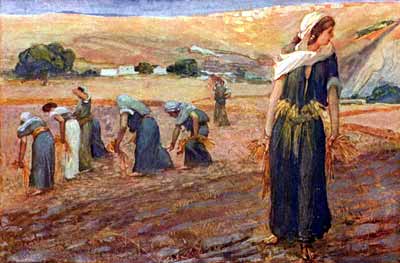
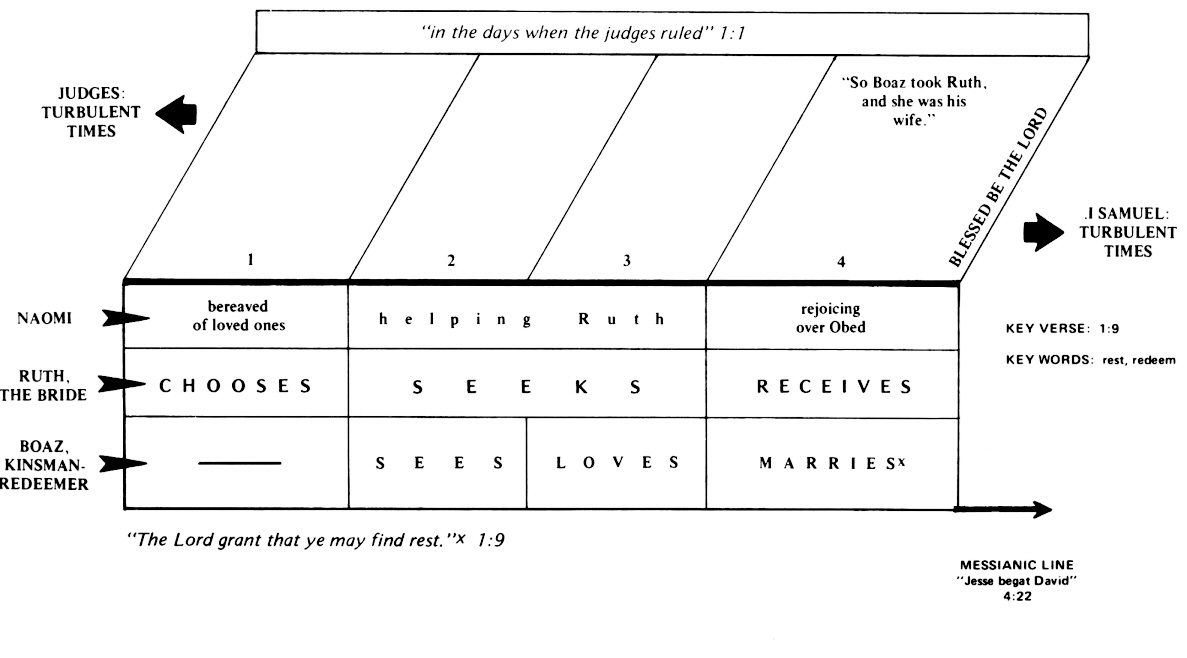
Irving Jensen's Survey of Bible (see his summary of Ruth online - page 392)
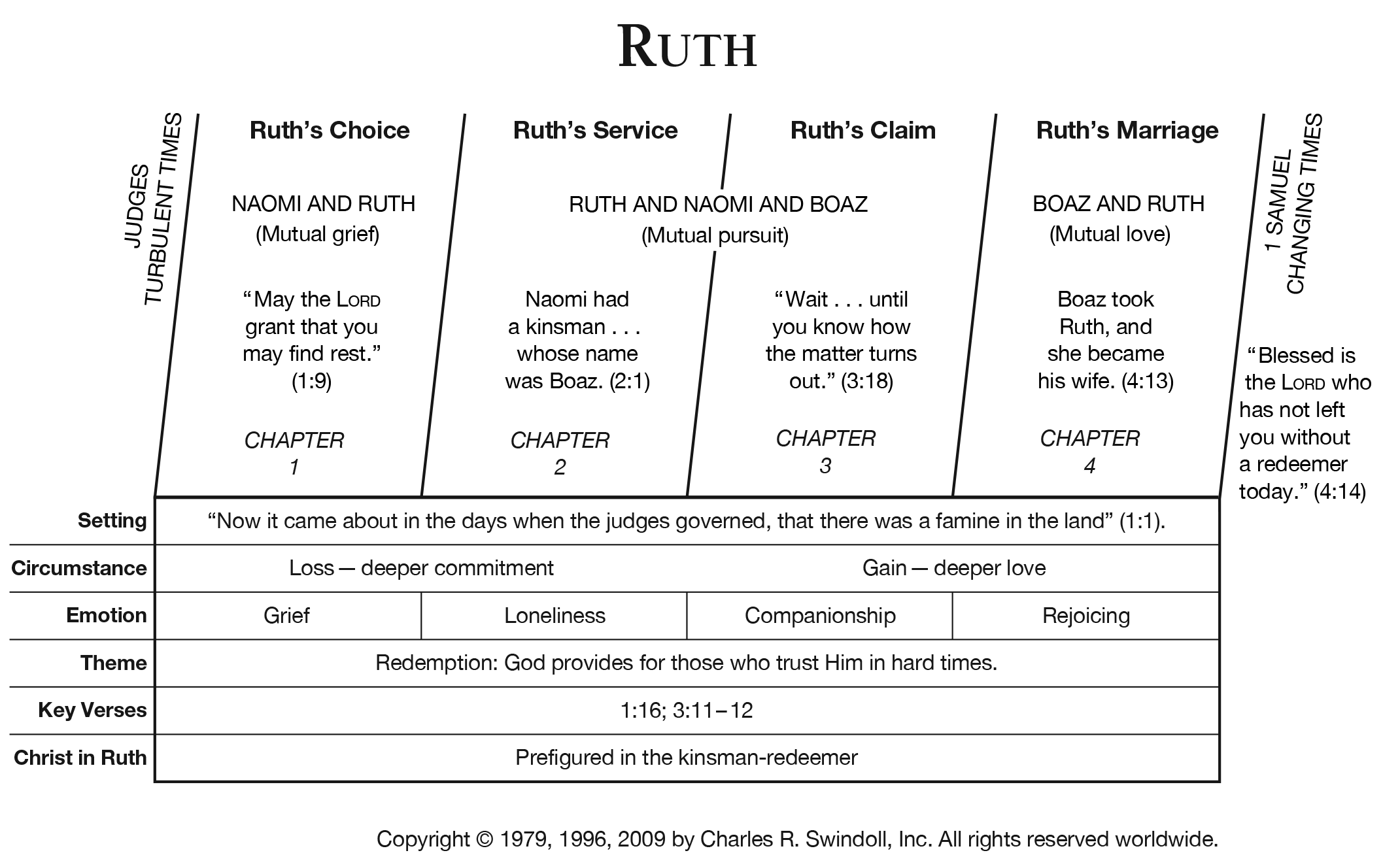
See Swindoll's summary chart of Ruth See Ruth Devotionals
|
RUTH: GOD PROVIDES |
|||
| Ruth 1 | Ruth 2 | Ruth 3 | Ruth 4 |
| Ruth's Choice | Ruth's Service | Ruth's Claim | Ruth's Marriage |
| Ruth's Resolve | Ruth's Rights | Ruth's Request | Ruth's Reward |
| Naomi and Ruth Mutual Grief |
Ruth and Naomi and Boaz Mutual Pursuit |
Boaz and Ruth Mutual Love |
|
| Ruth's Decision: Return with Naomi |
Ruth's Devotion: Provide for Naomi |
Ruth's Request: Redemption by Boaz |
Ruth's Reward: Relative of Messiah |
| Ruth and Naomi |
Ruth and Boaz |
||
| Death of Naomi's Family |
Ruth Cares for Naomi |
Boaz Cares for Ruth |
God Blesses with New Birth |
| Grief | Loneliness | Companionship | Rejoicing |
| Location: Plains of Moab |
Location: Fields of Bethlehem |
Location: Threshing floor of Bethlehem |
Location: Little town of Bethlehem |
| Time Lapsed: About 30 Years See Timeline |
|||
| Setting: Ru 1:1 Now it came about in the days when the judges governed Jdg 21:25+ In those days there was no king in Israel; everyone did what was right in his own eyes. |
|||

Ruth 2:19 Her mother-in-law then said to her, "Where did you glean today and where did you work? May he who took notice of you be blessed." So she told her mother-in-law with whom she had worked and said, "The name of the man with whom I worked today is Boaz." (NASB: Lockman)
Amplified: And her mother-in-law said to her, Where have you gleaned today? Where did you work? Blessed be the man who noticed you. So [Ruth] told [her], The name of him with whom I worked today is Boaz. (Amplified Bible - Lockman)
Hubbard Her mother-in-law said to her, “Where did you glean today? Where did you work? May the one who paid you such attention be blessed!” So she told her mother-in-law with whom she worked; she said, “The name of the man with whom I worked today is Boaz.
BBE: And her mother-in-law said to her, Where did you take up the grain today, and where were you working? May a blessing be on him who gave such attention to you. And she gave her mother-in-law an account of where she had been working, and said, The name of the man with whom I was working today is Boaz.
CEV: Naomi said, "Where did you work today? Whose field was it? God bless the man who treated you so well!" Then Ruth told her that she had worked in the field of a man named Boaz. (CEV)
GWT: Her mother-in-law asked her, "Where did you gather grain today? Just where did you work? May the man who paid attention to you be blessed." So Ruth told her mother-in-law about the person with whom she worked. She said, "The man I worked with today is named Boaz." (GWT)
KJV: And her mother in law said unto her, Where hast thou gleaned to day? and where wroughtest thou? blessed be he that did take knowledge of thee. And she showed her mother in law with whom she had wrought, and said, The man's name with whom I wrought to day is Boaz.
NLT: "So much!" Naomi exclaimed. "Where did you gather all this grain today? Where did you work? May the LORD bless the one who helped you!" So Ruth told her mother-in-law about the man in whose field she had worked. And she said, "The man I worked with today is named Boaz." (NLT - Tyndale House)
Young's Literal: And her mother-in-law saith to her, 'Where hast thou gleaned to-day? and where hast thou wrought? may he who is discerning thee be blessed.' And she declareth to her mother-in-law with whom she hath wrought, and saith, 'The name of the man with whom I have wrought to-day is Boaz.
Septuagint (LXX): kai eipen aute e penthera autes pou sunelecas semeron kai pou epoiesas eie o epignous se eulogemenos kai apeggeilen Routh te penthera autes pou epoiesen kai eipen to onoma tou andros meth' ou epoiesa semeron Boos
English of Septuagint: And her mother-in-law said to her, Where hast thou gleaned to-day, and where hast thou wrought? blessed be he that took notice of thee. And Ruth told her mother-in-law where she had wrought, and said, The name of the man with whom I wrought to-day is Booz
HER MOTHER IN LAW THEN SAID TO HER "WHERE DID YOU GLEAN TODAY? WHERE DID YOU WORK? MAY HE WHO TOOK NOTICE OF YOU BE BLESSED":
- Ruth 2:10; Ps 41:1; 2Cor 9:13, 14, 15
- Ruth Resources - Multiple Sermons and Commentaries
WHERE ON EARTH
DID YOU GLEAN TODAY?
Her mother-in-law then said to her "Where did you glean today?" - Although the text does not state it clearly, there is little doubt that Naomi noticed that the amount of barley Ruth had gleaned in one day was considerably more than one would have expected from simply following the reapers and picking up the leftovers. Why do I say that? Because she speaks a beatitude (blessing) on the one who noticed (took notice means more than just looked - see nakar below) without any other provocation. By law any owner of a field should have allowed Ruth to glean the leftovers, but Naomi knows that somehow she has interacted with the owner of the field for she has returned with far more than one would normally expect from a day's gleaning, not to mention the roasted grain! No one allows "roasted grain" to be gleaned! Ruth’s return ended Naomi’s "Mara" emptiness and filled her with a renewed sense of hope and thankfulness.
THOUGHT - By way of application, beloved, when we glean in the fields of our Greater Boaz and Kinsman Redeemer, the Living Word, we always obtain more than we deserve (grace). Or as Paul phrases it " Now to Him who is able to do far more abundantly beyond all that we ask or think, according to the power that works within us. to Him be the glory in the church and in Christ Jesus to all generations forever and ever. Amen." (Eph 3:20-21+).
Lange's Commentary notes that in the face of such abundance - The natural heart would have rejoiced, received, enjoyed, and inquired just as Naomi did, but withal (on the other hand) with no thought except of self. She, on the contrary, before her inquiries are answered, induced simply by the abundance of the gifts and the manifest happiness of Ruth (cp Pr 15:13), blesses the giver.
THOUGHT - Applying the question "Where did you glean today?" to each of our lives, it is a good question for us to ask ourselves each night: "Where have I gleaned today? What improvement have I made in grace and knowledge of my Lord and Savior Jesus Christ (2Pe 3:18+)? What have I done that will turn to a good account (cf Mt 6:19-21+, 2Cor 5:10+)? Let us not glean in any other field but that of our Lord and Master's and our labor will always yield fruit (cf Jn 15:5).
May he who took notice (nakar) of you - Naomi is so excited, she does not even give Ruth a chance to answer her two questions! How did she know a man had taken notice of her? The text did not say Ruth told her. As alluded to above, it seems the unexpected "largess" of barley, exceeding abundant over what one would have expected from the Levitical gleaning laws (cp Lv 19:9). Naomi must have deduced that Ruth had been shown favor (cp grace = undeserved, unmerited favor).
Be blessed (barak) - After two rapid fire questions, Naomi offers up a prayer of blessing for Boaz, whose identity is still unknown to her. This is a good practice to follow - we can pray for others without knowing their name, being confident that the Lord does know! Naomi's reaction expresses her heart, for out of the mouth comes that which fills the heart (cp Mt 12:34, 15:9, Lk 6:45). Virtually every prayer in Ruth is a prayer of blessing (not that the actual word "blessed" is used but that the intent of the prayer is to bless) and all are answered in this short book (cp Naomi's prayer for Ruth in Ru 1:8, 9).
So she told her mother-in-law with whom she had worked and said, "The name of the man with whom I worked today is Boaz -
Matthew Henry adds that "Ruth told her mother what kindness Boaz had shown her, that she might take some occasion or another to acknowledge it and return him thanks; but she did not tell her how Boaz had commended her, (Ru 2:11-note).
Humility teaches us, not only not to praise ourselves,
but not to be forward to publish others' praises of us.
Took notice (05234) (nakar) means to consider carefully and indicates a process of investigation and conveys the idea to "inspect" or "look over" something with the intention of recognizing it or of looking at it intently. The Septuagint translates nakar with epiginosko (see word study of epignosis)
Nakar - 41x in the OT - Gen. 27:23; 31:32; 37:32f; 38:25f; 42:7f; Deut. 1:17; 16:19; 21:17; 33:9; Jdg. 18:3; Ruth 2:10, 19; 3:14; 1Sam. 26:17; 2 Sam. 3:36; 1 Ki. 18:7; 20:41; Ezra 3:13; Neh. 6:12; 13:24; Job 2:12; 4:16; 7:10; 21:29; 24:13, 17; 34:19, 25; Ps. 103:16; 142:4; Prov. 20:11; 24:23; 28:21; Isa. 61:9; 63:16; Jer. 24:5; Lam. 4:8; Dan. 11:39
Nakar is the same verb used by Ruth when she asked Boaz - Why have I found favor in your sight that you should take notice of me, since I am a foreigner? (Ru 2:10-note)
Blessed (01288)(barak) is a verb which literally can mean to kneel (to go to one's knees - Camel in Ge 24:11, Solomon in 2Chr 6:13) as contrasted with standing position or even a bowing at the waist). And so barak can refer to an act of adoration sometimes on bended knee. To give divine blessings (Ge 1:22, 9:1-7) To esteem greatly or adore God for His blessings (Ge 24:48, Ps 103:1) To invoke blessings upon another (Ge 24:60, 27:4, 27)
Take Notice
Read: Ruth 2:13-20
Blessed be the one who took notice of you. —Ruth 2:19
While standing in a checkout line, I was estimating my bill and trying to keep my son from wandering away. I barely noticed when the woman ahead of me shuffled toward the exit, leaving all of her items behind. The clerk confided that the woman didn’t have enough money to pay her bill. I felt terrible; if only I had been aware of her situation earlier, I would have helped her.
In the book of Ruth, Boaz became aware of Ruth’s plight when he saw her gleaning in his fields (2:5). He learned that she was recently widowed and was the breadwinner for herself and her mother-in-law. Boaz saw her need for protection, and warned his harvesters to leave her alone (v.9). He supplied her with extra food by instructing his workers to let grain fall purposely (v.16). Boaz even addressed Ruth’s emotional needs by comforting her (vv.11-12). When Naomi heard about this, she said, “Blessed be the one who took notice of you” (v.19).
Are you aware of the needs of the people around you—in your church, neighborhood, or under your own roof? Today, consider how you might help bear someone’s burden. Then you will be fulfilling God’s plan for you (Gal. 6:2; Eph. 2:10). By Jennifer Benson Schuldt (Our Daily Bread, Copyright RBC Ministries, Grand Rapids, MI. Reprinted by permission. All rights reserved)
Help me Lord, to notice
The hurting, sick, and lost;
Guide me as I help them
Regardless of the cost.
—Schuldt
God works through us to meet the needs of those around us.
Ruth 2:20 Naomi said to her daughter-in-law, "May he be blessed of the LORD who has not withdrawn his kindness to the living and to the dead." Again Naomi said to her, "The man is our relative, he is one of our closest relatives." (NASB: Lockman)
Amplified: And Naomi said to her daughter-in-law, Blessed be he of the Lord who has not ceased his kindness to the living and to the dead. And Naomi said to her, The man is a near relative of ours, one who has the right to redeem us. (Amplified Bible - Lockman)
Hubbard: Naomi told her daughter-in-law, “He is worthy of praise before Yahweh who has not abandoned his kindness with the living and the dead.” Then Naomi added, “The man is a relative of ours. He is one of our kinsman-redeemers.”
BBE: And Naomi said to her daughter-in-law, May the blessing of the Lord, who has at all times been kind to the living and to the dead, be on him. And Naomi said to her, The man is of our family, one of our near relations.
CEV: "The LORD bless Boaz!" Naomi replied. "He has shown that he is still loyal to the living and to the dead. Boaz is a close relative, one of those who is supposed to look after us." (CEV)
GWT: Naomi said to her daughter-in-law, "May the LORD bless him. The LORD hasn't stopped being kind to people--living or dead." Then Naomi told her, "That man is a relative of ours. He is a close relative, one of those responsible for taking care of us." (GWT)
KJV: And Naomi said unto her daughter in law, Blessed be he of the LORD, who hath not left off his kindness to the living and to the dead. And Naomi said unto her, The man is near of kin unto us, one of our next kinsmen.
NIV: "The LORD bless him!" Naomi said to her daughter-in-law. "He has not stopped showing his kindness to the living and the dead." She added, "That man is our close relative; he is one of our kinsman-redeemers."
NLT: "May the LORD bless him!" Naomi told her daughter-in-law. "He is showing his kindness to us as well as to your dead husband. That man is one of our closest relatives, one of our family redeemers." (NLT - Tyndale House)
Young's Literal: And Naomi saith to her daughter-in-law, 'Blessed is he of Jehovah who hath not forsaken His kindness with the living and with the dead;' and Naomi saith to her, 'The man is a relation of ours; he is of our redeemers.'
Septuagint (LXX): kai eipen Noemin te numphe autes eulogetos estin (3SPAI) to kurio hoti ouk egkatelipen (3SAAI) to eleos autou meta ton zonton (PAPMPG) kai meta ton tethnekoton (RAPMPG) kai eipen aute Noemin eggizei hemin o aner ek ton agchisteuonton emas estin
English of Septuagint: And Noemin said to her daughter-in-law, Blessed is he of the Lord, because he has not failed in his mercy with the living and with the dead: and Noemin said to her, The man is near akin to us, he is one of our relations
NAOMI SAID TO HER DAUGHTER IN LAW "MAY HE BE BLESSED OF THE LORD"
- Ru 3:10; 2Sa2:5; Job 29:12 13; 2Ti 1:16, 17, 18
- Ruth Resources - Multiple Sermons and Commentaries
Naomi said to her daughter-in-law, "May he be blessed of the LORD Naomi's first reaction upon the identification of the master of the field as Boaz is fascinating. She offers up a second prayer "May he be blessed of Jehovah". How wonderful if prayer would be our first and natural "reflex" when we hear "good news". Clearly "bitter" Mara of chapter one is now turning into "blessing" for Naomi who speaks a blessing in the name of Jehovah.
Bitterness > Blessing
Unbelief > Faith
Despair > Hope
Empty > Full
One person, trusting the Lord and obeying His will,
can change a situation from defeat to victory.
-- Warren Wiersbe
As Wiersbe says "It is encouraging to see the changes that have taken place in Naomi because of what Ruth did. God used Ruth to turn Naomi’s bitterness into gratitude, her unbelief into faith, and her despair into hope. One person, trusting the Lord and obeying His will, can change a situation from defeat to victory . Ruth’s faith in God’s Word led her to the field of Boaz. The love of Boaz for Ruth compelled him to pour out his grace upon her and meet her every need. (Grace is love that pays the price to help the undeserving one.) Ruth’s experience of grace gave her new hope as she anticipated what her kinsman redeemer would do. “And now abide faith, hope, love” (1Cor 13:13), and they still abide with us as we abide in Jesus Christ and trust in Him." (See context in The Bible Exposition Commentary and here for next page) (Bolding added for emphasis)
The blessing of Jehovah is a frequent prayer in Ruth - the field workers to Boaz in (Ru 2:4+), Naomi to Boaz in (Ru 2:19, 20+), Boaz to Ruth in (Ru 3:10+) and finally the Bethlehemite woman to Naomi (Ru 4:14+). Naomi is beginning to see and understand the unfolding of God’s sovereign plan regarding her and Ruth the Moabitess and as she is reminded of the covenant loyalty of Jehovah, her emotions begin to shift from bitterness to blessing.
Someone has noted that every prayer in Ruth is a prayer of blessing (a "beatitude"), and God answered every one! In this case Naomi has ask Jehovah to deal kindly with Ruth and Orpah (Ru 1:8+), which He clearly answered in Ruth 2. Naomi acknowledges in Ruth 2:19, that He answered, bestowing kindness (hesed) on Ruth and Naomi, through their kinsman redeemer! In a similar and even greater way, God the Father in heaven is able to bestow kindness on sinners, through the kindness of His Son
Spurgeon writes that "There is no more blessed way of living than a life of dependence upon a covenant-keeping God. We have no care, for He careth for us; we have no troubles, because we cast our burdens upon the Lord."
Life is swayed by care. Concern is unavoidable but in the NT it is given a new orientation in Christ. Liberation from care comes as one casts it upon God (Ps 55:22+, 1Pe 5:7+), not because God grants every wish, but because prayer grants freedom from care.
WHO HAS NOT WITHDRAWN HIS KINDNESS TO THE LIVING OR TO THE DEAD:
- 2Sa 9:1; Pr 17:17; Php 4:10
- Ruth Resources - Multiple Sermons and Commentaries
THE LOVINGKINDNESS OF GOD
FROM EVERLASTING TO EVERLASTING
Who has not withdrawn his kindness (hesed) - The question arises as to whom does Naomi refer? Who has not withdrawn his kindness? Does this refer to Boaz or Jehovah? Notice how different translations suggest different answers...
NIV: "The LORD bless him!" Naomi said to her daughter-in-law. "He has not stopped showing his kindness to the living and the dead." She added, "That man is our close relative; he is one of our kinsman-redeemers."
NLT: "May the LORD bless him!" Naomi told her daughter-in-law. "He is showing his kindness to us as well as to your dead husband. That man is one of our closest relatives, one of our family redeemers."
GWT: Naomi said to her daughter-in-law, "May the LORD bless him. The LORD hasn't stopped being kind to people--living or dead." Then Naomi told her, "That man is a relative of ours. He is a close relative, one of those responsible for taking care of us."
The NIV suggests she is speaking of the kindness of God, while the NLT seems to favor Boaz as the one showing kindness. God's Word Translation clearly favors God as the ultimate source of the kindness.
I agree with John Piper who comments...I think the kindness she refers to is the Lord's kindness. (Cf. Ge 24:27.) Boaz had just begun to show kindness to the dead. It was God who seemed to have forsaken it. The Lord's kindness has not forsaken the living (Naomi and Ruth) or the dead (Elimelech and Mahlon). It was the Lord who stopped the famine. It was the Lord who bound Ruth to Naomi in love. It was the Lord who preserved Boaz for Ruth. Ruth did not just happen to come to Boaz's field. The light of God's love has finally broken through bright enough for Naomi to see. The Lord is kind. He is good to all who take refuge under H+-is wings. So let us fall on our faces, bow before the Lord, confess our unworthiness, take refuge under the wings of God, and be astonished at his grace. (Ruth: Under the Wings of God)
Henri Rossier agrees with Piper writing that...Naomi's heart is full of gratitude toward the man who had shown regard for Ruth when he might have rejected her as a foreigner. What sweet conversation is this exchange between these two God-fearing women! Ruth speaks the charming name of Boaz, and Naomi responds by giving thanks to Him who had not left off His kindness toward the living and the dead. (Ruth Meditations)
MacArthur - Naomi began to understand God's sovereign working, covenant loyalty, lovingkindness, and mercy toward her because Ruth, without human direction (Ru 2:3), found the near relative Boaz. (See context in The MacArthur Bible Commentary)
The Disciple's Study Bible writes...Naomi praised the kindness, the grace of God. This joyous recognition of God's goodness to His people in their distress stands in stark contrast to the darker sentiments voiced in Ru 1:13, Ru 1:20, 21. God will bless His people in the midst of their needs. He is slow to bring suffering upon His people, even if they deserve it. The suffering He does cause His people is for the purpose of helping His people grow. The righteousness of God would not let Him bring evil and suffering upon His people without just cause. The righteousness of God prompts Him to aid and bless His people when they are in distress. That is the nature of God as a God of grace. (See context in CSB Disciple's Study Bible)
Naomi acknowledged that it was Jehovah Who had not stopped showing His kindness to the living and the dead (cf Ge 24:27; 2Sa 2:5). When burdened with adversity and affliction, an awareness of even the little kindnesses Jehovah does for us can bring release, revival and rejoicing. Naomi was bitter but not so bitter that she had completely closed her heart to see the hand of the Almighty working in her behalf.
THOUGHT - Are you embittered with God? Like Naomi you may have lost someone very near and dear to you, but Naomi's example should encourage you to be on the lookout for the the "footprints" of Jehovah walking and working in your life. He is still Jehovah Shammah, the God Who is there and He ever seeks to heal and revive those downcast spirit. (Ps 34:18, Is 61:1, 2a)
Martin adds that Naomi's "night of sorrow with its fog of depression had broken into the dawning of a new day of joy. As God was the source of her sorrow, He was now the source of her joy. God’s kindness again rested on the living, Ruth and herself." (See context in The Bible Knowledge Commentary).
What does the reference of "His kindness...to the dead" refer to? One reasonable explanation is that the name of Elimelech, Naomi's dead husband, could "live on" through Ruth and Boaz, who as a kinsman -redeemer could redeem property and persons and thus perpetuate the lineage of Elimelech.
Martin on the dead - Naomi's mind immediately perceived the significance of the situation. Even the dead might soon be blessed, in that the name of Elimelech, her dead husband, could live on through her faithful daughter-in-law, Ruth. (See context in The Bible Knowledge Commentary)
Kindness (02617) (hesed/chesed/heced or Greek eleos = mercy) as noted earlier (Ru 1:8+) is the idea of faithful love in action and usually refers to God's lovingkindness expressed in His covenant relationship with Israel. God's hesed denotes persistent and unconditional tenderness, kindness, and mercy, a relationship in which He seeks after man with love and mercy. Hesed in Ruth- Ru 1:8; 2:20
The Hebrew word hesed is one of Jehovah's most central characteristics. Think of what we have learned about the CHARACTER OF BOAZ as you read this definition of hesed. In Ruth 3:10 hesed describes Ruth's character. God's loving-kindness (hesed) is offered to His people, who need redemption from sin, enemies, and troubles. A recurrent refrain describing God's nature is "ABOUNDING in hesed" (Ex 34:6; Neh 9:17; Ps 103:8; Jonah 4:2, Lam 3:22). Thus hesed is one of the most important words in the OT, and is often translated in the KJV as “lovingkindness” or “mercy”. This key OT term indicates FAITHFULNESS to a relationship. To show kindness or hesed is to act in a loyal, loving way to a person . This is true of kindness in human relationships and of the kindness God shows us.
Read 2Sa 9:1-13 for the beautiful example of David showing ''hesed" to crippled Mephibosheth (although the word hesed is not used), the surviving son of Jonathan with whom David had a covenant relationship (1Sa 18:1, 2, 3, 4). God's hesed denotes persistent and unconditional tenderness, kindness, and mercy. Hesed is central to God’s character and is closely tied to His covenant with His Chosen people; in fact the covenant may be thought of as the relationship from which the hesed flows. However, God’s hesed is not bound by the covenant itself, and though men may prove unfaithful to this relationship, God’s hesed is everlasting (Isa 54:8). In general, one may identify three basic meanings of hesed, and these 3 meanings always interact: "strength," "steadfastness," and "love." Any understanding of hesed that fails to suggest all three inevitably loses some of its richness. "Love" by itself easily becomes sentimentalized or universalized apart from the covenant. Yet "strength" or "steadfastness" suggests only the fulfillment of a legal or other obligation. hesed refers primarily to mutual and reciprocal rights and obligations between the parties of a relationship (especially Jehovah and Israel). But hesed is not only a matter of obligation; it is also of generosity. It is not only a matter of loyalty, but also of mercy. Hesed implies personal involvement and commitment in a relationship beyond the rule of law. "Devotion" is sometimes the single English word best capable of capturing the nuance of the Hebrew hesed. The RSV attempts to bring this out by its translation, "steadfast love." Biblical usage frequently speaks of someone "doing," "showing," or "keeping" hesed. The concrete content of the word is especially evident when it is used in the plural (eg, La 3:22). God's "mercies," "kindnesses," or "faithfulnesses" are His specific, concrete acts of redemption in fulfillment of His promise. An example appears in Isa. 55:3: "And I will make an everlasting covenant with you, according to the faithful mercies (hesed) shown to David".
Malachi says that "for you who fear My name the Sun of righteousness will rise with healing in its wings; and you will go forth and skip about like calves from the stall." (Mal 4:2+)
By showing His kindnesses "He heals the brokenhearted and binds up their wounds (Ps 147:3)
AND AGAIN NAOMI SAID TO HER "THE MAN IS OUR RELATIVE. HE IS ONE OF OUR CLOSEST RELATIVES":
- Ru 3:9-note; Ru 4:6-note; Lv 25:25, 48, 49 (from bondage); Dt 25:5, 6,7; Job 19:25
- Ruth Resources - Multiple Sermons and Commentaries
The man is a relation of ours; he is of our redeemers (YLT)
The man is near of kin unto us, one of our next kinsmen (KJV),
That man is our close relative;
he is one of our kinsman-redeemers (NIV)
That man is one of our closest relatives, one of our family redeemers (NLT)
Boaz is one of our close relatives, one who will take care of us (ICB)
That man is a relative of ours. He is a close relative, one of those responsible for taking care of us (GWT)
BOAZ IS ONE OF THEIR
KINSMAN-REDEEMERS
Again Naomi said to her, "The man is our relative, he is one of our closest relatives - Naomi immediately recognizes the name Boas as a potential kinsman redeemer. This recognition marks a major change in the storyline for Naomi from bitter to better.
Martin on our closest relatives - Boaz was a close relative, but more than that, he was a kinsman-redeemer. He could act as a redeemer of property and persons. He could act as a levir, a Latin term for brother-in-law. Boaz could redeem by fulfilling the levirate law, which required a brother of a deceased man to marry his widow and raise up a son to his name (Deut. 25:5-10). Though Boaz was not a brother to Mahlon, Ruth's deceased husband (Ruth 4:10), he was a close relative to the family and could act as a levir if he so desired. Naomi sensed the willingness of Boaz. No explanation is given as to why Naomi did not mention the nearer kinsman-redeemer (cf. Ru 3:12). (See context in The Bible Knowledge Commentary)
Hubbard writes "The significance of this verse must be underscored. First, in saying that Boaz was our kinsman-redeemer, Naomi cleared away ambiguity about Ruth’s social status. In her view, Ruth was definitely a family member entitled to the benefits of a gōʾēl. Second, Naomi introduced the prospect of help from Boaz, perhaps even of marriage for Ruth—a key item which anticipates the scheme of ch. 3. Third, the statements elevated the role of Boaz and thereby opened up new narrative possibilities. He was no longer simply a prominent, good-hearted Israelite; rather, he was a near relative with duties toward the women. This gave the story an added touch of intrigue. To which duties did Naomi refer? Would Boaz exercise those duties or not? Finally, the contrast between Naomi’s bitterness (Ru 1:20–21) and her joy signaled a reversal of her fortunes. She now had food and a gracious benefactor to look after her. Given the trend, the reader wondered whether she might also somehow have a son." (See context in The Book of Ruth)
Observe how the narrator has masterfully step by step unveiled the identity of Boaz. First, Boaz is merely presented as an acquaintance (Young's Literal Translation) or relative of Naomi’s, then as of the family of Elimelech (Ru 2:1+). This family relationship (of the family of Elimelech) is repeated in (Ru 2:3+) and finally after again stressing his family nearness (our relative), he is dramatically presented as the NIV translates it as one of our kinsman-redeemers or as a potential goel which is the key to the plot of this book and of "The Book"!
Hubbard summarizes the role of the goel -
(1) The gōʾēl was responsible for the geʾullâ, the repurchase of property once owned by clan members but sold from economic necessity (Lev. 25:25–30; cf. Jer. 32:1–15). By restoring the land to its original owner, the gōʾēl maintained the clan’s inheritance intact.
(2) If financially able, he also redeemed relatives whose poverty had forced them to sell themselves into slavery (Lev. 25:47–55).
(3) The gōʾēl haddām (lit. “kinsman of blood”) had the duty to avenge the killing of a relative by tracking down and executing the killer (Num. 35:12, 19–27; Deut. 19:6, 12; Josh. 20:2–3, 5, 9).
(4) As responsible head of the clan, the gōʾēl was the recipient of money paid as restitution for a wrong committed against someone now deceased (Nu 5:8).
(5) The word’s metaphorical usage shows that the gōʾēl also assisted a clan member in a lawsuit to see that justice was done (Job 19:25; Ps. 119:154; Prov. 23:11; Jer. 50:34; Lam. 3:58). (See context in The Book of Ruth)
|
THE KINSMAN |
|
| QUALIFICATIONS TO BE MET |
FULFILLMENT IN THE MESSIAH |
| Blood Relative = A Kinsman | Gal 4:4, 4:5 Heb 2:14,15, 16, 17 cp Jn 1:1, 14, Php 2:5-11 |
| Possessing the necessary resources | 1Cor 6:20 Gal 3:13 1Pe 1:18, 19 He 7:25, He 10:10-14 |
| Willing to pay the purchase price | Jn 10:15, 16, 17, 18 1Jn 3:16 Jn 18:37, Ro 5:8 Is 53:4, 5, 6, 7 |
| Willing to take as one's bride | Ro 7:4 2Co 11:2 Ep 5:25, 26, 27, 28, 29, 30, 31, 32 Re 19:7 |
Relative (07138) (qarob from the verb qarab = to come near) is an adjective meaning near, close by, closely related. Qarob refers to nearness in time or space: something is about to happen, is near at hand, e.g., judgment, calamity (Dt. 32:35) or something that is not near at hand, referring to its prophetic fulfillment as in Balaam's prophecy "I see him, but not now; I behold him, but not near; A star shall come forth from Jacob." (Nu 24:17) Solomon writes that "with the mouth of the foolish, ruin is at hand." (Pr 10:14) The first use of qarob is in Ge 19:20 which describes the "town is near enough to flee to" from the coming destruction of Sodom and Gomorrah. Joseph told his brothers "you shall live in the land of Goshen, and you shall be near me." (Ge 45:10) Solomon uses qarob figuratively to exhorts his readers to "draw near to listen rather than to offer the sacrifice of fools." (Eccl 5:1) Qarob as here in Ruth 4 refers to a relationship, a relative (Ex 32:27; Nu 27:11; 2Sa 19:42) and a relationship to God (Lev. 10:3; 1Ki 8:46, 59; Ps 119:151).
Qarob refers to one who is near (literally near, not in comparison with other relatives, but with men in general) whereas closest relatives is one of the key words of this book, the Hebrew word ga'al which is used 20 times in the 85 verses in Ruth. The total number of Old Testament uses of ga'al is 98 and Ruth has about 20% of the all the uses in Scripture.
Qarob is translated in the Septuagint with the adverb eggus, which means one who is near.
David offers a great prayer (we would all do well to keep on our heart so that it is near our lips) "Be not far from me, for trouble is near (qarob; Lxx = eggus); For there is none to help (boetheo)." (Psalm 22:11)
Swanson - 1. near, close, approaching, i.e., pertaining to being in close, or very close proximity to an object (Ge 19:20); 2. near, imminent, i.e., a point in time close to another point of time (Dt 32:35); 3. close relationship, i.e., have a state or condition of intimate association, as a figurative extension of close spatial proximity (Ps 34:18)
Qarob - 74v - about(1), close(2), close relative(1), closer(1), draws near(1), hand(1), kinsmen(1), lately(1), near(47), nearby(1), nearest(6), neighbors(2), ones near(1), related(1), relative(1), relatives(1), short(1), shortly(1), soon(2), who are near(2), who is near(1). Ge 19:20; 45:10; Ex 12:4; 13:17; Lev 10:3; 21:2f; 25:25; Nu 24:17; 27:11; Dt 4:7; 13:7; 21:3, 6; 22:2; 30:14; 32:17, 35; Josh 9:16; Ru 2:20; 3:12; 2Sa 19:42; 1Ki 8:46, 59; 21:2; 1Chr 12:40; 2Chr 6:36; Neh 13:4; Esther 1:14; 9:20; Job 17:12; 19:14; 20:5; Ps 22:11; 34:18; 38:11; 75:1; 85:9; 119:151; 145:18; 148:14; Pr 10:14; 27:10; Eccl 5:1; Isa 13:6, 22; 33:13; 50:8; 51:5; 55:6; 56:1; 57:19; Jer 12:2; 23:23; 25:26; 48:16, 24; Ezek 6:12; 7:7f; 11:3; 22:5; 23:5, 12; 30:3; 42:13; 43:19; Da 9:7; Joel 1:15; 2:1; 3:14; Obad 1:15; Zeph 1:7, 14
Qarob is used several times to refer to the imminent nature of the Day of the Lord (All in Lxx are translated with eggus). (See discussion of the doctrine of imminency - Imminency, Imminent - As related to Christ's Second Coming; Another discussion on imminency) - Clearly the Spirit is using the doctrine of imminency to generate in our hearts a sense of urgency!
(Ezek 30:3) “For the day is near, Even the day of the LORD is near; It will be a day of clouds, A time of doom for the nations.
(Joel 1:15-note) Alas for the day! For the day of the LORD is near, And it will come as destruction from the Almighty.
(Joel 2:1-note) Blow a trumpet in Zion, And sound an alarm on My holy mountain! Let all the inhabitants of the land tremble, For the day of the LORD is coming; Surely it is near,
(Joel 3:14-note) Multitudes, multitudes in the valley of decision! For the day of the LORD is near in the valley of decision.
(Oba 1:15) “For the day of the LORD draws near on all the nations. As you have done, it will be done to you. Your dealings will return on your own head.
(Zeph 1:7) Be silent before the Lord GOD! For the day of the LORD is near, For the LORD has prepared a sacrifice, He has consecrated His guests.
(Zeph 1:14) Near is the great day of the LORD, Near and coming very quickly; Listen, the day of the LORD! In it the warrior cries out bitterly.\
Hear are some other great uses of qarob (All in Lxx are translated with eggus) in the Psalms...
(Ps 34:18) The LORD is near to the brokenhearted, And saves those who are crushed in spirit.
(Ps 85:9) Surely His salvation is near to those who fear Him, That glory may dwell in our land.
(Ps 119:151) Thou art near, O LORD, And all Thy commandments are truth.
(Ps 145:18) The LORD is near to all who call upon Him, To all who call upon Him in truth.
Second Chances
He has not stopped showing his kindness. Ruth 2:20
Today's Scripture & Insight: Ruth 4:13–17
“How can you be so kind if you don’t even know me!” By making some wrong decisions, Linda had ended up in jail in a country not her own. For six years she remained in prison, and when she was set free she didn’t have anywhere to go. She thought her life was over! While her family gathered money to buy her ticket home, a kind couple offered her lodging, food, and a helping hand. Linda was so touched by their kindness that she willingly listened as they told her the good news of a God who loves her and wants to give her a second chance.
Linda reminds me of Naomi, a widow in the Bible who lost her husband and two sons in a foreign land and thought her life was over (Ruth 1). However, the Lord hadn’t forgotten Naomi, and through the love of her daughter-in-law and the compassion of a godly man named Boaz, Naomi saw God’s love and was given a second chance (4:13–17).
The same God cares for us today. Through the love of others we can be reminded of His presence. We can see God’s grace in the helping hand of people we may not even know well. But above all, God is willing to give us a fresh start. We just need, like Linda and Naomi, to see God’s hand in our everyday lives and realize He never stops showing us His kindness. By: Keila Ochoa (Our Daily Bread, Copyright RBC Ministries, Grand Rapids, MI. — Reprinted by permission. All rights reserved)
Dear Lord, thank You that You let us begin again and again.
God gives us second chances.
Surprised By God
The Lord . . . has not forsaken His kindness to the living and the dead! — Ruth 2:20
Today's Scripture: Ruth 2:17-23
If Naomi had dreamed about returning to her former home prosperous and successful, entering Bethlehem would have been a nightmare. While living in a foreign land, she had lost her husband and two sons and returned with only her daughter-in-law Ruth and a heart full of sorrow. “Do not call me Naomi [pleasant]; call me Mara [bitter],” she told her former neighbors, “for the Almighty has dealt very bitterly with me” (Ruth 1:20).
But this wasn’t the end of the story. When the discouraged Naomi saw God’s hand in Ruth’s life, she said, “The Lord . . . has not forsaken His kindness to the living and the dead!” (2:20). What appeared to be a dead-end had become a doorway for these two women who had lost so much.
The Old Testament book of Ruth is a wonderful story. The brief narrative is infused with an amazing sweetness and grace as “the Lord” is mentioned time after time.
Through Naomi and Ruth, we are reminded that God works in surprising ways to make His love known and to accomplish His purposes—even during difficult times.
God’s surprises continue so we can take heart. He has not stopped showing His kindness to you and me. By: David C. McCasland (Our Daily Bread, Copyright RBC Ministries, Grand Rapids, MI. Reprinted by permission. All rights reserved)
He whose heart is kind beyond all measure
Gives unto each day what He deems best—
Lovingly, its part of pain and pleasure,
Mingling toil with peace and rest.
—Berg
What we see of God’s provisions teaches us to trust Him for what we cannot see of His purposes.
The Giving Kind - At one end of the truck terminal where H. H. Lee worked years ago was a coal company. Nearby was a railroad, and each day several freight trains passed by. Lee often noticed that the owner of the company, who was a Christian, threw chunks of coal over the fence at various places along the track. One day he asked the man why he did this.
The man replied, “An elderly woman lives across the street, and I know that her pension is inadequate to buy enough coal. After the trains go by, she walks along and picks up the pieces she thinks have fallen from the coal car behind the engine. She doesn’t realize that diesels have replaced steam locomotives. I don’t want to disappoint her, so I just throw some pieces over the fence.”
That’s Christianity in action! The book of Ruth vividly portrays this principle of giving. When Boaz saw Ruth gathering grain behind the reapers in his field, he commanded them to leave some handfuls of grain for her. To her, this was a blessing from the Lord.
In the same way, the people whose lives we touch need to experience God’s love through our compassion and generosity. That’s why we should ask God to make us aware of opportunities to show kindness. — Henry G. Bosch (Our Daily Bread, Copyright RBC Ministries, Grand Rapids, MI. Reprinted by permission. All rights reserved)
Do a deed of simple kindness;
Though its end you may not see,
It will reach like widening ripples
Down a long eternity.
—Anon.
Kindness is the oil that takes the friction out of life.
Ruth 2:21 Then Ruth the Moabitess said, "Furthermore, he said to me, 'You should stay close to my servants until * they have finished all my harvest.' " (NASB: Lockman)
Amplified: And Ruth the Moabitess said, He said to me also, Stay close to my young men until they have harvested my entire crop (Amplified Bible - Lockman)
Hubbard: “There is one more thing,” Ruth the Moabitess said. “He told me, ‘Stay close to the young people who are mine until they have finished the entire harvest which is mine.’ ”
BBE: And Ruth the Moabitess said, Truly, he said to me, Keep near my young men till all my grain is cut.
CEV: Ruth told her, "Boaz even said I could stay in the field with his workers until they had finished gathering all his grain." (CEV)
GWT: Ruth, who was from Moab, told her, "He also said to me, 'Stay with my younger workers until they have finished the harvest.'" (GWT)
KJV: And Ruth the Moabitess said, He said unto me also, Thou shalt keep fast by my young men, until they have ended all my harvest.
NLT: Then Ruth said, "What's more, Boaz even told me to come back and stay with his harvesters until the entire harvest is completed." (NLT - Tyndale House)
Young's Literal: And Ruth the Moabitess saith, 'Also he surely said unto me, Near the young people whom I have thou dost cleave till they have completed the whole of the harvest which I have.'
Septuagint (LXX): kai eipen Routh pros ten pentheran autes kai ge hoti eipen pros me meta ton paidarion mou proskolletheti eos an telesosin holon ton ameton os huparchei moi
English of Septuagint: And Ruth said to her mother-in-law, Yea, he said also to me, Keep close to my damsels, until the men shall have finished all my reaping
THEN RUTH THE MOABITESS SAID "FURTHERMORE HE SAID TO ME 'YOU SHOULD STAY CLOSE TO MY SERVANTS UNTIL THEY HAVE FINISHED ALL MY HARVEST'":
- Ru 2:7, 8, 22; Song 1:7, 1:8
- Ruth Resources - Multiple Sermons and Commentaries
BOAZ'S ADVICE TO
"STICK LIKE GLUE"
Then Ruth the Moabitess said, "Furthermore, he said to me, 'You should stay close (dabaq) to my servants until they have finished all my harvest. Boaz advised Ruth to "stick like glue" to his servants. Notice that Boaz lets Ruth know of his concern for her in a very practical way. Husbands should likewise exercise this same protective tendency for their wives. Remember these were the difficult and dark days of the judges. All my harvest would also indicate that Boaz is inviting her to glean in his fields for the full three month harvest season.
Harvest - In Palestine the grain harvest came between April and June and was celebrated by the offering of the first sheaf of grain (Ex 34:22; Lev 23:10) and by the feast of harvest, one of the three pilgrimage festivals (Ex 23:16). In the OT events are dated by the wheat (Ge 30:14; Jdg 15:1, etc.) and the barley (2Sa 21:9; Ru 1:22, etc.) harvests.
Butler "This added statement by Ruth about the requirement Boaz gave her to stay with his reapers until the end of the harvest was given to show that Boaz may be thinking romance and redemption, too (Bible Biography Series - Ruth: The Ancestress of Christ)
Constable makes an excellent point noting that "The beauty of Ruth’s character shines forth in Ru 2:21. She did not view her relationship with Boaz as a way out of her own responsibility to provide for herself and her aged mother-in-law. Instead she rejoiced that she could continue to discharge her duty in safety.
Stay close (01692) (dabaq) is translated "cleaved" in Ruth 1:14. In this verse the Septuagint translates dabaq with the Greek verb Proskollao (4347) (prós = to, toward and in compound words prós implies motion, direction + kollao = to glue) literally means to glue one thing to another so that it adheres. Figuratively, proskollao means to join closely. Proskollao was frequently used in medical language of the uniting of wounds.
Ruth 2:22 Naomi said to Ruth her daughter-in-law, "It is good, my daughter, that you go out with his maids, so that others do not fall upon you in another field." (NASB: Lockman)
Amplified: And Naomi said to Ruth, It is good, my daughter, for you to go out with his maidens, lest in any other field you be molested. (Amplified Bible - Lockman)
Hubbard: But Naomi instructed Ruth, her daughter-in-law, “It would be better, my daughter, that you go work with his young women so that they not abuse you in another field.”
BBE: And Naomi said to Ruth, her daughter-in-law, It is better, my daughter, for you to go out with his servant-girls, so that no danger may come to you in another field.
CEV: Naomi replied, "My daughter, it's good that you can pick up grain alongside the women who work in his field. Who knows what might happen to you in someone else's field!" (CEV)
GWT: Naomi told her daughter-in-law Ruth, "It's a good idea, my daughter, that you go out to the fields with his young women. If you go to someone else's field, you may be molested." (GWT)
KJV: And Naomi said unto Ruth her daughter in law, It is good, my daughter, that thou go out with his maidens, that they meet thee not in any other field.
NLT: "This is wonderful!" Naomi exclaimed. "Do as he said. Stay with his workers right through the whole harvest. You will be safe there, unlike in other fields." (NLT - Tyndale House)
Young's Literal: And Naomi saith unto Ruth her daughter-in-law, 'Good, my daughter, that thou goest out with his young women, and they come not against thee in another field.'
Septuagint (LXX): kai eipen Noemin pros Routh ten numphen autes agathon thugater hoti eporeuthes meta ton korasion autou kai ouk apantesontai soi en agro hetero
English of Septuagint: And Noemin said to Ruth her daughter-in-law, It is well, daughter, that thou wentest out with his damsels; thus they shall not meet thee in another field
NAOMI SAID TO RUTH HER DAUGHTER IN LAW "IT IS GOOD MY DAUGHTER THAT YOU GO OUT WITH HIS MAIDS:
- Pr 27:10; Song 1:8
- Ruth Resources - Multiple Sermons and Commentaries
Naomi said to Ruth her daughter-in-law, "It is good, my daughter, that you go out with his maids (na'arah) - NLT - "This is wonderful!" Naomi exclaimed. "Do as he said. Stay with his workers right through the whole harvest"
Matthew Henry comments that"Our blessed Saviour is our Goel; it is He that has a right to redeem. If we expect to receive benefit by Him, let us closely adhere to Him, and His fields, and His family; let us not go to the world and its fields for that which is to be had with Him only, and which He has encouraged us to expect from Him. Has the Lord dealt bountifully with us? Let us not be found in any other field, nor seek for happiness and satisfaction in the creature."
THOUGHT - When the Lord deals bountifully with us, let us not be found in any other field, nor seeking for happiness and satisfaction in the creature. We lose Divine favors, if we slight them.
Maids (05291) (Hebrew = na'arah, Greek = korasion) usually refers to a marriageable but unmarried girl, emphasizing the youthfulness of the girl and is the term used to describe Ruth elsewhere in (Ru 2:6-note; Ru 4:12-note)
SO THAT OTHERS DO NOT FALL UPON YOU IN ANOTHER FIELD:
- Ruth Resources - Multiple Sermons and Commentaries
in someone else's field you might be harmed (NIV)
so that no danger may come to you in another field (BBE)
You might be molested if you went to someone else's field (TEV)
You will be safe there, unlike in other fields. (NLT)
If you work in another field, someone might hurt you (ICB)
BOAZ'S CONCERN FOR
RUTH'S WELFARE
So that others do not fall upon you in another field - Hebrew means that "they will not harm you in another field"
Fall upon (06293)(paga/pagha) is a verb with a broad range of meanings including to encounter or simple to meet (Ex 5:20, 23:4, Ge 32:1, Nu 35:19, 21, Amos 5:19, 1 Sa 10:5), to make intercession (Jer 7:16). Paga can also mean to meet with hostility and so to push against; strike, hit or attack as here in Ru 2:22 and also used with this sense in Josh 2:16; Jdg. 8:21. These were the days of Judges when every one did whatever they felt like doing (Ru 1:1, Jdg 21:25). Boaz says literally “that they do not fall upon thee.” Pagha signifies to fall upon a person, to smite and ill-treat him. (Keil, C. F., & Delitzsch)
Victor Hamilton notes that there are three special ways in which the verb paga is used - "One is to describe that a piece of land or a designated territory went from place X and "reached" to place Y (Joshua 16:7; Joshua 17:10; Joshua 19:11, 22, 26, 27, 34), or that a man in his journeys "reached" a certain place (Genesis 28:11, Jacob). A second use of this verb is to serve a number of times simply as a synonym for "to kill," to meet another person for the sake of eliminating him. The usual translation in these contexts is "to fall upon." There are fifteen uses of pāgaʿ in this context. In only one instance is God the subject who doles out punishment in the form of death (Exodus 5:3). Every other time it is man, normally (but not always) acting outside of divine will, selfishly, capriciously. The verse in Ruth (Ruth 2:22), "That they not 'meet' thee in any other field" (KJV) means likely, "that they not 'molest' thee" rather than "kill." The third way the verb is used is in the context of making intercession (1) to man (Ruth 1:16, "entreat me not," i.e. "don't press me to leave you," and Genesis 23:8, "entreat for me to Ephron," i.e. "put pressure on, use your influence"); (2) to God (Jeremiah 7:16, "don't make intercession to me"; also Jeremiah 27:18; Job 21:15). We have already noted the four references to this verb in the Hiphil as "intercede" (to man: Jeremiah 36:25 "to beg"; Jeremiah 15:11; Isaiah 53:12; Isaiah 59:16). An intercessor is one who makes "contact" with God as opposed to the many who simply dabble in prayer." (Theological Wordbook of the Old Testament)
New American Commentary - In Ruth 1:16 Pagha had been used of “to pressure, compel.” But coming after the conversations in Ru 2:8–16, the reader may interpret it as a catchall for nāga‘, “to touch, harass,” in Ru 2:9, hiklîm, “to shame, embarrass,” in Ru 2:15, and gā‘ar, “to rebuke, insult,” in Ru 2:16.
Gibrant on paga -
The verb pāghaʿ appears forty-six times in the Hebrew Bible and has cognates attested in Punic, Egyptian Aramaic, Jewish Aramaic, Syriac, Christian Palestinian Aramaic and Middle Hebrew. The basic meaning of pāghaʿ in the Qal stem is "to meet," but the word often implies physical contact. The verb conveys a number of semantic nuances of encountering another being, often in a violent context.
Pāghaʿ is used about fifteen times in the context of attacking another (e.g., 1 Ki. 2:25), including being killed by the Lord (Exo. 5:3). The verb may denote one who has been afflicted, for example, the Suffering Servant (Isa. 53:6). Sexual assault is likely conveyed by this verb as well (Ruth 2:22).
The verb is also used to denote the act of applying nonphysical forms of pressure, as when Abraham begged the Hittite elders to influence Ephron to sell him the cave of Macpelah in order to bury Sarah (Gen. 23:8) and when Ruth begged Naomi not to make her leave her (Ruth 1:16). Pāghaʿ also denotes the act of intercession for others before the Lord (Jer. 15:11).
In 1 Sam. 10:5, Saul is told he will encounter a band of ecstatic prophets in which he will be subsumed. This usage conveys that the encounter would be a meeting in which subsequent actions will result. Likewise, when a person encounters an enemy's animal, he is expected to return it to its owner immediately (Exo. 23:4). Jacob encountered angels of Yahweh on his way back from his stay with Laban, again an event with repercussions (Gen. 32:1).
The closest that the Hebrew Bible comes to using the primary sense of the noun is when it is used to indicate reaching a certain geographic point. For example, it is frequently used in Joshua to denote the extent of a particular boundary, as in "[the border] came to Jericho" (16:7). Also, Jacob "reached a certain place" (NIV), which became the location of a divine revelation (Gen. 28:11). (Complete Biblical Library Hebrew-English Dictionary)
Pagha - 46x in 43v in OT in the NAS - approach(1), attack(2), attacked(1), came(1), cut down(1), entreat(2), entreated(1), fall(7), fell(4), happen(1), intercede(2), interceded(1), kill(1), make supplication(1), meet(3), meets(3), met(2), reached(7), spare(1), strike the mark(1), touched(2), urge(1). The KJV translates it as fall 12, meet 11, reach 7, intercession 4, intreat 2, entreat 1, misc 9. Gen. 23:8; 28:11; 32:1; Ex. 5:3, 20; 23:4; Num. 35:19, 21; Jos. 2:16; 16:7; 17:10; 19:11, 22, 26f, 34; Jdg. 8:21; 15:12; 18:25; Ruth 1:16; 2:22; 1Sam. 10:5; 22:17f; 2 Sam. 1:15; 1 Ki. 2:25, 29, 31f, 34, 46; Job 21:15; 36:32; Isa. 47:3; 53:6, 12; 59:16; 64:5; Jer. 7:16; 15:11; 27:18; 36:25; Amos 5:19
Ruth 2:23 So she stayed close by the maids of Boaz in order to glean until the end of the barley harvest and the wheat harvest. And she lived with her mother-in-law. (NASB: Lockman)
Amplified: So she kept close to the maidens of Boaz, gleaning until the end of the barley and wheat harvests. And she lived with her mother-in-law. (Amplified Bible - Lockman)
Hubbard: So she did stay close to Boaz’s young women to glean until they had finished both the harvest of barley and of wheat. Then she lived with her mother-in-law.
BBE: So she kept near the servant-girls of Boaz to take up the grain till the cutting of the early grain and the cutting of the late grain were ended; and she went on living with her mother-in-law.
CEV: And so, Ruth stayed close to the women, while picking up grain in his field. Ruth worked in the fields until the barley and wheat were harvested. And all this time she lived with Naomi. (CEV)
GWT: So Ruth stayed with the young women who were working for Boaz. She gathered grain until both the barley harvest and the wheat harvest ended. And she continued to live with her mother-in-law. (GWT)
KJV: So she kept fast by the maidens of Boaz to glean unto the end of barley harvest and of wheat harvest; and dwelt with her mother in law.
NLT: So Ruth worked alongside the women in Boaz's fields and gathered grain with them until the end of the barley harvest. Then she worked with them through the wheat harvest, too. But all the while she lived with her mother-in-law. (NLT - Tyndale House)
Young's Literal: And she cleaveth to the young women of Boaz to glean, till the completion of the barley-harvest, and of the wheat-harvest, and she dwelleth with her mother-in-law.
Septuagint (LXX): kai prosekollethe (3SAPI) Routh tois korasiois Boos sullegein (PAN) eos ou sunetelesen (3SAAI) ton therismon ton krithon kai ton puron kai ekathisen (3SAAI) meta tes pentheras autes
English of Septuagint: And Ruth joined herself to the damsels of Booz to glean until they had finished the barley-harvest and the wheat-harvest
SO SHE STAYED CLOSE BY THE MAIDS OF BOAZ IN ORDER TO GLEAN UNTIL THE END OF THE BARLEY HARVEST AND THE WHEAT HARVEST:
- Pr 6:6, 7, 8; 13:1, 20; 1Co 15:33; Eph 6:1, 2, 3
- Ruth Resources - Multiple Sermons and Commentaries
And she cleaveth to the young women of Boaz to glean (YLT)
And Ruth joined herself to the damsels of Booz (English of LXX)
RUTH'S OBEDIENT AND
SUBMISSIVE SPIRIT
So she stayed close by the maids of Boaz in order to glean until the end of the barley harvest and the wheat harvest - Stayed close is the fourth and last use of the Hebrew verb dabaq in Ruth and pictures one "sticking like glue". Ruth dutifully observed her mother's and Boaz's directions (Ru 2:8+) and continued to glean even until the end of the wheat harvest, diligently gathering food that could be stored up for winter. Ruth's diligence and industry is a beautiful illustration of Solomon's instruction to "Go to the ant, O sluggard. Observe her ways and be wise, which, having no chief, officer or ruler, prepares her food in the summer and gathers her provision in the harvest. (Pr 6:6, 7, 8)
THOUGHT: Believers should be like Ruth and not wander from the Lord’s promised provision and protection into the fields of passing pleasures (Heb 11:25+, 1Jn 2:17+) of the world (see kosmos).
So for about the next three months from late March (approximate beginning of the barley harvest) until the middle of June (approximate end of the wheat harvest) Ruth gleaned in the fields of Boaz. It is intriguing that these two harvests spanned at least three months for this period is the one fixed by Jewish tradition as the time that must elapse before a female proselyte (Gentile joining the Jewish faith) may marry!
Chapter two thus closes with a hint of what is shortly to follow. This chapter also closes with a hint of suspense for there is no declaration of what is to follow after the harvest season ends. It is notable that neither Naomi nor Ruth ask “But what happens after Boaz’s harvest is over?”. It seems fair to conclude that they have both come to realize that Jehovah Himself is their Provider and they are resting in and working within His bountiful provision. Their response reminds one of the greater Kinsman Redeemer's exhortation to all of God's children to
not be anxious then, saying, 'What shall we eat?' or 'What shall we drink?' or 'With what shall we clothe ourselves?' For all these things the Gentiles eagerly seek; for your heavenly Father knows that you need all these things. But seek first His kingdom and His righteousness; and all these things shall be added to you. Therefore do not be anxious for tomorrow; for tomorrow will care for itself. Each day has enough trouble of its own. (Mt 6:31-34+)
Now Ruth's laboring was surely motivated by a wonderful hope (even though at the time she likely did not fully comprehend the significance of the events that were providentially transpiring), the anticipation of her day of redemption, when her kinsman redeemer would pay the price of redemption.
THOUGHT - By analogy believers today can labor with the same hope for our Kinsman Redeemer has already paid the price and we have been "sealed (by the Holy Spirit) for the day of redemption" (Ep 4:30+) "and not only this, but also we ourselves, having the first fruits of the Spirit, even we ourselves groan within ourselves, waiting eagerly for our adoption as sons, the redemption of our body." (Ro 8:23\+)
AND SHE LIVED WITH HER MOTHER IN LAW:
- Ruth Resources - Multiple Sermons and Commentaries
And she lived with her mother-in-law. - This pictures Ruth's commitment to Naomi and to Naomi's God. Ruth did not have a visa, a temporary agreement to stay only a set amount of time and no more. Ruth was there for good and for better or for worse. This emphasizes also that she was fulfilling her oath of commitment in Ruth 1:16, 17.
Lived (yashab) means to sit down and so to dwell, remain or abide. Yashab emphasizes a thoroughly settled state or condition -- settled down, comfortable and content with the circumstances.
Lived with her mother in law - Why might the narrator give us this fact? Could it be the days of the Judges were much like modern day America where unmarried couples give little thought to moving in together, not realizing that they will reap a "bountiful" harvest of bitter tragedy, barrenness and brokenness? Ruth stands out as model of righteous living which should encourage all saints that this remains possible, by the favor (grace) of God, even in the most unrighteous of times, like the days of the judges!
Daniel Block - The note not only brings the chapter full circle (cf. Ru 1:22) but also creates the impression that they had settled into a regular routine. We are left to wonder what has happened to Naomi's dream (Ru 2:20). Boaz has been introduced as an extremely kind and gracious man and as one who qualifies to rescue the line of Elimelech. But the dream seems to have died an early death; Boaz has helped Naomi and Ruth economically, but he is doing nothing about the real crisis in the family created by the deaths of all the male members. Only time will tell if this situation will be resolved. (Borrow Judges, Ruth. Vol. 6: New American Commentary)
J Vernon McGee has a concluding comment to this incredible chapter writing that "The beauty of this story, which occurred during the time of men like Gideon, of whom it is written “he had many wives,” (Jdg 8:30) and Samson, whose affairs with the opposite sex were notorious, would touch the hardest heart with profound wonder of the love of a great man for a noble woman. The honest love of a great man and a good woman is born in the heart of God, and this kind of love is noble and ennobling, and is described in the poetry of the Holy Spirit: "...for love is strong as death...Many waters cannot quench love, neither can the floods drown it: if a man would give all the substance of his house for love, it would utterly be contemned." (Song 8:6,7). (Thru the Bible Commentary)
Butler writes that "This statement says much about the good character of Ruth. In spite of her exciting prospects, she remained loyal to Naomi as she had stated in her vows recorded in chapter 1 of the book of Ruth. Ruth did not run around town seeking entertainment. "But she constantly came to her mother [in law] at night in due time, as became a virtuous woman, that was for working days, and not for merry nights. And when the harvest was ended... she did not gad abroad, but kept her aged mother [in law] company at home. Dinah [Jacob's daughter] went out to see the daughters of the land, and we know what a disgrace her vanity ended in [Genesis 34]. Ruth kept at home, and helped to maintain her mother [in law]" (Henry). (Ruth: The Ancestress of Christ)
Roy Hession applies the concept of kinsman redeemer writing "To conclude this chapter, we remind ourselves that the Hebrew of old did not have to wait until the year of Jubilee (Lev 25:10-15, 25-28) to have his lands restored and himself set free from slavery. If he had a near kinsman (Goel) who was able and willing he could have both his lands and himself redeemed right away. There is, indeed, a jubilee celebration waiting for us in heaven, when every last thing will be made good and every tear be dried. But we do not have to wait till then to have the losses of sin made good, our tears dried, our problems solved. Inasmuch as Jesus is our nearest Kinsman, we can enjoy a full redemption long before that jubilee. We don't have to go on with our sighs, we don't have to continue with those inner failures and traits that daunt us, we don't have to settle for anything less than what is promised in the Word of God (cp Ep 1:3+). There are unexplored areas in the redemption of our Lord Jesus that we have yet to discover. (Borrow Our nearest kinsman : the message of redemption and revival in the book of Ruth)
Adam Clarke sums up this chapter "
1. Ruth seems to have been a woman of a very amiable mind: she was modest, and she was industrious, and most probably a comely woman; and all these things served to attract the attention of Boaz, and to engage his affection. Her attachment also to her mother-in-law could not fail to secure his esteem. All these things worked together in the course of Providence, to bring about a matrimonial connection, which in its issue was intimately connected with the salvation of a lost world; for, from this very line, Jesus Christ, according to the flesh, sprang; and Ruth showed herself as worthy to be one of His progenitors as the Virgin Mary was to be His mother. See the notes on Mt 1:1–16
2. We should carefully attend to the leadings and to the workings of God’s providence; it is our duty and our interest to do both, for the path of duty is ever the way of safety. Had not Ruth acted thus, how dreary and uncomfortable must her life have been! but she followed God fully, and in a path apparently dangerous, and yet, not only sustained no injury, but succeeded well in all things: from this, as well as from innumerable other circumstances, we see the truth of that word, Acknowledge him in all thy ways, and he will direct thy steps; and with this we may ever connect, Trust in the Lord with thy whole heart, and lean not to thy own understanding. Whosoever follows God in simplicity of heart, will most assuredly be guided into all truth.