Ruth 3:2
Ruth 3:3
Ruth 3:4
Ruth 3:5
Ruth 3:6
Ruth 3:7
Ruth 3:8
Ruth 3:9
Ruth 3:10
Ruth 3:11
Ruth 3:12
Ruth 3:13
Ruth 3:14
Ruth 3:15
Ruth 3:16
Ruth 3:17
Ruth 3:18
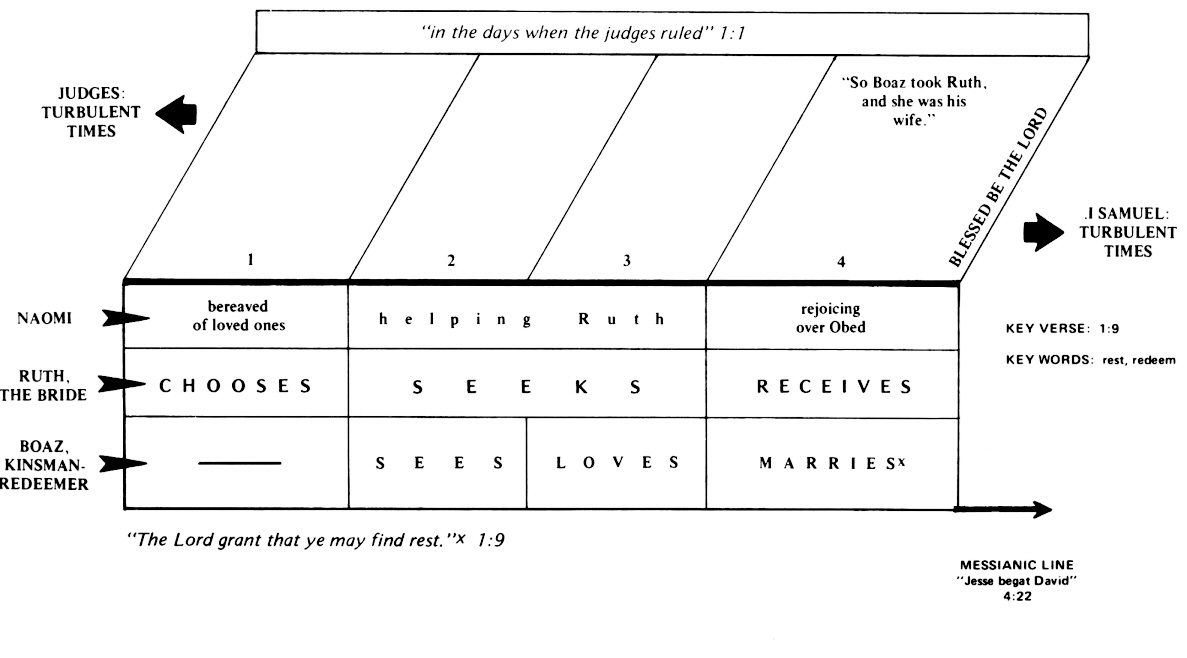
Irving Jensen's Survey of Bible (see his summary of Ruth online - page 392)
See Swindoll's summary chart of Ruth See Ruth Devotionals
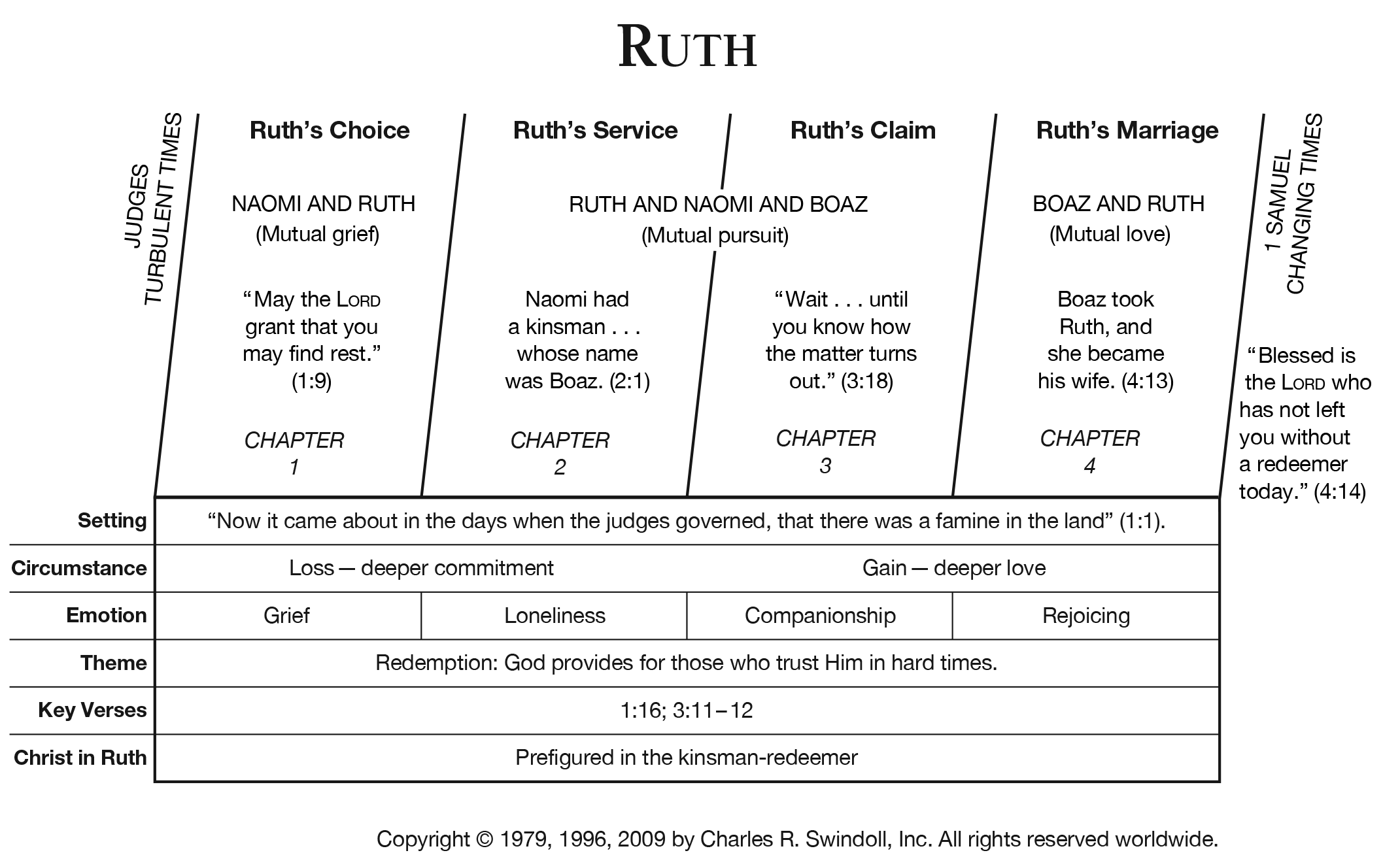
|
RUTH: GOD PROVIDES |
|||
| Ruth 1 | Ruth 2 | Ruth 3 | Ruth 4 |
| Ruth's Choice | Ruth's Service | Ruth's Claim | Ruth's Marriage |
| Ruth's Resolve | Ruth's Rights | Ruth's Request | Ruth's Reward |
| Naomi and Ruth Mutual Grief |
Ruth and Naomi and Boaz Mutual Pursuit |
Boaz and Ruth Mutual Love |
|
| Ruth's Decision: Return with Naomi |
Ruth's Devotion: Provide for Naomi |
Ruth's Request: Redemption by Boaz |
Ruth's Reward: Relative of Messiah |
| Ruth and Naomi |
Ruth and Boaz |
||
| Death of Naomi's Family |
Ruth Cares for Naomi |
Boaz Cares for Ruth |
God Blesses with New Birth |
| Grief | Loneliness | Companionship | Rejoicing |
| Location: Plains of Moab |
Location: Fields of Bethlehem |
Location: Threshing floor of Bethlehem |
Location: Little town of Bethlehem |
| Time Lapsed: About 30 Years See Timeline |
|||
| Setting: Ru 1:1 Now it came about in the days when the judges governed Jdg 21:25+ In those days there was no king in Israel; everyone did what was right in his own eyes. |
|||

Ruth 3:8 It happened in the middle of the night that the man was startled and bent forward; and behold, a woman was lying at his feet. (NASB: Lockman)
Amplified: At midnight the man was startled, and he turned over, and behold, a woman lay at his feet! (Amplified Bible - Lockman)
BBE: Now in the middle of the night, the man awaking from his sleep in fear, and lifting himself up, saw a woman stretched at his feet.
CEV: In the middle of the night, Boaz suddenly woke up and was shocked to see a woman lying at his feet. (CEV)
GWT: At midnight the man was shivering. When he turned over, he was surprised to see a woman lying at his feet. (GWT)
KJV: And it came to pass at midnight, that the man was afraid, and turned himself: and, behold, a woman lay at his feet.
NJB: In the middle of the night, he woke up with a shock and looked about him; and there lying at his feet was a woman. (NJB)
Young's Literal: And it cometh to pass, at the middle of the night, that the man trembleth, and turneth himself, and lo, a woman is lying at his feet.
Septuagint (LXX): egeneto (3SAMI) de en to mesonuktio kai echeste (3SAAI) o aner kai etarachthe (3SAPI) kai idou gune koimatai (3SPMI) pros podon autou
English of Septuagint: And it came to pass at midnight that the man was amazed, and troubled, and behold, a woman lay (sleeping) at his feet
AND IT HAPPENED IN THE MIDDLE OF THE NIGHT THAT THE MAN WAS STARTLED:
- Ruth 3 Resources - Multiple Sermons and Commentaries
- Click to listen to ballad which goes through all 4 chapters - The Lady Who Laid There Was Ruth!
"At midnight the man was shivering. When he turned over, he was surprised to see a woman lying at his feet." (GWT),
"woke up with a shock" (NJB).
IN THE MIDDLE
OF THE NIGHT
And it happened - It just "happened to happen!" God's providence once again!
In the middle (02677) of the night - This phrase is literally "in the half of the night" or at midnight. Boaz awoke suddenly and discovered that a woman was lying at his feet. Possibly this scene took place in the dark so that Boaz had the opportunity to reject the proposal without the whole town knowing.
So how did Boaz react? Startled and caught off guard -- remember that he was sleeping by the barley to protect it (these were evil "days of the judges" Jdg 21:25-note, Ru 1:1-note) and he may have had momentary fear that he was being robbed. The Targum translates it "The man trembled, and his flesh became like a (boiled) turnip through fear."
Be aware of some very poorly substantiated exposition in various commentaries on this particular section of Ruth. For example one liberal source offers an absurd, even irreverent interpretation "Ruth's act was an example of sacred prostitution at the high place in Bethlehem." (Staples "Ruth," pp. 150, 156-67) Ridiculous. So much for the commentaries - the point is you must know what the Word says from your own inductive study before you go to the commentaries!
Fortunately this genre of interpretation has been almost universally rejected as unfounded, particularly when one does a careful interpretation in light of the context of the entire story. It would be highly unlikely to see Ruth, portrayed uniformly as a woman of excellence (Ru 3:11, cp same adjective used to describe Boaz in Ru 2:1 = "wealth") stoop to such a level. Similarly it would be singularly out of character for a man like Boaz to take advantage of a woman in this way. Remember that Boaz goes the extra mile to maintain his integrity by emphasizing that he is not the closest Goel or kinsman-redeemer. Why would he besmirch his character in this section? Once again this genre of liberal interpretation shows the critical value of always interpreting Scripture in light of its context which is "king" in regard to accurate interpretation!
Was startled (02729) (charad) means to tremble, quake or shudder and describes human trembling before some strange or fearsome event. It conveys the the idea of movement resulting from agitation, usually trembling coming from emotional trauma as when Isaac realized Jacob had deceived him and received Esau's blessing (Ge 27:33) or when Joseph's brothers who had abandoned him in a pit met him in Egypt (Ge 42:28). In the future Millennium Israel will forget her disgrace and treachery against Yahweh and will live securely in the promised land "with no one to make them afraid." (Ezek 39:26+, cf Micah 4:4+, cf Mic 4:1-3, also Zeph 3:13+) After Jonathan and his armor bearer had slaughtered about 20 Philistines, "there was a trembling (noun form charadah) in the camp, in the field, and among all the people. Even the garrison and the raiders trembled (verb - charad), and the earth quaked so that it became a great trembling (noun form charadah)" (1Sa 14:15, cf Da 10:7).
Gilbrant - This verb contains the idea of movement resulting from agitation, usually trembling coming from emotional trauma. It can describe the shaking of a mountain or the flitting of a bird, but it is most commonly used to describe trembling or shuddering from some sort of fear. This is the prime nuance of its cognates in Ugaritic and Syriac. The Arabic cognate of chāradh means "to be furious." When the Lord descended upon Mount Sinai, the mountain began to quake vigorously (Exo. 19:18). The thundering and lightning that accompanied the Lord's presence at Sinai caused the people of Israel to tremble in fear (v. 16). In another context, Ezekiel speaks of the trembling of islands (Ezek. 26:18). Isaiah pictured islands as trembling in fear at the work of the Lord (Isa. 41:5). Hosea used chāradh to describe the trembling of birds (Hos. 11:11). There are several examples of chāradh being used to describe the trembling of a person resulting from emotional distress. When Isaac learned that Jacob had deceived him into giving Esau's blessing to his youngest son, he trembled in great anguish (Gen. 27:33). Similarly, when Joseph's brothers found money in their sacks of grain after buying food from their brother in Egypt, they trembled in fear (Ge 42:28). After Jonathan and his armor bearer made an attack on a Philistine garrison, the Philistines trembled in fear (1 Sam. 14:15, HED #2832). During his flight from Saul, David went to Nob to obtain help for his journey. At seeing David, Ahimelech the priest was afraid (1 Sam. 21:1). The festive spirit of Adonijah, who was celebrating his supposed rise to David's throne, turned to terror when he and his guests heard that Solomon had been crowned king (1 Ki. 1:49). In one instance, chāradh is used in the context of someone going to the trouble of taking care of a guest. A certain Shunammite woman and her husband prepared a room that would house Elisha whenever he was in the area. Elisha wanted to repay her for having "gone to all this trouble" for him (2 Ki. 4:13, NIV). The Hiphil takes the causative force of "to startle" or "to make one afraid." Moses promised his people that if they were faithful to keep their Covenant with the Lord, their enemies would not make them afraid (Lev. 26:6). Micah echoed this promise with his portrait of the future. He writes, "Every man will sit under his own vine and under his own fig tree, and no one will make them afraid, for the Lord Almighty has spoken" (Mic. 4:4, NIV). (Complete Biblical Library Hebrew-English Dictionary)
Charad -39x in 39v - been careful(1), came trembling(2), come trembling(2), disturb(2), frighten(3), frighten away(1), make afraid(4), quaked(1), routed(1), startled(1), terrified(2), terrify(2), tremble(10), trembled(4), trembles(1), trembling(2).
Gen 27:33; 42:28; Exod 19:16, 18; Lev 26:6; Deut 28:26; Judg 8:12; Ruth 3:8; 1 Sam 13:7; 14:15; 16:4; 21:1; 28:5; 2 Sam 17:2; 1 Kgs 1:49; 2 Kgs 4:13; Job 11:19; 37:1; Isa 10:29; 17:2; 19:16; 32:11; 41:5; Jer 7:33; 30:10; 46:27; Ezek 26:16, 18; 30:9; 32:10; 34:28; 39:26; Hos 11:10f; Amos 3:6; Mic 4:4; Nah 2:11; Zeph 3:13; Zech 1:21
The Greek Septuagint (LXX) translates the Hebrew word for startled with the Greek verb (tarasso) (5015) which describes an inward commotion which takes away one's calmness, causing physical agitation and shaking like water in a glass that has been sharply jarred (tarasso was used to describe agitating of water in a pool). Figuratively tarasso describes that state of mind which is to stirred up or disturbed often accompanied by various emotions including fear and trepidation. We've all experienced a "Boaz like" reaction, being suddenly awakened by some strange noise in the middle of the night and thinking that there was a burglar in the house. And then we were wide awake for some time after that because we were so shaken. Now you have the picture of the state of Boaz on this fateful Bethlehem night.
Brown-Driver-Briggs Hebrew and English Lexicon - charad
חָרַד verb tremble, be terrified (Assyrian —arâdu, id., according to Dl HA 20, Proverbs 46; Arabic be bashful, shamefaced; Late Hebrew חֲרָדָה a trembling) —
Qal Perfect וְחָרַד consecutive Isaiah 19:16, חָֽרְדָה Isaiah 10:29, חָרַדְתְּ 2 Kings 4:13, חָרְדוּ 1 Samuel 13:7; 1 Samuel 14:15, וְחָֽרְדוּ consecutive Ezekiel 26:16; Ezekiel 32:10; Imperfect יֶחֱרַד Job 37:1, וַיֶּחֱרַד Genesis 27:33 5t.; יֶחְרְדוּ Hosea 11:10; Ezekiel 26:18, יֶחֶרְדוּ Hosea 11:11, יֶחֱרָ֑דוּ Amos 3:6; Isaiah 41:6, וַיֶּחֶרְדוּ Genesis 42:28 2t.; Imperative חִרְדוּ Isaiah 32:11; —
1 tremble, quake, of a mountain Exodus 19:18 — so HCT, but read חָעָם, ᵐ5 see Di (E); of isles Ezekiel 26:18 (metaphor, in fear); so Isaiah 41:5 (קְצוֺת הארץ, "" אִיִּים יראו).
2 tremble, of persons under supernatural influence 1 Samuel 14:15 ("" חֲרָדֶה, וַתִּרְגַּז הָאָרָץ); start, start up (out of sleep) Ruth 3:8; in mental disturbance Genesis 27:33 (J; with accusative of congnate meaning with verb) tremble, in terror Exodus 19:16 (E), Isaiah 32:11 ("" רגז), be startled (at sound of trumpet) Amos 3:6 compare 1 Kings 1:49 (+ קום, הלך, ירא); tremble Ezekiel 26:16; Ezekiel 32:10 followed by לְ = at, Job 37:1 (לִבִּי), be terrified, of Egypt (personified) Isaiah 19:16 ("" מָּחַד), Ramah Isaiah 10:29, of Saul 1 Samuel 28:5 subject לִבּוֺ, "" ירא).
3 be anxiously careful 4 Kings 4:13.
4 with prepositions pregnantly = go or come trembling 1 Samuel 13:7 (followed by מֵאחריוᵐ5 L We Dr) Genesis 42:28 (E; followed by אֶלֿ) 1 Samuel 16:4 (followed by לִקְרָאתוֺ) Song of Solomon 1Samuel 21:2, Hosea 11:10 (מִיָּם) Hosea 11:11 (מִמִּצְרַיִם).
Hiph`il Perfect הֶחֱרִיד Judges 8:12, וְּהַחֲרַדְתִּ֫י 2 Samuel 17:2; Participle מַחֲרִיד Leviticus 6:26 11t.;Infinitive construct הַחֲרִיד Ezekiel 30:9; Zechariah 2:4; — drive in terror, rout an army, followed by accusative Judges 8:12; Ezekiel 30:9; Zechariah 2:4 compare 2 Samuel 17:2; (We proposes החרידוHosea 5:8 'setzt Benjamin in Schrecken,' for ᵑ0אַחֲרֶיךָ); in Participle absolute, only in ׳וְאֵין מ; and none shall terrify, i.e. disturb the peace of those reposing — שׁכב,שׁקט, רבץ, ישׁב, ישׁב לָבֶטַחִ — in the promised land Leviticus 26:6, so after captivity Jeremiah 30:10 = Jeremiah 46:27, also Ezekiel 34:28; Ezekiel 39:26; Micah 4:4; Zephaniah 3:13; of undisturbed peace of the righteous Job 11:19; peace of flocks in forsaken cities Isaiah 17:2; undisturbed feeding on carrion by fowl and beast Deuteronomy 28:26; Jeremiah 7:33, undisturbed prowling of lions Nahum 2:12 (metaphor of Assyrians).
AND BENT FORWARD AND BEHOLD A WOMAN WAS LYING AT HIS FEET:
- Ruth 3 Resources - Multiple Sermons and Commentaries
- Click to listen to ballad which goes through all 4 chapters - The Lady Who Laid There Was Ruth!
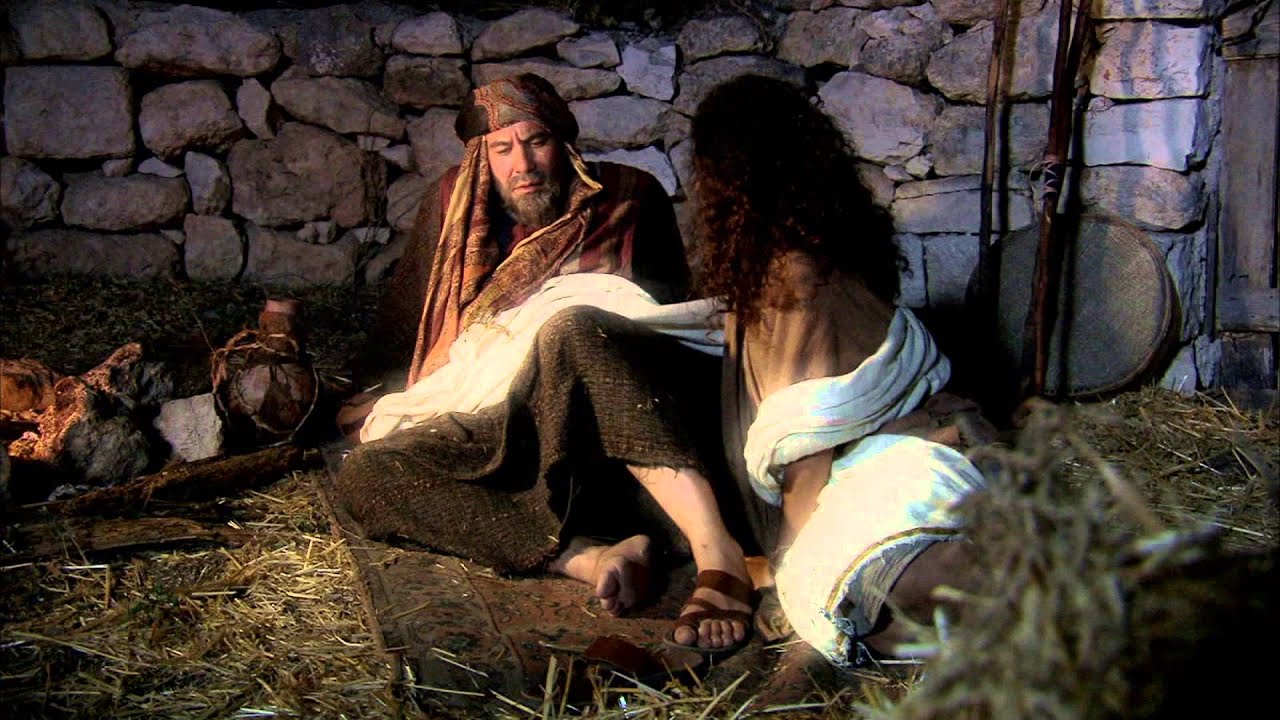
Ruth At the Feet of Boaz
Bent forward (03943) is a Hebrew verb that is concerned with turning but does not specify a particular way of turning.
And behold (02009) - As the famous "canine cartoon commentator", Snoopy, used to say “Life is full of rude awakenings!”. For example, remember when Jacob awoke to discover he was married to the wrong woman! Adam on the other hand was put to sleep by God as a single fellow and awoke a married man! While Jacob's realization was rude, such could hardly be said of either Adam's or Boaz's awakening.
Where was Ruth? She was lying at Boaz's feet which is an important detail to exonerate her from false accusations of impure motives and even worse of participating in an illicit relationship! The Hebrew verb for "lying" (07901) can refer to lying down for rest, lying down forever (deceased) or lying down to have sexual relations. Some commentaries have focused on this last meaning completely ignoring the surrounding text (context). Three times the author emphasizes the fact that Ruth was at the feet (04772) of Boaz.
The Targum adds that
Boaz subdued his concupiscence (= strong desire, especially sexual), and acted toward her as Joseph did to the Egyptian wife of his master, and as Pelatiel, the son of Laish the pious, did to Michal, the daughter of Saul, the wife of David, who put a sword between Michal and himself, because he would not approach to her.
A person's inner character is revealed not what they do when everyone is watching but when no one else can see! Boaz had disciplined himself for godliness.
Woodrow Kroll makes the following comments regarding "middle of the night" noting that...
Most crimes take place in the dark. In the dark of the night a thief slips into a home to steal. In dimly lit parking garages assailants lurk about for their next victims. In the blackness of alleys gang members hatch their plans.
Depraved men love the darkness because it hides their wicked deeds (John 3:19). And here was a perfect opportunity—a man alone with a woman in the dark. No one would have noticed; it was midnight and everyone was sound asleep. Nor probably would they have cared, had they taken note. Ruth was a foreigner and, worse yet, a Moabitess. Since the days of Moses when Moabites refused to allow passage through their land and even hired Balaam to curse the Israelites, no love existed between these two nations. Furthermore, Boaz was wealthy, and everyone knows that the rich take what they want. But Boaz was a man of honor and integrity—even in the dark.
God expects you and me to behave in the dark the same as we do in the light. It makes no difference if no one is watching. It doesn't even matter that our misdeeds will never be discovered. There is still One who knows and cares. The psalmist reminds us, "the darkness and the light are both alike to [God]" (Ps 139:12-note). The darkness is not the time to take a chance; it's the time to show your character.
Make sure God can trust you in the dark. Ask Him to give you the consistency of character that is unaffected by your circumstances. Be as faithful to the Lord when your actions are hidden as when they're out in the open. Someday, you'll be glad you did.
What a person is in the dark is what a person truly is.
Selwyn Hughes - Ruth 3:8-9 A Binding Contract
"Spread the corner of your garment over me, since you are a kinsman-redeemer." (Ru 3:9)
At midnight Ruth moves in quietly to where Boaz is lying, gently uncovers his feet, and proceeds to lie across them. Boaz is somewhat startled by this act and inquires anxiously: "Who are you?" "I am your servant Ruth," she replies, "Spread the corner of your garment over me, since you are a kinsman-redeemer" (v. 9). By this simple custom of lying at Boaz's feet, Ruth was really saying: "I belong to you and I want you to take care of me." Boaz is seemingly thrilled to be approached in this way for his response is certain and positive: "The Lord bless you don't be afraid. I will do for you all you ask" (vv. 10-11). We can safely assume from these words that at that moment he acceded to Ruth's request to cover her with his garment - the sign of his willingness to protect her and meet his obligations as a redeemer. The custom of covering a bride with a tallith, or fringed garment (Ezekiel 16:8), is still part of Jewish matrimonial ritual to this day. What spiritual lesson can be drawn from this beautiful and inspiring picture of Ruth lying at Boaz's feet? This - the Church, though surrounded at this present moment by a deep and dense darkness, is nevertheless resting safely and securely at the Savior's feet. But this is not all. His covering of us by the robe of righteousness is also the pledge that one day He is going to join us to Himself in a marriage that will last for all eternity. And that marriage is destined never to end in divorce.
O Father, just to live with You in eternity would have been enough to delight my soul forever, but to be joined to You, to be one with You, to be part of Your Bride, is more than I deserve. Yet that is Your promise. I am eternally grateful. Amen.
Bible verses: Ezekiel 16:8
Ruth 3:9 He said, "Who are you?" And she answered, "I am Ruth your maid. So spread your covering over your maid, for you are a close relative." (NASB: Lockman)
Amplified: And he said, Who are you? And she answered, I am Ruth your maidservant. Spread your wing [of protection] over your maidservant, for you are a next of kin. (Amplified Bible - Lockman)
BBE: And he said, Who are you? And she answering said, I am your servant Ruth: take your servant as wife, for you are a near relation.
CEV: "Who are you?" he asked. "Sir, I am Ruth," she answered, "and you are the relative who is supposed to take care of me. So spread the edge of your cover over me." (CEV)
GWT: "Who are you?" he asked. She answered, "I am Ruth. Spread the corner of your garment over me because you are a close relative who can take care of me." (GWT)
NJB: 'Who are you?' he said; and she replied, 'I am your servant Ruth. Spread the skirt of your cloak over your servant for you have the right of redemption over me.' (NJB)
Young's Literal: And it cometh to pass, at the middle of the night, that the man trembleth, and turneth himself, and lo, a woman is lying at his feet.
Septuagint (LXX): eipen (3SAAI) de tis ei (2SPAI) su e de eipen (3SAAI) ego eimi (1SPAI) Routh e doule sou kai peribaleis (2SFAI) to pterugion sou epi ten doulen sou hoti agchisteus ei (2SPAI) su
English of Septuagint: And he said, Who art thou? and she said, I am thine handmaid Ruth; spread therefore thy skirt over thine handmaid, for thou art a near relation
AND HE SAID WHO ARE YOU AND SHE ANSWERED I AM RUTH YOUR MAID:
- Ruth - Ru 2:10,11+; Ru 2:12+ 1Sa 25:41; Lk 14:11
- Ruth 3 Resources - Multiple Sermons and Commentaries
- Click to listen to ballad which goes through all 4 chapters - The Lady Who Laid There Was Ruth!
RUTH REVEALS
SELF AS SERVANT
He said, "Who are you?" And she answered, "I am Ruth your maid (amah) - Boaz recognized the shadowy figure as a woman, as his question "Who are you?" uses the feminine singular pronoun 'at. Ruth answers with the Hebrew word 'amah (0519) which is applied both to literal slaves and to those who figuratively call themselves by this term as an expression of humility and submission. Abigail for example fell at David's feet "and said, "On me alone, my lord, be the blame. And please let your maidservant speak to you, and listen to the words of your maidservant." (1Sa 25:24) Bathsheba addressed her husband David saying "My lord, you swore to your maidservant by the LORD your God, saying, 'Surely your son Solomon shall be king after me and he shall sit on my throne. (1Ki 1:17).
Gilbrant says that another frequent occurrence of amah "is in direct address where it serves as a token of the humility of the speaker." (Complete Biblical Library)
Recall the first time at his "feet" she had referred to herself as "a foreigner" (Ru 2:10+). Here she did not call herself Ruth the Moabitess or a foreigner but Ruth your maid which certainly suggests as some have surmised that Ruth was making a new beginning. Ruth is mentioned twelve times, five references as the Moabitess (Ru 1:22; 2:2; 2:21; 4:5; 4:10).
The NET Bible (also ESV, NIV, NLT) rendering in fact puts it this way "He said, "Who are you?" She replied, "I am Ruth, your servant. Marry your servant, for you are a guardian of the family interests." Ruth 3:9NET
The Septuagint translates maid (amah) with the word ''doule" (cp word study on NT word for "servant" = doulos) meaning one whose will is submitted to the will of the master. Thus Ruth is clearly willing to humble herself before Boaz. Doule is the name by which Mary (our Lord's mother) referred to herself saying "Behold, the bondslave (doule) of the Lord" (Lk 1:38+) and "He has had regard for the humble state (tapeinosis) of His bondslave (doule)" (Lk 1:48+) Jesus taught that "everyone who exalts himself shall be humbled, and he who humbles himself or herself shall be exalted. (Lk 14:11+) This promise certainly proved true in the life of Ruth the Moabitess ( cf Jas 4:6+, 2Co 12:9+; 2Co 12:10+)
THOUGHT- As a husband you may wish your wife submitted to you the way Ruth submits to Naomi and to Boaz. Then ask yourself whether you are providing the kind of godly leadership, care, and concern that Boaz showed towards Ruth? Now on the other hand, many wives wish they had a husband who loved, cared, and treated them they way Boaz did towards Ruth. But are they showing the same kind of humble submission and respect Ruth showed to Boaz? Ruth is a very practical book, especially regarding the relationship between men and women, especially between husbands and wives, and for these reasons alone it merits frequent study and meditation to "glean" the hidden treasures of wisdom for living buried in these four simple and yet very profound chapters.
Maid (0519)(amah) means maidservant (Ge 30:3; 31:33; Ex. 2:5; 2 Sa 6:20) or slave girl. Amah could be a female servant in a legal sense (Ex. 20:10, 17; 21:20; Lev. 25:6; Job 31:13). Amah occasionally was used of concubines (Gen. 20:17; 21:12; Ex. 23:12). The essential quality of this word is that it expresses the humility of a person (Ru 3:9; 1Sa 1:16; 25:24; 2Sa 20:17). It reflects submission when addressing God (1Sa 1:11; Ps. 86:16; 116:16).
Gilbrant - This feminine noun, meaning maid or handmaid, is frequently used for a concubine. It is the female equivalent of ʿevedh (HED #5860), a male servant, and the legal term used in the Decalogue (Exo. 20:10, 17). ʾAmāh is considered a synonym for shiphchāh (HED #8569), but does not always connote the same sense of servile duty contained in the latter. It is the word Rachel uses of her female slave, Bilhah, when she offers the slave to her husband as his concubine (Gen. 30:3). But v. 4 of the same chapter, which relates Rachel's action, calls Bilhah the shiphchāh of her mistress, and it is as such that she is identified in v. 7. In the same story, Zilpah, Leah's maid, is always termed shiphchāh. In fact, each of the female slaves, when first introduced as Laban's concubines (Gen. 29:24, 29), is called shiphchāh. Later on in the tale (Gen. 31:33), however, when Laban pursues Jacob and searches the tents for his stolen possessions, the two are referred to as ʾāmāh. In the presence of maid servants, David danced with all his might, much to the disgust of his wife Michal (2 Sam. 6:22). The term is used, as well, of Abraham's concubine (Gen. 21:10) and each of Job's female slaves by whom he is despised as a stranger and intruder in his own house (Job 19:15). Another frequent occurrence is in direct address where it serves as a token of the humility of the speaker. Ruth identifies herself as Boaz' servant (Ruth 3:9). Hannah, likewise, calls herself a servant when speaking to Eli, the priest (1 Sam. 1:16) as does Nabal's wife, Abigail, who intercedes with David on behalf of her foolish husband (1 Sam. 25:24-25). After the demise of her husband, Abigail accepts David's offer of marriage, and exclaims, "Consider your servant a slave to wash the feet of my lord's male servants." (Complete Biblical Library)
Amah - 71x in 49v - female(15), female servant(4), female slave(2), handmaid(2), handmaids(1), maid(8), maids(5), maidservant(19), servant*(1), servants*(6), slave*(4), slaves*(4). Gen. 20:17; Gen. 21:10; Gen. 21:12; Gen. 21:13; Gen. 30:3; Gen. 31:33; Exod. 2:5; Exod. 20:10; Exod. 20:17; Exod. 21:7; Exod. 21:20; Exod. 21:26; Exod. 21:27; Exod. 21:32; Exod. 23:12; Lev. 25:6; Lev. 25:44; Deut. 5:14; Deut. 5:21; Deut. 12:12; Deut. 12:18; Deut. 15:17; Deut. 16:11; Deut. 16:14; Jdg. 9:18; Jdg. 19:19; Ruth 3:9; 1 Sam. 1:11; 1 Sam. 1:16; 1 Sam. 25:24; 1 Sam. 25:25; 1 Sam. 25:28; 1 Sam. 25:31; 1 Sam. 25:41; 2 Sam. 6:20; 2 Sam. 6:22; 2 Sam. 14:15; 2 Sam. 14:16; 2 Sam. 20:17; 1 Ki. 1:13; 1 Ki. 1:17; 1 Ki. 3:20; Ezr. 2:65; Neh. 7:67; Job 19:15; Job 31:13; Ps. 86:16; Ps. 116:16; Nah. 2:7
SO SPREAD YOUR COVERING OVER YOUR MAID:
- Dt 22:30, Ezek 16:8
- Ruth 3 Resources - Multiple Sermons and Commentaries
- Click to listen to ballad which goes through all 4 chapters - The Lady Who Laid There Was Ruth!
Make me your wife according to God’s law, for you are my close relative (TLB)
Because you are a close relative, you are responsible for taking care of me. So please marry me (TEV)
Spread your cover over me, because you are a relative who is supposed to take care of me (NCV)
I am Ruth, your servant. Marry your servant, for you are a guardian of the family interests (NET)
Spread your wing [of protection] over your maidservant, for you are a next of kin (AMP)
Spread the skirt of your cloak over your servant for you have the right of redemption over me (NJB)
I am your servant Ruth: take your servant as wife, for you are a near relation (BBE)
Related Passage:
Ruth 2:12+ “May the LORD reward your work, and your wages be full from the LORD, the God of Israel, under whose wings (kanaph) you have come to seek refuge.”
RUTH REQUESTS
COVERING
Yes it is a cool night (that's why Boaz had a cover), but Ruth's request is not be warmed by cover, but "warmed" by marriage to Boaz.
So spread (natash/natas) your covering (kanaph) over your maid - Ruth reminded Boaz of his own words, and requested him to become the fulfiller of his own prayer. The word for covering (kanaph) is the same as that for `wing' in Ru 2:12+ Ruth reminded Boaz of his own words, and requested him to become the fulfiller of his own prayer.
Ruth’s words about Boaz taking her under his wing suggest that in her mind, she was entering into betrothal to marry Boaz. Betrothal was the first stage of marriage in which a couple contracted to marry each other (scroll down to entry #2 "Betrothal the First Formal Part" - in ISBE discussion of Marriage). Betrothal in ancient Israel (at the time of Christ) lasted for a year and was as binding as marriage, being dissolved only by divorce. Should the man to whom a girl was betrothed die, in the eyes of the law she was a widow. During the actual marriage ceremony, the groom’s relatives cover the bride with the groom’s garment, indicating that from then on, she was under his protection ("his wing").
In the present context, kanaph refers to the edge of a garment or bed-clothing flap. We find a similar use in Deuteronomy where God directs His people to "make yourself tassels on the four corners of your garment with which you cover yourself (Dt 22:12) The word wings was a symbol of protection, as with baby birds which run under their mother's wings to escape the birds of prey. God used Boaz as the vessel to answer his own prayer in behalf of Ruth. It was customary for a Jewish husband to cover his new wife with the end of his tallit (Heb., prayer shawl) to signify that she was under his protection. Accordingly, Ruth was asking Boaz to accept his responsibility as kinsman and to take her as his wife. The modern Jewish marriage ceremony takes place under a "huppah/chuppah" (a canopy -- sounds like "kanaph") in the presence of two lawful witnesses.
CULTURAL CONTEXT - To raise the skirts of a woman's garment is a symbol of insult and disgrace Jer 13:22, 26; Nah. 3:5, whereas to cover her with one's skirt was a token of matrimony. No doubt the idiom reflected the custom, still practiced by some in the Middle East, of a man throwing a garment over the woman he has decided to take as his wife, and symbolizing protection as well as fellowship. To this day in many parts of the East when a man says he put his skirt over a woman it is synonymous with saying that he has married her. Fruchtenbaum comments that spreading the covering referred to "the corner of the garment, and it refers to the fact that a man spreads this over his wife, as well as himself (Dt. 22:30, Dt 27:20).
In a parallel passage in Ezekiel we see God speaking to Israel reminding her "I passed by you and saw you, and behold, you were at the time for love; so I spread (paras) My skirt over you and covered your nakedness. I also swore to you and entered into a covenant with you so that you became Mine," declares the Lord GOD." (Ezek 16:8) (Cf God as Israel's "Husband" in Jer 31:32, Hos 2:19, Isa 54:5 cp Jer 2:2, Jer 3:14) In this figurative account in Ezekiel 16:8, God spreads His skirt over naked Jerusalem as an act of protection and as a precursor to marriage.
To spread one’s mantle over a person meant to claim that person for yourself. For example in (1Ki 19:19) Elijah finds "Elisha the son of Shaphat, while he was plowing with twelve pairs of oxen before him, and he with the twelfth. And Elijah passed over to him and threw his mantle on him."
This phrase Spread your covering vividly pictures the provision of protection, warmth and fellowship and in context speaks beautifully of marriage. Would it be true that all husbands covered their dearly beloved the way God does and the way Boaz did in this love story. There appears to be no hesitation in the response of Boaz. Ruth could let go of any fear she may have had, for there was no rebuke from this godly man. To the contrary, he gives her a blessing and acceptance as a `my daughter' in the family. No longer was she a stranger or foreigner for Ruth had come under the wings of Jehovah God (Ru 2:12-note); and now she would be under the wings of her kinsman-redeemer, Boaz!
Jamieson adds that Ruth "had already drawn part of the mantle over her; and she asked him now to do it, that the act might become his own. To spread a skirt over one is, in the East, a symbolical action denoting protection. To this day in many parts of the East, to say of anyone that he put his skirt over a woman, is synonymous with saying that he married her; and at all the marriages of the modern Jews and Hindus, one part of the ceremony is for the bridegroom to put a silken or cotton cloak around his bride.
Fruchtenbaum observes that "Earlier in Ruth 2:12 (note), Boaz complimented Ruth her for coming under the wing of Jehovah. Ruth had put herself under Jehovah’s wing when she came to Judah. But now, she sought also to put herself under Boaz’s wing. Boaz was being asked to answer his own prayer. (Ed: Even as Naomi in Ru 3:1-note was answering her own prayer from Ru 1:9-note) The marriage was the means by which God would protect Ruth and at the same time pay her in full the wages for her past kindness. Theologically speaking, God worked here not by direct intervention, but by providence, by using the righteous human acts described here. (Fruchtenbaum, A. G. Ariel's Bible Commentary : The books of Judges and Ruth. Page 325. San Antonio, Tex.: Ariel Ministries)
Covering (03671) (kanaph translated with Septuagint (LXX) pterugion = tarret or pinnacle) refers to an edge or extremity; specifically of a bird and thus refers to a bird's wing as used in Ru 2:12 ("under Whose wings" ) referring figuratively to the wings of the Almighty God. Now Ruth would be under the wings of Boaz, her beloved husband.
THOUGHT - What a beautiful picture of marriage! Is that a picture of your marriage?
The Old Testament uses kanaph many times, most often figuratively and most often referring to God in a positive context. For example, Israel's redemption and deliverance from bondage in Egypt is twice described with the beautiful picture of "wings" for God reminds His people
'You yourselves have seen what I did to the Egyptians, and how I bore you on eagles' wings, and brought you to Myself" (Ex 19:4) and
"Like an eagle that stirs up its nest, that hovers over its young, He spread His wings and caught them, He carried them on His pinions. " (Deut 32:11).
God's "wings" are pictured as instrumental in the redemption of His wife Israel from Egyptian bondage. Here in Ruth, the bride is requesting that her redeemer cover her with his "wings"! And ultimately from this covenant comes One from the line of David and the tribe of Judah, Who Himself is the Redeemer of all mankind. Have you sought refuge under the wings of the Redeemer of Israel from the wrath to come? Paul teaches that if you have, you are safe and can "wait for (God's) Son from heaven, Whom He raised from the dead, that is Jesus, Who delivers us from the wrath to come. (1Th 1:10+)
QUESTION - What did it mean to spread the corner of your garment over someone?
ANSWER - In Ruth 3:4, Naomi encouraged Ruth to go to Boaz at night, saying, “When he lies down, note the place where he is lying. Then go and uncover his feet and lie down. He will tell you what to do.” Ruth obeys, and in verse 9 she tells Boaz, “I am your servant Ruth. . . . Spread the corner of your garment over me, since you are a guardian-redeemer of our family.” The ESV uses “spread your wings.” What did this mean?
The Hebrew term can be translated either way, but the context makes the translation of “garment” more likely. The same idea is conveyed in Ezekiel 16:8 where God speaks metaphorically regarding Israel: “Later I passed by, and when I looked at you and saw that you were old enough for love, I spread the corner of my garment over you and covered your naked body. I gave you my solemn oath and entered into a covenant with you, declares the Sovereign LORD, and you became mine.” The context here notes God’s role as a husband for Israel.
The idea of matrimony appears in the context of Ruth’s story as well, both in the phrase itself and in the response of Boaz. He answers Ruth’s request by stating, “This kindness is greater than that which you showed earlier: You have not run after the younger men, whether rich or poor” (Ruth 3:10). Boaz understood that Ruth was asking him to take her as his wife. He blessed her for doing so, thankful she had pursued him rather than someone younger. He conveyed his attitude toward her through giving her barley as a gift and promising to get an answer to her request as soon as possible.
Some interpreters have sought to exaggerate the idea of “spreading your garment” as Ruth’s request for Boaz to have sexual relations with her. However, several reasons make this unlikely. First, her request includes the statement that Boaz is “a guardian-redeemer.” She did not want to have sexual relations with him because he was a redeemer; she was asking for marriage.
Second, it is clear she was following the plan given to her by her mother-in-law, Naomi. What was her plan? She was trying to encourage a marriage that would secure Ruth a better future.
Third, Boaz thanked Ruth for her request and said he would deal with it in the morning. He certainly could not have meant he would talk with the townspeople about her request for sexual relations! Rather, Boaz said he needed to discuss the necessary arrangements for marriage with those in his community because it dealt with a widow of an Israelite relative (Ruth 4).
Upon closer evaluation, to “spread your garment over me” in Ruth 3 was not merely a symbolic gesture or a request for sexual relations, but was rather Ruth’s way of asking Boaz to marry her, in obedience to Naomi’s directions. Boaz’s response ultimately resulted in a God-honoring marriage. GotQuestions.org
FOR YOU ARE A CLOSE RELATIVE:
- Close relative - Ru 2:12 +
- Ruth 3 Resources - Multiple Sermons and Commentaries
- Listen to ballad which goes through all 4 chapters - The Lady Who Laid There Was Ruth!
"for thou art a near kinsman" (ASV)
"for thou art a near kinsman (BBE)
"you are the relative who is supposed to take care of me" (CEV)
"you are a close relative who can take care of me" (GWT)
Today's English Version is very direct (albeit it is a paraphrase)
"Because you are a close relative, you are responsible for taking care of me. So please marry me."
BOAZ: KINSMAN-REDEEMER
RUTH'S GOEL
For you are a close relative (goel) - For is a term of explanation in this case explaining to Boaz why she is requesting his covering. Note she says "You are a kinsman-redeemer," rather than, "You are my kinsman-redeemer". Whether Ruth knew that there was a closer kinsman is uncertain. This is the second use of Goel in Ruth (Ru 2:20+) (See all uses)
It is surprising that Jonathan Edwards in his book "History of Redemption" which traces the history of redemption from Moses to David, absolutely ignored Boaz as a type of Christ (ED: see Typology), the great Redeemer, and instead included many of the judges (including Samson!) writing that "The deliverers that God raised up from time to time were all types of Christ, the great Redeemer of His Church; and some of them very remarkably so; as particularly, Barak, Jephthah, Gideon, Samson, in many particulars. "Having included Samson, (Jonathan Edwards) passed over the Book of Ruth entirely, paid no attention to Boaz, and discussed Samuel as the next in order as a type of the Redeemer. A. H. Strong, in his Systematic Theology, defined the section of theology under “Christology” as “the redemption wrought by Christ,” and he did not even allude to Boaz as a type of Christ. There is no reference to the Book of Ruth in his entire work on theology. Calvin, in the Institutes, made no reference to the Book of Ruth when contemplating redemption. In any biblical history of redemption that seeks to trace the types through the Scripture, there ought to be a reference to Boaz in the Book of Ruth." (From Ruth and Esther : Women of Faith)
Note that goel is the active participle of ga'al and geullah is the passive participle of ga'al - for further explanation click here
Ruth 2:20+ Naomi said to her daughter-in-law, "May he be blessed of the LORD who has not withdrawn his kindness to the living and to the dead ." Again Naomi said to her, "The man is our relative, he is one of our closest relatives (goel)."
Ruth 3:9+ He said, "Who are you?" And she answered, "I am Ruth your maid. So spread your covering over your maid, for you are a close relative (goel))."
Ruth 3:12+ "Now it is true I am a close relative (go'el); however, there is a relative closer (goel) than I.
Ruth 3:13+ "Remain this night, and when morning comes, if he will redeem (gaal/goel) you, good; let him redeem (ga'al) you. But if he does not wish to redeem (ga'al) you, then I will redeem (ga'al) you, as the LORD lives. Lie down until morning ."
Ruth 4:1+ Now Boaz went up to the gate and sat down there, and behold, the close relative (goel) of whom Boaz spoke was passing by, so he said, "Turn aside, friend, sit down here ." And he turned aside and sat down.
Ruth 4:3+ Then he said to the closest relative (goel), "Naomi, who has come back from the land of Moab, has to sell the piece of land which belonged to our brother Elimelech.
Ruth 4:4+ "So I thought to inform you, saying, 'Buy it before those who are sitting here, and before the elders of my people. If you will redeem (goel/gaal) it, redeem (goel/gaal) it; but if not, tell me that I may know; for there is no one but you to redeem (goel/gaal) it, and I am after you.'" And he said, "I will redeem (goe/gaal) it."
Ruth 4:6+ The closest relative (go'el) said, "I cannot redeem (goel/gaal) it for myself, because I would jeopardize my own inheritance. Redeem (goel/gaal) it for yourself; you may have my right of redemption (geullah = passive participle of goel/gaal), for I cannot redeem (gole/gaal) it."
Ruth 4:8+ So the closest relative (goel) said to Boaz, "Buy it for yourself." And he removed his sandal.
Ruth 4:14+ Then the women said to Naomi, "Blessed is the LORD who has not left you without a redeemer (goel) today, and may his name become famous in Israel.
Why did he have to ask who this was? Did he even know it was a woman?
Obviously it was dark because it was the middle of the night -- although he apparently did know it was a woman because the pronoun he uses in Hebrew is feminine.
How does Ruth characterize herself?
his "maid" the Hebrew word (amah) is not the same one (shiphchah) used in Ru 2:13 (note), but is the word for literal slaves -- this word suggests that she was humbling herself, submitting her will to his will, her hopes and desires to his providences.
Abigail "fell at (David's) feet and said, "On me alone, my lord, be the blame. And please let your maidservant (amah) speak to you, and listen to the words of your maidservant (amah)." (1Sa 25:24). Humility; Submission.
What does she request? How does this correlate with Dt 25:5-10?
to cover her with one's skirt was a token of matrimony; to fulfill the levirate marriage
Compare also her NEED = Ru 4:3 and God's PROVISION = Lev 25:25+, a truth ("promise") of which she would most likely have been knowledgeable (cp God's promise to believers in the NT 2Pe 1:4+)
Why was Ruth so bold in her request?
She knew Boaz was a Goel. (Ru 2:20+)
How is the Hebrew word "covering" translated elsewhere in Ru 2:12?
How else do these 2 verses relate? What was Boaz doing for Ruth in 2:12?
God used Boaz as the vessel to answer his own prayer in behalf of Ruth
What does Ezekiel 16:8 teach about the meaning of Ruth's request?
This idiom reflected the custom, still practiced by some Arabs, of a man’s throwing a garment over the woman he has decided to take as his wife, and symbolizing protection as well as fellowship. The "security" or REST that Naomi had desired for Ruth.
Ezekiel 16:8 = God says "I SPREAD (paras) MY SKIRT (wing - kanaph) OVER YOU".
This phrase reflects Israel's "marriageable state" and the spreading of God's “wing” pictures the custom of espousal as here in Ruth. This statement by God clearly indicates that He had entered into a covenant with young Israel. When? At Mt. Sinai (cf. Ex 19:5, 6, 7, 8). Here in this covenant is pictured as like a marriage. In fact, elsewhere God describes His relationship to Israel in similar terms Jeremiah 31:32 recording that God would make a new covenant with Israel "not like the covenant which I made with their fathers in the day I took them by the hand to bring them out of the land of Egypt, My covenant which they broke, although I was a husband to them," declares the LORD. (cf also Jeremiah 2:2)
What else would "wings" picture according to Dt 32:11?
This figure no doubt refers more especially to the protection and assistance of God experienced by Israel in its journey through the Arabian desert -- compare with Jesus' lament in Mt 23:37
"O Jerusalem, Jerusalem, who kills the prophets and stones those who are sent to her! How often I wanted to gather your children together, the way a hen gathers her chicks under her wings, and you were unwilling.
The responsibilities of the kinsman redeemer or go'el mentioned in Scripture are...
1). Avenging the death of a murdered relative (Nu 35:19)
2). Marrying a childless widow of a deceased brother (Dt 25:5-10),
3). Buying back family land that had been sold (Lv 25:25),
4). Buying a family member who had been sold as a slave (Lv 25:47-49),
5). Looking after needy and helpless members of the family (Lv 25:35).
Ruth 3:10 Then he said, "May you be blessed of the LORD, my daughter. You have shown your last kindness to be better than the first by not going after young men, whether poor or rich.(NASB: Lockman)
Amplified: And he said, Blessed be you of the Lord, my daughter. For you have made this last loving-kindness greater than the former, for you have not gone after young men, whether poor or rich. (Amplified Bible - Lockman)
BBE: And he said, May the Lord give you his blessing, my daughter: even better than what you did at the first is this last kind act you have done, in not going after young men, with or without wealth.
CEV: Boaz replied: The LORD bless you! This shows how truly loyal you are to your family. You could have looked for a younger man, either rich or poor, but you didn't. (CEV)
GWT: Boaz replied, "May the LORD bless you, my daughter. This last kindness-that you didn't go after the younger men, whether rich or poor-is better than the first. (GWT)
KJV: And he said, Blessed be thou of the LORD, my daughter: for thou hast showed more kindness in the latter end than at the beginning, inasmuch as thou followedst not young men, whether poor or rich.
NJB: 'May Yahweh bless you, daughter,' he said, 'for this second act of faithful love of yours is greater than the first, since you have not run after young men, poor or rich.
Young's Literal: And he saith, 'Blessed art thou of Jehovah, my daughter; thou hast dealt more kindly at the latter end than at the beginning -- not to go after the young men, either poor or rich.
Septuagint (LXX): kai eipen (3SAAI) Boos eulogemene (RPPFSN) su to kurio theo thugater hoti egathunas (2SAAI) to eleos sou to eschaton huper to proton to me poreuthenai (APN) se opiso neanion eitoi ptochos eitoi plousios
English of Septuagint: And Booz said, Blessed be thou of the Lord God, my daughter, for thou hast made thy latter kindness greater than the former, in that thou followest not after young men, whether any be poor or rich
THEN HE SAID MAY YOU BE BLESSED OF THE LORD:
- Blessed - Ru 2:4+; 1Cor 13:4-5+
- Ruth 3 Resources - Multiple Sermons and Commentaries
- Listen to ballad of all 4 chapters - The Lady Who Laid There Was Ruth!
BOAZ'S
BEATITUDE
Then he said, "May you be blessed (barak) of the LORD, my daughter - Boaz might have refused to have anything to do with Ruth; but in his love for her, he called her my daughter (Ru 2:8+) and pronounced a blessing on her (Eph 1:3+). There was not a moment's hesitation in the response of Boaz. It is obvious that Boaz understood Ruth’s action as a request for marriage. Ruth could let go of her fears for no rebuke was forthcoming. Instead, she received a blessing and acceptance as a `daughter' in the family. No longer was she a stranger or foreigner. (We too are now "accepted in the Beloved" KJV, Eph 1:6+) Boaz's immediate use of God’s covenant Name LORD shows His acknowledgment and recognition of Jehovah's sovereign and providential hand in all that was taking place.
THOUGHT - Our Heavenly Father and our Redeemer seek a closer relationship with us, and we should not be afraid to draw near and share Their love (Jn 14:21). If we could only realize in even a small way the great love our Kinsman Redeemer has for us, we would forsake everything else and enjoy His fellowship.
How quick are we to recognize and acknowledge the hand of the Lord in all that transpires in our life? May we like Boaz make this our natural (supernatural) response in everything (cp 1Th 5:18+)
Hubbard - Ruth acted neither from passion nor greed. Rather, sacrificially setting aside personal preferences, she chose a marriage of benefit to her family. She reckoned her own happiness as secondary to provision of an heir for her late husband and Naomi. Such a model of selfless concern for the needs of others recalls the early Christian hymn about Jesus (Phil. 2:1–11; cf. Rom. 12:10, 14) and his teaching that the “greatest” in the kingdom is everyone’s servant (Matt. 23:11; Luke 22:24–27; cf. John 13:12–17). (See context in The Book of Ruth)
Blessed (01288) (barak) (see Vine's note below) literally means to kneel down and to be or go to a stance in which one is on the knees as contrasted with standing on the feet, with the back straight or bent. To bless in the OT often conveys the idea of to endue with power for success, prosperity, fecundity, longevity, etc. Its major function seems to have been to confer abundant and effective life upon something (Ge 2:3) or someone (Ge 27:27) The source of true blessing is God and God alone. God's name, the manifestation of His personal, redemptive, covenant-keeping nature, is at the heart of all blessing.
Barak - The root of this word is found in other Semitic languages which, like Hebrew, use it most frequently with a deity as subject. There are also parallels to this word in Egyptian.
Barak occurs about 330 times in the Bible, first in Ge 1:22 "And God blessed them, saying, Be fruitful and multiply.
God’s first word to man is introduced in the same way: And God blessed them, and God said unto them, Be fruitful, and multiply (Ge 1:28).
Thus the whole creation is shown to depend upon God for its continued existence and function (cf. Ps 104:27-note, Ps 104:28-note, Ps 104:29-note, Ps 104:30+).
Barak is used again of man in Ge 5:2, at the beginning of the history of believing men, and again after the Flood in Ge 9:1: “And God blessed Noah and his sons.…”
The central element of God’s covenant with Abram is: “I will bless thee … and thou shalt be a blessing: And I will bless them that bless thee … and in thee shall all families of the earth be blessed” (Ge 12:1-3).
This “blessing” on the nations is repeated in Ge 18:18; 22:18; and 28:14.
In all of these instances, God’s blessing goes out to the nations through Abraham or his seed.
The Septuagint (LXX) translates all of these occurrences of barak in the passive, as do the kjv, nasb, and niv.
Paul quotes the Septuagint’s rendering of Ge 22:18 in Gal 3:8. The covenant promise called the nations to seek the “blessing” (cf. Isa 2:2, 3, 4), but made it plain that the initiative in blessing rests with God, and that Abraham and his seed were the instruments of it. God, either directly or through His representatives, is the subject of this verb over 100 times. The Levitical benediction is based on this order: “On this wise ye shall bless the children of Israel … the Lord bless thee … and they shall put my name upon the children of Israel; and I will bless them” (Nu 6:23, 24, 25,26, 27).
The passive form of barak is used in pronouncing God’s “blessing on men,” as through Melchizedek:
Blessed be Abram of the most high God … (Ge 14:19).
Blessed be the Lord God of Shem … (Ge 9:6) is an expression of praise.
Blessed be the most high God, which hath delivered thine enemies into thy hand” (Ge 14:20) is mingled praise and thanksgiving.
A common form of greeting was "Blessed be thou of the Lord" (1Sa 15:13)
The simple form of the verb is used in 2Chr 6:13 “He … kneeled down.…”
Six times the barak is used to denote profanity, as in Job 1:5: "It may be that my sons have sinned, and cursed God in their hearts."
YOU HAVE SHOWN YOUR LAST KINDNESS TO BE BETTER THAN THE FIRST BY NOT GOING AFTER YOUNG MEN WHETHER POOR OR RICH:
- Ruth 3 Resources - Multiple Sermons and Commentaries
- Click to listen to ballad which goes through all 4 chapters - The Lady Who Laid There Was Ruth!
Hebrew literally "you have made the latter act of devotion better than the former",
"even better than what you did at the first is this last kind act you have done, in not going after young men, with or without wealth" (BBE)
"You are showing more family loyalty now than ever by not running after a younger man, whether rich or poor" (NLT)
"this second act of faithful love of yours is greater than the first, since you have not run after young men, poor or rich" (NJB)
"This act of kindness is greater than the kindness you showed to Naomi in the beginning. You didn’t look for a young man to marry, either rich or poor" (NCV)
"You are showing even greater family loyalty in what you are doing now than in what you did for your mother-in-law. You might have gone looking for a young man, either rich or poor, but you didn’t" (TEV)
"This shows how truly loyal you are to your family. You could have looked for a younger man, either rich or poor, but you didn’t." (CEV)
BOAZ ACKNOWLEDGES
RUTH'S HESED - KINDNESS
You have shown your last kindness (hesed) to be better than the first by not going after young men, whether poor or rich Boaz realized that Ruth was primarily concerned for Naomi's future, reflecting her selfless, others oriented attitude (cf Php 2:3, 4+). It would have been natural for Ruth to have sought a husband of her own age rather than someone old enough to be her father. Boaz had observed her dignified self-control and respected her for it. He could do all she asked without incurring blame because the whole community had come to appreciate Ruth's integrity. Boaz is saying something like “It was wonderful when you agreed to care for an old woman, but it is marvelous in the extreme that you chose to respond to the love of an older man and deny yourself a husband in his prime” (a man of your own age).
In ancient times, daughters were not prized as highly as sons. Some fathers actually looked upon them as nuisances. However, the Hebrews treated their daughters more humanely than some of the surrounding cultures.
What was Ruth's latter "kindness"? The latter act of devotion is her decision to marry Boaz and thereby provide a child to carry on her deceased husband’s (and Elimelech’s line) and to provide for Naomi’s needs in her old age. (Ru 4:5+, Ru 4:10+, Ru 4:15+).
Her first kindness was described by Boaz in Ru 2:11+ (cf Ru 1:15, 2:2). If Ruth had been merely sensually inclined like so many in American culture today, she would have followed her fleshly desires and consorted easily with the younger men. In seeking out Boaz, she shows that her primary interest in this whole affair is the “immortality” of her husband and father-in-law, the perpetuation of their family line. Her hesed or covenant loyalty and faithfulness to her deceased husband Mahlon and to her mother-in-law Naomi became obvious in Moab, when she refused to leave Naomi and this kindness now takes on a new radiance, clearly attractive to Boaz.
Fruchtenbaum comments that "Her beginning kindness was her loyalty to Naomi and her willingness to forsake family and homeland and religion out of devotion to Naomi. The present kindness of her chesed (checed/hesed/heced) is that she now came to a man who was probably Naomi’s age. Her willingness to provide Naomi an heir by marrying a Goel like Boaz even exceeded her very impressive kindness earlier...she was willing to pass up the younger men who were not goels, for that would have only benefited Ruth and not Naomi. Thus she was willing to take on the family obligations of her own free will. She was not acting out of passion or greed but only out of love for Naomi; she considered her own happiness as secondary. Ruth could have married for love or money, but she chose to marry for family loyalty. So, her new display of chesed would therefore merit even greater repayment. (Ariel's Bible Commentary : The books of Judges and Ruth. Page 330) (Bolding added)
Young men - The idea is ''choice men'' in that the picked or chosen men for example in a military context are usually the young men. So there appear to be 2 reasons that Boaz had not proposed marriage to Ruth: (1). His considerably advanced age in comparison to Ruth and (2). His knowledge that there was a nearer kinsman than he.
MacArthur adds that "Ruth demonstrated moral excellence in that 1) she did not engage in immorality, 2) she did not remarry outside the family, and 3) she had appealed for levirate redemption to an older, godly man. (See context in The MacArthur Bible Commentary)
Whether poor or rich - This phrase suggests that Ruth must have been quite a "catch" and could have married anyone she wished. However, only by marrying a Goel or “kinsman redeemer” could she carry on her dead husband’s line and make provision for Naomi. Once again we see Ruth's lifestyle to daily "deny self" (Mk 8:34+), the watchword of an OT follower of the Messiah.
So it appears from Boaz's assessment of Ruth's motives that she was not simply trying to improve her condition in life by seeking Boaz to be her husband, for she might have had a rich young man. Ruth's Christ-like attitude of considering others more important than herself motivated her to seek to "build up the house" (preserving the name) of her deceased husband Mahlon (Ru 4:10) as well as the name of Elimelech.
Some commentators have cynically considered the entire episode in Ruth 3 as an example of the wily ways of a woman who was simply out to "get her man". This genre of (mis) interpretation shows a lack of sensitivity to the intricate (providential) chain of events (context must be king for interpretation to be accurate) that are unfolding in the story.
Kindness (lovingkindness) (02617) (hesed/chesed/heced) (used also in Ru 1:8-+; Ru 2:20+) conveys the basic meaning of steadfast or unfailing love and devotion. It is a multi-colored word so to speak as it conveys the ideas of kindness, lovingkindness, mercy, goodness, faithfulness, love, acts of kindness. Hesed is used to describe God's faithfulness to keep His covenant.
Vine has a lengthy discussion of hesed - In general, one may identify three basic meanings of the word, which always interact: "strength," "steadfastness," and "love." Any understanding of the word that fails to suggest all three inevitably loses some of its richness. "Love" by itself easily becomes sentimentalized or universalized apart from the covenant. Yet "strength" or "steadfastness" suggests only the fulfillment of a legal or other obligation.
The word refers primarily to mutual and reciprocal rights and obligations between the parties of a relationship (especially Yahweh and Israel). But ḥesed is not only a matter of obligation; it is also of generosity. It is not only a matter of loyalty, but also of mercy. The weaker party seeks the protection and blessing of the patron and protector, but he may not lay absolute claim to it. The stronger party remains committed to his promise, but retains his freedom, especially with regard to the manner in which he will implement those promises. Ḥesed implies personal involvement and commitment in a relationship beyond the rule of law.
Martial love is often related to ḥesed. Marriage certainly is a legal matter, and there are legal sanctions for infractions. Yet the relationship, if sound, far transcends mere legalities. The prophet Hosea applies the analogy to Yahweh's ḥesed to Israel within the covenant (e.g., Hosea 2:21). Hence, "devotion" is sometimes the single English word best capable of capturing the nuance of the original. The rsv attempts to bring this out by its translation, "steadfast love." Hebrew writers often underscored the element of steadfastness (or strength) by pairing ḥesed with ʾemet ("truth, reliability") and ʾemûnâ ("faithfulness").
Biblical usage frequently speaks of someone "doing," "showing," or "keeping" ḥesed. The concrete content of the word is especially evident when it is used in the plural. God's "mercies," "kindnesses," or "faithfulnesses" are His specific, concrete acts of redemption in fulfillment of His promise. An example appears in Isa. 55:3: "… And I will make an everlasting covenant with you, even the sure mercies of David."
Ḥesed has both God and man as its subject. When man is the subject of ḥesed, the word usually describes the person's kindness or loyalty to another; cf. 2 Sam. 9:7: "And David said … I will surely show thee [Mephibosheth] kindness for Jonathan thy father's sake…." Only rarely in the term applied explicitly to man's affection or fidelity toward God; the clearest example is probably Jer. 2:2: "Go and cry in the ears of Jerusalem, saying, thus saith the Lord; I remember thee, the kindness of thy youth, the love of thine espousals, when thou wentest after me in the wilderness…."
Man exercises ḥesed toward various units within the community, toward family and relatives, but also to friends, guests, masters, and servants. Ḥesed toward the lowly and needy is often specified. The Bible prominently uses the term ḥesed to summarize and characterize a life of sanctification within, and in response to, the covenant. Thus, Hos. 6:6 states that God desires "mercy [rsv, "steadfast love"] and not sacrifice" (i.e., faithful living in addition to worship). Similarly, Mic. 6:8 features ḥesed in the prophets' summary of biblical ethics: "… and what doth the Lord require of thee, but… to love mercy…?"
Behind all these uses with man as subject, however, stand the repeated references to God's ḥesed. It is one of His most central characteristics. God's loving-kindness is offered to His people, who need redemption from sin, enemies, and troubles. A recurrent refrain describing God's nature is "abounding in ḥesed" (Exod. 34:6; Neh. 9:17; Psa. 103:8; Jonah 4:2). The entire history of Yahweh's covenantal relationship with Israel can be summarized in terms of ḥesed. It is the one permanent element in the flux of covenantal history. Even the Creation is the result of God's ḥesed (Psa. 136:5-9). His love lasts for a "thousand generations" (Deut. 7:9; cf. Deut. 5:10 and Exod. 20:6), indeed "forever" (especially in the refrains of certain psalms, such as Psa. 136).
Words used in synonymous parallelism with ḥesed help to define and explain it. The word most commonly associated with ḥesed is ʾemet ("fidelity; reliability"): "… Let thy loving-kindness [ḥesed] and thy truth [ʾemet] continually preserve me." ʾemûnâ with a similar meaning is also common: "He hath remembered his mercy [ḥesed] and his truth [ʾemûnâ] toward the house of Israel…" This emphasis is especially appropriate when God is the subject, because His ḥesed is stronger and more enduring than man's. Etymological investigation suggests that ḥesed's primitive significance may have been "strength" or "permanence." If so, a puzzling use of ḥesed in Isa. 40:6 would be explained: "All flesh is grass, and all the goodliness thereof is as the flower of the field." The association of ḥesed with "covenant" keeps it from being misunderstood as mere providence or love for all creatures; it applies primarily to God's particular love for His chosen and covenanted people. "Covenant" also stresses the reciprocity of the relationship; but since God's ḥesed is ultimately beyond the covenant, it will not ultimately be abandoned, even when the human partner is unfaithful and must be disciplined (Isa. 54:8, 10). Since its final triumph and implementation is eschatological, ḥesed can imply the goal and end of all salvation-history (Psa. 85:7, 10; Psa. 130:7; Mic. 7:20). The proper noun Hasdiah (1 Chron. 3:20) is related to ḥesed. The name of Zerubbabel's son means "Yahweh is faithful/gracious," a fitting summary of the prophet's message. (Vine's Expository Dictionary of Old Testament and New Testament Words)
What is the "time phrase"? (then)
So Boaz replies without apparent hesitation. But he does not answer her affirmatively immediately. She might have been a bit concerned.
Who speaks "then" for the next 5 verses?
Boaz (note "my daughter" is used 8x in Ruth and 3x (in v10-16) by Boaz in his reply to her query
Here are all uses of the phrase "my daughter" in the OT (in ESV) - Deut. 22:16; Jos. 15:16; Jdg. 1:12; 11:35; Ruth 2:2, 8, 22; 3:1, 10, 11, 16)
How would you characterize his reply? PRAYER & PRAISE
How does Boaz preface his statements? a blessing (good way to start)
What does Boaz mean by her first kindness? see note Ruth 2:11
What about Ruth's last HESED? not to marry a "choice" man
What in essence is she doing by forgoing a "choice" man?
she is giving up any opportunity or desire she has to marry a young man, bc she is loyal to Naomi and her family & faithful to fulfill the obligation to carry on the family name.
Her HESED (covenant loyalty...to deceased Mahlon & to Naomi) shone forth admirably when she refused to leave Naomi; it now takes on new radiance. God uses Ruth to picture HESED: loyalty to covenant, to family, to relationships
Ruth 3:11 "Now, my daughter, do not fear. I will do for you whatever * you ask, for all my people in the city know that you are a woman of excellence. (NASB: Lockman)
Amplified: And now, my daughter, fear not. I will do for you all you require, for all my people in the city know that you are a woman of strength (worth, bravery, capability). (Amplified Bible - Lockman)
BBE: And now, my daughter, have no fear; I will do for you whatever you say: for it is clear to all my townspeople that you are a woman of virtue.
CEV: Don't worry, I'll do what you have asked. You are respected by everyone in town. (CEV)
GWT: Don't be afraid, my daughter. I will do whatever you say. The whole town knows that you are a woman who has strength of character. (GWT)
KJV: And now, my daughter, fear not; I will do to thee all that thou requirest: for all the city of my people doth know that thou art a virtuous woman.
NET: Now, my dear, don't worry! I intend to do for you everything you propose, for everyone in the village knows that you are a worthy woman.
NJB: Don't be afraid, daughter, I shall do everything you ask, since the people at the gate of my town all know that you are a woman of great worth. (NJB)
Young's Literal: And now, my daughter, fear not, all that thou sayest I do to thee, for all the gate of my people doth know that thou art a virtuous woman.
Septuagint (LXX): kai nun thugater me phobou (2SPMM) panta osa ean eipes (2SAAS) poieso (1SFAI) soi oiden (3SRAI) gar pasa phule laou mou hoti gune dunameos ei (2SPAI) su
English of Septuagint: And now fear not, my daughter, whatever thou shalt say I will do to thee; for all the tribe of my people knows that thou art a virtuous woman
AND NOW MY DAUGHTER DO NOT FEAR I WILL DO FOR YOU WHATEVER YOU ASK :
- Ruth 3 Resources - Multiple Sermons and Commentaries
- Click to listen to ballad which goes through all 4 chapters - The Lady Who Laid There Was Ruth!
"Now don’t worry about a thing, my child; I’ll handle all the details" (TLB)
"So be assured, daughter, I will do for you whatever you say" (NAB)
"Now, my daughter, don’t worry! I intend to do for you everything you propose" (NET)
"And now, my daughter, fear not. I will do for you all you require" (AMP)
BOAZ ALLAYS HER FEARS
AND AGREES TO HER REQUEST
Now, my daughter, do not fear (yare). I will do for you whatever you ask - Do not fear (yare) (Imperfect tense in Hebrew but a present imperative in the LXX) means don't be afraid or frightened. Fear (yare) can also convey the sense of reverential awe of God, clearly a fear this woman of excellence possessed! Boaz comforted Ruth and allayed her concern that she might have acted presumptuously or offended him by her forwardness. In the midnight darkness, Ruth could not see the face of Boaz, but she could hear his voice and his voice spoke the reassuring words "Do not fear." Boaz fortifies his comforting do not fear by assuring her with a promise. Boaz was a man of his word and so his promise was as good as if it were already accomplished. Ruth had seen and experienced his integrity in chapter 2 and thus had no reason to question his promise now.
NET Bible "everything which you are saying I will do for you." The Hebrew word order emphasizes Boaz's intention to fulfill Ruth's request.
THOUGHT- As with Ruth, a believer's assurance is not to be based upon feelings and/or untoward circumstances but is rooted in the truth, in the sure word from our greater Kinsman Redeemer, Christ Jesus. Don't trust your feelings. Trust His Word. Are you "in" His Word, that you might "hear" Him speak words of comfort to your soul?
How firm a foundation, ye saints of the Lord,
Is laid for your faith in His excellent Word.
Mills adds that "The ‘do not fear’ ...is not without significance, for it ensured that Ruth would not surmise that Boaz was being evasive by introducing the subject of the nearer ‘kinsman-redeemer.’ It displayed a laudable sensitivity in Boaz’s character which is exemplary for us all. Boaz suggested that Ruth tarry for the night to ensure that she was not molested; inebriated party-goers, celebrating the end of the harvest, would not make a good gauntlet for Ruth to run! Once again we find Boaz, obviously drawn to the winsome maid from Moab, acting with decorum despite his personal feelings. Note Ru 3:14, for it clearly establishes there was no impropriety. (Mills, M. A study guide to the book of Ruth)
Fear, be afraid (verb)(03372) yare - The first use of yare is instructional for it occurs just after the first sin, where Adam heard God in the garden of Eden and was afraid because of his nakedness (Ge 3:10). Sin brings a terrifying fear of God, because He is holy. The only reliable "antidote" for this fear is faith in our "greater Boaz", Who covers (clothes us) our spiritual nakedness (our unrighteousness) with His perfect righteousness (cp 2Cor 5:21, 1Cor 1:30, Re 3:18-note), that we might not be terrified by the presence of God. In fact the second use of yare in Ge 15:1 is God instructing Abram (later Abraham) to not fear. Why not? Because Jehovah promised him He would be his shield and would reward him. Abraham's had to "lay hold" of these promises by faith (relying on them even when what he saw might have tempted him to think otherwise, cp 2Co 5:7, 4:18, He 11:27-note), just as Ruth had to choose to place her trust in Boaz's promise in order to counter her feelings of fear (of rejection, of doubt, etc). Fear cannot cohabit with a real, robust faith!
FOR ALL MY PEOPLE IN THE CITY KNOW THAT YOU ARE WOMAN OF EXCELLENCE:
- Pr 31:29, 30, 31
- Ruth 3 Resources - Multiple Sermons and Commentaries
- Click to listen to ballad which goes through all 4 chapters - The Lady Who Laid There Was Ruth!
"all the tribe of my people knows that you art a virtuous woman" (English of LXX),
"worthy woman" (ASV)
"virtuous woman" (KJV)
"woman of worth" (Darby)
"woman of noble character" (NIV)
"honorable woman" (NLT)
"what a fine woman you are" (Tanakh)
"for it is clear to all my townspeople that you are a woman of virtue" (BBE)
"The whole town knows that you are a woman who has strength of character." (GWT)
For - Now Boaz explains the reason he will fulfill his promise to Ruth.
All my people in the city know (cp Ru 1:19+, Ru 2:11+) Ruth was like the description Beverly Parkin gave in her book Flowers by the Wayside, in which she describes a flower that reminds us of Ruth, writing that the regal yellow iris “grows in damp places, untroubled by storms and violent winds. There is great strength in its broad, spear-shaped leaves and the flowers bloom regardless of the weather.... The iris has great character.”
City (08179) (sha'ar) (used 4 times in Ru 3:11, 4:1, 10, 11 - see notes on Ru 3:11; 4:1; 10; 11) is literally gate so it reads more literally “all the gate of my people” where "gate" is a metonymy (= a figure of speech consisting of the use of the name of one thing for that of another of which it is an attribute or with which it is associated as “crown” in “lands belonging to the crown”) which could refer to everyone in town or to the leaders and prominent citizens of the community (Boaz’s peers) who transacted business and made legal decisions at the town gate.
Blaise Pascal, a 17th-century theologian declared "The virtue of a man ought to be measured, not by his extraordinary exertions, but by his everyday conduct."
The people of Bethlehem ("all my people in the city know") had noticed Ruth's daily conduct, and that earned her the reputation of being a virtuous woman. Boaz does not for a moment question their assessment of Ruth, which he might have had any of her actions or address (uncovering his feet, lying at his feet, asking him to cover her) been unseemly or in the least bit anything other than excellent. So here we find another reason to totally disregard any who would some 2500+ years later seek to attribute impure motives to this Moabitess, a woman of virtue
A woman of excellence (cp Pr 12:4, 31:10,29, 30, 31) - A woman of valor. A woman of virtue.
The Hebrew adjective excellence (02428) (chayil) conveys the basic meaning of being strong or firm. One could therefore translate this phrase as "woman of strong (not strong willed) character" and this is essentially the same phrase used in Pr 31:10 to describe the ideal wife, where the writer of Proverbs emphasizes the wife’s industry, devotion to her family and her concern for others, all characteristics which Ruth had amply demonstrated. In the present context then chayil refers to Ruth's virtue, capability, inner strength.
Chayil is also used in the common OT phrase "mighty (gibbor) men of valor (chayil). The word mighty is gibbor (01368) a root commonly associated with warfare and has to do with the strength and vitality of the successful warrior. Gibbor is used to describe God in Isa 10:21, Jer 32:18. The identical Hebrew phrase (gibbor + chayil) is used to refer to Boaz in Ru 2:1 (note) where it is translated as
- "wealthy man",
- "man of great wealth",
- "influential man",
- "mighty man of wealth",
- "a man mighty in wealth",
- "a rich and influential man",
- "a wealthy prominent man".
Just as courage and strength make a man a "hero", so too Ruth’s courage and strength, as shown in her virtuous character - make her a "heroine". The Greek Septuagint translates the Hebrew chayil with the word dunamis (word study) (a "dynamite" woman) which indicates inherent power residing in a thing by virtue of its nature -- dynamite has inherent power which becomes evident when the fuse is lit!
Although the proverb had not yet been written, Boaz, a man of excellence, recognized Ruth's character for he knew that
An excellent (Hebrew = chayil; Septuagint-LXX = timios =held of great price, precious, esteemed, held in honor, of great worth, highly regarded, respected) wife, who can find? For her worth is far above jewels... Charm is deceitful and beauty is vain, but a woman who fears the LORD, she shall be praised. (Pr 31:10, 30)
and that
An excellent (chayil) wife is the crown of her husband (Crown figuratively excellent wife = an emblem of renown and brings honor and respect to her husband), but she who shames him is as rottenness in his bones. (Pr 12:4 cp other Proverbs on wives - Pr 11:22, 14:1, 19:13)
Comment: As an aside -- Marriage doesn’t change a person’s character. If there are character weaknesses in either the husband or the wife, marriage will only reveal and accentuate them. A husband or wife who hopes to change his or her spouse after the honeymoon is destined for disappointment. (Wiersbe, W: Be Skillful)
Peter's description of a godly woman readily fits Ruth's excellent character as we observe her...
chaste (Ru 3:7-note - she lay at his feet, not his side) and respectful behavior. 3 And let not your adornment be merely external-- braiding the hair, and wearing gold jewelry, or putting on dresses; 4 but let it be the hidden person of the heart, with the imperishable quality of a gentle and quiet spirit, which is precious in the sight of God. 5 For in this way in former times the holy women also, who hoped (looked forward with confidence, as in 1Co 15:19, Mt 12:21 = trusting) in God (Ru 1:16+, Ru 2:12+, used to adorn themselves, being submissive to their own husbands. 6 Thus Sarah obeyed Abraham, calling him lord, (cp Ru 2:13+ "my lord") and you have become her children if you do what is right without being frightened by any fear. 7 You husbands likewise, live with your wives in an understanding way, as with a weaker vessel, since she is a woman; and grant (bestow, "allotting" to) her honor (worth, merit, a person of value, as expressed by one's attitude which works itself in action - Husbands, you say she is precious, but do your actions belie your words?) as a fellow heir of the grace of life, so that your prayers may not be hindered. (1Pe 3:2-7+)
As discussed in Ru 2:1 (note), the term used to describe Boaz is very similar to that used to describe Ruth thus making them the perfectly matched couple for an exemplary marriage.
Do you not find it Interesting that there is not one word praising her for her ''looks''. Boaz was most concerned about the ''inward look'' that she radiated.
Matthew Henry writes that "Ruth was a poor woman, and poverty often obscures the luster of virtue; yet Ruth's virtues, even in a mean condition, were generally taken notice of and could not be hid; nay, her virtues took away the reproach of her poverty. If poor people be but good people, they shall have honour from God and man. Ruth had been remarkable for her humility, which paved the way to this honour (cp Pr 15:33, 29:23). The less she proclaimed her own goodness the more did her neighbors take notice of it.
A life without virtue
is a life without value
Woodrow Kroll applies the truth about Ruth's virtue, writing that "God wants His people to live virtuous lives no matter what the rest of society does. Peter admonished, But also for this very reason [the corruption of the world], giving all diligence, add to your faith virtue (2Pe 1:5+). In the midst of a society that appears to enjoy wallowing in the pigsty of immorality, it is imperative that we live with virtue. Why? Because virtuous living keeps us in close fellowship with God. In addition, it sets us apart as a witness to the cleansing power of Jesus Christ. At a time when once again "every man is doing what is right in his own eyes," you and I need to be distinguished as people of virtue. Make sure your daily conduct reflects faith and virtue. In every respect, deal honestly with those around you. Keep not only your actions but also your thoughts from impurity. By doing so, you'll build for yourself the best reputation of all—not of shrewdness or business acumen, but of virtue. A life without virtue is a life without value."
|
Ruth |
||
|
Devoted to her family |
Pr 31:10, 11, 12, 23 |
|
|
Delighted in her work |
Pr 31:13 |
|
|
Diligent in her labor |
Pr 31:14, 15, 16, 17, 18, 19, 20, 21, 24, 27 |
|
|
Dedicated to godly speech |
Pr 31:26 |
|
|
Dependent on God |
Pr 31:25b, 30 |
|
|
Dressed with care |
Pr 31:22, 25a |
|
|
Discreet with men |
Pr 31:11, 12, 23 |
|
|
Delivered blessings |
Pr 31:28, 29 |
|
What is Boaz's reply to Ruth?
Do not fear, don't be afraid (my daughter)... he had not yet told her he would agree to place his covering on her. In the midnight darkness, Ruth couldn’t see the face of Boaz, but she could hear his voice, and that voice spoke loving assurance to her “Fear not!” Our assurance is not in our feelings or our circumstances but in His Word (Ro 10:17-note, 2Co 5:7). We all need to hear our Kinsman Redeemer's precious words "do not fear , do not be afraid" (see our Kinsman Redeemer's Words - Mt 10:26, 28, 31, 14:27, 17:7, Mk 5:36, 6:50, Lk 5:10, 8:50, 12:4, 7, 32, Jn 6:20, 12:15, Re 1:17-note, Re 2:10-note)!
Why was he so committed to follow through?
She was a woman of excellence -- worth, virtue, capability, a woman of ABILITY: The Septuagint translates the Hebrew word chayil with dunamis [word study] (a "dynamite" woman) which speaks of INHERENT POWER RESIDING IN A THING BY VIRTUE OF ITS NATURE...dynamite has inherent power which becomes evident when the fuse is lit!
Who knew?
The entire city (literally all my at the city gate) So all the Jewish people possibly the influential ones especially knew of Ruth
Ruth 3:12 "Now it is true I am a close relative; however, there is a relative closer than I. (NASB: Lockman)
Amplified: It is true that I am your near kinsman; however, there is a kinsman nearer than I. (Amplified Bible - Lockman)
BBE: Now it is true that I am a near relation: but there is a relation nearer than I.
CEV: It's true that I am one of the relatives who is supposed to take care of you, but there is someone who is an even closer relative. (CEV)
Darby: And now, truly I am one that has the right of redemption, yet there is one that has the right of redemption who is nearer than I.
KJV: And now it is true that I am thy near kinsman: howbeit there is a kinsman nearer than I.
GWT: It is true that I am a close relative of yours, but there is a relative closer than I. (GWT)
NET: Now yes, it is true that I am a guardian, but there is another guardian who is a closer relative than I am. (NET Bible)
NIV: Although it is true that I am near of kin, there is a kinsman-redeemer nearer than I. (NIV - IBS)
NJB: But, though it is true that I have the right of redemption over you, you have a kinsman closer than myself. (NJB)
NLT: But there is one problem. While it is true that I am one of your family redeemers, there is another man who is more closely related to you than I am. (NLT - Tyndale House)
Young's Literal: And now, surely, true, that I am a redeemer, but also there is a redeemer nearer than I.
Septuagint (LXX): kai hoti alethos agchisteus ego eimi (1SPAI) kai ge estin (3SPAI) agchisteus eggion huper eme
English of Septuagint: And now I am truly akin to thee; nevertheless there is a kinsman nearer than I
- However there is - Ro 4:1+; Mt 7:12; 1Th 4:6
- Ruth 3 Resources - Multiple Sermons and Commentaries
- Listen to ballad of all 4 chapters - The Lady Who Laid There Was Ruth!
"I am a redeemer" (Young's Literal)
"But there is one problem. It’s true that I am a close relative but there is someone else who is more closely related to you than I am" (TLB)
"But there is one problem. While it is true that I am one of your family redeemers" (NLT)
"And now, truly I am one that has the right of redemption yet there is one that has the right of redemption who is nearer than I." (Darby)
"It is true that I am a close relative and am responsible for you" (TEV)
"Now yes, it is true that I am a guardian" (NET)
BOAZ A GOEL
BUT NOT FOR SURE
Now it is true I am a close relative (goel/ga'al); however, there is a relative (goel/ga'al) closer than I. - The first clause must have been music to Ruth's ears, but the caveat must have been crushing. Boaz did not withhold the truth from Ruth that there was another go'el, for he did not want to give her false hope. Joy and peace based on ignorance of the truth is delusion and always leads to disappointment. The greatest concern of Boaz was for Ruth's redemption, even if that meant another go'el accomplished the goal. Boaz was not willing to sacrifice his integrity for the sake of expediency (a good lesson for all saints of all ages!). He sought do God’s will in God’s way for God's glory. He knew that if it were really from the Lord, than he would be able carry out the redemptive transaction in an orderly and proper way.
Why had this man not been mentioned before? The answer is not clear, but it seems likely that Naomi had already decided that the nearest relative was unlikely to take on any extra responsibilities. Boaz would put that matter to the test in Ruth 4.
A reasonable question might be “Why didn’t Ruth wait for Boaz to propose to her?” For one thing, he most likely expected that she would marry one of the younger bachelors in Bethlehem (Ru 3:10-note). Boaz was an older man, and Ruth was a young woman (Ru 4:12-note). Evidently he concluded that he was out of the running. The more important reason is given in Ru 3:12 -- There was a nearer kinsman in Bethlehem who had first option on Ruth and the property, and Boaz was waiting for him to act. Ruth had forced the issue, and now Boaz could approach this kinsman and get him to decide. As already suggested, Naomi may or may not have been known of the other kinsman (but see Ru 2:20 "he is one of our goels"), though Ruth probably did not know of his existence, so this revelation could have come as a small shock. Why Naomi sent Ruth to Boaz instead of to the other Kinsman Redeemer must have rested on Naomi's knowledge and instinct based on Ru 2:1 and his actions throughout chap 2
Though the reader already knows through the subtleties of the storyteller's art that Boaz loved Ruth, it is clear that as an honorable man he was going to adhere strictly to the laws of his people. This speaks volumes of his willingness to hold fast his integrity trusting God for the outcome, considering the interests of Ruth and Naomi as more importance than his own personal interests in Ruth (which seem fairly obvious). Boaz was a living example of the greater Kinsman Redeemer for he too did "nothing from selfishness or empty conceit, but with humility of mind (regarded) one another as more important than himself" and did "not merely look out for (his) own personal interests, but also for the interests of others. Have this attitude in yourselves which was also in Christ Jesus." (Php 2:3-5+)
John Walvoord has the following note on the Goel or Kinsman-Redeemer - Throughout the Old Testament there is constant reference to the גאל (Goel) or kinsman-redeemer. It is evident that these instances are typical foreshadowings of Christ as our Redeemer. The general law of redemption in the Old Testament is clear. The redeemer had to be a kinsman, one related to the person or inheritance to be redeemed (Lev 25:48, 49+; Ru 3:12, 13; He 2:14, 15). Christ fulfilled this by becoming man and by having the sins of the world imputed to Him. The Old Testament redeemer had to be able to redeem even as Christ in the New Testament (Ru 4:4-6; Jn 10:11, 18; 1Pe1:18). The redemption is accomplished by the payment of the price (Lv 25:27+; Ro 3:24-26; 1Pe 1:18,19; Gal 3:13+). Latent in the entire Old Testament order of redemption is the prophetic picture of Christ Who would come to redeem through the sacrifice of Himself. The consummation of His redemption yet awaits the saints both in earth and in heaven. (The Incarnation of the Son of God)
Selwyn Hughes - Ruth 3:10-13 A "Moonlight Sonata"
"Although it is true that I am near of kin, there is a kinsman-redeemer nearer than I." (v. 12)
The more we get into the story of Ruth and Boaz, the more it appears that his heart was set on her right from the very start. He seems greatly relieved that she has approached him in this way, and the passage that occupies our attention today is a kind of "moonlight sonata" in which Boaz bears testimony to Ruth's virtue, courage, and character. It would appear from his statement that there was a little age difference between them: "You have run after the younger men, whether rich or poor" (v. 10). We cannot be certain about this, but most commentators make that deduction from these words. One problem, however, faces the couple as they contemplate marriage. There is a closer relative than Boaz. Jewish law specifically required the next of kin, if he was single, to take on the responsibility of marrying a widow, but Boaz is second in line. He vows before the Lord that he will seek a settlement of the matter as quickly as possible, and then encourages Ruth to rest contentedly until the morning. Here we must ask: If there was a kinsman nearer than Boaz then why did not Ruth present herself to him? And why did not Naomi, who must have known there was a nearer kinsman than Boaz, steer Ruth in his direction? The answer will become clear as we reach the end of the story. For the moment, let us recognize in this the guiding and planning of the Almighty. The fate of most things precious is to grow familiar and lose their first bewildering thrill. May it never be so with the guidance of God.
O Father, give me, I pray, an ever increasing consciousness of the wonder of divine guidance. Let the fact that "nothing is too trivial for Omnipotence" continually amaze and astonish me. In Jesus' Name I pray. Amen.