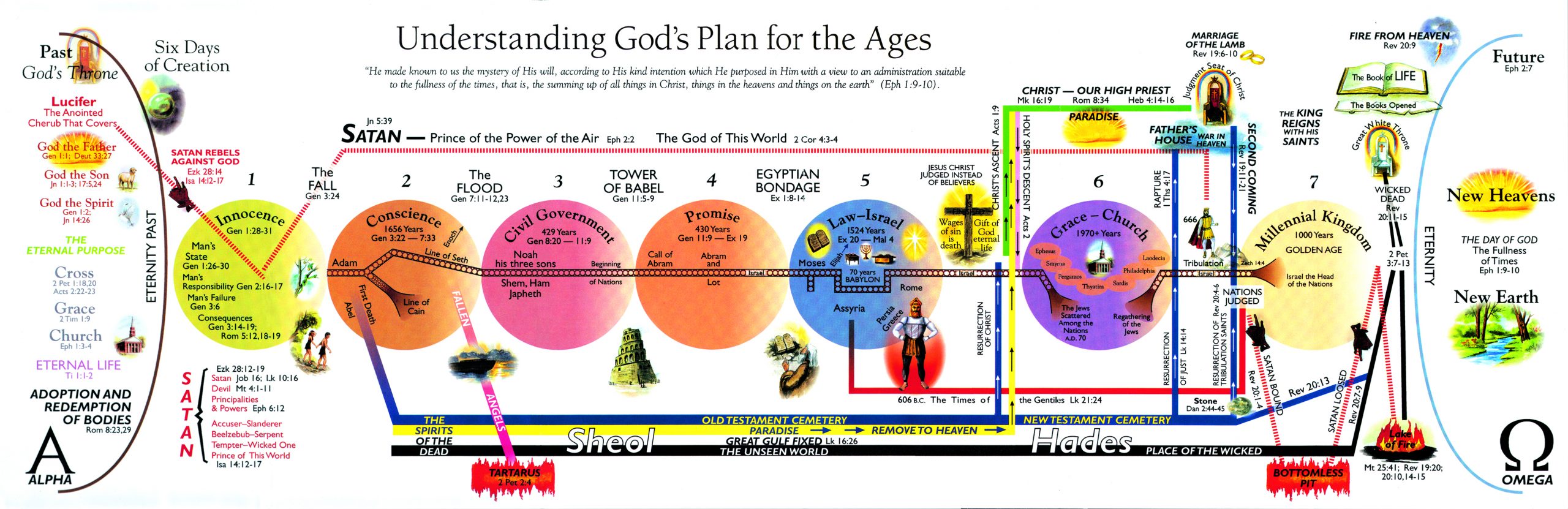
Source: Chart by Tim LaHaye and Thomas Ice - click to enlarge - Millenium on Right Side
Resources on the Millennium:
- Table Comparing Present Age, the Millennium and Eternity Future
- The Millennial Kingdom (see chart) - Tony Garland
- The Millennial Position of Spurgeon by Dennis Swanson (see also
- C. H. Spurgeon and the Future of Israel)
- What is the Millennial Kingdom, and should it be understood literally?
- Who will occupy the Millennial Kingdom?
- Will David reign with Jesus in the Millennial Kingdom?
- Will there be animal sacrifices during the millennial kingdom?
- What is the purpose of the thousand-year reign of Christ?
- The Theocratic Kingdom - Volume 1-3
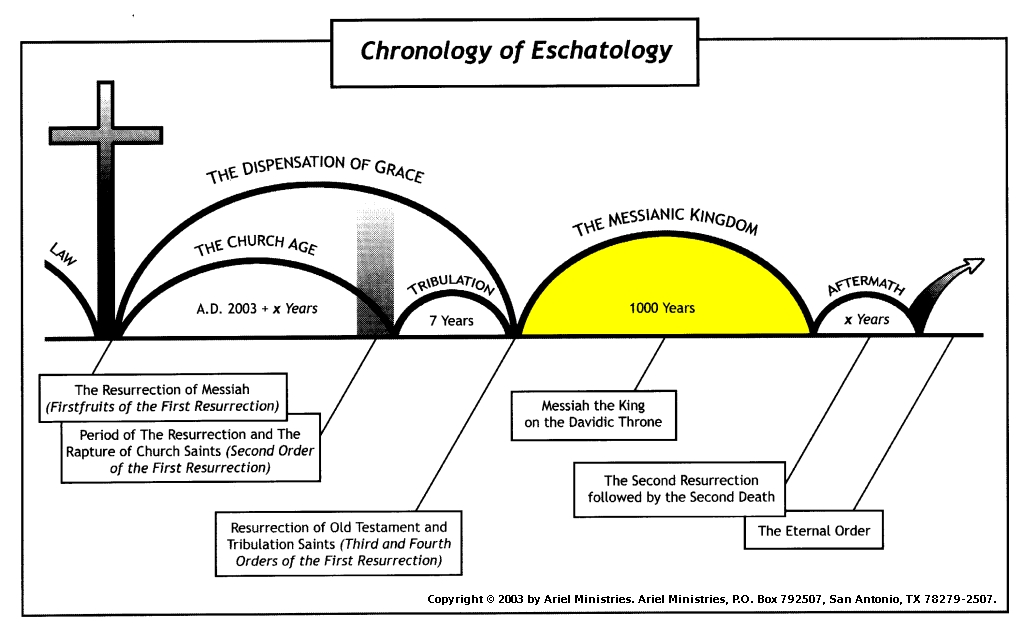
Volume 1 - Propositions 1 - 106
Volume 2 - Propositions 107 - 164
Volume 3 - Propositions 165 - 206
Although written in 1883, The Theocratic Kingdom stands as one of the single best expositions on the kingdom of God (including the Millennial Kingdom) ever written. In 1883 George Peters published his 3 volume magnum opus which is now available online. Link to Pdf
In 1952, Dr. Wilbur Smith writing a preface to the Theocratic Kingdom work said in his opening remarks that "No writer of a major work in the field of Biblical interpretation in modern times could have lived and died in greater oblivion, and experienced less recognition for a great piece of work, than the author of these three great volumes devoted to Biblical prophecy . . . Yet, this clergyman, never becoming nationally famous, never serving large churches, passing away in such comparative obscurity . . . wrote the most important single work on Biblical predictive prophecy to appear in this country at any time during the nineteenth century.
Lewis Sperry Chafer said that The Theocratic Kingdom was "The greatest work on prophetic interpretation ever written."
A C Gaebelein (In the Harmony of the Prophetic Word) (Published 1907)
Arnold Fruchtenbaum
John Walvoord
- The Doctrine of the Millennium — Part I: The Righteous Government of the Millennium
- The Doctrine of the Millennium — Part II: Spiritual Life in the Millennium
- The Doctrine of the Millennium — Part III: Social and Economic Aspects of the Millennium
- The Doctrine of the Millennium — Part IV: The Heavenly Jerusalem
- The Millennial Kingdom — Part I: The Prophetic Context of the Millennium
- The Prophetic Context of the Millennium — Part II: The Second Coming of Christ
- The Prophetic Context of the Millennium — Part III: The Second Coming of Christ in the New Testament
- The Prophetic Context of the Millennium — Part IV: The Resurrection at the Second Advent
- The Reign of Christ - Revelation 20 (Includes Discussion of Millennial Kingdom)
- The Future Work of Christ — The Millennial Kingdom and the Eternal State

Millennium is a term derived from the Latin mille meaning "a thousand". The term "Millennium" per se is not found in the Scriptures but is used by many evangelicals to identify the period of "one thousand years" which John mentions six times in Revelation 20. Other synonyms for "Millennium" include "Millennial Kingdom", "Messianic Kingdom", "1000 Year Reign of Christ", "Messianic Age" and “literalistic chiliasm (Greek chilias = one thousand)”. As outlined below, the characteristics of the "Millennium" are described in considerable detail in the Old Testament, albeit this period is never specifically defined as 1000 years in the OT text.
It is interesting to read the definition of "Millennium" from Webster's dictionary...
Millennium (Mil*len"ni*um) n. [LL., fr. L. mille a thousand + annus a year] the thousand years mentioned in Revelation 20 during which holiness is to prevail and Christ is to reign on earth
Clarence Larkin has an interesting comment writing that...
The Millennium,” [is] from the Latin words “Mille” (1000) and “Annum” (year). It is to be regretted, however, that the word “Millennium” ever supplanted the Biblical word “Kingdom,” for it is this period that Christ taught His Disciples to pray for in the petition—“Thy Kingdom Come. . .” (see note Matthew 6:10). (Clarence Larkin, Dispensational Truth. Glenside, PA: Rev. Clarence Larkin Estate, 1918, 1920)
Source: Bruce Hurt,MD
|
THE THREE VIEWS OF |
|||
|
VIEW |
RETURN OF CHRIST |
DESCRIPTION | METHOD OF Interpretation |
| Premillennialism |
Before the 1,000 year kingdom |
Christ returns bodily to earth to establish His literal kingdom on earth and will reign for 1,000 years |
|
| Postmillennialism |
After a golden age on earth |
Christ returns after the 1,000 years which represent a "golden age" of unspecified duration ushered in by triumph of the Church preaching the gospel & a large part of the world converting to Christianity |
|
| Amillennialism |
(No literal earthly kingdom) |
No literal reign of Christ. No earthly kingdom. Christ presently reigns over a spiritual kingdom | |

By Lamorak
Three Views of the Millennium
In simple terms there are 3 basic approaches to interpretation of "1000 years" in Revelation 20 only the first of which holds to the "Golden Rule" of literal interpretation!
1) Pre-millennial: Christ will return visibly and bodily to earth to defeat the Antichrist at the end of Daniel's Seventieth Week, His return marking the beginning of His 1000 year reign as King of kings.
After the 1000 years, the non-Christian dead are raised, judged at the Great White Throne, followed by the eternal state of a new heaven and new earth. Premillennialism generally holds to a revival of the Jewish nation (cp Israel's being granted her sovereign independence in May, 1948) and their repossession of their ancient land when Christ returns, specifically ruling over the boundaries promised by Jehovah in the Abrahamic Covenant...
On that day the LORD made a covenant with Abram, saying, "To your descendants I have given this land, From the river of Egypt as far as the great river, the river Euphrates (Genesis 15:18).
Comment: This literal covenant promise should not be "spiritualized" as having been or as being fulfilled in the Church, because Jehovah is a covenant keeping God Who will fulfill every promise to Israel literally. Although both Jew and Gentile are both saved by grace through faith {not just in the NT but also in the OT, which is why I abhor espousing a given brand of "systematic theology"}, the Jehovah's yet unfulfilled covenant promises to national Israel will be fulfilled beginning in the 1000 year reign of Messiah as King of kings. His Kingdom on earth will be consummated by divine dramatic intervention which effects utter and final defeat of all the rebellious kingdoms of men. When one begins to spiritualize the Scripture so that it conveniently fits with one's brand of systematic theology, the problem arises as to whose permutation of spiritualization is correct. And how do we reliably decide which verses to spiritualize and which to interpret literally? What if we begin to spiritualize essential doctrines such as the resurrection {as occurred! See 2Ti 2:18}? As an aside, although I probably come closest to the views of "dispensational theology", this website does not espouse a specific brand of "systematic theology", other than the literal interpretation of the Scriptures.
2) Post-millennial: Christ will return after the 1000 years.
This view holds that in the present age, proclamation of the the gospel (but see next paragraph) reduces the influence of evil and brings gradual expansion of the Kingdom of Christ as the church fulfills its function of being salt and light in the darkness. Specifically, this view does not hold that there is any necessity for Christ personal appearance on earth in order to bring about God's Kingdom.
As with all views there are permutations and variations (the minute details of which are not the subject of this brief summary), so that liberals hold the belief that human efforts (e.g., the "social gospel" not the genuine Biblical gospel) are necessary to accomplish the bringing in of God's Kingdom.
Evangelicals who espouse the post-millennial view generally feel that that proclamation of the Gospel is necessary to bring in the kingdom of God. Certainly Jesus was quite clear when He declared...
And this gospel of the kingdom shall be preached in the whole world for a witness to all the nations, and then the end shall come. (Mt 24:14)
In regard to the specific interpretation that the proclamation of the Gospel by the Church is necessary to bring in the Kingdom of God, one must be careful to see what saith the Lord. Certainly believers are under obligation to both Jews and Greeks to proclaim the glorious Gospel (Ro 1:14) but ultimately it is God's angelic messenger who presents the final proclamation of the Gospel to the whole world just prior to the Great Tribulation, announcing the beginning of the end (Note: for those who believe in a pre-tribulation rapture, the church will not even be present to accomplish the task Jesus described, so it has to be accomplished by God!), and in the midst of the impending wrath God remembers mercy, John recording...
And I saw another angel flying in midheaven, having an eternal gospel (this is the same Gospel Paul preached and there is no justification whatsoever for interpreting it as a "different gospel" as some such as C I Scofield did! {See Scofield's interpretative comment on Rev 14:6, regarding the "subdivisions" of "Gospel" - especially point #3 "it is neither the Gospel of the kingdom nor of grace" - I strongly disagree!} to preach to those who live on the earth, and to every nation and tribe and tongue and people 7 and he said with a loud voice, “Fear God, and give Him glory, because the hour of His judgment has come (Great Tribulation); and worship Him who made the heaven and the earth and sea and springs of waters." (Rev 14:6, 7-see notes Re 14:6; 7)
Comment: E W Bullinger had the following pithy comment writing that
While the majority of the Church’s teachers are loudly proclaiming that “the day of the Lord” will not come till the world’s conversion comes, the Spirit and truth of God are declaring that day shall not come until the apostasy comes {"and the man of lawlessness...is revealed" 2Thes 2:3, 4}. While the majority of the Church’s teachers are maintaining that the world is not yet good enough for Christ, the Spirit is declaring in the Word that the world is not yet bad enough!
As an aside will this worldwide angelic proclamation of the eternal gospel have the desired impact? Let's let the apostle John answer that question for he writes the following words
After these things I looked, and behold, a great multitude, which no one could count (do not miss John's "quantitative" comment for it promises a future harvest of souls during the Great Tribulation which is innumerable!), from every nation and all tribes and peoples and tongues, (notice that "coincidentally" these are the same four terms John used to describe the "recipients" of the eternal gospel in Rev 14:6!) standing before the throne and before the Lamb, clothed in white robes, and palm branches were in their hands...13 And one of the elders answered, saying to me, “These who are clothed in the white robes, who are they, and from where have they come?” 14 And I said to him, “My lord, you know.” And he said to me, “These are the ones who come out of the Great Tribulation, and they have washed their robes and made them white in the blood of the Lamb. (See notes Revelation 7:9, 13; 14)
Comment: The reasonable conclusion is that those who come out of the Great Tribulation heard the worldwide proclamation of the eternal gospel at the midpoint of the Tribulation, just prior to the onset of the last 3.5 years when the mystery of God would be finished {see note Re 10:7, cp notes on Rev 15:1 re "the wrath of God is finished"} and by grace through faith in God's glorious and eternal gospel, washed their robes white in the blood of the Lamb.
3) Amillennial: There will be no literal, visible millennium on earth, and thus no literal reign of Christ on earth over His kingdom.
This view holds that Satan is bound (Rev 20:1, 2, 3 -see notes Re 20:1; 2; 3) and the church is experiencing the millennium now and Christ is presently reigning over a spiritual kingdom either in (1) the hearts of men, (2) in heaven or (3) in the church.
There are some differences as to whether the millennium is being fulfilled on earth now (Augustine), or whether it is being fulfilled by the saints in heaven (Reformed). The main belief is that there will be no more millennium than there is now, and that the eternal state immediately follows Christ's Second Coming. Some modern amillenarians, however, spiritualize not only the millennium but also the Blessed Hope of the Second Coming of Christ (Titus 2:13). This modern view of the Lord's return identifies the coming of Christ as a perpetual advance of Christ in the church that includes many particular events.
One of the major repercussions of the amillennial view is that those who hold this position are forced to interpret the many OT and NT passages that refer to the millennial kingdom in a non-literal way, generally interpreting these verses spiritually as fulfilled in the church, who they "spiritualize" as "spiritual Israel" (see related discussion of The Israel of God on Gal 6:16)
In fairness, it should be noted that the summary of these three views of interpretation of the 1000 years in Revelation 20 is meant to be only a generalization and does not seek to go into the various arguments or permutations of belief of the post- or a-millennial views, some of which are quite complex.
As alluded to earlier, it needs to be reiterated that this website does not espouse a single specific theological approach to eschatology including even Dispensationalism which also strongly supports a literal millennium. Instead the approach is to seek to adhere as best as is humanly possible to a literal interpretation of the Biblical text. As a chemistry major at the University of Texas and later as a medical doctor trained in the practice of observation of literal tissue samples (specifically as a pathologist analyzing various tissues and cells of the human body under a microscope) I take the approach that
if the plain sense of the Biblical text makes good sense in context, then one should seek to make no other sense out of the inspired text for fear that the conclusion may end up as sheer nonsense.
And so it follows, especially if you are new to the study of prophecy, that one of the most important rules for accurate interpretation is to allow the Scripture to speak for itself, reading the text for the normal, plain sense, as long as the context allows (see discussion on Reading the Scripture Literally). If the Bible conveys actual or literal truth from God, it follows that the Bible ought to be interpreted literally. Utilizing this admittedly simple and even somewhat simple minded approach, it is difficult to overlook John's declaration that there is a 1000 year period in which Jesus Christ will reign and rule on earth as Lord of lords and King of kings.
Many shy away from the word literal since it seems to preclude anything symbolic. Clearly, the Bible uses symbolic language and figures of speech to convey literal truth. This however does not imply that the Bible should be interpreted symbolically, but that the symbols and figures of speech must be translated into literal truth in order for us to clearly understand God's intended message. You may be asking "How can a symbol be interpreted literally?" The real question is how else should a symbol be understood? In other words, if a symbol does not represent an actual or literal truth, then by default it must be a symbol of another symbol, etc, etc, this line of reasoning going on and on until the final result is nonsense. The point is that a symbol must represent some literal truth. When Jesus declared "I am the door. if anyone enters through Me, he shall be saved, and shall go in and out, and find pasture" (Jn 10:9) He was clearly using a figure of speech, and with the symbol of a door He beautifully illustrated that He was literally the Way through one must pass to come into the "room" of salvation. In short, we readily recognize the use of symbolic language in Scripture but emphasize that symbolic and figurative language must be understood plainly. To be sure, there are times when one cannot be absolutely certain of the literal meaning of a symbol, as for example the locusts in Re 9:7 (see note). The danger in such cases is to devise a symbolic interpretation of the symbol and forgo seeking the literal truth that God is trying to convey.
The straightforward, plain, normal, literal interpretation
is the most basic of all guidelines for the study of prophecy.
In fairness, it should be acknowledged that there are many good and godly people who disagree with the literal interpretation of 1000 years in Revelation 20 (see thousand in Re 20:2, 3, 4, 6, 7) but that leaves the non-literal interpretation as their only option. By default, they must resort to allegorical, spiritual or symbolic interpretation. What is the inherent danger of such an approach? A non-literal interpretative approach opens one to the vulnerability of fallen man's ingenuity and imagination. In other words, how far does one control the limits of their spiritualizing of a given passage? What is the plumb line that determines the accuracy of their non-literal assessment?
John Walvoord a literalist wrote...
A literal promise spiritualized is exegetical fraud. (Walvoord, J F: The Millennial Kingdom. Page 200. Zondervan Publishing, 1959)
The inherent dangers of non-literal interpretation should be readily apparent. I firmly believe that the difficulty of defining which allegorical, spiritualized, symbolic, mystical, etc, interpretation is the "right" interpretation is one of the major reasons there is a veritable cornucopia of chaotic, conflicting and confusing interpretations on the book of the Revelation and specifically on the short section of Scripture in Revelation 20. Is it not possible (even probable), that the Old Serpent, Satan, the liar, the devil, the diabolos (literally one who throws between or comes between and thus divides!) has had no small part in orchestrating the confusion regarding the interpretation of the Revelation of Jesus Christ which clearly defines our Lord's triumph and Satan's utter and final defeat? How often I hear Christians say they have never even read the Revelation of Jesus Christ. When I ask "Why not?", the most common answers are "I'm afraid to read it", "There are two many interpretations, so how can you know who is correct", or "It simply cannot be understood." I beg to disagree, dear Christian brother or sister. If you are born from above, your body is a temple of the Holy Spirit, Who lives in you as your resident Teacher, and concerning Whom Jesus said
"will teach you all things" (John 14:26) and will "guide you into all the truth...and... will disclose to you what is to come (sounds like He wants us to know prophecy!)." (John 16:13)
In his first epistle, John reminds us that...
the anointing (which alludes to the teaching ministry of the indwelling Holy Spirit) which you received from Him abides in you, and you have no need for anyone to teach you; but as His anointing teaches you about all things, and is true and is not a lie, and just as it has taught you, you abide in Him. (1John 2:27)
From other NT passages, we know that John is not saying you never need a teacher, but that you must understand that you as a believer already possess in the Spirit's anointing the best Teacher you will ever have and One Who will help discern whether your human teachers are speaking truth or error (cp Heb 5:14, 1Th 5:21,22). So a good practice when studying prophecy is to "pray without ceasing" (1Th 5:17) seeking the Holy Spirit's ministry of illumination.
Before you go any further and are biased even more by the interpretative comments on this page, you might take a moment and lay aside all you preconceived notions, your denominational trappings, your favorite prophecy teacher's interpretation, etc, and come to Revelation 19-22 as if you have never read this section before. Ask your Teacher the Holy Spirit to lead you into all the truth. Come with a heart that is tender and that trembles at His Word (Isa 66:5) seeking the plain sense of what God has declared about the end times. Remember that "God is not a God of confusion"! (1Co 14:33)
As you read these amazing passages, you might make a simple list of the major events from Revelation 19:11-21:3. You might also want to try to group the major events together and number each group. Then armed with what the Scripture clearly states, unbiased by any specific theological persuasion or system of theology, you will then be better prepared to evaluate what the commentaries (including the one you are reading) have to say about these important Scriptures. As I always like to say
"It's amazing how much light the Scriptures will shed on the commentaries!"
Now ask yourself as you simply wrote down the events in Revelation 19:11-21:3, does a literal reading suggest a logical sequence of the events? (Compare your findings with a simple observation of the events in Revelation Charted Out - Without Commentary) Again, try to put aside anything and everything you have ever been told about prophecy in general and the Revelation in particular, so that you might arrive at the most accurate, objective interpretation possible. May God's Spirit grant you His amazing grace to do so. Amen.
- Interpretation - Basic Principles
- Chicago Statement on Biblical Hermeneutics
- Bible Interpretation - Figures of Speech
- Interpreting Symbols - Introduction by Tony Garland - recommended
- The Importance of Meaning
- The Art and Science of Interpretation
- The Rise of Allegorical Interpretation
- Understanding Symbols and Figures
- Understanding Numbers
- Systems of Interpretation by Tony Garland - recommended
- Interpreting Prophecy Today - John Walvoord
- Part 1: Basic Considerations in Interpreting Prophecy
- Part 2: The Kingdom of God in the Old Testament
- Part 3: The New Testament Doctrine of the Kingdom
- Part 4: The Kingdom of God in the New Testament (continued)
- Issues in Hermeneutics - Andy Woods
- Grammatico Historical Method Matter Of Genre
- Hermeneutics - Study of Interpretation of Scriptures - Stephen R Lewis
Includes an interesting synopsis of the history of how Scripture has been interpreted since the first century AD, I would recommend the synopsis by Dr Stephen R Lewis (see page 22). You may be surprised at what you discover about the so called Early Church Fathers and their slide into allegorical interpretation which even such highly regarded men as Augustine (354-430 AD) et al championed and which sadly led to the allegorical method becoming the favored method of Scripture interpretation for almost 1000 years (the "dark ages" - perhaps herein lies a clue as to why they were so "dark"!) As one writer has said "the Middle Ages was a vast desert so far as biblical interpretation is concerned" (Mickelsen).
Bob Ross addresses this question with the following quotations from the "prince of preachers" himself...
With basic definitions before us, then, let's look at some quotes from Spurgeon to see what his position was on the Millennium.
"If I read the word aright, and it is honest to admit that there is much room for difference of opinion here, the day will come, when the Lord Jesus will descend from heaven with a shout, with the trump of the archangel and the voice of God. Some think that this descent of the Lord will be post-millennial — that is, after the thousand years of his reign. I cannot think so. I conceive that the advent will be PRE-millennial — that he will come first; and then will come the millennium as the result of his personal reign upon earth. But whether or no, this much is the fact, that Christ will suddenly come, come to reign, and come to judge the earth in righteousness." [from Justification & Glory MTP Vol 11, Year 1865, pg. 249, Romans 8:30 (age 31)]
Spurgeon here specifically identifies the Postmillennial view and denies his adherence to it. Those who attempt to claim Spurgeon for this viewpoint do not demonstrate their contention by referring to clear comparisons such as this one. They rather go to sermons not specifically dealing with both positions and pull out of them ideas that are "compatible" with Postmillennial thinking. This is a faulty way of proving a point, however — especially when they meet squarely with a Spurgeon statement like the one above & those below. [MANY postmillennialists (especially GARY NORTH), are guilty of misrepresenting Spurgeon constantly in articles and books; NORTH has alleged that "Spurgeon was Postmillennial" — yet neither his supplied quotations "say" so, or, he deliberately does not present a statement by Spurgeon which North can speculate "implies" a Postmillennial position.]
Again, consider Spurgeon's View here in light of Postmillennial teaching...
"Paul does not paint the future with rose-colour: he is no smooth-tongued prophet of a golden age, into which this dull earth may be imagined to be glowing. There are sanguine brethren who are looking forward to everything growing better and better and better, until, at last, this present age ripens into a millennium. They will not be able to sustain their hopes, for Scripture gives them no solid basis to rest upon. We who believe that there will be no millennial reign without the King, and who expect no rule of righteousness except from the appearing of the righteous Lord, are nearer the mark. Apart from the second Advent of our Lord, the world is more likely to sink into a pandemonium than to rise into a millennium. A divine interposition seems to me the hope set before us in Scripture, and, indeed, to be the only hope adequate to the occasion. We look to the darkening down of things; the state of mankind, however improved politically, may yet grow worse and worse spiritually." [from The Form of Godliness Without the Power MTP Vol 35, Year 1889, pg. 301, 2 Timothy 3:5 (age 54)]
"We are to expect the literal advent of Jesus Christ, for he himself by his angel told us, 'This same Jesus which is taken up from you into heaven shall so come in like manner as ye have seen him go into heaven,' which must mean literally and in person. We expect a reigning Christ on earth; that seems to us to be very plain, and to be put so literally that we dare not spiritualise it. We anticipate a first and a second resurrection; a first resurrection of the righteous, and a second resurrection of the ungodly, who shall be judged, condemned, and punished for ever by the sentence of the great King." [from Things to Come MTP Vol 15, Year 1869, pg. 329, 1 Corinthians 3:22 (age 35)]
Here, stress is laid upon the literal nature of the second coming. Also, after this literal return is stressed a reigning upon the earth.
"We have done once for all with the foolish ideas of certain of the early heretics, that Christ's appearance upon earth was but a phantom. We know that he was really, personally, and physically here on earth. But it is not quite so clear to some persons that he is to come really, personally, and literally, the second time. I know there are some who are labouring to get rid of the fact of a personal reign, but as I take it, the coming and the reign are so connected together, that we must have a spiritual coming if we are to have a spiritual reign. Now we believe and hold that Christ shall come a second time suddenly, to raise his saints at the first judgment, and they shall reign with him afterwards. The rest of the dead live not till after the thousand years are finished. Then shall they rise from their tombs at the sounding of the trumpet, and their judgment shall come and they shall receive the deeds which they have done in their bodies." [from The Two Advents of Christ MTP Vol 8, Year 1862, pg. 39, Hebrews 9:27-28 (age 28)] [from The Sinner's End MTP Vol 8, Year 1862, pgs. 712-713, Psalms 73:17-18 (age 28)],
Spurgeon is discussing the final condition of the sinner —
"Let us go on to consider their end. The day of days, that dreadful day has come. The millennial rest is over, the righteous have had their thousand years of glory upon earth."
In the quotes above, the order of events fits perfectly the PRE-millennial point of view. The final end of the sinner is faced after the righteous have enjoyed a thousand years with Christ.
"Our hope is the Personal PRE-MILLENNIAL Return of the Lord Jesus Christ in glory." [August 1891, age 58] by Charles H. Spurgeon
Of the various articles and writings by those who deny the conclusion that we feel is obvious, none that I have found bases itself on the same type of quotes we have produced (many others could have been given — see more below). To the contrary, their's are based on "interpreting" Spurgeon's statements apart from such quotes that we have given.
We feel safe in concluding, then, that of the three views we began with, Spurgeon expressly states that he believes in a literal return of Jesus Christ before a literal millennium on the earth. (Spurgeon's Millennial View)
Related Resource:
If you observe Revelation 19:11-21:3 literally, independent of any teaching on prophecy you may have heard, you will be able to come up with a literal timeline of the end time events similar to the one below (numbered 1-7, indicating a definite sequence of events, one after the other or contemporaneous with another event). As you look over this simple list ask yourself
"Does this sequence of events seem logical and orderly?"
And remember how John opens this great book...
The Revelation of Jesus Christ, which God gave Him to show to His bond-servants, the things which must shortly take place; and He sent and communicated it by His angel to His bond-servant John,2 who bore witness to the word of God and to the testimony of Jesus Christ, even to all that he saw.
Read his introduction again. Who are the individual entities and what is the sequence? Sketch out this verse - from whom to whom to whom, etc? What is he saying? What is God's heart in this introduction? Confusion? Or revelation (which means to take the lid off and expose fully so that it can be seen)?
If you carefully observed the sequence, you would observed something like this...
God gave the Revelation
V
Jesus
V
His angel
V
His bondservant John
V
His bondservants
V
Show the things which must shortly take place
If God is a God of order and not confusion and desires His bondservants to know these things and has presented them out in a logical, orderly fashion in Revelation 19-21, why would one need to allegorize or spiritualize the plain, natural reading of "1000 years"? Is "1000 years" not compatible with God's plan for the end of the ages? Why not? Is it because you were taught by someone you respected who simply did not believe the "1000 years" was literal? Or is it because you have read several commentaries that don't interpret "1000" as "one thousand"? Even if you did not know that there were literally dozens of Old Testament Scriptures (click for listing of these OT verses) that perfectly paralleled this period of "one thousand years", can you not see how the literal interpretation fits so well into the flow of events in these last chapters of the Revelation? Notice that I am not espousing any particular theological viewpoint (dispensational or otherwise) but only assuming a simple minded literal reading of the Scripture.
|
Chronological Summary of |
|||
| REVELATION 19 | REVELATION 20:1-10 | REVELATION 20:11-14 | REVELATION 21-22 |
|
Jesus Returns as King of kings Re 19:11, 16 Defeats Antichrist & Cast into Lake of Fire Re 19:19, 20 Wrath of God finished Re 15:1 |
Satan bound 1000 yr Re 20:2 Jesus & saints reign on earth 1000 yr Re 20:4 Satan unleashed after 1000 yr, defeated, & cast into Lake of Fire Re 20:7, 8, 9, 10 |
Great White Throne Judgment of unbelievers Re 20:11, 12, 13 Cast into Lake of Fire Re 20:14, 15 Old Earth & heaven fled away, no place found for them (burned up) Re 20:11, 2 Pe 3:7, 10 |
New Heaven & Earth Re 21:1 New Jerusalem Re 21:2 |
(1) The Second Coming of Christ:
And I saw heaven opened; and behold, a white horse, and He who sat upon it is called Faithful and True; and in righteousness He judges and wages war. And His eyes are a flame of fire, and upon His head are many diadems; and He has a name written upon Him which no one knows except Himself. And He is clothed with a robe dipped in blood; and His name is called The Word of God. And the armies which are in heaven, clothed in fine linen, white and clean, were following Him on white horses (Who are they? Compare Re 17:14-See the called, chosen and faithful) And from His mouth comes a sharp sword, so that with it He may smite the nations; and He will rule them with a rod of iron; and He treads the wine press of the fierce wrath of God, the Almighty. And on His robe and on His thigh He has a name written, "KING OF KINGS, AND LORD OF LORDS." (see notes Revelation 19:11; 12; 13; 14; 15; 16)
Comment: Note that this is the "second stage" of the Second Coming (coming with His saints), the first stage represented by the pre-tribulation rapture of His Bride, the Church (His coming for His saints) (See Table comparing Rapture vs Second Coming) (see discussion of pre-tribulation rapture)
(2) The defeat and fate of the Antichrist and the false prophet
And the Beast (the Antichrist - see his aliases, cf 1Jn 2:18, 22) was seized, and with him the false prophet who performed the signs in his presence, by which he deceived those who had received the mark of the beast and those who worshiped his image; these two were thrown alive into the lake of fire which burns with brimstone (note this event precedes Christ's 1000 year reign). And the rest were killed with the sword which came from the mouth of Him who sat upon the horse, and all the birds were filled with their flesh. (see notes 1Revelation 19:19; 20; 19:21)
(3) The binding of Satan for 1000 years
And I saw an angel coming down from heaven, having the key of the abyss and a great chain in his hand. And he laid hold of the dragon, the serpent of old (cp Ge 3:1, 2, 3, 4, 5, 3:15 = His demise prophesied!), who is the devil and Satan, and bound him for a thousand years, and threw him into the abyss, and shut it and sealed it over him, so that he should not deceive the nations any longer, until the thousand years were completed; after these things he must be released for a short time. (see notes Revelation 20:1; 20:2; 20:3)
(4) The reign of Christ and His saints for 1000 years
And I saw thrones, and they sat upon them, and judgment was given to them. And I saw the souls of those who had been beheaded because of the testimony of Jesus and because of the word of God, and those who had not worshiped the beast or his image, and had not received the mark upon their forehead (contrast ) and upon their hand; and they came to life and reigned with Christ for a thousand years. (cp Re 1:6, Re 2:26, Re 5:10) The rest of the dead did not come to life until the thousand years were completed. This is the first resurrection (See discussion of First & Second Resurrection; See also Order of Resurrection). Blessed and holy is the one who has a part in the first resurrection (these are the saints, the genuine believers, of all ages); over these the second death has no power, but they will be priests of God and of Christ and will reign with Him for a thousand years. (see notes Revelation 20:4; 20:5; 20:6)
(5) Satan's final defeat and eternal demise in the lake of fire
And when the thousand years are completed (notice how the time phrase "when..." indicates a sequence or an order in the events), Satan will be released from his prison, and will come out to deceive the nations which are in the four corners of the earth, Gog and Magog, to gather them together for the war; the number of them is like the sand of the seashore. And they came up on the broad plain of the earth and surrounded the camp of the saints and the beloved city (Jerusalem), and fire came down from heaven and devoured them. And the devil who deceived them was thrown into the lake of fire and brimstone (cp Mt 25:41), where the Beast (see his aliases) and the False Prophet are also; and they will be tormented day and night forever and ever. (see notes Revelation 20:7; 20:8; 20:9; 20:10)
(6) The Final Judgment of all Unbelievers at the Great White Throne
And I saw a great white throne and Him who sat upon it, from whose presence earth and heaven fled away, and no place was found for them (this appears to describe a time in eternity future when there is no heaven and no earth, old or new, which correlates with 2Pe 3:10). And I saw the dead, the great and the small, standing before the throne, and books were opened; and another book was opened, which is the book of life; and the dead were judged from the things which were written in the books, according to their deeds. And the sea gave up the dead which were in it, and death and Hades gave up the dead which were in them; and they were judged, every one of them according to their deeds. And death and Hades were thrown into the lake of fire. This is the second death (see Births, Deaths, and Resurrections.), the lake of fire. And if anyone's name was not found written in the book of life, he was thrown into the lake of fire. (see notes Revelation 20:11; 12; 13; 14; 15)
(7) The New Heaven and New Earth and "Immanuel" God With Us Forever
And I saw a new heaven and a new earth; for the first heaven and the first earth passed away, and there is no longer any sea. And I saw the holy city, new Jerusalem, coming down out of heaven from God, made ready as a bride adorned for her husband. And I heard a loud voice from the throne, saying, "Behold, the tabernacle of God is among men, and He shall dwell among them, and they shall be His people, and God Himself shall be among them (see notes Revelation 21:1; 21:2; 21:3)
A simple reading of the plain text, and listing of the events, logically and naturally leads to the objective conclusion that there is a period between Christ's defeat of the Antichrist and time of the Great White throne judgment which is separated by 1000 years, the period we know as the Millennium.

Some have claimed that belief in a literal "Millennium" is the product of twentieth century evangelical interpretation (especially widespread Dispensational teachings) but there is ample evidence that the literal view was espoused by many in the early church (the so-called "Early Church Fathers"), and that this view dominated for the first two centuries of the Christian era.
Geisler writes that
Millenarianism became the general belief of the time (the early church fathers) and met with almost no other opposition than that given by the Gnostics." (Geisler, Church History, vol.1, p.166)
John Walvoord gives a helpful synopsis of the history of the interpretation of the 1000 years noting that...
In the first two centuries of the Christian era the church was predominantly premillennial, interpreting Scripture to teach that Christ would fulfill the prophecy of His second coming and bring a thousand-year reign on earth before the eternal state will begin. Though not always cogent and sometimes fanciful, in general, prophecy was treated in the same way as other Scripture.
In the last ten years of the second century and in the third century the heretical school of theology at Alexandria, Egypt advanced the erroneous principle that the Bible should be interpreted in a nonliteral or allegorical sense. In applying this to the Scriptures, they subverted all the major doctrines of the faith, including prophecy. The result was that there was little progress in theology, especially in the prophetic area, until this problem of interpretation was solved.
Augustine (354-430) rescued the church from this erroneous principle as far as non-prophetic Scripture is concerned but continued to treat prophecy in a nonliteral way with the purpose of eliminating a millennial kingdom on earth.
Because amillennialism, which denies a literal millennial kingdom on earth following the Second Coming, is essentially negative and hinders intelligent literal interpretation of prophecy, there was little progress in this area. However the church continued to believe in heaven and hell and purgatory but neglected or explained away long passages having to deal with Israel in prophecy and the kingdom on earth as frequently revealed in the Old Testament (click list of these OT verses). Even in the Protestant Reformation prophecy was not rescued from this hindrance in its interpretation.
Though remnants of the church still advanced the premillennial view, it was not until the nineteenth and twentieth centuries that a movement to restore the literal truth of prophecy began to take hold. The twentieth century has been especially significant in the progress of prophetic interpretation and is one in which many details of prophecy have been debated and clarified in a way that had never been possible before. Though amillennialism continues to be the majority view of the church, among those who hold a high view of Scripture the premillennial interpretation has been given detailed exposition, serving to provide an intelligent view of the present and the future from the standpoint of biblical prophecy. (Walvoord, J. F.. The Prophecy Knowledge Handbook. Wheaton, Ill.: Victor Books. 1990)
Crispen adds that
the early Fathers lived in expectation of our Lord's speedy return... They distinguish between a first resurrection of the saints and a second or general resurrection. These they supposed would be separated by a period of a thousand years, during which Christ should reign over the saints in Jerusalem... While the church was alternately persecuted and contemptuously tolerated by the Roman Empire, the belief in Christ's speedy return and His millennial reign was widely entertained... When the Church was recognized and patronized by the state, the new order of things (i.e., acceptance by the establishment) seemed so desirable that the close of the dispensation (i.e., a literal 1000 year Messianic Age) ceased to be expected or desired. (History of Doctrine, p.231-232)
Smith notes that...
Immediately after the triumph of Constantine, Christianity having become dominant and prosperous, Christians began to lose their vivid expectation of our Lord's speedy advent, and to look upon the temporal supremacy of Christianity as a fulfillment of the promised reign of Christ on earth. (Smith, New Testament History, p.273)
Ferguson and Packer write that...
Many of the early fathers, including Papias (c. 60–c. 130), Justin (c. 100–c. 165), Irenaeus, Tertullian, Victorinus of Pettau (d. c. 304) and Lactantius (c. 240–c. 320), were premillennialists, i.e. they expected the personal coming of Christ in glory to inaugurate a millennial reign on earth before the last judgment. This belief was not only an interpretation of Revelation 20, but also a continuation of Jewish apocalyptic expectation of an interim messianic kingdom. The framework of Rev. 20 was filled with content derived from Jewish apocalyptic and especially from OT prophecies, with the result that the millennium was understood primarily as a restoration of paradise. Amid the abundant fruitfulness of the renewed earth and peace between the animals, the resurrected saints would enjoy 1,000 years of paradisal life on earth before being translated to eternal life in heaven. The 1,000 years were explained either as the originally intended span of human life on earth or as the world’s sabbath rest at the end of a 7,000-years’ ‘week’ of history. It was the materialistic nature of this millennialism which made it objectionable to others of the fathers, including Augustine, whose highly influential rejection of it led to the virtual disappearance of premillennialism until the 17th century. (Ferguson, S. B., & Packer, J. New Dictionary of Theology. Page 428. Downers Grove, IL: InterVarsity Press) (Bolding added)
Of the Early Church Fathers we read in more detail that...
"Papias, who had personal contact with those taught by Christ and His apostles and may well have been a disciple of the apostle John, asserted that “the Lord used to teach concerning those [end] times” that “there will be a period of a thousand years after the resurrection of the dead and the kingdom of Christ will be set up in material form on this very earth” (cited in Eusebius HE iii.39.12; Irenaeus Adv. haer v.33.3f).... (Papias') account is a weighty testimony to primitive Christian eschatological beliefs...Justin Martyr, “the most important of the Greek apologists of the second century” (Quasten, I, 196), while granting that “many who belong to the pure and pious faith and are true Christians think otherwise” than he on the millennial issue, explicitly declared: “I and others are right-minded Christians in all points and are assured that there will be a resurrection of the dead and a thousand years in Jerusalem, which will then be built, adorned and enlarged” (Dial. 80f; cf. J. Daniélou, VC, 2 [1948], 1–16).... In taking a millennial viewpoint, these fathers ranged themselves on the side of orthodoxy in two particulars: they supported the apostolicity and canonicity of Revelation (against those who combined a denial of its authenticity with amillennialism, e.g., Dionysius of Alexandria, as cited in Eusebius HE vii.14.1–3; 24.6–8); and they opposed both the Gnostics, whose dualistic spiritualizing of Christian doctrine completely wiped out eschatological hope, and Christian Platonists such as Origen (De prin. ii.11.2), whose rejection of a literal millennium stemmed from an idealistic depreciation of matter and a highly dangerous allegorical (Ed note: Figurative, symbolic and specifically having deeper or hidden spiritual meaning that transcends the literal sense of a sacred text! It is a method of interpreting a text in which the characters, events or places signify “deeper” meanings than their literal meaning. The allegorical method was especially employed with difficult texts. Even opponents of a literal millennial interpretation can clearly discern the potential pitfalls and dangers of the allegorical approach to the Word of Truth. Click offsite article) hermeneutic (Ed note: hermeneutics is the "science" or study of the methodological principles of interpretation, in this case of the Scripture)". (A. C. McGiffert, History of Christian Thought, I [1932], 227f)." (Bromiley, G. W. The International Standard Bible Encyclopedia, Revised. Vol. 3, Page 357-358. Wm. B. Eerdmans) (Bolding added)
Related resources -
If the early church believed in a literal Millennium, what happened to relegate this view to obscurity for most of the "Middle Ages"?
The answer is probably far more complex than that explained in this brief discussion, but the short answer is that during the fourth century of Christianity, when the church was given a "favored status" under the emperor Constantine, the amillennial position began to emerge as the dominant belief, thus replacing the previous belief in a literal millennium. The amillennial position was championed by the well known theologian Augustine (354–430AD). It is interesting that Augustine initially interpreted the "1000 years" literally and only later recanted from his literal interpretation. He apparently was driven away from that position by (in his words) the “immoderate, carnal” extremism of some of its advocates (Civ. Dei xx.7).
It appears that Augustine began to follow the symbolical-mystical hermeneutic approach of the fourth-century donatist Tyconius (a schismatic heretical Christian sect originating in North Africa in 311 AD, and which maintained that it alone constituted the true church and arose out of the initial teaching of Donatus who sought to separate the “pure” church from the “apostate” or “fallen” church) in arguing that
the "1000 years" of Revelation 20 actually designated the interval (in Augustine's words) “from the first coming of Christ to the end of the world, when He shall come the second time” (xx.8). Thus was “a new era in prophetic interpretation” introduced, wherein Augustine’s conception of the millennium as “spiritualized into a present politico-religious fact, fastens itself upon the church for about thirteen long centuries” (Froom, I, 479, with tabular summary of medieval views, 896f; see also R. C. Petry, Christian Eschatology and Social Thought: A Historical Essay on the Social Implications of Some Selected Aspects in Christian Eschatology to a.d. 1500 [1956], pp. 312–336). (ibid) (Bolding added)
John Walvoord gives some background on Augustine's position noting that the issue of whether prophecy should be interpreted literally or not ""was raised in the writings of the early church fathers and was brought to a head in the third century in the Alexandrian school of theology which attempted to give to all Scripture an allegorical or nonliteral meaning. Among the orthodox fathers Augustine countered the Alexandrian heresy by suggesting a twofold principle of interpretation of Scripture, namely, a literal interpretation of Scripture as a whole, but a spiritual or nonliteral interpretation of prophetic Scripture." (Walvoord, J: The Millennial Kingdom)
Augustine's interpretation proved to be the foundation for the doctrine which we today refer to as "Amillennialism". His allegorical approach (Click offsite article on rise of allegorical interpretation) in interpreting prophetic Scripture in general and the 1000 years in particular was so fully accepted that at the Council of Ephesus in 431AD, belief in the millennium was actually condemned as superstitious! The millennium began to be interpreted as a reference to the church, and the thousand-year reign of Christ and His saints was equated with the whole history of the church on earth, thus making for the denial of a future millennium, or so-called amillennialism. Amillennialism became the predominant view during the next 1300 years from about 400AD to 1700AD, the so-called Middle Ages or Dark Ages!
Although the Protestant Reformation brought about a renewed interest in the idea of "Sola Scriptura" (the Scriptures alone), this interpretative view did not completely reverse Augustine's symbolic/mystical approach to interpretation of Revelation 20. It seems that most of the Reformers...
"were so (legitimately) preoccupied with correcting the Church’s soteriological (doctrines dealing with how a person is genuinely saved or born again) errors that they could not give high priority to eschatology (study of future events). But from the pre-Reformers Wycliff and Huss to Luther, Calvin, and the doctrinal affirmations of Protestant Orthodoxy, the papacy was identified with the antichrist (Ed note: A non-literal interpretation which is not accurate when compared with specific Scriptures that describe the "antichrist"). This conviction led many Reformation Protestants to believe that the end of the world was at hand (T. F. Torrance, SJT, Occasional Papers 2, pp. 36–62; Vulliaud, pp. 127f). Had it not been for the outbreak of chiliasm (belief in a literal 1000 years) in a particularly offensive form at Münster (1534), early Church teaching on the millennium might have been recovered along with other doctrines obscured in the medieval synthesis. The speculations of radicals, however, as concretized in Münzer’s “Zion,” were so offensive to all that this was rendered impossible. (Ed note: Fueled by differences in wealth and class, radical leaders arose who claimed to be led by the Holy Spirit and who advocated rebellion against their oppressors in the name of God and in pursuit of the Millennium. In 1534, a rebellion in the city of Munster in 1534 was led by Jan Matthys took control of the community, by preaching that he was Enoch and was preparing the way for the return of Christ by establishing a community of good and doing away with the prevailing law codes. Then he issued a call for all the faithful to gather at Munster because it was the New Jerusalem. A great multitude of Anabaptists fled to the city and were besieged by an army of both Protestants and Catholics. A reign of terror served to keep the community under the control of Matthys' successor, Jan Bockelson, but the defenses finally collapsed and the town was taken.)
The Augsburg Confession, art 17 (Lutheran) and the Helvetic Confession, art 11 (Reformed) expressly rejected such “Jewish opinions” (but, let it be noted, did not reject millennialism per se — cf. Peters, Theocratic Kingdom, I, 531–34; M. Reu, Lutheran Dogmatics [1951], pp. 483–87; and Saarnivaara, pp. 94f)." (ibid) (Bolding added)
Not all early Protestants agreed with the Reformers as shown by the return to a literal interpretation of Revelation 20 in the early 17th century. A German Calvinist theologian, Johann Heinrich Alsted (1588-1638), revived the teaching of premillennialism in an academic form in the modern world. Alsted's book, "The Beloved City" (1627), presented his views, which caused the Anglican scholar, Joseph Mede (1586-1638), to become a premillennialist.
THE 1700's
During the 1700's, postmillennialism became the prevailing eschatological interpretation, receiving its most impressive formulation through the work of the Unitarian Daniel Whitby (1638-1726). According to his interpretation, the world was to be converted to Christ, the Jews restored to their land, and the pope and Turks defeated, after which the earth would enjoy a time of universal peace, happiness and righteousness for a thousand years. At the close of this period Christ would return personally for the last judgment. While some of Whitby's writings were publicly burned as heresy, particularly his views on the Trinity, many conservative theologians rapidly embraced and propagated his viewpoint on the millennium. Perhaps because of its agreement with the views of the eighteenth-century Enlightenment, postmillennialism was adopted by the leading commentators and preachers of the 1700's.
THE 1800's
TO THE PRESENT
By the 1800's under the influence of J N Darby (1800-1882), founder of the Plymouth Brethren movement, there was a rising interest in a literal interpretation of the "1000 years" of Revelation 20.
Robert Clouse explains that..
During the 1800's premillennialism again attracted widespread attention being fostered by the violent uprooting of European political and social institutions during the era of the French Revolution. There was also a renewed interest in the conversion and status of the Jews. One of the more influential leaders at this time was Edward Irving (1792-1834), a Church of Scotland minister who served a church in London, published many works on prophecy and helped to organize the Albury Park prophecy conferences. These meetings set the pattern for millennial gatherings throughout the nineteenth and twentieth centuries. Irving's enthusiasm spread to other groups and found firm support among the Plymouth Brethren movement.
J. N. Darby (1800-1882), an early Plymouth Brethren leader, articulated the dispensationalist understanding of premillennialism. He described the coming of Christ before the millennium as consisting of two stages: the first, a secret rapture removing the church before the Great Tribulation devastates the earth; the second, Christ's coming with his saints to set up the kingdom. He also believed that the church is a mystery of which only Paul spoke and that the purposes of God in Scripture could be understood through a series of time periods called dispensations. At his death Darby left forty volumes of writings and some fifteen hundred assemblies around the world. Through his books, which include four volumes on prophecy, the dispensational system was carried throughout the English-speaking world. The line of continuity from Darby to the present can be traced from his dispensationalist contemporaries and followers (C. H. Mackintosh, William Kelly and F. W. Grant) through the interceding scholars (W. E. Blackstone, James Hall Brooks, G. Campbell Morgan, H. A. Ironside, A. C. Gaebelein, and C. I. Scofield and his Scofield Bible) to the current adherents of his views.' The extent of this influence has been so vast that in many evangelical circles today the dispensationalist interpretation prevails.
The spread of Darby's views was aided by Henry Moorhouse, a Brethren evangelist of dispensational outlook, who helped convince D. L. Moody (1837-1899) of his prophetic interpretation. By the end of the nineteenth century Moody was probably the outstanding leader among evangelicals. Darby's impact on C. I. Scofield (1843-1921) was probably even more important since Scofield made dispensationalism an integral part of his Bible notes, and within fifty years three million copies of the Scofield Reference Bible were printed in the United States. In recent days the popularity of Hal Lindsey's books again demonstrates the vitality of the dispensational view. (Clouse, R, editor: The Meaning of the Millennium: Four Views, IVP)
It is clear from the above synopsis that for the past 2000 years there have always been genuine believers who espoused a literal interpretation of Revelation 20 so that a literal "Millennium" is not the "product" of modern day evangelicals, especially those who hold to a dispensational approach to theology. To be sure this latter school has promoted the literal approach as widely and effectively as any previous group, but they did not originate a literal interpretation of the 1000 years. It should also be noted that one can be a literalist without being a dispensationalist, so do not discard the interpretation of a literal 1000 years just because you don't agree with all dispensational theology (See a simple overview of this viewpoint at Covenantal vs. Dispensational Theology)
Finally, let us conclude these background comments on the "1000 years" by quoting an honest, albeit liberal amillennialist, S. D. F. Salmond (in "Christian Doctrine of Immortality" 2nd ed 1896) who admits that...
“The figurative interpretation, it must be owned, cannot be made exegetically good even in its most plausible applications... This remarkable paragraph in John’s Apocalypse speaks of a real millennial reign of Christ on earth together with certain of His saints, which comes in between a first resurrection and the final judgment” (pp. 441f).(ISBE, volume 3, p360)
Bernard Ramm in his book "Protestant Biblical Interpretation" (3rd rev. ed. Grand Rapids, MI: Baker Book House, 1970) explains that...
Among evangelicals there are generally two major camps regarding how prophetic passages should be read. Amillennialists will generally allegorize large portions of the prophetic Word, especially passages that speak of the Second Advent of Christ and the establishment of the one thousand year literal Davidic kingdom.
In contrast, premillennialists, following the teaching of the early church, treat the Second Coming with the same literal hermeneutic (science of interpretation) as they would the First Coming of Jesus. They hold that the Bible, from Genesis to Revelation, should be understood literally from a normal reading unless typology or poetry is used. And even then, premillennialists believe that literalness is implied behind the figure of speech or illustration used.
Does the Old Testament support the idea of a literal 1000 year reign of Christ on the earth?
Tony Garland writes that...
Even in the absence of the book of Revelation, premillennialists would expect a future kingdom on earth because one is required in order for God to fulfill the many OT promises which require such a kingdom (See notes Why a Millennial Kingdom?)
There are no Old Testament Scriptures that specifically quantify a future 1000 year period during which Messiah will rule on the earth.
As the International Standard Bible Encyclopedia states
it is almost universally admitted, by both opponents and advocates of millennialism, that the case for the doctrine rests squarely on the exegesis of Revelation 20 (ibid)
However, one of God's attributes is that He is "not a man, that He should lie" (Nu 23:19), and as Paul declares He "cannot lie" (Titus 1:2). In Malachi (Malachi 3:6) Jehovah declares "I the LORD do not change" which describes His immutability (unchangeableness). The point is that when God makes an unconditional promise, He is obligated to fulfill that promise and it will be fulfilled to the letter. You may be asking
How is this relevant to a discussion of the Millennium as it is related to the Old Testament?
Back in Genesis 15:18 God gave a specific promise of the land to Abraham and to his descendants, Moses recording that...
On that day the LORD made (cut) a (unconditional, immutable) covenant with Abram, saying, "To your descendants I have given this land, from the river of Egypt as far as the great river, the river Euphrates.
As an aside, as you read the Old Testament, you might make special note of the phrase the land. You will discover that after God's promise to Abraham in Genesis 12:1, 2, 3, 7 (cp Ge 26:3, 4, 28:13), the phrase "the land" is most often used as a synonym for the "promised land" or the land of Canaan, which Jehovah declared would be the permanent possession of Abraham's descendants (Ge 13:15, 15:18, Ezek 37:25). For an interesting study click click here for the occurrences of the land in the first five books (the Pentateuch). Note that before Genesis 12, the initial 9 uses do not refer to Canaan. For the uses after Genesis 12, check the context for the most accurate interpretation.
You may be saying, "That's interesting but how does "the land" help understand the "1000 years" in the Revelation?" That is a fair question which begs another question about "the land". The question is this -
Has God's very specific promise, with defined boundaries for "the land" ever been literally fulfilled to the nation of Israel?
A careful study of the OT history of Israel reveals that this specific promise has never been literally fulfilled, and yet we know that God's promise is certain. That being the case then the question remains as to when will this specific promise in the Abrahamic Covenant be fulfilled? Clearly, it was not fulfilled when Israel was "born again" as a nation in May, 1948. Thus the fulfillment has to be at some future time and the most logical answer is that it will be completely fulfilled during the Millennium, when Messiah reigns and Israel occupies "the land" "from the river of Egypt as far as the great river, the river Euphrates." If one discounts the literal interpretation of the "1000 years" and thus does away with the Millennial reign of Christ on earth in Israel, one makes it Scripturally impossible for God to fulfill His unbreakable promise of "the land" to Abraham and his descendants. To say that this promise is now passed on to the church (see related topic interpretation of the phrase "the Israel of God", Gal 6:16) is to ignore the clear promises of Scripture. The church has not replaced Israel in God's prophetic tapestry. Paul in fact warned the Gentile believers that...
"if some of the branches (natural, physical Jews from the nation of Israel) were broken off (because they did not receive Yeshua as their Messiah and Redeemer), and you, being a wild olive (speaking of the Gentiles who were "separate from Christ, excluded from the commonwealth of Israel, and strangers to the covenants of promise, having no hope and without God in the world" Ephesians 2:12), were grafted in among them and became partaker with them of the rich root of the olive tree (speaking especially of Abraham and the Abrahamic Covenant, which was entered by grace through faith), do not be arrogant toward the branches (speaking of natural Israel); but if you are arrogant, remember that it is not you who supports the root, but the root (the Abrahamic Covenant which at the Cross merges with the New Covenant. See related study of relationship of Abrahamic vs Old vs New Covenants) and supports you" (Romans 11:17-18 - notes)
To summarize the first point, although the Old Testament does not mention a specific time period of "1000 years", it does mention specific geographic borders of the land of Israel, dimensions which have not been attained nor will be attained until the future "1000 year" period when Messiah will reign on the earth with His saints.
Another argument for a Messianic Kingdom on earth are many OT passages (see Summary of Scriptures below) describing unique physical, spiritual and political characteristics that are difficult or even impossible to interpret unless one does accepts a future fulfillment which by default is most compatible with the "1000 year" period in Revelation 20.
We will look for now at one example in Isaiah 65 where Jehovah declares...
For behold, I create new heavens and a new earth; And the former things shall not be remembered or come to mind. 18 "But be glad and rejoice forever in what I create; For behold, I create Jerusalem for rejoicing, And her people for gladness. 19 "I will also rejoice in Jerusalem, and be glad in My people; And there will no longer be heard in her The voice of weeping and the sound of crying. 20 "No longer will there be in it an infant who lives but a few days, Or an old man who does not live out his days; For the youth will die at the age of one hundred And the one who does not reach the age of one hundred Shall be thought accursed. (Isaiah 65:17-20)
Now compare this passage with John’s “new heaven and new earth” (Re 21:1, 2- see notes Re 21:1; 2), where there will be no sin or death (1Cor 15:54, 55, 56; Re 21:4).
So how can one interpret Isa 65:17, 18, 19, 20? There are only two ways this text can be interpreted, literally or allegorically. The literal interpretation when compared with other Scriptures, leads to the deduction that this time can only reasonably corresponds to the 1000 year period described in Revelation 20. Or one can must spiritualize or allegorize the passage so that the allusions to death and sin are emptied of any significance. But if one spiritualizes those aspects, why not spiritualize the new heaven and new earth? This selective spiritualization is one of the chief problems with the non-literal approach, because who decides which sections are to be spiritualized and which are to be interpreted literally? To chose to allegorically interpret "difficult" passages or passages that don't support one's brand of systematic theology can only lead to confusion, especially in the realm of Bible prophecy.
Morris gives a balanced interpretation of Isaiah's prophecy writing that...
The prophecy intermingles here a description of the eternal state with that which foreshadows it--namely, the great millennial kingdom of Christ (Re 20:6). During the coming thousand-year reign of Christ on this present earth, antediluvian conditions will be largely restored, and some people will live perhaps a full thousand years. However, as this verse reveals, there will still be sin and death present, so it cannot be the new earth. On the new earth, there will be no sin and death (Re 21:4). These truths are not contradictory but complementary, the one being a type of the other. The millennial and antediluvian ages are similar, whereas the new earth represents restoration of paradise, before sin entered the world. (Morris, Henry: Defenders Study Bible. World Publishing) (Emphasis added)
Kaiser in Hard Sayings of the Bible explains that...
In the eternal state, when the new heavens and the new earth will have arrived, there will be no sin, sorrow and death. But when Christ reigns on earth, just prior to this eternal state, some of these burdens will remain, even if only in limited forms. So unexpected will death be that if people die after only living one hundred years, they will be regarded as having died as infants. Isaiah 65:20, 21, 22, 23, 24, 25 breaks the chronological order expected in the chapter and interjects a related note about Jerusalem during the millennium. (Hard Sayings of the Bible (308). Downers Grove, Il: InterVarsity)
Regarding this difficult passage in Isaiah 65, Keil and Delitzsch ask...
But to what part of the history of salvation are we to look for a place for the fulfilment of such prophecies as these of the state of peace prevailing in nature around the church, except in the millennium? A prophet was certainly no fanatic, so that we could say, these are beautiful dreams. . . . The prophet here promises a new age, in which the patriarchal measure of human life will return, in which death will no more break off the life that is just beginning to bloom, and in which the war of man with the animal world will be exchanged for peace without danger. And when is all this to occur? Certainly not in the blessed life beyond the grave, to which it would be both absurd and impossible to refer these promises, since they presuppose a continued mixture of sinners with the righteous, and merely a limitation of the power of death, not its utter destruction. But when then? This question ought to be answered by the anti-millenarians. They throw back the interpretation of prophecy to a stage, in which commentators were in the habit of lowering the concrete substance of the prophecies into mere doctrinal loci communes [generalities]. They take refuge behind the enigmatical character of the Apocalypse, without acknowledging that what the Apocalypse predicts under the definite form of the millennium is the substance of all prophecy, and that no interpretation of prophecy on sound principles is any longer possible from the standpoint of an orthodox anti-chiliasm, inasmuch as the anti-chiliasts twist the word in the mouths of the prophets, and through their perversion of Scripture shake the foundation of all doctrines, every one of which rests upon the simple interpretation of the words of revelation (Carl Friedrich Keil, and Franz Delitzsch, Commentary on the Old Testament)
Tony Garland explains...
One of the purposes of the Millennial Kingdom is to demonstrate what life on the earth would have been had man not rebelled in the Garden of Eden, but instead had exercised his God-given dominion in righteousness. The restoration (Mt 19:28; Acts 3:21) of the earth in preparation for the Millennial Kingdom will roll back conditions to be much like they were prior to the flood. Animals will be vegetarian and will no longer fear man. The earth will be highly productive and peace will extend throughout the globe. This is what would have been in the absence of man’s rebellion. In the righteous rule of Jesus from Jerusalem, the Millennial Kingdom will be a time of great spiritual and material blessing, which was God’s intention for the earth from the beginning. It forms a transition between present history, floundering in sin, and the eternal state of perfection. (See his complete discussion Why a Millennial Kingdom?)
A. Physical characteristics
1. Topography and geography of the earth changed- Is 2:2; Ezek 47:1, 2, 3, 4, 5, 6, 7, 8, 9, 10, 11, 12; 48:8, 9, 10, 11, 12, 13, 14, 15, 16, 17, 18, 19, 20; Zec 14:4, 8, 10
2. Wild animals tamed- Is 11:6, 7, 8, 9; 35:9; Ezek 34:25
3. Crops abundant- Is 27:6; 35:1, 2, 6, 7; Amos 9:13; Zech. 14:8
4. Human longevity increased- Is 65:20, 21, 22, 23
B. Spiritual and religious characteristics and events
1. Satan confined in the abyss - Re 20:1, 2, 3 (notes)
2. Millennial temple built - Ezek. 40:5-43:27
3. Animal sacrifices offered as memorials to Christ’s death - Is 56:7; 66:20, 21, 22, 23; Jer. 33:17,18; Ezek 43:18, 19, 20, 21, 22, 23, 24, 25, 26, 27; 45:13-46:24; Mal. 3:3, 4
4. Feasts of the New Year, Passover, and Tabernacles reinstituted - Ezek 45:18, 19, 20, 21, 22, 23, 24, 25; Zech 14:16, 17, 19, 19, 20, 21
5. Nations worship in Jerusalem - Is 2:2-4; Mic 4:2; 7:12; Zech. 8:20, 21, 22, 23; 14:16, 17, 18, 19, 20, 21
6. Worldwide knowledge of God - Is 11:9; Je 31:34; Mic 4:5; Hab 2:14 (cp Ps 22:27, 67:1,2, 72:19, 86:9, 98:1, 2, 3 Zec 14:8,9 Rev 11:15; 15:4
7. Unparalleled filling of and empowerment by the Holy Spirit on Israel - Is 32:15; 44:3; Ezek. 36:24, 25, 26, 27, 28, 29; 39:29; Joel 2:28, 29
8. New Covenant with Israel fulfilled - Jer. 31:31, 32, 33, 34; Ezek 11:19, 20; 36:25, 26, 27, 28, 29, 30, 31, 32
9. Righteousness and justice prevails - Is 9:7; 11:4; 42:1, 2, 3, 4; Jer. 23:5
C. Political characteristics and events
1. Israel reunited as a nation -Je 3:18; Ezek 37:15, 16, 17, 18, 19, 20, 21, 22, 23
2. Israel at peace in the land - Deut. 30:1, 2, 3, 4, 5, 6, 7, 8, 9, 10; Is 32:18; Ho 14:5, 7; Am 9:15; Mic 4:4; 5:4, 5a; Zec 3:10; 14:11
3. Abrahamic Covenant land-grant boundaries established - Ge 15:18, 19, 20, 21; Ezek 47:13-48:8, 23, 24, 25, 26, 27
4. Christ in Jerusalem rules over Israel - Is 40:11; Mic 4:7; 5:2b
5. Davidic Covenant fulfilled with Christ on the throne of David - 2Sa 7:11, 12, 13, 14, 15, 16; Is 9:6, 7; Je 33:17, 18, 19, 20, 21, 22, 23, 24, 25, 26; Am 9:11,12, Lk 1:32, 33
6. Christ rules over and judges the nations - Is 11:3, 4, 5; Mic 4:2,3a; Zec 14:9; Re 19:15 (note)
7. Resurrected saints reign with Christ - Mt 19:28; 2Ti 2:12; Re 5:10 (note); Re 20:4 (note)
8. Universal peace prevails - Is 2:4; 32:17,18; 60:18; Ho 2:18; Mic 4:2, 3, 4; 5:4; Zec 9:10
9. Jerusalem made the world’s capital - Je 3:17; Ezek 48:30, 31, 32, 33, 34, 35; Joel 3:16, 17; Mic 4:1, 6, 7, 8; Zec 8:2, 3
10. Israel exalted above the Gentiles - Is 14:1, 2; 49:22, 23; 60:14, 15, 16, 17; 61:5, 6, 7, 8, 9
11. The world blessed through Israel - Mic 5:7
D. Events following the Millennium
1. Satan released from the abyss - Re 20:7 (note)
2. Satan deceives the nations - Re 20:8 (note)
3. Global armies besiege Jerusalem (Re 20:9a) (note)
4. Global armies destroyed by fire (Re 20:9b) (note)
5. Satan cast into the lake of fire (Re 20:10) (note)
6. Evil angels judged (1Co 6:3)
7. The wicked dead resurrected (Da 12:2b; Jn 5:29b)
8. The wicked judged at the Great White Throne - Re 20:11, 12, 13, 14 (note)
9. The wicked cast into the lake of fire - Re 20:14, 15; 21:8 (note)
(Adapted from Walvoord, J. F., Zuck, R. B., et al: The Bible Knowledge Commentary. 1985. Victor or Logos)
See the additional discussion on the Millennium...
The Millennium 2 presents the prophetic events immediately preceding the millennium.
The Millennium 3 deals with a number of the Old Testament prophetic promises which will be fulfilled in the Millennium (see )
1) When an OT prophet spoke, it generally is in reference to one of four time periods: (Click notes)
a) The prophet's own time
b) Israel's captivity in Babylon or their restoration to the land of Israel after Babylonian exile
c) The Messiah's first coming (see Messianic Prophecies)
d) The Messiah's second coming (see Messianic Prophecies)
2) A single prophecy may have more than one fulfillment
Partial fulfillment in the near future
Complete and final fulfillment in the distant future
Without going into a lengthy discussion, the principle of near/partial and distant/complete fulfillment is seen in God's teaching on the Day of the Lord, a phrase mentioned some least 19 times in the OT and 4 times in the NT. This day, clearly not a literal 24 hour day, was partially fulfilled in Israel's Babylonian captivity but awaits complete fulfillment when the Lord pours out His final wrath upon all of mankind (including Israel) who continue to reject His offer of salvation by grace through faith in the Messiah.
3) A single prophecy may have a significant GAP in time between as to when different aspects are fulfilled. (The so-called "Law of Double Reference")
The idea is that a passage can be speaking of two different events separated by a long period of time. In the passage these two events are "blended" into one picture, with no apparent time gap. It is only by comparing Scripture with Scripture that a time gap is uncovered.
For example, Isaiah 61:1-2 records the following prophecy -- (See related resource The Incredible Prophecy of Isaiah 61:1-3)
"The Spirit of the Lord GOD is upon me, because the LORD has anointed me to bring good news to the afflicted. He has sent me to bind up the brokenhearted, to proclaim liberty to captives, and freedom to prisoners, (2a) to proclaim the favorable year of the LORD, (2b) and the day of vengeance of our God, to comfort all who mourn."
After His baptism, Jesus began His ministry in the Jewish synagogue in Nazareth with the following declaration from Isaiah 61:1-2a:
"THE SPIRIT OF THE LORD IS UPON ME, BECAUSE HE ANOINTED ME TO PREACH THE GOSPEL TO THE POOR. HE HAS SENT ME TO PROCLAIM RELEASE TO THE CAPTIVES, AND RECOVERY OF SIGHT TO THE BLIND, TO SET FREE THOSE WHO ARE DOWNTRODDEN, 19 TO PROCLAIM THE FAVORABLE YEAR OF THE LORD." 20 And He closed the book, and gave it back to the attendant, and sat down; and the eyes of all in the synagogue were fixed upon Him. 21 And He began to say to them, "Today this Scripture has been fulfilled in your hearing." (Luke 4:18-21)
Jesus stated that the Messianic prophecy in Isaiah 61:1-2a was fulfilled in His First Coming (literally "in your hearing". He will not fulfill "the day of vengeance" in Isaiah 61:2b until His Second Coming. His first coming was primarily as Redeemer and Savior, whereas His second coming will be primarily as Righteous Judge. Thus Isaiah 61:2 records prophecies that are separated by at least 2000 years.
Zechariah records a prophecy that demands interpretation of a "gap" of time between verse 9 and verse 10...
Rejoice greatly, O daughter of Zion! Shout in triumph, O daughter of Jerusalem! Behold, your king is coming to you; He is just and endowed with salvation, humble, and mounted on a donkey, even on a colt, the foal of a donkey. 10 And I will cut off the chariot from Ephraim, and the horse from Jerusalem; and the bow of war will be cut off. And He will speak peace to the nations; and His dominion will be from sea to sea, and from the River to the ends of the earth. (Zechariah 9:9-10)
Zechariah 9:9 is quoted in part by Matthew and was fulfilled when Jesus rode into Jerusalem on "Palm Sunday". Matthew records
Now this took place that what was spoken through the prophet might be fulfilled, saying, SAY TO THE DAUGHTER OF ZION, 'BEHOLD YOUR KING IS COMING TO YOU, GENTLE, AND MOUNTED ON A DONKEY, EVEN ON A COLT, THE FOAL OF A BEAST OF BURDEN. (Mt 21:4-5, see also John 12:14,15.)
Zechariah 9:10 refers a time yet future when at the Second Coming the King of kings will establish peace and will rule from "sea to sea, and from the River to the ends of the earth".
4) This website advocates and practices a literal approach to the interpretation all Scripture, including prophetic Scripture. (Click for discussion of interpretation in section on inductive study)
Succinctly and simply stated if the
plain sense makes good sense, then refrain from trying to make some other sense out of the passage or you may end up with nonsense.
For example, if a text says 1000 and there is no clear reason from the context that would suggest it should be interpreted any other way, then it will be interpreted as literal 1000. Otherwise one opens the door to the limits of the expositor's imagination. Furthermore, if a verse or phrase that could be interpreted literally is deemed by someone as a passage that should not be interpreted literally, it opens any and every verse of Scripture to the inherent danger of non-literal interpretation. In fact, a spiritual interpretation of the literal bodily resurrection of believers had the effect that a non-literal interpretation will almost always have on believers...confusion and disturbance, as Paul explained to Timothy writing that...
Men (teachers or leaders such as Hymenaeus and Philetus - whose "talk" which could have included non-literal "interpretation")...have gone astray from the truth saying that the resurrection has already taken place, and thus they upset the faith of some. (See notes 2 Timothy 2:18)
How might the resurrection have already taken place? In First Thessalonians (see notes 1Thessalonians 4:16; 4:17) Paul had clearly taught that there would be a bodily resurrection, but these men took a non-literal approach and "spiritualized" or "allegorically interpreted" the resurrection (allegory = form of literature in which a story points to a hidden or symbolic parallel meaning). What was the result? Upsetting of the faith of some of the believers. And do we not see the same effect of non-literal handling of the Scriptures today? Indeed we do -- witness for example the many genuine believers who do not even want to even read the book of the Revelation simply because of the widely divergent, confusing interpretations that have arisen from the profusion of non-literal interpretations which have opened the door wide to allegorization and/or spiritualization of the truth of God's final victory.
5) A clear understanding of the history of Israel is the key to unlocking prophecy
From Genesis to Revelation, the Word of God centers on Israel and the Jew. If you want to accurately interpret prophecy you must understand how God deals with Israel in both Testaments. Israel is God's timepiece and is the key to unlocking the prophetic Scriptures. If you "replace" the Jew with the church in your interpretative scheme, you will fail to understand God's prophetic timetable for His chosen people, and thus fail to understand much of prophecy, especially that relating to Israel. You must receive the word of God in its literal, natural sense, allowing scripture to interpret scripture and refraining from interpreting a passage with based on a brand of theology you have been taught (be it dispensationalist, reformed, etc), and then you will see clearly that God is not yet finished with Israel or the Jew.
6) Keep in mind that every prophecy is related to other prophecies like threads in a finely woven tapestry.
No single chapter has all the prophecies but predictive prophecies are interspersed throughout Scripture from Genesis to Revelation. This fact alone indicates that it is mandatory that study of prophecy calls for the student to be diligent to rightly divide the Word of truth, interpreting literally and logically, avoiding a given "brand" of "systematic theology" in which one interprets passages in a way that "fits" one's system.
Dr John Walvoord notes that...
In the history of the church the eschatological or prophetic portions of Scripture have suffered more from inadequate interpretation than any other major theological subject. The reason for this is that the church turned aside from a normal and grammatical literal interpretation of prophecy to one that is nonliteral and subject to the caprice of the interpreter. (Walvoord, J. F. The Prophecy Knowledge Handbook. Wheaton, Ill.: Victor Books. 1990)
7) Fulfilled predictive prophecy serves to increase our faith and resolve to hold fast to the certainty that those aspects of God's prophetic program which are as yet unfulfilled will surely come to pass just as He has sovereignly ordained. For example in the study of Daniel 9:24-27, literal interpretation gives a very specific time for the arrival or First Coming of Messiah (see notes Daniel 9:25) and then accurately predicts His Crucifixion (see notes Daniel 9:26). Both of these events are now history and thus sound forth a clear, reliable testimony that not one good word of God has ever failed, and assure us (literalists) that the literal fulfillment of Daniel 9:27 is just as certain. The result is that our faith is strengthened to fight the good fight.