Index to Topics on this Page:
- See related page - Second Coming of Christ-Quotes, Devotionals & Illustrations
- Table - Return of Christ
- Diagram of Return of Christ
- The Lord's Return - Two Stage Terminology
- Greek Nouns and Verbs Associated With The Lord's Return
- Scriptures that Specifically Refer to the Rapture
- Scriptures that Specifically Refer to the Second Coming
- Scriptures that Could Refer To Either The Rapture and/or the Second Coming
- THE SECOND COMING OF CHRIST - James Smith
- SECOND COMING A PRACTICAL DOCTRINE - William Blackstone
- RESOURCES RELATED TO THE RETURN OF THE LORD
- Contrasts between the Rapture and the Second Coming - John Walvoord
- TITUS 2:11-13 THE BLESSED HOPE
- Doctrine of the Second Coming - Dwight Pentecost
- IMMINENT, IMMINENCY - definition and discussion
- QUOTES RELATED TO THE RETURN OF THE LORD
- Related topic - Youtube video I did on Daniel 9:24-27 God's Prophetic Plan for the Ages
- Youtube video - The Rapture - Is it Real or Fantasy?
Background: "The Return of Christ" is a glorious event on God's prophetic calendar, but this wonderful doctrine can at times be confusing because some passages are ambiguous as to which aspect of the Return of Christ is being described and many commentaries use the term Second Coming generally to refer to both aspects of Christ's return (some of course because they do not accept a "two phase" return). The following table is an attempt to summarize the differences in the future Return of Christ. This chart is based on a literal interpretation of Scripture and not a specific theological persuasion, although admittedly this tabulation is more in keeping with what dispensationalists have taught.
Irregardless of our eschatological position, all believers can agree with John's encouraging and motivating declaration…
Beloved, now we are children of God, and it has not appeared as yet what we shall be. We know that, when He appears, we shall be like Him, because we shall see Him just as He is. And everyone who has this hope fixed on Him purifies himself, just as He is pure. (1Jn 3:2, 1Jn 3:3)
Related Resource:
- Multiple illustrations & quotations related to Christ's Second Coming
- Special Study - Signs of the Second Coming - scroll to page 139 (includes some fascinating information about reborn nation of Israel) - from Ron Mattoon
| … FOR His saints |
… WITH His saints |
|
| WHAT IS THE MOST GENERALLY ACCEPTED DESIGNATION? |
THE RAPTURE (Note) |
THE SECOND COMING (Note) |
| WHAT OTHER TERMS ARE USED? |
THE "TRANSLATION" |
THE REVELATION |
| WHAT RELATIONSHIP TO THE SAINTS? |
Christ will come |
Christ will come |
| WHAT GREEK VERBS ARE SPECIFIC? |
HARPAZO CAUGHT UP |
NO SPECIFIC GREEK VERB |
| WHAT GREEK NOUNS REFER TO THIS EVENT? |
Parousia = coming Apokalupsis = revelation Epiphaneia = appearing |
Parousia = coming Apokalupsis = revelation Epiphaneia = appearing |
| HOW IS CHRIST PORTRAYED? |
BRIDEGROOM (A MARRIAGE CEREMONY) |
KING OF KINGS LORD OF LORDS (CORONATION OF A KING) |
| WHY DOES CHRIST RETURN? |
TO DELIVER SAINTS |
TO JUDGE & WAGE WAR AGAINST SINNERS |
| WHO IS REMOVED AT THE RETURN? |
BELIEVERS - THEY HAVE A BLESSED HOPE |
UNBELIEVERS - THEY HAVE NO HOPE Mt 24:37-42 |
| WHAT IS A RESULT? | BLESSING 1Th 4:18+ |
JUDGMENT Rev 19:15 |
| WHAT IS THE RELATION TO THE MILLENNIAL KINGDOM? |
NO DIRECT |
IMMEDIATELY |
| WHICH SCRIPTURES ARE RELATIVELY SPECIFIC? |
1Th 4:13-18 John 14:1-3 1Co 15:51-54 (See note) |
Mt 24:27, 28, 29, 30 Rev 19:11, 12, 13, 14 2Th 1:7 2Th 2:8 (See note) |
| WHERE ARE THESE EVENTS DESCRIBED? |
REVEALED ONLY IN THE NEW TESTAMENT |
REVEALED IN BOTH TESTAMENTS |
| WHAT IS THE TIMING? |
PRECEDES Daniel's Seventieth Week (Seven Year Tribulation) (Note) |
TERMINATES Daniel's Seventieth Week (Seven Year Tribulation) (After Great Tribulation) (Note) |
| HOW CAN THIS EVENT BE PREDICTED? |
CANNOT BE PREDICTED… IT'S UNKNOWABLE… IT IS IMMINENT (note) |
YES CAN BE PREDICTED… IT'S KNOWABLE… 2520 days after Antichrist signs treaty with Israel or 1260 days after he breaks the covenant |
| HOW QUICKLY WILL IT OCCUR? |
IN A MOMENT (In an "atom") TWINKLING OF AN EYE 1Co 15:52 |
SLOW ENOUGH to be visible to the eye Mt 24:27, Rev 1:7 Ps 2:2, Rev 19:19 |
| WHAT WILL THE WORLD SEE? WILL THE WORLD SEE THE EVENT? |
NO… but… (see caveat) IT IS A PRIVATE MANIFESTATION Only believers see Him The world is spiritually "asleep" 1Th 5:2 |
YES… IT IS A PUBLIC PRESENTATION All on earth Every eye will see Him Rev 1:7 |
| WHAT SIGNS SIGNAL THIS EVENT? |
THERE WILL BE NO SIGNS |
MANY SIGNS… Mt 24:4-14 SIGN OF SON OF MAN Mt 24:29, 30 |
| WHAT IS THE RELATIONSHIP TO THE BOOK OF REVELATION? |
OCCURS BEFORE REVELATION — CHAPTER 4 |
OCCURS AFTER REVELATION — CHAPTERS 6-18 |
| WHERE DOES CHRIST COME? |
AIR… CHRIST'S FEET DO NOT TOUCH EARTH 1Th 4:16-17 |
EARTH… CHRIST'S FEET DO TOUCH EARTH Zech 14:4 |
| HOW DOES CHRIST COME? |
IN THE CLOUDS NO MENTION OF HORSE 1Th 4:17 |
ON CLOUDS ON A WHITE HORSE Mt 24:30, Rev 19:11 |
| WHO COMES WITH CHRIST? |
DEPARTED SAINTS ACCOMPANY CHRIST AT THE RAPTURE 1Th 4:14 |
THE CALLED AND CHOSEN AND FAITHFUL (saints) Rev 17:14 THE ARMIES (saints and angels) IN HEAVEN FOLLOWING ON WHITE HORSES Rev 19:14 |
| WHAT ARE THE ASSOCIATED JUDGMENTS? |
NO JUDGMENT OF UNBELIEVERS 1Cor 3:11, 12, 13, 14,15 |
JUDGMENT OF ANTICHRIST Rev 19:19, 20, 2Th 2:8 JUDGMENT OF SHEEP & GOATS |
| WHAT ATTITUDES ARE REFLECTED? | COMFORT FOR BELIEVERS 1Th 4:18 |
MOURNING FOR ALL THE TRIBES OF THE EARTH Rev 1:7, Mt 24:30 |
| WHAT HAPPENS TO BODIES OF BELIEVERS? | BELIEVERS RESURRECTED & PUT ON IMMORTALITY 1 Cor 15:51-52, 53, 54, 55 |
BELIEVERS SURVIVING TRIBULATION ENTER MILLENNIUM IN NATURAL BODIES Mt 25:23 |
| WHERE MENTIONED IN THE OLD TESTAMENT? | NO SPECIFIC MENTION (COMPARE ENOCH & ELIJAH) |
MENTIONED IN Da 2:44, 45 Da 7:11, 12, 13, 14 (See note) |
| WHAT CHANGES ON EARTH? | NO SPECIFIC CHANGES (Except that believers will suddenly be absent - see related note!!!) |
MT OF OLIVES SPLITS IN THE MIDDLE Zech 14:4 (Ref) (Ref 2) |
| ANGELS INVOLVED |
ANNOUNCED ONLY BY AN ARCHANGEL 1Th 4:16 |
INVOLVES MYRIADS OF ANGELS Jude 1:14 |
| WHO IS EFFECTED? |
EFFECTS ONLY BELIEVERS 1Th 4:16 |
EFFECTS BOTH BELIEVERS AND UNBELIEVERS Rev 19:15 |
| ASSOCIATION WITH RESURRECTION? | YES - A RESURRECTION 1Th 4:16, cf 1Co 15:51 |
NO RESURRECTION ASSOCIATED |
| WHO IS RESCUED? |
RESCUE OF THE CHURCH 1Th 1:10 |
RESCUE OF ISRAEL Mt 23:37-39, cf Zech 12:10 |
|
FOR |
The Tribulation |
WITH |
|
|
At the Rapture |
Antichrist Breaks |
At the Second Coming marking the End of the Tribulation & |
|
|
3.5 Years |
3.5 Years |
||
Based on a review of multiple commentaries and journal articles, it is "safe to say" that the majority of conservative evangelical scholars who interpret the Scripture in a literal, normative manner distinguish the Rapture, when Christ comes for His Bride, the Church, from the Second Coming, when Christ comes with His Bride, the Church to earth to judge and wage war against His enemies which is followed by the establishment of His 1000 year Millennial Kingdom. If one accepts a pre-tribulation viewpoint, this distinction would seem to be quite clear. However if one favors a post-tribulation rapture, then the identity of these events would merge into one event. In addition, even among those who appear to accept a pre-tribulation rapture, the term Second Coming is occasionally used without a specific designation to refer to both of these events. Strictly speaking since Christ has come a first time, both of these events would represent a "second coming". And since both aspects of Christ's return hold forth glorious promises for believers, it is not at all inappropriate to think of them both with great hope and eager anticipation (see Greek Verbs)
A number of the New Testament passages are somewhat ambiguous (see examples of these passages) as to which event is intended and one can read diametrically opposite comments by respected scholars that make relatively dogmatic interpretations regarding these ambiguous passages. While these ambiguous passages do at times tend to favor one event over the other event, the distinction is not always sufficiently distinctive to allow one to make the dogmatic statements one encounters in the Christian literature. It is little wonder that this wonderful future event on the Christian's calendar can be a source of some confusion. Furthermore, as I have studied this subject and the passages in question, it seems quite possible that in a number of passages the intended meaning is purposely ambiguous so that believers might be stimulated to anticipate the occurrence of both great eschatological events, the Rapture and the Second Coming.
Today in the Word writes that…
Biblical prophecy provides some of the greatest encouragement and hope available to us today. Just as the Old Testament is saturated with prophecies concerning Christ’s first advent, so both testaments are filled with references to the Second Coming of Christ.
One scholar has estimated that there are 1,845 references to Christ’s Second Coming in the Old Testament, where 17 books give it prominence.
In the 260 chapters of the New Testament, there are 318 references to the second advent of Christ—an amazing 1 out of every 30 verses. Twenty-three of the 27 New Testament books refer to this great event. For every prophecy in the Bible concerning Christ’s first advent, there are 8 which look forward to His second!
Ed Comment: Some of these 318 references are specific and refer to the Rapture while others can be identified as referring specifically to the Second Coming. As alluded to above, a careful study of the majority of these 318 passages cannot clearly separate the Rapture versus the Second Coming.
Dr Walvoord echoes the New Testament emphasis of the return of the Lord writing that…
The revelation of the second coming of Christ is one of the most important and most frequently mentioned doctrines of the New Testament. One out of every twenty-five verses in the New Testament refers either to the rapture of the church or to Christ’s coming to reign over the world (cf. Jesse Forrest Silver, The Lord’s Return, p. 29). Though it is not always possible to distinguish references to Christ’s coming for the church from references to His coming to establish His earthly kingdom, there are many passages which clearly present a premillennial coming at the close of the great tribulation to judge the world and to bring in the righteous reign of the King. Approximately twenty major references are found in the New Testament alone (Mt 19:28; 23:39; 24:3-25:46; Mark 13:24-37; Luke 12:35-48; 17:22-37; 18:8; 21:25-28; Acts 1:10-11; 15:16-18; Ro 11:25-27; 1Cor 11:26; 2Thess 1:7, 8, 9,10; 2:8 ; 2Pet 3:3, 4; Jude 1:14,15 ; Rev 1:7-8; 2:25, 26, 27, 28; 16:15; 19:11-21; 22:20). (The Prophetic Context of the Millennium — Part III: The Second Coming of Christ in the New Testament) (Comment: Read the first sentence again. Do you notice how even Dr Walvoord uses "the second coming" as a term to include the Rapture and the Second Coming.)
As noted in the preceding table other designations have been proposed for these two end time events including the division of Christ's return into two phases or two stages. Another designation that has been offered is to refer to these events as Christ's return for His saints (Rapture) or with His saints (Second Coming).
Dr Walvoord, who is one of the most influential and respected evangelical writers regarding Biblical study of future events (eschatology) differentiates between the Rapture and the Second Coming writing…
For the sake of brevity, the term rapture or translation is used for the coming of Christ for His church, while the term Second Coming is uniformly used as a reference to His coming to the earth to establish His millennial kingdom, an event which all consider post-tribulational. While the words rapture and translation are not quite identical, they refer to the same event. By the term rapture reference is made to the fact that the church is “caught up” from the earth and taken to heaven. By the term translation the thought is conveyed that those who are thus raptured are transformed in their physical bodies from natural and corruptible bodies to spiritual, incorruptible, and immortal bodies. Strictly speaking, the dead are raised while the living are translated. In common usage, however, this distinction is not normally maintained. (Source: 50 Reasons For a Pretribulational Rapture)
Dr Walvoord adds that…
Though the second coming may not be as important to the total program of God as the first coming, it certainly is without precedent in manifestation of the glory and power of the Triune God. It constitutes the most tremendous intervention of divine power in the entire course of human history…
Just as Scripture concerning the rapture of the church is climactic and determinative in truth revealed about the church, so the second coming is determinative in tracing the future course of Gentiles and Israel in the world, the resurrection of the righteous, and the fulfillment of prophecies concerning the kingdom of God on earth. King of glory. (John Walvoord. Millennial Kingdom - Prophetic Context)
Dr S Lewis Johnson the late esteemed professor of Dallas Theological Seminary said that…
The Tribulation, which we have called one of the "monster subjects" of the Bible, is followed by an even larger one, the doctrine of the Second Advent of the Lord Jesus. One commentator, in writing about the Second Advent has said that the most dramatic event in all history will be the visible appearing of Jesus Christ, and that is probably true. We certainly can say it is the most prophesied event in the Bible. There is no other event of holy Scripture that has so much of the divine revelation given to it as the Second Advent of the Lord Jesus. And as you know, it was one of the subjects that the apostles particularly taught and emphasized. (Sermon notes - Eschatology “The Second Coming of Jesus Christ)
Ed comment: Note that Dr Johnson uses the Second Advent as a synonym for the Second Coming. He also rightly points out that most of the Biblical references are to the visible, earthly return of the King of kings, which would make sense since the church was a mystery in the Old Testament and thus any passages that allude to Messiah's return would "by default" speak be referring to His Second Coming to fulfill His covenant promises (especially regarding the land) to made to Abraham and passed through Isaac to Jacob and in turn to the nation of Israel. (For more detail refer to Dr Walvoord's excellent 8 part series on Israel in Prophecy)
While I humbly agree with both these highly esteemed scholars, the problem arises when one is reading another writer's comments, in which they may use the term "Second Coming" in a more generic and/or a less distinctive manner.
The approach adopted by this website is to refer to Christ's return to gather His saints as the Rapture and His return with His saints as the Second Coming. If a clear distinction cannot be made in a passage under discussion, that qualifier is added. Note that when He returns to gather the saints, there are saints in His entourage as described by Paul in 1Th 4:14
For if we believe that Jesus died and rose again, even so God will bring with Him those who have fallen asleep in Jesus.
The upshot is that if you see the term Second Coming of Christ in the Christian literature, you need to try to discern the author's intended meaning (and this distinction is not always clear from my cursory review). Many times the context of the passage may favor either the Rapture or the Second Coming but that distinction is not always clear as previously noted.
Walvoord comments on the importance of the Second Coming writing…
On every hand one discovers that the Scripture dealing with the second coming is the key to the prophetic future. The important place given the premillennial Second Coming of Christ in Scripture justifies using the term premillennial to describe the whole system of Biblical interpretation which is involved. Just as Scripture concerning the rapture of the church is climactic and determinative in truth revealed about the church, so the second coming is determinative in tracing the future course of Gentiles and Israel in the world, the resurrection of the righteous, and the fulfillment of prophecies concerning the kingdom of God on earth. King of glory. (The Second Coming of Christ)
James F. Stitzinger- The deeper one looks into the coming of Christ, the more complex, intriguing, and astonishing it becomes, much like the beauty and complexity of human DNA under the microscope, or the heavens as viewed through a telescope (Ps 8:3-4). Sadly, many fail to discern this intrigue and approach prophecy with the use of Ockham’s Razor principle (from the great English scholastic, William of Ockham,1280-1349). In Ockham’s development of a nominalistic pursuit of the real, he insisted upon using the razor to slash away at complex explanations “of the hierarchy of being, of ideas and concepts, which sheer speculation had invented” in the realist’s pursuit of what is real.6 He asserted that what could be done with fewer assumptions is done in vain with more, and therefore, he called for the “rejection and pruning of all concepts which are not absolutely necessary.”7 posttribulationalists, historic premillennialists, postmillennialists as well as amillennialists8 all say, “Apply the razor!” and in doing so, reduce the two-phase second coming of Christ to one phase. Such tragic conclusions are similar to those of anti-trinitarians who find one person in the Godhead rather than three, or early students of Christology who said one nature of Christ rather than two distinct natures in the one person of the God-man (Phil 2:6-8). Rather than “apply the razor,” one should plunge into the depths of biblical teaching on the comings of Christ, making clear the biblical distinctions, and look deeply into the issues and nuances of the text, rather than being satisfied with traditional answers originating in unquestioned preunderstandings when approaching the text. (See full article THE RAPTURE IN TWENTY CENTURIES OF BIBLICAL INTERPRETATION OR HERE)
Explanatory Notes:
1) Regarding whether the Rapture is "visible" or "invisible" to the unbelieving world, to be completely accurate, it should be noted that Scripture is not absolutely definitive. Thus Dr. John Walvoord writes the following caveat…
His second coming will be a very public event. Everybody will see Him. The rapture of the church may be an event that is quite unseen by the world. Although the Bible never calls it a secret rapture because it is not a secret at least to Christians, it will take place very quickly. First Corinthians 15:52 speaks of the rapture as taking place “in the twinkling of an eye.” The world possibly will only be dimly aware that something has happened until it is all over. (Bolding added; italic emphasis mine) (John Walvoord - Christ’s Olivet Discourse on the End of the Age—Part III: Signs of the End of the Age)
Comment: On the other hand, it should be emphasized that there is certainly no doubt that the Rapture of millions of believers in a moment of time will not be a secret to the shocked and awed unbelieving world!
A devotional from J H Jowett (See J H Jowett's Daily Meditation - March 20)…
THE LORD IS AT HAND!
“Ye know not what hour your Lord doth come.”
—Matthew 24:42, 43, 44, 45, 46, 47, 48, 49, 50, 51.
THEN let me always live as though my Lord were at the gate! Let me arrange my affairs on the assumption that the next to lift the latch will be the King. When I am out with my friend, walking and talking, let me assume that just round the corner I may meet the Lord.
And so let me practise meeting Him! Said a mother to me one day concerning her long-absent boy: “I lay a place for him at every meal! His seat is always ready!” May I not do this for my Lord? May I not make a place for Him in all my affairs—my choices, my pleasures, my times of business, my season of rest? He may come just now; let His place be ready!
If He delay, I must not become careless. If He give me further liberty, I must not take liberties with it. Here is the golden principle, ever to live, ever to think, ever to work as though the Lord had already arrived. For indeed, He has, and when the veil is rent I shall find Him at my side.
THE LORD'S RETURN:
TWO STAGE TERMINOLOGY
The influential Christian writer C I Scofield alludes to a "two stage" terminology writing that…
The return of Christ will be personal and corporeal, in two stages:
TO THE AIR - before the Tribulation -usually called the Rapture
(1 Th 4:14 - 17; Phil 3:20 - 21; Rev 3:10)
THEN He will return…
TO THE EARTH - after the Tribulation
(Acts 1:11; Mt 23:39; 24:30; 25:31; Rev 19:11 - 16).
Herb Vander Lugt and Dave Branon rightly that…
Why would Christ return again… and again? The main evidence for a two-part return of Christ revolves around (1) God's distinct plans for Israel and the church and (2) prophecies that describe the time of Christ return as both knowable and unknowable… A two phase return would explain why Israel but not the church is mentioned in the endtime events of Revelation.
J Vernon McGee gives an illustration of the two aspects of Christ's return…
Now let’s make a comparison. At Christmas time we celebrate the birth of Christ. At Easter we commemorate the death and resurrection of Christ. At the incarnation the emphasis is put upon a baby. The Israelites hadn’t been looking for Him to come that way.
As George MacDonald put it,
“They were looking for a king to lift them high. He came a little baby thing that made a woman cry.”
Christ came into the world as a baby. After Jesus’ birth, Scripture is silent. We have no other report until about thirty years later. There is one isolated reference that Dr. Luke gives us, but for thirty years there is a period called the silent years in the life of Christ. That is a very important period, yet we are told almost nothing about it.
Then thirty years later Jesus steps out into public view. He had lived a life of obscurity in that little town of Nazareth. Now He moves out and teaches publicly for three years, then goes to the cross at the end of that three-year period. He is buried and resurrected. This coming of Christ is for redemption. The first aspect or appearance was incarnation; the second aspect or appearance was redemption. Now there is a wide difference between the two—a little Baby (incarnation) and a Man on a cross (redemption). Anyone, I am sure, would recognize the difference. But we do not call that the first and second coming of Christ. We package it up in one coming, which is proper.
We do the same thing for His coming for the church, then later His coming to establish His Kingdom on the earth. We put both in one package—and I can see nothing wrong with that. There is a wide difference, though, between the Rapture and the Revelation. The difference is not only in time. At the Rapture, He comes as the Bridegroom to take His Bride, His church, out of the world. Remember that He does not come to the earth at that time at all. At the Revelation He comes as a King to the earth to establish His Kingdom. (McGee, J. V. On Prophecy: Man's Fascination with the Future. Nashville: Thomas Nelson Publishers)
Arthur Whiting also mentions a "two stage" return of the Lord, writing that…
The following is a brief summary of the three words in the various New Testament uses so far as we have been able to discover from personal investigation:
1. Parousia meaning “presence,” occurs 24 times, 16 of which refer to our Lord’s return.
In 8 of the 16 it is used in connection with the coming of the Lord in judgment (Mt 24:3, 27, 37, 39; 1Thes 5:23; 2Thes 2:8; 2 Peter 1:16; 3:4 ), while the remaining 8 describe that aspect of His return connected with rewards, commonly called the Rapture (1 Cor 15:23; 1Thess 2:19; 4:15; 5:23; 2Thess 2:1; James 5:7, 8; 1 John 2:28).
2. Apokalupsis meaning “revelation,” or “manifestation,” occurs 18 times, 4 of which describe the second advent.
3 times it is used apparently of the Rapture (1Cor 1:7; 1 Peter 1:7, 13), and once in connection with the judgment aspect (2Thess 1:7, cf. Ro 2:5; 8:19).
3. Epiphaneia meaning “appearing,” occurs 6 times, 1 referring to the Lord’s first coming (2 Ti 1:10), and 5 to His second advent. Of these 5, 3 references are to the first aspect (1 Ti 6:14; 2 Ti 4:8; Titus 2:13), and the remaining 2 to the second, or judgment, aspect (2 Thess 2:8; 2 Tim 4:1). (Arthur Whiting: Bibliotheca Sacra 102:407 July 1945 p. 367)
Note that Whiting refers to the Rapture as the "first aspect" of our Lord's second advent and and the Second Coming as the "second or judgment aspect". Note also that Whiting identifies the verses he feels speak of these two events but some of these designations are far from definitive. For example, he designates 1 Thessalonians 5:23 as a reference to the Second Coming while Dr Walvoord says this same verse refers to the Rapture! This example is not to given as a criticism but simply to emphasize that if the experts in eschatology cannot agree which aspect of Christ's return a given verse refers, it is little wonder that the average layman might become confused. Below is 1 Thessalonians 5:23…
Now may the God of peace Himself sanctify you entirely; and may your spirit and soul and body be preserved complete, without blame at the coming of our Lord Jesus Christ.
Comment: Both of these eschatological experts agree that Christ is returning and that in itself should be cause of believers to greatly rejoice. I tend to agree with Dr Walvoord's interpretation (especially in light of the context in which Paul has just given specific details concerning the Rapture) that this passage refers to the Rapture. However to those believers who come to faith in the Great Tribulation (of which there will be many - compare notes on Revelation 7:9 and Revelation 7:14 where the same group of believers are described coming out of the Great Tribulation), surely this passage in 1 Thessalonians 5:23 will be a precious promise that many cling to considering the persecution they will be forced to endure.
Dr John Walvoord writing on Christ's Olivet Discourse in Matthew 24-25 comments that…
The interpretation will be followed here that Matthew 24:4-14 deals with general signs, that Matthew 24:15-26 are specific signs, and that Matthew 24:27-31 deals with the future second coming of Christ as described in greater detail in Revelation 19:11-21. (Ref)
Speaking to the disciples as representatives of especially the Jewish nation in the time of the end, Jesus begins in Matt 24:15 to give them the specific sign of the end of the age which is the great tribulation (Matt 24:21). He said to His disciples, “When ye therefore shall see the abomination of desolation, spoken of by Daniel the prophet, stand in the holy place, (whoso readeth, let him understand:) Then let them which be in Judaea flee into the mountains” (Matt 24:15-16). Here He is predicting a specific event so clear and so obvious that it will serve as a signal to Israel to flee to the mountains. The event will not be something vague, but it is identified as a prophetic event predicted by Daniel the prophet who called it “the abomination of desolation.” (Signs of the End of the Age)
Dr Walvoord also writes that…
Most premillennialists also distinguish the coming of Christ for His church, which is imminent, and the coming of Christ to establish His millennial reign upon the earth, which follows well-defined events of unfulfilled prophecy and is not imminent…
It is the viewpoint of the writer that all three terms (parousia, apokalupsis and epiphaneia) are used in a general and not a technical sense and that they are descriptive of both the rapture and the glorious return of Christ to the earth. (New Testament Words for the Lord’s Coming)
Dr John MacArthur gives us five reasons we are (or should be) looking forward to the Second Coming...
(1) IT MEANS CHRIST’S EXALTATION
The revelation of our Lord Jesus Christ will bring His long-due and eternally deserved exaltation. He will finally be crowned “Lord of lords and King of kings” (Rev. 17:14). He has been generally neglected, humiliated, despised, and rejected for 2,000 years since His first coming. His second coming will end that, for then “every knee [will] bow, of those who are in heaven, and on earth, and under the earth” (Phil. 2:10). He will not come the second time as sin-bearer (Heb. 9:28), but in His full glory and honor and majesty (Rev. 4:11; Rev 5:12).
(2) IT MEANS SATAN’S DEFEAT
The Lord’s return will bring Satan’s final defeat, humiliation, and punishment, which he deserves, just as Christ deserves and will then receive exaltation. Satan will no longer be “the ruler of the world” (John 14:30) or “the prince of the power of the air” (Eph. 2:2). He will be bound for a thousand years, released for a little while, then chained and thrown into the lake of fire for all eternity (Rev. 19:20; Rev 20:10).
(3) IT MEANS JUSTICE FOR THE MARTYRS
The Lord’s return will bring retribution against all who have persecuted and afflicted God’s faithful people. In his vision of the seal judgments, John “saw underneath the altar the souls of those who had been slain because of the word of God, and because of the testimony which they had maintained; and they cried out with a loud voice, saying, ‘How long, O Lord, holy and true, wilt Thou refrain from judging and avenging our blood on those who dwell on the earth?’ ” (Rev. 6:9–10). Vengeance belongs to the Lord (Deut. 32:35; Ro 12:19), and when the Son returns, God will take that vengeance—long deserved and long delayed. “For after all it is only just for God to repay with affliction those who afflict you, and to give relief to you who are afflicted and to us as well when the Lord Jesus shall be revealed from heaven with His mighty angels in flaming fire” (2 Thess. 1:6–7). They fully deserve it.
(4) IT MEANS THE DEATH OF CHRIST REJECTORS
Christ’s return will bring the death of all who have rejected Him. “When the Lord Jesus shall be revealed from heaven with His mighty angels in flaming fire,” He will deal out “retribution to those who do not know God and to those who do not obey the gospel of our Lord Jesus. And these will pay the penalty of eternal destruction, away from the presence of the Lord and from the glory of His power” (2 Thess. 1:7–9). The Lord is coming to judge those who have hated and rejected Him, for they deserve it.
(5) IT MEANS HEAVEN FOR THOSE WHO BELIEVE
For all who have believed in the Lord Jesus Christ, His coming will mean heaven for all eternity. Unlike Satan’s defeat, justice for the martyrs, and death for Christ rejectors, our gift of heaven will be totally undeserved. That is because we are under God’s grace. In ourselves we deserve the same fate as they; but in Christ we are granted forgiveness, redemption, holiness, and life everlasting in the presence of the unfading glory of our Lord. (See 1 Corinthians MacArthur New Testament Commentary)
The following Greek nouns are used to describe both the Rapture and the Second Coming.
(1) Parousia = coming
(2) Apokalupsis = revelation
The following Greek verbs are frequently associated with the references to the return of the Lord. A survey of the definition of each verb gives a clue as to why they are used to refer to the return of the Lord. And note that virtually every use is in the present tense indicating that they represent the believer's habitual practice or lifestyle! A firm belief in the Biblical doctrine of imminency, will stimulate an eager expectancy for the Bridegroom's return. Let us heed John's warning in his first epistle…
And now, little children, abide in Him (Ed: with an attitude of expectancy), so that when He appears (the doctrine of imminency), we may have confidence and not shrink away from Him in shame at His coming. (1 John 2:28)
(1) Anemeno = conveys the sense of expectant waiting—sustained, patient, trusting waiting. It pictures an eager looking forward to the coming of one (the One!) whose arrival was anticipated at any time. (see related hymn by Charles Wesley Come, Thou Long Expected Jesus - next time you sing it, sing it as a prayer.)
1Thessalonians 1:10 (note) and to wait (anemeno in present tense = as one's lifestyle which would certainly affect one's lifestyle!) for His Son from heaven, Whom He raised from the dead, that is Jesus, Who rescues (rhuomai) us from the wrath (orge) to come.
(2) Apekdechomai = waiting assiduously and in great anticipation and patience fully expecting something to transpire, in this case the return of the Lord!
1 Corinthians 1:7 so that you are not lacking in any gift, awaiting eagerly (apekdechomai in present tense = as one's habitual practice or lifestyle!) the revelation of our Lord Jesus Christ,
Philippians 3:20 (note) For our citizenship is in heaven, from which also we eagerly wait (apekdechomai in present tense = as our habitual practice, yea, even our lifestyle!) for a Savior the Lord Jesus Christ (21) 21 who will transform the body of our humble state into conformity with the body of His glory, by the exertion of the power that He has even to subject all things to Himself.
(2) Prosdechomai = means to accept favorably, to receive one into intercourse/companionship, to give access to oneself or receive to oneself. To wait for with a sense of expectancy (see notes Titus 2:13)
Below are representative Scriptures (not intended to be an exhaustive list) that specifically refer to the Rapture.
OLD TESTAMENT
There are no Old Testament passages which specifically prophesy of the Rapture of the Church. Some propose that the translations of Enoch and Elijah were predictive of or pointed to the NT Rapture but they still do not specifically prophesy the NT Rapture. Furthermore, since the church is a mystery not revealed in the OT, it is not surprising that an event that effects primarily the NT Church would not be specifically predicted.
NEW TESTAMENT
1 Thessalonians 4:13-18
1Thessalonians 4:13 (note) But we do not want you to be uninformed, brethren, about those who are asleep, that you may not grieve, as do the rest who have no hope. 14 For if we believe that Jesus died and rose again, even so God will bring with Him those who have fallen asleep in Jesus. 15 For this we say to you by the word of the Lord, that we who are alive, and remain until the coming of the Lord, shall not precede those who have fallen asleep. 16 For the Lord Himself will descend from heaven with a shout, with the voice of the archangel, and with the trumpet of God; and the dead in Christ shall rise first. 17 Then we who are alive and remain shall be caught up together with them in the clouds to meet the Lord in the air, and thus we shall always be with the Lord. 18 Therefore comfort one another with these words.
1 Corinthians 15:51-58 - This explains what transpires as they are caught up in the clouds and meet the Lord in the air…
Behold, I tell you a mystery; we shall not all sleep, but we shall all be changed, 52 in a moment (Greek = atomos = indivisible), in the twinkling of an eye, at the last trumpet (not the 7th trumpet in Revelation - see notes 1Thes 4:16; Rev 11:15); for the trumpet will sound, and the dead will be raised imperishable, and we shall be changed. 53 For this perishable must put on the imperishable, and this mortal must put on immortality. 54 But when this perishable will have put on the imperishable, and this mortal will have put on immortality, then will come about the saying that is written, "DEATH IS SWALLOWED UP in victory. 55 "O DEATH, WHERE IS YOUR VICTORY? O DEATH, WHERE IS YOUR STING?" 56 The sting of death is sin, and the power of sin is the law; 57 but thanks be to God, who gives us the victory through our Lord Jesus Christ. 58 Therefore, my beloved brethren, be steadfast, immovable, always abounding in the work of the Lord, knowing that your toil is not in vain in the Lord.
2 Thessalonians 2:1
Now we request you, brethren, with regard to the coming of our Lord Jesus Christ, and our gathering together (episunagoge) to Him.
Comment: This passage is a clear reference to the Rapture which Paul had taught about in his first letter.
John 14:1-3
(Jesus to His disciples) Let not your heart be troubled; believe in God, believe also in Me. 2 In My Father's house are many dwelling places; if it were not so, I would have told you; for I go to prepare a place for you. 3 And if I go and prepare a place for you, I will come (Literally "I am coming" = present tense) again, and receive you to Myself; that where I am, there you may be also.
Comment: In the very shadow of His teaching on the Cross, the Lord Jesus Christ reveals the truth that God had another purpose He would fulfill before bringing in the Millennial Kingdom also known as the Messianic Age, that glorious age His Jewish disciples longed to see consummated. Here in John 14, Christ told the disciples that He was going to leave, go to heaven, prepare a place for them in heaven, and come back to receive them to Himself. In other words, Jesus was teaching that before He fulfilled His purpose to bring in the Messianic Kingdom, He would first take them to dwell with Him in the Father’s house in heaven before His return to the earth. This truth was not fully comprehended by early Christians, even as it is not understood by many today, but for those who did grasp it, this truth inspired an attitude of eager anticipation and longing for His return.
Dr. Thomas Ice feels that the following passages speak primarily of the Rapture writing that…
the New Testament teaches that Christ’s coming in the clouds to rapture His church is imminent (1 Cor. 1:7; Phil. 3:20; 1 Thess. 1:10; Titus 2:13; Heb. 9:28; 1 Pet. 1:13; Jude 21; cf. Matt. 24:45-47; Mk. 13:33-37; Lk. 12:35-40), an event that could have taken place at any time during the last 2,000 years. (Conservative Theological Journal 4:12, August, 2000, page 172)
Comment: I respect Dr Ice's considerable knowledge and writing in the field of eschatology but I do not think that all of the passages he mentions can unequivocably be identified as referring to the Rapture. For that reason I have chosen to include many of these passages in the third category (click here) in which the distinction between the Rapture and the Second Coming is not absolutely clear cut.
Below are representative Scriptures (not an exhaustive list) that specifically refer to the Second Coming.
OLD TESTAMENT
This Second Coming is predicted in Daniel 2:44 in Daniel's interpretation of King Nebuchadnezzar's dream…
And in the days of those kings (the 10 kings and their kingdoms that exist at the end of this present age) the God of heaven will set up a kingdom which will never be destroyed, and that kingdom will not be left for another people; it will crush and put an end to all these kingdoms, but it will itself endure forever. (See Dr Walvoord's exposition of Daniel 2)
Daniel 7:13-14 is also a prophecy which alludes to the Second Coming, Daniel recording that…
I kept looking in the night visions, and behold, with the clouds of heaven One like a Son of Man was coming, and He came up to the Ancient of Days And was presented before Him. And to Him was given dominion, glory and a kingdom (the Millennial Kingdom), that all the peoples, nations, and men of every language might serve Him. His dominion is an everlasting dominion which will not pass away; and His kingdom is one which will not be destroyed. (See Dr Walvoord's exposition of Daniel 7)
Psalm 96:13
Before the LORD, for He is coming; For He is coming to judge the earth. He will judge the world in righteousness, and the peoples in His faithfulness.
Zechariah 2:10
Sing for joy and be glad, O daughter of Zion (speaking of Israel); for behold I am coming and I will dwell (Hebrew = shakan the root word of "Shekinah", in the form of which God dwelt in the midst of Israel in days of old) in your midst," declares the LORD.
Zechariah 12:10
And I will pour out on the house of David and on the inhabitants of Jerusalem, the Spirit of grace and of supplication, so that they will look on Me whom they have pierced; and they will mourn for Him, as one mourns for an only son, and they will weep bitterly over Him, like the bitter weeping over a first-born.
Comment: This is when "all Israel will be saved" (the 1/3 remnant) - for more detailed discussion see notes on Romans 11:26.
Zechariah 14:1-9
Behold, a day is coming for the LORD when the spoil taken from you will be divided among you (speaking of Israel). 2 (How will this transpire?) For I (Jehovah) will gather all the nations against Jerusalem to battle, and the city will be captured, the houses plundered, the women ravished, and half of the city exiled, but the rest of the people will not be cut off from the city. 3 Then (be alert to this "expression of time" especially in prophetic literature as it always discloses the sequence of events) the LORD (Jehovah - remember that Jehovah is Jesus, eg, compare Jesus' own testimony in John 12:41 with Isaiah 6) will go forth and fight against those nations (the Gentiles), as when He fights on a day of battle. 4 And in that day (What day? The one just described in v3) His feet will stand on the Mount of Olives (this fact substantiates that Christ's Second Coming is a personal, visible and bodily return to this earth), which is in front of Jerusalem on the east; and the Mount of Olives (the very place of His Ascension - cp Acts 1:9-11) will be split in its middle from east to west by a very large valley, so that half of the mountain will move toward the north and the other half toward the south. 5 And you (the Jews who remain alive) will flee by the valley of My mountains, for the valley of the mountains will reach to Azel; yes, you will flee just as you fled before the earthquake in the days of Uzziah king of Judah. Then the LORD, my God, will come, and all the holy ones with Him! (see notes Revelation 19:11; 19:14) 6 And it will come about in that day that there will be no light; the luminaries will dwindle. 7 For it will be a unique day which is known to the LORD, neither day nor night, but it will come about that at evening time there will be light. 8 And it will come about in that day that living waters will flow out of Jerusalem, half of them toward the eastern sea and the other half toward the western sea (see description of the Millennium); it will be in summer as well as in winter. 9 And the LORD (Jehovah - Jesus) will be king over all the earth (see note Revelation 19:16); in that day the LORD will be the only one, and His name the only one.
Comment: This Second Coming of Christ, Jehovah/Jesus, described in this passage gives additional detail of the same event described in Revelation 19:11ff - see notes).
NEW TESTAMENT
Matthew 16:27
For the Son of Man is going to come in the glory of His Father with His angels; and WILL THEN RECOMPENSE EVERY MAN ACCORDING TO HIS DEEDS.
Matthew 23:39
For I say to you, from now on you shall not see Me until you say, 'BLESSED IS HE WHO COMES IN THE NAME OF THE LORD!'
Comment: At the second coming of Christ, Israel will recognize and welcome their rejected Messiah as described above in Zechariah 12:10.
Matthew 24:3
And as He was sitting on the Mount of Olives, the disciples came to Him privately, saying, “Tell us, when will these things be, and what will be the sign of Your coming, and of the end of the age (the age they were living in and which we are still in but which is be followed by the next age which is often referred to as the Messianic Age when God fulfills His promises to Abraham, Isaac and Jacob, especially the promises of the land?”
Matthew 24:27-30 (cp Mark 13:24-26, Luke 21:25-27)
For just as the lightning comes from the east, and flashes even to the west, so shall the coming (parousia) of the Son of Man be. 28 "Wherever the corpse is, there the vultures will gather. 29 "But immediately after the tribulation of those days THE SUN WILL BE DARKENED, AND THE MOON WILL NOT GIVE ITS LIGHT, AND THE STARS WILL FALL from the sky, and the powers of the heavens will be shaken, 30 and then the sign of the Son of Man will appear in the sky, and then all the tribes of the earth will mourn, and they will see the SON OF MAN COMING ON THE CLOUDS OF THE SKY with power and great glory (In contrast to His first coming in which His glory was hidden, His second coming is with the full glory of His deity). 31 "And He will send forth His angels with A GREAT TRUMPET and THEY WILL GATHER TOGETHER His elect from the four winds, from one end of the sky to the other. (See Dr Walvoord's exposition of Matthew 24)
Comment: This passage from the Lord's Olivet Discourse is a clear prophetic promise of His Second Coming after the Great Tribulation. Dr Walvoord commenting on Matthew 24, Christ's Olivet Discourse, writes…
Christ will come in fulfillment of His promise given by the angels in Acts 1:11, “This same Jesus…shall so come in like manner as ye have seen him go into heaven.” In the ascension He went to heaven bodily. He is coming back bodily. He went gradually; they watched Him. He is coming back majestically and they will be able to watch Him. He went with clouds, and when He comes back He will come with clouds. He went visibly, and when He returns every eye will see Him.
Taken as a whole, the events which Christ describes leading up to and climaxing in His second coming will be unmistakable when they occur. While Christians today may anticipate the imminent coming of Christ in the rapture, it is obvious that the second coming to the earth cannot be fulfilled until the preceding events have come to pass.
With these words, Christ brings to a close the first doctrinal section in which He predicted events to come. There follows a series of illustrations and applications as the theological truth is related to practical considerations for all those who await His coming. (Christ’s Olivet Discourse on the End of the Age—Part III: Signs of the End of the Age - Matthew 24:15-31)
Matthew 24:37
For the coming of the Son of Man will be just like the days of Noah… 39 and they did not understand until the flood came and took them all away; so shall the coming of the Son of Man be.
Comment: Note that this is not a passage supporting the Rapture ("took them all away"), because those taken away are not taken to the bosom of the Lord but to the bottom of Sheol where they will await final sentencing which occurs at the Great White Throne judgment after the Millennium.
Matthew 26:64
Jesus said to him, "You have said it yourself; nevertheless I tell you, hereafter you shall see THE SON OF MAN SITTING AT THE RIGHT HAND OF POWER, and COMING ON THE CLOUDS OF HEAVEN."
2 Thessalonians 1:7
and to give relief to you who are afflicted and to us as well when the Lord Jesus shall be revealed from heaven with His mighty angels in flaming fire
Comment: The fact His mighty angels are with our Lord, leaves little doubt that this is a clear prophecy of Christ's Second Coming to judge and wage war. (see note Revelation 19:14)
2 Thessalonians 2:8
And then that lawless one (Antichrist) will be revealed whom the Lord will slay with the breath of His mouth and bring to an end by the appearance (epiphaneia) of His coming (epiphaneia);
Revelation 1:7
BEHOLD, HE IS COMING WITH THE CLOUDS, and every eye will see Him, even those who pierced Him; and all the tribes of the earth will mourn over Him. Even so. Amen. (see note Revelation 1:7)
Revelation 19:11-21
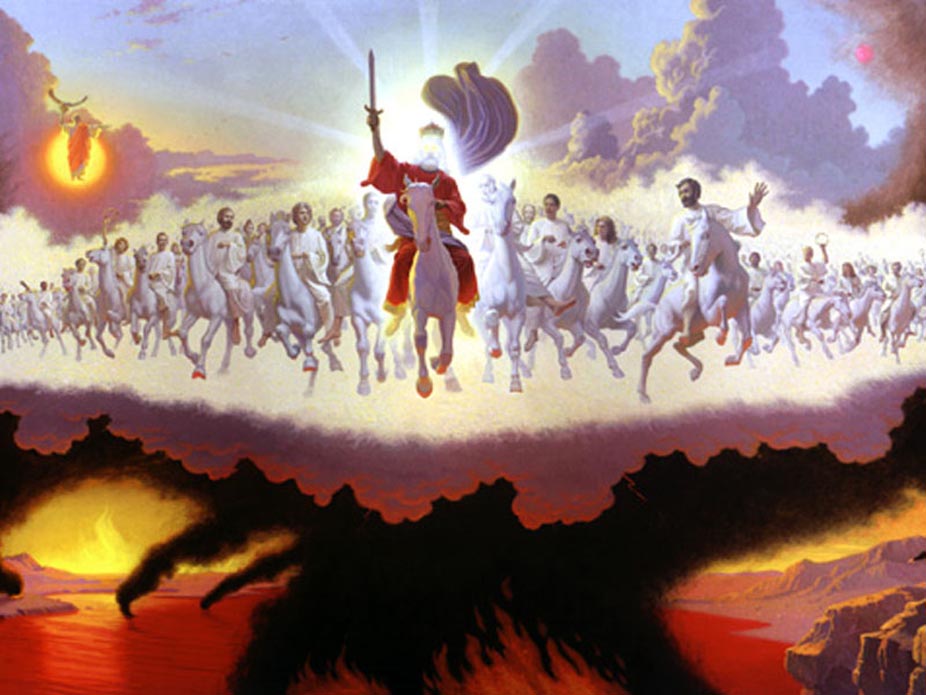
11 (note) And I saw heaven opened; and behold, a white horse, and He who sat upon it is called Faithful and True; and in righteousness He judges and wages war.
12 And His eyes are a flame of fire, and upon His head are many diadems; and He has a name written upon Him which no one knows except Himself.
13 And He is clothed with a robe dipped in blood; and His name is called The Word of God.
14 And the armies which are in heaven, clothed in fine linen, white and clean, were following Him on white horses.
15 And from His mouth comes a sharp sword, so that with it He may smite the nations; and He will rule them with a rod of iron; and He treads the wine press of the fierce wrath of God, the Almighty.
16 And on His robe and on His thigh He has a name written, "KING OF KINGS, AND LORD OF LORDS."
17 And I saw an angel standing in the sun; and he cried out with a loud voice, saying to all the birds which fly in midheaven, "Come, assemble for the great supper of God;
18 in order that you may eat the flesh of kings and the flesh of commanders and the flesh of mighty men and the flesh of horses and of those who sit on them and the flesh of all men, both free men and slaves, and small and great."
19 And I saw the beast and the kings of the earth and their armies, assembled to make war against Him who sat upon the horse, and against His army.
20 And the beast was seized, and with him the false prophet who performed the signs in his presence, by which he deceived those who had received the mark of the beast and those who worshiped his image; these two were thrown alive into the lake of fire which burns with brimstone.
21And the rest were killed with the sword which came from the mouth of Him who sat upon the horse, and all the birds were filled with their flesh.
Below are a few representative Scriptures that are somewhat ambiguous as to whether they refer specifically to the Rapture or to the Second Coming.
Note that in the comments, some of these verses do seem to favor the Rapture over the Second Coming (or vice versa), but the passage (and context) is not absolutely specific. See the example of Titus 2:11-13 which compares the "variegated" interpretations of multiple well known commentators (click here). A similar study could have been presented for many of the passages in this category.
As I have studied these passages and what the commentators have said about each passage, the wide divergence of opinions by excellent expositors is very striking and unpredictable. One comes away with a sense not that the Lord is trying to confuse us but that these passages cannot easily be "pigeon holed" because our Lord wants all believers, whether before the Rapture or after the Rapture and before the Second Coming to live motivated and encouraged/comforted by the sound doctrine that He will return for His own. Such an "interpretation" would be very compatible with our Lord's last uttered words…
He who testifies to these things says, "Yes, I am coming quickly." Amen. Come, Lord Jesus.
And all God's children echo John's cry…
"Maranatha. Our Lord, come!"
18 For I consider that the sufferings of this present time are not worthy to be compared with the glory that is to be revealed to us.
19 For the anxious longing of the creation waits eagerly for the revealing of the sons of God.
20 For the creation was subjected to futility, not of its own will, but because of Him who subjected it, in hope
21 that the creation itself also will be set free from its slavery to corruption into the freedom of the glory of the children of God.
22 For we know that the whole creation groans and suffers the pains of childbirth together until now.
23 And not only this, but also we ourselves, having the first fruits of the Spirit, even we ourselves groan within ourselves, waiting eagerly for our adoption as sons, the redemption of our body.
24 For in hope we have been saved, but hope that is seen is not hope; for why does one also hope for what he sees?
25 But if we hope for what we do not see, with perseverance we wait eagerly for it.
Comment: When we as sons of God be revealed? When will the redemption of our body be consummated? When Christ returns His children will share His glory. Ponder that incomprehensible truth. Let it work its way into your control center, your heart. Let it satisfy your soul. Let it stimulate, motivate and empower your walk of holiness today… and the next… and the next. It is God's glorious hope which is like a balm to our souls in a dark and sin sick world. A better world is on its way and we will soon be revealed in glory, enabled to enjoy His glorious world in a way that we can not now fully appreciate.
This revelation of the sons of God and the redemption of our bodies are promises that will be partially fulfilled at the Rapture (when we as believers will experience the final, full redemption of our bodies as we shed these corrupt frames in a moment in exchange for immortal, imperishable bodies) but most would agree that these promises are most fully consummated at the Second Coming, at the final revelation of our Lord Jesus Christ when we are revealed with Him in glory. It is worth noting that there will also be sons of God (both Jews and Gentiles) who survive the Tribulation and who enter the Millennial Kingdom in physical bodies and who will also eventually receive glorified bodies but exactly how and when this takes place is not clear from Scripture.
Ray Stedman explains the revelation of the sons of God - In other words, this present life in which we are living is just a school time that we Christians are going through, and here we have been placed to learn some lessons that are preparing us for the great day yet to come. And one of these days it is going to be graduation day -- the day when the sons of God will shed their humble attire and manifest that they have been princes in disguise all along (Ed note: synonymous with the apokalupsis or revelation), indwelt by the same wonderful secret of life that Jesus Christ had when he was here, indwelt by divine life, a man who is the vehicle of the divine life.
William Newell adds that the unveiling of glorified saints will be "as when some wonderful statue has been completed and a veil thrown over it, people assemble for the ‘unveiling’ of this work of art. It will be as when sky rockets are sent up on a festival night: rockets which, covered with brown paper, seem quite common and unattractive, but up they are sent into the air and then they are revealed in all colors of beauty, and the multitude waiting below shout in admiration. Now the saints are wrapped up in the common brown paper of flesh, looking outwardly like other folks. But the whole creation is waiting for their unveiling at Christ’s coming, for they are connected with Christ, one with Him, and are to be glorified with Him at His coming.
1 Corinthians 1:7
so that you are not lacking in any gift, awaiting eagerly (apekdechomai - in the present tense = as one's habitual practice - a lifestyle of "looking" for Jesus) the revelation of our Lord Jesus Christ
Comment: This verse could refer to the Rapture and/or the Second Coming and commentaries reflect both views. For example, John MacArthur favors this as a reference to His "Second Coming"; Thomas Constable favors "the Rapture". I think both are correct because believers today are looking forward to the imminent Rapture and believers who come to faith in the Tribulation will definitely look be eagerly awaiting His Second Coming to put an end to the Great Tribulation!
1Corinthians 15:23
But each in his own order: Christ the first fruits, after that those who are Christ’s at His coming,
Comment: This coming would include saints raised at the Rapture and saints (including OT saints) who will be resurrected at the time of the Second Coming.
Philippians 3:20 (note)
For our citizenship is in heaven, from which also we eagerly wait (apekdechomai - in the present tense = as one's habitual practice - a lifestyle of "looking" for Jesus) for a Savior the Lord Jesus Christ (21 - note) Who will transform the body of our humble state into conformity with the body of His glory, by the exertion of the power that He has even to subject all things to Himself.
Comment: Because of the mention of the transformation of the believer's body, this passage is most likely a reference to the Rapture and that is the interpretative approach of most conservative, premillennial, evangelical scholars.
1Thessalonians 1:10 (note)
and to wait (anemeno in present tense = as one's lifestyle which would certainly affect one's lifestyle!) for His Son from heaven, Whom He raised from the dead, that is Jesus, Who rescues (rhuomai) us from the wrath (orge) to come.
Comment: In the context of this epistle in which Paul was writing to believers whom he knew were waiting for Jesus to return from heaven, this reference is most likely to the Rapture (John MacArthur favors this interpretation - he makes the point that the fact that they were waiting indicates the imminency of the deliverance) however one could not absolutely exclude that it refer so the Second Coming (favored by the KJV Bible Commentary) for their will be those saints who lived during the Tribulation who led others to Christ and their joy will be those eternally saved men and women they were privileged to have a part in leading to faith in Christ.
Spurgeon takes a middle ground declaring: "Oh! This is a high mark of grace, when the Christian expects his Lord to come, and lives like one that expects Him every moment. If you and I knew to-night that the Lord would come before this service was over, in what state of heart should we sit in these pews? In that state of heart we ought to be."
1Thessalonians 2:19 (note)
For who is our hope or joy or crown of exultation? Is it not even you, in the presence of our Lord Jesus at His coming?
Comment: In the context of this epistle in which Paul was writing to believers whom he knew were waiting for Jesus to return from heaven, this reference is most likely to the Rapture (John MacArthur favors this interpretation) however one could not absolutely exclude that it refer so the Second Coming for their will be those saints who lived during the Tribulation who led others to Christ and their joy will be those eternally saved men and women they were privileged to have a part in leading to faith in Christ.
1Thessalonians 3:13 (note)
so that He may establish your hearts unblamable in holiness before our God and Father at the coming of our Lord Jesus with all His saints.
Comment: Most commentators (MacArthur, Constable, McGee) favor this as a reference to the Rapture but a few references (KJV Bible Commentary, Nelson's New Illustrated Bible Commentary) state that Paul refers to the Second Coming in this passage.
John Walvoord writes that "This verse is commonly related to the Rapture of the church, that when Christ comes He will find His church on earth, serving Him effectively. The passage could, however, also be taken in regard to the arrival in heaven of those caught up at the Rapture. In heaven their holiness and faithfulness to God will be especially evident before God the Father and before saints and angels. Paul was not advocating here sinless perfection as something that could be attained in this life, but he does hold that it is possible for a Christian to live in such a way that he will manifest his desire to serve the Lord and be blameless in what he is doing." (Walvoord, J. F. The Prophecy Knowledge Handbook. Wheaton, Ill.: Victor Books)
1Thessalonians 5:23 (note)
Now may the God of peace Himself sanctify you entirely; and may your spirit and soul and body be preserved complete, without blame at the coming of our Lord Jesus Christ.
1 Timothy 6:14
that you keep the commandment without stain or reproach until the appearing of our Lord Jesus Christ
Comment: Although one cannot state dogmatically, this reference addressing believers [cp "To Timothy"] appears to speak of Christ's return to remove His Bride, the Church, at the Rapture. Undoubtedly for those believers who come to Christ during the Seven Year Tribulation (Daniel's Seventieth Week - a "Week" of 7 Years) and especially the last 3.5 years of the Great Tribulation, this verse has application and in their case would refer to the Second Coming. Note that the idea of imminency is also implied by this verse.
2 Timothy 4:1 (note)
I solemnly charge you in the presence of God and of Christ Jesus, who is to judge the living and the dead, and by His appearing and His kingdom.
Comment: Because of the mention of appearing and kingdom in the same context, this verse appears to be more likely a reference to the Second Coming followed immediately by the Messianic Kingdom.
2 Timothy 4:8 (note)
in the future there is laid up for me the crown of righteousness, which the Lord, the righteous Judge, will award to me on that day; and not only to me, but also to all who have loved His appearing.
Comment: Given the fact that the phrase that day relates to rewarding of a crown, this passage seems to favor the Rapture, for most evangelical commentators feel that the Bema or Judgment Seat of Christ follows the Rapture and precedes the Second Coming.
Titus 2:13 (note)
looking for the blessed hope and the appearing of the glory of our great God and Savior, Christ Jesus
Comment: see more detailed discussion below.
Hebrews 9:28 (note)
27 (note) And inasmuch as it is appointed for men to die once and after this comes judgment, 28 so Christ also, having been offered once to bear the sins of many, shall appear a second time for salvation without reference to sin, to those who eagerly await (apekdechomai - in the present tense = as one's habitual practice - a lifestyle of "looking" for Jesus) Him.
Comment: This passage appears to speak primarily of Christ's Second Coming. However in view of the verb "eagerly await" there is a sense in which His return is pictured as imminent, and this would speak of the Rapture for those believers who live prior to the Tribulation. In addition "a second time for salvation" is a description of our "future tense salvation" or glorification, an event that will be experienced by some saints at the Rapture and for others who come to faith in the Tribulation their glorification will be realized at His Second Coming. Once again, it seems the predominant idea is that God wants His children "future focused", for such "heavenly" looking motivates sound godly living.
Ray Stedman: This is the only place in the New Testament where the return of Christ is called a second coming. During His first coming, He dealt with the problem of human sin on the cross; at His second coming the full effect of that sacrifice will be manifested in the resurrection (or “transformation”—1 Cor 15:51-52) of the bodies of those who wait for Him. (Stedman, R. C. (1992). Hebrews. The IVP New Testament Commentary Series. Downers Grove, Ill., U.S.A.: InterVarsity Press) (Bolding added)
Barton: The imagery behind the picture of Christ appearing a second time to bring salvation gets its force from the Day of Atonement, when the priest stood (appeared) before the people, then disappeared inside the Most Holy Place to present the blood on the mercy seat. (Ed: And the people waited eagerly, anxiously, expectantly for his appearing). Then the priest came out (a second time) and proclaimed forgiveness on the people. So Jesus appeared on our behalf the first time. When he returns, he will proclaim the full benefits of salvation. “Those who are waiting for him” conveys a warning, reminding the readers to remain faithful to Christ during their time of testing and persecution on earth. (Barton, B. B., Veerman, D., Taylor, L. C., & Comfort, P. W. Hebrews. Life application Bible Commentary. Wheaton, Ill.: Tyndale House Publishers)
Constable: When the Lord returns at the Rapture all Christians will enter into His presence… (Tom Constable's Expository Notes on the Bible) (Bolding added)
Wiersbe: When the high priest disappeared into the tabernacle on the Day of Atonement, the people waited outside expectantly for him to reappear. Perhaps God would refuse the blood and kill the high priest. What joy there was when he came out again! And what joy we will have when our High Priest appears to take us to our eternal holy of holies, to live with Him forever! (Wiersbe, W. W. Wiersbe's Expository Outlines on the New Testament. Wheaton, Ill.: Victor Books)
James 5:7-9
Be patient therefore, brethren, until the coming of the Lord. Behold, the farmer waits for the precious produce of the soil, being patient about it, until it gets the early and late rains. 8 You too be patient; strengthen your hearts, for the coming of the Lord is at hand. 9 Do not complain, brethren, against one another, that you yourselves may not be judged; behold, the Judge is standing right at the door.
Comment: Note that all 3 passages allude to the imminent return of Christ. However depending on which commentary you consult, you will find some writers consider this a reference to the Second Coming and others to the Rapture.
MacArthur: The second coming of Christ. Realizing the glory that awaits them at Christ’s return should motivate believers to patiently endure mistreatment (Ro 8:18)
Frank E. Gaebelein: James “does not treat the subject at length. He simply declares it as an inescapable fact, emphasizing, as he does so, its imminence. (Frank E. Gaebelein, The Practical Epistle of James, 1955),
Spiros Zodhiates: When this verb is used of time, it speaks of imminence. James tells us that this blessed event of the second coming of the Lord will come any time, is imminent… Our hearts will be propped up if we live in the constant expectation of His coming. (Spiros Zodhiates, The Patience of Hope. Grand Rapids: Wm. B. Eerdmans Publishing Company, 1960)
Arthur Whiting (Bibliotheca Sacra 102:407 July 1945 p. 367): Parousia meaning “presence,” occurs 24 times, 16 of which refer to our Lord’s return… (and) 8 describe that aspect of His return connected with rewards, commonly called the Rapture (1 Cor 15:23; 1 Thess 2:19; 4:15 ; 5:23 ; 2 Thess 2:1; James 5:7, 8; 1 John 2:28).
Showers: The… Greek verbs translated “at hand” (v 8) and “standing” (v. 9) are in the perfect tense and indicative mood, meaning that each of these verbs refers to an action that was completed before James wrote his epistle and that continues on in that completed state. The implication is that Christ’s coming drew near before James wrote his epistle, and His coming continues to be near. In addition, Christ as judge began to stand before the door before James wrote his epistle, and Christ as judge continues to stand before the door. In other words, Christ’s coming was imminent in New Testament times and continues to be imminent. James wanted to impress his readers with the fact that Christ could come through the door at any moment and cause them as Christians to stand before Him at the Judgment Seat of Christ. He could do so today. (Showers, R. E.. Maranatha Our Lord, Come! Bellmawr, New Jersey: The Friends of Israel Gospel Ministry, Inc)
See Shower's article - The Imminent Coming of Christ
1 Peter 1:7 (note)
that the proof of your faith, being more precious than gold which is perishable, even though tested by fire, may be found to result in praise and glory and honor at the revelation of Jesus Christ
Comment: This verse could refer to the Second Coming at the end of the Great Tribulation, but it could also refer to the revelation of Jesus when He returns to Rapture His Bride and rescue her from all affliction and adversity, following which there will be a time of reward at the Bema Seat.
John MacArthur interprets this as a reference to the Second Coming whereas Thomas Constable favors this as a reference to both the Rapture and the Second Coming.
1 Peter 1:13 (note)
Therefore, gird your minds for action, keep sober in spirit, fix your hope completely on the grace to be brought to you at the revelation of Jesus Christ.
Comment: This could refer to the Rapture (J Vernon McGee favors this interpretation), but it would be difficult to exclude the possibility that it refers to the Second Coming at the end of the Great Tribulation (John MacArthur favors this later view). Again we see the difficulty of separating the Rapture from the Second Coming and it is quite reasonable to interpret that both events are in view in this verse.
1 Peter 4:13 (note)
but to the degree that you share the sufferings of Christ, keep on rejoicing; so that also at the revelation of His glory, you may rejoice with exultation.
Comment: This could refer to the Rapture, but probably more likely refers to the Second Coming at the end of the Great Tribulation (John MacArthur favors this view). Thomas Constable interprets this as most likely a reference to both the Rapture and the Second Coming.
2 Peter 1:16 (note)
For we did not follow cleverly devised tales when we made known to you the power and coming of our Lord Jesus Christ, but we were eyewitnesses of His majesty.
Comment: This is an interesting verse for some conservative commentators (Thomas Constable, J Vernon McGee) feel this passage refers to the first coming (and Jesus' transfiguration) but a others (John MacArthur, Henry Morris) feel it speaks of His Second Coming! MacDonald deftly includes both an allusion to the transfiguration and the Second Coming explaining that "The Transfiguration was a preview of Christ's coming in power to reign over all the earth (Ed: "The Second Coming)" (BORROW Believer's Bible Commentary)
2 Peter 3:4 (note)
and saying, “Where is the promise of His coming? For ever since the fathers fell asleep, all continues just as it was from the beginning of creation.”
Comment: In the context of a world which rejects Christ's Second Coming, this verse would appear to favor the Second Coming or Christ's return at the end of the Tribulation to judge the earth and establish His millennial kingdom.
2 Peter 3:12 (note)
looking for and hastening the coming of the day of God, on account of which the heavens will be destroyed by burning, and the elements will melt with intense heat!
Comment: See comment on 2 Peter 3:4 above.
1 John 2:28
And now, little children, abide in Him, so that when He appears (phaneroo), we may have confidence and not shrink away from Him in shame at His coming.
Comment: Although one cannot state dogmatically, this reference appears to speak primarily of Christ's return to rescue His Bride, the Church, at the Rapture, especially since it seems to convey a sense of imminency (or the idea that He could return at any moment so guard your heart and watch the steps of your feet!). Undoubtedly for those believers who come to Christ in the Tribulation/Great Tribulation, this verse has direct application, for they too must seek to continually abide in Christ.
1 John 3:2-3
Beloved, now we are children of God, and it has not appeared as yet what we shall be. We know that, when He appears, we shall be like Him, because we shall see Him just as He is. 3 And everyone who has this hope fixed on Him purifies himself, just as He is pure.
Comment: See comment above on 1 John 2:28. Again the practical point is that if believers really believe they might see Him any day, they would (or should) be motivated to live in the reality of His imminent return.
Jude 1:21
keep yourselves in the love of God, waiting anxiously (prosdechomai = as your lifestyle or the habit of your life) for the mercy of our Lord Jesus Christ to eternal life.
Comment: Some commentators (John MacArthur) feel this refers to Christ's Second Coming, but others (J Vernon McGee, E. Pentecost in Bible Knowledge Commentary) favor this as a reference to the Rapture. Certainly if one is continually waiting anxiously for the Lord's return, it would serve to motivate one to keep one's self in the love of God, an application which might favor the this as a reference to the Rapture, but certainly does not exclude those saints who come to faith in the time of the Tribulation, which there will be considerable pressure not to keep one's self in the love of God.
The three appearings mentioned in Hebrews 9:24–28 are connected with the three aspects of the great Salvation of our Lord, the past, the present, and the future.
I. The Past. “He hath appeared to put away sin”—Redemption.
II. The Present. “He now appears in the presence of God for us”—Intercession.
III. The Future. “He shall appear the second time without sin unto salvation”—Transformation.
This same threefold deliverance is mentioned in 2 Corinthians 1:10, and corresponds with the threefold character of Christ, as prophet, priest, and king. The second coming of Christ has not much prominence in the preaching of to-day, although it has a very large place in the Word of God. There are 260 chapters in the New Testament, and over 300 references to this great coming event.
STUDY I THE MANNER AND TIME OF HIS APPEARING
When He comes for His people they shall be caught up to meet Him in the air (1 Thess. 4:17), but those in the earth see Him not. When He appears with His saints every eye shall see Him. As He appeared to His disciples after His resurrection and showed Himself, so shall He appear the second time and manifest His glory. To put the truth in order, let us ask—
I. What will be the Manner of His Appearing? It will be—
1. CERTAIN. “If I go, I will come again” (John 14:3). His coming again, then, is as certain as His departure. “If I go, I will come.” This is not the coming of death, but Himself. “The Lord Himself shall descend from Heaven” (1 Thess. 4:16).
2. PERSONAL. “This same Jesus shall so come in like manner as ye have seen Him go” (Acts 1:11). A spiritual coming, or the coming of the Holy Ghost, is not “this same Jesus.”
3. SUDDEN (Mal. 3:1–3). “Watch, lest coming suddenly He find you sleeping” (Mark 13:35, 36). His coming will be as quick as lightning (Matt. 24:27).
4. VISIBLE. “Behold He cometh, and every eye shall see Him” (Rev. 1:7). “Hereafter ye shall see the Son of Man” (Matt. 26:64). What a sight for this pleasure-loving, Christ-rejecting age! “All kindreds of the earth shall wail” (Isa. 2:19).
5. GLORIOUS. “The glorious appearing of the great God and our Saviour Jesus Christ” (Titus 2:13). When first He came He made Himself of no reputation, and became the “Man of Sorrows,” but when He appears the second time it will be in “great power and glory” (Mark 13:26). His Name now is above every name.
6. WITH HIS SAINTS. “Behold He cometh with ten thousands of His holy ones” (Jude 14., R.V.). “When Christ who is our life shall appear, then shall ye also appear with Him in glory” (Col. 3:4). By that time we shall have been made “like Him” (1 John 3:2). This is the fruit of grace. Blessed be the Lord who hath made us partakers of such an high and holy calling (Eph. 1:16).
7. TO ESTABLISH RIGHTEOUSNESS. “He will convince the ungodly of all their ungodly deeds and speeches against Him” (Jude 15). He will “judge with righteousness and equity” (Psa. 98:9). He will “bless the earth with prosperity and peace” (Psa. 72:7).
II. Will He Appear Before or After the Millennium? This is a disputed point. It may help us into the truth just to look at the condition of the world when He appears, as described in Scripture.
1. WHAT SAITH THE PROPHETS (Dan. 12:1, 2).
At the time Michael, the first prince, stands up for the people. It is to be a time of trouble such as there never was since there was a nation. Michael surely represents the Son of God, for at His standing up, or appearing, many rise from the dead (Isa. 60:1–3). Here the people are said to be in gross darkness when the Lord arises in His glory (Zech. 14:3, 4). Here the Lord is represented as fighting against the nations, when His feet shall stand upon the Mount of Olives. There is no Millennium here.
2. WHAT SAITH THE EVANGELISTS?
“The tares and the wheat are to grow together until the harvest” (Matt. 13:30). When the Lord of the vineyard comes He does not find righteousness prevailing, for He will “miserably destroy those wicked men” (Matt. 21:37–41). When the Bridegroom came five of the virgins were found unfit to enter, and were shut out (Matt. 25:10–12). “As it was in the days of Noah so shall it be also in the days of the Son of Man” (Luke 17:24–30). The world was at its worst instead of at its best when the flood came. If things are to go on improving (spiritually) till Christ comes, what is the meaning of these words, “Nevertheless, when the Son of Man cometh shall He find faith in the earth” (Luke 18:8; 1 Thess. 5:3). Before the Son of Man comes with power and great glory “men’s hearts are to be failing them for fear, because of the things which are coming on the earth” (Luke 21:25–28).
3. WHAT SAITH THE OTHER APOSTLES?
“The Spirit speaketh expressly that in the latter time some shall depart from the faith” (1 Tim. 4:1, 2). Is not this sign among us now? “Let no man deceive you (neither doctor nor professor) by any means, for that day shall not come except there come a falling away first” (2 Tim. 3:1–5). This falling away from the faith of the Gospel will be the result of the influence of “the scoffers” that are to come in the last days (2 Peter 3:3). Why should we hope that in these last days peaceful times will come, when the Holy Ghost has expressly declared that in the last days perilous times will come? (2 Tim. 3:1–5). It is not a question as to the failure of the Gospel, or the power of the Holy Spirit, but what is the revealed purpose of God. Let us take care that with regard to this great and precious truth the Lord may not be saying to us, “My thoughts are not your thoughts” (Jude 17, 18).
STUDY II THE RESULTS AND SIGNS OF HIS APPEARING
Let us keep in mind the difference between His coming for His people and coming with them.
I. Some of the Results when He comes FOR His People. There will be—
1. THE RESURRECTION OF THE DEAD IN CHRIST. “The dead in Christ shall rise first” (1 Thess. 4:16). “Blessed and holy is he that hath part in the first resurrection” (Rev. 20:6). This was Paul’s desire (Phil. 3:11). Called the resurrection of the just (Luke 14:14), and of life (John 5:29).
2. THE TRANSFORMATION OF THE LIVING. “We shall not all sleep (die), but we shall all be changed (all those who are alive at His coming) in a moment, in the twinkling of an eye; this corruptible shall put on incorruption” (1 Cor. 15:50–57). Then shall we be “clothed upon with our house which is from Heaven” (2 Cor. 5:4). Enoch, by his translation, did not taste death (see Matt. 16:28; Phil. 3:20, 21).
3. THE TRANSLATION OF ALL SAINTS. “We which are alive and remain shall be caught up together with them (those raised from the dead) to meet the Lord in the air” (1 Thess. 4:16, 17). This will be the fulfilment of John 14:3.
II. Some of the Results when He appears WITH His People. He will—
1. MANIFEST HIS OWN. “When Christ who is our life shall be manifested, then shall ye also with Him be manifested in glory” (Col. 3:4, R.V.). “When He shall appear we shall be like Him” (1 John 3:2). Hidden ones shall then be revealed. The world shall then see the blessedness of being a Christian.
2. TAKE VENGEANCE ON THE DISOBEDIENT. “The Lord Jesus shall be revealed from Heaven in flaming fire, taking vengeance on them that know not God, and that obey not the Gospel” (2 Thess. 1:7–9). The mighty angels mentioned in this passage are the “messengers of His might.” They may execute this terrible judgment upon the so-called Gospel hardened and unbelievers (Isa. 2:19).
3. RESTORE HIS ANCIENT PEOPLE. When He appears “they shall look upon Him whom they have pierced, and mourn” (Zech. 12:10). But “in that day a fountain shall be opened to the house of David, and to the inhabitants of Jerusalem” (chap. 13:1). When the “Deliverer comes out of Zion and turns away ungodliness from Jacob, then all Israel shall be saved” (Rom. 11:25–29).
4. JUDGE THE NATIONS. This is clearly taught in Matthew 25:31–46. The great image of the world’s power and unrighteous rule is broken in pieces at the coming of that stone, over which the “hands” of men have no control (Dan. 2:31–35), and which “shall fill the whole earth” (Psa. 2:7–9; Rev. 19:11).
5. DESTROY THE ANTICHRIST. “Then shall that wicked be revealed (as the light of the rising sun draws the poisonous weeds into a fruitfulness that reveals their true character) whom the Lord shall consume with the spirit of His mouth” (2 Thess. 2:7–9; 1 John 4:3).
6. RULE THE NATIONS. “In His days the righteous shall flourish; He shall have dominion from sea to sea; all kings shall fall down before Him, all nations shall serve Him” (Psa. 72:7–11). “The Lord shall be King over the whole earth” (Zech. 14:9). Wars shall cease and peace shall be on earth when He comes, “whose right it is to REIGN.” Come, Lord Jesus, come quickly. The whole creation is groaning for that Day (Rom. 8:22).
7. REWARD THE FAITHFUL. A perfect outline or programme of these coming events is found in Luke 19:11–27, given by the Lord Himself. His servants are rewarded according to their works at His coming. This is certainly the judgment spoken of by the apostle in 2 Corinthians 5:10. The rewards will differ according to the measure of faithfulness. “As one star differeth from another star in glory, so also in the resurrection” (1 Cor. 15:41).
III. Some of the Signs of His Appearing. As we saw from our last reading, the Scripture does not teach that the world will be converted before He comes, but there are certain signs given to indicate the nearness of His approach.
1. THE PREACHING OF THE GOSPEL TO ALL NATIONS. “This Gospel of the kingdom shall be preached in all the world for a witness unto all nations (not creatures), and then shall the end come” (Matt. 24:14). Even overlooking the fact that this was really done in the days of the apostles (Rom. 10:18; Col. 1:5, 6, 23), we cannot but believe that it is being accomplished now. (SEE ALSO Rev 14:6).
2. THE BUDDING OF THE FIG TREE. It is a natural and legitimate inference that our Lord in this parable referred to the Jewish nation (Luke 21:29–31). That they are showing signs of fresh life, and that Ezekiel’s vision of the bones is being fulfilled before our eyes in a manner never yet hitherto approached, must be more or less apparent to all.
3. THE PERILS OF THE TIMES. We are warned that “in the last days perilous times will come” (2 Tim. 3:1). “Many falling away from the faith, distress of nations, men’s hearts failing them for fear, looking at the things which are coming on the earth” (Luke 21:25–28). This is not the view of a pessimist, but of a believer in God.
4. THE CRY OF THE BRIDEGROOM’S FRIENDS. “At midnight there was a cry made, Behold the Bridegroom cometh” (Matt. 25:6). At midnight He came. “The day of the Lord will come as a thief in the night” (2 Peter 3:10). This cry is being raised in these days, “Behold He cometh.” No time is fixed, but the fact of His near approach is being heralded all over the world, although many believe it not. The condition and state of the world now has constrained many to “lift up their heads,” knowing that their redemption draweth nigh (Luke 21:28).
STUDY III HIS PERSONAL REIGN
Lay aside prejudice and unbelief and there will be no difficulty in understanding this most interesting part of the Divine revelation. The prophet Zechariah sets the whole matter before us in order. The method of many is to literalise what refers to the past, and spiritualise all that lies in the future. In Zechariah’s prophecy we see
1. THE MESSIAH’S BIRTH ANNOUNCED. “Lo, I come, I will dwell in the midst of thee” (chap. 2:10).
2. HIS CHARACTER FORETOLD. As “the Branch, as a Ruler, and a Priest upon His throne” (chap. 6:12, 13).
3. THE MANNER OF HIS PUBLIC APPEARING. “Behold thy King cometh riding upon an ass” (chap. 9:9, 10).
4. HIS REJECTION PREDICTED. “They shall look upon Me whom they have pierced” (chap. 10:12).
5. HIS SECOND COMING. “His feet shall stand on the Mount of Olives (chap. 14:3, 4). Notice that this is after He had been pierced and wounded in the house of His friends (Jews) (chap. 13:6).
6. HIS KINGSHIP. “The Lord shall be King over all the earth; in that day one Lord, and His Name one” (chap. 14:9).
7. THE MILLENNIUM. “In that day there shall be upon the bells of the horses HOLINESS UNTO THE LORD (chap. 14:20, 21). What could be more simple than this? The programme is complete, the order is in perfect harmony with the teaching of the New Testament. Look then at—
I. The Kingship of Jesus.
In Isaiah 9:6, 7 the “Child born and the Son given” is to have the government upon His shoulders, and His kingdom is to be established, not with grace, but with “judgment and with justice from henceforth and for ever” (Psa. 2:7–9). The angel’s message to Mary was, “He shall be great, and He shall REIGN over the house of Jacob for ever” (Luke 1:32, 33). Our Lord is not now on the throne of His father David, reigning over the house of Jacob, but on the throne of His Father in Heaven, as our great High Priest. The wise men, guided by God in seeking Jesus, said, “Where is He that is born King of the Jews?” “Behold, thy King cometh riding upon an ass” (Zech. 9:9). Pilate said to Him while in the depths of His terrible humiliation, “Art Thou a King then?” (John 18:37). Jesus did not deny the truth, but boldly acknowledged it, saying, “To this end was I born, and for this cause came I into the world” (John 18:37). “This is the King of the Jews” (Matt. 27:37).
II. The Sphere of His Reign.
“He shall be King over all the earth” (Zech. 14:9). From the rising of the sun to the going down of the same. (Mal. 1:11). “All the ends of the earth shall see the salvation of our God” (Isa 52:10). The kingdoms of this world shall become the kingdom of our Lord and of His (God’s) Christ. He shall judge among the nations (Isa. 2:4). All shall be blessed in Him, “all nations shall call Him blessed” (Psa. 72:17). “Every knee shall bow and every tongue confess that Jesus Christ is LORD.” He shall rule the nations with a rod of iron as KING OF KINGS AND LORD OF LORDS (Rev. 19:15, 16). “Till the thousand years should be fulfilled” (Rev. 20:3).
III. The Nature of His Kingdom.
It has been said, “Like priest, like people,” so it will be like king, like kingdom. This King’s rule will be supreme, “King of Kings,” so the kingdom will partake of all the characteristics of the King. There will be—
1. DELIVERANCE FROM THE POWER OF SATAN. He will be bound for a thousand years and cast into the bottomless pit (Rev. 20:2, 3). Then the whole earth will have rest and quiet (Isa. 14:7). Then the time of torment for unclean spirits will have come (Matt. 8:28, 29).
2. UNIVERSAL HARMONY. “The whole creation groaneth and travaileth, waiting for that redeeming day” (Rom. 8:22, 23). Then they shall “learn war no more” (Isa. 2:4). “The wolf shall dwell with the lamb, and the earth shall be full of the knowledge of the Lord” (Isa. 11:1–9). Peace on earth and goodwill among men.
3. PROSPERITY FOR THE RIGHTEOUS, and just judgment to the poor (Psa. 72:1–14). Christ will manifest Himself as the King of righteousness and the King of peace (Heb. 7:2; see 2 Peter 3:13).
4. AN EXTENSION OF HUMAN LIFE. “The child shall die an hundred years old” (Isa. 65:20). They shall not build and another inhabit (Isa. 65:18–25). “The inhabitant shall not say, I am sick” (Isa. 33:24).
5. SALVATION FOR THE HEATHEN. The heathen shall be given Him for an inheritance (Psa. 2:8). “All the ends of the world shall turn to the Lord, and all the kindreds of the nations shall worship Him” (Psa. 22:27). All people, nations, and languages shall serve Him (Dan. 7:13, 14; Psa. 82:8).
6. HONOUR FOR THE SAINTS. They shall “reign with Him a thousand years” (Rev. 20:6). “He hath made us kings unto God” (Rev. 1:6). “Thou hast made us unto our God kings, and we shall reign on the earth” (Rev. 5:10). Do you not know that the saints shall judge the world (1 Cor. 6:2). At the Coming of the Lord the faithful servant was made ruler over ten cities (Luke 19:17). These notes could be extended indefinitely, but we quote one more promise from the risen Lord to the Church in Thyatira and repeated in substance to the Church of the Laodiceans: “He that overcometh and keepeth My words unto the end, to him will I give power over the nations” (Rev. 2:26; 3:21). There will also be—
7. GLORY FOR THE SAVIOUR. “His Name shall endure for ever,” and “all nations shall CALL HIM blessed” (Psa. 72:17), and “the whole earth shall be filled with HIS GLORY.” AMEN, AND AMEN (Psa. 72:19).
Source: His online free 194 book Jesus is Coming
We have asserted that this truth of the coming of the Lord is eminently practical. In proof of this, we here: append the following references, to show how Jesus and the Apostles used the prophecies of His coming again as a motive to incite us.
1. To watchfulness,- Mat. 24:42-44; 25:13; Mark 13:32- 37; Lu. 12:35-38; Rev. 16:15.
2. To Sobriety,- 1 Thes. 5:2-6; 1 Pet. 1:13; 4:7; 5:8.
3. To repentance,- Acts 3:19-21; Rev. 3:3.
4. To fidelity,- Mat. 25:19-21; Lu. 12:42-44; 19:12-13.
5. Not to be ashamed of Christ,- Mar. 8:38.
6. Against worldliness,- Mat. 16:26-27
7. To moderation or mildness,- Phil. 4:5.
8. To patience,- Heb. 10:36-37; James 5:7-8.
9. To mortification of fleshly lusts,- Col. 3:3-5.
10. To sincerity,- Phil. 1:9-10.
11. To the practical sanctification of the entire being,- 1 Thes. 5:23.
12. To ministerial faithfulness,- 2 Tim. 4 :1-2.
13. To induce obedience to the Apostle's injunctions,- 1 Tim. 6:13-14.
14. To pastoral diligence and purity,- 1 Pet. 5:2-4.
15. To purify ourselves,- 1 John 3:2-3.
16. To abide in Christ,- 1 John 2:28.
17. To endure manifold temptations and the severest trial of faith,- 1 Pet. 1 :1.
18. To bear persecution for the sake of our Lord,- 1 Pet. 4:13. I
19. To holy conversation and godliness,- 2 Pet. 3:11-13.
20. To brotherly love,- 1 Thes. 3:12-13.
21. To keep in mind our heavenly citizenship- Phil. 3:20-21.
22. To love the second coming of Christ,- 2 Tim. 4:1-8.
23. To look for Him,- Heb. 9:21,28
24. To confidence that Christ will finish the work,- Phil. 1:6.
25. To hold fast the hope firm unto the end,- Rev. 2:25; 3:11.
26. To separation from worldly lusts and to live Godly,- Titus 2:11-13.
27. To watchfulness because of its suddenness,- Lk 17:24-30.
28. To guard against hasty judgment,- 1 Cor. 4:5.
29. To the hope of a rich reward,- Mt. 19:27-28,
30. To assure the disciples of a time of rejoicing,- 2 Cor. 1:14; Phil. 2:16; 1 Thes. 2:19.
31. To comfort the apostles in view of Christ's departure from them,- John 14:3; Acts 1:11.
32. Practical faith in the second coming, is a crowning grace and assurance of blamelessness in the day of the Lord,- 1 Cor. 1:4-8.
33. It is the principal event for which the believer waits,- 1 Thes. 1:9-10.
34. It is declared to be the time of reckoning with the servants,- Mt. 25:19.
35. Of judgment for the living nations,- Mt. 25:31-46.
36. Of the resurrection of the saints,- 1 Cor. 15:23.
37. Of the manifestation of the saints,- 2 Cor. 5:10; Col. 3:1.-
38. It is declared to be the source of consolation to those who sorrow over the dead who sleep in Jesus,- 1 Thes. 4:14-18...,
39. It is declared to be the time of Tribulation to unbelievers,- 2 Thes. 1:7-9.
40. It is proclaimed every time the Lord's Supper is celebrated,- 1 Cor. 11:26.
Such are some of the uses made of this doctrine in the New Testament. It is employed to arm the appeals, to point the arguments, and to enforce the exhortations. What is there more PRACTICAL in any other doctrine we would that we had space to give the passages referred to in full. But it will be a greater blessing to you, dear reader, if you will go to the Word and search them out.
We have made no distinction between those passages which refer to the Rapture, and those which refer to the Revelation, both classes being equally used as a motive for the practical purposes mentioned.
The following outline and arrangement of Scripture has been taken principally from a little pamphlet published in London. It is a concise view of the pre-millennial coming, with plain proof-texts of the same, conveniently arranged for reference and study. As the texts cited are necessarily brief, it will be found of great profit to read the context of each in the Word.
We believe it will enable every prayerful reader to apprehend the order of events that pertain to the coming of Christ, both as THE BRIDEGROOM and as THE KING.
Dr John Walvoord articles relating to various aspects of the return of Christ…
- The Future Work of Christ — Part I: The Coming of Christ for His Church
- The Future Work of Christ — Part II: The Church in Heaven
- The Future Work of Christ — Part III: Christ’s Coming to Reign
- The Future Work of Christ — Part IV: The Millennial Kingdom and the Eternal State
- Armageddon And The Second Coming Of Christ
- Matthew 25:31-36 The Judgment of the Nations
Dr S Lewis Johnson has several transcripts that relate to the Rapture and/or the Second Coming (Pdf)…
- Daniel 9:24-27 The Tribulation - General View
- Dt 4:25-31, Jer 30:5-7, Da 12:1, Zec 13:8-9, Rev 12 - Israel and the Tribulation
- John 14:1-3 The Certainty of the Second Coming
- 1 Thess. 4: 13-18 The Resurrection of the Church
- 1 Corinthians 15 The Translation of the Church
- Revelation 3: Church and Tribulation
- 1 Corinthians 3 The Judgment Seat of Christ
- Zech 14:1-7, Mt 24:29-31, Isa 27:12-13, Rev 19 - The Second Coming of Jesus Christ
Miscellaneous Resources:
- What Can We Know About the Second Coming? - RBC Booklet
"Where do we stand after 2000 years of false alarms and the current "future fatigue"? Should we join those who have thrown in the towel on prophetic study in favor of "more practical, life-related issues"? Or, if we are convinced that nothing is more practical than to look for our Lord's return, how should we do that? Should we be expecting an any-moment return? Or should we be more concerned about preparing for the coming years of unparalleled trouble that the prophets predict" - Just Before Heaven: The Judgment Seat Of Christ
- Reginald Showers (Friends for Israel Ministry) - The Imminent Coming of Christ
- Reginald Shower's - The Imminent Coming of Christ (same as above but different format)
- Gerald Stanton - The Doctrine of Imminency - Is It Biblical?
- Robert Thomas - Imminence in NT esp Paul's Thessalonian Epistles - 25 page analysis of the doctrine of imminence
- John MacArthur - Is Christ's Return Imminent?
- James F Stitzinger - Rapture in 20 Centuries of Biblical Interpretation - 22 pages!
- Richard Mayhue - Why a Pre-Tribulation Rapture?
- Timing of the Rapture see - Timing - Pre-, Mid- or Post-Tribulation
- William Blackstone - free book Jesus is Coming
Related Three Part Series from Dr Thomas Ice HAS BIBLE PROPHECY ALREADY BEEN FULFILLED?
- 1 Has Bible Prophecy Already Been Fulfilled?
- 2 When Will Prophecy Be Fulfilled?
- 3 Preterism vs. Futurism
- 4 What Is Preterism?
- 1 Has Bible Prophecy Already Been Fulfilled? PART II
- 2 Strange Preterist Implications
- 3 Conclusion
- 4 Notes
- 1 Has Bible Prophecy Already Been Fulfilled? Part III
- 2 Helping God
- 3 Three Preterist Prooftexts
- 4 Conclusion
- 5 Notes
Related Topics from Gotquestions.org
- What is the Judgment Seat of Christ / Bema Seat of Christ?
- What is the Great White Throne Judgment?
- What are all the different judgments in the Bible?
- What does the Bible say about when God will judge us?
- What does it mean that judgment begins at the house of God?
- What are the definitions of some common theological terms?
- What happens at the final judgment?
- What is the purpose of there being rewards in heaven?
- What is the concept of a secret rapture?
- What are the strengths and weaknesses of the pre-wrath view of the rapture?
- What are the strengths and weaknesses of the pretribulational view of the rapture (pretribulationism)?
- What is the difference between the Rapture and the Second Coming?
- What is the rapture of the church?
- How can I be ready to be caught up in the rapture?
- How can I be sure I won’t be left behind in the rapture?
- What are the strengths and weaknesses of the post-tribulational view of the rapture (posttribulationism)?
- When is the Rapture going to occur in relation to the Tribulation?
- Will there be a second chance for salvation after the Rapture?
Christ’s coming for His church is often designated as the Rapture. This is based on the statement of 1 Thessalonians 4:17 where those who are resurrected, or translated, are “caught up together with them in the clouds to meet the Lord in the air.” The idea of being “caught up” is embraced in the word rapture, or snatched up, and this is what will occur at the time of Christ’s coming for His church.
The Rapture, however, stands in sharp contrast to what will occur at the Second Coming.
(1) Christ’s coming at the Rapture is to take saints from the earth to the Father’s house in heaven, in contrast to the Second Coming, when the saints will come from heaven to earth and remain in the sphere of earth throughout Christ’s millennial kingdom.
(2) At the Rapture those who are “in Christ,” believers during the present age, will be resurrected from the dead, and living Christians will be translated, in contrast to the Second Coming, when no one will be translated.
(3) At the Rapture only the church is caught up to heaven in contrast to the Second Coming, when Old Testament saints and tribulation saints will be resurrected but remain in the earth.
(4) The Rapture of the church will remove the church before the time of judgment preceding the Second Coming, in contrast to the Second Coming, when believers on earth who are under persecution will be rescued by Christ but will remain in the earthly sphere.
(5) The Rapture is revealed in Scripture to be an imminent event, that is, there are no predicted events that precede the Rapture, in contrast to the Second Coming before which many important world-shaking prophecies must be fulfilled as seen in Revelation 6-18.
(6) The Rapture is a New Testament truth, whereas the doctrine of the second coming of Christ to the earth is revealed in both Testaments.
(7) The Rapture relates to those who are saved with no judgments on earth, in contrast to the Second Coming, which will deal with both saved and unsaved.
(8) Before and after the Rapture Satan will still be active, but after the Rapture Satan will be allowed even greater activity (2 Thess. 2:3-10; Rev. 12:12). At the Second Coming, however, Satan will be bound for a thousand years (Rev. 20:1-3).
(9) The purpose of the Rapture is to take saints from earth to heaven, in contrast to the Second Coming, which involves resurrection of the Old Testament saints and the tribulation saints who remain on earth. Later, at the Second Coming those raptured earlier will join those still living in the world who will enter the millennial kingdom.
(10) At the Rapture there is no judgment of the world, whereas Matthew 25:31-46 indicates that Gentiles will be judged in regard to entering the millennial kingdom. Also, Jews will experience a similar judgment (Ezek. 20:33-38) (ED: compare Isaiah 27:12-13).
(11) If all the saints had been raptured at the time of the Second Coming and met Christ in the air, the judgment of the Gentiles in Matthew 25:31-46 would be unnecessary, because there would have already been a separation of the saints from those not saved while Christ was coming from heaven to earth (1 Thess. 4:16-17). The fact that this judgment takes place after the Second Coming, when they are still intermingled, is proof that the Rapture did not take place as a part of the Second Coming.
(12) In Scripture the Rapture relates to the church, both living and dead, in contrast to the Second Coming, which relates primarily to Israel and the Gentiles as such.
(13) The Rapture is a blessed hope, a happy expectation, which could take place at any time, in contrast to the Second Coming, which can be realized only after the Great Tribulation when the majority of the earth’s population will have perished in one disaster or another.
(14) The Rapture is a comforting hope (John 14:1-3; 1 Thess. 4:18), in contrast to the Second Coming, where the hope of survival is realized only by a few.
(15) The world probably will not see Christ at the time of the Rapture as the church will be taken out of the world instantly, in contrast to the Second Coming, which is a majestic procession of the saints and angels from heaven to earth which will take many hours and the whole earth will see. (When Christ Comes for the Church)
COMPARISON OF INTERPRETATIONS
REGARDING THE RETURN OF THE LORD
Titus 2:11 For the grace of God has appeared, bringing salvation to all men, 12 instructing us to deny ungodliness and worldly desires and to live sensibly, righteously and godly in the present age, 13 looking for the blessed hope and the appearing of the glory of our great God and Savior, Christ Jesus (See expository notes on Titus 2:11; 12; 13)
Although I favor the interpretation that this passage refers to Christ's return at the Rapture one certainly cannot exclude reference to Christ's return at the end of the Seven Year Tribulation (Daniel's Seventieth Week - a "Week" of 7 Years) specifically after the last 3.5 years of the Great Tribulation. This difficulty probably explains why such excellent expositors as John MacArthur refer to this verse as a reference to the Second Coming and not a specific reference to the Rapture. There is however no question that for those of us in the church age, the application of this truth to our minds congers up the awesome thought of the imminent return of our Bridegroom to catch us up and rescue us from this present evil age (Gal 1:4) before the Seven Year Tribulation (pretribulation Rapture) or before the last 3.5 Great Tribulation (if you believe in a midtribulation Rapture). For those saints who come to faith during the Seven Year Tribulation, this verse will likewise be a blessed hope as they look for the sure appearing of the King of kings to defeat His enemies and bring in His 1000 year reign on earth.
Although Titus 2:11-13 does not specifically state that it refers to the rapture of the church, the fact that the believers are continually "looking for" this event suggests that Paul is referring to Christ's coming for His saints rather than with His saints. Obviously if you do not hold to a pre-tribulation or even mid-tribulation rapture viewpoint, this would probably not be your interpretation. However, in this section, I will assume that you hold a pre- or mid-tribulation rapture view and that this event is imminent in the sense that no other prophecy needs to be fulfilled in order for it to transpire. Let's look at a few evangelical commentaries to give you a sense of how they vary in their interpretation.
Dr John Walvoord, the late and greatly esteemed dean of evangelical prophecy scholars, writes that…
In Titus 2:13, our future hope is described as “looking for the blessed hope and appearing of the glory of the great God and our Saviour Jesus Christ.” While the appearing of the glory of Christ to the world and to Israel will not be fulfilled until the second coming to establish the kingdom on earth, the church will see the glory of Christ when she meets Him in the air (Ed: A description of the "rapture". This is the express teaching of 1 John 3:2: “but we know that, when he shall appear, we shall be like him; for we shall see him as he is” (AV) Again, it is difficult to make realistic a command to “look” for the glory of Christ if, as a matter of fact, the event is separated from us by great trials and persecutions which in all probability would cause our destruction. (Premillennialism and the Tribulation — Part III: Pretribulationism)
The exhortation to look for “the glorious appearing” (Titus 2:13) loses its significance if the tribulation must intervene first. Believers in that case should look for signs. (Premillennialism and the Tribulation — Part IX: Conclusion, John F. Walvoord) (Ed: In other words, Dr Walvoord favors Titus 2:13 as referring to the Rapture which occurs before the Tribulation.)
Whenever the truth of the rapture of the church is presented in the Bible, it is always in the form of predicting it as an imminent event. It is therefore offered as a hope to believers and a basis for comfort and exhortation with no events indicated as necessarily occurring first (1 Thess. 4:18; 5:6; Titus 2:13; 1 John 3:1-3). (John F. Walvoord: The Future Work of Christ — Part I: The Coming of Christ for His Church)
Henry Thiessen favors Titus 2:13 as a reference primarily to the Rapture writing that…
Paul wants us to be “looking for the blessed hope and appearing of the glory of the great God and our Savior Jesus Christ” (Titus 2:13). He does not ask us to look for the Tribulation, or the Antichrist, or for persecution and martyrdom, or for death, but for the return of Christ. If any of these events must precede the Rapture, then how can we help looking for them rather than the Lord’s coming? Such a view of the coming of the Lord can at best only induce a very general interest in the “blessed hope.” (Will the Church Pass Through the Tribulation? Part 3 from Bibliotheca Sacra 92:367. Jul 1935. page 293 - note - this resource requires an annual subscription but provides unlimited online access)
Henry Morris…
The second coming of Christ, specifically the very first event of that coming, the resurrection of those who died in Christ and the rapture of those believers still living when He comes, is the "blessed hope" of the Christian. When a believer is truly looking for that hope (notice that he is to be looking for the imminent coming of Christ), it is a great incentive to witnessing and godly living. "Every man that hath this hope in him purifieth himself, even as he is pure" (1 John 3:3). (Morris, Henry: Defenders Study Bible. World Publishing) (Ed: Morris makes a clear distinction that Titus 2:13 refers to the "first stage" of the return of Christ, but for those who use the term Second Coming to refer to the return of Christ at the end of the Tribulation, Morris' terminology could be somewhat confusing.)
W A Criswell…
The "appearing" (epiphaneia, Gk.) of Jesus is designated by Paul as the "blessed hope" for which all believers are to be in constant anticipation. This appearing of Christ is the next great event on God's prophetic calendar. Christ will come for His bride, namely, every true believer in Jesus (cf. 1 Thess. 4:14-17, note on the description of Christ's return). It is also of great significance that Paul here refers to Jesus not only as our "Savior," but also as "our great God." (Criswell, W A. Believer's Study Bible: New King James Version. 1991. Thomas Nelson)
J Vernon McGee…
“Looking for that blessed hope”—this is the next happening in the program of God: Christ is coming to take His church out of this world. (McGee, J V: Thru the Bible Commentary: Thomas Nelson) (Ed: McGee clearly is referring to the Rapture when Christ comes for the Church.)
Hampton Keathley writes that Christ's…
return is called the blessed hope because Christ’s return or appearance for the church ushers in a time of great blessing as promised over and over again in Scripture.
It is blessed because of all that the Savior’s return will mean to us as believers in Christ. His coming for us means translation (the rapture of the church to meet the Lord in the air), transformation or glorification (glorified resurrection bodies), reunion (meeting loved one and friends who have died in the Lord), examination and remuneration (evaluation for and the giving of rewards for faithful service), and reigning with Christ in the glorious future that follows (1 Thess. 4:13f; 2 Ti 2:10-13; 1 Cor. 3:12-13; 4:5; 2 Cor. 5:10; Rev. 2:16; 3:21; 5:10). (Titus 2:11-15 The Foundation, Means, and Motivation for Godly Behavior) (Ed: Note that Keathley like MacArthur below combines the blessings of the first and second phases of Christ's return. This is certainly reasonable in view of the fact that both phases bring glorious blessings and both contribute to our present steadfast hope.)
C H Ryrie comments that the blessed hope in Titus 2:11-13 refers to
Christ's second coming (The Ryrie Study Bible) (Ed: Notice that Dr Ryrie's comment is not otherwise qualified and thus it leaves you uncertain as to whether he interprets the blessed hope as the Rapture or the Second Coming but it sounds like the latter.)
John MacArthur commenting on Titus 2:11-13 writes…
I do not think Paul is speaking specifically of the Rapture—the time when, just before the seven-year Tribulation, Christ will appear and receive all believers, both living and dead, to Himself (see notes 1Thessalonians 4:13; 14; 15; 16; 17) —as distinguished from His coming in judgment at the end of the Tribulation to establish His millennial kingdom, when the Son of Man is going to come in the glory of His Father with His angels; and will then recompense every man according to his deeds (Matt. 16:27).
It seems rather that the apostle is here referring to Christ’s second coming in general, when He will appear in glory and power rather than in humility and submission as in His first coming.
Paul is focusing on the culmination of our salvation, which will be perfected and completed when our Lord calls us up to the place He has prepared (cf. John 14:1-3 - ED: CONSIDERED BY MOST TO BE A RAPTURE RELATED PASSAGE, EVEN BY DR MACARTHUR WHO WRITES IN HIS STUDY BIBLE - "This is one of the passages that refers to the rapture of the saints at the end of the age when Christ returns."), when we shall all be changed, in a moment, in the twinkling of an eye, at the last trumpet; for the trumpet will sound, and the dead will be raised imperishable, and we shall be changed. For this perishable must put on the imperishable, and this mortal must put on immortality (1 Cor. 15:51-53 [ED: CONSIDERED BY MOST TO BE A RAPTURE RELATED PASSAGE]; cf. Matt. 24:30-31; 25:31).
Paul therefore could assure us that now salvation is nearer to us than when we believed (Ro 13:11).
Even while we remain on earth, our citizenship is in heaven, from which also we eagerly wait for a Savior, the Lord Jesus Christ; who will transform the body of our humble state into conformity with the body of His glory, by the exertion of the power that He has even to subject all things to Himself (Php 3:20-21).
Even when we come back to earth to reign with Him, we will be untemptable and untouchable by sin. In the New Jerusalem, there shall no longer be any curse; and the throne of God and of the Lamb shall be in it, and His bond-servants shall serve Him; and they shall see His face, and His name shall be on their foreheads. And there shall no longer be any night; and they shall not have need of the light of a lamp nor the light of the sun, because the Lord God shall illumine them; and they shall reign forever and ever” (Rev 22:2-5)
(MacArthur. Titus: Moody Press)
(ED COMMENT: Dr MacArthur's comment is somewhat confusing, for in the first paragraph he feels Paul is not referring to the Rapture, but in the second paragraph he describes events what most evangelical commentators would identify as associated with the Rapture!) (Bolding added)
Disciple's Study Bible commenting on Titus 2:11-13 writes that…
This would be an explicit reference to Jesus as God. His coming again is the central reason Christians have hope. (Disciple's Study Bible) (Ed: Again this comment is somewhat non-committal.)
William MacDonald comments on the phrase blessed hope and the appearing writing that…
By this are we to understand the Rapture, when Christ appears in glory to the church and conveys it to heaven (1 Thess. 4:13–18)? Or does it refer to Christ’s coming to reign (ED: His term for the Second Coming), when He appears in glory to the world, puts down His foes, and sets up His kingdom (Rev 19:11-16)? Basically we believe Paul is speaking of the first—Christ’s coming for His bride, the church. But whether it is His coming as Bridegroom or as King, the believer should be prepared and looking for His glorious arrival. (BORROW Believer's Bible Commentary) (Bolding added)
Warren Wiersbe…
We are looking for Jesus Christ to return; this is our only hope and glory. This verse boldly affirms that Jesus Christ is God, for there is only one article in the Greek: “the great God and our Saviour.” Paul did not go into detail about the events surrounding the return of Christ. Believers should always be expecting His return and live like those who will see Him face-to-face. (ED: Wiersbe is a normally clear commentator but here does not clearly distinguish which aspect of the "return of Christ" that he feels Paul is describing.)
Bible Knowledge Commentary (A. Duane Litfin)…
The gospel of grace affects one’s present behavior, on the one hand, by focusing on God’s unmerited favor in the past (see the Lord’s parable in Matt. 18:23-35 for the dynamics of how this should work). But the Gospel also promotes godly living by focusing on the future. Christians look forward to the blessed hope—the glorious appearing of our great God and Savior, Jesus Christ (cf. 2 Timothy 4:8 note). It is crucial, moreover, to see that this One whom Christians look forward to meeting is the same One who gave Himself for us to redeem (lytrōsētai, “set free by payment of a price”; cf. Luke 24:21; see note 1 Peter 1:18) us from all wickedness and to purify for Himself a people that are His very own, eager to do what is good. A holy people was His purpose in paying such a fearful price. Therefore, knowing what all He has done and why He has done it, a Christian who truly loves Christ and looks forward to His return will pay any price to bring his life into conformity with his beloved Lord’s will, lest he disappoint Him at His return. This was the Apostle John’s thought when he wrote about the hope of Christ’s appearing:
Everyone who has this hope in him purifies himself, just as He is pure (1 John 3:3)
A full understanding of these things leads inexorably to godly living. Conversely, ungodly living in a Christian is a clear sign that either he does not fully understand these things or he does not actually believe them. (Walvoord, J. F., Zuck, R. B., et al: The Bible Knowledge Commentary. 1985. Victor) (ED: A very nice discussion but again without a clear specification as to which phase of Christ's return. Obviously, the thrust of the comments points toward the Rapture but it is never clearly stated.)
William Barclay…
The dynamic of this new life is the expectation of the coming of Jesus Christ. When a royal visit is expected, everything is cleansed and decorated, and made fit for the royal eye to see. The Christian is the man who is always prepared for the coming of the King of kings. (Barclay, W: The Daily Study Bible Series. The Westminster Press) (Ed: No distinction between the first and second stage of the Second Coming.)
KJV Study Bible…
That blessed hope and glorious appearing of the great God and our Savior Jesus Christ refers to His second coming. (Ed: No distinction)
Life Application Bible Commentary…
Paul gives us a wonderful motivation for all this righteous living (Titus 2:12)—believers are waiting for a hope that is already a certainty: the second coming (or appearing, epiphaneia) of Jesus Christ. We can look forward to Christ’s wonderful return with eager expectation and hope. Our hope makes us live each day ready morally and ethically to serve him. (Ed: It seems fairly clear that the authors are referring to the Rapture but they do not clearly state that conclusion.)
Open Bible…
The second coming of our Lord Jesus Christ. That is the blessed hope of the church and of every believer
The Preacher's Commentary…
The doctrine of Christ’s return is vital to our staying power in the tough issues of Christian obedience and discipleship. It is unfortunate when we make a test of orthodoxy out of some particular version of this hope. I’ve often thought that it must be the strategy of Wormwood himself (a “junior tempter” in charge of a young male “patient” in C. S. Lewis’ The Screwtape Letters) to get Christians fighting over whether the return of Christ is before, during, or after the Millennium or the Great Tribulation. Whatever your view of the manner of His coming, let the hope of His return be your sustaining joy and strength. (Briscoe, D. S., & Ogilvie, L. J. The Preacher's Commentary Series. New Testament. 2003. Thomas Nelson)
Ed: I appreciate this politically correct approach, but it surely loses some of its motivational character if the return is "after the Millennium" [I see no Scriptural basis for such a statement] or "the Great Tribulation". This is not simply semantics because a post-Tribulation return means the Antichrist will "return" first [And thus in an "ironic sense" believers would first be looking for the Antichrist rather than the true Christ!] and we will have to endure the Great Tribulation and then we see Christ return.
R Kent Hughes, R. K. and Bryan Chapell…
The knowledge that our God is coming creates expectancy in believers that stimulates faithfulness in daily endeavor and grants perseverance in times of trial. Because Christ is coming, we desire to live in fidelity to him (Titus 2:12). And knowing that He will deliver us from trial and will vanquish all His and our enemies, we can live in faithfulness to Him (ED: ENABLED BY HIS SPIRIT!). “The glorious appearing of our great God and Savior, Jesus Christ” is our cause for godly living “in this present age.” (1 & 2 Timothy and Titus: Preaching the Word. Wheaton, Ill.: Crossway Books)
- Source: Middletown Bible Church
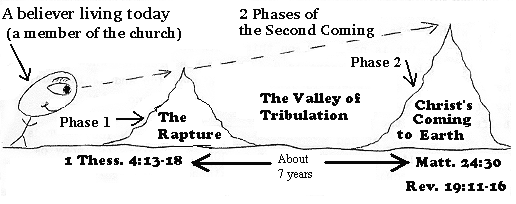
The following comparative study distinguishes between the two phases of the Second Coming of Christ:
1. TIME
RAPTURE--before the tribulation (Revelation 3:10). The church will be kept out of that hour or time of testing which will come upon the whole world. See our booklet, Will the Church Go Through the Tribulation?
SECOND ADVENT--after the tribulation (Matthew 24:29-30; Revelation 19:11-16).
2. QUICKNESS
RAPTURE--in a "moment" (Greek-"atom," a split-second, literally "uncut, indivisible," we divide and cut time into years and months and days and hours and minutes and seconds, but the smallest measure of time is an "atom" of time which we might call a split-second), in the blinking on an eye (1 Cor. 15:52). It is very sudden. It will happen before people will realize it is happening (even as it was with Enoch, see Genesis 5:24; Hebrews 11:5). An example of a man being raptured away suddenly so as to be seen no more is found in Acts 8:39 (where the Greek word for rapture, harpazo, is used).
SECOND ADVENT--slow enough for people to realize and see what is happening (Matthew 24:27; Rev. 1:7; Psalm 2:2; Rev. 19:19). The second coming of Christ to the earth will be visible and obvious to all. No one will miss it.
3. DATE (THE DAY ON WHICH IT WILL TAKE PLACE)
RAPTURE--UNKNOWN DAY. The Lord Jesus will surely come for His Church (John 14:3) but we do not know when (compare 1 John 2:28 and 3:2 where the subjunctive mood is used indicating that while the fact of His coming is sure, the time of His coming is unsure). The rapture is imminent which means that He may come at any time.
SECOND ADVENT--KNOWN DAY. The date of the second coming can be calculated to the very day. It will occur 2520 days (7 years, or 84 months, each month made up of 30 days) from the time that Antichrist makes a treaty with Israel (Daniel 9:27) and it will occur 1260 days (3½ years) from the time of the abomination of desolation (Matt. 24:15). See Revelation 11:2,3; 12:6,14; 13:5; 2 Thess. 2:8 (Antichrist destroyed at 2nd coming). Of course, this "known day" cannot be known or calculated by anyone until the treaty is signed (Dan. 9:27).
4. PRECEDING SIGNS
RAPTURE--NONE (Tit. 2:13; Rev. 22:20; etc.). He may come for His Church at any time and nothing needs to be fulfilled before He comes. The only thing we are waiting for is the completion of the church (Matt. 16:18; Rom. 11:25), and only God knows when this will be.
SECOND ADVENT--MANY (Matthew 24:3-28). There is much that must be fulfilled before Christ returns to the earth (such as all the events in Revelation 6-18 and in Matthew 24).
ILLUSTRATION: The rapture can be likened to Thanksgiving (a holiday without signs) and the second advent can be likened to Christmas (which is preceded by all kinds of signs). When you see the signs of Christmas (decorations, lights, trees, etc.) then you can be sure that Thanksgiving will take place at any time. If Christmas is near then Thanksgiving must be even nearer!
5. VISIBILITY
RAPTURE--Christ seen only by the church (1 Thess. 4:17; 1 John 3:2).
SECOND ADVENT--Christ seen by every eye (Rev. 1:7; Matthew 24:24-27).
6. LOCATION
RAPTURE--in the air (1 Thess. 4:17).
SECOND ADVENT--on the earth (Zech. 14:4; Acts 1:11).
7. ASSOCIATED JUDGMENT
RAPTURE--the judgment seat of Christ (2 Tim. 4:1,8; 1 Pet. 1:7).
SECOND ADVENT--destruction of the wicked armies (Rev. 19:17-19) and the judgment of living nations (Matthew 25:31-46).
8. IDENTITY OF THOSE REMOVED FROM THE EARTH AND THOSE REMAINING ON THE EARTH
RAPTURE--Believers are removed; unbelievers remain (1 Thess. 4:13-18; 1 Cor. 15:51-53; John 14:3).
SECOND ADVENT--Unbelievers are removed; believers remain (Matthew 24:37-41 and Luke 17:34-37). See Matthew 24:38 where the unbelieving world in Noah's day was taken away in judgment.
9. PURPOSE OF CHRIST'S COMING
RAPTURE--to receive His bride (John 14:3; 1 Thess. 4:17).
SECOND ADVENT--to receive His kingdom (Luke 19:22; Rev. chapters 19-20)
10. THE BODIES OF LIVING BELIEVERS
RAPTURE--church age believers are raised (those who have died) and are translated and "changed" (those who are living) with the result that they have immortal, resurrection bodies (1 Cor. 15:52-53; 1 Thess. 4:17).
SECOND ADVENT--believers who survive the tribulation enter the kingdom in natural bodies (Matthew 25:23), and these believers will eventually bear children and re-populate the earth.
For these many reasons, it is necessary to distinguish two phases of our Lord's second coming: 1) THE FIRST PHASE involving the Lord's coming for His church and taking His believers to heaven (John 14:3; 1 Thess. 4:13-18); 2) THE SECOND PHASE, taking place about 7 years later, involving the Lord's coming to earth as the world's Judge and conquering King (Rev. 19:11-21).
The Lord's Second Coming to Earth will be Public and Spectacular
Source: See page 392 in Things to Come
Concerning the second advent certain facts may be observed.
A. The second advent is premillennial. The literal method of interpreting the Scriptures, as previously set forth, makes necessary a premillennial coming of the Lord.
B. The second advent is a literal advent. In order to fulfill the promises made in the Word concerning His coming (Acts 1:11), His advent must be literal. This necessitates the bodily return of Christ to the earth.
C. The second advent is necessary. The large body of unfulfilled prophecy makes the second advent absolutely essential.49 It has been promised that He shall come Himself (Acts 1:11); that the dead will hear His voice (John 5:28); that He will minister unto His watching servants (Luke 12:37); that He will come to earth again (Acts 1:11), to the same Mount Olivet from which He ascended (Zech. 14:4), in flaming fire (2 Thess. 1:8), in the clouds of heaven with power and great glory (Matt. 24:30; 1 Pet. 1:7; 4:13), and stand upon the earth (Job 19:25); that His saints (the church) shall come with Him (1 Thess. 3:13; Jude 14); that every eye shall see Him (Rev. 1:7); that He shall destroy Antichrist (2 Thess. 2:8); that He shall sit on His throne (Matt. 25:-31; Rev. 5:13); that all nations will be gathered before Him and He will judge them (Matt. 25:32); that He shall have the throne of David (Isa. 9:6-7; Luke 1:32; Ezek. 21:25-27); that it will be upon the earth (Jer. 23:5-6); that He shall have a kingdom (Dan. 7:13-14); and rule over it with His saints (Dan. 7:18-27; Rev. 5: 10); that all kings and nations shall serve Him (Ps. 72:11; Isa. 49:6-7; Rev. 15:4); that the kingdoms of this world shall become His kingdom (Zech. 9:10; Rev. 11:15); that the people shall gather unto Him (Gen. 49:10); that every knee shall bow to Him (Isa. 45:23); that they shall come and worship the King (Zech. 14:16; Ps. 86:9); that He shall build up Zion (Ps. 102:16); that His throne shall be in Jerusalem (Jer. 3:17; Isa. 33:20-21); that the Apostles shall sit upon twelve thrones, judging the twelve tribes of Israel (Matt. 19:28; Luke 22:28-30); that He shall rule all nations (Ps. 2:8-9; Rev. 2:27); that He shall rule with judgment and justice (Ps. 9:7); that the temple in Jerusalem will be rebuilt (Ezek. 40—48), and the glory of the Lord will come into it (Ezek. 43:2-5; 44:4); that the glory of the Lord will be revealed (Isa. 40:5); that the wilderness shall be a fruitful field (Isa. 32: 15); that the desert will blossom as the rose (Isa. 35:1-2); and His rest shall be glorious (Isa. 11:10). The entire covenant program with Israel, which has not yet been fulfilled, necessitates the second advent of Messiah to the earth. The principle of literal fulfillment makes it essential that Christ return.
D. The second advent will be visible. Repeated references in the Scriptures establish the fact that the second advent will be a full and visible manifestation of the Son of God to the earth (Acts 1:11; Rev. 1:7; Matt. 24:30). As the Son was publicly repudiated and rejected, He shall be publicly presented by God at the second advent. This advent will be associated with the visible manifestation of glory (Matt. 16:27; 25:31), for in the completion of judgment and the manifestation of sovereignty God is glorified (Rev. 14:7; 18:1; 19:1).
E. Practical exhortations arising from the second advent. Extensive use is made of the doctrine of the second advent of Christ in the Scriptures as a basis of exhortation. It is used as an exhortation to watchfulness (Matt. 24:42-44; 25:13; Mark 13:32-37; Luke 12:35-38; Rev. 16:15); to sobriety (1 Thess. 5:2-6; 1 Pet. 1:13; 4:7; 5:8); to repentance (Acts 3:19-21; Rev. 3:3); to fidelity (Matt. 25:19-21; Luke 12:42-44; 19:12-13); to be unashamed of Christ (Mark 8:38); against worldiness (Matt. 16:26-27); to moderation (Phil. 4:5); to patience (Heb. 10:36-37; James 5:7-8); to mortification of the flesh (Col. 3:3-5); to sincerity (Phil. 1:9-10); to practical sanctification (1 Thess. 5:23); to ministerial faithfulness (2 Tim. 4:1-2); to incite obedience to the Apostle’s injunctions (1 Tim. 6:13-14); to pastoral diligence and purity (1 Pet. 5:2-4); to purity (1 John 3:2-3); to abide in Christ (1 John 2:28); to endure manifold temptations and the severest trials of faith (1 Pet. 1:7); to bear persecution for the Lord (1 Pet. 4:13); to holiness and godliness (2 Pet. 3:11-13); to brotherly love (1 Thess. 3:12-13); to keep in mind our heavenly citizenship (Phil. 3:20-21); to love the second coming (2 Tim. 4:7-8); to look for Him (Heb. 9:27-28); to have confidence that Christ will finish the work (Phil. 1:6); to hold fast the hope firm unto the end (Rev. 2:25; 3:11); to separation from worldly lusts and to live godly (Titus 2:11-13); to watchfulness because of its suddenness (Luke 17:24-30); to guard against hasty judgment (1 Cor. 4:5); to the hope of a rich reward (Matt. 19:27-28); to assure the disciples of a time of rejoicing (2 Cor. 1:14; Phil. 2:16; 1 Thess 2:19); to comfort the apostles in view of Christ’s departure (John 14:3; Acts 1:11); it is the principal event for which the believer awaits (1 Thess. 1:9-10); it is a crowning grace and assurance of blamelessness in the day of the Lord (1 Cor. 1:4-8); it is the time of reckoning with the servants (Matt. 25:19); it is the time of the judgment of the living Gentiles (Matt. 25:31-46); it is the time of the completion of the resurrection program for the saved (1 Cor. 15:23); it is the time of the manifestation of the saints (2 Cor. 5:10; Col. 3:4); it is a source of consolation (1 Thess. 4:14-18); it is associated with tribulation and judgment for the unsaved (2 Thess. 1:7-9); it is proclaimed at the Lord’s table (1 Cor. 11:26).50

Buster Keaton looking expectantly
"The Navigator" 1924
Imminent - An adjective from the Latin word imminens from imminere = to hang or project over. Literally, imminent means hanging or projecting over. Impending.
It is important to note that from the table comparing the two aspects of Christ's return, that His return is both knowable and unknowable! In other words, there are signs that will occur prior to the Second Coming ("knowable") whereas the Rapture has no preceding signs (unknowable). In this section, we will discuss the "unknowable" aspect of the Lord's return, a doctrine that Bible scholars refer to as imminency.
Related Resource:
- Sermon on 2 Timothy 4:1-2 - specifically Paul's emphasis on "Future Focus!" - by Bruce Hurt, MD
J Vernon McGee asks…
Why has He not revealed to us the time of His coming?
“That, when he shall appear, we may have confidence, and not be ashamed before him at his coming.” (1 John 2:28)
A Christian ought to live in the light of the imminent coming of Christ. If you tell me today that He is not coming for another ten years (I may not live that long!), then I do not need to worry about today, and I can be a little careless in my living. But if He might come today, if He came right at this moment, He would catch me preparing this Bible study and that would be fine. I hope He will come at a time like that, but I don’t know when He will come. There are times when I get behind a driver who won’t let me around to pass him, and I tell him what I think of him. If the Lord were to come at that moment, I might be ashamed at His appearing. So you and I need to be living all the time in the light of His imminent return. (Listen to the Mp3 of 1 John 2_28-29)
… Christ will come quickly. He will come right on schedule. We are not to look for the soon coming of Christ but the imminent coming of Christ. Neither will Christ “delay” His coming, as I hear some pious brothers say. The Lord is coming on His schedule—not mine nor yours. He will not delay. But we must remember that the Lord is long-suffering. He is patient. He is not willing that any should perish. (Listen to the Mp3 of Hab 2:1)
… A child of God should walk in the light of the imminent return of Christ all the time (Phil 1:10)
… the coming of Christ is a purifying hope. It will change your life, affect your life-style, if you hold to the hope of the rapture of the church; that is, the imminent coming of Christ for His own. If that doesn’t affect your life, you don’t really believe it. It is just sort of a theory or a philosophy with you. (1Thes 2:20)
… Paul makes it very clear that he believed in the imminent return of Christ. In verse 15 of this chapter he says, “We which are alive and remain unto the coming of the Lord.” Paul believed that the Lord Jesus Christ could come in his lifetime. He did not say or believe that He would come in his lifetime, but he said that He could come… There are those who accuse Paul of changing his position on the imminent coming of Christ as he himself grew older. Remember that this epistle to the Thessalonians was his earliest letter. Did Paul change his theology? When he wrote to the Philippians he was an old man, a prisoner in Rome, and he said: “For our conversation [citizenship] is in heaven; from whence also we look for the Saviour, the Lord Jesus Christ” (Phil. 3:20). Paul, at the end of his life, was still looking for Him. In other words, Christ’s coming was imminent… Paul had taught the Thessalonians that the coming of Christ was imminent, and this is still what we believe today. Between where we are right this moment and the coming of Christ for the church it is tissue-thin, which means it could happen any moment—even before you finish reading this page—or the coming of Christ could be way down yonder in the future. (1 Thes 4:12)
… Protestantism, as a whole, has turned away from looking for the coming of Jesus Christ, and they have built up these systems that certain things must be fulfilled before He can come. My friend, it is tissue-thin from where we are right now to the coming of Christ for His church. He could come the next moment or tomorrow. Don’t say that I said He is coming tomorrow because I don’t know. It may be a hundred years, but, my friend, His imminent return is what we are to look for. Sardis didn’t know when the enemy was coming, and we don’t know when Christ is coming—we have no way of knowing at all. In view of the fact that the Rapture could take place at any moment, the church is to be alert. The date is not set, nor even the period in which He will come, and the reason for that is that the church is to be constantly on the alert for His coming. (Rev 3:2)
Dwight Pentecost writes that…
The doctrine of imminency is taught in Scripture in such passages as John 14:2-3; 1 Corinthians 1:7; Philippians 3:20-21; 1 Thessalonians 1:9-10; 4:16-17; 5:5-9; Titus 2:13; James 5:8-9; Revelation 3:10; 22:17-22…the early church held to the doctrine of imminency. [Pentecost, BORROW Things to Come, 168.]
A W Pink explains imminency this way writing that…
When we say that the Redeemer’s Return is an imminent event, we do not mean it will occur immediately, but that He may come back in our own lifetime, that He may come back this year; yet, we cannot say that He will do so. (Pink, A. W. The Redeemer's Return)
Tony Garland explains that…
Imminence is “The quality or condition of being about to occur.”
In Scripture, the coming of Jesus Christ is portrayed as an imminent event. This means that Jesus can come at any moment: there is no event which must transpire before He comes.
Imminency makes it impossible to know when He might come so the believer must remain constantly on the lookout in case the Lord were to return and find him unprepared (Mt. 24:43; Luke 12:37-39; 1Th 4:15-17; Rev. 3:3). Many passages which teach the imminency of events utilize phrases such as “soon,” “quickly,” and “is near.” These events are described from the perspective of God Who “declares the end from the beginning” (Isa. 46:10). From His perspective, these events are certain but their timing is unspecified. They are “imminent”…
Just as “quickly” is used in Revelation to teach imminence, so also is “near” or “at hand” (engus) used to mean imminency and thus its usage does not support a first-century fulfillment. Philip E. Hughes rightly says, “The time is near, that is to say, the time of fulfillment is imminent. This interval between the comings of Christ is the time of the last days, and the last of these last days is always impending.” … It is better to see engus as a term that teaches the imminency of a period of time that could begin to happen without the warning of signs. (Thomas Ice, The End Times Controversy Eugene, OR: Harvest House Publishers, 2003)
Dr Reginald Showers has an excellent "definition" of the doctrine of imminency as understood by conservative evangelical premillennial scholars…
The concept of the imminent coming of Christ is a significant inference for the Pretribulation Rapture of the church. To understand this concept, we must examine the meaning of the term “imminent.”
The English word “imminent” comes from the Latin verb “immineo, imminere,” which means to “overhang” or “project.” In light of this, the English word “imminent” means “hanging over one’s head, ready to befall or overtake one; close at hand in its incidence.” Thus, an imminent event is one that is always hanging overhead, is constantly ready to befall or overtake a person, is always close at hand in the sense that it could happen at any moment. Other things may happen before the imminent event, but nothing else must take place before it happens. If something else must take place before an event can happen, that event is not imminent. The necessity of something else taking place first destroys the concept of imminency…
In line with this A. T. Pierson stated, "Imminence is the combination of two conditions, viz,: certainty and uncertainty. By an imminent event we mean one which is certain to occur at some time, uncertain at what time."
Since we never know exactly when an imminent event will occur, three things are true.
First, we cannot count on a certain amount of time transpiring before the imminent event happens; therefore, we should always be prepared for it to happen at any moment.
Second, we cannot legitimately set a date for its happening. As soon as we set a date for an imminent event, we destroy the concept of imminency because we thereby say that a certain amount of time must transpire before that event can happen. A specific date for an event is contrary to the concept that the event could happen at any moment.
Third, we cannot legitimately say that an imminent event will happen soon. The term “soon” implies that an event must take place “within a short time (after a particular point of time specified or implied).” By contrast, an imminent event may take place within a short time, but it does not have to do so in order to be imminent. Thus, “imminent” is not equal to “soon.”
This is illustrated by the fact that the next coming of Christ was just as imminent when the New Testament was written as it is today. However, today, some two thousand years later, that coming has not occurred yet. Thus, from today’s historical perspective, it is obvious that although the next coming of Christ was imminent in New Testament times, it certainly was not soon then.
Imminent
vs
Expectant
The relationship of “imminent” to “expectant” should be noted. The term “imminent” is an adjective used to describe the nature of an event. It depicts the kind of event that is always hanging overhead and could happen at any moment. By contrast, the term “expectant” is an adjective used to describe people’s attitude toward an event (i.e., looking forward to, looking out for, or waiting for the happening of an event).
In light of the meaning of the term “imminent” and the fact that the next coming of Christ has not happened yet, we can conclude that the concept of the imminent coming of Christ is that His next coming is always hanging overhead, is constantly ready to befall or overtake us, is always close at hand in the sense that it could happen at any moment. Other things may happen before Christ’s coming, but nothing else must happen before it takes place. If something else must happen before it can take place, then it is not imminent. The necessity of something else taking place first destroys the concept of the imminent coming of Christ.
Because we do not know exactly when Christ will come, three things are true.
First, we cannot count on a certain amount of time transpiring before Christ’s coming; therefore, we should always be prepared for that event to happen at any moment.
Second, we cannot legitimately set a date for Christ’s coming.
Third, we cannot legitimately say that Christ’s coming will happen soon. Again, it may happen soon, but it does not have to in order to be imminent.
Christians should have an expectant attitude toward Christ’s coming (Ed: see Greek Verbs above). Since it is imminent and therefore could happen at any moment, believers should constantly look forward to, look out for, or wait for that event. (BORROW Maranatha Our Lord, Come! 1995) (Bolding added)
Dr John Walvoord has the following "bullet points" on the Doctrine of Imminency…
- The pretribulational interpretation is the only view which teaches that the coming of Christ is actually imminent.
- The exhortation to be comforted by the coming of the Lord (1 Thess 4:18) is significant only in the pretribulational view, and is especially contradicted by posttribulationism.
- The exhortation to look for “the glorious appearing” (Titus 2:13) loses its significance if the tribulation must intervene first. Believers in that case should look for signs.
- The exhortation to purify ourselves in view of the Lord’s return has most significance if His coming is imminent (1 John 3:2–3).
- The church is uniformly exhorted to look for the coming of the Lord, while believers in the tribulation are directed to look for signs.
William MacDonald the godly Plymouth Brethren writer who went home to be with our Lord in 2007 wrote these poignant words regarding the effect that the truth of the Bridegroom's imminent return should have on His Bride, the Church…
For believers the hope of the imminent return of Christ has practical implications of vast significance.
- 1. It should have a purifying influence on our lives (1Thessalonians 5:23; 1 Jn. 3:3).
- 2. It should burden us to pray and work for the salvation of the lost (Gen. 19:14; Ezek. 33:6; Jude 21-23).
- 3. It should encourage us to persevere in spite of persecution and trial (Romans 8:18; 2 Cor. 4:17; 1Thessalonians 4:13-18).
- 4. It should make us reduce our holdings of material possessions; their value declines as His coming approaches (see Lev 25:8-10, 14-16).
- 5. It should constrain us to apologize to anyone we have wronged and to make restitution where necessary (Matthew 5:24; Ja 5:16).
- 6. It should inspire us to diligent service knowing that the night is coming when no one can work (Jn 9:4; 1Thessalonians 1:9; 1:10).
- 7. It should keep us in the attitude of expectancy (Luke 12:36) and abiding in Him so we will not be ashamed before Him as His coming (1 Jn. 2:28).
- 8. It should make us bold to confess Christ (Mark 8:38; Luke 9:26).
- 9. It should prove to be a comforting hope (John 14:1-3, 28; 1Thessalonians 4:18; 2 Thes 1:7; 2 Timothy 2:12).
- 10. It should be an encouragement to moderation, gentleness, and sweet reasonableness (Philippians 4:5).
- 11. It should be a motive for unity and love (1Thessalonians 3:12; 13).
- 12. It should encourage an other-worldly attitude (Colossians 3:1-4).
- 13. It should be a reminder of coming review and reward (Romans 14:10-12; 1 Cor 3:11-15; 2 Cor 5:10).
- 14. It should be used as a powerful appeal in preaching the gospel (Acts 3:19-21; Revelation 3:3).
For those who are not believers, the truth of Christ’s return should lead them to repent of their sins and make a full commitment of their lives to him as Lord and Savior. Only those who are in Christ will go to be with Him at the Rapture. The rest will be left behind for judgment. (BORROW Believer's Bible Commentary)
I do not normally recommend novels but if you are skeptical or if you are searching, I think you will find the following book an interesting read. It is an attempt to describe the chaos and confusion that the world will surely experience when the Rapture occurs. The title says it all "Untaken: 12 Hours Following the Rapture" by C. O. Wyler. Read some of the reviews by readers.
Related Resources on Imminency (some duplication of resources)
- Can the return of Christ truly be said to be imminent?
- Is Jesus coming soon?
- How are we to live our lives in light of Christ's return?
- What is the difference between the Rapture and the Second Coming?
- Is it possible to know when Jesus is coming back?
- What is the blessed hope?
- Reginald Showers (Friends for Israel Ministry) - The Imminent Coming of Christ
- Gerald Stanton - The Doctrine of Imminency - Is It Biblical?
- John Walvoord - The Imminent Translation of the Church
- Robert Thomas - Imminence in NT esp Paul's Thessalonian Epistles - 25 page analysis of the doctrine of imminence
- John MacArthur - Is Christ's Return Imminent?
- James F Stitzinger - Rapture in 20 Centuries of Biblical Interpretation - this article is virtually a BOOK at 151 pages!
- Richard Mayhue - Why a Pre-Tribulation Rapture?
- The Doctrine of Imminency: Is it Biblical? - Gerald Stanton
Dear Believer and
Dear Unbeliever…
What if it were today?
Would that thought affect the way I live today?
Would it affect what (Who) I believe?

- See more complete collection of Quotes, Devotionals and Illustrations related to the Second Coming
The saintly Presbyterian pastor Robert Murray McCheyne was known to on occasion ask people
Do you believe that Jesus is coming today?” If they replied in the negative, he would say, “Then you had better be ready, for He is coming at an hour when you think not!
During World War II occurred early in the war when the Japanese army stormed the Philippines and forced United States General Douglas MacArthur to leave the islands. Upon leaving the Philippines, General MacArthur declared his famous promise, “I shall return.” And he did, walking ashore a victor at Leyte in the Philippines several years later. In an even more famous quote, the Captain of the hosts, the Lord Jesus Christ declared to His fearful band of disciples “I will come again” (John 14:3)
He that rose from the clods we expect from the clouds. - Thomas Adams
A little while—then Christ will come;
The glorious hour draws nigh
When He will come to take His bride
To dwell with Him on high.
—Gilmore
Christ’s second coming is as certain as His first.
When it comes to belief in the Lord's return there are two kinds of Christians—gazers and goers.
He is coming! Oh, the rapture
To behold His lovely face,
And to tell Him how I love Him,
Who has saved me by His grace.
—Dimmock
Christ is coming—perhaps today!
A Scottish preacher once said, “The doctrine of the Lord’s second coming, as it appears in the New Testament, is like a lofty mountain that dominates the entire landscape.” Commenting on that statement, author A. J. Gordon adds, “No matter what road you take, no matter what pass you tread, you will find the mountain bursting on your vision at every turn of the way, and at every parting of the hills. What first struck me in reading the New Testament was this: Whatever doctrine I was pursuing, whatever precept I was enforcing, I found it fronting toward and terminating in the hope of the Lord’s second coming. All paths of obedience and service lead on to that mountain.” Someone has pointed out that there are more than 300 references to Christ’s return in the New Testament. One fact is clear—Jesus is coming back. Each day we are getting closer to that climactic moment. Today could be the day! - Our Daily Bread
The Lord has said He will return
To judge the world someday;
Are you prepared for Him to come
Or hoping for delay?
—Sper
Don't complain about what this world is coming to.
Proclaim the One who is coming to this world.
He who loves the coming of the Lord is not he who affirms it is far off, nor is it he who says it is near. It is he who, whether it be far or near, awaits it with sincere faith, stead-fast hope and fervent love. - Augustine
That day lies hid that every day we be on the watch. - Augustine
The certainty of the Second Coming of Christ should touch and tincture every part of our daily behavior. - John Blanchard
In the first advent God veiled his divinity to prove the faithful; in the second advent he will manifest his glory to reward their faith. -Chrysostom
The only remedy for all this mass of misery is the return of our Lord Jesus Christ. Why do we not plead for it every time we hear the clock strike? - Anthony Ashley Cooper
As Christians, we should not be exitists, looking for our going, but adventists, looking for his coming. - William Freel
The subject of the second coming of Christ has never been popular to any but the true believer. - Billy Graham
Christ hath told us he will come, but not when, that we might never put off our clothes, or put out the candle. - William Gurnall
Oh, the joy to see thee reigning, Thee, my own beloved Lord! Every tongue thy name confessing, Worship, honour, glory, blessing, Brought to thee with glad accord—Thee, my Master and my Friend, Vindicated and enthroned, Unto earth's remotest end Glorified, adored and owned! - Frances Ridley Havergal
Christ will come when he pleases, to show his sovereignty, and will not let us know when, to teach us our duty. - Matthew Henry
If this (Second Coming) is not an integral part of the faith once given to the saints, I do not know what is. - C. S. Lewis
Precisely because we cannot predict the moment, we must be ready at all moments. - C. S. Lewis
The primitive church thought a great deal more about the coming of Christ than about death, and thought a great deal more about his coming than about heaven. - Alexander Maclaren
I never preach a sermon without thinking that possibly the Lord may come before I preach another. - D. L. Moody
Christ is coming to the earth, in such form at least as shall fulfil his purposes of mercy to his friends and justice to his foes. - Thomas V. Moore
I never begin my work in the morning without thinking that perhaps he may interrupt my work and begin his own. I am not looking for death, I am looking for him. - G. Campbell Morgan
There is such a danger of our being so occupied with the things that are to come more than with him who is to come. - Andrew Murray
Millions of graves are dug every year, but it is inspiring to think that one generation of Christians will cheat the undertaker. - J. C. Pollock
The return of Christ represents not only the ultimate sense of accountability but the ultimate sense of hope as well. - What Can We Know About The Second Coming?
Oh, that Christ would make long strides! Oh, that he would fold up the heavens as a cloak, and shovel time and days out of the way! - Samuel Rutherford
There shall be no time for parting words or a change of mind when the Lord appears. -J. C. Ryle
Uncertainty about the date of the Lord's return is calculated to keep believers in an attitude of constant expectation and to preserve them from despondency. - J. C. Ryle
If I knew that our Lord would come this evening, I should preach just as I mean to preach; and if I knew he would come during this sermon, I would go on preaching until he did. - C. H. Spurgeon
Oh, that the Lord would come! He is coming! He is on the road and travelling quickly. The sound of his approach should be as music to our hearts! - C. H. Spurgeon
The fact that Jesus Christ is to come again is not a reason for star-gazing, but for working in the power of the Holy Ghost. - C. H. Spurgeon
Since he may come any day, it is well to be ready every day. - J. Hudson Taylor
He who came in humility and shame will return in spectacular magnificence. - John R. W. Stott
The imminent return of our Lord is the great Bible argument for a pure, unselfish, devoted, unworldly, active life of service. - R. A. Torrey
This is pinned as a badge to the sleeve of every true believer—that he looks for and longs for Christ's coming to judgement. - John Trapp
The Christian hope is not a matter for tickling our minds, but for changing our minds and influencing society. - Stephen Travis
I am daily waiting for the coming of the Son of God. - George Whitefield
The brightness of Christ's advent will reveal the true character of those things which were previously hidden by darkness. - Geoffrey B. Wilson