Titus 2:2
Titus 2:3
Titus 2:4
Titus 2:5
Titus 2:6
Titus 2:7
Titus 2:8
Titus 2:9
Titus 2:10
Titus 2:11
Titus 2:12
Titus 2:13
Titus 2:14
Titus 2:15
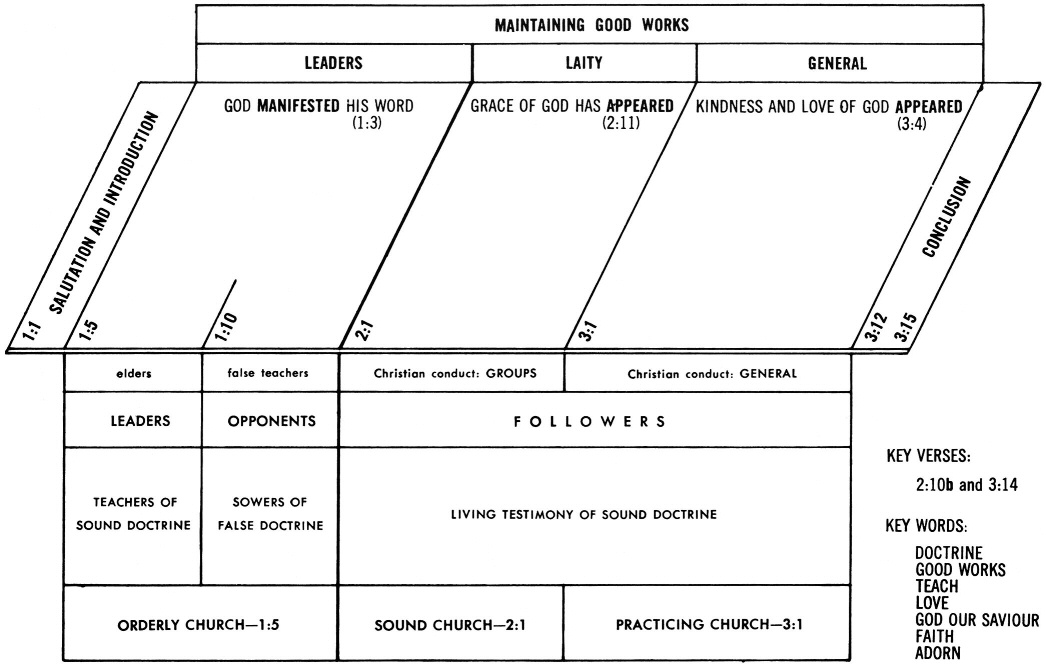
ADORNING THE DOCTRINE OF GOD
Click chart to enlarge
Charts from Jensen's Survey of the NT - used by permission
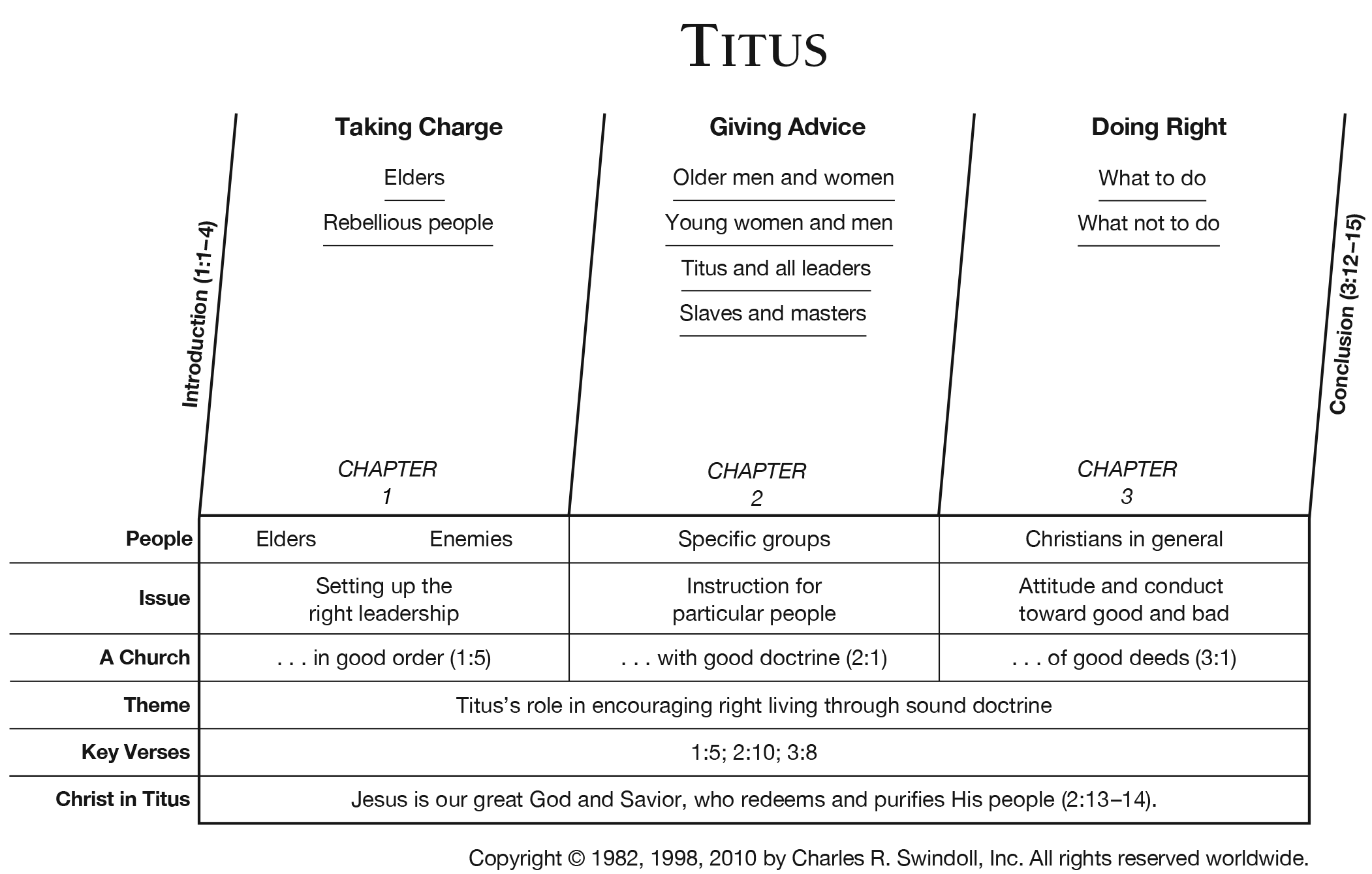
See Summary Chart by Charles Swindoll
Chart below from Michael J. Penfold
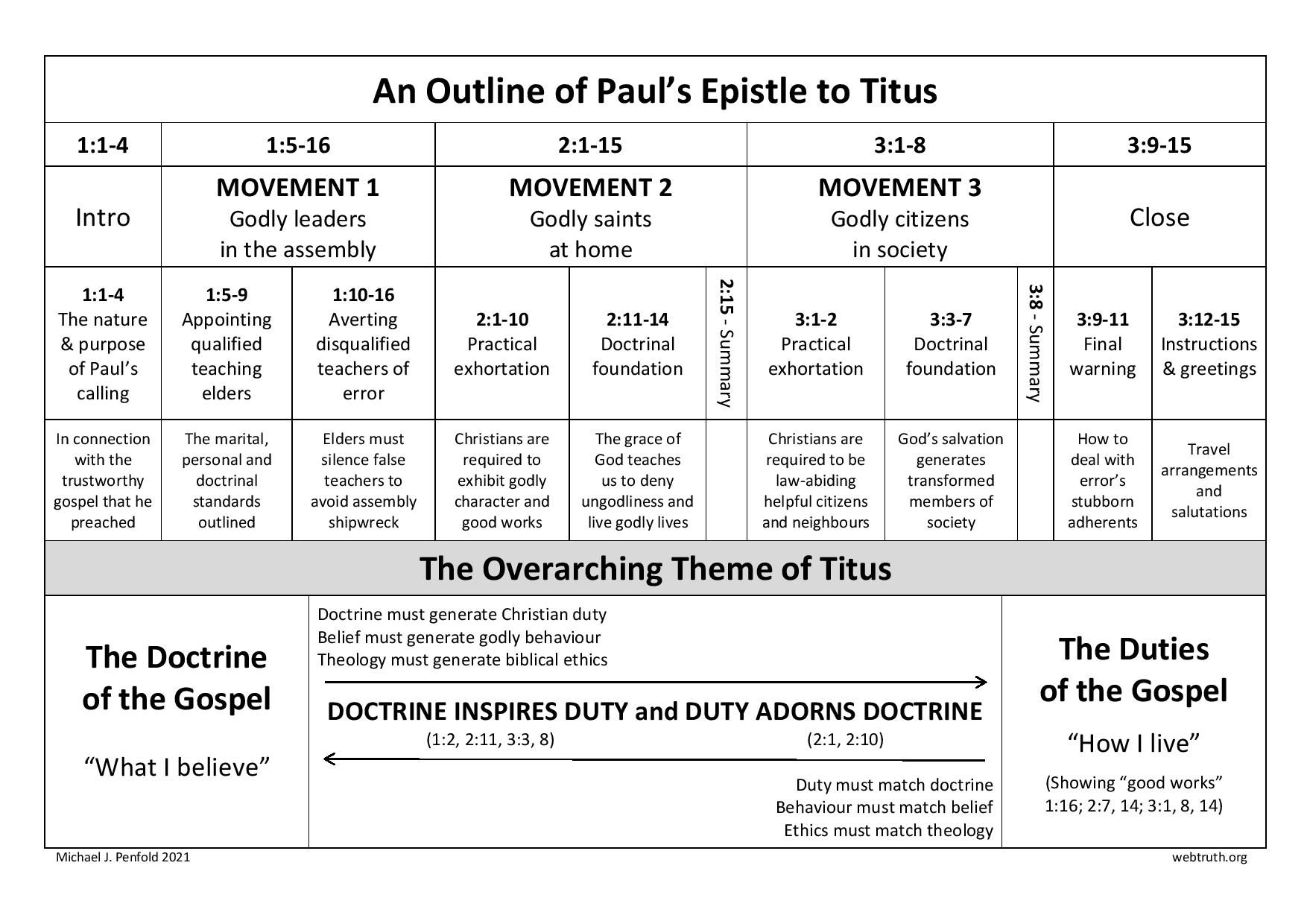
|
Focus |
Appoint Elders |
|||
|
Divisions |
Ordain |
Rebuke |
Maintain |
|
|
Topics |
||||
|
Topics |
Organization |
Offenders |
Operation |
|
|
Place |
Probably Written from either Corinth or Nicopolis (cf. Titus 3:12). |
|||
|
Time |
Circa 63 AD |
|||
|
Modified from Talk Thru the Bible |
||||
Titus 2:12 instructing (PAP) us to deny (AMP) ungodliness and worldly desires and to live (AAS) sensibly, righteously and godly in the present age (NASB: Lockman)
Greek: paideuousa (PAPFSN) hemas hina arnesamenoi (AMPMPN) ten asebeian kai tas kosmikas epithumias sophronos kai dikaios kai eusebos zosomen (1PAAS) en to nun aioni,
Amplified: It has trained us to reject and renounce all ungodliness (irreligion) and worldly (passionate) desires, to live discreet (temperate, self-controlled), upright, devout (spiritually whole) lives in this present world, (Amplified Bible - Lockman)
Barclay: schooling us to renounce godlessness and worldly desires for forbidden things, and to live in this world prudently, justly and reverently, (Westminster Press)
KJV: Teaching us that, denying ungodliness and worldly lusts, we should live soberly, righteously, and godly, in this present world;
Phillips: and it teaches us to have no more to do with godlessness or the desires of this world but to live, here and now, responsible, honourable and God-fearing lives. And while we live this life (Phillips: Touchstone)
Wuest: instructing us that denying impiety and worldly cravings, we should live discreetly and righteously and piously in the midst of this present age,
Young's Literal: teaching us, that denying the impiety and the worldly desires, soberly and righteously and piously we may live in the present age,
INSTRUCTING US: paideuousa (PAPFSN) hemas:
- Mt 29:20; 1Th 4:9; Heb 8:11; 1Jn 2:27
- Acts 7:22, Heb 12:6,11
- Titus 2 Resources - Multiple Sermons and Commentaries
- Titus 2:11-14 How Grace Works - Steven Cole
- Titus 2:11-14 Saving Grace, Pt. 3 - John MacArthur
- Titus 2:11-14 Saving Grace, Pt. 4 - John MacArthur
TRAINED BY GRACE
For an excellent Mp3 message on Titus 2:11-15 listen to John Piper - Our Hope: The Appearing of Jesus Christ
- It trains us to avoid ungodly lives filled with worldly desires (GWT)
- It teaches us not to live against God and not to do the evil things the world wants to do. (ICB)
- It teaches us to say "No" to ungodliness and worldly passions (NIV)
- And we are instructed to turn from godless living and sinful pleasures. (NLT)
- training us to renounce ungodliness and worldly passions (ESV)
- it has taught us that we should give up everything contrary to true religion and all our worldly passions (NJB)
- It has trained us to reject and renounce all ungodliness (irreligion) and worldly (passionate) desires (Amp)
- That grace instructs us to give up ungodly living and worldly passions (TEV)
- the grace of God… schools us to renounce irreligion and worldly passions (Moffatt)
Instructing us - What or who is instructing? The "Schoolmaster" is Grace. In the previous verse Grace was the Savior that rescued those who believed from sin and death, the spiritual transaction of justification (past tense salvation). In this verse Grace instructs and teaches and disciplines us and provides the power in our daily struggle against sin (cf Gal 5:17, 1Pe 2:11, Ro 8:13). In contrast to the one time event of justification, progressive sanctification (present tense salvation) is a daily process. We will remain in this "classroom" of sanctification until we see Jesus our the Blessed Hope at which time we will experience glorification (future tense salvation). (Related Resource: Three Tenses of Salvation)
Spurgeon - I wish to be driving at the point which the apostle is aiming at: that we are to be holy—holy because grace exercises a purifying discipline, and because we are the disciples of that grace. The discipline of grace, according to the apostle, has three results—denying, living, looking. (The Two Appearings and the Discipline of Grace)
Lehman Strauss says that this verse tells us…
that the operation of grace in salvation is a continuous, lifelong work until grace finds its consummation in glory.
The Concordia Self-study Commentary writes that…
God’s saving grace is a training grace which makes man’s life sound in every respect. Under the benign sway of this grace (cf. Ro 6:14) man’s relationship to himself is one of self-control ("sensibly"); to his fellowman, one of justice ("righteously); and to his God, one of piety (godly). God’s grace fulfills His ancient intention and promise of a people redeemed and purified for a life of service to Him. (Titus 2:14; cf. Ps 84:11) (Concordia Self-study Commentary. St. Louis: Concordia Publishing House) (Bolding added)
David deSilva in the Ashland Theological Journal writes that…
Both Titus 2:11–14 and 2Pe 1:4 (note) focus on the transformation of our lives from lives marked by “the corruption that is in the world because of lust” or by “impiety and worldly passions” into “lives that are self-controlled, upright, and godly,” reflecting our participation “in the divine nature.” Sanctification, in essence, is simply a right response to God’s gifts, putting the resources God has made available for holiness in Christ to good and proper use. (ATJ, 31, 1999, page 32)
Howard Zabriskie explains that…
Titus 2:11 has shown that salvation has been brought to all men, but verse 12 shows that this grace in its teaching ministry is not universal. It is restricted to those who have appropriated the saving grace of God and are themselves children of God by faith in Christ Jesus. One may well ask, “Why is there this contrast?” The answer to this question is found in the Greek word παιδεύουσα. (see paideuo below). This word generally translated, “teaching” (Ed: "instructing" in NAS) is more correctly rendered, “disciplining.” It is this truth that is often misunderstood. God does not discipline one who is not saved, for there would be no purpose in such action. He might judge such a one because of his sin, but discipline from Him is always reserved for saved people. The reason for this is evident. God has a place which He desires each one of His children to occupy. He has a work for each one to do. It is only as He prepares His children for their appointed tasks that they will accomplish His will. Many are happy enough to welcome God’s saving grace and find continual consolation in the fact that He keeps, but how few take pleasure in the gracious discipline He gives. Paul knew better than anyone else, the value of this aspect of God’s grace, and he told the Corinthian Church that he was exceedingly joyful in all tribulation (2Cor 7:4). He knew that tribulation worketh patience, and patience experience, and experience hope (Ro 5:3, 4-see notes Ro 5:3; 5:4). He therefore could tell those to whom he wrote to glory in tribulation (Ro 5:3). (The Discipline of Grace in Bibliotheca Sacra 93:370. April 36. p. 167) (Theological Journal Subscription info) (22 journals - 500 yrs of articles searchable by topic or verse! Incredible Online Resource!)
Instructing (3811) (paideuo from país = child) refers primarily to the training or discipline of children (whether in the schools of men - Acts 7:22, Acts 22:3 or in the school of God, Titus 2:12, et al), at one end of the spectrum training by teaching, instructing, educating or nurturing and at the other end of the spectrum utilizing correction and punishment if necessary (which it usually is for children) as a part of the training or child rearing process bringing them to maturity (this end of the spectrum conveyed by English words like chastise or chasten - see below - as morally disciplining an adult, correcting them and giving them guidance). In that regard we will briefly look at some of the most common English words used to translate paideuo and will attempt to draw out the sometimes subtle differences in meaning. From this introduction, you can see that the meaning of paideuo is dependent on the context.
Gilbrant - Paideuō is commonly used in Greek literature to mean the “upbringing” and “teaching” of children. Such “upbringing” consisted of teaching general knowledge and various kinds of training aimed at developing discipline and character. If necessary this included chastisement (physical punishment). In both the Septuagint and the New Testament paideuō is also used of “upbringing” a child, however, it was particularly used of “religious upbringing.” The meaning of “chastening” does not include punishment in the judicial or vengeful sense. Instead it is intended as a means of developing and refining the mind and the will. Therefore, believers can be assured that God’s chastening is not an expression of His wrath, but of His love, wisdom, and care. (Complete Biblical Library Greek-English Dictionary)
Spurgeon comments that paideuo…
is a scholastic term, and has to do with the education of children; not merely the teaching, but the training and bringing of them up. The grace of God has come to be a schoolmaster to us, to teach us, to train us, to prepare us for a more developed state. Christ has manifested in his own person that wonderful grace of God which is to deal with us as with sons, and to educate us unto holiness, and so to the full possession of our heavenly heritage. We are the many sons who are to be brought to glory by the discipline of grace.
So then, first of all, grace has a discipline. We generally think of law when we talk about schoolmasters and discipline; but grace itself has a discipline and a wonderful training power too. The manifestation of grace is preparing us for the manifestation of glory. What the law could not do, grace is doing.
The free favor of God instills new principles, suggests new thoughts, and by inspiring us with gratitude, creates in us love to God and hatred of that which is opposed to God. Happy are they who go to school to the grace of God!
This grace of God entering into us shows us what was evil even more clearly than the commandment does. We receive a vital, testing principle within, whereby we discern between good and evil.
The grace of God provides us with instruction, but also with chastisement, as it is written, “As many as I love I rebuke and chasten.”
As soon as we come under the conscious enjoyment of the free grace of God, we find it to be a holy rule, a fatherly government, a heavenly training. We find, not self indulgence, much less licentiousness; but on the contrary, the grace of God both restrains and constrains us; it makes us free to holiness, and delivers us from the law of sin and death by “the law of the spirit of life in Christ Jesus (Ro 8:2).” (From Spurgeon's sermon Two Appearings & the Discipline of Grace)
The most severe meaning of paideuo in the NT is Pilate's mistreatment of our Lord…
Luke 23:16 "I will therefore punish (paideuo) Him and release Him… Luke 23:22 And he said to them the third time, "Why, what evil has this man done? I have found in Him no guilt demanding death; I will therefore punish (paideuo) Him and release Him." (Comment: Clearly paideuo does not mean training or correction in this context, but only maltreatment)
Paideuo is used 13 times in the NT translated in the NAS as: correcting(1), discipline(2), disciplined(2), disciplines(1), educated(2), instructing(1),punish(2), punished(1), taught(1).
Luke 23:16 "Therefore I will punish Him and release Him."
Luke 23:22 And he said to them the third time, "Why, what evil has this man done? I have found in Him no guilt demanding death; therefore I will punish Him and release Him."
Acts 7:22 "Moses was educated in all the learning of the Egyptians, and he was a man of power in words and deeds.
Acts 22:3 "I am a Jew, born in Tarsus of Cilicia, but brought up in this city, educated under Gamaliel, strictly according to the law of our fathers, being zealous for God just as you all are today.
1 Corinthians 11:32 But when we are judged, we are disciplined by the Lord so that we will not be condemned along with the world.
2 Corinthians 6:9 as unknown yet well-known, as dying yet behold, we live; as punished yet not put to death,
1 Timothy 1:20 Among these are Hymenaeus and Alexander, whom I have handed over to Satan, so that they will be taught not to blaspheme.
2 Timothy 2:25 with gentleness correcting those who are in opposition, if perhaps God may grant them repentance leading to the knowledge of the truth,
Titus 2:12 instructing us to deny ungodliness and worldly desires and to live sensibly, righteously and godly in the present age,
Hebrews 12:6 FOR THOSE WHOM THE LORD LOVES HE DISCIPLINES, AND HE SCOURGES EVERY SON WHOM HE RECEIVES."
Hebrews 12:7 It is for discipline that you endure; God deals with you as with sons; for what son is there whom his father does not discipline?
Hebrews 12:10 For they disciplined us for a short time as seemed best to them, but He disciplines us for our good, so that we may share His holiness.
Revelation 3:19 'Those whom I love, I reprove and discipline; therefore be zealous and repent.
Paideuo 49 times in the Septuagint (LXX)
Lev 26:18, 23, 28; Deut 4:36; 8:5; 21:18; 22:18; 32:10; 2 Sam 22:48; 1 Ki 12:11, 14; 2 Chr 10:11, 14; Esther 2:7; Ps 2:10; 6:1; 16:7; 38:1; 39:11; 90:10; 94:10, 12; 105:22; 118:18; 141:5; Pr 3:12; 5:13; 9:7; 10:4; 13:24; 19:18; 22:3; 23:13; 28:17; 29:17, 19; 31:1; Isa 28:26; 46:3; Jer 2:19; 6:8; 10:24; 31:18; 46:28; Ezek 23:48; 28:3; Hos 7:12, 14; 10:10
Leviticus 26:18 (see note) ‘If also after these things you do not obey Me, then I will punish you seven times more for your sins.
Leviticus 26:28 then I will act with wrathful hostility against you, and I, even I, will punish you seven times for your sins.
Paul explains Who and why believers are disciplined writing…
1 Corinthians 11:32 But when we are judged, we are disciplined by the Lord in order that we may not be condemned (have sentence pronounced) along with the world.
Nelson's New Illustrated Bible Dictionary has an interesting statement on discipline noting that
the biblical concept of discipline has both a positive side (instruction, knowledge, and training) and a negative aspect (correction, punishment, and reproof). Those who refuse to submit to God’s positive discipline by obeying His laws will experience God’s negative discipline through His wrath and judgment. (Nelson's New Illustrated Bible Dictionary)
As discussed below paideuo can also be viewed as "parental" or "family" discipline as in the following passages (He 12:5, 6, 7, 8, 9, 10, 11-see notes He 12:5; 6; 7; 8; 9; 10; 11, 1Cor 11:32).
As Hiebert says
"notwithstanding the assertions of some learned modern psychologists, the timely use of some physical persuasion on the posterior end is truly beneficial for the development of the child" and I would add for "the child of God"!
Hiebert goes on to add that God's
"grace takes the believer into its school and carries on the process of training us. Knowledge of things spiritual is given, but when that is not enough then rebuke, conviction, and chastening are administered. The final aim is not creed but character. Accordingly we are told "Whom the Lord loveth He chasteneth, and scourgeth every son whom He receiveth" (He 12:6). The present tense indicates that this is a continuing process. No one ever graduates from the school of God's grace in this life." ("Titus and Philemon" p58, Moody, 1957) Amen to that.
The English word "discipline", which is used to translate paideuo, is defined by Webster as training that corrects or molds mental faculties and moral character. Discipline is derived from a Latin word meaning “instruction” or “training.”
Discipline describes the process of learning which molds one's character and enforces correct behavior. To discipline someone means to put them in a state of good order so that they function in the way they were intended to function.
Discipline, in spite of a popular misconception, is not inherently stern or harsh.
The English word "chastise" is sometimes used to translate paideuo and conveys a somewhat "harsher" degree of discipline.
Webster defines "chastise" as the infliction of either corporal punishment (as by whipping) or verbal censure.
Vance Havner speaking of the value of discipline quipped that…
You cannot sharpen an axe on a cake of butter.
Or as John Trapp bluntly put it…
Better be pruned to grow than cut up to burn.
Pilate, since he had declared our Lord guiltless of the charge brought against Him, and hence could not punish Him, weakly offered, as a concession to the Jews, to "therefore punish (KJV = "chastise" = paideuo) Him and release Him" (Lk 23:16, cf Lk 23:22) in context picturing punishment with blows and/or scourging.
Chasten is a broader term than "chastise" and means the discipline or training to which one is subjected, without, as in the other term, referring to the means employed to this end. Chasten is from Latin castus meaning pure or chaste and to chasten then is properly "to purify". In Paul's use of paideuo in first Timothy, although translated "taught", he clearly intends a harsher degree of discipline declaring
Hymenaeus and Alexander… I have delivered over to Satan, so that they may be taught (paideuo) not to blaspheme. (1Ti 1:20)
However one interprets this passage, it is clear that Paul is not referring to the impartation of knowledge per se but is speaking more of "teaching" by punishment or chastisement. And as Lea has well said "Education in Christian behavior is seldom a painless process since it involves the correction of human behavior which by nature stands in opposition to God."
Paideuo as discussed above originally meant to bring up a child, educating and instructing them and was used of activity directed toward the moral and spiritual nurture and training of the child, the goal being to influence the child's will and behavior.
Plato wrote (in "Laws", 659) that
Education (paideia noun form of paideuo) is the constraining and directing of youth toward that right reason which the law affirms, and which the experience of the best of our elders has agreed to be truly right.
Luke's uses in Acts emphasize the educational component of paideuo…
Moses (who) was educated (paideuo) in all the learning of the Egyptians ("the school of men") and he was a man of power in words and deeds. (Acts 7:22)
Paul describes himself as
a Jew, born in Tarsus of Cilicia, but brought up in this city, educated (paideuo) under Gamaliel ("the school of men"), strictly according to the law of our fathers, being zealous for God, just as you all are today. (Acts 22:3)
Paul gives instruction to all who would seek to be the Lord's bond-servant that they…
must (dei = a necessity) not be quarrelsome, but be kind to all, able to teach, patient when wronged, 25 with gentleness correcting those who are in opposition, if perhaps God may grant them repentance leading to the knowledge of the truth, with gentleness correcting (paideuo - present tense) those who are in opposition, if perhaps God may grant them repentance leading to the knowledge of the truth (see notes 2 Ti 2:24; 2:25).
Because the objects of this instruction are those who teach false doctrine and live ungodly lives, this particular instruction is in the form of correction so that they may repent and learn the truth.
HAVE YOU ENTERED
GOD'S SCHOOL OF GRACE?
Lehman Strauss writes that…
When the believing sinner accepts the work of divine grace which sent Christ to Calvary for his redemption, he matriculates (enrolls as a member) in the school of grace. Grace becomes his teacher to train, educate, and instruct him.
The end of the training course is the second appearing of Christ, and with that great event ever before him, he allows grace to correct and chasten him.
But keep in mind that the instruction is for believers only. While grace is bringing salvation to “all men,” it is obvious that all do not want salvation on God’s terms. They who refuse to enter the school of grace cannot receive its instruction. Grace teaches “us,” that is, the Christian believers.
With the second appearing of Christ before us (Titus 2:13), we readily submit to the disciplinary process of grace. The first lesson grace teaches us is a negative one. The Christian must deny or denounce ungodliness. “Ungodliness” (Gr. asebeia) is just the opposite of “godliness” (Gr. eusebeia) (Titus 1:1). The first act of saving grace is to rid the believer of impiety or irreverence toward God. Ungodliness, which is irreverence toward God, is usually the root of all other sins. I am amazed at the irreligious contempt for God in our day.
We can be certain that the person who has not denied ungodliness does not know the grace of God. He is not living with Christ’s return in view.
Believers must deny “worldly lusts,” those desires having the character of this present age however refined they may appear. The school of grace teaches us to “love not the world, neither the things that are in the world” (1John 2:15). “Be not conformed to this world” (Ro 12:2), because the “friendship of the world is enmity with God” (Jas 4:4). The Christian who is looking for that “blessed hope,” which is the appearing of Jesus Christ, will not be lusting after the pleasures and treasures of the world. It was Zacharias who said that God redeemed us that we “might serve him without fear, in holiness and righteousness before him, all the days of our life” (Luke 1:74, 75).
The blessed hope is indeed a sanctifying hope.
The teaching of grace, in view of the coming again of Christ, is not all negative. On the positive side we are exhorted to “live soberly,” that is in a sober-minded or sound-minded manner. Here is an exhortation enjoined upon all Christians. “Aged men be sober…aged women likewise…teach the young women to be sober…young men likewise exhort to be sober minded” (Titus 2:2–6). The Christian’s mind is set in proper balance who looks expectantly for Christ’s return.
The upward look for the coming again of the Lord Jesus is an effective counteraction for an unbalanced mind.
We should live “righteously.” Righteous living is right living before my fellowman. Then we are to live “godly.” Godly living is a right condition before God. Twice in the New Testament the words “holiness and righteousness” appear together (Luke 1:75; Eph 4:24), expressing the ideas of character before God and conduct before men. The hope of the coming again of Jesus Christ to claim His church provides incentive and stimulus for right living. It is a sanctifying hope.
Jesus Christ came the first time in order that He might get us ready for His second coming. (Our Only Hope BSac 120:478 - Apr 1963) (22 journals - 500 yrs of articles searchable by topic or verse! Incredible Online Resource!)
Family Discipline - God's discipline of His children brings them up and handles them as one would a child who is growing to maturity and who is in continual need of direction, teaching, instruction and a certain measure of compulsion in the form of even chastisement or chastening. God deals with saints as sons and daughters because He loves us too dearly to allow us to go on in sin. Like wandering sheep we soon feel the shepherd’s crook on our necks pulling us back into the fold and unto Himself. (2Cor 6:9; cf. Pr 3:12).
The writer of Hebrews discusses God's familial, filial discipline at some length reminding all sons and daughters who are experiencing His discipline to receive it and
5 not (to) regard lightly the discipline (paideia - the related noun) of the Lord, nor faint when you are reproved by Him, 6 for those whom the Lord loves, He (continuously as they need it) disciplines (paideuo) and He scourges every son whom He receives" adding that 7 "it is for discipline (paideia) that you endure; God deals with you as with sons; for what son is there whom his father does not discipline (paideuo)? 8 But if you are without discipline (paideia) of which all have become partakers, then you are illegitimate children and not sons. 9 Furthermore, we had earthly fathers to discipline (paideutes - noun form) us and we respected them; shall we not much rather be subject to the Father of spirits, and live? 10 For they disciplined (paideuo) us for a short time as seemed best to them, but He disciplines us for our good, that we may share His holiness. 11 All discipline for the moment seems not to be joyful, but sorrowful; yet to those who have been trained by it, afterwards it yields the peaceful fruit of righteousness. (see notes Hebrews 12:5; 12:6; 12:7; 12:8; 12:9; 12:10; 12:11)
The exhortation is not to reject discipline or be dejected by it, but to accept it and be instructed by it. Whatever discipline we are experiencing, we can be sure that His chastening hand is controlled by His loving heart.
In the context of participating in the Lord's supper (communion), Paul warns that against partaking without self-examination, the consequences of which can include sickness and even death. Paul writes that
when we are judged, we are disciplined (KJV, "chastened") by the Lord in order that we may not be condemned along with the world. (1Cor 11:32)
The Lord chastens His own children to drive them back to righteous behavior and sends death to some in the church to encourage those who remain to repent and choose holiness rather than sin. In so doing God is not doing so as would a judge condemning a criminal, but as a loving Father punishing His disobedient children. Chastening proves His love for us, and chastening can, if we cooperate, perfect His life in us.
The Septuagint (LXX) uses paideuo 62 times. For example, the psalmist extols the benefit of divine discipline declaring
Blessed is the man whom Thou dost chasten (Lxx = paideuo), O LORD and dost teach out of Thy law. (Ps 94:12) (See Spurgeon's comment)
Spurgeon comments that
Though he may not feel blessed while smarting under the rod of chastisement, yet blessed he is; he is precious in God’s sight, or the Lord would not take the trouble to correct him. The psalmist calls the chastened one a man in the best sense, using the Hebrew word which implies strength. He is a man, indeed, who is under the teaching and training of the Lord.
Faith enables the afflicted psalmist to see his troubles as part of God’s discipline and education for him. It is a great thing to be thus taught by the Lord. In another psalm, David prays
O Lord, rebuke me not in Thy wrath and chasten (Lxx = paideuo) me not in Thy burning anger. (Ps 38:1) (See Spurgeon's commentary)
Spurgeon paraphrases it this way
Turn not the rod into a sword; smite not so as to kill. True, my sins might well inflame Thee, but let Thy mercy and longsuffering quench the glowing coals of Thy wrath. Let me not be treated as an enemy or dealt with as a rebel. Bring to remembrance Thy covenant, Thy fatherhood, and my feebleness, and spare Thy servant.
Finally, although this last example uses the related noun paideia, the truth conveyed is the same, Solomon writing that
reproofs for discipline are the way of life (NIV has "the corrections of discipline are the way of life") (Pr 6:23, 20, 21, 22)
When the believing sinner receives Christ by faith and is born again, he then enters into God's "classroom of grace", grace now becoming his teacher to train, educate, and instruct him. In other words, the "Grace of God" is personified as our personal pedagogue or schoolmaster (Gk paidagogos [from pais = child + agogos = leader] an instructor of teacher of children, a slave who escorted children to school).
Vine says that paideuo refers to
a training gracious and firm. Grace, which brings salvation, employs means to give us full possession of it.
Accordingly the thought here, as indicated in what follows, is that of training believers by way of discipline as well as instruction, so as to subdue our carnal inclinations and guide us in our new manner of life in Christ and under grace.
Instructing is present tense indicating that "the grace of God" is continually assisting the believer in the development of their ability to make appropriate choices against ungodliness and for godliness.
What Paul is saying is that grace of God not only saves us ("saving grace") but operates in the lives of those who are saved, exerting its dynamic effect ("sanctifying grace") in every aspect of the "child rearing" process -- training, teaching, encouraging, correcting and disciplining us for our good and God's glory. The grace of God is o assist in the development of a person’s ability to make appropriate choices, practice discipline.
The great Master-builder squares and polishes with many strokes of the chisel and hammer the stones which shall find a place at last in the walls of the heavenly Jerusalem… It is the crushed grape, and not the untouched, from which the costly liquor distils.
Warren Wiersbe adds that "Those who use God’s grace as an excuse for sin have never experienced its saving power (Ro 6:1; Jude 1:4). The same grace that redeems us also renews us so that we want to obey His Word (see note Titus 2:14) (With the Word: Chapter-by-Chapter Bible Handbook. Nelson)
There is no surer way of allowing a child to end in ruin than to allow him to do as he likes. The child who gets his own way brings shame to his mother and is ultimately condemned along with the world. [Pr 6:23 Ps 119:71 - see Spurgeon's comment) Grace does not include (as one well known theologian has written) "the Christian's liberty to do precisely as he chooses." Clearly, grace does not grant permission to live in the flesh for that would "turn the grace of our God into licentiousness" (Jude 1:4) but supplies power to live controlled by the Spirit (Ro 8:12, 13-notes Ro 8:12; 13).
Grace is not license to do as we please, but the power to do as we should! Grace is God's enabling me to overcome sin ("sanctifying grace"). I cannot overcome it… it will overcome me if I try. All attempts to defeat the flesh in my own power will fail. It is not by "trying in self" but by "dying to self" that we enter into victory over sin. I can't. God never said I could. But He can and He always said He would. As those who have experienced a new birth, we now need to be continually instructed by grace in the way we should walk so that we do not dishonor the "family name" ("sons of God"). As Vance Havner said…
We can never be blessed until we learn that we can bring nothing to Christ but our need.
Grace is needed for every service, mercy for every failure and peace for every circumstance.
Thomas Brooks put it well when he said
The more grace thrives in the soul, the more sin dies in the soul…
A man may find out many ways to hide his sin, but he will never find out any way to subdue his sin, but by the exercise of grace.
Patrick Fairbairn writes that…
Herein lies the difference between the law and the gospel. The former shows itself in a denial of ungodliness and worldly lust—in an avoiding of those things which tend to dishonor God, and pamper worldly desires and appetites. The latter, in an active following after good—a necessary counterpart and complement to a renunciation of evil. ‘Soberly’ expresses the self-command and restraint which the Christian should always exercise over his thoughts and actions. ‘Righteously’ describes the integrity that should regulate all his dealings towards his fellow men. ‘Godly’ indicates the state of mind and conduct he should maintain in his relation toward God.
Hiebert talks about sensibly, godly and righteously noting that…
In the original these adverbs stand emphatically before the verb. They look in three directions, though sharp distinctions need not be pressed:
(1) inward, "self-controlled" ("soberly"), already stipulated for different groups (Titus 1:8; 2:2, 5) and now demanded of every believer;
(2) outward, "upright" ("righteously"), faithfully fulfilling all the demands of truth and justice in our relations with others;
(3) upward, "godly" ("reverently"), fully devoted to God in reverence and loving obedience.
Scofield observes that Titus 2:11-14
are notable for their perfect balance of doctrine with living. Beginning with the incarnation ("the grace of God… has appeared"), they relate this doctrine to a life that denies evil and practices good here and now (Titus 2:12); that sees in the return of Christ the incentive for godly conduct (the blessed hope" Titus 2:13), which works itself out in the form of personal holiness and good works, the purpose of the atonement (Titus 2:14). The passage is one of the most concise summations in the entire New Testament of the relation of Gospel truth to life.
Instructing us - The previous passage ended with the grace of God appearing to all men, but now Paul ratchets it down to "us", which would include himself and indicates he is speaking specifically to believers.
Spurgeon comments on this in his sermon observing that…
Grace has its discipline, and grace has its chosen disciples, for you cannot help noticing that while the eleventh verse says that, “the grace of God that brings salvation has appeared to all men,” yet it is clear that this grace of God has not exercised its holy discipline upon all men, and therefore the text changes its “all men“ into “us.” Usually in Scripture when you get a generality you soon find a particularity near it. The text hath it, “instructing us to deny ungodliness and worldly desires and live soberly, righteously, and godly in this present age.”
Thus you see that grace has its own disciples. Are you a disciple of the grace of God? Did you ever come and submit yourself to it? Have you learned to spell that word “faith?” Have you childlike trust in Jesus? Have you learned to wash in the laver of atonement? Have you learned those holy exercises which are taught by the grace of God? Can you say that your salvation is of grace? Do you know the meaning of that text, “By grace are ye saved through faith; and that not of yourselves: it is the gift of God?”
If so, then you are His disciples, and the grace of God which has appeared so conspicuously has come to discipline you. As the disciples of grace, endeavor to adorn its doctrine. According to the previous verses (see note Titus 2:10), even a slave might do this. He might be an ornament to the grace of God. Let grace have such an effect upon your life and character that all may say,
See what grace can do! See how the grace of God produces holiness in believers!
All along I wish to be driving at the point which the apostle is aiming at: that we are to be holy — holy because grace exercises a purifying discipline, and because we are the disciples of that grace. (From Spurgeon's sermon Two Appearings & the Discipline of Grace)
TO DENY UNGODLINESS: hina arnesamenoi (AMPMPN) ten asebeian:
- deny Lk 9:23, Ro 6:12,13, 14, 8:13, 13:12,13, 14 2Cor 7:1, Gal 5:16, Gal 5:24, Eph 4:22, 23, 24, 25, Col 3:5, 6, 7, 8, 9, 1Th 4:7, Heb 11:24, 25, 26, 27f, 1Pet 2:11, 12, 2Pe 1:4, 1Jn 2:15, 16, 17
- Isa 55:6, 55:7; Ezek 18:30;18:31, 33:14; 33:15 Mt 3:8, 3:9, 3:10; 16:24; Lk 1:75; Ro 6:4, 6:5, 6:6; 6:12, 6:19, 8:13; 13:12, 13:13 ;1Cor 6:9, 10, 11; 2Cor 7:1; Gal 5:24; Eph 1:4; 4:22, 23, 24, 25; Col 1:22; Col 3:5, 3:6, 3:7, 3:8, 3:9; 1Th 4:7; Jas 4:8, 4:9, 4:10; 1Pe 2:11, 12; 4:2 4:3 4:4 4:5; 2Pe 1:4; 2:20, 2:21, 2:22; 1Jn 2:15, 2:16, 2:17; Jude 1:18
- ungodliness Ro 1:18, 2Ti 2:16, Jude 1:18 contrast "godliness" Titus 1:1
- Titus 2 Resources - Multiple Sermons and Commentaries
- Titus 2:11-14 How Grace Works - Steven Cole
- Titus 2:11-14 Saving Grace, Pt. 3 - John MacArthur
- Titus 2:11-14 Saving Grace, Pt. 4 - John MacArthur
Remembering that instructing also has the inherent meaning of disciplining recall Solomon's Proverb which says…
The refining pot is for silver and the furnace for gold, but the LORD tests (bachan - focuses attention on an examination to prove the existence of some spiritual quality, such as integrity; Lxx = dokimazo) hearts. (Proverbs 17:3)
God's tests of the character of His children are always constructive not destructive in their intent. Remember that gold is most valuable when it has been intensely heated in the furnace in order to remove all dross (the scum on top, the impurities, that which is worthless) leaving one with pure gold (cp Job 23:10). How beautiful does the glory of the purified gold shine forth giving the metal its great valuable, a value made possible only by it having endured the refiner's fiery furnace. There is no other known method for removing the dross than by the furnace. In the same way, God's "furnace of discipline (instruction)" removes the dross from the believer’s heart in a way that no other process can accomplish. And although He need not use any one, He chooses to use tested men and women, those prepared personally by Himself as the Great Refiner.
To (2443) (hina) is a conjunction which expresses the purpose of the child rearing of believers -- "to deny ungodliness… " Paul is calling for a conscious choice of denial to be made as a first step in the new life of grace. There must be a conscious, willful repudiation of thoughts, words, and actions that are opposed to true godliness.
Van Oosterzee rightly said that…
The true learning of heaven must begin with the unlearning and laying off of all which stands in the way of the development of the new man.
A W Pink says…
Alas, many who are glad to hear of the grace which brings salvation, become restless when the preacher presses the truth that God's grace teaches us to DENY. That is a very unpalatable word in this age of self-pleasing and self-indulgence; but turn to Mt 16:24, "Then said Jesus unto His disciples, If any man will come after Me, let him deny himself, and take up his cross, and follow Me." And again, "Whoever does not bear his cross, and come after Me, cannot be My disciple" (Lk 14:27)—that is the unceasing demand of Christ, and nothing but Divine grace working within—can enable any one to meet it.
Grace teaches NEGATIVELY—it teaches us to renounce evil… Grace teaches a Christian to mortify his members which are upon the earth, "to deny ungodliness and worldly lusts." Grace teaches the believer to resist these evils—by preventing the flesh from ruling over him, and that, by refusing to allow sin to dominate his heart. (Grace Preparing for Glory)
The IVP NT Commentary has an interesting comment on deny writing:
Part of the earliest gospel message was the call to repent (Mark 1:15). It meant “to change the mind,” to leave behind an old way, a godless way, and turn to follow God. Paul’s material here uses a different word, deny. But the thrust is the same. The original language of this verse makes it clear that pursuit of the new life below is actually contingent upon this denial. As the NIV interprets it, say “No,” this denial is to be final and almost vocal. (IVP)
DENYING
LIVING
LOOKING
Spurgeon observes that…
The discipline of grace, according to the apostle, has three results — denying, living, looking. You see the three words before you. The first is “denying.”
When a young man comes to college he usually has much to unlearn. If his education has been neglected, a sort of instinctive ignorance covers his mind with briars and brambles. If he has gone to some faulty school where the teaching is flimsy, his tutor has first of all to fetch out of him what he has been badly taught.
The most difficult part of the training of young men is not to put the right thing into them, but to get the wrong thing out of them.
A man proposes to teach a language in six months, and in the end a great thing is done if one of his pupils is able to forget all his nonsense in six years.
When the Holy Spirit comes into the heart, he finds that we know so much already of what it were well to leave unknown; we are self-conceited, we are puffed up. We have learned lessons of worldly wisdom and carnal policy, and these we need to unlearn and deny. The Holy Spirit works this denying in us by the discipline of grace. (The Two Appearings and the Discipline of Grace)
Deny)(720)(arneomai from "a" = negation + rheo = say) literally means "to say no", to say one does not know about or is in any way related to some person or some thing. Webster says that to deny implies a firm refusal to accept as true, to grant or concede or to acknowledge the existence or claims of.
Gilbrant - Classical writers understood arneomai to mean “to refuse.” Under certain conditions other shades of meaning appear, such as “to reject” or “to decline”; the word can even mean “to deny something or someone.” It was during the Hellenistic period that arneomai first denoted the meaning so dominant in the New Testament— “to renounce, to deny.” Arneomai is rare in the canonical writings of the Septuagint; it appears only in Genesis 18:15 where Sarah denied that she had laughed.
Arneomai is used 33 uses in the NT and is translated: denied(9), denies(4), deny(13), denying(3), disowned(3), refused(1).
Matthew 10:33 "But whoever denies Me before men, I will also deny him before My Father who is in heaven.
Matthew 26:70 But he denied it before them all, saying, "I do not know what you are talking about."
Matthew 26:72 And again he denied it with an oath, "I do not know the man."
Mark 14:68 But he denied it, saying, "I neither know nor understand what you are talking about." And he went out onto the porch, and a rooster crowed.
Mark 14:70 But again he denied it. And after a little while the bystanders were again saying to Peter, "Surely you are one of them, for you are a Galilean too."
Luke 8:45 And Jesus said, "Who is the one who touched Me?" And while they were all denying it, Peter said, "Master, the people are crowding and pressing in on You."
Luke 9:23 And He was saying to them all, "If anyone wishes to come after Me, he must deny himself, and take up his cross daily and follow Me.
Luke 12:9 but he who denies Me before men will be denied before the angels of God.
Luke 22:57 But he denied it, saying, "Woman, I do not know Him."
John 1:20 And he confessed and did not deny, but confessed, "I am not the Christ."
John 13:38 Jesus answered, "Will you lay down your life for Me? Truly, truly, I say to you, a rooster will not crow until you deny Me three times.
John 18:25 Now Simon Peter was standing and warming himself. So they said to him, "You are not also one of His disciples, are you?" He denied it, and said, "I am not."
John 18:27 Peter then denied it again, and immediately a rooster crowed.
Acts 3:13 "The God of Abraham, Isaac and Jacob, the God of our fathers, has glorified His servant Jesus, the one whom you delivered and disowned in the presence of Pilate, when he had decided to release Him.
Acts 3:14 "But you disowned the Holy and Righteous One and asked for a murderer to be granted to you,
Acts 4:16 saying, "What shall we do with these men? For the fact that a noteworthy miracle has taken place through them is apparent to all who live in Jerusalem, and we cannot deny it.
Acts 7:35 "This Moses whom they disowned, saying, 'WHO MADE YOU A RULER AND A JUDGE?' is the one whom God sent to be both a ruler and a deliverer with the help of the angel who appeared to him in the thorn bush.
1 Timothy 5:8 But if anyone does not provide for his own, and especially for those of his household, he has denied the faith and is worse than an unbeliever.
2 Timothy 2:12 If we endure, we will also reign with Him; If we deny Him, He also will deny us;
2 Timothy 2:13 If we are faithless, He remains faithful, for He cannot deny Himself.
2 Timothy 3:5 holding to a form of godliness, although they have denied its power; Avoid such men as these.
Titus 1:16 They profess to know God, but by their deeds they deny Him, being detestable and disobedient and worthless for any good deed.
Titus 2:12 instructing us to deny ungodliness and worldly desires and to live sensibly, righteously and godly in the present age,
Hebrews 11:24 By faith Moses, when he had grown up, refused to be called the son of Pharaoh's daughter,
2 Peter 2:1 But false prophets also arose among the people, just as there will also be false teachers among you, who will secretly introduce destructive heresies, even denying the Master who bought them, bringing swift destruction upon themselves.
1 John 2:22 Who is the liar but the one who denies that Jesus is the Christ? This is the antichrist, the one who denies the Father and the Son.
1 John 2:23 Whoever denies the Son does not have the Father; the one who confesses the Son has the Father also.
Jude 1:4 For certain persons have crept in unnoticed, those who were long beforehand marked out for this condemnation, ungodly persons who turn the grace of our God into licentiousness and deny our only Master and Lord, Jesus Christ.
Revelation 2:13 'I know where you dwell, where Satan's throne is; and you hold fast My name, and did not deny My faith even in the days of Antipas, My witness, My faithful one, who was killed among you, where Satan dwells.
Revelation 3:8 'I know your deeds. Behold, I have put before you an open door which no one can shut, because you have a little power, and have kept My word, and have not denied My name.
Arneomai means to refuse to consent to something or reject something offered. For example
By faith Moses, when he had grown up, refused to be called the son of Pharaoh’s daughter (see note Hebrews 11:24)
Moses learned that it is not the possession of things, but the refusing and forsaking of them that brings rest, resting ultimately by faith in the promises of God. The decisions we make today (including those things we "deny") will determine the rewards of tomorrow. Our instructor grace will empower us to deny the temporal for the eternal.
Arneomai means to state that something is not true. E.g., the Jewish council seeking to punish Peter and John, said
"What shall we do with these men? For the fact that a noteworthy miracle has taken place through them is apparent to all who live in Jerusalem and we cannot deny it." (Acts 4:16).
Arneomai means to disclaim association with a person or event (repudiate, disown, verbally or non-verbally). E.g., John asks the rhetorical question
"Who is the liar but the one who denies that Jesus is the Christ? This is the antichrist, the one who denies (present tense = continual, habitual denial, not just a momentary lapse) the Father and the Son." (1Jn 2:22)
Jude warns that
"certain persons have crept in unnoticed (secretly, stealthily, subtly insinuating themselves), those who were long beforehand marked out for this condemnation, ungodly (corrupt in doctrine, depraved in conduct) persons who turn the grace of our God into licentiousness (unrestrained vice, gross immorality) and deny our only Master and Lord, Jesus Christ." (Jude 1:4)
Similarly Paul earlier had earlier describe some in Crete who would
"(continually) profess to know God, but by their deeds they deny (present tense = the habit of their life, continually disown and renounce) Him (by their actions), being detestable (loathsome, root word means to "stink"!) and disobedient, and worthless (unable to do anything that pleases God) for any good deed." (see note Titus 1:16)
C S Lewis was correct when he said that
"Of all bad men religious bad men are the worse."
Arneomai means to say "no" to oneself in order to live wholly for Christ. Luke records Jesus' declaration that
If anyone wishes to come after Me, let him deny himself, and take up his cross daily, and follow Me. (Lk 9:23)
John MacArthur remarks that
to deny carries the idea of a conscious, purposeful action of the will. It means to say "no". It is to confess and consciously turn away from that which is sinful and destructive and to move toward that which is good and godly. It includes the commitment a believer makes when he first acknowledges his sin and receives Christ as Savior and Lord as well as the countless other decisions he makes to deny and forsake the ungodliness and worldly desires that continue to find their way back into his life. (MacArthur. Titus: Moody Press)
The aorist tense of deny (arneomai) calls for a definite, effective refusal, renunciation and turning away from whatever is ungodly, corrupting and destructive. By saying "Yes" to Jesus in salvation, we are now empowered (and obligated - see Ro 8:12, 13-notes Ro 8:12; 13) to say "No" to the powerful, pervasive ungodly and worldly desires that continue to bombard our mind. Before salvation, when we were in Adam and the power of sin ruled over us, this denial was an IM-possibility but now that we are in Christ it is a HIM-possibility. The same grace that saved us now trains us in God's school of holiness.
As MacDonald puts it "there are “No-No’s” in that school which we must learn to renounce." (Believer's Bible Commentary: Thomas Nelson)
Deny is middle voice which is reflexive (Webster defines "reflexive" as of, relating to, or constituting an action [as in “he perjured himself”] directed back on the agent or the grammatical subject) and indicates that we ourselves initiate the action of denying and then experience participating in results of that action.
GRACE DOES NOT
LEAD TO LICENTIOUSNESS!
It is also worth noting that this section of Titus directly counters the false assumption that too much emphasis on grace begets a licentious lifestyle. To the contrary, Paul refutes this misconception, stating that far from promoting licentiousness, grace actually teaches the saint to deny ungodliness and worldly lusts! Grace is "free" but it's not "cheap". When one truly understands God's grace, he is faced with the truth that grace calls for ("instructs") certain ethical demands. Salvation is not only being set from the penalty of sin (past tense salvation or justification) but being set free from the slavery of sin (present tense salvation or sanctification). It is not just a change in position from "in Adam" to "in Christ", from in the kingdom of darkness and dominion of Satan to the kingdom of light ruled by the Lord Jesus (as good as those truths are), but practically speaking, the salvation that grace brings also includes a change in attitude, appetite, ambition, and action. The same "grace of God" that redeemed us, now daily reforms us and conforms us more and more into "the image of His Son". (Ro 8:29)
What does this act of denial of ungodliness and worldly desires look like? There are multiple passages that describe our new power over sin, the world and the devil and the responsibility we now have
to walk in a manner worthy (holy walking that "balances" our high calling) of the calling with which we have been called" (see note Ephesians 4:1).
Here are a few passages with brief comments:
Romans 6: Paul explains to the Roman saints that in light of their death to the power of the sin nature, now they are charged to
not let sin reign (as a king - the sinful nature is a dethroned monarch) in your mortal body so that you obey its lusts (implying that temptations will continue to come in the form of strong desires, but that now believers don't have to yield, instead putting into practice the power made possible by Christ's triumph over sin at Calvary), and do not go on presenting the members of your body to sin as instruments of unrighteousness (which parallels negative instruction of grace to deny ungodliness, etc) but present yourselves to God as those alive from the dead, and your members as instruments of righteousness to God (which parallels the positive instruction of grace to live sensibly, etc). For sin shall not be master over you (implying that sin can still exercise control in our bodies, but it does not have to reign there - we all occasionally let sin take over but that's not to be our habitual practice), for you are not under law, but under grace. (see notes Romans 6:12; 6:13; 6:14)
As Denney puts it
It is not restraint but inspiration that liberates from sin; not Mount Sinai but Mount Calvary which makes saints.
Romans 8: Paul explains how to deny ungodliness writing to the Romans saints that
we are under obligation, not to the flesh, to live according to the flesh--for if you are living (habitually) according to the flesh, you must die but if by the Spirit you are (habitually) putting to death the deeds of the body, you will (really and genuinely) live. (see notes Romans 8:12; 8:13)
Phillips paraphrases it -
Cut the nerve of your instinctive actions by obeying the Spirit (Phillips: Touchstone)
Wiersbe notes that…
It is not enough for us to have the Spirit; the Spirit must have us! Only then can He share with us the abundant, victorious life that can be ours in Christ. (Bible Exposition Commentary. 1989. Victor)
MacArthur adds that
the Spirit provides us with the energy and power to continually and gradually be killing our sins, a process never completed in this life. The means the Spirit uses to accomplish this process is our faithful obedience to the simple commands of Scripture. (The MacArthur Study Bible)
Looked at from another viewpoint Paul is saying that life lived under the tutelage of "the Spirit of Grace" will demonstrate itself in the way one conducts himself or herself in daily life. How are you doing?
Romans 13:
The night (spiritual darkness, man's depravity, Satan's dominion) is almost gone (hastening to a close, time is short compared to eternity), and the day (dawning of Messiah's return and reign) is at hand. (Motivated by the imminence of Christ's return) Let us therefore lay aside (fling off like filthy clothes, confess, repent, forsake, renounce, deny ~ the "negative" aspect of the process of daily sanctification) the deeds (sins) of darkness (everything evil and opposed to God) and put on ("positive" side of daily sanctification) the armor (or weapons both apropos terms for saints on earth are still at war with sin and Satan) of light (protection provided by practical righteousness and a holy life). Let us behave properly (live decently, a lifestyle pleasing to God) as in the (open light of) day (parallels "live sensibly, etc"), not in carousing (wild parties, sexual orgies, brawls, riots) and drunkenness, not in sexual promiscuity and sensuality, not in strife and jealousy (parallels deny "ungodliness, etc"). But put on the Lord Jesus Christ (feed your inner man His Word), and make no provision for the flesh (demands a deliberate denial and turning away from desires to indulge the flesh) in regard to its lusts. (see notes Romans 13:12; 13:13; 13:14)
2 Corinthians 7:1
Therefore, having these promises (Context = 2Cor 6:17,18), beloved, let us cleanse ourselves (parallels "deny ungodliness") from all defilement of flesh and spirit, perfecting (as our habitual practice = a process, daily sanctification) holiness (parallels "live sensibly") in the fear of God.
1 Peter 2:11
Beloved, I urge you as aliens and strangers to abstain (continually) from fleshly lusts, which wage war (continually strategize) against the soul. (note)
MacArthur comments that
Fleshly lusts are personified as if they were an army of rebels or guerrillas who incessantly search out and try to destroy the Christian’s joy, peace and usefulness. (MacArthur, J.: The MacArthur Study Bible)
Instructed by the grace of God, deny these "rebels" entry into the fortress of your mind, remembering that they gain entry especially through the "eye gate."
God through His prophet Isaiah had a similar "negative/positive" charge to Israel (although it was in the context of national/personal unfaithfulness) saying
"Wash yourselves, make yourselves clean. Remove the evil of your deeds from My sight. Cease to do evil. Learn to do good. Seek justice. Reprove the ruthless. Defend the orphan. Plead for the widow." (Isaiah 1:16, 17)
Comment: "The true learning of heaven must begin with the unlearning and laying off of all which stands in the way of the development of the new man.”
Paul says that grace instructs saints to make a conscious, willful repudiation of thoughts, words, and actions that are opposed to true godliness.
Spurgeon asks…
What have we to deny? First, we have to deny ungodliness. That is a lesson which many of you have great need to learn.
Listen to working-men. “Oh,” they say, “we have to work hard, we cannot think about God or religion.” This is ungodliness! The grace of God teaches us to deny this; we come to loathe such atheism.
Others are prospering in the world, and they cry, “If you had as much business to look after as I have, you would have no time to think about your soul or another world. Trying to battle with the competition of the times leaves me no opportunity for prayer or Bible-reading; I have enough to do with my day-book and ledger.” This also is ungodliness!
The grace of God leads us to deny this; we abhor such forgetfulness of God. A great work of the Holy Spirit is to make a man godly, to make him think of God, to make him feel that this present life is not all, but that there is a judgment to come, wherein he must give an account before God. God cannot be forgotten with impunity. If we treat Him as if He were nothing, and leave Him out of our calculations for life, we shall make a fatal mistake.
O my hearer, there is a God, and as surely as you live, you are accountable to Him.
When the Spirit of God comes with the grace of the gospel, He removes our inveterate ungodliness, and causes us to deny it with joyful earnestness. (The Two Appearings and the Discipline of Grace)
Ungodliness
obviously refers to the person who is openly immoral or evil, but it also includes the outwardly nice person who simply has no place for God in his life. His everyday life is organized, motivated, and run by self, with no place for God. The person who has tasted God’s grace will say no to such godless living. (Cole)
A W Pink says that…
Ungodliness is failing to give God His due place in our hearts and lives. It is disregarding His precepts and commands. It is having preference for the creature, loving pleasure more than holiness; being unconcerned whether my conduct pleases or displeases the Lord. There are many forms of ungodliness besides that of open infidelity and the grosser crimes of wickedness. We are guilty of ungodliness when we are prayerless. We are guilty of ungodliness when we look to and lean upon the creature; or when we fail to see God's hand in providence—ascribing our blessings to "luck" or "chance." We are guilty of ungodliness when we grumble at the weather.
Ungodliness (763) (asebeia from a = w/o + sébomai = worship, venerate) means want or lack of reverence or piety toward God (which speaks of one's heart attitude) speaks of a want of reverence and as used in the NT describes those living without regard for God. They conduct themselves in such a way as to effectively deny God's existence and right as Supreme Ruler and Authority.
BDAG adds that in general asebeia "is understood vertically as a lack of reverence for deity and hallowed institutions as displayed in sacrilegious words and deeds: impiety; its corollary adikia refers horizontally to violation of human rights (Greek-English Lexicon of the New Testament and Other Early Christian Literature)
Gilbrant - Asebeia is another word formed by adding a negating alpha (1) to an already existing word (in this case the verb sebomai, “to feel religious awe or fear,” or “to honor, to worship”). This noun means “godlessness, impiety” (cf. its cognates asebeō, asebēma, and asebēs). In classical Greek the word refers to ungodliness and impiety. In Rome, disloyalty to the emperor (who was venerated as a god) was considered asebeia (Liddell-Scott). Septuagint Usage - In the Septuagint asebeia translates 14 different Hebrew terms as well as 2 other forms. It appears to span both religious improprieties (Deut 18:22; especially Amos 1:3,6,9,11,13,etc) as well as civil disobedience (Deuteronomy 19:16; 25:2; Pr 28:3,4,13). Perhaps these concepts are actually inseparable (especially in Amos; cf. Ezekiel, the refrain “turn from all your asebeiōn” [Ezekiel 14:6; 18:28,30,31; 23:27,48]). In the Septuagint this word is closely related to the terms adikia, “wickedness, injustice,” and hamartia, “sin.” In Greek culture adikia referred to behavior which was contrary to state (city) ordinances while asebeia described behavior which was against the gods (Gunther, “Godliness,” Colin Brown, 2:91). This distinction is lost in both the Septuagint and the New Testament.
Asebeia is used 6 times in the NT…
Romans 1:18 (note) For the wrath of God is revealed from heaven against all ungodliness and unrighteousness of men, who suppress the truth in unrighteousness,
Romans 11:26 (note) and thus all Israel will be saved; just as it is written, "The Deliverer will come from Zion, He will remove ungodliness from Jacob."
2 Timothy 2:16 (note) But avoid worldly and empty chatter, for it will lead to further ungodliness,
Titus 2:12 (note) instructing us to deny ungodliness and worldly desires and to live sensibly, righteously and godly in the present age,
Jude 1:15 (note) to execute judgment upon all, and to convict all the ungodly of all their ungodly deeds which they have done in an ungodly way, and of all the harsh things which ungodly sinners have spoken against Him."
Jude 1:18 (note) that they were saying to you, "In the last time there shall be mockers, following after their own ungodly lusts."
Asebeia is found some 73 times in the Septuagint (LXX).
Deut. 9:4f; 18:22; 19:16; 25:2; 1 Sam. 24:11; Job 35:8; 36:18; Ps. 5:10; 32:5; 65:3; 73:6; Prov. 1:19, 31; 4:17; 11:5; 28:3f, 13; 29:25; Eccl. 8:8; Isa. 59:20; Jer. 5:6; 6:7; Lam. 1:5; Ezek. 12:19; 14:6; 16:43, 58; 18:28, 30f; 21:24; 22:11; 23:27, 29, 35, 48f; 33:9; Hos. 10:13; 11:12; Amos 1:3, 6, 9, 11, 13; 2:1, 4, 6; 3:14; 5:12; Obad. 1:10; Mic. 1:5, 13; 3:8; 6:7, 12; 7:18; Hab. 1:3; 2:8, 17; Zeph. 1:9; Mal. 2:16
Asebeia suggests a disregard of the existence of God, a refusal to retain Him in knowledge and a habit of mind that leads to open rebellion. It is a general reference to all that is "anti-God".
Robert Leighton wrote that…
The carnal mind sees God in nothing, not even in spiritual things. The spiritual mind sees him in everything, even in natural things.
Hiebert adds that ungodliness is
suggestive of the whole inner and outer life of the one who lives without God and in opposition to His law.
Augustine concurs noting that…
No man says, 'There is no God' but he whose interest it is there should be none.
The International Standard Bible Encyclopedia adds that ungodliness
can be a state of mind in which a person actively opposes and struggles against God or passively disobeys and remains indifferent. Yet “ungodliness” is not only a state of mind; it refers to one’s actions and manner of life.
Asebeia describes the spiritual condition of those alienated from God as Paul describes in (see note Romans 1:18) where he explains that
the wrath of God is revealed from heaven against all ungodliness and unrighteousness of men, who suppress the truth in unrighteousness"
John MacArthur commenting on this verse writes that
"Ungodliness refers to lack of reverence for, devotion to, and worship of the true God, a failure that inevitably leads to some form of false worship… Unrighteousness encompasses the idea of ungodliness but focuses on its result. Sin first attacks God’s majesty and then His law. Men do not act righteously because they are not rightly related to God, who is the only measure and source of righteousness. Ungodliness unavoidably leads to unrighteousness. Because men’s relation to God is wrong, their relation to their fellow men is wrong. Men treat other men the way they do because they treat God the way they do. Man’s enmity with his fellow man originates with his being at enmity with God. (MacArthur, J: Romans 1-8. Chicago: Moody Press)
Trench says that the idea of active opposition to religion is involved in the adjective "ungodly" (and the noun ungodliness) , and represents a deliberate withholding from God of His dues of prayer and of service. Ungodliness pictures a standing, so to speak, in battle array against God and His claims to respect, reverence and obedience! Not regarding man's impiety toward His Name and His character
while we were still helpless, at the right time Christ died for the ungodly. (see note Romans 5:6).
Ungodliness is the attitude and action that describes every sinner who has not trusted the Lord Jesus for salvation.
Ungodliness means lack of love or total disregard for God. Believers must refuse any action that lacks reverence for God. We live in an age when many totally reject God’s influence in every area of their life but we as new creations in Christ must firmly renounce that attitude.
John Calvin rightly declared that…
There is no stupidity more brutish than forgetfulness of God.
Adam Clarke defines ungodliness as
All things contrary to God; whatever would lead us to doubt His being, deny any of His essential attributes; His providence or government of the world, and His influence on the souls of men. Everything, also, which is opposed to His true worship; theoretical and practical atheism, deism, and irreligion in general. (Clarke's Commentaries)
Matthew Poole says that ungodliness is
living without regard to any Divine Being, or according to our own erroneous and superstitious conceits and opinions of him.
Anomia (literally "without law" or "lawless") is disregard for, or defiance of, God’s laws whereas asebeia is the same attitude towards God’s Person.
Ungodliness is usually the root of all other sins. The irreligious contempt for God in our day is astounding. We can be certain that the person who has not denied ungodliness does not know the grace of God and is certainly not living in the light of Christ’s imminent return.
John MacArthur agrees adding that the
person whose life is characterized by ungodliness cannot be truly saved, no matter how vocal and orthodox his profession of Christ may be. (MacArthur. Titus: Moody Press)
Life Application Bible Commentary has an interesting note on "saying no", writing that
we can do nothing to earn our salvation through any service we give or even by living morally upright. However, once we have accepted God’s salvation, His grace makes ethical demands of us both outwardly and inwardly. Grace teaches and enables us to say no outwardly to non-Christian activities and inwardly to non-Christian desires. Some people talk as if they were hypnotized and helpless victims of their own desires. But Christians are expected and enabled to just say no. (Barton, B, et al: The NIV Life Application Commentary Series: Tyndale)
Related Resource:
AND WORLDLY DESIRES: kai tas kosmikas epithumias:
- 1Jn 2:15, 16,17, 2Ti 2:22,1Pet 2:11,1Ti 6:9, Jas 4:4, cf Gal 6:14
- Titus 2 Resources - Multiple Sermons and Commentaries
- Titus 2:11-14 How Grace Works - Steven Cole
- Titus 2:11-14 Saving Grace, Pt. 3 - John MacArthur
- Titus 2:11-14 Saving Grace, Pt. 4 - John MacArthur
A W Pink says that worldly desires…
are those affections and appetites which dominate and regulate the man of the world. It is the heart craving worldly objects, pleasures, honors, riches. It is an undue absorption with those things which serve only a temporary purpose and use. Worldly lusts cause the things of Heaven to be crowded out by the interests and concerns of earth. This may be done by things which are quite lawful in themselves—but through an immoderate use they gain possession of the heart. Worldly lusts are the lust of the flesh, and the lust of the eyes, and the pride of life (1Jn 2:16-notes).
Now Divine grace is teaching the Christian to deny ungodliness and worldly lusts. It does this by putting upon him "the fear of the Lord," so that he departs from evil (cp Job 1:1). It does this by occupying the heart with a superior Object—when Christ was revealed to the heart of the Samaritan woman—she "left her waterpot" (Jn 4:28, cp Jn 14:15, 21). It does this by supplying powerful motives and incentives to personal holiness (cp 2Co 5:9, 10). It does this by the indwelling Spirit resisting the flesh (Gal 5:17). It does this by causing us to subordinate the interests of the body unto the higher interests of the soul. (Grace Preparing for Glory)
Worldly desires as discussed in more detail below are those sinful impulses that express themselves through the "instruments" (Ro 6:12, 13-see notes Ro 6:12; 13) of a believer's physical body. They are those overpowering attractions for the secular world. Worldly desires include selfishness, pride, seeking after status and power, greed, lust, and living for sinful pleasure rather than finding pleasure in God above all else. Grace trains you to say no to these things, because God and His grace are far sweeter than anything the world can offer.
John addressed these impulses in his first epistle, warning saints
Do not love (present imperative + a negative particle ["not"] means to stop doing this or do not have the habit of showing affection and devotion for) the world (kosmos - seductive Satan steered system of values, priorities, beliefs that excludes and actively opposes God and subtly attracts one's affection, participation and loyalty), nor the things in the world. If anyone loves the world, the love of the Father is not in him. For all that is in the world, the lust of the flesh [craving for sensual gratification proceeding from our flesh = the sin nature of man, that rebellious self dominated by sin, in opposition to God. Satan uses the evil world system to incite the flesh] and the lust of the eyes [greedy longings of the mind - Satan uses the eyes as a strategic avenue to incite wrong desires, eg Ge 3:6 Josh 7:20, 21] and the boastful pride of life [assurance in one’s own resources or in the stability of earthly things; arrogance over one’s circumstances, which produces haughtiness or exaggeration, parading what one possesses to impress others] ("the infernal trinity"), is not from the Father, but is from the world. And the world is passing away, and also its lusts; but the one who does the will of God abides forever. (1John 2:15-17)
Thomas Constable has a succinct summary of John's warning:
The lust of the flesh is the desire to do something apart from the will of God. The lust of the eyes is the desire to have something apart from the will of God. The pride of life is the desire to be something apart from the will of God. The first desire appeals mainly to the body, the second to the soul, and the third to the spirit. Perhaps the most common manifestation of the lust of the flesh in modern western civilization is illicit sex (hedonism, idolizing pleasure). Perhaps the most common manifestation of the lust of the eyes is excessive buying (materialism, idolizing possessions). Perhaps the most common manifestation of the pride of life is trying to control (egoism, idolizing power). (Titus Notes) (Bolding added)
C H Spurgeon writes that…
We next deny “worldly lusts:” that is, the lusts of the present world or age, which I described to you just now as coming in between the two appearings. This present age is as full of evil lusts as that in which Paul wrote concerning the Cretans. The lust of the eye, the lust of the flesh, and the pride of life are yet with us.
Wherever the grace of God comes effectually, it makes the loose liver deny the desires of the flesh; it causes the man who lusted after gold to conquer his greediness; it brings the proud man away from his ambitions; it trains the idler to diligence, and it sobers the wanton mind which cared only for the frivolities of life.
Not only do we leave these lusts, but we deny them. We have an abhorrence of those things wherein we formerly placed our delight. Our cry is, “What have I to do any more with idols?”
To the worldling we say, “these things may belong to you; but as for us, we cannot own them; sin shall no more have dominion over us. We are not of the world, and therefore its ways and fashions are none of ours.”
The period in which we live shall have no paramount influence over us, for our truest life is with Christ in eternity; our conversation is in heaven.
The grace of God has made us deny the prevailing philosophies, glories, maxims, and fashions of this present world. In the best sense we are nonconformists. We desire to be crucified to the world and the world to us. This was a great thing for grace to do among the degraded sensualists of Paul’s day, and it is not a less glorious achievement in these times. (The Two Appearings and the Discipline of Grace)
Worldly (2886) (kosmikos) can pertain to the earth as a physical phenomenon. The only 2 NT uses are here and Heb. 9:1 where we read
Now even the first covenant had regulations of divine worship and the earthly (in contrast to the heavenly) sanctuary. (see note Hebrews 9:1)
The other connotation of kosmikos and the manner used here in Titus, is pertaining to the the interests that prevail upon the earth, with the implication that these are at enmity with God. In this latter sense, kosmikos describes those passions, desires and sinful pleasures which have the character of "this present evil age" (Gal 1:4) a world system which "lies in the power of the evil one (Satan)" (1Jn 5:19).
The root word kosmos originally in classical Greek meant order and hence order of the world or the ordered universe. One of the meanings in the the NT is in reference to the order of things which are alienated from God, as manifested in and by the human race. Thus kosmos is sometime used to describe humanity as alienated from God, and acting in opposition to Him. That is the sense conveyed by the adjectival form "worldly" in Titus 2:12, and describe those desires in the world which estrange a person from God.
Desires (1939) (epithumia from verb epithumeo = set heart upon in turn epi = upon + thumos = passion) (click detailed definition) describes a drive or passion directed upon or toward an object and in the NT most often refers to the depraved cravings and inner vile unrestrained desires that arise from our fallen flesh nature inherited from Adam (Ro 5:12)
Worldly desires are passions for the pleasures and pursuits of this present passing world. These desires are motivated by an anti-God mind-set.
Adam Clarke defines worldly desires as those
desires, affections, and appetites, as men are governed by who have their portion in this life, and live without God in the world." (Clarke's Commentaries)
St. Bernard in a sermon declared that…
We deny “worldly lusts” when we withhold our consent from them, when we refuse the delight which they suggest, and the act to which they solicit us, nay, tear them up by the roots out of our soul and mind." [St. Bernard, Sermon 11, from A Commentary, Critical and Explanatory).
After spending two chapters explaining to the Colossian saints the glories of their salvation by grace and their completeness in Christ, Paul turns to the practical outworking of this truth charging that since they had
"been raised up with Christ (in union with Christ, they have been spiritually co-resurrected), (they were to) keep seeking the things above, where Christ is, seated at the right hand of God" and were to keep setting their "mind on the things above, not on the things that are on earth" explaining that that these attitudes were now possible because they had "died and (their) life (was) hidden with Christ in God" and that now "Christ (was their very) life." (see note Colossians 3:1; 3:2; 3:3; 3:4, cf Gal 2:20)
In contrast to the order of the instructions in Titus 2:12 (negative, then positive), in his charge to the Colossians, Paul first accentuates the positive (seek heaven) and then the negative (don't seek earthly things -- parallels "deny… worldly desires").
The spiritual meaning of all this is that we have said "goodbye" to the former way of life, and have entered into a completely new quality of life, the very life of the risen Lord Jesus Christ, Whose life empowers us to deny worldly desires, etc. Although we are still on earth, we need resist being tethered to the temporary trinkets and trifles of this world by continually seeking to cultivate an eternal, heavenly mindset. To paraphrase a wise saying: A little faith will bring your soul to heaven, but a great faith (manifest by uncompromising obedience) will bring heaven into your soul.
Spurgeon observes that…
Christians are not to run out of the world, as monks and hermits sought to do, but to live “in this present world.” Yet, while in the world, we are to be godly, that is, full of God. That kind of life which is without God is not for Christians. Those worldly desires, the pride and ambition, which are common to worldly men, are not to have power over us; we are to deny them, and to live soberly. This word relates not only to eating and drinking, but to the general sobriety of a man’s mind: “Denying ungodliness and worldly lusts, we should live soberly, righteously, and godly, in this present world.”
For believers, worldly desires (epithumia) (Click discussion of epithumia) can be defined as those passions that originate in the flesh (which is still entrenched [see Ro 6:12, Ga 5:16, Ga 5:17], albeit crucified [cf Ga 5:24-, Gal 6:14, Col 2:11] in believer's mortal bodies -- Gal 5:16; Ro 6:12, 13, 14-see notes Ro 6:12; 13; 14) and which refuse to submit to God. These desires are those strong attractions resident in even the sweetest believer's fallen nature (the flesh) and are fed by the corrupt, decaying world system's deceitful thinking and drive for passing pleasure. (Ro 7:18) Internet is a very good example… even the ''good'' things of the ''net'' can result in lost time (cf He 12:1-"encumbrance") with the man of God failing to buy up every opportunity (Col 4:5). We must deny the ''good'' for the sake of God's best! Denial of self is definition of a disciple of Christ (Mk 8:34, 35)
Chrysostom defined
worldly desires as those "things which do not pass over with us into heaven but are dissolved together with this present world. A man is very short-sighted if he sets all his heart and expends all his labour on things which he must leave behind when he quits this world. But an even simpler interpretation of worldly desires is that they are for things we could not show to God. It is only Christ who can make not only our outward life but also our inward heart fit for God to see." (Bolding added) (Daily Study Bible)
How did Paul tell the saints in Galatia to "deny… worldly desires"? Kenneth Wuest paraphrases it by stating that you must be ordering
"your behavior in the sphere of, by means of, the Spirit, and you will positively not fulfill the desires of the flesh." (see note Galatians 5:16).
The Amplified version translates it
walk (walking pictures progress, one step at time) and live [habitually] in the [Holy] Spirit [responsive to and controlled and guided by the Spirit]; then you will certainly not gratify the cravings and desires of the flesh (of human nature without God)." (see note Galatians 5:16).
In short let your Instructor and Teacher, "the Spirit of grace" (see note Hebrews 10:29) have His way. Remain in communion with Christ. Make decisions against evil and for good in the light of His holiness
for the eyes of the LORD move to and fro throughout the earth that He may strongly support those whose heart is completely His (2Chr 16:9)
AND TO LIVE SENSIBLY: zesomen (1PAAS):
- Ezek 36:27 Ps 105:45; Mt 5:19 20; Lk 1:6;1:75, 3:9, 10, 11, 12, 13; Acts 24:16; 24:25 Ro 6:19; 1Ti 4:12; 1Pe 1:14, 1:15,1:16, 1:17, 1:18; 2Pe 1:5, 1:6, 1:7, 1:8; 3:11; 1Jn 2:6; Re 14:12
- Titus 2 Resources - Multiple Sermons and Commentaries
- Titus 2:11-14 How Grace Works - Steven Cole
- Titus 2:11-14 Saving Grace, Pt. 3 - John MacArthur
- Titus 2:11-14 Saving Grace, Pt. 4 - John MacArthur
so that we can live self-controlled, moral, and godly lives in this present world (GWT)
That grace teaches us to live on earth now in a wise and right way--a way that shows that we serve God (ICB)
and to live self-controlled, upright and godly lives in this present age (NIV)
We should live in this evil world with self-control, right conduct, and devotion to God (NLT)
and to live self-controlled, upright, and godly lives in the present age (ESV)
we must be self-restrained and live upright and religious lives in this present world (NJB)
to live discreet (temperate, self-controlled), upright, devout (spiritually whole) lives in this present world (Amp)
and to live self-controlled, upright, and godly lives in this world (TEV),
the grace of God… schools us to renounce irreligion and worldly passions (Moffatt)
The goal of God’s curriculum in the school of grace is living. The life of a disciple of Christ is not just "saying no" to the "bad" but saying "yes" to the "best", and it's all made possible empowered by the Spirit (and not a spirit of legalism with a list of "don'ts and do's"!) and the grace in which we now stand. If the Christian life ended with the "don'ts" (the denials, the "Thou shalt not's"), all it would only be a life of avoidance. And that's not much to look forward to, so in this section Paul seeks to spur his readers on toward the "Thou shalt's".
Spurgeon adds that…
brethren, you cannot be complete with a merely negative religion; you must have something positive; and so the next word is living — that “we should live soberly, righteously, and godly, in this present world.”
Observe, brethren, that the Holy Ghost expects us to live in this present world, and therefore we are not to exclude ourselves from it. This age is the battle-field in which the soldier of Christ is to fight. Society is the place in which Christianity is to exhibit the graces of Christ. If it were possible for these good sisters to retire into a large house, and live secluded from the world, they would be shirking their duty rather than fulfilling it. If all the good men and true were to form a select colony, and do nothing else but pray and hear sermons, they would simply be refusing to serve God in His own appointed way. No, you have to live soberly, godly, righteously in this world, such as it is at present. It is of no use for you to scheme to escape from it. You are bound to breast this torrent, and buffet all its waves. If the grace of God is in you, that grace is meant to be displayed, not in a select and secluded retreat but in this present world. You are to shine in the darkness like a light. (Mt 5:16, Php 2:14-15) (The Two Appearings and the Discipline of Grace)
Live (2198) (zao - see study of noun zoe) means to live in such a way so as to enjoy real life as God intended it to be enjoyed. How is this possible? Jesus has bought us from our former slavery to self, Satan and soft things of the world (Titus 2:14) and His Spirit is the Source of the grace which includes the motivation to live in holy conduct and godliness. This new life is the perfect fulfillment of the prophecy in Ezekiel in which God promised
"I will put My Spirit within you and cause you to walk in My statutes (His part), and you will be careful to observe My ordinances (our responsibility "to live sensibly, etc")." (Ezek 36:27).
Paul gives us a NT parallel in his letter to the Philippians exhorting them to
work (present imperative) (not "for" but) out (describes sanctification, the process of continually working to bring about the goal which is Christ-likeness - the believer's responsibility e.g., to "deny ungodliness") your salvation with fear and trembling for it is God (cp "the grace of God") Who is at work in you both to will and to work for His good pleasure." (see notes Philippians 2:12; 2:13)
The apostle John writes that
"the one who says he abides in Him ought himself to walk (the idea of live or behave) in the same manner as He walked." (1Jn 2:6)
As Adam Clarke puts it believers being taught by grace are to have
every temper, appetite, and desire, under the government of reason, and reason itself under the government of the Spirit of God. (Clarke's Commentaries)
Spurgeon explains that…
This life is described in a three-fold way. You are, first, to live “soberly“ — that is, for yourself.
“Soberly” in all your eating and your drinking, and in the indulgence of all bodily appetites — that goes without saying. Drunkards and gluttons, fornicators and adulterers, cannot inherit the kingdom of God.
You are to live soberly in all your thinking, all your speaking, all your acting. There is to be sobriety in all your worldly pursuits. You are to have yourself well in hand: you are to be self-restrained.
I know some brethren who are not often sober. I do not accuse them of being drunk with wine; but they are mentally intoxicated: they have no reason, no moderation, no judgment. They are all spur, and no rein. Right or wrong, they must have that which they have set their hearts upon. They never look round to take the full bearing of a matter: they never estimate calmly; but with closed eyes they rush on like bulls. Alas for these unsober people! They are not to be depended on, they are everything by turns, and nothing long.
The man who is disciplined by the grace of God becomes thoughtful, considerate, self-curtained; and he is no longer tossed about by passion, or swayed by prejudice.
There is only one insobriety into which I pray we may fall; and truth to say, that is the truest sobriety. Of this the Scripture saith, “Be not drunk with wine, wherein is excess; but be filled with the Spirit.” When the Spirit of God takes full possession of us, then we are borne along by His sacred energy, and are filled with a divine enthusiasm which needs no restraint. Under all other influences we must guard ourselves against yielding too completely, that thus we may live “soberly.” (The Two Appearings and the Discipline of Grace)
A W Pink says that sensibly (soberly)…
comes first because we cannot live righteously or godly without it—he who takes to himself more than is due or fit, will not give men or God their portion. Unfortunately the word "sober" is now generally restricted to the opposite of inebriation—but the Christian is to be sober in all things. Sobriety is the moderation of our affections in the pursuit and use of earthly things. We are to be temperate in eating, sleeping, recreation, dress. We need to be sober-minded, and not extremists. Only Divine grace can effectually teach sobriety, and if I am growing in grace, then I am becoming more sober. Grace does not remove natural inclinations and affections—but it governs them—it bridles their excess. The first thing, then, that grace teaches us positively is self-control. "He who is slow to anger is better than the mighty; and he who rules his spirit than he who takes a city" (Pr 16:32). (Grace Preparing for Glory)
Sensibly (soberly) (4996) (sophronos from sozo = save + phren= mind) is an adverb meaning with sound mind and thus pertains to being prudent. We are to live with self-control, with self-restraint, rationally (belief or action that is in accord with reason), soberly (this word stresses seriousness of purpose and absence of levity or frivolity), self-controlled (exercising restraint over one's own impulses, emotions and desires, a fruit of the Spirit Ga 5:23), moderately and discreetly. (Click word study of sophronismos)
Titus 2:12 is the only Biblical use of sophronos.
To live sensibly is reflected in the self-control which only comes through the grace of God (His Spirit) working in us. Living in a self-controlled manner means not yielding to various passions and impulses. It is synonymous with the last of the fruits of the Spirit, which is self control (Gal 5:23). And Jerry Bridges reminds us that…
There is a form of self-control that says 'yes' to what we should do as well as that which says 'no' to what we shouldn't do.
Kehl wrote that…
True spiritual self-discipline holds believers in bounds but never in bonds; its effect is to enlarge, expand and liberate.
Paul is saying in essence now that having denied the lusts of the world, one is called on to continually reckon himself or herself as dead to sin (see note Romans 6:11). This Spirit enabled attitude of mind will prevent God’s child from entertaining in his life things that sever his communion with God.
William Barclay says that living sensibly is living
with the prudence which has everything under perfect control and which allows no passion or desire more than its proper place. (Daily Study Bible)
Believers are new creatures in Christ (2Cor 5:17) and thus are called to live now with a saved "mind of Christ" (1Cor 2:16) which is a sound mind because it takes in sound, healthy food and is able to make sensible, disciplined and prudent decisions in an upside down world drunk with a myriad of intoxicating delights that appeal to the old flesh, the eyes and the pride (1Jn 2:15, 16, 17).
John Wesley says that
sobriety, in the scriptural sense, is rather the whole temper of a man, than a single virtue in him. It comprehends all that is opposite to the drowsiness of sin, the folly of ignorance, the unholiness of disorderly passions. Sobriety is no less than all the powers of the soul being consistently and constantly awake, duly governed by heavenly prudence, and entirely conformable to holy affections. (Wesley's Notes)
Think! - Immediately following a soccer game in Athens, Greece, years ago, 21 people died and more than 50 were injured. The tragedy occurred when a wildly excited crowd responded to the victory of their team by blindly rushing out of the stadium. What they didn't realize was that a gate at the bottom of one of the 20 staircases was locked. As the mob reached the gate, many people were trampled by the shoving masses behind them. The fans were celebrating so loudly that they couldn't hear the screams of those who had fallen down.
This kind of mindless activity does not happen just at soccer games. In a subtle and even more tragic way it goes on around us every day. We may not be shouting or blindly running in a crowd, yet we go along, oblivious to the fact that people are dying and entering eternity without Christ. Often we become so absorbed in our own affairs that we fail to hear the sounds of those up ahead who are nearing the end of their lives. In a sense, our lack of love and concern is contributing to their plight.
If we've become complacent, let's think carefully about the words of Paul in Titus 2. He called for good judgment and clear-headed living, without which we'll never hear the cries for help above the noise of the crowd. — Mart De Haan (Our Daily Bread, Copyright RBC Ministries, Grand Rapids, MI. Reprinted by permission. All rights reserved)
If we drift aimlessly through life
And live for self each day,
The lost who often cross our path
May never find the way. --DJD
A true Christian is a person who is right-side-up
in an upside-down world.
RIGHTEOUSLY: kai dikaios:
- Titus 2 Resources - Multiple Sermons and Commentaries
- Titus 2:11-14 How Grace Works - Steven Cole
- Titus 2:11-14 Saving Grace, Pt. 3 - John MacArthur
- Titus 2:11-14 Saving Grace, Pt. 4 - John MacArthur
Spurgeon explains…
As to his fellow-men the believer lives “righteously.” I cannot understand that Christian who can do a dirty thing in business. Craft, cunning, over-reaching, misrepresentation, and deceit are no instruments for the hand of godly men. I am told that my principles are too angelic for business life, — that a man cannot be a match for his fellowmen in trade, if he is too Puritanic. Others are up to tricks, and he will be ruined if he cannot trick them in return.
O my dear hearers, do not talk in this way. If you mean to go the way of the devil, say so, and take the consequences; but if you profess to be servants of God, deny all partnership with unrighteousness. Dishonesty and falsehood are the opposites of godliness.
A Christian man may be poor, but he must live righteously: he may lack sharpness, but he must not lack integrity. A Christian profession without uprightness is a lie. Grace must discipline us to righteous living. (The Two Appearings and the Discipline of Grace)
A W Pink says that righteously…
concerns our dealings with our fellow men. It is giving to each his due, dealing honorably with all; injuring none, seeking the good of all. To live "righteously" is doing unto others—as we would have them do unto us; it is being truthful, courteous, considerate, kind, helpful. "Do good unto all men, especially unto those who are of the household of faith" (Gal 6:10), must be our constant aim. This is the second half of the Law's requirement, that we should "love our neighbor as ourselves." Only Divine grace can effectually "teach" us this. Nothing but Divine grace, can counteract our innate selfishness. (Grace Preparing for Glory)
Righteously (1346) (dikaíos from the adjective dίkaios which means being in accordance with what God requires) means manifesting right conduct, waking morally upright outwardly or in a right way which is in accordance with what God requires. It's a more general description of observable “rightness” in all aspects of life. It is conduct that cannot be condemned.
Dikaios pertains to what is just or right in a judicial sense as used in 1Pe 2:23-note describing God Who judges justly. In Luke 23:41 the adverb speaks of treatment of someone in a manner that is deserved by virtue of the way they live. Here in Titus (as well as 1Corinthians 15:34 and 1Th 2:10) dikaios pertains to the quality of one's ethical behavior which is with integrity, agreeably to the law of rectitude, uprightly.
Dikaios is used 5 times in NT:
Luke 23:41 "And we indeed justly, for we are receiving what we deserve for our deeds; but this man has done nothing wrong."
1Corinthians 15:34 Become sober-minded as you ought (better "as is right"), and stop sinning; for some have no knowledge of God. I speak this to your shame.
1Thessalonians 2:10 (note) You are witnesses, and so is God, how devoutly and uprightly and blamelessly we behaved toward you believers (Comment: From this letter, we see that Paul was not asking Titus to do something he himself had not already done.)
Titus 2:13 (note) instructing us to deny ungodliness and worldly desires and to live sensibly, righteously and godly in the present age,
1 Peter 2:23 (note) and while being reviled, He did not revile in return; while suffering, He uttered no threats, but kept entrusting Himself to Him who judges righteously;
There are 5 uses of dikaíos in the Septuagint (LXX) Gen. 27:36; Deut. 1:16; 16:20; Prov. 28:18; 31:9
The "dikaios" man is righteous not only in character but in conduct. This individual recognizes God has rights upon his life and he submits himself to be God’s rightful possession and, therefore, acquires God’s nature and performs his duty toward God. Whatever God says about how to live is "righteous".
Righteous denotes conduct that cannot be condemned. In simple terms, believers under the instruction of the grace of God, should just do right (live… righteously) no matter what others may do! Believers who honestly understand the grace of God will not want to live in sin. They will turn from ungodliness and worldly lusts; they will live serious, righteous, godly lives in this present world.
Adam Clarke says that living righteously is
"rendering to every man his due, injuring no person in his body, mind, reputation, or property; doing unto all as we would they should do to us; and filling up the duties of the particular stations in which it has pleased God to fix us, committing no sin, omitting no duty." (Clarke's Commentary)
AND GODLY: kai eusebos:
- Ps 4:3; 2Cor 1:12; 2Pe 2:9
- Titus 2 Resources - Multiple Sermons and Commentaries
- Titus 2:11-14 How Grace Works - Steven Cole
- Titus 2:11-14 Saving Grace, Pt. 3 - John MacArthur
- Titus 2:11-14 Saving Grace, Pt. 4 - John MacArthur
As David writes we are to
know that the LORD has set apart the godly man for Himself
Live… godly or with genuine piety which is instructed, initiated and empowered by the grace of God (not self effort), which seeks to please God not men.
Spurgeon explains godly as follows observing that…
Every man who has the grace of God in him indeed and of a truth, will think much of God, and will seek first the kingdom of God and His righteousness. God will enter into all his calculations, God’s presence will be his joy, God’s strength will be his confidence, God’s providence will be his inheritance, God’s glory will be the chief end of his being, God’s law the guide of his conversation. Now, if the grace of God, which has appeared so plainly to all men, has really come with its sacred discipline upon us, it is teaching us to live in this three-fold manner. (sensibly, righteously, godly) (The Two Appearings and the Discipline of Grace)
A W Pink says that godly…
is the attitude of our hearts towards God, ever seeking His glory. Godliness is made up of three ingredients, or more accurately, it issues from three springs—faith, fear, love.
Godly (2153) (eusebos from eu = well + sebomai = reverence <> Sebomai is from root "seb" = sacred awe) is an attitude of reverence exhibited in one's actions. In secular Greek use eusebos described practical piety towards one's parents. The Greek root was also commonly used in the Greco-Roman world of Paul to describe respect for the pagan gods. For example in one ancient text we read
"Can there be any better or more reverent (godly) way to honor the gods than by doing what they command?"
In summary, eusebos means reverence or awe that is well directed - living lives that are pleasing to God. It is not talking "godly" but living "godly".
Bryan Chapell rightly remarks that…
The goal of the godly is to adorn the gospel with credibility and evidence of its power in their lives. The Bible calls us to even enslave ourselves to what is disadvantageous to us so that others will be freed from the slavery of sin. If our lives exhibit no freedom from the passions of this world, then our lives implicitly say the gospel makes no difference. (“Intolerant” Grace: Titus 2:11-15 - Revival and Reformation 7:3 Summer 1998) (List of 22 journals - 500 yrs of articles searchable by topic or verse! Incredible Online Resource!)
Hiebert has written
There is an intimate connection between truth and godliness. A vital possession of truth is inconsistent with irreverence… Real truth never deviates from the path of piety. A profession of the truth which allows an individual to live in ungodliness is a spurious profession
The Old Testament teaches that living godly is intimately related to a "fear of the Lord" where fear connotes reverential awe or living Coram Deo (before the face of God) recognizing that all evil is a direct affront ("in His face") to His holy character. Thus we see men like Job
fearing God and turning away from evil (Job 1:1).
The effect of holy fear is a holy (godly) life.
Noah Webster's 1828 dictionary defines "godly" as
"living in obedience to God's commands, from a principle of love to him and reverence of his character and precepts."
To live "godly" is to live so as to render to God the reverence and worship associated with a holy life. It is to have reverence for God and a life of holiness in the world. To live godly is to live with a reverent awareness of God’s sovereignty over every aspect of one's life, and the attendant determination to honor him in all our conduct.
Godly defines a life that is pleasing to God but not necessarily "pleasing" to man for Paul writes that that
"indeed, all who desire to live godly (eusebos) in Christ Jesus will be persecuted." (see note 2 Timothy 3:12)
"Know that the Lord has set apart the godly man for Himself. The Lord hears when I call to Him." (Ps 4:3) (See Spurgeon's comment)
IN THIS PRESENT AGE: en to nun aioni:
- Jn 14:30, 17:14, 15, Ro 12:2 Gal 1:4 Eph 2:2 1Jn 5:19
- Titus 2 Resources - Multiple Sermons and Commentaries
- Titus 2:11-14 How Grace Works - Steven Cole
- Titus 2:11-14 Saving Grace, Pt. 3 - John MacArthur
- Titus 2:11-14 Saving Grace, Pt. 4 - John MacArthur
In this present age - “in the here and now” in contrast to the coming age. The potential for a victorious Christian life lies between His appearings of grace and then glory.
Steven Cole writes that…
In the present age emphasizes that we do not need to isolate ourselves from this evil world in monasteries or Christian communes. Rather, in the midst of this present evil age, we are to live sensible, righteous, godly lives, so that those in the world will be drawn to our Savior.
Hendricksen writes that…
we may live lives which display a changed relation:
a. to oneself: “self mastery,” making the proper use of such desires or drives as are not sinful in themselves, and overcoming those that are sinful;
b. to the neighbor: “fairness,” honesty, justice, integrity in dealing with others;
c. to God: “devotion,” godliness, true piety and reverence with respect to him who alone is the proper Object of worship.
Present (3568) (nun) means "now". The negative and positive charges Paul has just given indicate that Christian living must be demonstrated in an evil world that is hostile to God.
Age (165) (aion) generally means an extended period of time and has various meanings depending on the context. Age, referring to an age or time in contrast to kósmos, referring to people or space. Denotes duration or continuance of time, but with great variety.
Friberg on aion - era, time, age; (1) as a segment of contemporary time lifetime, era, present age (Lk 16.8); (2) of time gone by past, earliest times (Lk 1.70); (3) of prolonged and unlimited time = eternity (1Ti 1.17); (4) of time to come = eternity, age to come (Lk 20.35); idiomatically eis ton aiona literally into the age, i.e. forever, eternally (Jn 6.51); eis tous aionas ton aionas literally into the ages of the ages, i.e. forever and ever, forevermore (Heb 1.8); (5) plural, as a spatial concept, of the creation as having a beginning and moving forward through long but limited time universe, world (Heb 1.2; 9.26; 11.3) (Borrow Analytical lexicon of the Greek New Testament)
In the present context of the rebellious spirit on the island of Crete, refers to the "present evil age (aion) " (Gal 1:4), the world system that "lies in the power of the evil one" (1Jn 5:19), Satan, “the god of this world (aion)" (2Cor 4:4).
Gilbrant has an excellent discussion of aion
In the classical period aiōn denoted “lifetime, age, generation, a long period, or eternity.” Essentially the same meaning is found in both the Greek of the New Testament and in the Septuagint, namely (1) period, lifetime, generation, eternity; (2) in the plural form, the world, the universe; and (3) what is on the present side of time in contrast to something in the hereafter. The term aiōn suggests both limited and an unlimited time period, an epoch of time as well as eternity. This distinction is important for understanding the expression in its different contexts and circumstances. In classical Greek aiōn designates a period of time and is probably derived from aei (103), “always.” The term generally expresses an extended span of time, but it additionally assumes a specific meaning according to its various contexts. The word can stand for someone’s or something’s lifespan. “Herodotus can speak of ending our aiōn (Herodotus 1.32); Aeschylus of depriving a man of his aiōn (Aeschylus Prometheus 862); Euripides of breathing away one’s aiōn (Euripides Fragment 801)” (see Barclay, New Testament Words p.33). The term serves to signify a generation or an age, an epoch, a long period of time, and to designate eternity. Aiōn does not imply any movement of time from one point in time to another; rather, aiōn designates the totality of time and sees the entire picture simultaneously. Because aiōn suggested an age or aeon, it represented the world itself and the course of the world. In this sense aiōn parallels kosmos. Whereas kosmos connotes the world in terms of space, aiōn designates the world in terms of time (Trench, Synonyms of the New Testament, p.200). Kosmos as well as aiōn form the framework of mankind’s existence. The Greeks could speak of different aeons such as the present aiōn and the aiōn to come, an expression which was taken over by authors of the New Testament. Even though one might refer to an aiōn as a period of limited time— which one might also do with a word like eternal in our vocabulary—this does not overlook the fact that the Greeks employed aiōn especially in reference to eternity, the age which never ends. When the papyri (The Oxynhynchus Papyri 1.141) tell of a crowd of people that pays homage to the emperor with cries of “Agoustoi kurioi eis ton aiōna!” this literally means “The emperors (be) forever!” The term has consistently retained its meaning of “always” which was latent in its parent word aei. This nuance of extended time is captured by “eternity.” Just as Pythagoras could say that kosmos involves every aspect of the material universe, in the same way aiōn is the summary of all things. Also, the Greeks, perhaps like many other nations, imagined an eternal age to come. Aiōn was even the god of eternity in some early religious groups (ca. 200 B.C.; Sasse, “aiōn,” Kittel, 1:198). Plato (Timaeus 37d), however, in a rather unique stance, saw aiōn not as some period or age but as an eternity that was timeless— without time (cf. Philo, De Mutatione Nominum 267 for Philo’s definition of aiōn). His thoughts remained secondary to men like Aristotle, who retained the concept of aiōn as “endless time” (De Caelo 2.1). His influence is seen especially in the Grecian speculations and concepts of immortality and in notions regarding the world to come.
In the Septuagint aiōn is the primary equivalent of the Hebrew ‛ôlām. The thoughts behind this word chiefly influence the definition of aiōn in the New Testament. In reference to time the word points to an existence beyond that which is material, an unlimited, undefined, and unknown period in time, either past or future. The term also contains the concept of being uninterrupted. Depending upon the context it can be translated as “formerly, always, eternal, and all eternity.” It is ‛ôlām and its cognates which the Old Testament most frequently relies upon to describe “eternal” things and “eternity.” The Old Testament often understands the expressions “eternal” and “eternity” as relative in meaning. The nature of the matter in question and the pertinent circumstances determine the interpretation. For instance, the word ‛ôlām is used in Job 20:4 where it is said that “so it has been from eternity”; the explanation is added: “ever since man was placed on the earth” (NIV). Likewise, ‛ôlām occurs at Joshua 24:2, “long ago”; Jeremiah 28:8, “from early times”; and in Isaiah 42:14, “for a long time” (NIV). The word ‛ôlām retains its relative nature in expressions of future time, such as in connection with the divine institutions of Israel’s religious and social life (Exodus 12:14; 31:16; Deuteronomy 15:17; 1 Chronicles 16:11; 2 Chronicles 7:16; Ps 105:10). The covenant of God with all living things following the Flood is called “eternal” (Genesis 9:16), and the mighty mountains, which represent all of nature, are called in a relative sense “the everlasting mountains” (Habakkuk 3:6). But one can also discover that the terms “eternal” and “eternity” have an absolute sense in the Old Testament. Such is the case of the existence of God (Deuteronomy 32:40; Ps 90:1,2) which stands as distinct from humanity’s short, fleeting earthly existence. The same interpretation of “eternal” is consistent with the attributes of God—His power, and His superiority over every created being (cf. Genesis 21:33; Deuteronomy 33:27; Isaiah 40:28; 57:15), and His honor (Ps 104:31). God is in the absolute sense eternal in His relationship with humanity: He is an eternal light for His people (Isaiah 60:19); He is the eternal king (Exodus 15:18); His might is eternal (Daniel 4:34; cf. Ps 10:16; Ps 145:13; Jeremiah 10:10; Micah 4:7). His love is eternal (Jeremiah 31:3); His mercy (Ps 106:1; 107:1; 138:8; Isaiah 54:8); His faithfulness (Ps 146:6). But also His anger/wrath is eternal toward sin and its effects (Malachi 1:4). Absolutely eternal are His salvation (Isaiah 45:17; 51:6); His righteousness (Daniel 9:24); and His new covenant (Isaiah 55:3; 61:8; Jeremiah 32:40; Ezekiel 37:26). Messiah, the promised Saviour, is called “the eternal Father” (Isaiah 9:6). The Word of God is eternal (Isaiah 40:8). Man, the image of God, has eternity in his heart (Ecclesiastes 3:11).A figurative use of the eternity concept is found in the expression “from eternity to eternity” (Ps 90:2; 103:17). This denotes, through a means of polarity, the extent of something immeasurable. Nowhere in the Old Testament does “eternity” carry a philosophical meaning (i.e., suggest something outside the realm of time). Therefore ‛ôlām can denote a prolonged time period which extends beyond sight, which is hidden and secret (cf. ‛ălam) and which cannot be comprehended. Nevertheless, as with the Greek aiōn, ‛ôlām can refer to near and temporal things (see above). Therefore, aiōn had to be adapted to translate the different shades of meaning in the verses where ‛ôlām was used. Thus aiōn is found not less that 450 times in the Septuagint.
New Testament Usage - The noun aiōn, employed more than 100 times in the New Testament, primarily means “eternal”; but in other instances it carries the same definitions and nuances which are found in classical Greek and in the Septuagint. A summary of its usage can be listed thusly:
(1) The Material World - In some instances aiōn uniquely refers to the material universe, the creation. This lies behind the two occurrences in the Epistle to the Hebrews. In 1:2 it is said that it is by the Son that God has created the “universe” (NIV, tous aiōnas); and in 11:3 it is stated that through faith one understands that the “universe” (NIV), which is visible, was made of things which are unseen. Thus aiōn speaks of the totality of visible creation. This is a very unusual way in which to use the word since the usual term for the material world is kosmos.
(2) The Present Age - As seen above, it was common among the Greeks for aiōn to designate an epoch or age. Until recently, aiōn in this sense was often translated “the world,” just as kosmos. This leads very easily to a mingling of ideas, but it is difficult to avoid since “age” is also insufficient for conveying the full sense of aiōn. When aiōn stands behind the term “world” in the New Testament, this refers to the world at a specific point in time and at a certain period in history. Aiōn, like kosmos, may under these circumstances acquire a negative sense. If the present world or age is represented by either of these, it usually implies an evil and corrupt world, “our fallen earth with all its fallen inhabitants.” This is particularly apparent at Ephesians 2:2 where both terms are used: kata ton aiōna tou kosmou toutou. The phrase is probably impossible to interpret, but a literal rewording would indicate that mankind wandered “according to the age of this world.” Aiōn and kosmos both convey the same reality, but they supplement and intensify one another. From this perspective the words attain an ethical meaning. The term aiōn idiomatically expresses what one might refer to as “the spirit of the age,” the spiritual philosophies and ideologies which dominate any period. To paraphrase Trench's description of the moral/ethical meaning of aion "All of this—the fleeting mass of thoughts, the opinions, maxims, speculations, hope, impulses, aims, aspirations, which always circulate in the world—is included in the meaning of the term. It might be impossible to grasp it or define it accurately, but it is something which forms a very real and effective power. It is the moral or amoral atmosphere which we inhale each moment of our life in order to inevitably exhale it again. All this is included in aiōn (See Synonyms of the New Testament,). If one looks at the texts of the New Testament where aiōn occurs in this way, one will meet the characteristic features of the world or age represented by aiōn. Note that this depicts a world which is driven forward by the prince of the powers of the air (Ephesians 2:2), the god of this age (2 Corinthians 4:4); and spiritual forces are called the powers of this dark world (Ephesians 6:12; cf. 1 Corinthians 2:6,8; and see 2 Peter 2:17; Jude 1:13). The present age cherishes its wise men (1 Corinthians 1:20) and its seducing wisdom (1 Corinthians 2:6). Many are blinded by this wisdom so they choose it rather than “the foolishness of preaching” (1 Corinthians 1:21). The anxieties accompanying this age, coupled with the seductive power of riches, can strangle a spiritual life (Matthew 13:22; Mark 4:19; 1 Timothy 6:17). The people of God can be seduced by this false splendor so they are attracted by the present world (2 Timothy 4:10). But those belonging to the Lord must not be conformed to this world (Romans 12:2). To stand in opposition to the world will always cost something because those who want to live godly will be persecuted (2 Timothy 3:12). Believers have been delivered from this present age, with its enticements and offsetting afflictions, through Christ’s giving of himself in death (Galatians 1:4).
(3) The End of the World - This present age will come to its end. In fact, the time of the end is already present. Jesus has “once in the end of the world hath appeared to put away sin by the sacrifice of himself” (Hebrews 9:26). The community of faith in the New Testament, which is first and foremost eschatological, lives in the last days (Acts 2:17). The Lord has promised to be with His people always, until the end of the age (Matthew 28:20). The signs of the times warn of the end of the age and herald the return of the Lord (Matthew 24:3f.). And when the end comes, the Son of Man will send out His angels to separate the just from the wicked (Matthew 13:36-43).
(4) The World to Come - As distinct from this present age stands the world to come (ho aiōn ho mellōn or ho aiōn erchomenos). Those who for Christ’s sake and for the sake of the gospel have left family and property will receive the gift of eternal life (Mark 10:30; Luke 18:30). Thus the age to come is the realm of zoēn aiōnion, “eternal life,” and it must consequently be of eternal duration.
Only redeemed mankind will share in the inheritance through the resurrection of the dead (Luke 20:35). In this new existence God will demonstrate His exceeding goodness, “the exceeding riches of his grace, in his kindness toward us, through Christ Jesus” (Ephesians 2:7). For the one who believes in Christ the eternal life of the age to come has already been initiated; therefore, it can be said that he has tasted “the powers of the world/age to come” (Hebrews 6:5; cf. Ephesians 1:13ff.).
(5) Two “Worlds” - It is very informative to discover how the age to come is distinct from the present age. The present age—now (nun [3431])—contrasts all future ages, pantas tous aiōnas (Jude 25) and the “Day of Eternity,” hēmeran aiōnos (2 Peter 3:18). Thus the present time stands in antithesis to eternity. In Ephesians 1:21 Christ is declared to be “far above all principality, and power, and might, and dominion, and every name that is named, not only in this world but also in that which is to come.” Other texts represent the present age in juxtaposition to the age to come (Matthew 12:32).
(6) From Eternity - An expression which occurs frequently in the New Testament is ap(o) aiōnos. Under this cir-cumstance aiōn changes its meaning according to the context. What the prophets have predicted is “since the world began” (Luke 1:70; Acts 3:21). The man who had been born blind but was healed exclaimed that “since the world began was it not heard that any man opened the eyes of one that was born blind” (John 9:32). In these instances aiōn includes the present world, but it might just as well be understood to mean “not from eternity” (cf. Matthew 21:19). In Acts 15:18 aiōn evidently carries the meaning “eternity” (NIV, “that have been known for ages”). Paul, in Ephesians 3:9 and in Colossians 1:26, recalled the mystery (grace for all mankind) which had been hidden in God “for ages past” (NIV), ap aiōnōn. The eternal purpose of God, prothesin tōn aiōnōn (Ephesians 3:11), is accomplished in Christ Jesus. And in 1 Corinthians 2:7 the secret wisdom of God was destined for glory before time began.
(7) Eis Aiōna - Just as the expression ap aiōnos, “from eternity,” offers a retrospect on the preceding time of eternity, the recurring phrase eis aiōna, “in eternity,” relates to the future aspect of eternity. In every case there is no doubt that aiōn retains its basic meaning of “eternity.” Even in those cases where one might be inclined to take the words in a somewhat less than absolute sense—like in Luke 1:33, where it is said that the proclaimed Messiah will reign over the house of Jacob forever, or in Luke 1:55, where it is stated that God will show His mercy to Abraham and to his seed forever—one cannot deny that “eternity,” “unending time” is the major focus. “Forever” is the best understanding of the crowd’s reference to the eternality of the Messiah according to the Law (John 12:34). In John 13:8 Peter’s adamant reply to Jesus was that He (Jesus) would never wash Peter’s feet. Paul said he would eat no flesh “forever” while the world stands (1 Corinthians 8:13) so he might not cause his brother’s spiritual downfall. Negating eis aiōna is a Greek idiom expressing the idea of “never” (on this use cf. John 4:14; 8:51,52).
One encounters the phrase eis aiōna most frequently in the Gospel of John and there on the lips of Jesus. Here it does not function as any added qualification, but it forms an integral part of a declaration. In chapter 4, verse 14, Jesus promised the Samaritan woman “living water” in order that she would never thirst. In 6:51 and 58 He promised His listeners “living bread” so they would never be hungry. Jesus said that the son, the one born of God, who is a child of God, will abide in the house forever (John 8:35). In 8:51 and 11:26 He assured His listeners that the one believing in Him will never see death, and in 10:28 we read that those who belong to Him will never perish.
Such an emphatic use recurs in “pronouncements” of judgment, too. Jesus’ condemnation of the unfruitful fig tree recalls the severity of judgment: “Let no fruit grow on thee henceforward for ever” (Matthew 21:19). In speaking of blasphemy against the Holy Spirit Jesus declared that it is a sin which will not be forgiven, neither in this age (en toutō tō aiōni) nor in the age to come (Matthew 12:32). In other words, it will never be forgiven (eis ton aiōna).
The phrase also characterizes the righteousness of God which “remaineth for ever” (2 Corinthians 9:9). It depicts the Word of God as eternal (1 Peter 1:23,25), and it typifies the truth which “shall be with us for ever” (2 John 2).
Finally eis aiōna appears regularly in the doxologies and offerings of praise found in the New Testament. The Creator is “forever praised” (Romans 1:25, NIV, cf. Romans 9:5; 11:36; 16:27; Philippians 4:20). In 2 Peter 3:18 the praise (doxa [1385]) is directed to Jesus “both now and for ever” (literally “unto the eternal day,” eis hēmeran aiōnos). The praise and adoration reaches from aiōn to aiōn, “from eternity to eternity” (pro pantos tou aiōnos kai nun kai eis pantas tous aiōnas), “before all eternity both now and forever.”
(8) Forever and Ever - The twofold use of aiōn in a phrase emphasizes the concept of eternity even more (eis ton aiōna tou aiōnos, Hebrews 1:8; Psalm 45:6 [44:6]). The distinctive formula of the double use joined with the plural (thus, literally, “into the ages of the ages”) occurs regularly in Paul and in Revelation (but cf. Hebrews 13:21; 1 Peter 4:11; 5:11). This device of using repetition is a Hebrew idiom indicating a superlative (e.g., Holy of Holies = the most Holy Place); thus “into the ages of the ages” = “into the farthest age,” and hence, “forever and ever.” These constructions stress most emphatically the concept of eternality. In the Epistles the double form falls only in contexts of praise to God or Christ (Galatians 1:5; Ephesians 3:21; Philippians 4:20; 1 Timothy 1:17; 2 Timothy 4:18; Hebrews 1:8; 13:21; 1 Peter 4:11; 5:11). In Hebrews 1:8 it actually refers to the eternal throne of God. In Revelation the reinforced double form appears in praise texts directed to God and the Lamb (Revelation 1:6; 5:13; 7:12). God lives “forever and ever” (Revelation 4:9,10; 10:6; 15:7), and He is king forever and ever (Revelation 11:15; cf. 1 Timothy 1:17). Christ, who was dead, now lives forevermore (Revelation 1:18). The same expression characterizing the eternality of Christ and God depicts the eternal torment of the ungodly (Revelation 14:11; 19:3; 20:10), which stands in sharp contrast to the eternal glory awaiting believers (Revelation 22:5). (Complete Biblical Library Greek-English Dictionary)
How else is "this present age" to be defined? This term refers to the time (see aion below) inaugurated by Christ’s appearing (when "the grace of God" appeared) at His Incarnation and which will be consummated at His triumphant return. So in that sense it refers to a time period but as discussed below this phrase also conveys an ethical or moral meaning. In context, Paul's point is that the same grace that saves us is the grace which instructs and empowers us to shine forth as lights in the "now" generation. The gospel is not pie in the sky by and by, but it is for the here and now, and it teaches one how to really live life and not just exist in this present age like the rest of the world which has no concept of the liberating truth of the gospel.
Dearly beloved, are you simply "existing" or are you really "living" the abundant life available in Christ in this present age as you prepare for the glorious, righteous age to come?
As Christians we are called to live “in this present age” empowered by our "gracious teacher" (cf the Spirit of Grace - Heb 10:29) and we are not to live like it or for it.
Our Lord
"gave (yielded) Himself for (Gk prep "huper" = speaks of substitution = the character of Christ's atoning sacrifice) our sins, that He might deliver (rescue, pluck or draw out - the gospel is an "operation rescue", an "emancipation proclamation") us out of this present (actively) evil age, according to the will of our God and Father (it was His idea and desire not ours)." (Gal 1:4)
Now with grace as our "trainer" or instructor we are not to
be conformed (present imperative with negative implies this was already happening and they are commanded to stop) to this world, but be (present imperative - command to continually be being) transformed (let what's [really Who is on the inside - cp Col 1:27] on the inside shine on the outside ~ be changed in your outward expression you had before salvation to an expression coming from your regenerated new creation in Christ) by the renewing (qualitatively new, "brand new" way of thinking) of your mind, that you may prove (test and determine which thoughts, words, deeds "pass the test" as godly) what the will of God is, that which is good and acceptable and perfect." (see note Romans 12:2)
Believers should not seek or desire to cultivate this present age with its shallowness and godlessness as did
Demas (who) forsook (Paul because he)… loved the present age (aion) and went on to Thessalonica… " (Young's Literal. See note 2 Timothy 4:10)
In another use of "present age" Paul exhorts Timothy to
Instruct those who are rich in this present world (age = aion) not to be conceited or to fix their hope on the uncertainty of riches, but on God, Who richly supplies us with all things to enjoy. (1Ti 6:17)
Paul is referring to those who belong to the unsaved portion of humanity and are part of this age system, who think that the material wealth which they possess is the sum of all existence. Believers in contrast are to live soberly, righteously and godly in this present age, motivated by the truth that the best is yet to come.
The purpose of our Lord’s sacrifice was that He might deliver us out of the control of this present age, which is under the authority of Satan, and which in dramatic contrast to the age "to come" (Ep 1:21), the messianic age, in turn followed by the
new heavens and a new earth, in which righteousness dwells. (2Pe 3:13)
I have always been intrigued by Paul's statement in Ephesians in which he says
in the ages (aion) to come (God will) show the surpassing riches of His grace in kindness toward us in Christ Jesus." (see note Ephesians 2:7)
We know the Messianic age will be followed by the new heaven and earth, which by implication is an "age". Are there more "ages" to follow? We will have to wait and see. One thing is certain - "Jesus Christ yesterday and today the same, and to the ages (aion)" (Young's Literal, He 13:8) so to Him "be the glory forever and ever (literally "to the ages of the ages" - eis tous aionas ton aionon). Amen" (Ep 13:21)
Spurgeon notes that the Second Coming "is the terminus of the present age. We look from Anno Domini, in which he came the first time, to that greater Anno Domini, or year of our Lord, in which he shall come a second time, in all the splendour of his power, to reign in righteousness, and break the evil powers as with a rod of iron. See, then, where we are: we are compassed about, behind and before, with the appearings of our Lord. Behind us is our trust; before us is our hope. Behind us is the Son of God in humiliation; before us is the great God our Saviour in his glory. To use an ecclesiastical term, we stand between two Epiphanies: the first is the manifestation of the Son of God in human flesh in dishonour and weakness; the second is the manifestation of the same Son of God in all his power and glory. In what a position, then, do the saints stand! They have an era all to themselves which begins and ends with the Lord’s appearing.
(The Two Appearings and the Discipline of Grace)
Zabriskie asks…
Why is this limited to this present age? In this age in which sin abounds on every hand, and in which there are so many temptations that tend to lead the child of God into a life of ease and worldliness, there must be some measures taken to counteract such influences. For this reason God has His lessons in grace for each child of His. Such lessons must be learned in this age, for this is the place where one is trained for future positions and service. At the conclusion of this age the school days will have ended and there will be no chance to take postgraduate courses. It will be the time then to enter into the place prepared for us.
Then too, at the conclusion of this age the Church, composed of all of God’s own who have lived in the dispensation of grace, will be ushered into a realm where all will be in subjection to God. There will be no desires from within nor any temptations from without that would tend to sever one’s attention from the Master. All desires can then be gratified because all desires will be according to His will. We who are now able not to sin, by the power of God, will then be so constituted that we will not be able to sin. We will be perfect even as our Father in heaven is perfect so that all need for discipline will have been deleted.
Matthew Henry writes that
The gospel teaches us not only how to believe and hope well, but also to live well, as becomes that faith and hope in this present world, and as expectants of another and better. There is the world that now is, and that which is to come; the present is the time and place of our trial, and the gospel teaches us to live well here, not, however, as our final state, but with an eye chiefly to a future" as described in the next verse.
William Barclay summarizes this great verse
THERE are few passages in the New Testament which so vividly set out the moral power of the Incarnation as this does. Its whole stress is the miracle of moral change which Jesus Christ can work. This miracle is repeatedly here expressed in the most interesting and significant way. Isaiah once exhorted his people: “Cease to do evil; learn to do good” (Isaiah 1:16, 17). First, there is the negative side of goodness, the giving up of that which is evil and the liberation from that which is low; second, there is its positive side, the acquisition of the shining virtues which mark the Christian life. First, there is the renunciation of all godlessness and worldly desires (ED: ONLY POSSIBLE AS WE RELY ON THE SPIRIT - cf Ro 8:13). What did Paul mean by worldly desires? Chrysostom said that worldly things are things which do not pass over with us into heaven but are dissolved together with this present world. A man is very short-sighted if he sets all his heart and expends all his labour on things which he must leave behind when he quits this world. But an even simpler interpretation of worldly desires is that they are for things we could not show to God. It is only Christ who can make not only our outward life but also our inward heart fit for God to see.
That was the negative side of the moral power of the Incarnation; now comes the positive side. Jesus Christ makes us able to live with the prudence which has everything under perfect control, and which allows no passion or desire more than its proper place; with the justice which enables us to give both to God and to men that which is their due; with the reverence which makes us live in the awareness that this world is nothing other than the temple of God.
The dynamic of this new life is the expectation of the coming of Jesus Christ. When a royal visit is expected, everything is cleansed and decorated, and made fit for the roval eye to see. The Christian is the man who is always prepared for the coming of the King of kings.
Finally Paul goes on to sum up what Jesus Christ has done, and once again he does it first negatively and then positively.
Jesus has redeemed us from the power of lawlessness, that power which makes us sin.
Jesus can purify us until we are fit to be the special people of God. The word we have translated special (periousios) is interesting. It means reserved for; and it was specially used for that part of the spoils of a battle or a campaign which the king who had conquered set apart specially for himself. Through the work of Jesus Christ, the Christian becomes fit to be the special possession of God.
The moral power of the Incarnation is a tremendous thought. Christ not only liberated us from the penalty of past sin; he can enable us to live the perfect life within this world of space and time; and he can so cleanse us that we become fit in the life to come to be the special possession of God. (Daily Study Bible)
Age (aion) in Titus 2:12 represents the sum of the demonic-human philosophy of life.
Age (aion) as implied by the numerous ways it is translated into English (see next paragraph) is somewhat difficult to define. The specific meaning of aion is best determined by the context in which it is used. As a generalization aion usually refers to some aspect of time past, present or future.
As discussed below it is also used with a more figurative meaning in which it refers primarily to the ethical/moral system of the world. To make matters even more confusing, in a number of the 97 NT uses of aion the meaning has both a time and an ethical connotation. The following notes summarize some of the main uses of aion but are not intended to be all-inclusive.
Aion is used 122 times - age, 20; ages, 6; ancient time, 1; beginning of time, 1; course, 1; eternal, 2; eternity, 1; ever, 2; forever, 27; forever and ever, 20; forevermore, 2; long ago, 1; never, 1; old, 1; time, 1; world, 7; worlds, 1.
Mt. 12:32; 13:22, 39, 40, 49; 21:19; 24:3; 28:20; Mk. 3:29; 4:19; 10:30; 11:14; Lk. 1:33, 55, 70; 16:8; 18:30; 20:34f; Jn. 4:14; 6:51, 58; 8:35, 51f; 9:32; 10:28; 11:26; 12:34; 13:8; 14:16; Acts 3:21; 15:18; Ro 1:25; 9:5; 11:36; 12:2; 16:27; 1 Co. 1:20; 2:6, 7, 8; 3:18; 8:13; 10:11; 2 Co. 4:4; 9:9; 11:31; Gal. 1:4, 5; Ep 1:21; 2:2, 7; 3:9, 11, 21; Phil. 4:20; Col. 1:26; 1 Tim. 1:17; 6:17; 2Ti 4:10, 18; Titus 2:12; He 1:2, 8; 5:6; 6:5, 20; 7:17, 21, 24, 28; 9:26; 11:3; 13:8, 21; 1Pe 1:25; 4:11; 5:11; 2 Pet. 3:18; 1 Jn. 2:17; 2 Jn. 1:2; Jude 1:13, 25; Re 1:6, 18; 4:9, 10; 5:13; 7:12; 10:6; 11:15; 14:11; 15:7; 19:3; 20:10; 22:5
Aion in the Septuagint -
Gen. 3:22; 6:3-4; 13:15; Exod. 12:24; 14:13; 15:18; 19:9; 21:6; 29:9; 32:13; 40:15; Lev. 3:17; 25:46; Deut. 5:29; 12:28; 13:16; 15:17; 23:3,6; 28:46; 29:29; 32:7,40; Jos. 4:7; 8:28; 14:9; Jdg. 2:1; 1 Sam. 1:22; 2:30; 3:13-14; 13:13; 20:15,23,42; 27:12; 2 Sam. 3:28; 7:13,16,24-26,29; 12:10; 22:51; 1 Ki. 1:31; 2:33,45; 9:3,5; 10:9; 2 Ki. 5:27; 21:7; 1 Chr. 15:2; 16:15,34,36,41; 17:12,14,16,22-23,27; 22:10; 23:13,25; 28:4,7-8; 29:10,18; 2 Chr. 2:4; 5:13; 6:2; 7:3,6,16; 9:8; 13:5; 20:7,21; 30:8; 33:4,7; Ezr. 3:11; 4:15,19; 9:12; Neh. 2:3; 9:5; 13:1; Est. 4:17; 9:32; 10:3; Job 7:16; 19:18,23; Ps. 5:11; 9:5,7,18; 10:16; 12:7; 15:5; 18:50; 19:9; 21:4,6; 22:26; 25:6; 28:9; 29:10; 30:6,12; 31:1; 33:11; 37:18,27-29; 41:12-13; 44:8; 45:2,6,17; 48:8,14; 49:8,11,19; 52:8-9; 55:19,22; 61:4,7-8; 66:7; 71:1; 72:17,19; 73:12,26; 74:12; 75:9; 77:7; 78:69; 79:13; 81:15; 83:17; 84:4; 85:5; 86:12; 89:1-2,4,28-29,36-37,52; 90:2,8; 92:7-8; 93:2; 100:5; 102:12,28; 103:9,17; 104:5,31; 105:8,45; 106:31,48; 110:4; 111:3,5,8-10; 112:3,6,9; 113:2; 115:18; 117:2; 118:2-4,29; 119:44,52,89,93,98,111-112,142,144,152,160; 121:8; 125:1-2; 131:3; 132:12,14; 133:3; 135:13,21; 136:2ff; 138:8; 143:3; 145:1-2,13,21; 146:6,10; 148:6; Prov. 6:33; 8:21,23; 10:25,30; 19:21; 27:24; Eccl. 1:4,10; 2:16; 3:11,14; 9:6; 12:5; Isa. 9:7; 13:20; 14:20; 17:2; 18:7; 19:20; 25:2; 26:4; 28:28; 30:8; 32:14,17; 33:20; 34:10,17; 40:8; 44:7; 45:17; 46:9; 47:7; 48:12; 51:6,8-9; 57:15-16; 59:21; 60:21; 63:9; 64:4; Jer. 2:20; 3:5,12; 7:7; 17:25; 20:11; 25:5; 28:8; 31:40; 33:11; 35:6; 49:13,33; 50:39; 51:26,62; Lam. 3:6,31; 5:19; Ezek. 25:15; 26:20-21; 27:36; 28:19; 32:27; 37:25-26,28; 43:7,9; Dan. 2:4,20,28,44; 3:9; 4:1,34; 5:4,10; 6:6,21,26; 7:18; 8:11; 12:3,7; Hos. 2:19; Joel 2:2,26-27; 3:20; Amos 9:11; Obad. 1:10; Mic. 4:5,7; 5:2; 7:14; Zeph. 2:9; Zech. 1:5; Mal. 1:4; 3:4;
Aion is also combined with Greek prepositions to produce several unique references to time and this further compounds the difficulty of presenting a single, uniform, crisp definition. Below is a list of these phrases with representative Scriptures:
apo aion (3 occurrences of this phrase) = literally "from the age" translated from of old, long ago, from ancient time: Lk 1:70; Acts 3:21, 15:18
eis ton aiona (27 occurrences of this phrase) = literally "to the ages", usually translated forever, as in Jn 6:51;(phrase is used 27x in the NT [Mt. 21:19; Mk. 3:29; 11:14; Lk 1:55; Jn. 4:14; 6:51, 58; 8:35, 51, 52; 10:28; 11:26; 12:34; 13:8; 14:16; 1Co. 8:13; 2Co 9:9; He 1:8; 5:6; 6:20; 7:17, 21, 24, 28; 1Pe 1:25; 1Jn 2:17; 2Jn 1:2] and to really confuse you, when preceded by a negative particle is translated 8x as "never", eg Mk 3:29). This phrase is used 7x to refer to Jesus as "forever", especially His priesthood.
eis tous aionas (26 occurrences of this phrase - Lk. 1:33; Rom. 1:25; 9:5; 11:36; 16:27; 2 Co. 11:31; Gal. 1:5; Phil. 4:20; 1 Tim. 1:17; 2 Tim. 4:18; Heb. 13:8, 21; 1 Pet. 4:11; 5:11; Rev. 1:6, 18; 4:9f; 5:13; 7:12; 10:6; 11:15; 15:7; 19:3; 20:10; 22:5) = literally "to the ages", usually translated "forever": Romans 1:25 (note)
eis tous aionas ton aionon = literally "unto the ages of the ages" usually translated "forever & ever" in 1Ti 1:17, Hebrews 1:8 (note)
eis tous aionas ton aionon (20 verses - Gal. 1:5; Php 4:20; 1Ti 1:17; 2Ti 4:18; He 13:21; 1Pe 4:11; 5:11; Re 1:6, 18; 4:9, 10; 5:13, 14; 7:12; 10:6; 11:15; 15:7; 19:3; 20:10; 22:5) = literally "to the ages of the ages" translated "forever and ever" or "forevermore": Gal 1:5. This phrase "to the ages of the ages" occurs most often in the book of the Revelation (12x), the last use in Scripture recording the glorious truth that
"there shall no longer be any night and they shall not have need of the light of a lamp nor the light of the sun, because the Lord God shall illumine them and they shall reign forever and ever ("to the ages of the ages")" (Rev 22:5)
ek tou aionos (2 occurrences of this exact form) = literally "out of/from the age" translated "since the beginning" (of time) Jn 9:32; and "out of this present evil age" Gal 1:4
pro ton aionon = literally "before the ages" translated in NIV "before time began" 1Cor 2:7;
pro ton aionon = literally "from the ages" Ephesians 3:9 (note), Col 1:26 (note)
Aion in the plural is used as a spatial concept, specifically as a synonym for the created universe as having a beginning and moving forward through long but limited time. In Hebrews we see the following examples of aion with this use:
"in these last days has spoken to us in His Son, whom He appointed heir of all things, through whom also He made the world. (aion)" (see note Hebrews 1:2)
"By faith we understand that the worlds (aion) were prepared by the word of God, so that what is seen was not made out of things which are visible." (see note Hebrews 11:3).
Here are a few examples of the ways aion is used in the NT in an attempt to give you a sense of how you have to use the context to interpret the intended meaning:
Mt 12:32 "And whoever shall speak a word against the Son of Man, it shall be forgiven him; but whoever shall speak against the Holy Spirit, it shall not be forgiven him, either in this age (aion) or in [the age] to come."
Eph 1:21 "far above all rule and authority and power and dominion, and every name that is named, not only in this age (aion), but also in the one to come."
In both of these preceding passages aion refers primarily to the time period we are living in now and which precedes the time period or age to come which is often referred to as the Messianic age during which Christ will reign for 1000 years. See the next verse for who is ruling this current age or time period.
2 Corinthians 4:4
"in whose case the god of this world (aion) has blinded the minds of the unbelieving, that they might not see the light of the gospel of the glory of Christ, who is the image of God."
In a clear reference to Satan, Paul explains that the time period we are living in now (which precedes the Messianic age to come as discussed above) is ruled by Satan. In this case although Paul is referring primarily to a time period, the context indicates that it is a time period with a definite anti-God ethic or moral atmosphere. So in this use you can get a sense of how the time and ethical meanings of aion can overlap in a single verse.
Romans 12:2
And do not be conformed to this world (aion), but be transformed by the renewing of your mind, that you may prove what the will of God is, that which is good and acceptable and perfect. (note)
In this use there is clearly an ethical sense intended. Don't be poured into the mold of this world and the way it thinks and acts which is predominantly anti-God.
Figuratively "aion" refers to the popular culture and manner of thinking that is in rebellion against God and which will try to conform us to its ungodly pattern. As discussed more below, this figurative ethical/moral meaning of aion is closely related but still subtlety different from kosmos which like aion is also occasionally translated "world" (albeit much less often than is kosmos). Remember that there are 3 closely related words which the NT translates "world" -- aion, kósmos and oikouméne (the inhabited earth). Click to study Vine's overview of kosmos, aion and oikouméne.
Bengel defines aion as
the subtle, informing spirit of the kosmos or world of men who are living alienated and apart from God.
Trench adds that kósmos is the
"world contemplated under aspects of space"; aion is the world "contemplated under aspects of time."
Both aion and kosmos are used in the following verse, where Paul is reminding the Ephesians who they were before Christ became their life, writing that they had
formerly walked according to the course ("ways", NIV) (aion) of this world (kosmos), according to the prince of the power of the air, of the spirit that is now working in the sons of disobedience. (see note Ephesians 2:2)
Here both aion and kosmos are used together to convey the sense of "the spirit of this age" in which we live. It describes a lifestyle in which people follow the ways of the world. It is dominated by the humanistic philosophy that seeks to eliminate God from every aspect of life. This is the same meaning that Paul intends to convey in using aion in Titus 2:12 in the phrase "in this present age". It's not just the time we live in but also the ethical/moral atmosphere which surrounds us and which we "inhale". John also uses both aion and kosmos in his encouraging reminder to believers that this
world (kosmos) is passing away and also its lusts; but the one who does the will of God abides forever (eis ton aiona - to the age). (1Jn 2:17)
Trench goes on to explain that aion
"has a primary and physical, and then, super induced on this, a secondary and ethical, sense. In its primary, it signifies time, short or long, in its unbroken duration… but essentially time as the condition under which all created things exist, and the measure of their existence." He goes on to comment that aion "thus signifying time, … comes presently to signify all which exists in the world under conditions of time… and then, more ethically, the course and current of this world’s affairs."
Trench adds that
We speak of ‘the times,’ attaching to the word an ethical signification; or, still more to the point, ‘the age,’ ‘the spirit or genius of the age,’ ‘der Zeitgeist.’ (the spirit of the age) All that floating mass of thoughts, opinions, maxims, speculations, hopes, impulses, aims, aspirations, at any time current in the world (Ed note: sadly American television is an all too accurate barometer of this godless "spirit"), which it may be impossible to seize and accurately define, but which constitute a most real and effective power, being the moral, or immoral, atmosphere which at every moment of our lives we inhale, again inevitably to exhale,—all this is included in the aion. (Trench, R. C. Synonyms of the New Testament.)
Vine says that aion
signifies a period of indefinite duration, or time viewed in relation to what takes place in the period. The force attaching to the word is not so much that of the actual length of a period, but that of a period marked by spiritual or moral characteristics. (Vine, W E: Vine's Complete Expository Dictionary of Old and New Testament Words. 1996. Nelson)
Hodge adds an interesting comment writing that
The origin of this word (aion), as it is used in the New Testament, is found in an expression frequently used by the Jews, who were accustomed to distinguishing between the times before the Messiah and the times under the Messiah by calling the former period this world or “this age” and the latter “the world (or age) to come.
This "now age" or "present age" indeed does imply that there is a "next" age referring to the Messianic, millennial Kingdom with Christ reigning on earth, which is followed by the
new heavens and a new earth, in which righteousness dwells. (see note 2 Peter 3:13).
Vincent explains that aion refers in essence to
time, as the condition under which all created things exist, and the measure of their existence: a period of existence; a lifetime; a generation; hence, a long space of time; an age, era, epoch, period of a dispensation. On this primary, physical sense there arises a secondary sense, viz., all that exists in the world under the conditions of time. From this again develops a more distinctly ethical sense, the course and current of this world’s affairs… and this course as corrupted by sin; hence the evil world.
It is this latter sense that Paul intends here in Titus 2:12.
Kenneth Wuest adds that
this present age… is not content to perish in its own corruption, but seeks to drag all men with it down to its own inevitable destruction.
Titus 2:12 Barnyard Ducks - Does the following anonymous poem describe how you feel?
My soul is like a barnyard duck
Muddling in the barnyard muck,
Fat and lazy with useless wings;
But sometimes, when the northwind sings
And wild ducks fly overhead,
It ponders something lost and dead,
Then cocks a wary, bewildered eye
And makes a feeble attempt to fly.
It's quite content with the state it's in,
But it's not the duck it might have been.
Are you haunted by the fear that you'll never be what God meant you to be? That you're preoccupied with the trinkets of this passing world? Are you "living in the barnyard" when you could be soaring?
Do you really want to fly? Do you long to soar above the pettiness and insignificance of the barnyard muck?
You can! Put aside the sin and worldly weights that are holding you down (Heb. 12:1) and get busy with the tasks the Lord has for you. Only in Christ do we find the fulfillment He longs for each of us to enjoy.
Remember that Jesus came to set you free and let you soar as you look for His coming (Titus 2:11-13). Isn't it time you got out of the mud and did some flying? -- Haddon W. Robinson (Our Daily Bread, Copyright RBC Ministries, Grand Rapids, MI. Reprinted by permission. All rights reserved)
In this world but never of it,
Help me, Lord, to live this day
Free from all that would entangle,
Of the dazzle and array. -- Graves
If your Christian life is a drag,
worldly weights are probably to blame.