Titus 2:2
Titus 2:3
Titus 2:4
Titus 2:5
Titus 2:6
Titus 2:7
Titus 2:8
Titus 2:9
Titus 2:10
Titus 2:11
Titus 2:12
Titus 2:13
Titus 2:14
Titus 2:15
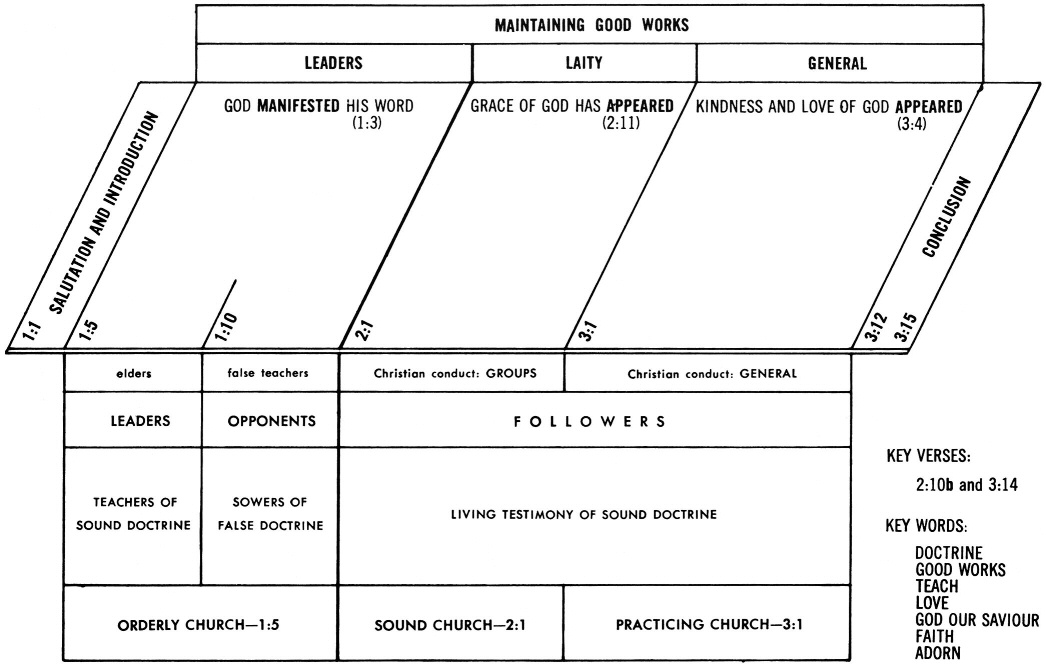
ADORNING THE DOCTRINE OF GOD
Click chart to enlarge
Charts from Jensen's Survey of the NT - used by permission
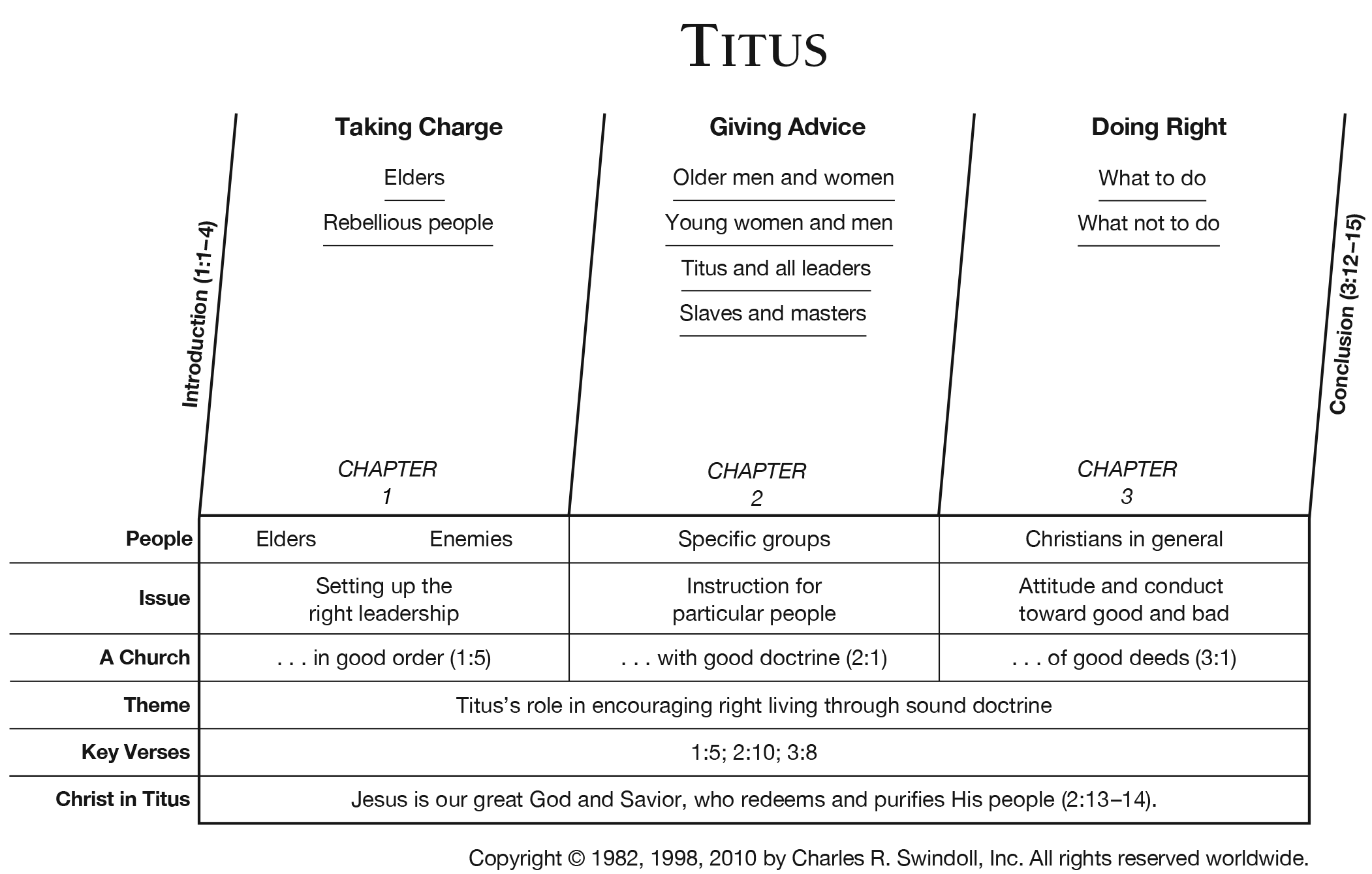
See Summary Chart by Charles Swindoll
Chart below from Michael J. Penfold
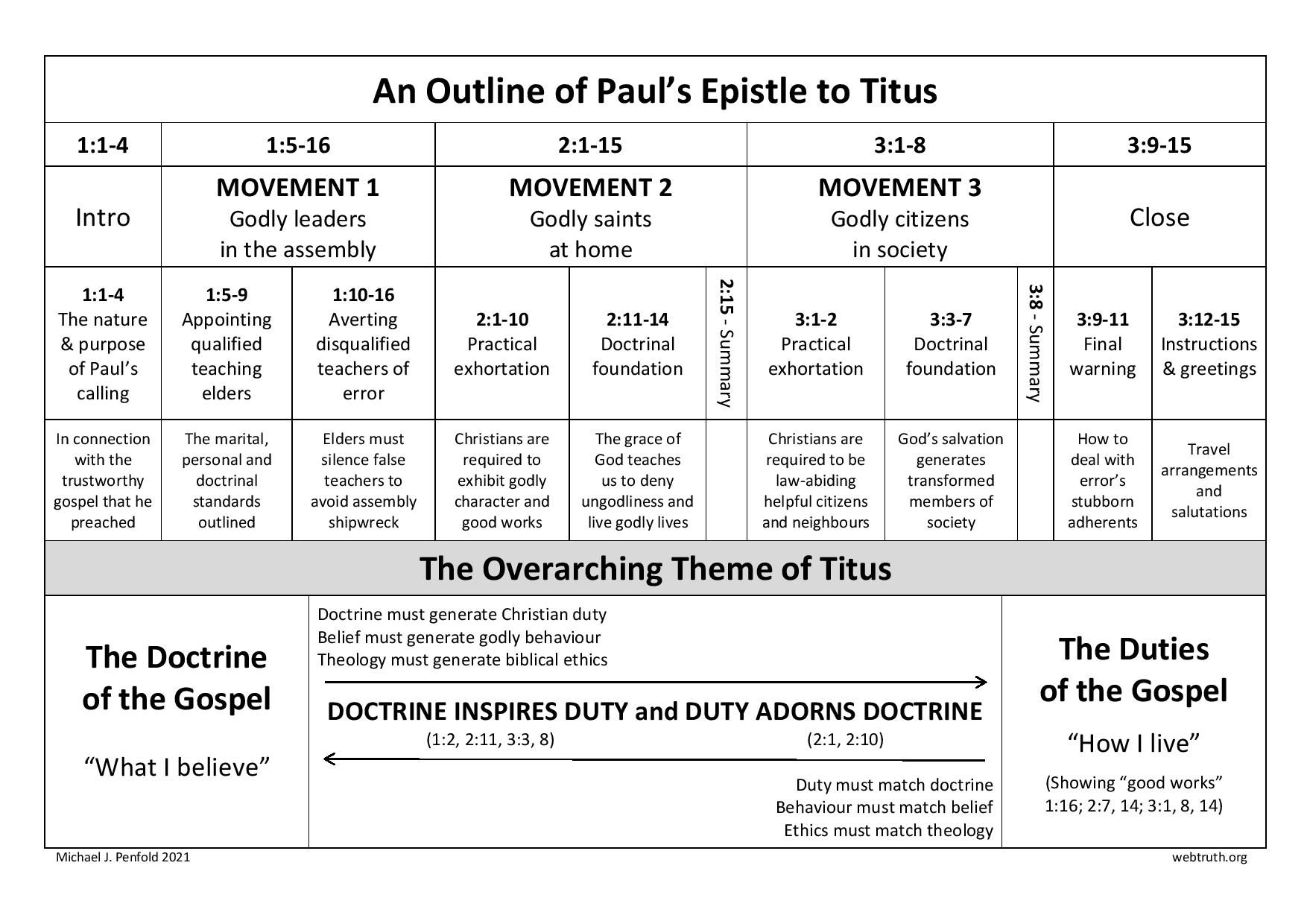
|
Focus |
Appoint Elders |
|||
|
Divisions |
Rebuke |
Maintain |
||
|
Topics |
||||
|
Topics |
Organization |
Offenders |
Operation |
|
|
Place |
Probably Written from either Corinth or Nicopolis (cf. Titus 3:12). |
|||
|
Time |
Circa 63 AD |
|||
|
Modified from Talk Thru the Bible |
||||
Titus 2:14 Who gave Himself for us to redeem us from every lawless deed, and to purify for Himself a people for His own possession, zealous for good deeds. (NASB: Lockman)
Greek: os edoken (3SAAI) heauton huper hemon hina lutrosetaii (3SAMS) hemas apo pases anomias kai katharise (3SAAS) heauto laon periousion, zeloten kalon ergon.
Amplified: Who gave Himself on our behalf that He might redeem us (purchase our freedom) from all iniquity and purify for Himself a people [to be peculiarly His own, people who are] eager and enthusiastic about [living a life that is good and filled with] beneficial deeds (Amplified Bible - Lockman)
Barclay: Who gave Himself for us to redeem us from the power of all lawlessness, and to purify us as a special people for Himself, a people eager for all fine works. (Westminster Press)
KJV: Who gave himself for us, that he might redeem us from all iniquity, and purify unto himself a peculiar people, zealous of good works.
Phillips: For he gave himself for us all, that he might rescue us from all our evil ways and make for himself a people of his own, clean and pure, with our hearts set upon living a life that is good. (Phillips: Touchstone)
Wuest: Who gave Himself on our behalf in order that He might set us free from every lawlessness and purify for Himself a people of His own private possession, zealous of good works. (Eerdmans)
Young's Literal: who did give himself for us, that he might ransom us from all lawlessness, and might purify to himself a peculiar people, zealous of good works;
WHO GAVE HIMSELF FOR US: hos edôken (3SAAI) heauton huper hêmôn:
- Mt 20:28; Jn 6:51; 10:15; Gal 1:4; 2:20; 3:13; Eph 5:2,23, 24, 25, 26, 27;1Ti 1:15;2:6; Heb 9:14; 1Pe 3:18; Rev 1:5, 5:9
- Titus 2 Resources - Multiple Sermons and Commentaries
- Titus 2:11-14 How Grace Works - Steven Cole
- Titus 2:11-14 Saving Grace, Pt. 3 - John MacArthur
- Titus 2:11-14 Saving Grace, Pt. 4 - John MacArthur
Paul now reverts back from the prophetic future (looking for the blessed hope - the future Second Coming of Christ) to the historical work of Christ which laid the foundation for His present work of sanctification in believers.
Expositor's Greek Testament notes that "This is an appeal from the constraining love of Christ to the responding love of man."
Who gave Himself - Speaking of His vicarious suffering and death. The act of giving Himself indicates Christ’s willing, gracious gift of Himself. Christ by His own choice gave humanity the priceless gift of His perfect, sinless life. The idea of "gave" is that this was a gift and as such could not be earned or merited or deserved!
Hiebert writes that "Who gave himself for us" summarizes that work as voluntary, exhaustive, and substitutionary. His giving of himself was the grandest of all gifts. (Gaebelein, F, Editor: Expositor's Bible Commentary 6-Volume New Testament)
In First Timothy we read "(Christ Jesus) Who gave Himself as a ransom for all, the testimony borne at the proper time. (1 Timothy 2:6)
For us - Paul includes himself here and thus is speaking of believers, including Titus to whom he is writing.
For (5228) (huper) is a preposition which serves in some contexts (as in this verse) as a marker indicating that an activity or event is in some entity’s interest or in behalf of or for the sake of someone else. As BDAG puts it huper is a marker indicating that an activity or event is in some entity’s interest (for, in behalf of, for the sake of someone/something).
Thus in this verse huper depicts the substitutionary atonement…
- Christ “for the sake of" ______ (fill in your name).
- Christ "in behalf of"_________ (fill in your name).
- Christ "instead of”_________ (fill in your name).
Compare other uses of huper in the sense of "in our place" or "for our sake"…
- Ro 5:6-note For while we were still helpless, at the right time Christ died for (huper) the ungodly.
- Ro 5:8-note But God demonstrates His own love toward us, in that while we were yet sinners, Christ died for (huper) us.
- 1Pe 3:18-note For Christ also died for sins once for (huper) all, the just for the unjust, in order that He might bring us to God, having been put to death in the flesh, but made alive in the spirit
See a foreshadowing of this reality of Christ's substitutionary atonement (Christ's death in our place on the Cross - see 1Jn 2:2 for the synonymous term "Propitiation") in the great epistle of Hebrews where we read as allusion to the Old Testament description the Day of Atonement (cp Lv 16:2, 12, 13) noting that…
into the second (the Holy of holies) only the high priest enters, once a year, not without taking blood, which he offers for (huper) himself and for the sins of the people committed in ignorance. (He 9:7-note)
Comment: In this passage describing the Levitical high priest's once/year entrance into the holy of holies for the sake of the people of Israel, we see a beautiful foreshadowing of our Great High Priest entering once for all time through the "rent veil" into the real Holy of holies (compare Mt 27:51, Mk 15:38, Lk 23:45 with He 10:19, 20-note), the very presence of God into His throne room in heaven.
For Christ did not enter a holy place made with hands, a mere copy of the true one, but into heaven itself, now to appear in the presence of God for (huper) us (He 9:24 -note)
This hope we have as an anchor of the soul, a hope both sure and steadfast and one which enters within the veil, 20 where Jesus has entered as a forerunner for (huper) us, having become a high priest forever according to the order of Melchizedek. (He 6:19, 20-note)
Hence, also, He (Christ) is able to save forever those who draw near to God through Him (the Great High Priest), since He always lives to make intercession for (huper) them. (He 7:25-note)
Philip Bliss' great hymn teaches this priceless doctrine of substitutionary atonement/propitiation…
Man of Sorrows! what a name
For the Son of God, who came
Ruined sinners to reclaim.
Hallelujah! What a Savior!Bearing shame and scoffing rude,
In my place condemned He stood;
Sealed my pardon with His blood.
Hallelujah! What a Savior!Guilty, vile, and helpless we;
Spotless Lamb of God was He;
“Full atonement!” can it be?
Hallelujah! What a Savior!Lifted up was He to die;
“It is finished!” was His cry;
Now in Heav’n exalted high.
Hallelujah! What a Savior!When He comes, our glorious King,
All His ransomed home to bring,
Then anew His song we’ll sing:
Hallelujah! What a Savior!
—Philip P. Bliss (play hymn)
Paul’s doctrine of substitution is reiterated in the famous passage where Paul declares…
I have been crucified with Christ; and it is no longer l who live, but Christ lives in me and [the life] which I now live in the flesh I live by faith in the Son of God, who loved me and gave Himself up for (huper) me. (Gal 2:20-note)
Huper is used in John 11:49-50, Caiaphas, the high priest, speaking prophetically declared…
You know nothing at all, nor do you take into account that it is expedient for you that one man should die for (huper = in the place of) the people, and that the whole nation should not perish.
In Galatians Paul used huper with a similar meaning writing "Christ redeemed us from the curse of the Law, having become a curse for (huper = "instead of") us-- for it is written, "CURSED IS EVERYONE WHO HANGS ON A TREE" (Galatians 3:13)
Steven Cole writes that grace trains us to "LOOK BACK TO THE SUPREME DEMONSTRATION OF HIS LOVE, WHICH REDEEMED US FROM SIN AND MADE US HIS OWN POSSESSION (Titus 2:14A). “Who” refers back to “our great God and Savior, Christ Jesus.” (Titus 2:13) None other than He “gave Himself for us”! If that thought doesn’t grip your heart, you’re in deep spiritual trouble. Paul shows that this past grace that was shown to us produces godliness in us. First, Christ “gave Himself for us, that He might redeem us from every lawless deed” (2:14a). The word redeem would have gotten the attention of any slaves. It was the word used of buying a slave out of the market so as to give him his freedom. Before we met Christ, we all were slaves of sin. He paid the redemption price in His own blood to free us from bondage to sin. How, then, can a believer go back into slavery to sin? Second, Christ gave Himself for us that He might “purify for Himself a people for His own possession.” Verse 12 focused on our need to purify ourselves, but Titus 2:14 focuses on Christ’s purifying us through His blood. He bought us from the slave market of sin and washed off our filth. Now we belong to Him as His personal possession. He prizes us more than anyone prizes a valuable treasure, because He paid for us with His blood. Again, what a motivation to live to please Him! One reason that we partake often of the Lord’s Supper is that it reminds us of these precious truths. Before we partake, we are to examine ourselves and confess any known sins. As we think on the great sacrifice that our God and Savior made by giving Himself for us, it will draw our hearts toward Him in love and devotion. It will make us long for the day of His appearing in glory, when we will be caught up to be with Him forever. Thus God’s grace in Christ brings salvation to us. Then it trains us to live in godliness. (How Grace Works Titus 2:11-14)
THAT HE MIGHT REDEEM US FROM EVERY LAWLESS DEED: hina lutrosetai (3SAMS) hemas pases anomias:
- Ge 48:16; Ps 130:8; Ezek 36:25; Mt 1:21; Ro 11:26, 27 Lk 24:21; 1Pet 1:18
- Titus 2 Resources - Multiple Sermons and Commentaries
- Titus 2:11-14 How Grace Works - Steven Cole
- Titus 2:11-14 Saving Grace, Pt. 3 - John MacArthur
- Titus 2:11-14 Saving Grace, Pt. 4 - John MacArthur
That (hina) expresses purpose and here clearly explains the purpose for which sinners have been redeemed as saints. See discussion of importance of pausing to ponder terms of purpose or result.
Redeem (3084) (lutroo from lutron/lytron = ransom in turn from luo = loose, release, unbind) in simplest terms means to release someone held captive (prisoner, slave) on receipt of a ransom payment (the "ransom" being the technical term for money paid to buy back a prisoner of war) with the implied analogy of freeing a slave set free (liberate, liberation, deliverance).
The Roman Empire had by some estimates as many 6 million slaves and the buying and selling of slaves was a major business. If a person wanted to free a loved one or friend who was a slave, they would buy (pay the redemption price = lutroo) the slave for themselves and then grant the slave his or her freedom, testifying to the slave's new state of liberation or deliverance with a written certificate.
Enslavement to sin is bondage, whereas enslavement to God is freedom (see discussion of eleutheroo = to set free from domination). True freedom means having the ability to yield your will to His good and perfect will and thereby become all He created you to be, set free from sin and free to live an abundant, "victorious" life pleasing to God empowered by His Spirit.
Lutroo is in middle voice which indicates that the person who carries out the action (of redemption) has a special interest in what the overall transaction. This is certainly the case in the redemption accomplished by Christ as Paul explains in the remainder of this verse.
The three uses of lutroo are all translated “redeem” and tell the story of the Cross.
In Lk 24:21 lutroo means to set Israel free from the yoke of Roman rule and oppression…
But we were hoping that it was He who was going to redeem Israel. Indeed, besides all this, it is the third day since these things happened.
In Titus 2:14 we are set men free from the yoke of self-will (specifically "every lawless deed"),
who gave Himself for us, that He might redeem (lutroo) us from every lawless deed and purify for Himself a people for His own possession, zealous for good deeds.
In 1Pe 1:18 (note) we are set free from a vain manner of life, i.e., from bondage to tradition.
knowing that you were not redeemed (lutroo) with perishable things like silver or gold from your futile way of life inherited from your forefathers,
Spurgeon - That word “redemption” sounds in my ears like a silver bell. We are ransomed, purchased back from slavery, and this at an immeasurable price; not merely by the obedience of Christ, nor the suffering of Christ, nor even the death of Christ, but by Christ’s giving Himself for us. All that there is in the great God and Savior was paid down that he might “redeem us from all iniquity.” The splendor of the Gospel lies in the redeeming sacrifice of the Son of God, and we shall never fail to put this to the front in our preaching. It is the gem of all the Gospel gems. As the moon is among the stars, so is this great doctrine among all the lesser lights which God hath kindled to make glad the night of fallen man. Paul never hesitates; he has a divine Savior and a divine redemption, and he preaches these with unwavering confidence. Oh that all preachers were like him!
From (575) (apo) indicates effective removal from (or separation from). In context it depicts our deliverance from the domination of Sin and our fallen flesh. While we have been set free and are no longer captives of these harsh task masters, unfortunately they still exist in our mortal bodies and can tempt us and we can fall under their spell if we fail to rely on the supernatural power of the Spirit (cf Gal 5:16-note, Gal 5:17-note).
Lawless (458) (anomia from a = neg. + nomos = etymologically something parceled out, allotted, what one has in use and possession; hence, usage, custom, rule, law) describes violation/transgression of law, wickedness; iniquity.
Anomia - 15x in NT - Matt. 7:23; 13:41; 23:28; 24:12; Rom. 4:7; 6:19; 2 Co. 6:14; 2 Thess. 2:3, 7; Tit. 2:14; Heb. 1:9; 10:17; 1 Jn. 3:4
Lawlessness is the essence of sin and represents self-assertion as opposed to the self-sacrifice of unconditional love.
Hiebert writes that "lawlessness (is) that assertion of self-will in defiance of God's standard that is the essence of sin. The expression ("redeem us from every lawless deed") stresses not our guilt as rebels but rather our deliverance from bondage to lawlessness through Christ's ransom. (Ibid)
Newport J D White - To what degree soever we allow the love of Christ to operate as a controlling principle in our lives, to that degree we are delivered from anomia (lawlessness) as an opposing controlling principle. (Expositor's Greek)
- Lawlessness is living as though your own ideas are superior to God's.
- Lawlessness says, "God may demand it but I don't prefer it."
- Lawlessness says, "God may promise it but I don't want it."
- Lawlessness replaces God's law with my contrary desires. I become a law to myself.
- Lawlessness is rebellion against the right of God to make laws and govern His creatures.
John gives a direct definition of anomia writing…
Everyone who practices (present tense) sin also practices (present tense) lawlessness; and sin is (present tense) lawlessness. (1John 3:4-note) (See note regarding the importance of the present tense in this passage.)
So as John teaches, lawlessness equates with sin. Salvation delivers the redeemed permanently from enslavement to the power of Sin. The unregenerate person is in total bondage to the ruling power of Sin, the principle of which indwells them.
Notice also that believer were not set free from some of the lawless deeds but from all. Thus there is nothing incomplete about Christ's redemption. When He paid the redemption price, He paid it in full and declared "It is finished!" (John 19:30-note) See also - TETELESTAI-PAID IN FULL
Paul (though his emissary Titus) is exhorting the believers in Crete now to live like men who have been redeemed and set free to obey a new Master.
F B Meyer comments that in this passage "we are, therefore, taught that the death of Jesus was intended, not for our forgiveness and justification merely, but for our sanctification, and our deliverance from the power of all our besetting sins.
REDEMPTION ILLUSTRATED - A missionary in West Africa was trying to convey the meaning of the word redeem in the Bambara language. So he asked his African assistant to express it in his native tongue.
"We say," the assistant replied, "that God took our heads out."
"But how does that explain redemption?" the perplexed missionary asked.
The man told him that many years ago some of his ancestors had been captured by slave-traders, chained together, and driven to the seacoast. Each of the prisoners had a heavy iron collar around his neck. As the slaves passed through a village, a chief might notice a friend of his among the captives and offer to pay the slave-traders in gold, ivory, silver, or brass. The prisoner would be redeemed by the payment. His head then would be taken out of his iron collar. What an unusual and graphic illustration of the word redeem! Let Him take your head out of the enslaving collar of sin and set you free. Christ was lifted up on the cross that we might be lifted out of our sin.
Redeemed-how I love to proclaim it!
Redeemed by the blood of the Lamb;
Redeemed through His infinite mercy-
His child, and forever I am.
(Play Redeemed How I Love to Proclaim It! by Fanny Crosby!)
AND PURIFY FOR HIMSELF: kai katharise (3SAAS) heauto:
- Mal 3:3; Mt 3:12; Ac 15:9; He 9:14;Jas 4:8; 1Pe 1:22; 1Jn 3:2, 3:3
- Ezek 37:23
- Titus 2 Resources - Multiple Sermons and Commentaries
- Titus 2:11-14 How Grace Works - Steven Cole
- Titus 2:11-14 Saving Grace, Pt. 3 - John MacArthur
- Titus 2:11-14 Saving Grace, Pt. 4 - John MacArthur
Purify for Himself - In his elaboration on the New Covenant, the prophet Ezekiel records God's promise to the believing remnant of Israel that…
they will no longer defile themselves with their idols, or with their detestable things, or with any of their transgressions; but I will deliver them from all their dwelling places in which they have sinned, and will cleanse them. And they will be My people, and I will be their God. (Ezekiel 37:23)
Hiebert - This negative work (redeem us from every lawless deed) is the necessary prelude to the positive work of sanctification, "to purify for himself a people that are his very own." Purify points to the moral defilement that man's rebellion produced. Sin makes us not only guilty but also unclean before a holy God. The blood-wrought cleansing (1Jn 1:7) enables men to be restored to fellowship with God as "a people that are his very own." (Ibid)
Purify (2511) (katharizo from katharos = pure, cleansed, without stain or spot; English words - catharsis = emotional or physical purging, cathartic = substance used to induce a purging, Cathar = member of a medieval sect which sought the purging of evil from its members) means to cause something to become clean from contamination or impurity or to make clean by taking away an undesirable part. To cleanse from filth or impurity. Katharizo means to cause to become clean as from physical stains and dirt (Mt 23:25).
Paul's use of the aorist tense for katharizo conveys the truth that Jesus' purification of sinners was a once for all, effective, completed action, which equates with "past tense" salvation or the justification which occurs once for all time when a sinner receives the free gift of salvation by grace through faith. This truth can still be applied to present tense salvation, for the fact that we are forever positionally pure and clean in God's sight should motivate us to seek to live pure and clean lives (enabled by the "pure" Spirit) in our daily practice. As Hiebert says since we "have been redeemed by His blood (see 1Pe 1:18, 19, 20-notes), Christ yearns that (we) voluntarily yield (ourselves) wholly to Him. Such a surrender is man's only reasonable response to divine mercy (Ro 12:1-note; Ro 12:2-note)."
This word group (katharizo, katharos) conveys the idea of physical, religious, and moral cleanness or purity in such senses as clean, free from stains or shame, and free from adulteration. In secular Greek katharizo occurs in inscriptions for ceremonial cleansing. Click (or here) for more background on the Biblical concept of clean and cleansing. See also study of Hebrew word tahor = clean, pure.
Katharizo - 31x in the NT - Mt 8:2, 3; 10:8; 11:5; 23:25, 26; Mk. 1:40, 42, 42; 7:19; Lk. 4:27; 5:12, 13; 7:22; 11:39; 17:14, 17; Acts 10:15; 11:9; 15:9; 2Co 7:1; Eph. 5:26; Tit. 2:14; Heb. 9:14, 22, 23; 10:2; Jas. 4:8; 1Jn. 1:7, 9
Figuratively katharizo referred to cleansing from ritual contamination or impurity as in (Acts 10:15). In a similar sense katharizo is used of cleansing lepers from ceremonial uncleanness (Mt 8:2, 3, et al; in the Septuagint of Lev 13:6)
Another figurative use of katharizo is found in 1John 1:9-note (cf James 4:8-James 4:8, Heb 10:2) where John describes the purifying or cleansing from sin and a guilty conscience which makes one acceptable to God and reestablishes fellowship.
In the present context the cleansing is not just an external cleansing like that of the hypocritical Pharisees who cleansed (katharizo) only
the outside of the cup and of the dish, but inside" they remained "full of robbery and self-indulgence. (Mt 23:25)
The quality of purification that Jesus produces is prefigured by His miraculous healing of the leprous man, Matthew recording that Jesus
stretched out His hand and touched him, saying, "I am willing; be cleansed (katharos)." And immediately his leprosy was cleansed (katharizo). (Mt 8:3)
Only God can cleanse a leper and only the God Man, Jesus can purify sinners on the "inside" of "robbery and self-indulgence".
Paul speaking of Jesus and His church writes that He has "cleansed (katharizo) her (His bride the Church) by the washing of water with the word (Eph 5:26-note).
The Greek Septuagint uses katharizo when it translates David's prayer --
Wash me thoroughly from my iniquity. Cleanse (Lxx = katharizo) me from my sin. (Ps 51:2).
John uses katharizo twice in first chapter of his first epistle, teaching that
if we walk in the light as He Himself is in the light, we have fellowship with one another, and the blood of Jesus His Son cleanses (katharizo) us from all sin." and that "If we confess our sins, He is faithful and righteous to forgive us our sins and to cleanse (katharizo) us from all unrighteousness. (1Jn 1:7-note, 1Jn 1:9)
In both of these uses in First John, the purification that is wrought in believers by Jesus refers to "present tense" salvation or sanctification which is a process that began with our our initial purification (justification) and which will continue until our "future tense" salvation or glorification is realized.
Until that glorious occasion Paul writes 'having these promises (What promises? See context = 2Cor 6:14-18), beloved, let us cleanse (katharizo) ourselves from all defilement of flesh and spirit, perfecting holiness in the fear of God. (2Cor 7:1- note)
In so doing we will indeed be a "peculiar people", each "a vessel for honor, sanctified, useful to the Master, prepared for every good work (deed). (2Ti 2:21-note)
A PEOPLE FOR HIS OWN POSSESSION: laon periousion:
- Ex 15:16; 19:5,6; Dt 7:6; 14:2; 26:18; Ps 35:4; 1Peter 2:9
- Titus 2 Resources - Multiple Sermons and Commentaries
- Titus 2:11-14 How Grace Works - Steven Cole
- Titus 2:11-14 Saving Grace, Pt. 3 - John MacArthur
- Titus 2:11-14 Saving Grace, Pt. 4 - John MacArthur
SAINTS:
POSSESSIONS OF JESUS
This verse is most literally rendered "a peculiar people". Below are other translations for comparison…
- people to be peculiarly His own - Amplified
- His own special possession - Analyzed Literal Translation
- so that we can be His special people GWT
- unto himself a peculiar people - KJV
- a people who are truly His - NET
- a people that are his very own - NIV
- His own special people - NKJV
- a people of his own - Phillips paraphrase
- a people as his own treasure - Rotherham
- people who belong to Him alone - TEV
- a people who should be specially His own - Weymouth
- a people of His own private possession, - Wuest
Spurgeon comments that "The translation “peculiar people” is unfortunate, because “peculiar” has come to mean odd, strange, singular. The passage really means that believers are Christ’s own people, His choice and select portion. Saints are Christ’s crown jewels, His box of diamonds; His very, very, very own. He carries His people as lambs in His bosom; He engraves their names on His heart. They are the inheritance to which He is the heir, and He values them more than all the universe beside. He would lose everything else sooner than lose one of them. He desires that you, who are being disciplined by his grace, should know that you are altogether His. You are Christ’s men. You are each one to feel, “I do not belong to the world; I do not belong to myself; I belong only to Christ. I am set aside by Him for Himself only, and His I will be.” The silver and the gold are His, and the cattle upon a thousand hills are His; but He makes small account of them, “the Lord’s portion is His people.” (From Spurgeon's sermon The Two Appearings and the Discipline of Grace)
I like what Bryan Chapell writes about this passage…
The work of salvation is His, and we are His. These statements are our great protection against legalism and our great propulsion toward godliness. Because Christ’s work alone purchases our salvation through the redeeming price of His blood, and Christ’s work alone purifies us through the cleansing that blood supplies, we do not look to our works as the basis of acceptance. Doing what God requires does not make us His own, but having been made His own by no work of ours, we now love to love Him who first loved us (cf. 1John 4:19-note).
"LOVE HIM WITH
ALL HIS HEART"
My daughter sometimes says to her mother,
“Mommy, I love you with all your heart.”
I realize why a three-year-old says such things. She tries to show her love by mistakenly echoing her mother’s frequent endearment,
“Katie, I love you with all my heart.”
But it is no mistake that here in Titus, God teaches us to love Him with all His heart. He pours before us the signs of the love, so that we will love and respond to Him at as high and close a level of affection as the human heart can sustain.
What does being a loved people do to us? It makes us more sensitive to sin. I want you to note clearly the apostle’s order. God’s people are first ransomed by His work, then purified to be His own, then they are “eager” (zealous) to do good (Titus: 2:14).
In some ways this message turns upside down our more common approach to how the Christian life operates. We tend to think that we cannot see the love of God until we see our sin, but Paul here makes it clear that it is seeing the love of God that enables us to see our sin.
Apprehension of the mercy of God in Christ makes us so long to love Him and reject what hurts Him that we become intolerant of the sin in our lives. I understand this as I look at my own marriage. The longer I am married, the more I marvel at my wife’s love for me despite my early coldness and continuing selfishness. But the more I see how much she loves me the more conscious I become of my insensitivities and the more eager I am to please her. The more I perceive her love, the more I cannot stand my sin against her. In the same way, when we see how wondrous is the love of Christ, then we become more and more sensitive to the sin in our lives and we long more and more to do what pleases Him.
THE POWER OF
NEW AFFECTIONS
This dynamic of having the love of God create an intolerance for sin is what the Puritans called the power of new affections. What will ultimately make us holy is not willpower, not guilt, not an inspiring message, but apprehension of the mercy of God in Christ that actually causes love for God to drive out and replace love for sin. The Puritans taught this truth with the image of the live oak, a variety of tree whose leaves—though dead—stuck to its branches through the winter. What eventually forced the leaves from the tree was not the abuse of the cold or the beating of the wind, but the new life springing up within the tree and replacing that which was dead. So when we are God’s people, there yet cling to us affections for evil that we must confess, but these are truly shed only as the love of Christ builds within us and ultimately drives out the old affections with the new life that is love for Him. (Bryan Chapell, “‘Intolerant’ Grace: Titus 2:11-15,” Reformation & Revival 7.3 (Summer 1998): 67-93.) (Theological Journal Subscription info) (Bolding added) (Greek tenses and coloring added for amplification)
Possession (4041) (periousios from perí = beyond + eimi = to be, exist) means of one's own possession, one's own and here qualifies people.
Periousios describes the property one owned as a rich and distinctive possession, a possession which is of very special status.
Titus 2:14 is the only NT use of periousios where Paul figuratively describes God's redeemed people as Christ's costly possession and His distinctive treasure. Believers are those that belong in a special sense to Christ. What an incredible word picture of blood bought, heaven bound sinners who are now the Savior's saints!
Periousios is used four times in the Septuagint for Israel, the chosen people, the peculiar people of Jehovah (see references in Vincent's note below).
Marvin Vincent has a lengthy note on periousion writing that it is used…
A few times in LXX (Septuagint), always with laos (Greek = people). For example:
Exodus 19:5 "Now then, if you will indeed obey My voice and keep My covenant, then you shall be My own possession [periousion] among all the peoples, for all the earth is Mine" (NAS)
Deut 7:6 "For you are a holy people to the LORD your God; the LORD your God has chosen you to be a people for His own possession [periousion] out of all the peoples who are on the face of the earth." (NAS)
Deut 14:2 "For thou art an holy people unto the LORD thy God, and the LORD hath chosen thee to be a peculiar [periousion] people unto himself, above all the nations that are upon the earth. (King James Version)
Deut 26:18 "And the LORD has today declared you to be His people, a treasured possession [periousion, as He promised you, and that you should keep all His commandments (note privilege always conveys responsibility!)" (NAS)
The phrase was originally applied to the people of Israel, but is transferred here to believers in the Messiah — Jews and Gentiles. Comp. 1Pe 2:10 (Click for discussion of "for you once were NOT A PEOPLE, but now you are THE PEOPLE OF GOD").
Periousios is from a participle meaning to be over and above: hence periousía = abundance, plenty. Periousios also means possessed over and above, that is, specially selected for one’s own; exempt from ordinary laws of distribution. Hence correctly represented by peculiar, derived from peculium, a private purse, a special acquisition of a member of a family distinct from the property administered for the good of the whole family. Accordingly the sense is given in Ep 1:14, (see note) where believers are said to have been sealed with a view to redemption of possession ("with a view to the redemption of God's own possession"), or redemption which will give possession, thus = acquisition. So 1Pe 2:9 (Click note ) where Christians are styled a people for acquisition, to be acquired by God as His peculiar possession.". (Vincent, M. R. Word Studies in the New Testament: Vol. 4, Page 346) (Bolding added)
Kenneth Wuest puts it plainly = Christians are the private possession of God. (Wuest's Word Studies from the Greek New Testament: Eerdmans) Do my thoughts, words and deeds over the last 24 hours support Wuest's description of "Who I am" and "Whose I am"?
This has always been God's desire from the beginning that His chosen people be a Holy People, His very own peculiar and special possession. Paul is saying that we as believers are no longer our own but are now Christ's special, treasured possession. Paul could not be much clearer.
Jesus warned of the practical implications of not heeding this truth (Mt 6:24-note). If you are loving the world then you cannot be loving Jesus, the Master Who bought you. (Jas 4:4-note, 1Jn 2:15-note, 1Jn 2:16-note, 1Jn 2:17-note)
As noted above, the 1611 KJV quaintly describes saints as a peculiar people. Unfortunately, too often we are a "peculiar people", but not in the way God intended! He didn’t die to make us odd or strange people, but a people who belong to Him in a special way, not to the world nor to ourselves.
Just as we formerly were possessed and enslaved by sin, now we are to be possessed by and enslaved to Jesus Christ.
Barnes observes that periousios "means, properly, having abundance; and then one’s own, what is special, or peculiar (Robinson, Lexicon), and here means that they were to be regarded as belonging to the Lord Jesus. It does not mean, as the word would seem to imply - and as is undoubtedly true - that they are to be a unique people in the sense that they are to be unlike others, or to have views and principles unique to themselves; but that they belong to the Saviour in contradistinction from belonging to themselves - “peculiar” or his own in the sense that a man’s property is his own, and does not belong to others. This passage, therefore, should not be used to prove that Christians should be unlike others in their manner of living, but that they belong to Christ as his redeemed people. From that it may indeed be inferred that they should be unlike others, but that is not the direct teaching of the passage. (Albert Barnes' Notes on the Bible) (Bolding added)
Adam Clarke writes that periousios "signifies such a peculiar property as a man has in what he has purchased with his own money. Jesus gave His life for the world, and thus has purchased men unto Himself; and, having purchased the slaves from their thraldom (enslavement), He is represented as stripping them of their sordid vestments, cleansing and purifying them unto Himself that they may become His own servants, and bringing them out of their dishonorable and oppressive servitude, in which they had no proper motive to diligence and could have no affection for the despot under whose authority they were employed. Thus redeemed, they now become His willing servants, and are zealous of good works - affectionately attached to that noble employment which is assigned to them by that Master Whom it is an inexpressible honor to serve. (Adam Clarke's Commentary on the Bible)
ZEALOUS FOR GOOD DEEDS: zeloten kalon ergon:
- Titus 2:7-note; Titus 3:8-note; Acts 9:36; Eph 2:10-note; 1Ti 2:10; 6:18; Heb 10:24-note; 1Pe 2:12-note
- Titus 2 Resources - Multiple Sermons and Commentaries
- Titus 2:11-14 How Grace Works - Steven Cole
- Titus 2:11-14 Saving Grace, Pt. 3 - John MacArthur
- Titus 2:11-14 Saving Grace, Pt. 4 - John MacArthur
CREED BREEDS CONDUCT
God Himself is described as zealous ("jealous") (see more examples under discussion of zelotes)…
Joshua 24:19 Then Joshua said to the people, "You will not be able to serve the LORD, for He is a holy God. He is a jealous (zealous; Lxx = zeloo = burns with zeal) God; He will not forgive your transgression or your sins.
Phinehas was zealous for the Lord's honor and integrity (for context read Numbers 25)…
Numbers 25:11 "Phinehas the son of Eleazar, the son of Aaron the priest, has turned away My wrath from the sons of Israel, in that he was jealous (zealous) with My jealousy (zeal) among them, so that I did not destroy the sons of Israel in My jealousy. 12 "Therefore say, 'Behold, I give him My covenant of peace;
(Notice the legacy that accrued from the zealous good deed of Phinehas!) Psalm 106:30 Then Phinehas stood up and interposed; and so the plague was stayed. 31 And it was reckoned to him for righteousness, To all generations forever.
Note who was blessed to be in the lineage of Phinehas
Ezra 7:1 Now after these things, in the reign of Artaxerxes king of Persia, there went up Ezra son of Seraiah, son of Azariah, son of Hilkiah,
2 son of Shallum, son of Zadok, son of Ahitub,
3 son of Amariah, son of Azariah, son of Meraioth,
4 son of Zerahiah, son of Uzzi, son of Bukki,
5 son of Abishua, son of Phinehas, son of Eleazar, son of Aaron the chief priest. (see discussion of Ezra 7:10 )
Amy Carmichael poetically pictured zealous for good deeds in her famous poem…
Give me the love that leads the way,
The faith that nothing can dismay,
The hope no disappointments tire,
The passion that will burn like fire.
Let me not sink to be a clod;
Make me thy fuel, Flame of God.
The Christian martyr Jim Elliot expressed a similar zealousness for good deeds when he asked..
Am I ignitable? God deliver me from the dread asbestos of 'other things'. Saturate me with the oil of the Spirit that I may be a flame.
Hiebert writes that "For those who have been redeemed from the doom of sin and death and brought into a unique relationship with God, the true voluntary response is to be enthusiastic "to do what is good." It is the true badge of His divine ownership. He who eagerly awaits the return of the Savior will be eager also to further His cause by good works until He comes. It is another instance of the union between creed and conduct insisted upon in the pastoral Epistles. (Ibid)
Zealous - Totally committed. Sold out. Abandoned. Dedicated. "Possessed". "On fire". Burning. Ablaze, Afire. Impassioned. Fanatical. Ardent. Fervent. Fervently devoted. Passionate. Passionate ardor in pursuit of something. Single heart. Single minded allegiance. Enthusiastically devoted. Eager desire to accomplish some goal or end.
THOUGHT - Dear reader, would our Father label you as one who is on fire for good (God) deeds?
Samuel Chadwick was right when he said that "Men ablaze are invincible. Hell trembles when men kindle."
THOUGHT - And of course they are set on fire by the Spirit, Who even came at the beginning like tongues of fire on the disciples in Acts 2+. He is the same Spirit Church! Nothing has changed. We need Him to set the Church ablaze for the glory of God.).
Spurgeon comments…
The apostle finishes up by saying that we are to be a people “zealous of good works.” Would to God that all Christian men and women were disciplined by divine grace till they became zealous for good works! In holiness zeal is sobriety. We are not only to approve of good works, and speak for good works, but we are to be red-hot for them. We are to be on fire for everything that is right and true. We may not be content to be quiet and inoffensive, but we are to be zealous of good works.
Oh that my Lord’s grace would set us on fire in this way!
There is plenty of fuel in the church, what is wanted is fire.
A great many very respectable people are, in their sleepy way, doing as little as they can for any good cause. This will never do.
We must wake up.
Oh the quantity of ambulance work that Christ’s soldiers have to do! One half of Christ’s army has to carry the other half. Oh that our brethren could get off the sick-list!
Oh that all of us were ardent, fervent, vigorous, zealous!
Come, Holy Spirit, and quicken us!
We may not go about to get this by our own efforts and energies, but God will work it by His grace. Grace given us in Christ is the fountain head of all holy impulse.
O heavenly grace, come like a flood at this time
and bear us right away!
Oh that those of you who have never felt the grace of God may be enabled to believe in the Lord Jesus Christ as to His first appearing! Then, trusting in His death upon the cross, you will learn to look for His second coming upon the throne, and you will rejoice therein. Unto His great name be glory for ever and ever! Amen. (From Spurgeon's sermon The Two Appearings and the Discipline of Grace)
Zealous (2207) (zelotes from zeo = to boil, be hot or glow) describes one zealous (fervent and enthusiastically devoted) for or eagerly desirous of something. A zelotes is one who is earnestly committed to a side or cause and thus could be described as an enthusiast, an adherent, or a loyalist.
Zealous (English) - marked by active interest and enthusiasm; filled with or inspired by intense enthusiasm or zeal; ardent; fervent; marked by fervent partisanship for a person, a cause, or an ideal; full of great energy, effort, and enthusiasm, especially in your political or religious ideas.
Zelotes - 8 times in the NT -
Luke 6:15 and Matthew and Thomas; James the son of Alphaeus, and Simon who was called the Zealot;
Acts 1:13 When they had entered the city, they went up to the upper room where they were staying; that is, Peter and John and James and Andrew, Philip and Thomas, Bartholomew and Matthew, James the son of Alphaeus, and Simon the Zealot, and Judas the son of James.
Acts 21:20 And when they heard it they began glorifying God; and they said to him, "You see, brother, how many thousands there are among the Jews of those who have believed, and they are all zealous for the Law;
Acts 22:3 "I am a Jew, born in Tarsus of Cilicia, but brought up in this city, educated under Gamaliel, strictly according to the law of our fathers, being zealous for God just as you all are today.
1 Corinthians 14:12 So also you, since you are zealous of spiritual gifts, seek to abound for the edification of the church.
Galatians 1:14 and I was advancing in Judaism beyond many of my contemporaries among my countrymen, being more extremely zealous for my ancestral traditions.
Titus 2:14 who gave Himself for us to redeem us from every lawless deed, and to purify for Himself a people for His own possession, zealous for good deeds.
1 Peter 3:13 Who is there to harm you if you prove zealous for what is good?
Some have accused their brethren of being too zealous, and there may be some truth in their accusations but as Brother Andrew said
It's easier to cool down a fanatic than warm up a corpse.
Secular Greek writers used zelotes to describe an emulator, admirer, imitator or follower of anyone.
Zelotes in other New Testament (not counting the two uses as a proper noun "Zealot") is used to describe those who are "zealous for the Law" (Acts 21:20), "zealous for God" (a Jew with great concern for the Mosaic law) (Acts 22:3), "zealous of spiritual gifts" (1Co 14:12), "zealous for… ancestral traditions" (Ga 1:14) and "zealous for what is good" (1Pe 3:13-note) From these uses you can observe that one can be zealous in a negative or in a positive sense. As Thomas Brooks explains "Zeal is like fire; in the chimney it is one of the best servants, but out of the chimney it is one of the worst masters." John Calvin adds that "Zeal without doctrine is like a sword in the hand of a lunatic."
Zelotes was used twice as a proper noun. One of Jesus' apostles was "Simon who was called the Zealot (zelotes)" (Luke 6:13), which described a fanatically patriotic Jewish group in Palestine who wanted to be independent of Rome. The Zealots were the fanatical patriots, who were pledged to liberate their native land by every possible means, and after the example of Phinehas (who was called "jealous" = "zealous" in Nu 25:11, 12, 13) were even prepared to take their lives in their hands, to sacrifice ease and comfort, home and loved ones, in their passionate love for their country. From the time of the Maccabees (105-63 B. C.) the Zealots rigorously adhered to the Mosaic law and even resorted to violence after the example of Phinehas (Nu 25:11, 12, 13) in order to prevent their Jewish from being violated.
Neither God nor humans are cold, unfeeling beings. Persons have emotions as well as intellect and will, and often these emotions are strong. To be zealous describes one of the stronger emotions.
Zelotes describes one who is one stirred to action by a strong emotion. Zeal thus describes an intense emotion which compels one to action. One who is zealous manifests an energetic, unflagging pursuit of an aim or devotion to a cause, in this case "good deeds". We are to be eagerly desirous to perform good deeds, veritable "zealots (albeit Spirit-controlled) for good works."
Am I Spirit controlled "zealot" for Jesus? Or are the embers of my heart just barely glowing? Am I abandoned to God, consecrated to God, passionate for God, wholeheartedly for God, etc?
Not all Christians have great mental powers, or are extrovert personalities, but all should be zealous. - Timothy G. Alford
It is better to wear out than to rust out. - Richard Cumberland
Paul had a good antidote for "low glow embers" speaking directly to Timothy but applicable to all believers:
I remind you to kindle afresh (continually keep fanning it full flame) the (charisma = spiritual) gift of God which is in you… (see notes 2Ti 1:5; 1:6)
When we think of the zeal of men for sports, politics, and business, we should be provoked to godly jealousy and inspired to good deeds. It's amazing how zealous some false religious zealots can be in regard to a lie, while true believers languish in a state of apathy even though they possess the absolute Truth.
As John Wesley once wrote…
Get on fire for God and men will come and see you burn.
Zelotes is used 6 times in the Septuagint to translate the Hebrew word qanna' (7067) and every use of zelotes is a description of Jehovah! In each of these OT uses, zelotes translates the Hebrew word for "jealousy" and thus portrays a very strong emotion, a passionate desire.
Below are some of these OT uses:
Exodus 20:5 "You shall not worship them or serve them; for I, the LORD your God, am a jealous (zelotes) God, visiting the iniquity of the fathers on the children, on the third and the fourth generations of those who hate Me"
Comment: Jealousy in marriage is an image used in the OT to describe the relationship between God and His covenant people (see Isa 54:5, Je 31:32, cp Je 2:2; Hos 2:19 - all referring to God's "wife" Israel), paralleling the relationship between husband and wife. Here in giving the Mosaic Law [the "10 Commandments"], Jehovah announced to Israel that they must remain faithful and committed to Him and not turn to idolatry, often equated in the OT with marital unfaithfulness. The idea was that God was Israel's "Husband" and Israel was viewed as His "wife" and therefore His jealousy was founded upon their "marital relationship". God's "jealousy" thus communicates the fierce intensity of His commitment to His people, even when they turn from Him. They may be unfaithful but He remains faithful for He cannot deny Himself. Thus While the anger of God is an expression of God's jealous wrath, the acts of judgment recorded in the OT continue to be for the ultimate benefit of His "wife" Israel who must be brought back to a right relationship with Him if they are to experience blessing.
Exodus 34:14 -- Jehovah says to Israel "you shall not worship any other god, for the LORD, whose name is Jealous (uses the related adjective zelotos), is a jealous (zelotes) God"
Deuteronomy 4:24 "For the LORD your God is a consuming fire, a jealous God.
Nahum 1:2 A jealous (Hebrew word = qanno') and avenging God is the LORD; The LORD is avenging and wrathful. The LORD takes vengeance on His adversaries, And He reserves wrath for His enemies.
Spurgeon - See what Christ died for, see what Christ lives for, see what we are to live for,-that we should not only be a people purified, but purified unto Himself. We are not only to have good works, but we are to be zealous of them; we are to burn with zeal for them, for zeal is a kind of fire, it is to burn and blaze in us until we warm and enlighten others also… As well a chariot without its steeds, a sun without its beams, a heaven without its joy, as a man of God without zeal… If by excessive zeal we die before reaching the average age of man, worn out in the Master's service, then glory to God, we shall have so much less of earth and so much more of heaven.
J C Ryle - Zeal in religion is a burning desire to please God, to do His will, and to advance His glory in the world in every possible way. It is a desire which the Spirit puts in the heart of every believer when he is converted—but which some believers feel so much more strongly than others, that they alone deserve to be called zealous. It impels them to make any sacrifice, to go through any trouble, to deny themselves to any amount, to suffer, to work, to labor, to toil, to spend themselves and be spent, and even to die, if only He can please God and honor Christ. They see only one thing, care for one thing, live for one thing, are swallowed up on one thing, and that one thing is to please God. Whether they live or whether they die; whether they have health or sickness, whether rich or poor; whether they please others or give offense; whether they are thought wise or foolish; whether they get blame or praise; whether they get honor or shame—for all this the zealous person cares nothing at all. He burns for one thing; and that one thing is to please God and to advance God’s glory. I want to strike a blow at the lazy, easy, sleepy Christianity of these latter days, which can see no beauty in zeal, and only uses the word ‘zealot’ as a word of reproach. I want to remind Christians that ‘Zealot’ was a name given by our Lord to His Apostle Simon as a mark of honor, and to persuade them to be zealous men.... There is in a sense in which it may be said that zeal is contagious. Nothing is more useful to the adherents of Christianity than to see a real live Christian—a thoroughly zealous man of God.... Zeal is good for a Christian’s own soul.... It will help mightily to promote inward feelings of joy, peace, comfort, and happiness. None have so much enjoyment of Christ as those who are ever zealous for His glory.
William MacDonald who spoke passionately about what defines a true disciple of Christ put it well when he said…
A disciple can be forgiven if he does not have great mental ability. He can be forgiven also if he does not display outstanding physical prowess. But no disciple can be excused if he does not have zeal. If his heart is not aflame with a red-hot passion for the Saviour, he stands condemned…
The disgrace of the church in the twentieth century is that more zeal is evident among Communists and cultists than among Christians.
The fiery bishop from yesteryear J C Ryle gives a similar challenge…
A zealous man in religion is a man of one thing. He only sees one thing, he cares for one thing, he is swallowed up in one thing; and that one thing is to please God… A zealous Saviour ought to have zealous disciples.
Lord give us men like Count Nicolas von Zinzendorf who lived what he said when he declared…
I have one passion only: It is he! It is he!
John Piper asks a question that we should all seriously ponder…
If you dropped dead right now, would you take with you a payload of pleasure in God or would you stand before him with a spiritual cavity where covetousness used to be? (Piper, John. Future Grace)
As an aside you might also consider (if you dare) reading Dr Piper's book entitled Don't Waste Your Life
Is God stirring your heart to be zealous for Him, zealous for good deeds? Then beloved, you dare not miss His timing and His call, for as John Trapp so aptly put it…
One live coal may set a whole stack on fire. (And you may indeed be that "coal" in your local body.)
Bryan Chapell writes that "The indulgence of ungodliness and worldly passions ultimately is a denial of the Word of God and message of the Savior. In contrast, our zeal is a consequence of wanting our Savior to be known as the One who has rescued us from evil, from compulsion, from infectious sin, from the evaluation of a person’s worth by the degree of pleasure that he or she can bring me. We should be living so that people will know their worth in Christ as the gospel proclaims—this must change us because the gospel changes everything!… Revival in all the areas the apostle identifies as requiring Christian transformation will be terribly costly. Who has any zeal for this and what will ignite it? The answer must be love for Him who gave Himself for us. Such love the apostle sparks by reminding us of our Savior’s actions and attitudes in our behalf. (Titus 2:11-15 ‘Intolerant’ Grace: Reformation & Revival) (Theological Journal Subscription info)
Good (2570) (kalos) means good with emphasis on that which is beautiful, handsome, excellent, surpassing, precious, commendable, admirable. It means inherently excellent or intrinsically good and thus providing some special or superior benefit. In classical usage, kalos was originally used to describe outward form -- of usefulness it referred to a fair haven, a fair wind. Auspicious, as sacrifices. Morally beautiful, noble; hence virtue is called to kalon . The New Testament usage is similar. Outwardly fair, as the stones of the temple (Lk 21:5); well adapted to its purpose, as salt (Mk 9:50); competent for an office, as deacons (1Ti 4:6); a steward (1Pe 4:10-note); a soldier (2Ti 2:3-note); expedient, wholesome (Mk 9:43, 45, 47); morally good, noble, as works (Mt 5:16-note); conscience (He 13:18-note). The phrase it is good, i.e., a good or proper thing (Ro 14:21-note). In the Septuagint kalos is the most commonly used word for good as opposed to evil (Ge 2:17; 24:50; Isa 5:20).
Kalos - 102 uses in the NT -
Matt. 3:10; 5:16; 7:17, 18, 19; 12:33; 13:8, 23f, 27, 37f, 45, 48; 15:26; 17:4; 18:8f; 26:10, 24; Mk. 4:8, 20; 7:27; 9:5, 42f, 45, 47, 50; 14:6, 21; Lk. 3:9; 6:38, 43; 8:15; 9:33; 14:34; 21:5; Jn. 2:10; 10:11, 14, 32f; Acts 25:10; 27:8; Rom. 7:16, 18, 21; 12:17; 14:21; 1 Co. 5:6; 7:1, 8, 26; 9:15; 2 Co. 8:21; 13:7; Gal. 4:18; 6:9; 1 Thess. 5:21; 1 Tim. 1:8, 18; 2:3; 3:1, 7, 13; 4:4, 6; 5:10, 25; 6:12f, 18f; 2 Tim. 1:14; 2:3; 4:7; Titus 2:7, 14; 3:8, 14; Heb. 5:14; 6:5; 10:24; 13:9, 18; Jas. 2:7; 3:13; 4:17; 1Pet. 2:12; 4:10
In sum kalos refer to deeds done in the power of His Spirit. No good deeds can be initiated and accomplished by the old nature (cf abiding in the Vine Jn 15:5, 1Cor 3:10, 11, 12,13, 14).
As John Morley put it "It is not enough to do good. One must do it in the right way."
Good deeds - Beautiful deeds. Handsome deeds. Inherently excellent and intrinsically good deeds.
R. L. Dabney rightly reminds us that "The gospel teaches us that while believers are not rewarded on account of their works, they are rewarded according to their works."
Someone has said that we should be like postage stamps. We should stick to one thing until the job is done! Steadfastness is the key to living a life that pleases our Lord.
As Oswald Chambers said "Do good until it is an unconscious habit of life and you do not know you are doing it."
And John Calvin does well reminding us that "In our good works nothing is our own."
Good deeds (Click for study of "good deeds") are not the root of salvation, but they are the fruit of genuine salvation (cf Mt 3:8, Ep 2:10-notes). (See Jas 2:14, 15, 16, 17, 18, 19, 20, 21, 22, 23, 24, 25, 26- see notes on the relationship between faith and works - Jas 2:14 ; 15; 16; 17; 18; 19; 20; 21; 22; 23; 24; 25; 26)
As Vance Havner once quipped "We need an outbreak of holy heartburn, when hearers shall be doers, when congregations shall go out from meetings to do things for God."
Redemption means freedom from a life of wickedness and to a life of obedience and purity. Christ died to provide us this redemption. God is concerned about the life-styles of His people. He looks for eager obedience and active doing of good. A full understanding of these things leads inexorably to godly living. Conversely, ungodly living in a Christian is a clear sign that either he does not fully understand these things or he does not actually believe them (i.e., he is not really a believer).
Steven Cole - God’s grace trains us who are saved to be zealous for good deeds (Titus 2:14b). “Good deeds” refer to deeds that are done out of sincere love for God and others in obedience to His Word. “Zealous” is a word that Paul used to describe his fanatical zeal for Judaism prior to his conversion (Gal. 1:14). It was also used to describe the fanatical Jewish sect that was devoted to ridding Israel of Roman domination. The Zealots were totally devoted to their cause, even to the point of risking their own lives to achieve their goals. You would not call them lukewarm! Could you rightly describe yourself as a fanatic for good deeds? It seems to me that the vast majority of Christians dabble at good deeds when it is convenient, when they don’t have anything else that they’d rather do. But if we have been bought out of the slave market of sin by the blood of our great God and Savior, we should be fanatics for good deeds. We ought to be totally devoted to serving our new Master. A book that has often convicted me of my own lack of love for the Lord and zeal for His work is Elisabeth Elliot’s, Shadow of the Almighty, subtitled, “The Life and Testament of Jim Elliot.” My copy is falling apart because I have thumbed back through it so many times. Elisabeth’s husband, Jim, was only 28 when he and four other young men were speared to death in their attempt to take the gospel to the fierce Auca Indians of Ecuador (Jim Elliot and the Auca Indians). Here are some quotes from his diary that show how he exemplified our text. God’s grace motivated him. At age 22, he wrote (p. 110), “I see clearly now that anything, whatever it is, if it be not on the principle of grace, it is not of God.” Regarding living in light of the second coming, at age 20 he wrote to his 15-year-old sister (p. 53), “Fix your eyes on the rising Morning Star…. Live every day as if the Son of Man were at the door, and gear your thinking to the fleeting moment…. Walk as if the next step would carry you across the threshold of Heaven.” Or, again at 22 (p. 115), “How poorly will appear anything but a consuming operative faith in the person of Christ when He comes. How lost, alas, a life lived in any other light!” His entire life portrayed intense zeal for the Lord and His work. He wrote (Through Gates of Splendor [Spire Books], pp. 19-20), “Wherever you are, be all there. Live to the hilt every situation you believe to be the will of God.” That’s how God’s grace works. It saves us and then it trains and motivates us to be godly people in this present age, zealous for good deeds, as we look for the appearing of the glory of our great God and Savior, Jesus Christ, who gave Himself for us. (How Grace Works Titus 2:11-14)
It has always been God’s purpose for His people to live godly and holy as a testimony to His own righteousness and holiness before the unbelieving world as in (Dt 26:18,19). Early in His ministry, in the Sermon on the Mount, Jesus emphasized this same truth (Mt 5:16-note, Mt 5:48-note) as did Peter (1Pe 2:12-note). As Spurgeon once put it…
I would not give much for your religion unless it can be seen. Lamps do not talk, but they do shine.
Spurgeon in his sermon entitled Good Works delivered on March 16, 1856 at New Park Street Chapel, Southwark declares…
We shall not be afraid of leading any of you into a legal spirit this morning through what we shall say, for after our frequent exhortations to avoid anything like trusting in your works, attended as they have been, we trust, by the Holy Spirit, we are not afraid that you will so misunderstand us, as to suppose that when we speak of good works, to-day, we shall in any way whatsoever wish you to imagine that they can promote your eternal salvation. We laboured when here the Sabbath morning before last, to let you know the difference between the two covenants, the covenant of grace and the covenant of works; we shall beg you to remember what we then said, and if by any slips of the tongue we should say anything that should look like legality, we beg you will put the two together, and wherein we shall err from the great truth of justification by faith, to reject our testimony.
"Zealous of good works." There are some who hear us preach high doctrine, and constantly declare that we are saved by grace through faith, and that not of ourselves, it is the gift of God, who, therefore, suppose that we cannot preach good works, and that we could not preach a good sermon of exhortation to Christians, to live in holiness. Well, we will not say that we can preach a good sermon, but we will say that we will try and preach one as to that matter that shall be as good as theirs, and as much lead the children of God to live in holiness as any of their exhortations can do, grounded as they are on trusting in the flesh, and based as they are on threatenings, regulations and promises, which they hope will induce God's children, but which are well enough for slaves, though of little avail in operating on the true-born believer. The children of God are a holy people;-for this very purpose were they born and brought into the world, that they should be holy; for this they were redeemed with blood and made a peculiar people. God's end in election, the end of all his purposes, is not answered until they become a people "zealous of good works."
WHAT ARE GOOD WORKS?
I. First, then, we are about to answer the question, WHAT ARE GOOD WORKS?
Now, I dare say we shall offend many here when we tell them what good works are; for in our opinion good works are the rarest things in the world, and we believe we might walk for many a mile before we should see a good work at all. We use the word good now in its proper sense. There are many works which are good enough between man and man, but we shall use the word good in a higher sense to-day as regards God. We think we shall be able to show you that there are very few good works anywhere, and that there are none out of the pale of Christ's church.
COMMANDED OF GOD
We think, if we read Scripture rightly, that no work can be good unless it is commanded of God. How this cuts off a large portion of what men will do in order to win salvation! The Pharisee said he tithed mint, anise, and cummin; could he prove that God commanded him to tithe his mint, his anise, and his cummin? Perhaps not. He said he fasted so many times a week; could he prove that God told him to fast? If not, his fasting was no obedience. If I do a thing that I am not commanded to do, I do not obey in doing it. Vain, then, are all the pretences of men, that by mortifying their bodies, by denying their flesh, by doing this, that, or the other, they shall therefore win the favour of God. No work is good unless God has commanded it. A man may build a long row of almshouses, but if he build without reference to the commandment, he has performed no good work.
GOOD MOTIVE
Again: nothing is a good work unless it is done with a good motive; and there is no motive which can be said to be good but the glory of God.
He who performs good works with a view to save himself, does not do them from a good motive, because his motive is selfish. He who does them also to gain the esteem of his fellows and for the good of society, has a laudable motive, so far as man is concerned; but it is, after all, an inferior motive. (cp 1Cor 4:5) What end had we in view? If for the benefit of our fellow-creatures, then let our fellow-creatures pay us; but that has nought to do with God. Work is not good, unless a man does it with a view to God's glory (cp Isa 61:3b, Mt 5:16-note), and he has been brought into subjection to God's divine will, so that in everything he has an eye to the Most High, and works in order to promote His glory and honor in the world.
DONE WITH FAITH
And even, beloved, when our works are done from the best motives, nothing is a good work unless it is done with faith; for "without faith it is impossible to please God." Like Cain, we may build the altar, and lay the first fruits of the salt of faith, there it will lie-it will not be accepted by God, for without faith it is impossible to please him (He 11:6-note).
Bring me a man who all his life long has been spending his health and strength for his fellow-creatures; fetch me some public officer, who has fully discharged his trust, who has laboured night and day, even to the wearing down of his constitution, because he believed that England expected every man to do his duty, and he wished to do it; bring me that man; let me see all his charitable works; let me witness the most lavish benevolence, the most profuse bounty; tell me that he has always, with a consistent motive, laboured for his country; and then, if he cannot answer this question. "Dost thou believe in the Son of God?" I shall be bound in all honesty to tell him that he has not done a solitary good work in all his life, so far as God is concerned.
BLOOD OF CHRIST IS SPRINKLED THEREON
Furthermore, when we have faith in God, and perform all our works with the best of motives, even then we have not so much as a solitary good work, until the blood of Christ is sprinkled thereon. Looking on all that we have ever done in our lives, can we find a solitary thing which we dare call good until Christ's blood is put upon it? Grant there is something good about it, for the Spirit wrought it in our souls; there is much also that is evil about it, for even our best exercises are so terribly spoiled, marred, and ruined by the sins and imperfections that are in them, that we dare not call them good, until Jesus Christ hath sprinkled them with his blood, and taken the stain away. Oh how often have I thought to myself,
"Now, I have laboured to preach God's word; I have not spared, at all times, before friends or foes, and I hope I have not shunned to declare the whole counsel of God!"
And yet, beloved, how many of those sermons have not been good works at all, because I had not an eye to my Master's honor at the time, or because there was not faith mixed with them but I preached in a desponding, low, miserable frame; or, perhaps, I had some natural aim, even in the winning of souls; for I have often feared, even when we rejoice to see souls converted, that we may have some evil motive, such as honoring ourselves, that the world may say, "See how many souls are brought to God by him!"
And even when the church associates in doing holy works, have you not noticed that something selfish creeps in-a wish to exalt our own church, to glorify our own people, and to make ourselves mighty. I am sure, beloved, if you sit down and pull your good works to pieces, you will find so many bad stitches in them that they need to be all unstitched and done over again. There are so many spots and blurs about them, that you need to have them washed in the blood of Christ to make them good for anything.
And now, beloved, do you think you have any good works? "Oh!" you say
"I am afraid I have not many myself-nay, I know I have not; but thanks be unto His love, He who accepted my person in Christ, accepts my works through Christ; and He who blessed me in Him, that I should be a chosen vessel, has been pleased to accept that which He Himself poured into the vessel, 'to the praise of the glory of His grace, where He hath made me accepted in the Beloved.'"
And now, ye moralists, ye who have trusted in yourselves that ye are righteous, if what I have said be true, what has become of all your holiness? You are saying
"I am a charitable man."
Grant that you are! I tell you to go and appeal to your fellow-creatures, and let them pay you for your charity. You say,
"Ay, but I am a consistent and moral man. I am a great credit to the country; if all men would act as I do, what a good thing for this world and generation!"
Of course you have served your generation. Then send in your bill, and let your generation pay you. I tell you, you have toiled for nought; you have only sown the wind, and likely enough you will reap the whirlwind. God owes you nothing; you have not lived to his honor; you must honestly confess that you have not performed a single action with a desire to please him; you have laboured to please yourself-that has been the highest motive you have had; you felt that if you were good you would go to heaven, and that if you were evil you would be sure to go to hell. You have been thoroughly selfish, from first to last. Reckon up your accounts and settle with yourself. God owes you nothing; you have done nothing for him; and if you have, then consider within yourself, you have so much violated God's commands, and so frequently done all you could to injure your Maker, if it were possible, that all your accounts are easily struck off. And as for your good works, where are they? Where are they? Ah! it is a figment and a fiction, a laugh and a dream. Good works in sinners? There are no such things. Augustine well said,
"Good works, as they are called, in sinners, are nothing but splendid sins."
This is true of the best works of the best man, who is out of Christ, they are nothing but splendid sins-vanished sins. God forgive you, dear friends, for your good works! You have as great need to be forgiven for your good works as you have for your bad ones, if you are out of Christ; for I reckon they are both alike, bad, if they come to be sifted.
WHERE DO GOOD WORKS COME FROM?
II. And now, secondly, WHERE DO GOOD WORKS COME FROM?
It is an old maxim, that nature can never rise above itself. Water, coming from the top of a hill, will rise as high as its source; but unless there is some extraordinary pressure put upon it, it will never rise higher.
So of human nature, Scripture says it is exceedingly vile; we cannot expect good works out of an evil nature.
Can a bitter well send forth sweet water? As poison groweth not on healthful trees, with healthful fruit, so cannot healthy fruit grow on poisonous trees.
We must not look for good works in an evil nature any more than we should look for the grapes of Sorek on the vines of Gomorrah.
We cannot expect to find good works coming from nature; truly it is vain and idle to think that good works can arise from the natural man. "Where, then," you ask, "do they come from?"
A REAL CONVERSION
We answer, good works come from a real conversion, brought about by the Spirit of God. Until our conversion, there is not the shadow of goodness about us. In the eye of the world we may be reputable and respectable, but in the eye of God we are nothing of the sort. Could we look into our hearts, as we sometimes look into other people's faces, we should see very much there which would drive out of our souls the very imagination of good works before our heart is changed. How many things there are in the world, which we have upon our tables and which we even eat, that if we were to put beneath our microscope we should be afraid to touch, for we should see all kinds of loathsome creatures creeping and crawling about in them-such things as we never conceived! and so it is with human nature.
When once the human heart is put under the microscope of Scripture, and we see it with a spiritual eye, we see it to be so vile and filthy, that we are quite sure that until we have a new heart and a right spirit, it would be just as impossible to expect to find good works in an unrighteous, unconverted man, as to hope to see fire burning in the midst of the ocean. The two things would be incongruous.
Our good works, if we have any, spring from a real conversion; yet more, they spring also from a constant spiritual influence exercised upon us, from the time of conversion even until the hour of death.
Ah! Christian, thou wouldst have no good works if thou hadst no fresh influence day by day. Thou wouldst not find the grace given thee at the first hour sufficient to produce fruit to-day. It is not like the planting of a tree in our hearts, which naturally of itself bringeth forth fruit; but the sap cometh up from the root of Jesus Christ. We are not trees by ourselves, but we are branches fixed on the living vine.
Good works, I know whence you come! Ye come floating down on the stream of grace, and if I did not have that stream of grace always flowing, I should never find good works coming from me.
Good works from the creature? Impossible! Good works are the gifts of God, His choice pearls, which he sends down with His grace.
UNION WITH CHRIST
And again: we think that good works spring from union with Christ.
We believe that the more a man knows and feels himself to be one with Jesus, the more holy will he be. The very fact that Christ and the Christian become one, makes the Christian Christ-like. Why is a Christian's character like Christ's character? Only for this reason, that is joined and united to the Lord Jesus Christ. Why doth that branch bring forth grapes? Simply because it has been engrafted into the vine, and therefore it partakes of the nature of the stem. So, Christian, the only way whereby thou canst bring forth fruit to God is by being grafted into Christ and united with him. You Christians who think you can walk in holiness without keeping up perpetual fellowship with Christ have made a great mistake. If you would be holy, you must live close to Jesus. Good works spring only thence. Hence we draw the most powerful reasons against anything like trusting in works; for as works are only the gift of God, how utterly impossible does it become for an unrighteous, unconverted, ungodly man, to produce any such good works in himself. And if they are God's gifts, how little merit can there be in them.
WHAT IS THE USE OF GOOD WORKS?
III. We have thus tried to trace good works to their origin and foundation. And now we come to the third point, which is, WHAT IS THE USE OF GOOD WORKS?
I am rather fond of being called an Antinomian, for this reason, that the term generally applied to those who hold truth very firmly and will not let it go. But I should not be fond of being an Antinomian. We are not against the law of God. We believe it is no longer binding on us as the covenant of salvation; but we have nothing to say against the law of God. "The law is holy; we are carnal, sold under sin." None shall charge us truthfully with being Antinomians. We do quarrel with Antinomians; but as for some poor souls, who are so inconsistent as to say the law is not binding, and yet try to keep it with all their might, we do not quarrel with them! they will never do much mischief; but we think they might learn to distinguish between the law as a covenant of life and a direction after we have obtained life.
Well, we do love good works. Do you ask, of what use are they?
EVIDENCES OF GRACE
I reply, first: Good works are useful as evidences of grace. The Antinomian says,-But I do not require evidences; I can live without them. This is unreasonable. Do you see yonder clock? That is the evidence of the time of day. The hour would be precisely the same if we had not that evidence. Still, we find the clock of great use. So we say, good works are the best evidence of spiritual life in the soul. Is it not written, "We know that we have passed from death unto life, because we love the brethren?" Loving the brethren is a good work.
Again, "If any man abide in me, he shall bring forth fruit." Fruits of righteousness are good works, and they are evidence that we abide in Christ. If I am living in sin day by day, what right have I to conclude I am a child of God? A man comes to this chapel, and while he hears the gospel, he exclaims, "What delicious truth! what heavenly doctrine!" Yet when he leaves the place, you may see him enter one public-house for another, and get intoxicated. Has this man any right to think himself an heir of heaven? The man who comes to God's house, and drinks "wine on the lees, well refined," and then goes away and drinks the cup and enjoys the company of the ungodly, gives no evidence that he is a partaker of divine grace. He says, "I do not like good works." Of course he does not.
"I know I shall not be saved by good works." Of this we are certain, for he has none to be saved by. Many are ready enough to say, "Nothing in my hands I bring, Simply to the cross I cling;" who believe they are children of God, because, though they have no good works as evidence, they think they have faith. Ah, sir! you have faith, and there is another gentleman quite as respectable as you are, who has faith; I shall not tell you his name this morning, but he is better than you are, for it is said, "He believes and trembles," while you sit unmoved by the most powerful appeals. Yes you who think you are children of God while you live in sin, you are in the most dreadful error. There is no delusion, if you except the delusion of the Pharisee, which is more dreadful than the delusion of a man, who thinks that sin and grace can reign together. The Christian has sins of heart, over which he groans and laments, but as regards his outward life, he is kept, so that the evil one touches him not; the Lord keeps him under the shadow of his wing; he doth not, except in some falls, allow him to turn out of the way. Works are the evidence of our faith; by faith our souls are justified before God; by works our faith is justified before ourselves and fellow-men. (see related study of James 2:14ff )
TESTIMONY… OF WHAT WE BELIEVE
Secondly, we think good works are the witnesses or testimony to other people of the truth of what we believe. Every Christian was sent into the world to be a preacher; and just like every other creature that God has made, he will always be preaching about his Lord. Doth not the whole world preach God? Do not the stars, while they shine, look down from heaven and say there is a God? Do not the winds chant God's name in their mighty howling? Do not the waves murmur it upon the shore, or thunder it in the storms? Do not the floods and the fields, the skies and the plains, the mountains and the valleys, the streamlets and the rivers, all speak for God?
Assuredly they do; and a new-born creature-the man created in Christ-must preach Jesus Christ wherever he goes. This is the use of good works. He will preach, not with his mouth always, but with his life.
The use of good works is, that they are a Christian's sermon. A sermon is not what a man says, but what he does.
You who practice are preaching; it is not preaching and practising, but practising is preaching.
The sermon that is preached by the mouth is soon forgotten, but what we preach by our lives is never forgotten.
There is nothing like faithful practice and holy living, if we would preach to the world.
The reason why Christianity does not advance with a mightier stride, is simply this:-that professors are in a large measure a disgrace to religion, and many of those who are joined to the church have no more godliness than those who are out of it.
If I preached such a contradictory sermon on a Sunday as some of you have preached the most part of your lives, you would go out and say,
"We will not go again till he can be a little more consistent with himself."
There is a difference in the very tone of the voice of some people when they are in the chapel engaged in prayer, and when they are in the workshop; you would hardly think them the same persons.
Out upon your inconsistency!
Professors, take heed lest your inconsistencies should blot your evidence, and some of you should be found manifesting, not inconsistency, but a most fearful consistency, because living in sin and iniquity, and therefore being consistent with yourselves in hypocrisy.
AN ADORNMENT
In the third place, good works are of us to a Christian as an adornment. You will all remember that passage in the Scriptures, which tells us how a woman should adorn herself.
"Whose adorning let it not be that outward adorning of plaiting the hair, and of wearing of gold, or of putting on of apparel; but let it be the hidden man of the heart, in that which is not corruptible, even the ornament of a meek and quiet spirit." (see note 1 Peter 3:3; 3:4)
The adornment of good works, the adornment in which we hope to enter heaven, is the blood and righteousness of Jesus Christ; but the adornment of a Christian here below, is his holiness, his piety, his consistency.
If some people had a little more piety, they would not require such a showy dress; if they had a little more godliness, to set them off, they would have no need whatever to be always decorating themselves.
The best ear-rings that a woman can wear, are the ear-rings of hearing the Word with attention.
The very best ring that we can have upon our finger is the ring which the father puts upon the finger of the prodigal son, when he is brought back; and the very best dress we can ever wear, is a garment wrought by the Holy Spirit, the garment of a consistent conduct.
But it is marvellous, while many are taking all the trouble they can to array this poor body, they have very few ornaments for their soul; they forgot to dress the soul.
Oh! no; they are too late at chapel, all because of that other pin, which they might have left out. They come here just when the service is beginning, because, forsooth, they have so much to put on, they could not be expected to be here in time. And there are Christian men and Christian women, who forget what God has written in his word, which is as true now as ever it was, that Christian women should array themselves with modesty.
It would be a good thing, perhaps, if we went back to Wesley's rule, to come out from the world in our apparel, and to dress as plainly and neatly as the Quakers, though alas! they have sadly gone from their primitive simplicity. I am obliged to depart a little sometimes, from what we call the high things of the gospel; for really the children of God cannot now be told by outward appearance from the children of the devil, and they really ought to be; there should be some distinction between the one and the other; and although religion allows distinction of rank and dress, yet everything in the Bible cries out against our arraying ourselves, and making ourselves proud, by reason of the goodliness of our apparel.
Some will say, "I wish you would leave that alone!" Of course you do, because it applies to yourself. But we let nothing alone which we believe to be in the Scriptures; and while I would not spare any man's soul, honesty to every man's conscience and honesty to myself demands, that I should always speak of that which I see to be an evil breaking out in the Church.
We should always take care that in everything we keep as near as possible to the written Word. If you want ornaments here they are. Here are jewels, rings, dresses, and all kinds of ornament; men and women, ye may dress yourselves up till ye shine like angels.
How can you do it? By dressing yourselves out in benevolence, in love to the saints, in honesty and integrity, in uprightness, in godliness, in brotherly-kindness, in charity. These are the ornaments which angels themselves admire, and which even the word will admire; for men must give admiration to the man or the woman who is arrayed in the jewels of a holy life and godly conversation. I beseech you, brethren, "adorn the doctrine of God our Saviour in all things."
IV. Thus have I told you the use of good works. Now just a moment or two to tell you that the religion which we profess in this place, and which we preach, is CALCULATED TO PRODUCE GOOD WORKS IN THE CHILD OF GOD.
Some say that what is called Calvinism, which is an alias for the true gospel, is calculated to lead men into sin. Now, we will refute that, just by reminding them, that the holiest people in the world have been those who professed the doctrine which we hold. If you ask who in the dark ages were the great moral lights of the world, the answer will be, such as Athanasius, Ambrose, Chrysostom; and then coming lower still, such men as Wycliffe, Jerome of Prague, and Calvin; and every one of these held the doctrines which we love to proclaim.
THE PURITANS
And just let me remind you, there never were better men in the world than the Puritans, and every one of them held fast the truth we love. I happened to find in a book the other day a statement which pleased me so much, that I thought I would read it to you. The writer says,
"The Puritans were the most resolved Protestants in the nation; zealous Calvinists; warm and affectionate preachers. They were the most pious and devout people in the land; men of prayer in secret and in public, as well as in their families. Their manner of devotion was fervent and solemn, depending on the assistance of the Divine Spirit. They had a profound reverence for the holy name of God, and were great enemies not only to profane swearing, but to foolish talking and jesting. They were strict observers of the Lord's day, spending the whole of it in public and private devotion and charity. It was the distinguishing mark of a Puritan, in these times, to see him going to church twice a day, with his Bible under his arm; and while others were at plays and interludes, at revels, or walking in the fields, or at the diversions of bowling, fencing, etc., on the eve of the Sabbath, these with their families were employed in reading the Scriptures, singing psalms, repeating sermons, catechising their children, and prayer. Nor was this the work only of the Lord's day, but they had their hours of family devotion in the week days; they were circumspect, as to all excess in eating and drinking, apparel, and lawful diversions; being frugal, industrious, exact in their dealings, and solicitous to give every one his own."
That is a noble testimony to puritanic truth and the power of the gospel. But I have one, which I think will please you, in another part of the book. A learned Infidel says of the modern Calvinists and Jansenists, that
"When compared with their antagonists, they have excelled, in no small degree, in the most rigid and respectable virtues; that they have been an honor to their own age, and the best model for imitation to every age succeeding."
Only think of an infidel speaking like that. I think it was an infidel that said,
"Go the Arminians to hear about good works; but go to the Calvinists to see them exhibited."
And even Dr. Priestly, who was a Unitarian, admits that,
"They who hold the doctrines of grace, have less apparent conformity to the world, and more of a principle of real religion, than his own followers: and that they who, from a principle of religion, ascribe more to God and less to man than others, have the greatest elevation of piety."
And just now, as the Unitarians are bringing up all their great men-so great that we never heard their names to this day-and endeavouring to do all they can in London, to bring people to Unitarianism, we would just tell them this fact. Dr. Priestly ascribes the coolness of Unitarianism to their becoming more indifferent to religious doctrine-and accounts for the fact of their chapels not being well attended, by saying that Unitarians have a very slight attachment to their religious doctrines. What a mercy! for if they continued to hold them, they would inevitably be lost. A man who denies the divinity of Christ is sure to be lost. It is idle for them to talk of their being Christians; they might as well talk of being holy angels. The best proof I can give you of the holy tendency of our doctrines is this great fact, viz.:-That in every age those who have held the doctrines of grace have exhibited in their lives a holy walk and conversation.
But once more: in just hastily running over the doctrines, we ask, what could more tend to make men holy, than the truths we preach? Do we not teach you, that God has chosen to himself a people who must be holy? Is that an unholy doctrine?
Do we not tell you that God has chosen to himself a people who in this world shall show forth his praise, by holy living? Is that an unholy doctrine?
And we have told you that the Holy Ghost gives a new heart, and a right spirit, and that there is something more required than you can do yourselves; that you are unable to perform such good things as God expects from you, therefore God the Spirit must renovate you. Do you call that an unholy doctrine? Is the doctrine, that men by nature are vile and need renewing grace, unholy?
And the doctrine that the true saints will certainly hold on to the end: is that unholy? Methinks the contrary to these doctrines are the most unholy in the world. Is the doctrine that only those who believe have an interest in the blood of Christ an unholy thing?
Is the doctrine that I preach, that Christ has redeemed only such as live in holiness, having been brought thereto by the Holy Ghost, an unholy thing? Methinks not.
We challenge all those who love to speak against our doctrines to prove that there is a single one of them which has an unholy tendency. Charge us with not holding good works? Come and try to get into our church, and you will soon have a proof that you are wrong. Why, we would not have you, sir, if you would give us a thousand pounds, unless we considered you were a holy man.
If you have not good works, it will be a long time before we will receive you; and if you were to steal into our church, you would be turned out in a week, if you lived in sin and unrighteousness; for it would soon be reported to the pastor and deacons, and you would see whether we did not hold the necessity of good works. If you did not exhibit them every day we would cast you out from amongst us, and have no fellowship with the unfruitful works of darkness, but rather reprove them. Our church order is the best refutation of the calumny.
What more can we say, then? We hope we have proved our points to all honest and consistent men. We only send you away, ye hypocrites, with this ringing in your ears,
"Except ye have the spirit of Christ, ye are none of his."
Except ye live like Christ, ye shall not be with Christ at last; if your spirit be not sanctified in this world, you will not find that God will sanctify you when you come before his throne.
But you, poor sinners, who have no holiness of your own, and no good works at all; I know you have not any, because you are not a child of God. Do you feel that you have not? Come then, and Christ will give you some: He will give you Himself. If you believe on the Lord Jesus, He will wash you from all your sins, give you a new heart, and henceforth your life shall be holy, your conduct shall be consistent, He shall keep you to the end, and you shall most assuredly be saved. God bless this testimony to any such as are living in sin, that they may be reclaimed from it; for Christ's sake! Amen. (Good Works)
Good deeds are such things that no man is saved for them nor without them. - Thomas Adams
Good Works
1. Love what is Good (Titus 1:8 - note)
2. Teach what is Good (Titus 2:3 - note)
3. Do what is Good (Titus 2:7, 14, 3:8, 14-see notes Ti 2:7, 14; 3:8; 14) Source unknown
Good Watches -Some people are like good watches. They’re pure gold, open-faced, always on time, dependable, quietly busy, and full of good works. Source unknown
Do All The Good You Can - At the church I attend, the Sunday morning service closes with a song based on John Wesley's words. We sing, "Do all the good you can, by all the means you can, in all the ways you can, in every place you can, at all the times you can, to everyone you can, as long as you ever can--do all the good you can." I've come to appreciate these words as a fitting challenge to live like Jesus, who "went about doing good" (Acts 10:38).
In Paul's letter to Titus, there are several references to doing good. We are told that a church leader is to be "a lover of what is good" (Titus 1:8). Christians are to be "zealous for good works" (Titus 2:14) and "ready for every good work" (Titus 3:1). Believers must "maintain good works" (Titus 3:8).
People everywhere are hungry for the reality of a personal touch from God, and we as Christians can do something about that. The wonderful gift of the love of Christ, which was given to us when we trusted in Him as our Savior, was never intended to be kept to ourselves. It should break out in acts of love, kindness, help, and healing wherever we are and in everything we do.
It's a great theme song for every Christian every day--"Do all the good you can." —David C. McCasland (Our Daily Bread, Copyright RBC Ministries, Grand Rapids, MI. Reprinted by permission. All rights reserved)
Follow with reverent steps the great example
Of Him whose holy work was doing good;
So shall the wide earth seem our Father's temple,
Each loving life a psalm of gratitude. --Whittier
Count that day lost
in which you've not done something good for another.
(Ed: But be sure and do a "motive check" - 1Co 4:5, 2Co 5:9)
Heartprints - Dorcas… was full of good works and charitable deeds. —Acts 9:36
We leave fingerprints on doorknobs, on books, on walls, on keyboards. Each person’s fingerprints are unique, so we leave our identity on everything we touch. Some supermarkets are even testing a technology that allows customers to pay by fingerprint. Each customer’s unique print and bank account number are kept on file so that the only thing needed to pay a bill is a scan of their finger.
A woman in the early church left another kind of print—a “heartprint.” Dorcas touched many people’s lives through her unique gift of sewing and giving away garments. She’s described as “full of good works and charitable deeds” (Acts 9:36). We too are to be “zealous for good works” (Titus 2:14). We each have a unique heartprint that can touch another.
An unknown author wrote this prayer about encouraging others: “O God, wherever I go today, help me leave heartprints! Heartprints of compassion, understanding, and love. Heartprints of kindness and genuine concern. May my heart touch a lonely neighbor or runaway daughter or anxious mother or even an aged grandfather. Send me out today to leave heartprints. And if someone should say, ‘I felt your touch,’ may that one sense Your love touching through me.”
Will you make this your prayer today? —Anne Cetas (Our Daily Bread, Copyright RBC Ministries, Grand Rapids, MI. Reprinted by permission. All rights reserved)
Just what do Christians look like?
What sets their lives apart?
They’re ordinary people
Who love God from the heart. —D. De Haan
People with a heart for God have a heart for people
Titus 2:15 These things speak and exhort and reprove with all authority. Let no one disregard you (NASB: Lockman)
Greek: Tauta lalei (2SPAM) kai parakalei (2SPAM) kai elegche (2SPAM) meta pases epitages; medeis sou periphroneito. (3SPAM)
KJV: These things speak, and exhort, and rebuke with all authority. Let no man despise thee.
Phillips: Tell men of these things, Titus. Urge them to action, using a reprimand where necessary with all the authority of God's minister - and as such let no one treat you with contempt. (Phillips: Touchstone)
Wuest: These things be constantly speaking and exhorting; and be rebuking with every authority. Let no one be despising you. (Eerdmans)
Young's Literal: these things be speaking, and exhorting, and convicting, with all charge; let no one despise thee!
THESE THINGS SPEAK AND EXHORT AND REPROVE WITH ALL AUTHORITY: tauta lalei (2SPAM) kai parakalei kai elegche (2SPAM) meta pases epitages:
- speak Titus 1:13; 2:1 [ESV - says "teach" but it is literally "speak the things… "], 1Ti 5:13, 2Ti 4:2
- With all authority - Mt 7:29; Mk 1:22;27 Lk 4:36
- Reprove [expose to the light] - Mt 18:15, Ep 5:11, 13, 1Ti 5:20; 2Ti 4:2; Titus 1:9, 13, Re 3:19
- Titus 2 Resources - Multiple Sermons and Commentaries
These things - What things? Surely Titus 2:11-14, and probably even a reference to the entire chapter!
All four commands in this verse are present imperatives! Paul was filled with zeal when he wrote this charge to his young disciple, Titus.
Speak (2980) (laleo) originally referred to just sounds like chatter of birds, prattling of children and then evolved to describe the highest form of speech. Laleo is a present tense (continuous action called for) command (imperative mood) signifying Paul's charge to Titus to "Keep on speaking" On what basis? Because you have "all authority".
Compare to Jesus' charge to His disciples (including us today) - And Jesus came up and spoke to them, saying, "All authority has been given to Me in heaven and on earth. "Go therefore and make disciples (the only command in the "great commission") of all the nations, baptizing them in the name of the Father and the Son and the Holy Spirit, teaching them to observe all that I commanded you; and lo, I am with you always, even to the end of the age." (Mt 28:18-20)
Exhort (3870) (parakaleo [word study] from para = side of, alongside, beside + kaleo [ word study] = call) means literally to call one alongside, to call someone to oneself, to call for, to summon. Parakaleo can include the idea of giving help or aid but the primary sense in the NT is to urge someone to take some action, especially some ethical course of action. Sometimes the word means convey the idea of comfort, sometimes of exhortation but always at the root there is the idea of enabling a person to meet some difficult situation with confidence and with gallantry.
Kent Hughes illustrates the root idea of parakaleo "to come alongside and encourage" with the following example - I see this exemplified every time my church has a roller skating party, and the parents put their little ones on skates for the first time. Mom and Dad skate with their child, holding on to his or her hands, sometimes with the child’s feet on the ground and sometimes in the air. But all the time the parents are alongside encouraging… [exhortation] is a wonderful gift, and we are to place it at Christ’s feet and be willing to be worn out in its use.
Parakaleo is in also a present tense (continuous action called for = present imperative) command to "Keep on exhorting"… it may not always be well pleasing to those who are being exhorted, but it is always well pleasing to the Lord to obey this command
Spurgeon - As I have already reminded you, Titus was a young man; and people are apt to despise the pastoral office when it is held by a young man. Yet they ought always to respect it, whether it be held by a young man or an old man. God knows best who is most fitted for the work of the ministry: and those of us who are getting old must never look with any kind of scorn or contempt upon those who are commencing their service, for we, too, were young once. You cannot measure a man’s grace by the length of his beard, nor by the number of his years.
Reprove (1651) (elegcho is [also spelled elencho] related to elegchos = bringing to light) means to bring to the light (to reveal hidden things) with the implication that there is adequate proof of wrongdoing. To shame or disgrace and thus to rebuke another in such a way that they are compelled to see and to admit the error of their ways. To show someone that they have done something wrong and summon them to repent.
Elegcho was used in the Greek law courts not merely of a reply to an opposing attorney, but of a refutation of his argument. No one could prove any charges of sin against our Lord. No one could bring charges against Him in such a way as to convince Him that He was guilty. (because of course He wasn't)
Keep on reproving which describes an admonishing in such a way that the one reproved is convicted of his sin and is compelled to admit the error of his ways. Christian rebuke means far more than flinging angry and condemning words at a man. It means speaking in such a way that he sees the error of his ways and accepts the truth. Mt 18:15 ("reprove him in private") and Eph 5:11 ("expose" is elegcho) good pictures
There are 17 uses of elegcho in the NT - Mt 18:15; Lk. 3:19; Jn. 3:20; 8:46; 16:8; 1 Co. 14:24; Eph. 5:11, 13; 1Ti 5:20; 2Ti 4:2; Titus 1:9, 13; 2:15; Heb. 12:5; Jas. 2:9; Jude 1:15; Rev. 3:19
Authority (2003) (epitage from epitásso = appoint over, put in charge in turn from epí = upon or over + tasso = arrange, appoint, order, set in place) means literally one appointed over and came to refer to something that is in its proper order or place. Figuratively epitage was used of an authoritative directive, an order, an official command, a directive or an injunction.
Epitage is used 7 times in the NT and in the NAS is translated authority, 1; command, 3; commandment, 3.
Romans 16:26 but now is manifested, and by the Scriptures of the prophets, according to the commandment of the eternal God, has been made known to all the nations, leading to obedience of faith; (see note)
1Corinthians 7:6,25 But this I say by way of concession, not of command… 25 Now concerning virgins I have no command of the Lord, but I give an opinion as one who by the mercy of the Lord is trustworthy.
2Corinthians 8:8 I am not speaking this as a command, but as proving through the earnestness of others the sincerity of your love also.
1Timothy 1:1 Paul, an apostle of Christ Jesus according to the commandment of God our Savior, and of Christ Jesus, who is our hope;
Titus 1:3 (note) but at the proper time manifested, even His word, in the proclamation with which I was entrusted according to the commandment of God our Savior;
Titus 2:15 (note) These things speak and exhort and reprove with all authority. Let no one disregard you.
The idea is to arrange upon and thus reflects a command imposed upon someone. Epitage stresses the authoritativeness of the command. Epitage denotes especially the direction of those in high office who have something to say.
In secular Greek epitage was used especially of oracles or divine commands (see note by Barclay below). For example in secular writings we read "according to commandment" (kat epitagen) on votive offerings which means "at the behest of the deity".
Epitage refers to a royal command that is not negotiable, but mandatory as illustrated in the 3 examples of the use of the related verb epitasso. One can better appreciate the force of the noun epitage by observing the use of epitasso (which in Greek was a military term the noun form used in the military sense of an “orderly array”) which describes for example Jesus' power over both supernatural forces and nature as shown below…
And they were all amazed, so that they debated among themselves, saying, "What is this? A new teaching with authority (exousia)! He commands (epitasso) even the unclean spirits, and they obey Him." (Mark 1:27)
And He said to them, "Where is your faith?" And they were fearful and amazed, saying to one another, "Who then is this, that He commands (epitasso) even the winds and the water, and they obey Him?" (Luke 8:25)
"And immediately (after the daughter of Herodias had danced for Herod and given her request for the head of John the Baptist) the king (Herod) sent an executioner and commanded (epitasso) him to bring back his (John the Baptist's) head. And he went and had him beheaded in the prison" (Mark 6:27)
Vine writes that "epitage differs from the usual word for authority, exousia, and denotes a commandment. (Vine's Complete Expository Dictionary)
William Barclay writes that epitage "is the word Greek uses for the injunctions which some inviolable law lays on a man; for the royal command which comes to a man from the king; and above all for the instructions which come to a man either directly or by some oracle from God. For instance, a man in an inscription dedicates an altar to the goddess Cybele kat’epitagēn, in accordance with the command of the goddess, which, he tells us, had come to him in a dream. Paul thought of himself as a man holding the king’s commission." (Daily Study Bible Series)
Paul described his own authority (epitage) in the opening of his first epistle to Timothy writing…
"Paul, an apostle of Christ Jesus according to the commandment (epitage) of God our Savior, and of Christ Jesus, who is our hope" Epitage here stresses Paul’s apostolic authority for he had a direct charge from God the Father and Jesus Christ to carry out his ministry.
Earlier in this letter Paul had issued a similar exhortation to Titus writing that…
This testimony ("Cretans are always liars, evil beasts, lazy gluttons") is true. For this cause reprove them severely that they may be sound in the faith. (see note Titus 1:13)
In Paul's last words to Timothy he commanded his young disciple to…
preach the word; be ready in season and out of season; reprove, rebuke, exhort, with great patience and instruction." (see note 2 Timothy 4:2) (All of these commands are aorist imperative = speaking of the urgent need to carry them out!)
LET NO ONE DISREGARD YOU: medeis sou periphroneito (3SPAM):
- Titus 2 Resources - Multiple Sermons and Commentaries
Disregard (4065) (periphroneo from peri = around, about or of, in sense of concerning or regarding + phroneo = to think, set one's mind or heart upon something -denotes the whole action of the affections and will as well as the reason) means literally to think around (on all sides) and then to depreciate, despise; to think above or beyond a thing, to ignore, to look down on, to have disdain for.
Disregard (English) - willful lack of care and attention; to bar from attention or consideration; to ignore | to treat as unworthy of consideration or respect; lack of attention or respect
The idea is that thinking around something it usually for the purpose of evasion. Eventually, periphroneo came to be used almost exclusively in the negative sense of strongly disagreeing with an idea and of treating it with disrespect or disregard.
Note that periphroneo is a present imperative with a negative thus conveying the sense "stop letting others depreciate or despise what you are saying", implying that this was happening.
Paul's encouragement to Titus is that God’s truth is to be proclaimed with authority, and obedience to it demanded in the church. No disobedience can be tolerated or overlooked.
I looked for the church and I found it in the world; I looked for the world and I found it in the church.—Horatius Bonar
In a similar exhortation to Timothy Paul says "Let no one look down on your youthfulness, but rather in speech, conduct, love, faith and purity, show yourself an example of those who believe. (1Timothy 4:12) In 1Timothy 4:12 the verb for "look down upon" is different than that used in Titus. In the exhortation to Timothy it is kataphroneo (katá = down or against + phronéo = think) which means literally to think down upon or against and so to despise, think lightly of, neglect, not care for, hold in contempt or feel contempt for someone or something because it is thought to be bad or without value. The verb kataphroneo in Timothy is a stronger word of scorn, whereas the verb periphroneo used here in Titus implies the possibility of one making mental circles around one and so "out-thinking" him. Paul's point is - Let none of them look down on you. Don't let anyone think that what you say is not important.
Bryan Chapell writes that…
So wondrous are these truths that Paul insists God’s people must be led in them—these are not matters we are just to tell people to go figure out for themselves. Paul tells Titus,
These things speak (present imperative = command to make this your habitual practice. Implication - Don't stop doing this.) and exhort (present imperative)… (2:15a).
What are “these things?” The message of grace that enables Titus to “encourage,” and the message of intolerance to sin that requires Titus also to “reprove” (present imperative) where it is appropriate (2:15b). Grace is not grace that saves from nothing, nor does grace teach that a past way of life is inconsequential.
If you teach “these things” (i.e., grace despite sin and obedience through grace) there are those who will accuse you of promoting license on one hand, and there will be those who accuse you of being a legalist on the other hand. But whether they want to call you a prude or a profligate, Paul says the leader of God’s people should “let no one” (not those in the world who want to call him a prude nor those in the church who want to call him a “fundy”) “disregard” him (present imperative + negative = stop letting this happen - implying is was happening.), either by failing to speak with authority, or by failing to live in accord with what the Bible says (2:15b).
If you proclaim this message of grace that seeks to break people from their love of sin, I cannot promise your life will be blessed in human terms. In fact, I can virtually guarantee that you will be attacked from all sides—from those saying that you are a legalistic prude who does not understand grace, and from those saying that you are a grace fanatic who has no standards. Still, I say to you, “Let no one disregard you.” Make grace clear and tolerate no evil for your sake, for the sake of the people of God, and for the sake of the gospel of Christ. Revival will not come without the price of our discomfort and the cost of personal attack. No revivals of the past have come without dramatic change in the lifestyles of those in the church, as well as the reformation of society.
Extricating ourselves and our people from the mire of those cultural sins that have entered into our habits, appetites, and homes will not come without struggle within and without the church. Still, I urge you to proclaim the unconditional grace of God as the motive and power for standing with an unconditional commitment to godliness. I implore you to take this stand because as the darkness of our culture grows more intense, I and others will need the encouragement of being able to look toward a misty dawn of revival with the assurance that you, too, are willing to carry more of God’s children from the muck that threatens their eternal lives. Do not tolerate a gospel not founded on grace, nor a grace that does not inspire holiness. May you so powerfully believe and proclaim the love of Christ that affection for Him drives out the affections of this world. (Bryan Chapell, “‘Intolerant’ Grace: Titus 2:11-15,” Reformation & Revival 7.3) (Bolding added) (Greek tenses and coloring added for amplification)
Illustration - When George Burns, known for his long career as a radio comedian and film actor, reached the age of eighty-five, he said, “I was always taught to respect my elders, and I’ve now reached the age when I don’t have anybody to respect.” Titus, however, faced the opposite problem. For him the challenge was one of earning the respect of those to whom he ministered. Samuel Taylor Coleridge wrote: “In religious matters it is holiness which gives authority.” We cannot control the way others feel about us, but we do have control over the way that we live. (Today in the Word)