1 Chronicles 2:2
1 Chronicles 2:3
1 Chronicles 2:4
1 Chronicles 2:5
1 Chronicles 2:6
1 Chronicles 2:7
1 Chronicles 2:8
1 Chronicles 2:9
1 Chronicles 2:10
1 Chronicles 2:11
1 Chronicles 2:12
1 Chronicles 2:13
1 Chronicles 2:14
1 Chronicles 2:15
1 Chronicles 2:16
1 Chronicles 2:17
1 Chronicles 2:18
1 Chronicles 2:19
1 Chronicles 2:20
1 Chronicles 2:21
1 Chronicles 2:22
1 Chronicles 2:23
1 Chronicles 2:24
1 Chronicles 2:25
1 Chronicles 2:26
1 Chronicles 2:27
1 Chronicles 2:28
1 Chronicles 2:29
1 Chronicles 2:30
1 Chronicles 2:31
1 Chronicles 2:32
1 Chronicles 2:33
1 Chronicles 2:34
1 Chronicles 2:35
1 Chronicles 2:36
1 Chronicles 2:37
1 Chronicles 2:38
1 Chronicles 2:39
1 Chronicles 2:40
1 Chronicles 2:41
1 Chronicles 2:42
1 Chronicles 2:43
1 Chronicles 2:44
1 Chronicles 2:45
1 Chronicles 2:46
1 Chronicles 2:47
1 Chronicles 2:48
1 Chronicles 2:49
1 Chronicles 2:50
1 Chronicles 2:51
1 Chronicles 2:52
1 Chronicles 2:53
1 Chronicles 2:54
1 Chronicles 2:55
|
1107 |
1011 |
971 |
931 |
853 |
722 |
586 |
||||
| 1 Samuel | 2 Samuel | 1 Kings | 1 Kings | 2 Kings | ||||||
|
31 |
1-4 | 5-10 | 11-20 | 21-24 | 1-11 | 12-22 | 1-17 | 18-25 | ||
|
1 Chronicles 10 |
1Chr 11-19 |
1Chr 20-29 |
2 Chronicles |
2 Chronicles |
2 Chronicles |
|||||
|
Legend: B.C. dates at top of timeline are approximate. Note that 931 BC marks the division of the Kingdom into Southern Tribes (Judah and Benjamin) and Ten Northern Tribes. To avoid confusion be aware that after the division of the Kingdom in 931 BC, the Southern Kingdom is most often designated in Scripture as "Judah" and the Northern Kingdom as "Israel." Finally, note that 1 Chronicles 1-9 is not identified on the timeline because these chapters are records of genealogy. |
||||||||||
THE DOWNWARD SPIRAL
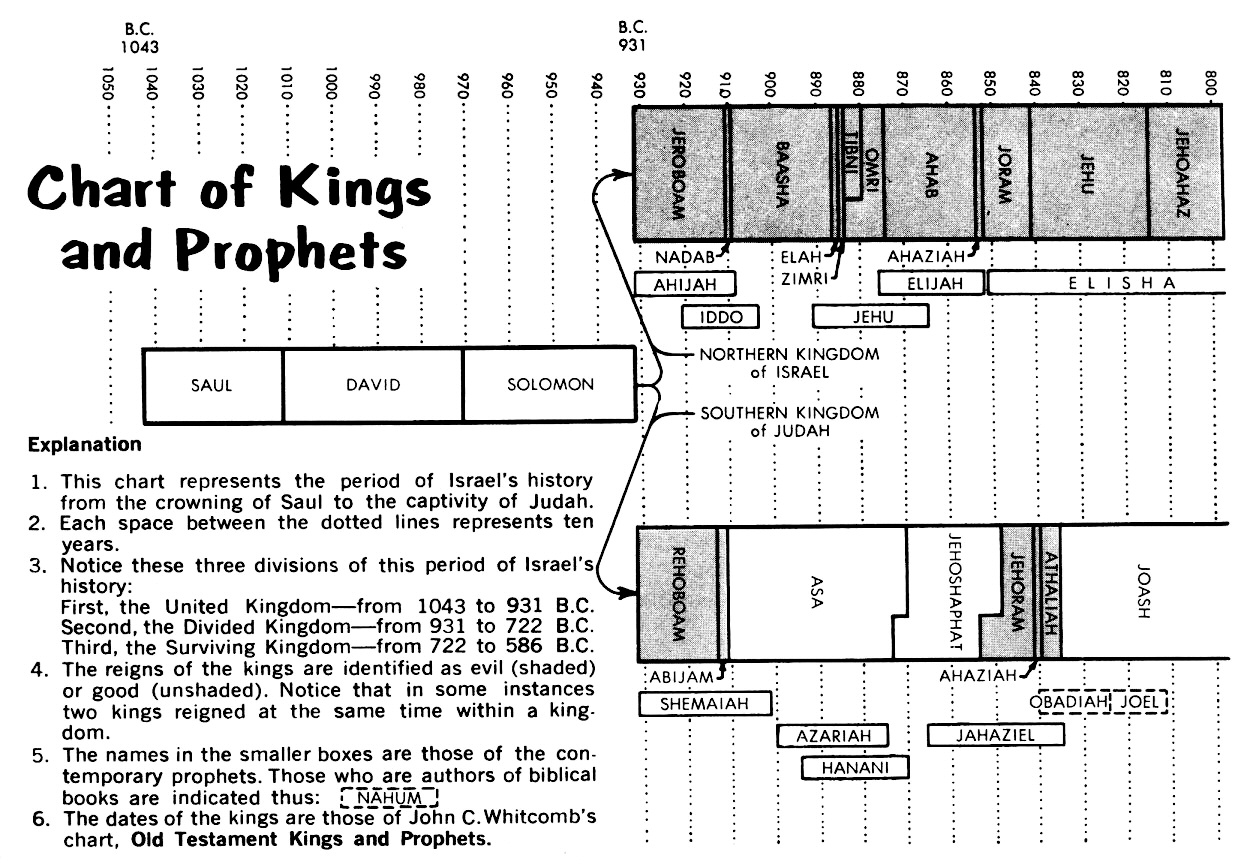
Click to Enlarge
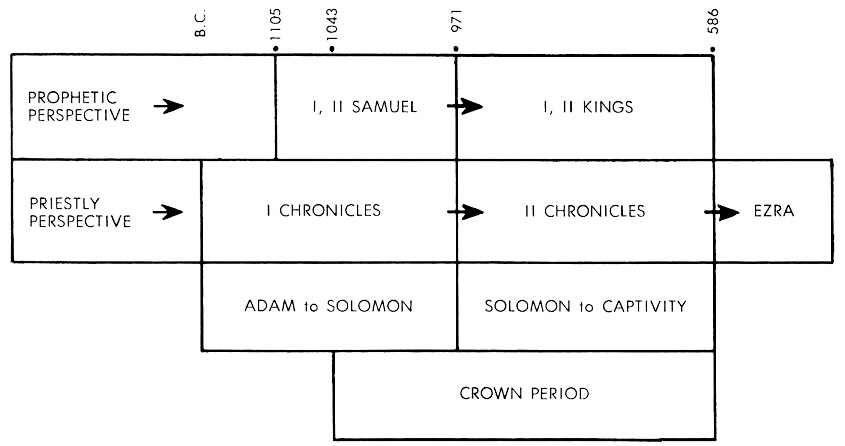
Comparison of 1 Samuel thru 2 Chronicles

| FIRST CHRONICLES SUMMARY CHART |
|
| 1 Chronicles 1-9:44 | 1 Chronicles 10:1-39:30 |
| Royal Line of David |
Reign of David |
| 12 Tribes of David's Reign |
Highlights of David's Reign |
| Genealogies | History |
| Ancestry | Activity |
| 1000's of Years | Circa 33 Years |
1 Chronicles 2:1 These are the sons of Israel: Reuben, Simeon, Levi, Judah, Issachar, Zebulun,
- Israel: or, Jacob, Ge 32:28 49:2
- Reuben: Ge 29:32-35 30:5-24 35:18,22-26 46:8-27 49:4-28 Ex 1:2-4 Nu 1:5-15 13:4-15 26:5-65 Rev 7:5-8
- NOTE THAT MOST OF THE NAMES ARE LINKED TO BIBLE DICTIONARY ENTRYS TO FACILITATE FURTHER STUDY.
Related Passages:
Genesis 32:28 He said, “Your name shall no longer be Jacob, but Israel; for you have striven with God and with men and have prevailed.”
These are the sons of Israel: Reuben, Simeon, Levi, Judah, Issachar, Zebulun, This begins the genealogy of the nation of Israel by listing the sons of Jacob (whose name God changed to Israel in Genesis 32:28). The Chronicler gives special attention to Judah because Chronicles focuses heavily on the Davidic kingdom and God’s covenant promises connected to David’s line.
🙏 THOUGHT — The genealogy begins with ordinary human names, yet behind them stands the extraordinary faithfulness of God. Generations rise and fall, but God steadily moves history toward the coming of His promised King, Jesus Christ (Galatians 4:4).
A brief overview of these sons:
- Reuben — Jacob’s firstborn, but he lost the rights of the firstborn because of sin (Genesis 35:22; 49:3–4).
- Simeon — Ancestor of the tribe of Simeon, later absorbed largely into Judah’s territory (Joshua 19:1–9).
- Levi — Ancestor of the priestly tribe. The Levites were set apart for tabernacle and temple service (Numbers 3:5–10).
- Judah — The royal tribe from which David and ultimately the Messiah, Jesus Christ, would come (Genesis 49:10; Matthew 1:1–3).
- Issachar — Known for strength and discernment (1 Chronicles 12:32).
While the chapter begins with familiar names, the names of most of those in this genealogies are relatively obscure, but they all served important purposes:
- Preserving tribal identity after the exile (recall Chronicles was written to the post-exilic Jewish community).
- Establishing inheritance rights in Israel.
- Demonstrating the historical continuity of Judah’s line.
- Ultimately tracing the royal and messianic lineage that culminates in Jesus Christ (Matthew 1:1–16).
QUESTION: Who was Reuben in the Bible? | GotQuestions.org (ALL ENTRIES FROM GOTQUESTIONS.ORG USED BY PERMISSION)
ANSWER: Reuben was the firstborn son of Jacob by Leah and the forefather of one of the twelve tribes of Israel. The story of Reuben in the Bible is told in Genesis chapters 29–50.
Reuben’s mother Leah became the wife of Jacob by a cunning trick (Genesis 29:15–30). Jacob had gone to live with his uncle, Laban, in Paddan Aram. There he met and fell in love with Laban’s beautiful daughter Rachel. Jacob agreed to work seven years for the right to marry Rachel, Leah’s younger sister. On their wedding night, Laban substituted the heavily veiled Leah in Rachel’s place. The next morning, Jacob was shocked to discover the deceit. So smitten was he with Rachel that he consented to work another seven years for her.
Leah’s life turned out to be heartbreaking as she sought to win Jacob’s love. But God blessed Leah with the honor of bearing many children, including Jacob’s oldest son, Reuben.
Several meanings have been assigned to the name Reuben, but the most widely accepted is “behold a son.” When Leah gave birth to Reuben, she explained her choice: “She named him Reuben, for she said, ‘It is because the LORD has seen my misery. Surely my husband will love me now’” (Genesis 29:32). This statement introduces the lifelong tension that existed between the two sisters in their marriage to Jacob.
As an adult, Reuben was one of the more honorable sons of Jacob. Reuben saved Joseph’s life when his brothers plotted to kill him. He talked the brothers out of murdering Joseph and convinced them to leave him in a pit instead (Genesis 37:21–22). Reuben intended to return privately and rescue Joseph, but his plan failed when, in his absence, the other brothers sold Joseph into slavery. Years later, as all the brothers faced misfortune in Egypt, Reuben called out his brothers for bringing disaster on their family: “Didn’t I tell you not to sin against the boy? But you wouldn’t listen! Now we must give an accounting for his blood” (Genesis 42:22).
An interesting episode involving Reuben in the Bible centers on his mother’s and aunt’s belief in folk medicine in Genesis 30:14–17. One day during the wheat harvest, Reuben came across mandrakes in the field. Mandrakes were herbaceous flowering plants known for their exotic fragrance and human-shaped roots. They were also believed to enhance a woman’s fertility. Reuben picked the mandrakes and brought them to his mother, Leah.
Rachel asked for some of the mandrakes Reuben had found, but Leah rebuked her: “Wasn’t it enough that you took away my husband? Will you take my son’s mandrakes too?” (Genesis 30:15). So, Rachel struck a deal with Leah. In return for some of the mandrakes, she let Leah sleep with Jacob. As a result, Leah became pregnant and gave Jacob a fifth son, Issachar.
Reuben demonstrated extreme love for his aging father when he offered his own two sons as a guarantee for the safety of Benjamin (Genesis 42:37). But, despite Reuben’s admirable qualities and good intentions, he lacked enduring strength of character.
Reuben’s great failure occurred when he slept with his father’s concubine Bilhah. This act, a serious crime punishable by death, revealed the loss of his earlier integrity. After Rachel died, Reuben was likely anxious because Jacob had shown favor to her sons over Leah’s. He may also have been worried for his mother. By sleeping with Bilhah, Reuben was likely challenging his father’s authority and grasping for power.
As the oldest son of Jacob, Reuben should have been granted the birthright, but he was denied this honor because of his act of disrespect: “Reuben, you are my firstborn, my might, the first sign of my strength, excelling in honor, excelling in power. Turbulent as the waters, you will no longer excel, for you went up onto your father’s bed, onto my couch and defiled it” (Genesis 49:3–4).
The tribe of Reuben descended from Reuben and his four sons: Hanoch, Pallu, Hezron, and Carmi. After helping the other tribes take possession of the Promised Land, the tribe of Reuben settled east of the Jordan River. Initially starting out strong, the tribe was always mentioned first—in the place of honor—in lists of the twelve tribes of Israel. However, because of Reuben’s incest with Bilhah, the tribe eventually lost its place of preeminence as Jacob had prophesied. No prominent judge, prophet, or ruler came from the tribe of Reuben, and no mention of the tribe, other than the listing in Revelation 7:5, is made in the New Testament.
Related:
- What can we learn from the tribe of Reuben? | GotQuestions.org
- Why did Reuben, Gad, and the half-tribe of Manasseh want to live on the east of the Jordan?
QUESTION: Who was Simeon in the Bible? | GotQuestions.org
ANSWER: The name Simeon is used of four men in the Bible: Simeon, son of Jacob (Genesis 29:33); Simeon, a man in Jerusalem who met the baby Jesus (Luke 2:25); Simeon, named in the lineage of Jesus (Luke 3:30); and Simeon of the church in Antioch (Acts 13:1). This article will focus on two Simeons: the son of Jacob and the man mentioned in Luke 2.
Simeon in the Old Testament is the second-born son of Jacob, born to Jacob’s wife Leah. Jacob was the patriarch, or father, of the twelve tribes of Israel and had received the Abrahamic Covenant (Genesis 28:14–15).
Simeon was a man of anger and violence. His sister Dinah was taken and defiled by a Hivite named Shechem, a son of the ruler of that area (Genesis 34:2). When Jacob and his sons learned of this, “they were shocked and furious, because Shechem had done an outrageous thing in Israel by sleeping with Jacob’s daughter—a thing that should not be done” (Genesis 34:7). All the brothers conspired to initiate a plan to establish a false treaty with Hamor’s family (Genesis 34:13). The treaty involved all the men of the city being circumcised (verse 15). But, instead of the family of Jacob and the family of Hamor living peacefully together as Hamor was led to believe (Genesis 34:21), the sons of Jacob, including Simeon, sought to avenge their sister. After the men of the city had been circumcised, while they were still in pain, Simeon and Levi “took their swords and attacked the unsuspecting city, killing every male. They put Hamor and his son Shechem to the sword and took Dinah from Shechem’s house and left” (Genesis 34:25–26). Jacob rebuked Simeon and Levi for their bloody act: “You have brought trouble on me by making me obnoxious to the Canaanites and Perizzites, the people living in this land” (Genesis 34:30).
Later, as Jacob was nearing death, he gave his sons a patriarchal blessing. At that time, he remembered the sins of Simeon and Levi, saying, “Simeon and Levi are brothers—their swords are weapons of violence. Let me not enter their council, let me not join their assembly, for they have killed men in their anger and hamstrung oxen as they pleased. Cursed be their anger, so fierce, and their fury, so cruel! I will scatter them in Jacob and disperse them in Israel” (Genesis 49:5–7). Jacob’s words came to pass as, centuries later, after the conquest of the Promised Land, the tribe of Simeon was small and was forced to share territory with Judah, a larger and more powerful tribe (Joshua 19:1–9). The curse on Simeon reminds us that vengeance belongs only to God (Genesis 4:15; Psalm 38:20; 1 Peter 3:9).
The Bible also shows that Simeon was a man of envy and hatred. He and his brothers were jealous of their father’s love for Joseph and angered by Joseph’s dreams that the brothers construed as arrogance, so they sold Joseph into slavery (Genesis 37). Simeon was then complicit in leading their father to believe that Joseph had been killed by a fierce animal. Later, Joseph, as vizier of Egypt, tested his brothers and imprisoned Simeon until his brothers returned from Canaan (Genesis 42:18–19, 24).
Despite Simeon’s wrongdoing, we see God’s love and grace. Simeon was justly rebuked and cursed by his father, but he was also honored by Jacob as recorded in two special moments. The first occurs when Jacob, still grieving the supposed death of Joseph, is presented with the possibility that he might lose Simeon as well and equates Simeon with his two favorite children, Joseph and Benjamin: “You have deprived me of my children. Joseph is no more and Simeon is no more, and now you want to take Benjamin. Everything is against me” (Genesis 42:36). We also see Jacob’s grace when he recognizes Joseph’s sons as being equal to Reuben and Simeon, his first and second born. In this blessing of his grandchildren, Jacob, despite Simeon’s prior violence, murder, and lies, recognizes Simeon’s rightful place in the family.
In Revelation 7:7 the tribe of Simeon is listed in a place of honor, among the twelve tribes of Israel who are sealed by God’s protection in the tribulation. Simeon, son of Jacob, is referenced throughout the Pentateuch and seven times in the book of Joshua. Simeon and/or the tribe that bears his name is also mentioned in the historical records of 1 and 2 Chronicles and in the book of Ezekiel.
The other prominent Simeon in the Bible was a man in Jerusalem (Luke 2:25) who lived at the time Jesus was born. Simeon’s reputation was that of being “righteous and devout” (Luke 2:25). For generations the people of God waited for and expected a Messiah, a Savior. Simeon was like his fellow Israelites in that he waited “for the consolation of Israel” (verse 25). The concept of consolation implies comfort. The nation of Israel was waiting for God’s comfort, expecting that He would come and rescue them (Luke 23:50–51; Mark 15:43; Acts 10:22), just as He had done in delivering them from slavery and bringing them out of Egypt (Exodus 14). Simeon was unique in what he knew—namely, that he would see the Messiah with his own eyes, for “it had been revealed to him by the Holy Spirit that he would not die before he had seen the Lord’s Messiah” (Luke 2:26).
Joseph and Mary, in faithfulness to the Law, traveled to Jerusalem while Jesus was still an infant to present Him to God in the temple (Luke 2:22; cf. Exodus 13:1–2). It is during their visit to the temple that Simeon saw Jesus, the long-awaited “consolation of Israel.” We don’t know how long Simeon had waited, but we do know that he was led by the Spirit to go to the temple that day, and he recognized Jesus the moment he saw Him.
When Simeon saw the baby Jesus, he picked Him up in his arms and said,
“Sovereign Lord, as you have promised,
you may now dismiss your servant in peace.
For my eyes have seen your salvation,
which you have prepared in the sight of all nations:
a light for revelation to the Gentiles,
and the glory of your people Israel” (Luke 2:29–32).
Simeon’s words assert that 1) Jesus would be the salvation of the world, 2) He would deliver truth not only to those in Israel but also to the Gentiles, and 3) Jesus would bring glory upon the people of Israel. Luke records that Jesus’ parents “marveled at what was said about him” (Luke 2:33).
Simeon spoke to Mary, Jesus’ mother. Simeon said, “This child is destined to cause the falling and rising of many in Israel, and to be a sign that will be spoken against, so that the thoughts of many hearts will be revealed. And a sword will pierce your own soul too” (Luke 2:34). In this prophecy, Simeon said that 1) some of the Jewish people would believe that Jesus is the “consolation of Israel,” and some would not, 2) there would be much opposition to Jesus in the future, 3) Jesus would reveal the truth, and 4) Jesus’ suffering would cause Mary much pain, personally.
Simeon stands as a testimony of how we, too, should anticipate the arrival of the Messiah. Simeon looked forward to Christ’s first coming, and we anticipate His Second Coming (see Acts 1:11 and Titus 2:13).
Jesus, the “consolation of Israel,” is the comfort of all those who believe in Him, and Simeon is a beacon of faith in an unbelieving world and a positive assurance that “hope does not disappoint” (Romans 5:5, NASB).
Related:
QUESTION: Who was Levi in the Bible? | GotQuestions.org
ANSWER: The name Levi is attached to four different characters in the Bible. There are two men named Levi found in Jesus’ genealogy in the book of Luke, each of them a father of a man named Matthat (Luke 3:24, 29). The third Levi is more commonly known as the disciple Matthew. He is referred to as Levi twice, in Mark 2:14 and Luke 5:27–29. Both occurrences coincide with Jesus’ calling of Levi/Matthew, so it is likely Jesus changed Levi’s name once he became Jesus’ disciple, just as He did for Simon Peter.
The fourth Levi was a son of Jacob. He was the third-born, and his mother was Jacob’s wife Leah. Levi and each of his eleven brothers became the heads of the twelve tribes of Israel. The Bible does not give many details of Levi’s life; however, in Genesis 34, Levi and his brother Simeon defend the honor of their sister, Dinah, although the manner in which they went about it was appalling. This is what happened: when Dinah was away from her father’s house one day, she was raped by Shechem, the son of the Hivite ruler of that territory (verse 2). When Dinah’s brothers heard about the rape, they were furious. Shechem, who desired Dinah as his wife, asked for Dinah’s hand, so Dinah’s brothers tricked him and said that first he, his father, and the other men of the city must be circumcised (verse 15). Shechem and his father agreed, and all the males went through the rite of circumcision. But three days later, when the men of Shechem were still in pain, Levi and Simeon strapped on their swords and attacked the city, killing every man (verse 25) and plundering the city (verses 27–29). Jacob was angry at Levi and Simeon because of their murderous attack (verse 30), but Levi and Simeon were unapologetic (verse 31).
Levi was also involved in selling his brother Joseph to merchants who sold Joseph as a slave in Egypt. Joseph’s brothers were jealous of him, for their father showed him much favoritism (Genesis 37:3). Joseph went through several hard years in Egypt but eventually became second-in-command to Pharaoh due to his faithfulness and the Lord’s blessing (Genesis 41:39–41). Later, Joseph’s brothers, including Levi, were forced to come buy food from Egypt, and it was during one of their trips there that they discovered the man they’d been dealing with for food was their brother Joseph. The brothers begged forgiveness from Joseph with true repentance, and Joseph forgave them. Eventually, Joseph brought his whole family to live in Egypt.
Before Jacob died in Egypt, he called his sons to him and spoke words of prophecy over each of them. He said this of Levi: “Simeon and Levi are brothers—their swords are weapons of violence. Let me not enter their council, let me not join their assembly, for they have killed men in their anger and hamstrung oxen as they pleased. Cursed be their anger, so fierce, and their fury, so cruel! I will scatter them in Jacob and disperse them in Israel” (Genesis 49:5–7). Jacob’s harsh words showed that Levi and Simeon’s bloody vengeance for their sister’s rape had lasting consequences.
The descendants of Levi became numerous, but they were indeed scattered throughout the Promised Land. Moses was a descendant of Levi (Exodus 2:1). Other notable men of Levi’s family line were Eli, Ezra, and John the Baptist.
Related:
- What can we learn from the tribe of Levi / the Levites? - Got Questions
- What was the Levitical priesthood? | GotQuestions.org
QUESTION: Who was Judah in the Bible? | GotQuestions.org
ANSWER: Judah was the fourth son of Jacob with his wife Leah, and the head of one of the 12 tribes of Israel. The other 11 tribes descended from Judah’s brothers and half-brothers.
Judah’s second-to-youngest brother, Joseph, was preferred by their father, and Judah and his brothers hated Joseph (Genesis 37:3–4). One day, the brothers threw Joseph in a cistern and conspired to kill him. The eldest sibling, Reuben, argued against this course of action, intending to rescue Joseph from the others (verses 21–22). But while the brothers ate lunch, and in Reuben’s absence, a caravan approached, and Judah came up with a plan to sell Joseph to the caravan’s merchants as a slave (verses 26–17). The brothers agreed, and Joseph was sold and taken to Egypt.
It is possible that Judah felt remorse or guilt for his actions, for “at that time, Judah left his brothers and went down to stay with a man of Adullam named Hirah” (Genesis 38:1). There, Judah married a Canaanite woman who gave Judah three sons: Er, Onan, and Shelah. When Er grew up, Judah gave him a wife named Tamar. But Er was an evil man, so the Lord put him to death (verse 7). Following the custom of levirate marriage, Tamar was then given to Onan, who selfishly refused to give Tamar children (verse 9); he was also put to death by the Lord for his actions. Shelah was too young to take a wife, so Judah ordered Tamar to live as a widow in her father’s house (verse 11).
After several years Judah’s own wife died, and he grieved. When he recovered, he traveled to Timnah to oversee to the shearing of his sheep. Tamar, still a widow in spite of the fact that Shelah had grown up, heard that her father-in-law was coming, and she devised a plan. Tamar put on a veil and pretended to be a prostitute on the road to Timnah (Genesis 38:14). The veil hid her identity from Judah, and Judah slept with her. Tamar became pregnant, which had been her goal all along. Three months later, when Judah found out that his supposedly chaste daughter-in-law was pregnant, he was filled with rage: “Bring her out and have her burned to death!” he demanded (verse 24). As she was being brought out for punishment as a harlot, Tamar produced evidence that her pregnancy was due to Judah’s own immorality. Judah saw his hypocrisy and repented, saying, “She is more righteous than I, since I wouldn’t give her to my son Shelah” (verse 26). Judah did not have sexual relations with Tamar after that. She later gave birth to twins, two boys named Perez and Zerah (verses 29–30).
Meanwhile, God was with Judah’s brother Joseph in Egypt, elevating Joseph to a place of power second only to Pharaoh himself (Genesis 41:39–40). Joseph had interpreted the king’s dream warning of seven years of plenty followed by seven years of famine, and so Pharaoh put Joseph in charge of gathering grain to store for the lean years. Under Joseph’s supervision, a large amount of grain was set aside (verse 49). When the great famine came upon the land, it affected even Canaan. Judah and his brothers traveled from Canaan to Egypt to buy some of the surplus food. Joseph eventually revealed himself to his brothers, who were remorseful for what they had done to him (for more on this, see Genesis 42 – 45).
Soon, Joseph brought his entire family to the land of Egypt, where their descendants would live for several hundred years, according to God’s great plan for His people. This is where Jacob died, and before he passed, he called all his sons to bless them. In spite of all Judah’s faults, his blessing from Jacob was both rich and wonderful; in it, Jacob foretold that Judah’s house would be the greatest, and the scepter, or rule, would not depart from his descendants (see Genesis 49:8–12 for the full blessing). Jacob’s words held true, for, many years later, Judah’s line produced King David and his dynasty and, eventually, through the line of Perez, came the Messiah, Jesus Christ, who is called “the Lion of the tribe of Judah” (Revelation 5:5).
Related:
- What can we learn from the tribe of Judah? | GotQuestions.org
- Who/what is the Lion of the tribe of Judah? | GotQuestions.org
QUESTION: Who was Issachar in the Bible? | GotQuestions.org
ANSWER: Issachar was Jacob’s ninth son and ancestor of one of the twelve tribes of Israel. In Hebrew, Issachar means either “man of reward” or “hired man.” His name is associated with the circumstances of his birth.
Issachar’s mother was Leah. After she gave birth to her fourth son, Judah, Leah stopped having children and was presumed to be barren (Genesis 29:35). One day her oldest son, Reuben, came across mandrakes in the field. In folk medicine, these flowering herbs were thought to enhance a woman’s fertility. Reuben picked the mandrakes and brought them to his mother. Leah and her younger sister, Rachel, argued over the mandrakes, but finally came to an agreement. Leah would give Rachel some of the mandrakes as a reward or payment for allowing Leah to sleep with their husband, Jacob. That night, Leah became pregnant and later gave Jacob her fifth (and his ninth) son, Issachar (Genesis 30:14–18).
As a Bible character, Issachar plays almost no role in the family story. We know he fathered four sons: Tola, Puah, Jashub, and Shimron (Genesis 46:13). To escape the famine, Issachar joined Jacob in relocating his family to Egypt, where Issachar eventually died and was buried. Later his body was moved to Shechem with the rest of the patriarchs (Acts 7:16).
Like his brothers, Issachar received a blessing from his father before Jacob’s death: “Issachar is a rawboned donkey lying down among the sheep pens. When he sees how good is his resting place and how pleasant is his land, he will bend his shoulder to the burden and submit to forced labor” (Genesis 49:14–15). The blessing seems more like a curse, possibly indicating that the tribe of Issachar was forced to work for a Canaanite king at some point.
The territory of the tribe of Issachar, described in Joshua 19:17–23, incorporated the fertile eastern section of the valley of the Jezreel River, a western tributary of the Jordan, with Mount Tabor to the north and the Jordan River to the east.
Issachar shared a border and close connection with the tribe of Zebulon. This link is evident in the common blessing given by Moses before his death: “About Zebulun he said: ‘Rejoice, Zebulun, in your going out, and you, Issachar, in your tents. They will summon peoples to the mountain and there offer the sacrifices of the righteous; they will feast on the abundance of the seas, on the treasures hidden in the sand’” (Deuteronomy 33:18–19).
Issachar was a large tribe. Its battle-ready men numbered 54,400 in the first census (Numbers 1:29). By the time of the second census, it had increased to 64,400 (Numbers 26:25). During the reign of King David, Issachar’s mighty men numbered 87,000 (1 Chronicles 7:5).
In the time of the judges, Issachar’s tribe joined with Deborah and Barak to defeat Jabin, the king of Hazor (Judges 5:15). From Issachar’s tribe came a later judge, Tola (Judges 10:1–2), as well as two kings of Israel, Baasha and his son Elah (1 Kings 15:27 – 16:14). As one of the northern tribes in the divided kingdom, Issachar was taken into captivity when the northern kingdom fell.
There is a brief mention in the Bible of another man named Issachar: a Levite and descendant of Korah. This Issachar was one of the door-keepers of the temple. He is listed as the seventh son of Obed-edom and was one of the “capable men with the strength to do the work” (1 Chronicles 26:8).
Related:
QUESTION: Who was Zebulun in the Bible? | GotQuestions.org
ANSWER: Zebulun was the sixth son of Jacob by his wife Leah and the tenth of all Jacob’s sons. Zebulun’s birth came during the ongoing rivalry between sisters Rachel and Leah for their husband’s attention. So upon Zebulun’s birth, Leah said, “God has endowed me with a good gift; now my husband will dwell with me, because I have borne him six sons” (Genesis 30:20, NASB). Leah uses a play on words here: “God has endowed (zabad) me with a good gift (zebed), and now my husband will dwell (zabal) with me.” The name Zebulun means “dwell” (also translated “honor”) and sounds much like the Hebrew words for “gift” and “endowed.”
The Bible does not provide many details concerning Zebulun’s life. We know that Zebulun was among the older brothers who conspired to kill their younger brother, Joseph, because of jealousy (Genesis 37:4). In the end, they did not kill him but sold him to some traders headed to Egypt (Genesis 37:26). Zebulun and his brothers had evil motives, but God used their wicked plan to save the entire nation of Israel (Genesis 50:20). Although Zebulun is not mentioned by name in this account, he had an equal part in the deception and was also present decades later when they were reunited with the brother they thought dead.
Jacob pronounced a blessing on each of his twelve sons before he died. To Zebulun he said, “Zebulun will live by the seashore and become a haven for ships; his border will extend toward Sidon” (Genesis 49:13). Zebulun had three sons: Sered, Elon, and Jahleel (Genesis 46:14). Their descendants became the tribe of Zebulun. Centuries later, the tribe of Zebulun was given an allotment within the Promised Land. Their eastern border was the Sea of Galilee, and their western border eventually stretched to the Mediterranean (Joshua 19:10–16).
Before he died, Moses also blessed the tribe of Zebulun, saying, “Rejoice, Zebulun, in your going out” (Deuteronomy 33:18). Once settled in their land, the tribe of Zebulun became traders and sailors and profited much by the seagoing trade.
During the wandering in the wilderness, the tribe of Zebulun was led by Eliab son of Elon, and they numbered 57,400 (Numbers 2:7). During the time of the judges, the prophetess Deborah advised the commander of the army to take men from Naphtali and Zebulun to go against the enemy (Judges 4:4–7). They were considered brave risk-takers (Judges 5:18).
Although Zebulun’s name is rarely mentioned in Scripture, he was part of the foundation God built for a nation that would one day produce His Son, Jesus Christ. The twelve tribes of Israel, founded in Genesis, are still prominent in the book of Revelation. In Revelation 21:12, John describes the New Jerusalem, and Zebulun is represented: “It had a great, high wall with twelve gates, and with twelve angels at the gates. On the gates were written the names of the twelve tribes of Israel.”
Zebulun’s name is inscribed in heaven, not because of the good he did or the life he lived. He is important in heaven because God chose him to be part of His plan to redeem mankind. We can learn from Zebulun’s life that God’s plans far supersede our ideas of why we are here. Despite our mistakes and rebellion, God’s plans go forward (Isaiah 46:9–11). He is working out His will for His creation, and we are each a part of that grand scheme.
Related:
1 Chronicles 2:2 Dan, Joseph, Benjamin, Naphtali, Gad and Asher.
- Dan: Ge 30:6
- Joseph: Ge 30:24
- Benjamin: Ge 35:18
- Naphtali: Ge 30:8
- Gad: Ge 30:11
- Asher: Ge 30:13 35:26 46:17 49:20 Nu 1:40,41 De 33:24 Jos 19:24-31
COMPLETION OF THE
12 TRIBES OF ISRAEL
Dan, Joseph, Benjamin, Naphtali, Gad and Asher. Together with verse 1, these names make up the twelve sons of Jacob (Israel), the fathers of the twelve tribes of Israel. The Chronicler is establishing the covenant nation before narrowing the focus to the tribe of Judah and the royal line of David.
Briefly, these sons were:
- Dan — Ancestor of the tribe of Dan. The tribe later struggled with idolatry (Judges 18).
- Joseph — Jacob’s beloved son who rose to power in Egypt and preserved his family during famine (Genesis 37–50). His two sons, Ephraim and Manasseh, later received tribal inheritance rights in Israel.
- Benjamin — Youngest son of Jacob and ancestor of the tribe from which King Saul came (1 Samuel 9:1–2). The apostle Paul was also from Benjamin (Philippians 3:5).
- Naphtali — A northern tribe later associated with the region where Jesus carried out much of His Galilean ministry (Isaiah 9:1; Matthew 4:13–15).
- Gad — A tribe known for mighty warriors east of the Jordan (1 Chronicles 12:8).
- Asher — A tribe associated with abundance and blessing (Genesis 49:20; Deuteronomy 33:24–25).
🙏 THOUGHT — The twelve sons of Israel were very different in temperament, history, and spiritual faithfulness, yet God wove them together into one people. In a similar way, believers from many backgrounds are united in Christ into one body (1 Corinthians 12:12–13). Perhaps your family history was a bit dysfunctional, but rest assured that if you are a child of God (believer), God is working all things "together for good to those who love God, to those who are called according to His purpose (HE HAS A PURPOSOSE FOR YOUR LIFE! cf Eph 2:10).(Ro 8:28).
QUESTION: Who was Dan in the Bible? | GotQuestions.org
ANSWER: Dan was the fifth of twelve sons born to the Jewish patriarch Jacob. Dan’s mother was Bilhah, Rachel’s maidservant. Dan’s younger brother was Naphtali. As full brothers, the two are frequently mentioned together in the Bible (Deuteronomy 27:13; Exodus 1:4).
The account of Dan’s birth is contained in Genesis 30:1–8. Rachel, who had remained childless, was envious of her sister, Leah, who had already given birth to four sons of Jacob. Barrenness held great shame for women in ancient cultures, so Rachel followed the custom of the day and presented her maidservant, Bilhah, to Jacob as a third wife. When Bilhah gave birth to Dan, Rachel considered the child her own. Rachel named him Dan, meaning “he judged,” because she felt that God had judged and vindicated her through the child’s birth.
On his deathbed, Jacob pronounced a blessing over all his sons. Dan was promised the role of a judge: “Dan shall judge his people as one of the tribes of Israel” (Genesis 49:16, ESV). Dan’s blessing also included these words: “Dan will be a snake by the roadside, a viper along the path, that bites the horse’s heels so that its rider tumbles backward” (verse 17). Scripture does not tell us if Dan himself possessed these traits, but his tribe was small yet fierce like the viper in his father’s blessing.
Dan had only one son, Hushim, to carry on his bloodline (Genesis 46:23). He is listed as Shuham (an alternate spelling of Hushim) in Numbers 26:42 and identified as the ancestor of the clan of the Shuhamites. Nothing else is disclosed about Dan in the Bible.
Some of Dan’s descendants are mentioned in the days of the wilderness wanderings. Oholiab was a skilled craftsman appointed by God to work on the tabernacle (Exodus 31:6; 35:34; 38:23). An unnamed son whose father was Egyptian and whose mother was from the tribe of Dan blasphemed the name of the Lord and was put to death (Leviticus 24:10–11). Ahiezer was a leader of the tribe of Dan (Numbers 1:12; 2:25; 7:66–71; 10:25).
When Israel entered the Promised Land, the tribe that descended from Dan was allotted a portion of Canaan between Judah and Ephraim bordering the Mediterranean coast (Joshua 19:40–48). However, except for the valley of Zorah and Eshtaol, Dan’s tribe failed to gain control of the territory, especially after the Philistines settled there. In the book of Judges, Samson, who was from the tribe of Dan, was called by God to fight against the Philistines (Judges 13-16). Eventually, Dan’s tribe migrated to the north and seized the city of Laish. They renamed the city Dan and took up residence in the surrounding areas (Judges 18).
In Moses’ blessing, Dan’s tribe is called “a lion’s cub, springing out of Bashan” (Deuteronomy 33:22). Some believe the reference relates to Dan’s northern migration and capture of Laish. After Dan resettled to the north, the tribe became associated with idolatry (Judges 18:30–31; 2 Kings 10:29).
Related:
- What can we learn from the tribe of Dan? | GotQuestions.org
- Why is the tribe of Dan missing from the 144,000 in Revelatiion on?
QUESTION: Who was Joseph in the Old Testament? | GotQuestions.org
ANSWER: Joseph was the eleventh son of Jacob, his first son through his favored wife, Rachel. Joseph’s story is found in Genesis 37—50. After the announcement of his birth, we see Joseph next as a seventeen-year-old returning from shepherding the flock with his half-brothers to give Jacob a bad report of them. We are also told that Jacob "loved Joseph more than any of his other sons, because he had been born to him in his old age; and he made an ornate robe for him" (Genesis 37:3). Joseph’s brothers knew their father loved Joseph more than them, which caused them to hate him (Genesis 37:4). To make matters worse, Joseph began relating his dreams to the family—prophetic visions showing Joseph one day ruling over his family (Genesis 37:5–11).
The animosity toward Joseph peaked when his brothers plotted to kill him in the wilderness. Reuben, the eldest, objected to outright murder and suggested they throw Joseph into a cistern, as he planned to come back and rescue the boy. But, in Reuben’s absence, some merchants passed by, and Judah suggested selling Joseph into slavery; the brothers accomplished the task before Reuben could rescue him. The boys took Joseph’s robe and, after dipping the robe in goat’s blood, deceived their father into thinking his favorite son had been slain by wild beasts (Genesis 37:18–35).
Joseph was sold by the merchants to a high-ranking Egyptian named Potiphar and eventually became the supervisor of Potiphar’s household. In Genesis 39 we read of how Joseph excelled at his duties, became one of Potiphar’s most trusted servants, and was put in charge of his household. Potiphar could see that, whatever Joseph did, God looked favorably on him and he prospered in all that he did. Unfortunately, Potiphar’s wife attempted to seduce Joseph. Joseph consistently refused her advances, showing honor for the master who had entrusted him with so much and saying that it would be "a wicked thing and a sin against God" for him to go to bed with Potiphar’s wife (Genesis 39:9). One day Potiphar’s wife caught Joseph by the cloak and again made sexual advances. Joseph fled, leaving his cloak in her hand. In anger, she falsely accused Joseph of attempted rape, and Potiphar put him in prison (Genesis 39:7–20).
In jail, Joseph was again blessed by God (Genesis 39:21–23). Joseph interpreted the dreams of two of his fellow prisoners. Both interpretations proved to be true, and one of the men was later released from jail and restored to his position as the king’s cupbearer (Genesis 40:1–23). But the cupbearer forgot about Joseph and failed to speak to Pharaoh about him. Two years later, the king himself had some troubling dreams, and the cupbearer remembered Joseph’s gift of interpretation. The king summoned Joseph and related his dreams. Based on Pharaoh’s dreams, Joseph predicted seven years of bountiful harvests followed by seven years of severe famine in Egypt and advised the king to begin storing grain in preparation for the coming dearth (Genesis 41:1–37). For his wisdom, Joseph was made a ruler in Egypt, second only to the king. Joseph was in charge of storing up food during the years of plenty and selling it to Egyptians and foreigners during the years of famine (Genesis 41:38–57). During these years of plenty Joseph had two sons—Manasseh and Ephraim (Genesis 41:50–52).
When the famine struck, even Canaan was affected. Jacob sent ten of his sons to Egypt to buy grain (Genesis 42:1–3). He kept Benjamin, his youngest and the only other son of Rachel, behind (Genesis 42:4). While in Egypt, the men met their long-lost brother, whom they did not recognize. Joseph, however, did recognize his brothers. He tested them by accusing them of being spies. He confined them for three days then released all but one, sending with them grain for their households and requiring them to come back with their youngest brother (Genesis 42:6–20). Still unaware of Joseph’s identity, the brothers were afflicted with guilt for having sold their brother years before (Genesis 42:21–22). Joseph overheard their discussion and turned aside to weep (Genesis 42:23–24). He retained Simeon and sent the others on their way, secretly returning their money to their grain sacks (Genesis 42:25). When the brothers later realized the money had been returned, they feared even more (Genesis 42:26–28, 35). Once home, they told Jacob all that had transpired. Jacob mourned again the loss of Joseph and the added loss of Simeon. He refused to send Benjamin, despite Reuben’s promise that, if he did not return with Benjamin, Jacob could kill Reuben’s two sons (Genesis 42:35–38).
The famine became so severe that Jacob acquiesced. Judah persuaded Jacob to send Benjamin with him, giving his own life as a pledge (Genesis 43:1–10). Jacob agreed, sending also choice fruits and double the money for the grain (Genesis 43:11–14). When Joseph saw the men, he instructed his servants to slaughter an animal and prepare a meal for the brothers to dine with him (Genesis 43:15–17). Afraid at the invitation to Joseph’s house, the brothers made apologies to Joseph’s steward for the money that had been replaced the first time. Joseph’s steward reassured them and brought Simeon out (Genesis 43:18–25). When Joseph returned, the brothers bowed to him, fulfilling his earlier prophecy (Genesis 43:26). He asked about their family’s welfare and again wept, this time removing himself to his chamber (Genesis 43:27–30). When the men sat down for the meal, at a separate table from Joseph, they were amazed to be arranged by birth order. Benjamin was given five times the portion the other brothers received (Genesis 43:31–34). Before sending them back to their father, Joseph again tested his brothers by returning their money to their grain sacks and placing his silver cup in Benjamin’s sack. He let the brothers start on their journey and then sent his steward after them to feign anger and threaten to kill Benjamin. Back in Joseph’s presence, Judah pleaded for Benjamin’s life, saying that, if Benjamin were to die, so would Jacob. Judah told of Jacob’s grief over the loss of Joseph and his belief that he could not bear to lose Joseph’s brother. Judah also spoke of his pledge to Jacob and offered his life for Benjamin’s (Genesis 44).
Upon seeing this proof of his brothers’ change of heart, Joseph sent all his servants away and wept openly and loudly enough to be heard by Pharaoh’s household. He then revealed himself to his brothers (Genesis 45:1–3). Joseph immediately reassured them, telling them not to be angry with themselves for what they’d done to him and saying that God had sent him to Egypt in order to preserve them (Genesis 45:4–8). Joseph reaffirmed his forgiveness years later, after the death of his father, saying that, although his brothers intended evil to him, God had intended it for good (Genesis 50:15–21). Joseph sent his brothers back to Jacob to retrieve the remainder of his household to come live in Goshen, where they would be near to Joseph and he could provide for them (Genesis 45:9—47:12).
Jacob did come to live in Egypt with all of his family. Before he died, Jacob blessed Joseph’s two sons and gave thanks to God for His goodness: “I never expected to see your face again, and now God has allowed me to see your children too” (Genesis 48:11). Jacob gave the greater blessing to the younger of the two sons (verses 12–20). Later in the history of Israel, Ephraim and Manasseh, the tribes of Joseph, were often considered two distinct tribes. Jacob’s descendants lived in Egypt for 400 years, until the time of Moses. When Moses led the Hebrews out of Egypt, he took the remains of Joseph with him, as Joseph had requested (Genesis 50:24–25; cf. Exodus 13:19). In asking that he be buried in Canaan, Joseph showed great faith that God would bring His people back to the Promised Land (Hebrews 11:22).
There is much to learn from Joseph’s story. As parents, we have warnings concerning Jacob’s favoritism and the effects that can have on other children as seen in Joseph’s youthful pride and his brothers’ envy and hatred. We have a good example of how to handle sexual temptation—run (Genesis 39:12; cf. 2 Timothy 2:22), and we have a clear picture of God’s faithfulness. He does not forsake His children, even in the midst of suffering: “The Lord was with Joseph” (Genesis 39:3, 5, 21, 23).
There may be many distressing circumstances we find ourselves in, and some of them may even be unjust, as were those in Joseph’s life. However, as we learn from the account of Joseph’s life, by remaining faithful and accepting that God is ultimately in charge, we can be confident that God will reward our faithfulness in the fullness of time. Who would blame Joseph if he had turned his brothers away in their need? Yet Joseph showed them mercy, and God desires that we exercise mercy above all other sacrifices (Hosea 6:6; Matthew 9:13).
Joseph’s story also presents amazing insight into how God sovereignly works to overcome evil and bring about His plan. After all his ordeals, Joseph was able to see God’s hand at work. As he revealed his identity to his brothers, Joseph spoke of their sin this way: “Do not be distressed and do not be angry with yourselves for selling me here, because it was to save lives that God sent me ahead of you. . . . It was not you who sent me here, but God” (Genesis 45:5, 8). Later, Joseph again reassured his brothers, offering forgiveness and saying, “You intended to harm me, but God intended it for good” (Genesis 50:20). Man’s most wicked intentions can never thwart the perfect plan of God.
Related:
- What can we learn from the tribe of Joseph? | GotQuestions.org
- What is the story of Joseph and his brothers? | GotQuestions.org
QUESTION: Who was Benjamin in the Bible? | GotQuestions.org
ANSWER: Benjamin was a son of Jacob and head of one of the twelve tribes of Israel. Benjamin was the twelfth-born and youngest son in Jacob’s family. He was born to Jacob’s wife Rachel, making Benjamin the full brother of Joseph. His story is found in Genesis chapters 35–49. It is here that we learn of his birth (Genesis 35); his relationship to his father and brothers (Genesis 37, 42–45); his relationship with Joseph (Genesis 43–45); his children (Genesis 46); and the blessing he received from his father (Genesis 46:21).
Jacob had two wives, Rachel and Leah. He loved Rachel with such fervor that he worked for her dad for seven years to earn the right to marry her (Genesis 29:18), seven years that “seemed like only a few days to him because of his love for her” (Genesis 29:20). This love helps us to understand Jacob’s affection for Benjamin, born to his beloved Rachel. Rachel had great difficulty in giving birth to Benjamin. Her midwife told her that she was having another son. Rachel died in childbirth, but, as she was dying, she named her son Ben-Oni, which means “Son of My Trouble.” Jacob renamed him Benjamin, “Son of My Right Hand” (Genesis 35:18).
Benjamin was not part of the conspiracy concocted by his ten older brothers to kill their brother Joseph. Later, when the brothers had to travel to Egypt to seek food during a famine, Jacob’s love for his youngest son compelled him to keep Benjamin home “because he was afraid that harm might come to him” (Genesis 42:4). The other brothers traveled to Egypt and met with the governor of Egypt (Joseph, whom his brothers did not recognize). Joseph tested his brothers by accusing them of spying and demanding that they prove their honesty by bringing Benjamin back with them: “You will not leave this place unless your youngest brother comes here” (Genesis 42:15). Joseph shut them all in prison for three days and then released all but Simeon. The others returned home with the grain they had purchased—and the money that Joseph had secretly returned to them (verse 25).
Back in Canaan, Jacob laments his predicament: “You have deprived me of my children. Joseph is no more and Simeon is no more, and now you want to take Benjamin. Everything is against me!” (Genesis 42:36). For a while, Jacob refused to allow Benjamin to make the trip back to Egypt (verse 38). He later relented when they ran out of grain and Judah promised to personally guarantee Benjamin’s safe return (Genesis 43:8–9).
Upon arriving in Egypt, the brothers presented themselves to Joseph, who was still unrecognized by them. Joseph, as he greeted the brothers this second time, “looked about and saw his brother Benjamin, his own mother’s son, [and] he asked, ‘Is this your youngest brother, the one you told me about?’ And he said, ‘God be gracious to you, my son.’ Deeply moved at the sight of his brother, Joseph hurried out and looked for a place to weep” (Genesis 43:29–30).
Joseph showed favor to Benjamin by preparing five times more food and drink for him than for his brothers when they gathered for dinner (Genesis 43:34). When it came time for the children of Israel to return to their father, Joseph used Benjamin as the means of further testing them. Joseph placed a silver cup in Benjamin’s bag along with the money for the grain (Genesis 44:1–2). Joseph let his brothers set out on their journey and then sent a steward after them to feign outrage over the fact that they possessed stolen property. The brothers proclaimed their innocence, but, sure enough, the silver cup was found in Benjamin’s possession; the brothers tore their garments in grief (verses 3–13). As punishment for their “crime,” Joseph demanded that Benjamin remain in Egypt. But Judah—the same brother who had suggested years earlier that Joseph be sold into slavery—pleads with Joseph, saying, “Now then, please let your servant remain here as my lord’s slave in place of the boy, and let the boy return with his brothers. How can I go back to my father if the boy is not with me? No! Do not let me see the misery that would come on my father” (Genesis 44:33–34). So, the brothers passed the test; they demonstrated a true change of heart from the time when they had mistreated Joseph.
Joseph finally revealed himself to his brothers: “I am your brother Joseph, the one you sold into Egypt! And now, do not be distressed and do not be angry with yourselves for selling me here, because it was to save lives that . . . God sent me ahead of you to preserve for you a remnant on earth and to save your lives by a great deliverance. So then, it was not you who sent me here, but God” (Genesis 45:4–8). Joseph then instructed his brothers to bring their father and all they possessed to Egypt, and “he threw his arms around his brother Benjamin and wept, and Benjamin embraced him, weeping” (verse 14).
Years later in Egypt, as Jacob prepared to die, he blessed Benjamin, saying, “Benjamin is a ravenous wolf; in the morning he devours the prey, in the evening he divides the plunder” (Genesis 49:27). The tribe of Benjamin became famous for their skill in battle and warlike nature. We learn more about Benjamin and the tribe of Benjamin throughout the books of Numbers, Deuteronomy, Joshua, and Judges. Descendants of Benjamin include Ehud, one of the judges; Saul, Israel’s first king; Queen Esther; and the apostle Paul.
Related:
QUESTION: Who was Naphtali in the Bible? | GotQuestions.org
ANSWER: Naphtali was Jacob’s sixth-born son and the second of two sons by Rachel’s maidservant, Bilhah. Naphtali’s older brother was Dan.
Rachel was so delighted at the birth of another son that she called the child Naphtali, which means “my wrestling.” She chose this name because she felt vindicated after struggling with her older sister, Leah, to provide Jacob with heirs: “Then Rachel said, ‘I have had a great struggle with my sister, and I have won.’ So she named him Naphtali” (Genesis 30:8).
Little more is written of Naphtali in the Bible; we know that he had four sons: Jahzeel, Guni, Jezer, and Shillem (Genesis 46:24), and, eventually, he moved his family with Jacob to Egypt to escape the famine.
Jacob’s deathbed blessing upon Naphtali was, “Naphtali is a doe set free that bears beautiful fawns” (Genesis 49:21) or “gives beautiful words” (NASB). Scholars suggest many interpretations for Jacob’s blessing of Naphtali. Some say it implied gentleness of character; others think it may have alluded to agility in battle or hastiness.
Naphtali’s descendants came to be known as the tribe of Naphtali, one of the twelve tribes of Israel. The first census in the wilderness credited 53,400 adult, battle-ready males to the tribe of Naphtali (Numbers 1:42–43). A later census taken near the end of the wilderness wanderings counted 45,400 men of Naphtali who were capable of battle (Numbers 26:48).
Moses, when Israel entered the Promised Land, pronounced a blessing on Naphtali’s tribe: “Naphtali is abounding with the favor of the LORD and is full of his blessing; he will inherit southward to the lake” (Deuteronomy 33:23). As indicated in this blessing, Naphtali settled in northern Canaan in the high regions west and northwest of the Sea of Galilee.
Three Levitical cities reserved for the family of the Gershonites existed within the tribe’s borders (Joshua 21:32; 1 Chronicles 6:62) along with Kedesh, a city of refuge (Joshua 20:7). Naphtali successfully conquered the region but did not drive out the Canaanites. Instead, the Canaanites were subjected to forced labor (Judges 1:33).
The geographical position of the tribe led to several major conflicts in the region. The most significant was the war against Jabin, king of Hazor. Barak, the Hebrew warrior and son of Abinoam, from Kedesh in Naphtali, was called by Deborah, the judge and prophetess, to lead the tribes of Zebulun and Naphtali against the Canaanite forces of Hazor (Judges 4 – 5). The tribe of Naphtali as well as Asher, Zebulun, and Manasseh was also summoned by Gideon to fight against the Midianites and Amalekites (Judges 6:33–35).
During the monarchy period, the tribe of Naphtali sent armed forces to Hebron, showing support for David’s rule (1 Chronicles 12:34). The tribe stayed loyal to David’s dynasty during Solomon’s administration as well. King Solomon had twelve regional officers over all Israel. One of them was Ahimaaz, who married Solomon’s daughter, Basemath. Ahimaaz was from the tribe of Naphtali (1 Kings 4:7–15).
During the time of the divided kingdoms, the story of the tribe of Naphtali becomes harder to trace. When Pekah ruled in Israel, Tiglath-pileser III of Assyria began to exert his powerful influence in the region of Naphtali. By 732 BC, the Assyrian king had conquered Gilead, Galilee, and all of Naphtali and taken the people into captivity (2 Kings 15:29).
The prophet Isaiah recalled how the Lord had brought the land of Naphtali into contempt but would one day make it glorious again (Isaiah 9:1). Isaiah’s prophecy was fulfilled in the coming of Jesus Christ, who brought the Good News to people living in the region of Naphtali (Matthew 4:13–15). Finally, in the book of Revelation, 12,000 members of the tribe of Naphtali are included among the sealed servants of God (Revelation 7:6).
Related:
QUESTION: Who was Gad in the Bible? | GotQuestions.org
ANSWER: Gad the seer (or prophet) is first mentioned in 1 Samuel 22:5. Before the Holy Spirit was poured out on believers at Pentecost (Acts 2), God communicated to His people primarily through His chosen prophets. In the Old Testament, those prophets are sometimes called seers (1 Samuel 9:9). Seers were sought by kings and others in authority when they needed direction from the Lord (2 Kings 17:13; 1 Chronicles 25:5).
Gad appears suddenly in the book of 1 Samuel as a consultant to David while he was on the run from Saul. At that time, Gad counsels David to leave Moab and return to Judah (1 Samuel 22:5). Gad is not mentioned again until David took the throne as the king of Israel and Gad is named as his seer (2 Samuel 24:11). At that time, kings had specific prophets whose counsel they sought, much as an American President has an advisory council. The difference is that these seers were to represent the Lord’s counsel and not merely present good advice. However, seers were not always trustworthy, and the Lord brought judgment on those who spoke from their own authority (Jeremiah 14:14–15).
Gad, it appears, was an honorable man and faithfully spoke the Lord’s words to David. After David had sinned by numbering the troops, the Lord sent Gad to rebuke him and give three options of punishment (2 Samuel 24:11–14). Gad later went back to David to give him the Lord’s command about making his sin right through offering a sacrifice (2 Samuel 24:18). Gad remained loyal to David throughout his reign and is later listed as a compiler of the king’s chronicles (1 Chronicles 29:29). Gad must have been a young man when he first joined David’s band, since he outlived David and wrote a history of his life.
Though rarely mentioned by name, Gad the seer may have played a crucial role in David’s success as king. His initial advice while David was on the run from Saul not only kept David safe, but it allowed David to build a reputation as a mighty warrior, making him popular with the people (1 Chronicles 12:1–22). From that, we learn that leaders need to surround themselves with wise people who understand God’s Word and can communicate God’s message accurately (see Isaiah 6:8–9; 1 Corinthians 14:1–4). For every great leader, there are nameless supporters who advise, rebuke, encourage, and warn, using their gifts for the betterment of another. Though his name is rarely mentioned, Gad’s influence is seen throughout the incredible life and successes of King David. Where David excelled, Gad’s counsel was right behind him. When David failed, Gad’s rebukes and advice quickly followed. Gad worked in harmony with God’s other influential prophet, Nathan, to keep David’s heart and life pleasing to God and worthy of the throne (2 Chronicles 29:29; 2 Samuel 12:1). Because Gad was faithful to his calling, David had the godly insights he needed to fulfill the role God called him to play.
Related:
QUESTION: Who was Asher in the Bible? | GotQuestions.org
ANSWER: Asher was the eighth son of Jacob, and his name means “Blessed” or “Happy.” Asher’s mother was Leah’s servant, Zilpah. According to the laws at the time regarding children born of servants, Asher would have been seen as Leah’s son rather than Zilpah’s. Asher had a total of eleven brothers, including a full brother by Zilpah; two half-brothers from Jacob’s other wife, Rachel; two half-brothers from Rachel’s servant, Bilhah; and six half-brothers from Leah. He also had a sister named Dinah. Each of Jacob’s sons, including Asher, would become the head of one of the twelve tribes of Israel. As God had promised to Asher’s great-grandfather, Abraham, He was making Abraham’s descendants into a great nation (Genesis 12:2).
The Bible does not say much about Asher as an individual. It does, however, describe the jealousy and anger Asher and his brothers had toward their brother Joseph due to Jacob’s preferential treatment of him (Genesis 37:3–4). This favoritism, coupled Joseph’s description of the dreams he had in which his brothers were bowing down to him, caused the brothers to develop an extreme hatred of him (verses 5–11). Asher and his brothers ended up selling Joseph to some merchants, who in turn sold him as a slave in Egypt (verse 28). Joseph served there for several years, but God raised him to second-in-command of all Egypt (Genesis 41:39–41). As Joseph had interpreted a dream had by the king that warned of seven years of plenty followed by seven years of great famine, Pharaoh put Joseph in charge of collecting food during the seven good years and storing it for the seven bad years (verses 48–49). When the famine began, Joseph’s brothers came to buy food from Egypt, eventually discovering that the man they were dealing with was their brother. They were grieved over what they had done to Joseph, and soon after the reunion Jacob and the rest of his family were brought to live in Egypt.
Just before Jacob died, he blessed each of his sons. The blessing for Asher was as follows: “Asher’s food will be rich; / he will provide delicacies fit for a king” (Genesis 49:20). In essence, Jacob was blessing Asher and his descendants with a promise that they would gain good food and riches. Later, Moses also blessed Asher’s descendants: “Most blessed of sons is Asher; / let him be favored by his brothers, / and let him bathe his feet in oil. / The bolts of your gates will be iron and bronze, / and your strength will equal your days” (Deuteronomy 33:24–25).
Genesis 46:17 notes that Asher had four sons (Imnah, Ishvah, Ishvi, and Beriah) and one daughter (Serah). His tribe would eventually grow into six clans and, after the exodus from Egypt, was quite large. The Bible says that, at one point during the Israelites’ journey to Canaan, Asher’s tribe had 41,500 fighting men (Numbers 1:41).
Asher’s tribe inherited land in Canaan along the coast, from the city of Sidon in the north to Mt. Carmel in the south. True to the blessings that Asher had received, the tribe possessed territory containing some of the richest soil in all of Canaan. Asher produced much grain, wine, oil, and minerals.
Asher’s descendants endured as God had promised Abraham, and his tribe is mentioned often throughout the Bible. One of Asher’s descendants, a prophetess named Anna, was blessed to meet the baby Jesus just days after His birth (Luke 2:36). And one day, during the tribulation that will occur after Jesus returns for believers, a remnant of the nation of Israel will come to a saving knowledge of Jesus Christ, including 12,000 sealed from the tribe of Asher (Revelation 7:6).
Related:
1 Chronicles 2:3 The sons of Judah were Er, Onan and Shelah; these three were born to him by Bath-shua the Canaanitess. And Er, Judah’s firstborn, was wicked in the sight of the LORD, so He put him to death.
- and: 1Ch 9:5 Ge 38:2-10 46:12 Nu 26:19
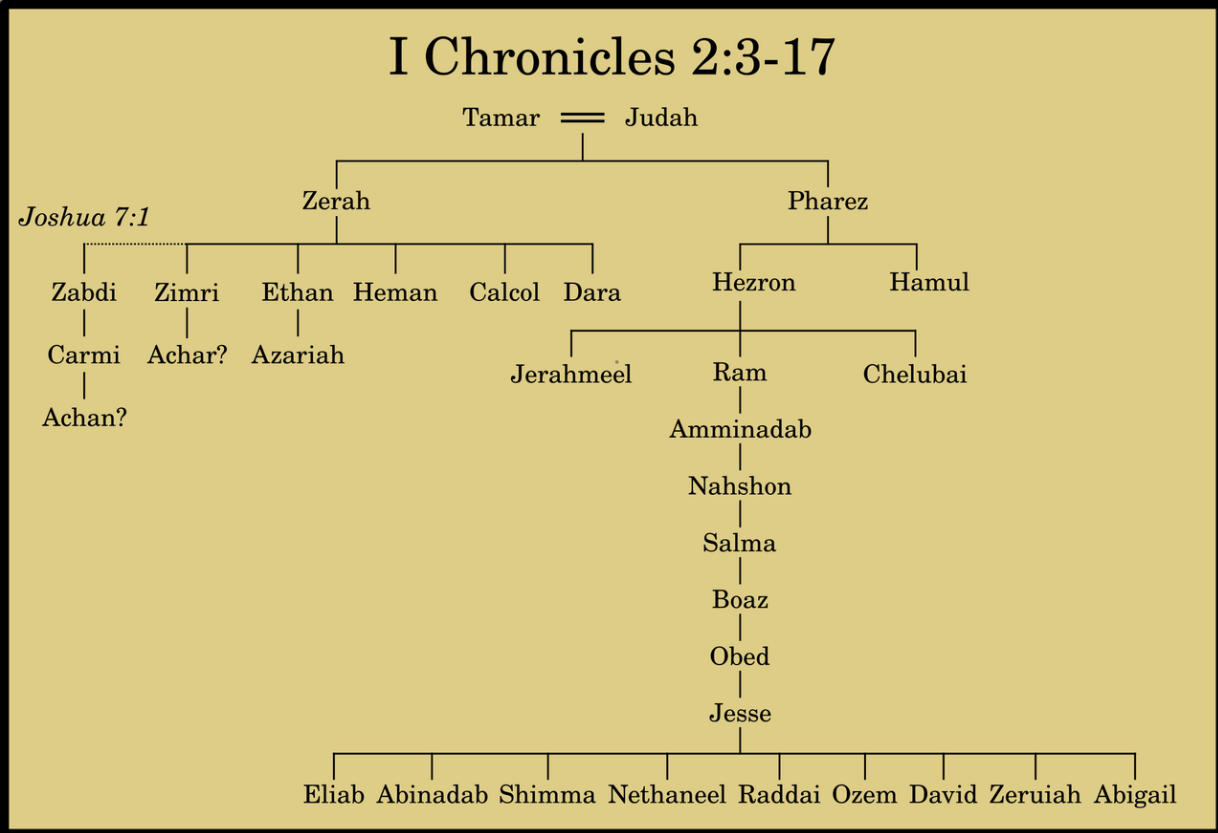
The sons of Judah were Er, Onan and Shelah; these three were born to him by Bath-shua the Canaanitess. And Er, Judah’s firstborn, was wicked in the sight of the LORD, so He put him to death. Here we begin a lengthy list of Judah's descendants from 1Ch 2:3 through 1Ch 4:23.
J.A. Thompson: From a genealogical perspective, the royal clan of Judah did not show much promise. His eldest son Er died because of wickedness. As a familiarity with the account would show (Gen 38), it did not get much better since Judah's second and third sons did not bear sons either. It was rather through the sordid incident of Judah and his daughter-in-law Tamar, disguised as a prostitute, that the promised heritage was perpetuated through their twin sons, Perez and Zerah. Ironically, the Chronicler could in one and the same breath show the consequences of sin (death of Er) and also the grace of God abounding in the midst of it as two sons were born by means of Judah's wicked deed. Out of this union came the ancestral father of Israel's greatest king (Ruth 4:18-22). (See 1, 2 Chronicles: An Exegetical and Theological Exposition)
1 Chronicles 2:4 Tamar his daughter-in-law bore him Perez and Zerah. Judah had five sons in all.
- Tamar: Ge 38:13-30 Ru 4:12 Mt 1:3, Thamar
- Pharez: 1Ch 9:4 Nu 26:21 Ru 4:18 Ne 11:4, Perez, Mt 1:3 Lu 3:33, Phares
- Zerah: 1Ch 9:6 Nu 26:13,20 Ne 11:24 Mt 1:3, Zara
Related Passages:
Ruth 4:18-22 Now these are the generations of Perez: to Perez was born Hezron, 19 and to Hezron was born Ram, and to Ram, Amminadab, 20 and to Amminadab was born Nahshon, and to Nahshon, Salmon, 21 and to Salmon was born Boaz, and to Boaz, Obed, 22 and to Obed was born Jesse, and to Jesse, David.
A TAINT OF SIN
IN THE MESSIANIC LINE
Tamar his daughter-in-law bore him Perez and Zerah. Judah had five sons in all. This refers back to the events recorded in Genesis 38. Judah’s sons Er and Onan died because of their wickedness before the LORD (Genesis 38:7, 10). Tamar, Judah’s widowed daughter in law, was left without offspring, even though Judah had promised that his remaining son Shelah would eventually fulfill the duty of levirate marriage and raise up descendants for the deceased family line. Judah failed to keep that promise. In desperation, Tamar disguised herself as a prostitute and conceived twins by Judah himself. When Judah later learned the truth, he confessed: “She is more righteous than I.” (Genesis 38:26) The twins born from this union were Perez (or Pharez) and Zerah. Perez became especially important because the Messianic line flowed through him - Perez → Hezron → Ram → Amminadab → Nahshon → Boaz → David → Jesus Christ (Ruth 4:18–22; Matthew 1:3).
This verse demonstrates several profound truths that God’s purposes continue despite human failure and moral weakness. The line leading to Messiah includes sinners and broken situations, magnifying God’s grace. God often works through unexpected people and circumstances to accomplish His sovereign plan. Matthew intentionally includes Tamar in the genealogy of Jesus (Matthew 1:3), showing that the grace of God reaches into scandal, shame, and human failure.
🙏 THOUGHT — Genesis 38 is not included in Scripture to glorify sin, but to magnify grace. The Messiah’s lineage itself testifies that Jesus came into a fallen world to save sinners (1 Timothy 1:15). Don't we all have some elements of Genesis 38 in our family history or even our personal lived. Praise God for "Tamar grace" He has shown to all of us in Christ Jesus, the Righteous One! Amen
QUESTION: Who was Tamar in the Bible? | GotQuestions.org
ANSWER: There are three women named Tamar in Scripture. One Tamar, the beautiful daughter of Absalom, is only mentioned in passing in 2 Samuel 14:27; this Tamar became the mother of Queen Maacah, who married King Rehoboam. The other two Tamars are both tragic figures, women who were ruined by the neglect and abuse of close family members. Their stories seem to be included in Scripture for the purpose of providing historical and spiritual information about the Messianic line. This article will focus on Tamar the daughter-in-law of Judah; and Tamar the daughter of David.
Jacob’s son Judah (patriarch of the line of Judah) had three sons: Er, Onan, and Shelah. A woman named Tamar married Er, but then Er died, leaving her a widow. Since it was required that the next of kin care for a brother’s widow, Tamar was given to Onan, but he also died. Shelah was still a boy and could not marry Tamar, so Judah asked her to return to her father’s house and wait until Shelah was grown up. However, once Shelah was old enough, Judah did not honor his promise. Tamar remained an unmarried widow. Tamar then went into town disguised as a prostitute, tricked Judah, and got him to sleep with her. She then became pregnant by Judah and bore twin sons named Perez and Zerah. The story is recorded in Genesis 38.
The other Tamar was King David’s daughter. She had a brother, Absalom, and a half-brother, Amnon. Amnon had an obsessive desire for his half-sister Tamar, and one day he pretended to be sick and called for her to come to him in his bedroom to help him. When she was there alone with him, he raped her. Unfortunately, though David was angry, he did not punish Amnon or require him to marry Tamar, so Absalom took it upon himself to murder Amnon in revenge (2 Samuel 13:1–22). Absalom’s anger and bitterness toward his father because of these events eventually led to his attempt to usurp his throne and to disgrace David by committing public immorality with his father’s concubines.
We would expect the twin sons of Judah’s incestuous union with his daughter-in-law to be outcasts, hidden away, or perhaps not even mentioned in the Bible. However, surprisingly, the Messianic line continues through Tamar’s son Perez. God did not provide a “cleaner” way to continue the line that would eventually include His Son. Perez was the ancestor of Jesus of Nazereth.
It is the same with King David’s story. Absalom’s anger and rejection of his father’s rule seem to have been born out of a festering bitterness toward David. Though Absalom was clearly in the wrong for the murder of Amnon, we sympathize with him, and we sympathize with his disgraced sister. Considering David’s own immorality and the murder he committed, it is easy to see why Absalom thought himself the better man. But, despite David’s faults, God still chose to continue the line of the Messiah through David rather than through Absalom.
Why are these unpleasant stories included in Scripture, and why are the people involved—people who hurt others, even their own family members—granted the privilege of being included in the Messianic line? It may be simply to show us that God’s purpose is accomplished despite man’s unrighteousness. In Hebrews 11 there is a long list of Old Testament people who are commended for their faith, and among them are many sinful people who did dreadful things. But, because they believed God, their faith was credited to them as righteousness (Genesis 15:6).
QUESTION: Who was Perez in the Bible? | GotQuestions.org
ANSWER: Perez was one of the sons of Judah through an illicit affair with his daughter-in-law, Tamar. Perez’s twin brother was Zerah. In the biblical genealogies, Perez is listed as an ancestor of King David and of Jesus Christ.
The name Perez in Hebrew means “breach” or “he who bursts forth,” and it refers to how he was born.
Judah, one of Jacob’s twelve sons, was leader of the Israelite tribe bearing his name. His sons were Er, Onan, and Shelah. Judah arranged for the marriage of his oldest son, Er, with a Canaanite woman named Tamar. But Er, who was “wicked in the sight of the Lord,” died before producing an offspring, leaving Tamar a childless widow (Genesis 38:7).
Er’s next oldest unmarried brother, Onan, was required to enter into a levirate marriage with Tamar, with a goal of producing an heir for his deceased brother. But Onan refused to have a child with Tamar, knowing the offspring would be heir to his brother’s estate and not his own. So, the Lord punished Onan with death (Genesis 38:8–10).
Judah’s third son, Shelah, was not yet old enough to marry, so Judah told Tamar to return to her father’s house and wait for Shelah to grow up. When Shelah came of age, Judah failed to keep his promise, and Tamar took matters into her own hands.
She devised a plan to entice Judah into having sex with her and thus produce an heir. She covered her face and disguised herself as a prostitute. The plan worked. Tamar became pregnant with twin boys as a result of her encounter with Judah. When the time came to give birth, Zerah’s hand emerged from the womb first, so the midwife tagged the child’s wrist with a red thread to identify him as the firstborn. But then Zerah pulled his hand back, and suddenly Perez burst forth from Tamar’s womb, earning his name and the rights of the firstborn (Genesis 38:27–30).
Both Tamar and Judah sinned in their immoral union, but God worked through their sinfulness to bring about the birth of Jesus Christ through their bloodline (Ruth 4:18–22; Matthew 1:3; Luke 3:33). The Messiah is called Lion of the Tribe of Judah (Revelation 5:5), having descended from Judah through Perez.
Perez fathered two sons, Hezron and Hamul, and became the ancestral leader of the Perezite clan (Genesis 46:12; Numbers 26:20). The family was well respected, as evidenced by this blessing pronounced upon Boaz when he committed to redeem Ruth: “Then the elders and all the people standing in the gate replied, ‘We are witnesses! May the LORD make this woman who is coming into your home like Rachel and Leah, from whom all the nation of Israel descended! May you prosper in Ephrathah and be famous in Bethlehem. And may the LORD give you descendants by this young woman who will be like those of our ancestor Perez, the son of Tamar and Judah’” (Ruth 4:11–12, NLT).
It was through Perez’s son Hezron that King David and, eventually, Jesus Christ descended.
When the Israelites returned from captivity in Babylon, 468 Perezites were chosen to live in Jerusalem (1 Chronicles 9:4; Nehemiah 11:4, 6). The Bible says they were “all outstanding men.”
QUESTION: Who was Zerah in the Bible? | GotQuestions.org
ANSWER: Zerah was a common name in the ancient Middle East, and several Zerahs are mentioned in Scripture (e.g., Genesis 36:33; 1 Chronicles 4:24; 6:21; Joshua 22:20). Only three Zerahs have any personal details connected to the mention of their names.
The first Zerah is listed in Genesis 36:13–17 as a grandson of Esau. One of Esau’s wives was named Basemath, who was the daughter of Esau’s uncle Ishmael, making her Esau’s cousin (Genesis 36:3). Basemath and Esau had a son named Reuel; Reuel was the father of Zerah.
The second Zerah in the Bible appears in a single verse in 2 Chronicles 14:9: “Zerah the Cushite marched out against [King Asa and the army of Judah] with an army of thousands upon thousands and three hundred chariots, and came as far as Mareshah.” Historians speculate that this Zerah the Cushite (also called an Ethiopian in some versions) may be Usarken II, the third king of Egypt after Shishak. He may have been born in Ethiopia and married into the royal family of Egypt, thereby inheriting the throne; or he may have invaded Judah after passing through Egypt with the pharaoh’s blessing. Another possibility is that this Ethiopian Zerah was a nomadic leader of Arabians, associated with the Midianites (see Habakkuk 3:7).
The most noteworthy Zerah in Scripture is a son of Judah by his daughter-in-law Tamar (1 Chronicles 2:4). The account of Judah and Tamar is found in Genesis 38. Judah’s son, the husband of Tamar, was so wicked that God put him to death. Judah’s second son was to have a child with Tamar on his elder brother’s behalf, but he was also unrighteous, and God put him to death. Judah asked Tamar to wait as a widow until his next son was old enough to provide an heir, but Judah never intended to fulfill that promise. So, after Judah’s wife died, Tamar posed as a prostitute along the road Judah was traveling. Judah hired her, not knowing who she was. From that union came twins, Perez and Zerah (Genesis 38:27–30).
The name Zerah can mean “scarlet” or “brightness.” He was so named because, when the twins were being born, Zerah’s hand emerged first. The midwife tied a red thread around his wrist to establish birth order. But then he withdrew his hand, and his brother Perez was born first. Zerah came out of the womb with the red string on his wrist, thereby earning his name.
This Zerah grew up and became the patriarch of the Zerahite clan of Israelites mentioned in Joshua 7:16–18. Zerah’s great-grandson Achan disobeyed the Lord and took some of the spoil from Jericho in direct violation of God command (Joshua 7:20–21).
Years later, the Zerahites were among the Israelites who returned to Jerusalem from their seventy years in Babylonian captivity. The returning tribe of Judah, including the children of Zerah, numbered 690 members (1 Chronicles 9:3–6).
Zerah’s twin brother, Perez, was an ancestor of Jesus Christ (Matthew 1:3–17). Zerah reminds us that God doesn’t overlook anyone because of their parentage or the circumstances of their birth. Every person holds a unique place in God’s order and plan, and each individual is responsible to God for what he does with what he is given.
1 Chronicles 2:5 The sons of Perez were Hezron and Hamul.
- Hezron: Ge 46:12 Nu 26:21 Ru 4:18 Mt 1:3 Lu 3:33,
Related Passages:
Genesis 46:12 The sons of Judah: Er and Onan and Shelah and Perez and Zerah (but Er and Onan died in the land of Canaan). And the sons of Perez were Hezron and Hamul.
MESSIANIC LINE
THROUGH HEZRON
The sons of Perez were Hezron and Hamul. - Perez, the son born to Judah and Tamar (Genesis 38), became one of the key ancestors in the Messianic line. His two sons were Hezron, the more prominent of the two, because the royal line leading to David and ultimately to Jesus Christ came through him (Ruth 4:18–22; Matthew 1:3) and Hamul mentioned here and also in Genesis 46:12 as one of those who went down to Egypt with Jacob’s family.
🙏 THOUGHT — Many names in Chronicles are almost unknown to us, but none were forgotten by God. The Lord who preserves genealogies also remembers every person who belongs to Him (Isaiah 49:16; Luke 12:6–7). Does this truth not add substance to His promise in Hebrews 13:5 "for He Himself has said, “I WILL NEVER DESERT YOU, NOR WILL I EVER FORSAKE YOU,”? Psalm 46:1-2 "God is our refuge and strength, A very present help in trouble. Therefore we will not fear, though the earth should change And though the mountains slip into the heart of the sea;
QUESTION: Who was Perez in the Bible? | GotQuestions.org
ANSWER: Perez was one of the sons of Judah through an illicit affair with his daughter-in-law, Tamar. Perez’s twin brother was Zerah. In the biblical genealogies, Perez is listed as an ancestor of King David and of Jesus Christ.
The name Perez in Hebrew means “breach” or “he who bursts forth,” and it refers to how he was born.
Judah, one of Jacob’s twelve sons, was leader of the Israelite tribe bearing his name. His sons were Er, Onan, and Shelah. Judah arranged for the marriage of his oldest son, Er, with a Canaanite woman named Tamar. But Er, who was “wicked in the sight of the Lord,” died before producing an offspring, leaving Tamar a childless widow (Genesis 38:7).
Er’s next oldest unmarried brother, Onan, was required to enter into a levirate marriage with Tamar, with a goal of producing an heir for his deceased brother. But Onan refused to have a child with Tamar, knowing the offspring would be heir to his brother’s estate and not his own. So, the Lord punished Onan with death (Genesis 38:8–10).
Judah’s third son, Shelah, was not yet old enough to marry, so Judah told Tamar to return to her father’s house and wait for Shelah to grow up. When Shelah came of age, Judah failed to keep his promise, and Tamar took matters into her own hands.
She devised a plan to entice Judah into having sex with her and thus produce an heir. She covered her face and disguised herself as a prostitute. The plan worked. Tamar became pregnant with twin boys as a result of her encounter with Judah. When the time came to give birth, Zerah’s hand emerged from the womb first, so the midwife tagged the child’s wrist with a red thread to identify him as the firstborn. But then Zerah pulled his hand back, and suddenly Perez burst forth from Tamar’s womb, earning his name and the rights of the firstborn (Genesis 38:27–30).
Both Tamar and Judah sinned in their immoral union, but God worked through their sinfulness to bring about the birth of Jesus Christ through their bloodline (Ruth 4:18–22; Matthew 1:3; Luke 3:33). The Messiah is called Lion of the Tribe of Judah (Revelation 5:5), having descended from Judah through Perez.
Perez fathered two sons, Hezron and Hamul, and became the ancestral leader of the Perezite clan (Genesis 46:12; Numbers 26:20). The family was well respected, as evidenced by this blessing pronounced upon Boaz when he committed to redeem Ruth: “Then the elders and all the people standing in the gate replied, ‘We are witnesses! May the LORD make this woman who is coming into your home like Rachel and Leah, from whom all the nation of Israel descended! May you prosper in Ephrathah and be famous in Bethlehem. And may the LORD give you descendants by this young woman who will be like those of our ancestor Perez, the son of Tamar and Judah’” (Ruth 4:11–12, NLT).
It was through Perez’s son Hezron that King David and, eventually, Jesus Christ descended.
When the Israelites returned from captivity in Babylon, 468 Perezites were chosen to live in Jerusalem (1 Chronicles 9:4; Nehemiah 11:4, 6). The Bible says they were “all outstanding men.”
QUESTION: What is the significance of Hezron in the Bible? | GotQuestions.org
ANSWER: The name Hezron means “enclosure.” In the Bible, Hezron refers to both a town and more than one individual. Joshua 15:25 lists a walled town named Kerioth-Hezron, also called Hazor, which translates as “castle.” Several individuals also bear the name Hezron.
The Genesis account introduces us to Hezron, the son of Reuben (Genesis 46:9), who followed Jacob from Canaan to Egypt. This Hezron is also mentioned in Exodus 6:14, and his clan is appears in Numbers 26:6 under the tribe of Reuben in the census of the Israelites.
Another Hezron is one of the sons of Perez. This would make him a grandson of Judah and a relative of Reuben’s Hezron. He is first mentioned in a list of family members in Genesis 46:12, “The sons of Judah: Er, Onan, Shelah, Perez and Zerah (but Er and Onan had died in the land of Canaan). The sons of Perez: Hezron and Hamul.”
Hezron’s lineage under Judah is further highlighted in the Israelites’ census: “The descendants of Perez were: through Hezron, the Hezronite clan; through Hamul, the Hamulite clan” (Numbers 26:21). Thus, both Hezrons were a significant part of Israel’s early growth as a people group.
Hezron son of Reuben was instrumental in furthering the tribe of Reuben. But it is Hezron son of Judah who takes the spotlight due to his place in the messianic genealogy. We read of him in Matthew’s account:
Judah the father of Perez and Zerah, whose mother was Tamar,
Perez the father of Hezron,
Hezron the father of Ram,
Ram the father of Amminadab. (Matthew 1:3–4a)
From there, the line leads to King David (Matthew 1:6).
We also read of Hezron in Luke’s account:
The son of Amminadab, the son of Ram,
the son of Hezron, the son of Perez,
the son of Judah. (Luke 3:33)
So, in both Joseph’s genealogy (in Matthew) and Mary’s genealogy (in Luke), Hezron shows up. He is an ancestor of Jesus the Messiah through his son Ram (cf. 1 Chronicles 2:9).
As one of the links in the chain from Abraham to Jesus, Hezron represents the long-term faithfulness of God. God’s plan may seem to move forward slowly, but it is sure to come to pass. Even seemingly random details can serve as puzzle pieces in God’s overall strategy. The redemption arc from Abraham to Jesus included numerous individuals whom God worked through, including Hezron. The genealogies in Matthew and Luke affirm God’s purposeful work in human history and the fulfillment of the messianic promise.
1 Chronicles 2:6 The sons of Zerah were Zimri, Ethan, Heman, Calcol and Dara; five of them in all.
- Zimri: i.e. snug; my song; my field. 1Ch 2:6 8:36 9:42 Nu 25:14 1Ki 16:9,10,12,15,16,18,20 2Ki 9:31 Jer 25:25, (1) Captain of Elah king of Israel, whom he slew and succeeded, B.C. 930, 1Ki 16:9,10, (2) Captain of the Simeonites, Nu 25:14, (3) Descendant of Judah by Tamar, 1Ch 2:4, (4) Of the stock of Saul, 1Ch 8:36 9:42, (5) A son of Zerah, the son of Judah, 1Ch 2:6, called Zabdi in, Jos 7:1,17,18 Zabdi is apparently here called [Zimriy,] Zimri, in consequence of a [Beyth,] {baith,} being mistaken for a [Mem,] {mem,} and a [Daleth,] {daleth,} for a [Reysh,] {raish.} Jos 7:1,17,18, Zabdi, (6) A name applied to a tribe and supposed to refer to people in Eastern Arabia, Jer 25:25
- Ethan: i.e. perennial, constant; ancient,>. 1Ch 2:6,8 6:42,44 15:17,19 1Ki 4:31 Ps 89:1 *title, (1) An Israelite known for his wisdom, an Ezrahite, to whom Psalm 89 is attributed in its title, 1Ki 4:31, (2) A son of Zerah, the son of Judah, 1Ch 2:6,8, (3) A descendant of Gershon, the son of Levi, 1Ch 6:42, (4) A descendant of Merari, the son of Levi, 1Ch 6:44 15:19
- Heman: i.e. faithful, , 1Ch 2:6 6:33 15:17,19 16:41,42 25:1,4,5,6 1Ki 4:31 2Ch 5:12 29:14 2Ch 35:15 Ps 88:1 *title, (1) A wise man who flourished before Solomon, 1Ch 2:6 1Ki 4:31, (2) A Levite of the Kohathites, a leader of David's choir, 1Ch 15:17 16:41,42 Ps 88:1, See also Homam, 1Ch 1:39
- Calcol: i.e. sustenance; comprehended,. 1Ki 4:31
- Dara: i.e. pearl of wisdom
The sons of Zerah were Zimri, Ethan, Heman, Calcol and Dara; five of them in all. - Although the Messianic line continued through Perez, the family of Zerah also became known for wisdom and prominence in Israel.Four of Zerah's descendants seem to be the "wise men" with whom Solomon is compared (cf. Ethan, Heman, Chalcol, and Darda in 1 Kin. 4:31; 1 Chr. 15:16, note). According to Josh. 7:1, Achan was the great-grandson of Zerah through Zabdi (Zimri).
These men are likely the same wise men mentioned in 1 Kings 4:31 “For he was wiser than all men, than Ethan the Ezrahite, Heman, Calcol and Darda, the sons of Mahol.” That passage emphasizes Solomon’s extraordinary wisdom by comparing him to men already famous for wisdom in Israel. “Darda” in Kings is probably the same person as “Dara” here, a variation in spelling. Long before Solomon’s reign, God had already raised up wise men in Israel. Yet even the wisest human wisdom pales beside Christ, “in whom are hidden all the treasures of wisdom and knowledge” (Colossians 2:3).
Heman later becomes an important name in Israel’s worship history. A Heman appears as a Levitical singer and musician appointed by David (1 Chronicles 15:17; Psalm 88 title). Some scholars debate whether that is the same individual or a later descendant bearing the same name.
This Zimri should not be confused with Zimri king of Israel (1 Kings 16) or Zimri the Simeonite involved in Baal worship (Numbers 25:14). Nothing further is recorded about this Zimri here.
QUESTION: Who was Zerah in the Bible? | GotQuestions.org
ANSWER: Zerah was a common name in the ancient Middle East, and several Zerahs are mentioned in Scripture (e.g., Genesis 36:33; 1 Chronicles 4:24; 6:21; Joshua 22:20). Only three Zerahs have any personal details connected to the mention of their names.
The first Zerah is listed in Genesis 36:13–17 as a grandson of Esau. One of Esau’s wives was named Basemath, who was the daughter of Esau’s uncle Ishmael, making her Esau’s cousin (Genesis 36:3). Basemath and Esau had a son named Reuel; Reuel was the father of Zerah.
The second Zerah in the Bible appears in a single verse in 2 Chronicles 14:9: “Zerah the Cushite marched out against [King Asa and the army of Judah] with an army of thousands upon thousands and three hundred chariots, and came as far as Mareshah.” Historians speculate that this Zerah the Cushite (also called an Ethiopian in some versions) may be Usarken II, the third king of Egypt after Shishak. He may have been born in Ethiopia and married into the royal family of Egypt, thereby inheriting the throne; or he may have invaded Judah after passing through Egypt with the pharaoh’s blessing. Another possibility is that this Ethiopian Zerah was a nomadic leader of Arabians, associated with the Midianites (see Habakkuk 3:7).
The most noteworthy Zerah in Scripture is a son of Judah by his daughter-in-law Tamar (1 Chronicles 2:4). The account of Judah and Tamar is found in Genesis 38. Judah’s son, the husband of Tamar, was so wicked that God put him to death. Judah’s second son was to have a child with Tamar on his elder brother’s behalf, but he was also unrighteous, and God put him to death. Judah asked Tamar to wait as a widow until his next son was old enough to provide an heir, but Judah never intended to fulfill that promise. So, after Judah’s wife died, Tamar posed as a prostitute along the road Judah was traveling. Judah hired her, not knowing who she was. From that union came twins, Perez and Zerah (Genesis 38:27–30).
The name Zerah can mean “scarlet” or “brightness.” He was so named because, when the twins were being born, Zerah’s hand emerged first. The midwife tied a red thread around his wrist to establish birth order. But then he withdrew his hand, and his brother Perez was born first. Zerah came out of the womb with the red string on his wrist, thereby earning his name.
This Zerah grew up and became the patriarch of the Zerahite clan of Israelites mentioned in Joshua 7:16–18. Zerah’s great-grandson Achan disobeyed the Lord and took some of the spoil from Jericho in direct violation of God command (Joshua 7:20–21).
Years later, the Zerahites were among the Israelites who returned to Jerusalem from their seventy years in Babylonian captivity. The returning tribe of Judah, including the children of Zerah, numbered 690 members (1 Chronicles 9:3–6).
Zerah’s twin brother, Perez, was an ancestor of Jesus Christ (Matthew 1:3–17). Zerah reminds us that God doesn’t overlook anyone because of their parentage or the circumstances of their birth. Every person holds a unique place in God’s order and plan, and each individual is responsible to God for what he does with what he is given.
1 Chronicles 2:7 The son of Carmi was Achar, the troubler of Israel, who violated the ban.
- Carmi: 1Ch 4:1
- Achar: Jos 7:1-5, Achan
- troubler: De 7:26 13:17 Jos 6:18 7:11-15,25 22:20
Related Passages:
Joshua 7:1-5 But the sons of Israel acted unfaithfully in regard to the things under the ban, for Achan, the son of Carmi, the son of Zabdi, the son of Zerah, from the tribe of Judah, took some of the things under the ban, therefore the anger of the LORD burned against the sons of Israel. 2 Now Joshua sent men from Jericho to Ai, which is near Beth-aven, east of Bethel, and said to them, “Go up and spy out the land.” So the men went up and spied out Ai. 3 They returned to Joshua and said to him, “Do not let all the people go up; only about two or three thousand men need go up to Ai; do not make all the people toil up there, for they are few.” 4 So about three thousand men from the people went up there, but they fled from the men of Ai. 5 The men of Ai struck down about thirty-six of their men, and pursued them from the gate as far as Shebarim and struck them down on the descent, so the hearts of the people melted and became as water.
BIRTH OF A
TROUBLER
The son of Carmi was Achar, the troubler of Israel, who violated (maal - been unfaithful to; LXX - atheteo - set aside, ignored) the ban - Achar is another form of the name Achan, the man whose sin brought defeat and trouble upon Israel in Joshua 7. The Chronicler intentionally uses the name Achar because it sounds like the Hebrew word for “trouble” (ʿakhar), emphasizing the consequences of his sin. The event occurred after Israel’s victory at Jericho. God had declared Jericho to be under “the ban” (ḥerem), meaning its spoils were devoted to destruction or consecrated to the LORD (Joshua 6:17–19). Israel was forbidden to take any of the plunder for personal use. Achan secretly took a beautiful Babylonian garment, silver, and gold, and hid them in his tent (Joshua 7:21). Because of this hidden sin, Israel was defeated at Ai, and thirty six Israelite soldiers died (Joshua 7:5). God revealed that covenant disobedience within the camp had brought His discipline upon the entire nation! Secret sin does not remain secret and ultimately can be very costly to many others (I call it the principle of the "ripple effect" of sin!).
Iain Duguid: Achan’s story is told in Joshua 7. In summarizing it here, the Chronicler introduces a major theme for the book: “breaking faith” (Hb. maal; translated elsewhere also as “be faithless”). The Chronicler will recount numerous examples of Israel’s breaking faith, commonly stated explicitly as worshiping other gods. The results were always catastrophic, leading to defeat, death, or exile (1Ch 5:25; 9:1; 10:13; 2Ch 12:2; 26:16, 18; 28:19, 22; 29:6, 19; 30:7; 33:19; 36:14). (ESV Expository Commentary)
Joshua later said to Achan “Why have you troubled (Hebrew = 'akar) us? The LORD will trouble ('akar) you this day.” (Joshua 7:25) That wordplay explains why Chronicles calls him “Achar, the troubler of Israel.”
Violated the ban refers to breaking God’s command regarding the devoted things (ḥerem). Achan treated what belonged to God as his own. His sin involved disobedience, covetousness, theft, and deception. Notice how one sin usually has several "offspring!" The Valley where judgment occurred became known as the Valley of Achor (“trouble”) (Joshua 7:26).
🙏 THOUGHT — Beloved, Achan’s sin was committed secretly, but its effects spread publicly. Instead of putting it under the blood (1Jn 1:7,9), Achan "swept" his sin "under the rug," failing to understand Pr 28:13. Sin never remains isolated; it affects families, communities, and fellowship with God (Nu 32:23b; Gal 6:7, 8, Hos 8:7). Yet even the Valley of Achor later became a picture of hope and restoration through God’s grace (Hosea 2:15). We all sin. And we all sin secretly, forgetting that secret sin on earth is open scandal in Heaven. Therefore, confess and repent quickly, bringing secret sin to the holy light of Yahweh!
Trouble (troubler, troubled) (05916) akar is a verb meaning to cause trouble, stir up resentment, cause hatred. It usually describes the trouble brought upon one from another person. The first use is by Jacob addressing his sons Simeon and Levi declaring “You have brought trouble (Lxx = miseo = to be hated) on me." (By killing Hamor and his son Shechem who had defiled their sister Dinah - Ge 34:26-27). (Ge 34:30) In Pr 11:17 "the cruel man does himself harm (Lxx = exollumi - to destroy utterly in the present tense = continually destroys himself!)" In Pr 11:29 Solomon warns that "He who troubles his own house will inherit wind," which "refers to actions which make life difficult for one's family." His reward is "empty air," nothing that can be grasped, nothing he can put his hands on. In 1Sa 14:29 Jonathan (son of Saul) declared that Saul had "troubled the land" by telling the soldiers none could eat food (1Sa 14:28) Ahab called Elijah a "troubler of Israel." (1Ki 18:17, 18).
TWOT says akar "reflects the social dimension of an individual’s action. A person’s negative action (this word always has a negative concept) has a harmful influence not only on himself, but also upon others. A person can “trouble” another person or the entire nation, bringing either man’s or God’s judgment upon others. KB (p. 703) followed by Holladay (p. 273) define the word to mean “taboo; cast out from (social) intercourse”
The story of Achan is an excellent illustration of this proverb, for in this sad saga we see that the troubler (Achan) reaped trouble from his ill gotten gain! Joshua (Josh 6:18) warned Israel not to take any loot that was under the ban for if they did Israel would be accursed and it would "bring trouble (Lxx = ektribo = to cause removal by irritation, image of wearing something out by rubbing. To rub out. To destroy. To ruin.)." Later, Joshua asked Achan (who had disobeyed Joshua's warning) “Why have you troubled (Lxx = olethreuo = to destroy, to corrupt, to kill) us? The LORD will trouble (Lxx = exolethreuo = eliminate by destruction, utterly destroy, Acts 3:23) you this day.” (Josh 7:25) And all Israel stoned them with stones; and they burned them with fire after they had stoned them with stones." In 1Chr 2:7 alludes to this event - "the son of Carmi was Achar (refers to Achan [which also means troubler or troublesome!] the Hebrew word that means "trouble!"), the troubler (akar) of Israel, who violated the ban."
QUESTION - Who was Achan in the Bible? | GotQuestions.org
ANSWER - 1 Chronicles 2:7 refers to Achan as “the troubler of Israel, who broke faith in the matter of the devoted thing” (ESV). In the days of Joshua, when the Reubenites, Gadites, and half-tribe of Manasseh built their own altar east of the Jordan River, the other tribes used the story of Achan as a warning: “Do not rebel against the Lord or against us by building an altar for yourselves, other than the altar of the Lord our God. When Achan son of Zerah was unfaithful in regard to the devoted things, did not wrath come on the whole community of Israel? He was not the only one who died for his sin” (Joshua 22:19b–20). So who was this “troubler” named Achan, and what did he do?
The story of Achan is found in Joshua 7. God had delivered Jericho into the Israelites’ hands, as recorded in Joshua 6. The Israelites had been instructed to destroy everything in the city, with the exception of Rahab and her family, as well as the city’s gold, silver, bronze, and iron. The metals were to go into the tabernacle treasury; they were “sacred to the Lord” (Joshua 6:19) or “devoted” to Him. Jericho was to be totally destroyed, and the Israelites were to take no plunder for themselves.
Shortly after their success at Jericho, the Israelites moved on to attack the city of Ai. The spies Joshua sent to Ai thought the city would be easy to overtake—much easier than Jericho—and they suggested Joshua only send two or three thousand troops. Much to their shock, the Israelites were chased out of Ai, and thirty-six of them were killed. Joshua tore his clothes and bemoaned their attempts at conquering Canaan. He told God, “The Canaanites and the other people of the country will hear about this and they will surround us and wipe out our name from the earth. What then will you do for your own great name?” (Joshua 7:9). God responded by telling Joshua that some Israelites had sinned by taking devoted things. The people were to consecrate themselves, and then the following morning the perpetrator would be identified by lot (see Proverbs 16:33).
When morning came, each tribe presented itself. The tribe of Judah was chosen by lot, then the clan of the Zerahites, then the family of Zimri, then Achan. “Then Joshua said to Achan, ‘My son, give glory to the Lord, the God of Israel, and honor him. Tell me what you have done; do not hide it from me’” (Joshua 7:19). Achan confessed his sin, admitting that in Jericho he saw a robe, two hundred shekels of silver, and a fifity-shekel bar of gold that he “coveted,” took, and hid in a hole he had dug within his tent. Messengers from Joshua confirmed the plunder was found in Achan’s tent, and they brought it before the assembly. The Israelites then stoned Achan, his children, and his livestock and burned the bodies; they also burned Achan’s tent, the plunder he had taken, and “all that he had” in the Valley of Achor (i.e., the “Valley of Trouble”), Joshua 7:25–26. The pile of stones was left there as a reminder of Achan’s sin and the high cost of not obeying the Lord.
After Achan was judged, God told Joshua, “Do not be afraid; do not be discouraged. Take the whole army with you, and go up and attack Ai. For I have delivered into your hands the king of Ai, his people, his city and his land” (Joshua 8:1). The Israelites laid an ambush and soundly defeated Ai, killing all of its inhabitants. This time, the Israelites were allowed to take the plunder for themselves. Only Jericho, the first city in Canaan, had been wholly devoted to the Lord (see Deuteronomy 18:4).
The story of Achan is a stark reminder of the penalty of sin, which is death (Romans 6:23a). We also see two truths illustrated plainly:
First, that sin is never an isolated event—our sin always has a ripple effect that touches others. Achan’s sin led to the deaths of thirty-six of his fellow soldiers and defeat for the whole army.
Second, we can always be sure that our sins will find us out (Numbers 32:23). Hiding the evidence in our tents will not conceal it from God.
Achan’s sin was grave. He took what was God’s. The Israelites had been specifically warned about the consequences of not doing as God instructed. Joshua told them, “Keep away from the devoted things, so that you will not bring about your own destruction by taking any of them. Otherwise you will make the camp of Israel liable to destruction and bring trouble on it” (Joshua 6:18). Achan’s sin was a clear and willful violation of a direct order, and he did bring trouble on the entire camp of Israel. Also, Achan was given time to repent on his own; he could have come forward at any time, yet chose to wait through the casting of lots. Rather than admit his guilt and perhaps call on the mercy of God or at least demonstrate reverence for Him, Achan attempted to hide. “Whoever conceals their sins does not prosper, but the one who confesses and renounces them finds mercy” (Proverbs 28:13).
The precious metals Achan took were meant to be given to the tabernacle; they were God’s possession. So Achan not only disobeyed a direct order, but he stole from God Himself and then covered it up. The story of Ananias and Sapphira in Acts 5 is a similar warning against lying to God. As to why Achan’s entire family was destroyed along with him, that is a bit difficult to understand. Most likely, they were complicit in the sin—they would surely have known about the hole dug in their tent and what was hidden there. Or perhaps their execution was a demonstration of just how pure the Israelites were called to be.
In the story of Achan we see just how deceptive sin can be. In the midst of a miraculous victory, Achan was enticed by a robe, some silver, and some gold—certainly none of that compares with the power of God he had just witnessed. Yet we know our own hearts can be just as easily swayed. James 1:14–15 says, “Each person is tempted when they are dragged away by their own evil desire and enticed. Then, after desire has conceived, it gives birth to sin; and sin, when it is full-grown, gives birth to death.” Another aspect of sin’s deception is that it promises a benefit that it just can’t deliver. The stolen items did Achan absolutely no good; he couldn’t spend the money, and he couldn’t wear the clothes. What seemed of great worth to him was actually worthless, buried in a hole in the ground while guilt festered in his heart.
In Joshua 7:21, as Achan finally confesses his sin, he relates the process that led to his destruction: “I saw . . . I coveted . . . and took.” This is the same process that leads to many sins today. Achan was deceived by sin’s lies, but we don’t have to be. “Don’t be deceived, my dear brothers and sisters. Every good and perfect gift is from above, coming down from the Father of the heavenly lights, who does not change like shifting shadows. He chose to give us birth through the word of truth, that we might be a kind of firstfruits of all he created” (James 1:16–18). Real blessing comes from God, not through the pleasures of sin.
Throughout the Bible we find that mercy accompanies judgment, even in the story of Achan. God was merciful in limiting the destruction caused by Achan’s sin. He also quickly restored the nation of Israel after the sin was dealt with. In Joshua 8 we see Israel defeat Ai and renew their covenant with God. God forgives, and He desires to be in relationship with His people. Even when we do not understand His commands, we can trust His character. He is the unchanging One and the Giver of good things. Achan’s story is both one of warning and one of hope.
QUESTION - What can we learn from Achan taking the accursed things (Joshua 7)? GOTQUESTIONS.ORG.
ANSWER - Joshua 7 brings us to a drastic turning point in Israel’s progress in the Promised Land. So far, the nation has faithfully followed the Lord’s commands and experienced great victory and blessing. “But,” begins chapter 7 ominously, “the children of Israel committed a trespass regarding the accursed things, for Achan the son of Carmi, the son of Zabdi, the son of Zerah, of the tribe of Judah, took of the accursed things; so the anger of the Lord burned against the children of Israel” (Joshua 7:1, NKJV).
“The accursed things” are that which were set apart and devoted to the God of Israel, whether for special ceremonial use or destruction (see Leviticus 27:28; Deuteronomy 2:34). The spoils of their conquest of Jericho, including silver, gold, and other valuable items, were to go into the Lord’s treasury (Joshua 6:17–21), and the idols and everything else in the city was to be destroyed (Joshua 6:24)—excepting Rahab and her family. The people were forbidden to take anything from Jericho for their own personal use.
Joshua’s instructions were clear: “Do not take any of the things set apart for destruction, or you yourselves will be completely destroyed, and you will bring trouble on the camp of Israel” (Joshua 6:18, NLT). Achan, whose name means “trouble,” violated the command by taking some of the devoted things (Joshua 7:1). Achan disobeyed what he knew was God’s will and, by his own confession, took some of the forbidden loot for himself: “When I saw in the plunder a beautiful robe from Babylonia, two hundred shekels of silver and a bar of gold weighing fifty shekels, I coveted them and took them. They are hidden in the ground inside my tent, with the silver underneath” (Joshua 7:21). God calls Achan’s sin “an outrageous thing” (verse 15), and because of that sin, Israel was defeated at Ai.
The first thing we observe from Achan taking the accursed things is God’s attitude toward sin. The Lord was angry over Achan’s disobedience, but His anger burned not just against the one man but against all the children of Israel. God held the nation responsible as one whole people, including Joshua and the elders of Israel. Why would God do this? Because Israel was one people—one family—under God (Exodus 19:5–6; Ecclesiastes 9:18). The whole family was in a covenant relationship with God. When one member breaks the covenant, the entire family’s relationship with the Lord was broken.
A similar bond exists among believers today. Together we form one body, and Jesus Christ is the Head (1 Corinthians 12:12–31). When one member sins, the consequences extend beyond just that one person. In the case of Achan, thirty-six soldiers who had no part in his rebellion died in the battle of Ai.
The apostle Paul applied the rule to the New Testament church: “Don’t you realize that this sin is like a little yeast that spreads through the whole batch of dough?” (1 Corinthians 5:6, NLT). As members of Christ’s body, we are one unit. We belong to one another, we need one another, and what happens to one of us affects all of us: “If one part suffers, all the parts suffer with it, and if one part is honored, all the parts are glad” (1 Corinthians 12:26, NLT).
A similar principle is seen in Adam and Eve’s sinful rebellion, which affected the whole human race. The sin of the first humans caused the fall of all humankind, ending the perfect communion all people might have enjoyed with God. We deceive ourselves if we think our sin only affects us. Our disobedience wreaks havoc on those we love—including the innocent.
Achan’s account of his taking of the accursed things reveals a progression of sin: in his own words, he “saw,” he “coveted,” he “took,” and he hid the evidence (Joshua 7:21). Seventeenth-century theologian Matthew Poole’s comment well summarizes Achan’s downfall: the sin “began at his eye, which he permitted to gaze and fix upon them, which inflamed his desire, and made him covet them; and that desire put him upon action, and made him take them; and having taken, resolve to keep them, and to that end hide them in his tent” (Poole’s English Annotations on the Holy Bible, entry for Joshua 7:21).
Achan’s story also teaches us that God does not allow sin to go unpunished among His covenant people (see Numbers 32:23). Achan tries to hide his sin (Joshua 7:21), but what is concealed from human sight is still known to God (Jeremiah 16:17; Job 10:14; Daniel 2:22; Psalm 69:5). We cannot hide our sins from an all-knowing heavenly Father.
The sin of one man put the entire nation at risk of destruction (Joshua 7:12). All the people of Israel had a lesson to learn from Achan taking the accursed things. God told them to “consecrate yourselves” (Joshua 7:13). Tribe by tribe, clan by clan, household by household, each person needed to search his heart, purify his life, and present himself before the Lord. At this moment, God’s grace was extended to each person for the forgiveness of sin. Achan and his family were singled out as the guilty, unrepentant parties and were put to death (Joshua 7:14–24). Then God was no longer angry with Israel. The covenant relationship between the Lord and His people was made right.
Achan’s fate illustrates the truth of James 1:14–15, “Each person is tempted when they are dragged away by their own evil desire and enticed. Then, after desire has conceived, it gives birth to sin; and sin, when it is full-grown, gives birth to death.” We discover from Achan taking the accursed things that sin corrupts and destroys people’s lives. In His holiness, God won’t tolerate sin among His people. But in His love He calls us to repentance and forgiveness so that our relationship with Him can be restored.
QUESTION - What is the significance of the Valley of Achor in the Bible?
ANSWER - The Valley of Achor, situated northwest of Jericho on the northern border of the tribe of Judah, is the place where the Israelites executed Achan and his household. Achor means “trouble,” “affliction,” or “taboo” and implies a severe kind of trouble. To understand how the “Valley of Trouble” received its name, we turn to the book of Joshua and the story of Achan’s sin.
After Israel experienced a great victory at the battle of Jericho, Achan, a member of the tribe of Judah, directly disobeyed the Lord’s command and kept some of the spoils from Jericho for himself. God had ordered all the spoils to be consecrated to the Lord (Joshua 6:17–19).
Next Israel fought against Ai, a much weaker city than Jericho, but the battle ended in terrible humiliation and defeat (Joshua 7:2–5). The Lord revealed to Joshua the reason Israel had lost the battle: God’s anger had been provoked because of Achan’s act of disobedience (Joshua 7:10–23). Achan, “the troubler of Israel,” brought trouble on the whole nation: “Israel has sinned; they have violated my covenant, which I commanded them to keep. They have taken some of the devoted things; they have stolen, they have lied, they have put them with their own possessions” (Verse 11).
We belong to each other, we need each other, and our actions affect one another
(1 Corinthians 12:12).
Israel stood guilty before God because of the sin of Achan. Only one person had acted in disobedience, but all Israel was held responsible. Why would God fault the whole nation for the transgression of one man? Because Israel was one people in the Lord. Today, God’s children are one body in Jesus Christ. We belong to each other, we need each other, and our actions affect one another (1 Corinthians 12:12). Achan’s sin had a profound impact on the whole community as our sin today affects the entire body of Christ.
Achan’s crime was the first recorded act of disobedience after Israel had crossed the Jordan, and his death was the first divinely commanded punishment in the new land. God made it clear that corruption in His family is damaging and disastrous. He would not tolerate disobedience. The sin had to be identified, judged, and purged, and the punishment in the Valley of Achor was severe.
Achan and his family were stoned to death and burned in the Valley of Achor: “Then Joshua, together with all Israel, took Achan son of Zerah, the silver, the robe, the gold bar, his sons and daughters, his cattle, donkeys and sheep, his tent and all that he had, to the Valley of Achor. Joshua said, ‘Why have you brought this trouble on us? The LORD will bring trouble on you today.’ Then all Israel stoned him, and after they had stoned the rest, they burned them. Over Achan they heaped up a large pile of rocks, which remains to this day. Then the LORD turned from his fierce anger. Therefore that place has been called the Valley of Achor ever since” (Joshua 7:24–26).
Once Achan’s sin had been dealt with, the Lord turned from His anger, and the people were restored to His favor. Later, the Valley of Achor, the scene of Israel’s trouble, is called “a door of hope” to the future restored nation: “There I will give her back her vineyards, and will make the Valley of Achor a door of hope. There she will respond as in the days of her youth, as in the day she came up out of Egypt” (Hosea 2:15).
When communion with the Lord is restored, there is hope for the future. The troubles of the past are reversed and replaced with blessings: “Sharon will become a pasture for flocks, and the Valley of Achor a resting place for herds, for my people who seek me” (Isaiah 65:10).
QUESTION - Why did God judge the sin of Achan so severely? | GotQuestions.org
ANSWER - The story of Achan’s sin and God’s punishment is found in Joshua 7. Achan was an Israelite who fought the battle of Jericho with Joshua. God had commanded the Israelites to destroy the entire city of Jericho because of its great sin. Only Rahab the harlot and her household were spared because she had hidden the Israelite spies (Joshua 6:17). God further commanded that, unlike most victories when soldiers were allowed to take the spoils, the Israelites were to take nothing from Jericho. Everything in it was “accursed” or “devoted to destruction.” God warned that anyone taking spoils from Jericho would “make the camp of Israel liable to destruction and bring trouble on it” (Joshua 6:18-19). The Israelites obeyed, except for Achan, who stole a beautiful robe and some gold and silver and hid these things in his tent.
His sin was discovered, of course (Numbers 32:23). God commanded that Achan and his entire family and all his possessions be destroyed, a punishment that seems overly harsh to us today. How are we to understand this dire act of God? There are several reasons for the severe penalty God inflicted upon Achan. For one thing, Achan’s sin affected the entire nation of Israel. In Joshua 7:1 God says that “the Israelites” acted unfaithfully and that His anger burned “against Israel.” The nation as a whole was in a covenant relationship with God and, when one member transgressed that covenant, the entire nation’s relationship with Him was damaged. Achan’s sin defiled the other members of the community as well as himself. A similar situation is seen in the sin of Adam and Eve and its effect on the whole of mankind. Adam and Eve’s rebellion destroyed the perfect communion the human race would have enjoyed with God.
Further, Achan’s sin caused God’s blessing upon the Israelites to be withheld in their subsequent battle against the city of Ai, and the Israelites “were routed by the men of Ai, who killed about thirty-six of them” (Joshua 7:4-5). Thirty-six men who were not involved in Achan’s sin died because of Achan’s sin. He stole that which was “devoted to destruction” and so brought destruction on others. God explained to Joshua, “That is why the Israelites cannot stand against their enemies; they turn their backs and run because they have been made liable to destruction” (Joshua 7:12; see also 22:20). We fool ourselves if we think that our sin affects only us. Disobedience brings ruin even upon the innocent. Sin’s effects go beyond the initial sinner.
Also, the gold and silver Achan stole was stolen from God Himself. The precious metals were to be added to the treasury of the Lord, and, in stealing them, Achan robbed God directly. Achan’s disobedience was also an insult to God’s holiness and His right to command His people in the manner He sees fit. Even so, God gave Achan a night to consider his sin and come to Him in repentance (Joshua 7:13). Achan did not avail himself of God’s mercy and patience, however. The gold and silver Achan coveted had a stronger pull on his allegiance. Is it any wonder that, in the face of such insult, God would choose to destroy him?
But why, we might ask, did God destroy Achan’s family as well? The Bible doesn’t give us God’s exact reasons for destroying Achan’s family, although Proverbs 15:27 does say that “a greedy man brings trouble to his family.” In the case of Achan, all we can do is speculate. Perhaps it was an object lesson to the rest of the nation, a lesson they learned after Korah’s rebellion (Numbers 16) but which needed to be reinforced. Perhaps Achan’s children had already begun to exhibit their father’s traits of covetousness, disobedience, and disrespect for God’s commands. Most likely, they had actually helped Achan hide the stuff and were, in fact, accomplices to the crime.
There is no way to know all of God’s reasons for what seems to us His harsh punishment of Achan and his family. He doesn’t always explain His reasoning to us, nor does He have to. The story of Achan and many other biblical narratives give us sufficient information to understand that God is holy and that He is not to be disobeyed without risking dire consequences.
Related:
1 Chronicles 2:8 The son of Ethan was Azariah.
- Ethan: 1Ch 2:6
- Azariah: 1Ch 6:36
The son of Ethan was Azariah (“Yahweh has helped”) - Scripture gives no further details about Azariah beyond identifying him as the son of Ethan. The Ethan mentioned here is likely the wise man listed in 1 Chronicles 2:6 and compared to Solomon in 1 Kings 4:31 “For he was wiser than all men, than Ethan the Ezrahite...” If so, Azariah came from a family noted for wisdom and prominence within Judah.
🙏 THOUGHT — Beloved, do you feel isolated, as if no one knows you or appreciates you. You much remember that you are truly a child of the Living God. And while many believers pass through history with little earthly recognition, our Father Who art in Heaven remembers every one of His beloved in Christ. And so today, meditate on the truth that while names are forgotten by men, the names of His children are never forgotten by the Lord (Malachi 3:16, cf 1Jn 3:1,2).
QUESTION: Who was Azariah in the Bible? | GotQuestions.org
ANSWER: Azariah was a common man’s name in Bible times. The name Azariah means "Yahweh has helped." Names were often given for spiritual reasons. For example, an "ah" added to a name was significant because it was part of Yahweh’s name. When God changed Abram’s name to Abraham and Sarai’s name to Sarah, He was giving them His name as part of His covenant with them (Genesis 17: 4-5, 15-16). While there a few more mentions of men named Azariah in the Bible, we will look at the most significant ones.
Two men named Azariah were among King Solomon’s chief officials. First Kings 4:2-6 mentions "Azariah son of Zadok" and "Azariah son of Nathan." The first Azariah was actually the grandson, not the son, of Zadok (1 Chronicles 6:8). Early Middle Eastern genealogies often skipped generations, calling grandsons and great-grandsons "sons" which meant "descended from." This Azariah may have held the highest office in Solomon’s court since he is listed first. The title of "priest" in First Kings 4:2 means "prince" or "high priest," so this Azariah may have been second in command to the king.
The second Azariah mentioned in First Kings 4 is described as "son of Nathan." This Nathan is most likely not the prophet who ministered to Solomon’s father, David (2 Samuel 12:1), but rather Solomon’s brother (1 Chronicles 3:5). That makes this Azariah Solomon’s nephew, who also served as one of his chief officers.
The most famous Azariah was one of Daniel’s three friends we know by their Babylonian names: Shadrach, Meshach, and Abednego. After being taken to Babylon as slaves, their Hebrew names were changed. Abednego’s name was originally Azariah. When the young men refused to bow to the king’s statue, they were thrown into the fiery furnace (Daniel 3). The meaning of Azariah’s Hebrew name was particularly true for Abednego that day.
Another Azariah, also called Uzziah, was a king of Judah (2 Chronicles 26). Historians speculate that he reigned from 783-742 B. C., much of that time as co-regent along with his father, Amaziah. He was 16 years old when he began to reign. He was a good king and helped return the people to the worship of Yahweh alone. For that reason, God allowed him to reign as king for 52 years, significantly longer than most kings ruled. Second Chronicles 26:5 says, "And as long as he sought the LORD, God gave him success." However, in verses 14-16, things changed: "But when Uzziah grew powerful, his arrogance led to his own destruction. He was unfaithful to the LORD his God, for he entered the temple of the LORD to burn incense on the altar of incense." Despite his name and despite his earlier adherence to the laws of God, his heart grew proud. He couldn’t handle the success God gave him and began to believe that he was responsible for the good things in his life.
We can learn from Azariah’s name that simply beginning well does not ensure a lifetime of obedience to God. Even having the name of the Lord as part of our heritage does not free us from the responsibility to live up to that name. We may be born into a Christian home, learn about Jesus from nursery school, and walk faithfully for a time, but God places a high value on faithfulness. Enduring to the end is important (Matthew 24:13; James 5:11; 2 Timothy 2:12). When the Lord is part of our identity, we must live out our days in a way that continues to honor His name.
1 Chronicles 2:9 Now the sons of Hezron, who were born to him were Jerahmeel, Ram and Chelubai.
- Jerahmeel: 1Ch 2:25-33
- Ram: Ru 4:19 Mt 1:3 Lu 3:3, Aram
- Chelubai: 1Ch 2:18,19,24,42, Caleb
Now the sons of Hezron, who were born to him were Jerahmeel, Ram and Chelubai. - Hezron was a son of Perez and grandson of Judah. He became one of the central patriarchal figures within the tribe of Judah, and much of the genealogy in Chronicles flows through his descendants.
Jerahmeel became the head of a large Judahite clan in the southern region of Judah. Much of the remainder of 1 Chronicles 2 traces his descendants. The Jerahmeelites later appear during David’s time (1 Samuel 27:10; 30:29).
Ram is especially important because the royal and Messianic line proceeds through him (see diagram above) and ultimately to Jesus Christ (Ruth 4:19–22; Matthew 1:3–6).
Chelubai is generally understood to be another form of the name Caleb (compare 1 Chronicles 2:18, 42). Caleb became associated with faithfulness and wholehearted devotion to the LORD, especially in the days of Moses and Joshua (Numbers 14:24; Joshua 14:6–14).
This verse marks an important transition in Chronicles. The genealogy narrows from the broader sons of Israel to the tribe of Judah, then to Hezron, and eventually toward David and the Messianic King.
1 Chronicles 2:10 Ram became the father of Amminadab, and Amminadab became the father of Nahshon, leader of the sons of Judah;
- Amminadab: Ru 4:19,20 Mt 1:4 Lu 3:33, Aminadab
- Nahshon: Nu 1:7 2:3 7:12,17 10:14 Ru 4:20 Mt 1:4 Lu 3:32, Nassoon
Ram became the father of Amminadab, and Amminadab became the father of Nahshon, leader of the sons of Judah; Ram was the son of Hezron and an ancestor in the Messianic line (Ru 4:19; Mt 1:3–4). Though little is said about him personally, his place in the genealogy is crucial because God’s covenant purposes flowed through his descendants.
Frederick Mabie: Although Ram was not the oldest son of Hezron, he is treated with priority by the Chronicler, given his connection with David (v.15). Note that 1Ch 2:10–12 in this section reflect the genealogy leading to David given in Ruth 4:18–22. For more on the theology of divine grace and sovereignty reflected in these genealogical summaries, see comments on vv.3–8. Lastly, note that this genealogical summary shows that the military leaders Joab, Abishai, and Amasa (1Ch 2:16–17) were related to each other as well as to King David. (SEE The Expositor's Bible Commentary: 1 Chronicles-Job - Page 55)
August Konkel: Having established Ram as central in the families of Judah, the Chronicler provides a linear genealogical link to Jesse, father of David (1 Chron 2:10– 12). The list provides ten generations from Judah to Jesse. Aside from the note about Nahshon being a chief in Judah (v. 10), and several variations in spelling of names, this is the same genealogy found in Ruth (4:19b-22). The Chronicler varies the ending in a segmented genealogy of Jesse, which makes David his seventh son. (See 1 & 2 Chronicles)
Amminadab became the father of Nahshon. He also appears in the genealogy of Jesus (Matthew 1:4; Luke 3:33). His family became closely connected to Israel’s spiritual leadership: His daughter Elisheba married Aaron the high priest (Exodus 6:23). Thus the kingly line of Judah and the priestly line of Levi became linked through marriage.
Nahshon was the chief prince or tribal leader of Judah during Israel’s wilderness journey after the Exodus. Nahshon appears prominently in Nu 1:7, Nu 2:3, Nu 7:12, and Nu 10:14.
Judah marched first among the tribes during Israel’s wilderness travels, reflecting Judah’s emerging leadership role among the tribes.
QUESTION: Who was Amminadab in the Bible? | GotQuestions.org
ANSWER: The Bible speaks of three men named Amminadab. None of the three have much information about them provided in Scripture, but we can still glean certain details from the text.
The Bible’s first mention of a man named Amminadab is in Exodus 6:23. This Amminadab was of the tribe of Judah and the father of Elisheba, the woman who married Aaron, Moses’ brother and the first high priest of the Israelites. Later, the Bible references this same Amminadab in connection with his son Nahshon, who is called “the leader of the people of Judah” (Numbers 2:3). As we follow the line through Nahshon, we see that Amminadab was an ancestor of both Boaz and David and therefore an ancestor of Jesus Christ (see Ruth 4:18–22; Matthew 1:4; Luke 3:33).
Another man named Amminadab is a Levite mentioned in the Bible in conjunction with his more infamous son Korah (1 Chronicles 6:22). Korah was a clan leader during the Israelites’ journey to the Promised land and is known for his rebellion against Moses and his subsequent destruction by the Lord God (see Numbers 16).
The third Amminadab in the Bible was a Levite and the son of Uzziel. This Amminadab likely served in the tabernacle. He was one of 112 Levites who received the great honor of bringing the ark of the covenant to Jerusalem. Previously, the ark had been captured by the Philistines (1 Samuel 4:1–11) but was returned when calamity fell on the Philistines due to the ark’s presence in their temple. David had constructed a palace for himself in the city of Jerusalem and, as in times of old, a tent for the ark of the covenant. David ordered the chosen men, including Amminadab, to consecrate themselves and carry the ark on poles into the city. Amminadab’s exact role in this is not mentioned, but he was likely a part of the procession, which included sacrifices, choirs, dancing, and “a joyful sound with musical instruments: lyres, harps and cymbals” (1 Chronicles 15:16). David would eventually commission a temple to be built by his son Solomon, and the temple would be the permanent house for the ark.
1 Chronicles 2:11 Nahshon became the father of Salma, Salma became the father of Boaz,
- Salma: Ru 4:21 Mt 1:4,5 Lu 3:32, Salmon, Booz
Nahshon became the father of Salma, Salma became the father of Boaz,
Nahshon was the tribal leader of Judah during the wilderness wanderings (Nu 1:7). As prince of Judah, he represented the tribe from which the royal line would come.
Salma is usually identified with Salmon in Ruth 4:20–21 and Matthew 1:4–5. Variations in spelling are common in Old Testament genealogies. Matthew’s genealogy adds an important detail that “Salmon was the father of Boaz by Rahab” (Matthew 1:5) This refers to Rahab the harlot of Jericho, the woman who protected the Israelite spies and later came to faith in the God of Israel (Joshua 2; Hebrews 11:31; James 2:25). Thus God’s grace is already visible in the Messianic line, incorporating a former Canaanite prostitute into the ancestry of Christ.
Boaz becomes one of the great figures in the book of Ruth who was a wealthy landowner in Bethlehem, a man of godly character and and the kinsman redeemer (gaal) who married Ruth. Boaz and Ruth became the great grandparents of King David (Ruth 4:13–22).
This genealogy reveals the remarkable providence of God. Through wilderness leaders, redeemed Gentiles, widows, and ordinary people, God preserved the line that would ultimately bring forth the Messiah.
🙏 THOUGHT — The lineage of Christ is filled with stories of amazing grace. God delights in redeeming broken people and weaving them into His grand story of redempton (Eph 2:12–13).
QUESTION: Who was Boaz in the Bible? | GotQuestions.org
ANSWER: Boaz was a wealthy man from Bethlehem mentioned in the genealogy of Christ (Matthew 1:5). He is one of the main characters in the Bible book of Ruth, a sometimes overlooked masterpiece of Scripture full of life lessons and prophetic implications. The son of Boaz and Ruth was Obed, King David’s grandfather. Everything we see about Boaz in Scripture is good. He shows himself to be a kind, generous, and honorable man of his word.
The book of Ruth opens with a sad narrative about a Judean family: Elimelek, his wife Naomi, and their two sons, Mahlon and Kilion, move to the pagan territory of Moab due to a famine in Bethlehem, their hometown. Soon after that, Elimelek died, leaving Naomi with the sons, who had both married Moabite women. Tragically, after ten years had passed, the sons of Elimelek died, too.
The widow Naomi later heard that “the Lord had come to the aid of his people by providing food for them” (Ruth 1:6). She decided to return home to Judah, and one of her daughters-in-law, Ruth, chooses to go with her. Notably, Naomi and Ruth turn up in Bethlehem just as the barley harvest begins (Ruth 1:22).
Ruth works in the fields as a gleaner, one who picks up leftover grain after the harvesters have moved through. “As it turned out, she was working in a field belonging to Boaz, who was from the clan of Elimelek” (Ruth 2:3). Boaz, who had already heard of Ruth’s care for Naomi, speaks to her and assures her that she will be provided for in his field. Boaz then secretly tells his harvesters to leave behind some stalks of grain so that Ruth will have more to gather (Ruth 2:16).
That evening, when Naomi finds out that Ruth has been working in Boaz’s field, she identifies him as a close kinsman and one of their guardian-redeemers. A guardian-redeemer, or kinsman-redeemer, is a relative who had the privilege or responsibility to act on behalf of a relative in need. A guardian-redeemer was one to whom an Israelite could turn in times of trouble. The laws governing the guardian-redeemer are found in Leviticus 25:25 –55.
Ruth went to Boaz and let him know that she needed a guardian-redeemer. Boaz told Ruth that he was pleased to offer her redemption, which would include marriage to her, but there was one relative who was closer in line to be the guardian-redeemer. The next day, Boaz met with the other relative and presented the situation. The man declined to marry Ruth, and Boaz then made a commitment in front of the town’s leaders that he would take Ruth as his wife (Ruth 4:1–10). Boaz and Ruth were married, and Obed was born.
In the role of guardian-redeemer, Boaz becomes a picture of Jesus Christ. The Quest Bible devotional explains: “The word guardian-redeemer finds ultimate fulfillment in the coming of the Messiah (see Isa 59:20). Jesus is our near guardian who came to buy us back into God’s family. In the New Testament the concept is reflected in the various words for redeem, which suggest paying a ransom, making a purchase or saving from loss” (www.biblegateway.com/devotionals/quest-bible/2012/07/17, accessed 6/21/2021).
SEE HEBREW AND GREEK WORDS
- Redeem gaal
- Redeem lutroo
- Redemption apolutrosis How to do Greek Word Study (See also)
- Redemption lutrosis
We see the concept of redemption played out by Boaz throughout the book of Ruth:
In Ruth 2:8–9, Boaz shows compassion and gentleness to Ruth. In Ruth 2:11–12, Boaz, a man with superior leadership qualities, notes that Ruth is a hard worker. He compliments her for taking care of her mother-in-law. Ruth 2:14 describes Boaz’s courtesy toward the young woman. The generosity of Boaz is shown in Ruth 2:15–16, in that he orders extra bundles of grain set out for her to find. He demonstrates his commitment to Ruth by lifting her out of poverty, providing for her needs, and ensuring that Ruth’s former husband—Naomi’s son—had offspring to carry on the family name.
Boaz can be seen as a reflection of our Lord Jesus Christ, our guardian-redeemer. We were “outsiders” (sinners), impoverished, forsaken, and struggling to make it. The Lord showed us compassion, gentleness, and generosity. He lifted us out of spiritual poverty, provided for our eternal needs, and gave us a forever home.
It is interesting that Boaz is the name of one of the two bronze pillars in Solomon’s temple (1 Kings 7:21). Boaz means “in him is strength.” Since neither pillar was used to support the temple structure, Boaz and the other pillar, Jakin (“he will establish”), were symbolic of Israel’s dependence on God’s strength and presence.
Related:
- What are Jachin and Boaz? | GotQuestions.org
- Was it against the Mosaic Law for Boaz to marry Ruth, according to according to Deuteronomy 23:3?. GotQuestions.org
1 Chronicles 2:12 Boaz became the father of Obed, and Obed became the father of Jesse;
- Jesse: 1Ch 10:14 Ru 4:22 1Sa 16:1 Isa 11:1,10 Mt 1:5 Lu 3:32 Ac 13:22 Ro 15:12
Boaz became the father of Obed, and Obed became the father of Jesse;
Obed was the son born to Boaz and Ruth. His birth brought joy and restoration to Naomi after years of sorrow and loss. The women told Naomi: “A son has been born to Naomi!” (Ruth 4:17) The name Obed means “servant” or “one who serves,” from the Hebrew root ʿabad (“to serve”). Though little is recorded about Obed personally, he stands as a crucial link in the Messianic line.
Jesse became the father of David, Israel’s greatest king. who lived in Bethlehem and is frequently called “Jesse the Bethlehemite” (1Sa 16:1) From Jesse’s family God chose David, the shepherd king. Isaiah later prophesied concerning the Messiah: “Then a shoot will spring from the stem of Jesse.” (Isaiah 11:1)
This prophecy points ultimately to Jesus Christ, the greater Son of David.
This genealogy emphasizes God’s providence across generations. What began as the sorrowful story of a famine stricken widow in Ruth ultimately became part of the lineage through which the Savior entered the world.
🙏 THOUGHT — Ruth began with death, famine, and emptiness, but ended with redemption and the birth of a royal line. God often turns bitter providences into channels of future blessing and redemption. He has done in before and He is able to do it in our lives if we are currently experiencing adversity and bitterness (as I my because of a prodigal son - so I am writing to try and remind myself even though I am having a hard time believing anything good could come out of my son's wrecked life! Just being honest!). (Ro 8:28).
QUESTION: Who was Obed in the Bible? | GotQuestions.org
ANSWER: The name Obed means “serving” or “worshiping,” and there are several men listed in the Bible named Obed. The most notable Obed in Scripture is the son of Ruth and Boaz (Ruth 4:17; Matthew 1:5). Obed’s mother, Ruth, was a Moabitess who immigrated to Bethlehem with her mother-in-law, Naomi. Boaz was a landowner who became Ruth’s kinsman-redeemer. Their son Obed is a significant part of biblical history because Obed’s son Jesse became the father of King David (Ruth 4:21–22). Obed’s name is mentioned only in four genealogies, in Ruth, 1 Chronicles, Matthew, and Luke. We know nothing about the life of Obed other than his conception was directly ordained by the Lord: “The Lord enabled [Ruth] to conceive, and she gave birth to a son” (Ruth 4:13); he was cared for by his grandmother (verse 16); Obed’s birth caused great joy in Bethlehem (verses 14–17); and he became the grandfather of a king (verse 22).
For all the lack of personal information we have concerning Obed, he is a vital link in God’s plan to bring salvation to the world. When Naomi’s husband and two sons died, it looked like her husband’s family line had come to a dead end. But God choose a non-Israelite, a bachelor farmer, and a series of “coincidences” to eventually bring David into the world. Jesus is often referred to by the messianic title “Son of David” (e.g., Matthew 9:27; 12:23), and David is often titled “son of Jesse” (1 Chronicles 10:14; Psalm 72:20; Acts 13:22). Since Jesse was the son of Obed, Obed’s name is forever linked with the promised Messiah of Israel (Matthew 1:1).
Other, lesser-known Obeds in Scripture include the following:
• Obed-edom, the Gittite (2 Samuel 6:10). As David was bringing the Ark of the Covenant from Kiriath Jearim to Jerusalem, a man named Uzzah was killed by God for touching the ark. The procession to Jerusalem stopped, and the ark was taken to the nearby house of Obed-edom for safe-keeping for three months. Obed-edom treated the ark with reverence, and the Lord blessed his entire household (verse 11).
• Obed, a son of Ephlal (1 Chronicles 2:37–38).
• Obed, a Judaite. This Obed was the father of Azariah, one of the captains who helped Jehoiada conquer the wicked queen Athaliah (2 Chronicles 23:1).
• Obed, one of David’s mighty men (1 Chronicles 11:47).
• Obed, son of Shemaiah. This Obed is the grandson of Obed-edom. He was also a gatekeeper of the temple (1 Chronicles 26:7) and a “capable” man with “the strength to do the work” (verse 8).
QUESTION: Who was Jesse in the Bible? | GotQuestions.org
ANSWER: Jesse in the Bible is father of David and thus an important part of the lineage of Christ, the Son of David (Matthew 22:42). We don’t know much about Jesse as a person; most of the Bible’s references to Jesse come in the context of his relation to his famous son David.
In order to understand the rich history surrounding the name of Jesse, one might begin by tracing his lineage back to Abraham. God chose Abraham and promised that through his seed all the nations of the world would be blessed (Genesis 22:16–18). Jumping forward several generations, we are introduced to Boaz, a wealthy and God-fearing resident of Bethlehem. Boaz demonstrates God’s redemptive character by wedding himself to Ruth the Moabitess, who forsook her ungodly heritage (see Numbers 25:1–5) and clung to the God of Israel (Ruth 1:16).
The book of Ruth is an incredible story of God’s salvific nature. By faith Ruth is welcomed into the fellowship of God’s covenant people, Israel. After her marriage to Boaz, Ruth gives birth to Obed (Ruth 4:13), and the Bethlehemite women rejoice in the blessing of God over her family (verses 14–15). Boaz and Ruth’s son Obed later begets Jesse, who becomes the father of David (verse 22), God’s choice for king for Israel (1 Samuel 16:1). Thus Ruth was granted a place of honor as the great-grandmother of David, who was a type of and faithful predecessor to the Christ-King
Jesse takes the stage with his eight sons in 1 Samuel 16–17. The prophet Samuel invites Jesse and his family to a sacrificial feast, but Jesse only brings his seven oldest sons, including Eliab, Abinadab, and Shammah; all seven were rejected by God as king (1 Samuel 16:6–10). Jesse had chosen to leave David, his youngest son, to tend the sheep. However, it is this lowly shepherd boy whom, to the probable surprise of both Jesse and Samuel, God directs Samuel to anoint as the chosen king (1 Samuel 16:11–13). Although it is David’s kingship that typifies and anticipates the reign of the Christ-King, Jesse’s name still receives mention in a couple prophecies of the Messiah.
In Isaiah, Jesse is mentioned as the stump from which a Branch (Christ) would come forth to be a banner for all peoples; to this banner all nations would rally (Isaiah 11:1–3, 10; cf. Jeremiah 23:5). Furthermore, Micah 5:2 identifies Bethlehem—the little town of Jesse—as the source of the King of all kings. The Branch from the root of Jesse would eventually spring forth and bear everlasting fruit.
The New Testament begins with these words: “This is the genealogy of Jesus the Messiah the son of David, the son of Abraham” (Matthew 1:1). From God’s promise to Abraham and all the way to God’s promised Messiah, our vision of God’s universal program of salvation expands as new narratives bring fuller color and understanding. Jesus’ genealogy in Matthew references not only Israelites but also Gentiles, including Rahab, the God-fearing mother of Boaz and former prostitute from Jericho (Joshua 2:1–21), and Ruth the Moabitess, grandmother of Jesse. From this mixed (Jew and Gentile) clan, Christ came to be the banner not just for the people of Israel but for peoples of all nations (Romans 15:7–13). Jesus was not the beginning of a message of salvation for all but the climactic expression and extension of the salvation God had already extended to all who believe.
Who is Jesse? Although a relatively minor character in the biblical drama, Jesse shares in a rich lineage essential to God’s plan of redemption for all nations. May Jesse’s name be to you a symbol of a grander narrative, a blessed lineage, a beacon of hope for all who choose to call upon the name of the Lord, young and old, Jew and Gentile, slave and free.
Related:
1 Chronicles 2:13 and Jesse became the father of Eliab his firstborn, then Abinadab the second, Shimea the third,
- his firstborn: 1Sa 16:6-13 17:13,28
- Eliab: 1Ch 27:18, Elihu
- Shimma: 1Ch 20:7, Shimea, 1Sa 16:9, Shammah
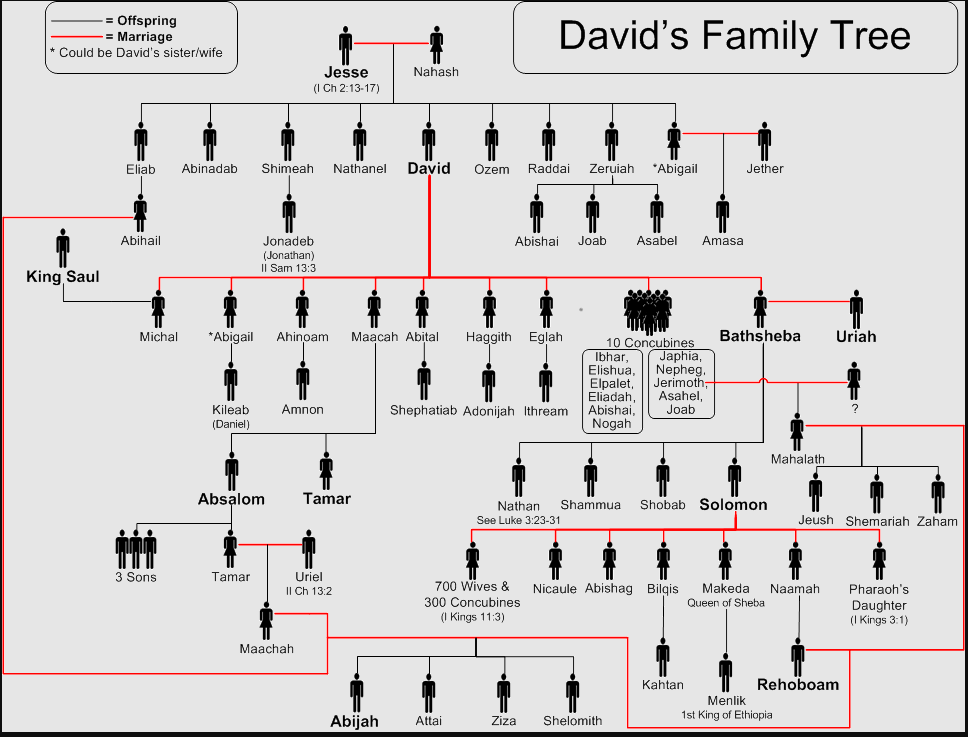
THE COUNTDOWN OF
JESSE'S SONS
and Jesse became the father of Eliab his firstborn, then Abinadab the second, Shimea the third, This verse introduces David’s older brothers before eventually focusing on David himself.
Eliab was Jesse’s oldest son. When Samuel first saw him, he assumed Eliab must be the LORD’s chosen king because of his impressive appearance saying “Surely the LORD’S anointed is before Him.” (1Sa 16:6) But God corrected Samuel declaring “Man looks at the outward appearance, but the LORD looks at the heart.” (1Sa 16:7) Eliab later appears in the account of David and Goliath, where he became angry at David for visiting the battlefield (1Sa 17:28).
Abinadab was the next older son who passed before Samuel when God was selecting Israel’s future king, but he too was not chosen (1 Samuel 16:8). He also fought in Saul’s army against the Philistines (1Sa 17:13).
Shimea is called Shammah in 1 Samuel 16:9, and sometimes Shimeah elsewhere. Clearly, variations in Hebrew names are common in Old Testament genealogies.
God’s choice often differs from human expectations. Jesse’s older, stronger sons seemed more likely candidates for kingship, yet God chose the youngest shepherd boy, David. God does not measure greatness the way man does. Human beings focus on appearance, status, and strength, but the LORD looks upon the heart (1 Samuel 16:7).
QUESTION: How many brothers did King David have? | GotQuestions.org
ANSWER: David, Israel’s second king, was the youngest son of Jesse from Bethlehem. In 1 Samuel 17:12–14, Scripture plainly states that Jesse had eight sons, of which David was the youngest. But in 1 Chronicles 2:12–16, the account of David’s family lists only seven sons of Jesse. So, did David have six or seven brothers?
The narrative of David’s anointing by the prophet Samuel supports the reasoning that Jesse had eight sons, and thus David had seven brothers: “Jesse had seven of his sons pass before Samuel, but Samuel said to him, ‘The LORD has not chosen these.’ So he asked Jesse, ‘Are these all the sons you have?’ ‘There is still the youngest,’ Jesse answered. ‘He is tending the sheep.’ Samuel said, ‘Send for him; we will not sit down until he arrives. So he sent for him and had him brought in. He was glowing with health and had a fine appearance and handsome features. Then the LORD said, ‘Rise and anoint him; this is the one.’ So Samuel took the horn of oil and anointed him in the presence of his brothers, and from that day on the Spirit of the LORD came powerfully upon David. Samuel then went to Ramah” (1 Samuel 16:10–13).
The Bible gives us the names of David’s brothers:
Eliab is David’s oldest brother (1 Samuel 16:6; 17:13, 28; 1 Chronicles 2:13). The second born is Abinadab (1 Samuel 16:8; 17:13; 1 Chronicles 2:13). David’s third oldest brother is Shimea (1 Samuel 16:9; 1 Chronicles 2:13). Shimea is alternately spelled Shammah (1 Samuel 17:13) and Shimeah (2 Samuel 13:3). The fourth brother is Nethanel, the fifth Raddai, and the sixth Ozem (1 Chronicles 2:14–15). The chronicler also names two sisters of David: Zeruiah and Abigail (1 Chronicles 2:16). Mysteriously, however, one brother is missing from this list of names, and David—again listed as the youngest here—is called “the seventh” (verse 15).
One possibility for the missing brother could be Elihu, who is identified in 1 Chronicles 27:18 as the chief officer over the tribe of Judah and “a brother of David.” But most scholars tend to believe the name Elihu is a variant of Eliab, who was David’s oldest brother. Elihu and Eliab are the same person.
Skeptics point to this discrepancy in the number of brothers David had as proof that the Bible has errors and contradictions, and therefore is not to be trusted as reliable. The argument neglects the reality that biblical genealogies often did not include every ancestor in a family line. For example, when a child died without leaving any children, he or she was usually omitted from the record.
The passage in 1 Samuel was written in the early days of David’s life, but the genealogy in 1 Chronicles was recorded much later. The chronicler’s primary concern was to preserve Israel’s family records for verifying tribal identity and inheritance rights. Therefore, most Bible scholars deduce that one of David’s seven brothers must have died at a young age without producing any heirs, and was therefore not accounted for in the later genealogical register.
So, David had seven brothers and at least two sisters. One of his brothers most likely died before having children.
1 Chronicles 2:14 Nethanel the fourth, Raddai the fifth,
Nethanel the fourth, Raddai the fifth,
The name Nethanel means “God has given” (Hebrew nathan = give + El = God). He is mentioned only in the genealogies and family listings of Jesse’s sons. Unlike Eliab, Abinadab, and Shimea, he does not appear in any major narrative events.
Raddai is another otherwise unknown son of Jesse. His name may carry the idea of “subduing” or “ruling,” though the exact meaning is uncertain. He is mentioned only here in the genealogical record.
1 Chronicles 2:15 Ozem the sixth, David the seventh;
- David: It appears from the parallel places of Samuel, that Jesse had eight sons, of whom David was the eighth and youngest; but one may have died before David came to the throne. 1Sa 16:10,11 17:12-14
Ozem the sixth, David the seventh;
Very little is known about Ozem. His name appears only in the genealogies of Jesse’s family (here and in 1 Samuel 16:10–11 indirectly through the count of Jesse’s sons). Like several of David’s brothers, he remains largely in the background of biblical history.
David is listed last because he was the youngest son of Jesse (1 Samuel 16:11). Yet though youngest in the family, he became the greatest king in Israel’s history and the central human figure in Chronicles. The Chronicler’s genealogy has been steadily narrowing toward David because God established the Davidic covenant with him (2 Samuel 7:12–16), the kings of Judah descended from his line, and ultimately the Messiah, Jesus Christ, would come through David’s lineage (Matthew 1:1; Romans 1:3). Scripture repeatedly emphasizes this surprising reversal of the youngest chosen over the older, the shepherd exalted as king, and the humble raised up by God.
The seventh - Seven in Scripture is often associated with completeness or divine purpose. However, 1 Samuel 17:12 mentions Jesse having eight sons. One son likely either died young or was omitted here for genealogical purposes, which was not uncommon in biblical records.
🙏 THOUGHT — David’s story reminds us that God often chooses the unlikely and overlooked. The LORD delights in exalting the humble and accomplishing His purposes through those whom the world least expects (1 Corinthians 1:26–29).
QUESTION: Who was David in the Bible? | GotQuestions.org
ANSWER: We can learn a lot from the life of David. He was a man after God’s own heart (1 Samuel 13:13–14; Acts 13:22)! We are first introduced to David after Saul, at the insistence of the people, was made king (1 Samuel 8:5, 10:1). Saul did not measure up as God’s king. While King Saul was making one mistake on top of another, God sent Samuel to find His chosen shepherd, David, the son of Jesse (1 Samuel 16:10, 13).
David is believed to have been twelve to sixteen years of age when he was anointed as the king of Israel. He was the youngest of Jesse’s sons and an unlikely choice for king, humanly speaking. Samuel thought Eliab, David’s oldest brother, was surely the anointed one. But God told Samuel, "Do not consider his appearance or his height, for I have rejected him. The LORD does not look at the things people look at. People look at the outward appearance, but the LORD looks at the heart" (1 Samuel 16:7). Seven of Jesse’s sons passed before Samuel, but God had chosen none of them. Samuel asked if Jesse had any more sons. The youngest, David, was out tending sheep. So they called the boy in and Samuel anointed David with oil "and from that day on the Spirit of the Lord came powerfully upon David" (1 Samuel 16:13).
The Bible also says that the Spirit of the Lord departed from King Saul and an evil spirit tormented him (1 Samuel 16:14). Saul’s servants suggested a harpist, and one recommended David, saying, "I have seen a son of Jesse of Bethlehem who knows how to play the lyre. He is a brave man and a warrior. He speaks well and is a fine-looking man. And the LORD is with him" (1 Samuel 16:18). Thus, David came into the king’s service (1 Samuel 16:21). Saul was pleased with young David, and he became one of Saul’s armor-bearers.
Saul’s pleasure in David vanished quickly as David rose in strength and fame. In perhaps one of the best known biblical accounts, David slew the giant Goliath. The Philistines were at war with the Israelites and taunted Israel’s military forces with their champion, Goliath from Gath. They proposed a dual between Goliath and whoever would fight him. But no one in Israel volunteered to battle the giant. David’s older brothers were part of Saul’s army; after Goliath had been taunting the Israelites for forty days, David visited his brothers at the battlefield and heard the Philistine’s boasts. The young shepherd asked, "What will be done for the man who kills this Philistine and removes this disgrace from Israel? Who is this uncircumcised Philistine that he should defy the armies of the living God?" (1 Samuel 17:26). David’s oldest brother became angry and accused David of pride and coming only to watch the battle. But David continued to talk about the issue.
Saul heard what David was saying and sent for him. David told Saul, "Let no one lose heart on account of this Philistine; your servant will go and fight him" (1 Samuel 17:32). Saul was incredulous; David was not a trained soldier. David provided his credentials as a shepherd, being careful to give the glory to God. David had killed lions and bears that went after his sheep, and he claimed the Philistine would die like them because he had "defied the armies of the living God. The LORD who rescued me from the paw of the lion and the paw of the bear will rescue me from the hand of this Philistine" (1 Samuel 17:36–37). Saul acquiesced, provided that David wear Saul’s armor into the fight. But David was not used to the armor and left it behind. David took with him only his staff, five smooth stones, his shepherd’s bag, and a sling. Goliath was not intimidated by David, but neither was David intimidated by the giant. "David said to the Philistine, 'You come against me with sword and spear and javelin, but I come against you in the name of the LORD Almighty, the God of the armies of Israel, whom you have defied. This day the LORD will deliver you into my hands" (1 Samuel 17:45–46). David’s trust in God and his zeal for God’s glory are remarkable. David did kill Goliath. He also entered into Saul’s service full-time, no longer tending his father’s sheep.
It was at this time that Saul’s son, Jonathan, "became one in spirit with David" (1 Samuel 18:1). David and Jonathan’s friendship is instructive to friendships today. Though his father was king and Jonathan would have been a natural heir to the throne, Jonathan chose to support David. He understood and accepted God’s plan and protected his friend from his murderous father (1 Samuel 18:1–4, 19—20). Jonathan demonstrates humility and selfless love (1 Samuel 18:3; 20:17). During David’s reign, after Saul’s and Jonathan’s deaths, David sought out anyone who remained of the house of Saul to whom he could show kindness for Jonathan’s sake (2 Samuel 9:1). Clearly, both men greatly cared for one another and honored one another.
After the incident with Goliath, David continued to grow in fame. The chant in the camp of Saul was taunting as the people sang out the praises of David and demeaned King Saul, causing a raging jealousy in Saul that never subsided (1 Samuel 18:7–8).
Saul’s jealousy of David turned murderous. He first tried to have David killed by the hand of the Philistines by asking David to become his son-in-law. The king offered his daughter in return for David’s military service. David, in humility, refused, and Saul’s daughter was given to another (1 Samuel 18:17–19). Saul’s other daughter, Michal, was in love with David, so Saul asked again. David again refused due to his lack of wealth and inability to afford the bride price for the daughter of a king. Saul asked for a hundred Philistine foreskins, hoping David would be slaughtered by the enemy. When David killed two hundred Philistines, doubling the required payment, Saul realized he was outmatched, and his fear of David increased (1 Samuel 18:17–29). Jonathan and Michal warned David of their father’s murderous intent, and David spent the next years of his life fleeing from the king. David wrote several songs during this time, including Psalms 57, 59, and 142.
Although Saul never stopped pursuing him with the intent to kill him, David never raised a hand against his king and God’s anointed (1 Samuel 19:1–2; 24:5–7). When Saul eventually died, David mourned (2 Samuel 1). Even knowing that he was God’s anointed, David did not force his way to the throne. He respected God’s sovereignty and honored the authorities God had currently in place, trusting that God would fulfill His will in His timing.
While on the run, David raised up a mighty army and with power from God defeated everyone in his path, always asking God first for permission and instructions before going into battle, a practice he would continue as king (1 Samuel 23:2–6; 9–13; 2 Samuel 5:22-23). Once king, David remained a powerful military commander and soldier. Second Samuel 23 recounts some of the exploits of David’s so-called "mighty men." God honored and rewarded David’s obedience and gave him success in everything he did (2 Samuel 8:6).
David began to take other wives. He married Abigail, a widow of Carmel, during the time he was fleeing from Saul (1 Samuel 25). David had also married Ahinoam of Jezreel. Saul had given David’s first wife, Michal, to another man (1 Samuel 25:43–44). After Saul’s death David was publicly anointed king over the house of Judah (2 Samuel 2:4), and he then had to fight against the house of Saul before being anointed king over all of Israel at the age of thirty (2 Samuel 5:3–4). Now king, David took Michal back to be his wife again (2 Samuel 3:14). David also conquered Jerusalem, taking it from the Jebusites, and became more and more powerful because the Lord Almighty was with him (2 Samuel 5:7).
The Ark of the Covenant had been previously captured by the Philistines (1 Samuel 4). Upon its return to Israel, the ark was housed at Kiriath Jearim (1 Samuel 7:1). David wanted to bring the ark back to Jerusalem. But David omitted some of God’s instructions on how to transport the ark and who was to carry it. This resulted in the death of Uzzah who, amid all the celebrations, reached out to steady the ark with his hand. God struck Uzzah down, and he died there beside the ark (2 Samuel 6:1–7). In fear of the Lord, David abandoned the moving of the ark and let it rest in the house of Obed-Edom (2 Samuel 6:11).
Three months later, David resumed the plan to bring the ark to Jerusalem. This time, he followed instructions. He also "dance[ed] before the LORD with all his might" (2 Samuel 6:14). When Michal saw David worshiping in that way, "she despised him in her heart" (2 Samuel 6:16). She asked David how he, as king, could have acted so undistinguished in front of his people. "David said to Michal, 'It was before the LORD, who chose me rather than your father or anyone from his house when he appointed me ruler over the LORD’s people Israel—I will celebrate before the LORD. I will become even more undignified than this, and I will be humiliated in my own eyes" (2 Samuel 6:21–22). David understood that true worship is intended for God alone. We do not worship for the benefit of the perceptions of others but in humble response to God (John 4:24).
After David was settled in his palace and had peace with his enemies, he wanted to build a temple for the Lord (2 Samuel 7:1–2). The prophet Nathan first told David to do as he wanted. But then God told Nathan that David would not be the one to build His temple. Instead, God promised to build a house for David. This promise included a prediction that Solomon would build the temple. But it also spoke of the coming Messiah, the Son of David who would reign forever (2 Samuel 7:4–17). David responded in humility and awe: "Who am I, Sovereign Lord, and what is my family, that you have brought me this far?" (2 Samuel 7:18; see 2 Samuel 7:18–29 for David’s entire prayer). Before he died, David made preparations for the temple. God’s reason for not allowing David to build the temple was that he had shed so much blood, but David’s son would be a man of peace and not a man of war. Solomon would build the temple (1 Chronicles 22).
Much of David’s shedding of blood had been a result of war. But, in a sordid incident, David also had one of his mighty men killed. Though David was a man after God’s own heart, he was also human and sinful. While his armies were at war one spring, David remained home. From his rooftop he saw a beautiful woman bathing. He found out that she was Bathsheba, the wife of Uriah the Hittite, one of his mighty men who was at war, and David sent messengers for her. David slept with Bathsheba, and she became pregnant. David called Uriah back from battle, hoping he would sleep with his wife and believe the child to be his, but Uriah refused to go home while his comrades were at war. So David arranged for Uriah to be killed in battle. David then married Bathsheba (2 Samuel 11). This incident in David’s life shows us that everyone, even those we highly esteem, struggle with sin. It also serves as a cautionary tale about temptation and the way sin can so quickly multiply.
The prophet Nathan confronted David about his sin with Bathsheba. David responded in repentance. He wrote Psalm 51 at this time. Here we see David’s humility and his true heart for the Lord. Though Nathan told David that his son would die as a result of his sin, David pleaded with the Lord for his son’s life. David’s relationship with God was such that he was willing to persist in faith and to hope that God might relent. When God enacted His judgment, David accepted it completely (2 Samuel 12). In this story we also see God’s grace and sovereignty. Solomon, David’s son who succeeded him and through whom Jesus descended, was born of David and Bathsheba.
God had also told David, through Nathan, that the sword would not depart from his house. Indeed, David’s household had much trouble from that time on. We see this among David’s children when Amnon raped Tamar, leading to Absalom’s murder of Amnon, and Absalom’s conspiracy against David. Nathan had also told David that his wives would be given to one who was close to him; this would not occur in secret as had David’s sin with Bathsheba, but in public. The prophecy was fulfilled when Absalom slept with his father’s concubines on the roof for all to see (2 Samuel 16).
David is the author of many of the psalms. In them we see the way he sought after and glorified God. He is often thought of as a shepherd king and a warrior poet. Scripture calls him “the sweet psalmist of Israel” (2 Samuel 23:1). David’s life seemed filled with the range of human emotions—a common shepherd boy with great confidence in God’s faithfulness who honored authorities, fled for his life, and became the king against whom all future kings of Israel would be measured. He saw many military victories. He also fell into grave sin, and his family suffered as a result. But through it all David turned to God and trusted Him. Even in the Psalms when David is downcast or despondent, we see him lift his eyes up to his Maker and give Him praise. This reliance on God and continual pursuit of relationship with God is part of what makes David a man after God’s own heart.
God promised David a descendant to rule on the throne forever. That everlasting king is Jesus, the Messiah and Son of David.
Related (from Gotquestions.org):
- Does the Bible mention David’s mother?
- How old was David when he was anointed, fought Goliath, became king, died?
- Who are the sons of David mentioned in the Bible?
- What should we learn from the account of David and Goliath?
- Why was God so angry at David for taking the census?
1 Chronicles 2:16 and their sisters were Zeruiah and Abigail. And the three sons of Zeruiah were Abshai, Joab and Asahel.
- sons of: 1Sa 26:6 2Sa 2:18-23 3:39 16:9-11 19:22
and their sisters were Zeruiah and Abigail. And the three sons of Zeruiah were Abshai, Joab and Asahel.
Zeruiah and Abigail were David’s sisters, making their sons David’s nephews. Zeruiah became the mother of three famous warriors Abishai, Joab and Asahel. Abigail became the mother of Amasa. These family connections are important because many of David’s leading commanders came from within his extended family.
Abshai was one of David’s greatest military supporters and one of “the mighty men” (2Sa 23:18–19). He demonstrated fierce loyalty to David accompanying David into Saul’s camp (1Sa 26:6–9), fighting courageously in battle, and helping defend David during Absalom’s rebellion. Yet Abishai could also be impulsive and harsh, often wanting to destroy David’s enemies immediately.
Joab became commander of David’s army and one of the most complex figures in Scripture. He was brilliant militarily, fiercely loyal to David at times, but also ruthless, politically calculating, and often disobedient. Joab killed Abner (2 Samuel 3:27), killed Absalom against David’s wishes (2 Samuel 18:14), and later supported Adonijah’s attempt to seize the throne (1 Kings 1:7). Though highly effective, Joab frequently acted according to human wisdom rather than submission to God’s king.
Asahel was known for extraordinary speed “Asahel was as swift footed as one of the gazelles which is in the field.” (2 Samuel 2:18) He pursued Abner during battle and was killed by him after refusing to turn aside (2 Samuel 2:18–23). His death contributed to the long conflict between the house of Saul and the house of David. This verse begins to show how David’s kingdom was deeply intertwined with family relationships, loyalty, ambition, conflict, and human weakness.
Henry Morris - Another of David's sisters, Abigail, was the mother of Amasa, who became Absalom's general when he rebelled against David (2 Samuel 17:25). However, Abigail was only a half-sister to David. Amasa's father, Jether, is called both an Israelite and an Ishmaelite, indicating either that he was of mixed parentage or that he was an Ishmaelite proselyte to Israel's faith. Three of David's most conspicuous generals were his own nephews. Abishai, Joab and Asahel were all sons of his sister Zeruiah (2 Samuel 2:18).
Believer's Study Bible - Women played a conspicuous role in the history of Israel. Here, David's sister Zeruiah is identified as the mother of his famous military leaders Abishai, Joab, and Asahel (cf. 2 Sam. 2:18), and Abigail is shown to be the mother of Absalom's captain Amasa (2 Sam. 17:25), who was slain by his rival Joab (2 Sam. 20:4-13; cf. 1 Kin. 2:5, 6, 28-34).
🙏 THOUGHT — Even within David’s own family circle were courage, loyalty, pride, violence, and tragedy. Scripture honestly portrays both the strengths and failures of God’s servants, reminding us that the true perfect King would ultimately be Christ alone.
QUESTION: Who was Abigail in the Bible? | GotQuestions.org
ANSWER: Abigail was one of David’s wives. Her story is found in 1 Samuel 25. At the beginning of the story, Abigail is the wife of a wealthy man named Nabal who lived in a town called Maon in the wilderness of Paran, an area near the Sinai Peninsula. Abigail was “an intelligent and beautiful woman” (1 Samuel 25:3) who saved her husband and his household, prevented David from doing something rash, and secured an unexpected future for herself.
The story of Abigail in the Bible is an interesting one for many reasons. For one, Nabal is a rather bizarre character. For no apparent reason, Nabal refuses David’s request for food and shelter. Despite knowing of David’s previous benevolence to his shepherds, Nabal churlishly refuses to aid David and his men as they tried to keep one step ahead of King Saul. David’s request was not unreasonable, but Nabal, who is described as “surly and mean” (1 Samuel 25:3), essentially spits in the faces of David’s servants, saying, “Who is this David? Who is this son of Jesse? Many servants are breaking away from their masters these days. Why should I take my bread and water, and the meat I have slaughtered for my shearers, and give it to men coming from who knows where?” (verses 10–11).
David did not take this rejection well. He swore to kill every male associated with Nabal’s household (1 Samuel 25:22). He had strapped on his sword and was on his way with four hundred armed men (verse 13), when Abigail met him on the road. She offered David gifts of wine, grain, prepared meat, and cakes of figs. Then she fell down in front of David, pleading with him to show mercy to her husband, Nabal (verse 23). In her plea, Abigail shows that she understands Nabal’s character: “Please pay no attention, my lord, to that wicked man Nabal. He is just like his name—his name means Fool, and folly goes with him” (verse 25).
In taking up Nabal’s cause and asking David to spare his life, Abigail proves herself to be a righteous, caring woman. At great risk to herself, she approaches David, an angry man bent on revenge, and intercedes for her husband, despite his bad behavior. Her request can be seen as a picture of Christ, who offered Himself as a sacrifice to save foolish sinners from the consequences of their own actions and who continues to intercede for us (Hebrews 7:25).
Abigail’s propitiation saves the day. David thanks Abigail for staying his hand and repents of his own foolish and rash decision to slaughter Nabal’s household (1 Samuel 25:32–34). In fact, David sees Abigail’s coming to him as a blessing from God, and he sends her home in peace (verse 35).
Meanwhile, Nabal, insensitive to his wrongdoing and the danger that he had been in, holds a kingly feast for himself and gets drunk (1 Samuel 25:36). Abigail waits until the next morning for her husband to sober up, and then she tells Nabal everything—how David had been on his way to destroy him and how she herself had saved Nabal. Upon hearing this news, Nabal falls ill: “His heart failed him and he became like a stone. About ten days later, the LORD struck Nabal and he died” (verses 37–38). David then sends a message to Abigail asking her to become his wife, and Abigail responds affirmatively (verses 40–42).
Scripture says that we should not seek vengeance for ourselves. Rather, we should “leave room for God’s wrath, for it is written: ‘It is mine to avenge; I will repay,’ says the Lord” (Romans 12:19; cf. Deuteronomy 32:35). This is exactly what happened in Abigail’s story. David was prevented from taking revenge, and the Lord Himself took care of the matter in due time.
David and Nabal can be seen as representative of the two responses men have to Christ. Nabal does not repent or acknowledge his sin; neither does he thank Abigail for her willingness to risk her own life on his behalf. On the other hand, David’s heart is tender and repentant, and he calls Abigail blessed for her actions. David is spared the consequences of the sin he had planned, but Nabal dies in his sin.
In the end, Nabal’s wealth, his wife, and his very life are taken from him. Abigail—a savior full of beauty, wisdom, and discretion—enters a loving relationship with David. In Abigail, we have a small picture of the ultimate Savior, the Source of beauty and wisdom, who desires a loving relationship with us forever.
QUESTION: Who was Joab in the Bible? | GotQuestions.org
ANSWER: Joab was a son of Zeruiah, King David’s sister (1 Chronicles 2:13–17) and was therefore one of David’s nephews. Joab’s brothers were two of David’s brave warriors, Abishai and Asahel. Joab was positioned as commander of David’s armies because of his victory over the Jebusites, resulting in the possession of the city of Jerusalem. It was through this victory that Jerusalem became “the city of David” (1 Chronicles 11:4–9).
Joab fought and won many battles for the king, but his personal lack of self-control was problematic. In a war against the forces of Ish-Bosheth, Joab’s brother Asahel was killed by Abner, the commander of Ish-Bosheth’s armies. Joab was furious and pursued Abner to kill him, but Abner escaped (2 Samuel 3:12–32). Later, after Abner swore allegiance to David, Joab’s fuse blew, and his desire to avenge his brother’s blood drove him to deceive and murder Abner (2 Samuel 3:26–27). This action deeply grieved David, but the king felt unable to bring justice against the mighty Joab (2 Samuel 3:39). Instead, David pronounced a curse over Joab and his future descendants: “May his blood fall on the head of Joab and on his whole family! May Joab’s family never be without someone who has a running sore or leprosy or who leans on a crutch or who falls by the sword or who lacks food” (2 Samuel 3:29).
As the commander of David’s armies, Joab was provided many victories by God, but Joab caused much grief to the king and to Israel. His anger and perhaps the power of his position drove him to poor decisions at times. In addition to his murder of Abner, Joab killed his own cousin, Amasa—and his betrayal was Judas-style, accompanied by a kiss: “Joab said to Amasa, ‘How are you, my brother?’ Then Joab took Amasa by the beard with his right hand to kiss him. Amasa was not on his guard against the dagger in Joab’s hand, and Joab plunged it into his belly, and his intestines spilled out on the ground. Without being stabbed again, Amasa died” (2 Samuel 20:9–10). Joab disobeyed King David’s command to spare Absalom’s life, himself striking Absalom with three javelins (2 Samuel 18). David mourned the death of his son Absalom, a response that was sternly reprimanded by Joab (2 Samuel 19:1–8). It was also Joab who, in accordance with David’s command, placed Uriah the Hittite at the front of the battle to be killed, so that David could feel justified in marrying Uriah’s widow (2 Samuel 11).
Joab, for all his faults, was obviously a capable man of war and valiant on the battlefield. And he ought to be given credit for his loyalty to David for almost four decades. Joab also counseled David when David sinfully desired to take a census; if David had heeded Joab’s advice, he could have spared his nation the plague that befell Israel (2 Samuel 24).
When David was on his death bed, Joab conspired with Adonijah to install Adonijah as the next king, instead of Solomon (1 Kings 1). This action, plus Joab’s other rash decisions, vengeful murders, and inability to take certain important orders, finally drove David over the edge. David commanded Solomon to ensure Joab’s execution, an act that was carried out by Benaniah as Joab was clinging to the horns of the altar in hopes of finding clemency (1 Kings 2:5–6, 28–34).
1 Chronicles 2:17 Abigail bore Amasa, and the father of Amasa was Jether the Ishmaelite.
- Amasa: 2Sa 17:25 19:13 20:4-12 1Ki 2:5,32
- Jether: Jether, [Yether] is essentially the same with [Yithra,] Ithra, the latter only having the addition of an ['Aleph] {aleph;} and it is probable, that he was an Ishmaelite by birth but an Israelite by religion. 2Sa 17:25, Ithra an Israelite
- Ishmeelite: a descendant of Ishmael
Abigail bore Amasa, and the father of Amasa was Jether the Ishmaelite.
Note that this Abigail was David’s sister, not Abigail the wife of Nabal whom David later married (1 Samuel 25). Amasa was therefore David’s nephew and cousin to Joab, Abishai, and Asahel. He later became commander of Absalom’s army during Absalom’s rebellion against David “Absalom set Amasa over the army in place of Joab.” (2 Samuel 17:25)
After Absalom’s defeat, David attempted reconciliation by appointing Amasa commander over his own army in place of Joab (2 Samuel 19:13). However, Joab, jealous and politically ruthless, later murdered Amasa “Joab took Amasa by the beard with his right hand to kiss him... and struck him in the belly.” (2 Samuel 20:9–10) This tragic event again reveals the violence and power struggles surrounding David’s kingdom. This undoubtedly is partial fulfillment of the prophet Nathan's declaration to David upon disclosure of his sin with Bathsheba and role in her husband Uriah's murder:
'Now therefore, the sword shall never depart from your house, because you have despised Me and have taken the wife of Uriah the Hittite to be your wife.' (2Sa 12:10)
Amasa’s father was “Jether the Ishmaelite” which is noteworthy because Ishmaelites descended from Ishmael, Abraham’s son through Hagar (Ge 16; 25:12–18). Thus Amasa had mixed Israelite and Ishmaelite ancestry. In 2 Samuel 17:25 the name appears as “Ithra the Israelite,” leading to discussion among scholars. Some believe “Ishmaelite” is the correct reading, while others think “Israelite” may reflect later textual variation. Either way, the Chronicler’s wording emphasizes the diverse and sometimes unexpected backgrounds found within Israel’s history.
🙏 THOUGHT — The family of David included both faithful servants and deeply flawed men. Yet through all the turmoil of human weakness, ambition, and conflict, God continued sovereignly and providentially preserving His covenant purposes and the royal line leading to Christ.
QUESTION: Who was Amasa in the Bible? | GotQuestions.org
ANSWER: Amasa was a nephew of King David who was involved in the coup attempt against David. Appointed by Absalom, David’s son whose ambitions included his father’s crown, Amasa led the rebel army that sought to overthrow King David. Amasa’s mother was Abigail, one of David’s sisters, and he was a cousin of Joab, whose mother was also a sister of David (2 Samuel 17:25; 1 Chronicles 2:16–17). Joab served as one of King David’s military commanders, and it was he who eventually killed Amasa—not in battle, but by an act of treachery (2 Samuel 20:8–10).
Amasa’s story is intricately intertwined with that of Absalom. Absalom was the third son of King David; in many ways, Absalom was much like his father—hot-blooded, impetuous, and popular among his countrymen. David was a man after God’s own heart, but, as a parent, David had failings. His household could only be described as dysfunctional. One of David’s sons, Amnon, raped his half-sister Tamar (2 Samuel 13:1–19). Despite the outrage of this incestuous crime, David did nothing. Perhaps David’s refusal to discipline Amnon fueled the pent-up anger inside Absalom. For two years, Absalom patiently bided his time as if all was well with Amnon, but then, in a carefully planned scheme, Absalom had Amnon murdered (2 Samuel 13:23–29). No doubt, Absalom felt justified in killing his half-brother, as his father had done nothing to avenge Tamar. From that time forward, David’s relationship with Absalom was strained.
Over time, Absalom grew restless with ambition. He began plotting his father’s overthrow. When Absalom’s plan to take the throne was in place, he appointed Amasa captain over his rebel army (2 Samuel 17:25). For a while, it appeared as though Absalom’s scheme would succeed, but, in the end, Amasa’s forces were defeated. Absalom was killed by Joab, much to the distress of King David, who had wanted to spare Absalom’s life. David returned to Jerusalem, and his rule over Israel was solidified.
Displeased with Joab for slaying his son Absalom, King David planned to remove him from leadership and replace him with Amasa, whom he was willing to forgive. David sent the message to Amasa: “Are you not my own flesh and blood? May God deal with me, be it ever so severely, if you are not the commander of my army for life in place of Joab” (2 Samuel 19:13). During a subsequent military campaign, however, Joab murdered Amasa in cold blood:
While [Joab and his men] were at the great rock in Gibeon, Amasa came to meet them. Joab was wearing his military tunic, and strapped over it at his waist was a belt with a dagger in its sheath. As he stepped forward, it dropped out of its sheath.
Joab said to Amasa, “How are you, my brother?” Then Joab took Amasa by the beard with his right hand to kiss him. Amasa was not on his guard against the dagger in Joab’s hand, and Joab plunged it into his belly, and his intestines spilled out on the ground. Without being stabbed again, Amasa died (2 Samuel 20:8–10a).
Amasa must have been a man of capabilities, for he garnered the attention of both David and his favored son, Absalom. Unfortunately, Amasa may have lacked a measure of discernment. He foolishly joined the rebellion against his uncle. And he fatally trusted Joab as a comrade, although Joab was a man with a reputation for bloody revenge. An extra dose of discernment might have prevented Amasa from falling prey to his adversary.
1 Chronicles 2:18 Now Caleb the son of Hezron had sons by Azubah his wife, and by Jerioth; and these were her sons: Jesher, Shobab, and Ardon.
- Caleb: Caleb, [Kaleb,] is the same as Chelubai, [Keluwbay]; the latter simply having a [Vav,] {wav} inserted, and a [Yode,] {yood} affixed. This person must have lived some time before Israel left Egypt; for Bezaleel, the principal person employed in constructing the tabernacle, was his grandson. 1Ch 2:9, Chelubai, 1Ch 2:42
Now Caleb the son of Hezron had sons by Azubah his wife, and by Jerioth; and these were her sons: Jesher, Shobab, and Ardon.
Martin Selman says "the otherwise unknown Caleb son of Hezron is probably distinct from Caleb, a Kenizzite and son of Jephunneh, who is frequently said to have ‘followed the Lord wholeheartedly’ (e.g. Numbers 14:24; 32:12; Joshua 14:6, 13-14).” (2 Chronicles: An Introduction and Commentary)
Iain Duguid: “Caleb the son of Hezron” (“Chelubai,” v. 9, is a variant form) is to be distinguished from the Caleb of the conquest stories, also a Judahite (“son of Jephunneh”; 4:15; 6:56; Num. 13:64). His line ends here with “Bezalel,” who had a key role in the construction of the tabernacle and was “filled . . . with the Spirit of God” (Ex. 31:1–5; 35:30–36:2). (ESV Expository Commentary)
Payne has a helpful note - The remainder of chapter 2 (2Ch 2:28-55) tabulates the descendants of the other sons of Hezron, through lists that have not been preserved elsewhere in Scripture. Some of the names that follow designate whole communities that sprang from his line; e.g., Tekoa (v.24), Beth Zur (v.45), Kiriath Jearim, Bethlehem, or Beth Gader (vv.50-54). Hezron's son Caleb is not to be confused with Moses' spy of the same name (4:15), who appeared three hundred years later. (See The Expositor's Bible Commentary - Abridged Edition - Page 50)
August Konkel: The Chronicler returns to the descendants of Hezron to show the integration of different families in the region of Bethlehem, the home of Jesse, the father of David (1Ch 2:18; cf. v. 9). These include the descendants of Caleb in the regions of Ephrath and Hebron to the south (vv. 19, 42). The introduction of Hur brings in another tribal relationship (v. 20). Hur is the grandfather of Bezalel, the chosen craftsman in the building of the tabernacle (Exod 31:2; 35:30). In the time of the exodus, Hur is the fourth generation from Judah. This is consistent with the genealogies found in the books of Exodus through Joshua, all of which are three to six generations from Jacob’s sons (Rendsburg: 186–89). The relationship of Judah to the sons of Aaron is found in his marriage to Elisheba, daughter of Amminadab (Exod 6:23). Amminadab is a leader of the tribe of Judah (1 Chron 2:10; cf. Ruth 4:19–20). (See 1 & 2 Chronicles)
NET NOTE - Heb "and Caleb son of Hezron fathered [children] with Azubah, a wife, and with Jerioth." Jerioth could be viewed as a second wife (so NLT; cf. also NASB, NIV, NRSV), but the following context mentions only "her [presumably Azubah's] sons." Another option, the one chosen in the translation ("Caleb son of Hezron fathered sons by his wife Azubah (also known as Jerioth). Her sons were Jesher, Shobab, and Ardon."), is that Jerioth is another name for Azubah.
Jesher, Shobab, and Ardon Very little is known about these sons beyond their inclusion in the genealogy. As throughout Chronicles, the Chronicler preserves these names to establish Judah’s tribal and clan structure after the exile.
QUESTION: What is the significance of Hezron in the Bible? | GotQuestions.org
ANSWER: The name Hezron means “enclosure.” In the Bible, Hezron refers to both a town and more than one individual. Joshua 15:25 lists a walled town named Kerioth-Hezron, also called Hazor, which translates as “castle.” Several individuals also bear the name Hezron.
The Genesis account introduces us to Hezron, the son of Reuben (Genesis 46:9), who followed Jacob from Canaan to Egypt. This Hezron is also mentioned in Exodus 6:14, and his clan is appears in Numbers 26:6 under the tribe of Reuben in the census of the Israelites.
Another Hezron is one of the sons of Perez. This would make him a grandson of Judah and a relative of Reuben’s Hezron. He is first mentioned in a list of family members in Genesis 46:12, “The sons of Judah: Er, Onan, Shelah, Perez and Zerah (but Er and Onan had died in the land of Canaan). The sons of Perez: Hezron and Hamul.”
Hezron’s lineage under Judah is further highlighted in the Israelites’ census: “The descendants of Perez were: through Hezron, the Hezronite clan; through Hamul, the Hamulite clan” (Numbers 26:21). Thus, both Hezrons were a significant part of Israel’s early growth as a people group.
Hezron son of Reuben was instrumental in furthering the tribe of Reuben. But it is Hezron son of Judah who takes the spotlight due to his place in the messianic genealogy. We read of him in Matthew’s account:
Judah the father of Perez and Zerah, whose mother was Tamar,
Perez the father of Hezron,
Hezron the father of Ram,
Ram the father of Amminadab. (Matthew 1:3–4a)
From there, the line leads to King David (Matthew 1:6).
We also read of Hezron in Luke’s account:
The son of Amminadab, the son of Ram,
the son of Hezron, the son of Perez,
the son of Judah. (Luke 3:33)
So, in both Joseph’s genealogy (in Matthew) and Mary’s genealogy (in Luke), Hezron shows up. He is an ancestor of Jesus the Messiah through his son Ram (cf. 1 Chronicles 2:9).
As one of the links in the chain from Abraham to Jesus, Hezron represents the long-term faithfulness of God. God’s plan may seem to move forward slowly, but it is sure to come to pass. Even seemingly random details can serve as puzzle pieces in God’s overall strategy. The redemption arc from Abraham to Jesus included numerous individuals whom God worked through, including Hezron. The genealogies in Matthew and Luke affirm God’s purposeful work in human history and the fulfillment of the messianic promise.
1 Chronicles 2:19 When Azubah died, Caleb married Ephrath, who bore him Hur.
- Ephrath: 1Ch 2:24,50 1Ch 4:4 Mic 5:2,
When Azubah died, Caleb married Ephrath, who bore him Hur. The death of Azubah marks a transition in Caleb’s family line. Scripture mentions it briefly and moves forward genealogically, emphasizing the continuation of the family through another marriage. Caleb then married Ephrath (or Ephrathah). The name is closely associated with the Bethlehem region: Bethlehem was sometimes called Ephrath or Ephrathah (Ge 35:19). This genealogy is gradually moving toward Bethlehem, the hometown of David, and ultimately Jesus Christ. Micah later prophesied: “But as for you, Bethlehem Ephrathah... from you One will go forth for Me to be ruler in Israel.” (Micah 5:2)
Hur became an important figure in Judah’s lineage because Hur was later associated with Bethlehem (1 Chronicles 2:50–51), and his descendants became influential in Judah. Some also connect this Hur with the Hur who assisted Moses during the battle against Amalek “Aaron and Hur supported his hands...” (Exodus 17:12) though it is doubtful they are the same person.
1 Chronicles 2:20 Hur became the father of Uri, and Uri became the father of Bezalel.
- Bezalel (KJV): Ex 31:2 36:1,2 37:1 38:22 2Ch 1:5
Hur became the father of Uri, and Uri became the father of Bezalel.
This verse introduces one of the most gifted craftsmen in the Old Testament: Bezalel, the man specially chosen by God to oversee construction of the tabernacle. Bezalel is the key figure in this verse. God personally chose and empowered him for the work of constructing the tabernacle:
“See, I have called by name Bezalel... and I have filled him with the Spirit of God in wisdom, in understanding, in knowledge, and in all kinds of craftsmanship.” (Exodus 31:2–3)
Bezalel supervised the making of the ark of the covenant, the mercy seat, the golden lampstand, priestly furnishings, and many other sacred items used in worship.
One remarkable truth about Bezalel is that he was filled with the Spirit not for preaching or warfare, but for craftsmanship and artistic skill. His work demonstrates that creativity, excellence, beauty, and skilled labor can all be acts of worship when devoted to God.
🙏 THOUGHT — God not only calls preachers and kings; He also calls craftsmen, artists, builders, and workers. Skills and abilities become sacred when surrendered for God’s glory. Dear believer, whether you are a waiter/waitress or a CEO "Whatever you do, do your work heartily, as for the Lord rather than for men, knowing that from the Lord you will receive the reward of the inheritance. It is the Lord Christ whom you serve." (Col 3:24,25)
QUESTION: Who were Bezalel and Oholiab in the Bible? | GotQuestions.org
ANSWER: Bezalel and Oholiab were two men God chose to aid in the construction of the tabernacle, the holy tent where God dwelled in the midst of His people.
During the Israelites’ journey from Egypt to the Promised Land, God called Moses to Mount Sinai, where He gave His Law to the people (Exodus 19–24). In the course of His conversation with Moses, God instructed Moses to gather the people and build the tabernacle (chapters 25–31). As these events took place over 1,500 years before the permanent indwelling of the Holy Spirit, God’s Spirit would reside in this tabernacle. God gave specific instructions for the building of the tabernacle, including plans for the tent itself, the courtyard, the consecration of the priests, the priests’ garments, and even the furniture. The rich materials to be used in the construction were to be donated as an offering from the people (Exodus 25:1–7; 30:11–16). In the end, the people were generous and brought even more than was needed (Exodus 36:3–7).
Many craftsmen would be needed for this work, and in Exodus 31:2–6 God tells Moses that He had given many men the skills they would need to bring His plans for the tabernacle to fruition. Two of these men God mentions by name: Bezalel from the tribe of Judah and Oholiab from the tribe of Dan. Bezalel in particular was filled with God’s Spirit (verses 31:2–3), a rare occurrence in Old Testament times. God’s Spirit empowered Bezalel and Oholiab with talent and intelligence, giving them the ability to work in every kind of crafting, including woodwork, stonework, metalwork, engraving, embroidery, and weaving. The Spirit’s empowering gave Bezalel and Oholiab skill to work with the raw materials and to form the artistic designs (Exodus 31:4–5; 35:30–32, 35). Bezalel himself constructed the Ark of the Covenant (Exodus 37:1).
In addition, God inspired both Bezalel and Oholiab to teach all the other craftsmen who had been given special skill by God. Together, led and aided by Bezalel and Oholiab, the craftsmen were able to complete the tabernacle according to God’s specifications (Exodus 36:8–39:43).
The story of Bezalel and Oholiab shows us that God cares about aesthetics; He is a God of beauty and design. Fine craftsmanship and skill in various artistic endeavors is a gift from God. Bezalel and Oholiab should encourage Christian artists today to create works of art for the glory of God.
1 Chronicles 2:21 Afterward Hezron went in to the daughter of Machir the father of Gilead, whom he married when he was sixty years old; and she bore him Segub.
- Machir: Ge 50:23 Nu 26:29 27:1 32:39,40 De 3:15
This verse records a later marriage in the life of Hezron and introduces a connection between the tribes of Judah and Manasseh.
Afterward Hezron went in to the daughter of Machir the father of Gilead, whom he married when he was sixty years old; and she bore him Segub
Hezron was a grandson of Judah through Perez and became one of the major ancestral heads within Judah’s genealogy.
Machir was the firstborn son of Manasseh (Genesis 50:23), and the ancestor of the region later called Gilead. Thus this marriage joined the tribe of Judah (through Hezron), with the tribe of Manasseh (through Machir’s daughter).
The father of Gilead likely means founder or chief ancestor of the Gileadite clan, not necessarily the literal founder of the geographic territory alone. Gilead later became the important Transjordan region east of the Jordan River.
1 Chronicles 2:22 Segub became the father of Jair, who had twenty-three cities in the land of Gilead.
- Jair: Nu 32:41 De 3:14 Jos 13:30
Segub became the father of Jair, who had twenty-three cities in the land of Gilead.
Jair was an influential leader connected with the region of Gilead east of the Jordan River and was descended from Judah through Hezron, but through his grandmother was also connected to Machir and Manasseh. Because of this mixed tribal connection, Jair came to possess territory in the region associated with Manasseh. Jair controlled a network of settlements or towns in Gilead which became known elsewhere as: the towns of Jair(Havvoth Jair) (cf Nu 32:41, Dt 3:14, Joshua 13:30). The number of cities varies somewhat in different passages because the territory likely expanded over time, or different groupings of settlements were counted.
Gilead was the fertile hill country east of the Jordan River, known for pasturelands, balm (Jer 8:22) and trade, and strategic importance. It became associated particularly with the tribes of Manasseh and Gad.
QUESTION: What is the significance of the land of Gilead in the Bible?
ANSWER: Gilead was a fertile, mountainous area east of the Jordan River. The name Gilead means “rocky region” or “hill country.” Solomon refers to goats “descending from Gilead” in Song of Solomon 6:5. To the north of Gilead was Bashan, and to the south were Moab and Ammon.
When the Promised Land was divided among the twelve tribes of Israel, the tribes of Reuben, Gad, and half of Manasseh received territory to the east of the Jordan. Their inheritance was largely comprised of the land of Gilead (Joshua 13:24–31). Gad received “all the towns of Gilead” (verse 25), and, in some passages of Scripture, the terms Gilead and Gad are used interchangeably (see Judges 5:17). The Bible mentions several mountains of Gilead: Abarim, Pisgah, Nebo, and Peor.
Gilead was also the name of a great-grandson of Joseph through Joseph’s son Manasseh. Generations later, the tribe of Manasseh inherited a portion of the land of Gilead. It could very well be that some of the ancestral Gileadites lived in the land of Gilead after the conquest of Canaan.
The land of Gilead features in several incidents in the Old Testament. The city of Ramoth Gilead (meaning “heights of Gilead”) was a city of refuge (Joshua 20:8). The judge Jephthah lived and fought in Gilead, saving the Gileadites and all of Israel from the Ammonites (Judges 11). After King Saul’s death, the people of Gilead supported Ish-Bosheth as the heir to the throne (2 Samuel 2:9), but they later fully supported David. Absalom, David’s son who led a coup against his father, camped in Gilead (2 Samuel 17:24), and it was there that Absalom died (2 Samuel 18:6–15).
Later, Ramoth in Gilead fell into Syrian hands, and King Ahab attempted to retake the city for Israel, but he died in the attempt (1 Kings 22:1–36). King Jehoram later wrested the city from the Syrians, making it a possession of Israel once again. One of Jehoram’s commanders, Jehu, was anointed as king of Israel in Ramoth (2 Kings 9:1–10). Finally, the Assyrian king Tiglath-Pileser invaded Gilead and deported the inhabitants back to Assyria (2 Kings 15:29). But the Lord will never forsake His people, and He has promised to return the Israelites to Gilead some day: “Though I scatter them among the peoples, yet in distant lands they will remember me. They and their children will survive, and they will return. I will . . . gather them from Assyria. I will bring them to Gilead” (Zechariah 10:0–10).
The land of Gilead was known for its balm, a liquid rosin that flowed or dripped from certain trees such as pine, cedar, cypress, or terebinth. Gilead was most noted for the Balsamodendron Gileadense, a rosin-producing tree native to that area. Because of easy access to medicinal ingredients, many physicians made their homes in Gilead. This helps us understand Jeremiah 8:22, which says, “Is there no balm in Gilead? Is there no physician there? Why then is there no healing for the wound of my people?” Jeremiah mourned for the desperate spiritual condition of Israel. They could cure physical ailments with their doctors and their medicines, but they could not cure the deeper disease of idolatry that was destroying them (Jeremiah 8:19; 46:11).
The land of Gilead is a reminder that the Lord provides all good things for our use (Deuteronomy 6:10–11; James 1:17). Yet we often forget Him and take pride in our abundance, making gods out of the gifts. Israel did that repeatedly. Although the land of Gilead provided healing for many ailments, it could not provide the spiritual healing that comes only from obedience to God and His Word.
1 Chronicles 2:23 But Geshur and Aram took the towns of Jair from them, with Kenath and its villages, even sixty cities. All these were the sons of Machir, the father of Gilead.
- Geshur: Jos 13:13 2Sa 13:38
But Geshur and Aram took the towns of Jair from them, with Kenath and its villages, even sixty cities. All these were the sons of Machir, the father of Gilead.
Geshur and Aram were neighboring Aramean peoples north and northeast of Israel. Geshur was a small Aramean kingdom east of the Sea of Galilee. Aram refers broadly to the Aramean/Syrian peoples. These groups often conflicted with Israel over territory in the Transjordan region.
Kenath was a city in the Bashan/Gilead region east of the Jordan. Numbers 32:42 records “Nobah captured Kenath and its villages, and called it Nobah after his own name.” Even sixty cities likely includes Jair’s towns, Kenath, and surrounding villages. The number reflects a substantial regional territory. The Chronicler emphasizes that these settlements were associated with the descendants of Machir, the leading family branch of Manasseh in Gilead. Though Jair descended partly from Judah through Hezron, the territory itself was strongly identified with Machir’s line because of the maternal connection and geographic inheritance.
1 Chronicles 2:24 After the death of Hezron in Caleb-ephrathah, Abijah, Hezron’s wife, bore him Ashhur the father of Tekoa.
- Calebephratah: 1Ch 2:9,18,19 1Sa 30:14
- Ashur: 1Ch 4:5
- Tekoa: 2Sa 14:2 Am 1:1
This verse is somewhat difficult in Hebrew, but it continues tracing the descendants connected with Hezron and the Judahite settlements.
After the death of Hezron in Caleb-ephrathah, This marks the end of Hezron’s life, one of the major ancestral figures in Judah’s genealogy.
Abijah, Hezron’s wife, bore him Ashhur the father of Tekoa.
NET NOTE - Heb "And after the death of Hezron in Caleb Ephrathah, and the wife of Hezron, Abijah, and she bore to him Ashhur the father of Tekoa." Perhaps one could translate: "After Hezron died in Caleb Ephrathah, Abijah, Hezron's wife, bore to him Ashhur, the father of Tekoa" (cf. NASB, NIV, NRSV). In this case the text suggests that Abijah was born after his father's death. Because of the awkward syntax and the odd appearance of "Caleb Ephrathah" as a place name, some prefer to emend the text. Some alter (b®khalev 'efratah, "in Caleb Ephrathah") to bo' khalev 'efratah, "Caleb had sexual relations with Ephrath" and then change"Abijah") to 'avihu, "his father". This results in the following translation: "And after Hezron's death, Caleb had sexual relations with Ephrath, his father Hezron's wife, and she bore to him Ashhur the father of Tekoa" (cf. NAB). This would mean that Caleb's second wife Ephrath had actually been his late father's wife (probably Caleb's stepmother). Perhaps the text was subsequently altered because Caleb's actions appeared improper in light of the injunctions in Lev 18:8; 20:11 ; Deut 22:30; 27:20 (which probably refer, however, to a son having sexual relations with his stepmother while his father is still alive).
QUESTION: Who was Ahijah in the Bible? | GotQuestions.org
ANSWER: There are seven men in the Bible with the name Ahijah, but most of them are only briefly mentioned. The ones who appear in only one verse in the Bible can be found in 1 Kings 4:3; 1 Chronicles 2:25; 8:7; and 11:36. Two more Ahijahs are mentioned in more than one verse: Ahijah the priest (and grandson of Eli), who was in charge of the ark of the covenant while Saul was king (1 Samuel 14:3; 18); and Ahijah the father of Baasha, one of the kings of Israel (1 Kings 15:27, 33; 21:22; 2 Kings 9:9).
Besides all these, there is still one more Ahijah in the Bible, and his role was a larger one. This Ahijah was a prophet from Shiloh during the time of Solomon. Through Ahijah, God had a message that would change the kingdom of Israel forever. This message was relayed to Jeroboam, one of King Solomon’s officials. Scripture says that “Jeroboam was going out of Jerusalem, and Ahijah the prophet of Shiloh met him on the way, wearing a new cloak” (1 Kings 11:29). While the two men spoke alone in the countryside, Ahijah took hold of his new cloak and tore it into twelve pieces, giving Jeroboam ten of the pieces. He then prophesied that the kingdom would be divided, with Jeroboam becoming king over ten of the tribes. Ahijah told Jeroboam that, if he followed the Lord and was faithful to the Law, then he would have God’s promise: “I will build you a dynasty as enduring as the one I built for David and will give Israel to you” (verse 38).
After Ahijah’s prophecy, Solomon tried to kill Jeroboam for his rebellion, but Jeroboam fled safely to Egypt. When Solomon passed away, Jeroboam returned to warn Solomon’s son Rehoboam to lighten the load of labor Solomon had imposed upon the people of Israel (1 Kings 12:4). Rehoboam refused and angrily promised to increase the load (verses 13–14). In response, the people of Israel rose up against Rehoboam. Everything then happened as Ahijah had prophesied: the kingdom split; Jeroboam became king over most of the tribes (the northern kingdom of Israel), and David’s descendants were left with the tribe of Judah.
King Jeroboam, not wanting the people to return to Jerusalem in the southern kingdom of Judah to worship the Lord, made two golden calves, one in Bethel and one in Dan, for the people to worship (1 Kings 12:26–30). In the coming days, he continued to promulgate idol worship and led the people astray. So the Lord determined to destroy Jeroboam’s household (1 Kings 13:33–34). Jeroboam’s son, Abijah, fell ill, and Jeroboam asked his wife to disguise herself and visit Ahijah with a gift (1 Kings 14:1–2). Ahijah, in his old age, was blind, but the Lord let him know that it was Jeroboam’s wife who had come to see him (verse 5).
When the queen arrived at Ahijah’s house, Ahijah had the Lord’s message ready: “Go, tell Jeroboam that this is what the LORD, the God of Israel, says: ‘I raised you up from among the people and appointed you ruler over my people Israel. I tore the kingdom away from the house of David and gave it to you, but you have not been like my servant David. . . . You have done more evil than all who lived before you. You have made for yourself other gods, idols made of metal; you have aroused my anger and turned your back on me. Because of this, I am going to bring disaster on the house of Jeroboam. I will cut off from Jeroboam every last male in Israel—slave or free. I will burn up the house of Jeroboam as one burns dung, until it is all gone. Dogs will eat those belonging to Jeroboam who die in the city, and the birds will feed on those who die in the country. The LORD has spoken!’” (1 Kings 14:7–11). Ahijah went on to say that Jeroboam’s son would die as soon as the queen arrived back home and that the kingdom of Israel would eventually be uprooted because of their sins.
No more is said about Ahijah the prophet, except the mention of his name in 1 Kings 15:29 when his prophecy was fulfilled with the destruction of Jeroboam’s entire family at the hand of King Baasha.
1 Chronicles 2:25 Now the sons of Jerahmeel the firstborn of Hezron were Ram the firstborn, then Bunah, Oren, Ozem and Ahijah.
- the sons of: Of the persons mentioned in verses 25-33, nothing more is recorded or known.
- Jerahmeel: 1Ch 2:9
Now the sons of Jerahmeel the firstborn of Hezron were Ram the firstborn, then Bunah, Oren, Ozem and Ahijah.
Jerahmeel became the ancestor of an important Judahite clan known as the Jerahmeelites. They later occupied territory in the southern part of Judah and are mentioned during David’s time “the cities of the Jerahmeelites” (1 Samuel 27:10) The Chronicler carefully traces this branch because these clans remained significant within Judah after the exile. Most of these men (Ram the firstborn, then Bunah, Oren, Ozem and Ahijah) are otherwise unknown outside the genealogy.
Frederick Mabie: vv. 25-41 -- The section outlining the descendants of Jerahmeel provides genealogical information on this little known family that is mostly situated in the southern regions of Judah (cf. “the Negev of Jerahmeel,” 1Sa 27:10). Particular attention seems given to women, even non-Israelite women, in this section (cf. Hill, 81). Note the inclusion of an Egyptian (Jarha) in this broader family line of Judah (recall Tamar [probably a Canaanite] and Ruth [Moabitess]). As Isaiah proclaims, God’s ultimate redemptive plan includes Israelites, Egyptians, and Assyrians serving him shoulder to shoulder, with God saying of the Egyptians, “Blessed be Egypt my people” (cf. Isa 19:18–25). (SEE The Expositor's Bible Commentary: 1 Chronicles-Job - Page 55)
August Konkel: Having dealt with the sons of Ram and Caleb (1 Chron 2:10–17, 18– 24), the Chronicler turns his attention to Jerahmeel, the firstborn of Hezron (vv. 25–33). Because Jerahmeel was the oldest descendant of Hezron, his descendants may be regarded as among the most established of Judah’s families. They divide into two groups. The first is a total of eight families, but only the eldest son, Ram, extends to a second generation in the genealogy. A second wife, whose name means “crown” (Atarah, v. 26), provided him only one son (v. 26), but the genealogy extends as far as six generations through Appaim (v. 31). In the latter group, two families became extinct: Seled and Jether died without descendants. (SEE 1 & 2 Chronicles)
Note that Ram is probably not the same Ram mentioned earlier in the Messianic line (1 Chronicles 2:9–10). Repetition of names was very common in Israelite genealogies. Ozem also appeared among Jesse’s sons (1 Chronicles 2:15), though it is a different individual.
1 Chronicles 2:26 Jerahmeel had another wife, whose name was Atarah; she was the mother of Onam.
This verse adds another detail to the family line of Jerahmeel, the firstborn son of Hezron.
Jerahmeel had another wife, whose name was Atarah; The mention of another wife reflects the reality that polygamy existed in Old Testament times, though it often brought complications and family tensions. Scripture records these arrangements honestly without necessarily approving them as God’s ideal for marriage (Genesis 2:24; Matthew 19:4–6). The name Atarah means “crown” or “wreath," but nothing more is known about her beyond her place in this genealogy.
she was the mother of Onam Onam became an important branch within the Jerahmeelite family line, and his descendants are traced in the following verses. The Chronicler often narrows into specific branches because certain clans later became significant within Judah’s tribal structure and settlements.
1 Chronicles 2:27 The sons of Ram, the firstborn of Jerahmeel, were Maaz, Jamin and Eker.
- Ram: 1Ch 2:25
The sons of Ram, the firstborn of Jerahmeel, were Maaz, Jamin and Eker.
This Ram was the firstborn son of Jerahmeel, and a grandson of Hezron. He belonged to the Judahite clan structure connected with the Jerahmeelites in southern Judah. This is not the same Ram found earlier in the Messianic line leading to David (1 Chronicles 2:9–10). As noted, repeated names were very common in biblical genealogies.
Maaz, Jamin (“right hand” or “south”) and Eker. - Nothing further is recorded about these men elsewhere in Scripture. Their importance lies primarily in preserving the clan and family records of Judah.
1 Chronicles 2:28 The sons of Onam were Shammai and Jada. And the sons of Shammai were Nadab and Abishur.
- Onam: 1Ch 2:26
This verse continues tracing the descendants of Jerahmeel through Onam, the son of Atarah (1 Chronicles 2:26).
The sons of Onam were Shammai and Jada. And the sons of Shammai (“astonishment” “desolate”) were Nadab and Abishur.
Onam was a son of Jerahmeel, and became the head of another branch within the Jerahmeelite clan structure.
This Shammai should not be confused with Shammai the famous rabbinic teacher of the New Testament era or other Old Testament individuals with similar names.
Nadab means “willing,” “noble,” or “generous” and is not the same as Nadab the son of Aaron (Leviticus 10) or Nadab king of Israel (1 Kings 15).
1 Chronicles 2:29 The name of Abishur’s wife was Abihail, and she bore him Ahban and Molid.
The name of Abishur’s wife was Abihail, and she bore him Ahban and Molid
The name Abihail means “my father is strength” or “father of might.” Several women in the Old Testament bore this name, so this Abihail should not be confused with others mentioned elsewhere in Scripture.
1 Chronicles 2:30 The sons of Nadab were Seled and Appaim, and Seled died without sons.
- Nadab: 1Ch 2:28
This verse continues tracing the descendants of Jerahmeel through Shammai and Nadab.
The sons of Nadab were Seled and Appaim Very little is known about either man beyond their place in the genealogy
and Seled died without sons This brief statement carried major significance in ancient Israel. To die without sons often meant the end of a family branch, loss of inheritance continuity, and disappearance of a family name within tribal records. In Israelite culture, preserving a family line was extremely important because land inheritance passed through families, tribal identity depended on genealogy, and covenant continuity was tied to descendants. This concern explains practices such as levirate marriage (Deuteronomy 25:5–10), where a close relative could raise up offspring in the name of a deceased man.
J.A. Thompson: The ominous repetition of “died without children” (1Ch 2:2:30, 32) and the absence of male offspring for Sheshan (2:34) spoke volumes to readers anxious about their future. The linkage from Adam to Abraham to Jacob-Israel to David and so forth was never automatic. The harsh realities of life were that some families did not enjoy perpetuation. These startling exceptions to the rule showed how the genealogical survival of the appointed, such as the royal and high priestly houses, were a tribute to the sustaining grace of God's hand across the ages. This was the case for the house of Jesse and his “seventh son” David (2:13) whose male offspring were also numerous (3:1–9). There must have been a growing sense of confidence in the Lord's sovereignty as each clan and family's names resounded in the mind of the ancient reader. No person was incidental to Israel's life, past or present. The Church has always experienced the same triumphant note in a future for God's people because of the testimony of the past. (See 1, 2 Chronicles: An Exegetical and Theological Exposition)
1 Chronicles 2:31 The son of Appaim was Ishi. And the son of Ishi was Sheshan. And the son of Sheshan was Ahlai.
- the children of Sheshan: 1Ch 2:34,35
The son of Appaim was Ishi. Appaim’s line continued after his brother Seled died without sons (v. 30), showing how one branch of the family ended while another continued. The name Ishi means “my man” or “my husband.” Several individuals in the Old Testament share this name, but this particular Ishi appears only in this genealogy.
And the son of Ishi was Sheshan. And the son of Sheshan was Ahlai
NET NOTE - Heb "sons." The Hebrew text has the plural "sons" in all three instances in this verse, even though the following lists have only one name each.
1 Chronicles 2:32 The sons of Jada the brother of Shammai were Jether and Jonathan, and Jether died without sons.
- 1Ch 2:30
The sons of Jada - This verse returns to the family line of Jada, who was mentioned earlier as the brother of Shammai (1 Chronicles 2:28). Jada was a descendant of Jerahmeel through Onam. The Chronicler now traces his descendants separately from Shammai’s branch.
the brother of Shammai were Jether and Jonathan, and Jether died without sons.
Jonathan’s line continued and is developed in the next verse. This Jonathan is not Jonathan the son of Saul, nor any other more famous Jonathan in Scripture.
1 Chronicles 2:33 The sons of Jonathan were Peleth and Zaza. These were the sons of Jerahmeel.
- Peleth: Nu 16:1
The sons of Jonathan Jonathan was the surviving son of Jada after Jether died without sons (v. 32). His line continued through Peleth and Zaza. Very little is known about either individual beyond their inclusion in this genealogy.
These were the sons of Jerahmeel This statement serves as a summary conclusion to the section tracing Jerahmeel’s descendants.
1 Chronicles 2:34 Now Sheshan had no sons, only daughters. And Sheshan had an Egyptian servant whose name was Jarha.
- no sons: Nu 27:3,4,8
- but daughters: Nu 36:2,10,11
- Jarha: i.e. increasing moon,, 1Ch 2:35
This verse introduces an unusual and important development in the genealogy of Judah.
Now Sheshan had no sons, only daughters. In ancient Israel, this created a significant family issue because inheritance normally passed through sons, family names and clan identity were preserved through male descendants, and genealogical continuity was highly valued. This does not mean daughters were unimportant, but it reflects the inheritance structure within Israel’s tribal system. The situation recalls other biblical cases where inheritance questions arose because there were no sons, such as the daughters of Zelophehad in Numbers 27:1–11.
And Sheshan had an Egyptian servant whose name was Jarha Though originally a servant, Jarha would soon become part of Sheshan’s family through marriage (v. 35). This is another example in Scripture of God working through unexpected people and circumstances. The presence of Egyptians within Israel reflects the mixed realities of life after the Exodus and during later generations.
1 Chronicles 2:35 Sheshan gave his daughter to Jarha his servant in marriage, and she bore him Attai.
- his daughter: 1Ch 2:31
- Attai: i.e. opportune, , 1Ch 2:36 12:11 2Ch 11:20, (1) Son of Jarha, father of Nathan, 1Ch 2:35,36, (2) One who came to David to Ziklan, 1Ch 12:11, (3) Son of Rehoboam by Maachah, 2Ch 11:20
This verse continues the unusual family situation introduced in the previous verse.
Sheshan gave his daughter to Jarha his servant in marriage, and she bore him Attai. Since Sheshan had no male heirs, he gave his daughter in marriage to Jarha, his Egyptian servant. This arrangement preserved Sheshan’s family line through his daughter’s descendants. In ancient Israel, preserving inheritance and family continuity was extremely important. By marrying his daughter to Jarha, Sheshan ensured that his household and lineage would continue.
The fact that Jarha was Egyptian is striking. An outsider and former servant became incorporated into a Judahite family line. This demonstrates again that: foreigners could become assimilated into Israel, and covenant identity sometimes extended beyond ethnic boundaries.
Scripture contains several examples of Gentiles being incorporated into God’s people:
- Rahab the Canaanite,
- Ruth the Moabitess,
- Uriah the Hittite,
- and here Jarha the Egyptian.
Sheshan: When the people of the East have no sons, they frequently marry their daughters to their slaves, even when they have much property to bestow upon them. Hassan had been the slave of Kamel, his predecessor; but Kamel, according to the custom of the country, gave him one of his daughters in marriage, and left him at his death one part of his great riches which he had amassed in the course of a long and prosperous life (Maillet, Lett. xi. p. 118).
🙏 THOUGHT — God’s covenant purposes often advanced through unexpected people and unlikely situations. The inclusion of outsiders within Israel’s story foreshadows the day when people “from every nation and all tribes and peoples and tongues” would belong to God through Christ (Revelation 7:9).
1 Chronicles 2:36 Attai became the father of Nathan, and Nathan became the father of Zabad,
- Zabad: 1Ch 11:41
This verse continues the genealogy flowing from the union of Sheshan’s daughter and Jarha the Egyptian servant.
Attai became the father of Nathan, and Nathan became the father of Zabad This Nathan should not be confused with Nathan the prophet during David’s reign, or Nathan the son of David mentioned in Luke’s genealogy of Jesus. Several men named Zabad appear elsewhere in Scripture, but nothing further is known about this particular individual beyond the genealogy.
1 Chronicles 2:37 and Zabad became the father of Ephlal, and Ephlal became the father of Obed,
- Ephlal: i.e. intercession
- Obed: Ru 4:17
This verse continues the genealogy descending from Sheshan through Jarha the Egyptian servant.
and Zabad became the father of Ephlal, and Ephlal became the father of Obed, -- Zabad was the son of Nathan and part of the line preserved through Sheshan’s daughter after Sheshan had no sons. Very little is known about Ephlal beyond his place in the genealogy.
This Obed is not the same person as the more famous Obed in the book of Ruth, who was the son of Boaz and Ruth and the grandfather of David (Ruth 4:21–22). The Obed in 1 Chronicles 2:37 appears only in this genealogy, and Scripture gives no additional narrative details about him. His significance lies primarily in preserving the tribal and family records of Judah. Chronicles was written after the exile, and these genealogies helped establish Israel’s heritage, inheritance rights, and especially the preservation of the Messianic line flowing through Judah (Genesis 49:10). The name Obed comes from the Hebrew root עָבַד (ʿabad), meaning “to serve” or “servant.” Thus, Obed means “serving” or “servant.” This fits a common biblical theme that God values humble service (Mark 10:43–45).
1 Chronicles 2:38 and Obed became the father of Jehu, and Jehu became the father of Azariah,
- Jehu: 2Ki 9:2
- Azariah: 1Ch 6:36 2Ch 23:1
This verse continues the genealogy descending from Sheshan through Jarha the Egyptian servant within the Jerahmeelite branch of Judah.
and Obed became the father of Jehu, and Jehu became the father of Azariah The Jehu mentioned here is another relatively unknown man in the genealogy of Judah. Scripture gives no narrative details about him beyond his place in the family record. He is not the famous Jehu who became king of Israel and destroyed the house of Ahab (2 Kings 9–10). That Jehu lived much later and belonged to the northern kingdom. The name Jehu (Hebrew: יֵהוּא, Yehuʾ) likely means “Yahweh is He” or “Yahweh is God.”
Azariah - Nothing more is recorded about this particular Azariah beyond his place in the family line descending from Jerahmeel through Sheshan. He should not be confused with the many other men named Azariah in the Old Testament, including Azariah the high priest (1 Kings 4:2), Azariah/Uzziah king of Judah (2 Kings 15:1–7), and Azariah, companion of Daniel, better known by the Babylonian name Abed nego (Daniel 1:6–7) The name Azariah (Hebrew: עֲזַרְיָה, ʿAzaryah) means “Yahweh has helped” or “helped by Yahweh.” It combines ʿazar = to help plus Yah = shortened form of Yahweh.
1 Chronicles 2:39 and Azariah became the father of Helez, and Helez became the father of Eleasah,
- Helez: i.e. strength,, 2Sa 23:26, (1) One of David's valiant men, 1Ch 11:27 2Sa 23:26, (2) A descendant of Jerahmeel, 1Ch 2:39
- Eleasah: i.e. God has wrought, , 1Ch 2:39,40 8:37 9:43 Ezr 10:22 Jer 29:3, (1) Descended from Sheshan's daughter, 1Ch 2:39, (2) One of the stock of Saul, 1Ch 8:37 9:43, (3) Rendered "Elasah, " the bearer of Jeremiah's letter to the captives in Babylon, Jer 29:3
and Azariah became the father of Helez, and Helez became the father of Eleasah
1 Chronicles 2:40 and Eleasah became the father of Sismai, and Sismai became the father of Shallum,
- Sisamai: i.e. distinguished one; swallow,
- Shallum: 2Ki 15:10
and Eleasah became the father of Sismai, and Sismai became the father of Shallum
Shallum - Nothing more is specifically recorded about him elsewhere in Scripture. He is not the same as the more famous Shallums in the Bible, such as Shallum king of Israel (2 Kings 15:10–15), Shallum the husband of Huldah the prophetess (2 Kings 22:14), or or Shallum son of Josiah (Jeremiah 22:11).
1 Chronicles 2:41 and Shallum became the father of Jekamiah, and Jekamiah became the father of Elishama.
- Jekamiah: i.e. let Jah arise, , 1Ch 3:18
- Elishama: Nu 1:10 2Ki 25:25
and Shallum became the father of Jekamiah, and Jekamiah became the father of Elishama.
The name “Elishama” means “God has heard” or “God hears” (from Hebrew El = God and shama = to hear). Many men in the Old Testament had this name, but this particular Elishama is otherwise unknown outside this genealogy.
1 Chronicles 2:42 Now the sons of Caleb, the brother of Jerahmeel, were Mesha his firstborn, who was the father of Ziph; and his son was Mareshah, the father of Hebron.
- Caleb: This was not Caleb the son of Jephunneh, but Caleb the son of Hezron, and therefore called the brother of Jerahmeel: See the parallel texts: 1Ch 2:9, Chelubai, 1Ch 2:18,19,24
- his firstborn: Ge 49:3 Ex 4:22,23 Ro 8:29 Heb 12:23
- the father: i.e. the founder, Or, as the Targum renders, "the prince of the Ziphites;" for it was usual to call both the founder and the prince of a city its father.
- Ziph: Jos 15:24 1Sa 23:19 26:1
- the father of Hebron: 1Ch 2:23,24,45,49,52 8:29 Ezr 2:21-35 Ne 7:25-38
Now the sons of Caleb, the brother of Jerahmeel, were Mesha his firstborn, who was the father of Ziph; and his son was Mareshah, the father of Hebron.
Caleb was not Caleb the son of Jephunneh, but Caleb the son of Hezron, and therefore called the brother of Jerahmeel
Frederick Mabie: The Chronicler continues his summary of the family line of Caleb begun earlier (cf. vv.18–24). A number of these descendants are connected with cities in the southern areas of Judah that play a significant role in the broader history of Israel (e.g., Hebron, v.42; Kiriath Jearim, v.53; Bethlehem, v.54). The Netophathites (v.54) are later associated with two of David’s mighty men (cf. 2Sa 23:28–29; 1Ch 11:30), and the town of Netophah (about three miles south of Jerusalem) later served as a home to Levitical singers during the postexilic period (cf. Ne 12:27–28). Note that the Kenites (v.55) were not ethnically Israelites (cf. Ge 15:18–21) but were eventually “grafted in” to the tribe of Judah and the family of Israel, demonstrating God’s transethnic redemptive plan (cf. Ge 12:1–3; Eph 2:19–22). (SEE The Expositor's Bible Commentary: 1 Chronicles-Job - Page 56)
1 Chronicles 2:43 The sons of Hebron were Korah and Tappuah and Rekem and Shema.
The sons of Hebron were Korah and Tappuah and Rekem and Shema. -
Hebron here is not the city of Hebron, but a man named Hebron, a descendant in Judah’s line.
Korah — Not the famous Korah who rebelled against Moses in Numbers 16. This Korah was simply one of Hebron’s sons in the tribe of Judah.
Tappuah — His name means “apple” or “fruit.” He may also be connected to the family that later gave its name to a town in Judah or Ephraim called Tappuah (Joshua 15:34; 17:8).
Rekem — The name likely means “variegated” or “embroidered.” Little else is known about him apart from this genealogy.
Shema — A common Hebrew name meaning “hear” or “he has heard.” He becomes important in the next verse because his line is expanded
1 Chronicles 2:44 Shema became the father of Raham, the father of Jorkeam; and Rekem became the father of Shammai.
- Raham: i.e. compassionate,
- Jorkoam: i.e. paleness or spreading of the people, <1Ch 2:44
This verse continues the genealogy connected with Caleb’s descendants in the tribe of Judah.
Shema became the father of Raham, the father of Jorkeam; and Rekem became the father of Shammai.
This Shammai is not the famous Jewish rabbi from New Testament times, nor other Old Testament men with similar names.
1 Chronicles 2:45 The son of Shammai was Maon, and Maon was the father of Bethzur.
- Bethzur (house of rock): 1 Mac 4:28; 6:7, etc. Jos 15:58
The son of Shammai was Maon, and Maon was the father of Bethzur
Maon also became the name of a town in the hill country of Judah south of Hebron. That town later appears in the life of David: David hid in the wilderness of Maon while fleeing from Saul (1 Samuel 23:24–25). Nabal, Abigail’s husband, had possessions in the region of Maon and Carmel (1 Samuel 25:2).
Bethzur was situated in the tribe of Judah, twenty miles south from Jerusalem, towards Hebron (Joshua 15:58), according to Eusebius. It was fortified by Rehoboam, (2 Ch 11:7) and was a fortress of great consequence, principally in the time of the Maccabees.
1 Chronicles 2:46 Ephah, Caleb's concubine, bore Haran, Moza and Gazez; and Haran became the father of Gazez.
- Caleb's: 1Ch 2:18,19,48
Ephah, Caleb's concubine (pilegesh), bore Haran A concubine in the ancient Near East was a secondary wife or household wife of lower social status than the primary wife, yet her children were still recognized as legitimate members of the family line.
Moza and Gazez; and Haran became the father of Gazez. Very little is known about these individuals outside the genealogy.
Concubine (06370) pilegesh concubine in the Bible was a true wife but of secondary rank and does not as is not a "kept mistress." The concubine did not cohabit with a man UNLESS she was married to him. Although she cohabitated with the husband, the man could repudiate and send her away with a small gift. However, clearly having a concubine is a variation of polygamy which is the practice of having more than one wife at the same time. In Judges 19 in the days when everyone did what was right in his own eyes, the Levite had a concubine and is referred to as son-in-law in Jdg 19:5 and the concubine's father is referred to as his father-in-law in Jdg 19:4, so clearly the Bible is teaching the concubine was married to the Levite. We see a stratification between wife and concubine in 1Ki 11:3 where Solomon "had seven hundred wives, princesses, and three hundred concubines, and his wives turned his heart away." To sleep with a king's concubine would have indicated plans to usurp the throne (2 Sam. 3:7; 16:21, 22; cf. 1 Ki. 2:21-24). Men who are known to have had concubines include some famous Biblical characters (as an aside I note Joseph and Daniel and none of the prophets are in this list -- just pondering that thought!) - Nahor (Ge 22:24), Abraham (Ge 25:6), Jacob (Ge 35:22), Eliphaz (Ge 36:12), Saul (2Sa 3:7), David (2Sa 5:13; 15:16; 16:21), Solomon (1Ki. 11:3), Caleb (1Chr 2:46), Manasseh (1Chr 7:14), Rehoboam (2Chr. 11:21), Abijah (2Chr 13:21) and Belshazzar (Da 5:2). Many of these men were kings and in ancient times a concubine was often a sign of wealth and a status symbol. Concubinage seems to have evolved with men who sought concubines because their wives could not bear children (Abraham Ge 16:1-16 Jacob Ge 30:4-5 So she [Rachel] gave him her maid Bilhah as a wife, and Jacob went in to her. Bilhah conceived and bore Jacob a son.") and in both situations the wives presented their maidservants to their own husbands. It is notable that Isaac did not have a concubine because Rebekah was not barren. This practice degenerated (that's a good way to look it) into a regular custom amony the Jews. It is surprising that unfaithfulness of a concubine was not considered a true act of adultery (Lev. 19:20). When a son had intercourse with the concubine of his father, a type of family punishment was inflicted on him (Gen. 35:22; 1 Chr. 5:1). It was not the penalty of death demanded for adultery with the father's wife, though.Children of a concubine were not viewed as illegitimate. They were considered part of the family, and, in fact, their names occasionally appear in the family's genealogies (Gen. 22:24).
1 Chronicles 2:47 The sons of Jahdai were Regem, Jotham, Geshan, Pelet, Ephah and Shaaph.
The sons of Jahdai were Regem, Jotham, Geshan, Pelet, Ephah and Shaaph. This verse continues the genealogy associated with Caleb’s descendants in Judah. Most of these individuals are otherwise unknown outside this genealogy.
1 Chronicles 2:48 Maacah, Caleb's concubine, bore Sheber and Tirhanah.
- concubine: 1Ch 2:46 Ge 25:5,6
Maacah, Caleb's concubine (pilegesh), bore Sheber and Tirhanah. The name Maacah appears frequently in the Old Testament and was used for several individuals, and even geographic regions. This Maacah should not be confused with others bearing the same name.
1 Chronicles 2:49 She also bore Shaaph the father of Madmannah, Sheva the father of Machbena and the father of Gibea; and the daughter of Caleb was Achsah.
- the father of Madmannah: 1Ch 2:42
- Gibea : Jos 15:57 2Sa 21:6, Gibeah
She also bore Shaaph the father of Madmannah, Sheva the father of Machbena and the father of Gibea; and the daughter of Caleb was Achsah. This verse continues tracing the descendants associated with Caleb and begins connecting certain individuals with Judahite towns and settlements.
Madmannah was a city situated in the southern part of Judah, and towards Gaza, according to Eusebius. Jos 15:31 Isa 10:31, Madmenah
Achsah becomes the most prominent individual in this verse because she later appears in a significant narrative. She is best known from Joshua 15:16–19 and Judges 1:12–15. Caleb offered Achsah in marriage to whoever conquered Kiriath-sepher (Debir). Othniel captured the city and married her. Achsah then wisely requested springs of water from her father: “Give me a blessing; since you have given me the land of the Negev, give me also springs of water.” (Joshua 15:19) Caleb granted her both upper and lower springs.
1 Chronicles 2:50 These were the sons of Caleb. The sons of Hur, the firstborn of Ephrathah, were Shobal the father of Kiriath-jearim,
- Ephratah: 1Ch 2:19,20, Ephrath
- Kirjathjearim: 1Ch 2:53 13:5,6 Jos 15:9,60 1Sa 7:1
These were the sons of Caleb. The Caleb here is the son of Hur (so the Hebrew text reads) and therefore grandson of the preceding, and brother to Uri, the father of Bezaleel. His branch of the family (vv. 50-55) settled the Kirjath Jearim and Bethlehem regions.
The sons of Hur, the firstborn of Ephrathah, were Shobal the father of Kiriath-jearim
Kiriath-jearim was an important town in Judah located west of Jerusalem. Its name means “city of forests.” It became especially significant because the ark of the covenant stayed there for many years after being returned by the Philistines (1 Samuel 7:1–2), before David later brought the ark to Jerusalem (2 Samuel 6). Thus this seemingly obscure genealogical note quietly connects to major events in Israel’s worship history.
Chronicles often links people with towns because clans established settlements, towns became identified with founding families, and postexilic readers needed to understand territorial and genealogical continuity.
1 Chronicles 2:51 Salma the father of Bethlehem and Hareph the father of Beth-gader.
- Salma (KJV): 1Ch 4:4
- Bethlehem (KJV): Ge 35:19 Ru 1:19 2:4 4:11 Mt 2:1,6 Joh 7:42
Salma the father of Bethlehem and Hareph the father of Beth-gader.
Salma (or Salmon/Salmah in related passages) is associated here with Bethlehem. The phrase “father of Bethlehem” likely means founder, chief settler, or ancestral clan leader connected with Bethlehem, the hometown of David (1 Samuel 16:1), called “the city of David” (Luke 2:4), and ultimately the birthplace of Jesus Christ.
Eugene Merrill: Of particular interest are the references to Bethlehem (1 Chon. 2:51, 54), birthplace of both David and Jesus. The town was founded by or named after the great-grandson of Caleb through Caleb’s wife Ephrathah (v. 50, spelled Ephrath in v. 19). The combination of Bethlehem and Ephrath(ah) appears also in the story of Rachel’s death in childbirth (Gen. 35:19), where it is used anachronistically; in Ruth 4:11 in reference to blessing on Ruth; and in Micah 5:2 with respect to the birth of the Messiah. (SEE Bible Knowledge Commentary: Old Testament - Page 594).
1 Chronicles 2:52 Shobal the father of Kiriath-jearim had sons: Haroeh, half of the Manahathites,
- Haroeh (KJV): or, Reaiah, 1Ch 4:2 As Haroeh and Reaiah have nearly the same signification, it is probable they were deemed perfectly interchangeable, and indifferently applied.
Shobal the father of Kiriath-jearim had sons: Shobal was a descendant of Caleb, through Hur, and is described as the “father of Kiriath-jearim.” In biblical genealogies, the term father often means “founder” or “chief ancestor” of a clan or city. Thus, Shobal was likely the founder or leader of the people who settled in Kiriath-jearim, a city later known for housing the Ark of the Covenant for a time (1 Samuel 7:1–2).
Haroeh half of the Manahathites indicates that Shobal’s descendants formed distinct family groups or clans within Judah. These genealogical details show how the tribe of Judah expanded and organized itself into towns and family divisions.
1 Chronicles 2:53 and the families of Kiriath-jearim: the Ithrites, the Puthites, the Shumathites and the Mishraites; from these came the Zorathites and the Eshtaolites.
- Ithrites: 1Ch 11:40 2Sa 23:38
- the Zareathites: Jos 15:33 19:41 Judges 13:2,25 16:31
and the families of Kiriath-jearim: the Ithrites, the Puthites, the Shumathites and the Mishraites; from these came the Zorathites and the Eshtaolites These names likely refer not merely to individuals, but to extended family clans or settlements descending from common ancestors. The Ithrites later appear connected with David’s mighty men - Ira the Ithrite and Gareb the Ithrite
(2 Samuel 23:38) Very little is known about the Puthites, the Shumathites and the Mishraites.
from these came the Zorathites and the Eshtaolites These clans became associated with Zorah and Eshtaol. Both towns later became important in the territory connected with Dan and Judah. These places are especially famous as the region associated with Samson “the Spirit of the LORD began to stir him in Mahaneh-dan, between Zorah and Eshtaol.” (Judges 13:25) Samson’s parents also lived in this region (Judges 13:2).
1 Chronicles 2:54 The sons of Salma were Bethlehem and the Netophathites, Atroth-beth-joab and half of the Manahathites, the Zorites.
- Bethlehem: 1Ch 2:51
- Netophathites: 1Ch 11:30 2Sa 23:29 Ezr 2:22 Ne 7:26 12:28
- Ataroth: or, Atarites, or crowns of the house of Joab, Jos 16:2
The sons of Salma were Bethlehem and the Netophathites, Atroth-beth-joab and half of the Manahathites, the Zorites Here Bethlehem likely refers not merely to the town itself, but to the clan or settlement community associated with it.
Netophathites later appear among David’s mighty men (2 Samuel 23:28–29), and among those returning from exile (Ezra 2:22; Nehemiah 7:26).
1 Chronicles 2:55 The families of scribes who lived at Jabez were the Tirathites, the Shimeathites and the Sucathites. Those are the Kenites who came from Hammath, the father of the house of Rechab.
- the scribes: Ezr 7:6 Jer 8:8
- Jabez: 1Ch 4:9-10
- Kenites: Jud 1:16 4:11 1Sa 15:6
- Rechab: 2Ki 10:15 Jer 35:2-8,19
Related Passages:
1 Chronicles 4:9-10 Jabez was more honorable than his brothers, and his mother named him Jabez saying, “Because I bore him with pain.” 10Now Jabez called on the God of Israel, saying, “Oh that You would bless me indeed and enlarge my border, and that Your hand might be with me, and that You would keep me from harm that it may not pain me!” And God granted him what he requested.
The families of scribes These were clans devoted to the work of scribes. In ancient Israel, scribes were highly important because they copied and preserved documents, maintained genealogical and legal records, and later became experts in the Law.
who lived at Jabez were the Tirathites, the Shimeathites and the Sucathites. Those are the Kenites who came from Hammath, the father of the house of Rechab.
William MacDonald - Here was a man who had a large concept of God and honored Him by seeking His blessing. Jabez was a man of faith, and the Lord took note of it. "But without faith it is impossible to please Him, for he who comes to God must believe that He is, and that He is a rewarder of those who diligently seek Him" (Heb. 11:6). Ironside comments:
His prayer is fourfold. "Bless me indeed." That is, "Give me true happiness." This is only found as one prevails and walks with God. "Enlarge my coast." He was not content to go on only with what he had. He would enter into and enjoy more of the inheritance of the Lord. "That Thine hand may be with me!" He counted on God's protecting care. And lastly, he prayed, "Keep me from evil that it may not make me sorrowful." Sin is the only thing that can rob a child of God of his joy in the Lord.
Jabez sought and was rewarded. May God strengthen us to follow his example! (Borrow Believer's Bible Commentary)
The Kenites were a non Israelite people group originally associated with Midian, and linked to Moses through his father in law (Judges 1:16). Unlike many hostile nations, the Kenites generally maintained friendly relations with Israel. Some Kenites became integrated among the people of Judah.
The house of Rechab refers to the Rechabites, a remarkable group later described in Jeremiah 35. The Rechabites were known for strict obedience, simple living, and loyalty to the commands handed down by their ancestor Jonadab son of Rechab. God commended them because they obeyed their forefather faithfully, in contrast to Judah’s disobedience toward the LORD (Jeremiah 35:12–19).
This verse is remarkable because outsiders (Kenites) became integrated into Israel, scribes helped preserve God’s truth, and the Rechabites became an example of faithful obedience.