1 Chronicles 3:2
1 Chronicles 3:3
1 Chronicles 3:4
1 Chronicles 3:5
1 Chronicles 3:6
1 Chronicles 3:7
1 Chronicles 3:8
1 Chronicles 3:9
1 Chronicles 3:10
1 Chronicles 3:11
1 Chronicles 3:12
1 Chronicles 3:13
1 Chronicles 3:14
1 Chronicles 3:15
1 Chronicles 3:16
1 Chronicles 3:17
1 Chronicles 3:18
1 Chronicles 3:19
1 Chronicles 3:20
1 Chronicles 3:21
1 Chronicles 3:22
1 Chronicles 3:23
1 Chronicles 3:24
|
1107 |
1011 |
971 |
931 |
853 |
722 |
586 |
||||
| 1 Samuel | 2 Samuel | 1 Kings | 1 Kings | 2 Kings | ||||||
|
31 |
1-4 | 5-10 | 11-20 | 21-24 | 1-11 | 12-22 | 1-17 | 18-25 | ||
|
1 Chronicles 10 |
1Chr 11-19 |
1Chr 20-29 |
2 Chronicles |
2 Chronicles |
2 Chronicles |
|||||
|
Legend: B.C. dates at top of timeline are approximate. Note that 931 BC marks the division of the Kingdom into Southern Tribes (Judah and Benjamin) and Ten Northern Tribes. To avoid confusion be aware that after the division of the Kingdom in 931 BC, the Southern Kingdom is most often designated in Scripture as "Judah" and the Northern Kingdom as "Israel." Finally, note that 1 Chronicles 1-9 is not identified on the timeline because these chapters are records of genealogy. |
||||||||||
THE DOWNWARD SPIRAL
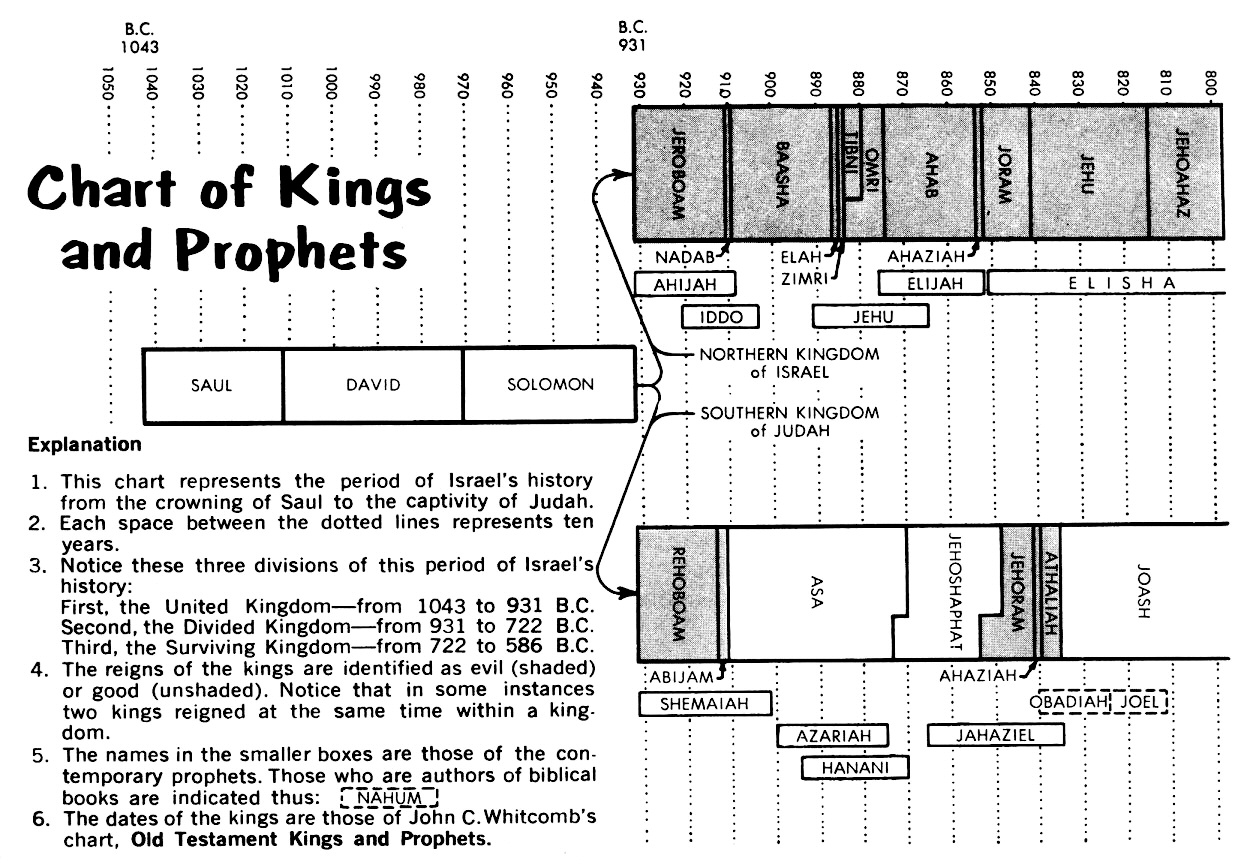
Click to Enlarge
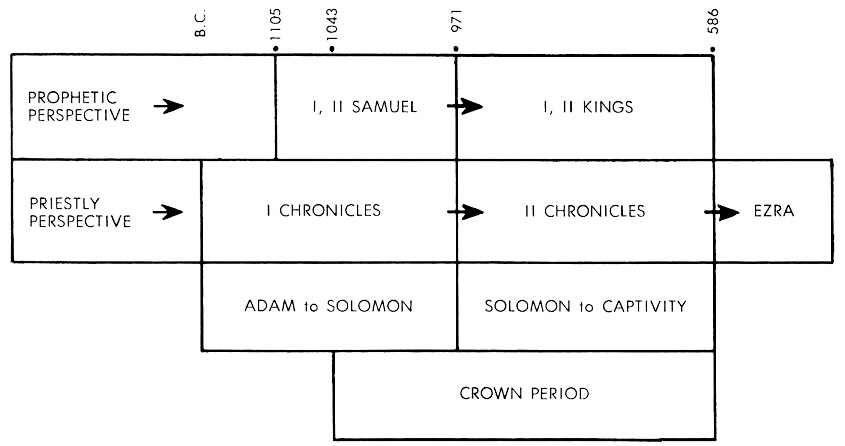
Comparison of 1 Samuel thru 2 Chronicles

| FIRST CHRONICLES SUMMARY CHART |
|
| 1 Chronicles 1-9:44 | 1 Chronicles 10:1-39:30 |
| Royal Line of David |
Reign of David |
| 12 Tribes of David's Reign |
Highlights of David's Reign |
| Genealogies | History |
| Ancestry | Activity |
| 1000's of Years | Circa 33 Years |
1 Chronicles 3:1 Now these were the sons of David who were born to him in Hebron: the firstborn was Amnon, by Ahinoam the Jezreelitess; the second was Daniel, by Abigail the Carmelitess;
- the sons of David (KJV): 2Sa 3:2-5
- Amnon (KJV): 2Sa 13:1,29
- Ahinoam (KJV): 1Sa 25:42,43 27:3
- Jezreelitess (KJV): Jos 15:56
- Daniel (KJV): It is probable this person had two names. The Targumist says he was "called Chileab, because he was in every respect like his father." 2Sa 3:3
- of Abigail (KJV): 1Sa 25:39-42
- NOTE THAT MOST OF THE NAMES ARE LINKED TO BIBLE DICTIONARY ENTRYS TO FACILITATE FURTHER STUDY.
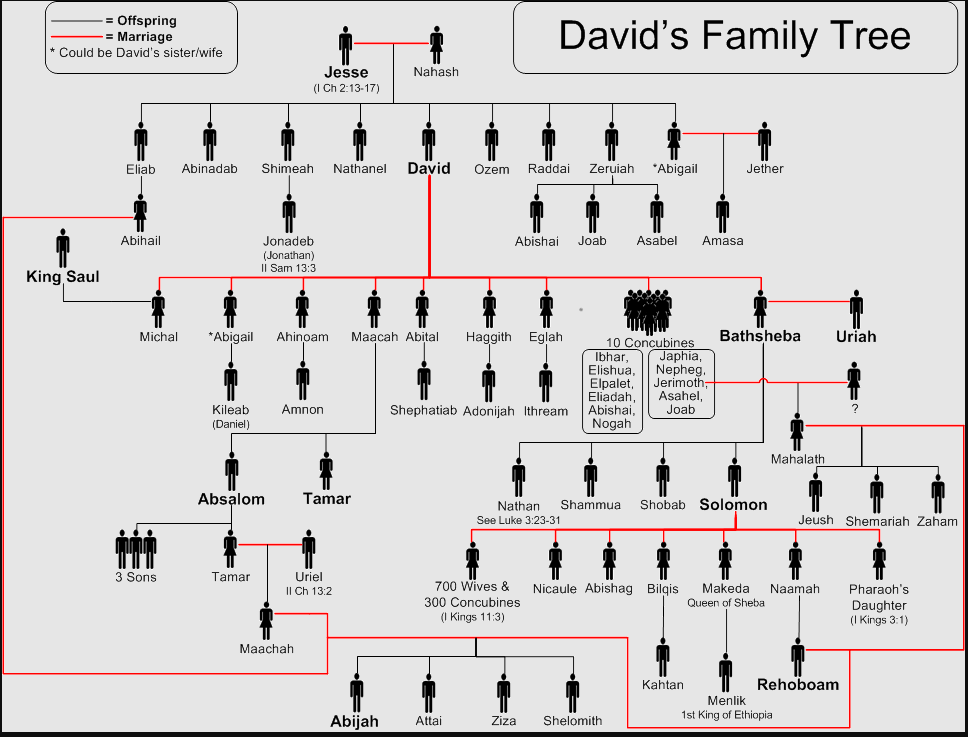
Now these were the sons of David who were born to him in Hebron: the firstborn was Amnon, by Ahinoam the Jezreelitess; the second was Daniel, by Abigail the Carmelitess;
Amnon was David’s firstborn son, born through Ahinoam the Jezreelitess. Although he held the privilege of primogeniture, his life became a tragic example of unrestrained lust and moral failure. In 2 Samuel 13, Amnon violated his half sister Tamar and was later murdered by Absalom in revenge. His life illustrates how sin within David’s household brought the very turmoil Nathan had prophesied after David’s sin with Bathsheba (2 Samuel 12:10–11).
Daniel the second son, is elsewhere called Chileab in 2 Samuel 3:3. Most scholars understand these to be two names for the same person, which was not uncommon in the ancient world. Daniel was born to Abigail the Carmelitess, the wise widow of Nabal whom David later married (1 Samuel 25). Unlike several of David’s other sons, Daniel/Chileab disappears from the biblical narrative, suggesting he may have died young or simply did not play a significant public role in Israel’s history.
The mention of these sons also highlights that David’s family history was complex and troubled. Though David was “a man after God’s own heart” (Acts 13:22), the sword never departed from his house because of sin. Yet through this imperfect family line, God faithfully preserved His covenant promises, culminating in the birth of Jesus Christ, “the son of David” (Matthew 1:1).
Andrew Hill: The family of David is the feature attraction of Judah’s genealogy. The Chronicler’s emphasis on David stems from his knowledge of prophetic statements about the unbreakable covenant God made with David and the reestablishment of Davidic kingship in Israel (cf. Jer. 33:19–22). He then offers this hope to his audience through the repetition of the word of the Lord to Nathan announcing the Davidic covenant (1 Chron. 17:4–14, esp. vv. 10–14; cf. 2 Sam. 7:4–16). The record of the royal line continues the genealogy tracing David’s ancestry from Ram to Jesse (1 Chron. 2:10–17). The chapter divides naturally into three distinct sections: - David’s children (3:1–9), - the kings of Judah (3:10–16), and - the postexilic descendants of David (3:17–24) (See 1 and 2 Chronicles)
August Konkel: The Davidic genealogy documents an unbroken succession of Davidides for approximately seven centuries. The genealogy names these descendants without distinction. There is no reference as to which were monarchs, nor to the tumultuous events that divided Israel and finally ended the monarchy of Judah. A pedigree of seven centuries is in itself a testimony to the divine preservation of the house of David. The survival of the Davidic house testifies to God accomplishing his divine purpose through David. All the other lineages of Judah merged in various ways to form new entities, as indicated in the records of Judah. The return from exile did not bring about a restoration of Davidic rule within the community of Israel. The absence of political authority made it all the more important to demonstrate the continuation of a particular line of succession within the Davidic house. The capital had been conquered, the temple burned, and members of the dynasty humiliated, exiled, or executed, but the concept of an eternal Davidic kingdom survived (1 Chron 28:4). Though history might seem to have refuted the promise to David, it was the Chronicler’s conviction that God had elected Judah, and within Judah had chosen David to bring about his eternal kingdom. (See all of Konke's comments on 1Ch 3 - click 1 & 2 Chronicles)
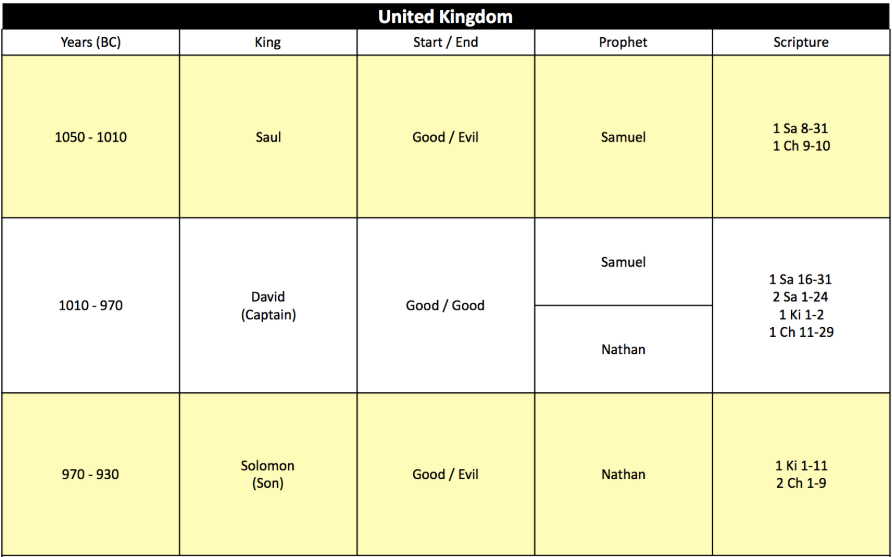
QUESTION: Who was David in the Bible? | GotQuestions.org
ANSWER: We can learn a lot from the life of David. He was a man after God’s own heart (1 Samuel 13:13–14; Acts 13:22)! We are first introduced to David after Saul, at the insistence of the people, was made king (1 Samuel 8:5, 10:1). Saul did not measure up as God’s king. While King Saul was making one mistake on top of another, God sent Samuel to find His chosen shepherd, David, the son of Jesse (1 Samuel 16:10, 13).
David is believed to have been twelve to sixteen years of age when he was anointed as the king of Israel. He was the youngest of Jesse’s sons and an unlikely choice for king, humanly speaking. Samuel thought Eliab, David’s oldest brother, was surely the anointed one. But God told Samuel, "Do not consider his appearance or his height, for I have rejected him. The LORD does not look at the things people look at. People look at the outward appearance, but the LORD looks at the heart" (1 Samuel 16:7). Seven of Jesse’s sons passed before Samuel, but God had chosen none of them. Samuel asked if Jesse had any more sons. The youngest, David, was out tending sheep. So they called the boy in and Samuel anointed David with oil "and from that day on the Spirit of the Lord came powerfully upon David" (1 Samuel 16:13).
The Bible also says that the Spirit of the Lord departed from King Saul and an evil spirit tormented him (1 Samuel 16:14). Saul’s servants suggested a harpist, and one recommended David, saying, "I have seen a son of Jesse of Bethlehem who knows how to play the lyre. He is a brave man and a warrior. He speaks well and is a fine-looking man. And the LORD is with him" (1 Samuel 16:18). Thus, David came into the king’s service (1 Samuel 16:21). Saul was pleased with young David, and he became one of Saul’s armor-bearers.
Saul’s pleasure in David vanished quickly as David rose in strength and fame. In perhaps one of the best known biblical accounts, David slew the giant Goliath. The Philistines were at war with the Israelites and taunted Israel’s military forces with their champion, Goliath from Gath. They proposed a dual between Goliath and whoever would fight him. But no one in Israel volunteered to battle the giant. David’s older brothers were part of Saul’s army; after Goliath had been taunting the Israelites for forty days, David visited his brothers at the battlefield and heard the Philistine’s boasts. The young shepherd asked, "What will be done for the man who kills this Philistine and removes this disgrace from Israel? Who is this uncircumcised Philistine that he should defy the armies of the living God?" (1 Samuel 17:26). David’s oldest brother became angry and accused David of pride and coming only to watch the battle. But David continued to talk about the issue.
Saul heard what David was saying and sent for him. David told Saul, "Let no one lose heart on account of this Philistine; your servant will go and fight him" (1 Samuel 17:32). Saul was incredulous; David was not a trained soldier. David provided his credentials as a shepherd, being careful to give the glory to God. David had killed lions and bears that went after his sheep, and he claimed the Philistine would die like them because he had "defied the armies of the living God. The LORD who rescued me from the paw of the lion and the paw of the bear will rescue me from the hand of this Philistine" (1 Samuel 17:36–37). Saul acquiesced, provided that David wear Saul’s armor into the fight. But David was not used to the armor and left it behind. David took with him only his staff, five smooth stones, his shepherd’s bag, and a sling. Goliath was not intimidated by David, but neither was David intimidated by the giant. "David said to the Philistine, 'You come against me with sword and spear and javelin, but I come against you in the name of the LORD Almighty, the God of the armies of Israel, whom you have defied. This day the LORD will deliver you into my hands" (1 Samuel 17:45–46). David’s trust in God and his zeal for God’s glory are remarkable. David did kill Goliath. He also entered into Saul’s service full-time, no longer tending his father’s sheep.
It was at this time that Saul’s son, Jonathan, "became one in spirit with David" (1 Samuel 18:1). David and Jonathan’s friendship is instructive to friendships today. Though his father was king and Jonathan would have been a natural heir to the throne, Jonathan chose to support David. He understood and accepted God’s plan and protected his friend from his murderous father (1 Samuel 18:1–4, 19—20). Jonathan demonstrates humility and selfless love (1 Samuel 18:3; 20:17). During David’s reign, after Saul’s and Jonathan’s deaths, David sought out anyone who remained of the house of Saul to whom he could show kindness for Jonathan’s sake (2 Samuel 9:1). Clearly, both men greatly cared for one another and honored one another.
After the incident with Goliath, David continued to grow in fame. The chant in the camp of Saul was taunting as the people sang out the praises of David and demeaned King Saul, causing a raging jealousy in Saul that never subsided (1 Samuel 18:7–8).
Saul’s jealousy of David turned murderous. He first tried to have David killed by the hand of the Philistines by asking David to become his son-in-law. The king offered his daughter in return for David’s military service. David, in humility, refused, and Saul’s daughter was given to another (1 Samuel 18:17–19). Saul’s other daughter, Michal, was in love with David, so Saul asked again. David again refused due to his lack of wealth and inability to afford the bride price for the daughter of a king. Saul asked for a hundred Philistine foreskins, hoping David would be slaughtered by the enemy. When David killed two hundred Philistines, doubling the required payment, Saul realized he was outmatched, and his fear of David increased (1 Samuel 18:17–29). Jonathan and Michal warned David of their father’s murderous intent, and David spent the next years of his life fleeing from the king. David wrote several songs during this time, including Psalms 57, 59, and 142.
Although Saul never stopped pursuing him with the intent to kill him, David never raised a hand against his king and God’s anointed (1 Samuel 19:1–2; 24:5–7). When Saul eventually died, David mourned (2 Samuel 1). Even knowing that he was God’s anointed, David did not force his way to the throne. He respected God’s sovereignty and honored the authorities God had currently in place, trusting that God would fulfill His will in His timing.
While on the run, David raised up a mighty army and with power from God defeated everyone in his path, always asking God first for permission and instructions before going into battle, a practice he would continue as king (1 Samuel 23:2–6; 9–13; 2 Samuel 5:22-23). Once king, David remained a powerful military commander and soldier. Second Samuel 23 recounts some of the exploits of David’s so-called "mighty men." God honored and rewarded David’s obedience and gave him success in everything he did (2 Samuel 8:6).
David began to take other wives. He married Abigail, a widow of Carmel, during the time he was fleeing from Saul (1 Samuel 25). David had also married Ahinoam of Jezreel. Saul had given David’s first wife, Michal, to another man (1 Samuel 25:43–44). After Saul’s death David was publicly anointed king over the house of Judah (2 Samuel 2:4), and he then had to fight against the house of Saul before being anointed king over all of Israel at the age of thirty (2 Samuel 5:3–4). Now king, David took Michal back to be his wife again (2 Samuel 3:14). David also conquered Jerusalem, taking it from the Jebusites, and became more and more powerful because the Lord Almighty was with him (2 Samuel 5:7).
The Ark of the Covenant had been previously captured by the Philistines (1 Samuel 4). Upon its return to Israel, the ark was housed at Kiriath Jearim (1 Samuel 7:1). David wanted to bring the ark back to Jerusalem. But David omitted some of God’s instructions on how to transport the ark and who was to carry it. This resulted in the death of Uzzah who, amid all the celebrations, reached out to steady the ark with his hand. God struck Uzzah down, and he died there beside the ark (2 Samuel 6:1–7). In fear of the Lord, David abandoned the moving of the ark and let it rest in the house of Obed-Edom (2 Samuel 6:11).
Three months later, David resumed the plan to bring the ark to Jerusalem. This time, he followed instructions. He also "dance[ed] before the LORD with all his might" (2 Samuel 6:14). When Michal saw David worshiping in that way, "she despised him in her heart" (2 Samuel 6:16). She asked David how he, as king, could have acted so undistinguished in front of his people. "David said to Michal, 'It was before the LORD, who chose me rather than your father or anyone from his house when he appointed me ruler over the LORD’s people Israel—I will celebrate before the LORD. I will become even more undignified than this, and I will be humiliated in my own eyes" (2 Samuel 6:21–22). David understood that true worship is intended for God alone. We do not worship for the benefit of the perceptions of others but in humble response to God (John 4:24).
After David was settled in his palace and had peace with his enemies, he wanted to build a temple for the Lord (2 Samuel 7:1–2). The prophet Nathan first told David to do as he wanted. But then God told Nathan that David would not be the one to build His temple. Instead, God promised to build a house for David. This promise included a prediction that Solomon would build the temple. But it also spoke of the coming Messiah, the Son of David who would reign forever (2 Samuel 7:4–17). David responded in humility and awe: "Who am I, Sovereign Lord, and what is my family, that you have brought me this far?" (2 Samuel 7:18; see 2 Samuel 7:18–29 for David’s entire prayer). Before he died, David made preparations for the temple. God’s reason for not allowing David to build the temple was that he had shed so much blood, but David’s son would be a man of peace and not a man of war. Solomon would build the temple (1 Chronicles 22).
Much of David’s shedding of blood had been a result of war. But, in a sordid incident, David also had one of his mighty men killed. Though David was a man after God’s own heart, he was also human and sinful. While his armies were at war one spring, David remained home. From his rooftop he saw a beautiful woman bathing. He found out that she was Bathsheba, the wife of Uriah the Hittite, one of his mighty men who was at war, and David sent messengers for her. David slept with Bathsheba, and she became pregnant. David called Uriah back from battle, hoping he would sleep with his wife and believe the child to be his, but Uriah refused to go home while his comrades were at war. So David arranged for Uriah to be killed in battle. David then married Bathsheba (2 Samuel 11). This incident in David’s life shows us that everyone, even those we highly esteem, struggle with sin. It also serves as a cautionary tale about temptation and the way sin can so quickly multiply.
The prophet Nathan confronted David about his sin with Bathsheba. David responded in repentance. He wrote Psalm 51 at this time. Here we see David’s humility and his true heart for the Lord. Though Nathan told David that his son would die as a result of his sin, David pleaded with the Lord for his son’s life. David’s relationship with God was such that he was willing to persist in faith and to hope that God might relent. When God enacted His judgment, David accepted it completely (2 Samuel 12). In this story we also see God’s grace and sovereignty. Solomon, David’s son who succeeded him and through whom Jesus descended, was born of David and Bathsheba.
God had also told David, through Nathan, that the sword would not depart from his house. Indeed, David’s household had much trouble from that time on. We see this among David’s children when Amnon raped Tamar, leading to Absalom’s murder of Amnon, and Absalom’s conspiracy against David. Nathan had also told David that his wives would be given to one who was close to him; this would not occur in secret as had David’s sin with Bathsheba, but in public. The prophecy was fulfilled when Absalom slept with his father’s concubines on the roof for all to see (2 Samuel 16).
David is the author of many of the psalms. In them we see the way he sought after and glorified God. He is often thought of as a shepherd king and a warrior poet. Scripture calls him “the sweet psalmist of Israel” (2 Samuel 23:1). David’s life seemed filled with the range of human emotions—a common shepherd boy with great confidence in God’s faithfulness who honored authorities, fled for his life, and became the king against whom all future kings of Israel would be measured. He saw many military victories. He also fell into grave sin, and his family suffered as a result. But through it all David turned to God and trusted Him. Even in the Psalms when David is downcast or despondent, we see him lift his eyes up to his Maker and give Him praise. This reliance on God and continual pursuit of relationship with God is part of what makes David a man after God’s own heart.
God promised David a descendant to rule on the throne forever. That everlasting king is Jesus, the Messiah and Son of David.
Related (from Gotquestions.org):
- Does the Bible mention David’s mother?
- How old was David when he was anointed, fought Goliath, became king, died?
- Who are the sons of David mentioned in the Bible?
- What should we learn from the account of David and Goliath?
- Why was God so angry at David for taking the census?
QUESTION - Who was Amnon in the Bible? | GotQuestions.org
ANSWER - Amnon was King David’s firstborn son. His mother was Ahinoam. Amnon showed despicable character, an alarming lack of self-control, and great selfishness.
Amnon fell in love—or in lust—with his half-sister Tamar. She was the full sister of David’s son Absalom, and the Bible says she was very beautiful (2 Samuel 13:1). Amnon was obsessed with the desire to sleep with her, and his obsession became so consuming that Amnon grew physically sick (verse 2).
Jonadab, David’s nephew, was Amnon’s adviser. He noted Amnon’s depression and, being a shrewd man (2 Samuel 13:3), came up with a plan for Amnon to sate his desire to have Tamar for himself. Jonadab gave Amnon wicked advice: he advised Amnon to feign illness and request that Tamar come to his quarters to make him some food and feed him herself. This would provide the opportunity that Amnon desired. Amnon followed the counsel, and Tamar innocently came to Amnon’s quarters to prepare some bread. When the food was ready, Amnon cleared his quarters of everyone except for Tamar and asked her to come into his bedroom to feed him. She did, and he grabbed her and said, “Come to bed with me, my sister” (verse 11).
Tamar refused Amnon’s advances, calling his actions a “wicked thing” (2 Samuel 13:12). She tried to reason with him, pointing out the unlawfulness of his desire and that, if he took her virginity, she would bear a lifelong disgrace. She warned him that he would be counted among “the wicked fools in Israel” (verse 13). To buy time, Tamar told Amnon to request their father for her hand in marriage—such a marriage was unlawful and would not have been granted, but Tamar was clutching at straws. But Amnon did not heed her, and he proceeded to rape her (verse 14).
Immediately after the rape, Amnon was filled with hatred toward Tamar; in fact, “he hated her more than he had loved her” (2 Samuel 13:15). In all likelihood, Amnon knew what he had done was abhorrent. But instead of allowing himself to feel guilty, he turned his anger on Tamar. He ordered her out and had his servant bolt the door, ignoring Tamar’s pleas to not shame her in this manner. Tamar knew she was ruined, so she tore the robes that designated her as a virgin, put ashes on her head, and mourned loudly as she left.
Sadly, David, although furious at his son’s crime, did not punish Amnon (2 Samuel 13:21). But Absalom hated Amnon for what he had done to his sister and sought revenge. Two full years later, he devised a plan to move Amnon into a place of vulnerability. Absalom asked David and the princes to attend a sheep-shearing with him. David declined but allowed his sons to go with Absalom. When all the sons had gathered and were drinking together, Absalom ordered his men to kill Amnon in cold blood (verse 28). In fear for their lives, the rest of Absalom’s brothers fled back to the palace (verse 29).
While they were on their way, a false report saying that Absalom had killed all his brothers reached David. Distraught, David fell down in despair (2 Samuel 13:31). Jonadab appeared to inform the king that only Amnon had been killed, and Jonadab told him why: “This has been Absalom’s express intention ever since the day Amnon raped his sister Tamar” (verse 32). When the remainder of David’s sons reached the palace, they came to David and mourned with him. Absalom, meanwhile, fled to Geshur to escape punishment for his brother’s murder.
Although David eventually found consolation and wanted Absalom to return (2 Samuel 13:39), it was several years before the two met again. Sadly, however, the family had been irreparably torn apart by Amnon’s and Absalom’s actions. In time, Absalom tried to take his father’s throne and was killed by David’s army commander, Joab.
Related:
- Why did Amnon rape Tamar? - Got Questions
- Why did Amnon rape Tamar? Why didn’t David punish Amnon?
- Who are the sons of David mentioned in the Bible? | GotQuestions.org
QUESTION - Who was Ahinoam of Jezreel? | GotQuestions.org
ANSWER - Ahinoam of Jezreel was a wife of King David. She was the wife he married after his wife Michal was given to another man and sometime before he met Abigail. Ahinoam was the mother of David’s oldest son, Amnon (2 Samuel 3:2). Jezreel refers to the city of that name in northern Israel and the area surrounding it, including Lower Galilee, Mt. Carmel, and Mt. Tabor. Jezreel was the place where Ahinoam was from originally.
David met Ahinoam during his fugitive years as he was fleeing from King Saul. Saul also had a wife named Ahinoam (1 Samuel 14:49–50), and some speculate that Saul’s Ahinoam and David’s Ahinoam were the same person. While this is technically possible, it is extremely unlikely. King Saul was still alive when David married Ahinoam.
Ahinoam was with David during some of the hardest times of his life, when he was constantly on the move, fighting battles, and struggling just to stay alive. In his attempts to elude Saul, David took refuge in Philistine territory. David, his two wives, Ahinoam and Abigail, and 600 of his men were welcomed by King Achish of Gath (1 Samuel 27:1–3). Later, David asked for a country town where he and his men could dwell with their families, and “on that day Achish gave him Ziklag, and it has belonged to the kings of Judah ever since. David lived in Philistine territory a year and four months” (1 Samuel 27:6–7).
Then tragedy struck. While David and his fighting men were traveling north with the Philistines on a military assignment, Amalekite raiders attacked Ziklag. They burned the town and took captive “the women and everyone else in it, both young and old. They killed none of them, but carried them off as they went on their way” (1 Samuel 30:1–2). Ahinoam and Abigail were among those captured. When David and his men returned to Ziklag and saw the carnage, David’s men thought of stoning him, because “each one was bitter in spirit because of his sons and daughters. But David found strength in the Lord his God” (1 Samuel 30:6).
With God’s guidance, David caught up with the Amalekite raiders. “David fought them from dusk until the evening of the next day. . . . David recovered everything the Amalekites had taken, including his two wives. Nothing was missing: young or old, boy or girl, plunder or anything else they had taken. David brought everything back” (1 Samuel 30:17–19). Ahinoam was safe again.
After Saul’s death, David inquired of the Lord what to do, and the Lord instructed him to go to Hebron. “David went up there with his two wives, Ahinoam of Jezreel and Abigail, the widow of Nabal of Carmel. David also took the men who were with him, each with his family, and they settled in Hebron and its towns. Then the men of Judah came to Hebron, and there they anointed David king over the tribe of Judah” (2 Samuel 2:2–4). On that day, Ahinoam of Jezreel became Queen Ahinoam of Judah. Her son Amnon was later born in Hebron.
QUESTION - Who was Abigail in the Bible? | GotQuestions.org
ANSWER - Abigail was one of David’s wives. Her story is found in 1 Samuel 25. At the beginning of the story, Abigail is the wife of a wealthy man named Nabal who lived in a town called Maon in the wilderness of Paran, an area near the Sinai Peninsula. Abigail was “an intelligent and beautiful woman” (1 Samuel 25:3) who saved her husband and his household, prevented David from doing something rash, and secured an unexpected future for herself.
The story of Abigail in the Bible is an interesting one for many reasons. For one, Nabal is a rather bizarre character. For no apparent reason, Nabal refuses David’s request for food and shelter. Despite knowing of David’s previous benevolence to his shepherds, Nabal churlishly refuses to aid David and his men as they tried to keep one step ahead of King Saul. David’s request was not unreasonable, but Nabal, who is described as “surly and mean” (1 Samuel 25:3), essentially spits in the faces of David’s servants, saying, “Who is this David? Who is this son of Jesse? Many servants are breaking away from their masters these days. Why should I take my bread and water, and the meat I have slaughtered for my shearers, and give it to men coming from who knows where?” (verses 10–11).
David did not take this rejection well. He swore to kill every male associated with Nabal’s household (1 Samuel 25:22). He had strapped on his sword and was on his way with four hundred armed men (verse 13), when Abigail met him on the road. She offered David gifts of wine, grain, prepared meat, and cakes of figs. Then she fell down in front of David, pleading with him to show mercy to her husband, Nabal (verse 23). In her plea, Abigail shows that she understands Nabal’s character: “Please pay no attention, my lord, to that wicked man Nabal. He is just like his name—his name means Fool, and folly goes with him” (verse 25).
In taking up Nabal’s cause and asking David to spare his life, Abigail proves herself to be a righteous, caring woman. At great risk to herself, she approaches David, an angry man bent on revenge, and intercedes for her husband, despite his bad behavior. Her request can be seen as a picture of Christ, who offered Himself as a sacrifice to save foolish sinners from the consequences of their own actions and who continues to intercede for us (Hebrews 7:25).
Abigail’s propitiation saves the day. David thanks Abigail for staying his hand and repents of his own foolish and rash decision to slaughter Nabal’s household (1 Samuel 25:32–34). In fact, David sees Abigail’s coming to him as a blessing from God, and he sends her home in peace (verse 35).
Meanwhile, Nabal, insensitive to his wrongdoing and the danger that he had been in, holds a kingly feast for himself and gets drunk (1 Samuel 25:36). Abigail waits until the next morning for her husband to sober up, and then she tells Nabal everything—how David had been on his way to destroy him and how she herself had saved Nabal. Upon hearing this news, Nabal falls ill: “His heart failed him and he became like a stone. About ten days later, the LORD struck Nabal and he died” (verses 37–38). David then sends a message to Abigail asking her to become his wife, and Abigail responds affirmatively (verses 40–42).
Scripture says that we should not seek vengeance for ourselves. Rather, we should “leave room for God’s wrath, for it is written: ‘It is mine to avenge; I will repay,’ says the Lord” (Romans 12:19; cf. Deuteronomy 32:35). This is exactly what happened in Abigail’s story. David was prevented from taking revenge, and the Lord Himself took care of the matter in due time.
David and Nabal can be seen as representative of the two responses men have to Christ. Nabal does not repent or acknowledge his sin; neither does he thank Abigail for her willingness to risk her own life on his behalf. On the other hand, David’s heart is tender and repentant, and he calls Abigail blessed for her actions. David is spared the consequences of the sin he had planned, but Nabal dies in his sin.
In the end, Nabal’s wealth, his wife, and his very life are taken from him. Abigail—a savior full of beauty, wisdom, and discretion—enters a loving relationship with David. In Abigail, we have a small picture of the ultimate Savior, the Source of beauty and wisdom, who desires a loving relationship with us forever.
Related:
- What is the story of David and Nabal? | GotQuestions.org
- How many wives did King David have? | GotQuestions.org
- How many children did King David have? | GotQuestions.org
- Who are the sons of David mentioned in the Bible? | GotQuestions.org
1 Chronicles 3:2 the third was Absalom the son of Maacah, the daughter of Talmai king of Geshur; the fourth was Adonijah the son of Haggith;
- Absalom (KJV): 2Sa 13:1,20-28,38 18:14,18,33 19:4-10
- Geshur (KJV): 1Ch 2:23 Jos 13:13 2Sa 14:23,32 15:8
- Adonijah (KJV): 2Sa 3:4 1Ki 1:5 2:24,25
THE TRAGEDIES OF ABSALOM
AND ADONIJAH
This portion of 1 Chronicles 3 continues the listing of the sons born to David in Hebron and introduces two of the most tragic and ambitious figures in David’s household, Absalom and Adonijah.
the third was Absalom the son of Maacah, the daughter of Talmai king of Geshur; Absalom the son of Maacah, the daughter of Talmai king of Geshur reveals an important political connection. Maacah was the daughter of a foreign king from Geshur, a small Aramean kingdom northeast of the Sea of Galilee. David’s marriage to her likely had diplomatic value, forming an alliance with Geshur. Absalom inherited remarkable beauty and charisma (2 Samuel 14:25), but beneath the outward attractiveness was a proud and vengeful heart. After his sister Tamar was violated by Amnon, Absalom eventually murdered Amnon and later fled to his maternal grandfather Talmai in Geshur (2 Samuel 13:37). Eventually, Absalom led a full scale rebellion against David, seeking to seize the throne (2 Samuel 15–18). His life is a sobering reminder that outward appearance and charm are no substitute for submission to God. The son who stole the hearts of Israel ultimately died hanging helplessly in a tree, pierced by Joab’s spears (2 Samuel 18:9–15).
the fourth was Adonijah the son of Haggith; Adonijah likewise attempted to exalt himself to the throne. After David became old and weak, Adonijah declared himself king without David’s authorization, gathering chariots, horsemen, and supporters around himself (1 Kings 1:5). The text specifically notes a parental failure in David’s life: “His father had never crossed him at any time by asking, ‘Why have you done so?’” (1 Kings 1:6). Like Absalom before him, Adonijah was handsome and ambitious, but his self exaltation opposed God’s chosen king, Solomon. His attempted coup failed, and though initially spared, he was later executed after continuing to maneuver for royal power (1 Kings 2:13–25).
QUESTION - Who was Absalom in the Bible? | GotQuestions.org
ANSWER - Absalom was the third son of King David, by his wife Maacah. The bulk of Absalom’s story is told in 2 Samuel 13-19. He had a strong influence on his father’s reign.
The first recorded event defining Absalom’s life also involved his sister Tamar and half-brother Amnon. Tamar was beautiful, and Amnon lusted after her. When Tamar rebuffed Amnon’s advances, he arranged, through subterfuge, to have her come to his house, where he raped her. After the rape, Amnon put Tamar out of his house in disgrace. When Absalom heard what happened, he took his sister in to live with him. For the next two years, Absalom nursed a hatred of his half-brother. Then, using some subterfuge of his own, Absalom invited Amnon to his house for a party. During the festivities, in the presence of David’s other sons, Absalom had his servants kill Amnon in cold blood.
Out of fear of his father, Absalom ran away to Geshur, where he stayed for three years. During that time, Scripture says that David “longed to go out to Absalom,” but we’re never told that he actually did anything to reconcile the relationship. David’s general, Joab, was ultimately responsible for bringing Absalom back to Jerusalem. However, even then, Absalom was not permitted to enter David’s presence, but had to live in a house of his own. He lived this way, presumably never contacting or being contacted by his father, for two years. Finally, once again by way of Joab’s intercession, the two men get back together, and there is a small measure of reconciliation.
Unfortunately, this peace did not last. Possibly resenting his father’s hesitancy to bring him home, Absalom began to stealthily undermine David’s rule. He set himself up as judge in Jerusalem and gave out promises of what he would do if he were king. After four years of this, he asked to go to Hebron, where he had secretly arranged to have himself proclaimed king.
The conspiracy strengthened, and the number of Absalom’s followers grew steadily, such that David began to fear for his own life. David gathered his servants and fled Jerusalem. However, David left behind some of his concubines and a few informers as well, including Zadok and Abiathar the priests and his adviser Hushai.
Upon entering Jerusalem as king, Absalom sought to solidify his position, first by taking over David’s house and sleeping with his concubines, considered an unforgivable act. Then he laid plans to immediately pursue and attack David’s forces, but the idea was abandoned owing to the advice of Hushai. This delay allowed David to muster what troops he had at Mahanaim and mount a counterattack to retake the kingdom.
David himself did not take part in the counterattack, having been persuaded by his generals to remain behind. He did give explicit instructions to the generals to “deal gently” with Absalom, in spite of his treason. Scripture makes the point that all the troops heard David’s orders concerning Absalom. However, the orders were disobeyed. As Absalom was riding under some trees, his long hair became entangled in the branches, and he was unhorsed. Joab found Absalom suspended in mid-air and killed him there. Thus, the rebellion was quelled, and David returned to Jerusalem as king.
David mourned deeply over his son, so much so that it affected the morale of the army. His grief was so great that their victory seemed hollow to them, and they returned to the capital in shame rather than triumph. It was not until he was rebuked by Joab that David was restored to a measure of kingly behavior.
Much has been said about David’s neglect of Absalom in this sad incident. It is possible that parental responsibility is a lesson we can take from this episode, but Scripture does not expressly teach it here. We do know that David did nothing about Amnon’s rape of Tamar, although he knew about it. If David had avenged Tamar, would Absalom have taken it upon himself to mete out justice? And what was the impact on Absalom’s soul of carrying hatred for Amnon for so long? We don’t know the answers to those questions, but it seems that David’s inaction had a deleterious effect in Absalom’s life.
What we can say with certainty, however, is that pride goes before a fall (Proverbs 16:18). Absalom’s self-promotion led to nothing. Also, God is sovereign. God foiled Absalom’s plan to overthrow his father’s kingdom (see 2 Samuel 17:14). All events are settled in eternity, and nothing, not even the Absaloms of the world, can thwart the power of God to do as He pleases in history.
Related:
1 Chronicles 3:3 the fifth was Shephatiah, by Abital; the sixth was Ithream, by his wife Eglah.
- Eglah (KJV): The Targumist, Jarchi, and others, maintain that this was Michal; and though it is stated (2 Sa 6:23) that "she had no child to the day of her death," yet she might have had a child before, at that time living. 2Sa 3:5
the fifth was Shephatiah (“Yahweh has judged” or “Yahweh judges.”), by Abital; the sixth was Ithream, by his wife Eglah. This verse completes the list of the six sons born to David during his years reigning in Hebron. Unlike Amnon, Absalom, and Adonijah, very little is recorded in Scripture about Shephatiah and Ithream, yet even their inclusion demonstrates the chronicler’s concern to preserve the royal genealogy accurately and to show the growth of David’s house during this formative stage of his kingdom.
The repeated references to different mothers also quietly reveal the growing complexity within David’s household. Multiple wives and many sons created rivalries, divided loyalties, and succession tensions that later erupted into tragedy and conflict. Though polygamy was culturally practiced in the ancient Near East, it consistently produced sorrow and disorder in Scripture, even among godly men. David’s family life became marked by jealousy, immorality, rebellion, and bloodshed, illustrating that deviation from God’s original design for marriage inevitably carries painful consequences (Genesis 2:24).
1 Chronicles 3:4 Six were born to him in Hebron, and there he reigned seven years and six months. And in Jerusalem he reigned thirty-three years.
- he reigned (KJV): 2Sa 2:11 2Sa 5:4-5 1Ki 2:11
- and in Jerusalem (KJV): 2Sa 5:4,14-16
Related Passages:
2 Samuel 5:4-5 David was thirty years old when he became king, and he reigned forty years. 5 At Hebron he reigned over Judah seven years and six months, and in Jerusalem he reigned thirty-three years over all Israel and Judah.
SIX SONS BORN
IN HEBRON
This verse is both a summary of David’s family during his Hebron years and a chronological marker for his reign. The six sons just listed were all born while David ruled in Hebron over the tribe of Judah before he became king over the entire nation of Israel.
Six were born to him in Hebron, and there he reigned seven years and six months. - Hebron was the city where David first established his royal rule after the death of Saul (2 Samuel 2:1–4). It was an ancient and significant city associated with Abraham, Isaac, and Jacob, and it became the launching point for David’s kingdom. During these years David’s household rapidly expanded, symbolizing increasing strength and royal blessing. Yet the growing number of wives and sons also foreshadowed future domestic turmoil.
And in Jerusalem he reigned thirty-three years. - The move from Hebron to Jerusalem marks the transition from a divided kingdom to a united monarchy under God’s chosen king. After the tribes united under him, David captured Jerusalem from the Jebusites and made it his capital (2 Samuel 5:6–10). Jerusalem became both the political and spiritual center of Israel and ultimately the city associated with the Messianic King. David’s total reign was forty years: seven and a half in Hebron and thirty-three in Jerusalem (1 Kings 2:11).
1 Chronicles 3:5 These were born to him in Jerusalem: Shimea, Shobab, Nathan and Solomon, four, by Bath-shuaBath-shua the daughter of Ammiel;
- Shimea (KJV): 1Ch 14:4 2Sa 5:14, Shammuah
- Nathan (KJV): 2Sa 7:2-4 12:1-15 Lu 3:31
- Solomon (KJV): 1Ch 28:5,6 2Sa 12:24,25
- Bathshua (KJV): 2Sa 11:3, Bath-sheba, Mt 1:6
- Ammiel (KJV): 2Sa 11:3, Eliam
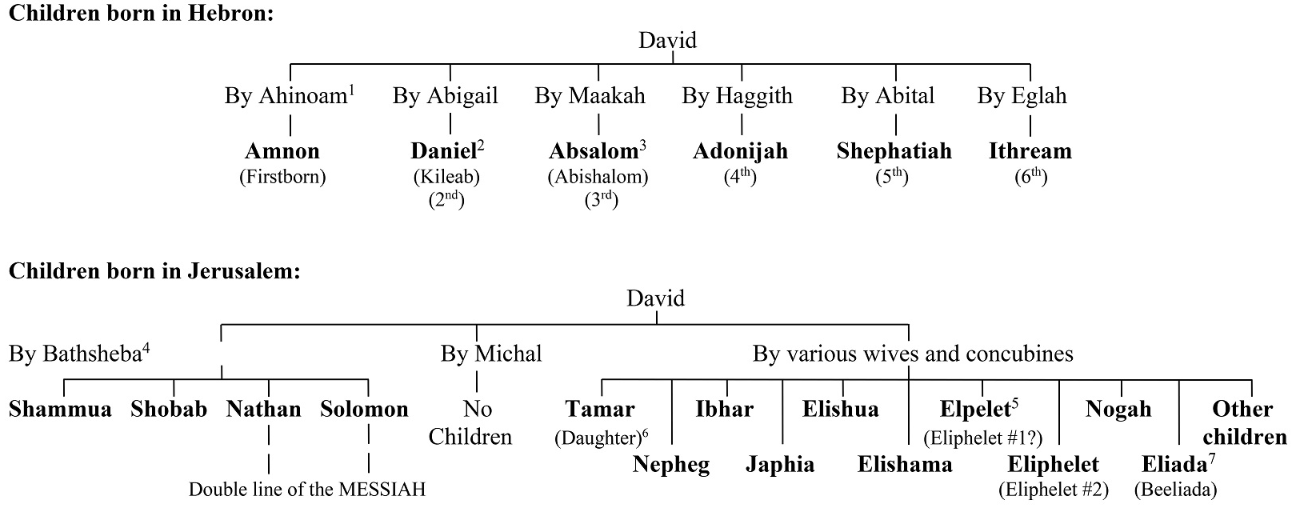
TWO OG BATHSHEBA'S FOUR SONS CONTRIBUTE
TO "THE DOUBLE LINE OF THE MESSIAH"
These were born to him in Jerusalem: Shimea, Shobab, Nathan and Solomon, four, by Bath-shua (Bathsheba) the daughter of Ammiel; These four sons were born to David by Bath-shua, better known in Samuel as Bathsheba (2 Samuel 11:3). “Bath-shua” is likely a variant form of her name used by the chronicler. Likewise, “Ammiel” appears elsewhere as “Eliam” (2 Samuel 11:3), probably reflecting alternate forms of the same name.
Though David sinned grievously and suffered severe consequences, God did not abandon His covenant purposes. From this union ultimately came Solomon, and through Solomon the royal Messianic line continued to Jesus Christ (Matthew 1:6).
ON BOTTOM LEFT SIDE OF THE CHART ABOVE (from "All the Genealogies of the Bible") NOTICE THE "DOUBLE LINE OF THE MESSIAH" BENEATH NATHAN AND SOLOMON.
The inclusion of Nathan is significant. Though Solomon carried the royal succession, the genealogy in Luke 3:31 traces Jesus’ lineage through Nathan rather than Solomon, showing another branch of David’s family line. Thus both Nathan and Solomon became important in the Messianic genealogy. (See more discussion below).
The "Double Line of the Messiah" is not an easy subject to unravel. Below is a quote from a book by Nancy Dawson entitled "All the Genealogies of the Bible"...
Biblical and Theological Significance Historical Context for the Genealogy This chart (ED: CLICK THIS LINK FOR THE CHART DAWSON IS REFERRING TO AND THE MAJORITY OF DAWSON'S EXPLANATION) is perhaps the centerpiece and the most theologically significant of all genealogies in this work because it incorporates three key genealogical passages to explain the ancestry of Jesus the Messiah—1 Chronicles 3:10–24; Matthew 1:6–17; and Luke 3:23–31. Collectively, the Scriptures show that the genealogy of Jesus is traced through his earthly father (Joseph) and reveal that there was a double line leading to the Messiah—the “David-Solomon kingly line” and the “David-Nathan non-royal line,” which was established by the descendants of two of the four sons born to David and Bathsheba. The chart emphasizes the biblical truth that Jesus was the “son of David” (Matthew 1:1; 9:27; 12:23; 20:30–31; 21:9, 15; 22:42; Mark 10:47–48; 12:35; Luke 18:38–39; 20:41). The chart also accentuates the threatened state of the messianic line during the tumultuous period of the exile and discusses the crucial role that two pivotal figures—Shealtiel and Zerubbabel—played in messianic concatenation. Through the normal process of biological procreation (“nature”) and legal processes, such as levirate marriage and/or adoption (“law”), the genealogical line brought forth Jesus Christ—the Son of God—into the world. (CLICK to read more explanation).
See also the notes below on related discussion of the "Curse of Jeconiah."
QUESTION - Who was Solomon in the Bible? | GotQuestions.org
ANSWER - Solomon was the third and last king of the united kingdom of Israel, following King Saul and King David. He was the son of David and Bathsheba, the former wife of Uriah the Hittite whom David had killed to hide his adultery with Bathsheba while her husband was on the battle front. Solomon wrote the Song of Solomon, the book of Ecclesiastes, and much of the book of Proverbs. His authorship of Ecclesiastes is contested by some, but Solomon is the only “son of David” to be “king over Israel” (not just Judah) “in Jerusalem” (Ecclesiastes 1:1, 12), and many of the descriptions of the author fit Solomon perfectly. Solomon reigned for 40 years (1 Kings 11:42).
What are the highlights of Solomon’s life? When he ascended to the throne, he sought after God, and God gave him opportunity to ask for whatever he wanted. Solomon humbly acknowledged his inability to rule well and unselfishly asked God for the wisdom he would need to rule God’s people justly. God gave him wisdom and wealth besides (1 Kings 3:4–15; 10:27). In fact, "King Solomon was greater in riches and wisdom than all the other kings of the earth" (1 Kings 10:23). God also gave Solomon peace on all sides during most of his reign (1 Kings 4:20–25).
One common illustration of Solomon’s wisdom is his judging a dispute over the identity of the true mother of an infant child (1 Kings 3:16-28). Solomon proposed splitting the living child in half, knowing that the true mother would prefer to lose her son to another woman than to have him killed. Solomon was not only wise in his rule but had great general wisdom as well. His wisdom was renowned in his day. The Queen of Sheba traveled 1,200 miles to verify the rumors of his wisdom and grandeur (1 Kings 10). "Solomon answered all her questions; nothing was too hard for the king to explain to her. When the queen of Sheba saw all the wisdom of Solomon and the palace he had built, the food on his table, the seating of his officials, the attending servants in their robes, his cupbearers, and the burnt offerings he made at the temple of the LORD, she was overwhelmed" (1 Kings 10:3–5). Solomon proved not only to be knowledgeable but to have put his wisdom into action in the way his kingdom functioned.
Solomon wrote many proverbs and songs (1 Kings 4:32) and completed many building projects (1 Kings 7:1–12; 9:15–23). Solomon also built a fleet of ships and acquired tons of gold from Ophir with Hiram, king of Tyre, as a partner (1 Kings 9:26–28; 10:11, 22). Perhaps Solomon’s most important building project was completing the Jewish temple per the instructions and provisions of his father, David (1 Kings 6; 1 Chronicles 22).
Solomon had 700 wives and 300 concubines, many of them foreigners who led him into public idolatry in his old age, greatly angering God (1 Kings 11:1–13). First Kings 11:9–10 records, "The LORD became angry with Solomon because his heart had turned away from the LORD, the God of Israel, who had appeared to him twice. Although he had forbidden Solomon to follow other gods, Solomon did not keep the LORD’s command." God told Solomon that he would remove the kingdom from him, but, for the sake of David, would not do so during Solomon’s lifetime. He also promised not to tear the whole kingdom away. In the meantime, God raised up adversaries against Solomon who caused trouble the remainder of Solomon’s life (1 Kings 11:14–25). Jeroboam, who would become the first king of Israel, also began to rebel against Solomon, but fled (1 Kings 11:26–40). The kingdom was divided under Rehoboam, Solomon’s son (1 Kings 12).
There are many lessons we can learn from the life of Solomon. First, when we seek God with all of our heart, He will be found (1 Kings 3:3–7). Second, those who honor God will be honored by Him (1 Kings 3:11–13; 1 Samuel 2:30). Third, God will equip us to accomplish the tasks He calls us to if we will rely on Him (1 Kings 3; Romans 12:3–8; 2 Peter 1:3). Fourth, the spiritual life is a marathon, not a sprint. A good start is not always enough to finish well (1 Kings 3; 11). Fifth, we can sincerely ask God to incline our hearts toward Him (1 Kings 8:57–58), but we will wander off the path of righteousness if we choose to violate His revealed Word. Sixth, those closest to us will affect our spiritual lives (Exodus 34:16; 1 Kings 11:1–8; Daniel 1; 3; 1 Corinthians 15:33), and we must therefore be very careful of the company we keep. Seventh, life lived apart from God will be meaningless, regardless of education, fulfilled goals, the greatest of pleasures, and the greatest abundance of wealth (Ecclesiastes 1:2).
QUESTION - Who was Bathsheba in the Bible? | GotQuestions.org
ANSWER - Bathsheba, the daughter of Eliam, was initially married to Uriah the Hittite, one of David’s loyal soldiers (2 Samuel 11:3). However, she later became the wife of King David and the mother of King Solomon (2 Samuel 11:27; 12:24). The name Bathsheba means “daughter of abundance.” The Bible describes her as “very beautiful” (2 Samuel 11:2).
Bathsheba is best known for the story of David’s adultery, as described in 2 Samuel 11. This narrative highlights the contrast between the faithfulness of Uriah and Bathsheba and David’s lustful desires. One evening, Bathsheba was taking a bath, probably to purify herself according to the Law of Moses (2 Samuel 11:2, 4). David saw her bathing and desired her. Despite knowing of Bathsheba’s marriage to Uriah, David summoned her to the palace and slept with her. Later, Bathsheba sends word to David that she is pregnant (2 Samuel 11:5).
In an attempt to conceal his sin, David called Uriah back from battle, hoping that Uriah would sleep with Bathsheba (2 Samuel 11:6–10). However, Uriah, remaining faithful to his duty as a soldier, chose not to go home to his wife (2 Samuel 11:11). Frustrated by this, David devised a wicked plan to send Uriah to the front line of the battle. At the same time, David instructed Joab, the army commander, to withdraw, leading to Uriah’s death at the hands of the enemy (2 Samuel 11:14–25).
Bathsheba received the devastating news of her husband’s death on the battlefield and mourned for Uriah (2 Samuel 11:26). Subsequently, Bathsheba became David’s wife. Unfortunately, the sorrow did not end there. David and Bathsheba’s newborn baby, unnamed in the narrative, died just seven days after birth as a consequence of David’s sin (2 Samuel 12:18). In Psalm 51 David confesses his sin with Bathsheba and prays for forgiveness.
As queen, Bathsheba bore Solomon, her second son, who later became the king of Israel (2 Samuel 12:24). This son was dearly loved by God and given the name Jedidiah, which means “loved by the Lord.” In modern terms, Bathsheba experienced the joy of a “rainbow baby.”
Bathsheba recedes from the biblical narrative until later, when she plays a crucial role in securing Solomon’s succession to the throne (1 Kings 1:11–35). When Adonijah, another son of David, declared himself as the king of Israel during David’s old age, the prophet Nathan reminded Bathsheba of David’s oath that Solomon would be his successor. Bathsheba and Nathan promptly approached David to remind him of his promise. Bathsheba bowed before King David and told him of Adonijah’s actions. Then she emphasized the dire situation she and Solomon faced: “My lord the king, the eyes of all Israel are on you, to learn from you who will sit on the throne of my lord the king after him. Otherwise, as soon as my lord the king is laid to rest with his ancestors, I and my son Solomon will be treated as criminals” (1 Kings 1:20–21). Nathan confirmed Bathsheba’s report. Consequently, David gave the order, and Solomon was officially crowned as the king of Israel.
There are a few additional details to note about Bathsheba. After Solomon ascended to the throne, Bathsheba innocently assisted Adonijah in requesting that Solomon allow him to marry Abishag the Shunammite, who had been David’s platonic companion (1 Kings 2:13–21). Solomon rejected the request, recognizing that Adonijah was attempting to use Bathsheba to finagle his way to the throne. Solomon had Adonijah executed along with everyone else who took part in the plot to wrest the throne from him (verses 22–35).
Many scholars argue that Bathsheba may have been the mother of Lemuel mentioned in Proverbs 31:1–9. Considering that King Lemuel is believed to be a nickname for Solomon, it is possible that Bathsheba, as his mother, instructed him to walk in reverence of the Lord. Also, in the genealogy of Jesus provided in Matthew 1:1–17, Bathsheba is indirectly referred to in verse 6 as “the wife of Uriah” (ESV).
Bathsheba’s story reminds us that God has a plan, and He can work even through difficult situations with imperfect people to bring about something good. Queen Bathsheba, despite the unsavory events surrounding her coming to the palace, became the mother of the wisest and most successful king ever to grace the throne.
Related:
QUESTION - Who is Bathshua in the Bible? | GotQuestions.org
ANSWER - The Bible mentions two different women named Bathshua. Genesis describes the first as the daughter of a Canaanite man and the mother of Judah’s three sons (Genesis 38:2). Later in the Old Testament, a genealogy in 1 Chronicles uses the name Bathshua as an alternative to Bathsheba, the name of David’s wife, the mother of Solomon (1 Chronicles 3:5).
Judah’s story in Genesis introduces the first Bathshua: “He saw a Canaanite woman, the daughter of Shua, and he married her” (Genesis 38:2, NLT). The name Bathshua comes from the text’s identification of the woman as “Shua’s daughter.” The name Bathshua combines Bath-, meaning “daughter of,” with Shua, the name of her father. A genealogy of Judah’s descendants is the only other place in the Bible that refers to this woman: “These three were born to him by a Canaanite woman, the daughter of Shua” (1 Chronicles 2:3).
Approximately 700 years after the first Bathshua, an Israelite woman had the same name. Some modern English translations such as the ESV translate her name as “Bath-shua,” while others like the NIV use the more common version of her name, “Bathsheba.”
The Bible contains minor variations regarding the name of her father. In 2 Samuel 11:3, Bathshua/Bathsheba is called the daughter of Eliam, while 1 Chronicles 3:5 says she is the daughter of Ammiel. The solution to this discrepancy is understanding that Eliam and Ammiel are the same name in Hebrew. The difference lies in the order of the parts of the name. Eliam is El + Am (“God” + “people”), and Ammiel is the reverse, Am + El (“people” + “God”). Name reversals like this are not rare in Hebrew.
Other passages provide more description of the second Bathshua, or Bathsheba. According to 2 Samuel 11:3, she was “the wife of Uriah the Hittite.” Uriah was a valiant soldier in David’s army, and, even though he was a Hittite, he was deeply committed to the nation of Israel (see 2 Samuel 11:11).
The Bible also mentions Bathsheba’s beauty (2 Samuel 11:2) in the context of David’s attraction to her in the events leading up to their adultery (2 Samuel 11; Psalm 51). After their sin, David arranged for the death of Uriah on the battlefield (2 Samuel 11:14–17). David then married Bathshua/Bathsheba. Their illicit affair resulted in a son who died shortly after birth (2 Samuel 12:14–23). Later, David and Bathshua had four other sons: Shammua, Shobab, Nathan, and Solomon (2 Samuel 5:14; 1 Chronicles 3:5).
Bathsheba continued to play a significant role in the royal household, as evident in the story of Solomon’s succession to the throne. With the help of the prophet Nathan, she prevented Adonijah’s illicit power grab, thereby keeping him from taking the throne from Solomon (1 Kings 1:11). Later, Adonijah attempted to fool Bathsheba, but her son, King Solomon, prevented his devious plan from succeeding (1 Kings 2:13).
Non-biblical writings may offer further insight about the second Bathshua. Some Jewish and Christian traditions attribute the authorship of Proverbs 31 to Solomon, who wrote it in honor of his mother. While the chapter doesn’t name Bathshua/Bathsheba, some interpretations identify her as the “mother of King Lemuel”—which some believe is a pen name of Solomon—in Proverbs 31:1. If this is true, the passage may reflect the kind of instruction she gave Solomon, warning him against lusting after women, poor judgment, and unjust leadership.
The New Testament doesn’t mention the first Bathshua and only mentions the second one once. Matthew’s genealogy of Jesus refers to Bathsheba but doesn’t use her name. The description reads, “David was the father of Solomon, whose mother had been Uriah’s wife” (Matthew 1:6).
The two women named Bathshua in the Bible each played a role in Israel’s history, even though they lived centuries apart.
QUESTION - Why are Jesus’ genealogies in Matthew and Luke so different? GotQuestions.org? WATCH VIDEO
ANSWER - Jesus’ genealogy is given in two places in Scripture: Matthew 1 and Luke 3:23-38. Matthew traces the genealogy from Jesus to Abraham. Luke traces the genealogy from Jesus to Adam. However, there is good reason to believe that Matthew and Luke are in fact tracing entirely different genealogies. For example, Matthew gives Joseph’s father as Jacob (Matthew 1:16), while Luke gives Joseph’s father as Heli (Luke 3:23). Matthew traces the line through David’s son Solomon (Matthew 1:6), while Luke traces the line through David’s son Nathan (Luke 3:31). In fact, between David and Jesus, the only names the genealogies have in common are Shealtiel and Zerubbabel (Matthew 1:12; Luke 3:27).
Some point to these differences as evidence of errors in the Bible. However, the Jews were meticulous record keepers, especially in regard to genealogies. It is inconceivable that Matthew and Luke could build two entirely contradictory genealogies of the same lineage. Again, from David through Jesus, the genealogies are completely different. Even the reference to Shealtiel and Zerubbabel likely refer to different individuals of the same names. Matthew gives Shealtiel’s father as Jeconiah while Luke gives Shealtiel’s father as Neri. It would be normal for a man named Shealtiel to name his son Zerubbabel in light of the famous individuals of those names (see the books of Ezra and Nehemiah).
One explanation, held by the church historian Eusebius, is that Matthew is tracing the primary, or biological, lineage while Luke is taking into account an occurrence of “levirate marriage.” If a man died without having any sons, it was tradition for the man’s brother to marry the widow and have a son who would carry on the deceased man’s name. According to Eusebius’s theory, Melchi (Luke 3:24) and Matthan (Matthew 1:15) were married at different times to the same woman (tradition names her Estha). This would make Heli (Luke 3:23) and Jacob (Matthew 1:15) half-brothers. Heli then died without a son, and so his (half-)brother Jacob married Heli’s widow, who gave birth to Joseph. This would make Joseph the “son of Heli” legally and the “son of Jacob” biologically. Thus, Matthew and Luke are both recording the same genealogy (Joseph’s), but Luke follows the legal lineage while Matthew follows the biological.
Most conservative Bible scholars today take a different view, namely, that Luke is recording Mary’s genealogy and Matthew is recording Joseph’s. Matthew is following the line of Joseph (Jesus’ legal father), through David’s son Solomon, while Luke is following the line of Mary (Jesus’ blood relative), through David’s son Nathan. Since there was no specific Koine Greek word for “son-in-law,” Joseph was called the “son of Heli” by marriage to Mary, Heli’s daughter. Through either Mary’s or Joseph’s line, Jesus is a descendant of David and therefore eligible to be the Messiah. Tracing a genealogy through the mother’s side is unusual, but so was the virgin birth. Luke’s explanation is that Jesus was the son of Joseph, “so it was thought” (Luke 3:23).
Related:
1 Chronicles 3:6 and Ibhar, Elishama, Eliphelet,
- Elishama (KJV): 1Ch 14:5 2Sa 5:15, Elishua
- Eliphelet (KJV): 1Sa 14:5, Elpalet
and Ibhar, Elishama, Eliphelet, - Little is recorded about these men individually.
1 Chronicles 3:7 Nogah, Nepheg and Japhia,
- Nogah (KJV): 2Sa 5:15,16
Nogah, Nepheg and Japhia, Most of these sons remain otherwise unknown in Scripture, which reminds us that not every member of David’s family occupied a prominent role in redemptive history. Yet God knew each one individually, and their names were preserved permanently in the inspired record.
1 Chronicles 3:8 Elishama, Eliada and Eliphelet, nine.
- Eliada (KJV): 1Ch 14:7, Beeliada
- Eliphelet (KJV): 1Ch 14:7 2Sa 5:14-16, Eliphalet
NINE SONS IN
JERUSLEM
Elishama, Eliada and Eliphelet, nine - Nine was the total number of sons listed in verses 5–8 who were born to David in Jerusalem. Notice the names such as Elishama and Eliphelet appear earlier in the list as well (1 Chronicles 3:6). Some believe the earlier children may have died young and later sons were given the same names, a practice not uncommon in the ancient world. Others suggest textual variations developed over time in the manuscript tradition
1 Chronicles 3:9 All these were the sons of David, besides the sons of the concubines; and Tamar was their sister.
- of the concubines (KJV): 2Sa 5:13
- Tamar (KJV): 2Sa 13:1-20
All these were the sons of David, besides the sons of the concubines; the chronicler has not listed every child born to David. Concubines occupied a secondary status to wives in the ancient Near East, though their children were still recognized members of the household. David’s multiplication of wives and concubines reflected the customs of surrounding kings, but it also represented a departure from God’s ideal for marriage established in Genesis 2:24 and a violation of the warning given to Israel’s kings in Deuteronomy 17:17: “He shall not multiply wives for himself, or else his heart will turn away.” Scripture consistently shows that polygamy brought complications, rivalries, and sorrow even into the lives of otherwise godly men.
And Tamar was their sister became central to one of the most tragic episodes in David’s household (2 Samuel 13:1-20). She was the daughter of David and Maacah and the full sister of Absalom. Tamar was violated by her half brother Amnon, an act that brought devastating shame and grief upon David’s family. David became angry but failed to administer justice decisively, and Absalom later avenged Tamar by murdering Amnon. That event set into motion a chain of bitterness, revenge, and rebellion that ultimately erupted into Absalom’s revolt against David.
The mention of Tamar in this genealogy therefore serves as more than a family footnote. Her story stands as a painful reminder that sin’s consequences often spread far beyond the original act. David’s earlier sin with Bathsheba and Uriah was forgiven, yet Nathan had warned him, “the sword shall never depart from your house” (2 Samuel 12:10). Tamar’s tragedy became part of that fulfillment!
Nancy Dawson adds "True to Nathan’s prophecy (2 Samuel 12:10), David’s family was beset by internal strife for the last years of his reign. David’s son Amnon raped his half-sister Tamar, and, in retribution, Absalom (Tamar’s full brother) murdered Amnon (2 Samuel 13). Absalom fled to Geshur near his mother’s (Maakah’s) family (cf. 2 Samuel 3:3). Absalom returned three years later and was eventually forgiven by his father (2 Samuel 13:34–39; 14:23–33). However, within a short time, Absalom raised a rebellion against his father David (2 Samuel 15). Soon thereafter Absalom met his death—while riding through the forest of Ephraim, he caught his head in low-lying boughs of a great oak tree and, while suspended there, David’s military commander, Joab, killed him, much to David’s lament (2 Samuel 18:5–15, 29–33). (All the Genealogies of the Bible: Visual Charts)
Let us be ever mindful of the potential
ripple effects of our sin!
QUESTION - Who was Tamar in the Bible? | GotQuestions.org
ANSWER - There are three women named Tamar in Scripture. One Tamar, the beautiful daughter of Absalom, is only mentioned in passing in 2 Samuel 14:27; this Tamar became the mother of Queen Maacah, who married King Rehoboam. The other two Tamars are both tragic figures, women who were ruined by the neglect and abuse of close family members. Their stories seem to be included in Scripture for the purpose of providing historical and spiritual information about the Messianic line. This article will focus on Tamar the daughter-in-law of Judah; and Tamar the daughter of David.
Jacob’s son Judah (patriarch of the line of Judah) had three sons: Er, Onan, and Shelah. A woman named Tamar married Er, but then Er died, leaving her a widow. Since it was required that the next of kin care for a brother’s widow, Tamar was given to Onan, but he also died. Shelah was still a boy and could not marry Tamar, so Judah asked her to return to her father’s house and wait until Shelah was grown up. However, once Shelah was old enough, Judah did not honor his promise. Tamar remained an unmarried widow. Tamar then went into town disguised as a prostitute, tricked Judah, and got him to sleep with her. She then became pregnant by Judah and bore twin sons named Perez and Zerah. The story is recorded in Genesis 38.
The other Tamar was King David’s daughter. She had a brother, Absalom, and a half-brother, Amnon. Amnon had an obsessive desire for his half-sister Tamar, and one day he pretended to be sick and called for her to come to him in his bedroom to help him. When she was there alone with him, he raped her. Unfortunately, though David was angry, he did not punish Amnon or require him to marry Tamar, so Absalom took it upon himself to murder Amnon in revenge (2 Samuel 13:1–22). Absalom’s anger and bitterness toward his father because of these events eventually led to his attempt to usurp his throne and to disgrace David by committing public immorality with his father’s concubines.
We would expect the twin sons of Judah’s incestuous union with his daughter-in-law to be outcasts, hidden away, or perhaps not even mentioned in the Bible. However, surprisingly, the Messianic line continues through Tamar’s son Perez. God did not provide a “cleaner” way to continue the line that would eventually include His Son. Perez was the ancestor of Jesus of Nazereth.
It is the same with King David’s story. Absalom’s anger and rejection of his father’s rule seem to have been born out of a festering bitterness toward David. Though Absalom was clearly in the wrong for the murder of Amnon, we sympathize with him, and we sympathize with his disgraced sister. Considering David’s own immorality and the murder he committed, it is easy to see why Absalom thought himself the better man. But, despite David’s faults, God still chose to continue the line of the Messiah through David rather than through Absalom.
Why are these unpleasant stories included in Scripture, and why are the people involved—people who hurt others, even their own family members—granted the privilege of being included in the Messianic line? It may be simply to show us that God’s purpose is accomplished despite man’s unrighteousness. In Hebrews 11 there is a long list of Old Testament people who are commended for their faith, and among them are many sinful people who did dreadful things. But, because they believed God, their faith was credited to them as righteousness (Genesis 15:6).
1 Chronicles 3:10 Now Solomon’s son was Rehoboam, Abijah was his son, Asa his son, Jehoshaphat his son,
- Rehoboam (KJV): 1Ki 11:43 14:31 15:6 Mt 1:7, Roboam
- Abijah (KJV): 1Ki 15:1, Abijam, 2Ch 13:1, Abijah
- Asa (KJV): 1Ki 15:8 2Ch 14:1
- Jehoshaphat (KJV): 1Ki 15:24 2Ch 17:1 Mt 1:8, Josaphat
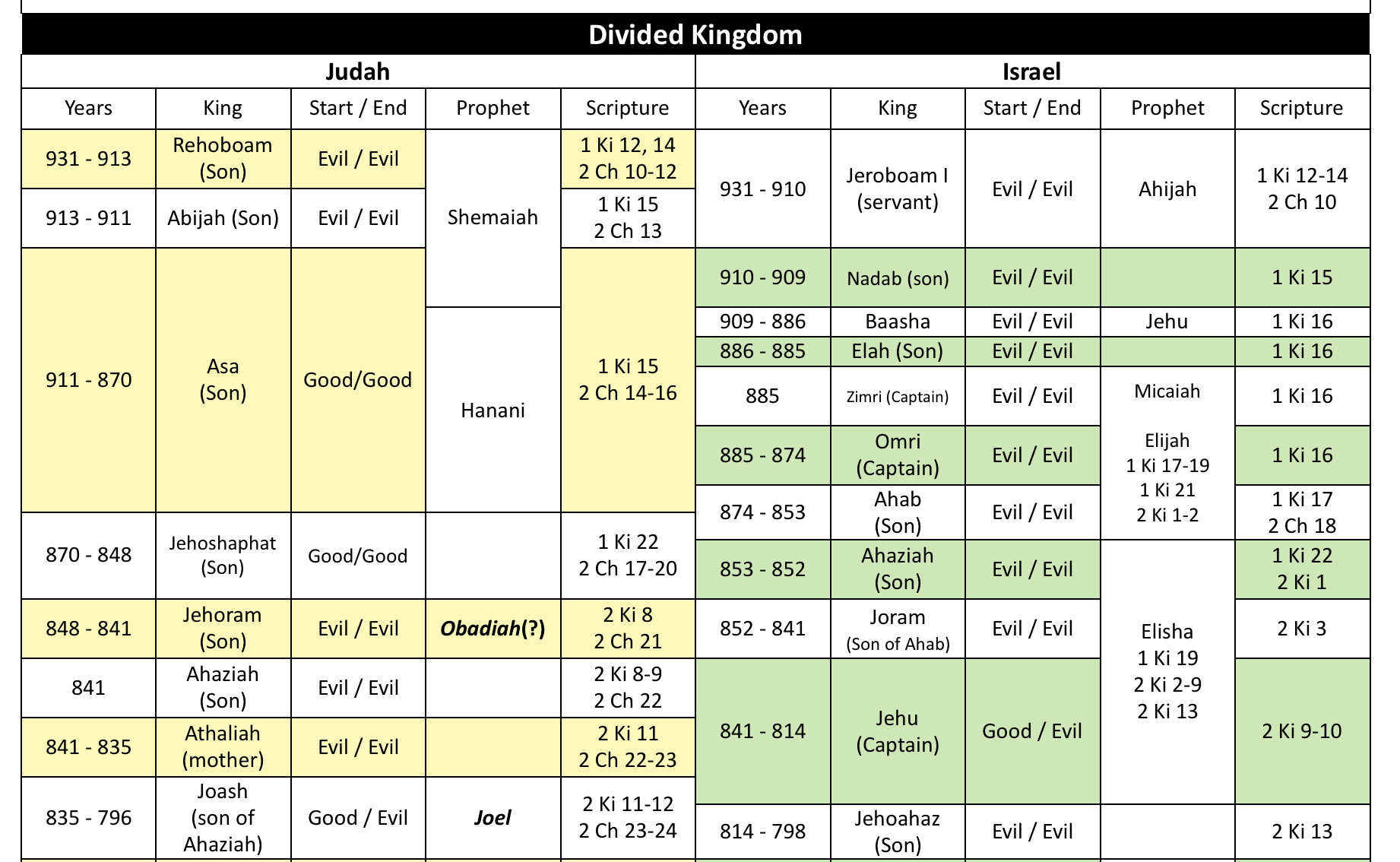
The genealogy now focuses on the kings that come from the line of David, as summarized in the list above.
Now Solomon’s son was Rehoboam, (SEE NOTE ABOVE ON DOUBLE LINE OF THE MESSIAH THROUGH DAVID'S SONS NATHAN AND SOLOMON) Rehoboam inherited the throne after Solomon’s death, but his harsh and prideful response to the people’s request for relief from heavy burdens led to the division of the kingdom (1 Kings 12:1–19). Ten tribes revolted and formed the northern kingdom of Israel under Jeroboam, leaving Rehoboam ruling only Judah and Benjamin. His reign illustrates how pride and failure to heed wise counsel can fracture what once seemed strong and united (Proverbs 15:22).
Abijah was his son, Abijah (also called Abijam in Kings) ruled Judah after Rehoboam. Though his reign was spiritually mixed, one significant moment stands out when he boldly declared Judah’s covenant relationship with the LORD against Jeroboam’s idolatrous northern kingdom (2 Chronicles 13:4–12). God granted him victory, not because Abijah was personally righteous, but because of God’s covenant faithfulness to David.
Asa his son, Asa became one of Judah’s godlier kings. He initiated reforms, removed idols, and called Judah back to covenant loyalty (Read 2 Chronicles 14–16). Scripture says, “Asa did what was good and right in the sight of the LORD his God” (2 Chronicles 14:2). He demonstrated faith when facing overwhelming military threats, crying out, “LORD, there is no one besides You to help in the battle between the powerful and those who have no strength” (2 Chronicles 14:11). Yet even Asa stumbled later in life by relying on human alliances instead of the LORD and by responding angrily to prophetic rebuke. (Read the sad saga of King Asa in his later years in 2Chr 16:1-14. Oh for God's grace to finish this short race well! In Jesus' Name. Amen. cf Heb 12:1-2)
Jehoshaphat his son - Jehoshaphat also stands among Judah’s more faithful kings. He strengthened the kingdom spiritually by teaching God’s Law throughout the land (2 Chronicles 17:7–9). He trusted God during a massive invasion, proclaiming, “We do not know what to do, but our eyes are on You” (2 Chronicles 20:12). God delivered Judah miraculously without battle (2Chr 20:13-30). However, Jehoshaphat weakened himself spiritually through compromising alliances with the wicked house of Ahab.
This succession of kings reveals a recurring pattern throughout Judah’s history: periods of reform followed by compromise and decline. Yet through faithful kings and flawed kings alike, God preserved the Davidic line exactly as He promised (2 Samuel 7:12–16). The genealogy steadily moves forward toward Jesus Christ, the ultimate Son of David, the perfectly righteous King whose kingdom will never divide, fail, or end (Luke 1:32–33).
QUESTION - Who was King Rehoboam in the Bible? | GotQuestions.org
ANSWER - Rehoboam was the son of King Solomon and king of Judah for seventeen years (931–913 BC). Solomon had turned away from God, and God told Solomon that He would tear the kingdom from him yet leave him one tribe. God also promised, for the sake of David, not to tear the kingdom away during Solomon’s lifetime but during that of his son (1 Kings 11:9–13). Shortly after Rehoboam became king, a rebellion placed the ten northern tribes under the rule of Jeroboam and left Rehoboam with his own tribe (Judah) and the tribe of Benjamin.
Jeroboam started out as a servant of Solomon in charge of forced labor (1 Kings 11:28). A prophet told Jeroboam that he would be king over Israel (1 Kings 11:26–40). At some point, Jeroboam fled from Solomon to Egypt. But when Rehoboam went to Shechem to be installed as king of Israel, Jeroboam returned. The people sent Jeroboam to the new king to ask him to lighten the heavy load of labor and taxes that Solomon had laid on them (1 Kings 12:1–4; 2 Chronicles 10:3–4). The older advisers gave King Rehoboam the wise counsel to honor the people’s request and thus win their loyalty (1 Kings 12:6–7; 2 Chronicles 10:6–7). King Rehoboam asked the young men who had grown up with him for advice as well. They foolishly told the new king to threaten even harsher conditions. Rehoboam took the young men’s advice, and the people rebelled, abandoning the house of David and ultimately making Jeroboam their king (1 Kings 12:8–20; 2 Chronicles 10:8–19). Rehoboam fled to Jerusalem (1 Kings 12:18; 2 Chronicles 10:18), where he mustered 180,000 warriors from the tribes of Judah and Benjamin to mount an attack. But Shemaiah, a prophet of God, delivered God’s message to Rehoboam: the troops should go home because the divided kingdom had come from the Lord. The people of Judah wisely listened and did not invade Israel (1 Kings 12:21–24; 2 Chronicles 11:1–4). However, there continued to be warfare between Jeroboam and Rehoboam throughout Rehoboam’s reign (1 Kings 14:30; 2 Chronicles 12:15).
In the northern kingdom, Jeroboam promoted idolatry and removed the Levites from service, so the priests and Levites came to Rehoboam and served at the temple of the Lord in Jerusalem (2 Chronicles 11:13–15), along with all those who wanted to seek the one true God (2 Chronicles 11:16). 2 Chronicles 11:17 says, “They strengthened the kingdom of Judah, and for three years they made Rehoboam the son of Solomon secure, for they walked for three years in the way of David and Solomon.” Rehoboam also built multiple cities for defense, with strong fortresses, commanders, and supplies (2 Chronicles 11:5–12). King Rehoboam “acted wisely” by placing his sons throughout the districts of Judah and Benjamin, supplied ample provisions, and found them wives (2 Chronicles 11:23).
Unfortunately, after King Rehoboam became established in the southern kingdom, he abandoned the ways of God (2 Chronicles 12:1). In the fifth year of Rehoboam’s reign, Shishak king of Egypt captured the fortified cities in Judah and set out against Jerusalem. Shemaiah the prophet told Rehoboam, “This is what the Lord says, ‘You have abandoned me; therefore, I now abandon you to Shishak” (2 Chronicles 12:5). “The leaders of Israel and the king humbled themselves and said, ‘The Lord is just’” (verse 6). Seeing their humility, God said He would not destroy them but would allow them to become subjects of Shishak. The Pharaoh attacked Jerusalem and removed all the treasures from the temple and the palace (1 Kings 14:26; 2 Chronicles 12:9). Rehoboam did make bronze shields to replace the gold ones his father had made (1 Kings 14:27; 2 Chronicles 12:10–11).
2 Chronicles 12:12 says, “Because Rehoboam humbled himself, the Lord’s anger turned from him, and he was not totally destroyed. Indeed, there was some good in Judah.” “Some good in Judah” seems a fitting way to characterize the reign of Rehoboam. He was unwise and perhaps brash in his treatment of the forced laborers, thus leading to his loss of the kingdom. However, that loss was God-ordained, and Rehoboam proceeded to follow the ways of the Lord for some time. But then he turned from God, and the nation slid into moral and spiritual decay. “Judah did evil in the eyes of the LORD. By the sins they committed they stirred up his jealous anger more than those who were before them had done” (1 Kings 14:22). They set up high places and had male shrine prostitutes in the land, which King Asa, Rehoboam’s grandson, would later remove.
From King Rehoboam we learn the importance of wise counselors and maintaining faithfulness to God. When Rehoboam went his own way, things did not go well for his kingdom. When he listened to God, Judah was secure.
Related:
QUESTION - Who was King Abijah in the Bible? | GotQuestions.org
ANSWER - King Abijah, also called King Abiah or King Abijam, was the son of King Rehoboam and father of King Asa. Abijah reigned for only three years (913–911 BC) in Judah before he died. Abijah was a wicked king: “He committed all the sins his father had done before him; his heart was not fully devoted to the Lord his God, as the heart of David his forefather had been” (1 Kings 15:3). King Abijah attempted to reclaim the northern ten tribes of Israel as part of his kingdom, and so there was war between Abijah and Jeroboam throughout Abijah’s lifetime (verse 6).
King Abijah had some victories over Israel to the north. Second Chronicles 13 describes a battle in which Abijah and his 400,000 men triumphed over Jeroboam with his 800,000 men. King Abijah stood on Mount Zemaraim and spoke out to Jeroboam and Israel about God’s covenant with David, Jeroboam’s rebellion against Rehoboam, and Jeroboam’s ridding Israel of the Levites and allowing anyone to become a priest of false gods. Abijah concluded, “God is with us; he is our leader. His priests with their trumpets will sound the battle cry against you. People of Israel, do not fight against the Lord, the God of your ancestors, for you will not succeed” (2 Chronicles 13:12). The troops of Israel had come behind those of Judah to ambush them, intending to attack them from both front and rear. But the men from Judah cried out to God, the priests blew their trumpets, and “at the sound of their battle cry, God routed Jeroboam and all Israel before Abijah and Judah” (2 Chronicles 13:15). Abijah also took the towns of Bethel, Jeshanah, Ephron, and their surrounding villages from Jeroboam. From that time, King Jeroboam’s strength lessened: “Jeroboam did not regain power during the time of Abijah. And the Lord struck him down and he died. But Abijah grew in strength. He married fourteen wives and had twenty-two sons and sixteen daughters” (Chronicles 13:20–21).
Abijah’s mother was Maakah, and she apparently held a position of authority as queen mother throughout Abijah’s reign and into the reign of her grandson Asa. After Abijah’s death, there was peace between Israel and Judah for ten years (2 Chronicles 14:1), and Abijah’s son, King Asa, instituted wide reforms throughout Judah. One of Asa’s reforms was to depose his grandmother Maakah because of her promotion of Asherah worship (1 Kings 15:13). Second Chronicles 14:2 says, “Asa did what was good and right in the eyes of the Lord his God.”
Abijah’s short reign was unfortunately marked by doing evil in the eyes of the Lord. Even though God had granted him victory over Israel, Abijah continued the same error as his father, Rehoboam—not being fully devoted to God (2 Chronicles 12:14; 1 Kings 15:3).
QUESTION - Who was King Asa in the Bible? | GotQuestions.org
ANSWER - Asa was a descendant of David and the third king of the southern kingdom of Judah. He ruled for forty-one years (1 Kings 15:10) and “did what was good and right in the eyes of the Lord his God” (2 Chronicles 14:2). The biblical account of Asa’s reign is detailed in 1 Kings 15 and 2 Chronicles 14–16.
Asa became king of Judah in the twentieth year of Jeroboam of Israel’s reign (Jeroboam was the first king of the northern kingdom of Israel after the kingdom divided). Asa’s father, Abijah, had done much evil in God’s sight and only ruled for three years. Asa’s grandfather, Rehoboam, had also done evil in God’s sight. But King Asa instituted reform; he removed the male shrine prostitutes, cut down Asherah poles, and even deposed his grandmother from her position as queen mother because of her involvement with Asherah worship (1 Kings 15:12–13; 2 Chronicles 14:3; 15:16). Asa also commanded his people to follow the Lord (2 Chronicles 14:4). First Kings 15:14 says, “Although he did not remove the high places, Asa’s heart was fully committed to the Lord all his life” (see also 2 Chronicles 15:17).
Judah was at peace with surrounding nations for ten years during Asa’s reign (2 Chronicles 14:1). Second Chronicles 15 describes a time when Azariah, a prophet, told Asa that, if he sought the Lord, God would be with him. This encouraged Asa to remove idols and to repair the altar at the Lord’s temple. He assembled the people together to sacrifice to the Lord: “They entered into a covenant to seek the Lord, the God of their ancestors, with all their heart and soul. All who would not seek the Lord, the God of Israel, were to be put to death, whether small or great, man or woman. They took an oath to the Lord with loud acclamation, with shouting and with trumpets and horns. All Judah rejoiced about the oath because they had sworn it wholeheartedly. They sought God eagerly, and he was found by them. So the Lord gave them rest on every side” (2 Chronicles 15:12–15).
Asa built up the fortified cities, and Judah enjoyed a time of prosperity (2 Chronicles 14:6–7). When Zerah the Cushite marched out to make war against Judah, Asa called on God for aid. “The Lord struck down the Cushites before Asa and Judah. The Cushites fled, and Asa and his army pursued them as far as Gerar. Such a great number of Cushites fell that they could not recover; they were crushed before the Lord and his forces. The men of Judah carried off a large amount of plunder” (2 Chronicles 14:12–13).
Unfortunately, in the thirty-fifth year of Asa’s reign, he made some mistakes. When King Baasha of Israel fortified Ramah so as to isolate the territory of Judah, Asa made a treaty with Ben-Hadad, king of Aram. The treaty was effective in stopping Israel, and the Judahites took supplies from Ramah and built up Geba and Mizpah, but the treaty with Aram was not pleasing to God (see 1 Kings 15:16–22; 2 Chronicles 16:1–10). Hanani, the seer, visited Asa and reminded him of the way God had conquered the Cushites. He chastised Asa for relying on Ben-Hadad instead of God. Rather than repent of his sin, however, Asa became angry; at the same time he began to oppress some of his people (2 Chronicles 16:10). For the remainder of Asa’s reign, his kingdom was at war.
In the thirty-ninth year of Asa’s reign, he got a severe foot disease, but he looked only to the physicians for help and not God (2 Chronicles 16:12). In the forty-first year of his reign, Asa died and was buried with great honor.
Despite a less-than-ideal end to his reign, Asa is considered a godly and good king. His son, Jehoshaphat, succeeded him and ruled for twenty-five years. Jehoshaphat was also a godly ruler, following in his father’s footsteps and seeking the Lord, yet he also made foolish alliances with those who did not follow the Lord (2 Chronicles 19:1–3; 20:31–33, 20:35–21:1). The life of King Asa is an example to all of us of how easy it is to drift away from the Lord. Asa began his reign with a strong commitment to God, but as years went by his dedication faltered, bringing unnecessary trouble.
QUESTION - Who was King Jehoshaphat in the Bible? | GotQuestions.org
ANSWER - King Jehoshaphat was the fourth king of Judah under the divided monarchy, the son of Asa. We are first introduced to him in 1 Kings 15:24 but are told nothing more than that he succeeded Asa. Later, 1 Kings 22:42 tells us that he was 35 years old when he began his reign and that he reigned 25 years (from 873 to 848 BC). First Kings 22 gives a brief account of his reign with 2 Chronicles 17–22 giving a more comprehensive account.
Spiritually, Jehoshaphat began his reign in a positive way. Second Chronicles 17:3–6 gives this commendation: “The Lord was with Jehoshaphat because he followed the ways of his father David before him. He did not consult the Baals but sought the God of his father and followed his commands rather than the practices of Israel. The Lord established the kingdom under his control; and all Judah brought gifts to Jehoshaphat, so that he had great wealth and honor. His heart was devoted to the ways of the Lord; furthermore, he removed the high places and the Asherah poles from Judah.” In addition, Jehoshaphat sent men throughout the kingdom to teach the people the Law of God (2 Chronicles 17:7–9).
Militarily, Jehoshaphat fortified his defenses, primarily against the northern kingdom of Israel (2 Chronicles 17:1–3). The surrounding nations feared Judah and brought tribute (2 Chronicles 17:10–19).
After making peace with Israel, Jehoshaphat apparently tried to reach out to Ahab, the king of Israel. Ahab was one of the wickedest kings of Israel, and Jehoshaphat could not have been ignorant of his character. First Kings 22 and 2 Chronicles 18 relate the following account: Ahab asks Jehoshaphat to help him attack Syria. Jehoshaphat wisely requests that they consult the LORD on the matter. Ahab gathers 400 of his prophets who encourage the attack. Jehoshaphat recognizes that these are not genuine prophets of the LORD, and the exchange that follows between Jehoshaphat and Ahab is almost comical: “But Jehoshaphat asked, ‘Is there no longer a prophet of the Lord here whom we can inquire of?’ The king of Israel answered Jehoshaphat, ‘There is still one prophet through whom we can inquire of the Lord, but I hate him because he never prophesies anything good about me, but always bad. He is Micaiah son of Imlah.’”
So, Micaiah is summoned, and the question is posed. Micaiah responds with high irony: “Attack and be victorious, . . . for the Lord will give it into the king’s hand.” This answer exasperates King Ahab: “How many times must I make you swear to tell me nothing but the truth in the name of the Lord?” Micaiah then tells Ahab the hard truth: “I saw all Israel scattered on the hills like sheep without a shepherd, and the Lord said, ‘These people have no master’” (1 Kings 22:15–18).
In spite of what seems to be an acknowledgement that Micaiah speaks for the LORD, Jehoshaphat joins Ahab in the attack. Ahab is killed, and Jehoshaphat narrowly escapes. When Jehoshaphat returns home, he is reprimanded by a prophet of the Lord for his collaboration with Ahab: “Jehu the seer, the son of Hanani, went out to meet him and said to the king, ‘Should you help the wicked and love those who hate the Lord? Because of this, the wrath of the Lord is on you. There is, however, some good in you, for you have rid the land of the Asherah poles and have set your heart on seeking God’” (2 Chronicles 19:2–3).
Jehoshaphat continues to make reforms, appointing judges throughout the land to handle disputes and charging them to make righteous judgments and to fear the Lord (2 Chronicles 19:4–11).
In 2 Chronicles 20, an alliance of nations decides to march against Judah. Jehoshaphat seeks the Lord and asks all Judah to fast (verse 3). Through a man named Jahaziel, the Lord tells Jehoshaphat that He will deliver Judah without a fight (verses 14–17). Jehoshaphat goes out to battle with singers leading the way, singing praise to the Lord. The alliance of nations turn against each other and begin to kill each other (verses 22–23). The men of Judah spend three days collecting the spoils of war that were abandoned by their enemies (verse 25).
Although Jehoshaphat started his reign by removing the idolatrous high places, at the end of his reign, there were still high places that had not been taken away (1 Kings 22 and 2 Chronicles 20). Jehoshaphat started well, but his diligence flagged, and the idol-worship returned. First Kings 22:41–50 and 2 Chronicles 20:35–37 record a joint ship-building venture that Jehoshaphat attempted with the wicked king Ahaziah of Israel. Jehoshaphat, who had already been chastised for an alliance with Ahab, is once again confronted by a prophet with a warning. It seems that Jehoshaphat heeded the warning and did not allow Ahaziah’s men to sail with the Judeans, but the judgment still came to pass: the fleet was wrecked, and Jehoshaphat’s foolish investment with Ahaziah proved futile.
Jehoshaphat is still considered a good and godly king, but his reign ended rather badly. He kept trying to build an alliance with Israel, even though the kings of Israel were obviously wicked. Jehoshaphat worshiped the Lord and led his people in seeking the Lord, but the hearts of the people were never fully changed. They reverted to pagan practices. King Jehoshaphat was unable to pass his faith on to his son Jehoram who reigned after him. Jehoram started by killing all of his brothers, and then he married the daughter of Ahab (2 Chronicles 21:4–6).
1 Chronicles 3:11 Joram his son, Ahaziah his son, Joash his son,
- Joram (KJV): 1Ki 22:50 2Ch 21:1, Jehoram
- Ahaziah (KJV): 2Ki 8:24 2Ch 21:17, Jehoahaz, 1Ch 22:1-6, Azariah
- Joash (KJV): 2Ki 11:21 2Ch 24:1
Joram his son, (also called Jehoram) was the son of Jehoshaphat. Though raised under a godly father, Joram married Athaliah, the daughter of Ahab and Jezebel, bringing the corrupt influence of Ahab’s house into Judah (2 Chronicles 21:6). After becoming king, Joram murdered his own brothers to secure his throne and led Judah into idolatry. Scripture says, “He made high places in the mountains of Judah and caused the inhabitants of Jerusalem to play the harlot” (2 Chronicles 21:11). Because of his wickedness, Elijah sent him a written prophecy announcing divine judgment (2Chr 21:12–15). His reign ended in misery, disease, and dishonor, and the people “made no fire for him like the fire for his fathers” (2Chr 21:19), indicating little public mourning.
Ahaziah his son, ruled only briefly and followed the sinful ways of the house of Ahab because of the influence of his mother Athaliah (2 Chronicles 22:3). He aligned himself with Israel’s wicked king Joram and became caught up in the judgment God brought through Jehu. Ahaziah was killed during Jehu’s purge against Ahab’s dynasty (2 Kings 9:27–29).
Joash his son (also called Jehoash) survived only because he was hidden as a child from Athaliah's murderous attempt to destroy the royal seed of David (2 Kings 11:1–3). This was a critical moment in redemptive history because Satan’s efforts to destroy the Davidic line threatened the Messianic promise itself. God preserved Joash through the courage of Jehosheba and the protection of the priest Jehoiada. At age seven, Joash was crowned king and Athaliah was overthrown. Under Jehoiada’s guidance, Joash began well and repaired the Temple (2 Chronicles 24:4–14). However, after Jehoiada’s death, Joash turned away from the LORD, listened to corrupt leaders, and even ordered the death of Zechariah the prophet, Jehoiada’s son (2 Chronicles 24:20–22)! His life illustrates the danger of borrowed spirituality. He outwardly followed God while under godly influence, but his heart was never fully surrendered to Yahweh.
QUESTION - Who was King Jehoram / Joram in the Bible? | GotQuestions.org
ANSWER - There are two kings in the Bible referred to as King Jehoram/Joram. The first was the son of King Jehoshaphat, and he ruled in the southern kingdom of Judah from 853 to 841 BC. The other King Jehoram was the son of the wicked King Ahab, and he ruled in the northern kingdom of Israel from 852 to 841 BC . The name Joram is a shortened form of Jehoram. Complicating matters is the fact that both Jehorams were brothers-in-law to each other.
Jehoram son of Jehoshaphat was 32 years old when he began to reign, and he reigned for four years with his father and another eight years on his own in Judah (2 Kings 8:16–17)—a total of twelve years. Although Jehoshaphat had been a good and godly king, Jehoram did not follow in his father’s footsteps. He married Athaliah, daughter of King Ahab (and sister of Ahab’s son Joram), and he became an evil ruler. But, in spite of King Jehoram’s wickedness, God kept his covenant with David and refrained from destroying Judah (2 Kings 8:19).
Sadly, God’s mercy had no effect on Jehoram’s behavior. He led his kingdom into idolatry and lewdness, and he caused both Edom and Libnah to revolt against Judah (2 Chronicles 21:8, 11). So God sent word through the prophet Elijah that, because Jehoram had led the people into sin, there would be a devastating attack on Jehoram’s house and Jehoram himself would be struck with an incurable bowel disease (verses 14–15). As part of God’s judgment, the Philistines and Arabs “attacked Judah, invaded it and carried off all the goods found in the king’s palace, together with his sons and wives. Not a son was left to him except Ahaziah, the youngest” (verse 17). The disease killed Jehoram in a gruesome and agonizing manner at the age of 40. The people did not mourn this wicked king (verses 18–20).
The other Jehoram (or Joram), son of Ahab, took the throne of Israel in the second year of his brother-in-law’s reign in Judah, and he was just as corrupt. He certainly had a poor example in his father. Ahab had turned the people to idolatry, leading them away from the true God of their fathers to the worship of his wife Jezebel’s god, Baal. Ahab had famously clashed with the Elijah on many occasions, and his wicked rule had led to God’s punishment over the whole land in the form of a years-long drought. The consequences of Ahab’s choices carried into his son’s reign. Ahab had previously taken control of Moab and forced the people to pay tribute, but, when Joram took the throne, Moab rebelled, forcing Joram into war (2 Kings 3:4–5).
King Joram called for help in the battle from King Jehoshaphat of Judah and the king of Edom, and the combined armies set out on a march through the wilderness toward Moab (2 Kings 3:8). Along the way, they ran out of water. Jehoshaphat made inquiries and discovered that Elisha, a prophet of God and Elijah’s successor, was nearby. Elisha was brought before the kings, and Joram asked for help from God. Elisha wanted to refuse Joram, but he agreed to help for Jehoshaphat’s sake (verse 14). Through God’s power, Elisha filled a dry stream bed with water for the troops, and he also promised that God would deliver Moab into their hands (verses 15–18). The prophecy came true, and Moab fled before Israel (verses 20–27).
In spite of this miracle and the victories in subsequent battles God granted, King Joram continued in his evil ways. Although he had brought Baal worship to an end in Israel, “he clung to the sins of Jeroboam” (2 Kings 3:3), and his demise was sure. Joram was injured in a battle with the Aramians (2 Kings 9:15). God charged Jehoshaphat’s son Jehu to destroy the entire house of Ahab (2 Kings 9:6–10). Jehu obeyed, and, after confronting Joram, he shot Joram between the shoulders with an arrow (verse 24). Unfortunately, Jehu stopped obeying God after he had wiped out Ahab’s family. King Jehu became yet another deficient ruler who continued leading the people of Israel into sin (verse 31).
QUESTION - Who was King Ahaziah in the Bible? | GotQuestions.org
ANSWER - There are two kings named Ahaziah in the Bible; one ruled in the northern kingdom of Israel and the other in the southern kingdom of Judah. In a long line of righteous and unrighteous kings that ruled in the northern and southern kingdoms, these men were both evil kings.
Ahaziah of Israel was king from 853—852 BC. He was the son of Ahab and Jezebel, who were among the most wicked rulers Israel ever had. Ahaziah’s parents brought Baal worship into the land and turned God’s people away from Him; although Ahaziah reigned for only two years, he was just as evil as his parents. He “aroused the anger of the LORD” (1 Kings 22:53) due to his own worship of Baal, which continued to lead the people into sin and idolatry. At one point King Ahaziah of Israel tried to ally with King Jehoshaphat of Judah, but, after a warning from one of God’s prophets, Jehoshaphat severed ties with the wicked king (verse 49; cf. 2 Chronicles 20:37).
At some point during his reign, King Ahaziah of Israel fell out of a window, injuring himself badly. He was confined to bed, and, rather than inquire of the Lord, Ahaziah sent messengers to inquire of Baal-Zebub, the “god” of Ekron, to see if he would recover (2 Kings 1:2). The Lord sent His prophet, Elijah, to confront the messengers and give them God’s message for King Ahaziah: he would never recover from his injuries and would die in his bed.
When the messengers returned to King Ahaziah and relayed what Elijah had told them, Ahaziah was angry and sent his captain and 50 soldiers to fetch Elijah. The captain demanded that Elijah come down from the hill he was sitting on, but the prophet refused; instead, he announced, “May fire come down from heaven and consume you and your fifty men!” (2 Kings 1:10). The Lord allowed this miracle, and all King Ahaziah’s men were consumed by fire. Ahaziah sent men to Elijah twice more. In the second instance, the same thing happened as in the first: Elijah called down fire to kill the soldiers. However, the third captain begged for his life, and the Lord spared the company. Elijah came to the king. God’s Word had not changed: Elijah repeated God’s message of judgment directly to Ahaziah, and soon Ahaziah died. As Ahaziah had no sons, he was succeeded by his brother Joram, who was also a sinful ruler—although not as evil as his brother and parents before him (verse 17).
The other Ahaziah, King Ahaziah of Judah (who is also called “Jehoahaz” in some translations), was the nephew of King Ahaziah of Israel and the son of Jehoram, the evil son of the righteous king Jehoshaphat. Judah’s King Ahaziah was related to King Ahaziah of Israel through his mother, Athaliah, the daughter of Ahab and Jezebel. Ahaziah of Judah walked in the ways of his father, and because of this the Lord allowed him to reign less than one year in 841 BC. He was only 22 years old (2 Kings 8:26–27).
King Ahaziah immediately allied with his other uncle, King Joram, in a war against the king of Aram. King Joram was wounded and went to Jezreel to rest (2 Kings 8:28–29), and Ahaziah of Judah joined him there. During this time, a man named Jehu was anointed by the Lord as king of Israel with the command to destroy the house of Ahab (see 2 Kings 9:1–10). Jehu knew King Joram of Israel and King Ahaziah of Judah were in Jezreel, and so he rode to that city (verse 16). When King Joram and King Ahaziah went down to meet Jehu, Joram guessed Jehu’s plan and tried to flee (verse 23). Jehu, however, shot Joram with an arrow and killed him instantly (verse 24). Ahaziah tried to run as well, but Jehu’s company pursued him, mortally wounding him. Ahaziah made it to Megiddo but died there (verse 27). Jehu continued his campaign, killing Jezebel and eventually destroying all of Ahab’s family.
Not only are the stories of King Ahaziah of Israel and King Ahaziah of Judah a part of the history of the Jewish people, they are also a cautionary tale of the consequences of leading God’s people away from the Lord. Both the northern and southern kingdoms were eventually destroyed as a result of God’s judgment for their evil ways. While a remnant that spent 70 years in captivity was eventually able to return to Judah, the kingdom was never the same again.
QUESTION - Who was King Joash in the Bible? | GotQuestions.org
ANSWER - There are two kings with the name Joash (or Jehoash) in the Bible: one a king of Judah (reigned 835–796 BC) and the other a king of Israel (reigned 798–782 BC).
The story of King Joash of Judah starts with that of King Jehu of Israel. Anointed king of Israel by Elisha, Jehu was tasked with destroying King Ahab’s descendants and wiping out Baal worship in the land (2 Kings 9). First Kings 21:25–26 gives the reason for the judgment: “There was never anyone like Ahab, who sold himself to do evil in the eyes of the Lord, urged on by Jezebel his wife. He behaved in the vilest manner by going after idols, like the Amorites the Lord drove out before Israel.” God had told Ahab, through Elijah, “I am going to bring disaster on you. I will wipe out your descendants and cut off from Ahab every last male in Israel—slave or free, . . . because you have aroused my anger and have caused Israel to sin” (1 Kings 21:21–22). Ahab responded to the prophecy with mourning and in humility, so God relented, saying that He would not bring the disaster in Ahab’s time but during his son’s reign. Jehu was God’s instrument to fulfill the prophecy.
After Jehu was anointed king over Israel, he set out against Joram, a son of Ahab and the current king of Israel. Ahaziah (different from the other son of Ahab who initially succeeded him) was king of Judah at the time and was with Joram. Judah’s Ahaziah, however, “followed the ways of the house of Ahab and did evil in the eyes of the Lord, as the house of Ahab had done, for he was related by marriage to Ahab’s family” (2 Kings 8:27). Jehu killed both Ahaziah and Joram; executed Ahab’s wife, Jezebel; killed Ahab’s descendants; and “wiped out Baal from Israel” (2 Kings 10:28, ESV). Unfortunately, Jehu himself did not walk in the ways of God, but, since he had been faithful to God’s call to rid Israel of Baal worship, God promised that four generations of his line would be king of Israel (2 Kings 10:30).
King Joash of Judah first comes on the scene when Athaliah, the mother of King Ahaziah, whom Jehu had killed, took charge of Judah. Athaliah killed all of the royal family she could find in Judah in order to secure the throne for herself. However, Athaliah missed one of her grandsons—the infant Joash. The evil queen’s daughter (or possibly step-daughter) rescued young Joash and his nurse, and the child was hidden for six years in the temple while Athaliah reigned in Judah (2 Kings 11:1–3). In the seventh year, the priest Jehoiada revealed Joash to the captains of the guards. The priest made an agreement with them to provide protection to the temple and the rightful king, and Jehoiada brought Joash out into public and anointed him as king (2 Kings 11:4–12). The people of Judah rejoiced over Joash’s appointment. Upon hearing the noise of the ceremony, Queen Athaliah rushed to the temple, crying, "Treason! Treason!” By Jehoiada’s command, Athaliah was captured by the guards, removed from the temple, and put to death (2 Kings 11:13–16). “Jehoiada then made a covenant between the Lord and the king and people that they would be the Lord’s people. He also made a covenant between the king and the people” (2 Kings 11:17). The people tore down the temple of Baal, watchmen were set over the Lord’s temple, and, at the age of seven, Joash took the throne (2 Kings 11:18–21).
Second Kings 12:1–3 says that Joash “reigned in Jerusalem forty years. . . . Joash did what was right in the eyes of the Lord all the years Jehoiada the priest instructed him.” Second Kings 12 goes on to describe various financial dealings of Joash. King Joash’s main achievement was making repairs to the temple (2 Kings 12:4–16). He also used a monetary gift to dissuade King Hazael of Aram (Syria) from attacking Jerusalem (2 Kings 12:17–18).
The tragedy of King Joash of Judah is that, after his mentor and guardian, Jehoiada, died, he began listening to wicked advisers. Joash revived Baal and Asherah worship in Judah (2 Chronicles 24:17–19). God sent prophets to warn Joash, but he did not listen to them. Finally, the prophet Zechariah, son of the priest Jehoiada, brought God’s word to Joash, but the king callously ordered the son of his old friend to be stoned to death (verses 19–22). Joash’s reign did not end peacefully: “His officials conspired against him and assassinated him at Beth Millo, on the road down to Silla” (2 Kings 12:20). Joash’s son Amaziah took over the throne, and Amaziah “did what was right in the eyes of the Lord,” but, the Bible notes, he was more like his father Joash than his ancestor David (2 Kings 14:3–4). Interestingly, Amaziah interacted with the other King Joash in the Bible.
King Joash of Israel began his reign in the thirty-seventh year of the reign of King Joash of Judah, so there was some overlap. King Amaziah started ruling Judah in the second year of King Joash of Israel. Amaziah of Judah battled against the Edomites and then challenged Joash of Israel to battle (2 Kings 14:7–8). Joash refused, essentially telling Amaziah he was needlessly stirring up trouble (2 Kings 14:9–10). Amaziah did not heed the warning, and Joash of Israel defeated Judah in battle. Second Chronicles 25:20 says that Judah’s defeat was “because they sought the gods of Edom.”
Second Kings records another of Joash of Israel’s military victories. When Joash’s father, Jehoahaz, was reigning, King Hazael of Aram (the same king that Joash of Judah had kept from attacking Jerusalem) oppressed Israel (2 Kings 13:22). “But the Lord was gracious to them and had compassion and showed concern for them because of his covenant with Abraham, Isaac and Jacob. To this day he has been unwilling to destroy them or banish them from his presence” (2 Kings 13:23). When the prophet Elisha was sick and near to death, King Joash of Israel visited the prophet, apparently disconcerted over the military situation in Israel (2 Kings 13:14). Elisha instructed Joash to shoot arrows out of the open window. The prophet then proclaimed, “The Lord’s arrow of victory, the arrow of victory over Aram! . . . You will completely destroy the Arameans at Aphek” (2 Kings 13:17). Elisha next instructed Joash to strike the ground with the arrows. Joash did so but stopped after three strikes. “The man of God was angry with him and said, ‘You should have struck the ground five or six times; then you would have defeated Aram and completely destroyed it. But now you will defeat it only three times’” (2 Kings 13:19). When Hazael died and his son, Ben-hadad, took over, Joash did defeat him three times. Israel was able to recover cities that previously had been taken from them (2 Kings 13:24–25).
King Joash of Israel ruled for sixteen years and “did evil in the eyes of the Lord and did not turn away from any of the sins of Jeroboam son of Nebat, which he had caused Israel to commit; he continued in them” (2 Kings 13:11). After he died, Joash of Israel was succeeded by his son Jeroboam II (2 Kings 14:16).
1 Chronicles 3:12 Amaziah his son, Azariah his son, Jotham his son,
- Amaziah (KJV): 2Ki 14:1 2Ch 25:1
- Azariah (KJV): 2Ki 14:21 15:30 2Ch 26:1, Uzziah, Mt 1:8,9, Ozias
- Jotham (KJV): 2Ki 15:5,32 2Ch 27:1 Mt 1:9, Joatham
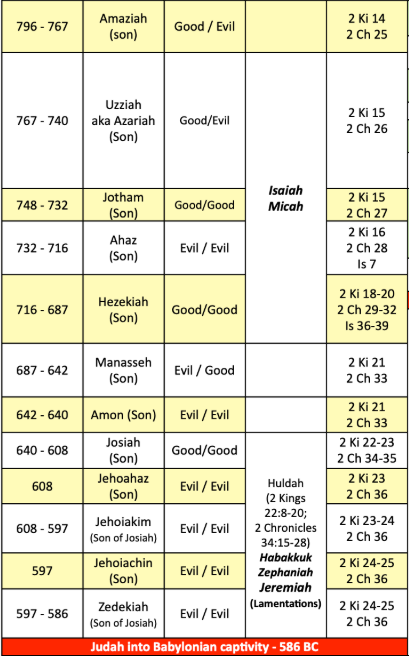
These kings reveal a recurring pattern in Judah’s history: partial obedience, outward reform, and yet incomplete devotion to the LORD.These kings reveal a recurring pattern in Judah’s history: partial obedience, outward reform, and yet incomplete devotion to the LORD.
Amaziah his son, Amaziah, the son of Joash, began his reign with a measure of obedience. Scripture says, “He did right in the sight of the LORD, yet not with a whole heart” (2 Chronicles 25:2). That statement captures the tragedy of his reign. He obeyed God outwardly in some areas, including respecting the Mosaic Law by not executing the children of his father’s assassins (2 Kings 14:6; Deuteronomy 24:16). God granted him military success against Edom, but afterward Amaziah foolishly brought back the gods of Edom and worshiped them (2 Chronicles 25:14)! Victory led to pride rather than gratitude. He later provoked a disastrous war against Israel and suffered humiliation and defeat. Amaziah illustrates the danger of divided loyalty: external religion without wholehearted devotion eventually collapses spiritually.
Azariah his son, Azariah is more commonly known as Uzziah (2 Kings 15:13; Isaiah 6:1). He became one of Judah’s strongest and most prosperous kings. Under his rule Judah experienced military success, economic growth, and technological advancement (2 Chronicles 26:6–15). Scripture says, “As long as he sought the LORD, God prospered him” (2 Chronicles 26:5). Yet prosperity became spiritually dangerous. “But when he became strong, his heart was so proud that he acted corruptly” (2 Chronicles 26:16). Uzziah unlawfully entered the Temple to burn incense, usurping priestly authority, and God struck him with leprosy. He lived isolated until death. His reign powerfully demonstrates that success can become more spiritually hazardous than adversity when it breeds pride and self reliance.
Jotham his son, Jotham ruled faithfully during a spiritually declining period. Unlike his father, he did not enter the Temple presumptuously (2 Chronicles 27:2). He strengthened Judah militarily and administratively, and Scripture gives the key to his stability: “Jotham became mighty because he ordered his ways before the LORD his God” (2 Chronicles 27:6). Yet despite his personal integrity, the people as a whole continued in corruption. Jotham’s reign reminds us that even godly leadership cannot automatically transform a rebellious nation unless the hearts of the people also turn to God.
QUESTION - Who was King Amaziah in the Bible? | GotQuestions.org
ANSWER - Amaziah was a king of the southern kingdom of Judah from 796 to 767 BC. He succeeded his father, King Joash, who was originally a righteous king but turned aside later in life and was assassinated by his own officials (2 Kings 12:20–21). One of Amaziah’s first acts was to bring justice upon the murderers of his father (2 Kings 14:5).
The Bible summarizes Amaziah’s reign thus: “He did what was right in the eyes of the LORD, but not as his father David had done” (2 Kings 14:3). One of Amaziah’s failings was that, while he led the people of Judah in worshiping the Lord, he failed to remove the high places where people continued to sacrifice and burn incense in violation of God’s instruction to offer sacrifices in Jerusalem (verse 4; cf. Deuteronomy 12:13–14). Amaziah later conquered the Edomites and foolishly brought back their gods and sacrificed to them. This idolatry resulted in an unnamed prophet coming to Amaziah and rebuking him. Amaziah insolently resisted the prophet’s words, saying to him, “Since when have I made you the king’s counselor?” (2 Chronicles 25:16, NLT). The prophet was not to be intimidated, however. He told King Amaziah, “I know that God has determined to destroy you, because you have done this and have not listened to my counsel” (verse 16).
Amaziah’s defeat of the Edomites had made him overconfident, so he sent a challenge to King Jehoash of Israel to meet him in battle (2 Kings 14:8; 2 Chronicles 25:17). Jehoash recognized Amaziah’s arrogance and refused the challenge, knowing that he could easily defeat the smaller territory of Judah (2 Kings 14:9–10; 2 Chronicles 25:18–19). But Amaziah would not back down, and so Jehoash attacked, defeating the army of Judah and capturing Amaziah. Amaziah was taken to Jerusalem where Jehoash plundered the temple before returning to Samaria (2 Kings 14:14; 2 Chronicles 25:24).
After Jehoash died, Amaziah lived another 15 years. It is unknown whether he returned to rule in Jerusalem, but, in any case, the men of Judah were conspiring against him, causing him to flee to Lachish in southwestern Judah. But the assassins sent after Amaziah found him and killed him. “He was brought back by horse and was buried with his ancestors in the City of Judah” (2 Chronicles 25:28). Amaziah could have had a long, successful reign had he continued following the Lord, but his story became another cautionary tale of the fate of the kings who turned aside to idolatry.
QUESTION - Who was King Uzziah (AZARIAH) in the Bible? | GotQuestions.org
ANSWER - King Uzziah in the Bible was one of the good kings of Judah. His father was King Amaziah, and his mother was a woman named Jecoliah, from Jerusalem. Uzziah was the father of King Jotham. Ministering during Uzziah’s reign were the prophets Hosea, Isaiah, Amos, and Jonah. The kings in the northern kingdom of Israel during his time were Jeroboam II, Zechariah, Shallum, Menahem, Pekahiah, Pekah, and Hoshea. Uzziah is also called Azariah in 2 Kings 14:21.
King Uzziah was sixteen years old when he began to reign, and he reigned for 52 years in Judah from approximately 790 to 739 BC. He “did what was right in the eyes of the Lord” as his father Amaziah had done (2 Chronicles 26:4). King Uzziah sought the Lord “during the days of Zechariah, who instructed him in the fear of God.” This Zechariah is most likely a godly prophet to whom Uzziah listened. As long as Uzziah made a point to seek God, God made him prosperous (2 Chronicles 26:5). Unfortunately, after Zechariah died, Uzziah made some mistakes later in his life.
King Uzziah in the Bible is shown as a wonderfully intelligent and innovative king, under whom the state of Judah prospered (2 Chronicles 26:6–15). He was used by God to defeat the Philistines and Arabs (verse 7), he built fortified towers and strengthened the armies of Judah (verses 9 and 14), and he commissioned skilled men to create devices that could shoot arrows and large stones at enemies from the city walls (verse 15). He also built up the land, and the Bible says he “loved the soil” (verse 10). The Ammonites paid tribute to King Uzziah, and his fame spread all over the ancient world, as far as the border of Egypt (verses 8 and 15).
Unfortunately, King Uzziah’s fame and strength led him to become proud, and this led to his downfall (2 Chronicles 26:16). He committed an unfaithful act by entering the temple of God to burn incense on the altar. Burning incense on the altar was something only the priests could do. By attempting to do this himself, Uzziah was basically saying he was above following the Law. It was not a humble thing to do. Eighty courageous priests, led by a high priest named Azariah, tried to stop the king: “It is not right for you, Uzziah, to burn incense to the Lord. That is for the priests, the descendants of Aaron, who have been consecrated to burn incense. Leave the sanctuary, for you have been unfaithful; and you will not be honored by the Lord God” (2 Chronicles 26:18). Uzziah became angry with the priests who dared confront him. But, “while he was raging at the priests in their presence before the incense altar in the Lord’s temple, leprosy broke out on his forehead” (verse 19). Uzziah ran from the temple in fear, because God had struck him (verse 20). From that day to the day of his death, King Uzziah was a leper. He lived in a separate palace and was not allowed to enter the temple of the Lord. His son, Jotham, governed the people in his place.
King Uzziah is also mentioned in the book of Matthew as one of the ancestors of Joseph, Jesus’ legal father (Matthew 1:8–9).
1 Chronicles 3:13 Ahaz his son, Hezekiah his son, Manasseh his son,
- Ahaz (KJV): 2Ki 16:1 2Ch 28:1-8 Mt 1:9, Achaz
- Hezekiah (KJV): 2Ki 18:1 2Ch 29:1 Mt 1:9, Ezekias
- Manasseh (KJV): 2Ki 21:1 2Ch 33:1 Mt 1:10, Manasses
Ahaz his son Ahaz was one of Judah’s most ungodly kings. Instead of trusting the LORD during national crises, he turned to political alliances and pagan worship. He even sacrificed his sons in the fire according to the abominations of the surrounding nations (2 Chronicles 28:3). During the Syro Ephraimite crisis, when Judah was threatened by the northern kingdom of Israel and Aram (Syria), God graciously offered Ahaz a sign through the prophet Isaiah, including the famous Immanuel prophecy (Isaiah 7:14). Yet Ahaz refused to trust God and instead appealed to Assyria for help. He later desecrated the Temple, shut its doors, and promoted idolatry throughout Judah (2 Chronicles 28:24–25). His reign illustrates the ruinous effects of unbelief and worldly dependence. When leaders reject God, spiritual decay spreads rapidly through a nation.
Hezekiah his son In remarkable contrast, Hezekiah became one of Judah’s greatest reforming kings. He reopened the Temple, restored worship, reinstituted Passover observance, and destroyed idols, even breaking the bronze serpent Moses had made because the people had turned it into an object of worship (2 Kings 18:4). Scripture gives extraordinary praise: “After him there was none like him among all the kings of Judah” (2 Kings 18:5). When Assyria later surrounded Jerusalem under Sennacherib, Hezekiah turned to the LORD in prayer rather than human schemes, and God miraculously delivered the city (2 Kings 19:35). Yet Hezekiah also stumbled through pride when he displayed his treasures to Babylonian envoys, leading Isaiah to prophesy Judah’s future Babylonian exile (Isaiah 39:1–7). His life shows both the power of genuine faith and the subtle danger of pride after spiritual victory.
Manasseh his son, Tragically, Manasseh reversed nearly everything his father Hezekiah had accomplished. He became the most wicked king Judah ever had, rebuilding high places, practicing sorcery, promoting idolatry, and even placing idols within the Temple itself (2 Chronicles 33:1–9). Scripture says he seduced Judah “to do evil more than the nations whom the LORD destroyed before the sons of Israel” (2 Chronicles 33:9). Yet Manasseh’s story also contains one of the Bible’s most remarkable examples of grace. After being taken captive to Babylon, he humbled himself greatly before God, prayed for mercy, and was restored to his kingdom (2 Chronicles 33:12–13). Though the nation still suffered long term consequences from his earlier wickedness, his personal repentance demonstrates that no sinner is beyond God’s mercy when there is genuine humility.
QUESTION - Who was King Ahaz in the Bible? | GotQuestions.org
ANSWER - Ahaz was an evil king of Judah who became king at the age of 20 and reigned for 4 years with his father, Jotham, from 735 to 731 BC, and 16 years on his own, from 731 to 715 BC. Second Kings 16 and 2 Chronicles 28 record King Ahaz’s destructive practices, such as idol worship and sacrilege against the temple of the Lord. The actions of Ahaz contributed to the downfall of the kingdom of Judah, which the Lord brought about in 586 BC. Isaiah 7–10 speaks of the results and consequences of King Ahaz’s wicked ways.
Ahaz’s father, King Jotham, was one of the good kings of Judah (2 Chronicles 27:2), so it is unclear why King Ahaz departed so completely from the teachings of the Lord. His repugnant deeds included sacrificing his own children, which was a great evil the kingdom of Israel had already been practicing (2 Kings 16:3; 2 Chronicles 28:3). King Ahaz also desecrated the temple as a result of his alliance with the king of Assyria, which came about in response to punishment God sent on Ahaz in the form of attacks on Ahaz’s land.
King Rezin of Aram and King Pekah of Israel had besieged King Ahaz’s lands, and, although they were not strong enough to defeat Ahaz, they did “inflict heavy casualties on him” (2 Chronicles 28:5). Not only were Ahaz’s son Maaseiah and his second-in-command, Elkanah, killed, but over 100,000 soldiers were killed, and Judah’s cities were plundered. Many Israelites who were living in Judah were taken captive (verses 6–8). Because of all this, Ahaz appealed to the king of Assyria, Tiglath-Pileser, for help in defeating Aram and Israel. Tiglath-Pileser complied and attacked Damascus, capturing the city and killing King Rezin.
When King Ahaz met the victorious king of Assyria in Damascus, he saw a pagan altar there he wanted to copy for his own use in Jerusalem. So he sent plans to his priest Uriah, who finished the altar before Ahaz came back from Damascus (2 Kings 16:11). Upon his return, King Ahaz made sacrifices on the altar to the gods of Damascus. He moved the altar of the Lord, and, although he still planned to use it for “guidance” (verse 15), Ahaz offered all the sacrifices on the new altar.
Ahaz’s sacrilege did not end there. To impress the king of Assyria, he removed the royal entryway of the temple as well as the Sabbath canopy, and cut the temple furnishings into pieces (2 Kings 16:17–18; 2 Chronicles 28:24). After shutting the doors to the temple, he placed altars at all the street corners in Jerusalem and high places for worshiping false gods in every city in Judah (2 Chronicles 28:24–25).
The Bible is not clear on how Ahaz died, but it does say that, although he was buried with his ancestors in Jerusalem, he did not earn a place in the tombs of the kings of Israel (2 Kings 16:20; 2 Chronicles 28:27). His son Hezekiah reigned after him, and, fortunately, King Hezekiah “did what was right in the eyes of the LORD” (2 Chronicles 29:2). He reversed what his father had done to the temple, purifying it and again consecrating it for worship of the Lord (verses 3–36).
QUESTION - Who was Hezekiah in the Bible? | GotQuestions.org
ANSWER - Hezekiah was one of the few kings of Judah who was constantly aware of God’s acts in the past and His involvement in the events of every day. The Bible describes Hezekiah as a king who had a close relationship with God, one who did “what was good and right and faithful before the Lord his God” (2 Chronicles 31:20).
Hezekiah’s story is told in 2 Kings 16:20—20:21; 2 Chronicles 28:27—32:33; and Isaiah 36:1—39:8. He is also mentioned in Proverbs 25:1; Isaiah 1:1; Jeremiah 15:4; 26:18–19; Hosea 1:1; and Micah 1:1.
Hezekiah, a son of the wicked King Ahaz, reigned over the southern kingdom of Judah for twenty-nine years, from c. 715 to 686 BC. He began his reign at age 25 (2 Kings 18:2). He was more zealous for the Lord than any of his predecessors (2 Kings 18:5). During his reign, the prophets Isaiah and Micah ministered in Judah.
After Ahaz’s wicked reign, there was much work to do, and Hezekiah boldly cleaned house. Pagan altars, idols, and temples were destroyed. The bronze serpent that Moses had made in the desert (Numbers 21:9) was also destroyed, because the people had made it an idol (2 Kings 18:4). The temple in Jerusalem, whose doors had been nailed shut by Hezekiah’s own father, was cleaned out and reopened. The Levitical priesthood was reinstated (2 Chronicles 29:5), and the Passover was reinstituted as a national holiday (2 Chronicles 30:1). Under Hezekiah’s reforms, revival came to Judah.
Because King Hezekiah put God first in everything he did, God prospered him. Hezekiah “held fast to the Lord and did not stop following him; he kept the commands the Lord had given Moses. And the Lord was with him; he was successful in whatever he undertook” (2 Kings 18:6–7).
In 701 BC, Hezekiah and all of Judah faced a crisis. The Assyrians, the dominant world power at the time, invaded Judah and marched against Jerusalem. The Assyrians had already conquered the northern kingdom of Israel and many other nations, and now they threatened Judah (2 Kings 18:13). In their threats against the city of Jerusalem, the Assyrians openly defied the God of Judah, likening Him to the powerless gods of the nations they had conquered (2 Kings 18:28–35; 19:10–12).
Faced with the Assyrian threat, Hezekiah sent word to the prophet Isaiah (2 Kings 19:2). The Lord, through Isaiah, reassured the king that Assyria would never enter Jerusalem. Rather, the invaders would be sent home, and the city of Jerusalem would be spared (2 Kings 19:32–34). In the temple, Hezekiah prays a beautiful prayer for help, asking God to vindicate Himself: “Now, Lord our God, deliver us from his hand, so that all the kingdoms of the earth may know that you alone, Lord, are God” (2 Kings 19:19).
God, faithful as always, kept His promise to protect Jerusalem. “That night the angel of the Lord went out and put to death a hundred and eighty-five thousand in the Assyrian camp. When the people got up the next morning—there were all the dead bodies!” (2 Kings 19:35). The remaining Assyrians quickly broke camp and withdrew in abject defeat. “So the Lord saved Hezekiah and the people of Jerusalem. . . . He took care of them on every side” (2 Chronicles 32:22).
Later, Hezekiah became very sick. Isaiah told him to set things in order and prepare to die (2 Kings 20:1). But Hezekiah prayed, beseeching God to be merciful and to remember all the good he had done. Before Isaiah had even left the king’s house, God told Isaiah to tell Hezekiah that his prayer had been heard and that his life would be extended fifteen years. Isaiah applied a poultice, and Hezekiah was healed (2 Kings 20:5–7).
However, soon after his healing, Hezekiah made a serious mistake. The Babylonians sent a gift to Hezekiah, for they had heard Hezekiah had been sick. In foolish pride, Hezekiah showed the Babylonians all of his treasures, all the silver and gold, and everything in his arsenal. There was nothing Hezekiah did not parade in front of them. Isaiah rebuked Hezekiah for this act and prophesied that all the king had shown the Babylonians would one day be taken to Babylon—along with Hezekiah’s own descendants.
During the years following his illness, Hezekiah fathered the heir to Judah’s throne, Manasseh, who would turn out to be the evilest king ever to reign in Judah (2 Kings 18—20; 2 Chronicles 29—32; Isaiah 36—39). Tradition has it that Manasseh is the one who murdered Hezekiah’s friend, Isaiah.
Hezekiah’s life is, for the most part, a model of faithfulness and trust in the Lord. His faith was more than superficial, as his bold reforms show. Hezekiah’s trust in the Lord was rewarded with answered prayer, successful endeavors, and miraculous victory over his enemies. When faced with an impossible situation, surrounded by the dreadful and determined Assyrian army, Hezekiah did exactly the right thing—he prayed. And God answered.
1 Chronicles 3:14 Amon his son, Josiah his son.
- Amon (KJV): 2Ki 21:19 2Ch 33:20,21
- Josiah (KJV): 2Ki 22:1 2Ch 34:1 Mt 1:10,11, Josias, Johanan, or, Jehoahaz, 2Ki 23:30, Jehoiakim, 2Ki 23:34, Eliakim, 2Ch 36:5 Jer 22:18, Zedekiah, 2Ki 24:17,18, Mattaniah, 2Ch 36:11, Shallum, The Targumist says he was called Shallum, "because the kingdom departed from the house of David in his days." 2Ki 23:30 2Ch 36:1, Jehoahaz, Jer 22:11
QUESTION - Who was King Amon in the Bible? | GotQuestions.org
ANSWER - 2 Kings 21 and 2 Chronicles 33 tell us about King Amon of Judah. He was an evil king, the son of Manasseh and father of Josiah. Amon was twenty-two years old when he began to rule and was king for only two years (642–640 BC) before he was assassinated.
The Bible has harsh words for the evil king Amon. Second Chronicles 33:22–23 says, “He did evil in the eyes of the Lord, as his father Manasseh had done. Amon worshiped and offered sacrifices to all the idols Manasseh had made. But unlike his father Manasseh, he did not humble himself before the Lord; Amon increased his guilt” (2 Chronicles 33:22–23). Second Kings 21:22 says, “He forsook the Lord, the God of his ancestors, and did not walk in obedience to him.”
The prophet Zephaniah wrote against the sins of Jerusalem that had been established during the reign of Amon. He cites Baal-worship (Zephaniah 1:4), star-worship (verse 5), and Molech-worship (verse 5). He goes on to say, “Her prophets are unprincipled; they are treacherous people. Her priests profane the sanctuary and do violence to the law” (Zephaniah 3:4).
Amon’s father, Manasseh, was responsible for rebuilding the pagan high places that Hezekiah had torn down. “Manasseh led Judah and the people of Jerusalem astray, so that they did more evil than the nations the Lord had destroyed before the Israelites” (2 Chronicles 33:9). God spoke to Manasseh and the people, but they did not listen. So God sent the Assyrians to attack Judah. When Manasseh was captured by the Assyrians and brought to Babylon, he called out to God. God had grace on Manasseh and returned him to Jerusalem. In response, Manasseh removed the foreign gods and idols from the temple and restored the altar of the Lord there. The people still sacrificed on the high places, yet only to God. Manasseh himself repented and attempted to restore righteousness to his kingdom. Unfortunately, his son did not carry on that reform. Amon did evil in God’s sight, and his own servants killed him.
The people of Judah struck down those who had conspired against King Amon. They installed Amon’s eight-year-old son, Josiah, as king. Josiah was responsible for widespread reform in Judah. It was during Josiah’s reign that the temple was repaired and Hilkiah, the high priest, found the Book of the Law. Josiah had it read aloud and tore his clothes at the hearing. Josiah understood the depth of the sin of the people and God’s righteous anger against them. Through a prophetess, Huldah, God promised disaster for Judah, but He also demonstrated grace. He told Josiah this: “Because your heart was responsive and you humbled yourself before the Lord when you heard what I have spoken against this place and its people—that they would become a curse and be laid waste—and because you tore your robes and wept in my presence, I also have heard you, declares the Lord. Therefore I will gather you to your ancestors, and you will be buried in peace. Your eyes will not see all the disaster I am going to bring on this place” (2 Kings 22:19–20). Josiah proceeded to have the Book of the Covenant read to the people and to renew the covenant between the people and God.
It is interesting to see that Amon followed in the evil ways of his father, failing to humble himself as his father had eventually done, yet he had a godly son. Each of us is accountable to God. We are not destined to walk in the footsteps of our ancestors’ examples, whether good or bad. The story of Amon serves as a warning to us as well as an encouragement. Judah would eventually receive God’s punishment because of what they had done in Manasseh’s days (2 Kings 23:26–27), but, during Josiah’s reign, they walked in God’s ways. Josiah was not bound to repeat his father’s mistakes. Rather, “Neither before nor after Josiah was there a king like him who turned to the Lord as he did—with all his heart and with all his soul and with all his strength, in accordance with all the Law of Moses” (2 Kings 23:25)
QUESTION - Who was King Josiah in the Bible? | GotQuestions.org
ANSWER - Josiah was the king of Judah from approximately 640 to 609 B.C. His reign in Jerusalem is discussed in 2 Kings 22–23 and 2 Chronicles 34–35. Josiah was the son of King Amon and the grandson of King Manasseh—both of them wicked kings of Judah. Yet Josiah was a godly king and known as one of the world’s youngest kings; he began his reign at age 8 after his father was assassinated. A highlight of Josiah’s reign was his rediscovery of the Law of the Lord.
2 Kings 22:2 introduces Josiah by saying, “And he did what was right in the eyes of the LORD and walked in all the way of David his father, and he did not turn aside to the right or to the left.” In the eighteenth year of his reign, he raised money to repair the temple, and during the repairs the high priest Hilkiah found the Book of the Law. When Shapan the secretary read it to Josiah, the king tore his clothes, a sign of mourning and repentance (2 Kings 22:10–11).
King Josiah called for a time of national repentance. The Law was read to the people of the land, and a covenant made between the people and the Lord: “The king stood by the pillar and made a covenant before the LORD, to walk after the LORD and to keep his commandments and his testimonies and his statutes with all his heart and all his soul, to perform the words of this covenant that were written in this book. And all the people joined in the covenant” (2 Kings 23:3).
Many reforms followed. The temple was cleansed from all objects of pagan worship, and the idolatrous high places in the land were demolished. Josiah restored the observance of the Passover (2 Kings 23:2–23) and removed mediums and witches from the land. 2 Kings 23:25 records, “Before him there was no king like him, who turned to the LORD with all his heart and with all his soul and with all his might, according to all the Law of Moses, nor did any like him arise after him.” God’s wrath would later come upon Judah due to the evil King Manasseh had done (2 Kings 23:25), but the judgment was delayed because of Josiah’s godly life and leadership (2 Kings 22:20).
Josiah died in battle against the Egyptian Pharaoh Necho at Megiddo. King Josiah was buried in Jerusalem in his own tomb, and his son Jehoahaz took the role of king.
Much can be learned from Josiah’s life that is positive. First, Josiah shows the influence a person can have from a very young age. Even children have enormous potential to live for God and to have great impact. Second, Josiah lived a life fully committed and obedient to God and was blessed for it. Third, Josiah properly responded to God’s Word. By the time he became king, the Scriptures had long been neglected, and Josiah’s heart was smitten by the failure of his people to honor God’s Word. Josiah had Scripture read to the people and made a commitment to live by it. “‘Because your heart was responsive and you humbled yourself before the Lord when you heard what I have spoken . . . I also have heard you,’ declares the Lord” (2 Kings 22:19).
Related:
- Who was Huldah the prophetess in the Bible? | GotQuestions.org
- Who was Pharaoh Neco? | GotQuestions.org
- Who was Hilkiah in the Bible? | GotQuestions.org
1 Chronicles 3:15 The sons of Josiah were Johanan the firstborn, and the second was Jehoiakim, the third Zedekiah, the fourth Shallum.
The sons of Josiah were Johanan the firstborn Johanan is mentioned only here and disappears from the biblical narrative. Since Jehoahaz later became king instead of Johanan, many believe Johanan either died young or never assumed political prominence.
and the second was Jehoiakim Jehoiakim originally bore the name Eliakim. Pharaoh Neco changed his name to Jehoiakim after placing him on Judah’s throne following Josiah’s death (2 Kings 23:34). Jehoiakim became notorious for rebellion against God’s word. When Jeremiah’s prophetic scroll was read to him, he cut it apart and burned it piece by piece in the fire (Jeremiah 36:23). His reign was marked by oppression, arrogance, and spiritual corruption. During his reign Babylon first invaded Judah in 605 BC, beginning the process that would culminate in Jerusalem’s destruction.
the third Zedekiah, This is not the later king Zedekiah who ruled during Jerusalem’s final fall; rather, this appears to be another son of Josiah bearing the same name, likely otherwise unknown. The better known King Zedekiah was actually Josiah’s son Mattaniah, whose name Nebuchadnezzar changed to Zedekiah (2 Kings 24:17). Genealogical naming patterns in the ancient world sometimes create these complexities.
the fourth Shallum Shallum is another name for Jehoahaz (Jeremiah 22:11). Jehoahaz briefly reigned after Josiah’s death, but Pharaoh Neco quickly removed him and took him captive to Egypt, where he died (2 Kings 23:31–34). His short reign symbolized Judah’s growing political helplessness before foreign powers.
Martin Selman on Shallum, Jehoiakim, and Zedekiah: “The information here cannot be reconciled with what is said about their ages in 2 Kings 23:31, 26; 24:18, and it is easiest to assume some scribal error in connection with the numbers.”(2 Chronicles: An Introduction and Commentary)
QUESTION - Who was King Jehoiakim in the Bible? | GotQuestions.org
ANSWER - Jehoiakim (named Eliakim at birth, 2 Chronicles 36:4) was one of the last kings of Judah before the Babylonian captivity. He reigned 609—597 BC. Jehoiakim was a son of good King Josiah (Jeremiah 26:1) of Judah. His mother’s name was Zebidah (2 Kings 23:36). Jehoiakim’s father, King Josiah, had returned Judah to the Lord by tearing down idol shrines and restoring obedience to God’s Law (2 Kings 23:19–25). After Josiah’s death, his son Jehoahaz was chosen king by the people. But, as often happened in those days, Jehoahaz did not follow in the footsteps of his father but “did evil in the sight of the Lord” (2 Kings 23:32). Jehoahaz only reigned three months before he was taken into captivity by the king of Egypt, who replaced Jehoahaz with his brother Eliakim (2 Kings 23:26; 2 Chronicles 36:5). The Egyptian king renamed the 25-year-old Eliakim “Jehoiakim.”
Jehoiakim also did evil in the Lord’s sight (2 Kings 23:37). Because of the ongoing, unrepentant sin of the nation of Judah, God sent invading armies to capture and enslave them. Jehoiakim was taken captive by King Nebuchadnezzar, who put him in chains and carted him off to Babylon (2 Kings 24:1; 2 Chronicles 36:6;). It was at this time that Daniel and his three friends were also taken to Babylon (Daniel 1:1–2). Jehoiakim was later returned to Jerusalem, although he had to act as Nebuchadnezzar’s servant for three years and pay tribute to him.
During the time King Jehoiakim reigned as a vassal of Babylon, the prophet Jeremiah preached in Jerusalem. God’s message was that the Babylonian invasion was God’s punishment for Judah’s sin and that the Hebrews should repent. Jehoiakim called for Jeremiah’s scroll to be read in his court. But, as every three or four columns of the scroll were read, “the king cut them off with a scribe’s knife and threw them into the firepot, until the entire scroll was burned in the fire. The king and all his attendants who heard all these words showed no fear, nor did they tear their clothes” (Jeremiah 36:23–24). Rather than heed God’s warning, Jehoiakim hardened his heart and tried to destroy God’s Word (see Jeremiah 25:1–4). Earlier, Jehoiakim had murdered the godly prophet Uriah (Jeremiah 26:20–23).
Jehoiakim reigned eleven years (2 Kings 23:36; 2 Chronicles 36:5). Jeremiah rewrote the scroll that Jehoiakim had burned, and God pronounced judgment on the king: “Therefore this is what the LORD says about Jehoiakim king of Judah: He will have no one to sit on the throne of David; his body will be thrown out and exposed to the heat by day and the frost by night” (Jeremiah 36:30). “He will be buried like a dead donkey—dragged out of Jerusalem and dumped outside the gates!” (Jeremiah 22:19, NLT). This prophecy was fulfilled when, in the eleventh year of Jehoiakim’s reign, he stopped paying tribute to Babylon. Nebuchadnezzar responded by besieging Jerusalem. According to Josephus, Jehoiakim was killed during the siege, and his body was thrown over the city wall.
After Jehoiakim’s ignoble death, his son Jehoiachin succeeded him as the new king in Judah. Jehoiachin reigned only three months and ten days (2 Chronicles 36:9) before he, too, was taken to Babylon while the foreign king appointed his successor (2 Chronicles 36:10). This appointment of kings by the people or by invading armies was a far cry from the holy anointing of God’s chosen ones by His prophets in days gone by. The removal of God from Judah’s political process was another indication of just how far the Jewish people had fallen away from their God.
From King Jehoiakim’s life, we can learn that godly parentage does not necessarily guarantee godly children. Many times in Israel’s and Judah’s history, the Bible records that the children of good kings and prophets “did evil in the sight of the Lord” (2 Kings 21:1–2; 1 Samuel 8:3) and did not follow the paths of their fathers. God holds each individual responsible for his or her obedience to His direction (Deuteronomy 24:16). King Jehoiakim’s willful rejection of God’s Word and his subsequent fate are a perfect illustration of the folly of disobedience. “Whoever remains stiff-necked after many rebukes will suddenly be destroyed—without remedy” (Proverbs 29:1).
QUESTION - Who were the sons of Josiah, and what happened to them?
ANSWER - Josiah was one of the last and best kings of Judah. He became king at 8 years old and reigned for 31 years. Under his reign, the high priest Hilkiah found the Book of the Law, and the prophetess Huldah warned that God would judge Judah for not following it. The king immediately enacted a nation-wide education program to teach the people the law. He destroyed most pagan worship practices and repaired the temple. He reinstated the Passover, donating a great number of animals for sacrifices. Josiah then made the foolish decision to challenge Pharaoh Neco and died in battle (2 Kings 22; 2 Chronicles 34—35).
Josiah’s sons were Johanan, Jehoiakim, Zedekiah, and Shallum (1 Chronicles 3:15). Jehoiakim was originally named Eliakim. Zedekiah was originally Mattaniah. And Shallum is later called Jehoahaz.
We know nothing of Johanan. He may have died young.
After Josiah’s death, Shallum, also called Jehoahaz, was made king. His evil reign lasted three months before Neco of Egypt imprisoned him (2 Kings 23:31–34; 2 Chronicles 36:1–3). He is noted in a prophecy by Jeremiah: “For this is what the Lord says about Shallum son of Josiah, who succeeded his father as king of Judah but has gone from this place: ‘He will never return. He will die in the place where they have led him captive; he will not see this land again’” (Jeremiah 22:11–12).
Pharaoh Neco made the second brother, Eliakim, king of Judah instead, changing his name to Jehoiakim. This son of Josiah paid the tribute Neco demanded, taxing the people to do so. He was also evil. When the Babylonian King Nebuchadnezzar swept the Levant, Jehoiakim became his vassal for three years before rebelling. Nebuchadnezzar then took him to Babylon where he died (2 Kings 23:33—24:6; 2 Chronicles 36:3–8). In addition, Nebuchadnezzar took “some of the people of Israel, both of the royal family and of the nobility” including Daniel, Shadrach, Meshach, and Abednego (Daniel 1:3, ESV).
Nebuchadnezzar made Jehoiakim’s son Jehoiachin king. He reigned for three months before Jerusalem was besieged by Babylon. King Jehoiachin surrendered and was brought to Babylon along with a great amount of treasure as well as officials, warriors, craftsmen, and 10,000 captives; only the poor remained in Jerusalem (2 Chronicles 36:8–10; 2 Kings 24:6–16).
Having taken Jehoiachin captive, Nebuchadnezzar made Jehoiakim’s brother Zedekiah king, instead. Zedekiah reigned for eleven years but rebelled against Nebuchadnezzar so egregiously that Nebuchadnezzar had his sons killed in front of him and then blinded him before taking him into exile (2 Chronicles 36:11–14; 2 Kings 24:18—25:7). During this third deportation of Jews, Jerusalem was sacked, the temple was destroyed, and the leadership of Jerusalem was transferred to a Babylon-appointed governor named Gedaliah. A small group conspired and assassinated Gedaliah two months later (2 Kings 25:8–26).
Years later, Evil-merodach, king of Babylon, freed Jehoiachin from prison and gave him a position in the courts (2 Kings 25:27–30). Although Jehoiachin had done evil, he was the only king to do as God commanded and surrender to Nebuchadnezzar.
1 Chronicles 3:16 The sons of Jehoiakim were Jeconiah his son, Zedekiah his son.
- Jeconiah (KJV): 2Ki 24:6,8 25:27 2Ch 36:9, Jehoiachin, Jer 22:24,28, Coniah, Mt 1:11, Jechonias
- Zedekiah (KJV): As the sons of Jeconiah are enumerated in the succeeding verse, and as Zedekiah is no where else mentioned as the son of Jeconiah, but as the son of Josiah, it is highly probable that son here means successor. 1Ch 3:15 2Ki 24:17, being his uncle
The sons of Jehoiakim were Jeconiah his son “Jeconiah” is also known by the names Jehoiachin and Coniah in different passages (2 Kings 24:6; Jeremiah 22:24). He was the son and successor of Jehoiakim and became king during the final days of Judah’s decline. His reign lasted only about three months before Nebuchadnezzar II besieged Jerusalem and carried him captive to Babylon in 597 BC (2 Kings 24:8–16). Along with him went many nobles, craftsmen, and treasures from the Temple, marking the second major deportation to Babylon.
Jeconiah occupies a very important place in biblical theology because of Jeremiah’s prophecy against him. God declared concerning Coniah (Jeconiah), “Write this man down childless, a man who will not prosper in his days; for no man of his descendants will prosper sitting on the throne of David or ruling again in Judah” (Jeremiah 22:30). This raises a significant Messianic question because Matthew’s genealogy traces Jesus’ legal royal lineage through Jeconiah (Matthew 1:11–12). Yet Luke’s genealogy appears to trace Jesus’ physical descent through another son of David, Nathan rather than Solomon (Luke 3:31). Thus Jesus inherited the legal right to David’s throne through Joseph without being physically descended from the cursed bloodline, since He was virgin born. In this way God perfectly preserved both the Davidic covenant and the integrity of Jeremiah’s prophecy.
Zedekiah his son. The phrase “Zedekiah his son” creates some difficulty because the historical Zedekiah who ruled after Jeconiah was actually Jeconiah’s uncle, another son of Josiah (2 Kings 24:17). Some scholars think “son” here may carry the broader meaning of “descendant” or “successor,” which is common in Hebrew genealogies. Others suggest the verse refers to another lesser known Zedekiah connected to Jehoiakim’s family. The main point, however, is the continuation of the royal line during Judah’s final crisis years.
This verse stands at the edge of national catastrophe. The kingdom was collapsing under divine judgment because of persistent covenant unfaithfulness.
1 Chronicles 3:17 The sons of Jeconiah, the prisoner, were Shealtiel his son,
- Shealtiel/Salathiel: Ezr 3:2,8 5:2, , Mt 1:12
Related Passages:
Jeremiah 22:24 ("CURSE" ON JECONIAH) “As I live,” declares the LORD, “even though Coniah the son of Jehoiakim king of Judah were a signet ring on My right hand, yet I would pull you off;
Jeremiah 22:30 “Thus says the LORD, ‘Write this man down childless, A man who will not prosper in his days; For no man of his descendants will prosper Sitting on the throne of David Or ruling again in Judah.’”
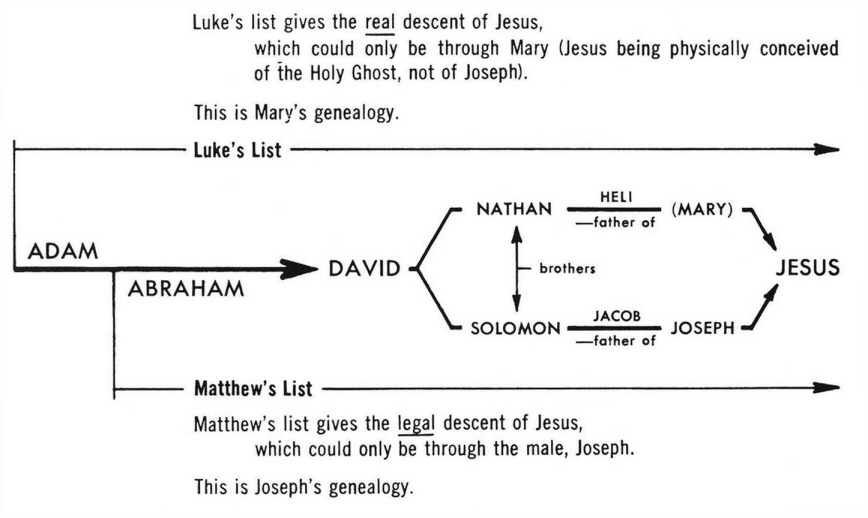
The sons of Jeconiah, the prisoner, The chronicler’s description “the prisoner” reminds readers that Judah’s exile was not merely political misfortune but divine judgment for covenant unfaithfulness. The Davidic king, once seated on Jerusalem’s throne, now sat in Babylonian captivity as a vivid picture of the nation’s fall.
The phrase “Jeconiah, the prisoner” (or “Jeconiah, the captive”) is unique in the genealogical record. Most kings of Judah are simply listed by name, but Jeconiah is specifically identified by his status as a captive. This distinction serves several important purposes in the biblical narrative.
First, it marks a turning point in Israel’s history. Jeconiah (also called Jehoiachin or Coniah) was the last king of Judah before the Babylonian exile (2 Kings 24:8–15). His capture and deportation to Babylon symbolized the fulfillment of God’s judgment on Judah for its persistent sin and idolatry. By calling him “the prisoner,” the chronicler reminds readers that the Davidic monarchy was interrupted because of covenant unfaithfulness. This was not merely a political event—it was a theological one. As Jeremiah records, “As I live,” declares the LORD, “even though Coniah the son of Jehoiakim king of Judah were a signet ring on My right hand, yet I would pull you off” (Jeremiah 22:24).
Second, the title “the prisoner” underscores the "CURSE" pronounced on Jeconiah’s line in Jeremiah 22:30. This "CURSE" seemed to threaten the continuation of the Davidic line and the promise of a coming Messiah. However, as explained below (SEE NOTE), the curse was either limited to Jeconiah’s immediate descendants, reversed through repentance, or bypassed through the virgin birth of Christ
ADDENDUM: IN OTHER WORDS IN LUKE'S GENEALOGY OF MESSIAH, Lk 3:31, IS GIVEN THROUGH DAVID'S SON NATHAN AND NOT THROUGH DAVID'S SON SOLOMON AS IN MATTHEW'S GENEALOGY IN Mt 1:6,7 (SEE DEPICTION IN TIMELINE ABOVE). LUKE WAS ESTABLISHING THE PHYSICAL LINE, MATTHEW THE KINGLY LINE, IF THAT MAKES SENSE TO YOU). (For more discussion of this somewhat complex topic see notes on Jer 22:24 and more in depth notes on Jer 22:30.)
Third, the chronicler’s inclusion of Jeconiah’s descendants—especially Shealtiel and Zerubbabel—shows that God’s covenant promises were not nullified by human failure. Even though Jeconiah was a captive, his line continued, and through it came Zerubbabel, who led the return from exile and rebuilt the temple (Haggai 2:23). In that passage, God says to Zerubbabel, “I will make you like a signet ring, for I have chosen you,” directly reversing the imagery of Jeconiah’s curse. This demonstrates God’s mercy and faithfulness to His covenant with David (2 Samuel 7:12–16), despite human sin.
John MacArthur adds this note on Jeconiah's "CURSE" – God’s curse resulting in no royal descendants from the line of Jeconiah (a.k.a. Jehoiachin), as given by Jeremiah (Jer 22:30), was enforced by God. Even though Jeconiah was in the line of Christ, the Messiah was not a physical child of that line (ED: WHICH CAME THROUGH SOLOMON), thus affirming the curse, yet sustaining the legality of His kingship through Joseph, who was in David’s line. His blood birthright came through Mary, who traced her line to David through his son Nathan, not Solomon (cf. Lk 3:31). (SEE MacArthur Study Bible)
Were Shealtiel his son, “Shealtel became an important link in the postexilic Messianic line. Although he never returned to Israel from exile, presumably he had a son during the time of exile. The Davidic line was that close to being exterminated but his son Zerubbabel later led one of the first groups of Jewish exiles back from Babylon and played a major role in rebuilding the Temple (Ezra 3:2; Haggai 1:1). Thus, from the line that appeared shattered and disgraced, God raised up restoration leadership.
There is a profound theological irony here. Earthly kings imprisoned David’s descendants, but they could not imprison God’s covenant purposes. Human empires like Babylon rose and fell, but God’s promise endured. The line that passed through an exiled prisoner would ultimately produce Jesus Christ, who Himself would be rejected, condemned, and crucified, yet through apparent defeat would establish the everlasting kingdom promised to David (Isaiah 9:6–7).
QUESTION - What is the curse of Jeconiah? | GotQuestions.org
ANSWER - Jeconiah, also called “Jehoiachin” (1 Chronicles 3:16, NIV) and “Coniah” (Jeremiah 22:24), was a king of Judah who was deported as part of the Babylonian captivity (Esther 2:6; 1 Chronicles 3:17). He is also listed in the genealogy of Jesus, in Joseph’s family line (Matthew 1:12).
The curse of Jeconiah is found in Jeremiah 22. First, the LORD likens the king to a signet ring on God’s hand—a ring that God will pull off (verse 24). Then, God pronounces a curse: “Record this man as if childless, a man who will not prosper in his lifetime, for none of his offspring will prosper, none will sit on the throne of David or rule anymore in Judah” (verse 30).
The problem is that the curse of Jeconiah seems to invalidate Jesus’ right to the throne of David. The Davidic Covenant promised that the Messiah, the “Son of David,” would reign forever on Jerusalem’s throne (1 Chronicles 17:11-14). If Jesus is a descendant of Jeconiah, then how can He be the Messiah, since the curse bars any of Jeconiah’s descendants from assuming David’s throne?
There are three possible solutions to this difficulty.
First, the “offspring” of Jeconiah mentioned in the curse could be a limited reference to the king’s own children—his immediate offspring, in other words. On a related note, the phrase “in his lifetime” could apply to the entire verse. The curse would only be in force while the king lived. This is exactly what happened, as Jeconiah was not successful as a king (he only reigned for three months before he surrendered to Nebuchadnezzar’s forces), and none of his sons (he had seven of them, 1 Chronicles 3:17–18) reigned over Judah.
A second solution concerns the virgin birth. Jesus only had one human parent, Mary. His mother was of David’s line, but not through Jeconiah (Luke 3:31). Joseph was Jesus’ legal father, but not His physical one. Thus, Jesus was of royal blood through Mary, but the curse of Jeconiah stopped with Joseph and was not passed on to Jesus.
A third possible solution is that God reversed the curse on Jeconiah’s family. This is hinted at by the prophet Haggai, who told Zerubbabel, Jeconiah’s grandson, that God would make him a “signet ring” on God’s hand (Haggai 2:23). Zerubbabel was blessed by God as the governor of Judea, and he prospered in that role when the Jewish exiles returned to Jerusalem. The “signet ring” imagery of Jeconiah’s curse is repeated in Zerubbabel’s blessing, which must be more than coincidence. Several rabbinic sources teach that Jeconiah repented in Babylon and that God forgave him and lifted the curse.
1 Chronicles 3:18 and Malchiram, Pedaiah, Shenazzar, Jekamiah, Hoshama and Nedabiah.
and Malchiram, Pedaiah, Shenazzar, Jekamiah, Hoshama and Nedabiah. This verse continues listing the descendants of Jeconiah during the Babylonian exile. Among these names, “Pedaiah” becomes especially important because verse 19 identifies Zerubbabel as his son.
An interesting sidenote is found in the meaning of the Hebrew names of these sons..
- “Malchiram” may mean “my king is exalted.”
- “Pedaiah” means “Yahweh has redeemed.”
- “Jekamiah” means “Yahweh establishes.”
- “Nedabiah” means “Yahweh has freely given.”
Even in exile, these names reflect hope in God’s covenant faithfulness, redemption, and restoration. The royal family may have lost its throne, but they had not lost their God.
1 Chronicles 3:19 The sons of Pedaiah were Zerubbabel and Shimei. And the sons of Zerubbabel were Meshullam and Hananiah, and Shelomith was their sister;
- Zerubbabel (KJV): Ezr 2:2 3:2 Hag 1:12-14 2:2,4 Zec 4:6-9 Mt 1:12, Zorobabel
The sons of Pedaiah were Zerubbabel Zerubbabel is one of the most significant descendants of David after the Babylonian captivity. Though born during exile, he became the leading Davidic figure when the Jews returned to Jerusalem under Persian rule. His name likely reflects his Babylonian background, perhaps meaning “born in Babylon” or “seed of Babylon,” a reminder that God preserved the royal line even in captivity. Zerubbabel became a central figure in Judah’s restoration. Alongside Joshua the high priest, he led the rebuilding of the Temple after the exile (Ezra 3–6). The prophets Haggai and Zechariah strongly encouraged him during this difficult work. Zechariah famously declared, “Not by might nor by power, but by My Spirit” (Zechariah 4:6), teaching that God’s purposes would be accomplished not through political strength but divine enablement.
Payne has an interesting note on the father of Zerubbabel - Shenazzar was succeeded as the first Persian governor of Judah (Ezra 5:4, 16) by his nephew Zerubbabel (Ezra 2:2), physically the son of his next older brother Pedaiah but reckoned as the legal son of the oldest brother, Shealtiel (Ezra 3:2, 8; Hag 1:1, 12; Matt 1:12; Luke 3:27). Shealtiel may have died without issue, so that his brother would have raised up seed to his name according to the custom of the levirate (Deut 25:5-10). The authenticity of many of the names that follow is confirmed by archaeological evidence from sixth and fifth centuries seals and letters (Myers, Chronicles, p. 21). (See The Expositor's Bible Commentary - Abridged Edition- Page 50)
Eugene Merrill - Three difficulties here must be addressed. First, Zerubbabel (v. 19) is elsewhere called the son of Shealtiel, not the son of Pedaiah (Ezra 3:2, 8; 5:2; Neh. 12:1; Hag. 1:12, 14; 2:2, 23; Matt. 1:12; Luke 3:27). Since Shealtiel and Pedaiah were brothers (1 Chron. 3:17-18) the best solution seems to be that Shealtiel died early on and his role of dynastic succession was assumed by his younger brother Pedaiah.
The second problem concerns Luke's account of the genealogy in which he identifies Shealtiel as the son of Neri, whose descent is not from Solomon but from David's son Nathan (Luke 3:27-31). The answer may lie in the possibility that since Jeconiah had no male heir to sit on the throne (cf. Jer. 22:30), a daughter of Jeconiah married Neri, son of Melki (Luke 3:27-28; not the Melki of Luke 3:24), of the line of Nathan. Legally Shealtiel, as grandson of Jeconiah, would continue the Davidic dynasty through Solomon, a viewpoint espoused by Matthew (Matt. 1:6-12).
The third conflict appears in Zerubbabel's line. The chronicler lists Zerubbabel's seven sons and one daughter (1 Chron. 3:19b-20). But none of them is mentioned in the genealogies of either Matthew or Luke. Matthew, who traces Jesus' descent from David through Solomon, wrote that the son of Zerubbabel was Abiud (Matt. 1:13). Luke, viewing it through Nathan, said Rhesa was that son (Luke 3:27). It is entirely possible, of course, that the Shealtiel and Zerubbabel of Luke are not the same as those of 1 Chronicles and that Luke preserves a genealogy of Mary straight from David through Nathan, a line of succession that has no other connection with the chronicler's genealogy (cf.
comments
on Luke 3:27). This would preclude the suggested solution to the second problem previously mentioned (and would, in fact, eliminate the problem altogether). This still leaves the variance between 1 Chronicles 3:19b-20 and Matthew 1:13. One may conjecture that Abiud is another name for one of the seven sons of Zerubbabel listed in Chronicles or that his name is missing from that list to begin with. That such a thing is possible may be seen in 1 Chronicles 3:22 where the historian wrote that Shemaiah had six sons but listed only five names. (See Bible Knowledge Commentary: Old Testament - Page 595)
Reformation Study Bible - Zerubbabel is called the son of Shealtiel (3:17) elsewhere (Ezra 3:2, 8; Neh. 12:1; Hag. 1:12, 14; 2:2, 23; Matt. 1:12; Luke 3:27). This may mean that Zerubbabel succeeded Pedaiah. Alternatively, Pedaiah may have become the head of the family at Shealtiel's death, adopting Zerubbabel as his own.
NIV Study Bible - Other texts name Shealtiel (v. 17) as Zerubbabel's father (Ezr 3:2,8; Ne 12:1; Hag 1:1,12,14; 2:2,23). Suggestions offered to resolve this difficulty are: (1) Shealtiel may have died early, and Pedaiah became the head of the family. (2) Pedaiah may have married the childless widow of Shealtiel; Zerubbabel would then be regarded as the son of Shealtiel according to the law of levirate marriage (Dt 25:5-6). In Lk 3:27 Neri instead of Jehoiachin (v. 17) is identified as the father of Shealtiel. Suggestions similar to those above could be made in this instance as well. It is also interesting to note that the genealogies of Jesus in Mt 1 and Lk 3 both trace his descent to Zerubbabel, but that none of the names subsequent to Zerubbabel (vv. 19-24) is found in the NT genealogies.
Believer's Study Bible - Zerubbabel probably accompanied the first band of exiles as they returned from Babylon to Jerusalem in 538 B.C. (cf. Ezra 2:2; 3:2, 8; Neh. 7:6, 7; 12:1) and acted as governor until at least 515 B.C. As the official representative of the Davidic monarchy (cf. 3:17, note), he was accorded messianic significance by Haggai and Zechariah (Hag. 2:20-23; Zech. 4:6-14). A collection of postexilic seals found recently near Jerusalem includes one inscribed "Shelomith maidservant [or wife] of Elnathan the governor." The mention of "Shelomith" here in the predominantly male genealogy of Chronicles indicates she had some particular significance. She may have been the wife of the governor.
and Shimei. And the sons of Zerubbabel were Meshullam and Hananiah, and Shelomith was their sister -
QUESTION - Who was Zerubbabel in the Bible? | GotQuestions.org
ANSWER - Zerubbabel was the grandson of King Jehoiachin of Judah (1 Chronicles 3:17) and thus a descendant of David. Born in Babylon during the exile (between 587 and 539 BC), Zerubbabel traveled to Judah after King Cyrus II allowed the Judean captives to return to their homeland to rebuild the temple (Ezra 1:1–4; 6:3–5, 8–10). The prophet Haggai identifies Zerubbabel as the governor of Judah after the exile (Haggai 1:1; 2:2, 21).
Zerubbabel is listed in the Bible as an ancestor of Jesus Christ (Matthew 1:12–13; Luke 3:27). The identity of Zerubbabel’s father is somewhat of a puzzle. All but one reference in the Bible name Shealtiel as his father (Ezra 3:2, 8; 5:2; Nehemiah 12:1; Haggai 1:1, 12–14; 2:2, 23; Matthew 1:12–13; Luke 3:27). This would make King Jehoiachin his grandfather. But in 1 Chronicles 3:19, Pedaiah, the brother of Shealtiel, is named as Zerubbabel’s father. One possible solution is that Shealtiel was married but died before having a son. Under the law of levirate marriage, his brother Pedaiah might have taken Shealtiel’s widow, making Pedaiah the biological father of Zerubbabel. Another proposal is that both Shealtiel and Pedaiah had sons named Zerubbabel. A final solution suggests that the text in 1 Chronicles contains a scribal error.
Zerubbabel is a Babylonian name meaning “offspring of Babylon.” As governor of Judah, Zerubbabel was appointed as one of the initial leaders who supervised the reconstruction of the Jerusalem temple with the help of Joshua, the high priest (Ezra 3:2–3, 8). After a season of about fourteen months to get settled, the Jewish people began to rebuild in earnest. It wasn’t long before opposition arose from surrounding adversaries, and, eventually, the work was brought to a standstill by order of King Artaxerxes (Ezra 4:1–24). Only the foundation of the temple had been completed.
The foundation showed that this new temple was going to be much smaller than Solomon’s original, to the disappointment of those who remembered the former structure: “Many of the older priests and Levites and family heads, who had seen the former temple, wept aloud when they saw the foundation of this temple being laid” (Ezra 3:12). The prophet Haggai addressed their disappointment: “‘Who of you is left who saw this house in its former glory? How does it look to you now? Does it not seem to you like nothing? But now be strong, Zerubbabel,’ declares the Lord. . . . ‘Be strong, all you people of the land,’ declares the Lord, ‘and work. For I am with you,’ declares the Lord Almighty” (Haggai 2:3–4). Zechariah, too, told the people not to despise “the day of small things” (Zechariah 4:10), because God had great plans for this new temple.
After a seventeen-year delay, under the next king of Persia, Darius, the Jews were granted permission to continue rebuilding. Within three and a half years after the second effort began, the temple was completed in 516 BC.
In one of Zechariah’s visions, he receives words that surely encouraged Zerubbabel: “This is the word of the Lord to Zerubbabel: ‘Not by might nor by power, but by my Spirit,’ says the Lord Almighty. What are you, mighty mountain? Before Zerubbabel you will become level ground. Then he will bring out the capstone to shouts of ‘God bless it! God bless it!’ Then the word of the Lord came to me: ‘The hands of Zerubbabel have laid the foundation of this temple; his hands will also complete it. Then you will know that the Lord Almighty has sent me to you’” (Zechariah 4:6–9).
As a descendant of King David, Zerubbabel was identified with the coming Messiah by his contemporary prophets, Haggai and Zechariah. The Jewish people began to see Zerubbabel as their great hope for reviving the Davidic kingship and for liberation from the Persians.
Haggai declared that God would use Zerubbabel to overthrow and destroy kingdoms: “The word of the LORD came to Haggai a second time on the twenty-fourth day of the month: ‘Tell Zerubbabel governor of Judah that I am going to shake the heavens and the earth. I will overturn royal thrones and shatter the power of the foreign kingdoms.’ . . . ‘On that day,’ declares the LORD Almighty, ‘I will take you, my servant Zerubbabel son of Shealtiel,’ declares the LORD, ‘and I will make you like my signet ring, for I have chosen you,’ declares the LORD Almighty” (Haggai 2:20–23).
As a seal of royal authority, the “signet ring” is a messianic metaphor. In Jeremiah 22:24–25, God said if Jehoiachin (Zerubbabel’s grandfather) were His signet ring, He would cast him off. Thus, Haggai was saying that through Zerubbabel God would reverse the curse He had pronounced on Jehoiachin. God would place the wicked king’s grandson like a signet ring on His finger. Likewise, the words “on that day” point to a future messianic fulfillment of Haggai’s message.
Although Zerubbabel’s temple was smaller than Solomon’s had been, God promised a greater glory: “The glory of this present house will be greater than the glory of the former house,” said the Lord (Haggai 2:9). The glory bestowed on Zerubbabel’s temple came centuries later when Jesus Christ, the Son of God, came into the temple courts. Solomon’s temple never received a visit from the Messiah, but Zerubbabel’s did.
Curiously, even before the temple was completed and dedicated, Zerubbabel’s name disappears from the biblical record. It’s possible that Zerubbabel may have returned to Babylon soon after finishing his work on the temple, or it could be that the Persians feared a Jewish uprising and had Zerubbabel removed or executed. Regardless, Zerubbabel is revered as one of the Bible’s great heroes, laboring to reconstruct the Lord’s house of worship and shining like a beacon toward the coming Messiah.
While the temple Zerubbabel helped rebuild paled in comparison to the size and grandeur of Solomon’s, it far outlasted it. In fact, Zerubbabel’s temple was still standing 500 years later when the promised Messiah, Jesus Christ, graced its courts.
QUESTION - What does it mean that Zerubbabel was the LORD's signet ring (Haggai 2:23)? GotQuestions.org
ANSWER - In Haggai 2:23 we read, “‘On that day,’ declares the LORD Almighty, ‘I will take you, my servant Zerubbabel son of Shealtiel,’ declares the LORD, ‘and I will make you like my signet ring, for I have chosen you.’” What did God mean when He said Zerubbabel was His signet ring?
Ancient kings used signet rings to designate authority, honor, or ownership. A signet contained an emblem unique to the king. Official documents were sealed with a dollop of soft wax impressed with the king’s signet, usually kept on a ring on his finger. Such a seal certified the document as genuine, much like a notary public’s stamp today. In 1 Kings 21:8, the evil Queen Jezebel took King Ahab’s signet ring and “wrote letters in Ahab’s name and sealed them with his seal.” The ring’s stamp gave her letters the king’s authority. In Daniel 6:17, a signet ring was used to seal a stone covering a lions’ den: “A stone was brought and laid on the mouth of the den, and the king sealed it with his own signet and with the signet of his lords, that nothing might be changed concerning Daniel.” A royal signet ring is also featured in Genesis 41:41-43 and Esther 8:8.
It is important to understand who Zerubbabel is. He is the governor of the rebuilt Jerusalem and is himself of royal blood, being a descendant of David and the grandson of Judah’s King Jehoiachin. Years earlier, Jehoiachin had lost his throne when he was deported to Babylon; in fact, God pictured Jehoiachin as a signet ring being removed from God’s finger (Jeremiah 22:24). Now, God calls Zerubbabel the “signet ring,” but this time it won’t be removed.
In Haggai’s prophecy, God is giving Zerubbabel encouragement and hope. The governor is “chosen” for a unique and noble purpose. As God’s signet ring, Zerubbabel is given a place of honor and authority. God is reinstating the Davidic line and renewing His covenant with David. Judah still has a future as they look forward to the coming Son of David, the Messiah, who would one day “overturn royal thrones and shatter the power of the foreign kingdoms” (Haggai 2:22).
Zerubbabel is also called “my servant.” This title was often a Messianic reference in the Old Testament (2 Samuel 3:18; 1 Kings 11:34; Isaiah 42:1–9; 49:1–13; 50:4–11; 52:13—53:12; Ezekiel 34:23–24; 37:24–25). The triad of servant, son, and signet ring created a special combination of encouragement for Zerubbabel in his important and difficult task of reconstructing the Jewish temple. As God’s “signet ring,” Zerubbabel becomes a picture of the future Messiah, Jesus Christ, who will establish His people in the Promised Land, construct an even grander temple (Zechariah 6:12–13), and lead the righteous in never-ending worship.
1 Chronicles 3:20 and Hashubah, Ohel, Berechiah, Hasadiah and Jushab-hesed, five.
and Hashubah, Ohel, Berechiah, Hasadiah and Jushab-hesed, five. - little is known historically about these individuals
- “Hashubah” may mean “esteemed” or “considered.”
- “Berechiah” means “Yahweh blesses.”
- “Hasadiah” means “Yahweh is kind” or “Yahweh has shown lovingkindness,” reflecting the important Hebrew idea of hesed, God’s loyal covenant love.
- “Jushab-hesed” likely means “lovingkindness is restored” or “mercy returns,” an especially fitting name in the postexilic context.
1 Chronicles 3:21 The sons of Hananiah were Pelatiah and Jeshaiah, the sons of Rephaiah, the sons of Arnan, the sons of Obadiah, the sons of Shecaniah.
- Ne 10:22
The sons of Hananiah were Pelatiah and Jeshaiah, the sons of Rephaiah, the sons of Arnan, the sons of Obadiah, the sons of Shecaniah. These names are largely unknown elsewhere in Scripture
- “Pelatiah” means “Yahweh delivers.”
- “Jeshaiah” means “Yahweh saves.”
- “Obadiah” means “servant of Yahweh.”
- “Shecaniah” means “Yahweh dwells” or “Yahweh has taken up residence.”
Payne - The Hebrew text does not have "and" to introduce "the sons of Rephaiah, of Arnan... " These are not stated to be further grandsons of Zerubbabel but are presumably contemporaries of Jeconiah the captive whose relationship to him has not been preserved (see Introduction: Date). (The Expositor's Bible Commentary - Abridged Edition)
1 Chronicles 3:22 The descendants of Shecaniah were Shemaiah, and the sons of Shemaiah: Hattush, Igal, Bariah, Neariah and Shaphat, six.
- Hattush (KJV): Ezr 8:2
- six (KJV): Five only are enumerated in the text, which Houbigant would substitute as the true reading; but probably the father is reckoned with his sons.
The descendants of Shecaniah were Shemaiah, and the sons of Shemaiah: Hattush, Igal, Bariah, Neariah and Shaphat, six. - the chronicler is tracing generations that lived after the Babylonian exile, during a time when the Davidic throne no longer existed politically. The royal line had become outwardly obscure, yet God was still faithfully preserving it generation after generation.
The statement “six” creates a small difficulty because only five names are listed if Shemaiah himself is excluded. Some suggest one name may have dropped out during manuscript transmission, while others count Shemaiah among the six. Such minor textual questions are common in ancient genealogical records and do not affect the overall theological message of the passage.
1 Chronicles 3:23 The sons of Neariah were Elioenai, Hizkiah and Azrikam, three.
The sons of Neariah were Elioenai, Hizkiah and Azrikam, three. - This verse continues the genealogy of the postexilic descendants of David:
- “Elioenai” means “my eyes are toward Yahweh” or “God is my eyes,” suggesting dependence upon and watchfulness toward the Lord.
- “Hizkiah” means “Yahweh strengthens.”
- “Azrikam” means “whom Yahweh has helped.”
These names are striking because they reflect trust in God during a period when Judah outwardly appeared weak and insignificant.
1 Chronicles 3:24 The sons of Elioenai were Hodaviah, Eliashib, Pelaiah, Akkub, Johanan, Delaiah and Anani, seven.
The sons of Elioenai were Hodaviah, Eliashib, Pelaiah, Akkub, Johanan, Delaiah and Anani, seven. This final verse may seem like merely a list of obscure names, but it carries profound theological significance. The chronicler has traced the descendants of David from the height of the united monarchy, through division, apostasy, judgment, exile, and finally into the postexilic generations. Though no Davidic king sat on the throne at this point, the line itself still lived. God had preserved His covenant promises exactly as He said He would (2 Samuel 7:12–16).
Frederick Mabie: For the Chronicler, the ability to trace these “sons” of David was important for facilitating hope in God’s present and future plans for the house of David. This list clearly extends into the postexilic period, perhaps even to the time of the Chronicler. The leadership of Zerubbabel (v.19) corresponded with renewed prophetic hope that God was restoring the Davidic line in Judah (cf. Zec 4:1–14; Hag 2:20–23), a hope ultimately fulfilled in Christ (cf. Mt 22:42; Lk 1:32; Ac 15:16).
As Martin Selman says "“Through this multitude of largely unknown names, the Chronicler points out that God’s election purposes were still at work despite the vicissitudes of Judah’s history (e.g. 2:3,7) and the exile (e.g. 3:17-24).” (2 Chronicles: An Introduction and Commentary)
Iain Duguid: What stands out is that the Davidic family continues. Although no Davidic heir succeeded Zerubbabel as governor, hope of dynastic renewal is suggested in the way the Davidic line is focused on and traced. Thus in 1 Chronicles 3:17–24 each generation takes up just one son from the preceding generation (Zerubbabel, Hananiah, Shecaniah, Shemaiah, Neariah, Elioenai). Hope of restoration is also expressed in Zerubbabel’s sons’ names: Meshullam (“repaid, restored”), Hananiah (“the Lord is merciful”), Hashubah (“considered”), Ohel (“[God’s] tent”), Berechiah (“the Lord blesses”), Hasadiah (“The Lord is steadfast love”), and Jushab-hesed (“May steadfast love return”).
- “Hodaviah” means “praise Yahweh.”
- “Eliashib” means “God restores.”
- “Pelaiah” means “Yahweh does wonders.”
- “Johanan” means “Yahweh is gracious.”
- “Delaiah” means “Yahweh has drawn near.”
- “Anani” may mean “cloud of Yahweh” or “protected by Yahweh.”