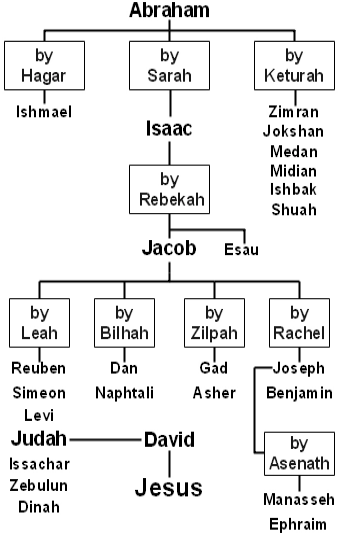
1 Chronicles 1:2
1 Chronicles 1:3
1 Chronicles 1:4
1 Chronicles 1:5
1 Chronicles 1:6
1 Chronicles 1:7
1 Chronicles 1:8
1 Chronicles 1:9
1 Chronicles 1:10
1 Chronicles 1:11
1 Chronicles 1:12
1 Chronicles 1:13
1 Chronicles 1:14
1 Chronicles 1:15
1 Chronicles 1:16
1 Chronicles 1:17
1 Chronicles 1:18
1 Chronicles 1:19
1 Chronicles 1:20
1 Chronicles 1:21
1 Chronicles 1:22
1 Chronicles 1:23
1 Chronicles 1:24
1 Chronicles 1:25
1 Chronicles 1:26
1 Chronicles 1:27
1 Chronicles 1:28
1 Chronicles 1:29
1 Chronicles 1:30
1 Chronicles 1:31
1 Chronicles 1:32
1 Chronicles 1:33
1 Chronicles 1:34
1 Chronicles 1:35
1 Chronicles 1:36
1 Chronicles 1:37
1 Chronicles 1:38
1 Chronicles 1:39
1 Chronicles 1:40
1 Chronicles 1:41
1 Chronicles 1:42
1 Chronicles 1:43
1 Chronicles 1:44
1 Chronicles 1:45
1 Chronicles 1:46
1 Chronicles 1:47
1 Chronicles 1:48
1 Chronicles 1:49
1 Chronicles 1:50
1 Chronicles 1:51
1 Chronicles 1:52
1 Chronicles 1:53
1 Chronicles 1:54
|
1107 |
1011 |
971 |
931 |
853 |
722 |
586 |
||||
| 1 Samuel | 2 Samuel | 1 Kings | 1 Kings | 2 Kings | ||||||
|
31 |
1-4 | 5-10 | 11-20 | 21-24 | 1-11 | 12-22 | 1-17 | 18-25 | ||
|
1 Chronicles 10 |
1Chr 11-19 |
1Chr 20-29 |
2 Chronicles |
2 Chronicles |
2 Chronicles |
|||||
|
Legend: B.C. dates at top of timeline are approximate. Note that 931 BC marks the division of the Kingdom into Southern Tribes (Judah and Benjamin) and Ten Northern Tribes. To avoid confusion be aware that after the division of the Kingdom in 931 BC, the Southern Kingdom is most often designated in Scripture as "Judah" and the Northern Kingdom as "Israel." Finally, note that 1 Chronicles 1-9 is not identified on the timeline because these chapters are records of genealogy. |
||||||||||
THE DOWNWARD SPIRAL
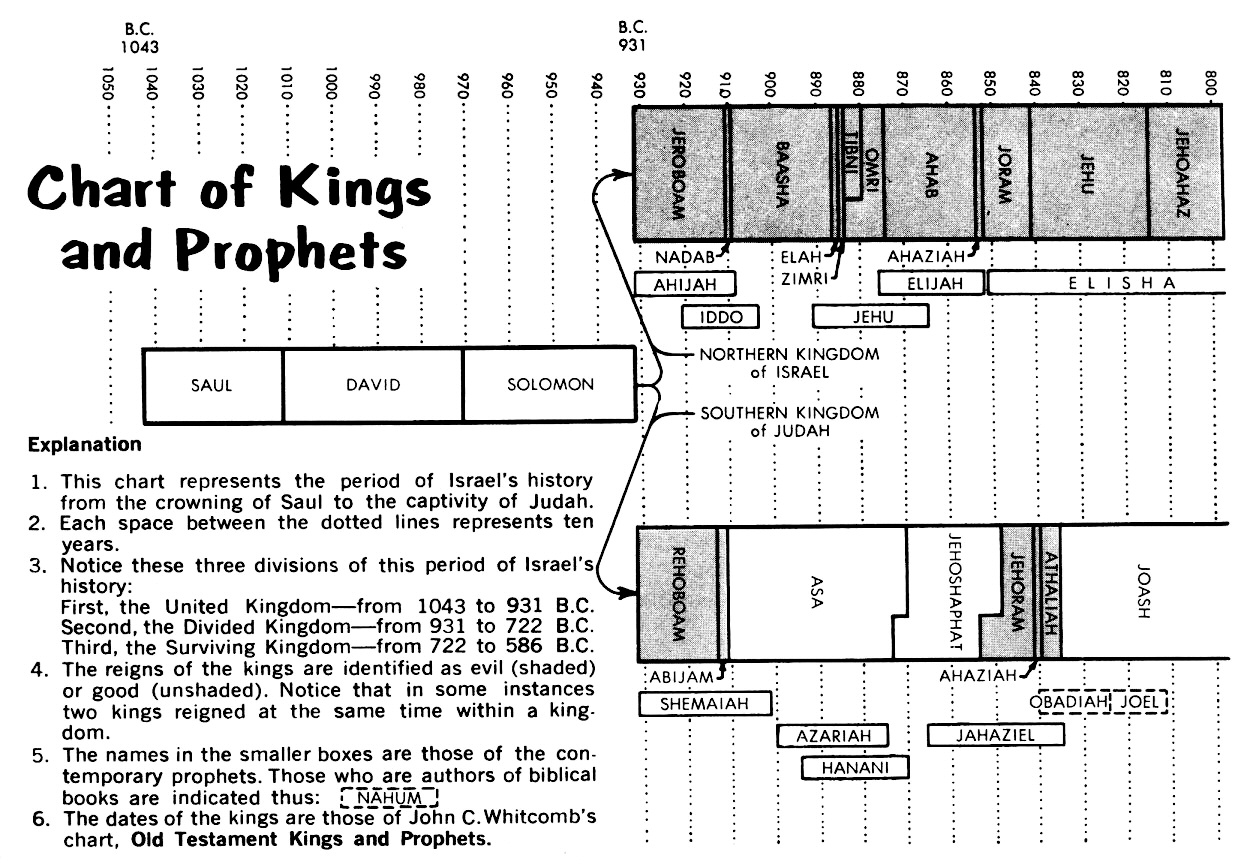
Click to Enlarge
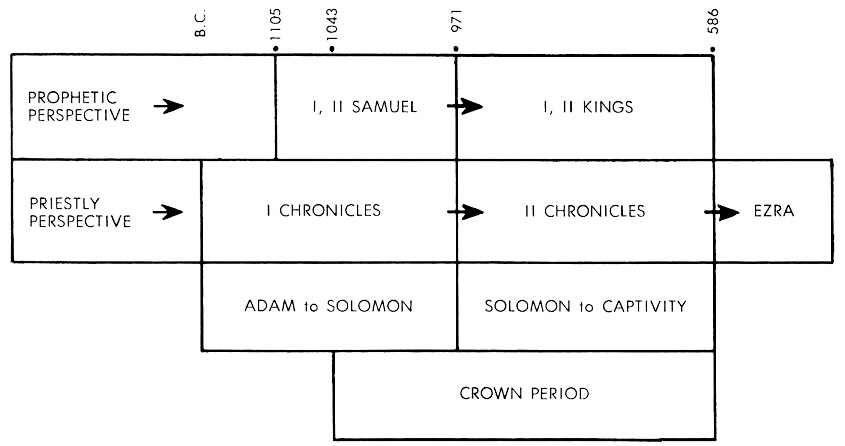
Comparison of 1 Samuel thru 2 Chronicles

| FIRST CHRONICLES SUMMARY CHART |
|
| 1 Chronicles 1-9:44 | 1 Chronicles 10:1-39:30 |
| Royal Line of David |
Reign of David |
| 12 Tribes of David's Reign |
Highlights of David's Reign |
| Genealogies | History |
| Ancestry | Activity |
| 1000's of Years | Circa 33 Years |
Source: 1 Chronicles Overview
Title
The original title in the Hebrew Bible read “The annals (i.e., events or happenings) of the days.” First and Second Chronicles were comprised of one book until later divided into separate books in the Greek OT translation, the Septuagint (LXX) ca. 200 B.C. The title also changed at that time to the inaccurate title, “the things omitted,” i.e., reflecting material not in 1, 2 Samuel and 1, 2 Kings. The English title “Chronicles” originated with Jerome’s Latin Vulgate translation (ca. 400 A.D.), which used the fuller title “The Chronicles of the Entire Sacred History.”
Neither 1 nor 2 Chronicles contains direct statements regarding the human author, though Jewish tradition strongly favors Ezra the priest (cf. Ezra 7:1–6) as “the chronicler.” These records were most likely recorded ca. 450–430 B.C. The genealogical record in 1 Chr. 1–9 supports a date after 450 B.C. for the writing. The NT does not directly quote either 1 or 2 Chronicles.
Background and Setting
The immediate historical backdrop encompassed the Jews’ three–phase return to the Promised Land from the Babylonian exile: 1) Zerubbabel in Ezra 1–6 (ca. 538 B.C.); 2) Ezra in Ezra 7–10 (ca. 458 B.C.); and 3) Nehemiah in Neh. 1–13 (ca. 445 B.C.). Previous history looks back to the Babylonian deportation/Exile (ca. 605–538 B.C.) as predicted/reported by 2 Kings, Esther, Jeremiah, Ezekiel, Daniel, and Habakkuk. The prophets of this restoration era were Haggai, Zechariah, and Malachi.
The Jews had returned from their 70 years of captivity (ca. 538 B.C.) to a land that was markedly different from the one once ruled by King David (ca. 1011–971 B.C.) and King Solomon (971–931 B.C.): 1) there was no Hebrew king, but rather a Persian governor (Ezra 5:3; 6:6); 2) there was no security for Jerusalem, so Nehemiah had to rebuild the wall (Neh. 1–7); 3) there was no temple, so Zerubbabel had to reconstruct a pitiful semblance of the Solomonic temple’s former glory (Ezra 3); 4) the Jews no longer dominated the region, but rather were on the defensive (Ezra 4; Neh. 4); 5) they enjoyed few divine blessings beyond the fact of their return; 6) they possessed little of the kingdom’s former wealth; and 7) God’s divine presence no longer resided in Jerusalem, having departed ca. 597–591 B.C. (Ezek. 8–11).
To put it mildly, their future looked bleak compared to their majestic past, especially the time of David and Solomon. The return could best be described as bittersweet, i.e., bitter because their present poverty brought hurtful memories about what was forfeited by God’s judgment on their ancestors’ sin, but sweet because at least they were back in the Land God had given Abraham 17 centuries earlier (Gen. 12:1–3). The chronicler’s selective genealogy and history of Israel, stretching from Adam (1 Chr. 1:1) to the return from Babylon (2 Chr. 26:23), was intended to remind the Jews of God’s promises and intentions about: 1) the Land; 2) the nation; 3) the Davidic king; 4) the Levitical priests; 5) the temple; and 6) true worship, none of which had been abrogated because of the Babylonian captivity. All of this was to remind them of their spiritual heritage during the difficult times they faced, and to encourage them to be faithful to God.
Historical and Theological Themes
First and Second Chronicles, as named by Jerome, recreate an OT history in miniature, with particular emphases on the Davidic Covenant and temple worship. In terms of literary parallel, 1 Chronicles is the partner of 2 Samuel, in that both detail the reign of King David. First Chronicles opens with Adam (1Ch 1:1) and closes with the death of David (1Ch 29:26–30) in 971 B.C. Second Chronicles begins with Solomon (1Ch1:1) and covers the same historical period as 1 and 2 Kings, while focusing exclusively on the kings of the southern kingdom of Judah, thus excluding the history of the northern 10 tribes and their rulers, because of their complete wickedness and false worship. It ranges from the reign of Solomon (1Ch1:1) in 971 B.C. to the return from Babylon in 538 B.C. (1Ch36:23). Over 55 percent of the material in Chronicles is unique, i.e., not found in 2 Samuel or 1 and 2 Kings. The “chronicler” tended to omit what was negative or in opposition to the Davidic kingship; on the other hand, he tended to make unique contributions in validating temple worship and the line of David. Whereas 2 Kings 25 ends dismally with the deportation of Judah to Babylon, 2 Chronicles 36:22–23 concludes hopefully with the Jews’ release from Persia and return to Jerusalem.
These two books were written to the repatriated Jewish exiles as a chronicle of God’s intention of future blessing, in spite of the nation’s past moral/spiritual failure for which the people paid dearly under God’s wrath. First and Second Chronicles could be briefly summarized as follows:
- A Selected Genealogical History of Israel (1 Chr. 1–9)
- Israel’s United Kingdom Under Saul (1 Chr. 10), David (1 Chr. 11–29), and Solomon (2 Chr. 1–9)
- Judah’s Monarchy in the Divided Kingdom (2 Chr. 10–36:21)
- Judah’s Release From Their Seventy Year Captivity (2 Chr. 36:22, 23).
The historical themes are inextricably linked with the theological in that God’s divine purposes for Israel have been and will be played out on the stage of human history. These two books are designed to assure the returning Jews that, in spite of their checkered past and present plight, God will be true to His covenant promises. They have been returned by God to the Land first given to Abraham as a race of people whose ethnic identity (Jewish) was not obliterated by the deportation and whose national identity (Israel) has been preserved (Gen. 12:1–3; 15:5), although they are still under God’s judgment as prescribed by the Mosaic legislation (Deut. 28:15–68). The priestly line of Eleazar’s son Phinehas and the Levitical line were still intact so that temple worship could continue in the hopes that God’s presence would one day return (Num. 25:10–13; Mal. 3:1). The Davidic promise of a king was still valid, although future in its fulfillment (2 Sam. 7:8–17; 1 Chr. 17:7–15). Their individual hope of eternal life and restoration of God’s blessings forever rested in the New Covenant (Jer. 31:31–34).
Two basic principles enumerated in these two books prevail throughout the OT, namely, obedience brings blessing, disobedience brings judgment. In the Chronicles, when the king obeyed and trusted the Lord, God blessed and protected. But when the king disobeyed and/or put his trust in something or someone other than the Lord, God withdrew His blessing and protection. Three basic failures by the kings of Judah brought God’s wrath: 1) personal sin; 2) false worship/idolatry; and/or 3) trust in man rather than God.
Interpretive Challenges
First and Second Chronicles present a combination of selective genealogical and historical records and no insurmountable challenges within the two books are encountered. A few issues arise, such as: 1) Who wrote 1 and 2 Chronicles? Does the overlap of 2 Chr. 36:22–23 with Ezra 1:1–3 point to Ezra as author? 2) Does the use of multiple sources taint the inerrancy doctrine of Scripture? 3) How does one explain the variations in the genealogies of 1 Chr. 1–9 from other OT genealogies? 4) Are the curses of Deut. 28 still in force, even though the 70 year captivity has concluded? 5) How does one explain the few variations in numbers when comparing Chronicles with parallel passages in Samuel and Kings? These will be dealt with in the notes at the appropriate places.
Outline
- Selective Genealogy (1Ch 1:1–9:34)
- Adam to Before David (1Ch 1:1–2:55)
- David to the Captivity (1Ch 3:1–24)
- Twelve Tribes (1Ch 4:1–9:2)
- Jerusalem Dwellers (1Ch 9:3–34)
- David’s Ascent (1Ch 9:35–12:40)
- Saul’s Heritage and Death (1Ch 9:35–10:14)
- David’s Anointing (1Ch 11:1–3)
- Jerusalem’s Conquest (1Ch 11:4–9)
- David’s Men (1Ch 11:10–12:40)
- David’s Reign (1Ch 13:1–29:30)
- The Ark of the Covenant (1Ch 13:1–16:43)
- The Davidic Covenant (1Ch 17:1–17:27)
- Selected Military History (1Ch 18:1–21:30)
- Temple-Building Preparations (1Ch 22:1–29:20)
- Transition to Solomon (1Ch 29:21–29:30)
1 Chronicles 1-9 The Genealogical Tree
Why all this emphasis on the genealogies?
The genealogies in 1 Chronicles 1 serve several important purposes.
First, they show that Israel’s history is rooted in the history of all humanity. The chapter begins with Adam, not Abraham, reminding readers that the God of Israel is the Creator and Lord of the whole world, not just one nation.
Second, the genealogies trace God’s sovereign plan through history. Out of all the nations descended from Adam and Noah, God chose the line of Shem, then Abraham, Isaac, and Jacob (Israel). The lists show that Israel did not appear by accident but emerged according to God’s sovereign covenant purposes.
Third, these genealogies helped the returned exiles—since Chronicles was written after the 70-year Babylonian captivity—understand their identity and heritage. Many Jews had lost land, records, and a sense of national stability. The Chronicler reminded them that they were still God’s covenant people and had a divinely appointed place and purpose among the Gentile nations.
Finally, the genealogies prepare the way for the main focus of Chronicles which is a discussion of the kingdom of David, the temple, and the worship of God. They narrow history step by step until attention centers on Israel, Judah, and ultimately David’s royal line, through which the Messiah would come (cf Davidic Covenant in 2Sa 7:12–16; Mt 1:1).
What are some of the major themes/big ideas in First Chronicles:
God Rules History
1 Chronicles shows that God sovereignly directs history, nations, kings, and events according to His purposes. The long genealogies emphasize that history is not random; God is carrying out His covenant plan from Adam to David.The Centrality of Worship
A major focus of the book is proper worship of God. Much attention is given to the ark, the Levites, musicians, priests, sacrifices, and preparations for the temple. Worship is presented as the heart of national life (1Chr 15–16).The Davidic Covenant
David is the central human figure in 1 Chronicles. The book highlights God’s covenant promises to David and his descendants (1 Chronicles 17:11–14). David is portrayed as the chosen king through whom God would establish His kingdom purposes.Preparation for the Temple
Although Solomon builds the temple in 2 Chronicles, 1 Chronicles emphasizes David’s extensive preparation for it. David gathers materials, organizes worship, appoints Levites, and prepares the nation spiritually for temple worship. (1Ch 22:5, 22:14, 28:11-19)Seeking God Brings Blessing
One repeated lesson is that those who seek the LORD prosper spiritually, while those who forsake Him experience defeat or judgment (1Chr 10:13–14; 22:19; 28:9). The book constantly calls God’s people to wholehearted devotion.God Desires the Heart
The Chronicler repeatedly stresses inward devotion, humility, and sincerity before God. David’s prayers and worship show that external ritual alone is not enough; God desires hearts fully devoted to Him (1Chr 28:9; 29:17).Hope After Failure
Written to postexilic Jews who had returned from Babylon, the book reminds God’s people that failure and judgment are not the end of the story. God remains faithful to His covenant promises and still has a future for His people. (1Ch 9:1-2, 1Ch 16:34)Israel’s Identity and Calling
The genealogies (1Ch 1-9) and historical narratives reminded the returned exiles who they were:God’s covenant people, descended from Abraham and chosen for His purposes among the nations.The Importance of Obedience
Saul’s downfall and David’s successes illustrate the contrast between disobedience and obedience. Even David’s mistakes, such as moving the ark improperly, show that God must be approached according to His revealed will. (1Ch 10:13,14, 1Ch 15:13)The Coming Messianic King
The emphasis on David’s line points forward ultimately to the Messiah (1Ch 17:13,14), Jesus Christ, the greater Son of David, whose kingdom will endure forever (Isa 9:6–7; Lk 1:32–33).
Martin Selman - This chapter has therefore become a panoramic view of God’s dealings with humanity in both creation and redemption. God’s name does not actually appear, of course, but his activity is visible everywhere to the discerning reader.”...The sections are so arranged that the person providing the link from Adam to Israel is dealt with last in each generation. The structure can be represented as in the diagram below. (Diagram below is from Selman) (1 Chronicles: An Introduction and Commentary)
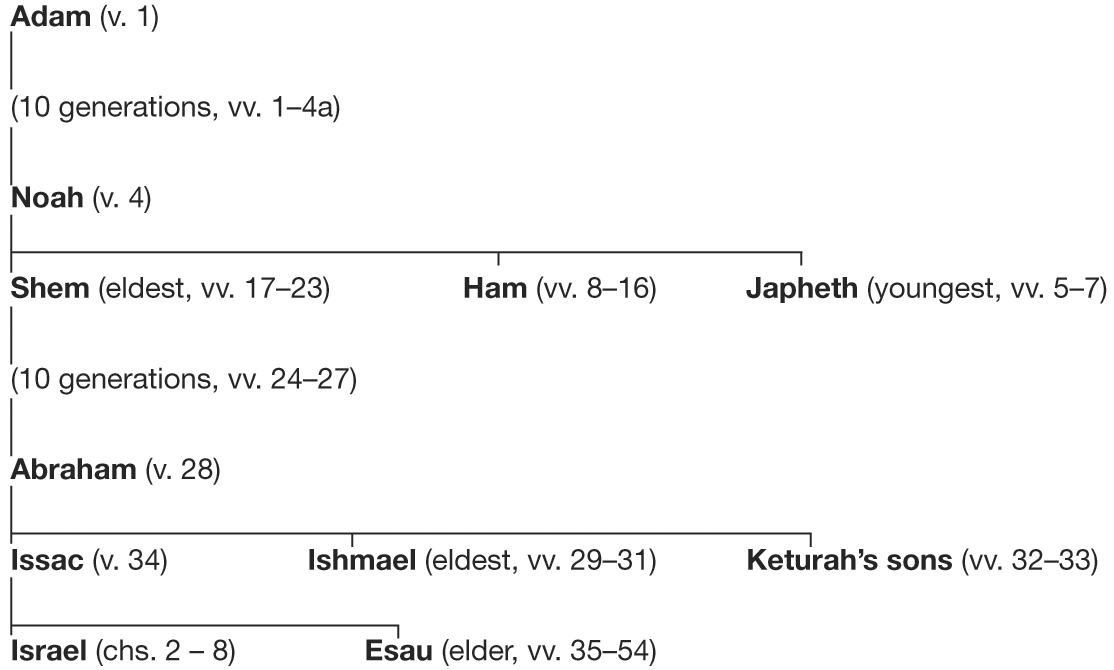
David Guzik points out that "We see God almost everywhere in this chapter:
- We see God calling out for Adam, hiding in his shame.
- We see God blessing the birth of Seth, providing a son to replace on murdered and the other a murderer.
- We see God walking with Enoch.1:24–27
- We see God calling to Noah and shutting the door of the ark.
- We see God speaking to the sons of Noah and making His covenant with them.
- We see God as the Most High, dividing an inheritance to the nations (Deuteronomy 32:8).
- We see God dividing the earth at the tower of Babel in the days of Peleg.
- We see God choosing a Babylonian from an idol worshipping family named Abraham.
- We see God stopping the sacrificial knife held over a surrendered Isaac.
- We see God orchestrating the choice of Israel over his brother Esau, despite all fleshly efforts of man to do otherwise.
- We see God blessing Esau and his descendants, as He promised to do.
PARALLELS BETWEEN 1 CHRONICLES 2 AND GENESIS
1 Chronicles 1:1–4a - Genesis 5:1–32
1 Chronicles 4b-23 - Genesis 10:1-29
1 Chronicles 1:24–27 - Genesis 11:10–32
1 Chronicles 1:28–34 - Abraham
1 Chronicles 1:29–31—Genesis 25:12–16
1 Chronicles 1:32–33—Genesis 25:1–4
1 Chronicles 1:35–54 - Esau and Edom
1 Chronicles 1:25–37— Genesis 36:10–14
1 Chronicles 1:38–42— Genesis 36:20–28
1 Chronicles 1:43–54— Genesis 36:31–43
1 Chronicles 1:1 Adam, Seth, Enosh
- Sheth: Ge 4:25,26 5:3,8 Lu 3:38, Seth
- Enosh: Ge 5:9-11 Lu 3:38, Enos
- NOTE THAT ALL NAMES ARE LINKED TO BIBLE DICTIONARY ENTRYS TO FACILITATE FURTHER STUDY.
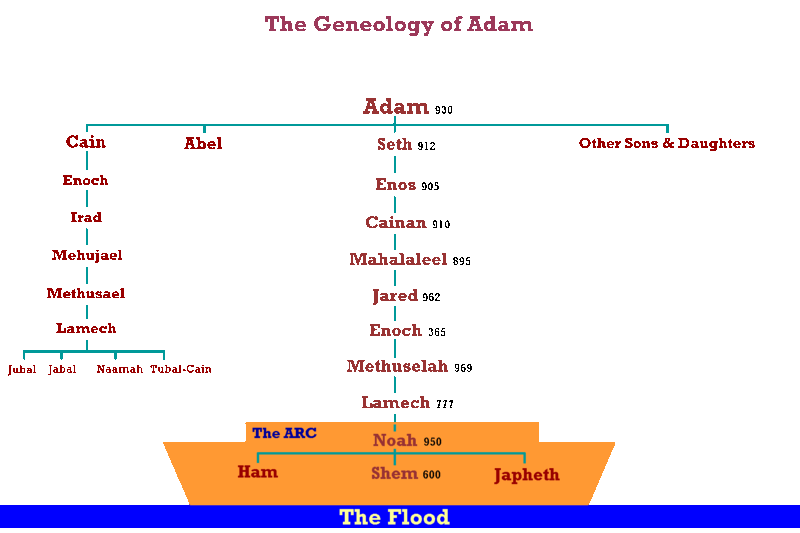
NOTE: For more commentary on the names in 1 Chronicles 1:1-4 read the comments on the genealogy of Adam in Genesis 5:3-32.
Adam, Seth, Enosh - In the diagram above note "Cainan" is Kenan in 1Ch 1:2. Note there is no mention of Abel and the line of Cain is totally passed over by the Chronicler because it no longer plays a significant role in the biblical narrative after the Flood. With the judgment of the worldwide deluge, the corrupt civilization associated with Cain’s descendants was swept away. Noah, preserved by God through the ark, became the father of a new humanity and the new starting point for the post Flood world. Thus the genealogical focus shifts away from Cain and centers on the godly line through Seth leading to Noah, through whom God would preserve the human race and continue His redemptive purposes.
We also know that Adam had other sons not mentioned in the genealogy (Ge 5:4).
Iain Duguid: Charles H. Kraft tells of a Gentile student of OT studies who asked a Jewish student to identify his favorite Scripture passage. He immediately responded, “The first eight chapters of Chronicles.” To Jews and other tribal cultures, genealogical lists are the clearest way of showing the love of God for particular people that is central to the gospel.
Henry Morris - The Adam-to-Abraham genealogy listed in 1 Chronicles 1:1-27 at the beginning of 1 Chronicles is the same as that in Genesis 5, but both omit the name of Cainan found in the genealogy of Luke 3:36. Cainan is also found in the Septuagint. It seems likely that the name "Cainan" was accidentally added by some Greek-Septuagint copyist, possibly by careless insertion of the antediluvian Cainan in the post-diluvian chronology (Genesis 5:9-14). The other alternative--that the second "Cainan" was inadvertently omitted by an ancient Hebrew copyist, in both Genesis and 1 Chronicles--seems less likely, both in view of the doctrine of verbal inspiration and also in view of the meticulous copying accuracy of the ancient Hebrew scribes who preserved the Old Testament Scriptures. In either case, a copying mistake was involved. Nevertheless, it seems probable that the original compiler of the genealogy presented it as a complete record, and all later copyists regarded it as such, including the inspired writer of 1 Chronicles. However, the chronological data included in either the Genesis genealogy or the others has posed a difficulty since it seems to be much too short to correlate with the generally accepted secular chronology of ancient history which assumes at least several hundred thousand years for the history of mankind. This fact has led many Christian apologists to propose arbitrary large gaps in the three genealogies of Genesis, 1 Chronicles and Luke. This expedient, however, is without warrant in either the context or the obvious intent of the writers. It seems more consistent with the Biblical doctrine of inerrancy to focus instead on the false assumptions in the evolutionary chronologies developed by secular writers--assumptions centered in naturalism and uniformitarianism.
Ryrie - This most extensive (through 1Ch 9:44) collection of genealogical tables in the OT serves to show the ancestry of the tribes of Israel, to focus on the importance of the Davidic line from which Messiah came, to emphasize the tribe of Levi from which the priests came, and to remind Israel of the importance of racial and religious purity.
John Goldingay: There are several points where someone who tries to read all though the Bible may get stuck or may at least ask the question, “What the heck?” The nine chapters of names that open Chronicles is one of the places where this question is most pressing. Yet the lists occupy a sixth of the book; evidently they were very important to its authors, so it’s worth trying to get into their way of thinking. What might postexilic Judahites infer from this first list? They might realize, “We are part of a story that has been going on for a long time. We are not so insignificant. We issue from a process going back to the very creation of humanity.” They might even infer, “God’s purpose for the whole world lies behind our being here. God intends to do something with us that will fulfill the original purpose of creating the world. We exist for the sake of the world, even if at the moment it thinks we are nothing.” They would indeed be likely to feel overwhelmed by the power of the superpowers of the day, which in the Second Temple period were Medo-Persia, then Greece. What is the nature of God’s sovereignty in relation to the empires of the day? Before it has completed five verses, Chronicles has mentioned Media and Greece. They are part of an unfolding of history that happens within God’s purview.
Andrew Hill: The basic purpose of the genealogy is to identify kinship relationships between individuals, families, and people groups. Marshall Johnson has isolated nine distinct functions that genealogies serve in the Old Testament:
- demonstrate existing relationships between Israel and neighboring tribes by establishing common ancestors (e.g., the relationship of Lot’s descendants to Israel, Gen. 19:36–38)
- connecting isolated traditions of Israelite origins into a coherent literary unit by means of an inclusive genealogical system (e.g., the toledot formulas in Genesis [5:1; 10:1; etc.])
- bridge chronological gaps in the biblical narratives (e.g., Ruth 4:18–22)
- serve as chronological controls for the dating of key Old Testament events (e.g., the date of the book of Esther in relationship to the Babylonian exile, Est. 2:5– 6—although the selective nature of biblical genealogies may compromise the accuracy of the genealogy as a chronological device)
- perform a specific political and/or military function, as in the taking of a census (e.g., Num. 1:3–46)
- legitimize an individual or family in an office or enhance the stature of an individual by linkage to an important clan or individual of the past (e.g., Zeph. 1:1)
- establish and preserve the ethnic purity of the Hebrew community, as in the case of the records found in Ezra and Nehemiah (e.g., Ezra 7)
- assert the importance of the continuity of God’s people through a period of national calamity (prominent in Chronicles, e.g., the line of David in 1 Chron. 3:17–24)
- express order, structure, and movement in history according to a divinely prearranged plan (e.g., identifying Haman, the son of Hammedatha, as an Agagite, Est. 3:1, 10).
It is evident the genealogies of 1 Chronicles 1–9 serve multiple purposes, especially in legitimizing the authority of Levitical priesthood as the rightful successors to the royal authority of Davidic kingship and in asserting the continuity of the Hebrew people through the national distress of the Babylonian exile. There is even a sense in which the juxtaposition of certain genealogies (e.g., that of Esau and Israel or Saul and David) works to express movement in history according to God’s redemptive plan.
Iain Duguid: The genealogy is first a reminder that Israel and Edom share common human heritage, not only from Adam but also, more closely, from Abraham and Isaac. Further, while the statement that “these are the kings who reigned in the land of Edom before any king reigned over the people of Israel” (1 Chron. 1:43) in itself could allow for subsequent Edomite kings, the Chronicler’s insertion of “Hadad died,” with no successor named (v. 51a; cf. Gen. 36:31–39), suggests that he saw Edomite kingship ending once Israel had a king. Indeed, he later tells how Edom became “David’s servants” (1 Chron. 18:13). And though it is true that Edom “revolted . . . to this day” during the reign of faithless Jehoram (2 Chron. 21:8–10), it is implied that Edom’s rebellion was due solely to Israel’s faithlessness—and might therefore end when Israel returns to faith. These factors, along with the irenic tone of this genealogy, thus encourage the hearer to look forward to a time in which Edom will again give allegiance to God and his anointed ruler.
Martin Selman: The result appears to be a real hotchpotch, sometimes with obvious gaps (e.g. no details are given about the tribe of Zebulun, though cf. 2:1). Closer examination, however, reveals the presence of certain connecting threads which give the patchwork a real sense of design: - Israel belongs to the past, but must not live in it. - Certain people have a special significance in the purposes of God. - Occupation of the Promised Land remains a priority. - The nations of the world belong to God. - All types of people have a place within the purposes of God. The good, the bad, and the ugly are all included in the lists.
Bob Utley - Note the progression.
- Adam (Cain and Abel not mentioned) to Noah, 1 Chr. 1:1-4
- Noah's children, 1 Chr. 1:4,5-23
- Shem, 1 Chr. 1:17-23 (emphasis noted by length of genealogy)
- Ham, 1 Chr. 1:8-16
- Japheth, 1 Chr. 1:5-7
- Shem to Abraham, 1 Chr. 1:24-27
- descendants of Abraham, 1 Chr. 1:28-42
- Ishmael, 1 Chr. 1:29-33
- Isaac, 1 Chr. 1:35-42
(1) Esau, 1 Chr. 1:35-42
(2) Israel/Jacob (picks up in second chapter)
- leaders in Esau's family, 1 Chr. 1:43-54
"Adam" This Hebrew word (BDB 9; NIDOTTE, vol. 1, pp. 262-266) is the general term for human person.
- a man ‒ Gen. 2:5,7,8,15,16,18,19
- mankind ‒ Gen. 1:26; 6:2,5,6,7; 9:5,6
- both male and female ‒ Gen. 1:27; 5:2
- proper name ‒ possibly Gen. 2:19,20,21,23; 3:8,9,17,20,21; 4:1,25; 5:1,2,3,4,5; Deut. 32:8; 1 Chr. 1:1
It is often hard, in the context of Genesis, to know if God is addressing "the man" or Adam.
"Enosh" He is mentioned in Gen. 4:26; 5:6,7,9,10,11; 1 Chr. 1:1. His name (BDB 60) means "man" or "mankind." It is used synonymously with "Adam" (BDB 9, see note at Gen. 2:20) in Job 25:6; Ps. 8:4; 96:3; 144:3; Isa. 51:12; 56:2.
GOTQUESTIONS QUESTIONS ABOUT FIRST CHRONICLES
- Book of 1 Chronicles - Bible Survey
(EXCERPT) - Practical Application: Genealogies such as the ones in 1 Chronicles may seem dry to us, but they remind us that God knows each of His children personally, even down to the number of hairs on our heads (Matthew 10:30). We can take comfort in the fact that who we are and what we do is written forever in God’s mind. If we belong to Christ, our names are written forever in the Lamb’s book of Life (Revelation 13:8). God is faithful to His people and keeps His promises. In the Book of 1 Chronicles, we see the fulfillment of God’s promise to David when he is made king over all Israel (1 Chronicles 11:1-3). We can be sure that His promises to us will be fulfilled as well. He has promised blessings to those who follow Him, who come to Christ in repentance, and who obey His Word. Obedience brings blessing; disobedience brings judgment. The Book of 1 Chronicles, as well as 1 & 2 Samuel and 1 & 2 Kings, is a chronicle of the pattern of sin, repentance, forgiveness, and restoration of the nation of Israel. In the same way, God is patient with us and forgives our sin when we come to Him in true repentance (1 John 1:9). We can take comfort in the fact that He hears our prayer of sorrow, forgives our sin, restores us to fellowship with Him, and sets us on the path to joy.
- Who wrote the book of 1 Chronicles? Who was the author of 1 Chronicles?
Like the books of Samuel and Kings, the book of Chronicles was initially a single work before its division in the Greek Septuagint. In modern Bibles, Chronicles is split into two books, and 1 Chronicles is placed after 2 Kings. In the Hebrew Tanakh, the book of Chronicles concludes the Jewish Scripture. No one knows for sure who wrote 1 Chronicles. First Chronicles starts with a genealogy from Adam through King Saul. From there, the book of 1 Chronicles records events of Israel’s history beginning with Saul’s death and tracing David’s reign as king. The book ends with King David’s death. The author of 1 Chronicles, often called the Chronicler, is anonymous. Jewish tradition attributes the book to Ezra, and this is indeed a likely candidate. The text suggests a single author in the post-exilic period. The author drew from diverse sources—including other books of the Old Testament—and was both knowledgeable and meticulous. Scholars agree that the author of 1 Chronicles was a skilled, theologically solid scribe. Ezra answers to all the above and remains the most plausible choice of author (see Ezra 7:6, 10; Nehemiah 8:1–2). Furthering the idea that Ezra is the Chronicler are the language similarities between Chronicles and Ezra and Nehemiah. Is there absolute certainty that Ezra wrote and compiled 1 Chronicles? No. The Chronicler did not deem it essential to reveal his identity, and some questions linger. Regardless of who the author of 1 Chronicles was, we can appreciate the skill, competence, and meticulous nature of the Chronicler, used by God to convey His Word to us. As the author recorded the history of God’s people, we see God’s faithfulness to His promises to the family of David, and we are reminded of the ultimate fulfillment of those promises in Jesus.
- When was 1 Chronicles written?
First Chronicles tells the story of an important era in Israel’s history, highlighting God’s faithfulness to the nation during the reigns of David and Solomon. For the original recipients of the book—the remnant of the southern kingdom of Judah—it was critical to recommit to the covenant God made with their ancestors. The genealogies in the first nine chapters of 1 Chronicles indicate that the author wrote the book after 450 BC. The narrative in the rest of the book suggests that it was completed in the time of Nehemiah, around 430 BC. The composition of 1 Chronicles is directly tied to the timeframe of Judah’s exile. Nebuchadnezzar, the Babylonian king, completed his conquest of the southern kingdom of Judah in 586 BC, taking many of its inhabitants into exile. The exile lasted 70 years (Jeremiah 25:11–12; 29:10), beginning with the first wave of captives taken in 605 BC. It ended when Persia conquered Babylon. The Persian King Cyrus permitted the Jews to return home in 538 BC. Many of those initially taken into exile died in captivity, so it was their children who eventually returned to Judah. Given the importance of the genealogical records in 1 Chronicles and their historical context, the question of authorship is significant. Jewish tradition attributes the book to Ezra the scribe and priest. This view is based on the likelihood that Ezra lived around the time 1 Chronicles was written and on his description as “a scribe skilled in the Law of Moses” (Ezra 7:6, ESV; cf. Nehemiah 8:1, 4). However, there are no direct statements in the Old or New Testament that identify Ezra as the author of 1 Chronicles.The first nine chapters of 1 Chronicles list genealogical records from Adam through the Israelites’ return after the exile. References to Israel’s return indicate that the book was written after 450 BC. This is evident in the genealogical section, which refers to those who returned: “And Judah was taken into exile in Babylon because of their breach of faith. Now the first to dwell again in their possessions in their cities were Israel, the priests, the Levites, and the temple servants. And some of the people of Judah, Benjamin, Ephraim, and Manasseh lived in Jerusalem” (1 Chronicles 9:1–3, ESV). These details confirm that 1 Chronicles was completed after the exile when the children of those taken into captivity returned home and began to resettle the land God had given their ancestors (Genesis 12:1–3).
Furthermore, 1 and 2 Chronicles were originally a single book known as “Chronicles,” written as a unified composition by a single author. Thus, the timeframe for its composition extends to the final narratives of 2 Chronicles. The book’s last words record the decree of King Cyrus of Persia, who permitted the Jews to return home. The decree states, “The Lord, the God of heaven, has given me all the kingdoms of the earth, and he has charged me to build him a house at Jerusalem, which is in Judah. Whoever is among you of all his people, may the Lord his God be with him. Let him go up” (2 Chronicles 36:23, ESV; cf. Ezra 1:1–4). Ezra returned in 458 BC (Ezra 7:7–8), and Nehemiah followed in 445 BC (Nehemiah 2:1). First Chronicles is a significant book because the Jews who returned home were born in exile and needed to reconnect with their ancestral roots, including worshiping Yahweh and living according to the Law of Moses. Through genealogies and historical narratives, God encouraged this new generation of Israelites to stay faithful to Him.
- What is the purpose of First and Second Chronicles?
Likely written between 450 and 425 BC, 1 and 2 Chronicles includes many lists of genealogies. Further, much of the content covers the same events found in the books of Samuel and Kings. Surely, God had a purpose for inspiring the writing of the Chronicles, even with its similar content. First of all, not all of the content of the Chronicles is found in Samuel and Kings. In fact, over half of the content of Chronicles is unique. The scope of 1 and 2 Chronicles is very broad, tracing the history of Israel from Adam and Eve until the end of the Babylonian Captivity. Emphasis is given to the tribe of Judah, to whom the books were written, as well as the Levitical priests, who were important in re-establishing worship in Jerusalem. The Davidic Covenant and temple worship are common themes running through the Chronicles. Ezra the priest and scribe is generally considered the author of 1 and 2 Chronicles. The Babylonian Talmud identifies Ezra by name as the author of these writings. Further, the events of 1 and 2 Chronicles lead up to the events of Ezra and Nehemiah (originally one book in the Hebrew Bible). Also interesting is the name of 1 and 2 Chronicles in the Septuagint (a Greek translation of the Old Testament produced around 300 BC). The title translates as “The Books of Things Left Out,” referring to additional details surrounding the historical events recorded in the books of Samuel and Kings. Due to the Judean emphasis of the Chronicles, we learn much more about the southern kingdom of Judah and its kings; the books of Kings contain more detail about the northern kingdom of Israel. The books of 1 and 2 Chronicles were invaluable in the restoration of Judah after their time in Babylon. The remnant returned to a ruined Jerusalem, a destroyed temple, and many other obstacles to their success. They must have felt overwhelmed and forsaken by God. By tracing the history of God’s people, the author of the Chronicles reminded the new generation that God had been their help in ages past. By emphasizing the unconditional Davidic Covenant, he gave them hope for the future. By including the genealogies, he showed them that they were the ones to continue the legacy. In short, the author of the Chronicles showed a despairing people that they had a powerful, faithful God who would strengthen them to rebuild the temple and the city.
- Why were genealogies so important to Israel?
Family lists and genealogies (SEE ALSO What is the relevance of the genealogies in the Bible?) are a prominent part of 1 and 2 Chronicles and other Old Testament books. These genealogies were obviously important to Israel, and the Jews kept meticulous records.(1) One reason family history was important to Israel is that it proved one’s identity as a Jew, a partaker of the blessings of Abraham, Isaac, and Jacob and part of the people chosen by God. If a person was not a Jew, he or she could not truly be a Jewish citizen and participate in all of the aspects of Jewish life and culture.
(2) Family history was also important due to where one lived. Each of the Jewish tribes had received a land inheritance in Israel. For a person to inherit land in a particular tribal area required evidence that he was descended from that particular tribe.
(3) Genealogies were essential to proving whether a Jewish male could serve in the Levitical priesthood. Priests could only be from the tribe of Levi and descendants of Aaron, the brother of Moses. If a man could not prove this connection, he was unable to serve as a priest.
4) A family’s history could also show an affiliation with people of significance. Today, people delight in finding proof that their ancestors are famous people, such as John Adams or Wyatt Earp. In the same way, a Jew descended from someone like Moses or Gideon was considered to possess a significant blessing.
(5) Genealogies emphasized the importance of the family unit in Jewish culture. Traditional Jewish culture emphasized marriage between a man and a woman who were responsible for raising children and continuing the legacy of their family with the next generation. The Jews took seriously their responsibility to continue the line that would bring honor to the family name.
(6) Finally, the genealogies of the Jews were important in tracing the line of the Messiah. The Old Testament made it clear that the Messiah would be the Son of David (see Matthew 22:42), so records of family history were vital. Matthew and Luke both include genealogies of Jesus in their Gospels to show Jesus’ connection to David. Matthew’s Gospel, written for Jews, traces Jesus’ genealogy to Abraham. Luke’s Gospel, written for Gentiles, traces Jesus’ genealogy all the way back to Adam.
1 Chronicles 1:2 Kenan, Mahalalel, Jared,
- Kenan: Ge 5:12-14 Lu 3:37, Cainan
- Mahalaleel: Ge 5:15-17 Lu 3:37, Maleleel
- Jered: Ge 5:18-20 Lu 3:37, Jared
Kenan, Mahalalel, Jared This continues the genealogy from Adam through the godly line of Seth.
1 Chronicles 1:3 Enoch, Methuselah, Lamech,
- Henoch: Ge 5:21-24 Heb 11:5 Jude 1:14, Enoch
- Methuselah: Ge 5:25-27 Lu 3:37, Mathusala
- Lamech: Ge 5:28-31 Lu 3:36
Related Passages:
Genesis 5:18-24 Jared lived one hundred and sixty-two years, and became the father of Enoch. 19 Then Jared lived eight hundred years after he became the father of Enoch, and he had other sons and daughters. 20 So all the days of Jared were nine hundred and sixty-two years, and he died. 21 Enoch lived sixty-five years, and became the father of Methuselah. 22 Then Enoch walked with God three hundred years after he became the father of Methuselah, and he had other sons and daughters. 23 So all the days of Enoch were three hundred and sixty-five years. 24 Enoch walked with God; and he was not, for God took him.
Genesis 5:25-27 Methuselah lived one hundred and eighty-seven years, and became the father of Lamech. 26 Then Methuselah lived seven hundred and eighty-two years after he became the father of Lamech, and he had other sons and daughters. 27 So all the days of Methuselah were nine hundred and sixty-nine years, and he died. 28 Lamech lived one hundred and eighty-two years, and became the father of a son. 29 Now he called his name Noah, saying, “This one will give us rest from our work and from the toil of our hands arising from the ground which the LORD has cursed.” 30 Then Lamech lived five hundred and ninety-five years after he became the father of Noah, and he had other sons and daughters. 31 So all the days of Lamech were seven hundred and seventy-seven years, and he died.
Enoch, Methuselah, Lamech, This verse continues the genealogy from Adam through the godly line of Seth, highlighting men connected to God’s unfolding plan of redemption. Enoch was the father of Methuselah and is especially remembered because he “walked with God” (Genesis 5:24). Unlike the others in Genesis 5, Enoch did not die but was taken by God to heaven, showing a life of close fellowship and faith (Hebrews 11:5).
Methuselah is known as the longest living man recorded in Scripture, living 969 years (Genesis 5:27). His long life demonstrated God’s patience before the coming judgment of the Flood.
Lamech was the son of Methuselah and the father of Noah and he lived during a time when wickedness on the earth was rapidly increasing. Lamech looked with hope toward his son Noah, saying that Noah would bring comfort from the curse placed on the ground because of sin (Genesis 5:29).
These names move the genealogy closer to Noah and the Flood, while also emphasizing the themes: God’s judgment on sin and His grace in preserving a faithful line through whom His promises would continue.
1 Chronicles 1:4 Noah, Shem, Ham and Japheth.
- Noah: Ge 5:32 Ge 6:8,9 Ge 7:1 Ge 9:29 Isa 54:9,10 Eze 14:14 Mt 24:37,38 Lu 3:36 17:26, Noe, Heb 11:7 2Pe 2:5
- Shem: Ge 5:32 6:10 9:18
Related Passages:
Genesis 5:32 Noah was five hundred years old, and Noah became the father of Shem, Ham, and Japheth.
Genesis 6:8-9 But Noah found favor in the eyes of the LORD. 9 These are the records of the generations of Noah. Noah was a righteous man, blameless in his time; Noah walked with God.
Genesis 7:1 Then the LORD said to Noah, “Enter the ark, you and all your household, for you alone I have seen to be righteous before Me in this time.
Luke 3:36 the son of Cainan, the son of Arphaxad, the son of Shem, the son of Noah, the son of Lamech,
Genesis 9:26-27 He also said, “Blessed be the LORD, The God of Shem; And let Canaan be his servant. 27“May God enlarge Japheth, And let him dwell in the tents of Shem; And let Canaan be his servant.”
Genesis 9:29 So all the days of Noah were nine hundred and fifty years, and he died.
A "FRESH START"
NOAH AND THREE SONS
Noah, Shem, Ham and Japheth. - The line of the Messiah will comes through Shem
August Konkel: The general division of the nations among the three sons of Noah is clear: three spheres of peoples and lands converge in the region of Israel. The world is described from an Israelite point of view, looking in the three directions of inhabited lands.
QUESTION - What is the biblical account of Shem, Ham, and Japheth?
ANSWER - Shem, Ham, and Japheth were the three sons of Noah who along with their wives were carried in the ark during the great flood. Their descendants went on to re-populate the world (Genesis 10:1). Noah fathered Shem, Ham, and Japheth after he was 500 years old (Genesis 5:32). If Noah had any other children, they are not mentioned in the biblical account. Only Shem, Ham, and Japheth are mentioned.
The Israelites came from the line of Shem; in fact, the word Semite comes from the name of Shem. Other descendants of Shem include the Assyrians, Chaldeans, Elamites, Arameans, Moabites, Ammonites, and Edomites. Japheth’s line produced the Persians, Romans, Scythians, and Macedonians. Ham’s line produced the Canaanites, the Babylonians, the Phoenicians, the Cushites, and the Egyptians. Each of the races and people-groups that exist today can trace their lineage back to one of these three brothers.
There is only one biblical story recorded that concerns Shem, Ham, and Japheth. After the flood waters receded, Noah was “a man of the soil” and grew a vineyard (Genesis 9:20). One day, after drinking too much wine, Noah passed out in his tent and lay there naked and exposed. Ham “saw his father naked and told his two brothers outside” (Genesis 9:22). Some have suggested that Ham—or possibly his son Canaan—performed an inappropriate sexual act on his drunken father, but that is nothing more than speculation. Whatever the extent of Ham’s sin, Shem and Japheth refused to join him in dishonoring their father; instead, they walked into the tent backward without looking at Noah and lay a blanket over him to cover him (Genesis 9:23). When Noah woke up and found out what Ham had done, he cursed Ham’s child, Canaan, saying, “Cursed be Canaan! The lowest of slaves will he be to his brothers” (Genesis 9:25). Noah then blessed his other two sons and reiterated Canaan’s servitude to both Shem and Japheth (verses 26–27).
Noah’s curse on Canaan was not an empty threat. In fact, it could be seen as a prophecy of events to unfold in the lives of the Canaanites. In Genesis 10, the descendants of Canaan are listed. They include the Sidonians, the Hittites, the Jebusites, the Amorites, and the inhabitants of Sodom and Gomorrah (Genesis 10:15–19). Noah’s curse/prophecy came true during the time of Joshua. The Canaanites, descendants of Ham and Canaan, were conquered by the Israelites, descendants of Shem. True to God’s Word, some of the Canaanites became slaves (Joshua 9:27; 17:12–13).It’s important to note that Noah’s three sons were blessed (Genesis 9:1) and, out of Ham’s descendants, only the line of Canaan was cursed (Genesis 9:25). The historical record supports the fact of Noah’s curse on Canaan and is powerful evidence of the accuracy of Scripture.
1 Chronicles 1:5 The sons of Japheth were Gomer, Magog, Madai, Javan, Tubal, Meshech and Tiras.
- Ge 10:1-5 Eze 27:13 38:2,3,6 39:1
Related Passages:
Genesis 10:1-5 Now these are the records of the generations of Shem, Ham, and Japheth, the sons of Noah; and sons were born to them after the flood. 2 The sons of Japheth were Gomer and Magog and Madai and Javan and Tubal and Meshech and Tiras. 3 The sons of Gomer were Ashkenaz and Riphath and Togarmah. 4 The sons of Javan were Elishah and Tarshish, Kittim and Dodanim. 5 From these the coastlands of the nations were separated into their lands, every one according to his language, according to their families, into their nations.
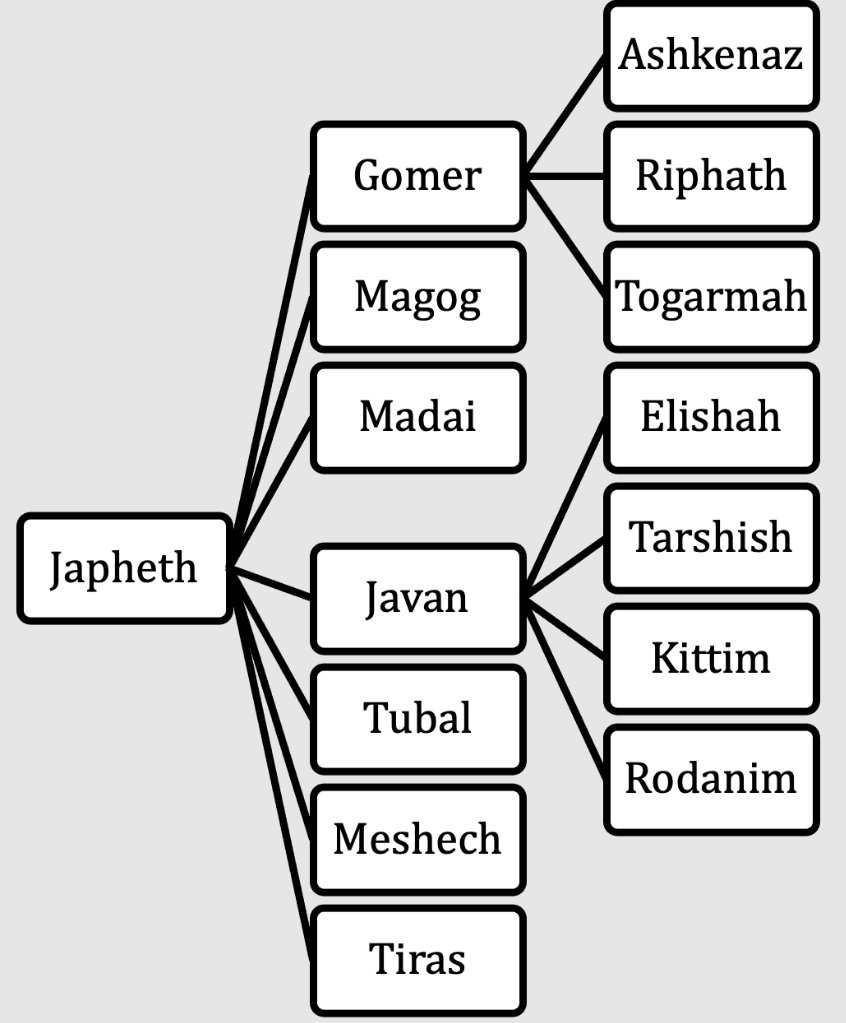
1 Chronicles 1:5-7
The Descendants of Japheth
The sons of Japheth were Gomer, Magog, Madai, Javan, Tubal, Meshech and Tiras. These settled in modern Anatolia (Turkey) and are used as symbols of rebellious nations in Ezekiel 38-39.
J Vernon McGee - Notice that the sons of Japheth are listed, then the sons of Ham (1Ch 1:8), and finally the sons of Shem. Only the line of Shem continues. It leads to Abraham.
David Guzik - The sons of Japheth: It is commonly supposed that “The seven sons of Japheth founded the people of Europe and northern Asia.” (Payne)
- From Javan came Greek Ionia
- From Gomer came the ancient Cimmerians of the Russian plains
- From Madai came the Medes and Persians of Iran
- From Tubal and Meshech came the inhabitants of the Turkish plateau
- Kittim, and Rodanim: These are respectively the islands of Cyprus and Rhodes.
Believer's Study Bible - The sons of Japheth, or the Japhethites, were the ancestors of the peoples known as Indo-Europeans (Gen. 10:1, note). Javan, for example, was doubtless related to the coastal peoples (Gen. 10:4, 5) identified as the Ionians in Homer's Iliad and as Greeks in the Bible (cf. Ezek. 27:13; Dan. 8:21; 10:20; 11:2; Joel 3:6).
Ryrie - Vs. 1:5-23 A reproduction of the records of Gen. 10, with minor differences of spelling. Regarding verse 5, see notes on Ezek. 38:2, 5-6.
1 Chronicles 1:6 The sons of Gomer were Ashkenaz, Diphath, and Togarmah.
- Ashchenaz: Ge 10:3, Ashkenaz
- Riphath: or Diphath, as it is in some copies
The sons of Gomer were Ashkenaz, Diphath, and Togarmah.
1 Chronicles 1:7 The sons of Javan were Elishah, Tarshish, Kittim and Rodanim.
- Tarshish: Ps 72:10 Isa 66:19
- Kittim: These, and other words ending in {im,} forming the Hebrew plural, are not the names of individuals, but of nations. Nu 24:24 Isa 23:1,12 Jer 2:10 Eze 27:6 Da 11:30, Chittim
- Dodanim: or, Rodanim, according to some copies
The sons of Javan were Elishah, Tarshish, Kittim and Rodanim.
1 Chronicles 1:8 The sons of Ham were Cush, Mizraim, Put, and Canaan.
- sons: Ge 10:6,7
- Put: Ge 10:6
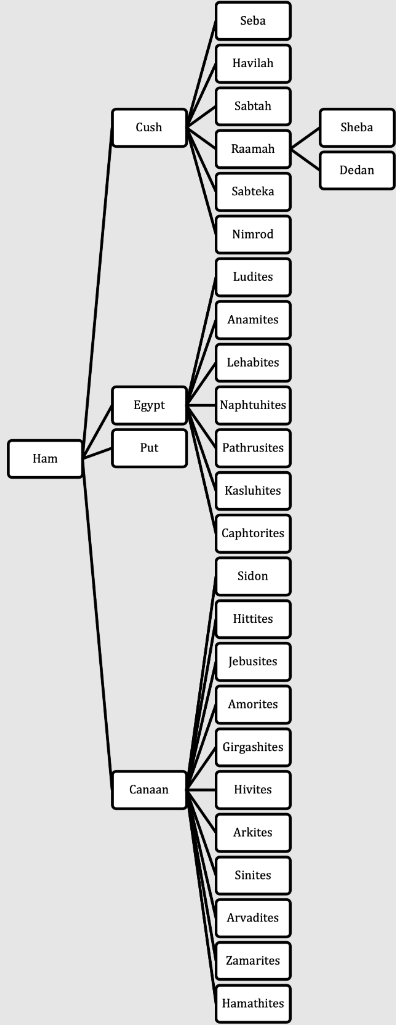
1 Chronicles 1:8-16
Descendants of Ham
The sons of Ham were Cush, Mizraim (EGYPT), Put, and Canaan. - This list is almost identical to Genesis 10:6-8, 13-18. The descendants of Ham are the peoples who populated Africa and the Far East.
See PRE-ISRAELITE INHABITANTS OF PALESTINE
Believer's Study Bible - The sons of Ham, or Hamites, were the ancestors of the peoples of Arabia (Cush), Egypt (Mizraim), Libya (Put), and Canaan (cf. Gen. 10:1, note).
1 Chronicles 1:9 The sons of Cush were Seba, Havilah, Sabta, Raama and Sabteca; and the sons of Raamah Sheba were Dedan
- Sabta: i.e. he compassed the chamber; to surround. Ge 10:7, Sabtechah, i.e. terror, <Strong's H5455>, Ge 10:7
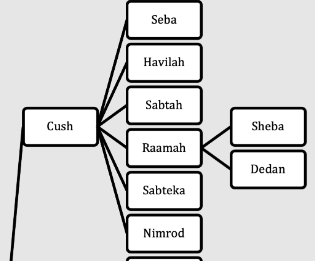
The sons of Cush were Seba, Havilah, Sabta, Raama and Sabteca; and the sons of Raamah Sheba were Dedan - These names represent tribes and nations that spread primarily into regions associated with northeast Africa and parts of Arabia. Cush is most commonly connected with the region of Ethiopia or Nubia south of Egypt, and his descendants became associated with powerful ancient civilizations in Africa and beyond.
The descendants of Raamah, Sheba and Dedan, became associated with Arabian trade routes and commercial wealth. Scripture later mentions Sheba in connection with riches, spices, and distant travel, most famously in the visit of the queen of Sheba to Solomon (1 Kings 10:1–13). Dedan likewise became known as a trading people in the prophets (Ezekiel 27:15, 20).
1 Chronicles 1:10 Cush became the father of Nimrod; he began to be a mighty one in the earth.
- Ge 10:8-12 Mic 5:6
Related Passages:
Genesis 10:8-12 Now Cush became the father of Nimrod; he became a mighty one on the earth. 9 He was a mighty hunter before the LORD; therefore it is said, “Like Nimrod a mighty hunter before the LORD.” 10 The beginning of his kingdom was Babel and Erech and Accad and Calneh, in the land of Shinar (BABYLON). 11 From that land he went forth into Assyria, and built Nineveh and Rehoboth-Ir and Calah, 12 and Resen between Nineveh and Calah; that is the great city.
NIMROD
THE MIGHTY ONE
Cush became the father of Nimrod; he began to be a mighty one in the earth - Through Cush also came Nimrod, the mighty ruler described later in the chapter, who established some of the earliest centers of organized rebellion and human power, including Babylon in the land of Shinar (Genesis 10:8–10). Thus the line of Cush became connected both with great civilizations and with the rise of kingdoms that often stood in opposition to God.
Jewish Targum regarding Nimrod “He began to be bold in sin, a murderer of the innocent, and a rebel before the Lord.”
QUESTION - Who was Nimrod in the Bible? | GotQuestions.org
ANSWER - Nimrod in the Bible was the great-grandson of Noah through the line of Ham and Cush (Genesis 10:8). What we know of him comes from four verses in Genesis:
Cush was the father of Nimrod, who began to be a mighty one on the earth. He was a mighty hunter before the Lord; so it is said, “Like Nimrod, a mighty hunter before the Lord.” His kingdom began in Babylon, Erech, Accad, and Calneh, in the land of Shinar. From that land he went forth into Assyria, where he built Nineveh, Rehoboth-Ir, Calah, and Resen, which is between Nineveh and the great city of Calah. (Genesis 10:8–12, BSB)
There are other mentions of Nimrod in Micah 5:6, which refers to Assyria as “the land of Nimrod” and in 1 Chronicles 1:10, which includes his name in a genealogy.
In Genesis 10, Nimrod is called “a mighty warrior on the earth” (verse 8) and “a mighty hunter before the Lord” (verse 9a). So famous was Nimrod’s prowess as a hunter of wild animals that his skill became proverbial, and the ancients used to compliment people by saying, “This man is like Nimrod, the greatest hunter in the world” (verse 9b, NLT).
Nimrod was obviously a mighty man with great skill and plenty of ambition. The fact that Genesis 10:8 calls Nimrod “a mighty one” (KJV) has led some to associate him with the Nephilim, which are called “mighty men” in Genesis 6:4 (KJV). This association, although untenable, has led still others to believe that Nimrod was a giant.
Many legends have sprung up around Nimrod. In Jewish legends, Nimrod promoted the worship of many gods and was the sworn enemy of Abraham, whom Nimrod tried to murder (see Genesis Rabbah 38:13). Islamic literature also teaches that Nimrod and Abraham battled one other (Qur’an 21:68–70; 37:97–99). Scottish minister and writer Alexander Hislop claimed that Nimrod was married to Semiramis, a famous queen in the ancient world. All of this is speculation.
Equally unsubstantiated are the descriptions of Nimrod from Jewish historian Josephus, who links Nimrod to the building of the Tower of Babel: “[Nimrod] said he would be revenged on God, if he should have a mind to drown the world again; for that he would build a tower too high for the waters to reach. And that he would avenge himself on God for destroying their forefathers” (Antiquities of the Jews, Book 1, Chapter 4). So, the motive for building the Tower of Babel, according to Josephus, was to protect humanity against another flood. Further, according to Josephus, Nimrod “persuaded [his subjects] not to ascribe [their strength] to God, as if it were through his means they were happy, but to believe that it was their own courage which procured that happiness” (ibid.). Of course, construction of the Tower of Babel ended with another show of God’s power: the Lord confused the languages of the people, making it impossible for them to communicate effectively enough to finish the job.
Nimrod has lent his name to our vocabulary: today, a “nimrod” is “a hunting expert or devotee.” (And, for a brief time in the 1980s, nimrod was a less-than-heroic slang term for “geek” or “socially awkward person.”) Nimrod appears as a character in the mythology of many ancient cultures; he shows up in Hungarian, Greek, Arabic, Syrian, and Armenian legends. There is evidence that the Epic of Gilgamesh and the myth of Hercules both find their origins in Nimrod’s life. Nimrod was undoubtedly a powerful, charismatic hero-figure of the ancient world. It isn’t hard to see why so many myths and legends would spring up in the wake of such a man. In the end, however, Nimrod’s power and glory came to nothing, because God is stronger than even the mightiest of men, and He cannot be thwarted. Nimrod was a mighty hunter before the Lord, but humility before the Lord is the posture of the wise (Proverbs 3:34; 11:2; James 4:6; 1 Peter 5:5).
NIMROD [SMITH]
(rebellion; or the valiant), a son of Cush and grandson of Ham. The events of his life are recorded in (Genesis 10:8) ff., from which we learn (1) that he was a Cushite; (2) that he established an empire in Shinar (the classical Babylonia) the chief towns being Babel, Erech, Accad and Calneh; and (3) that he extended this empire northward along the course of the Tigris over Assyria, where he founded a second group of capitals, Nineveh, Rehoboth, Calah and Resen.
NIMROD [ISBE]
NIMROD - nim'-rod (nimrodh; Nebrod): A descendant of Ham, mentioned in "the generations of the sons of Noah" (Gen 10; compare 1 Ch 1:10) as a son of Cush. He established his kingdom "in the land of Shinar," including the cities "Babel, and Erech, and Accad, and Calneh" (Gen 10:10), of which only Babel, or Babylon, and Erech, or Uruk, have been identified with certainty. "The land of Shinar" is the old name for Southern Babylonia, afterward called Chaldea ('erets kasdim), and was probably more extensive in territory than the Sumer of the inscriptions in the ancient royal title, "King of Shumer and Accad," since Accad is included here in Shinar. Nimrod, like other great kings of Mesopotamian lands, was a mighty hunter, possibly the mightiest and the prototype of them all, since to his name had attached itself the proverb: "Like Nimrod a mighty hunter before Yahweh" (Gen 10:9). In the primitive days of Mesopotamia, as also in Palestine, wild animals were so numerous that they became a menace to life and property (Ex 23:29; Lev 26:22); therefore the king as benefactor and protector of his people hunted these wild beasts. The early conquest of the cities of Babylonia, or their federation into one great kingdom, is here ascribed to Nimrod. Whether the founding and colonization of Assyria (Gen 10:11) are to be ascribed to Nimrod will be determined by the exegesis of the text. English Versions of the Bible reads: "Out of that land he (i.e. Nimrod) went forth into Assyria, and builded Nineveh," etc., this translation assigning the rise of Assyria to Nimrod, and apparently being sustained by Mic 5:5,6 (compare J. M. P. Smith, "Micah," ICC, in the place cited.); but American Revised Version, margin renders: "Out of that land went forth Asshur, and builded Nineveh," which translation is more accurate exegetically and not in conflict with Mic 5:6, if in the latter "land of Nimrod" be understood, not as parallel with, but as supplemental to, Assyria, and therefore as Babylon (compare commentaries of Cheyne, Pusey, S. Clark, in the place cited.).
Nimrod has not been identified with any mythical hero or historic king of the inscriptions. Some have sought identification with Gilgamesh, the flood hero of Babylonia (Skinner, Driver, Delitzsch); others with a later Kassite king (Haupt, Hilprecht), which is quite unlikely; but the most admissible correspondence is with Marduk, chief god of Babylon, probably its historic founder, just as Asshur, the god of Assyria, appears in verse 11 as the founder of the Assyrian empire (Wellhausen, Price, Sayce). Lack of identification, however, does not necessarily indicate mythical origin of the name.
1 Chronicles 1:11 Mizraim became the father of the people of Lud, Anam, Lehab, Naphtuh,
- Ge 10:13,14
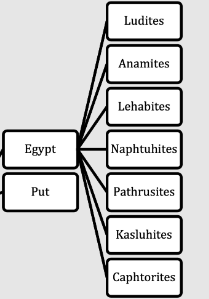
Egypt = Mizraim
Mizraim became the father of the people of Lud, Anam, Lehab, Naphtuh, “Mizraim” is the Hebrew name for Egypt, so this verse is describing the spread of peoples and tribes that came from the Egyptian branch of Ham’s descendants after the Flood. The names Lud, Anam, Lehab, and Naphtuh represent ancient peoples associated with Egypt and nearby regions in North Africa.
1 Chronicles 1:12 Pathrus, Casluh, from which the Philistines came, and Caphtor.
- Caphthor: De 2:23 Jer 47:4 Am 9:7
Egypt = Mizraim
Pathrus, Casluh, from which the Philistines came, and Caphtor. Pathrus refers to the people of Pathros, a region in upper or southern Egypt. The name appears later in the prophets as an Egyptian territory (Isaiah 11:11; Ezekiel 29:14). Casluh is especially important because the text notes that “from which the Philistines came.” The Philistines became one of Israel’s most persistent enemies throughout the Old Testament, especially during the days of Samson, Saul, and David. They settled along the coastal plain southwest of Israel in cities such as Gaza, Ashkelon, Ashdod, Ekron, and Gath. Caphtor is generally identified with Crete or islands in the Mediterranean region. Other passages connect the Philistines with Caphtor as well (Jeremiah 47:4; Amos 9:7), suggesting migration movements between these related peoples and regions. SEE Why were the Philistines and the Israelites always at war?
1 Chronicles 1:13 Canaan became the father of Sidon, his firstborn, Heth,
- Canaan: Ge 9:22,25,26 10:15-19
- Heth: Ge 23:3,5,20 27:46 49:30-32 Ex 23:28 Jos 9:1 2Sa 11:6
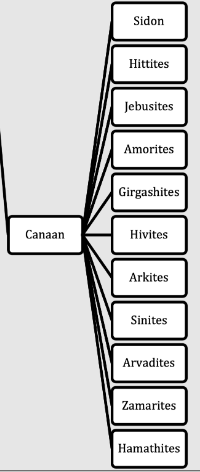
Canaan became the father of Sidon, his firstborn, Heth, - NLT = "Canaan's oldest son was Sidon, the ancestor of the Sidonians. Canaan was also the ancestor of the Hittites." Canaan was the son of Ham and became the ancestor of the Canaanite peoples who later inhabited the land promised to Israel. These nations became known for idolatry, immorality, and opposition to God, and they frequently appear throughout the Old Testament narrative.
Sidon was Canaan’s firstborn and became the founder of the famous Phoenician city of Sidon along the Mediterranean coast. Sidon later became known for commerce, wealth, shipping, and pagan worship. It was closely associated with Tyre and with the spread of Baal worship into Israel, especially during the days of Jezebel (1 Kings 16:31). SEE What is the significance of the city of Sidon in the Bible?
Heth became the ancestor of the Hittites, an important people group in the ancient Near East. The Hittites lived in various regions of Canaan and appear often in Genesis and later Old Testament history. Abraham purchased the cave of Machpelah from the sons of Heth as a burial place for Sarah (Genesis 23). SEE Who were the Hittites? | GotQuestions.org
ARCHAEOLOGICAL IMPORTANCE OF HITTITES - The existence of the Hittites was long doubted by many skeptics because, for centuries, they were known primarily from the Bible (e.g., Genesis, Joshua, 1 Kings). Critics once claimed the Hittites were either insignificant or entirely legendary because little external evidence had been found. That changed dramatically in the late 19th and early 20th centuries through major archaeological discoveries in what is now modern Turkey. In the 1870s and 1880s, archaeologists began discovering inscriptions and monuments in Anatolia (Asia Minor) referring to a previously unknown empire linked to the Hittites. These finds hinted that the biblical references were grounded in real history. The breakthrough came in 1906 when German archaeologist Hugo Winckler excavated the ancient city of Hattusa at Boğazköy (Boğazkale) in Turkey. There he uncovered thousands of clay tablets, royal archives, diplomatic treaties, laws, military records and religious texts. These discoveries proved beyond doubt that the Hittites were not a minor tribe but the rulers of a vast and sophisticated empire. Soon afterward, scholars deciphered the Hittite language, an Indo-European language written in cuneiform. This allowed historians to reconstruct Hittite history, politics, religion, and international relations. One of the most famous discoveries was the treaty between the Hittites and Egypt following the Battle of Kadesh involving Ramesses II. This discovery demonstrated that the Hittites were one of the great superpowers of the ancient Near East, alongside Egypt, Assyria, and Babylon. Archaeological findings such as these should strengthen our confidence in the absolute reliability and veracity of Scripture. In reality, archaeology does not prove the Bible true; rather, again and again, the Bible proves itself true and archaeology simply confirms its historical accuracy.
Believer's Study Bible - According to the linguistic criteria, the Canaanites and Amorites are classified as "Semites," although they are "Hamites" according to the predominant factors of genealogy and geography used in the Scriptures (cf. Gen. 10:19, 20). Heth is identified with two groups of people in the O.T. Usually, "the sons of Heth" refers to a relatively unimportant ethnic group living in Palestine since the days of the patriarchs (cf. Gen. 10:15; 15:19-21; Num. 13:29; Josh. 11:3; Ezek. 16:3). On the other occasions, "the sons of Heth" indicates an originally non-Semitic people called "Hittites," who ruled Asia Minor during the second millennium B.C. They established centers in northern Syria (referred to by the Assyrians as the "Land of Hatti"), where they ruled together with Aramean kings during the first millennium B.C. (cf. Josh 1:4, note; 1 Kin. 11:1; 2 Kin. 7:6, 7; 2 Chr. 1:17).
CANAAN; CANAANITES [ISBE] - ka'-nan, ka'-nan-its (kena`an; Chanaan):
1. Geography
2. Meaning of the Name
3. The Results of Recent Excavations
4. History
(1) Stone Age
(2) Bronze Age
(3) A Babylonian Province
(4) Jerusalem Founded
(5) The Hyksos
(6) Egyptian Conquest
(7) Tell el-Amarna Tablets
5. The Israelitsh Invasion
6. Culture
7. Art
8. Commerce
9. Art of Writing
Canaan is stated in Gen 10:6 to have been a son of Ham and brother of Mizraim, or Egypt. This indicates the Mosaic period when the conquerors of the XVIIIth and XIXth Egyptian Dynasties made Canaan for a time a province of the Egyptian empire. Under the Pharaoh Meneptah, at the time of the Exodus, it ceased to be connected with Egypt, and the Egyptian garrisons in the South of the country were expelled by the Philistines, who probably made themselves masters of the larger portion of it, thus causing the name of Philistia or Palestine to become synonymous with that of Canaan (see Zeph 2:5). In the Tell el-Amarna Letters, Canaan is written Kinakhna and Kinakhkhi. The latter form corresponds with the Greek (Chna), a name given to Phoenicia (Hecat. Fragments 254; Eusebius, praep. Ev., i.10; ix.17).
1. Geography:
In Nu 13:29 the Canaanites are described as dwelling "by the sea, and along by the side of the Jordan," i.e. in the lowlands of Palestine. The name was confined to the country West of the Jordan (Nu 33:51; Josh 22:9), and was especially applied to Phoenicia (Isa 23:11; compare Mt 15:22). Hence, Sidon is called the "firstborn" of Canaan (Gen 10:15, though compare Jdg 3:3), and the Septuagint translates "Canaanites" by "Phoenicians" and "Canaan" by the "land of the Phoenicians" (Ex 16:35; Josh 5:12). Kinakhkhi is used in the same restricted sense in the Tell el-Amarna Letters, but it is also extended so as to include Palestine generally. On the other hand, on the Egyptian monuments Seti I calls a town in the extreme South of Palestine "the city of Pa-Kana'na" or "the Canaan," which Conder identifies with the modern Khurbet Kenan near Hebron.
As in the Tell el-Amarna Letters, so in the Old Testament, Canaan is used in an extended sense to denote the whole of Palestine West of the Jordan (Gen 12:5; 23:2,19; 28:1; 31:18; 35:6; 36:2; 37:1; 48:7; Ex 15:15; Nu 13:2; Josh 14:1; 21:2; Ps 135:11). Thus, Jerusalem which had Amorite and Hittite founders is stated to be of "the land of the Canaanite" (Ezek 16:3), and Isa (19:18) terms Hebrew, which was shared by the Israelites with the Phoenicians and, apparently, also the Amorites, "the language of Caaan." Jabin is called "the king of Canaan" in Jdg 4:2,23,24; but whether the name is employed here in a restricted or extended sense is uncertain.
2. Meaning of the Name:
As the Phoenicians were famous as traders, it has been supposed that the name "Canaanite" is a synonym of "merchant" in certain passages of the Old Testament. The pursuit of trade, however, was characteristic only of the maritime cities of Phoenicia, not of the Canaanitish towns conquered the Israelites. In Isa 23:11 we should translate "Canaan" (as the Septuagint) instead of "merchant city" (the King James Version); in Hos 12:7 (8), "as, for Canaan" (Septuagint), instead of "he is a merchant" (the King James Version); in Zeph 1:11, "people of Canaan" (Septuagint), instead of "merchant people" (the King James Version); on the other hand, "Canaanite" seems to have acquired the sense of "merchant," as "Chaldean" did of "astrologer," in Isa 23:8, and Prov 3:1:24, though probably not in Zec 14:21, and Job 41:6 (Hebrew 40:30).
3. The Results of Recent Excavation:
Much light has been thrown upon the history of Canaan prior to the Israelite occupation by recent excavation, supplemented by the monuments of Babylonia and Egypt. The Palestine Exploration led the way by its excavations in 1890-92 at Tell el-Hesy, which turned out to be the site of Lachish, first under Professor Flinders Petrie and then under Dr. Bliss. Professor Petrie laid the foundations of Palestine archaeology by fixing the chronological sequence of the Lachish pottery, and tracing the remains of six successive cities, the fourth of which was that founded by the Israelites. Between it and the preceding city was a layer of ashes, marking the period when the town lay desolate and uninhabited. The excavations at Lachish were followed by others at Tell es-Safi, the supposed site of Gath; at Tell Sandahanna, the ancient Marissa, a mile South of Bet Jibrin, where interesting relics of the Greek period were found, and at Jerusalem, where an attempt was made to trace the city walls. Next to Lachish, the most fruitful excavations have been at Gezer, which has been explored by Mr. Macalister with scientific thoroughness and skill, and where a large necropolis has been discovered as well as the remains of seven successive settlements, the last of which comes down to the Seleucid era, the third corresponding with the first settlement at Lachish. The two first settlements go back to the neolithic age. With the third the Semitic or "Amorite" period of Canaan begins; bronze makes its appearance; high-places formed of monoliths are erected, and inhumation of the dead is introduced, while the cities are surrounded with great walls of stone. While Mr. Macalister has been working at Gezer, German and Austrian expeditions under Dr. Schumacher have been excavating at Tell em-Mutesellim, the site of Megiddo, and under Dr. Sellin first at Tell Taanak, the ancient Taanach, and then at Jericho. At Taanach cuneiform tablets of the Mosaic age were found in the house of the governor of the town; at Samaria and Gezer cuneiform tablets have also been found, but they belong to the late Assyrian and Babylonian periods. At Jericho, on the fiat roof of a house adjoining the wall of the Canaanitish city, destroyed by the Israelites, a number of clay tablets were discovered laid out to dry before being inscribed with cuneiform characters. Before the letters were written and dispatched, however, the town, it seems, was captured and burnt. An American expedition, under Dr. Reisner, is now exploring Sebastiyeh (Samaria), where the ruins of Ahab's palace, with early Hebrew inscriptions, have been brought to light, as well as a great city wall built in the age of Nebuchadrezzar.
4. History:
(1) Stone Age.
The history of Canaan begins with the paleolithic age, paleolithic implements having been found in the lowlands. Our first knowledge of its population dates from the neolithic period. The neolithic inhabitants of Gezer were of short stature (about 5 ft. 4 inches in height), and lived in caves--at least in the time of the first prehistoric settlement--and burned their dead. Their sacred place was a double cave with which cup-marks in the rock were connected, and their pottery was rude; some of it was ornamented with streaks of red or black on a yellow or red wash. In the time of the second settlement a rude stone wall was built around the town. The debris of the two neolithic settlements is as much as 12 ft. in depth, implying a long period of accumulation.
(2) Bronze Age.
The neolithic population was succeeded by one of Semitic type, which introduced the use of metal, and buried its dead. The name of Amorite has been given to it, this being the name under which the Semitic population of Canaan was known to the Babylonians. Gezer was surrounded by a great wall of stone intersected by brick towers; at Lachish the Amorite wall was of crude brick, nearly 29 ft. in thickness (compare Dt 1:28). A "high-place" was erected at Gezer consisting of 9 monoliths, running from North to South, and surrounded by a platform of large stones. The second monolith has been polished by the kisses of the worshippers; the seventh was brought from a distance. Under the pavement of the sanctuary lay the bones of children, more rarely of adults, who had been sacrificed and sometimes burnt, and the remains deposited in jars. Similar evidences of human sacrifice were met with under the walls of houses both here and at Taanach and Megiddo. In the Israelite strata the food-bowl and lamp for lighting the dead in the other world are retained, but all trace of human sacrifice is gone. At Lachish in Israelite times the bowl and lamp were filled with sand. The second "Amorite" city at Gezer had a long existence. The high-place was enlarged, and an Egyptian of the age of the XIIth Dynasty was buried within its precincts. Egyptian scarabs of the XIIth and XIIIth Dynasties are now met with; these give place to scarabs of the Hyksos period, and finally to those of the XVIIIth Dynasty (1600 BC). Hittite painted pottery of Cappadocian type is also found in the later debris of the city as well as seal-cylinders of the Babylonian pattern.
(3) A Babylonian Province.
Meanwhile Canaan had for a time formed part of the Babylonian empire. Gudea, viceroy of Lagas under the kings of the Dynasty of Ur (2500 BC), had brought "limestone" from the "land of the Amorites," alabaster from Mt. Lebanon, cedar-beams from Amanus, and golddust from the desert between Palestine and Egypt. A cadastral survey was drawn up about the same time by Uru-malik, "the governor of the land of the Amorites," the name by which Syria and Canaan were known to the Babylonians, and colonies of "Amorites" engaged in trade were settled in the cities of Babylonia. After the fall of the Dynasty of Ur, Babylonia was itself conquered by the Amorites who founded the dynasty to which Khammurabi, the Amraphel of Gen 14:1, belonged (see HAMMURABI). In an inscription found near Diarbekir the only title given to Khammu-rabi is "king of the land of the Amorites." Babylonian now became the official, literary and commercial language of Canaan, and schools were established there in which the cuneiform script was taught. Canaanitish culture became wholly Babylonian; even its theology and gods were derived from Babylonia. The famous legal code of Khammu-rabi (see HAMMURABI, CODE OF) was enforced in Canaan as in other parts of the empire, and traces of its provisions are found in Gen. Abram's adoption of his slave Eliezer, Sarai's conduct to Hagar, and Rebekah's receipt of a dowry from the father of the bridegroom are examples of this. So, too, the sale of the cave of Machpelah was in accordance with the Babylonian legal forms of the Khammu-rabi age. The petty kings of Canaan paid tribute to their Babylonian suzerain, and Babylonian officials and "commerical travelers" (damgari) frequented the country.
(4) Jerusalem Founded.
We must ascribe to this period the foundation of Jerusalem, which bears a Babylonian name (Uru-Salim, "the city of Salim"), and commanded the road to the naphtha springs of the Dead-Sea. Bitumen was one of the most important articles of Babylonian trade on account of its employment for building and lighting purposes, and seems to have been a government monopoly. Hence, the rebellion of the Canaanitish princes in the naphtha district (Gen 14) was sufficiently serious to require a considerable force for its suppression.
(5) The Hyksos.
The Amorite dynasty in Babylonia was overthrown by a Hittite invasion, and Babylonian authority in Canaan came to an end, though the influence of Babylonian culture continued undiminished. In the North the Hittites were dominant; in the South, where Egyptian influence had been powerful since the age of the XIIth Dynasty, the Hyksos conquest of Egypt united Palestine with the Delta. The Hyksos kings bear Canaanitish names, and their invasion of Egypt probably formed part of that general movement which led to the establishment of an "Amorite" dynasty in Babylonia. Egypt now became an appanage of Canaan, with its capital, accordingly, near its Asiatic frontier. One of the Hyksos kings bears the characteristically Canaanitish name of Jacob-el, written in the same way as on Babylonian tablets of the age of Khammu-rabi, and a place of the same name is mentioned by Thothmes III as existing in southern Palestine
(6) Egyptian Conquest.
The Pharaohs of the XVIIIth Dynasty expelled the Hyksos and conquered Palestine and Syria. For about 200 years Canaan was an Egyptian province. With the Egyptian conquest the history of the second Amorite city at Gezer comes to an end. The old wall was partially destroyed, doubtless by Thothmes III (about 1480 BC). A third Amorite city now grew up, with a larger and stronger wall, 14 ft. thick. The houses built on the site of the towers of the first wall were filled with scarabs and other relics of the reign of Amon-hotep III (1440 BC). At Lachish the ruins of the third city were full of similar remains, and among them was a cuneiform tablet referring to a governor of Lachish mentioned in the Tell el-Amarna Letters. At Taanach cuneiform tablets of the same age have been discovered, written by Canaanites to one another but all in the Babylonian script and language.
(7) Tell el-Amarna Tablets.
In the Tell el-Amarna Letters we have a picture of Canaan at the moment when the Asiatic empire of Egypt was breaking up through the religious and social troubles that marked the reign of Amon-hotep IV. The Hittites were attacking it in the North; in the South of Canaan the Khabiri or "confederate" bands of free-lances were acquiring principalities for themselves. The petty kings and governors had foreign troops in their pay with which they fought one against the other; and their mercenaries readily transferred their allegiance from one paymaster to another, or seized the city they were engaged to defend. Hittites, Mitannians from Mesopotamia, and other foreigners appear as governors of the towns; the Egyptian government was too weak to depose them and was content if they professed themselves loyal. At times the Canaanitish princes intrigued with the Assyrians against their Egyptian masters; at other times with the Mitannians of "Aram-Naharaim" or the Hittites of Cappadocia. The troops sent by the Egyptian Pharaoh were insufficient to suppress the rebellion, and the authority of the Egyptian commissioners grew less and less. Eventually the king of the Amorites was compelled to pass openly over to the Hittite king, and Canaan was lost to the Pharaohs.
5. The Israelite Invasion:
Gaza and the neighboring towns, however, still remained in their hands, and with the recovery of Egyptian power under the XIXth Dynasty allowed Seti I to march once more into Canaan and reduce it again to subjection. In spite of Hittite attacks the country on both sides of the Jordan acknowledged the rule of Seti and his son Ramses II, and in the 21st year of the latter Pharaoh the long war with the Hittites came to an end, a treaty being made which fixed the Egyptian frontier pretty much where the Israelite frontier afterward ran. A work, known as The Travels of the Mohar, which satirizes the misadventures of a tourist in Canaan, gives a picture of Canaan in the days of Ramses II. With the death of Ramses II Egyptian rule in Palestine came finally to an end. The Philistines drove the Egyptian garrisons from the cities which commanded the military road through Canaan, and the long war with the Hittites exhausted the inland towns, so that they made but a feeble resistance to the Israelites who assailed them shortly afterward. The Egyptians, however, never relinquished their claim to be masters of Canaan, and when the Philistines power had been overthrown by David we find the Egyptian king again marching northward and capturing Gezer (1 Ki 9:16). Meanwhile the counry had become to a large extent Israelite. In the earlier days of the Israelite invasion the Canaanitish towns had been destroyed and the people massacred; later the two peoples intermarried, and a mixed race was the result. The portraits accompanying the names of the places taken by Shishak in southern Palestine have Amorite features, and the modern fellahin of Palestine are Canaanite rather than Jewish in type.
6. Culture:
Canaanitish culture was based on that of Babylonia, and begins with the introduction of the use of copper and bronze. When Canaan became a Babylonian province, it naturally shared in the civilization of the ruling power. The religious beliefs and deities of Babylonia were superimposed upon those of the primitive Canaanite. The local Baal or "lord" of the soil made way for the "lord of heaven," the Sun-god of the Babylonians. The "high-place" gradually became a temple built after a Babylonian fashion. The sacred stone, once the supreme object of Canaanitish worship, was transformed into a Beth-el or shrine of an indwelling god. The gods and goddesses of Babylonia migrated to Canaan; places received their names from Nebo or Nin-ip; Hadad became Amurru "the Amorite god"; Ishtar passed into Ashtoreth, and Asirtu, the female counterpart of Asir, the national god of Assyria, became Asherah, while her sanctuary, which in Assyria was a temple, was identified in Canaan with the old fetish of an upright stone or log. But human sacrifice, and more especially the sacrifice of the firstborn son, of which we find few traces in Babylonia, continued to be practiced with undiminished frequency until, as we learn from the excavations, the Israelite conquest brought about its suppression. The human victim is also absent from the later sacrificial tariffs of Carthage and Marseilles, its place being taken in them by the ram. According to these tariffs the sacrifices and offerings were of two kinds, the zau`at or sin offering and the shelem or thank-offering. The sin offering was given wholly to the god; part of the thank-offering would be taken by the offerer. Birds which were not allowed as a sin offering might constitute a thank-offering. Besides the sacrifices, there were also offerings of corn, wine, fruit and oil.
7. Art:
What primitive Canaanitish art was like may be seen from the rude sculptures in the Wadi el-Kana near Tyre. Under Babylonian influence it rapidly developed. Among the Canaanite spoil captured by Thothmes III were tables, chairs and staves of cedar and ebony inlaid with gold or simply gilded, richly embroidered robes, chariots chased with silver, iron tent poles studded with precious stones, "bowls with goats' heads on them, and one with a lion's head, the workmanship of the land of Zahi" (the Phoenician coast), iron armor with gold inlay, and rings of gold and silver that were used as money. At Taanach, gold and silver ornaments have been found of high artistic merit. To the Israelites, fresh from the desert, the life of the wealthy Canaanite would have appeared luxurious in the extreme.
8. Commerce:
The position of Canaan made it the meeting-place of the commercial routes of the ancient world. The fleets of the Phoenician cities are celebrated in the Tell el-Amarna Letters, and it is probable that they were already engaged in the purple trade. The inland towns of Canaan depended not only on agriculture but also on a carrying trade: caravans as well as "commercial travelers" (damgari) came to them from Cappadocia, Babylonia and Egypt. Bronze, silver, lead, and painted ware were brought from Asia Minor, together with horses; naphtha was exported to Babylonia in return for embroidered stuffs; copper came from Cyprus, richly chased vessels of the precious metals from Crete and corn from Egypt. Baltic amber has been found at Lachish, where a furnace with iron slag, discovered in the third Amorite city, shows that the native iron was worked before the age of the Israelite conquest. The manufacture of glass goes back to the same epoch. As far back as 2500 BC, alabaster and limestone had been sent to Babylonia from the quarries of the Lebanon.
9. Art of Writing:
Long before the age of Abraham the Babylonian seal-cylinder had become known and been imitated in Syria and Canaan. But it was not until Canaan had been made a Babylonian province under the Khammu-rabi dynasty that the cuneiform system of writing was introduced together with the Babylonian language and literature. Henceforward, schools were established and libraries or archive-chambers formed where the foreign language and its complicated syllabary could be taught and stored. In the Mosaic age the Taanach tablets show that the inhabitants of a small country town could correspond with one another on local matters in the foreign language and script, and two of the Tell el-Amarna letters are from a Canaanitish lady. The official notices of the name by which each year was known in Babylonia were sent to Canaan as to other provinces of the Babylonian empire in the cuneiform script; one of these, dated in the reign of Khammurabi's successor, has been found in the Lebanon.
LITERATURE.
H. Vincent, Canaan d'apres l'exploration recente, 1907; G. A. Smith, Historical Geography of the Holy Land, 1894; Publications of the Palestine Exploration Fund; E. Sellin, Tell Ta`annek and Eine Nachlese auf dem Tell Ta`annek, 1904-5; Schumacher, Tell Mutesellim, 1909; Thiersch, Die neueren Ausgrabungen in Palestina, 1908.
See, further, ARKITE; ARVADITES; BAAL; GIRGASHITE; HITTITES; HIVITE; JEBUSITE; KADMONITE; KENIZZITE; PALESTINE; PERIZZITE; REPHAIM; SINITES; TEMAN.
A. H. Sayce
1 Chronicles 1:14 and the Jebusites, the Amorites, the Girgashites,
- Jebusite: Ge 15:21 Ex 33:2 34:11 Jud 1:21 19:11 2Sa 24:16 Zec 9:7
- Amorite: Ge 48:22 Nu 21:21-32 De 20:17 Jos 3:10 24:15 2Sa 21:2 2Ki 21:11 Am 2:9
- Girgashite: Ge 15:21 De 7:1 Jos 3:10 Ne 9:8
and the Jebusites, the Amorites, the Girgashites, The Jebusites lived in and around Jerusalem, which was originally called Jebus (Judges 19:10). They remained in the land for many years until David captured Jerusalem and made it the capital of Israel (2 Samuel 5:6–9).
The Amorites were one of the most powerful and widespread peoples in Canaan. At times the term “Amorite” was used broadly for the inhabitants of the land. They became known for their strength, fortified cities, and wickedness. God told Abraham that Israel would not possess the land until “the iniquity of the Amorite” was complete (Ge 15:16), showing God’s patience before judgment.
The Girgashites are mentioned among the Canaanite tribes inhabiting the Promised Land (Deuteronomy 7:1). Though less is known about them historically, they formed part of the pagan culture and opposition Israel faced upon entering Canaan.
JEBUS; JEBUSI; JEBUSITE [ISBE]
JEBUS; JEBUSI; JEBUSITE - je'-bus, jeb'-u-si, jeb'-u-zit (yebhuc, ha-yebhuci): "Jebus" is an old name for Jerusalem (Jdg 19:10,11; 1 Ch 4:5 parallel 2 Sam 5:6-9, "the same is Jerus"; see preceding article). "Jebusi" (literally, "Jebusite") is also used as a name for the city in the King James Version (Josh 18:16,28; compare 15:8); the Revised Version (British and American) correctly renders "Jebusite" (see JERUSALEM). "Jebusites," for the people (in the King James Version Gen 15:21; Ex 3:8,17, etc.), does not occur in Hebrew in the plural; hence, in the Revised Version (British and American) is always rendered in the singular, "Jebusite." The "Jebusite" is said in Gen 10:16; 1 Ch 1:14 to be the 3rd son of Canaan, i.e. of the country of Canaan. Elsewhere he represents a tribe separate from the Canaanites. He stands between Heth and the Amorite (compare Nu 13:29; Josh 11:3; Ezek 16:3,15). In the lists of the peoples inhabiting Palestine the "Jebusite" is always placed last, a fact indicative, probably, of their smaller number.
To what race the Jebusites belonged is doubtful. Their name does not seem Semitic, and they do not make their appearance till after the patriarchal period.
The original name of Jerusalem was Babylonian, Uru-Salim, "the city of Salim," shortened into Salem in Gen 14:18 and in the inscriptions of the Egyptian kings Ramses II and Ramses III. In the Tell el-Amarna Letters (1400 BC) Jerusalem is still known as Uru-Salim, and its king bears a Hittite name, implying that it was at the time in the possession of the Hittites. His enemies, however, were closing around him, and one of the tablets shows that the city was eventually captured and its king slain. These enemies would seem to have been the Jebusites, since it is after this period that the name "Jebus" makes its appearance for the first time in the Old Testament (Jdg 19:10,11).
The Jebusite king at the time of the conquest was Adoni-zedek, who met his death at Beth-boron (Josh 10:1 ff; in 10:5 the word "Amorite" is used in its Babylonian sense to denote the inhabitants of Canaan generally). The Jebusites were a mountain tribe (Nu 13:29; Josh 11:3). Their capital "Jebus" was taken by the men of Judah and burned with fire (Jdg 18), but they regained possession of, and held, the fortress till the time of David (2 Sam 5:6 ff).
When Jerusalem was taken by David, the lives and property of its Jebusite inhabitants were spared, and they continued to inhabit the temple-hill, David and his followers settling in the new City of David on Mt. Zion (Josh 15:8,63; Jdg 1:21; 19:11). And as Araunah is called "king" (2 Sam 24:23), we may conclude that their last ruler also had been lowed to live. His name is non-Sem, and the various spellings of it (compare 1 Ch 21:15, "Ornan") indicate that the Hebrew writers had some difficulty in pronouncing it. The Jebusites seem ultimately to have blended with the Israelite population.
James Orr
AMORITES [ISBE]
AMORITES - am'-o-rits; Amorites ('emori, always in the singular like the Babylonian Amurru from which it is taken; Amorraioi):
1. Varying Use of the Name Explained
2. The Amorite Kingdom
3. Sihon's Conquest
4. Disappearance of the Amorite Kingdom
5. Physical Characteristics of the Amorites
The name Amorite is used in the Old Testament to denote (1) the inhabitants of Palestine generally, (2) the population of the hills as opposed to the plain, and (3) a specific people under a king of their own. Thus (1) we hear of them on the west shore of the Dead Sea (Gen 14:7), at Hebron (Gen 14:13), and Shechem (Gen 48:22), in Gilead and Bashan (Dt 3:10) and under Hermon (Dt 3:8; 4:48). They are named instead of the Canaanites as the inhabitants of Palestine whom the Israelites were required to exterminate (Gen 15:16; Dt 20:17; Jdg 6:10; 1 Sam 7:14; 1 Ki 21:26; 2 Ki 21:11); the older population of Judah is called Amorite in Josh 10:5,6, in conformity with which Ezek (16:3) states that Jerusalem had an Amorite father; and the Gibeonites are said to have been "of the remnant of the Amorites" (2 Sam 21:2). On the other hand (2), in Nu 13:29 the Amorites are described as dwelling in the mountains like the Hittites and Jebusites of Jerusalem, while the Amalekites or Bedouins lived in the south and the Canaanites on the seacoast and in the valley of the Jordan. Lastly (3) we hear of Sihon, "king of the Amorites," who had conquered the northern half of Moab (Nu 21:21-31; Dt 2:26-35).
1. Varying Use of the Name Explained:
Assyriological discovery has explained the varying use of the name. The Hebrew form of it is a transliteration of the Babylonian Amurru, which was both sing. and plural. In the age of Abraham the Amurru were the dominant people in western Asia; hence Syria and Palestine were called by the Babylonians "the land of the Amorites." In the Assyrian period this was replaced by "land of the Hittites," the Hittites in the Mosaic age having made themselves masters of Syria and Canaan. The use of the name "Amorite" in its general sense belongs to the Babylonian period of oriental history.
2. The Amorite Kingdom:
The Amorite kingdom was of great antiquity. About 2500 BC it embraced the larger part of Mesopotamia and Syria, with its capital probably at Harran, and a few centuries later northern Babylonia was occupied by an "Amorite" dynasty of kings who traced theft descent from Samu or Sumu (the Biblical Shem), and made Babylon their capital. To this dynasty belonged Khammu-rabi, the Amraphel of Gen 14:1. In the astrological documents of the period frequent reference is made to "the king of the Amorites." This king of the Amorites was subject to Babylonia in the age of the dynasty of Ur, two or three centuries before the birth of Abraham He claimed suzerainty over a number of "Amorite" kinglets, among whom those of Khana on the Euphrates, near the mouth of the Khabur, may be named, since in the Abrahamic age one of them was called Khammu-rapikh and another Isarlim or Israel. A payment of a cadastral survey made at this time by a Babylonian governor with the Canaanite name of Urimelech is now in the Louvre. Numerous Amorites were settled in Ur and other Babylonian cities, chiefly for the purpose of trade. They seem to have enjoyed the same rights and privileges as the native Babylonians. Some of them were commercial travelers, but we hear also of the heads of the great firms making journeys to the Mediterranean coast.
In an inscription found near Diarbekir and dedicated to Khammu-rabi by Ibirum (= Eber), the governor of the district, the only title given to the Babylonian monarch is "king of the Amorites," where instead of Amurru the Sumerian Martu (Hebrew moreh) is used. The great-grandson of Khammu-rabi still calls himself "king of the widespread land of the Amorites," but two generations later Babylonia was invaded by the Hittites, the Amorite dynasty came to an end, and there was once more a "king of the Amorites" who was not also king of Babylonia.
The Amorite kingdom continued to exist down to the time of the Israelite invasion of Palestine, and mention is made of it in the Egyptian records as well as in the cuneiform Tell el-Amarna Letters, and the Hittite archives recently discovered at Boghaz-keui, the site of the Hittite capital in Cappadocia. The Egyptian conquest of Canaan by the kings of the XVIIIth Dynasty had put an end to the effective government of that country by the Amorite princes, but their rule still extended eastward to the borders of Babylonia, while its southern limits coincided approximately with what was afterward the northern frontier of Naphtali. The Amorite kings, however, became, at all events in name, the vassals of the Egyptian Pharaoh. When the Egyptian empire began to break up, under the "heretic king" Amenhotep IV, at the end of the XVIIIth Dynasty (1400 BC), the Amorite princes naturally turned to their more powerful neighbors in the north. One of the letters in the Tell el-Amarna correspondence is from the Pharaoh to his Amorite vassal Aziru the son of Ebed-Asherah, accusing him of rebellion and threatening him with punishment. Eventually Aziru found it advisable to go over openly to the Hittites, and pay the Hittite government an annual tribute of 300 shekels of gold. From that time forward the Amorite kingdom was a dependency of the Hittite empire, which, on the strength of this, claimed dominion over Palestine as far as the Egyptian frontier.
The second successor of Aziru was Abi-Amurru (or Abi-Hadad), whose successor bore, in addition to a Semitic name, the Mitannian name of Bentesinas. Bente-sinas was dethroned by the Hittite King Muttallis and imprisoned in Cappadocia, where he seems to have met the Hittite prince Khattu-sil, who on the death of his brother Muttallis seized the crown and restored Bente-sinas to his kingdom. Bente-sinas married the daughter of Khattu-sil, while his own daughter was wedded to the son of his Hittite suzerain, and an agreement was made that the succession to the Amorite throne should be confined to her descendants. Two or three generations later the Hittite empire was destroyed by an invasion of "northern barbarians," the Phrygians, probably, of Greek history, who marched southward, through Palestine, against Egypt, carrying with them "the king of the Amorites." The invaders, however, were defeated and practically exterminated by Ramses III of the XXth Egyptian Dynasty (1200 BC). The Amorite king, captured on this occasion by the Egyptians, was probably the immediate predecessor of the Sihon of the Old Testament.
3. Sihon's Conquest:
Egyptian influence in Canaan had finally ceased with the invasion of Egypt by the Libyans and peoples of the Aegean in the fifth year of Meneptah, the successor of Ramses II, at the time of the Israelite Exodus. Though the invaders were repulsed, the Egyptian garrisons had to be withdrawn from the cities of southern Palestine, where their place was taken by the Philistines who thus blocked the way from Egypt to the north. The Amorites, in the name of their distant Hittite suzerains, were accordingly able to overrun the old Egyptian provinces on the east side of the Jordan; the Amorite chieftain Og possessed himself of Bashan (Dt 3:8), and Sihon, "king of the Amorites," conquered the northern part of Moab.
The conquest must have been recent at the time of the Israelite invasion, as the Amorite song of triumph is quoted in Nu 21:27-29, and adapted to the overthrow of Sihon himself by the Israelites. `Woe unto thee,' it reads, `O Moab; thou art undone, O people of Chemosh! (Chemosh) hath given thy sons who escaped (the battle) and thy daughters into captivity to Sihon king of the Amorites.' The flame that had thus consumed Heshbon, it is further declared, shall spread southward through Moab, while Heshbon itself is rebuilt and made the capital of the conqueror: "Come to Heshbon, that the city of Sihon (like the city of David, 2 Sam 5:9) may be rebuilt and restored. For the fire has spread from Heshbon, the flame from the capital of Sihon, devouring as far as Moab (reading `adh with the Septuagint instead of `ar), and swallowing up (reading bale`ah with the Septuagint) the high places of Arnon." The Israelite invasion, however, prevented the expected conquest of southern Moab from taking place.
4. Disappearance of the Amorite Kingdom:
After the fall of Sihon the Amorite kingdom disappears. The Syrians of Zobah, of Hamath and of Damascus take its place, while with the rise of Assyria the "Amorites" cease to be the representatives in contemporary literature of the inhabitants of western Asia. At one time their power had extended to the Babylonian frontier, and Bente-sinas was summoned to Cappadocia by his Hittite overlord to answer a charge made by the Babylonian ambassadors of his having raided northern Babylonia. The Amorite king urged, however, that the raid was merely an attempt to recover a debt of 30 talents of silver.
5. Physical Characteristics of the Amorites:
In Nu 13:29 the Amorites are described as mountaineers, and in harmony with thins, according to Professor Petrie's notes, the Egyptian artists represent them with fair complexions, blue eyes and light hair. It would, therefore, seem that they belonged to the Libyan race of northern Africa rather than to the Semitic stock. In western Asia, however, they were mixed with other racial elements derived from the subject populations, and as they spoke a Semitic language one of the most important of these elements would have been the Semites. In its general sense, moreover, the name "Amorite" included in the Babylonian period all the settled and civilized peoples west of the Euphrates to whatever race they might belong.
LITERATURE.
Hugo Winckler, Mitteilungen der deutschen Orient-Gesellschaft (1907), No. 35, Berlin; Sayce, The Races of the Old Testament, Religious Tract Soc., 1890.
A. H. Sayce
GIRGASHITE [ISBE]
GIRGASHITE - gur'-ga-shit (girgashi; Gergesaios; also punctuated (?) Girgasite (Gen 10:16 the King James Version)): A son of (the land of) Canaan (Gen 10:16), and accordingly enumerated along with the Canaanite' in the list of tribes or nationalities inhabiting that country (Gen 15:21; Dt 7:1; Josh 3:10; 24:11; Neh 9:8). It has been supposed that the name survived in that of "the Gergesenes," the King James Version (the Revised Version (British and American) "the Gadarenes"), of Mt 8:28, on the East side of the Sea of Galilee; Josephus (Ant., I, vi, 2), however, states that nothing was known about it. The inscriptions of the Egyptian king, Ramses II, mention the Qarqish who sent help to the Hittites in their war with Egypt; but Qarqish was more probably in Asia Minor than in Syria. Pinches (The Old Testament in the Light of the Historical Records, 324) would identify the Girgashites with the Kirkishati of an Assyrian tablet; the latter people, however, seem to have lived to the East of the Tigris, and it may be that, as in the case of the Hittites, a colony of the Qarqish, from Asia Minor, was established in Palestine.
A. H. Sayce
1 Chronicles 1:15 the Hivites, the Arkites, the Sinites,
- Hivite: Ex 3:8,17 13:5 1Ki 9:20
the Hivites, the Arkites, the Sinites, The Hivites were one of the prominent Canaanite groups living in cities and rural regions throughout the land. They appear frequently in the days of Joshua. The Gibeonites, who deceived Israel into making a covenant with them, were Hivites (Joshua 9:7). Some Hivites also lived near Mount Hermon in the north (Joshua 11:3). Like the other Canaanite peoples, they were associated with the idolatrous practices of the land.
HIVITE [ISBE]
HIVITE - hi'-vit (chiwwni; Heuaios):
1. Name:
A son of Canaan (Gen 10:17), i.e. an inhabitant of the land of Canaan along with the Canaanite and other tribes (Ex 3:17, etc.). In the list of Canaanite peoples given in Gen 15:19-21, the Hivites are omitted in the Hebrew text, though inserted in Septuagint and S. Gesenius suggests that the name is descriptive, meaning "villagers." The difficulty of explaining it is increased by the fact that it has been confused with "Horite" in some passages of the Hebrew text. In Josh 9:7 the Septuagint reads "Horite" as also does Codex A in Gen 34:2, and in Gen 36:2 a comparison with 36:24,25 shows that "Horite" must be substituted for "Hivite."
2. Geographical Situation:
In Jdg 3:3 the Hittites are described as dwelling "in Mount Lebanon, from Mount Baal-hermon unto the entrance of Hamath," and in accordance with this the Hivite is described in Josh 11:3 as being "under Hermon in the land of Mizpeh," and in 2 Sam 24:7 they are mentioned immediately after "the stronghold of Tyre." Hence, the Septuagint (Codex Alexandrinus) reading must be right in Gen 34:2 and Josh 9:7, which makes the inhabitants of Shechem and Gibeon Horites instead of Hivites; indeed, in Gen 48:22 the people of Shechem are called Amorite, though this was a general name for the population of Canaan in the patriarchal period. No name resembling Hivite has yet been found in the Egyptian or Babylonian inscriptions.
A. H. Sayce
1 Chronicles 1:16 the Arvadites, the Zemarites and the Hamathites.
- Hamathite: Nu 34:8 1Ki 8:65
the Arvadites, the Zemarites and the Hamathites. The Arvadites were associated with the island city of Arvad, located off the coast of Phoenicia in the Mediterranean Sea. Arvad later became known for its sailors and military strength and is mentioned in Ezekiel’s prophecy against Tyre (Ezekiel 27:8, 11). The Hamathites were connected with Hamath, an important city and kingdom in Syria along the Orontes River. Hamath later appears often in Israel’s history as a northern boundary marker of the land (Numbers 34:8; 1 Kings 8:65).
1 Chronicles 1:17 The sons of Shem were Elam, Asshur, Arpachshad, Lud, Aram, Uz, Hul, Gether and Meshech.
- sons of Shem: Ge 10:22-32 11:10
- Elam: Ge 14:1 Isa 11:11 21:2 22:6 Jer 25:25 Eze 32:24 Da 8:2
- Asshur: Nu 24:22-24 Ezr 4:2 Ps 83:8, Assur, Eze 27:23 32:22 Ho 14:3
- Arpachshad (Arphaxad): Ge 11:10-13; Lk 3:36
- Lud: Isa 66:19 Eze 27:10
- Aram: Nu 23:7
- Meshech: Ge 10:23
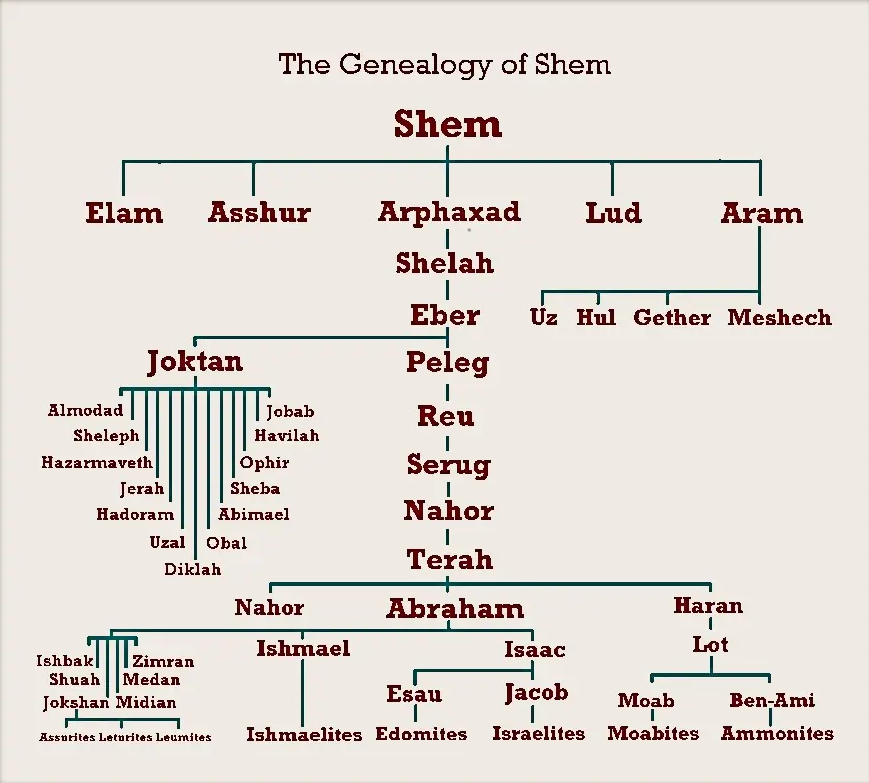
1 Chronicles 1:17-27
Descendants of Shem
The sons of Shem were Elam, Asshur, Arpachshad (Arphaxad), Lud, Aram, Uz, Hul, Gether and Meshech Elam became the ancestor of the Elamites (Persian peoples), who lived east of Babylon in the region of modern Iran. Elam later appears in the prophets and in events connected with Babylon and Persia.
Asshur became the father of the Assyrians, whose mighty empire later conquered the northern kingdom of Israel in 722 BC. The capital cities of Assyria included Nineveh and Ashur.
Arpachshad (Arphaxad) is especially important because through his line came Eber, Abraham, Israel, David, and eventually Jesus Christ (Luke 3:35–36). The covenant line flows through him.
Lud was father to the Lydians who lived for a time in Asia Minor.
Aram became the ancestor of the Arameans or Syrians. The region of Aram frequently appears throughout the Old Testament, especially in conflicts with Israel.
Believer's Study Bible - The sons of Shem, or Semites, indicates the peoples found primarily in western Asia and eastern Africa between Armenia and the Gulf of Persia.
SHEM [ISBE]
SHEM - shem (shem; Sem):
1. Position in Noah's Family: His Name:
The eldest son of Noah, from whom the Jews, as well as the Semitic ("Shemitic") nations in general have descended. When giving the names of Noah's three sons, Shem is always mentioned first (Gen 9:18; 10:1, etc.); and though "the elder" in "Shem the brother of Japheth the elder" (Gen 10:21 margin) is explained as referring to Shem, this is not the rendering of Onkelos. His five sons peopled the greater part of West Asia's finest tracts, from Elam on the East to the Mediterranean on the West. Though generally regarded as meaning "dusky" (compare the Assyr-Babylonian samu--also Ham--possibly = "black," Japheth, "fair"), it is considered possible that Shem may be the usual Hebrew word for "name" (shem), given him because he was the firstborn--a parallel to the Assyr-Babylonian usage, in which "son," "name" (sumu) are synonyms (W. A. Inscriptions, V, plural 23, 11,29-32abc).
2. History, and the Nations Descended from Him:
Shem, who is called "the father of all the children of Eber," was born when Noah had attained the age of 500 years (Gen 5:32). Though married at the time of the Flood, Shem was then childless. Aided by Japheth, he covered the nakedness of their father, which Ham, the youngest brother, had revealed to them; but unlike the last, Shem and Japheth, in their filial piety, approached their father walking backward, in order not to look upon him. Two years after the Flood, Shem being then 100 years old, his son Arpachshad was born (Gen 11:10), and was followed by further sons and daughters during the remaining 500 years which preceded Shem's death. Noah's prophetic blessing, on awakening from his wine, may be regarded as having been fulfilled in his descendants, who occupied Syria (Aramaic), Palestine (Canaan), Chaldea (Arpachshad), Assyria (Asshur), part of Persia (Elam), and Arabia (Joktan). In the first three of these, as well as in Elam, Canaanites had settled (if not in the other districts mentioned), but Shemites ruled, at some time or other, over the Canaanites, and Canaan thus became "his servant" (Gen 9:25,26). The tablets found in Cappadocia seem to show that Shemites (Assyrians) had settled in that district also, but this was apparently an unimportant colony. Though designated sons of Shem, some of his descendants (e.g. the Elamites) did not speak a Semitic language, while other nationalities, not his descendants (e.g. the Canaanites), did.
See HAM; JAPHETH; Table of Nations
T. G. Pinches
1 Chronicles 1:18 Arpachshad became the father of Shelah and Shelah became the father of Eber.
- Shelah: Ge 10:24 11:12-15, Salah
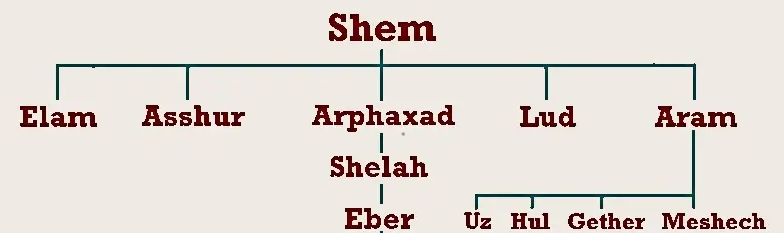
Arphaxad = Arpachshad
Arpachshad (Arphaxad) became the father of Shelah and Shelah became the father of Eber. This verse is important because it moves the genealogy closer to Abraham and ultimately to the coming Messiah. Among the many nations descended from Noah, God was preserving one particular line through which His redemptive plan would unfold. Eber is especially significant because his name is commonly connected with the term “Hebrew.” Abraham would later be called “the Hebrew” (Genesis 14:13), indicating descent from this line.
Payne -The name Eber forms the root of ‘Hebrew’; but this patriarch was the ancestor not only of Abraham (v. 27), but also of a number of other unsettled people, know in ancient history as Habiru or Apiru. (See The Expositor's Bible Commentary - Abridged Edition - Page 50)
1 Chronicles 1:19 Two sons were born to Eber, the name of the one was Peleg, for in his days the earth was divided, and his brother’s name was Joktan.
- Eber: Ge 10:21,25 11:16,17 Nu 24:24
- Peleg: that is, Division
Related Passages:
Genesis 11:9 Therefore its name was called Babel, because there the LORD confused the language of the whole earth; and from there the LORD scattered them abroad over the face of the whole earth.
Two sons were born to Eber, the name of the one was Peleg, for in his days the earth was divided, and his brother’s name was Joktan. The name Peleg comes from a Hebrew word meaning “division” or “split.” The mention of Joktan is also important because many Arabian tribes later descended from him.
QUESTION - In what way was the earth divided in Peleg’s time? GOTQUESTIONS.ORG
ANSWER - In 1 Chronicles 1:19 it is noted that the earth was divided in the days of Peleg: “Two sons were born to Eber: One was named Peleg, because in his time the earth was divided; his brother was named Joktan” (see also verse 25). The detail that “the earth was divided” has caused some to speculate about the exact nature of the division.
The first reference to Peleg is found in Genesis 10:25, which reads the same as 1 Chronicles 1:19. Immediately following, in Genesis 11, is the event that describes this division of the earth: the Tower of Babel.
At the Tower of Babel, the Lord was displeased with the actions of people who sought to build a tower to the heavens and “make a name” for themselves (Genesis 11:4). In judgment, God confused their languages so they could no longer understand one another. The account ends with this summary: “That is why it was called Babel—because there the LORD confused the language of the whole world. From there the LORD scattered them over the face of the whole earth” (Genesis 11:9).
Peleg’s family history is noted once again following the Tower of Babel (Genesis 11:16–19). The fact that Peleg is mentioned before and immediately after the account of the Tower of Babel helps clarify that this is the key event that divided the earth. It seems the earth was not divided geologically, but its people were divided into various language groups.
Today, more than 7,000 languages exist worldwide. While many of these languages were developed after the Tower of Babel, they can be traced to different linguistic roots. The languages that exist today still serve as a dividing point in culture. These divisions have existed since the Tower of Babel in the time of Peleg.
Interestingly, one final mention of Peleg is found in the New Testament. In Luke 3:35, Peleg is mentioned in the genealogy of Jesus. During the time of Peleg, God divided the earth with language. But all the while He had a plan—one that included Peleg—to send Jesus Christ, the One who can reconcile all divisions.
EBER [ISBE]
EBER - e'-ber (`ebher; Eber, in Gen; Obed, in Ch):
(1) Occurs in the genealogies (Gen 10:21,25; 11:14 ff) as the great-grandson of Shem and father of Peleg and Joktan. The word means "the other side," "across," and the form "Hebrew," which is derived from it, is intended to denote the people or tribe who came "from the other, side of the river" (i.e. the Euphrates), from Haran (Gen 11:31), whence Abraham and his dependents migrated to Canaan.
PELEG [ISBE]
PELEG - pe'-leg (pelegh, "watercourse," "division"): A son of Eber, and brother of Joktan. The derivation of the name is given: "for in his days was the earth divided" (niphleghah) (Gen 10:25; compare Lk 3:35, the King James Version "Phalec"). This probably refers to the scattering of the world's population and the confounding of its language recorded in Gen 11:1-9. In Aramaic pelagh and Arabic phalaj mean "division"; in Hebrew pelegh means "watercourse." The name may really be due to the occupation by this people of some well-watered (furrowed), district (e.g. in Babylonia), for these patronymics represent races, and the derivation in Gen 10:25 is a later editor's remark. - S. F. Hunter
1 Chronicles 1:20 Joktan became the father of Almodad, Sheleph, Hazarmaveth, Jerah,
- Hazarmaveth: Ge 10:26-27
Related Passages:
Genesis 10:26-27 Joktan became the father of Almodad and Sheleph and Hazarmaveth and Jerah 27 and Hadoram and Uzal and Diklah
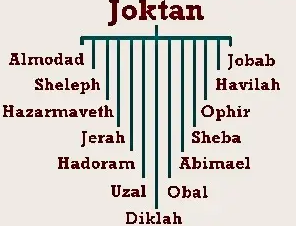
Joktan became the father of Almodad, Sheleph, Hazarmaveth, Jerah, - Joktan became the ancestor of many tribes and peoples that settled primarily in the Arabian Peninsula after the scattering at Babel. This verse is part of the genealogies found in 1 Chronicles 1 and Genesis 10, often called the Table of Nations. These genealogies trace the descendants of Noah’s sons after the Flood, showing how the nations of the earth were repopulated.
1 Chronicles 1:21 Hadoram, Uzal, Diklah,
- Hadoram: Ge 10:27
Hadoram, Uzal, Diklah, These names represent additional tribes or peoples descended from Joktan who settled mainly in the Arabian Peninsula after the scattering of nations at Babel. Uzal is traditionally associated with an ancient city in Yemen.
1 Chronicles 1:22 Ebal, Abimael, Sheba,
- Ebal: Ge 10:28,
Ebal, Abimael, Sheba, These names represent additional Arabian tribes and peoples that descended from Joktan after the nations were scattered from Babel. Sheba became especially important in later biblical history. The descendants of Sheba were associated with wealth, trade, spices, gold, and distant caravans in southern Arabia. The most famous connection is the Queen of Sheba who visited Solomon to test his wisdom and behold the glory of his kingdom (1 Kings 10:1–13). SEE Who was the Queen of Sheba? | GotQuestions.org
1 Chronicles 1:23 Ophir, Havilah and Jobab; all these were the sons of Joktan.
- Ophir: Ge 10:29 1Ki 9:28 10:11 1Ch 29:4 Job 22:24 Ps 45:9 Isa 13:12
- Havilah: Ge 2:11 25:18 1Sa 15:7
Ophir, Havilah and Jobab; all these were the sons of Joktan. Ophir ecame famous in the Old Testament as a land associated with extraordinary wealth, especially fine gold. Solomon received gold, precious stones, and valuable goods from Ophir (1 Kings 9:28; 10:11). Its exact location is uncertain, but many place it somewhere in Arabia, East Africa, or along ancient maritime trade routes.
QUESTION - What is the significance of Ophir in the Bible? | GotQuestions.org
ANSWER - Ophir is mentioned in the Bible as a land renowned for its fine gold and other precious goods. The land of Ophir was most likely first settled by the descendants of a man named Ophir, son of Joktan (Genesis 10:29; 1 Chronicles 1:23). The geographical location of Ophir is uncertain, and there have been many theories about its location.
Some of the locations suggested for Ophir are Arabia, India, Africa, and the Philippines. Some later scholars have even suggested the possibility of the Americas, but this seems unlikely. Arabia seems to be the most widely accepted view of biblical scholars, but the exact location cannot be pinned down since it is not specifically stated in the Bible.
The Bible says Ophir was a land of gold. Ophir is so well-known for its connection to gold that it has been used to name locations where gold was found during modern gold rushes, such as in California and New South Wales. When preparing for the construction of the temple, David provided 3,000 talents of gold from Ophir, about 110 tons (1 Chronicles 29:4–5). With the aid of Hiram, king of Tyre, Solomon amassed a large quantity of gold on a voyage to Ophir, adding to his vast wealth (1 Kings 9:27–28; 10:23). It seems that Ophir gold was highly valued for its natural purity. Isaiah 13:12, referring to the punishment of the wicked, says, “I will make people scarcer than pure gold, more rare than the gold of Ophir.” Other passages in Scripture reference the precious gold of Ophir as a symbol of worthiness and being untainted (Psalm 45:9; Job 28:16). The fact that Ophir gold was used in the construction of the temple of the Lord demonstrates its significance in the Bible.
The Bible says Ophir was a land of precious goods. In addition to its gold, Ophir was also known for its precious stones and “almugwood” (1 Kings 10:11; see Job 28:16). Like its gold, Ophir’s almugwood was used in the construction of the temple, specifically to “make supports for the temple of the Lord” (1 Kings 10:12). This wood was also used in the construction of Solomon’s palace and for making instruments, including harps and lyres (1 Kings 10:12). Although the direct identification of almugwood is uncertain, many scholars believe it could be an aromatic material such as sandalwood (the NLT translates the word as “red sandalwood”). In any case, the amount of almugwood that Solomon used was record-breaking: “So much almugwood has never been imported or seen since that day” (1 Kings 10:12).
Some commentators believe that Solomon’s fleet’s voyage to Ophir was repeated every three years, “bringing gold, silver, ivory, apes, and peacocks” (1 Kings 10:22, ESV). Goods such as ivory, apes, and peacocks would point to Ophir being located in India or Africa, but it is uncertain if the triennial shipments actually came from Ophir. Even if they did, the goods may not have been native to Ophir but merely traded there.
Ophir was known for its treasures of gold, precious stones, and almugwood. As David gathered the best of the best for the construction of the temple of the Lord, he brought materials from Ophir. Ophir’s gold and fine wood were used to represent God’s holiness and splendor in His temple, because “splendor and majesty are before him; strength and glory are in his sanctuary” (Psalm 96:6).
1 Chronicles 1:24 Shem, Arpachshad, Shelah,
- Shem: Ge 11:10-26
- Shelah: Lu 3:35

SHEM'S LINE TO
TERAH
Shem, Arpachshad (Arphaxad), Shelah - NLT - "So this is the family line descended from Shem: Arphaxad, Shelah" Shem’s name means “name” or “renown,” and his line was blessed by God (Genesis 9:26), showing that God’s redemptive plan would continue through him. Arpachshad (Arphaxad) was Shem’s son, born two years after the Flood (Genesis 11:10). His name may mean “healer” or “releaser.” Arpachshad’s descendants settled in the region that later became known as Chaldea or Babylonia, in Mesopotamia. From his line came Eber, whose name is the root of the term “Hebrew.” Thus, Arpachshad’s lineage connects directly to the people of Israel and to the Messiah Himself (Luke 3:36). Shelah was the son of Arpachshad (Genesis 10:24). His name may mean “sprout” or “mission.” Shelah fathered Eber, continuing the line that would lead to Abraham. Though little is said about Shelah personally, his place in the genealogy is crucial because it preserves the continuity of God’s covenant line.
QUESTION - Who was Shem in the Bible? | GotQuestions.org
ANSWER - Shem was one of the three sons of Noah. Before the great flood that God used to judge the inhabitants of the earth for their great wickedness (Genesis 6:5–7), God instructed the righteous Noah to build a great ark to save Noah and his wife, along with their sons, Shem, Ham, and Japheth, and their wives. The Lord brought two of every kind of unclean animal and seven of every kind of clean animal and shut them up in the ark before the flood waters covered the earth (Genesis 7:14–16). The families and animals were in the ark for about 370 days: 40 days and 40 nights during the rains, and then the remainder of the time waiting for the flood waters to recede (see Genesis 7:1–8:19).
Shem is always mentioned first among the sons of Noah, possibly because he was of primary importance to Moses’ audience, the Hebrews. Shem was their ancestor. In the birth order of Noah’s sons, Shem was the middle child, as calculated below:
• according to Genesis 5:32, Noah began having children when he was 500 years old.
• according to Genesis 7:11, Noah was 600 years old when the flood began (making his oldest child 100 years old)
• according to Genesis 11:10, Shem had a child when he was 100 years old, two years after the flood (making him 98 years old at the time of the flood)
• since we know that Ham was not the oldest (according to Genesis 9:24), the 100-year-old son at the time of the flood must have been Japheth
Shem, along with his brothers and their wives, fulfilled God’s command to begin repopulating the earth (Genesis 9:7). Shem’s line produced the Assyrians, Chaldeans, Elamites, Arameans, Moabites, Ammonites, Edomites, Arabs, and Hebrews. Shem’s name is the origin of the word Semitic; Shem’s great-grandson Eber was the father of those who were eventually called “Hebrews,” including Abram and the Jews (see Genesis 10 and 11 for more on Shem’s line).
There is only one other story that deals with Shem, son of Noah. After the flood, Noah became something of a farmer and grew a vineyard (Genesis 9:20). He became drunk on the wine one day and passed out naked in his tent (verse 21). Noah’s son Ham found him thus, but instead of covering his father or helping him in any way, he reported the incident to his brothers outside (verse 22). Shem and Japheth brought some sort of garment into the tent, and, walking backward so they would not see their father’s nakedness, they covered Noah with the garment (verse 23). When Noah woke, he was angry and cursed Ham’s son Canaan, but he blessed both Shem and Japheth for the respect they showed (verses 24–27).
After Shem had fathered many children, he passed away at the old age of 600 (Genesis 11:10–11). Shem is mentioned in the New Testament as an ancestor of Jesus (Luke 3:36).
1 Chronicles 1:25 Eber, Peleg, Reu,
- Eber: Lu 3:35, Heber
- Peleg: Lu 3:35, Phalec
- Reu: Lu 3:35, Ragau
Eber, Peleg, Reu, This verse traces the direct family line from Shem toward Abraham and ultimately to the Messiah. The genealogy has now narrowed from the many nations of the world to the specific lineage through which God would fulfill His redemptive promises. Eber is especially important because his name is commonly connected with the word “Hebrew.” From this line would eventually come Abraham and the Hebrew people. Eber represents an important link in the godly lineage preserved after the Flood. Peleg means “division,” and Scripture explains that “in his days the earth was divided” (Genesis 10:25). This most likely refers to the division of peoples and languages at the tower of Babel, when God scattered humanity across the earth because of their united rebellion.
1 Chronicles 1:26 Serug, Nahor, Terah,
- Serug: Lu 3:35, Saruch
- Nahor: Lu 3:34, Nachor
- Terah: Lu 3:34, Thara
Serug, Nahor, Terah, Nahor was the son of Serug and the grandfather of Abraham. His family lived in Mesopotamia, an area filled with idolatry and pagan worship during that period (Joshua 24:2). Terah was the father of Abraham, Nahor, and Haran. Terah originally lived in Ur of the Chaldeans before beginning the journey toward Canaan (Genesis 11:31). Though Terah himself did not complete the journey, God would soon call Abraham out of this idolatrous environment to become the father of the covenant nation.
QUESTION - Who was Terah in the Bible? | GotQuestions.org
ANSWER - Terah is known in the Bible as the father of Abram (known later as Abraham), who in turn received the covenant promise of God regarding the future birth of His Son, Jesus. Terah is mentioned in Jesus’ genealogy in Luke 3:34.
Terah was the son of Nahor, who was of Noah’s son’s Shem’s line. Nahor fathered Terah at the young age of 29 years (Genesis 11:24), but Terah was 70 years old before his three sons, Abram, Nahor, and Haran, were born (verse 26). Haran was the father of Lot, Abram’s nephew and traveling companion, but Haran died during Terah’s lifetime (verse 28). After Haran’s death, Terah uprooted his family from their home in Ur of the Chaldeans and set out for the land of Canaan. For unknown reasons, Terah never made it to their destination but stopped and settled in Harran instead. This is where Terah died at age 205.
After Terah had passed away, God called Abram to continue the journey to Canaan. God promised to make Abram into a great nation (Genesis 12:1–2), even though Abram’s wife, Sarai, was barren (Genesis 11:30). Abraham heeded God’s command and put His trust in the Lord to the end of his days. Years later, Joshua mentions Terah in an address to the Israelites: “This is what the Lord, the God of Israel, says: ‘Long ago your ancestors, including Terah the father of Abraham and Nahor, lived beyond the Euphrates River and worshiped other gods’” (Joshua 24:2). Joshua then urged the people to make a clean break from their pagan heritage: “Throw away the gods your ancestors [including Terah] worshiped beyond the Euphrates River . . . and serve the Lord” (verse 14).
Terah and his family were idol-worshipers, and that means God spoke to Abraham before he even knew God. What a blessing that God can call anyone, regardless of their ancestry and former faith, to live a life for Him and be a part of His great plan.
1 Chronicles 1:27 Abram, that is Abraham.
- Abram: Ge 11:27-32 17:5 Jos 24:2 Ne 9:7
Related Passages:
Genesis 11:27-32 Now these are the records of the generations of Terah. Terah became the father of Abram, Nahor and Haran; and Haran became the father of Lot. 28 Haran died in the presence of his father Terah in the land of his birth, in Ur of the Chaldeans. 29 Abram and Nahor took wives for themselves. The name of Abram’s wife was Sarai; and the name of Nahor’s wife was Milcah, the daughter of Haran, the father of Milcah and Iscah. 30 Sarai was barren; she had no child. 31 Terah took Abram his son, and Lot the son of Haran, his grandson, and Sarai his daughter-in-law, his son Abram’s wife; and they went out together from Ur of the Chaldeans in order to enter the land of Canaan; and they went as far as Haran, and settled there. 32 The days of Terah were two hundred and five years; and Terah died in Haran.
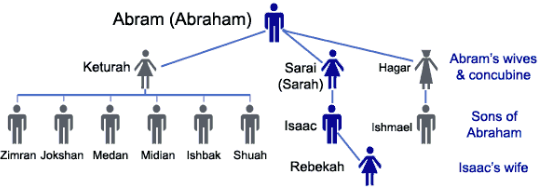
Abram, that is Abraham.
J.A. Thompson: The shorter name Abram (abram) is of uncertain meaning, though probably it means “the father is exalted.” The name rarely was used in the Old Testament. The name Abraham (abrāhām) probably means “father of a multitude,” and from the late perspective of the Chronicler in this genealogical context it testified to the verity of God's promises and to his faithfulness.
1 Chronicles 1:28 The sons of Abraham were Isaac and Ishmael.
- Isaac: Ge 17:19-21 21:2-5,12
- Ishmael: Ge 16:11-16 21:9,10
1 Chronicles 1:28-33
Sons of Abraham
The sons of Abraham were Isaac and Ishmael. Although Ishmael was actually the firstborn child of Abram by Hagar the Egyptian (cf. Gen. 16:1-16; 17:1-5, 15-19), the chronicler lists Isaac before Ishmael to suit his intention of tracing God's redemptive purpose through the genealogy of the forthcoming Messiah.
QUESTION - Who was Isaac in the Bible? | GotQuestions.org
ANSWER - The name Isaac, which means “he laughs,” was derived from his parents’ reaction when God told Abraham that he, at 100 years old, and his wife Sarah, at the age of 90, would have a son (Genesis 17:17; 18:12). Isaac was Abraham’s second son; his first, Ishmael, was by Sarah’s maidservant, Hagar, as a result of Sarah’s impatience to give Abraham a family (Genesis 16:1-2). As soon as Isaac was weaned, Sarah insisted that Abraham send Hagar and her son away, ensuring the family inheritance would go to Isaac (Genesis 21:3-12).
Many years later, Isaac was taken by his father up a mountain where Abraham, in obedience to God, prepared to sacrifice him (Genesis 22:1-14). Abraham, Isaac, and two of Abraham’s servants loaded up donkeys and made a three-day journey to Mount Moriah. Leaving his servants behind, Abraham and Isaac carried up the wood, knife, and materials for the fire, saying they would worship and then return. Curious, Isaac asked about the location of the lamb for the offering. Abraham told Isaac that God Himself would provide the lamb. Abraham proceeded to build the altar and tie up Isaac to lay atop it. The Bible gives no indication that Isaac resisted. As Abraham prepared to kill Isaac, an angel stopped him. Abraham then saw a ram in a thicket and offered it instead. There is an interesting analogy in this account that mirrors God giving up His only Son, Jesus, to be sacrificed. God did indeed provide the Lamb—literally for Abraham and Isaac then and figuratively for all of humanity willing to accept the sacrifice of Jesus (John 1:29; Hebrews 10).
Sarah died when Isaac was in his late thirties. After her death, Abraham sent one of his servants to find a wife for Isaac from their clan, as Abraham was determined his son should not have a Canaanite for a wife (Genesis 24:1-51). Abraham’s servant prayed to have success in finding a suitable wife, and God directed his quest. When he was forty, Isaac married his cousin Rebekah (Genesis 25:20). The Bible tells us that "he loved her; and Isaac was comforted after his mother’s death" (Genesis 24:67).
At age sixty, Isaac became the father of twins—Jacob and Esau. While Isaac favored his elder son, Esau, Rebekah’s favorite was Jacob. This caused great rivalry within the family and led to Jacob, the younger son, receiving the inheritance and his father’s blessing that should have gone to Esau, the older son, after Isaac and Esau were deceived by Rebekah and Jacob. Isaac became aware of the deceit but could not revoke his blessing on Jacob (Genesis 27). Rebekah learned of Esau’s plan to kill Jacob after Isaac’s death and convinced Isaac to send Jacob to her brother Laban to find a wife among her relatives. Isaac again blessed Jacob before sending him on his way, praying that God would give Jacob the blessing given to Abraham.
Abraham died when Isaac was about seventy-five and left everything to him (Genesis 25:5). Though Ishmael had been sent away when Isaac was weaned, both Isaac and Ishmael buried Abraham (Genesis 25:9). The Bible does not talk specifically about their relationship, and the descendants of Ishmael and those of Isaac have historically been enemies; animosity remains to this day. But it is interesting to note that the two men apparently united in mourning their father.
When there was a famine in the land, God appeared to Isaac and told him not to go to Egypt but to remain in the land. God promised to be with Isaac and bless him and give the land to Isaac’s descendants. God reaffirmed the covenant He had made with Abraham, saying that He would make his descendants as numerous as the stars and bless all the nations of the earth through them (Genesis 26:1–6).
Isaac remained in the land of Canaan. But, similar to what his father had done years before his birth, in fear, Isaac presented Rebekah as his sister rather than his wife (Genesis 26:7–11). But, just as God had protected Sarah, He also protected Rebekah. God blessed Isaac with bountiful crops and wealth, so much so that the Philistines became jealous and stopped up the water wells Abraham had dug. The Philistine king asked Isaac to move, and Isaac complied, moving from place to place digging new wells when his enemies quarreled with him over the water. The Philistine king soon recognized that Isaac had been blessed by God and made a treaty of peace between them (Genesis 26:26–31).
Isaac died at the age of 180 and was buried by both his sons. God affirmed His covenant with Isaac’s son, Jacob, whom He renamed Israel.
Though much of Isaac’s story is narrative without many readily applicable lessons to our lives, we do see in Isaac a heart surrendered to God’s will. For example, he was obedient to Abraham and Sarah and apparently trusting of their guidance. He obeyed when God told him to remain in the land despite the famine and the attacks of his enemies. When Isaac discovered that he had been deceived by his son Jacob, he accepted and submitted to what he recognized as God’s will, in spite of it being completely against the accepted tradition at the time. Just as Isaac discovered, we, too, must remember that God’s ways are not our ways or His thoughts the same as ours (Isaiah 55:8). Isaac’s story also demonstrates God’s faithfulness to His promises—He had made a covenant with Abraham and would continue to uphold it with Isaac and with Isaac’s son Jacob.
Though there are no great achievements to speak of concerning Isaac’s life, it was Isaac whom God chose to continue the covenant line, the same line that would produce the Messiah, Jesus. And for many generations the Jewish nation described their God as the God of Abraham, Isaac, and Jacob. Indeed, there are several passages of Scripture where God describes Himself in the same manner (e.g., Exodus 3:6). Isaac is listed with the other patriarchs and has a place in God’s kingdom (Luke 13:28). And there is no greater honor we can hope to achieve.
QUESTION - Who was Ishmael in the Bible? | GotQuestions.org
ANSWER - Ishmael is considered a patriarch of Islam based upon legends that have developed around him and information found in the Qur’an. But what does the Bible tell us about Ishmael?
Ishmael was the firstborn son of Abraham. God had appeared to Abraham and promised that he would have a son and that he would be the father of many nations (Genesis 15). However, as time went on, Abraham had no children. His wife, Sarah, had been unable to conceive, and they began to question just how the promise would be fulfilled.
In Genesis 16 Sarah suggests that Abraham should have a child with her slave Hagar, an Egyptian. Apparently, this was a somewhat common practice at the time (also practiced in Genesis 30 by Jacob’s wives): the wife would give a female slave to her husband, but any children born would be counted as the children of the wife (perhaps an ancient version of surrogacy). While this may have seemed like a workable solution for Abraham and Sarah, in actuality it caused more problems than it solved.
Hagar did conceive a child with Abraham. When Hagar knew she was pregnant, she began to “despise” Sarah, and Sarah appealed to Abraham for help. Abraham told Sarah to do as she saw fit, so she began to mistreat Hagar, and Hagar ran away (Genesis 16:4–6).
The angel of the Lord found Hagar in the desert and told her to return to Sarah. He then told her about her yet unborn son: “You are now pregnant and you will give birth to a son. You shall name him Ishmael, for the Lord has heard of your misery. [Ishmael means “God hears.”] He will be a wild donkey of a man; his hand will be against everyone and everyone’s hand against him, and he will live in hostility toward all his brothers” (Genesis 16:11–12). So Hagar went back and bore a son; Abraham was 86 years old.
In Genesis 17, when Abraham is 99 years old (making Ishmael approximately 13), God appeared to him once again and reiterated the promise that he would be the father of many nations. God told Abraham that Sarah, who was 90 years old, will have a son. Abraham had a hard time believing this and asked that God would fulfill His promises through Ishmael (verse 18). From this we can see that Abraham genuinely loved Ishmael. But God said the promise will be fulfilled through a son that Sarah will bear: “Your wife Sarah will bear you a son, and you will call him Isaac. I will establish my covenant with him as an everlasting covenant for his descendants after him. And as for Ishmael, I have heard you: I will surely bless him; I will make him fruitful and will greatly increase his numbers. He will be the father of twelve rulers, and I will make him into a great nation. But my covenant I will establish with Isaac, whom Sarah will bear to you by this time next year” (verses 19–21).
In Genesis 21, Sarah’s son, Isaac, is born, and once again problems arise. Sarah sees Ishmael mocking the young Isaac, and she demands action from Abraham: “Get rid of that slave woman and her son, for that woman’s son will never share in the inheritance with my son Isaac” (verse 10).
“The matter distressed Abraham greatly because it concerned his son. But God said to him, ‘Do not be so distressed about the boy and your slave woman. Listen to whatever Sarah tells you, because it is through Isaac that your offspring will be reckoned. I will make the son of the slave into a nation also, because he is your offspring’” (Genesis 21:11–13). Once again, Abraham’s love for his son Ishmael comes through, and God promises to bless Ishmael. Abraham gathered some provisions and sent Hagar and Ishmael away. After the provisions had been exhausted, Hagar and Ishmael were overcome with grief, assuming that they would die in the desert. “God heard the boy crying, and the angel of God called to Hagar from heaven and said to her, ‘What is the matter, Hagar? Do not be afraid; God has heard the boy crying as he lies there. Lift the boy up and take him by the hand, for I will make him into a great nation.’ Then God opened her eyes and she saw a well of water. So she went and filled the skin with water and gave the boy a drink” (verses 17–19). Once again, God appeared to Hagar and promised that Ishmael will be a great nation. Finally, we are told that “God was with the boy as he grew up. He lived in the desert and became an archer. While he was living in the Desert of Paran, his mother got a wife for him from Egypt” (verses 20–21).
Upon Abraham’s death, he left everything to Isaac, but Ishmael did help his half-brother bury Abraham (Genesis 25:9). Genesis 25:12–18 lists the descendants of Ishmael. They are indeed numerous, divided into twelve tribes, and, as God had earlier revealed, “They lived in hostility toward all the tribes related to them” (verse 18). Ishmael lived a total of 137 years (verse 17).
Genesis 25 is the last mention of Ishmael as an individual (except for later genealogies); however, his descendants continue to be mentioned in relation to Israel. Esau marries a descendant of Ishmael since his mother did not want him to marry Canaanite women (see Genesis 28:6–8; 36:3). Ishmaelites are mentioned as a people group in Genesis 37—Joseph’s brothers sold him to Ishmaelite traders who took him to Egypt as a slave. Ishmaelites are mentioned incidentally a few more times in the Old Testament (as well as other, unrelated men named Ishmael), but the New Testament is silent about him. Ishmael is not held up as an example either to be followed or avoided.
Islamic lore reports that Abraham took Hagar and Ishmael to Mecca, and Ishmael is considered a patriarch of Islam. While it is not accurate to say that all Arabs are descended from Ishmael, many probably are. There is still a great deal of strife between the descendants of Isaac and those who see Ishmael as their father. One wonders how things might have been different had Abraham simply trusted God to bring about His promise without any added “help” from Abraham and Sarah.
1 Chronicles 1:29 These are their genealogies: the firstborn of Ishmael was Nebaioth, then Kedar, Adbeel, Mibsam,
- The firstborn: Ge 25:12-16
- Nebaioth: Ge 28:9, Nebajoth, Isa 60:7
- Kedar: Ps 120:4 Song 1:5 Isa 21:17
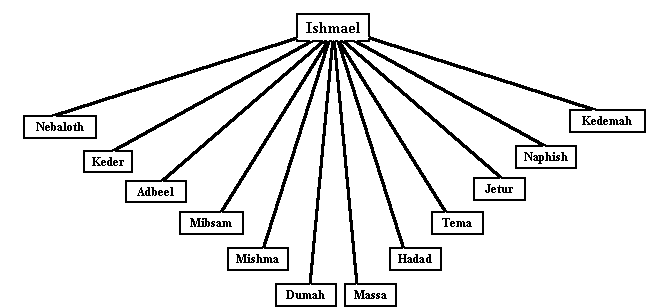
TWELVE SONS
OF ISHMAEL
These are their genealogies: the firstborn of Ishmael was Nebaioth, then Kedar, Adbeel, Mibsam, The phrase “These are their genealogies” emphasizes the orderly development of nations and peoples from Abraham’s descendants. Scripture carefully records these lines to show that God faithfully fulfilled His promises not only to Isaac but also to Ishmael.
Nebaioth was Ishmael’s firstborn son and became the ancestor of an important Arabian tribe. His descendants were associated with nomadic life, livestock, and trade routes in the desert regions.
Kedar became one of the most prominent Ishmaelite tribes. The name Kedar frequently appears in the prophets and is associated with Arabian peoples known for tents, flocks, and trade (Isaiah 21:16–17; 42:11). Kedar became almost synonymous with the desert tribes of Arabia.
Adbeel and Mibsam likewise became tribal ancestors among the Ishmaelites, though less is known about them specifically.
Henry Morris - Ishmael was a son of Abraham as Esau was a son of Isaac (1 Chronicles 1:34), yet neither was in the line of the chosen people of Israel. The same is true of the sons of Keturah, Abraham's wife in his later years. Yet their descendants are included here along with those of Jacob, essentially copied from the same tabulations in Genesis. In accord with the principle of verbal inspiration, there must be a reason why the writer of 1 Chronicles was led to repeat these records. All of these others are descendants of Abraham, and for later generations of both Jews and Gentiles repetition again emphasizes the fact that God has abundantly fulfilled His original prophetic promise to make Abraham "a father of many nations" (Genesis 17:5). These offspring--from Ishmael, Keturah and Esau--have their modern descendants in the various Arab peoples and states. It is also noteworthy that, despite the long enmity between Arabs and Israelis, and the enmity of both toward Christians, the Arabs alone among non-Christian peoples continue to believe in the book of Genesis, in a primeval special creation of the entire universe and in a personal transcendent Creator God. All other nations, since the Dispersion at Babel, have followed some form of evolutionary humanistic pantheism, although some--especially among the animists--do also maintain the tradition of a far-off "unknown God" (Acts 17:23), who was greater than the other gods.
Ryrie - 1:29-33 The sons of Ishmael and Keturah began many of the tribes that later formed into the Arabs.
QUESTION - Who are the descendants of Ishmael? | GotQuestions.org SEE VIDEO
ANSWER - Ishmael was a son of Abraham, born of Sarah’s maidservant Hagar in an attempt to bring into the world the son God had promised to Abraham and Sarah. Later, Isaac was born to Abraham and Sarah, and Hagar and Ishmael were driven away because of Ishmael’s attitude toward Isaac (Genesis 21:9–10, 14). But God still had plans for Ishmael.
God promised Hagar that Ishmael, as a son of Abraham, would become a great nation (Genesis 21:17–18). The fulfillment is recorded in Genesis 25:12–18—Ishmael had twelve sons who became great rulers and eventually a nation of people. That came about in this way: Hagar, who was Egyptian herself, found a wife from Egypt for her son, and Ishmael settled in the desert of Paran (Genesis 21:21). Ishmael’s descendants “settled in the area from Havilah to Shur, near the eastern border of Egypt as you go toward Ashur” (Genesis 25:18). The Bible lists Ishmael’s sons as Nebaioth, Kedar, Adbeel, Mibsam, Mishma, Dumah, Massa, Hadad, Tema, Jetur, Naphish, and Kedemah (verses 13–15).
The area of Havilah where Ishmael’s descendants lived is in the northern part of the Arabian Peninsula; Shur is a wilderness area between Beersheba in the Negev Desert and Egypt. Isaiah 60:7 mentions the descendants of Nebaioth and Kedar as those who raise flocks. The descendants of Ishmael became known as Arabs, which basically means “nomads.” From the beginning, the descendants of Ishmael were a warlike people, as “they lived in hostility toward all the tribes related to them” (Genesis 25:18). This fulfilled God’s earlier word that Ishmael would be “a wild donkey of a man; his hand will be against everyone and everyone’s hand against him, and he will live in hostility toward all his brothers” (Genesis 16:12).
Later, others settled in the Arabian Peninsula as well, including the descendants of Keturah’s sons (1 Chronicles 1:32–33) and some of Esau’s descendants, among them the Amalekites (Genesis 36:12).
There is a popular theory common among Muslims and some Christians that Arabian Muslims are direct descendants of Ishmael. In fact, Muhammad was a major proponent of this idea, claiming to be a descendant of Ishmael according to the Quran. There is most likely some truth in this theory. According to missionary and author Kenneth Fleming, “what we know for certain seems to support the theory that the Ishmaelites are, at the very least, a major element in the Arab genetic line. Old records clearly link the north Arabians with Ishmael’s descendants” (“Ishmael and the Bible,” Emmaus Journal 13:2, 2004). But it’s unlikely that all of those in Arabia are descendants of Ishmael, as the descendants of Keturah and the children of Esau also lived in the Arabian Peninsula.
Although some modern Arabians could trace their lineage back to Ishmael, not all Arabians are descendants of Ishmael as Muslims try to claim. We know from the Bible that God made Ishmael into a great nation. His descendants can share in the blessings of Abraham by putting their faith in Jesus Christ for salvation.
1 Chronicles 1:30 Mishma, Dumah, Massa, Hadad, Tema,
- Dumah: Isa 21:11
- Hadad: or Hadar, Ge 25:15
Mishma, Dumah, Massa, Hadad, Tema, Mishma became the ancestor of an Arabian tribe or settlement, likely located in the desert regions east or south of Canaan.
Dumah is associated with a region in northern Arabia. Isaiah later mentions Dumah in a prophecy concerning the nations (Isaiah 21:11). The name may also carry the idea of silence or stillness.
Massa became another Ishmaelite tribal group, probably connected with Arabian trade routes and desert settlements.
Hadad was another descendant of Ishmael. The name Hadad later became common among rulers and peoples in the surrounding regions and was often associated with storm deities in pagan cultures.
Tema became one of the better known Arabian tribes and oasis settlements. Tema is mentioned in Job 6:19 and Isaiah 21:14 as a desert region associated with caravans and travelers. It was an important stopping point along trade routes through Arabia.
These names demonstrate how Ishmael’s descendants spread widely throughout the Arabian Peninsula, forming tribes, settlements, and trade networks. Though they were outside the covenant line through Isaac, God still fulfilled His promises concerning Ishmael’s posterity and national growth.
1 Chronicles 1:31 Jetur, Naphish and Kedemah; these were the sons of Ishmael.
- Jetur: Ge 25:15
Jetur, Naphish and Kedemah; these were the sons of Ishmael These final names complete the list of the twelve sons of Ishmael, fulfilling God’s promise that Ishmael would become the father of twelve princes and a great nation (Genesis 17:20).
Jetur became the ancestor of a northern Arabian tribe. His descendants are later associated with regions east of Israel and were involved in conflicts during Israel’s history (1 Chronicles 5:19).
Naphish likewise became the head of an Arabian clan or tribal group living in the desert regions east of Canaan.
Kedemah probably became associated with eastern desert peoples. The name itself carries the idea of “eastward” or “eastern.”
The concluding statement, “these were the sons of Ishmael,” summarizes the fulfillment of God’s word concerning Abraham’s first son. Ishmael’s descendants multiplied into organized tribes and peoples spread throughout Arabia and surrounding regions.
Although Ishmael was not the son through whom the covenant promises would continue, God still greatly blessed him according to His promise. Scripture consistently shows that God is faithful to every word He speaks. Ishmael did not inherit the covenant line reserved for Isaac, but he was not forgotten by God.
1 Chronicles 1:32 The sons of Keturah, Abraham’s concubine, whom she bore, were Zimran, Jokshan, Medan, Midian, Ishbak and Shuah. And the sons of Jokshan were Sheba and Dedan.
- the sons: Ge 25:1-4
- Midian: Ge 37:28 Ex 2:15-16 Nu 22:4-7 Nu 25:6 Nu 31:2 Judges 6:1-6
- Sheba: 1Ki 10:1 Job 6:19 Ps 72:10,15 Isa 60:6
- Dedan: Isa 21:13 Jer 25:23 49:8 Eze 25:13 27:20
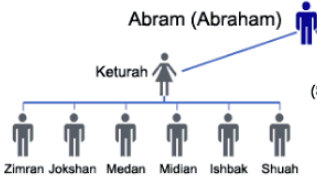
SONS OF KETURAH
ABRAHAM'S CONCUBINE
The sons of Keturah, Abraham’s concubine (pilegesh), whom she bore, were Zimran, Jokshan, Medan, Midian, Ishbak and Shuah. And the sons of Jokshan were Sheba and Dedan.
Believer's Study Bible - Keturah is called a "concubine" in this passage, although she is referred to as Abraham's "wife" in Gen. 25:1-4, where she is credited with three additional sons. A concubine was simply a slave wife. The first use of the term occurs in the early period of the judges (cf. Judg. 19:1-30). The omission of the additional descendants of Keturah in Chronicles is in keeping with the purpose of the book to trace God's redemptive promises.
J.A. Thompson: Only the descendants of Jokshan (v. 32) and Midian (v. 33) are listed, those of Dedan being ignored (cf. Gen 25:3–4). The descendants of Dedan were South Arabians. Perhaps the Chronicler thought they were only peripheral to his main theme. (See 1, 2 Chronicles: An Exegetical and Theological Exposition)
Concubine (06370) pilegesh (SEE ALSO concubine) Concubine in the Bible was a true wife but of secondary rank and does not as is not a "kept mistress." The concubine did not cohabit with a man UNLESS she was married to him. Although she cohabitated with the husband, the man could repudiate and send her away with a small gift. However, clearly having a concubine is a variation of polygamy which is the practice of having more than one wife at the same time. In Judges 19 in the days when everyone did what was right in his own eyes, the Levite had a concubine and is referred to as son-in-law in Jdg 19:5 and the concubine's father is referred to as his father-in-law in Jdg 19:4, so clearly the Bible is teaching the concubine was married to the Levite. We see a stratification between wife and concubine in 1Ki 11:3 where Solomon "had seven hundred wives, princesses, and three hundred concubines, and his wives turned his heart away." To sleep with a king's concubine would have indicated plans to usurp the throne (2 Sam. 3:7; 16:21, 22; cf. 1 Ki. 2:21-24). Men who are known to have had concubines include some famous Biblical characters (as an aside I note Joseph and Daniel and none of the prophets are in this list -- just pondering that thought!) - Nahor (Ge 22:24), Abraham (Ge 25:6), Jacob (Ge 35:22), Eliphaz (Ge 36:12), Saul (2Sa 3:7), David (2Sa 5:13; 15:16; 16:21), Solomon (1Ki. 11:3), Caleb (1Chr 2:46), Manasseh (1Chr 7:14), Rehoboam (2Chr. 11:21), Abijah (2Chr 13:21) and Belshazzar (Da 5:2). Many of these men were kings and in ancient times a concubine was often a sign of wealth and a status symbol. Concubinage seems to have evolved with men who sought concubines because their wives could not bear children (Abraham Ge 16:1-16 Jacob Ge 30:4-5 So she [Rachel] gave him her maid Bilhah as a wife, and Jacob went in to her. Bilhah conceived and bore Jacob a son.") and in both situations the wives presented their maidservants to their own husbands. It is notable that Isaac did not have a concubine because Rebekah was not barren. This practice degenerated (that's a good way to look it) into a regular custom amony the Jews. It is surprising that unfaithfulness of a concubine was not considered a true act of adultery (Lev. 19:20). When a son had intercourse with the concubine of his father, a type of family punishment was inflicted on him (Gen. 35:22; 1 Chr. 5:1). It was not the penalty of death demanded for adultery with the father's wife, though.Children of a concubine were not viewed as illegitimate. They were considered part of the family, and, in fact, their names occasionally appear in the family's genealogies (Gen. 22:24).
35V - Gen. 22:24; Gen. 25:6; Gen. 35:22; Gen. 36:12; Jdg. 8:31; Jdg. 19:1; Jdg. 19:2; Jdg. 19:9; Jdg. 19:10; Jdg. 19:24; Jdg. 19:25; Jdg. 19:27; Jdg. 19:29; Jdg. 20:4; Jdg. 20:5; Jdg. 20:6; 2 Sam. 3:7; 2 Sam. 5:13; 2 Sam. 15:16; 2 Sam. 16:21; 2 Sam. 16:22; 2 Sam. 19:5; 2 Sam. 20:3; 2 Sam. 21:11; 1 Ki. 11:3; 1 Chr. 1:32; 1 Chr. 2:46; 1 Chr. 2:48; 1 Chr. 3:9; 1 Chr. 7:14; 2 Chr. 11:21; Est. 2:14; Cant. 6:8; Cant. 6:9; Ezek. 23:20
QUESTION - Who was Keturah in the Bible? | GotQuestions.org
ANSWER - Keturah was Abraham’s second wife, following the death of Sarah, his first wife (Genesis 23:2; 25:1). We know little about Keturah, other than her name and the names of the sons she bore to Abraham (Genesis 25:2; 1 Chronicles 1:32–33).
There has been some debate as to whether Keturah was Abraham’s wife or his concubine, since she is described as each in different places in Scripture. Genesis 25:1 says that Keturah was his wife; 1 Chronicles 1:32 calls her his concubine. Genesis 25:6 also implies that Keturah was a concubine. A concubine was a woman who willingly entered into an exclusive relationship with a man for the purposes of meeting his sexual needs or providing children for him (Hagar was considered a concubine of Abraham’s). The woman was often a slave or a single female without male protectors. A concubine did not have equal status as a wife, but, unlike a prostitute, she was provided for and considered the sole property of the man. Because Keturah was in a monogamous relationship with Abraham, she could properly be considered his “wife,” although she had a lesser rank than Sarah had enjoyed.
It could also be that Keturah had begun her relationship with Abraham as a concubine and was then promoted to official “wife status” after the death of Sarah. This would explain the differing biblical descriptions of her role. However, Keturah, the concubine-become-wife, is never referred to in Scripture with the same respect and honor that is given to Sarah as Abraham’s wife (1 Peter 3:6).
Keturah’s sons were Zimran, Jokshan, Medan, Midian, Ishbak, and Shuah (Genesis 25:2). The descendants of Midian (the Midianites) later become a big part of Israel’s history; in fact, Moses married a Midianite (Exodus 2:15–21). All Keturah’s sons received “gifts” from Abraham (Genesis 25:6), but none shared in the inheritance of Isaac (verse 5). Keturah’s sons became the fathers of Arabian tribes living east of Israel.
QUESTION - How many wives did Abraham have? | GotQuestions.org
ANSWER - Abraham had a principal wife, Sarah (Genesis 11:29), and two secondary wives, Hagar and Keturah (Genesis 16:3; 25:1).
Abraham’s first wife was Sarah. She alone would possess legal rights and social standing as Abraham’s wife, and only her child Isaac would become the rightful heir to the family inheritance.
Sarah, who was unable to bear children, gave her Egyptian servant, Hagar, to Abraham as a concubine, although the Bible also calls Hagar Abraham’s wife (Genesis 16:1–4). A concubine was a woman, often a servant or slave, who lived with a man as if she were his wife, having sexual relations with him and bearing his children. When one’s wife was unable to produce an heir, taking a concubine was a common solution in ancient times. But a concubine held “secondary wife status,” lower than that of the primary wife. The concubine’s position, while subordinate to her master and mistress, was permanent. Concubines were provided for and protected as part of the family.
Hagar gave Abraham a son, whose name was Ishmael, but he was not to be the son of God’s covenant (Genesis 17:1–14). It was through Abraham and Sarah’s child Isaac that God had promised to establish His everlasting covenant (Genesis 17:15–19).
Keturah was Abraham’s second wife after the death of Sarah: “Abraham had taken another wife, whose name was Keturah. She bore him Zimran, Jokshan, Medan, Midian, Ishbak and Shuah” (Genesis 25:1–2). Like Hagar, Keturah was called both “wife” and “concubine” in Scripture (1 Chronicles 1:32). As a “wife,” Keturah was married to Abraham in the legal sense, living in a sexual union with him. Yet, as a “concubine” she held a rank inferior to Sarah’s. Keturah may have first become Abraham’s concubine when Sarah was still alive but was later elevated to the position of wife after Sarah passed away.
Before Abraham died, he gave all his material possessions and the blessings of the covenant to Isaac, the child God had promised to him and Sarah. To the sons of Hagar and Keturah, Abraham gave only gifts from his house and then sent them away to live in the country east of Israel (Genesis 25:5–11).
Does the fact that Abraham had three wives prove that God condones polygamy?
No. God’s ideal pattern for the marriage relationship has always been a monogamous union between one man and one woman (Genesis 1:27; 2:24). From the time of Lamech (Genesis 4:19), people engaged in polygamy, but it was never God’s design. Even though the practice is not expressly forbidden in Scripture, its consequences were often harmful and problematic (Deuteronomy 17:17; 1 Kings 11:1–3; Judges 8:30—9:57; 1 Samuel 1:1–7).
The Bible does not explicitly clarify why God tolerated polygamy among His people. One reason may have been to provide a secure home for unmarried women who had no other safe way to provide for themselves in the male-dominated, patriarchal society of the ancient world. At that time in history, women were not educated or trained for employment and thus depended on male members of their families to protect and support them. With prostitution, slavery, or starvation as the only other choices, many unmarried women turned to concubinage.
Polygamy also served to develop the growth of humanity at a much faster rate, fulfilling God’s command to “be fruitful and increase in number; multiply on the earth and increase upon it” (Genesis 9:7). Perhaps God tolerated polygamy in ancient times to solve some of these problems, but the New Testament clearly specifies God’s ideal intent for marriage to be the union of one man and one woman for life (Ephesians 5:22–33; 1 Timothy 3:2, 12; Titus 1:6).
1 Chronicles 1:33 The sons of Midian were Ephah, Epher, Hanoch, Abida and Eldaah. All these were the sons of Keturah.
- Ephah: Isa 60:6
The sons of Midian were Ephah, Epher, Hanoch, Abida and Eldaah. All these were the sons of Keturah. After Sarah’s death, Abraham married Keturah (Genesis 25:1), and through her came several additional descendants. One of her sons was Midian, whose descendants became the Midianites, an important people group in Old Testament history. The sons of Midian — Ephah, Epher, Hanoch, Abida, and Eldaah — became tribal leaders or clan ancestors within the Midianite peoples. These tribes settled mainly in regions east and south of Canaan, often associated with the Arabian desert areas and trade routes. The Midianites later played a significant role in Israel’s history: Moses fled to Midian after escaping Egypt and married Zipporah, the daughter of Jethro, a Midianite priest (Exodus 2:15–21). At other times the Midianites became enemies of Israel, oppressing the nation during the days of Gideon (Judges 6–8).
The concluding phrase, “All these were the sons of Keturah,” emphasizes that these descendants came from Abraham but were distinct from the covenant line that continued through Isaac. Though Abraham fathered many nations, God’s covenant promises concerning the land, Israel, and the Messiah specifically passed through Isaac (Genesis 17:19–21).
1 Chronicles 1:34 Abraham became the father of Isaac. The sons of Isaac were Esau and Israel.
- Abraham: Ge 21:2,3 Mt 1:2 Lu 3:34 Ac 7:8
- The sons of Isaac: Ge 25:24-28 Mal 1:2-4 Ro 9:10-13
- Israel: Ge 32:28
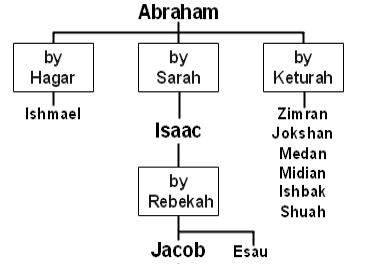
1 Chronicles 1:34-42
Sons of Issac
Abraham became the father of Isaac. The sons of Isaac were Esau and Israel.
Believer's Study Bible - The chronicler's purpose is seen again in his choice of the name "Israel" instead of "Jacob" for the son of Isaac, the child of promise (cf. Gen. 25:19-26).
1 Chronicles 1:35 The sons of Esau were Eliphaz, Reuel, Jeush, Jalam and Korah.
- sons of Esau: Ge 36:4,5,9,10
1 Chronicles 1:35-37
Sons of Esau
The sons of Esau were Eliphaz, Reuel, Jeush, Jalam and Korah. Esau was the brother of Jacob and became the father of the Edomites, the nation of Edom located southeast of the Dead Sea. Though Esau did not inherit the covenant promises given to Jacob, God still fulfilled His word that Esau would become a great nation (Genesis 25:23; 36:1). Eliphaz became the most prominent line among Esau’s descendants and fathered several important chiefs in Edom. Some connect him with the line from which Eliphaz the Temanite of the book of Job may have come. This genealogy demonstrates how rapidly Esau’s descendants multiplied and organized into tribes, chiefs, and eventually kings. In many ways Edom became politically organized before Israel did, fulfilling Isaac’s blessing that Esau would become powerful and established (Genesis 27:39–40). Yet there is also an important spiritual contrast in the background. Esau represents the line that valued earthly things over spiritual inheritance, having sold his birthright for a meal (Genesis 25:29–34; Hebrews 12:16). Though his descendants prospered materially and nationally, the covenant promises concerning redemption and the coming Messiah continued through Jacob, not Esau.
Believer's Study Bible - The genealogy of Esau is characteristically presented before that of the line of the chosen seed.
Ryrie - 1:35 Brief mention (through v. 54) is made of the descendants of Esau, though the writer's primary interest focuses on the descendants of Jacob (Israel). Esau is Edom. See note on Gen. 25:22.
1 Chronicles 1:36 The sons of Eliphaz were Teman, Omar, Zephi, Gatam, Kenaz, Timna and Amalek.
- Teman: 1Ch 1:53 Ge 36:11-15 Jer 49:7,20 Am 1:12 Ob 1:9 Hab 3:3
- Omar: i.e. eloquent Ge 36:11
- Zephi: i.e. expectations; watch thou, <Strong's H6825>. Ge 36:11,15
ESAU'S DESCENDANTS:
SONS OF ELIPHAZ
The sons of Eliphaz were Teman, Omar, Zephi, Gatam, Kenaz, Timna and Amalek. Eliphaz was the firstborn son of Esau and became the ancestor of several important Edomite clans and tribal leaders. These names eventually developed into regions, tribes, and ruling families within Edom.
Teman became one of the most prominent Edomite clans. The region of Teman later became famous for wisdom and military strength (Jeremiah 49:7; Obadiah 8). Eliphaz the Temanite, one of Job’s friends, may have come from this lineage.
Amalek became especially significant because from him came the Amalekites, one of Israel’s most persistent and hostile enemies throughout the Old Testament. The Amalekites attacked Israel shortly after the Exodus while the Israelites were weak and weary in the wilderness (Exodus 17:8–16). Because of their continual hostility toward God’s people, Amalek later became a symbol of persistent opposition to the LORD and His covenant people. SEE Who were the Amalekites? | GotQuestions.org
1 Chronicles 1:37 The sons of Reuel were Nahath, Zerah, Shammah and Mizzah.
- Reuel: Ge 36:4
ESAU'S DESCENDANTS:
SONS OF RUEL
The sons of Reuel were Nahath, Zerah, Shammah and Mizzah. Though little detailed information is given elsewhere in Scripture about these men individually, their inclusion demonstrates how Esau’s descendants multiplied rapidly into organized tribes and territories. The Edomites became a substantial and influential nation living southeast of the Dead Sea in the rugged hill country of Seir.
1 Chronicles 1:38 The sons of Seir were Lotan, Shobal, Zibeon, Anah, Dishon, Ezer and Dishan.
- the sons of Seir: Ge 36:20,29,30
- Ezar: The variation here is only in the translation. Ge 36:21, Ezer
1 Chronicles 1:38-42
DESCENDANTS OF SEIR
The sons of Seir were Lotan, Shobal, Zibeon, Anah, Dishon, Ezer and Dishan. Seir was the ancestor of the Horites, an ancient people who originally inhabited the mountainous region of Seir before the descendants of Esau settled there (Genesis 36:20). Over time the Edomites intermarried with and absorbed these peoples, and the land eventually became known as Edom.
The seven sons listed here — Lotan, Shobal, Zibeon, Anah, Dishon, Ezer, and Dishan — became tribal chiefs or clan leaders in the region. These names represent the early inhabitants and ruling families of Mount Seir.
Believer's Study Bible - (vv. 38-42) The "sons of Seir" are the Horite clans who lived in the land of Edom prior to the emergence of Israel's monarchy (cf. Gen. 36:20-30).
August Konkel: No genealogical link from Esau to Seir is provided in Genesis or Chronicles. An etymological link is made at the birth of Esau (Gen 25:25); the firstborn of Rebekah was both red (Edom) and hairy (Seir). The geographical location of Seir is uncertain. Edom is generally east of the southern Arabah (the rift valley through the Jordan and the Dead Sea and extending southward); a traditional site for Mount Seir is located there (Jebel esh-Sheraʾ), southeast of the Dead Sea. Seir often appears as a synonym for Edom (Gen 32:3; Num 24:18). Seir was the home of the Horites until they were displaced by the Edomites (Deut 2:12; cf. Gen 36:20). The designation of Seir probably changed over time.
QUESTION - Who were the Horites in the Bible? | GotQuestions.org
ANSWER - The Horites were an ancient people group who had some dealings with Abraham’s family and the Edomites. The little we know of the Horites comes completely from Scripture.
The Horites are first mentioned in Genesis 14:6. They were defeated by the alliance of kings that also defeated the kings of Sodom and Gomorrah and took Lot and his family captive. The Horites are mentioned as living in Mt. Seir at that time.
The Horites are next mentioned in Genesis 36 where Esau’s descendants are listed. Esau settled in the hill country of Seir, which was also the territory of the descendants of Seir the Horite. It would make sense that, if Seir was the leader of the clan, he would name the mountain area where he and his clan settled as Mt. Seir. The descendants of Seir are given in some detail in verses 20–30, and they are noted as Horite chieftains. Deuteronomy 2:12 tells us that Esau’s descendants displaced and destroyed the Horites. Deuteronomy 2:22 tells us that the Lord destroyed the Horites so that Esau’s descendants could inhabit their territory, also called Edom.
Beyond this, there is no more information about the Horites. They are last mentioned in Deuteronomy 2, except for 1 Chronicles 1, which simply reiterates the information found in the Pentateuch.
While Genesis does provide some detailed information about the descendants of Seir the Horite, we know very little about the larger group of Horites or even if there was a larger group. The etymology of the term Horite may have to do with those who dwell in a “cave” or “hole.” It is possible that the Horites were cave-dwellers or that Seir himself was a cave-dweller so that the name “Seir the Horite” simply means “Seir the cave dweller.” If this is true, then Seir may have been the first of the line, and, as his family/clan grew, the description eventually took the force of a proper noun—much the same way that last names developed in English usage during the Middle Ages.
The fact that the Horites are mentioned in Scripture with no introduction or explanation would indicate that the original hearers/readers of Genesis were familiar with them and the location of Mt. Seir. There are many things in Scripture that we wonder about because we are separated by so many years. For the original audience, the accounts of the Horites would have been rather recent history and required no further explanation.
1 Chronicles 1:39 The sons of Lotan were Hori and Homam; and Lotan’s sister was Timna.
- Hori: Ge 36:22 De 2:12,22
- Homam: i.e. destruction Ge 36:22
DESCENDANTS OF SEIR
The sons of Lotan were Hori and Homam; and Lotan’s sister was Timna Lotan was one of the sons of Seir and a chief among the Horite clans living in the land of Seir before the Edomites settled there. His sons, Hori and Homam, became family leaders within that region.
The name Hori may even preserve a connection with the Horites themselves, whose name is often linked with cave dwellers or mountain inhabitants. These tribes lived in the rugged territory southeast of the Dead Sea and formed part of the early population later absorbed by Esau’s descendants.
The mention of Timna, Lotan’s sister, is noteworthy because women are not frequently named in genealogies unless they hold particular historical significance. Timna later became associated with Eliphaz, Esau’s son, as a concubine and became the mother of Amalek (Genesis 36:12). Through her came the Amalekites, a people who would later become persistent enemies of Israel.
Thus this seemingly simple genealogical note quietly prepares the reader for major later developments in biblical history. The Amalekites would repeatedly oppose God’s people from the time of the Exodus onward. The verse also illustrates how various family lines among the Horites and Edomites became interconnected through marriage and tribal alliances. Scripture carefully records these relationships because they help explain the origins of nations and peoples that later appear throughout the Old Testament narrative.
SEE Who were the Amalekites? | GotQuestions.org
1 Chronicles 1:40 The sons of Shobal were Alian, Manahath, Ebal, Shephi and Onam. And the sons of Zibeon were Aiah and Anah.
- Alian: i.e. lofty, Ge 36:23,
- Shephi: i.e. my bareness; my prominence., Aiyah, The difference here is only in the translation; the original being uniformly Aiyah. Ge 36:24
DESCENDANTS OF SEIR
The sons of Shobal were Alian, Manahath, Ebal, Shephi and Onam. And the sons of Zibeon were Aiah and Anah. Shobal and Zibeon were sons of Seir and leaders among the Horite clans living in the land before it became Edom. Their descendants formed tribal groups and family divisions within the mountainous region of Seir.
The sons of Shobal — Alian, Manahath, Ebal, Shephi, and Onam — became clan leaders among the Horites. Though little else is known about these individuals, the genealogy demonstrates how the Horite people developed into organized family structures and tribal territories.
The sons of Zibeon were Aiah and Anah. Anah is especially noteworthy because Genesis 36:24 adds an unusual detail that he discovered “hot springs” (or possibly water sources) in the wilderness while tending his father’s donkeys. This small historical note reflects the practical realities of life in the arid regions of Seir, where water sources were extremely valuable.
These genealogies may appear obscure, but they help establish the historical background of Edom and the surrounding peoples. The Horites were eventually displaced or absorbed by the descendants of Esau, fulfilling God’s providential ordering of nations and territories (Deuteronomy 2:12).
1 Chronicles 1:41 The son of Anah was Dishon. And the sons of Dishon were Hamran, Eshban, Ithran and Cheran.
- The sons: Ge 46:7
- Dishon: 1Ch 1:38 Ge 36:25
- Hamran (KJV): Ge 36:26, Hemdan
DESCENDANTS OF SEIR
The son of Anah was Dishon. And the sons of Dishon were Hamran, Eshban, Ithran and Cheran. Anah, a descendant of Seir, was one of the Horite clan leaders who lived in the mountainous region later occupied by the Edomites. His son Dishon became another tribal chief, and Dishon’s sons — Hamran, Eshban, Ithran, and Cheran — formed additional family branches within the Horite peoples.
Though little specific information is known about these individuals, the genealogy serves several important purposes. First, it preserves the historical origins of the peoples living in Seir before the descendants of Esau settled there. Second, it shows how tribes and clans multiplied and became organized into recognizable family groups and territories.
These names also demonstrate the detailed historical character of Scripture. The Bible is not presenting mythology or vague legend but tracing actual peoples and family lines connected with the nations surrounding Israel.
The broader biblical context explains that the descendants of Esau eventually displaced or absorbed the Horites in Seir (Deuteronomy 2:12). Thus these genealogies provide the background for the later development of the nation of Edom.
1 Chronicles 1:42 The sons of Ezer were Bilhan, Zaavan and Jaakan. The sons of Dishan were Uz and Aran.
- Zavan: i.e. the disquiet, Ge 36:27, Zaavan, Achan
- Jakan: i.e. let him oppress them,
- Uz. Ge 10:23 36:28 La 4:21
DESCENDANTS OF SEIR
The sons of Ezer were Bilhan, Zaavan and Jaakan. The sons of Dishan were Uz and Aran. Ezer and Dishan were descendants of Seir, the ancestor of the Horites who originally inhabited the mountainous land of Seir before the Edomites settled there. Their sons — Bilhan, Zaavan, Jaakan, Uz, and Aran — became additional Horite clans and tribal family groups in that region. Though little else is known about these individuals, their inclusion completes the genealogy of the Horite chiefs and demonstrates how extensively the peoples of Seir were organized into tribes and clans. The Horites formed an established population in the region before being displaced or absorbed by the descendants of Esau (Deuteronomy 2:12).
The name Uz is especially interesting because elsewhere in Scripture “the land of Uz” is associated with Job (Job 1:1). While it is uncertain whether this is the same connection, the name reflects how these early family lines became associated with regions and territories known throughout later biblical history.
Payne - “Uz gave the name of the home of the patriarch Job (Job 1:1), who may thus have been an early Edomite descendant of Esau (cf. Lamentations 4:21).” (See The Expositor's Bible Commentary - Abridged Edition - Page 50)
F B Meyer - This is an ancient graveyard. The names of past generations who were born and died, who loved and suffered, who stormed and fought through the world, are engraven on these solid slabs. But there is no inscription to record their worth or demerit. Just names, and nothing more.”
1 Chronicles 1:43 Now these are the kings who reigned in the land of Edom before any king of the sons of Israel reigned. Bela was the son of Beor, and the name of his city was Dinhabah.
- the kings: Ge 36:31-39 49:10 Nu 24:17-19
1 Chronicles 43-54
RULERS IN EDOM
Now these are the kings who reigned in the land of Edom before any king of the sons of Israel reigned. Bela was the son of Beor, and the name of his city was Dinhabah. - This marks an important transition in the genealogy from the descendants of Esau to the rulers of Edom. This statement highlights that the nation of Edom developed an organized monarchy long before Israel had a human king. While Israel would not officially have a monarchy until the days of Saul (about 1050 BC), Edom already had a succession of kings centuries earlier. This fulfilled God’s word to Rebekah that “two nations” were in her womb (Ge 25:23). Esau’s descendants became a powerful nation.
The first king mentioned is Bela the son of Beor the son of Beor, whose city was Dinhabah. Very little else is known about him, but his inclusion demonstrates the historical reality and growing strength of Edom. The list of Edomite kings also differs from Israel’s later monarchy because these kings apparently did not form a single family dynasty; one king was succeeded by another from different cities and families. This may suggest a more tribal or confederated system of rule.
1 Chronicles 1:44 When Bela died, Jobab the son of Zerah of Bozrah became king in his place.
- Bozrah: Isa 34:6 63:1 Jer 49:13 Am 1:12 Mic 2:12
RULERS IN EDOM
When Bela died, Jobab the son of Zerah of Bozrah became king in his place. - Note the repeated pattern in 1Ch 1:44-51 "When _______ died ______ became king" which emphasizes the mortality of every earthly ruler. Kings rise and fall, but God’s purposes continue generation after generation. Even the most powerful rulers are temporary.
Edom possessed an organized system of succession and government long before Israel’s monarchy began. Jobab is identified as “the son of Zerah,” and he came from Bozrah, one of the principal cities of Edom. Bozrah later became well known in the prophets as a leading city of Edom and often symbolized the nation itself (Isaiah 34:6; Jeremiah 49:13). Its mention here reflects the growing strength and organization of Edom as a nation descended from Esau.
1 Chronicles 1:45 When Jobab died, Husham of the land of the Temanites became king in his place.
- Jobab: Ge 10:29
- Husham: Ge 36:34
- Temanites: 1Ch 1:36,53 Job 2:11 Jer 49:7,20 Eze 25:13 Am 1:12 Ob 1:9 Hab 3:3
RULERS IN EDOM
When Jobab died, Husham of the land of the Temanites became king in his place. This verse again emphasizes the passing nature of earthly kingdoms. One king dies, another rises, and the cycle continues. The repeated pattern throughout this section reminds the reader that human rulers are temporary, but God’s sovereign purposes continue unchanged through every generation.
1 Chronicles 1:46 When Husham died, Hadad the son of Bedad, who defeated Midian in the field of Moab, became king in his place; and the name of his city was Avith.
- Hadad: Ge 36:35
- Bedad: Ge 36:35
- Midian: Ge 25:2
- Avith: Ge 36:35
RULERS IN EDOM
When Husham died, Hadad the son of Bedad, who defeated Midian in the field of Moab, became king in his place; and the name of his city was Avith. This verse gives more detail about Hadad than most of the other Edomite kings, emphasizing both his military success and political power. After the death of Husham, Hadad the son of Bedad rose to the throne of Edom.
Hadad is specifically remembered because he “defeated Midian in the field of Moab.” This indicates that Edom was not merely a small tribal region but a nation involved in significant military conflicts with neighboring peoples such as the Midianites. The victory suggests that Hadad was a strong warrior king who expanded or defended Edom’s influence in the region east of the Dead Sea.
The mention of Midian connects this verse with the descendants of Abraham through Keturah (Genesis 25:1–2). The Midianites became an important people group throughout Old Testament history, sometimes interacting peacefully with Israel and at other times opposing them.
The phrase “in the field of Moab” refers to territory associated with Moab, another neighboring nation descended from Lot. Thus this brief statement reflects the continual struggles, shifting alliances, and regional warfare common among the ancient Near Eastern kingdoms.
Hadad’s city was Avith, another indication that the Edomites had organized urban centers and established political administration long before Israel’s monarchy.
1 Chronicles 1:47 When Hadad died, Samlah of Masrekah became king in his place.
- Samlah: Ge 36:36
- Masrekah: Ge 36:36
RULERS IN EDOM
When Hadad died, Samlah of Masrekah became king in his place. This verse continues the repeated pattern seen throughout the list of Edomite rulers: one king dies and another rises to take his place. The steady rhythm of succession highlights the temporary nature of earthly authority. Even powerful rulers who conquered enemies and ruled cities eventually passed away.
1 Chronicles 1:48 When Samlah died, Shaul of Rehoboth by the River became king in his place.
- Shaul: The original is uniformly Shaul. Ge 36:37, Saul
RULERS IN EDOM
When Samlah died, Shaul of Rehoboth by the River became king in his place. Again the genealogy emphasizes the passing nature of earthly rule. Samlah died, and another king immediately rose to take his place. The repeated cycle throughout this section reminds the reader that human kingdoms are temporary and constantly changing. The reference to “the River” often points to the Euphrates in the Old Testament, though the exact location of Rehoboth is uncertain today.
1 Chronicles 1:49 When Shaul died, Baal-hanan the son of Achbor became king in his place.
- Baalhanan: Ge 36:38
- Achbor: Ge 36:38
RULERS IN EDOM
When Shaul died, Baal-hanan the son of Achbor became king in his place. Human authority continually changes hands, but God’s sovereign rule remains unchanged. The next king was Baal-hanan, the son of Achbor. His name means something like “Baal is gracious” or “Baal has shown favor,” reflecting the pagan religious culture common among the surrounding nations. The name “Baal” refers to the Canaanite storm god, showing that the Edomites had turned away from the worship of the true God of their ancestor Abraham. The use of the name “Baal” shows how deeply idolatry had become embedded in the region long before Israel entered the land. Baal worship would later become one of Israel’s greatest spiritual dangers and a continual source of apostasy.
This list of Edomite kings demonstrates that Edom had political organization, leadership structures, and established rulership generations before Israel’s monarchy began. Yet despite Edom’s early worldly strength, the covenant promises and the coming Messiah would not arise from Edom’s throne.
1 Chronicles 1:50 When Baal-hanan died, Hadad became king in his place; and the name of his city was Pai, and his wife’s name was Mehetabel, the daughter of Matred, the daughter of Mezahab.
- Hadad: Ge 36:39, Hadar
- Pai: i.e. sighing, Ge 36:39, Pau
RULERS IN EDOM
When Baal-hanan died, Hadad became king in his place; and the name of his city was Pai, and his wife’s name was Mehetabel, the daughter of Matred, the daughter of Mezahab. The new king was Hadad, another Edomite ruler whose city was Pai. As throughout this section, the mention of a city reflects Edom’s organized political structure and established urban centers. What makes this verse unusual is the detailed mention of Hadad’s wife and her ancestry. Mehetabel, Hadad’s wife, whose name means “favored of God” and reflects a recognition of the true God, even within a nation steeped in idolatry.
SEE FERTILITY WORSHIP OF THE ANCIENT NEAR EAST
1 Chronicles 1:51 Then Hadad died. Now the chiefs of Edom were: chief Timna, chief Aliah, chief Jetheth,
- Aliah: i.e. moral perverseness,Ge 36:40, Alvah
RULERS IN EDOM
Then Hadad died. Now the chiefs of Edom were: chief Timna, chief Aliah, chief Jetheth, With the death of Hadad, the genealogy shifts from listing kings to listing “chiefs” or tribal leaders within Edom. This suggests a change in Edom’s political structure, perhaps returning to a confederation of clan rulers rather than a centralized monarchy. Earlier in the genealogy, Timna was connected with the family of Esau and became associated with the line that produced Amalek (Genesis 36:12). Here the name likely refers to a clan or territorial chief descended from that family line. The term “chief” points to tribal authority and regional leadership. Edom appears to have been organized around powerful family groups, each governed by its own leader. These chiefs formed the social and political structure of the nation.
Theologically, this verse—and the entire genealogy of Edom—serves several important purposes in Scripture.
First, it shows that God’s promises to Abraham were fulfilled even in Esau’s line. In Genesis 25:23, God told Rebekah that she would bear two nations: “Two nations are in your womb; and two peoples will be separated from your body; and one people shall be stronger than the other; and the older shall serve the younger.” Esau’s descendants became the nation of Edom, while Jacob’s descendants became Israel. Both grew into great peoples, but God’s covenant blessings were given through Jacob.
Second, it demonstrates that God is sovereign over all nations, not just Israel. As Acts 17:26 declares, “He made from one man every nation of mankind to live on all the face of the earth, having determined their appointed times and the boundaries of their habitation.” Even the rise and fall of Edomite kings and chiefs occurred under God’s control.
Third, it reminds us that earthly power and prominence are temporary. Hadad’s death and the succession of chiefs show the fleeting nature of human rule. In contrast, God’s kingdom endures forever. As Psalm 22:28 says, “For the kingdom is the Lord’s and He rules over the nations.”
Finally, the Edomite genealogies serve as a historical backdrop for later biblical events. The Edomites often opposed Israel (Numbers 20:14–21; Obadiah 1:10–14), and their hostility became a symbol of rebellion against God’s chosen people. Yet even their story is preserved in Scripture to show that God’s justice and sovereignty extend to all peoples.
So, 1 Chronicles 1:51 is not just a list of names—it is a reminder that every nation, tribe, and leader exists under the authority of the Lord. Human kingdoms rise and fall, but God’s purposes stand forever (Proverbs 19:21).
1 Chronicles 1:52 chief Oholibamah, chief Elah, chief Pinon,
- Aholibamah: Ge 36:41
RULERS IN EDOM
chief Oholibamah, chief Elah, chief Pinon, Oholibamah is an interesting inclusion because that name also appears earlier in Genesis 36:2 as one of Esau’s wives. The repetition of the name here likely indicates that one of her descendants became the head of a clan named after her. The name Oholibamah means “tent of the high place,” suggesting a connection to worship or a sacred site—perhaps reflecting the idolatrous practices common in Edom. Elah means “terebinth” or “oak tree,” a term often associated with strength or with places of pagan worship in the ancient Near East (cf. Hosea 4:13) Pinon (sometimes spelled Painan) is less certain in meaning.
1 Chronicles 1:53 chief Kenaz, chief Teman, chief Mibzar,
- Kenaz: Ge 36:11
- Teman: Ge 36:11
- Mibzar: Ge 36:42
RULERS IN EDOM
Chief Kenaz, chief Teman, chief Mibzar, Kenaz was the head of an Edomite clan. The name Kenaz means “hunter.” The name later appears elsewhere in Scripture, including in connection with Caleb’s family line, showing that names could be shared among different peoples and generations.
Teman means “south” and became associated with a region in Edom. The Temanites were widely known for wisdom and strength. Teman was famous for its wise men (Jeremiah 49:7), showing that Edom was culturally advanced, though spiritually estranged from God. The prophets often referred to Teman when speaking of Edom’s pride and coming judgment (Jeremiah 49:7; Obadiah 8–9). Eliphaz the Temanite in the book of Job likely came from this region.
Mibzar means “fortress” or “stronghold and was another Edomite chief or territorial division.
1 Chronicles 1:54 chief Magdiel, chief Iram. These were the chiefs of Edom.
- These are: Ge 36:41-43
Related Passages:
Genesis 36:43 chief Magdiel, chief Iram. These are the chiefs of Edom (that is, Esau, the father of the Edomites), according to their habitations in the land of their possession.
RULERS IN EDOM
chief Magdiel, chief Iram. These were the chiefs of Edom. this verse mirrors Genesis 36:43, and repetition of this list in both Genesis and Chronicles shows that God wanted Israel to remember the history of their relatives, the Edomites, and how He had fulfilled His word.
The name Magdiel may mean “preciousness of God” or “tower of God,” while Iram may mean “city of the exalted” or “watchful.” These names, though obscure, reflect the strength and organization of Edom’s tribal system.Magdiel may mean “tower of God” or “greatness of God,” possibly referring to a fortified region or prominent clan.
Genesis 36:43 explains that these chiefs ruled “according to their settlements in the land of their possession.” This means that each chief governed a specific region or district within Edom. The Edomites lived in the rugged territory south of the Dead Sea, a land of mountains and fortresses. Their political structure was tribal, with each chief exercising authority over his own area.