Hosea 8:2
Hosea 8:3
Hosea 8:4
Hosea 8:5
Hosea 8:6
Hosea 8:7
Hosea 8:8
Hosea 8:9
Hosea 8:10
Hosea 8:11
Hosea 8:12
Hosea 8:13
Hosea 8:14
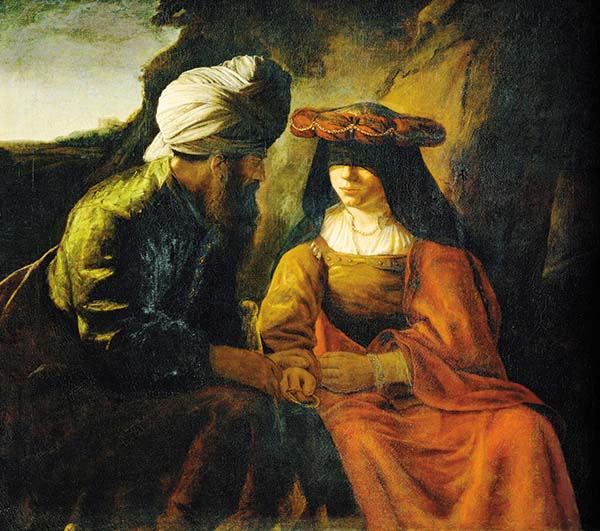
Hosea's Unconditional Love for Gomer
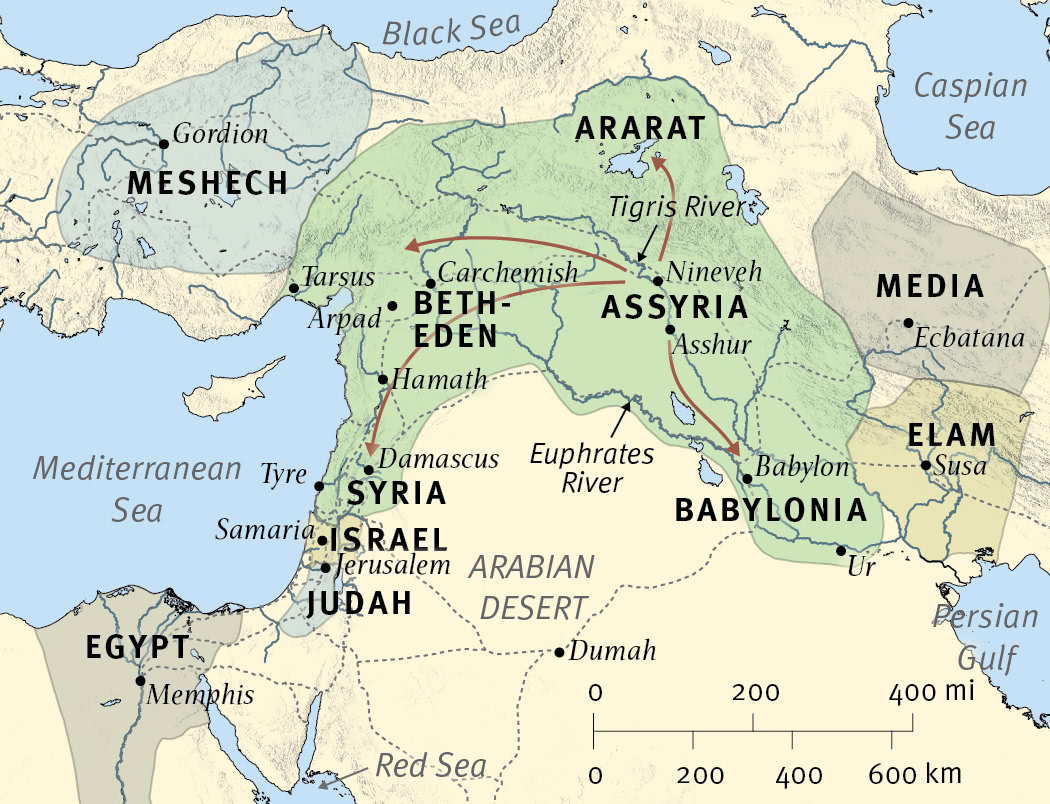
Source: ESV Global Study Bible
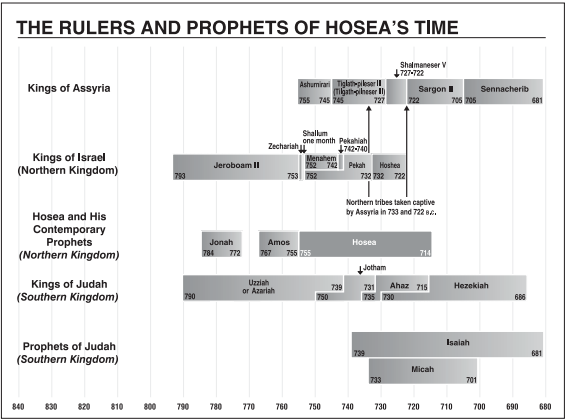
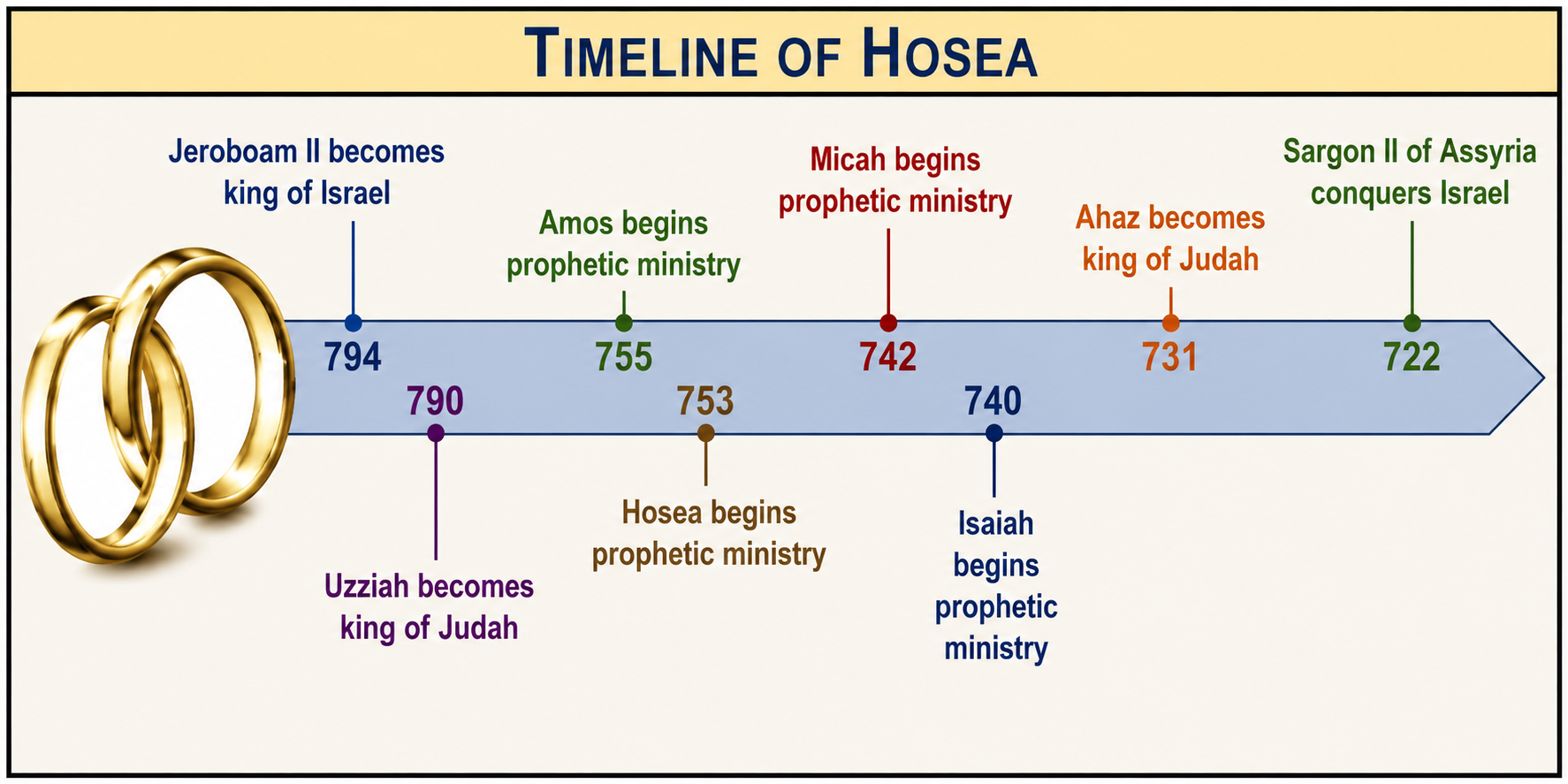
OUTLINE OF HOSEA
I. The Prodigal Wife, Hosea 1:1-3:5
A. Her Unfaithfulness, Hosea 1:1-11
B. Her Punishment, Hosea 2:1-13
C. Her Restoration and Israel's, Hosea 2:14-23
D. Her Redemption, Hosea 3:1-5
II. The Prodigal People, Hosea 4:1-14:9
A. The Message of Judgment, Hosea 4:1-10:15
1. The indictment, Hosea 4:1-19
2. The verdict, Hosea 5:1-15
3. The plea of Israel, Hosea 6:1-3
4. The reply of the Lord, Hosea 6:4-11
5. The crimes of Israel, Hosea 7:1-16
6. The prophecy of judgment, Hosea 8:1-10:15
B. The Message of Restoration, Hosea 11:1-14:9
1. God's love for the prodigal people, Hosea 11:1-11
2. God's chastisement of the prodigal people, Hosea 11:12-13:16
3. God's restoration of the prodigal people, Hosea 14:1-9
Borrow Ryrie Study Bible - page 1292
Hosea 8:1 Put the trumpet to your lips! Like an eagle the enemy comes against the house of the LORD, Because they have transgressed My covenant And rebelled against My law.
KJV Set the trumpet to thy mouth. He shall come as an eagle against the house of the LORD, because they have transgressed my covenant, and trespassed against my law.
NET Sound the alarm! An eagle looms over the temple of the LORD! For they have broken their covenant with me, and have rebelled against my law.
NLT "Sound the alarm! The enemy descends like an eagle on the people of the LORD, for they have broken my covenant and revolted against my law.
BGT εἰς κόλπον αὐτῶν ὡς γῆ ὡς ἀετὸς ἐπ᾽ οἶκον κυρίου ἀνθ᾽ ὧν παρέβησαν τὴν διαθήκην μου καὶ κατὰ τοῦ νόμου μου ἠσέβησαν
LXE He shall come into their midst as the land, as an eagle against the house of the Lord, because they have transgressed my covenant, and have sinned against my law.
CSB Put the horn to your mouth! One like an eagle comes against the house of the LORD, because they transgress My covenant and rebel against My law.
ESV Set the trumpet to your lips! One like a vulture is over the house of the LORD, because they have transgressed my covenant and rebelled against my law.
NIV "Put the trumpet to your lips! An eagle is over the house of the LORD because the people have broken my covenant and rebelled against my law.
YLT 'Unto thy mouth -- a trumpet, As an eagle against the house of Jehovah, Because they transgressed My covenant, And against My law they have rebelled.
NKJ "Set the trumpet to your mouth! He shall come like an eagle against the house of the LORD, Because they have transgressed My covenant And rebelled against My law.
NJB Put the trumpet to your lips! Like an eagle, disaster is swooping on Yahweh's home! Because they have violated my covenant and been unfaithful to my Law,
NRS Set the trumpet to your lips! One like a vulture is over the house of the LORD, because they have broken my covenant, and transgressed my law.
RSV Set the trumpet to your lips, for a vulture is over the house of the LORD, because they have broken my covenant, and transgressed my law.
NAB A trumpet to your lips, You who watch over the house of the LORD! Since they have violated my covenant, and sinned against my law,
- the trumpet: Ho 5:8 Isa 18:3 Isa 58:1 Jer 4:5 Jer 6:1 Jer 51:27 Eze 7:14 Eze 33:3-6 Joe 2:1,15 Am 3:6 Zep 1:16 Zec 9:14 1Co 15:52
- thy mouth: Heb. the roof of thy mouth
- as: De 28:49 Jer 4:13 Jer 48:40 Hab 1:8 Mt 24:28
- the house: Ho 9:15 2Ki 18:27 Am 8:3 Am 9:1 Zec 11:1
- transgressed: Ho 6:7 Isa 24:5 Jer 31:32 Eze 16:59 Heb 8:8-13
Related Passages:
Deuteronomy 28:49 “The LORD will bring a nation against you from afar, from the end of the earth, as the eagle swoops down, a nation whose language you shall not understand,
Hosea 9:15 All their evil is at Gilgal; Indeed, I came to hate them there! Because of the wickedness of their deeds I will drive them out of My house! I will love them no more; All their princes are rebels.
THE SOUND OF A
MERCIFUL WARNING
Put the trumpet (shophar/shopar/sopar) to your lips! (cf Hos 5:8) Heb “A horn unto your gums!”; NAB “A trumpet to your lips!” - Sound the alarm! Trumpet is shophar, or ram's horn which was blown for several purposes to warn of approaching danger (Ezek. 33:3–6; Jer. 4:5–6), to summon the people (Num. 10:1–10), to announce holy assemblies and feasts (Lev. 23:24) or to proclaim God's intervention or judgment (Joel 2:1; Zeph. 1:16). In this context clearly it is a warning to Israel that her judgment is imminent.
Like an eagle the enemy comes against the house of the LORD - Eagle - Or perhaps “A vulture.” Some identify the species indicated by the Hebrew term נֶשֶׁר (nesher) as the griffon vulture (cf. NEB, NRSV). The invading Assyrians are pictured as an eagle that swoops down rapidly upon its prey (fulfilling the prophecy of Dt 28:49). The invading Assyrian army is pictured as an eagle (or great bird of prey) swooping swiftly and irresistibly upon its unsuspecting victim. The image emphasizes the speed, power, accuracy, and inevitability of God's coming judgment. Just as an eagle circles high above before suddenly diving upon its prey, so Assyria would descend upon Israel with devastating force. This fulfilled Moses' covenant warning that if Israel persisted in covenant unfaithfulness, "the LORD will bring a nation against you from afar... as the eagle swoops down" (Deut. 28:49). Hosea's prophecy therefore announces not merely an Assyrian invasion but the execution of the covenant curses God had promised centuries earlier. The phrase against the house of the LORD refers not to Yahweh's temple but to the Northern Kingdom, God's covenant people, who by their idolatry and rebellion had forfeited His protective blessing. The nation that had been called to be God's treasured possession would now experience His righteous discipline, proving that covenant privilege never exempts covenant breakers from covenant judgment (cf. Lev. 26:14–39; Deut. 28:15–68). WOE! Yet even this severe warning was ultimately an expression of God's mercy, for the sounding of the trumpet (Hos. 8:1a) gave Israel one final opportunity to repent before the eagle descended.
🙏 THOUGHT - God's warnings always precede His judgments. Before discipline comes, He graciously sounds the trumpet through His prophets. The wise person responds immediately rather than presuming upon God's patience (cf. Amos 3:6–8; Joel 2:1, 12–13). Have you received any "warnings" to "cease and desist" a particular sin?
H. Ronald Vandermey: Assyria, pictured as a swift eagle (Deut. 28:49), has been designated as God’s tool to render justice for the transgressing of the covenant. Historically, this prediction of judgment was fulfilled both in the invasion of Tiglath-pileser III (734-733 B.C.), and in the conquest of Shalmaneser in 722 B.C. (2 Kings 15:29; 2 Kings 17:1-6). (See Hosea & Amos- Everyman's Bible Commentary - Page 52)
M. Daniel Carroll: God’s instrument of chastisement will come like a bird of prey, swiftly and mercilessly (Dt 28:49; Jer 4:13; Hab 1:8). (see Hosea, Amos, Micah)
Bob Utley - "an eagle" This refers to a vulture (BDB 676; see UBS Fauna and Flora of the Bible, pp. 82-84). The symbolism is clear, an unclean bird of prey, which has been sent by God, symbolizing the invading Assyrian army (Targums) with its corresponding death and destruction. In Jeremiah the same imagery referred to Nebuchadnezzar II (i.e. Jer. 4:13; Jer 48:40; Jer 49:13; and also in Ezekiel 17). ▣ "the house of the Lord" This refers to the covenant people of YHWH, here the northern tribes, Israel (cf. Hosea 9:3-4,15, NIV), although the NET Bible translates it as "the temple of the Lord" because of the eagle imagery of Ezekiel 17 (Jewish Study Bible, p. 1155). ▣ "transgressed My covenant" This means "gone beyond the boundary" (BDB 716, KB 778, Qal PERFECT, cf. Hosea 6:7; Deut. 17:2; Josh. 7:11,15; Jdg. 2:20; 2 Kgs. 18:12; Jer. 34:18). Hosea uses the concept of covenant several times (cf. Hosea 2:18; Hosea 6:7; Hosea 8:1; see SPECIAL TOPIC: COVENANT). His unique message from God transforms sin from violation of a law to violation of love (i.e. marriage covenant). ▣ "rebelled against My law" This means "reject rightful authority" (BDB 833, KB 981, Qal PERFECT). The two phrases ("transgressed" and "rebelled") in this verse are in a Hebrew parallel relationship (both Qal PERFECTS, as are "My covenant" and "My law";
Because (term of explanation) they have transgressed (abar; LXX - parabaino - overstep, break) My covenant (beriyth) and rebelled (pasha; LXX - asebeo) against My law - Hosea now explains why God's judgment is about to fall. Israel's guilt is twofold, though the two charges are inseparably related: they violated God's covenant and openly rebelled against His law. To transgress (ʿābar) literally means to cross over or go beyond a boundary. Israel deliberately crossed the boundaries God had established in the Mosaic Covenant, treating His covenant obligations as though they were no longer binding. Their outward acts of disobedience revealed an inward spirit of rebellion against Yahweh's authority.
The Mosaic Covenant may be viewed as Israel's marriage covenant with Yahweh. At Sinai, God entered into a unique covenant relationship with His redeemed people, pledging Himself to them and calling for their exclusive love and loyalty (Ex. 19:5–6; Ex 24:7–8). But Israel proved to be an unfaithful wife, repeatedly abandoning her divine Husband to pursue spiritual lovers—the Baals and other idols. Ironically, Baal itself means "lord," "master," or "husband," highlighting the spiritual adultery of exchanging the true Husband for false gods (cf. Hos. 2:16–17). Thus, Israel's idolatry was not merely a violation of religious ritual; it was covenant treachery, the betrayal of a marriage relationship established by God's grace. Hosea's marriage to Gomer vividly illustrates this tragic reality: just as Gomer was unfaithful to Hosea, so Israel had been unfaithful to Yahweh.
Transgressed (crossed, pass)(05674)(abar) literally means to pass, cross over, go through, go beyond, or move from one place to another. Its basic idea is movement across a boundary, obstacle, or space. It describes crossing a river (Gen. 31:21), passing through a land (Num. 21:22), going as far as a destination (Gen. 12:6), or passing by someone (Gen. 18:3–5). It is the common verb used of Israel crossing the Jordan into the Promised Land (Deut. 27:3; Josh. 1:2), emphasizing the overcoming of a barrier to enter God's promised inheritance. In the Hiphil stem it often means to cause someone or something to pass, whether moving people (Gen. 8:1; Gen 32:24), or tragically causing children to "pass through the fire" in pagan sacrifice (Deut. 18:10).
Beyond physical movement, ʿābar is frequently used metaphorically. It can describe something that exceeds or surpasses a limit (1 Kgs. 10:23; Jer. 5:28), wealth or wickedness that goes beyond others, or a person who passes away in death (Job 30:15). Spiritually, it conveys the important idea of crossing a moral or covenant boundary. To transgress God's covenant or commandments is literally to pass beyond the limits He has established (Num. 14:41; Deut. 17:2). Conversely, Israel is said to enter (pass into) God's covenant (Deut. 29:12), while Balaam declared his resolve not to go beyond the word of the LORD (Num. 22:18). Thus, ʿābar portrays both physical and spiritual movement, often highlighting the decisive crossing of a boundary—whether into God's blessings through obedient faith or beyond His ordained limits through sinful rebellion.
ABAR IN THE MINOR PROPHETS - Hos. 6:7; Hos. 8:1; Hos. 10:11; Joel 3:17; Amos 5:5; Amos 5:17; Amos 6:2; Amos 7:8; Amos 8:2; Amos 8:5; Jon. 2:3; Jon. 3:6; Mic. 1:11; Mic. 2:8; Mic. 2:13; Mic. 5:8; Mic. 7:18; Nah. 1:8; Nah. 1:12; Nah. 1:15; Nah. 3:19; Hab. 1:11; Hab. 3:10; Zeph. 2:2; Zeph. 2:15; Zeph. 3:6; Zech. 3:4; Zech. 7:14; Zech. 9:8; Zech. 10:11; Zech. 13:2
Rebelled (06586) pasha verb = pesha' = to transgress) is a strong covenant word that conveys the idea of breaking a relationship by willfully rejecting legitimate authority. It is more than an isolated act of disobedience; it describes a deliberate, defiant breach of loyalty between two parties, whether in the civil sphere (rebellion against a king) or the spiritual sphere (rebellion against God). The verb therefore carries the ideas of to revolt, rebel, break away, apostatize, transgress, or commit treachery. It emphasizes not merely violating a rule but rejecting the One who gave the rule.
In Hosea 8:1, Israel had not stumbled into sin through ignorance or weakness. She had knowingly and repeatedly revolted against Yahweh, refusing His rightful rule despite being His covenant people. Her rebellion was open and persistent, expressed in idolatry, spiritual adultery, and continual disregard for God's law. Thus, pāshaʿ describes the attitude of a subject who raises the banner of revolt against his king or a wife who willfully abandons her covenant husband. It is one of the strongest Old Testament words for covenant infidelity, highlighting that Israel's sin was not merely moral failure but high-handed rebellion against the God Who had redeemed, loved, and entered into covenant with her (cf. Isa. 1:2; Isa 43:27; Isa 48:8; Ezek. 2:3). The seriousness of Israel's punishment was therefore proportional to the seriousness of her offense: she was not merely law-breaking but covenant-breaking, not merely disobedient but rebellious.
G Campbell Morgan - Set the trumpet to thy mouth.—Hosea 8.1
The words constitute an abrupt and startling command, evidently given to the prophet. He was commanded to warn the nation of imminent judgment. This he did in one short, sharp sentence: "As an eagle he cometh against the house of Jehovah." The next word, "Because," introduces the main burden of this message, which is that of the clear statement of the reasons for the calamity. The first is that of transgression and trespass, that is, wilful disobedience to law. The second is that of rebellion, as revealed in the setting up of kings and princes, not of Divine ordination. The third is that of idolatry, the making of false representations of God—the calf of Samaria. The fourth is that of seeking aid in alliances with other nations. The fifth is that of erecting false altars, and desecrating those of Jehovah. Thus, in brief sentences, the prophet recapitulated the statements of the sins of the nation which all the prophets denounced. Finally, he described the whole situation as to national sin and Divine retribution, in the words: "Israel hath forgotten his Maker, and builded palaces; and Judah hath multiplied fortified cities; but I will send a fire upon his cities, and it shall devour the castles thereof." Whenever a nation forsakes God it ensures its ruin. It may, for a time, dwell in luxury, building palaces; and give itself a sense of security, by fortifying its cities; but sooner or later the Divine fire will destroy the cities, and devour the castles. There is no true pleasure, nor any real security, but such as are found in the maintenance of right relationships with God. "Except Jehovah build the house, they labour in vain that build it: Except Jehovah keep the city, the watchman waketh but in vain."
Hosea 8:1-7 TODAY IN THE WORD
As recently noted by Christian writer Kurt De Haan, a group of more than 100 scientists keep a close eye on outer space, watching for hurtling objects such as asteroids or comets. The concern is that one of these heavenly bodies could be thrown out of its orbit and collide with earth, having a devastating outcome. De Haan observes: ""Frankly, I'm one of those people who is not terribly worried about an asteroid hit."" He says he is much more concerned about our readiness for an event we know is going to happen: the return of Jesus Christ (2 Pet. 3:10).
De Haan's point is well made. It's easy to be concerned about the wrong thing. Just look at Israel in the text before us.
The nation's rulers were wandering around like wild donkeys (Hos. 8:9), worrying about the armies of Assyria massed against Samaria. And all the while, Israel completely ignored the One she should have been keeping an eye on, her covenant-keeping God.
The pattern of Israel's disobedience has become familiar to us. Like a loving and forgiving Husband, God had done everything possible to turn His wayward people back to Himself. But they did everything possible to spurn His love. So He sent a great eagle, the army of Assyria, to swoop down on His hapless people.
But what else could we expect from a people who offered God hollow, hypocritical worship, chose its leaders without consulting Him, and then constructed and bowed down to calf-idols? We can hear the anguish in God's complaint concerning His people: ""How long will they be incapable of purity?"" (v. 5). Hosea must have wondered the same about his wife Gomer.
TODAY ALONG THE WAY
Our God is always faithful in His relationships with us as believers. But how often do we find ourselves responding to Him with the exact opposite attitude?
Hosea 8:1-7 Today in the Word
Store up for yourselves treasures in heaven, where moth and rust do not destroy.
Matthew 6:20
In Ecclesiastes, the phrase “chasing after the wind” describes the pursuits of life on earth. King Solomon had come to the conclusion that the grand acquisitions and achievements of his life were worthless, part of a never-ending race with the grave as the finish line. He most likely wrote the book long after he had compromised his faith by marrying into practically every religion and every nation on earth.
Solomon’s successors on the thrones of Israel and Judah followed in his footsteps of compromised faith, and they did so without Solomon’s depth of wisdom. They chased after the winds of pagan worship, and all of their work was an exercise in futility. They sowed in spiritual ground that could never bear fruit, and they would reap a whirlwind of destruction (v. 7).
The theme of Israel’s doom runs throughout today’s passage, beginning with an image that could prove misleading to those familiar with the American icon of the eagle. But the bird described here is no symbol of freedom; it is a bird of prey or a scavenging vulture circling overhead as if Israel were a carcass. Israel was perishing because they were in blatant violation of God’s covenant. To show that their infidelity was not a recent development or a one-time occurrence, God made reference to one of Israel’s earliest and most blatant blunders.
Israel had been unfaithful to the law of the covenant even as it was first being etched into stone. They struggled to produce any semblance of faithfulness toward God, always testing the limits of His mercy. God wasn’t punishing Israel for a brief lapse in righteousness. The national epidemic of sin was a chronic condition. Their worship of gods made from human hands had peaked, and they had provoked the anger of God for far too long. The gods they depended on for agricultural success were no gods at all, and the fruit of their labor and misguided worship would be devoured (v. 7). The true provider of blessing for generations was repaying their evil with destruction and loss.
Apply the Word
You may not engage in anything as drastic as bowing down to a golden idol, but there are many common activities and ambitions that are equally futile from an eternal perspective. We must learn to consider a full and prosperous life as one that makes an eternal investment in God’s kingdom. Evaluate your activities throughout the next week. Is your life lived in worship of God or in pursuit of personal gratification? Ask God to use your life for His glory.
Hosea 8:2 They cry out to Me, “My God, we of Israel know You!”
KJV Israel shall cry unto me, My God, we know thee.
NET Israel cries out to me, "My God, we acknowledge you!"
NLT Now Israel pleads with me, 'Help us, for you are our God!'
BGT ἐμὲ κεκράξονται ὁ θεός ἐγνώκαμέν σε
LXE They shall soon cry out to me, saying, O God, we know thee.
CSB Israel cries out to Me, "My God, we know You!"
ESV To me they cry, "My God, we-- Israel-- know you."
NIV Israel cries out to me, 'O our God, we acknowledge you!'
YLT To Me they cry, 'My God, we -- Israel -- have known Thee.'
NKJ Israel will cry to Me,`My God, we know You!'
NJB in vain will they cry, 'My God!' In vain, 'We, Israel, know you!'
NRS Israel cries to me, "My God, we-- Israel-- know you!"
RSV To me they cry, My God, we Israel know thee.
NAB While to me they cry out, "O, God of Israel, we know you!"
- Ho 5:15 Ho 7:13,14 2Ki 10:16,29 Ps 78:34-37 Isa 48:1,2 Jer 7:4 Mic 3:11 Mt 7:21 Mt 25:11 Lu 13:25 Tit 1:16 1Jn 2:4
Related Passages:
Matthew 7:21-23 (DO YOU TRULY KNOW HIM OR JUST KNOW ABOUT HIM) Not everyone who says to Me, ‘Lord, Lord,’ will enter the kingdom of heaven, but he who does (present tense - habitually, not perfection but direction) the will of My Father who is in heaven will enter. 22 “Many will say to Me on that day, ‘Lord, Lord, did we not prophesy in Your name, and in Your name cast out demons, and in Your name perform many miracles?’ 23 “And then I will declare to them, ‘I never knew you (THEY KNEW ABOUT HIM BUT DID NOT TRULY KNOW HIM); DEPART FROM ME, YOU WHO PRACTICE (present tense - habitually, not sporadically) LAWLESSNESS.’ (cf 2Co 13:5, Acts 16:31)
THE CRY FOR HELP FROM
AN UNREPENTANT HEART
They cry out to Me, “My God, we of Israel know (yada; LXX - ginosko) You!” - They did not desire Yahweh, but only His aid! In the face of impending judgment, Israel loudly professes allegiance to God, claiming a covenant relationship with Him. Their cry sounds orthodox and sincere, but it is exposed as empty religious profession rather than genuine faith. They addressed Yahweh as "My God," yet their lives consistently denied that confession. They wanted God's protection without God's rule, His blessings without obedience, and His deliverance without repentance.
The tragedy is that Israel desired Yahweh's help but not Yahweh Himself. She cried out only when calamity threatened, treating God as a refuge of convenience rather than the Lord of her life. Their profession, "We know You," was contradicted by their idolatry, injustice, and persistent rebellion. As Hosea has already shown, they had abandoned their divine Husband to pursue other lovers while still expecting Him to rescue them when trouble came. Their words revealed religious presumption, not covenant devotion.
Israel did not truly know Yahweh in the biblical sense of intimate, covenant relationship. In Scripture, to "know" God involves far more than intellectual awareness or religious affiliation; it speaks of a personal relationship marked by love, trust, obedience, and covenant faithfulness (cf. Hos. 4:1, 6; Hos 6:6; Jer. 9:23–24).
James Mays: They call him ‘my God’, an appellation which lays hold on the election and claims its blessing in trust (Hos 2.23; Ps 18.2; Ps 22.1; Ps 63.1, etc.). In the confessional sentence, ‘We know you’, the worshippers take up a primary motif of Hosea’s prophetic speech, perhaps in response to his sayings (cf. commentary on ‘knowledge of God’ in Hos 4.1), and claim to express in their lives the revelation of Yahweh. They break the covenant and say ‘my God’, rebel against the tōrā and say, ‘We know you’! (SEE Hosea: A Commentary - Page 116)
Bob Utley - What a tragedy to have the form of godliness but not to know God (cf. Hosea 7:14; Isa. 29:13; Jeremiah 7; Matt. 7:21-23; 2 Tim .3:5).
🙏 THOUGHT - Dear reader, this passage gives us a timeless warning. It is possible to make orthodox confessions, participate in religious activities, and even claim to know God while living in practical rebellion against Him (2Ti 3:5). Mere profession is no substitute for a life of obedient faith. Jesus echoed this same principle when He warned, "Not everyone who says to Me, 'Lord, Lord,' will enter the kingdom of heaven, but he who does (present tense - habitually, not perfection but direction) the will of My Father" (Mt 7:21; cf. Lk 6:46; Titus 1:16). God is not impressed by claims of knowing Him, but is looking for lives that demonstrate that knowledge through loving obedience. Which category are you in - professors or possessors? It will make all the difference in this life and the life to come!
Know (03045) yada to know, to learn, to perceive, to discern, to experience, to confess, to consider, to know people relationally, to know how, to be skillful, to be made known, to make oneself known, to make to known. As noted below in several examples, the Septuagint translates yada often with the Greek verb ginosko, which conveys the sense of to know by experience and/or to know intimately (as used in Mt 1:25KJV and ESV which says Joseph "knew her not" which the NAS paraphrases "kept her a virgin"). And many of the uses of yada also have this experiential emphasis as with the Greek ginosko.
YADA IN HOSEA AND MINOR PROPHETS - Hos. 2:8; Hos. 2:20; Hos. 5:3; Hos. 5:4; Hos. 5:9; Hos. 6:3; Hos. 7:9; Hos. 8:2; Hos. 8:4; Hos. 9:7; Hos. 11:3; Hos. 13:4; Hos. 13:5; Hos. 14:9; Joel 2:14; Joel 2:27; Joel 3:17; Amos 3:2; Amos 3:10; Amos 5:12; Amos 5:16; Jon. 1:7; Jon. 1:10; Jon. 1:12; Jon. 3:9; Jon. 4:2; Jon. 4:11; Mic. 3:1; Mic. 4:12; Mic. 6:5; Nah. 1:7; Nah. 3:17; Hab. 2:14; Hab. 3:2; Zeph. 3:5; Zech. 2:9; Zech. 2:11; Zech. 4:5; Zech. 4:9; Zech. 4:13; Zech. 6:15; Zech. 7:14; Zech. 11:11; Zech. 14:7; Mal. 2:4
Hosea 8:3 Israel has rejected the good; The enemy will pursue him.
KJV Israel hath cast off the thing that is good: the enemy shall pursue him.
NET But Israel has rejected what is morally good; so an enemy will pursue him.
NLT But it is too late. The people of Israel have rejected what is good, and now their enemies will chase after them.
BGT ὅτι Ισραηλ ἀπεστρέψατο ἀγαθά ἐχθρὸν κατεδίωξαν
LXE For Israel has turned away from good things; they have pursued an enemy.
CSB Israel has rejected what is good; an enemy will pursue him.
ESV Israel has spurned the good; the enemy shall pursue him.
NIV But Israel has rejected what is good; an enemy will pursue him.
YLT Cast off good hath Israel, an enemy pursueth him.
NKJ Israel has rejected the good; The enemy will pursue him.
NJB Israel has rejected the good, the enemy will pursue them.
NRS Israel has spurned the good; the enemy shall pursue him.
RSV Israel has spurned the good; the enemy shall pursue him.
NAB The men of Israel have thrown away what is good; the enemy shall pursue them.
- cast: Ps 36:3 Ps 81:10,11 Am 1:11 1Ti 5:12
- the enemy: Lev 26:36 De 28:25 La 3:66 La 4:19
Related Passages:
Amos 5:14 Seek good and not evil, that you may live; And thus may the LORD God of hosts be with you, Just as you have said!
Micah 6:8 He has told you, O man, what is good; And what does the LORD require of you But to do justice, to love kindness, And to walk humbly with your God?
Leviticus 26:36 ‘As for those of you who may be left, I will also bring weakness into their hearts in the lands of their enemies. And the sound of a driven leaf will chase them, and even when no one is pursuing they will flee as though from the sword, and they will fall.
Deuteronomy 28:25 “The LORD shall cause you to be defeated before your enemies; you will go out one way against them, but you will flee seven ways before them, and you will be an example of terror to all the kingdoms of the earth.
Deuteronomy 28:45; 49 “So all these curses shall come on you and pursue you and overtake you until you are destroyed, because you would not obey the LORD your God by keeping His commandments and His statutes which He commanded you. 28:49 “The LORD will bring a nation against you from afar, from the end of the earth, as the eagle swoops down, a nation whose language you shall not understand,
SO MUCH FOR GOD
COMING TO THEIR RESCUE
Israel has rejected (zanach; LXX - apostrepho = turn away from, repudiate) the good; The enemy will pursue him - God's response exposes the emptiness of Israel's claim, "My God, we know You!" (Hos. 8:2). Significantly, He does not immediately reject their plea for help but instead reveals why their profession is false: they have rejected the good. If Israel truly knew Yahweh, she would love and obey what He calls good. Instead, she rejected His law, His covenant, and His gracious rule. Their actions contradicted their words. Their profession was exposed as empty. Consequently, instead of divine deliverance, the enemy will pursue him. Having rejected God's protection, Israel would now experience the covenant curse of relentless pursuit by the Assyrians (cf. Dt. 28:45, 49). Their lips claimed to know God, but their lives proved otherwise.
Lloyd Ogilvie comments that "The word good is a comprehensive word that includes knowledge of God, the gifts of the covenant, the commandments, the promises of God’s provision and protection, and a future filled with hope. Israel has made a choice. She rejected not only the good, but the Good One (as some translators render it) and consequently received the enemy in judgment for her obstinate stubbornness. (SEE The Preacher's Commentary - Vol. 22: Hosea / Joel / Amos)
H. Ronald Vandermey: The good (Hebrew, tob) is a reference not only to God’s character (Amos 5:14; Mic. 6:8); but also to the manifestation of His goodness in covenant blessings (Hos 2:8; Hos 3:5). As prof that Israel has rejected the good, Hosea devotes (See Hosea & Amos- Everyman's Bible Commentary - Page 52)
J. Andrew Dearman: Two basic charges are leveled throughout the book that illustrate rejecting good: the embrace of idolatry and polytheism on the one hand, and involvement with international suitors on the other hand. (SEE The Book of Hosea - Page 23)
Rejected (02186) zanach means to reject, cast off, spurn, or exclude someone or something regarded as unacceptable or no longer worthy. The verb conveys a deliberate act of repudiation and disapproval, often implying that the rejected object is viewed as useless, defiled, or unfit. It describes a decisive breaking of fellowship or relationship, whether between God and His people or between people themselves.
Israel rejected YHWH's covenant in Hos 8:3 adn YHWH rejected their "calf" worship in Hos 8:5.
When God is the subject, zānaḥ most often refers to His judicial rejection of His covenant people because of their persistent sin and rebellion (Ps. 43:2; Ps 60:1; Ps 74:1; Ps 77:7; Ps 89:38; Lam. 2:7). This rejection, however, is disciplinary rather than absolute, for God promises that He will not reject forever (Lam. 3:31) and will one day restore His people (Zech. 10:6). When people are the subject, the verb describes their rejection of God, His commands, His appointed servants, or sacred things (2 Chr. 11:14; 2 Chr 29:19; Hos. 8:3).
In Hosea 8, the irony is profound. Israel rejected what is good—namely Yahweh, His covenant, and His law (Hos. 8:3)—and in response the LORD rejected Israel's calf-idol as an abomination (Hos. 8:5). The nation that spurned God discovered that what it trusted instead was itself rejected by God. Thus, zānaḥ vividly illustrates the principle that those who reject God and His gracious provision will ultimately experience His rejection in judgment, though His mercy always leaves the door open for repentance and restoration.
ZANACH - 19X/19V - been rejected(1), cast off(1), discarded(1), excluded(1), reject(5), rejected(10). 1 Chr. 28:9; 2 Chr. 11:14; 2 Chr. 29:19; Ps. 43:2; Ps. 44:9; Ps. 44:23; Ps. 60:1; Ps. 60:10; Ps. 74:1; Ps. 77:7; Ps. 88:14; Ps. 89:38; Ps. 108:11; Lam. 2:7; Lam. 3:17; Lam. 3:31; Hos. 8:3; Hos. 8:5; Zech. 10:6
Hosea 8:4 They have set up kings, but not by Me; They have appointed princes, but I did not know it. With their silver and gold they have made idols for themselves, That they might be cut off.
KJV They have set up kings, but not by me: they have made princes, and I knew it not: of their silver and their gold have they made them idols, that they may be cut off.
NET They enthroned kings without my consent! They appointed princes without my approval! They made idols out of their silver and gold, but they will be destroyed!
NLT The people have appointed kings without my consent, and princes without my knowledge. By making idols for themselves from their silver and gold, they have brought about their own destruction.
BGT ἑαυτοῖς ἐβασίλευσαν καὶ οὐ δι᾽ ἐμοῦ ἦρξαν καὶ οὐκ ἐγνώρισάν μοι τὸ ἀργύριον αὐτῶν καὶ τὸ χρυσίον αὐτῶν ἐποίησαν ἑαυτοῖς εἴδωλα ὅπως ἐξολεθρευθῶσιν
LXE They have made kings for themselves, but not by me: they have ruled, but they did not make it known to me: of their silver and their gold they have made images to themselves, that they might be destroyed.
CSB They have installed kings, but not through Me. They have appointed leaders, but without My approval. They make their silver and gold into idols for themselves for their own destruction.
ESV They made kings, but not through me. They set up princes, but I knew it not. With their silver and gold they made idols for their own destruction.
NIV They set up kings without my consent; they choose princes without my approval. With their silver and gold they make idols for themselves to their own destruction.
YLT They have made kings, and not by Me, They have made princes, and I have not known, Their silver and their gold they have made to them idols, So that they are cut off.
NKJ "They set up kings, but not by Me; They made princes, but I did not acknowledge them. From their silver and gold They made idols for themselves-- That they might be cut off.
NJB They have set up kings, but without my consent, and appointed princes, but without my knowledge. With their silver and gold, they have made themselves idols, but only to be destroyed.
NRS They made kings, but not through me; they set up princes, but without my knowledge. With their silver and gold they made idols for their own destruction.
RSV They made kings, but not through me. They set up princes, but without my knowledge. With their silver and gold they made idols for their own destruction.
NAB They made kings, but not by my authority; they established princes, but without my approval. With their silver and gold they made idols for themselves, to their own destruction.
- set: 1Ki 12:16-20 2Ki 15:10-30 "Shallum, Menakem, Pekahiah." I knew. Mt 25:12 Lu 13:25,27 Joh 10:14 Ga 4:9
- of: Ho 2:8 Ho 13:2 1Ki 12:28 1Ki 16:31
- that they: Ho 13:9 1Ki 13:34 Jer 44:7,8 Eze 18:31
ISRAEL LEAVING GOD OUT
OF THEIR CHOICE OF RULERS
They have set up kings, but not by Me - Heb “but without me”; NCV “without asking my permission”; CEV “without consulting me.” God is not denying His sovereign control over history (cf. Dan. 2:21; Rom. 13:1). Rather, He is condemning Israel's rebellious independence in choosing and installing kings without seeking His will or submitting to His authority. After the kingdom divided, Israel rejected the Davidic dynasty that God had established and instead followed Jeroboam I (1 Ki. 12). While God allowed the division as judgment, the Northern Kingdom repeatedly enthroned kings through conspiracies, assassinations, and military coups (e.g., Baasha, Zimri, Omri, Jehu, Shallum, Menahem, Pekah, Hoshea), with little or no regard for God's revealed will. Their political decisions were driven by human ambition and expediency rather than obedience. The phrase "not by Me" therefore means not with My approval, not in submission to My revealed will, and not in dependence upon Me. In effect Israel had rejected God’s sovereign control and “approval” of kiings, leaders and key decisions and had usurped Yahweh's role of directing the nation, which is always a bad idea (Are you listening America?)
🙏 THOUGHT - The principle extends beyond kings. Whenever God's people make important decisions while ignoring His Word and seeking their own wisdom, they repeat Israel's error. Success is never found in independence from God but in humble submission to His will. "Trust in the LORD with all your heart... and He will make your paths straight" (Prov. 3:5–6).
The appointment of kings is motivated
by ruthless ambition, not divine call.
--Robin Routledge in Hosea
Bob Utley - "They" refers to the leaders (priests and princes) of Israel. They had turned away from the Davidic kings (in Judah) and appointed their own leaders and made their own worship sites (the two "calves" set up by Jeroboam I at Bethel and Dan). The contemporary example is the series of kings after Jeroboam II, (see note on Hosea 7:3). YHWH was their true king and only He could designate His earthly representative.
Lloyd Ogilvie: The crucial problem was that Israel no longer sought the guidance of God. This was a decisive step away from Him in the downward spiral of forgetting Him. He was no longer the source of wisdom for large or small decisions, but shelved as an anachronism. . . The opposite of forgetting God is to receive His sovereign control and guidance in every moment, choice, and decision. He will accept no vice-regency in our lives. Nor will He serve as our advisor while we reign on the throne of our little kingdom. (SEE The Preacher's Commentary - Vol. 22: Hosea / Joel / Amos)
James Montgomery Boice - “To choose leaders without the direction of God is not only sinful, it is foolish.Those who follow their own wisdom in the choice of leaders inevitably get what they deserve.”
Derek Kidner: Although the king-making castigated here was far from democratic in our sense – being a series of conspiracies and bloody coups – God saw it as the people’s doing for all that; for the violence at the top had its roots in the anarchy below. We could have guessed as much, but chapter Hos 4:1-3 has already put it beyond doubt. (SEE The Message of Hosea)
Allen Guenther: Though Israel claims to know their God (Hos. 8:2), they appoint over themselves rulers whom the Lord does not know. It is not that Israel is being ruled by foreigners. Rather, they are governed by kings who do not walk according to God’s decrees nor submit to his instruction (cf. Deut. 17:14-20). Israel has substituted rulers of their own choice for rulers God might choose. (SEE Hosea, Amos: Believers Church Bible Commentary)
They have appointed princes, but I did not know it - NRSV “but without my knowledge.”This second charge parallels the first and reinforces Israel's determination to govern independently of God. The princes were the nation's officials, rulers, and leaders who exercised authority under the king. Like their kings, they were appointed without seeking God's guidance or approval. I did not know it" does not imply that God lacked information, for He is omniscient. Rather, "know" is used in the covenantal sense of acknowledging, approving, or recognizing (cf. Amos 3:2; Nah. 1:7). God is saying, "I did not acknowledge them as My chosen leaders. I did not approve of their appointment." They acted as though He had no place in their decisions. The nation's repeated coups, assassinations, and power struggles demonstrated that they trusted human schemes rather than the Lord.
With their silver and gold they have made idols for themselves - srael took the very wealth that God had graciously given them and used it to manufacture idols in direct violation of the second commandment (Ex. 20:4–5). Their silver and gold, intended to be used for God's glory, became the raw materials of their spiritual adultery. Rather than worshiping the Creator, they trusted in lifeless images fashioned by their own hands. The phrase "for themselves" underscores the self-centered nature of idolatry. Their gods were not revealed by God but invented by man to satisfy human desires. As Isaiah later mocked, the craftsman makes a god from the same piece of wood he uses to cook his dinner (Isa. 44:9–20). An idol is ultimately a god of one's own making.
That (term of purpose/result) they might be cut off. - This reveals the tragic outcome of Israel's idolatry. Whether expressing God's judicial purpose or the inevitable result of their sin, the end was the same: destruction and exile. The very idols they trusted would become the occasion of their downfall. Instead of bringing security and prosperity, they brought judgment. Idolatry always promises life but always leads to ruin.
NET NOTE on might be cut off - Heb “in order to be cut off.” The text gives the impression that they made the idols for this purpose, but the language is ironic and sarcastic, bringing out the futility of their efforts. One could paraphrase, “they made idols … but only so that they might be destroyed.” Though they had other plans for the idols, God’s judgment would bring their intentions to naught.
David Thompson applies this to the church today writing that "S. Lewis Johnson once said one of the things that greatly troubled him is that many people in the church want their leader to make them be like all the other churches. He said most of the time that will bring people into the “reproach of God.” So rather than pray for God to send them His choice, they appoint their leaders who will make them like all the other churches. They get the resumes and they appoint some “rah rah” leader who will be good with youth (ED: THE LEADERS IGNORED MY WIFE AND MY RECOMMENDATION TO NOT HIRE A YOUNG MAN FOR THE YOUTH, BUT THEY LIKED HIS LOOKS AND CHARISMA AND IT TURNED OUT TO BE A DISASTER!), who will bring in progressive music, who will head lots of programs. The problem is these men are not called or gifted by God to feed people the Word of God. Very few churches actually look for someone who will study to rightly divide Scripture, who will give attention to systematic reading of the Word of God and the teaching of the Scriptures. Instead, they appoint their own leaders because they really don’t care about the Word of God. (Sermon Hosea 8:1-14)
Hosea 8:5 He has rejected your calf, O Samaria, saying, “My anger burns against them!” How long will they be incapable of innocence?
KJV Thy calf, O Samaria, hath cast thee off; mine anger is kindled against them: how long will it be ere they attain to innocency?
NET O Samaria, he has rejected your calf idol! My anger burns against them! They will not survive much longer without being punished, even though they are Israelites!
NLT "O Samaria, I reject this calf-- this idol you have made. My fury burns against you. How long will you be incapable of innocence?
BGT ἀπότριψαι τὸν μόσχον σου Σαμάρεια παρωξύνθη ὁ θυμός μου ἐπ᾽ αὐτούς ἕως τίνος οὐ μὴ δύνωνται καθαρισθῆναι
LXE Cast off thy calf, O Samaria; mine anger is kindled against them: how long will they be unable to purge themselves in Israel?
CSB Your calf-idol is rejected, Samaria. My anger burns against them. How long will they be incapable of innocence?
ESV I have spurned your calf, O Samaria. My anger burns against them. How long will they be incapable of innocence?
NIV Throw out your calf-idol, O Samaria! My anger burns against them. How long will they be incapable of purity?
YLT Cast off hath thy calf, O Samaria, Burned hath Mine anger against them, Till when are they not capable of purity?
NKJ Your calf is rejected, O Samaria! My anger is aroused against them-- How long until they attain to innocence?
NJB I spurn your calf, Samaria! My anger blazes against them! How long will it be before they recover their innocence?
NRS Your calf is rejected, O Samaria. My anger burns against them. How long will they be incapable of innocence?
RSV I have spurned your calf, O Samaria. My anger burns against them. How long will it be till they are pure
NAB Cast away your calf, O Samaria! my wrath is kindled against them; How long will they be unable to attain innocence in Israel?
GWN Get rid of your calf-shaped idol, Samaria. My anger burns against these people. How long will they remain unclean?
- calf: Ho 8:6 Hos 10:5 Isa 45:20 Ac 7:41
- My: De 32:22 2Ki 17:16-18,21-23
- How: Pr 1:22 Jer 4:14 Jer 13:27
Related Passages:
Hosea 4:6 My people are destroyed for lack of knowledge. Because you have rejected knowledge, I also will reject you from being My priest. Since you have forgotten the law of your God, I also will forget your children.
1 Kings 12:28-29 So the king consulted, and made two golden calves, and he said to them, “It is too much for you to go up to Jerusalem; behold your gods, O Israel, that brought you up from the land of Egypt.” 29 He set one in Bethel, and the other he put in Dan.
Hosea 13:2 And now they sin more and more, And make for themselves molten images, Idols skillfully made from their silver, All of them the work of craftsmen. They say of them, “Let the men who sacrifice kiss the calves!”
Hosea 10:5 The inhabitants of Samaria will fear For the calf of Beth-aven. Indeed, its people will mourn for it, And its idolatrous priests will cry out over it, Over its glory, since it has departed from it.
Acts 7:41 “At that time they made a calf and brought a sacrifice to the idol, and were rejoicing in the works of their hands.
Deuteronomy 6:15; for the LORD your God in the midst of you is a jealous God; otherwise the anger of the LORD your God will be kindled against you, and He will wipe you off the face of the earth.
Deuteronomy 7:4 “For they will turn your sons away from following Me to serve other gods; then the anger of the LORD will be kindled against you and He will quickly destroy you.
Deuteronomy 11:17 “Or the anger of the LORD will be kindled against you, and He will shut up the heavens so that there will be no rain and the ground will not yield its fruit; and you will perish quickly from the good land which the LORD is giving you.
Psalm 26:6 I shall wash my hands in innocence, And I will go about Your altar, O LORD,
Psalm 73:13 Surely in vain I have kept my heart pure And washed my hands in innocence;
YAHWEH REJECTS THEIR
CALF WORSHIP
He has rejected (zanach) your calf, O Samaria - He refers to Yahweh. Your calf refers to the golden calf worship centered at Bethel (and originally Dan), established by Jeroboam I to keep the Northern Kingdom from worshiping at the Temple in Jerusalem (1 Ki. 12:26–33). Although Jeroboam claimed these calves represented Yahweh, God utterly rejected this man-made form of worship as idolatry. What Israel honored as its protector, God denounced as an abomination.
Notice the irony in the phrase "your calf" indicating it was Samaria's calf, not God's. The idol belonged to the people who made and trusted it. Rather than belonging to Yahweh, it was a human invention that symbolized Israel's spiritual apostasy.
ESV Study Bible - These verses (Hos 8:5-6) respond to v. 3, “Israel has spurned the good.” Archaeologists have found sculptures of Baal standing on a bull. This calf-idol is reminiscent of the calf-idol made by Aaron (Ex. 32:1-4) and the calf-idol erected at Bethel (1 Kings 12:28-29). As the calf-idol in Aaron’s day was pulverized, so this idol shall be broken to pieces (cf. also 2 Kings 23:15).
Saying “My anger (aph; LXX - thumos) burns (charah) against them!” - Picture a fire. Then picture an "omnipotent" fire. This describes God's intense, righteous indignation over Israel's persistent idolatry. His anger was kindled or burning hot, not as uncontrolled rage but as His holy rage responding to their covenant unfaithfulness. Israel had repeatedly rejected God's gracious warnings and refused to repent, so His patience had reached its limit. The idol they trusted could neither save them nor extinguish God's wrath.
Bob Utley - "Anger burns (Qal PERFECT) is used to describe God's reaction to covenant disobedience (e.g. often in Moses, Deut. 6:15; Deut 7:4; Deut 11:17; Deut 29:26; Deut 31:17; rare in the prophets, Isa. 5:24-25).
How long will they be incapable of innocence (niqqayon; LXX - katharizo - thoroughly cleansed for sacred use, ritually clean, morally pure and acceptable to God) - This is a poignant rhetorical question expressing God's grief and exasperation over Israel's persistent refusal to repent and calls for a negative answer. One might express it "When will they ever learn?" It is not a request for information but a lament over a people who have become incapable of purity because they continually cling to their sin. The idea is not that Israel lacked the ability to choose rightly, but that she had become so hardened by habitual idolatry that innocence or purity seemed impossibly distant.
NET NOTE - Heb "How long will they be able to be free from punishment?" This rhetorical question affirms that Israel will not survive much longer until God punishes it. The NET version turns the question into a declaration - "They will not survive much longer without being punished, even though they are Israelites!"
🙏 THOUGHT - The verse serves as a timeless warning, emphasizing that sin never remains static. When sin is repeatedly embraced, it hardens one's heart, dulls the conscience, and makes repentance increasingly difficult. What begins as an occasional compromise (a "little sin") can become a settled pattern of life (Heb 3:13, Backsliding, Backsliding quotes). Believers are therefore exhorted, "Today if you hear His voice, do not harden your hearts" (Heb 3:15). God's desire is always repentance and restoration, but continual resistance to His Spirit leads to increasing spiritual blindness.
Robin Routledge: The final part of verse 5 expresses Yahweh’s dismay over Israel’s lack of purity. This is linked with the cleanness necessary to come before God (Ps 26:6; Ps 73:13; cf. Ge. 20:5). Despite calls to turn back to Yahweh, the people persist in idolatrous disobedience. (SEE Hosea: An Introduction and Commentary - Page 122)
J. Andrew Dearman: The prophet’s representation of divine anger in v. 5 includes a rhetorical question. How long can Israel remain guilty? A major claim of the book is that Israel cannot remain guilty forever. Israel must repent or suffer the consequences. Moreover, the time of judgment is at hand in the historical process. That is the unspoken conclusion to the question of Hos 8:5. (See The Book of Hosea - Page 23)
David Allan Hubbard: How long? does not raise a chronological question but laments that Israel’s lack of purity (cf. Ge. 20:5; Ps 26:6; Ps 73:13, where the Hebrew word describes innocent hands, clean of guilt) has become a permanent practice. (SEE Hosea: An Introduction and Commentary - Page 158)
Anger (nose, nostril, wrath) (0639) aph from anaph = to breathe hard, to be angry) is a masculine noun meaning nose, nostril, snout (pigs - Pr 11:22), face (2Sa 25:23) and anger. Both senses are found in Proverbs 30:22 - "For the churning of milk produces butter, and pressing the nose (aph) brings forth blood; so the churning of anger (aph) produces strife." In the first use God "breathed into (man's) nostrils the breath of life." (Ge 2:7) Aph sometimes refers to the entire e whole face (Ge 3:19), especially in the expression, to bow one’s face to the ground (Ge 19:1; 1Sa 24:8). To have length of nose is to be slow to wrath (Pr 14:29, Pr 16:32). To have shortness of nose is to be quick tempered (Pr. 14:17; Jer. 15:14, 15). Aph is used in a phrase (goba aph) which means pride, arrogance, formally, high of nose, an improper haughtiness and self-confidence (Ps 10:4). Often speaks of divine anger or wrath (Ps 2:5, Ps 2:12, Ps 6:1, Ps 30:5, Ps 74:1, Ps 77:9, Ps 78:21) and thankfully is "Slow to anger." (Ps 103:8; Ps 145:8, both Lxx = makrothumos = long-suffering)
The Lxx uses orge to translate aph in Pr 15:1 (and many of the other uses that connote anger). Some uses of aph are translated with thumos (Pr 24:18).
Innocence (05356) (niqqayon) is a noun meaning innocence, cleanness, purity, or freedom from guilt. Derived from the verb naqah ("to be clean, free, acquitted"), it describes a state of being undefiled, whether physically, ceremonially, or morally. It can denote innocence in contrast to guilt (Gen. 20:5), ceremonial cleanness (Ps. 26:6), or moral purity before God (Ps. 73:13).
In Hosea 8:5, the term highlights Israel's tragic spiritual condition: "How long will they be incapable of innocence?" The nation had become so thoroughly permeated by idolatry that purity and freedom from guilt seemed beyond their reach. Their persistent rebellion had hardened their hearts, making innocence a distant possibility apart from genuine repentance.
In Amos 4:6, the same word is used ironically in the expression "cleanness of teeth," meaning empty mouths because of famine—a judgment God sent in an effort to bring His people back to Himself. Thus, niqqāyôn consistently conveys the idea of cleanness or freedom from defilement, whether physical, ceremonial, or moral, with its highest expression being a life that stands innocent before God.
NIQQAYON - 5V - cleanness(1), innocence(4).Gen. 20:5; Ps. 26:6; Ps. 73:13; Hos. 8:5; Amos 4:6
Hosea 8:6 For from Israel is even this! A craftsman made it, so it is not God; Surely the calf of Samaria will be broken to pieces.
KJV For from Israel was it also: the workman made it; therefore it is not God: but the calf of Samaria shall be broken in pieces.
NET That idol was made by a workman– it is not God! The calf idol of Samaria will be broken to bits.
NLT This calf you worship, O Israel, was crafted by your own hands! It is not God! Therefore, it must be smashed to bits.
BGT ἐν τῷ Ισραηλ καὶ αὐτὸ τέκτων ἐποίησεν καὶ οὐ θεός ἐστιν διότι πλανῶν ἦν ὁ μόσχος σου Σαμάρεια
LXE Whereas the workman made it, and it is not God; wherefore thy calf, Samaria, was a deceiver:
CSB For this thing is from Israel-- a craftsman made it, and it is not God. The calf of Samaria will be smashed to bits!
ESV For it is from Israel; a craftsman made it; it is not God. The calf of Samaria shall be broken to pieces.
NIV They are from Israel! This calf--a craftsman has made it; it is not God. It will be broken in pieces, that calf of Samaria.
YLT For even it is of Israel; an artificer made it, And it is not God, For the calf of Samaria is fragments!
NKJ For from Israel is even this: A workman made it, and it is not God; But the calf of Samaria shall be broken to pieces.
NJB For it is the product of Israel- a craftsman made the thing, it is no god at all! The calf of Samaria will be broken to pieces!
NRS For it is from Israel, an artisan made it; it is not God. The calf of Samaria shall be broken to pieces.
RSV in Israel? A workman made it; it is not God. The calf of Samaria shall be broken to pieces.
NAB The work of an artisan no god at all, Destined for the flames-- such is the calf of Samaria!
- from: Ps 106:19,20
- the workman: Ps 115:4-8 Ps 135:15-18 Isa 44:9-20 Jer 10:3-9,14 Hab 2:18 Ac 17:29 Ac 19:26
- the calf: Ho 10:2,5,6 Jer 43:12,13 Jer 50:2
- shall: 2Ki 23:15,19 2Ch 31:1 2Ch 34:6,7
Related Passages:
Psalm 100:3 Know that the LORD Himself is God; It is He who has made us, and not we ourselves; We are His people and the sheep of His pasture.
Exodus 32:4 He took this from their hand, and fashioned it with a graving tool and made it into a molten calf; and they said, “This is your god, O Israel, who brought you up from the land of Egypt.”
1 Kings 12:28 So the king consulted, and made two golden calves, and he said to them, “It is too much for you to go up to Jerusalem; behold your gods, O Israel, that brought you up from the land of Egypt.”
IDOLS CREATED BY MEN
NOT BY THE CREATOR OF MEN!
For from Israel is even this! A craftsman made it, so it is not God - NET is easier to understand - "That idol was made by a workman" Hosea exposes the utter absurdity of Israel's idolatry. The golden calf did not come from heaven—it came from Israel. It originated in the sinful imagination and skilled hands of fallen men, not by divine revelation. The phrase "from Israel" emphasizes the utter absurdity of idolatry for the idol was of human origin. What the people revered as sacred was, in reality, their own creation! How much more stupid (deceived) can one be!
A craftsman made it - Idols fashioned by human hands cannot be of the Creator. A manufactured object, regardless of its beauty or precious materials, possesses neither life nor deity. It has no power to see, hear, speak, save, or judge (cf. Ps. 115:4–8; Isa. 44:9–20). The idol's very existence as a product of human craftsmanship proves it cannot be God. Remember that anything man invents, controls, or trusts in as a substitute for God becomes an idol.
James Mays: The blunt assertions of the first line of v. 6 are scornful and abusive. How can a deity be manufactured in an artisan’s shop! This analysis of the ridiculous folly of an idol focuses on the one fact that it is the creation of a human being, which made it an impossibly futile figure to those who knew Yahweh by experience and tradition as the maker of history (Isa. 8.2, 20; Isa 40.18–20; Isa 44.9ff.). The protest that the bull is no god implies that the Israelites had come to see the image itself as divine. It was incredible to Hosea that they should have faith in what they had made and could control. Their reverence will be shown up for superstition in the fate to come upon their image. This thing carved of wood and covered with gold will be riven into splinters! (Hosea (1969): A Commentary - Page 119)
Allen Guenther: Inherent in the anti-idol argument is an implicit comparison with God’s original design. People were made in the divine image. When they rebel against their covenant Lord, they re-create him in the image of the animals they were to rule. At a deeply subconscious level, people attempt to control their gods. They are, like the first humans, intent on becoming and acting like gods. (SEE Hosea, Amos: Believers Church Bible Commentary)
Surely the calf of Samaria will be broken to pieces - NLT paraphrases it as a conclusion "Therefore, it must be smashed to bits." (Ps 100:3) The idol in which Israel placed her confidence would itself become an object of destruction. The golden calf of Samaria, representing the state-sponsored worship established by Jeroboam I at Bethel, was powerless to save either itself or the nation that trusted in it. The irony is striking: the god that was supposed to protect Israel could not even protect itself. What human hands had fashioned would be shattered by human hands. Israel had exchanged the living God for a lifeless object, only to discover that the object could neither deliver nor endure.
Hosea 8:7 For they sow the wind And they reap the whirlwind. The standing grain has no heads; It yields no grain. Should it yield, strangers would swallow it up.
KJV For they have sown the wind, and they shall reap the whirlwind: it hath no stalk: the bud shall yield no meal: if so be it yield, the strangers shall swallow it up.
NET They sow the wind, and so they will reap the whirlwind! The stalk does not have any standing grain; it will not produce any flour. Even if it were to yield grain, foreigners would swallow it all up.
NLT "They have planted the wind and will harvest the whirlwind. The stalks of grain wither and produce nothing to eat. And even if there is any grain, foreigners will eat it.
BGT ὅτι ἀνεμόφθορα ἔσπειραν καὶ ἡ καταστροφὴ αὐτῶν ἐκδέξεται αὐτά δράγμα οὐκ ἔχον ἰσχὺν τοῦ ποιῆσαι ἄλευρον ἐὰν δὲ καὶ ποιήσῃ ἀλλότριοι καταφάγονται αὐτό
LXE for they sowed blighted seed, and their destruction shall await them, a sheaf of corn that avails not to make meal; and even if it should produce it, strangers shall devour it.
CSB Indeed, they sow the wind and reap the whirlwind. There is no standing grain; what sprouts fails to yield flour. Even if they did, foreigners would swallow it up.
ESV For they sow the wind, and they shall reap the whirlwind. The standing grain has no heads; it shall yield no flour; if it were to yield, strangers would devour it.
NIV "They sow the wind and reap the whirlwind. The stalk has no head; it will produce no flour. Were it to yield grain, foreigners would swallow it up.
YLT For wind they sow, and a hurricane they reap, Stalk it hath none -- a shoot not yielding grain, If so be it yield -- strangers do swallow it up.
NKJ "They sow the wind, And reap the whirlwind. The stalk has no bud; It shall never produce meal. If it should produce, Aliens would swallow it up.
NJB Since they sow the wind, they will reap the whirlwind; stalk without ear, it will never yield flour- or if it does, foreigners will swallow it.
NRS For they sow the wind, and they shall reap the whirlwind. The standing grain has no heads, it shall yield no meal; if it were to yield, foreigners would devour it.
RSV For they sow the wind, and they shall reap the whirlwind. The standing grain has no heads, it shall yield no meal; if it were to yield, aliens would devour it.
NAB When they sow the wind, they shall reap the whirlwind; The stalk of grain that forms no ear can yield no flour; Even if it could, strangers would swallow it.
- sown: Ho 10:12 Job 4:8 Pr 22:8 Ec 5:16 Ga 6:7
- it hath: Isa 17:11 Jer 12:13
- stalk: or, standing corn
- the strangers: Ho 7:9 De 28:33 Jdg 6:3-6 2Ki 13:3-7 2Ki 15:19,29
Related Passages:
Galatians 6:7-8 Do not be deceived, God is not mocked; for whatever a man sows, this he will also reap. 8 For the one who sows to his own flesh will from the flesh reap corruption, but the one who sows to the Spirit will from the Spirit reap eternal life.
Deuteronomy 28:33 “A people whom you do not know shall eat up the produce of your ground and all your labors, and you will never be anything but oppressed and crushed continually.
Deuteronomy 28:51 “Moreover, it shall eat the offspring of your herd and the produce of your ground until you are destroyed, who also leaves you no grain, new wine, or oil, nor the increase of your herd or the young of your flock until they have caused you to perish.
Job 4:8 “According to what I have seen, those who plow iniquity And those who sow trouble harvest it.
Proverbs 22:8 He who sows iniquity will reap vanity, And the rod of his fury will perish.
Hosea 10:13 You have plowed wickedness, you have reaped injustice, You have eaten the fruit of lies. Because you have trusted in your way, in your numerous warriors,
Proverbs 11:29 He who troubles his own house will inherit wind, And the foolish will be servant to the wisehearted.
Ecclesiastes 1:14; 17 I have seen all the works which have been done under the sun, and behold, all is vanity and striving after wind. (1:17) And I set my mind to know wisdom and to know madness and folly; I realized that this also is striving after wind.
THE TIMELESS LAW
OF SOWING AND REAPING
For (term of explanation) - Explains the principle of why the calf would be broken to pieces. God's judgment was not arbitrary but the inevitable consequence of Israel's own actions. They would reap exactly what they had sown.
Decisions to Abandon God
Reap Dire Consequences
- Paul Apple
They sow the wind And they reap the whirlwind - The wind speaks of the emptiness of idolatry. As an aside the Hebrew word hebel which means vapor or breath is used to depict the emptiness of idols (Dt 32:21, 1Ki 16:13, Jer 2:5). The whirlwind symbolizes the inevitable harvest of idolatry: judgment is delayed, certain, and far more devastating than the sin that produced it. This proverbial statement expresses the unchangeable principle that our harvest always corresponds to our planting, but is far greater in magnitude. Israel sowed the empty, futile wind of idolatry, political alliances, and covenant rebellion. What seemed insignificant at first would return as a devastating whirlwind of divine judgment in the form of Assyrian invasion and defeat. Beloved, sin never remains small, but grows, multiplies, and eventually produces consequences far beyond what the sinner anticipated (cf. Gal. 6:7–8). Beware!
🙏 THOUGHT - Reaping follows sowing -- actions have consequences, for good or evil. Wicked deeds result in suffering and sorrow. Israel sowed the wind of idolatry and reaped the whirlwind of destruction. This principle was applied with great fury to ancient Israel, and a similar time of reaping awaits other nations that forget God (Ps 9:17). Beloved of God, every day we are sowing seeds, with our thoughts, words, deeds, priorities, and choices. We ALL need to honestly ask ourselves, "What kind of harvest am I planting today?" Small acts of compromise can produce a painful harvest, while daily obedience to God yields the peaceful fruit of righteousness (Heb 12:11). No one can sow to the flesh and expect to reap the blessings of the Spirit (Gal 6:7–8). And lest we be deceived, we need to remember that the harvest may not come immediately, but it is certain. Therefore, sow faithfully to the Lord today, trusting Him for a harvest that brings glory to Him and eternal reward (cf Mt 6:19-21).
Israel sowed the wind of idolatry and
reaped the whirlwind of destruction.
Bob Utley - For they sow the wind, And they reap the whirlwind" The first two lines form a proverb that speaks of our responsibility to God both corporately and individually (i.e. the spiritual principle of sowing and reaping, cf. Job 34:11,25; Ps. 28:4; Ps 62:12; Prov. 12:14; Prov 24:12; Eccl. 12:14; Jer. 17:10; Jer 32:19; Ezek. 33:20; Matt. 16:27; Matt 25:31-46; Rom. 2:6; Rom 14:12; 1 Cor. 3:8; 2 Cor. 5:10; Gal. 6:7-10; 2 Tim. 4:14; 1 Pet. 1:17; Rev. 2:23; Rev 20:12; Rev 22:12). Choices have consequences in time and in eternity!
Jeremy Thomas: Now which pattern or patterns of suffering are going on in verse 7? Sow the wind…reap the whirlwind. That’s cause effect. . . Cause, people in Israel did stupid things, effect they reap the whirlwind, just as night follows day so if you sin there are consequences.
The standing grain has no heads; It yields no grain - The imagery shifts from the wind to a failed harvest. Israel's labor would prove fruitless. The stalks might appear healthy, but they produced no heads of grain, and therefore no harvest. This pictures the emptiness of a life lived apart from God—much activity but no lasting fruit. All of Israel's efforts to secure prosperity apart from Yahweh would end in disappointment.
Should it yield, strangers would swallow it up (bala; LXX - katesthio - consume, devour, destroy) - Even if some stalks bore grain, Israel would never enjoy it. Foreign invaders would consume the fruit of their labor. Thus, whether through barrenness or conquest, Israel would lose everything. This fulfilled the covenant warnings that disobedience would result in others eating the produce of the land (cf. Dt. 28:33, 51). The nation that had trusted in idols instead of God would discover that sin always yields a bitter harvest.
James Mays: The second saying is set in rhyme, a somewhat rare device in Hebrew poetry. ‘Grain without growth (semaḥ) yields no meal (qemaḥ).’ What fails in the beginning can hardly succeed at the end. This saying applies to the same folly in Israel’s life as the first. They have called on the cult for fertility and turned to allies for security, but to no avail. Now can they expect better of such conduct in the future? Hosea nails the point down with an added prediction of judgment. Even if their present crop did yield grain, they would not harvest it, for strangers would swallow it up. The enemy sent by Yahweh (v. 3) guarantees the truth of the Wisdom principle! (SEE Hosea (1969): A Commentary - Page 120)
John Schultz: In beautiful inconsistency, the prophet theorizes that some stalks would produce grain but this will not mean that the one who sowed would be fed with it. The land would be invaded and the invader would take away the crop, leaving the population to starve to death. Israel had had enough of such experiences in her past. We read that, in the days of Gideon: “Whenever the Israelites planted their crops, the Midianites, Amalekites and other eastern peoples invaded the country. They camped on the land and ruined the crops all the way to Gaza and did not spare a living thing for Israel, neither sheep nor cattle nor donkeys. They came up with their livestock and their tents like swarms of locusts. It was impossible to count the men and their camels; they invaded the land to ravage it.” (Hosea Commentary)
Bob Utley - "strangers would swallow it up" This is a reference to the exile of Israel by Assyria (cf. Isa. 1:7). The crops (if there are any, cf. Hosea 8:7, lines c,d) that Israel had thanked Ba'al for would now be enjoyed by others (i.e. Assyrians).
Sow a thought, and you reap an act;
Sow an act, and you reap a habit;
Sow a habit, and you reap a character;
Sow a character, and you reap a destiny.
—Samuel Smiles
QUESTION - What does it mean to sow the wind and reap the whirlwind (Hosea 8:7)? GOTQUESTIONS.ORG
ANSWER - Hosea 8:7 makes the enigmatic statement, “For they sow the wind, and they shall reap the whirlwind.” This proverb is known in modern times for its use in military speeches and as a title for a science fiction novel. What did Hosea mean?
The proverb uses an illustration gleaned from the agricultural process of sowing and reaping. A farmer would sow seed. Of course, the type of seed he planted determined the type of plant that would grow and be harvested. This is the principle of duplication. In Hosea 8:7, God says that Israel had planted wind and would harvest a whirlwind. Taking the “wind” to mean something worthless and foolish (see Job 7:7; Proverbs 11:29; and Ecclesiastes 1:14, 17), we can surmise that Israel’s foolishness in the past would result in a veritable storm of consequence. Indeed, in the previous verses, Hosea decries Israel’s idolatry (Hos 8:4-6). Their foolish pursuit of false gods would reap a severe judgment from the Lord.
Also at work in the proverb is the principle of multiplication: a farmer may plant one kernel of corn, but he will reap much more than that—a whole ear. In the same way, Israel’s sin of idolatry would bring forth an amplified consequence that would sweep them all away.
The rest of Hos 8:7 notes the results of this “whirlwind” of judgment: “The standing grain has no heads; it shall yield no flour; if it were to yield, strangers would devour it.” So, the crop would yield nothing. Outsiders would steal anything that did happen to grow. Israel would have understood Hosea’s words well. A poor or stolen crop would be devastating. Here, God is warning His people that their idolatry would lead to ruin.
In addition to following idols, Israel was seeking help in other, equally sinful ways. “For they have gone up to Assyria, a wild donkey wandering alone; Ephraim has hired lovers” (Hosea 8:9). Israel had made ill-advised treaties with Assyria for protection from their enemies. Instead of trusting God, they relied on their wealth and the help of pagan nations.
The “whirlwind” came upon Israel in 722 B.C., when Assyria invaded Israel, destroyed the capital city of Samaria, and deported the Israelites. Yet Hosea 14:4 promised future grace: “I will heal their apostasy; I will love them freely, for my anger has turned from them.” A whirlwind does not last forever, and God’s judgment would not be unending. God would later renew the relationship between Him and His people.
Today, we can see the truth of Hosea’s proverb in many ways. Those who live in unrepentant sin can expect to suffer the consequences of their sin—consequences that both “fit the crime” and exhibit a stunning intensity. Also, this statement by Hosea is a clarion call to avoid idolatry. Anything that steals our trust in the Lord, lessens our devotion to Him, or controls us can be considered an idol and should be abolished from our lives.
Hosea 8:7 Reaping Whirlwind
If you cheat in practice, you'll cheat in the game. If you cheat in your head, you'll cheat on the test. - You'll cheat on the girl. You'll cheat in business. You'll cheat on your mate. - Sow a thought, reap an act. Sow an act, reap a habit. Sow a habit, reap a character. Sow a character, reap a destiny.
D L Moody - They have sown the wind, and they shall reap the whirlwind.
The story runs, that, as Abdallah lingered over his morning repast, a little fly alighted on his goblet, took a sip, and was gone. It came again and again; increased its charms; became bolder and bolder; grew in size till it presented the likeness of a man; consumed Abdallah’s meat, so that he grew thin and weak while his guest became great and strong. Then contention arose between them, and the youth smote the demon, so that he departed; and the youth rejoiced at his deliverance. But the demon soon came again, charmingly arrayed, and was restored to favor. On the morrow, the youth came not to his teacher. The mufti, searching, found him in his chamber lying dead upon his divan. His visage was black and swollen; and on his throat was the pressure of a finger, broader than the palm of a mighty man. His treasures were gone. In the garden, the mufti discovered the footprints of a giant, one of which measured six cubits. Such is the Oriental portrayal of the growth and power of habit.
WHENEVER I hear a young man talking in a flippant way about sowing his wild oats, I don’t laugh. I feel more like crying, because I know he is going to make his grey-haired mother reap in tears; he is going to make his wife reap in shame; he is going to make his old father and his innocent children reap with him. Only ten or fifteen or twenty years will pass before he will have to reap his wild oats; no man has ever sowed them without having to reap them. Sow the wind and you reap the whirlwind.
Spurgeon - My Sermon Notes on Hosea 8:7—“for they have sown the wind, and they shall reap the whirlwind: it hath no stalk: the bud shall yield no meal: if so be it yield, the strangers shall swallow it up.”
Life is a seed-time. Of all men it may be said, “they have sown.”
Prudent men put the question, “What will the harvest be?”
The hope of harvest is the joyful encouragement of the righteous.
The certainty of harvest should be a solemn warning to the godless.
It is well to follow worldly lives to their issues that we may avoid them. Here we see what evil seed will produce.
I. THE RESULT OF CERTAIN SOWINGS WILL BE TERRIBLE. “They have sown the wind, and they shall reap the whirlwind.”
The sowing was careless, or mischievous, or changeable; and the harvest was of the same reckless, ruthless, mingled character, only terribly intensified. Wind grew into whirlwind.
1. Vicious men sow their wild oats, and we need not say what they reap. The debauched, drunken, and profligate are around us, bearing already in their own persons the first-fruits of the fearful harvest of transgression.
2. Oppressors in a nation are sure to be repaid with revolt, bloodshed, etc., as may be seen in the French Revolution, and many other dreadful historical incidents. Wars bring an awful harvest of poverty and death. Oh, that our nation would cease to be so eager for the fray!
3. Immoral theories go far beyond their original intent. The speculation was an airy nothing, but the outcome is a whirlwind, breaking down all that is built up.
4. Heresies in the church also lead to unexpected evils. Apparently trifling errors grow to grievous evils. The use of a symbol developes into idolatry. A little laxity increases into absolute immorality. Small disputes lead on to heart-burnings and divisions.
5. Tolerance of sin in a family is a fruitful source of overwhelming evil. See the case of Eli. Mind it is not your own.
6. Toleration of sin in yourself. Occasional indulgence becomes habit, and habit is as the Simoom of the desert, before which life expires, and hope is swept away. Even allowable acts may grow into dangerous excess.
Let no man think that he can measure, much less limit, the consequences of sin as to himself, his family, the church, or the world. When once the winds are up, who can still them?
II. THE RESULT OF SOME SOWINGS IS MANIFEST FAILURE. “It hath no stalk.”
The seed feebly tries to grow, but it comes to nothing.
1. Self-conceit vainly endeavours to produce a reputation.
2. Self-righteousness strives unsuccessfully to obtain salvation.
3. Human wisdom idly struggles to make a new gospel.
4. Mere idlers and talkers affect to be useful, but it is a delusion. What appears to be accomplished soon vanishes away. Great talk, but “no stalk.”
5. He who spends his life without faith in Christ, and obedience to his will, may dream of a happy future, but he will be deceived: “it hath no stalk.”
Wherefore do men live for folly, and dote on vanity?
III. THE RESULT OF MANY SOWINGS IS UNSATISFACTORY. “The bud shall yield no meal.”
“The devil’s meal is all bran,” so they say, and it is true.
1. The man lived for pleasure, and found satiety.
2. He lived for fame, and gathered vanity.
3. He lived for self, and found misery.
4. He lived by his own works and religiousness, but reaped no peace of mind, and no real salvation.
IV. THE RESULT OF MANY SOWINGS IS PERSONAL DISAPPOINTMENT. “If so be it yield, the strangers shall swallow it up.”
1. The man spends his life as a common toiler, who earns much for his master, but nothing for himself, and this is a poor result if there be no higher object in life.
2. He invents, devises, and commences, but another gains the profit.
3. He heapeth up riches, and knoweth not who shall gather them. His heirs forget him, and strangers swallow up his savings without gratitude.
Without God, nothing is wise, or strong, or worth the doing.
Only to live unto God is a wise sowing.
May the Lord destroy utterly all our sowings to the flesh,
lest we reap corruption!
-- Gal. 6:8.
May the Lord Jesus supply us with good seed,
and bless us in the sowing! Oh, for a consecrated life!
INCIDENTS
An Eastern apologue tells us of Abdallah, to whom an evil spirit came at first as a fly, sipping an atom of syrup. He did not drive away the creature, and to his surprise it increased to the size of a locust. Being further indulged, the creature went on growing, and made such rapid increase that it became an enormous monster, devoured his substance, and in the end murdered him, leaving in the garden, where it slew its victim, a footprint six cubits long. Thus does sin grow upon men, till it becomes a giant habit, and slays them.
Augustine tells us of a young man who thought that the devil had made flies, and such like tiny things. By the influence of this apparently insignificant error, he was led on, step by step, till in the end he ascribed everything to Satan, and ceased to believe in God. Thus does error sow the wind, and reap the whirlwind. Scrupulous correctness of faith is as much a duty as careful practice in morals.
David Hume, the historian, philosopher, and sceptic, spent his life in traducing the Word of God. In his last moments he joked with those around him; but the intervals were filled up with sadness. He wrote, “I am affrighted and confounded with the forlorn solitude in which I am placed by my philosophy. When I turn my eye inward, I find nothing but doubt and ignorance. Where am I, and what? I begin to fancy myself in the most deplorable condition imaginable, environed in the deepest darkness.”—New Cyclopædia of Anecdote.
The history of the Rev. Caleb Colton, M.A., the author of “Lacon,” may serve as a striking illustration of the truth of our text. He was a clergyman at Tiverton, popular and clever, but very fond of field-sports. One day, however, a friend suddenly expired while uttering most impious language. The awe-struck minister abjured dogs and guns, and vowed to live henceforth for his sacred calling. For months his preaching was earnest, but at the end of that time he resumed the sporting life. He had, moreover, acquired a love for gambling. A presentation to the vicarage of Kew and Petersham brought him to London, and while numbers were reading with delight his “Lacon; or, Many Things in Few Words; addressed to those who think,” the wretched author was sitting far into the night among swindlers. His passion for play involving him in pecuniary difficulties, he was forced to abscond, and his living was declared void. After leading a vagabond life, he perished by his own hand at Fontainebleau, in 1832.
C H Spurgeon - What Shall the Harvest Be - Hosea 8:7 - Introduction
PRUDENT men look before them to see the result of their actions. Their eyes look right on, beyond the present, to the future. They look before they leap. It is only the foolish man who goes blindly on, till at last he stumbles and has a desperate and probably fatal fall. Brethren, I hope that I am addressing those who have enough wit and wisdom to look at the consequences of what they are doing. This is how I wish to live,—not merely doing what may give me to-day a temporary pleasure, but asking myself what will be the result of those actions by-and-by. How will they appear to me when I come to be old? What aspect will they wear when my eyes are failing me in death? What will be the result in that life after death,—that endless future which is so sure to come to me, let me live as I may? I say that I hope I am speaking to those who do look a little ahead, and are not, “like dumb driven cattle,” satisfied if there be grass enough within the reach of their mouths, but who look before them to see the consequences on the morrow, and especially on that last great day for which all other days were made,—“the day of judgment and perdition of ungodly men.” We are all sowing, brethren; we cannot help it. You, sisters, too, are sowing;—perhaps but a little garden plot, or possibly a broader acreage in public life; but you are all sowing. And every day there is a sowing; no man goes forth in the morning without a seed-basket. What may be in it, is not so easily told. There may be nought in it but the wind; there may be darnel in it; there may be in it curses which shall grow up to plague himself and others; but it is certain that we do not move an inch along the furrows of life without scattering some kind of seed. He that does least is seeding his idleness; and, like the thistle that stands still, and offers its downy seed to be carried by every wandering wind, so does the sluggard; he does mischief by doing nothing.
As we are all sowing, the great question we have to consider is,—“What will the harvest be?” Every wise man will ask himself that question. I may have sown very little in my small plot, or, I may have walked far, and scattered the seed broadcast over the wider field committed to my charge; but what have I sown, and what shall I reap? What sheaves shall I gather into the garner? Sheaves of fire that shall burn into my soul for ever, or sheaves of glory that I shall bring with rejoicing in the last great day? Brethren, if it be rightly examined, this matter of the harvest from our sowing will be found to be full of very rich encouragement to those who are seeking to serve God. If thou hast believed in Christ, and received eternal life by faith in him, and if now thou art trying to labour for him, thou art sowing blessed seed; and if it come not up to-day, or to-morrow, yet grace ensures a crop, and thou shalt have precious sheaves which thou shalt gather in one of these days. Therefore, be thou encouraged to labour on. The husbandman waits for the precious fruits of the earth through the long and dreary winter; through the chequered days of spring, through March winds and April showers, he waits, until at last the golden harvest rewards him for all his toil. Labour on, then, beloved, “stedfast, unmoveable, always abounding in the work of the Lord, forasmuch as ye know that your labour is not in vain in the Lord.” That which you sow, you shall also reap; your Lord has told you so. Therefore, be not dismayed by the long waiting; but—
“Sow and faint not,
Till the seed a harvest bear.”
But, while this truth is full of encouragement to God’s people, it ought to be a very strong and powerful check to those who are living in sin. As you sow, you will have to reap. Those “wild oats” about which you laugh now, are easily sown, but they will make hard and sorrowful reaping. That act of iniquity, that indulgence in lust, that lie, that blasphemy, that revolt against God in stifling conscience and refusing to yield to Christ,—all these will produce a harvest in due season. It is easy to toss these pigeons up into the air, but they will all come home to roost. At night-fall, you shall see every one of them; and they will have grown greater than when you set them flying, and they will be bearers of messages of misery to the rash hand that sent them flying abroad. It is a dreadful thing to be so living that you would not wish the result of your actions to come home to you; and if any of you are so living, I pray God, the Holy Spirit, now to give me something to say which shall, like a strong hand, lay hold of your bridle, and compel you to stand still, and race no longer in the downward course to hell.
SUMMARY - The Law of the Harvest:
Spurgeon taught that every action is a "seed" sown in the present, with eternity as the reaping. Whatever a person chooses to "sow"—whether through their thoughts, words, or deeds—will determine what they ultimately harvest.
Wise people do not merely consider the pleasure of the present moment but the consequences their choices will bring in time and eternity. God's moral law is unchanging: we always reap what we sow, and the harvest is usually far greater than the seed. Those who "sow the wind" by pursuing sin, worldly pleasure, self-confidence, or neglect of God will reap the destructive "whirlwind" of misery, judgment, and eternal loss. Conversely, those who have trusted Christ and faithfully sow to the Spirit can labor with confidence, knowing that God guarantees a harvest of righteousness, joy, and eternal reward. Spurgeon concludes by urging every believer to examine the seed they are sowing today, for tomorrow's harvest is being determined by today's choices.
Two Eternal Destinies:
The sermon emphasizes the stark contrast between two harvests: sowing to the flesh leads to corruption and spiritual death, while sowing to the Spirit leads to eternal life and joy.
Warnings Against Complacency:
Spurgeon frequently used this agricultural metaphor to urge his congregation to be intentional with their time, avoid worldly distractions, and remain steadfast in faith and good works.
The Hymn -
The phrase is also famously tied to a gospel hymn often printed alongside or sung in conjunction with this message. The lyrics serve as a probing reflection for the singer:
Sown in the darkness, or sown in the light,
Sown in our weakness, or sown in our might,
Gathered in time, or eternity,
Sure, ah, sure, will the harvest be!
Hosea 8:7 — Sowing the Wind, Reaping the Whirlwind
I. The Hebrew Text
כִּ֛י ר֥וּחַ יִזְרָ֖עוּ וְסוּפָ֣תָה יִקְצֹ֑רוּ קָמָ֣ה אֵֽין־ל֗וֹ צֶ֚מַח בְּלִ֣י יַֽעֲשֶׂה־קֶּ֔מַח אוּלַ֣י יַֽעֲשֶׂ֔ה זָרִ֖ים יִבְלָעֻֽהוּ׃
Transliteration: kî rûaḥ yizrāʿû wesûp̣āṭāh yiqṣōrû; qāmāh ʾên-lô ṣemaḥ belî yaʿăśeh-qemaḥ; ʾûlay yaʿăśeh zārîm yiḇlāʿūhû.
A note on the tense. The two governing verbs are Qal imperfects — yizrāʿû ("they sow") and yiqṣōrû ("they reap"). The KJV's perfect ("they have sown…they shall reap") reads the first as completed action; the NASB, ESV and NET rightly render both as ongoing/habitual with certain future consequence. The point is not merely one past act but a settled course of life whose harvest is already guaranteed by the moral order of God's government.
II. Word Study — Key Hebrew Terms
SOW (zaraʿ, זָרַע, Strong's H2232) is the ordinary agricultural verb for scattering seed, used from Genesis 1:11 onward. BDB gives "sow, scatter seed"; HALOT, "to sow, to scatter seed, to be sown." Its theological freight comes from the fixed correspondence between seed and harvest established at creation — "after their kind" (Genesis 1:11-12) — which is precisely the principle Paul presses in Galatians 6:7-8 and which Hosea presses here. The LXX renders with speirō (ἐσπειραν, aorist of σπείρω, G4687), the same verb Paul uses in Galatians 6:7. What a man sows is not merely what he does; it is what he is becoming, planted in soil that will not fail to reproduce it.
WIND (rûaḥ, רוּחַ, Strong's H7307) carries the full range "breath, wind, spirit" (BDB); HALOT lists "moving air, breath, spirit, mind." In Hosea's polemic against the calf-cult and the Assyrian-Egyptian alliances, rûaḥ is the emblem of emptiness — that which makes noise, moves violently, and leaves nothing behind. Compare Hosea 12:1, where Ephraim feeds on wind and pursues the east wind, and Ecclesiastes 5:16, where the man who "toils for the wind" gains nothing. Idolatry is agriculture in an empty field.
REAP (qāṣar, קָצַר, Strong's H7114) — BDB: "reap, harvest." The harvest metaphor is Hosea's own signature (cf. Hosea 6:11; Hosea 10:12-13), and it is the metaphor Scripture uses most consistently for eschatological reckoning (Joel 3:13; Matthew 13:30, 39; Revelation 14:15).
WHIRLWIND (sûp̣āh, סוּפָה, Strong's H5492) — BDB: "storm-wind, tempest"; HALOT: "storm, whirlwind, gale." The form here is sûp̣āṭāh, with the paragogic hê (locative/intensive he), which the Pulpit Commentary takes as strengthening the noun still further — a tempest of the greatest violence. Note the escalation built into the lexicon itself: the seed is rûaḥ (a breath), the harvest is sûp̣āh (a hurricane). One does not merely reap what one sows; one reaps it multiplied. Sûp̣āh is elsewhere the very figure of divine visitation upon the wicked (Proverbs 1:27; Isaiah 5:28; Nahum 1:3).
STANDING GRAIN / STALK (qāmāh, קָמָה, Strong's H7054) is the mature grain standing ready for harvest — from qûm, "to rise, stand." BDB: "standing grain." It is the word used of the standing corn Samson burned (Judges 15:5) and of the neighbor's grain in Deuteronomy 23:25.
SHOOT / BUD (ṣemaḥ, צֶמַח, Strong's H6780) — "sprout, growth, branch" (BDB). This is the same noun that becomes the great messianic title "the Branch" (Isaiah 4:2; Jeremiah 23:5; Jeremiah 33:15; Zechariah 3:8; Zechariah 6:12). The contrast is not incidental to a Christ-centered reading: Israel's ṣemaḥ yields nothing, while God's promised ṣemaḥ yields everything.
MEAL / FLOUR (qemaḥ, קֶמַח, Strong's H7058) — the ground flour, the end product for which the whole agricultural cycle exists (cf. Genesis 18:6; 1 Kings 17:12-16).
The paronomasia: ṣemaḥ / qemaḥ. Hosea's Hebrew turns on a deliberate play of sound — the ṣemaḥ (sprout) will produce no qemaḥ (flour). The two nouns differ by a single consonant. Hebrew wordplay of this kind is not ornament; it binds the promise and the disappointment into one breath, so that the ear itself hears the near-miss.
Cambridge Bible for Schools and Colleges notes: "In the Hebrew there is a characteristic play upon sounds, — the çemakh yields no qemakh."
Keil & Delitzsch: "Tsemach brings no qemach, — a play upon the words, answering to our shoot and fruit."
Ellicott renders the effect: "The growth shall yield no grain," as we might express the play of words in the Hebrew.
STRANGERS (zārîm, זָרִים, Strong's H2114) — "strange, foreign" (BDB); in Hosea the term is not abstract but concrete, the foreign invader. Compare Hosea 7:9, where strangers devour his strength. SWALLOW UP (bālaʿ, בָּלַע, Strong's H1104) — "swallow down, swallow up, engulf." Hosea deliberately repeats the verb in the very next line: the nation that could not keep its grain from being swallowed is itself swallowed up (Hosea 8:8). The judgment is measured by the crime.
III. The Septuagint Reading
ὅτι ἀνεμόφθορα ἔσπειραν, καὶ ἡ καταστροφὴ αὐτῶν ἐκδέξεται αὐτά· δράγμα οὐκ ἔχον ἰσχὺν τοῦ ποιῆσαι ἄλευρον· ἐὰν δὲ καὶ ποιήσῃ, ἀλλότριοι καταφάγονται αὐτό.
Brenton's English translation of the LXX: "for they sowed blighted seed, and their destruction shall await them, a sheaf of corn that avails not to make meal; and even if it should produce it, strangers shall devour it."
The translators handled the Hebrew idiom interpretively rather than literally. Instead of "wind," they read ἀνεμόφθορα (anemophthora) — seed ruined by the wind, blasted grain (cf. the blighted ears of Genesis 41:6, 23, LXX). Instead of "whirlwind," they read καταστροφή (katastrophe) — overthrow, ruin, the word used of Sodom's destruction in 2 Peter 2:6. The Greek loses the wind/whirlwind wordplay but sharpens the theology: what they planted was already blighted at the moment of sowing, and catastrophe simply waits (ἐκδέχομαι) for them. Ἀλλότριοι ("strangers," G245) and καταφάγονται ("shall devour," G2719) render zārîm and bālaʿ.
IV. The Structure of the Verse — A Descending Ladder of Futility
The verse falls into two movements, and the second is a fourfold descent:
- Positive judgment — the sowing of wind yields not emptiness merely but tempest. Multiplied reaping.
- No standing grain (qāmāh ʾên-lô) — the seed never reaches maturity at all.
- No flour from the shoot (ṣemaḥ belî yaʿăśeh-qemaḥ) — if it matures, the head is empty.
- Strangers swallow it (zārîm yiḇlāʿūhû) — if the head fills, another eats it.
Every possible avenue of return is closed. This is the anatomy of a life invested outside the will of God, and Hosea sets it against the alternative he will state in Hosea 10:12 — "Sow with a view to righteousness, reap in accordance with kindness."
V. Cross-References
Job 4:8 — "According to what I have seen, those who plow iniquity And those who sow trouble harvest it."
Proverbs 22:8 — "He who sows iniquity will reap vanity, And the rod of his fury will perish."
Galatians 6:7-8 — "Do not be deceived, God is not mocked; for whatever a man sows, this he will also reap. For the one who sows to his own flesh will from the flesh reap corruption, but the one who sows to the Spirit will from the Spirit reap eternal life."
Galatians 6:9 — "Let us not lose heart in doing good, for in due time we will reap if we do not grow weary."
Hosea 10:12-13 — "Sow with a view to righteousness, Reap in accordance with kindness; Break up your fallow ground, For it is time to seek the LORD Until He comes to rain righteousness on you. You have plowed wickedness, you have reaped injustice, You have eaten the fruit of lies."
Hosea 12:1 — "Ephraim feeds on wind, And pursues the east wind continually; He multiplies lies and violence. Moreover, he makes a covenant with Assyria, And oil is carried to Egypt."
Hosea 7:9 — "Strangers devour his strength, Yet he does not know it; Gray hairs also are sprinkled on him, Yet he does not know it."
Hosea 8:8 — "Israel is swallowed up; They are now among the nations Like a vessel in which no one delights."
Ecclesiastes 5:16 — "This also is a grievous evil—exactly as a man is born, thus will he die. So what is the advantage to him who toils for the wind?"
Habakkuk 2:13 — "Is it not indeed from the LORD of hosts That peoples toil for fire, And nations grow weary for nothing?"
2 Corinthians 9:6 — "Now this I say, he who sows sparingly will also reap sparingly, and he who sows bountifully will also reap bountifully."
1 Corinthians 15:58 — "Therefore, my beloved brethren, be steadfast, immovable, always abounding in the work of the Lord, knowing that your toil is not in vain in the Lord."
VI. Commentary
ALBERT BARNES, Notes on the Whole Bible, on Hosea 8:7 —
"'They shall reap,' not merely as 'they have sown,' but with an awful increase. They sowed folly and vanity, and shall reap, not merely emptiness and disappointment, but sudden, irresistible destruction. 'They sowed the wind,' and, as one seed bringeth forth many, so the wind, 'penn'd up,' as it were, in this destructive tillage, should 'burst forth again, reinforced in strength, in mightier store and with great violence.' Thus they 'reaped the whirlwind,' yea, (as the word means) 'a mighty whirlwind'. But the whirlwind which they reap doth not belong to 'them;' rather they belong to it, blown away by it, like chaff, the sport and mockery of its restless violence."
"He speaks of three stages of progress. First, the seed should not send forth the grain with the ear; 'it hath no stalk or standing corn;' even if it advanced thus far, still the ear should yield no meat; or should it perchance yield this, the enemy should devour it. Since the yielding fruit denotes doing works, the fruit of God's grace, the absence of the 'standing corn' represents the absence of good works altogether; the absence of the 'meal,' that nothing is brought to ripeness; the 'devouring' by 'the enemy,' that what would otherwise be good, is, through faulty intentions or want of purity of purpose, given to Satan and the world, not to God."
KEIL & DELITZSCH, Commentary on the Old Testament —
"The harvest answers to the sowing (cf. Galatians 6:7-8). Out of the wind comes tempest. Wind is a figurative representation of human exertions; the tempest, of destruction…. Qemach: generally meal, here probably the grain-bearing ear, from which the meal is obtained. But even if the shoot, when grown, should yield some meal, strangers, i.e., foreigners, would consume it. In these words not only are the people threatened with failure of the crop; but the failure and worthlessness of all that they do are here predicted. Not only the corn of Israel, but Israel itself, will be swallowed up."
MATTHEW HENRY, Commentary on the Whole Bible —
"They got no good to themselves by worshipping idols: They have sown the wind. They have put themselves to a great deal of trouble and expense to make and worship their idols, have made a business of it as much as the husbandman does of sowing his corn, in expectation of reaping some mighty advantage from it…. But it is all a cheat; it is like sowing the wind, which can yield no increase; they labour in vain, labour for the wind, Eccl. 5:16…. Those that make an idol of this world do so; they set their eyes on that which is not, which, like the wind, makes a great noise, but has nothing substantial in it."
"They brought ruin upon themselves by it: They shall reap the whirlwind, a great whirlwind (so the word signifies), which shall hurry them away and dash them to pieces. They not only have not their false gods for them but they set the true God against them; their favour will stand them in no more stead than the wind, but his wrath will do them more mischief than a whirlwind. As a man sows, so shall he reap."
JAMIESON, FAUSSET & BROWN, Commentary Critical and Explanatory —
"sown … reap—(Pr 22:8; Ga 6:7). 'Sow … wind,' that is, to make the vain show of worship, while faith and obedience are wanting [Calvin]. Rather, to offer senseless supplications to the calves for good harvests (compare Ho 2:8); the result being that God will make them 'reap no stalk,' that is, 'standing corn.' Also, the phraseology proverbially means that all their undertakings shall be profitless (Pr 11:29; Ec 5:16)."
MATTHEW POOLE, Annotations upon the Holy Bible —
"They have sown the wind; a proverbial speech, to denote either lost labour, or, which is much worse, labour that will undo and tear to pieces him that laboureth: both these are in the verse. Man's life and labour is a seed that will bring forth fruit; but when this life and labour is laid out on sin, as here Israel's was, it will bring forth that fruit the sinner is unwilling to reap."
"They shall reap the whirlwind; a violent, tearing, and dissipating tempest, which beareth down and destroyeth all that is in its way; an emblem of the wrath of God breaking out against these vain and sinful men."
JOHN GILL, Exposition of the Entire Bible —
"The Israelites took a great deal of pains in the idolatrous worship of the calves, and made a great stir, bustle, and noise in it, like the wind; were very vainglorious and ostentatious, made a great show of religion and devotion, and promised themselves great things from it…; but this was lost labour, it was labouring for the wind, or sowing that; they got nothing by it, or what was worse than nothing; it proved not only useless, but hurtful, to them…; so they that sow to the flesh, shall of the flesh reap corruption, Galatians 6:8."
PULPIT COMMENTARY —
"This proverbial expression imports more than merely labor in vain; it denotes labor that has an injurious and destructive result. It has more than a negative significancy of lost labor; it conveys the idea of positive detriment…. If, then, the wind denote the vanity and nothingness of human effort, the whirlwind is the image of destruction and annihilation, viz. a storm or hurricane remorselessly tearing all away with it. Suphah itself intensifies the notion included in ruach, while the paragogic ה intensifies still more, so as to denote a storm of greatest violence."
"First, then, when the wind of vain human efforts is the sowing, destruction is the harvest. If the seed spring up at all, the ear does not fill; or if the ear should fill, there is no substance in it; or if it fill and have substance, the rapacity of hostile invaders consumes it. Thus a blight falls on all they do."
Citing Kimchi: "The prophet means to say that they will weary themselves in vain in this service (of idols), just as if a man who sows the wind, in which there is nothing substantial, shall only reap the wind, or even still less; as if he had said, 'Ye shall not obtain the least enjoyment, but only injury.'"
ELLICOTT'S COMMENTARY FOR ENGLISH READERS —
"The great law of Divine retribution, the punishment for sin being often a greater facility in sinning—indifference to God becoming enmity, forgetfulness of duty or truth becoming violent recoil from both. 'Wind' expresses what is empty and fruitless…. It hath no stalk.—Not even incipient prosperity, as in the days of Jeroboam II."
BENSON COMMENTARY —
"A proverbial expression, to signify, that as men's works are, so must their reward be; that they who sow iniquity shall reap vanity, Proverbs 22:8. Their labour shall be fruitless, or shall turn to their hurt and damage: As if he had said, All the pains which the kings of Israel and their subjects had taken to enrich themselves, and to strengthen their kingdom, being built upon the foundation of apostacy and idolatry, shall turn to no better account, than countrymen expect from a blasted crop of corn."
CAMBRIDGE BIBLE FOR SCHOOLS AND COLLEGES —
"First, Israel sows wind and reaps whirlwind, i.e. his present conduct is unprofitable to himself, and the requital of it shall be actual destruction. Next, though Israel sows a corn-plant, it never grows up to its full size (it, i.e. Israel, hath no standing corn); or if it does, it either yields the farmer no meal, or its meal is seized upon by the enemy, i.e. the worldly results of Israel's policy are never good, and any wealth that it attains passes into the hands of the enemy."
VII. C. H. Spurgeon — "What Shall the Harvest Be?"
Metropolitan Tabernacle Pulpit, Volume 45, Sermon No. 2593. Preached Sunday evening, May 14, 1882, at the Metropolitan Tabernacle, Newington. Text: Hosea 8:7. Read the full sermon at The Spurgeon Library
Spurgeon's Introduction — Every Man Is Sowing
"PRUDENT men look before them to see the result of their actions. Their eyes look right on, beyond the present, to the future. They look before they leap. It is only the foolish man who goes blindly on, till at last he stumbles and has a desperate and probably fatal fall…. This is how I wish to live, — not merely doing what may give me to-day a temporary pleasure, but asking myself what will be the result of those actions by-and-by. How will they appear to me when I come to be old? What aspect will they wear when my eyes are failing me in death? What will be the result in that life after death, — that endless future which is so sure to come to me, let me live as I may?"
"We are all sowing, brethren; we cannot help it…. And every day there is a sowing; no man goes forth in the morning without a seed-basket…. He that does least is seeding his idleness; and, like the thistle that stands still, and offers its downy seed to be carried by every wandering wind, so does the sluggard; he does mischief by doing nothing."
Spurgeon then turns the doctrine both ways. To the believer it is encouragement: if you have believed in Christ and are labouring for Him, "grace ensures a crop," and the long winter of waiting does not cancel the harvest (1 Corinthians 15:58). To the man living in sin it is a check:
"Those 'wild oats' about which you laugh now, are easily sown, but they will make hard and sorrowful reaping…. It is easy to toss these pigeons up into the air, but they will all come home to roost. At night-fall, you shall see every one of them; and they will have grown greater than when you set them flying, and they will be bearers of messages of misery to the rash hand that sent them flying abroad."
Spurgeon's Outline
He divides the text into its two halves:
I. SOME SOWINGS WILL PRODUCE A HORRIBLE HARVEST — "They have sown the wind, and they shall reap the whirlwind."
-
The sowing of oppression, which leads to revolt and revenge. His illustration is pre-Revolutionary France — peasants treated worse than cattle, kings certain their dynasties would never end — and then the guillotine. "Men may stretch the cord for a long while, but at length it snaps, and woe be to those that are holding it when it gives way!"
-
The justification of outrage leads on to murder. A startlingly contemporary application: the Phoenix Park murders in Dublin had occurred just eight days before this sermon (May 6, 1882). To those who disclaimed all responsibility while having excused violence in principle, Spurgeon answers with the image of a man breaching a Dutch dyke to let through "a little stream," and drowning the province: "You cannot scatter fire, and then when, at last, the city burns, say, 'Oh, we never meant it to spread like that!'"
-
The teacher of error. Unsoundness at one point rots the whole, "like a single speck of decay in fruit." He retells Augustine's account of the man who concluded the devil must have made flies, and by degrees came to believe the devil made everything — with Augustine's verdict, "he that erreth about a fly soon erreth about all things." He then adds his famous image: "Go to the top of St. Paul's Cathedral, and throw a stone down from that height. You say that you only mean to throw it a yard. Ah! but it will never rest until it gets to the ground." Hence his declaration: "I therefore love to meet a man who is stiffbacked in his orthodoxy; and, in this age of laxness and looseness, I am prepared to clap my hands even when I see a little bigotry."
-
An ill example at home. The easy-tempered professing Christian whose children run into vanity and open sin while he offers only Eli's feeble hint; family prayer neglected, holy living unknown; the sons lost to drink or vice, the daughters unhappy, the whole family gone from the church. "He sowed the wind, and he has reaped the whirlwind." Spurgeon upholds Proverbs 22:6 as still holding good, and locates the failure in the training rather than in the promise.
-
Persons who fall into evil habits. Told through the parable of the Persian prince who dreamed that a fly sipped at his cup; driven off, it returned as a bird, then an eagle, then a grinning man, then a giant who trod him to death. "At first, you say, 'Is it not a little one?' But it grows, and increases, till it becomes unconquerable."
II. SOME SOWINGS MUST END IN FAILURE — "It hath no stalk: the bud shall yield no meal: if so be it yield, the strangers shall swallow it up."
-
The aimless life. Those who insist they sow nothing and harm no one. "I never yet heard of a man doing any great good in the world if he did not mean to do it. I never heard of a man glorifying God by accident, nor of anyone getting to heaven as it were by the throw of the dice." Such a life meets the Master's reckoning: "Give an account of thy stewardship."
-
The selfish life. The shop opened only for money, the home kept only for comfort, the circle stretched no wider than wife and children. "Selfishness is often like the serpent that stings itself to death…. When self is everything to a man, he confines his soul within the charnel-house of his own ribs, and his spirit dies within him, and becomes like a stone." He gathers riches without contentment, dies, and strangers swallow the estate — leaving "a massive tomb, and the notice in the newspapers that he died worth so many thousands of pounds, — which is not true, for he never was really worth a farthing all his life."
-
The self-righteous life. Great at sowing — "so many prayers, — so many almsgivings, — so many sermons, — so many ceremonies. Yes, wind, wind, wind." His satirical figure is a man named Goodenough, cousin to Too-good. The harvest is Isaiah 64:6: "all his righteousnesses are as filthy rags, and they shall be like the sere leaves of the forest borne away by the wind." Spurgeon prays such a man may reap that whirlwind now rather than at the judgment, and points him to the atoning blood and the imputed righteousness of Christ.
-
The deceitful life. The hypocrite's endless labour of patching, "daub with untempered mortar here, and whitewash there," never at peace. "It hath no stalk" even in the present — his religion cannot yield him so much as present comfort; and at the last a stranger tells the truth about him and the reputation is blasted. "The devil's meal is all bran," he says, "and… the hypocrite's meal is all bran."
Spurgeon's Application — Plough It Up, and Sow Christ's Seed
"If we have been sowing anything that we ought not to sow, we should pray God to come and plough it all up. Lord, drive the plough straight through every life that is not according to thy Word! Oh, to have all the evil obliterated, — every seed of sin crushed and destroyed! Would God that it might be so with all of us!"
"What next? Well, let us then go — oh, may the Divine Spirit lead us! — to Jesus Christ, and ask him to give us the good seed. Let us have our hands washed from the evil in which we formerly delighted; and he alone can cleanse us. Then let us take the clean good wheat which he will give us out of his own granary, and let us go and sow it. God help us to sow it right and left, from morn to eve, without weariness, that, at the last, we may gather in a glorious harvest, not to our own glory, but to the praise of him by whose rich, free, and sovereign grace we were enabled to sow to the Spirit, and of the Spirit to reap life everlasting! Amen."
The service closed with Knowles Shaw's hymn from Sankey's collection, from which the sermon takes its title:
"Sowing the seed by the dawn-light fair,
Sowing the seed by the noon-day glare;
Sowing the seed by the fading light,
Sowing the seed in the solemn night:
Oh! what shall the harvest be?…
Sown in the darkness, or sown in the light,
Sown in our weakness, or sown in our might,
Gathered in time, or eternity,
Sure, ah, sure, will the harvest be!"— Knowles Shaw (1834–1878), "What Shall the Harvest Be?"
VIII. Summary Application
Hosea 8:7 is not a proverb about bad luck. It is a statement about the moral structure of the universe under the government of a holy God, and it stands or falls with His character. Three things follow:
1. The harvest is certain. Israel's calf-worship and her frantic diplomacy with Assyria and Egypt looked like activity; they were wind. The Assyrian invasion of 722 B.C. was the whirlwind. The correspondence between sowing and reaping is not a threat God has to enforce from outside; it is built into the created order, which is why Paul can say simply, "God is not mocked" (Galatians 6:7).
2. The harvest is greater than the sowing. Wind becomes whirlwind. Sin never returns in the same measure it went out; it returns multiplied. This is the mercy in the warning — it is stated before the reaping, while the sowing can still be changed.
3. There is another field. Hosea does not leave the figure in judgment. Two chapters later he issues the invitation that answers this verse: "Sow with a view to righteousness, reap in accordance with kindness; break up your fallow ground, for it is time to seek the LORD until He comes to rain righteousness on you" (Hosea 10:12). The New Testament gives the same alternative in its final form — sowing to the flesh and reaping corruption, or sowing to the Spirit and reaping eternal life (Galatians 6:8). The seed for that second sowing is not in us; as Spurgeon puts it, we must go to Christ and take the clean wheat out of His own granary.
Hosea 8:8 Israel is swallowed up; They are now among the nations Like a vessel in which no one delights.
KJV Israel is swallowed up: now shall they be among the Gentiles as a vessel wherein is no pleasure.
NET Israel will be swallowed up among the nations; they will be like a worthless piece of pottery.
NLT The people of Israel have been swallowed up; they lie among the nations like an old discarded pot.
BGT κατεπόθη Ισραηλ νῦν ἐγένετο ἐν τοῖς ἔθνεσιν ὡς σκεῦος ἄχρηστον
LXE Israel is swallowed up: now is he become among the nations as a worthless vessel.
CSB Israel is swallowed up! Now they are among the nations like discarded pottery.
ESV Israel is swallowed up; already they are among the nations as a useless vessel.
NIV Israel is swallowed up; now she is among the nations like a worthless thing.
YLT Israel hath been swallowed up, Now they have been among nations, As a vessel in which is no delight.
NKJ Israel is swallowed up; Now they are among the Gentiles Like a vessel in which is no pleasure.
NJB Israel has himself been swallowed; now they are lost among the nations like something no one wants,
NRS Israel is swallowed up; now they are among the nations as a useless vessel.
RSV Israel is swallowed up; already they are among the nations as a useless vessel.
NAB Israel is swallowed up; he is now among the nations a thing of no value.
- swallowed: 2Ki 17:1-6 2Ki 18:11 Jer 50:17 Jer 51:34 La 2:2,5,16 Eze 36:3
- among: Lev 26:33 De 28:25,64
- a vessel: Isa 30:14 Jer 22:28 Jer 48:38 Ro 9:22 2Ti 2:20,21
ISRAELS FATE IS
SURE AND SEALED
Israel is swallowed up (bala; LXX - katapino - figuratively destroy, cause the end of) - Not only crops, but Israel, the nation, is swallowed up. This description of future judgment is so sure, it is spoken of here as a "done deal." This is a common prophetic idiom, often called the prophetic perfect, in which a future event is described in the past tense because its fulfillment is certain in God's sovereign plan. The nation that had refused to return to the Lord would soon be swallowed up—consumed by the Assyrian Empire and removed from its land. God's warnings had become God's sentence and Israel's reaping.
Bob Utley - "Israel is swallowed up" This VERB (Niphal PERFECT) is used as imagery for suddenness of death (Sheol, cf. Prov. 1:12) and destruction. Here it is used for Israel being taken into exile (e.g. Ps. 124:3; Jer. 51:34; Lam. 2:16).
Robin Routledge: The nation will share the same fate as the grain, and will disappear among foreign peoples, notably Assyria. And, as a result of divine judgment, and maybe partly, too, due to its vacillating, pleading for help with one nation then another (cf. 7:11) and forming and breaking alliances, Israel has become worthless (literally, ‘a vessel without value’) on the international stage. (SEE Hosea: An Introduction and Commentary)
Trent Butler: Israel's land was situated between Assyria and Babylon to the northeast and Egypt to the southwest. Similarly, it stood between Asia Minor and Syria to the northwest and the trading lanes of the Arabian Desert to the southeast. All land traffic had to go through Israel, so all nations wanted to control their territory. God announced that such desire would be history. Enemies would swallow up the nation just as strangers swallowed up whatever grain might be produced. Arrogant Israel stood as a worthless, broken pot that no one wanted, and they stood on foreign soil, not their own. (SEE Holman Old Testament Commentary - Hosea, Joel, Amos - Page 65)
They are now among the nations Though the exile had not yet occurred, Hosea again speaks of it as an accomplished fact because its fulfillment was certain. Israel, once God's treasured possession among the nations (Ex. 19:5), would now be scattered among the Gentile nations, stripped of her distinct identity and covenant privileges.
Like a vessel in which no one delights - This term of comparison (simile) is vivid. The Hebrew word for vessel refers to an ordinary container or utensil. Israel had been created to be a vessel useful to God (cf 2Ti 2:20,21), displaying His glory before the nations (Isa 43:21, Dt 4:6–8). Instead, through persistent idolatry and rebellion, she had become like a broken, cracked, or worthless pot that no one wants or values. Cast aside as useless, she would be rejected and despised among the nations. This picturea a tragic reversal for the people chosen by God to be His prized possession (Ex 19:5) became a discarded vessel because she rejected the God who had formed her. Yet even this judgment was not God's final word. As Jeremiah later illustrated with the potter (Jer. 18:1–6), the God Who judges a marred vessel is also able to remake it according to His sovereign purpose.
Swallowed (destroyed) (01104) bala means to to swallow down, swallow up, engulf as a person swallows a fig (Isa. 28:4) or as the great fish swallowed Jonah (Jon. 1:17). "The earth swallowed" Pharaoh's army. (Ex 15:12) "The earth opened its mouth and swallowed them up" speaking of Korah and his rebellion (Nu 16:32). Used in Hosea 8:7 and Hosea 8:8
Gilbrant - This primary Hebrew verb means "to swallow," "to swallow up" or "to engulf." It is used literally and figuratively. The earth opened its mouth and swallowed the rebellious Korahites opposing Moses. The wicked "swallows down" riches only to lose them again according to Zophar (Job 20:15). The wicked also attempt to swallow the righteous, but the Lord prevents it (Ps. 124:3). Jonah 1:17 says, "Now the Lord appointed a great fish to swallow Jonah." Usages of the simple stem include the rod of Aaron swallowing the rods of Pharaoh's sorcerers and magicians (Exo. 7:12) and the earth swallowing the imperial Egyptian army, as they drowned under the surface of the water. In the passive sense, the corrupt priests and prophets of Israel were swallowed up by wine (Isa. 28:7). Hosea 8:8 says of God's apostate people, "Israel is swallowed up." Through their involvement with pagan nations, the Israelites had lost their unique identity as the Lord's people. The Piel (intensive) form carries the same meaning of "to swallow" (Ps. 35:25; Isa. 3:12), also speaking of corruption in the political system. Swallowing is also understood in the sense of "to destroy" militarily, as when Joab considered attacking Abel, or when Zion was besieged (Isa. 49:19). The speech of the senseless person eventually brings ruin upon himself, without anyone needing to oppose him (Ecc. 10:12). Balac is used once in the Hithpael future tense. Psalm 107:27 speaks of mariners imperiled on a tempestuous sea. Literally, this verse states, "their wisdom is swallowed up." (Complete Biblical Library)
Hosea 8:8-14 Today in the Word
I wrote for them the many things of my law, but they regarded them as . . . alien.
Hosea 8:12
As a child, John Webber played with a toy worth a million dollars. As an adult, he visited a London antique shop with an old cup that had been his childhood toy and learned it was an ancient Persian relic (probably crafted not long after the days of Hosea). The golden cup, appraised at nearly $1 million, may have once been used by royalty, but little John Webber had used it as a target for his air rifle.
Like a priceless treasure that had become nothing more than a child’s plaything, God’s chosen people had been cast aside like a worthless piece of pottery (v. 8). Today’s reading illustrates the many ways that this prized nation had depreciated beyond belief.
Israel was like a donkey without a master, a lover who had prostituted herself. They had gone from being a prosperous, mighty nation to becoming a weak people who groveled at the feet of other kingdoms. They no longer demonstrated the glorious supremacy of God. They were a cautionary tale of the depths of human weakness.
Israel’s worship had lost all value as well. Their altars were desecrated, and their sacrifices were devoid of meaning. They had collapsed as a nation in every way. Their agriculture, economy, government, military, and spiritual health had all been—or would soon be—devastated. How could this be the nation that represented God to the world?
The reason behind their collapse was simple: they had rejected the Word of God (v. 12). Israel looked at God’s law as if it were completely alien to them when it should have defined their way of life! The nation of God had put their trust in city walls and strong fortresses and abandoned any connection to the Lord who gave them everything they had. They had lost their value as a nation because they had devalued the Word—God’s law was essentially their national constitution, and they didn’t even recognize it. Because of their ignorance, everything they had come to depend on for security was taken and destroyed. When the Word of God loses its importance in the eyes of His people, His people become ineffective.
Apply the Word
It should come as no surprise when the world looks at the Bible with disdain. But what’s even more grievous is when God’s people treat His Word with ambivalence. Today’s passage and the entire book of Hosea show ample evidence of the critical connection between the Word of God and a relationship with God. It is impossible to follow God without following His Word. Resist the temptation to make choices based on what is popular. Make the Word of God the deciding factor in your decisions, and you will never regret it.
Hosea 8:8-14 TODAY IN THE WORD
Earlier this year (1997), television coverage of the terrible flooding from the Red River brought us a very unusual sight. Fire raged through a three-block area of buildings in downtown Grand Forks, North Dakota, even though the city streets stood under several feet of flood water. Fire crews were slowed by the icy, sewage-filled water flooding the streets. They finally managed to bring the fire under control, but only after it had destroyed at least six buildings.
Watching a building burn as it stands in water is, thankfully, something we don't see every day. But it's an appropriate picture of the situation Israel found herself in as the Assyrians closed in from the east and God closed in from above.
You could say that Israel couldn't seem to do anything right. The nation incurred God's anger and invited His judgment as we see in Hosea 8:14 of today's passage: ""I will send fire upon their cities."" Even when Israel's leaders made an attempt to do something about their situation, they turned to the wrong source and added ""flooding to their fire.""
Hosea refers to Israel's attempt to seek an alliance with Assyria as the act of a ""wild donkey"" (Hosea 8:9). Most wild animals will do anything to avoid being brought under control, even if their resistance is self-destructive. That was the case with Israel as the nation resisted God's every attempt to bring His people back to Himself.
In Hosea 8:10, God says He will gather Israel together, although the nation had sold herself to other nations. But this was for judgment, not for redemption. God would gather Israel together to send the people into exile in Assyria.
The reasons for Israel's punishment are stated again in Hosea 8:11-14, this time in very personal terms. God's law and His sacrifices were precious and holy gifts to Israel, but the people disregarded them and defiled themselves. God could not overlook these offenses.
TODAY ALONG THE WAY
You probably know people who, like Israel, can't seem to make right decisions. As a result, they go from one situation of bondage to another.
Hosea 8:9 For they have gone up to Assyria, Like a wild donkey all alone; Ephraim has hired lovers.
KJV For they are gone up to Assyria, a wild ass alone by himself: Ephraim hath hired lovers.
NET They have gone up to Assyria, like a wild donkey that wanders off. Ephraim has hired prostitutes as lovers.
NLT Like a wild donkey looking for a mate, they have gone up to Assyria. The people of Israel have sold themselves-- sold themselves to many lovers.
BGT ὅτι αὐτοὶ ἀνέβησαν εἰς Ἀσσυρίους ἀνέθαλεν καθ᾽ ἑαυτὸν Εφραιμ δῶρα ἠγάπησαν
LXE For they have gone up to the Assyrians: Ephraim has been strengthened against himself; they loved gifts.
CSB For they have gone up to Assyria like a wild donkey going off on its own. Ephraim has paid for love.
ESV For they have gone up to Assyria, a wild donkey wandering alone; Ephraim has hired lovers.
NIV For they have gone up to Assyria like a wild donkey wandering alone. Ephraim has sold herself to lovers.
YLT For they -- they have gone up to Asshur, A wild ass alone by himself is Ephraim, They have hired lovers!
NKJ For they have gone up to Assyria, Like a wild donkey alone by itself; Ephraim has hired lovers.
NJB for having made approaches to Assyria- like a wild donkey, all alone. Ephraim has rented lovers
NRS For they have gone up to Assyria, a wild ass wandering alone; Ephraim has bargained for lovers.
RSV For they have gone up to Assyria, a wild ass wandering alone; Ephraim has hired lovers.
NAB They went up to Assyria-- a wild ass off on its own-- Ephraim bargained for lovers.
- they: Ho 5:13 Hos 7:11 2Ki 15:19 Eze 23:5-9
- a wild: Job 39:5-8 Jer 2:24
- hath: Ho 2:5-7,10 Ho 12:1 Isa 30:6 Eze 16:33,34
- lovers: Heb. loves
Related Passages:
Hosea 5:13 When Ephraim saw his sickness, And Judah his wound, Then Ephraim went to Assyria And sent to King Jareb. But he is unable to heal you, Or to cure you of your wound.
Hosea 7:11 So Ephraim has become like a silly dove, without sense; They call to Egypt, they go to Assyria.
2 Kings 15:19 Pul, king of Assyria, came against the land, and Menahem gave Pul a thousand talents of silver so that his hand might be with him to strengthen the kingdom under his rule.
For is a term of explanation as if Yahweh even needed to explain His righteous acts! This for explains why Israel would be swallowed up -- something swallowed cease to exists in its original form!
they have gone up to Assyria Instead of turning to Yahweh in repentance, Israel turned to Assyria for protection and security. The phrase "gone up" reflects the customary expression for traveling to a foreign kingdom of power or prominence, but spiritually it pictures Israel seeking salvation from man rather than from God. In a tragic irony, the very nation from which Israel sought help would become the instrument of her destruction. Israel's seeking political alliance was not merely poor diplomacy, but in effect an act of unbelief, revealing that Israel trusted military power and human wisdom more than the living God (cf. Isa. 31:1; Hos. 5:13; Hos 7:11).
Bob Utley "they have gone up to Assyria" This VERB (Qal PERFECT) is used in the sense of compass direction. Although Assyria is to the northeast, the only road to it was directly north. North became imagery for evil and invasion. This verse is about Israel seeking a political alliance with Assyria for protection.
Like a wild donkey all alone - This term of comparison (simile) is painful sarcarsm. Hosea compares Israel to a wild donkey, a fitting picture of stubborn independence and untamed self-will. The wild donkey of the desert was known for roaming wherever it pleased and refusing restraint or control (cf. Job 39:5–8; Jer. 2:24). In the same way, Israel rejected the Lord's loving rule and insisted on pursuing her own course, refusing to submit to God's covenant. Like a wild donkey wandering the wilderness, Israel mistook rebellion for freedom, when in reality it led only to loneliness, futility, and eventual captivity. True freedom is never found in independence from God but in joyful submission to His gracious rule.
J. Andrew Dearman: The Asian wild ass is not a solitary figure; it lives in herds as a sociable animal. Like the zebra, however, it does not take to domestication. Ishmael, for example, is compared to the wild ass (Gen. 16:12), although the mobile desert dwellers descended from him were tightly organized in clans and tribes. Perhaps the related characteristics of independence and stubbornness are the vehicle (source domain) of the metaphor to render the tenor (target domain) of a laughable and pitiful Israel overwhelmed in the diplomatic arena. Elsewhere Hosea describes the people as a stubborn heifer (Hos 4:16). A wild ass hiring love is a metaphor of cutting sarcasm, intended to shame Ephraim and its diplomatic frenzy. Here is a solitary wild ass (which still has plenty of opportunities to mate in its own herd) out paying for lovers! The love in this case would be the goodwill or favors offered by the Assyrian suzerain. Ephraim, however, is going to pay for them. (SEE The Book of Hosea - Page 23)
The phrase "all alone" (or "by itself") highlights Israel's self-imposed isolation. Rather than remaining in the security of a covenant relationship with Yahweh, she wandered away in proud independence. While seeking alliances with pagan nations, Israel had become spiritually isolated from the only One who could truly protect her.
Bob Utley "Like a wild donkey all alone" One of the characteristics of wild donkeys (BDB 825) during mating season (allusion to the fertility cult) is their uncontrollableness (cf. Jer. 2:23-24). Israel was acting just this way toward idolatry.
Lloyd Ogilvie: The donkey image uses a pun on the word donkey with the name Ephraim. Instead of remaining with the herd, the wild donkey goes off to seek its mate. “Ephraim has hired lovers.” The image shifts. The people are like a whore who has sunk so low that she must pay her lovers and cannot even earn a whore’s wage. (See The Preacher's Commentary - Vol. 22: Hosea / Joel / Amos)
Ephraim has hired lovers - Or “has hired herself out to lovers”; cf. NIV “has sold herself to lovers.” The metaphor continues Hosea's marriage theme. Just as Gomer pursued other men despite Hosea's faithful love, so Israel pursued foreign nations and their gods, even paying a price to secure their favor. In the ancient world, lovers normally paid the prostitute, but Ephraim reversed the relationship by paying her lovers. Instead of being pursued, Israel bribed the surrounding pagan nations—especially Assyria—for political alliances and military protection (cf. Hos. 7:11; Hos 12:1; 2 Ki. 15:19–20). These alliances were not merely acts of diplomacy; they were spiritual adultery, revealing that Israel trusted foreign powers rather than her covenant Husband, Yahweh.
🙏 THOUGHT - Whenever God's people look to the world for the security, significance, or satisfaction that only God can provide, they imitate Ephraim's folly. We not only abandon our first love (Rev 2:4,5), we often pay a great price for the very things that ultimately enslave and disappoint us.
Bob Utley "Ephraim has hired lovers" The VERB (Hiphil PERFECT) has the connotation of hired cultic lovers (cf. Hosea 2:12). This refers to the foreign alliances (e.g. Hosea 8:10; Ezek. 16:36-37). These political alliances always involved, to some extent, the deities of the nation. The irony is that her lovers are now enemies (cf. Hosea 8:3)! In this context it is obvious that fertility worship is used as a way to denote spiritual adultery. It is difficult to know if this is (1) literal, (2) figurative, or (3) both.
Hosea 8:10 Even though they hire allies among the nations, Now I will gather them up; And they will begin to diminish Because of the burden of the king of princes.
KJV Yea, though they have hired among the nations, now will I gather them, and they shall sorrow a little for the burden of the king of princes.
NET Even though they have hired lovers among the nations, I will soon gather them together for judgment. Then they will begin to waste away under the oppression of a mighty king.
NLT But though they have sold themselves to many allies, I will now gather them together for judgment. Then they will writhe under the burden of the great king.
BGT διὰ τοῦτο παραδοθήσονται ἐν τοῖς ἔθνεσιν νῦν εἰσδέξομαι αὐτούς καὶ κοπάσουσιν μικρὸν τοῦ χρίειν βασιλέα καὶ ἄρχοντας
LXE Therefore shall they be delivered to the nations: now I will receive them, and they shall cease a little to anoint a king and princes.
CSB Even though they hire lovers among the nations, I will now round them up, and they will begin to decrease in number under the burden of the king and leaders.
ESV Though they hire allies among the nations, I will soon gather them up. And the king and princes shall soon writhe because of the tribute.
NIV Although they have sold themselves among the nations, I will now gather them together. They will begin to waste away under the oppression of the mighty king.
YLT Also though they hire among nations, Now I gather them, and they are pained a little, From the burden of a king of princes.
NKJ Yes, though they have hired among the nations, Now I will gather them; And they shall sorrow a little, Because of the burden of the king of princes.
NJB and because he has rented them from the nations I am now going to round them up; soon they will feel the weight of the king of princes!
NRS Though they bargain with the nations, I will now gather them up. They shall soon writhe under the burden of kings and princes.
RSV Though they hire allies among the nations, I will soon gather them up. And they shall cease for a little while from anointing king and princes.
NAB Even though they bargain with the nations, I will now gather an army; King and princes shall shortly succumb under the burden.
- now: Ho 10:10 Eze 16:37 Eze 23:9,10,22-26,46,47
- sorrow a little: or, begin to sorrow in a little while, as, Hag 2:6
- for: 2Ki 14:26 2Ki 15:19,20 2Ki 17:3 1Ch 5:26
- the king: Isa 10:8 Isa 36:13 Eze 26:7 Da 2:37
Related Passages:
Ezekiel 20:34-35 “I will bring you out from the peoples and gather you from the lands where you are scattered, with a mighty hand and with an outstretched arm and with wrath poured out; 35 and I will bring you into the wilderness of the peoples, and there I will enter into judgment with you face to face.
THE ALLIANCES CAUSE
ISRAEL TO WRITHE
Even though they hire allies among the nations ("they have hired themselves out to lovers"), Now I will gather them up (qāḇatṣ) - NLT - "But though they have sold themselves to many allies, I will now gather them together for judgment." Israel believed she could secure her future by purchasing the favor of foreign nations, especially Assyria (2Ki 15:19,20), through tribute and political alliances. Yet these costly alliances could not thwart God's sovereign purposes. Though Israel gathered allies, God would gather Israel—not for protection, but for judgment. Every substitute we trust in place of God will ultimately fail us. Security is never found in human strength or worldly alliances but in wholehearted dependence upon the Lord.
Israel gathered allies;
God gathered exiles.
Bob Utley Now I will gather them up " The VERB (qāḇatṣ Piel IMPERFECT) is commonly used for YHWH gathering His scattered people after a judgment, but here it means to gather them for judgment (i.e. exile).
NET NOTE - The Piel stem of קָבַץ (qāḇatṣ) is often used in a positive sense, meaning “to regather” a dispersed people (HALOT 1063 s.v. קבץ 3.a; BDB 868 s.v. קָבַץ 1.α). However, in Hosea 8:10 it is used in a negative sense, meaning “to assemble (people) for judgment” (e.g., Ezek 20:34-35; Hos 9:6; HALOT 1063 s.v. 3.e.i). Cf. JPS “I will hold them fast” (in judgment, see the parallel in Hos 9:6).
Lloyd Ogilvie: The figure of gather is one of judgment, as in Hosea 9:6, Joel 3:2, Micah 4:12–5:1, and Ezekiel 16:37 and Ezekiel 22:20. Israel will be gathered like ripe fruit placed in a container, there to waste away under the rule of the Assyrian “king of princes” or mighty king. (SEE The Preacher's Commentary - Vol. 22: Hosea / Joel / Amos)
And they will begin to diminish Because of the burden of the king of princes. - NLT = " Then they will writhe under the burden of the great king." (See ESV below) - The burden refers to the tribute imposed on Israel by the Assyrians, but this tribute bought no security. The net result would be declining wealth, strength, population, and independence for Israel.
Trent Butler: Having gathered them, God will make them decrease in number as they serve their unfaithful kings and leaders and pay the exorbitant taxes demanded so the kings can continue to pay tribute to Assyria or other nations (2 Kgs. 15:19–20). This gathering for decrease stands in opposition to God's act of gathering the Israelites in Egypt, where he made them multiply miraculously in spite of the burdens of the Egyptian kings.
The ESV translation captures another possible nuance: "And the king and princes shall soon writhe because of the tribute." In this rendering, Israel's rulers themselves are pictured as writhing in anguish under the oppressive demands of the Assyrian king. Whether the emphasis is on the nation's decline (NASB) or the leaders' distress (ESV), the message is the same that the alliance with Assyria became a crushing burden rather than a source of security.
Once again we see irony, for while Israel paid tribute to avoid conquest, these payments only postponed the inevitable and the nation that was hired as protector became Israel's conqueror. Human solutions sought apart from God can become the very instruments of our misery. True security is found not in paying tribute to the world, but in trusting the Lord.
Hosea 8:11 Since Ephraim has multiplied altars for sin, They have become altars of sinning for him.
KJV Because Ephraim hath made many altars to sin, altars shall be unto him to sin.
NET Although Ephraim has built many altars for sin offerings, these have become altars for sinning!
NLT "Israel has built many altars to take away sin, but these very altars became places for sinning!
BGT ὅτι ἐπλήθυνεν Εφραιμ θυσιαστήρια εἰς ἁμαρτίας ἐγένοντο αὐτῷ θυσιαστήρια ἠγαπημένα
LXE Because Ephraim has multiplied altars, his beloved altars are become sins to him.
CSB When Ephraim multiplied his altars for sin, they became his altars for sinning.
ESV Because Ephraim has multiplied altars for sinning, they have become to him altars for sinning.
NIV "Though Ephraim built many altars for sin offerings, these have become altars for sinning.
YLT Because Ephraim did multiply altars to sin, They have been to him altars to sin.
NKJ "Because Ephraim has made many altars for sin, They have become for him altars for sinning.
NJB Ephraim keeps building altars for his sins, these very altars are themselves a sin.
NRS When Ephraim multiplied altars to expiate sin, they became to him altars for sinning.
RSV Because Ephraim has multiplied altars for sinning, they have become to him altars for sinning.
NAB When Ephraim made many altars to expiate sin, his altars became occasions of sin.
- many: Ho 10:1,2,8 Ho 12:11 Isa 10:10,11
- altars: De 4:28 Jer 16:13
Related Passages:
Hosea 6:6 For I delight in loyalty rather than sacrifice, And in the knowledge of God rather than burnt offerings.
Hosea 10:1,2,8 Israel is a luxuriant vine; He produces fruit for himself. The more his fruit, The more altars he made; The richer his land, The better he made the sacred pillars. 2 Their heart is faithless; Now they must bear their guilt. The LORD will break down their altars And destroy their sacred pillars.....8 Also the high places of Aven, the sin of Israel, will be destroyed; Thorn and thistle will grow on their altars; Then they will say to the mountains, “Cover us!” And to the hills, “Fall on us!”
ALTARS FOR SIN OFFERING
BECAME ALTARS OF SIN
Since (functions as a term of explanation) Ephraim has multiplied altars for sin, They have become altars of sinning for him - NLT = "Israel has built many altars to take away sin, but these very altars became places for sinning!" Sin by its very nature is deceiving (Heb 3:13) and this verse proves this principle! The very altars Israel built to secure God's favor became places where sin multiplied rather than diminished. Under the Mosaic Law, God had designated one central place of worship (Deut. 12:5–14), but Ephraim erected numerous unauthorized altars throughout the land. More altars did not produce more worship—they produced more opportunities for idolatry and covenant violation. Note the irony that instead of removing guilt, the altars increased it.
Trent Butler: One thing multiplied in Israel—altars. They built altars to offer sacrifices for their sins. To all appearances such altars sought to fulfill God's demands for sin offerings (Lev. 16:1–34). But the unfaithful people confused offerings to the God of Israel and offerings to Baal. They confused obeying God's covenant expectations with carrying out ritual, which they thought was a guaranteed way of pleasing God. They could not learn that “I desire mercy, not sacrifice, and acknowledgment of God rather than burnt offerings” (Hos. 6:6). Thus altars for sin offerings became altars for sinning for a people who had forgotten the meaning of obedience. (SEE Holman Old Testament Commentary - Hosea, Joel, Amos - Page 66)
Bob Utley "Ephraim has multiplied altars for sin" This refers either to the golden calf worship at both Dan and Bethel or the local Ba'al shrines in each village on every high hill. The irony is that Israel's religiosity was not helpful, but disastrous! The phrase "altars for sin" is repeated twice for emphasis.
James Mays: An altar marked a holy place, a shrine where a deity was thought to be available for worship and communion; it was an instrument of commerce with the god. Building altars was a pious act. Had not the fathers done so (Ge. 12.7; Ge 33.20; Ge 35.7)? Altars meant sacrifice and sacrifice atoned for whatever sins were committed. As Israel prospered in the land, more and more altars were erected (Hos 10.1). Religion got its proportionate share of the nation’s prosperity, probably because the cult was imagined to be the machine which produced such abundance. Ephraim had an impeccable record in the cause of sanctuary extension. Yet Yahweh sends no commendation by the prophet. His startling word is that the many altars built to deal with sin have become a place to sin. As Israel now uses them, altars come between Yahweh and his people instead of bringing them to encounter. Sacrifice has become an end in itself (Hos 8:13a; see Amos 4.4f.) and has displaced attention to the will of their Lord (Hos 8:12). The sacrificial cult was practised according to the ways of Canaan and was an occasion for depravity and evil (Hos 4.13f.). Just as the expansion of the priesthood meant increase of iniquity, the multiplication of altars brought the proliferation of sin. The cult resulted in the very opposite of its pious purpose! (Hosea: A Commentary)
J. Andrew Dealman: There are at least two possibilities why Hosea connected the increase in altars and the increase in sinfulness, which, of course, was the opposite of Ephraim’s intent in building them. One is a charge of polytheism, with Ephraim following the logic of polytheism in offering sacrifice to a number of deities in hopes of securing its well-being. Modern proverbial analogies would be “covering all the bases” or “hedging one’s bets.” The other possibility is a critique of perceived syncretistic and baalized forms of Yahwism that usher forth from those who do not “know YHWH” (Hos 8:2). If Hos 8:13 continues the charge of inadequate cultic service to YHWH, then syncretistic, baalized forms of Yahwism are likely in mind in Hos 8:11. The brevity of Hosea’s expression makes it difficult to choose between these options for increased sacrificial activities, and it is quite possible that the broad-based charge includes examples of both. (See The Book of Hosea - Page 23)
Hosea 8:12 Though I wrote for him ten thousand precepts of My law, They are regarded as a strange thing.
KJV I have written to him the great things of my law, but they were counted as a strange thing.
NET I spelled out my law for him in great detail, but they regard it as something totally unknown to them!
NLT Even though I gave them all my laws, they act as if those laws don't apply to them.
BGT καταγράψω αὐτῷ πλῆθος καὶ τὰ νόμιμα αὐτοῦ εἰς ἀλλότρια ἐλογίσθησαν θυσιαστήρια τὰ ἠγαπημένα
LXE I will write down a multitude of commands for him; but his statutes are accounted strange things, even the beloved altars.
CSB Though I were to write out for him ten thousand points of My instruction, they would be regarded as something strange.
ESV Were I to write for him my laws by the ten thousands, they would be regarded as a strange thing.
NIV I wrote for them the many things of my law, but they regarded them as something alien.
YLT I write for him numerous things of My law, As a strange thing they have been reckoned.
NKJ I have written for him the great things of My law, But they were considered a strange thing.
NJB However much of my Law I write for him, Ephraim regards it as alien to him.
NRS Though I write for him the multitude of my instructions, they are regarded as a strange thing.
RSV Were I to write for him my laws by ten thousands, they would be regarded as a strange thing.
NAB Though I write for him my many ordinances, they are considered as a stranger's.
- written: De 4:6-8 Ne 9:13,14 Ps 119:18 Ps 147:19,20 Pr 22:20 Eze 20:11 Ro 3:1 Ro 7:12
- but: Ho 4:6 2Ki 17:15,16 Ne 9:26 Ps 50:17 Isa 30:9 Jer 6:16,17
GOD'S LAWS DISREGARDED
BY THE LAWLESS
Though I wrote for him ten thousand precepts of My law - God's indictment is especially tragic because Israel's problem was not a lack of revelation but a rejection of revelation. The expression "ten thousand precepts" is a figure of speech (hyperbole) meaning enough guidane to know the will of God. God had graciously given Israel abundant instruction through His Law, leaving no excuse for her ignorance or disobedience.
They are regarded as a strange thing (zur; LXX - allotrios - foreign) - Instead of cherishing God's Word as instructed by Moses in Dt 32:46, 47, as their greatest treasure (cf Job 23:12, Ps 119:9-11), Israel treated God's Word as something foreign, unfamiliar, and irrelevant. His Word that should have governed every aspect of their national and personal life had become an unwelcome intrusion. They lived as though God's commands were meant for someone else.
David Guzik makes a good point on regarded as a strange thing noting that "This tells us the way the Bible is received by the natural man. Paul expressed the same idea in 1 Corinthians 2:14: But the natural man does not receive the things of the Spirit of God, for they are foolishness to him; nor can he know them, because they are spiritually discerned. The Word of God and the things of the spirit are great things, but seem like a strange thing when man is in sin and idolatry."
Robin Routledge: This points to the people’s disregard for Yahweh’s written instruction, and includes an indictment of the priests, who have failed to teach the people as they should (cf. Hos 4:4–10; Mal. 2:6–9). Indeed, it appears that Israel’s religion has become so corrupted by false worship that what is set out in the law and should be intrinsic to Israel’s covenant faith is now considered ‘strange’ (zār). (See Hosea: An Introduction and Commentary - Page 126)
Spurgeon - This volume is the writing of the living God: each fetter was penned with an Almighty finger; each word in it dropped from the everlasting lips, each sentence was dictated by the Holy Spirit....If this be the Word of God, what will become of some of you who have not read it for the last month?Most people treat the Bible very politely . . . When they get home, they lay it up in a drawer till next Sunday morning; then it comes out again for a little bit of a treat and goes to chapel; that is all the poor Bible gets in the way of an airing.That is your style of entertaining this heavenly messenger.There is dust enough on some of your Bibles to write “damnation” with your fingers.....The Bible treats of great things, and of great things only.There is nothing in this Bible which is unimportant.Every verse in it has a solemn meaning, and if we have not found it out yet, we hope yet to do it.”
Bob Utley YHWH's law had become to them as a non-family foreigner!
The irony is profound. Israel was unique among the nations because she alone had received God's written revelation (cf. Deut. 4:7–8), yet she treated that priceless gift as if it belonged to strangers. The very Word that could have preserved the nation was ignored, resulting in judgment. A Bible that sits unopened or is heard but not heeded becomes like a "strange thing." The blessing belongs not merely to those who know God's Word, but to those who do it (Jas. 1:22–25).
Possessing God's Word is not enough;
we must receive it, treasure it, and obey it.
Strange (02114 - זוּר) (zur) is a verb which means to be strange, foreign, alien, or unauthorized. It describes someone or something outside the relationship, place, or purpose God has ordained. The word is used of foreign gods (Deut. 32:16; Ps. 44:20), unauthorized fire offered before the Lord (Lev. 10:1), outsiders who were not permitted to perform priestly duties or partake of holy things (Ex. 29:33; Lev. 22:10; Num. 3:10), and people who are estranged or alienated (Job 19:13; Ps. 58:3). Thus, zûr often conveys the idea of that which is foreign to God's covenant, outside His appointed order, or unacceptable in His sight. In Hosea 8:12, Israel regarded God's law as a "strange thing," treating His familiar covenant revelation as though it were foreign, irrelevant, and belonging to someone else.
ZUR - 75V - adulteress(3), adulteress*(1), alien(2), aliens(2), another(2), enemies(1), estranged(4), foreign(2), foreigners(2), illegitimate(1), layman(9), outsider(2), satisfied(1), strange(11), strange thing(1), strange things(1), stranger(7), strangers(22), turned away(1), unusual(1).Exod. 29:33; Exod. 30:9; Exod. 30:33; Lev. 10:1; Lev. 22:10; Lev. 22:12; Lev. 22:13; Num. 1:51; Num. 3:4; Num. 3:10; Num. 3:38; Num. 16:40; Num. 18:4; Num. 18:7; Num. 26:61; Deut. 25:5; Deut. 32:16; 1 Ki. 3:18; 2 Ki. 19:24; Job 15:19; Job 19:13; Job 19:15; Job 19:27; Ps. 44:20; Ps. 54:3; Ps. 58:3; Ps. 69:8; Ps. 78:30; Ps. 81:9; Ps. 109:11; Prov. 2:16; Prov. 5:3; Prov. 5:10; Prov. 5:17; Prov. 5:20; Prov. 6:1; Prov. 7:5; Prov. 11:15; Prov. 14:10; Prov. 20:16; Prov. 22:14; Prov. 23:33; Prov. 27:2; Prov. 27:13; Isa. 1:4; Isa. 1:7; Isa. 17:10; Isa. 25:2; Isa. 25:5; Isa. 28:21; Isa. 29:5; Isa. 43:12; Isa. 61:5; Jer. 2:25; Jer. 3:13; Jer. 5:19; Jer. 18:14; Jer. 30:8; Jer. 51:2; Jer. 51:51; Lam. 5:2; Ezek. 7:21; Ezek. 11:9; Ezek. 14:5; Ezek. 16:32; Ezek. 28:7; Ezek. 28:10; Ezek. 30:12; Ezek. 31:12; Hos. 5:7; Hos. 7:9; Hos. 8:7; Hos. 8:12; Joel 3:17; Obad. 1:11
“I have written to him the great things of my law, but they were counted as a strange thing.” Hosea 8:12
Who is the author of it? Do these men jointly claim the authorship? Are they the compositors of this massive volume? Do they between themselves divide the honour? Our holy religion answers, No! This volume is the writing of the living God: each letter was penned with an Almighty finger; each word in it dropped from the everlasting lips, each sentence was dictated by the Holy Spirit. Albeit, that Moses was employed to write his histories with his fiery pen, God guided that pen. It may be that David touched his harp and let sweet psalms of melody drop from his fingers, but God moved his hands over the living strings of his golden harp. It may be that Solomon sang canticles of love, or gave forth words of consummate wisdom, but God directed his lips, and made the preacher eloquent. If I follow the thundering Nahum when his horses plough the waters, or Habbakuk when he sees the tents of Cushan in affliction; if I read Malachi, when the earth is burning like an oven; if I turn to the smooth page of John, who tells of love, or the rugged fiery chapters of Peter, who speaks of the fire devouring God’s enemies; if I turn to Jude, who launches forth curses upon the foes of God, everywhere I find God speaking: it is God’s voice, not man’s; the words are God’s words, the words of the Eternal, the Invisible, the Almighty, the Jehovah of this earth. This Bible is God’s Bible; and when I see it, I seem to hear a voice springing up from it, saying, “I am the book of God: man, read me. I am God’s writing: open my leaf, for I was penned by God; read it, for he is my author, and you will see him visible and manifest everywhere.”
SUMMARY OF SERMON The Bible - Preaching at twenty from Hosea 8:12, Spurgeon takes the text in three parts: the Bible's Author, its subjects, and its treatment. God Himself wrote it, every letter penned by an Almighty finger, which means it carries absolute authority (reason's job is to discover what it means, not dictate what it ought to say), perfect truthfulness, and evidence of God's mercy in stooping to write at all; Spurgeon declines to argue the point philosophically, offering instead his own testimony of a brief, dark voyage into free thought from which faith rescued him. Its subjects are uniformly "great things" — no verse is trivial, though not all are equally vital, the essentials summarized as the "three R's": ruin, redemption, regeneration. Yet men count it strange: some never read it, some find it dry (a blindness needing the Spirit's eye-salve), and some openly mock it. His closing charge is simply to go home and read it, praying that God would pour in the illuminating rays of the Sun of Righteousness.
F B Meyer - I write for him my law in ten thousand precepts. (R.V.)
The A.V. slightly differs here: “I have written to him the great things of my law, but they were counted as a strange thing.” God’s will is so all-sided and far-reaching in its scope, that it cannot be contained in one precept or a thousand. It needs ten thousand precepts to set forth its heights, and lengths, and breadths, and to cover all the circumstances of our lives. But how thoughtful God is in anticipating our ten thousand difficulties, perplexities, and questions; and in directing us how He would wish us to act. Anticipating all the steps of our life, God has written ten thousand precepts to guide us.
But what great things have been unfolded to us in the Law of God—using that term to cover the entire compass of revelation! Mysteries which pass the conception of angels have been placed within the reach of men. Our Father has beckoned us to share with Him the sublimest secrets of his government.
Let us not count them as strange things. We often say to one another: “Do not treat me as a stranger.” And is not this the sense in which we may get estranged from the word and thought of God—keeping them only for special times; giving them courtly entertainment; but refusing to admit them to the familiarity of daily intercourse? Nothing hurts God more than this! Never perform your daily duties as though God must be shut out from them. If you keep one day sacred, it is that all time may be sanctified: if you keep one place private for prayer and worship, it is that the light which shines there may irradiate all the places of your daily occupation; if you keep one meal for special meditation on the love of Jesus, it is that whether ye eat or drink, or whatever ye do, all should be done for Him.
Hosea 8:13 As for My sacrificial gifts, They sacrifice the flesh and eat it, But the LORD has taken no delight in them. Now He will remember their iniquity, And punish them for their sins; They will return to Egypt.
KJV They sacrifice flesh for the sacrifices of mine offerings, and eat it; but the LORD accepteth them not; now will he remember their iniquity, and visit their sins: they shall return to Egypt.
NET They offer up sacrificial gifts to me, and eat the meat, but the LORD does not accept their sacrifices. Soon he will remember their wrongdoing, he will punish their sins, and they will return to Egypt.
NLT The people of Israel love their rituals of sacrifice, but to me their sacrifices are all meaningless. I will hold my people accountable for their sins, and I will punish them. They will return to Egypt.
BGT διότι ἐὰν θύσωσιν θυσίαν καὶ φάγωσιν κρέα κύριος οὐ προσδέξεται αὐτά νῦν μνησθήσεται τὰς ἀδικίας αὐτῶν καὶ ἐκδικήσει τὰς ἁμαρτίας αὐτῶν αὐτοὶ εἰς Αἴγυπτον ἀπέστρεψαν καὶ ἐν Ἀσσυρίοις ἀκάθαρτα φάγονται
LXE For if they should offer a sacrifice, and eat flesh, the lord will not accept them: now will he remember their iniquities, and will take vengeance on their sins: they have returned to Egypt, and they shall eat unclean things among the Assyrians.
CSB Though they offer sacrificial gifts and eat the flesh, the LORD does not accept them. Now He will remember their guilt and punish their sins; they will return to Egypt.
ESV As for my sacrificial offerings, they sacrifice meat and eat it, but the LORD does not accept them. Now he will remember their iniquity and punish their sins; they shall return to Egypt.
NIV They offer sacrifices given to me and they eat the meat, but the LORD is not pleased with them. Now he will remember their wickedness and punish their sins: They will return to Egypt.
YLT The sacrifices of Mine offerings! They sacrifice flesh, and they eat, Jehovah hath not accepted them, Now doth He remember their iniquity, And inspect their sin, They -- to Egypt they turn back.
NKJ For the sacrifices of My offerings they sacrifice flesh and eat it, But the LORD does not accept them. Now He will remember their iniquity and punish their sins. They shall return to Egypt.
NJB They offer sacrifices to me and eat the meat, they do not win Yahweh's favour. On the contrary, he will remember their guilt and punish their sins; they will have to go back to Egypt.
NRS Though they offer choice sacrifices, though they eat flesh, the LORD does not accept them. Now he will remember their iniquity, and punish their sins; they shall return to Egypt.
RSV They love sacrifice; they sacrifice flesh and eat it; but the LORD has no delight in them. Now he will remember their iniquity, and punish their sins; they shall return to Egypt.
NAB Though they offer sacrifice, immolate flesh and eat it, the LORD is not pleased with them. He shall still remember their guilt and punish their sins; they shall return to Egypt.
- They sacrifice: Jer 7:21-23
- but: Ho 5:6 Ho 9:4 Ho 12:11 1Sa 15:22 Pr 21:27 Isa 1:11 Jer 14:10 Am 5:22 1Co 11:20,29
- now: Ho 9:9 Ex 20:3 Ex 32:34 Am 8:7 Rev 16:19
- they shall: Ho 7:16 Ho 9:3,6 Ho 11:5 De 28:68
Related Passages:
1 Samuel 15:22 Samuel said, “Has the LORD as much delight in burnt offerings and sacrifices As in obeying the voice of the LORD? Behold, to obey is better than sacrifice, And to heed than the fat of rams.
Psalm 51:16-17 For You do not delight in sacrifice, otherwise I would give it; You are not pleased with burnt offering. 17The sacrifices of God are a broken spirit; A broken and a contrite heart, O God, You will not despise.
Hosea 6:6 For I delight in loyalty rather than sacrifice, And in the knowledge of God rather than burnt offerings.
THEIR SACRIFICES GIVE
YAHWEH NO DELIGHT
As for My sacrificial gifts Israel continued to offer sacrifices, but their worship had become empty ritual devoid of genuine devotion. The sacrifices were called "My sacrificial gifts" because God Himself had ordained the sacrificial system as a means of worship, atonement, and fellowship. Yet the people had corrupted His gifts by offering sacrifices while persisting in idolatry and covenant rebellion.
They sacrifice the flesh and eat it - This passage emphasizes that the people still enjoyed the outward rituals, including the fellowship meals associated with certain sacrifices (which allowed one to eat the meat - PEACE OFFERING). They faithfully observed the ceremonies and consumed the sacrificial meat, but their hearts remained far from God. Worship had become a religious performance rather than an expression of love and obedience.
But - Term of contrast. The people delighted in their sacrifices, BUT God did not delight in them.
The LORD has taken no delight (ratsah; LXX - prosdechomai - receive willingly, welcome) in them (Heb “does not accept them”) - Here is God's verdict on their sacrifices. He rejected not the sacrifices themselves but the hypocritical hearts behind them. Ritual without repentance, sacrifice without obedience, and worship without love are unacceptable to God (cf. 1Sa 15:22; Ps 51:16-17; Hos. 6:6). The people delighted in their sacrifices, but God did not delight in them. True worship is measured not merely by outward activity but by a heart that loves, trusts, and obeys the Lord.
Bob Utley "But the Lord has taken no delight (ratsah) in them" The term "delight" (BDB 953, KB 1280, Qal PERFECT) means "accept" (see good brief word study in Robert Girdlestone, Synonyms of the OT, pp. 139-141) (1) people, cf. Jer. 14:10; Ezek. 20:40; (2) sacrifices, cf. Jer. 14:12; Ezek. 20:41); (3) This verse and concept are paralleled by Hosea 5:6. YHWH is only pleased with cultic ritual when it is accompanied by heartfelt faith, repentance, and obedience (cf. Amos 5:21- 28: Micah 6:6-8).
Now He will remember (zakar;LXX - mimnesko) their iniquity ('avon) - Remember does not mean that God had forgotten Israel's sins. Rather, it signifies that the time had come for Him to repay them for their sins. During His patience and longsuffering, God had delayed judgment and repeatedly called Israel to repentance through His prophets. Now His patience had reached its appointed end. He would remember their iniquity by bringing the covenant curses He had long warned about (Dt 28-30).
And punish them for their sins - YLT = "And inspect their sin." Literally means to visit or call to account. Israel would now answer for her persistent idolatry, covenant rebellion, and refusal to repent. God's judgment was not arbitrary but the just consequence of their repeated rejection of His grace.
They will return to Egypt - Is this literal or figurative? It is probably best understood figuratively, not as a prophecy of a mass return to the land of Egypt (which did not happen). Egypt symbolized bondage, slavery, and exile. Just as God had graciously delivered Israel from Egyptian bondage in the Exodus, their continued rebellion would reverse that redemption. They would experience a new bondage, but this time in Assyria (cf. Hos. 9:3; Hos 11:5). The message is clear that in rejecting their Redeemer, they forfeited the blessings of God's redemption and returned to a condition resembling the slavery from which God had once delivered them.
🙏 THOUGHT - Is there a personal application here for believers? While clearly believers cannot lose their eternal redemption in Christ (cf eternal security), if we persist in the "pig pen" of sin, we may find ourselves in bondage to the very sins once that were once controlled by power of the Spirit (Ro 8:13, cf Col 3:5). Jesus warned "Truly, truly, I say to you, everyone who commits sin is the slave of sin." (Jn 8:34) While a believer can never lose his or her salvation, they can lose the joy, freedom, and intimate fellowship with Christ (cf Ps 51:10-13). The remedy is not to remain in the far country but, like the prodigal son, to repent and return to the Father's loving embrace (Lk 15:21-24). Sin promises freedom but always produces slavery. Christ alone gives true freedom, for "if the Son makes you free, you will be free indeed." (Jn 8:36).
Bob Utley "They will return to Egypt" This seems be imagery for a reverse Exodus or a way of referring to slavery (cf. Hosea 7:16; Hosea 9:3). When you compare this to Hosea 11:5, it seems like a contradiction. However, I think this is using Egypt as a symbol of slavery. Israel will return to slavery, but this time it will be to the nation of Assyria (i.e. exile). Israel will not "turn" (i.e. repent) so she will "return" (i.e. exile, same VERB).
Punish (visit) (06485) pequddah/pāqadh/paqad conveys the root idea of something that is attended to or set in order -- fighting men under an officer (2 Chr. 17:14), priests in an order (1 Chr. 23:11; 1 Chr 24:19); arrangement of Tabernacle (Nu 4:16[2x]). Office of one in charge of something (Ps 109:8) or officers (2 Ki. 11:18; Isa. 60:17). Usually pequddah means accounting when God attended to people's actions, usually to call them to account for their sins (Nu 16:29; Jer. 48:44). In Job 10:12 God's attention was for Job's good.
Pāqad fundamentally means to intervene or to take action toward someone. Depending on the context, that intervention may be for blessing (to care for, visit, appoint, entrust, or provide) or for judgment (to inspect, call to account, punish, or avenge). In Hosea 8:13, the verb means that God is calling Israel to account for her sins and intervening in judgment. The related noun pequddāh likewise refers either to oversight and responsibility or to divine visitation in judgment, depending on the context.
Delight (be accepted, be a delight, be pleased) (07521) ratsah/rasah means to be pleased with. To satisfy a debt. To be acceptable. To accept favorably. To be favorable to.
Sometimes man is the subject ( Ge 33:10; Dt. 33:24; 1Chr. 29:3; Ps. 50:18; Pr 3:12) and other times the Lord (1Chr. 28:4; Ps. 51:16; Ps 147:10; Mic 6:7; Hag 1:8). Jehovah takes pleasure in, delights in or is pleased with uprightness (1Chr 29:17), reverential fear (Ps 147:11), the Messiah (Isa 42:1) In Leviticus ratsah describes the sacrifices of men as acceptable to God (Lev. 1:4; Lev 7:18; Ps. 119:108; Jer. 14:12; Hos. 8:13; Amos 5:22; Mal. 1:8). Ratsah is used in prayers (Dt 33:11, 24, Ps 40:13, Ps 119:108) and religious greetings (2 Sa 24:23).
Remember (record, mention) (02142) zakar means to recall, call to mind or to be brought to remembrance.
ZAKAR IN HOSEA AND MINOR PROPHETS - Hos. 2:17; Hos. 7:2; Hos. 8:13; Hos. 9:9; Amos 1:9; Amos 6:10; Jon. 2:7; Mic. 6:5; Nah. 2:5; Hab. 3:2; Zech. 10:9; Zech. 13:2; Mal. 4:4
The first use of zakar is wonderful for it says "God remembered Noah" remembering His covenant (Ge 6:18), declaring later "I will remember My covenant, which is between Me and you and every living creature of all flesh; and never again shall the water become a flood to destroy all flesh. 16 “When the bow is in the cloud, then I will look upon it, to remember the everlasting covenant between God and every living creature of all flesh that is on the earth.” (Ge 9:15-16) Similarly we see "that God remembered Abraham" and for that reason (based on covenant), He spared Lot from the destruction of Sodom and Gomorrah (Ge 19:29). When Israel was in bondage in Egypt "God heard their groaning; and God remembered His covenant with Abraham, Isaac, and Jacob." (Ex 2:24, Ex 6:5, cp Lev 26:42, 45, Ps 98:3 [lovingkindness = covenant term] Ps 105:5, Ps 106:45, Ps 109:16, Ezek 16:60) Moses interceded for Israel asking God to "remember" the Abrahamic covenant and pass over their stubbornness, wickedness and sin (Dt 9:27) Thus we see these many of the early uses of zakar speak of God's good memory (so to speak - for His memory is perfect) is based on the fact that He is in covenant with those He recalls to mind. If you are like me and from time to time think God has forgotten you, recall to mind that you are in covenant with Him (New Covenant) and on that basis He will (forever) remember you! I love Hezekiah's prayer "Remember now, O LORD, I beseech You, how I have walked before You in truth and with a whole heart and have done what is good in Your sight." And Hezekiah wept bitterly." (2Ki 20:3) King David called on the people - "Remember His wonderful deeds which He has done, His marvels and the judgments from His mouth...Remember His covenant forever, The word which He commanded to a thousand generations." (1Chr 16:12, 15) Nehemiah repeatedly called on God to remember in his prayers (Neh 1:8, Neh 4:14, Neh 5:19, Neh 6:14, Neh 13:14, Neh 13:22, 29, 31). I think Nehemiah gives us a good "template" to imitate when we make petition to the Most High God! I love David's prayer to God not to remember and then to remember (Ps 25:6-7). Korah gives us a great pattern to imitate when we are downcast in Ps 42:4, 6. Many of the psalms (see 49 uses below) speak of either men remembering God (often in form of a prayer) or of God remembering men (e.g., Ps 78:35, 39) Ps 78:42 is a warning to all believers = "They did not remember His power, The day when He redeemed them from the adversary." Have you been saved? Then you have experienced His power! And doubtless there are countless other instances we could all remember (if we chose to!) in which His great power has been palpably present to enable or deliver us!
Norman Geisler - When Critics Ask
HOSEA 8:13—How can this verse say that Ephraim will return to Egypt when Hos 11:5 says that Ephraim will not return there?
PROBLEM: According to the prophecy of 8:13, because Israel, or Ephraim, had sinned against God, Hosea prophesied that they would return to Egypt (cf. 9:3). However, in 11:5 God specifically states that Israel “shall not return to the land of Egypt.” Is this a contradiction?
SOLUTION: There is no contradiction because the statements refer to different aspects of Israel’s experience. In Hosea 8:13, God is remembering the sin of Israel in worshiping other gods. In their hearts, the people of Israel were always “returning to Egypt.” In Hosea 11:5, God is reiterating the promise of Deuteronomy 17:16 that Israel would not return to the captivity of Egypt. Although God would punish the sin of His people, He would not cause them to return to the captivity of Egypt. Rather, He would bring the Assyrian armies to enact His judgment, and Israel would be carried away as the captives of this foreign enemy. On several occasions Israel had sought help from Egypt against the Assyrians. The promise that they would not return to Egypt was not only a restatement of the promise of Deuteronomy 17:16, but it was also a warning that Egypt would not be able to help Israel any more against the invading Assyrians. Although their hearts were turning away from God, and returning to the pagan influence of Egypt, God would not drive them back there. Rather, He would break the bond with Egypt that Israel continued to rely upon instead of relying upon their God. He would do this by bringing about their captivity in Assyria. These two statements are in perfect harmony.
Gleason Archer - Is there a contradiction between Hosea 8:13 (“Ephraim will return to Egypt”) and Hosea 11:5 (“They will not return to Egypt”)?
Hosea 11:5 states in full: “They [i.e., Israel or Ephraim; cf. Hosea 11:1–2] will not return to the land of Egypt; but Assyria—he will be their king, because they refused to return to Me” (NASB). This passage reaffirms that the tribes of Israel generally, and the Northern Kingdom headed up by the tribe of Ephraim in particular, will not be driven back to Egypt as a nation of enslaved exiles. This reiterates the promise of Deuteronomy 17:16: “Moreover, he [the future king of Israel] shall not multiply horses for himself, nor shall he cause the people to return to Egypt to multiply horses, since Yahweh has said to you, ‘You shall never again return that way.’ ” Deuteronomy 17:16 suggests, however, that developing a large force of chariotry and relying on this type of armament rather than on the Lord’s deliverance would lead to an Egyptian attitude of materialism and pride. In that sense such a king, as Solomon turned out to be (cf. 1 Kings 4:26), would in effect be turning the people back to Egypt on that spiritual level of materialistic arrogance.
It is surely in this figurative sense that Hosea intends 8:11–13: “Since Ephraim has multiplied altars for sin.… As for My sacrificial gifts, they sacrifice the flesh and eat it, but Yahweh has taken no delight in them. Now He will remember their iniquity, and punish them for their sins; they will return to Egypt.” While it is true that taken by itself this last clause might amount to a threat of actual deportation to Egypt, it seems more harmonious with the context to understand this as figurative and translate the verb yāšûḇû as “they are returning”—which is legitimate for the Hebrew imperfect tense (i.e., an imperfect indicates noncomplete action, and this may have either a future reference or a present reference—as here—depending on the context). In other words, they are becoming spiritually Egyptian-pagan in their attitude toward God as they engage in sacrifice. Rather than coming to Him with full repentance for sin, with full trust in God’s grace, and with a sincere purpose to do His will, they come to God’s altar to buy Him off or earn His favor—as any heathen would do to his god. (Another striking example of using the name of a country or city as a symbol of wickedness, rather than an actual geographical location, is found in Isa. 1:9–10: “Hear the word of the LORD, you rulers of Sodom”—long after the historical Sodom had ceased to exist.) (Bible Difficulties)
Hosea 8:14 For Israel has forgotten his Maker and built palaces; And Judah has multiplied fortified cities, But I will send a fire on its cities that it may consume its palatial dwellings.
KJV For Israel hath forgotten his Maker, and buildeth temples; and Judah hath multiplied fenced cities: but I will send a fire upon his cities, and it shall devour the palaces thereof.
NET Israel has forgotten his Maker and built royal palaces, and Judah has built many fortified cities. But I will send fire on their cities; it will consume their royal citadels.
NLT Israel has forgotten its Maker and built great palaces, and Judah has fortified its cities. Therefore, I will send down fire on their cities and will burn up their fortresses."
BGT καὶ ἐπελάθετο Ισραηλ τοῦ ποιήσαντος αὐτὸν καὶ ᾠκοδόμησαν τεμένη καὶ Ιουδας ἐπλήθυνεν πόλεις τετειχισμένας καὶ ἐξαποστελῶ πῦρ εἰς τὰς πόλεις αὐτοῦ καὶ καταφάγεται τὰ θεμέλια αὐτῶν
LXE And Israel has forgotten him that made him, and they have built fanes, and Juda has multiplied walled cities: but I will send fire on his cities, and it shall devour their foundations.
CSB Israel has forgotten his Maker and built palaces; Judah has also multiplied fortified cities. I will send fire on their cities, and it will consume their citadels.
ESV For Israel has forgotten his Maker and built palaces, and Judah has multiplied fortified cities; so I will send a fire upon his cities, and it shall devour her strongholds.
NIV Israel has forgotten his Maker and built palaces; Judah has fortified many towns. But I will send fire upon their cities that will consume their fortresses."
YLT And forget doth Israel his Maker, and buildeth temples, And Judah hath multiplied cities of defence, And I have sent a fire into his cities, And it hath consumed their palaces!
NKJ "For Israel has forgotten his Maker, And has built temples; Judah also has multiplied fortified cities; But I will send fire upon his cities, And it shall devour his palaces."
NJB Israel has forgotten his Maker and has built palaces, while Judah keeps on building fortified towns; but I shall send fire down on his cities to devour their citadels.
NRS Israel has forgotten his Maker, and built palaces; and Judah has multiplied fortified cities; but I will send a fire upon his cities, and it shall devour his strongholds.
RSV For Israel has forgotten his Maker, and built palaces; and Judah has multiplied fortified cities; but I will send a fire upon his cities, and it shall devour his strongholds.
NAB Israel has forgotten his maker and built palaces. Judah, too, has fortified many cities, but I will send fire upon his cities, to devour their castles.
- forgotten: Ho 13:6 De 32:18 Ps 106:21 Isa 17:10 Jer 2:32 Jer 3:21 Jer 23:27
- Maker: Isa 29:23 Isa 43:21 Eph 2:10
- and buildeth: 1Ki 12:31 1Ki 16:31
- and Judah: 2Ch 26:10 2Ch 27:4 Isa 22:8-11
- I will send: 2Ki 18:13 Isa 42:13,25 Jer 17:27 Am 1:4,10,12,14 Am 2:5
Related Passages:
Deuteronomy 8:11-14 “Beware that you do not forget the LORD your God by not keeping His commandments and His ordinances and His statutes which I am commanding you today; 12 otherwise, when you have eaten and are satisfied, and have built good houses and lived in them, 13 and when your herds and your flocks multiply, and your silver and gold multiply, and all that you have multiplies, 14 THEN (HERE'S THE PROBLEM) your heart will become proud and you will forget the LORD your God Who brought you out from the land of Egypt, out of the house of slavery.
Psalm 20:7 Some boast in chariots and some in horses, But we will boast in the name of the LORD, our God.
Psalm 127:1 A Song of Ascents, of Solomon. Unless the LORD builds the house, They labor in vain who build it; Unless the LORD guards the city, The watchman keeps awake in vain.
Proverbs 21:31 The horse is prepared for the day of battle, But victory belongs to the LORD.
A PROPHETIC WARNING
TO ISRAEL AND JUDAH
For (term of explanation) This FOR explains the root cause of Israel's coming judgment.
Israel has forgotten his Maker and built palaces - Their greatest sin was not merely idolatry, political alliances, or moral corruption (all of which were horrible), but that they had forgotten their Maker. To forget God does not mean they had lost all memory of Him, but that they had ceased to acknowledge, trust, and obey Him. They lived as though the God Who created them as a nation (Dt 7:7,8), redeemed them from Egypt (Ex 6:6), and entered into covenant with them (Ex 24:3,7) no longer mattered.
Lloyd Ogilvie: The last verse of Hosea 8 not only summarizes the whole chapter but serves as a fulcrum for the levers of truth throughout the whole chapter. When we take verse 14 as the text for a message, we have a basic theme for the exposition of the main points throughout the chapter. “For Israel has forgotten his Maker” (Hos. 8:14). . . This is the reason for the misplaced authority, the misappropriated autonomy, the misdirected adoration, and the miscalculated assumptions. In this final verse of chapter 8, both Israel and Judah are assured of the fateful loss of conscious accountability and consistent attention to their Creator, Sustainer, and absolute sovereign Lord.
Bob Utley "Israel has forgotten" Israel has "forgotten" (BDB 1013, KB 1484, Qal IMPERFECT with waw) YHWH and His covenant (cf. Hosea 2:13; Hosea 4:6; Hosea 13:6), so He will "remember" (cf. Hosea 8:13d) her iniquities! ▣ ""Maker" This is the DIRECT OBJECT of "forgotten" and it is a Qal ACTIVE PARTICIPLE of the VERB "to make" (BDB 793, KB 889). There is an irony between Israel making idols (i.e. golden calves) for themselves (cf. Hosea 8:6) and forgetting the One who made them (cf. Gen. 1:26; Isa. 17:7). It is possible that "maker" refers to YHWH's initiation to form a people (i.e. call of Abraham, the Exodus [cf. Gen. 15:12-17], the giving of the Law at Sinai [cf. Exod. 19-20]), not Genesis. ▣ "built palaces. . .fortified cities" Israel was trusting in her wealth (cf. Hosea 8:14c). Judah was trusting in her military might. The Maker is not impressed by human building projects. They will be destroyed! In 2 Kgs. 18:13 Sennacherib is said to have captured all of the fortified cities of Judah.
They forgot their Maker
but remembered their mansions.
Instead of depending upon their Maker, they depended upon their manufacturing. "Built palaces" symbolizes Israel's confidence in wealth, luxury, political power, and human achievement. They invested enormous resources in impressive buildings while neglecting the God who had made and prospered them. Their magnificent palaces became monuments to self-sufficiency rather than testimonies to God's blessing.
THOUGHT- Whenever we become more occupied with building our own temporal kingdoms than cultivating our relationship with the One Who made and redeemed us, we repeat Israel's mistake. We forget our Maker. Material success is never a substitute for fellowship with God (cf Dt 8:11-14, Mt 6:19-21, Lk 12:16-21, Rev 3:17,18).
To "forget our Maker" does not mean that a Christian loses all knowledge of God. Rather, it means to live as though He were no longer central to our thoughts, decisions, priorities, and affections. We may still confess Him with our lips while practically ignoring Him in daily life. How can we forget our Maker (as you read these do a self-inventory):
- Neglecting fellowship with Him through prayer and His Word (Luke 10:39–42; John 15:4–5).
- Trusting in wealth, abilities, or human resources rather than in God (Deut. 8:11–18; Prov. 3:5–6).
- Becoming preoccupied with building our own (little) kingdom instead of seeking His glorious kingdom (Matt. 6:33).
- Losing our first love so that service replaces devotion (Rev. 2:4–5). WOE!
- Living independently of God, making plans without seeking His will (Jas. 4:13–16). CONVICTING!
- Allowing idols of the heart—success, comfort, reputation, possessions, or relationships—to occupy the place that belongs to Christ alone (Col. 3:5; 1 John 5:21). ANOTHER WOE!
To forget our Maker is to live as though we are self-made and self-sufficient.
We remember Him by consciously depending on Him,
delighting in Him, and giving Him first place in every area of life.
And Judah has multiplied fortified cities - Judah was not exempt from God's scrutiny. Instead of trusting the Lord as her defender, Judah increasingly relied upon fortified cities, walls, and military defenses for security. There is nothing inherently wrong with strong cities, but they became sinful when they replaced trust in God. Judah looked to her fortifications rather than to the Lord of hosts.
God is not opposed to prudent preparation,
but He is opposed to misplaced trust.
It is interesting to note that Israel trusted in palaces, while Judah trusted in fortresses. One relied on wealth and prosperity, the other on military strength, but both had shifted their confidence from God to human resources.
David Allan Hubbard: Judah’s fortified cities (NIV’s ‘towns’ is better, given their size) speak of the false reliance on self-protection and military might (cf. Hos 10:14; Hos 11:6) which Judah (and Israel) substituted for trust in God (cf. Ps. 127:1); Sennacherib claimed to have taken forty-six such Judean towns just three decades after Hosea spoke these words; and the means used for building such lavish enterprises were themselves unjust – unfair taxation, profit from crooked businesses, and slave labour. (SEE Hosea: An Introduction and Commentary - Page 164)
THOUGHT - Perhaps we can capture some of the ungodly heart of Israel and Judah by examining our own attraction to bigness and nice facilities.What could be wrong with success and nice buildings?They easily become idols if your heart turns from God.If God brings size and great buildings, it is wonderful – as long as we don’t turn our eyes of Him, making those things idols. (David Guzik)
But (term of contrast) introduces a solemn contrast. Israel trusted in her palaces and Judah in her fortified cities, but God declares that neither wealth nor military strength can withstand His judgment.
I will send a fire on its cities that it may consume its palatial dwellings - The fire symbolizes God's destructive judgment, carried out through invading armies. The magnificent cities and luxurious palaces in which Judah placed her confidence would be consumed, demonstrating that no human achievement is secure when God opposes it. What men admired, God would reduce to ashes. Indeed, this prophecy was fulfilled when the Babylonians captured Jerusalem in 586 B.C., burned the city, the king's palace, and even the Temple (2 Ki. 25:8–10).
🙏THOUGHT - Whatever we trust more than God will ultimately fail us. Wealth, prestige, military power, and human accomplishments cannot protect us from God's righteous judgment. The only secure refuge is the Lord Himself for "God is our refuge and strength, A very present help in trouble" (Ps. 46:1) and "The name of the LORD is a strong tower; The righteous runs into it and is safe.." (Pr. 18:10).
Bob Utley "I will send fire" NIDOTTE, vol. 1, p. 533, "the punishment prophesied for Israel's enemies often included the burning of cities (Jer. 43:12-13; Jer 49:27), expressed with particular effect in Amos 1:4,7,10,12,14; Amos 2:2,5; Hosea 8:14, where the concept of holy war probably lies behind the formula, ‘I will send fire upon...'" If so, then instead of God fighting for and defending Israel, He is the very One who is her enemy! What a shocking reversal, so characteristic of the prophets' messages!
Charles Feinberg - Throughout our reading of this chapter and others in this prophecy we keep asking ourselves, “But why all this? Why? Why?” The answer is simply: Israel has forgotten her Maker! How could this be possible? She had followed her own way so long and had left God out of her reckoning so consistently that she had ultimately forgotten God, her Maker. It was as though He did not exist. He was not in all her thoughts. Is it possible? It is all too possible and fearfully actual. How unspeakably sad to build temples to idols and fortified cities for the dependence upon the flesh and neglect the only source of help and hope in God. In this both Israel and Judah were implicated. Fire upon their cities and palaces was fulfilled by Sennacherib invading the land; Jerusalem alone was exempt. (See 2 Ki 18:13 and following verses.) (See The Minor Prophets)
Duane Garrett: Yahweh concludes his first complaint with another lamentation over Israel's desire to find security through political and military means. The nation “forgets” God when it supposes that it must resort to military buildup in order to provide security for itself. In this context “palaces” probably are not especially places of luxury but fortified residences analogous to Herod's residence at Masada. Together with fortified towns and garrisons, these were to be a security network that both protected the nation and in particular preserved the lives and wealth of the upper classes. The “fire” that Yahweh sends is metonymy for invasion and siege work by enemy nations, but the language recalls the destruction of Sodom and Gomorrah by fire. (See Hosea, Joel: An Exegetical and Theological Exposition)
Alan Redpath: Do we understand what it means to forget God? I’m not sure we do. It does not mean that God was put into the realm of oblivion. You cannot forget God like that! Even in denying God you are remembering Him. Intellectually we do not forget God. The word “forgot” here means, ‘Israel hath mislaid his Maker.’ If you forget something, it is out of your memory altogether. If you mislay something, you are completely aware of its existence; but as far as you are concerned, it is out of use, out of circulation.
John Butler - CONDEMNATION Hosea 8:14 - Sermon Starters
“Israel hath forgotten his Maker; and buildeth temples; and Judah hath multiplied fenced cities; but I will send a fire upon his cities, and it shall devour the palaces thereof” (Hosea 8:14).
The prophet Hosea indicted both the northern (“Israel”) and southern (“Judah”) kingdoms here about their spiritual condition. Hosea could be speaking about out nation, too; for what he says can be applied to our nation without difficulty.
FIRST—THE FORGETTING
“Israel hath forgotten his Maker and buildeth temple” To forget God is to leave Him out of your life, to ignore His commandments, and give your devotion to someone or something else. Israel did not have time for God. They were too busy with other things in life. As an example they were busy making “temples.” The word “temples” does not refer here to a place of worship but to other buildings. Israel was so busy with building that they did not have time for God. This certainly portrays our land today. We are so busy with our business that Sunday is just another business day of buying, selling, building, and repairing. It is not a day of worship. Sports’ stadiums are filled with people on Sunday, but not church sanctuaries. People have forgotten God, they have no time for God. They read more of the Sunday newspaper than they do of the Bible. They watch more filthy TV than pray to God. God is not in their thoughts.
SECOND—THE FENCES
“Judah multiplied fenced cities” The “fenced cities” means walls around cities. That was their major protection in those days. They were busy protecting themselves against every evil except against the evil of sin. How like our land. Insurance salesmen would sell you insurance for every conceivable problem. Security is a big sale today. But few are interested in spiritual security. Few people are putting the wall of salvation around their soul. Our nation prides itself in its military might and is developing new weapons to wipe out the enemy, but our nation has little defense against sin. With homosexuals and abortion and gambling protected by the fences of the law, we have protected that which destroys us rather than protect ourselves from that which will destroy us. It is a study in stupidity. But when you forget God, your brains go to jelly and you do strange things.
THIRD—THE FIRE
“I will send a fire upon his cities, and it shall devour the palaces thereof.” The “fire” speaks of the judgment. Judgment comes upon those who forget God. A people who forget God have no protection against this “fire.” even though they have “fenced” their cities and lives with human security. All the great structures that were built, instead of giving time to worship God, will be destroyed by this judgment. God wants your devotion and you give Him your devotion or it will be damnation for you. Forget God and eternal fire is your future.