2 Kings 20:2
2 Kings 20:3
2 Kings 20:4
2 Kings 20:5
2 Kings 20:6
2 Kings 20:7
2 Kings 20:8
2 Kings 20:9
2 Kings 20:10
2 Kings 20:11
2 Kings 20:12
2 Kings 20:13
2 Kings 20:14
2 Kings 20:15
2 Kings 20:16
2 Kings 20:17
2 Kings 20:18
2 Kings 20:19
2 Kings 20:20
2 Kings 20:21
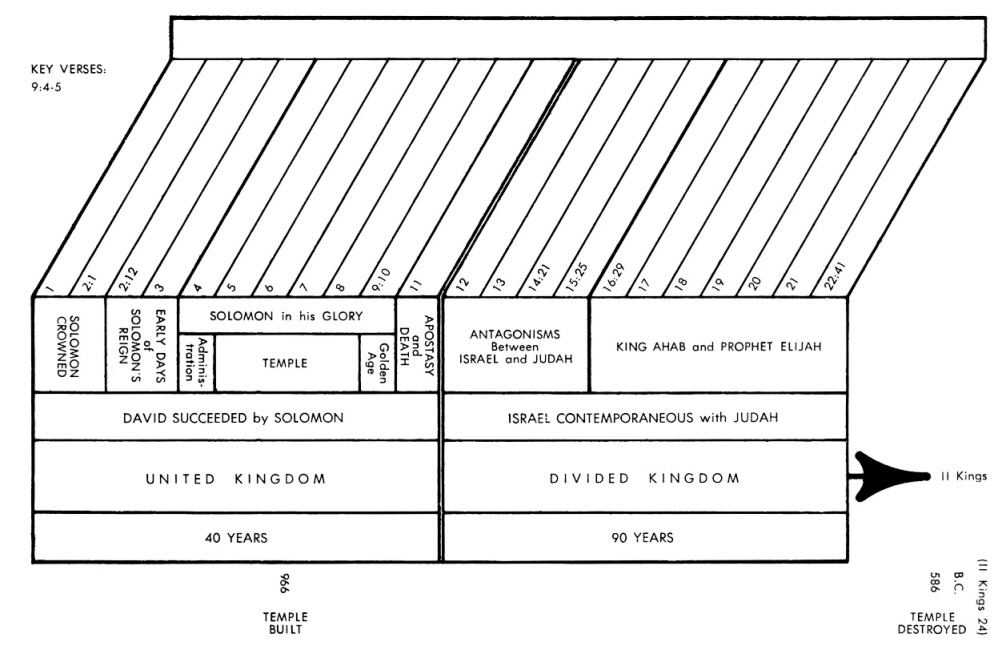
Chart from recommended resource Jensen's Survey of the OT - used by permission
1 Kings Chart from Charles Swindoll

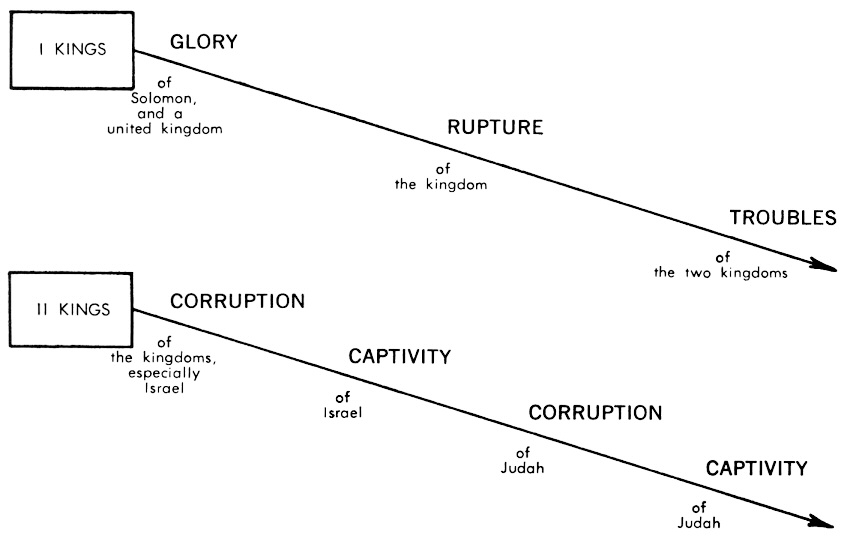
THE DOWNWARD SPIRAL
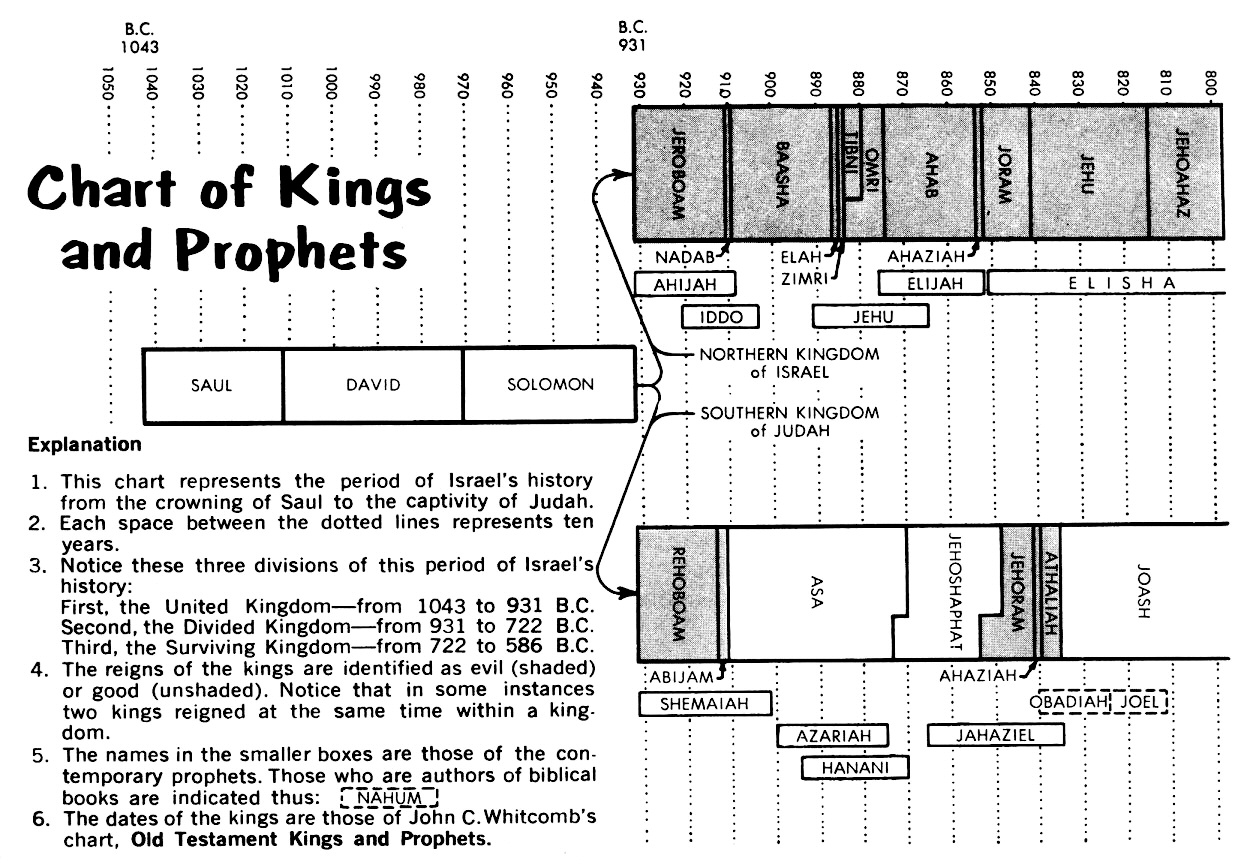
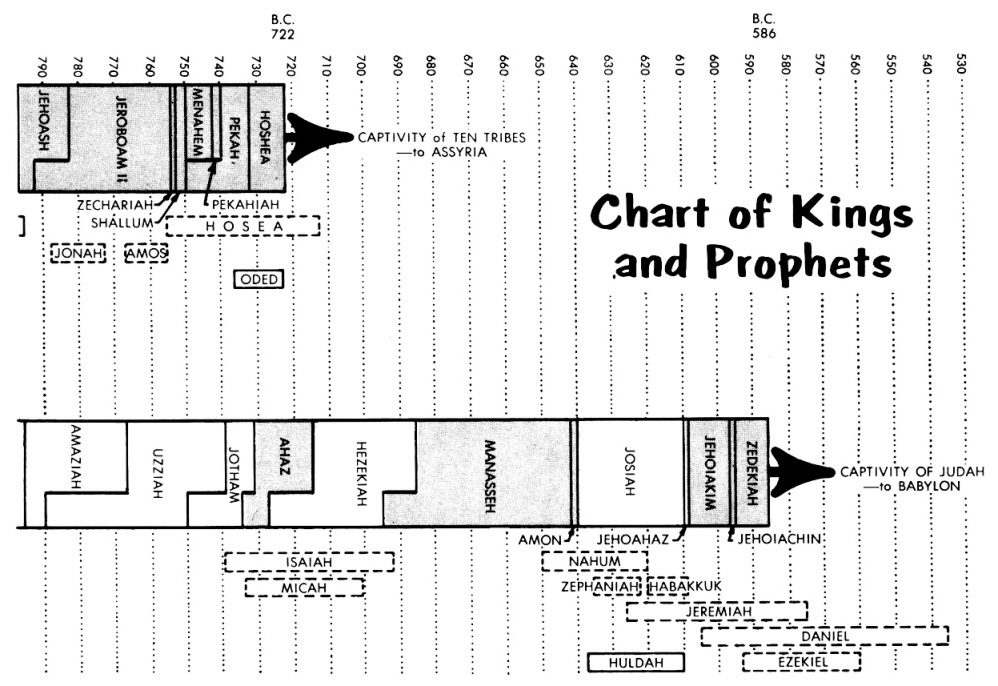
Click to Enlarge
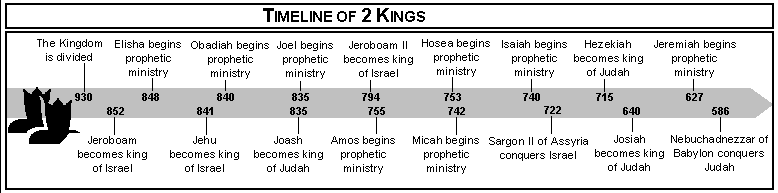
Ryrie Study Bible - Borrow
Click to Enlarge
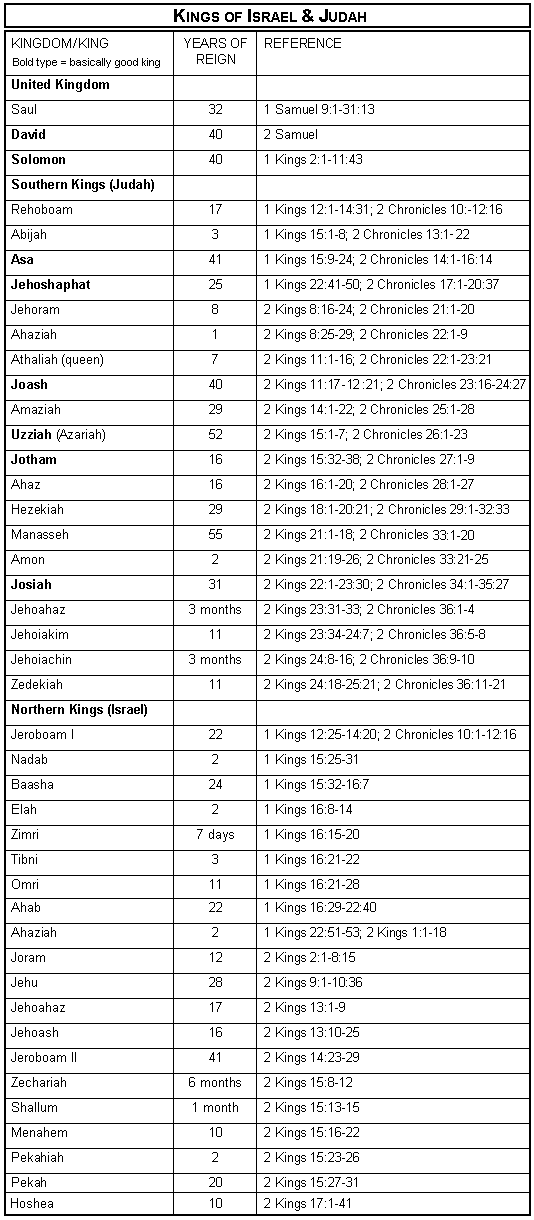
(NOTE: Many consider Amaziah and Hezekiah as "good" kings)
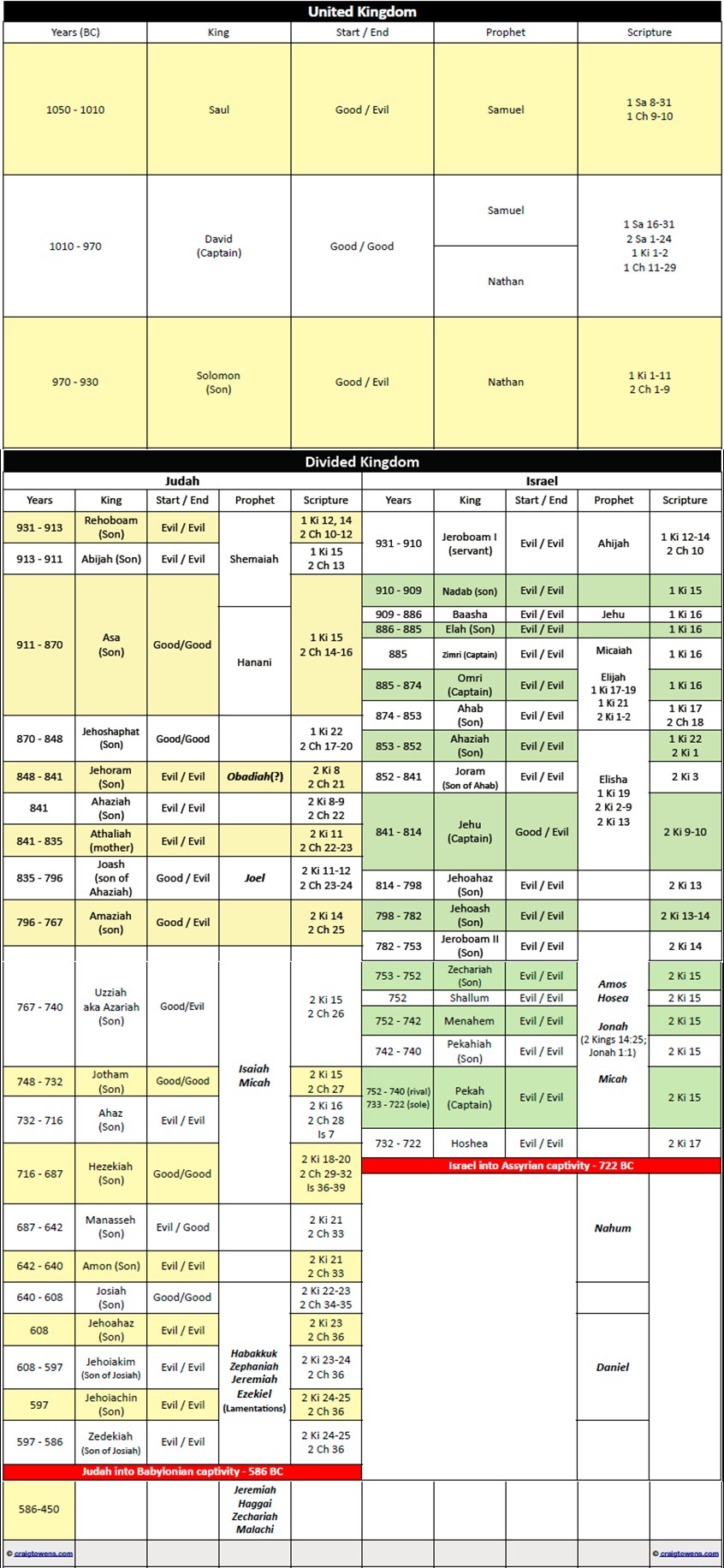
SEE ALSO:
ESV chart - kings of Israel - more information
ESV chart - kings of Judah - more information
Another Chart with Variable Dates for Reigns of King
2 Kings 20:1 In those days Hezekiah became mortally ill. And Isaiah the prophet the son of Amoz came to him and said to him, “Thus says the LORD, ‘Set your house in order, for you shall die and not live.’”
- Hezekiah: 2Ch 32:24-26 Isa 38:1-20 Joh 11:1-5 Php 2:27,30
- the prophet: 2Ki 19:2,20
- house in order: Heb. Give charge concerning thine house, 2Sa 17:23 Isa 38:1
- die: Jer 18:7-10 Jon 3:4-10
READY! SET! GO!
GET HOUSE IN ORDER!
In those days - Always ask "what days?" or "What time is this?" Unfortunately this is not an easy answer. While this time phrase at first glance seems to link the current event to the same general period as the Assyrian crisis, after God’s dramatic deliverance from Sennacherib (2 Kings 19), this is far from established
William MacDonald for example writes "The events of chapter 20 are generally believed to have taken place earlier, probably in the early part of chapter 18, during the first invasion of Sennacherib (see v. 6)." (Borrow Believer's Bible Commentary)
Reformation Study Bible - There is good reason to believe that this incident and the reception of the Babylonian envoys (vv. 12-19) occurred before the Assyrian invasion of Judah in 701 b.c., because according to Babylonian documents, Merodach-baladan (v. 12) died in 703 b.c. (ED: 2 YEARS BEFORE THE ASSYRIAN INVASION DESCRIBED IN CHAPTER 19) Since God added fifteen years to Hezekiah's life (v. 6), he would have been ill in 702 b.c. or before.
For a more detailed discussion of the chronology see Patterson page 271-272.
Hezekiah became mortally ill The phrase indicates a sickness that was humanly incurable—literally “sick unto death.” This was not a mild affliction but a crisis that confronted Hezekiah with his own mortality, stripping away royal power, military security, and recent triumph. The illness of Hezekiah probably occurred just before the invasion of Sennacherib into the land of Judah. Sennacherib's invasion took place in 701 B.C., the fourteenth year of the reign of Hezekiah (18:13). Hezekiah had 15 years of life added to him as a result of God's mercy in answering his prayer, and died in 686 B.C., after a reign of 29 years (beginning in 715 B.C.; cf. 18:2).
Utley - "Set your house in order, for you shall die and not live" Our lives are not controlled by chance, fate, or circumstance. We are in the hands of God (cf. Matt. 6:26,27; 10:29-31)!
Guzik - We know from comparing 2 Kings 18:2 with 2 Kings 20:6 that Hezekiah was 39 years old when he learned he would soon die.
And Isaiah the prophet the son of Amoz came to him - Tested yes, but abandoned no. God does not abandon His servant in suffering times. He sends His word through His prophet. Isaiah’s presence shows that this illness was not random, but was under divine sovereignty and accompanied by divine revelation.
And said to him, ‘Thus says the LORD This formula signals absolute divine authority. What follows is not Isaiah’s opinion or medical prognosis but God’s final word—unless God Himself chooses to change it.
Set your house in order - This is both practical and spiritual. Practically Hezekiah should arrange affairs, succession, responsibilities. Spiritually Hezekiah should prepare to meet God, examine his life, and settle unfinished obedience. It is a call to intentional readiness, not panic.
For (term of explanation) you shall die and not live - Note had this doubles down on death (die...not live), leaving no "wiggle room." The declaration is stark and unambiguous. From a human standpoint, the sentence is final. Yet Scripture soon reveals that God’s declarations may function as calls to prayer, not merely announcements of fate.The point of this passage is tha even the godliest leaders must face death honestly, but God often uses such moments to draw His servants into deeper prayer, humility, and dependence. This verse teaches that crisis is not the absence of God’s care but often the setting for His most personal dealings with us.
2 Kings 20:2 Then he turned his face to the wall and prayed to the LORD, saying,
- he turned: 1Ki 8:30 Ps 50:15 Isa 38:2,3 Mt 6:6
Related Passages:
Isaiah 38:2Then Hezekiah turned his face to the wall and prayed to the LORD,
PRAYER AS HEZEKIAH'S
REFLEX RESPONSE TO CRISIS
Then - Notes progression in the story, in this case rapid progression by Hezekiah. This signals his immediate response. Hezekiah does not delay, debate, or seek human counsel first. The word connects directly to Isaiah’s announcement of impending death, showing that prayer is his instinctive reflex in crisis.
He turned his face to the wall This physical action is deeply symbolic. Turning to the wall suggests withdrawal from all human distraction, all courtiers, physicians, and even the prophet himself. It speaks of solitude, privacy, and undivided attention. In Hebrew thought, bodily posture often mirrors inner disposition and here it conveys Hezekiah's total focus and earnestness before God.
And prayed to the LORD, saying Hezekiah's response demonstrates that prayer is not a ritual or a formality but symbolizes act of dependence. Hezekiah does not argue with Isaiah, protest the message, or resign himself to fate. He goes directly to the life Giver and Sustainer! Prayed (his action) marks prayer as the means by which faith responds to reality. The object of His prayer is decisive, as he prays to Yahweh, the covenant-keeping God, not to a godless idol like his counterpart Sennacherib was doing when he died (2Ki 19:37+). This invokes God’s faithfulness, character, and past promises. The crisis is placed squarely within the covenant relationship, not outside of it.
When God’s word brings us to the end of all human hope, the proper response is not despair or distraction, but focused, personal prayer that turns fully toward Him alone.
William Barnes on turned his face to the wall - As observed in the note on 1 Kgs 21:4, King Ahab of Israel did much the same thing when he disliked a message he had just heard. But in following this with a prayer, Hezekiah acted quite differently than Ahab did. Instead of refusing to eat, as Ahab did, Hezekiah refused to acquiesce to the status quo—so he prayed. And by now we know that this is a person who knows how to pray most powerfully (even though, to the proverbial “untrained ear,” I must admit that his actual prayer followed by bitter weeping has the quality of petulant complaint). (See 1-2 Kings - Page 344)
2 Kings 20:3 “Remember now, O LORD, I beseech You, how I have walked before You in truth and with a whole heart and have done what is good in Your sight.” And Hezekiah wept bitterly.
- remember: Ge 8:1 Ne 5:19 13:14,22,31 Ps 25:7 89:47,50 119:49 Isa 63:11
- I have walked: 2Ki 18:3-6 Ge 5:22,24 17:1 1Ki 2:4 3:6 Job 1:1,8 Lu 1:6
- in truth: 2Ch 31:20-21 Ps 32:2 145:18 Jer 4:2 Joh 1:47 2Co 1:12 1Jn 3:21,22
- a perfect heart: 1Ki 8:61 11:4 15:14 2Ch 16:9
- And Hezekiah wept bitterly: Heb. wept with a great weeping, 2Sa 12:21,22 Ps 6:6 102:9 Isa 38:14 Heb 5:7
Related Passages:
2 Chronicles 31:20-21+ Thus Hezekiah did throughout all Judah; and he did what was good, right and true before the LORD his God. 21 Every work which he began in the service of the house of God in law and in commandment, seeking his God, he did with all his heart and prospered.
2 Kings 18:3-6+ He did right in the sight of the LORD, according to all that his father David had done. 4 He removed the high places and broke down the sacred pillars and cut down the Asherah. He also broke in pieces the bronze serpent that Moses had made, for until those days the sons of Israel burned incense to it; and it was called Nehushtan. 5 He trusted in the LORD, the God of Israel; so that after him there was none like him among all the kings of Judah, nor among those who were before him. 6 For he clung to the LORD; he did not depart from following Him, but kept His commandments, which the LORD had commanded Moses.
Remember now, O LORD - Hezekiah appeals directly to Yahweh’s covenantal awareness, not because God forgets, but because remember in Scripture often means to act faithfully in accordance with a relationship. This is not presumption, it is prayer grounded in covenant. And while remember is in the imperative, it is not as if Hezekiah is commanding God, but it speaks of urgency and understands that the petitioner as a believer has an open door to plead with God (cf Heb 4:16+).
Patterson “Turning his face to the wall, thereby both dismissing Isaiah and entering into solitary confinement with God, Hezekiah poured out his heart to the Lord.”
Utley - "Remember now, O Lord, I beseech You" This seems to imply that He was urging YHWH to answer his prayer based on his faithfulness (i.e., Neh. 5:19; 13:14,31). Yet in the context it is obvious that he is speaking to YHWH out of faith, not merit (i.e., Neh. 13:22).
David Guzik has an interesting comment on Remember now, O LORD: To our ears, Hezekiah’s prayer might almost sound ungodly. In it, his focus is on self-justification and his own merits. It is pretty much as if Hezekiah prayed, “LORD, I’ve been such a good boy and You aren’t being fair to me. Remember what a good boy I’ve been and rescue me.” But under the Old Covenant, this was a valid principle on which to approach God. Passages like Leviticus 26 and Deuteronomy 28 show that under the Old Covenant, blessing or cursing was sent by God on the basis of obedience or disobedience. On that principle, David could write in Psalm 15: LORD, who may abide in Your tabernacle? Who may dwell in Your holy hill? He who walks uprightly, and works righteousness, and speaks the truth in his heart. (Psalm 15:1-2). But under the New Covenant, we are blessed on the principle of faith in Jesus (Galatians 3:13-14). Hezekiah’s principle of prayer isn’t fitting for a Christian today. We pray in the name of Jesus (John 16:23-24), not in the name of who we are or what we have done.. “We come across similar pleas again and again in the prayers of God’s children of old. The Psalms abound with them. But we do not find them in the New Testament. The Church bases its pleas on Christ’s righteousness.” (Bultema)
I beseech You This is the language of urgent entreaty, not entitlement. Hezekiah does not demand but pleads. The king who commanded armies now approaches God as a dependent servant, giving all God's people a beautiful example to emulate.
How I have walked before You in truth - The verb walked describes Hezekiah’s entire manner of life. Before You emphasizes Hezekiah's Coram Deo lifestyle, ever conscious of living under God’s gaze (Pr 15:3+), not merely public righteousness, but integrity lived before the face of God. Truth here points to faithfulness, reliability, and sincerity, not sinless perfection. In other words, it speaks of direction, not perfection. Hezekiah appeals to a life oriented toward God generally characterized by absence of duplicity or hypocrisy.
And with a whole heart A whole heart signals undivided loyalty. His devotion was not partial, strategic, or occasional. In Kings, a “whole heart” contrasts sharply with kings who followed God and idols.
Study these passages on whole heart for you edification and motivation - 1Ki 8:61 1Ki 11:4 1Ki 15:3,14 2Ki 20:3 1Ch 12:38 1Ch 28:9 29:19 2Ch15:17 2Ch 16:9 2Ch 19:9 2Ch25:2. See also Job 1:1.
Utley - "with a whole heart" This is an idiom for complete faith, obedience, and devotion. It was first used in various phrases in Deuteronomy (cf. Deut. 4:29; 6:5; 7:9; 10:12; 11:1,13,22; 19:9; 26:16; 30:2,6,10, 16,20). It then was used in the historical books for occasions and actions of certain people. Solomon ‒ 1 Kgs. 8:23; Josiah ‒ 2 Kgs. 23:3; soldiers of David ‒ 1 Chr. 12:38; David counsels Solomon ‒ 1 Chr. 28:9; the people as they brought an offering for David's plans for the temple ‒ 1 Chr. 29:9; YHWH's obedient servants ‒ 2 Chr. 6:14; used of those who repent ‒ 2 Chr. 6:38;
And have done what is good in Your sight Hezekiah measured his life by God’s evaluation, not human success or political legacy. Good reflects covenant obedience, especially his reforms, trust in the LORD, and rejection of idolatry (See 2Ki 18:3-6+; 2Ch 31:20-21+)
And Hezekiah wept bitterly - The prayer ends not with triumph, but with tears. These are not manipulative "crocodile tears," but the honest grief of a godly man facing death, probably with thoughts of unfinished work, and the certainty of separation from this temporal life. Scripture does not rebuke his weeping. God responds to it. Tears did not draw God's response, but the sincerity of Hezekiah's heart did touch God's compassionate heart!
Utley - "Hezekiah wept bitterly" He did not want to die because there was yet no male heir. In a sense, YHWH's healing was part of His promise to David in 2 Samuel 7 and 1 Chronicles 17. (While not everyone agrees with Utley here, I do agree with this interpretation).
David Guzik has an interesting comment on Hezekiah wept bitterly - Hezekiah lived under the Old Covenant, and at that time there was not a confident assurance of the glory in the life beyond. Instead, Jesus brought life, and immortality came to light through the gospel (2 Timothy 1:10). Also, under the Old Covenant, Hezekiah would have regarded this as evidence that God was very displeased with him.
Faithful believers may appeal to their life lived sincerely before God, not as a claim meriting God's favor, but as an expression of relational trust and can also pour out real sorrow, knowing that tears and integrity can coexist in genuine prayer.
2 Kings 20:4 Before Isaiah had gone out of the middle court, the word of the LORD came to him, saying,
- the middle court 2Ki 22:14 1Ki 7:8
RAPID DIVINE
RESPONSE
Before (time phrase) Isaiah had gone out of the middle court This emphasizes immediacy. Isaiah has not yet even exited the royal complex when God speaks. The timing underscores that Hezekiah’s prayer was answered almost instantly, without any significant delay. God’s response was not hesitant or reluctant. The middle court refers to an interior courtyard of the royal complex, a transitional space between the king and the outside world. Isaiah is in motion, leaving after delivering a hard word of judgment, when God intervenes. This highlights that divine mercy interrupts the path of judgment. One can imagine how Isaiah himself might have been taken aback by God's call to make an "about face!"
Utley - There was no "middle court" related to the palace and no part of Jerusalem was called "the middle city" (AB, p. 254).
The word of the LORD came to him - This is a technical prophetic phrase indicating direct divine revelation, not Isaiah’s opinion or emotional reaction. The reversal that follows comes solely from God’s sovereign initiative and grace. What changes is not God’s awareness, but the course of action He has chosen to reveal in response to prayer. God pursues His prophet, reinforcing the truth that God is active, attentive, and responsive, especially to humble prayer offered in faith and sincerity.
Utley - the word of the Lord came to him, saying - This was a very specific message from YHWH, given at a specific time. We do not understand how God regularly communicated with His prophets, but it is obvious this was audible and instantaneous.
Saying introduces a new divine directive to Isaiah, signaling a reversal or addition to the previous message. What a reversal -- the prophet who just announced death is about to proclaim life. God’s final word, not the first word, will define the outcome.
🙏 THOUGHT - God hears sincere prayer and can intervene with immediate mercy, even after judgment has been pronounced. What appears settled is never beyond the reach of God’s compassionate response to humble faith. This is good for us to remember, when we reason to ourself over some situation that it is final and settled and so we might as well not pray over it. We might be surprised like Hezekiah was at how God responds!
2 Kings 20:5 “Return and say to Hezekiah the leader of My people, ‘Thus says the LORD, the God of your father David, “I have heard your prayer, I have seen your tears; behold, I will heal you. On the third day you shall go up to the house of the LORD.
- Turn again: 2Sa 7:3-5 1Ch 17:2-4
- leader of My people: Jos 5:14,15 1Sa 9:16 10:1 2Sa 5:2 2Ch 13:12 Heb 2:10
- the God of your father David: 2Ch 34:3 Isa 38:5 55:3 Mt 22:32
- I have heard: 2Ki 19:20 Ps 65:2 66:19,20 Lu 1:13
- I have seen: Ps 39:12 56:8 126:5 Rev 7:17
- I will heal: 2Ki 20:7 Ex 15:26 De 32:39 Job 33:19-26 Ps 147:3 Jas 5:14,15
- you shall go up to the house of the LORD go: 2Ki 20:8 Ps 66:13-15,19,20 116:12-14 118:17-19 Isa 38:22 Joh 5:14
RAPID DIVINE REVERSAL
AFTER INTERCESSORY PRAYER
Return and say to Hezekiah the leader of My people - God interrupts Isaiah mid-departure (cf. v. 4). The command is urgent and decisive. The verdict of death is not final when prayer intervenes. Heaven responds swiftly when faith cries out. Calling Hezekiah the leader of people is God's affirmation of Hezekiah’s covenant role. Though sick and near death, he is still God’s appointed shepherd. Illness does not nullify calling. Leadership is defined by divine appointment, not physical strength.
Thus says the LORD - This is not Isaiah’s opinion, prognosis, or optimism. It is divine speech. The authority of the message rests entirely on Yahweh’s self-revelation.
The God of your father David - God anchors His response in covenant faithfulness. Hezekiah is heard not merely as an individual but as a Davidic king. The promise flows through God’s enduring commitment to David (2Sa 7:12-16).
I have heard your prayer - Prayer reached heaven. God does not merely acknowledge that prayer was spoken—He declares that it was received. This affirms prayer as real, effectual communion with God.
Bob Utley - "I have heard your prayer" Notice the number of "I's" in vv. 5-6. YHWH is the God who hears and acts, not like the idols of the nations. "I have seen your tears" The exact reason for the tears is not stated. But probably it is related to repentance. Notice Hezekiah's prayer effected God's pronouncement.
Repentance in the OT is not mere emotion nor mere confession,
but deep conviction that results in changed allegiance and behavior
REPENTANCE IN THE OLD TESTAMENT - Old Testament repentance is best understood not as a single, fixed definition but as a dynamic reorientation of life toward God, expressed through two primary Hebrew verbs—nāḥam and šûb—each contributing essential dimensions to the biblical concept. Nāḥam (naham/nacham) (often associated with “deep sighing” or “breathing deeply”) emphasizes profound inner response—grief, compassion, consolation, or a changed resolve—that issues in concrete action (e.g., Gen 6:6–7; Exod 32:14; Deut 32:36; Job 42:5–6); when applied to God, this language does not imply moral failure or error but is a literary-theological accommodation expressing His compassionate relenting toward repentant sinners (Num 23:19; 1 Sam 15:29; Ps 110:4; Jer 4:27–28; Ezek 24:14). Šûb (shub/sub), by contrast, is decisively directional and volitional, meaning “to turn/return,” and dominates prophetic calls to repentance by demanding a decisive turning away from sin and a turning back to YHWH (1 Kgs 8:33, 48; 2 Chr 7:14; Ps 51:13; Isa 10:21–22; Jer 3:12–14; Hos 14:1–2; Amos 5:4, 6, 14). Together, these terms show that repentance in the OT is not mere emotion nor mere confession, but deep conviction that results in changed allegiance and behavior—a reversal of the self-centered trajectory of the Fall (Gen 3) and a restoration, though imperfect, of covenant fellowship grounded in God’s mercy (Isa 1:16–20). This pattern is vividly illustrated in David’s repentance after Bathsheba (2 Sam 12:7-14; Ps 32:1-11; Ps 51:1-19), where forgiveness coexists with enduring consequences, and even in Manasseh’s late turning, where genuine humbling leads to restoration (2 Chr 33:12–13). Thus OT repentance is fundamentally a change of action flowing from a transformed heart, involving cognitive recognition of sin, personal humility before God, and moral redirection of life—an initial turning that must become an ongoing posture of faithfulness (Ps 90:13; cf. Amos 4:6–11; 5:4–6)—so that regret matures into enduring devotion to the LORD. (Compiled from notes by Bob Utley)
INTERCESSORY PRAYER - Intercessory prayer stands at the heart of biblical faith because it reflects God’s relational design and is modeled supremely by Jesus Himself. Throughout the Gospels—especially Luke—Jesus is repeatedly shown praying, both privately and publicly (Mark 1:35; Luke 3:21; 6:12; 9:29), and in moments of deepest intercession for others, as in Gethsemane and His prayer for Peter (Luke 22:31–46). He cleansed the temple because it had ceased to function as “a house of prayer for all the peoples” (Matt 21:13; Mark 11:17; Luke 19:46; cf. 1 Kgs 8:43, 60), underscoring prayer’s central place in God’s redemptive purposes. Jesus also gave His disciples a model prayer (Matt 6:5–13; Luke 11:2–4) and culminated His earthly ministry with the High Priestly Prayer of John 17, where He explicitly interceded for His disciples and for all who would later believe. Prayer, therefore, is the tangible expression of trust in a personal, present, and responsive God—one who has chosen, in His wisdom, to work through the prayers of His children (James 4:2), not primarily to inform Him, but to draw them into deeper fellowship with the Triune God.
The Old Testament repeatedly portrays God seeking and honoring intercessors. Abraham pleaded for Sodom (Gen 18:22–33), Moses repeatedly stood in the breach for Israel after their sin (Exod 32:9–14, 31–35; 33:12–16; Deut 9:18, 25–29), Samuel prayed faithfully for the nation (1 Sam 7:5–9; 12:16–23), and David interceded even in personal anguish for his child (2 Sam 12:16–18). God Himself lamented the absence of such mediators, declaring, “He saw that there was no man, and was astonished that there was no one to intercede” (Isa 59:16). Yet Scripture also warns that unconfessed sin and hardened hearts hinder prayer (Ps 66:18; Prov 28:9; Isa 59:1–2; 64:7), making repentance and restored fellowship essential for effective intercession (1 John 1:9–2:2).
In the New Testament, intercession reaches its fullest theological depth: Jesus continually intercedes for believers at the right hand of the Father (Rom 8:34; Heb 7:25; 9:24; 1 John 2:1–2), while the Holy Spirit intercedes within believers, translating their weakness into prayers aligned with God’s will (Rom 8:26–27). Paul’s ministry is saturated with intercession—for Israel (Rom 9:1ff; 10:1), for churches (Eph 1:16; Phil 1:3–4, 9; Col 1:3, 9), and he repeatedly asks others to pray for him (Rom 15:30; Eph 6:19). The church is likewise commanded to pray for one another (Eph 6:18; James 5:16), for enemies (Matt 5:44), leaders (1 Tim 2:1–2), the sick (James 5:13–16), and even those in spiritual danger (1 John 5:16). Scripture teaches that answered prayer is shaped by abiding in Christ (John 15:7), praying in His name (John 14:13–14), walking in the Spirit (Eph 6:18), aligning with God’s will (1 John 5:14–15), humility, right motives, and perseverance (Luke 18:1–8; Matt 7:7–8). What a privilege and responsibility intercessory prayer is: the Son intercedes for us, the Spirit prays within us, and the Father invites us to participate, using prayer to transform individuals, families, churches, and even the course of history.
David Guzik - Hezekiah’s prayer was important. By all indications, if Hezekiah had not made his passionate prayer, his life would not have been extended. This is another demonstration of the principle that prayer matters.. In fact, God gave two gifts to Hezekiah. First, He gave the gift of an extended life. Second, He gave the gift of knowing he only had fifteen years left. If he were wise, this would still give King Hezekiah the motivation to walk right with God and to set his house in order.
I have seen your tears - Tears are part of prayer. God does not separate emotion from faith. He sees what words cannot carry. This phrase reveals divine compassion as well as divine attentiveness.
🙏 THOUGHT - When was the last time your prayer was accompanied by tears? Have you ever shed tears when you prayed? Wet eyes often speak of a soft heart. The old Puritans used to pray for the gift of tears. For the Puritans, tears were not emotionalism for its own sake. They saw them as a gracious work of God—evidence of a heart truly affected by sin, grace, Christ’s sufferings, and God’s glory. Thomas Watson wrote “A sinner’s tears are precious. Tears dropping from the eye are like pearls dropping from the crown.” Richard Baxter often lamented dryness of heart and urged believers to pray until truth “worked upon the affections.” Tears are the blood of the soul, and they are never shed in vain when faith mixes with them.
Behold - In context this is A marker of divine intervention. What follows is unexpected, gracious, and sovereign. God draws attention to the reversal He is about to perform.
I will heal you - Healing is God’s personal act, not chance recovery or medical coincidence. His "healing Name" is Jehovah Rapha: (Jehovah Rophe) The LORD our Healer. The promise is unconditional and direct. God even names the outcome before he details the process.
Bob Utley - "I will heal you" This healing would allow time for an heir, but oh my, what a terrible heir (i.e., Manasseh)!
On the third day - Note that it is interesting that the healing is certain but not instantaneous. God appoints the timing. The delay underscores obedience, trust, and preparation (so in one sense it does have some "conditions") and foreshadows a biblical pattern of restoration after waiting.
You shall go up to the house of the LORD - The goal of healing is worship. Restoration is not merely physical but relational. God heals His servant so that he may again stand in His presence and praise Him publicly.
God is not only sovereign over life and death, but is attentive to prayer, compassionate toward tears, faithful to covenant, and purposeful in healing, restoring His servants so they may return to worship and service.
2 Kings 20:6 “I will add fifteen years to your life, and I will deliver you and this city from the hand of the king of Assyria; and I will defend this city for My own sake and for My servant David’s sake.”’”
- I will add: Ps 116:15 Ac 27:24
- I will defend: 2Ki 19:34 2Ch 32:22 Isa 10:24
FIFTEEN YEARS BY
SOVEREIGN GRACE
I will add fifteen years to your life - This is a direct, sovereign promise from the LORD, the "Divine Mathematician." ADD emphasizes divine initiative; i.e., Hezekiah does not negotiate or earn these years. God grants them. The specific number underscores that human life is under God’s precise control, not chance or medical prognosis. The sentence of death announced earlier (v.1) is reversed by grace in response to prayer.
Spurgeon - Hezekiah, though but a little prince, suddenly found himself a wealthy man, having moreover one thing in his treasury which could not have been discovered among the riches of any other living man, namely, a writ from the Court of Heaven, that he should live fifteen years… This great prosperity was a great temptation, far more difficult to endure than Rabshakeh’s letter, and all the ills which invasion brought upon the land.”
Donald Wiseman - Hezekiah was granted an added fifteen years; since he died c. 686 b.c. this promise can be dated from about the time of the siege of Jerusalem. His recovery was also symbolic of the recovery of Jerusalem.” (See 1 and 2 Kings: An Introduction and Commentary - Page 305)
Cyril Barber - In the first section, Hezekiah is ill and is told that he is soon to die. In answer to his prayer, the Lord adds fifteen years to his life. Inasmuch as Hezekiah died in 686 B.C., his illness must have occurred in 701 B.C.-the eventful year that included Sennacherib’s first invasion. This brings us to another question: Was Hezekiah’s illness before or after the Assyrian attack on Judah? God specifically promised Hezekiah deliverance from the Assyrians, and assured him that He would defend the city of Jerusalem (2Ki 20:6), so Hezekiah’s illness must have been just before the events described in 2Ki 18:13–16.
And I will deliver you and this city - God links personal deliverance with corporate deliverance. Hezekiah’s life is bound up with Jerusalem’s future. The king’s preservation is not merely for his own benefit but for the sake of God’s redemptive purposes for His people. Leadership matters; the fate of the city is intertwined with the faith and life of its king.
Not everyone agrees with the following statement but many reputable sources do agree. Therefore take it with that caveat. Without the extension of life, Manasseh would not have been born. Hezekiah's petition preserved the messianic line. According to 2 Kings 21:1, Manasseh was twelve years old when he began to reign, which means he was born three years after God extended Hezekiah’s life. If Hezekiah had died when Isaiah first told him to set his house in order, Manasseh would never have been born.
Don Stewart writes that "during that last fifteen years of his life, Hezekiah fathered a son who would succeed him as king over Judah. His name was Manasseh. Unfortunately, Manasseh was one of the worst kings in Judah’s history. He brought untold misery to the people with his idolatrous practices. Indeed, his evil deeds stopped the worship of the Lord, the true God. Therefore, the extra fifteen years which Hezekiah was granted became disastrous to the nation." (Did Hezekiah Convince God to Allow Him to Live Fifteen Extra Years? )
David Guzik - Manasseh was twelve years old when he became king: This means that he was born in the last fifteen years of Hezekiah’s life, the additional fifteen years that Hezekiah prayed for. Those additional fifteen years brought Judah one of its worst kings. I will defend this city This promise was in accord with the LORD’s previous prophecies of deliverance, and dates this chapter as being before God destroyed the Assyrian army (Isaiah 37:36-37). The connection of the two promises indicates that one would confirm the other. When Hezekiah recovered his health, he could know that God would also deliver him from the Assyrians.
Christopher Knapp - “Had this good king been able to foresee the wickedness of his unworthy son, he would doubtless have no desire to recover from his sickness. Better by far die childless than beget a son such as Manasseh proved to be.” (Biography of Hezekiah)
Bob Utley - "I will defend this city for My own sake and for My servant David's sake" God is in control both of individual destinies and national destinies. He acts on His people's behalf, first of all for Himself and His own honor and glory (cf. Ezek. 36:22-36) and secondly because of the faithfulness of those who love Him (i.e., David). See full note at 19:34. "for My own sake and for My servant David's sake" This refers to YHWH's promise to David in 2 Samuel 7 and 1 Chronicles 17.
From the hand of the king of Assyria - This identifies the threat explicitly and historically. The danger is not abstract but is Assyrian power, the most terrifying military force of the ancient world. By naming the enemy, God demonstrates that no earthly power, however brutal or vast, lies beyond His authority. What Assyria holds in its “hand,” God can remove effortlessly.
Fnd I will defend this city - The emphasis shifts from deliverance to protection. God is not merely reacting to danger; He is actively committing Himself as Jerusalem’s defender. This language portrays God as a divine warrior and guardian, standing watch over His chosen city. Jerusalem’s safety does not rest in walls, weapons, or alliances, but in God’s personal defense.
For My own sake - This is the theological heart of the verse. God acts not because Judah deserves it, but because His name, character, and glory are at stake. The deliverance is rooted in God’s faithfulness. His holiness, His promises, and His integrity. Salvation is ultimately God-centered, not man-centered.
And for My servant ('ebed; LXX - doulos) David’s sake - Here the LORD anchors the promise in covenant history. David is long dead, yet God’s commitment to him still governs present events. This phrase recalls the Davidic covenant (2Sa 7:12-16), showing that God’s promises endure across generations. Hezekiah benefits from grace rooted in a promise made centuries earlier.
God extends life, defeats enemies, and preserves His people not because of human merit, but because He is faithful to His Own Name and to His unbreakable covenant promises to Abraham and to David.
MY SERVANT - “My Servant” is a rich, honorific title of calling and dignity in Scripture, denoting one who belongs to God, represents Him, and carries out His purposes. In the Old Testament it is used both collectively and individually. Collectively, “My servant” can describe the patriarchs as a group (Deut 9:27), the prophets as God’s commissioned spokesmen (2 Kgs 17:13; Jer 7:25; 26:5; 35:15), and Israel as a nation, chosen and redeemed to serve Yahweh before the world (Ps 105:6; Isa 41:8–9; 44:1–2; 49:3; Jer 30:10). The Septuagint even clarifies Isaiah 42:1 in this national sense by identifying the servant as “Jacob…Israel,” underscoring Israel’s vocation to embody God’s purposes. Yet the title is also applied individually to key figures whom God raised up for specific roles: Abraham (Gen 26:24), Job (Job 1:8; 42:8), Moses as prophet and covenant mediator (Num 12:7–8; Deut 34:5), Joshua as military leader (Josh 24:29), David as king (2 Sam 7:5, 8; Ezek 34:23–24), Zerubbabel as administrator (Hag 2:23), and even foreign rulers such as Cyrus (Isa 44:28; 45:1) and Nebuchadnezzar (Jer 25:9), showing that God sovereignly employs both believers and unbelievers to accomplish His redemptive purposes.
Most significantly, “My Servant” becomes a Messianic title in Isaiah’s Servant Songs (Isa 42:1–4; 49:1–6; 50:4–9; 52:13–53:12). While some passages can describe Israel corporately (Isa 41:8–9; 42:19; 44:21), Isaiah 52:13–53:12 unmistakably portrays an individual, ideal Servant who suffers and dies for the sins of others (Isa 53:8), something Israel itself could not do. This Servant is exalted by God (Isa 52:13), crushed according to God’s redemptive will (Isa 53:10), and brings justification to many (Isa 53:11). The New Testament explicitly identifies this Servant with Jesus Christ, as Matthew cites Isaiah 42:1–4 as fulfilled in Him (Matt 12:18–21), and the early church prays using “My Servant” language for Jesus’ person and work (Acts 4:27, 30). Thus, across Scripture, “My Servant” traces a theological line from Israel’s calling, through faithful individuals, to its climax in Christ—the obedient Servant through whom God brings salvation, demonstrating that history, nations, and rulers are all under His sovereign hand to fulfill His eternal redemptive plan (Isa 53:10).
2 Kings 20:7 Then Isaiah said, “Take a cake of figs.” And they took and laid it on the boil, and he recovered.
- Take a cake : 2Ki 2:20-22 4:41 Isa 38:21
HEALING BY PROMISE
AND BY POULTICE
Then Isaiah said - This signals prophetic authority in action. Isaiah is not acting as a physician but as the Lord’s commissioned messenger. The healing that follows is rooted in God’s promise (2Ki 20:5–6), not in medical expertise. The prophet speaks because God has already spoken.
Take a cake of figs - Isaiah's instruction is specific, simple, and a normal type of medical procedure for boils and carbuncles. A cake of figs was a poultice in the ancient Near East, known for softening and drawing out infection. Yet Scripture carefully avoids crediting the figs themselves with healing power. God often uses ordinary means to accomplish extraordinary purposes, ensuring that faith rests in Him, not the instrument. (cf clay to eyes of blind man Jn 9:15+).
And they took and laid it on the boil - They is not specified but must have been attendants of the king. Immediate obedience follows. There is no argument, no delay, no skepticism. The king who had been helpless in bed now submits to a humble, mundance act. The “boil” (likely a severe, life-threatening infection - as a physician I have seen infections necrotizing fasciitis which can be quickly fatal) emphasizes the seriousness of Hezekiah’s condition and the improbability of recovery apart from divine intervention.
Boil is Hebrew shechin - The skin disease of boils was one of the ten plagues brought by the Lord on Egypt (Ex 9:9-11). The Lord threatens boils if Israel will not obey him (Dt. 28:27, 35). God is viewed as the ultimate reason for the disease, even in the case of Job, where the more immediate agent is Satan (Job 2:7), and the proximate cause may well have been germs.
And he recovered (chayah - "he lived") - An apt subtitle for this verse woulde be "Obedience Applied, Healing Supplied." The outcome is stated briefly and decisively. Scripture does not say the figs healed him; it simply states the result. The healing is complete, effective, and unmistakable, confirming that God’s word spoken in verses 5–6 is now fulfilled. The means served the promise, not the other way around.
Bob Utley - "and he recovered" This phrase makes unnecessary "the sign" of vv. 8-11. There seem to be two historical accounts combined. AB, pp. 256-257, suggests that Isaiah reworked an earlier account, like 2 Kings. We must acknowledge the time, person, and method of the production of the OT is unknown to moderns!
God heals by His sovereign word, yet often chooses humble, ordinary means, so that our trust rests not in methods, medicine, or rituals, but in Him alone. Notice that in this case Hezekiah (and those who applied the poultice) participated in the answer to the prayer. Have you ever prayed a prayer and you were called to participate in order to assure the answer to the prayer? See "Paradoxical Principle of 100% Dependent and 100% Responsible"
2 Kings 20:8 Now Hezekiah said to Isaiah, “What will be the sign that the LORD will heal me, and that I shall go up to the house of the LORD the third day?”
- What shall be: 2Ki 20:5 19:29 Judges 6:17,37-40 Isa 7:11,14 Isa 38:22 Ho 6:2
Related Passages:
Isaiah 38:22+ Then Hezekiah had said, “What is the sign that I shall go up to the house of the LORD?”
FROM THE SICKBED
TO THE SANCTUARY
Now Hezekiah said to Isaiah - Hezekiah responds directly to the prophet. This shows the king engaging with God through God’s appointed messenger. His faith is not mystical but is anchored in the revealed word through God's mouthpiece, Isaiah.
What will be the sign ('oth; LXX - semeion) - This is not unbelief but seeking confirmation. In Scripture, a sign often serves as a divine authentication of God’s promise (cf. Gideon, Ahaz, Isaiah 7). Hezekiah is asking for assurance, not proof.
Bob Utley - "What will be the sign" Probably Hezekiah's understanding of God's word being non-revokable, caused him to doubt whether the new message could become reality. Therefore, he asks for a special sign from God that Isaiah's words in v. 1 would not come true.
That the LORD will heal (rapha/rophe; LXX - iaomai = literally deliverance from physical disease) me - Hezekiah attributes healing exclusively to Yahweh, not to Isaiah, medicine, or chance. Though a poultice of figs is mentioned later (v. 7), the king understands that means do not replace the Healer.
And that I shall go up to the house of the LORD - The goal of healing is not merely survival or comfort, but restored worship. To go up to the temple signals renewed public devotion, gratitude, and fellowship with the LORD. Apparently his sickness has kept him from going to the Temple and he desires to be back in the presence of the LORD.
The third day - This indicates confidence that recovery will be real and relatively swift, an expectation of a specific, verifiable fulfillment and a time frame that allows the sign to be tested. The mention of a definite day underscores that God’s promises operate in real history, not vague spiritual optimism.
Hezekiah teaches us that it is not faithless to seek confirmation when God speaks, especially when the purpose is restored worship. However you might see discussion Is it acceptable to “lay out a fleece” before God in prayer?
True faith listens to God’s word, trusts His power, and desires healing not for self-indulgence, but for renewed devotion to Him.
Sign (0226) 'oth means a signal, a mark a miracle and is used to describe amazing events such as God bringing Israel out of Egypt (Ex 4:8, 9, Nu 14:22) or a sign serving to authenticate the message as from God (1Sa 2:34, 10:7, 9) in contrast to the signs from false prophets (Dt 13:1, 2). King Hezekiah received a sign from Jehovah that the He would add fifteen years to his life (Isa 38:1, 2, 3, 4, 5, 6, 7, 8; Gideon - Jdg 6:17+) As an aside, while the Bible does record individuals asking for signs of divine approval or affirmation, this process is not to be the norm. In other words, it is usually not best to test God by asking Him for signs! Perhaps better is the prayer of the sick boy's father in Mark (Mk 9:24)!
NET NOTE - The Hebrew term אוֹת (’ot, “sign”) can refer to a miraculous event (see v. 11), but it does not carry this sense inherently. Elsewhere in Isaiah the word usually refers to a natural occurrence or an object/person vested with special significance (see 8:18; 19:20; 20:3; 37:30; 55:13; 66:19). Only in 38:7–8, 22 does it refer to a miraculous deed that involves suspending or overriding natural laws. The sign outlined in vv. 14–17 involves God’s providential control over events and their timing, but not necessarily miraculous intervention.
Bob Utley - SIGN IN OLD TESTAMENT
- The Semitic root
- The NOUN "sign" is used
- as a marker of time, Gen. 1:14
- as a marker of person, Gen. 4:15
- as a marker of covenant, Gen. 9:12,13,17; 17:11
- as a marker of a faith promise, Exod. 3:12
- as a miracle to affirm God's representative (i.e., Moses), Exod. 4:8 (twice),9,17,28,30; 7:3; 8:23, etc.
- tribal standard, Num. 2:2; Ps. 74:4
- as a warning, Num. 16:38; 17:10
- There are several "signs" in the OT
- a sign (or mark) for Cain's protection ‒ Gen. 4:15
- a rainbow for no more floods ‒ Gen. 9:12-17
- the blood on the door ‒ Exod. 12:13
- the Sabbath ‒ Exod. 31:12-17; Ezek. 20:12,20
- plate made from the censers of Korah ‒ Num. 16:36-40
- phylacteries and frontlets ‒ Deut. 6:8; 11:18
- the stones taken from the midst of the Jordan ‒ Josh. 4:6
- certain words spoken by Philistines to Jonathan ‒ 1 Sam. 14:10
- agricultural crops over three seasons ‒ 2 Kgs. 19:29-34; Isa. 37:30
- movement of shadow on the stairs ‒ 2 Kgs. 20:8-11; Isa. 38:5-8
- birth of a son to Ahaz ‒ Isa. 7:11,14
- an altar in Egypt ‒ Isa. 19:19-22
- YHWH made known to the nations ‒ Isa. 66:18-19 (cf. Isa. 11:10,11-16; 19:22)
- mark on forehead of faithful followers in Jerusalem ‒ Ezek. 9:4 (cf. Rev. 7:3; 14:1)
See NIDOTTE, vol. 4, pp. 1224-1228, "Sign and Symbol: Theology of."
- It is used often in Isaiah.
- special birth, Isa. 7:14
- Isaiah's children, Isa. 8:18
- altar and pillar in Egypt, Isa. 19:19-20
- Isaiah's dress, Isa. 20:3
- harvest, Isa. 37:30
- sparing Jerusalem from Assyria, Isa. 38:7
- Hezekiah's healing, Isa. 38:22
- false signs, Isa. 44:25
- agricultural blessings, Isa. 55:13
- missionaries to the nations, Isa. 66:1
- The NOUN "sign" is used
- OT ‒ BDB 68, KB 559
The terms "wonder," "sign," "portent" (BDB 68, KB 559) are synonymous (cf. Deut. 4:34; 7:19; 29:2) with "sign," "mark" (BDB 16, KB 26). It is used often in Exodus and Deuteronomy, but only twice in Isaiah (i.e., Isa. 8:18 and 20:3). - BDB has two main usages.
- a special demonstration of God's power (i.e., the plagues of the Exodus)
- a token of future events or symbolic acts denoting future events (cf. Isa. 20:3; Ezek. 12:6-11; 24:24; Zech. 3:8)
These usages show God's knowledge of the future and His ability to set its course. He reveals things to His people so they will trust and follow Him!
2 Kings 20:9 Isaiah said, “This shall be the sign to you from the LORD, that the LORD will do the thing that He has spoken: shall the shadow go forward ten steps or go back ten steps?”
- This sign: Isa 38:7-8 Mt 16:1-4 Mk 8:11,12 Lu 11:29,30
Related Passages:
Isaiah 38:7-8 “This shall be the sign to you from the LORD, that the LORD will do this thing that He has spoken: 8 “Behold, I will cause the shadow on the stairway, which has gone down with the sun on the stairway of Ahaz, to go back ten steps.” So the sun’s shadow went back ten steps on the stairway on which it had gone down.
WHEN GOD PUTS TIME
IN REVERSE!
Isaiah said, “This shall be the sign ('oth; LXX - semeion) to you from the LORD - In this context a sign ('oth) is a God-given confirmation meant to authenticate the divine promise. God does not rebuke Hezekiah for asking for a sign but graciously condescends to strengthen faith that has already turned toward Him in prayer. The source of the sign is explicitly from the LORD, not from Isaiah, nature, or human manipulation which underscores divine control of the situation.
That the LORD will do the thing that He has spoken - The sign is not an end in itself but it points to the promise of Hezekiah's healing. God links the miracle directly to His word (He has spoken), teaching that His spoken promise precedes and governs the sign, not the other way around. The emphasis is on God’s faithfulness to what He has already declared (v6 I will add fifteen years to your life), reinforcing that God's promise is reliable even before visible confirmation.
Shall the shadow go forward ten steps - This option represents what is natural and expected, of time moving forward as usual. It highlights the ordinary course of creation, where shadows advance predictably. By including this option, God shows that He is not constrained by what appears normal or inevitable, even though this direction would still require divine intervention.
Or go back ten steps? - Here God offers the impossible from, the reversal of time’s visible marker. This choice magnifies His sovereignty, for the LORD is not only able to accelerate time but to reverse it entirely. The question places Hezekiah at a crossroads of faith. Will he ask for the harder sign that leaves no room for doubt?
Bob Utley - Verse 9 is a question to Hezekiah. Does he want the shadow to move forward or backward? To get this the Hebrew text must be slightly emended. See the parallel in Isa. 39:8. Isaiah 39:9-20 records a beautiful poem that Hezekiah wrote about his illness and YHWH healing him.
2 Kings 20:10 So Hezekiah answered, “It is easy for the shadow to decline ten steps; no, but let the shadow turn backward ten steps.”
- 2Ki 2:10 3:18 Isa 49:6 Mk 9:28,29 Joh 14:12
WHEN ORDINARY PROOF
IS NOT ENOUGH
So Hezekiah answered - This is Hezekiah’s response to Isaiah’s question (v. 9) about which sign he desired. The king is not silent, passive, or fatalistic and he engages thoughtfully with God’s offer. His answer shows discernment, not doubt. He is reasoning reverently about what would best confirm the Lord’s promise.
It is easy for the shadow to decline ten steps - Hezekiah acknowledges that a shadow moving forward (declining) is the normal, expected course of nature. Time moves forward and shadows lengthen or shorten predictably. Such a sign, while still from God, could be mistaken as merely coincidental or ordinary.
Bob Utley - As in the plagues of the exodus, YHWH used natural events with supernatural intensity, timing and locality. Here, the reversal of a natural event (i.e., a shadow). Also note Joshua 10:12-13.
William Barnes writes "As far as the sun’s shadow moving forward or backward, Hezekiah obviously sought the more impressive sign, reversing the progress of time itself, as it were (he was hardly in the mood to speed up time!)." Concerning this, Oswalt (1986:678 - see The Book of Isaiah, Chapters 1–39 - Page xxxiv) cites Smith to great effect: “[Smith] paints a graphic picture of the dying king watching from his sickroom as the shadow inexorably descended the steps. How easily he could have associated his own ebbing strength with that lengthening shadow and contemplated the coming sunset with dread. Thus, when the prophet offered to move the shadow forward ten steps, one can imagine the king reacting with alarm. Much better to move it backward, up the steps, as a sign of the divine reprieve. (See 1-2 Kings - Page 345)
No, but let the shadow turn backward ten steps - This is the heart of the verse. Hezekiah asks for what is humanly impossible, a reversal of the normal order of time. He wants a sign that cannot be explained by natural causes, only by the direct power of God. This request does not challenge God’s ability; it honors it. Hezekiah desires unmistakable confirmation that the Lord who promised healing truly governs time, creation, and life itself. Contrast Hezekiah's willingness to ask for a sign and his father Ahaz refusal to ask God for a sign (see Isa 7:10-12+).
Hezekiah requested that the sundial do the unnatural, i.e., change its direction from descending to ascending at an accelerated rate. Through the years, men have tried again and again to explain what transpired but have failed to reach a consensus. Although the details of this phenomenon are not given, clearly it was localized in its effect and confined to Judah (cf. 2 Chr. 32:31). God simply chose this unusual happening to indicate His answer and confirm His mercy upon Hezekiah, showing thereby His omnipotence and omniscience.
2 Kings 20:11 Isaiah the prophet cried to the LORD, and He brought the shadow on the stairway back ten steps by which it had gone down on the stairway of Ahaz.
- cried unto: Ex 14:15 1Ki 17:20,21 18:36-38 Ac 9:40
- he brought: Jos 10:12-14 2Ch 32:24,31 Isa 38:8
WHEN TIME
MOVED BACKWARD
Isaiah the prophet - The verse begins by identifying Isaiah in his prophetic role, not merely as a messenger but as an intercessor. The sign is not performed by Hezekiah, nor by Isaiah’s authority, but by the LORD. Isaiah played a role for he stood between God and king as God’s appointed servant.
Cried to the LORD - The verb cried indicates earnest, urgent prayer, not a casual request. Even though God has already promised healing and a confirming sign (vv. 5–10), Isaiah still prays deliberately. This shows that divine promises do not cancel prayer, but they invite it. God’s power is released through dependence, not presumption. The content of his cry was clearly for the LORD to bring back the shadow ten steps.
Any attempt at an explanation of how this
was accomplished would be pure speculation.
--Norman Geisler
And He brought the shadow on the stairway back ten steps - Isaiah prays, but God acts. The reversal of the shadow signifies a reversal of natural expectation, reinforcing that the God of Israel rules not only life and death, but time itself. The specificity of ten steps underscores the measurable, verifiable nature of the miracle. This was not a vague or symbolic sign, but was observable and undeniable. The number corresponds exactly to Hezekiah’s request, confirming that God not only answered, but answered precisely. Imagine Hezekiah's emotions as the shadow supernaturally went back up the stairs!
Bob Utley - This shows that God is in control of heavenly bodies. This was very important to the people of the ancient world who believed the stars guided their destinies. Exactly how YHWH performed this miracle is unknown and really is not significant. God acted in response to Hezekiah's prayer and His larger purposes for Israel.
By which it had gone down - This phrase stresses reversal, not pause. Time does not merely stop but moves backward. In the context of Hezekiah’s illness, the sign visually represents life being restored instead of diminished, days being added rather than subtracted.
Ryrie - the stairway of Ahaz. A westward facing flight of stairs on which, normally, the declining sun would cause a shadow to move upward. As a confirmatory sign to Hezekiah, the shadow went down 10 steps.
On the stairway of Ahaz - Isn't this ironic that the sign occurs on a structure associated with Ahaz, Hezekiah’s faithless father, who actually refused to ask God for a sign (see Isa 7:10-12+). Symbolically, God’s act of grace is displayed on the legacy of an unfaithful king, highlighting the contrast between Ahaz’s unbelief and Hezekiah’s trust.
The God who grants life also governs time; when He confirms His promises, He does so with unmistakable power, reminding us that nothing—nature, history, or human limitation—lies beyond His sovereign control.
The tragedy of this story of God's miraculous healing of Hezekiah is that the king failed at appropriately to the healing. An appropriate reaction would have been humble gratitude. Instead 2 Chronicles 32:24-26+ says...
In those days Hezekiah became mortally ill; and he prayed to the LORD, and the LORD spoke to him and gave him a sign. 25 But Hezekiah gave no return for the benefit he received, because his heart was proud; therefore wrath came on him and on Judah and Jerusalem. 26 However, Hezekiah humbled the pride of his heart, both he and the inhabitants of Jerusalem, so that the wrath of the LORD did not come on them in the days of Hezekiah.
You ask how did his heart become proud? Keep reading and you will see the answer!
Norman Geisler - 2 KINGS 20:11—How could the shadow retreat by ten degrees on the stairway of Ahaz?
PROBLEM: In response to Hezekiah’s prayer, God instructed Isaiah to prophesy to Hezekiah that God would add 15 years to Hezekiah’s life. When he heard this, Hezekiah asked for a sign to confirm God’s promise. The sign was that the shadow would retreat ten degrees. But, this would involve making the shadow go backward instead of forward as the sun set. How could the shadow retreat?
SOLUTION: Obviously, this was a miracle. Hezekiah realized that it would not be a miraculous confirmation of God’s promise if the sign involved some phenomenon that could be easily explained (2 Kings 20:10). It was the miraculous nature of the event that qualified it as a sign from God. Any attempt at an explanation of how this was accomplished would be pure speculation. Although God can employ the forces of nature to accomplish His purposes, He can also accomplish His will in a way that defies natural explanation. God can perform miracles, and this was a miracle. (When Critics Ask)
2 Kings 20:12 At that time Berodach-baladan a son of Baladan, king of Babylon, sent letters and a present to Hezekiah, for he heard that Hezekiah had been sick.
- Berodach-baladan: Isa 39:1-8, Merodach-baladan
- king: 2Ch 32:31
- Babylon: Ge 10:10 11:9 Isa 13:1,19 14:4
- sent letters: 2Sa 8:10 10:2
- for he had heard: Isa 39:1
Related Passages:
Isaiah 39:1+ At that time Merodach-baladan son of Baladan, king of Babylon, sent letters and a present to Hezekiah, for he heard that he had been sick and had recovered.
2 Chronicles 32:31+ Even in the matter of the envoys of the rulers of Babylon, who sent to him to inquire of the wonder (LXX - teras - omen, something so unusual it arouses close observation; something that astounds because of transcendent association) that had happened in the land, God left ('azab; LXX - egkataleipo) him alone only to test (nacah/nasah LXX = peirazo) him, that He might know (yada) all that was in his heart
THE TEST AFTER
THE MIRACLE
At that time - This phrase seems to link directly to the event of Hezekiah’s healing and the supernatural reversal of the shadow (2Ki 20:1–11). The visit was not accidental, following immediately upon divine deliverance. A moment of spiritual victory becomes a moment of spiritual testing (note). In fact the sovereign God allowed the events that took place at that time to occur in order "to test (nacah/nasah LXX = peirazo) him, that He might know (yada) all that was in his heart."
MacDonald has an interesting comment - From 2 Chronicles 32:31 we conclude that it was a supernatural event, the news of which reached as far as Babylon. The Babylonians worshiped the heavenly bodies and they would certainly notice any irregularities. Word spread quickly that it was on Hezekiah’s behalf that this great miracle had taken place. (ED: THIS COMMENT IMPLIES THE SUPERNATURAL EVENT WAS SOMETHING THAT COULD BE OBSERVED IN THE HEAVENS BUT THAT IS BY NO MEANS DEFINITIVE.) Believer's Bible Commentary
Trapp makes an interesting comment - “The sun – which was their (BABYLONIAN'S) god – had honoured Hezekiah; therefore they were sent to honour him too with a visit and a present.”
August Konkel: The visit of the Babylonian envoys is cast in terms of well-known eastern interest in astrology (2Ch 32:31). Kings accounts for the visit as an inquiry into Hezekiah’s health (2 Kings 20:12). For the Chronicler, they came investigating a sign, no doubt a reference to the return of the shadow (2 Kings 20:8-11). This is presented as a test from God, the real cause for their appearance. God was not testing Hezekiah’s actions but (Hezekiah) needed to know what was in his heart (the expression is derived from Dt 8:2). Though this is not presented as a test in Kings, the story there does show that Hezekiah responded positively to the prophet’s warning and resigned himself to the divine will (2 Kings 20:12-19). The story in both versions ends on a positive note, indicating Hezekiah’s devotion to the divine purpose whether the final outcome be good or bad.
The chronicler writes "Even in the matter of the envoys of the rulers of Babylon, who sent to him to inquire of the wonder that had happened in the land, God left him alone only to test him, that He might know all that was in his heart." (2 Chronicles 32:31+)
🙏 THOUGHT - Hezekiah Should have recognized God's test sent for a "heart checkup" This "Babylonian Test" reminds me of the old Emergency Broadcast System test message, a famous civil-defense signal used in the U.S. for decades (1963-1997). The classic wording was: “This is a test of the Emergency Broadcast System. This is only a test. Had this been an actual emergency, you would have been instructed where to tune in your area for official information.” (If you are older than 40 name this tune!) This message was accompanied by the distinctive, harsh attention signal (a buzzing tone) that many people instantly recognized. It was never meant to be ignored, but to train listeners to respond when a real emergency came. In the same way, God’s allowing the Babylonians to visit Hezekiah in effect functioned as a test, a warning signal, that should have alerted Hezekiah that danger lay ahead if he failed the "Babylonian Test!" God still tests us as the Great Physician in order to give us a "heart check up." How are you doing with the divinely sent or allowed tests which have come into your life?
Berodach-baladan a son of Baladan, king of Babylon - This Babylonian ruler (also called Merodach-baladan in Isaiah 39:1) was a political opportunist and rebel against Assyria. His interest in Hezekiah is strategic, not merely compassionate. Babylon is not yet the dominant empire, but it is rising. Scripture subtly introduces the future oppressor of Judah. What appears as friendly diplomacy foreshadows coming judgment.
Berodach-Baladan (usually called Merodach-Baladan) ruled Babylon from 721-710 B.C. and again in 703-702 B.C. After 702 B.C. he continued his opposition to Assyrian control as a refugee in Elam. It was likely during this time that he sought the support of Judah by means of this embassy. Babylon had long been in a struggle with Assyria, and Merodach-Baladan had been personally involved for over 20 years.
Bob Utley - "At that time Berodach-baladan a son of Baladan, king of Babylon" Hezekiah was very impressed by this deputation from Babylon (cf. Isaiah 39). "Berodach-baladan" Berodach can be spelled "Merodach (BDB 597, cf. Isa. 39:1), which is a Babylonian deity. The normal spelling of this Babylonian deity is Marduk (BDB 597). This Babylonian leader ruled Babylon twice during the Assyrian period of domination from 721 to 710 B.C. He was a rebellious leader in the vassal state of Babylon. He was deposed but 12 years later regained control for 6 months in 703 B.C. Josephus says that this letter from him to Hezekiah was for the purpose of a military alliance against Assyria (cf. Josephus, Antiq. 10.2.2). "Baladan" He (BDB 114) is known in the Assyrian record as "Yakin" because this Babylonian rebel was from the tribe of "Bit-Yakin." "for he heard that Hezekiah had been sick" From 1 Chronicles 32:31 we learn he also heard of the miraculous movement of the sun and probably sent representatives to study this unusual astral phenomenon. Babylon is the source of astronomy and astrology in the ANE.
Guzik comments on Berodach-baladan - His presence shows that this was more than a courtesy call. This was an attempt to bring the kingdom of Judah on to the side of the Babylonians against the Assyrians. “According to Josephus (Ant. X.2.2.) the purpose of the visit was to secure Hezekiah as an ally to an anti-Assyrian coalition.” (Wiseman). “The real reason of the visit was political; Babylon desired to throw off the yoke of Assyria. What nation was more likely to help them than the one at the hands of which Assyria had been so completely defeated? Babylon sought alliance with Judah against Assyria.” (Morgan)
Sent letters and a present to Hezekiah - This is ancient Near Eastern diplomacy. So far to good. The letters suggest political communication; the gift suggests flattery. Maybe not so good! The gesture is designed to win favor and open dialogue, not simply to express kindness. The focus shifts from God’s deliverance to Hezekiah’s response. The king who prayed humbly before the Lord is now addressed by foreign powers who admire him. The test subtly shifts from sickness to success.
For (term of explanation) he heard that Hezekiah had been sick - The stated reason sounds compassionate, but we can say with a fairly hight degree of assurance (based on subsequent Babylonian behavior toward Judah) that the underlying motive was intelligence-gathering. Hezekiah’s illness and recovery would have signaled weakness, recovery, and possible alliance potential.
After great spiritual deliverance often comes subtle (sometimes not so subtle) spiritual danger: flattery, attention, and worldly admiration can test faith just as severely as suffering does. And so this story reminds us that victory does not exempt God’s servants from personal tests or trials. Triumph on one front may be followed by testing on another.
🙏 THOUGHT - Mountain top spiritual experiences are great. But we must always be aware the other side of the mountain goes down. While it is not inevitable, many times mountain top spiritual experiences will be followed by a valley of testing. This makes sure we don't become too proud of the mountain top, thinking that we arrived there by our own strength and resolve! The message echoes Paul's warning in 1Co 10:12+ "Therefore let him who thinks he stands take heed (present imperative see our need to depend on the Holy Spirit to obey) that he does not fall."
Dale Ralph Davis - What then do we see here in 2Ki 20:12–19? We see a king who finds it hard to be steadfast. We see a king who seems to do better in sickness (vv. 1–11) than in health (vv. 12–19), who perhaps handles blight better than blessing. This is the king of 18:1–8, who trusted Yahweh (18:5), and yet seems to think Yahweh needed a little help from Babylon. How fragile our faithfulness; how changing our consistency; how easily our faith can fade.
Norman Geisler - 2 KINGS 20:12–15—How can these verses speak of the visitors from Berodach-Baladan as coming after the invasion of Sennacherib?
PROBLEM: According to the sequence of events as they are presented in 2 Kings 20:12–15, the delegation sent from Berodach-Baladan (spelled Merodach-Baladan in Isa. 39:1) came to visit Hezekiah after the invasion of Sennacherib in 701 B.C. However, according to historical evidence, Berodach-Baladan had fled to Elan after having been expelled from Babylon by Sennacherib in 702 B.C. How can the chronology of these verses be reconciled?
SOLUTION: The fact that the description of the invasion of Sennacherib in both 2 Kings and Isaiah comes before the description of the visit of the delegation from Berodach-Baladan does not mean that this is the actual order. In 2 Kings 20:1 we find the introductory phrase “In those days.” However, this does not necessarily indicate that the following events took place in the same time period as the previous section. This phrase is sometimes used to introduce a new section and is similar in function to the phrase “And it came to pass.” We find this type of use in Judges 17:6, 18:1, 19:1, and Esther 1:2. It may also be pointed out that the Hebrew word hem that is translated here as “those” can also be rendered “these.” It is the context that determines its function. The beginning phrase could be translated, “In these days.”
The visit recorded in 2 Kings 20:12–15 actually took place
before the invasion of Sennacherib recorded in 2 Kings 18–19.
The visit recorded in 2 Kings 20:12–15 actually took place before the invasion of Sennacherib recorded in 2 Kings 18–19. (When Critics Ask)
2 Kings 20:13 Hezekiah listened to them, and showed them all his treasure house, the silver and the gold and the spices and the precious oil and the house of his armor and all that was found in his treasuries. There was nothing in his house nor in all his dominion that Hezekiah did not show them.
- showed: 2Ch 32:27 Isa 39:2
- precious things: or, spicery, 1Ki 10:2,10,15,25
- armour: or, jewels, Heb. vessels
- there was nothing: 2Ch 32:25,26 Pr 23:5 Ec 7:20
THE TRAGEDY OF SHOWING
WHAT SHOULD BE GUARDED
Another good subtitle would be "An Exhibition of Arrogance!"
Hezekiah listened to them - The verb listened marks a critical shift. Hezekiah does not merely hear the Babylonian envoys but he gives heed to them. In Scripture, “listening” often implies receptivity and responsiveness, not neutrality. The danger here is subtle, for Hezekiah listens without discernment, failing to inquire of the LORD as he had done earlier during the Assyrian crisis.
And showed them all his treasure house - Note that there is no evidence the Babylonians even asked for such a display, as that would have been brazen and politically inappropriate. And so Hezekiah carries out an act of self-display rather than careful stewardship of God's gifts. Can we not see a touch of pride in this godly king? The king treats what God entrusted to him as his own achievement. What should have been guarded is exhibited. Indeed to answer my rhetorical question, this passage signals the beginning of pride for Hezekiah is turning blessings into trophies.
Bob Utley - See the comment in 2 Chr. 32:27-29 about Hezekiah's God-given wealth (obviously before the payment to Sennacherib in 701 B.C.).This compound term ("treasure" plus "house,") occurs only here (NIDOTTE, vol. 3, pp. 109-110). The term "armory" also occurs only here and the parallel in Isa. 39:2. It may refer to Solomon's "House of Lebanon." See full note at 1 Kgs. 10:16-17 online).
David Guzik points out that "Hezekiah faced – and failed under – a temptation common to many, especially those in ministry – the temptation of success. Many men who stand strong against the temptations of failure and weakness fail under the temptations of success and strength."
The silver and the gold - These represent wealth, stability, and international prestige. Ironically, much of this wealth had been restored or protected by God Himself. What grace had preserved, pride now exposes. The mention of precious metals underscores the magnitude of what is being revealed. Do you have a retirement plan? It would be like showing the hackers on the internet your retirement portfolio! The outcome would not be good as proved true in this case of "full disclosure."
And the spices and the precious oil - These were luxury and cultic items used for anointing, worship, and royal honor. Displaying them to pagan envoys blurs the line between holy provision and political currency. Sadly this godly king treast sacred resources as diplomatic assets.
And the house of his armor - Here the emphasis moves from wealth to military power. Hezekiah implicitly advertises his defenses, strength, and preparedness. In light of Jehovah's defense against the Assyrians, Hezekiah should have been testifying that the LORD was Judah’s defense. Instead, the king highlights weapons and logistics, showing that his human security is replacing divine trust.
And all that was found in his treasuries - The phrase is comprehensive and tragic. There is no restraint, no discretion, no boundary. Total disclosure reflects total self-confidence. Hezekiah withholds nothing, because he senses no danger. After all Babylon is not Assyria and is not a world power at this time. Hezekiah showed definite lack of discernment and judgment. There are some things you should never show or reveal to other people, whether potential adversaries or even friends!
There was nothing in his house nor in all his dominion that Hezekiah did not show them - This expands the failure from personal to national. The king’s pride exposes the entire realm of Judah. What should have been protected for future generations is laid bare in a moment of personal vanity and vainglory!
The verse ends with an indictment without commentary. Scripture allows the action to condemn itself. The repetition emphasizes excess, lack of wisdom, and the tragic irony that the very things God had delivered from Assyria are now handed over visually to Babylon. This was an exhibition of arrogance on the part of Hezekiah. It was met with significant rebuke (vv. 17, 18), and eventually brought the downfall of Judah.
When gratitude fades into pride, God’s gifts become liabilities, and what He protects by grace we may surrender through self-display.
David Guzik We might say that Hezekiah sinned in at least five ways:
- Pride, in that he was proud of the honors the Babylonians brought.
- Ingratitude, in that he took honor to himself that really belonged to God.
- Abusing the gifts given to him, where he took the gifts and favors to his own honor and gratification of his lusts (2 Chronicles 32:25-26).
- Carnal confidence, in that he trusted in the coalition he had made with the king of Babylon.
- Missing opportunity, in that he had a great opportunity to testify to the Babylonian envoys about the greatness of God and the LORD’s blessing on Judah. Instead, he glorified himself.
2 Kings 20:14 Then Isaiah the prophet came to King Hezekiah and said to him, “What did these men say, and from where have they come to you?” And Hezekiah said, “They have come from a far country, from Babylon.”
- came Isaiah: Isa 39:3-8
- What said: 2Ki 5:25,26 2Sa 12:7-15 2Ch 16:7-10 25:7-9,15,16 Ps 141:5 Pr 25:12 Jer 26:18,19 Am 7:12,13 Mk 6:18,19
- a far country: De 28:49 Jos 9:6,9 Isa 13:5
QUESTIONS THAT EXPOSE
HEZEKIAH'S HEART
Then - The timing word then links Hezekiah's recovery directly to his interaction with the Babylonian envoys. Isaiah just "happens" to show up after Hezekiah's foolish "full disclosure" of his treasury. Clearly this was God's providence (I like to call it "providential serindipity!") and God had sent His prophet Isaiah. One is reminded of Elisha's questioning his servant Gehazi...
But he (GEHAZI) went in and stood before his master. And Elisha said to him, “Where have you been, Gehazi?” And he said, “Your servant went nowhere.” 26 Then he said to him, “Did not my heart go with you, when the man turned from his chariot to meet you? Is it a time to receive money and to receive clothes and olive groves and vineyards and sheep and oxen and male and female servants? (2Ki 5:25-26+)
Isaiah the prophet came to King Hezekiah - The title the prophet underscores Isaiah’s role as God’s authoritative spokesman. This is not a friendly visit but a divine inspection, for God sends His prophet to address what has just occurred.
And said to him, “What did these men say, and from where have they come to you?” - Like Elisha above, Isaiah already knew the answer! This first question probes content. Isaiah presses Hezekiah to consider the message and implications of the conversation. It subtly asks: What ideas were exchanged? What impressions were given? What posture did you take, humble gratitude or proud display? Isaiah knew full well the answers to these questions! This second question probes origin. “From where” highlights not geography alone but spiritual and political significance. Babylon was a rising power, ambitious, and watching other nations. Isaiah’s question invites Hezekiah to reflect on who he was eager to impress and why.
And Hezekiah said, “They have come from a far country - Hezekiah responds readily, perhaps too readily. There is no hesitation, no self-examination, and notably no mention of the LORD. His answer is factual but incomplete, revealing more about his mindset than he intends. The phrase suggests pride. The distance they came magnifies the honor. He is imply important people traveled far just to see me. Instead of emphasizing God’s deliverance or glory, Hezekiah emphasizes his own significance in the eyes of powerful outsiders. In fact, there is no textual evidence that he ever even mentioned Yahweh and how the LORD has delivered Judah from the Assyrians, who was also an enemy of the Babylonians. The Jews were supposed to be a light to the Gentiles but it appears that Hezekiah's light bulb fizzled out.
From Babylon - The final word lands with ominous weight. Babylon, yes still distant and seemingly friendly, but one day the instrument of Judah’s downfall (2Ki 20:16–18). What Hezekiah treats as a badge of prestige is, in God’s perspective, a warning sign. The seed of future judgment has already been sown by Hezekiah in this casual exchange.
2 Kings 20:15 He said, “What have they seen in your house?” So Hezekiah answered, “They have seen all that is in my house; there is nothing among my treasuries that I have not shown them.”
- All the things: 2Ki 20:13 Jos 7:19 Job 31:33 Pr 28:13 1Jn 1:8-10
THE COST OF
UNGUARDED PRIDE
Other subtitles might be “Treasuries Opened, Judgment Approaching” or “When Openness Becomes Exposure.”
He said, “What have they seen in your house?” - Isaiah initiates the confrontation. The prophet speaks after hearing Hezekiah’s report (v. 14), indicating a deliberate, probing response rather than a casual inquiry. This is the calm before judgment is announced. Isaiah's question targets Hezekiah's exposure. Seen implies inspection, evaluation, and knowledge gained. Your house includes both the royal palace and the treasurie, the symbols of Judah's power, security, and pride. And unfortunately symbols of Hezekiah's pride.
So Hezekiah answered - Hezekiah seems to respond without any hesitation or restraint. It is as if he is clueless regarding Isaiah's visit and question! Hezekiah show no discernment, no minimization, and no awareness of the spiritual danger his openness has created.
They have seen all that is in my house; there is nothing among my treasuries that I have not shown them - Hezekiah readily confesses to full disclosure. Nothing was withheld. What should have been guarded with discerment was displayed with foolish confidence. The description reveals the king's heart was momentarily unguarded by humility. The verse ends with an absolute statement doubling down on the idea of full disclosure, almost as if he is proud to have given the enemy a guided tour! The problem is not dishonesty but indiscretion (and stupidity). Hezekiah’s failure was not deception, but prideful transparency before the wrong audience.
David Guzik - Hezekiah thought that this display of wealth would impress the Babylonians. All it did was show them what the kings of Judah had and what they could get from them. One day the kings of Babylon would come and take it all away. This was fulfilled in 2 Kings 24:10-13 and 2 Kings 25:11-17, under the Babylonian king Nebuchadnezzar.....It would be more than a hundred years before Babylon carried away the royal treasures of Judah, but they did come, just as Isaiah prophesied. This prophecy is so remarkably accurate that many skeptics insist – without grounds other than unbelief – a later “Isaiah” must have written it after the fact.
The upshot is that Hezekiah’s downfall was not rebellion but unguarded pride, leading him to reveal what God's gifts to impress men rather than to glorify God, which he could easily have done by just recounting the Yahweh's rescue of Jerusalem from the Assyrians.
🙏 THOUGHT - What we display reveals whom we trust. When blessings become showcases instead of stewardship, they quietly invite loss. What do you enjoy displaying or showing off? Your Maseratis, Porsches or Jaguars, your house with 6 fireplaces (there is one in my neighborhood and only 2 people live there!), your vacation homes on the beach and in the mountains, your country club membership, etc., etc. Let Jesus give you a good alternative to show the "Babylonians" in your life... "Let your light shine (aorist imperative see our need to depend on the Holy Spirit to obey) before men in such a way that they may see your good works, and glorify (GIVE OTHERS A PROPER OPINION OF) your Father Who is in heaven." (Mt 5:16+).
2 Kings 20:16 Then Isaiah said to Hezekiah, “Hear the word of the LORD.
- Hear: 2Ki 7:1 1Ki 22:19 Isa 1:10 Am 7:16
HEAR THE WORD
OF THE LORD
Then Isaiah said to Hezekiah The word “Then” marks a decisive turning point. After Hezekiah’s interaction with the Babylonian envoys and his self-satisfied report (vv. 14–15), the narrative shifts from royal pride to prophetic confrontation. The speaker is Isaiah, not as a court adviser but as God’s authorized spokesman, addressing Hezekiah directly, king to prophet the servant of the LORD. Isaiah speaks to the king personally. This is not a general oracle but a targeted word. Sadly spiritual privilege and past faithfulness do not exempt Hezekiah from accountability, a good reminder for all believers, especially if you are a leader! God addresses leaders directly because their actions carry more far reaching consequences.
Hear (shama) the word of the LORD - Isaiah issues a command Hear (shama) which is more that in one ear and out the other. Isaiah is calling for full attention to what Jehovah is going to declare. is more than auditory; it demands attention, submission, and obedience. It echoes covenant language, the famous "Shema" (Dt 6:4+). Isaiah is not making a suggestion inviting discussion or giving an explanation but is summoning Hezekiah to receive the divine word without argument or defense.
We have already addressed this danger above, but it warrants repeating that spiritual success does not immunize God’s people from correction. Furthermore, after great deliverance can come great danger, for pride often follows blessing.
2 Kings 20:17 ‘Behold, the days are coming when all that is in your house, and all that your fathers have laid up in store to this day will be carried to Babylon; nothing shall be left,’ says the LORD.
- will be carried to Babylon: 2Ki 24:13 25:13-15 Lev 26:19 2Ch 36:10,18 Jer 27:21,22 52:17-19
Related Passages:
2 Chronicles 32:31+ Even in the matter of the envoys of the rulers of Babylon, who sent to him to inquire of the wonder that had happened in the land, God left him alone only to test him, that He might know all that was in his heart.
WHEN PRIDE EMPTYS THE TREASURY:
NOTHING WILL BE LEFT!
Behold (hinneh; LXX - idou) is in effect a command that signals urgency and gravity. Isaiah is calling Hezekiah to pay careful attention. What follows is not speculation, advice, or warning in general terms—it is a solemn divine announcement. Spurgeon reminds us that "Behold is a word of wonder; it is intended to excite admiration. Wherever you see it hung out in Scripture, it is like an ancient sign-board, signifying that there are rich wares within, or like the hands which solid readers have observed in the margin of the older Puritanic books, drawing attention to something particularly worthy of observation." I would add, behold is like a divine highlighter, a divine underlining of an especially striking or important text. It says in effect "Listen up, all ye who would be wise in the ways of Jehovah!"
The days are coming - This would happen 100+ years later. The judgment is certain but delayed. God does not say today or soon, but He does say it will happen. This introduces the principle of deferred consequences, where God's mercy in regard to the timing and yet does not cancel accountability in outcome.
What is flaunted before the world
may one day be forfeited by God.
When all that is in your house, and all that your fathers have laid up in store to this day This refers to Hezekiah’s royal treasures, precisely the riches he proudly displayed to the Babylonian envoys (2Ki 20:13–15). What he exposed in pride will later be removed in judgment. The loss will extend beyond Hezekiah’s personal wealth to generations (past and future) of accumulated blessing. The consequences of his actions will affect the national and dynastic inheritance. Personal pride can impoverish future generations.
Will be carried to Babylon - Babylon is named explicitly, not the current world power Assyria. The very nation Hezekiah courted becomes the instrument of Judah’s future exile. This shows God’s perfect foreknowledge and His sovereignty over rising world powers. This is in effect a prediction of the Babylonian captivity 115 years hence in 586 BC (especially remarkable since Assyria was the world power at that time) when the Nebuchadnezzar II came to power in Babylon (Jer 27:21, 22; 52:17).
Nothing shall be left,’ says the LORD - Nothing signal complete destruction and desolation, exactly what happened to Solomon's glorious Temple, all "catalyzed" by a momentary slip of a king's pride! The judgment will be total, removing any hope of partial preservation or mitigation. What once symbolized blessing and security would one day in the future be utterly stripped away by the Babylonians! Notice the phrase says the LORD which is like a divine seal on this horrible prophecy. This closing seal underscores the certainty and finality of the word. God Himself stands behind the pronouncement.
Hezekiah’s unguarded pride brought no immediate punishment, yet it set irreversible consequences in motion. God’s patience should never be mistaken for approval; delayed judgment is still certain judgment when His word has been spoken.
Behold (02009) hinneh is an interjection meaning behold, look, now; if. "It is used often and expresses strong feelings, surprise, hope, expectation, certainty, thus giving vividness depending on its surrounding context." (Baker) Hinneh generally directs our mind to the text, imploring the reader to give it special attention. In short, the Spirit is trying to arrest our attention! And so hinneh is used as an exclamation of vivid immediacy (e.g., read Ge 6:13)! Hinneh is a marker used to enliven a narrative, to express a change a scene, to emphasize an idea, to call attention to a detail or an important fact or action that follows (Isa 65:17, Ge 17:20, 41:17). The first use of hinneh in Ge 1:29 and second in Ge 1:31 - "And God saw all that He had made, and behold, it was very good. And there was evening and there was morning, the sixth day." Hinneh is oftn used in the idiom "Here I am" in Ge 22:1, 7,11 Ge 27:1,18, Ge 31:11, Ge 46:2 Ex 3:4 1Sa 3:4, 3:16, 12:3, 2Sa 1:7, Isa 52:6, Isa 58:9. Hinneh is used most often to point out people but also to point out things (Ge 31:41, 17:4). God uses hinneh to grab man's attention before He brings destruction (Ge 6:13, 17). God uses hinneh when He establishes covenants (Ge 9:9, 15:12, 17 [when Jehovah cut the Abrahamic covenant], Ge 17:4, cp Ge 28:13, 15), when He provided a sacrificial substitute for Isaac (foreshadowing His giving us His only Son!) (Ge 22:13). Hinneh marks the "chance
2 Kings 20:18 ‘Some of your sons who shall issue from you, whom you will beget, will be taken away; and they will become officials in the palace of the king of Babylon.’”
- sons: 2Ki 24:12 25:6 2Ch 33:11
- shall be: Da. 1:3-7."
Related Passage:
2 Kings 24:14 Then he led away into exile all Jerusalem and all the captains and all the mighty men of valor, ten thousand captives, and all the craftsmen and the smiths. None remained except the poorest people of the land
Daniel 1:1-7+ In the third year of the reign of Jehoiakim king of Judah, Nebuchadnezzar king of Babylon came to Jerusalem and besieged it. 2 The Lord gave Jehoiakim king of Judah into his hand, along with some of the vessels of the house of God; and he brought them to the land of Shinar, to the house of his god, and he brought the vessels into the treasury of his god. 3 Then the king ordered Ashpenaz, the chief of his officials, to bring in some of the sons of Israel, including some of the royal family and of the nobles, 4 youths in whom was no defect, who were good-looking, showing intelligence in every branch of wisdom, endowed with understanding and discerning knowledge, and who had ability for serving in the king’s court; and he ordered him to teach them the literature and language of the Chaldeans. 5 The king appointed for them a daily ration from the king’s choice food and from the wine which he drank, and appointed that they should be educated three years, at the end of which they were to enter the king’s personal service. 6 Now among them from the sons of Judah were Daniel, Hananiah, Mishael and Azariah. 7 Then the commander of the officials assigned new names to them; and to Daniel he assigned the name Belteshazzar, to Hananiah Shadrach, to Mishael Meshach and to Azariah Abed-nego.
THE LASTING LEGACY OF
SHORT TERM PRIDE!
Some of your sons who shall issue from you, whom you will beget, will be taken away Future generations would pay for present spiritual failure. This judgment is personal and dynastic, not merely national. The consequences of Hezekiah’s pride (2Ki 20:12–17) will fall not only on Judah in general but on his own descendants. The phrase softens the blow slightly, some, not all, yet it still signals real loss. The double phrasing (issue...beget) emphasizes direct lineage. These are not distant relatives but his own offspring, underscoring the gravity of the warning that future generations would pay for present spiritual failure. Scripture often stresses this generational principle (cf. Ex 20:5; Gal 6:7). This is the language of exile and forced removal, not voluntary travel. It anticipates Babylonian deportation, later fulfilled beginning in 605, 597, 586 BC. What Hezekiah welcomed into his palace (Babylonian envoys) would one day invade and destroy not only his palace but the Temple of the LORD!
Bob Utley - "Some of your sons who shall issue from you, whom you will beget, will be taken away" This refers to Manasseh (2 Chr. 33:11), Jehoiachin (2 Kgs. 24:15), and Zedekiah (2 Kgs. 25:7)."will become officials in the palace of the king of Babylon" This happened to Daniel and his three friends under Nebuchadnezzar (cf. Daniel 1). (See KINGS OF NEO-BABYLON)
Oh, the potential costs
of our momentary sin!
And they will become officials in the palace of the king of Babylon - Ironically, these sons will not be slaves in chains but servants in a foreign court. This is not promotion (although Daniel was in truth highly promoted) but humiliation, service rendered to a pagan king rather than the LORD. Status does not cancel loss. Influence does not negate captivity.
Misplaced trust today
shapes tomorrow’s bondage.
Babylon is named explicitly, marking a decisive prophetic shift. Assyria is the present threat, but Babylon is the future conqueror. The very nation Hezekiah sought to impress will become Judah’s jailer. This fulfills the principle that misplaced trust today shapes tomorrow’s bondage.
2 Kings 20:19 Then Hezekiah said to Isaiah, “The word of the LORD which you have spoken is good.” For he thought, “Is it not so, if there will be peace and truth in my days?”
NKJ So Hezekiah said to Isaiah, "The word of the LORD which you have spoken is good!" For he said, "Will there not be peace and truth at least in my days?"
NET Hezekiah said to Isaiah, "The LORD's word which you have announced is appropriate." Then he added, "At least there will be peace and stability during my lifetime."
BGT καὶ εἶπεν Εζεκιας πρὸς Ησαιαν ἀγαθὸς ὁ λόγος κυρίου ὃν ἐλάλησεν ἔστω εἰρήνη ἐν ταῖς ἡμέραις μου
LXE And Ezekias said to Esaias, Good is the word of the Lord which he has spoken: only let there be peace in my days.
CSB Then Hezekiah said to Isaiah, "The word of the LORD that you have spoken is good," for he thought: Why not, if there will be peace and security during my lifetime?
ESV Then Hezekiah said to Isaiah, "The word of the LORD that you have spoken is good." For he thought, "Why not, if there will be peace and security in my days?"
NIV "The word of the LORD you have spoken is good," Hezekiah replied. For he thought, "Will there not be peace and security in my lifetime?"
NLT Then Hezekiah said to Isaiah, "This message you have given me from the LORD is good." For the king was thinking, "At least there will be peace and security during my lifetime."
- Good: Lev 10:3 1Sa 3:18 Job 1:21 Ps 39:9 La 3:22,39,
- Is it not so, if there will be peace. Es 9:30 Jer 33:6 Zec 8:19 Lu 2:10,14
PEACE NOW
JUDGMENT LATER
Then Hezekiah said to Isaiah - This is Hezekiah’s direct response to Isaiah’s severe prophecy (vv. 16–18) announcing future judgment on Judah and the exile of his descendants to Babylon. The king does not dispute, argue, or defend himself. His response is brief and revealing.
The word of the LORD which you have spoken is good - There is a difference of opinion as to what Hezekiah meant by GOOD. The split is between it is GOOD because I will be spared or it is GOOD because it is the will of the LORD and I accept it as such. Most commentaries favor the later interpretation but a number of respected writers favor the former. Personally, considering Hezekiah's entire life trajectory and not just the "bumps in the road" (common to all of us!), I feel Hezeiah was taking the "high road" of a godly response and not the "low road" of a self-centered response. And so I see Hezekiah as acknowledging that Isaiah’s message truly comes from the LORD and therefore is right, just, and authoritative, even though it is personally painful and nationally disastrous. This reflects submission to God’s judgment rather than resentment or denial.
Roger Ellsworth - Commentators are divided on whether Hezekiah responded well to Isaiah’s prophecy about the coming Babylonian conquest. Some suggest that he was so absorbed with his own comfort that he had no concern at all about the future of the nation. Others say he was only recognizing that the message spoken by Isaiah was God’s Word and that it was irreversible. Given Hezekiah’s spiritual history, we cannot think that he would be guilty of the former.
John Butler - The submission to the penalty. “Good is the word of the LORD” (2 Kings 20:19). Hezekiah submitted nobly to Israel’s message of rebuke. This spoke of Hezekiah’s humility but it also gave honor to God. The schedule for the penalty. “Peace and truth be in my days” (2 Kings 20:19). The penalty would not occur in Hezekiah’s day (which showed God’s mercy), but it would be later in his descendents’ day. Sin can leave a long trail of harmful effect upon mankind.
Richard Patterson - Hezekiah’s response has been variously understood. Some interpreters view it as a callous regard for his own safety (e.g., Cohn, 144). Others consider it an acknowledgment of God’s grace and goodness (e.g., Keil, 468). The Chronicler reports that Hezekiah, having been rebuked for his pride, humbled himself. Although he would face danger in his day, the Babylonian threat would not materialize until later (2 Ch 32:25–26). The canonical commendation of Hezekiah as a man of trust tends to indicate that Hezekiah accepts the Lord’s rebuke through Isaiah and is grateful that God’s final judgment of Judah will not come immediately. (New edition of Expositor's Bible Commentary)
Patterson (1st edition of Expositor's Bible Commentary) Hezekiah responded with humility and genuine godliness, acknowledging the propriety of Isaiah’s God-given message. Hezekiah’s last words contain a touch of pathos. While he was thankful that God would keep his promise not to surrender Judah and Jerusalem in his day (cf. v.6), yet he realized that his own actions had put his nation and his posterity in danger.
Keil and Delitszch - The first part of Hezekiah’s reply, “Good is the word of Jehovah, which thou hast spoken,” is an expression of submission to the will of the Lord, like Eli’s answer in 1 Sam. 3:18 (cf. 1 Kings 2:38, 42); (“He calls that good in which it is right to acquiesce, as having proceeded from Him who does nothing but what is not only most just, but tempered with the greatest goodness, even when He inflicts punishment.”—Clericus.)
Bob Utley - This reflects a statement of self-interest (cf. Isa. 39:8), but in context, it is an affirmation by Hezekiah that YHWH is Holy and that His word of judgment is appropriate.
Adam Clarke - Good is the word of the Lord] He has spoken right, I have done foolishly. I submit to his judgments.
Robert Hubbard - Like Eli and Job, Hezekiah humbly submitted to God’s will as “good” (v. 19; cf. 1 Sam. 3:18; Job 1:21).
James Lumby on Good is the word of the Lord which thou hast spoken - Bishop Hall takes these words of Hezekiah as uttered in a proper spirit. ‘The rod was smart, yet good Hezekiah kisses it. His heart struck him no less than the mouth of the prophet, meekly therefore doth he yield to this divine correction … God’s children are neither waspish nor sullen, when they are chid or beaten: but patiently hold their backs to the stripes of a displeased mercy: knowing how much more God is to be magnified for what He might have done than repined at for what He hath done’. Some however have thought that the sentiment of the next sentence is too full of selfishness to accord with such a perfect character. The Chronicler however (2Ch 32:26) speaks of the king’s humbling himself for his pride of heart. Is it not good [R.V. so], if peace and truth be [R.V. shall be] in my days?] These words are spoken, as it seems, after reflection on the previous utterance, and seem to breathe a spirit of thankfulness mainly for the peace and security promised for Hezekiah’s own lifetime. That this would be granted is implied because the prophecy speaks only of the evils which should come upon his descendants.
Pulpit Commentary - Then said Hezekiah unto Isaiah, Good is the word of the Lord which thou hast spoken. Hezekiah accepts the rebuke, thereby acknowledging himself to have been in the wrong, and submits without remonstrance to his punishment. “Good is the word of the Lord”—who “in his wrath has thought upon mercy.” The king feels that God might, in justice, have visited him, in his own person, with some immediate affliction or calamity. It is a relief to hear that the blow will not fall during his lifetime. There may be a tinge of selfishness in his acquiescence, but it is not very pronounced, and does not call for any severe animadversion. The Old Testament saints were not faultless, and are not set before us as perfect patterns. There is one only “Ensample” given us whose steps we are to follow in all things. And he said—apparently after a pause, perhaps turning to his courtiers, whose looks may have expressed astonishment at the words which he had just spoken—Is it not good, if peace and truth be in my days? i.e. Am I not right to acquiesce in the sentence and pronounce it “good,” if it promises me “peace and truth,” or “tranquillity and steadfastness”? Ought I not to accept with thankfulness the immediate boon, instead of troubling myself about a remote future?
Jon Courson - After seeing Hezekiah’s mistake, here we see his maturity, for even though he was told his kingdom would come crashing down and that his sons would be carried away, he willingly submitted to the will of God.
Charles Simeon - IF of active virtues it may be said, that they are more fascinating and beautiful in the eyes of men; of passive virtues it may be said, that an equal degree of divine grace is displayed in them. It is as much an effect of divine grace to suffer patiently the will of God, as it is to perform it diligently. Accordingly we find, that most of the eminent saints of old were as remarkable for a meek submission to the divine disposals, as for a zealous execution of the divine commands. Aaron, Eli, Job, David, and many others, are recorded as bright examples of the passive graces: and the history of Hezekiah, as contained in the words before us, furnishes us with an admirable specimen of pious resignation. (Sermon on 2 Kings 20:19 "Hezekiah's Resignation")
Below are two examples of resources that see Hezekiah's response as self-centered and it is interesting that they are both "study Bibles" which tend to keep comments short and not discuss alternative interpretations, which is one reason you should be very cautious relying solely on study Bible comments to supplement your Bible study.
ESV Study Bible (borrow) Hezekiah thinks only of himself (and he was one of the good kings of Judah!). Hezekiah is disappointing as a man and father; but even more so as the steward of David’s dynasty. He is not allowed to act solely for himself: for his sons to serve as eunuchs (v7) threatens their ability to continue the family line. He failed to learn the lesson of Isa 38:1, and thus failed to prepare his descendants to avoid the disaster.
ED: While I think this is a good resource generally, I disagree with this comment because it does not even allude to the fact that many excellent commentators take a different interpretative approach. This example actually serves as a good lesson for all of Bible students to be very careful taking the word of only one source. This is tempting to do when their interpretation fits the one we favor!)
Life Application Study Bible is an example of some who interpret "good" in a more "selfish" way - Hezekiah was saying that it was good that these terrible events foretold by Isaiah wouldn't happen during his lifetime. Hezekiah's statement seems selfish, shortsighted, and proud. He knew that his nation would be punished for its sins, so he may have been acknowledging and thanking God for choosing not to destroy Judah during his lifetime. (See Life Application Study Bible- Page 612)
For he thought, This phrase exposes Hezekiah’s inner reasoning, not merely his spoken words. Scripture deliberately pulls back the curtain on his heart, allowing us to see both faith and limitation at work.
“Is it not so “Is it not so" is a rhetorical question which signals relief mixed with resignation. Hezekiah accepts the outcome as settled and unchangeable. There is no intercessory prayer here (contrast 2 Kings 19), suggesting quiet acceptance rather than pleading.
If there will be peace (shalom) and truth ('emeth) in my days?” - CSB - "for he thought: Why not, if there will be peace and security during my lifetime?" NET - "Then he added, "At least there will be peace and stability during my lifetime." This is the most searching part of the verse. Peace (shalom) indicates stability, safety, and absence of invasion. Truth ('emeth) points to order, reliability, and covenant stability. What this verse is saying is that Hezekiah finds comfort in the fact that judgment will not fall during his lifetime. While this shows gratitude for mercy, it also reveals a limited, short-range perspective, concerned more with personal peace than future generations.
Paul House - Hezekiah’s response to Isaiah’s message is a bit difficult to assess. Unlike in earlier episodes, he does not petition the Lord about this matter at all. He merely asks an enigmatic question. P. Ackroyd suggests three possible ways to interpret the verse: (1) Hezekiah makes a smug, self-serving comment; (2) Hezekiah takes the message as a prayer that the disaster be delayed as long as possible; (3) Hezekiah accepts the inevitability of judgment, yet is grateful that the events will be delayed until after his death.80 Though it is impossible to say with absolute certainty, the third option appears more in keeping with the king’s character. On the one hand he sees destruction ahead, just as he sees death beyond the fifteen-year extension of his life, while on the other hand he appreciates this reprieve as much (or almost as much) as he has previous ones. (See 1, 2 Kings: An Exegetical and Theological Exposition)
2 Kings 20:20 Now the rest of the acts of Hezekiah and all his might, and how he made the pool and the conduit and brought water into the city, are they not written in the Book of the Chronicles of the Kings of Judah?
- he made a pool: 2Ch 32:4,30,32 Ne 3:16 Isa 22:9-11
- the book: 2Ki 8:23 15:6,26 16:19 1Ki 14:19 15:7,23
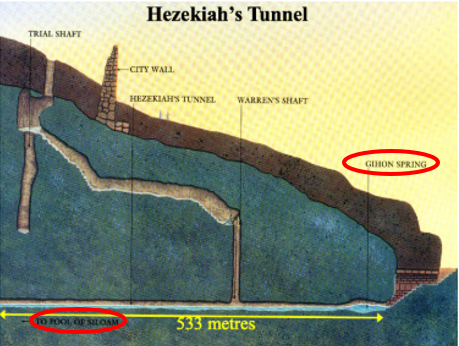
Tunnel in Solid Rock from Gihon Springs outside City
on North to Pool of Siloam Within City on SW
HEZEKIAH'S LEGACY
OF LEADERSHIP
Now the rest of the acts of Hezekiah - Now the rest of implies that his reign included many other deeds and accomplishments beyond what is recorded in this chapter. This is the standard closing formula used in Kings to signal the end of a reign. It implies that what has been recorded so far is selective, not exhaustive. Scripture highlights what is theologically significant, not everything that is historically possible.
And all his might - Might refers to Hezekiah’s strength as a king, including courage, leadership, administrative skill, and resolve, especially under Assyrian pressure. It acknowledges that Hezekiah was not merely pious, but also capable and effective in governance.
and how he made the pool and the conduit and brought water into the city - This points to Hezekiah’s engineering achievement, most famously the tunnel that diverted water from the Gihon Spring into Jerusalem. It reflects foresight, preparation, and wisdom, especially in anticipation of siege (cf. 2 Chr 32:2–4, 30). Water was life itself during a siege. By securing Jerusalem’s water supply, Hezekiah ensured survival without exposure to enemy forces. This phrase highlights quiet, practical faith—trusting God while responsibly using means.
The conduit and pool were constructed by King Hezekiah in anticipation of the coming Assyrian siege in order to assure a water supply for Jerusalem during the siege. The tunnel was rediscovered in the nineteenth century, cut in solid rock under Mt. Zion and the city walls, extending 1780 feet from Gihon Spring to the pool of Siloam. On the tunnel wall, near its exit, was found a Hebrew inscription commemorating the completion of the tunnel and noting the surveying skill of its engineers, who constructed it simultaneously from both ends, meeting in the center.
In his preparations against Sennacherib, Hezekiah ordered his engineers to construct a tunnel that would bring water from the spring of Gihon into the city proper. The tunnel was excavated through solid rock for a distance of almost 600 yards. When it was completed, it emerged just inside the southeastern corner of the old city, where what was later known as the Pool of Siloam was situated. This conduit, referred to in this verse and in 2 Chr. 32:30, was a remarkable engineering accomplishment, for the excavators worked with hand tools from opposite ends, meeting in the center. The tunnel was discovered in 1880 and bore a graffiti inscription detailing the completion of the project.
Donald Wiseman on Hezekiah's tunnel - This tunnel, found in 1880, was cut for 643 metres to cover a direct distance of 332 metres to enable the defenders to fetch water within the protective walls even during a siege.....An inscription in cursive Hebrew of the early eighth century b.c. details the work:
‘When (the tunnel) was driven through while (the quarrymen were swinging their) axes, each man towards the other and, while there was still 3 cubits to be cut through (there was heard) the voice of a man calling to his fellow, for there was a crevice (?) on the right… and when the tunnel was (finally) driven through, the quarrymen hewed each towards the others, axe against axe. Then the waters flowed from the Spring to the Pool for 1,200 cubits and the height of the rock above the head(s) of the quarrymen was 100 cubits.’” (See 1 and 2 Kings: An Introduction and Commentary - Page 308)
are they not written in the Book of the Chronicles of the Kings of Judah - This rhetorical question points readers to another historical source, affirming the historical credibility of the account. It also reminds us that Scripture’s purpose is not mere record-keeping, but spiritual instruction.
2 Kings 20:21 So Hezekiah slept with his fathers, and Manasseh his son became king in his place.
- slept: 2Ki 21:18 1Ki 2:10 11:43 14:31 2Ch 26:23 32:33
- Manasseh: 2Ki 21:1
A GODLY KING
HIS FINAL SLEEP
So - This small word (term of conclusion) signals conclusion and consequence. It ties the verse to everything that precedes, Hezekiah’s deliverance, healing, pride before Babylon, and the prophetic word concerning the future. The narrative now moves from evaluation to closure.
Hezekiah slept with his fathers Hezekiah is one of Judah’s greatest kings. Yet even the most faithful king is not exempt from mortality. The verse deliberately treats him simply as a man whose reign has ended, underscoring that no human leader is permanent. Slept with his fathers is a reverent idiom for death, emphasizing continuity rather than extinction. It suggests physical death without annihilation, reunion with the covenant community of Israel’s past and peaceful completion rather than violent removal
and Manasseh his son became king in his place - The spotlight immediately shifts to the next generation. The verse contains an intentional contrast in seed form of a godly father followed by a son who will become one of Judah’s most wicked kings (2 Kings 21). This juxtaposition warns that spiritual success is not automatically inherited.The verb became king marks an official transfer of authority. Kings rise and fall, but the throne continues. Human reigns are temporary. God’s sovereign rule remains uninterrupted.
Josephus, Antiq. 10:3.1 (below), says Hezekiah lived 54 years and reigned 29 years
1. [An. 699.] When King Hezekiah had survived the interval of time already mentioned, and had dwelt all that time in peace, he died: having compleated fifty four years of his life, and reigned twenty nine.4 But when his son Manasseh, whose mother’s name was Hephzibah of Jerusalem, had taken the Kingdom, he departed from the conduct of his father; and fell into a course of life quite contrary thereto: and shewed himself in his manners most wicked in all respects; and omitted no sort of impiety: but imitated those transgressions of the Israelites, by the commission of which against God they had been destroyed. For he was so hardy as to defile the temple of God, and the city, and the whole countrey. For by setting out from a contempt of God, he barbarously slew all the righteous men that were among the Hebrews. Nor would he spare the Prophets: for he every day slew some of them: till Jerusalem was overflown with blood. So God was angry at these proceedings, and sent Prophets to the King, and to the multitude; by whom he threatened the very same calamities to them, which their brethren the Israelites, upon the like affronts offered to God, were now under. But these men would not believe their words; by which belief they might have reaped the advantage of escaping all those miseries: yet did they in earnest learn, that what the Prophets had told them was true.
Even the greatest lives eventually close, and what follows depends not on legacy alone but on the faithfulness of the next generation, reminding us that spiritual inheritance must be personally embraced, not merely received.