Matthew 3:2
Matthew 3:3
Matthew 3:4
Matthew 3:5
Matthew 3:6
Matthew 3:7
Matthew 3:8
Matthew 3:9
Matthew 3:10
Matthew 3:11
Matthew 3:12
Matthew 3:13
Matthew 3:14
Matthew 3:15
Matthew 3:16
Matthew 3:17
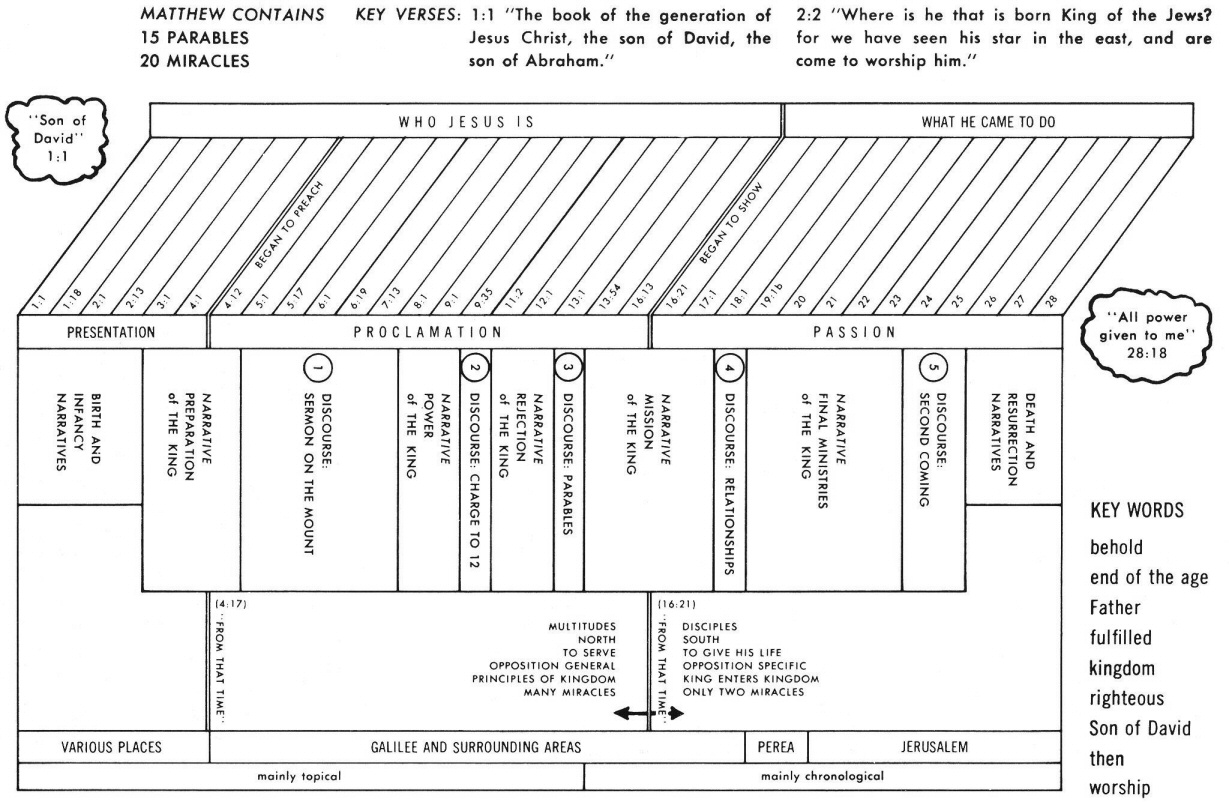
Click chart to enlarge
Charts from Jensen's Survey of the NT - used by permission
Another Chart from Charles Swindoll
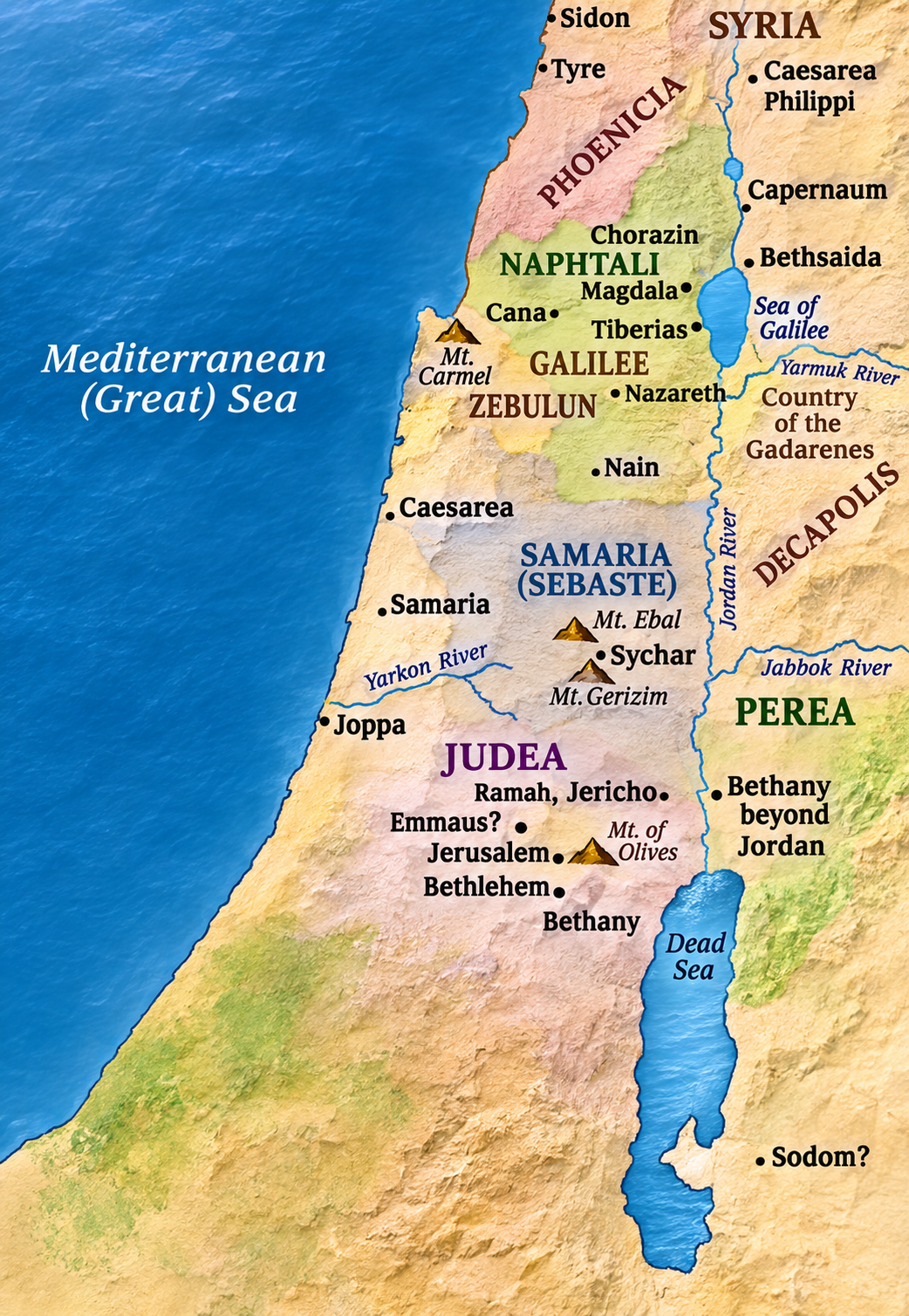
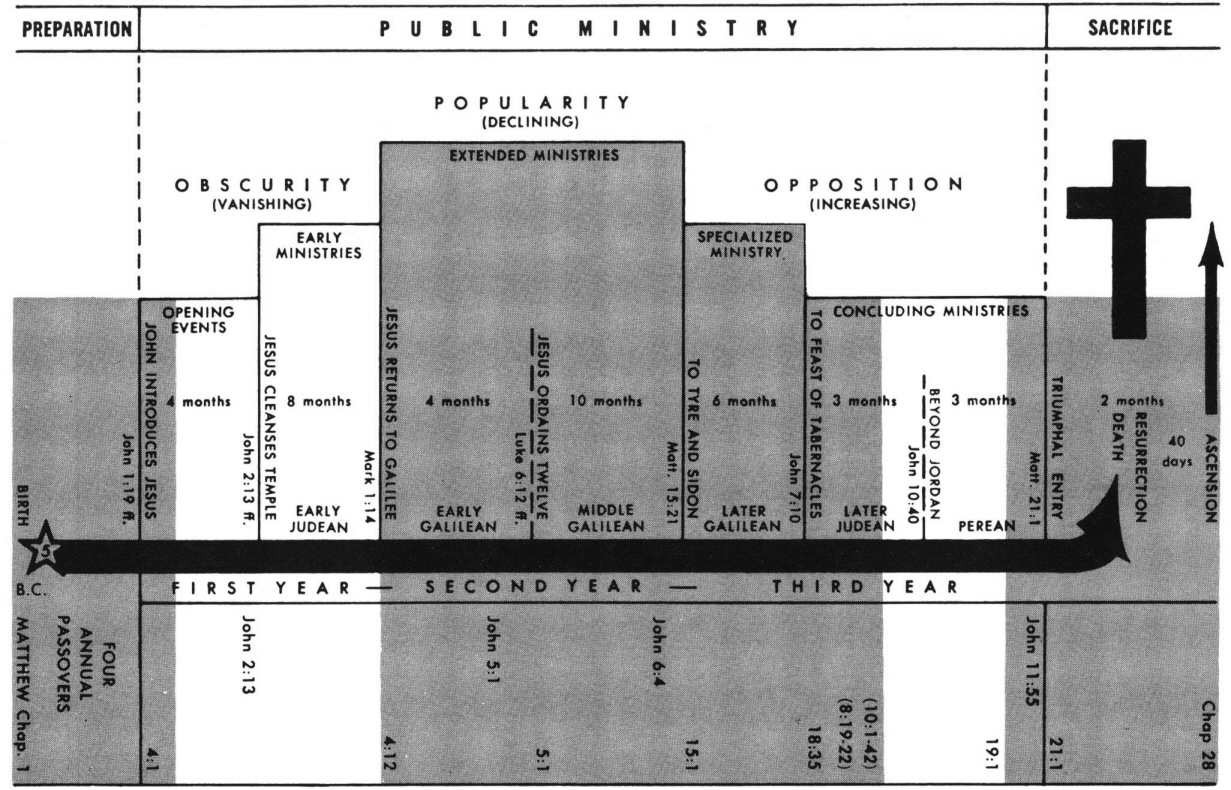
Click chart to enlarge
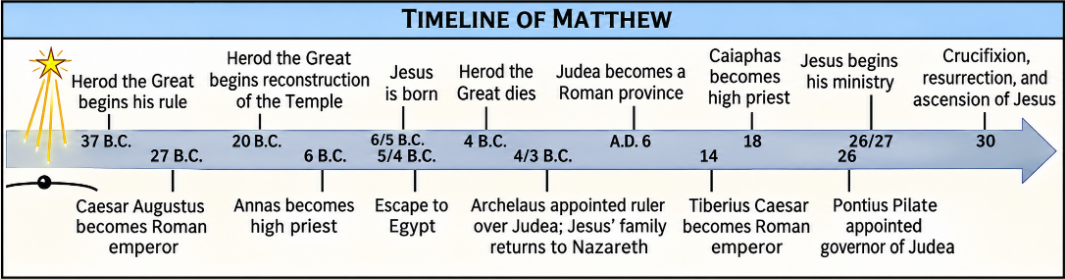
Source: Ryrie Study Bible
Matthew 3:1 Now in those days John the Baptist came, preaching in the wilderness of Judea, saying,
NET Matthew 3:1 In those days John the Baptist came into the wilderness of Judea proclaiming,
GNT Matthew 3:1 Ἐν δὲ ταῖς ἡμέραις ἐκείναις παραγίνεται Ἰωάννης ὁ βαπτιστὴς κηρύσσων ἐν τῇ ἐρήμῳ τῆς Ἰουδαίας
NLT Matthew 3:1 In those days John the Baptist came to the Judean wilderness and began preaching. His message was,
KJV Matthew 3:1 In those days came John the Baptist, preaching in the wilderness of Judaea,
ESV Matthew 3:1 In those days John the Baptist came preaching in the wilderness of Judea,
NIV Matthew 3:1 In those days John the Baptist came, preaching in the Desert of Judea
ASV Matthew 3:1 And in those days cometh John the Baptist, preaching in the wilderness of Judaea, saying,
CSB Matthew 3:1 In those days John the Baptist came, preaching in the Wilderness of Judea
NKJ Matthew 3:1 In those days John the Baptist came preaching in the wilderness of Judea,
NRS Matthew 3:1 In those days John the Baptist appeared in the wilderness of Judea, proclaiming,
YLT Matthew 3:1 And in those days cometh John the Baptist, proclaiming in the wilderness of Judea,
- those - Lu 3:1,2
- John - Mt 11:11 Mt 14:2-14 Mt 16:14 Mt 17:12,13 Mt 21:25-27,32 Mk 1:4,15 Mk 6:16-29 Lu 1:13-17,76 Lu 3:2-20 Joh 1:6-8,15-36 Joh 3:27-36 Ac 1:22 Ac 13:24,25 Ac 19:3,4
- preaching - Isa 40:3-6 Mk 1:7 Lu 1:17
- the wilderness - Mt 11:7 Jos 14:10 Jos 15:61,62 Lu 7:24
- Matthew 3 Resources - Multiple Sermons and Commentaries
Related Passages:
Luke 3:1-2 Now in the fifteenth year of the reign of Tiberius Caesar, when Pontius Pilate was governor of Judea, and Herod was tetrarch of Galilee, and his brother Philip was tetrarch of the region of Ituraea and Trachonitis, and Lysanias was tetrarch of Abilene, 2in the high priesthood of Annas and Caiaphas, the word of God came to John, the son of Zacharias, in the wilderness.
Matthew 11:11 “Truly I say to you, among those born of women there has not arisen anyone greater than John the Baptist! Yet the one who is least in the kingdom of heaven is greater than he.
Isaiah 40:3-6 A voice is calling, “Clear the way for the LORD in the wilderness; Make smooth in the desert a highway for our God. 4“Let every valley be lifted up, And every mountain and hill be made low; And let the rough ground become a plain, And the rugged terrain a broad valley; 5Then the glory of the LORD will be revealed, And all flesh will see it together; For the mouth of the LORD has spoken.” 6A voice says, “Call out.” Then he answered, “What shall I call out?” All flesh is grass, and all its loveliness is like the flower of the field.
Mark 1:7 And he was preaching, and saying, “After me One is coming who is mightier than I, and I am not fit to stoop down and untie the thong of His sandals.
Luke 1:17 “It is he who will go as a forerunner before Him in the spirit and power of Elijah, TO TURN THE HEARTS OF THE FATHERS BACK TO THE CHILDREN, and the disobedient to the attitude of the righteous, so as to make ready a people prepared for the Lord.”
John 1:8 He (John the Baptist) was not the Light, but he came to testify about the Light.
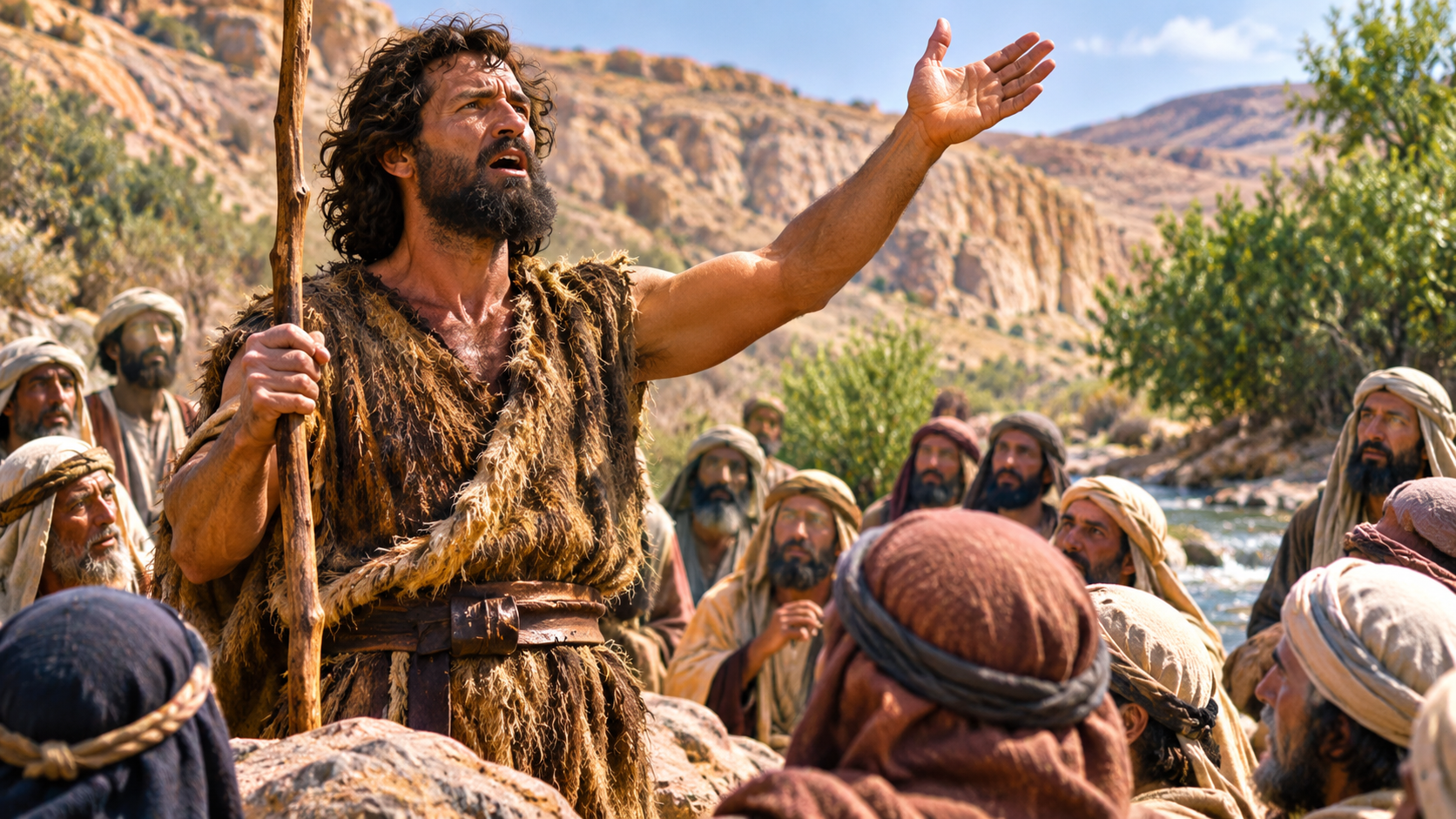
JOHN CAME AS A
DIVINE HERALD
In the first century a herald was a Crier, Messenger or Proclaimer who made a public proclamations for kings, princes and military commanders, which is apropos for John heralded Jesus, who was the rightful King of the Jews (Mt 2:2), the prophesied Prince of peace (Isaiah 9:6) and the coming conqueror as King of kings (Rev 19:11-16). The kerux served as a close confidant of the king, and would travel throughout the realm announcing to the people whatever the king wished to make known. John understood his purpose for existence and stuck with the divine plan for his life. Certain qualities were required of heralds. They must have powerful voices, so voice auditions were often held. Also they had to be capable of calming down an unruly mob, in order to faithfully communicate the command. An honest disposition was also required, as a protection against the exaggeration of a royal decree. Furthermore, they could make no additions or subtractions from the received message. Later these heralds were also used to declare the message of a Greek deity or a religious oracle.
🙏 THOUGHT - Do you know God's plan for your life? Paul writes of every believer that "we are His workmanship, created in Christ Jesus for good works, which God prepared beforehand so that we would walk in them. " (Eph 2:10). So clearly our goal is to discern the "good works" God has pre-prepared for us to walk in!
Now in those days - This is a transition phrase that simply tells the reader the story is moving on to a new episode, without saying how much time has passed. The immediately preceding passage in Matthew 2:23 says Jesus "came and lived in a city called Nazareth." The very next verse jumps to John’s ministry (Mt 3:1). Between the two lie roughly 25 to 30 years, because Jesus was about thirty when He began His ministry: “When He began His ministry, Jesus Himself was about thirty years of age, being, as was supposed, the son of Joseph, the son of Eli,” (Lk 3:23). So “those days” means, in effect, “during the time Jesus was living in Nazareth.” In sum now in those days works as a curtain-raiser so to speak rather than a specific date. Matthew is setting a scene, not giving a chronology.
D A Carson agrees that in those days is "a general term that reveals little chronologically but insists that the account is historical." (Expositor's Bible Commentary).
Luke's passage does give us a general sense of when John came on the scene writing "in the fifteenth year of the reign of Tiberius Caesar...the word of the Lord came to John...so he began saying to the crowds...." (Lk 3:1, 3, 7)
The phrase in those days is a common Old Testament formula for starting a new section of a story. A striking parallel is Moses, who also left his childhood behind in a single phrase: “Now it came about in those days, when Moses had grown up, that he went out to his brethren and looked on their hard labors; and he saw an Egyptian beating a Hebrew, one of his brethren” (Ex 2:11). Mark uses the same loose phrase for Jesus’ baptism: “In those days Jesus came from Nazareth in Galilee and was baptized by John in the Jordan” (Mk 1:9). For timing, Luke is the anchor. Luke 3:1-2 dates John’s ministry to “the fifteenth year of the reign of Tiberius Caesar,” about AD 28–29 (or AD 26–27 if a co-regency is counted). He adds the names of Pilate, Herod Antipas, Philip, Lysanias, Annas and Caiaphas.
In those days - 51x - Gen. 6:4; Exod. 2:11; Deut. 17:9; Deut. 19:17; Jos. 20:6; Jdg. 17:6; Jdg. 18:1; Jdg. 19:1; Jdg. 20:27; Jdg. 20:28; Jdg. 21:25; 1 Sam. 3:1; 1 Sam. 28:1; 2 Sam. 16:23; 2 Ki. 10:32; 2 Ki. 15:37; 2 Ki. 20:1; 2 Chr. 32:24; Neh. 6:17; Neh. 13:15; Neh. 13:23; Est. 1:2; Est. 2:21; Isa. 38:1; Jer. 3:16; Jer. 3:18; Jer. 5:18; Jer. 31:29; Jer. 33:15; Jer. 33:16; Jer. 50:4; Jer. 50:20; Ezek. 38:17; Dan. 10:2; Joel 2:29; Joel 3:1; Zech. 8:6; Zech. 8:23; Matt. 3:1; Matt. 24:19; Matt. 24:38; Mk. 1:9; Mk. 8:1; Mk. 13:17; Mk. 13:24; Lk. 2:1; Lk. 5:35; Lk. 9:36; Lk. 21:23; Acts 2:18; Rev. 9:6
John the Baptist (baptistes) came (paraginomai) (see summary of John the Baptist below) - Moffatt translates it "came on the scene," Came (see full note below) is the idea of he came onto the public scene and what a scene he made - suddenly appearing, strangely dressed (Mt 3:4), strange diet, strong preaching and calling Jews to be baptized (something usually done only for Gentile proselytes). Mark's presentation of the prophet is even more sudden Mk 1:4 stating that "John the Baptist appeared in the wilderness preaching a baptism of repentance for the forgiveness of sins."
Bob Utley - "John" This was the shortened form of the name "Johanan", which meant "YHWH is gracious" or "gift of YHWH." His name was significant because, like all biblical names, it pointed toward God's purpose for his life. John was the last of the Old Testament prophets. There had not been a prophet in Israel since 2 Chronicles or Malachi, around 430-400 B.C. His very presence caused great spiritual excitement among the faithful Jewish people
William Hendriksen comments that "If John, like Jesus (Luke 3:23), was about thirty years of age when he made his first public appearance, then, since the Baptist was about six months older than Jesus (Luke 1:26, 36), and since Jesus probably began his ministry in late A.D. 26 or early 27, it was likely during the summer of that same year that John had begun to address the multitudes." (BORROW BNTC-Matthew page 196)
Came (paraginomai) is in the present tense (paraginetai, “comes”), which is a historical present. Matthew narrates a past event in the present tense to make it vivid, as if John is stepping onto the scene before our eyes. This might be paraphrased “In those days John the Baptist arrives...” The historical present describes a past event as though it were actually taking place: e.g., "they spoke to him about her" (Mark 1:30). Here the present is a pictorial tense, displaying the action vividly before our eyes. In English we often use the historical present when recounting personal experiences such as "then he says to me". The Gospel of Mark frequently uses historical present - see peculiarities of Mark. Matthew wants us to picture John coming forward, making his dramatic appearance on the desert stage! As Robertson says Came "is the historical present and calls for a vivid imagination on the part of the reader."
Darrell Bock on John the Baptist - Luke 3:1–20 contains much uniquely Lucan material. Only Luke details the content of John the Baptist’s teaching (Luke 3:10–14). Only Luke cites Isa. 40:4–5 (Luke 3:4–6). The lengthened citation (Matthew and Mark cite only Isa. 40:3) means that Jesus’ coming offers the opportunity of salvation for all. Only Luke mentions the imprisonment of John so early in the account (Luke 3:19–20). But there are also traditional materials that have clear parallels elsewhere. The warning about judgment to the Jewish leaders has a clear parallel (Luke 3:7–9; Matt. 3:7–10). The promise of the Mightier One to come has conceptual parallels (Luke 3:15–17; Matt. 3:11–12; Mark 1:7–8). Both old and fresh material describe John’s ministry of preparation....This pericope (Lk 3:1-6) has a twofold purpose: to place Jesus’ ministry in the midst of world history (Lk 3:1–2a) and to set the ministry of John the Baptist in the midst of OT hope (Lk 3:4–6). The word of God comes to John in the wilderness as his ministry renews God’s direct activity for people (Lk 3:2b–3). By beginning in the wilderness, the account picks up where the infancy section left off with John (Lk 1:80)....External ancient sources testify to the existence of John the Baptist. Josephus makes explicit mention of him (ED: see interesting discussion of John the Baptist and Josephus). As Fitzmyer (1981: 451) notes, there is no contradiction between the portrait of Josephus and the portrait of the Gospels. Josephus stresses the political fears that John aroused in Herod (ED: HEROD ANTIPAS RULED AS TETRARCH OVER GALILEE AND PEREA FROM 4BC TO 39AD), while the Gospels focus on his moral preaching, even against the political leadership. (See Luke - Baker Exegetical Commentary)
Baptist (910)(baptistes from baptizo = to baptize) means one who dips or who baptizes and is always used as the surname of John as the "Baptizer" the forerunner of Messiah. Matt. 3:1; Matt. 11:11; Matt. 11:12; Matt. 14:2; Matt. 14:8; Matt. 16:14; Matt. 17:13; Mk. 6:25; Mk. 8:28; Lk. 7:20; Lk. 7:33; Lk. 9:19. Not used in the Septuagint. As noted Jews had the rite of baptism for Gentile proselytes, so here we see John in essence treating the Jews as Gentiles! John is a bold because he is filled with the Spirit Who enables bold declaration!
John the Baptist - The NAS uses this specific designation 15x and all but 3 use the noun baptistes with 3 in Mark using the verb baptizo- Matt. 3:1; Matt. 11:11; Matt. 11:12; Matt. 14:2; Matt. 14:8; Matt. 16:14; Matt. 17:13; Mk. 1:4 (baptizo); Mk. 6:14 (baptizo); Mk. 6:24 (baptizo); Mk. 6:25; Mk. 8:28; Lk. 7:20; Lk. 7:33; Lk. 9:19
Bob Utley - "the Baptist" Baptism was a common rite among Jews of the first and second century - preparation for worship at the temple (i.e., cleansing rite) and the self baptism of proselytes. If someone from a Gentile background were to become a full child of Israel, he had to accomplish three tasks: circumcision, if male, self-baptism by immersion, in the presence of three witnesses and sacrifice in the temple
In sectarian groups of first century Palestine, such as the Essenes, baptism was apparently a common, repeated experience. However, to mainline Judaism, John's baptism of repentance would have been humiliating for a natural child of Abraham to undergo a proselyte ritual.
Some OT precedents can be cited for ceremonial washing. - as a symbol of spiritual cleansing (cf. Isa. 1:16) or as a regular ritual performed by the priests (cf. Exod. 19:10; Leviticus 15) It should be noted that all other baptisms in first century Jewish culture were self-administered. Only John's called for him to administer this rite. Apparently John made a spiritual evaluation of the candidate's spiritual qualifications which evidenced a personal repentance (cf. Matt. 3:7-10).
Came (3854)(paraginomai from para = beside + ginomai = to come to exist) means literally to become near and hence to come on the scene with various nuances - (1) most commonly it means to come or arrive at a place, reach a place, be present. BDAG adds "to be in movement so as to be present at a particular place" It often indicated an official arrival as the magi in Mt 2:1 (e.g., Mt 3:13; Mk 14:43, Lk 7:4, 20, Lk 8:19, Lk 11:6; Lk 22:52; Ac 9:26, 39; Acts 13:14; Acts 15:4; Acts 20:18; Acts 24:17, 24; 1 Cor 16:3); (2) to make a public appearance, show up publicly at a place; the arrival or public appearance of an official personage (Mt 3:1, Lk 12:51 = "Do you suppose that I came to grant peace on earth?", Heb 9:11 = "when Christ appeared as a high priest of the good things to come"); (3) stand by, to come to the aid of (2 Ti 4:16). (4) To come against someone usually with a hostile purpose ("who had come" and "against" = epi - upon - Lk 22:52).
Paraginomai 36x in 36v - Matt. 2:1; Matt. 3:1; Matt. 3:13; Mk. 14:43; Lk. 7:4; Lk. 7:20; Lk. 8:19; Lk. 11:6; Lk. 12:51; Lk. 14:21; Lk. 19:16; Lk. 22:52; Jn. 3:23; Jn. 8:2; Acts 5:22; Acts 5:25; Acts 9:26; Acts 9:39; Acts 10:33; Acts 11:23; Acts 13:14; Acts 14:27; Acts 15:4; Acts 17:10; Acts 18:27; Acts 20:18; Acts 21:18; Acts 23:16; Acts 23:35; Acts 24:17; Acts 24:24; Acts 25:7; Acts 28:21; 1 Co. 16:3; 2 Tim. 4:16; Heb. 9:11
Paraginomai is common in the Septuagint so the following are only a sample of over 170 uses - Gen. 14:13; Gen. 26:32; Gen. 32:20; Gen. 35:9; Gen. 45:19; Gen. 50:10; Gen. 50:16; Exod. 2:16; Exod. 2:17; Exod. 2:18; Exod. 8:24; Exod. 16:35; Exod. 18:6; Exod. 18:12; Exod. 18:15; Exod. 19:9; Exod. 20:20; Exod. 36:4; Lev. 14:48; Num. 9:6; Num. 10:21; Num. 14:36; Num. 20:5; Num. 20:22; Num. 21:7; Deut. 18:6; Jos. 5:14; Jos. 9:8; Jos. 9:12; Jos. 11:5; Jos. 18:8; Jos. 21:45; Jos. 22:15; Jos. 24:11; Jdg. 5:28; Jdg. 6:5; Jdg. 8:15; Jdg. 9:31; Jdg. 9:37; Jdg. 11:18; Jdg. 13:9; Jdg. 18:2; Jdg. 18:7; Jdg. 18:8; Jdg. 19:10; Jdg. 20:34; Jdg. 21:2; Ruth 1:19; Ruth 1:22
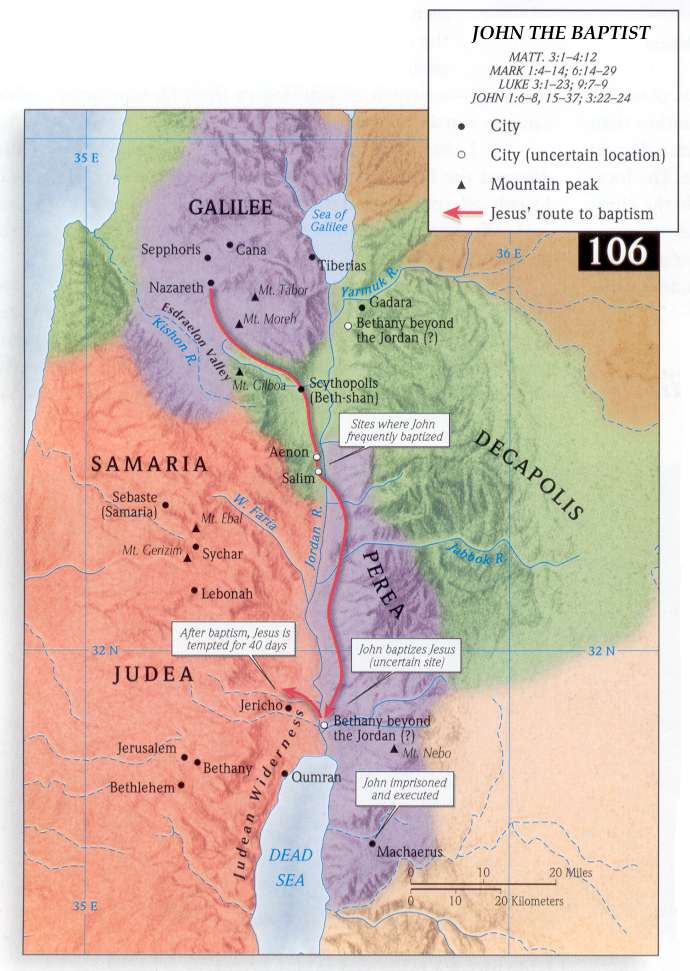
John the Baptist's Ministry - click to enlarge
From Holman Bible Atlas (available for purchase in digital or Hardcover)
© 1998 B&H Publishing Group used by permission.
Please do not reproduce.
John's public preaching ended nearly four hundred years of prophetic silence. As Simmons says "In this sense his message and ministry marked the culmination of the law and the prophets, but heralded the inbreaking of the kingdom of God (Matthew 11:12 ; Luke 16:16). So John was truly a transitional figure, forming the link between the Old and New Testaments. He spans the ages with one foot firmly planted in the Old Testament and the other squarely placed in the New."
John MacArthur comments that "the coming of the herald (John the Baptist) signified the coming of the King. The beginning of John’s ministry signaled the beginning of Jesus’ ministry (see Acts 10:37–38)....Everything about John the Baptist was unique and amazing—his sudden public appearance, his life-style, his message, his baptizing, and his humility. He was born to a mother who was barren. He was a priest by heritage but became a prophet. He forsook his earthly father’s ministry for the sake of his heavenly Father’s. After spending most of his life in the desert, at the right moment God spoke to his heart, and he began to thunder out the message God had given him in that desert-to announce the coming of the King." (SEE Matthew Commentary)
William Hendriksen has a poignant picture of the prophet's preaching - His message was not prolix (unduly prolonged) but pithy, not soothing but soul-searching, not flattering but frightening, at least to considerable degree. He was a preacher of imminent doom (see Mt 3:7, 10), a catastrophe that could be avoided only by a, radical turnabout of mind and heart. The gist of his message is given here in verse 2. (BORROW BNTC-Matthew)
Preaching (kerusso - present tense - continually) in the wilderness (eremos) of Judea, saying - Luke 3:2 says "the Word of God came to John" and presumably this is the Word that he was preaching. All preachers should do the same. Today preachers hear "the Word of God" from the Bible, so any preaching that is not preaching from the Bible is not likely to be a Word from God! With his last words Paul commanded Timothy "Preach the Word." (2 Ti 4:2). John did not pick the most populous, popular venue for his preaching tour! In fact John almost certainly did not choose, but surrendered to the leading of the Spirit, Who later led Jesus to the wilderness also!
🙏 THOUGHT Are we willing to go where God sends us, even if it seems to be like a "wilderness" to us? Do we have an Isaiah 6 mentality of “Here am I. Send me!” (Isa 6:8)?
A T Robertson quips that "he was also the Preacher, heralding his message out in the barren hills at first where few people were, but soon his startling message drew crowds from far and near. Some preachers start with crowds and drive them away!" As an aside, one of the most rapidly growing churches in the Austin area is a Bible believing church where the pastor preaches the pure milk of the Word unapologetically! He even says things like "I know that many of you listening to me are not genuine believers, but you are only professing Christ!" That sounds a little like what John the Baptist would say! And yet the crowds were coming to hear him! Pastor, do you want to see your church grow? Then begin to preach exposiional sermons and they will come to hear and hopefully be transformed.
William Hendriksen on wilderness - (John the Baptist ) was preaching in “the wilderness of Judea,” a term indicating the rolling bad lands between the hill country of Judea to the west, and the Dead Sea and lower Jordan to the east, stretching northward to about the point where the Jabbok flows into the Jordan. It is indeed a desolation, a vast undulating expanse of barren chalky soil covered with pebbles, broken stones and rocks. Here and there a bit of brushwood appears, with snakes crawling underneath (see verse 7). It is clear, however, from Mt. 3:5 (cf. Jn 1:28) that the terrain of John’s activity extended even to the east bank of the Jordan. It included the entire region around—i.e., on both banks of this part of—the Jordan. (Borrow Exposition of the Gospel According to Matthew. page 196)
On the map above (click to enlarge) the Judean wilderness was the region immediately west of the Dead Sea and was an utterly barren desert. John probably preached near the northern end of this region, close to where the Jordan flowed into the Dead Sea (Lk 3:6). The wilderness was probably a full day’s journey from Jerusalem and certainly would be an unusual location to herald the coming King, but then God's way are not man's ways...
“For My thoughts are not your thoughts, Nor are your ways My ways,” declares the LORD. 9 “For as the heavens are higher than the earth, So are My ways higher than your ways And My thoughts than your thoughts. 10 “For as the rain and the snow come down from heaven, And do not return there without watering the earth And making it bear and sprout, And furnishing seed to the sower and bread to the eater; 11 So will My word be which goes forth from My mouth; It will not return to Me empty, Without accomplishing what I desire, And without succeeding in the matter for which I sent it. (Isaiah 55:8-11).
Preaching (proclaiming, heralding) (2784)(kerusso from kerux/keryx = a herald - one who acts as the medium of the authority of one who proclamation he makes; kerugma = the thing preached or the message) means to proclaim (publicly) or to herald or act as a public crier - the town official who would make a proclamation in a public gathering. Kerusso was used of the official whose duty it was to proclaim loudly and extensively the coming of an earthly king, even as the gospel is to clearly announce the coming of the King of kings and Lord of lords (Rev 19:16)!
A M Hunter says kerusso "In the New Testament the verb does not mean 'to give an informative or hortatory or edifying discourse expressed in beautifully arranged words with a melodious voice; it means to proclaim an event...." (BORROW The Unity of the New Testament - Page 20)
The imperial herald would enter a town on behalf of the Emperor and publicly proclaim the message his Sovereign had ordered him to give. He did so with such formality, gravity and authority that the people understood the message must be heeded! Think about this in regard to the gospel of God instead of the decree of a man: “For this reason we also constantly thank God that when you received the word of God which you heard from us, you accepted it not as the word of men, but for what it really is, the word of God, which also performs its work in you who believe” (1 Th 2:13). The herald gave the people exactly what the Emperor told him to give, nothing more and nothing less. He did not dare add to the message or take away from it. So too Paul charged Timothy: “preach [kerusso] the word; be ready in season and out of season; reprove, rebuke, exhort, with great patience and instruction” (2 Ti 4:2).
In Mt 3:1 kerusso is a present participle: John came continually proclaiming his message. Jesus pictured the herald’s task vividly: “What I tell you in the darkness, speak in the light; and what you hear whispered in your ear, proclaim upon the housetops” (Mt 10:27). And He promised that the herald’s work will continue until the end: “This gospel of the kingdom shall be preached in the whole world as a testimony to all the nations, and then the end will come” (Mt 24:14).
KERUSSO IN MATTHEW- Matt. 3:1; Matt. 4:17; Matt. 4:23; Matt. 9:35; Matt. 10:7; Matt. 10:27; Matt. 11:1; Matt. 24:14; Matt. 26:13.
Wilderness (desolate, desert)(2048)(eremos) when used as an adjective, normally describes places which are abandoned, desolate, or unpopulated. The wilderness referred to in the Gospels extended from the hill country of Judah on the west to the Dead Sea on the east, and north into the Jordan River valley (click the map above to enlarge and see the Judean Wilderness). "The wilderness was "indeed a desolation, a vast undulating expanse of barren chalky soil covered with pebbles, broken stones and rocks. Here and there a bit of brushwood appeared, with snakes crawling underneath (Mt 3:7)" (Hendriksen BORROW BNTC-Matthew)
In a way eremos in this context is a double entendre because John was himself in a literal wilderness crying and pointing out to the Jewish nation the way out of the spiritual wilderness and darkness which had enshrouded the nation of Israel for centuries.
Robertson adds "There were some people scattered over the barren cliffs. Here John came in close touch with the rocks, the trees, the goats, the sheep, and the shepherds, the snakes that slipped before the burning grass over the rocks."
EREMOS IN MATTHEW - Matt. 3:1; Matt. 3:3; Matt. 4:1; Matt. 11:7; Matt. 14:13; Matt. 14:15; Matt. 23:38; Matt. 24:26.
The Wilderness - R W Funk - Journal of Biblical Literature - Sept, 1959 (allows you to read up to 6 articles free each month)
F B Meyer - In those days cometh John the Baptist.
The Evangelist is fond of the present tense, “cometh.” Yes, these records are true to all time. You tell me that they happened nineteen centuries ago. Certainly; but they happened yesterday, and are happening today. Remember that He is the same yesterday, today, and for ever. He was, and is, and is to come. Christ was born into the world, but He is always being born into the hearts of men in Regeneration. John preceded and announced his advent in the wilderness of Judaea; and he is always preparing his way into the hearts and lives of men. It is doubtful whether Jesus ever comes into the heart of mature manhood without the previous work of a John the Baptist. Of days of conviction of sin, of remorse, of repentance, we may truly say, “In those days cometh John the Baptist.”
John the Baptist is sadly needed today. Much of what we call Christianity is but Christianized heathenism. It glozes over covetousness, luxurious self-indulgence, compliance with fashion and worldliness; it admits into its high places men who thrive on the oppression of the poor; it condones the oppression of the native races, the sale of opium and spirits, the shameless traffic in impurity; it rears the ideals of the world in the place of the changeless cross of the slain Christ with its divine sorrow and blood. Ah, we need that John the Baptist should come with his stern words about the axe, the winnowing-fan, and the fire. Nothing less will avail to prepare the way for a new coming of Christ.
Each age has had its John the Baptist. Now St. Bernard; now Savonarola; now John Knox. With sonorous, ringing voice the herald has prepared the way of the King: “He cometh to judge the world!”
Michael Andrus - There are probably a number we could consider, but I would like to ask us to focus on the fact that God is more interested in our availability than our ability, in our character than our charisma, in our commitment than our conformity.
I think there are many Christians who fail to live up to their potential because they feel they are so different or so inadequate that they just can’t accomplish anything significant for God. John the Baptizer’s story tells me that God can use anyone–even the person who is weird by worldly standards, or the one who is a non-comformist by nature. Some non-conformists, of course, are really egotists trying to make a name for themselves by their bizarre behavior or dress. That’s not what I’m talking about. I’m talking about the person who is different because he or she is just different. If God has made you in such a way that you stand out from all the cookie-cutter personalities around you, celebrate that uniqueness and make yourself available for that unique ministry God has created just for you.
And one final thought–let’s not forget the principal message of this strange Advance Team of one: “Behold the Lamb of God who takes away the sin of the world!” (John 1:29). John’s obsession was to point people to Jesus. May that be ours as well.
Unlikely Giants
Among those born of women there is not a greater prophet than John the Baptist. — Luke 7:28
Today's Scripture : Matthew 3
Dwight L. Moody was greatly moved by a lay preacher’s statement that the world has yet to see what God can do through a person fully yielded to Him. Because an attitude of submission is far more important than outward appearance, some unlikely people have become spiritual giants.
The first time I met Pete, he had a 2-day growth of stubble, a missing front tooth, and a suit that looked as if he had slept in it. But I discovered that God was using him in an unusual way to reach disadvantaged people.
Philip Yancey described the late Bill Leslie as “disheveled,” “disorganized,” and one who “laughed uproariously at his own (bad) jokes.” But he points out that as pastor of the LaSalle Street Church in Chicago, this man had led many people to Christ and brought great social and economic changes to that part of the city. This unlikely spiritual giant died at age 60 after three decades of work in the inner city.
Pete and Bill remind me of John the Baptist. Although he lived as a recluse and wore a rough, camel’s-hair garment, he had a ministry to thousands. Jesus called him the greatest of the prophets (Lk. 7:28).
God uses ordinary people, and He wants to use you. Serve Him humbly, zealously, and expectantly. By: Herbert Vander Lugt (Reprinted by permission from Our Daily Bread Ministries. Please do not repost the full devotional without their permission.)
True greatness does not lie with those
Who strive for worldly fame;
It lies instead with those who choose
To serve in Jesus’ name. —DJD
God uses those who are small in their own eyes.
Related Resources on John the Baptist:
- G J Goldberg - John the Baptist and Josephus
- Who was John the Baptist in the Bible?
- Did John the Baptist lose his faith in Jesus as the Messiah (Matthew 11:3; Luke 7:19)?
- What was the meaning and importance of the baptism of John the Baptist?
- Why did John the Baptist refer to the Pharisees as a brood of vipers?
- Whyte's Dictionary of Biblical Characters - John the Baptist
- Baker Evangelical Dictionary John the Baptist
- Easton's Bible Dictionary John the Baptist
- Fausset Bible Dictionary John the Baptist
- Hastings' Dictionary of the Bible John the Baptist
- Hastings' Dictionary of the NT John the Baptist
- Watson's Theological Dictionary John the Baptist
- International Standard Bible Encyclopedia John the Baptist
- Kitto Biblical Cyclopedia John the baptist
- The Jewish Encyclopedia John the Baptist
Warren Wiersbe - John the Baptist was a model preacher. He was a road builder who prepared the way for the Lord (Mt 3:3; Isa. 40:3), and an axman who got to the root of sin and exposed it (Mt 3:10). He was not intimidated by people, nor was he afraid to preach about judgment (Mt 3:12). He was obedient to his Lord and magnified Him in all things (John 3:30). (BORROW With the Word)
John Broadus gives a good summary of John - John the Baptist.—The most probable date for the beginning of the Baptist’s ministry is A. D. 26, say in the spring. (Comp. on Mt 2:19.) The name John (Johanan = Jehovah graciously gave - ED: Others say "Gift of Jehovah") had become common since the time of the popular ruler John Hyrcanus (died B. C. 106); thirteen persons of that name are mentioned in Josephus; and in the New Testament, besides the Baptist and the Evangelist, we meet with John Mark (Acts 12:12), and John of the high-priestly family. (Acts 4:6.) John the forerunner was well known to Matthew’s first readers as the ‘Baptist,’ or Baptizer (comp. 14:2, 8); we find Josephus also (“Ant.,” 18, 5, 2) mentioning him as “John, who was surnamed Baptist.” This name, the Baptizer, was of course given him in consequence of the remarkable rite he performed, which attracted universal attention, and was repeatedly used as the characteristic representative of his whole work (see on Mt 21:25).—The circumstances connected with John’s birth are given only by Luke. Of his history since childhood we only know that he ‘was in the deserts till the day of his shewing unto Israel.’ (Luke 1:80.) His father would be anxious to give to the child of such hopes the best priestly education, and it is probable that he retired to ‘the deserts’ after the death of his parents, who were of advanced age at the time of his birth. Such a step would be natural only when grown, or nearly so. In the wild region between Jerusalem and the Dead Sea, he probably spent his time in religious meditation, ripening for his great mission. Yet that he knew human nature, and observed the men of his own time, appears from Luke 3:10–14. In this same wild region dwelt the Essenes (see on Mt 3:7), and here also Josephus (“Life,” 2) locates the teacher Banus, with whom he spent three years in seclusion, at a period about thirty years later than John’s public appearance. It had been appointed (Luke 1:15) that from the beginning of John’s life he should not ‘drink wine or strong drink,’ i. e., should live as a Nazirite (Nu 6:1–21), implying extraordinary and lifelong consecration to God’s service. A child of the mountains, and living a temperate life in the open air, he probably became strong in body, as well as ‘grew strong in spirit’ (Luke 1:80.) Comp. on Mt 3:4. It is probable (see Mt 3:13) that he began his ministry when about thirty years old. “This protracted period of private discipline and preparation in the life both of Christ and his forerunner, is in striking contrast with our own impatience even under the most hurried superficial processes of education.” (Alexander).—That a priest should be called to be a prophet was not strange; comp. Jeremiah and Ezekiel.—For a further account of John, see throughout this chapter, and on Mt 4:12; Mt 9:14 ff.; Mt 11:2–19; Mt 14:1–13; Mt 17:10–13; Mt 21:25, 32. Köhler: “Though the historical information is very limited, there are few persons of whom we can form so clear and lively a conception.… An imposing figure, in whose posture and traits of countenance were depicted iron will, and deep, holy earnestness, yet without passing into hardness. In general, John may be called a classical example of the manifestation of love in the garb of severity. We cannot doubt his profound compassion for the unhappy condition of his people, sunken in sin and exposed to judgment, although it would hardly occur to us to conceive of him as weeping, like the Lord Jesus, over the coming fate of Jerusalem.” (Matthew 3 Commentary)
A number of passages concerning John the Baptist can be somewhat enigmatic or confusing. So here is a good summary by William Simmons...
Apart from Jesus Christ, John the Baptist is probably the most theologically significant figure in the Gospels. As was the case with Jesus, his birth was announced by an angel and accompanied by divine intervention (Luke 1:5-25), and the birth itself is meticulously recorded (Luke 1:57-80) John's birth not only parallels that of Jesus, but echoes the momentous occasion of the birth of Isaac to Abraham and Sarah (Genesis 17:15-22 ; Genesis 18:9-15; Genesis 21:1-7). John is clearly a pivotal figure in the salvation history of God.
Although his formative years were lived in obscurity in the desert (Luke 1:80), his public ministry ended nearly four hundred years of prophetic silence. John was that voice crying in the wilderness preparing the way for the coming Messiah (Isaiah 40:3 ; Matthew 3:3 ; Mark 1:2-3; Luke 3:3-6). In this sense his message and ministry marked the culmination of the law and the prophets, and heralded the inbreaking of the kingdom of God (Matthew 11:12 ; Luke 16:16). So John was truly a transitional figure, forming the link between the Old and New Testaments. He spans the ages with one foot firmly planted in the Old Testament and the other squarely placed in the New.
The central theme of his ministry was, "Repent, for the kingdom of heaven is near" (Matthew 3:2NIV). He was called "The Baptist" because his practice was to baptize those who responded to the message he proclaimed and sincerely repented of their sins (Matthew 3:1; Mark 6:14; Luke 7:20).
John was an end-times prophet. He conducted his ministry with an eschatological authority that demanded immediate action. He taught that judgment is at hand. The axe is laid to the roots and God will thoroughly purge his threshing floor (Matthew 3:10-12 ; Luke 3:9,17). And the authenticity of repentance was evidenced in very practical terms: share with those in need, eliminate graft, and prohibit extortion (Luke 3:11-14).
John's lifestyle was as austere as his message. He was an ascetic living in the wilderness, clothed in camel hair and subsisting on locusts and wild honey (Matthew 3:4 ; Mark 1:6). Unlike Jesus, he expected people to come to him, rather than he going to them (Matthew 3:5).
John was no "crowd pleaser." He willingly confronted the hypocrisy of the religious establishment (Matthew 3:7 ; Luke 3:7). He did not hesitate to expose the immorality of Herod and chose to die a martyr's death rather than compromise his convictions (Matthew 14:3-12 ; Mark 6:17-29).
All of these characteristics portray John as a fiery prophet proclaiming the apocalyptic message of God. Indeed, Luke says that John came "in the spirit and power of Elijah" (Luke 1:17) (ED: see Was John the Baptist really Elijah reincarnated? ). He goes on to allude to Malachi 4:5, which states that Elijah will return "before that great and dreadful day of the Lord." In fact, some contemporaries of John, priests and Levites sent from Jerusalem (Jn 1:19), inquired if he were Elijah (John 1:19-21). The belief that Elijah would return and prepare the way of the Lord can be traced to Malachi 3:1, Malachi 4:5. Such belief is also found in the extra-biblical accounts (Apocrypha) of Sirach 48:10,2NRSV Esdras 6:2NRSV. The Gospels also indicate that many believed that Elijah would come first, and then the Christ (Matthew 11:14 ; Matthew 17:10 ; Mark 6:15 ; Mark 9:11 ; Luke 9:8). John flatly denied that he was Elijah reincarnated (John 1:21,25). Nevertheless Jesus affirmed that Elijah must come first and that he had come in the person of John the Baptist (Matthew 17:11-13 ; Mark 9:12-13). John fulfilled Malachi's prophecy in a spiritual sense, rather than in a literal way.
ADDITIONAL NOTES ON JOHN'S RELATION TO ELIJAH
JOHN MACARTHUR - The question about his being Elijah introduces some important truth. At every orthodox Passover ceremony even today a cup is reserved at the table for Elijah. At the circumcision of orthodox Jewish baby boys a chair is placed for Elijah. The anticipation is that, if Elijah would ever come and sit in the chair or drink from the cup, the Messiah’s arrival would be imminent. That belief is based on Malachi 4:5–6, in which the prophet predicts, “Behold, I am going to send you Elijah the prophet before the coming of the great and terrible day of the Lord. And he will restore the hearts of the fathers to their children, and the hearts of the children to their fathers.”....The Elijah prophesied by Malachi was not to be a reincarnation of the ancient prophet. Rather, as the angel of the Lord told Zacharias regarding his son, John the Baptist, the prophesied forerunner would come "in the spirit and power of Elijah" (Luke 1:17). John would not be the ancient prophet come back to earth but would minister in much the same style and power as had Elijah. In that way, as Jesus had told the disciples at least once before, "[John] is Elijah, who was to come" (Matt. 11:14).Why then, some wonder, did John himself disclaim being Elijah? When the priests and Levites from Jerusalem asked him, '"Are you Elijah?'... he said, "I am not'" (John 1:21). He denied being Elijah because, though he knew of the prophecy of Luke 1, like Jesus, he realized the question was about a literal, reincarnated Elijah. And, though John did not share Jesus' omniscience, he doubtlessly also realized that the questioning of the priests and Levites originated from unbelief, not sincere faith. They were not interested in learning the truth but of finding a way to discredit John, just as they would later seek ways to discredit the One whose way he came to prepare. (See Matthew Commentary - Page 52)
ADDITIONAL NOTE FROM HENDRIKSEN on the meaning of in the Spirit and power of Elijah asking "Does this mean that John was Elijah? The answer is both "No" and "Yes." Not literally, as is clear from the fact that when John was asked, "Are you Elijah?" he truthfully answered, "I am not" (John 1:21). But figuratively, so that Jesus even calls him Elijah (Mt. 11:13, 14; cf. Mt 17:12; Mark 9:12, 13). The solution is given here in Luke 1:17: The "spirit and power of Elijah" was going to be clearly displayed in John the Baptist. Cf. Elijah's boldness, "I have not troubled Israel but you [Ahab] have" (1 Ki 18:18), with the Baptist's (Mt. 14:4), "It isn't right for you [Herod Antipas] to have her [your brother Philip's wife Herodias]." And see also Mt. 3:7; Lk 3:7, Lk 3:19. (BORROW BNTC-LUKE page 72)
WARREN WIERSBE on John like Elijah - In Mal. 4:5–6, God promised that Elijah would come before the dreadful Day of the Lord. The Jews asked John if he was Elijah and he denied it (John 1:21). Yet, if the Jews had received their King, John would have been that Elijah (see Mt 11:14). John came in the spirit and power of Elijah (Luke 1:17). John was the last of the Old Testament prophets (Luke 16:16 = "“The Law and the Prophets were proclaimed until John.") and the greatest of them (Mt. 11:7–15; Mt 17:9–13). (Bible Exposition Commentary)
JOHN GRASSMICK - The presence of Elijah at the transfiguration (Mk 9:4), the confirmation of Jesus as Messiah (Mk 8:29; Mk 9:7), and His reference to the Resurrection (Mk 9:9) suggested that the end of all things was near. If so, where was Elijah who must come first to prepare the nation spiritually for the Messiah’s coming? (cf. Malachi 3:1–4; Malachi 4:5–6) Perhaps the disciples thought Elijah’s work of renewal would mean the Messiah would not need to suffer. In reply, Jesus made two things clear. First, He acknowledged on the one hand that Elijah does come (lit., “is coming”) first (before the Messiah) and restores (“is going to restore”) all things through spiritual renewal (Mal. 4:5–6). On the other hand this does not remove the necessity for the Son of Man to suffer much and be rejected (cf. Ps. 22; Isa. 53, esp. Isa 53:3).Second, however (but in Greek is a strong adversative), Jesus declared that indeed Elijah has come already. In a veiled way Mark recorded how Jesus identified John the Baptist as the one who fulfilled at Jesus’ First Advent the role function expected of the end-time Elijah (cf. Mark 1:2–8; Matt. 17:13; Luke 1:17). Jesus gave John his true significance which John did not even recognize about himself (cf. John 1:21; Matt. 11:14). (See Bible Knowledge Commentary - Page 143 or The Bible Knowledge Commentary Gospels - Page 41)
LOUIS BARBIERI - Elijah had already come in the person of John the Baptist and his ministry was not recognized. Instead of receiving John the Baptist, the religious leaders had rejected him. As they refused to acknowledge John’s ministry and instead rejected him, Jesus too would be rejected. At the first announcement concerning the birth of John, Zechariah his father had been told that he would go before the Lord “in the spirit and power of Elijah” (Luke 1:17). The Lord’s earlier words concerning John (Matt. 11:14) affirmed that he would have been the predicted Elijah if the nation had responded in saving faith. Everything necessary to bring in Messiah’s kingdom had been performed. The only contingency was the acceptance by the nation of her rightful King. (Bible Knowledge Commentary comments on Matthew 17:10-13) (See Bible Knowledge Commentary - Page 60 or The Bible Knowledge Commentary Gospels - Page iv)
JOHN BROADUS on John the Baptist's similarity to Elijah - It had been predicted, (Mal. 4:5 f.) that Elijah the prophet should be sent before the advent of Messiah to prepare the people for his coming. This was explained by the angel (Luke 1:17) as to be fulfilled in John, who would go before the Lord ‘in the spirit and power of Elijah,’ and was also declared by Jesus to have been fulfilled in John (see on John 11:14; 17:10–13). The ministry of each consisted mainly in severe reproof and exhortation to amendment, and there was something appropriate to such a work in seclusion of life, with rude fare and coarse clothing, and in austerity of manner. “Even his appearance called men to repentance.” (Theophylact). This was hardly personal asceticism, but appears to have been designed, like the numerous symbolical acts employed by other prophets, to attract attention, and give greater impressiveness, to the reformer’s rebukes of a luxurious and worldly minded generation. It was what we call an “object-lesson.” We may imagine the effect when Elijah suddenly issued from his retreats, and, arrayed like some Bedouin or savage Dervish of to-day, stood before a weak and self-indulgent king, with stern look and tone, and harsh words of merited reproof. And similar must have been the effect of John’s appearance and known mode of life. (Comp. Mt 11:8.) Elijah is described as ‘an hairy man’ (2 Kings 1:8), literally ‘a possessor of hair,’ and this is best understood as meaning that he wore a garment made of hair, especially as his girdle is mentioned immediately after. This characteristic dress of Elijah appears to have been imitated by succeeding prophets; for we find in Zec 13:4 the prediction of a time when the false prophets would become ashamed of their impostures, and would not ‘wear a garment of hair to deceive.’ On the part of John, these peculiarities were not a mere imitation of his prototype, for they had the same appropriateness and signific ance in both cases.—There is little propriety in the notion of some artists and writers that John was attenuated through much fasting. Doubtless he did fast (see on 9:14), but so did many Jews, and not necessarily to attenuation. His out-door life and homely food might (see on v. 2) even promote bodily health (compare Elijah), and physical force seems-naturally implied in his preaching to great crowds in the open air, and boldly facing the most jealous and powerful. John was also like Elijah in that he was not a writing prophet, but left his work to be recorded by others. (Pressensé). (Commentary)
In this way Jesus acknowledges the central role that John played in God's plan of salvation. He was the greatest born among women because he had the privilege of pointing to the Lamb of God (John 1:29-34). Yet as the last great prophet of the pre-Christian era, yet the one who is least in the kingdom is greater than he (Matthew 11:11 ; Luke 7:28). The point is that the least believer in the kingdom has a greater privilege than John, not greater character. Believers in the kingdom see the cross and resurrection fulfilled, while John only pointed ahead to them.
John fully accepted his subordinate role to Christ. He denied that he was the Christ and repeatedly emphasized that he was simply a witness to the Light (John 1:19-23; cf. also John 1:6-9 ; John 3:27-30 ). John stated that Jesus was greater than he, and that Jesus had a more powerful ministry and baptism (Mark 1:7-8 ; Luke 3:16 ; John 1:26-27). He did not want to baptize Jesus, but rather desired to be baptized by Jesus (Matthew 3:13-14). John allowed his disciples to leave his own leadership and follow after Jesus (John 1:35-39 ).
But for all of his greatness, John was merely human. In this sense he too joined in the popular speculations about the identity of Christ. It may be that John's vision of the Messiah varied so much from what he heard and saw in Jesus, that he came to question if Jesus were really the Christ (Matthew 11:2-3 ; Luke 7:18-20). The fact that Jesus was not an ascetic, and that he actively sought the fellowship of publicans and sinners may have been an offense to John and his disciples (Matthew 9:9-17 ; Matthew 11:18-19 ; Luke 7:33-34). Jesus may have rebuked John in this regard when he said, "Blessed is the man who does not fall away on account of me" (Matthew 11:6 ; Luke 7:23).
Finally, even though John was merely a witness serving as a transitional figure, the impact of his life and ministry should not be underestimated. During his lifetime he had a following of disciples who shared common practices such as fasting and prayers (Matthew 9:14 ; John 1:35-37 ; Jn 4:1-2). John's disciples survived his death and spread throughout the Mediterranean world. Apollos was from Alexandria in North Africa and at one point knew only of the baptism of John (Acts 18:24-25 ). Similarly, upon arriving in Ephesus, Paul encountered about a dozen disciples of John. They too had only experienced the baptism of John (Acts 19:1-7). These instances indicate that the Baptist's movement may have had more influence than what we are able to glean from the New Testament....
In conclusion, John the Baptist is of great theological importance in the New Testament. He ended nearly four hundred years of prophetic silence and paved the way for the Messiah. In the spirit of Elijah, he preached a message of repentance and baptism. In his darkest hour he questioned if Jesus was the One who was to come, or whether there would be another. He inaugurated a spiritual movement that had influence long after his death and extended throughout the Mediterranean world. (Baker's Evangelical Dictionary of Biblical Theology)
QUESTION - Was John the Baptist really Elijah reincarnated? - GotQuestions.org WATCH VIDEO
ANSWER - Matthew 11:7–14 declares,
“Jesus began to speak to the crowd about John: ‘What did you go out into the desert to see? A reed swayed by the wind? If not, what did you go out to see? A man dressed in fine clothes? No, those who wear fine clothes are in kings’ palaces. Then what did you go out to see? A prophet? Yes, I tell you, and more than a prophet. This is the one about whom it is written: “I will send my messenger ahead of you, who will prepare your way before you.” I tell you the truth: Among those born of women there has not risen anyone greater than John the Baptist; yet he who is least in the kingdom of heaven is greater than he. From the days of John the Baptist until now, the kingdom of heaven has been forcefully advancing, and forceful men lay hold of it. For all the Prophets and the Law prophesied until John. And if you are willing to accept it, he is the Elijah who was to come.’”
Here Jesus quotes from Malachi 3:1, where the messenger appears to be a prophetic figure who is going to appear. According to Malachi 4:5, this messenger is “the prophet Elijah,” whom Jesus identifies as John the Baptist. Does this mean that John the Baptist was Elijah reincarnated? Not at all.
First, Jesus’ original hearers (and Matthew’s original readers) would never have assumed Jesus’ words to refer to reincarnation. Besides, Elijah did not die; he was taken to heaven in a whirlwind as he rode in a chariot of fire (2 Kings 2:11). Arguing for a reincarnation (or a resurrection) of Elijah misses that point. If anything, the prophecy of the Elijah “to come” would have been viewed as Elijah’s physical return to earth from heaven.
Second, the Bible is quite clear that John the Baptist is called “Elijah” because he came in the “spirit and power of Elijah” (Luke 1:17), not because he was Elijah in a literal sense. John the Baptist is the New Testament forerunner who points the way to the arrival of the Lord, just as Elijah filled that role in the Old Testament (and might again in the future—see Revelation 11).
Third, Elijah himself appears with Moses at Jesus’ transfiguration after John the Baptist’s death. This would not have happened if Elijah had changed his identity into that of John (Matthew 17:1–13).
Fourth, Mark 6:14–16 and Mark 8:28 show that both the people and Herod distinguished between John the Baptist and Elijah.
Finally, proof that this John the Baptist was not Elijah reincarnated comes from John himself. In the first chapter of John the Apostle’s gospel, John the Baptist identifies himself as the messenger of Isaiah 40:3, not as the Elijah of Malachi 3:1. John the Baptist even goes so far as to specifically deny that he was Elijah (John 1:19–23).
John did for Jesus what Elijah was to have done for the coming of the Lord, but he was not Elijah reincarnated. Jesus identified John the Baptist as Elijah, while John the Baptist rejected that identification. How do we reconcile these two teachings? There is a key phrase in Jesus’ identification of John the Baptist that must not be overlooked. He says, “If you are willing to accept it, he is Elijah.” In other words, John the Baptist’s identification as Elijah was not predicated upon his being the actual Elijah, but upon people’s response to his role. To those who were willing to believe in Jesus, John the Baptist functioned as Elijah, for they believed in Jesus as Lord. To the religious leaders who rejected Jesus, John the Baptist did not perform this function.
Was John the Baptist really Elijah reincarnated? - The consistent resolution across the corpus is that Jesus was speaking of John's office and ministry, not his person. Bob Deffinbaugh puts it most compactly: "John both is and is not Elijah. He is Elijah in spirit; he is not literally Elijah in the flesh" (Deffinbaugh, "The Witness of John" (2004)). Daniel Wong agrees: "He was not Elijah returned from his heavenly assumption (Elijah in person), but he was Elijah in role, function, or type of ministry" (Wong, "The Two Witnesses in Revelation 11," Bibliotheca Sacra 1997). David Malick states it as a clean distinction: "John the Baptist was not the person of Elijah but he exercised the function (office) of Elijah by preaching repentance and preparing Messiah's way" (Malick, "An Argument of the Gospel of John" (2013)).
W. Hall Harris III quotes C. F. D. Moule on why John's denial and Jesus' affirmation are "psychologically complementary": "The Baptist humbly rejects the exalted title, but Jesus, on the contrary, bestows it on him" (Harris, "Exegetical Commentary on John 1" (2004)). In other words, John denied being Elijah in the sense his questioners meant — the literal Elijah returned from heaven — while Jesus affirmed that John performed Elijah's predicted function. As Charles Day puts it, "The thing which John denies is being Elijah risen from the dead" (Day, "What Did You Go Out To See?" Conspectus 2009).
QUESTION - In what way was John the Baptist the greatest (Matthew 11:11)? GOTQUESTIONS.ORG
ANSWER - In a discourse about John the Baptist, Jesus honored the prophet with these words:
“Truly I tell you, among those born of women there has not risen anyone greater than John the Baptist” (Matthew 11:11a).
John certainly did not see himself as “great”—he did not see himself as worthy enough to baptize Jesus (Matthew 3:13–14) or even to carry His sandals (Matthew 3:11).
The “greatness” that Jesus refers to concerning John has to do with John’s unique position in history, not with any special talent, holiness, or personal merit. In fact, immediately after stating that John is the greatest “among those born of women,” Jesus says, “Yet whoever is least in the kingdom of heaven is greater than he” (Matthew 11:11b). More on this paradox later.
One reason that Jesus called John the Baptist the “greatest” was that John held the honor of being chosen by God as the forerunner to the Messiah. John’s mission was to personally prepare the world for Christ’s arrival. John’s ministry was predicted in Isaiah 40:3 and Malachi 3:1. After Jesus came, John introduced Him to the world as the Lamb of God Who would take away the sin of the world (John 1:35–36). John was the herald who introduced to the world the Hero of all history. It was this introduction that accredited Jesus before the Jewish crowds and leaders, some of whom believed on Jesus, and many of whom did not.
John was also the “greatest” in that he preached with the power of Elijah (Luke 1:17; 3:7–18). John shared many qualities with Elijah, including calling a nation to repentance, rebuking the king, and persevering in the face of public misunderstanding and malicious persecution (Matthew 11:16–18; Mark 6:14–19).
John pointed at an actual human being who stood directly
in front of him. No other prophet had that privilege.
John was also the “greatest” in that God had chosen him to break the 430 years of divine silence that had existed since the prophet Malachi. John was the Spirit-anointed bridge from the Old Testament to the New. John was the last of the Old Testament prophets and stood on the cusp of a new dispensation. His preaching was the end of the Law and the beginning of the Promise. He was the last in the long line of prophets who predicted Christ, yet he was the only one who could actually see Christ in the flesh. Moses, Isaiah, and the rest of the prophets had pointed to a far-distant personage they could see only faintly. John pointed at an actual human being who stood directly in front of him. No other prophet had that privilege.
Jesus’ full statement in Matthew 11:11 is paradoxical:
“Truly I tell you, among those born of women there has not risen anyone greater than John the Baptist; yet whoever is least in the kingdom of heaven is greater than he.”
How can John be the greatest, if even the “least in the kingdom” is greater than John? Again, the answer has to do with the Christian’s unique position in history, not with his personal merit. John died without seeing the fullness of God’s plan in Christ (see Mark 6:17–29). John never saw the crucifixion of Christ or His glorious resurrection. Yet even the “least in the kingdom of heaven” knows of these events and understands their meaning.
The baptism of John was insufficient to save (see Acts 18:24–26; 19:1–7). The disciples of John in Ephesus needed to hear the whole gospel, not just what John had taught. They needed to be baptized in the name of the Lord Jesus, the one John had predicted. They needed the baptism of the Holy Spirit. John was truly the greatest prophet of his era—the Old Testament time—yet all Christians today have a fuller perspective on the work of Christ.
QUESTION - What was the meaning and importance of the baptism of John the Baptist? gotquestions.org WATCH VIDEO
ANSWER - Though today the word baptism generally evokes thoughts of identifying with Christ’s death, burial, and resurrection, baptism did not begin with Christians. For centuries before Christ, the Jews had used bathing in water as a ritual cleansing ceremony (see Leviticus 14:1–4, 8–9; 15:4, 6–11, 13, 16–22, 27; Numbers 19:7). John the Baptist took the ritual of baptism and applied it to those who saw their need for spiritual cleansing in preparation for the arrival of the Messiah. Many believed John’s message and were baptized by him (Matthew 3:5–6). The baptisms John performed had the specific purpose of readying hearts for the coming of the Lord.
In Matthew 3:11, John the Baptist mentions the purpose of his baptisms: “I baptize you with water for repentance.” Paul affirms this in Acts 19:4: “John’s baptism was a baptism of repentance. He told the people to believe in the one coming after him, that is, in Jesus.” John’s baptism had to do with repentance—it was a symbolic representation of changing one’s mind and going a new direction. “Confessing their sins, they were baptized by him in the Jordan River” (Matthew 3:6). Being baptized by John demonstrated a recognition of one’s sin, a desire for spiritual cleansing, and a commitment to follow God’s law in anticipation of the Messiah’s arrival.
There were some, like the Pharisees, who came to the Jordan to observe John’s ministry but who had no desire to step into the water themselves. John rebuked them sternly: “When he saw many of the Pharisees and Sadducees coming to where he was baptizing, he said to them: ‘You brood of vipers! Who warned you to flee from the coming wrath? Produce fruit in keeping with repentance’” (Matthew 3:7–8). Even the religious leaders needed to repent of their sin, although they saw no need of it.
Christian baptism today also symbolizes repentance, cleansing, and commitment, but Jesus has given it a different emphasis. Christian baptism is a mark of one’s identification with the death, burial, and resurrection of Christ. It is representative of a cleansing that is complete and a commitment that is the natural response of one who has been made new. Jesus’ sacrifice on the cross completely washes away our sins, and we are raised to new life empowered by the Holy Spirit (2 Corinthians 5:17–21; Romans 6:1–11). With John’s baptism, a person repented of sin and was therefore ready to place his faith in Jesus Christ. John’s baptism foreshadowed what Jesus would accomplish, much as the Old Testament sacrificial system did.
John prepared the way for Christ by calling people to acknowledge their sin and their need for salvation. His baptism was a purification ceremony meant to ready the peoples’ hearts to receive their Savior.
Matthew 3:2 "Repent, for the kingdom of heaven is at hand."
Hendriksen - “Be converted (“Make a complete turnabout in mind and heart.”), for the kingdom of heaven is at hand. (BORROW BNTC-Matthew)
NET Matthew 3:2 "Repent, for the kingdom of heaven is near."
GNT Matthew 3:2 [καὶ] λέγων, Μετανοεῖτε· ἤγγικεν γὰρ ἡ βασιλεία τῶν οὐρανῶν.
NLT Matthew 3:1 In those days John the Baptist came to the Judean wilderness and began preaching. His message was, 2 "Repent of your sins and turn to God, for the Kingdom of Heaven is near. "
KJV Matthew 3:2 And saying, Repent ye: for the kingdom of heaven is at hand.
ESV Matthew 3:2 "Repent, for the kingdom of heaven is at hand."
NIV Matthew 3:2 and saying, "Repent, for the kingdom of heaven is near."
ASV Matthew 3:2 Repent ye; for the kingdom of heaven is at hand.
CSB Matthew 3:2 and saying, "Repent, because the kingdom of heaven has come near!"
NKJ Matthew 3:2 and saying, "Repent, for the kingdom of heaven is at hand!"
NRS Matthew 3:2 "Repent, for the kingdom of heaven has come near."
YLT Matthew 3:2 and saying, 'Reform, for come nigh hath the reign of the heavens,'
- Repent - Mt 4:17 Mt 11:20 Mt 12:41 Mt 21:29-32 1Ki 8:47 Job 42:6 Eze 18:30-32 Eze 33:11 Mk 1:4,15 Mk 6:12 Lu 13:3,5 Lu 15:7,10 Lu 16:30 Lu 24:47 Ac 2:38 Ac 3:19 Ac 11:18 Ac 17:30 Ac 20:21 Ac 26:20 2Co 7:10 2Ti 2:25 Heb 6:1 2Pe 3:9 Rev 2:5,21
- for - Mt 5:3,10,19,20 Mt 6:10,33 Mt 10:7 Mt 11:11,12 Mt 13:11,24,31,33,44,45,47 Mt 13:52 Mt 18:1-4,23 Mt 20:1 Mt 22:2 Mt 23:13 Mt 25:1,14 Da 2:44 Lu 6:20 Lu 9:2 Lu 10:9-11 Joh 3:3-5 Col 1:13
- Matthew 3 Resources - Multiple Sermons and Commentaries
Related Passages:
Matthew 4:17 From that time Jesus began to preach and say, “Repent (present imperative), for the kingdom of heaven is at hand.”
Mark 1:15 and saying, “The time is fulfilled, and the kingdom of God is at hand; repent (present imperative) and believe (present imperative) in the gospel.”
Matthew 5:3; 10; 19; 20 “Blessed are the poor in spirit, for theirs is the kingdom of heaven. (5:10) “Blessed are those who have been persecuted for the sake of righteousness, for theirs is the kingdom of heaven. (5:19) “Whoever then annuls one of the least of these commandments, and teaches others to do the same, shall be called least in the kingdom of heaven; but whoever keeps and teaches them, he shall be called great in the kingdom of heaven. (5:20) “For I say to you that unless your righteousness surpasses that of the scribes and Pharisees, you will not enter the kingdom of heaven.
John 3:3-5 Jesus answered and said to him, “Truly, truly, I say to you, unless one is born again he cannot see the kingdom of God.” 4 Nicodemus *said to Him, “How can a man be born when he is old? He cannot enter a second time into his mother’s womb and be born, can he?” 5 Jesus answered, “Truly, truly, I say to you, unless one is born of water and the Spirit he cannot enter into the kingdom of God.
Matthew 21:42-43 Jesus *said to them, “Did you never read in the Scriptures, ‘THE STONE WHICH THE BUILDERS REJECTED, THIS BECAME THE CHIEF CORNER stone; THIS CAME ABOUT FROM THE LORD, AND IT IS MARVELOUS IN OUR EYES’? 43 “Therefore I say to you, the kingdom of God will be taken away from you and given to a people, producing the fruit of it.
Daniel 2:44 “In the days of those kings the God of heaven will set up a kingdom which will never be destroyed, and that kingdom will not be left for another people; it will crush and put an end to all these kingdoms, but it will itself endure forever.
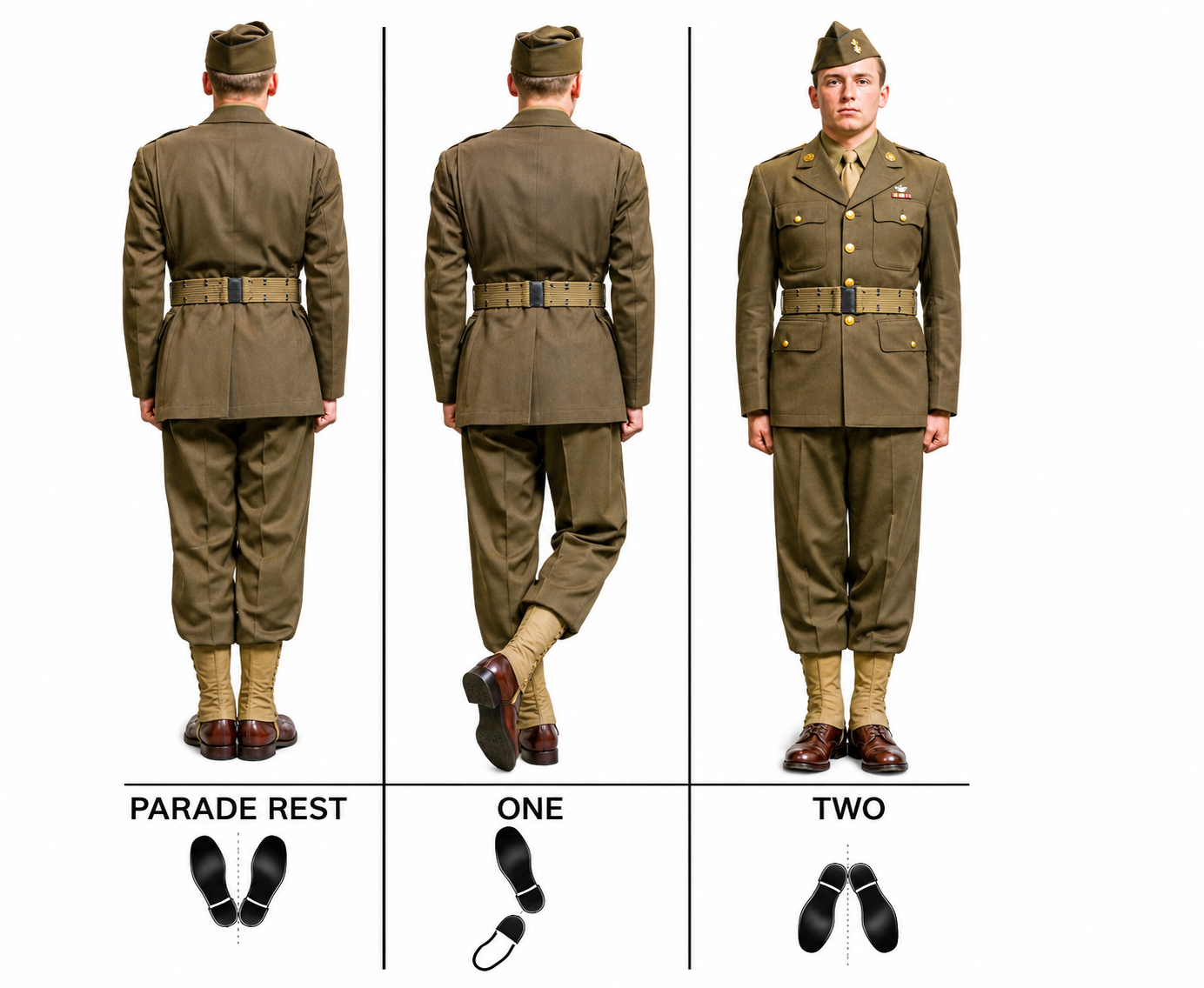
REPENT
ABOUT FACE!
The command "About Face" is describes the act of pivoting 180 degrees, especially in a military formation. Another English definition says it is "a reversal of direction, of attitude, behavior, or point of view." This is a good picture of repentance that Jesus commands. Jesus continues the call to repentance made by John in Mark 1:4.
The Amplified Version has a nice "definition" of "repent" built into the translation (one of the advantages of checking this version (especially the first edition), the phrases in parentheses functioning almost like a "mini-lexicon" if you will)...
And saying, Repent (think differently; change your mind, regretting your sins and changing your conduct), for the kingdom of heaven is at hand.
Repent is a command (present imperative) not a suggestion which is a proposal offered for acceptance or rejection. John is not giving a "multiple choice!" It reminds me of the phrase "take it or leave it!" Repent is the one side of the coin (so to speak) which is balanced by the other side which is fruit-bearing (Mt 3:8, 10), supernatural fruit serving to authenticate whether one has truly repented or just feels sorry about their sin (or sorry they got caught!) with no change of heart or mind.
In a similar passage with a slightly different twist Luke says that John "came into all the district around the Jordan, preaching (kerusso) a baptism of repentance for the forgiveness of sins." (Lk 3:3)
Spurgeon - His was a preparatory ministry; his work was to prepare men’s minds for Christ; and never is the heart of man so ready to receive Christ as when it is in a state of repentance. When it is weary of sin, then is it that Christ comes in, and is welcomed by the soul conscious of its guilt, tired of it, and longing to be rid of it.
Repent, for the kingdom of heaven is at hand - Some favor the translation "be converted." As alluded to in the title above, repent is not a suggestion but a command. Repentance is not optional but mandatory! Repent is not regret or remorse but means a change one's mind and acting on that change! In Mt 3:8 it fruit that is evidence of genuine repentance, the fruit giving evidence of a changed mind and changed life!
These words (Repent....), one has written, were “a trumpet blast…[and] the keynote of the New Testament message.” (William Douglas Chamberlain, The Meaning of Repentance)
What is interesting is that the command is in the present imperative which in essence calls believers to a life (so to speak) of repentance. In other words one does not just repent once and "coast" the rest of their spiritual life, but repeatedly practices repentance as needed (which is often for most of us!). After Jesus was driven from His hometown of Nazareth (Lk 4:29) to His future Galilean base of operations in Capernaum, we see Jesus proclaim the same message as John (Mt 4:17).
R C H Lenski
The present tense, “be repenting,” indicates a state or condition, one befitting the day of the Messiah, thus a life lived in repentance (See Interpretation of St. Matthew's Gospel - Page 92)
When Martin Luther nailed his 95 Theses to the door of the church in 1517, his first thesis was concerning repentance!
“When our Lord and Master Jesus Christ said, “Repent” (Matthew 4:17), he willed the entire life of believers to be one of repentance.”
In a sense the entire Protestant Reformation hangs on those simple words. If you are a Christian, repentance ought to be part of your daily life.
The Second London Baptist Confession (1689), 15.4, which follows the Westminster Confession and Puritan theology closely:
“As repentance is to be continued through the whole course of our lives, upon the account of the body of death, and the motions thereof, so it is every man’s duty to repent of his particular known sins particularly.”
The Westminster Confession (1646) makes the same point about particular sins in 15.5:
“Men ought not to content themselves with a general repentance, but it is every man’s duty to endeavour to repent of his particular sins, particularly.”
Thomas Brooks (1608–1680):
“As long as a Christian continues sinning, he cannot but continue mourning.”
One thinks of the Church at Ephesus:
Revelation 2:5 'Therefore remember from where you have fallen, and repent and do the deeds you did at first; or else I am coming to you and will remove your lampstand out of its place--unless you repent.
From that time Jesus began to preach (kerusso) and say, “Repent (present imperative see our need to depend on the Holy Spirit to obey), for the kingdom of heaven is at hand.”(Mt 4:17, cf Lk 5:32)
In a similar passage in Mark Jesus adds "believe" - “The time is fulfilled, and the kingdom of God is at hand; repent (present imperative see our need to depend on the Holy Spirit to obey) and believe (present imperative) in the gospel.” (present imperative see our need to depend on the Holy Spirit to obey).
NOTE: Repent is a command in all the uses above. Why is that important? It means that you must rely on the Spirit giving you the desire and the power to repent (see Php 2:13NLT). Repentance is a gift as Paul says in Ro 2:4 "Or do you think lightly of the riches of His kindness and tolerance and patience, not knowing that the kindness of God leads you to repentance?" What leads you to repentance? God's kindness! The Spirit is the "Dispenser" (so to speak) of this divine kindness. And again note that in Acts 11:18 Luke records "When they heard this, they quieted down and glorified God, saying, “Well then, God has granted to the Gentiles also the repentance that leads to life.”" Here we see repentance is granted by God, and so it is a gift of God. "
The disciples preached the same message - "“And as you go, preach, saying, ‘The kingdom of heaven is at hand.’" (Mt 10:7) and "They went out and preached that men should repent." (Mark 6:12) In Peter's sermon at Pentecostal he declared “Repent, (aorist imperative see our need to depend on the Holy Spirit to obey) and each of you be baptized in the name of Jesus Christ for the forgiveness of your sins; and you will receive the gift of the Holy Spirit. (Acts 2:38, cf Acts 3:19, Acts 20:21, Acts 26:18)
Repent (3340)(metanoeo from meta = with, among + noeo = to think, exercise the mind <> from nous = mind - see study = metanoia) means to have another mind. Metanoeo means to change one's mind in respect to sin, God, and self, from what is wrong to what is right! To turn to God and from sin (Luke 15:7 = "one sinner who repents", 10). It does not mean you are simply sorry for you sins! "The primary meaning involves a turning to God which may indeed make a person sorry for his sins, but that sorrow is a by-product and not the repentance itself....In a word, John's command to the people of Israel was for them to turn from their sins to God in anticipation of their Messiah." (Toussaint)
Our English word repent is a bit misleading in that it is derived from a Latin word (paeniteo) which means, “to make sorry.” The Greek word (metanoeō), however, means a change of mind. The emphasis is not on the feelings, but on the thought, the will, the mind, and the purpose of the individual who repents.
R C H Lenski - In μετανοεῖτε, “be repenting,” we are introduced to one of the most important words in the New Testament, the Hebrew nicham, “repent by changing the mind,” and schub, “to turn” or to be converted. Μετανοεῖν originally means: “to perceive or see afterward” (μετά), i.e., when it is too late; “to change one’s mind” and thus “to regret” and “to repent.” The Scriptural use of the term added a spiritual depth that is far beyond the thought of secular writers. The word at once signified that religious change of the heart which turns from sin and guilt to cleansing and forgiveness by God’s grace. The linguistic difference between μετανοεῖν and its synonym ἐπιστρέφειν is that the former looks both backward toward the regretted sin and forward to the accepted pardon, while the latter looks rather to the grace received. (See Interpretation of St. Matthew's Gospel - Page 92)
Broadus observes that “wherever this Greek word is used in the New Testament the reference is to changing the mind and the purpose from sin to holiness.” It is not an intellectual decision but a change of mind that issues in a change of behavior. Stated simply repent means “to change one’s mind and act on that change (as in Mt 3:8).” In other words fruit demonstrates that a profession (of repentance) is a true possession (of repentance).
The corollary is no changed life indicates there has been no changed mind! Don't be deceived by "easy believism" for the fruit of that false teaching is eternal death! Where easy believism fails is its lack of recognition that a person with faith in Jesus will lead a progressively changed life. This change of mind may, especially in the case of Christians who have fallen into sin, be preceded by sorrow (2Cor 7:8-11); but sorrow for sin, though it may cause repentance, is not repentance. Repentance involves sorrow for sin, but sorrow that leads to a change of thinking, desire, and conduct of life.
METANOEO - 34X/32V - repent(26), repented(5), repents(3). Matt. 3:2; Matt. 4:17; Matt. 11:20; Matt. 11:21; Matt. 12:41; Mk. 1:15; Mk. 6:12; Lk. 10:13; Lk. 11:32; Lk. 13:3; Lk. 13:5; Lk. 15:7; Lk. 15:10; Lk. 16:30; Lk. 17:3; Lk. 17:4; Acts 2:38; Acts 3:19; Acts 8:22; Acts 17:30; Acts 26:20; 2 Co. 12:21; Rev. 2:5; Rev. 2:16; Rev. 2:21; Rev. 2:22; Rev. 3:3; Rev. 3:19; Rev. 9:20; Rev. 9:21; Rev. 16:9; Rev. 16:11
One of the best illustrations of genuine repentance is found in Paul's description of the saints at Thessalonica…
For they themselves (other believers in Macedonia and Achaia) report about us (Paul, Silvanus and Timothy) what kind of a reception we had with you, and how you turned to God from idols (PERFECT PICTURE OF REPENTANCE) to serve a living and true God, and to wait for His Son from heaven (PERFECT PICTURE OF BRINGING FORTH FRUIT IN KEEPING WITH REPENTANCE), whom He raised from the dead, that is Jesus, who delivers us from the wrath to come. (1 Th 1:9; 1:10)
Paul also gives an excellent summary
but kept declaring both to those of Damascus first, and also at Jerusalem and then throughout all the region of Judea, and even to the Gentiles, that they should repent and turn to God, performing deeds appropriate to repentance. (Acts 26:20)
Paul declared that he was
"solemnly testifying to both Jews and Greeks of repentance toward God and faith in our Lord Jesus Christ. (Acts 20:21)
C H Spurgeon wrote that "Repentance and faith must go together to complete each other. I compare them to a door and its post. Repentance is the door which shuts out sin, but faith is the post on which its hinges are fixed. A door without a doorpost to hang on is not a door at all, while a doorpost without the door hanging on it is of no value whatever. What God hath joined together let no man put asunder, and these two he has made inseparable—repentance and faith)
J C Ryle wrote… There can be no true repentance without faith. You may cast away your old habits, as the serpent casts off his skin—but if you are not resting all upon the Lamb of God who takes away the sins of the world, and looking to be saved by simple faith in Him, you may be wise in your own eyes—but you are just ignorant of the root and fountain, the Alpha and the Omega, the beginning and the end, the first and the last, in all true gospel religion. You may tell us you have repented—but if you have not at the same time laid hold on Christ, you have hitherto received the grace of God in vain.
Related Resources:
Bishop Ryle offers this descriptive definition of repentance - Repentance is a thorough change of man's natural heart, upon the subject of sin. We are all born in sin. We naturally love sin. We take to sin, as soon as we can act and think—just as the bird takes to flying, and the fish takes to swimming. There never was a child that required schooling or education in order to learn deceitfulness, selfishness, passion, self-will, gluttony, pride, and foolishness. These things are not picked up from bad companions, or gradually learned by a long course of tedious instruction. They spring up of themselves, even when boys and girls are brought up alone. The seeds of them are evidently the natural product of the heart. The aptitude of all children to these evil things is an unanswerable proof of the corruption and fall of man. Now when this heart of ours is changed by the Holy Spirit, when this natural love of sin is cast out, then takes place that change which the Word of God calls "repentance." The man in whom the change is wrought is said to "repent." (Repentance)
J C Ryle has a few words of warning regarding repentance - We must carefully bear in mind that no repentance can make atonement for sin. The blood of Christ, and nothing else, can wash away sin from man's soul. No quantity of repentance can ever justify us in the sight of God. "We are accounted righteous before God, only for the sake of our Lord Jesus Christ, by faith, and not for our own works or deservings." It is of the utmost importance to understand this clearly. The trouble that men bring upon their souls, by misunderstanding this subject, is more than can be expressed.
But while we say all this, we must carefully remember that without repentance no soul was ever yet saved. We must know our sins, mourn over them, forsake them, abhor them, or else we shall never enter the kingdom of heaven. There is nothing meritorious in this. It forms no part whatever of the price of our redemption. Our salvation is all of grace, from first to last. But the great fact still remains, that saved souls are always penitent souls, and that saving faith in Christ, and true repentance toward God, are never found asunder. This is a mighty truth, and one that ought never to be forgotten.
Do we ourselves repent? This, after all, is the question which most nearly concerns us. Have we been convinced of sin by the Holy Spirit? Have we fled to Jesus for deliverance from the wrath to come? Do we know anything of a broken and contrite heart, and a thorough hatred of sin? Can we say, "I repent," as well as "I believe?" If not, let us not delude our minds with the idea that our sins are yet forgiven. It is written, "Except you repent, you shall all likewise perish." (Luke 13:3)
Related Resource:
For - Term of explanation. This one is easy to understand. Matthew explains why the Jews should repent. In the following passage (Mt 3:3) repentance is described figuratively with the commands to "make ready" and "make...straight." In short they needed to repent because the King was coming!
The kingdom (basileia) of heaven is at hand (eggizo) - "As close as your hand." While the Kingdom of Heaven has several meanings depending on the context, the simplest meaning is the Kingdom is at hand because the King Himself would soon be present in the midst of the Jews. And the King was coming with a message of good news describing victory over spiritual enemies but not over national enemies (that would occur at His Second Coming). John was calling for the Jews to repent and prepare for their King. The kingdom of heaven was waiting to be ushered in, but Israel was not ready for it! When Israel as a nation rejected their King, the kingdom was taken from them (Mt 21:42–43). Matthew records an almost identical proclamation by Jesus "From that time Jesus began to preach and say, “Repent (present imperative),, for the kingdom of heaven is at hand (eggizo).” (Mt 4:17)
John MacArthur adds that "Despite many similar warnings by the prophets, many of the people and most of the leaders were not prepared for John’s message. What he said was shocking; it was unexpected and unacceptable. It was inconceivable to them that, as God’s people, they had anything to do to inherit God’s kingdom but simply wait for and accept it. The Messiah was their Messiah, the King was their King, the Savior was their Savior, the promise was their promise. Every Jew was destined for the kingdom, and every Gentile was excluded, except for a token handful of proselytes. That was the common Jewish thinking of the day, which John totally shattered. But John’s message was God’s message, and he would not compromise it or clutter it with the popular misconceptions and delusions of his own day and his own people. He had no word but God’s word, and he proclaimed no kingdom but God’s kingdom and no preparation but God’s preparation. That preparation was repentance. God’s standard would not change, even if every Jew were excluded and every Gentile saved. God knew that some Jews would be saved, but none apart from personal repentance and conversion." (SEE The MacArthur Commentary)
Kingdom of Heaven can be a somewhat complex subject but suffice it to say that it has a PRESENT REALITY which awaits a FUTURE REVELATION. The PRESENT REALITY is that the King is reigning in the hearts of those who have repented and believed in Him. The FUTURE REVELATION is the return of the King of kings to defeat His enemies and establish His Messianic rule on Earth (Millennium). It is predominantly this latter aspect of the Kingdom of God the nation was expecting and hoping for (cf (2 Sa 7:8-17; Isa. 11:1-9; Isa 24:23; Jer. 23:5-6; Mic 4:6-7; Zech 9:9-10; Zech 14:9; cf. Mt. 20:21; Mk 10:37; Mk 11:10; Mk 12:35-37; Mk 15:43; Luke 1:31-33; Lk 2:25, Lk 2:38; Acts 1:6)
🙏 THOUGHT - All who live in the PRESENT REALITY are eagerly, expectantly looking for the FUTURE REVELATION, a mindset that motivates us to order our steps in a manner which is pleasing to the Lord. What (Who) you are looking for will (should) impact what (Who) you are living for beloved! That is why the Spirit inspired the writers of the NT to pen 1 in 25-30 verses either directly or indirectly describing the Second Coming of the King! The first century church is said to have greeted one another with the watch word Maranatha. God grant that the church in these last days would do the same, and live accordingly. In Jesus' Name. Amen (See Vertical Vision Transforms Horizontal Living)
AN ESCHATOLOGICAL OR PROPHETIC VIEW OF THE KINGDOM OF GOD - One interpretation of Kingdom of God is that Jesus the King has arrived and fulfilled the prophecy of Daniel in Da 9:25 "So you are to know and discern that from the issuing of a decree to restore and rebuild Jerusalem until Messiah the Prince there will be seven weeks and sixty-two weeks; it will be built again, with plaza and moat, even in times of distress." This passage prophesies the time when Messiah would come to Israel. Israel should have known this was the time from this prophecy, for Jesus Himself said “If you had known in this day, even you, the things which make for peace! But now they have been hidden from your eyes." (Lk 19:42). And again Jesus declared "you did not recognize the time of your visitation." (Lk 19:44). The tragedy recorded in all four Gospels is that when Jesus entered Jerusalem to begin His last week of life the Jewish crowds hailed Him as King "shouting: “BLESSED IS THE KING WHO COMES IN THE NAME OF THE LORD (QUOTING Ps 118:26); Peace in heaven and glory in the highest!” (Lk 19:38, Mt 21:9-11, Mk 11:8-10, Jn 12:13). The problem was that Israel was expecting the Messiah to be a conquering King, defeating the Romans, failing to recognize that He first had to be a Suffering Servant (Mk 10:45, Isaiah 53:1-12) and failing to understand that in that role He did in fact conquer the even more deadly enemies of death (1 Cor 15:55-56, 57), the devil (Heb 2:14-15), Sin (the sinful flesh) (Ro 6:11) and the fallen, godless, evil world (Gal 6:14). And He will return as King of kings and Lord of lords (Rev 19:16) to conquer all world powers arrayed against Him, His Kingdom and His people. (Rev 19:11-21, cf Da 2:34-35, Da 2:44-45).
Kingdom (932)(basileia from basileus = a sovereign, king, monarch) denotes sovereignty, royal power, kingship, royal rule, dominion. Involved in the term is the sovereign authority of a ruler, the activity of ruling, and the realm of rule including its benefits. Basileia thus can refer to the territory or people over whom a king rules. There are two kingdoms at war, the kingdom of this world (cf "present evil world" Gal 1:4KJV, James 4:4, 1 Jn 2:15-17) headed by Satan (see Lk 4:5-6, see especially verse 6, cf 1 Jn 5:19) and the Kingdom of God headed by Jesus (cf Jn 18:37, Rev 19:16).
🙏 THOUGHT - Believers are members of the Kingdom of God and are subject to the King, Jesus Christ. Are you still attempting to rule your life or have you willingly submitted yourself to Jesus with the inherent desire to do His will on earth as it is in Heaven?
Kingdom of Heaven is used only by Matthew while the other Gospels used Kingdom of God - Matt. 3:2; Matt. 4:17; Matt. 5:3; Matt. 5:10; Matt. 5:19; Matt. 5:20; Matt. 7:21; Matt. 8:11; Matt. 10:7; Matt. 11:11; Matt. 11:12; Matt. 13:11; Matt. 13:24; Matt. 13:31; Matt. 13:33; Matt. 13:44; Matt. 13:45; Matt. 13:47; Matt. 13:52; Matt. 16:19; Matt. 18:1; Matt. 18:3; Matt. 18:4; Matt. 18:23; Matt. 19:12; Matt. 19:14; Matt. 19:23; Matt. 20:1; Matt. 22:2; Matt. 23:13; Matt. 25:1. While some teach the terms are different, I agree with John MacArthur that "There is no significant difference between “the kingdom of God” and the kingdom of heaven. The one phrase emphasizes the sovereign Ruler of the kingdom and the other emphasizes the kingdom itself, but they are the same kingdom. Matthew 19:23–24 confirms the equality of the phrases by using them interchangeably." (Compare also kingdom of heaven in Matthew 13:33 and kingdom of God in Luke 13:20,21)
Robertson on at hand - It was a startling word that John thundered over the hills and it re-echoed throughout the land. The Old Testament prophets had said that it would come some day in God’s own time. John proclaims as the herald of the new day that it has come, has drawn near (is at hand). How near he does not say, but he evidently means very near, so near that one could see the signs and the proof.
At hand (1448) (eggizo) means to draw near in space and/or time. In this context the kingdom is drawing near in both senses, because the King of the kingdom is about to step onto the stage in this great drama of redemption (Mt 3:2). The verb is in the perfect tense: the kingdom has drawn near and now stands near. It is right at the door, close enough that the only fitting response is to repent now.
With the King now on the scene the day has arrived. Matthew's uses of eggizo - Matt. 3:2; Matt. 4:17; Matt. 10:7; Matt. 21:1; Matt. 21:34; Matt. 26:45; Matt. 26:46;
It was a spiritual Kingdom, the reign of God in the hearts of men...
it will be a visible Kingdom when the King returns.
Vance Havner - The Kingdom was coming then in the Person of the Saviour; it was a spiritual Kingdom, the reign of God in the hearts of men. The Kingdom is coming soon; it will be a visible Kingdom when the King returns (ED: TO SET UP HIS MESSIANIC KINGDOM FOR 1000 YEARS) and once again our message should be "Repent ye, for the kingdom of heaven is at hand." Christ's message to the church for this hour is "Repent." But who dares to call the average Sunday‑morning congregation to repentance? Said Joseph Parker: "The man whose message is Repent sets himself against his age and will be battered mercilessly by the age whose moral tone he challenges. There is but one end for such a man… off with his head! You had better not preach repentance until you have pledged your head to heaven."
Walter Wessel explains that "the Lord's kingship is both a present reality (God is exercising his authority now) and a future hope (God will reign in the eschaton—the End—when he finally puts down all opposition to his reign). (Expositor's Bible Commentary – Volume 8: Matthew, Mark, Luke)
John MacArthur describes 5 phases of the Kingdom of Heaven/God - God’s kingly rule over the hearts of men and over the world may be thought of as having a number of phases.
(1) The first is the prophesied kingdom, such as that foretold by Daniel.
(2) The second phase is the present kingdom, the one that existed at the time of John the Baptist and that he mentions. It is the kingdom that both John and Jesus spoke of as being at hand (cf. Mt 4:17).
(3) The third phase may be referred to as the interim kingdom, the kingdom that resulted because of Israel’s rejection of her King. The King returned to heaven and His kingdom on earth now exists only in a mystery form. Christ is Lord of the earth in the sense of His being its Creator and its ultimate Ruler; but He does not presently exercise His full divine will over the earth. He is, so to speak, in a voluntary exile in heaven until it is time for Him to return again. He reigns only in the hearts of those who know Him as Savior and Lord. For those “the kingdom of God is … righteousness and peace and joy in the Holy Spirit” (Rom. 14:17).
(4) The fourth phase can be described as the manifest kingdom, in which Christ will rule, physically, directly, and fully on earth for a thousand years, the Millennium. In that kingdom He will rule both externally and internally—externally over all mankind, and internally in the hearts of those who belong to Him by faith.
(5) The fifth, and final, phase is the “eternal kingdom of our Lord and Savior Jesus Christ,” which “will be abundantly supplied” to all of His own (2 Pet. 1:11).
Had God’s people Israel accepted their King when He first came to them, there would be no interim kingdom. The kingdom at hand would have become the kingdom of a thousand years, which, in turn, would have ushered in the eternal kingdom. But because they killed the forerunner of the King and then the King Himself, the millennial kingdom, and consequently the eternal kingdom, were sovereignly postponed. (See Matthew Commentary - Page 56)
David Platt - Throughout Scripture, God calls His people to take responsibility for their sins by confessing them. Simple recognition or admission of sin is useless. In several different places in Scripture we read about people who merely acknowledged their sin but went no further. In Exodus 9:27 Pharaoh acknowledged his sin against the Lord before Moses and Aaron; in Joshua 7:20 Achan admitted his sin to Joshua; in 1 Samuel 15:24 an insincere Saul confessed to Samuel his sin of keeping back what the Lord had commanded him to destroy. The examples of Pharaoh, Achan, and Saul teach us that there’s more to repentance than confession. Beyond mere confession, repentance involves contrition (sorrow over sin). There must be a deep realization in your heart that you have sinned against God. It’s the kind of sorrow we see in Psalm 51 as David, in contrite brokenness, cries out to God, saying, “Against You—You alone—I have sinned” (v. 4). This is not merely sorrow over getting caught, the kind of worldly sorrow Paul speaks about that is nothing more than selfish regret; rather, godly sorrow is deep realization that you have offended God, and this leads to godly repentance (2 Cor 7:10). Biblical repentance means more than simply feeling bad about sin. Later in Matthew, we’ll see the rich young ruler who walked away from Jesus was sorrowful but not repentant (19:16–22), for he didn’t want to part with his possessions. And later we read that Judas was sorrowful for betraying Jesus, but he wasn’t repentant (27:3–10). These examples lead us to a third aspect of biblical repentance: Repentance involves a conversion (turn from sin). (See Exalting Jesus in Matthew)
Matthew 3:2 A Boy's Rebuke
"And sayings Repent ye: for the kingdom of heaven is at hand."—Matt. 3:2
In the neighborhood of Hoddam Castle, Dumfriesshire, Scotland, there was once a tower called the "Tower of Repentance." What gave the tower its name we are not told, but it is said that an English baronet, walking near the castle, saw a shepherd lad lying upon the ground, reading attentively. "What are you reading, lad?" "The Bible, sir." "The Bible, indeed!" laughed the gentleman; "then you must be wiser than the parson. Can you tell me the way to heaven?" "Yes, sir, I can," replied the boy, in no way embarrassed by the mocking tone of the other; "you must go by way of yonder tower." The gentleman saw that the boy had learned right well the lesson of his book, and, being rebuked, he walked away in silence. Does the reader know anything of the Tower of Repentance? If not, let him learn.
Matthew 3:3 For this is the one referred to by Isaiah the prophet when he said, "THE VOICE OF ONE CRYING IN THE WILDERNESS, 'MAKE READY THE WAY OF THE LORD, MAKE HIS PATHS STRAIGHT!'"
NET Matthew 3:3 For he is the one about whom Isaiah the prophet had spoken: "The voice of one shouting in the wilderness, 'Prepare the way for the Lord, make his paths straight.'"
GNT Matthew 3:3 οὗτος γάρ ἐστιν ὁ ῥηθεὶς διὰ Ἠσαΐου τοῦ προφήτου λέγοντος, Φωνὴ βοῶντος ἐν τῇ ἐρήμῳ· Ἑτοιμάσατε τὴν ὁδὸν κυρίου, εὐθείας ποιεῖτε τὰς τρίβους αὐτοῦ.
NLT Matthew 3:3 The prophet Isaiah was speaking about John when he said, "He is a voice shouting in the wilderness, 'Prepare the way for the LORD's coming! Clear the road for him!' "
KJV Matthew 3:3 For this is he that was spoken of by the prophet Esaias, saying, The voice of one crying in the wilderness, Prepare ye the way of the Lord, make his paths straight.
ESV Matthew 3:3 For this is he who was spoken of by the prophet Isaiah when he said, "The voice of one crying in the wilderness: 'Prepare the way of the Lord; make his paths straight.'"
NIV Matthew 3:3 This is he who was spoken of through the prophet Isaiah: "A voice of one calling in the desert, 'Prepare the way for the Lord, make straight paths for him.' "
ASV Matthew 3:3 For this is he that was spoken of through Isaiah the prophet, saying, The voice of one crying in the wilderness, Make ye ready the way of the Lord, make his paths straight.
CSB Matthew 3:3 For he is the one spoken of through the prophet Isaiah, who said: A voice of one crying out in the wilderness: Prepare the way for the Lord; make His paths straight!
NKJ Matthew 3:3 For this is he who was spoken of by the prophet Isaiah, saying: "The voice of one crying in the wilderness:`Prepare the way of the LORD; Make His paths straight.'"
NRS Matthew 3:3 This is the one of whom the prophet Isaiah spoke when he said, "The voice of one crying out in the wilderness: 'Prepare the way of the Lord, make his paths straight.'"
YLT Matthew 3:3 for this is he who was spoken of by Isaiah the prophet, saying, 'A voice of one crying in the wilderness, Prepare ye the way of the Lord, straight make ye His paths.'
- by Isaiah the prophet - Isa 40:3 Mk 1:3 Lu 3:3-6 Joh 1:23
- Prepare - Isa 57:14,15 Mal 3:1 Lu 1:17,76
- Matthew 3 Resources - Multiple Sermons and Commentaries
- Play Handel's masterpiece Every Valley Shall be Exalted
Related Passages:
Isaiah 40:3 - "A voice is calling, “Clear the way for the LORD in the wilderness; Make smooth in the desert a highway for our God."
Luke 3:4-6 "As it is written in the book of the words of Isaiah the prophet, “THE VOICE OF ONE CRYING IN THE WILDERNESS, ‘MAKE READY THE WAY OF THE LORD, MAKE HIS PATHS STRAIGHT. 5 ‘EVERY RAVINE WILL BE FILLED ("every valley shall be exalted" KJV) , AND EVERY MOUNTAIN AND HILL WILL BE BROUGHT LOW; THE CROOKED WILL BECOME STRAIGHT, AND THE ROUGH ROADS SMOOTH; 6 AND ALL FLESH WILL SEE THE SALVATION OF GOD.’” (Lk 3:4-6, quoting Isaiah 40:3-5)
Luke 1:80 And the child (JOHN THE BAPTIST) continued to grow and to become strong in spirit, and he lived in the deserts until the day of his public appearance to Israel.
Mark 1:2-4 As it is written in Isaiah the prophet: “BEHOLD, I SEND MY MESSENGER AHEAD OF YOU, WHO WILL PREPARE YOUR WAY; 3 THE VOICE OF ONE CRYING IN THE WILDERNESS, ‘MAKE READY THE WAY OF THE LORD, MAKE HIS PATHS STRAIGHT.’” 4 John the Baptist appeared in the wilderness preaching a baptism of repentance for the forgiveness of sins.
Luke 3:4-6 as it is written in the book of the words of Isaiah the prophet, “THE VOICE OF ONE CRYING IN THE WILDERNESS, ‘MAKE READY THE WAY OF THE LORD, MAKE HIS PATHS STRAIGHT. 5 ‘EVERY RAVINE WILL BE FILLED, AND EVERY MOUNTAIN AND HILL WILL BE BROUGHT LOW; THE CROOKED WILL BECOME STRAIGHT, AND THE ROUGH ROADS SMOOTH; 6 AND ALL FLESH WILL SEE THE SALVATION OF GOD.’”
John 1:23 He said, “I am A VOICE OF ONE CRYING IN THE WILDERNESS, ‘MAKE STRAIGHT THE WAY OF THE LORD,’ as Isaiah the prophet said.”
For (gar) - Term of explanation, in this case explaining that the appearance of John the Baptist in the wilderness had been foretold almost 700 years earlier. John the Baptist was preaching because God had foreordained it and foretold it some 700 years before throught His prophet Isaiah. In other words John's mission was based on OT prophecies.
D A Carson says "For this is he"...becomes the ground for the Baptist's preaching in v.2." (Expositor's Bible Commentary, p 121)
Broadus adds that "For gives the reason why John appeared in the wilderness and bade the people prepare for the Messianic reign, viz., because John is the person spoken of by—through—the prophet (‘through,’ see Mt 2:17), as destined to do so."
This is the one referred to by Isaiah the prophet when he said - Recall that Matthew's Gospel is aimed at Jewish readers who would have been familiar with Old Testament prophecies and may have (or should have) recognized that Isaiah's prophecy is fulfilled in John the Baptist (cf other fulfillments - Mt 1:22-23, Mt 2:15, Mt 2:17-18, Mt 2:23, Mt 4:14-15, et al). All 4 Gospels refer to Isaiah's prophecy - Mark 1:2-3; Luke 3:4-6; John 1:23.
Broadus suggests that the prophecy in Isaiah 40:3-5 probably had two fulfillments "The immediate reference of the prophecy in Isaiah is probably to Jehovah, as leading his people back through the eastern desert from their captivity in Babylon: the remote reference is to the coming of Messiah, and spiritual deliverance. Here, as often in the prophets (see on Mt 2:15), there is a typical relation between the history of Israel and that of Messiah."
🙏 THOUGHT - Remember that nothing more convincingly demonstrates God’s control over history than fulfilled prophecy. As an aside there are over 300 Messianic Prophecies that clearly pointed to Jesus as the Messiah. God has made it very clear to everyone, Jews and Gentiles alike, that Jesus is the fulfillment of the OT prophecies. How foolish to ignore the Old Testament as so many in evangelical circles do today! The great OT Messianic Prophecies can give faith to those who have never believed and undergird the faith of all who have believed in Jesus (Ro 10:17).
Related Resources:
- Josh McDowell's classic "More than a Carpenter" - good book to suggest to your skeptical friends!
- How a Jewish man Michael Goldstone met Messiah - site has multiple similar video testimonies
The voice of one crying (boao) in the wilderness (eremos) - Voice of one is a description of John the Baptist which alludes to his specific mission and the place where his mission was to be accomplished. John was not prepared by God to pastor a church, to write theology books, to compose religious music, etc, but was called to call, to cry out! The present tense indicates this was John's pattern -- continually crying out. John the Baptist was not whimpering, crying softly and quietly! He was crying out like the HERALD (see below) he was born to be (Lk 1:15, 16, 17), as one who had a strong voice, a clear message and a Spirit enabled bold demeanor giving public witness concerning the Messiah Jesus Christ. Imagine the Jewish people who walked up and heard John crying out this message at the top of his lungs! It would have been a striking scene.
Crying (994)(boao from boé 995) means raise a cry, crying out loud with unusually high volume as a manifestation of feeling. John's preaching was undoubtedly passionate and full of emotion and feeling. He had been preparing his entire life for this purpose! And so he cried out from the depths of his heart in hopes that his message would reach the hearts of his Jewish hearers. And lest we miss it, we should emphasize that John was simply a divine mouthpiece, so the One Who was really crying out to Israel was Jehovah Himself. Remember that Israel was the wife of Jehovah and had gone astray from the Mosaic covenant, "My covenant which they broke, although I was a husband to them,” declares the LORD." (Jer 31:32). Now after 400 "silent years" God was using His mouthpiece, John the Baptist, calling them "Return, O Israel." (Hos 14:1, cf Jer 3:14, Joel 2:12-13).
John Phillips on John's crying - "The Hebrews had fallen on bad times quite apart from Roman oppression. Dead formalism characterized their religion. The roots of this formalism, which had been sprouting in Malachi's day, now ran deep. Rabbinical tradition had largely replaced the Bible. John the Baptist knew all about the hypocrisy of the Pharisees, the skepticism of the Sadducees, the materialism and opportunism of the Herodians, and the fanaticism of the Zealots. The faith of the fathers, applauded in Hebrews 11, had now become "thce Jews' religion" (Gal. 1:13). Someone needed to cut a path through the tangled undergrowth of the deadening, man made tradition. The Messiah was coming! It was high time that someone spoke out. So John became "the voice of one crying in the wilderness." John did not seek the big cities, and he did not stalk the streets of Jerusalem. Rather, he sought solitary, lonely places that were off the beaten track down by the riverside. He did not go to the people. He made the people come to him, and come they did until vast crowds thronged into the wilds to hear him preach...."Make his paths straight!" cried John. It was a clarion call to his own countrymen to clean up their lives and clear away all moral and religious obstacles that might hinder the coming King. (See Exploring the Gospel of Mark: An Expository Commentary - Page 18)
🙏 THOUGHT - Preaching is to be to the people, not before them. It is to be affirmative, authoritative, and positive, not uncertain and negative. The gospel is not open for discussion; it is not just one of many possibilities; it is the truth of God. (POSB)
Jack Dean Kingsbury makes a insightful observation on the parallels between John the Baptist and Jesus - "As Jesus' forerunner, John foreshadows in his person and work the person and work of Jesus.
(1) Both John and Jesus are the agents of God sent by God (Mt 11:10; 10:40).
(2) Both belong to the time of fulfillment (Mt 3:3; 1:32). Both have the same message to proclaim (Mt 3:2; 4:17).
(3) Both enter into conflict with Israel: in the case of the crowds, a favorable reception ultimately gives way to repudiation; in the case of the leaders, the opposition is implacable from the outset (Mt 3:7-10; 9:3).
(4) Both John and Jesus are 'delivered up' to their enemies (Mt 4:12; 10:4).
(5) And both are made to die violently and shamefully (Mt 14:3-12; 27:37)." (See Matthew as Story - Page 49)
In the wilderness (eremos) - Luke alluded to the wilderness in (Lk 1:80) describing how John the Baptist "continued to grow, and to become strong in spirit, and he lived in the deserts (eremos = "wilderness") until the day of his public appearance to Israel." John was not in the holy Temple in Jerusalem, but in the hot desert in Judea. As shown on the map above, the wilderness (Mt 3:1 = "wilderness of Judea"; cf Mk 1:4) refers to the uninhabited desert region to the northwest of the Dead Sea.
MacArthur adds that "John seems to have preached near the northern end of this region, close by where the Jordan flows into the Dead Sea (Lk 3:6). This was a full day’s journey from Jerusalem and seems an odd location to announce the arrival of a King. But it is perfectly in keeping with God’s ways (1 Co 1:26–29)." (See MacArthur Study Bible)
Darrell Bock adds that "Given the Gospel of John’s comments, the ministry involved both sides of the Jordan River, since Perea was also included in the ministry (John 1:28; John 3:23; John 10:40)." (See Luke : Baker Exegetical Commentary)
Wilderness (2048) see map of Judean Wilderness and also the note on eremos. (Used 9x in Mark - Mk. 1:3; Mk. 1:4; Mk. 1:12; Mk. 1:13; Mk. 1:35; Mk. 1:45; Mk. 6:31; Mk. 6:32; Mk. 6:35). In a way this word is a double entendre because John was himself in a literal wilderness crying and pointing out to the Jewish nation the way out of the spiritual wilderness and darkness which had enshrouded the nation of Israel for centuries.
Beitzel observes that "It is difficult to describe adequately the foreboding desolation and howling barrenness along the shores of the Dead Sea.… If there could be fixed in one’s mind the image of the almost-painful sterility of the Sahara or of Death Valley, and then multiply that by a factor of four or more, one might come close to capturing the geographical reality to which he is exposed along the shores of the Dead Sea." (The Moody Atlas of Bible Lands)
🙏 THOUGHT - Do you feel like you are in the wilderness beloved? Then take heart for God can still speak to you even though you feel like you are in a wilderness (see Lk 3:2)! Today of course He does not speak to us exactly as He did to John, but He still speaks to us through His Word of Truth. So when you are in the wilderness don't throw up your hands but "throw yourself" into His hands, into His Book and beseech Him to speak by His Spirit (see Illumination). He is ready and willing to speak to you through His Word and prayer. Make sure you first confess (1 Jn 1:9, Pr 28:13) any known sins in order to clear the "static" from the "Heavenly walkie talkie!"
Make ready (hetoimazo) the way of the Lord (kurios) - Make ready is a command in the aorist imperative calling for his hearers to do this now and not to delay or procrastinate. Their need is urgent! Wuest says "That was the character of the preaching of the Baptist. His was no pussy-footing, no beating about the bush, no smooth, oily, namby-pamby preaching. The Baptist was a man among men, and his preaching was straight from the shoulder." He is speaking figuratively of course and not calling for them to make a literal path but to make their hearts ready to receive the Lord Jesus. Wuest adds "The Ancient of Days was to incarnate Himself in humanity, grow up from a little child to manhood, and offer Himself to Israel as its Messiah, its King. His road needed to be prepared, that is, the hearts of His Chosen People must be ready. John’s ministry was to see to it that Israel was ready to welcome its Messiah."
Broadus - Great public roads were rare in the East until introduced by the Romans. When an Oriental monarch was designing to Journey into a certain region, he sent messengers in advance to require that a graded road should be prepared. Hence the image, here denoting spiritual preparation. Notice that in Isa. 40:4, every part of the process of grading is mentioned. (Commentary)
D A Carson says "In Isaiah 40:3 the way of Yahweh is being "made straight" (a metaphor using road building to refer to repentance); in Matthew 3:3 it is the way of Jesus.(Expositor's Bible Commentary, p 121)
Literally the idea was to fill in the holes, remove the rocks and debris and knock down the hills, to make the king's passage pleasant and easy. In this context of course the commands (make ready and prepare) convey a figurative meaning. So how were John's Jewish hearers to accomplish what he was commanding? John is calling for heart work!
Spurgeon on make ready and prepare - “Men’s hearts were like a wilderness, wherein there is no way; but as loyal subjects throw up roads for the approach of beloved princes, so were men to welcome the Lord, with their hearts made right and ready to receive him.”
Brian Bell - When you read your bible & pray, first clear the way for the Lord. When you worship, first smooth the desert path for God. When God seems distant, do a little roadwork of repentance in order to prepare the way for Him.
As Guzik says "The idea of preparing the way of the LORD is a word picture, because the real preparation must take place in our hearts. Building a road is very much like the preparation God must do in our hearts. They are both expensive, they both must deal with many different problems and environments, and they both take an expert engineer."
If we compare the parallel passages in Matthew, we see that this quote from Isaiah 40:3 followed John's call to the people to "Repent, for the kingdom of heaven is at hand." (Mt 3:2-3) It follows that the way to make ready the way of the Lord is by personal repentance! And ultimately the only way natural men and women could obey these supernatural commands was by being enabled by the Spirit (See discussion of the Need for the Holy Spirit to obey NT commands or "How to Keep All 1642 Commandments in the New Testament!").
🙏 ESCHATOLOGICAL THOUGHT - It is interesting that in the Last Days, at the end of the Great Tribulation (Jer 30:7), the Jews will (belatedly) obey this call of John with national mourning and repentance, Zechariah 12:10-14 recording "I (JEHOVAH) will pour out on the house of David and on the inhabitants of Jerusalem, the Spirit of grace and of supplication, so that they will look on Me whom they have pierced; and they will mourn for Him, as one mourns for an only son, and they will weep bitterly over Him like the bitter weeping over a firstborn." And at that time when Israel recognizes and receives her King, Jehovah goes on to declare "I will bring the third part (OF THE NATION OF ISRAEL) through the fire, Refine them as silver is refined, And test them as gold is tested. They will call on My name, And I will answer them; I will say, ‘They are My people,’ And they will say, ‘The LORD is my God (THESE STATEMENTS BY ISRAEL AND BY JEHOVAH ARE THE LANGUAGE OF COVENANT, specifically the FULFILLMENT OF THE NEW COVENANT TO ISRAEL AND TO JUDAH - see Jer 31:31-37)’” (Zechariah 13:9, cf Ro 11:26-27)
Make ready (2090)(hetoimazo from heteos = fitness - see study of related word hetoimasia) means to make ready, specifically to make ready beforehand for some purpose, use, or activity. Mark's uses of hetoimazo - Mk. 1:3; Mk. 10:40; Mk. 14:12; Mk. 14:15; Mk. 14:16. This same verb is used by Paul who charges us to do some spiritual housecleaning that we might be useful vessels in the hands of the Lord "Therefore, if anyone cleanses himself from these things, he will be a vessel for honor, sanctified, useful to the Master, prepared (hetoimazo) for every good work." (2 Ti 2:21) Thayer says when it is used as here to prepare the way (hodos = road) of the Lord, it is used as a figure “drawn from the oriental custom of sending on before kings on their journeys persons to level the roads and make them passable,” thus, “to prepare the minds of men to give the Messiah a fit reception and secure His blessings.” The verb is plural and is thus addressed to Israel.
Lord (master, owner)(2962)(kurios from kuros = might or power, related to kuroo = to give authority) primarily means the possessor, owner, master, the supreme one, one who is sovereign and possesses absolute authority, absolute ownership and uncontested power. Kurios is used literally 1000's of times in the Septuagint for the name Jehovah or Yahweh.
🙏 THOUGHT - Edwards comments that "The imagery given in verse 3 from Isaiah 40:3-5 is also very pertinent for us. If Christ is going to continue His advance in our lives, then many things must be cleared away. The hills and mountains of pride and unrighteousness must be leveled. The valleys of things we lack must be filled up. Rough spots must be smoothed out until all which hinders us from reflecting God's glory is removed. Then our lives will no longer be a wilderness, but a highway upon which the King of glory may be clearly seen."
Make (poieo) His paths (tribos) straight (euthus) - Make (poieo) a present imperative command (see need to depend on the Holy Spirit to obey) in the plural thus calling for continual obedience by the people of Israel. As Wuest says this obedience "should be a habit with Israel, a constant attitude, not a formal. abrupt welcome and that is all, but a welcome that would extend on and on, an habitual welcome that would be the natural expression of their heart."
Robertson comments on paths straight that "Automobile highways today well illustrate the wonderful Persian roads for the couriers of the king and then for the king himself. The Roman Empire was knit together by roads, some of which survive today. John had a high and holy mission as the forerunner of the Messiah."
Paths (5147)(tribos from tribo = to rub, wear down) in secular Greek was used for a path, usually a well-worn track, a beaten path, thoroughfare and thus a defined track or route. A path that is familiar. Only 3x - Mt 3:3, Mk 1:3, Lk 3:4. In the present context Wuest notes that "The expression does not refer to a literal path or road down which the Lord would travel, but to the hearts of the people of Israel, and His entrance among them." In Ps 25:4 David prays "Make me know Your ways, O LORD; Teach me Your paths (Lxx = tribos)." (A GOOD PRAYER FOR ALL OF US!) (cf other uses of tribos in Lxx = Ps 44:18, Ps 139:3 = another good prayer)
Ps 119:105 " Your word is a lamp to my feet And a light to my path (Lxx = tribos)."
Jer 6:16 Jehovah says “Stand by the ways and see and ask for the ancient paths (Lxx = tribos)..."
Micah 4:2 (IN THE MESSIANIC KINGDOM) "Many nations will come and say, “Come and let us go up to the mountain of the LORD And to the house of the God of Jacob, That He may teach us about His ways And that we may walk in His paths (Lxx = tribos).” For from Zion will go forth the law, Even the word of the LORD from Jerusalem.
Tribos in the Septuagint - Gen. 49:17; Jdg. 5:6; Jdg. 5:20; 1 Sam. 6:12; 2 Sam. 20:12; 2 Sam. 20:13; 1 Chr. 26:18; Job 18:10; Job 22:15; Job 28:7; Job 30:12; Job 30:13; Job 34:11; Job 38:20; Ps. 8:8; Ps. 17:5; Ps. 18:45; Ps. 23:3; Ps. 25:4; Ps. 27:11; Ps. 44:18; Ps. 77:19; Ps. 78:50; Ps. 119:35; Ps. 119:105; Ps. 139:3; Ps. 139:23; Ps. 140:5; Ps. 142:3; Prov. 1:15; Prov. 2:15; Prov. 2:19; Prov. 2:20; Prov. 3:17; Prov. 8:2; Prov. 8:20; Prov. 15:21; Prov. 16:17; Prov. 30:19; Isa. 3:12; Isa. 30:11; Isa. 40:3; Isa. 42:16; Isa. 43:16; Isa. 49:9; Isa. 49:11; Isa. 58:12; Isa. 59:8; Jer. 6:16; Jer. 9:10; Jer. 18:15; Lam. 3:9; Dan. 4:37; Hos. 2:6
Straight (2117)(euthus) when used as an adjective as it is here in Mark 1:3, euthus literally means straight or a straight line and figuratively to what is proper or right. For example, in Acts 9:11 euthus described a literal roadway "the street called Straight (euthus)" which was literally straight through Damascus. The use of euthus in Mark 1:3 is figurative calling for "straight paths" (so to speak) in one's heart and life (cf Mt 3:3, Lk 3:4). Euthus is used again in Luke 3:5 (quoting the Septuagint reading of Isaiah 40:4), where we read "the crooked (skolios - "crooked" lives) will be straight (euthus)" which speaks of heart change, moral/ethical transformation. Euthus is also used as adverb meaning immediately which is a key word in the Gospel of Mark as evidenced by 11 uses in the first chapter! All Matthew's uses of euthus - Matt. 3:3; Matt. 3:16; Matt. 13:20; Matt. 13:21; Matt. 14:27; Matt. 21:2; Matt. 21:3; Matt. 26:74
🙏 THOUGHT - The cry of the prophet is: (1) Man has an inadequate righteousness; therefore, repentance is needed. (2) The present world is an inadequate world; therefore, the Kingdom of Heaven is needed. (3) Man has prepared an inadequate life for the Lord; therefore, he must prepare the way for the Lord. (POSB)
Matthew 3:3-4 “THE VOICE OF ONE CRYING IN THE WILDERNESS"
Men’s hearts were like a wilderness, wherein there is no way; but as loyal subjects throw up roads for the approach of beloved princes, so were men to welcome the Lord, with their hearts made right and ready to receive him.....Lord, let not my meat, my drink, or garments, hinder me in thy work!” - Spurgeon
Matthew 3:4 Now John himself had a garment of camel's hair and a leather belt around his waist; and his food was locusts and wild honey.
NET Matthew 3:4 Now John wore clothing made from camel's hair with a leather belt around his waist, and his diet consisted of locusts and wild honey.
GNT Matthew 3:4 Αὐτὸς δὲ ὁ Ἰωάννης εἶχεν τὸ ἔνδυμα αὐτοῦ ἀπὸ τριχῶν καμήλου καὶ ζώνην δερματίνην περὶ τὴν ὀσφὺν αὐτοῦ, ἡ δὲ τροφὴ ἦν αὐτοῦ ἀκρίδες καὶ μέλι ἄγριον.
NLT Matthew 3:4 John's clothes were woven from coarse camel hair, and he wore a leather belt around his waist. For food he ate locusts and wild honey.
KJV Matthew 3:4 And the same John had his raiment of camel's hair, and a leathern girdle about his loins; and his meat was locusts and wild honey.
ESV Matthew 3:4 Now John wore a garment of camel's hair and a leather belt around his waist, and his food was locusts and wild honey.
NIV Matthew 3:4 John's clothes were made of camel's hair, and he had a leather belt around his waist. His food was locusts and wild honey.
ASV Matthew 3:4 Now John himself had his raiment of camel's hair, and a leathern girdle about his loins; and his food was locusts and wild honey.
CSB Matthew 3:4 John himself had a camel-hair garment with a leather belt around his waist, and his food was locusts and wild honey.
NKJ Matthew 3:4 And John himself was clothed in camel's hair, with a leather belt around his waist; and his food was locusts and wild honey.
NRS Matthew 3:4 Now John wore clothing of camel's hair with a leather belt around his waist, and his food was locusts and wild honey.
YLT Matthew 3:4 And this John had his clothing of camel's hair, and a girdle of skin round his loins, and his nourishment was locusts and honey of the field.
NAB Matthew 3:4 John wore clothing made of camel's hair and had a leather belt around his waist. His food was locusts and wild honey.
NJB Matthew 3:4 This man John wore a garment made of camel-hair with a leather loin-cloth round his waist, and his food was locusts and wild honey.
- had a garment - Mt 11:8 2Ki 1:8 Zec 13:4 Mal 4:5 Mk 1:6 Lu 1:17 Rev 11:3
- his food was locusts - Mt 11:18 Lev 11:22
- wild honey - Dt 32:13 1Sa 14:25-27
- Matthew 3 Resources - Multiple Sermons and Commentaries

John the Baptist
JOHN'S ODD CLOTHES
AND UNUSUAL DIET
Now John himself had (echo) a garment (enduma) of camel's hair and a leather belt around his waist - "He was outfitted for survival in the wilderness—like a desert monk." (Barton) In the parallel description in Mark 1:6 the verb "clothed" is in the perfect tense that indicates John's garb was not his occasional dress when he preached (like a pastor might put on a suit), but his permanent attire. He probably would not make the front cover of "GQ Magazine!" John's attire was a striking contrast to the flowing robes and lengthened phylacteries of the prideful Jewish religious leaders who do all their deeds to be noticed by men (Mt 23:5) John's distinctive dress would also presage a different declaration than that of the self-righteous Jewish leaders. Broadus writes that the "clothing of camel’s hair was a coarse cloth made by weaving camel’s hair, and such cloth is still often worn in the East by the poor."
Brian Bell comments that "So many times John had to deflect...No, I’m not the Messiah. No, I’m not The Prophet. No, I’m not the Light just the lamp who bears witness to the Light. No, I’m not the Word, I’m just the voice. No, I’m not the Groom, just the best man.
The wealthy of John's day wore girdles of costly linen or silk, often wrought with silver or gold. John scorned such embellishments preferring instead a simple leather belt. A leather belt is referred to in the KJV a leathern girdle which "was a necessary and almost universal part of an Oriental’s dress (Mt 10:9, Acts 21:11), being required to bind the long, loose robe (Mt 5:40), in order to active labor, or rapid locomotion, and it was often very costly and showy (cp. Rev. 1:13). John’s girdle was made of leather, cheap and rude, as was Elijah’s, (2 Ki 1:8)" (Broadus) One is reminded of Peter's exhortation to "gird up the loins of your mind" (1Pe 1:13KJV), a figure of speech drawn from the Middle Eastern practice of gathering up long robes around the waist to prepare for work or action.
David Turner - "According to W. Davies and Allison (1988: 295–96), Bedouin still wear camel hair garments and eat locusts today....A camel hair garment bound with a leather belt might suggest poverty in another context, but here it is suggestive of John’s prophetic role and stern message of repentance (2 Kings 1:8; Zech. 13:4; cf. Mal. 4:5; Matt. 11:7–9, 14; 17:10–13; Heb. 11:37). Eating locusts was permitted by Scripture (Lev. 11:20–23), and wild (uncultivated) honey is mentioned several times (Gen. 43:11; Exod. 3:8; Deut. 32:13; Judg. 14:8; 1 Sam. 14:25; Ps. 81:16; Ezek. 27:17; cf. Kelhoffer 2005a, 2005b). All in all, John’s clothing and diet model the message he preaches. He is unconcerned with the niceties of wardrobe and food (Matt. 11:8, 18; cf. 2 Macc. 5:27; Josephus, Life 11), and he calls Israel away from preoccupation with such things and toward the kingdom." (See Matthew (Baker Exegetical Commentary on the New Testament))
As D A Carson said "Both Elijah and John had stern ministries in which austere garb and diet confirmed their message and condemned the idolatry of physical and spiritual softness.” (Expositor's Bible Commentary)
Undoubtedly John's father had told him of the prophetic pronouncement over his life and ministry that he would "go as a forerunner before Him (MESSIAH) in the spirit and power of Elijah." (Lk 1:17).
🙏 THOUGHT - Would such an uncouth figure be welcome today in any pulpit in our cities? In the wilderness it did not matter. It was probably a matter of necessity with him, not an affectation. (A T Robertson) Also consider that some Jews undoubtedly came out of curiosity and heard a call to repent. Are unbelievers curious about your Christian lifestyle and values? As Peter exhorts the believers in his first epistle "Sanctify (aorist imperative) Christ as Lord in your hearts, always being ready to make a defense to everyone who asks you to give an account for the hope that is in you, yet with gentleness and reverence" (1 Pe 3:15, cf Ro 11:11NLT).
🙏 THOUGHT - John’s message was the message of a prophet: he dressed and ate as a prophet. The believer is to be disciplined and to live moderately (Lu 9:23; Ro 12:1) The believer’s dress and habits should be adapted to meet the needs of his people (POSB) Spurgeon added "“Lord, let not my meat, my drink, or garments, hinder me in thy work!” Is there something trivial and/or external hindering you for following your calling by the Lord, for as Peter said "each one has received a special gift, employ it in serving one another as good stewards of the manifold grace of God. (1 Pe 4:10-11 cf Eph 2:10).
Spurgeon - Everything about him was impressive, and everything was suitable to the message he had to deliver. He was so dressed as to be noticed at once as a man of ascetic habit. He was not the chaplain of a prince, else would he have been clothed in soft raiment. He was not one who had a gentle message to deliver, else would he not have gone into the wilderness, and summoned the people to come away from their avocations to listen to him. He was the rough pioneer to prepare the way for the King.
And his food was locusts and wild honey - John's diet was nutritious and the price was right in the wilderness. Click the locust above to make him big and somewhat intimidating. I wonder if John ate "kosher locusts?" Leviticus had put the stamp of approval on locusts declaring "These of them you may eat: the locust in its kinds, and the devastating locust in its kinds, and the cricket in its kinds, and the grasshopper in its kinds." (Lev 11:22) One commentator says modern Bedouins still wear camel hair garments and eat locusts (grasshoppers). Wild honey could be found in abundance, made by the wild bees who nested in the clefts of rocks and in the trees of the valley. Honey is mentioned several times in the OT (Gen 43:11; Exod 3:8; Deut 32:13; Jdg 14:8; 1 Sam 14:25; Ps 81:16; Ezek 27:17)

A Yummy Wild Locust
Broadus - The law of Moses (Lev. 11:22) allowed locusts, at least of certain kinds, to be eaten; and a treatise in the Talmud copiously discusses the marks by which ‘clean’ locusts might be distinguished. To eat these is still common in the East among the poor. The heads, legs, and wings being removed, they are boiled, stewed, or roasted, and sometimes dressed with butter. They are eaten both fresh, and dried, or salted. They are very different from what we call locusts. (Matthew 3 Commentary)
🙏 THOUGHT - And just in case you are wondering wild honey is basically devoid of protein, so John would have had to depend solely on his locust intake. "The protein content in fresh weight is between 13–28 g/100g for adult locust, 14–18 g/100g for larvae, as compared to 19–26 g/100g for beef." So let's say an average male needs about 60 grams of protein per day and the average locust weighs 2 grams which means John would have had to eat about 100 fresh locusts each day to achieve his minimum daily requirement for protein!
Wikipedia on locusts as food - Locusts are edible insects. Several cultures throughout the world consume insects, and locusts are considered a delicacy and eaten in many African, Middle Eastern, and Asian countries. They have been used as food throughout history. They can be cooked in many ways, but are often fried, smoked, or dried.
Garment (1742)(enduma from enduo = put on from en = in + duo = to sink) literally refers to clothing, especially an outer garment or cloak. In Mt 22:11-12 enduma refers to clothes that one wears to a wedding. Enduma refers to Jesus' clothing after His resurrection (Mt 28:3). Sheep's clothing in Mt 7:15 refers figuratively to false teachers. Enduma refers to clothing as something we should not be anxious about (Mt 6:25, 28, Lk 12:23). Used to describe the Lord Jesus when He returns and His "garments (Lxx = enduma) (are) like the one who treads in the wine press." (Isa 63:2).
Enduma - 8x - clothes(2), clothing(5), garment(1). Mt. 3:4; Mt. 6:25; Mt. 6:28; Mt. 7:15; Mt. 22:11; Mt. 22:12; Mt. 28:3; Lk. 12:23.
Enduma in the Septuagint - 2 Sa 1:24; 2 Sa 20:8; 2 Ki. 10:22; Ps. 69:11; Ps. 133:2; Pr 31:22; Isa. 63:2; Lam 4:14; Da 3:21; Da 7:9; Zeph 1:8;
Had (2192) echo means to have, hold (in one's charge or keeping Rev 1:18), keep, preserve, possess, own (Mt 19:22), cling to. To stand in a close relationship to someone (Jn 8:41).
STRONG'S - ECHO - 1) to have, i.e. to hold 1a) to have (hold) in the hand, in the sense of wearing, to have (hold) possession of the mind (refers to alarm, agitating emotions, etc.), to hold fast keep, to have or comprise or involve, to regard or consider or hold as 2) to have i.e. own, possess 2a) external things such as pertain to property or riches or furniture or utensils or goods or food etc. 2b) used of those joined to any one by the bonds of natural blood or marriage or friendship or duty or law etc, of attendance or companionship 3) to hold one's self or find one's self so and so, to be in such or such a condition 4) to hold one's self to a thing, to lay hold of a thing, to adhere or cling to 4a) to be closely joined to a person or a thing
GINGRICH - borrow Shorter Lexicon of the Greek New Testament
I. active transitive—1. have, hold Mt 26:7; Rev 1:16; Rev 5:8. Have on, wear Mt 3:4; Jn 18:10; Rev 9:9, 17. Keep, preserve Lk 19:20 ; 1 Ti 3:9; Rev 6:9. Seize Mk 16:8
2. have as one's own, possess lit. and fig. Mt 18:8f; Mt 19:22; Lk 11:5; Lk 15:4; Lk 19:26; Jn 8:41; Ac 2:44; Ro 12:4; 1 Cor 4:7; 1 Cor 5:1; 1 Cor 7:2; Eph 5:5; Col 4:1; 1 Jn 2:23; Rev 18:19. Of all conditions of body and soul have Mt 11:18; Jn 5:42; Ac 28:9; Ro 10:2; 1 Cor 13:1; Heb 10:2, 19. Have at hand, have at one's disposal Mt 14:17; Mk 8:1; Jn 4:11; Phil 2:20; 1 Jn 2:1. With indications of time and age - be fifty years old Jn 8:57. be for a long time Jn 5:6. be of age Jn 9:21, 23. Have = have something over one, be under something avna,gkhn e;cein be under necessity 1 Cor 7:37; be compelled Lk 14:18. be in need Eph 4:28; need Lk 19:31, 34. 2 Cor 4:1. Have within oneself Mk 13:17; Jn 5:26; 2 Cor 1:9; Phil 1:7.
3. have or include in itself, bring about, cause Heb 10:35; Jas 1:4; Jas 2:17; 1 Jn 4:18 .
4. consider, look upon, view Mt 14:5; Mt 21:46; Mk 11:32; Lk 14:18f; Phil 2:29
5. with inf. following have the possibility, can, be able, be in a position Mt 18:25; Lk 12:4; Acts 4:14; Acts 25:26; Heb 6:13; 2 Pet 1:15. One must Lk 12:50; 2 Jn 12.
6. Special combinations: acknowledge Ro 1:28. he has no hold on me Jn 14:30. meet face to face Ac 25:16. be situated (a certain distance) away Acts 1:12.II. active, intrans., with an adverb be, be situated - how they are Acts 15:36. be ready 2 Cor 12:14. be sick Mt 4:24. be well, healthy Mk 16:18. be at the point of death Mk 5:23. to. for the present Ac 24:25. Other expressions: Ac 7:1; Ac 12:15; 1 Ti 5:25.
III. mid. hold oneself fast, cling to - things that belong to salvation Heb 6:9. neighboring Mk 1:38. Of time immediately following: on the next day Ac 21:26; cf. Acts 20:15; Lk 13:33.
FRIBERG - with a basic meaning have, hold, with a wide range of meanings derived from the contexts and accompanying terms; the following are represented;
I. active, transitively;(1) as using the hand to grasp something have, hold (Rev 1.16);
(2) of clothing, weapons, etc. have on, wear (Jn 18.10);
(3) literally and figuratively, as holding something safely keep, preserve ( 1Ti 3.9);
(4) of emotional states taking hold of someone seize, grip (Mk 16.8);
(5) legally, of property have (at one's disposal), possess, own, enjoy (Mk 10.22);
(6) of a binding or close relationship with a person have (a husband), be married ( Jn 4.17); have (a friend) (Lk 11.5); have (a master) (Col 4.1);
(7) of conditions of body and soul; have (a disease) (Acts 28.9); be possessed by (a demon), have (an evil spirit) (Mk 5.15);
(8) idiomatically, with indications of time - literally have years, i.e. be x years old (Jn 8.57); literally have days in, i.e. be in a certain situation for x days (Jn 11.17 );
(9) as bearing or possessing abstract qualities, spiritual gifts, and powers have, possess, enjoy (Jn 3.16); with en have something within oneself (2Co 1.9);
(10) as holding an opinion - have, consider, regard as (Mt 14.5);
(11) with the object expressed or implied and followed by an infinitive have the possibility of, can, be able to (Mt 18.25; Acts 4.14); with a sense of compulsion must, have to (Lk 12.50);II. active, intransitively, with an adverb or adverbial expressions determining the sense be, be situated, get along in such a way; be well, be healthy (Mk 16.18), be sick (Mt 4.24), with an infinitive following be ready to, be prepared to (2Co 12.14), be pregnant (Mk 13.17), etc.;
III. middle (only as a participle in the NT); (1) of inherent association belong to (Heb 6.9); (2) of close association of place neighboring, nearby (Mk 1.38); (3) of close association of time - on the next day, on the following day (Lk 13.33; Acts 20.15) (BORROW Analytical lexicon of the Greek New Testament)
ECHO - 574 - ability(1), able(1), accompany(1), acknowledge*(1), am(2), become(1), been(3), being(1), being under(1), bringing(1), conceived*(1), consider(2), considered(2), could(2), derive(1), deriving(1), devoid*(1), enjoyed(1), experiencing(1), felt(1), following(1), get(2), gripped(1), had(80), has(134), have(283), have had(2), having(50), held(1), hold(5), holding(7), holds(2), ill*(5), incurring(1), involves(1), keep(3), keeping(3), kept(1), maintain(1), maintained(1), maintaining(1), meets(1), nearby(1), next(2), obliged*(1), obtain(2), obtained(1), owned(3), possess(2), possessed(4), possesses(1), receive(1), received(1), recover*(1), regard(2), regarded(1), reigns*(1), remember*(1), retain(1), seize(1), show(1), think*(1), unable*(1), under(1), under*(1), use(1), without*(3). Matt. 3:4; Matt. 3:9; Matt. 3:14; Matt. 4:24; Matt. 5:23; Matt. 5:46; Matt. 6:1; Matt. 7:29; Matt. 8:16; Matt. 8:20; Matt. 9:6; Matt. 9:36; Matt. 11:15; Matt. 11:18; Matt. 12:11; Matt. 13:5; Matt. 13:6; Matt. 13:9; Matt. 13:12; Matt. 13:21; Matt. 13:27; Matt. 13:43; Matt. 13:44; Matt. 13:46; Matt. 14:4; Matt. 14:5; Matt. 14:17; Matt. 15:30; Matt. 15:32; Matt. 15:34; Matt. 16:8; Matt. 17:15; Matt. 17:20; Matt. 18:8; Matt. 18:9; Matt. 18:25; Matt. 19:16; Matt. 19:21; Matt. 19:22; Matt. 21:3; Matt. 21:21; Matt. 21:26; Matt. 21:28; Matt. 21:38; Matt. 21:46; Matt. 22:12; Matt. 22:24; Matt. 22:25; Matt. 22:28; Matt. 25:25; Matt. 25:28; Matt. 25:29; Matt. 26:11; Matt. 26:65; Matt. 27:16; Matt. 27:65; Mk. 1:22; Mk. 1:32; Mk. 1:34; Mk. 1:38; Mk. 2:10; Mk. 2:19; Mk. 3:10; Mk. 3:15; Mk. 3:22; Mk. 3:29; Mk. 3:30; Mk. 4:5; Mk. 4:6; Mk. 4:9; Mk. 4:17; Mk. 4:23; Mk. 4:25; Mk. 4:40; Mk. 5:3; Mk. 5:15; Mk. 6:18; Mk. 6:34; Mk. 6:38; Mk. 7:16; Mk. 7:25; Mk. 8:1; Mk. 8:2; Mk. 8:5; Mk. 8:7; Mk. 8:14; Mk. 8:16; Mk. 8:17; Mk. 8:18; Mk. 9:17; Mk. 9:43; Mk. 9:45; Mk. 9:47; Mk. 9:50; Mk. 10:21; Mk. 10:22; Mk. 11:3; Mk. 11:22; Mk. 11:25; Mk. 11:32; Mk. 12:6; Mk. 12:23; Mk. 12:44; Mk. 14:7; Mk. 14:8; Mk. 14:63; Mk. 16:8; Mk. 16:18; Lk. 3:8; Lk. 3:11; Lk. 4:33; Lk. 4:40; Lk. 5:24; Lk. 7:33; Lk. 7:40; Lk. 7:42; Lk. 8:6; Lk. 8:8; Lk. 8:13; Lk. 8:18; Lk. 8:27; Lk. 9:3; Lk. 9:11; Lk. 9:58; Lk. 11:5; Lk. 11:6; Lk. 12:4; Lk. 12:5; Lk. 12:17; Lk. 12:19; Lk. 12:50; Lk. 13:6; Lk. 13:11; Lk. 13:33; Lk. 14:14; Lk. 14:18; Lk. 14:19; Lk. 14:28; Lk. 14:35; Lk. 15:4; Lk. 15:8; Lk. 15:11; Lk. 16:1; Lk. 16:28; Lk. 16:29; Lk. 17:6; Lk. 17:7; Lk. 18:22; Lk. 19:20; Lk. 19:24; Lk. 19:25; Lk. 19:26; Lk. 19:31; Lk. 19:34; Lk. 20:24; Lk. 20:28; Lk. 20:33; Lk. 21:4; Lk. 22:22; Lk. 22:29; Lk. 22:31; Lk. 22:36; Lk. 22:37; Lk. 22:71; Lk. 23:17; Lk. 24:39; Lk. 24:41; Jn. 2:3; Jn. 3:15; Jn. 3:16; Jn. 3:29; Jn. 3:36; Jn. 4:11; Jn. 4:17; Jn. 4:18; Jn. 4:32; Jn. 4:44; Jn. 4:52; Jn. 5:2; Jn. 5:5; Jn. 5:6; Jn. 5:7; Jn. 5:24; Jn. 5:26; Jn. 5:36; Jn. 5:38; Jn. 5:39; Jn. 5:40; Jn. 5:42; Jn. 6:9; Jn. 6:40; Jn. 6:47; Jn. 6:53; Jn. 6:54; Jn. 6:68; Jn. 7:20; Jn. 8:6; Jn. 8:12; Jn. 8:26; Jn. 8:41; Jn. 8:48; Jn. 8:49; Jn. 8:52; Jn. 9:41; Jn. 10:10; Jn. 10:16; Jn. 10:18; Jn. 10:20; Jn. 11:17; Jn. 12:6; Jn. 12:8; Jn. 12:35; Jn. 12:36; Jn. 12:48; Jn. 13:8; Jn. 13:29; Jn. 13:35; Jn. 14:21; Jn. 14:30; Jn. 15:13; Jn. 15:22; Jn. 15:24; Jn. 16:12; Jn. 16:15; Jn. 16:21; Jn. 16:22; Jn. 16:30; Jn. 16:33; Jn. 17:5; Jn. 17:13; Jn. 18:10; Jn. 19:7; Jn. 19:10; Jn. 19:11; Jn. 19:15; Jn. 20:31; Jn. 21:5; Acts 2:44; Acts 2:45; Acts 2:47; Acts 3:6; Acts 4:14; Acts 4:35; Acts 8:7; Acts 9:14; Acts 9:31; Acts 13:5; Acts 14:9; Acts 15:21; Acts 16:16; Acts 18:18; Acts 19:13; Acts 19:38; Acts 20:15; Acts 21:13; Acts 21:23; Acts 21:26; Acts 23:17; Acts 23:18; Acts 23:19; Acts 23:25; Acts 23:29; Acts 24:15; Acts 24:16; Acts 24:19; Acts 24:23; Acts 25:16; Acts 25:19; Acts 25:26; Acts 28:9; Acts 28:19; Acts 28:29; Rom. 1:13; Rom. 1:28; Rom. 2:14; Rom. 2:20; Rom. 4:2; Rom. 5:1; Rom. 5:2; Rom. 6:21; Rom. 6:22; Rom. 8:9; Rom. 8:23; Rom. 9:10; Rom. 9:21; Rom. 10:2; Rom. 12:4; Rom. 12:6; Rom. 13:3; Rom. 14:22; Rom. 15:4; Rom. 15:17; Rom. 15:23; 1 Co. 2:16; 1 Co. 4:7; 1 Co. 4:15; 1 Co. 5:1; 1 Co. 6:1; 1 Co. 6:4; 1 Co. 6:7; 1 Co. 6:19; 1 Co. 7:2; 1 Co. 7:7; 1 Co. 7:12; 1 Co. 7:13; 1 Co. 7:25; 1 Co. 7:28; 1 Co. 7:29; 1 Co. 7:37; 1 Co. 7:40; 1 Co. 8:1; 1 Co. 8:10; 1 Co. 9:4; 1 Co. 9:5; 1 Co. 9:6; 1 Co. 9:17; 1 Co. 11:4; 1 Co. 11:10; 1 Co. 11:16; 1 Co. 11:22; 1 Co. 12:12; 1 Co. 12:21; 1 Co. 12:23; 1 Co. 12:24; 1 Co. 12:30; 1 Co. 13:1; 1 Co. 13:2; 1 Co. 13:3; 1 Co. 14:26; 1 Co. 15:31; 1 Co. 15:34; 2 Co. 1:9; 2 Co. 1:15; 2 Co. 2:3; 2 Co. 2:4; 2 Co. 2:13; 2 Co. 3:4; 2 Co. 3:12; 2 Co. 4:1; 2 Co. 4:7; 2 Co. 4:13; 2 Co. 5:1; 2 Co. 5:12; 2 Co. 6:10; 2 Co. 7:1; 2 Co. 7:5; 2 Co. 8:11; 2 Co. 8:12; 2 Co. 9:8; 2 Co. 12:14; Gal. 2:4; Gal. 4:22; Gal. 4:27; Gal. 6:4; Gal. 6:10; Eph. 1:7; Eph. 2:12; Eph. 2:18; Eph. 3:12; Eph. 4:28; Eph. 5:5; Eph. 5:27; Phil. 1:7; Phil. 1:23; Phil. 1:30; Phil. 2:2; Phil. 2:20; Phil. 2:27; Phil. 2:29; Phil. 3:4; Phil. 3:9; Phil. 3:17; Col. 1:4; Col. 1:14; Col. 2:1; Col. 2:23; Col. 3:13; Col. 4:1; Col. 4:13; 1 Thess. 1:8; 1 Thess. 1:9; 1 Thess. 3:6; 1 Thess. 4:9; 1 Thess. 4:13; 1 Thess. 5:1; 2 Thess. 3:9; 1 Tim. 1:19; 1 Tim. 3:4; 1 Tim. 3:7; 1 Tim. 3:9; 1 Tim. 4:8; 1 Tim. 5:4; 1 Tim. 5:12; 1 Tim. 5:16; 1 Tim. 6:2; 1 Tim. 6:8; 1 Tim. 6:16; 2 Tim. 1:3; 2 Tim. 1:13; 2 Tim. 2:19; 2 Tim. 3:5; Tit. 1:6; Tit. 2:8; Phlm. 1:5; Phlm. 1:7; Phlm. 1:8; Phlm. 1:17; Heb. 2:14; Heb. 3:3; Heb. 4:14; Heb. 4:15; Heb. 5:12; Heb. 5:14; Heb. 6:9; Heb. 6:13; Heb. 6:18; Heb. 6:19; Heb. 7:3; Heb. 7:5; Heb. 7:6; Heb. 7:24; Heb. 8:1; Heb. 8:3; Heb. 9:1; Heb. 9:4; Heb. 10:1; Heb. 10:2; Heb. 10:19; Heb. 10:34; Heb. 10:35; Heb. 10:36; Heb. 11:10; Heb. 11:15; Heb. 12:1; Heb. 12:9; Heb. 12:28; Heb. 13:10; Heb. 13:14; Heb. 13:18; Jas. 1:4; Jas. 2:1; Jas. 2:14; Jas. 2:17; Jas. 2:18; Jas. 3:14; Jas. 4:2; 1 Pet. 2:12; 1 Pet. 2:16; 1 Pet. 3:16; 1 Pet. 4:8; 2 Pet. 1:15; 2 Pet. 1:19; 2 Pet. 2:14; 2 Pet. 2:16; 1 Jn. 1:3; 1 Jn. 1:6; 1 Jn. 1:7; 1 Jn. 1:8; 1 Jn. 2:1; 1 Jn. 2:7; 1 Jn. 2:20; 1 Jn. 2:23; 1 Jn. 2:27; 1 Jn. 2:28; 1 Jn. 3:3; 1 Jn. 3:15; 1 Jn. 3:17; 1 Jn. 3:21; 1 Jn. 4:16; 1 Jn. 4:17; 1 Jn. 4:18; 1 Jn. 4:21; 1 Jn. 5:10; 1 Jn. 5:12; 1 Jn. 5:13; 1 Jn. 5:14; 1 Jn. 5:15; 2 Jn. 1:5; 2 Jn. 1:9; 2 Jn. 1:12; 3 Jn. 1:4; 3 Jn. 1:13; Jude 1:3; Jude 1:19; Rev. 1:16; Rev. 1:18; Rev. 2:3; Rev. 2:4; Rev. 2:6; Rev. 2:7; Rev. 2:10; Rev. 2:11; Rev. 2:12; Rev. 2:14; Rev. 2:15; Rev. 2:17; Rev. 2:18; Rev. 2:20; Rev. 2:24; Rev. 2:25; Rev. 2:29; Rev. 3:1; Rev. 3:4; Rev. 3:6; Rev. 3:7; Rev. 3:8; Rev. 3:11; Rev. 3:13; Rev. 3:17; Rev. 3:22; Rev. 4:7; Rev. 4:8; Rev. 5:6; Rev. 6:2; Rev. 6:5; Rev. 6:9; Rev. 7:2; Rev. 8:3; Rev. 8:6; Rev. 8:9; Rev. 9:3; Rev. 9:4; Rev. 9:8; Rev. 9:9; Rev. 9:10; Rev. 9:11; Rev. 9:14; Rev. 9:17; Rev. 9:19; Rev. 10:2; Rev. 11:6; Rev. 12:2; Rev. 12:3; Rev. 12:6; Rev. 12:12; Rev. 12:17; Rev. 13:1; Rev. 13:9; Rev. 13:11; Rev. 13:14; Rev. 13:17; Rev. 13:18; Rev. 14:1; Rev. 14:6; Rev. 14:11; Rev. 14:14; Rev. 14:17; Rev. 14:18; Rev. 15:1; Rev. 15:2; Rev. 15:6; Rev. 16:2; Rev. 16:9; Rev. 17:1; Rev. 17:3; Rev. 17:4; Rev. 17:7; Rev. 17:9; Rev. 17:13; Rev. 17:18; Rev. 18:1; Rev. 18:19; Rev. 19:10; Rev. 19:12; Rev. 19:16; Rev. 20:1; Rev. 20:6; Rev. 21:9; Rev. 21:11; Rev. 21:12; Rev. 21:14; Rev. 21:15; Rev. 21:23; Rev. 22:5
ECHO - SEPTUAGINT -Gen. 1:29; Gen. 1:30; Gen. 7:22; Gen. 8:11; Gen. 16:4; Gen. 16:5; Gen. 16:11; Gen. 18:10; Gen. 18:31; Gen. 19:15; Gen. 23:8; Gen. 24:15; Gen. 24:45; Gen. 34:14; Gen. 37:24; Gen. 38:23; Gen. 38:24; Gen. 38:25; Gen. 41:23; Gen. 41:38; Gen. 43:26; Gen. 43:27; Gen. 44:19; Gen. 49:25; Exod. 2:1; Exod. 21:22; Exod. 26:3; Exod. 28:32; Exod. 28:43; Exod. 33:12; Exod. 36:2; Exod. 39:23; Lev. 6:10; Lev. 11:21; Lev. 21:23; Lev. 22:20; Lev. 22:22; Lev. 25:30; Num. 2:2; Num. 2:5; Num. 2:7; Num. 2:12; Num. 2:14; Num. 2:17; Num. 2:20; Num. 2:22; Num. 2:27; Num. 2:29; Num. 2:34; Num. 7:9; Num. 16:3; Num. 19:2; Num. 22:5; Num. 22:11; Num. 22:29; Num. 27:18; Num. 34:3; Deut. 2:25; Deut. 4:38; Deut. 11:30; Deut. 24:15; Deut. 28:30; Deut. 30:20; Jos. 5:8; Jos. 6:8; Jos. 8:20; Jos. 17:17; Jdg. 4:11; Jdg. 6:20; Jdg. 9:37; Jdg. 13:5; Jdg. 13:7; Jdg. 18:7; Jdg. 19:14; 1 Sam. 4:18; 1 Sam. 19:3; 1 Sam. 23:6; 2 Sam. 11:5; 2 Sam. 13:23; 2 Sam. 14:30; 2 Sam. 15:18; 2 Sam. 16:13; 2 Sam. 21:1; 1 Ki. 1:9; 1 Ki. 7:36; 1 Ki. 9:26; 1 Ki. 13:25; 2 Ki. 8:12; 2 Ki. 15:16; 1 Chr. 2:30; 1 Chr. 2:32; 1 Chr. 10:8; 1 Chr. 25:2; 1 Chr. 25:6; 1 Chr. 27:34; 1 Chr. 28:12; 2 Chr. 11:21; 2 Chr. 13:20; 2 Chr. 18:16; Neh. 2:6; Neh. 3:23; Neh. 4:3; Neh. 4:12; Neh. 4:18; Neh. 8:4; Neh. 8:10; Est. 1:1; Est. 3:11; Est. 4:2; Est. 4:17; Est. 8:12; Est. 8:15; Job 1:11; Job 1:14; Job 2:3; Job 4:11; Job 4:21; Job 6:5; Job 10:13; Job 17:8; Job 17:9; Job 18:14; Job 18:20; Job 19:20; Job 21:6; Job 21:10; Job 21:17; Job 24:8; Job 27:10; Job 30:9; Job 30:16; Job 31:16; Job 31:35; Ps. 16:2; Ps. 38:14; Ps. 68:25; Ps. 94:15; Ps. 115:5; Ps. 115:6; Ps. 115:7; Ps. 135:16; Ps. 135:17; Ps. 140:5; Ps. 141:6; Prov. 1:22; Prov. 3:27; Prov. 6:7; Prov. 7:10; Prov. 12:19; Prov. 13:5; Prov. 13:7; Prov. 18:2; Prov. 20:9; Prov. 22:27; Prov. 23:3; Prov. 24:5; Prov. 26:12; Prov. 27:26; Prov. 27:27; Prov. 28:23; Prov. 29:20; Prov. 30:13; Prov. 30:14; Eccl. 10:20; Cant. 2:14; Cant. 8:8; Isa. 1:30; Isa. 3:6; Isa. 3:24; Isa. 6:5; Isa. 6:6; Isa. 7:14; Isa. 8:6; Isa. 13:8; Isa. 13:16; Isa. 13:17; Isa. 27:11; Isa. 28:2; Isa. 31:9; Isa. 37:3; Isa. 40:11; Isa. 43:8; Isa. 45:9; Isa. 47:14; Isa. 53:2; Isa. 54:1; Isa. 55:1; Isa. 57:8; Isa. 62:11; Jer. 3:3; Jer. 9:8; Jer. 15:18; Jer. 17:5; Jer. 18:15; Jer. 38:19; Jer. 42:16; Jer. 50:42; Ezek. 1:15; Ezek. 1:19; Ezek. 3:13; Ezek. 8:11; Ezek. 9:1; Ezek. 9:2; Ezek. 9:3; Ezek. 10:6; Ezek. 10:9; Ezek. 10:16; Ezek. 10:19; Ezek. 11:22; Ezek. 12:2; Ezek. 17:3; Ezek. 34:4; Ezek. 40:43; Ezek. 41:22; Ezek. 42:1; Ezek. 42:6; Ezek. 43:6; Ezek. 43:8; Ezek. 44:18; Ezek. 48:13; Ezek. 48:18; Ezek. 48:21; Dan. 2:14; Dan. 3:15; Dan. 3:16; Dan. 3:21; Dan. 4:1; Dan. 4:17; Dan. 4:31; Dan. 4:32; Dan. 5:4; Dan. 5:16; Dan. 6:3; Dan. 7:4; Dan. 7:5; Dan. 7:7; Dan. 7:9; Dan. 7:20; Dan. 8:3; Dan. 8:6; Dan. 8:17; Dan. 8:20; Hos. 4:6; Hos. 7:11; Hos. 8:7; Hos. 13:11; Hos. 13:16; Amos 1:3; Amos 1:13; Amos 2:8; Amos 3:4; Amos 5:20; Amos 6:13; Mic. 1:11; Nah. 3:12; Hab. 1:14; Zech. 5:9; Zech. 8:4; Zech. 9:11
Bruce Barton - BEING WEIRD - John’s appearance and lifestyle dramatically contrasted with the people of his day. He looked and lived as he did both out of necessity and to further demonstrate his message. Some people go to great extremes today to demonstrate their loyalty to sports teams: They buy jackets, license plates, ties, and collectibles. Since the days of the early church, faithful Christians have shown loyalty in many ways. Some have adopted clothes and eating habits similar to John’s. Some have tried to imitate Peter or other early Christian leaders. Today, with so much loyalty evident on any city block (just count the baseball caps), Christians need “caps” to show their commitment to Jesus. And the Bible suggests the most important emblems: attitudes like loving others, being hopeful under stress, and trusting in God for daily needs. Badges like these show others how faith in the living God makes a difference in your life. What loyalties does your life portray? (See Matthew - Page 42)
Related Resource:
Matthew 3:5 Then Jerusalem was going out to him, and all Judea and all the district around the Jordan;
NET Matthew 3:5 Then people from Jerusalem, as well as all Judea and all the region around the Jordan, were going out to him,
GNT Matthew 3:5 τότε ἐξεπορεύετο πρὸς αὐτὸν Ἱεροσόλυμα καὶ πᾶσα ἡ Ἰουδαία καὶ πᾶσα ἡ περίχωρος τοῦ Ἰορδάνου,
NLT Matthew 3:5 People from Jerusalem and from all of Judea and all over the Jordan Valley went out to see and hear John.
KJV Matthew 3:5 Then went out to him Jerusalem, and all Judaea, and all the region round about Jordan,
ESV Matthew 3:5 Then Jerusalem and all Judea and all the region about the Jordan were going out to him,
NIV Matthew 3:5 People went out to him from Jerusalem and all Judea and the whole region of the Jordan.
ASV Matthew 3:5 Then went out unto him Jerusalem, and all Judaea, and all the region round about the Jordan;
CSB Matthew 3:5 Then people from Jerusalem, all Judea, and all the vicinity of the Jordan were flocking to him,
NKJ Matthew 3:5 Then Jerusalem, all Judea, and all the region around the Jordan went out to him
NRS Matthew 3:5 Then the people of Jerusalem and all Judea were going out to him, and all the region along the Jordan,
YLT Matthew 3:5 Then were going forth unto him Jerusalem, and all Judea, and all the region round about the Jordan,
NAB Matthew 3:5 At that time Jerusalem, all Judea, and the whole region around the Jordan were going out to him
NJB Matthew 3:5 Then Jerusalem and all Judaea and the whole Jordan district made their way to him,
GWN Matthew 3:5 Jerusalem, all Judea, and the whole Jordan Valley went to him.
- Mt 4:25 Mt 11:7-12 Mk 1:5 Lu 3:7 Lu 16:16 Joh 3:23 Joh 5:35
- Matthew 3 Resources - Multiple Sermons and Commentaries
Related Passages:
Mark 1:5 And all the country of Judea was going out to him, and all the people of Jerusalem; and they were being baptized by him in the Jordan River, confessing their sins.
Luke 3:7 So he began saying to the crowds who were going out to be baptized by him, “You brood of vipers, who warned you to flee from the wrath to come?
Luke 16:16 “The Law and the Prophets were proclaimed until John; since that time the gospel of the kingdom of God has been preached, and everyone is forcing his way into it.
John 3:23 John also was baptizing in Aenon near Salim, because there was much water there; and people were coming and were being baptized–
A POPULAR PROPHET
Then (tote) is a favorite term of Matthew to mark transition, here marking resumption of John's presentation to the public, which he had alluded to in Mt 3:1 declaring "John the Baptist came, preaching in the wilderness of Judea." John's topic is not
Jerusalem was going out to him, and all Judea and all the district around the Jordan - Jerusalem and all are both hyperbole (exaggeration for effect) but in any event clearly they were coming in droves, so to speak! (cf "the whole city" in Mt 8:34). The phrase all the district around the Jordan means both sides of the Jordan River. Why did John elicit such a response? As Matthew says later in his Gospel the people "all regard John as a prophet." (Mt 21:26) And Israel had been without a prophet since Malachi, and so many responded because they knew that a prophet came with a message from God. Who wouldn't want to hear a man with a message from God? Little did they know that this message would be a call to repent from their sins!
The verb going out is imperfect tense (as is "being baptized") which vividly pictures a steady stream of men and women going out to him and being baptized. While we cannot know how many in Israel came out, some commentators have estimated that at least a million people came to see and hear him! John did not use nor need slick marketing techniques to draw a crowd. John was not motivated by the spirit of the age (like so many are today), but by the Spirit of all ages ("eternal Spirit" Heb 9:14). He was a Spirit filled prophet with an urgent message to a people dead in their trespasses and sins (Eph 2:1). John's striking presence and stern proclamation elicited quite a response among the Jews. As noted above, it would take about a day to reach John from Jerusalem, indicating they were very motivated to make this trip into an arid, barren place (with snakes)!
As John Phillips says "John lived for only one thing: to be a voice thundering at the conscience of his age. There was such a ring of genuineness to his voice and such evidence of sincerity in his life that people responded." (See Exploring the Gospel of Matthew: An Expository Commentary - Page 54)
Spurgeon - The people were expecting a Messiah, and so they went en masse to John as soon as his shrill voice had startled the solitudes. (Matthew Commentary)
Spurgeon - That was his baptism,—a baptism of repentance, and of confession, preparatory to the coming of the Master. See what power there was in John because God was with him. I do not know that he had any remarkable eloquence. Certainly, some things about him were rather repulsive than attractive. But when God is with a man, the people must listen to him. Jerusalem must pour her thousands out of her gates, and the rural districts must yield their hundreds; for if God speaks, no matter by whom, he will have human ears to listen to his voice.
And perhaps John became a bit too popular for the likes of jealous King Herod. The Jewish historian Josephus writes "Now, when [many] others came in crowds about him, for they were greatly moved by hearing his words, Herod, who feared lest the great influence John had over the people might put it into his power and inclination to raise a rebellion (for they seemed ready to do anything he should advise), thought it best, by putting him to death, to prevent any mischief he might cause, and not bring himself into difficulties, by sparing a man who might make him repent of it when it should be too late. Accordingly he was sent a prisoner, out of Herod’s suspicious temper, to Macherus, the castle I before mentioned, and was there put to death." (Antiquities 18.5.2). Josephus actually wrote more about John the Baptist than he did about Jesus. The influence of John the Baptist is evident decades after his ministry began, as seen in Acts 18:25 and Acts 19:3.
J C Ryle has an excellent summary regarding the obvious popularity of John the Baptist - J C Ryle - Let us observe, in the third place, how great were the effects which the ministry of John the Baptist produced for a time on the Jewish nation. We are told that, "People from Jerusalem and from all over Judea traveled out into the wilderness to see and hear John. And when they confessed their sins, he baptized them in the Jordan River." The fact here recorded is one that is much overlooked. We are apt to lose sight of him who went before the face of our Lord, and to see nothing but the Lord Himself. We forget the morning star in the full blaze of the Sun. And yet it is clear that John's preaching arrested the attention of the whole Jewish people, and created an excitement all over Palestine. It aroused the nation from its slumbers, and prepared it for the ministry of our Lord, when He appeared. Jesus Himself says, "He was a burning and a shining light--you were willing to rejoice for a season in his light." (John 5:35.) We ought to remark here how little dependence is to be placed on what is called "popularity." If ever there was one who was a popular minister for a season, John the Baptist was that man. Yet of all the crowds who came to his baptism, and heard his preaching, how few, it may be feared, were converted! Some, we may hope, like Andrew, were guided by John to Christ. But the vast majority, in all probability, died in their sins. Let us remember this whenever we see a crowded church. A great congregation no doubt is a pleasing sight. But the thought should often come across our minds, "How many of these people will reach heaven at last?" It is not enough to hear and admire popular preachers. It is no proof of our conversion that we always worship in a place where there is a crowd. Let us take care that we hear the voice of Christ Himself, and follow Him. (Commentary)
Matthew 3:6 and they were being baptized by him in the Jordan River, as they confessed their sins.
NET Matthew 3:6 and he was baptizing them in the Jordan River as they confessed their sins.
GNT Matthew 3:6 καὶ ἐβαπτίζοντο ἐν τῷ Ἰορδάνῃ ποταμῷ ὑπ᾽ αὐτοῦ ἐξομολογούμενοι τὰς ἁμαρτίας αὐτῶν.
NLT Matthew 3:6 And when they confessed their sins, he baptized them in the Jordan River.
KJV Matthew 3:6 And were baptized of him in Jordan, confessing their sins.
ESV Matthew 3:6 and they were baptized by him in the river Jordan, confessing their sins.
NIV Matthew 3:6 Confessing their sins, they were baptized by him in the Jordan River.
ASV Matthew 3:6 and they were baptized of him in the river Jordan, confessing their sins.
CSB Matthew 3:6 and they were baptized by him in the Jordan River as they confessed their sins.
NKJ Matthew 3:6 and were baptized by him in the Jordan, confessing their sins.
NRS Matthew 3:6 and they were baptized by him in the river Jordan, confessing their sins.
YLT Matthew 3:6 and they were baptized in the Jordan by him, confessing their sins.
NAB Matthew 3:6 and were being baptized by him in the Jordan River as they acknowledged their sins.
NJB Matthew 3:6 and as they were baptised by him in the river Jordan they confessed their sins.
GWN Matthew 3:6 As they confessed their sins, he baptized them in the Jordan River.
- were - Mt 3:11,13-16 Eze 36:25 Mk 1:8,9 Lu 3:16 Joh 1:25-28,31-33 Joh 3:23-25 Ac 1:5 Ac 2:38-41 Ac 10:36-38 Ac 11:16 Ac 19:4,5,18 1Co 10:2 Col 2:12 Tit 3:5,6 Heb 6:2 Heb 9:10 *Gr: 1Pe 3:21
- confessing - Lev 16:21 Lev 26:40 Nu 5:7 Jos 7:19 Job 33:27,28 Ps 32:5 Pr 28:13 Da 9:4 Mk 1:5 Lu 15:18-21 Ac 2:38 Ac 19:18 Ac 22:16 Jas 5:16 1Jn 1:9
- Matthew 3 Resources - Multiple Sermons and Commentaries
Related Passages:
Acts 19:1-7 It happened that while Apollos was at Corinth, Paul passed through the upper country and came to Ephesus, and found some disciples. 2 He said to them, “Did you receive the Holy Spirit when you believed?” And they said to him, “No, we have not even heard whether there is a Holy Spirit.” 3 And he said, “Into what then were you baptized?” And they said, “Into John’s baptism.” 4 Paul said, “John baptized with the baptism of repentance, telling the people to believe in Him who was coming after him, that is, in Jesus.” 5 When they heard this, they were baptized in the name of the Lord Jesus. 6 And when Paul had laid his hands upon them, the Holy Spirit came on them, and they began speaking with tongues and prophesying. 7 There were in all about twelve men.
Acts 13:24 after John had proclaimed before His coming a baptism of repentance to all the people of Israel.
Mark 1:4-5 John the Baptist appeared in the wilderness preaching a baptism of repentance for the forgiveness of sins. 5 And all the country of Judea was going out to him, and all the people of Jerusalem; and they were being baptized by him in the Jordan River, confessing their sins.
Mark 1:4 (Wuest) There arose John, the baptizer, in the uninhabited region, making a public proclamation of a baptism which had to do with a change of mind relative to the previous life an individual lived, this baptism being in view of the fact that sins are put away.
Luke 3:3 And he came into all the district around the Jordan, preaching a baptism of repentance for the forgiveness of sins;
Acts 19:18 Many also of those who had believed kept coming, confessing and disclosing their practices.
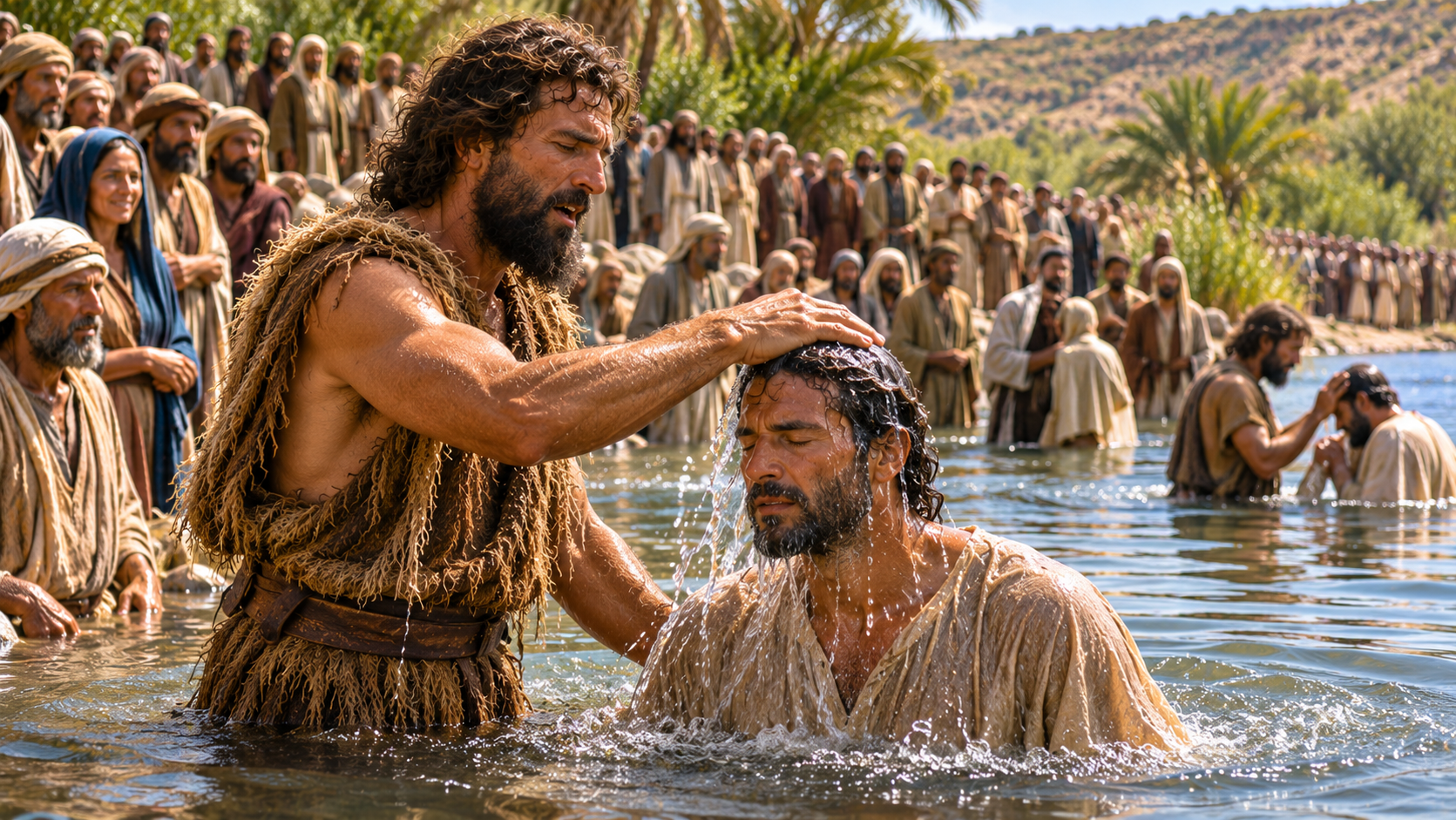
BAPTIZING THOSE
CONFESSING THEIR SINS
And they were being baptized (baptizo) by him in the Jordan River as they confessed (exomologeo) their sins (hamartia) - Were being baptized is in the imperfect tense (as was going out in Mt 3:5) giving the picture of one after another, a veritable stream (pun intended) of humanity coming into the river! A B Bruce says "The movement of course was gradual. It began on a small scale and steadily grew till it reached colossal proportions." One baptism after another was symbolic of a new life, but in John's baptism true new life was neither caused nor obtained, for that would await the coming of Messiah. And as stated below, many of the baptisms were not even truly symbolic, but with time proved to be hypocritical professions, so to speak.
David Turner on being baptized - The meaning of the word “baptize” and the detail that the baptisms are being done in (ἐν, en) the Jordan River indicate the probability that John immerses those who repent (cf. BDAG 164–65; Did. 7). Jewish ritual baths in this time period likewise included immersion. The present adverbial participle ἐξομολογούμενοι (exomologoumenoi, confessing) implies that the confession occurs at the same time as the baptism. In light of 3:7–8, there is the additional implication that John does not baptize those whom he deems unrepentant. (ED: But see Carson's comment) This is consistent with Josephus’s understanding of John’s baptism in Ant. 18.117. (See Matthew Baker Exegetical Commentary on the New Testament) (Bolding added)
John's baptism was different from the traditional Jewish ritual washings of hands, feet and head, washings which were repeated by the person himself, representing repeated purification for repeated sinning. But John's baptism was (1) probably the entire body (complete immersion), (2) was a one time event and (3) John was the one doing the baptizing, not the individual (as with the ritual washings Jews would perform). Gentiles who sought to associate with Judaism were baptized one time signifying that they as outsiders were coming into Judaism. Thus for a Jew to submit to a one time baptism like John's baptism was tantamount to them admitting they were outsiders seeking entrance into the people of God! As Turner noted, as they confessed their sins suggests that their confession of sins occurred at the same time as their baptism.
John MacArthur adds that "That act symbolized before the world that they realized their national and racial descent, or even their calling as God’s chosen and covenant people, could not save them. They had to repent, forsake sin, and trust in the Lord for salvation. It is that of which the baptism was a public witness, as they confessed their sins. They had to come into the kingdom just like the Gentiles, through repentance and faith—which included a public admission of sins. We know from subsequent accounts in the gospels that many of those acts of repentance must have been superficial and hypocritical, because John soon lost much of his following, just as Jesus would eventually lose most of His popularity. But the impact of John’s ministry on the Jewish people was profound and unforgettable. The way of the King had been announced to them, and they had no excuse for not being ready for His coming" (SEE The MacArthur Commentary)
John Phillips has an excellent comment that "John's baptism focused on repentance. John did not want proselytes; he wanted penitents. His baptism could not wash away sin, but his preaching could produce conviction of sin. Those who repented under John's preaching simply, and in a most public way, signified their repentance by being immersed in the Jordan. Cleansing would have to await the ministry of the Messiah." (See Exploring the Gospel of Mark) (Bolding added)
William Barclay - “Baptism (ED: IN CONTEXT REFERRING TO JOHN'S BAPTISM) was for sinners, and no Jew ever conceived of himself as a sinner shut out from God. Now for the first time in their national history the Jews realized their own sin and their own clamant (Urgent or Pressing) need of God. Never before had there been such a unique national movement of penitence and of search for God.” (Matthew 3)
Spurgeon - The “Confessing their sins” which went with baptism in Jordan gave it its meaning. Apart from the acknowledgment of guilt, it would have been a mere bathing of the person without spiritual significance; but the confession which went with it made it an instructive sign. John must have inwardly wondered to see the multitudes come; but his chief thought ran forward to his coming Lord. He thought more of him than of “all Judæa.”(Matthew Commentary)
Confessed (exomologeo) their sins (hamartia) - To confess one’s sins, as they were being baptized, is to agree with God about them, presumably confessing them audibly (which is humbling). To reiterate, it seems clear that John baptized no one who did not confess and repent of his sins. Of course the subsequent course of their life would show whether they truly had turned from the sin they confessed. Obviously there was no way you could demonstrate that change of behavior in the baptismal waters. The word “confess” (exomologeo) is a compound word meaning “to speak the same thing that another speaks,” thus, “to agree with.”
Thus, confession of sin is more than merely admitting that there is sin in one’s life. It is agreeing (homologeo) with God about everything the fact of our sin implies. It is looking at sin from God’s point of view (as best we can do give our finite nature) and acting accordingly, which means repenting of it: putting the sin away and resolving to be done with it. “He who conceals his transgressions will not prosper, But he who confesses and forsakes them will find compassion” (Pr 28:13). Note that true confession both confesses and forsakes.
Yet this is something we can do only in reliance on the Holy Spirit. Our natural man does not truly want to confess or repent. We must submit to the indwelling Spirit, Who gives us both the desire to confess and the power to follow through “For God is working in you, giving you the desire and the power to do what pleases him.” (Php 2:13NLT) And when we do confess, we have His promise: “If we confess our sins, He is faithful and righteous to forgive us our sins and to cleanse us from all unrighteousness” (1 Jn 1:9).
D A Carson on the relationship between the confession and the baptism - The Greek does not make clear whether the confession was individual or corporate, simultaneous with baptism or antecedent to it. Josephus (Antiq. XVIII, 116--17 [v.2] says that John, "surnamed the Baptist," required righteous conduct as a "necessary preliminary if baptism was to be acceptable to God." Since John was urging people to prepare for Messiah's coming by repenting and being baptized, we may surmise that open renunciation of sin was a precondition of his baptism, which was therefore both a confirmation of confession and an eschatological sign....The Jordan River is fast flowing. No doubt John stationed himself at one of the fords, and prepared the way for the Lord. (ED: Either way, it is clear John did require confession with their baptism).
Gotquestions - John’s baptism had to do with repentance—it was a symbolic representation of changing one’s mind and going a new direction. “Confessing their sins, they were baptized by him in the Jordan River” (Matthew 3:6). Being baptized by John demonstrated a recognition of one’s sin, a desire for spiritual cleansing, and a commitment to follow God’s law in anticipation of the Messiah’s arrival.
COMMENT - Whether those who confessed and were baptized truly followed through and showed a changed life is, as they say, another story! Jesus suggests that for many of them the enthusiasm was short-lived: “He was the lamp that was burning and was shining and you were willing to rejoice for a while in his light” (Jn 5:35). That is why John demanded more than a dip in the Jordan. He demanded fruit: “Therefore bear fruit in keeping with repentance” (Mt 3:8).
John's baptism was a baptism of repentance, an acknowledgement of sin, and of the need for the forgiveness of sins which Messiah (the "Lamb of God") would bring about (Jn 1:29). The baptism was the symbol of their acknowledgement of sin, and of their need for a Savior. It was a "preparatory baptism," but it did not preclude the need for "believer's baptism," once they had come to faith in Jesus as that promised Messiah (see in Acts 19:1-7)
Darrell Bock helps us understand John's baptism of repentance for the forgiveness of sins (Mk 1:4, Luke 3:3) =
The final characteristic mentioned about this baptism is its goal. It is directed toward, (eis, for), the forgiveness of sins. This statement could be read to suggest that some type of total forgiveness and efficacy is found in John’s baptism that makes the experience one of “becoming saved.” However, this understanding reads back more into the event than the time of the event and the presentation of Luke will allow. John is a preparatory figure (Lk 1:17 ="It is he who will go as a forerunner before Him in the spirit and power of Elijah, TO TURN THE HEARTS OF THE FATHERS BACK TO THE CHILDREN, and the disobedient to the attitude of the righteous, so as to make ready a people prepared for the Lord.”, Luke 1:76–77; Schürmann 1969: 154–57). He prepares a people for God. Most importantly, John says that his baptism is nothing compared to the baptism that the Mightier One brings (Lk 3:16).
John’s baptism is a prophetic eschatological washing; that is,
it is a baptism of promise that looks to the greater baptism of the SpiritSo John’s baptism is a prophetic eschatological washing; that is, it is a baptism of promise that looks to the greater baptism of the Spirit (Schürmann 1969: 158–60). It points forward to the cleansing that comes to those who respond to Messiah’s offer with faith. This association of Spirit and cleansing was mentioned in the OT (Ezek. 36:25–27; Zech. 13:1).
The washing in the Jordan adds symbolism, picturing either repentance (Isa. 1:16–17; Jer. 4:14) or divine cleansing (Ps. 51:7–9; Isa. 4:2–6; Ezek. 37:23; Jer. 33:8) or, perhaps, both (Nolland 1989: 141). If there be any doubt that Luke understands John in this prophetic and eschatological fashion, a glance at Acts 19:1–10 ends any such uncertainty. Disciples who know only of John are to accept immediately the baptism tied to Jesus. Acts 19:4 makes it clear that John’s baptism is not complete in itself, but points to faith in Jesus (also Acts 13:24). Thus, John’s baptism represented for its precross Israelite audience a commitment to a new approach to God resulting in a life of fruitfulness for God and expectation of the eschaton....
In short, John’s baptism was a step on the way to the Promised One’s forgiveness. The repentance in view here will not only make one alter the way one lives, but also will cause one to see “the Mightier One to come” as the promise of God. To submit to this baptism is to confess one’s commitment to this perspective. This is the essence of John’s baptism of repentance for the forgiveness of sins. (Baker Exegetical Commentary-Luke)
John MacArthur adds that these comments on baptism in Judaism...
"While there were various ceremonial washings in Judaism (cf. Heb. 6:2), there was no baptism of Jews (ED: THAT IS, NOTHING LIKE THE ONE TIME BAPTISM IN CHRISTIANITY). But while there was no baptism of Jews in Judaism, the Jews did baptize Gentile converts to Judaism (Gentile proselytes). Thus, those who “were being baptized by [John] in the Jordan River, as they confessed their sins” (Mt. 3:6), were publicly acknowledging that they were no better than the Gentiles. Their sins had separated them from the true and living God (cf. Isa 59:2) and cut them off from covenant blessings. For Jewish people to place themselves on the same level as the despised Gentiles was astonishing, and demonstrates the power of John’s preaching. Unfortunately, few being baptized by John were truly repentant. (ED: THIS IS SOMEWHAT OF A CONJECTURAL STATEMENT, ALTHOUGH IT IS PROBABLY TRUE - SEE COMMENT BELOW) The nation would later reject Jesus when He failed to meet their expectations of a political Messiah, Who would deliver them from the Romans. Others were superficial from the start....But those few (Mt 7:13–14) who acknowledged their sinful condition and alienation from God and turned to Him in repentant faith were saved. (See context in Luke Commentary)
Comment - While there were not many who were saved as a result of John's baptism of repentance for the forgiveness of sins, there do appear to be some, and below are some examples to consider:
- Acts 18:24-25 records "Now a Jew named Apollos, an Alexandrian by birth, an eloquent man, came to Ephesus; and he was mighty in the Scriptures. 25 This man had been instructed in the way of the Lord; and being fervent in spirit, he was speaking and teaching accurately the things concerning Jesus, being acquainted only with the baptism of John." (COMMENT: So either directly or indirectly he had been instructed by John the Baptist. From Luke's description Apollos was clearly saved. Unlike the disciples of John the Baptist in Acts 19:1-7 there is no evidence that Apollos needed to be re-baptized.)
- Another possible example is two of John the Baptist's disciples, Andrew and John, who became Jesus' disciples. John records "Again the next day John was standing with two of his disciples, 36 and he looked at Jesus as He walked, and said, “Behold, the Lamb of God!” The two disciples (ANDREW AND JOHN) heard him speak, and they followed Jesus." (John 1:35-37) (COMMENT: So obviously Andrew and John believed in Jesus, although exactly when they truly believed is difficult to state dogmatically.)
- In addition Jesus alludes to some who believed - "For John came to you ("the chief priests and the elders" - Mt 21:23) in the way of righteousness and you did not believe him; but the tax collectors and prostitutes did believe him; and you, seeing this, did not even feel remorse (metamellomai) afterward so as to believe him." (Mt 21:32, cf Mt 21:25)
- In a similar allusion by Jesus we read - “I say to you, among those born of women there is no one greater than John; yet he who is least in the kingdom of God is greater than he.” 29 When all the people and the tax collectors heard this, they acknowledged God’s justice, having been baptized with the baptism of John. 30 But the Pharisees and the lawyers rejected God’s purpose for themselves (Ryle = "they rejected God’s offer of salvation"), not having been baptized by John. (Lk 7:28-30)
Were being baptized (907)(baptizo from bapto = cover wholly with a fluid; stain or dip as with dye; used of the smith tempering the red-hot steel, used of dyeing the hair; of a ship that "dipped" = sank) has a literal and a figurative meaning in the NT. The literal meaning is to submerge, to dip or immerse as in water. A study of the 77 NT uses reveals that most of the uses of baptizo in the Gospels and Acts are associated with literal water baptism. Mark uses baptizo 4x in this section (Mk 1:4, 5, 8, 9 - twice in v8). All of Matthew's uses - Matt. 3:6; Matt. 3:11; Matt. 3:13; Matt. 3:14; Matt. 3:16; Matt. 28:19
The Greeks used baptizo to describe the dyeing of a garment, in which the whole material was plunged in and taken out from the element used. Baptizo was used of the act of sinking ships. Baptizo also meant to bathe of a boat which had been wrecked by being submerged and then stranded on the shore. Figuratively, baptizo pictures the introduction or placing of a person or thing into a new environment or into union with something else so as to alter its condition or its relationship to its previous environment or condition. In this sense baptizo means to be identified with. In some contexts baptizo meant to wash ceremonially for purpose of purification (washing of cups - Mk 7:4, Lk 11:38 = This custom before meals, prescribed by the Pharisees, was not required by the original Mosaic law. See Ritual Washing in Judaism). Jesus used this verb figuratively to alert his disciples to a coming baptism of suffering ("They [disciples] said to Him, “We are able.” And Jesus said to them, “The cup that I drink you shall drink; and you shall be baptized with the baptism with which I am baptized." (Mk 10:39). This describes them in a sense as “immersed” or “covered over” with suffering (cf Lk 12:50)!
The baptism of John the Baptist was for repentance and was associated with John calling for the people to believe in Jesus (Acts 19:4) (cf, Mt 3:6, Mk 1:4, 5). In Lk 7:29 "When all the people and the tax collectors heard this, they acknowledged God’s justice, having been baptized with the baptism of John." This suggests that they were saved. Contrast those in Lk 7:30 "But the Pharisees and the lawyers rejected [atheteo] God’s purpose [boule] for themselves, not having been baptized [baptizo] by John." Note that it was not the fact that John baptized in water that they were saved but those who were in fact saved were saved based on their repentance and their belief in Jesus (Who was coming). Those who were genuinely saved exercised faith in the truth they knew of Messiah (before the Cross), which is how all Old Testament saints were saved. (See comments by Bock and MacArthur below)
IDENTIFICATION - James Montgomery Boice helps understand this figurative meaning of baptizo writing that "The clearest example that shows the meaning of baptizo is a text from the Greek poet and physician Nicander, who lived about 200 B.C. It is a recipe for making pickles and is helpful because it uses both words. Nicander says that in order to make a pickle, the vegetable should first be 'dipped' (bapto) into boiling water and then 'baptised' (baptizo) in the vinegar solution. Both verbs concern the immersing of vegetables in a solution. But the first is temporary. The second, the act of baptizing the vegetable, produces a permanent change. When used in the New Testament, this word more often refers to our union and identification with Christ than to our water baptism... mere intellectual assent is not enough. There must be a union with Him, a real change, like the vegetable to the pickle!" (Bolding added)
Warren Wiersbe - When you read about “baptism” in the New Testament, you must exercise discernment to determine whether the word is to be interpreted literally or symbolically. For example, in Romans 6:3, 4 and Galatians 3:27, 28, the reference is symbolic (Ed: and figurative) since water baptism cannot put a sinner into Jesus Christ. Only the Holy Spirit can do that (Ro 8:9; 1Co 12:13; see Acts 10:44, 45, 46, 47, 48). Water baptism is a public witness of the person’s identification with Jesus Christ, while Spirit baptism is the personal and private experience that identifies the person with Christ. The Jews baptized Gentile converts, but John was baptizing Jews! His baptism was authorized from heaven (Mt 21:23–27); it was not something John devised or borrowed. It was a baptism of repentance, looking forward to the Messiah’s coming (Acts 19:1–7). His baptism fulfilled two purposes: it prepared the nation for Christ and it presented Christ to the nation (John 1:31). (Bible Exposition Commentary)
Confessed (present tense, middle voice) (1843)(exomologeo from ek - wholly out from or ex = out or intensify meaning [implies full, frank, open confession, openly or publicly] of homologeo - to say the same thing about from homos = same + lego = speak) Homologeo means to speak the same thing that another speaks, to agree fully with someone else. The prefix ex adds the idea of saying it out: a full, frank, open, public confession. Here the people agreed with God’s verdict that they had missed the mark (hamartia). They did not make excuses for their sin; they called it what God calls it: “and they were being baptized by him in the Jordan River, as they confessed their sins” (Mt 3:6). Mark records the same scene: “And all the country of Judea was going out to him, and all the people of Jerusalem; and they were being baptized by him in the Jordan River, confessing their sins” (Mk 1:5).
The present tense pictures a continuing scene: one person after another stepping forward, confessing and being baptized. The middle voice stresses personal involvement. Each person confessed his own sins himself; no one confessed on his behalf. Confession of this kind is the opposite of concealment, and Scripture attaches a promise to it: “He who conceals his transgressions will not prosper, But he who confesses and forsakes them will find compassion” (Pr 28:13). “If we confess our sins, He is faithful and righteous to forgive us our sins and to cleanse us from all unrighteousness” (1 Jn 1:9).
Exomologeo occurs 10 times in the NT. Every use carries the root idea of open, wholehearted agreement, applied in four ways:
- Confessing sins (Mt 3:6; Mk 1:5; Acts 19:18; Jas 5:16).
- “Many also of those who had believed kept coming, confessing and disclosing their practices” (Acts 19:18).
- “Therefore, confess your sins to one another, and pray for one another so that you may be healed. The effective prayer of a righteous man can accomplish much” (Jas 5:16).
- Openly praising God, that is, agreeing aloud with who He is and what He has done (Mt 11:25; Lk 10:21; Ro 15:9).
- “At that time Jesus said, ‘I praise You, Father, Lord of heaven and earth, that You have hidden these things from the wise and intelligent and have revealed them to infants’” (Mt 11:25).
- Acknowledging Christ as Lord (Ro 14:11; Php 2:11).
- “and that every tongue will confess that Jesus Christ is Lord, to the glory of God the Father” (Php 2:11).
- Consenting or agreeing, used once in a sobering sense of Judas (Lk 22:6).
- “So he consented, and began seeking a good opportunity to betray Him to them apart from the crowd” (Lk 22:6).
Every person will one day “say the same thing” about Jesus Christ that God says (Php 2:11). The only question is whether we agree with God now, freely, in repentance and faith, or are compelled to agree later, at judgment. This is not an example of "better late than never," for late confession will result in "lake possession" in the lake of fire (Rev 20:11-15).
🙏 THOUGHT - Remember that for believers confession is not just acknowledging our sin against God, but is agreeing with God about the evil of our sin and expressing a desire to "throw off our old sinful nature and our former way of life, which is (being) corrupted by lust and deception (and) instead let the Spirit (continually) renew your thoughts and attitudes." (Eph 4:22-23NLT).
Hiebert notes that exomologeo is literally confessing out, which pictures the openness and fullness of their confession. "It was a public acknowledgment of sins, although certainly not in full, colorful detail. Confessing basically means “speaking the same thing.” They openly agreed with the divine verdict concerning their deeds. True confession implies our willingness to call our sins by the name that God gives them." (Commentary)
Matthew 3:5--6 Confessed their sins - The ‘Confessing their sins’ which went with baptism in the Jordan gave it its meaning. Apart from the acknowledgement of guilt, it would have been a mere bathing of the person without spiritual significance. - Spurgeon
MacArthur observes that six things demonstrate the true greatness of John.
(1) He was filled with and controlled by the Spirit, even from “his mother’s womb” (Luke 1:15b).
(2) He was obedient to God’s Word. From childhood he followed God’s will, and from it he never wavered.
(3) He was self-controlled, drinking neither “wine or liquor” (Luke 1:15a). In his food, dress, and life-style he was temperate and austere.
(4) He was humble. His purpose was to announce the king, not to act kingly or take for himself any of the king’s prerogatives. Speaking of Jesus, John said, “After me One is coming who is mightier than I, and I am not fit to stoop down and untie the thong of His sandals” (Mark 1:7), and on a later occasion, “He must increase, but I must decrease” (John 3:30).
(5) He courageously and faithfully proclaimed God’s Word, thundering it across the wilderness as long as he was free to preach, to whomever would listen. (ED: MEN AND WOMEN FILLED WITH/CONTROLLED BY THE SPIRIT HAVE THE "FRUIT" OF HOLY BOLDNESS! cf Acts 4:31).
(6) Finally, he was faithful in winning people to Christ, in turning “back many of the sons of Israel to the Lord their God” (Luke 1:16). He stands as a pattern for all who seek genuine greatness. (SEE The MacArthur Commentary)
John's Baptism and forgiveness of sins - See Mark 1:4, Luke 3:3 - John’s baptism was not the means of forgiveness. It was the public sign of a genuine inner repentance (metanoia) that looked forward to the forgiveness God would provide through the coming Messiah. Mark and Luke describe it as “a baptism of repentance for the forgiveness of sins”: “John the Baptist appeared in the wilderness preaching a baptism of repentance for the forgiveness of sins” (Mk 1:4). The forgiveness is tied to the repentance, and the baptism (baptizo) was its outward expression. It is “a baptism characterized by repentance, with a view to forgiveness,” not “a baptism that produces forgiveness.” Matthew makes this especially clear. He leaves “forgiveness of sins” out of his account of John’s baptism (“I baptize you with water for repentance,” Mt 3:11) and keeps the phrase for the cross: “for this is My blood of the covenant, which is poured out for many for forgiveness of sins” (Mt 26:28). John announced forgiveness; Christ accomplished it. His baptism pointed beyond itself to the One who was coming: “Paul said, ‘John baptized with the baptism of repentance, telling the people to believe in Him who was coming after him, that is, in Jesus’” (Acts 19:4). Water has never removed sin: “And according to the Law, one may almost say, all things are cleansed with blood, and without shedding of blood there is no forgiveness” (Heb 9:22). Forgiveness has always come only through faith in God’s provision, which is fulfilled in His Son: “Of Him all the prophets bear witness that through His name everyone who believes in Him receives forgiveness of sins” (Acts 10:43).
John’s baptism did not wash away sins. It publicly showed a repentance that looked to the Lamb of God, whose blood alone “takes away the sin of the world” (Jn 1:29).
Gotquestions addresses the question of the meaning of John's baptism -
Though today the word baptism generally evokes thoughts of identifying with Christ’s death, burial, and resurrection, baptism did not begin with Christians. For years before Christ, the Jews had used baptism in ritual cleansing ceremonies of Gentile proselytes. John the Baptist took baptism and applied it to the Jews themselves—it wasn’t just the Gentiles who needed cleansing. Many believed John’s message and were baptized by him (Matthew 3:5–6). The baptisms John performed had a specific purpose.
In Matthew 3:11, John the Baptist mentions the purpose of his baptisms: “I baptize you with water for repentance.” Paul affirms this in Acts 19:4: “John’s baptism was a baptism of repentance. He told the people to believe in the one coming after him, that is, in Jesus.” John’s baptism had to do with repentance—it was a symbolic representation of changing one’s mind and going a new direction. “Confessing their sins, they were baptized by him in the Jordan River” (Matthew 3:6). Being baptized by John demonstrated a recognition of one’s sin, a desire for spiritual cleansing, and a commitment to follow God’s law in anticipation of the Messiah’s arrival.
There were some, like the Pharisees, who came to the Jordan to observe John’s ministry but who had no desire to step into the water themselves. John rebuked them sternly: “When he saw many of the Pharisees and Sadducees coming to where he was baptizing, he said to them: ‘You brood of vipers! Who warned you to flee from the coming wrath? Produce fruit in keeping with repentance’” (Matthew 3:7–8). Even the religious leaders needed to repent of their sin, although they saw no need of it.
Christian baptism today also symbolizes repentance, cleansing, and commitment, but Jesus has given it a different emphasis. Christian baptism is a mark of one’s identification with the death, burial, and resurrection of Christ. It is representative of a cleansing that is complete and a commitment that is the natural response of one who has been made new. Jesus’ sacrifice on the cross completely washes away our sins, and we are raised to new life empowered by the Holy Spirit (2 Corinthians 5:17–21; Romans 6:1–11).
With John’s baptism, a person repented of sin and was therefore ready to place his faith in Jesus Christ. John’s baptism foreshadowed what Jesus would accomplish, much as the Old Testament sacrificial system did. John prepared the way for Christ by calling people to acknowledge their sin and their need for salvation. His baptism was a purification ceremony meant to ready the peoples’ hearts to receive their Savior.
G Campbell Morgan has some interesting comments emphasizing three qualities of John's ministry:
- First, it was attractive “ Then went out to him Jerusalem, and all Judaea, and all the region round about Jordan;”
- Secondly, it was convictive “And were baptized of him in Jordan, confessing their sins;
- Finally, it was invective. Against the men who constituted the fountain-head of all Israel’s trouble Pharisees, Sadducees he flung himself in passionate protest.
We sometimes imagine that there is nothing attractive in our ministry, except the winning, wooing note. But there are times when we seem to need again the voice of the herald; and when God finds a John the Baptist and sends him out, his message is full of attractiveness. This is a great picture of attractiveness, of a man with a note of conviction in his message and authority in the way that he deals with sin.
- He came with no theology;
- He came with no philosophy to discuss;
- He came with no new cult to introduce;
- He did not come to ask men to consider a position which they could accept or reject as they pleased;
- He came with the thundering voice of a great inspiration “Repent;”
- His message of God’s authority stirred every place, and every one.
Thank God it is true to-day. We do not need one Gospel for the city, and another for the suburbs, and another for the country. Jerusalem, and all Judaea, and all the villages need the same message. Before Jesus come, John the Baptist must come to the city, and suburbs, and country; and as his message is heard there will be attractiveness in it.
Then notice, his message was convictive.
At least men acknowledged the truth externally, and submitted to the baptism which was a symbol of their repentance. Of course it all fell short there. It can never be any more than that. John Baptist can never communicate life. Coming after him is the Sin-bearer, the great tender-hearted King of men, Who does not only produce repentance, but gives life. If we are convinced of sin, thank God for it, but it is not enough. The crowds that thronged the banks of the Jordan, and went down into its waters of baptism, which was a baptism of repentance, were very sincere; but to accept Jesus there must be something more than this.
Once again, notice the invective note in his preaching.
Now the leaders were responsible Pharisees and Sadducees. The Pharisee was a ritualist; - The Sadducee a rationalist. The Pharisee believed in all supernatural things, but imagined that they could be expressed in external things, and that is always the story of ritualism. The Sadducees did not believe in angel, spirit, or resurrection. They were rationalists, old and hard. These are the forces that damn a people, that blight a nation. John saw them coming; the ritualists and the rationalists, who with their splendid observance of externalities and their inward corruptness of life, had blighted the whole nation. And John said with roughness, “Who hath warned you to flee from the wrath to come,” ye kin of vipers? And then, as if he had said: You have come, and you say you repent; but by you, more than by all others, must be manifested the reality of your repentance. “Bring forth therefore fruits meet for repentance;” trust no longer in your physical relationship to Abraham “God is able of these stones to raise up children unto Abraham.” What a message it was! It must have burned and scorched these men. The more one studies it the more glad one is that Jesus’ ministry of renewing followed. Thank God that the message to-day is that of this blessed King! (Matthew 3:1-12; Matthew 3:13-17)
D L Moody - THINK of the whole population going out into the wilderness to hear this wonderful open-air preacher, to be “baptized of him in Jordan, confessing their sins!” John was a preacher of repentance. Perhaps no one ever rang out the word “Repent!” like John the Baptist. Day after day, as he came out of the desert and stood on the banks of that famous river, you could hear his voice, “Repent! for the kingdom of heaven is at hand.” We can almost now hear the echoes of his voice as they floated up and down the Jordan.
Many wonderful scenes had been witnessed at that stream. Naaman had washed away his leprosy there. Elijah and Elisha had crossed it dryshod. Joshua had led through its channel the mighty host of the redeemed on their journey from Egypt into the promised land. But it had never seen anything like this: men, women, and children, mothers with babes in their arms, scribes, Pharisees, Sadducees, publicans and soldiers, flocked from Judea, Samaria and Galilee, to hear this lonely wilderness prophet.
Matthew 3:7 But when he saw many of the Pharisees and Sadducees coming for baptism, he said to them, "You brood of vipers, who warned you to flee from the wrath to come?
NET Matthew 3:7 But when he saw many Pharisees and Sadducees coming to his baptism, he said to them, "You offspring of vipers! Who warned you to flee from the coming wrath?
GNT Matthew 3:7 Ἰδὼν δὲ πολλοὺς τῶν Φαρισαίων καὶ Σαδδουκαίων ἐρχομένους ἐπὶ τὸ βάπτισμα αὐτοῦ εἶπεν αὐτοῖς, Γεννήματα ἐχιδνῶν, τίς ὑπέδειξεν ὑμῖν φυγεῖν ἀπὸ τῆς μελλούσης ὀργῆς;
NLT Matthew 3:7 But when he saw many Pharisees and Sadducees coming to watch him baptize (NOTE THAT THIS IS NOT WHAT THE GREEK TEXT SAYS), he denounced them. "You brood of snakes!" he exclaimed. "Who warned you to flee God's coming wrath?
KJV Matthew 3:7 But when he saw many of the Pharisees and Sadducees come to his baptism, he said unto them, O generation of vipers, who hath warned you to flee from the wrath to come?
ESV Matthew 3:7 But when he saw many of the Pharisees and Sadducees coming to his baptism, he said to them, "You brood of vipers! Who warned you to flee from the wrath to come?
NIV Matthew 3:7 But when he saw many of the Pharisees and Sadducees coming to where he was baptizing, he said to them: "You brood of vipers! Who warned you to flee from the coming wrath?
ASV Matthew 3:7 But when he saw many of the Pharisees and Sadducees coming to his baptism, he said unto them, Ye offspring of vipers, who warned you to flee from the wrath to come?
CSB Matthew 3:7 When he saw many of the Pharisees and Sadducees coming to the place of his baptism, he said to them, "Brood of vipers! Who warned you to flee from the coming wrath?
NKJ Matthew 3:7 But when he saw many of the Pharisees and Sadducees coming to his baptism, he said to them, "Brood of vipers! Who warned you to flee from the wrath to come?
NRS Matthew 3:7 But when he saw many Pharisees and Sadducees coming for baptism, he said to them, "You brood of vipers! Who warned you to flee from the wrath to come?
YLT Matthew 3:7 And having seen many of the Pharisees and Sadducees coming about his baptism, he said to them, 'Brood of vipers! who did shew you to flee from the coming wrath?
NAB Matthew 3:7 When he saw many of the Pharisees and Sadducees coming to his baptism, he said to them, "You brood of vipers! Who warned you to flee from the coming wrath?
- the Pharisees - Mt 5:20 Mt 12:24 Mt 15:12 Mt 16:6,11,12 Mt 22:15,23,34 Mt 23:13-28 Mk 7:3-5 Mk 8:15 Mk 12:13,18 Lu 7:30 Lu 11:39-44 Lu 16:14 Lu 18:11 Joh 1:24 Joh 7:45-49 Joh 9:40 Ac 4:1,2 Ac 5:17 Ac 15:5 Ac 23:6-9 Ac 26:5
- You brood of vipers - Mt 12:34 Mt 23:33 Ge 3:15 Ps 58:3-6 Isa 57:3,4 Isa 59:5 Lu 3:7-9 Joh 8:44 1Jn 3:10 Rev 12:9,10
- who - Jer 6:10 Jer 51:6 Eze 3:18-21 Eze 33:3-7 Ac 20:31 Ro 1:18 Heb 11:7
- flee - Ro 5:9 1Th 1:10 2Th 1:9,10 Heb 6:18 Rev 6:16,17
- Matthew 3 Resources - Multiple Sermons and Commentaries
Related Passages:
Luke 3:7 So he began saying to the crowds who were going out to be baptized by him, “You brood of vipers, who warned you to flee from the wrath to come?
John 3:18 “He who believes in Him is not judged; he who does not believe has been judged already, because he has not believed in the name of the only begotten Son of God.
Malachi 4:5-6 “Behold, I am going to send you Elijah the prophet before the coming of the great and terrible day of the LORD. 6 “He will restore the hearts of the fathers to their children and the hearts of the children to their fathers, so that I will not come and smite the land with a curse.”
Matthew 12:34 “You brood of vipers, how can you, being evil, speak what is good? For the mouth speaks out of that which fills the heart.
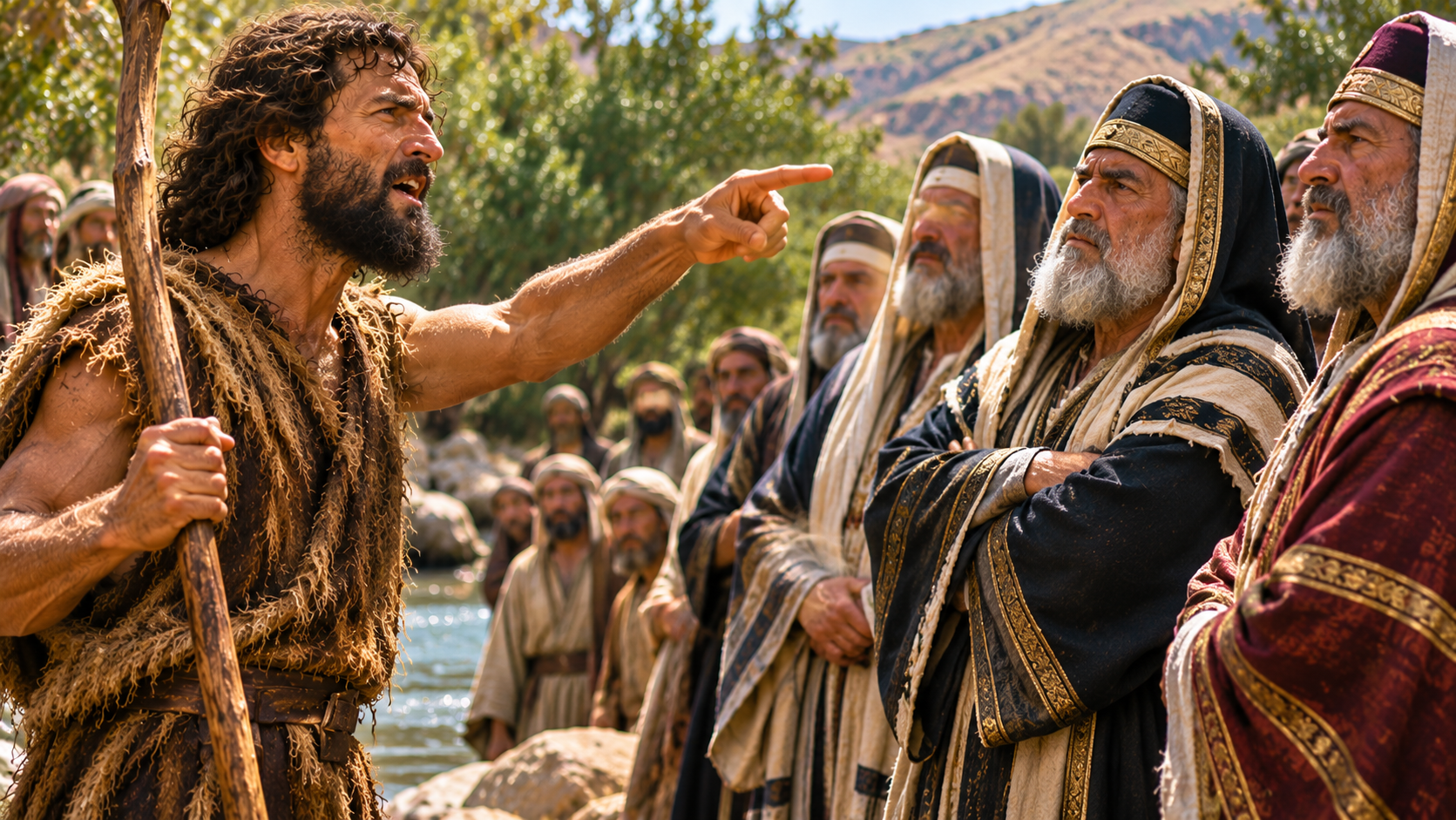
A POPULAR PROPHET
PREACHING AN UNPOPULAR PRECEPT
But when he saw many of the Pharisees (pharisaios) and Sadducees (saddoukaios) coming for baptism (baptisma) - Broadus observes "with only one article, throws the two parties together as both needing sharp rebuke." The presence of these two rival parties coming together would have been a clue that their intentions were not good (cf The enemy of my enemy is my friend).
McNeile observes "Here a strong attraction, there a strong repulsion, made them for the moment forget their differences”
We find them united again in Mt 16:1 and Mt 22:23, 34. It is interesting that the parallel passage in Luke 3:7 has John warning "the crowds who were going out to be baptized by him," whereas here in Matthew 3 he is directing his warning at the religious leaders. Both groups needed to hear and heed his warning! Consistent with his criticism for the Jewish religious leaders, Matthew is the only Gospel writer to repeatedly address the Pharisees and Sadducees (5x = Mt. 3:7; Mt. 16:1; Mt. 16:6 = "“Watch out and beware of the leaven of the Pharisees and Sadducees.”; Mt. 16:11 = "beware of the leaven of the Pharisees and Sadducees."; Mt. 16:12)
Warren Wiersbe adds that "The Pharisees were legal literalists who turned the law into a burden; the Sadducees were “liberals” who denied much of the OT (see Acts 23:8)." (borrow Wiersbe's Expository Outlines on the New Testament )
Matthew Poole pointed out four things about the Pharisees.
• They believed that one was made righteous by keeping the law, and they believed themselves to be righteous in this way.
• They often misinterpreted the law.
• They held many traditions to be of equal authority to Scripture.
• They were often hypocrites in their practice, neglecting the core and spirit of the law for aspects of outward observance. (Guzik)
Spurgeon - It was strange to see the proud Separatists and the sceptical Moralists come to be baptized; and therefore, as a test, John addressed them with scorching words. He saw that they were serpentine in their motives and viperish in their tempers, and so he calls them “Progeny of vipers”: thus would he see whether they were sincere or not. He asks who suggested to them to flee from that wrath of which he was the forerunner, according to the closing words of the Old Testament (Malachi 4:5-6). This enquiry was not complimentary; but it is no business of the Lord’s servants to make themselves pleasing: they must be faithful, and especially so to the great and learned. Thus faithful was John the Baptist, and he was honoured for it by him that sent him.
D A Carson - “Many Pharisees and Sadducees may have come for baptism with the ostentation that characterized their other religious activities … they were showing the world how ready they were for Messiah, though they had not truly repented.” (Expositor's Bible Commentary)
He said to them, "You brood (gennema) of vipers (echidna), who warned (hupodeiknumi) you to flee - Using the same epithet as Jesus would later use (Mt 12:34, Mt 23:33), John's sarcastic question must have stung these arrogant serpentine ecclesiastics! In a bit of bitter irony, the vipers themselves were stung! What a picture John describes with this warning -- what happens when there is a fire in the desert? The vipers flee from the heat of the fire to take cover in their holes. God's coming wrath would be far worse, beginning with first being cast into Hades (a "place of torment" Lk 16:28), and ending with Hades being thrown into the Lake of fire and brimstone (Rev 20:15), where "they will be tormented day and night forever and ever." (Rev 20:10), Whether this is literal or figurative fire, the effect is to produce eternal torment. John emphasizes this coming wrath of God, a truth which should stir a fear in every human heart and in turn motivate a desire for genuine repentance.
The irony is striking. These men prided themselves on their pedigree: “We have Abraham for our father” (Mt 3:9). John tells them their true “parentage” is not Abraham but a nest of snakes! The phrase points back to the original serpent, whose “seed” has been at war with the woman’s seed since the Fall: “And I will put enmity Between you and the woman, And between your seed and her seed; He shall bruise you on the head, And you shall bruise him on the heel” (Gen 3:15). Jesus made the same point even more directly: “You are of your father the devil, and you want to do the desires of your father. He was a murderer from the beginning, and does not stand in the truth because there is no truth in him. Whenever he speaks a lie, he speaks from his own nature, for he is a liar, and the father of lies” (Jn 8:44). What a person is shows in what he produces. “You brood of vipers, how can you, being evil, speak what is good? For the mouth speaks out of that which fills the heart” (Mt 12:34).
The picture of fleeing vipers may also lie behind John’s words (Mt 3:7). When a field or a pile of brush was set on fire, snakes would rush out ahead of the flames to escape. Paul experienced this on Malta: “But when Paul had gathered a bundle of sticks and laid them on the fire, a viper came out because of the heat and fastened itself on his hand” (Acts 28:3). The Pharisees and Sadducees were like snakes scurrying away from the fire, wanting to escape judgment without any change of nature. Jesus’ final use of the phrase is His most solemn: “You serpents, you brood of vipers, how will you escape the sentence of hell?” (Mt 23:33).
Broadus feels that “Warned, is stronger than the original, which signifies to show secretly or partially, and thus to intimate, suggest, indicate, or more generally, to make known.”
On his reading, John’s question is almost ironic: “Who tipped you off? Who gave you the hint that you should run from the coming wrath?” (Mt 3:7). John was not denying that wrath was coming. He was questioning their motives. They seemed to have caught wind of the danger, like snakes fleeing a brush fire, without any real change of heart. That is why he immediately demands proof: “Therefore bear fruit in keeping with repentance” (Mt 3:8).
D A Carson on John's question - John's rhetorical question takes on a sarcastic nuance: "Who warned you to flee the coming wrath and come for baptism-when in fact you show no signs of repentance?"...John the Baptist stands squarely in the prophetic tradition-a tradition in which the Day of the Lord points much more to darkness than to light for those who think they have no sin (Amos 2:4-8; 6:1-7). "You brood of vipers!" also belongs to the prophetic tradition (cf. Isa 14:29; 30:6; cf. CD 19:22); in Matthew 12:34, Jesus uses these terms to excoriate the Pharisees.
Scripture makes figurative use of poisonous snakes and vipers (Dt. 32:33; Isa 59:5; Ps. 140:3) with reference to the wicked. Truth be told, all of us in our natural (unregenerate) state have "the poison of asps (picture) under (our) lips." (Ro 3:13b, cf Ps 58:3,4) It is also interesting that various politicians and other groups were called “vipers” or “brood of vipers” in Greco-Roman sources (e.g., Aeschylus, Choephori 994; Euripides, Ion 1262). (Evans See The Bible Knowledge Background Commentary: Matthew-Luke)
John Broadus on the wrath (orge) to come - It was expected among the Jews (as the Book of Enoch shows), that in connection with Messiah’s appearance there would be an outburst of God’s wrath upon his enemies, i. e. upon the Gentiles. But John, in accordance with the whole tenor of his teaching, describes ‘the coming wrath’ as threatening all God’s enemies, including impenitent Jews; and this was already implied in Mal 3 (e.g. “He will sit as a smelter and purifier of silver, and He will purify the sons of Levi and refine them like gold and silver, so that they may present to the LORD offerings in righteousness. 4 “Then the offering of Judah and Jerusalem will be pleasing to the LORD as in the days of old and as in former years." Mal 3:3-4) and Mal 4 (e.g., "For behold, the day is coming, burning like a furnace; and all the arrogant and every evildoer [IMPLICIT = BOTH JEW AND GENTILE] will be chaff; and the day that is coming will set them ablaze,” says the LORD of hosts, “so that it will leave them neither root nor branch.”....3 “You will tread down the wicked, for they will be ashes under the soles of your feet on the day which I am preparing,” says the LORD of hosts." Mal 4:1, 3)."
From the wrath (orge) to come (mello) - There is another touch of sarcasm, for most the Jews believed in the wrath to come but they falsely believed it was reserved for the pagan, heathen Gentiles! They needed to look in the mirror! Paul described that in contrast to most of the Jews, many of these despised Gentiles had "turned to God from idols to serve a living and true God (PICTURE OF REPENTANCE), and to wait for His Son from heaven (PICTURE OF BRINGING FORTH FRUIT IN KEEPING WITH REPENTANCE), Whom He raised from the dead, that is Jesus, Who rescues (rhuomai = RESCUE FROM DANGER!) us from the wrath to come (present tense)." (1 Th 1:9-10) Paul's description of the Gentile rescue by Jesus was identical to John's description in this passage, which reads more literally "the (mello in present tense - continually) coming wrath." In short, the picture is that God's wrath is already "on its way!" (cf Jn 3:18) It is imminent! The present tense is used in a proleptic sense for so certain is the wrath of God to come to pass at some time in the future. This phrase is reminiscent of Romans 1:18 where Paul writes that "For the wrath (orge) of God is (present tense - continually being) revealed from heaven against all ungodliness and unrighteousness of men who (CONTINUALLY, ACTIVELY, WILLFULLY) suppress the truth in unrighteousness."
When the fearful righteous wrath of God comes there will be no place for "vipers" to hide, no place for sinners to slide! (cf Rev 6:15, 16, 17, Hos 10:8) The only solution is to "Be saved from this perverse generation" (Acts 2:40+) and seek refuge in the Redeemer, "hiding" in Christ (Col 3:3), believing in His so great a salvation (Heb 2:3). Considering the fact that Jerusalem would be destroyed some 40 years later, one might think John's warning was about this coming destruction in A D 70. However the wrath to which John refers is far worse than the destruction of Jerusalem, describing the final wrath reserved for every soul whose name is not found written in the Book of Life and thus is thrown into the Lake of Fire. (cf Rev 20:10 and Rev 20:11-15) For the Jews another aspect of God's wrath is the coming time of Jacob's trouble (Jer 30:7), which occurs at the end of this present evil age (Gal 1:4), in the last 3.5 year period (cf Daniel's Seventieth Week) of indescribably horrendous judgments known as the Great Tribulation in which 2/3's of the world's Jews will "be cut off and perish" (Zechariah 13:8-9) (For comparison Hitler murdered 1/3 of the world's Jews). Failure to repent will reap God's righteous wrath! Or as someone has quipped "Turn or burn!" (Of course, this is far from a laughing matter!) (See also the dark, dread Day of the Lord a day of doom)
The prophet John's warning echoes the language of the Old Testament prophets:
Behold, the Day of the Lord is coming, Cruel, with fury and burning anger, To make the land a desolation; And He will exterminate its sinners from it. (Isa. 13:9);
Behold, the name of the LORD comes from a remote place; Burning is His anger and dense is His smoke; His lips are filled with indignation And His tongue is like a consuming fire; (Isa. 30:27);
A day of wrath is that day, A day of trouble and distress, A day of destruction and desolation, A day of darkness and gloom, A day of clouds and thick darkness, (Zeph. 1:15).
The apostle John describes how to flee from the wrath to come writing “He who believes in the Son has eternal life (PRESENT POSSESSION); but he who does not obey (FAITH THAT BELIEVES OBEYS - FAITH ALONE SAVES BUT THE FAITH THAT TRULY SAVES IS NOT ALONE) the Son will not (ABSOLUTELY NOT) see life (IN CONTEXT ETERNAL LIFE WITH GOD - cf 2 Th 1:8,9), but the wrath of God abides (present tense - continually abiding over his head like the proverbial "Sword of Damocles") on him.” (Jn 3:36)
Pharisees (5330) pharisaios is transliterated from the Hebrew parash (06567 - to separate) from Aramaic word peras (06537) ("Peres" in Da 5:28), signifying to separate, owing to a different manner of life from that of the general public. After the resettling of the Jewish people in Judea on their return from the Babylonian captivity, there were two religious groups among them. One party contented themselves with following only what was written in the Law of Moses. These were called Zadikim, the righteous. The other group added the constitutions and traditions of the elders, as well as other rigorous observances, to the Law and voluntarily complied with them. They were called Chasidim or the pious. From the Zadikim the sects of the Sadducees and Karaites were derived. From the Chasidim were derived the Pharisees and the Essenes. In I Mac2:42NRSV, among the persons who joined Mattathias against Antiochus IV (Epiphanes), about 167 b.c., are named the Asideans (Asidaíoi), who are described as voluntarily devoted to the law. The Asideans are mentioned also in I Mac 7:13NRSV; II Mac14:6NRSV. In the time of our Lord, the Pharisees were the separatists of their day, as well as the principal sect among the Jews. The Pharisees considered themselves much holier than the common people (Lu 18:11, 12). They wore special garments to distinguish themselves from others.
PRINCIPLE TENETS OF PHARISEES: In opposition to those of the Sadducees, and the former group maintained the existence of angels and spirits and the doctrine of the resurrection (Acts 23:8), which the latter party denied (Mt 22:23; Mk 12:18; Lu 20:27). The Pharisees made everything dependent upon God and fate (Josephus, The Jewish Wars, ii.8.14). However, they did not deny the role of the human will in affecting events (Josephus, Antiquities, xviii.1.3).
ZEAL FOR TRADITION: The Pharisees distinguished themselves with their zeal for the traditions of the elders, which they taught was derived from the same fountain as the written Word itself, claiming both to have been delivered to Moses on Mount Sinai (Mt 15:1-6; Mk 7:3-5). See also parádosis (3862), tradition, and éntalma (1778), a religious precept versus entole (1785), commandment.
William Barclay - In many ways, the Pharisees were the best people in the whole country. There were never more than 6,000 of them; they were what was known as a chaburah, or brotherhood. They entered into this brotherhood by taking a pledge in front of three witnesses that they would spend all their lives observing every detail of the scribal law. (See more detailed notes from William Barclay)
Sadducees (4523) saddoukaios is one of the four major sects of Judaism and were in opposition to the Pharisees and Essences (the Zealots were the fourth sect). Sadducees were the religious and political liberals of the day and made up most of priests and their primary concerns were for the operation of the temple and the interpretation of the Law. They were fewer in number than their major rivals, the Pharisees (who had more influence on the people), but they were more influential and all the high priests of that day were from this sect (cf Acts 5:17) and presided over the Sanhedrin or Jewish "supreme court." The Sadducees were men of position and often wealthy landowners (aristocrats). The irony is that while they were the dominant religious force in Israel, they were worldly minded, materialistic secularists with little genuine interest in religion. They generally were against any opposition to Rome for fear that it would jeopardize their political position and wealth. John records "Therefore the chief priests (SADDUCEES) and the Pharisees convened a council, and were saying, “What are we doing? For this man is performing many signs. 48 “If we let Him go on like this, all men will believe in Him, and the Romans will come and take away both our place and our nation.” (Jn 11:47-48) "The Sadducees controlled the official political structures of Judaism at this time, being the majority members of the Sanhedrin. They were known as extremely strict on law and order issues." (NET Note)
The theology of the Sadducees were diametrically opposed to that of the Pharisees. Thus the Sadducees
(1) rejected oral traditions which was vital to the "religion" of the Pharisees,
(2) accepted the teaching of Moses but seem to have rejected the later books of the OT,
(3) they rejected the resurrection (Mt 22:23), along with the doctrine of future rewards or punishment, there was no heaven or hell, no existence whatsoever except on this earth so that when a man died he just ceased to exist (WHAT A HOPELESS, PESSIMISTIC BELIEF!),
(4) they also denied the existence of beings in other dimensions such as angels and spirits (Acts 23:7, 8) (they were essentially "anti-supernaturalists" consequently, they opposed apocalyptic and messianic movements in general and not just Christianity in particular),
(5) and finally as MacArthur says "they rejected predestination and the sovereignty of God, believing man to be the master of his own destiny. These theological liberals were the first to persecute the church."
Brood (KJV - "generation")(1081)(gennema from gennáo = to give birth to, beget, involving generation from gínomai = to become) describes the product of begetting: that which is born or produced, offspring. To call someone a gennema of something is to say what he came from, his origin and nature. In the NT gennema occurs 4 times, always in the phrase “brood of vipers” (Mt 3:7; 12:34; 23:33; Lk 3:7). John the Baptist used it first, and Jesus later took it up against the same religious leaders.
You brood 4 times - Matt. 3:7; Matt. 12:34; Matt. 23:33; Lk. 3:7.
Vipers (2191)(echidna) was an adder or other poisonous snake. Echidna is used four times as a figurative description of people - Pharisees and Sadducees (Mt. 3:7; Mt 12:34; Mt 23:33) and the Jewish crowd (Lk 3:7). Broadus says vipers is "a phrase of reproach, describing them as noxious and odious, and perhaps also as insidious." Echidna is used once of a literal viper (Acts 28:3).
Echidna referred to small poisonous snakes that lived primarily in the desert regions of Palestine and other parts of the eastern Mediterranean. Because they looked like a dried twig when they were still, a person collecting wood for a fire would often pick one up inadvertently and be bitten, as was Paul on the island of Malta (Acts 28:3). That particular viper was deadly, and when Paul suffered no harm from the bite, the superstitious islanders thought he was a god (Acts 28:3, 6). Vipers therefore had the understandable reputation for being both deadly and deceitful.
"Vipers (e.g., the Nicander’s viper) were commonly believed to eat their way out of their mother’s womb; thus John’s calling the crowd “viper’s offspring” was even nastier than calling them “vipers.” Serpents would flee a burning field." (Craig Keener)
ESV note adds that viper was "A general term for any of a number of poisonous snakes in Israel, showing that the people had become the seed of the Serpent (Ge 3:15)."
It is interesting to note that in pagan Greek culture, the viper (echidna) had long been associated with evil. In Greek mythology the name echidna was given to a monster deity that was half snake and half woman and that gave birth to other monsters, including the murderous sphinx of Thebes.
By the time of Christ, the term "viper" was universally associated with extreme wickedness and danger. Therefore when John the Baptist and later Jesus called the Pharisees, Sadducees and Scribes (Mt 23:29) a brood of vipers, He was declaring them to be both evil and deadly.
Warned (5263)(hupodeiknumi from hupo = under + deiknumi = to show) literally means to show by placing something under, that is, before, someone’s eyes. Figuratively it means to show, make known, point out or indicate. When what is pointed out is danger, it means to warn. Jesus used it that way in Lk 12:5. In other places it simply means “to show” (Acts 20:35, Acts 9:16).
Wrath (3709)(orge from orgaô = to teem, to swell) It pictures a swelling that builds until it finally bursts, and so describes anger that comes from one’s settled nature rather than from a sudden impulse. Used of God, orge does not mean the uncontrolled anger that men are so prone to. It means God’s settled indignation: His controlled, passionate, hostile response to sin in all its forms. Settled indignation means that God’s holiness cannot and will not coexist with sin in any form whatsoever. John the Baptist warned the religious leaders of this very wrath (Mt 3:7). Paul uses the same phrase: “and to wait for His Son from heaven, whom He raised from the dead, that is Jesus, who rescues us from the wrath to come” (1 Th 1:10).
Orge is used mainly of God’s holy, righteous wrath, but it is sometimes used of the wrath of men. In that case it means a deep inner resentment that seethes and smolders: “Let all bitterness and wrath and anger and clamor and slander be put away from you, along with all malice” (Eph 4:31). In that verse “wrath” translates thumos and “anger” translates orge. James gives the reason such anger must go: “for the anger of man does not achieve the righteousness of God” (Jas 1:20).
The two words differ in this way. Used of God, orge is His constant, controlled indignation toward sin. Thumos is more a passionate outburst of rage. The word originally described violent movements of air or water and came to mean “to well up” or “boil up.” Thumos anger is agitated and violent and rushes out at a moment’s notice. Its root idea of rapid motion was used of a man breathing hard as he chased an enemy in great rage. You can picture his nostrils flaring! In short, thumos flares up and dies down; orge abides. John 3:36 shows this clearly: “He who believes in the Son has eternal life; but he who does not obey the Son will not see life, but the wrath of God abides on him.” In summary, God’s wrath is His holy hatred of all that is unholy, His righteous indignation at everything that is unrighteous.
Orge in the Gospels. Orge occurs 36 times in the NT, 12 of them in Romans. It is found only 5 times in the Gospels:
- “But when he saw many of the Pharisees and Sadducees coming for baptism, he said to them, ‘You brood of vipers, who warned you to flee from the wrath to come?’” (Mt 3:7).
- “After looking around at them with anger, grieved at their hardness of heart, He said to the man, ‘Stretch out your hand.’ And he stretched it out, and his hand was restored” (Mk 3:5). This is the only Gospel use of orge for Jesus’ own anger. It is a perfect picture of righteous anger: anger joined with grief, and directed at sin, not at a person’s injury.
- “So he began saying to the crowds who were going out to be baptized by him, ‘You brood of vipers, who warned you to flee from the wrath to come?’” (Lk 3:7).
- “Woe to those who are pregnant and to those who are nursing babies in those days; for there will be great distress upon the land and wrath to this people” (Lk 21:23).
- “He who believes in the Son has eternal life; but he who does not obey the Son will not see life, but the wrath of God abides on him” (Jn 3:36).
🙏 THOUGHT - The indescribable horror of God's righteous wrath (one of His divine attributes) which is coming upon all men and women who stubbornly resist His gracious call to "be saved" and remain dead in their trespasses and sins should motivate us who are saved from that wrath to boldly, continually throw out the Gospel life line to those who are perishing (Play and watch Fanny Crosby powerful classic Rescue the Perishing and then do it!). And we can certainly pray for their salvation! I routinely pray for a hidden people group using the Joshua Project's daily reminder and find myself literally overwhelmed by the statistics on many days where the people group is described as having several million eternal souls and NOT A SINGLE BELIEVER is known in all of those millions. This should break our hearts and stimulate us to plead with God for these otherwise eternally doomed souls! If you need so me additional motivation, take some time to study some of the Related Resources below on Eternal Punishment.
QUESTION - Why did John the Baptist refer to the Pharisees as a brood of vipers?
ANSWER - John the Baptist condemned the Pharisees and Sadducees as a “brood of vipers” in Matthew 3:7. A “brood of vipers” is a “family of snakes.” Because vipers are venomous, John was essentially calling the religious leaders “deadly sons of serpents.” It’s quite a bold denunciation—and one Jesus repeated to the Pharisees in Matthew 12:34.
The Pharisees and Sadducees were the religious leaders in Israel during the time of John the Baptist and Jesus. The Pharisees were the Law-keepers and promoters of tradition, and the Sadducees comprised the wealthier ruling class. Over the centuries, these well-meaning groups had become corrupt, legalistic, and hypocritical and would eventually be responsible for crucifying the Son of God. They earned their label “brood of vipers,” a sobriquet with deeper meaning than is obvious at first glance.
The viper was seen to be an evil creature. Its venom was deadly, and it was also devious—the viper that bit Paul was hiding in the firewood (Acts 28:3). The Hebrew Scriptures, which the Pharisees knew well, associate the serpent with Satan in Genesis 3. For John to call the Pharisees a “brood of vipers” implies that they bore satanic qualities. This idea is clearly stated by Jesus in John 8:44, where He says the unbelieving Jews “belong to [their] father, the devil.” When John and Jesus called the Pharisees a “brood of vipers,” they were pointing out that these men were deceitful, dangerous, and wicked—deceitful in that they were hypocrites (Matthew 23:15); dangerous in that they were blind leaders of the blind (Matthew 15:14); and wicked in that their hearts were full of murder (John 8:37).
Another fascinating detail is found in Jesus’ use of the epithet “brood of vipers” to describe the Pharisees. In Matthew 23:33, He says, “You brood of vipers, how are you to escape being sentenced to hell?” Farmers, then as now, often burned the stubble of their fields to get the land ready for the next planting season. As the fires neared the vipers’ dens, the snakes would slither away from the flames, but they often did not escape being consumed. Snakes fleeing the fire was a common sight, and Jesus’ words to the Pharisees would likely have called it to their minds. How could they think they would escape the fire of God’s judgment by relying on their own works, which were not at all honest or good? John’s and Jesus’ calling them a brood of vipers was meant to make them aware of their own wickedness and call them to repent.
Guzik- We can learn much from John the Baptist’s preaching, “Flee from the wrath to come.”
• This wrath is the wrath of God.
• This wrath is fair and well deserved.
• This wrath is often ignored or disregarded because it is not immediate; it is to come.
• This wrath is not any less certain just because it is delayed and is to come.
• This wrath is terrible when it comes because it is God’s wrath.
• This wrath cannot be stood against; the only way to survive is to successfully flee from it.
What John told them to do is also instructive: flee.
• To flee implies immediate action.
• To flee implies swift action.
• To flee implies straight movement with no diversions.
Related Resources on Eternal Punishment: (Most are from GotQuestions.org)
- Eternal Punishment
- J C Ryle's discussion of Hell
- Does hell exist?
- Where is hell? What is the location of hell?
- Is hell real? Is hell eternal?
- What does hell look like? How hot is hell?
- How can I not go to hell?
- Is Satan the master of hell? Do Satan and his demons punish people in hell?
- Who will go to hell?
- Is hell literally a place of fire and brimstone?
- Did God create hell?
- Are there different levels of punishment in hell?
- How can a loving God send someone to hell?
- What kind of bodies will people have in hell?
- Do Jews believe in hell?
- When was hell created?
- Why does God send people to hell?
- Questions about Heaven, Hell, and Eternity
C H Spurgeon - “The wrath to come.” - Matthew 3:7
It is pleasant to pass over a country after a storm has spent itself; to smell the freshness of the herbs after the rain has passed away, and to note the drops while they glisten like purest diamonds in the sunlight. That is the position of a Christian. He is going through a land where the storm has spent itself upon his Saviour’s head, and if there be a few drops of sorrow falling, they distil from clouds of mercy, and Jesus cheers him by the assurance that they are not for his destruction. But how terrible is it to witness the approach of a tempest: to note the forewarnings of the storm; to mark the birds of heaven as they droop their wings; to see the cattle as they lay their heads low in terror; to discern the face of the sky as it groweth black, and look to the sun which shineth not, and the heavens which are angry and frowning! How terrible to await the dread advance of a hurricane—such as occurs, sometimes, in the tropics—to wait in terrible apprehension till the wind shall rush forth in fury, tearing up trees from their roots, forcing rocks from their pedestals, and hurling down all the dwelling-places of man! And yet, sinner, this is your present position. No hot drops have as yet fallen, but a shower of fire is coming. No terrible winds howl around you, but God’s tempest is gathering its dread artillery. As yet the water-floods are dammed up by mercy, but the flood-gates shall soon be opened: the thunderbolts of God are yet in his storehouse, but lo! the tempest hastens, and how awful shall that moment be when God, robed in vengeance, shall march forth in fury! Where, where, where, O sinner, wilt thou hide thy head, or whither wilt thou flee? O that the hand of mercy may now lead you to Christ! He is freely set before you in the gospel: his riven side is the rock of shelter. Thou knowest thy need of him; believe in him, cast thyself upon him, and then the fury shall be overpast for ever.
C H Spurgeon - “FLEE FROM THE WRATH TO COME.” - Introduction
“Who hath warned you to flee from the wrath to come?”—Matthew 3:7.
“Who have fled for refuge to lay hold upon the hope set before us.”—Hebrews 6:18.
Introduction WE will first consider the question of John the Baptist: “When he saw many of the Pharisees and Sadducees come to his baptism, he said unto them, O generation of vipers, who hath warned you to flee from the wrath to come?” I have no doubt that the Pharisees and Sadducees were very much surprised to hear John addressing them in that way; for men, who wish to win disciples, ordinarily adopt milder language than that, and choose more attractive themes, for they fear that they will drive their hearers from them if they are too personal, and speak too sharply. There is not much danger of that nowadays, for the current notion abroad now is that gospel ministers can sew with silk without using a sharp needle; and that, instead of piercing men with the sword of the Spirit, they should show them only the hilt of it; let them see the bright diamonds on the scabbard, but never let them feel the sharpness of the twoedged blade. They should always comfort, and console, and cheer, but never allude to the terror of the Lord.
Memorable Lines from Spurgeon's sermon FLEE FROM THE WRATH TO COME...for some you will need to read the full sermon for the context.
On preaching that avoids the sword
- “The current notion abroad now is that gospel ministers can sew with silk without using a sharp needle; and that, instead of piercing men with the sword of the Spirit, they should show them only the hilt of it; let them see the bright diamonds on the scabbard, but never let them feel the sharpness of the twoedged blade.”
- “He did not come to say what men wished him to say, but to discharge the burden of the Lord, and to speak out plainly what was best for men’s eternal and immortal interests.”
On the Pharisee and Sadducee
- “Those phylacteries and the broad borders of his garment, of which he was so proud, would not screen him from the anger of God against injustice and transgression; but, just like any common sinner, he would need to ‘flee from the wrath to come.’”
- “He was a Broad Churchman, a man of liberal ideas, fully abreast of the age.” (of the Sadducee)
On the certainty of God’s wrath
- “If there be a God, he cannot let sin go unpunished.”
- “It is not only because he can do it, but because he must do it, that he will, one of these days, let loose the fury of his wrath against sin.”
- “The longer God’s arm is uplifted, the more terrible will be the blow when at last he strikes.”
- “To sin against the patience and longsuffering of Almighty God, is to sin with a vengeance.”
- “As a torrent, that is dammed up for a while, gathers force and strength, and every hour in which it is kept back it gets to be more irresistible, so must it be with ‘the wrath to come’ when at last it does come upon you.”
- “Nor is ‘the wrath to come’ any the less sure because it is delayed.”
- “The just indignation of God against sin must be commensurate with his absolute purity.”
On honest preaching
- “I could not suspect the honesty of those who preach an unpalatable truth which grieves themselves as much as it is distasteful to those who hear it.”
- “We have two strings to our bow; but, to my mind, you have none at all.”
On fleeing
- “If thy ribs were granite, and thy nerves were brass, thou couldest not endure the wrath of the Almighty; nay, not even for a moment.”
- “He that flees for his life does not creep and crawl; he runs at his utmost speed, and he wishes that he could ride on the wings of the wind.”
- “What if your beds should become your tombs?”
- “Straight away to Jesus is the only direction for you just now.”
- “There is the gospel in a nutshell; lay hold of it, and live by it.”
On repentance and its fruit
- “There is no going to heaven by following the road to hell. There is no finding pardon while continuing in sin.”
- “Sin and you must part, or else Christ and you can never keep company.”
- “Wilt thou leave thy sins, and go to heaven, or have thy sins, and go to hell?” (the voice Bunyan thought he heard)
On false hopes (Mt 3:9)
- “Your pedigree will avail you nothing unless you personally quit your sins, and lay hold on Christ as your Saviour.”
- “Your baptism, your church-going, your chapel-going, your eating of the Lord’s supper, your saying of collects, your family prayers, your giving of your guineas, everything of your own put together will all be less than nothing, and vanity, if you trust to it.”
- “You will be as surely damned by your righteousness, if you trust in it, as you will by your unrighteousness.”
On substitution
- “How does Christ deliver us from ‘the wrath to come’? Why, by putting himself into our place, and putting us into his place.”
- “Here comes the great flood of almighty wrath; I will stand just where it is coming, and let it flow over me.” (Spurgeon putting the words in Christ’s mouth)
- “He bore, that you might never bear, His Father’s righteous ire.”
On the hardness of the heart
- “I used to think that, if I once told out this wondrous story of ‘free grace and dying love,’ everybody would believe it; but I have long since learned that so hard is the heart of man, that he will sooner be damned than be saved by Christ.”
- “Escape by quitting your sins, and laying hold on Jesus; and do it this very moment, for you may never have another opportunity to do it.”
Matthew 3:8 "Therefore bear fruit in keeping with repentance;
NET Matthew 3:8 Therefore produce fruit that proves your repentance,
GNT Matthew 3:8 ποιήσατε οὖν καρπὸν ἄξιον τῆς μετανοίας
NLT Matthew 3:8 Prove by the way you live that you have repented of your sins and turned to God.
KJV Matthew 3:8 Bring forth therefore fruits meet for repentance:
ESV Matthew 3:8 Bear fruit in keeping with repentance.
NIV Matthew 3:8 Produce fruit in keeping with repentance.
ASV Matthew 3:8 Bring forth therefore fruit worthy of repentance:
CSB Matthew 3:8 Therefore produce fruit consistent with repentance.
NKJ Matthew 3:8 "Therefore bear fruits worthy of repentance,
NRS Matthew 3:8 Bear fruit worthy of repentance.
YLT Matthew 3:8 bear, therefore, fruits worthy of the reformation,
NAB Matthew 3:8 Produce good fruit as evidence of your repentance.
NJB Matthew 3:8 Produce fruit in keeping with repentance,
GWN Matthew 3:8 Do those things that prove you have turned to God and have changed the way you think and act.
- bear- Mt 21:28-30,32 Isa 1:16,17 Lu 3:8,10-14 Ac 26:20 Ro 2:4-7 2Co 7:10,11 2Pe 1:4-8
- fruit - Ga 5:22,23 Eph 5:9 Php 1:11
- in keeping with, Jer 7:3-7 Jer 26:13 Jer 36:3
- Matthew 3 Resources - Multiple Sermons and Commentaries
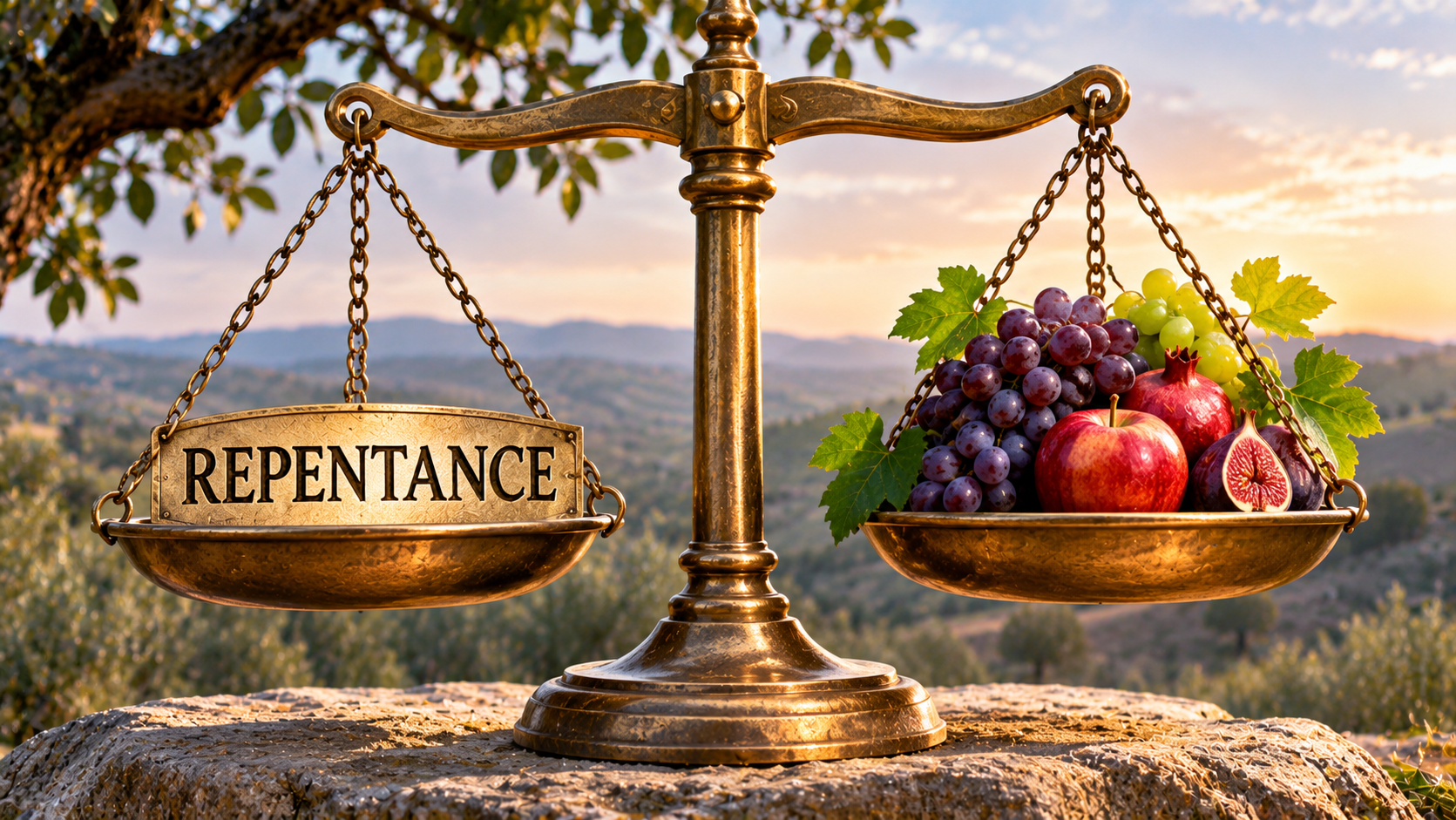
SHOW YOUR COLORS!
The English idiom "show your colors" means to reveal what one truly believes or thinks and so to act in accordance with one's real personality, temperament, or disposition. John demands proof of profession. Producing fruit was a figurative way to describe the lifestyle of one who was truly repentant (cf Mt 3:10; Mt 7:16–20; Mt 12:33; Mt 13:8, 23, 26; Mt 21:19). One is reminded of a similar picture of the "Blessed Man" of Psalm 1 for "He will be like a tree firmly planted by streams of water, Which yields its fruit in its season And its leaf does not wither; And in whatever he does, he prospers." (Ps 1:3) In a similar picture Isaiah writes "Say to the righteous that it will go well with them, For they will eat the fruit of their actions." (Isa 3:10)
Spurgeon comments "Act as a change of mind would lead you to do: above all, quit the pride in which you enwrap yourselves, and leave the serpent motives which now actuate you. Lord, save us from a fruitless repentance, which would be only an aggravation of our previous sins."
This bold challenge to the religious leaders, the very Jews who held themselves up as lights to the laity, is more evidence that John carried out his ministry, not in reliance upon his natural strength, but as a man continually filled with the Spirit (cf call on every believer - Eph 5:18) and thus in complete dependence on the supernatural power the Spirit Who enabled him to bear fruit, one of the fruits being "holy boldness," with no fear of serpentine men (Pr 29:25) nor of their possible vindictive reprisals!
A T Robertson comments that
John demands proof from these men (Ed: Pharisees and Sadducees) of the new life before he administers baptism to them. “The fruit is not the change of heart, but the acts which result from it” (McNeile). It was a bold deed for John thus to challenge as unworthy the very ones who posed as lights and leaders of the Jewish people. “Any one can do acts externally good but only a good man can grow a crop of right acts and habits” (Bruce). (Robertson, A. Word Pictures in the New Testament)
Therefore - (term of conclusion) - John’s “therefore” ties his command to what he has just said about the wrath to come (Mt 3:7) As Broadus explains "Therefore, presents the exhortation as the consequence of what precedes, or is naturally supplied. “As you profess repentance and wish to be baptized, therefore produce fruit worthy of repentance, and thus prove that you really do repent.” This exhortation he might naturally address to all (Luke 3:8), while it was especially appropriate to the Pharisees and Sadducees. It is not probable that he required them to go off and prove their repentance before he could baptize them; he only gave them a special charge."
Luke records the charge as given to the crowds: “Therefore bear fruits in keeping with repentance, and do not begin to say to yourselves, ‘We have Abraham for our father,’ for I say to you that from these stones God is able to raise up children to Abraham” (Lk 3:8). Whatever John required, Scripture later shows that most of the Pharisees never submitted to his baptism at all (Lk 7:30). Jesus Himself made the same point: “For John came to you in the way of righteousness and you did not believe him; but the tax collectors and prostitutes did believe him; and you, seeing this, did not even feel remorse afterward so as to believe him” (Mt 21:32).
When we see a therefore, we should always ask what it is there for. Here the answer is sobering: because wrath is coming, true repentance must show itself in changed lives. Paul preached the same message: “but kept declaring both to those of Damascus first, and also at Jerusalem and then throughout all the region of Judea, and even to the Gentiles, that they should repent and turn to God, performing deeds appropriate to repentance” (Acts 26:20).
Bear fruit (karpos) in keeping (áxios) with repentance (metanoia) - Turn your new way of thinking into a new way of walking. If you truly think differently (repent), then you will walk differently. Jesus (in the context of true/false teachers) referred to the same principle declaring "You will know them by their fruits...every good tree bears good fruit." (Mt 7:16-17). The upshot is if one's life demonstrates no supernatural fruit, one's repentance is a sham profession not a sure possession! The verb bear is poieo which literally means to make, to do, to accomplish and is in the aorist imperative, so that John is calling for his hearers to do this now, or as the Nike commercial says "Just Do It!" Don't delay. Don't procrastinate. Ultimately the only way to truly obey this command is by the supernatural power of the Spirit, and in this case prior to Pentecost He would not be indwelling the "true repenters," but He would still be empowering them to bear supernatural fruit. In Luke 3 the crowds ask John "What shall we do?" and he answered (giving them a sampling of "good fruit")...
And he would answer and say to them, “The man who has two tunics is to share with him who has none; and he who has food is to do likewise.” 12 And some tax collectors also came to be baptized, and they said to him, “Teacher, what shall we do?” 13 And he said to them, “Collect no more than what you have been ordered to.” 14 Some soldiers were questioning him, saying, “And what about us, what shall we do?” And he said to them, “Do not take money from anyone by force, or accuse anyone falsely, and be content with your wages.” (Lk 3:11-14)
Now beloved think about this "fruit" John describes. Every one of us is intrinsically, naturally selfish and self-centered and each of John's descriptions of "fruit" cuts at our innate selfishness! The only One Who can enable us to truly overcome our "gravity of greediness" is the Holy Spirit, either before or after Pentecost! (cf John 15:5)
William Hendriksen adds that "repentance, if it is to be genuine, must be accompanied by fruit-bearing. A merely outward confession of sin will never do. A mere desire to be baptized, as if this rite were a wonder-working charm, has no positive value. There must be that inward change which expresses itself outwardly in God-glorifying conduct, fruit-bearing in keeping with conversion. According to Luke 3:10–14 this fruit-bearing must include such items as generosity, fairness, thoughtfulness, and contentment; according to Mt. 23:23, justice, mercy, and faith; and in view of the manner in which the Baptist descriptively addresses these Pharisees and Sadducees (“You offspring of vipers”), there must be uprightness. On fruit-bearing see also Mt. 5:20–23; 7:16–19; 12:33; 13:8, 23; 16:6, 11, 12; Mt 23; Luke 13:6–9; John 15:1–16; Gal. 5:22, 23; Eph. 5:9; Phil. 1:22; 4:17; Col. 1:6; Heb. 12:11; 13:15; and James 3:18.) (Borrow Exposition of the gospel according to Matthew page 204)
David Turner - Producing fruit as a metaphor for a repentant lifestyle occurs elsewhere in Matthew (Mt 3:10; 7:16–20; 12:33; 13:8, 23, 26; 21:19, 33–44; cf. James 3:18) and is common in the Bible (Ps. 1:3; Pr. 1:31; 11:30; Isa. 3:10; 5:1–7; Hos. 10:1, 12–13; cf. 2 Esd. 3:20NRSV; Sir. 23:25NRSV). John now and Jesus later both affirm that the lifestyle of converts must fit or correspond to their profession of repentance. A change in lifestyle will never occur if confidence is placed in descent from Abraham (Mt 3:9).¹¹ Such descent and the blessings it brings are admirable but do not merit salvation (cf. Ro 3:1–4:15; 9:1–11:32).¹² If John is speaking Hebrew, the irony of his words is underlined by a play on words between son (בֵּן, bēn) and stone (אֶבֶן, eben; cf. Matt. 21:37, 42; Kazmierski 1987). Even if John is speaking Aramaic, where son is בַּר (bar) rather than bēn, the indirect wordplay would likely still be noticed by those familiar with both languages. (See Matthew Baker Exegetical Commentary on the New Testament)
A B Bruce makes an interesting comment that “Anyone can do (poiēsate) acts externally good but only a good man can grow a crop of right acts and habits” (See study of what truly constitutes Good Deeds)
is used literally of fruit, produce or offspring. It describes what is produced by the inner energy of a living organism. In the NT the figurative uses predominate, especially in the Gospels, where a person’s actions and words are viewed as “spiritual” fruit growing out of his essential being or character. John’s call to “bear fruit in keeping with repentance” (Mt 3:8) means exactly this: a changed heart will show itself in a changed life. Jesus taught the same principle: “So every good tree bears good fruit, but the bad tree bears bad fruit. A good tree cannot produce bad fruit, nor can a bad tree produce good fruit” (Mt 7:17-18). “So then, you will know them by their fruits” (Mt 7:20). Good fruit is the result of relying on the Good Spirit: “But the fruit of the Spirit is love, joy, peace, patience, kindness, goodness, faithfulness, gentleness, self-control; against such things there is no law” (Gal 5:22-23).
Karpos occurs 66 times in the NT. Matthew uses it 19 times, in 14 verses: Mt 3:8, 10; 7:16, 17 (2x), 18 (2x), 19, 20; 12:33 (3x); 13:8, 26; 21:19, 34 (2x), 41, 43.
Jesus explains good fruit in His parable of the soils, where the seed is “the word of the kingdom” (Mt 13:19): “And others fell on the good soil and yielded a crop [karpos], some a hundredfold, some sixty, and some thirty” (Mt 13:8). He then explains the parable: “And the one on whom seed was sown on the good soil, this is the man who hears the word and understands it; who indeed bears fruit and brings forth, some a hundredfold, some sixty, and some thirty” (Mt 13:23). In Mt 13:23 “bears fruit” translates the related verb karpophoreo, “to bear fruit,” from karpos and phero, “to bear.” The parallel accounts read:
- “And those are the ones on whom seed was sown on the good soil; and they hear the word and accept it and bear fruit, thirty, sixty, and a hundredfold” (Mk 4:20).
- “But the seed in the good soil, these are the ones who have heard the word in an honest and good heart, and hold it fast, and bear fruit with perseverance” (Lk 8:15).
The source of all such fruit is abiding in Christ: “I am the vine, you are the branches; he who abides in Me and I in him, he bears much fruit, for apart from Me you can do nothing” (Jn 15:5). “My Father is glorified by this, that you bear much fruit, and so prove to be My disciples” (Jn 15:8).
The word in keeping is the adjective áxios which strictly speaking means “bringing into balance” hence describes that which is fitting in the sense that it corresponds to what should be expected. In this case fruit (Spirit wrought good works) serve to authenticate the genuineness of one's repentance. One way to depict the meaning of axios is to draw out a scale as shown below. The fruit should "balance" the "repentance." No fruit, no repentance.
Repentance.....................................................Fruit
/\

So in the picture of scales imagine the "weight" of your Repentance on one pan, perfectly balanced by the "weight" of the fruit your repentance produces.
In keeping (514)(áxios from ágō = to weigh) Strictly speaking, axios pictures bringing up the other beam of the scales. It describes something that has the weight of another thing of like value: it counterbalances it, weighs as much, is worth as much. So axios means bringing into balance, and hence of equivalent or similar worth. John’s command means that the fruit of a person’s life should “weigh the same” as the repentance he professes (Mt 3:8). Paul preached the same balance: “but kept declaring both to those of Damascus first, and also at Jerusalem and then throughout all the region of Judea, and even to the Gentiles, that they should repent and turn to God, performing deeds appropriate (axios) to repentance” (Acts 26:20).
The picture of the scales also explains Paul’s great comparison of present suffering and future glory. Put on the balance, the two do not weigh the same, because the glory to come far outweighs the suffering now: “For I consider that the sufferings of this present time are not worthy [axios] to be compared with the glory that is to be revealed to us” (Ro 8:18). “For momentary, light affliction is producing for us an eternal weight of glory far beyond all comparison, while we look not at the things which are seen, but at the things which are not seen; for the things which are seen are temporal, but the things which are not seen are eternal” (2 Co 4:17-18).
The Septuagint uses axios the same way in Proverbs, where nothing earthly balances heavenly wisdom: “She is more precious than jewels; And nothing you desire compares with her” (Pr 3:15). “For wisdom is better than jewels; And all desirable things cannot compare with her” (Pr 8:11).
Axios occurs 41 times in the NT. Matthew uses it 9 times: Mt 3:8; 10:10, 11, 13 (2x), Mt 10:37 (2x), Mt 10:38; 22:8. Most of these concern who is “worthy” of Christ: “He who loves father or mother more than Me is not worthy of Me; and he who loves son or daughter more than Me is not worthy of Me” (Mt 10:37).
There are some in "evangelicalism" who teach that repentance is only a change of mind. The problem with this definition is that has nothing to do with one’s real attitude toward sin and does not necessarily result in any change in lifestyle. If one's life and deeds do not change, one's repentance is counterfeit! Or stated another way true repentance will produce a life-style and behavior that demonstrate the reality of a changed heart.
Repentance (3341)(metanoia from meta = after + noéo = to understand) literally means “afterthought” or “to think after,” and so implies a change of mind. But the NT uses make clear that metanoia means much more than merely changing one’s mind. It includes a complete change of heart, attitude, interest and direction. Metanoia is a conversion in every sense of the word. Jesus’ teaching supports this: “I tell you that in the same way, there will be more joy in heaven over one sinner who repents [metanoeo] than over ninety-nine righteous persons who need no repentance [metanoia]” (Lk 15:7).
True repentance always shows itself in a changed life. That is why John demanded fruit that “weighs the same” as the repentance professed: “Therefore bear fruit in keeping with repentance” (Mt 3:8). Paul links repentance with turning to God and with deeds that prove it: “but kept declaring both to those of Damascus first, and also at Jerusalem and then throughout all the region of Judea, and even to the Gentiles, that they should repent and turn to God, performing deeds appropriate to repentance” (Acts 26:20). He also distinguishes true repentance from mere regret: “For the sorrow that is according to the will of God produces a repentance without regret, leading to salvation, but the sorrow of the world produces death” (2 Co 7:10). And repentance itself is a gift of God’s grace: “with gentleness correcting those who are in opposition, if perhaps God may grant them repentance leading to the knowledge of the truth” (2 Ti 2:25).
The noun metanoia occurs 22 times in the NT, most often in Luke (5) and Acts (6). The related verb metanoeo, “to repent,” occurs 34 times. Matthew’s only other use of metanoia is in Mt 3:11: “As for me, I baptize you with water for repentance, but He who is coming after me is mightier than I, and I am not fit to remove His sandals; He will baptize you with the Holy Spirit and fire.”
QUESTION - What is repentance and is it necessary for salvation? WATCH VIDEO
ANSWER - Many understand the term repentance to mean “a turning from sin.” Regretting sin and turning from it are related to repentance, but are not the precise meaning of the word. In the Bible, the word repent means “to change one’s mind.” The Bible also tells us that true repentance will result in a change of actions (Luke 3:8–14; Acts 3:19). In summarizing his ministry, Paul declares, “I preached that they should repent and turn to God and demonstrate their repentance by their deeds” (Acts 26:20). The short biblical definition of repentance is “a change of mind that results in a change of action.”
What, then, is the connection between repentance and salvation? The book of Acts especially focuses on repentance in regard to salvation (Acts 2:38; 3:19; 11:18; 17:30; 20:21; 26:20). To repent, concerning salvation, is to change your mind regarding sin and Jesus Christ. In Peter’s sermon on the day of Pentecost (Acts chapter 2), he concludes with a call for the people to repent (Acts 2:38). Repent from what? Peter calls the people who rejected Jesus (Acts 2:36) to change their minds about that sin and to change their minds about Christ Himself, recognizing that He is indeed “Lord and Christ” (Acts 2:36). Peter calls the people to change their minds, to abhor their past rejection of Christ, and to embrace faith in Him as their Messiah and Savior.
Repentance involves recognizing that you have thought wrongly in the past and determining to think rightly in the future. The repentant person has “second thoughts” about the mindset he formerly embraced. There is a change of disposition and a new way of thinking about God, about sin, about holiness, and about doing God’s will. True repentance is prompted by “godly sorrow,” and it “leads to salvation” (2 Corinthians 7:10).
Repentance and faith can be understood
as two sides of the same coin.
Repentance and faith can be understood as two sides of the same coin. It is impossible to place your faith in Jesus Christ as the Savior without first changing your mind about your sin and about who Jesus is and what He has done. Whether it is repentance from willful rejection or repentance from ignorance or disinterest, it is a change of mind. Biblical repentance, in relation to salvation, is changing your mind from rejection of Christ to faith in Christ.
Repentance is not a work we do to earn salvation. No one can repent and come to God unless God pulls that person to Himself (John 6:44). Repentance is something God gives—it is only possible because of His grace (Acts 5:31; 11:18). No one can repent unless God grants repentance. All of salvation, including repentance and faith, is a result of God drawing us, opening our eyes, and changing our hearts. God’s longsuffering leads us to repentance (2 Peter 3:9), as does His kindness (Romans 2:4).
While repentance is not a work that earns salvation, repentance unto salvation does result in works. It is impossible to truly change your mind without changing your actions in some way. In the Bible, repentance results in a change in behavior. That is why John the Baptist called people to “produce fruit in keeping with repentance” (Matthew 3:8). A person who has truly repented of sin and exercised faith in Christ will give evidence of a changed life (2 Corinthians 5:17; Galatians 5:19–23; James 2:14–26).
To see what repentance looks like in real life, turn to the story of Zacchaeus. Here was a man who cheated and stole and lived lavishly on his ill-gotten gains—until he met Jesus. At that point he had a radical change of mind: “Look, Lord!” said Zacchaeus. “Here and now I give half of my possessions to the poor, and if I have cheated anybody out of anything, I will pay back four times the amount” (Luke 19:8). Jesus happily proclaimed that salvation had come to Zacchaeus’s house, and that even the tax collector was now “a son of Abraham” (verse 9)—a reference to Zacchaeus’s faith. The cheat became a philanthropist; the thief made restitution. That’s repentance, coupled with faith in Christ.
Repentance, properly defined, is necessary for salvation. Biblical repentance is changing your mind about your sin—no longer is sin something to toy with; it is something to be forsaken as you “flee from the coming wrath” (Matthew 3:7). It is also changing your mind about Jesus Christ—no longer is He to be mocked, discounted, or ignored; He is the Savior to be clung to; He is the Lord to be worshiped and adored.
Matthew 3:9 and do not suppose that you can say to yourselves, 'We have Abraham for our father'; for I say to you that from these stones God is able to raise up children to Abraham.
NET Matthew 3:9 and don't think you can say to yourselves, 'We have Abraham as our father.' For I tell you that God can raise up children for Abraham from these stones!
GNT Matthew 3:9 καὶ μὴ δόξητε λέγειν ἐν ἑαυτοῖς, Πατέρα ἔχομεν τὸν Ἀβραάμ. λέγω γὰρ ὑμῖν ὅτι δύναται ὁ θεὸς ἐκ τῶν λίθων τούτων ἐγεῖραι τέκνα τῷ Ἀβραάμ.
NLT Matthew 3:9 Don't just say to each other, 'We're safe, for we are descendants of Abraham.' That means nothing, for I tell you, God can create children of Abraham from these very stones.
KJV Matthew 3:9 And think not to say within yourselves, We have Abraham to our father: for I say unto you, that God is able of these stones to raise up children unto Abraham.
ESV Matthew 3:9 And do not presume to say to yourselves, 'We have Abraham as our father,' for I tell you, God is able from these stones to raise up children for Abraham.
NIV Matthew 3:9 And do not think you can say to yourselves, 'We have Abraham as our father.' I tell you that out of these stones God can raise up children for Abraham.
ASV Matthew 3:9 and think not to say within yourselves, We have Abraham to our father: for I say unto you, that God is able of these stones to raise up children unto Abraham.
CSB Matthew 3:9 And don't presume to say to yourselves, 'We have Abraham as our father.' For I tell you that God is able to raise up children for Abraham from these stones!
NKJ Matthew 3:9 "and do not think to say to yourselves,`We have Abraham as our father.' For I say to you that God is able to raise up children to Abraham from these stones.
NRS Matthew 3:9 Do not presume to say to yourselves, 'We have Abraham as our ancestor'; for I tell you, God is able from these stones to raise up children to Abraham.
YLT Matthew 3:9 and do not think to say in yourselves, A father we have -- Abraham, for I say to you, that God is able out of these stones to raise children to Abraham,
NAB Matthew 3:9 And do not presume to say to yourselves, 'We have Abraham as our father.' For I tell you, God can raise up children to Abraham from these stones.
- do not suppose - Mk 7:21 Lu 3:8 Lk 5:22 Lk 7:39 Lk 12:17
- We have Abraham- Eze 33:24 Lu 16:24 Joh 8:33,39,40,53 Ac 13:26 Ro 4:1,11-16 Ro 9:7,8 Ga 4:22-31
- from these stones God is able to raise up children to Abraham - Mt 8:11,12 Lu 19:40 Ac 15:14 Ro 4:17 1Co 1:27,28 Ga 3:27-29 Eph 2:12,13
- Matthew 3 Resources - Multiple Sermons and Commentaries
Related Passages:
Luke 3:8 “Therefore bear fruits in keeping with repentance, and do not begin to say to yourselves, ‘We have Abraham for our father,’ for I say to you that from these stones God is able to raise up children to Abraham.
Romas 2:28-29 or he is not a Jew who is one outwardly, nor is circumcision that which is outward in the flesh. 29 But he is a Jew who is one inwardly; and circumcision is that which is of the heart, by the Spirit, not by the letter; and his praise is not from men, but from God.
Galatians 3:7 Therefore, be sure that it is those who are of faith who are sons of Abraham.
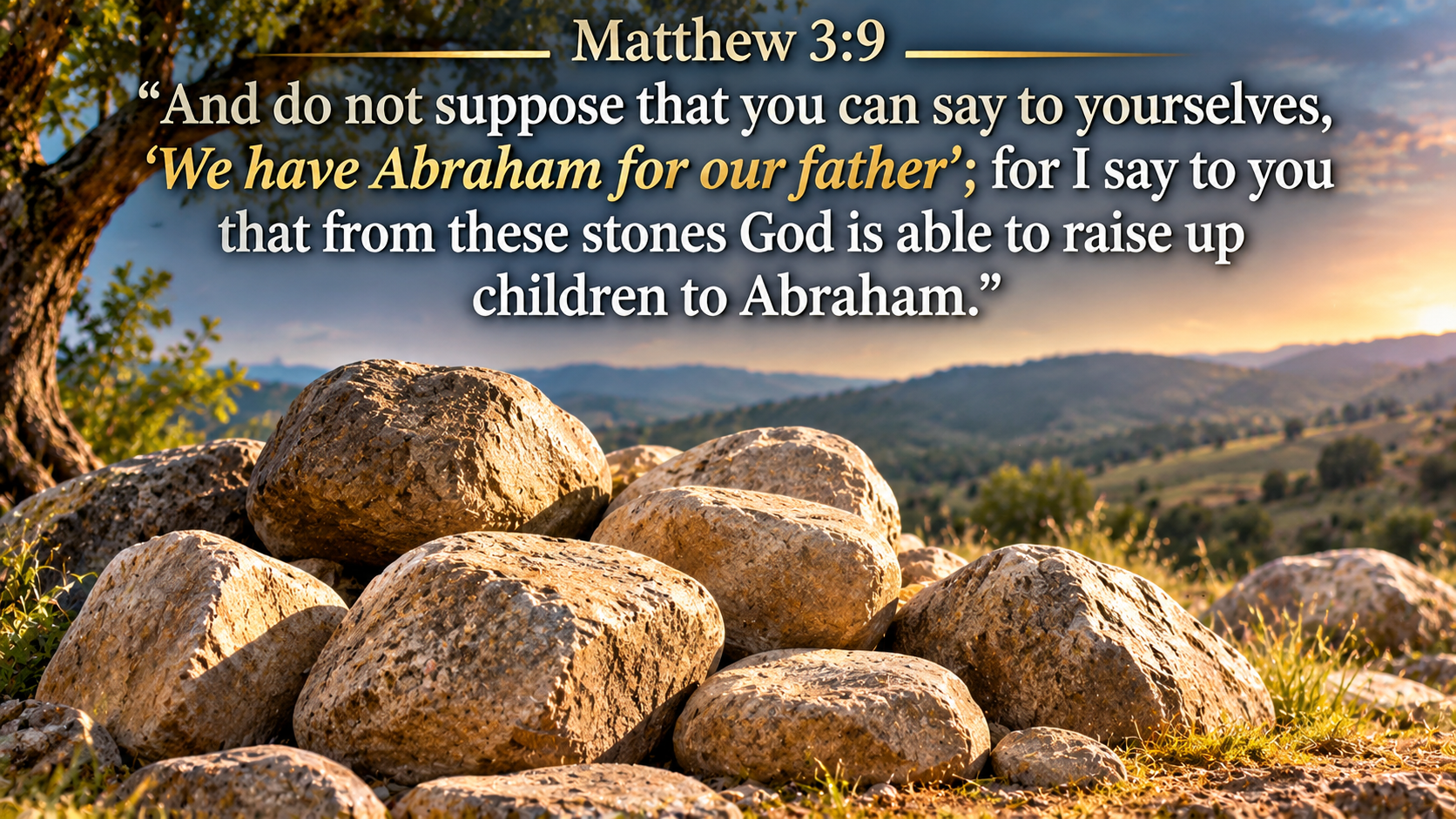
DON'T TRUST YOUR
ANCESTRAL CREDENTIALS
And do not suppose that you can say to yourselves, 'We have Abraham for our father' - John anticipates that his hearers will object to his call for repentance by playing the “ancestor card” (Mt 3:9). In effect John says, “Don’t trust in your Jewish heritage!” He is countering a common Jewish assumption of his day that because they descended from Abraham, they had no need to fear the wrath of God and were in no danger of judgment. This belief persisted in later generations. The Mishnah (compiled about AD 200) states, “All Israel has a portion in the world to come” (m. Sanhedrin 10:1). In the second century Justin Martyr described Jewish teachers who held that the eternal kingdom would be given to the physical descendants of Abraham “although they be sinners and faithless” (Dialogue with Trypho 140). In short, John is saying that being Jewish is not a “fire insurance policy.” Such presumption leads only to judgment, for “The axe is already laid at the root of the trees; therefore every tree that does not bear good fruit is cut down and thrown into the fire” (Mt 3:10).
Paul makes the same point: “For he is not a Jew who is one outwardly, nor is circumcision that which is outward in the flesh. But he is a Jew who is one inwardly; and circumcision is that which is of the heart, by the Spirit, not by the letter; and his praise is not from men, but from God” (Ro 2:28-29). “Therefore, be sure that it is those who are of faith who are sons of Abraham” (Gal 3:7).
The principle applies to everyone who considers anything "salvific" (church membership, belonging to some other "religion," undergoing water baptism, performing so-called good works, having saved parents, etc, etc) other than belief in Jesus Christ is sadly deceived and surely doomed! “And there is salvation in no one else; for there is no other name under heaven that has been given among men by which we must be saved” (Acts 4:12).
D A Carson - in the intertestamental period the general use of descent from Abraham, in the context of a rising merit theology, supported the notion that Israel was chosen because it was choice and that the merits of the patriarchs would suffice for their descendants (cf. Carson, Divine Sovereignty, pp. 39ff.). But not only may God narrow Israel down to a remnant, he may also raise up authentic children of Israel from "these stones" (perhaps stones lying in the river bed-both Hebrew and Aramaic have a pun on "children" and "stones"). Ordinary stones will suffice; there is no need for the "rocks" of the patriarchs and their merits.
MacArthur adds that "The rabbis taught that “all Israelites have a portion in the world to come.” They spoke of the “delivering merits of the fathers,” who passed on spiritual merit to their descendants. Some even taught that Abraham stood guard at the gates of Gehenna, or hell, turning back any Israelite who happened that way. They claimed that it was Abraham’s merit that enabled Jewish ships to sail safely on the seas, that sent rain on their crops, that enabled Moses to receive the law and to enter heaven, and that caused David’s prayers to be heard." (SEE The MacArthur Commentary)
Some time later Jesus confronted this same false assumption addressing a group of Jews who had ostensibly believed in Him (Jn 8:30), but which would prove to be a false belief as Jesus Himself recognized declaring...
They answered Him, “We are Abraham’s descendants and have never yet been enslaved to anyone; how is it that You say, ‘You will become free’?”....“So if the Son makes you free, you will be free indeed. 37 “I know that you (JEWS) are Abraham’s descendants; (REFERRING TO NATURAL, PHYSICAL DESCENT) yet you seek to kill Me, because My word has no place in you (THIS SHOWS Jn 8:30 WAS ONLY A PROFESSION, NOT GENUINE BELIEF). 38 “I speak the things which I have seen with My Father; therefore you also do the things which you heard from your father.” 39 They answered and said to Him, “Abraham is our father.” Jesus said to them, “If you are (TRULY) Abraham’s children, do (imperfect tense - again and again, over and over do) the deeds of Abraham (cf "fruit in keeping with repentance").... 57 So the Jews said to Him, “You are not yet fifty years old, and have You seen Abraham?” 58 Jesus said to them, “Truly, truly, I say to you, before Abraham was born, I am. (THE SACRED NAME OF YAHWEH)” 59 Therefore they picked up stones to throw at Him, but Jesus hid Himself and went out of the temple. (John 8:33, 36-39, 57-59) (Comment - Jesus went on to say in John 8:44 that their deeds proved their father was actually Satan! Woe!)
David Stern in the Jewish NT Commentary writes: "There can be no doubt that in the 1st century c.e. the doctrine was widespread that descendants can benefit and even can claim salvation on the ground of their ancestors’ righteousness. Yeshua’s opponents made exactly such a claim at [John 8:33], Paul’s own opponents obviously were making use of the idea at [2Co 11:22]. Rabbinic literature does well in pointing up Avraham’s faithful and trusting attitude toward God. For example, the Midrash Rabbah: “In the 'olam haba [world to come] Israel will sing a new song, as it is said, ‘Sing unto Adonai a new song, for he has done marvelous things’ (Ps 98:1). By whose z'khut [merit] will they do so? By the merit of Avraham, because he trusted in the Holy One, blessed be he, as it says, ‘And he trusted in Adonai’ (Ge15:6).” (Exodus Rabbah 23:5)
A child of Abraham in hell
was beyond their thinking.MacArthur - In Jesus’ story of the rich man and Lazarus, it is overlooked that the rich man in hell addresses Abraham as “Father,” and Abraham, speaking from heaven, calls the rich man his “Child.” But the rich man was then told by Abraham, “Between us and you there is a great chasm fixed, in order that those who wish to come over from here to you may not be able, and that none may cross over from there to us” (Luke 16:25–26). A child of Abraham in hell was beyond their thinking. The Jews generally considered Gentiles to be the occupants of hell, spiritually lifeless and hopeless, dead stones as far as a right relationship with God is concerned. (SEE The MacArthur Commentary)
Lk 3:8 is a clear warning by John that false ("superficial") repentance is really no repentance in the sight of God and as such would not deliver one from the impending wrath of God. As an aside while the Jews did not inherit saving faith from Abraham, they did inherit their sin propensity from Abraham (cf Ro 5:12)!
John in referring to Abraham as their father could be alluding to Isaiah 51:1-2 "Listen to me, you who pursue righteousness, Who seek the LORD: Look to the rock from which you were hewn And to the quarry from which you were dug. 2 “Look to Abraham your father And to Sarah who gave birth to you in pain; When he was but one I called him, Then I blessed him and multiplied him.” The Jews could read a passage like this and think "We're fine for we were hewn from Abraham." If so, John is dramatically correcting such a false belief.
Many Jews believed that salvation was based on their obedience to God in being circumcised, and that, therefore, their eternal security rested in that rite. In his commentary on the Book of Moses, Rabbi Menachem wrote,
“Our Rabbins [rabbis] have said that no circumcised man will ever see hell”
The book Akedath Jizehak taught that
“Abraham sits before the gate of hell, and does not allow that any circumcised Israelite should enter there” (fol. 54, col. 2).
A T Robertson adds that...
John touched the tender spot, their ecclesiastical pride. They felt that the “merits of the fathers,” especially of Abraham, were enough for all Israelites. At once John made clear that, reformer as he was, a breach existed between him and the religious leaders of the time. (Word Pictures in the New Testament)
MacArthur - John’s message of preparation for the coming of the King was repentance, conversion, the demand for a completely different life. That must have been startling news for Jews who thought that, as God’s chosen people—the children of Abraham, the people of the covenant—they deserved and were unconditionally assured of the promised King. Knowing what they must have been thinking, John later told his listeners, “Do not suppose that you can say to yourselves, ‘We have Abraham for our father’; for I say to you, that God is able from these stones to raise up children to Abraham” (3:9). God was not interested in His people’s human heritage but in their spiritual life. “What the King wants from you,” John was saying, “is that you make a complete turnaround from the way you are, that you be totally converted, totally changed.” God calls for radical change and transformation that affects the mind, the will, and the emotions—the whole person. John’s point was simple: “You are in the same condition as the Gentiles. You have no right to the kingdom unless you repent and are converted from sin to righteousness.” He called for a true repentance that results in the fruit of a translated life (v. 8) and that includes baptism with water (v. 11a). Failure to repent would result in severe judgment, as Matthew 11:20–24 and 12:38–41 demonstrate. (SEE The MacArthur Commentary)
For I say to you that from these stones God is able to raise up children to Abraham - The image is vivid. God does not need Abraham’s physical descendants to keep His promise. If He chose, He could make children of Abraham out of the lifeless stones lying at their feet. Many commentators note a likely wordplay in the Hebrew or Aramaic that John probably spoke. “Stones” is ‘abanim and “children” is banim. The two words sound almost alike, so John’s hearers would have caught the point: God can turn ‘abanim into banim! Craig Blomberg agrees that "The reference to “these stones” probably reflects an original Aramaic wordplay between children (bĕenayyāa) and stones (ʾabnayyā) and was no doubt inspired by the characteristically rocky ground that covers Israel." (See Matthew: An Exegetical and Theological Exposition)
Some also suggest an allusion to the twelve memorial stones that Israel took from the Jordan when they entered the land, which were set up as a reminder of God’s faithfulness: “Those twelve stones which they had taken from the Jordan, Joshua set up at Gilgal. He said to the sons of Israel, ‘When your children ask their fathers in time to come, saying, “What are these stones?”’” (Josh 4:20-21). This is possible but not certain, since the location of John’s baptizing was near the traditional crossing site.
Vincent suggests John was “Pointing, as he spoke to the pebbles on the beach of the Jordan."
Craig Evans adds an interesting note on these stones could be "referring to “these stones” of Josh. 4, where twelve stones were placed by the Jordan River as a symbol of God’s deliverance of the twelve tribes of Israel: “ ‘Take twelve stones from here out of the midst of the Jordan …’ And these twelve stones, which they took out of the Jordan River, Joshua set up in Gilgal, and he said to the people of Israel, ‘When your children ask their fathers in time to come, “What do these stones mean?” then you shall let your children know, “Israel passed over this Jordan on dry ground” ’ ” (Josh. 4:2, 20–22). This stone symbolism reappears in the Elijah narrative: “And Elijah took twelve stones according to the number of the tribes of the sons of Jacob, to whom the word of the LORD had come, saying, ‘Israel shall be your name.’ So with the stones he built an altar in the name of the LORD …” (1 Kings 18:31–32). Like Elijah of old, so now John, the promised Elijah of the last days (Mark 9:13 “I say to you, that Elijah has indeed come”), has placed a monument of twelve stones at the Jordan River and has summoned the tribes of Israel to repent and prepare themselves for the coming of the Lord’s anointed. In continuity with this aspect of John’s ministry, Jesus appoints twelve disciples (cf. Mark 3:14, 16). children to Abraham (v. 9): It is probable that in John’s original Semitic diction (whether Hebrew or Aramaic) a word-play lies behind stones and children, for stone in Hebrew is eben and son (or child) is ben. This word-play is found in various Jewish sources (e.g., Josephus, J.W. 5.6.3 §272; Tg. Onq. Gen. 49:24; Tg. Zech. 10:4; Tg. Ps. 118:22; Exod. Rab. 37.1 [on Ex. 27:20]). In effect, the Baptist has said that God can raise up from these twelve stones (that represent the twelve tribes of Israel) children to Abraham; fulfillment of the Almighty’s promises is not contingent upon faithless stewards. They may presume nothing. (See The Bible Knowledge Background Commentary: Matthew-Luke)
One cannot determine the number of truly saved people
in any given church by simply counting those who have responded
to altar calls, received baptism, or become church members
🙏 THOUGHT - "Too often in the history of the church, people have trusted in living in a “Christian” country, being raised in a Christian family, holding membership or even office in a local church, and even in verbal claims to have repented and to have trusted in Christ. Yet without the evidence of a changed life and perseverance in belief, all such grounds of trust prove futile. One cannot determine the number of truly saved people in any given church by simply counting those who have responded to altar calls, received baptism, or become church members." - Craig Blomberg (See Matthew: An Exegetical and Theological Exposition)
Matthew 3:10 "The axe is already laid at the root of the trees; therefore every tree that does not bear good fruit is cut down and thrown into the fire.
NET Matthew 3:10 Even now the ax is laid at the root of the trees, and every tree that does not produce good fruit will be cut down and thrown into the fire.
GNT Matthew 3:10 ἤδη δὲ ἡ ἀξίνη πρὸς τὴν ῥίζαν τῶν δένδρων κεῖται· πᾶν οὖν δένδρον μὴ ποιοῦν καρπὸν καλὸν ἐκκόπτεται καὶ εἰς πῦρ βάλλεται.
NLT Matthew 3:10 Even now the ax of God's judgment is poised, ready to sever the roots of the trees. Yes, every tree that does not produce good fruit will be chopped down and thrown into the fire.
KJV Matthew 3:10 And now also the axe is laid unto the root of the trees: therefore every tree which bringeth not forth good fruit is hewn down, and cast into the fire.
ESV Matthew 3:10 Even now the axe is laid to the root of the trees. Every tree therefore that does not bear good fruit is cut down and thrown into the fire.
NIV Matthew 3:10 The ax is already at the root of the trees, and every tree that does not produce good fruit will be cut down and thrown into the fire.
ASV Matthew 3:10 And even now the axe lieth at the root of the trees: every tree therefore that bringeth not forth good fruit is hewn down, and cast into the fire.
CSB Matthew 3:10 Even now the ax is ready to strike the root of the trees! Therefore, every tree that doesn't produce good fruit will be cut down and thrown into the fire.
NKJ Matthew 3:10 "And even now the ax is laid to the root of the trees. Therefore every tree which does not bear good fruit is cut down and thrown into the fire.
NRS Matthew 3:10 Even now the ax is lying at the root of the trees; every tree therefore that does not bear good fruit is cut down and thrown into the fire.
YLT Matthew 3:10 and now also, the axe unto the root of the trees is laid, every tree therefore not bearing good fruit is hewn down, and to fire is cast.
NAB Matthew 3:10 Even now the ax lies at the root of the trees. Therefore every tree that does not bear good fruit will be cut down and thrown into the fire.
NJB Matthew 3:10 Even now the axe is being laid to the root of the trees, so that any tree failing to produce good fruit will be cut down and thrown on the fire.
- already - Mal 3:1-3 Mal 4:1 Heb 3:1-3 Heb 10:28-31 Heb 12:25
- the axe - Lu 3:9 Lu 23:31
- therefore - Ps 1:3 Ps 92:13,14 Isa 61:3 Jer 17:8 Joh 15:2
- is cut down - Mt 7:19 Mt 21:19 Ps 80:15,16 Isa 5:2-7 Isa 27:11 Eze 15:2-7 Lu 13:6-9 Joh 15:6 Heb 6:8 1Pe 4:17,18
- Matthew 3 Resources - Multiple Sermons and Commentaries
Related Passages:
Malachi 4:1 “For behold, the day is coming, burning like a furnace; and all the arrogant and every evildoer will be chaff; and the day that is coming will set them ablaze,” says the LORD of hosts, “so that it will leave them neither root nor branch.”
Hebrews 10:31 It is a terrifying thing to fall into the hands of the living God.
Hebrews 12:25 See to it that you do not refuse Him who is speaking. For if those did not escape when they refused him who warned them on earth, much less will we escape who turn away from Him who warns from heaven.
Luke 3:9 “Indeed the axe is already laid at the root of the trees; so every tree that does not bear good fruit is cut down and thrown into the fire.”
John 15:6 “If anyone does not abide in Me, he is thrown away as a branch and dries up; and they gather them, and cast them into the fire and they are burned.
Matthew 7:19 Every tree that does not bear good fruit is cut down and thrown into the fire.
Matthew 21:19 Seeing a lone fig tree by the road, He came to it and found nothing on it except leaves only; and He *said to it, “No longer shall there ever be any fruit from you.” And at once the fig tree withered.
Luke 13:6-9 And He began telling this parable: “A man had a fig tree which had been planted in his vineyard; and he came looking for fruit on it and did not find any. 7“And he said to the vineyard-keeper, ‘Behold, for three years I have come looking for fruit on this fig tree without finding any. Cut it down! Why does it even use up the ground?’ 8“And he answered and said to him, ‘Let it alone, sir, for this year too, until I dig around it and put in fertilizer; 9and if it bears fruit next year, fine; but if not, cut it down.’”
Hebrews 6:8 but if it yields thorns and thistles, it is worthless and close to being cursed, and it ends up being burned.
Isaiah 10:33 Behold, the Lord, the GOD of hosts, will lop off the boughs with a terrible crash; Those also who are tall in stature will be cut down And those who are lofty will be abased.
Jeremiah 46:22 “Its sound moves along like a serpent; For they move on like an army And come to her as woodcutters with axes.
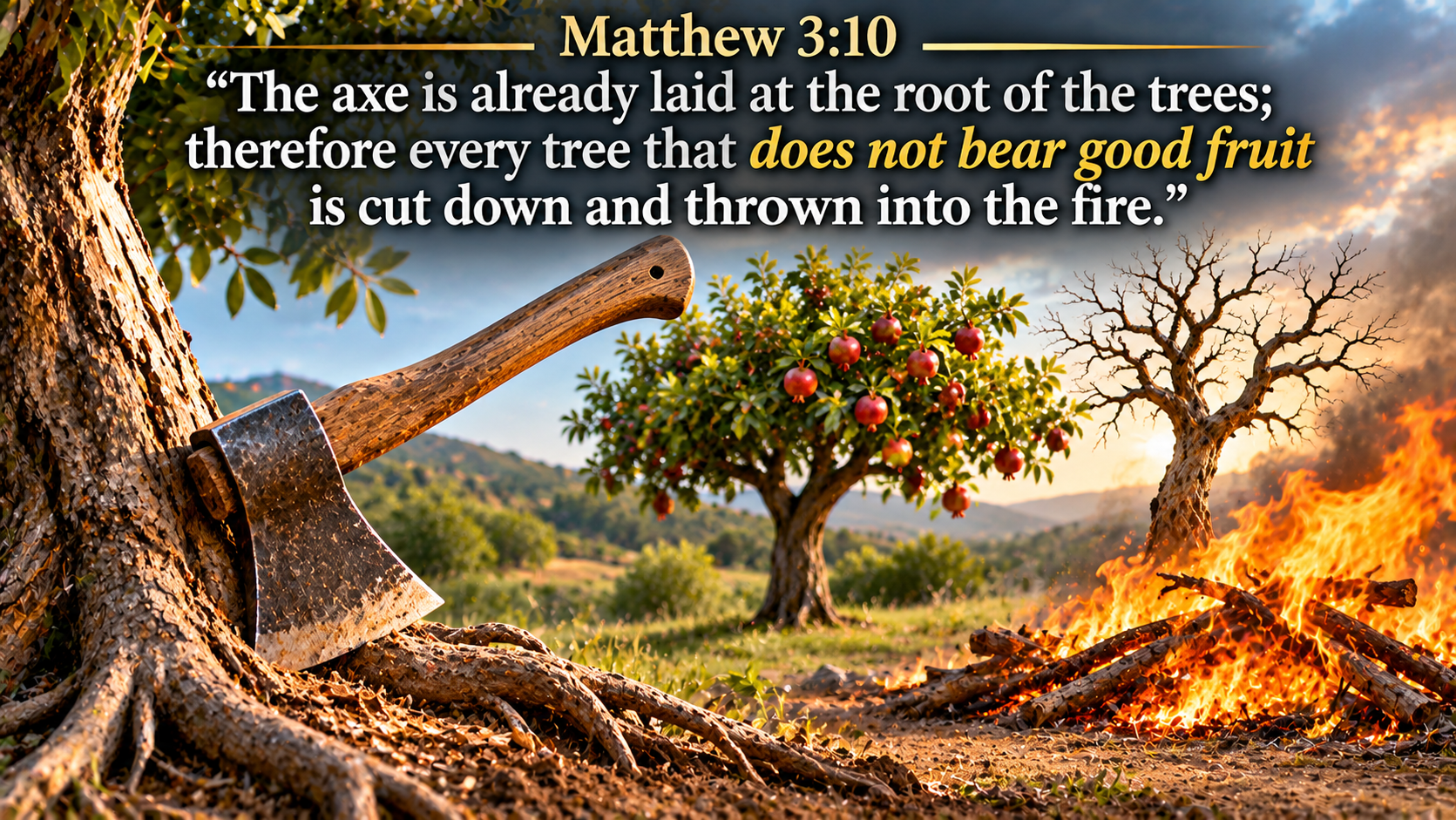
JUDGMENT IS
IMMINENT
Imminent is an adjective derived from the Latin word imminens from imminere meaning to hang or project over. And so literally imminent means hanging or projecting over, ready to take place, hanging threateningly over one's head! In the immediate context John is giving a vivid picture of imminent judgment in order to emphasize the urgent need for his hearer to respond to his call for fruit-bearing repentance!
As Spurgeon said “No mere pruning and trimming work did John come to do; he was the handler of a sharp axe that was to fell every worthless tree.”
Warren Wiersbe rightly observes that "God gets to the root of our lives (Mt 3:10), for the root determines the fruit (Mt 3:8)." (borrow Wiersbe's Expository Outlines on the New Testament )
The axe is already (see expression of time) laid at the root of the trees - In the Greek text already is in an emphatic position to get across the sense of urgency inherent in John's message! It pictures the axe poised to chop down the trees (the non-repenters). NLT paraphrases it "Even now the ax of God's judgment is poised." In keeping with the previous passage, John's metaphor is depicting the people as like "fruit trees." No spiritual fruit indicates no real repentance. Robertson says the axe "is there ready for business." The axe is placed and lain, ready to chop!
Earlier John had declared "the Kingdom of Heaven is at hand" (Mt 3:2) and now he couples the nearness of the Kingdom with the warning that the judgment is also near, which is logical because failure to enter the Kingdom of Heaven/God (cf Jn 3:3) will leave judgment as the only viable (really "non-viable" because it brings eternal death) alternative! John the apostle wrote "“He who believes in the Son has eternal life; but he who does not obey the Son will not see life, but the wrath of God abides on him.” (Jn 3:36, cf "the wrath is revealed" in Ro 1:18)
Adam Clarke comments that "It has been well observed, that there is an allusion here to a woodman, who, having marked a tree for excision, lays his axe at its root, and strips off his outer garment, that he may wield his blows more powerfully, and that his work may be quickly performed.”
A T Robertson says "The prophetic present occurs also with “cut down” and “thrown.” (ED: Note that laid is also in present tense.) The prophetic present tense describes what is going to take place in the future as though it were already coming. It implies certainty and thus states with assurance that which is predicted (cut down...thrown). The idea is that these events which are future are pictured as if already present.
MacArthur helps us understand John's picture of the ax and trees writing that "At the end of every harvest season the farmer would go through his vineyard or orchard looking for plants that had borne no good fruit. These would be cut down to make room for productive vines and trees and to keep them from taking nutrients from the soil that were needed by the good plants. A fruitless tree was a worthless and useless tree, fit only to be cut down and thrown into the fire. Jesus used a similar figure in describing false disciples. “If anyone does not abide in Me, he is thrown away as a branch, and dries up; and they gather them, and cast them into the fire, and they are burned” (John 15:6). Fruitless repentance is worthless and useless; it means absolutely nothing to God." (SEE The MacArthur Commentary)
Therefore every tree that does not bear (poieo) good (kalos) fruit (karpos) is cut down (ekkopto) and thrown ( ballo) into the fire (pur) - Therefore (term of conclusion) marks the inevitable conclusion and certain destiny for all (every tree) non-repenters! There are no exception clauses for Jews or anyone depending on their own self-righteousness! John's words are echoed by Jesus in His Sermon on the Mount when He declared (context was referring especially to false prophets - Mt 7:15) "Every tree that does not bear good fruit is cut down and thrown into the fire." (Mt 7:19) So even as false prophets would be cut down, so too false repenters would be cut down.
The fire of course especially in the context of Mt 3:12 ("unquenchable fire") is a picture of Divine judgment which will result in doom, destruction (not annihilation) and torment, just as does true fire to flammable objects. And non-repenters are "flammable" so to speak! But the tragic irony is they will experience eternal fire but will continue to exist in utter torment! Does this horrendous truth not make you want to pray for the unsaved in your sphere of influence and seek opportunities to share the Gospel before it is too late?!
Spurgeon - It is not enough to hew it down. Into the fire it must go; and John minces not his words about the matter, he speaks straight out the message of his Master.
MacArthur on fire - Fire is a frequent biblical symbol of the torment of divine punishment and judgment. Because of their exceptional wickedness, Sodom and Gomorrah were destroyed by “brimstone and fire from the Lord out of heaven” (Gen. 19:24). After Korah, his men, and their households were swallowed up by the earth and “went down alive to Sheol … fire also came forth from the Lord and consumed the two hundred and fifty men who were offering the incense” (Num. 16:32–33, 35). In His role as a righteous Judge, God is frequently called “a consuming fire” (Ex. 24:17; Deut. 4:24; Deut 9:3; etc.). In the last chapter in the Old Testament, Malachi speaks of the coming day that will be “burning like a furnace; and all the arrogant and every evildoer will be chaff; and the day that is coming will set them ablaze” (Mal. 4:1). John’s preaching picked up where Malachi left off, and Jesus Himself often spoke of the fires of hell (Matt. 5:22, 29; Mark 9:43, 47; Luke 3:17; etc.)."(SEE The MacArthur Commentary)
Salvation is not verified by a past act,
but by present fruitfulness
- MacArthur
Bruce Barton asks "So how are we to bear good fruit? God calls us to be “active” in our obedience. To be productive for God, we must obey his teachings, resist temptation, actively serve others, and share our faith." (See Matthew - Page 47) But be careful....
🙏 THOUGHT - While I agree with Barton's suggestions for fruitfulness, note that he leaves out one critical element of supernatural fruit bearing, and that is the element of supernatural enablement provided only by the indwelling Holy Spirit. Beloved, don't fall into the subtle trap of "doing" at the expense of the necessity of "being!" In other words, be BEING continually filled with the Spirit (Eph 5:18) and then you will be empowered to be continually DOING good (God glorifying) works! E.g., just try to obey Paul's command by "doing" before "being" as when Paul commands "husbands, love (present imperative) your wives, just as Christ also loved the church and gave Himself up for her" (Eph 5:25 - see Need for the Holy Spirit to obey) If we try to accomplish the doing without the being, we fall into the trap of legalism which will blunt both the flow of grace and the work of the Spirit. As I like to say to my students, quit "trying" and start "dying," dying to self (Mk 8:34-35) and living for Jesus by the power of His Spirit. This dynamic will make all the difference in this world and the world to come!
Laid (present passive)(2749)(keimai) literally means to lie, to be in a reclining position, to be laid down. Here it is used in that literal sense: the axe is lying at the root of the tree, already in position and ready to strike (Mt 3:10). The present tense, together with “already,” stresses that judgment is imminent. The woodsman is not on his way. He has already set the axe at the base of the trunk and is measuring his stroke. Luke records the same warning (Lk 3:9).
Elsewhere keimai is used figuratively, meaning to be appointed or destined for a particular end: “And Simeon blessed them and said to Mary His mother, ‘Behold, this Child is appointed for the fall and rise of many in Israel, and for a sign to be opposed’” (Lk 2:34). “So that no one would be disturbed by these afflictions; for you yourselves know that we have been destined for this” (1 Th 3:3). That sense isn’t the main point in Mt 3:10, but it fits the picture well: the axe lying at the root is a sign that judgment has been determined.
Keimai occurs 24 times in the NT, and only 3 times in Matthew. The most glorious use is the empty tomb: “He is not here, for He has risen, just as He said. Come, see the place where He was lying” (Mt 28:6). The third is “You are the light of the world. A city set on a hill cannot be hidden” (Mt 5:14).
Cut down (1581)(ekkopto from ek =from, out + kópto = cut) literally means to cut off or cut out, cutting so as to sever completely. Figuratively it means to bring something to an end by removing it: to do away with, to eliminate. In Mt 3:10 John pictures the fruitless tree being chopped off at the base and thrown into the fire: “The axe is already laid at the root of the trees; therefore every tree that does not bear good fruit is cut down and thrown into the fire.” The present tense (“is cut down”) states a fixed principle of God’s judgment, as certain as if it were already happening. Jesus repeated John’s warning almost word for word: “Every tree that does not bear good fruit is cut down and thrown into the fire” (Mt 7:19). He also told a parable about a fig tree that gave the owner no fruit for three years: “And he said to the vineyard-keeper, ‘Behold, for three years I have come looking for fruit on this fig tree without finding any. Cut it down! Why does it even use up the ground?’” (Lk 13:7).
Jesus also used ekkopto in a sobering call to deal radically with sin: “If your right hand makes you stumble, cut it off and throw it from you; for it is better for you to lose one of the parts of your body, than for your whole body to go into hell” (Mt 5:30; cf. Mt 18:8). Here is the choice: either we cut off our sin now, or our sin will cause us to be cut off later.
Matthew's uses - Matt. 3:10; Matt. 5:30; Matt. 7:19; Matt. 18:8;
Matthew 3:11 "As for me, I baptize you with water for repentance, but He who is coming after me is mightier than I, and I am not fit to remove His sandals; He will baptize you with the Holy Spirit and fire.
NET Matthew 3:11 "I baptize you with water, for repentance, but the one coming after me is more powerful than I am– I am not worthy to carry his sandals. He will baptize you with the Holy Spirit and fire.
GNT Matthew 3:11 ἐγὼ μὲν ὑμᾶς βαπτίζω ἐν ὕδατι εἰς μετάνοιαν, ὁ δὲ ὀπίσω μου ἐρχόμενος ἰσχυρότερός μού ἐστιν, οὗ οὐκ εἰμὶ ἱκανὸς τὰ ὑποδήματα βαστάσαι· αὐτὸς ὑμᾶς βαπτίσει ἐν πνεύματι ἁγίῳ καὶ πυρί·
NLT Matthew 3:11 "I baptize with water those who repent of their sins and turn to God. But someone is coming soon who is greater than I am-- so much greater that I'm not worthy even to be his slave and carry his sandals. He will baptize you with the Holy Spirit and with fire.
KJV Matthew 3:11 I indeed baptize you with water unto repentance: but he that cometh after me is mightier than I, whose shoes I am not worthy to bear: he shall baptize you with the Holy Ghost, and with fire:
ESV Matthew 3:11 "I baptize you with water for repentance, but he who is coming after me is mightier than I, whose sandals I am not worthy to carry. He will baptize you with the Holy Spirit and fire.
NIV Matthew 3:11 "I baptize you with water for repentance. But after me will come one who is more powerful than I, whose sandals I am not fit to carry. He will baptize you with the Holy Spirit and with fire.
ASV Matthew 3:11 I indeed baptize you in water unto repentance: but he that cometh after me is mightier than I, whose shoes I am not worthy to bear: he shall baptize you in the Holy Spirit and in fire:
CSB Matthew 3:11 "I baptize you with water for repentance, but the One who is coming after me is more powerful than I. I am not worthy to remove His sandals. He Himself will baptize you with the Holy Spirit and fire.
NKJ Matthew 3:11 "I indeed baptize you with water unto repentance, but He who is coming after me is mightier than I, whose sandals I am not worthy to carry. He will baptize you with the Holy Spirit and fire.
NRS Matthew 3:11 "I baptize you with water for repentance, but one who is more powerful than I is coming after me; I am not worthy to carry his sandals. He will baptize you with the Holy Spirit and fire.
YLT Matthew 3:11 'I indeed do baptize you with water to reformation, but he who after me is coming is mightier than I, of whom I am not worthy to bear the sandals, he shall baptize you with the Holy Spirit and with fire,
NAB Matthew 3:11 I am baptizing you with water, for repentance, but the one who is coming after me is mightier than I.I am not worthy to carry his sandals. He will baptize you with the holy Spirit and fire.
- baptize - Mt 3:6 Mk 1:4,8 Lu 3:3,16 Joh 1:26,33 Ac 1:5 Ac 11:16 Ac 13:24 Ac 19:4
- but - Lu 1:17 Joh 1:15,26,27,30,34 Joh 3:23-36
- whose - Mk 1:7 Lu 7:6,7 Ac 13:25 Eph 3:8 1Pe 5:5
- He will baptize - Isa 4:4 Isa 44:3 Isa 59:20,21 Zec 13:9 Mal 3:2-4 Mk 1:8 Lu 3:16 Joh 1:33 Ac 1:5 Ac 2:2-4 Ac 11:15,16 1Co 12:13 Ga 3:27,28
- Matthew 3 Resources - Multiple Sermons and Commentaries
Related Passages:
Luke 3:16 John answered and said to them all, “As for me, I baptize you with water; but One is coming who is mightier than I, and I am not fit to untie the thong of His sandals; He will baptize you with the Holy Spirit and fire.
Mark 1:8 “I baptized you with water; but He will baptize you with the Holy Spirit.”
COMING ONE BRINGS
A DIFFERENT BAPTISM
As for me, I baptize (see baptizo above) you with water for repentance (see metanoia above) - This has been described at length above. Suffice it to say John's baptism is distinct from Christian baptism which first consists of baptism into (identification with) Christ at the time of the new birth (see Ro 6:3 = "into His death" not into water!) and then is followed by water baptism which serves to symbolize and testify to one's spiritual baptism into Christ by grace through faith.
John MacArthur comments that in "John’s ministry it (BAPTISM) marked the outward profession of inward repentance, which prepared a person for the coming of the King. As the apostle Paul explained many years later, “John baptized with the baptism of repentance, telling the people to believe in Him who was coming after him, that is, in Jesus” (Acts 19:4). (SEE The MacArthur Commentary)
D A Carson suggests "John’s baptism was “essentially preparatory”....Jesus’ baptism inaugurated the Messianic Age." (Expositor's Bible Commentary)
But - John now makes a clear contrast between his ministry and Messiah's ministry.
He who is coming after me is mightier (ischuros) than I - Before John contrasts the two baptisms (water versus the Spirit), he contrasts the two persons (Mt 3:11). The word “mightier” implies that John himself was mighty, though he does not say how. He certainly drew huge crowds and preached with great boldness, both of which reflect the power of his ministry. The angel had said, “For he will be great in the sight of the Lord; and he will drink no wine or liquor, and he will be filled with the Holy Spirit while yet in his mother’s womb” (Lk 1:15). Interestingly, John’s might did not lie in miracles: “Many came to Him and were saying, ‘While John performed no sign, yet everything John said about this man was true’” (Jn 10:41). His power was the power of the Spirit-filled, fearless proclamation of the Word of God.
His impact on the public was so great that Herod Antipas, tetrarch of Galilee and Perea, could not ignore him. Herod both feared and was fascinated by him: “for Herod was afraid of John, knowing that he was a righteous and holy man, and he kept him safe. And when he heard him, he was very perplexed; but he used to enjoy listening to him” (Mk 6:20). In the end Herod arrested and executed him (Mt 14:3-12). Josephus adds that Herod feared John’s influence over the people might lead to an uprising (Antiquities 18.5.2 §118).
Yet as mighty as John was, the One coming after him was mightier still: mighty enough to bind the “strong man,” Satan, and plunder his house. Jesus used the same comparison of Himself: “When a strong man, fully armed, guards his own house, his possessions are undisturbed. But when someone stronger than he attacks him and overpowers him, he takes away from him all his armor on which he had relied and distributes his plunder” (Lk 11:21-22). John could only call people to repent. Jesus could change them from the inside by His Spirit.
And I am not fit (hikanos) to remove His sandals - John's genuine humility is expressed here. John says he is not worthy to perform even the lowly task of a servant.
R Kent Hughes describes "A rabbinic saying, dated after Christ but very likely contemporary to Christ, stated that disciples ought to do everything for their masters that a slave does, except for one thing—untie his sandals. That was simply too much to ask any Jew to do for another Jew. But John had it right in relationship to Christ. He affirmed that he was not worthy of doing the most personally degrading task for the Messiah." (See Luke: That You May Know the Truth)
G Campbell Morgan - There is a humility about this; there is a touch of modesty in it; and the difference between a real humility and a mock humility, we all know. Real humility never knows it is humble; mock humility is proud of its humility. I lead you to the external symbol of your repentance; He shall whelm you in the fire-whelming of the Holy Ghost, that burns your sin out of you, and re-makes you. I have to do, said John, with the external thing water, that which can only touch the surface of things; He shall work with fire, that which shall go through everything.
He will baptize (see baptizo above) you with the Holy Spirit and fire (pur) - Luke's version is identical (Lk 3:16) but Mark 1:8 omits the phrase and fire. Some take this to represent only one baptism, but others take this to represent two baptisms. I favor the latter. Those who see only one baptism (D A Carson), take the fire as a purifying agent. One of the main arguments to support this premise is that there is only one preposition with (Greek = en) before Spirit and fire. In other words there is no separate "with" before fire, which as Carson (Expositor's Bible Commentary) says "suggests a unified concept, Spirit-fire or the like." However regarding fire notice that John has spoken about fire in Mt 3:10 and will speak of it again in Mt 3:12 and in both contexts fire clearly speaks of judgment which would be strong support for the use of fire in this verse as indicative of judgment.
Louis Barbieri comments that "Those hearing John’s words would have been reminded of two Old Testament prophecies: Joel 2:28–29 and Malachi 3:2–5. Joel had given the promise of the outpouring of the Holy Spirit on Israel. An actual outpouring of the Spirit did occur in Acts 2 on the day of Pentecost, but experientially Israel did not enter into the benefits of that event. She will yet experience the benefits of this accomplished work when she turns in repentance at the Lord’s Second Advent (cf Zech 12:10)." (See Bible Knowledge Commentary - Page 25)
NET Note on With the Holy Spirit and fire (pur) - There are differing interpretations for this phrase regarding the number of baptisms and their nature.
(1) Some see one baptism here, and this can be divided further into two options. (a) The baptism of the Holy Spirit and fire could refer to the cleansing, purifying work of the Spirit in the individual believer through salvation and sanctification, or (b) it could refer to two different results of Christ's ministry: Some accept Christ and are baptized with the Holy Spirit, but some reject him and receive judgment.
(2) Other interpreters see two baptisms here: The baptism of the Holy Spirit refers to the salvation Jesus brings at his first advent, in which believers receive the Holy Spirit, and the baptism of fire refers to the judgment Jesus will bring upon the world at his second coming. One must take into account both the image of fire and whether individual or corporate baptism is in view.
A decision is not easy on either issue. The image of fire is used to refer to both eternal judgment (e.g., Matt 25:41) and the power of the Lord's presence to purge and cleanse his people (e.g., Isa 4:4–5). The pouring out of the Spirit at Pentecost, a fulfillment of this prophecy no matter which interpretation is taken, had both individual and corporate dimensions. It is possible that since Holy Spirit and fire are governed by a single preposition in Greek, the one-baptism view may be more likely, but this is not certain. Simply put, there is no consensus view in scholarship at this time on the best interpretation of this passage.
Warren Wiersbe favors two baptisms writing "John mentioned two other baptisms: a baptism of the Spirit and a baptism of fire (Matt. 3:11). The baptism of the Spirit came at Pentecost (Acts 1:5, and note that Jesus said nothing about fire). Today, whenever a sinner trusts Christ, he is born again and immediately baptized by the Spirit into the body of Christ, the church (1 Cor. 12:12–13). In contrast, the baptism of fire refers to the future judgment, as Matthew explains (Matt. 3:12). (Bible Exposition Commentary)
John MacArthur on Holy Spirit and fire says "Many interpreters (ED: Like D A Carson) take this (and fire) to be a part of the Holy Spirit baptism, which began at Pentecost and which in that instance was accompanied by "tongues of fire" (Acts 2:3). But the Acts account says that those tongues "appeared to them" (that is, the waiting disciples) "as of fire." They were not fire, but looked like licks of fire. In his last promise of the soon-coming baptism with the Holy Spirit, Jesus said nothing about actual fire being a part of the experience (Acts 1:5). And when, a short time later, Cornelius and his household were baptized with the Holy Spirit, no fire was present (Acts 10:44; Acts 11:16; cf. Acts 8:17; Acts 19:6). Other interpreters take the fire to represent a spiritual cleansing, as described in the quotation above from Ezekiel. But nothing in Ezekiel's text, in the context of John's message here, or in the Pentecost reference to the tongues "as of fire" relates to such cleansing. Consequently, it seems best to consider fire as representing God's coming judgment, which, as we have seen, is so frequently in Scripture symbolized by fire. In both the preceding and following verses (Mt 3:10, 12) John clearly uses fire to represent judgment and punishment. It is impossible (ED: I WOULD NOT SAY "IMPOSSIBLE" BUT "IT SEEMS UNLIKELY") that the middle reference to fire would concern an entirely different subject. Both of the adjoining verses contrast the fates of believers and unbelievers, those who bear good fruit and those who do not (Mt 3:10) and the valuable wheat and the worthless chaff (Mt 3:12). It therefore seems logical and natural to take Mt 3:11 also as a contrast between believers (those baptized with the Holy Spirit) and unbelievers (those baptized with the fire of God's judgment). (SEE The MacArthur Commentary)
David L Turner favors the one baptism interpretation - "Though some (e.g., Bruner 1987:79–80; Luz 1989:171; Ridderbos 1987:55) see two baptisms here, one in the Spirit indicating salvation and the other in fire indicating judgment, it is preferable to see only one purifying baptism (Davies and Allison 1988:317). In this understanding the phrase, “Spirit and fire,” is understood as a hendiadys, a figure of speech in which one idea is expressed by two words. This seems to be indicated also by OT texts that associate the eschatological outpouring of the Spirit with both cleansing water (Isa 32:15; Isa 44:3; Ezek 36:25–27; Joel 2:28–29; cf. 1QS 4:20–22) and refining fire (Isa 1:25; Isa 4:4; Isa 30:27–30; Zech 13:9; Mal 3:1–3; Mal 4:1; cf. Acts 2:3; 2 Ezra 13:8–11NRSV). So it is best to conclude that the one eschatological outpouring of the Spirit through Jesus will purify and judge. The Holy Spirit has been mentioned as the miraculous agent behind Jesus’ conception (Mt 1:18, 20). Now as John speaks of the future, he asserts that Jesus will baptize in the Holy Spirit. Though he would eventually dispense the Spirit to others (Mt 3:11), Jesus presently needs the empowerment of the Spirit for his own mission (Mt 4:1; Mt 12:18, 28). For a perceptive study of the ministry of the Spirit to Jesus see Hawthorne 1991." (See The Gospel of Matthew - The Gospel of Mark - Page 59)
Mightier (2478)(ischuros from ischuo = to be able) is an adjective which means strong, powerful, mighty (usually referring to inherent physical strength), able, forcible. Ischuros denotes places “stress on the actual power that one possesses rather than on the mere principle of power." It is notable that ischuros is used in the Septuagint to refer to God in Jer 32:18 which says "O great and mighty (Lxx = ischuros) God. The LORD of hosts is His name." And in Jeremiah 33:3 He invites Israel to "Call to Me and I will answer you, and I will tell you great and mighty (Lxx = ischuros) things, which you do not know.’ Mark uses ischuros to describe the "strong man" in Mk 3:27, who in context is Satan (or Beelzebul - Mk 3:22), and the One Who binds him is Jesus Himself, which shows Jesus to be mightier than John the Baptist.
Fire (4442)(pur) refers to literal fire (Mt 13:40; Mt 17:15, etc). Pur is used figuratively of God inflicting punishment (Heb 12:29), of disunion (Lk 12:49), of the tongue that kindles strife and discord (James 3:5-6), of trials (1 Pe 1:7, Rev 3:18), at Pentecost (Acts 2:3 = " tongues as of fire "), of burning up useless works (1 Cor 3:10-15), as a description of doing something with great difficult in Jude 1:23 ("snatching them out of the fire"). Fire in the context of judgment as in the present passages, the eternal fire, the place of punishment (Mt. 13:42, 50; Mt. 5:22; Mt 18:9; Mk 9:4 Mt. 18:8; Mt 25:41; Jude 1:7 Rev. 14:10); the Lake of fire (Rev. 19:20; Rev 20:10, 14, 15; Rev 21:8). All of Matthew's uses of pur - Mt. 3:10; Mt. 3:11; Mt. 3:12; Mt. 5:22; Mt. 7:19; Mt. 13:40; Mt. 13:42; Mt. 13:50; Mt. 17:15; Mt. 18:8; Mt. 18:9; Mt. 25:41 = "“Then He will also say to those on His left, ‘Depart from Me, accursed ones, into the eternal fire which has been prepared for the devil and his angels."
Kent Hughes - I once heard E. V. Hill, the pastor of Mount Zion Missionary Baptist Church in Los Angeles, tell of the ministry of an elderly woman in his church whom they all called 1800 because no one knew how old she was. 1800 was hard on unsuspecting preachers because she would sit in the front row, and as soon as the preacher began she would say, "Get him up!" (referring to Christ). After a few minutes, if she did not think there was enough of Christ in the sermon, she would again shout, "Get him up!" If a preacher did not "Get him up!" he was in for a long, hard day! Here John the Baptist's response to misplaced adulation was to "get him up"—a noble task because it is the chief purpose for our existence....John was the greatest of all men, he was having the greatest of all ministries to date, multitudes were at his feet, but he knew that he wasn't worthy to perform even the humblest act for Christ. If we aim to "get him up," we need to "get ourselves down." (See Luke: That You May Know the Truth)
ONE GLIMPSE OF GOD'S HOLINESS - As we become more like the Savior, we become more deeply aware of our own sinfulness. This paradox is not the result of morbid introspection nor evidence of a warped self-image. It's an honest recognition of who we are, who Christ is, and how much we long to be like Him.
The caretaker of the home where Beethoven spent his final years led a group of tourists to the room that housed a stately old piano.
Lifting the cover with an air of reverence, he said, "This was Beethoven's piano!"
A young woman stepped forward, sat down on the music stool, and began playing one of Beethoven's sonatas. Concluding, she spun around and said to the shocked caretaker,
"I suppose many people who visit here like to play Beethoven's piano."
"Well, Miss," he replied, "last summer the world famous Paderewski was here, and some of his friends wanted him to play, but he said, `No, I am not worthy."
After a glimpse of God's holiness, Isaiah cried out, "Woe is me!" (Isa. 6:5) . At the end of his suffering, Job humbly confessed, "Therefore I abhor myself, and repent in dust and ashes" (Job 42:6). And John the Baptist said of the Messiah, "He who is coming after me is mightier than I, whose sandals I am not worthy to carry." A healthy sense of our unworthiness before God makes us rely more than ever on the worthiness of Jesus. That's the secret of becoming like Him. —D. J. De Haan(Reprinted by permission from Our Daily Bread Ministries. Please do not repost the full devotional without their permission.)
It is only when men begin to worship that they begin to grow.
Matthew 3:12 "His winnowing fork is in His hand, and He will thoroughly clear His threshing floor; and He will gather His wheat into the barn, but He will burn up the chaff with unquenchable fire."
NET Matthew 3:12 His winnowing fork is in his hand, and he will clean out his threshing floor and will gather his wheat into the storehouse, but the chaff he will burn up with inextinguishable fire."
GNT Matthew 3:12 οὗ τὸ πτύον ἐν τῇ χειρὶ αὐτοῦ καὶ διακαθαριεῖ τὴν ἅλωνα αὐτοῦ καὶ συνάξει τὸν σῖτον αὐτοῦ εἰς τὴν ἀποθήκην, τὸ δὲ ἄχυρον κατακαύσει πυρὶ ἀσβέστῳ.
NLT Matthew 3:12 He is ready to separate the chaff from the wheat with his winnowing fork. Then he will clean up the threshing area, gathering the wheat into his barn but burning the chaff with never-ending fire."
KJV Matthew 3:12 Whose fan is in his hand, and he will throughly purge his floor, and gather his wheat into the garner; but he will burn up the chaff with unquenchable fire.
ESV Matthew 3:12 His winnowing fork is in his hand, and he will clear his threshing floor and gather his wheat into the barn, but the chaff he will burn with unquenchable fire."
NIV Matthew 3:12 His winnowing fork is in his hand, and he will clear his threshing floor, gathering his wheat into the barn and burning up the chaff with unquenchable fire."
ASV Matthew 3:12 whose fan is in his hand, and he will thoroughly cleanse his threshing-floor; and he will gather his wheat into the garner, but the chaff he will burn up with unquenchable fire.
CSB Matthew 3:12 His winnowing shovel is in His hand, and He will clear His threshing floor and gather His wheat into the barn. But the chaff He will burn up with fire that never goes out."
NKJ Matthew 3:12 "His winnowing fan is in His hand, and He will thoroughly clean out His threshing floor, and gather His wheat into the barn; but He will burn up the chaff with unquenchable fire."
NRS Matthew 3:12 His winnowing fork is in his hand, and he will clear his threshing floor and will gather his wheat into the granary; but the chaff he will burn with unquenchable fire."
YLT Matthew 3:12 whose fan is in his hand, and he will thoroughly cleanse his floor, and will gather his wheat to the storehouse, but the chaff he will burn with fire unquenchable.'
- His winnowing fork - Isa 30:24 Isa 41:16 Jer 4:11 Jer 15:7 Jer 51:2 Lu 3:17
- He will thoroughly clear - Mt 13:41,49,50 Mal 3:2,3 Mal 4:1 Joh 15:2
- and gather - Mt 13:30,43 Am 9:9
- but He will burn - Job 21:18 Ps 1:4 Ps 35:5 Isa 5:24 Isa 17:13 Ho 13:3 Mal 4:1 Lu 3:17
- with unquenchable fire - Isa 1:31 Isa 66:24 Jer 7:20 Jer 17:27 Eze 20:47,48 Mk 9:43-48
- Matthew 3 Resources - Multiple Sermons and Commentaries
Related Passage:
Luke 3:17 “His winnowing fork is in His hand to thoroughly clear His threshing floor, and to gather the wheat into His barn; but He will burn up the chaff with unquenchable fire.”
Psalm 1:4 The wicked are not so, But they are like chaff which the wind drives away.
Matthew 13:30; 43 ‘Allow both to grow together until the harvest; and in the time of the harvest I will say to the reapers, “First gather up the tares and bind them in bundles to burn them up; but gather the wheat into my barn.”’” (13:43) “Then THE RIGHTEOUS WILL SHINE FORTH AS THE SUN in the kingdom of their Father. He who has ears, let him hear.
Amos 9:9 “For behold, I am commanding, And I will shake the house of Israel among all nations As grain is shaken in a sieve, But not a kernel will fall to the ground.
Isaiah 66:24 “Then they will go forth and look On the corpses of the men Who have transgressed against Me. For their worm will not die And their fire will not be quenched; And they will be an abhorrence to all mankind.”
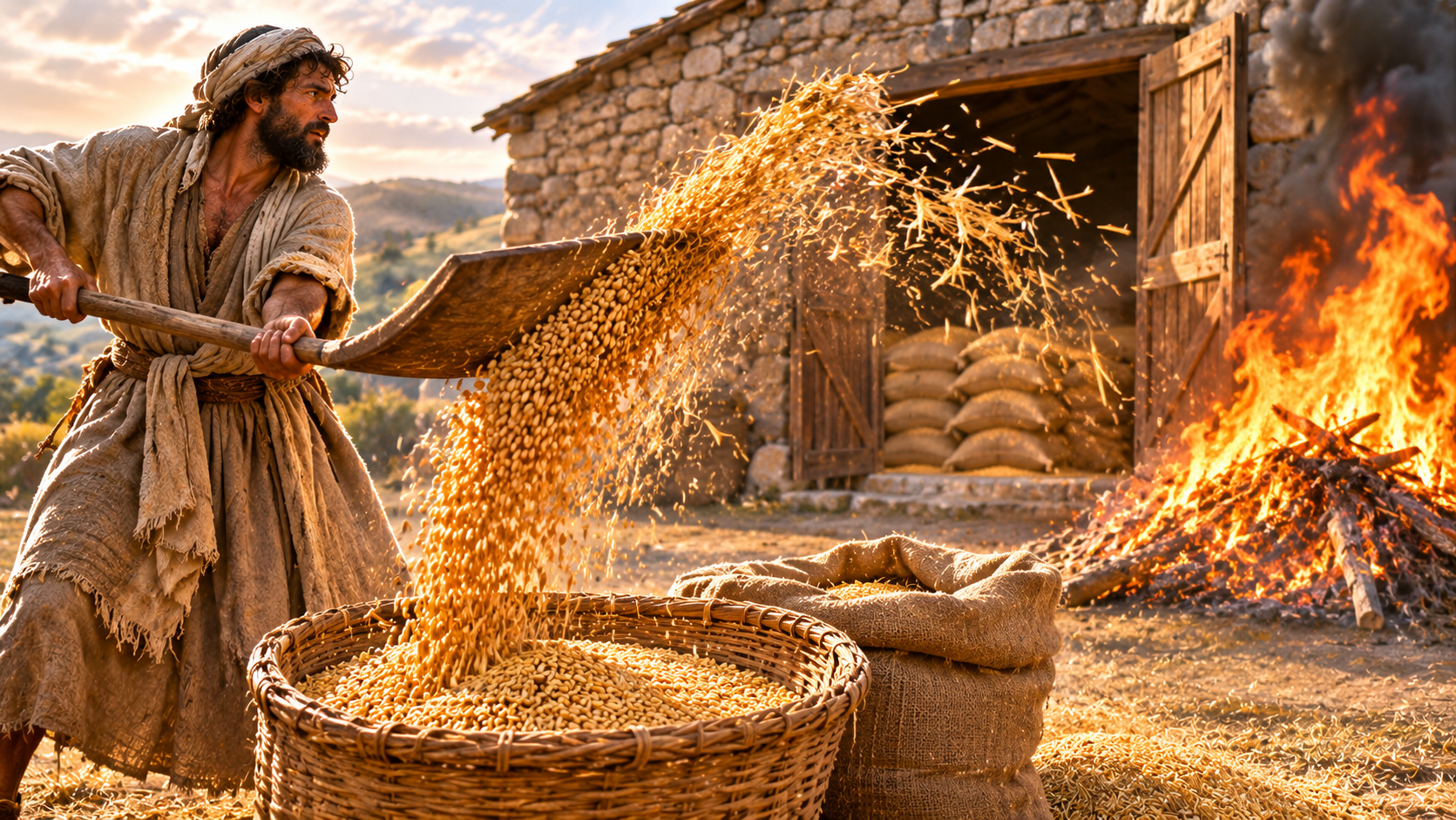
WINNOWING
SPIRITUAL "GRAIN"
First the harvested stalks of wheat would be threshed on a stone or hard-packed dirt surface (threshing floor) by oxen dragging heavy timbers over the grain which would result in separation of the chaff (pix) from the kernels of wheat (pix). This combination would then be winnowed. Winnowing is the the act of separating grain from chaff by throwing it in the air allowing the prevalent breezes off of the Mediterranean Sea to carry away the useless, lighter husks (chaff) and allowing the heavier, valuable wheat to fall to the ground. It is also used to remove weevils or other pests from stored grain. Winnow in our English dictionary means to remove from a group until only the best are left. Interesting! In Biblical terms only the "best ones" are only those who are in Christ. In this agricultural land, John's picture left no one guessing what he was saying. They knew he was describing a separation and it was not of literal wheat but of human beings! How effective was John's picturesque teaching? The gospel of John gives us a sense of the effect of John's ministry of preparation for the Messiah writing
And He (JESUS) went away again beyond the Jordan to the place where John was first baptizing, and He was staying there. 41 Many came to Him and were saying, “While John performed no sign, yet everything John said about this man was true.” 42 Many believed in Him there." (John 10:40-42)
Comment: John records several times that Jews believed in Jesus (John 2:23 John 4:39,41 John 8:30 John 11:45 John 12:42) but studying the context of these passages it is clear that not all who believed really believed! In other words they had a superficial belief or intellectual belief but it was unassociated with a change in behavior and thus was a false profession. On the other hand, clearly some truly believed in Jesus, but it is difficult to arrive at a sense of how many of those who "believed" were genuine. We will have to wait for Heaven for the answer.
🙏 THOUGHT - The practical takeaway for us as Christ’s disciples is to be sure to present the full gospel of Jesus Christ, warning that profession of Christ is no guarantee of possession of Christ. Jesus Himself warned, “Not everyone who says to Me, ‘Lord, Lord,’ will enter the kingdom of heaven, but he who does the will of My Father who is in heaven will enter” (Mt 7:21). We need to emphasize that the proof of genuine faith is bringing forth fruit in keeping with repentance (Mt 3:8). A new birth always produces a new life: “Therefore if anyone is in Christ, he is a new creature; the old things passed away; behold, new things have come” (2 Co 5:17). As James puts it, “Even so faith, if it has no works, is dead, being by itself” (Jas 2:17), and John adds, “By this we know that we have come to know Him, if we keep His commandments” (1 Jn 2:3).
In short, a person who never shows any transformation toward godly behavior (not perfection but direction) has no biblical basis for assurance that his or her soul will spend eternity in heaven. But must also be clear that fruit is the evidence of salvation, not the ground of it. We are saved by grace through faith alone, but the faith that saves is never alone: “For by grace you have been saved through faith; and that not of yourselves, it is the gift of God; not as a result of works, so that no one may boast. For we are His workmanship, created in Christ Jesus for good works, which God prepared beforehand so that we would walk in them” (Eph 2:8-10). And the One who begins that good work will finish it: “For I am confident of this very thing, that He who began a good work in you will perfect it until the day of Christ Jesus” (Php 1:6). AMEN!
His winnowing fork (ptuon) is in His hand, and He will thoroughly clear (diakatharizo) His threshing floor - His...His...He refer to Jesus Christ. Thoroughly clear (diakatharizo - only Biblical use) indicates that this separation is absolute and complete and there will not be a few "husks" of unbelievers (so to speak) on the threshing floor mixed in with the valuable, believing "wheat"!
🙏 THOUGHT - How sad that people created in the image of God (Ge 1:27) will end their life on earth as nothing more that "chaff" to be burned and tormented forever and ever, regardless of how powerful they were, how many degrees they had after their name, how many humanitarian causes they established, how many books they wrote, etc, etc. Outside of Christ, they are eternally worthless chaff! Woe!
John presents a vivid picture of the future judgment of Messiah Who will leave not a trace of chaff (cf Ps 1:4). His separation (winnowing) of the the wheat (repenters) from the chaff (non-repenters) is thorough and final as the chaff will be thrown into the Lake of fire and brimstone (Rev 20:15). Even in the Old Testament we see a description of the thoroughness of the removal of the chaff by the Messiah as recorded in the book of Daniel...
“You (DANIEL SPEAKING TO NEBUCHADNEZZAR) continued looking until a Stone was cut out without hands (= SUPERNATURAL = MESSIAH AT HIS SECOND COMING), and IT struck (SEPTUAGINT = PATASSO = SAME VERB IN Rev 19:15! THIS IS NOT A COINCIDENCE!) the statue on its feet of iron and clay and crushed them. 35 Then the iron, the clay, the bronze, the silver and the gold (ALL ELEMENTS OF THE GODLESS GENTILE NATIONS) were crushed all at the same time (BY THE STONE CUT OUT OF ROCK WITHOUT HANDS = MESSIAH AT HIS SECOND COMING!) and became like chaff from the summer threshing floors; and the wind carried them away so that not a trace of them was found. (cf "HE WILL THOROUGHLY CLEAR HIS THRESHING FLOOR!") But the Stone that struck (SEPTUAGINT = PATASSO) the statue became a great mountain and filled the whole earth (JESUS ESTABLISHES HIS MESSIANIC KINGDOM). (Daniel 2:34-35)
Compare John's description in the Revelation - From His (JESUS') mouth comes a sharp sword, so that with it He may strike down the nations (STRIKE IS SAME VERB PATASSO USED IN DANIEL 2), and He will rule them with a rod of iron; and He treads the wine press of the fierce wrath of God, the Almighty. 16 And on His robe and on His thigh He has a name written, “KING OF KINGS, AND LORD OF LORDS.” (Rev 19:15-16)
Isaiah 63:4 describes this separation in prophetic terms declaring
“For the day of vengeance (REFERS TO HIS SECOND COMING) was in My (MESSIAH'S) heart (REFERRING TO HIS SECOND COMING), And My year of redemption has come (BELIEVING "WHEAT" - in context of Isaiah 63 = the believing remnant of Israel).
Daniel also describes this tragic day of future separation of the wicked from the redeemed declaring
"Many of those who sleep in the dust of the ground will awake (RESURRECTION), these to everlasting life, but the others to disgrace and everlasting contempt." (Daniel 12:2)
Notice the adjective everlasting modifying both life and contempt! While I personally am horrified by this doctrine, passages like this leave little doubt that eternal punishment will indeed be everlasting! Let this truth motivate us to share the Gospel, not argue over the doctrine of Hell! Jesus left little room for argument when He plainly declared "These (THE GOATS - Mt 25:31, 32, 33, 41-45), will go away into eternal punishment, but the righteous into eternal life.” (Mt 25:46). Sadly, Jesus could not have been much clearer!

WINNOWING THE GRAIN
Winnowing is a vivid picture of judgment of the Righteous Judge Jesus (cf 2 Ti 4:1). John writes "For not even the Father judges anyone, but He has given all judgment to the Son... 27 and He gave Him authority to execute judgment, because He is the Son of Man. 28 “Do not marvel at this; for an hour is coming, in which all who are in the tombs will hear His voice, 29 and will come forth; those who did the good deeds to a resurrection of life ("WHEAT"), those who committed the evil deeds to a resurrection of judgment ("CHAFF"). (Jn 5:22, 27-29)
Marvin Vincent - The picture is of a farmer at his threshing-floor, the area of hard-beaten earth on which the sheaves are spread and the grain trodden out by animals. His fan, that is his winnowing-shovel or fork, is in his hand, and with it he throws up the mingled wheat and chaff against the wind in order to separate the grain....The whole metaphor represents the Messiah as separating the evil from the good, according to the tests of his kingdom and Gospel, receiving the worthy into his kingdom and consigning the unworthy to destruction (compare Mt. 13:30; 39–43; 48–50).
And He will gather (sunago) His wheat into the barn - The wheat pictures true believers, those whose repentance was genuine. The Lord will gather them safely into His “barn,” His eternal kingdom, at the final harvest (cf Mt 13:30, 43). Note that it is His wheat: they belong to Him, and not one grain will be lost (Jn 10:28). They are wheat rather than chaff, and you can tell because they bear the fruit of repentance (Mt 3:8) and the eternal fruit of Good Deeds: “You did not choose Me but I chose you, and appointed you that you would go and bear fruit, and that your fruit would remain, so that whatever you ask of the Father in My name He may give to you” (Jn 15:16). “For we are His workmanship, created in Christ Jesus for good works, which God prepared beforehand so that we would walk in them” (Eph 2:10).
The picture in this passage reminds one of the eternal "separation" of the righteous from the wicked in Psalm 1...
1 How blessed is the man who does not walk in the counsel of the wicked, Nor stand in the path of sinners, Nor sit in the seat of scoffers!
2 But his delight is in the law of the LORD, And in His law he meditates day and night.
3 He will be like a tree firmly planted by streams of water, Which yields its fruit in its season And its leaf does not wither; And in whatever he does, he prospers.
4 The wicked are not so, But they are like chaff which the wind drives away.
5 Therefore the wicked will not stand in the judgment, Nor sinners in the assembly of the righteous.
6 For the LORD knows the way of the righteous, But the way of the wicked will perish. (Ps 1:1-6)
But (sad, somber contrast) He will burn up (katakaio) the chaff (achuron) with unquenchable (asbestos) fire (pur) - The wheat would be stored in the granary for later grinding into flour to make bread, but the chaff would be raked into piles and burned. Literal chaff refers to material consisting of seed coverings and small pieces of stem or leaves that have been separated from the seeds. It refers to anything regarded as worthless, in this case souls who are worthless and useless in regard to eternity. This is a tragic picture of the fate of men created in the image of God, but who steadfastly refuse His offer of salvation in Jesus, and end up eternally worthless! Oh my! This ought to break our hearts as believers and motivate us to share the Gospel with everyone we can while we still can!
Winnowing fork (4425)(ptuon) denotes "a winnowing shovel or fan," with which grain is thrown up against the wind, in order to separate the chaff (Mt 3:12 ; Lk 3:17, no uses in the Septuagint). Winnowing - Wikipedia
Winnowing fork (KJV = "fan") - A long wooden shovel used for tossing grain against the wind after threshing so that the lighter chaff would be blown away, leaving the kernels to settle in a pile. Shovels were also used for this purpose (Isaiah 30:24). Winnowing is a frequent figure for the Divine sifting and chastisement, Jer 4:11; Jer 15:7 etc.
NET Note - A winnowing fork is a pitchfork-like tool used to toss threshed grain in the air so that the wind blows away the chaff, leaving the grain to fall to the ground. The note of purging is highlighted by the use of imagery involving sifting through threshed grain for the useful kernels.
Thoroughly clear (1245) (diakatharizo) is a compound of dia, “through,” which here intensifies the meaning to “thoroughly, completely,” and katharizo “to cleanse, purify, make clean.” katharizo in turn comes from katharos, “clean, pure,” the source of our English word “catharsis,” a purging. The idea is to clean something through and through, from one end to the other, so that nothing that ought to be removed is left behind. The picture is of a farmer who does not stop when most of the chaff has blown away. He goes over the whole threshing floor until it is completely clear. John’s point is that the Messiah’s separation of the righteous from the wicked will be absolute and complete. No unbelieving “husks” will be left on the threshing floor mixed in with the valuable, believing “wheat.”
TECHNICAL NOTE - Diakatharizo occurs only once in the Nestle-Aland Greek text (the text the NASB follows), in Mt 3:12. The Textus Receptus (the text behind the KJV) uses it twice, in Mt 3:12 and Lk 3:17. In Lk 3:17 the Nestle-Aland text reads instead diakathairo, a closely related verb with the same meaning, “to cleanse thoroughly.” The difference does not affect the meaning of the passage.
Gather (4863)(sunago from sun = with + ago = to lead) literally means to lead together. It has three main uses in the NT:
- To gather in or gather up (Mt 13:47; 25:24, 26; Lk 3:17; 15:13; Jn 6:12-13; 15:6).
- To bring or call together, to assemble (Mt 22:10; 25:32; Mk 2:2; 7:1; Jn 11:47; 18:2; Acts 13:44; 14:27; 1 Co 5:4).
- To invite or receive as a guest (Mt 25:35, 38, 43).
Sunago means literally to lead together. To gather (in) or gather (up) (Mt 13:47; Mt 25:24, 26; Lk 3:17; Lk 15:13; Jn 6:12f; Jn 15:6). To bring or call together, gather (Mt 22:10; Mt 25:32; Mk 2:2; Mk 7:1; Jn 11:47; Jn 18:2; Acts 13:44; Acts 14:27; 1 Cor 5:4). To invite or receive as a guest (Mt 25:35, 38, 43). This verb gives us our English word synagogue a place where Jews pray and worship. We see a gathering for judgment similar to Lk 3:17 in Joel 3:11 where God is commanding a gathering of unholy (unsaved) Gentiles, not for the purpose of worship, but for wrath, in the Valley of Jehoshaphat, the Valley of Decision, for it is judgment time for the nations of the world is "ripe!"
In Mt 3:12 and its parallel, the Lord gathers His wheat for safekeeping (Lk 3:17). But Scripture also describes a very different gathering, a gathering for judgment. In Joel, God summons the unholy Gentile nations, not to worship but to face His wrath, in the Valley of Jehoshaphat. The Septuagint uses sunago here: “I will gather all the nations And bring them down to the valley of Jehoshaphat. Then I will enter into judgment with them there On behalf of My people and My inheritance, Israel, Whom they have scattered among the nations; And they have divided up My land” (Joel 3:2). It is judgment time, for the nations of the world are “ripe!” “Put in the sickle, for the harvest is ripe. Come, tread, for the wine press is full; The vats overflow, for their wickedness is great. Multitudes, multitudes in the valley of decision! For the day of the LORD is near in the valley of decision” (Joel 3:13-14).
The NT uses sunago for that same end-time gathering: “All the nations will be gathered before Him; and He will separate them from one another, as the shepherd separates the sheep from the goats” (Mt 25:32). “And they gathered them together to the place which in Hebrew is called Har-Magedon” (Rev 16:16). Jesus also used the word of fruitless branches: “If anyone does not abide in Me, he is thrown away as a branch and dries up; and they gather them, and cast them into the fire and they are burned” (Jn 15:6). Everyone will one day be gathered, either as wheat into His barn or as chaff for the fire!
Will burn up (2618)(katakaio from kata = intensifies meaning of verb + kaio = to burn) means to burn up, to consume or destroy by fire. The word denotes a violent consuming heat. It means to burn utterly as of chaff (Mt 3:17, Lk 3:17), tares (Mt 13:30,40), magic paraphernalia after citizens of Ephesus had been saved (Acts 19:19), works believers do in their own strength, for their own glory (1 Cor 3:15), earth (here in 2 Pe 3:10), trees and grass (Rev 8:7), the rebuilt city of Babylon (Re 17:16, Re 18:8)
Chaff (892)(achuron) refers to the husks and refuse of wheat separated by treading the grain followed by winnowing. This chaff (Wikipedia) or straw was used by the Egyptians to make bricks (with Jewish labor - Ex 5:7, 10-13). Chaff (straw) was also used as fodder and and notably, from the Ptolemaic period on, as fuel for fires. In the Lxx of Da 2:35 achuron describes what happens to the godless world kingdoms that become "like chaff" when the King returns as the "Stone" which crushes Nebuchadnezzar's statute.
Achuron - 21x in 20v in the Septuagint - Ge. 24:25; Ge 24:32; Ex. 5:7; Ex 5:10; Ex 5:11; Ex 5:12; Ex 5:13; Ex 5:16; Exod. 5:18; Jdg. 19:19; 1 Ki. 4:27; Job 21:18; Job 41:27; Isa. 11:7; Isa. 17:13; Isa. 30:24; Isa. 65:25; Jer. 23:28; Dan. 2:35; Nah. 3:14;
Unquenchable (762)(asbestos from a = without + sbennumi = to quench) means literally not extinguished, thus not able to be quenched. Asbestos is used only in Mt 3:12, Mk 9:43 (KJV also has Mk 9:45) and Lk 3:17 with no uses in the Septuagint.
Dwight Pentecost -- In a very graphic way John transported his hearers to the harvest field. After the grain had been cut it was brought to the threshing floor, and the threshing sledge was dragged over it by oxen; then the grain was cast into the air in the evening when the breezes blew, so that the breeze might blow the chaff away and leave only the grain. John warned the nation Israel, in the light of his promise that Messiah was coming, that the Old Testament made it very clear that only the righteous, the redeemed, will be received into His Kingdom. The people had been convicted by John’s preaching of their unworthiness, their unrighteousness, and their sin. On one hand they were thrilled with the message of the fulfillment of the promise that Messiah was coming; on the other, they stood convicted of their unworthiness to meet Him. They were torn between the two, the desire to see Him and fear that they would be rejected by Him. (See Design for Living: Lessons on Holiness from the Sermon on the Mount - Page 15)
Steven Cole applies this passage on chaff thrown into the unquenchable fire - Along with playing down the seriousness of sin, modern evangelicalism often sidesteps the horrors of hell. The mood of our culture is tolerance, love, and forgiveness. We don’t want to punish prisoners, but to rehabilitate them. If, after years of appeals, a murderer is actually put to death, we do it in the most painless way possible, through lethal injection. But even that form of capital punishment is opposed by many. As a result, when we talk to sinners about the gospel, we feel like we have to apologize for God and skirt around the unpleasant matter of hell. The dominant theme of our message is, “God loves you just the way you are.” But the Bible clearly warns that “he who does not obey the Son shall not see life, but the wrath of God abides on him” (John 3:36).
In personal witnessing, people need to know that if they do not repent and believe in Jesus Christ, they are simply storing up wrath for themselves in the day of the righteous judgment of God (Rom. 2:5). While this may be difficult news, it is ultimately good news. Note Luke 3:18: John’s warnings of judgment are described as his preaching the good news to the people. If it is true that God’s awful judgment is ahead, then even though it may not be pleasant to think about, it is eternally good news to tell people that God has provided the way of escape. We have not told them the gospel if we dodge the warning of God’s coming judgment.
Again, one of the best ways of communicating this is simply to let the person read the Bible. Jesus spoke more about hell than anyone else. Let the person read Jesus’ words, so that you get out of the way and he stands face to face with the Word of God. The idea that basically decent people will all go to heaven someday apart from repentance and faith in Christ is radically opposed to the Word of God. We must warn sinners of the coming judgment.....
Even if you have not seen the popular movie,“Titanic” (I have not and don’t plan to), you know the basic story. The supposedly unsinkable ship hit an iceberg on her maiden voyage, sending 1,517 people to their watery graves. What you may not know is that most, if not all, could have been saved. Another ship, the Californian, had passed within sight of the Titanic and made radio contact at 11 p.m. At 11:30, the captain and wireless operator on the Californian went to bed. Ten minutes later, the Titanic hit the iceberg. Although the officer on duty on the Californian saw the distress rockets from the Titanic, he wasn’t sure what they meant and he couldn’t arouse the sleepy captain. A report testified that if the Californian had responded, many, if not all, of the lives that were lost could have been saved.
We may condemn the captain of the Californian who slept while 1,500 people perished nearby. But aren’t we often guilty of the same thing if we’re complacent while people around us perish? We need to be sensitive. I’m not suggesting that we use offensive methods. But we must not hold back from warning people about sin and judgment. We must tell them about the supremacy of Jesus Christ and how they must trust in Him alone as their Savior from the wrath to come. I pray that we all would join John the Baptist in pointing people to Christ, even if it costs us as it did cost John. (Pointing People to Christ)
Matthew 3:13 Then Jesus arrived from Galilee at the Jordan coming to John, to be baptized by him.
NET Matthew 3:13 Then Jesus came from Galilee to John to be baptized by him in the Jordan River.
GNT Matthew 3:13 Τότε παραγίνεται ὁ Ἰησοῦς ἀπὸ τῆς Γαλιλαίας ἐπὶ τὸν Ἰορδάνην πρὸς τὸν Ἰωάννην τοῦ βαπτισθῆναι ὑπ᾽ αὐτοῦ.
NLT Matthew 3:13 Then Jesus went from Galilee to the Jordan River to be baptized by John.
KJV Matthew 3:13 Then cometh Jesus from Galilee to Jordan unto John, to be baptized of him.
ESV Matthew 3:13 Then Jesus came from Galilee to the Jordan to John, to be baptized by him.
NIV Matthew 3:13 Then Jesus came from Galilee to the Jordan to be baptized by John.
ASV Matthew 3:13 Then cometh Jesus from Galilee to the Jordan unto John, to be baptized of him.
CSB Matthew 3:13 Then Jesus came from Galilee to John at the Jordan, to be baptized by him.
NKJ Matthew 3:13 Then Jesus came from Galilee to John at the Jordan to be baptized by him.
NRS Matthew 3:13 Then Jesus came from Galilee to John at the Jordan, to be baptized by him.
YLT Matthew 3:13 Then cometh Jesus from Galilee upon the Jordan, unto John to be baptized by him,
NAB Matthew 3:13 Then Jesus came from Galilee to John at the Jordan to be baptized by him.
NJB Matthew 3:13 Then Jesus appeared: he came from Galilee to the Jordan to be baptised by John.
GWN Matthew 3:13 Then Jesus appeared. He came from Galilee to the Jordan River to be baptized by John.
- Mt 2:22 Mk 1:9 Lu 3:21
- Matthew 3 Resources - Multiple Sermons and Commentaries

THE INAUGURATION OF
JESUS' PUBLIC MINISTRY
Parallel Passages:
Mark 1:9 In those days Jesus came from Nazareth in Galilee and was baptized by John in the Jordan.
Luke 3:21 Now when all the people were baptized, Jesus was also baptized, and while He was praying, heaven was opened,
R C Foster writes "The almost complete silence of the Gospel writers concerning the first thirty years of Jesus' life causes the reader to focus his attention on the first public appearance of Jesus. The scant but startling information furnished concerning the birth and infancy of Jesus and His visit to the temple at the age of twelve add profound emphasis to the question—How will Jesus begin His great work? What will be the first significant act which biographers will record?" (Studies in the Life of Christ)
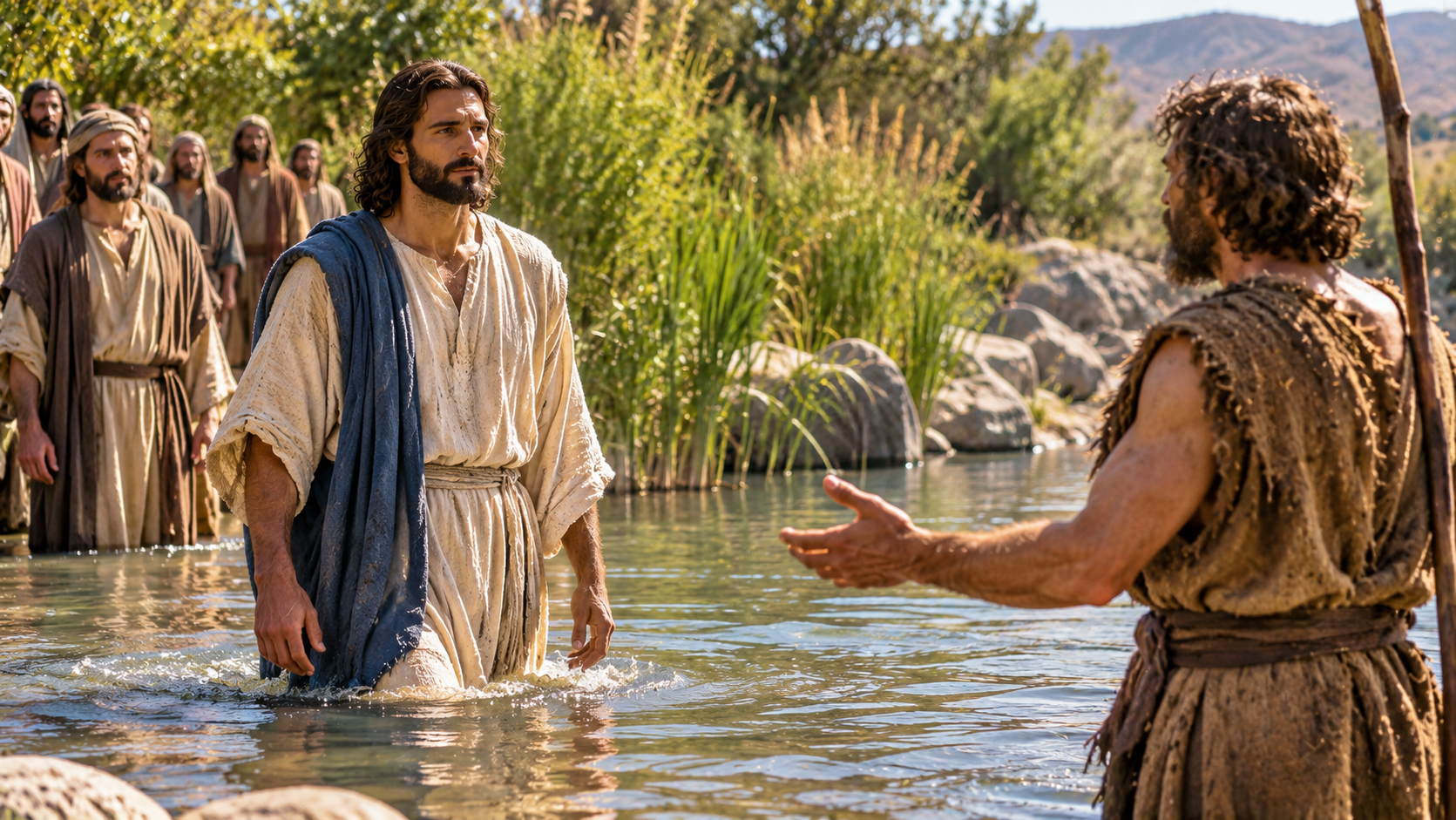
Then (tote) is an expression of time which means "At that time." When used as an adverb THEN is always worth pausing to ponder and query asking questions like "What time is it? What happens next? Why does this happen now?, etc". When then is used (as determined by the context) to be an expression of time or "time phrase", it usually indicates sequence and thus marks that which is next in order of time, soon after that, following next after in order of position, narration or enumeration, being next in a series (See English definitions or here). Observing then can be very useful in following the course of events in a chapter or paragraph, especially in eschatological (prophetic) passages
John MacArthur on when is then - We are not told the exact time to which the then refers, and Matthew no doubt uses the term simply to show the general sequence of events. We do not know the precise length of John’s ministry, but according to Luke he began preaching “in the fifteenth year of the reign of Tiberius Caesar, when Pontius Pilate was governor of Judea, and Herod was tetrarch of Galilee … in the high priesthood of Annas and Caiaphas” (Luke 3:1–2). The best assumption is that it occurred in the year A.D. 29, quite a few months, perhaps nearly a year, before Jesus’ baptism. John also continued to preach for a while afterward, causing his ministry to be ending as Jesus’ ministry was beginning. We know that John was about six months older than Jesus (Luke 1:26) and that Jesus began His ministry when He “was about thirty years of age” (Luke 3:23). If John began preaching at the same age, he would have been ministering for about six months when Jesus came to him for baptism. But we have no reason to believe that the two began ministering at the same age. And though we know how old Jesus was when He began, we are given no reason as to why He began at that age. (SEE The MacArthur Commentary)
Came from Nazareth in Galilee
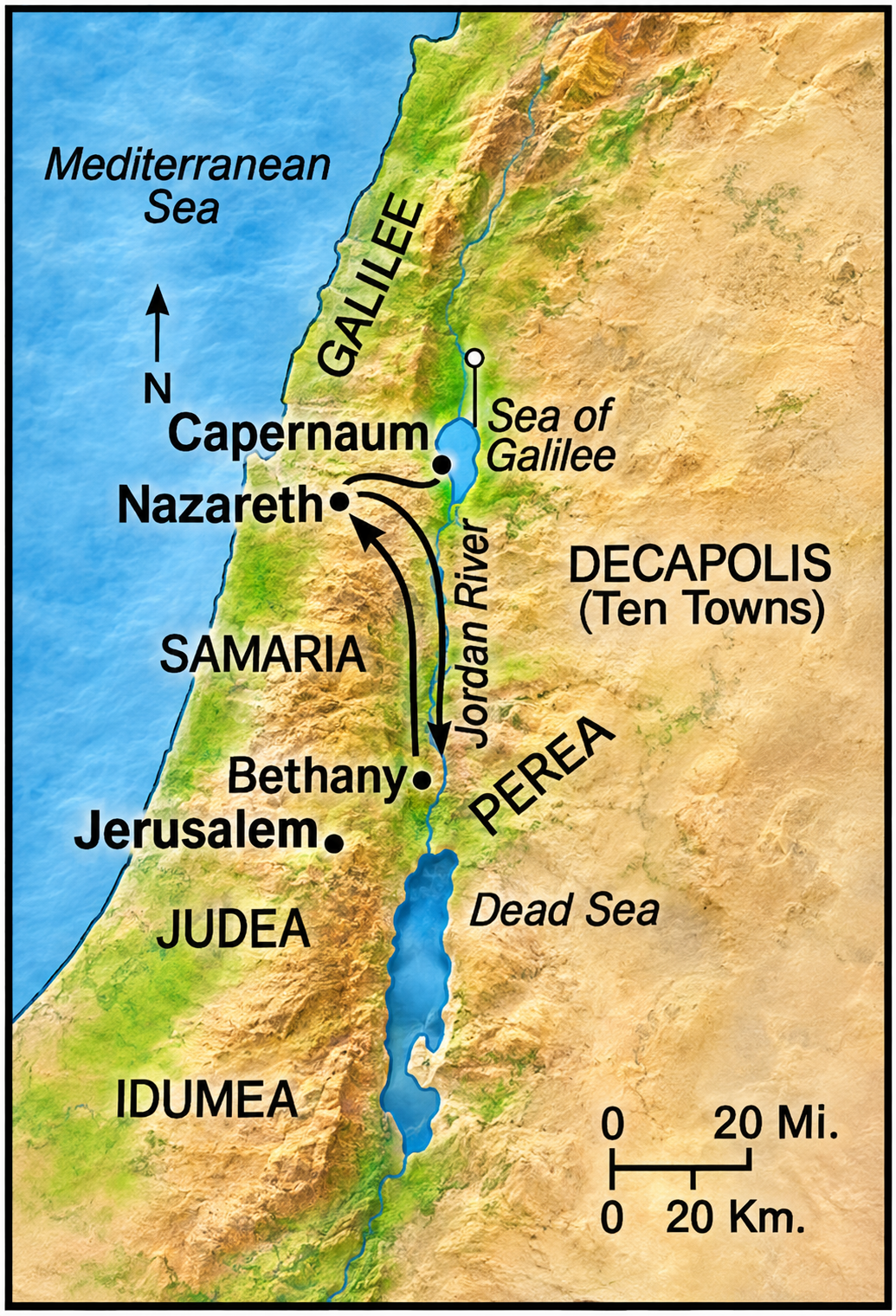


Jesus arrived (paraginomai) from Galilee (See here) at the Jordan coming to John, to be baptized (baptizo) by him - Mark 1:9 tells us Jesus came specifically from Nazareth in Galilee. To be baptized is aorist passive infinitive emphasizes purpose. Imagine John's reaction for he had been explaining that Jesus' baptism would be much greater than his, and now suddenly Jesus came to him and asked to be baptized! So Jesus comes to be baptized in public before the Jewish crowds, for Luke records "Now when all the people were baptized Jesus was also baptized." (Lk 3:21) Another interpretation of the Lucan passage might be that after the crowds were baptized, then Jesus was baptized implying it was more private.

Matthew 3:14 But John tried to prevent Him, saying, "I have need to be baptized by You, and do You come to me?"
NET Matthew 3:14 But John tried to prevent him, saying, "I need to be baptized by you, and yet you come to me?"
GNT Matthew 3:14 ὁ δὲ Ἰωάννης διεκώλυεν αὐτὸν λέγων, Ἐγὼ χρείαν ἔχω ὑπὸ σοῦ βαπτισθῆναι, καὶ σὺ ἔρχῃ πρός με;
NLT Matthew 3:14 But John tried to talk him out of it. "I am the one who needs to be baptized by you," he said, "so why are you coming to me?"
KJV Matthew 3:14 But John forbad him, saying, I have need to be baptized of thee, and comest thou to me?
ESV Matthew 3:14 John would have prevented him, saying, "I need to be baptized by you, and do you come to me?"
NIV Matthew 3:14 But John tried to deter him, saying, "I need to be baptized by you, and do you come to me?"
ASV Matthew 3:14 But John would have hindered him, saying, I have need to be baptized of thee, and comest thou to me?
CSB Matthew 3:14 But John tried to stop Him, saying, "I need to be baptized by You, and yet You come to me?"
NKJ Matthew 3:14 And John tried to prevent Him, saying, "I need to be baptized by You, and are You coming to me?"
NRS Matthew 3:14 John would have prevented him, saying, "I need to be baptized by you, and do you come to me?"
YLT Matthew 3:14 but John was forbidding him, saying, 'I have need by thee to be baptized -- and thou dost come unto me!'
NAB Matthew 3:14 John tried to prevent him, saying, "I need to be baptized by you, and yet you are coming to me?"
NJB Matthew 3:14 John tried to dissuade him, with the words, 'It is I who need baptism from you, and yet you come to me!'
John - Lu 1:43 Joh 13:6-8
- I have - Joh 1:16 Joh 3:3-7 Ac 1:5-8 Ro 3:23,25 Ga 3:22,27-29 Ga 4:6 Eph 2:3-5 Rev 7:9-17
- Matthew 3 Resources - Multiple Sermons and Commentaries
JOHN ATTEMPTS TO
HINDER JESUS
John's resistance to baptizing Jesus is recorded only by Matthew.
But John tried to prevent (diakoluo) Him - It is interesting that John recognized Jesus immediately, but it is not clear how John had come to know Him (cf his recognition in Jn 1:29 - and why would the One Who takes away sin need baptism?). Prevent is used only here in the Bible and means he attempted to keep this from happening. The idea of the verb is to thoroughly impede or utterly forbid and in the imperfect tense indicates that he was persistent in efforts to keep this baptism from happening. Broadus says "The verb rendered ‘hinder’ is compounded with a preposition, which increases its force, ‘was completely hindering,’ ‘earnestly sought to hinder." Why is John trying to prevent Him? John knew that Jesus had no need for a baptism of repentance for forgiveness of sins (cf Mt 3:2, 6, 11) so in effect Jesus did not meet the requirements for John's baptism! Jesus had no need to repent for he had never sinned.
2 Corinthians 5:21 He made Him who knew no sin to be sin on our behalf, so that we might become the righteousness of God in Him.
Hebrews 4:15 For we do not have a high priest who cannot sympathize with our weaknesses, but One who has been tempted in all things as we are, yet without sin.
Hebrews 7:26 For it was fitting for us to have such a high priest, holy, innocent, undefiled, separated from sinners and exalted above the heavens;
1 John 3:5 You know that He appeared in order to take away sins; and in Him there is no sin.
Robertson adds "The two men of destiny are face to face for the first time apparently. The Coming One stands before John and he recognizes him before the promised sign is given."
Saying, "I have need to be baptized (baptizo) by You, and do You come to me? - The 3 pronouns are all emphatic (I...You...You ) which emphasize John's sense of bewilderment and confusion. John expresses his surprise as he explains why he is resistant to baptize Jesus. John knew he was a sinner and like those he was baptizing was in need of confession and repentance. John's surprise and question recall Simon Peter in the Upper Room when Jesus sought to wash Peter's feet prompting him to say "Lord, do You wash my feet?” (John 13:6)
Broadus adds "In like manner, John’s mother had felt unworthy of a visit from the mother of her Lord - "And how has it happened to me, that the mother of my Lord would come to me?". (Luke 1:43)
Some like France think "It was as if John said to Jesus, “I need your Spirit-and-fire baptism, not your water-baptism.” Most commentators however think this is not likely to have been John's meaning. In context, John is baptizing in water and Jesus asked to be baptized in water and it would be more natural to then see John asking Jesus to baptize him in water for he knew Jesus was more righteous.
Warren Wiersbe addresses the question of why Jesus "needed" to be baptized: First, His baptism gave approval to John’s ministry. Second, He identified Himself with publicans and sinners (BECAUSE THESE WERE ONES BEING BAPTIZED), the very people He came to save. But mainly, His baptism pictured His future baptism on the cross (Matt. 20:22; Luke 12:50) when all the “waves and billows” of God’s judgment would go over Him (Ps. 42:7; Jonah 2:3).(Bible Exposition Commentary)
Spurgeon - See the humility of the true servant of Christ. He is not willing even to exercise the office of a slave, and to carry his Master’s shoes, or to unloose the latchet of them. And who among us is worthy to occupy even the lowest office for Christ? There is an honour about it that far transcends any worthiness of ours. To serve him at all, is honour indeed. But, brethren, fix your eyes upon Christ, and recollect what a baptism it is into which he baptizes us;—not with water, but into the Holy Ghost and into fire. Can we bear it? Can we endure the fire? It will only burn up that which ought to be burned; and happy is he to whom God has imparted that eternal life which can never be consumed.
Prevent (1254) diakoluo (imperfect tense) from dia, which here strengthens the meaning, and koluo, “to hinder, prevent, keep from, forbid.” Diakoluo means to hinder completely, to block, to forbid outright, to keep something from happening. Lexicons differ on the exact force of dia. Zodhiates takes it as intensive (“to hinder throughout... to impede or forbid utterly”). Thayer thinks it denotes separation, like the Latin prohibere, “to hold away, keep off,” so the picture is of someone stepping between a person and his goal to keep him from it. Either way the sense is strong: John did not merely hesitate; he tried to stop Jesus altogether. The word occurs only in Mt 3:14. It was used in Greek from Sophocles and Thucydides onward, and the Septuagint uses it in Judith 12:7NRSV, where Holofernes orders his guards not to hinder Judith from going out.
The imperfect tense is the key to the verse. BDAG calls it a conative imperfect, an imperfect that describes an attempted action: “he tried to prevent Him.” That is why the NASB says “tried to prevent.” The imperfect also pictures the action as ongoing, as if John kept protesting, “No, Lord, it should be the other way around!” until Jesus answered him. But John’s attempt did not succeed. Jesus’ gentle but firm reply ended the protest (Mt 3:15). Note the contrast: John tried to prevent Him, but in the end he permitted Him.
John’s resistance was not rebellion but humility. He recognized that the One standing before him was sinless and far greater than he. “I have need to be baptized by You” is the confession of a man who knew he was a sinner in the presence of the Holy One. Yet even a well-meaning objection can stand in the way of God’s plan. Peter later did the same when he tried to stop Jesus from going to the cross: “Peter took Him aside and began to rebuke Him, saying, ‘God forbid it, Lord! This shall never happen to You’” (Mt 16:22). True humility does not only protest its unworthiness; it submits when the Lord has spoken. John’s “Then he permitted Him” is a model for us: “‘For My thoughts are not your thoughts, Nor are your ways My ways,’ declares the LORD” (Isa 55:8).
The simple verb koluo (23 times in the NT) appears in two other passages connected with baptism, both times in a question meant to show that nothing should prevent baptism when God has clearly worked: “As they went along the road they came to some water; and the eunuch said, ‘Look! Water! What prevents me from being baptized?’” (Acts 8:36). “Surely no one can refuse the water for these to be baptized who have received the Holy Spirit just as we did, can he?” (Acts 10:47). Jesus used it of children: “But Jesus said, ‘Let the children alone, and do not hinder them from coming to Me; for the kingdom of heaven belongs to such as these’” (Mt 19:14).
Matthew 3:15 But Jesus answering said to him, "Permit it at this time; for in this way it is fitting for us to fulfill all righteousness." Then he permitted Him.
NET Matthew 3:15 So Jesus replied to him, "Let it happen now, for it is right for us to fulfill all righteousness." Then John yielded to him.
GNT Matthew 3:15 ἀποκριθεὶς δὲ ὁ Ἰησοῦς εἶπεν πρὸς αὐτόν, Ἄφες ἄρτι, οὕτως γὰρ πρέπον ἐστὶν ἡμῖν πληρῶσαι πᾶσαν δικαιοσύνην. τότε ἀφίησιν αὐτόν.
NLT Matthew 3:15 But Jesus said, "It should be done, for we must carry out all that God requires. " So John agreed to baptize him.
KJV Matthew 3:15 And Jesus answering said unto him, Suffer it to be so now: for thus it becometh us to fulfil all righteousness. Then he suffered him.
ESV Matthew 3:15 But Jesus answered him, "Let it be so now, for thus it is fitting for us to fulfill all righteousness." Then he consented.
NIV Matthew 3:15 Jesus replied, "Let it be so now; it is proper for us to do this to fulfill all righteousness." Then John consented.
ASV Matthew 3:15 But Jesus answering said unto him, Suffer it now: for thus it becometh us to fulfil all righteousness. Then he suffereth him.
CSB Matthew 3:15 Jesus answered him, "Allow it for now, because this is the way for us to fulfill all righteousness." Then he allowed Him to be baptized.
NKJ Matthew 3:15 But Jesus answered and said to him, "Permit it to be so now, for thus it is fitting for us to fulfill all righteousness." Then he allowed Him.
NRS Matthew 3:15 But Jesus answered him, "Let it be so now; for it is proper for us in this way to fulfill all righteousness." Then he consented.
YLT Matthew 3:15 But Jesus answering said to him, 'Suffer now, for thus it is becoming to us to fulfil all righteousness,' then he doth suffer him.
NAB Matthew 3:15 Jesus said to him in reply, "Allow it now, for thus it is fitting for us to fulfill all righteousness." Then he allowed him.
NJB Matthew 3:15 But Jesus replied, 'Leave it like this for the time being; it is fitting that we should, in this way, do all that uprightness demands.' Then John gave in to him.
- Permit - John 13:7-9
- for - Ps 40:7,8 Isa 42:21 Lu 1:6 Joh 4:34 Joh 8:29 Joh 13:15 Joh 15:10 Php 2:7,8 Heb 7:26 1Pe 2:21-24 1Jn 2:6
- Matthew 3 Resources - Multiple Sermons and Commentaries

"Permit it at this time"
But Jesus answering said to him, "Permit (aphiemi) it at this time - Permit is a command in the aorist imperative meaning do this immediately! Jesus did not have to be baptized, but choose to be baptized.
For (gar) is a term of explanation. Jesus explains why John should baptize Him.
In this way it is fitting for us to fulfill (pleroo) all righteousness (dikaiosune)." Then he permitted (aphiemi) Him - John clearly understood and accepted Jesus' explanation. Commentators have less understanding and so several interpretations are offered (see below). Notice that he said that it was fitting for both of them. Did you miss the "us?" John as the baptizer of Jesus fulfilled righteousness by being obedient to God’s plans and purposes for Christ’s baptism would signal the beginning of His public ministry.
John Broadus on fulfill all righteousness - It was proper for all devout Jews to be baptized; therefore it was proper for Jesus. If one so deeply, though hitherto quietly devout, had stayed away from the ministry and baptism of the new prophet, it would have been setting a very bad example, unless explained; and explanation of his future position and work could not then be given, even if it was then entirely plain to his own mind. Notwithstanding the peculiar mission of John and Jesus, it was becoming that they should fully perform everything righteous.
Michael Andrus on fulfill all righteousness - Jesus’ baptism represents the willing identification of the sinless Son of God with the sinful people He came to save. He who has no sin takes His place among those who have no righteousness. The Savior of the world takes His place among the sinners of the world. Paul puts it this way in 2 Cor. 5:21: “God made Him who had no sin to be sin for us, so that in him we might become the righteousness of God.” There was no other way to fulfill all righteousness.
Louis Barbieri on fulfill all righteousness asks "What did Jesus mean? The Law included no requirements about baptism, so Jesus could not have had in view anything pertaining to Levitical righteousness. But John’s message was a message of repentance, and those experiencing it were looking forward to a coming Messiah who would be righteous and who would bring in righteousness. If Messiah were to provide righteousness for sinners, He must be identified with sinners. It was therefore in the will of God for Him to be baptized by John in order to be identified (the real meaning of the word “baptized”) with sinners." (See Bible Knowledge Commentary - Page 25)
Spurgeon - This is one of the most striking proofs that the ordinance of baptism is not to be neglected by any of Christ’s followers, for even he who, in himself, could have had no need for it,—who is himself the Baptizer with the Holy Ghost and with fire, yet comes to the baptizer in water, and asks to be immersed.
baptism means identification, and I believe identification
was the primary purpose for the baptism of the Lord Jesus.
J Vernon McGee answers the question Why was Jesus baptized? (his explanation is similar to Allen Ross - it is the one I favor) -- There may be several answers, but the primary reason is stated right here: it is fitting for us to fulfill all righteousness. Jesus is identifying Himself completely with sinful mankind. Isaiah had prophesied that He would be numbered with the transgressors (see Isa. 53:12). Here is a King who identifies Himself with His subjects. Actually, baptism means identification, and I believe identification was the primary purpose for the baptism of the Lord Jesus. Again, the reason Jesus was baptized was not to set an example for us. It was not a pattern for us to follow. Christ was holy He did not need to repent. You and I do need to repent. He was holy, harmless, undefiled, and separate from sinners. He was baptized to completely identify Himself with humanity. (See Through His Spirit: The Person and Unique Work of the Holy Spirit)
John MacArthur is similar to McGee stating that "Christ was here identifying Himself with sinners. He will ultimately bear their sins; His perfect righteousness will be imputed to them (2 Cor. 5:21, 1Pe 2:24). This act of baptism was a necessary part of the righteousness He secured for sinners. This first public event of His ministry is also rich in meaning: 1) it pictured His death and resurrection (cf. Luke 12:50); 2) it therefore prefigured the significance of Christian baptism; 3) it marked His first public identification with those whose sins he would bear (Isa 53:11; 1 Pet. 3:18); and 4) it was a public affirmation of His messiahship by testimony directly from heaven. (BORROW MacArthur Study Bible)
Ryrie agrees that "Jesus fulfilled all the righteous requirements to be Israel's Messiah. Also, by allowing John to baptize Him, He identified with sinners whom He came to save, though, of course, He Himself had no sin to repent of.
MacDonald writes "He felt it appropriate that in baptism He identify Himself with those godly Israelites who were coming to be baptized unto repentance. But there was an even deeper meaning. Baptism for Him was a ritual symbolizing the way in which He would fulfill all the righteous claims of God against man's sin. His immersion typified His baptism in the waters of God?s judgment at Calvary. His emergence from the water foreshadowed His resurrection. By death, burial, and resurrection, He would satisfy the demands of divine justice and provide a righteous basis by which sinners could be justified. (Borrow Believer's Bible Commentary)
Warren Wiersbe - Jesus was not baptized to confess any sins (v. 5), since He was sinless. His baptism was His presentation to Israel (John 1:31) as well as a picture of His future baptism on the cross when “all the waves and billows” of judgment would go over Him (Matt. 20:22; Ps. 42:7). The baptism of John looked forward to the coming of Messiah (Acts 19:1–7). Christian baptism today looks back to the death, burial, and resurrection of Jesus Christ and witnesses of the believer’s identification with Him (Col. 2:12; Acts 10:47–48). (BORROW With the Word)
David Turner - It seems best to conclude with others (Carson 1984:105–108; Davies and Allison 1988:325–327) that Jesus fulfilled all righteousness by fulfilling the OT pattern and prediction about the Messiah. In Jesus’ baptism, he and John fulfilled the OT by introducing the Messiah to Israel. This baptism, an inauguration of Jesus’ ministry to Israel, led immediately to OT fulfillment in that the Spirit, as a dove, came upon the Messiah (Isa 11:1–2; Isa 42:1; cf. Matt 12:18, 28) and the Father endorsed his Son in the voice from heaven (Ps 2:7; Isa 42:1; cf. Matt 17:5). In baptism, Jesus as the servant proclaimed and exemplified the righteousness envisioned by the prophets. Additionally he identified in baptism with the repentant righteous remnant within the nation of Israel (cf. Mt 3:5–6). Though he had no sin to confess, his baptism nevertheless demonstrated his humility and anticipated his ministry to lowly but repentant people (cf. Mt 2:23; Mt 11:19; Mt 12:20; Mt 21:5). (SEE The Gospel of Matthew - The Gospel of Mark - Page 62)
NIVSB has a good summary of the reasons for Jesus' baptism -
(1) The first, mentioned here, was “to fulfill all righteousness.” His baptism indicated that he was consecrated to God and officially approved by him, as especially shown in the descent of the Holy Spirit (v. 16) and the words of the Father (v. 17; cf. Ps 2:7; Isa 42:1). All God’s righteous requirements for the Messiah were fully met in Jesus.
(2) At Jesus’ baptism John publicly announced the arrival of the Messiah and the inception of his ministry (Jn 1:31–34).
(3) By his baptism Jesus completely identified himself with humanity’s sin and failure (though he himself needed no repentance or cleansing from sin), becoming our substitute (2Co 5:21). (See Allen Ross below)
(4) His baptism was an example to his followers. (BORROW NIV Study Bible)
Allen Ross' explanation of the meaning of fulfill all righteousness from his excellent Exposition of the Gospel of Matthew...
Jesus’ Explanation. Jesus responded to John by saying that it was proper for them to do this to fulfill all righteousness. There are two important aspects of this sentence that we should observe. The first is Jesus word “us”--”it is proper for us.” It was not simply something Jesus was to do, but John and Jesus had to do something to fulfill all righteousness. Jesus was not acting in isolation; he was acting with John--the Sinless one with the sinner, to fulfill God’s plan. Or, as the gospel at large teaches, the one who had no sin to repent of takes his place among those who had sin to repent of (ED: cf 2Cor 5:21). The one who was sinless went down into the water of baptism that was the portion of the sinner.
And this act of baptism would be part of John’s fulfilling his mission as well, because the forerunner was to introduce the Messiah to the world.
But we have to probe a little deeper to find out what this identification with sinners was all about. The key has to be the meaning of the term “righteousness.” It is one of those words that receives a lot of explanation in teachings and lessons, but some explanation talks around the basic meaning. Certainly righteousness is right living, good deeds, virtuous acts, and the like. But if you were to do a detailed word study, you would find a more specific meaning behind all these connotations.
As an aside here, the way that you would do a detailed word study is to trace the usage of the word. Most people simply check a word book and read a few paragraphs. That is usually satisfactory, if the word book has done its work. To do the work yourself, you would get a concordance, check all the passages where a word was used, and place the uses/passages in categories of meaning. The result would be a dictionary-type conclusion--such and such a word means this, this, and this. Then you would decide which of those categories of meaning fit this passage your were studying the best.
A concordance is not a dictionary; it is a reference book that will list the passage in the Bible where your word is found. You would have to know the precise Greek word, find the references in Matthew, then in the rest of the New Testament, and then in the Old Testament in conjunction with the Hebrew word it translates. As you would guess, for a commonly used word like “righteousness,” this would take hours and hours (but you would learn a lot about many passages you found). This is why most folks will rely on someone who has done the work. That may by a little more risky, but usually the reliable sources have the basic things. You may want to check some passages they discuss and see if you agree with their interpretation; but on the whole they should provide the information.
In studying the words of Matthew it is usually helpful to see what the Old Testament Hebrew word behind the Greek would have been. The New Testament Greek is a translation of the things that Jesus would have said in Hebrew, or at times Aramaic. And much of the New Testament Greek terminology was developed from Old Testament Greek (usage in the Septuagint, the Greek translation of the Old Testament). I know this sounds technical at first, but it simply emphasizes the close connection between the New Testament and Old Testament vocabulary.
In light of this, a full study of “righteousness” for this passage will start with a survey of how it is used in the Gospel of Matthew, but ultimately draw in the Old Testament background. The whole study will lead to a meaning for the word as that which “conforms to the standard,” which would mean doing the will of God.1 What is intrinsically “right” has to be in harmony with the will of God. Accordingly, then, the idea of fulfilling all righteousness does not here mean that Jesus has been unrighteous. It simply means that here He is committing Himself to do God’s will for Him, to conform to the standard which is the will of God.
And God’s will for Him was laid out in Scripture for centuries. It is clearest in Isaiah 53:1-12 which announces that the Suffering Servant was to be “numbered with the transgressors.” Here he began to be identified with sinners. And, as John had said of this Lamb of God, Isaiah had prophesied that the LORD would lay on Him the iniquity of us all. And further, Isaiah described this one as God’s righteous servant: “my righteous servant will justify many.” So the Messiah, the Servant of the LORD in Isaiah, would identify with sinners, take their sins on Himself, and justify them through the suffering He would endure. Jesus was saying that this baptism was the beginning of all that; it was here that He began to fulfill the righteous will of God that He become the Suffering Servant who would take on Himself the sins of the world. This baptism was the inauguration of that ministry.
As a little theological rule of thumb, we usually say that in every work of “God” from creation through redemption, the Father decrees it, the Son does it, the Spirit empowers it. There is no work of “God” that all three persons of the Godhead are not so involved with.
Fulfill (complete) (4137)(pleroo) means to bring to completion or to meet the requirements of. Fulfill is a key word in Matthew especially speaking of fulfilled prophecy. Matthew's uses - Matt. 1:22; Matt. 2:15; Matt. 2:17; Matt. 2:23; Matt. 3:15; Matt. 4:14; Matt. 5:17; Matt. 8:17; Matt. 12:17; Matt. 13:35; Matt. 13:48; Matt. 21:4; Matt. 23:32; Matt. 26:54; Matt. 26:56; Matt. 27:9;
Righteousness (1343)(dikaiosune from dikaios = being proper or right in the sense of being in accordance with what God requires) is the quality of being upright. In its simplest sense dikaiosune conveys the idea of conformity to a standard or norm and in Biblical terms the "standard" is God and His perfect, holy character. Dikaiosune is rightness of character before God and rightness of actions before men. Matthew's uses of dikaiosune - Matt. 3:15; Matt. 5:6; Matt. 5:10; Matt. 5:20; Matt. 6:1; Matt. 6:33; Matt. 21:32. Righteousness is a major topic in Matthew - Righteous (dikaios), righteousness (dikaiosune), and to be righteous (dikaioo) occur more than two dozen times in Matthew, far more than in Mark (twice) or Luke (seventeen times)
The Obedience Factor
Permit it to be so now, for thus it is fitting for us to fulfill all righteousness. — Matthew 3:15
Today's Scripture : Matthew 3:13-17
Dewey VanderVelde refused to be baptized. He steadfastly resisted, even when his wife and daughters were baptized one Sunday afternoon.
Years later, his pastor preached on the baptism of Jesus. He pointed out that John the Baptist initially refused to baptize Jesus, but Jesus said, “It is fitting for us to fulfill all righteousness” (Matthew 3:15). The pastor then added this comment: “If Jesus obeyed the will of the Father, so should we.”
After the message, Dewey asked to be baptized. He said that he should have obeyed the Lord’s command much sooner, and he regretted having been so stubborn.
The issue, of course, was more than just baptism; it was obedience. The same may be true for us. We may be stubbornly disobeying the Lord in a certain area of our life—lying, cheating, stealing at work, not giving to the Lord.
Here’s what we must face: Jesus obeyed the Father in everything. His submission took Him from the height of popularity to abandonment. It took Him from public adoration to solitary suffering. It took Him to Pilate’s judgment hall, the terrible road to Calvary, the cross, and the tomb.
Let it be today that we willingly decide to obey the Lord in everything. By: David C. Egner (Reprinted by permission from Our Daily Bread Ministries. Please do not repost the full devotional without their permission.)
O give us strength to quench the urge
To do things our own way;
And help us, Lord, to heed Your Word,
Its precepts to obey. —Sper
True faith will obey without delay.
James Smith - WITH JESUS AT THE RIVER JORDAN THE SIGNIFICANCE OF CHRIST’S BAPTISM.
“Thus it becometh us” (Matt. 3:15).
Introduction
“BECOMING.” That is a word often on our lips and in our thoughts. It is one of the tests of life. It decides matters concerning behaviour and dress.
The answer to “Does it become me?” decides choice of material and style of dress, and, “It is most unbecoming of you” settles for us language and conduct.
The Lord Jesus makes this the one reason why John should baptise Him. And we, too, are included, for He said, “Thus it becometh us,” not me.
400 YEARS’ SILENCE. For four hundred years prophecy had been silent. At last the silence was broken, and a voice was heard in the land speaking like those of old. It was the voice of one who was clad in the hairy cloak and leather girdle of the old prophets.
ROUGH SPEECH. “And,” as old Bishop Hall put it, “his raiment was rough, so was his tongue; and if his food was wild honey, his speech was stinging locusts.”
“WHO” (Matt. 3:7). This phrase arrested our attention a while ago. As there was absence of any marks of true penitence, John asked under whose preaching they had been moved to ask repentance.
CHARACTER OF HIS PREACHING.
1. Spoke Plainly about Sin.
a. Taught absolute need of repentance.
b. Repentance must be proved by works.
c. Warned men not to rest on outward privileges.
2. Spoke Plainly about the Lord Jesus.
а. That He was mightier than he
b. He was only slave. Jesus was the King.
c. He baptised only with water, whereas the Lord would baptise with the Spirit.
3. Spoke Plainly of Holy Spirit.
а. Such a thing as baptism of Spirit.
b. Special offer of Lord Jesus to baptise thus in Spirit.
4. Spoke Plainly about Awful Danger of Impenitent.
a. Told them there was a wrath to come.
b. He preached of the unquenchable fire.
5. Spoke Plainly about the Safety of Believers. He taught there was a “garner” for all who were Christ’s wheat.
JOHN’S RELUCTANCE.
1. Had John ever seen the Lord? We know not.
2. He felt abashed at His presence. He noted in His face a majesty, purity, and peace, making him feel his unworthiness.
WHY DID THE LORD JESUS SEEK BAPTISM?
1. It is a difficult question.
2. John’s baptism was of repentance—but He was spotless!
3. One explanation is that, at this age, Levites were bathed and anointed and admitted to service.
4. We want to give four reasons why it was becoming of our Saviour to be baptised.
I. Serious Interest. It betokened a serious interest in this national religious movement, and surely that was becoming. “Then cometh Jesus from Galilee.”
IN CARPENTER’S SHOP. Whilst the Lord was working in the Nazareth workshop, news reached His village of the appearance of John, and the multitudes from all parts flocked to hear him. It was the beginning of a national religious movement. He showed sufficient interest to travel 24 miles to hear John.
INDIFFERENCE.
1. We do not doubt that there were thousands who showed not the least interest in this movement.
2. It is so to-day—and that fact is a puzzle to us.
3. Surely a movement that has existed so long and has wrought such marvellous changes is worthy of a little serious interest.
UNBECOMING. We would say to the thousands who have not the slightest interest in the Christian religion that, to say the least, such an attitude is most unbecoming.
BECOMING SERIOUS. It was not uncommon years ago to call conversion “becoming serious.” And judging from the faces of some of its professors, it appeared to be a very serious matter indeed. It ought to be “becoming joyful.” Yes, but you must become serious before becoming joyful. In one sense all unsaved are often sad enough.
II. Humility. His coming to be baptised of John was a proof and fruit of humility, and surely humility is becoming. “Then cometh Jesus to be baptised of him.”
USUAL. When a King is to be baptised a minister is sent for. But He did not stand on His dignity and send for John. He came. Usually when a King is to be baptised, a prelate or pontiff must officiate—some high dignitary at any rate. But He came to be baptised of this lowly prophet-preacher.
HUMILITY. Humility of heart and mind will betray itself. And humility is most becoming of us.
III. Identification. It was an act of identification with His people, and surely that was most becoming of Him.
WHY? It is a sinners’ ordinance—but He was no sinner!
LOST HIS CHARACTER.
1. Have you ever thought of this, that our Lord lost His character by this act?
2. Only sinners came to the waters of baptism.
3. Note:
a. He was numbered with the transgressors by His baptism.
b. It was an act by which He consented to take His place among sinners.
c. It was an act of identification with the people.
d. It was, in figure, what He would actually do for them by and bye—die.
IV. Submission. It was His submission and obedience to a Divinely appointed ordinance, and surely that act was most becoming. His first public act is one of obedience to the Voice of God as in the rite of baptism.
DON’T GO TOO FAR. There is a danger of some of us making too little because others make too much of ordinances.
ONLY TWO SACRAMENTS. Baptism and the Lord’s Supper.
OUR DUTY. Our becoming duty is to observe them.
V. Glorious Result.
1. Opened Heaven. This suggests, or rather, proves, the perfection of the thirty years He had lived at Nazareth.
2. Holy Spirit. First time Trinity clearly made known.
3. Voice. Proclaiming His love to His Son.
G Campbell Morgan - Thus it becometh us to fulfil all righteousness. Matt. 3.15
"Thus." How? What is the real significance of this first recorded word of our Lord as He approached His public minis-try? The answer is to be found in a consideration of the reason for the protest of John, to which it was a reply. John's baptism was to repentance and remission of sins. As he looked at Jesus, he knew that He had nothing of which to repent; no sins to be remitted. Why then should He submit to this baptism? The answer to that inquiry our Lord gave. The reason for His baptism was that through all which it symbolized He would fulfil righteousness; and only through such action could He do this. In baptism He confessed, as His own, sins which He had not committed, and repented of them before God. He was numbered with transgressors and bore the sins of many. It was at once the prophecy and interpretation of His coming passion-baptism. The most arresting fact here is that in this word we have the revelation of a new element in the Righteousness of God—new that is, in the sense that it had not hitherto been revealed. Included in the Divine righteousness is the determination to make it possible, by the way of vi-carious suffering. Thus love is seen, mastered by righteousness; and suffering, in order to make the unrighteous righteous. Thus righteousness is seen, acting in love, that men may be brought into the place where love can bestow all its gifts. That is the righteousness unveiled in the Gospel. That is the righteousness which exceeds that of the Pharisees. How far have we entered into the personal experience of it?
P G Matthew - In Matthew 3, we read about the baptism of Jesus. Have you ever wondered why Jesus was baptized by John the Baptist? Why would the sinless Son of God have to go into the desert to be baptized by one who was baptizing people for the forgiveness of their sins?
Jesus submitted to John’s baptism in order to fulfill God’s righteous requirements. He was the true Israelite who would, as our representative, fulfill all righteousness and obey all God’s laws perfectly. This One, who was without sin, identified with sinners and became our substitute, the head of a glorious new humanity.
By receiving John’s baptism, Jesus was also announcing that the Messiah would soon be baptized with a baptism of suffering, which would take away the sin of the world. His baptism was thus pointing to the violent death of the cross. Jesus knew from the outset that he came to die. Now he was publicly declaring to the Father and to the world that he was in complete submission to the will of God.
John’s baptism of Jesus marked the beginning of Jesus’ messianic journey to the cross, where he would suffer the pains of hell on behalf of his people. As he prayed, the Holy Spirit came down in the visible form of a dove. In order to fully complete this most difficult task, Jesus would need the Holy Spirit to come upon him without measure, strengthening, encouraging, and guiding him in his human nature.
After his baptism, Jesus received consolation and comfort from the first Person of the Trinity, God the Father. After the descent of the Holy Spirit, the voice of the Father came from heaven, saying, “This is my Son, whom I love; with him I am well pleased.”
The baptism of Jesus reassures us that salvation is the work of the Trinity. All three Persons of the Godhead are involved in our salvation. The Son assumed the role of a suffering servant. Within three years he would say from the cross, “It is finished,” indicating that his work of redemption was complete. The Holy Spirit, who descended upon Jesus, strengthened him and guided him for his mission. And the Father gave his audible approval to his Son, his servant, the one in whom his plan for our salvation would prosper.
Matthew 3:16 After being baptized, Jesus came up immediately from the water; and behold, the heavens were opened, and he saw the Spirit of God descending as a dove and lighting on Him,
NET Matthew 3:16 After Jesus was baptized, just as he was coming up out of the water, the heavens opened and he saw the Spirit of God descending like a dove and coming on him.
GNT Matthew 3:16 βαπτισθεὶς δὲ ὁ Ἰησοῦς εὐθὺς ἀνέβη ἀπὸ τοῦ ὕδατος· καὶ ἰδοὺ ἠνεῴχθησαν [αὐτῷ] οἱ οὐρανοί, καὶ εἶδεν [τὸ] πνεῦμα [τοῦ] θεοῦ καταβαῖνον ὡσεὶ περιστερὰν [καὶ] ἐρχόμενον ἐπ᾽ αὐτόν·
NLT Matthew 3:16 After his baptism, as Jesus came up out of the water, the heavens were opened and he saw the Spirit of God descending like a dove and settling on him.
KJV Matthew 3:16 And Jesus, when he was baptized, went up straightway out of the water: and, lo, the heavens were opened unto him, and he saw the Spirit of God descending like a dove, and lighting upon him:
ESV Matthew 3:16 And when Jesus was baptized, immediately he went up from the water, and behold, the heavens were opened to him, and he saw the Spirit of God descending like a dove and coming to rest on him;
NIV Matthew 3:16 As soon as Jesus was baptized, he went up out of the water. At that moment heaven was opened, and he saw the Spirit of God descending like a dove and lighting on him.
ASV Matthew 3:16 And Jesus when he was baptized, went up straightway from the water: and lo, the heavens were opened unto him, and he saw the Spirit of God descending as a dove, and coming upon him;
CSB Matthew 3:16 After Jesus was baptized, He went up immediately from the water. The heavens suddenly opened for Him, and He saw the Spirit of God descending like a dove and coming down on Him.
NKJ Matthew 3:16 When He had been baptized, Jesus came up immediately from the water; and behold, the heavens were opened to Him, and He saw the Spirit of God descending like a dove and alighting upon Him.
NRS Matthew 3:16 And when Jesus had been baptized, just as he came up from the water, suddenly the heavens were opened to him and he saw the Spirit of God descending like a dove and alighting on him.
YLT Matthew 3:16 And having been baptized, Jesus went up immediately from the water, and lo, opened to him were the heavens, and he saw the Spirit of God descending as a dove, and coming upon him,
- Jesus - Mk 1:10
- behold - Eze 1:1 Lu 3:21 Ac 7:56
- he saw the Spirit - Isa 11:2 Isa 42:1 Isa 59:21 Isa 61:1 Lu 3:22 Joh 1:31-34 Joh 3:34 Col 1:18,19
- Matthew 3 Resources - Multiple Sermons and Commentaries
Related Passages:
Acts 10:36-38 “The word which He sent to the sons of Israel, preaching peace through Jesus Christ (He is Lord of all)– 37 you yourselves know the thing which took place throughout all Judea, starting from Galilee, after the baptism which John proclaimed. 38 “You know of Jesus of Nazareth, how God anointed Him with the Holy Spirit and with power, and how He went about doing good and healing all who were oppressed by the devil, for God was with Him.

THE HEAVENLY VISION
JESUS' MINISTRY INAUGURATED
This is the first clear expression of the concept of the Trinity in the New Testament.
After being baptized (baptizo), Jesus came up (anabaino) immediately (euthus) from the water (Mark 1:10) - A simple reading of this text certainly suggest Jesus went under the water. Alternatively, this could also picture Jesus leaving the water and going up on the bank of the river.
And behold, (idou) the heavens (ouranos) were opened (anoigo) - The opening of heaven is a frequent apocalyptic motif found in the giving of revelation (Read Ezek 1:1; John 1:51; Acts 7:56; Acts 10:11; Rev 19:11.) as is a voice from heaven. (Read Isa 6:4, 8; Ezek 1:25, 28; Rev 4:1; Rev 10:4, 8; Rev 11:12; Rev 14:13.). It is interesting that the heavens were opened to mark the inauguration of Jesus' earthly ministry to accomplish redemption of mankind, while in Revelation 19:11 the heavens are opened to mark the return of Jesus to accomplish His redemption of the earth (cf Rev 5:9-see commentary = Garland writes "the redemption in view [in Rev 5:9] is both soteriological -- individual souls are reconciled to God and eschatological -- the original creation will be restored at last.")
OTHER HEAVENLY OPENINGS -
As Stephen was about to be martyred he declared "Behold, I see the heavens opened up (dianoigo) and the Son of Man standing at the right hand of God.” (Acts 7:56)
In Acts 10:11 Peter "saw the sky opened up, and an object like a great sheet coming down, lowered by four corners to the ground."
In the Revelation the apostle John writes "And I saw heaven opened (anoigo), and behold, a white horse, and He who sat on it is called Faithful and True, and in righteousness He judges and wages war." (Rev 19:11, cf also Rev 4:1, Rev 11:19)
It is interesting to note Isaiah's prayer for divine intervention, which some think will be the type of prayer that the redeemed remnant of Israel will be praying during the Great Tribulation days, the Time of Jacob's Trouble/Distress (Jer 30:6). "Oh, that You would rend (Lxx = anoigo) the heavens and come down, That the mountains might quake at Your presence" (Isa 64:1)
And he saw the Spirit (pneuma) of God descending (katabaino) as a dove (peristera) and lighting (erchomai) on Him - Luke 3:22 has " in bodily form like a dove." Matthew says John the Baptist saw the Spirit. Did everyone present see the Spirit? I do not know. The text does not say. The descent of the Spirit as a dove indicates He was not a literal dove ("AS" IS A TERM OF COMPARISON KNOWN AS A SIMILE. Mark 1:10 has "LIKE A DOVE"). In some way, the coming down of the Spirit was made visible to John, or otherwise he would have been able to see Him (cf Jesus' description of Him in John 3:8 where Jesus indicates we cannot see the Spirit just as we cannot see the wind). Clearly John saw this most amazing event for the apostle John writes
John (THE BAPTIST) testified (martureo = GAVE A WITNESS) saying, “I have seen the Spirit descending as a dove out of heaven, and He remained upon Him. I did not recognize Him, but He who sent me to baptize in water said to me, ‘He upon whom you see the Spirit descending and remaining upon Him, this is the One who baptizes in the Holy Spirit (IN OTHER WORDS THE SIGN JOHN WITNESSED WAS SUPERNATURAL PROOF OF JESUS' MESSIAHSHIP - JUST AS GOD HAD TOLD HIM).’ I myself have seen, and have testified that this is the Son of God.” (Jn 1:32-34)
Comment - Note the description that the Spirit "remained upon Him." Was this "remaining" something that was visible, like a "halo" over Jesus' head??? There is nothing in the NT which would suggest that Jesus walked around with a halo or an aura or a dove-like glow over His head. The idea if that the Spirit's abiding presence was with the Man Jesus, continually empowering His ministry. In that sense the Spirit remained upon Jesus. Notice also that this statement by John in essence fulfills the prophecy uttered by Isaiah...
The Spirit of the LORD will rest on Him (Lxx = anapauo used figuratively here of the Spirit's resting in place, remaining -- anapauo is used in this same sense in 1 Pe 4:14), The spirit of wisdom and understanding, The spirit of counsel and strength, The spirit of knowledge and the fear of the LORD. (Isaiah 11:2) (Isaiah's point is that that He would be supernaturally energized by the Spirit!)
The Spirit of the Lord GOD is upon me, Because the LORD has anointed me To bring good news to the afflicted; He has sent me to bind up the brokenhearted, To proclaim liberty to captives And freedom to prisoners; (Isaiah 61:1 quoted in Luke 4:18)
“Behold, My Servant, whom I uphold; My chosen one in whom My soul delights. I have put My Spirit upon Him; He will bring forth justice to the nations. (Isaiah 42:1)
NET NOTE - Isaiah 42:1–7 contain the first of Isaiah's "servant songs," which describe the ministry of a special, ideal servant who accomplishes God's purposes for Israel and the nations. This song depicts the servant as a just king who brings justice to the earth and relief for the oppressed.
Kenneth C. Fleming - All through Old Testament times the Spirit of God came upon and empowered certain individuals to accomplish special tasks. Never once did the Spirit remain on that individual after the task was finished. But when the Holy Spirit of God came upon the Lord Jesus at the start of his earthly ministry, he “rested” on him (Matt. 3:16), or as the apostle John wrote, he “remained” or became “at home” on him (John 1:32). Jesus was the first one upon whom the Holy Spirit could remain in all his holiness and be perfectly at home. The same Spirit now dwells in every believer because of the finished work of Christ. It is helpful for us to ask ourselves to what degree the Holy Spirit may feel “at home” in our lives. (Emmaus Journal · Vol. 19:1 · 2010)
So the Spirit of God came upon Jesus, an event Peter (see below) describes as an anointing from the Father. This anointing signified the inception of Jesus' ministry, that the Spirit was on/in Jesus and Jesus was supernaturally empowered by the Spirit (Acts 10:38 below). He was given this supernatural power at the beginning of His public ministry and it was primarily in reliance on the power of the Spirit that Jesus carried out His ministry (even to the bitter end "Who through the eternal Spirit offered Himself" Heb 9:14) To be sure, there were some unique events such as walking on water, reading minds of men, performance of miracles like water to wine, etc. But what Peter says below is that Jesus ministered in the power of the Holy Spirit. See also Luke 4:1 and Luke 4:14 which describe the role of the Holy Spirit at the beginning of Jesus' ministry just after His baptism by John.
🙏 THOUGHT - Here is why I am belaboring this point -- Jesus did this to give us His perfect example to follow, the very thing we are commanded to do, Paul writing "Be (present imperative/ - command to continually be) imitators of me, JUST AS I AM OF CHRIST." (1 Cor 11:1). Yes, Paul was unique and undoubtedly the greatest of the apostles, but even he states that he imitated Jesus' example of the need to be filled with and rely on the power of the Spirit to live the supernatural life. Beloved, if you are experiencing less that the John 10:10b "abundant life," perhaps it could be because you have never really understood that you had been commanded to imitate Jesus and that when you did His Spirit would enable you to live a supernatural, abundant life! So how can you obey Paul's command to be an imitator of him as he was of Christ? The simple answer is by the Spirit and ONLY BY THE SPIRIT! There is NO PLAN B (so to speak) for living the supernatural Christian life! See discussion of the Need for the Holy Spirit to obey NT commands (or "How to Keep All 1642 Commandments in the New Testament!") See also The Holy Spirit-Walking Like Jesus Walked! See more discussion of this vitally important topic below.
The question is what is the significance of the Spirit descending upon Jesus? Did Jesus not have the Spirit indwelling Him? Of course He did, for Jesus always had the Spirit. So while there may be several answers, one that strikes me is that this event presents a pattern for believers to live a supernatural life.
It was the Spirit of God who gave
success to Jesus Christ’s ministry.
--C H Spurgeon
If this is true, which it is, how much more important is it for all believers to daily die to self and rely wholly on the Holy Spirit for ministry to and through us to a world dead in sin and enemies of God?! In short, the descending of the Spirit on Jesus demonstrates that from the outset of His public ministry Jesus is giving us His pattern of perfect reliance on the empowering presence of the Spirit to fulfill ministry. As discussed below, for believers to successfully fulfill the "good works" (aka "God works") ministry that God has pre-prepared for them in Christ Jesus (read Eph 2:10, cf 2 Ti 2:21), they need to learn the secret of relying wholly on the Holy Spirit!
F B Meyer rightly points out the analogy - “What this scene was in the life of the Lord, Pentecost was for the Church. Then she was anointed for her divine mission among men; the unction of the Holy One rested upon her, to be continued and renewed as the centuries slowly passed.” (From "Behold My Servant" Isaiah 42:1)
Peter in essence summarizes Jesus' 3 year ministry and in so doing alludes to the Spirit's anointing of the God-Man Jesus:
Opening his mouth, Peter said: “I most certainly understand now that God is not one to show partiality, 35 but in every nation the man who fears Him and does what is right is welcome to Him. 36 “The word which He sent to the sons of Israel, preaching peace through Jesus Christ (He is Lord of all)(ED: THE WORDS OF ALL WOULD HAVE MUSIC TO THIS GENTILE'S EARS!)– 37 you yourselves know (MEANS TO KNOW BEYOND A SHADOW OF A DOUBT) the thing which took place throughout all Judea, starting from Galilee (SO HERE PETER STATES THE BEGINNING OF JESUS' MINISTRY), after the baptism which John proclaimed. 38 “You know of Jesus of Nazareth, how God anointed Him with the Holy Spirit and with power, (SEE NOTE BELOW ON ANOINTED) and how He went about doing good and healing all who were oppressed by the devil, for God was with Him (ED: YES THE FATHER WAS WITH HIM, BUT THE HOLY SPIRIT WAS ALSO WITH HIM EMPOWERING HIM). 39 “We are witnesses of all the things He did both in the land of the Jews and in Jerusalem. They also put Him to death by hanging Him on a cross. (HERE PETER DESCRIBES THE CULMINATION OF JESUS' 3 YEAR MINISTRY) 40 “God raised Him up on the third day and granted that He become visible, 41 not to all the people, but to witnesses who were chosen beforehand by God, that is, to us who ate and drank with Him after He arose from the dead. (WHAT PETER HAS JUST DESCRIBED IS THE ESSENCE OF THE GOSPEL) 42 “And He ordered us to preach to the people, and solemnly to testify (WHY SOLEMNLY? READ ON - A JUDGMENT IS COMING!) that this is the One who has been appointed by God as Judge of the living and the dead. 43 “Of Him all the prophets (REFERRING TO THE OLD TESTAMENT MESSIANIC PROPHECIES) bear witness that through His name everyone who believes in Him receives forgiveness of sins.” (Acts 10:34-43)
Comment - Anointed in Acts 10:38 is chrio which means to consecrate/set apart for sacred work as by unction. The idea is to assign a person to task, with implication of supernatural sanctions, blessing, and endowment. And so fittingly Jesus is also given the title of Christos (from chrio), also called the Messiah - Anointed One. John uses the related word chrisma describing the believer's anointing in 1 John 2:20 and 1 John 2:27 which in context refers to our "anointing" with the Holy Spirit, this "anointing" occurring the moment we were regenerated by grace through faith. Have you ever considered yourself to be an anointed saint? You are! See interesting CARM.org article 1 John 2:27, You are anointed of God and here is a brief quote to "wet your appetite" - "It is this anointing that opens your mind, teaches you, guides you, calls you to pray, empowers you, and enables you to be stronger Christians, more powerful Christians. Not just people who are saved, but people who are saved, indwelt, and empowered."
The question arises whether the Spirit descended while Jesus was still in the water? Mark's reading would suggest that is the case, but read Matthew's version "After being baptized, Jesus came up immediately from the water; and behold (idou = calls for special attention to this event!), the heavens were opened, and he saw the Spirit of God descending as a dove and lighting on Him." (Mt 3:16) The word "from" is apo which speaks of separation and thus it would support the interpretation that the Spirit descended on Jesus after He had departed the water. This is not a major theological high-water mark (pun intended), but it does bring into question the accuracy of paintings such as the one by Grigory Gagarin.

One other point - While the Spirit came on Jesus after His baptism, this in no way means that the Spirit comes upon men or women in association with water baptism. The Spirit comes upon (and in) believers the moment they are saved/regenerated by the Spirit, and this occurs when by grace they believe in the Gospel of Jesus Christ. Faith alone saves a soul from Hell. The act of water baptism absolutely does not save a soul. However performing this act can deceive a soul into thinking they are saved if they have been instructed by someone they respect that they need to undergo water baptism in order to be saved. I was baptized 3 times, first as an infant, next after completing Lutheran confirmation (age 12), and finally at age 40 after I had personally received Christ as my Lord and Savior (about 3 weeks earlier). My third baptism was in essence a testimony and celebration of the redeeming work of Christ performed several weeks prior. It was a testimony that I had been saved by grace through faith.
R C Lenski on Jesus' baptism - The truth is: no new relation was established; what happened was an act of God, that great act by which he inaugurated Jesus into his mighty office of Prophet, High Priest, and King....We are not told what became visible when the heavens were suddenly opened as we are told in the cases of Ezekiel and of Stephen. We may say that the heavenly glory became visible, and that Jesus, John, and any others who were present beheld its radiance (cf Jn 1:32-34) (BORROW The Interpretation of St. Mark's Gospel PAGE 48)
Related Resources:
- Is baptism necessary for salvation?
- Does 1 Peter 3:21 teach that baptism is necessary for salvation?
- Does Galatians 3:27 teach that baptism is necessary for salvation?
- Does the Bible teach believer's baptism/credobaptism?
- Does John 3:5 teach that baptism is necessary for salvation?
- What does the Bible say about infant baptism / paedobaptism?
- Does Mark 16:16 teach that baptism is necessary for salvation?
Behold (2400) (idou) is a word used to grasp the reader's attention. See short excursus on this word below. is the second person singular aorist middle imperative of eidon which means to see, perceive, look at. In the NT idou is used as a demonstrative particle that draws attention to what follows. Idou in the middle voice means "you yourself look, see, perceive!" The aorist imperative is a command emphasizing "Do it now! Don't delay!" Spurgeon reminds us that "Behold is a word of wonder; it is intended to excite admiration. Wherever you see it hung out in Scripture, it is like an ancient sign-board, signifying that there are rich wares within, or like the hands which solid readers have observed in the margin of the older Puritanic books, drawing attention to something particularly worthy of observation." I would add, behold is like a divine highlighter, a divine underlining of an especially striking or important text. It says in effect "Listen up, all ye who would be wise in the ways of Jehovah!" Zodhiates writes that idou is a "demonstrative particle. “Lo and behold!”, serving to call attention to something external or exterior to oneself; usually used at the beginning of a clause or only with kai (and), before it, but sometimes in the mid. of a clause before words which are to be particularly noted (Mt 23:34; Lk 13:16; Acts 2:7). (The Complete Word Study Dictionary) Idou is used by the Biblical writers to (1) prompt or arouse the reader's attention (introducing something new or unusual), (2) to mark a strong emphasis ("Indeed!" Lk 13:16) and (3) to call the reader to pay close attention (very similar to #1) so that one will listen, remember or consider
🙏 THOUGHT - Dear reader, have you experienced this "Behold" in your life? If not, then read Acts 4:12, Acts 16:31, Romans 10:9, 10, John 1:12, 13, Ephesians 2:8,9,10 so that you too might "Behold" the glory of the risen Son in your life (see the following comment) and experience a brand new life in Christ. Baker says that behold emphasizes the dramatic aspect of the change in 2Co 5:17 - as if the reader is watching it occur, almost like observing a sunrise (Ed: It is early in the morning as I write this note. I am on the Texas coast overlooking the Gulf of Mexico and the bright orange sun has literally just peeked over the distant horizon of the ocean - and my reaction was literally to stop and behold! And then to praise Him for His glory. Ps 19:1). One minute it is dark and hazy, the next, the sun has popped out and one “beholds” its wonder as it transforms the shimmering landscape (Ed: As I watch the sun slowly rise in over the ocean, the shimmering waves shout out "Glory to God in the highest"!). (Baker, W. R. 2 Corinthians. The College Press NIV commentary. Joplin, MO: College Press Pub) (Bolding added)
Matthew uses behold about 62 times out of a total of 162 uses in the NT so he clearly likes this demonstrative particle - Matt. 1:20; Matt. 1:23; Matt. 2:13; Matt. 2:19; Matt. 3:16; Matt. 3:17; Matt. 4:11; Matt. 7:4; Matt. 8:24; Matt. 8:34; Matt. 9:10; Matt. 10:16; Matt. 11:10; Matt. 11:19; Matt. 12:2; Matt. 12:18; Matt. 12:41; Matt. 12:42; Matt. 12:46; Matt. 12:47; Matt. 12:49; Matt. 13:3; Matt. 17:3; Matt. 17:5; Matt. 19:27; Matt. 20:18; Matt. 21:5; Matt. 22:4; Matt. 23:34; Matt. 23:38; Matt. 24:23; Matt. 24:25; Matt. 24:26; Matt. 25:6; Matt. 26:45; Matt. 26:46; Matt. 26:47; Matt. 26:51; Matt. 27:51; Matt. 28:2; Matt. 28:7; Matt. 28:9; Matt. 28:20;
Came up (305)(anabaino) indicates movement towards a destination. The first use of anabaino describes Jesus coming up out of the water after baptism (Mt 3:16, Mk 1:10) and later Jesus "went up to the mountain" (Mt 5:1) in preparation for one of the greatest sermons in history (Sermon on the Mount). What is the proper mode of baptism? - immersion or sprinkling?
Opened (455)(anoigo from ana = again + oigo = to open) means to open, to open up, to open again, to give access to and is the verb used by Luke in Luke 3:21. Mark (Mk 1:11) uses a different verb schizo which also describes the "opening" (tearing) of the veil of the Temple when Jesus died on the Cross (See discussion of schizo). While Matthew and Luke say the heavens opened using the aorist tense, Mk 1:10 uses the present tense (He saw the heavens opening) which vividly describes this opening as a process as if the heavens were being split apart like a garment (cf use of schizo in Lk 5:36 and King Hezekiah in Lxx of Isa 37:1 "tore his clothes"). Humanistic rationalization speculates the heavens were opened as everything from flashes of lightning to clouds moving and exposing the sun. No, it was not natural but supernatural! God in effect "tore" open the heavens! Imagine what must have gone through the minds of all those present to witness this dramatic event! Lk 3:21 adds the detail that this opening of the heavens occurred "while He was praying"). The verb schizo used by Mark is more vivid than the other two synoptists and is the same verb used for tearing of the Temple veil from top to bottom (Mt 27:51, Mk 15:38. Lk 23:45). Griffith says that "Just as the veil of the Temple was rent in twain to symbolize the perfect access of all men to God (Hebrews 10:19,20), so here the heavens are rent asunder to show how near God is to Jesus, and Jesus is to God."
Dove (4058) peristera means a dove or pigeon. The NASB translates it “dove” everywhere except Luke 2:24, where it has “young pigeons.” In classical Greek the word meant much the same, and doves and pigeons were common food in the ancient world. A papyrus letter even asks someone to bring half a jar of preserved birds (Moulton-Milligan). What changes in Scripture is the symbolic weight the bird carries. Writers did not develop the dove into a deity or a sacred bird, as some pagan religions did. Instead, they drew on its gentleness, its purity, its helplessness and its faithful return home to picture spiritual truths.
In the Old Testament (Hebrew yonah, Septuagint peristera) the dove held a special place in Israel’s worship. Turtledoves and young pigeons were the only birds prescribed for burnt offerings: “But if his offering to the LORD is a burnt offering of birds, then he shall bring his offering from the turtledoves or from young pigeons” (Lev 1:14). In God’s grace they were the offering of the poor, who could not afford a lamb: “But if she cannot afford a lamb, then she shall take two turtledoves or two young pigeons, the one for a burnt offering and the other for a sin offering; and the priest shall make atonement for her, and she will be clean” (Lev 12:8). The dove is also a term of endearment for the beloved: “O my dove, in the clefts of the rock, In the secret place of the steep pathway, Let me see your form, Let me hear your voice; For your voice is sweet, And your form is lovely” (Song 2:14). It can picture longing for escape: “I said, ‘Oh, that I had wings like a dove! I would fly away and be at rest’” (Ps 55:6). Negatively, it pictures foolish instability, as when Israel fluttered between the nations instead of trusting God: “So Ephraim has become like a silly dove, without sense; They call to Egypt, they go to Assyria” (Hos 7:11). Positively, it pictures Israel’s future homecoming: “They will come trembling like birds from Egypt And like doves from the land of Assyria; And I will settle them in their houses, declares the LORD” (Hos 11:11). And it was a dove that announced the end of God’s judgment in the flood: “The dove came to him toward evening, and behold, in her beak was a freshly plucked olive leaf. So Noah knew that the water was abated from the earth” (Gen 8:11).
In the New Testament peristera occurs 10 times, in three settings:
- The Spirit at Jesus’ baptism (Mt 3:16; Mk 1:10; Lk 3:22; Jn 1:32). This is the most important use: “After being baptized, Jesus came up immediately from the water; and behold, the heavens were opened, and he saw the Spirit of God descending as a dove and lighting on Him” (Mt 3:16).
- It was visible. Luke stresses that this was a real, visible event: “and the Holy Spirit descended upon Him in bodily form like a dove, and a voice came out of heaven, ‘You are My beloved Son, in You I am well-pleased’” (Lk 3:22).
- It was a sign to John. He was told that this would identify the Messiah, and he notes that the Spirit stayed: “John testified saying, ‘I have seen the Spirit descending as a dove out of heaven, and He remained upon Him’” (Jn 1:32).
- It echoes earlier Scripture. Many see the Spirit “hovering” over the waters of creation (Gen 1:2), and Noah’s dove signaling a new beginning after judgment. At the Jordan the Spirit anoints the One who will bring a new creation and true peace with God.
- It fits the Spirit’s character. The gentle dove fits the Spirit resting on the meek and lowly Messiah, who “will not quarrel, nor cry out” (Mt 12:19).
- The disciple’s character (Mt 10:16). The dove pictures purity and harmlessness: “Behold, I send you out as sheep in the midst of wolves; so be shrewd as serpents and innocent [akeraios] as doves.” Disciples must be wise in a hostile world, but without guile, with singleness of heart and pure motives.
- Sacrifice and the temple (Lk 2:24; Mt 21:12; Mk 11:15; Jn 2:14, 16). At Jesus’ presentation, Mary and Joseph offered “A PAIR OF TURTLEDOVES OR TWO YOUNG PIGEONS” (Lk 2:24), the offering of the poor under Lev 12:8. It is a quiet testimony that the Son of God was born into a humble home. Later, Jesus drove the dove sellers out of the temple: “and to those who were selling the doves He said, ‘Take these things away; stop making My Father’s house a place of business’” (Jn 2:16). How ironic that the offering God had given in mercy to the poor had become a means of profit at their expense.
In the early church the dove became a rich Christian symbol: of the Holy Spirit, of peace (from Noah’s dove), of the believer’s innocence (Clement of Alexandria and Origen called believers “doves”), and sometimes of the soul. Tertullian contrasted the simple dove with the cunning serpent to distinguish true Christians from heretics (Against the Valentinians 3). Some Gnostic heretics misused the baptism scene, claiming that “the Christ” only came upon the man Jesus when the dove descended. The Gospels refute this, since Jesus was “Immanuel... God with us” from His conception (Mt 1:23).
PERISTERA - 10V - Matt. 3:16; Matt. 10:16; Matt. 21:12; Mk. 1:10; Mk. 11:15; Lk. 2:24; Lk. 3:22; Jn. 1:32; Jn. 2:14; Jn. 2:16
PERISTERA IN SEPTUAGINT - Gen. 8:8; Gen. 8:9; Gen. 8:10; Gen. 8:11; Gen. 8:12; Gen. 15:9; Lev. 1:14; Lev. 5:7; Lev. 5:11; Lev. 12:6; Lev. 12:8; Lev. 14:22; Lev. 14:30; Lev. 15:14; Lev. 15:29; Num. 6:10; 2 Ki. 6:25; Ps. 55:6; Ps. 68:13; Cant. 1:15; Cant. 2:10; Cant. 2:13; Cant. 2:14; Cant. 4:1; Cant. 5:2; Cant. 5:12; Cant. 6:9; Isa. 38:14; Isa. 59:11; Isa. 60:8; Jer. 48:28; Hos. 7:11; Hos. 11:11; Nah. 2:7; Zeph. 3:1;
MORE DISCUSSION OF THE HOLY SPIRIT IN JESUS' MINISTRY AND OUR NEED FOR THE SAME POWER - In the schematic below Jesus came (incarnation and first 30 years basically in seclusion) and then came to the Jordan to inaugurate His 3 year public ministry (not specifically shown). The Spirit coming upon Jesus in essence "anointed" Him with the Spirit and with power to successfully carry out his 3 year ministry. Here was the perfect Man presenting us with the perfect pattern to imitate, even as John says "the one who says he abides in Him (CHRIST) ought (MUST) himself walk (LIVE) in the same manner as He walked."(1 Jn 2:6). How did Jesus walk these 3 years? Filled with the Spirit (cf Lk 4:1) and with the power of the Spirit (Lk 4:14). And so just as Jesus' relied wholly on the Holy Spirit for His supernatural ministry, so too all believers must rely on the same Spirit and same power (Acts 1:8) to live a supernatural life for the glory of God. Note in the schematic when Jesus left (ascension after crucifixion and resurrection), He sent the promise of the Spirit from the Father (Lk 24:49, cf Jn 14:16-17, Jn 15:26, Jn 16:7, Acts 2:33) which was dramatically demonstrated at the Feast of Pentecost in Acts 2:1-4ff. Subsequently the reception of the Spirit and power is the experience of every believer at the moment of conversion (cf Ro 8:9+, 1 Cor 12:13). See more discussion of this critically important Biblical truth - The Holy Spirit-Walking Like Jesus Walked! and A Spirit Filled Church.
🙏 THOUGHT - Are you trying to live the Christian life in your own (old) natural power, or the Spirit's (new) supernatural power? Are you attempting to fulfill your ministry in your power or in reliance on His power? The former leads to utter futility, the latter to unbelievable fruitfulness!
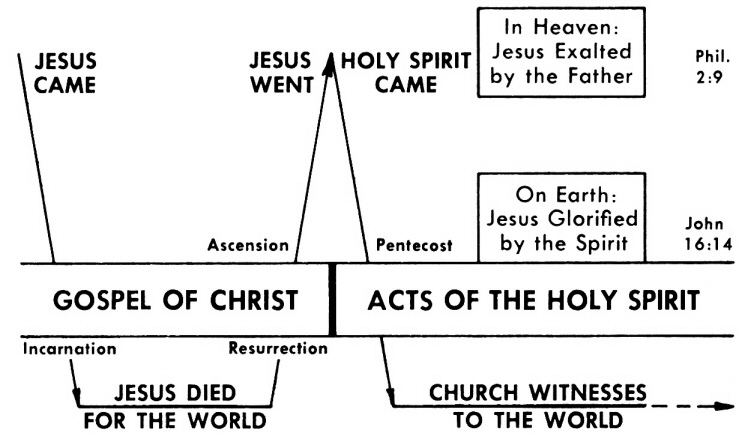
Click chart to enlarge
HERETICAL ERROR - Robertson says "The Cerinthian Gnostics took the dove to mean the heavenly aeon Christ that here descended upon the man Jesus and remained with him till the Cross when it left him, a sort of forecast of the modern distinction between the Jesus of history and the theological Christ." Hiebert adds "Cerinthus (c. A.D. 100), a late contemporary of John the Apostle at Ephesus, separated Jesus from Christ. He taught that the “Christ spirit” came upon the man Jesus, the son of Joseph and Mary, at his baptism and empowered his ministry but left him before his crucifixion; it was only the man Jesus who died and rose again. Cerinthus thus rejected the doctrine of the incarnation and consequently obliterated the Christian doctrine of the atonement."
- Commentary notes on 1 John 4:2
- What is Cerinthianism? | CARM.org
- Dr Wayne Grudem's outline on the The Humanity of Christ Systematic Theology
- Is Jesus God in the flesh- Why is it important that Jesus is God in the flesh?
- Why is the humanity of Jesus important?
- What is the meaning of the Incarnation of Christ?
- What does incarnate mean? How was Jesus God incarnate?
- How can the Incarnation be reconciled with God's immutability?
- What is the hypostatic union? How can Jesus be both God and man at the same time?
- Cerinthus - Wikipedia = "Cerinthus distinguished between the man Jesus and the Christ. He denied the supernatural virgin birth of Jesus, making him the biological son of Joseph and Mary, and taught that the Christ descended upon Him in the form of a dove from the Supreme Ruler at baptism and left Him again at his crucifixion—never to embody the flesh.(See Irenaeus, Against Heresies, 1.26.1)
QUESTION: Why was Jesus baptized? - GotQuestions.org WATCH VIDEO
ANSWER: At first glance, the purpose Jesus’ baptism is unclear. John’s baptism was the baptism of repentance (Matthew 3:11), but Jesus was sinless and had no need of repentance. Even John was taken aback at Jesus’ coming to him. John recognized his own sin and was aware that he, a sinful man in need of repentance himself, was unfit to baptize the spotless Lamb of God: “I need to be baptized by you, and do you come to me?” (Matthew 3:14). Jesus replied that it should be done because “it is proper for us to do this to fulfill all righteousness” (Matthew 3:15).
There are several reasons why it was fitting for John to baptize Jesus at the beginning of Jesus’ public ministry. Jesus was about to embark on His great work, and it was appropriate that He be recognized publicly by His forerunner. John was the “voice crying in the wilderness” prophesied by Isaiah, calling people to repentance in preparation for their Messiah (Isaiah 40:3).
By baptizing Him, John was declaring to all that here was the One they had been waiting for, the Son of God, the One he had predicted would baptize “with the Holy Spirit and fire” (Matthew 3:11).
Jesus’ baptism by John takes on an added dimension when we consider that John was of the tribe of Levi and a direct descendant of Aaron. Luke specifies that both of John’s parents were of the Aaronic priestly line (Luke 1:5). One of the duties of the priests in the Old Testament was to present the sacrifices before the Lord. John the Baptist’s baptism of Jesus could be seen as a priestly presentation of the Ultimate Sacrifice. John’s words the day after the baptism have a decidedly priestly air: “Look, the Lamb of God, who takes away the sin of the world!” (John 1:29).
Jesus’ baptism also showed that He identified with sinners. His baptism symbolized the sinners’ baptism into the righteousness of Christ, dying with Him and rising free from sin and able to walk in the newness of life. His perfect righteousness would fulfill all the requirements of the Law for sinners who could never hope to do so on their own. When John hesitated to baptize the sinless Son of God, Jesus replied that it was proper to “fulfill all righteousness” (Matthew 3:15). By this He alluded to the righteousness that He provides to all who come to Him to exchange their sin for His righteousness (2 Corinthians 5:21).
In addition, Jesus’ coming to John showed His approval of John’s baptism, bearing witness to it, that it was from heaven and approved by God. This would be important in the future when others would begin to doubt John’s authority, particularly after his arrest by Herod (Matthew 14:3-11).
Perhaps most importantly, the occasion of the public baptism recorded for all future generations the perfect embodiment of the triune God revealed in glory from heaven. The testimony directly from heaven of the Father’s pleasure with the Son and the descending of the Holy Spirit upon Jesus (Matthew 3:16-17) is a beautiful picture of the trinitarian nature of God. It also depicts the work of the Father, Son, and Spirit in the salvation of those Jesus came to save. The Father loves the elect from before the foundation of the world (Ephesians 1:4); He sends His Son to seek and save the lost (Luke 19:10); and the Spirit convicts of sin (John 16:8) and draws the believer to the Father through the Son. All the glorious truth of the mercy of God through Jesus Christ is on display at His baptism.
The Trinity
. . . elect according to the foreknowledge of God the Father, in sanctification of the Spirit, for obedience and sprinkling of the blood of Jesus Christ. —1
Today's Scripture : 1 Peter 1:1-9
Many churches celebrate what is known as Trinity Sunday. Someone might say, “Who cares? With all the practical, everyday problems we face, why talk about such a complicated doctrine as the Trinity?” The problem with such thinking is that we cannot clearly grasp the truth of our salvation without having some understanding of the Trinity.
In the opening verses of Peter’s very practical first letter, the apostle referred to the role of the Father, the Holy Spirit, and the Son in saving us (1 Peter 1:2). Our salvation began with the Father’s loving plan, was made possible by Jesus’ atoning death on the cross to provide forgiveness and cleansing, and is carried out by the Holy Spirit’s transforming work in us. The more clearly we see and appreciate the unique role each Person of the Godhead has in our salvation, the more intimate will be our daily walk with Him.
We cannot fully comprehend His being—that He is three-in-one, that He eternally exists in three equal yet distinct Persons as God the Father, God the Son, and God the Holy Spirit (Matthew 3:16-17; 28:19). But He expects us to praise Him because of the wonder of His love and forgiveness that flows from His triune nature.
That’s why the Trinity is such a vital truth. — Herbert Vander Lugt (Reprinted by permission from Our Daily Bread Ministries. Please do not repost the full devotional without their permission.)
Praise ye the Spirit, Comforter of Israel,
Sent of the Father and the Son to bless us;
Praise ye the Father, Son, and Holy Spirit,
Praise ye the triune God!
—Anon.
The Trinity confounds our mind, but comforts our heart.
What About The Trinity?
When the Helper comes, whom I shall send to you from the Father, . . . He will testify of Me. —John 15:26
Today's Scripture : John 15:15-27
A pupil asked the noted philosopher Hegel (1770-1831) to explain a passage he had written. Hegel read it and said, “When that was written, there were two who knew its meaning—God and myself. Now, alas! There is but one, and that is God.”
Some people feel that way about the doctrine of the Trinity, noting that the word isn’t even in the Bible. This truth, however, is clearly taught in Scripture.
A. H. Strong defined it well: “We do not say that one God is three Gods, nor that one person is three persons, nor that three Gods are one God, but only that there is one God with three distinctions in His being.”
Baffling? Yes! Absurd? No!
The idea of a triune God is biblically sound and makes sense. Here’s one way of explaining the logic behind the Trinity: The Bible says that God is love (1 Jn. 4:8). Love always needs an object. If God were an eternal, absolute unity, without the distinction of persons within Himself, eternal love could not exist. But because God is a Trinity, the Father, Son, and Holy Spirit can express love to one another. Not only that, but we benefit as well because the Son reveals the Father’s love and truth to us by the work of the Holy Spirit (Jn. 15:10,26).
Thank God for the Trinity! By: Dennis J. DeHaan (Reprinted by permission from Our Daily Bread Ministries. Please do not repost the full devotional without their permission.)
For Further Study
Matthew 3:13-17; 28:19;
John 1:1-18; 14:16-17; 15:15-27; 17:5,24;
Philippians 2:5-11; Hebrews 9:14.
There's perfect unity in the Trinity.
C H Spurgeon - “He saw the Spirit of God descending like a dove.” —Matthew 3:16
As the Spirit of God descended upon the Lord Jesus, the head, so he also, in measure, descends upon the members of the mystical body. His descent is to us after the same fashion as that in which it fell upon our Lord. There is often a singular rapidity about it; or ever we are aware, we are impelled onward and heavenward beyond all expectation. Yet is there none of the hurry of earthly haste, for the wings of the dove are as soft as they are swift. Quietness seems essential to many spiritual operations; the Lord is in the still small voice, and like the dew, his grace is distilled in silence. The dove has ever been the chosen type of purity, and the Holy Spirit is holiness itself. Where he cometh, everything that is pure and lovely, and of good report, is made to abound, and sin and uncleanness depart. Peace reigns also where the Holy Dove comes with power; he bears the olive branch which shows that the waters of divine wrath are assuaged. Gentleness is a sure result of the Sacred Dove’s transforming power: hearts touched by his benign influence are meek and lowly henceforth and for ever. Harmlessness follows, as a matter of course; eagles and ravens may hunt their prey—the turtledove can endure wrong, but cannot inflict it. We must be harmless as doves. The dove is an apt picture of love, the voice of the turtle is full of affection; and so, the soul visited by the blessed Spirit, abounds in love to God, in love to the brethren, and in love to sinners; and above all, in love to Jesus. The brooding of the Spirit of God upon the face of the deep, first produced order and life, and in our hearts, he causes and fosters new life and light. Blessed Spirit, as thou didst rest upon our dear Redeemer, even so rest upon us from this time forward and for ever.
Norman Geisler - MATTHEW 3:16–17—Does this passage support polytheism? - When Cultists Ask
MISINTERPRETATION: This passage—which describes Jesus’ baptism, with the Holy Spirit descending on him as a dove and the Father verbally commending him—has been misinterpreted in a variety of ways. The Jehovah’s Witnesses say that, just because the Father, Son, and Holy Spirit are mentioned together does not mean they are “one,” as trinitarians argue. The Mormons argue that this passage gives support to their view that the Father, the Son, and the Holy Spirit are three separate personages or Gods (i.e., polytheism). These three cannot possibly be “one,” as trinitarians teach (Talmage, 1977, 39–40).
CORRECTING THE MISINTERPRETATION: This passage does not support Mormon polytheism. Rather, it supports a crucial premise of trinitarianism—the truth that there are three distinct persons of the Godhead.
Matthew 3:16–17 supports the doctrine of the Trinity, though in itself it does not prove the doctrine. Trinitarians base their understanding of the nature of God on the accumulative evidence of the whole of Scripture. Taken by itself, all that the passage proves directly is that there are three different persons in the Godhead. It does not show that these three persons all share one and the same divine essence.
Other verses demonstrate the unity of God—that he is one in essence. Deuteronomy 6:4 declares: “Hear, O Israel: The LORD our God, the LORD is one.” This truth of God’s essential unity is repeated in the New Testament (Mark 12:29). Paul said explicitly: “We know that . . . there is no God but one” (1 Cor. 8:4).
Some passages show both the unity and plurality of God. For example, Matthew 28:19 declares: “Go therefore and make disciples of all the nations, baptizing them in the name of the Father and the Son and the Holy Spirit” (NASB). The word name is singular in the Greek, indicating that there is one God. But there are three distinct persons within the Godhead, each with a definite article in the Greek—the Father, the Son, and the Holy Spirit. This disproves the Jehovah’s Witnesses’ view since it proves the Father, Son, and Holy Spirit are subsumed under one name and therefore are indeed “one” (unlike Abraham, Isaac, and Jacob). This disproves the Mormon view, since it shows that the Father, Son, and Holy Spirit are not three separate individuals or gods but rather are three persons within one Godhead.
So, Scripture taken as a whole yields the doctrine of the Trinity that is based on three lines of biblical evidence: (1) evidence that there is only one true God; (2) evidence that there are three Persons who are recognized as God; and (3) evidence for three-in-oneness within the Godhead. Scripture uniformly teaches that there is only one God (Deut. 6:4; 32:39; 2 Sam. 7:22; Ps. 86:10; Isa. 44:6; John 5:44; 17:3; Rom. 3:29–30; 16:27; 1 Cor. 8:4; Gal. 3:20; Eph. 4:6; 1 Thess. 1:9; 1 Tim. 1:17; 2:5; James 2:19; 1 John 5:20–21; Jude 25). Yet Scripture also calls three persons God—the Father (1 Peter 1:2), the Son (John 20:28; Heb. 1:8), and the Holy Spirit (Acts 5:3–4). Scripture also indicates three-in-oneness in the Godhead (Matt. 28:19; 2 Cor. 13:14). The accumulative evidence of the whole of Scripture indicates that God is a Trinity.
Matthew 3:16, 17 - David Reed - borrow Mormons Answered Verse by Verse -
And Jesus, when he was baptized, went up straightway out of the water: and, lo, the heavens were opened unto him, and he saw the Spirit of God descending like a dove, and lighting upon him: And lo a voice from heaven, saying, This is my beloved Son, in whom I am well pleased.
On one occasion a Mormon read these verses to a Christian and, thinking that the Christian believed Jesus Christ and God the Father to be the same person, he asked somewhat sarcastically, “When the God Jesus came out of the water was he acting as a ventriloquist and throwing his voice so that it would sound like it was coming from heaven?”
Other Mormon missionaries may make the same point by reading these verses and then arguing in this manner: “Here God the Father, Jesus Christ, and the Holy Spirit are shown to be separate and distinct persons located in different places and each one doing something different: the Father speaking from heaven, Jesus coming up out of the water of baptism, and the Holy Spirit floating down through the air like a bird. This disproves the belief that the three are one person without body or form, as taught in the various churches.”
If the unsuspecting householder finds his faith shaken by such arguments, it is for two reasons: (1) he started out with a popular misconception in his own mind rather than with sound Christian theology, and (2) the Mormon missionaries played upon this by misrepresenting Christian belief. True, there may be some pseudo-Christian sects that present God as a vague, nebulous person, but that is not what is taught in sound, Bible-believing churches. Christians who are readers of Holy Scripture know that the Father is God, the Son is God, and the Holy Spirit is God, and yet there is only one true God; so they conclude, in agreement with traditional church teaching, that God is triune, that the three distinct persons making up the Divinity are together the one true God.
While a reading of Matthew 3:16 and 17 might unsettle someone who thinks the Christian churches present God as a single incorporeal person, and while some Mormon missionaries might successfully attack this concept in an attempt to turn their potential converts to Mormonism, such an off-target argument will have no effect on Christians who know the God they worship.
See also the discussion of Genesis 1:26, 27.
Jon Courson - Jon Courson's Application Commentary: Volume 3, New ... - Page 16
And Jesus, when he was baptized, went up straightway out of the water: and lo, the heavens were opened unto him, and he saw the Spirit of God descending like a dove, and lighting upon him: And lo a voice from heaven, saying, This is my beloved Son, in whom I am well pleased. Matthew 3:16–17
In this passage, we see a perfect picture of the Trinity—the Holy Spirit descending upon Jesus the Son as the voice of the Father is heard.
Why is the Trinity such an important concept? I struggled for many years with this question. ‘Lord, why didn’t You avoid this confusing Trinity concept altogether?’ I asked. ‘We are accused of being polytheistic. We’re confused in our prayers. We get all tangled up. Why didn’t You keep it simple—just You—just One?’
In recent years, however, I have come into this understanding of the Trinity, which, for me personally, has made all the difference:
God the Father, God the Son, and God the Spirit dwelt together in ages past—a billion years before years even began—perfectly content. The Father loved the Son. The Son honored the Father. The Spirit was for the Son and from the Father. The three of Them dwelt together in complete harmony, in total satisfaction. They are, and always will be, family—but They’re only One.
This means God didn’t need me. He went through billions and zillions of years without man, and you know what? He got along just fine.
God loves you immensely. He loves you so much that He gave His only Son to die and plunge into hell in order to redeem you. He’s completely and totally in love with you—but He doesn’t need you because He’s absolutely fulfilled in and of Himself. And that takes all of the pressure off because when love is demanding, it isn’t love.
When love is not a Trinitarian kind of love, it can become smothering and restrictive. It causes tension and anxiety. It causes one to feel caged in, cooped up, or put down; jealous or envious; used or abused.
Many of us erroneously picture God wringing His hands, pacing the clouds, worried about whether or not we’re going to love Him in return. He’s not. He’s doing just fine. He’s very happy, totally fulfilled, perfectly content. Yet He is so magnanimous and expansive that He has chosen to create us, love us, and say to us, ‘Come unto Me and I will give you rest.’ His request is neither a demand nor a need. It is an invitation.
Never forget that there is One who loves you who is not uptight about you or burdensome to you. And may the mystery of the Trinity give you rest in your relationship with Him.
Robert Hawker - And lo, the heavens were opened unto him, and he saw the Spirit of God descending like a dove, and lighting upon him. And lo, a voice from heaven, saying, This is my beloved Son, in whom I am well pleased.—Matt. 3:16, 17.
Take thy stand, my soul, this evening by the river Jordan, and by faith behold the wonders displayed in the hour thy Jesus entered upon his public ministry. Behold a decisive proof of the distinct personality in the threefold character, which all the sacred volume of the scriptures gives to the revelation of the Godhead. Behold Jesus, the uncreated Word, on the bank of Jordan! Behold the Holy Spirit, hovering as a dove on his sacred person! And hear the voice of God coming from heaven, proclaiming who Jesus was, his relationship to him, and his approbation of him. And when thou hast duly pondered the precious testimony, bend thy knee in adoration, love, and praise to the sacred Three in One, for so condescending an act of grace, in confirmation of the faith once delivered to the saints. Nor quit the hallowed spot until thou hast well and duly considered the blessedness of the proclamation given from heaven by the Father, to the person and character of the Lord Jesus. John the Baptist was taught to form his conclusion of Christ by this very evidence. He that sent John to baptize, had said unto him, “Upon whom thou shalt see the Spirit descending, and remaining on him, the same is he which baptizeth with the Holy Ghost; And I saw,” said John, “and bare record, that this is the Son of God.” And do thou, my soul, take thy confidence from the same precious testimony; and then ask thyself another question: Is he whom the Father declared to be his beloved Son, thy beloved Saviour? And while God declares himself well pleased with him as thy Saviour, art thou well pleased with him also in this precious character? If to these questions thou canst truly say, Yes, yes, thou wilt find a blessed testimony indeed, and a soul-refreshing consolation in this view of Jesus. Go then, in all thy holy exercise of faith and prayer, go to thy God and Father in Christ Jesus, and plead for all thou standest in need of, for the life that now is, and that which is to come, upon this footing: that in him, in whom God hath declared himself well pleased, thou art well pleased; and for his blood and righteousness’ sake, thou seekest every supply of grace here, and glory hereafter. This will be a sure plea, and such as can never fail. And he that proclaimed, by a voice from heaven, his perfect approbation of Jesus, as a Saviour for poor sinners, will give, for his sake, every thing that poor sinners can need during a life of grace, until consummated in glory.
Matthew 3:17 and behold, a voice out of the heavens said, "This is My beloved Son, in whom I am well-pleased."
NET Matthew 3:17 And a voice from heaven said, "This is my one dear Son; in him I take great delight."
GNT Matthew 3:17 καὶ ἰδοὺ φωνὴ ἐκ τῶν οὐρανῶν λέγουσα, Οὗτός ἐστιν ὁ υἱός μου ὁ ἀγαπητός, ἐν ᾧ εὐδόκησα.
NLT Matthew 3:17 And a voice from heaven said, "This is my dearly loved Son, who brings me great joy."
KJV Matthew 3:17 And lo a voice from heaven, saying, This is my beloved Son, in whom I am well pleased.
ESV Matthew 3:17 and behold, a voice from heaven said, "This is my beloved Son, with whom I am well pleased."
NIV Matthew 3:17 And a voice from heaven said, "This is my Son, whom I love; with him I am well pleased."
ASV Matthew 3:17 and lo, a voice out of the heavens, saying, This is my beloved Son, in whom I am well pleased.
CSB Matthew 3:17 And there came a voice from heaven: This is My beloved Son. I take delight in Him!
NKJ Matthew 3:17 And suddenly a voice came from heaven, saying, "This is My beloved Son, in whom I am well pleased."
NRS Matthew 3:17 And a voice from heaven said, "This is my Son, the Beloved, with whom I am well pleased."
YLT Matthew 3:17 and lo, a voice out of the heavens, saying, 'This is My Son -- the Beloved, in whom I did delight.'
NAB Matthew 3:17 And a voice came from the heavens, saying, "This is my beloved Son, with whom I am well pleased."
NJB Matthew 3:17 And suddenly there was a voice from heaven, 'This is my Son, the Beloved; my favour rests on him.'
GWN Matthew 3:17 Then a voice from heaven said, "This is my Son, whom I love-my Son with whom I am pleased."
- behold - Joh 5:37 Joh 12:28-30 Rev 14:2
- This - Mt 12:18 Mt 17:5 Ps 2:7 Isa 42:1,21 Mk 1:11 Mk 9:7 Lu 3:22 Lu 9:35 Eph 1:6 Col 1:13 2Pe 1:17
- Matthew 3 Resources - Multiple Sermons and Commentaries
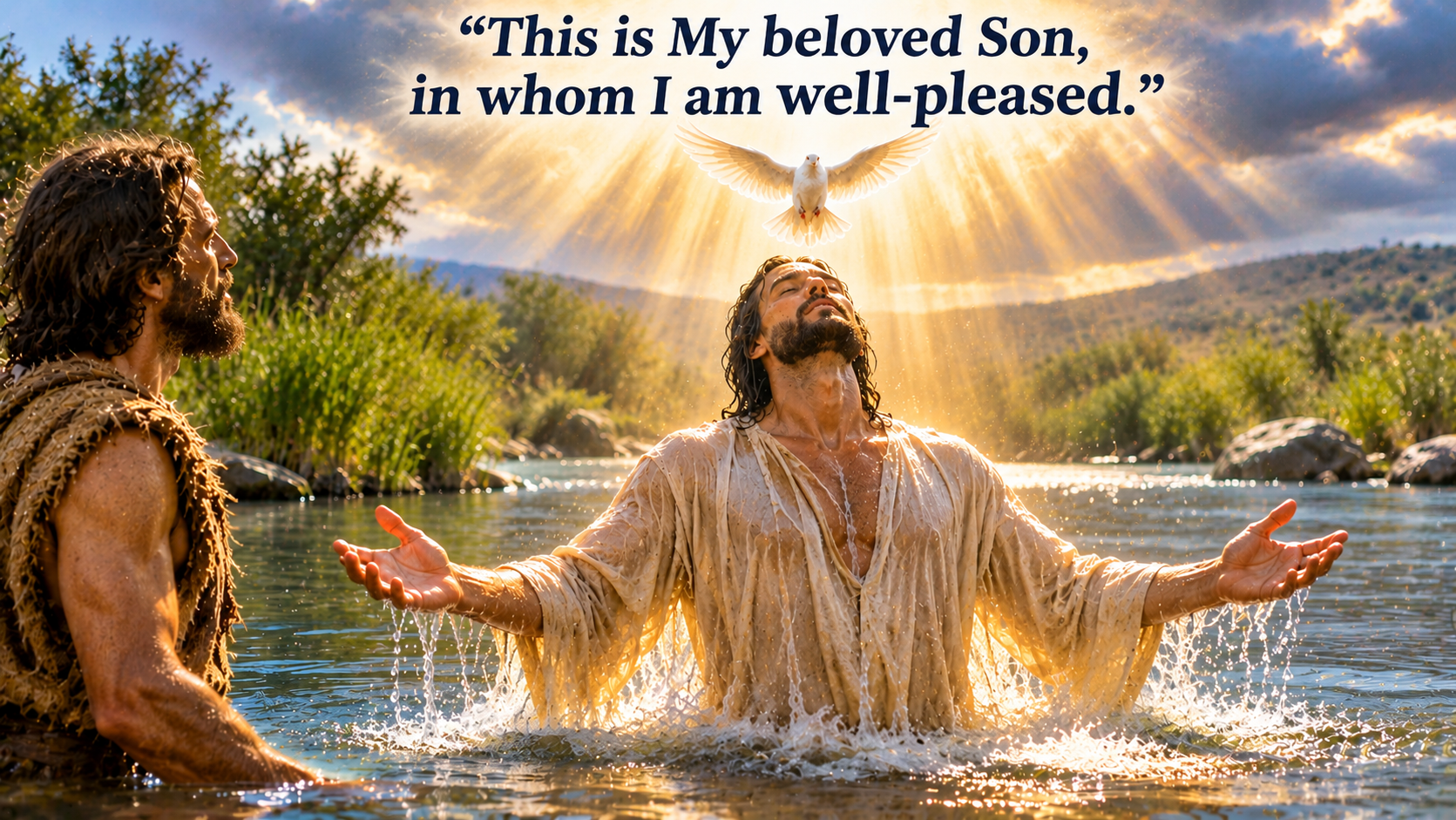
THE FATHER'S SEAL
OF APPROVAL
And behold (see idou above) - As we have noted behold is used to grab our attention to what follows. In this case it hardly seems necessary, for God the Father speaking audibly from His throne room in Heaven ought to be sufficient to arouse the attention of even the sleepiest saint!
A voice out of the heavens said - The text does not state it, but clearly this is the voice of God the Father in Heaven speaking to God the Son Who has become incarnated as fully Man, even as God the Spirit has just descended upon Him. There it is as clear as day - THE TRINITY. Someone said of the crucial doctrine of the Trinity - If you try to understand it, you'll lose your mind, but if you try to deny it, you will lose your soul!. That saying may be slightly exaggerated, but the gist of it is absolutely true. A good modern example of those who try to deny the Trinity is the so-called "Jesus Only" movement (see below). This is the first of three recorded occasions when the Father spoke from Heaven. The second was when Jesus was transfigured (Mt 17:5, Lk 9:28-36), and the third was during His last week before the cross (John 12:28).
Jesus declared "And the Father who sent Me, He has testified of Me. You have neither heard His voice at any time nor seen His form. (John 5:37)
Guzik - In this God the Father also expressed His approval of Jesus’ life up to this point. “By the divine proclamation at the baptism God announced the presence of the King, and set the seal of His approval on the years already lived.” (Morgan)
"This is My beloved Son - Note the fact that God calls Jesus His Son indicates that He Himself is God the Father. "God the Father loves God the Son, and communicated that love by God the Holy Spirit." (Guzik) In His declaration of divine love, God affirms that Jesus is His Son. Therefore Jesus is God. Folks say Jesus never claimed to be God (which is incorrect) but this testimony is as good, for it comes from the Father Himself. Jesus is God. Period!
Beloved (27)(agapetos from agapao = to love, agape = unconditional love borne by Spirit - Gal 5:22) means beloved, dear, very much loved. Agapetos describes the love of another, this love being called out of the "giver's" heart by preciousness of the recipient of the love (the "beloved'). Agapetos describes "one who is in a very special relationship with another" (BDAG) and in secular Greek is used mostly of a child, especially an only child to whom all the love of his parents is given (cf use by the Father describing His only Son and Abraham describing his "only son" in Ge 22:2). In the context of the New Testament agape love speaks of God’s divine and infinite love, a love that seeks the ultimate spiritual welfare of the one loved.
NET Note on beloved Son - Grk "my beloved Son," or "my Son, the beloved [one]." The force of agapetos is often "pertaining to one who is the only one of his or her class, but at the same time is particularly loved and cherished."
The first 7 uses of agapetos in the NT are of God the Father speaking of Jesus, His beloved Son (Mt. 3:17; Mt 12:18; Mt 17:5; Mk. 1:11; Mk 9:7; Mk 12:6; Lk. 3:22) and as Friberg says these uses describe "One not only greatly loved but also unique, the only one of a class." This usage by God to describe His only Son, the Son of His love, gives you some idea of the preciousness of the word beloved! This truth makes it even more incredible that believers are referred to as "beloved of God." (Ro 1:7). It is so easy to forget this incomprehensible truth!
The psalmist prophesied of the Father's blessing of His Son...
“I will surely tell of the decree of the LORD: He said to Me, ‘You are My Son, Today I have begotten You. ‘Ask of Me, and I will surely give the nations as Your inheritance, And the very ends of the earth as Your possession. (Ps 2:7-8)
John Trapp - “God so loved his Son, that he gave him all the world for his possession, Psalm 2:6,7,8; but he so loved the world, that he gave Son and all for its redemption.”
J C Ryle - That voice was the voice of God the Father. It declared the wondrous and ineffable love which has existed between the Father and the Son from all eternity. "The Father loves the Son, and has given all things into His hand." (John 3:35) It proclaimed the Father's full and complete approbation of Christ's mission to seek and save the lost. It announced the Father's acceptance of the Son as the Mediator, Substitute, and Surety of the new covenant. There is a rich mine of comfort, in these words, for all Christ's believing members. In themselves, and in their own doings, they see nothing to please God. They are daily sensible of weakness, shortcoming, and imperfection in all their ways. But let them recollect that the Father regards them as members of His beloved Son Jesus Christ. He sees no spot in them. (Song 4:7.) He beholds them as "in Christ," clothed in His righteousness, and invested with His merit. They are "accepted in the Beloved," and when the holy eye of God looks at them, He is "well pleased." (Commentary)
in whom I am well-pleased - The other synoptic Gospels record the testimony of the Father regarding His Son at His transfiguration...
While he was still speaking, a bright cloud overshadowed them, and behold, a voice out of the cloud said, “This is My beloved Son, with whom I am well-pleased; listen (present imperative) to Him!” (Mt 17:5)
Then a voice came out of the cloud, saying, “This is My Son, My Chosen One; listen (present imperative) to Him!” (Luke 9:35)
🙏 THOUGHT - Note the addition of the command "Listen to Him" (calling for this to be a lifestyle) which would have been directed to the 3 disciples (Peter, James and John) who were with him. By application, this command should be obeyed by us today as His disciples! Are you listening to Him? Are you daily in the Word, so that you might hear His voice? Are you relying on the Spirit to enable you to obey the command? Or are you vainly trying to obey the command by relying on your own natural power? If so, you are destined to fail. Only as we learn to rely wholly on the Holy Spirit will we be enabled to successfully keep this command (and for that matter any of the 100's of commands in the NT!) See discussion of the Need for the Holy Spirit to obey NT commands.
Well-pleased (take great delight)(2106)(eudokeo from eu = well, good + dokeo = to think) means literally to think well of and so to be well pleased, to take pleasure or delight in. To delight means to take great pleasure, to give keen enjoyment, to provide a high degree of gratification. Note that five of the first six uses of eudokeo refer to the Father's taking pleasure in His Son (Mt 3:17; Mt 12:18; Mt 17:5; Mk 1:11; Lk 3:22; cf 2 Pe 1:17).
John MacArthur has an interesting comment considering that Jesus had come to give His life as a sacrifice for sins (Heb 10:12, cf Heb 9:26) - "God had examined, as it were, His beloved Son, who would offer Himself as a sacrifice for the sins of those with whom He was willing to identify Himself. No imperfection could be found in Him, and God was delighted." (SEE The MacArthur Commentary)
J C Ryle applies this truth to believers today - There is a rich mine of comfort, in these words, for all Christ's believing members. In themselves, and in their own doings, they see nothing to please God. They are daily sensible of weakness, shortcoming, and imperfection in all their ways. But let them recollect that the Father regards them as members of His beloved Son Jesus Christ. He sees no spot in them. (Song 4:7.) He beholds them as "in Christ," clothed in His righteousness, and invested with His merit. They are "accepted in the Beloved," and when the holy eye of God looks at them, He is "well pleased." (Commentary)
L O Richards adds that well pleased means, "among other things, that Jesus was fulfilling the Messianic role to which God had called him. In contrast, God was not pleased with the sacrifices and offerings of the OT system (Heb 10:6, 8). They could not be established in His purpose as a way to cleanse humanity from sin." (Expository Dictionary of Bible Words)
Related Resources:
- What does the Bible teach about the Trinity?
- What are some popular illustrations of the Holy Trinity?
- How can there be subordination / hierarchy in the Trinity?
- How is the doctrine of the Trinity not tritheism?
- What is Trinitarianism? Is Trinitarianism biblical?
Spurgeon - Voices from the excellent glory
‘And lo a voice from heaven, saying, This is my beloved Son, in whom I am well pleased.’ Matthew 3:17
‘and behold a voice out of the cloud, which said, This is my beloved Son, in whom I am well pleased; hear ye him.’ Matthew 17:5
‘Father, glorify thy name. Then came there a voice from heaven, saying, I have both glorified it, and will glorify it again.’ John 12:28
God has three times with audible voice spoken out of heaven to bear witness to Jesus. These are historical facts. Then receive with assured conviction the truth to which God bears witness. The Man of Nazareth is the Son of the Highest; the Son of Mary is the Saviour appointed to bear human sin; he is the way of salvation, the only way. Doubt not this truth; accept the Saviour, for God declares that he is well pleased in him. Hear him then with profound reverence, accept the teaching and invitations of Jesus not as the mere utterances of fallible men, but as the instructions and the loving expostulations of God. Respect every word and command of Christ. Listen to him as spirits listen to the voice of the Most High when they bow before the throne; he says, ‘Come unto me, all ye that labour and are heavy laden, and I will give you rest’, hear him and lovingly obey the command. Hear him with unconditional obedience. God attests him as being sent from heaven. ‘Whatsoever he saith unto you, do it.’ Since he bids you believe him, be not unbelieving. He has told us to say in his name, ‘He that believeth and is baptized shall be saved.’ Despise not that double command. Attend, sinner, for the Son of God speaks to you. Trust and be baptized, and you will be saved. There stands the gospel stamped with the authority of deity; obey it now. May the Holy Spirit lead you to do so. Hear him, lastly, with joyful confidence. If God has sent Jesus, trust him; if he bears the glory of God’s seal upon him, joyfully receive him. You who have trusted him, trust him better from this day forth. Leave your souls confidently in the hand of him of whom Jehovah, thrice speaking out of heaven, declares that he is the only Saviour.
HERESY - DECEITFUL SPIRITS AND DOCTRINES OF DEMONS - "Jesus Only" or Oneness Pentecostalism teaches there is no Trinity, just different "modes" but a verse like this shows how utterly ridiculous, foolish and deceived such a belief actually is! Is Jesus a ventriloquist, throwing His voice into the clouds so that it speaks words of affirmation to Himself? This shows how far some cults go to twist the truth of Scripture. What is dangerous about the Oneness Movement is it looks so much like the "real thing," and it is easy to fall into this cultish system! It is always best to let the Scriptures speak for themselves and in this passage a simple reading/understanding of the text shows that Jesus is not the Father and the Father is not Jesus. Could it be more clearly/plainly portrayed? I think not! Gotquestions adds "The "Jesus Only" movement, also known as Oneness Pentecostalism or oneness theology, teaches that there is only one God, but denies the tri-unity of God. In other words, oneness theology does not recognize the distinct persons of the Godhead: Father, Son, and Holy Spirit. It has various forms—some see Jesus Christ as the one God, who sometimes manifests Himself as the Father or the Holy Spirit. The core doctrine of Oneness Pentecostal / Jesus Only is that Jesus is the Father and Jesus is the Spirit. There is one God who reveals Himself in different "modes." As an aside a popular singing group in Christian contemporary music is named Phillips, Craig and Dean, a group which has apparently espoused teachings of the Jesus Only movement (See discussion of their doctrinal beliefs). The point is that in these "last days" every true believer needs to be a BEREAN (Acts 17:11) who is taking in solid food (PURE MILK OF THE WORD - 1 Pe 2:2) which is "for the mature, who because of practice have their senses trained to discern good and evil." (Hebrews 5:14).
- What are the Beliefs of Jesus Only/Oneness Pentecostals?
- What is Oneness doctrine? | GotQuestions.org
- What is the United Pentecostal Church? | GotQuestions.org
- What is Sabellianism (Modalism)?
- Sabellianism, Modalism, and Monarchianism
- Dr Wayne Grudem's discussion of the Trinity and Modalism in his online text Systematic Theology) - "Modalism gains its attractiveness from the desire to emphasize clearly the fact that there is only one God." (Grudem)
These two words are not native to the English language. Therefore. they do not have any intrinsic meaning of their own. The only rightful meaning they can have is the one that is derived from the Greek word of which they are the spelling. The verb is spelled baptizō (βαπτιζω), from which with a slight change in spelling we get our word “baptize.” The noun is baptisma (βαπτισμα), and taking off the last letter, we have “baptism.”
We will study these words first in their classical usage. The word baptizō (βαπτιζω) is related to another Greek word baptō (βαπτω). The latter meant “to dip, dip under.” It was used of the smith tempering the red-hot steel. It was used also in the sense of “to dip in dye, to colour, to steep.” It was used of the act of dyeing the hair, and of glazing earthen vessels. It was used as a proverb in the sense of “steeping someone in crimson,” that is, giving him a bloody coxcomb. It meant also “to fill by dipping in, to draw.” It was used of a ship that dipped, that is, sank. Baptizō (Βαπτιζω), the related word meant “to dip repeatedly.” It was used of the act of sinking ships. It meant also “to bathe.” It was used in the phrase “soaked in wine,” where the word “soaked” is the meaning of baptizō (βαπτιζω). It is found in the phrase “overhead and ears in debt,” where the words “overhead and ears” are the graphic picture of what the word meant. The word here means therefore “completely submerged.” Our present day English equivalent would be “sunk.” A baptes (βαπτες) is one who dips or dyes. A baptisis (βαπτισις) is a dipping, bathing, a washing, a drawing of water. A baptisma (βαπτισμα) is that which is dipped. A baptisterion (βαπτιστεριον) is a bathing place, a swimming bath. A baptistes (βαπτιστες) is one that dips, a dyer. Baptos (Βαπτος) means “dipped, dyed, bright colored, drawn like water.”
Baptizō (Βαπτιζω) is used in the ninth book of the Odyssey, where the hissing of the burning eye of the Cyclops is compared to the sound of water where a smith dips (baptizo) a piece of iron, tempering it. In the Battle of the Frogs and Mice, it is said that a mouse thrust a frog with a reed, and the frog leaped over the water, (baptizō (βαπτιζω)) dyeing it with his blood. Euripedes uses the word of a ship which goes down in the water and does not come back to the surface. Lucian dreams that he has seen a huge bird shot with a mighty arrow, and as it flies high in the air, it dyes (baptizō (βαπτιζω)) the clouds with his blood. An ancient scholium to the Fifth Book of the Iliad makes a wounded soldier dye (baptizō (βαπτιζω)) the earth with his blood. In Xenophon’s Anabasis, we have the instance where the Greek soldiers placed (baptizō (βαπτιζω)) the points of their spears in a bowl of blood.
We come now to the usage of these words in Koine Greek, giving examples from the papyri, the LXX, and the New Testament.
In secular documents of the Koine period, Moulton and Milligan report the following uses of baptizō (βαπτιζω), “a submerged boat, ceremonial ablutions, a person flooded or overwhelmed in calamities.” They say that the word was used in its metaphorical sense even among uneducated people. A biblical example of this use is found in our Lord’s speaking of His Passion as a “baptism” (Mk. 10:38). These scholars report the use of baptō (βαπτω) as referring to fullers and dyers. The word is used of colored garments, and of wool to be dyed. The word baptisma (βαπτισμα) is found in a question regarding a new baptism someone is reported to be preaching. This use of this noun is peculiar to the N.T., and to ecclesiastical writers.
In the LXX we have in Leviticus 4:6 the words, “And the priest shall dip (baptō (βαπτω)) his finger in the blood, and sprinkle (prosrainō (προσραινω)) of the blood seven times before the Lord.” Here the word baptō (βαπτω) is found in juxtaposition to prosrainō (προσραινω), a verb closely allied to prosrantizo, baptō (προσραντιζο, βαπτω) meaning “to dip,” the latter verb “to sprinkle.”
In the N.T., we have the rich man asking that Lazarus dip (baptō (βαπτω)) his finger in water and cool his tongue (Luke 16:24). In Heb. 9:10 baptisma (βαπτισμα) is translated “washings” and refers to the ceremonial ablutions of Judaism. In Mk. 7:4 baptisma (βαπτισμα) is used of the ceremonial washing of cups, pots, brazen vessels, and tables. Baptisma (Βαπτισμα) is used in Mt. 3:7, and baptizō (βαπτιζω) in Mt. 3:16, and I Cor. 1:14, of the rite of water baptism. In Mk. 10:38 our Lord speaks of His sufferings on the Cross as the baptisma (βαπτισμα) with which He is to be baptizō (βαπτιζω).
In these examples of the various uses of the words baptō (βαπτω) and baptizō (βαπτιζω) we discover three distinct usages, a mechanical one, a ceremonial one, and a metaphorical (μεταφοριχαλ) one.
The mechanical usage can be illustrated by the action of the smith dipping the hot iron in water, tempering it, or the dyer dipping the cloth in the dye for the purpose of dying it. These instances of the use of our Greek word, give us the following definition of the word in its mechanical usage. The word refers to the introduction or placing of a person or thing into a new environment or into union with something else so as to alter its condition or its relationship to its previous environment or condition. While the word, we found, had other uses, yet the one that predominated above the others was the above one. Observe how perfectly this meaning is in accord with the usage of the word in Romans 6:3, 4, where the believing sinner is baptized into vital union with Jesus Christ. The believing sinner is introduced or placed in Christ, thus coming into union with Him. By that action he is taken out of his old environment and condition in which he had lived, the First Adam, and is placed into a new environment and condition, the Last Adam. By this action his condition is changed from that of a lost sinner with a totally depraved nature to that of a saint with a divine nature. His relationship to the law of God is changed from that of a guilty sinner to that of a justified saint. All this is accomplished by the act of the Holy Spirit introducing or placing him into vital union with Jesus Christ. No ceremony of water baptism ever did that. The entire context is supernatural in its character. The Greek word here should not be transliterated but translated, and the translation should read; “As many as were introduced (placed) into Christ Jesus, into His death were introduced. Therefore we were buried with Him through the aforementioned introduction into His death.” The same holds true of I Cor. 12:13 which should be translated, “For through the instrumentality of one Spirit were we all placed into one body.” It is because we so often associate the English word “baptism” with the rite of water baptism, that we read that ceremony into Romans 6. A student is one of the writer’s Greek classes who is a Greek himself, who learned to speak that language as his mother tongue and studied it in the schools of Greece, stated during a class discussion that the Greek reader would react to the Greek text of Romans and the word baptizō (βαπτιζω) as the writer has. The purely mechanical usage of our word is seen in the following places: Mt. 3:11 (second occurrence); Mk. 1:8 (second); Luke 3:6 (second), 16:24; John 1:33 (second), 13:26; Acts 1:5 (second), 11:16 (second); Rom. 6:3, 4; I Cor. 12:13; Gal. 3:27; Eph. 4:5; Col. 2:12; Rev. 19:13.
Before listing the places where the word occurs in its ceremonial usage, we will trace the usage of baptizō (βαπτιζω) back to Levitical washings. In the LXX (Lev. 14:8, 9, Lev 15:5, 6, 7, 8, 10, 11, 16, 18, 21, 22, 27, Lev 17:15, Lev 15:13, Lev 16:4, 24, 28) the word “wash” is louō (λουω). This Greek word is found in Acts 22:16 in connection with the word baptizō (βαπτιζω) in the expression, “Be baptized and wash away thy sins.” According to Mk. 7:4 “washing of cups” (baptizō (βαπτιζω)), Lk. 11:38, and Heb. 9:10, where baptizō (βαπτιζω) is used, that word seems to have been the technical term at the time for these washings. Expressions like those in Isaiah 1:16, and the prophecies like those in Ezek. 36:25, Ezek 37:23, and Zech. 13:1 are connected with the Levitical washings. These washings and the prophecies are connected with the purification which followed the act of expiation or cleansing from sin (Ex. 19:14; Lev. 13:14; Heb. 10:22, 23). Thus, that which the word baptizō (βαπτιζω) stood for was not unknown to the Jews. While the ceremonial washings of Leviticus were performed by the person himself, with one exception, and that was where Moses in installing Aaron and his sons as priests, himself washed them (Lev. 8:6), John baptizō (βαπτιζω) his converts himself.
Baptizō (Βαπτιζω) in the ministry of our Lord and John was, like the theocratic washings and purifications, a symbol whose design was to point to the purging away of sin on whom the rite was performed (Mt. 3:6; John 3:22–25). John’s baptism was in response to the repentance of the individual (Mt. 3:11). It was connected with his message of an atonement for sin that was to be offered in the future, and the necessity of faith in that atonement (Acts 19:4).
John’s baptism had looked ahead to a coming Saviour. Paul’s baptism, or Christian baptism now looks back to a Saviour who has died and who has arisen again (Acts 19:5). That the rite of water baptism is the outward testimony of the inward fact of a person’s salvation, and that it follows his act of receiving Christ as Saviour and is not a prerequisite to his receiving salvation, is seen in the use of the preposition eis (εἰς) in Mt. 3:11 where the translation should read, “I indeed baptize you with water because of repentance.” While the act of Christian baptism is a testimony of the person that his sins have been washed away, it also pictures and symbolizes the fact of the believing sinner’s identification with Christ in His death, burial, and resurrection (Rom. 6:), for baptizō (βαπτιζω) means, “to dip, to immerse.” It never means “to sprinkle.” The Greeks had a word for “sprinkle” namely, rantizō (ῥαντιζω). The two words, baptizō (βαπτιζω) and rantizō (ῥαντιζω) are used in juxtaposition in Lev. 4:6.
The following are the places where baptizō (βαπτιζω) is used of the baptism administered by John the Baptist and by the disciples of our Lord under the dispensation of law. Mt. 3:6, Mt 11:1 (first mention), 13, 14, 16; Mk. 1:4, 5, 8 (first mention), 9; Lk. 3:7, 12, 16 (first mention), 21, 7:29, 30; John 1:25, 26, 28, 31, 33 (first mention), 3:22, 23, 26, 4:1, 2, 10:40; Acts 1:5, (first mention) 11:16 (first mention), 19:4 (first mention). The noun baptisma (βαπτισμα) when it is used of the baptism in the dispensation of law is found in the following places: Mt. 3:7, Mt 21:25; Mk. 1:4, Mk 11:30; Lk. 3:3, Lk 7:29, Lk 20:4; Acts 1:22, Acts 10:37, Acts 13:24, Acts 18:25, Acts 19:34.
The word baptizō (βαπτιζω) is used of the ablutions of the Jews which were extra-Biblical, and which were called the traditions of the elders (Mt. 15:2), in Mk. 7:4, Lk. 11:38. The noun baptismos (βαπτισμος) is used in connection with the same practices in Mt. 7:4; Mk. 7:8. It is used of the Levitical ablutions in Heb. 6:2, Heb 9:10.
Baptizō (Βαπτιζω) is used of Christian baptism in Mt. 28:19; Acts 2:38, 41, Acts 8:12, 13, 16, 36, 38, Acts 9:18, Acts 10:47, 48, Acts 16:15, 33, Acts 18:8, Acts 19:5, Acts 22:16; I Cor. 1:13, 14, 15, 16, 17, 15:29. Baptisma (Βαπτισμα) is used in I Pet. 3:21 of Christian baptism.
The metaphorical use of baptizō (βαπτιζω) we find in Mt. 20:22, 23; Mk. 10:38, 39; Lk. 12:50. A metaphor is the use of a word or phrase literally denoting one kind of object or idea in place of another by way of suggesting a likeness or analogy between them, for example, “the ship plows the sea.” In the above passages, our Lord is speaking of His sufferings in connection with the Cross. He speaks of them as a baptism. The words were uttered while He was on His way to Jerusalem to be crucified. John the Baptist had announced His coming and had baptized the multitudes. Our Lord’s disciples had been baptizing during the three years of His ministry. The words baptizō (βαπτιζω) and baptisma (βαπτισμα) which are used by Matthew, Mark, and Luke had by that time become the technical and common Greek words used to describe the rite administered by John and our Lord’s disciples. Our Lord used the rite of baptism as a metaphor to speak of His coming sufferings. Just as a convert was plunged into the baptismal waters, He was about to be plunged into His sufferings. Just as the person would be immersed in the water, so He would be overwhelmed by His sufferings. Just as the person would come up out of the water, so He would be freed from His sufferings and arise from the dead.
There is one passage in which baptizō (βαπτιζω) is found that we have not classified. It is I Cor. 10:2 “were all baptized unto Moses.” Expositor’s Greek Testament has an illuminating note on it. “ ‘The cloud’ shading and guiding the Israelites from above, and the ‘sea’ making a path for them through the midst and drowning their enemies behind them, were glorious signs to ‘our fathers’ of God’s salvation; together they formed a washing of regeneration (Tit. 3:5), inaugurating the national life; as it trode the miraculous path between upper and nether waters, Israel was born into its Divine estate. Thus ‘they all received their baptism unto Moses in the cloud and in the sea’ since in this act they committed themselves to the guidance of Moses, entering through him into acknowledged fellowship with God.” (From Studies in the Vocabulary of the Greek New Testament) (Eerdmans Publishing - used by permission)
Reasons which enforce repentance
1. God's sovereign command. "He commands all men everywhere to repent" (Acts 17:30). Repentance is not optional. It is not left to our choice, whether or not we will repent—but it is an indispensable command. God has enacted a law in the High Court of heaven—that no sinner shall be saved, except the repenting sinner—and he will not break his own law. Though all the angels should stand before God and beg for the salvation of an unrepenting person—God would not grant it. "The Lord God, the compassionate and gracious God, slow to anger, abounding in love and faithfulness, maintaining love to thousands, and forgiving wickedness, rebellion and sin. Yet he does not leave the guilty unpunished" (Ex 34:6-37). Though God is more full of mercy than the sun is of light—yet he will not forgive a sinner while he goes on in his guilt! "He will not leave the guilty unpunished!"
2. The pure nature of God denies communion with an impenitent creature
Until the sinner repents, God and he cannot be friends: "Wash yourselves and be clean! Let me no longer see your evil deeds. Give up your wicked ways." (Isa 1:16). "Go, steep yourselves in the brinish waters of repentance! Then," says God, "I will parley with you!" "Come now, and let us reason together" (Isa 1:18). But otherwise, do not come near me! "What communion has light with darkness?" (2 Cor 6:14). How can the righteous God befriend him who goes on still in his trespasses? "I will not justify the wicked" (Ex 23:7). If God should be at peace with a sinner before he repents—God would seem to accept and approve all that evil he has done. He would go against his own holiness. It is inconsistent with the sanctity of God's nature, to pardon a sinner while he is in the act of rebellion.
3. Sinners continuing in impenitence are out of Christ's commission
See his commission: "The Spirit of the Lord God is upon me; he has sent me to bind up the brokenhearted" (Isa 61:1). Christ is a Prince and Savior—but not to save men in an capricious way, whether or not they repent. If ever Christ brings men to heaven, it shall be through the gate of repentance. "Him has God exalted to be a Prince and a Savior—to give repentance" (Acts 5:31). A king pardons rebels if they repent and yield themselves to the mercy of their prince—but not if they persist in open defiance.
4. We have by sin wronged God
There is a great deal of equity in it that we should repent. We have by sin wronged God. We have eclipsed his honor. We have infringed his law, and we should, reasonably, make him some reparation. By repentance we humble and judge ourselves for sin. We set to our seal that God is righteous if he should destroy us, and thus we give glory to God and do what lies in us to repair his honor.
5. If God should save men without repentance, making no discrimination, then by this rule he must save all, not only all men—but all devils. And so consequently the decrees of election and reprobation must fall to the ground. How diametrically opposed this is to sacred writ—let all judge. There are two kinds of people who will find it harder to repent than others:
(1) Those who have sat a great while under the ministry of God's ordinances—but grow no better. The ground soaks up the rain that falls on it—yet "bears thistles and thorns, it is useless. The farmer will condemn that field and burn it." (Heb 6:8). There is little hope of the metal which has lain long in the fire—but is not melted and refined. When God has sent his ministers one after another, exhorting and persuading men to leave their sins—but they settle upon the lees of external formality and can sit and sleep under a sermon—it will be hard for these ever to be brought to repentance. They may fear lest Christ should say to them as once he said to the fig-tree, "May you never bear fruit again!" (Matt 21:19).
(2) Those who have sinned frequently against the convictions of the Word, the checks of conscience, and the motions of the Spirit. Conscience has stood as the angel, with a flaming sword in its hand. It has said, "Do not this great evil!" But sinners regard not the voice of conscience—but march on resolvedly under the devil's colors. These will not find it easy to repent: "They are those who rebel against the light" (Job 24:13). It is one thing to sin for lack of light—and another thing to sin against light. Men begin by sinning against the light of conscience, and proceed gradually to despising the Spirit of grace.
This serves sharply to reprove all unrepenting sinners whose hearts seem to be hewn out of a rock, and are like the stony ground which lacked moisture. This disease, I fear, is epidemic: "Is anyone sorry for sin? Does anyone say, 'What a terrible thing I have done?' No! All are running down the path of sin as swiftly as a horse rushing into battle!" (Jer 8:6). Men's hearts are marbled into hardness: "They made their hearts as hard as stone, so they could not hear the law or the messages that the Lord Almighty had sent them by his Spirit through the earlier prophets. That is why the Lord Almighty was so angry with them." (Zech 7:12). They are not at all dissolved into a penitential frame.
It is fabled that witches never weep. I am sure of this—that those who have no grief for sin are spiritually bewitched by Satan! We read that Christ "denounced the cities where he had done most of his miracles, because they hadn't turned from their sins and turned to God" (Matt 11:20). And may he not denounce many now for their impenitence? Though God's heart is broken with their sins—yet their hearts are not broken. They say, as Israel did, "I love foreign gods, and I must go after them!" (Jer 2:25).
The justice of God, like the angel, stands with a drawn sword in its hand, ready to strike—but sinners have not eyes as good as those of Balaam's donkey to see the sword! God smites on men's backs—but they do not, as Ephraim did, smite upon their thigh (Jer 31:19). It was a sad complaint the prophet took up: "you have stricken them—but they have not grieved" (Jer 5:3). That is surely reprobate silver which becomes harder in the furnace. "When trouble came to King Ahaz, he became even more unfaithful to the Lord" (2 Chron 28:22).
A hard heart is a dwelling for Satan. As God has two places he dwells in—heaven and a humble heart; so the devil has two places he dwells in—hell and a hard heart. It is not falling into water which drowns—but lying in it. It is not falling into sin which damns—but lying in it without repentance: "having their conscience seared with a hot iron" (1 Tim 4:2). Hardness of heart results at last in the conscience being seared. Men have silenced their consciences, and God has seared them. And now he lets them sin and does not punish them, "Why should you be beaten any more?" (Isa 1:5) —as a father stops correcting a child whom he intends to disinherit.
A Serious Exhortation to Repentance
Let me in the next place persuade you to this great duty of repentance. Sorrow is not good for anything—except for sin. If you shed tears for outward losses, it will not advantage you. Water for the garden, if poured in the sink—does no good. Medicine for the eye, if applied to the arm, is of no benefit. Sorrow is medicinal for the sinful soul—but if you apply it to worldly things it does no good. Oh that our tears may run in the right channel—and our hearts burst with sorrow for sin! That I may the more successfully press this exhortation, I shall show you that repentance is necessary, and that it is necessary for all people and for all sins.
1. Repentance is necessary
Repentance is necessary: "except you repent—you shall all likewise perish!" (Luke 13:5). There is no rowing to paradise—except upon the stream of repenting tears. Repentance is required as a qualification. It is not so much to endear us to Christ—as to endear Christ to us. Until sin be bitter—Christ will not be sweet.
2. Repentance is necessary for all people
Thus God commands all men: "now God commands all men everywhere to repent" (Acts 17:30).
(1) Repentance is necessary for GREAT people: "Say unto the king and to the queen, Humble yourselves" (Jer. 13:18). The king of Nineveh and his nobles changed their robes for sackcloth ( Jon. 3:6). Great men's sins do more hurt than the sins of others. The sins of leaders are leading sins, therefore they of all others have need to repent. If such as hold the scepter repent not, God has appointed a day to judge them—and a fire to burn them! (Isaiah 30:33).
(2) Repentance is necessary for the FLAGITIOUS sinners in the nation. England needs to put itself in mourning and be humbled by solemn repentance. What horrible impieties are chargeable upon the nation! We see people daily listing themselves under Satan. Not only the banks of religion—but those of civility, are broken down. Men seem to contend, as the Jews of old, who should be most wicked. "It is the filth and corruption of your lewdness and idolatry. And now, because I tried to cleanse you but you refused, you will remain filthy until my fury against you has been satisfied" (Ezek. 24:13). If oaths and drunkenness, if perjury and luxury will make a people guilty, then it is to be feared that England is in God's black book. Men have cancelled their vow in baptism and made a private contract with the devil! Instead of crying to mercy to save them, they cry, "God damn us!" Never was there such riding posthaste to hell—as if men despaired of getting there in time. They have boasted how many they have debauched and made drunk. Thus "they declare their sin as Sodom" (Isaiah 3:9). Indeed, men's sins are grown daring, as if they would hang out their flag of defiance against God—like the Thracians who, when it thunders, gather together in a body and shoot their arrows against heaven. "For they have clenched their fists against God, defying the Almighty. Holding their strong shields, they defiantly charge against him." (Job 15:25-26). They are desperate in sin—and run furiously against God.
Oh to what a height is sin boiled up! Men count it a shame not to be impudent. May it not be said of us, as Josephus speaks of the Jews. Such was the excessive wickedness of those times, that if the Romans had not come and sacked their city, Jerusalem would have been swallowed up with some earthquake, or drowned with a flood, or consumed with fire from heaven. And is it not high time then for England to enter into a course of remedy, and take this pill of repentance, which has so many vile sins spreading in her? England is an island encompassed by two oceans, an ocean of water—and an ocean of wickedness. O that it might be encompassed with a third ocean—that of repenting tears!
If the book of the law chances to fall upon the ground, the Jews have a custom presently to proclaim a fast. England has let both law and gospel fall to the ground, therefore needs to fast and mourn before the Lord. The ephah of wickedness seems to be full. There is good reason for tears to fall apace, when sin fills so fast! Why then, are the wells of repentance stopped up? Do not the sinners of the land know that they should repent? Have they no warning? Have not God's faithful messengers lifted up their voice as a trumpet—and cried to them to repent? But many of these tools in the ministry have been spent and worn out upon rocky hearts. Has not God blessed us with many preachers to call men to repentance—but still they are settled on their lees (Zeph. 1:12)? Do we think that God will always put up with our affronts? Will he endure thus to have his name and glory trampled upon? The Lord has usually been more swift in the process of his justice, against the sins of a professing people. I say therefore with Bradford, "Repent, O England!" You have belepered yourself with sin, and must needs go and wash in the spiritual Jordan. You have kindled God's anger against you. Throw away your weapons, and bring your holy tears of repentance, that God may be appeased in the blood of Christ. Let your tears run—or God's scroll of curses will fly (Zech. 5:2). Either men must turn—or God will overturn. Either the fallow ground of their hearts must be broken up—or the land broken down. If no words will prevail with sinners, it is because God has a purpose to slay them (1 Sam. 2:25). Those who, by their prodigious sins have so far incensed the God of heaven that he denies them the tears of repentance, may look upon themselves as condemned people.
(3) Repentance is necessary for the CHEATING crew. "They are wise to do evil" ( Jer. 4:22), making use of their invention only for circumvention. Instead of living by their faith, they live by their shifts. These are those who make themselves poor so that by this artifice they may grow rich. I would not be misunderstood. I do not mean such as the providence of God has brought low, whose estates have failed, but not their honesty—but rather such as feign a break, that they may cheat their creditors. There are some who get more by breaking than others can by trading. These are like beggars that discolor and blister their arms—that they may move others to charity. As they live by their sores, so these live by their breaking. When the frost breaks, the streets are more full of water. Likewise, many tradesmen, when they break, are fuller of money. These make as if they had nothing—but out of this nothing great estates are created. Remember, the kingdom of heaven is taken by force, not by fraud.
Let men know that after this golden sop, the devil enters. They squeeze a curse into their estates. They must repent quickly. Though the bread of falsehood is sweet (Proverbs 20:17)—yet many vomit up their sweet morsels in hell!
(4) Repentance is necessary for MORAL people. These have no visible spots on them. They are free from gross sin, and one would think they had nothing to do with the business of repentance. They are so good, that they scorn God's offer of mercy. Indeed these are often in the worst condition: these are they who think they need no repentance (Luke 15:7). Their morality undoes them. They make a "savior" of it, and so on this rock they suffer shipwreck. Morality shoots short of heaven. It is only nature refined. A moral man is but old Adam dressed in fine clothes. The king's image counterfeited and stamped upon brass will not go current. The moral person seems to have the image of God—but he is only brass metal, which will never pass for current. Morality is insufficient for salvation. Though the life is moralized, the lust may be unmortified. The heart may be full of pride and atheism. Under the fair leaves of a tree, there may be a worm.
I am not saying, repent that you are moral—but that you are no more than moral. Satan entered into the house that had just been swept and garnished (Luke 11:26). This is the emblem of a moral man, who is swept by civility and garnished with common gifts—but is not washed by true repentance. The unclean spirit enters into such a one. If morality were sufficient to salvation, Christ need not have died. The moral man has a fair lamp—but it lacks the oil of grace.
(5) Repentance is needful for HYPOCRITES. I mean such as allow themselves in the sin. Hypocrisy is the counterfeiting of sanctity. The hypocrite or stage-player has gone a step beyond the moralist, and dressed himself in the garb of religion. He pretends to a form of godliness, but denies the power (2 Tim. 3:5). The hypocrite is a saint in disquise. He makes a magnificent show, like an ape clothed in fine purple. The hypocrite is like a house with a beautiful facade—but every room within is dark. He is a rotten post, which is beautifully pointed over. Under his mask of profession, he hides his plague-sores.
The hypocrite is against painting of faces—but he has but painted holiness. He is seemingly good—so that he may be really bad. In Samuel's mantle, he plays the devil. Therefore the same word in the original signifies to use hypocrisy—and to be profane. The hypocrite appears to have his eyes lifted to heaven—but his heart is full of impure lustings. He lives in secret sin against his conscience. He can be as his company is, and act both the dove and the vulture. He hears the word—but is all ear. He is for temple-devotion, where others may look upon him and admire him—but he neglects family and closet prayer. Indeed, if prayer does not make a man leave sin—sin will make him leave prayer. The hypocrite feigns humility—but it is that he may rise in the world. He is a pretender to faith—but he makes use of it rather for a cloak than a shield. He carries his Bible under his arm—but not in his heart! His whole religion is a sly lie (Hos 11:12).
But is there such a generation of men to be found? The Lord forgive them their painted holiness! Hypocrites are "in the gall of bitterness" (Acts 8:23). O how they need to humble themselves in the dust! They are far gone with their disease, and if anything can cure them, it must be feeding upon the salt marshes of repentance. Let me speak my mind freely. None will find it more difficult to repent—than hypocrites. They have so juggled in religion, that their treacherous hearts know not how to repent. Hypocrisy is harder to cure than insanity. The hypocrite's abscess in his heart, seldom breaks.
Such as are guilty of prevailing hypocrisy, let them fear and tremble. Their condition is sinful and sad. It is sinful because they do not embrace religion out of choice but design; they do not love it, only pretend it. It is sad upon a double account.
Firstly, because this art of deceit cannot hold long; he who hangs out a sign of holiness—but has not the commodity of grace in his heart—must needs break at last!
Secondly, because God's anger will fall heavier upon hypocrites. They dishonor God more and take away the gospel's good name. Therefore the Lord reserves the most deadly arrows in his quiver to shoot at them. If heathen are damned, hypocrites shall be double-damned. Hell is called the place of hypocrites (Matt. 24:51), as if it were chiefly prepared for them.
(6) Repentance is necessary for God's own people, who have a real work of grace. They must offer up a daily sacrifice of tears. The Antinomians hold that when any come to be believers, they have a writ of ease, and there remains nothing for them now to do but to rejoice. Yes, they have something else to do, and that is to repent. Repentance is a continuous act. The outlet of godly sorrow, must not be quite stopped until death. Jerome, writing in a letter to Laeta, tells her that her life must be a life of repentance. Repentance is called crucifying the flesh (Gal. 5:24), which is not done on all at once—but continuously, all our life. And are there not many reasons why God's own people should go into the weeping bath? "Are there not with you, even with you—sins against the Lord?" (2 Chron. 28:10). Have not you sins of daily living? Though you are diamonds, you still have flaws. Do we not read of the 'spot of God's children" (Deut. 32:5). Search with the candle of the Word into your hearts—and see if you can find no matter for repentance there!
(a) Repent of your rash censuring. Instead of praying for others, you are ready to pass a verdict upon them. It is true that the saints snail judge the world (1 Cor. 6:2)—but wait your time; remember the apostle's caution in 1 Corinthians 4:5: "judge nothing before the time, wait until the Lord comes".
(b) Repent of your vain thoughts. These swarm in your minds as the flies did in Pharaoh's court (Exod. 8:24). What bewilderings there are in the imagination! If Satan does not possess your bodies, he does your imaginations. "How long shall your vain thoughts lodge within you?" (Jer. 4:14). A man may think himself into hell. O you saints, be humbled for this lightness in your head.
(c) Repent of your vain fashions. It is strange that the garments which God has given to cover shame—should reveal pride! The godly are bid not to be conformed to this world (Romans 12:2). People of the world are garish and mirthful in their dresses. It is in fashion nowadays—to go to hell. But whatever others do—yet let not Judah offend (Hos. 4:15). The apostle Paul has set down what outer garment Christians must wear: "modest apparel" (1 Tim. 2:9); and what undergarment: "be clothed with humility" (1 Pet. 5:5).
(d) Repent of your decays in grace. "You have left your first love" (Rev. 2:4). Christians, how often is it low water in your souls! How often does coldness of heart come upon you! Where are those flames of affection, those sweet meltings of spirit—which you once had? I fear they are melted away. Oh repent for leaving your first love!
(e) Repent of your non-improvement of talents. Health is a talent; estate is a talent; wit and abilities are talents; and these God has entrusted you with, to improve for his glory. He has sent you into the world as a merchant sends his steward beyond the seas to trade for his advantage—but you have not done the good you might. Can you say, "Master, your talent has earned five more talents" (Luke 19:18)? O mourn at the burial of your talents! Let it grieve you that so much of your life has not been time lived but time lost; that you have filled up your golden hours more with froth than with devotion.
(f) Repent of your forgetfulness of sacred vows. A vow is a binding one's soul to God (Num. 30:2). Christians, have you not served for common uses after you have been the Lord's by solemn dedication? Thus, by breach of vows, you have made a breach in your peace. Surely this calls for a fresh laver of tears.
(g) Repent of your unanswerableness to blessings received. You have lived all your life upon free grace. You have been bemiracled with mercy. But where are your returns of love to God? The Athenians would have ungrateful people sued at law. Christians, may not God sue you at law—for your unthankfulness? "I will recover my wool and my flax" (Hos. 2:9); I will recover them by law.
(h) Repent of your worldliness. By your profession you seem to resemble the birds of paradise—which soar aloft and live upon the dew of heaven. Yet as serpents you lick the dust! Baruch, a good man, was taxed with this: "do you seek great things for yourself?" (Jer. 45:5).
(i) Repent of your divisions. These are a blot in your coat of armor, and make others stand aloof from true religion. Indeed, to separate from the wicked, resembles Christ, who was "separate from sinners" (Heb. 63 7:26). But for the godly to divide among themselves, and look askew one upon another—had we as many eyes as there are stars, they were few enough to weep for this! Divisions eclipse the church's beauty and weaken her strength. God's Spirit brought in cloven tongues among the saints (Acts 2:3)—but the devil has brought in cloven hearts. Surely this deserves a shower of tears!
(j) Repent for the iniquity of your holy things. How often have the services of God's worship been frozen with formality and soured with pride? There have been more of the peacock's plumes—than the moans of the dove. It is sad that pious duties should be made a stage for vainglory to act upon. O Christians, there is such a thick crust upon your duties, that it is to be feared there is but little substance left in them for God to feed upon. Behold here repenting work, cut out for the best. And that which may make the tide of grief swell higher, is to think that the sins of God's people do more provoke God, than do the sins of others (Deut. 32:19). The sins of the wicked pierce Christ's side. The sins of the godly go to his heart! Peter's sin, being against so much love, was most unkind, which made his cheeks to be furrowed with tears: "When he thought about it, he began to weep" (Mark 14:72).
3. Repentance is necessary for ALL sins.
Let us be deeply humbled and mourn before the Lord for original sin. We have lost that pure frame of soul that once we had. Our nature is vitiated with corruption. Original sin has diffused itself as a poison into the whole man, like the Jerusalem artichoke which, wherever it is planted, soon overruns the ground. There are not worse natures in hell, than we have! The hearts of the best are like Peter's sheet, in which there were a number of unclean creeping things (Acts 10:12). This primitive corruption is bitterly to be bewailed because we are never free from it. It is like a spring underground, which though it is not seen—yet it still runs. We may as well stop the beating of the pulse—as stop the motions to sin! This inbred depravity retards and hinders us in that which is spiritual: "I do not do the good that I want to do" (Romans 7:19).
Original sin may be compared to that fish Pliny speaks of, which cleaves to the keel of the ship and hinders it when it is under sail. Sin hangs weights upon us—so that we move but slowly to heaven. O this adherence of sin! Paul shook the viper which was on his hand into the fire (Acts 28:5)—but we cannot shake off original corruption in this life. Sin does not come as a lodger for a night—but as an indweller: "sin which dwells in me" (Romans 7:17). It is with us as with one who has a cancer in him; though he changes the air—yet still he carries his disease with him. Original sin is inexhaustible. This ocean cannot be emptied. Though we sin much—yet the stock of sin is not at all diminished. The more we sin—the fuller we are of sin. Original corruption is like the widow's oil—which increased by pouring out.
Another wedge to break our hearts, is that original sin mixes with the very habits of grace. Hence it is that our actings towards heaven are so dull and languid. Why does faith act no stronger—but because it is clogged by sin? Why does love to God burn no purer—but because it is hindered with lust? Original sin mixes with our graces. As bad lungs cause shortness of breath—so original sin having infected our heart, our graces breathe now very faintly. Thus we see much in original sin, which may draw forth our tears.
In particular, let us lament the corruption of our will and our affections. Let us mourn for the corruption of our will. The will, not following the dictates of right reason, is biased to evil. The will has a distaste for God, not as he is good—but as he is holy. It contumaciously affronts him: "We will do whatever we want. We will burn incense to the Queen of Heaven and sacrifice to her just as much as we like!" (Jer. 44:17). The greatest wound has fallen upon our will.
Let us grieve for the corruption of our affections. They are taken off from their proper object. The affections, like faulty arrows, shoot beside the mark. At the beginning, our affections were wings to fly to God; now they are weights to pull us away from him. Let us grieve for the sinful inclination of our affections. Our love is set on sin—our joy on the creature. Our affections, like the lapwing, feed on dung. How justly may the corruption of our affections bear a part in the scene of our grief? We of ourselves are falling into hell, and our affections would thrust us there.
Let us lay to heart actual sins. Of these I may say, "Who can understand his errors?" (Psalm 19:12). They are like sparks of a furnace. We have sinned in our eyes; they have been conduits to let in vanity. We have sinned in our tongues; they have been fired with passion. What action proceeds from us—wherein we do not betray some sin? To compute all these, would outnumber the drops in the ocean. Let actual sins be solemnly repented of, before the Lord.
Powerful Motives to Repentance
That the exhortation to repentance may be more quickened, I shall lay down some powerful motives to excite repentance.
1. Sorrow and melting of heart fits us for every holy duty.
A piece of lead, while it is in the lump, can be put to no use—but melt it, and you may then cast it into any mold, and it is made useful. So a heart that is hardened into a lump of sin is good for nothing—but when it is dissolved by repentance, it is useful. A melting heart is fit to pray. When Paul's heart was humbled and melted, then "behold, he prays" (Acts 9:11). It is fit to hear the Word. Now the Word works kindly. When Josiah's heart was tender, he humbled himself and rent his clothes at the hearing of the words of the law (2 Chron. 34:19). His heart, like melting wax, was ready to take any seal of the Word. A melting heart is fit to obey. When the heart is like metal in the furnace, it is facile and malleable to anything: "Lord, what will you have me to do?" (Acts 9:6). A repenting soul subscribes to God's will and answers to his call—as the echo answers to the voice.
2. Repentance is highly acceptable to God.
When a spiritual river runs to water this garden, then our hearts are a garden of Eden, delightful to God. I have read that doves delight to be about the waters. And surely God's Spirit, who descended in the likeness of a dove, takes great delight in the waters of repentance. The Lord esteems no heart sound, but the broken heart: "The sacrifices of God are a broken spirit" (Psalm 51:17). Mary stood at Jesus' feet weeping (Luke 7:38). She brought two things to Christ, ointment and tears. Her tears were better than her ointment. Tears are powerful orators for mercy. They are silent—yet they have a voice: "the Lord has heard the voice of my weeping" (Psalm 6:8).
3. Repentance commends all our services to God.
That which is seasoned with the bitter herbs of godly sorrow, is God's savory meat. Hearing of the Word is then good, when we are pricked at the heart (Acts 2:37). Prayer is delightful to God when it ascends from the altar of a broken heart. The publican smote upon his breast saying, "God be merciful to me a sinner". This prayer pierced heaven: "he went away justified rather than the other" (Luke 18:14). No prayer touches God's ear—but what comes from a heart touched with the sense of sin.
4. Without repentance nothing will avail us.
Some bless themselves that they have a stock of knowledge—but what is knowledge good for, without repentance? It is better to mortify one sin, than to understand all mysteries. Impure notionalists do but resemble Satan transformed into an angel of light. Learning and a bad heart—is like a fair face with a cancer in the breast. Knowledge without repentance, will be but a torch to light men to hell.
5. Repenting tears are delicious.
They may be compared to myrrh, which though it is bitter in taste, has a sweet smell and refreshes the spirits. So repentance, though it is bitter in itself—yet it is sweet in the effects. It brings inward peace. The soul is never more enlarged and inwardly delighted—than when it can kindly melt. How oft do the saints fall aweeping for joy! The Hebrew word for "repent" signifies "to take comfort". None so joyful as the penitent!
They say that tears have four qualities: they are hot, moist, salty, and bitter. It is true of repenting tears. They are hot, to warm a frozen conscience; moist, to soften a hard heart; salty, to season a soul putrefying in sin; bitter, to wean us from the love of the world. And I will add a fifth. They are sweet, in that they make the heart inwardly rejoice "Your sorrow shall be turned into joy!" (John 16:20). "Sorrowful, yet always rejoicing." (2 Corinthians 6:10)
"Let a man," said Augustine, "grieve for his sin and rejoice for his grief." Tears are the best sweetmeats. David, who was the great weeper in Israel, was the sweet singer of Israel. The sorrows of the penitent are like the sorrows of a woman giving birth: "A woman giving birth to a child has pain because her time has come; but when her baby is born she forgets the anguish because of her joy that a child is born into the world" (John 16:21). So the sorrows of humbled sinners bring forth grace, and what joy there is when this child is born!
6. Great sins repented of, shall find mercy.
Mary Magdalene, a great sinner, obtained pardon when she washed Christ's feet with her tears. For some of the Jews who had a hand in crucifying Christ, upon their repentance, the very blood they shed was a sovereign balm to heal them! "Though your sins be as scarlet, they shall be as white as snow" (Isaiah 1:18). Scarlet in the Greek is called "dibasson", because it is "twice dipped", and the arts of man cannot wash out the dye again. But though our sins are of a scarlet color, God's mercy can wash them away. This may comfort those whom the heinousness of their sin discourages, as if there were no hope for them. Yes, upon their serious turning to God, their sins shall be expunged and done away with!
"Oh—but my sins are sinful beyond measure!" Do not make them greater, by not repenting. Repentance unravels sin and makes it as if it had never been. "Oh—but I have relapsed into sin after pardon, and surely there is no mercy for me!" The children of God have relapsed into the same sin: Abraham did twice equivocate; Lot committed incest twice; Asa, a good king—yet sinned twice by creature-confidence, and Peter twice by carnal fear (Matt. 26:70; Gal. 2:12). But for the comfort of such as have relapsed into sin more than once, if they solemnly repent, a white flag of mercy shall be held forth to them.
Christ commands us to forgive our trespassing brother seventy times seven in one day, if he repents (Matt. 18:22). If the Lord bids us do it, will not he be much more ready to forgive upon our repentance? What is our forgiving mercy, compared to his? This I speak not to encourage any impenitent sinner—but to comfort a despondent sinner that thinks it is in vain for him to repent and that he is excluded from mercy.
7. Repentance is the inlet to spiritual blessings.
It helps to enrich us with grace. It causes the desert to blossom as the rose. It makes the soul as the Egyptian fields after the overflowing of the Nile, flourishing and fruitful. Never do the flowers of grace grow more, than after a shower of repentant tears! Repentance causes knowledge: "When their heart shall turn to the Lord, the veil shall be taken away" (2 Cor. 3:16). The veil of ignorance which was drawn over the Jews" eyes shall by repentance be taken away. Repentance inflames love. Weeping Mary Magdalene loved much (Luke 7:47). God preserves these springs of sorrow in the soul—to water the fruit of the Spirit (Gal. 5:22).
8. Repentance ushers in temporal blessings.
The prophet Joel, persuading the people to repentance, brings in the promise of secular good things: "rend your heart, and not your garments, and turn unto the Lord . . . the Lord will answer and say to his people, Behold, I will send you corn, and wine, and oil" (Joel 2:13,19). When we put water into the pump, it fetches up only water—but when we put the water of tears into God's bottle, this fetches up wine: "I will send you wine, and oil". Sin blasts the fruits of the earth: "You have sown much, and bring in little" (Hag. 1:6). But repentance makes the pomegranate bud and the vine flourish with full clusters. Fill God's bottle—and he will fill your basket! "If you return to the Almighty, you shall lay up gold as dust" (Job 22:2324). Repenting is a returning to God, and this brings a golden harvest.
9. Repentance staves off judgments from a land.
When God is going to destroy a nation, the penitent sinner stays his hand, as the angel did Abraham's (Gen. 22:12). The Ninevites repentance caused God to repent: "God saw that they turned from their evil way; and God repented of the evil, that he had said that he would do unto them; and he did it not" (Jonah 3:10). An outward repentance has adjourned and kept off wrath. Ahab sold himself to work wickedness; yet upon his fasting and rending his garments, God said to Elijah, "I will not bring the evil in his days" (1 Kings 21:29). If the rending of the clothes kept off judgment from the nation, what will the rending of the heart do!
10. Repentance makes joy in heaven.
The angels do, as it were, keep festive day: "There is joy in the presence of the angels of God over one sinner that repents" (Luke 15:10). As praise is the music of heaven, so repentance is the joy of heaven. When men neglect the offer of salvation and freeze in sin, this delights the devils—but when a soul is brought home to Christ by repentance, this makes joy among the angels.
11. Consider how dearly our sins cost Christ.
To consider how dearly our sins cost Christ, may cause tears to distill from our eyes. Christ is called the Rock (1 Cor. 10:4). When his hands were pierced with nails, and the spear thrust in his side, then was this Rock smitten, and there came out water and blood. And all this Christ endured for us: "the Messiah shall be cut off—but not for himself" (Dan. 9:26). We tasted the apple—and he drank the vinegar and gall. We sinned in every faculty—and he bled in every vein! Can we look upon a suffering Savior with dry eyes? Shall we not be sorry for those sins—which made Christ a man of sorrow? Shall not our enormities, which drew blood from Christ—draw tears from us? Shall we sport any more with sin and so rake in Christ's wounds? Oh that by repentance we could crucify our sins afresh! The Jews said to Pilate, "If you let this man go, you are not Caesar's friend" (John 19:12). Likewise, if we let our sins go and do not crucify them—we are not Christ's friends.
12. This is the end of all afflictions which God sends, whether it is sickness in our bodies or losses in our estates—that he may awaken us out of our sins and make the waters of repentance flow. Why did God lead Israel in that march in the wilderness among fiery serpents, but that he might humble them (Deut:8:2)? Why did he bring Manasseh so low, changing his crown of gold into fetters of iron—but that he might learn repentance? "He humbled himself greatly before the God of his fathers. Then Manasseh knew that the Lord he was God" (2 Chron. 33:12,13). One of the best ways to cure a man of his lethargy—is to cast him into a fever. Likewise when a person is stupified and his conscience grown lethargic—God, to cure him of this distemper, puts him to extremity and brings one burning calamity or another, that he may startle him out of his security and make him return to him by repentance.
13. The days of our mourning will soon be ended.
After a few showers that fall from our eyes—we shall have perpetual sunshine! Christ will provide a handkerchief to wipe off his people's tears: "God shall wipe away all tears" (Rev. 7:17). Christians, you will shortly put on your garments of praise. You will exchange your sackcloth for white robes. Instead of sighs—you will have triumphs; instead of groans—anthems; instead of the water of tears—the water of life! The mourning of the dove will be past—and the time of the singing of birds will come. This brings me to the next point.
14. The happy and glorious reward which follows upon repentance.
"But now that you have been set free from sin and have become slaves to God, the benefit you reap leads to holiness, and the result is eternal life!" (Romans 6:22). The leaves and root of the fig-tree are bitter—but the fruit is sweet. Repentance to the fleshy part seems bitter—but behold sweet fruit—everlasting life. The Turks imagine that after this life is a paradise of pleasure, where dainty dishes will be served in, and they will have gold in abundance, silken and purple apparel, and angels will bring them red wine in silver cups, and golden plates. Here is an epicure's heaven. But in the true paradise of God there are astonishing delights and rare viands served in. "No eye has seen, no ear has heard, and no mind has imagined what God has prepared for those who love him." (1 Cor. 2:9). God will lead his penitents from the house of mourning—to the banqueting house. There will be no sight there—but of glory; no sound there—but of music; no sickness—unless of love. There shall be unspotted holiness—and unspeakable joy. Then the saints shall forget their solitary hours and be sweetly solacing themselves in God—and bathing in the rivers of divine pleasure!
O Christian, what are your duties—compared to the recompense of reward? What an infinite disproportion is there between repentance enjoined—and glory prepared? There was a feast-day at Rome, when they used to crown their fountains. God will crown those heads which have been fountains of tears. Who would not be willing to be a while in the house of mourning—who shall be possessed of such glory as put Peter and John into an ecstasy to see it even darkly shadowed and portrayed in the transfiguration! (Matt. 17) This reward which free grace gives, is so transcendently great that could we have but a glimpse of glory revealed to us here, we would need patience to be content to live any longer. O blessed repentance, that has such a great light side—with the small dark side; and has so much sugar—at the bottom of the bitter cup!
15. The next motive to repentance is to consider the evil of impenitence.
A hard heart is the worst heart. It is called a heart of stone (Ezek. 36:26). If it were iron—it might be mollified in the furnace—but a stone put in the fire will not melt; it will sooner fly in your face. Impenitence is a sin which grieves Christ: "being grieved for the hardness of their hearts" (Mark 3:5). It is not so much the disease which offends the physician—as the contempt of his remedy. It is not so much the sins we have committed which so provoke and grieve Christ—as that we refuse the remedy of repentance which he prescribes. This aggravated Jezebel's sin: "I gave her space to repent, and she repented not" (Rev. 2:21 ).
A hard heart receives no impression. Oh the plague of an obdurate heart! Pharaoh's heart turned into stone—was worse than his waters turned into blood. David had his choice of three judgments plague, sword, and famine—but he would have chosen them all rather than a hard heart. An impenitent sinner is neither allured by entreaties nor affrighted by menaces. Such as will not weep with Peter—shall weep like Judas! A hard heart is the anvil—on which the hammer of God's justice will be striking to all eternity!
16. The last motive to repentance, is that the day of judgment is coming
This is the apostle's own argument: "God commands all men everywhere to repent; because he has appointed a day, in the which he will judge the world" (Acts 17:3031). There is that in the day of judgment, which may make a stony heart bleed. Will a man go on thieving—when the the Judge is looking upon him! Will the sinner go on sinning—when the day of judgment is so near? You can no more conceal your sin—than you can defend it. And what will you do when all your sins shall be written in God's book—and engraved on your forehead! O direful day, when Jesus Christ clothed in his judge's robe shall say to the sinner, "Stand forth; answer to the indictment brought against you. What can you say for all your oaths, adulteries, and your desperate impenitence?" O how amazed and stricken with terror will the sinner be! And after his conviction he must hear the sad sentence, "Depart from Me, you who are cursed, into the eternal fire prepared for the Devil and his angels!" Then, he who would not repent of his sins—shall repent of his folly! If there is such a time coming, wherein God will judge men for their impieties—what a spur should this be to repentance! The penitent soul shall at the last day lift up his head with comfort and have a discharge to show—written by the Judge's own hand!
Exhortations to Speedy Repentance
The second branch of the exhortation is to press people to speedy repentance: "God now commands all men everywhere to repent" (Acts 17:30). The Lord would not have any of the late autumn fruits offered to him. God loves early penitents, who consecrate the spring and flower of their age to him. Early tears, like pearls bred of the morning dew, are more orient and beautiful. O do not reserve the dregs of your old age for God, lest he reserve the dregs of his cup of wrath for you! Be as speedy in your repentance as you would have God speedy in his mercies: "the King's business required haste" (1 Sam. 21:8). Therefore repentance requires haste.
It is natural to us to procrastinate and put off repentance. We say, as Haggai did, "The time is not yet come" (Hag. 1:2). No man is so bad, but he purposes and intends to repent—but he procrastinates so long, until at last all his purposes and intentions prove abortive. Many are now in hell—who purposed and intended to repent!
Satan does what he can to keep men from repentance. When he sees that they begin to take up serious thoughts of repentance, he bids them "wait a little longer." "If this traitor, sin, must die" (says Satan), "let it not die yet." So the devil gets a reprieve for sin; it shall not die at present. At last men put off repentance so long—that death seizes on them, and their work is not done! Let me therefore lay down some effective arguments to persuade to speedy repentance:
1. Now is the season of repentance—and everything is best done in its season. "Now is the accepted time" (2 Cor. 6:2); now God has a mind to show mercy to the penitent. He is on the giving hand. Kings set apart days for healing. Now is the healing day for our souls. Now God hangs forth the white flag and is willing to parley with sinners. A prince at his coronation, as an act of royalty—gives money, proclaims pardons, fills the conduits with wine. Now God promises pardons to penitent sinners. Now the conduit of the gospel runs wine. Now is the accepted time. Therefore come in now and make your peace with God. Break off your iniquities now by repentance. It is wisdom to take the season. The farmer takes the season for sowing his seed. Now is the seedtime for our souls.
2. The sooner you repent—the fewer sins you will have to answer for. At the deathbed of an old sinner, where conscience begins to be awakened, you will hear him crying out: "Here are all my old sins come about me, haunting my deathbed as so many evil spirits—and I have no forgiveness! Here is Satan, who was once my tempter, now become an accuser—and I have no advocate; I am now going to be dragged before God's judgment seat where I must receive my final doom!" O how dismal is the case of this man. He is in hell—before his time! But you who repent early of your sinful courses, this is your privilege—you will have the less to answer for. Indeed, let me tell you, you will have nothing to answer for. Christ will answer for you. Your judge will be your advocate (1 John 2:1). "Father," Christ will say, "here is one that has been a great sinner—yet a broken-hearted sinner; if he owes anything to your justice, charge it to my account!"
3. The sooner we repent, the more glory we may bring to God. It is the purpose of our living—to be useful in our generation. Better lose our lives—than the purpose of our living. Late converts who have for many years taken pay on the devil's side, are not in a capacity of doing so much work in the vineyard. The thief on the cross could not do that service for God—as Paul did. But when we turn early from sin, then we give God the first fruits of our lives. We spend and are spent for Christ. The more work we do for God—the more willing we shall be to die—and the sweeter death will be. He who has wrought hard at his labor is willing to go to rest at night. Such as have been honoring God all their lives, how sweetly will they sleep in the grave! The more work we do for God—the greater will our reward be. He whose pound had gained ten pounds, Christ did not only commend him—but advance him: "you will be governor of ten cities as your reward" (Luke 19:17). By late repentance, though we do not lose our crown—yet we make it lighter.
4. It is of dangerous consequence to put off repentance longer. It is dangerous, if we consider what sin is. Sin is a poison—it is dangerous to let poison lie long in the body. Sin is a bruise. If a bruise is not soon cured, it gangrenes and kills. Just so, if sin is not soon cured by repentance, it festers the conscience and damns! Why should any love to dwell in the tents of wickedness? They are under the power of Satan (Acts 26:18), and it is dangerous to stay long in the enemy's quarters.
It is dangerous to procrastinate repentance because the longer any go on in sin the harder they will find the work of repentance. Delay strengthens sin—and hardens the heart—and gives the devil fuller possession. A tree at first may be easily plucked up—but when it has spread its roots deep in the earth, a whole team cannot remove it. It is hard to remove sin when once it comes to be rooted. The longer the ice freezes—the harder it is to be broken. The longer a man freezes in sin—the harder it will be to have his heart broken. The longer any travail with iniquity—the sharper pangs they must expect in the new birth. When sin has long been fastened in the heart—it is not easily shaken off. Sin comes to a sinner as the elder brother came to his father: "I have been slaving many years for you, and I have never disobeyed your orders" (Luke 15:29), and will you cast me off now? What, in my old age, after you have had so much pleasure by me? See how sin pleads custom, and that is a leopard's spot (Jer. 13:23 ). It is dangerous to procrastinate and delay repentance because there are three days which may soon expire:
(1) The day of the GOSPEL may expire. This is a sunshiny day. It is sweet, but swift. Jerusalem had a day but lost it: "but now they are hidden from your eyes" (Luke 19:42). The Asian churches had a gospel day—but at last the golden candlestick was removed. It would be a sad time in England to see the glory departed. With what hearts could we follow the gospel to the grave? To lose the gospel were far worse than to have our freedom taken from us. "Gray hairs are here and there" (Hos. 7:9). I will not say the sun of the gospel has set in England—but I am sure it is under a cloud. That was a sad speech, "The kingdom of God shall be taken from you" (Matt. 21:43). Therefore it is dangerous to delay repentance, lest the market of the gospel should depart, and the vision cease.
(2) A man's personal day of GRACE may expire. What if that time should come, when God should say the means of grace shall do no good: that ordinances shall have "a miscarrying womb and dry breasts" (Hos. 9:14)? Were it not sad to adjourn repentance until such a decree came forth? It is true, no man can justly tell that his day of grace is past—but there are two helpful signs by which he may fear it:
(a) When conscience has done preaching. Conscience is a bosom-preacher. Sometimes it convinces, sometimes it reproves. It says, as Nathan to David, "You are the man!" (2 Sam. 12:7). But men imprison this preacher, and God says to conscience, "Preach no more! He who is filthy, let him be filthy still!" (Rev. 22:11). This is a fatal sign that a man's day of grace is past.
(b) When a person is in such a spiritual lethargy that nothing will work upon him or make him sensible. There is "the spirit of deep sleep poured out upon you" (Isaiah 29:10). This is a sad presage that his day of grace is past. How dangerous then is it to delay repentance when the day of grace may so soon expire!
(3) The day of LIFE may expire. What security have we—that we shall live another day? We are marching rapidly out of the world. We are going off the stage. Our life is a candle, which is soon blown out. Man's life is compared to the flower of the field, which withers sooner than the grass (Psalm 103:15). "Show me, O Lord, my life's end and the number of my days; let me know how fleeting is my life. You have made my days a mere handbreadth; the span of my years is as nothing before you. Each man's life is but a breath. Man is a mere phantom as he goes to and fro." (Psalm 39:4-6). Life is but a flying shadow. The body is like a vessel filled with a little breath. Sickness broaches this vessel; death draws it out. O how soon may the scene alter! Many a virgin has been dressed the same day in her bride-apparel, and her winding-sheet! How dangerous then is it to adjourn repenting when death may so suddenly make a thrust at us.
Say not that you will repent tomorrow. Remember that speech of Aquinas: "God who pardons him who repents—has not promised to give him tomorrow to repent in." I have read of Archias, who was feasting among his cups, when one delivered him a letter and desired him to read the letter immediately, for it was of serious business. He replied, "I will mind serious things tomorrow"; and that day he was slain. Thus while men think to spin out their silver thread, death cuts it. Olaus Magnus observes of the birds of Norway, that they fly faster than the birds of any other country. Not that their wings are swifter than others—but by an instinct of nature they, knowing the days in that climate to be very short, not above three hours long, do therefore make the more haste to their nests. So we, knowing the shortness of our lives and how quickly we may be called away by death—should fly so much the faster on the wing of repentance to heaven!
But some will say that they do not fear a sudden death; they will repent upon their deathbed. I do not much like a deathbed repentance. He who will venture his salvation within the circle of a few short minutes, runs a desperate hazard. You who put off repentance until your deathbed, answer me to these four queries:
(a) How do you know that you shall have a time of sickness? Death does not always give its warning, by a lingering illness. Some it arrests suddenly. What if God should presently send you a summons to surrender your life?
(b) Suppose you should have a time of sickness, how do you know that you shall have the use of your senses? Most are demented, on their deathbed.
(c) Suppose you should have your senses—yet how do you know your mind will be in a frame for such a work as repentance? Sickness does so discompose body and mind, that one is in no condition, at such a time, to take care for his soul. In sickness a man is scarcely fit to make his will, much less to make his peace with God! The apostle said, "Is any sick among you? let him call for the elders of the church" (James 5:14). He does not say, let him pray—but let him call for the elders, that they may pray over him. A sick man is very unfit to pray or repent; he is likely to make but sick work of it. When the body is out of tune, the soul must needs jar in its devotion. Upon a sick bed a person is more fit to exercise impatience than repentance. We read that at the pouring out of the fourth vial, when God did smite the inhabitants and scorched them with fire, that "they blasphemed the name of God, and repented not" (Rev. 16:9). So when the Lord pours out his vial and scorches the body with a fever—the sinner is fitter to blaspheme than to repent!
(d) How do you who put off all to a deathbed, know that God will give you in that very juncture of time, grace to repent? The Lord usually punishes neglect of repentance in time of health—with hardness of heart in time of sickness. You have in your lifetime repulsed the Spirit of God, and are you sure that he will come at your call? You have not taken the first season, and perhaps you shall never see another springtide of the Spirit again. All this considered may hasten our repentance. Do not lay too much weight upon a deathbed. "Do your best to come before winter" (2 Tim. 4:21). There is a winter of sickness and death a-coming. Therefore make haste to repent. Let your work be ready before winter. "Today, if you hear his voice--do not harden your hearts" (Heb. 3:7-8).