Nehemiah 4:2
Nehemiah 4:3
Nehemiah 4:4
Nehemiah 4:5
Nehemiah 4:6
Nehemiah 4:7
Nehemiah 4:8
Nehemiah 4:9
Nehemiah 4:10
Nehemiah 4:11
Nehemiah 4:12
Nehemiah 4:13
Nehemiah 4:14
Nehemiah 4:15
Nehemiah 4:16
Nehemiah 4:17
Nehemiah 4:18
Nehemiah 4:19
Nehemiah 4:20
Nehemiah 4:21
Nehemiah 4:22
Nehemiah 4:23
NEHEMIAH UNDER CONSTRUCTION
JUST A FEW NOTES NOW
WILL FINISH IF THE LORD WILLS
Nehemiah 4:1 Now it came about that when Sanballat heard that we were rebuilding the wall, he became furious and very angry and mocked the Jews.
- Sanballat (KJV): Ne 2:10,19 Ezr 4:1-5 Ac 5:17
- mocked (KJV): Ps 35:15,16 44:13,14 Mt 27:29 Heb 11:36
NEHEMIAH'S JERUSALEM
Now it came about that when Sanballat heard that we were rebuilding the wall, he became furious and very angry and mocked the Jews.
Believer's Study Bible - The opposition which was previously hinted at (2:10, 19) here reveals itself. A fourth adversary is named ("Ashdodites," v. 7, i.e., Philistines), meaning that Judah was completely surrounded, since the Philistines occupied territory to the west (cf. 2:19, note). All of the adversaries, like Judah, were subject to Persia. But the reestablishment of the Jewish exiles in their homeland restricted the activities of these other governors (power is not easily relinquished). The opponents employed a series of tactics, increasing in severity from ridicule (vv. 1-3) to conspiracy (vv. 7, 8) and threats (vv. 10, 11). Nehemiah responded to each tactic following prayer or a call to prayer (vv. 4, 9, 14). The opponents never physically attacked, but simply lowered morale. Nehemiah urged the people to respond vigorously to the threats because God was with them (vv. 14, 15). An important theme in this chapter is that while God's people must often act courageously and forcefully, they must do so only in complete dependence on God.
Matthew Henry - Opposition of Sanballat and others Neh 4:1-6. Many a good work has been looked upon with contempt by proud and haughty scorners. Those who disagree in almost every thing, will unite in persecution. Nehemiah did not answer these fools according to their folly, but looked up to God by prayer. God's people have often been a despised people, but he hears all the slights that are put upon them, and it is their comfort that he does so. Nehemiah had reason to think that the hearts of those sinners were desperately hardened, else he would not have prayed that their sins might never be blotted out. Good work goes on well, when people have a mind to it. The reproaches of enemies should quicken us to our duty, not drive us from it.
Steven Cole - Responding to Opposition (Nehemiah 4:1-23)
When Igor Sikorsky was 12, his parents told him that competent authorities had already proved human flight impossible. He went on to build the first helicopter. In his American plant, he posted this sign:
According to recognized aerotechnical tests, the bumblebee cannot fly because of the shape and weight of his body in relation to the total wing area. The bumblebee does not know this, so he goes ahead and flies anyway (Encyclopedia of 7,700 Illustrations, by Paul Lee Tan [Assurance Publishers], p. 945).
Nehemiah would have loved that sign! His story shows that whenever you try to accomplish anything significant for the Lord, you will face strong opposition. Satan never bothers with half-hearted people who are content with a ho-hum spiritual existence. But if you come on fire for Christ, look out! The name “Satan” means “adversary”; he is committed to opposing God and His people, especially when they are zealous to exalt God’s glory.
This is true on the personal level. As long as you live with one foot in the world, living according to the world’s values and for the world’s goals, Satan won’t trouble you. You can go to church and even pray and read your Bible, and he won’t mind. But the minute you wake up from your spiritual lethargy, shake off the worldly mindset, and commit yourself to radical obedience to Jesus Christ, you will encounter spiritual opposition!
This also applies to churches and church leaders: Whenever godly leaders attempt to rally God’s people to advance His kingdom, opposition will hit. Satan doesn’t mind when churches gather to sing and to hear soothing sermons about how to use the Bible to achieve personal success. Those churches are no threat to his domain of darkness. But when a pastor preaches the gospel that convicts sinners of their sin in the presence of a holy God and points them to the cross of Jesus Christ, look out! When a pastor calls the flock to obedient, holy living in this wicked world, look out! When a pastor directs the vision of the flock toward the unreached nations who are waiting to hear the gospel, look out! The enemy is committed to opposing that kind of work. We need to be ready for such opposition and know how to respond to it. Nehemiah 4 teaches us that …
When the enemy opposes us as he surely will, we should respond with prayer, work, vigilance, and focus on the Lord.
If we only had chapter 3, we would get the impression that the work on the wall went without a snag. “So-and-so built this gate, and these people built the wall to this point, and next to them, these people built the wall further, etc.” It sounds as if there were no problems. But such was not the case. It never is. Chapters 4-6 show us some of the problems that had to be overcome in the process of rebuilding the wall. There is a cycle of advance and setback through chapters 3-6:
|
Chapter 3: Advance |
Neh 4:1-3: Setback |
|
Neh 4:4-6: Advance |
Neh 4:7-8: Setback |
|
Neh 4:9: Advance |
Neh 4:10-12: Setback |
|
Neh 4:13-23: Advance |
Neh 5:1-6: Setback |
|
Neh 5:7-19: Advance |
Neh 6:1-14: Attempted setback |
|
Neh 6:15-16: Final advance |
Neh 6:17-19: Attempted setback |
This cycle shows that the Christian life is a conflict. There will always be opposition. The enemy will try to get you sidetracked or to give up completely. Even though it was God’s will for the wall to be rebuilt, He did not remove the opposition. Even though it is God’s will for you to grow strong in faith and to labor to advance His kingdom, God does not remove the opposition. If you respond properly, the opposition will drive you to greater dependence on the Lord and to greater determination to do what He has called you to do. If you yield to the opposition, you will quit the race in discouragement or settle in for a mediocre Christian existence.
The first defense against the enemy is to be aware of the kinds of opposition that he uses. We will look first at the various forms the opposition takes and then at how we are to respond.
1. If you know Jesus Christ and attempt to accomplish anything for Him, the enemy will oppose you.
Our text reveals at least six types of opposition:
(1) THE ANGER OF OTHERS AGAINST YOU.
Sanballat, the governor of Samaria, became furious and very angry (Neh 4:1, 7). The Hebrew word means “burning mad.” A secure and independent Jerusalem would threaten his hold on the area and undermine his control of the trade route through the region, thus hurting his economy. So for the time being, he dropped his differences with the Ammonites to the east, the Arabs to the south, and the Philistines to the west. In anger over what Nehemiah was doing they all came together, threatening to stop the work by violence if necessary. This new work of God in Jerusalem threatened their lifestyle, and so they got angry.
Satan often uses the anger of others to try to squelch the newfound joy and zeal of a new believer. Suppose that a teenager who grew up in a culturally religious home, where the gospel was never preached, gets saved. He goes home and joyously tells his parents how he has met Jesus Christ as Savior and Lord. Are they overjoyed? Hardly! They explode: “What do you mean that you’ve become a Christian? How do you think we raised you? As a heathen? What’s all this nonsense about being born again?”
Why are they mad? You’d think they would be glad that their kid wasn’t doing drugs or getting girls pregnant. They’re mad because if their kid gets serious about God, it threatens their worldly, self-centered lifestyle. The same thing happens when a wife meets Christ. Her zeal for God convicts her husband of his wicked ways, and he responds with anger. Satan’s aim is to get the new Christian to cool his commitment to the Lord. If anger doesn’t stop the work, Satan hauls out another tool:
(2) MOCKERY AND SARCASM.
Sanballat and his buddies gather within hearing distance of the wall and ask a bunch of sarcastic questions (Neh 4:2): “What are those feeble Jews doing? Are they going to restore it for themselves? Can they offer sacrifices?” He means, “Do they think that they can complete this project and offer sacrifices of thanksgiving?” “Can they finish in a day? Can they revive the stones from the dusty rubble, even the burned ones?” After each rhetorical question, his cronies probably roared with laughter. Then Tobiah threw in his sarcastic barb, “if a fox should jump on [this poor excuse for a wall], he would break [it] down.”
Satan frequently uses ridicule against those who take a stand for the Lord. If you become a Christian and let it be known, your fellow workers will mock you and call you a holy Joe. They will be waiting for you to fall into some sin, so that they can hoot about it: “We knew you were no different. Christians are a bunch of hypocrites!” Your commitment to Christ threatens their godless lifestyle.
(3) THREATS AND INTIMIDATION.
If anger and ridicule don’t work, the enemy gets more aggressive. Nehemiah’s enemies had to be careful, since he was working under Artaxerxes’ permission. They couldn’t just rally their troops and march on Jerusalem, or they would be charged with rebellion against the king. But they could and did use threats of violence (Neh 4:8, 11), which they circulated among the Jews living near them (Neh 4:12). Small bands of terrorists could sneak in and pick off a few of the people working on the wall, and Sanballat would just tell Artaxerxes that it was a renegade band that he didn’t have control over. So, like the militant Muslims today, the threat of terrorist activity put the Jews under immense psychological pressure.
Satan still uses subtle or overt threats and intimidation to oppose Christians. “If you don’t keep quiet about the boss’s corruption, you’ll get fired.” “If you discipline your children as Scripture directs, the authorities will take them away from you.” “If you write a paper in defense of the Christian faith, the professor will flunk you.” Years ago, an evangelical church in Phoenix had a powerful attorney on the elder board who was having an affair. When they confronted him and told him to step down from the board, he threatened them with a lawsuit that would bankrupt the church with legal fees, even if they won. He finally agreed to step down if all the elders resigned along with him. Sadly, the church capitulated to his threats!
(4) DISCOURAGEMENT AND EXHAUSTION.
Apparently there was a discouraging proverb or work song that circulated among the workers at this point (Neh 4:10): “The strength of the burden bearers is failing, yet there is much rubbish; and we ourselves are unable to rebuild the wall.” The people were wearing out and the piles of rubbish didn’t seem to be diminishing. They had lost their earlier heart for the work that had resulted in the wall rapidly being built to the halfway mark (Neh 4:6).
Satan knows that the halfway point in any work is the most effective time to strike. When a new project begins, there is plenty of enthusiasm. “Let’s arise and build! Let’s do it!” If you get over the midway hump and see the completion drawing near, there is another surge of enthusiasm. “We’re almost there! Let’s get it done!” But right in the middle of things, exhaustion and discouragement set in. People have lost the initial zeal and all they can see are the piles of rubble still waiting to be removed. They feel like quitting.
The same thing is true in your walk with God. When you first get on fire for the Lord, it’s exciting. “We’re going to win the world for Christ!” Every Bible study you go to seems fresh and challenging. Your times in the Word and in prayer are rich with new discoveries. You just can’t get enough of it. But somewhere down the line, the newness wears off. You begin to notice the piles of rubble in your own life and in the church, problems and sins that just don’t seem to go away. You begin to grow weary, wondering if all your efforts are making any difference for the cause of Christ. Your weariness leads you to discouragement. But Satan isn’t out of tools.
(5) NEGATIVISM.
The criticism and mockery (in Neh 4:2-3) came from the enemy without. This negativism came from the Jews themselves who lived near the enemy (Neh 4:12). These people were not involved in the work of rebuilding the wall. That is significant! They lived near the enemy, and thus were constantly exposed to his negative attacks on the work. And, they weren’t involved personally in the work. So they were hearing negative reports and threats and they didn’t know firsthand what God was doing in Jerusalem. They came repeatedly (“ten times” is a Hebrew expression meaning “over and over”) to warn Nehemiah and those working on the wall, “They will come up against us from every place where you may turn.”
Invariably, negativism in the church comes from professing Christians who live near the enemy and are not involved in the Lord’s work. Such negativism is the enemy of faith. “There are giants in the land. We were like grasshoppers in their sight. There’s no way that we can take the land” (see Num. 13:28-29, 31-33). There is a proper place for realism. Nehemiah didn’t ignore the very real danger that existed. But if he had listened to these prophets of doom, he never would have finished the wall.
(6) FEAR.
Fear is the cumulative effect of all of the above factors (Neh 4:14). The people had seen the enemy’s anger and had heard their mockery and threats. They were wearing down through exhaustion. Then they repeatedly heard gloom and doom from their fellow Jews who lived near the enemy. Nehemiah saw their fear and exhorted them not to be afraid.
Satan uses fear to paralyze God’s people and keep them from attempting anything significant for the Lord. Maybe it’s a fear of failure. You’ve never done it before, and you don’t know if you can do it. Maybe it’s a fear of rejection. If you try it, others will think you’re a fanatic and stand off from you. It may be a fear of conflict. If you do what God wants you to do, you know that you’ll catch flak. So, you back off.
These are some of the tactics that Satan uses to oppose God’s work both in projects that people undertake in advancing the Lord’s work and in individual hearts that want to advance spiritually. How should we respond to such opposition?
2. Respond to the enemy’s opposition with prayer, work, vigilance, and focus on the Lord.
Whenever you encounter opposition, you have several options. You can run from it; you can try to dodge it or go around it; you can try to work out a compromise; or, you can meet it head on and work through it. The last approach is usually the only biblical way. Nehemiah’s approach can be broken down into four aspects: They lifted their voices in prayer; they put their hearts into the work; they kept their eyes on the enemy in vigilance; and, they kept their minds focused on the Lord in faith.
(1) THEY LIFTED THEIR VOICES IN PRAYER.
Often when we face opposition, our first response is to get angry and hit back or defend ourselves. But our first response should always be prayer (Neh 4:4, 9). John Bunyan wisely observed, “You can do more than pray after you have prayed, but you cannot do more than pray until you have prayed” (source unknown). Prayer reminds us that God is sovereign, even over those who are attacking us. He has allowed this trial for a reason. In prayer we submit our hearts to Him and acknowledge our trust in Him.
But what about Nehemiah’s prayer in Neh 4:4-5? It doesn’t seem to fit with, “Love your enemies, and pray for those who persecute you” (Matt. 5:44)! Should we pray as Nehemiah prayed?
I must be brief (for more, see , my sermon on Psalm 137 [10/24/93]; also, see James Adams, War Psalms of the Prince of Peace [Presbyterian & Reformed Publishing], 1991). First, this is not a prayer for personal vengeance, but rather a prayer that God would act to judge sinners. Second, since these enemies were hindering God’s work, it was a prayer that God would judge those who oppose His kingdom and glory. Third, to pray for God’s kingdom to be established (as in the Lord’s Prayer) is implicitly, if not explicitly, to pray for all competing kingdoms to be destroyed (Adams, p. 52). As Christians, we should pray that God would “destroy” our enemies by converting them. But if He so chooses, God may also destroy them by pouring out His wrath on them, as He will surely do at the final judgment if they have not repented of their rebellion against Him.
We need to guard our hearts against any selfish motives or personal delight in seeing our enemies brought down. But we must also remember that the saints will rejoice when God finally judges the wicked (Rev. 18:20). If our hearts are right, we can pray that God would subdue the enemies of the cross, either by conversion or by His justice. Prayer should be our first response to opposition.
(2) THEY PUT THEIR HEARTS INTO THE WORK.
“The people had a heart [lit.] to work” (Neh 4:6). Although there was a slight pause while Nehemiah organized the militia, they didn’t abandon the work to chase down the enemy. They didn’t allow the enemy’s threat to get their focus onto other issues. They just kept building the wall, and pretty soon the enemy was outside looking up, instead of looking straight across at them over the wall.
There are times when it is necessary to refute false teachers and defend sound doctrine. In fact, this is one of the tasks of the elders (Titus 1:9-16). But we should never get so distracted by fighting false teachers that we forget our main purpose, which is to proclaim the gospel both here and around the world through missions. Both the sword and the trowel are necessary, but the reason for the sword is so that we can use the trowel. We defend the faith with the sword of God’s Word so that we can build His kingdom with the trowel. To get sidetracked onto defending the faith to the neglect of winning and building people is to forget our goal.
(3) THEY KEPT THEIR EYES ON THE ENEMY IN VIGILANCE.
Nehemiah prayed first, but then he set up a guard. “Trust God and keep your powder dry!” Also, notice that Nehemiah’s prayer did not make the enemy go away; instead, the enemy upped the threats to attack! Prayer isn’t a magic cure-all. Prayer doesn’t mean that you can ignore the enemy’s threats or pretend that they don’t exist. Nehemiah was vigilant to arm the workers and post guards around the clock. Also, he put into place a warning system, so that wherever the trumpet was blown, the workers would quickly rally there to defend their families and the city. The workers didn’t take off their clothes at night so that they would be ready to defend the city. Vigilance!
If a report came to us during church that a dangerous lion had escaped in this neighborhood, would you stroll out to your car in normal fashion? Would you let your kids run loose outside? Of course not! You would arm yourself and be on guard constantly for fear of that lion on the loose.
Yet many Christians are oblivious to the dangers that come from our adversary the devil, who prowls about like a roaring lion, seeking to devour us (1 Pet. 5:8). They go out into the world without putting on the full armor of God (Eph. 6:10-20). They hang out with worldly friends and fill their minds with the crud of Hollywood. They let their kids watch the trash on TV, and after the kids are in bed, the parents tune in the shows for “mature” audiences—mature in evil, but not in godliness! And then they wonder why they have family problems!
If you don’t want to fall victim to the enemy, you’ve got to set up a defense against him in advance. Block the opportunities for moral filth from your life and home. Spend time each day saturating your mind with God’s Word. Have a network of brothers and sisters in the Lord whom you can rally to when the enemy attacks. To be oblivious to the enemy is to be vulnerable.
Nehemiah and his people responded to the enemy’s opposition by lifting their voices in prayer, putting their hearts into the work, and by vigilantly keeping their eyes on the enemy. Finally,
(4) THEY KEPT THEIR MINDS FOCUSED ON THE LORD.
Nehemiah reminded them (Neh 4:14), “Remember the Lord who is great and awesome, and fight for your brothers, your sons, your daughters, your wives and your houses.” The people were discouraged because they had gotten their focus onto the enemy’s threats, the piles of rubble, and all the work left to do. Nehemiah rightly directed their focus back to the Lord who is great and awesome and to the things that were at stake if they yielded to the enemy, namely, their families.
When opposition hits, it’s easy to get your focus off the Lord and onto your problems. At such times stop and, as Paul says, “Set your mind on the things above, not on the things that are on earth” (Col. 3:2). If you’re tempted to some sin, remember the devastating effects that it will have on your family. Get God’s perspective on your situation. “No temptation has overtaken you but such as is common to man; and God is faithful, who will not allow you to be tempted beyond what you are able, but with the temptation will provide the way of escape also, that you may be able to endure it” (1 Cor. 10:13). Keep your mind focused on the Lord!
Conclusion
Historian Will Durant observed, “Rome remained great as long as she had enemies who forced her to unity, vision and heroism. When she had overcome all her enemies, she flourished for a moment and then began to die” (cited in “Bits & Pieces,” 9/87). Opposition kept Rome strong.
If you know Christ and try to accomplish anything for Him, you will experience opposition, especially if you are in leadership. Respond as Nehemiah did, with prayer, keeping on with the work, vigilance against the enemy, and keeping your focus on the great and awesome God whom we serve.
Discussion Questions
- How can you know the difference between legitimate rebuke and ungodly opposition? How can we grow even if it is the latter?
- How can we determine the difference between healthy realism that acknowledges problems and unhealthy negativism?
- Does Satan use believers to oppose God’s work? If so, how?
- If Satan opposes the committed believer, why not avoid this by being lukewarm (see Rev. 3:14-22)? (ED: THIS IS NOT WHAT "LUKEWARM" MEANS)
Brian Bell - Intro:Once Linus (from the peanuts cartoon) said to his sister Lucy after she had done something mean to him again, Big sisters are the crab grass in the lawn of life.
Know anyone like that?
Expect criticism & be ready for it.
The enemies of God will do everything in their power to come against God & His work, and never sit idly by w/o a relentless fight…Expect it!
In scripture & so in our life…after a series of success often comes a severe crisis. [The enemy doesn’t like things going well for his enemy’s kingdom]So far Nehemiah has had: his prayers answered, received royal permission to return to Jerusalem, was granted governmental resources, authority, protection, & an enthusiastic response from his fellow countrymen…but it so happened (see Neh 4:1).
All through history men/women of God who ventured upon the service for God has been confronted with the very same problems that constantly vex us. Alan Redpath (BORROW Victorious Christian Service [Revell]).
Read Spurgeon (Swindoll pg.62)
Pick out the different weapons the enemy uses here.
As Paul said, for we are not ignorant of his devices. 2 Cor.2:11
RIDICULE (Neh 4:1-6)(Neh 4:1) What is mockery’s goal?…for you to stop, give up, just quit.
How do you battle that? Remind yourself who’s work you’re doing.[God’s, not yours]
Practically, why the attacks?
A fortified Jerusalem would endanger the balance of power in the region.
(Neh 4:2,3) How Satan loves his rumor & ridicule campaign.
Thomas Carlyle, the British critic & author said, ridicule was the language of the devil.
Shakespeare called it, paper bullets of the brain.
Who do you remember in scripture suffered at the hands of ridicule?
Goliath did this to David, So the Philistine said to David, Am I a dog, that you come to me with sticks?
The Philistines did to Samson, They said, call for Samson, that he may perform for us.
Jesus suffered at the hands of ridicule from thieves, the people, & soldiers.
Sanballat ridicules…
(Neh 4:2a) He ridicules the workers - What are these feeble Jews doing? (but when we are weak He is strong)
(Neh 4:2b) He ridicules the work itself - Will they fortify themselves? (Feeble Jews can’t build strong walls) Will they offer sacrifices? (Sanballat was blaspheming against Jehovah God…God won’t help His people) Will they complete it in a day? (means, this is a difficult job, they’ll soon quit)
(Neh 4:2c) He ridicules the materials - Will they revive the stones from the heaps of rubbish; stones that are burned? Yes, just watch.
(Neh 4:3) He ridicules the finished product - Whatever they build, if even a fox goes up on it, he will break down their stone wall?
You won’t need an army to knock this down one little fox could.
(Neh 4:4,5) He prayed & asked God to fight the battle for him.
Imprecatory prayer (curse) – he was praying as a servant of God, not requesting personal vengeance but official vindication for God’s people.
To oppose God’s people was to oppose God.
(Neh 4:6) Note: Pray & get back to work.
CONSPIRACY (Neh 4:7-9)(Neh 4:7,8a) The threat was that they’d attack from every side:
North (Sanballat/Samaria) South (Arabs) East (Tobiah & Ammonites) West (Ashdod)
Why is it always easier for enemies to come together for a single purpose than it is for Christians to? Then the Pharisees went out and immediately plotted with the Herodians against Him, how they might destroy Him. Mk.12:13
(Neh 4:8b) Confusion often causes anxiety to our souls. We start to spiritually hyper ventilate.
(Neh 4:9) What did Nehemiah do to meet this threat? Make your prayer & set your watch.
Pray & keep working (pray & sweat)
Here is the clear balance between faith in God & readiness.
There is neither foolish independence of God nor foolish neglect of human responsibility. (G. Cambell Morgan)
The NT inverts it, Watch & Pray.
Means trust God, while at the same time be alert to what the enemy is doing.
DISCOURAGEMENT (Neh 4:10)
The Devil was having a yard sale, and all of his tools were marked with different prices. There was hatred, jealously, deceit, lying, pride - all at expensive prices. But over to the side of the yard on display was a tool more obviously worn than any of the other tools. It was also the most costly. The tool was labeled, DISCOURAGEMENT. When questioned, the Devil said, "It's more useful to me than any other tool. When I can't bring down my victims with any of the rest of these tools, I use discouragement, because so few people realize that it belongs to me."
They Lost their Strength (Neh 4:10a)
They Lost their Vision (Neh 4:10b)
They Lost their Confidence (Neh 4:10c)
Leith Anderson said, Most things that discourage me are dwarfed by some new problem within 72 hours.
Have you become discouraged about the amount of rubble/rubbish/trash that must be cleared away in your life?
INTIMIDATION (Neh 4:11-23)(Neh 4:11) When the enemy can’t fool you he will try frightening you.
The Jews living outside the city would come to work w/frightening tales about the enemies plans.
(Neh 4:12) Scare Tactic. Plots of war.
Some fears, are no fears at all. [most worrying is about things that never comes to pass]
(Neh 4:13) While Critics discourage, Leaders encourage.
Satan wanted to use these problems as weapons to destroy the work, but God used them as tools to build His people.
God had one Son w/o sin, but He never had a Son w/o trial. (Warren Wiersbe)
(Neh 4:13-16) Fuse together w/a common goal.
When fear strikes, immediately a good leader reassures his fearful workers.
Frightened people discourage others & help bring defeat…What man is there who is fearful and fainthearted? Let him go and return to his house, lest the heart of his brethren faint like his heart. Deut.20:8
Note he arms & assembles whole families. Like Israel today…
Yom Kippur War Oct 1973. A coalition of Arab states led by Egypt & Syria against Israel as a way of recapturing part of the territories which they lost to the Israelis back in the 6-Day War. The war began with a surprise joint attack by Egypt and Syria on the Jewish holiday of Yom Kippur. Just 1 problem, 1 phone call to a house reached the whole family of soldiers, both enlisted & retired, because they all celebrate Sabbaths & holidays together.
(Neh 4:14) Direct your attention toward the Lord. Remember the Lord, great & awesome.
The Greatness of God helps us overcome...our fear of man.
Fear & faith cannot live together in the same heart.
(Neh 4:15-18) Build & Battle - Our hands must be familiar w/the sword against the attack of our spiritual enemies, & w/the trowel to contribute our bit of work toward God’s building. (F. B. Meyer)
Sword
What instrument, tool, or weapon are your hands very comfortable with? [Guitar, needle & thread, gun, hammer, nun-chucks]
How did we get comfortable w/these? (using them often)
How are you with wielding the Word of God? (it works the same, get comfortable w/it)
What is your part of the wall to build for His kingdom?
Spurgeon started a famous magazine back in 1865 called The Sword & the Trowel – the title he grabbed from here.
He said it was a record of combat with sin & labor for the Lord. We would ply the trowel w/untiring hand for the building up of Jerusalem’s dilapidated walls, & wield the sword w/vigor & valor against the enemies of the truth.
The people practiced Eph.6:10a,18. They armed themselves, prayed, & kept working
Put on the whole armor of God...Praying always with all prayer and supplication in the Spirit; Being watchful to this end with all perseverance.
(Neh 4:19,20) Determine a rallying point –Where did Nehemiah plan to be if a fight broke out? rally to us there. Learn much of a leader here.
He was a leader who served & a servant who led. (Warren Wiersbe)
(Neh 4:21-23) Look out for one another - See vs.14b also.
(Neh 4:22) Guard by day, work party by night.So they intensified, instead of abandoning the work.
They were able to complete it in 52 days.
You can’t always work like this (at this level of intensity) but there are times when you have to put in the extra effort.
What a great picture Nehemiah gives us: Having our sword girded at our side, a tool in our hand. Having a mind to work, eyes watching, & our ear listening for the trumpet of any emergency (or like Jesus’ Return) & a heart to work together with others.
Or as Redpath explained why the Jews were successful: The people had…
A mind to work (Neh 4:6)
A heart to pray (Neh 4:9)
An eye to watch (Neh 4:9)
An ear to hear (Neh 4:20)
Nehemiah 4:2 He spoke in the presence of his brothers and the wealthy men of Samaria and said, “What are these feeble Jews doing? Are they going to restore it for themselves? Can they offer sacrifices? Can they finish in a day? Can they revive the stones from the dusty rubble even the burned ones?”
- the army (KJV): Ezr 4:9,10
- feeble (KJV): 1Sa 14:11,12 17:43,44 Zec 12:8 1Co 1:27
- fortify themselves (KJV): Heb. leave to themselves
- sacrifice (KJV): Ne 12:27,43
- revive (KJV): Ne 4:10 Eze 37:3-13 Hab 3:2
He spoke in the presence of his brothers and the wealthy men of Samaria and said, “What are these feeble Jews doing? Are they going to restore it for themselves? Can they offer sacrifices? Can they finish in a day? Can they revive the stones from the dusty rubble even the burned ones - Fire would weaken and crack the limestone.
Nehemiah 4:3 Now Tobiah the Ammonite was near him and he said, “Even what they are building–if a fox should jump on it, he would break their stone wall down!”
- Tobiah (KJV): Ne 2:10,19 6:1 1Ki 20:10,18 2Ki 18:23
Now Tobiah the Ammonite was near him and he said, “Even what they are building–if a fox should jump on it, he would break their stone wall down!”
Ryrie - Tobiah taunted the Jews by insinuating that a lightweight fox could destroy their inept efforts.
Nehemiah 4:4 Hear, O our God, how we are despised! Return their reproach on their own heads and give them up for plunder in a land of captivity.
- Hear (KJV): Ps 123:3,4
- despised (KJV): Heb. despite
- turn (KJV): 1Sa 17:26 Ps 79:12 Pr 3:34 Ho 12:14
Hear, O our God, how we are despised! Return their reproach on their own heads and give them up for plunder in a land of captivity.
Ryrie - Vs. 4:4-5 The fact that God was being challenged explains the harsh tone of Nehemiah's prayer.
Nehemiah 4:5 Do not forgive their iniquity and let not their sin be blotted out before You, for they have demoralized the builders.
- cover not (KJV): Ps 59:5-13 69:27 109:14 Jer 18:23 2Ti 4:14
- their sin (KJV): Ps 51:1,9 Isa 43:25 44:22
- before the builders (KJV): Isa 36:11,12
Do not forgive their iniquity and let not their sin be blotted out before You, for they have demoralized the builders.
Nehemiah 4:6 So we built the wall and the whole wall was joined together to half its height, for the people had a mind to work.
- and all the wall (KJV): That is, the whole circuit of the wall was completed unto half the intended height.
- for the people (KJV): The original is very emphatic, {wyhee laiv leam laasoth,} "for the people had a heart to work." Their heart was engaged in it, and they went about it cheerfully and vigorously.
- had a mind (KJV): Ne 6:15 1Ch 29:3,14,17,18 2Ch 29:36 Ps 110:3 2Co 8:16,17 Php 2:13 Heb 13:21
So we built the wall and the whole wall was joined together to half its height, for the people had a mind to work
Ryrie - Vs. 4:6-9 With the walls half-built (v. 6), mere jeering was insufficient and an open attack was now planned (v. 8), necessitating both prayer and constant vigil (v. 9).
Nehemiah 4:7 Now when Sanballat, Tobiah, the Arabs, the Ammonites and the Ashdodites heard that the repair of the walls of Jerusalem went on, and that the breaches began to be closed, they were very angry.
- Sanballat (KJV): Ne 4:1 2:10,19
- the Ammonites (KJV): Jud 10:7-18 11:12-40 1Sa 11:2 2Sa 10:1-5 2Ki 24:2 2Ch 20:1 Eze 25:3-7 Am 1:13
- Ashdodites (KJV): Ne 13:23,24 1Sa 5:1,2 2Ch 26:6-8 Jer 25:20 Am 1:8 3:9 Zec 9:5,6
- heard (KJV): Ezr 4:4-16 5:8
- were made up (KJV): Heb. ascended
- then (KJV): Ge 3:15 Ac 4:17,18 5:33 Rev 12:12,13,17
Now when Sanballat, Tobiah, the Arabs, the Ammonites and the Ashdodites heard that the repair of the walls of Jerusalem went on, and that the breaches began to be closed, they were very angry.
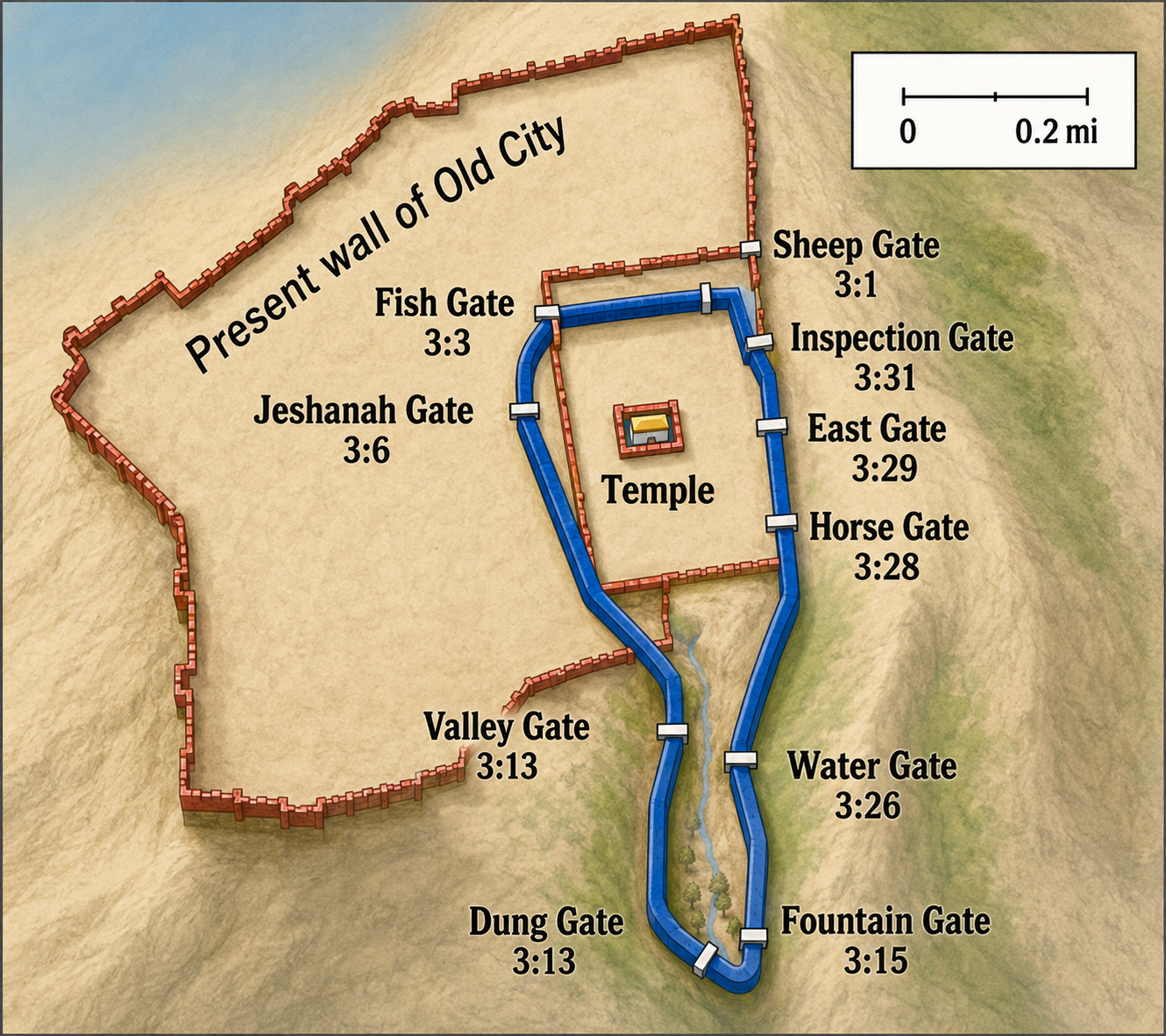
Henry Morris -Ashdodites. The Ashdodites (or Philistines) were west of Jerusalem, the Arabians were on the south, the Ammonites were on the east, and Governor Sanballat and the Samaritans on the north. Thus Jerusalem was surrounded by enemies, but God Himself was in their midst, and that was enough.
Matthew Henry - The designs of the adversaries Neh 4:7-15. The hindering good work is what bad men aim at, and promise themselves success in; but good work is God's work, and it shall prosper. God has many ways of bringing to light, and so of bringing to nought, the devices and designs of his church's enemies. If our enemies cannot frighten us from duty, or deceive us into sin, they cannot hurt us. Nehemiah put himself and his cause under the Divine protection. It was the way of this good man, and should be our way. All his cares, all his griefs, all his fears, he spread before God. Before he used any means, he made his prayer to God. Having prayed, he set a watch against the enemy. If we think to secure ourselves by prayer, without watchfulness, we are slothful, and tempt God; if by watchfulness, without prayer, we are proud, and slight God: either way, we forfeit his protection. God's care of our safety, should engage and encourage us to go on with vigour in our duty. As soon as a danger is over, let us return to our
Nehemiah 4:8 All of them conspired together to come and fight against Jerusalem and to cause a disturbance in it.
- all (KJV): Ps 2:1-3 83:3-11 Isa 8:9,10 Ac 23:12,13
- hinder it (KJV): Heb. make an error to it, Jer 20:10
All of them conspired together to come and fight against Jerusalem and to cause a disturbance in it.
Nehemiah 4:9 But we prayed to our God, and because of them we set up a guard against them day and night.
- Nevertheless (KJV): Ne 4:11 Ge 32:9-12,28 2Ki 19:14-19 Ps 50:15 55:16-22 Lu 6:11,12 Ac 4:24-30
- set a watch (KJV): Mt 26:41 Lu 21:36 1Pe 5:8
But we prayed to our God, and because of them we set up a guard against them day and night.
Nehemiah 4:10 Thus in Judah it was said, “The strength of the burden bearers is failing, Yet there is much rubbish; And we ourselves are unable To rebuild the wall.”
- The strength (KJV): Nu 13:31 32:9 Ps 11:1,2 Hag 1:2
- bearers (KJV): 2Ch 2:18 Eze 29:18
Thus in Judah it was said, “The strength of the burden bearers is failing, Yet there is much rubbish; And we ourselves are unable To rebuild the wall.”
Ryrie - Vs. 4:10-12 The persistent rumor of imminent attack discouraged the workers. Judah. I.e., among the Jews. Neighboring Jews repeatedly urged those who were building to leave their work and return home to protect their families (v. 12).
Nehemiah 4:11 Our enemies said, “They will not know or see until we come among them, kill them and put a stop to the work.”
- They shall not (KJV): Jud 20:29-48 2Sa 17:2 Ps 56:6 Isa 47:11 Ac 23:12,21 1Th 5:2
Our enemies said, “They will not know or see until we come among them, kill them and put a stop to the work.”
Nehemiah 4:12 When the Jews who lived near them came and told us ten times, “They will come up against us from every place where you may turn,”
- ten times (KJV): Ge 31:7,41 Nu 14:22 Job 19:3
- From all places (KJV): etc. or, That from all places ye must return to us
- ye shall return (KJV): Houbigant, Michaelis, and Dathe contend, that instead of {tashoovoo,} "ye shall return," we should read {chashevoo,} "they designed."
When the Jews who lived near them came and told us ten times, “They will come up against us from every place where you may turn,”
Nehemiah 4:13 then I stationed men in the lowest parts of the space behind the wall, the exposed places, and I stationed the people in families with their swords, spears and bows.
- Therefore (KJV): Ge 32:13-20 2Ch 32:2-8 Ps 112:5 Mt 10:16 1Co 14:20
- in the lower places (KJV): Heb. from the lower parts of the place, etc. their swords. Ne 4:17,18 Song 3:7,8 Eph 6:11-20
then I stationed men in the lowest parts of the space behind the wall, the exposed places, and I stationed the people in families with their swords, spears and bows.
Ryrie - Apparently the families outside Jerusalem were brought into the city and given protection.
Nehemiah 4:14 When I saw their fear, I rose and spoke to the nobles, the officials and the rest of the people: “Do not be afraid of them; remember the Lord who is great and awesome, and fight for your brothers, your sons, your daughters, your wives and your houses.”
- Be ye not afraid, Nu 14:9 De 1:21,29,30 20:3,4 Jos 1:9 2Ch 20:15-17 32:7 Ps 27:1 46:11 Isa 41:10-14 Mt 10:28 Heb 13:6
- remember (KJV): Ps 20:7 77:10-20 143:5 Isa 51:12,13 63:11-13
- great (KJV): Ne 1:5 De 10:17 Job 37:22 Ps 65:5 66:3,5 Isa 64:1-3 Na 1:2-7 Heb 12:20,21,28,29
- fight (KJV): 2Sa 10:12
When I saw their fear, I rose and spoke to the nobles, the officials and the rest of the people: “Do not be afraid of them; remember the Lord who is great and awesome, and fight for your brothers, your sons, your daughters, your wives and your houses.”
Nehemiah 4:15 When our enemies heard that it was known to us, and that God had frustrated their plan, then all of us returned to the wall, each one to his work.
- God (KJV): 2Sa 15:31 17:14 Job 5:12,13 Ps 33:10,11 Pr 21:30 Isa 8:10 Isa 44:25 La 3:37,38 1Co 3:19,20
- every one (KJV): Mk 13:34 Ro 12:11 1Th 4:11
When our enemies heard that it was known to us, and that God had frustrated their plan, then all of us returned to the wall, each one to his work
Nehemiah 4:16 From that day on, half of my servants carried on the work while half of them held the spears, the shields, the bows and the breastplates; and the captains were behind the whole house of Judah.
- my servants (KJV): Ne 4:23 5:15,16 Ps 101:6
- and the other half (KJV): This is no unusual thing in Palestine, even at the present day; people sowing their seed are often attended by armed men, to prevent the Arabs from robbing them of it.
- habergeons (KJV): {Habergeon,} from the Teutonic {hals,} the neck, and {bergen,} to cover, defend, may be considered as signifying a breast-plate, though the Franco-Gallic {hautbergon} signifies a coat of mail; the original {shiryon,} we have already seen, denotes a corslet.
From that day on, half of my servants carried on the work while half of them held the spears, the shields, the bows and the breastplates; and the captains were behind the whole house of Judah.
Ryrie - Vs. 4:16-23 Measures Nehemiah took included seeing that half of his own bodyguard was always armed, alerting each ruler to be ready to lead his group in case of attack (v. 16), arming the laborers (v. 17), seeing that each builder had a sword at his side (v. 18), having a trumpeter always ready to sound the alarm (v. 18), and urging all who could possibly do so to remain in Jerusalem at night (v. 22).
Matthew Henry - Nehemiah's precautions - Neh 4:16-23. We must watch always against spiritual enemies, and not expect that our warfare will be over till our work is ended. The word of God is the sword of the Spirit, which we ought to have always at hand, and never to have to seek for it, either in our labours, or in our conflicts, as Christians. Every true Christian is both a labourer and a soldier, working with one hand, and fighting with the other. Good work is likely to go on with success, when those who labour in it, make a business of it. And Satan fears to assault the watchful Christian; or, if attacked, the Lord fights for him. Thus must we wait to the close of life, never putting off our armour till our work and warfare are ended; then we shall be welcomed to the rest and joy of our Lord.
Nehemiah 4:17 Those who were rebuilding the wall and those who carried burdens took their load with one hand doing the work and the other holding a weapon.
- bare burdens (KJV): Ne 4:10
- every one (KJV): That is, he had his arms at hand; and was as fully prepared to fight as to work. The builders could not possibly have made any progress, if they had literally held a weapon in one of their hands; but the expression is evidently figurative, implying that every man was a much a soldier as a builder.
- with one (KJV): Da 9:25 1Co 9:12 16:9,13 2Co 6:7 Eph 6:11-20 Php 1:28 2Ti 2:3 2Ti 4:7
Those who were rebuilding the wall and those who carried burdens took their load with one hand doing the work and the other holding a weapon
Nehemiah 4:18 As for the builders, each wore his sword girded at his side as he built, while the trumpeter stood near me.
- by his side (KJV): Heb. on his loins
- he that sounded (KJV): Nu 10:9 2Ch 13:12-17
As for the builders, each wore his sword girded at his side as he built, while the trumpeter stood near me
Nehemiah 4:19 I said to the nobles, the officials and the rest of the people, “The work is great and extensive, and we are separated on the wall far from one another.
I said to the nobles, the officials and the rest of the people, “The work is great and extensive, and we are separated on the wall far from one another.
Nehemiah 4:20 “At whatever place you hear the sound of the trumpet, rally to us there. Our God will fight for us.”
- our God (KJV): Ex 14:14,25 De 1:30 3:22 20:4 Jos 23:10 Zec 14:3
At whatever place you hear the sound of the trumpet, rally to us there. Our God will fight for us
Nehemiah 4:21 So we carried on the work with half of them holding spears from dawn until the stars appeared.
- So we (KJV): 1Co 15:10,58 Ga 6:9 Col 1:29
So we carried on the work with half of them holding spears from dawn until the stars appeared.
Nehemiah 4:22 At that time I also said to the people, “Let each man with his servant spend the night within Jerusalem so that they may be a guard for us by night and a laborer by day.”
- every one (KJV): Ne 11:1,2
At that time I also said to the people, “Let each man with his servant spend the night within Jerusalem so that they may be a guard for us by night and a laborer by day
Nehemiah 4:23 So neither I, my brothers, my servants, nor the men of the guard who followed me, none of us removed our clothes, each took his weapon even to the water.
- So neither I (KJV): Ne 5:16 7:2 Jud 9:48 1Co 15:10
- saving that (KJV): etc. or, every one went with his weapon for water, Jud 5:11 The original of this obscure clause is {ish shilcho hammayim,} which is rendered by Montanus, {vir missile suum aquas,} "a man his dart to the waters," of which it is difficult to make sense. It is wholly omitted by the LXX.; and one of De Rossi's MSS. reads, {meshallachah al hammayim,} "in order to send them to the water."
So neither I, my brothers, my servants, nor the men of the guard who followed me, none of us removed our clothes, each took his weapon even to the water