Nehemiah 5:2
Nehemiah 5:3
Nehemiah 5:4
Nehemiah 5:5
Nehemiah 5:6
Nehemiah 5:7
Nehemiah 5:8
Nehemiah 5:9
Nehemiah 5:10
Nehemiah 5:11
Nehemiah 5:12
Nehemiah 5:13
Nehemiah 5:14
Nehemiah 5:15
Nehemiah 5:16
Nehemiah 5:17
Nehemiah 5:18
Nehemiah 5:19
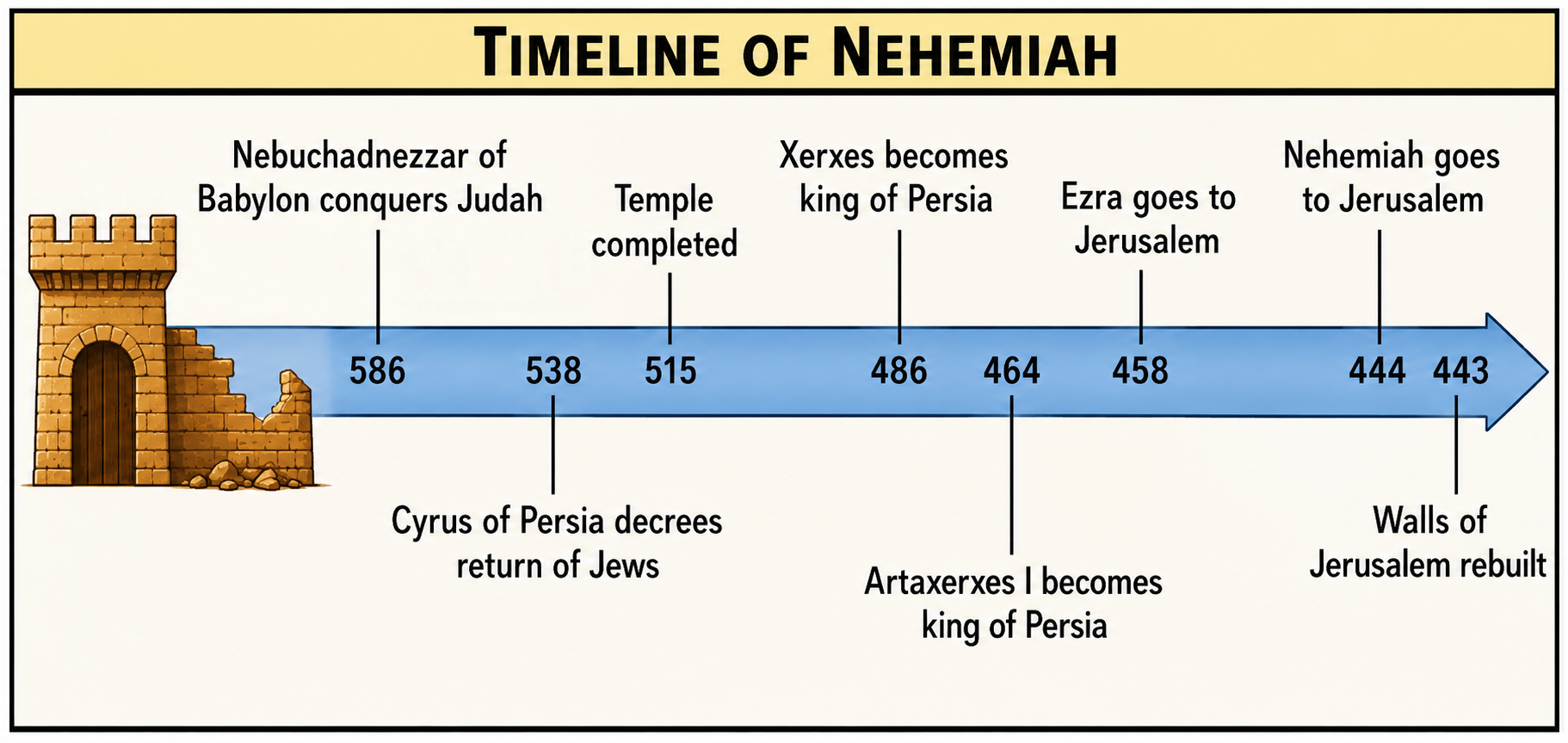
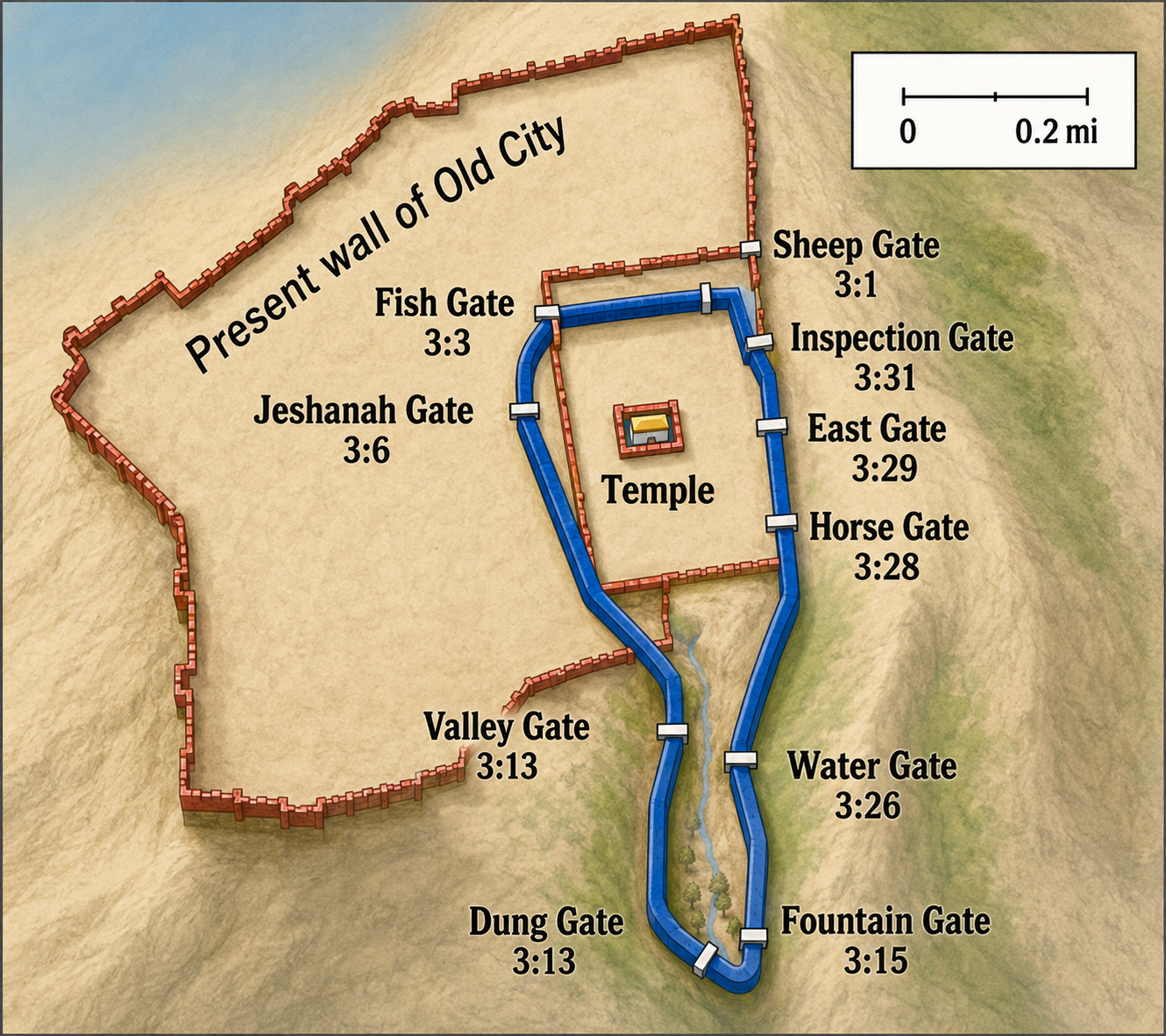
NEHEMIAH'S JERUSALEM
NEHEMIAH UNDER CONSTRUCTION
JUST A FEW NOTES NOW
WILL FINISH IF THE LORD WILLS
Nehemiah 5:1 Now there was a great outcry of the people and of their wives against their Jewish brothers.
- a great cry (KJV): Ex 3:7 Ex 22:25-27 Job 31:38,39 Job 34:28 Isa 5:7 Lu 18:7 Jas 5:4
- their brethren (KJV): Lev 25:35-37 De 15:7-11 Ac 7:26 1Co 6:6-8
Gene Getz - Some say the events in this chapter happened after the wall was completed. It is argued (a) that calling a large assembly (v. 7) would have endangered the city, leaving it almost defenseless, and (b) that Nehemiah would not have been appointed governor till after the wall was completed. However, verse 16 suggests that the "wall work" was continuing. Up to this point Nehemiah’s challenges as a spiritual leader focused primarily on those outside of Judah. But before the walls were finally rebuilt, he encountered the most difficult and intense kind of problem almost every spiritual leader has to face sometime--problems within. For Nehemiah, those problems centered not on Sanballat, Tobiah, or Geshem but on his own people, the Jews. (Page 742 Bible Knowledge Commentary online)
Now there was a great outcry of the people and of their wives against their Jewish brothers.
Bob Utley - "there was a great outcry of the people and of their wives against their Jewish brothers" The term "outcry" (BDB 858) is used often of an outcry heard by God (e.g., Exod. 3:7,9; Exod 22:23; 1 Sam. 9:16; Job 27:9; Job 34:28; Isa. 5:7; Zeph. 1:10). Often this is in a legal sense (cf. The Jewish Study Bible, p. 1694). Notice the legal term "contend" in Neh. 5:7. The rich Jews were exploiting the circumstances of the rebuilding of the walls to gouge their Hebrew brothers (cf. Neh. 5:7) . This was a serious problem which was undermining the economic and military stability of the new nation.
Believer's Study Bible - (vv. 1-13) Whereas ch. 4 describes the opposition which threatened the work from without, Neh 5:1-13 narrates threats within the Jewish community itself. Three different complaints are voiced by three separate groups: (1) large families without land who needed food (v. 2); (2) those who had mortgaged their land to buy food (v. 3); and (3) those who had borrowed money to pay their taxes (v. 4). Nehemiah called for Jewish creditors and lenders to restore property and persons to their original state. He does not appear to have charged the lenders with lawbreaking. The phrases "exacting usury" (v. 7), "lending" (v. 10), and "usury" (vv. 7, 10) are usual terms for lending or lending against a pledge (Deut. 24:6-13), and imply nothing more. The term "interest" is not used here (cf. Ex. 22:25). Nehemiah's point in vv. 8, 9 is that the Jews had been forcing their brothers into debt slavery just as their former Gentile creditors had done (from which Nehemiah had been using his personal resources to redeem them). This amounted to a shameless disregard of their responsibility to love one another. He exhorts them to join him in returning all pledges taken against loans, and all income derived from property taken in pledge (vv. 10, 11). The creditors' enthusiastic response brought joy throughout the assembly (vv. 12, 13).
Ryrie - Neh 5:1-5 It is uncertain whether the events of this chapter happened during the time the walls were being built (when normal means of gaining income would have been interrupted) or later (which v. 7, the calling of a great assembly, and v. 14 may indicate--although v. 16 seems to suggest otherwise). The landless were short of food (v. 2); the landowners were forced to mortgage their land because of a famine (v. 3); and borrowing was necessary to pay a property tax imposed by the Persians. These existing problems were aggravated and erupted because of the economic pressures of rebuilding. On usury and slavery, see notes on Ex. 21:1-6; Ex 22:25-27; Lev. 25:35-46; Deut. 24:10-13.
Steven Cole - Resolving Conflicts Within (Nehemiah 5:1-19)
A man heard his daughter and some of her friends arguing loudly in the back yard. He went out and reprimanded her. “But Daddy,” she protested, “we were just playing church.”
Ouch! It’s sad, but true, that the church of Jesus Christ has often been marked more by factions than by fellowship. There is even a book titled Great Church Fights. I haven’t read it, but it sounds interesting. J. Vernon McGee (Ezra, Nehemiah, & Esther [Thru the Bible Books], p. 117) observes, “In the history of the church we have seen that when the devil could not destroy the church by persecution, the next thing he did was to join it!” If you have been a Christian for very long, you have probably been in a church that went through a split.
In this fallen world, some splits are inevitable if we are committed to sound doctrine and godly standards. There have always been and always will be those who bring in destructive heresies (2 Pet. 2:1) and/or evil behavior (2 Pet. 2:13-14, 18-19). If church leaders are obedient to God, they must confront serious error and sinful behavior (Titus 1:9-16). But when they do so, even if they follow Scripture and act in love, there are always some who will react negatively and leave.
No matter what the cause of the disunity, we should work at resolving conflicts in the church in a biblical manner. Paul exhorts us to be diligent “to preserve the unity of the Spirit in the bond of peace” (Eph. 4:3). We should “pursue the things which make for peace and the building up of one another” (Rom. 14:19). If we want God’s blessing, Peter says that we “must seek peace and pursue it” (1 Pet. 3:11b). Passivity is not adequate. We must pursue peace in a godly manner without compromising truth or holiness.
As we saw last week, Nehemiah did not have smooth sailing in trying to rebuild the walls of Jerusalem, as chapter 3 by itself might lead us to believe. Chapters 4 & 6 show how he had to face opposition from without. Chapter 5 shows how he had to deal with conflict from within. Some scholars argue that these events must have taken place after the wall was completed, since Nehemiah would not have taken the time for an assembly of the whole populace (Neh 5:7) in the middle of the project. But my understanding is that he did have to take the time in the middle of the project to deal with this internal problem that threatened to sabotage the work.
The problem (Neh 5:1-5) centered on the complaints of the poorer Jews against the wealthy Jews who were either ignoring their desperate needs or were actually making those needs worse through exploiting them. Things were made worse by a famine, so that those who owned property were forced to mortgage their fields, vineyards, and houses in order to get food. Others had to borrow in order to pay the king’s tax on their lands. Some were even forced to sell their children into slavery to their fellow Jews in order to pay their bills.
In disregard of the Mosaic law that forbade a Jew from loaning money at interest to a fellow Jew in need (Exod. 22:25; Deut. 23:19), the wealthier Jews were not only charging interest (“the hundredth part” [Neh 5:11] means 1% per month, or 12% per year), but also they were taking Jewish children as slaves as collateral for the loans. They were operating as heartless businessmen, putting their own financial gain as foremost, without regard for how it hurt their poorer brethren and their families. Nehemiah saw these problems as serious enough to stop the work on the wall long enough to get them resolved. The way he dealt with things and the people’s response show us some biblical principles for resolving conflicts in the church.
In order to do the Lord’s work, we must resolve conflicts in the church in a biblical manner.
There are three principles here, two of which involve the people, and one that involves the leaders.
1. To resolve conflicts biblically, people must air complaints to the proper authorities.
We do not know whether the people who were being wronged had first gone to those exploiting them without getting things resolved. That is always the first step when you think that someone has wronged you, to go directly to the person and try to get things resolved (Matt. 18:15). But at this point, they brought their complaint to Nehemiah, or at least he heard about it. There is a basic and yet often overlooked principle: a leader cannot deal with problems that he is not aware of. Sometimes he cannot deal with problems even when he is aware of them, of course. But without exception, it is impossible to deal with problems when you do not know about them.
I am amazed at how often people air their complaints to everyone except the leaders who could perhaps do something to help. They always have an excuse: “I just wanted to see if anyone else felt the same way that I feel.” Or, “I just need to air my feelings.” Or, “The pastor is too busy and he won’t listen to you anyway!” So they circulate through the church, stirring up dissension and disunity, but the leaders don’t even know that there is a problem.
Years ago, the wife of one of my elders called and asked, “Did you know that Miss Jones [an elderly woman in the church] is calling through the church directory asking people if they like our using guitars in our worship times?” I said, “No, I had no idea.” So I went to visit Miss Jones. Her first words were, “So have you come to bawl me out?” I said, “No, I’ve come to talk with you and to explain why we have changed our music style. And, I’ve come to ask you not to stir up gossip and controversy by calling through our church directory.” Clearly, she was very uncomfortable with such direct resolution of a problem!
But to talk to everyone in the church except those who can do something about the problem just stirs up dissension and spreads gossip. To resolve conflicts or problems biblically, go directly to the person responsible and talk about the problem. If someone comes to you with a complaint, ask if he has talked to one of the pastors or elders. If not, direct him to do so before he talks to anyone else. Many misunderstandings can be resolved at this level without causing larger problems in the church.
2. To resolve conflicts biblically, leaders must deal with complaints in a biblical manner.
Nehemiah is an example of godly leadership here. He could have told these people, “I’m busy on this wall. Come back in six weeks and we’ll talk.” But Nehemiah realized that the problems were significant and the people were upset. So he interrupted his attention on the wall to listen and help resolve this matter. He did five things that leaders should do:
(1) HE GOT RIGHTEOUSLY ANGRY.
It may surprise some to read (Neh 5:6) that Nehemiah got very angry when he heard these complaints. There seem to be two extremes in Christian circles today. Some think that all anger is wrong. Sometimes Christians who think this deny their own anger, even when it is evident to everyone else. Others, buying into modern psychology, say that anger isn’t right or wrong—it just is. They say that we should express it and own up to it.
The Bible clearly teaches that most anger is sinful, but that some anger is righteous (Eph. 4:26, 31). Jesus got angry at the hardness of heart of the Pharisees (Mark 3:5), but He did not sin. If our anger is directed against the sinful treatment of others and if we allow it to move us toward constructive means to try to resolve the problem, it may be righteous anger. If it involves some wrong committed against us, it may be righteous, but probably sinful selfishness and pride are mixed in with it, and so we should be very careful to examine our motives before God. It is right to get angry about sinful practices such as child abuse, pornography, abortion, racism, and the mistreatment of women. It would be sinful to respond with violence toward those who perpetrate such sins. We need to check ourselves to make sure that we direct our righteous anger righteously. That’s what Nehemiah did.
(2) HE EXERCISED SELF-CONTROL.
Before Nehemiah contended with the ones guilty of exploiting the poor, he consulted with himself (Neh 5:7). That is significant! He didn’t go off in a rage to blast those who were wrong. He stopped, cooled off, thought and prayed things through, and only then took action. Proverbs 16:32 says, “He who is slow to anger is better than the mighty, and he who rules his spirit, than he who captures a city.” We all, but especially leaders, need to exercise self-control when we get angry.
(3) HE FOLLOWED THE PRINCIPLES OF BIBLICAL CONFRONTATION.
It’s easy to get angry but then to cool off and do nothing. After all, it is difficult and uncomfortable to confront those who are causing a problem. It is especially difficult to confront those who happen to be rich and powerful, as these men were. What if they got defensive and withdrew their support of the project? What if they began to view Nehemiah as an enemy? They could use their clout to cause a lot more damage. Maybe Nehemiah should stall for time until the wall was finished. But he didn’t do that.
First, he privately confronted those guilty of mistreating the poor (Neh 5:7). We do not know whether this involved a single meeting or a series of meetings, and whether Nehemiah was alone or whether he took some trusted leaders with him. But the biblical pattern for resolving conflict is, “If your brother sins, go and show him his fault in private; if he listens to you, you have won your brother. But if he does not listen to you, take one or two more with you” (Matt. 18:15-16a). While Nehemiah did not have our Lord’s teaching on this, he seems to have followed this pattern of private confrontation before any public confrontation.
Did Nehemiah succeed in private? We don’t know for sure, but probably not. There is no recorded response from the nobles at this point (James Boice, BORROW Nehemiah/Learning to Lead [Revell], p. 94). So Nehemiah moved to public confrontation.
He called a great assembly and spelled out the problem. He rebuked the leaders (Neh 5:8) by pointing out how he and others had redeemed their Jewish brothers who had been sold to the nations, but now it was Jews themselves who were selling their brothers into slavery. They could not find a word to answer. He further stated that their behavior was not good in that their enemies would mock the Jews for their mistreatment of their own people (Neh 5:9).
Some think that Nehemiah (Neh 5:10) is admitting his own past failure in lending money at interest to his fellow Jews (based on the plural “let us leave off the usury”), but I think that he is just using the plural to identify with these men. Nehemiah had loaned money in accordance with the Law, without charging interest. He is appealing to these wealthy men to join him in doing the same. He asks them to give back to the poor their fields, vineyards, olive groves, and houses, along with the interest that they had charged.
There are many Christian leaders who are afraid to confront sinners with their sin, whether in private or in public. This fear increases when the person in sin is rich and powerful. But we must follow Nehemiah’s example of confronting those who are in sin. Nehemiah exhibited proper righteous anger under control. His anger gave him the courage to confront those who were wrong.
(4) HE SET A PERSONAL EXAMPLE OF GODLINESS.
One reason that Christians hesitate to confront those in sin is the fear that the one confronted will point his finger back at the one doing the confronting, exposing areas where he is in sin. So they say, “Judge not, lest you be judged,” and let things go.
Nehemiah shows us that leaders must be above reproach, proving to be examples to the flock (1 Pet. 5:1-4). He had spent his own money to redeem fellow Jews from slavery (Neh 5:8). He had loaned them money without interest (Neh 5:10). We don’t know at what point Nehemiah had been appointed governor, whether before he went to Jerusalem the first time or some time after the wall was finished. But in Neh 5:14-19, he adds his own example as governor over a 12-year period, not out of pride, but to give an example to other leaders to follow. His practices give us several important principles for leaders.
(A) HE LAID ASIDE HIS RIGHTS AND DID NOT TAKE ADVANTAGE OF HIS POSITION AND POWER (5:14-15).
He rightly could have demanded a food allowance as his predecessors had done by taxing the people and then sending their servants out to collect the tax with force. The governor had a right to such an allowance, and Nehemiah could have imposed it. After all, he had 150 Jews and officials at his table daily, besides those who came in from surrounding nations (Neh 5:17). To feed them required one ox, six choice sheep, plus poultry and wine every day (Neh 5:18). But Nehemiah set aside his right to the governor’s food allowance and apparently bore these costs out of his own pocket.
Many Christian leaders fall into the trap of thinking that their position gives them certain rights and power. We should follow the example of the Lord Jesus, who laid aside His rights to take on the form of a servant and be obedient even to death on a cross.
(B) HE FEARED GOD AND CARED ABOUT HURTING PEOPLE (Neh 5:15B, 18B).
Nehemiah gives two reasons why he bucked the trend of his predecessors and laid aside his rights: He feared God (Neh 5:15b), and he was concerned “because the servitude was heavy on this people” (Neh 5:18b). Every man in leadership must constantly remember that he is only a servant under God, and that he must answer to God someday. This is not “my” church; it is Christ’s church, and I am just His under-shepherd. Fearing God means that we should not do things as others, even other Christians, do them. We must fear God first and foremost. And, we must care about hurting people. To add to the burden of those who are already burdened would be insensitive and unloving.
I do not share this in any way to boast, but only, like Nehemiah, to give you an example. Years ago, I had a beautiful 1968 Mustang. My office was at home. One day I listened to a woman who had all sorts of problems. I offered some counsel and prayed with her. As she left, I was standing at the window and I watched as she backed her huge car into my nice Mustang. I saw the Mustang move when she hit it and I winced, but apparently she didn’t even feel it, because she drove off. I could have called her and asked that she submit the incident to her insurance, but I thought, “She’s got enough problems already.” I said, “Lord, she just hit Your car!” But the Lord said, “That’s okay. People matter more than cars do!” So I dropped it there and lived with the dent.
(C) HE WAS GENEROUS AND READY TO SHARE (Neh 5:17-18).
It cost him to feed everyone out of his own pocket, but he was willing to do it so that he didn’t have to impose a burden on these already burdened people. A leader must be an example of generosity.
(D) HE WAS COMMITTED TO THE WORK (Neh 5:16).
Nehemiah reports that he applied himself (or “held fast”) to the work on the wall, and neither he nor his servants bought any land. Nehemiah and his servants probably knew in advance that real estate prices would shoot up once the wall was completed. They could have bought up land cheaply before announcing the project and then sold the land at a tidy profit. But the soldier in active service does not get entangled in everyday affairs, so that he may please the one who enlisted him (2 Tim. 2:4). Nehemiah kept his focus on the work. So should we.
(E) HE WORKED FOR GOD’S APPROVAL (Neh 5:19).
Nehemiah was not working for man’s applause, but for God’s “well done.” Matthew Henry (Matthew Henry’s Commentary [Scripture Truth Book Company], 2:1085) writes, “He mentions it to God in prayer not as if he thought he had hereby merited any favor from God, as a debt, but to show that he looked not for any recompense of his generosity from men, but depended upon God only to make up to him what he had lost and laid out for his honor; and he reckoned the favor of God enough.” We all should labor for God’s approval and reckon it enough, even if people do not say “thanks.”
So, Nehemiah exercised righteous anger under control. He confronted those at fault biblically. He set a godly personal example. The remarkable thing is that when he confronted them with their wrong behavior, they agreed to give back the money and do as Nehemiah had requested (5:12). But Nehemiah didn’t say, “That’s wonderful, God bless you!” He did something else that leaders must do:
(5) HE REQUIRED ACCOUNTABILITY.
Nehemiah knew that human nature is full of good intentions that never make it into practice. So he made these rich men take a public oath before the priests, that they would follow through. Then, in the tradition of the prophets, he dramatically shook out his robe in front of them and said, “Thus may God shake out every man from his house and from his possessions who does not fulfill this promise; even thus may he be shaken out and emptied” (Neh 5:13). That’s making them sign on the dotted line! Surprisingly, no one said, “Don’t you trust us?”
Leaders need to hold people accountable to their promises before God and others. If there has been marital unfaithfulness or financial misdeeds, the guilty party needs to reestablish trust. The only way to do that is through very close accountability.
Thus to resolve conflicts biblically, people must air complaints to the proper authorities. Leaders must deal with those complaints in a biblical manner. Finally,
3. To resolve conflicts biblically, people must be willing to submit to God, to His Word, and to godly leaders.
Sadly, when leaders confront people with wrongdoing, all too often the people either react with anger and defensiveness, or they just move on to another church or drop out of church altogether without dealing with their sin.
But thankfully, there are a few victories, such as we see here. These nobles and rulers accepted Nehemiah’s rebuke without fighting back. They could see that their behavior disobeyed God’s Word, it hurt their fellow Jews, and it gave their enemies cause to mock them and their God (Neh 5:9). They were willing to face up to their own greed and to pay back those whom they had taken advantage of. And, they were not only willing to be held accountable, but they did it with praise to God (Neh 5:13)! Wow! It’s a wonder that Nehemiah didn’t keel over with a heart attack!
From 25 years as a pastor, I can say that to see people respond that readily to correction is rare! But it shouldn’t be. Hebrews 13:17 gives an exhortation that sounds strange in our day when people have no concept of being under spiritual authority: “Obey your leaders and submit to them, for they keep watch over your souls as those who will give an account. Let them do this with joy and not with grief, for this would be unprofitable for you.”
Conclusion
Some of what I’ve said has been addressed to those of you who are not leaders. Other things were addressed to those of us who lead in some capacity. It is human nature for the non-leaders to hear a message like this and think, “Yes, I wish our leaders would do what they’re supposed to do!” And for the leaders to think, “If only our people responded to our leadership as these people did to Nehemiah!” But rather than pointing our finger at each other, each of us needs to obey what applies to us.
Someone has said that in a church quarrel, Satan remains neutral and supplies ammunition to both sides. That may not always be true, but he does like to divide God’s people by getting them to wrong one another and then not to deal biblically with problems. We must be committed to resolve conflicts God’s way. Then His work will go forward.
Discussion Questions
- When does “sharing a concern” with someone cross the line into gossip? How can we avoid this?
- How can we know when to drop a matter versus when to go to the person to try to get it resolved?
- When is it right to leave a church? When is it wrong?
- “Obey your leaders and submit to them” (Heb. 13:17) frightens most of us. What limits apply to both leaders and people?
Matthew Henry - The Jews complain of grievances - Verses 1-5. Men prey upon their fellow-creatures: by despising the poor they reproach their Maker. Such conduct is a disgrace to any, but who can sufficiently abhor it when adopted by professing Christians? With compassion for the oppressed, we should lament the hardships which many in the world are groaning under; putting our souls into their souls' stead, and remembering in our prayers and succours those who are burdened. But let those who show no mercy, expect judgment without mercy.
Brian Bell - Nehemiah 5
- Intro: What you are doing is not good
- Moses found out the hard way it was much easier to dispose of an Egyptian master than to reconcile 2 Jewish brothers (Ex. 2:11-15).
- This chapter deals with the enemy attacking from within.
- And a whole lot of selfishness.
- Selfishness is:
- Putting yourself at the center of everything.
- Insisting on getting what you want, when you want it.
- It means exploiting others so you can have your own way.
- It’s not only wanting my own way but expecting everybody else to want my way too
- Moses found out the hard way it was much easier to dispose of an Egyptian master than to reconcile 2 Jewish brothers (Ex. 2:11-15).
- SELFISHNESS (Neh 5:1-5)
- It was so bad even the wives (who normally kept silent) were joining in the protest.
- 4 different groups effected:
- The Hungry (Neh 5:2)
- This was the general population. Maybe they didn’t own land. They were starving because of the famine (Neh 5:3).
- Hungry Landowners (Neh 5:3)
- They had to mortgage their property in order to eat.
- Those overtaxed (Neh 5:4)
- They were forced to borrow money to pay their taxes.
- When Alexander the Great took over Susa, where Nehemiah had served Artaxerxes, he found some 270 tons of gold, & 1,200 tons of silver.
- The policy stripped the kingdom of coinage, created inflation, & was in part responsible for the serious economic stress in Judea.
- The Jews who exploited the situation (Jewish Brethren vs.1,5)
- Some of the wealthy Jews were taking advantage of the situation & taking their lands & their children for collateral.
- Main problem with this? Both the people & the land belonged to the Lord…& He wouldn’t have anybody using either one for personal gain.
- Psalm 35:10 With every bone in my body I will praise him: Lord, who can compare w/you? Who else rescues the helpless from the strong? Who else protects the helpless & poor from those who rob them?
- The Hungry (Neh 5:2)
- CONFRONTATION (Neh 5:6-13)
- When you are doing work for the Lord it always seems something happens that makes you question what you’re doing.
- Here Nehemiah could have asked himself, maybe I shouldn’t have started this wall project?
- But it wasn’t the wall that created the problems, it only revealed them.
- This also happens when someone gets saved. Ever heard or said yourself, “Ever since I’ve gotten saved there surfaced all these problems in my life.”
- (Neh 5:6) Nehemiah was not a Politician who asks, what is popular? Or a Diplomat who asks, what is safe? but a True Leader who asked, what is right?
- What is your response to problems?
- Do you confront problems courageously?
- Some hold to the philosophy, There is no problem so great that you can’t ignore it.
- But any problem you ignore...will only go underground, grow deeper roots, & bear bitter fruits.
- Remember problem solving in ministry is not an intellectual exercise it’s a spiritual experience.
- If we depend on the wisdom of the world, we will get what the world can do; but if we depend on the wisdom of God, we will get what God can do.
- Do you confront problems courageously?
- His 1st response was the emotion of anger.
- Not reacting w/a sinful temper tantrum. But the expression of righteous indignation.
- Moses over the golden-calf - Ex 32:19 So Moses' anger became hot, and he cast the tablets out of his hands and broke them at the foot of the mountain.
- Jesus to the Pharisees - Mark 3:5 And when He had looked around at them with anger, being grieved by the hardness of their hearts, He said to the man, Stretch out your hand. And he stretched it out, and his hand was restored as whole as the other.
- How do I make sure I am angry but sinning not? Ps. 4:4 Be angry, and do not sin. [key] Meditate within your heart on your bed, and be still.
- Nehemiah did that. He was angry, but thought before he spoke (Neh 5:7). There is a time to speak.
- Aristotle said, (loosely) Be angry w/the right person, to the right extent, at the right time, & w/the right object, & in the right way.
- Not reacting w/a sinful temper tantrum. But the expression of righteous indignation.
- His 2nd response was one of serious thought.
- He put his heart & head together as he pondered the problem & sought God’s direction.
- Prov.16:32 He who is slow to anger is better than the mighty, And he who rules his spirit than he who takes a city.
- So I called a great assembly against them. Public Sin = Public Rebuke & Repentance.
- Nehemiah appealed to 6 things:
- He appealed to their Love (Neh 5:7a)
- He uses brother/brethren 4 times.
- Gen.13:8 So Abram said to Lot,...for we are brethren.
- 1 Jn.4:21 he who loves God must love his brother also.
- He uses brother/brethren 4 times.
- He appealed to the Word (Neh 5:7b)
- Ex.22:25 If you lend money to any of My people who are poor among you, you shall not be like a moneylender to him; you shall not charge him interest.
- The Jews had gone into Babylon, farmers & came out, commerce people. They learned how to use money & to make money.
- There is nothing wrong with using money, & making money, nor lending money …providing you don’t violate God’s word nor exploit those who are helpless.
- In the ancient world interest loans are known to have exceeded 50% at times. Today sometimes 300% on a $25 loan...they’ll never pay off. (When Helping Hurts, pg.60, story of Mary in Kenya.)
- The bible has much to say about the right & wrong use of money. Yet so many ignore these truths & use their resources w/o consulting God.
- Most think they can tithe their income, then do what they want w/the rest
- They forget they are stewards of ALL that is Gods, not just what we give Him…we’ll be accountable for all that is His.
- He appealed to their Redemption (Neh 5:8)
- God had redeemed them from: Egypt, Babylon, & now Nehemiah & his friends had redeemed some from financial bondage.
- He appealed to the Fear of God (Neh 5:9a)
- Clear confrontation, what you are doing is not good.
- Often when we have sinned we have forgotten the fear of the Lord.
- This is not the dread of a slave toward his master; but the loving respect of a child toward his parent.
- To fear the Lord is to seek to glorify God in everything we do.
- Oswald Chambers said, When you fear God, you fear nothing else; if you do not fear God, you fear everything else.
- He appealed to their Witness to their enemy (Neh 5:9b)
- They were called to be a light to the Gentiles.
- Is.42:6 I, the LORD, have called You in righteousness, And will hold Your hand; I will keep You and give You as a covenant to the people, As a light to the Gentiles.
- It is better to loose money than to lose your witness. (1 Cor. 6)
- It is also easier to make money than to make up a bad witness.
- They were called to be a light to the Gentiles.
- He appealed w/his own Personal Practice (Neh 5:10,11)
- He practiced what he preached.
- He told them to restore: interest, security, & property.
- He appealed to the Judgment of the Lord (Neh 5:12,13)
- Shook the fold off his garment – symbolic of what God would do w/them if they didn’t keep their vow.
- This was similar to shaking the dust off your feet. It was an act of condemnation.
- Acts 18:6 But when they opposed him and blasphemed, he (Paul) shook his garments and said to them, Your blood be upon your own heads; I am clean. From now on I will go to the Gentiles.
- So, he seals it with a vow before the priests (Neh 5:12). So now it wasn’t only a promise to their neighbor but before their God.
- Shook the fold off his garment – symbolic of what God would do w/them if they didn’t keep their vow.
- He appealed to their Love (Neh 5:7a)
- Their 4-fold Response:
- They said they will restore it (Neh 5:12). They would obey.
- They said Amen (Neh 5:13). This was their solemn assent. So be it, May the Lord do all that you said.
- They praised the Lord (Neh 5:13). Why? Nehemiah had helped them in solving their problem.
- They did it (Neh 5:13). They didn’t only say they would, they did.
- Are there any social concerns you are concerned with today? [clean water. food. AIDS. Malaria. preventable diseases. trafficking. immigration. homeless. poor. illiteracy. refugees/war]
- He became agitated enough to do something about it. Will you?
- Normally we think, I’m just one person, what can one person do?…well, ask Nehemiah :)
- When you are doing work for the Lord it always seems something happens that makes you question what you’re doing.
- ROLE MODEL (Neh 5:14-19)
- What integrity we see w/Nehemiah & his men.
- D.L.Moody said, A holy life will produce the deepest impression. Lighthouses blow no horns; they only shine.
- What an example these men are to us.
- They didn’t use their official expense account; nor tax the people so they could eat; & they paid their own expenses, & didn’t ask for reimbursement.
- He worked on the wall rather than on his wealth (Neh 5:16).
- “Leaders accept more of the blame & less of the credit. They are people who quietly sacrifice so that others might have more.” (Warren Wiersbe Bible Exposition Commentary - Old Testament )
- A clear conscience is a mighty weapon in God’s hands.
- (Neh 5:17,18) Nehemiah not only paid for his food but he also shared it w/others.
- Some estimate this to have fed 500 guests.
- (Neh 5:19) This is the 4th of his prayers.
- The greatest thing about Nehemiah was whatever he did, he did only to please the Lord.
- This is from a speech given in 2006 National Prayer Breakfast in Washington D.C.
God is in the slums, in the cardboard boxes where the poor play house.
God is in the silence of a mother who has infected her child with a virus that will end both their lives.
God is in the cries heard under the rubble of war. God is in the debris of wasted opportunity & lives, &
God is with us if we are with them. given by the Bono, of U2.
- What integrity we see w/Nehemiah & his men.
Nehemiah 5:2 For there were those who said, “We, our sons and our daughters are many; therefore let us get grain that we may eat and live.”
- our sons (KJV): Ps 127:3-5 Ps 128:2-4 Mal 2:2
- we take up corn (KJV): Ge 41:57 Ge 42:2 Ge 43:8
For there were those who said, “We, our sons and our daughters are many; therefore let us get grain that we may eat and live.”
Bob Utley - For there were those who said" Their statement has two COHORTATIVES and an IMPERFECT used as a COHORTATIVE. There were three main complaints: (1) the physical needs of a large population during a famine (cf. Neh. 5:3) (2) they had mortgaged their property for food (the necessities of life) (3) they had to borrow money to pay the king's tax (cf. Ezra 4:13). The problem was not usury (Jews loaning money to Jews and charging interest, cf. Exod. 22:25; Lev. 25:36), but that the rich Jews were demanding a pledge (a physical guarantee) until the loan was paid. This meant a forfeiture of property.
Nehemiah 5:3 There were others who said, “We are mortgaging our fields, our vineyards and our houses that we might get grain because of the famine.”
- mortgaged (KJV): Ge 47:15-25 Lev 25:35-39 De 15:7
- because (KJV): Mal 3:8-11
There were others who said, “We are mortgaging our fields, our vineyards and our houses that we might get grain because of the famine
Bob Utley - mortgaging our fields - This VERB (BDB 786 II, KB 876 Qal ACTIVE PARTICIPLE) means "to give in pledge." The common people were being forced to use their ancestral land, even their homes, as surety for a loan.
Nehemiah 5:4 Also there were those who said, “We have borrowed money for the king’s tax on our fields and our vineyards.
- the king's tribute (KJV): Ne 9:37 De 28:47,48 Jos 16:10 1Ki 9:21 Ezr 4:13,20
Also there were those who said, “We have borrowed money for the king’s tax on our fields and our vineyards
Bob Utley - "the king's tax" If food (i.e., grain) was not the need then governmental revenue was. Persia expected revenue from her provinces (cf. Ezra 4:13) and assessed a land tax.
Nehemiah 5:5 “Now our flesh is like the flesh of our brothers, our children like their children. Yet behold, we are forcing our sons and our daughters to be slaves, and some of our daughters are forced into bondage already, and we are helpless because our fields and vineyards belong to others.”
- our flesh (KJV): Ge 37:27 Isa 58:7 Jas 2:5,6
- we (KJV): Ex 21:1-11 Lev 25:39-43 2Ki 4:1 Mt 18:25
Now our flesh is like the flesh of our brothers, our children like their children. Yet behold, we are forcing our sons and our daughters to be slaves, and some of our daughters are forced into bondage already, and we are helpless because our fields and vineyards belong to others
Bob Utley - "we are forcing our sons and our daughters to be slaves" The writings of Moses allowed Israelites in debt to sell themselves as servants, but not slaves (cf. Exod. 21:2-6; Lev. 25:39-43; Deut. 15:12-18). Debtors also were forced to use their children as payment to creditors (e.g., Exod. 21:7-11; 2 Kgs. 4;1). ▣ forced into bondage - This VERB (BDB 461, KB 460, Niphal PARTICIPLE) means "subdue" (cf. Gen. 1:28), but can mean "assault" (e.g., Esth. 7:8). The context already mentioned "slavery," so this is an intensified attack against selected young women (implication is that they were turned into sex slaves). Brown, Driver, and Briggs (p. 461, VERB kbs #2) says that this term is related to 'gh (cf. Ezek. 23:11).
Nehemiah 5:6 Then I was very angry when I had heard their outcry and these words.
- Ne 13:8,25 Ex 11:8 Nu 16:15 Mk 3:5 Eph 4:26
Then I was very angry when I had heard their outcry and these words
Bob Utley - "outcry" This is a different term (BDB 277) from Neh. 5:1, but it is related (cf. Neh. 9:9). Nehemiah was extremely angry at these accusations and exploitations by the wealthy Jews. He himself was a wealthy Jew, but he did not take advantage (cf. Neh. 5:10,14-19).
Henry Morris - very angry. Nehemiah's anger was justified. As leader and governor of the Jews in Jerusalem, he had made great sacrifices for the people, both in his labors (Nehemiah 4:21-23) and in his finances (Nehemiah 5:14-18). Yet he was encountering not only fierce external opposition from the people of the land, but also internal profiteering by certain leaders of the Jews (Nehemiah 5:1-5). Those Jews who were either fearful or slothful tried to discourage him (Nehemiah 4:10-12). Christian leaders in every age who have undertaken a vital and needed work for God have repeatedly encountered similar problems, both external and internal. Nehemiah's persistence and courage under such circumstances could be their example and inspiration.
Matthew Henry - Nehemiah redresses the grievances - Neh 5:6-13. Nehemiah knew that, if he built Jerusalem's walls ever so high, so thick, or so strong, the city could not be safe while there were abuses. The right way to reform men's lives, is to convince their consciences. If you walk in the fear of God, you will not be either covetous of worldly gain, or cruel toward your brethren. Nothing exposes religion more to reproach, than the worldliness and hard-heartedness of the professors of it. Those that rigorously insist upon their right, with a very ill grace try to persuade others to give up theirs. In reasoning with selfish people, it is good to contrast their conduct with that of others who are liberal; but it is best to point to His example, who though he was rich, yet for our sakes became poor, that we, through his poverty, might be rich, 2 Corinthians 8:9. They did according to promise. Good promises are good things, but good performances are better.
Nehemiah 5:7 I consulted with myself and contended with the nobles and the rulers and said to them, “You are exacting usury, each from his brother!” Therefore, I held a great assembly against them.
- I consulted with myself (KJV): Heb. my heart consulted in me, Ps 4:4 Ps 27:8
- I rebuked (KJV): Lev 19:15 2Ch 19:6,7 Ps 82:1-4 Pr 27:5 2Co 5:16 Ga 2:11 1Ti 5:20 Tit 2:15
- Ye exact usury (KJV): Ex 22:25 Lev 25:36 De 15:2,3 De 23:19,20 De 24:10-13 Ps 15:1,5 Eze 22:12 Eze 45:9
- I set a great assembly (KJV): 2Ch 28:9-13 Mt 18:17
I consulted with myself and contended with the nobles and the rulers and said to them, “You are exacting usury, each from his brother!” Therefore, I held a great assembly against them
Bob Utley - "I consulted with myself" If mlk is taken in its Aramaic sense (cf. Dan. 4:24) then this is an idiom for "thought carefully" (BDB 576 III, KB 591, Niphal IMPERFECT); if in the Hebrew sense of mlk then "I controlled my feelings" (BDB 573 II, cf. REB). ▣ "I held a great assembly against them" Nehemiah called a "town meeting" to settle (legal setting, "content") a community issue (cf. Neh. 5:3). He could have made a decision administratively, but hoped that the fear of God would cause true repentance and reform.
Nehemiah 5:8 I said to them, “We according to our ability have redeemed our Jewish brothers who were sold to the nations; now would you even sell your brothers that they may be sold to us?” Then they were silent and could not find a word to say.
- We after (KJV): Mt 25:15,29 2Co 8:12 Ga 6:10
- redeemed (KJV): Lev 25:47-49
- sell your (KJV): Ex 21:16 De 24:7
- shall they (KJV): Ro 14:15 1Co 8:11
- held (KJV): Job 29:10 Job 32:15 Mt 22:12 Ro 3:19
I said to them, “We according to our ability have redeemed our Jewish brothers who were sold to the nations; now would you even sell your brothers that they may be sold to us?” Then they were silent and could not find a word to say Nehemiah himself had bought back Jews sold into slavery to heathens.
Bob Utley - "redeemed" This term (BDB 888, KB 1111, Qal PERFECT) speaks of buying someone back from slavery or helplessness. Nehemiah admits that he was redeeming Jews from foreign bondage (cf. Lev. 25:48), but the horrendous setting of chapter 5 is that Jews were forcing their brothers into bondage! Special Topic: Redeem/Ransom
Nehemiah 5:9 Again I said, “The thing which you are doing is not good; should you not walk in the fear of our God because of the reproach of the nations, our enemies?
- It is not (KJV): 1Sa 2:24 Pr 16:29 Pr 17:26 Pr 18:5 Pr 19:2 Pr 24:23
- walk (KJV): Ne 5:15 Ge 20:11 Ge 42:18 Lev 25:36 Ac 9:31
- reproach (KJV): Ge 13:7,8 2Sa 12:14 Eze 36:20 Ro 2:24 1Ti 5:14 Tit 2:5 1Pe 2:12
Again I said, “The thing which you are doing is not good; should you not walk in the fear of our God because of the reproach of the nations, our enemies
Bob Utley - "walk" "Walk" (BDB 229, KB 246, Qal IMPERFECT) is a biblical idiom for lifestyle faith. It develops from the concept of God's word as a path to follow (e.g., Ps. 1:1; Ps 119:101,105; Pro. 1:15; Pro 4:14). The first title for the church in Acts was "the Way" (cf. Acts 9:2; Acts 19:9,23; Acts 22:4; Acts 24:14,22; and possibly 18:2-26). ▣ "in the fear of our God" One's knowledge of God must issue in an awesome respect for Him. To know Him and then act inappropriately (the actions of God's people reflect on the character of God Himself) is a serious violation of revelation (cf. Luke 12:48). Special Topic: Fear (See The Fear of the Lord) ▣ "the reproach of the nations, our enemies" These wealthy Jews were playing into the hand of Israel's enemies (cf. Neh. 4:4). This was either (1) a known plot to undermine the new political structure set up by Nehemiah or (2) greed. Their reaction (cf. Neh. 5:11-12) shows #2 is correct.
Nehemiah 5:10 “And likewise I, my brothers and my servants are lending them money and grain. Please, let us leave off this usury.
- I likewise (KJV): Mic 2:1 Lu 3:13,14 1Co 9:12-18
- I pray you (KJV): 2Co 5:11,20 2Co 6:1 Phm 1:8,9
- leave (KJV): Ne 5:7 Ex 22:25-27 Ps 15:5 Eze 18:8,13
And likewise I, my brothers and my servants are lending them money and grain. Please, let us leave off this usury
Bob Utley - Nehemiah and those associated with him are acting in exactly the opposite way from these wealthy, elite business men. ▣ "my servants" Literally this is the term (BDB 654) "boy," "lad," or "youth," but it is used regularly of servants (cf. Neh. 4:16,22,23; Neh 5:10,15,16; Neh 6:5; Neh 13:19; Esth. 2:2; Esth 3:13; Esth 6:3,5). ▣ "Please, let us leave off this usury" This is a Qal COHORTATIVE. This may refer to (1) loaning money with interest (cf. Neh. 5:11) or (2) confiscation of pledges (cf. Neh. 5:7), which was legal, but was being abused at this point (cf. Exod. 22:25-27; Deut. 23:19-20). Because they could does not mean they should!
Nehemiah 5:11 “Please, give back to them this very day their fields, their vineyards, their olive groves and their houses, also the hundredth part of the money and of the grain, the new wine and the oil that you are exacting from them.”
- Restore (KJV): Lev 6:4,5 1Sa 12:3 2Sa 12:6 Isa 58:6 Lu 3:8
- their lands (KJV): Ne 5:3,4
- the hundredth (KJV): This was probably the rate of interest which they obliged their poor debtors to pay each month, which would amount to about 12 per cent. Another author states that this is the lowest rate of interest in Syria: the usual rate is 20; and it is sometimes as high as 30 per cent.
Please, give back to them this very day their fields, their vineyards, their olive groves and their houses, also the hundredth part of the money and of the grain, the new wine and the oil that you are exacting from them
Bob Utley - "Please, give back to them this very day their fields" The VERB (BDB 996, KB 1427, Hiphil IMPERATIVE) is often used for repentance (i.e., "turn back"), but here for "return" (cf. Neh. 5:12). Nehemiah was trying to embarrass these rich Jews in the presence of the assembled group to do that which was morally right. In a sense this was an enactment of Jubilee freedom (cf. Lev. 25:10). He is using himself and his associates as an example.
Nehemiah 5:12 Then they said, “We will give it back and will require nothing from them; we will do exactly as you say.” So I called the priests and took an oath from them that they would do according to this promise.
- We will restore (KJV): 2Ch 28:14,15 Ezr 10:12 Mt 19:21,22 Lu 19:8
- I called (KJV): Ne 10:29 Ne 13:25 2Ki 23:2,3 2Ch 6:22,23 2Ch 15:13,14 Ezr 10:5 Jer 34:8-10 Mt 26:63
Then they said, “We will give it back and will require nothing from them; we will do exactly as you say.” So I called the priests and took an oath from them that they would do according to this promise
Bob Utley - "took an oath" The VERB (BDB 989, KB 1396, Hiphil IMPERFECT) is always used of humans swearing to God. Nehemiah did not trust these wealthy Jews, but he demanded that they take an oath in God's name. What they said they would do (BDB 793 I, KB 889, Qal IMPERFECT), they now swore they would do (BDB 793 I, Qal INFINITIVE CONSTRUCT). This was connected with a curse if they did not perform what they promised. The curse of Neh. 5:13 (i.e., shaking out one's garment [cf. Acts 18:6], which is a play on "shake out" used twice of Nehemiah and God) is an acted out curse of emptiness and poverty.
Nehemiah 5:13 I also shook out the front of my garment and said, “Thus may God shake out every man from his house and from his possessions who does not fulfill this promise; even thus may he be shaken out and emptied.” And all the assembly said, “Amen!” And they praised the LORD. Then the people did according to this promise.
- I shook my lap (KJV): So "when the Roman ambassadors entered the senate of Carthage, they had their toga gathered up in their bosom, and said, We carry here peace and war; you may have which you will. The senate answered, You may give which you please. They then shook their toga, and said, We bring you war."--Livy. Mt 10:14 Ac 13:51 Ac 18:6
- So God (KJV): 1Sa 15:28 1Ki 11:29-31 Zec 5:3,4
- emptied (KJV): Heb. empty, or void
- Amen (KJV): Nu 5:22 De 27:14-26
- praised (KJV): 1Ch 16:36
- the people (KJV): 2Ki 23:3 Ps 50:14 Ps 76:11 Ps 119:106 Ec 5:5
I also shook out the front of my garment A gesture symbolizing complete rejection of any who might violate this agreement.
and said, “Thus may God shake out every man from his house and from his possessions who does not fulfill this promise; even thus may he be shaken out and emptied.” And all the assembly said, “Amen!” And they praised the LORD. Then the people did according to this promise
Bob Utley - "Thus may God shake out. . .even thus may he be shaken out" These are both IMPERFECTS used in a JUSSIVE sense seeking God's judgment for those who violate their pledge. ▣ "Amen" "Amen" (BDB 53) is a form of the OT word for "faith" (cf. Hab. 2:4). The root's original etymology meant "to be firm" or "to be sure." It primarily refers to the trustworthiness of God. The term developed in Jewish usage into an affirmation like we use it today and as it is used here (cf. Num. 5:22; Deut. 27:26). Special Topic: Amen ▣ "they praised the Lord" "They" must refer to both the wealthy and poor Jews ("all the assembly"). ▣ "Then the people did according to this promise" It is unusual that "the people" here refers to the wealthy Jews. The phrase is usually used of the people as a whole (cf. Neh. 5:15).
Nehemiah 5:14 Moreover, from the day that I was apponted to be their governor in the land of Judah, from the twentieth year to the thirty-second year of King Artaxerxes, for twelve years, neither I nor my kinsmen have eaten the governor’s food allowance.
- from the twentieth (KJV): Ne 2:1 Ne 13:6
- I and my (KJV): 1Co 9:4-15,18 2Th 3:8,9
- the bread (KJV): Ezr 4:13,14 Ro 13:6,7
Moreover, from the day that I was appointed to be their governor in the land of Judah, from the twentieth year to the thirty-second year of King Artaxerxes, for twelve years, neither I nor my kinsmen have eaten the governor’s food allowance
Bob Utley - " for twelve years" This was 445 to 433 B.C. This was the time of Nehemiah as governor of Judah in Jerusalem. The following verses discuss his personal use of his privileges and fortunes during this period of governmental service. ▣ "I nor my kinsmen" This is another difficult phrase. It may refer to Persian officials, blood relatives, helpers. The same ones seem to be referred to in Neh. 5:10.
Believer's Study Bible - As Nehemiah had earlier admitted his involvement in the wrong (5:10), so here he uses himself as an example of unselfishness. Even though he was entitled to a provision as governor, he refused to take it because of "the fear of God" (v. 15) and because "the bondage was heavy on this people" (v. 18). Verses 17 and 18 indicate how great was the personal cost to Nehemiah. Cf. Paul's similar dealings with the Corinthians (2 Cor. 11:7-9; 2 Cor 12:13, 14).
Ryrie - During the entire 12 years of his first term as governor, Nehemiah did not take any salary or allowance from the people as former Persian governors had done.
Matthew Henry - Nehemiah's forbearance - Neh 5:14-19. Those who truly fear God, will not dare to do any thing cruel or unjust. Let all who are in public places remember that they are so placed to do good, not to enrich themselves. Nehemiah mentions it to God in prayer, not as if he had merited any favour from God, but to show that he depended upon God only, to make up to him what he had lost and laid out for his honour. Nehemiah evidently spake and acted as one that knew himself to be a sinner. He did not mean to claim a reward as of debt, but in the manner that the Lord rewards a cup of cold water given to a disciple for his sake. The fear and love of God in the heart, and true love of the brethren, will lead to every good work. These are proper evidences of justifying faith; and our reconciled God will look upon persons of this character for good, according to all they have done for his people.
Nehemiah 5:15 But the former governors who were before me laid burdens on the people and took from them bread and wine besides forty shekels of silver; even their servants domineered the people. But I did not do so because of the fear of God.
- even their (KJV): 1Sa 2:15-17 1Sa 8:15 Pr 29:12
- so did (KJV): Mt 5:47 2Co 11:9 2Co 12:13
- because (KJV): Ne 5:9 Job 31:23 Ps 112:1 Ps 147:11 Pr 16:6 Ec 12:13,14 Isa 50:10 Lu 18:2-4
But the former governors who were before me laid burdens on the people and took from them bread and wine besides forty shekels of silver; even their servants domineered the people. But I did not do so because of the fear of God
Bob Utley - "laid burdens on the people" The VERB (BDB 457, KB 455, Hiphil PERFECT) is a metaphor derived from placing a heavy yoke on a domestic animal (e.g., 1 Kgs. 12:10,14; 2 Chr. 10:10,14; Isa. 47:6). This is the non-religious use of the root kbd for "glory," which means "heavy" and "dignity." ▣ "bread and wine besides forty shekels" This list of revenue can be understood in several ways - (1) as the daily requirements of the governor (LXX, TEV, NJB), (2) as the yearly taxation on families, (3) or both (Peshitta, NKJV, NIV) ▣ "I did not do so because of the fear of God" This is a direct contrast to the wealthy Jews' attitudes and methods (cf. Neh. 5:9).
Nehemiah 5:16 I also applied myself to the work on this wall; we did not buy any land, and all my servants were gathered there for the work.
- I continued (KJV): Lu 8:15 Ro 2:7 1Co 15:58 Ga 6:9
- neither bought (KJV): Nu 16:15 Ac 20:33-35 1Th 2:5,6
- all my (KJV): 2Co 12:16-18 Php 2:20,21
I also applied myself to the work on this wall; we did not buy any land, and all my servants were gathered there for the work.
Bob Utley - "we did not buy any land" Neh. 5:13-19 shows that Nehemiah did not abuse either his position or the circumstances of the Jewish nation during his time as governor. ▣ "all my servants" The phrase is much like "my kinsmen" in Neh. 5:14. To whom it refers is uncertain. This same group is mentioned in Neh. 4:16,21 ("we carried on the work") and Neh. 5:10,14. Those related (by blood, office, or service) to Nehemiah acted in the same way as he did. This is exactly opposite of the previous governors (i.e., Neh. 5:15, "even their servants domineered the people").
Nehemiah 5:17 Moreover, there were at my table one hundred and fifty Jews and officials, besides those who came to us from the nations that were around us.
- Moreover (KJV): He kept open house, and entertained all comers; besides having 150 Jews, who had their food constantly at his table, and at his expense.
- at my table (KJV): 2Sa 9:7,13 1Ki 18:19
- an hundred (KJV): Isa 32:8 Ro 12:13 1Pe 4:9,10
Moreover, there were at my table one hundred and fifty Jews and officials, besides those who came to us from the nations that were around us
Bob Utley - Nehemiah as governor was required to entertain officials from other provinces and leaders from Judah. He did this (1) at his own expense and (2) he did not partake of the food allotted. Because of Neh. 5:14 option #2 is best.
Nehemiah 5:18 Now that which was prepared for each day was one ox and six choice sheep, also birds were prepared for me; and once in ten days all sorts of wine were furnished in abundance. Yet for all this I did not demand the governor’s food allowance, because the servitude was heavy on this people.
- Now that (KJV): 1Ki 4:22,23
- one ox (KJV): This was food sufficient for more than two hundred men. Bp. Pococke says that the bey of Tunis had daily twelve sheep, with fish and fowls, soups, oranges, eggs, onions, boiled rice, etc., etc. His nobles dined with him; after they had done, the servants sat down; and when they had finished, the poor took what was left. Here the bey's twelve sheep are equal to Nehemiah's one ox and six choice sheep; and probably the mode of living between the two was nearly alike. It is still the practice in the East to calculate the expenses of the table, not by the money paid, but by the provisions consumed by the guests.
- required (KJV): Ne 5:14,15
- because the bondage (KJV): Ps 37:21,26
NEHEMIAH'S UNSELFISH
EXAMPLE
Now that which was prepared for each day was one ox and six choice sheep, also birds were prepared for me; and once in ten days all sorts of wine were furnished in abundance. Yet for all this I did not demand the governor’s food allowance, because the servitude was heavy on this people.
Bob Utley - "the servitude was heavy on this people" Nehemiah explains why he acted with such selflessness during this period: (1) the taxation was heavy (cf. Neh. 5:15), (2) he wanted to please God (cf. Neh. 5:9,15,19)
Nehemiah 5:19 Remember me, O my God, for good, according to all that I have done for this people.
- Think (KJV): Ne 13:14,22,31 Ge 40:14 Ps 25:6,7 Ps 40:17 Ps 106:4 Jer 29:11
- according to (KJV): Ps 18:23-25 Mt 10:42 Mt 25:34-40 Mk 9:41
Remember me, O my God, for good, according to all that I have done for this people
Bob Utley - This has been Nehemiah's prayer ("remember me," Qal IMPERATIVE) from the beginning (cf. Neh. 1:11; Neh 13:31). Nehemiah was a man of integrity, faith, and prayer!