Jeremiah 29:2
Jeremiah 29:3
Jeremiah 29:4
Jeremiah 29:5
Jeremiah 29:6
Jeremiah 29:7
Jeremiah 29:8
Jeremiah 29:9
Jeremiah 29:10
Jeremiah 29:11
Jeremiah 29:12
Jeremiah 29:13
Jeremiah 29:14
Jeremiah 29:15
Jeremiah 29:16
Jeremiah 29:17
Jeremiah 29:18
Jeremiah 29:19
Jeremiah 29:20
Jeremiah 29:21
Jeremiah 29:22
Jeremiah 29:23
Jeremiah 29:24
Jeremiah 29:25
Jeremiah 29:26
Jeremiah 29:27
Jeremiah 29:28
Jeremiah 29:29
Jeremiah 29:30
Jeremiah 29:31
Jeremiah 29:32
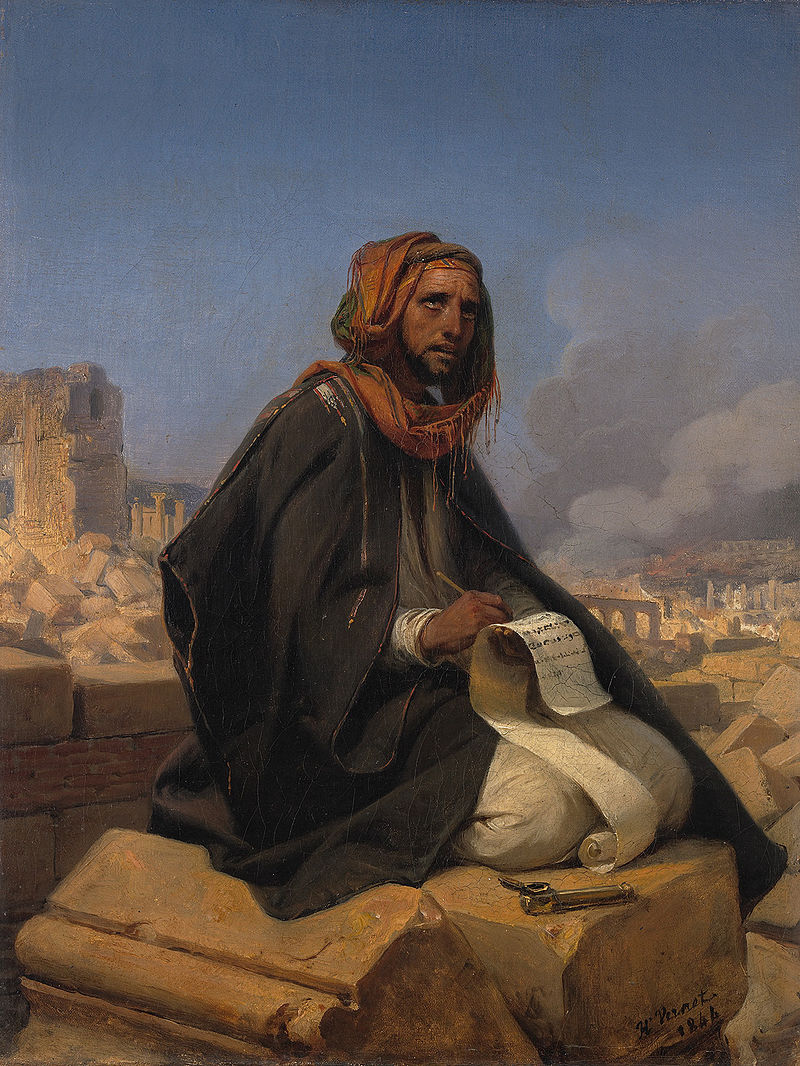
"Jeremiah on the Ruins of Jerusalem"
(Horace Vernet, 1844)
'For I know the plans that I have for you,' declares the LORD,
'plans for welfare and not for calamity to give you a future and a hope.
-- Jeremiah 29:11
(Play beautiful related song by Marty Goetz and Misha)
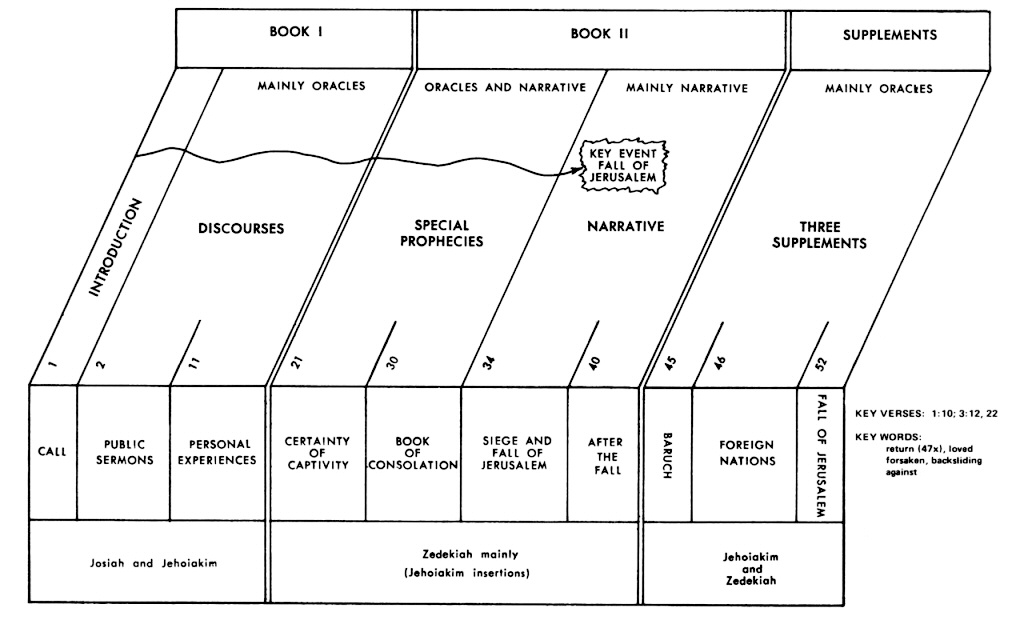
Click chart to enlarge
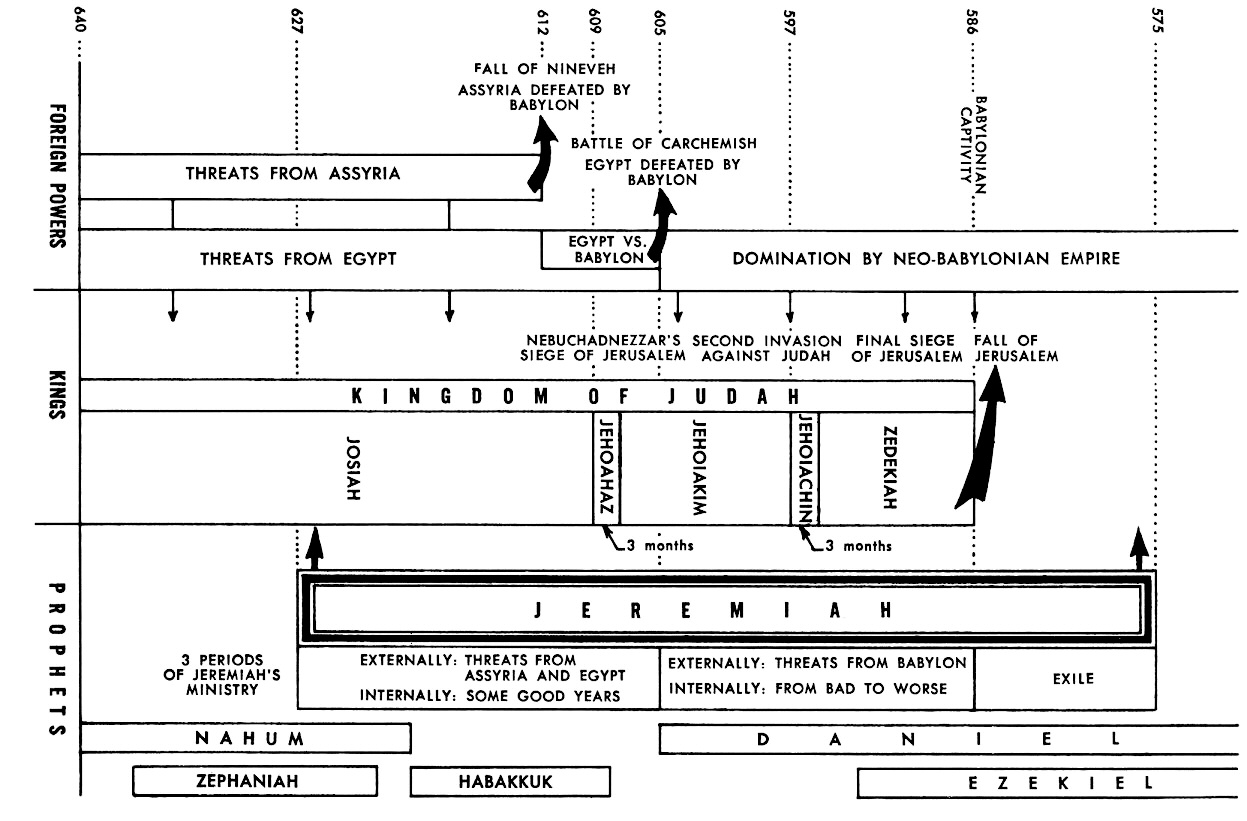
Click chart to enlarge
Chart from recommended resource Jensen's Survey of the OT - used by permission
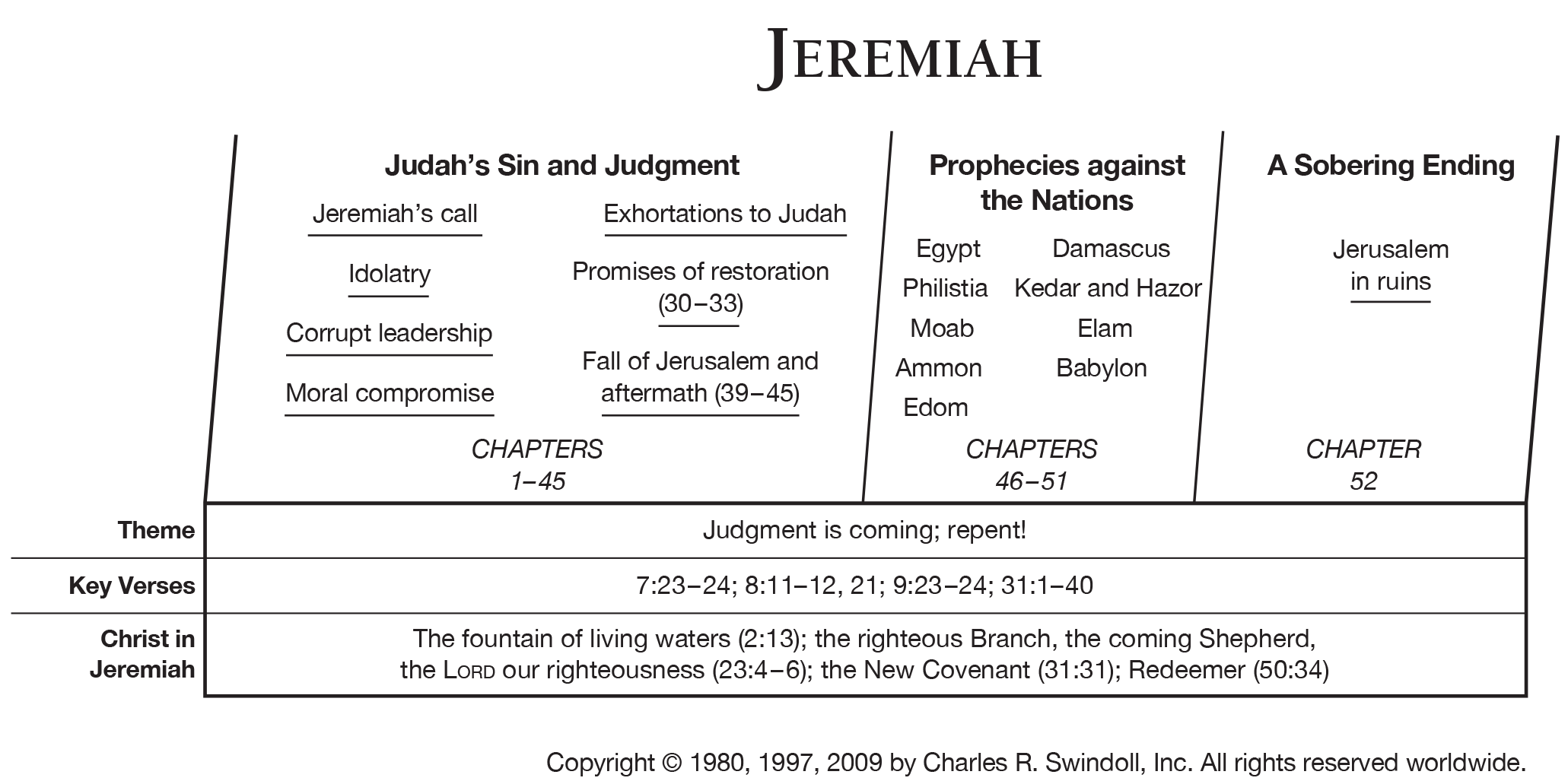
Jeremiah Chart from Charles Swindoll
| JEREMIAH: "PROPHET TO THE NATIONS" Sin - "I Will Punish" (Jer 9:25) Hope - "I Will Restore" (Jer 30:17) Judah & Jerusalem |
||||||
|
Prophet |
Prophecies to Judah Jer 2:1-45:5 |
Prophecies to the Gentiles Jer 46:1-51:64 |
Prophet's Appendix Jer 52:1-52:34 |
|||
| Prophet's Commission Jer 1:1-19 |
Judah Condemned Jer 2:1-25:38 |
Jeremiah's Conflicts Jer 26:1-29:32 |
Jerusalem's Future Jer 30:1-33:26 |
Jerusalem's Fall Jer 34:1-45:5 |
Nations Condemned Jer 46:1-51:64 |
Historic Conclusion Jer 52:1-52:34 |
| Before The Fall Of Jerusalem Jer 1:1-38:28 |
The Fall Jer 39:1-18 |
After The Fall |
||||
| Call | Ministry | Retrospect | ||||
| Nation of Judah |
Surrounding Nations |
Future of Babylon |
||||
| 627-582 BC Ministered 40+ Years! |
||||||
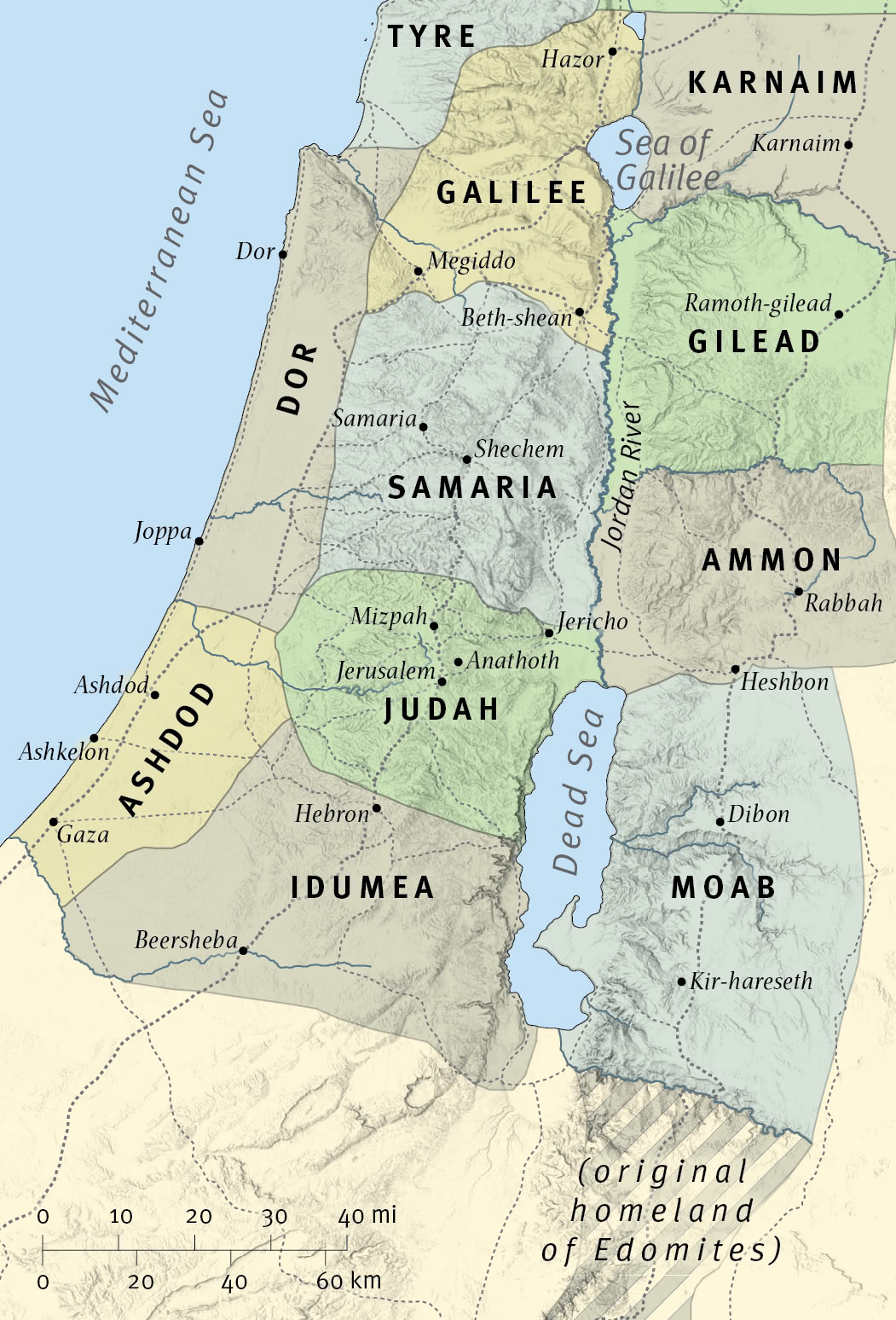
Map of Israel at Time of Jeremiah
Source: ESV Global Study Bible

Source: ESV Global Study Bible
Jeremiah 29:1 Now these are the words of the letter which Jeremiah the prophet sent from Jerusalem to the rest of the elders of the exile, the priests, the prophets and all the people whom Nebuchadnezzar had taken into exile from Jerusalem to Babylon.
- Now: This transaction is supposed to have taken place in the first or second year of Zedekiah.
- of the letter: Jer 29:25-29 2Ch 30:1-6 Es 9:20 Ac 15:23 2Co 7:8 Ga 6:11 Heb 13:22 Rev 2:1-3:22
- the elders: Jer 24:1-7 28:4
Related Passages:
2 Kings 24:14-16 Then he led away into exile all Jerusalem and all the captains and all the mighty men of valor, ten thousand captives, and all the craftsmen and the smiths. None remained except the poorest people of the land. 15So he led Jehoiachin away into exile to Babylon; also the king’s mother and the king’s wives and his officials and the leading men of the land, he led away into exile from Jerusalem to Babylon. 16All the men of valor, seven thousand, and the craftsmen and the smiths, one thousand, all strong and fit for war, and these the king of Babylon brought into exile to Babylon.
Ezekiel 11:16 “Therefore say, ‘Thus says the Lord GOD, “Though I had removed them far away among the nations and though I had scattered them among the countries, yet I was a sanctuary for them a little while in the countries where they had gone.”’
JEREMIAH'S LETTER
TO THE EXILES
INTRODUCTION - Part I of the book of Jeremiah (Jeremiah 1–29) unfolds in a largely chronological sequence, recording prophetic messages delivered during the reigns of Josiah, Jehoahaz, Jehoiakim, Jehoiachin, and Zedekiah, and culminating in Jeremiah 29 which turns its focus to those already exiled in Babylon, exhorting them to remain content in their circumstances and faithful to the Lord even in a foreign land (Jer 29:4–7). Part II (Jer 30–36) gathers various prophecies without strict chronological order, and the whole book may be viewed in six major divisions: Jer 1–29; 30–36; 37–39; 40–42; 43–44; and 45–52. Jeremiah 29 specifically contains letters sent by the prophet to the exiles in Babylon, likely written after the deportation of Jeconiah (Jehoiachin) in 597 BC, addressed to the Jews carried away at that time (3,023 in Jer 52:28; 10,000 in 2Ki 24:14 - difference in these numbers is uncertain), urging them to live normal, settled lives in exile, to wait patiently for the Lord’s promised restoration after seventy years (Jer 29:10–14), and to reject the deceptive assurances of false prophets such as Ahab and Zedekiah (Jer 29:21).
🙏 THOUGHT - The exilic community faced a deep crisis—both spiritually and practically—and had to decide whether their situation was temporary or a long-term reality. Though the natural instinct in hardship is to cling to hopeful, quick solutions, optimism not grounded in God’s Word is deceptive and ultimately harmful, because it creates false expectations that collapse. Instead of listening to reassuring but false voices, they were called to reject delusion and anchor themselves in divine revelation, for only God’s Word provides a true and enduring response to catastrophe (cf. Jer 29:8; Pr 14:12).
John Guest adds that "This letter has been considered one of the most important documents of the Old Testament. Undaunted by the eight hundred miles that separated him from his mission field.... The fact that they were allowed to deliver such a letter indicates that Nebuchadnezzar was not oppressing the Hebrews but rather was allowing them a reasonable existence." (See The Preacher's Commentary - Vol. 19: Jeremiah and Lamentations)
Now - This is a time marker, designating a precise historical shift and specifically pointing to the period sometime after the second deportation in 597 BC, when Jehoiachin (Jeconiah) was taken to Babylon by Nebuchadnezzar (2Ki 24:12–16) along with a significant portion of its leadership, craftsmen, and elites. Now marks the fact that the exile had begun but was not yet complete. Jerusalem still stood, albeit already judged. Jeremiah is speaking from Jerusalem to the exiles in Babylon, declaring that though they are far from the Promised Land, they are not beyond the reach of Yahweh the Promise Keeping God.
Paul Apple calls Jeremiah 29 "the gameplan for successful living in oppressive circumstances (addressed to those in exile in Babylon)."
These are the words of the letter - This opening signals that this is not casual correspondence but authoritative revelation, for though it comes in the form of a letter, it bears the full weight of prophetic Scripture. The message is not merely Jeremiah’s—it is God’s, for “men moved by the Holy Spirit spoke from God” (2 Peter 1:21), and thus the human instrument does not diminish the divine authority. The medium is a letter, but the source is the Lord Himself, who speaks with certainty and purpose even into the place of exile, demonstrating that His word is not bound by geography or circumstance (2 Timothy 2:9) and that even in judgment He continues to reveal, instruct, and call His people to Himself (Jeremiah 29:10–13). The purpose of Jeremiah's letter is to tell the exiles how to behave in a pagan land and to give them encouragment to motivate such behavior.
Warren Wiersbe - A man with the heart of a true shepherd, Jeremiah wanted to enlighten them and encourage them in their life in Babylon. Governed by special laws concerning clean and unclean things, the Jewish people would have a difficult time adjusting to a pagan society. Jeremiah wanted them to be good witnesses to the idolatrous Babylonians, and he also wanted them to be good Jews even though separated from their temple and its services.
Which Jeremiah the prophet sent from Jerusalem Jeremiah remains in Jerusalem while others are in Babylon which naturally creates a bit of a geographic tension. Yet distance does not limit divine communication and Yahweh will use the mouthpiece of his servant (in this case in the form of a written communication) to speak to the Chosen People in distress and discouragment in exile. As Ps 139:7 declares, “Where can I go from Your Spirit?” Even in Babylon, God’s Word would reach His people. (And wherever you are beloved, physically or spiritually, God's Word is able to reach you and minister to your soul!)
To the rest of the elders of the exile, the priests, the prophets and all the people This comprehensive list shows that the message is for the entire covenant community, leaders and laity alike. The elders represent civil leadership (which is still somehow in place in exile). The priests are apparently allowed some degree of religious freedom. While they could not offer sacrifices, since worship was centralized in the temple in Jerusalem (Dt 12:5–6), they were able to gather, teach, pray, and seek the Lord. And though the altar was absent, the presence of God was not (Ezekiel 11:16). We see elders repeatedly coming to Ezekiel to inquire of God (Ezekiel 8:1; 14:1; 20:1), indicating organized spiritual life even in exile. In short, no group is exempt from hearing God’s Word. Compare Deuteronomy 29:10–11, where all Israel stands together before the LORD.
The fact that Jeremiah addresses his letter to the elders of the exile, the priests, the prophets and all the people indicates that there existed some form of community organization among the exiles.
Charles Feinberg - Near East gave the queen mother a prominent place (cf. 1 Kings 2:13-20; 15:2, 10; 22:42; Dan 5:10). She was especially important in this instance, since Jehoiachin was only eighteen years old (2 Kings 24:8-15) (The Expositor's Bible Commentary – Volume 6)
Whom Nebuchadnezzar had taken into exile from Jerusalem to Babylon. Nebuchadnezzar is the human instrument, but God is the ultimate agent as Jeremiah makes clear in Jeremiah 29:4. On one hand there was clearly political conquest, but on the unseen hand the exile wass divine discipline (cf 2Ch 36:17).
🙏 THOUGHT - Are you experiencing the disiplining hand of Yahweh? Then the encouraging principle you can glean from this verse is that even in discipline, God’s children are never beyond the reach of His Word or the purposes of His hand (cf Ro 8:28). Hebrews 12:11 says "All discipline for the moment seems not to be joyful, but sorrowful; yet to those who have been trained by it, afterwards it yields the peaceful fruit of righteousness."
John Walton - letter to exiles. Evidence of correspondence between Jerusalem and the exiles taken away in 597 is found in this letter, presumably delivered by a Babylonian messenger or a merchant traveling to Mesopotamia. There is ample precedent for the transport of both private and official correspondence throughout the Old Testament period. The Lachish Letters represent the type of internal communication employed in the kingdom of Judah during the Assyrian invasion of 701. For evidence that this letter was received and respected see Daniel 9:2.
Warren Wiersbe feels that there are "Several different letters are involved in this chapter: a letter from Jeremiah to the exiles (vv. 1-14); a letter concerning Jewish false prophets in Babylon to which Jeremiah replied (vv. 15-23); a letter from Shemaiah to the temple priests concerning Jeremiah, which he read (vv. 24-29); and a letter from Jeremiah to the exiles concerning Shemaiah (vv. 30-32). Correspondence like this wasn’t difficult to maintain in those days, for there were regular diplomatic missions between Jerusalem and Babylon (v. 3), and Jeremiah had friends in high places in the government.
Bob Utley makes an interesting observation that "This chapter clearly presents YHWH's sovereignty in the actions of history. Notice the string of "I have. . ." or "I will . .." statement
- I have sent into exile, Jer. 29:4,14,18,20
- I have not sent them (i.e. the false prophets in Babylon), Jer. 29:9
- I will visit you (i.e. in Babylon), Jer. 29:10
- I will fulfill My good word (i.e. to bring you back to Palestine), Jer. 29:10
- I have plans for you (two emphatic "I's"), Jer. 29:11
- I will listen to you (see note at Jer. 29:11-14), Jer. 29:12
- I will restore your fortunes, Jer. 29:14
- I will gather you from all the nations. . .where I have driven you, Jer. 29:14
- I will send upon them the sword, famine, and pestilence (i.e. the Jews still in Judah), Jer. 29:17
- I will make them like rotten fruit (i.e. the Jews still in Judah), Jer. 29:17
- I will pursue them with the sword, Jer. 29:18
- I sent to them again and again My servants (i.e. the prophets), Jer. 29:19
- I will deliver them into the hand of Nebuchadnezzar (i.e. false prophets killed in Babylon), Jer. 29:21
- I did not command them (i.e. the false prophets to speak), Jer. 29:23
- I am He who knows and am a witness, Jer. 29:23
- I am about to punish Shemaiah (i.e. false prophet), Jer. 29:32
- I am about to do (good) to My people (i.e. the Jews in Babylon), Jer. 29:32
YHWH, unlike the lifeless idols, is active in the lives of His people for His larger redemptive purposes!
Jeremiah 29:2 (This was after King Jeconiah and the queen mother, the court officials, the princes of Judah and Jerusalem, the craftsmen and the smiths had departed from Jerusalem.)
- Jeconiah: Jer 22:24-28, Coniah, Jer 27:20 28:4 2Ki 24:12-16 2Ch 36:9,10,
- court officials- KJV = eunuchs: or, chamberlains, 2Ki 9:32 *marg: 2Ki 20:18 Da 1:3-21
Related Passages:
2 Kings 24:12-16 (JECONIAH'S SURRENDER TO NEBUCHADNEZZAR - 597 BC) Jehoiachin the king of Judah went out to the king of Babylon, he and his mother and his servants and his captains and his officials. So the king of Babylon took him captive in the eighth year of his reign. 13 He carried out from there all the treasures of the house of the LORD, and the treasures of the king’s house, and cut in pieces all the vessels of gold which Solomon king of Israel had made in the temple of the LORD, just as the LORD had said. 14 Then he led away into exile all Jerusalem and all the captains and all the mighty men of valor, ten thousand captives, and all the craftsmen and the smiths. None remained except the poorest people of the land. 15 So he led Jehoiachin away into exile to Babylon; also the king’s mother (QUEEN MOTHER) and the king’s wives (NOTE POLYGAMY) and his officials and the leading men of the land, he led away into exile from Jerusalem to Babylon. 16 All the men of valor, seven thousand, and the craftsmen and the smiths, one thousand, all strong and fit for war, and these the king of Babylon brought into exile to Babylon.
JEREMIAH'S LETTER SENT
PRIOR TO DESTRUCTION OF JERUSALEM
This was after King Jeconiah (Jehoiachin 2Ki 24:8,9, Coniah Jer 22:24) - To what does "this" refer? Some suggest it refers to the exile, but others like the NET Bible translation see "this" as referring to Jeremiah's letter rendering it "He sent it after King Jeconiah..." In context, the "this" seems to be more accurately interpreted as anchoring the timing of the letter, i.e., ater the 597 BC deportation. In sum, Jeremiah 29:1 explains that a letter is being sent “to the rest of the elders of the exile,” and Jer 29:2 inserts a parenthetical reminder of which exile movement we are talking about. (READ PARALLEL DESCRIPTION IN 2Ki 24:14, 15, 16)
The word "after" places the timing after the second deportation (597 BC). Jeconiah, a Davidic king, was taken to Babylon after only three months on the throne. This is significant because it shows that even the line of David was not exempt from discipline. God had promised a Davidic dynasty (2 Samuel 7:16), yet disobedience brought immediate judgment upon the throne.
And the queen mother (Nehushta 2Ki 24:8), the court officials, the princes of Judah and Jerusalem, the craftsmen and the smiths had departed from Jerusalem - Nebuchadnezzar wisely removed the entire leadership structure and skilled workforce from Jerusalem during this exile. This was a deliberate strategy because by deporting the political leaders, military men, and skilled workers, he ensured that Judah could not rebuild its strength or organize resistance but would help King Nebuchadnezzar beautify Babylon.
NET NOTE on court (palace) officials - This term is often mistakenly understood to refer to a "eunuch." It is clear, however, in Gen 39:1 that "eunuchs" could be married. On the other hand it is clear from Isa 59:3–5 that some who bore this title could not have children. In this period, it is possible that the persons who bore this title were high officials like the rab saris who was a high official in the Babylonian court (cf. Jer 39:3 , 13; 52:25).
Bob Utley adds "the court officials" "literally is "eunuchs" (BDB 710). It is an Akkadian word which means "the one at the head." Usually this refers to those who had been castrated and put into public service. But, since Potiphar (Gen. 39:1) was married and has this same title, this term may have come to mean simply "a government official."
John Walton - queen mother. The queen mother in Judah apparently had a high status and was both an influence on her son the king as well as a power in her own right (see comment on 1 Kings 2:19 and the need to remove her from power in Asa’s time in 1 Kings 15:13). In this case we know that Jehoiachin’s mother was named Nehushta (see 2 Kings 24:8; Jer 13:18) and that she was also stripped of her crown and attendant power when they were taken together into exile. exile of craftsmen and artisans. In choosing persons to take as hostages in the exile of 597, Nebuchadnezzar naturally took members of the royal family and their advisers among the nobility and priesthood. Craftsmen (see 10:3) and skilled artisans might have been useful to the king’s ambitious building plans, but they also represented the relatively wealthy middle class of Judah. Most importantly, the skills of craftsmen and artisans were generally passed on through families, generation to generation, and often comprised trade secrets. The Babylonians would desire to preserve these and benefit from them. This same respect for the guilds is seen in Utnapishtim’s inclusion of artisans in his ark in the Gilgamesh flood story.
Jeremiah 29:3 The letter was sent by the hand of Elasah the son of Shaphan, and Gemariah the son of Hilkiah, whom Zedekiah king of Judah sent to Babylon to Nebuchadnezzar king of Babylon, saying,
- Shaphan: Jer 26:24 39:14 2Ki 22:8 Eze 8:11
- Gemariah: Jer 36:25 2Ki 22:12 2Ch 34:20
HOW THE PROPHETIC
LETTER WAS DELIVERED
The letter was sent by the hand of Elasah the son of Shaphan, and Gemariah the son of Hilkiah - These two men had the privilege of personally delivering divine revelation to the exiles in Babylon. In the ancient world, official correspondence was carried by trusted representatives.
Elasah the son of Shaphan connects this mission to a godly lineage. Shaphan was Josiah's scribe (2Ki 22:3,8,12) involved in the discovery of the Book of the Law during Josiah’s reforms (2Ki 22:8–10). Elasah is probably Ahikam's brother of Jer 26:24, who had helped Jeremiah during the royal reaction to his temple sermon.
NET NOTE Elasah son of Shaphan may have been the brother of Ahikam, who supported Jeremiah when the priests and the prophets in Jerusalem sought to kill Jeremiah for preaching that the temple and the city would be destroyed (cf. 26:24).
John Guest adds that "It was Ahikam’s hand that had saved the life of Jeremiah from the angry mob of priests. It was now Elasah’s hand that delivered this letter." (See The Preacher's Commentary - Vol. 19: Jeremiah and Lamentations)
Gemariah the son of Hilkiah is probably Hilkiah was the high priest who found the Book of the Law (2Ki 22:4–8). This association also links the delivery of Jeremiah’s letter to a lineage associated with Scripture, reform, and covenant faithfulness. The message of exile and restoration is thus entrusted to men connected to prior movements of revival and truth. One is reminded of 2Ti 2:2 "The things which you have heard from me in the presence of many witnesses, entrust (for safekeeping as a deposit in a bank - aorist imperative see our need to depend on the Holy Spirit to obey) these to faithful (trustworthy) men who will be able to teach others also." Note in Paul's exhortation we have transmission from Paul to Timothy to faithful men to others (4 passes of the baton!)
NET NOTE on Gemariah - This individual is not the same as the Gemariah mentioned in Jer 36:10, 11, 12, 25 who was one of the officials who sought to have the first scroll of Jeremiah’s prophecies preserved. He may, however, have been a son or grandson of the High Priest who discovered the book of the law during the reign of Josiah (cf., e.g., 2 Kgs 22:8, 10) which was so instrumental in Josiah’s reforms.
Elasah and Gemariah demonstrate that even in the darkest times, a remnant remained faithful to the LORD.
Whom Zedekiah king of Judah sent to Babylon to Nebuchadnezzar king of Babylon, saying - This vassal king under Babylonian authority (2Ki 24:17), is sending an official delegation. The purpose is uncertain but it could have been to carry tribute to Nebuchadnezzare. However it must be admitted we do not know if Zedekiah was aware of Jeremiah's letter or not. In any event what is amazing is that God is using even a compromised king like Zedekiah to unknowingly facilitate the spread of divine truth!
NET NOTE It is unclear whether this incident preceded or followed those in the preceding chapter. It is known from Jer 51:59 that Zedekiah himself had made a trip to Babylon in the same year mentioned in Jer 28:1 and that Jeremiah had used that occasion to address a prophecy of disaster to Babylon. It is not impossible that Jeremiah sent two such disparate messages at the same time (see Jer 25:8–11, 12–14, 17–18, 26).
Believer's Study Bible adds The couriers were from priestly families connected with the reform of Josiah. It is possible that Gemariah was the son of Hilkiah, the famous priest of Josiah's day. Their mission almost certainly included the carrying of tribute or payment to Nebuchadnezzar from Zedekiah, showing the latter's loyalty.
Bob Utley- This VERB "send" (Qal PERFECT) is used an unusual number of times in this chapter.
- letter sent, Jer. 29:1
- people sent, Jer. 29:3
- prophets YHWH did not send, Jer. 29:9,25,31
- YHWH sends the sword, famine, and pestilence, Jer. 29:17
- YHWH's word sent by His prophets, Jer. 29:19 (twice), 28,31
It is a common VERB but its repetition shows the problem—who speaks for God?
Jeremiah 29:4 “Thus says the LORD of hosts, the God of Israel, to all the exiles whom I have sent into exile from Jerusalem to Babylon,
- whom: Jer 24:5 Isa 5:5 10:5,6 45:7 59:1,2 Am 3:6
YAWHEH THE TRUE
AUTHOR OF THE LETTER
Put yourself in the places of these Jews, "exiles...into exile," having lost everything but their own lives and probably a suitcase of possessions!
Thus says the LORD of hosts (Jehovah Sabaoth, LORD of hosts of armies), the God of Israel, to all the exiles whom I have sent into exile from Jerusalem to Babylon - The recipients were not just the elders or leaders (v1) but all the Jewish exiles for all needed to hear a Word from Heaven. Note the first thing Yahweh tells the exiles is that was His sovereign power which had sent them into exile. By default, Nebuchanezzar was simply the human agent of Yahweh's will which is always good and acceptable and perfect.
NET NOTE on sent - Heb “I sent.” This sentence exhibits a rapid switch in person, here from the third person to the first. Such switches are common to Hebrew poetry and prophecy (cf. GKC 462 §144.p). Contemporary English, however, does not exhibit such rapid switches and it creates confusion for the careful reader. Such switches have regularly been avoided in the NET translation. Elsewhere Nebuchadnezzar is seen as the one who carried them into exile (cf. Jer 27:20; 29:1). Here and in Jer 29:14 the LORD is seen as the One Who sends them into exile. The LORD is the ultimate cause and Nebuchadnezzar is His agent or servant (cf. Jer 25:9; 27:6 and notes).
One of the first steps in turning tragedy into triumph is to accept
the situation courageously and put ourselves into the
hands of a loving God, Who makes no mistakes.
Warren Wiersbe helps paint the perspective of the exiles - They'd lost their freedom and were now captives. Theyd been taken from their homes and had lost their means of making a living. They were separated from relatives and friends, some of whom may have perished in the long march from Jerusalem to Babylon. No matter how they looked at it, the situation seemed hopeless. How should we handle such a depressing situation? Accept it from the hand of God (v. 4) and let God have His way. It does no good to hang our harps on the willow trees and sit around and weep, although this may be a temporary normal reaction to tragedy (Ps. 137:1-4). One of the first steps in turning tragedy into triumph is to accept the situation courageously and put ourselves into the hands of a loving God, Who makes no mistakes.
Bob Utley- "whom I have sent into exile" Again, throughout the account of this period God claims (ED: HE DOES NOT JUST "CLAIM" BUT ACTUALLY IS IN FULL CONTROL!) to be in control of history (i.e. Isa. 10:5; Jer. 25:9; 27:6). The exile is His judgment on Judah in order to bring His people back to personal faith in Him (cf. Jer. 29:7).
Jeremiah 29:5 ‘Build houses and live in them; and plant gardens and eat their produce.
- Jer 29:10,28 Eze 28:26
ENCOURAGING COMMANDS
FROM THE LORD OF HOSTS
Build houses and live in them; and plant gardens and eat their produce - This message is suprisingly hopeful. Yahweh gives the exiles four commands they can truly carry out, for God never issues a command without also providing the enablement to obey it (cf. Php 2:13NLT). Notice He does not tell them to live as if confined captives or merely to “get by.” On the contrary, He calls them to engage life to build, plant, and eat. In commanding them to eat, He implicitly promises that what they plant will produce, not famine but provision (Jer 29:5,6). To build houses implies they would somehow obtain financial ability to carry this out. Houses clearly indicates that this will not be a short stay as prophesied by the false prophets, thus this command would counter any reluctance to build because of the lying prophets saying they would quickly return to Judah. Obedience to Yahweh's commands would be blessed by security and survival even though they were in exile.
As the saying goes,
“bloom where you are planted.”
John McKay - No doubt, the people were told where to settle. Both biblical (Ezek. 3:15) and other evidence points to the region of the city of Nippur sixty miles south-east of Babylon, where much work was needed to restore an area devastated by war. ....There does not seem to have been any conscious policy of forced assimilation. They could continue to observe the ritual laws, the Sabbath and circumcision, all of which distinctives would have helped maintain their national identity and communal solidarity. They were free to communicate with their native land—though not of course to go back there. The mention of gardens rather than fields probably indicates that they were unable to acquire extensive land-holdings, but as tenants would have been allotted plots of ground in the vicinity of their houses. (Jeremiah: Chapters 21-52)
Paul Apple - Application: This letter is a good guide for us on our pilgrimage. Our home is the heavenly Jerusalem; we are presently living in the enemy's land, a planet whose god is Satan. Yet God does not call us to live as hermits, or in constant rebellion against the social structures of our culture. We, like the captives of old, must "seek the peace of Babylon," even as we bear witness against her errors and refuse to participate in her sins.
Jeremiah 29:6 ‘Take wives and become the fathers of sons and daughters, and take wives for your sons and give your daughters to husbands, that they may bear sons and daughters; and multiply there and do not decrease.
NET - Marry and have sons and daughters. Find wives for your sons and allow your daughters get married so that they too can have sons and daughters. Grow in number; do not dwindle away.
- Take: Jer 16:2-4 Ge 1:27-28 Ge 9:7 1Ti 5:14
- take wives: Ge 21:21 24:3,4,51,60 28:1-4 29:19 34:4 Jud 1:12-14 12:9 14:2 1Co 7:36-38
Related Passages:
Genesis 1:27-28 God created man in His own image, in the image of God He created him; male and female He created them. 28 God blessed them; and God said to them, “Be fruitful and multiply, and fill the earth, and subdue it; and rule over the fish of the sea and over the birds of the sky and over every living thing that moves on the earth.”
Genesis 9:7 “As for you, be fruitful and multiply; Populate the earth abundantly and multiply in it.”
Deuteronomy 26:5 “You shall answer and say before the LORD your God, ‘My father was a wandering Aramean, and he went down to Egypt and sojourned there, few in number; but there he became a great, mighty and populous nation.
FIVE MORE COMMANDS
FOR LIVING IN EXILE
Take wives and become the fathers of sons and daughters, and take wives for your sons and give your daughters to husbands, that they may bear sons and daughters - Yahweh further declares that He is for them, even in exile. His command is for them to enjoy life (marriage was one of the great joys of the Jews) even though they were experiencing His hand of discipline. Bear sons is Qal IMPERFECT used in a JUSSIVE sense (like a command). The wives Jeremiah encouraged them to marry though not stated, surely would be Jewish, and not foreign (cf. Dt 7:3), for the seed of Abraham must continue according to the divine promise (Ge 12:1–3).
And if they would lay hold of the truth that Yahweh had the sovereign power to bring them to Babylon, He surely also would have the power to enable them to be fruitful and multiply.
And multiply there and do not decrease ("do not dwindle away") - Yahweh is giving them the blessing of children (cf Ps 127:5). Do not decrease is Qal IMPERFECT used in a JUSSIVE sense (like a command). Since it is the LORD Who gives children, this is the juxtaposition of God's sovereignty and man's responsibilty. Practically speaking, procreation would be critical to assure that there were Jews who could return to Judah when the 70 years were completed.
As Warren Wiersbe says "This small Jewish remnant was holding in its hands the future of God’s great plan of salvation, and they must obey Him, be fruitful, and multiply."
Note how all these commands are in essence encouraging. God know that it was human nature to become downcast having been dragged from their homes into a land of pagans whose language they could not understand.
John McKay makes an interesting comment that "The three generations in exile would correspond to the three generations of Nebuchadnezzar’s descendants (Jer 27:7) and would span the seventy years that had been prophesied for the captivity (Jer 25:11)....The promise of a numerous offspring, so much part of the Abrahamic covenant, is being transferred to a foreign land (‘there’ refers to Babylon). The same phenomenon of population growth had previously occurred when Israel was enslaved in Egypt (Ex 1:7). The imposition of the covenant curse had broken the tie between the people and the land, but if in exile they were obedient to the LORD, they would enjoy renewed blessing." (Jeremiah: Chapters 21-52)
Jeremiah 29:7 ‘Seek the welfare of the city where I have sent you into exile, and pray to the LORD on its behalf; for in its welfare you will have welfare.’
NET - Work to see that the city where I sent you as exiles enjoys peace and prosperity. Pray to the LORD for it. For as it prospers you will prosper.'
NLT And work for the peace and prosperity of Babylon. Pray to the LORD for that city where you are held captive, for if Babylon has peace, so will you."
- seek: Da 4:27 6:4,5 Ro 13:1,5 1Pe 2:13-17
- pray: Ezr 6:10 7:23 Da 4:19 1Ti 2:1,2
Related Passages:
1 Peter 2:12-17 (HERE IS A NT PARALLEL COMMAND FOR BELIEVERS) Keep (present tense) your behavior excellent among the Gentiles, so that in the thing in which they slander you as evildoers, they may because of your good deeds, as they observe them, glorify God in the day of visitation. (DANIEL'S WITNESS INFLUENZED NEBUCHADNEZZAR - cf Da 4:17, 26, 37) 13 Submit (aorist imperative see our need to depend on the Holy Spirit to obey) yourselves for the Lord’s sake to every human institution, whether to a king as the one in authority, 14 or to governors as sent by him for the punishment of evildoers and the praise of those who do right. 15 For (term of explanation) such is the will of God that by doing right you may silence the ignorance of foolish men. 16 Act as free men, and do not use your freedom as a covering for evil, but use it as bondslaves of God. 17 Honor (aorist imperative see our need to depend on the Holy Spirit to obey) all people, love (present imperative see our need to depend on the Holy Spirit to obey) the brotherhood, fear (present imperative) God, honor (present imperative) the king.
Matthew 5:43-48 “You have heard that it was said, ‘YOU SHALL LOVE YOUR NEIGHBOR and hate your enemy.’ 44 “But I say to you, love your enemies and pray for those who persecute you, 45 so that you may be sons of your Father who is in heaven; for He causes His sun to rise on the evil and the good, and sends rain on the righteous and the unrighteous. 46 “For if you love those who love you, what reward do you have? Do not even the tax collectors do the same? 47 “If you greet only your brothers, what more are you doing than others? Do not even the Gentiles do the same? 48 “Therefore you are to be perfect, as your heavenly Father is perfect.
Romans 12:21 Do not be overcome by evil, but overcome evil with good.
SEEK & PRAY FOR CAPTORS
FOR YOUR OWN BENEFIT
Seek the welfare (shalom - peace) of the city where I have sent you into exile - Imagine the reaction of the exiles to this command, which would totally turn their previous thoughts upside down! Recall it was the false prophets who had used the same word shalom in Jer 6:14 crying "‘Peace, peace,’ But there is no peace!" This is the second time Yahweh reminds then it was He who sent them into exile in Babylon. Clearly Yahweh wants the exiles to understand that this was not accidentally but divinely providential!
John McKay - The exiles are not to be ill-disposed towards the land they are in, even though they have been forcibly taken there. This was indeed the hardest part of the divine instructions. Psalm 137 reminds us of the bitterness that affected the later deportees. But while it was legitimate to criticise and oppose the evil perpetrated by Babylon, the exiles’ attitude was not to be negative with respect to the pagan land they were in. Rather they were to promote its interests in every way open to them, because ultimately it was the LORD who had brought them there....They are to exhibit the same concern for it as they once had displayed towards Jerusalem (Ps. 122:6–8). (Jeremiah: Chapters 21-52)
and pray to the LORD on its (the city's) behalf - Notice that prayer was to be a significant part of how they would seek the welfare of the city. Yahweh is calling the Jews to pray for their enemies, the very ones who had taken them into exile, destroying their city and temple. This is like a "turn the other cheek" command, which would be difficult to obey, which is why he goes on to explain why pray for them. This is the only example in the OT of praying for one's enemies, particularly a Gentile city of exile.
Charles Feinberg - Unique in ancient literature was Jeremiah’s command for them to pray for their pagan captors. The city referred to in v.7 was any of the Babylonian cities. Throughout the centuries the precepts enjoined here have been followed by the Jews in dispersion. To this day they pray in their worship on the Sabbath and on festivals for the rulers under whom they are living. Cyrus had asked for the prayers of the people (cf. Ezra 6:10; also 1 Macc 7:33). (See The Expositor's Bible Commentary - Abridged Edition - Page 491)
John Guest - Rather than becoming detached and passive, they were actively to be bringing down the grace of God into that pagan city. In much the same way, Christians are to be instruments of peace in the midst of a secular culture. When Jesus prayed for His disciples before His arrest in Gethsemane, He said, “I do not pray that You should take them out of the world, but that You should keep them from the evil one. They are not of the world, just as I am not of the world” (John 17:15–16). Jesus was clearly speaking of the way disciples were to live on earth, even though they were citizens of heaven. Earlier, He had said to them, “Render to Caesar the things that are Caesar’s, and to God the things that are God’s” (Mark 12:17). We are to be law-abiding citizens within the secular culture, all the while knowing that this is not the culture to which we ultimately belong. Heaven is our real home. This earth is only the land of our exile, but it is a land nonetheless for which we are to pray and for which we are to seek peace. (The Preacher's Commentary - Vol. 19: Jeremiah and Lamentations)
For (term of explanation) in its welfare (shalom - peace) you will have welfare (shalom - peace) - Yahweh is explaining why they should seek and pray, giving them a motive to do so. In a word, they would reap the benefits of their seeking and praying. The benefit is supernatural shalom in the midst of their exile and loss.
🙏 THOUGHT - Of course this promise is specifically and directly for the Jews in Babylonian exile, but some 40 years ago I read this passage and begin to apply the principles inherent in the passage, remembering there is only one correction interpretation, but many legitimate applications. And though almost all of my 15 partners (fellow pathologists) were not believers, I began to ask God month after month for the welfare of our practice. You might accuse me of 'name it, claim it,' I am convinced the Spirit had me pray this prayer year after year. While I won't go into the details, over those years it was clear to me God's hand was on our group and then one day He answered exceeding abundantly beyond all that I could ask or think, allowing our practice to be sold and providing for me so that I could quit pathology and go into full time ministry, writing on preceptaustin.org. "Not to us, O LORD, not to us, But to Your name give glory Because of Your lovingkindness, because of Your truth." (Ps 115:1)
If we reject the wooden yoke of submission,
we end up wearing only an iron yoke of subjugation
Warren Wiersbe - It would be easy for the Jews to wage constant warfare against their idolatrous Gentile captors, but Jeremiah instructed them to strive to get along with the Babylonians. The exiles were to be peacemakers, not troublemakers, and they were to pray sincerely for their enemies (Mt. 5:43-48; 1Ti 2:1-3; Titus 3:1-2). It was possible to be good Jews even in a pagan land. Remember, if we reject the wooden yoke of submission, we end up wearing only an iron yoke of subjugation (Jer. 28:12-14). Thus, the best course is to yield ourselves to the Lord and to those who are over us, no matter how badly they may treat us. (See Peter's counsel to Christian slaves in 1Pe 2:18-25.) To indulge in false hopes is to miss what God has planned for us.
Charles Feinberg - "History shows that in all the centuries of their world-wide dispersion, the Jews have tried to follow this pattern. They have identified themselves with the country of their residence, while at the same time looking toward eventual restoration to their native land."...The freedom allowed them implies they were neither slaves nor prisoners in their new land. (See The Expositor's Bible Commentary - Abridged Edition - Page 491)
John McKay - They had been separated from the worship of the Temple in Jerusalem, but that did not debar them from prayer, even on behalf of their captors. Their own fortunes were inextricably linked up with what happened to Babylon. ‘Surely there is more in this than a prudential, pragmatic policy for survival. It rings true to the authentic mission of the priestly people of God, to exist in order to be the vehicle of God’s blessing, God’s shālôm, for those outside, even the oppressor himself’ (Wright 1983:127). This is the same outlook on living in a heathen society that is promoted by Paul. ‘I urge, then, first of all, that requests, prayers, intercession and thanksgiving be made for everyone—for kings and all those in authority, that we may live peaceful and quiet lives in all godliness and holiness. This is good, and pleases God our Saviour, who wants all men to be saved and to come to a knowledge of the truth’ (1 Tim. 2:1–4). Indeed, the advice conveyed to the exiles goes further than that: obedience to the commands of the LORD will lead to the reversal of the curse of the broken covenant. Deut. 28:30–32 lists the forcible breakup of marriage, loss of home, lack of enjoyment of vineyards and absence of children as aspects of the covenant curse on disobedience. Here these aspects of the curse are being divinely lifted from the exilic community, and that functioned as a precursor of further restoration at a later time. (Jeremiah: Chapters 21-52)
Warren Wiersbe - It’s profitable to compare Jeremiah’s counsel to the exiles in Babylon with Peter’s counsel to the “pilgrims and strangers” in the Roman Empire (1 Peter 2:11-17). Both men told the people to be good citizens and good witnesses and to do good works. Paul agreed with their approach when he wrote, “If it is possible, as much as depends on you, live peaceably with all men” (Ro 12:18NKJV).
C H Spurgeon - THE principle involved in this text would suggest to all of us who are the Lord’s strangers and foreigners that we should be desirous to promote the peace and prosperity of the people among whom we dwell. Specially should our nation and our city be blest by our constant intercession. An earnest prayer for his country is well becoming in the mouth of every believer.
Eagerly let us pray for the great boon of peace, both at home and abroad. If strife should cause bloodshed in our streets, or if foreign battle should slay our brave soldiers, we should all bewail the calamity; let us therefore pray for peace, and diligently promote those principles by which the classes at home and the races abroad may be bound together in bonds of amity.
We ourselves are promised quiet in connection with the peace of the nation, and this is most desirable; for thus we can bring up our families in the fear of the Lord, and also preach the gospel without let or hindrance. To-day let us be much in prayer for our country, confessing national sins, and asking for national pardon and blessing, for Jesus’ sake.
G Campbell Morgan - This letter of Jeremiah proves that the popular school of prophecy at the time, that is, the school which preached rebellion against Babylon, and denied the messages of Jeremiah, had its messengers, not only in Jerusalem, but in Babylon among the captives there. By their messages a false hope of speedy return was created, threatening to produce unrest amongst them. This was undoubtedly what the false prophets, and the politicians influenced by them, desired. So they hoped to stir up the spirit of rebellion, and insure the fulfilment of their prophesyings, and the successful issue of their policies. Confident in the certainty that the progamme of God must be carried out, Jeremiah sent this letter to them, charging them to settle where they were, giving no heed to these lying spirits. Seventy years were before them. Let them act accordingly. In the midst of this counsel, these words occur, and they contain a principle of persistent application. They constitute an appeal for sanity. When in the grip of adverse circumstances which are the result of the Divine will, let men endeavour to secure the best conditions possible, and let them do it by the best means, by prayer. Jeremiah had foretold the ultimate overthrow of Babylon with no uncertain sound. Of that issue there could be no doubt. But so long as it remained, and they were held there as captives by the will of God, let them secure peace for themselves, by seeking the peace of the city, and that by prayer. The advice was that of the highest religious feeling, and it was that of practical common sense. These two things are never divorced.
F B Meyer - Seek the peace of the city, whither I have caused you to be carried away captives.
For seventy years the captives must make themselves at home and happy in Babylon. It was of no use to scheme and plot a speedier return. They must work out the predicted seventy years; and in the meanwhile let them seek the peace of the great heathen city to which they had been borne, and pray, not only for Jerusalem, but for it.
How many who read these lines are captives in positions against their will and choice. Servants and governesses in worldly homes; apprentices and clerks amid uncongenial associates; travellers in distant towns and commercial hotels; people in all kinds of positions in which they would not choose to be.
The natural tendency of all such is to fret, and begin endeavoring to secure their emancipation and removal. “Let me get away from this as soon as possible.” Or, at least, if unable to get free, they take as little interest as possible in their immediate associates, making themselves cold, and stiff, and inaccessible. This is not God’s way. Wherever you find yourself, seek the peace and comfort of those about you. Jesus bade us salute those who do not salute us, and lift our voices in intercessory prayer for our oppressors and persecutors.
God had a special purpose in allowing the captivity of his people into Babylon. It was to scatter synagogues and the Old Testament, in preparation for the Gospel. The transportation of Stundists to Siberia will affect the religious life of that great tract for all the future. You are carried into captivity to bring the Gospel to many who would otherwise never hear of it. Wherever God shall open the door, leave behind
Jeremiah 29:8 “For thus says the LORD of hosts, the God of Israel, ‘Do not let your prophets who are in your midst and your diviners deceive you, and do not listen to the dreams which they dream.
NET "For the LORD God of Israel who rules over all says, 'Do not let the prophets or those among you who claim to be able to predict the future by divination deceive you. And do not pay any attention to the dreams that you are encouraging them to dream.
- Do not let: Jer 14:14 23:21 27:14,15 28:15 Zec 13:4 Mt 24:4,5,24 Mk 13:5,6,22,23 Lu 21:8 Ro 16:18 2Co 11:13-15 Eph 4:14 5:6 2Th 2:3,9-11 2Ti 3:13 2Jn 1:7-9 Rev 13:14 19:20
- dreams: Jer 5:31 Mic 2:11 Lu 6:26 2Pe 2:2,3
Related Passages:
Jeremiah 14:14 Then the LORD said to me, “The prophets are prophesying falsehood in My name. I have neither sent them nor commanded them nor spoken to them; they are prophesying to you a false vision, divination, futility and the deception of their own minds.
Jeremiah 27:9 But as for you, do not listen to your prophets, your diviners, your dreamers, your soothsayers or your sorcerers who speak to you, saying, ‘You will not serve the king of Babylon.’
WARNING ABOUT FALSE PROPHETS
WHO GIVE FALSE HOPE
John McKay - Jer 29:8–9 are one sentence that focuses on the false expectations of the prophets who were active among the exiles; Jer 29:10–11 are concerned with the plans the LORD has for their future. (Jeremiah: Chapters 21-52)
For (term of explanation) introduces the reason and grounds for what has just been commanded in Jeremiah 29:5–7. For is the hinge between command and correction. It explains why obedience is necessary and exposes the lie that would keep them from obeying. God had just told the exiles to settle down in Babylon to build, plant, marry, and seek the welfare of the city. That would have sounded counterintuitive, even offensive, to people hoping for a quick return. So “for” explains why they must live this way. In context, Yahweh is saying obey His commands, because what you are hearing from prophets and diviners about a quick end is false. In short, God anchors their conduct in truth so they will not be driven by false hope but by His Word.
McKay adds "There then follow four verses, each of which begins with kî, ‘for’. They set out two main reasons (followed in each case by a subordinate reason) as to why the exiles should heed Jeremiah’s advice. Verses 8–9 are one sentence that focuses on the false expectations of the prophets who were active among the exiles; vv. 10–11 are concerned with the plans the LORD has for their future. (Jeremiah: Chapters 21-52)
Thus says the LORD of hosts (Jehovah Sabaoth, LORD of hosts of armies) - LORD of hosts (see note below) is one of the most prominent descriptions of Yahweh in Jeremiah occurring in 71 verses:
Jer. 6:6; Jer. 6:9; Jer. 7:3; Jer. 7:21; Jer. 8:3; Jer. 9:7; Jer. 9:15; Jer. 9:17; Jer. 10:16; Jer. 11:17; Jer. 11:20; Jer. 11:22; Jer. 16:9; Jer. 19:3; Jer. 19:11; Jer. 19:15; Jer. 20:12; Jer. 23:15; Jer. 23:16; Jer. 23:36; Jer. 25:8; Jer. 25:27; Jer. 25:28; Jer. 25:29; Jer. 25:32; Jer. 26:18; Jer. 27:4; Jer. 27:18; Jer. 27:19; Jer. 27:21; Jer. 28:2; Jer. 28:14; Jer. 29:4; Jer. 29:8; Jer. 29:17; Jer. 29:21; Jer. 29:25; Jer. 30:8; Jer. 31:23; Jer. 31:35; Jer. 32:14; Jer. 32:15; Jer. 32:18; Jer. 33:11; Jer. 33:12; Jer. 35:13; Jer. 35:18; Jer. 35:19; Jer. 39:16; Jer. 42:15; Jer. 42:18; Jer. 43:10; Jer. 44:2; Jer. 44:11; Jer. 44:25; Jer. 46:18; Jer. 46:25; Jer. 48:1; Jer. 48:15; Jer. 49:7; Jer. 49:26; Jer. 49:35; Jer. 50:18; Jer. 50:33; Jer. 50:34; Jer. 51:5; Jer. 51:14; Jer. 51:19; Jer. 51:33; Jer. 51:57; Jer. 51:58;
Do not let your prophets (LXX - pseudoprophetes - false prophets) who are in your midst and your diviners (Jer 14:14, 27:9 - qasam) deceive (nasha; LXX - anapeitho - persuade wrongly or to a different opinion) you, and do not listen to the dreams which they dream - Do not let and do not listen are both Qal IMPERFECT used in a JUSSIVE sense (like commands). Yahweh gives two "gentle" commands to the exiles to not let these men deceive you even if they practice divination. And then He says don't even listen to their dreams, which is the best way to keep from being deceived. This reminds me of Paul's warning about the last days that "evil men and impostors will proceed from bad to worse, deceiving and being deceived." (2Ti 3:13) These false prophets were people-pleasers who said only what the people wanted to hear, backing their claims up with divination and dreams, which can be seductive.
Notice the NET and NIV translations which both have "And do not pay any attention to the dreams that you are encouraging them to dream." HCSB has "don't listen to the dreams you elicit from them." Apparently the exiles in Babylon were seeking omens about their future! God says don't do it!
🙏 THOUGHT - Dear follower of Jesus, do you seek occult guidance regarding your future? If so, cease immediately (cf Dt 18:10–12; Hos 4:12)! The Bible clearly reveals your future beloved! In the ancient world, divination was widespread across cultures like Babylon, Egypt, Canaan, Greece, and Rome. It included astrology (reading the stars), casting lots (Ezekiel 21:21) and necromancy (consulting the dead, 1Sa 28:10-25) Today’s equivalents include Tarot cards, Astrology apps, Psychic readings and Crystals and “energy” practices! Craziness! The exiles were like folks today with so much global/economic chaos causing them to delve into things like astrology and fortune tellers. About 30% of U.S. adults consult astrology, tarot, or fortune tellers at least once a year! Social media --TikTok, apps, “WitchTok”-- has made these practices far more mainstream and accessible.U.S. psychic/fortune-telling industry generated about $2.3 billion in 2024. It has grown steadily at ~5% annually and expanded online. Astrology alone is now a multi-billion-dollar digital industry. That’s a real resurgence economically. Uncertainty (economic, social, personal) pushes people toward these practices. In some places (e.g., China, Thailand), this has even been called a “spiritual economy” driven by anxiety and modern pressures. In short, people aren’t necessarily believing more (its about the same as it has always been), but they are engaging more, talking about it more, and spending more on it than before.
Bob Utley - The list of what the prophets were doing is condemned in Lev. 19:26,31; 20:6; Deut. 18:9-13 (cf. Jer. 27:9-10). For a good discussion of dream interpretation, see ANE Thought and the OT, p. 243. It is important to note the biblical material on how to test a true prophet. OT, Deut. 13:1-5; 18:14-22 and NT, Matt. 7:15-27; 1 John 4:1-3)
Deceive (05378) nasha (נָשָׁא) carries the idea of deception that misleads the mind and heart, leading someone away from truth into false confidence, error, or ruin. In its basic sense it can mean to lend or exact a debt, but in its extended (Hiphil/Niphal) usage it takes on a moral and spiritual force—to deceive, beguile, delude, or give false hope, often through subtle or persuasive means. It describes how the serpent “deceived” Eve (“The serpent deceived me, and I ate” — Genesis 3:13 NASB), illustrating deception that distorts reality and leads to sin. This same word is used of political or military deception, where leaders mislead people with false assurances of safety or deliverance (2 Kings 18:29; 19:10; 2 Chronicles 32:15), and of false prophets who speak lies that lead God’s people astray (“Do not let your prophets… deceive you” — Jeremiah 29:8).
Nāshāʾ also penetrates deeper, exposing self-deception, where the human heart convinces itself of lies (“Do not deceive yourselves” — Jeremiah 37:9; cf. Jeremiah 49:16; Obadiah 1:3, 7), showing that deception is not only external but internal. It can even describe the sudden, deceptive nature of death (Psalm 55:15), which overtakes unexpectedly. In a difficult theological sense, the term is used of God in Jeremiah 4:10, expressing how His prophetic word was perceived as misleading by those under judgment, not because God lies (Numbers 23:19), but because hardened hearts misinterpret His dealings.
In sum, nāshāʾ speaks of a deception that creates false reality—whether by Satan, rulers, false prophets, circumstances, or one’s own heart—promising what is not true and leading ultimately to judgment or loss (cf. Proverbs 14:12).
Diviners (07080)(qasam) is derived from an Arabic root which primarily means to distribute, divide, decide (by God or so-called fate) and then to determine by lot or magical scroll, and thus to divine. The pagans (and sadly Israel) would divine by various methods -- sometimes by examining the position of the stars, and other times through casting lots with arrows, consulting idols, examining animal organs such as the liver (see esp Ezek 21:21) or through conjuring up the dead (a sin King Saul committed in 1Sa 28:8). The goal of divination was to attempt to predict the future or discern hidden knowledge by one of these occult methods. A soothsayer was one who attempted to predict the future by magical, intuitive, or more rational means. Notice that divination was just one of a group of evil (occult) spiritual practices (Dt 18:10)
Vine on qasam - Divination was a pagan parallel to prophesying (Dt. 18:10, 14-15—first occurrence.) Qasam is a seeking after the will of the gods, in an effort to learn their future action or divine blessing on some proposed future action (Josh 13:22). It seems probable that the diviners conversed with demons (1Cor 10:20). The practice of divination might involve offering sacrifices to the deity on an altar (Nu 23:1ff.). It might also involve the use of a hole in the ground, through which the diviner spoke to the spirits of the dead (1Sa 28:8). At other times, a diviner might shake arrows, consult with household idols, or study the livers of dead animals (Ezek. 21:21). Divination was one of man’s attempts to know and control the world and the future, apart from the true God. It was the opposite of true prophecy, which essentially is submission to God’s sovereignty (Dt. 18:14).
Hagan defines divination as "Communication with a deity (Ed: I would add - a false one at that!) for the purpose of determining the deity's knowledge, resulting in clarification of a decision or discernment of the future. Two forms of divination developed in the ancient Near East, one using inductive manipulation of natural or human phenomena and the other taking intuitive forms of inner revelation." (See the full article on Divination in Baker's Evangelical Dictionary of Biblical Theology)
NET NOTE Various means of divination are alluded to in the OT. For example, Ezek 21:26–27 alludes to throwing down arrows to see which way they fall and consulting the shape of the liver of slaughtered animals. Gen 44:5 alludes to reading the future through pouring liquid in a cup. The means alluded to in this verse were all classified as pagan and prohibited as illegitimate in Deut 18:10–14. The LORD had promised that he would speak to them through prophets like Moses (Deut 18:15, 18). But even prophets could lie. Hence, the LORD told them that the test of a true prophet was whether what he said came true or not (Deut 18:20–22). An example of false prophesying and the vindication of the true as opposed to the false will be given in the chapter that follows this.
NET NOTE on LORD (Yahweh) of hosts - NET renders it "the LORD who rules over all" a way of rendering the title "Yahweh of armies." It is an abbreviation of a longer title "Yahweh the God of armies" (or "LORD God of hosts) which occurs 8 times in Jeremiah (see Jer. 2:19; Jer. 15:16; Jer. 38:17; Jer. 44:7; Jer. 46:10; Jer. 49:5; Jer. 50:25; Jer. 50:31). The abbreviated title ("LORD of hosts") occurs seventy-one times in the book of Jeremiah. On thirty-two occasions it is further qualified by the title "the God of Israel," showing his special relation to Israel. On six occasions it is preceded by the title "Lord" ('adonay) (see, e.g., Jer 46:10) and twice it is preceded by the title "the King" (see, e.g., Jer 51:17). Both titles emphasize His sovereignty. Twice it is said that He is the maker of all things (Jer 10:16; 51:19), and once it is said that He made the earth and the people and animals on it and gives them into the control of whomever He wishes (Jer 27:4–5). On two occasions it is emphasized that He also made the heavenly elements and controls the natural elements of wind, rain, thunder, and hail (Jer 31:35; Jer 51:14–16). All this is consistent with usage elsewhere where the "armies" over which He has charge are identified as
(1) the angels which surround His throne (Isa 6:3, 5; 1Ki 22:19) and which He sends to protect His servants ( 2Ki 6:17),
(2) the natural forces of thunder, rain, and hail (Isa 29:6; Josh 10:11; Jdg 5:4, 5) through which He sends the enemy into panic and "gums" up their chariot wheels,
(3) the armies of Israel (1 Sam 17:45) which He leads into battle ( Num 10:34–35; Josh 5:14, 15) and for whom He fights as a mighty warrior (Exod 15:3; Isa 42:13; Ps 24:8), and even
(4) the armies of the nations which He musters against His disobedient people (Isa 13:14).
This title is most commonly found in the messenger formula "Thus says…" introducing both oracles of judgment (on Israel [e.g., Jer 9:7, 15] and on the nations [e.g. Jer 46:19; 50:18]; and see in general Jer 25:29–32). It emphasizes His sovereignty as the King and Creator, the Lord of creation and of history, and the just Judge Who sees and knows all (Jer 11:20; 20:12) and judges each person and nation according to their actions (Jer 32:18–19). In the first instance (in the most dominant usage) this will involve the punishment of His own people through the agency of the Babylonians (cf., e.g., Jer 25:8–9). But it will also include the punishment of all nations, including Babylon itself (cf. Jer 25:17–26, 32–38), and will ultimately result in the restoration of his people and a new relation with them (Jer 30:8; 31:35–37).
John Walton - Dreams - Dreams were usually received spontaneously, but on occasion people desiring communication from the divine realm could actively seek to experience a dream. Such attempts are labeled incubation. Incubation dreams were often sought by royalty and involved sleeping in a sacred space. The resulting dreams, as with prophetic dreams, involved deity speaking to the dreamer. The most prominent example is Gudea, the governor of Lagash in the early second millennium, as he engaged in incubation seeking guidance for building a temple. The list of others could perhaps include Solomon of Israel in the early first millennium (1 Kings 3).8
The majority of dreams, however, simply came to people in the normal course of their lives. They did not involve a speaking deity, but the recipients nevertheless believed that the gods were communicating through the symbols of the dream, so they desired interpretation of these symbols. This demand resulted in the accumulation of an extensive literature in both Mesopotamia and Egypt to provide resources for the dream interpreters, often formulated in catalogs of conditional statements.9 The protases (“If …”) identify the content of the dream and involve activities, travels (including distinct omens for various cities), what one eats, what one wears, what someone gives to the dreamer, animals, deities, or realms (e.g., the netherworld) encountered, or doing various sorts of labor. The apodoses (“Then …”) offering the interpretation are largely binary (good or bad results), even when directed to a specific category. They pertain to the aspects of life that are of concern to most people of any culture or era: life, property, family, health, and success.
Comparative Exploration:
Dreams and Dream Interpreters in Israel
In Israel, as in the ancient Near East, dreams were considered to be important, whether they came to private individuals (Jacob, Gen. 28; Joseph, Gen. 37) or to leaders (e.g., Gideon, Judg. 7; Solomon, 1 Kings 3). Most prominent are the dreams of foreign rulers (local ones such as Abimelech, Gen. 20; or world leaders such as Pharaoh, Gen. 41, or Nebuchadnezzar, Dan. 2, 4).
In the realm of prophecy, it was recognized that God could choose to communicate through dreams, but the spoken word of God was privileged over dreams (Jer. 23:28). Dreaming prophets are referred to disparagingly, classified as lying prophets speaking the delusions of their minds (Jer. 23:26). Furthermore, dream interpreters are classified along with sorcerers and mediums (Jer. 27:9; 29:8). The classical prophets never offer a word of the Lord received in a dream, though they do occasionally have visions.
In Israel two famous dream interpreters served foreign rulers, Joseph and Daniel. Both offered their interpretations as having been given by God (Gen. 41:16; Dan. 2:27–28; 4:18). The difference between them is that Joseph’s ability is informal, whereas Daniel’s is most likely associated with his training (Dan. 1:4). His education in the “language and literature of the Babylonians” prepared him to be an advisor to the king, so it is likely that the curriculum includes the omen literature with the expectation that he will serve as a baru (expert in divination). It is difficult to know whether trainees were exposed to all the reference literature (dream books, celestial omen collections, extispicy manuals, etc.) or would have specialized in one area. Daniel is most involved with dream interpretation, but also shows some awareness of celestial omens in the interpretation of the handwriting on the wall.1 It is also possible that he shows awareness of the anomalies collection (šumma izbu) in the vision of the beasts that emerge from the sea (Dan. 7).2
In Israel dream interpretation is given acceptable status only when God’s direct involvement in the interpretation can be affirmed. Israelites preserved no standard, formalized understanding of how dreams signify, nor is there a hermeneutic for scholarly interpretation. Israel agreed with the rest of the ancient Near East that deity could and did communicate through dreams. But they had no semiotic system by which to decipher dreams and no hermeneutic of interpretation that was considered reliable. (See page 243 Ancient Near Eastern Thought and the Old Testament)
Jeremiah 29:9 ‘For they prophesy falsely to you in My name; I have not sent them,’ declares the LORD.
- falsely: Heb. in a lie, Jer 29:23,31 27:15
FALSE PROPHETS NOT
SENT BY YAHWEH
For they prophesy falsely to you in My name (note); I have not sent them,’ declares the LORD - Jeremiah a servant of Yahweh warns that just because these men claim to speak for Yahweh, they only do so to deceive their hearers with their claims of divine inspiration. Yahweh flatly states He did not send these diviners and dreamers!
Rosy predictions were
the stock in trade of the falsifiers.
-- Charles Feinberg
Jeremiah 29:10 “For thus says the LORD, ‘When seventy years have been completed for Babylon, I will visit you and fulfill My good word to you, to bring you back to this place.
- When seventy years: Jer 25:12 27:7,22 2Ch 36:21-23 Ezr 1:1,2 Da 9:2 Zec 7:5
- I will: Jer 24:6,7 32:42-44 Zep 2:7
Related Passages:
Daniel 9:2 (DANIEL MUST HAVE READ JEREMIAH'S LETTER) in the first year of his reign, I, Daniel, observed in the books the number of the years which was revealed as the word of the LORD to Jeremiah the prophet for the completion of the desolations of Jerusalem, namely, seventy years.
Jeremiah 27:22 ‘They will be carried to Babylon and they will be there until the day I visit them,’ declares the LORD. ‘Then I will bring them back and restore them to this place.’”
Jeremiah 24:6-7 ‘For I will set My eyes on them for good, and I will bring them again to this land; and I will build them up and not overthrow them, and I will plant them and not pluck them up (THIS CANNOT BE JUST RETURN FROM 70 YR EXILE FOR THE JEWS WERE "PLUCKED UP" IN 70 AD) 7 ‘I will give them a heart to know Me, (THIS IS THE NEW COVENANT THUS THIS IS A FUTURE FULFILLMENT IN END TIMES - cf Zech 12:10, Zech 13:8,9) for I am the LORD; and they will be My people, and I will be their God (THIS IS THE LANGUAGE OF COVENANT), for they will return to Me with their whole heart.
Micah 4:10 Writhe and labor to give birth, Daughter of Zion (AKA JERUSALEM), Like a woman in childbirth; For now you will go out of the city, Dwell in the field, And go to Babylon. There you will be rescued; There the LORD will redeem you From the hand of your enemies.
THE PROMISE OF
RESTORATION AFTER 70 YEARS
For thus says the LORD, ‘When seventy years have been completed for Babylon - Contra to the false hope given by the false prophets of quick return to Judah, Yahweh plainly tells the exiles to settle in for the long haul. This of course is why He had said build, dwell, plant and eat, for He knew they would have to remain for many years. His instructions were that they migh make the best of those years. As they experienced welfare in Babylon, it would make it easier for them to persevere seven decades. Notice the word "completed," which indicates that the 70 years fulfills God's time of discipline. Not a year sooner or a year later, but in God's perfect timing of 70 years.
J A Thompson - "It is remarkable that Jeremiah was able to propose that the power of Babylon would last so brief a time (See The Book of Jeremiah - Page 107)
2 Chronicles 36:20,21 explains what Yahweh meant by "seventy years have been completed" writing
Those who had escaped from the sword he carried away to Babylon; and they were servants to him and to his sons until the rule of the kingdom of Persia, to fulfill the word of the LORD by the mouth of Jeremiah, until the land had enjoyed its sabbaths. All the days of its desolation it (THE PROMISED LAND) kept sabbath until seventy years were complete.
Clearly the Jews had disobeyed God and had not kept a Sabbath Year for about 490 years.
True hope is based on the revealed Word of God,
not on the “dream messages” of self-appointed prophets.
--Warren Wiersbe
I will visit you and fulfill My good word to you, to bring you back to this place - This are the promises of the Promise-Keeping-God and He would keep His promises! Yahweh gives the exiles three promises, to visit them, to fulfill His Word (which is a "good" word) and to bring them back to Judah and Jerusalem. This place is a phrase used some 30 times in Jeremiah and most uses refer to either Judah or Jerusalem
Warren Wiersbe - God makes His plans for His people, and they are good plans that ultimately bring hope and peace. Therefore, there is no need to be afraid or discouraged. In every situation, however, God’s people have the responsibility to seek the Lord, pray, and ask Him to fulfill His promises, for the Word and prayer go together (Acts 6:4). The purpose of chastening is that we might seek the Lord, confess our sins, and draw near to Him (Heb. 12:3-13).
Bob Utley - "I will visit you" This visit may be the vision of Ezekiel 1 and 10. YHWH leaves the temple because of its idolatry (Ezekiel 8) and comes to abide with the exiles in Babylon."fulfill My good" This is described later in Jer. 29:10 as restoration to the land of promise (cf. Jer. 24:6-7).
John Walton - seventy-year period. There are a number of different ways that the seventy-year period can be calculated. The capital city of Assyria, Nineveh, fell in 612. In 605 the Babylonians gained nominal control of all Syria-Palestine. Twice the Babylonian armies came against Jerusalem and went away with exiles, 597 and at the destruction of Jerusalem and the temple in 586. Any of these four can be identified as starting points. On the other end, Babylon fell in 539, and the first return of deportees took place in 538. The temple was rebuilt in 515. While it is therefore not difficult to put together a scenario that involves a literal seventy years, it should also be recognized that seventy is often a symbolic number representing a period of divine judgment. When Babylon was destroyed in the seventh century by Sennacherib, it was said that Marduk, the god of Babylon, had decreed seventy years as the period that it would lay in ruins. Sennacherib’s son, Esarhaddon, however, used a trick of interpretation to reduce the number to eleven and had the city rebuilt.
John McKay - Jeremiah then brings forward another saying of the LORD which presents a positive view of the future. In this way those who were in exile should be motivated and encouraged because there was a goal in view and what was happening to them was not pointless....This refers back to the promise of Jer 25:11–12. There will come a time when the LORD’s righteous anger against his people will have run its course and its purpose will be accomplished.(Jeremiah: Chapters 21-52)
Warren Wiersbe writes "Bible students don’t agree on the dating of the seventy years of captivity or even on whether the phrase “seventy years” should be considered a round number or be taken literally. From the beginning of the Babylonian invasion (606 BC to the return of the Jewish remnant under Zerubbabel (536) is seventy years, but so is the period from the destruction of Jerusalem (587—586) to the completion of the second temple by the returned exiles (516). Daniel 9:1-2 seems to indicate that Daniel took the prophecy to mean seventy actual years.
Constable - At the end of that time, the Lord would again intervene in their affairs, fulfill His promise to them, and bring them back to the Promised Land. This is one indication that God wanted the exiles to return at the end of the captivity. Those who chose to remain in Babylon then were acting contrary to God's will for them (cf. 50:8; 51:6; Deut. 30:1-5; Isa. 48:20).
Bob Utley - "When seventy years have been completed for Babylon" This same round number is mentioned in Jer. 25:11,12. Some see the time span
- from the fall of Nineveh, the capital of Syria in 612 B.C. to the fall of the capital of Babylon in 539 B.C.
- from the destruction of the first temple in 586 B.C. to the construction of the second temple in 516 B.C.
- from Nebuchadnezzar II becoming king in 605 B.C. to the fall of Babylon in 539 B.C.
The truth of the matter is that there is no literal seventy-year period about which scholars are unanimous. This seems to be a round number which refers to several generations or the normal life span of one individual.
The number seventy in Scripture commonly functions as a symbol of completeness or a full, divinely appointed period, often representing the span of a generation or the completion of God’s purposes. This idea is reflected in its repeated use across the Bible: from judgment and vengeance (Genesis 4:24), to family fullness (Exodus 1:5), leadership completeness (Numbers 11:16), and even the normal human lifespan (“As for the days of our life, they contain seventy years” — Psalm 90:10 NASB).
In prophetic contexts, especially regarding the exile, seventy years signifies a complete period of divine judgment and restoration. Jeremiah prophesied that Judah would serve Babylon for seventy years (Jeremiah 25:11; 29:10), a timeframe later recognized by Daniel (Daniel 9:2). This period likely represents not an exact mathematical count, but the full measure of God’s disciplinary judgment—long enough to encompass a generation shaped by disobedience (cf. 2 Chronicles 36:21; Leviticus 26:33–35).
Historically, scholars connect the “seventy years” to key events (e.g., 605–539 BC or 586–516 BC), but Scripture’s emphasis is less on precision and more on completion—God’s judgment runs its full course, and then restoration begins. This same symbolic fullness carries into the New Testament, where Jesus speaks of unlimited forgiveness (“seventy times seven” — Matthew 18:22) and sends out seventy disciples (Luke 10:1), possibly reflecting the totality of the nations (Genesis 10).
In short: seventy represents a *complete, God-ordained period—whether of judgment, human life, or divine purpose—after which God brings fulfillment or restoration.
James Smith - CLAIMING THE PROMISES JEREMIAH 29:10–14
These words form part of the letter which Jeremiah sent to those who were captives in Babylon (v. 1). This letter like the Gospel of God, is a revelation of His mind and will to those who, because of their sins, and iniquities, have become the slaves of an alien power.
I. The Thoughts of God. “I know the thoughts that I think” (v. 11). If great men have great thoughts, what shall we say of the thoughts of God. What might this world not give to know what God’s thoughts are.
1. They are PERSONAL thoughts. “Thoughts that I think toward you.” Neither science nor philosophy can tell what God thinks of us. The heavens may declare His glory, but His own lips must tell me what He thinks of me. This He does in Christ, who loved me and gave Himself for me.
2. They are PEACEFUL thoughts. “Thoughts of peace and not of evil.” Guilty man naturally imagines that God’s thoughts toward him are thoughts of war and destruction. But, “God was in Christ reconciling the world to Himself, not imputing their trespasses unto them.” “My thoughts are not your thoughts, saith the Lord” (Isa. 55:8). The Cross of Christ is God’s thought of peace toward a warring world. He hath made peace by the blood of His Cross.
3. They are PROSPECTIVE thoughts. “To give you hope in your end” (R.V.). Or, to secure for you a blessed future. God’s purposes with Judah are not yet fulfilled (Zech. 12:9, 10; 14:20, 21). There is also a glorious future for the Church of God (Eph. 2:7). The thoughts of God, revealed to us, and believed by us, inspires with a new and blessed hope, not only for this life, but also for the life which is to come (see Psalm 139:17).
II. The Expectation of God. When God reveals His thoughts to His people, He expects that they will receive them, and act accordingly. He says—
1. “Ye shall CALL upon Me” (v. 12). How shall we call on Him of whom we have not heard? But now that we have heard, faith and prayer are expected to be exercised. God looks for His promises to be claimed.
2. “Ye shall SEEK Me, and find Me, when ye shall search for Me with all your heart.” It is not enough to cry for deliverance, we must seek for the Deliverer. When His thoughts are so good and gracious towards us, why should we not seek the embrace of His Person? Those who see Him with all their heart make a whole-hearted discovery, for, when there is the purity of heart, there is the vision of God (Matt. 5:8). “Seek, and ye shall find” (Luke 11:9, 10).
III. The Promises of God (v. 14). These promises are the proofs of His exceeding great and precious thoughts to usward who believe. He promises—
1. TO HEARKEN. “Ye shall pray unto Me, and I will hearken unto you” (v. 12). His ear is not heavy that it cannot hear, neither is it too far away, or too much occupied with others, to hearken unto you.
2. TO ANSWER. “I will be found of you” (v. 14). God promises to reveal and surrender Himself to the seeking soul, and, oh, what a find! Infinite goodness and fullness for the soul’s eternal need.
3. TO DELIVER. “I will turn away your captivity.” The bondage of sin He turns away by the revelation of His power; the bondage of darkness He turns away by the dawning of His light; the bondage of the world, the flesh, and the Devil, by the revelation of His Cross, His Word, and His Spirit.
4. TO RESTORE. “I will gather you … and bring you again into the place.” Their sin drove them away, but God’s grace would bring them back. Christ suffered, the Just for the unjust, that He might bring us to God. As every Jew will yet be gathered out “from all the nations,” so every child of God will yet be gathered out as members of the Body of Christ (Acts 15:14).
Jeremiah 29:11 ‘For I know the plans that I have for you,’ declares the LORD, ‘plans for welfare and not for calamity to give you a future and a hope.
- I know: Job 23:13 Ps 33:11 40:5 Isa 46:10,11 55:8-12 Mic 4:12 Zec 1:6 Zec 8:14,15
- plans: Jer 3:12-19 Jer 30:18-22 Jer 31:1-33:26 Isa 40:1-46:13 Eze 34:11-31 Eze 36:1-37:28 Ezek 39:1-29 Ho 2:14-23 Hos 3:5 Hos 14:2-9 Joel 2:28-32 Am 9:8-15 Mic 5:4-7 7:14-20 Zep 3:14-20 Zec 9:9-17 12:5-10 Zec 14:20,21 Rev 14:8-14
- to give you a future and a hope., La 3:26
Related Passages:
Proverbs 23:18 Surely there is a future, And your hope will not be cut off.
Proverbs 24:14 Know that wisdom is thus for your soul; If you find it, then there will be a future, And your hope will not be cut off.
Jeremiah 24:5-6 “Thus says the LORD God of Israel, ‘Like these good figs, so I will regard as good the captives of Judah, whom I have sent out of this place into the land of the Chaldeans. 6 ‘For I will set My eyes on them for good, and I will bring them again to this land; and I will build them up and not overthrow them, and I will plant them and not pluck them up.
GOD'S SURE PLANS ISRAEL:
A FUTURE AND A HOPE
For (term of explanation) gives a beautiful prophecy explaining why the exiles can trust the promises Yahweh had just given the exiles.
I know the plans that I have for you,’ declares the LORD (Heb “Oracle of the LORD) - Literal Hebrew - "Heb "I know the plans that I am planning for you, oracle of the LORD, plans of well-being and not for harm to give to you…." First, God stakes the certainty of His plans for Israel on the fact that He is omniscient and knows beyond a shadow of a doubt. Notice who His plans are for -- in context this clearly refers to the Jewish exiles in Babylon.
🙏 THOUGHT - This phrase is clearly applicable to beleivers for the omniscient God knows the plans He has for each of his children.
John McKay - The way in which their circumstances will change, and the time scale on which such change will arise are divinely determined and reliable (I KNOW THE PLANS)....The LORD declares that he has certain ends in view and invites them to trust him. The ‘I’ in ‘I know’ is emphatic; ‘I alone’ (REB) or ‘surely I’ (NRSV) bring this out. ‘Plans to prosper you’/‘plans of šālôm’ (6:14) points beyond the well-being described in v. 7 to the total blessing provided by the LORD. ‘Hope and a future’ reverses the order of the Hebrew, ‘a future and hope’, where ‘future’ (ʾaḥărit) refers to what is metaphorically behind one, and therefore unseen and unknown. Viewing the future in this way is the reverse of the English idiom. The two words probably convey one thought, a hopeful future (31:17), or the future you hope for. It is not something that will merely be a projection of human desires, but something divinely determined. (Jeremiah: Chapters 21-52)
Plans for welfare (shalom - peace, prosperity, welfare) and not for calamity (raʿ - evil; LXX - kakos) - Yahweh's plans are for Israel's prospering and peace. Note that God had commanded the exiles to seek and pray for this shalom during their 70 year exile.
ESV Study Bible - Having sought Babylon’s shalom, the exiles will receive God’s shalom in the form of a future and a hope in their homeland.
to give you a future and a hope. In the midst of these terrible circumstances, however, God gives a message of hope - he has great plans for them, as individuals and as a nation.
🙏 THOUGHT - The promise to Israel was temporal and national, but the promise to the church is eternal and personal, yet both rest on the same unchanging truth: God is for His people, God is with His people, and God is bringing His people to a good and certain end (Romans 8:28; Hebrews 13:5; 1 Peter 1:3–4). Are you suffering sorrow or loneliness (Maybe your mate has told you they just don't love you anymore which happened to me, but God worked a miracle)? Are you struggling through difficult times? If you are a child of the Living God, take heart and take hope, for your Heavenly Father has good thoughts and plans for your life!
The critical caveat for the exiles in Babylon concerns conditions attached to the promise. God tells his people they will find well-being when they seek him with their whole heart; they will not experience God’s shalom if they only commit to follow and obey halfheartedly. Additionally, those who promise well-being apart from the cross of Christ are “persuading people to trust in a lie.” So Christians may claim Jeremiah 29:11—but not as a guarantee of personal prosperity or the fulfillment of specific desires. Rather, it promises God’s faithful presence and ultimate restoration for those who genuinely seek him, even amid present suffering.
NET NOTE - NET translates it "I have plans to give you a future filled with hope" - Heb "a future and a hope." This is a good example of hendiadys where two formally coordinated nouns (adjectives, verbs) convey a single idea where one of the terms functions as a qualifier of the other.
Charles Feinberg - Jeremiah’s words “hope and a future” (v.11) are literally “an end and a hope,” which is a hendiadys (a figure in which a complex idea is expressed in two words linked by a coordinating conjunction) and means “a hopeful end.” This word from the Lord was surely more heartening to the exiles’ spirits than the false prophets’ promises of quick deliverance. (See The Expositor's Bible Commentary - Abridged Edition)
Charles Dyer - The 70-year Exile was a part of God’s plans to give Judah hope and a future. The judgment prompted the exiles to seek God wholeheartedly (cf. Dan. 9:2–3, 15–19). Once they had turned back to their God He would gather them from all the nations where they had been banished and return them to their land. The larger purpose of the Exile was to force Israel back to her God (cf. Deut. 30:1–10). (See Bible Knowledge Commentary: Old Testament - Page 1166)
Mackay: This is the essence of the divine message for those in exile. A shaft of light pierces the gloom of their present situation when the Lord says he has plans for their future. But realization of these plans was contingent upon their attitude. They were called to exercise faith without the accompaniments of Temple, sacrifice and sacred city, which the people had previously so identified with true religion that they had lost sight of the need to trust simply in God. He would deliver them, but on his time scale and not the one that they considered to be appropriate. The passing of the years would tend to encourage among them a right disposition towards the Lord, one of obediently waiting on his will, as opposed to the automatic claim they thought they had on his blessing.(Jeremiah: Chapters 21-52)
Jeremiah 29:11 is a rich and comforting promise, but it must be read in light of its conditions and context. The assurance of “a future and a hope” is not detached from the call that follows: “You will seek Me and find Me when you search for Me with all your heart” (Jeremiah 29:13). In other words, the promise of well-being is inseparably tied to wholehearted pursuit of God. His people do not experience His shalom—His fullness of peace, wholeness, and blessing—through partial devotion or divided allegiance (cf. Deuteronomy 4:29). God is not offering a casual optimism, but a covenant promise to those who genuinely return to Him.
There is also a necessary warning embedded in the broader context. Just prior to this promise, God condemns false voices who proclaim peace on their own terms: “they are prophesying falsely to you in My name… and are leading you into futility” (Jeremiah 29:8–9). Any message of “well-being” that bypasses repentance, submission, and ultimately the redemptive work of Christ is a deception. As the New Testament makes clear, true peace with God comes only through the cross (Romans 5:1), and any promise of blessing apart from that foundation is, in effect, urging people to trust in a lie.
Therefore, Christians may rightly embrace Jeremiah 29:11, but not as a blanket guarantee of immediate prosperity or the fulfillment of personal ambitions. Rather, it is a promise of God’s sovereign purposes, faithful presence, and ultimate restoration—a hope that often unfolds through seasons of discipline, waiting, and even suffering (cf. Romans 8:28, Hebrews 12:10–11). The heart of the promise is not that life will go as we plan, but that God’s plans are good, and He will bring His people to the end He has appointed, as they seek Him with their whole heart.
C H Spurgeon - God’s thoughts of peace, and our expected end
‘For I know the thoughts that I think toward you, saith the LORD, thoughts of peace, and not of evil, to give you an expected end.’ Jeremiah 29:11
Sometimes a man may hardly know his own thoughts, because he has scarcely made up his mind. There are several subjects now upon the public mind, concerning which it is wise to say little or nothing, because it is not easy to decide about them. Upon a certain matter one asks you this question and another asks you another question; it is possible that you have so carefully weighed and measured the arguments both pro and con that you cannot come to a conclusion either way. Your thoughts differ from day to day and therefore you do not yet know them. You need not be ashamed of this: it shows that you have a just sense of your own imperfect knowledge. A fool soon makes up his mind, because there is so very little of it, but a wise man waits and considers. The case is far otherwise with the only wise God. The Lord is not a man that he should need to hesitate; his infinite mind is made up and he knows his thoughts. With the Lord there is neither question nor debate: ‘he is in one mind, and who can turn him?’ His purpose is settled and he adheres to it. He is resolved to reward ‘them that diligently seek him’ and to honour those that trust in him. He is resolved to remember his covenant for ever and to keep his promises to those who believe him. His thought is that the people whom he has formed for himself shall show forth his praise. ‘The Lord knoweth them that are his’; he knows whom he gave to his Son and he knows that these shall be his jewels for ever and ever. Beloved, when you do not know your own mind, God knows his mind.
QUESTION: What is the meaning of “for I know the plans I have for you” in Jeremiah 29:11? Gotquestions.org
ANSWER: “‘For I know the plans I have for you,’ declares the Lord, ‘plans to prosper you and not to harm you, plans to give you hope and a future.’” This verse or portions of it are very popular. Jeremiah 29:11 is often displayed on posters, T-shirts, bumper stickers, etc. This verse is often spoken as a promise of hope to people who are grieving or discouraged. However, before it can be applied, it must first be understood in context.
When interpreting Scripture, we must keep in mind the distinction between a passage’s interpretation and the same passage’s application: a passage can have only one meaning, but it may have many applications. Jeremiah 29:11 is no different. The verse has only one meaning.
Jeremiah 29 is addressed to the exiles in Babylon. As punishment for the sins of Judah, God was going to send the Babylonians to destroy Jerusalem and the temple and to carry away many of the people to Babylon. (See Jeremiah 25:8–14 for one example.) At the time Jeremiah wrote Jeremiah 29, Nebuchadnezzar had already removed some Jews to Babylon (see verse 1), although the total destruction of Jerusalem and the temple was still to come. Jeremiah writes to the exiles to tell them that people would return to the land after 70 years (verse 10). Then he reassures them in verse 11 that God has not forsaken them. They will be restored. God’s plans for His Chosen People were “for good and not for disaster, to give you a future and a hope” (NLT).
In the primary application, Jeremiah 29:11 has nothing to do with any person living today. This verse applied only to the Jews who were in exile in Babylon during the sixth century BC. However, the sentiment expressed is so beautiful and encouraging, is there not any sense in which it applies today? The answer is, yes.
Jeremiah 29:11 has other applications. In particular, this verse reflects a more general principle of God’s grace and affections for those whom He loves, including the modern church. This more general application can be made because of the unchanging nature of God.
God had promised to bring Israel back; therefore, the exiles could be assured that they had a future and a hope. This promise was not made to all nations at the time, but only to Israel. Likewise, God has promised believers in Christ certain things that are not applicable to the human race in general. For those who are in Christ, God has promised that our sins are forgiven and we stand before God justified. God has plans for those in Christ, and those plans are good.
Shades of Jeremiah 29:11 are seen elsewhere in Scripture, such as in Romans 8:31–39: “If God is for us, who can be against us? He who did not spare his own Son, but gave him up for us all—how will he not also, along with him, graciously give us all things? Who will bring any charge against those whom God has chosen? It is God who justifies. Who then is the one who condemns? No one. Christ Jesus who died—more than that, who was raised to life—is at the right hand of God and is also interceding for us. Who shall separate us from the love of Christ? Shall trouble or hardship or persecution or famine or nakedness or danger or sword? . . . No, in all these things we are more than conquerors through him who loved us. For I am convinced that neither death nor life, neither angels nor demons, neither the present nor the future, nor any powers, neither height nor depth, nor anything else in all creation, will be able to separate us from the love of God that is in Christ Jesus our Lord.”
Believers in Christ can be confident that all things will work together for our good and that God has a future planned for us. We have hope that “does not put us to shame” (Romans 5:5). We have been given promises to rely on, just as Israel was. So, if by quoting Jeremiah 29:11 we are thinking of our security in Christ, then the wording is appropriate, even if the historical context does not apply.
A word of caution, however, that Jeremiah 29:11 can be misused as well. First, it is sometimes wrongly applied to humanity in general. Strictly speaking, the promise of Jeremiah 29:11 does not apply to every human being, but only those who are in Christ. Perhaps it could even be extended as part of the invitation to receive Christ: “If you come to Him, He promises you a future and a hope!” Outside of Christ, the only Savior, there is no future and no hope (see John 3:18). Too often, Jeremiah 29:11, quoted without context and applied universally, is made to give the impression that God is a doting grandfather who just wants to spoil us.
The second danger of using this verse without understanding the context is the same as the danger of taking Romans 8:28 out of context. Jeremiah 29:11 promised that the nation of Israel would be restored, but very few of the exiles lived to see the fulfillment of that prophecy 70 years later. Most of them died without seeing the future that God had planned. Likewise, the future and hope we have in Christ are not a guarantee that things will go well in this life. For most believers throughout history and in the world today, the world is a cold and dangerous place. In fact, the promise outlined in Romans 8:28 is specifically that, even though believers will face all sorts of dangers and persecutions in this life (trouble, hardship, persecution, famine, nakedness, danger, sword—see verse 35), Christ will never abandon them. In this life, believers have hope because of the work of the Holy Spirit in our hearts, but the future and the hope and the prosperity that God has planned for believers will be fully realized only after this life of suffering is over.
Jeremiah 29:12 ‘Then you will call upon Me and come and pray to Me, and I will listen to you.
- Jer 31:9 Jer 33:3 Ne 2:4-20 Ps 10:17 Ps 50:15 Ps 102:16,17 Isa 30:19 Isa 65:24 Eze 36:37 Da 9:3-19 Zec 13:9 Mt 7:7,8
Related Passages:
Jeremiah 31:9 “With weeping they will come, And by supplication I will lead them; I will make them walk by streams of waters, On a straight path in which they will not stumble; For I am a father to Israel, And Ephraim is My firstborn.”
Psalm 10:17 O LORD, You have heard the desire of the humble; You will strengthen their heart, You will incline Your ear
Psalm 50:15 Call upon Me in the day of trouble; I shall rescue you, and you will honor Me.”
Psalm 102:16, 17 For the LORD has built up Zion; He has appeared in His glory. 17 He has regarded the prayer of the destitute And has not despised their prayer.
Isaiah 30:19 O people in Zion, inhabitant in Jerusalem, you will weep no longer. He will surely be gracious to you at the sound of your cry; when He hears it, He will answer you.
Isaiah 65:24 “It will also come to pass that before they call, I will answer; and while they are still speaking, I will hear.
Then - This is a time sensitive word which often begs the question when is then or what happens then? Yahweh has just promised the Jews a future and a hope. Now he describes what happens "then."
Daniel 9:1-2 (DANIEL'S GREAT PRAYER) In the first year of Darius the son of Ahasuerus, of Median descent, who was made king over the kingdom of the Chaldeans– 2 in the first year of his reign, I, Daniel, observed in the books the number of the years which was revealed as the word of the LORD to Jeremiah the prophet for the completion of the desolations of Jerusalem, namely, seventy years.
You will call upon Me and come and pray to Me, and I will listen to you - Three verbs, all requiring Spirit enabling in order to carry them out. And yet the "you" charges each Jew with personal responsibility humble himself or herself in order to fulfill these instructions. In a sense this is a "conditional" statement, for when the Jews call, come and pray, that is when Yahweh will listen, hear and heed their cry.
This instruction to Israel is echoed in Jer 33:3 "‘Call to Me and I will answer you, and I will tell you great and mighty things, which you do not know."
Jeremiah 29:13 ‘You will seek Me and find Me when you search for Me with all your heart.
- You will seek Me: Lev 26:40-45 De 4:29-31 30:1-20 1Ki 8:47-50 2Ch 6:37-39 Ps 91:15 Isa 55:6,7 Ho 5:15 6:1-3 Am 5:4-6 Zep 2:1-3 Lu 11:9,10
- with all your heart. Jer 3:10 24:7 De 30:2,10 1Ki 2:4 2Ki 23:3 2Ch 22:9 31:21 Ps 119:2,10,58,69,145 Joe 2:12 Ac 8:37
Related Passages:
Leviticus 26:40-45 (CONDITIONAL PROMISE) ‘If they confess their iniquity and the iniquity of their forefathers, in their unfaithfulness which they committed against Me, and also in their acting with hostility against Me– 41 I also was acting with hostility against them, to bring them into the land of their enemies–or if (CONDITION) their uncircumcised heart becomes humbled so that they then make amends for their iniquity, 42 then (PROMISE) I will remember My covenant with Jacob, and I will remember also My covenant with Isaac, and My covenant with Abraham as well (ABRAHAMIC COVENANT), and I will remember the land. 43 ‘For the land will be abandoned by them, and will make up for its sabbaths (70 SABBATHS OR 490 YEARS) while it is made desolate without them. They, meanwhile, will be making amends for their iniquity, because they rejected My ordinances and their soul abhorred My statutes. 44 ‘Yet in spite of this, when they are in the land of their enemies (BABYLON BUT ALSO IN THE GLOBAL DIASPORA), I will not reject them, nor will I so abhor them as to destroy them, breaking My covenant with them; for I am the LORD their God. 45 ‘But I will remember for them the covenant (MOSAIC COVENANT) with their ancestors, whom I brought out of the land of Egypt in the sight of the nations, that I might be their God. I am the LORD.’”
Jeremiah 3:10 “Yet in spite of all this her treacherous sister Judah did not return to Me with all her heart, but rather in deception,” declares the LORD.
Deuteronomy 4:29-30 “But from there you will seek (baqas, piel) the LORD your God, and you will find Him if you search (darash) for Him with all your heart and all your soul. 30 “When you are in distress and all these things have come upon you, in the latter days you will return to the LORD your God and listen to His voice (cf Zech 12:9, 10).
SEEKING GOD WITH
A WHOLE HEART
You will seek (baqas; LXX - ekzeteo - diligent search) Me and find (matsa; LXX - heurisko) Me when you search (darash; LXX - zeteo) for Me with all your heart - They will seek Yahweh because the Spirit energizes their hearts so that they make the volitional choice to seek Him and the same applies to search for Him. What is the condition of seeking Yahweh and finding Him? It is seeking with one's whole heart, full surrender, complete yielding and submission to Yahweh. How is this possible? It is only supernaturally possible but it is what Yahweh had prophetically promised in Dt 30:1-10....
So it shall be when all of these things have come upon you, the blessing and the curse which I have set before you, and you call them to mind in all nations where the LORD your God has banished you (WORLDWIDE DIASPORA), 2 and you return to the LORD your God and obey Him with all your heart and soul according to all that I command you today, you and your sons, 3 then the LORD your God will restore you from captivity, and have compassion on you, and will gather you again from all the peoples where the LORD your God has scattered you. 4 “If your outcasts are at the ends of the earth, from there the LORD your God will gather you, and from there He will bring you back. 5“The LORD your God will bring you into the land which your fathers possessed, and you shall possess it; and He will prosper you and multiply you more than your fathers. (FULFILLMENT AWAITS THE RETURN OF MESSIAH WHEN "ALL" ISRAEL WILL BE SAVED) 6 “Moreover the LORD your God will circumcise your heart and the heart of your descendants, (THIS IS THE NEW COVENANT WHICH WILL ONLY BE COMPLETELY FULFILLED WHEN MESSIAH RETURNS AND THE REMNANT ENTERS THIS COVENANT) to love the LORD your God with all your heart and with all your soul, so that you may live. 7 “The LORD your God will inflict all these curses on your enemies and on those who hate you, who persecuted you. 8 “And you shall again obey the LORD, and observe all His commandments which I command you today. 9 “Then the LORD your God will prosper you abundantly in all the work of your hand, in the offspring of your body and in the offspring of your cattle and in the produce of your ground, for the LORD will again rejoice over you for good, (Zephaniah 3:17) just as He rejoiced over your fathers; 10 if you obey the LORD your God to keep His commandments and His statutes which are written in this book of the law, if you turn to the LORD your God with all your heart and soul.
The restored status anticipated for them will be conditioned
upon a genuine spiritual response from them...
John McKay on seek and find - baqas (piel) and darash (qal) are synonyms which are often used in combination to heighten the thought of attempting to communicate with God and to know his will. When this is done with genuine whole-hearted repentance (cf. Jer 24:7), then the LORD will make himself known to those who approach him (2Ch 15:4, 15). The exiles are being informed that the restored status anticipated for them will be conditioned upon a genuine spiritual response from them, and it is this that they are expected to cultivate in their condition of captivity. The wording of the saying about seeking and finding the LORD follows closely that of Deut. 4:29: ‘But if from there [their anticipated dispersion among the nations] you seek (baqas, piel) the LORD your God, you will find him if you look for (darash) him with all your heart and with all your soul.’ The people are being invited to explore the divine provision already recorded as relevant to their situation. As those who were experiencing the impact of the curse of the broken covenant, they are assured that if they respond with a total and exclusive commitment to the LORD, then he will be accessible to them even in Babylon, and they will enjoy his favour. (Jeremiah: Chapters 21-52)
Charles Feinberg - Jer 29:12–14 The remainder of this section stresses the nature of the hopeful future. The Lord says that he can and will be entreated of the exiles (v.12). The promises, however, are contingent on their wholehearted repentance (v.13). Then the Lord will listen to them and will make himself accessible to them. In v.14 the declaration “I will gather you from all the nations and places where I have banished you” looks far beyond the Jews’ return from Babylon to their future restoration from worldwide dispersion. (See The Expositor's Bible Commentary - Abridged Edition - Page 491)
Henry Morris writes that "Although this promise was given specifically to the Israelites exiled in Babylonia, the principle is universally true (Hebrews 11:6). The Lord here confirms His promise in Deuteronomy 30:1-3. A half-hearted repentance and faith will not suffice. This promise to ancient Israel applies in principle to any aspect of our relation to God. The first commandment, according to Jesus, is to love God "with all thy heart" (Matthew 22:37).
Seek (search) (01245) baqas expresses a person's earnest seeking of something or someone which exists or is thought to exist with the intention that it will be found or acquired. It pictures one searching earnestly until the object of the search is located. The Septuagint (Lxx) translates baqas with the verb ekzeteo which implies giving attention and priority to and deliberately pursuing after. Webster says that to seek means to go in search or quest of, to look for, to try to discover, to search for by going from place to place. Zeteo in classical Greek is often used as a technical term for philosophical investigation, something “examined, considered” or “deliberated.”
Baqas describes an earnest search until the object of the search is located. Thus peace is to be searched for earnestly (Ps 34:14). The Lord’s face (His presence) must especially be sought (Ps 27:4, 8) On the other hand, we are not to seek the occult (Lev 19:31). Naomi sought for security for her daughter-in-law Ruth (Ru 3:1+).
Search (01875) darash means to seek, to inquire of, to examine, to require, consult, ask. One of the most frequent uses of this word is in the expression "to inquire of God," which sometimes indicates a private seeking of God in prayer for direction (Gen. 25:22), and often it refers to the contacting of a prophet who would be the instrument of God's revelation (1 Sam. 9:9; 1 Kings 22:8). At other times this expression is found in connection with the use of the Urim and Thummim by the high priest as he sought to discover the will of God by the throwing of these sacred stones (Nu 27:21).
Leonard Coppes - Our word is distinguished from its frequent parallel and equivalent bāqas (q.v.) (dārash-bāqash, Psalm 38:12 [H 13]; Ezekiel 34:6; bāqash-dārash, Judges 6:29; Deut. 4:29) inasmuch as it 1. means "to seek with care" (1 Samuel 28:7), 2. is often cognitive (its end is "to know"), and 3. seldom governs an infinitive. For other synonyms see bāqash. Cf. Ugaritic drsh (UT 19: no. 709). Our verb occurs 164 times. The meaning "to seek with care" (cognitive) occurs in Leviticus 10:16, where Moses seeks to find out in detail what happened to the sin-offering, and in 2 Samuel 11:3 where David seeks to find out who Bathsheba was (cf. Deut. 23:6; Jeremiah 29:7). Israel is told to seek carefully the place God would choose (Deut. 12:5) and justice (Isaiah 1:17; cf. Isaiah 16:5). In the eschaton Jerusalem, the place no one seeks (Jeremiah 30:17), will be the place "sought out" (Isaiah 62:12; or "cared for," Deut. 11:12). Furthermore, it is the Gentiles who would seek out the messianic king (Isaiah 11:10). His place of rest (Numbers 10:33; Deut. 12:9) is glorious. Closely related to the above is the meaning "to care for." The Psalmist retorts "no man cares for my soul" (Psalm 142:4 [H 5]). Israel is told to seek the welfare of the city of their exile (Jeremiah 29:7). Perhaps 1 Chron. 15:13; 2 Chron. 1:5 refer to "care" for the ark and the brazen altar. (TWOT Online)
With all your heart - “With all your heart” means seeking God with the totality of one’s inner being—mind, will, desires, and affections—so that devotion to Him is undivided, sincere, and without hypocrisy. In Scripture, the “heart” emphasizes intellectual and volitional commitment, not merely emotion, calling for a whole-person pursuit of God rather than a divided allegiance (Matthew 6:24). This wholehearted seeking is not self-generated but Spirit enabled by God’s transforming grace (Jeremiah 24:7). It does not require sinless perfection, but it does require authenticity including an honest (non-hypocritical) orientation toward God in which outward obedience flows from Spirit wrought inward power (cf Eph 3:16), even as believers continue to struggle against remaining sin (Ro 7).
Robert Morgan - From this Verse … Whom I Abhorred Jeremiah 29:12–14
Sundar Singh was born into a devout Hindu family in North India in September, 1889, the youngest son of a wealthy Sikh. As a teenager, he enrolled in a mission school sponsored by American Presbyterians, but upon learning he would have to study the Bible, he was furious. He tore the pages from his Bible and led other students in open revolt. But even while attacking the Scripture, Sundar found it piquing his curiosity. He began reading it and was immediately attracted to the Savior. Still, he bitterly resisted its message. He withdrew from the mission school and publicly burned a New Testament. Once he spent a solid hour scrubbing himself after the shadow of a missionary fell across his body.
Yet he remained entranced by the Bible, and, almost against his will, he would open it to secretly read its message. One day he turned to Jeremiah 29:13 and was pricked by the words: “And you will seek Me and find Me, when you search for Me with all your heart.” The battle within him became intense.
I arose at three in the morning, determined to find peace or to end my life by casting myself before the train that passed near the house at five o’clock. After taking a bath, I spent an hour and a half in prayer. I kept praying, “O God, if there be a God, reveal Thyself to me. … ” I hoped to see Krishna or Buddha. Presently I saw a globe of light in the room and in the light there appeared, not the form I had hoped to see, but the Living Christ whom I abhorred. He showed me His hands and said, “Why do you persecute me?”
That day Sundar Singh embraced Christianity. He went on to become a powerful evangelist who experienced one breathtaking adventure after another for Christ.
Henry Blackaby - Jeremiah 29:11
No one knows you like God does. He’s known about you since before time began. He was present at your birth, and he’s been intimately acquainted with every detail of your life right up until now. He’s aware of your weaknesses as well as your strengths. He knows your fears and your joys. He knows how to make your life fulfilling and how to make it really count for something. That’s why he has a plan for you. He didn’t create you, then abandon you to figure out life as you go along. He loves you far too much for that!
God has a perfect plan for your life. It’s tailored just for you. It matches the things he’s building into your character right now. The plan he has for you is not the same as his plans for your friends. All of your experiences, both good and bad, fit into his plan. The promises he has made to you and the things he has taught you are part of his design for your life.
How tragic to live your life and accomplish all of your own goals, yet never discover what could have been if you had sought God’s direction! Be sure to spend time consulting the Master in your decisions. He will show you options you never considered. You will have no regrets when you allow God to direct your steps, for his path leads to abundant life (John 10:10).
ANSWER: As the exile of Judah was beginning, Jeremiah sent a letter recording a message from God to the elders of the exile, the priests, the prophets, and all the people taken into exile by Nebuchadnezzar, king of Babylon (Jeremiah 29:1–4). In that letter, God foretells that the people of Judah would one day return to Him. God says, “You will find me when you seek me with all your heart” (Jeremiah 29:13).
The letter begins with God exhorting the people to go about normal lives in Babylon, to be a blessing to the cities where they were exiled, and to pray for the welfare of those cities (Jeremiah 29:4–7). Any messages that they should not do so (perhaps that they should fight or rebel) would not be from God but would be from false prophets (Jeremiah 29:8–9). God said He would bring the people back into the land of Israel after the 70-year exile in Babylon (Jeremiah 29:10). That exile had been explained in Jeremiah 25:8–11 and was a consequence for breaking God’s covenant given through Moses (the Mosaic Covenant, or Old Covenant, as it is referred to in Jeremiah 31). That judgment had arrived, but it would not last forever—there would be a time coming when the people “will find me when you seek me with all your heart” (Jeremiah 29:13).
When God brought the people of Judah back into their land, it would be to fulfill the plans God had for them—plans for well-being rather than calamity and to give them a future and a hope (Jeremiah 29:11). God’s plan was to fulfill the unconditional promises of blessing that He had made to Abraham, Isaac, and Jacob, and to bless the people in the land. But before He would fulfill those covenants of blessing for Israel, God would ensure that they were not placing confidence in their own efforts and righteousness. God wanted to ensure they would seek Him with all their heart. They would call upon Him and pray to Him, and He would listen to them (Jeremiah 29:12).
God’s promise to Israel, “You will find me when you seek me with all your heart,” denoted a major change. At some point after the completion of the 70-year exile, when Israel was back in the land, the people would relate to God differently than they had in the past. Rather than follow laws externally, they would one day have true righteousness as God would write His laws on their hearts, and they would all know God (Jeremiah 31:31ff).
While the return from exile fulfilled Jeremiah’s prophecy, God’s full plans for the nation’s well-being and their future of hope have not yet been realized. That fulfillment will come after the Messiah’s second coming as He installs His kingdom in Jerusalem (cf. Jeremiah 31:31ff and Revelation 20). At that time, all the nation will know their God, as the New Covenant promised. In the meantime, all who seek Him with all their heart will find Him.
While these prophecies and promises are specifically related to the people of Judah and Israel, the principle that God will draw near to those who draw near to Him is a universal truth (James 4:8a). But we have to draw near to God on His own terms—with clean hands and purified hearts (James 4:8b) that only God can provide by grace through faith in Jesus Christ (Ephesians 2:8–9). While Jeremiah’s letter recorded the words of God for the exiled people of Judah, readers today can benefit from recognizing that the same God who said, “You will find me when you seek me with all your heart,” has also told us that we can draw near to Him and He will draw near to us (James 4:8) and that He will never leave or forsake us (Hebrews 13:5).
QUESTION - What does it mean to return to God with your whole heart (Jeremiah 24:7)? GOTQUESTIONS.ORG
ANSWER - Through Jeremiah’s vision of the good figs and the bad figs (Jeremiah 24:1–10), God encourages the prophet with a promise to care for a remnant of His people in exile. The Lord would work in their hearts and one day bring them back to their land: “I will set my eyes on them for good, and I will bring them back to this land. I will build them up, and not tear them down; I will plant them, and not pluck them up. I will give them a heart to know that I am the Lord, and they shall be my people and I will be their God, for they shall return to me with their whole heart” (verses 6–7, ESV).
Inspired by this vision, Jeremiah writes a letter from Jerusalem to the exiles in Babylon, urging them to live peacefully and patiently in the land because God has good plans for their future (Jeremiah 29:1–14). Again, through Jeremiah, the Lord calls the people to return to Him with their whole hearts: “Then you will call on me and come and pray to me, and I will listen to you. You will seek me and find me when you seek me with all your heart. I will be found by you . . . and will bring you back from captivity” (verses 12–14). The prophet Joel delivers a similar call to repentance: “‘Even now,’ declares the Lord, ‘return to me with all your heart, with fasting and weeping and mourning. Rend your heart and not your garments. Return to the Lord your God’” (Joel 2:12–13).
In these passages, repentance from sin is conceived as returning to God with a whole heart. Interestingly, in Jeremiah’s vision, the Lord Himself begins the work of repentance by changing their hearts. God did the same for the children of Israel when they disobeyed the covenant under Moses. The Lord promised to circumcise their hearts so they would love Him and return to Him with their whole hearts and souls (Deuteronomy 30:1–10). True repentance that turns us away from sin and back to God begins when the Lord changes our hearts. He gives us “an undivided heart” and “a new spirit,” removing our stony hearts and replacing them with “a heart of flesh” (Ezekiel 11:19; see also Ezekiel 36:26; Jeremiah 32:38–39).
The great longing of God’s heart is for people who are far away in spiritual rebellion to repent of their sins and return to a place of wholehearted obedience and devotion to the Lord (Luke 15:11–32). This theme weaves throughout the entire Bible (Nehemiah 1:9; Zechariah 1:3; Malachi 3:7; 1 John 1:9). In His loving grace, God leads us to repentance (Titus 2:11–14; 1 Peter 5:10). In His goodness and kindness, He draws us back to Himself (John 6:44; Romans 2:4). By working in our hearts to change our minds about sin, He does for us that which we cannot do for ourselves. He creates in us new hearts, clean and pure (Psalm 51:10), so that we want to return to Him, our source of life, and love Him with all our hearts.
Returning to God with our whole heart indicates the sincerity of our repentance and devotion to the Lord (Jeremiah 3:10; 1 Kings 8:46–50). God wants us to love Him and dedicate ourselves to Him with everything we’ve got—heart, soul, mind, and strength (Deuteronomy 6:5; 13:3; Matthew 22:37). Samuel urged the people to “worship the Lord with all your heart, and don’t turn your back on him” (1 Samuel 12:20, NLT).
A whole heart for God is an undivided heart (Psalm 86:11). Too often, our hearts become divided through sin and distracted by the things of this world. Just like the stubborn and rebellious children of Israel, we lose interest in what God wants. If we find ourselves in this predicament—more interested in pleasing ourselves than pleasing God—we must surrender our divided hearts to God.
Do you need to return to God with a whole heart? Then heed the apostle Paul’s plea to “live in a right way in undivided devotion to the Lord” (1 Corinthians 7:35). Let God change your heart as you repent from sin and follow James’ urging to “come close to God, and God will come close to you. Wash your hands, you sinners; purify your hearts, for your loyalty is divided between God and the world” (James 4:8, NLT).
C H Spurgeon - Seekers directed and encouraged
‘And ye shall seek me, and find me, when ye shall search for me with all your heart.’ Jeremiah 29:13
Some seek God with a false heart. They flame with zeal and would have their friends know it, for they say as Jehu did to Jehonadab, ‘Come with me, and see my zeal for the LORD’; but their heart is not true towards God. Their piety is an affectation of feeling and not deep soul-work; it is sentimentality, not the graving of God’s Spirit upon the heart. Beware of a false religious excitement, of being borne up with religious gas as some are, inflated like balloons by a revival, only to burst by-and-by when most they need something to support them. God grant us to be saved from a lie in the heart, for it is a deadly canker, fatal to all hope of finding the Lord. Some seek him, too, with a double heart, as the Hebrew puts it. They have a heart towards God and they have a heart towards sin: they have a heart towards the pardon, but they have also a heart towards the transgression. They would serve God and Mammon: they would build an altar for Jehovah and still keep Dagon in his place. If your heart is divided you will be found wanting. Those prayers will never get to heaven which fly upward with only one wing. If one oar pulls towards earth and the other towards heaven, the boat of the soul will revolve in a circle of folly, but never reach the happy shore. Beware of a double heart. And some seek God with half a heart. They have a little concern and are not altogether indifferent; they do think when they pray, read and sing, but the thought is not very intense. Superficial in all things, the seed is sown in stony ground and soon it is withered away, because there is no depth of earth. The Lord save us from this.
C H Spurgeon - A second word to seekers
‘And ye shall seek me, and find me, when ye shall search for me with all your heart.’ Jeremiah 29:13
How ought a man to seek after heaven and eternal life? Should it not be with all his heart? Poor seeker, recollect that every one you have to do with in this matter is in earnest. Look down on hell’s domain and see how earnest Satan is to hold you and ruin you! How diligently the enemy baits his hooks and sets his traps to catch the souls of men! How does he compass sea and land to hold his captives lest they escape. On the other hand see how earnest Christ is! He proved his earnestness by a life of toil by day and of prayer by night, by hunger, thirst, faintness and sweat. The zeal of God’s house had eaten him up; he was earnest even to the death for sinners. And God is in earnest: there is no mockery with him, or carelessness or indifference about human souls. When he speaks of sinners perishing, he cries out with a solemn oath that he has no pleasure in their death, but if they to the last refuse his love and defy his justice, he will not trifle with them, but will judge in earnest and punish in earnest. Has he not said, ‘Consider this, ye that forget God, lest I tear you in pieces, and there be none to deliver’? The majesty of his power is revealed in flaming wrath against transgressors; hell is no trifle and his wrath is no small matter. Heaven and hell, then, are in earnest, and so must you be if you would find salvation. Shall we, who have to tell you to escape from the wrath to come, pray to be in earnest, and shall we never feel earnest enough, but always cry that we may be seized with a yet more intense passion for your welfare, and shall it seem to you to be a common-place affair, a thing that you may let alone and let happen as it may?
D L Moody - Jer 29:13
THESE are the men who find Christ—those who seek for Him with all their heart. I am tired and sick of half-heartedness. You don’t like a half-hearted man, you don’t care for any one to love you with a half-heart; and the Lord won’t have it. If we are going to seek for Him and find Him, we must do it with all our heart.
I believe the reason why so few people find Christ is because they are not terribly in earnest about their soul’s salvation. God is in earnest; everything He has done proves that He is in earnest about the salvation of men’s souls. What is Calvary but a proof of that? And the Lord wants us to be in earnest when it comes to this great question of the soul’s salvation. I never saw men seeking Him with all their hearts but they soon found Him.
J C Philpot - Jeremiah 29:13 - After the Lord has quickened our souls, for a time we often go, shall I say, blundering on, not knowing there is a Jesus. We think that the way of life is to keep God’s commandments, obey the law, cleanse ourselves from sin, reform our lives, and cultivate universal holiness in thought, word, and action; and so we go, blundering and stumbling on in darkness; and all the while never get a single step forward. But when the Lord has suffered us to weary ourselves to find the door, and let us sink lower and lower into the pit of guilt and ruin, from feeling that all our attempts to extricate ourselves have only plunged us deeper and deeper, and the Spirit of God opens up to the understanding and brings into the soul some spiritual discovery of Jesus, and thus makes known that there is a Saviour, a Mediator, and a way of escape—this is the grand turning-point in our lives, the first opening in the valley of Achor of the door of hope. And when the soul has once seen that there is a Jesus, and once felt a measure of the power of His resurrection, it never goes to any other quarter for pardon, justification, and salvation. When the Spirit of God begins to open up with power in His conscience that there is a Jesus, that He is the only Mediator, that the Son of God has come down and taken a holy nature into union with Himself, and is now at the right hand of the Father, it is the first break of day, the first dawn of hope; and upon that bright spot does the shipwrecked soul fix his longing eyes till the Sun of righteousness arises upon it with healing in His wings. It is a great step in a man’s experience to turn wholly and solely to the Lord, and renounce all creature righteousness, all forms and ceremonies as a way of salvation. It is a great mercy to turn away from them, as the shipwrecked mariner turns away from his sinking ship, and looks to the rising sun to shew him some way of escape, and thus afford him some gleam of hope.
Kenneth Osbeck - COME, YE DISCONSOLATE
Thomas Moore, 1779–1852, (verses 1 and 2 with alterations)
Thomas Hastings, 1784–1872, (verse 3)
You will seek Me and find Me when you seek Me with all your heart. (Jeremiah 29:13)
God’s delight is to administer comfort to wounded spirits.—Unknown
Repeating the plea to “come” and the plaintive promise that “earth has no sorrow that heav’n cannot heal,” this hymn of a soulful Irish poet has brought divine peace and consolation to countless troubled individuals. The text assures the anguished, the desolate, the straying one, and the penitent that responding to God’s gracious invitation and sharing our burdens with Him will bring us joy, light, hope, and tender comfort.
Thomas Moore was well-known in Ireland for his poems and ballads such as “The Last Rose of Summer” and “Believe Me, If All Those Endearing Young Charms.” He became known as the “Voice of Ireland.” Moore’s prose and poetry were said to be influential in the political emancipation of Ireland. The English seemed to sense in his writings the true spirit of the Irish people, and they were moved to be more sympathetic toward their gaining independence from England.
After Thomas Moore included this hymn in his 1824 collection, Sacred Songs—Duets and Trios, a number of revisions were made in the lines by Thomas Hastings, an American hymnist. The third stanza was almost completely rewritten by Hastings. It is generally agreed that these changes made Moore’s poem easier to sing and more suitable for evangelical church use. How important to be reminded that “Earth has no sorrow that heaven cannot heal.”
Come, ye disconsolate, where’er ye languish—Come to the mercy seat, fervently kneel; Here bring your wounded hearts; here tell your anguish: Earth has no sorrow that heav’n cannot heal.
Joy of the desolate, Light of the straying, Hope of the penitent, fadeless and pure! Here speaks the Comforter, tenderly saying, “Earth has no sorrow that heav’n cannot cure!”
Here see the Bread of Life, see the waters flowing forth from the throne of God, pure from above; come to the feast of love—come ever knowing earth has no sorrow but heav’n can remove.
For Today: Matthew 11:28, 29; John 14:1; 2 Corinthians 1:3–7; Hebrews 4:15, 16; 1 Peter 5:7
Bring to the mercy seat whatever is clouding your life, and you will find the consolation and peace that God has promised and that only He can give. Then remember that the world is full of people with heavy hearts. Share this word of encouragement with someone. Carry this musical reminder with you—
Jeremiah 29:14 ‘I will be found by you,’ declares the LORD, ‘and I will restore your fortunes and will gather you from all the nations and from all the places where I have driven you,’ declares the LORD, ‘and I will bring you back to the place from where I sent you into exile.’
- I will be: De 4:7 1Ch 28:9 2Ch 15:12-15 Ps 32:6 46:1 Isa 45:19 55:6 Ro 10:20
- I will bring you back: Jer 16:14,15 23:3-8 24:5-7 30:3,10 31:8-14 32:37-44 33:7-26 Jer 46:27,28 50:4,5,19,20,33,34 51:10 Ps 126:1,4 Eze 11:16-20 Eze 34:1-31 36:1-39:29 Am 9:14 Mic 4:12 Zep 3:20
Related Passages:
Jeremiah 30:3 ‘For behold, days are coming,’ declares the LORD, ‘when I will restore the fortunes of My people Israel and Judah.’ The LORD says, ‘I will also bring them back to the land that I gave to their forefathers and they shall possess it.’”
Ezra 1:5 (THE JEWS WHO RETURN AFTER 70 YEARS) Then the heads of fathers’ households of Judah and Benjamin and the priests and the Levites arose, even everyone whose spirit God had stirred to go up and rebuild the house of the LORD which is in Jerusalem. (NOTE: Estimated percentage of Jews who returned after 70 years in the range of 10–15%. The Scriptures are not clear - Ezra 2:64 + Ezra 2:65 ~ 50,000 in the first wave)
GOD'S PROMISES TO ISRAEL
ARE A GLOBAL PROMISE
I will be found (matsa) by you,’ declares the LORD, ‘and I will restore (shub/sub) your fortunes and will gather (qāḇatṣ) you from all the nations and from all the places where I have driven you,’ declares the LORD - Note the four great "I WILL" promises of Yahweh. First, Yahweh allows Himself to be found by them, clearly a supernatural discovery for no sinner seeks God. Next, He will restore their fortunes, making them properous and secure. And third, Yahweh would bring all the Jews on the earth back to the land Promised to their forefathers, Abraham, Isaac and Jacob, thus fulfilling the land promise of the Abrahamic Covenant. Note that the cause of Jewish diaspora is Yahweh Himelf, for He has driven them to the four corners of the world. This third promise may be partially fulfilled with the birth of the nation of Israel in May, 1948 but it will be fully fulfilled in the Promised Land in the Millennial Kingdom.
John McKay - This makes clear the sequence involved. Their seeking will precede their return. Those who come back will already have approached the LORD in sincerity, and He can be completely relied on to help them in time of crisis (Ps. 22:20; 27:9; 40:14; 63:8).(Jeremiah: Chapters 21-52)
TECHNICAL NOTE - NET NOTE on I will restore your fortune - "Alternately, “I will bring you back from exile.” This idiom occurs twenty-six times in the OT and in several cases it is clearly not referring to return from exile but restoration of fortunes (e.g., Job 42:10; Hos 6:11–7:1; Jer 33:11). It is often followed as here by “regather” or “bring back” (e.g., Jer 30:3) so it is often misunderstood as “bringing back the exiles.” The versions (LXX, Vulg., Tg., Pesh.) often translate the idiom as “to go away into captivity,” deriving the noun from שְׁבִי (shévi, “captivity”). However, the use of this expression in Old Aramaic documents of Sefire parallels the biblical idiom: “the gods restored the fortunes of the house of my father again” (J. A. Fitzmyer, The Aramaic Inscriptions of Sefire [BibOr], 100–101, 119–20). The idiom means “to turn someone’s fortune, bring about change” or “to reestablish as it was” (HALOT 1386 s.v. 3.c). In Ezek 16:53 it is paralleled by the expression “to restore the situation which prevailed earlier.” This amounts to restitutio in integrum, which is applicable to the circumstances surrounding the return of the exiles.
And I will bring you back to the place from where I sent you into exile - NET = " This fourth promise would be initially fulfilled when God moved in the heart of King Cyrus to allow the Jews to return to the Promised Land. But the Roman conquest in 70 AD would result in a dispersion of the Jews which would eventually be worldwide. The complete fulfillment of this prophecy is when Yahweh brings Israel back into the Promised Land from which she will never be exiled, as will occur in the Millennium!
Warren Wiesbe agrees writing that "Jeremiah was looking ahead to the end of the age when Israel will be regathered to meet their Messiah and enter their kingdom (Isa. 10:20—12:6)."
Moody Bible Commentary - Once they had turned back to the Lord, He would gather them from all the nations where they had been banished and restore them to their land (Jer 29:14). The Jewish people did not return from Babylon because of spiritual revival, but because of Cyrus's decree. However, in the future the whole people of Israel will call upon the Lord and recognize Jesus as their Savior (Zech 12:10). This restoration is from all the nations, so it seems to look beyond the return from Babylonian exile to the future regathering of Israel at the end of days when Messiah will establish His kingdom.
What the Bible Teaches - It is difficult to escape the conclusion that the prophecy looks far beyond the return from Babylon as described in the book of Ezra. Ultimately God's people experienced worldwide dispersion and this remains the case today.
John MacArthur - The Lord would answer their prayer, by returning the Jews to their land, cf. Daniel's example and God's response (Da 9:4-27). Fulfillment would occur in the era of Ezra and Nehemiah, and beyond this in even fuller measure after the Second Advent of their Messiah (cf. Da 2:35, 45; 7:13, 14, 27; 12:1-3, 13). (See The MacArthur Study Bible)
Charles Feinberg - In v.14 the declaration "I will gather you from all the nations and places where I have banished you" looks far beyond the Jews' return from Babylon to their future restoration from worldwide dispersion. (See The Expositor's Bible Commentary - Abridged Edition: ... - Page 491)
Jeremiah 29:15 “Because you have said, ‘The LORD has raised up prophets for us in Babylon’–
- Jer 29:8,9 28:1-17 Eze 1:1,3
EXILES QUOTE FALSE
PROPHETS IN BABYLON
Because you have said (here it is exiles who are speaking) - Normally a term of explanation "forces" you to re-read the preceding section to see what is being explained. However, in this context, the because introduces the reason for the warning which follows.
Charles Feinberg - identifies this as "A “second letter” of Jeremiah (Jer 29:15–19)" (See The Expositor's Bible Commentary - Abridged Edition - Page 491)
‘The LORD has raised up prophets (NET adds - "of good news") for us in Babylon’– This is not what Yahweh said but what the people in exile declared a statement Jeremiah rebuts in Jer 29:16. It describes what at least some of the exiles were saying among themselves. Their theology was being shaped by false divination rather than divine revelation. They "wishful thiniking" is seeking to counter Jeremiah's clear declaration of 70 years of exile. On the surface, their words sounded pious. They even use covenant language (“the LORD has raised up”). But the problem is not the wording but the assumption/presumption behind it. These prophets were claiming a quick end to exile (Jer 29:8, 9). This tickled the people's ears (2Ti 4:3,4), for they preferred the message of the the false prophets (Jer 6:14) because that message promised comfort without repentance. And they probably reasoned if prophets are among us, then surely God must be speaking peace to us through these prophets. However God had already clearly stated in Jer 29:9 "they prophesy falsely to you in My name." The exiles wanted God to adjust His message to their circumstances, rather than them adjusting their hearts to Yahweh's Word.
🙏 THOUGHT There is an important lesson for all believers. God sometimes permits false voices as a test (Dt 13:1–3), but since not every spiritual message originates from Him we must train our senses to discern good and evil and to test the spirits. (Heb 5:14, 1Jn 4:1) Mark it down that it is possible to speak in God’s name, use God’s language, and still be completely out of step with God’s truth. God’s people must never build their hope on what is popular, encouraging, or widely affirmed, but only on what God has actually spoken.
Bob Utley - 29:15-23 These verses seem to involve a second letter. It is interesting that Jer. 29:16-20 is not found in the LXX, which is the Greek translation of the OT (but is in all Hebrew MSS). This section seems to break the sequences between Jer. 29:15 and 21. Possibly these ancient Jewish translators saw this section simply as a repeat of Jer. 24:8-10. There are many repetitious passages in Jeremiah because it is obviously a book later edited around themes, not chronological sequence (an anthology).
Spurgeon - “The prophet had the double duty of putting down their false hopes, and sustaining their right expectations. He, therefore, plainly warned them against expecting more than God had promised, and he aroused them to look for the fulfillment of what he had promised.”
Charles Dyer - Evidently these prophets were proclaiming the safety of Jerusalem and the swift return of those in captivity (cf. Jer 28:2–4).
Jeremiah 28:2-4 “Thus says the LORD of hosts, the God of Israel, ‘I have broken the yoke of the king of Babylon. 3 ‘Within two years I am going to bring back to this place all the vessels of the LORD’S house, which Nebuchadnezzar king of Babylon took away from this place and carried to Babylon. 4 ‘I am also going to bring back to this place Jeconiah the son of Jehoiakim, king of Judah, and all the exiles of Judah who went to Babylon,’ declares the LORD, ‘for I will break the yoke of the king of Babylon.’” (See Bible Knowledge Commentary: Old Testament - Page 1166)
Jeremiah 29:16 for thus says the LORD concerning the king who sits on the throne of David, and concerning all the people who dwell in this city, your brothers who did not go with you into exile–
CSB But this is what the LORD says concerning the king sitting on David's throne and concerning all the people living in this city-- that is, concerning your brothers who did not go with you into exile.
NIV but this is what the LORD says about the king who sits on David's throne and all the people who remain in this city, your countrymen who did not go with you into exile--
NLT But this is what the LORD says about the king who sits on David's throne and all those still living here in Jerusalem-- your relatives who were not exiled to Babylon.
- Jer 29:3 24:2 38:2,3,17-23 Eze 6:1-9:11 17:12-21 21:9-27 22:31 Eze 24:1-14
JEREMIAH'S REPLY
TO THE EXILES' MESSAGE
For (most versions render this as "but") - The word for introduces Jeremiah's divine rebuttal, explaining why the people’s claim that God had raised up prophets in verse 15 is falacious. God through Jeremiah corrects their misinformed and dangerous theology.
John McKay points out that the exiles in Babylon felt "All that had happened was a temporary and minor reverse such as had happened before, e.g. in 605 BC. It would soon be over, and all would be well. Jeremiah’s task was to counteract such facile optimism." (Jeremiah: Chapters 21-52)
Thus says the LORD - What follows is not false prophecy but divine revelation.
Concerning the king who sits on the throne of David This king refers to Zedekiah (597-586 BC), the last son of Josiah to reign as king of Judah, and who was still reigning in Jerusalem at the time. Throne of David recalls the Davidic covenant (2Sa 7:12–16). The people likely assumed that because a son of David was still on the throne, God had not fully judged us. Their false assumption is about to be dismantled, for although the throne remained, divine favor had departed (Jer 21:10).
And concerning all the people who dwell in this city (Jerusalem) your brothers who did not go with you into exile– This refers to those still in Jerusalem, not yet taken into exile for the latter thought they were the unfortunate ones and those in Jerusalem were the blessed remnant. Hold that thought, Jeremiah deals with it in the parable of the good figs and rotten figs in Jer 24:5-6.
Kidner: In Babylon it was tempting for the first main wave of exiles to pin their hopes on the fact that, after all, Jerusalem was still intact, still inhabited, and possessed of the temple and a Davidic king. In Babylon too, as at home, there were prophets (15) stirring up these sentiments. So the truth about the homeland and the truth about these prophets had to be told.
Sometimes the place of hardship is the place of God’s favor,
and the place of ease is the place of greatest danger.
WOE!
Jeremiah 29:17 thus says the LORD of hosts, ‘Behold, I am sending upon them the sword, famine and pestilence, and I will make them like split-open figs that cannot be eaten due to rottenness.
- Behold: Jer 29:18 15:2,3 24:8-10 34:17-22 43:11 52:6 Eze 5:12-17 14:12-21 Lu 21:11,23
- them like: Jer 24:1-3,8
YAHWEH DECLARES FATE
OF THOSE STILL IN JERUSALEM
Thus says the LORD of hosts - Reiterates that the Source of the next shocking statement is from the throne of Heaven! “LORD of hosts” (Yahweh Sabaoth) emphasizes that God commands armies, both heavenly and earthly (cf. 1Sa 17:45). The coming judgment is not accidental but is ordered by God Himself.
Behold (hinneh) - Listen up! You've been listening to the false prophets, and now Yahweh says "Listen carefully to what I say!" What follows is certain and imminent.
I am sending upon them - Yahweh of the armies will send Nebuchadnezzar's armies against Jerusalem. Amos 3:6 asks rhetorically "If a trumpet is blown in a city will not the people tremble? If a calamity occurs in a city has not the LORD done it?" Answer? YES!
The sword, famine and pestilence - Yahweh sends the familiar triad of war and invasion (Babylon), siege conditions and starvation and disease that is result of the starving condition. Jeremiah is issuing this warning of what is in store for Jerusalem as a means of countering the false hopes engendered in the minds of the exiles in Babylon by the false prophets in their midst.
And I will make them like split-open figs - Now Yahweh connect directly with Jeremiah 24 (vision of good and bad figs), where the good figs represent the exiles (Jer 24:5–6) and the bad figs represent those remaining in Jerusalem (Jer 24:8) Here, the imagery even intensifies for these figs are not just bad, but split open, rotten, repulsive.
That cannot be eaten due to rottenness - This depicts the total corruption and uselessness of those remaining in Jerusalem, morally corrupt and fit only for judgment, not preservation (Have you ever had fig preserves? these are fit for that purpose, so to speak!)
What Yahweh is saying is that the ones the exiles envy are the ones under His wrath.
Jeremiah 29:18 ‘I will pursue them with the sword, with famine and with pestilence; and I will make them a terror to all the kingdoms of the earth, to be a curse and a horror and a hissing, and a reproach among all the nations where I have driven them,
- make them a terror : Jer 15:4 24:9 34:17 Lev 26:33 De 28:25,64 2Ch 29:8 Ps 44:11 Eze 6:8 12:15 22:15 36:19 Am 9:9 Zec 7:14 Lu 21:24
- to be a curse: Heb. for a curse, Jer 29:22 19:8 Jer 25:9 26:6 42:18 De 29:21-28 1Ki 9:7,8 2Ch 7:19-22 29:8 Isa 65:15 La 2:15,16
Related Passages:
Leviticus 26:23-25 ‘And if by these things you are not turned to Me, but act with hostility against Me, 24then I will act with hostility against you; and I, even I, will strike you seven times for your sins. 25‘I will also bring upon you a sword which will execute vengeance for the covenant; and when you gather together into your cities, I will send pestilence among you, so that you shall be delivered into enemy hands.
Jeremiah 14:12 “When they fast, I am not going to listen to their cry; and when they offer burnt offering and grain offering, I am not going to accept them. Rather I am going to make an end of them by the sword, famine and pestilence.”
Jeremiah 24:9-10 ‘I will make them a terror and an evil for all the kingdoms of the earth, as a reproach and a proverb, a taunt and a curse in all places where I will scatter them. 10 ‘I will send the sword, the famine and the pestilence upon them until they are destroyed from the land which I gave to them and their forefathers.’”
GOD'S JUDGMENT FOR
BREAKING COVENANT
I will pursue them with the sword, with famine and with pestilence - Jeremiah continues to undermine the false teaching of the prophets in Babylon but pointing out all that will happen to Judah has not yet occurred and much worse is yet to come. When the "hound of Heaven" pursues, there can be no escape. Yahweh's judgment is based on covenant disobedience (cf. Lev 26:23-25). Sword… famine… pestilence is a repeated pattern of covenant curses (Jer 14:12; Ezek 5:12), describing comprehensive devastation—war from without, starvation from within, and disease throughout—so that no sphere of life remains untouched.
and I will make them a terror to all the kingdoms of the earth - Judah would become an object lesson of divine judgment, their downfall producing fear in other nations (Dt 28:25). In short, what happened to Judah was a warning to the nations showing what happens when God's word is rejected.
to be a curse and a horror and a hissing, and a reproach among all the nations where I have driven them - This intensifies the disgrace to Judah. A curse signifies their name becomes a formula for judgment (Jer 24:9). A horror is something shocking and dreadful to behold (Dt 28:37). A hissing is a term of scorn and derision from onlookers (1Ki 9:8). A reproach speaks of public shame and dishonor among the nations (Ps 79:4). Where I have driven them makes clear that even their dispersion is under God’s sovereign hand, fulfilling the warnings long given in the Law (Dt 28:64). Talk about the Grim Reaper!
Jeremiah 29:19 because they have not listened to My words,’ declares the LORD, ‘which I sent to them again and again by My servants the prophets; but you did not listen,’ declares the LORD.
- Jer 6:19 7:13,24-26 25:3-7 26:5 32:33 34:17 35:14-16 44:4,5 Zec 1:4-6 7:11-13 Heb 12:25
Related Passages:
Zechariah 7:11-13 “But they refused to pay attention and turned a stubborn shoulder and stopped their ears from hearing. 12 “They made their hearts like flint so that they could not hear the law and the words which the LORD of hosts had sent by His Spirit through the former prophets; therefore great wrath came from the LORD of hosts. 13 “And just as He called and they would not listen, so they called and I would not listen,” says the LORD of hosts;
Jeremiah 7:25-26 “Since the day that your fathers came out of the land of Egypt until this day, I have sent you all My servants the prophets, daily rising early and sending them. 26 “Yet they did not listen to Me or incline their ear, but stiffened their neck; they did more evil than their fathers.
2 Chronicles 36:15-16 The LORD, the God of their fathers, sent word to them again and again by His messengers, because He had compassion on His people and on His dwelling place; 16 but they continually mocked the messengers of God, despised His words and scoffed at His prophets, UNTIL the wrath of the LORD arose against His people, UNTIL there was no remedy (HEALING).
THE CAUSE OF
YAHWEH'S JUDGMENT
Because - (in return for, as recompense for) - This term of explanation gives the cause of the divine judgment, which is not Judah's ignorance but her persistent willful refusal to obey God's Word and instead to brazenly break the Mosaic Covenant she had agreed to in Exodus 24:3,7.
They have not listened to My words,’ declares the LORD ‘which I sent to them again and again by My servants the (true) prophets - Note that the phrase My servants distinguished the true prophets of the LORD from those in the midst of the exiles who were masquerading as Yahweh's prophets. Here we see the great patience of God, warning again and again. Not listened obviously signifies they had heard the warning words from the prophets (Amos 3:7). They simply refused to believe them thus disobeyed them. Zech 7:11 gives a good summary "they refused to pay attention and turned a stubborn shoulder and stopped their ears from hearing."
NET NOTE on again and again - This reflects a Hebrew idiom (e.g., Jer 25:3, 4), i.e., an infinitive of a verb meaning “to do something early [or eagerly]” followed by an infinitive of another verb of action. Cf. HALOT 1384 s.v. שָׁכַם Hiph.2.
But you (You exiles in Babylon) did not listen,’ declares the LORD - Yahweh turns the charge now to the exiles, reiterating their hardness of heart, a willful, ongoing resistance to His voice, even in the face of having experienced the consequences of their disobedience! They are slow learners! They were manifesting not a momentary lapse but a settled pattern of disobedience.
Jeremiah 29:20 “You, therefore, hear the word of the LORD, all you exiles, whom I have sent away from Jerusalem to Babylon.
- all you: Eze 3:11,15
- whom: Jer 24:5 Mic 4:10
Related Passages:
Deuteronomy 6:4 “Hear, O Israel! The LORD is our God, the LORD is one!
James 1:22 But prove (present imperative see our need to depend on the Holy Spirit to obey) yourselves doers of the word, and not merely hearers who delude themselves.
JEREMIAH ISSUES ANOTHER
CALL TO THE EXILES
You, therefore Hear (shama) the word of the LORD, all you exiles - Yahweh commands the exiles, calling for attentive, obedient listening. As we have pointed out several times in the notes, in Scripture to hear is to receive, believe, and respond (Dt 6:4; Jas 1:22). The address all you exiles affirms that none are outside the scope of God’s concern or His revelation, even in a foreign land.
Whom I have sent away from Jerusalem to Babylon - Once again sent expresses God’s absolute sovereignty over the exile itself. They were not ultimately sent by Nebuchadnezzar, but by Yahweh. Thus the exiles' displacement was not random but purposeful and not outside His will but directed by it (Jer 29:4; 2Ki 24:14–16).
James McKay - The description of those addressed matches that of Jer 29:4, and reminds them of who controlled the political and military forces that had shaped their destiny. They ought therefore to listen carefully to what further message he has sent as regards how they should behave. (Jeremiah: Chapters 21-52)
TSK - Dr. Blayney thinks there were two letters written by the prophet to the captives in Babylon, and the first ends with this verse. That having heard, on the return of the embassy, that the captives had received his advices favourably, and because they were deceived by false prophets, who promised them a speedier deliverance, he therefore wrote a second letter, beginning with the fifteenth verse, and going on with the twenty-first, etc. (in which order these verses are read in the Septuagint,) in which he denounces God's judgments on the three chief of those, Ahab, Zedekiah, and Shemaiah.
Hear (listen, obey, understand)(08085) shama means to hear (Adam and Eve hearing God = Ge 3:8, 10, Ge 18:10 = "overheard"), to listen (Ge 3:17, Ge 16:2 [= this was a big mistake and was the origin of Jews and Arabs!] Ex 6:9,16:20, 18:19, Webster's 1828 on "listen" = to hearken; to give ear; to attend closely with a view to hear. To obey; to yield to advice; to follow admonition) and since hearing/listening are often closely linked to obedience, shama is translated obey (1 Sa 15:22, Ge 22:18, 26:5, 39:10, Ex 19:5, disobedience = Lev 26:14, 18, 21, 27) or to understand. KJV translates shama "hearken" (196x) a word which means to give respectful attention. Of God's hearing in general or hearing our prayers (Hab 1:2, Ps 66:18, cf God's hearing in Zeph 2:8, Ge 16:11, 17:20, 30:17, 22, Ge 21:17, 29:33, 30:6, 17, 22; Ex 2:24, Ex 16:8, 9, 12, Nu 11:1, 12:2). Shama means “to hear intelligently and attentively and respond appropriately." In other words to hear does not convey the idea of "in one ear and out the other!"
Bob Utley- "hear the word of the Lord" This VERB (BDB 1033, KB 1570; Qal IMPERATIVE) can be translated (examples from NIV):
- hear ‒ Jer. 2:4; 5:21; 6:19; 7:2; 10:1; 13:15; 17:20; 19:3; 21:11; 22:2; 31:10; 42:15; 44:24,26; 49:20; 50:45
- obey ‒ Jer. 7:23; 11:4,7; 35:13; 38:20
- listen ‒ Jer. 11:2,6
- proclaim ‒ Jer. 4:5,16; 5:20; 46:14 (twice); 50:2
- summon ‒ Jer. 50:29; 51:27
This is the crucial covenant issue! The Mosaic Covenant was a conditional covenant linked to human obedience.
Jeremiah 29:21 “Thus says the LORD of hosts, the God of Israel, concerning Ahab the son of Kolaiah and concerning Zedekiah the son of Maaseiah, who are prophesying to you falsely in My name, ‘Behold, I will deliver them into the hand of Nebuchadnezzar king of Babylon, and he will slay them before your eyes.
- which: Jer 29:8,9 14:14,15 La 2:14
Related Passage:
Jeremiah 23:21 “I did not send these prophets, But they ran. I did not speak to them, But they prophesied.
YAHWEH'S FORMAL INDICTMENT
OF THE FALSE PROPHETS
Thus says the LORD of hosts, the God of Israel - God Who commands the armies of heaven and earth is the Prosecuting Attorney, the Judge and the Jury.
Concerning Ahab the son of Kolaiah and concerning Zedekiah the son of Maaseiah - Their false message is not mentioned but was surely the message that the exile would be over soon. This is deliberate and public exposure, showing that false teachers are not treated vaguely but are specifically identified and held accountable for speaking lies “in My name,” a grievous offense condemned in the Law (Deuteronomy 18:20).
Bob Utley - "Ahab. . .Zedekiah" These were false prophets who were in Babylon and who apparently would be publicly executed by Nebuchadnezzar II. We learn from Ezekiel 13 that there were other false prophets in exile also. This entire literary unit, chapters 26-29, seems to be related by the theme of false prophets.
Who are prophesying to you falsely in My name - Hebrew "prophesying lies in My Name. Their sin is not merely error but presumption, but far more serious for they were claiming divine authority for words God had not spoken (Jer 23:21), thereby misleading the people and fostering false hope in contradiction to God’s true message of exile and discipline.
NET NOTE on what was so egregious about prophesying in My Name - In the OT, the "name" reflected the person's character (cf. Gen 27:36; 1 Sam 25:25) or his reputation (Gen 11:4; 2 Sam 8:13). To speak in someone's name was to act as his representative or carry his authority (1 Sam 25:9; 1 Kgs 21:8). To call someone's name over something was to claim it for one's own (2 Sam 12:28). By preaching lies they had obliterated part of God's essential character.
Behold - The exiles needed to listen attentively and understand the price of false prophesying! What follows is the judgment of these liars, and surely would get the attention of the exiles. One doubts there were many false prophets after these men were publicly slain as a warning.
I will deliver them into the hand of Nebuchadnezzar king of Babylon, and he will slay them before your eyes - The same instrument God used to discipline Judah will now be used to judge the deceivers, showing that no one stands above God’s justice (Jer 25:9). The phrase he will slay them before your eyes underscores both the certainty and the public nature of the punishment, serving as a visible warning to the exiles that God vindicates His word and judges those who distort it (Deuteronomy 13:5).
Jeremiah 29:22 ‘Because of them a curse will be used by all the exiles from Judah who are in Babylon, saying, “May the LORD make you like Zedekiah and like Ahab, whom the king of Babylon roasted in the fire,
- shall be: Ge 48:20 Ru 4:11 Isa 65:15 1Co 16:22
- roasted: Da 3:6,21
JUDGMENT OF FALSE PROPHETS
BECOMES A PROVERBIAL CURSE
Because of them a curse will be used by all the exiles from Judah who are in Babylon, saying, - Their fate into a living warning among the exiles. their names would no longer represent honor but would become a formula of judgment, just as covenant curses warned Israel would happen if they rebelled (Deuteronomy 28:37). Instead of being remembered as leaders, they would be remembered as examples of divine wrath.
“May the LORD make you like Zedekiah and like Ahab, whom the king of Babylon roasted in the fire - This proverbial saying indicates that their punishment would be so severe and so well known that people would invoke it as the worst imaginable outcome. Their names become synonymous with destruction, much like Sodom and Gomorrah and later expressions of judgment in Scripture (cf. Jer 24:9). If these false prophets were known to the Babylonian officials as promoting a short exile, the implication would have been Nebuchadnezzar would have a short reign and that would surely get them "boiled alive!"
Bob Utley - "May the Lord make you like" This verse reflects an ancient proverb and curse formula.
The phrase whom the king of Babylon roasted in the fire describes a shocking public execution, likely intended both as punishment and as a deterrent. This reflects the brutal methods sometimes employed by Nebuchadnezzar (cf. Da 3:6), but here it is not merely Babylonian cruelty but is divine justice.
Bob Utley - "roasted in fire" We have learned from the Code of Hammurabi (i.e. King of Babylon from 1792-1750 B.C.) that this was a common public means of execution (cf. Section 25:110,157). These prophets betrayed themselves by their lifestyle (cf. Jer. 29:23; 7:15-23; Matt. 7:15-27).
NET NOTE on roasted in fire - Being roasted to death in the fire appears to have been a common method of execution in Babylon. See Dan 3:6, 19–21. The famous law code of the Babylonian king Hammurabi also mandated this method of execution for various crimes a thousand years earlier. There is a satirical play on words involving their fate, “roasted them to death” (קָלָם, qalam), and the fact that that fate would become a common topic of curse (קְלָלָה, qélalah) pronounced on others in Babylon.
Their end becomes their legacy, for instead of blessing, their names become a curse, and instead of honor, a warning, showing that those who speak falsely in the name of the Lord will be remembered not for their words but for their judgment, so that all may fear and know that God does not take lightly the misuse of His name (Deuteronomy 28:37; Jeremiah 29:21).
Kidner: Marks of false prophets: - incitement to serve other gods (even when it was supported by signs and wonders and true predictions, Dt. 13-5) - predictions that failed (Dt. 18:20-22, cf. Je. 28:9) - indulgent preaching (Je. 23:17, 32) - and here, immoral living (Jer 29:23)
Jeremiah 29:23 because they have acted foolishly in Israel, and have committed adultery with their neighbors’ wives and have spoken words in My name falsely, which I did not command them; and I am He who knows and am a witness,” declares the LORD.’”
KJV Because they have committed villany in Israel, and have committed adultery with their neighbours' wives, and have spoken lying words in my name, which I have not commanded them; even I know, and am a witness, saith the LORD.
NKJ because they have done disgraceful things in Israel, have committed adultery with their neighbors' wives, and have spoken lying words in My name, which I have not commanded them. Indeed I know, and am a witness, says the LORD.
NET This will happen to them because they have done what is shameful in Israel. They have committed adultery with their neighbors' wives and have spoken lies while claiming my authority. They have spoken words that I did not command them to speak. I know what they have done. I have been a witness to it,' says the LORD."
CSB because they have committed an outrage in Israel by committing adultery with their neighbors' wives and have spoken a lie in My name, which I did not command them. I am He who knows, and I am a witness." This is the LORD's declaration.
ESV because they have done an outrageous thing in Israel, they have committed adultery with their neighbors' wives, and they have spoken in my name lying words that I did not command them. I am the one who knows, and I am witness, declares the LORD.'"
NIV For they have done outrageous things in Israel; they have committed adultery with their neighbors' wives and in my name have spoken lies, which I did not tell them to do. I know it and am a witness to it," declares the LORD.
NLT For these men have done terrible things among my people. They have committed adultery with their neighbors' wives and have lied in my name, saying things I did not command. I am a witness to this. I, the LORD, have spoken."
YLT Because that they have done folly in Israel, and commit adultery with the wives of their neighbours, and speak a word in My name falsely that I have not commanded them, and I am He who knoweth and a witness -- an affirmation of Jehovah.
NJB because they have done a scandalous thing in Israel, committing adultery with their neighbour's wives and speaking lying words in my name without orders from me. I know all the same and am witness to it, Yahweh declares.'
- and have: Jer 7:9,10 23:14,21 Ps 50:16-18 Zep 3:4 2Pe 2:10-19 Jude 1:8-11
- spoken words in My name falsely: Jer 29:8,9,21
- I am He Jer 13:27 16:17 23:23,24 Pr 5:21 Mal 2:14 3:5 Heb 4:13 Rev 1:5 Rev 3:14
THE GROUNDS FOR
THE SEVERE JUDGMENT
Because (term of explanation) they have acted foolishly (nebalah; LXX - anomia - lawlessness, disposed to what is lawless) in Israel - NET - "This will happen to them because they have done what is shameful in Israel" ESV - "they have done an outrageous thing"
NET NOTE on acted foolishly ("done what is shameful") - It is commonly assumed that this word is explained by the two verbal actions that follow. The word (נְבָלָה, névalah) is rather commonly used of sins of unchastity (cf., e.g., Gen 34:7; Jdg 19:23; 2Sa 13:12) which would fit the reference to adultery. However, the word is singular and not likely to cover both actions that follow. The word is also used of the greedy act of Achan (Josh 7:15) which threatened Israel with destruction and the churlish behavior of Nabal (1Sa 25:25) which threatened him and his household with destruction. The word is also used of foolish talk in Isa 9:17 and Isa 32:6. It is possible that this refers to a separate act, one that would have brought the death penalty from Nebuchadnezzar, i.e., the preaching of rebellion in conformity with the message of the false prophets in Jerusalem and other nations (cf. Jer 27:9, 13). Hence it is possible that the translation should read: “This will happen because of their vile conduct. They have propagated rebellion. They have committed adultery with their neighbors’ wives. They have spoken words that I did not command them to speak. They have spoken lies while claiming my authority.”
Foolishly does not mean mere lack of wisdom but moral perversity and covenant violation, for in Scripture the “fool” is one who rejects God and lives in rebellion against Him (Ps 14:1; Pr 1:7). What was their foolishness? Read on.
John McKay on acted foolishly ("outrageous things") - ‘Outrage in Israel’ was a semi-technical phrase to denote serious disorderly actions that were subversive of the covenant order among the people, usually of gross uncleanness (Gen. 34:7, cf. also Deut. 22:21; Josh. 7:15; Judg. 20:6). Two such actions are specified: adultery (Judg. 19:23; 20:6, 10; 2 Sam. 13:12–13) and false prophecy (Job 42:8; Isa. 32:5–7). (Jeremiah: Chapters 21-52)
and have committed adultery with their neighbors’ wives - Like many false teachers today (or preachers who are ostensibly orthodox), the false prophets went after the women, blatantly violating Ex 20:14 “You shall not commit adultery." These men had godless words and godless lives, a bad combination!
and have spoken words in My name falsely, which I did not command them They also committed spiritual treachery, claiming divine authority for human lies, a direct violation of God’s prohibition against false prophecy (Dt 18:20). Thus, they corrupted both life and doctrine: their conduct was impure and their message was untrue. This is total exposure, for their sin was both in life and in lips, defiling themselves and others through adultery and deceiving others through their false prophecy,
Bob Utley - In this context of Jer. 29:23 (its only use in Jeremiah) it describes the actions of two false prophets. adultery (i.e. spiritual adultery, cf. Jer. 23:14) and spoken falsely in YHWH's name (cf. Jer. 2:8; 23:13)
and I am He who knows and am a witness,” declares the LORD - Though their sins may have been hidden from sight, they were fully exposed before God, Who sees all and Who testifies against them (Hebrews 4:13; Malachi 3:5). He is not only Judge but Witness, guaranteeing that nothing escapes His all seeing eye and nothing will go unaddressed or unpunished.
Bob Utley - "I am He who knows, and am a witness" This is the affirmation that YHWH judges the heart as well as the deeds (cf. Jer. 7:11; 16:17; 17:10; 32:19; Prov. 5:21; 1 Cor. 4:5; Heb. 4:13). This should be a warning to all those who claim to speak for God!
Foolishly (folly, foolishness)(05039) nebalah from nabal = to be senseless or foolish) means senselessness, disgraceful folly and of immorality indicating profane actions and refers to deeds that are especially serious, grave, sinful, arrogant: rape, harlotry (Ge. 34:7; Dt. 22:21). The breaking of Israel’s covenant laws (Josh 7:15); sodomy (Jdg 19:23, 24); offering incorrect advice in an arrogant way (Job 42:8). Foolish talk (Isa. 9:17). And worst of all spiritual adultery against the Most High God (Jer. 29:23).
NEBALAH -13V - act of folly(2), disgraceful act(1), disgraceful acts(1), disgraceful thing(3), folly(3), foolishly(1), foolishness(1), nonsense(1). Gen. 34:7; Deut. 22:21; Jos. 7:15; Jdg. 19:23; Jdg. 19:24; Jdg. 20:6; Jdg. 20:10; 1 Sam. 25:25; 2 Sam. 13:12; Job 42:8; Isa. 9:17; Isa. 32:6; Jer. 29:23
Jeremiah 29:24 To Shemaiah the Nehelamite you shall speak, saying,
- Shemaiah: Jer 29:31,32
- Nehelamite: or, dreamer, Jer 29:8
DIVINE SUMMONS:
SHEMAIAH SINGLED OUT
To Shemaiah the Nehelamite you shall speak, saying - Yahweh is speaking to Jeremiah so what follows is not Jeremiah’s personal response but a message commissioned by God Himself (cf. Ex 4:12; Jer 1:7). By naming Shemaiah specifically, the LORD again shows that false teaching is not dealt with in the abstract but is confronted directly and personally, holding individuals accountable for misleading God’s people (Jeremiah 23:21).
Ryrie Many exiles in Babylon objected to Jeremiah's letter and tried to engineer official reprisals against him by appealing through a false prophet (Shemaiah) to Zephaniah, a deputy to the high priest in Jerusalem (cf. Jer. 52:24), who read Shemaiah's letter to Jeremiah. The true prophet then denounced the false prophet.
The address must then be part of a second letter
Jeremiah sent to Babylon.
NET NOTE Jer 29:24–32 are concerned with Jeremiah’s interaction with a false prophet named Shemaiah. The narrative in this section is not in strict chronological order and is somewhat elliptical. It begins with a report of a message that Jeremiah appears to have delivered directly to Shemaiah and refers to a letter that Shemaiah sent to the priest Zephaniah encouraging him to reprimand Jeremiah for what Shemaiah considered treasonous words in his letter to the exiles (Jer 29:24–28; compare Jer 29:28 with Jer 29:5). However, Jeremiah is in Jerusalem and Shemaiah is in Babylon. The address must then be part of a second letter Jeremiah sent to Babylon. Following this the narrative refers to Zephaniah reading Shemaiah’s letter to Jeremiah and Jeremiah sending a further letter to the captives in Babylon (Jer 29:29–32). This is probably not a third letter but part of the same letter in which Jeremiah reprimands Shemaiah for sending his letter to Zephaniah (Jer 29:25–28; the same letter referred to in Jer 29:29). The order of events thus is: Jeremiah sent a letter to the captives counseling them to settle down in Babylon (Jer 29:1–23). Shemaiah sent a letter to Zephaniah asking him to reprimand Jeremiah (Jer 29:26–28). After Zephaniah read that letter to Jeremiah (Jer 29:29), Jeremiah wrote a further letter to Babylon reprimanding him (Jer 29:25–28, 31) and pronouncing judgment on him (Jer 29:32). The elliptical nature of the narrative is reflected in the fact that Jer 29:25–27 are part of a long causal sentence which sets forth an accusation but has no corresponding main clause or announcement of judgment. This kind of construction involves a rhetorical figure (called aposiopesis) where what is begun is not finished for various rhetorical reasons. Here the sentence that is broken off is part of an announcement of judgment which is not picked up until Jer 29:32 after a further (though related) accusation (Jer 29:31b).
Jeremiah 29:25 “Thus says the LORD of hosts, the God of Israel, ‘Because you have sent letters in your own name to all the people who are in Jerusalem, and to Zephaniah the son of Maaseiah, the priest, and to all the priests, saying,
- Because: 1Ki 21:8-13 2Ki 10:1-7 19:9,14 2Ch 32:17 Ezr 4:7-16 Ne 6:5,17 Ne 6:19 Ac 9:2
- Zephaniah: Jer 29:29 Jer 21:1-2 Jer 37:3 Jer 52:24 2Ki 25:18-21
Related Passages:
Jeremiah 37:3 Yet King Zedekiah sent Jehucal the son of Shelemiah, and Zephaniah the son of Maaseiah, the priest, to Jeremiah the prophet, saying, “Please pray to the LORD our God on our behalf.”
Jeremiah 52:24 Then the captain of the guard took Seraiah the chief priest and Zephaniah the second priest, with the three officers of the temple.
YAHWEH EXPOSES SHEMAIAH'S
SELF-APPOINTED AUTHORITY
Thus says the LORD of hosts, the God of Israel - Yahweh asserts that the true authority belongs to Him alone.
‘Because you have sent letters in your own name to all the people who are in Jerusalem, and to Zephaniah (not the prophet) the son of Maaseiah, the priest, and to all the priests, saying, Shemaiah acted independently, not as one sent by God but as one promoting his own authority, assuming a role that belonged only to the Lord’s appointed prophet. In doing so, he set himself up as a rival voice, attempting to influence both those “in Jerusalem” and the priesthood itself. His outreach to Zephaniah and “all the priests” shows the seriousness of the offense, for he sought to direct the spiritual leadership of the nation, likely urging them to oppose Jeremiah and silence the true word of God (cf. Jeremiah 29:26–27). This was not a private error but a coordinated attempt to redirect authority and reshape the message being heard by God’s people.
Bob Utley - "Zephaniah the son of Maaseiah, the priest" This man is referred to in Jer. 21:1; 37:3; 52:24; 2 Kgs.25:18.
NET NOTE "Zephaniah the son of Maaseiah, the priest" According to Jer 52:24 and 2 Kgs 25:18 Zephaniah son of Maaseiah was second in command to the high priest. He was the high ranking priest who was sent along with a civic official to inquire of the LORD’s will from Jeremiah by Zedekiah on two separate occasions (Jer 21:1; 37:3).
Jeremiah 29:26 “The LORD has made you priest instead of Jehoiada the priest, to be the overseer in the house of the LORD over every madman who prophesies, to put him in the stocks and in the iron collar,
NET "The LORD has made you priest in place of Jehoiada. He has put you in charge in the LORD's temple of controlling any lunatic who pretends to be a prophet. And it is your duty to put any such person in the stocks with an iron collar around his neck.
- Overseer: Jer 20:1,2 2Ki 11:15,18 Ac 4:1 5:24
- for every: 2Ki 9:11 Ho 9:7 Mk 3:21 Joh 10:20 Ac 26:11,24 2Co 5:13-15
- who prophesies: Jer 29:27 De 13:1-5 Zec 13:3-6 Mt 21:23 Joh 8:53 10:33
- to put him in the stocks Jer 20:1,2 38:6,28 2Ch 16:10 18:26 Ac 5:18 16:24 2Co 11:33 Rev 2:10
Related Passages:
2 Kings 9:11 Now Jehu came out to the servants of his master, and one said to him, “Is all well? Why did this mad fellow come to you?” And he said to them, “You know very well the man and his talk.”
Jeremiah 20:2 Pashhur had Jeremiah the prophet beaten and put him in the stocks that were at the upper Benjamin Gate, which was by the house of the LORD.
Hosea 9:7 The days of punishment have come, The days of retribution have come; Let Israel know this! The prophet is a fool, The inspired man is demented, Because of the grossness of your iniquity, And because your hostility is so great.
Jeremiah 23:21 “I did not send these prophets, But they ran. I did not speak to them, But they prophesied.
A PORTION OF SHEMAIAH'S
MISUSE OF AUTHORITY
The LORD has made you priest instead of Jehoiada the priest - This is an appeal to divine appointment, but it is used manipulatively, for Shemaiah invokes God’s authority to pressure Zephaniah into acting against Jeremiah, even though God had not commanded this (Jeremiah 23:21). It is a subtle but serious error: claiming divine backing for human agenda.
to be the overseer in the house of the LORD - This emphasizes responsibility for maintaining order and guarding the temple, a legitimate role (2 Kings 11:18), but Shemaiah distorts that role by redefining what constitutes disorder.
over every madman who prophesies, to put him in the stocks and in the iron collar - NET - "He has put you in charge in the LORD's temple of controlling any lunatic who pretends to be a prophet." Shemaiah labels true prophecy as madness, echoing how genuine prophets were often dismissed as insane (cf. 2Ki 9:11; Hos 9:7) and calls him to be "controlling any lunatic who pretends to be a prophet." Jeremiah who speaks God’s word is falsely categorized as a madman or lunatic and in the next verse says he should have been reprimanded.
Scalise - "The irony is that Zephaniah would, according to Deut 28:34, become a madman himself when he witnessed the judgment coming upon Jerusalem. (See Jeremiah 26-52, Volume 27 - Page 79)
Even though part of Jeremiah's prophecy had come true, the vast majority of the
leaders of Judah still thought that Jeremiah was a treasonous, insane person.
Bob Utley - "every madman" The term "madman" (BDB 993), alluding to Jeremiah, was originally used of animal sounds (i.e. pigeon, camel), but came to denote human sounds of a deranged person howling or shouting in anger. It is true that the prophets of the older sections of the OT had these kinds of actions (i.e. 1 Sam. 10:9-13). It was used of prophets in 2 Kgs. 9:11 and Hosea 9:7. It was a slur to discredit the actions and words of a speaker for YHWH, here Jeremiah (i.e. in stocks in Jer. 20:2). It disregarded the message because of the way in which it was delivered. Even though part of Jeremiah's prophecy had come true, the vast majority of the leaders of Judah still thought that Jeremiah was a treasonous, insane person.
To put him in the stocks and in the iron collar - Shemaiah is essentially urging the priest to silence and punish the true prophet public humiliation and restraint (Jeremiah 20:2), and so treats divine revelation as disorder that must be suppressed.
John Walton - stocks and neck irons. The word used for “stocks” here only appears twice elsewhere (2 Chron 16:10 and Jer 20:2), and in neither case is its meaning clear. Some have suggested a narrow or low prison cell, but the addition of “neck irons” in this passage suggests a restraining device of some sort in which the prophet could be held and displayed in a humiliating and uncomfortable stance (see Jeremiah’s complaint in 20:7–8). Further identification will have to await future discoveries.
Jeremiah 29:27 now then, why have you not rebuked Jeremiah of Anathoth who prophesies to you?
- now then: 2Ch 25:16 Am 7:12,13 Joh 11:47-53 Ac 4:17-21 5:28,40
- who prophesies: Jer 29:26 43:2,3 Nu 16:3 Mt 27:63 2Ti 3:8
SHEMAIAH PRESSURES ZEPHANIAH
TO REPRIMAND JEREMIAH
Now then, why have you not rebuked Jeremiah of Anathoth who prophesies to you (NET - "who is pretending to be a prophet among you")- Shemaiah's tirade continues with a rhetorical question that functions essentially as an assertion. The phrase “now then, why have you not rebuked…” implies negligence, as if Zephaniah has failed in his duty, but the standard Shemaiah imposed was false, for it assumed that Jeremiah deserved correction rather than recognition. By calling him Jeremiah of Anathoth, Jeremiah is deliberately diminished, identified merely by his hometown rather than his divine calling as a prophet of the LORD, which is Shemaiah's subtle attempt to reduce Jeremiah's authority and credibility (cf. Jeremiah 1:1).
The charge “who prophesies to you” is key, because Jeremiah’s message contradicted the false prophets by affirming that the exile would be long and that the people must submit to it (Jeremiah 29:4–10). What Shemaiah labels as error is in fact truth, which is typical of false teachers who often redefine truth as danger or falsehood and obedience as disobedience (Isaiah 5:20). In short, Shemaiah's demand to “rebuke” him is really a call to suppress God’s Word, treating divine revelation through Jeremiah God's mouthpiece as something that must be corrected, disciplined, and/or punished (cf. Jer 20:2).
Jeremiah 29:28 “For he has sent to us in Babylon, saying, ‘The exile will be long; build houses and live in them and plant gardens and eat their produce.’
- Jer 29:1-10
SHEMAIAH'S REAL REASON
FOR OPPOSING JEREMIAH
For he has sent to us in Babylon, saying - This refers to the letter of Jeremiah (Jeremiah 29:1), showing that his influence extended beyond Jerusalem into the exile itself, his letter likely circulating among the exiles, thereby confronting error even at a distance.
The exile will be long Jeremiah's word directly opposes the false prophets who were promising a quick return (Jer 28:3). Jeremiah's message was not pessimistic, but truthful.
Build houses and live in them and plant gardens and eat their produce - This part of the accusation is correct but was far from being pessimistic. What Shemaiah presents as a problem is actually God’s provision, as Jeremiah is encouraging the exiles on how to live faithfully for 70 years under judgment, and not how to escape it prematurely.
Jeremiah 29:29 Zephaniah the priest read this letter to Jeremiah the prophet.
- Jer 29:25
SHEMAIAH EXPOSED
TO JEREMIAH
Zephaniah the priest read this letter to Jeremiah the prophet - God is in full control and the private opposition of Shemaiah is brought into the light before the very prophet he sought to silence! Zephaniah does not act on the accusation but instead reads the letter to Jeremiah, showing a measure of restraint and discernment, refusing to condemn without first confronting the matter with the one accused (cf. Proverbs 18:17). By doing this, Zephaniah allows the false charge to be tested in the presence of the true prophet, rather than enforcing it blindly, and in so doing becomes an instrument through which God will further reveal the truth. The reading of the letter turns hidden hostility into open examination, setting the stage for divine response.
Jeremiah 29:30 Then came the word of the LORD to Jeremiah, saying,
YAHWEH SPEAKS TO HIS
ACCUSED PROPHET
Then connects directly to the reading of the letter, showing that once the false charge is exposed, God immediately answers it. This is not mere coincidence but divine providence and just retribution.
Came the word of the LORD to Jeremiah, saying, - Using the standard prophetic formula God gives His response to the situation, showing that human accusation and attempt to suppressthe truth now gives way to God’s authoritative intervention.
Yahweh does not leave His word undefended, but confirms His true messenger and confronts every false voice with His own authoritative word (Jeremiah 1:7; 23:21).
Jeremiah 29:31 “Send to all the exiles, saying, ‘Thus says the LORD concerning Shemaiah the Nehelamite, “Because Shemaiah has prophesied to you, although I did not send him, and he has made you trust in a lie,”
- Send: Jer 29:20
- Because: Jer 29:9,23 14:14,15 23:21 28:15-17 Eze 13:8-16,22,23 2Pe 2:1
Related Passages:
Jeremiah 28:15-16 Then Jeremiah the prophet said to Hananiah the (FALSE) prophet, “Listen now, Hananiah, the LORD has not sent you, and you have made this people trust in a lie. 16 Therefore thus says the LORD, ‘Behold, I am about to remove you from the face of the earth. This year you are going to die, because you have counseled rebellion against the LORD.’”
TWO FOLD GROUNDS FOR
YAHWEH'S PUBLIC VERDICT
Send to all the exiles, saying - This command initiates a public divine verdict, turning what began as private opposition into a message for all the exiles, so that the error would not remain hidden but be corrected openly. The phrase “Send to all the exiles” shows that false teaching affects the whole community and therefore must be addressed before the whole community (cf. 1 Timothy 5:20).
Thus says the LORD concerning Shemaiah the Nehelamite - Jeremiah is issuing this rebuttal to Shemaiah in the Name of Yahweh.
Because - Term of explanation which introduces the grounds of God’s judgment, explaining why Yahweh is about to act against Shemaiah. Because answers the question: On what basis will God judge him?
Shemaiah has prophesied to you, although I did not send him - The first ground for Shemaiah's judgment is Shemaiah spoke, but he was never sent, so that his authority was assumed, not given. This charge strikes at the heart of prophetic legitimacy, for the defining mark of a true prophet is divine commission (Jer 23:21).
God exposes both the messenger
and his message
And he has made you trust in a lie (Or “is giving you false assurances.”) - The second ground of Shemaiah's judgment had to do with the effect of his message. False prophecy does not merely misinform but misdirects trust, causing people to rest in what God has not said. Instead of leading the people to repentance and submission to God’s Word through Jeremiah, Shemaiah sought to give them false assurance, subtly undermining their faith and by extension their obedience to Yahweh's command to "build...plant..., etc.
Bob Utley - "he has made you trust in a lie" This same phrase is used in Jer. 28:15. It is referring to the messages of peace and rapid restoration coming from the false prophets in both the Jewish community in Babylon and the Judean capital of Jerusalem. Ezekiel well describes these false prophets in Ezek. 13:2-3,22; 22:28. The concept of "lie" (BDB 1044) can denote
- idols (cf. Jer. 10:14; 13:25; 51:17)
- false messages (cf. Jer. 14:14; 18:8; 20:6; 23:5,6; 27:10,14,16; 28:15; 29:9)
- false testimony (cf. Jer. 5:2; 37:14)
- unbelief
- rejecting YHWH's true message/messenger for a false one (cf. Jer. 28:16)
Jeremiah 29:32 therefore thus says the LORD, “Behold, I am about to punish Shemaiah the Nehelamite and his descendants; he will not have anyone living among this people, and he will not see the good that I am about to do to My people,” declares the LORD, “because he has preached rebellion against the LORD.”’”
- punish: Jer 20:6 Ex 20:5 Nu 16:27-33 Jos 7:24,25 2Ki 5:27 Ps 109:8-15 Isa 14:20,22 Am 7:17
- he shall: Jer 22:30 35:19 1Sa 2:30-34
- behold: Jer 29:10-14 17:6 2Ki 7:2,19,20
- rebellion: Heb. revolt, Jer 28:16
Related Passages:
1 Samuel 2:31-32 (PROPHECY TO ELI WHOSE LEGACY IS CUT OFF) ‘Behold, the days are coming when I will break your strength and the strength of your father’s house so that there will not be an old man in your house. 32 ‘You will see the distress of My dwelling, in spite of all the good that I do for Israel; and an old man will not be in your house forever.
YAHWEH'S FINAL VERDICT
AGAINST SHEMAIAH
Therefore (term of conclusion) thus says the LORD - Yahweh links the judgment directly to the charge. Therefore because Shemaiah spoke without being sent and led others into false trust, therefore God Himself now declares the outcome (cf. Jeremiah 23:19–22).
“Behold, I am about to punish Shemaiah the Nehelamite - This divine declaration signals immediacy and certainty, for when God says “Behold,” He calls attention to an action that is sure and near. The judgment is not delayed indefinitely but is impending.
and his descendants he will not have anyone living among this people - The punishment of Shemaiah will have a ripple effect on his descendants. This signals the removal of Shemiah's legacy and posterity, which is a severe covenant judgment (cf. 1Sa 2:31–33), meaning his line will be cut off from participation in the community of God’s people. His influence ends, and his name is extinguished.
Warren Wiersbe writes "What life does to us depends largely on what life finds in us. If we seek the Lord and want His best, then circumstances will build us and prepare us for what He has planned. If we rebel or if we look for quick and easy shortcuts, then circumstances will destroy us and rob us of the future God wants us to enjoy. The same sun that melts the ice also hardens the clay. God’s thoughts and plans concerning us come from His heart and lead to His peace. Why look for substitutes?
Bob Utley - he shall not have anyone living among this people" Jeremiah pronounces judgment on this false prophet in the total eradication of all of his relatives and descendants. To a Jew this was a horrifying prospect.
The one who led others into false confidence is himself
cut off from both present standing and future blessing
and he will not see the good that I am about to do to My people," declares the LORD - Shemaiah is excluded from Judah's future restoration, which is fitting as he had accused Jeremiah of lying about 70 years of exile. While God has promised eventual blessing and return for the exiles (Jer 29:10–14), Shemaiah will have no share in it. The promise remains for the faithful, but he is personally cut off from its fulfillment.
To speak falsely in God’s Name
is not a small error but an act of rebellion
because he has preached rebellion against the LORD - Now God gives the ultimate reason for Shemaiah's severe judgment. Preaching rebellion against Yahweh defines his sin at its deepest level. He did not merely propagate error, but in fact incited the Zephaniah, et al, to actively resist God’s revealed will through His servant Jeremiah. And to contradict God’s word is to oppose God Himself (Jer 28:16).