Nehemiah 3:2
Nehemiah 3:3
Nehemiah 3:4
Nehemiah 3:5
Nehemiah 3:6
Nehemiah 3:7
Nehemiah 3:8
Nehemiah 3:9
Nehemiah 3:10
Nehemiah 3:11
Nehemiah 3:12
Nehemiah 3:13
Nehemiah 3:14
Nehemiah 3:15
Nehemiah 3:16
Nehemiah 3:17
Nehemiah 3:18
Nehemiah 3:19
Nehemiah 3:20
Nehemiah 3:21
Nehemiah 3:22
Nehemiah 3:23
Nehemiah 3:24
Nehemiah 3:25
Nehemiah 3:26
Nehemiah 3:27
Nehemiah 3:28
Nehemiah 3:29
Nehemiah 3:30
Nehemiah 3:31
Nehemiah 3:32
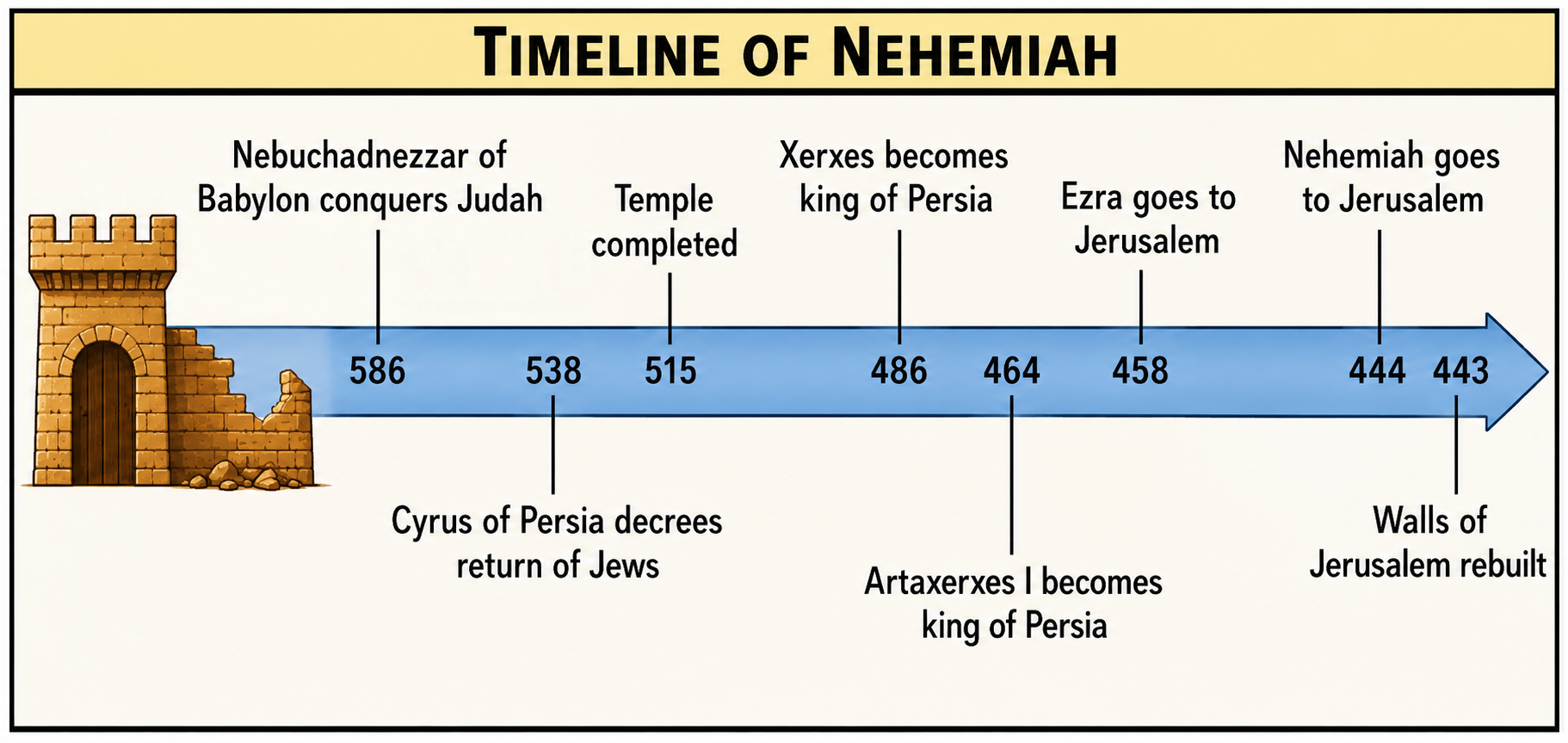
NEHEMIAH UNDER CONSTRUCTION
JUST A FEW NOTES NOW
WILL FINISH IF THE LORD WILLS
Nehemiah 3:1 Then Eliashib the high priest arose with his brothers the priests and built the Sheep Gate; they consecrated it and hung its doors. They consecrated the wall to the Tower of the Hundred and the Tower of Hananel.
- Eliashib (KJV): Ne 12:10 Ne 13:28
- the sheep gate (KJV): This gate is supposed to have immediately communicated with the temple, and to have been called the sheep gate, because the sheep intended for sacrifice passed through it. But, after all which learned men have written on this subject, which is but of little interest, we scarcely know any thing about these gates: what they were, why called by these names, or in what part of the wall they were situated, beyond what may be learned from the parallel passages. Ne 12:39 Joh 5:2+
- sanctified it (KJV): Ne 12:30 De 20:5+ Ps 30:1 *title Pr 3:6,9+
- the tower (KJV): Ne 12:39 Jer 31:38+ Zec 14:10+
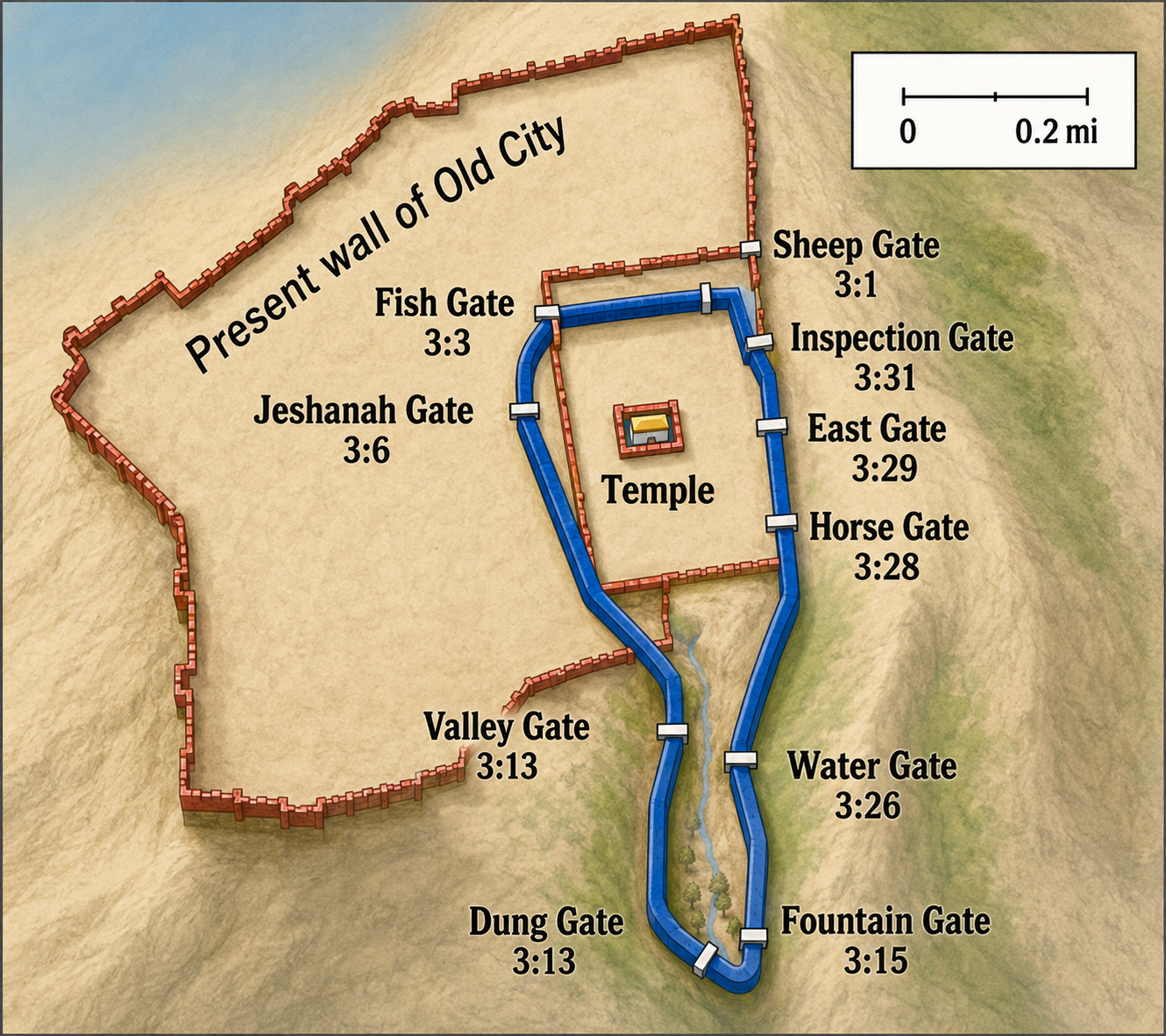
NEHEMIAH'S JERUSALEM
Then Eliashib the high priest arose with his brothers the priests and built the Sheep Gate; they consecrated it and hung its doors. They consecrated the wall to the Tower of the Hundred and the Tower of Hananel.
Believer's Study Bible - The expression "Eliashib the high priest" occurs here and in v. 20. Eliashib, the son of Joiakim, was the grandson of Jeshua (12:10, 11), who returned from Babylon with Zerubbabel (Ezra 2:2; Ezra 3:2). He allied himself with Tobiah (13:4), probably by marriage. His grandson likewise joined with the family of Sanballat, and came into conflict with Nehemiah (13:28). The "Tower of the Hundred," together with the "Tower of Hananel" at the northeast corner of the wall, was located between the Fish Gate, near the modern Damascus Gate, and the "Sheep Gate" near the pool of Bethesda (so named because sheep were brought in here to be sacrificed). Proceeding west to east along the north wall, one would pass both towers, which were evidently located close together.
Brian Bell - Intro: God’s Work Done God’s WayWhat is the largest project you have worked on? Build your own home? Remodel? Put in your yard? 3-tier wedding cake?
Re-read 2:17,18 - & the people responded incredibly.
What positive experiences do you have in working w/others to accomplish a task?
What was your worst experience with Team-Work?
We all need our leadership skills honed.
Whether we are administrating a building project; organizing family chores; running a business; managing a church, or fellowship group; coaching a soccer team, or are the President of the U.S. trying to pull together National unity…we all need leadership skills.
Nehemiah touches on at least 4 dynamics of effective leadership:
- The relationship of the leader to God (Neh 1)
- The relationship of the leader to his Earthly Superiors (Neh 2:1-8)
- The relationship of the leader to his Workers under him/her (Neh 2:9-20)
- The relationship of the leader to the Work itself (Neh 3)
We will see in this chapter an incredible feat of organization on Nehemiah’s part.
The lists are not a dull recital of forgotten names(like yellow pages); they preserve the story of heroic people played who played their part in the continuity of the people of God.
GOD’S WORK DONE GOD’S WAY
Jerusalem in time of Christ [temple mnt, pool of Siloam, Herod’s palace]
Map: Start at the top (north wall) Sheep Gate, he moves counter clock-wise, endsup where he started (see vs.1,32). [10 gates (repair 6), 4 towers] [North Wall vs.1-5. W 6-12. So 13,14. S/E 15-27]
Also, (1b) Tower of the 100 & of Hananael was important because it was the most vulnerable to attack. explain Valleys…
The rest was protected by 3 Valleys: Kidron, Hinnom, & Tyropoeon.
PRIORITIZING THE TASK
This was well prayed through (ch.1) & well thought through (ch.2).
Ask. Why start here? (sheep/sacrifices came in here)
So what does Nehemiah do first? Making sure the important part of the temple worship, sacrifice for the sins of the people, is taken care of first. Making sure priorities are in order.
400yrs later Jesus would walk through this gate in Jn.5, Pool of Bethesda
And as the Passover Lamb going to the cross.
Prioritize, put God first - We can do this today by lifting up the person of JC.
As Paul said, HIM we proclaim (Col.1:28). One may disassociate Buddha from his teaching, Confucius and others from theirs, but Christ was His teaching.
MANAGEABLE SECTIONS
Don’t underestimate the task.
This wall was about 2 ½ miles long.
A good leader assesses the situation, then breaks it down into doable chunks (whether it’s cleaning your child’s room, or the garage)
This also affixes responsibility for each part of the task.
GETTING EVERYONE INVOLVED
Everyone took a piece of the wall. Team-work w/41 groups.
When it comes to the work of the Lord, there’s no place for spectators or self-appointed advisers and critics; there’s always room for workers.
(10) Assigned to work in front of your house. Why?
Be more personally involved. More highly motivated (protection for your family). Not have to waste travel time. In case of attack, wouldn’t leave your post, stay & protect your family. It was a real family affair, utilizing all available talents. Convenience & motivation.
If your section doesn’t get done in front of your house…it’s like the neighbor in your track whose grass is not mowed, weeds are a foot high, shrubs all grown over. It is noticed by all the neighbors (positive peer pressure) [buy in here]
So Priests by the Temple (1) & by their houses (28); the temple servants by their work (26); Jedaiah in front of his house (10); Benjamin & Hasshub (23).
No long commute to work. Home for lunch? This would ensure good work… why? How good would you build the wall of defense to your city, in front of your house, where your kids play?
Let’s see who helped…just construction workers? Nope.
Priests, Levites, temple servants, rulers, common people, men from far away cities/commuters (vs.2, + 7 other cities mentioned), gatekeepers (29), guards, farmers, union men (vs.8 goldsmiths & perfumers), merchants (32), women (daughters vs.12), bachelors/singles (23).
We see then the diverse people God used for this task. Each one was needed to do their part.
The greatest ability in the kingdom of God, is availability and dependability.
Note how many times next to him, beside him. God’s looking for Unity not Uniformity
The huge redwood trees in our state are considered the largest things on earth the tallest trees in the world. Some of them are 300’ high and over 2500 years old. One would think that the trees have a tremendous root system reaching down hundreds of feet into the earth. The redwoods actually have a very shallow system of routes, but they all intertwine. They’re locked to each other. When storms come or the winds blow, the redwoods stand. They are locked to each other. [Good picture of how the church should function today]
Unfortunately today the church is like a football game…You have 30,000 spectators who badly need some exercise & 22 men who badly need rest. 80/20 principle.What is your part? What section of the CM wall is yours to work on?
Run that test on your: Talents & abilities, availability & finances.
What does your house look like? Is your family protected? Or, is family your only focus?
Yes 1st serve the Lord at home…but not only at home.
If someone wrote a summary (like ch.3) about who was doing what in our church, would you be listed favorably or unfavorably? Why?
REMEMBER EVERY FARM HAS ITS TURKEYS
So, don’t be discouraged…you’ll never get 100% cooperation.
You notice on all polls that are taken there is always a % for, against & unsure.
See vs.5 the nobles of Tekoah. [little town in Judah]
They didn’t put their shoulders (necks) to the work.
What would keep a ruler from helping out? (Pride. Too low of a job for me to do. My employees can’t see me humble myself to this place, they’ll loose respect for me)
Any areas/jobs that you are too good for?
Would you stop at the Dung Gate & let someone else do that? (13)
(14) Malchijah steps up to the task & look at the contrast to the next verse.
How is your work ethic? Would it be the same answer if I asked your boss?
What are you presently doing to build the body of Christ? To show unity?
How are you helping around the church? In your community? In your world?
EVERY FARM ALSO HAS ITS WORKHORSES
(5a) Not everyone in Tekoah were Turkeys. The men from Tekoah were very hard workers.
See also Neh 3:27. Double duty.
Also it was only said of Baruch that he carefully (or, zealously NIV) repaired his section.Do you do your work zealously to/for the Lord?
In building, in both construction & in the church, there are:
Constructionists (those helping to get the job done) there are
Destructionists (those tearing things down) &
Obstructionists (those who get in the way & create problems for those doing the work).
Make sure you’re in the right group.
Steven Cole - We Won! (Nehemiah 3:1-32)
You are famished. You haven’t eaten for several days, but you have been invited to a banquet. You arrive and are seated with the other guests as huge platters of delicious smelling food are served. But then you discover that you have a rather serious problem: your arms will not bend at the elbow! You can’t get the food from your plate to your mouth! Then you learn that everyone else at the banquet has the same problem! No one can taste this feast unless he decides to go for it face first, like a pig.
But then one guy gets an idea. He reaches down with his fork and gets a mouthful of food. With his stiff arm, he swings it over into his neighbor’s mouth. His neighbor reciprocates and soon everyone is feeding one another and enjoying the banquet.
That’s a rough picture of how God’s people should function. God made us as individuals and we should not deny it. But at the same time, He has made us as interdependent individuals. We are many members, but one body in Christ. He wants us to learn to work together. God Himself is a Trinity. He is one God consisting of three persons, each of which is fully God. The three persons are in perfect unity of being and harmony in working together. God wants His people to reflect His image by working together in unity and harmony.
But that’s easier said than done. How do we do it? Nehemiah 3 provides us with an illustrative answer. It’s an account of the division of labor in rebuilding the wall of Jerusalem under Nehemiah’s leadership. At first glance (and perhaps at second and third glance), it is not an easy passage to preach. One well-known Bible teacher allegorizes the gates in the chapter, assigning a spiritual meaning to each one. The Sheep Gate refers to Christ, the Good Shepherd, where the Christian life must begin. The Fish Gate refers to Christ’s calling us to be fishers of men. The Old Gate means that we should reject all the modern, newfangled ideas and get back to the old paths. Etc.!
Another usually profitable author launches off the verses that mention men working by their houses to deal with the importance of the Christian family. A third mentions the chapter in one sentence and moves on to chapter four. Even C. H. Spurgeon takes the reference to the Broad Wall (3:8) to springboard into a sermon on the need for the church to be separate from the world. While I agree with his point, I fail to see that as the meaning of this text.
Why did God include Nehemiah 3 in Scripture? What does He want us to learn from it? I believe that it’s here to show us the importance of working together to accomplish God’s purpose.
To accomplish God’s purpose, we need a common vision, dedicated leaders, and willing workers who do their part.
These three elements are either explicit or implicit in our text: the common vision to rebuild the wall; Nehemiah as the leader who had instilled that vision; and, all the people who got involved.
1. To accomplish God’s purpose, we need a common vision for the task.
You can’t work together if everyone has a different notion of what you’re trying to accomplish. If one man had thought that the purpose was to construct a decorative fence, but the next guy envisioned a fortress, chaos would have reigned! If they had gotten very far, it would have looked ridiculous. They needed to agree on a common vision so they could work together harmoniously.
Their task was specific and measurable: to rebuild the wall around Jerusalem to provide a defense against their enemies. I envy them in that the project could be completed fairly quickly and everyone could say, “We did it!”
But the church’s task is not so easily attained. Our task is to see the Great Commission fulfilled by proclaiming the gospel to every people group on earth. But more than just evangelism, that task requires raising up churches in every people group that teach their people to obey all that Jesus commanded (Matt. 28:20). And the supreme goal of God’s purpose through His church is that He would be glorified, that His name would be hallowed on earth as it is in heaven.
As we saw in chapter 1, that will happen as His people find their sufficiency and joy in Jesus Christ. As John Piper says, “God is most glorified in us when we are most satisfied in Him.” And so our goal is to spread a passion for God’s glory among the nations by proclaiming the gospel and by helping all His saints to savor Jesus Christ as their greatest joy and treasure. That’s our vision.
Everything we do for the Lord should have that vision in mind, even though it’s not as immediately obvious how every task contributes to the vision. For example, if you get an opportunity to talk to someone about Jesus Christ and he responds to the gospel, that is obviously related to the vision!
But what about cleaning up the kitchen after a church social? Helping with that task probably won’t directly result in many souls being added to the kingdom. But even so, it is a vital task that contributes to the overall cause. If no one chose to do it, it could seriously hinder the well-being of the church! Or, someone could do it with a grumbling spirit, complaining about how insensitive others are who don’t get involved. Or, you can do it with joy in your heart because God has saved you and made you a part of His church. He gets the glory and your life radiates the joy of knowing Jesus Christ.
Again, our overall vision is to spread a passion for God’s glory among the nations by proclaiming the gospel and by helping all of His saints to savor Jesus Christ as their greatest joy and treasure.
2. To accomplish God’s purpose, we need dedicated leaders who can help everyone work toward the common vision.
God accomplishes His purpose through people, but people need leaders to motivate and organize them for the cause. The people listed in Nehemiah 3 had been living there for years. But the wall didn’t get built until God raised up Nehemiah to lead the charge. It’s interesting that Nehemiah is never mentioned in chapter 3 (Neh 3:16 refers to a different man), but his labor is behind the whole chapter. He did at least seven things that good leaders do:
(1) A LEADER MUST NOT MIND IF THE CREDIT GOES TO OTHERS.
Nehemiah didn’t want a huge sign over the main gate or a bronze plaque reading: THE NEHEMIAH MEMORIAL WALL. Rather, Nehemiah was committed to the task. He wanted the wall to be built so that God’s name would be exalted in Jerusalem and His people would no longer be a reproach. Nehemiah knew that God would recognize his efforts. He was laboring to hear “well done” from the Lord (Neh 13:31).
(2) A LEADER MUST MOTIVATE PEOPLE.
The Jews had been back in the land for 90 years, but the wall hadn’t been built. But then Nehemiah came along and got everyone excited about the idea. They went to work and put up the wall in record time, in spite of opposition.
Motivation is a key to productivity. You’ve experienced this. You’ve had a project that didn’t get done for a long time. You procrastinated because you just were not motivated to do it. Then something inside you changed. Maybe it was a deadline: Clean the house before the relatives arrived for a visit. Maybe you saw the value of getting it done. You thought, “I’m tired of looking at a weed-overgrown back yard. I’m going to landscape it.” You got motivated and finished the project rather quickly.
The difficult thing about motivating a group of people is that what motivates some turns off others. Even Nehemiah couldn’t get the nobles of Tekoa to join the project (Neh 3:5). One wise way that Nehemiah motivated the people was to assign many of them to work on the portion of the wall that they had particular interest in. The priests worked on the Sheep Gate (Neh 3:1), where the people would bring sacrifices to the temple. Others repaired the wall in front of their own homes (Neh 3:10, 23, 28-30). They had a personal incentive to do a good job!
(3) A LEADER MUST PLAN AND ORGANIZE.
It is obvious from the smooth operation outlined in Neh 3 that Nehemiah had done some extensive planning and organizing. He had figured out in advance how to go about this huge task. He broke the project down into manageable units. He assigned the available workers to the various units and worked to coordinate them so that everything fit together. As we saw last week, planning and prayer are not opposed to one another, as long as we don’t rely on our plans.
And there is nothing wrong with organization, as long as we are flexible enough to adapt to the strengths and weaknesses of the individuals involved. Sometimes people emphasize that the body of Christ is a living organism, not an organization. While that is true and must not be forgotten, we also should remember that every living organism is highly organized. There is nothing wrong and everything right with organization as long as it furthers the efficient functioning of the organism.
(4) A LEADER MUST DELEGATE.
Nehemiah couldn’t possibly have done all this work by himself. He had to entrust it to the workers and give them the authority to get the job done. Sometimes, to be honest, it is easier to do the job myself rather than to delegate it. But as the job grows in size, the necessity of delegation grows.
Some pastors keep their hand on every aspect of the ministry, and they often burn out. I sometimes baffle people because I don’t have a clue about what is going on in some aspects of the ministry here. I don’t see that as my job. God has given gifts to His people and they are competent to carry on His work. I’m available as a resource if there is a problem. But I do not need to have my hand on everything. I couldn’t do that and get done what God has given me to do. If God has called you to lead, always ask yourself, “Can someone else do this as effectively or more effectively than I can?” By delegating, you involve more workers and you get more done.
(5) A LEADER MUST OVERSEE.
Delegating does not mean dumping or dictating! To dump something on someone and walk away from it is not effective leadership. To dictate every detail is not to delegate with proper freedom. While Nehemiah delegated the work, you can be sure that he went around inspecting the progress, talking to his leaders, helping them keep things moving toward the goal. In Neh 3:20, he notes that Baruch zealously repaired a section of the wall. Apparently, Nehemiah knew not only who was doing what, but also how they were doing it. Baruch did an exceptional job.
The elders are to give oversight to the flock. That involves the balance between giving guidance and counsel as needed, but also giving the freedom to workers to carry out their ministries in accordance with their own gifts and ideas, in line with Scripture and the overall vision.
(6) A LEADER MUST GIVE PROPER RECOGNITION.
Apparently Nehemiah wrote down in detail who was doing what on this project (I can’t imagine him remembering all these names without writing them down!). Some are mentioned as completing more than one section of the wall (Neh 3:4,21; Neh 3:5, 27). But the important thing was not that Nehemiah recognized every worker, but that God recognized them by including their names here. I’ll be honest that I’m always a little nervous to give recognition by name for fear that I’ll forget someone who will get his feelings hurt. But in spite of that, it is proper to give recognition for a job well done.
(7) A LEADER MUST NOT GET DISTRACTED BY THOSE WHO ARE NOT COOPERATIVE.
Nehemiah 3:5 mentions in passing the nobles of Tekoa who refused to join the project, perhaps out of petty pride. To the nobles’ shame, the people of Tekoa built two sections of the wall, and some nobles from other towns rolled up their sleeves and went to work (Neh 3:9, 12). But Nehemiah didn’t expend any energy on the nobles of Tekoa. Rather, he worked with the many willing workers. Those who didn’t get involved were the losers in the long run.
To accomplish God’s purpose, we need a common vision and dedicated leaders. Finally,
3. To accomplish God’s purpose, we need willing workers who do their part.
The people heard Nehemiah’s vision and they responded, “Let’s arise and build” (Neh 2:18). Working together they accomplished what no one could have accomplished individually. Four things:
(1) THE WORKERS WERE WILLING TO COOPERATE AND COORDINATE WITH ONE ANOTHER FOR THE OVERALL CAUSE.
While some worked in front of their own homes (as already noted), many others came from outlying cities to help (Neh 3:2, 5, 7, 13, 14, 16, 17). After the project was through, they returned home without any daily personal benefit. Perhaps they could dwell more securely in their villages with a strong capital in Jerusalem. They would have enjoyed knowing that the temple was secure behind the wall, so that they could go there for the annual feasts. But beyond any personal benefits, they were willing to work for the overall cause, that the name of the Lord and His people would no longer be a reproach among the nations.
Also, they coordinated the project so that all the parts fit together. Each person knew what his task was and did it, but he did it in harmony and conjunction with others. It would not have worked if one guy built his section but didn’t interlock it with the section of the guy next to him. If you’ve ever played with your kids’ interlocking building blocks, you know that each section of a wall must be locked into the next section, or it will fall over. The guys building the gates had to coordinate with the guys building the walls around the gates. In the church, it is not enough to have a bunch of independent ministries alongside each other. We all should work together in supporting the overall cause of Christ.
(2) THE WORKERS WERE WILLING TO COMPLEMENT EACH OTHER FOR THE OVERALL CAUSE.
Everyone couldn’t do the same job. Some worked on the walls. Others worked on the gates. Hanging a large gate is not an easy task! Some were strong enough to carry heavy stones or bricks. Others had to do lighter work. But each worker was important to the cause. As Paul tells us (1 Cor. 12:12-30), the body is not one member, but many. The foot dare not think that it is not a vital part of the body because it is not a hand. And the hand would be foolish to despise the foot. Each part has a specific and important function to fulfill. Each part depends on the other parts in order for the whole body to function properly.
(3) SOME WORKERS WERE WILLING TO WORK OUTSIDE OF THEIR AREAS OF STRENGTH.
The priests (including the high priest) got involved building the Sheep Gate and a portion of the wall (Neh 3:1). They didn’t learn how to do that in seminary! Maybe they had to get some pointers on how to build and hang a gate from some of the men who were experienced in that sort of thing. Some of the city officials rolled up their sleeves and joined their people in the work (Neh 3:9, 12). They didn’t view manual labor as beneath their dignity. Some of the workers were goldsmiths and perfume makers by trade (Neh 3:8). They weren’t used to this kind of rugged labor. They probably had aches in muscles they never knew that they had before this, but they joined in the work. One man made repairs with his daughters (Neh 3:12)! Apparently they did more than made lunch and lemonade!
Sometimes people will say, “I’m not going to work on a cleanup crew because that’s not my spiritual gift.” Your spiritual gift should help you know where to concentrate your efforts, but there are many jobs where we’re all called to pitch in, whether it’s our gift or not. The point of Nehemiah 3 is that everyone got involved. The New Testament is clear that if you’re a Christian, you are in the ministry (service) and you will give an account of your ministry to the Master someday (Matt. 25:14-30). The danger is that the “one-talent” Christian will think that his part is insignificant and he won’t use it for the Master. But the Master expects every servant to use what He has entrusted to him.
(4) SOME WORKERS WERE WILLING TO DO THE LESS GLAMOROUS OR DESIRABLE JOBS.
Malchijah (Neh 3:14) repaired the Refuse (or Dung) Gate. It was at the south of the city, and opened to the Kidron Valley where the people brought all their trash to burn. If he is the same Malchijah mentioned in Neh 3:31, he was a goldsmith by trade, and he also helped out with repairs on another part of the wall. There were probably a lot more volunteers to repair the Fountain Gate than there were for the Refuse Gate! But Malchijah realized that the job needed to get done, and he was willing to do it for the cause.
Conclusion
Years ago I heard a story that I’ve never forgotten because it challenged my cultural mindset with what I believe is a more biblical point-of-view. I’ve shared it with you before, but I tell it again because it illustrates our text so well. Some Western missionaries in a remote area of the Philippine Islands set up a croquet game in their front yard. Several of their Agta Negrito neighbors became interested, and so the missionary explained the rules, gave each one a mallet and ball, and got them going.
As the game progressed, opportunity came for one of the players to take advantage of another by knocking that person’s ball out of the court. The missionary explained the procedure, but his advice puzzled his Negrito friend. “Why would I want to knock his ball out of the court?” he asked. “So you will win!” the missionary explained. The short native, clad only in a loincloth, shook his head in bewilderment. In that hunting and gathering society, people survive not by competing, but by sharing equally in every activity.
The game continued, but no one followed the missionary’s advice. When a player successfully got through all the wickets, the game was not over for him. He went back and gave aid and advice to his fellow players. As the final player moved toward the last wicket, the game was still very much a team effort. Finally, when the last wicket was played, the whole group shouted happily, “We won! We won!”
That’s how the church should function. We should work together cooperatively, not competitively. When one member scores a point, it’s a point for the whole team.
Studying this chapter reminded me of several things at our church. One was the two work days we had to demolish the old facility so that we could remodel. It was a real joy to see all the men working together for a common goal, and we got a lot done. It also brought to mind what happened again just this week, as the ladies came together to orchestrate the annual Craft Sale for missions. Their efforts combine to raise thousands of dollars to further the cause of Christ around the globe. I could also mention AWANA or Sunday School, but I’m likely to leave a worthy ministry out! We all should see these things and shout, “We won!”
But some of you attend services here, but you aren’t serving in any part of the cause. I’m so glad that you come, and I hope that you’re learning and growing. Maybe you’re just taking a much-needed rest, and that’s okay. But if you know Christ, you’re a vital part of the body. At some point, the Lord wants you to get involved in the cause. Here’s how 1 Peter 4:10-11 puts it:
“As each one has received a special gift, employ it in serving one another as good stewards of the manifold grace of God. Whoever speaks, is to do so as one who is speaking the utterances of God; whoever serves is to do so as one who is serving by the strength which God supplies; so that in all things God may be glorified through Jesus Christ, to whom belongs the glory and dominion forever and ever. Amen.”
Discussion Questions
- How can a believer know where in God’s purpose he/she ought to serve?
- Ezra was a godly leader, but he didn’t get the wall built. Should he have tried again, or was it okay for him to focus on other areas and leave the wall to Nehemiah?
- Since none of us can do it all, how do we know when it’s okay to say no to a ministry opportunity?
- Is there a proper place for competition among believers? Give biblical support. When is it out of balance? Should we teach our kids more about cooperation instead of competition?
Matthew Henry - The work was divided, so that every one might know what he had to do, and mind it, with a desire to excel; yet without contention, or separate interests. No strife appears among them, but which should do most for the public good. Every Israelite should lend a hand toward the building up of Jerusalem. Let not nobles think any thing below them, by which they may advance the good of their country. Even some females helped forward the work. Some repaired over against their houses, and one repaired over against his chamber. When a general good work is to be done, each should apply himself to that part which is within his reach. If every one will sweep before his own door, the street will be clean; if every one will mend one, we shall all be mended. Some that had first done helped their fellows. The walls of Jerusalem, in heaps of rubbish, represent the desperate state of the world around, while the number and malice of those who hindered the building, give some faint idea of the enemies we have to contend with, while executing the work of God. Every one must begin at home; for it is by getting the work of God advanced in our own souls that we shall best contribute to the good of the church of Christ. May the Lord thus stir up the hearts of his people, to lay aside their petty disputes, and to disregard their worldly interests, compared with building the walls of Jerusalem, and defending the cause of truth and godliness against the assaults of avowed enemies.
Nehemiah 3:2 Next to him the men of Jericho built, and next to them Zaccur the son of Imri built.
- next unto him (KJV): Heb. at his hand
- the men (KJV): Ne 7:36 Ezr 2:34
- Zaccur (KJV): Ne 10:12
Next to him the men of Jericho built, and next to them Zaccur the son of Imri built.
Nehemiah 3:3 Now the sons of Hassenaah built the Fish Gate; they laid its beams and hung its doors with its bolts and bars.
- the fish gate (KJV): Ne 12:39 2Ch 33:14+ Zep 1:10+
- the beams (KJV): Ne 3:6 Ne 2:8
- the doors (KJV): Ne 6:1 Ne 7:1
Now the sons of Hassenaah built the Fish Gate; they laid its beams and hung its doors with its bolts and bars
Ryrie - Fish Gate (see map). Located in the northern section of the wall, just W of the Tower of Hananel.
Nehemiah 3:4 Next to them Meremoth the son of Uriah the son of Hakkoz made repairs. And next to him Meshullam the son of Berechiah the son of Meshezabel made repairs. And next to him Zadok the son of Baana also made repairs.
- Meremoth (KJV): Ne 3:21 Ne 10:15
- Urijah (KJV): Ezr 8:33, Uriah
- Meshullam (KJV): Ne 10:7
Next to them Meremoth the son of Uriah the son of Hakkoz made repairs. And next to him Meshullam the son of Berechiah the son of Meshezabel made repairs. And next to him Zadok the son of Baana also made repairs.
Believer's Study Bible - The Hebrew word for "made repairs," which occurs throughout ch. 3, means to "make strong," and does not imply restoration to an original condition.
Ryrie - Some men, such as Meremoth, accepted a second allotment of work (cf. vv. 21, 5, 27).
Nehemiah 3:5 Moreover, next to him the Tekoites made repairs, but their nobles did not support the work of their masters.
- the Tekoites (KJV): Ne 3:27 2Sa 14:2+ Am 1:1
- their nobles (KJV): Jud 5:23+ Jer 5:4,5 1Co 1:26+ 1Ti 6:17,18+
- put not (KJV): Jer 27:2,8,12+ Jer 30:8,9+ Mt 11:29+ Ac 15:10+
Moreover, next to him the Tekoites made repairs, but their nobles did not support the work of their masters
Ryrie - The nobles of Tekoa (the birthplace of Amos 10 mi, or 16 km, S of Jerusalem) refused to work, perhaps fearing reprisals from Sanballat. masters (referring to their overlords) or perhaps lord (referring to Nehemiah).
Nehemiah 3:6 Joiada the son of Paseah and Meshullam the son of Besodeiah repaired the Old Gate; they laid its beams and hung its doors with its bolts and its bars.
NEHEMIAH'S JERUSALEM
Joiada the son of Paseah and Meshullam the son of Besodeiah repaired the Old (Jeshanah) Gate; they laid its beams and hung its doors with its bolts and its bars
Believer's Study Bible - The meaning of "Old Gate" is unclear, and thus its location is uncertain. Based on 12:39 and 2 Kin. 14:13, some have identified it with the Corner Gate. The account of rebuilding and repairing begins (v. 1) and ends (v. 32) at the "Sheep Gate" and proceeds counterclockwise.
Nehemiah 3:7 Next to them Melatiah the Gibeonite and Jadon the Meronothite, the men of Gibeon and of Mizpah, also made repairs for the official seat of the governor of the province beyond the River.
- the Gibeonite (KJV): Jos 9:3-27+ 2Sa 21:2+
- Mizpah (KJV): Ne 3:19 2Ch 16:6+
- the throne (KJV): That is, probably, the palace of the Persian governor, west of the Euphrates; the term throne being used to signify any royal abode: for Sir J. Chardin, describing a splendid tent erected by the king of Persia, says "that there was an inscription wrought upon the cornice of the anti-chamber, which gave it the appellation of the throne of the second Solomon." Sitting upon a throne has, however, sometimes been granted to governors. Ne 2:8
Next to them Melatiah the Gibeonite and Jadon the Meronothite, the men of Gibeon and of Mizpah, also made repairs for the official seat of the governor of the province beyond the River.
Believer's Study Bible - The phrase "one of the perfumers" indicates a member of a guild of perfume makers or dealers.
Nehemiah 3:8 Next to him Uzziel the son of Harhaiah of the goldsmiths made repairs. And next to him Hananiah, one of the perfumers, made repairs, and they restored Jerusalem as far as the Broad Wall.
- the goldsmiths (KJV): Ne 3:31,32 Isa 46:6
- of the apothecaries (KJV): Ge 50:2 Ex 30:25+ Ec 10:1+
- fortified (KJV): or, left
- the broad wall (KJV): Ne 12:38
Next to him Uzziel the son of Harhaiah of the goldsmiths made repairs. And next to him Hananiah, one of the perfumers, made repairs, and they restored Jerusalem as far as the Broad Wall.
Nehemiah 3:9 Next to them Rephaiah the son of Hur, the official of half the district of Jerusalem, made repairs.
- the ruler (KJV): Ne 3:12,17
Next to them Rephaiah the son of Hur, the official of half the district of Jerusalem, made repairs
Nehemiah 3:10 Next to them Jedaiah the son of Harumaph made repairs opposite his house. And next to him Hattush the son of Hashabneiah made repairs.
- even (KJV): Ne 3:23,28-30
- Hattush (KJV): Ne 10:4
Next to them Jedaiah the son of Harumaph made repairs opposite his house. And next to him Hattush the son of Hashabneiah made repairs
Ryrie - Those assigned to repair the wall in front of their house would be especially motivated (also Neh 3:23, 28-30).
Nehemiah 3:11 Malchijah the son of Harim and Hasshub the son of Pahath-moab repaired another section and the Tower of Furnaces.
- Harim (KJV): Ne 10:5
- Pahathmoab (KJV): Ne 7:11 Ne 10:14 Ezr 2:6 Ezr 8:4
- other piece (KJV): Heb. second measure
- the tower (KJV): Ne 12:38
Malchijah the son of Harim and Hasshub the son of Pahath-moab repaired another section and the Tower of Furnaces
Ryrie - Malchijah. A restored wrongdoer (cf. Ezra 10:31), he helped build the Tower of Furnaces (SW corner, just N of the Valley Gate, v. 13).
Nehemiah 3:12 Next to him Shallum the son of Hallohesh, the official of half the district of Jerusalem, made repairs, he and his daughters.
Next to him Shallum the son of Hallohesh, the official of half the district of Jerusalem, made repairs, he and his daughters.
Nehemiah 3:13 Hanun and the inhabitants of Zanoah repaired the Valley Gate. They built it and hung its doors with its bolts and its bars, and a thousand cubits of the wall to the Refuse Gate.
- the valley gate (KJV): Ne 2:13
- Zanoah (KJV): There were two towns of the name of Zanoah in the tribe of Judah: see the parallel passages. Ne 11:30 Jos 15:34,56+ 1Ch 4:18+
NEHEMIAH'S JERUSALEM
REFUSE GATE = DUNG GATE
Hanun and the inhabitants of Zanoah repaired the Valley Gate. They built it and hung its doors with its bolts and its bars, and a thousand cubits of the wall to the Refuse (Dung - KJV) Gate
Ryrie - Through the Refuse Gate, at the southern tip of the city near the Pool of Siloam, refuse was carted to the Valley of Hinnom to be burned.
Nehemiah 3:14 Malchijah the son of Rechab, the official of the district of Beth-haccherem repaired the Refuse Gate. He built it and hung its doors with its bolts and its bars.
- the dung gate (KJV): Ne 2:13 Ne 12:31
- the ruler (KJV): Ne 3:9,12,15-18
- Bethhaccerem (KJV): Beth-haccerem was a town of Judah, situated on a mountain, between Jerusalem and Tekoa, according to Jerome on Jer. ch. 6. Dr. Pococke conjectures that the Mountain of the Franks, called also the Mount of Bethulia, from a village of that name near it, west-north-west of Tekoa, is the ancient Beth-haccerem; the position of which seems to agree with the citadel of Herodium, built by Herod, on a moderate-sized hill, sixty furlongs from Jerusalem. Jer 6:1
Malchijah the son of Rechab, the official of the district of Beth-haccherem repaired the Refuse Gate. He built it and hung its doors with its bolts and its bars
Nehemiah 3:15 Shallum the son of Col-hozeh, the official of the district of Mizpah, repaired the Fountain Gate. He built it, covered it and hung its doors with its bolts and its bars, and the wall of the Pool of Shelah at the king’s garden as far as the steps that descend from the city of David.
- the gate (KJV): Ne 2:14 Ne 12:37 2Ch 32:30+
- the ruler (KJV): Ne 3:9,12,14
- Mizpah (KJV): Ne 3:7 Jud 20:1,3+, Mizpeh, Jer 40:6
- Siloah (KJV): Siloah was situated under the eastern wall of Jerusalem, between that city and the brook Kedron, and is described by Chateaubriand as lying at the foot of Mount Zion. Dr. Richardson represents the pool of Siloam as occurring higher up the valley of Jehoshaphat, towards the north, than the well of Nehemiah, a little beyond the village of Siloa, and nearly opposite the tombs of Jehoshaphat and Zechariah. Isa 8:6+, Shiloah, Lu 13:4+ Joh 9:7+, Siloam
- the stairs (KJV): 2Sa 5:6,7+
NEHEMIAH'S JERUSALEM
Shallum the son of Col-hozeh, the official of the district of Mizpah, repaired the Fountain Gate. He built it, covered it and hung its doors with its bolts and its bars, and the wall of the Pool of Shelah at the king’s garden as far as the steps that descend from the city of David.
Nehemiah 3:16 After him Nehemiah the son of Azbuk, official of half the district of Beth-zur, made repairs as far as a point opposite the tombs of David, and as far as the artificial pool and the house of the mighty men.
- the ruler (KJV): Ne 3:9,12,14
- Bethzur (KJV): Jos 15:58+ 1Ch 2:45+ 2Ch 11:7+
- the sepulchres (KJV): 2Ch 16:14+ Ac 2:29+
- the pool (KJV): 2Ki 20:20+ Isa 7:3+ Isa 22:11
- the house (KJV): 1Ki 14:27,28+ 2Ch 12:10,11+ Song 3:7+
After him Nehemiah the son of Azbuk, official of half the district of Beth-zur, made repairs as far as a point opposite the tombs of David, and as far as the artificial pool and the house of the mighty men
Henry Morris - This Nehemiah is different from the Nehemiah who was governor and author of the book. The name "Nehemiah" means "God is the Comforter" and was probably a common name among God-fearing Israelites (Ezra 2:2).
Believer's Study Bible - This Nehemiah is not the governor but another individual from "Beth Zur" (cf. Josh. 15:58+), which lies between Jerusalem and Hebron. Many identify this "pool" as a man-made reservoir constructed by Hezekiah to assure the city a water supply when under siege (2 Chr. 32:30+; Isa. 22:9-11). The "House of the Mighty" may refer to military quarters.
Nehemiah 3:17 After him the Levites carried out repairs under Rehum the son of Bani. Next to him Hashabiah, the official of half the district of Keilah, carried out repairs for his district.
After him the Levites carried out repairs under Rehum the son of Bani. Next to him Hashabiah, the official of half the district of Keilah, carried out repairs for his district
Nehemiah 3:18 After him their brothers carried out repairs under Bavvai the son of Henadad, official of the other half of the district of Keilah.
After him their brothers carried out repairs under Bavvai the son of Henadad, official of the other half of the district of Keilah.
Nehemiah 3:19 Next to him Ezer the son of Jeshua, the official of Mizpah, repaired another section in front of the ascent of the armory at the Angle.
- Jeshua (KJV): Ne 10:9 Ne 12:8
- Mizpah (KJV): Ne 3:15
- the turning (KJV): 2Ch 26:9+
Next to him Ezer the son of Jeshua, the official of Mizpah, repaired another section in front of the ascent of the armory at the Angle
Nehemiah 3:20 After him Baruch the son of Zabbai zealously repaired another section, from the Angle to the doorway of the house of Eliashib the high priest.
After him Baruch the son of Zabbai zealously repaired another section, from the Angle to the doorway of the house of Eliashib the high priest
Nehemiah 3:21 After him Meremoth the son of Uriah the son of Hakkoz repaired another section, from the doorway of Eliashib’s house even as far as the end of his house.
- Meremoth (KJV): Ne 3:4
- Koz (KJV): Ne 7:63 Ezr 2:61
After him Meremoth the son of Uriah the son of Hakkoz repaired another section, from the doorway of Eliashib’s house even as far as the end of his house
Nehemiah 3:22 After him the priests, the men of the valley, carried out repairs.
- the men of the plain (KJV): Ne 6:2 Ne 12:28
After him the priests, the men of the valley, carried out repairs
Nehemiah 3:23 After them Benjamin and Hasshub carried out repairs in front of their house. After them Azariah the son of Maaseiah, son of Ananiah, carried out repairs beside his house.
- over against (KJV): Ne 3:10,29,30
- Azariah (KJV): Ne 10:2
- Maaseiah (KJV): Ne 8:4,7
After them Benjamin and Hasshub carried out repairs in front of their house. After them Azariah the son of Maaseiah, son of Ananiah, carried out repairs beside his house
Nehemiah 3:24 After him Binnui the son of Henadad repaired another section, from the house of Azariah as far as the Angle and as far as the corner.
- Binnui (KJV): Ne 10:9
- another piece (KJV): That which had been left by Azariah, after he had repaired the wall by his own house. It is probable that some of the principal people were either obliged, or voluntarily offered, to repair those parts of the wall which were opposite, or adjacent, to their own houses. The names of those who repaired the walls are commemorated, because it was an undertaking of piety, virtue, and courage, to restore the holy city. Ne 3:11,19,27
- the turning (KJV): Ne 3:20
After him Binnui the son of Henadad repaired another section, from the house of Azariah as far as the Angle and as far as the corner.
Nehemiah 3:25 Palal the son of Uzai made repairs in front of the Angle and the tower projecting from the upper house of the king, which is by the court of the guard. After him Pedaiah the son of Parosh made repairs.
- the king's (KJV): Jer 22:14+ Jer 39:8
- by the court (KJV): Ne 12:39 Jer 32:2+ Jer 33:1+ Jer 37:21 Jer 39:15
- Pedaiah (KJV): Ne 8:4
- Parosh (KJV): Ne 7:8 Ezr 2:3
Palal the son of Uzai made repairs in front of the Angle and the tower projecting from the upper house of the king, which is by the court of the guard. After him Pedaiah the son of Parosh made repairs
Nehemiah 3:26 The temple servants living in Ophel made repairs as far as the front of the Water Gate toward the east and the projecting tower.
- Nethinims (KJV): Ne 7:46-56 Ne 10:28 1Ch 9:2 Ezr 2:43-58
- dwelt (KJV): etc. or, which dwelt in Ophel, repaired unto
- Ophel (KJV): or, the tower. Ne 3:27 Ne 11:21 2Ch 27:3+ 2Ch 33:14+
- the water (KJV): The water gate is supposed to have been that by which the Nethinim brought in water for the use of the temple. Ne 8:1,3 Ne 12:37
NEHEMIAH'S JERUSALEM
The temple servants living in Ophel made repairs as far as the front of the Water Gate toward the east and the projecting tower.
Believer's Study Bible - Ophel was between the central Valley of Jerusalem and the Valley of Jehoshaphat, i.e., Kidron. It was on the slope of the temple hill, which explains the dwelling of temple servants there. On the "Nethinim," see Ezra 2:55-58; Ezra 7:7, notes.
Ryrie Study Bible - Water Gate. On the E; nearby was a tower adjacent to the wall guarding the eastern side of Ophel (i.e., Mount Zion, immediately S of the Temple).
Nehemiah 3:27 After them the Tekoites repaired another section in front of the great projecting tower and as far as the wall of Ophel.
- the Tekoites (KJV): Ne 3:5
- the wall (KJV): Ne 3:26
After them the Tekoites repaired another section in front of the great projecting tower and as far as the wall of Ophel
Nehemiah 3:28 Above the Horse Gate the priests carried out repairs, each in front of his house.
NEHEMIAH'S JERUSALEM
Above the Horse Gate the priests carried out repairs, each in front of his house.
Ryrie - Horse Gate. Near the Temple on the E. Further N was the East Gate, and still further N the Inspection Gate (near the present Golden Gate). Jesus may have entered Jerusalem in His triumphal entry through the Inspection Gate or the East Gate (Matt. 21:10+).
Nehemiah 3:29 After them Zadok the son of Immer carried out repairs in front of his house. And after him Shemaiah the son of Shecaniah, the keeper of the East Gate, carried out repairs.
- the son (KJV): Ne 7:40 Ezr 2:37
- Shechaniah (KJV): Ezr 10:2
- the east gate (KJV): Jer 19:2
After them Zadok the son of Immer carried out repairs in front of his house. And after him Shemaiah the son of Shecaniah, the keeper of the East Gate, carried out repairs
Nehemiah 3:30 After him Hananiah the son of Shelemiah, and Hanun the sixth son of Zalaph, repaired another section. After him Meshullam the son of Berechiah carried out repairs in front of his own quarters.
- another piece (KJV): Ne 3:21
- Meshullam (KJV): Ne 3:4
After him Hananiah the son of Shelemiah, and Hanun the sixth son of Zalaph, repaired another section. After him Meshullam the son of Berechiah carried out repairs in front of his own quarters
Nehemiah 3:31 After him Malchijah, one of the goldsmiths, carried out repairs as far as the house of the temple servants and of the merchants, in front of the Inspection Gate and as far as the upper room of the corner.
- the goldsmith's (KJV): Ne 3:8,32
After him Malchijah, one of the goldsmiths, carried out repairs as far as the house of the temple servants and of the merchants, in front of the Inspection Gate and as far as the upper room of the corner
Nehemiah 3:32 Between the upper room of the corner and the Sheep Gate the goldsmiths and the merchants carried out repairs.
- the sheep gate (KJV): Thus the whole city was surrounded with a wall; for Eliashib began at the sheep gate. Ne 3:1 Ne 12:39 Joh 5:2+
- the goldsmiths (KJV): The word {tzeraphim} may denote smiths, or refiners, or persons that worked in metals of any kind; but it is generally understood of those who worked in gold. From the remotest period of the history of the Jews, they had artists in all the elegant and ornamental trades; and it appears that goldsmiths, apothecaries, and merchants were formed into companies in the time of Nehemiah. Ne 3:8,31
NEHEMIAH'S JERUSALEM
Between the upper room of the corner and the Sheep Gate the goldsmiths and the merchants carried out repairs