Jeremiah 38:2
Jeremiah 38:3
Jeremiah 38:4
Jeremiah 38:5
Jeremiah 38:6
Jeremiah 38:7
Jeremiah 38:8
Jeremiah 38:9
Jeremiah 38:10
Jeremiah 38:11
Jeremiah 38:12
Jeremiah 38:13
Jeremiah 38:14
Jeremiah 38:15
Jeremiah 38:16
Jeremiah 38:17
Jeremiah 38:18
Jeremiah 38:19
Jeremiah 38:20
Jeremiah 38:21
Jeremiah 38:22
Jeremiah 38:23
Jeremiah 38:24
Jeremiah 38:25
Jeremiah 38:26
Jeremiah 38:27
Jeremiah 38:28
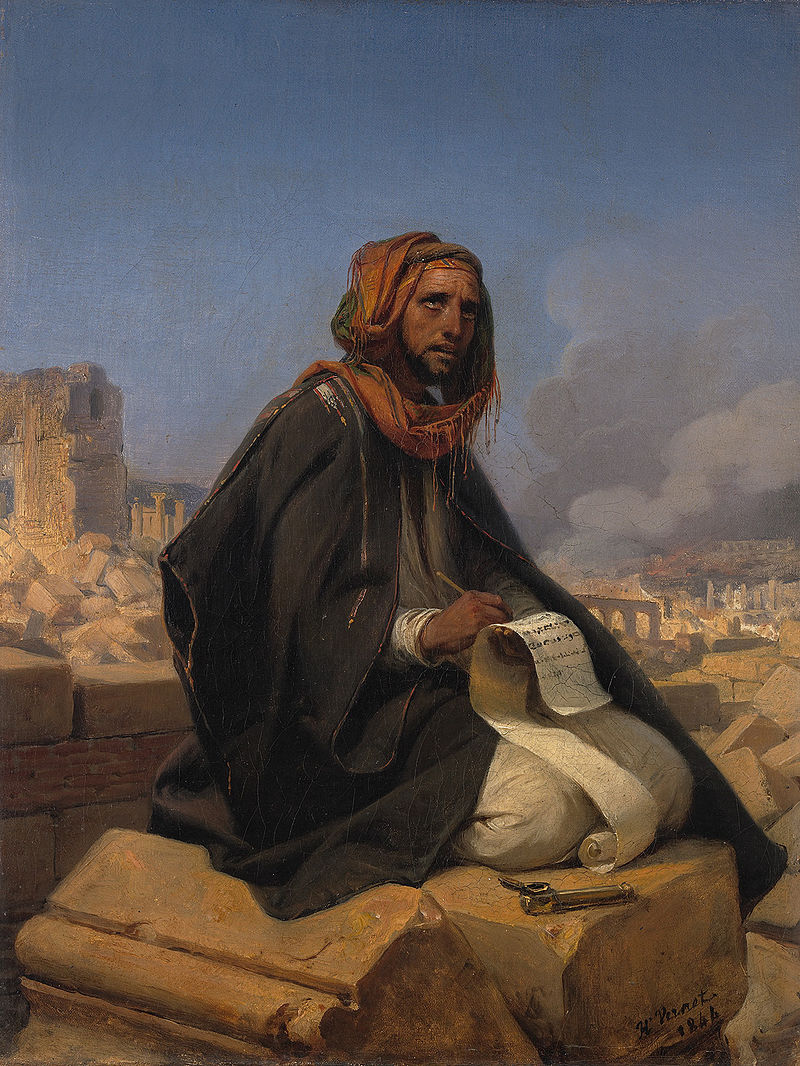
"Jeremiah on the Ruins of Jerusalem"
(Horace Vernet, 1844)
'For I know the plans that I have for you,' declares the LORD,
'plans for welfare and not for calamity to give you a future and a hope.
-- Jeremiah 29:11
(Play beautiful related song by Marty Goetz and Misha)
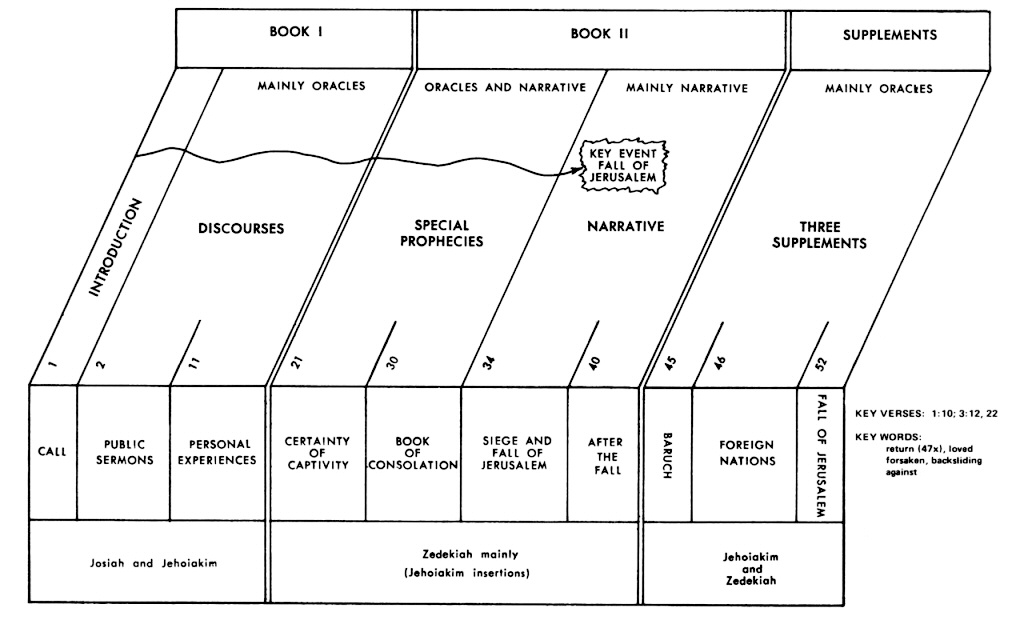
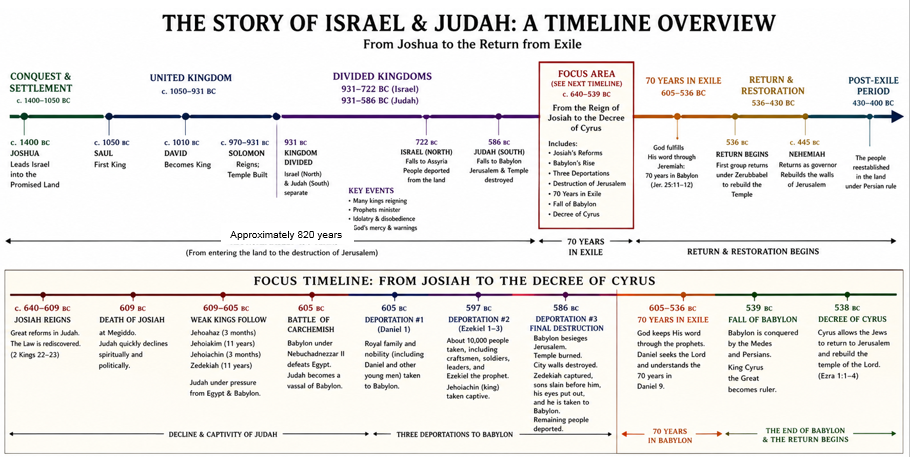
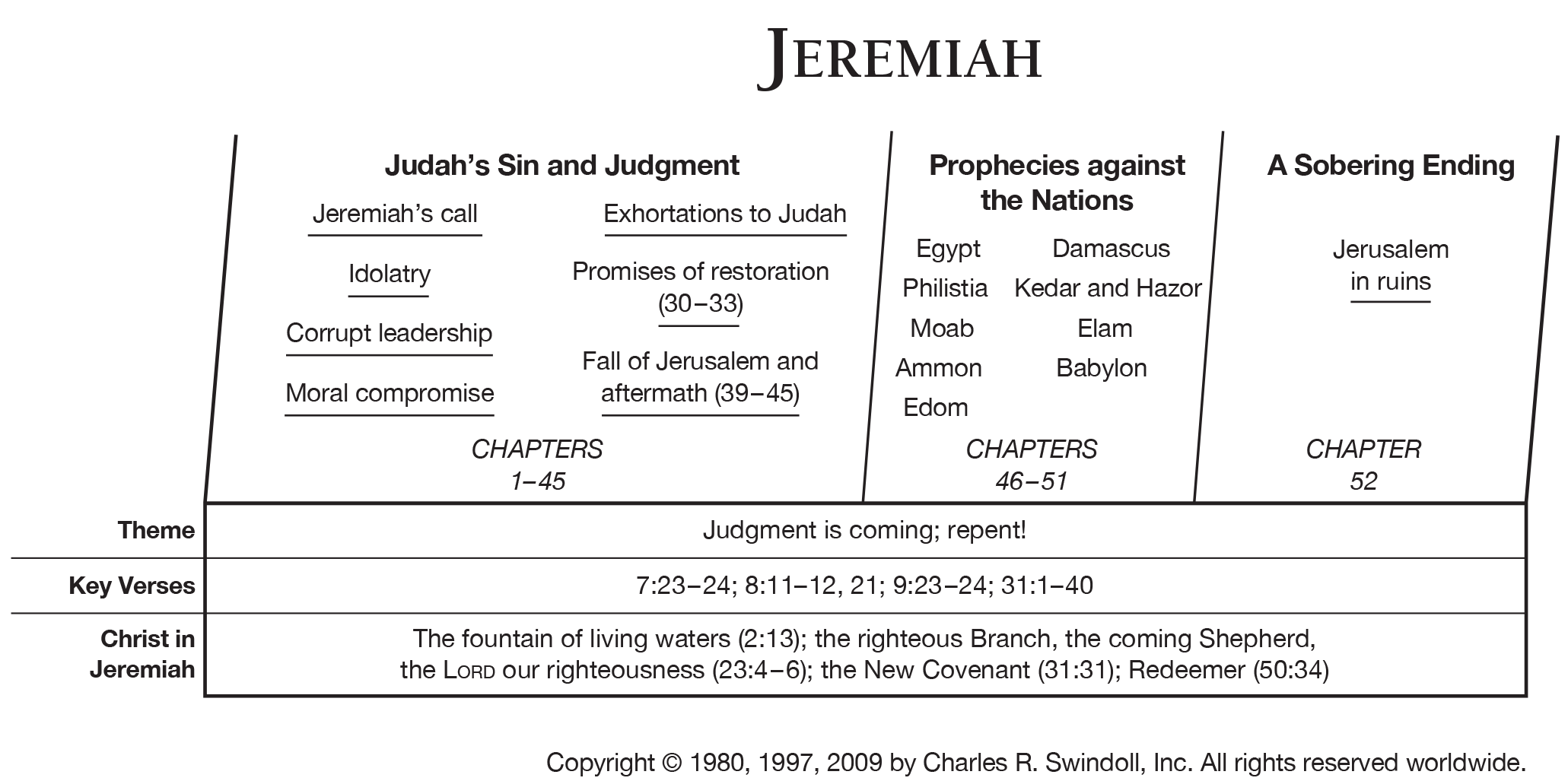
Click chart to enlarge
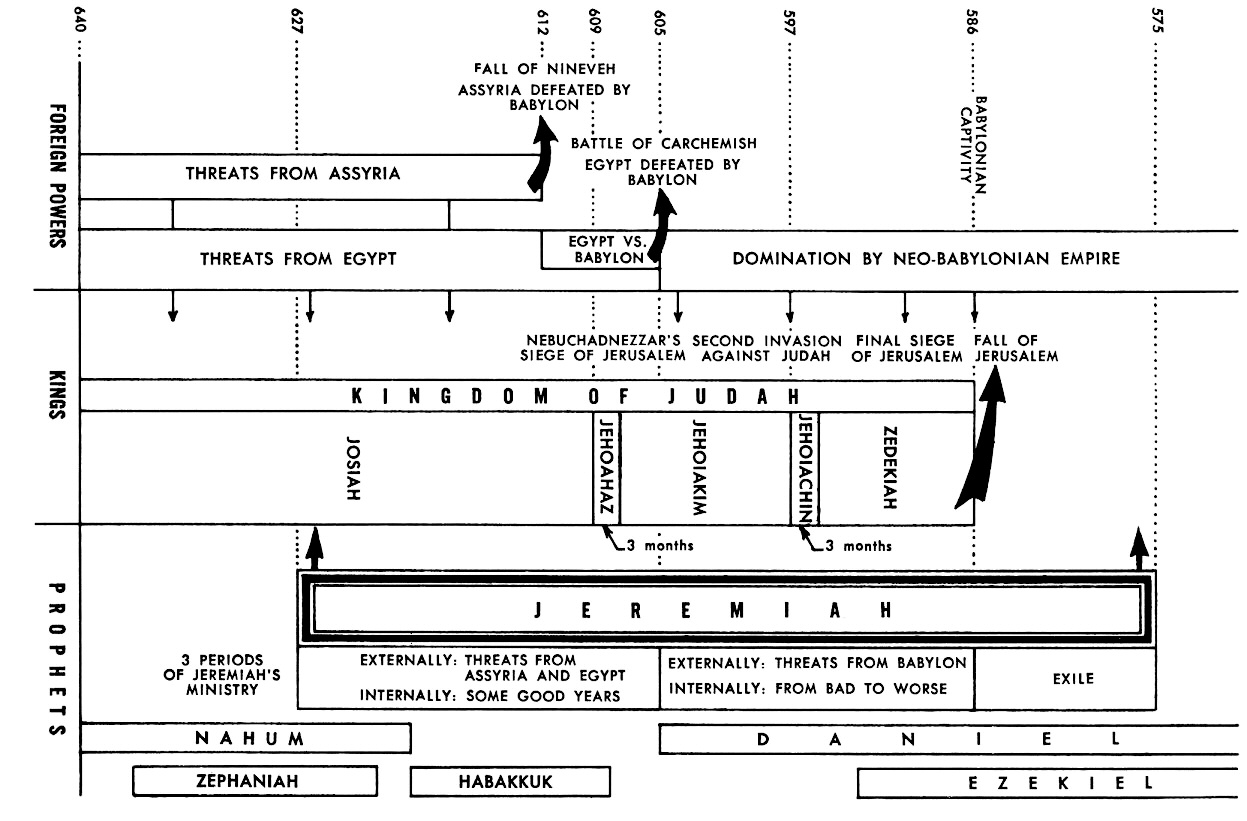
Click chart to enlarge
Chart from recommended resource Jensen's Survey of the OT - used by permission
Jeremiah Chart from Charles Swindoll
| JEREMIAH: "PROPHET TO THE NATIONS" Sin - "I Will Punish" (Jer 9:25) Hope - "I Will Restore" (Jer 30:17) Judah & Jerusalem |
||||||
|
Prophet |
Prophecies to Judah Jer 2:1-45:5 |
Prophecies to the Gentiles Jer 46:1-51:64 |
Prophet's Appendix Jer 52:1-52:34 |
|||
| Prophet's Commission Jer 1:1-19 |
Judah Condemned Jer 2:1-25:38 |
Jeremiah's Conflicts Jer 26:1-29:32 |
Jerusalem's Future Jer 30:1-33:26 |
Jerusalem's Fall Jer 34:1-45:5 |
Nations Condemned Jer 46:1-51:64 |
Historic Conclusion Jer 52:1-52:34 |
| Before The Fall Of Jerusalem Jer 1:1-38:28 |
The Fall Jer 39:1-18 |
After The Fall |
||||
| Call | Ministry | Retrospect | ||||
| Nation of Judah |
Surrounding Nations |
Future of Babylon |
||||
| 627-582 BC Ministered 40+ Years! |
||||||
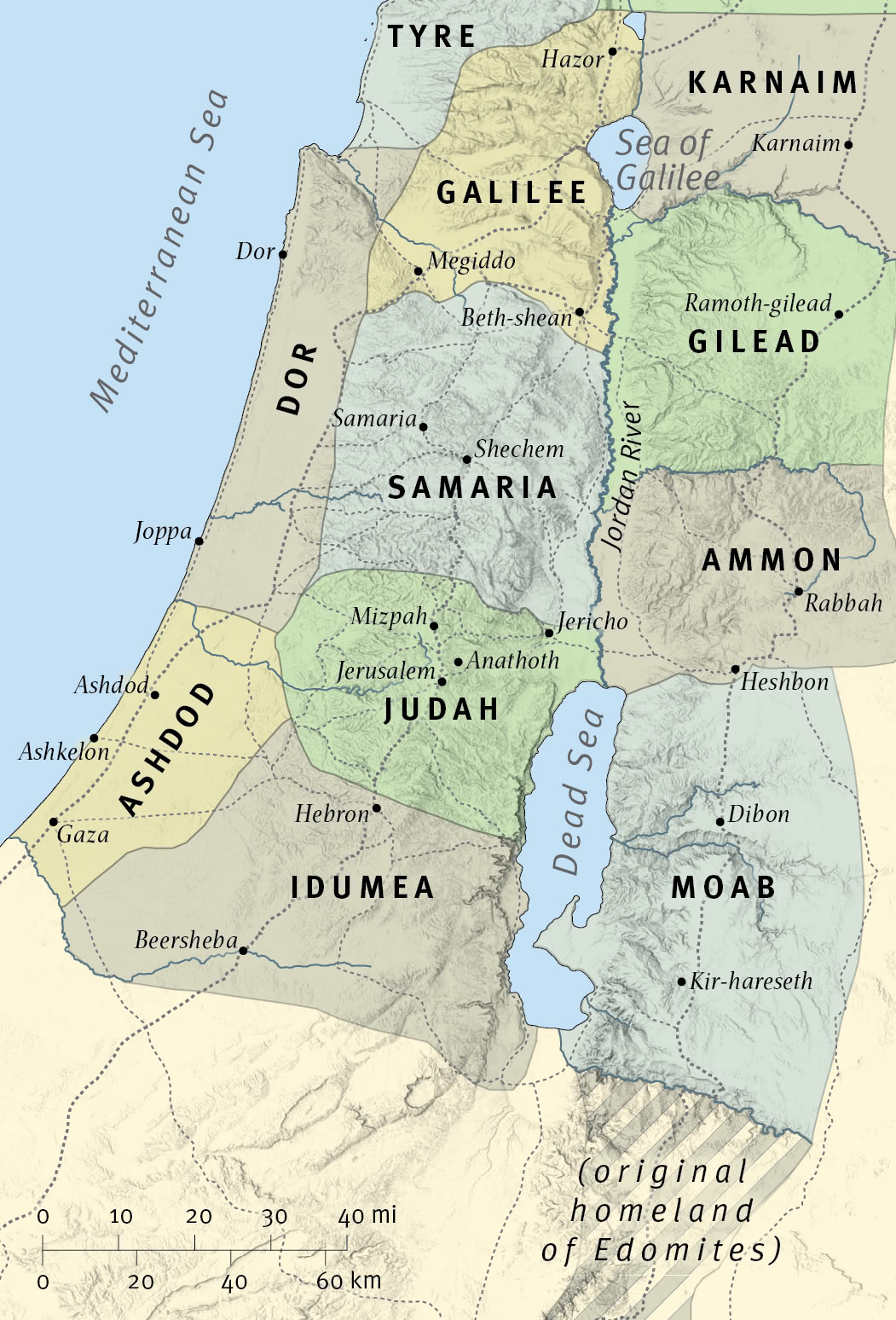
Map of Israel at Time of Jeremiah
Source: ESV Global Study Bible
Jeremiah 38:1 Now Shephatiah the son of Mattan, and Gedaliah the son of Pashhur, and Jucal the son of Shelemiah, and Pashhur the son of Malchijah heard the words that Jeremiah was speaking to all the people, saying,
- Shephatiah: Ezr 2:3 Ne 7:9
- Jucal: Jer 37:4, Jehucal
- Gedaliah the son of Pashhur: Jer 21:1-10,
- Melchiah, 1Ch 9:12,
- Malchijah, Ne 11:12
- heard: Ac 4:1,2,6-10 5:28

A CABAL OF EVIL OFFICIALS
BANDED AGAINST JEREMIAH
Note on picture - A seal inscribed “Jehucal son of Shelemiah,” mentioned in Jeremiah 37:3 and Jeremiah 38:1. ( Gabri Laron/Hebrew University/Dr. Eilat Mazar)
An apropos title for this chapter might be "Truth Telling Can Land You in the Pit!"
While we do not know the exact date of the events in this chapter, it is fairly certaing that the events took place near the end of the siege of Jerusalem which ended in 586 BC.
Now Shephatiah the son of Mattan, and Gedaliah the son of Pashhur, and Jucal the son of Shelemiah, and Pashhur the son of Malchijah heard the words that Jeremiah was speaking to all the people, saying - This group of men most of whom had political influence and access to King Zedekiah banded together in an attempt to silence Jeremiah's prophecies they perceived as negative.
Tremper Longman: We may assume that they are all members of a pro-Egyptian political party, one that looked to Egypt for hope against the Babylonian threat. These men are deeply disturbed by Jeremiah’s preaching. He sounds like an agent of the Babylonians, telling the people that they will survive only if they surrender. (Jeremiah, Lamentations (Understanding the Bible Commentary)
G Campbell Morgan - “Those clamouring princes were unquestionably the politicians who had influenced the king against the word of the prophet; and had advocated resistance to Babylon when Jeremiah had persistently declared its futility.”
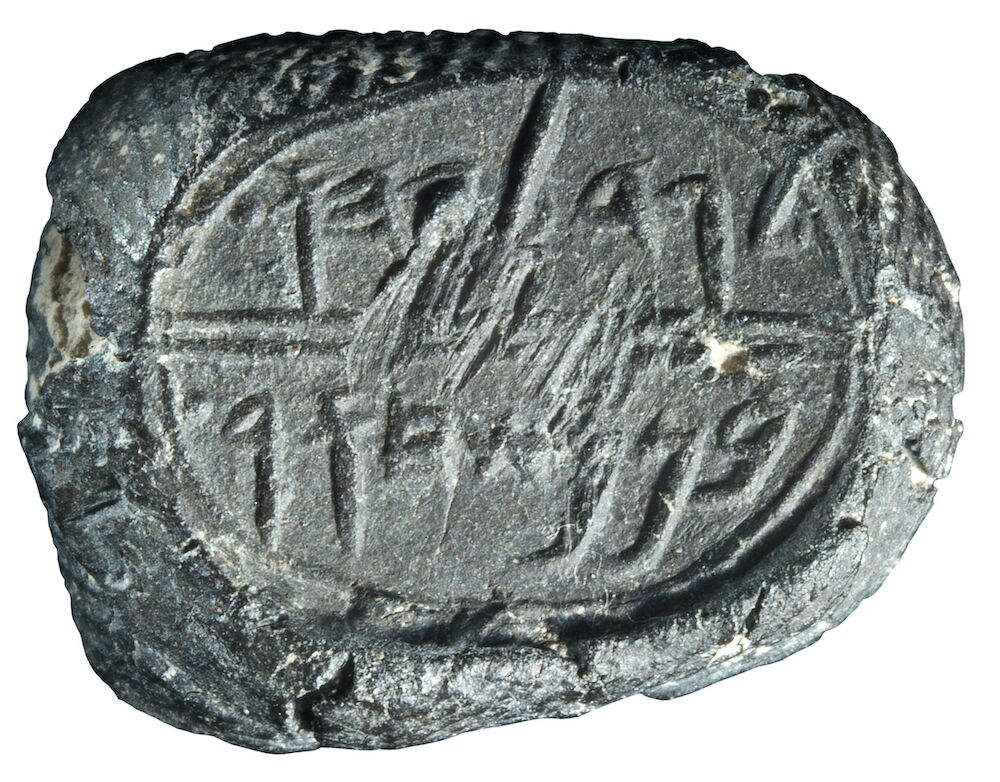
Note on picture:A seal inscribed “Gedaliah son of Pashur,” mentioned in Jeremiah 38:1. (ESTATE OF DR. EILAT MAZAR)
David Guzik - In 2005 and 2008, Dr. Eilat Mazar discovered in the City of David area of Jerusalem two seal impressions in clay (bulla) with the names Gedaliah the son of Pashur and Jeucal the son of Shelemiah – two of the names as recorded here and in Jeremiah 37:3. These are some of the most recent of the 52 specific people of the Hebrew Bible to be confirmed by archaeology. (Biblical Archaeology Review, 41.5, page 18 – September/October 2015)
Bob Utley - "Shephatiah the son of Mattan" He was a member of the royal servants/counselors of Zedekiah during the invasion of Judah by Neo-Babylon. He was an enemy of Jeremiah and thought he was a traitor deserving death. ▣ "Gdealiah the son of Pashhur" He was of the same group and held the same opinion of Jeremiah as did Shephatiah (ED: MAY BE THE SAME PASHHUR WHO BEAT JEREMIAH - Jer 20:1-6). ▣ "Jucal the son of Shelemiah" This man also goes by the name "Jehucal" in Jer. 37:3, where he is a royal messenger sent to Jeremiah and asking him, on the king's behalf, to pray for the crisis situation. ▣ "Pashhur the son of Malchijah" This royal servant is also mentioned in Jer. 21:1, as well as here. He is not the same person as Pashhur the priest, mentioned in Jer. 20:1-6.
John Butler - Saving of Jeremiah. •Desire: the princes requested to kill Jeremiah. •Deference: the king gave in, and they put the prophet in a pit. •Deliverance: Ebed-melech helped get Jeremiah out of the pit. •Declarations: Zedekiah again asked Jeremiah for counsel, and Jeremiah told him again to submit to Babylon. •Dread: Zedekiah was afraid to submit for fear of the Jews mocking him. •Disguising: Zedekiah told Jeremiah not to tell the princes of his inquiry, and this also helped to save Jeremiah from death.
Larry Richards - Pity the Poor, Powerless King (Jer. 38) - Borrow The 365 day devotional commentary
TV found a winner when it decided to feature “Lifestyles of the Rich and Famous.” Ah, how the average person envies them. Wealth! Power! What more could a human being want?
But Jeremiah gave a totally different notion of the “rich and famous” of his time. His portrait of Zedekiah, the King of Judah, takes us behind the scenes, and reveals a man more to be pitied than envied. For this king was powerless!
When officials demanded the death sentence for Jeremiah, Zedekiah shrugged and said, “He is in your hands. The king can do nothing to oppose you” (v. 5). After Jeremiah was rescued by the bold Ebed-Melech, Zedekiah went to Jeremiah alone, to ask what was to happen to him in the future (vv. 14–16). The king was told that if he surrendered he and his family would live (vv. 17–18). Zedekiah hesitated, and shared his fears. The Babylonians might hand him over to the Jews who had deserted to them, and he might be mistreated (v. 19). Again Jeremiah urged surrender (vv. 20–23), but the king only begged that Jeremiah not tell his officials what either of them had said, but simply to say that Jeremiah had begged for his life (vv. 24–28).
What a portrait of a king! Afraid of the future. Terrified of his own officials. Knowing what was right, but totally unable to do it, even if he wanted to. The most powerful man in Judah was the least free to act; the least able to do what was wise and right. Oh, yes, we should pityäthe poor, helpless king. And we should learn from him.
The greatest gift that God can give us is freedom—the freedom to do what we believe is right. Often the rich are too concerned for their wealth to do what they believe is right. They are captives of what they possess. Often the famous are too concerned about what others will think to do what they believe is right. They are captives of their fame. And often the powerful are too concerned about maintaining their position to act on what they believe is right. They are captives, not wielders, of their own power. Only those who care supremely about doing God’s will are truly rich, for they alone are truly free.
Personal Application - Do God’s will, and you will be greater—and happier—than any king.
Quotable
Whenever Richard Cory went down town,
We people on the pavement looked at him:
He was a gentleman from soul to crown,
Clean favored, and imperially slim.
And he was always quietly arrayed,
And he was always human when he talked;
But still he fluttered pulses when he said,
“Good morning,” and he glittered when he walked.
And he was rich—yes, richer than a king
-And admirably schooled in every grace:
In fine, we thought that he was everything
To make us wish that we were in his place.
So on we worked, and waited for the light,
And went without the meat, and cursed the bread;
And Richard Cory, one calm summer night,
Went home and put a bullet through his head.-Edward Arlington Robinson
Jeremiah 38:2 “Thus says the LORD, ‘He who stays in this city will die by the sword and by famine and by pestilence, but he who goes out to the Chaldeans will live and have his own life as booty and stay alive.’
- He: Jer 38:17-23 21:8,9 24:8 27:13 29:18 34:17 42:17,22 44:13 Eze 5:12-17 6:11 7:15 14:21 Mt 24:7,8 Rev 6:4-8
- will live and have: Jer 21:9 39:18 45:5
JEREMIAH'S LIFE AND DEATH
PREDICTION
Thus says the LORD, ‘He who stays in this city will die by the sword and by famine and by pestilence - By now Jeremiah must sound like a "broken record" to his dull hearers! He mentions the three killers of the siege they would soon experience unless they heeded his warning. The first aspect of Jeremiah's message from Yahweh was simple - stay in the city and die in the city.
But - Term of contrast. This introduces Jeremiah's contrasting message. Basically he was proclaiming life and death to the people.
He who goes out to the Chaldeans will live and have his own life as booty and stay alive - Jeremiah promises those who surrender a threefold assurance of preservation: they will live, they will retain their life as spoil, and they will continue to live. With this repeated emphasis, Jeremiah makes the promise unmistakably clear.
Thompson - “The verb ‘go out to’ probably bears the sense ‘desert to’ or ‘give oneself to.’ Jeremiah’s remarks seemed to be traitorous and to give the officials good grounds to arrest the prophet.” (See The Book of Jeremiah - Page 44)
John Mackay: The Lord’s message has been consistent throughout. Of course, by saying that continued resistance was futile and by urging the people to align themselves with the enemy forces, Jeremiah was uttering what the officials could interpret only as high treason. But Jeremiah’s message was not born out of a lack of patriotism, or out of fear for his personal safety, or for some personal advantage. He was the loyal spokesman of the Lord, and he had a deep concern for the well-being of his people. They could not escape the impending catastrophe, but they could rescue their own lives by prompt surrender to the Babylonians. Whatever would then happen to them would not be glorious or grand, but it would be better than the horrors of life in a city under prolonged siege or the massacre that would ensue when the city fell. (Jeremiah: Chapters 21-52)
Bob Utley - "die" This chapter uses this VERB "die" (BDB 559, KB 562) often.
- those who stay in Jerusalem will die, Jer. 38:2
- those who desire to kill Jeremiah, Jer. 38:4
- Jeremiah's death as a result of being put into the empty cistern, Jer. 38:9,26
- desire to save Jeremiah, Jer. 38:10
- Jeremiah's message to Zedekiah, Jer. 38:15
- Zedekiah's response to Jeremiah, Jer. 38:16
- Zedekiah's threat to Jeremiah, Jer. 38:24
- the official's threat to Jeremiah, Jer. 38:25
"live" As "die" is used often in this chapter, so too, "live" (BDB 310, KB 309).
- In Jer. 38:2
- "will live" ‒ The Kethiv (written in the MT) has it as a Qal IMPERFECT but the Qere (suggested in the margin by MT formatters) has a Qal PERFECT, which matches the next two VERBS.
- The second use of "will live" is a Qal IMPERFECT.
- in Jer. 38:17 (twice) are Jeremiah's words to Zedekiah.
- in Jer. 38:20 are Jeremiah's words to Zedekiah.
Obedience to YHWH's message through Jeremiah brings life, but disobedience brings death. In a sense it reflects the "two ways" of Deut. 30:15-20 (cf. Jer. 21:8). Life is a gift of which we are stewards. There are consequences, both temporal and eternal, connected to human choices and actions (i.e. Psalm 1)!
Jeremiah 38:3 “Thus says the LORD, ‘This city will certainly be given into the hand of the army of the king of Babylon and he will capture it.’”
- Jer 21:10 Jer 32:3-5
Related Passages:
Jeremiah 21:10 “For I have set My face against this city for harm and not for good,” declares the LORD. “It will be given into the hand of the king of Babylon and he will burn it with fire.”’
THE FATE OF JERUSALEM
A FAIT ACCOMPLI
Thus says the LORD, ‘This city will certainly be given into the hand of the army of the king of Babylon and he will capture it - The phrase “will certainly be given” emphasizes divine certainty and sovereign action, indicating that Jerusalem is being handed over by Yahweh Himself as an act of judgment, even as He had earlier called Nebuchadnezzar His servant (Jeremiah 27:6). This is not merely a military outcome but a theological decree. The repeated certainty marks that the city has passed the point of no return; its fall is fixed and irreversible. For this reason, Jeremiah’s call to go out to the Chaldeans is not defeatism but obedience to God’s revealed will, since remaining in the city now means certain death, while surrender aligns with the only path of life God has graciously left open
Bob Utley - This city will certainly be given" The prophecy by Jeremiah of the complete destruction of Jerusalem by Neo-Babylon has not changed (cf. Jer. 21:20; 32:28; 34:2; 37:8; 38:3)! The VERB (Niphal IMPERFECT) is matched by the INFINITIVE ABSOLUTE of the same root which denotes certainty! There was no hope for Jerusalem and the temple to be spared.
James Smith - THE VOICE OF THE LORD JEREMIAH 38
“Obey, I beseech thee, the voice of the Lord … so it shall be well with thee” (v. 20). The “voice” here stands for the Word of the Lord. It is—
I. A Warning voice (vv. 3, 4).
II. A Humbling voice (v. 2).
III. A Hated voice (vv. 4–6).
IV. A Convicting voice (secret concern, v. 14).
V. An Assuring voice (v. 20).
VI. An Infallible voice (chap. 39:2–7).
Jeremiah 38:4 Then the officials said to the king, “Now let this man be put to death, inasmuch as he is discouraging the men of war who are left in this city and all the people, by speaking such words to them; for this man is not seeking the well-being of this people but rather their harm.”
- the officials: Jer 26:11,21-23 36:12-16 2Ch 24:21 Eze 22:27 Mic 3:1-3 Zep 3:1-3
- thus: Ex 5:4 1Ki 18:17,18 21:20 Ezr 4:12 Ne 6:9 Am 7:10 Lu 23:2 Joh 11:46-50 Ac 16:20 17:6 24:5 28:22
- welfare: Heb. peace, shalomJer 29:7
THE OFFICIALS ACCUSATION OF
SEDETION AND CALL FOR JEREMIAH'S DEATH
Then the officials (the men in Jer 38:1) said to the king, “Now let this man be put to death, inasmuch as he is discouraging the men of war who are left in this city and all the people, by speaking such words to them - Their reason for calling for Jeremiah's death is that his prophecies were discouraging the morale of the soldiers and citizens saying the city would be captured by the Babylonians.
Philip Graham Ryken on the men of war who are left - “Apparently Judah had lost a few good men. No doubt some had fallen in battle while defending the city walls. Others were slipping out at night by ones and twos and going over to surrender to the Babylonians.” (See Jeremiah and Lamentations: From Sorrow to Hope)
Their charge against Jeremiah and call for his death reveals how deeply they misunderstood both his message and his mission. From their perspective, his repeated prophecies of Babylon’s inevitable victory were undermining morale among the soldiers and weakening the resolve of the people during a time of siege. In their eyes, such words were dangerous and even treasonous, eroding national unity and resistance. Yet in reality, Jeremiah was seeking their true welfare, faithfully proclaiming the Word of God and urging surrender as the only path to life (Jeremiah 38:2). What they labeled as harm was actually God’s merciful warning, while their insistence on resistance would lead to destruction.
For (term of explanation) this man is not seeking the well-being (shalom) of this people but rather their harm - The conjunction “for” introduces their explanation, giving the supposed basis for their demand that Jeremiah be put to death. In their reasoning, his message of surrender to Babylon could only mean that he was working against the nation’s interests. They interpreted his warnings of judgment and his call to go out to the Chaldeans as evidence that he desired the people’s ruin rather than their welfare. Yet their accusation was exactly opposite of Jeremiah's intent, for he was seeking their good by faithfully delivering God’s Word, which offered the only path of survival in the face of certain judgment (Jer 38:2). What they labeled as harm was actually divine mercy, while their own counsel to resist Babylon would lead to death and devastation. The hearts of the officials were so hardened to the truth that it led them reject the very message intended for their preservation as summarized in 2 Chronicles 36:15–16
The LORD, the God of their fathers, sent word to them again and again by His messengers, because He had compassion on His people and on His dwelling place; 16 but they continually mocked the messengers of God, despised His words and scoffed at His prophets, until the wrath of the LORD arose against His people, until there was no remedy.
Faithful messengers of God are very often misrepresented as troublemakers,
when in reality they are speaking truth for the people’s good.
Derek Kidner - It was ironical ... that the leaders who had played the traitor against Babylon, their overlord, were such sticklers for internal loyalty, and that they should profess concern for the peace and welfare (shalom,Jeremiah 38:4 b) of the citizens whom they insisted on sacrificing.
David Guzik - Sometimes God’s servants are accused of the exact opposite of the truth. Moses was a remarkably humble man (Numbers 12:3), but was accused of pride (Numbers 16:3). Job was a righteous man (Job 1:1), but was accused of great sin by his friends (Job 4:7-8, 8:20, 11:14-17). Jesus was the spotless Son of God and was accused of being demon possessed (John 7:20, 8:48, 8:52).
John Trapp adds that " “Ahab charged the like crime upon Elijah (1 Kings 18:17); the Jews upon Christ (Luke 23:2), and afterwards upon Paul ; the heathen persecutors upon the primitive Christians; the heretics still upon the orthodox, that they were seditious, antimonarchical, e(Acts 24:5), etc.”
Bob Utley - "the men of war who are left" Apparently there had been casualties and desertions. The other option is that Judah had no regular military except volunteers who went by the name, "men of war." "this man is not seeking the well-being of this people" These court officials still totally misunderstood Jeremiah and his message. They purposefully ignored the promise of "life" in Jer. 38:2.
THE PERSECUTION OF JEREMIAH Jeremiah 38:4–13 - Croft Pentz
As Christians, we must be willing to suffer for the Lord. The closer we live to God, the more we will suffer. When the Christian decides to live for God, the world will drop him. Note these verses concerning persecution: 2 Timothy 3:12; Matthew 5:10–12; Romans 8:18.
1. REVILED—v. 4
2. PURPOSE OF REVIVAL—vv. 16–17
3. RELEASED—vv. 7–13
Jeremiah “went all the way” with the Lord. He had real backbone. Because of Jeremiah’s stand he suffered much for the Lord. A religion that costs nothing is worth nothing!
Jeremiah 38:5 So King Zedekiah said, “Behold, he is in your hands; for the king can do nothing against you.”
NET King Zedekiah said to them, "Very well, you can do what you want with him. For I cannot do anything to stop you."
NLT King Zedekiah agreed. "All right," he said. "Do as you like. I can't stop you."
- for the king: 1Sa 15:24 1Sa 29:9 2Sa 3:39 19:22 Pr 29:25 Joh 19:12-16
Related Passages:
1 Samuel 15:24 Then Saul said to Samuel, “I have sinned; I have indeed transgressed the command of the LORD and your words, because I feared the people and listened to their voice.
Proverbs 29:25 The fear of man brings a snare, But he who trusts in the LORD will be exalted.
ZEDEKIAH FECKLESS CAVING TO
THE DEMAND OF THE OFFICIALS
So King Zedekiah said, “Behold, he is in your hands; for the king can do nothing against you - Zedekiah, whose habitual compromising had robbed him of courage and confidence in his power, capitulated. And so in his response, Zedekiah capitulates to the pressure of his officials, effectively surrendering Jeremiah into their control. The statement reveals a striking weakness of leadership, as the king who should have upheld justice and protected the Lord’s prophet instead claims impotence, declaring himself unable to oppose them. Whether this reflects political fear, personal indecision, or a desire to avoid conflict, the result is the same: Zedekiah abandons responsibility and permits injustice to proceed. His words expose the tragic irony of a ruler who holds authority yet refuses to exercise it, allowing the voice of truth to be silenced by those who oppose God’s Word (cf. Proverbs 29:25).
Adam Clarke comments “Poor weak prince! you respect the prophet, you fear the cabal, and you sacrifice an innocent man to your own weakness and their malice!”
The intimidation of the princes seem to have paralyzed his will.
He was a king with a wish-bone instead of a back-bone.
-- Arthur Cundall
J A Thompson reminds us that Zedekiah "was, of course, a puppet king, set up by Nebuchadnezzar after the exile of Jehoiachin and possibly not accepted by everyone in the nation as the true king.” (See The Book of Jeremiah - Page 44)
Alexander Maclaren - “Zedekiah is one more instance of the evil which may come from a weak character, and of evil which may fall on it. He had good impulses, but he could not hold his own against the bad men round him.”
The cowardly action of King Zedekiah reminds me of a similar response centuries later by Pilate in Jn 19:15-16...
So they (JEWS SEEKING TO KILL JESUS) cried out, “Away with Him, away with Him, crucify Him!” Pilate *said to them, “Shall I crucify your King?” The chief priests answered, “We have no king but Caesar.” 16 So he then handed Him over to them to be crucified.
Derek Kidner adds that “The king’s capitulation to his princes (Jeremiah 38:5) was perhaps the most abject surrender in biblical history until the moment when Pilate washed his hands before the multitude.” (Jeremiah)
G Campbell Morgan - And Zedekiah the king said, Behold he is in your hand; for the king is not he that can do anything against you.—Jer 38.5.
What a revelation we have in these words of the weakness and wickedness of Zedekiah.' They were spoken to men who were clamouring for the blood of the prophet. These clamouring princes were unquestionably the politicians who had influenced the king against the word of the prophet; and had advocated resistance to Babylon when Jeremiah had persistently declared its futility, and had urged king and nation to yield to the Divine chastisement. There can be no question that Zedekiah had no desire to see Jeremiah destroyed, but he felt that he was helpless, and in these Words confessed his impotence. Thus he sought to fling the blame upon them, and to escape responsibility himself. It was a weak and unwarranted position. If it were true that he had so passed into their hands that he was then helpless, it was also true that his passing into their hands was the result of his original and persistent disobedience to the voice of that great prophet who had exercised his ministry to the people during the whole period of his reign. We have modern examples of this same kind of endeavour to shift a responsibility for wrong done. It cannot be thus shifted. The first sin of yielding to false policies in disobedience to Divine revelation, involves the helplessness which follows, which thus remains personal sin. The truth applies to the individual. That a man was drunk when he murdered his victim does not exonerate him from blame. He had no business to be drunk. That a man is outvoted in the counsel of the ungodly does not excuse him. He has no right to be in association with such counsel.
Bob Utley - This verse shows the weakness of Zedekiah (so too, Saul, cf. 1 Sam. 15:24 and even of David, cf. 2 Sam. 3:39).
Notice the play on "hand."
- "discouraging" of Jer. 38:4 is literally "weakening the hands"
- "all the people" of Jer. 38:4 is literally "the hands of all"
- "he is in your hands" of Jer. 38:5 is an idiom of power over someone
C H Spurgeon - Zedekiah; or, the man who cannot say ‘No’.
‘Then Zedekiah the king said, Behold, he is in your hand: for the king is not he that can do any thing against you.’ Jeremiah 38:5
Zedekiah was a gentleman of a sort wonderfully common nowadays, a good-natured, easy man; his nobles could get anything they liked from him. He would not act amiss of his own self, but he would follow the lead of others, wherever that might lead him. He had a great respect for the prophet; he liked to visit him and know what message he had received from God. He did not wish to have it known that he did consult him, but still he liked to steal away in private and have a talk with the man of God. He much respected the man so sorrowful and yet so heroic. But when the princes came round him, though he was an autocratic king and could have snuffed out those gentlemen at once, yet half-a-dozen of them, all very glib of speech, most easily persuaded him. He did not want to have any bother: he would do anything for a quiet life. ‘The king is not he that can do any thing against you.’ As much as to say: ‘I cannot say “No” to you, if you wish it. I am sorry: I think you are wrong, but I will not insist upon my own idea. If you wish it, although I am a king and perhaps ought not to be so yielding, yet I so much wish to please everybody that I cannot refuse you anything. You may take the prophet and, if you like, you may put him into a dungeon, where he will die. I think you are too hard on a good man, for whom I have a great respect, but at the same time, gentlemen, I am not a man that can stand out against you; and so take him and do as you please.’ This is that king Zedekiah: he does not rule, but is ruled by the princes whom he ought to command. ‘Oh,’ says one, ‘you do not mean to insinuate that we have any Zedekiahs about now?’ I shall not insinuate anything, but boldly declare that these soft, molluscous beings make up a large proportion of the population.
Jeremiah 38:6 Then they took Jeremiah and cast him into the cistern of Malchijah the king’s son, which was in the court of the guardhouse; and they let Jeremiah down with ropes. Now in the cistern there was no water but only mud, and Jeremiah sank into the mud.
- Then they took: Jer 37:21 Ps 109:5 Lu 3:19,20
- into the cistern: Jer 37:16 La 3:55 Ac 16:24 2Co 4:8,9 Heb 10:36
- Malchijah the king’s son, Jer 36:26
- and they let : Jer 38:11,12
- Now in the cistern: (Jer 38:26; Jer 37:20.) Jer 38:22 Ge 37:24 Ps 40:2 69:2,14,15 La 3:52-55 Zec 9:11
Related Passages:
Genesis 37:23-24 (cf TREATMENT OF JOSEPH BY BROTHERS) So it came about, when Joseph reached his brothers, that they stripped Joseph of his tunic, the varicolored tunic that was on him; 24and they took him and threw him into the pit. Now the pit was empty, without any water in it.
JEREMIAH'S MUDDY
CISTERN CONFINEMENT
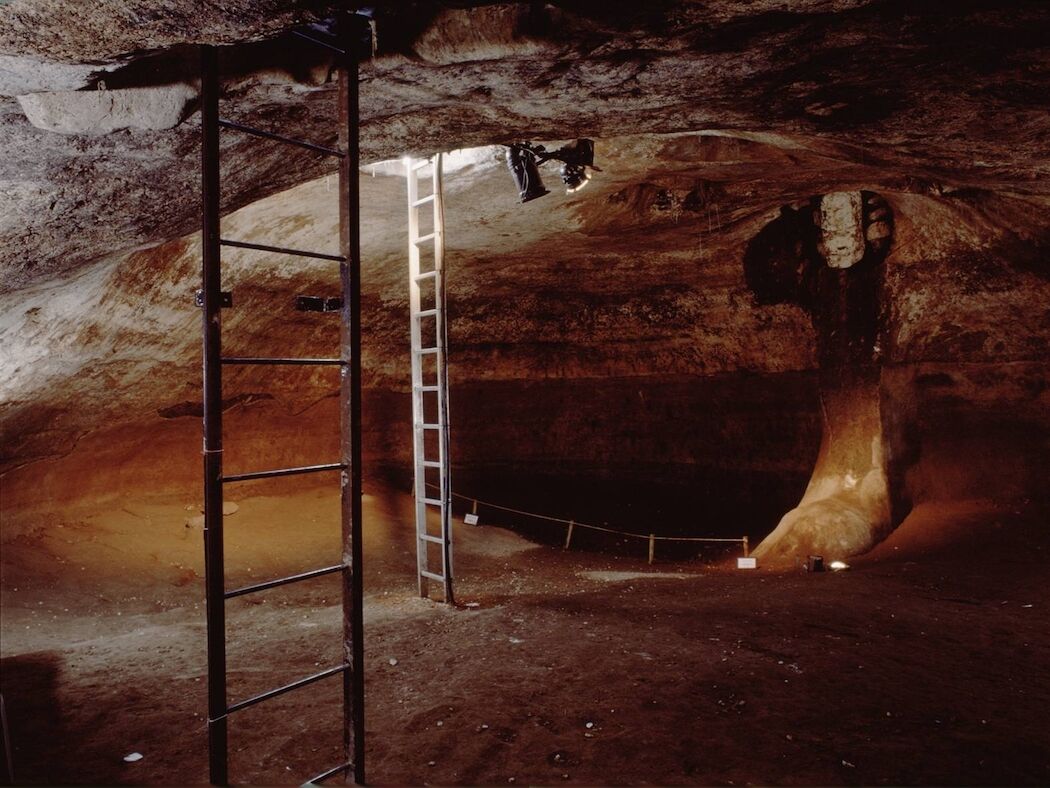
Note on picture - Discovered in 1998 in the City of David, this cistern dates to the First Temple period. Some archaeologists believe it is the dungeon into which Judah’s princes cast the Prophet Jeremiah.
Philip Ryken: A cistern, of course, is an underground cavity for storing rainwater. . . The cisterns of Jeremiah’s day were usually bottle-shaped, with a narrow opening at the top and a large round cavern underneath. They were often fifteen feet deep or more. This cistern must have been a deep one, because Jeremiah needed to be lowered into it by ropes. (See Jeremiah and Lamentations: From Sorrow to Hope)
Then they took Jeremiah - Let's stop there. They could have easily taken Jeremiah and put a sword in him. But they did not want his blood on their hands. Notice they did not throw him in the cistern but lowered him (throwing might have caused a wound and cause him to bleed to death). In this way these hypocrits avoided shedding any of Jeremiah's blood. One is reminded of Jesus' words in Mt 23:34-35
"Therefore, behold, I am sending you prophets and wise men and scribes; some of them you will kill and crucify, and some of them you will scourge in your synagogues, and persecute from city to city, that upon you may fall the guilt of all the righteous blood shed on earth, from the blood of righteous Abel to the blood of Zechariah, the son of Berechiah, whom you murdered between the temple and the altar.
J A Thompson adds "The final intention of the officials was to bring about Jeremiah’s death without bloodshed (cf. Genesis 37:18-19). He could well die a slow and painful but bloodless death in a cistern.” (See The Book of Jeremiah - Page 44)
And cast him into the cistern of Malchijah the king’s son, which was in the court of the guardhouse - This action follows King Zedekiah handing Jeremiah over to the officials, and it reveals the evil intent to silence the prophet without a formal hearing. Generally a cistern was a deep, rock-hewn pit used to store water, but this one was empty, containing only mud at the bottom, making it a slow, miserable and cruel means of death by starvation. The mention of “Malchijah the king’s son” likely refers to a royal official connected to the palace complex, indicating that this took place within a secured area, “the court of the guardhouse,” where prisoners were held. Thus, Jeremiah is transferred from confinement to a life-threatening situation, not because of any crime, but because he faithfully proclaimed God’s Word. This event highlights the depth of Judah’s spiritual rebellion, for not only die the leaders reject the message, they also sought to destroy the messenger. They were fulfilling the pattern described in 2 Chronicles 36:16, where God says His messengers were mocked, despised, and mistreated.
R K Harrison on cistern - “Most houses in Jerusalem had private cisterns (cf. 2 Kings 18:31; Proverbs 5:15) for storing water collected from rainfall or from a spring. They were usually pear-shaped with a small opening at the top, which could be covered over if necessary to prevent accidents or contamination of the water.” (Jeremiah and Lamentations: An Introduction and Commentary)
And they let Jeremiah down with ropes - There were no stairs and no ladder so that once he was let down he was incarcerated for good.
Now in the cistern there was no water but only mud, and Jeremiah sank into the mud - This stark description underscores the severity and cruelty of his situation. The cistern was designed to hold water but at this time was a filled with thick, clinging mire and filth, turning it into a place of slow suffering rather than immediate death. Jeremiah’s sinking into the mud conveys both physical helplessness and emotional distress, as he would have been trapped, unable to free himself, surrounded by darkness, isolation, and the looming threat of starvation. Anyone who has ever stepped into deep mud can begin to grasp the suffocating, immobilizing sensation, but here it is intensified by confinement and abandonment. One can hardly even imagine the sorrow of heart and loneliness of spirit felt by Jeremiah as he was left to languish without food or water in the mire. The scene vividly illustrates the cost of faithful obedience, as God’s prophet is rejected and left to perish, yet it also sets the stage for divine intervention, showing that even in the lowest and most desperate circumstances, the Lord has not abandoned His servant (cf. Psalm 40:2). One wonders if Jeremiah recalled Yahweh's promise in Jer 1:8 “Do not be afraid of them, For I am with you to deliver you,” declares the LORD."
Bob Utley - "the king's son" This was an official title, not necessarily a blood relationship, but probably someone of the royal family (cf. Jer. 36:26). "Jeremiah sank into the mud" Josephus adds the tradition that it was up to his neck (Antiq. 10.7.5) (ED: THIS WOULD LEAVE HIM GASPING FOR AIR AS THE MUD HINDERED HIS ABILITY TO INSPIRE AND EXPIRE!). He was meant to die there (cf. Jer. 38:4). The "mud" would have been the sediment which had collected in the bottom of a cistern. Cisterns caught and stored the runoff of rain water.
Josephus Antiquities 10.7.5 - But for the King himself, he was not at all irritated against Jeremiah: such was his gentle and righteous disposition. Yet that he might not be engaged in a quarrel with those rulers, at such a time, by opposing what they intended, he let them do with the Prophet whatsoever they would. Whereupon, when the King had granted them such a permission, they presently came into the prison, and took him, and let him down with a cord into a pit full of mire, that he might be suffocated, and die of himself. So he stood up to the neck in the mire, which was all about him; and so continued. But there was one of the King’s servants,13 who was in esteem with him; an Ethiopian by descent; who told the King what a state the Prophet was in; and said, that his friends and his rulers had done evil in putting the Prophet into the mire, and by that means contriving against him, that he should suffer a death more bitter than that by his bonds only. When the King heard this, he repented of his having delivered up the Prophet to the rulers; and bid the Ethiopian take thirty men of the King’s guards, and cords with them, and whatsoever else they understood to be necessary for the Prophet’s preservation; and to draw him up immediately. So the Ethiopian took the men he was ordered to take, and drew up the Prophet out of the mire, and left him at liberty [in the prison.]
TSK on the cistern: This dungeon, which seems to have belonged to one of Zedekiah's sons, appears to have been a most dreadful place; the horrors of which were probably augmented by the cruelty of the jailor. "The eastern people," observes Sir J. Chardin, "have not different prisons for the different classes of criminals; the judges do not trouble themselves about where the prisoners are confined, or how they are treated, considering it merely as a place of safety; and all that they require of the jailor is, that the prisoner be forthcoming when called for. As to the rest, he is master to do as he pleases; to treat him well or ill; to put him in irons or not; to shut him up close, or hold him in easier restraint; to admit people to him, or to suffer nobody to see him. If the jailor and his servants have large fees, let the person be the greatest rascal in the world, he shall be lodged in the jailor's own apartment, and the best part of it; and on the contrary, if those that have imprisoned a man give the jailor greater presents, or that he has a greater regard for them, he will treat the prisoner with the greatest inhumanity." This adds a double energy to those passages which speak of "the sighing of the prisoner," and to Jeremiah's supplicating that he might not be remanded to the dungeon of Jonathan.
John Walton (page 671) - imprisoned in a cistern. A staging area for troops would have had a cistern to store rainwater during the dry months. Since this stage of the siege of Jerusalem took place during the normally rainy winter months of 588-587, the fact that a narrow-necked limestone cistern was available as a prison and was empty of water attests to the larger population in the city and the desperate situation they faced. The quagmire at the bottom of the cistern, however, would have prevented Jeremiah from resting and would have been extremely unhealthy. Since the king was afraid to execute Jeremiah, he may have been relying on disease or malnutrition to rid him of the prophet (see Ps 79:11).
Jeremiah 38:7 But Ebed-melech the Ethiopian, a eunuch, while he was in the king’s palace, heard that they had put Jeremiah into the cistern. Now the king was sitting in the Gate of Benjamin;
- Ebed-melech: Jer 39:16-18
- Ethiopian: Jer 13:23 Ps 68:31 Mt 8:11,12 20:16 Lu 10:30-36 13:29,30 Ac 8:27-39
- eunuch: Jer 29:2 34:19 2Ki 24:15
- the king’s palace: Jer 37:13 De 21:19 Job 29:7-17 Am 5:10
Related Passages:
Jeremiah 20:2 Pashhur had Jeremiah the prophet beaten and put him in the stocks that were at the upper Benjamin Gate, which was by the house of the LORD.
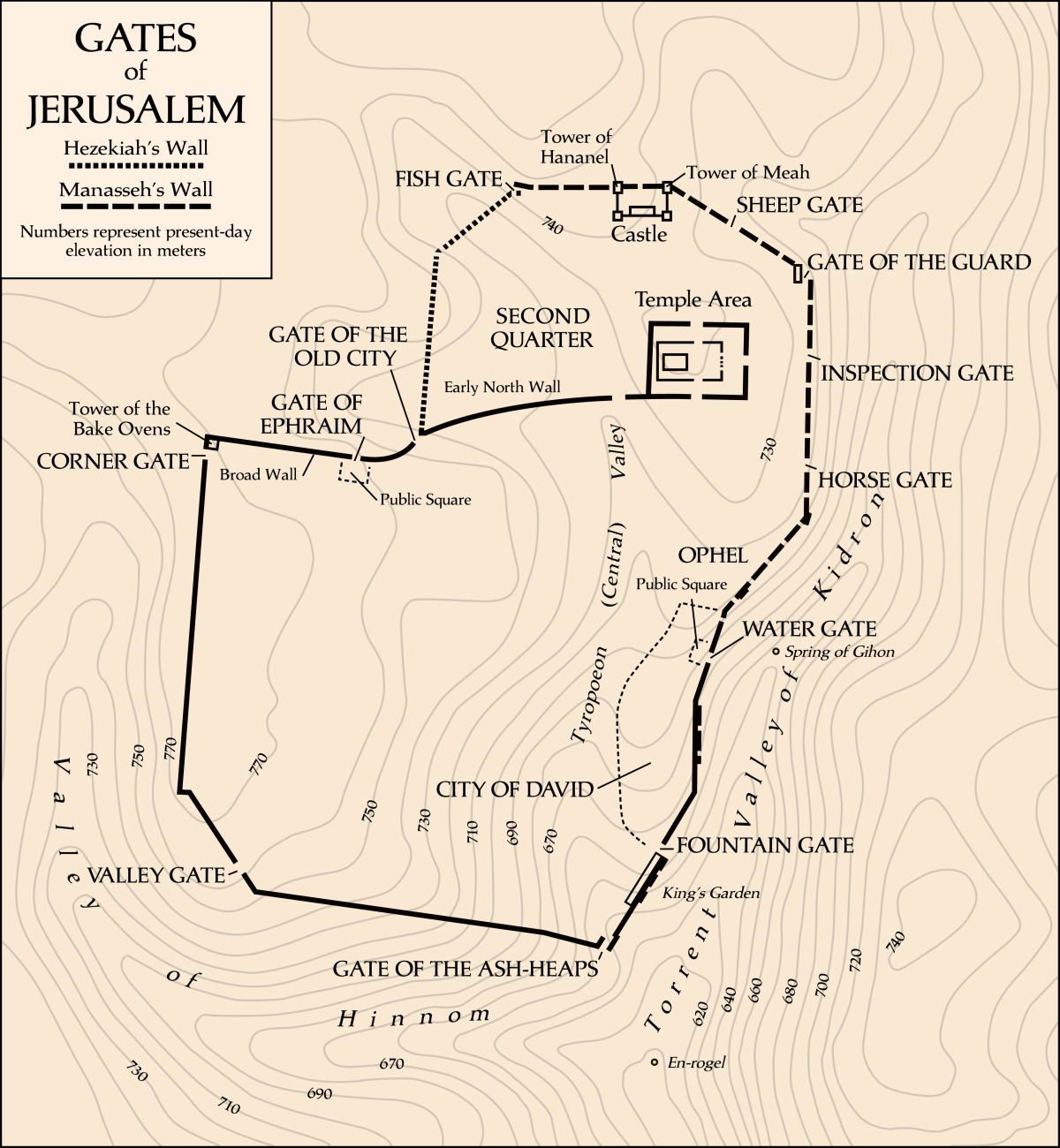
Gates of Jerusalem - Gate of Benjamin most likely Sheep's Gate (see note)
A FOREIGNER HEARS OF
JEREMIAH'S AFFLICTION
But - Term of contrast. What's being contrasted?
Ebed-melech (means "servant of the king") the Ethiopian, a eunuch (saris/sariys), while he was in the king’s palace - So here we see God's provision for delivering His servant by sending a foreigner who was willing to help Jeremiah, while his own people seek to get rid of him! Since Ebed-melech means servant of the king we may not know his true name (but we will in heaven!)
John Trapp on Ebed-melech - “A stranger, but (as that good Samaritan in the Gospel) more merciful than any of the Jewish nation, who gloried in their privileges.”
Bob Utley - "Ebed-melech" This term (BDB 715) is literally "servant of the king." It is not a name but a title also found in other Semitic cultures. This man helps Jeremiah and is rewarded with his life (cf. Jer. 39:16-18). ▣ "Ethiopian" This (BDB 469 I) is often translated "Cushite" (cf. Jer. 13:23), which denotes a person from the nation just south of Egypt. This was a foreign servant/official in the Judean palace. ▣ "a eunuch" This term can be translated "official" (BDB 710). Physical castration was often involved (cf. Isa. 56:3-5), but not always (i.e. Potiphar in Gen. 39:1ff).
Heard that they had put Jeremiah into the cistern - How did he hear? The text does not say, but clearly it was facilitated by the providence of God, for Yahweh had made a promise to His servant Jeremiah in Jer 1:8 "Do not be afraid of them, For I am with you to deliver you,” declares the LORD." Now let's watch Yahweh follow through on His word of promise!
Now the king was sitting in the Gate of Benjamin - The Gate of Benjamin (see note) was one of the city gates on the north side of Jerusalem, most likely the "Sheep Gate," facing the territory of Benjamin, the direction from which Babylonian forces approached. City gates in the ancient Near East were not merely entry points but functioned as places of judgment, administration, and public decision-making (cf. Dt 21:19; Ru 4:1–2). Thus, when it says the king was “sitting” there, it indicates that King Zedekiah was apparently acting in his official capacity, overseeing legal matters or hearing cases. The setting is significant because it shows the king outwardly exercising authority in a public place of justice while, at the same time, he was internally weak and indecisive regarding Jeremiah, whose life was in danger (Jer 38:4–6). In short, the phrase portrays the king positioned at the seat of judgment, yet failing to uphold true justice, highlighting the contrast between his official role and his moral compromise.
THE GATE OF BENJAMIN: In Old Testament as in later times, some of the gates appear to have received different names at various times. Thus the Sheep Gate, at the northeastern angle, appears to be identical with the Gate of Benjamin or Upper Gate of Benjamin (Jer 20:2; 37:13; 38:7); the prophet was going, apparently, the nearest way to his home in Anathoth. In Zec 14:10 the breadth of the city is indicated, where the prophet writes, “She shall be lifted up, and shall dwell in her place, from Benjamin’s gate unto the place of the first gate, unto the corner gate.” (International Standard Bible Encyclopedia)
John Walton (page 671) - Cushite official in the palace. Since Ebed-Melech had a Hebrew name (meaning “servant of the king”), it is likely that he was either an Ethiopian slave or a freedman who had come into royal service. The easy manner in which he confronted Jeremiah’s guards and King Zedekiah as he sat in judgment in the city gate suggests both familiarity with the king and that his counsel was held in high esteem. The designation “eunuch” may indicate either his capacity as a royal official and/or his physical condition (see comment on Is 56:4-5). 38:7. king sitting at the Benjamin Gate. There is ample biblical and archaeological evidence available for kings having regularly sat in judgment at the city gate. For example, the Iron Age gate area at Tell Dan contains a raised platform with stone pedestals for a canopy that served as a place of justice. Absalom argued against his father David’s political ability when he charged that the king was not sitting at the gate hearing the cases of his people (2Sa 15:2-6).
Jeremiah 38:8 and Ebed-melech went out from the king’s palace and spoke to the king, saying,
THE ETHIOPIAN EUNUCH
BEGINS HIS INTERVENTION
And - Note this "hinge word" is significant in this context for it demonstrates that Eded-melech was not just a "hearer" (of Jeremiah's predicament) but a "doer!"
Ebed-melech went out from the king’s palace and spoke to the king, saying - Given the political animus toward Jeremiah, Ebed-melech may have been risking his life in interceding for Jeremiah. We learn from Jer 39:15-18 that Ebed-melech was a believer in Yahweh and his faith resulted in God saving his life...
Now the word of the LORD had come to Jeremiah while he was confined in the court of the guardhouse, saying, 16“Go and speak to Ebed-melech the Ethiopian, saying, ‘Thus says the LORD of hosts, the God of Israel, “Behold, I am about to bring My words on this city for disaster and not for prosperity; and they will take place before you on that day. 17 “But I will deliver you on that day,” declares the LORD, “and you will not be given into the hand of the men whom you dread. 18 “For I will certainly rescue you, and you will not fall by the sword; but you will have your own life as booty, because you have trusted in Me,” declares the LORD.’
Philp Ryken: Ebed-Melech was a nobody. He was a Cushite, to being with. Cushites were Gentiles, black Africans from Ethiopia or Sudan. So Ebed-Melech was an alien in Judah. Plus, he was a eunuch in the royal palace. Perhaps he was in charge of Zedekiah’s harem, but in any case he as a slave, and very likely an emasculated slave. We may not even know his name, for “Ebed-Melech” simply means “servant of the king.” It was not much of a name. Even if it was the man’s proper name, it shows that he had not identity of his own. His status as a human being was completely defined by his relationship to his owner (ED: LOVE THIS! THIS IS A BELIEVER'S IDENTITY - Ro 1:1, Ro 6:22). (See Jeremiah and Lamentations: From Sorrow to Hope
Bob Utley - "spoke to the king" Either he was a trusted official who had the ear of the king or he took advantage of public court to speak.
Jeremiah 38:9 “My lord the king, these men have acted wickedly in all that they have done to Jeremiah the prophet whom they have cast into the cistern; and he will die right where he is because of the famine, for there is no more bread in the city.”
- these men have acted wickedly: Jer 38:1-6 Es 7:4-6 Job 31:34 Pr 24:11,12 31:8,9
- for there is no more bread: Jer 37:21 52:6
Related Passages:
Proverbs 24:11-12NLT Rescue those who are unjustly sentenced to death; don't stand back and let them die. 12 Don't try to avoid responsibility by saying you didn't know about it. For God knows all hearts, and he sees you. He keeps watch over your soul, and he knows you knew! And he will judge all people according to what they have done.
Proverbs 31:8-9 Open your mouth for the mute, For the rights of all the unfortunate. 9Open your mouth, judge righteously, And defend the rights of the afflicted and needy.
EBED-MELECH'S PREDICTION
OF JEREMIAH'S DEMISE
My lord the king - Ebed-melech acknowledged the authority of King Zedekiah, calling him "lord."
John Trapp points out "What a brave man was this, to oppose so many princes, and so potent that the king himself dared not displease them! It was God’s Holy Spirit that put this mettle into him, and gave him the freedom of speech
These men have acted wickedly in all that they have done to Jeremiah the prophet whom they have cast into the cistern - Clearly Ebed-melech did not agree with the treatment of Jeremiah. His statement acted wickely is a bold accusation before King Zedekiah. The phrase acted wickedly exposes their conduct not merely as harsh or unjust, but as morally evil in the sight of God, since their treatment of Jeremiah was a direct rejection of Yahweh's messenger and message! By emphasizing “in all that they have done,” Ebed-melech indicts the entire course of their actions, culminating in the cruel act of casting Jeremiah into a cistern, effectively leaving him to die slowly from starvation and exposure. This statement reveals that Ebed-melech clearly recognized both the injustice and the spiritual seriousness of what had been done. In contrast to the silence and compromise of others, Ebed-melech stands out as a man of courage and conviction, willing to confront authority and defend God’s prophet, demonstrating that even in a corrupt environment, one who fears the Lord (cf Jer 39:15-18) will discern evil rightly and act decisively against it (cf. Pr 31:8–9).
And he will die right where he is because of the famine, for there is no more bread in the city - The eunuch realized Jeremiah would soon be at death's door because of the famine. The fact that there was a famine and a short supply of bread identifies these events as taking place in the last 2 years of Zedekiah's reign when Nebuchadnezzar had laid seige to Jerusalem.
R K Harrison - “The suggestion that food supplies were exhausted was somewhat exaggerated in the heat of the moment, since stocks lasted until just before the city fell (Jeremiah 52:6f.).” (Jeremiah and Lamentations: An Introduction and Commentary)
Bob Utley - The reason for Jeremiah's feared death is stated as famine. Conditions are much worse now than in Jer. 37:21.
Jeremiah 38:10 Then the king commanded Ebed-melech the Ethiopian, saying, “Take thirty men from here under your authority and bring up Jeremiah the prophet from the cistern before he dies.”
- Then the king commanded: Es 5:2 8:7 Ps 75:10 Pr 21:1
ZEDEKIAH COMMANDS
JEREMIAH'S RESCUE
Then - This notes progression in the narrative, in this case a somewhat surprising course of action by King Zedekiah, considering that Jeremiah had not given him comforting prophecies! Surely this is the hand of Yahweh as described in Pr 21:1 "The king’s heart is like channels of water in the hand of the LORD; He turns it wherever He wishes." Zedekiah is clearly a weak leader for he agreed first with his officials and now he agrees with his servant!
The king commanded Ebed-melech the Ethiopian, saying, “Take thirty men from here under your authority and bring up Jeremiah the prophet from the cistern before he dies - Here we see King Zedekiah’s urgent attempt to correct an injustice done to the prophet Jeremiah. The large number of men suggests both the difficulty of the task and the possibility of resistance from those who had imprisoned Jeremiah. By granting Ebed-melech authority, the king showed a measure of trust in this foreign servant, even as his own leadership remained weak. The phrase “before he dies” underscores the life-or-death urgency of the situation.
John Calvin - Let us be courageous when it is necessary, though we have little hope of a favorable outcome. Ebedmelech might have thought that his attempt to help Jeremiah would be in vain, however strenuously he pleaded for the prophet. He might then have relinquished the task instead of boldly undertaking it.
Likewise, those who think too much about a difficult task often talk themselves into inactivity. They think, “What effect can you possibly have? You are only one person, and your enemies are many. If the king himself has been forced to yield to the anger of wicked men, how can you as an individual have the confidence to resist them? Furthermore, such tumult will be raised that you will perish in it. Meantime, these wicked men will perhaps stone the unhappy man whom you are trying to help.”
All these thoughts might have occurred to Ebedmelech, and he thus might have desisted from helping. But we see that he rested not in his own confidence but in God’s favor.
Let us remember his example and hope beyond hope when God requires us to do something. When faith and duty demand anything from us, we must close our eyes to all obstacles and go forward in our work, for all events are in God’s hands alone, and they will happen as he pleases. Our duty is to proceed, even if we think our labors may be in vain and will not bear fruit. Ebedmelech happily succeeds in rescuing the prophet because he acts as a pious and upright man in obeying God.
God will also extend his hand to us, whatever difficulties we encounter, for we shall overcome them by his power and help.
Jeremiah 38:11 So Ebed-melech took the men under his authority and went into the king’s palace to a place beneath the storeroom and took from there worn-out clothes and worn-out rags and let them down by ropes into the cistern to Jeremiah.
- let them: Jer 38:6
EBED-MELECH PREPARES
FOR THE RESCUE
So Ebed-melech took the men under his authority and went into the king’s palace to a place beneath the storeroom and took from there worn-out clothes and worn-out rags and let them down by ropes into the cistern to Jeremiah - The rags would provide padding between the rope and Jeremiah's armpits so he would not be cut.
Jeremiah 38:12 Then Ebed-melech the Ethiopian said to Jeremiah, “Now put these worn-out clothes and rags under your armpits under the ropes”; and Jeremiah did so.
- Put: Ro 12:10,15 Eph 4:32
INSTRUCTIONS FOR
JEREMIAH'S RESCUE
Then Ebed-melech the Ethiopian said to Jeremiah, “Now put these worn-out clothes and rags under your armpits under the ropes”; and Jeremiah did so - This verse highlights the careful compassion shown in the prophet’s rescue. The rags were placed under Jeremiah’s arms to cushion the ropes, preventing injury. This small detail reveals thoughtful mercy, showing that Ebed-melech not only sought to save Jeremiah’s life but also to minimize his suffering, illustrating how genuine compassion attends even to practical needs in acts of deliverance.
Bob Utley - "put these worn-out clothes and rags under your armpits" Apparently a room close by had some worn out clothes that could be used to cushion Jeremiah as he was pulled from the cistern. This shows the man's concern for Jeremiah. This is an eyewitness detail!
J J Knapp - Under the Armholes Jer. 38:12
At the king’s command Jeremiah had been cast into a miry pit because he had proclaimed the truth of God. The Chaldeans had surrounded the city and Jeremiah knew that no escape was possible. Therefore he had counselled the people to surrender to the enemy. God only knew how heavy it was for him to speak like this and to take upon himself the appearance to betray his own people into the hands of the enemy, but he could not hide what had been revealed to him from above. The princes of the king, who did not believe his prophetic mission, judged that such a language would paralyse the moral strength of the people and it was upon their counsel that he had been placed as a prisoner in one of the deep pits. However, an Ethiopian took it up for him with the king and obtained permission to deliver him from the pit. It is moving to take note of the touching tenderness with which this work was accomplished by him. It was not enough for him to lower ropes or cords into the pit and to pull the prophet up with them. He was afraid that the cords might hurt Jeremiah when he would hang down from them in his full weight; therefore he quickly gathered some old torn and worn rags and told the prisoner to put these under his armholes, under the cords, so that the tensely drawn cords would not cut into the weak flesh.
This is a humbling lesson in the practising of charity. So often we have the opportunity to perform works of mercy on behalf of one of our fellow men. The hungry must be nourished, the sick visited, the naked clothed, the strangers given hospitality, the erring made to return, the neglected nursed, the fallen erected. How do we do this work of charity? Do we do it with rough hands and cutting cords? Or do we also have bundled rags to place under the armholes? We can throw the needy an alms with a haughty gesture,—certainly, the poor man is helped by it, but how painful it is, painful like thin cords that cut deep into the flesh. We also could have placed some of the warm love of our hearts with the gift, extending it with a word of compassion or a glance of understanding,—these are the improvised pillows under the armholes.
To be tender in our service so that it shall not hurt! To be loving in the support so that it does not humiliate! To be compassionate in our saving, so that it does not offend! Where can that be learned better than at the feet of Christ? His help for the miserable was both direct and tender. The experience of that merciful and yet so powerful grace alone teaches us to wind the cords in such a way that they will not even for a moment graze the outer skin.
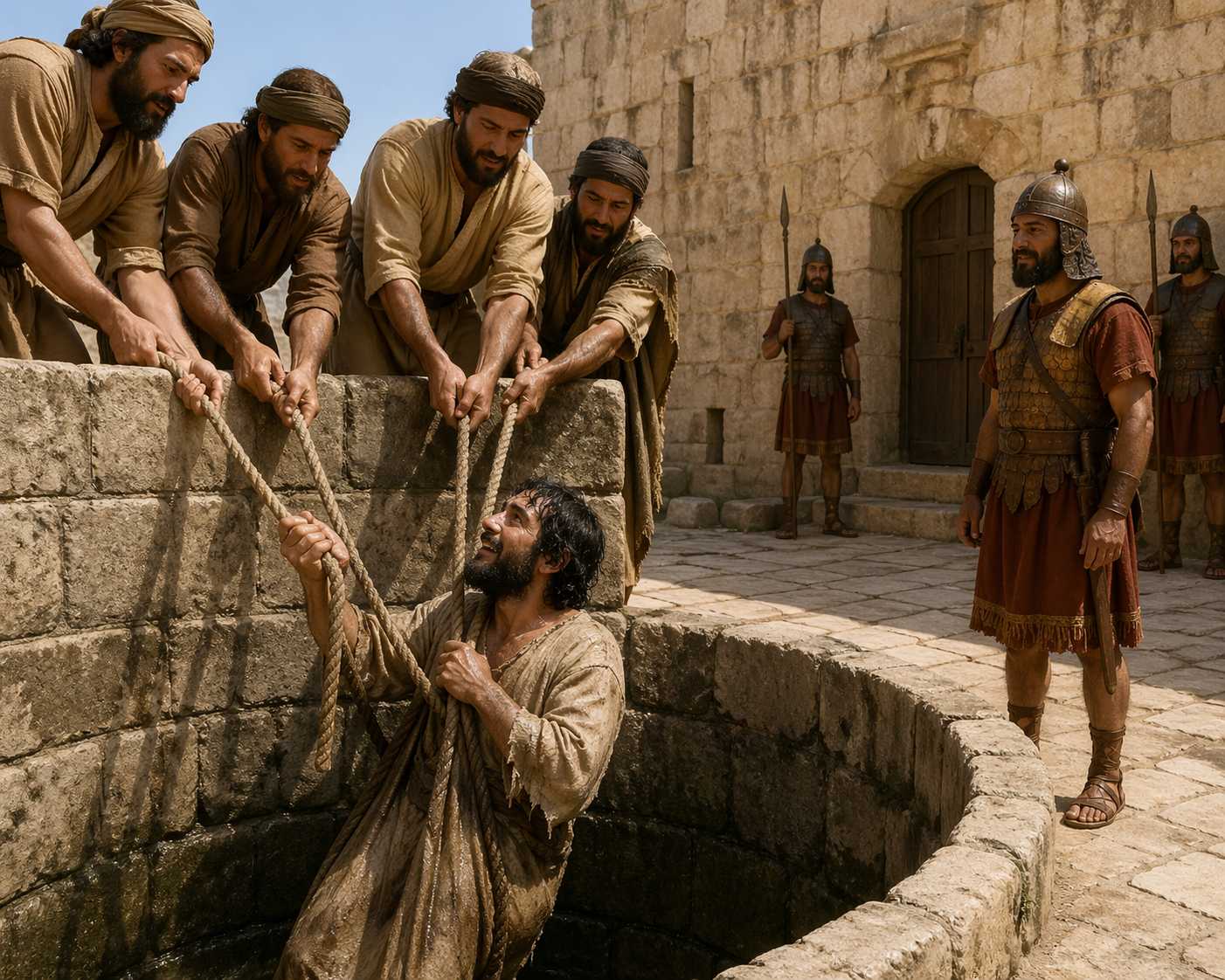
Jeremiah 38:13 So they pulled Jeremiah up with the ropes and lifted him out of the cistern, and Jeremiah stayed in the court of the guardhouse.
- So: Jer 38:6
- Jeremiah: Jer 38:28 37:21 39:14-18 1Ki 22:27 Ac 23:35 24:23-26 28:16,30
JEREMIAH RESCUED AND
TRANSFERRED TO GUARDHOUSE
So they pulled Jeremiah up with the ropes and lifted him out of the cistern, and Jeremiah stayed in the court of the guardhouse - Although Jeremiah was rescued out of the mud from on high but he was still kept in prison in the guardhouse.
He sent from on high, He took me;
He drew me out of many waters.
-- Psalms 18:16
Bob Utley - He was rescued from the cistern but would stay in custody!
Philip Ryken points out that "“Ebed-Melech received the same reward as Jeremiah. When Jerusalem fell, both men were rescued, for God delivers all who trust in him. Like all true servants of the King, Ebed-Melech was saved by faith.” (See Jeremiah and Lamentations: From Sorrow to Hope)
Jeremiah 39:15-18 Now the word of the LORD had come to Jeremiah while he was confined in the court of the guardhouse, saying, 16 “Go and speak to Ebed-melech the Ethiopian, saying, ‘Thus says the LORD of hosts, the God of Israel, “Behold, I am about to bring My words on this city for disaster and not for prosperity; and they will take place before you on that day. 17 “But I will deliver you on that day,” declares the LORD, “and you will not be given into the hand of the men whom you dread. 18 “For I will certainly rescue you, and you will not fall by the sword; but you will have your own life as booty, because you have trusted in Me,” declares the LORD.’”
Jeremiah 38:14 Then King Zedekiah sent and had Jeremiah the prophet brought to him at the third entrance that is in the house of the LORD; and the king said to Jeremiah, “I am going to ask you something; do not hide anything from me.”
- sent: Jer 21:1-2 Jer 37:17
- third, 1Ki 10:5 2Ki 16:18
- I am going to ask: Jer 42:2-5,20 1Sa 3:17,18 1Ki 22:16 2Ch 18:15
Related Passages:
Jeremiah 37:16-17 For Jeremiah had come into the dungeon, that is, the vaulted cell; and Jeremiah stayed there many days. Now King Zedekiah sent and took him out; and in his palace the king secretly asked him and said, “Is there a word from the LORD?” And Jeremiah said, “There is!” Then he said, “You will be given into the hand of the king of Babylon!”
ZEDEKIAH'S CLANDESTINE
CONSULTATION WITH JEREMIAH
Then King Zedekiah sent and had Jeremiah the prophet brought to him at the third entrance that is in the house of the LORD - Zedekiah keeps coming back to the only man whom he could trust. As in Jeremiah 37:16–17, King Zedekiah again sought a private meeting with Jeremiah. This repeated desire for secrecy reveals the king’s inner conflict: though he feared the officials and lacked the courage to act publicly on Jeremiah’s message, he still recognized that the prophet spoke the true word of the LORD. By calling for a private audience, Zedekiah attempts to hear from God without exposing himself to political pressure, illustrating a divided heart that is willing to inquire of the truth in private but unwilling to submit to it in public! (cf. Nicodemus in John 3:2).
And the king said to Jeremiah, “I am going to ask you something; do not hide anything from me - This secret meeting is at least the second with King Zedekiah (Jer 37:17). Do not hide anything from me implies whether the message is good or bad, the king want so hear it. Clearly, Zedekiah had some regard for Jeremiah's prophecies even if he failed to act on them.
Bob Utley - The Anchor Bible Commentary by John Bright says that Jer. 37:11-21 is the first recorded interview of Jeremiah face to face with Zedekiah and Jer. 38:1-28 is a second account.
John Walton (page 672) - third entrance to the temple. This “third” entrance to the temple is only mentioned in this text. However, since Zedekiah wished a very private audience with Jeremiah, no more secure place could be found than the king’s personal entrance to the temple precincts.
David Guzik - There are several similarities between the events of Jeremiah 37 and Jeremiah 38 and some commentators (such as J A Thompson) believe the two chapters describe the same event from different perspectives. Nevertheless, the two chapters (Jeremiah 37 and Jeremiah 38) are more different than alike.
- Different charges made against Jeremiah.
- Different places of incarceration.
- Different manners of rescue.
- Different places of meeting with the king.
- Different conversations with the king.
Given this, it is more likely that they are indeed separate though similar events. Jeremiah was true to his character and Zedekiah was true to his character, so the same drama might have been acted out in similar, yet different ways.
Jeremiah 38:15 Then Jeremiah said to Zedekiah, “If I tell you, will you not certainly put me to death? Besides, if I give you advice, you will not listen to me.”
- Lu 22:67,68
JEREMIAH'S HESITANCY TO
SPEAK TRUTH TO ZEDEKIAH
Besides, if I give you advice, you will not listen to me.” - While this is a simple response to King Zedekiah, it is also in effect a prophecy, for Zedekiah would not listen to Jeremiah's advice. He has not listened before, so why would we expect him to listen now. He did not have a hearing problem but a fatal heart problem. He was stiff necked and hard hearted and would not receive Jeremiah's words which could have saved his soul! Only a humble man would have received Jeremiah's words, but Zedekiah was the antithesis of a humble man. Proverbs 29:1 typifies Zedekiah for it says "A man who hardens his neck after much reproof Will suddenly be broken beyond remedy." Indeed his heart would be broken as he would soon watch his sons put to death before his eyes. And that would be the last thing he would ever see because then he was blinded! That is an example of Pr 29:1 "in spades" as they say!
Parunak: These are the two great concerns that probably keep most of us silent concerning the things of God: fear for what others will think of or do to us, and frustration and discouragement over lack of response when we do speak.
Bob Utley - Zedekiah still holds Jeremiah in a sacred position (i.e. Herod and John the Baptist). (1) meets with him secretly (cf. Jer. 38:16,24-27) (2) but will not act on his words. He wants to know the word of YHWH (cf. Jer. 38:14) but he will not do it (James 1:22). He apparently feared the Neo-Babylonian army and a faction within Judah (cf. v. 16).
Jeremiah 38:16 But King Zedekiah swore to Jeremiah in secret saying, “As the LORD lives, Who made this life for us, surely I will not put you to death nor will I give you over to the hand of these men who are seeking your life.”
NET So King Zedekiah made a secret promise to Jeremiah and sealed it with an oath. He promised, "As surely as the LORD lives who has given us life and breath, I promise you this: I will not kill you or hand you over to those men who want to kill you."
NLT So King Zedekiah secretly promised him, "As surely as the LORD our Creator lives, I will not kill you or hand you over to the men who want you dead."
- King Zedekiah swore to Jeremiah: Jer 37:17 Joh 3:2
- that made: Nu 16:22 27:16 Ec 12:7 Isa 57:16 Zec 12:1 Heb 12:9
- of these: Jer 38:1-6 34:20
Related Passages:
2 Chronicles 36:13 He also rebelled against King Nebuchadnezzar who had made him swear allegiance by God. But he stiffened his neck and hardened his heart against turning to the LORD God of Israel.
ZEDEKIAH SOLEMN
PROMISE TO JEREMIAH
But King Zedekiah swore to Jeremiah in secret saying (NET = "and sealed it with an oath"), “As the LORD lives, Who made this life for us - NLT = , "As surely as the LORD our Creator lives," This is a striking confession from a king marked by persistent disobedience. In this oath, Zedekiah rightly acknowledges Yahweh as the giver and sustainer of life, invoking His living presence to validate his words. Yet the statement is a bit ironic/hypocritical, because this same king had previously sworn an oath to Nebuchadnezzar in the name of the LORD and then violated it (cf. 2Ch 36:13; Ezek 17:13–19). Thus, while his lips affirm truth about God, his life has contradicted it, exposing his pattern of inconsistency and unfaithfulness. The verse underscores the sobering reality that acknowledging God with your lips is not the same as submitting to Him with your life.
Strangely, a king who did not live as the LORD lived
swore an oath, as the LORD lives.
-- David Guzik
NET NOTE - Who made this life - Heb “who has made this life/soul/ breath [נֶפֶשׁ, nefesh] for us.” The Hebrew term נֶפֶשׁ refers to the living, breathing substance of a person which constitutes his very life (cf. BDB 659 s.v. נֶפֶשׁ 1; 3).
Surely I will not put you to death nor will I give you over to the hand of these men who are seeking your life - Zedekiah makes a double promise of first "no harm" and second "no betrayal." He is saying he would not surrender Jeremiah into the hands of those who intended harm. In other words the king gives Jeremiah a double guarantee of safety of protection from his own authority and protection from external threat. Zedekiah is choosing to guard and protect God's prophet.
Bob Utley - The king promises not to kill Jeremiah (cf. Jer. 38:15-16) and not to turn him over to his officials who want to kill him (cf. Jer. 38:4) Zedekiah swore by the covenant Deity's name ("As the Lord lives") and His creative action ("who gave us life/breath"). Zedekiah was a religious man but a weak, indecisive one!
Jeremiah 38:17 Then Jeremiah said to Zedekiah, “Thus says the LORD God of hosts, the God of Israel, ‘If you will indeed go out to the officers of the king of Babylon, then you will live, this city will not be burned with fire, and you and your household will survive.
NET Then Jeremiah said to Zedekiah, "The LORD, the God who rules over all, the God of Israel, says, 'You must surrender to the officers of the king of Babylon. If you do, your life will be spared and this city will not be burned down. Indeed, you and your whole family will be spared.
NET NOTE - The title “the LORD who rules over all” is a way of rendering the title “Yahweh of armies.” It is an abbreviation of a longer title “Yahweh the God of armies” which occurs five times in Jeremiah (see, e.g., Jer 44:7). The abbreviated title occurs seventy-seven times in the book of Jeremiah. On thirty-two occasions it is further qualified by the title “the God of Israel,” showing his special relation to Israel. On six occasions it is preceded by the title “Lord” (see, e.g., Jer 46:10) and twice it is preceded by the title “the King” (see, e.g., Jer 51:17). Both titles emphasize his sovereignty. Twice it is said that he is the Maker of all things (Jer 10:16; 51:19), and once it is said that He made the earth and the people and animals on it and gives them into the control of whomever he wishes (Jer 27:4–5). On two occasions it is emphasized that he also made the heavenly elements and controls the natural elements of wind, rain, thunder, and hail (Jer 31:35; 51:14–16). All this is consistent with usage elsewhere where the “armies” over which he has charge are identified as (1) the angels which surround his throne (Isa 6:3, 5; 1 Kgs 22:19) and which he sends to protect his servants (2 Kgs 6:17), (2) the natural forces of thunder, rain, and hail (Isa 29:6; Josh 10:11; Jdg 5:4, 5) through which he sends the enemy into panic and “gums” up their chariot wheels, (3) the armies of Israel (1 Sam 17:45) which he leads into battle (Num 10:34–35; Josh 5:14, 15) and for whom he fights as a mighty warrior (Exod 15:3; Isa 42:13; Ps 24:8), and even (4) the armies of the nations which he musters against his disobedient people (Isa 13:14). This title is most commonly found in the messenger formula “Thus says …” introducing both oracles of judgment (on Israel [e.g.,Jer 9:7, 15] and on the nations [e.g. Jer 46:19; 50:18]; and see in general Jer 25:29–32). It emphasizes his sovereignty as the King and Creator, the Lord of creation and of history, and the just Judge Who sees and knows all (Jer 11:20; 20:12) and judges each person and nation according to their actions (Jer 32:18–19). In the first instance (in the most dominant usage) this will involve the punishment of His own people through the agency of the Babylonians (cf., e.g., Jer 25:8–9). But it will also include the punishment of all nations, including Babylon itself (cf. Jer 25:17–26, 32–38), and will ultimately result in the restoration of his people and a new relation with them (Jer 30:8; 31:35–37).
NLT Jeremiah 38:17 Then Jeremiah said to Zedekiah, "This is what the LORD God of Heaven's Armies, the God of Israel, says: 'If you surrender to the Babylonian officers, you and your family will live, and the city will not be burned down.
- the LORD God of hosts, : Ps 80:7,14 Am 5:27
- the God of Israel: 1Ch 17:24 Ezr 9:4
- If you will indeed go out to the officers: Jer 38:2 Jer 7:6,7 Jer 21:8-10 Jer 27:12,17 Jer 39:3 Job 23:13
Related Passages:
Jeremiah 21:3-10 (JEREMIAH'S PREVIOUS MESSAGE TO ZEDEKIAH) Then Jeremiah said to them, “You shall say to Zedekiah as follows: 4 ‘Thus says the LORD God of Israel, “Behold, I am about to turn back the weapons of war which are in your hands, with which you are warring against the king of Babylon and the Chaldeans who are besieging you outside the wall; and I will gather them into the center of this city. 5 “I Myself will war against you with an outstretched hand and a mighty arm, even in anger and wrath and great indignation. 6 “I will also strike down the inhabitants of this city, both man and beast; they will die of a great pestilence. 7 “Then afterwards,” declares the LORD, “I will give over Zedekiah king of Judah and his servants and the people, even those who survive in this city from the pestilence, the sword and the famine, into the hand of Nebuchadnezzar king of Babylon, and into the hand of their foes and into the hand of those who seek their lives; and he will strike them down with the edge of the sword. He will not spare them nor have pity nor compassion.”’ 8 “You shall also say to this people, ‘Thus says the LORD, “Behold, I set before you the way of life and the way of death. 9 “He who dwells in this city will die by the sword and by famine and by pestilence; but he who goes out and falls away to the Chaldeans who are besieging you will live, and he will have his own life as booty. 10 “For I have set My face against this city for harm and not for good,” declares the LORD. “It will be given into the hand of the king of Babylon and he will burn it with fire.”’
ONE LAST "IF-THEN"
WARNING TO ZEDEKIAH
Then Jeremiah said to Zedekiah - This is the last chance for Zedekiah, because after this these two would not meet again. It was now or never for Zedekiah. Do or die!
Thus says the LORD God of hosts, the God of Israel - Jeremiah emphasizes that although Zedekiah is hearing Jeremiah's voice, it is not he who is speaking but Yahweh is speaking through him. Once again this shows the patience of the LORD to give Zedekiah another opportunity to repent. But one day it would be the last day and this interchange seems to be that day! See NET NOTE above and Jehovah Sabaoth, LORD of hosts
The fate of the city rested with one man’s repentance
and trust in the LORD.
-- David Guzik
If you will indeed go out to the officers of the king of Babylon, then you will live - This recalls Jeremiah's earlier similar warning to King Zedekiah “Behold, I set before you the way of life and the way of death." (Jer 21:8 - see context above) In other words surrendering to Nebuchadnezzar was in effect tantamount to surrending to the will of Yahweh, something Zedekiah continually fails to do! This passage reveals the incredible patience of God with sinners (we have all experienced this attribute). In this case repentance would not prevent the capture of Jerusalem but it would preserve his life, the integrity of the city and the sparing of his royal family. Zedekiah's simply act of contrition by waving a white flag could have saved the destruction that would soon occur! So sad!
🙏 THOUGHT - Are we ever as stubborn as Zedekiah, knowing full well that submission to the will of God is the better path, yet resisting it to our own harm and the harm of those we love? Zedekiah repeatedly heard the word of the LORD and understood the way of escape, but his fear of men and reluctance to obey led to ruin for himself, his family, and the city (Jer 38:17–20). His example confronts us with the same searching question: will we act on what we know to be true, or delay until the opportunity for obedience passes and the consequences become unavoidable (Jas 1:22; Gal 6:7–8)?
This city will not be burned with fire - IF Zedekiah refuses to go out and surrender, Jeremiah (speaking for Yahweh) predicts he will effectively doom the city of Jerusalem to firey destruction.
And you and your household will survive (live - chayah) - And IF he refuses he and his family will lose their lives. One would think the radical contrast between the fruit of obedience and disobedience would have motivated King Zedekiah to humble himself, yield to Yahweh's authority and surrender to Nebuchadnezzar. But as Jeremiah wrote in Jeremiah 17:9 “The heart is more deceitful than all else And is desperately sick; Who can understand it?"
Jeremiah 38:18 ‘But if you will not go out to the officers of the king of Babylon, then this city will be given over to the hand of the Chaldeans; and they will burn it with fire, and you yourself will not escape from their hand.’”
NET But if you do not surrender to the officers of the king of Babylon, this city will be handed over to the Babylonians and they will burn it down. You yourself will not escape from them.'"
NLT But if you refuse to surrender, you will not escape! This city will be handed over to the Babylonians, and they will burn it to the ground.'"
- But if you will not go out: 2Ki 24:12 25:27-30
- then: Jer 38:3,23 Jer 24:8-10 Jer 32:3-5 Jer 34:2,3,19-22 Jer 39:3,5-7 Jer 52:7-11 2Ki 25:4-10 Eze 12:13 17:20,21 21:25-27
THE RESULT OF NOT
SURRENDERING
But - Jeremiah introduces a contrast even though he has already decreed what would happen in the previous passage. Here we have another conditional sentence marked by "IF"!
if you will not go out to the officers of the king of Babylon - All Zedekiah had to do was surrender to Nebuchadnezzar. However as we saw in his previous interaction with Nebuchadnezzar "he became stiff-necked and hardened his heart and would not turn to the LORD, the God of Israel." (2Ch 36:13NIV).
and you yourself will not escape from their hand (their power) - Zedekiah's failure to humble himself and surrender would set in motion a tidal wave of events that would impact the city and Zedekiah himself. Note the two "wills" - "you will not go out" = "you yourself will not escape." Jeremiah's prophecy implies he (of cours his God) knew Zedekiah would make an attempt to escape. One wonders, if Jeremiah's words every crossed his mind on that fateful night he attempted to slip away unnoticed?
P G Matthew - The message today is the same: Surrender to the Lord Jesus Christ and you and your household will be saved (Acts 16:31). Sadly, like Zedekiah, the vast majority of the people of the world refuse to believe this gospel. They think God is a joke. But our God rules the heavens and the earth.
NET NOTE - Zedekiah held out this hope of escape until the end and attempted to do so but was unsuccessful (cf. Jer 39:4–5).
John Mackay - The Lord promises to intervene to modify the Babylonian treatment of Zedekiah and Jerusalem, but it would take faith in the word Jeremiah has brought for the king to venture on that promise. (Jeremiah: Chapters 21-52)
Jeremiah 38:19 Then King Zedekiah said to Jeremiah, “I dread the Jews who have gone over to the Chaldeans, for they may give me over into their hand and they will abuse me.”
KJV And Zedekiah the king said unto Jeremiah, I am afraid of the Jews that are fallen to the Chaldeans, lest they deliver me into their hand, and they mock me.
NET Then King Zedekiah said to Jeremiah, "I am afraid of the Judeans who have deserted to the Babylonians. The Babylonians might hand me over to them and they will torture me."
NLT "But I am afraid to surrender," the king said, "for the Babylonians may hand me over to the Judeans who have defected to them. And who knows what they will do to me!"
- I: Jer 38:5 1Sa 15:24 Job 31:34 Pr 29:25 Isa 51:12,13 57:11 Joh 12:42 Joh 19:12,13
- abuse (mock): Jer 38:22 Jdges 9:54 16:25 1Sa 31:4 Isa 45:9,10
Related Passages:
Proverbs 29:25 The fear of man brings a snare, But he who trusts in the LORD will be exalted.
ZEDEKIAH'S FEAR
OF MEN'S MOCKERY
Then King Zedekiah said to Jeremiah, “I dread the Jews who have gone over to the Chaldeans - Zedekiah fears his own subjects who have already defected to the Babylonians.
For - He explains his fear.
They (Babylonians) may give me over into their hand and they (ones who had previously defected) will abuse me - He fears men more than he fears God, for if he had feared God he would have obeyed God and trusted His promise that he would survive. The Septuagint translates abuse with katamokaomai which means to mock or laugh at.
Bob Utley - As Zedekiah was afraid of the officials in Jer. 38:4-5, now he is afraid of the Judean deserters! He should have been afraid of YHWH! If only he would have trusted in YHWH's promise (cf. Jer. 38:20). Divine promises are linked to human choices!
Jeremiah 38:20 But Jeremiah said, “They will not give you over. Please obey the LORD in what I am saying to you, that it may go well with you and you may live.
NET Then Jeremiah answered, "You will not be handed over to them. Please obey the LORD by doing what I have been telling you. Then all will go well with you and your life will be spared.
NLT Jeremiah replied, "You won't be handed over to them if you choose to obey the LORD. Your life will be spared, and all will go well for you.
- Obey: Jer 26:13 2Ch 20:20 Da 4:27 Ac 26:29 2Co 5:11,20 6:1 Phm 1:8-10 Jas 1:22
- and thy: Isa 55:3
JEREMIAH PLEADS WITH
ZEDEKIAH TO OBEY
But Jeremiah said, “They will not give you over. - Even though he has already guaranteed Zedekiah's survival if he surrenders, now he seeks to calm his fears that he would be handed over to the deserters. Jeremiah could not have been clearer. It was up to Zedekiah to hear and heed or not to listen and not live!
Please obey (shama - hear, heed) the LORD in what I am saying to you - "Listen to Yahweh!" Jeremiah commands Zedekiah to listen to Yahweh's words spoken through his servant. Jeremiah is speaking Yahweh's Word and Zedekiah is hearing the sound waves but he not truly hearing because as his subsequent actions demonstrate, he would not heed or obey what he had heard from Jeremiah. Zedekiah reminds me of the command of James to...
prove (present imperative see our need to depend on the Holy Spirit to obey) yourselves doers of the word, and not merely hearers who delude (present tense - continually) themselves (NLT = "fooling yourselves" NET = "deceive yourselves"). (James 1:22)
John Guest - Who are you going to believe, Zedekiah? The choice was between his fears and God’s facts, as ever it is in the life of faith. (Borrow The Preacher's Commentary)
NET NOTE - Heb “Please listen (shama) to the voice of the LORD with regard to what I have been telling you.” For the idiom “listen to the voice” = “obey” see BDB 1034 s.v. שָׁמַע 1.m. Obedience here is expressed by following the advice in the qualifying clause, i.e., what I have been telling you.
That (term of purpose/result) it may go well with you and you may live (chayah) - Jeremiah gives to results of obedience (1) things will go well for Zedekiah and (2) his life would be spared. This is the second time Jeremiah has promised Zedekiah his life if he surrenders. We cannot accuse God of not trying to get Zedekiah's attention!
Bob Utley -This reaffirmation of YHWH's promise has
- a command to obedience ‒ BDB 1033, KB 1570, Qal IMPERATIVE (see SPECIAL TOPIC: KEEP)
- two conditional JUSSIVES (LIKE COMMANDS)
- it may go well with you ‒ BDB 405, KB 408, Qal IMPERFECT used in a JUSSIVE sense
- you may live ‒ BDB 310, KB 309, Qal JUSSIVE (cf. Jer. 38:2)
F B Meyer - Obey.… So it shall be well with thee, and thy soul shall live. (R.V.)
Of many Christians it can hardly be said that their souls live; they exist, but do not thrive. The food of the soul is in part the Word of God; but in part it is obedience. As we obey we are fed; for our Master said, “My meat is to do the will of Him that sent Me, and to finish his work” (John 4:34). The same truth is suggested here; if we obey the voice of the Lord, it is well with us, and our soul thrives.
The voice of God speaks from the page of his Word. Let us not accept that to be his voice which does not come to us through Scripture, or is not corroborated by Scripture. But let us be very careful to obey God’s Word, so far as we know it, even when, as in Zedekiah’s case, it seems to contradict all the suggestions of prudence and common-sense. Better be with God in a minority of one, than have the plaudits of an immense host of godless men.
How well I remember, years ago now, entering the bed-chamber of an eminent saint, one autumn morning, whose diminishing candles told how long he had been feeding on the Word of God. I asked him what had been the subject of his study. He said he had been engaged since four o’clock in discovering all the Lord’s positive commandments, that he might be sure that he was not wittingly neglecting any one of them. It is very sad to find how many in the present day are neglecting to observe to do the Lord’s precepts — concerning his ordinances, concerning the laying-up of money, the evangelization of the world, and the manifestation of perfect love. They know the Lord’s will, and do it not. They appear to think that they are absolved from that “observing to do,” which was so characteristic of Deuteronomy. As though Love were not more inexorable than Law!
Jeremiah 38:21 “But if you keep refusing to go out, this is the word which the LORD has shown me:
NET But if you refuse to surrender, the LORD has shown me a vision of what will happen. Here is what I saw:
NLT But if you refuse to surrender, this is what the LORD has revealed to me:
- if: Jer 5:3 Ex 10:3,4 16:28 Job 34:33 Pr 1:24-31 Isa 1:19,20 Heb 12:25
- this is: Jer 15:19-21 26:15 Nu 23:19,20 24:13 Job 23:13 Eze 2:4,5,7 Eze 3:17-19 Ac 18:6 20:26,27
JEREMIAH RECOUNTS HIS
DIVINE VISION TO ZEDEKIAH
But - This term of contrast is a life or death contrast!
If you keep refusing to go out, this is the word which the LORD has shown me - Jeremiah is now preparing to give his final conclusion of what would happen if Zedekiah refused to obey.
G Campbell Morgan - Nothing is more marked throughout all this story than the absolute and unswerving loyalty of Jeremiah to the message of judgment which he was called on to deliver.
Jeremiah 38:22 ‘Then behold, all of the women who have been left in the palace of the king of Judah are going to be brought out to the officers of the king of Babylon; and those women will say, “Your close friends Have misled and overpowered you; While your feet were sunk in the mire, They turned back.”
NET All the women who are left in the royal palace of Judah will be led out to the officers of the king of Babylon. They will taunt you (NET NOTE- The words "taunt you" are supplied in the translation to give the flavor of the words that follow.) saying, 'Your trusted friends misled you; they have gotten the best of you. Now that your feet are stuck in the mud, they have turned their backs on you.'
NLT All the women left in your palace will be brought out and given to the officers of the Babylonian army. Then the women will taunt you, saying, 'What fine friends you have! They have betrayed and misled you. When your feet sank in the mud, they left you to your fate!'
- all: Jer 41:10 43:6 La 5:11
- friends: Heb. The men of thy peace, Jer 38:4-6 Jer 20:10 Ps 41:9
- Have misled: Jer 38:19 La 1:2 Mic 7:5
- feet: Jer 38:6 Ps 69:2,14
- they: Jer 46:5,21 Isa 42:17 La 1:13
THE TAUNT SONG
OF THE WOMEN
Then behold, all of the women who have been left in the palace of the king of Judah are going to be brought out to the officers of the king of Babylon; and those women will say - NET - "All the women who are left in the royal palace of Judah will be led out to the officers of the king of Babylon. They will taunt you..."
Charles Feinberg - “More cutting than the ridicule of the defectors, whom Zedekiah feared, would be the ridicule the palace women would heap on him for his gullibility in trusting faithless allies.”
Parunak: Your women will mock you. You are afraid of mockery from the surrendered Jews. How will you feel when your own harem scolds you for how your “friends,” the princes who urge resistance, have misled you and left you in the lurch?
Your close friends Have misled and overpowered you - This seems to refer to Zedekiah’s trusted advisers, nobles, and military leaders—those who counseled him to resist Babylon rather than submit as God had commanded through Jeremiah. These men were supposed to be loyal allies, but their advice was rooted in pride, fear, and political calculation rather than obedience to God. They “misled and overpowered” him by persuading him to ignore God’s prophetic warning, and when disaster came, they abandoned him—symbolized by the image of his “feet sunk in the mire,” a picture of helplessness and ruin. Zedekiah's misplaced trust in deceitful counselors led to his downfall and the destruction of Jerusalem.
While your feet were sunk in the mire, They turned back - NLT - "When your feet sank in the mud, they left you to your fate!" This is a bit ironical for earlier Jeremiah's feet were sunk in the mire in the cistern! Zedekiah would find himself trapped in the consequences of his disobedience.
NET NOTE on Your close friends Have misled and overpowered you - Heb “The men of your friendship incited you and prevailed over you. Your feet are sunk in the mud. They turned backward.” The term “men of your friendship” (cf. s.v. שָׁלוֹם 5.a) is used to refer to Jeremiah’s “so-called friends” in Jer 20:10, to the trusted friend who deserted the psalmist in Ps 41:10, and to the allies of Edom in Obad 7. According to most commentators it refers here to the false prophets and counselors who urged the king to rebel against Nebuchadnezzar. The verb translated “misled” is a verb that often refers to inciting or instigating someone to do something, often with negative connotations (so BDB 694 s.v. סוּת Hiph.2). It is generally translated “deceive” or “mislead” in 2 Kgs 18:32; 2 Chr 32:11, 15. Here it refers to the fact that his pro-Egyptian counselors induced him to rebel. They have proven too powerful for him and prevailed on him (יָכֹל לְ, yakhol lé; see BDB 408 s.v. יָכֹל 2.b) to follow a policy which will prove detrimental to him, his family, and the city. The phrase “your feet are sunk in the mud” is figurative for being entangled in great difficulties (so BDB 371 s.v. טָבַע Hoph and compare the usage in the highly figurative description of trouble in Ps 69:2 [69:3 HT]).
NET NOTE - The taunt song here refers to the fact that Zedekiah had been incited into rebellion by pro-Egyptian nobles in his court who prevailed on him to seek aid from the new Egyptian Pharaoh in 589 B.C. and withhold tribute from Nebuchadnezzar. This led to the downfall of the city which is depicted in Jeremiah's vision from the standpoint of its effects on the king himself and his family.
John Walton (page 672) - wives and children brought out. When a city fell and a king was taken, his family and his administration were taken also. It was a fearful time, for prospects included, at best, exile and captivity, and at worst, rape, torture and death. Less is known about Babylonian treatment of captives than about the Assyrian practices.
Bob Utley - 38:21-23 YHWH's promises, ignored or refused, result in consequences.
- women of the palace will be given over to the officials of the Neo-Babylonian army
- they will accuse the king of vacillation and weakness to his counselors ("your feet were sunk in the mire" is an idiom of indecision)
- Zedekiah's wives and children will be exiled. The VERB may imply
- sexual abuse
- humiliation
- exile
- Zedekiah will be tortured as he feared
- the city and temple will be destroyed
Verse 22 includes a poem at the end which is purported to be from the palace women given over to the Neo-Babylonian officers. It addresses a group of people called "your close friends."
- royal counselors who favored an alliance with Egypt
- royal counselors who wanted Jeremiah killed for treason
- false prophets who gave a supposed divine message absolutely opposite of Jeremiah's message of defeat and exile
Jeremiah 38:23 ‘They will also bring out all your wives and your sons to the Chaldeans, and you yourself will not escape from their hand, but will be seized by the hand of the king of Babylon, and this city will be burned with fire.’”
NET "All your wives and your children will be turned over to the Babylonians. You yourself will not escape from them but will be captured by the king of Babylon. This city will be burned down."
NLT All your wives and children will be led out to the Babylonians, and you will not escape. You will be seized by the king of Babylon, and this city will be burned down."
- they will: Jer 38:18 39:6 41:10 52:8-13 2Ki 25:7 2Ch 36:20,21
- burned. Jer 27:12,13 Eze 14:9 43:3
MORE CONSEQUENCES OF
ZEDEKIAH'S DISOBEDIENCE
They will also bring out all your wives and your sons to the Chaldeans - This refers to Zedekiah's wives and sons who would be led out to the Babylonians.
and you yourself will not escape from their hand - Again Jeremiah implies Zedekiah will attempt to escape but he would not succeed.
but will be seized by the hand of the king of Babylon - The Babylonians would capture Zedekiah.
and this city will be burned with fire - Jerusalem would be burned, which indicates the Temple and the king's palace.
Jeremiah 38:24 Then Zedekiah said to Jeremiah, “Let no man know about these words and you will not die.
LET'S KEEP OUR
LITTLE SECRET
Then Zedekiah said to Jeremiah, “Let no man know about these words and you will not die. - This is a strange response. Notice Zedekiah does not deny the words of Jeremiah. Did he believe him? We cannot be certain. He likely knew that if Jeremiah made such predictions in public, he would be put to death.
Derek Kidner - Even the preview of what he is bringing on his family (Jeremiah 38:23) fails to pull the king together. Like a child, he is only scared for having his secret talk found out. His parting words – virtually, ‘Don’t tell on me!’ – show that God’s latest and last call to turn back from the brink (Jeremiah 38:20ff.) has not even registered with him.”
NET NOTE - This is probably not a threat that the king himself will kill Jeremiah, but a premonition that if the pro-Egyptian party that was seeking to kill Jeremiah found out about the conversation they would go ahead and kill Jeremiah (cf. 38:2–4).
Jeremiah 38:25 “But if the officials hear that I have talked with you and come to you and say to you, ‘Tell us now what you said to the king and what the king said to you; do not hide it from us and we will not put you to death,’
NET Jeremiah 38:25 The officials may hear that I have talked with you. They may come to you and say, 'Tell us what you said to the king and what the king said to you. Do not hide anything from us. If you do, we will kill you.'
NLT Jeremiah 38:25 My officials may hear that I spoke to you, and they may say, 'Tell us what you and the king were talking about. If you don't tell us, we will kill you.'
- Jer 38:4-6,27
ZEDEKIAH WARNS JEREMIAH OFFICIALS
WILL INTERROGATE AND THREATEN HIM
But if the officials hear that I have talked with you and come to you and say to you, ‘Tell us now what you said to the king and what the king said to you - Zedekiah fears the officials will discover what he was talking about with Jeremiah
do not hide it from us and we will not put you to death - Zedekiah knows they will threaten him with death if he refuses to tell them.
Jeremiah 38:26 then you are to say to them, ‘I was presenting my petition before the king, not to make me return to the house of Jonathan to die there.’”
NET f they do this, tell them, 'I was pleading with the king not to send me back to die in the dungeon of Jonathan's house.'"
NLT If this happens, just tell them you begged me not to send you back to Jonathan's dungeon, for fear you would die there."
- Jer 37:15-16,20 42:2 Es 4:8
Related Passages:
Jeremiah 37:15-16; 20 Then the officials were angry at Jeremiah and beat him, and they put him in jail in the house of Jonathan the scribe, which they had made into the prison. 16 For Jeremiah had come into the dungeon, that is, the vaulted cell; and Jeremiah stayed there many days. (37:20) “But now, please listen, O my lord the king; please let my petition come before you and do not make me return to the house of Jonathan the scribe, that I may not die there.”
ZEDEKIAH RECOMMENDS
JEREMIAH TELL A LIE
Then - This completes Zedekiah's "if/then" advice to Jeremiah.
you are to say to them, ‘I was presenting my petition before the king, not to make me return to the house of Jonathan to die there.’” - Basically, Zedekiah is telling Jeremiah to lie to the officials.
NET NOTE - Heb "I was causing to fall [= presenting] my petition before the king not to send me back to Jonathan's house to die there." The word "dungeon of" is supplied in the translation to help the reader connect this petition with Jeremiah's earlier place of imprisonment where the officials had put him with every intention of letting him die there (Jer 37:15–16, 20).
Bob Utley - "you are to say to them" Jeremiah agrees to the cover story. He did ask the king this very question in Jer. 37:20. The "cover story" involved the location of Jeremiah's confinement (cf. v. 28).
Jeremiah 38:27 Then all the officials came to Jeremiah and questioned him. So he reported to them in accordance with all these words which the king had commanded; and they ceased speaking with him, since the conversation had not been overheard.
NET All the officials did indeed come and question Jeremiah. He told them exactly what the king had instructed him to say. They stopped questioning him any further because no one had actually heard their conversation.
NLT Sure enough, it wasn't long before the king's officials came to Jeremiah and asked him why the king had called for him. But Jeremiah followed the king's instructions, and they left without finding out the truth. No one had overheard the conversation between Jeremiah and the king.
- So he reported: 1Sa 10:15,16 16:2-5 2Ki 6:19 Ac 23:6
OFFICIALS QUESTION JEREMIAH
AS ZEDEKIAH PREDICTED
Then - This marks progression in the narrative so that what Zedekiah had supposed was now taking place. NLT paraphrases it "Sure enough, it wasn't long before the king's officials came to Jeremiah."
All the officials came to Jeremiah and questioned him - So just as Zedekiah had forseen, the city officials interrogated Jeremiah.
So he reported to them in accordance with all these words which the king had commanded - Jeremiah followed Zedekiah's advice and in effect spoke a partial truth.
Adam Clarke - This was telling the truth, and nothing but the truth, but not the whole truth. The king did not wish him to defile his conscience, nor did he propose any thing that was not consistent with the truth.”
And they ceased speaking with him, since the conversation had not been overheard - The officials "backed off" upon hearing Jeremiah's explanation because none of them had actually heard the conversation so they could hardly refute his explanation.
NET NOTE - And they ceased speaking with him... - Heb “And they were silent from him because the word/matter [i.e., the conversation between Jeremiah and the king] had not been heard.”
Jeremiah 38:28 So Jeremiah stayed in the court of the guardhouse until the day that Jerusalem was captured.
NET So Jeremiah remained confined in the courtyard of the guardhouse until the day Jerusalem was captured. The following events occurred when Jerusalem was captured.
NLT And Jeremiah remained a prisoner in the courtyard of the guard until the day Jerusalem was captured.
- Jer 38:13 15:20,21 37:21 39:14 Ps 23:4 2Ti 3:11 4:17,18
JEREMIAH REMAINED
IN PRISON UNTIL 586 BC
So Jeremiah stayed in the court of the guardhouse until the day that Jerusalem was captured - One man went back to prison, but survived. The other man (Zedekiah) went back to his palace and eventually was killed. Jeremiah 38 ends with captivity of the prophet. Jeremiah 39 describes the captivity and punishment of Zedekiah (Jer 39:1-7)
J A Thompson - “Zedekiah returned to the palace to suffer the anguish of knowing what was right to do but lacking the courage to do it.”(The Book of Jeremiah)
NET NOTE - Heb “And Jeremiah stayed/remained in the courtyard of the guardhouse …” The translation once again intends to reflect the situation. Jeremiah had a secret meeting with the king at the third entrance to the temple (v. 14). He was returned to the courtyard of the guardhouse (cf. v. 13) after the conversation with the king where the officials came to question him (v. 27). He was not sent back to the dungeon in Jonathan’s house as he feared, but was left confined in the courtyard of the guardhouse.
Parunak: Summary Review the main characters and what we have learned from each.
1. The princes of Jerusalem. Unlike the princes under Jehoiakim, they are concerned only for their own prestige, and provide no leadership for the people in spiritual matters. Let us be sure that we use positions of leadership as a stewardship from God, not to advance ourselves.
2. Zedekiah. Because he seeks to please men rather than God, he waffles back and forth, and in the end is powerless to choose even what is best for himself. Let us resolve to steer by the star of God’s Word, whatever people around us say, for only then will we be consistent and able to bring blessing both to ourselves and to those around us.
3. Ebed-Melech. A foreigner, a slave, mutilated in body and excluded from the formal signs of fellowship with God, yet he is the hero of this story. Let us remember that God has chosen the foolish things of the world to confound he wise, and the weak things to confound the things that are mighty, and base things, and things that are despised, yes, and things that are not, to confound the things that are, that no flesh should glory in his presence (1 Cor. 1:27-29), and let us be careful neither to reject his humble servants, nor to fear to be thus thought of ourselves.
4. Jeremiah. He is willing to be God’s pawn in the story; bars without complaining the tremendous suffering that is brought to him (contrast his confessions earlier); speaks boldly the message God has given him, without fear of personal consequences. Let us pray for God’s Spirit so to strengthen and use us to glorify him.