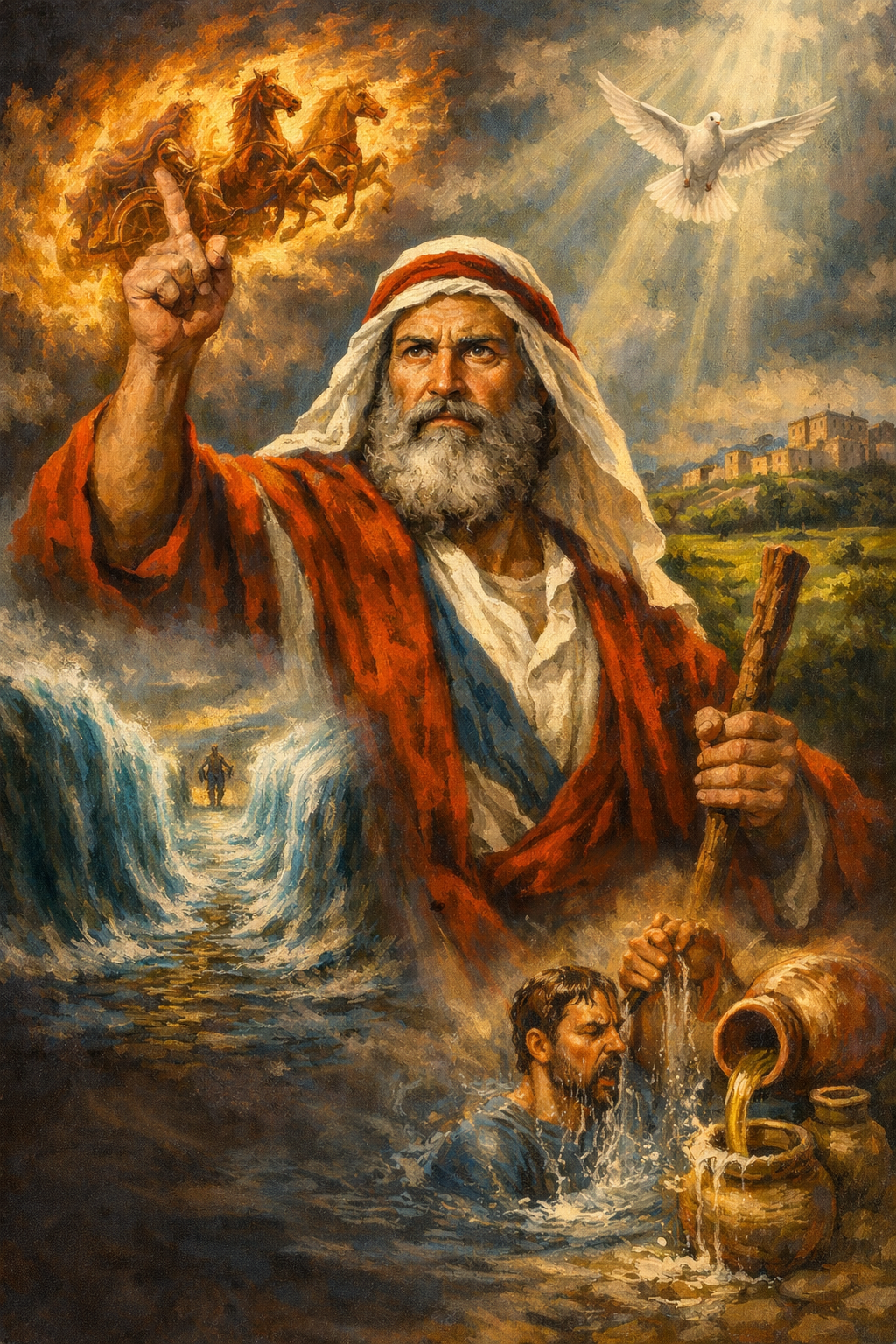
From the Greater Men and Women of the Bible - Ruth to Naaman
i. The Waters Healed
Two miracles, one of mercy and one of judgment, marked Elisha’s establishment as Elijah’s successor. The former, Elisha’s first public act, seems typical of his whole ministry. All the natural charms of Jericho, one of the fairest sites in the East, were spoilt by the unsatisfactory character of the water. The water was “naught,” and the ground was barren because of it. Calling for a new cruse and a supply of salt, Elisha led the way to the spring whence the waters issued, and, casting in the salt as the symbol of purification and preservation, declared that God had “healed” the waters. A spring called “Ain es Sultan” is still pointed out as the one in question, and as it is the only spring of any importance in the neighbourhood of Jericho, the tradition may be accepted.
A bitter barren-making stream,
The tears that flowed for sin,
Till the great Prophet came, and cast
Salt from the new cruse in.
Yet staunched he not the waters so—
That they should flow no more:
He healed their springs, then bid them rur
As freely as before:
He healed their source, and well has proved
His word not given in vain,
That now they never should bring death
Nor barrenness again.
ii. The Judgment of Irreverence
2 Kings 2:23-25
The faith of the men of Jericho in asking for this miracle stands in contrast with the insolence and irreverence shown by a number of “young lads” (R.V. marg.) who mocked the prophet as he entered Bethel: “Go up, thou bald head. And he turned back, and cursed them in the name of the Lord. And there came forth two she-bears out of the wood, and tare forty and two children of them.” This incident seems at first sight an exception to Elisha’s whole career, and contrary to the spirit of the Bible. But it should be remembered that Bethel was the great seat of idolatry, and this “curse” was not mere personal indignation, but a revelation of the Divine wrath against the apostasy of the place, which was no doubt the real cause of the attack on a prophet of Jehovah. It is also well to bear in mind that the narrative before us is exceedingly brief, and wanting in details which might relieve the difficulty and modify the apparent disproportion between the wrong done and the penalty inflicted. In its present form it reads like a folklore tale, of the kind familiar in all lands, intended for the admonition of rude and naughty children.
¶ As the Church has its rites and mysteries and its true freedom, and Angels watch their observance, so Satan has his rites and his false freedom, and his evil spirits watching to entice children to them. We see their influence in sullenness, in want of courtesy, in disrespect, in irreverence, till they are destroyed, like the children of Bethel by Elisha. But as he passed from their doom to intercede for them on Carmel, so our Christ and His saints are ever interceding for us. The dews fall from Heaven upon our children, and we see their effect in bright greetings and smiles and obeisance; the graver training the more light-hearted to do reverence, as the Angels train us.2
¶ Seven years old Geneviève was, then, when on his way to England from Auxerre, St. Germain passed a night in her village of Nanterre, and among the children who brought him on his way in the morning in more kindly manner than Elisha’s convoy, noticed this one—wider-eyed in reverence than the rest; drew her to him, questioned her, and was sweetly answered, that she would fain be Christ’s handmaid. And he hung round her neck a small copper coin, marked with the cross. Thenceforward Geneviève held herself as “separated from the world.”1
iii. The Army Saved
2 Kings 3:1-27
1. After this, Elisha returned to the solitude of Mount Carmel. But, before long, he was called back to public action, and was enabled to prove himself in very deed, as Elijah had been, “the chariot of Israel, and the horsemen thereof”; for God used him to save three kings and their armies from a lingering death through thirst. Jehoram of Israel, Jehoshaphat of Judah, and the king of Edom had united in a campaign against the Moabites and their king Mesha, who had thrown off their allegiance to Israel, and refused to pay the annual tribute of the wool of 100,000 lambs and 100,000 rams. Jehoram was the brother of the late king Ahaziah. He had abjured the Baal-worship, destroying the idol his father had made, but, like all the kings of Israel, he continued the idolatries of Jeroboam.
The allied armies found themselves in difficulties after a circuitous march of seven days: there was no water to be found in the wilderness. At Jehoshaphat’s suggestion Elisha, who was with the armies, was summoned. At first he only bade Jehoram betake himself to the prophets of his father and his mother, but then, in deference to the piety of the king of Judah, he consented to seek a Divine answer. When a minstrel played before him and the hand of Jehovah was upon him, he commanded that deep trenches be dug, and prophesied that, though they should see no rain, the valley would yet be filled with water. His orders were obeyed, and next morning, owing to a plentiful fall of rain high among the mountains of Moab, the streams poured down, and all the country was filled with water.
¶ This incident throws light both upon the general accuracy of the ancient narrative, and upon the fact that events to which a directly supernatural colouring is given are, in many instances, not so much supernatural as providential. The deliverance of Israel was due, not to a portent wrought by Elisha, but to the pure wisdom which he derived from the inspiration of God. When the counsels of princes were of none effect, and for lack of the spirit of counsel the people were perishing, his mind alone, illuminated by a wisdom from on high, saw what was the right step to take. He bade the soldiers dig trenches in the dry torrent bed—which was the very step most likely to ensure their deliverance from the torment of thirst, and which would be done under similar circumstances to this day. They saw neither wind nor rain; but there had been a storm among the farther hills (according to the tradition of Josephus, rain had fallen at three days’ distance on the hills of Edom) and the swollen water-courses discharged their overflow into the trenches of the wady which were ready prepared for them, and offered the path of least resistance.1
¶ Man will never become a materialist so long as his harp and his viol are left to him. He can never deny his relation to a spiritual world while so ethereal a thing as music is here to keep him company. Music is so plainly of two worlds, a mediator between them. It touches matter; it touches spirit, and each vibrates to the contact. Note the two things and their relation here. On the one side you have the collection of sounds, the product of vibrations in the air; sounds, with their marvellous harmonic relations, their connexion with number, with mathematics, with the qualities of metals and strings; all this for the material side. But there is the other; that of the soul’s response. How has this come about? How is it that you have this common language, appealing at once to the universal heart; that leaps across all the tongues, all the dialects with which the human family has confused itself, and tells its own story to every listening soul? Why is it that these vibrations, movements of the impalpable air, breaking on the tympanum, on a nerve, stir in us all that is exalted, mystical, religious? We talk to-day of ministering angels as though that were some legend of old. In music we have an angel, not shaped for us in bodily form, but something beyond ourselves, that waits on our spirit, that whispers our relationship to a harmony that is behind and beyond all ages and all worlds.2
2. Another strange result followed: the crimson light of the dawn reflected on the new-made watercourses was mistaken by the Moabites for blood. Imagining that the allied armies had turned their swords against each other, they rushed heedlessly to their own ruin. Not only did the allies drive the Moabites before them; they deliberately destroyed the country, casting stones on all the good ground, filling up the wells, cutting down the trees and leaving only Kir-hareseth with its fortifications undestroyed. Jehoram’s victory seemed complete. But there was to be no glory or triumph for Israel. The sequel to the story is not quite clear. The king of Moab, having failed in a desperate attempt to break through to Edom, took his eldest son, the heir to the throne, and offered him up as a burnt-offering to Moloch. And the last words of the inspired record are these: “And there was great wrath against Israel: and they departed from him, and returned to their own land.” Now, the Moabite Stone, while silent about previous reverses, records the great triumph of Mesha, king of Moab, in driving back the invading army. The Scripture certainly admits the explanation that, roused to fury by their king’s action, the Moabites rallied to another onslaught, and drove the invaders out of their land.
¶ In the Moabite Stone (11:1–8) Mesha tells us that, in the reign of his father, Chemoshmelek (?) of Dibon, Chemosh was angry with Moab, and Omri and his son oppressed Moab, subjected and occupied it forty years. This brings us to the point at which Kings first refers to Moab. 2 Kings 1:1, 3:4, 5 states that Mesha king of Moab was rich in sheep, and paid to Israel a tribute (? annual) of 100,000 lambs and 100,000 rams (A.V.), or their wool (R.V.); and that when Ahab died he rebelled against the king of Israel. According to Mesha (1:8), the revolt took place in the middle of Ahab’s reign. Probably the war of Israel with Syria, which cost Ahab his life, afforded the opportunity for the revolt of Moab. It is not clear how we are to combine the inscription and 2 Kings 3. We may suppose that Mesha’s victories took place at the time of the revolt, before the events of 2 Kings 3; or that, at first, Moab simply asserted its independence, and that Mesha’s conquests were made after the retreat of Jehoram; or that the inscription is a comprehensive account of Mesha’s achievements both before and after Jehoram’s campaign, his reverses being ignored, just as Kings makes no mention of the loss of Israelite cities to Moab. In 2 Kings 3. we read that Jehoram, at the head of a general muster of Israel, and with Jehoshaphat of Judah and the king of Edom as allies, marched round the southern end of the Dead Sea, a route which suggests that Israel was very weak on the east of the Jordan; that the Moabites fell into an ambush, and were defeated; that the allies captured and destroyed the cities and laid waste the land, and at last shut up Mesha in Kir-hareseth. After an unsuccessful sortie, Mesha “took his eldest son … and offered him for a burnt-offering upon the wall. And there was great wrath against (R.V.) or upon (R.V.m.), Israel; and they departed from thence and returned to their own land.” Possibly the Israelite account disguises a defeat as a voluntary withdrawal; but the prophets’ accounts of the superstition of their fellow-countrymen show that they may have been afraid to press the siege after what they believed to be an irresistible appeal to Chemosh. But the retreat was a disastrous blow to the prestige of Israel.1
iv. The Widow’s Oil
2 Kings 4:1-7
Many of Elisha’s miracles seem to have no special purpose, either doctrinal or otherwise, but simply the relief of trivial and transient distresses. From the awful scenes of blood and carnage we pass to a humble home in Israel. The widow of one of the sons of the prophets—the name and place are wanting—was in debt, and her sons were about to be taken away by her creditor and sold as slaves. In her difficulty she appealed to Elisha as the recognized head of the prophetic guild. On Elisha’s inquiry she acknowledged that she had nothing left but a small quantity of a coarse kind of oil which was used for anointing the body after a bath. That was enough in the prophet’s hands to test and evidence faith. She was commanded to borrow from her neighbours all the vessels she could, to retire into the privacy of her house for an act of faith, and there pour out from the pot of oil into the borrowed vessels. As she did so the oil multiplied until she had filled every vessel she could lay hands on. Determined to do nothing without the direct command of Elisha, she came to him with the glad tidings of what had happened, and was now told to sell the oil, pay her debt, and herself and her sons to live off the balance.
The widow’s necessity was, to the great Elisha, not the plea of charity, but the demand of justice. If in the circumstances the prophet had not given heed to the appeal of the widow, it would have implied either that he was not the living medium between God and His people which he professed to be, or that Jehovah was not the living and the true God in the sense in which Elisha had preached Him. With reverence be it said, the appeal to the prophet could no more have remained unanswered than a cry for help addressed to Christ in the days of His flesh.
¶ Help, in clerical garments or in the garb of a layman, is one of those perennially blessed people whom men instinctively trust. There is a healthy sense of efficiency about them and a broad human nature. David Scott is happy in his picture of Help the Athlete. He is the natural successor to the Herakles of Euripides whom Browning transcribes so wonderfully in Balaustion’s Adventure, and to Shakespeare’s Henry v. on the night before Agincourt. He is the kind of man that Charles Kingsley was, whose “nearest work” is that of helping “lame dogs over stiles.” He is the type that Jerome describes for modern days in his chapter on “Evergreens” in Idle Thoughts, and Mrs. Browning in her My Kate. And indeed Help is often a woman, and among all woman’s new ideals of to-day there is none that will ever fulfil her nature so perfectly as the oldest of all—the helpmeet. Help is an office which conventional piety may sometimes count secular. Yet what is called spirituality is to a certain extent a matter of temperament, and those who have a special aptitude for helping need ask for no higher office. Paul has included “helps” among the great functions of Christian ministry, and the beautiful legend of Christoferus has proclaimed the essential Christianity of such service. Ruskin has said finely: “There is no true potency, remember, but that of help, nor true ambition but the ambition to save.”1
v. The Shunammite
2 Kings 4:8-37
1. The charmingly-told Shunem incident reveals further friendliness and homely interests. Elisha, in his journeys to and fro among the schools of the prophets, had often enjoyed the welcome hospitality eagerly pressed upon him by the lady of Shunem. Struck with his sacred character, she persuaded her husband to take a step unusual even to the boundless hospitality of the East. She begged him to do honour to this holy man of God by building for him a little chamber on the flat roof of the house, to which he might have easy and private access by the outside staircase. Her husband was willing, and so the prophet’s chamber was soon ready; and it became Elisha’s home whenever he passed through the town.
2. Elisha was anxious to do something for her to show his appreciation of her kindness; and, as his services in connexion with the expedition against Moab had brought him into favour at court, he offered to speak for her to the king, or the captain of the host. She replied with the greatest dignity, “I dwell among mine own people.” She had no need of earthly honours; she was enjoying to the full the purest satisfaction which comes from duty faithfully discharged and love fully requited. Gehazi, the prophet’s servant, unscrupulous as he afterwards appears, but a keen observer, suggested that her only need was a child, for she had none. A son was promised her, and, like Isaac and John the Baptist, was born beyond all human probability.
3. But the gift of God was apparently to be taken from her. After some years—the narrative goes on without a break—the child going with his father into the harvest fields was attacked by sunstroke, and died on his mother’s knees. With the quiet dignity of faith she rode with one servant to Elisha at Carmel, and in her great earnestness took hold of the prophet by the feet. Gehazi started to thrust her away, but Elisha saw that the woman was in great trouble, and he said to the servant, “Let her alone; for her soul is vexed within her: and the Lord hath hid it from me, and hath not told me.” Then the woman said, “Did I desire a son of my lord? did I not say, Do not deceive me?” Elisha guessed the truth, and at once sent Gehazi to hasten on and lay his staff upon the face of the child. But the broken-hearted mother refused to leave Elisha. She imagined that the servant and the staff might be severed from Elisha; but she knew that wherever the prophet was, there was power. So Elisha arose and followed her, and on the way Gehazi met them with the news that the child lay still and dead, with the fruitless staff upon his face.
The reason for this failure is not quite clear. It may have lain in the want of faith in the woman, or in the character of Gehazi, or more probably in a mistake on Elisha’s part in supposing that he could communicate the power of the Spirit of God in this way.
On coming to the house, Elisha found the body of the child upon the bed. After earnest prayer he outstretched himself over the little corpse, as Elijah had done at Zarephath. Soon it began to grow warm with returning life, and Elisha, after pacing up and down the room, once more stretched himself over him. Then the child opened his eyes and sneezed seven times, and Elisha called to Gehazi to summon the mother. “Take up thy son,” he said. She prostrated herself at his feet in speechless gratitude, then took up her recovered child and went.
¶ We see in the Shunammite a true and faithful Israelitish woman, who, in a time of general apostasy, owned Jehovah alike in her life and her home. Receiving a prophet, because of Him who had sent him, because he was a holy man of God—and with humility and entire self-forgetfulness—she received a prophet’s reward in the gift most precious to a Jewish mother, which she had not dared to hope for, even when announced to her. Then, when severely tried, she still held fast to her trust in the promise—strong even when weakest—once more self-forgetful, and following deepest spiritual impulse. And, in the end, her faith appears victorious—crowned by Divine mercy, and shining out the more brightly from its contrast to the felt weakness of the prophet. As we think of this, it seems as if a fuller light were shed on the history of the trials of an Abraham, an Isaac, or a Jacob; on the inner life of those heroes of faith to whom the Epistle of the Hebrews points us for example and learning (Heb. 11.), and on such Scripture sayings as these: “Jehovah killeth, and maketh alive: he bringeth down to the grave, and bringeth up” (1 Sam. 2:6); “Know that Jehovah hath set apart him that is godly for himself; Jehovah will hear when I call unto him” (Ps. 4:3); or this: “All the paths of Jehovah are mercy and truth unto such as keep his covenant and his testimonies” (Ps. 25:10). The story speaks to us of Him through whom “death is swallowed up in victory.” As we think of Him who, as God Incarnate, and as the Sent of the Father, is to us the Representative and the Prophet of God in a unique sense, we recall that it was not, as by Elijah or Elisha, through prayer and personal contact, but by the Word of His power that He raised the dead (Mark 5:39–42; Luke 6:13–15; John 11:43, 44). And beyond this we remember that “the hour … now is, when the dead shall hear the voice of the Son of God: and they that hear shall live”; and that “whosoever liveth and believeth” in Christ “shall never die” (John 5:25, 11:26).1
vi. Death in the Pot
2 Kings 4:38-41
Elisha’s next miracle according to the Scripture narrative does not immediately follow the preceding in order of time, but probably took place during the seven years’ famine, of which we have an account in a later chapter.
The sons of the prophets were seated round him, listening to his instructions; the hour came for their simple meal, and he ordered the great pot to be put on the fire for the vegetable soup on which, with bread, they chiefly lived. One of them went out for herbs, and carelessly brought his outer garment (the abeyah) full of wild poisonous colocynths, which, by ignorance or inadvertence, were shred into the pottage. But when it was cooked and poured out they perceived the poisonous taste, and cried out, “O man of God, there is death in the pot.” “Bring meal,” answered the wonder-worker, and forthwith the dish was rendered harmless and wholesome—not because of the meal, but because of the power of Jehovah working through His servant.
¶ There are many species of the Gourd family wild in Palestine. We found Cucumis prophetarum, the Globe Cucumber; Citrullus colocynthus, the Colocynth; and Ecbalium elaterium, the Squirting Cucumber. I conceive that, though the Squirting Cucumber will answer the requirements of the text (2 Kings 4:39), yet that the Colocynth is undoubtedly the plant in question. The Squirting Cucumber is not so bitter, nor does it bear the same resemblance to the good fruit. Besides, it is common over the whole country, and ought to have been well known to the prophet’s servant. Now Elisha, we read, had just come down to Gilgal, between Jericho and the Dead Sea, and doubtless the gatherer of the pottage would be his attendant who had accompanied him from the upper country. The Colocynth grows abundantly on the barren sands near Gilgal, and all round the Dead Sea on the low flats, covering much ground with its tendrils, which reach a prodigious length, and bearing great quantities of fruit. We never saw the Colocynth elsewhere. Indeed, it is exclusively a plant of the dry and barren sandy deserts; or growing on volcanic sand, as at Pantellaria. An inhabitant of the upper country could not, therefore, be expected to recognize it, but would be attracted at once by the beautiful appearance of the fruit, and gather it eagerly for the Wild Melon, or Pumpkin.1
vii. Miraculous Feeding
2 Kings 4:42-44
Closely connected with this is the next event recorded. If the former showed how easily God could remove from the provision of His people that which was hurtful by the addition of that which in itself is nutritious and wholesome, the next event affords another instance of how readily He can send unexpected provision to supply the wants of His servants. A man of Baal-shalishah brought to Elisha, as the prophet of Jehovah, an offering of the first-fruits of his land. This is the only mention of Baal-shalishah, but it was probably near Gilgal, in “the land of Shalishah,” where Saul had searched for the lost asses. The offering consisted of twenty barley loaves, the food of the common people, and a sack or wallet full of “fresh ears of corn.” Elisha told his servant—perhaps Gehazi—to set them before the people present. “What,” he asked, “should I set this before an hundred men?” But Elisha told him in the Lord’s name that it would more than suffice; and so it did.
¶ Although this narrative is generally, and in a sense correctly, regarded as prefiguring the miraculous multiplication of the scanty provision with which our Lord fed the multitude (Matt. 14:19–21; John 6:9–13), yet the text does not here indicate any such miraculous increase of the food. But it does most emphatically indicate that Elisha was truly the prophet and servant of Jehovah; that his trust in his God was absolute and unwavering; and that, true to His promise, the Lord will always provide for His servants who look up unto Him.1
¶ Was this not the foreshadowing of a far grander miracle, done by the power of the great Anti-type, Christ Jesus? Can we not see the five thousand men sitting in rows on the green grass? Can we not hear the voice of the Master, uttering the very same words as Elisha, “Give ye them to eat”? “And they did all eat, and were filled; and they took up of the fragments that remained twelve baskets full.” Yet how far more wonderful was the later miracle! Only one hundred men were fed by Elisha, five thousand by Christ; one loaf supplied the needs of five men at Gilgal, one loaf was sufficient for one thousand at Bethsaida. Only a little was left at Elisha’s feast; twelve baskets full were collected by the apostles after the supper on the grass. Yet, still, Elisha’s miracle was a shadow, a picture, nay more, a foretaste, of grand and glorious things to come.2
viii. Naaman
2 Kings 5:1-27
1. The best-known miracle of Elisha, the story of which has become a classic, was the healing of the leprosy of Naaman, the “captain of the host” of the king of Syria. The fame of the prophet had been brought to the Syrian court by a little Israelite maid—the servant of Naaman’s wife—who had been carried captive by the Syrians in one of their marauding excursions into Israelite territory. The king despatched Naaman, who was a great favourite with him, with a present of “ten talents of silver, and six thousand pieces of gold, and ten changes of raiment,” to the court of Samaria, requesting that he might be cured. The king of Israel himself was neither physician nor prophet; and he saw, or chose to see, in the despatch of the Syrian monarch only one of those impossible demands with which ambitious monarchs are wont to preface a declaration of war. But Naaman’s arrival and message were reported to Elisha. With the freedom and authority of his great position, he rebuked Jehoram for his unbelief and his alarm. Why could not Naaman be sent on to him that he might learn that there was a prophet in Israel? Naaman obeyed. The great Syrian left the palace of the monarch, and drew up, with his long line of horsemen and his splendid war-chariot, before the humble dwelling of Elisha. He waited, expecting that the prophet, who had invited him, would at once appear. But the servant of the King of kings was not exultantly impressed, as false prophets so often are, by earthly greatness. Elisha did not even pay him the compliment of coming out of the house to meet him. He simply sent out his servant to the Syrian commander-in-chief with the brief message, “Go and wash in Jordan seven times, and thy flesh shall come again to thee, and thou shalt be clean.”
2. We may at once say that the conduct of Elisha was not prompted by fear of defilement by leprosy, or by a desire to mark more clearly the miracle about to be performed, least of all by spiritual pride. The spiritual pride of a Jew would have found other expression, and, in general, those who cherish spiritual pride are scarcely proof against such visits as this of Naaman. We cannot doubt that the bearing of Elisha was Divinely directed. Naaman was a proud man. He had been accustomed, at the brilliant court of Damascus, to receive a great deal of deference and consideration—more perhaps than any one, except the monarch himself. Naaman wished to be treated like a great man that happened to be a leper; Elisha treated him like a leper that happened to be a great man. Naaman’s pride and confidence in his wealth and high standing must be broken. He must learn that God’s true servant is not overawed by earthly greatness. He must realize that in God’s sight he is only a leper not fit to be touched. And the means used for his recovery must lift his faith up to God. It had been rudely detached from the king, and was resting upon the prophet; it must be shifted from the prophet to the living God. Elisha wished to efface himself completely, and to fix the leper’s thoughts on the one truth that, if healing was granted to him, it was due to the gift of God, not to the thaumaturgy or arts of man.
¶ No doubt, as a rule, people are ready to repose wonderful faith in the doctor. It is striking to see how implicitly an invalid will accept a doctor’s diagnosis of his disease, and drink the drugs, whatever they be, which he prescribes as a remedy. Sometimes, however, before sending for a doctor, an invalid has made up his mind as to what the disease is, and as to what medicines should be employed. If, when the doctor comes, he pronounces it a different disease, and prescribes a different remedy, the invalid is disappointed and displeased. In all probability he will dismiss the doctor, simply because, whether right or wrong, he has ventured to contradict his own preconceived notion. This is literally a modern repetition of the case of Naaman.1
3. In great indignation Naaman turned and left the city. It was well that the relation between himself and his servants was so simple and affectionate (“my father”) that they could address him in terms of respectful expostulation, and so turn him from his rash purpose. They pleaded that, as he would have been ready to do any great or difficult thing that the prophet commanded, he might at least try so simple a remedy. So it came to pass that instead of returning “in a rage” to Damascus a leper, Naaman went down to Jordan. And as “according to the saying of the man of God,” he “dipped himself seven times in Jordan,” “his flesh came again like unto the flesh of a little child, and he was clean.”
4. Then it was that, in his gratitude and his joy, Naaman paid his second visit to Elisha. He was immediately admitted to the presence of the prophet, whom he met with the confession, “Now I know that there is no God in all the earth, but in Israel.” That was the lesson which Elisha desired to teach him, and this acknowledgment of Naaman’s is the prophet’s best reward. Naaman was eager to make some rich return to the prophet; but here again he was astonished at the difference between Elisha and the priests or soothsayers, with whose greed for gain he was doubtless well acquainted. Elisha refused to take any reward or payment. He felt that it was a good opportunity to show to the Syrians that the God of all the earth was a God of love, and that His prophet was unselfish. He was anxious that Naaman should carry to Syria the loftiest possible conception of the God of Israel. It was of the utmost importance to show that, as the prophet of God did not work miracles in his own power, or by his own will, so he did it not for reward, and that the gift of God could not be purchased with money. It was essential that Naaman and the Syrians should not look upon him as upon some vulgar sorcerer who wrought wonders for “the rewards of divination.” Indeed, we can scarcely exaggerate the impression which the refusal of Elisha must have made both upon the followers of Naaman and generally in Israel. To put an end to all importunity, in refusing the present, he appealed to Jehovah with his usual solemn formula—“As the Lord liveth, before whom I stand, I will receive none.”
5. Naaman, made to feel by Elisha’s self-denial that the glory was due to Elisha’s God, resolved to become a worshipper of Jehovah. He asked permission to take earth from Israel, that he might erect an altar to the God of Israel, his idea being the popular one, that Jehovah was a local deity, and could be worshipped only on His own soil. Elisha did not seek to correct his mistake. He even gave the proselyte permission to continue to pay outward homage to Rimmon, the god worshipped by the king of Syria. He practically allowed Naaman to give the sign of outward compliance with idolatry, by saying to him, “Go in peace.” The position of Naaman was wholly different from that of any Israelite. He was only the convert, or the half convert, of a day, and though he acknowledged the supremacy of Jehovah as alone worthy of his worship, he probably shared in the belief—common even in Israel—that there were other gods, local gods, gods of the nations, to whom Jehovah might have divided the limits of their power. To demand of one who, like Naaman, had been an idolater all his days, the sudden abandonment of every custom and tradition of his life, would have been to demand from him an unreasonable, and, in his circumstances, useless and all but impossible self-sacrifice. The best way was to let him feel and see for himself the futility of Rimmon-worship. If he were not frightened back from his sudden faith in Jehovah, the scruple of conscience which he already felt in making his request might naturally grow within him and lead him to all that was best and highest. The temporary condonation of an imperfection might be a wise step towards the ultimate realization of a truth. We cannot at all blame Elisha, if, with such knowledge as he then possessed, he took a mercifully tolerant view of the exigencies of Naaman’s position. He will not quench the smoking flax. Naaman was still very ignorant. He knew very little yet of the holy God of Israel. But Elisha knew that the God who had begun a good work in him would perfect it.
6. A characteristic Oriental incident closes the story. Naaman having departed in peace, Elisha’s servant Gehazi followed him, and by dint of lying obtained the treasure which Elisha refused. But Elisha divined his dishonesty and doomed him and his house to be afflicted with the leprosy of Naaman for ever. His punishment was severe; but his sin was great. The leprosy was a fitting punishment, both because it had been Naaman’s, from which obedient reliance on God had set him free, and because of its symbolical meaning, as the type of sin.
One sin leads, as if by a fatal necessity, to another. When he started upon the sinful step, Gehazi had only one object in view, to secure by any means, fair or foul, a portion of the coveted treasure. It is probable that falsehood did not enter into his programme. But, as he proceeded, a lie became necessary. And then, at a later stage, an additional lie was required. Yes, and this warns us of the danger of beginning a sinful course, for we cannot tell what may be the result. The ancient Romans were in the way of expressing a warning in these two words, Obsta principiis, which mean, “Resist beginnings.” The wisdom of such a warning is not only seen in this, that the same sin is so apt to grow from less to more, but in this, that one sin is so likely to lead to another sin of a different description. Our duty, therefore, is to keep the heart with all diligence, since out of it are the issues of life.1
ix. The Lost Axe-head
2 Kings 6:1-7
The striking story of Elisha and Naaman, and of the fall and punishment of Gehazi, is followed by an anecdote of the prophet’s life which appears to rise but little above the ecclesiastical portents related in mediæval hagiologies.
The sons of the prophets, who were increasing in numbers, resolved to build a larger dwelling-place by the Jordan. While they were engaged in felling trees, the head of a borrowed axe flew off and fell into the water. It would be vain to search for it in the deep and turbid river. But a cry brought the man of God to the spot. He broke off a stick and cast it into the stream, and forthwith the iron came to the surface, and was restored to its possessor.
This miracle is so contrary to our ideas, and so out of proportion to the loss incurred, that attempts have been made to find a simpler explanation of it. But it seems clear that the writer of the Book of Kings understood the incident as of a miraculous nature, otherwise it would not have had a place among the “wonders” which Elisha did.
¶ Some of the Rabbis and certain modern interpreters have argued, either that the stick which had been cut off struck right into the hole of the axe-head and so brought it up, or else that the stick thrust under the axe had rendered it possible to drag it to land. But, to speak plainly, both these suggestions involve such manifest impossibilities as hardly to require serious discussion. It is scarcely necessary to add that every such explanation is opposed equally to the wording and to the spirit of the sacred text, which assuredly would not have recorded among the marvellous doings of the heaven-sent prophet a device, which, if it had been possible, could have been accomplished by any clever-handed person. There cannot be any doubt in the mind of every impartial man that Scripture here intends to record a notable miracle. On the other hand, there is nothing in the sacred text which obliges us to believe that the iron “did swim.” In fact, the Hebrew word is never used in that sense. The impression left on our minds is that the iron which had sunk to the bottom was set in motion, made to float, probably, by some sudden rush of water. Beyond this we cannot go in our attempts to explain the manner in which this miraculous result may have been brought about.1
¶ It is a well-known fact, that, owing to the strong specific gravity of its waters, things will float in the Dead Sea that will not float elsewhere. I do not know whether iron is one of these things; but at all events something like iron may have been seen to float in these waters that would have sunk in others. That would be at once regarded as a miracle, and would easily give rise to such a story.2
Elisha, the prophet that is in Israel, telleth the king of Israel the words that thou speakest in thy bedchamber.—2 Kings 6:12.
ELISHA’S life and ministry were very closely linked with the political and military history of his country. However much he disliked the idolatrous practices of her kings, he had still hope for his country, and was ready to help her. He intervened, therefore, not once or twice only, to save the king and his soldiers.
DOTHAN
2 Kings 6:8-23
1. The Syrians, at this later period, seem to have carried on the war by a system of predatory incursions into the territory of Israel; and on several occasions Elisha warned King Jehoram of the place which the Syrians intended to surround, and, by thus putting him on his guard, enabled him to escape, or at any rate to defeat the measures of the enemy. The Syrian king, bewildered by his ill-success, at first suspected treachery, and then, learning of Elisha’s clairvoyance, sent an army to seize the prophet in Dothan.
2. The sequel was remarkable. A servant of the prophet first discovered the enemy, in the early morning; and, greatly alarmed, he informed his master of what appeared to him a hopeless situation. But Elisha was undisturbed. His mind was stayed on God. “Fear not,” he said; “for they that be with us are more than they that be with them.” He then prayed for his dismayed follower, and the man had a vision of forces, hitherto unseen by him, that guard and help the servants of God. The literal story runs: “And the Lord opened the eyes of the young man; and he saw: and, behold, the mountain was full of horses and chariots of fire round about Elisha.”
Our eyes are blinded and we need to have them cleared, if not in the same manner as this lad’s, yet in an analogous way. We look so constantly at the things seen that we have no sight for the unseen. Worldliness, sin, unbelief, sense and its trifles, time and its transitoriness, blind the eyes of our mind; and we need those of sense to be closed that these may open. The truest vision is the vision of faith. It is certain, direct, and conclusive. The world says, “Seeing is believing”; the gospel says, “Believing is seeing.” If we would but live near to Jesus Christ, pray to Him to touch our blind eyeballs, and turn away from the dazzling unrealities which sense brings, we should find Him the “master-light of all our seeing,” and be sure of the eternal, invisible things, with an assurance superior to that given by the keenest sight in the brightest sunshine. When we are blind to earth, we see earth glorified by angel presences, and fear and despair and helplessness and sorrow flee away from our tranquil hearts. If, on the other hand, we fix our gaze on earth and its trifles, there will generally be more to alarm than to encourage, and we shall do well to be afraid, if we do not see, as in such a case we shall certainly not see, the fiery wall around us, behind which God keeps His people safe.
Almighty God, as now we raise
Our longing eyes in hope to Thee,
Anointed, may our wond’ring gaze
Thy chariots and Thy horsemen see.
Let faith revive, let courage new
The vision of Thy hosts impart;
That all Thou willest we may do
With steadfast hands and holy heart.
3. There is a touch of almost joyful humour in the way in which Elisha proceeded to use, in the present emergency, the power of Divine deliverance. Some think that he went out of the town and came himself to the Syrian captains; but what we read is simply that “when they came down to him,” he prayed God to send them “illusion,” so that they might be misled. Then he boldly said to them, “This is not the way, neither is this the city: follow me, and I will bring you to the man whom ye seek.” Elisha led the Syrians in their delusion straight into the city of Samaria, where they suddenly found themselves at the mercy of the king and his troops.
4. With an eagerness and a spiritual dulness characteristic of him, Jehoram would fain have slaughtered these captives of the Lord. And, with an equally characteristic uprightness and large-hearted generosity, the prophet almost indignantly rebuked the spurious zeal and courage of the king: “Thou shalt not smite them: wouldest thou smite those whom thou hast taken captive with thy sword and with thy bow?” It would have been unmanly to act otherwise; Jehovah had not brought these blinded men as His own captives to give the king of Israel an easy and a cruel triumph; the whole moral purpose of this event, its very character, would have been changed, if the proposal of Jehoram had been carried out. And it was right royal treatment on the part of the Heavenly Conqueror’s ambassador, when, at his bidding, they gave them a great meal, and then dismissed them to their master, to report how Jehovah made captives of the captors of His representative, and how he entertained and released His captives. It was a signal victory for Elisha; and the calm faith he manifested when apparently in great peril makes the story of Dothan one of the most helpful and inspiring in his whole career.
¶ In the hollow where the Boer tents had stood, amid the laagered wagons of the vanquished, under a murky sky and a constant drizzle of rain, the victors spent the night. Sleep was out of the question, for all night the fatigue parties were searching the hillside and the wounded were being carried in. Campfires were lit and soldiers and prisoners crowded round them, and it is pleasant to recall that the warmest corner and the best of their rude fare were always reserved for the downcast Dutchmen, while words of rude praise and sympathy softened the pain of defeat. It is the memory of such things which may in happier days be more potent than all the wisdom of statesmen in welding our two races into one.1
¶ It was six o’clock in the morning when General Pretyman rode up to Lord Roberts’ headquarters. Behind him upon a white horse was a dark-bearded man, with the quick restless eye of the hunter, middle-sized, thickly built, with grizzled hair flowing from under a tall brown felt hat. He wore the black broad-cloth of the burgher with a green summer overcoat, and carried a small whip in his hands. His appearance was that of a respectable London vestryman rather than of a most redoubtable soldier with a particularly sinister career behind him.
The Generals shook hands, and it was briefly intimated to Cronje that his surrender must be unconditional, to which, after a short silence, he agreed. His only stipulations were personal, that his wife, his grandson, his secretary, his adjutant, and his servant might accompany him. The same evening he was despatched to Cape Town. receiving those honourable attentions which were due to his valour rather than to his character. His men, a pallid ragged crew, emerged from their holes and burrows, and delivered up their rifles. It is pleasant to add that, with much in their memories to exasperate them, the British privates treated their enemies with as large-hearted a courtesy as Lord Roberts had shown to their leader. Our total capture numbered some three thousand of the Transvaal and eleven hundred of the Free State. That the latter were not far more numerous was due to the fact that many had already shredded off to their farms. Besides Cronje, Wolverans of the Transvaal, and the German artillerist Albrecht, with forty-four other field-cornets and commandants, fell into our hands. Six small guns were also secured. The same afternoon saw the long column of the prisoners on its way to Modder River, there to be entrained for Cape Town, the most singular lot of people to be seen at that moment upon earth—ragged, patched, grotesque, some with goloshes, some with umbrellas, coffee-pots, and Bibles, their favourite baggage. So they passed out of their ten days of glorious history.1¶ Mr. Gladstone’s intellectual generosity was a part of the same largeness of nature. He cordially acknowledged his indebtedness to those who helped him in any piece of work, received their suggestions candidly, even when opposed to his own preconceived notions, did not hesitate to confess a mistake. Those who know the abundance of their resources, and have conquered fame, can doubtless afford to be generous. Julius Cæsar was, and George Washington, and so, in a different sphere, were Isaac Newton and Charles Darwin. But the instances to the contrary are so numerous that one may say of magnanimity that it is among the rarest as well as the finest ornaments of character.2
FAMINE IN SAMARIA
The next incident, though introduced without remark immediately after the last, evidently occurred at a different time. The king of Syria gathered a great army to besiege Samaria. Elisha encouraged the men of Israel to defend their city to the last. The wonderfully vivid narrative tells a pitiful tale of women boiling their children, of unclean food worth more than its weight in silver, of a king worked up to a pitch of frenzy and murderous designs, and renouncing his allegiance to Jehovah. Such faith as he had was strained to the breaking point. In despair, he turned his fury upon the prophet who, he thought, had power which he would not use, and sent to apprehend him. Then, with a sudden revulsion of feeling, the king apparently followed his own messenger, and confessed that the calamity was Divinely inflicted, and that he must surrender the city: “Behold this evil is of the Lord; why should I wait for the Lord any longer?” Then at this crisis of fate, Elisha spoke. The message was confident: “Hear ye the word of the Lord: Thus saith the Lord, To-morrow about this time shall a measure of fine flour be sold for a shekel, and two measures of barley for a shekel, in the gate of Samaria.” One of the lords in close attendance on the king derided the prophet. Only if windows were made in heaven might such a thing be. “Behold,” was the only response, “thou shalt see it with thine eyes, but shalt not eat thereof.”
During the night there was a panic in the Syrian host, the camp was deserted and every part of the prophecy fulfilled. The very courtier who had mocked Elisha was appointed to guard the city gate, and was trodden to death by the uncontrollable rush of the hungry populace.
The unbelieving lord has not only his predecessors, but, alas! he has also his followers, crowds and crowds of faithless souls who follow in his footsteps. Some of them are like himself, utterly unbelieving. They believe neither in God nor in His power. They utterly deny the use of prayer. They sneer at the true believer. They turn into ridicule every attempt to acknowledge God in His dealings with man. We have all heard of such men; nay, we have doubtless come across them in daily life. In the office, in the railway carriage, in the workshop, in the place of business, in the street, their laugh of unbelief is heard. They are very active, and they do their best to get others to join them. They would fain ridicule all around them out of their faith in God. Let us beware of allowing ourselves, even for a moment, to be shaken in our confidence; let us remember that those who join in the sneer of the unbeliever will share the unbeliever’s doom.
¶ Here, I think, is the moral fault of unbelief:—that a man can bear to make so great a moral sacrifice as is implied in renouncing God. He makes the greatest moral sacrifice to obtain partial satisfaction to his intellect: a believer ensures the greatest moral perfection, with partial satisfaction to his intellect also; entire satisfaction to the intellect is, and can be, attained by neither. Thus, then, I believe, generally, that he who has rejected God must be morally faulty, and therefore justly liable to punishment. But, of course, no man can dare to apply this to any particular case, because our moral faults themselves are so lessened or aggravated by circumstances to be known only by Him who sees the heart, that the judgment of those who see the outward conduct only must ever be given in ignorance.1
Hazael
1. Elisha next appears in wider political connexion with the personages and events of his time. He is described as visiting Damascus, where he unwillingly carried out one of the commissions given to Elijah at Horeb. He did not indeed “anoint” Hazael to be king over Syria, but sorrowfully foretold his elevation to the throne. When Elisha arrived in the neighbourhood of Damascus, Benhadad was lying ill. He knew the fame of Elisha as a man of God, and desired to learn through him whether he would recover from this sickness. He sent Hazael, his commander-in-chief, laden with presents, to learn his fate from the seer. Elisha’s reply was uncertain: according to one reading, he bade Hazael return and tell the king that he should certainly recover; according to another reading (the kethibh, and therefore probably authentic), Hazael was to reply that Benhadad should certainly die. At any rate, Elisha left Hazael in no doubt that the king was not to recover, and that his successor was none other than Hazael himself.
2. Elisha had read Hazael’s guilty secret, just as, long before, he had read Gehazi’s guilty secret. Hazael had, in his inmost heart, conceived a plot. No doubt he had often been contrasting his own vigour with the decrepit, nominal king, and had nursed ambitious hopes, which gradually turned to dark resolves.
While Hazael stood waiting before him, the prophet of Israel looked upon the Syrian with a fixed, intent gaze. Only when he noted that Hazael’s conscience was troubled by the glittering eyes which seemed to read the inmost secrets of his heart did Elisha drop his glance, and burst into tears. “Why weepeth my lord?” asked Hazael, in still deeper uneasiness. In answer, the prophet read off the blood-red vision, revealing the scourge which this man before him would yet prove to Israel. The revelation, described though it was with painful literalness, in no way shocked Hazael. In his eyes the picture was one of military glory, of conquest, with its attendant massacres, wherein the accompaniment of suffering and death to others was a small thing. Yet, though his heart leaped with joy at the possible realization of his dreams, he kept up the semblance of humility in his reply: “What, is thy servant a dog, that he should do this great thing?” Elisha was in no way deceived by the wily, ambitious Syrian, but answered that the throne of Syria was his ambition, and that he would yet reach it.
3. This conversation with Elisha seems to have accelerated Hazael’s purpose, as if the prediction were to his mind a justification of his means of fulfilling it. By his deed, or another’s, the king died, not of his illness, but apparently by accident; and Hazael was at once raised to the throne of Syria. Under him Damascus again became a formidable power. In spite of his humble anticipation of himself, he turned out to be all that the prophet had foretold,—“mighty and of great power.”
¶ The scene has sometimes been misrepresented to Elisha’s discredit, as though he suggested to the general the crimes of murder and rebellion. The accusation is entirely untenable. Elisha was, indeed, in one sense, commissioned to anoint Hazael king of Syria, because the cruel soldier had been predestined by God to that position; but, in another sense, he had no power whatever to give to Hazael the mighty kingdom of Aram, nor to wrest it from the dynasty which had now held it for many generations. All this was brought about by the Divine purpose, in a course of events entirely out of the sphere of the humble man of God. In the transferring of this crown he was in no sense the agent or the suggester. The thought of usurpation must, without doubt, have been already in Hazael’s mind. Ben-hadad, as far as we know, was childless. At any rate he had no natural heirs, and seems to have been a drunken king, whose reckless undertakings and immense failures had so completely alienated the affections of his subjects from himself and his dynasty that he died undesired and unlamented, and no hand was uplifted to strike a blow in his defence. It hardly needed a prophet to foresee that the sceptre would be snatched by so strong a hand as that of Hazael from a grasp so feeble as that of Ben-hadad II. The utmost that Elisha had done was, under Divine guidance, to read his character and his designs, and to tell him that the accomplishment of these designs was near at hand.1
Jehu
The third commission entrusted to Elijah at Horeb was still unfulfilled; Jehu had to be anointed king of Israel. Elisha took the first step in this revolution, but apparently no further part in its blood-stained course. The occasion was a campaign against Syria, at Ramoth-gilead, again, as in Ahab’s time, a centre of contention. Ahab’s son Joram was wounded, and went home to Samaria to be cured. His ally the king of Judah left the army, and went to visit him. During their absence Elisha called one of the sons of the prophets, and sent him to Ramoth-gilead, with instructions to seek out Jehu, and secretly anoint him king. As soon as Jehu divulged the secret to his brother officers, they proclaimed him king, and the whole army at once espoused his cause. The nation had long been ready for a change, and the house of Omri fell without being able to strike a blow in self-defence. Throughout all the bloodthirsty though imperative reforms that Jehu carried out, Elisha kept entirely in the background.
¶ Personal ambition and blind religious zeal were so blended in the energetic, ruthless character of Jehu that his revolution was the most bloody recorded in all of Israel’s history.… According to the tradition, his religious fervour was not cooled until all the prophets and worshippers of Baal, together with the pillar and temple, were completely destroyed. Jehu’s acts were doubtless approved by the extremists of his day. It is true that the evils which he undertook to correct were deep-seated and deadly. Disloyalty to Jehovah was counted in ancient Israel as treason, and treason in all ages has been punished by death. Jehu also lived before the conception of Jehovah as the God not only of justice but of love had been clearly proclaimed to the race. But measured even by the standards of his own age, his deeds as recorded by tradition cannot be wholly justified. Politically, Jehu’s policy of slaying the leaders of his nation was as disastrous as it was indefensible. It left his kingdom weak and open to attack on every side at the moment when all its strength was needed to meet the great dangers which impended. The prophet Hosea, who saw clearly the mistakes of the past, absolutely condemned Jehu’s bloody acts.1
JOASH
1. Elisha lived to extreme old age, and his last thoughts were given to his country. It is clear that there is a long blank in the story of his life. For nearly sixty years he was the great religious force in the land, and on many occasions the guide of her policy at home and abroad. Yet for more than forty years we have no record at all (unless some of the miracles fall within this period) of how that time was spent, or how that influence told upon the history of his native country. It is sad to reflect that, in spite of all his labours, Israel had become feeble and dependent. During the reigns of the pusillanimous sons of Jehu, the Syrians had done to Israel according to their will, and the nation had more than once been brought to the verge of extinction.
2. But at last a brighter day began to dawn. Already in the time of Jehoahaz there was a promise of a great deliverer. In the days of Joash, Elisha himself foresaw the first turn of the fortune which he had so mournfully predicted. The last scene of his life showed how deeply the Syrian war coloured all his thoughts, as well as those of the king. When he was now struck with his mortal sickness, the young Joash came to visit the aged seer who had placed his grandfather on the throne, and wept over his face. No words could be more appropriate than those in which he addressed the prophet: “My father, my father, the chariots of Israel and the horsemen thereof!” Elisha had still the spirit of the master to whom he first applied these words. To impress on the young king’s mind a sense of his duty, he used a fine piece of symbolism. He bade the king open the window and shoot an arrow eastward, calling it “the Lord’s arrow of victory, even the arrow of victory over Syria.” He then directed the king to strike on the ground with the rest of the arrows. “And he smote thrice, and stayed.” The energy of the youth was not equal to the energy of the expiring prophet, who burst out in indignation on his dying bed—“Thou shouldest have smitten five or six times; then hadst thou smitten Syria till thou hadst consumed it; whereas now thou shalt smite Syria but thrice.” The prophet perhaps read the king’s character by the indecisive way in which he performed what he must have known to be intended as a “sign” from Jehovah.
¶ He was never very ready to talk about himself, but when asked what he regarded as his master secret, he always said, “Concentration.” Slackness of mind, vacuity of mind, the wheels of the mind revolving without biting the rails of the subject, were insupportable. Such habits were of the family of faintheartedness, which he abhorred. Steady practice of instant, fixed, effectual attention was the key alike to his rapidity of apprehension and to his powerful memory. By instinct, by nature, by constitution, he was a man of action in all the highest senses of a phrase too narrowly applied and too narrowly construed. The currents of daimonic energy seemed never to stop, the vivid susceptibility to impressions never to grow dull. He was an idealist, yet always applying ideals to their purposes in act. Toil was his native element. There was nobody like him when it came to difficult business for bending his whole strength to it, like a mighty archer stringing a stiff bow.1
ELISHA’S BONES
There is one other tradition regarding Elisha, and that the most marvellous of all. His wonder-working power did not terminate with his life. In the spring of the year after his death a burial was taking place in the cemetery which contained his sepulchre, when it chanced that a band of marauding Moabites came in sight. The Moabites had now had time to recover from their great defeat by Jehoram and Jehoshaphat; they had spread themselves over the districts north of the river Arnon; and every year, when the spring crops were just ripe, their hordes poured over the fields of Samaria on their errand of plunder and violence. It was one of these bands of spoilers that was observed in the distance by the mourners. They wished to put the corpse for safety into the nearest hiding-place before the Moabites were upon them. It may have been accident, it may have been design, which led them to choose the tomb of Elisha; it may have been the depth and spaciousness of the cave; it may have been the prophet’s reputation for sanctity. So, as the original says, “they thrust the man into the sepulchre.” “And,” we are told, “as soon as the man touched the bones of Elisha, he revived, and stood up on his feet.”
There is no other miracle in Holy Scripture which is exactly like this: and it certainly is much more striking than any of those which were performed by Elisha during his lifetime. It produced a great effect upon the Jews; they held this posthumous miracle to be Elisha’s chief title to distinction among the prophets. “After his death his body prophesied,” or taught—that was his crowning glory in the Jewish school.
¶ Alone of all the graves of the saints of the Old Testament, there were wonders wrought at Elisha’s resting-place which seemed to continue after death the grace of his long and gentle life. It was believed that by the mere touch of his bones a dead corpse was re-animated. In this, as in so much beside, his life and miracles are not Jewish but Christian. His works stand alone in the Bible in their likeness to the acts of mediæval saints. There alone in the Sacred History the gulf between Biblical and Ecclesiastical miracles almost disappears. The exception proves the general rule; still it is but just to notice the exception.1
¶ In Dinet’s Saint Symphorien d’ Autun, there is attributed to the body of St. Virgilius, who died A.D. 610, a miraculous power similar to that recorded in Scripture in the case of Elisha’s bones. “When the funeral procession of the saint arrived at the grave, and the remains were about to be lifted therein,” we are told, “all of a sudden came persons carrying the body of one dead. It was that of a young girl, the only child of her mother, and she was a widow. The bearers, out of breath, implored the clergy to let the dead body touch that of the deceased prelate. The permission was granted, and at a given signal all the immense crowd fell on their knees, waiting to see what would happen. Forthwith the ‘Kyrie Eleison’ was intoned; a thousand voices or more took up the chant, and at the seventh repetition, the young girl rose on her feet in the presence of the whole multitude. A shudder ran through the crowd, a silence ensued unbroken by a single sound, then a sudden reaction took place, a shout of joy burst forth, the funeral hymn was changed to a song of praise, the funeral procession to a march of triumph. The resuscitated damsel, pressed on all sides by the crowd, went homewards, crying as she went along, ‘O blessed bishop! O good and holy pastor! How am I thy debtor! How powerful thy merits! Well hast thou shown thy inheritance to eternal life in giving me back to life.’ ”
¶ The relation between Elijah and Elisha was of a particularly close kind, and may be compared with that between Moses and Joshua or David and Solomon. The one is the complement of the other; the resemblances, and still more the marked contrast between the character and activity of each, qualified both together for the common discharge of one great work by “diversity of operation.” The difference between them is much more striking than the resemblance. Elijah is the prophet of the wilderness, rugged and austere; Elisha is the prophet of civilized life, of the city and the court, with the dress, manners, and appearance of “other grave citizens.” Elijah is the messenger of vengeance,—sudden, fierce, and overwhelming; Elisha is the messenger of mercy and restoration. Elijah’s miracles, with few exceptions, are works of wrath and destruction; Elisha’s miracles, with but one notable exception, are works of beneficence and healing. Elijah is the “prophet as fire” (Ecclesiasticus 48:1), an abnormal agent working for exceptional ends; Elisha is the “holy man of God which passeth by us continually,” mixing in the common life of the people, and promoting the advancement of the Kingdom of God in its ordinary channels of mercy, righteousness, and peace.1