Nehemiah 11:2
Nehemiah 11:3
Nehemiah 11:4
Nehemiah 11:5
Nehemiah 11:6
Nehemiah 11:7
Nehemiah 11:8
Nehemiah 11:9
Nehemiah 11:10
Nehemiah 11:11
Nehemiah 11:12
Nehemiah 11:13
Nehemiah 11:14
Nehemiah 11:15
Nehemiah 11:16
Nehemiah 11:17
Nehemiah 11:18
Nehemiah 11:19
Nehemiah 11:20
Nehemiah 11:21
Nehemiah 11:22
Nehemiah 11:23
Nehemiah 11:24
Nehemiah 11:25
Nehemiah 11:26
Nehemiah 11:27
Nehemiah 11:28
Nehemiah 11:29
Nehemiah 11:30
Nehemiah 11:31
Nehemiah 11:32
Nehemiah 11:33
Nehemiah 11:34
Nehemiah 11:35
Nehemiah 11:36
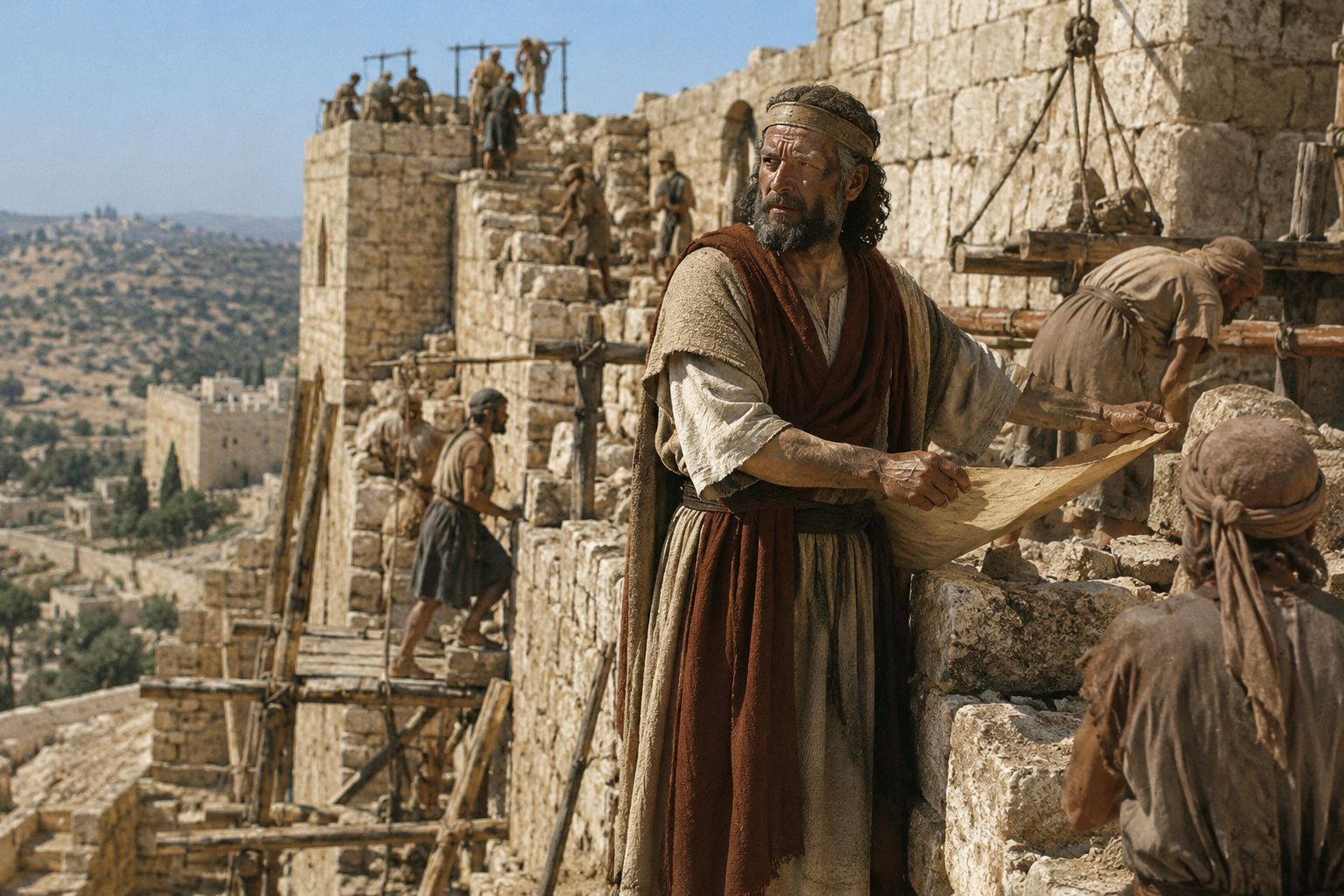
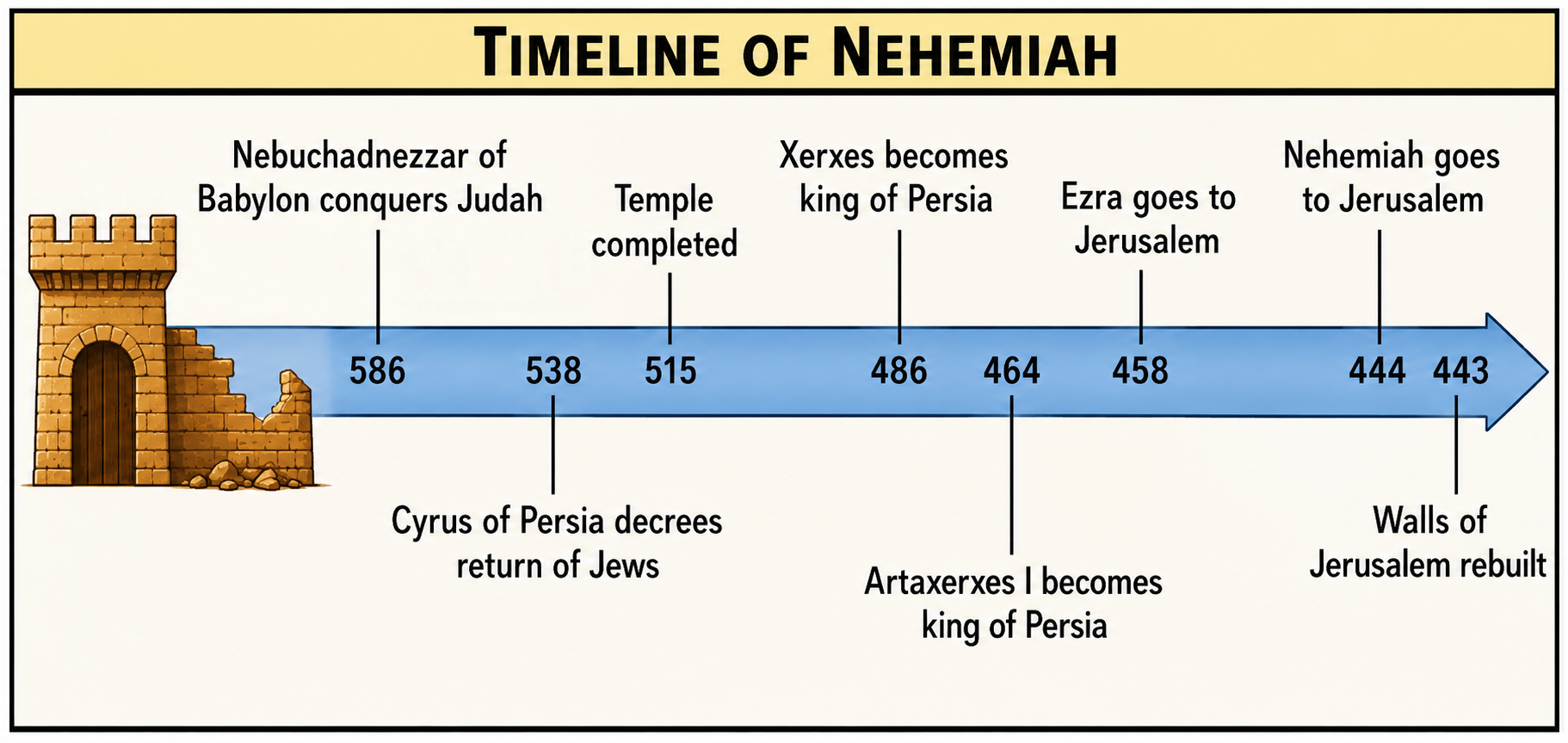
NEHEMIAH UNDER CONSTRUCTION:
JUST A FEW NOTES NOW.
WILL FINISH IF THE LORD WILLS
Nehemiah 11:1 Now the leaders of the people lived in Jerusalem, but the rest of the people cast lots to bring one out of ten to live in Jerusalem, the holy city, while nine-tenths remained in the other cities.
- the rulers (KJV): Ne 7:4,5 De 17:8,9 Ps 122:5
- cast lots (KJV): Jerusalem certainly had many inhabitants at this time, but not sufficient to preserve the city, which was now encompassed with a wall, the building of which was going on fast. Nehemiah, therefore, obliged one-tenth of the country people to come and dwell in it, that the population might be sufficient for the defence of the city. Some volunteered their services, which was at that time considered a sacrifice to patriotism; as Jerusalem then afforded very few advantages, and was a place of considerable danger: hence "the people blessed them that willingly offered themselves." Ne 10:34 Jos 18:10 1Ch 26:13 Pr 16:33 Ac 1:24
- one of ten (KJV): Jud 20:9,10
- the holy (KJV): Ne 11:18 Isa 48:2 Isa 52:1 Mt 4:5 Mt 27:53
Now the leaders of the people lived in Jerusalem, but the rest of the people cast lots to bring one out of ten to live in Jerusalem, the holy city, while nine-tenths remained in the other cities
Believer's Study Bible - (vv. 1-3) With the city rebuilt, it now had to be settled for defense purposes. This new population would consist of across section of the people of Judah.
Ryrie - 11:1-2 Now that Jerusalem (here first referred to as the holy city) was secured with walls, it needed to be repopulated, so lots were cast to bring one-tenth of the country's population into the city. Others apparently moved voluntarily (v. 2).
Bob Utley - "the leaders of the people lived in Jerusalem" Since the terrible siege of Jerusalem by Nebuchadnezzar in 586 B.C., no one wanted to live in the city. The leaders (the wealthy laymen, cf. Neh. 11:3) and the temple personnel were the only large groups that lived within the city's walls (cf. Neh. 11:3; Neh 2:16-17). They were to be joined by 10% of the Jewish population of the surrounding towns plus any volunteers (cf. Neh. 11:2). This involved leaving established homes and farms. This same subject is first introduced in Neh. 7:4. ▣ "cast lots" This VERB (BDB 656, KB 709, Hiphil PERFECT) means "casting lots (cf. 1 Chr. 24:31; 1 Chr 25:8; 1 Chr 26:13-14; Esth. 3:7; Esth 9:24). This had religious connotations (cf. Neh. 10:34; Num. 26:55-56; Jos. 14:2; Pro. 16:33; Pro 18:18). It was a way to know the will of YHWH, as was the Urim and Thummim (cf. Exod. 28:30; Lev. 8:8; Num. 27:21). The Urim was used exclusively by the High Priest, but "lots" were used to know YHWH's will by others (cf. NIDOTTE, vol. 1, pp. 840-842). See Urim and Thummim ▣ "the holy city" This was a way of referring to the place where YHWH dwelt (cf. Isa. 48:2; Isa 52:1; Dan. 9:24).
Steven Cole - You’re in the Ministry Now! (Nehemiah 11:1-12:47)
If I were to ask, “How does a person go into the ministry?” many Christians would answer, “The person needs to go to Bible college or seminary. After he has served in a ministry position for a while, he needs to be ordained.”
All right, I admit that it was a trick question. The question itself and that answer reflect a deeply entrenched, but erroneous, mentality among God’s people, which divides people into two categories: those who are “in the ministry” (“clergy”) and those who are not (“laity”). To the extent that we buy into that mindset, the body of Christ will be crippled. Just a few will be committed to doing the work of the ministry, while the majority sit back and let them do it. But the biblical picture is that those who are gifted as pastor-teachers and evangelists are to equip the saints (all believers) for the work of the ministry (Eph. 4:11-12).
So the correct answer to the question, “How does a person go into the ministry?” is, “He or she trusts in Jesus Christ as Savior and Lord.” At the moment a person trusts Christ as Savior, the Holy Spirit baptizes him (or her) into the body of Christ (1 Cor. 12:13). As members of His body, each one has a spiritual gift which he is to exercise for the building up of the body. It is proper and usually necessary for those who are gifted as pastor-teachers and evangelists to pursue formal training. It is also proper, according to Scripture (1 Tim. 5:17-18; 1 Cor. 9:14) to support those who devote themselves to these ministries. But it still is true that every believer has a spiritual gift that he or she is to use in ministry.
I’m talking primarily about a mindset where each of you sees yourself as entrusted by God with a vital ministry for which you will give an account. In the parable of the talents, it was the one-talent man who buried rather than invested his talent. Often in the body of Christ, it is the “one-talent” person who thinks, “I’m not gifted in an important way, so I can’t do much for the Lord.” That’s a wrong mentality that I want to challenge. The lesson I want to draw from our text is that…
All of God’s people should be ministry oriented.
Nehemiah 11 & 12 is another one of those portions of Scripture that you look at and think, “Why did God put this in His inspired Word?” From Neh 11:3-12:26 there is a lengthy register of the names of the Jewish citizens. These two chapters include:
1. The families who repopulated Jerusalem (Neh 11:3-24)
A. Lay families in Jerusalem (Neh 11:3-9)
B. Priests in Jerusalem (Neh 11:10-14)
C. Levites, gatekeepers, and temple servants in Jerusalem (Neh 11:15-24)
2. The families who lived in the cities of Judah and Benjamin (Neh 11:25-36)
3. The priests and Levites of Zerubbabel’s return (Neh 12:1-9)
4. The high priests (Neh 12:10-11)
5. The priests and Levites after Zerubbabel and Jeshua (Neh 12:12-26).
6. The dedication of the wall (Neh 12:26-43)
7. The organization of temple support (Neh 12:44-47)
Derek Kidner (Ezra & Nehemiah, Tyndale Old Testament Commentaries [IVP], p. 117) aptly says,
It is not bureaucratic pedantry that has preserved these names. The point is, once more, that these people and their chronicler are conscious of their roots and of their structure as God’s company. This is no rabble of refugees, settling down anywhere: they have the dignity of order and of known relationships; above all, of their calling to be “a kingdom of priests and a holy nation” (Ex. 19:6).
These people had willing hearts to do whatever God wanted them to do, and each functioned in their own unique capacity. As we examine the section that lists the names of the Jewish citizens, four factors emerge that help us define what ministry involves. The section dealing with the dedication of the wall reveals four requirements for the person involved in ministry (= every believer).
What does ministry involve?
1. MINISTRY INVOLVES A WILLINGNESS TO LIVE WHERE GOD WANTS YOU TO LIVE.
Nehemiah got the wall built, but there were not many people living in the city (Neh 7:4). When the people returned from the exile, the walls were torn down and there was a lot of rubble from the previous destruction. It would have required a lot of work to clear the rubble and restore the city. As the former capital, the restored city would have been a major target for enemies to attack. At first there wasn’t much economic opportunity there. It was far easier to settle out in the country and farm your own plot of ground. So most of the people had been content to live in the surrounding villages scattered across the land.
But Nehemiah knew that if the city was to be strong and prosperous and if the worship in the temple was to thrive, the city had to be well populated with citizens who could defend it in case of attack. As Neh 11:1 notes, the leaders lived in Jerusalem, but most of the people did not. So they cast lots to pick one out of ten who would move to Jerusalem. It seems that some who were not chosen volunteered to move, either in place of or in addition to those who drew the lot (Neh 11:2). The ones who stayed in the villages blessed those who were willing to move to Jerusalem.
Those who moved had to pull up roots where they were already established, give up their acreage in the country, and move into what quickly became a somewhat crowded city. Based on the number of men who moved to the city (3,044), there were about 10,000, conservatively estimated, who moved into the city, with a total population of 100,000 Jews in the land (Howard Vos, cited by James Boice, Nehemiah: Learning to Lead [Revell], p. 175). Although it was inconvenient and less desirable in some ways to move from the country to the city, these people were willing to live where God wanted them to live in order to serve His purpose.
One of the first considerations that any servant of God should think about is, “Where does God want me to live?” That should be determined in large measure by the potential for your ministry in that locale. Is there a solid Bible-teaching church where you can grow and serve? If not, is God calling you to help start such a church? That should be a primary factor in any move that you make.
I meet many Christians who say things like, “I moved to Flagstaff because it was a small town and not too crowded. But it’s becoming too big. I’m thinking of moving to (and they name some beautiful remote setting).” They haven’t given a minute’s thought to what sort of church may be there. Their main aim is to get away from people and the city.
Has it ever occurred to you that God pictures heaven as a city? It’s not pictured as a ranch or personal retreat, where you can live in seclusion and ignore others. It’s a city, the New Jerusalem! The reason Christians think about escaping from the city is that they don’t have a ministry mindset. If you’re thinking ministry, you’re thinking people. And while people live in the country and in suburbs, it is tragic that American evangelicals have, in large part, abandoned the cities. Rather than complaining about all the people in Flagstaff, we should view them as an opportunity for ministry!
2. MINISTRY INVOLVES SERVING IN THE SPHERE IN WHICH GOD CALLS YOU TO SERVE.
Chapter 11 lists the heads of families in Jerusalem (Neh 11:3-9); the priests (Neh 11:10-14); the Levites (Neh 11:15-18); the gatekeepers and temple servants (Neh 11:19-21); various officials appointed by the king of Persia (Neh 11:22-24); and, the people who lived outside the city (Neh 11:25-36). Each served in his respective sphere for the effective operation of the city and the nation. Those who lived outside of the city had to farm the land to provide food for those in the city. Each had a different role, but each role was vital to the entire cause.
In the body of Christ, God has gifted us in different ways, but every part is vital for the overall functioning and health of the body (1 Cor. 12:12-30). We should learn to coordinate and complement each other without friction or rivalry. Problems often develop in the body because the eye looks at everyone from the perspective of the eye only, and the hand views everything from the perspective of the hand. But the eye should value the hand and the hand should value the eye.
I once heard Carl George make the astute observation that the things in the church that people usually complain about reveal the person’s area of spiritual gift. For example, if a person says, “This isn’t a caring church,” she is probably gifted in mercy. The one who says, “This church doesn’t emphasize outreach enough” is probably an evangelist. The guy who says, “This church is a disorganized mess” is probably a gifted administrator.
The solution is not for the gifted person to sit around criticizing others for not doing what probably is not their area of gift, but rather to get involved in the areas that he thinks need fixing! The merciful person should help us all become more merciful by showing mercy. The evangelist should show us how to reach the lost. The administrator should help us get organized. God has made us all differently, and we only work as a body when we work in our sphere and affirm others in their sphere.
3. MINISTRY INVOLVES A WILLINGNESS TO SERVE WITHOUT ACCLAIM.
Most of these names mean nothing to us. Some aren’t even listed by name, but are lumped together with all of their kinsmen as a group (Neh 11:12-14). Zabdiel is named (Neh 11:14), although he means nothing to us, but 128 of his kinsmen go unnamed, except to say that they were valiant warriors. But 128 valiant warriors were no small part of a secure, safe city!
The church needs many people like that in order to function well. This place would shut down in a week if we didn’t have many who labor faithfully behind the scenes. You never see them up front, but they do what God has given them to do. They’re like your vital organs: you never see them, but when one of them shuts down, you’re in big trouble! Note two things about these people:
- Faithfulness, not fame, is the issue.
Motive is what matters. If we serve to try to gain esteem and recognition, we’re doing it for the wrong reason. We’ll get angry when others do not give us the strokes that we’re seeking. Chuck Swindoll writes, “If you desire fame and recognition, you will most likely fail as a leader and your efforts will go unrewarded for all eternity. That’s not a threat; it’s a promise” (Hand Me Another Brick [Thomas Nelson Publishers], p. 171). He goes on to cite Matthew 6:1, “Beware of practicing your righteousness before men to be noticed by them; otherwise you have no reward with your Father who is in heaven.”
- God notices even if others do not.
God saw fit to record these names that mean absolutely nothing to us. But they meant something to God, and that’s what ultimately matters. If you’re getting upset because no one in the church notices all that you do, your focus is in the wrong place. Look to the Lord, whom you are serving. And remember Hebrews 6:10: “For God is not so unjust as to forget your work and the love which you have shown toward His name, in having ministered and in still ministering to the saints.”
4. MINISTRY INVOLVES PEOPLE FIRST AND PROGRAMS SECOND.
These long lists underscore the importance of people to God. Each one of these strange, hard-to-pronounce names represents a person whom God loved and knew. Jesus said that the good shepherd “calls his own sheep by name” and that his “sheep follow him because they know his voice” (John 10:3, 4). The Christian faith is all about personal relationships, first with God, and then with one another (the two great commandments, Matt. 22:37-40).
Programs should always be the vehicle through which we minister to people. If a program is not doing that, we need to axe the program and replace it with something that ministers God’s Word to people. Apart from programs, if you have the proper ministry mindset, you will seek to relate to people. On Sunday mornings, take the initiative to meet new people. Make them feel welcome here. Introduce them to others. While we can’t get well acquainted with everyone, if it is a person to whom you can relate, set up a time to get together for coffee or have them over to dinner. Share your own testimony and ask them about how God has worked in their lives. Ministry takes place though relationships.
That threatens some people. It’s safer to work in a program, or to be involved in maintaining the building, where you can keep your distance from people. But God isn’t saving buildings or sanctifying programs. He is saving and sanctifying people, and He does that through His people reaching out in love to others.
Thus ministry involves a willingness to live where God wants you to live; to serve in the sphere where God wants you to serve; to serve without acclaim; and to put people ahead of programs.
What are some requirements for ministry?
Do you need seminary training? Do you need to know Hebrew, Greek, and theology? Those things may be helpful in some spheres of ministry. But they are not the main thing. The main requirement for being involved in ministry is that your heart is right before God. In the section describing the dedication of the wall (Neh 12:27-43) and the organization of temple support (Neh 12:44-47), there are four aspects of a heart that is right before God:
1. A SERVANT (= MINISTER) NEEDS A PURE HEART (Neh 12:30).
Before they dedicated the wall, the priests and Levites purified themselves, the people, the gates, and the wall. The Old Testament rituals for purification symbolize the fact that our hearts are sinful and God is absolutely holy. Those who serve Him must be cleansed from all known sin of thought, word, and deed.
A scandal hit the front page of our local paper and the evening news this week, in which a man who was formerly an elder here, who also was in full time ministry, was charged with 17 counts of molesting girls who were at sleepovers with his daughters. When that sort of hypocrisy is exposed, the world mocks the name of Christ.
All of us struggle against temptation. All of us are vulnerable to fall into sin. But if you are not guarding yourself from temptation and walking in consistent victory over sin, please do not make a claim of being a Christian. Don’t get involved in any sort of ministry. Rather, humble yourself before God, repent of all of your sins, and take measures to protect yourself from falling again. Purity on the heart level is an essential requirement for Christian service.
2. A SERVANT NEEDS A WORSHIPFUL HEART (Neh 12:27, 31-43).
The dedication of the wall was a time, not to praise Nehemiah, but to praise the Lord. Nehemiah organized two choirs to walk in opposite directions on top of the wall until they converged at the temple. They sang praises to the accompaniment of cymbals, harps, and lyres. The chapter refers six times to David, who is twice called “the man of God” (Neh 12:24, 36, 37 [twice], 45, & 46). David was a man after God’s heart because he was a worshiper of God. He had set up the whole system of worship that these people were seeking to follow (Neh 12:46).
God doesn’t want your work if He doesn’t have your worship. To worship God is to rejoice in and extol His great attributes and actions. It is to reverence God above all else. True worship is not just outward, but inward. It engages the mind, the heart, the will, and the emotions. Whether you’re setting up chairs or preaching a sermon, it ought to flow out of a heart of worship for God.
3. A SERVANT NEEDS A JOYFUL HEART (Neh 12:43).
As you read the account of this dedication service, you get the distinct impression that these people were enjoying themselves! Chuck Swindoll (p. 186) pictures it as a sort of Jewish Disneyland Parade! Note the emphasis on joy in Neh 12:43: it is mentioned four times in that verse, and again in Neh 12:44. It says, “the joy of Jerusalem was heard from afar.” It wasn’t their song that was heard from afar, but their joy (Swindoll, p. 188). Outsiders heard their joy!
Have you ever been outside of a stadium when a ball game was going on inside, and suddenly the crowd roars? You know when that happens that something good happened inside! Probably someone for the home team just hit a homerun. In the same way, people should be able to walk by the church and think, “Something good is going on in there!” In fact, God has hit a grand-slam homerun for us through Jesus Christ. We need to so caught up with what God has done that His great joy radiates from this place!
A servant needs a pure heart, a worshipful heart, and a joyful heart. Finally,
4. A SERVANT NEEDS A GIVING HEART (Neh 12:44-47).
These people gave joyfully so that God’s work could go forward. They saw the importance of worship at the temple and they were willing to give the necessary offerings to support the many priests, Levites, gatekeepers, and singers who served there. The people did it because they “rejoiced over the priests and Levites who served” (Neh 12:44).
Have you ever been attracted to a stingy, tight-fisted person? No, we’re all attracted to warm, generous people who freely share what is theirs with others. As I mentioned last week, one of the most reliable gauges of your heart before God is your checkbook. If God is going to use you to minister to others, you need to have a generous heart. You will see the importance of supporting those who are called to serve God on the mission field. You will see the importance of supporting the local church. Just before Peter exhorts us to use our spiritual gifts in serving one another, he says, “Be hospitable to one another without complaint” (1 Pet. 4:9).
Conclusion
The pioneer missionary, William Carey, was a cobbler before he left for the mission field. He would keep a map of India before him in his shop, stopping every so often to study it. He longed to go there and preach the gospel.
He did a lot of preaching and teaching on the side, with the result that his trade dwindled. One day a friend admonished him for neglecting his business. “Neglecting my business?” Carey said. “My business is to extend the kingdom of God. I only cobble shoes to pay expenses.”
That should be the mindset of every Christian. If you know Christ as your Savior, you’re in the ministry now! But may I ask, Are you ministry-oriented? Is that your mindset? Are there people in your schedule on a regular basis? When you gather with God’s people, are you thinking about others and how you can show the love of Christ to them? If you’ve been coming here for more than three or four weeks and you’re thinking, “This is an unfriendly church,” you may be part of the problem! The solution is for you to reach out in friendliness to others. Rather than coming to get your needs met, come to meet the needs of others.
I heard about the son of a pastor who also decided to become a pastor. The dad told the son, “Keep close to God, keep close to men. And bring God and men together.” That’s ministry! God’s people should stay close to Him and close to people and bring the two together.
Discussion Questions
- To what extent (if any) do our desires enter into the question of where God wants us to live? How can we know His will in this decision?
- How can a Christian determine what His spiritual gifts are?
- To what extent does a naturally shy person need to overcome this trait in order to minister effectively to people?
- To what extent does a believer need to “have it all together” before he/she gets involved in ministry?
Nehemiah 11:2 And the people blessed all the men who volunteered to live in Jerusalem.
- blessed (KJV): De 24:13 Job 29:13 Job 31:20
- willingly (KJV): Judges 5:9 2Co 8:16,17
And the people blessed all the men who volunteered to live in Jerusalem
Henry Morris - dwell in Jerusalem. With the walls completed and temple services fully operational, it was necessary to increase the internal population of Jerusalem in order to make the city function effectively. In addition to the leaders and the Nethinims, it was desired that ten percent of the Israelites live there. Some volunteered; others were selected by lot (Nehemiah 11:1).
Nehemiah 11:3 Now these are the heads of the provinces who lived in Jerusalem, but in the cities of Judah each lived on his own property in their cities–the Israelites, the priests, the Levites, the temple servants and the descendants of Solomon’s servants.
- Now (KJV): There is a good deal of difference between this enumeration and that in Chronicles; as this comprehends not only those who came first with Zerubbabel, but also those who came with Ezra and Nehemiah: see on 1 Ch 9:18.
- the chief (KJV): Ne 7:6 Ezr 2:1
Now these are the heads of the provinces who lived in Jerusalem, but in the cities of Judah each lived on his own property in their cities–the Israelites, the priests, the Levites, the temple servants and the descendants of Solomon’s servants.
Bob Utley - "Now these are the heads of the provinces who lived in Jerusalem" This list is quite similar to 1 Chronicles 9; about half of the names are the same. The exact relationship between these two lists as with other lists in the books of Ezra and Nehemiah, is uncertain. ▣ "each lived on his own property" The term "property" (BDB 28) usually meant "to grasp" or "to seize," but in connection to tribal allotments it has the connotation of given by YHWH (both as a promise to Abraham, cf. Gen. 5:12-21 and by the Urim in Joshua 13-19). ▣ "Israelites" This refers to Jewish laymen. This verse lists the different elements of Jewish society. The different kinds of temple personnel and lay persons are included. ▣ "temple servants" This term (BDB 682) in post-exilic texts always has the ARTICLE and is PLURAL. It designates a temple labor force. The origin of the term may be "the given ones," referring to those non-Israelites defeated in battle by King David and given to the temple to help the Levites (cf. Ezra 8:20); therefore, they are like "Solomon's servants" (cf. Ezra 2:58; Neh. 7:60; Neh 11:3).
Henry Morris - dwelt in Jerusalem. The list of names in Nehemiah 11:3-24 corresponds in general to the list of returnees in 1 Chronicles 9:2-17. Probably these were the organized groups and their leaders when Nehemiah arrived at Jerusalem.
Ryrie - s. 11:3-24 These verses (cf. 1 Chron. 9:2-17) apparently list those already resident in Jerusalem, including laymen (vv. 3-9), priests (vv. 10-14), Levites (vv. 15-18), gatekeepers (v. 19), Temple servants (v. 21; on Ophel, see note on 3:26), and certain other individuals (vv. 22-24; on the sons of Asaph, see note on Ezra 2:41).
Nehemiah 11:4 Some of the sons of Judah and some of the sons of Benjamin lived in Jerusalem. From the sons of Judah: Athaiah the son of Uzziah, the son of Zechariah, the son of Amariah, the son of Shephatiah, the son of Mahalalel, of the sons of Perez;
- dwelt (KJV): 1Ch 9:3,4-9
- Perez (KJV): The variation of Pharez and Perez is only found in the translation; the original being uniformly [Perets <Strong's H6557>.] Ge 38:29 Ru 4:18, Pharez, Mt 1:3 Lu 3:33, Phares
Some of the sons of Judah and some of the sons of Benjamin lived in Jerusalem. From the sons of Judah: Athaiah the son of Uzziah, the son of Zechariah, the son of Amariah, the son of Shephatiah, the son of Mahalalel, of the sons of Perez;
Bob Utley - "sons of Judah. . .sons of Benjamin" The preponderance of returning Jews were from these two tribes because they made up the last tribal groups to be exiled. Simeon was also part of the tribe of Judah but had lost their tribal identity. ▣ "Perez" See Gen. 38:29.
Nehemiah 11:5 and Maaseiah the son of Baruch, the son of Col-hozeh, the son of Hazaiah, the son of Adaiah, the son of Joiarib, the son of Zechariah, the son of the Shilonite.
- Colhozeh (KJV): Ne 3:15
- Shiloni (KJV): Some suppose Shiloni to be the name of a man; others derive it from Shiloh, the city so called; and others derive it from Shelah, son of Judah. Ge 38:5, Shelah, Nu 26:20, Shelanites, 1Ch 4:21 1Ch 9:5
and Maaseiah the son of Baruch, the son of Col-hozeh, the son of Hazaiah, the son of Adaiah, the son of Joiarib, the son of Zechariah, the son of the Shilonite.
Bob Utley - "the son of the Shilonite" This designation is surprising in a list of names (cf. 1 Chr. 9:5). There is no first name associated with this place (Shiloh, a city in Ephraim). It is possible that the consonants of "Shilonites" should refer to "Shelah," one of Judah's sons in Gen. 38:5,26, therefore, "Shelanite" (cf. Derek Kidner, Tyndale Commentary, p. 118), which is the way NEB and REB translate 1 Chr. 9:5 and the form appears in Num. 26:20.
Nehemiah 11:6 All the sons of Perez who lived in Jerusalem were 468 able men.
All the sons of Perez who lived in Jerusalem were 468 able men.
Nehemiah 11:7 Now these are the sons of Benjamin: Sallu the son of Meshullam, the son of Joed, the son of Pedaiah, the son of Kolaiah, the son of Maaseiah, the son of Ithiel, the son of Jeshaiah;
- the sons (KJV): 1Ch 9:7-9
- Joed (KJV): It is probable that Joed was also called Hodaviah, and that Pedaiah had also the name of Hasenuah.
Now these are the sons of Benjamin: Sallu the son of Meshullam, the son of Joed, the son of Pedaiah, the son of Kolaiah, the son of Maaseiah, the son of Ithiel, the son of Jeshaiah;
Nehemiah 11:8 and after him Gabbai and Sallai, 928.
and after him Gabbai and Sallai, 928.
Nehemiah 11:9 Joel the son of Zichri was their overseer, and Judah the son of Hassenuah was second in command of the city.
- Judah (KJV): 1Ch 9:7, Hodaviah, Hasenuah
Joel the son of Zichri was their overseer, and Judah the son of Hassenuah was second in command of the city.
Bob Utley - "their overseer" This term (BDB 824) means "commissioner, deputy, overseer. It is used in Neh. 11:22 for a leader of Levites. It is used of the king's officers in 2 Chr. 24:11 and of the king's military officers in 2 Kgs. 25:19. This text does not specify exactly what kind of overseer. ▣ "second in command of the city" This may imply that he was next to Nehemiah's brother, Hanani (cf. Neh. 7:2). It is possible that Judah was the overseer of Benjamin's labor force who helped rebuild the walls of Jerusalem. The NIV translates this phrase "was over the Second District of the city." The only other English translation that I have found that has this interpretation is James Moffatt, A New Translation of the Bible. It is also in the footnote of the NEB.
Nehemiah 11:10 From the priests: Jedaiah the son of Joiarib, Jachin,
- Jedaiah (KJV): One of Dr. Kennicott's MSS. omits, [ben <Strong's H1121>,] {ben,} "son of," and reads "Jedaiah, Joiarib, Jachin:" which is nearly that of the parallel place. Joiarib, [Yowyariyb <Strong's H3114>,] is merely a contracted form of [Yehowyariyb <Strong's H3080>,] Jehoiarib, by the elision of [He',] {hay.} Ne 7:39 Ne 12:19 1Ch 9:10, Jehoiarib, Ezr 2:36 Ezr 8:16
- Joiarib (KJV): Ne 12:6
From the priests: Jedaiah the son of Joiarib, Jachin
Nehemiah 11:11 Seraiah the son of Hilkiah, the son of Meshullam, the son of Zadok, the son of Meraioth, the son of Ahitub, the leader of the house of God,
- Seraiah (KJV): Seraiah probably had also the name of Azariah. 1Ch 6:7-14 1Ch 9:11, Azariah, Ezr 7:1-5
- the ruler (KJV): He had the command over all secular matters; as the high priest had over all those which were spiritual. Nu 3:32 1Ch 9:1 2Ch 19:11 2Ch 31:13 Ac 5:24
Seraiah the son of Hilkiah, the son of Meshullam, the son of Zadok, the son of Meraioth, the son of Ahitub, the leader of the house of God,
Bob Utley - "the leader of the house of God" The term (BDB 617) means "one in front." It is used of political leaders, but also of religious leaders (cf. 2 Chr. 31:12; 2 Chr 35:8; Jer. 20:1, also of High Priest, 1 Chr. 9:11; 2 Chr. 31:13 [different word in Neh. 11:10]; Neh. 11:11; Dan. 11:22).
Nehemiah 11:12 and their kinsmen who performed the work of the temple, 822; and Adaiah the son of Jeroham, the son of Pelaliah, the son of Amzi, the son of Zechariah, the son of Pashhur, the son of Malchijah,
- Adaiah (KJV): 1Ch 9:12,13
and their kinsmen who performed the work of the temple, 822; and Adaiah the son of Jeroham, the son of Pelaliah, the son of Amzi, the son of Zechariah, the son of Pashhur, the son of Malchijah,
Nehemiah 11:13 and his kinsmen, heads of fathers’ households, 242; and Amashsai the son of Azarel, the son of Ahzai, the son of Meshillemoth, the son of Immer,
and his kinsmen, heads of fathers’ households, 242; and Amashsai the son of Azarel, the son of Ahzai, the son of Meshillemoth, the son of Immer,
Nehemiah 11:14 and their brothers, valiant warriors, 128. And their overseer was Zabdiel, the son of Haggedolim.
- of one of the great men (KJV): or, of Haggedolim, Ne 11:14
and their brothers, valiant warriors, 128. And their overseer was Zabdiel, the son of Haggedolim
Bob Utley - valiant warriors - This term (BDB 298) can refer to (1) physical strength (2) military prowess (e.g., Jos. 1:14; Jos 8:3; Jos 10:7; Jdg. 6:12; Jdg 11:1; 2 Chr. 13:3; 2 Chr 14:8) (3) ability (cf. Neh. 11:6; Exod. 18:21,25; 1 Chr. 9:13) (4) wealth (1 Sam. 9:1; 2 Kgs. 15:20). Because these men are priests either #1 or #3 fits the context best. the son of Haggedolim - The term (BDB 153, KB 177) means "great" and is used to describe many things and persons (NASB 1970 marginal note, p. 700, "the great ones"). The TEV translation carries the basic thought of the PLURAL form in this context.
Nehemiah 11:15 Now from the Levites: Shemaiah the son of Hasshub, the son of Azrikam, the son of Hashabiah, the son of Bunni;
- Shemaiah (KJV): 1Ch 9:14,19
Now from the Levites: Shemaiah the son of Hasshub, the son of Azrikam, the son of Hashabiah, the son of Bunni
Nehemiah 11:16 and Shabbethai and Jozabad, from the leaders of the Levites, who were in charge of the outside work of the house of God;
- Shabbethai (KJV): Ne 8:7
- had the oversight of (KJV): Heb. were over, 1Ch 26:20
- outward (KJV): Calmet supposes they provided the victuals for the priests, the victims for the sacrifices, the sacerdotal vestments, the sacred vessels, and other necessaries for the service of the temple. Ac 6:2,3
and Shabbethai and Jozabad, from the leaders of the Levites, who were in charge of the outside work of the house of God;
Bob Utley - "who were in charge of the outside work of the house of God" In the context of Nehemiah, one wonders if this refers to (1) normal temple activities, but done outside the precincts of the temple (e.g., raising sacrificial sheep) (2) the work done on the walls and gates of the city which were near the temple area (3) other administrative assignments (cf. 1 Chr. 26:29). The term has the connotation in this text of secular work.
Nehemiah 11:17 and Mattaniah the son of Mica, the son of Zabdi, the son of Asaph, who was the leader in beginning the thanksgiving at prayer, and Bakbukiah, the second among his brethren; and Abda the son of Shammua, the son of Galal, the son of Jeduthun.
- Zabdi (KJV): In the parallel passage, instead of Zichri, many manuscripts have Zabdi, as here: he is also called Zaccur. Ne 10:12 1Ch 9:15, Zichri
- to begin (KJV): Ne 12:8,31 1Ch 16:4,41 1Ch 25:1-6
- thanksgiving (KJV): Php 4:6 1Th 5:17,18
- Bakbukiah (KJV): Ne 12:9,25
and Mattaniah the son of Mica, the son of Zabdi, the son of Asaph, who was the leader in beginning the thanksgiving at prayer, and Bakbukiah, the second among his brethren; and Abda the son of Shammua, the son of Galal, the son of Jeduthun.
Bob Utley - Asaph. . .Jeduthun" These were two of the three groups of temple singers appointed by David (cf. 1 Chr. 25:1-4; 2 Chr. 5:12). Asaph was a leader of a Levitical family involved in temple music and praise (cf. 1 Chr. 25:1-2; 2 Chr. 5:12). ▣ "and Bakbukiah, the second among his brethren" This seems to imply that this Levite was the assistant to Mattaniah (cf. TEV). This Hebrew term (BDB 1041) is often used to denote the second in charge/control/leadership (cf. 2 Kgs. 23:4; 2 Kgs 25:18; 1 Chr. 5:12; 1 Chr 15:18; 2 Chr. 31:12; Jer. 52:24). ▣ "Abda the son of Shammua" 1 Chronicles 9:16 has Obadiah son of Shemaiah.
Nehemiah 11:18 All the Levites in the holy city were 284.
- the holy (KJV): Ne 11:1 1Ki 11:13 Da 9:24 Mt 24:15 Mt 27:53 Rev 11:2 Rev 21:2
All the Levites in the holy city were 284.
Bob Utley - Many of the Levites lived outside of the city of Jerusalem (cf. Neh. 11:3,20), but 284 did live in the city.
Nehemiah 11:19 Also the gatekeepers, Akkub, Talmon and their brethren who kept watch at the gates, were 172.
- Akkub (KJV): Ne 7:45 Ne 12:25 1Ch 9:17-22
- that kept (KJV): Ps 84:10
- the gates (KJV): Heb. at the gates
Also the gatekeepers, Akkub, Talmon and their brethren who kept watch at the gates, were 172.
Bob Utley - "the gatekeepers" These were also ancient families who were appointed to this special task at the temple (cf. 1 Chr. 9:17-27; 1 Chr 23:5; Ezra 2:42).
Nehemiah 11:20 The rest of Israel, of the priests and of the Levites, were in all the cities of Judah, each on his own inheritance.
The rest of Israel, of the priests and of the Levites, were in all the cities of Judah, each on his own inheritance.
Bob Utley - "each on his own inheritance" Originally the tribe of Levi did not inherit land. The Lord Himself was their inheritance (cf. Num. 18:20,24; Deut. 10:9; Deut 18:1-2; Jos. 13:14,33). The Levites asked Joshua for houses in certain special cities called "Levitical cities" (cf. Joshua 21) along with a small part of the surrounding pasture land. In this way they could grow vegetable gardens or raise an animal.
Nehemiah 11:21 But the temple servants were living in Ophel, and Ziha and Gishpa were in charge of the temple servants.
- the (KJV): Ne 3:26,31 2Ch 27:3
- Ophel (KJV): or, the tower
But the temple servants were living in Ophel, and Ziha and Gishpa were in charge of the temple servants.
Henry Morris - Nethinims. The Nethinim (those appointed) are frequently mentioned in Ezra and Nehemiah, and they apparently were servants assigned to the more menial tasks around the temple and city. They were possibly descendants of the Gibeonites, slaves assigned by Joshua to be perpetual "hewers of wood and drawers of water for the congregation, and for the altar of the LORD" (Joshua 9:27). Nevertheless, they dwelt in the Ophel section of Jerusalem and were, by this time at least, considered full participants in the faith of the nation.
Nehemiah 11:22 Now the overseer of the Levites in Jerusalem was Uzzi the son of Bani, the son of Hashabiah, the son of Mattaniah, the son of Mica, from the sons of Asaph, who were the singers for the service of the house of God.
- overseer (KJV): Ne 11:9,14 Ne 12:42 Ac 20:28
- Uzzi (KJV): Ne 12:42
- Bani (KJV): Ne 3:17 Ne 8:7 Ne 9:4,5 Ne 10:13
- Hashabiah (KJV): Ne 10:11 Ne 12:24 Ezr 8:19
- Mattaniah (KJV): Ne 11:17 Ne 12:25,35 Ne 13:13 1Ch 9:15
- Of the sons (KJV): Ne 11:17 Ne 12:46 1Ch 25:1-6
- were over (KJV): Ne 11:11,16 1Ch 9:16-32
Now the overseer of the Levites in Jerusalem was Uzzi the son of Bani, the son of Hashabiah, the son of Mattaniah, the son of Mica, from the sons of Asaph, who were the singers for the service of the house of God.
Bob Utley - There are so many lists of people in Ezra and Nehemiah. Often the names are common. The only way to try to tell them apart is to (1) check which group they are a part of (e.g., lay persons, priests, Levites, etc.), (2) check the tribe , (3) check the order of the names. Here in Neh. 11:22 it is obvious that Uzzi is from the same family of Asaph mentioned in Neh. 11:17.
Nehemiah 11:23 For there was a commandment from the king concerning them and a firm regulation for the song leaders day by day.
- the king's (KJV): 1Ch 9:33 Ezr 6:8,9 Ezr 7:20-24
- a certain portion (KJV): or, a sure ordinance
For there was a commandment from the king concerning them and a firm regulation for the song leaders day by day.
Bob Utley - "the king" This refers to David, not Artaxerxes I (cf. Neh. 12:24,45-46). These temple personnel were appointed special tasks to perform in the temple on a regular basis, many of the tasks going back to David's day.
Nehemiah 11:24 Pethahiah the son of Meshezabel, of the sons of Zerah the son of Judah, was the king’s representative in all matters concerning the people.
- Meshezabeel (KJV): Ne 10:21
- Zerah (KJV): Ge 38:30, Zarah, Nu 26:20 Mt 1:3, Zara
- at the king's (KJV): 1Ch 18:17 1Ch 23:28 *margins
Pethahiah the son of Meshezabel, of the sons of Zerah the son of Judah, was the king’s representative in all matters concerning the people
Bob Utley - "Pethahiah" This is the name of a priest in David's day who was involved in the twenty-four divisions (cf. 1 Chr. 24:16). There is another man by this same name mentioned in Neh. 11:24. The interpretive question is (1) do Neh. 11:23 and 24 go together and, thereby "the king" refers to David or (2) is the man a representative of Artaxerxes I, the Persian king during Ezra's and Nehemiah's day?
Nehemiah 11:25 Now as for the villages with their fields, some of the sons of Judah lived in Kiriath-arba and its towns, in Dibon and its towns, and in Jekabzeel and its villages, 26and in Jeshua, in Moladah and Beth-pelet,
- Kirjatharba (KJV): Jos 14:15
- Dibon (KJV): Jos 15:22, Dimonah
- Jekabzeel (KJV): Jos 15:21, Kabzeel
Now as for the villages with their fields, some of the sons of Judah lived in Kiriath-arba and its towns, in Dibon and its towns, and in Jekabzeel and its villages, 26and in Jeshua, in Moladah and Beth-pelet,
Ryrie - 11:25-26 These verses list towns in the former territories of Judah (vv. 25-30) and Benjamin (vv. 31-36), where other Jews lived.
Bob Utley - 11:25-36 The list of cities in chapter 3 which relates those who worked on the city wall is different from this list. The only name that is the same is Zanoah. This is hard to explain for the lists are supposed to be a list of the surrounding cities with Jewish populations. The possibilities are (1) that these cities mark the extent of the boundaries of Judah and Benjamin, not the cities close to Jerusalem or (2) that these are cities in the pre-exilic land allocations of Judah (cf. Neh. 11:25-30) and Benjamin (cf. Neh. 11:31-36) in which the returnees settled. ▣ "Kiriath-arba" This is the ancient name for Hebron (cf. Gen. 23:2), which is 20 miles south of Jerusalem (cf. Jos. 14:15; Jos 15:54; Jos 20:7; Jdg. 1:10).▣ "and its towns" This is literally the Hebrew idiom "daughters." ▣ "Dibon" This is possibly the same as Dimonah. See Jos. 15:21-26. ▣ "Jekabzeel" A village in southern Judah close to Edom. See Joshua 15:21. ▣ 11:25, 28, 32, 34 "Jekabzeel. . .Meconah. . .Ananiah. . .Neballat" These are cities which appear only here in the Bible.
Nehemiah 11:26 and in Jeshua, in Moladah and Beth-pelet,
- Moladah (KJV): Jos 15:26 Jos 19:2
- Bethphelet (KJV): Jos 15:27, Beth-palet
and in Jeshua, in Moladah and Beth-pelet,
Bob Utley - 11:26 "Moladah" See Jos. 15:26; Jos 19:2; 1 Chr. 4:28. ▣ "Beth-pelet" This is a village in southern Judah. See Jos. 15:27.
Nehemiah 11:27 and in Hazar-shual, in Beersheba and its towns,
- Hazar-shua, Jos 15:28 Jos 19:3, Beth-sheba, Ge 21:31 Ge 26:33 Judges 20:1
and in Hazar-shual, in Beersheba and its towns,
Bob Utley - "Hazar-Shual, in Beersheba" Both are mentioned in Jos. 15:28.
Nehemiah 11:28 and in Ziklag, in Meconah and in its towns,
- Ziklag (KJV): Jos 15:31 1Sa 27:6
- Mekonah (KJV): Probably the Mechanam which Jerome (in Beth-macha) places eight miles from Eleutheropolis, towards Jerusalem.
and in Ziklag, in Meconah and in its towns
Bob Utley - "Ziklag" See Jos. 15:31; Jos 19:5; 1 Sam. 27:6; 1 Sam 30:1,14,25.
Nehemiah 11:29 and in En-rimmon, in Zorah and in Jarmuth,
- Enrimmon (KJV): Rimmon is placed by Eusebius in the south of Judah, 16 miles south of Eleutheropolis. Jos 15:32, Rimmon
- Zareah (KJV): These variations are only chargeable to the translator; the original being uniformly Zorah. Jos 15:33, Zoreah, Jos 19:41 Jud 13:25, Zorah
- Jarmuth (KJV): Jos 12:11 Jos 15:35
and in En-rimmon, in Zorah and in Jarmuth,
Bob Utley - "En-rimmon" See Joshua 15:32. ▣ "Zorah" See Jos. 15:33. ▣ "Jarmuth" Like Lachish this was originally an Amorite city. See Jos. 10:3,5,23; Jos 12:11; Jos 15:35.
Nehemiah 11:30 Zanoah, Adullam, and their villages, Lachish and its fields, Azekah and its towns. So they encamped from Beersheba as far as the valley of Hinnom.
- Zanoah (KJV): Ne 3:13 Jos 15:34
- Adullam (KJV): Jos 12:15 Mic 1:15
- Lachish (KJV): Jos 10:3 Jos 15:39 Isa 37:8
- Azekah (KJV): Jos 15:35
- the valley (KJV): Jos 15:8 Jos 18:16 2Ki 23:10 Jer 7:31,32 Jer 19:2,6 Jer 32:35
Zanoah, Adullam, and their villages, Lachish and its fields, Azekah and its towns. So they encamped from Beersheba as far as the valley of Hinnom
Ryrie - Beersheba. 32 mi (51 km) S of Jerusalem. valley of Hinnom. SW area of Jerusalem. See note on 2 Chron. 28:3.
Bob Utley - "Zanoah, Adullam" Both are mentioned in Jos. 15:34-35. ▣ "Lachish" This was a major walled city (e.g., Jos. 10; 12:3-16; 2 Chr. 11:9; 2 Chr 22:9). ▣ "Azekah" This is a city of Judah located on the coastal plain. See Jos. 15:35. ▣ "Beersheba" This is about 32 miles south of Jerusalem. The current Persian land allocation for Judah did not extend that far north. ▣"the valley of Hinnom" One of the valleys in Jerusalem known as the location of the worship of the Phoenician fire god Molech. This valley was later used as the garbage dump for Jerusalem. Jesus uses it to describe Hell — Gehenna.
Nehemiah 11:31 The sons of Benjamin also lived from Geba onward, at Michmash and Aija, at Bethel and its towns,
- from Geba (KJV): or, of Geba, Ne 7:30, Gaba, Jos 18:24
- at Michmash (KJV): or, to Michmash, Ne 7:31, Michmas, 1Sa 13:11,23 Isa 10:28
- Aija (KJV): Ne 7:32, Ai, Ge 12:8, Hai, Jos 8:9, Ai, Beth-el, Ge 28:19 Jos 18:13
The sons of Benjamin also lived from Geba onward, at Michmash and Aija, at Bethel and its towns,
Bob Utley - Geba" This was a northern city of Benjamin. Its name means "height" or "hill." See Joshua 18:24.▣ "Michmash and Aija" Both are mentioned in Isa. 10:28-20. They were located near Bethel. Aija means "ruins" and may be a way of referring to Ai.
Nehemiah 11:32 at Anathoth, Nob, Ananiah,
- Anathoth (KJV): Ne 7:27 Jos 21:18 Isa 10:30 Jer 1:1
- Nob (KJV): 1Sa 21:1 1Sa 22:19 Isa 10:32
at Anathoth, Nob, Ananiah, - Anathoth was the home of Jeremiah, three mi (five km) N of Jerusalem.
Bob Utley - "Anathoth" This was a Levitical city three miles north of Jerusalem (cf. Jos. 21:18). It was Jeremiah's hometown (cf. Jer. 1:1). ▣ "Nob" Another Levitical city two miles north of Jerusalem (cf. 1 Sam. 21:1; 1 Sam 22:9,11,19; Isa. 10:32).
Nehemiah 11:33 Hazor, Ramah, Gittaim,
- Ramah (KJV): Jos 18:25 1Sa 7:17 Mt 2:18, Rama
- Gittaim (KJV): 2Sa 4:3
Hazor, Ramah, Gittaim,
Bob Utley - "Hazor" Often these village names, like the people, are hard to identify because there are several by the same name. Hazor is a good example. ▣ "Ramah" This is a city of Benjamin five miles north of Jerusalem. See Joshua 18:25; Judges 4:5; Judges 19:13; Ezra 2:26. ▣ "Gittaim" The name means "two wine presses" and was northwest of Jerusalem. See 2 Sam. 4:3.
Nehemiah 11:34 Hadid, Zeboim, Neballat,
- Zeboim (KJV): 1Sa 13:18
Hadid, Zeboim, Neballat,
Bob Utley - "Hadid. . .Lod and Ono" See Ezra 2:33 and Neh. 7:37.
Nehemiah 11:35 Lod and Ono, the valley of craftsmen.
- Lod (KJV): Ne 7:37 1Ch 8:12
- the valley (KJV): 1Ch 4:14
Lod and Ono, the valley of craftsmen.
Bob Utley - "the valley of craftsmen" The ancient guilds lived close together (cf. 1 Chr. 4:14).
Nehemiah 11:36 From the Levites, some divisions in Judah belonged to Benjamin.
- And of (KJV): Jos 21:1-45 1Ch 6:54-81
- divisions (KJV): Ge 49:7
From the Levites, some divisions in Judah belonged to Benjamin
Bob Utley - As Neh. 11:25-30 describes the restored land of Judah in this Persian period, so Neh. 11:31-35 describes the extent of the land of Benjamin. The Levites lived in all areas of the restored land (cf. TEV).