Nehemiah 12:2
Nehemiah 12:3
Nehemiah 12:4
Nehemiah 12:5
Nehemiah 12:6
Nehemiah 12:7
Nehemiah 12:8
Nehemiah 12:9
Nehemiah 12:10
Nehemiah 12:11
Nehemiah 12:12
Nehemiah 12:13
Nehemiah 12:14
Nehemiah 12:15
Nehemiah 12:16
Nehemiah 12:17
Nehemiah 12:18
Nehemiah 12:19
Nehemiah 12:20
Nehemiah 12:21
Nehemiah 12:22
Nehemiah 12:23
Nehemiah 12:24
Nehemiah 12:25
Nehemiah 12:26
Nehemiah 12:27
Nehemiah 12:28
Nehemiah 12:29
Nehemiah 12:30
Nehemiah 12:31
Nehemiah 12:32
Nehemiah 12:33
Nehemiah 12:34
Nehemiah 12:35
Nehemiah 12:36
Nehemiah 12:37
Nehemiah 12:38
Nehemiah 12:39
Nehemiah 12:40
Nehemiah 12:41
Nehemiah 12:42
Nehemiah 12:43
Nehemiah 12:44
Nehemiah 12:45
Nehemiah 12:46
Nehemiah 12:47
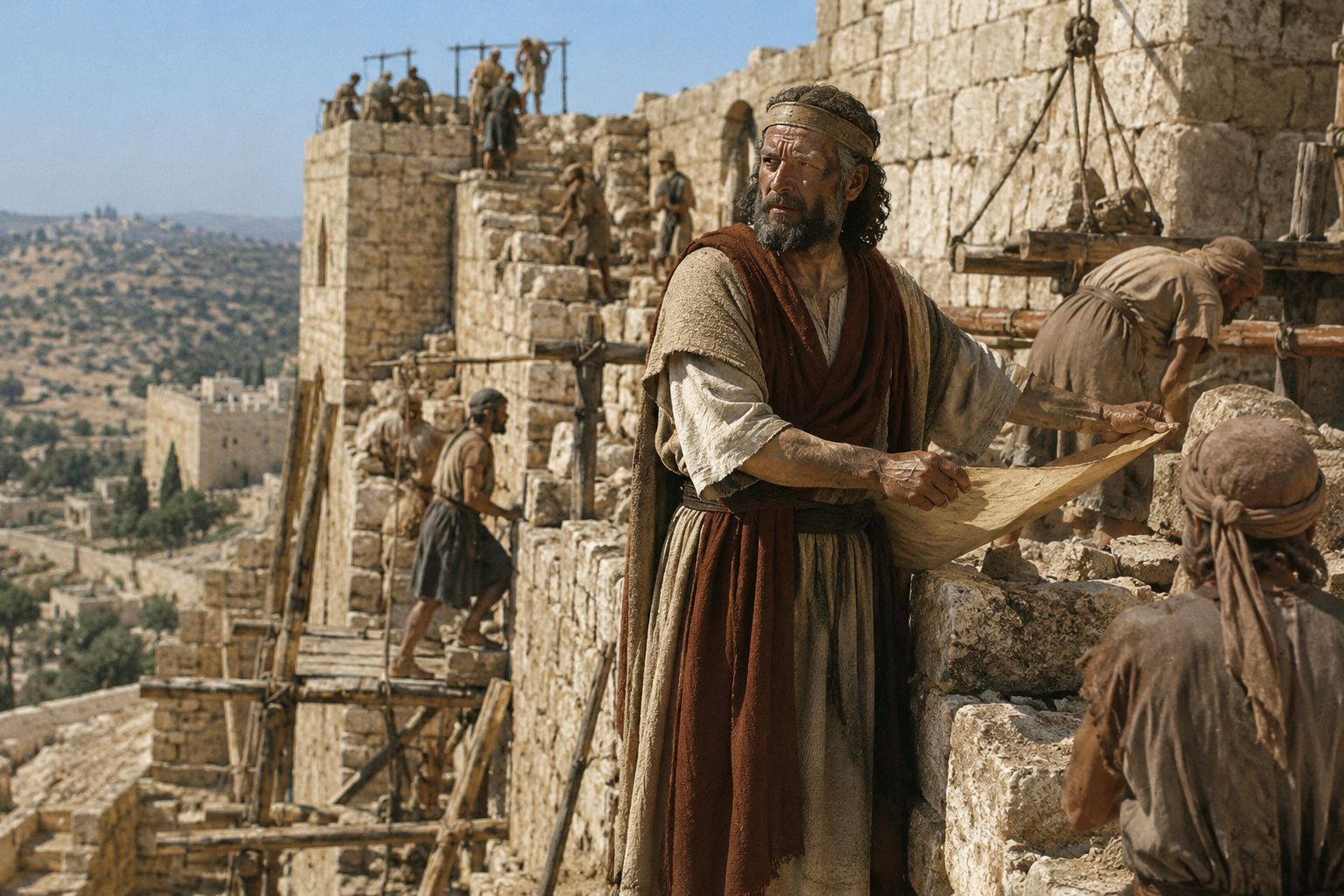
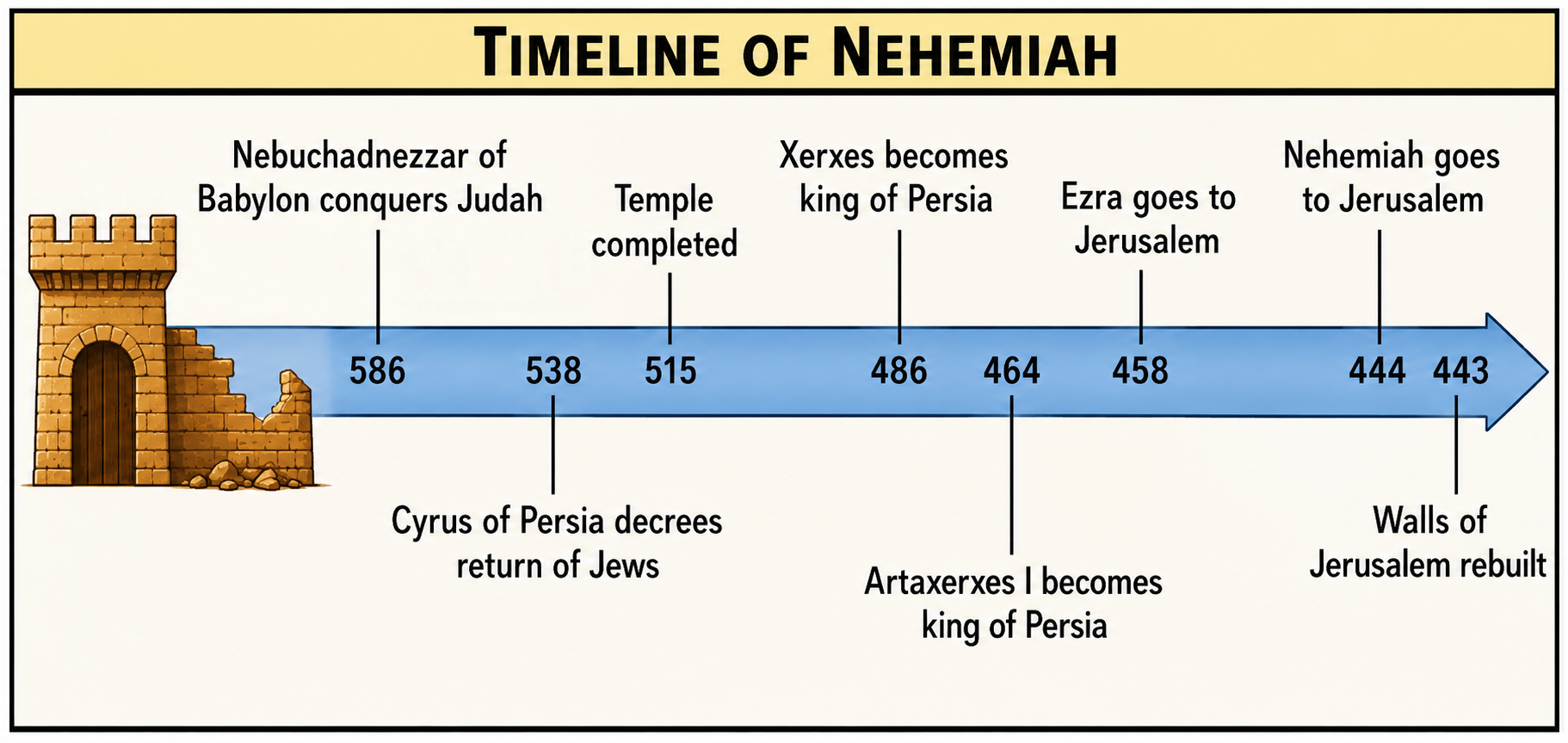
NEHEMIAH UNDER CONSTRUCTION:
JUST A FEW NOTES NOW.
WILL FINISH IF THE LORD WILLS
Nehemiah 12:1 Now these are the priests and the Levites who came up with Zerubbabel the son of Shealtiel, and Jeshua: Seraiah, Jeremiah, Ezra,
- We have in this chapter a record of little more than the names of a great many priests and Levites, that were eminent in their day among the returned Jews. It is good to know what our godly ancestors and predecessors were, that we may learn thereby what we should be.
- the priests (KJV): Ne 7:7 Ezr 2:1,2
- Zerubbabel (KJV): 1Ch 3:17-19 Ezr 3:8 Ezr 4:2 Ezr 5:2 Hag 1:1,12,14 Hag 2:2,21-23 Zec 4:6-10 Mt 1:12,13, Zorobabel, Salathiel
- Jeshua (KJV): Ne 12:10 Zec 3:1-9 Zec 6:11, Joshua
- Seraiah (KJV): Ne 12:12-21 Ne 10:2-8 Ezr 2:2
Now these are the priests and the Levites who came up with Zerubbabel the son of Shealtiel, and Jeshua: Seraiah, Jeremiah, Ezra,
Henry Morris - Jeshua. In Nehemiah 12:1-7 are listed twenty-two "chief of the priests" that went to Jerusalem with Zerubbabel and Jeshua, whereas only four groups of priests are listed in Ezra 2:36-39. Evidently the four original families of priests were divided into twenty-two groups after arrival in Jerusalem.
Believer's Study Bible - v. 1-26) Two lists of priests are given, one from the first exiles (vv. 1-7), another from a later generation (vv. 12-21). Other lists here include high priests from the whole period (vv. 10, 11), and heads of Levitical families (vv. 22-26).
Ryrie Study Bible - 12:1-9 The priests and Levites who returned with Zerubbabel and Joshua (Ezra 2:2, 36-40) almost 100 years before (538 B.C.) are listed in this section. Though David had established 24 divisions of priests (see note on 1 Chron. 24:4), only 22 names are listed here either because of a copyist's omission or perhaps two divisions were unfilled. stood opposite them in their service divisions (v. 9). Refers either to antiphonal singing or alternate shifts of service.
Bob Utley - "Now these are the priests and the Levites who came up with Zerubbabel" The main return of exiled Israelites under Cyrus' decree occurred in 538 B.C. Documenting one's ancestry was very important for the returning exiles to verify their tribal lineage. This list is similar to, but has some differences in comparison with Ezra 2:36-39 and Neh. 7:39-47. The exact reasons for the differences are uncertain. ▣ "Ezra" This is not Ezra, the priest/scribe (cf. Ezra 7; 10; Neh. 8; 12:13,26,33,26).
Brian Bell - Nehemiah 12:1-7
- PRIESTS & LEVITES (Neh 12:12:1-26)
- Read only vs.1 & 24.
- Registering & organizing the priests.
- THE WALLS DEDICATED (Neh 12:27-43)
- Read all.
- The great dedication of the city walls.
- The celebration is marked by choirs, musicians, & giving of thanks.
- There were Workers on the wall & then Watchers on the wall, now Worshippers filling the wall.
- Singing is mentioned 8 times. Thanksgiving 6 times. Rejoicing 7 times. Musical Instruments 3 times.
- Singing – Swindoll says, Don’t stop singing! Sing this afternoon. Sing on your way home from work! One of the most exuberant expressions of a happy heart is a singing mouth…People are starved for happiness. When it is expressed in any authentic manner, they are greatly encouraged.
- Ezra (Neh 12:31-37) & Nehemiah (Neh 12:38-42) each led one of the 2 choirs as they sang their way around the city walls & met at the Temple area.
- Up on the wall (Neh 12:31) – We have done this in Israel when we’ve gone.
- Looking at a clock they both started at 8 o’clock (west side). Ezra led his choir clockwise up to 1 o’clock (north side); & Nehemiah led his team counterclockwise to 1 o’clock.
- Ps.125:1,2 Those who trust in the LORD Are like Mount Zion, Which cannot be moved, but abides forever. As the mountains surround Jerusalem, So the LORD surrounds His people From this time forth and forever. (stability & security)
- The sound of their joy was heard afar off (Neh 12:43).
- One thing I noticed driving through Germany. In every little village the one building that stood out the most was what? The church
- building.
- Oh that our church would stand out in our community. Our building does, but does our church/the people?
- Neighborhood by Neighborhood, street by street, is how we are going to be heard afar off.
- Why walk the walls? That’s what they were dedicating.
- It showed that the walls weren’t like Tobiah said, Whatever they build, if even a fox goes up on it, he will break down their stone wall. (Neh 4:3) but here we have people marching ON the walls.
- Why the need to dedicate the wall before the Lord?
- Any work that we do for God succeeds only because of His working in us.
- Therefore our work must be dedicated to Him, for His glory.
- Otherwise we may become proud. Or, it may become an idol to us.
- Read Deut.8:11-20.
- We also need to make sure that whatever we dedicate to the Lord is a milestone but never a millstone. That it only begins a greater work, & isn’t the end of a finished work.
- (Neh 12:30) What value is a dedicated wall w/o a dedicated people?
- 2 Cor.7:1 Therefore, having these promises, beloved, let us cleanse ourselves from all filthiness of the flesh and spirit, perfecting holiness in the fear of God.
- Body/flesh & spirit refers to the whole person in his external & internal aspects.
- What hypocrisy for a business man to dedicate his business to the Lord, but not his business practices. [A fish on the business card, but not the Lord in his heart]
- What hypocrisy for a family to dedicate their home to the Lord, but not their family practices. [A formal house dedication, but not the heart dedication]
- What hypocrisy for a ministry leader to dedicate his ministry to the Lord, but not himself. [An open house ceremony, but not an open heart]
- 2 Cor.7:1 Therefore, having these promises, beloved, let us cleanse ourselves from all filthiness of the flesh and spirit, perfecting holiness in the fear of God.
- (43) The work was finished, the enemy was humiliated, & the Lord was glorified…so why not rejoice?
- How is Joy inseparable from God? Ps.16:11 In Your presence is fullness of joy.
- (43) They offered great sacrifices.
- J. Hudson Taylor, When God’s work is done in God’s way for God’s glory, it will not lack God’s support.
- The order is, that we 1st give ourselves, then our sacrifices.
- 2 Cor.8:5 they first gave themselves to the Lord, and then to us by the will of God.
- TEMPLE RESPONSIBILITIES (Neh 12:44-47)
- A permanent staff for the Temple is appointed & tithes are collected.
- Continual services will be held there now, as the Law required.
- Note in Neh 12:44 that the people were pleased (they rejoiced over) the priests that were placed over this business.
- NLT For all the people of Judah took joy in the priests and Levites and their work. They performed the service of their God and the service of purification.
- They were exemplary in their purity & in their obedience to God.
- NLT For all the people of Judah took joy in the priests and Levites and their work. They performed the service of their God and the service of purification.
- Why is David mentioned 5 times in this chapter? (Neh 12:24,36,37,45,46)
- David had been dead for over 500 years & yet had set up & established much in regards to worship for Israel.
- He organized the Priests & Levites. He wrote many songs for the Temple choirs. He devised musical instruments for use in worship. David captured the city of Jerusalem from the Jebusites. He also provided the blueprints for the Temple, along w/much of the wealth for its construction.
- Maybe we understand better what John was saying in 1 Jn.2:17 He who does the will of God abides forever.
Matthew Henry - The priests and Levites that returned - Neh 12:1-26. It is a debt we owe to faithful ministers, to remember our guides, who have spoken to us the word of God. It is good to know what our godly predecessors were, that we may learn what we should be.
Nehemiah 12:2 Amariah, Malluch, Hattush,
- Malluch (KJV): Ne 12:14, Melicu
Amariah, Malluch, Hattush,
Nehemiah 12:3 Shecaniah, Rehum, Meremoth,
- Shechaniah (KJV): Ne 12:14, Shebaniah
- Rehum (KJV): Ne 12:15, Harim
- Meremoth (KJV): Ne 12:15, Meraioth
Shecaniah, Rehum, Meremoth,
Nehemiah 12:4 Iddo, Ginnethoi, Abijah,
- Ginnetho (KJV): Instead of Ginnetho, many MSS., and Vulgate have Ginnethon. Ne 12:16, Ginnethon
- Abijah (KJV): Lu 1:5, Abia
Iddo, Ginnethoi, Abijah,
Bob Utley - "Ginnethoi" The priest's name appears as Ginnethon in Neh. 10:6; Neh 12:16 (and the Vulgate).
Nehemiah 12:5 Mijamin, Maadiah, Bilgah,
- Miamin (KJV): Ne 12:17, Miniamin
- Maadiah (KJV): The variation between Moadiah, [Mowadyah <Strong's H4153>,] and Maadiah, [Maadyah <Strong's H4573>,] merely arises from the elision of [Vav,] {wav;} the LXX., however, in ver. 17, have [Maasai.] Ne 12:17, Moadiah
Mijamin, Maadiah, Bilgah
Nehemiah 12:6 Shemaiah and Joiarib, Jedaiah,
- Joiarib (KJV): Ne 11:10 1Ch 9:10, Jehoiarib
Shemaiah and Joiarib, Jedaiah,
Nehemiah 12:7 Sallu, Amok, Hilkiah and Jedaiah. These were the heads of the priests and their kinsmen in the days of Jeshua.
- Sallu (KJV): The variation of [Calluw <Strong's H5543>,] Sallu, and [Callay <Strong's H5543>,] Sallai, is simply caused by the mutation of [Vav,] {wav} and [Yowd,] {yood.} Ne 12:20, Sallai
- the chief (KJV): "The chief of the priests" seem to have been the heads of the courses established by David. 1Ch 24:18
- of Jeshua (KJV): Ne 12:1 Ezr 3:2 Hag 1:1 Zec 3:1
Sallu, Amok, Hilkiah and Jedaiah. These were the heads of the priests and their kinsmen in the days of Jeshua
Nehemiah 12:8 The Levites were Jeshua, Binnui, Kadmiel, Sherebiah, Judah, and Mattaniah who was in charge of the songs of thanksgiving, he and his brothers.
- Jeshua (KJV): Ne 7:48 Ne 9:4 Ne 10:9-13
- Mattaniah (KJV): Ne 11:17,22
- the thanksgiving (KJV): that is, The psalms of thanksgiving, Ne 12:24 1Ch 9:33
The Levites were Jeshua, Binnui, Kadmiel, Sherebiah, Judah, and Mattaniah who was in charge of the songs of thanksgiving, he and his brothers
Bob Utley - 12:8-9 This list expands the list in Ezra 2:40-42 of Levites who returned with Zerubbabel and Jeshua. "Mattaniah who was in charge of the songs of thanksgiving" This was a common name among Levitical musicians. It is also mentioned in 1 Chr. 9:15; 2 Chr. 20:14; Neh. 11:17,22; Neh 12:8,25,35.
Nehemiah 12:9 Also Bakbukiah and Unni, their brothers, stood opposite them in their service divisions.
- over against (KJV): Ps 134:1-3
Also Bakbukiah and Unni, their brothers, stood opposite them in their service divisions
Bob Utley - "Unni" The MT has (Kethiu‒written) Unno, but has a note that it should be read (Qere) as Unni. ▣ "stood opposite them in their service divisions" This may refer to liturgical or antiphonal singing aspects of worship (cf. 2 Chr. 7:6). Because of Neh. 12:24 and the term "opposite" (BDB 617), which means "in front of," it may simply refer to the Levites being divided into twenty-four groupings to share the load of ministry (cf. 1 Chr. 23:6).
Nehemiah 12:10 Jeshua became the father of Joiakim, and Joiakim became the father of Eliashib, and Eliashib became the father of Joiada,
- Jeshua (KJV): Ne 12:26 1Ch 6:3-15
- Eliashib (KJV): Ne 3:1 Ne 13:4,7,28
Jeshua became the father of Joiakim, and Joiakim became the father of Eliashib, and Eliashib became the father of Joiada,
Ryrie - 12:10-11 A listing of the line of high priests from Jeshua to Jaddua. See note on v. 22.
Bob Utley - 12:10-11 This is a 1ist of the High Priest's family, which may run into the Greek Period. Josephus (Antiq. 11.7.8) says Judda was high priest in 322 B.C. 12:10 "Jeshua. . .Joiakim. . .Eliashib" Jeshua was the descendant of the last high priest when Jerusalem fell in 586 B.C. (cf. Ezra 3:2). Eliashib was the chief priest when Nehemiah arrived in Jerusalem in 445 B.C. (cf. Neh. 3:1).
Nehemiah 12:11 and Joiada became the father of Jonathan, and Jonathan became the father of Jaddua.
- Jonathan (KJV): Jaddua is supposed to be Jaddus the high priest, who went in his pontifical robes to meet Alexander the Great, when advancing to destroy Jerusalem; who was so struck with his appearance, that he forbore all hostilities, and granted many privileges to the Jews. According to Eusebius, he was high priest from A.M. 3665 to 3982. Ne 12:11
and Joiada became the father of Jonathan, and Jonathan became the father of Jaddua.
Nehemiah 12:12 Now in the days of Joiakim, the priests, the heads of fathers’ households were: of Seraiah, Meraiah; of Jeremiah, Hananiah;
- the chief (KJV): Ne 12:22 1Ch 9:33,34 1Ch 15:12 1Ch 24:6-31
- Seraiah (KJV): Ne 12:1
Now in the days of Joiakim, the priests, the heads of fathers’ households were: of Seraiah, Meraiah; of Jeremiah, Hananiah;
Nehemiah 12:13 of Ezra, Meshullam; of Amariah, Jehohanan;
of Ezra, Meshullam; of Amariah, Jehohanan;
Nehemiah 12:14 of Malluchi, Jonathan; of Shebaniah, Joseph;
- Melicu (KJV): Ne 12:2, Malluch
- Shebaniah (KJV): Two MSS., and Vulgate in ver. 3, have Shebaniah; and here many MSS. have Shechaniah. Ne 12:3, Shechaniah
of Malluchi, Jonathan; of Shebaniah, Joseph;
Nehemiah 12:15 of Harim, Adna; of Meraioth, Helkai;
- Harim (KJV): Ne 12:3, Rehum
- Meraioth (KJV): Ne 12:3, Meremoth
of Harim, Adna; of Meraioth, Helkai;
Bob Utley - "Meraioth" Many assume he is the same as Meremoth of Neh. 12:3. ▣ "Helkai" Many assume he is the Hilkiah of Neh. 12:7.
Nehemiah 12:16 of Iddo, Zechariah; of Ginnethon, Meshullam;
- Iddo (KJV): Ne 12:4
- Ginnethon (KJV): Ne 12:4, Ginnetho
of Iddo, Zechariah; of Ginnethon, Meshullam
Ryrie - Zechariah. The famous prophet (Ezra 5:1).
Bob Utley - "Zechariah" This is the post-exilic prophet (519 B.C., cf. Zech. 1:1) linked with Haggai, Zerubbabel, and Joshua.
Nehemiah 12:17 of Abijah, Zichri; of Miniamin, of Moadiah, Piltai;
- Miniamin (KJV): The LXX., and Vulgate have here [Miamin,] Miamin. Ne 12:5, Miamin
- Moadiah (KJV): Ne 12:5, Maadiah
of Abijah, Zichri; of Miniamin, of Moadiah, Piltai
Nehemiah 12:18 of Bilgah, Shammua; of Shemaiah, Jehonathan;
- Shemaiah (KJV): Ne 12:6
of Bilgah, Shammua; of Shemaiah, Jehonathan
Nehemiah 12:19 of Joiarib, Mattenai; of Jedaiah, Uzzi;
of Joiarib, Mattenai; of Jedaiah, Uzzi;
Nehemiah 12:20 of Sallai, Kallai; of Amok, Eber;
- Sallai (KJV): Ne 12:7, Sallu
of Sallai, Kallai; of Amok, Eber;
Bob Utley - "Sallai" Many assume he is the same as Sallu of Neh. 12:7.
Nehemiah 12:21 of Hilkiah, Hashabiah; of Jedaiah, Nethanel.
- of Hilkiah, Hashabiah; of Jedaiah, Nethanel.
Nehemiah 12:22 As for the Levites, the heads of fathers’ households were registered in the days of Eliashib, Joiada, and Johanan and Jaddua; so were the priests in the reign of Darius the Persian.
- Eliashib (KJV): Ne 12:10,11
- recorded (KJV): Ne 12:12,13
As for the Levites, the heads of fathers’ households were registered in the days of Eliashib, Joiada, and Johanan and Jaddua; so were the priests in the reign of Darius the Persian
Bob Utley - "Darius" This either refers to the reign of Darius II (423-404 B.C., i.e., Josephus is inaccurate so Derek Kidner, Tyndale Commentary, pp. 143-146) or to the reign of Darius III (336-331 B.C., if Josephus' identifications are correct). Apparently, Jewish scribes had added to the genealogies unto their day. Kings of Persia
Henry Morris - Jaddua. According to Josephus, Jaddua was high priest at the time Alexander the Great defeated the Persians, and Greece became the dominant empire in the world. He is said to have dissuaded Alexander from his intention to destroy Jerusalem. Darius. This Darius is not Darius the Great, but probably Darius III, or possibly Darius II. Nehemiah is said by Josephus to have lived to a great age, so he could well have known Jaddua, at least in the early years of his priestly ministry.
Ryrie - Eliashib. A contemporary of Nehemiah and the grandson of Joshua, the high priest in Zerubbabel's day. Johanan. The same as Jonathan of v. 11. Jaddua. Many identify him as the man who, according to Josephus, was high priest when Alexander the Great invaded Persia (333 B.C.). If so, the Darius of this verse was Darius III (335-331 B.C.), and a copyist, not Nehemiah, added this part of the genealogy. It is quite possible, however, that there were two high priests with the same name and that Nehemiah knew this Jaddua as a young man, if not as high priest (though this is possible as well, since, according to the Elephantine Papyri, Johanan was high priest in 408 B.C., and Nehemiah may have lived until about 400 and seen Jaddua become high priest sometime between 408 and 400). If this is an earlier Jaddua, then the Darius mentioned was Darius II (423-404 B.C.).
Nehemiah 12:23 The sons of Levi, the heads of fathers’ households, were registered in the Book of the Chronicles up to the days of Johanan the son of Eliashib.
- the book (KJV): 1Ch 9:14-44
The sons of Levi, the heads of fathers’ households, were registered in the Book of the Chronicles up to the days of Johanan the son of Eliashib
Bob Utley - "the book of the Chronicles" This does not refer to the biblical book of I and 2 Chronicles, but to the temple records which Ezra and Nehemiah draw from freely.
Henry Morris - Johanan. Johanan (same as the Jonathan of Nehemiah 12:11) is mentioned by name in the Elephantine papyri as being high priest in about 408 B.C.
Nehemiah 12:24 The heads of the Levites were Hashabiah, Sherebiah and Jeshua the son of Kadmiel, with their brothers opposite them, to praise and give thanks, as prescribed by David the man of God, division corresponding to division.
- Hashabiah (KJV): Ne 12:8 Ne 8:7 Ne 9:4 Ne 10:9-13
- according (KJV): 1Ch 23:1-32 1Ch 25:1-26:32
- the man (KJV): De 33:1 Jos 14:6 1Ki 17:24 2Ch 8:14 1Ti 6:11 2Ti 3:17
- ward (KJV): Ne 12:9 Ezr 3:10,11
The heads of the Levites were Hashabiah, Sherebiah and Jeshua the son of Kadmiel, with their brothers opposite them, to praise and give thanks, as prescribed by David the man of God, division corresponding to division
Bob Utley - "the son of Kadmiel" The KJV has "Binnui." The UBS Text Project, p. 542, gives "son of" a "C" rating (considerable doubt), but suggests in its note that "son of" is probably the remains of the original reading, which was the name "Binnui." ▣ "as prescribed by David" See 1 Chronicles 23:6. ▣ "the man of God" This is a title used of Moses (cf. Deut. 33:1; Jos. 14:6). It was used of the prophets. In Hebrew theology one must be a prophet to write Scripture. Moses is called a prophet in Deuteronomy 18. David was considered to be the author of numerous Psalms; therefore, he too must be a prophet, a man of God (ish Elohim).
Nehemiah 12:25 Mattaniah, Bakbukiah, Obadiah, Meshullam, Talmon and Akkub were gatekeepers keeping watch at the storehouses of the gates.
- Mattaniah (KJV): Ne 12:8,9 Ne 11:17-19 1Ch 9:14-17
- keeping (KJV): 1Ch 23:32 1Ch 26:12 Isa 21:8
- thresholds (KJV): or, treasuries, or assemblies
Mattaniah, Bakbukiah, Obadiah, Meshullam, Talmon and Akkub were gatekeepers keeping watch at the storehouses of the gates.
Bob Utley - "the storehouses of the gates" There were storehouses in the temple in several locations. small rooms off of the central building; small rooms at the gates
Nehemiah 12:26 These served in the days of Joiakim the son of Jeshua, the son of Jozadak, and in the days of Nehemiah the governor and of Ezra the priest and scribe.
- Joiakim (KJV): Ne 12:10
- Nehemiah (KJV): Ne 8:9 Ezr 7:6,11
These served in the days of Joiakim the son of Jeshua, the son of Jozadak, and in the days of Nehemiah the governor and of Ezra the priest and scribe
Bob Utley - "in the days of Nehemiah. . .Ezra" Those who assume that Ezra 7:7 is inaccurate and place Ezra after Nehemiah usually change or delete this verse and Neh. 12:36 and 38.
Matthew Henry - The dedication of the wall - Neh 12:27-43. All our cities, all our houses, must have holiness to the Lord written upon them. The believer should undertake nothing which he does not dedicate to the Lord. We are concerned to cleanse our hands, and purify our hearts, when any work for God is to pass through them. Those that would be employed to sanctify others, must sanctify themselves, and set themselves apart for God. To those who are sanctified, all their creature-comforts and enjoyments are made holy. The people greatly rejoiced. All that share in public mercies, ought to join in public thanksgivings.
Nehemiah 12:27 Now at the dedication of the wall of Jerusalem they sought out the Levites from all their places, to bring them to Jerusalem so that they might celebrate the dedication with gladness, with hymns of thanksgiving and with songs to the accompaniment of cymbals, harps and lyres.
- the dedication (KJV): Jerusalem was the holy city, and the wall was built under the immediate superintendence and blessing of Jehovah: it was therefore proper that it should be dedicated to that God who was there worshipped by solemn praises, prayers, and sacrifices. The dedication seems to have consisted in processions of the most eminent persons around the walls, with thanksgivings to God, who had enabled them to bring the work to so happy a conclusion; and, no doubt, to all this were added a particular consecration of the city to God, and the most earnest invocation that He would take it under His guardianship, and defend it and its inhabitants against their enemies. De 20:5 Ps 30:1 *title
- out (KJV): Ne 11:20 1Ch 15:4,12 1Ch 25:6 1Ch 26:31 2Ch 5:13 2Ch 29:4-11,30 Ezr 8:15-20
- gladness (KJV): Ne 8:17 De 16:11 2Sa 6:12 2Ch 29:30 Ezr 6:16 Ps 98:4-6 Ps 100:1,2 Php 4:4
- thanksgivings (KJV): 1Ch 13:8 1Ch 15:16,28 1Ch 16:5,42 1Ch 23:5 1Ch 25:1-6 2Ch 5:13 2Ch 7:6 Ezr 3:10,11 Ps 81:1-4 Ps 92:1-3 Ps 149:3 Ps 150:2-5 Rev 5:8
Now at the dedication of the wall of Jerusalem they sought out the Levites from all their places, to bring them to Jerusalem so that they might celebrate the dedication with gladness, with hymns of thanksgiving and with songs to the accompaniment of cymbals, harps and lyres.
Believer's Study Bible - The first-person account of Nehemiah resumes implicitly here, and explicitly at 12:31, after breaking off at 7:5.
Ryrie - 12:28-29 The places named were all near Jerusalem.
Bob Utley - 12:27-43 This section deals with the dedication of the walls of Jerusalem, which relates back to chapter 7. The FIRST PERSON SINGULAR PRONOUN "I" appears again (cf. Neh. 12:31), as it last did in Neh. 7:5. "cymbals, harps and lyres" These were also used in Solomon's dedication of the temple (cf. 2 Chr. 5:13). These returnees tried to mimic Solomon's rituals, procedures, and actions.
Nehemiah 12:28 So the sons of the singers were assembled from the district around Jerusalem, and from the villages of the Netophathites,
- plain (KJV): Ne 6:2
- Netophathi (KJV): 1Ch 2:54 1Ch 9:16
So the sons of the singers were assembled from the district around Jerusalem, and from the villages of the Netophathites,
Ryrie - 12:28-29 The places named were all near Jerusalem.
Bob Utley - "Netophathites" This was a city near Bethlehem (cf. Ezra 2:22; Neh. 2:26).
Nehemiah 12:29 from Beth-gilgal and from their fields in Geba and Azmaveth, for the singers had built themselves villages around Jerusalem.
- the house (KJV): Or, Beth-Gilgal, a village erected where the Israelites encamped after they had crossed the Jordan. De 11:30 Jos 5:9 Jos 10:43
- Geba (KJV): Ne 11:31 Jos 21:17 1Ch 6:60
- Azmaveth (KJV): Ezr 2:24
from Beth-gilgal and from their fields in Geba and Azmaveth, for the singers had built themselves villages around Jerusalem.
Bob Utley - "Beth-gilgal" Beth means "house" or "place." Gilgal means "wheel" or "circle." There are two possibilities: (1) the first camp site of Joshua in the Promised Land (cf. Jos. 4,5,10), near Jericho (2) a place twelve miles north of Shechem (cf. 2 Kgs. 2:1; 2 Kgs 4:38) associated with Elijah and Elisha "Geba" This means "height" or "hill." It was a Levitical city of Benjamin (cf. Joshua 21:17; 1 Sam. 13:3; 2 Sam. 5:25; 1 Chr. 6:60; 1 Chr 8:6; 2 Chr. 16:6; Neh. 11:31; Neh 12:29; Isa. 10:29; Zech. 14:10).
Nehemiah 12:30 The priests and the Levites purified themselves; they also purified the people, the gates and the wall.
- themselves (KJV): Ge 35:2 Ex 19:10,15 Nu 19:2-20 2Ch 29:5,34 Ezr 6:21 Job 1:5 Heb 5:1,3
The priests and the Levites purified themselves; they also purified the people, the gates and the wall
Ryrie - The purification of the wall would have been done by sprinkling sacrificial blood on it.
Bob Utley - "purified" This VERB (BDB 372, KB 369, used twice, the first Hithpael IMPERFECT and the second Piel IMPERFECT) means "cleanse" or "purify." The Piel form denotes cleansing: Often the cleansing was by blood or water.
- the altar of incense, Lev. 16:19
- the temple, 2 Chr. 29:15,16,18; Neh. 13:6
- Judah and Jerusalem, 2 Chr. 34:3,5,8
- of Jerusalem, Neh. 12:30
- the priesthood, Neh. 13:30
- the altar Ezek. 43:26
Nehemiah 12:31 Then I had the leaders of Judah come up on top of the wall, and I appointed two great choirs, the first proceeding to the right on top of the wall toward the Refuse Gate.
- the princes (KJV): 1Ch 13:1 1Ch 28:1 2Ch 5:2
- two great (KJV): Ne 12:38,40
- dung gate (KJV): Ne 2:13 Ne 3:13,14
Then I had the leaders of Judah come up on top of the wall, and I appointed two great choirs, the first proceeding to the right on top of the wall toward the Refuse Gate
Believer's Study Bible - 31-43) Nehemiah appointed two processions for the dedication of the walls, both circling the city in opposite directions before meeting at the temple (v. 40).
Ryrie - 12:31-37 Nehemiah organized two groups to encircle the city. The first, led by Ezra, proceeded from the SW corner of the city wall E, then N, led by singers (v. 31), followed by princes (vv. 32-33), then priests with trumpets (vv. 35, 41) and Levites with stringed instruments (v. 36)
Bob Utley - 12:31-43 This is the official dedication of the walls. How soon it followed their construction is uncertain. It was a religious occasion much like Joshua's covenant renewal at Shechem. It is unusual to dedicate a wall in the OT, but in reality it offered protection for the holy city and its holy temple. "two great choirs" These two processionals started on the top of the western wall about in the middle (south of the temple). This was exactly where Nehemiah had started his nighttime reconnoitering (cf. Neh. 2:13-16). Ezra led one group (Neh. 12:36) south, counter clockwise, while Nehemiah followed with the other one north, clockwise (cf. Neh. 12:38). They met on the eastern wall level with the temple (the Gate of the Guard, Neh. 12:39).
Nehemiah 12:32 Hoshaiah and half of the leaders of Judah followed them,
Hoshaiah and half of the leaders of Judah followed them,
Nehemiah 12:33 with Azariah, Ezra, Meshullam,
- Azariah (KJV): Ne 10:2-7
with Azariah, Ezra, Meshullam,
Nehemiah 12:34 Judah, Benjamin, Shemaiah, Jeremiah,
Judah, Benjamin, Shemaiah, Jeremiah,
Nehemiah 12:35 and some of the sons of the priests with trumpets; and Zechariah the son of Jonathan, the son of Shemaiah, the son of Mattaniah, the son of Micaiah, the son of Zaccur, the son of Asaph,
- with trumpets (KJV): Nu 10:2-10 Jos 6:4 2Ch 5:12 2Ch 13:12
- Zechariah (KJV): Ne 11:17 1Ch 6:39-43 1Ch 25:2 1Ch 26:10,11
and some of the sons of the priests with trumpets; and Zechariah the son of Jonathan, the son of Shemaiah, the son of Mattaniah, the son of Micaiah, the son of Zaccur, the son of Asaph
See Horns Used by Israel.
Nehemiah 12:36 and his kinsmen, Shemaiah, Azarel, Milalai, Gilalai, Maai, Nethanel, Judah and Hanani, with the musical instruments of David the man of God. And Ezra the scribe went before them.
- musical instruments (KJV): Ne 12:24 1Ch 23:5 2Ch 8:14 Am 6:5
- Ezra (KJV): Ezr 7:1 Ezr 8:1
and his kinsmen, Shemaiah, Azarel, Milalai, Gilalai, Maai, Nethanel, Judah and Hanani, with the musical instruments of David the man of God. And Ezra the scribe went before them
Nehemiah 12:37 At the Fountain Gate they went directly up the steps of the city of David by the stairway of the wall above the house of David to the Water Gate on the east.
- the fountain gate (KJV): Ne 2:14 Ne 3:15,16
- the stairs (KJV): Jerusalem was built on very uneven ground, some hills being enclosed within the walls, there was a necessity, therefore, for steps, by which to ascend and descend; probably similar to what is seen in the city of Bristol. Ne 3:15 2Sa 5:7-9
- water gate (KJV): Ne 3:26 Ne 8:1,3,16
At the Fountain Gate they went directly up the steps of the city of David by the stairway of the wall above the house of David to the Water Gate on the east.
Nehemiah 12:38 The second choir proceeded to the left, while I followed them with half of the people on the wall, above the Tower of Furnaces, to the Broad Wall,
- other (KJV): Ne 12:31
- tower (KJV): Ne 3:11
- broad (KJV): Ne 3:8
The second choir proceeded to the left, while I followed them with half of the people on the wall, above the Tower of Furnaces, to the Broad Wall,
Ryrie - 12:38-43 The other group proceeded N, then E to the Temple area, meeting the first group in the Temple courts (v. 40), where they offered sacrifices and praised God (vv. 41-43). For the location of the various gates, see notes on chap. 3.
Nehemiah 12:39 and above the Gate of Ephraim, by the Old Gate, by the Fish Gate, the Tower of Hananel and the Tower of the Hundred, as far as the Sheep Gate; and they stopped at the Gate of the Guard.
- the gate of Ephraim (KJV): Ne 8:16 2Ki 14:13
- the old (KJV): Ne 3:6
- the fish gate (KJV): Ne 3:3 Zep 1:10
- the tower (KJV): Ne 3:1 Jer 31:38
- the sheep (KJV): Ne 3:32 Joh 5:2
- the prison (KJV): Ne 3:25,31 *Heb: Jer 32:2
and above the Gate of Ephraim, by the Old Gate, by the Fish Gate, the Tower of Hananel and the Tower of the Hundred, as far as the Sheep Gate; and they stopped at the Gate of the Guard.
Nehemiah 12:40 Then the two choirs took their stand in the house of God. So did I and half of the officials with me;
- Ne 12:31,32 Ps 42:4 Ps 47:6-9 Ps 134:1-3
Then the two choirs took their stand in the house of God. So did I and half of the officials with me
Nehemiah 12:41 and the priests, Eliakim, Maaseiah, Miniamin, Micaiah, Elioenai, Zechariah and Hananiah, with the trumpets;
- with trumpets (KJV): Ne 12:35
and the priests, Eliakim, Maaseiah, Miniamin, Micaiah, Elioenai, Zechariah and Hananiah, with the trumpets
Nehemiah 12:42 and Maaseiah, Shemaiah, Eleazar, Uzzi, Jehohanan, Malchijah, Elam and Ezer. And the singers sang, with Jezrahiah their leader,
- sang loud (KJV): Heb. made their voice to be heard, Ps 81:1 Ps 95:1 Ps 98:4-9 Ps 100:1,2 Isa 12:5,6
- overseer (KJV): Ne 11:14
and Maaseiah, Shemaiah, Eleazar, Uzzi, Jehohanan, Malchijah, Elam and Ezer. And the singers sang, with Jezrahiah their leader,
Nehemiah 12:43 and on that day they offered great sacrifices and rejoiced because God had given them great joy, even the women and children rejoiced, so that the joy of Jerusalem was heard from afar.
- offered (KJV): Nu 10:10 De 12:11,12 1Ch 29:21,22 2Ch 7:5-7,10 2Ch 29:35,36 Ps 27:6
- God (KJV): 2Ch 20:27 Job 34:29 Ps 28:7 Ps 30:11,12 Ps 92:4 Isa 61:3 Isa 66:10-14 Jer 33:11 Joh 16:22
- the wives also (KJV): Ex 15:20,21 2Ch 20:13 Ps 148:11-13 Jer 31:13 Mt 21:9,15 Eph 5:19 Jas 5:13
- the joy (KJV): 1Sa 4:5 Ezr 3:13
and on that day they offered great sacrifices and rejoiced because God had given them great joy, even the women and children rejoiced, so that the joy of Jerusalem was heard from afar.
Bob Utley - 12:44-47 This seems to be a parenthesis giving further information and not part of Nehemiah's first person account.
Nehemiah 12:44 On that day men were also appointed over the chambers for the stores, the contributions, the first fruits and the tithes, to gather into them from the fields of the cities the portions required by the law for the priests and Levites; for Judah rejoiced over the priests and Levites who served.
- some (KJV): Ne 10:37-39 Ne 13:5,12,13 2Ch 13:11,12 2Ch 31:11-13
- chambers (KJV): 1Ch 9:26 1Ch 26:21-26
- of the law (KJV): that is, appointed by the law
- Judah rejoiced (KJV): Heb. the joy of Judah. Levites. Nu 3:10 Nu 8:24,25 1Ch 23:28 2Ch 5:11,12 Pr 8:34 Isa 40:31 Ro 12:7
- waited (KJV): Heb. stood
On that day men were also appointed over the chambers for the stores, the contributions, the first fruits and the tithes, to gather into them from the fields of the cities the portions required by the law for the priests and Levites; for Judah rejoiced over the priests and Levites who served
Believer's Study Bible - Cf. 10:32-39; 10:37, notes. The support of God's house of worship and its ministries had been assigned to the people of God (cf. Mal. 3:10; Luke 11:42, notes).
Nehemiah 12:45 For they performed the worship of their God and the service of purification, together with the singers and the gatekeepers in accordance with the command of David and of his son Solomon.
- the singers (KJV): 1Ch 25:1-26:32
- the ward (KJV): That is, they suffered no unclean person to enter the temple. 1Ch 23:28 2Ch 23:6
For they performed the worship of their God and the service of purification, together with the singers and the gatekeepers in accordance with the command of David and of his son Solomon.
Bob Utley - "in accordance with the command of David and of his son Solomon" See 1 Chronicles 23-26 and 2 Chr. 8:14.
Nehemiah 12:46 For in the days of David and Asaph, in ancient times, there were leaders of the singers, songs of praise and hymns of thanksgiving to God.
- and Asaph (KJV): 1Ch 25:1-31 2Ch 29:30 Ps 73:1 *title Ps 83:1 *title
For in the days of David and Asaph, in ancient times, there were leaders of the singers, songs of praise and hymns of thanksgiving to God.
Ryrie - On Asaph, see note on Ezra 2:41
Nehemiah 12:47 So all Israel in the days of Zerubbabel and Nehemiah gave the portions due the singers and the gatekeepers as each day required, and set apart the consecrated portion for the Levites, and the Levites set apart the consecrated portion for the sons of Aaron.
- Zerubbabel (KJV): Ne 12:1,12,26
- gave (KJV): Ne 10:35-39 Ne 13:10-12 2Ch 31:5,6 Mal 3:8-10 Ga 6:6
- and they (KJV): That is, the people separated, or set apart, the tenth of the produce of their lands for the use of the Levites; and the Levites separated the tenth of their tithes for the priests. Nu 18:21-29
- sanctified (KJV): that is, set apart
So all Israel in the days of Zerubbabel and Nehemiah gave the portions due the singers and the gatekeepers as each day required, and set apart the consecrated portion for the Levites, and the Levites set apart the consecrated portion for the sons of Aaron.
Bob Utley - The order of tithes is seen in Num. 18:21-32 (cf. Neh.10:38).