Nehemiah 7:2
Nehemiah 7:3
Nehemiah 7:4
Nehemiah 7:5
Nehemiah 7:6
Nehemiah 7:7
Nehemiah 7:8
Nehemiah 7:9
Nehemiah 7:10
Nehemiah 7:11
Nehemiah 7:12
Nehemiah 7:13
Nehemiah 7:14
Nehemiah 7:15
Nehemiah 7:16
Nehemiah 7:17
Nehemiah 7:18
Nehemiah 7:19
Nehemiah 7:20
Nehemiah 7:21
Nehemiah 7:22
Nehemiah 7:23
Nehemiah 7:24
Nehemiah 7:25
Nehemiah 7:26
Nehemiah 7:27
Nehemiah 7:28
Nehemiah 7:29
Nehemiah 7:30
Nehemiah 7:31
Nehemiah 7:32
Nehemiah 7:33
Nehemiah 7:34
Nehemiah 7:35
Nehemiah 7:36
Nehemiah 7:37
Nehemiah 7:38
Nehemiah 7:39
Nehemiah 7:40
Nehemiah 7:41
Nehemiah 7:42
Nehemiah 7:43
Nehemiah 7:44
Nehemiah 7:45
Nehemiah 7:46
Nehemiah 7:47
Nehemiah 7:48
Nehemiah 7:49
Nehemiah 7:50
Nehemiah 7:51
Nehemiah 7:52
Nehemiah 7:53
Nehemiah 7:54
Nehemiah 7:55
Nehemiah 7:56
Nehemiah 7:57
Nehemiah 7:58
Nehemiah 7:59
Nehemiah 7:60
Nehemiah 7:61
Nehemiah 7:62
Nehemiah 7:63
Nehemiah 7:64
Nehemiah 7:65
Nehemiah 7:66
Nehemiah 7:67
Nehemiah 7:68
Nehemiah 7:69
Nehemiah 7:70
Nehemiah 7:71
Nehemiah 7:72
Nehemiah 7:73
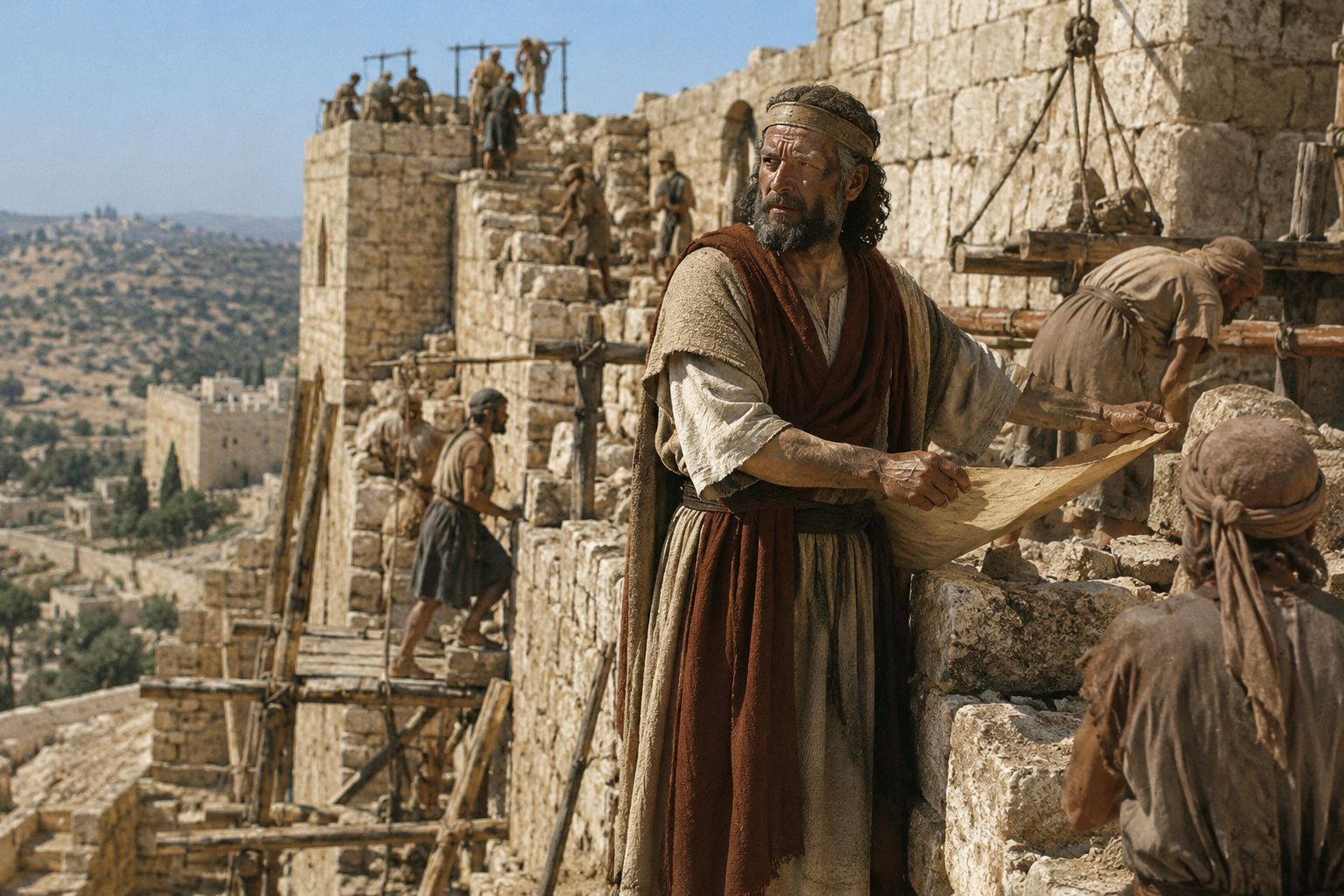
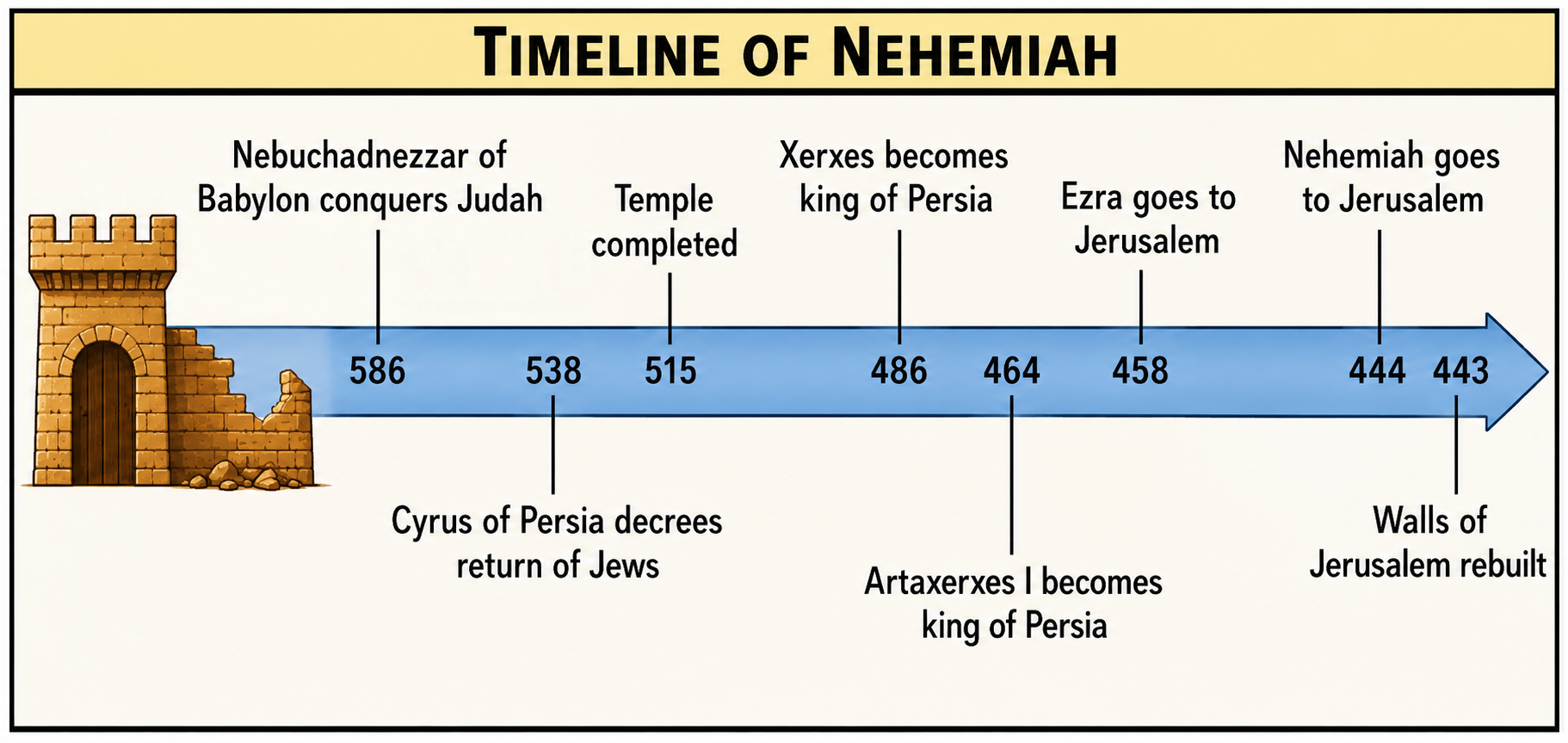
NEHEMIAH UNDER CONSTRUCTION:
JUST A FEW NOTES NOW.
WILL FINISH IF THE LORD WILLS
Nehemiah 7:1 Now when the wall was rebuilt and I had set up the doors, and the gatekeepers and the singers and the Levites were appointed,
- the wall (KJV): Ne 3:1-32 Ne 6:15
- I had set up (KJV): Ne 3:3 Ne 6:1
- the porters (KJV): Ne 10:39 Ne 11:3 Ne 12:24 1Ch 23:1-32 1Ch 25:1-26:32 2Ch 31:2 Ezr 3:8
Now when the wall was rebuilt and I had set up the doors, and the gatekeepers and the singers and the Levites were appointed,
Ryrie - doors. In the gates (cf. 6:1). gatekeepers and the singers and the Levites. Appointed to guard the gates (v. 3).
Bob Utley - "the gatekeepers and the singers and the Levites" Some scholars see this as misplaced because it seems to refer to the temple and not the city. Yet, we learn later, that the Levitical gatekeepers were also appointed to the city gates because of the lack of people willing to live in Jerusalem (cf. Neh. 7:4).
Matthew Henry - The city committed to Hananiah Neh 7:1-4. Nehemiah, having finished the wall, returned to the Persian court, and came to Jerusalem again with a new commission. The public safety depends on every one's care to guard himself and his family against sin.
Steven Cole - Counting for God (Nehemiah 7:1-73)
Have you ever struggled with feelings that your life is not worthwhile? I think we all feel that way at times. I know that I do! Life goes by so quickly! I often think about, “What am I accomplishing that really matters? How can I spend my life so that it counts for something worthwhile?”
The correct answer to those questions is to spend our lives so that they count for God and His purpose. If our lives count for God, then they count not just for time, but for eternity. So the key question becomes, how can I live so that my life counts for God?
Believe it or not, Nehemiah 7 has some answers to this important question. It is one of those chapters that make you wonder why God took up space in the Bible for it! It especially makes you wonder when you realize that Neh 7:6-73 are essentially the same as Ezra 2. Why would God put this long list of unpronounceable names in the Bible once, let alone twice? It’s just not the sort of chapter that you relish when you come to it in your Bible reading!
The chapter serves as a pivot in the Book of Nehemiah. Chapters 1-6 describe the restoration of the wall of Jerusalem. Chapters 8-13 tell about the restoration of the people of Judah. Chapter 7 begins with three verses describing the precautions that Nehemiah took to guard the newly walled city from attack, thus wrapping up the first half of the book. Neh 7:4-73 look forward to the reforms of the second half of the book by showing how Nehemiah went about repopulating the city so that it would become a vital center for national and spiritual life.
In Ezra, this list of names of those who returned from Babylon under Zerubbabel in 536 B.C. served to document who was a true Jew. In Nehemiah, nearly a century later (444 B.C.), the list answers the question, “Who is available to repopulate the city and to provide for temple worship?” Nehemiah uses the list to instill in the people a reminder of their personal and national identity as God’s people and to encourage them to fulfill their responsibilities in light of this identity.
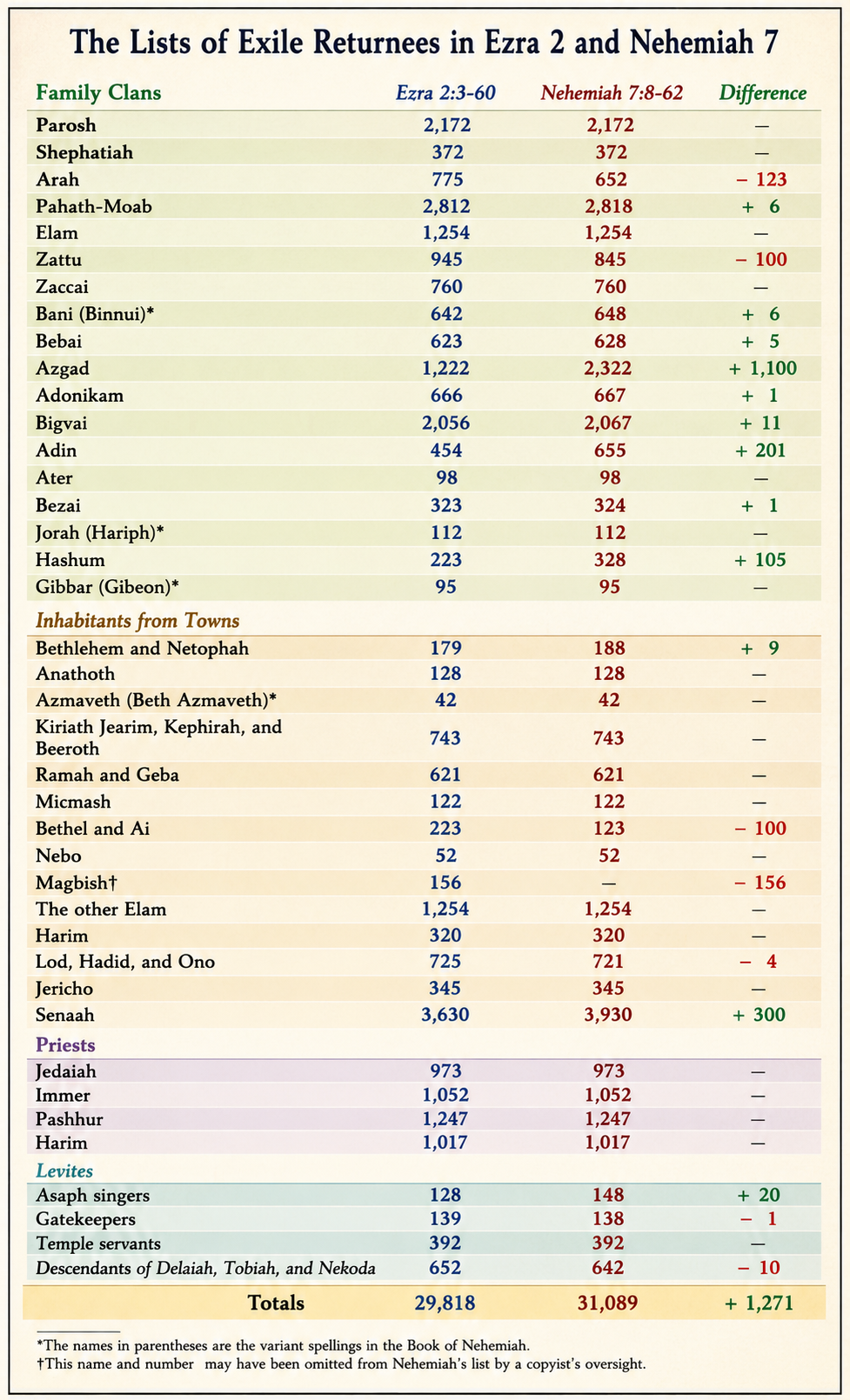
There are variations between the two lists that are difficult, if not impossible, to reconcile. Derek Kidner (Ezra & Nehemiah, Tyndale Old Testament Commentaries [IVP], pp. 38-39) points out that the names in the two lists show only the slightest variations, whereas half of the numbers disagree apparently at random, with sometimes one list and sometimes the other giving the larger figure. He argues that this is a classic example of how difficult it was for scribes to copy lists of Hebrew numbers. The doctrine of inerrancy asserts that the Bible is without error in the original manuscripts. Since we possess only copies, sometimes we are not able to reconcile conflicting details that may have arisen from scribal errors.
But to set aside these technical scholarly questions, the spiritual message of Nehemiah 7 is intact. It is:
To count for God, commit yourself to the things that matter to God.
The chapter reveals five things that matter to God:
1. Worship matters to God (Neh 7:1).
Nehemiah mentions that after the walls were rebuilt and the doors were installed, he appointed the gatekeepers, singers, and Levites (Neh 7:1). Most commentators say that these worship leaders were also assigned guard duty at the city gates. While that may be so, I agree with Derek Kidner (p. 102) that these men take priority here because worship was the city’s reason for existence. Maybe they held choir practice while standing guard, but the reason for protecting the city from invaders was not just so that everyone could live securely. It was primarily so that the worship of God in the temple could take place.
From what we read in the Book of Revelation, a good part of heaven will be spent praising God in corporate worship. The saints gather with the angels and the four living creatures and the 24 elders and sing, “Worthy is the Lamb that was slain,” and “To Him who sits on the throne, and to the Lamb, be blessing and honor and glory and dominion forever and ever” (Rev. 5:9, 12, 13). We will be so caught up with the beauty of the glory of God that we will be lost in wonder, love, and praise!
Gary Larsen has a Far Side cartoon showing a guy sitting on a cloud in his white robe with a harp, and he’s thinking, “I should have brought a magazine.” Sadly, that’s how even many Christians think of heaven—a boring time! But to the degree that we think that, we have failed to see the stunning beauty of Jesus Christ!
When you come on a scene of natural beauty, such as a beautiful sunset at the Grand Canyon, even if you don’t know anyone standing nearby, you want to say something to them: “Wow, that’s awesome, isn’t it!” We do that because beauty creates spontaneous praise in us, and praise is best when it is shared. Heaven will be a time of drinking in the infinite beauty of the infinite God and sharing it with others. If you want your life to count for God, grow as a worshiper by growing to know God in His infinite beauty.
2. Godly character matters to God (Neh 7:2-3).
Nehemiah was an exemplary leader who knew that to be effective, he needed to delegate responsibility to other competent men. While certain administrative skills are necessary for effective leadership, the main requirement is godly character.
Nehemiah picked two men. Hanani was probably his blood brother, who had come to him at Susa with the report of Jerusalem’s sad condition (Neh 1:1-3). He is appointed as the civil leader of Jerusalem. Hananiah is appointed as the military leader because “he was a faithful man and feared God more than many.” Together they are charged not to open the city gates until the sun was hot, and to bolt them and stand guard when they were shut. Also, they were to appoint guards from the residents of the city, each in front of his own house. There are three godly character traits here:
A. FAITHFULNESS.
The Hebrew word means reliable, truthful, and firm. Hananiah was a man you could depend on. He spoke the truth and if he promised to do something, he did it. If you want your life to count for God, work at becoming a faithful person. It is a fruit that the Holy Spirit produces in us as we walk in dependence on Him (Gal. 5:16, 22). All of us are stewards of the gifts and time that God allots to us. Paul said that it is required of stewards that they be found trustworthy, or faithful (1 Cor. 4:2).
Faithfulness is also an essential ingredient in relationships. If you do not trust someone, you will not get close to that person. You always keep your distance, for fear that he will take something that you say and disclose it, perhaps with distortion, to others. If you sense that someone is not truthful, you don’t trust him and you won’t get close to him. Since our God is a faithful God who always speaks truth and keeps His word, as we grow in godliness, we will grow in faithfulness.
Let me briefly suggest four ways to develop faithfulness.
*Recognize and define the responsibilities that God has given you to do. As a Christian, you are responsible to obey God’s commands to live a morally pure life that honors Him. As a husband and father, you are responsible to provide the basic needs for your family. As a parent, you are responsible to train your children in God’s ways. As a gifted member of Christ’s body, you are responsible to serve Him in some capacity. You cannot be faithful if you are foggy about what you’re supposed to be doing.
*Start with and don’t neglect the small things. If you’re faithful in little things, you will be faithful with much (Luke 16:10). In the context, “little things” refers to your managing the money God has entrusted to you. Do you squander it on selfish pursuits or do you invest it wisely for God’s purposes? Do you pay your bills on time? Are you honest in financial matters? Do you keep your word? Do you live an orderly life? Do you keep appointments on time?
*Keep your relational priorities straight. Your relationship with Jesus Christ is first. If it goes, everything goes. Spend time alone with Him each day. Your relationship with your family is next. If I do not order my family relationships properly, I am not qualified to lead in the local church (1 Tim. 3:4-5). Relationships are so important that John says that if I do not love my brother whom I have seen, I cannot love God whom I have not seen (1 John 4:20).
*Learn to use your time more effectively. Most unfaithful people complain that they don’t have time to do what they are supposed to do. But we all have the same number of hours each day. Faithful people learn to use their time well.
B. FEAR OF GOD.
Hananiah “feared God more than many.” The fear of God is a matter of degree: Some fear God a little; others fear God more. The fear of God grows out of the knowledge of God. When you see who God is and you realize who you are by way of comparison, you fall on your face in fear, realizing that He could rightly cast you into hell for your many sins. Even when you know that He has been gracious to you through Christ, you do not presume on that grace by becoming irreverent toward the Holy One. You remember that He knows your every thought and deed, and so you seek to please Him in all you do. If you want your life to count for God, grow in the fear of God.
C. WATCHFULNESS.
Nehemiah not only built the wall with the sword and the trowel, he also posted guards and gave careful instructions to these appointed leaders on the need to guard the city. He trusted God, but he also set up a watch (see Neh 4:9). The two are not in opposition.
Jesus warns us frequently to be on the alert (Mark 13:34-37). First Peter 5:8 warns us, “Be of sober spirit, be on the alert. Your adversary the devil prowls around like a roaring lion, seeking someone to devour.” We need to watch out for the spiritual dangers that Satan strews across our paths, to avoid falling into sins that would destroy us. As married couples, be alert to the dangers that could destroy your marriage. As parents, be alert to the dangers that could destroy your children. As church leaders, be alert to the dangers that could damage God’s flock.
Note that a time of success is a critical time to be on guard. The walls were built, the gates were in place. It would have been easy to kick back and let down the guard. The enemy often hits right after a victory. Be especially careful then!
Also, we need to be especially on guard in our own homes. Nehemiah instructed that each one stand guard in front of his own house (7:3). Guard what movies and TV shows come into your home. Guard what comes through on your home computer. Take caution if your children spend the night at a friend’s home, as to what they plan to do and who is supervising. Instruct and warn your kids about spiritual dangers and how to call if they need help.
To count for God, commit yourself to worship and to godly character, because these things matter to God.
3. People matter to God (Neh 7:4-73).
From a historical, salvation perspective, these Jewish genealogical records are important because when the Messiah came to this earth, it was important to prove that He was descended from the tribe of Judah and the lineage of David. When we worked through the list in Ezra 2, we went over the various categories in some detail, so I’m not going to repeat that here. But the list illustrates three important points that apply to us:
A. INDIVIDUALS ARE IMPORTANT TO GOD.
Although these names do not mean anything to us, they mean something to God. He knows His people by name. Jesus, the Good Shepherd, “calls his own sheep by name,” and they follow Him because they know His voice (John 10:3-4). I try to learn the names of those who regularly attend here, but my brain is limited and I often fail. But even if I fail to remember your name, there is One who never forgets! He created you in His image and He put you here at this time and place for His purpose.
Make sure that Jesus knows you by name! You may be thinking, “Doesn’t Jesus know everyone by name?” In the sense of His omniscience, yes. But in the sense of personal knowledge, no. On judgment day, He will say to some who cry, “Lord, Lord,” who did many things in His name, “I never knew you; depart from Me, you who practice lawlessness” (Matt. 7:23). They were not truly His sheep, because they did not follow Him. He gives eternal life to His sheep, and they will never perish, and no one can snatch them out of His hand (John 10:28). Make sure that you are one of His sheep!
The fact that individuals matter to God also means that they should matter to us. Invest your life building Jesus Christ into people, and your life will count for God and for eternity.
B. FAMILIES ARE IMPORTANT TO GOD.
The list contains many family groups (Neh 7:8-25). God designed the family as the basic unit of society. A man and woman are to leave their own families of origin and come together in a lifelong covenant relationship. In that context, children are to be born and reared in God’s ways as revealed in His Word. The family is also the building block of the local church. To say this is not in any way to devalue singles, who are a vital part of God’s family. But it is to say that the church is only strong when the families in that church are strong. Is it any wonder that Satan is attacking Christian families? If we want our lives and our children’s and grandchildren’s lives to count for God, we must guard our covenant commitments in our families.
C. MEN ARE IMPORTANT TO GOD.
The list is made up of men. This does not mean that women are unimportant to God. The Bible elevates women to a status that is unknown in other religions. Husbands are to grant their wives honor as co-heirs of the grace of life (1 Pet. 3:7).
But at the same time, Scripture is clear that there is a hierarchy of roles in the family and in the church. Husbands are the heads of their wives, just as God is the head of Christ and Christ is the head of the church (1 Cor. 11:3; Eph. 5:23). Elders and teachers in the local church are to be men (1 Tim. 2:11-15; 1 Tim 3:1-7). These God-ordained roles are not culturally determined. Rather, they have to do with the church and the home reflecting the image of God, where there is an equality of personhood, but at the same time, a hierarchy of roles in which the Son willingly submits to the Father to carry out the divine purpose. If Satan cannot break up a home through divorce, his next tactic is to get the man to be passive.
Men, for your life to count for God, you need to take seriously your responsibility to lead your wife and children in the things of God. By lead, I do not mean barking commands in Archie Bunker fashion from your armchair in front of the TV set! I mean walking with God as an example and becoming a servant-leader, even as Jesus led. I mean actively loving your wife and training your children. Don’t dump that job on your wife!
To count for God, commit yourself to what matters to God: worship, godly character, and people.
4. Your place in God’s family history matters to God (Neh 7:4-73).
Nehemiah says (Neh 7:5) that God put it into his heart to assemble the people to be enrolled by genealogies. Then he found this book of the record of those who first came up to Jerusalem. It served as a map for the current enrollment. As Kidner (p. 103) puts it, Nehemiah’s “immediate concern was to get his people rightly orientated, sure both of their inheritance and their calling.”
As Christians, our physical lineage is not nearly as important as our spiritual lineage. We need to know that we have been born spiritually into God’s family, the church, through faith in the Lord Jesus Christ. And, we need to have some evidence of it. Those claiming to be priests who could not find any record of their ancestry were excluded from the priesthood until a priest could verify it by divine means (7:61-65). Even so, a believer should be able to verify where God promises eternal life to those who believe in Christ and say, “I have put my trust in that specific promise of God.” And, the believer should see some evidence that God has changed his heart. Before, we were hostile toward God. Now, by His grace, we love God and the things of God.
It is also important to realize that God put you here at this point in the history of His people to fulfill the role that He has ordained for you. Previous generations passed the torch to you. You must carry it faithfully and pass it on to the next generation. One reason modern Christians are so carried away by the world is that they are ignorant of church history, of how God has worked down through the ages through His people who have been faithful to His calling. Reading Christian biographies and church history will give you perspective for the times we live in. Finally,
5. Your understanding of and commitment to God’s purpose matters to Him (Neh 7:6, 73).
The people in this list returned from Babylon to Jerusalem and Judah, each to his own city. They easily could have stayed in Babylon. Their families had been there for several generations. They were established and comfortable there. It was not easy to pack up and move across hundreds of miles of hostile territory to a land that had been devastated by war. But they knew God’s promise to their forefather Abraham, to give him this land. He had said that His name would dwell in this temple in this city, to be a glory to the nations. So they understood and committed themselves to God’s purpose, in spite of the hassle and hardships involved.
God’s purpose is to be glorified among the nations by calling to Himself a people redeemed by His Son, “a chosen race, a royal priesthood, a holy nation, a people for God’s own possession,” who “proclaim the excellencies of Him who has called [them] out of darkness into His marvelous light” (1 Pet. 2:9). If you know Christ, He has given you a spiritual gift, material resources, and opportunities to be used to glorify Him and further His purpose. To count for God, commit yourself to His purpose for your life. There is no greater reason to live than to live for God’s purpose!
Conclusion
I want to close by giving a word of balance in this matter of having our lives count for God. It is good to learn from every godly example that you can, whether in the Bible or in church history. But also it is important to come to terms with how God made you. Don’t kick yourself because you’re not someone else. You will be frustrated if you think that you have to be just like someone else and do what he did. I love Spurgeon, but he was one of a kind! I hope that I learn from him, but I’m not Spurgeon by a long shot!
Each of us is unique and God has assigned each of us a different role to fulfill. In Nehemiah 7, some were priests, others were gatekeepers, singers, and temple servants. Each role is important to God. Discover who you are in Christ and commit yourself fully to be all that God wants you to be. Jim Elliot, who laid down his life at 28 for the cause of the gospel, wrote in his diary, “Wherever you are, be all there. Live to the hilt every situation you believe to be the will of God” (Elisabeth Elliot, Through Gates of Splendor [Spire Books], pp. 19-20, italics his). Commit yourself to the things that matter to God. That’s how to make your life count for Him!
Discussion Questions
- How does a person discover exactly who he or she is in the Lord?
- Can we go too far in fearing God? Is the fear of God in tension with or in harmony with the love of God?
- How can a man who feels spiritually inferior to his wife give proper leadership to his family? Or should the wife lead in such cases?
- If all these names matter to God, shouldn’t every Christian make an effort to learn the names of new people at church? How can a person who struggles with this overcome it?
- Intro:
- The walls were finished in 52 days but the people inside sure weren’t.
- The 2nd part of the book, the remainder (ch.’s 7-13), teaches us about an even more important building program in Jerusalem...the spiritual building of the people behind the walls.
- Here we have the first steps toward community.
- Did you know you can acquire just about everything in solitude - except character.
- The fruit of the Spirit: [the 2nd 3 must be shown outward, in community]
- 1st 3, inner attitudes, God-ward, sourced in God (Love, joy, peace)
- 2nd 3, relational qualities, man-ward, expressed to others (longsuffering kindness, goodness)
- 3rd 3, personal qualities, self-ward, guides indiv conduct (faithfulness, gentleness, self-control)
- The 2nd part of the book, the remainder (ch.’s 7-13), teaches us about an even more important building program in Jerusalem...the spiritual building of the people behind the walls.
- The walls were finished in 52 days but the people inside sure weren’t.
- PEOPLE OF THE WALL (Neh 7:1-6)
- (Neh 7:2) What 2 things was Nehemiah looking for in his leaders?
- Faithful men who Fear God.
- Required in OT: Jethro recommended to Moses Moreover you shall select from all the people able men, such as fear God, men of truth, hating covetousness.
- Required in NT: In Acts 6, the 12 looked for seven men of good reputation, full of the Holy Spirit and wisdom, whom we may appoint over this business…And they chose Stephen, a man full of faith and the Holy Spirit…
- What do churches look for in leaders today?
- Forceful personality, vision, admin skills, decisiveness, humor, tact? Those all play a part, but the most desirable qualities are godliness & integrity.
- (Neh 7:3) In the East it is customary to open the gates of a city at sunrise, and to bar them at sunset, a rule which is very rarely infringed upon. But here…
- A precaution necessary because of the enemies prior attempts against them.
- (Neh 7:5) Do you ever have things put in your heart by God? Do your respond when He does?
- (Neh 7:2) What 2 things was Nehemiah looking for in his leaders?
- PEOPLE OF THE INHERITANCE (Neh 7:7-73)
- We ought to be very sure that we & our loved ones are included in God’s register.
- Worship seemed to be an important part of building a strong community of faith.
- Note the singers – vs.1,44,67,73. [Our musician’s Fellowship, The Stir, next Sat 6:30pm. Renowned vocal coach Billy Purnell doing a vocal workshop]
CONTEXTUAL INSIGHTS - Bob Utley
A. This list is very similar to the list of Ezra 2 ("those who came up first," Neh. 7:5, also note I Esdras 5:8-42).
B. The names were probably originally based on the same official list (Persian or Jewish), but they are not exactly the same. Names are spelled differently and some names are added and omitted. The stated numbers also do not always agree.
C. The list is divided into categories of people:
1. men of Israel, Neh. 7:7b-38
2. priests, Neh. 7:39-42
3. Levites, Neh. 7:43-45
4. temple servants, Neh. 7:46-56
5. sons of Solomon's slaves, Neh. 7:57-60
6. those of undocumentable ancestry, Neh. 7:61-65
a. laymen, Neh. 7:61-62
b. priests, Neh. 7:63
D. Summaries
1. of those who returned, Neh. 7:66-67
2. of the offerings, Neh. 7:70-72
a. Persian
b. Jewish
E. See notes at Ezra 2 on specific names and categories of returnees
F. I Esdras (also knows as Esdras A) is a Greek version of Josiah's Passover (2 Chr. 35,36) through Nehemiah 7 (which is paralleled in Ezra 2). It differs from the MT and the LXX. For a good brief discussion see R. K. Harrison, Introduction to the Old Testament, pp. 1194-1199.
Nehemiah 7:2 then I put Hanani my brother, and Hananiah the commander of the fortress, in charge of Jerusalem, for he was a faithful man and feared God more than many.
- my brother (KJV): Ne 1:2
- Hananiah (KJV): Ne 10:23
- the ruler (KJV): Ne 2:8
- a faithful man (KJV): Nu 12:7 Ps 101:6 Da 6:4 Mt 24:45 Mt 25:21 Lu 16:10-12 1Co 4:2 2Ti 2:2
- feared God (KJV): Ne 5:15 Ge 42:18 Ex 18:21 2Sa 23:3 1Ki 18:3,12 Job 1:1 Isa 33:5,6
then I put Hanani my brother, and Hananiah the commander of the fortress, in charge of Jerusalem, for he was a faithful man and feared God more than many
Bob Utley - "I put Hanani my brother, and Hananiah" These could be two forms of one name (cf. BDB 337); both mean "YHWH has been gracious." However, in Neh. 7:3 it says, "I said to them" which confirms that there were two men involved. Hanani is first mentioned in Neh. 1:2 as Nehemiah's brother and source of his information about the condition of Jerusalem. The name Hananiah also appears in the list of Neh. 10:23. ▣ "the commander of the fortress" Most walled cities had an inner fortress. "Fortress" is also used to describe Susa in Neh. 1:1 and Esth. 1:2,5, etc). Jerusalem's citadel was close to the temple (cf. Neh. 2:8), possibly incorporating the towers, the Hundred and Hananel (cf. Neh. 3:1). The same word "fortress" (BDB 108) was used of the temple itself in 1 Chr. 29:1,19. he was a faithful man" The term (BDB 54) for "faith" in the OT has the connotation of reliability, sureness (e.g., "the right way," Gen. 24:48), stability, continuance, faithfulness (e.g., Neh. 7:2; Isa. 38:3), truth (e.g., Esth. 9:30; Jer. 33:6). This same term is often used of God (e.g., Neh. 9:33; Exod. 34:6; Isa. 38:18,19; Zech. 8:8). ▣ "feared God more than many" This term (BDB 431, KB 432, Qal PERFECT [OT Parsing Guide, p. 380], but Qal ACTIVE PARTICIPLE [Analytical Key to OT, p. 69]) is used several times in Nehemiah and in several senses. Qal form fear God, Neh. 1:11; Neh 7:2 fear men, Neh. 2:2; Neh 4:14; Neh 6:13 Niphal form ‒ God as awesome/fearful, Neh. 1:5; Neh 4:14; Neh 9:32 the NOUN, fear of God, Neh. 5:9,15. Effective leaders are those who are trustworthy and revere YHWH! Special Topic: Fear (OT)
Nehemiah 7:3 Then I said to them, “Do not let the gates of Jerusalem be opened until the sun is hot, and while they are standing guard, let them shut and bolt the doors. Also appoint guards from the inhabitants of Jerusalem, each at his post, and each in front of his own house.”
- Let not the gates (KJV): This is, the gates were not to be opened till sun-rise, and to be shut at sun-set; which is still the custom in many cities of the East. If a traveller arrives after sun-set, he finds the gates shut, and on no consideration will they open them till morning. Ne 13:19 Ps 127:1 Mt 10:16
- every one to be (KJV): Ne 3:23,28-30
Then I said to them, “Do not let the gates of Jerusalem be opened until the sun is hot, and while they are standing guard, let them shut and bolt the doors. Also appoint guards from the inhabitants of Jerusalem, each at his post, and each in front of his own house.”
Bob Utley - This verse has two IMPERFECTS used in a JUSSIVE sense ("be opened," "shut") and one IMPERATIVE ("bolt").
- The New English Bible and REV think it refers to closing the gates during the noon time rest
- the RSV, TEV, and NJB imply that the gates were to be opened late (well after sunrise) and closed early (well before sundown)
- the UBS Text Project, p. 533, suggests "as long as (the people) are (still) up (i.e., have not yet gone to bed)"
Whatever the specifics of this verse mean, it is obvious that special care was given to the opening, closing, and guarding of Jerusalem's gates during this period. Notice how the residents and businesses were to guard the entrances closest to their homes and shops. This is the same personal interest used to construct the walls. The NIV and the NET Bibles understand this aspect to relate to the separate guard stations, one at the gates and one by their homes.
Nehemiah 7:4 Now the city was large and spacious, but the people in it were few and the houses were not built.
- large and great (KJV): Heb. broad in spaces
- the houses (KJV): Isa 58:12 Hag 1:4-6 Mt 6:33
Now the city was large and spacious, but the people in it were few and the houses were not built
Ryrie - Neh 7:4-73 This record, probably stored in the Temple archives, is virtually the same as in Ezra 2 and was likely the basis for Nehemiah's populating Jerusalem with those of pure ancestry (11:1).
Bob Utley - "the city was large and spacious" This is exactly opposite of the new size of the reduced city. What can this mean? (1) it must relate to the number of people living there, not a comparison of the previous size of the city. (2) there was plenty of room for new houses and shops (an invitation for people to move into the city). Remember context, not lexicons, determine word meaning!
Nehemiah 7:5 Then my God put it into my heart to assemble the nobles, the officials and the people to be enrolled by genealogies. Then I found the book of the genealogy of those who came up first in which I found the following record:
- my God (KJV): Ne 5:19 Ne 6:14
- put into mine (KJV): Ezr 7:27 1Co 15:10 2Co 3:5 2Co 8:16 Php 2:12,13 Col 1:29 Jas 1:16 Whatever good motion is in our minds, whether prudent or pious, we must acknowledge it to come from God; for every good gift and every good work are from above; he gives knowledge, he gives grace. What is commonly called human prudence, ought to be ascribed to the direction of Divine Providence. He who teaches the husbandman discretion, Isa 28:26, as certainly over-rules the deliberations of senators.
- that (KJV): Ne 7:64 1Ch 9:1-9 Ezr 2:62
Then my God put it into my heart to assemble the nobles, the officials and the people to be enrolled by genealogies. Then I found the book of the genealogy of those who came up first in which I found the following record
Bob Utley - Nehemiah felt he was led by YHWH.
Henry Morris - register of the genealogy. This genealogical register (Nehemiah 7:6-73) is essentially the same as that earlier recorded by Ezra (Ezra 2:1-70), though with some interesting differences. One reason for this repetition may be the importance in God's sight of maintaining true records of the twelve tribes. Twelve thousand from each tribe are to be specially sealed as His witnesses during the coming period of great tribulation on earth (Revelation 7:4-8). Whether or not accurate genealogical records have been kept by Israel here on earth, we can be sure God has them in heaven.
Matthew Henry - Register of those that first returned - Neh 7:5-73. Nehemiah knew that the safety of a city, under God, depends more upon the inhabitants than upon its walls. Every good gift and every good work are from above. God gives knowledge, he gives grace; all is of him, and therefore all must be to him. What is done by human prudence, must be ascribed to the direction of Divine Providence. But woe to those who turn back from the Lord, loving this present world! and happy those who dedicate themselves, and their substance, to his service and glory!
Nehemiah 7:6 These are the people of the province who came up from the captivity of the exiles whom Nebuchadnezzar the king of Babylon had carried away, and who returned to Jerusalem and Judah, each to his city,
- the children (KJV): Ezr 2:1-70 Ezr 5:8 Ezr 6:2
- whom Nebuchadnezzar (KJV): 2Ki 24:14-16 2Ki 25:11 2Ch 36:1-23 Jer 39:1-18 Jer 52:1-34
These are the people of the province who came up from the captivity of the exiles whom Nebuchadnezzar the king of Babylon had carried away, and who returned to Jerusalem and Judah, each to his city
Bob Utley - "each to his city" This links up with Neh. 7:73a ("all Israel lived in their cities"). This was important because Nehemiah divided the responsibilities for building and wall construction (and guarding and protecting) by original city of the returnees' parents, residence in Jerusalem, guild/trade, and tribe (Levites, priests)
Nehemiah 7:7 who came with Zerubbabel, Jeshua, Nehemiah, Azariah, Raamiah, Nahamani, Mordecai, Bilshan, Mispereth, Bigvai, Nehum, Baanah. The number of men of the people of Israel:
- Zerubbabel (KJV): Ne 12:1,7,10 Eze 1:11, Sheshbazzar, Ne 2:2 Hag 1:1 Mt 1:12,13, Zorobabel
- Jeshua (KJV): Ezr 3:8,9 Ezr 5:2 Zec 3:1-3, Joshua
- Azariah (KJV): One of Dr. Kennicott's codices has Seraiah, as in the parallel passage. Ezr 2:2, Seraiah, Reelaiah
- Mispereth (KJV): Ezr 2:2, Mizpar
- Nehum (KJV): Three MSS. in the parallel place have Nehum, and four have here Rehum. Ne 12:3 Ezr 2:2, Rehum
who came with Zerubbabel, Jeshua, Nehemiah, Azariah, Raamiah, Nahamani, Mordecai, Bilshan, Mispereth, Bigvai, Nehum, Baanah. The number of men of the people of Israel
Bob Utley - These are the main leaders and families. ▣ "Azariah" In Ezra 2:2 this is replaced by "Seraiah," in I Esdras 5:8, "Zaraias." ▣ "Raamiah" In Ezra 2:2 this is spelled Reelaiah; in I Esdras 5:9, Resaias. ▣ "Mispereth" In Ezra 2:2 this is spelled Mispar; it is not in I Esdras. ▣ "Nehum" In Ezra 2:2 this is replaced by Rehum; it is not in I Esdras.
Nehemiah 7:8 the sons of Parosh, 2,172;
- Parosh (KJV): Ne 10:14 Ezr 2:3 Ezr 8:3, Pharosh, Ne 10:25
the sons of Parosh, 2,172
Bob Utley - Except for numbers and spelling errors this is an exact parallel to Ezra 2. "Parosh, 2,172" In I Esdras 5:9 it is "Phoros 2,172."
Source: Bible Knowledge Commentary page 688
Nehemiah 7:9 the sons of Shephatiah, 372;
- Shephatiah (KJV): Ezr 2:4 Ezr 8:8
the sons of Shephatiah, 372;
Bob Utley - "Shephatiah, 372" In I Esdras 5:10 it is "Saphat, 472."
Nehemiah 7:10 the sons of Arah, 652;
the sons of Arah, 652;
Bob Utley - "Arah, 652" In I Esdras 5:10 it is "Ares, 756." ▣ "652" In Ezra 2:5 the number is 775.
Nehemiah 7:11 the sons of Pahath-moab of the sons of Jeshua and Joab, 2,818;
the sons of Pahath-moab of the sons of Jeshua and Joab, 2,818;
Nehemiah 7:12 the sons of Elam, 1,254;
the sons of Elam, 1,254;
Nehemiah 7:13 the sons of Zattu, 845;
the sons of Zattu, 845;
Bob Utley - "Zattu, 845" In Ezra 2:8 the number is 945; I Esdras 5:12 has "Zathui, 975."
Nehemiah 7:14 the sons of Zaccai, 760;
the sons of Zaccai, 760;
Bob Utley - "Zaccia, 760" I Esdras 5:13 has "Chorbe, 705."
Nehemiah 7:15 the sons of Binnui, 648;
- Binnui (KJV): Ezr 2:10, Bani, 642
the sons of Binnui, 648;
Bob Utley - "Bennui" In Ezra 2:10 this is spelled Bani (as it is in I Esdras 5:13). The number of returnees is also different. Ezra has 642, but Nehemiah has 648 (as it is in I Esdras 5:13).
Nehemiah 7:16 the sons of Bebai, 628;
- Bebai (KJV): Ezr 2:11, 623
the sons of Bebai, 628;
Bob Utley - "628" In Ezra 2:11 the number is 623.
Nehemiah 7:17 the sons of Azgad, 2,322;
- Azgad (KJV): Ezr 2:12,
the sons of Azgad, 2,322;
Bob Utley - "Azgad, 2,322" In Ezra 2:12 the number is 1,222. In I Esdras 5:13 it is "Astad, 1,322."
Nehemiah 7:18 the sons of Adonikam, 667;
- Adonikam (KJV): Ezr 2:13
the sons of Adonikam, 667;
Bob Utley - "667" In Ezra 2:13 the number is 666.
Nehemiah 7:19 the sons of Bigvai, 2,067;
- Bigvai (KJV): Ezr 2:14, 2, 056
- two thousand (KJV): One MS. of Dr. Kennicott's reads "two thousand sixty and six;" but no doubt "two thousand and fifty-six," is the true reading, as in the parallel passage.
the sons of Bigvai, 2,067
Bob Utley - "Bigvai, 2,067" In Ezra 2:14 the number is 2,056; in I Esdras 5:14 it is "Bagoi, 2,066."
Nehemiah 7:20 the sons of Adin, 655;
- Adin (KJV): Ezr 2:15, 454
- six hundred (KJV): One of Dr. Kennicott's codices has "six hundred fifty and four."
the sons of Adin, 655;
Bob Utley - "Adin, 655" In Ezra 2:15 the number is 454; in I Esdras 5:14 it is "Adinu, 454."
Nehemiah 7:21 the sons of Ater, of Hezekiah, 98;
- Ater (KJV): Ezr 2:16
the sons of Ater, of Hezekiah, 98
Nehemiah 7:22 the sons of Hashum, 328;
- Hashum (KJV): Ezr 2:19
the sons of Hashum, 328
Bob Utley - "Hashum 328" In Ezra this name appears in Neh. 2:19 and the number is 223.
Nehemiah 7:23 the sons of Bezai, 324;
- Bezai (KJV): Ezr 2:17
the sons of Bezai, 324
Bob Utley - "Bezai, 324" In Ezra 2:17 the number is 323; in I Esdras 5:16 it is "Bassia, 323."
Nehemiah 7:24 the sons of Hariph, 112;
- Hariph (KJV): Hariph and Jorah were probably two distinct names of this person. Ezr 2:18, Jorah
the sons of Hariph, 112;
Bob Utley - "Hariph, 112" In Ezra 2:18 this is replaced by "Jorah, 112; in I Esdras 5:17 it is "Arsiphorith, 102."
Nehemiah 7:25 the sons of Gibeon, 95;
the sons of Gibeon, 95;
Bob Utley - Gibeon" In Ezra 2:20 this is spelled Gibbar.
Nehemiah 7:26 the men of Bethlehem and Netophah, 188;
the men of Bethlehem and Netophah, 188
Bob Utley - Nehemiah's list combines the two cities with one number, 188, while Ezra 2:21-22 has 123 plus 56 which equals 179; I Esdras 5:17-18 has 123 plus 55 equaling 178.
Nehemiah 7:27 the men of Anathoth, 128;
the men of Anathoth, 128
Nehemiah 7:28 the men of Beth-azmaveth, 42;
the men of Beth-azmaveth, 42
Bob Utley - "Beth-azmaveth" In Ezra 2:24 this is replaced simply by Azmaveth. Beth was a common addition to city names ("house of," cf. Neh. 7:26). The NET Bible (p. 732) has "the family of Azmaveth," which is probably the sense intended.
Nehemiah 7:29 the men of Kiriath-jearim, Chephirah and Beeroth, 743;
the men of Kiriath-jearim, Chephirah and Beeroth, 743
Bob Utley - "Kiriath-jearim" In Ezra 2:25 this is spelled Kiriath-arim"; in I Esdras 5:19 it is "Kariathiarius."
Nehemiah 7:30 the men of Ramah and Geba, 621;
the men of Ramah and Geba, 621
Nehemiah 7:31 the men of Michmas, 122;
the men of Michmas, 122
Nehemiah 7:32 the men of Bethel and Ai, 123;
- Bethel (KJV): Jos 8:9,17 Ezr 2:28
the men of Bethel and Ai, 123;
Bob Utley - "Ai" This is the city mentioned in Jos. 7-8. ▣ "123" In Ezra 2:28 the number is 223.
Nehemiah 7:33 the men of the other Nebo, 52;
- Nebo (KJV): Ezr 2:29
- fifty and two (KJV): The Alexandrian MS. of the Septuagint adds, [Huioi Magabos hekaton pentekontaex,] "The children of Magbish an hundred fifty and six," as in Ezr 2:30.
the men of the other Nebo, 52
Bob Utley - "the men of the other Nebo 52" "The other" is left out in Ezra 2:29. In Ezra 2:30 "sons of Magbish" appears, but is left out in Nehemiah.
Nehemiah 7:34 the sons of the other Elam, 1,254;
- the other Elam (KJV): Ne 7:12 Ezr 2:31
the sons of the other Elam, 1,254;
Nehemiah 7:35 the sons of Harim, 320;
- Harim (KJV): Ezr 2:32 Ezr 10:31
the sons of Harim, 320;
Nehemiah 7:36 the men of Jericho, 345;
- Jericho (KJV): Ezr 2:34
the men of Jericho, 345
Nehemiah 7:37 the sons of Lod, Hadid and Ono, 721;
- Lod (KJV): Ne 6:2 Ne 11:34,35 1Ch 8:12 Ezr 2:33, 725
the sons of Lod, Hadid and Ono, 721;
Bob Utley - "721" Ezra 2:33 has the number 725. Also "the men of Jericho" in Ezra 2:34 is left out of Nehemiah.
Nehemiah 7:38 the sons of Senaah, 3,930.
- Senaah (KJV): Ezr 2:35, 3, 630
the sons of Senaah, 3,930.
Bob Utley - "3,930" In Ezra 2:35 the number is 3,630.
Nehemiah 7:39 The priests: the sons of Jedaiah of the house of Jeshua, 973;
- Jedaiah (KJV): 1Ch 24:7-19 Ezr 2:36
The priests: the sons of Jedaiah of the house of Jeshua, 973;
Bob Utley - "Jedaiah of the house of Jeshua, 973" Ezra 2 has the same, but I Esdras 5:24 has "Jeddu, the son of Jesus, among the sons of Sanasib, 972."
Nehemiah 7:40 the sons of Immer, 1,052;
- Immer (KJV): 1Ch 24:14 Ezr 2:37
the sons of Immer, 1,052;
Bob Utley - "the sons of Immer, 1,052" Ezra 2 has the same, but I Esdras 5:24 has "the sons of Emmeruth, 1,052."
Nehemiah 7:41 the sons of Pashhur, 1,247;
- Pashur (KJV): 1Ch 9:12 1Ch 24:9 Ezr 2:38 Ezr 10:22
the sons of Pashhur, 1,247
Bob Utley - "the sons of Pashhus, 1,247" Ezra 2 has the same, but I Esdras 5:25 has "the sons of Phassurus, 1,246."
Nehemiah 7:42 the sons of Harim, 1,017.
- Harim (KJV): 1Ch 24:8 Ezr 2:39 Ezr 10:31
the sons of Harim, 1,017.
Bob Utley - "the sons of Harin, 1,017" Ezra 2 has the same, but I Esdras 5:25 has "the sons of Charme, 1,017."
Nehemiah 7:43 The Levites: the sons of Jeshua, of Kadmiel, of the sons of Hodevah, 74.
- Hodevah (KJV): Ezr 2:40, Hodaviah, Ne 3:9, Judah
The Levites: the sons of Jeshua, of Kadmiel, of the sons of Hodevah, 74.
Bob Utley - "Hodevah" In Ezra 2:40 this is spelled "Hodariah." This name is not found in I Esdras 5:26; it has "Bannas and Sudias."
Nehemiah 7:44 The singers: the sons of Asaph, 148.
- The singers (KJV): 1Ch 25:2 Ezr 2:41, 128
- an hundred (KJV): One of Dr. Kennicott's MSS. reads in the parallel place of Ezra, "an hundred and forty and eight," as here.
The singers: the sons of Asaph, 148.
Bob Utley - "Asaph" He was appointed by David as Levitical musician (cf. 1 Chr. 25; 2 Chr. 25:12). He became the head of a family of musicians (cf. Ezra 2:41; Ezra 3:10; Neh. 11:17,22; Neh 12:35). ▣ "148" In Ezra 2:41 the number is 128 (as it is in I Esdras 5:27).
Nehemiah 7:45 The gatekeepers: the sons of Shallum, the sons of Ater, the sons of Talmon, the sons of Akkub, the sons of Hatita, the sons of Shobai, 138.
- The porters (KJV): 1Ch 26:1-32 Ezr 2:42, 130
The gatekeepers: the sons of Shallum, the sons of Ater, the sons of Talmon, the sons of Akkub, the sons of Hatita, the sons of Shobai, 138.
Bob Utley - "138" In Ezra 2:45 the number is 139 (as it is in I Esdras 5:28).
Nehemiah 7:46 The temple servants: the sons of Ziha, the sons of Hasupha, the sons of Tabbaoth,
- Nethinims (KJV): Lev 27:2-8 Jos 9:23-27 1Ch 9:2
- Hashupha (KJV): Ezr 2:43, Hasupha
The temple servants: the sons of Ziha, the sons of Hasupha, the sons of Tabbaoth
Nehemiah 7:47 the sons of Keros, the sons of Sia, the sons of Padon,
- Sia (KJV): Ezr 2:44, Siaha
the sons of Keros, the sons of Sia, the sons of Padon
Bob Utley - "Sia" In Ezra 2:44 this is spelled Siaha; in I Esdras 5:29, "Sua."
Nehemiah 7:48 the sons of Lebana, the sons of Hagaba, the sons of Shalmai,
- Hagaba (KJV): Ezr 2:45,46, Hagabah, or Hagab, The Alexandrian MS. of the Septuagint inserts here, [uioi Akoud, uioi Outa, weoi Ketar, weoi Agab] "the children of Akoud, the children of Outa, the children of Ketar, the children of Agab," or Hagab: see the parallel passages.
- Shalmai (KJV): In the parallel passage not only the Keri and Septuagint, but many of Dr. Kennicott's MSS. read Shalmai, as here. A more extensive collation of MSS. would doubtless tend still more to harmonize both the names and numbers. Ezr 2:46, Shamlai
the sons of Lebana, the sons of Hagaba, the sons of Shalmai,
Bob Utley - "the sons of Lebana, ths sons of Hagaba, the sons of Shalmai" In Ezra 2:45 the first two names have a concluding "h" and the last name is replaced by "Akkub." Nehemiah's list seems to omit Hagab. These two names, "Hagabah" and "Hagab," found in Ezra 2:45-46, are easily confused. The list is quite different and abbreviated in I Esdras.
Nehemiah 7:49 the sons of Hanan, the sons of Giddel, the sons of Gahar,
the sons of Hanan, the sons of Giddel, the sons of Gahar,
Nehemiah 7:50 the sons of Reaiah, the sons of Rezin, the sons of Nekoda,
the sons of Reaiah, the sons of Rezin, the sons of Nekoda,
Nehemiah 7:51 the sons of Gazzam, the sons of Uzza, the sons of Paseah,
the sons of Gazzam, the sons of Uzza, the sons of Paseah,
Nehemiah 7:52 the sons of Besai, the sons of Meunim, the sons of Nephushesim,
- Meunim (KJV): The first of these variations is attributable to the translation, the original being uniformly, [Meuwniy <Strong's H4586>,] {Meunim;} and the latter arises from the mutation of, [Vav,] {wav,} and, [Yowd,] {yood,} and insertion of, [Shiyn,] {sheen,} though in the parallel passage the Kethiv is [Nephiyciym <Strong's H5304>,] {Nephisim;} and here the Keri and many MSS. have [Nephuwhseciym <Strong's H5300>,] {Nephishesim.} Ezr 2:50, Mehunim, Nephusim
the sons of Besai, the sons of Meunim, the sons of Nephushesim,
Bob Utley - Nehemiah's list leaves out "Asnah" of Ezra 2:50; "Asana" of I Esdras 5:31. ▣ "Nephushesim" In Ezra 2:50 this is spelled Nephisim.
Nehemiah 7:53 the sons of Bakbuk, the sons of Hakupha, the sons of Harhur,
the sons of Bakbuk, the sons of Hakupha, the sons of Harhur
Nehemiah 7:54 the sons of Bazlith, the sons of Mehida, the sons of Harsha,
- Bazlith (KJV): Instead of Bazlith, many MSS. and the LXX. have Bazluth, as in the parallel place. Ezr 2:52, Bazluth
the sons of Bazlith, the sons of Mehida, the sons of Harsha
Bob Utley - "Bazleth" In Ezra 2:52 this is spelled Bazluth; Basaloth in I Esdras.
Nehemiah 7:55 the sons of Barkos, the sons of Sisera, the sons of Temah,
- Tamah (KJV): Here there is no variation in the original; it being uniformly Tamah. Ezr 2:53, Thamah
the sons of Barkos, the sons of Sisera, the sons of Temah
Nehemiah 7:56 the sons of Neziah, the sons of Hatipha.
the sons of Neziah, the sons of Hatipha.
Nehemiah 7:57 The sons of Solomon’s servants: the sons of Sotai, the sons of Sophereth, the sons of Perida,
- Solomon's (KJV): Ne 11:3
- Perida (KJV): Three MSS. have Peruda, instead of Perida, as in Ezra. Ezr 2:55, Peruda
The sons of Solomon’s servants: the sons of Sotai, the sons of Sophereth, the sons of Perida
Bob Utley - "Sophereth" In Ezra 2:55 it is spelled Hassophereth; I Esdras 5:33 has "Assaphioth." This word (BDB 709) may be related to the root "to write" (BDB 706), which would mean it refers to a family of scribes as in 1 Chr. 2:54. ▣ "Perida" In Ezra 2:55 this is spelled Peruda; in I Esdras 5:33 it is "Pharida."
Nehemiah 7:58 the sons of Jaala, the sons of Darkon, the sons of Giddel,
- Jaala (KJV): The variation of [Yaala <Strong's H3279>,] {Jaalah,} and [Yaalah <Strong's H3279>,} {Jaala,} merely arises from the mutation of [He,] {hay,} into ['Aleph,] {aleph,} according to the Chaldee dialect. Ezr 2:56, Jaalah
the sons of Jaala, the sons of Darkon, the sons of Giddel,
Bob Utley - "Amon" In Ezra 2:57 this is replaced by Ami; I Esdras 5:34 has several short names beginning with "a"—Agia, Addui, Allon.
Nehemiah 7:59 the sons of Shephatiah, the sons of Hattil, the sons of Pochereth-hazzebaim, the sons of Amon.
- Amon (KJV): Instead of Amon, two of De Rossi's MSS. have Amin, and the LXX. have [Emim,] Emim; which nearly approaches the Ami of Ezra. Ezr 2:57, Ami
the sons of Shephatiah, the sons of Hattil, the sons of Pochereth-hazzebaim, the sons of Amon.
Nehemiah 7:60 All the temple servants and the sons of Solomon’s servants were 392.
- the Nethinims (KJV): Ezr 2:58
All the temple servants and the sons of Solomon’s servants were 392.
Nehemiah 7:61 These were they who came up from Tel-melah, Tel-harsha, Cherub, Addon and Immer; but they could not show their fathers’ houses or their descendants, whether they were of Israel:
- Telharesha (KJV): The first of these variations only exists in the translation; the original being uniformly [Tel Charsha <Strong's H8521>,] {Tel-harsha:} the latter simply arises from the insertion of a [Vav,] {wav;} being written ['Addan <Strong's H135>,] {Addan,} in the parallel passage, and ['Addown <Strong's H114>,] {Addon,} here. Ezr 2:59, Tel-harsa, Addan
- seed (KJV): or, pedigree
These were they who came up from Tel-melah, Tel-harsha, Cherub, Addon and Immer; but they could not show their fathers’ houses or their descendants, whether they were of Israel
Nehemiah 7:62 the sons of Delaiah, the sons of Tobiah, the sons of Nekoda, 642.
- six hundred (KJV): Ezr 2:60, 652
the sons of Delaiah, the sons of Tobiah, the sons of Nekoda, 642.
Bob Utley - "642" In Ezra 2:60 the number is 652.
Nehemiah 7:63 Of the priests: the sons of Hobaiah, the sons of Hakkoz, the sons of Barzillai, who took a wife of the daughters of Barzillai, the Gileadite, and was named after them.
- of the priests (KJV): Ezr 2:61-63
- Barzillai (KJV): 2Sa 17:27 2Sa 19:31-33 1Ki 2:7
Of the priests: the sons of Hobaiah, the sons of Hakkoz, the sons of Barzillai, who took a wife of the daughters of Barzillai, the Gileadite, and was named after them
Bob Utley - "Hobaiaha" Ezra 2:61 spells the name "Habaiah."
Nehemiah 7:64 These searched among their ancestral registration, but it could not be located; therefore they were considered unclean and excluded from the priesthood.
- These sought (KJV): Mt 22:11-13
- those that were (KJV): Ne 7:5 1Ch 9:1
- but it was (KJV): Mt 25:11,12
- as polluted (KJV): Ne 13:29 Lev 4:3
These searched among their ancestral registration, but it could not be located; therefore they were considered unclean and excluded from the priesthood
Bob Utley - "they were considered unclean" The VERB (BDB 146 II, KB 169, Pual IMPERFECT) means "defiled," here in the same sense that their Levitical ancestry could not be confirmed. The special food for the priests could not be eaten by them (cf. Lev. 2:3; Lev 7:21-36) because they were undocumented.
Nehemiah 7:65 The governor said to them that they should not eat from the most holy things until a priest arose with Urim and Thummim.
- the Tirshatha (KJV): or, the governor, Ne 8:9 Ne 10:1 Ezr 2:63
- that they should (KJV): Lev 2:3,10 Lev 6:17 Lev 7:19,20 Lev 10:17,18 Lev 21:21-23
- till there (KJV): Ex 28:30 Nu 27:21 De 33:8
The governor said to them that they should not eat from the most holy things until a priest arose with Urim and Thummim.
Bob Utley - "The governor" refers to Nehemiah (Ezra 2:63, "Tirshatha"; I Esdras 5:40 has "Nehemias" and "Attharias"). He demanded that their confirmation be a heavenly affirmation. The Urim and Thummim were a set of objects (cf. Exod. 28:30; Lev. 8:8) kept by the High Priest (cf. Deut. 33:8) used to determine the will of God (cf. Num. 27:21). Nehemiah seems to be using these objects and a future priest as a way of referring to God's Promised One (much like Zechariah used Joshua) Special Topic: Urim and Thummim
Nehemiah 7:66 The whole assembly together was 42,360,
- Ezr 2:64
The whole assembly together was 42,360,
Bob Utley - "42,360" This same number is also in Ezra 2:64. When you add up both Ezra's (29,818) and Nehemiah's (31,089) lists by names, cities and groups neither equal this number. This shows that both lists are incomplete. Milton Terry, Biblical Hermeneutics, p. 525, has an interesting numerical comment.
"The probability is that neither list is intended as a perfect enumeration of all the families that returned from exile, but only of such families of Judah and Benjamin as could show an authentic genealogy of their father's house, while the 42,360 includes many persons and families belonging to other tribes who in their exile had lost all certain record of their genealogy, but were nevertheless true descendants of some of the ancient tribes. It is also noticeable that Ezra's list mentions 494 persons not recognized in Nehemiah's list, and Nehemiah's list mentions 1,765 not recognised in Ezra's list; but if we add the surplus of Ezra to the sum of Nehemiah (494 + 31,089 = 31,583) we have the same result as by adding Nehemiah's surplus to the sums of Ezra's numbers (1,765 + 29,818 = 31,583). Hence it may be reasonably believed that 31,583 was the sum of all that could show their father's house, that the two lists were drawn up independently of each other; and that both are defective, though one supplies the defects of the other."
Henry Morris - The total number coming back to Jerusalem in the first wave of emigrants from Babylon, given here as 42,360, is the same as given in Ezra 2:64. However, the total of the individual numbers given by Ezra is 29,818 and of those given by Nehemiah is 31,089. Nehemiah mentions 1,765 persons not cataloged by Ezra, and Ezra mentions 494 not mentioned by Nehemiah. Adding the appropriate omitted numbers to each yields a total of 31,583 individuals in both cases. This, of course, leaves a total of 10,777 individuals who were not specially listed by either Ezra or Nehemiah, but who nevertheless were with the returning exiles. Possibly their individual genealogical records had been lost. Another intriguing possibility is that this group consisted of people from the ten northern tribes, carried into Assyrian captivity long before the Babylonian captivity of Judah, Benjamin and Levi. These from the Assyrian Captivity most likely would not have genealogical records but they were still descendants of the original children of Israel. This inference would give still further support to the concept that all the tribes of Israel were included in the post-exilic nation that existed in Palestine until after the first coming of their Messiah. This may also be implied by the specific phrase: "the number, I say, of the men of the people of Israel" used by both writers (Ezra 2:2; Nehemiah 7:7), rather than referring specifically to Judah and Benjamin.
Nehemiah 7:67 besides their male and their female servants, of whom there were 7,337; and they had 245 male and female singers.
- their manservants (KJV): Isa 45:1,2 Jer 27:7
- two hundred (KJV): Ezr 2:65, 200
besides their male and their female servants, of whom there were 7,337; and they had 245 male and female singers
Bob Utley - "245" In Ezra 2:65 the number of singers is 200; I Esdras 5:42 also has "245." The UBS Text Project. p. 534, has the following comment: Although the MT of Nehemiah is not original here, it cannot be replaced by another more original text form. For there is no ancient textual witness which attests to such a more original text than the MT. The parallel passage in Ezra 2.65-66 shows that the original Nehemiah text has been lost through homoeoteleuton, and it is from here that certain Hebrew manuscripts and old and modern translations complete the Nehemiah text."
Nehemiah 7:68 Their horses were 736; their mules, 245;
- Ezr 2:66,67
Their horses were 736; their mules, 245;
Bob Utley - Many Hebrew manuscripts omit this verse, as does the Septuagint. However, it is present in Ezra 2:66
Nehemiah 7:69 their camels, 435; their donkeys, 6,720.
- Here Jerome adds, in the Vulgate, {Hucusque refertur quid in commentario scriptum fuerit; exin Nehemie historia texitur:} "Thus far do the words extend which were written in the register; what follows belongs to the history of Nehemiah." This addition is not found in the Hebrew, or any ancient version: it is also wanting in the Paris and Complutensian Polyglotts; but is found in the Editio Prima of the Vulgate. What follows, however, seems to relate to a distinct oblation from that recorded in Ezra; and was probably made after the people were registered by Nehemiah, who was the Tirshatha, or governor, at this time, as Zerubbabel had been at the first return of the Jews from captivity. Blessed be God that our faith and hope are not built upon the niceties of names and numbers, genealogy and chronology, but on the great things of the law and gospel. Whatever is given to the work of God and his cause will surely be remembered by him (Heb 6:10).
their camels, 435; their donkeys, 6,720.
Bob Utley - The numbers between Ezra and Nehemiah are very different. See John H. Walton and D. Brent Sandy, The Lost World of Scripture, which discusses how oral cultures pass on their traditions.
Nehemiah 7:70 Some from among the heads of fathers’ households gave to the work. The governor gave to the treasury 1,000 gold drachmas, 50 basins, 530 priests’ garments.
- some (KJV): Heb. part, Ezr 2:68-70
- the chief (KJV): Nu 7:2-86 1Ch 29:3-9
- The Tirshatha (KJV): Ne 8:9 Ne 10:1
- drams (KJV): Darkemonim, or darics; a Persian gold coin, worth about 1#. 5s.
- basins (KJV): Ex 12:22 Ex 24:6 1Ki 7:45 1Ch 28:17 2Ch 4:8,11 Jer 52:19
Some from among the heads of fathers’ households gave to the work. The governor gave to the treasury 1,000 gold drachmas, 50 basins, 530 priests’ garments.
Bob Utley - "gold drachmas. . .silver minas" See Special Topic: ANE Weights and Volumes (metrology). 7:70 The MT has "five humdred" but no mention of what. The English translations are split bewteen 530 priestly robes ‒ NASB, NRSV, TEV or 30 priestly robes and no mention of the "500" something ‒ NKJV, NJB, JPSOA, LXX. The REB and Peshitta put the "500" in their translations but do not link it to anything. The UBS Text Project, p. 535, suggests that by comparing Ezra 2:69 one could assume that the "500" refer to "silver minas offered by Nehemiah.
Nehemiah 7:71 Some of the heads of fathers’ households gave into the treasury of the work 20,000 gold drachmas and 2,200 silver minas.
- chief (KJV): Job 34:19 Lu 21:1-4 2Co 8:12
- pound (KJV): Manim, manehs or minas, As a weight, the maneh was equal to 100 shekels; but as a coin, equal to 60 shekels, or about 9#.
Some of the heads of fathers’ households gave into the treasury of the work 20,000 gold drachmas and 2,200 silver minas.
Nehemiah 7:72 That which the rest of the people gave was 20,000 gold drachmas and 2,000 silver minas and 67 priests’ garments.
That which the rest of the people gave was 20,000 gold drachmas and 2,000 silver minas and 67 priests’ garments
Nehemiah 7:73 Now the priests, the Levites, the gatekeepers, the singers, some of the people, the temple servants and all Israel, lived in their cities. And when the seventh month came, the sons of Israel were in their cities.
- all Israel (KJV): It was for the purpose of ascertaining the different families, and consequently the different cities, villages, etc., which belonged to them, according to the ancient division of the land, that the public registers were examined.
- when the seventh (KJV): Ezr 2:70 Ezr 3:1
Now the priests, the Levites, the gatekeepers, the singers, some of the people, the temple servants and all Israel, lived in their cities. And when the seventh month came, the sons of Israel were in their cities.