Nehemiah 8:2
Nehemiah 8:3
Nehemiah 8:4
Nehemiah 8:5
Nehemiah 8:6
Nehemiah 8:7
Nehemiah 8:8
Nehemiah 8:9
Nehemiah 8:10
Nehemiah 8:11
Nehemiah 8:12
Nehemiah 8:13
Nehemiah 8:14
Nehemiah 8:15
Nehemiah 8:16
Nehemiah 8:17
Nehemiah 8:18
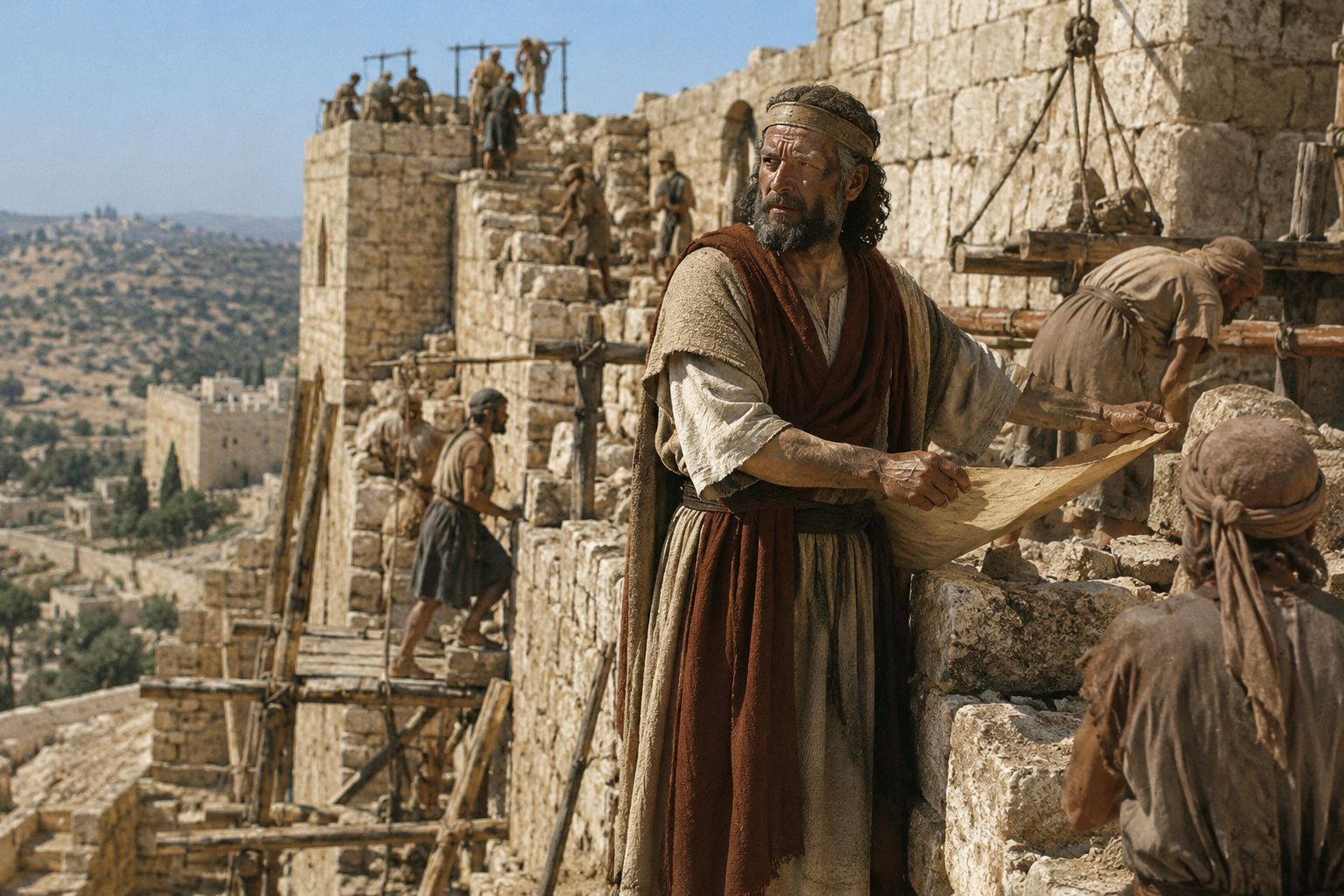
NEHEMIAH UNDER CONSTRUCTION:
JUST A FEW NOTES NOW.
WILL FINISH IF THE LORD WILLS
Nehemiah 8:1 And all the people gathered as one man at the square which was in front of the Water Gate, and they asked Ezra the scribe to bring the book of the law of Moses which the LORD had given to Israel.
- all the people (KJV): Ezr 3:1-13
- as one man (KJV): Jud 20:1,8
- before (KJV): Ne 8:16 Ne 3:26 Ne 12:37
- Ezra (KJV): Ne 8:4-9 Ezr 7:6,11 Jer 8:8,9 Mt 13:52 Mt 23:2,13,34
- bring (KJV): 2Ch 34:15 Isa 8:20 Mal 4:4
And all the people gathered as one man at the square which was in front of the Water Gate, and they asked Ezra the scribe to bring the book of the law of Moses which the LORD had given to Israel.
Bob Utley - "all the people gathered as one man" This is a Hebrew idiom of unity (cf. Ezra 3:1). Both Ezra 2 and 3 parallel Nehemiah 7 and 8. This was purposeful to link these two leaders together. "at the square" It is highly unusual that this convocation should occur at the city square, and not at the temple. Possibly this meeting occurred at the city gate, which was the place of justice and social life in ancient Jewish communities. This was the place where justice and wisdom were to be regularly proclaimed (cf. Pro. 1:20, 21; Pro 8:1ff). "the Water Gate" This seems to be on the east side of the new city wall, just south of Ophel (cf. Neh. 3:26), close to the major water source of the city of Jerusalem, the Gihon Spring (where Solomon was anointed, 1 Kgs. 1:33,38,45). "Ezra the scribe" At this point in the book of Nehemiah the priest/scribe Ezra appears. See Introduction to Ezra, Authorship, for more information. See Scribes "the book of the law of Moses" I reject modern JEDP source criticism. I hold to the Mosaic authorship of the Pentateuch (i.e., Genesis-Deuteronomy), even though it may have been edited by someone like Ezra or Jeremiah. How much of the book of the law (cf. 2 Chr. 34:15) was read on this occasion is uncertain. The word "book" (BDB 706) would refer to a scroll. "which the Lord had given to Israel" The basic meaning of this VERB (BDB 845, Piel PERFECT) is "charge," "command." The covenant people (i.e., Israel from Jacob) were required to keep the covenant. There were privileges and responsibilities (cf. Neh. 10:29; Leviticus 26; Deuteronomy 28).
Henry Morris - all the people. Even if "all" is not taken literally, there must have been gathered here one of the largest congregations ever to hear the Scriptures read in their presence. Even the older children were included (Nehemiah 8:2).
8:1 Ezra the scribe. Ezra is here mentioned for the first time by Nehemiah, but he had already been preaching to the people for at least thirteen years.
8:1 law of Moses. "The book of the law of Moses" undoubtedly included all the Pentateuch, and possibly is used here generically for all of the Scriptures which had been received by this time. Ezra is generally believed to have been largely responsible for organizing the canon of the Old Testament Scriptures.
Believer's Study Bible - This verse undoubtedly belongs with 7:73b, indicating the time frame for these events. From this point until 12:27, the accounts are given in the third person (see Ezra 1:1 and Nehemiah 1:1, book notes). Ezra also appears at this time. Chapters 8-10 concern renewal of covenant.
Matthew Henry - The reading and expounding the law - Neh 8:1-8. Sacrifices were to be offered only at the door of the temple; but praying and preaching were, and are, services of religion, as acceptably performed in one place as in another. Masters of families should bring their families with them to the public worship of God. Women and children have souls to save, and are therefore to acquaint themselves with the word of God, and to attend on the means of grace. Little ones, as they come to reason, must be trained up in religion. Ministers when they go to the pulpit, should take their Bibles with them; Ezra did so. Thence they must fetch their knowledge; according to that rule they must speak, and must show that they do so. Reading the Scriptures in religious assemblies is an ordinance of God, whereby he is honoured, and his church edified. Those who hear the word, should understand it, else it is to them but an empty sound of words. It is therefore required of teachers that they explain the word, and give the sense of it. Reading is good, and preaching is good, but expounding makes reading the better understood, and preaching the more convincing. It has pleased God in almost every age of the church to raise up, not only those who have preached the gospel, but also those who have given their views of Divine truth in writing; and though many who have attempted to explain Scripture, have darkened counsel by words without knowledge, yet the labours of others are of excellent use. All that we hear must, however, be brought to the test of Scripture. They heard readily, and minded every word. The word of God demands attention. If through carelessness we let much slip in hearing, there is danger that through forgetfulness we shall let all slip after hearing.
Steven Cole - Spiritual Renewal (Nehemiah 8:1-18)
Two little old ladies were walking out of church one Sunday. One said, “My, that preacher certainly preaches for a long time!” Her friend replied, “No, he really doesn’t preach a long time, it just seems like a long time!” (J. Vernon McGee, SEE Thru the Bible Vol. 15: History of Israel (Ezra/Nehemiah/Esther))
I wonder what they would have thought about a service that had about six hours of Bible reading and preaching at the people’s request, during which the people stood the whole time! And not only that, they came back the next day for more! That was the remarkable situation that we read about in Nehemiah 8. It would be accurate to call it a revival or a time of unusual spiritual renewal. At the center of this revival was the exposition of Scripture. In fact, Derek Kidner states, “This day was to prove a turning-point. From now on, the Jews would be predominantly ‘a people of the book’” (Ezra & Nehemiah, Tyndale Old Testament Commentaries [IVP], p. 106). Our text teaches us that …
A strong emphasis on God’s Word is a primary mark of spiritual renewal.
Down through the centuries, God’s people have gone through cycles where His Word has been neglected and the spiritual condition of His people deteriorates. In His grace, God sends renewal. Inevitably, one of the main marks of such renewal is a renewed emphasis on God’s Word.
We see this in the Old Testament, when Judah languished under the godless reigns of King Manasseh, and his son, Amon. Amon’s son, Josiah, began to seek the Lord when he was 16 and to institute spiritual reforms. Then Hilkiah the priest found a copy of God’s law and Josiah called the nation to repentance (2Chr 34:14). Revival ensued because God’s Word was obeyed.
The same thing happened during the Reformation, which at its heart was a revival of God’s Word. The Roman Catholic Church had neglected the Word. Priests were the only ones with access to it, and most of them were ignorant of its contents. John Wycliffe and William Tyndale labored to get the Bible translated into common English. Martin Luther translated the Bible into German. John Calvin began to preach expository sermons, explaining and applying the Word to the people of Geneva. The Reformation theme, sola scriptura, renewed God’s people.
The same thing was true of the great Puritan revivals in England and America during the 16th and 17th centuries. J. I. Packer (BORROW A Quest for Godliness {Crossway Books], p. 98) writes,
For Puritanism was, above all else, a Bible movement. To the Puritan the Bible was in truth the most precious possession that this world affords. His deepest conviction was that reverence for God means reverence for Scripture, and serving God means obeying Scripture. To his mind, therefore, no greater insult could be offered to the Creator than to neglect his written word; and conversely, there could be no truer act of homage to him than to prize it and pore over it, and then to live out and give out its teaching. Intense veneration for Scripture, as the living word of the living God, and a devoted concern to know and do all that it prescribes, was Puritanism’s hallmark.
Nehemiah 8 shows us four marks of spiritual renewal related to God’s Word:
1. For spiritual renewal, God’s people must read His Word.
The people gathered and asked Ezra to bring the book (scroll) of the Law of Moses which the Lord had given to Israel (Neh 8:1). They read from it publicly from dawn until noon! Kidner (p. 104) refutes the liberal view, that the Pentateuch (the five books of Moses) was the creation of a recent redactor who pieced together the older materials. He says that what Ezra read from was obviously not a new manifesto, but rather “the foundation articles of the faith, laid down at the exodus.” Also, this law had full divine authority. The phase translated, “which the Lord had given to Moses” is literally “commanded Moses.” As Kidner observes, “one does not tamper with material that one would describe in such terms.” The people recognized and respected the fact that God had given this material to Moses, and therefore it was His authoritative word to them.
Copies of the Law of Moses were probably somewhat rare, and many of the Jews may never have heard it read before. Even in the New Testament, Paul instructs Timothy to give attention in church meetings “to the public reading of Scripture, to exhortation and teaching” (1 Tim. 4:13). Until the invention of the printing press in the 15th century, the Bible had to be copied by hand, and often there would only be one copy in a city, often chained to the pulpit. Since people were often illiterate, the Bible had to be read publicly for the common people to know what it says.
God could have communicated with us in some form other than writing. He could have sent an angel to each language group with His message and saved Wycliffe Bible Translators a lot of time and effort! He could have had the message communicated verbally from generation to generation. But He chose to put it in written form. That means that for people to know God and His message of salvation, at least one person in the group, and preferably many, have to learn to read and study. I would argue that the strength of a church will be in direct proportion to the number of people in that church who read and study God’s written Word.
We live in a culture where almost all of us know how to read. Those who can’t read or can’t read well can readily learn how. We have multiple translations of the Bible in our language. And yet most American Christians spend far more time playing pointless computer games or sitting in front of a TV set that spews out garbage than they do reading and studying the words that God has given to us in the Bible!
For the good of your soul I would challenge you to read and reread the Bible all the days of your life. If you want spiritual renewal, it will come through God’s Word. In Psalm 119, which extols God’s Word, nine times the author (probably Ezra) mentions how God’s Word (or some synonym for the Word) brings revival (Ps. 119:25, 50, 93, 107, 149, 154, 156). If you have never done so, I’d encourage you to read through the entire Bible in the New Year. For spiritual renewal, God’s people must read His Word.
2. For spiritual renewal, God’s people must reverently hear His Word expounded.
Having ears that work does not guarantee that we really hear. Although God made us with two ears that we cannot close and one mouth that we can (which ought to teach us something!), we sometimes close off our minds so that we do not really hear what is being said, even though we did hear the sounds of the words. Anyone who is married has had that experience. Your wife is talking to you, but you are reading the mail or the paper and you didn’t hear a thing she said. In the same way, it is possible to hear the Bible read or preached and not hear a thing. Your mind was elsewhere.
That’s why Jesus often said, “He who has ears to hear, let him hear” (Mark 4:9, 23). He said, “Take care how you listen, for whoever has, to him shall more be given; and whoever does not have, even what he thinks he has shall be taken away from him” (Luke 8:18). If the Bible contains the very words that God Himself is saying to us, then it certainly behooves us to listen reverently to what He is saying!
The people in our text were both attentive and reverent when God’s Word was read to them. Verse 3 mentions their attentiveness, and verses 5 & 6 show their reverence. They stood up as if to greet a royal visitor, and then they bowed down in worship. They were not worshiping the actual scroll that Ezra held in his hand, but rather the God who had given the words of that scroll to Moses and through Moses to them.
Attentiveness stems from reverence. If we maintain our reverence for God and that fact that He is speaking to us through His Word, we will pay attention to what He says. If we forget that this is the Word of the living God to us, our minds will wander to other things. I realize that preachers can sometimes be boring. But if I lose your attention, direct your mind to the text of Scripture and ask the Lord to open it to your heart.
Rowland Hill was an 18th century English preacher greatly used of God. Shortly before he died, he was visiting with an old friend who told him that he could still remember the text and part of a sermon that he had heard Hill preach 65 years before. Hill asked him what he remembered. He said that Hill had said that some people when listening to a sermon did not like the delivery of the preacher. Then he said, “Supposing you went to hear the will of one of your relatives read, and you were expecting a legacy from him. You would hardly think of criticizing the manner in which the lawyer read the will. Rather, you would be all attention to hear whether anything was left to you and if so, how much. That is the way to hear the gospel preached” (told by Charles Spurgeon, Lectures to My Students SEE PAGE 501).
Spiritual renewal comes through reverently hearing God’s Word when it is read and preached.
3. For spiritual renewal, God’s Word must be taught.
Neh 8:7, 8 report that these men who stood on the platform with Ezra explained the law to the people, “translating to give the sense so that they understood the reading.” Scholars debate the meaning of the word “translating” (NASB). Some say that since many of the people spoke Aramaic, the biblical Hebrew had to be translated into Aramaic. But probably the sense of the NIV is correct, that the teachers made the reading of Scripture clear and gave the meaning. Probably Ezra would read a section and then his assistants, perhaps in smaller groups, would expound on that section to make the meaning clear to the people.
Much of the Bible is plain to anyone who can read. As Mark Twain is reputed to have said, it wasn’t the sections of the Bible that he couldn’t understand that bothered him. It was the parts that he could understand that troubled him! But there are some sections of Scripture that are difficult to grasp and so God has given to the church pastors and teachers to help His people understand and apply His Word to their lives. Also, we are blessed with many excellent study tools to help us learn the Word in times of personal study: study Bibles, Bible handbooks, word study books, commentaries, Bible encyclopedias, and theological books.
To properly apply the Bible, you must properly interpret it. To properly interpret it, you must understand what the author meant for the people to whom he was writing in the context of that day. Also, since the Bible fits together as a unified whole, you must get a grasp of everything that the Bible teaches about a subject by comparing Scripture with Scripture, interpreting the Bible by itself. Sometimes this requires historical research to discover the customs and/or historical events that relate to the biblical text. Sometimes it requires either knowing the original biblical languages or consulting scholars who do in order to understand words and/or grammatical constructions. Always it requires interpreting a particular verse or paragraph of Scripture in the larger context of the book in which it is written. If you take a text out of its context, you can make the Bible say just about anything you wish!
Much could be said, but let me make two observations about sound Bible teaching:
A. SOUND BIBLE TEACHING MUST BE ACCURATE, CLEAR, AND APPLIED TO LIFE.
It must be accurate. You can make all sorts of interesting points, but if you are not accurately reflecting what the passage is teaching, you are not teaching the Bible rightly.
It must be clear. Granted, some texts are very difficult to understand (even Peter says such about some of Paul’s writings, 2 Pet. 3:15-16). Sometimes Jesus seemed to be deliberately obscure, especially in His parables, to hide the truth from scoffers. But usually the job of a Bible teacher is to communicate the truth clearly and simply. Martin Luther condemned preachers who aimed at the intellectuals in the crowd to the neglect of helping simple, unlearned people understand saving truth. He said that even though he had more than 40 doctors and magistrates in his church, when he preached he spoke to the young people, children, and servants. If the educated people weren’t impressed, Luther said, the door is open; let them be gone (The Table Talk of Martin Luther, edited by Thomas Kepler [Baker], pp. 253-254).
Sound teaching must be accurate and clear. But also it must be applied to life. As you study the Word personally and if you ever teach it, your aim should be to answer the question, “So what?” What difference should this text make in my life and in the lives of my hearers? John Calvin did not view theology as an end in itself. He said, (cited by T. H. L. Parker, Calvin’s Preaching ([Westminster/John Knox Press], pp. 11-12, 15),
When I expound Holy Scripture, I must always make this my rule: That those who hear me may receive profit from the teaching I put forward and be edified unto salvation. If … I do not procure the edification of those who hear me, I am a sacrilege, profaning God’s Word…. The Word of God is not to teach us to prattle, not to make us eloquent and subtle and I know not what. It is to reform our life, so that it is known that we desire to serve God, to give ourselves entirely to him and to conform ourselves to his good will.
B. SOUND BIBLE TEACHING REQUIRES COMMITMENT ON THE PART OF THE TEACHER AND THE TAUGHT.
Those who teach must be committed to take the time and effort to study and prepare. You cannot teach the Bible accurately, clearly, and with proper application to life if you just read a text and say whatever pops into your mind at the moment. And yet many pastors do just that, claiming that the Spirit is leading them! Even the apostles, who were taught directly by Christ and by the Holy Spirit, had to say no to certain ministry demands so that they could devote themselves to prayer and the ministry of the Word (Acts 6:4). If they had to devote themselves to the task of preaching, how much more do we!
But the ones who are taught also must be committed to the Word. In the church this means that those who are not gifted in the area of teaching take on other necessary ministry tasks so that those who teach can study and prepare. In other words, there must be a division of labor according to spiritual gifts.
You see this principle in Nehemiah 8. Until now, Nehemiah has been in the forefront. He was a gifted administrator who could organize and mobilize people to get the wall built. But when it came time to teach the Word, he took a back seat to Ezra, who was skilled in the law of Moses, who had set his heart to study it, practice it, and teach it (Ezra 7:6, 10). These two men illustrate beautifully the principle of team ministry.
Thus for spiritual renewal, God’s people must read His Word, reverently hear His Word, and the Word must be taught. Finally,
4. For spiritual renewal, God’s people must respond to His Word.
It is spiritually dangerous to study the Word without the goal of obedient response. Knowledge apart from obedience leads to pride (1 Cor. 8:1). Our aim, as Calvin put it, should always be to transform our lives by Scripture. There are five responses here:
A. REPENTANCE.
The people wept when they heard and understood God’s Word (Neh 8:9), because they realized how much they had sinned against God. We will see this in more detail in chapter 9. But the fact is, the more the light of God’s holy Word shines into our hearts, the more we will see areas where we do not conform to His righteousness. Spiritual renewal always involves repentance.
B. JOY.
The clouds of godly repentance should quickly break up, allowing the sun of godly joy to flood our hearts (8:9-10). God never wounds us to hurt us, but only to heal. The joy of knowing that He has forgiven all of our sins and that we are His people should fill our hearts. We will look further at Neh 8:10 in our next study.
C. GOOD DEEDS.
Ezra and Nehemiah reminded the people to send portions from the part of the sacrifices that they could eat to those who had nothing (Neh 8:10). God’s Word should produce compassion in our hearts for the needy. His salvation is “to purify for Himself a people for His own possession, zealous for good deeds” (Titus 2:14).
D. OBEDIENCE.
The people heard in the reading of the Law that they should observe the Feast of Booths. Since it was only two weeks away, they immediately made preparations to do it. This feast commemorated both the harvest that God had just provided and the deliverance that He had granted under Moses, when Israel lived in temporary shelters in the wilderness. The Israelites had not celebrated a Feast of Booths like this one since the time of Joshua (Neh 8:17)! Again it is noted that their obedience resulted in great rejoicing.
E. WORSHIP.
The Feast of Booths lasted a whole week, and every day consisted of more reading of God’s law, culminating in a solemn assembly on the final day (Neh 8:18). In other words, there was great rejoicing along with reverential attention to God’s Word. As the people camped in the temporary shelters, they reflected back on God’s faithful dealings with the nation, in spite of their sins. And so they were filled with gratitude and love toward God for His gracious dealings with them. The reading, study, and preaching of God’s Word should produce in all of us a heart of worship as we reflect on His abundant mercies toward us.
Conclusion
Chuck Swindoll (BORROW Hand Me Another Brick [Thomas Nelson Publishers], pp. 152-153) tells of a time when he spoke at a family conference. He noticed a young couple with several small children. Although they looked and sounded like a Christian family, it was evident to him that they were very miserable. He knew that divorce was on the back burner of their minds.
But as the week progressed, he saw that couple change as they listened to the teaching of God’s Word. The husband hung on every word. The wife had her Bible open and followed the messages closely. At the end of the week, this couple came up to Swindoll and his wife and said, “We want you to know that this week has been a 180-degree turnaround experience for us. When we came, we were ready to separate. We’re going back stronger than we have ever been in our marriage.” But that joyous news was dampened by another family’s response. Chuck continues,
At the same conference with the same speakers, the same truths, the same surroundings, the same schedule, another father was turned off. He wasn’t open. He attended the first few sessions, but by and by the guilt became so great and the conviction so deep that he went home. He had stayed awake the entire night before and reached the decision to leave and not come back. His family left hurting—perhaps even more than when they came.
What was the difference? Swindoll says, “attitude.” The couple who benefited had teachable hearts. The other man did not.
Some people come to church with reverence for God and His Word, saying, “God, teach me! I want to know You more!” They are ready to respond to the Word. They profit from the teaching. Others come to the same service with sin in their hearts that they don’t want to deal with. They are turned off by the very same message that helps others to grow. If you want spiritual renewal, check your heart. It comes when responsive hearts read and reverently hear God’s Word faithfully proclaimed.
Discussion Questions
- How can a non-studious type develop a hunger to read and study God’s Word?
- How can we develop the kind of responsive hearts that are needed to profit from God’s Word?
- How can we guard ourselves from the spiritual pride that often accompanies knowledge (see 1 Cor. 8:1)?
- Jot down one spiritual goal that you could work on in response to this message.
- PEOPLE OF THE BOOK (Neh 8:1-12)
- This was Bible Conference 101. Guest speaker…Ezra.
- Why was Ezra equipped to deliver the Word to the people? (Neh 8:1,2)
- Ezra 7:9,10 for the gracious hand of his God was on him. This was because Ezra had determined to study and obey the Law of the Lord and to teach those decrees and regulations to the people of Israel.
- Ezra’s personal commitment to study the Law, practice it in his own life, & then teach it was reflected.
- Why not Nehemiah? He wasn’t a priest nor a Levite.
- Ezra 7:9,10 for the gracious hand of his God was on him. This was because Ezra had determined to study and obey the Law of the Lord and to teach those decrees and regulations to the people of Israel.
- Where was the Word going to be read...at the Water Gate...where else. The washing of the water of the word.
- Not at the Altar, but at the center of city life. The kind of place where God’s wisdom pleads most urgently to be heard.
- Prov.1:20 Wisdom shouts in the streets. She cries out in the public square
- The Law itself insisting that its voice must not be confined to the sanctuary but heard in the house & the street. Kidner
- Where is your water gate/cooler? Have you taken the Word of God out of church & to the streets, to your community, to your Town Square?
- Not at the Altar, but at the center of city life. The kind of place where God’s wisdom pleads most urgently to be heard.
- How long did the people stand? (Neh 8:3) [about 6 hours, from day light till noon]
- Why do you think the people stood? (Neh 8:5)
- Out of respect of the reading of Gods word.
- Ask, How can we show respect for Gods word today?
- Balance? India/never below you/not arm pit. Nate/ear rung for dropping as kid.
- Why does it mention that he opened up the book in the sight of all the people & was above them? (Neh 8:5)
- I think pastors, Bible study teachers, Children’s Church teachers should do this also...open the book in the sight of all the people. Why? [even needed to in oral]
- How did Ezra bless the Lord? (Praise, he praised His God) (Neh 8:6)
- This was not a type of bibliolatry/biblio book/Latria worship as though the scrolls were being venerated simply as a relic. The adoration was for God, as vs.6 makes abundantly clear.
- Why did the people get so excited about the hearing of the word of God? (Neh 8:6)
- Obviously they were a long time w/o it.
- Did everyone have their own bible to read in that day? [no way]
- Does the Word ever move you to radical worship? [prostrate]
- How did Ezra teach them? (Neh 8:8)
- Read distinctly – Clear. Parash, to make distinct.
- Gave the sense – Gave the meaning of, explained.
- Helped them to understand the reading – how to apply. Result: they understood
- Mention: Observation. Interpretation. Application steps.
- What was the effect of the readings, on the people?
- Grief stricken – mourning & weeping (Neh 8:9) & sorrow (Neh 8:10).
- When they heard & understood God’s Law, they understood their violation of it.
- Blessed are they that mourn for they shall be comforted.
- Joy (Neh 8:10) – Nehemiah probably reminded them of God’s mercy & forgiveness.
- They heard God punishes sin, but also blesses obedience.
- They had not been utterly destroyed as a nation…this was reason for rejoicing!
- We always need to cultivate Holy Joy.
- The joy of sin forgiven; of acceptance w/God; of hope that anchors us to the unseen & cannot be ashamed.
- You may not be able to Joy in yourself, or your surroundings, but you may always rejoice in the Lord.
- Grief stricken – mourning & weeping (Neh 8:9) & sorrow (Neh 8:10).
- What brought about their joy? (Neh 8:12 – understanding the teachings)
- Probably my highest compliment by people new to our church...“I can understand it when you teach it. You make it simple/plain.”
- What does Jeremiah say is the connection between God’s Word & Joy? Jer.15:16 Your words were found, and I ate them, And Your word was to me the joy and rejoicing of my heart.
- The bible is a source of happiness.
- Proverbs 8:34-36 Blessed is the man who listens to me (wisdom), Watching daily at my gates, Waiting at the posts of my doors. For whoever finds me finds life, And obtains favor from the LORD; But he who sins against me wrongs his own soul; All those who hate me love death.
- Jesus said in Lk.11:28 blessed are those who hear the word of God & keep it.
- You can’t be happier then when you discover, accept, & obey God’s word.
- What brought about their strength? [Joy-ing in the Lord (Neh 8:10)]
- The sequence in chapter 8 is striking:
- Intellectual response to the Word(Neh 8:1-8). Emotional response to the Word(Neh 8:9-12) and Volitional response to the Word (Neh 8:13-18).
- What a perfect church gathering: People gathered in unity. They told Ezra bring the book. They assembled. Were listening. The word was exalted. The preacher: read, explained,applied the word. The people responded: by weeping, cut to heart, grief of sin, and by rejoicing & feasting.
- PEOPLE OF OBEDIENCE (Neh 8:13-18)
- This Feast of Tabernacles is also called the Festival of Sukkot/booths.
- It is also called the Feast of Ingathering (as it was at the completion of the Harvest)
- Josephus said, “it was holiest & greatest festival among the Jews.”
- A feast, not only for harvest but for all the bounty of nature which made life possible and living happy. Barclay
- This was the most joyful feast of the year. A festival packed with Joy & feasting lasting 1 week. This came right after the Day of Atonement.
- True Joy comes only when we know we are right w/God.
- Why was this harvest festival apropos? [remember where I’ve brought you from… i.e. tents in the wilderness & now from Babylon]
- How did the people react to the things they learned? (Neh 8:16,17)
- The whole assembly went out & did it.
- Also note very great gladness (Neh 8:17) [simchah gadol meod, gladness great very] a) How do you view obedience? Drudgery or great gladness?
- Prayer: Lord, we want to honor your word, listen to it, seek to understand it & then obey it?
- This Feast of Tabernacles is also called the Festival of Sukkot/booths.
Nehemiah 8:2 Then Ezra the priest brought the law before the assembly of men, women and all who could listen with understanding, on the first day of the seventh month.
- priest (KJV): De 17:18 De 31:9,10 Mal 2:7
- congregation (KJV): De 31:11-13 2Ch 17:7-9 Ac 15:21
- could hear with understanding (KJV): Heb. understood in hearing, Isa 28:9
- the first (KJV): Lev 23:24 Nu 29:1
Then Ezra the priest brought the law before the assembly of men, women and all who could listen with understanding, on the first day of the seventh month
Bob Utley - "the assembly of men, women, and all who could listen with understanding" It was unusual to include women and children in these convocations. This shows the seriousness of the occasion. The phrase "who could listen with understanding" reflects the Jewish concept of sin and responsibility. They do not focus on Genesis 3, as Paul does, to explain human rebellion and an evil world. Jews prefer to assert that spiritual responsibility is related to age and knowledge (at 13 years of age the boy's rite is called Bar Mitzvah and at 12 the girls is called Bath Mitzvah). Only after a period of study and personal commitment is a Jewish male of thirteen responsible to obey the Law. The VERB (BDB 1033) means "to hear so as to do" (e.g., Deut. 4:1,6,9,13,14; Deut 5:1; Deut 6:4; Deut 9:1; Deut 20:3; Deut 27:9-10). Knowledge brings responsibility (cf. Luke 12:48). A person by this name appears in Neh. 8:4, "Shema." ▣ "on the first day of the seventh month" The seventh month was a very important month to the Hebrews (cf. Leviticus 23; Exodus 23). It was not only a time of new year, but a time of fasting and repentance (the 10th), as well as a time of feasting and thanking God for the harvest (the 15th).
Ryrie - the first day of the seventh month. The time of the Feast of Trumpets, Sept. 27, 444 B.C. See note on Lev. 23:24.
Nehemiah 8:3 He read from it before the square which was in front of the Water Gate from early morning until midday, in the presence of men and women, those who could understand; and all the people were attentive to the book of the law.
- he read (KJV): Lu 4:16-20 Ac 13:15,27 Ac 15:21
- morning (KJV): Heb. light, Ac 20:7,11 Ac 28:23
- ears (KJV): Mt 7:28,29 Mk 12:37 Lu 8:18 Lu 19:48 Ac 16:14 Ac 17:11 1Th 2:13 Heb 2:1-3 Rev 2:29 Rev 3:22
He read from it before the square which was in front of the Water Gate from early morning until midday, in the presence of men and women, those who could understand; and all the people were attentive to the book of the law
Bob Utley - "He read from it, before the square. . .from early morning until midday" Apparently Ezra read for something like 6 hours in Hebrew (cf. Neh. 8:7). ▣ "in the presence of men and women, those who could understand" If this meeting had occurred in the temple, only men could have attended. By it being at the square, the entire Jewish population could come. ▣ "all the people were attentive to the book of the law" There is no VERB, literally "the ears of all the people to the book of Law." This idiom shows the level of commitment and anticipation on the part of the people.
Believer's Study Bible - The reading of the Book of the Law of Moses probably referred to portions read from the entire Pentateuch. Noteworthy is the fact that even children who were old enough to understand were gathered for Ezra's reading. When the book was opened, the people all stood as a natural response of reverence for the Word of God (v. 5). Several others aided Ezra in explaining the significance of the Law (v. 7). Verse 8 describes an early case of expository preaching. After the text was read, the content was carefully explained for the people so that its full significance might be comprehended. Because the official language of Babylon during these days was Aramaic, many of the Israelites had adopted the language of their captors. This made translation and interpretation of the Law, which was written in Hebrew, all the more important.
Nehemiah 8:4 Ezra the scribe stood at a wooden podium which they had made for the purpose. And beside him stood Mattithiah, Shema, Anaiah, Uriah, Hilkiah, and Maaseiah on his right hand; and Pedaiah, Mishael, Malchijah, Hashum, Hashbaddanah, Zechariah and Meshullam on his left hand.
- pulpit (KJV): Heb. tower
- Maaseiah (KJV): Ne 10:25 Ne 11:5
- Malchiah (KJV): Ne 10:3
- Hashum (KJV): Ne 10:18 Ezr 10:33
- Meshullam (KJV): Ne 10:7,20 Ne 11:7 Ne 12:13 Ezr 10:29
Ezra the scribe stood at a wooden podium which they had made for the purpose. And beside him stood Mattithiah, Shema, Anaiah, Uriah, Hilkiah, and Maaseiah on his right hand; and Pedaiah, Mishael, Malchijah, Hashum, Hashbaddanah, Zechariah and Meshullam on his left hand
Ryrie - This is the first mention of a podium, or platform, in the Bible; it was strong enough to support Ezra and 13 others.
Bob Utley - hese people listed were apparently priests or Levites (Maaseiah in both Neh. 8:4 & 7). Many of the names appear only here, but others appear in other chapters of Ezra/Nehemiah. One is never certain if it is the same person or just the same name. An example is "Meshullam." There are over twenty-one people (Young's Analytical Concordance, p. 656) by this name; some appear in Ezra ‒ Nehemiah:
Nehemiah 8:5 Ezra opened the book in the sight of all the people for he was standing above all the people; and when he opened it, all the people stood up.
- opened (KJV): Lu 4:16,17
- sight (KJV): Heb. eyes
- stood up (KJV): Judges 3:20 1Ki 8:14
Ezra opened the book in the sight of all the people for he was standing above all the people; and when he opened it, all the people stood up.
Bob Utley - "Ezra opened the book in the sight of all the people. . .and when he opened it, all the people stood up" This was a sign of respect at the reading of God's word. God's word is a recurrent theme in Ezra-Nehemiah. Did they stand for the entire six hours? This translation implies that the Law was written in codex form, but this was a later development. The word "book" (BDB 706) can mean scroll; if so "opened" (BDB 834 I) may imply scrolled to the beginning. The Jewish (and later Christian) tradition of standing when the word of God is read comes from this verse.
Henry Morris - people stood up. Apparently the congregation stood on their feet from morning until noon, for seven days, as the Scriptures were read and expounded (compare Nehemiah 8:3,7,8,18). This is an amazing testimony of reverence toward God's Word, seldom, if ever, repeated since.
Ryrie - Neh 8:5-6 The people often stood as a sign of reverence and humility (1 Sam. 1; 26; 1 Kings 8:22; Luke 18:11,13). lifting up their hands. A symbol of receiving God's blessing. faces to the ground in worship and adoration.
Nehemiah 8:6 Then Ezra blessed the LORD the great God. And all the people answered, “Amen, Amen!” while lifting up their hands; then they bowed low and worshiped the LORD with their faces to the ground.
- blessed (KJV): 1Ch 29:20 2Ch 6:4 Ps 41:13 Ps 72:18,19 Eph 1:3 1Pe 1:3
- Amen (KJV): Ne 5:13 Jer 28:6 Mt 6:13 1Co 14:16
- with lifting (KJV): Ge 14:22 Ps 28:2 Ps 63:4 Ps 134:2 Ps 141:2 La 3:41 1Ti 2:8
- bowed (KJV): Ge 24:26 Ex 4:31 Ex 12:27 2Ch 20:18 2Ch 29:30
- with their faces (KJV): Lev 9:24 Mt 26:39 Rev 7:11
Then Ezra blessed the LORD the great God. And all the people answered, “Amen, Amen!” while lifting up their hands; then they bowed low and worshiped the LORD with their faces to the ground
Bob Utley - "the Lord the great God" As there was a transition from the centrality of the priesthood to the leadership of the prophet in early Israeli life, now another transition as the influence of the word of God (scroll of Moses) transcends the temple ritual as the focus of worship. Yes, they still performed the temple rituals, but the study of the Word, as seen in the further development of the synagogue, becomes the focus of daily life. The Word of God is a recurrent emphasis in Nehemiah. YHWH does not manifest Himself in the awesome physical ways that He did during the Exodus or dedication of Solomon's temple, but His power, promises, and presence are fully revealed in His word (by faith). ▣ "Amen, amen." This Hebrew word comes from the root "to be firm." It is related etymologically to the Hebrew word emunah, which is found in Habakkuk 2:4 and is translated in English "faith." Here the crowd affirms the truth that the Lord is a great God (cf. Neh. 1:5; Neh 4:14; Neh 9:32). ▣ "while lifting up their hands; then they bowed low and worshiped the Lord with their faces to the ground" The normal posture for Jewish prayer was the hands and the open eyes uplifted to heaven (as if in conversation with God). At certain times of intensity, there are Old Testament examples of Jewish people kneeling in prayer (cf. 1 Kgs. 8:54; Ps. 95:6; Isa. 45:23; Dan. 6:10). Here they bowed to the ground (cf. Exod. 34:8; Jos. 5:14; 2 Chr. 20:18; Job 1:20). This prostration before the Lord shows an intense degree of emotion and worship (cf. Exod. 4:31; Exod 12:27). It is very similar to the posture and form of modern Muslim prayers.
Nehemiah 8:7 Also Jeshua, Bani, Sherebiah, Jamin, Akkub, Shabbethai, Hodiah, Maaseiah, Kelita, Azariah, Jozabad, Hanan, Pelaiah, the Levites, explained the law to the people while the people remained in their place.
- Jeshua (KJV): Ne 3:19 Ne 9:4 Ne 10:9 Ne 12:24
- Bani (KJV): Ne 3:17 Ne 9:4 Ne 10:13
- Sherebiah (KJV): Ne 9:4 Ne 10:12 Ne 12:24 Ezr 8:18
- Akkub (KJV): Ne 11:16,19 Ne 12:25
- Hodijah (KJV): Ne 10:10,18
- Maaseiah (KJV): Ne 8:4 Ne 3:23 Ne 12:41,42 Ezr 10:22
- Kelita (KJV): Ne 10:10 Ezr 10:23
- Azariah (KJV): Ne 3:23 Ne 10:2 Ne 12:33
- Jozabad (KJV): Ezr 10:22,23
- Hanan (KJV): Ne 10:10
- Pelaiah (KJV): Ne 10:10
- caused (KJV): Lev 10:11 De 33:10 2Ch 17:7-9 2Ch 30:22 Mal 2:7
Also Jeshua, Bani, Sherebiah, Jamin, Akkub, Shabbethai, Hodiah, Maaseiah, Kelita, Azariah, Jozabad, Hanan, Pelaiah, the Levites, explained the law to the people while the people remained in their place.
Ryrie - Neh 8:7-8 The reading of the law was interspersed with explanation; indeed, the law was also translated from Hebrew into Aramaic, the only language some of the people may have understood (cf. 13:24).
Bob Utley - This list of names seems to include priests and Levites; both functioned as teachers (cf. Lev. 10:11; Deut. 17:10-11; Deut 33:10). However, because of Neh. 8:9 some see this as referring to Levites only (cf. NRSV, TEV, NJB, NET Bible). The Septuagint, I Esdras 9:48, and Vulgate do not have "and" before "the Levites." C. D. Ginsburg also thinks the "and" should be dropped (notes in his Hebrew Bible). Levites were also teachers of the Law (esp. in later Judaism, cf. 2 Chr. 35:3). Here as Ezra (and the others of Neh. 8:4) read the Hebrew text they moved among the crowd and translated it (cf. Neh. 8:7) into Aramaic, which was the language used in the Persian Empire and understood by the common person of that day. ▣ "explained the law to the people" The VERB (BDB 106, KB 122, Hiphil PARTICIPLE PLURAL) means "to discern." The Hiphil was often used of teaching the Law (cf. 2 Chr. 25:8; 2 Chr. 35:3; Neh. 8:7,9,12). It is often used of the wise in Proverbs (cf. Pro. 8:9; Pro 17:10,24; Pro 28:2,7,11). The implication is that they understood and then obeyed (cf. Neh. 8:12; 2 Chr. 26:5), which is parallel to shema (cf. Neh. 8:2). ▣ "to the people while the people remained in their place" This may relate either to
- the people grouping themselves, and each group having an assigned teacher
- that they remained standing in family groups throughout the reading of the Law
Nehemiah 8:8 They read from the book, from the law of God, translating to give the sense so that they understood the reading.
- and gave the sense (KJV): Hab 2:2 Mt 5:21,22,27,28 Lu 24:27,32,45 Ac 8:30-35 Ac 17:2,3 Ac 28:23
They read from the book, from the law of God, translating to give the sense so that they understood the reading.
Henry Morris - The Scriptures were written in Hebrew, but the people had no doubt used the Aramaic language or possibly other languages while in Babylon, or while scattered in Assyria. Thus translation, as well as simple reading and exposition, would have been required for many of the people.
Nehemiah 8:9 Then Nehemiah, who was the governor, and Ezra the priest and scribe, and the Levites who taught the people said to all the people, “This day is holy to the LORD your God; do not mourn or weep.” For all the people were weeping when they heard the words of the law.
- Nehemiah (KJV): Ne 7:65,70 Ne 10:1 Ezr 2:63
- Tirshatha (KJV): or, governor
- Ezra (KJV): Ezr 7:11
- the Levites (KJV): Ne 8:7,8 2Ch 15:3 2Ch 30:22 2Ch 35:3 Ho 4:6
- This day (KJV): Ne 8:2 Lev 23:24 Nu 29:1-6
- mourn not (KJV): De 12:7,12 De 16:11,14,15 De 26:14 Ec 3:4 Isa 61:3 Mal 2:13
- all the people (KJV): 2Ki 22:11,19 2Ch 34:19,21 Ro 3:20 Ro 7:9 2Co 7:9-11
Then Nehemiah, who was the governor, and Ezra the priest and scribe, and the Levites who taught the people said to all the people, “This day is holy to the LORD your God; do not mourn or weep.” For all the people were weeping when they heard the words of the law.
Bob Utley - "the governor" This is a Persian loan word (BDB 1077, cf. Ezra 2:63; Neh. 7:65,70; Neh 8:9; Neh 10:1). The Hebrew equivalent is Pechah (BDB 808, cf. Ezra 5:3,6,14; Ezra 6:6,7,13; Ezra 8:36; Neh. 2:7,9; Neh 3:7; Neh 5:14,15,18; Neh 12:26). All of Israel's leaders (the last VERB of Neh. 8:12 is PLURAL "their") participated in these events (Nehemiah the governor, Ezra the official in charge of proper worship, and the Levite instructors). ▣ "For all the people were weeping when they heard the words of the Law" This implies godly sorrow over their apathy and non-performance concerning the word of God (cf. v. 10). This is the same attitude required for the Day of Atonement in Leviticus 16. A similar time of fasting and repentance is found in chapter 9. It is surprising that the Day of Atonement is not mentioned as these people tried to reinstate and be obedient to the writings of Moses.
Ryrie - Conviction of sin caused the people to weep, appropriate to the Day of Atonement (on the tenth day of the month) but not to the Feast of Trumpets and the celebration of the completion of the wall.
Matthew Henry - The people called upon to be joyful - Neh 8:9-12. It was a good sign that their hearts were tender, when they heard the words of the law. The people were to send portions to those for whom nothing was prepared. It is the duty of a religious feast, as well as of a religious fast, to draw out the soul to the hungry; God's bounty should make us bountiful. We must not only give to those that offer themselves, but send to those out of sight. Their strength consisted in joy in the Lord. The better we understand God's word, the more comfort we find in it; the darkness of trouble arises from the darkness of ignorance.
Nehemiah 8:10 Then he said to them, “Go, eat of the fat, drink of the sweet, and send portions to him who has nothing prepared; for this day is holy to our Lord. Do not be grieved, for the joy of the LORD is your strength.”
- Go your way (KJV): Ec 2:24 Ec 3:13 Ec 5:18 Ec 9:7 1Ti 6:17,18
- eat (KJV): Song 5:1
- send (KJV): De 26:11-13 Es 9:19,22 Job 31:16-18 Ec 11:2 Lu 11:41 Rev 11:10
- the joy (KJV): Ps 28:7,8 Ps 149:2 Pr 17:22 Isa 6:7,8 Isa 12:1-3 Isa 35:1-4 Isa 61:10 Joe 2:23 2Co 8:2 2Co 12:8,9 Php 3:4
Then he said to them, “Go, eat of the fat, drink of the sweet, and send portions to him who has nothing prepared; for this day is holy to our Lord. Do not be grieved, for the joy of the LORD is your strength
Bob Utley - "eat of the fat" This term (BDB 1032) is used only here in the OT, according to BDB. It means the best pieces of meat. This is not the term for "fat" (BDB 804) which was offered only to God on the altar of sacrifice (cf. Lev. 1:8,12; Lev 3:3-4; Lev 4:8-10). ▣ "Go, eat. . .drink. . .send" These are all Qal PLURAL IMPERATIVES. It was a special festival day. ▣ "drink of the sweet" The term "sweet" (BDB 609), used of wine, is found only here in the OT. ▣ "send portions to him who has nothing prepared" The term "portion" (BDB 584) refers to the part of a sacrifice given back to an offerer (and his family, cf. 1 Sam. 1:4-5; Esth. 9:19,22). This was a common act in times of rejoicing (cf. Esth. 9:22). God cares for the poor, the widow, the orphan, and the alien, so too, must His people, who are to reflect His character (e.g., Exod. 23:11; Deut. 15:4,7,11; Deut 26:11-13; Pro. 14:31; Pro 19:17; Pro 22:9). ▣ "this day is holy to our Lord" In context this means given to or dedicated to God (adon). It was a covenant renewal ceremony, something like Jos. 8:30-35. ▣ "Do not be grieved" The VERB (BDB 780 I, KB 864, Niphal IMPERFECT used in a JUSSIVE sense) means "grieved" or "pained." The people were stunned at their disobedience and the disobedience of their ancestors (cf. Nehemiah 9). However, the occasion was one of renewal and new beginnings; they must rejoice with the God of the Covenant. Deity is denoted by Adon in the phrase "holy to the Lord," but later in the verse, He is called YHWH, the covenant, the redeemer title for God.
Believer's Study Bible - Nehemiah characteristically (cf. 5:14-18) admonished the people to send portions to the poor who were unable to prepare anything themselves, so that they, too, could find joy.
Ryrie - The people sorrowed because they had not obeyed the law; they rejoiced that they could now understand it and obey it.
Walter Kaiser - Hard Sayings page 223 - Making Clear the Book of the Law? The issue in this verse concerns the word here translated as “making it clear” (mep̄ōrāš). Some render it “to translate.” This would mean that the exiles who had returned from seventy years of captivity in Babylon had become fluent in Aramaic but had lost their ability to understand the text of the Law as it was read in Hebrew.
But if these Jews really had lost their knowledge of Hebrew, then why were such postexilic books as 1 and 2 Chronicles, Ezra, Nehemiah, Esther, Haggai, Zechariah and Malachi written in Hebrew? If the writers of these texts wanted to reach the Jewish audience of the fifth and fourth centuries B.C., why would they have chosen to use an archaic language that the people no longer grasped?
Approximately one week after the returnees had completed the walls of Jerusalem (Neh 6:15; Neh 7:1), the people assembled in the square in front of the famous Water Gate (Neh 3:26). There Ezra, the scribe, began a public reading of the Torah of Moses (Neh 8:1).
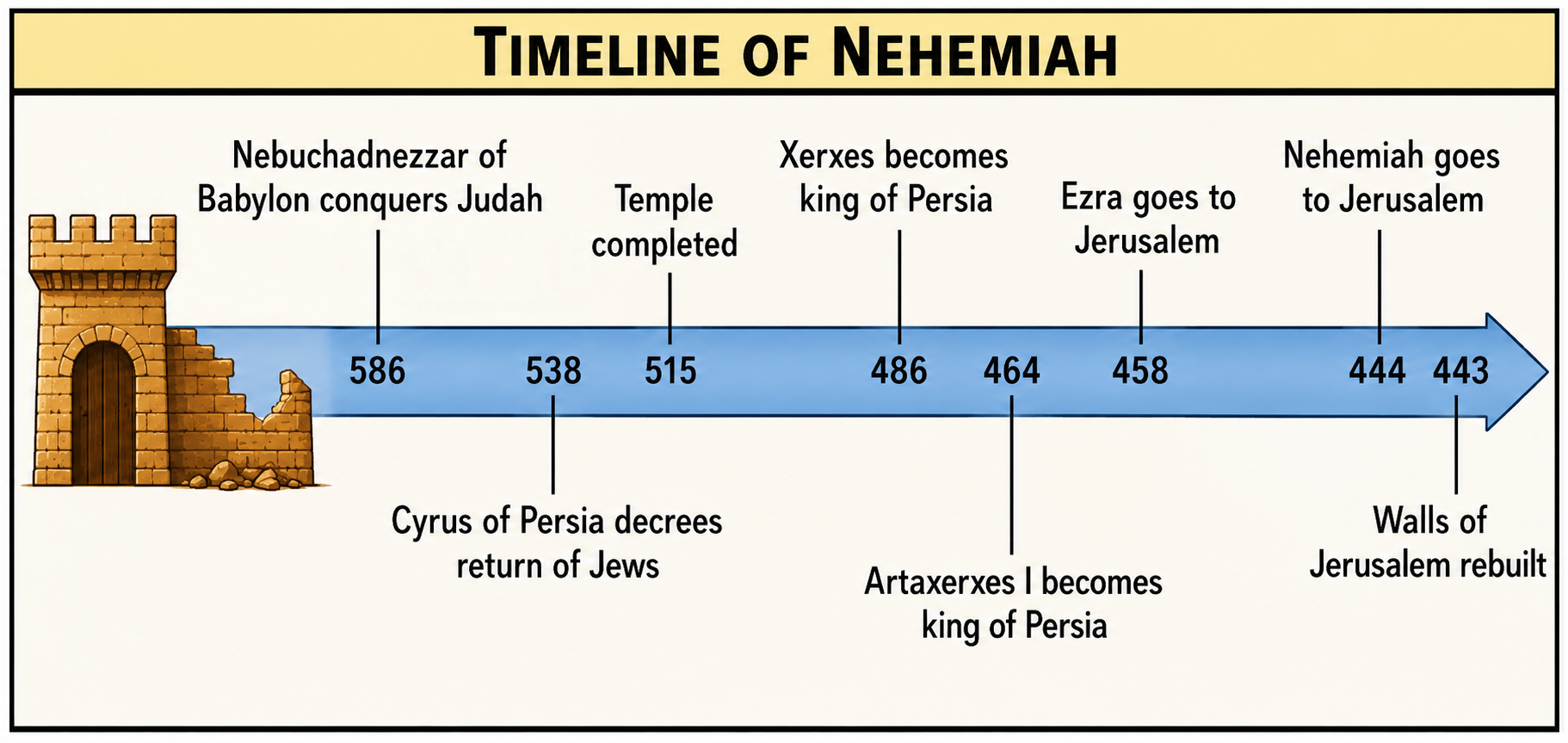
Although Ezra is not recorded as having had a major part in the fifty-two-day rebuilding of the walls of Jerusalem, he now appeared on the scene as a spiritual leader and as the reader of the Law of God. Ezra had led an earlier return of some fifty thousand Jews from Babylon in 458 B.C. Nehemiah had come later, in 445 B.C., as a civil leader leading an aroused populace to quickly rebuild the walls of the holy city.
It was the first day of the month of Tishri, the day designated as the Feast of Trumpets (Lev 23:24; Num 29:1). As specified by the law, this was a day of rest and worship. It was a time of preparation for the most significant day in Israel’s religious calendar, the Day of Atonement, celebrated on the tenth of Tishri (approximately our September/October).
The assembly included all men, women and children who could understand (Neh 8:2). The meeting began early in the morning, at the break of day, and Ezra read until midday—approximately six hours! He spoke from a wooden platform that accommodated not only his pulpit but also the thirteen Levites who helped him in this work. Just how these thirteen men functioned is not altogether clear. Did they assist him in the reading of the Law, or did they split the people up into small groups from time to time to assist them in their comprehension of what was being read?
As the Book of the Law was opened, the people stood to show their respect for the Word of God. Prior to the reading, however, Ezra led the people in a prayer of praise to the Lord their God. The people responded with “Amen! Amen!” as they lifted their hands and bowed down in worship to the Lord (Neh 8:6).
At this point the problematic verse appears. What does mep̄ōrāš mean? Does it mean “to translate”—in this case, from Hebrew into the cognate tongue of Aramaic—or does it mean to give an exposition of the passage and make the sense clear?
The root from which this word comes, pārāš, has the basic meaning “to make distinct or separate.” It could refer to the way the words were distinctly articulated, or better still, to the Law’s being read and expounded section by section. The word pārāšā, a cognate of the term we are considering, was used by the Hebrew Masoretic scribes to speak of dividing the Pentateuch into paragraphs or sections for each reading. Therefore, we cannot agree that the Levites were mere translators for the people. They “broke out” the standard Pentateuchal sections and followed the readings with exposition, “giving the meaning so the people could understand what was being read.”
The motive for observing this Feast of Trumpets (or Rosh Hashanah, the Jewish New Year’s Day) was the people’s thanksgiving for God’s gracious assistance in rebuilding the wall. This goodness of God led them instinctively to want to hear more of God’s Word. They stood by the hour to listen intently to that Word and to have it explained to them.
There is no need to wonder why so many postexilic books of the Old Testament were written in Hebrew. The only alleged evidence that the Jewish returnees could not speak Hebrew is this one word in Nehemiah 8:8, and there are no linguistic grounds for thinking that it means “translating.”
QUESTION - Why did Nehemiah say, “The joy of the Lord is your strength?"
ANSWER - In Nehemiah 8, the people of Judah had just finished rebuilding the wall around Jerusalem. It was not as high or as thick or as impressive as it had once been and was certainly less impressive than the walls of other cities—enemy cities. The people had many detractors who did not want the walls to be rebuilt. The next step was to “rebuild” the people by teaching them the Law of God that had been neglected in many respects. Ezra read the Book of the Law to the people, who were convicted of their ignorance and disobedience. They were repentant and began to weep.
However, as important as this revival was, God did not want His people to remain dejected. He had not rejected them but was in the process of restoring them.
“Then Nehemiah the governor, Ezra the priest and teacher of the Law, and the Levites who were instructing the people said to them all, ‘This day is holy to the Lord your God. Do not mourn or weep.’ For all the people had been weeping as they listened to the words of the Law.
“Nehemiah said, ‘Go and enjoy choice food and sweet drinks, and send some to those who have nothing prepared. This day is holy to our Lord. Do not grieve, for the joy of the Lord is your strength.’ The Levites calmed all the people, saying, ‘Be still, for this is a holy day. Do not grieve.’ Then all the people went away to eat and drink, to send portions of food and to celebrate with great joy, because they now understood the words that had been made known to them” (Nehemiah 8:9–12).
When the people understood how they had disobeyed and neglected the Lord, they were sad. However, in their repentance God wanted them to rejoice, not grovel in guilt. They came to understand God’s Word and the fact that He was forgiving them. God wanted them to rejoice, and their strength was renewed as they went from mourning to feasting and rejoicing.
Joy is a tremendous source of strength. If a person is down and discouraged, almost any obstacle or hardship is enough to incapacitate him or her. “A joyful heart is good medicine, but a crushed spirit dries up the bones” (Proverbs 17:22). This can be true for anyone. “Emotional energy” is extremely powerful. This is why coaches give motivational speeches to their players. A person who is “up” will accomplish far more than a person who is “down.” Joy provides strength. A person suffering from a physical ailment or pain but who is filled with joy will survive much better than a discouraged person with the same condition. Joy can even make a person forget his pain and limitations. In fact, it is better to have joy in suffering than despair in ease and luxury.
Joy is available in a variety of places. A person can receive joy from other individuals and from circumstances. The primary difference between the joy that is provided by people and circumstances and the joy that comes from the Lord is in consistency and duration. People will fail. Circumstances will change. A person whose joy and strength are from these sources will inevitably be inconsistent. That person will be up and down, riding the waves of alternating joy and sadness, encouragement and discouragement.
However, when a person’s source of joy and the strength it provides is the Lord, then he can be even-keeled and constant, just as God is constant. Many verses in Scripture speak to the joy that God provides His people:
Romans 15:13: “May the God of hope fill you with all joy and peace as you trust in him, so that you may overflow with hope by the power of the Holy Spirit.”
Psalm 16:11: “You make known to me the path of life; you will fill me with joy in your presence, with eternal pleasures at your right hand.”
1 Peter 1:8–9: “Though you have not seen him, you love him; and even though you do not see him now, you believe in him and are filled with an inexpressible and glorious joy, for you are receiving the end result of your faith, the salvation of your souls.”
Psalm 5:11: “But let all who take refuge in you be glad; let them ever sing for joy. Spread your protection over them, that those who love your name may rejoice in you.”
Psalm 28:7: “The Lord is my strength and my shield; my heart trusts in him, and he helps me. My heart leaps for joy, and with my song I praise him.”
Isaiah 41:10 does not mention the word joy but does admonish Israel not to be dismayed, which is a similar concept: “So do not fear, for I am with you; do not be dismayed, for I am your God. I will strengthen you and help you; I will uphold you with my righteous right hand.”
Isaiah 40:30–31 deals with the similar theme of hope: “Even youths grow tired and weary, and young men stumble and fall; but those who hope in the Lord will renew their strength. They will soar on wings like eagles; they will run and not grow weary, they will walk and not be faint.”
When Israel (then) or Christians (today) come to realize how much God has done for them and what great things He has in store, the result is joy, and that joy will produce strength. Furthermore, one of the things that God has in store for His people is strength to endure hard times. He will never leave or forsake us (Hebrews 13:5). As we focus on God’s presence and promises, our joy and strength will increase. As we focus on fallible and fickle people and uncertain circumstances, our joy will decrease, and our strength will also decrease.
Nehemiah 8:11 So the Levites calmed all the people, saying, “Be still, for the day is holy; do not be grieved.”
- stilled (KJV): Nu 13:30
So the Levites calmed all the people, saying, “Be still, for the day is holy; do not be grieved.”
Bob Utley - 8:11-12 This shows the festival nature of Israel's religious feasts. Knowing God issues in joy, not sadness! All days with Him are festivals of joy! Only the Day of Atonement was a fasting occasion. The Levites communicated to the people the wishes of the leadership (cf. Neh. 8:11).
Nehemiah 8:12 All the people went away to eat, to drink, to send portions and to celebrate a great festival, because they understood the words which had been made known to them.
- to send (KJV): Ne 8:10
- to make (KJV): Ps 126:1-3
- because (KJV): Ne 8:7,8 Job 23:12 Ps 19:8-11 Ps 119:14,16,72,97,103,104,111,127, Ps 119:130,171,174 Pr 2:10,11 Pr 24:13,14 Jer 15:16 Lu 24:32 Ro 7:18
All the people went away to eat, to drink, to send portions and to celebrate a great festival, because they understood the words which had been made known to them
Nehemiah 8:13 Then on the second day the heads of fathers’ households of all the people, the priests and the Levites were gathered to Ezra the scribe that they might gain insight into the words of the law.
- the second (KJV): 2Ch 30:23 Pr 2:1-6 Pr 8:33,34 Pr 12:1 Mk 6:33,34 Lu 19:47,48 Ac 4:1 Ac 13:42
- to understand the words of the law (KJV): or, that they might instruct in the words of the law, Ne 8:7,8 Lu 24:32 2Ti 2:24,25
Then on the second day the heads of fathers’ households of all the people, the priests and the Levites were gathered to Ezra the scribe that they might gain insight into the words of the law
Ryrie - Neh 8:13-18 Further study of the law revealed that during the Feast of Booths, or Tabernacles (see note on Lev. 23:34-43), everybody was to dwell in booths; as a result, preparations for that time of celebration were ordered. The feast had been observed since the days of Joshua (cf. 1 Kings 8:65; 2 Chron. 7:9; Ezra 3:4), but not by the entire assembly (v. 17).
Bob Utley - "on the second day, the heads of the fathers' households of all the people" The first day of Tishri was a general assembly, but the second day was a special day of training for the elders and leaders of the people that they might instruct their own tribal groups and clans in the Law of Moses.
Matthew Henry - The feast of tabernacles, The joy of the people - Neh 8:13-18. They found written in the law about the feast of tabernacles. Those who diligently search the Scriptures, find things written there which they have forgotten. This feast of tabernacles was a representation of the believer's tabernacle state in this world, and a type of the holy joy of the gospel church. The conversion of the nations to the faith of Christ, is foretold under the figure of this feast, Zechariah 14:16. True religion will render us strangers and pilgrims upon earth. We read and hear the word acceptably and profitably, when we do according to what is written therein; when what appears to be our duty is revived, after it has been neglected. They minded the substance; else the ceremony had been of no use. They did it, rejoicing in God and his goodness. These are the means which the Spirit of God crowns with success, in bringing the hearts of sinners to tremble and to become humbled before God. But those are enemies to their own growth in holiness, who always indulge sorrow, even for sin, and put away from them the consolations tendered by the word and Spirit of God.
Nehemiah 8:14 They found written in the law how the LORD had commanded through Moses that the sons of Israel should live in booths during the feast of the seventh month.
- by (KJV): Heb. by the hand of
- dwell (KJV): Lev 23:34,40-43 De 16:13-15 Zec 14:16-19 Joh 7:2
- booths (KJV): Ge 33:17
- the feast (KJV): That is, the feast of tabernacles, which was held in the month {Tisri,} the seventh of the ecclesiastical year, in commemoration of the sojourning of the Israelites in the wilderness after they had been delivered from Egyptian bondage. For other particulars see the parallel passages.
They found written in the law how the LORD had commanded through Moses that the sons of Israel should live in booths during the feast of the seventh month
Bob Utley - "They found written in the law how the Lord. . .the feast of the seventh month" The Feast of Tabernacles or Booths is discussed in Exod. 23:16; Exod 34:22; Lev. 23:39-44; Num. 29:12-40; Deut. 16:13-15. Feasts of Israel
Believer's Study Bible - In reading the Law, the people were reminded of the strict directions concerning the Feast of Tabernacles (Lev. 23:39-43, note; see also chart, "Feasts of the Lord," Ex. 23:14). This feast was ranked with Passover and Pentecost in importance (cf. Ex. 23:14-17; Ex 34:23; Deut. 16:16), signifying both "Ingathering" (Ex. 34:22) and God's care for Israel in the wilderness (Lev. 23:43).
Nehemiah 8:15 So they proclaimed and circulated a proclamation in all their cities and in Jerusalem, saying, “Go out to the hills, and bring olive branches and wild olive branches, myrtle branches, palm branches and branches of other leafy trees, to make booths, as it is written.”
- And that (KJV): Lev 23:4
- in Jerusalem (KJV): De 16:16
- the mount (KJV): Judges 9:48,49 Mt 21:1
- fetch (KJV): Lev 23:40
- olive (KJV): Ge 8:11
- palm (KJV): Joh 12:13 Rev 7:9
So they proclaimed and circulated a proclamation in all their cities and in Jerusalem, saying, “Go out to the hills, and bring olive branches and wild olive branches, myrtle branches, palm branches and branches of other leafy trees, to make booths, as it is written.”
Bob Utley - "Go" This VERB (BDB 422, KB 425) is a Qal IMPERATIVE. ▣ "bring" This VERB (BDB 97, KB 112) is a Hiphil IMPERATIVE.
Nehemiah 8:16 So the people went out and brought them and made booths for themselves, each on his roof, and in their courts and in the courts of the house of God, and in the square at the Water Gate and in the square at the Gate of Ephraim.
- the roof (KJV): De 22:8 2Sa 11:2 Jer 19:13 Jer 32:29
- the courts (KJV): 2Ch 20:5 2Ch 33:5
- the street of the water gate (KJV): Ne 8:3 Ne 3:26 Ne 12:37
- gate of Ephraim (KJV): Ne 12:37,39 2Ki 14:13
So the people went out and brought them and made booths for themselves, each on his roof, and in their courts and in the courts of the house of God, and in the square at the Water Gate and in the square at the Gate of Ephraim
Nehemiah 8:17 The entire assembly of those who had returned from the captivity made booths and lived in them. The sons of Israel had indeed not done so from the days of Joshua the son of Nun to that day. And there was great rejoicing.
- sat under (KJV): Joh 1:14 Heb 11:9,13
- Jeshua (KJV): Jos 1:1, Joshua, Heb 4:8, Jesus
- had not (KJV): 2Ch 7:8-10 2Ch 8:13 Ezr 3:4
- done so (KJV): 2Ch 30:26 2Ch 35:18
- there was (KJV): 1Ch 29:22 2Ch 7:10 2Ch 30:21-23
The entire assembly of those who had returned from the captivity made booths and lived in them. The sons of Israel had indeed not done so from the days of Joshua the son of Nun to that day. And there was great rejoicing
Days of Joshua = 1405-1381, That day = 445-415 - It is not meant that there had not been some formal observance of the Feast of Tabernacles (cp. 2Ch8:13; Ezr3:4), but that the people had not dwelt in booths since Joshua's days.The feast of tabernacles had actually been observed by the captives who returned to Jerusalem with Zerubbabel and Jeshua (Ezr3:4), but it was not like this, with all the people of Israel dwelling in their own hand-made "booths," with great gladness everywhere.The text does not mean that the feast had not been observed since the time of Joshua, only that its full twofold significance had not been recognized (cf. Neh8:14). Apparently it had been celebrated only as a harvest festival. The aspect of pilgrimage would be especially meaningful to the exiles now.
Bob Utley - The Feast of Booths had been celebrated (cf. 2 Chr. 7:8; 2 Chr 8:13; Ezra 3:4; Hosea 12:9), but possibly the booths had not been a regular or required aspect of the feast.
Henry Morris - great rejoicing - Although the children of Israel had occasionally observed the feasts of the Lord, as commanded in Leviticus 23, the observances had generally been perfunctory and often ignored altogether. The feast of tabernacles had actually been observed by the captives who returned to Jerusalem with Zerubbabel and Jeshua (Ezra 3:4), but it was not like this, with all the people of Israel dwelling in their own hand-made "booths," with great gladness everywhere.
Believer's Study Bible - The text does not mean that the feast had not been observed since the time of Joshua, only that its full twofold significance had not been recognized (cf. 8:14, note). Apparently it had been celebrated only as a harvest festival. The aspect of pilgrimage would be especially meaningful to the exiles now.
Nehemiah 8:18 He read from the book of the law of God daily, from the first day to the last day. And they celebrated the feast seven days, and on the eighth day there was a solemn assembly according to the ordinance.
- day by day (KJV): De 31:10-13
- a solemn assembly (KJV): Heb. a restraint
- according (KJV): Lev 23:36 Nu 29:35 Joh 7:37
He read from the book of the law of God daily, from the first day to the last day. And they celebrated the feast seven days, and on the eighth day there was a solemn assembly according to the ordinance
Bob Utley - "He read from the book of the law of God daily. . .on the eighth day there was a solemn assembly according to the ordinance" This shows that the Feast of the Tabernacle was an eight day feast, with the eighth day having special significance (cf. Num. 29:35). This seems to relate to Jesus' words in John 7:37.