Daniel 1:2
Daniel 1:3
Daniel 1:4
Daniel 1:5
Daniel 1:6
Daniel 1:7
Daniel 1:8
Daniel 1:9
Daniel 1:10
Daniel 1:11
Daniel 1:12
Daniel 1:13
Daniel 1:14
Daniel 1:15
Daniel 1:16
Daniel 1:17
Daniel 1:18
Daniel 1:19
Daniel 1:20
Daniel 1:21
Introduction: These notes are somewhat different from other verse by verse notes on this website as they are not intended to be as in depth. Please refer to other resources for more commentary. Note that the approach in these notes is to interpret Daniel as literally as possible. This first section is primarily introduction and background information on the Book of Daniel. To go to verse by verse notes click Daniel 1:1 Comments.
Recommended Resource: After you have read through Daniel (one sitting if possible) and then begun to study Daniel 1, I have an Mp3 teaching tape by Calvary Chapel Pastor Rob Salvato which is highly recommended because of his excellent introductory remarks on the important historical background to Daniel and then his comments on the opening passages in Daniel 1:1-8. This Mp3 is about 64 minutes and is well worth a one hour investment as I think you will agree! Link to the Mp3 - Click to listen or Right Click and Choose "Save Target As" This audio is especially recommended for all you dads (or dads to be) -- from yours truly, a 63yo dad with 4 grown children. I wish I had known these truths when my children were teenagers!
Revision in 2026 - I am now 80 yo and am going through the Precept course on Daniel for about my 4th or 5th time, but this time my son Joel is leading a group of men through this study. My, how quickly 17 years have passed (Ps 90:12)! And how good is our God to prompt my son to lead this group of men through the study. My prayer for them and for you as you study is that our Father by His Word and His Holy Spirit would enable you to continually "grow in the grace and knowledge of our Lord and Savior Jesus Christ. To Him be the glory, both now and to the day of eternity. Amen." (2Pe 3:18)
|
TWO DIVISIONS OF |
||
| DANIEL 1-6 | DANIEL 7-12 | |
| On Site |
Historical |
Prophetic |
|
J Vernon McGee |
The Historic Night with Prophetic Light |
The Prophetic Light in the Historic Night, |
|
Precept Ministries |
Living Out a Biblical Worldview |
Gaining Understanding of the Time of the End |
|
John Phillips |
Daniel and His Personal Friends |
Daniel and His People's Future |
|
Irving Jensen |
Mainly Historical: 6 Historical Narratives |
Mainly Predictive: 4 Apocalyptic Visions |
|
Irving Jensen |
Daniel Interprets Other's Dreams |
Angel Interprets Daniel's Dreams |
|
Rob Salvato |
The Prophet - The Man |
The Prophecy - The Message |
There are some other important divisions that should be kept in mind as you study the Book of Daniel...
|
SOME OTHER DIVISIONS OF |
||
| Daniel 1 | Daniel 2-7 | Daniel 8-12 |
|
Written in Hebrew |
Written in Aramaic |
Written in Hebrew |
|
Daniel's |
God's Prophetic Plan |
God's Prophetic Plan |
**THE TIMES OF
THE GENTILES
In view of the emphasis on the fate of Gentiles and Jews in Daniel 2-12, it is worth noting that many conservative commentators feel that these events mark the inception of the specific "times" which Jesus referred to in Luke 21 when He declared that...
they (the Jews in Jerusalem - fulfilled in 70AD when Titus sacked the Temple and destroyed Jerusalem) will fall by the edge of the sword, and will be led captive into all the nations; and Jerusalem will be trampled under foot by the Gentiles until (Time phrase) the times of the Gentiles be fulfilled (Ed: The time of Gentile domination will come to an end). 25 "And there will be signs in sun and moon and stars, and upon the earth dismay among nations, in perplexity at the roaring of the sea and the waves, 26 men fainting from fear and the expectation of the things which are coming upon the world (Ed: Referring to the incredible events of the Great Tribulation, described in detail in Revelation 6-19); for the powers of the heavens will be shaken. 27 And then they will see THE SON OF MAN (Messiah) COMING IN A CLOUD with power and great glory (Messiah's triumphant Second Coming at the end of the 7 years of Daniel's Seventieth Week [Re 19:13, Re 19:14, Re 19:15, Re 19:16, Re 19:20, Re 19:21] and the last 3.5 years referred to as the Great Tribulation - Mt 24:21). 28 "But when these things begin to take place, straighten up and lift up your heads, because your redemption is drawing near." (Lk 21:28)
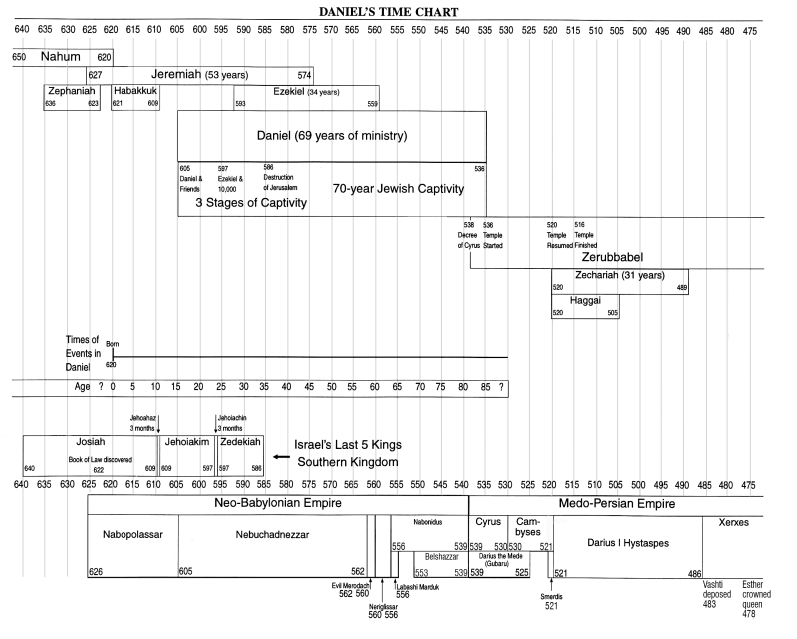
The times of the Gentiles began with the Gentile nation of Babylon destroying the Temple and initiating Gentile domination over Jerusalem in 605, 597 and 586 BC. In fact, the essential area of Jerusalem--the sacred site of its ancient temple, Temple Mount--is still under the control of the Muslim Arabs. Thus, the "times of the Gentiles" have not yet been fulfilled, nor will they be until Christ returns (Lk 21:27) to restore Jerusalem, a restoration ("redemption") of which Jesus spoke in (Luke 21:28).
Irving Jensen feels the Key verse is Da 4:17 and the key words are "dream" and "vision".
“This sentence is by the decree of the angelic watchers And the decision is a command of the holy ones, In order that the living may know That the Most High is ruler over the realm of mankind, And bestows it on whom He wishes And sets over it the lowliest of men.”
The first 6 chapters are chronologically arranged (although it is difficult to specifically date chapters 3, 4, 5-see table below), with the prophecies of the last six chapters fitting into these chapters. The following table is from Tony Garland's recommended free online commentary on Daniel (see also his in depth verse by verse commentary on the book of the Revelation, one of the best evangelical commentaries available - A Testimony of Jesus Christ A Testimony of Jesus Christ). Note that Dr Garland chooses Daniel's "starting age" as 14yo but the range in various reputable sources is from 14-21yo.
Some unusual aspects of the Book of Daniel...
God never speaks directly
Written in two languages Hebrew and Aramaic (Aramaic from Da 2:4-Da 7:28)
Contains one of the most direct OT references to resurrection (Da 12:1, 2, 3)
Lays out the history of the world culminating in the return of the Messiah ("The Stone" in Daniel 2:34, 35, 45, "The Son of Man" in Daniel 7:13, 14, et al)
Accurately predicts the time of Messiah's first coming and crucifixion in Daniel 9:24, 25, 26, 27, a section I feel is rightly referred to as "the backbone of all Biblical prophecy". (See notes on Daniel 9:24, Daniel 9:25, Daniel 9:26, Daniel 9:27)
| Chronological Structure of the Book of Daniel |
|||||
| Year (B.C.) | Passage | Chronological Indicator | Related Events |
Israel Ruled By | Daniel's Age (est.) |
| 606 | Daniel 1:1 | 3rd year of the reign of King Jehoiakim. | Daniel taken captive to Babylon. | Babylon | 14 |
| 604 | Daniel 2:1 | 2nd year of King Nebuchadnezzar. | Nebuchadnezzar's vision of a great image of four metals. | Babylon | 16 |
| 604-562 | Daniel 3:1ff |
- |
Nebuchadnezzar's image of gold, the fiery furnace. | Babylon | 16-58 |
| 604-562 | Daniel. 4:1-27 |
- |
Nebuchadnezzar's dream of a great tree chopped down. | Babylon | 16-58 |
| 604-562 | Daniel 4:28-37 | - | Nebuchadnezzar's humiliation as a beast. | Babylon | 17-58 |
| 553 | Daniel 7:1 | 1st year of King Belshazzar. | Daniel's vision of the four beasts. | Babylon | 67 |
| 551 | Daniel 8:1 | 3rd year of reign of King Belshazzar. | Daniel's vision of a ram and a goat. | Babylon | 69 |
| 539 | Daniel 5:1 | Last year of King Belshazzar. | Abuse of temple vessels at party, handwriting on the wall. | Babylon | 81 |
| 539 | Daniel 5:31 | 1st year of Darius the Mede. | Fall of Babylon to Medo-Persia, Darius strengthened by Angelic messenger (Da 11:1). | Medo-Persia | 81 |
| 539 | Daniel 9:1,2 | 1st year of reign of Darius the Mede. | Daniel's intercession for Israel and Gabriel's answer of seventy sevens. | Medo-Persia | 81 |
| 539 | Daniel 1:21 | 1st year of King Cyrus. | Cyrus subsequently issued the decree given allowing the Jews to return and rebuild. | Medo-Persia | 81 |
| 539-537 | Daniel 6:1-9, 10-23 | - | Daniel in the lion's den. | Medo-Persia | 81-83 |
| 537 | Da 10:1 | 3rd year of King Cyrus of Persia. | Daniel's vision by the Tigris river (Da 10-12) | Medo-Persia | 83 |
|
Note: Daniel himself received 4 visions which are described in Daniel 7-12 (Da 7:1, Da 8:1, Da 9:1, 2, Da 10:1) but these visions actually occurred during the historical section of Daniel 1-6 - thus Daniel's 1st and 2nd visions (Da 7:1, Da 8:1) occurred between Daniel 4 (the last mention of Nebuchadnezzar) and Daniel 5 (the last day of the reign of Belshazzar). Daniel's 3rd vision (Da 9:1,2) occurred in approximately 539BC the beginning of which is described in Da 5:31 and the 4th vision in about 537BC |
|||||
WHY STUDY PROPHECY?
WHY STUDY DANIEL?
It seems that many in the modern church have tended to minimize the preaching and teaching of Bible prophecy for reasons I cannot comprehend. Perhaps some think it is a topic which is too divisive. Others may consider prophecy too difficult to understand. Still others may eschew prophecy for fear of being labeled as adherents to a certain system of interpretation. There may be other reasons, but whatever the reason, the paucity of preaching on this subject in the modern "missional minded" church is surely a mistake. At the very least 2Timothy 3:16-17 (where "All Scripture" in context refers primarily to the Old Testament) would strongly suggest that preaching "apocalyptic literature" is vital for the training of the man or woman of God, that they may be fully equipped for every good work. At the outset, it should be stated that these notes approach the book of Daniel as inspired by God's Spirit and that He, the Spirit of Truth, desires and is able to lead us into all truth, including the truth about the things to come (Read Jn 14:26, Jn 16:13). While we may argue about the different systems of theology, it seems to me that the safest way to approach this book (and any book of the Bible for that matter) is to read the text prayerfully and Literally, and that is the approach taken by these notes. Remember that Daniel is a book written by a Jewish man to the Jewish people in captivity and a time of despair, a time in which they need to know that Jehovah, the covenant keeping God, was not finished with their nation, Israel. Sadly many today teach the sinister doctrine of replacement theology (another source), which says that God is finished with the nation of Israel and has replace her with the Church, who now inherits the promises to Israel! (See related topic The Israel of God)
The following thoughts are in not necessarily in order of importance and also overlap somewhat...
1) It has been estimated that 20-25% of Scripture is prophecy and a substantial majority of biblical predictions (difficult to quantitate but probably more that 75% and this depends on one's eschatology) have been fulfilled, and what remains centers on Christ's return, the Tribulation, the Kingdom, and the eternal state. In fact, the book of Revelation is difficult to understand and interpret without knowledge of and comparison to parallel passages in the book of Daniel. Even this first verse of Daniel begins to fulfill a prophecy given by Isaiah (see 2Ki 20:1-2) which fulfills his prophecy in 2Kings 20:16-18 (Read 2Kings 20 for context to see what mistake King Hezekiah made that provided the background for Isaiah's prophecy - 2Ki 20:12-18 {Repeated in Isaiah 39:1-8} - Lesson? Be careful what you show other people in an act of pride! They may lust for what you have and even try to take it from you! Note Hezekiah's self-centered response = 2Ki 20:19!). Davis commenting on Isaiah's prophecy of the fall of Jerusalem rightly observes that...
This was a startling revelation, for Assyria was the great power of the day and seemingly unassailable. The visit was probably an attempt by Babylon to foment problems for Assyria in the west, thereby diverting attention from Babylon. The postexilic reader would have seen the roots of the destruction of Jerusalem in the foolish pride of Hezekiah and in the greed of Babylon. (Baker's Evangelical Dictionary of Biblical Theology)
2) The cults and false teachers major in the misuse, abuse and perversion of prophecy, especially unfulfilled prophecy which makes it imperative for the believer to know what saith the Lord on this vital subject.
3) Study of prophecy (and all Scripture) increases our faith (Ro 10:17). If God has fulfilled prophecy in the past, He will surely fulfill those prophecies that pertain to the future. You can stake your life on this certainty!
4) Daniel demonstrates it is possible to live in Babylon and yet not succumb to the anti-god, worldly Babylonian influence, a truth which should encourage all believers that they can do likewise.
5) Daniel teaches that God is sovereign and able to sustain His children even in adverse circumstances. Years ago when I taught Daniel, one of the couples lost a 22 year old daughter to anorexia nervosa, and the truth they tenaciously clung to in this severe testing time was the truth that the Most High God reigns over all people, all time and all circumstances.
6) As we watch the America (and the world in general) rushing headlong into godless paganism and rank unrighteousness (cp Pr 14:34), we can take heart that the Most High God is in control and always preserves His remnant of believers.
7) Daniel teaches like no other book in Scripture, that history truly is "His Story"! In this sense, Daniel is distinct from other Old Testament prophets which call their the people to repent and lead a new life (prophet - used with the sense of "forth telling"). Daniel is a prophet more in the sense of "for telling" or predicting events before they come to pass (as do the other OT prophets who were "forth tellers"). If you want to understand history and what's happening in our world today, you need to understand Daniel.
8) Although God never speaks directly (no "thus saith the Lord's") in Daniel, clearly God's influence permeates the entire book and as we come to know Him better through this book, we will be enabled to stand firm and to take action in the midst of a godless society (see Da 11:32b).
9) Knowledge of the world's future (God's Plan for the Ages) should effect conduct in the present (cp 2Pe 3:11) (See Vertical Vision Transforms Horizontal Living). The effect of studying prophecy is not to make us smarter sinners but to make us more like the Savior. The study of prophecy (and all of Scripture for that matter) is to transform our minds so that we conform more and more with the image of God's Son (cp 2Co 3:18, Ro 12:2, Ro 8:29, 1Pe 2:2, 2Pe 3:18) Daniel the believer models a life of consistent faithfulness, manifest by unerring obedience, demonstrating that a godly life is still possible even during times of hardship. As we watch America become more and more "Babylonized", we as believers need to be importuning and pleading on our knees with the God of Heaven to empower Christian parents to train up young "Daniel's" and "Danielles" who will be strategically placed in the next generation. Amen
10) Future hope (Da 7:27) stimulates present purity (1Jn 3:2, 1Jn 3:3, cp Titus 2:11, 12, 13, 14). (Note: Remember that "hope" in the Bible rarely means "hope so" but "hope sure," an absolute assurance of future good or that God will do good to me in the future cp Da 7:18, 22, 27). Our hope isn't just theological; it's ethical -- it has behavioral consequences. If I believe Christ is coming again and that I will stand before His judgment seat, this truth will (or certainly should) transform me and make a difference in the way I conduct my life. Related Resource: The Blessed Hope = Definition; Blessed Hope = Source of; Blessed Hope = Stabilizing Effect; Blessed Hope = Sanctifying Effect).
11) Miracles and fulfilled prophecy clearly establish God as the only God. (see Is 42:9, Isa 44:7, Isa 45:21, Isa 46:9, 10, etc, cp similar teaching by Jesus in Jn 14:29)
12) Daniel begins with captivity of the chosen, blessed people, which finally exhausted the merciful patience of God, a fact which should serve as a examples warning all NT believers to not "play" around with sin! Remember that rebellious Israel in the OT is often an excellent picture of our fallen flesh, the old evil, anti-god tendency that still lurks in believers! Paul makes reference to sins of Israel in the OT writing...
Now these things happened as examples for us, that we should not crave evil things, as they also craved...Now these things happened to them as an example, and they were written for our instruction, upon whom the ends of the ages have come. (1Co 10:6, 11)
13) The apostle Paul also emphasizes the positive effect of studying Daniel writing that...
whatever was written in earlier times was written for our instruction, that through perseverance and the encouragement of the Scriptures we might have hope. (Ro 15:4)
14) Daniel's (and other OT) prophecy is like a lamp to which we do well to pay attention as we live our our lives in the darkness of this present evil age. The Young's Literal Translation of 2Peter 1:19 reads...
And we have more firm (more firm than what? then even human experience - the apostle's witness of the transfiguration) the prophetic word, to which we do well giving heed, as to a lamp shining in a dark place, till day may dawn, and a morning star may arise -- in your hearts; (Note: Some interpret this passage to mean that the Transfiguration substantiated the OT prophecies. Young's Literal which is more true to the original Greek word order would support the idea that the Word was more sure than the experience. This original arrangement supports the interpretation that Peter is ranking Scripture over experience. The prophetic word [Scripture] is more complete, more permanent, and more authoritative than the experience of anyone.)
15) Daniel is the key to a full and accurate interpretation of the book of the Revelation. As Pastor Ray Stedman explains...
The book of Revelation explains the book of Daniel. The book of Daniel lays the basis for the book of Revelation. If you would like to know God's program for the future, it is essential that you understand this book of Daniel. (Daniel - On the Way to the Future)
As Pastor Ray Pritchard says...
Daniel is one of the most popular Old Testament books. Since I was a child it has been one of my favorites. This book has it all: history … prophecy … politics … prayer … lions … statues … wild animals … a fiery furnace … dreams and visions … a king who thought he was a cow … incredible adventure … amazing escapes … angels … demons … detailed information about ancient history … and amazing prophesies about the end times. I heartily recommend Daniel as one of the best Old Testament books for young people to read. Here we discover the difference godly teenagers can make in the world (The Four Freshmen How the World Tries to Seduce the Church)
Related Resources: Excellent Bible studies on Daniel [6 weeks] geared to children ages 8-12 - if you are studying Daniel use the resources below to take your son or daughter through Daniel. That would be an investment you would never regret!
- Daniel 1-6 - You're A Brave Man, Daniel! (children's study)!
- Daniel 7-12 - Fast Forward to the Future (children's study)!
- Discovering What the Future Holds - 40 Minute Bible Study (or Borrow a copy)
Daniel has "suffered" more from the "Critic's Den" then he ever suffered in the Lion's Den! Liberal theologians largely discount Daniel as a "fake" or a "forgery" written by someone hundreds of years after Daniel lived (e.g., one popular date of its writing is around 166BC). Why is Daniel so attacked? Simply stated, Daniel speaks of and substantiates the truth of the supernatural, specifically pointing to the Most High God Who is over heaven and earth. Rational man (sinful man) does not want to be held accountable to such a great God, for he knows that such a God is also a Judge of right and wrong. If he can "manufacture" a God of his own vain imagination (aka an "idol", [read this sad "devolution" in Ro 1:18-25] often appropriately referred to as a "vain" or "empty" thing in the Hebrew OT, eg, 2Ki 17:15 "followed vanity" = Hebrew word hebel = vapor, emptiness, first use in Dt 32:21 = "idols"), such a "god" will not put constrains on his behavior and he can do whatever is right in his own eyes (cp Jdg 21:25). In other words, he does what he desires and it is "right" because he has no absolute standard of what is right (righteous) or wrong (unrighteous, sin, transgression, evil). Daniel abolishes this specious, selfish thinking when interpreted literally! Here is a link to the 135 page apologetic by Robert Anderson entitled Daniel in the Critic's Den
How does a believer counter erudite, intricate arguments against the authenticity of Daniel? My simplistic answer is to listen to our Lord Jesus Christ's affirmation of the veracity of Daniel in His famous "Olivet Discourse", in which He warns the disciples...
Therefore when you see the ABOMINATION OF DESOLATION which was spoken of through Daniel the prophet, standing in the holy place (let the reader understand [verb anaginosko = to know well, exactly or accurately, to distinguish between, to recognize, most often used of public reading of something as in Lk 4:16])... (Mt 24:15)
Matthew Poole comments: (By this) quotation our Saviour does both give His testimony to that book (Daniel) as a part of holy writ, and also lets His disciples know, that what He told them was but what was prophesied of, and so must have its accomplishment....
Ray Stedman comments on the phrase "let the reader understand": That is, don't read through Daniel superficially. Think it through. Give yourself to thought on this. You have to understand what he is talking about before you will be able to recognize the desolating sacrilege, or abomination of desolation, when it comes. This is why the Lord went on to say that the world in its superficial approach to truth will not understand when it cries, "Peace, peace, peace," for there will be no peace; sudden destruction will come upon them and they will be swept away just as the people of Noah's day were swept away when the flood came. (Overview of Daniel- On the Way to the Future)
If Jesus believed Daniel was a true prophet (fulfilling Moses' prophecy in Dt 18:15), all of men's "rational" arguments against Daniel, regardless of their degree of erudition, are in effect obliterated by the testimony of our Lord! Period! No room for arguments! That is unless one does not accept Jesus' Words as Truth (cp Jn 1:14, Jn 14:6)!
Another Scriptural support for the authenticity of the book of Daniel is the testimony of Ezekiel (taken to Babylon in 59 7BC about 8 years after Daniel which would have been time for Daniel's "reputation" to filter down to the Jewish exiles, among whom Ezekiel lived) to the godly character of the prophet Daniel (Eze 14:14, 16) As an aside, this simplistic "apologetic" ("defense" of the faith, cp 1Pe 3:15), is not given to disparage other legitimate evangelical arguments in support of Daniel, but is emphasized because it is one defense that is easy to recall and is "watertight"! (For more on the authorship and authenticity of Daniel see Tony Garland's works - Daniel - Introduction Part 2)
Read the story recorded by Josephus in which Alexander the Great was shown Daniel's prophecy describing himself and he drew back from destroying Jerusalem. (Alexander Reads About Himself in the Book of Daniel)
AUTHORSHIP OF
DANIEL
According to the book of Daniel, who wrote Daniel? "I, Daniel" (Da 8:15) is one of the most direct ascriptions by Daniel that he was the author of this book.
Daniel 1:1 In the third year of the reign of Jehoiakim king of Judah, Nebuchadnezzar king of Babylon came to Jerusalem and besieged it.
KJV In the third year of the reign of Jehoiakim king of Judah came Nebuchadnezzar king of Babylon unto Jerusalem, and besieged it.
NET In the third year of the reign of King Jehoiakim of Judah, King Nebuchadnezzar of Babylon advanced against Jerusalem and laid it under siege.
NLT During the third year of King Jehoiakim's reign in Judah, King Nebuchadnezzar of Babylon came to Jerusalem and besieged it.
BGT ἐπὶ βασιλέως Ιωακιμ τῆς Ιουδαίας ἔτους τρίτου παραγενόμενος Ναβουχοδονοσορ βασιλεὺς Βαβυλῶνος εἰς Ιερουσαλημ ἐπολιόρκει αὐτήν
--- Daniel (TH) 1:1 ἐν ἔτει τρίτῳ τῆς βασιλείας Ιωακιμ βασιλέως Ιουδα ἦλθεν Ναβουχοδονοσορ βασιλεὺς Βαβυλῶνος εἰς Ιερουσαλημ καὶ ἐπολιόρκει αὐτήνLXE In the third year of the reign of Joakim king of Juda, came Nabuchodonosor king of Babylon to Jerusalem, and besieged it.
CSB In the third year of the reign of Jehoiakim king of Judah, Nebuchadnezzar king of Babylon came to Jerusalem and laid siege to it.
ESV In the third year of the reign of Jehoiakim king of Judah, Nebuchadnezzar king of Babylon came to Jerusalem and besieged it.
NIV In the third year of the reign of Jehoiakim king of Judah, Nebuchadnezzar king of Babylon came to Jerusalem and besieged it.
YLT In the third year of the reign of Jehoiakim king of Judah, come hath Nebuchadnezzar king of Babylon to Jerusalem, and layeth siege against it
- 2Ki 24:1,2,13; 2Chr 36:5-7
Related Passages:
2 Kings 24:1-2, 13 In his days Nebuchadnezzar king of Babylon came up, and Jehoiakim became his servant for three years; then he turned and rebelled against him. 2 The LORD sent against him bands of Chaldeans, bands of Arameans, bands of Moabites, and bands of Ammonites. So He sent them against Judah to destroy it, according to the word of the LORD which He had spoken through His servants the prophets.....13 He carried out from there all the treasures of the house of the LORD, and the treasures of the king’s house, and cut in pieces all the vessels of gold which Solomon king of Israel had made in the temple of the LORD, just as the LORD had said.
2 Chronicles 36:5-7 Jehoiakim was twenty-five years old when he became king, and he reigned eleven years in Jerusalem; and he did evil in the sight of the LORD his God. 6 Nebuchadnezzar king of Babylon came up against him and bound him with bronze chains to take him to Babylon. 7 Nebuchadnezzar also brought some of the articles of the house of the LORD to Babylon and put them in his temple at Babylon.
Jeremiah 25:1-10 The word that came to Jeremiah concerning all the people of Judah, in the fourth year of Jehoiakim the son of Josiah, king of Judah (that was the first year of Nebuchadnezzar king of Babylon) (THIS WAS 605 BC), 2 which Jeremiah the prophet spoke to all the people of Judah and to all the inhabitants of Jerusalem, saying, 3 “From the thirteenth year of Josiah the son of Amon, king of Judah, even to this day, these twenty-three years the word of the LORD has come to me, and I have spoken to you again and again, but you have not listened. 4 “And the LORD has sent to you all His servants the prophets again and again, but you have not listened nor inclined your ear to hear, 5 saying, ‘Turn now (REPENT) everyone from his evil way and from the evil of your deeds, and dwell on the land which the LORD has given to you and your forefathers forever and ever; 6 and do not go after other gods to serve them and to worship them, and do not provoke Me to anger with the work of your hands, and I will do you no harm.’ 7 “Yet you have not listened to Me,” declares the LORD, “in order that you might provoke Me to anger with the work of your hands to your own harm. 8 “Therefore thus says the LORD of hosts, ‘Because you have not obeyed My words (NOTE "NOT LISTENED" EQUATES WITH NOT OBEYING), 9 behold, I will send and take all the families of the north,’ declares the LORD, ‘and I will send to Nebuchadnezzar king of Babylon, My servant, and will bring them against this land and against its inhabitants and against all these nations round about; and I will utterly destroy them and make them a horror and a hissing, and an everlasting desolation. 10 ‘Moreover, I will take from them the voice of joy and the voice of gladness, the voice of the bridegroom and the voice of the bride, the sound of the millstones and the light of the lamp. 11 ‘This whole land will be a desolation and a horror, and these nations will serve the king of Babylon seventy years (THE 70 YEAR COUNTDOWN BEGINS IN 605 BC)
THE FIRST CAPTURE
OF JERUSALEM
In the third year of the reign of Jehoiakim king of Judah, Nebuchadnezzar king of Babylon came to Jerusalem and besieged it - Daniel opens not with a vision but with a historical crisis. The “third year of Jehoiakim” corresponds approximately to 605 B.C., when Nebuchadnezzar advanced into Judah following Babylon's decisive victory over Egypt at Carchemish (Jer 46:2). Besieged indicates that Nebuchadnezzar brought Jerusalem under military pressure and submission. This first Babylonian incursion began the process that would eventually culminate in Jerusalem's complete destruction in 586 B.C. (2Ki 25:1–10). Yet Daniel immediately directs our attention beyond Nebuchadnezzar's military power to God's sovereignty in the next verse explaining “The Lord gave Jehoiakim king of Judah into his hand” (Da 1:2). From man's perspective Nebuchadnezzar came and conquered but from heaven's perspective God gave and accomplished His purpose. While earthly kings move armies, but God directs history, for it is HIS story.
Persistent disobedience
eventually brings consequences.
In the third year (605BC) of the reign of Jehoiakim - Critics attack this as "inaccurate" because Jer 25:1 says "the fourth year of Jehoiakim" (see also Jer 45:1; Jer 36:1; Jer 46:2). The critics are correct about one thing -- God is not a God of confusion but of order and thus He never contradicts Himself! So how can one give a defense for this apparent "contradiction"? In Daniel 1:1 the author uses the Babylonian system for dating the reign of a king and not the Jewish system utilized by Jeremiah. In the Babylonian system of dating the reign of a king, the first year of ascendancy was not counted, whereas it was counted in the Jewish system. There is no contradiction. See KINGS OF THE DIVIDED KINGDOM.
J Dwight Pentecost explains the third year of the reign of Jehoiakim in Da 1:1 noting that "This seems to conflict with Jeremiah's statement that the first year of Nebuchadnezzar, king of Babylon, was in the fourth year of Jehoiakim's reign (Jer. 25:1). At least two explanations may be given for this apparent discrepancy. The first is the difference between Jewish and Babylonian reckoning. The Jewish calendar began the year in Tishri (September-October) while the Babylonian calendar began in the spring in the month of Nisan (March-April). If Babylonian reckoning were used, the year Nebuchadnezzar besieged Jerusalem was the fourth year of Jehoiakim's reign. But if the Jewish reckoning were used it was Jehoiakim's third year. Daniel, a Jew, may well have adopted the familiar Jewish calendar. A second explanation is based on the Babylonian method of reckoning the dates of a king's reign. The portion of a king's reign that preceded the beginning of a new year in the month Nisan, that is, the year of accession, was called the first year even if it was of short duration. If Jeremiah followed that method of reckoning, he counted Jehoiakim's year of accession (which was only part of a full year) as the first year. And if Daniel used the Jewish method of reckoning (which did not count the first months of a king's reign before the new year) he then counted only the three full years of Jehoiakim's reign. The year was 605 b.c. (See The Bible Knowledge Commentary Major Prophets - Page 471)
Gleason Archer after giving a detailed explanation of the "discrepancy" (between Da 1:1 and Je 25:1, Je 46:2) agrees with Pentecost that "there is no discrepancy whatever between the two reckonings and the often-repeated argument (based on these reckonings) against the historical trustworthiness of Daniel is worthless." (Expositor's Bible Commentary)(See also Daniel in the Critic's Den by Sir Robert Anderson)
THREE INVASIONS OF JUDAH
BY BABYLON
Babylon attacked Judah and Jerusalem in 3 waves over a period 19 years. Keep this in mind as you read Daniel for he ascends to power in the first two years ...
1) 605BC - (Daniel 1:1) Daniel and the 3 friends taken captive
605 BC May-June (from D. J. Wiseman, Chronicles of the Chaldean Kings 626-556 B.C., page 25) – General Nebuchadnezzar (sent by his father Nabopolassar, who was king of Babylon at this time) completed his conquest of the Assyrian empire at the famous Battle of Carchemish (located in modern day Syria). The rule of the known world literally changed hands at this great battle, because not only did Nebuchadnezzar defeat the once invincible Assyrian army but he also defeated their Egyptian allies and pursued them southward through Palestine.
605 BC June-August - Wiseman writes that at this time "The effect (of Nebuchadnezzar's victory over Assyria and Egypt) on Judah was that King Jehoiakim, a vassal of Necho (Egyptian King), submitted voluntarily to Nebuchadnezzar, and some Jews, including the prophet Daniel, were taken as captives for hostages to Babylon" Around this time General Nebuchadnezzar learned of his father Nabopolassar's death, which prompted his return to Babylon to be crowned king.
605 BC September 7 - Nebuchadnezzar was crowned King of Babylon
For context note that Jeremiah began his 53 year prophetic ministry to Judah and Jerusalem in about 627BC.
2) 597BC - (2Ki 24:8-17) Ezekiel and 10,000 taken captive.
Regarding Ezekiel's deportation in 597BC here is an explanation Silva and Tenney
"The problem concerning the age of Ezekiel when he was taken into exile has been a matter of discussion, but it is most probable that he was twenty-five years old at the time. The opening statement of his prophecy, “In the thirtieth year … as I was among the exiles,” appears to be a reference to his age at the time of his call into the prophetic ministry, which in the following verse is dated in “the fifth year of the exile of King Jehoiachin,” who was also among the captives of the 597 B.C. deportation (Ezek. 1:1–2)." (Silva, M., & Tenney, M. C. BORROW The Zondervan Encyclopedia of the Bible, Volume 2, D-G)
John MacArthur adds - "This (Ezekiel 1:2) is 593 b.c. The king, Ezekiel, and 10,000 others (2Ki 24:14) had been deported to Babylon in 597 b.c., Ezekiel at the age of 25." (See MacArthur Study Bible)
Charles Dyer - “The 30th year” probably referred to Ezekiel’s age. As a priest (Ezek 1:3) this was the age he would normally have entered the Lord’s service. Ezekiel had been taken into captivity with King Jehoiachin in March of 597." (See The Bible Knowledge Commentary Major Prophets - Page 338)
3) 586BC - (2Ki 25:1-12) Judah was defeated, Jerusalem sacked, the Temple was burned and the walls of the city destroyed.
Before we discuss King Jehoiakim, let's take a brief look at ISRAEL, BIRTH TO EXILE (note the recurrence of words like sin [see appended Scriptures also] in God's chosen people)...
|
ISRAEL |
||||||||
|
Called Abraham & Cut Covenant (Ge 12:1-3, Ge 15:6 = Abe's salvation by grace thru faith, cp Ga 3:8) The covenant promises passed to Isaac > Jacob > 12 sons (See New Covenant in OT and Abrahamic vs Old vs New) |
Exodus -- Israel comes out of bondage in Egypt
|
Period of The Judges There was no king Jdg 21:25 Note - 1400 to 1050 is ~25% of Israel's OT history, the dark days of the Judges! Or 40% if you go from nation's birth to time of exile |
Period of The Kings... 1 Saul (no heart) 2 David (whole heart) 3 Solomon (half a heart) |
Kingdom divided because of Solomon's sin |
Northern 10 tribes ="Israel" |
|||
|
Southern 2 tribes (Judah & Benjamin) called "Judah" |
Taken captive to Babylon in 3 "waves" |
|||||||
| ~2000BC | 1440BC | 1400BC | 1050BC | 931BC |
722BC |
605 - Daniel 597 - Ezekiel 586 - Temple razed |
||
Jehoiakim king of Judah - See the timeline of Israel above for an overview (cf Chronology of History of Israel). The best timeline I have found to summarize the events immediately preceding Daniel and extending through the time of his ministry in Babylon is found at the Precept Ministries International posting of Daniel Lesson 1 Living Out a Biblical Worldview (Print Out the Timeline from page 43 and use it to take notes as you read and study Daniel). If you have opportunity to attend this excellent 2 part course on the book of Daniel, please take advantage as it is highly recommended (Click to check for classes in your area).
Related Resources: Timeline of Ezekiel - Prophet During Daniel's Ministry
Jehoiakim - ("He whom Jehovah has set up") the second son of Josiah, and eighteenth king of Judah, which he ruled over for eleven years (B.C. 610-599). His original name was Eliakim (q.v.). On the death of his younger brother Jehoahaz (= Shallum, Jer. 22:11), who favored the Chaldeans against the Egyptians, was made king by the people; but the king of Egypt, Pharaoh Necho II invaded the land and deposed Jehoahaz (2 Kings 23:33, 34; Jer. 22:10-12), setting Eliakim on the throne in his stead, and changing his name to Jehoiakim. After this the king of Egypt took no part in Jewish politics, having been defeated by the Chaldeans at Carchemish (2 Kings 24:7; Jer. 46:2). Palestine was now invaded and conquered by Nebuchadnezzar. Jehoiakim was taken prisoner and carried captive to Babylon (2 Chr. 36:6, 7). It was at this time that Daniel also and his three companions were taken captive to Babylon (Da 1:1, 2). Nebuchadnezzar reinstated Jehoiakim on his throne, but treated him as a vassal king. In the year after this, Jeremiah caused his prophecies to be read by Baruch in the court of the temple. Jehoiakim, hearing of this, had them also read in the royal palace before himself. The words displeased him, and taking the roll from the hands of Baruch he cut it in pieces and threw it into the fire (Jer. 36:23). During his disastrous reign there was a return to the old idolatry and corruption of the days of Manasseh. After three years of subjection to Babylon, Jehoiakim withheld his tribute and threw off the yoke (2 Kings 24:1), hoping to make himself independent. Nebuchadnezzar sent bands of Chaldeans, Syrians, and Ammonites (2 Kings 24:2) to chastise his rebellious vassal. They cruelly harassed the whole country (comp. Jer. 49:1-6). The king came to a violent death, and his body having been thrown over the wall of Jerusalem, to convince the besieging army that he was dead, after having been dragged away, was buried beyond the gates of Jerusalem "with the burial of an ass," B.C. 599 (Jer. 22:18, 19; Jer 36:30). Nebuchadnezzar placed his son Jehoiachin on the throne, wishing still to retain the kingdom of Judah as tributary to him. (Easton's Bible Dictionary)
Nebuchadnezzar (Note) (ruled Babylon for about 43 years, circa 605-562BC) was the king of Babylon. His name means something like "Nebo, protect my frontier." And while he was the Old Testament's version of the King of kings," (Da 2:37, he was but a tool, a "servant" of Jehovah (Jer 25:9 = "My servant", cp Da 1:2 "the Lord gave", Hab 1:6 = "I [God] am raising up the Chaldeans...to seize dwelling places which are not theirs", Hab 1:12 = "appointed them to judge...established them to correct [discipline]")
Nebuchadnezzar - Used 59x - 2 Kgs 24:1, 10f; 25:1, 8, 22; 1 Chr 6:15; 2 Chr 36:6f, 10, 13; Ezra 1:7; Ezra 2:1; Neh 7:6; Esth 2:6; Jer 21:2, 7; Jer 22:25; Jer 24:1; Jer 25:1, 9; Jer 27:6, 8, 20; Jer 28:3, 11, 14; Jer 29:1, 3, 21; Jer 32:1, 28; Jer 34:1; Jer 35:11; Jer 37:1; Jer 39:1, 5, 11; Jer 43:10; Jer 44:30; Jer 46:2, 13, 26; Jer 49:28, 30; Jer 50:17; Jer 51:34; Jer 52:4, 12, 28ff; Ezek 26:7; Ezek 29:18f; Ezek 30:10; Dan 1:1, 18; Dan 2:1
|
BABYLON (BABEL) |
||
|
GENESIS to... Revelation |
||
|
Genesis 10:8-10 |
>>>>>>>>>>>>>>>>>>>>>> |
Revelation 14:8 |
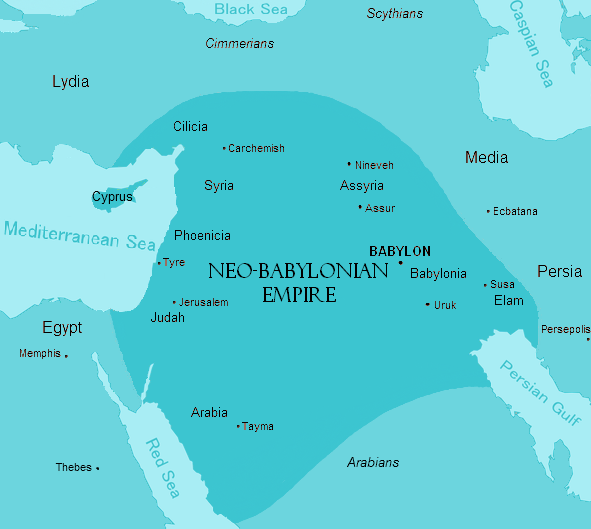
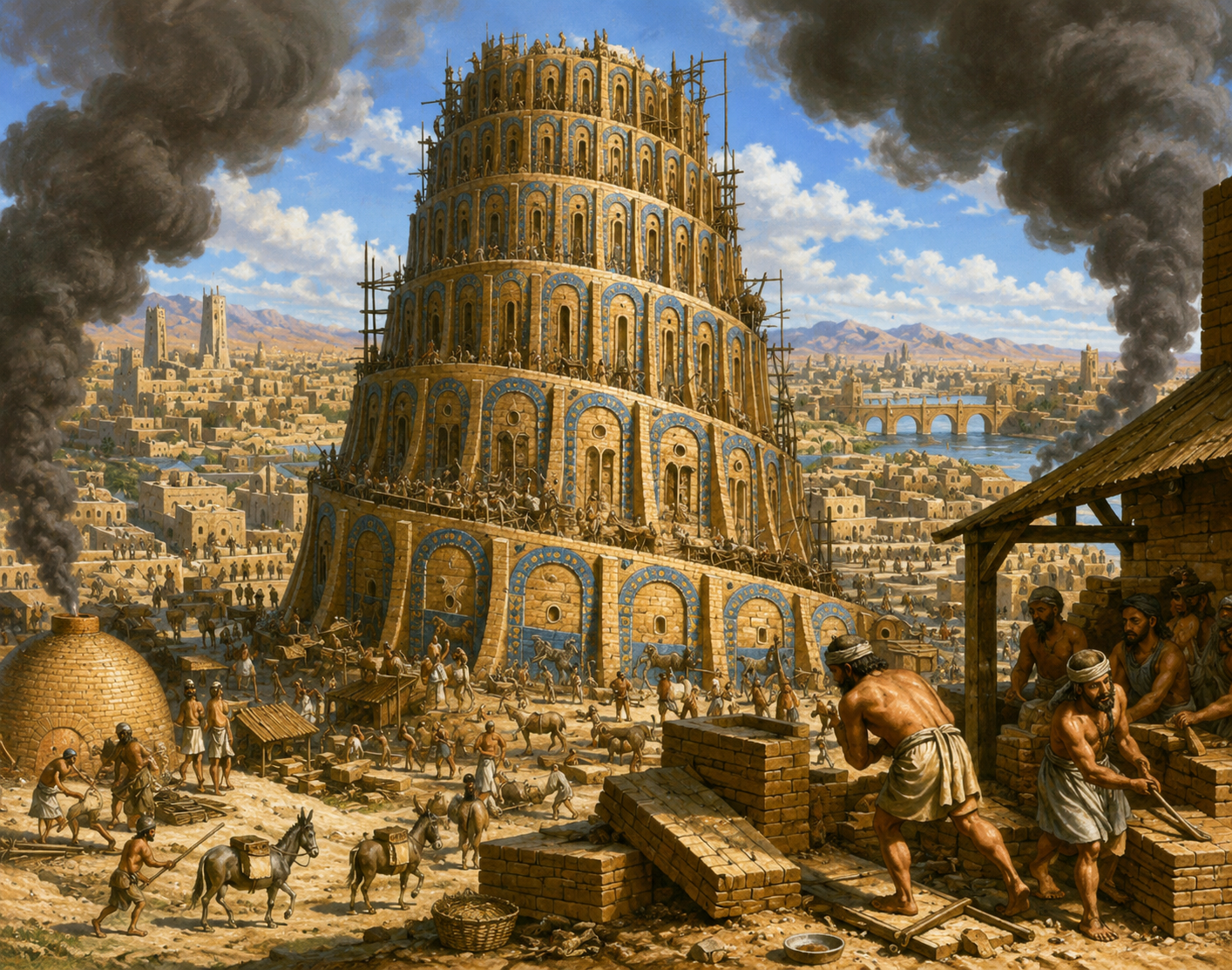
Babylon (0894)(babel) refers to the ancient city-state located in modern Iraq (Babylon - included Reconstructed City), about 20 miles south of Bagdad (near the modern city of Hillah). The term is used to refer to the city of Babylon, the geographical region of Babylonia, and the Neo-Babylonian Empire. Babel first occurs in Gen. 11:9, where it is given a Hebrew folk etymology by relating it to the verb ("to confuse"; "to mix"). The English term "to babble" comes from this biblical etymology.
In the NAS Babylon is first described by the synonymous term "Babel" ( = confusion cp Ge 11:9) the genesis of which is found in Ge 10:8, 9, 10, 11. In Ge 10:10 we encounter the first use of the word kingdom which indicates Nimrod was a king, and specifically one who is repeatedly called "mighty". The name Nimrod means to rebel, to be rebellious or a rebel, indicating that this earthly king was opposed to the true King. Ge 11:1,2,3,4 substantiates the rebellious spirit of Babel (a "monument" to sinful pride opposed to the rule of God) or Babylon who John describes as "Babylon, the Mother of harlots and abominations of the earth" (Rev 17:5). In other words Nimrod's kingdom of ancient Babylon was the fountainhead of every idolatrous, false world religion, as her evil seed was spread throughout the earth (Ge 11:8). This "divine scattering" in Genesis 11 also helps understand John's enigmatic statement of how Babylon came to sit on “peoples, multitudes, nations, and tongues” (Rev 17:15-note). In Revelation John records the final demise of Babylon (Rev 18:21-note), cp Jeremiah's prophecy - Je 51:63, 64)
New Testament uses of Babylon - Matt 1:11f, 17; Acts 7:43; 1 Pet 5:13; Rev 14:8; Rev 16:19; Rev 17:5; Rev 18:2, 10, 21 Babel - 294x in 260 verses - Gen 10:10; Gen 11:9; 2 Kgs 17:24, 30; 20:12, 14, 17f; 24:1, 7, 10ff, 15ff, 20; 25:1, 6ff, 11, 13, 20ff, 27f; 1 Chr 9:1; 2 Chr 32:31; 2 Chr 33:11; 2 Chr 36:6f, 10, 18, 20; Ezra 1:11; Ezra 2:1; Ezra 7:6, 9; Ezra 8:1; Neh 7:6; Neh 13:6; Esth 2:6; Ps 87:4; Ps 137:1, 8; Isa 13:1, 19; Isa 14:4, 22; Isa 21:9; Isa 39:1, 3, 6f; Isa 43:14; Isa 47:1; Isa 48:14, 20; Jer 20:4ff; Jer 21:2, 4, 7, 10; Jer 22:25; Jer 24:1; Jer 25:1, 9, 11f; Jer 27:6, 8f, 11ff, 16ff, 20, 22; Jer 28:2ff, 6, 11, 14; Jer 29:1, 3f, 10, 15, 20ff, 28; Jer 32:2ff, 28, 36; Jer 34:1ff, 7, 21; Jer 35:11; Jer 36:29; Jer 37:1, 17, 19; Jer 38:3, 17f, 22f; Jer 39:1, 3, 5ff, 9, 11, 13; Jer 40:1, 4f, 7, 9, 11; Jer 41:2, 18; Jer 42:11; Jer 43:3, 10; Jer 44:30; Jer 46:2, 13, 26; Jer 49:28, 30; Jer 50:1f, 8f, 13f, 16ff, 23f, 28f, 34f, 42f, 45f; Jer 51:1f, 6ff, 11f, 24, 29ff, 33ff, 37, 41f, 44, 47ff, 53ff, 58ff, 64; Jer 52:3f, 9ff, 15, 17, 26f, 31f, 34; Ezek 12:13; Ezek 17:12, 16, 20; Ezek 19:9; Ezek 21:19, 21; Ezek 23:15, 17, 23; Ezek 24:2; Ezek 26:7; Ezek 29:18f; Ezek 30:10, 24f; Ezek 32:11; Dan 1:1; Mic 4:10; Zech 2:7; Zech 6:10. Translated as Babel(2), Babylon(257), Babylonians*(3).
Tony Garland - In the record of Babel, as minimal as it is, we see the first human king and kingdom in direct rebellion to the commands of God resulting in judgment. In Babylon of the end, we will see the last human king and kingdom in ultimate rebellion to the commands of God resulting in the final judgment of all human kingdoms to be replaced by the Millennial Kingdom ruled by Messiah
Following terms are synonyms - Babel, Babylon, Shinar, Chaldean/Chaldea
Resources Related to Babylon:
- Art and pictures related to Babylon
- Babylon - History and Religion (related article)
- Babylonian Chronicle - "The Babylon Chronicle for the years 605-595 BC, describes the fall of Jerusalem to Nebuchadnezzar in 597 BC, the so-called “second deportation,” the first being in 605 B.C. when Daniel and his companions where taken to Babylon (Da 1:1-5)."
- Biblical Argument for the Rebuilding of Babylon - Dr Charles Dyer - 43 page treatise
- Babylon in Bible Prophecy - Thomas Ice (Dispensational perspective)
- What is the Identity of Babylon in Rev 17-18? - Andy Woods? (Dispensational perspective)
- Who is the Great Harlot Babylon - Kay Arthur
Besieged (More literally "laid siege") (06696) (tsûr/sur) has the basic meaning to enclose or to confine. It conveys the ideas of to lay siege, to secure, to tie up or bind (2Ki 5:23, Ezek 5:3, Dt 14:25), to surround.
The most common meaning of tsûr is to lay siege, usually to a city, by surrounding it and cutting off its supplies. To “encircle and enclose a fortified area as an aggressive military strategy to defeat a city or nation.” The word does not necessarily denote an actual battle but emphasizes taking control of a city. For example, David's men besieged Rabbah (2Sa 11:1; 1Chr. 20:1); Nadab laid siege to Gibbethon (1Ki. 15:27) Omri to Tirzah (1Ki. 16:17). Saul attempted to surround David at Keilah (1Sa 23:8). The Assyrians under Ben-Hadad besieged Samaria (1Ki. 20:1; 2Ki. 6:24f). Shalmaneser V laid siege against Samaria (725BC 2Ki 18:9) which fell after three years (722BC). Nebuchadnezzar laid siege to Jerusalem in 597BC (2 Ki. 24:11) and 588BC (Jer. 32:2; Jer 37:5). Instructions to Israel regarding siege tactics appear in Dt. 20:12, 19. 2Sa 20:15 describes the strategy of building ramps to overtake a walled city.
Ezekiel built a "siege model" to illustrate the fate of a besieged Jerusalem (Ezek 4:3). In a stunning indictment of God's people, the Lord Himself prophetically foretold He would lay siege to Jerusalem/Ariel (Isa. 29:3).
Tsûr is used in a metaphorical sense of enclosing or surrounding (Song 8:9), where Shulammite's brothers announce their resolve to garrison or encircle ("barricade") their little sister. In Ps 139:5, the psalmist acknowledges that the Lord has " enclosed me behind and before," which is a picture of the Lord's continual presence and protection.
Besiege - Webster says it means to To lay siege to; to beleaguer; to beset, or surround with armed forces, for the purpose of compelling to surrender, either by famine or by violent attacks; as, to besiege a castle or city. To surround (a fortified area, esp. a city) with military forces to bring about its surrender.
TWOT - This root means to make secure a valuable object, such as money (2Ki 5:23)... Applied to military action it means to relentlessly attack an opponent’s stronghold. Every effort was made to shut off supplies (especially water, cf. II Sam 12:27) from the city and to prevent the people from escaping. The tactics included building a mound to reach the wall and using battering rams and towers to breach it (cf. II Sam 20:15; Ezk 26:8f.). The inhabitants of a besieged city were threatened by both sword and famine; therefore, some surrendered to the enemy in order to preserve their lives (Jer 21:9). Without great discipline, tension inside the city mounted as prices for anything resembling food soared (II Kgs 6:25). It took the Assyrians three years to capture Samaria (II Kgs 17:5). Sometimes armies lacked the capacity to move from victories on the battlefield to take a stronghold (II Kgs 16:5). (Online Theological Wordbook of the Old Testament)
Tsûr - 38x in KJV - Ex 23:22; Ex 32:4; Deut 2:9, 19; Deut 14:25 (= put in a bag, take, i.e., place an object into a bag, as an extension of laying siege to a city); Dt 20:12, 19; Judg 9:31; 1 Sam 23:8; 2 Sam 11:1; 2 Sam 20:15; 1 Kgs 7:15; 15:27; 16:17; 20:1; 2 Kgs 5:23; 6:24f; 12:10; 16:5; 17:5; 18:9; 24:11; 1Chr 20:1; 2Chr 28:20; Esth 8:11; Ps 139:5; Song 8:9; Isa 21:2; Isa 29:3; Jer 21:4, 9; Jer 32:2; Jer 37:5; Jer 39:1; Ezek 4:3; Ezek 5:3; Dan 1:1.
KJV renders tsûr - besiege 21, lay siege 3, distress 3, bind 2, adversaries 1, assault 1, bags 1, beset 1, cast 1, fashioned 1, fortify 1, inclose 1, bind up 1; 38.
NAS renders tsûr - barricade(1), besiege(3), besiege*(1), besieged(1), besieged*(10), besieging*(5), bind(2), bound(1), enclosed(1), laid siege(1), lay siege(1), laying siege(1), set(1), stirring(1), tied(1).
Note that NAS uses a different Strong's number for Ex 23:22; Deut 2:9, 19; Esther 8:11 [rendered adversary(1), attack(1), harass(2)] and Baker says tsûr in these contexts signifies "A verb meaning to attack, to harass, to be an adversary. It refers to attacking persons, putting them under duress, opposing them. God would serve as an adversary against the enemies of His people (Ex. 23:22 where Lxx = antikeimai = to be set over against, to be opposed to someone, to be hostile toward). It refers to harassing or oppressing a people or nation (Deut. 2:9, 19 where Lxx - echthraino = be at enmity with in both verses); or even to attacking them (Esther 8:11 where Lxx = antikeimai), in context with God’s approval." (Complete Word Study Dictionary- Old Testament)
Donald Campbell explains...
When judgment came, it was for two clear reasons.
First, the Mosaic Law specified that every seventh year the land was not to be farmed since it was a sabbatical year, a year of rest for the land, symbolizing that "the earth is the Lord's." But apparently the Israelites had not observed this law for 490 years, because the writer of Chronicles states that the captivity was 70 years in length "to fulfill the word of the Lord by the mouth of Jeremiah, until the land had enjoyed her Sabbaths; for as long as she lay desolate she kept Sabbath, to fulfill threescore and ten years" (2 Chr 36:21).
Think of the patience of God lasting for nearly 500 years, a patience that had all but run out. For the northern kingdom of Israel, that divine patience was exhausted in 722 B.C. when the cruel Assyrians besieged Israel's capital, Samaria, and carried captive its leading citizens. More than 100 years later the cruel armies of Babylon came as God's instruments of judgment on Jerusalem
The lesson might well haunt modern-day society-God's patience has limits because He is also a God of justice and He must judge sin! An individual or a nation is foolish to imagine that God will never intervene to judge. The Bible and all of human history, to argue eloquently to the contrary.
God's judgment also fell on Judah for the gross sin of idolatry. Israel had been swallowed up by this evil practice in the forms of Jeroboam's calf worship and the worship of Baal. While Judah resisted it for a time, eventually the sordid story was repeated and there were even idolatrous orgies in Jerusalem. (BORROW Daniel Decoder of Dreams)
Norman Geisler - DANIEL 1:1a—Wasn’t the Book of Daniel actually written after about 170 B.C.?
PROBLEM: Daniel contains an incredible amount of detail concerning the kingdoms of the Gentiles from the reign of Nebuchadnezzar, from about 605 B.C., down to the Roman empire which began to exercise dominance as early as 241 B.C. and, under the Roman general Pompey, took over the Promised Land in 63 B.C. However, conservative scholars have maintained that Daniel wrote in the 6th century B.C. How could Daniel have given such historically accurate details of events in the future?
SOLUTION: The Book of Daniel contains supernatural prophecies that, from Daniel’s time, extended hundreds of years into the future (Dan. 2:7). Daniel 11 presents a sweeping display of detailed prophecy that stretches from the reign of Cyrus the Great to the reign of antichrist, to the millennial kingdom, to the end of the age and into eternity. The record of the movement of nations and events is so accurate, it reads as the historical account of an eyewitness. However, conservative scholarship places the date of the Book of Daniel at a time before any of these events took place. The book itself claims to be predictive prophecy (cf. 9:24ff). To avoid the conclusion that Daniel’s prophecy was a supernatural act of God, modern scholars have proposed a number of explanations including a late date of writing. However, the historical accuracy of Daniel’s record confirms a 6th century composition, and the best conclusion is that the Book of Daniel is a revelation from God about historical events that were future to Daniel, many of which are still future to us today.
Henry Blackaby - Far from Home
And the Lord delivered Jehoiakim king of Judah into his hand, along with some of the articles from the temple of God. These he carried off to the temple of his god in Babylonia and put in the treasure house of his god. Then the king ordered Ashpenaz, chief of his court officials, to bring in some of the Israelites from the royal family and the nobility. Daniel 1:2–3
How do you handle change? If you were to move to a new country with a strange language, different customs, and foreign foods, how do you think you would adjust? Daniel had no choice about moving. Nebuchadnezzar, the powerful Babylonian king, had conquered Jerusalem. He had forcibly taken young people from the wealthiest families and brought them to the distant city of Babylon. Daniel had been taken from his family, his home, and his country to live in a hostile land filled with idol worshipers.
Everything changed for Daniel. The language was different. The religion was different. The laws were different. Everything was different except one thing—God. Daniel found that God was just as real to him in Babylon as he had been in Jerusalem. Daniel’s enemies could remove his parents and his friends, but they could not take God away. Daniel would face his new life with God by his side. As a result, instead of letting the change in surroundings beat him, Daniel actually thrived and experienced a full, rich life.
God’s presence made all the difference to Daniel. He was able to approach his new life with confidence rather than fear. God stood by Daniel and blessed his efforts. If you are experiencing troublesome changes right now, remember that one thing hasn’t changed: God is still with you. You may feel all alone, but God loves you, and he’s ready to help you, no matter what you face next. You may not always have your parents or friends nearby to help you, but God has promised that he will always be with you, wherever you are (Isaiah 41:10).
James Smith - THE MAN OF PURPOSE DANIEL 1
The book of Daniel has been cast into the critics’ den, but, like Daniel, it shall yet escape from the mouths of the lions. Rationalists are rejecting it because of its miracles and prophetic utterances. The Lord Jesus Christ approved of it, for it formed part of the canonical Scriptures in His time. Sir Isaac Newton said that “Christianity itself may be said to be founded on the prophecies of Daniel.”
After the siege of Jerusalem (v. 1), Daniel had been taken captive to Babylon, a distance of about eight hundred miles. He was probably about fourteen years of age at that time.
I. His Character. We know nothing of his parents, but judging from his character as a lad, he must have been nurtured in a God-fearing home, for the soundest principles of life had been early formed. One has said: “There is nothing rarer than personality, for there are so many causes that hinder both interior and exterior, so many hostile forces to crush, so many illusions to lead astray.” Blessed is that young man who can truly say, “I know in whom I have believed,” etc. A personal knowledge of God is the mightiest of all safeguards for city life.
II. His Temptations (vv. 5, 6). Testing times will come. These are needed for our moral and spiritual development. The king’s command was to select blameless youths, skilful and wise, to take the honoured place of students at the Royal College, and to “stand in the king’s palace.” It was to be a three years’ course, to learn the tongue of the Chaldeans. The Chaldeans were the politicians, philosophers, theologians, and teachers of the nation. What an opportunity for a young, bright, hopeful man! But how could he eat that meat and drink that wine which had been consecrated to idols, and defile his conscience? The worldly man sees no difficulty, but rather a grand chance to attain honour and earthly glory; but it is very different with the man who is abiding in the fellowship of God.
III. His Purpose. “He purposed in his heart that he would not defile himself” (v. 8). This in our days would be called “narrow-mindedness and puritanical bigotry.” In this connection see Paul’s advice (Rom. 14:21). That man is of little value for God who is not able to stand against popular opinion. The Talmud says: “A myrtle tree remains a myrtle even in the desert.” A man of God should act as such in any circumstance. God is not influenced by man-made conditions. A lad of fifteen years was following the plough near the Carse of Gowrie, the horses stopped in the middle of the furrow. At that moment this question came to his mind: “Might I not make more of my life than I am doing?” and straightening himself up, he said, “God helping me, I will be a missionary.” That lad was Dr. James Stewart, of Lovedale. Keep a conscience void of offence.
IV. His Reward. “God made Daniel to find favour” (v. 9, R.V.). This was a great crisis in the life of Daniel. He was found faithful, and God promoted him. Henceforth he is marked as a leader of the people. Faith in God, and plain fare (v. 15), got the victory for both body and soul. “Their countenances were fairer and fatter than all who did eat the king’s meat.” Godliness is profitable. Why? Because it is the highest type of character and the best possible relationship to God and men. The wisdom that profited Daniel was not found in the schools of the learned, but in the closet of communion with the God of Heaven. Determine to know nothing among men save Jesus Christ and Him crucified, and the wisdom of God will be in you.
Dare to Be a Daniel By Rev. Timothy Beougher
Introduction: Different countries have different cultural norms, and what is appropriate in one culture may be offensive in another culture. For example, you should never touch a person’s head in Thailand; the head is considered sacred. In Portugal you should never write anything in red ink; it is very offensive. Chewing gum is illegal in Singapore and can result in a large fine. In our message today Daniel illustrates for us how to live when we “leave home” or encounter new situations. While this message is focused especially on those graduating from high school, it applies to all of us. Anytime something changes in our lives (a new job, a new house, a new school, a new stage of life), we face challenges to our faith. Daniel illustrates how to live when we leave what is familiar to us and encounter new situations.
1. You Will Face a Test: To Walk with God in a “Strange” Land. Daniel 1:3–7 introduces us to Daniel and three of his friends who were carried off in captivity to Babylon. They are called “young men,” a phrase used to describe teenagers between the ages of twelve and fifteen. These young men had grown up around Jerusalem. There they were constantly reminded about God through His Word and worship at the temple. Instead of being surrounded by a culture that supported walking with God, they found themselves in a pagan nation surrounded by pagan practices and people. Verse 4 introduces us to the king’s reprogramming effort; Daniel was enrolled at Babylon State University on a full scholarship. He was in a new location; no one was watching him and his actions. His parents weren’t there; his pastor wasn’t there. The opportunity for temptation was great. But Daniel remembered that God was there! The Babylonians gave them new names to fit that culture. Do you see the challenge that Daniel faced? He was thrust into a pagan culture in this strange land and was expected to conform. But Daniel was a teenager with convictions. He made a choice: “I’m going to walk with God even in a strange land.” Just because your circumstances have changed doesn’t mean God has changed.
2. You Must Fight the Temptation to Compromise Your Convictions. Verses 5 and 8 tell us about the food and wine at the king’s table, but Daniel resolved not to defile himself. We are not sure why the food represented a compromise for Daniel, but it is clear Daniel drew a line in the sand. As we encounter new situations, we must fight the temptation to compromise our convictions. Some of you will be going to schools where you will experience what one pastor has called “cultural brainwashing.” You will be challenged to abandon your beliefs, to become like everybody else. Don’t give in! Determine not to conform (Rom. 12:2). The decisions you make over the next few years will greatly impact the rest of your life. There are three key issues:
A. Truth Issue: What is Truth? The Babylonians sought to educate Daniel and his friends in their history and culture. Education is not evil; it’s good and important to learn. But as we learn, we need wisdom to sort out truth from opinion. Daniel and his friends were being challenged to accept a pagan view of life. The key is that they mastered the material, but it never mastered them. The world will try to get you to adopt their view of truth. You will face the temptation to become intellectually sophisticated. You will be pressured to conform! Don’t compromise your convictions! Do not determine what is right based on cultural norms. There are absolutes in God’s Word. The bottom line is that it doesn’t matter what others say; ultimately, what really matters is what God says.
B. Identity Issue: Who am I? Daniel means “God is judge.” Hananiah means “The Lord is gracious.” Mishael means “Who is like God?” Azariah means “The Lord helps.” They were given new names: Daniel became Belteshazzar, “Bel will protect” (Babylonian God). Hananiah became Shadrach, “command of Aku” (a Babylonian moon god). Mishael became Meshach, “who is like Aku?” (Babylonian god). Azariah became, Abednego, “servant of Nebo” (another god). The identity issue is a key issue. By what name will others know you? Teenagers, college students, graduate students, adults, you’re going to have to make a choice. Are you willing to be called a Christian in your culture? You must deal with the temptation to compromise your identity. Take a stand! Be proud of being a Christian!
C. Morality Issue: How Will I Live? Daniel had to decide whether to obey King Nebuchadnezzar and live like him, or to follow the King of kings and obey Him completely. Will we adopt the world’s immorality or live by God’s morality? You must fight the temptation of compromising your convictions.
3. You Can Triumph by Staying Pure in a Fallen World. The Babylonians changed these young men’s homes, their names, and their education, but they couldn’t change their hearts! These young men had decided to follow God no matter what the cost. They didn’t give in to the voices: “It’s okay–everybody else is doing it.” “I’ll just keep my faith to myself—after all, faith is a private matter.”
“When in Rome, do as the Romans do.” They requested a different diet and God honored them. God honored Daniel and his friends: they became healthier (vv. 15, 16) and wiser (vv. 17–20) than the others. When your heart truly belongs to God, you can be in any location and in any situation and still do the right thing.
Application: First, commit to walk with God (see v. 8). Let people know you’re a Christian from the moment you set foot on that campus or the first day on your new job. Second, spend time with the Lord each day in the Word and in prayer. Either the Bible will keep you from sin or sin will keep you from the Bible. Next, memorize key verses to deal with temptation (see Ps. 119:11) and develop a bond of accountability (see Eccl. 4:9, 10). Graduates can find a campus fellowship (see Heb. 13:3). It’s also necessary to find a good church, so don’t sleep in! Finally, trust God (Prov. 3:5, 6). In 1873 hymn writer Philip Bliss wrote a gospel song about this story called “Dare to be a Daniel.” We should all heed these words of wisdom:
Dare to be a Daniel.
Dare to stand alone!
Dare to have a purpose firm!
Dare to make it known.
Daniel 1:2 The Lord gave Jehoiakim king of Judah into his hand, along with some of the vessels of the house of God; and he brought them to the land of Shinar, to the house of his god, and he brought the vessels into the treasury of his god.
KJV And the Lord gave Jehoiakim king of Judah into his hand, with part of the vessels of the house of God: which he carried into the land of Shinar to the house of his god; and he brought the vessels into the treasure house of his god.
NET Now the Lord delivered King Jehoiakim of Judah into his power, along with some of the vessels of the temple of God. He brought them to the land of Babylonia to the temple of his god and put the vessels in the treasury of his god.
NLT The LORD gave him victory over King Jehoiakim of Judah and permitted him to take some of the sacred objects from the Temple of God. So Nebuchadnezzar took them back to the land of Babylonia and placed them in the treasure-house of his god.
BGT καὶ παρέδωκεν αὐτὴν κύριος εἰς χεῖρας αὐτοῦ καὶ Ιωακιμ τὸν βασιλέα τῆς Ιουδαίας καὶ μέρος τι τῶν ἱερῶν σκευῶν τοῦ κυρίου καὶ ἀπήνεγκεν αὐτὰ εἰς Βαβυλῶνα καὶ ἀπηρείσατο αὐτὰ ἐν τῷ εἰδωλίῳ αὐτοῦ
--- Daniel (TH) 1:2 καὶ ἔδωκεν κύριος ἐν χειρὶ αὐτοῦ τὸν Ιωακιμ βασιλέα Ιουδα καὶ ἀπὸ μέρους τῶν σκευῶν οἴκου τοῦ θεοῦ καὶ ἤνεγκεν αὐτὰ εἰς γῆν Σεννααρ οἶκον τοῦ θεοῦ αὐτοῦ καὶ τὰ σκεύη εἰσήνεγκεν εἰς τὸν οἶκον θησαυροῦ τοῦ θεοῦ αὐτοῦLXE And the Lord gave into his hand Joakim king of Juda, and part of the vessels of the house of God: and he brought them into the land of Sennaar to the house of his god; and he brought the vessels into the treasure-house of his god.
CSB The Lord handed Jehoiakim king of Judah over to him, along with some of the vessels from the house of God. Nebuchadnezzar carried them to the land of Babylon, to the house of his god, and put the vessels in the treasury of his god.
ESV And the Lord gave Jehoiakim king of Judah into his hand, with some of the vessels of the house of God. And he brought them to the land of Shinar, to the house of his god, and placed the vessels in the treasury of his god.
NIV And the Lord delivered Jehoiakim king of Judah into his hand, along with some of the articles from the temple of God. These he carried off to the temple of his god in Babylonia and put in the treasure house of his god.
YLT and the Lord giveth into his hand Jehoiakim king of Judah, and some of the vessels of the house of God, and he bringeth them in to the land of Shinar, to the house of his god, and the vessels he hath brought in to the treasure-house of his god.
- Lord gave - Da 2:37,38; Da 5:18; Dt 28:49-52; Dt 32:30; Jdg 2:14; Jdg 3:8; Jdg 4:2; Ps 106:41,42; Isa 42:24
- Along with some of - Da 5:2; 2Chr 36:7; Jer 27:19,20
- Shinar - Ge 10:10; Ge 11:2; Isa 11:11; Zech 5:11 -- Synonyms = Babel, Babylon, Shinar, Chaldean/Chaldea
- He brought the vessels - Da 5:2,3; Jdg 16:23,24; 1Sa 5:2; 1Sa 31:9,10; Ezra 1:7; Jer 51:44; Hab 1:16
Related Passages:
Daniel 2:37-38 (NOTE SOVEREIGNTY OF GOD) “You, O king, are the king of kings, to whom the God of heaven has given the kingdom, the power, the strength and the glory; 38 and wherever the sons of men dwell, or the beasts of the field, or the birds of the sky, He has given them into your hand and has caused you to rule over them all. You are the head of gold.
Daniel 5:18 “O king, the Most High God granted sovereignty, grandeur, glory and majesty to Nebuchadnezzar your father.
Deuteronomy 28:49-50 “The LORD will bring a nation against you from afar, from the end of the earth, as the eagle swoops down, a nation whose language you shall not understand, 50a nation of fierce countenance who will have no respect for the old, nor show favor to the young.
Deuteronomy 32:30 “How could one chase a thousand, And two put ten thousand to flight, Unless their Rock had sold them, And the LORD had given them up?
2 Kings 20:17,18 (PROPHECY OF REMOVAL OF TEMPLE VESSELS DURING KING HEZEKIAH'S REIGN) ‘Behold, the days are coming when all that is in your house, and all that your fathers have laid up in store to this day will be carried to Babylon; nothing shall be left,’ says the LORD. 18 ‘Some of your sons who shall issue from you, whom you will beget, will be taken away; and they will become officials in the palace of the king of Babylon.’”
Isaiah 39:6-7 Behold, the days are coming when all that is in your house and all that your fathers have laid up in store to this day will be carried to Babylon; nothing will be left,’ says the LORD. 7 ‘And some of your sons who will issue from you, whom you will beget, will be taken away, and they will become officials in the palace of the king of Babylon.’”
THE ABSOLUTE
SOVEREIGNTY OF GOD
The Lord (adonai; LXX - kurios = Owner, Master, one who has full control) gave (cf "gave" in Da 1:9, 17) Jehoiakim king of Judah into his hand (yad = idiomatically equates with one’s power and authority) - Babylon conquered Judah, but ultimately the sovereign God orchestrated the defeat of Jehoiakim. To be given into one's hand was an idiomatic way of saying he was given into the power of Nebuchadnezzar.
David Jeremiah comments that "The Book of Daniel has a high and lofty view of the sovereignty of God. The theme is: There is a God in heaven. The book repeats that He is the great God, He is the God of gods, the King of heaven (cf Da 4:25). When we understand that prevailing theme, we are able to understand how God may use some people for His purposes, even when they are not His own children. For instance, we read in Daniel 1:1–2: “In the third year of the reign of Jehoiakim king of Judah, Nebuchadnezzar king of Babylon came to Jerusalem and besieged it. And the Lord delivered Jehoiakim king of Judah into his hand.” Nebuchadnezzar thought he captured the city. The Babylonian Daily News probably headlined, NEBUCHADNEZZAR CONQUERS KING OF JUDAH. No, he didn’t. God gave it to him. ....Christians should be the calmest people on earth. We have no right to run around this world in frenzied activity, staying up and walking the floor at night, wondering what is going to happen. God in heaven rules the kingdoms of men.(See The Handwriting on the Wall - Page 19)
Bob Utley - "the Lord gave. . .God granted. . .God gave" These phrases are found in Da 1:2,9 (Qal IMPERFECT with waw), and Da 1:17 (Qal PERFECT). Each combine to show God's control of history! This is a recurrent theme in Daniel. In the ancient world every army fought under the banner/name of their god. Success in battle showed the supremacy of one god over another. However, the Bible clearly asserts that it was because of Israel's and Judah's sins and rebellion against YHWH that YHWH allowed, yes even engineered (i.e., Isa. 10:5-11), the invasion of the promised land. The curses of Lev. 26 and Deut. 28:15-68 became reality!
Along with some of the vessels of the house of God; and he brought them to the land of Shinar, to the house of his god, and he brought the vessels into the treasury of his god - Nebuchadnezzar removed sacred vessels from the Jerusalem temple (cf. 2Ch 36:7) just as had been predicted in 2Ki 20:17-18 (approximately 100 years earlier. This was particularly humiliating because conquering nations commonly regarded military victory as evidence that their gods had defeated the gods of the conquered people.
NET NOTE on Shinar - The land of Babylonia (Heb “the land of Shinar”) is another name for Sumer and Akkad, where Babylon was located (cf. Gen 10:10; 11:2; 14:1, 9; Josh 7:21; Isa 11:11; Zech 5:11).
NET NOTE on god - Or “gods” (NCV, NRSV, TEV; also later in this verse). The Hebrew term can be used as a numerical plural for many gods or as a plural of majesty for one particular god. Since Nebuchadnezzar was a polytheist, it is not clear if the reference here is to many gods or one particular deity. The plural of majesty, while normally used for Israel’s God, is occasionally used of foreign gods (cf. BDB 43 s.v. אֱלֹהִים 1, 2). See Jdg 11:24 (of the Moabite god Chemosh); 1 Sam 5:7 (of the Philistine god Dagon); 1 Kgs 11:33 (of the Canaanite goddess Astarte, the Moabite god Chemosh, and the Ammonite god Milcom); 2 Kgs 19:37 (of the Assyrian god Nisroch). Since gods normally had their own individual temples, Dan 1:2 probably refers to a particular deity, perhaps Marduk, the supreme god of Babylon, or Marduk’s son Nabu, after whom Nebuchadnezzar was named. The name Nebuchadnezzar means “Nabu has protected the son who will inherit” (HALOT 660 s.v. נְבוּכַדְרֶאצַּר). For a discussion of how temples functioned in Babylonian religion BORROW H. Ringgren's, Religions of the Ancient Near East, 77–81.
Lord (Adonai) (Septuagint = kurios) is the name for God indicating that He is the supreme Master. The use of this name in this verse indicates that He is in complete control of removing kings (and kingdoms) and establishing kings (and kingdoms) (Da 2:21). The fact that the Lord is in control is emphasized throughout the book of Daniel (eg, see Da 2:37,38; Da 5:18). But God is a God of great compassion and in the midst of His righteous wrath (the defeat and exile of Judah), remembering mercy (cp Hab 3:2), "granting favor and compassion" (Da 1:9) as well as "knowledge and intelligence" (Da 1:17) to His chosen servants.
Related Resources:
Proverbs 21:1 (Note by Charles Bridges)
The king's heart is like channels of water in the hand of the LORD; He turns it wherever He wishes.
We see the Sovereign Hand of God in the disciplinary action on Judah in a parallel passage...
He (Jehovah) brought up against them the king of the Chaldeans (Nebuchadnezzar) who slew their young men with the sword in the house of their sanctuary, and had no compassion on young man or virgin, old man or infirm; He gave them all into his hand. (2Chr 36:17,18, 19, 20, 21)
Gleason Archer notes that "the theme of God's absolute sovereignty is here implied. It continues to dominate the entire Book of Daniel, along with the accompanying theme of God's unwavering purpose to bring his people back to repentance through disciplinary suffering, so equipping them spiritually for restoration to the Land of Promise. The divine motive behind all this dreadful humiliation, suffering, and loss was redemptive and altogether in harmony with God's promises given to the generation of Moses (Lev 26; Dt 28; cf. also 2Chr 36: 14-21). (Expositor's Bible Commentary)
Nebuchadnezzar thought he conquered Judah with his military campaign and siege (Da 1:1), but Daniel records that the victory was given by the Lord, a truth all believers must continually keep in mind as they fight the good fight of faith. As David wrote...
Some boast in chariots, and some in horses (King Nebuchadnezzar trusted in his power), but we will boast in the name of the LORD (Ps 124:8), our God (by faith we lay hold of His supernatural power). (Ps 20:7, cp Pr 21:31, Ps 33:17-20, Ec 9:11, Is 31:1, 2Chr 16:7-9, King Jehoshaphat = 2Chr 20:15-22, David against Goliath = 1Sa 17:45-47, Hezekiah = 2Chr 32:7, 8)
Judah refused to heed the warnings of her prophets or the fate of her idolatrous sister Israel and continued to practice idolatry. Finally, God gave Judah into the hands of the land of idolatry!
THOUGHT - If you continually pursue idols, beware, for God may just give you what you want!
Daniel 1:1,2 is not only a fulfillment of Isaiah's prophecy to Hezekiah (alluded to above [see note] - 2Ki 20:16-18) but is also a fulfillment of a prophecy recorded by Moses (Dt 28:49-52).
WHY WAS JUDAH
TAKEN INTO EXILE?
Through Jeremiah, Jehovah summarized Judah's sin declaring that...
My people have committed two evils: (#1) (the sin of "omission") They have forsaken Me , the fountain of living waters, (#2) (the sin of "commission") to hew for themselves cisterns, broken cisterns, that can hold no water. (Jer 2:13)
Comment: In ancient Israel there were two major sources of water, running streams of fresh, clear and cool water and large pits called cisterns. The landowners would dig cisterns to collect rainwater adding a coat of lime plaster in an attempt to insure the cistern would hold water. However frequently cracks would develop and the water would leak out, not to mention that this water was brackish. How sad that in a similar foolish way Israel abandoned Jehovah, the "fountain of living waters" (Ps 36:9; Pr 16:22; Isa 55:1; Jn 7:37, 38, 39) to make for themselves powerless "gods" (cp Lev 26:1 where Hebrew word for "idols" = literally "something worthless", cp Ps 96.5; Is 2:8; Hab. 2:18)!
Nothing twists and deforms the soul
more than a low or unworthy conception of God.
-- A W Tozer
The sins of Judah which eventually resulted in the final destruction of Jerusalem in 586BC were...
(1) Idol Worship in place of Worship of the One True Living God -
Dt 32:15-17 “But Jeshurun (ISRAEL) grew fat and kicked– You are grown fat, thick, and sleek– Then he forsook God who made him, And scorned the Rock of his salvation. 16 “They made Him jealous with strange gods; With abominations they provoked Him to anger. 17 “They sacrificed to demons who were not God, To gods whom they have not known, New gods who came lately, Whom your fathers did not dread.
Israel's idolatry broke the commandments in Ex 20:3-5 "You shall have no other gods before Me. 4 “You shall not make for yourself an idol, or any likeness of what is in heaven above or on the earth beneath or in the water under the earth. 5 “You shall not worship them or serve them; for I, the LORD your God, am a jealous God, visiting the iniquity of the fathers on the children, on the third and the fourth generations of those who hate Me,"
(2) Failure to observe the Sabbaths for the Land for 490 years -
2 Chronicles 36:20-21 Those who had escaped from the sword he carried away to Babylon; and they were servants to him and to his sons until the rule of the kingdom of Persia, 21 to fulfill the word of the LORD by the mouth of Jeremiah, until the land had enjoyed its sabbaths. All the days of its desolation it kept sabbath until seventy years were complete.
Every seventh year the Jews were to keep the Sabbath year and allow the land to rest (cf Lev 25:4). So for 490 years Israel had failed to keep the Sabbath year which meant the nation "owed" Yahweh 70 Sabbath years! Judah was reaping the harvest of conforming to the mold of the pagan world, rather than obeying God's clear instructions!
(3) Manasseh's great sin was also a factor leading to the final destruction of Jerusalem. Note these crucial hinge words in 2 Kings 21:11-12 "Because Manasseh king of Judah has done these abominations, having done wickedly more than all the Amorites did who were before him, and has also made Judah sin with his idols; 12 therefore thus says the LORD, the God of Israel, ‘Behold, I am bringing such calamity on Jerusalem and Judah, that whoever hears of it, both his ears will tingle."
2Ki 21:11 begins with "BECAUSE" This term of explanation introduces the reason for the judgment that God announces in 2Ki 21:12. It explains why God is about to bring calamity on Jerusalem and Judah. Manasseh did not merely sin personally but he corrupted the spiritual life of Judah, which ultimately led to national judgment.
2Ki 21:12 begins with "THEREFORE" - A fitting term of conclusion to Manasseh's evil regime, reaching backward and gathers up a long list of deliberate violations of the Mosaic covenant by Manasseh. Therefore introduces God’s judicial conclusion ("bringing...calamity on Jerusalem") based on the reasons stated in the previous verse. It signals that the coming judgment is the logical and inevitable result of Manasseh’s sins described in 2 Kings 21:11.
Manasseh's evil (even in face of his personal repentance) made divine judgment a moral necessity. Manasseh's wickedness was so great that he was blamed for the fall of the Southern Kingdom! 2Ki 21:11 begins with "BECAUSE" which introduces the reason for God's "calamity" judgment in the next verse 2Ki 21:12.
There are at least 3 other verses which demonstrate that the "calamity on Jerusalem" was directly related to Manasseh's sins despite the fact that he himself experienced personal repentance and revival (2Ch 33:11,12,13)! Tragically, the spiritual damage to the nation had already been done and could not be undone! Note each passage below has the explanatory hinge word "BECAUSE OF..."
Jeremiah 15:4 “I will make them an object of horror among all the kingdoms of the earth BECAUSE OF Manasseh, the son of Hezekiah, the king of Judah, for what he did in Jerusalem.
2 Kings 23:26-27 However, the LORD did not turn from the fierceness of His great wrath with which His anger burned against Judah, BECAUSE OF all the provocations with which Manasseh had provoked Him. 27 The LORD said, “I will remove Judah also from My sight, as I have removed Israel. And I will cast off Jerusalem, this city which I have chosen, and the temple of which I said, ‘My name shall be there.’”
2 Kings 24:3-4 Surely at the command of the LORD it came upon Judah, to remove them from His sight BECAUSE OF the sins of Manasseh, according to all that he had done, 4 and also for the innocent blood which he shed, for he filled Jerusalem with innocent blood; and the LORD would not forgive.
TAKEAWAY
One leader can shape the spiritual direction
of an entire nation for generations.
COUNTDOWN
TO CAPTIVITY
Tony Garland summarizes the countdown as follows...
#5 - Josiah - Josiah begin his reign while a boy of only eight (2Ki 22:1) and reigned for 31 years. His reign was patterned after the godly king Hezekiah. He initiated repairs to the temple whereupon the high priest Hilkiah rediscovered the Book of the Law which had been neglected for many years (2Ki 22:8 - Ed note: Where was the Book of the Law was lost? In the very place it should have had preeminence. Beloved, is this not what we see in pulpits across America where there is a veritable dearth of delivered doctrine that is fully "sound" = Greek in 2Ti 4:3). Upon reading the Law, it became apparent just how far Israel had neglected her duties causing Josiah to repent of the ungodliness of the nation. But it was “too little too late”—God confirmed through the prophetess Huldah that judgment would not be averted (2Ki 22:16, 17). (This could also be known from the prophecy previously given to Hezekiah that Babylon would eventually cart off Israel’s treasures and some from among her people: 2Ki 20:12-18) Nevertheless Josiah continued following closely in the footsteps of his great-grandfather Hezekiah by instituting religious reforms.
Observe (1) All of the last 4 kings after Josiah were evil. (2) Three of those kings were sons of Josiah, the godly king. One cannot help but wonder why they were not positively impacted by the "revival" that occurred during their father Josiah's reign! Another young man named Daniel seems to have been at least in part the fruit from that last great revival in Josiah's day. Daniel would have been very young, but his parents would certainly have experienced the revival associated with finding the Book of the Law. However, where Scripture is silent we must tread lightly and not speculate too far a field! It's just good "food for thought".
#4 - Jehoahaz (note) (Shallum-note) - After the death of king Josiah, his son Jehoahaz reigned. He proved to be an ungodly king who reigned for only three months before being deposed by Pharaoh Necho and taken to Egypt where he eventually died (2Ki 23:31-34; 2Chr 36:1-4; 2Ki 22:1-12).
605BC
1st Deportation from Judah
(Daniel 1:1, 2Ki 24:1,2,13; 2Chr 36:5-7)
#3 - Jehoiakim (aka Eliakim) - After deposing of his brother Jehoahaz, Eliakim was appointed as a vassal king by Pharaoh Necho of Egypt and renamed Jehoiakim. Like his brother before him, he was an evil king (2Ki 23:37). He reigned 11 years. It was during his reign that Daniel was taken captive to Babylon. In his 4th year (Jewish mode of dating, the 3rd year from the Babylonian mode of dating a regal reign), the Battle of Carchemish (Carchemish - Wikipedia) also took place at which time Nebuchadnezzar defeated Pharaoh Necho of Egypt which marked the beginning of Babylon’s ascendancy over Egypt in the region of Palestine (Jer 25:1; Jer 45:1; Jer 36:1; Jer 46:2 = the 4th year of Jehoiakim = the Jewish mode of dating the regal reign. Contrast the phrase in Da 1:1 - the 3rd year of Jehoiakim = the Babylonian mode of dating the regal reign). The other notable result of the battle of Carchemish was the final defeat of Assyria which made Babylon the leading world empire at that time. Thereafter, Jehoiakim was made vassal king of Babylon by Nebuchadnezzar until late 601bc when Nebuchadnezzar suffered defeat while advancing on Egypt whereupon Jehoiakim switched allegiance to Egypt (2Ki 24:1). This proved to be a fatal mistake when in 598bc Babylon attacked Jerusalem and Jehoiakim was killed.
As an aside John Whitcomb notes that "It was once a commonplace of negative criticism to deny that Nebuchadnezzar could have besieged Jerusalem in 605 B.C. In 1956, however, a cuneiform tablet was published that revealed that Nebuchadnezzar "conquered the whole area of the Hatti-country after the Battle of Carchemish in May-June 605. The term Hatti-country covers all of Syria, Phoenicia, and Palestine." (See his excellent comments on Daniel 1:1 thru first part of Da 3:19 in Daniel- Everyman's Bible Commentary - Page 25)
597BC
2nd Deportation from Judah
Ezekiel and 10,000
(2Ki 24:8-17, Ezek 1:1-2)
#2 - Jehoiachin (aka Jeconiah, Coniah) - Upon the death of his father Jehoiakim, Jehoiachin (also known as Jeconiah or Coniah) reigned for a period of three months before he surrendered to Babylon. After surrendering to Babylon, he was deported and his uncle, Mattaniah was installed as vassal king and renamed Zedekiah (2Ki 24:12-16). Treasures were carried out from the king’s house and the temple (2Ki 24:13) in fulfillment of the Word of the Lord given to Hezekiah by Isaiah (2Ki 20:16-19). Ten thousand captives were taken to Babylon (2Ki 24:14), including Ezekiel (Eze 1:2) and Mordecai’s great-grandfather Kish (Esther 2:5, 6). Jehoiachin was imprisoned in Babylon until the reign of Evil Merodach (who reigned after the death of Nebuchadnezzar). He remained in Babylon and was provided for by the king (2Ki 25:30).
586BC
3rd Deportation from Judah
Razing of Jerusalem and the Temple
(2Ki 25:1-12)
#1 - Zedekiah (aka Mattaniah) - The final king to reign over Judah was Zedekiah, who reigned for 11 years as a vassal king subject to Babylon. Like all the kings following Josiah’s reign, he was evil. When a new Egyptian Pharaoh (Hophra) came to the throne in 588 B.C., Zedekiah took the occasion to rebel against Babylon. Nebuchadnezzar responded by the siege which led to the final downfall of Jerusalem, the destruction of the city and temple, and the deportation of the majority who were left. In fulfillment of Ezekiel’s prophecies that Zedekiah would be taken to Babylon but never see it, his sons were killed before him, his eyes were put out, and he was taken to Babylon where he died (Jer 39:6, 7; Jer 52:9, 10, 11; 2Ki 25:6, 7 cf. Eze 12:13; Eze 17:16). After capturing Jerusalem, the Babylonians burned the leader‘s houses and the temple and broke down the city walls. (Daniel - Introduction Part 7 - with slight modification)
Land of Shinar (aka Babylonia) - In southern Mesopotamia (Ge 10:10), site of the Tower of Babel (Ge 11:2) and continued in Scripture to have "the nuance of a place hostile to faith...the place to which wickedness is banished" (Zech 5:11).
Babylon = Babel = Shinar = Chaldea
Brought the vessels into the house of his god - Symbolic gesture demonstrating Babylon's pantheon of gods was great than Judah's God. Some translate gods plural which would certainly be appropriate as by some accounts there were more than 100 Babylonian gods (polytheism = literally "many gods"). The chief Babylonian god was Marduk (or Bel , related to Baal = lord, master) along with Nebo (incorporated in Nebuchadnezzar's name). It is little surprise that God inspired Daniel to specifically use His Name Adonai or Master. Not only had Isaiah predicted the sacking of Jerusalem (predicted about 702BC), but he also prophesied the fall of Bel (Isa 46:1) at the hands of Cyrus the Persian in 539BC, in a sense then describing the beginning and the end of the Babylonian empire (although the final end will not occur until Rev 18:21).
As a typical polytheist and clever diplomat, Nebuchadnezzar took no chances with Israel's God, Jehovah, and carefully enshrined His sacred vessels in Marduk's temple in Babylon. Contrast the sacriligeous treatment of the Temple vessels sixty-six years later by Belshazzar (Da 5:1-4). After the fall of Babylon, King Cyrus (Ezra 1:7) and King Darius (Ezra 6:5) encouraged the Jews to carry these vessels back to their Temple in Jerusalem.
John Whitcomb observes that "Nebuchadnezzar shrewdly took enough of the sacred vessels to demonstrate the superiority of his god over the God of the Jews but left enough in the Temple so the Jews would be able to carry on their ceremonies unhindered and thus be less likely to rebel against their new overlord. In 586 B.C., however, totally exasperated by the disloyalty of the Jewish kings and rulers, Nebuchadnezzar ordered all the sacred vessels to be destroyed or carried off to Babylon (2Chr 36:18). (See Daniel - Everyday Bible Commentary).
TODAY IN THE WORD Daniel 1:1-2; Jeremiah 25:1-14 - During Jehoiakim’s reign, Nebuchadnezzar king of Babylon invaded the land. - 2 Kings 24:1
New Year's Eve, 1999, saw the Y2K worriers stocking up on bottled water and canned goods; the turn-of-the-millennium enthusiasts planning extravagant celebrations to usher in the year 2000; and the history purists insisting there was no reason to get excited. These mathematically precise folks argued that the third millennium wouldn't begin until the two-thousandth year had ended and 2001 had begun. In other words, the year 2000 could be the turn of the millennium only if there had been a year zero.
A look at the accounts in Daniel 1 and Jeremiah 25 presents a similar conundrum. Did Nebuchadnezzar lay siege to Jerusalem in the fourth year of Jehoiakim's reign (Jer. 25:1) or the third (Dan. 1:1)? Some scholars believe that the Babylonians didn't begin numbering a king's reign until the year after he took the throne. The ascension year would essentially be that king's “year zero,” while Hebrew writers would have referred to it as year number one. Other reasonable explanations exist, but it does make sense that Daniel was trained to use a Babylonian numbering style.
Daniel didn't blindly accept everything about the Babylonian culture, most notably their pagan religion. He was caught in a peculiar situation, as the prophecy of Jeremiah describes. After the destruction of the northern kingdom of Israel by the Assyrians, Daniel's native nation of Judah had been unwilling to listen to the Word of the Lord—and judgment for their sins was sure. Daniel was taken to Babylon after the first of three major attacks on Jerusalem by Nebuchadnezzar's forces. He had been forcibly taken to live in exile.
For Daniel, the hope of returning to his homeland wasn't good. Jeremiah foretold that the Babylonian exile would last for seventy years (Jer. 25:11). God allowed Nebuchadnezzar to take the people of Israel, the articles of the temple (Dan. 1:2), and something even more surprising: the role of God's servant (Jer. 25:9).
TODAY ALONG THE WAY - The authenticity of Daniel is disputed by people who refuse to accept the possibility of the supernatural elements of the book: miraculous rescue, inspired wisdom, and predictive prophecy. Although we may say with our mouths that we accept those truths, believers are sometimes reluctant to open our hearts to God's supernatural intervention. As you study this month, make room for the possibility that God will use you each day as He did Daniel, miraculously and boldly in a land of doubt.
John MacArthur - INTEGRITY TRIUMPHS OVER ADVERSITY DANIEL 1:1–2 (Strength for Today: Daily Readings for a Deeper Faith)
Integrity shines brightest against the backdrop of adversity.
Our passage today tells of the tragic time in Israel’s history when God chastened her severely by allowing King Nebuchadnezzar and the wicked nation of Babylon to march against her and take her captive. God never coddles His people, nor does He wink at their sin. Israel’s chastening illustrates the principle that “judgment [begins] with the household of God” (1 Peter 4:17). But as severe as His discipline can be, it is always aimed at producing greater righteousness and godly integrity in His children (Heb. 12:5–11).
The Babylonian captivity set the stage for a truly uncommon display of integrity from Daniel and his three Hebrew friends. In the days ahead we will examine their character in some depth. For now, however, be encouraged that adversity of any kind—even chastening for sin—is God’s way of providing the rich soil for nourishing and strengthening the spiritual fruit of integrity. Without the adversities of Babylon, Daniel’s integrity and that of his friends would not have shone as brightly as it did and would not have had the significant impact it had on King Nebuchadnezzar and his entire kingdom.
Perhaps you are currently experiencing adversities that are especially challenging, and you may not yet understand what God is accomplishing through them. But like Daniel and his friends, you can pray for the wisdom to understand His will and the faith to trust Him through the process. And you can be assured He will never fail you.
✧✧✧
Suggestions for Prayer: Each day your integrity is tested in many ways. Ask the Lord to help you be aware of those times and to make choices that honor Him.
For Further Study: Read 1 Kings 9:3–5. What kind of integrity did God require of Solomon? ✧ What promises did He make if Solomon obeyed?
Daniel 1:3 Then the king ordered Ashpenaz, the chief of his officials, to bring in some of the sons of Israel, including some of the royal family and of the nobles.
KJV And the king spake unto Ashpenaz the master of his eunuchs, that he should bring certain of the children of Israel, and of the king's seed, and of the princes;
NET The king commanded Ashpenaz, who was in charge of his court officials, to choose some of the Israelites who were of royal and noble descent–
NLT Then the king ordered Ashpenaz, his chief of staff, to bring to the palace some of the young men of Judah's royal family and other noble families, who had been brought to Babylon as captives.
BGT καὶ εἶπεν ὁ βασιλεὺς Αβιεσδρι τῷ ἑαυτοῦ ἀρχιευνούχῳ ἀγαγεῖν αὐτῷ ἐκ τῶν υἱῶν τῶν μεγιστάνων τοῦ Ισραηλ καὶ ἐκ τοῦ βασιλικοῦ γένους καὶ ἐκ τῶν ἐπιλέκτων
--- Daniel (TH) 1:3 καὶ εἶπεν ὁ βασιλεὺς τῷ Ασφανεζ τῷ ἀρχιευνούχῳ αὐτοῦ εἰσαγαγεῖν ἀπὸ τῶν υἱῶν τῆς αἰχμαλωσίας Ισραηλ καὶ ἀπὸ τοῦ σπέρματος τῆς βασιλείας καὶ ἀπὸ τῶν φορθομμινLXE And the king told Asphanez his chief eunuch, to bring in some of the captive children of Israel, and of the seed of the kingdom, and of the princes;
CSB The king ordered Ashpenaz, the chief of his court officials, to bring some of the Israelites from the royal family and from the nobility--
ESV Then the king commanded Ashpenaz, his chief eunuch, to bring some of the people of Israel, both of the royal family and of the nobility,
NIV Then the king ordered Ashpenaz, chief of his court officials, to bring in some of the Israelites from the royal family and the nobility--
YLT And the king saith, to Ashpenaz master of his eunuchs, to bring in out of the sons of Israel, (even of the royal seed, and of the chiefs,)
Related Passages:
2 Kings 20:17-18 ‘Behold, the days are coming when all that is in your house, and all that your fathers have laid up in store to this day will be carried to Babylon; nothing shall be left,’ says the LORD. 18 ‘Some of your sons who shall issue from you, whom you will beget, will be taken away; and they will become officials in the palace of the king of Babylon.’”
Isaiah 39:6-7 ‘Behold, the days are coming when all that is in your house and all that your fathers have laid up in store to this day will be carried to Babylon; nothing will be left,’ says the LORD. 7 ‘And some of your sons who will issue from you, whom you will beget, will be taken away, and they will become officials in the palace of the king of Babylon.’”
BABYLONIAN
BRAINWASHING
Then the king ordered Ashpenaz, the chief of his officials, to bring in some of the sons of Israel, including some of the royal family and of the nobles - ("Doesn’t that sound like the Hitlerian concept of the master race?" - David Jeremiah) Nebuchadnezzar ordered Ashpenaz, a high-ranking official responsible for the royal household, to select promising young captives from among the sons of Israel, particularly those belonging to the royal family and nobility. These were not random prisoners but members of Judah's most influential families, taken to Babylon both as valuable assets and potentially as hostages ensuring Judah's submission. Their deportation also fulfilled Isaiah's prophecy to King Hezekiah more than a century earlier (probably around 701–700 B.C. but some chronologies place the episode somewhat earlier = 2Ki 20:17-18; Isa 39:6-7). Daniel was apparently among this privileged group, although Scripture does not explicitly identify his family. Nebuchadnezzar believed he was selecting young men for his purposes, but behind the actions of Babylon's king stood the sovereign hand of Israel's God. As Da 1:2 has already emphasized, “the Lord gave Jehoiakim king of Judah into his hand.” Nebuchadnezzar brought these young men to Babylon, but God was positioning His servants at the very heart of the empire where He intended to use them.
While some commentators (as well as ESV and KJV translations) feel that Daniel was physically a eunuch, the text does not make a definitive statement in that regard. Yes, there is no record of a wife or family which could support the premise that Daniel had been made into a eunuch. On the other hand, Potiphar, "Pharaoh's officer [saris]" (Ge 37:36, cp "an Egyptian officer [saris]" in Ge 39:1) is called a "saris" and yet he clearly had a wife (Net Bible Note on Ge 40:2 = "evidence from Akkadian texts shows that in early times the title [saris] was used of a court official in general. Only later did it become more specialized in its use.") And so where Scripture is not definitive we had best not speculate further.
David Jeremiah has a note for all you who are skeptical of the prophecy of Daniel - “During the last quarter of a century, the name Ashpenaz has been found on the monuments of ancient Babylon, which are now in the Berlin Museum. It says, ‘Ashpenaz, master of eunuchs in the time of Nebuchadnezzar.’ ” (For more discussion of this topic see Daniel Defended) Alexander the Great instituted a similar policy of enlisting the brightest, best looking young men (captives) into government service, reminiscent to our modern "think tanks" where ingenious, innovative products and policies are birthed. (See The Handwriting on the Wall - Page 19)
NET NOTE - It is possible that the word Ashpenaz is not a proper name at all, but a general term for “innkeeper.” See J. J. Collins, Daniel (Hermeneia), 127, n. 9. However, the ancient versions understand the term to be a name, and the present translation (along with most English versions) understands the word in this way. COURT OFFICIAL - The word court official (Hebrew saris) need not mean “eunuch” in a technical sense (see Gen 37:36, where the term refers to Potiphar, who had a wife), although in the case of the book of Daniel there was in Jewish literature a common tradition to that effect. On the OT usage of this word see HALOT 769–70 s.v. סָרֹיס.
HOW TO KEEP YOUR CHILDREN
FROM BEING "BABYLONIZED"!
Some of the sons of Israel - While we cannot be certain of the number of "sons of Israel" (some historians estimate the number at between 50-75), it appears that only four drew the line and and refused to compromise their beliefs and core values. Apparently the Babylonian influence proved too much for most of the young men. Most scholars place Daniel's age at around 15 which is certainly not a time when one would expect a young man to manifest the strength of character to resist the sophisticated Babylonian brainwashing. Furthermore, consider the risk associated with resisting the will of the most powerful pagan king in the world. And consider how taking a stand would surely jeopardize the chance for advancement in the Babylonian court. And yet we see in Daniel 1:8 that these four took an uncompromising stand. Why? How would this have been possible? The answer is not directly stated but there were at least 3 things that could help understand their ability to resist indoctrination.
(1) Godly parents taught the Word of God - They named their children with God honoring names. They also knew (especially after the revival) Deut 6:4-8 which charge godly parents to "saturate" (the Hebrew word for "teach...diligently" in Dt 6:7 = engrave a stone tablet and figuratively = "teach incisively"!) their children with the Word of God.
(2) Revival of interest in the Word of God - There was a "revival" under King Josiah when the "book of the law" which had been lost in the house of God (the temple) was discovered (2Ki 22:8-11, 2Ki 23:3-4). If Daniel was 15 in 605BC, it mean roughly the first 10 years of his life would have been during this time when the Word of God was once again prized in Jerusalem.
(3) Prophets spoke the Word of God - Jeremiah, Zephaniah and Habakkuk were prophesying the Word of God and it is likely Daniel was impacted by his ministry (Daniel later refers to Jeremiah's written word - Da 9:2).
In sum, these young men had a strong faith nourished by their exposure to the Word of God (cp Ro 10:17), and God's Word provided a grid through which they could filter the godless Babylonian curriculum. If our children attend "Babylon State University", they need to have been equipped so that their faith and commitment to the Word of God is strong, and they are able to filter out those teachings which are clearly anti-God by comparing them with the Word of God. As we watch America drift further into the darkness of godlessness, many Christian parents fear for the fate of their children. Be encouraged by this young man Daniel. However it does behoove Christian parents to be diligent to practice the principles of Dt 6:6,7,8, for without the Word of Truth their children will be vulnerable to the lies and attractive deceptions of the fallen world system controlled by Satan (1Jn 5:19) (See related resource: Memorizing His Word)
John Whitcomb - These young men from Jerusalem's court needed to be secure in their knowledge of Yahweh to be able to study this literature objectively without allowing it to undermine their faith. Evidently the work of Jeremiah, Zephaniah and Habakkuk had not been in vain. (See Daniel- Everyman's Bible Commentary - Page 28).
Officials (KJV, ESV = eunuchs) (05631) (saris) means a court official and is sometimes rendered "eunuch" because of the practice of using men who had been castrated men (presumably to forgo any untoward action with the king's royal harem!) to function in key government roles (e.g. in the Persian empire where sariys is rendered eunuch even in the NAS in Esther 2:3, 14, 15, 21, Esther 4:4, 5, Esther 6:2, 14, Esther 7:9).
Sariys/Cariyc is used 6 times in Daniel, only in chapter 1 ( Dan 1:3, 7, 8, 9, 10, 18).
Sariys/Cariyc - 42v in OT - Gen 37:36; Gen 39:1; Gen 40:2, 7; 1 Sam 8:15; 1 Kgs 22:9; 2 Kgs 8:6; 9:32; 20:18; 23:11; 24:12, 15; 25:19; 1 Chr 28:1; 2 Chr 18:8; Esth 1:10, 12, 15; Esth 2:3, 14f, 21; Esth 4:4f; Esth 6:2, 14; Esth 7:9; Isa 39:7; Isa 56:3f; Jer 29:2; Jer 34:19; Jer 38:7; Jer 41:16; Jer 52:25; Dan 1:3, 7ff, 18.
NAS translates - court officers(1), court officials(1), eunuch(5), eunuchs(10), officer(5), officers(1), official(3), officials(16).
KJV translates - eunuch 17, chamberlain 13, officer 12; 42
ILLUSTRATION FROM DONALD CAMPBELL - Major Jerry Singleton was a prisoner of war in North Vietnam for seven years. Later, as a seminary student, he described in some detail how the North Vietnamese soldiers attempted to reeducate him and his fellow prisoners. Over a loudspeaker in their room came a constant barrage of propaganda, night and day, with the purpose of trying to change their political ideas. When I asked him how he was able to resist, he replied quietly but firmly that it was because he had Christian convictions and because the Lord strengthened him. (BORROW Daniel Decoder of Dreams)
TODAY IN THE WORD Daniel 1:3-7 - Everyone must submit himself to the governing authorities. - Romans 13:1 - Stella Ho lived in Venezuela for thirty years, running a shop with her unsaved husband. In January 2004, Stella was abducted by three thieves. God used her compassionate spirit and godly influence to change the hearts of her captors. In just eight days, Stella was freed, her captors' hearts were changed, and her husband accepted Christ after witnessing the outpouring of prayer and love from her fellow believers. Stella said, “Our time is short. We never know what may happen to us. We must strive to serve the Lord and discern what we can do for God.”
If Daniel had been allowed to plot the course of his own life, he probably wouldn't have picked “abducted by Babylonians” as his first choice. He didn't get to choose his circumstances, but he served the Lord by accepting the position in which God had placed him. We usually remember Daniel for his courageous stands against compromise, but the first test of his allegiance to God was one of humble submission.
Some scholars conclude that Daniel was in his early teens at the time of his abduction, and the word for “young men” in verse 4 supports that theory. For Daniel, Hananiah, Mishael, and Azariah, submitting to Babylonian rule could not have been easy. They had been the cream of Judah's crop, members of the nobility, and among the most promising young men in their nation. But their new captors erased their Jewish names and assigned them names that would identify them with pagan gods.
Daniel and his friends could have rebelled. Along with adopting pagan names, they were to eat from the king's menu, learn the Babylonian language, study their literature, and enter the service of the king. But of all those foreign practices, these four young men would refuse to obey only the dietary guidelines. Overall, Daniel and his friends showed maturity beyond their years. Daniel's right attitude toward divinely appointed leadership gives us our first glimpse of his extraordinary character.
TODAY ALONG THE WAY - If you find yourself working for an unsavory boss or living in a town you wish you could flee, take heart. Although you may feel desperate to escape your circumstances, ask God to use you to brighten your surroundings with His glory. That can be done by standing up to people who urge you to do wrong, but it's just as likely God will ask you to perform menial or undesirable tasks as a display of obedience and humility. Making yourself subject to others is a powerful act of faith in God's sovereignty.
John MacArthur - INTEGRITY TRIUMPHS OVER PRIDE -- DANIEL 1:3–4, 6 (Strength for Today: Daily Readings for a Deeper Faith)
Man values physical beauty and superior human capabilities,
whereas God values spiritual character.
As King Nebuchadnezzar was besieging Jerusalem, he received word that his father had died. So he returned to Babylon, leaving Jehoiakim, king of Judah, in power. To ensure the king’s loyalty, Nebuchadnezzar instructed Ashpenaz, the chief of his officials, to take some hostages from among the royal families of Israel. Among those selected were Daniel, Hananiah, Mishael, and Azariah.
Nebuchadnezzar’s plan was to train these young hostages in the ways of the Babylonians (Chaldeans), then press them into service as his representatives among the Jews. There were an estimated fifty to seventy–five hostages, each of whom was young (probably in his early teens), handsome, and without physical defect. In addition, each had superior intellect, education, wisdom, and social graces.
Being among such a select group of people could have led to pride in Daniel, Hananiah, Mishael, and Azariah. But self–glorification meant nothing to them. Their priority was to serve their God with humility, integrity, and fidelity. Nebuchadnezzar could look on them favorably, train them in the ways of the Chaldeans, and offer them power and influence in his kingdom, but he could never incite their pride or diminish their allegiance to the Lord.
Like Babylon, our society is enamored with physical beauty and human capabilities. However, let your focus be on spiritual character and using for God’s glory the talents and abilities He has given you.
✧✧✧
Suggestions for Prayer: Thank the Lord for the special gifts He has given you. ✧ Prayerfully guard your heart against subtle pride, which undermines spiritual character.
For Further Study: Read Daniel 4:28–36. How did God deal with King Nebuchadnezzar’s pride? ✧ What was the king’s response (see v. 37)?
Daniel 1:4 youths in whom was no defect, who were good-looking, showing intelligence in every branch of wisdom, endowed with understanding and discerning knowledge, and who had ability for serving in the king's court; and he ordered him to teach them the literature and language of the Chaldeans.
KJV Children in whom was no blemish, but well favoured, and skilful in all wisdom, and cunning in knowledge, and understanding science, and such as had ability in them to stand in the king's palace, and whom they might teach the learning and the tongue of the Chaldeans.
NET young men in whom there was no physical defect and who were handsome, well versed in all kinds of wisdom, well educated and having keen insight, and who were capable of entering the king's royal service– and to teach them the literature and language of the Babylonians.
NLT "Select only strong, healthy, and good-looking young men," he said. "Make sure they are well versed in every branch of learning, are gifted with knowledge and good judgment, and are suited to serve in the royal palace. Train these young men in the language and literature of Babylon. "
BGT νεανίσκους ἀμώμους καὶ εὐειδεῖς καὶ ἐπιστήμονας ἐν πάσῃ σοφίᾳ καὶ γραμματικοὺς καὶ συνετοὺς καὶ σοφοὺς καὶ ἰσχύοντας ὥστε εἶναι ἐν τῷ οἴκῳ τοῦ βασιλέως καὶ διδάξαι αὐτοὺς γράμματα καὶ διάλεκτον Χαλδαϊκὴν
--- Daniel (TH) 1:4 νεανίσκους οἷς οὐκ ἔστιν ἐν αὐτοῖς μῶμος καὶ καλοὺς τῇ ὄψει καὶ συνιέντας ἐν πάσῃ σοφίᾳ καὶ γιγνώσκοντας γνῶσιν καὶ διανοουμένους φρόνησιν καὶ οἷς ἐστιν ἰσχὺς ἐν αὐτοῖς ἑστάναι ἐν τῷ οἴκῳ τοῦ βασιλέως καὶ διδάξαι αὐτοὺς γράμματα καὶ γλῶσσαν ΧαλδαίωνLXE young men in whom was no blemish, and beautiful in appearance, and skilled in all wisdom, and possessing knowledge, and acquainted with prudence, and who had ability to stand in the house before the king, and the king gave commandment to teach them the learning and language of the Chaldeans.
CSB young men without any physical defect, good-looking, suitable for instruction in all wisdom, knowledgeable, perceptive, and capable of serving in the king's palace-- and to teach them the Chaldean language and literature.
ESV youths without blemish, of good appearance and skillful in all wisdom, endowed with knowledge, understanding learning, and competent to stand in the king's palace, and to teach them the literature and language of the Chaldeans.
NIV young men without any physical defect, handsome, showing aptitude for every kind of learning, well informed, quick to understand, and qualified to serve in the king's palace. He was to teach them the language and literature of the Babylonians.
YLT lads in whom there is no blemish, and of good appearance, and skilful in all wisdom, and possessing knowledge, and teaching thought, and who have ability to stand in the palace of the king, and to teach them the literature and language of the Chaldeans.
- in whom - Lev 21:18, 19, 20, 21 Lev 24:19,20 Jdg 8:18 2Sa 14:25 Ac 7:20 Eph 5:27
- Intelligence - Da 2:20,21, Da 5:11 Ec 7:19 Ac 7:22
- Ability - Da 1:17, 18, 19, 20 Pr 22:29
Eccl 7:19 Wisdom strengthens a wise man more than ten rulers who are in a city.
Pr 22:29 Do you see a man skilled in his work? He will stand before kings; He will not stand before obscure men.
Dan 2:30 “But as for me, this mystery has not been revealed to me for any wisdom residing in me more than in any other living man (Daniel acknowledges the supernatural Source), but for the purpose of making the interpretation known to the king, and that you may understand the thoughts of your mind.
Dan 5:11 “There is a man in your kingdom in whom is a spirit of the holy gods; and in the days of your father, illumination, insight, and wisdom like the wisdom of the gods were found in him. And King Nebuchadnezzar, your father, your father the king, appointed him chief of the magicians, conjurers, Chaldeans, and diviners.
Cuneiform Tablet
NEBUCHADNEZZAR INDOCTRINATES
THE BEST AND BRIGHTEST
Youths (yeled; LXX - neaniskos - young man) in whom was no defect, who were good-looking, showing intelligence (sakal/sākhal) in every branch of wisdom (chokmah; LXX - sophia), endowed (yada) with understanding (bin/biyn) and discerning knowledge (cf Da 1:17), and who had ability for serving in the king's court; and he ordered him to teach them the literature and language of the Chaldeans (kasdim). - Nebuchadnezzar was selecting the best and brightest of Judah's young men for service in his government. They were to possess physical attractiveness and health (“no defect…good-looking”), intellectual ability (“showing intelligence…endowed with understanding and discerning knowledge”), and the aptitude necessary to “serve in the king's court.” Babylon's strategy was not merely to conquer nations but to identify their most promising young people, educate them in Babylonian culture, and assimilate them into imperial service.
As an aside, the fact that they were to have "no defect" would weigh against the thought that they were castrated and made eunuchs. They would certainly not be without defect then!
To teach them is tantamount to saying he wanted to "brain wash" them! Literature refers to the writings and learning of the Chaldeans, while language probably included Akkadian, the scholarly language of Babylon, and possibly Aramaic, widely used throughout the empire. Their education would have exposed them to Babylonian history, mathematics, astronomy, astrology, literature, and undoubtedly its pagan religious and divinatory traditions. Daniel demonstrates that one can learn about a godless culture without allowing that culture to determine what one believes. Daniel learned Babylon's literature and language, but when Babylon's teaching conflicted with God's truth, Daniel made up his mind that he would not defile himself (Da 1:8). Babylon could change his location, education, language, and even his name, but it could not change his allegiance to the LORD.
David Jeremiah - Babylon was the learning center of the world in that day; the curricula for those Hebrew children would have included all the humanistic teaching of the time. The Chaldeans had the reputation of being the wisest men in the world. In Matthew 2 we are told that the wise men, the Magi, came to worship Jesus. The word magi means magicians. The Hanging Gardens of Babylon, one of the seven wonders of the ancient world, were air-conditioned and extremely beautiful. (See The Handwriting on the Wall: Secrets from the Prophecies of Daniel)
Language of the Chaldeans (cp Da 5:8, Da 9:1; see Chaldean language) - refers to the Babylonian language written in ancient cuneiform (Cuneiform script) (Image of cuneiform). Although Aramaic was the language of the empire, literature was still written in cuneiform.
John Whitcomb - The language of the Chaldeans was not Aramaic, the commercial lingua franca of the Fertile Crescent, which was somewhat similar to Hebrew and which Daniel and his friends probably knew already; it was rather the official language of Babylon, a Semitic dialect similar to Akkadian. The term Chaldean is used here and in Da 5:30 and Da 9:1 (as well as in other Old Testament books and also the Assyrian records) in a national or ethnic sense. But in Daniel 2 through 5 it is used of a special class of wise men. The only other known case of this specialized use of Chaldean is found in a statement by the Greek historian Herodotus (b. 484 B.C.), who traveled in Babylonia and told of "the Chaldeans, the priests of this god." (See Daniel- Everyman's Bible Commentary - Page 28)
NET NOTE - The language of the Chaldeans referred to here is Akkadian, an East Semitic cuneiform language.
Believers Study Bible writes that Chaldean in an ethnic sense "was originally used of certain tribes living in southern Mesopotamia, who eventually gained control of Babylon (cf. Isa. 13:19; Isa 23:13; Isa 43:14; Isa 47:1, 5; Isa 48:14, 20). After losing control of Babylon for a while, they regained it in 627 B.C. under Nabopolassar, whose dynasty continued with his son Nebuchadnezzar. Thus, the term "Chaldean" in an ethnic sense is equivalent to "Babylonian." The other use of the term, which was probably spelled differently at first, refers to a class of astrologer-priests noted for their literary scholarship. In any case, the four Hebrew men were to be thoroughly trained for government service.
ILLUSTRATION on INDOCTRINATION - In pre-World War II Paris the artists, intellectuals, and bohemian philosophers would gather on the Left Bank and exchange their ideas on life and destiny. From Harvard to modern Budapest, the bright young people of this generation debate the existence of God and the meaning of the human soul. Their schooling and companions mold their thinking at a time when their minds are inquisitive and searching. The most important thing is to be open-minded, not to be dogmatic in one’s opinions.
Allan Bloom, a brilliant professor at the University of Chicago, described the prevalent thinking among American university students. He wrote:
There is one thing a professor can be absolutely certain of: almost every student entering the university believes, or says he believes, that truth is relative. . . . Relativism is necessary to open-mindedness; and this is the virtue, the only virtue, which all primary education for more than fifty years has dedicated itself to inculcating. Openness—and the relativism that makes it the only plausible stance in the face of various claims to truth and various ways of life and kinds of human beings—is the great insight of our times. The true believer is the real danger. . . . The point is not to correct the mistakes and really be right; rather it is not to think you are right at all.
Mind control begins with the young. By destroying their beliefs and indoctrinating them into a counterculture, the ruling forces of evil can capture a generation for their purposes. Today our children are being subverted in a more subtle fashion than the Hitler Youth, but the web of control is just as strong. (SEE The Handwriting on the Wall - Page 19)
Youths (03206) yeled (plural yeledim) means children but is frequently used for young men. (see Ge 21:8, 14, 15, 16). The Septuagint uses the word neaniskos which in Greek refers to a relatively young man (eg, Mt 19:20, 22). No one knows Daniel's age for sure but most agree that it is in the range from 14-21 years.
Derived from the verb yālad, this masculine noun is the most common term for bringing forth children. It occurs about ninety times in the Hebrew text, and is the masculine counterpart to the feminine yaldāh, "girl."
This noun is a generic, covering a wide variety of age groups from prenatal to adolescent. The common denominator among human offspring is that the subject is part of his father's estate and has not yet reached the status of head of household. The word is often used of young children, usually boys. It describes Isaac at the time when he was weaned from his mother (Gen. 21:8). Jacob uses it to describe his children in Gen. 30:21f; 33:1f. Moses fell in this category when he was placed in the river (Exo. 2:6-10). Most passages do not specify an age.
Yeled can refer to infants (Exo. 1:17; 2 Sam. 12:15, 18-22; 1 Ki. 3:25). Ruth 4:16 employs it for a nursing baby. And in Exo. 21:22, it refers to a fetus.
The noun may be used for adolescents or young adults. Lamech boasted of killing a young man who wounded him (Gen. 4:23). Ishmael was at least fifteen years old when he was sent away with his mother Hagar (Gen. 21:14ff). Yeledh is used to describe Joseph when he was sold into slavery at the age of seventeen (Gen. 37:30; 42:22). Ruth 1:5 uses it to describe Naomi's sons, who had grown and taken wives. The young men who gave bad advice to Rehoboam were referred to by yeledh, although some speculate that the term may refer to an institution contrasting with the "elders of Israel" (1 Ki. 12:8, 10, 14). In 2 Ki. 2:24, the youths who were mauled by bears for taunting Elisha may have been older. Daniel and his three friends are described by this term when they are captured and brought to Nebuchadnezzar's court (Dan. 1:4). This is the description used for the Messiah in the noted prophecy of Isa. 9:6.
The prophets use this word figuratively to describe both the apostate Israelites—literally, "children of transgression" (Isa. 57:4), and the love of God for his child Ephraim—literally, "child of delights" (Jer. 31:20)
The term sometimes refers to the offspring of animals: ravens (Job 38:41); wild goats and deer (Job 39:3); and cows and bears (Isa. 11:7). (Complete Biblical Library)
YELED - 75V - boy(7), boys(3), child(32), child's(2), children(27), lad(2), lads(1), young(3), young men(6), youths(5). Gen. 4:23; Gen. 21:8; Gen. 21:14; Gen. 21:15; Gen. 21:16; Gen. 30:26; Gen. 32:22; Gen. 33:1; Gen. 33:2; Gen. 33:5; Gen. 33:6; Gen. 33:7; Gen. 33:13; Gen. 33:14; Gen. 37:30; Gen. 42:22; Gen. 44:20; Exod. 1:17; Exod. 1:18; Exod. 2:3; Exod. 2:6; Exod. 2:7; Exod. 2:8; Exod. 2:9; Exod. 2:10; Exod. 21:4; Ruth 1:5; Ruth 4:16; 1 Sam. 1:2; 2 Sam. 6:23; 2 Sam. 12:15; 2 Sam. 12:18; 2 Sam. 12:19; 2 Sam. 12:21; 2 Sam. 12:22; 1 Ki. 3:25; 1 Ki. 12:8; 1 Ki. 12:10; 1 Ki. 12:14; 1 Ki. 14:12; 1 Ki. 17:21; 1 Ki. 17:22; 1 Ki. 17:23; 2 Ki. 2:24; 2 Ki. 4:1; 2 Ki. 4:18; 2 Ki. 4:26; 2 Ki. 4:34; 2 Chr. 10:8; 2 Chr. 10:10; 2 Chr. 10:14; Ezr. 10:1; Neh. 12:43; Job 21:11; Job 38:41; Job 39:3; Eccl. 4:13; Eccl. 4:15; Isa. 2:6; Isa. 8:18; Isa. 9:6; Isa. 11:7; Isa. 29:23; Isa. 57:4; Isa. 57:5; Jer. 31:20; Lam. 4:10; Dan. 1:4; Dan. 1:10; Dan. 1:13; Dan. 1:15; Dan. 1:17; Hos. 1:2; Joel 3:3; Zech. 8:5
Chaldeans (03778) (kasdim) is used in Daniel in (1) an ethnic sense (Da 5:30) and (2) in a religious sense to describe a special class of wise men (Da 2:2, 4, 5, 10; Da 4:7; Da 5:7, 11).
KASDIM - 80V - Chaldea(7), Chaldeans(71), Chaldeans'(1), Chaldees(1). Gen. 11:28; Gen. 11:31; Gen. 15:7; 2 Ki. 24:2; 2 Ki. 25:4; 2 Ki. 25:5; 2 Ki. 25:10; 2 Ki. 25:13; 2 Ki. 25:24; 2 Ki. 25:25; 2 Ki. 25:26; 2 Chr. 36:17; Neh. 9:7; Job 1:17; Isa. 13:19; Isa. 23:13; Isa. 43:14; Isa. 47:1; Isa. 47:5; Isa. 48:14; Isa. 48:20; Jer. 21:4; Jer. 21:9; Jer. 22:25; Jer. 24:5; Jer. 25:12; Jer. 32:4; Jer. 32:5; Jer. 32:24; Jer. 32:25; Jer. 32:28; Jer. 32:29; Jer. 32:43; Jer. 33:5; Jer. 35:11; Jer. 37:5; Jer. 37:8; Jer. 37:9; Jer. 37:10; Jer. 37:11; Jer. 37:13; Jer. 37:14; Jer. 38:2; Jer. 38:18; Jer. 38:19; Jer. 38:23; Jer. 39:5; Jer. 39:8; Jer. 40:9; Jer. 40:10; Jer. 41:3; Jer. 41:18; Jer. 43:3; Jer. 50:1; Jer. 50:8; Jer. 50:10; Jer. 50:25; Jer. 50:35; Jer. 50:45; Jer. 51:4; Jer. 51:24; Jer. 51:35; Jer. 51:54; Jer. 52:7; Jer. 52:8; Jer. 52:14; Jer. 52:17; Ezek. 1:3; Ezek. 11:24; Ezek. 12:13; Ezek. 16:29; Ezek. 23:14; Ezek. 23:15; Ezek. 23:16; Ezek. 23:23; Dan. 1:4; Dan. 2:2; Dan. 2:4; Dan. 9:1; Hab. 1:6
Gilbrant - This proper noun refers to the Chaldeans as a people as well as to the location, Chaldea. The Chaldeans are frequently referred to in the OT as people living in or near Ur (a city by the Persian Gulf). The ancestor of the Chaldeans was Chesed, the nephew of Abraham through his brother Nahor (Gen. 11:28, 31; 15:7; Neh. 9:7).
The Chaldeans first appeared in the ninth century, as a tribal confederation in the extreme southern part of Mesopotamia, known as Sealand, in an area known as Sumer. The tribes immediately made allies of the Babylonians and Elamites (who lived just east of Babylon), and often were in conflict with their Assyrian overlords. Assyrian records claim that over 200,000 Chaldeans were deported and resettled throughout the empire (suffering the same fate as Samaria and the northern tribes of Israel). Five tribes are attested in the region. Some were quickly "babylonianized," taking on Babylonian names among the elite and becoming involved in Babylonian politics. Virtually no cultural remnants of Chaldeans are discernible, given their ready acceptance of Babylonian culture, art forms and religion.
Much more frequently, Chaldeans are identified with Babylonians under the rule of King Nebuchadnezzar. The Israelites were unable to resist the might of the Chaldean army and Chaldean people (Jer. 37:9f; Ezek. 23:22f). Babylon was said to be the pride of the Chaldean people (Isa. 13:19); nevertheless, even this great nation would face God's judgment (43:14), and the "daughter of the Chaldeans" would lose her royalty (47:5). The Chaldeans were also among Job's persecutors (Job 1:17).
Chaldeans may also have been a more specific and select group of wise men who were, among other occult practices, skilled interpreters of dreams. Such men were summoned to interpret the dream of Nebuchadnezzar (Dan. 2:2, 4). It is of note that when they begin to speak to the king in Aramaic, the Book of Daniel is written in Aramaic and continues through ch. 7. Aramaic was the common language of politics, trade, wisdom and elite learned people in the Neo-Babylonian and late Neo-Assyrian empires. Daniel and his friends were taught the language in order to be of service to the king (Dan. 1:4).
Kasdîm also refers to Chaldea, the land of Chaldeans. God promised judgment upon Chaldea and its inhabitants for their ill treatment of Israel (Jer. 50:10; 51:25, 35). Jerusalem was accused of "harlotry" with Chaldea, "the land of merchants," in trusting political alliances and economic ties rather than trusting in Yahweh (Ezek. 16:29). (Complete Biblical Library)
QUESTION - Who were the Chaldeans in the Bible? | GotQuestions.org
ANSWER - The Chaldeans were people who lived in southern Babylonia which would be the southern part of Iraq today. Sometimes the term Chaldeans is used to refer to Babylonians in general, but normally it refers to a specific semi-nomadic tribe that lived in the southern part of Babylon. The land of the Chaldeans was the southern portion of Babylon or Mesopotamia. It was generally thought to be an area about 400 miles long and 100 miles wide alongside the Tigris and Euphrates Rivers.
The Chaldeans are mentioned multiple times in the Bible in both contexts. For example, Genesis 11:28 speaks of Abraham’s father Terah, who lived in “Ur of the Chaldeans,” home to the specific tribe or people known as the Chaldeans. We know from verses such as Genesis 11:31 and Genesis 15:7 that God called Abraham, a descendant of Shem, out of Ur of the Chaldeans so that Abraham would follow God to the land that God had promised to him and his descendants.
The Chaldeans were an intelligent and sometimes aggressive, warlike people. In 731 BC Ukinzer, a Chaldean, became king of Babylon; however, his reign was short-lived. A few years later Merodach-Baladan, also a Chaldean, became king over Babylon. Then in 626 BC Nabopolassar, another Chaldean, began what would be an extended period of time during which Babylon was ruled by a Chaldean king. During this time the word Chaldean became synonymous for Babylon, and we see many verses in Scripture where the word Chaldean was used to refer to Babylonians in general (Isaiah 13:19; 47:1, 5; 48:14, 20). Successors to Nabopolassar were Nebuchadnezzar, Amel-Marduk, Nabonidus and then Belshazzar, “king of the Chaldeans” (Daniel 5:30).
At the height of the Babylonian Empire, the Chaldeans were an influential and highly educated group of people. Some historians believe that, after Persia conquered Babylon, the term Chaldean was used more often to refer to a social class of highly educated people than to a race of men. The Chaldeans influenced Nebuchadnezzar’s decision to throw Shadrach, Meshach, and Abednego into the fiery furnace (Daniel 3:8) and were well known as wise men and astrologers during the time of Jewish captivity in Babylon. (Daniel 1:4; 2:10; 4:7; 5:7, 11). At the time of Daniel, Babylon was the intellectual center of western Asia, and the Chaldeans were renowned for their study and knowledge of astrology and astronomy. They kept detailed astronomical records for over 360 years, which can help us understand how the wise men from the East would have been able to recognize and follow the star that would lead them to the King of the Jews (Matthew 2:2).
Put a white cloth into colored dye long enough and eventually the cloth begins to take on the color of its surroundings. Indoctrination works by prolonged exposure. Babylon surrounded Daniel with its language, literature, religion, food, names, and worldview, hoping that eventually the young Hebrews would think like Babylonians. Daniel lived in Babylon, but he refused to let Babylon live in him (Da 1:8; Ro 12:2).
A compass normally points north, but place a powerful magnet beside it and the needle can be pulled away from true north. The compass has not lost its ability to point; it has simply come under a competing influence. Babylon attempted to become the magnet beside Daniel's moral compass, redefining truth, wisdom, worship, and identity. Daniel kept his heart oriented toward God's Word (Da 1:8; Ps 119:105).
Takeaway: When the world pulls at your compass, keep God's Word as your true north.
BABYLON'S FOUR-STEP PROGRAM
Nebuchadnezzar's program in Daniel 1 is itself a powerful illustration of indoctrination:
Change their environment — take them from Jerusalem to Babylon (Da 1:3).
Change their education — teach them “the literature and language of the Chaldeans” (Da 1:4).
Change their lifestyle — feed them from “the king's choice food” (Da 1:5).
Change their identity — replace their Hebrew names with Babylonian names (Da 1:6–7).
The goal was greater than education. Babylon wanted to reshape their worldview and allegiance.
But then comes the decisive contrast:
“But Daniel made up his mind that he would not defile himself.” (Da 1:8)
Babylon changed Daniel's address, education, diet, and name, but it could not change his heart.
Takeaway: The world may rename you, surround you, and educate you, but it cannot own a heart that belongs to God.
THE BOILING FROG — WITH A CAUTION
The familiar story says that a frog placed in gradually heated water will remain until it dies. That isn't reliable biology, but it remains useful as a metaphor: spiritual compromise often occurs gradually rather than suddenly.
Indoctrination rarely begins by saying, “Reject everything you believe.” It more often says, “Just accept this small adjustment.” Then another follows. This is why Scripture warns: “See to it that no one takes you captive through philosophy and empty deception.” (Col 2:8)
Daniel recognized the boundary early and “made up his mind” before the pressure intensified (Da 1:8).
Takeaway: Compromise usually enters by degrees before it controls by domination.
THE COUNTERFEIT-BILL ILLUSTRATION
Bank tellers have traditionally been trained to recognize genuine currency so thoroughly that abnormalities become noticeable. The principle applies spiritually: the best defense against false teaching is intimate familiarity with the truth.
Daniel could study Babylonian literature without surrendering to Babylonian theology because he already possessed a framework through which to evaluate what he was learning.
Compare:
“Do not be conformed to this world, but be transformed by the renewing of your mind.” (Ro 12:2)
“Thy word I have treasured in my heart, that I may not sin against Thee.” (Ps 119:11)
Takeaway: The better you know the truth, the easier it is to recognize the counterfeit.
Babylon's goal was not merely to educate Daniel's mind but to reprogram his worldview. They changed his location, language, literature, lifestyle, and name, hoping eventually to change his loyalty. But Daniel drew the line at his heart: “Daniel made up his mind that he would not defile himself” (Da 1:8). He learned what Babylon taught without believing everything Babylon believed. Babylon could educate Daniel, but it could not indoctrinate a heart anchored in God's truth.
And perhaps the shortest one-liner: Indoctrination seeks to change what you believe by controlling what continually fills your mind; God's antidote is a mind continually renewed by His Word (Ro 12:2).
Daniel 1:5 The king appointed for them a daily ration from the king's choice food and from the wine which he drank, and appointed that they should be educated three years, at the end of which they were to enter the king's personal service.
KJV And the king appointed them a daily provision of the king's meat, and of the wine which he drank: so nourishing them three years, that at the end thereof they might stand before the king.
NET So the king assigned them a daily ration from his royal delicacies and from the wine he himself drank. They were to be trained for the next three years. At the end of that time they were to enter the king's service.
NLT The king assigned them a daily ration of food and wine from his own kitchens. They were to be trained for three years, and then they would enter the royal service.
BGT καὶ δίδοσθαι αὐτοῖς ἔκθεσιν ἐκ τοῦ οἴκου τοῦ βασιλέως καθ᾽ ἑκάστην ἡμέραν καὶ ἀπὸ τῆς βασιλικῆς τραπέζης καὶ ἀπὸ τοῦ οἴνου οὗ πίνει ὁ βασιλεύς καὶ ἐκπαιδεῦσαι αὐτοὺς ἔτη τρία καὶ ἐκ τούτων στῆσαι ἔμπροσθεν τοῦ βασιλέως
--- Daniel (TH) 1:5 καὶ διέταξεν αὐτοῖς ὁ βασιλεὺς τὸ τῆς ἡμέρας καθ᾽ ἡμέραν ἀπὸ τῆς τραπέζης τοῦ βασιλέως καὶ ἀπὸ τοῦ οἴνου τοῦ πότου αὐτοῦ καὶ θρέψαι αὐτοὺς ἔτη τρία καὶ μετὰ ταῦτα στῆναι ἐνώπιον τοῦ βασιλέωςLXE And the king appointed them a daily portion from the king's table, and from the wine which he drank; and gave orders to nourish them three years, and that afterwards they should stand before the king.
CSB The king assigned them daily provisions from the royal food and from the wine that he drank. They were to be trained for three years, and at the end of that time they were to serve in the king's court.
ESV The king assigned them a daily portion of the food that the king ate, and of the wine that he drank. They were to be educated for three years, and at the end of that time they were to stand before the king.
NIV The king assigned them a daily amount of food and wine from the king's table. They were to be trained for three years, and after that they were to enter the king's service.
YLT And the king doth appoint for them a rate, day by day, of the king's portion of food, and of the wine of his drinking, so as to nourish them three years, that at the end thereof they may stand before the king.
- daily ration: Atheneus says the kings of Persia were accustomed to order for their courtiers the food left at their tables. 1Ki 4:22,23 2Ki 25:30 Mt 6:11 Lk 11:3
- might enter: Da 1:19 Ge 41:46 1Sa 16:22 1Ki 10:8 2Ch 9:7 Jer 15:19 Lk 1:19, Lk 21:36)
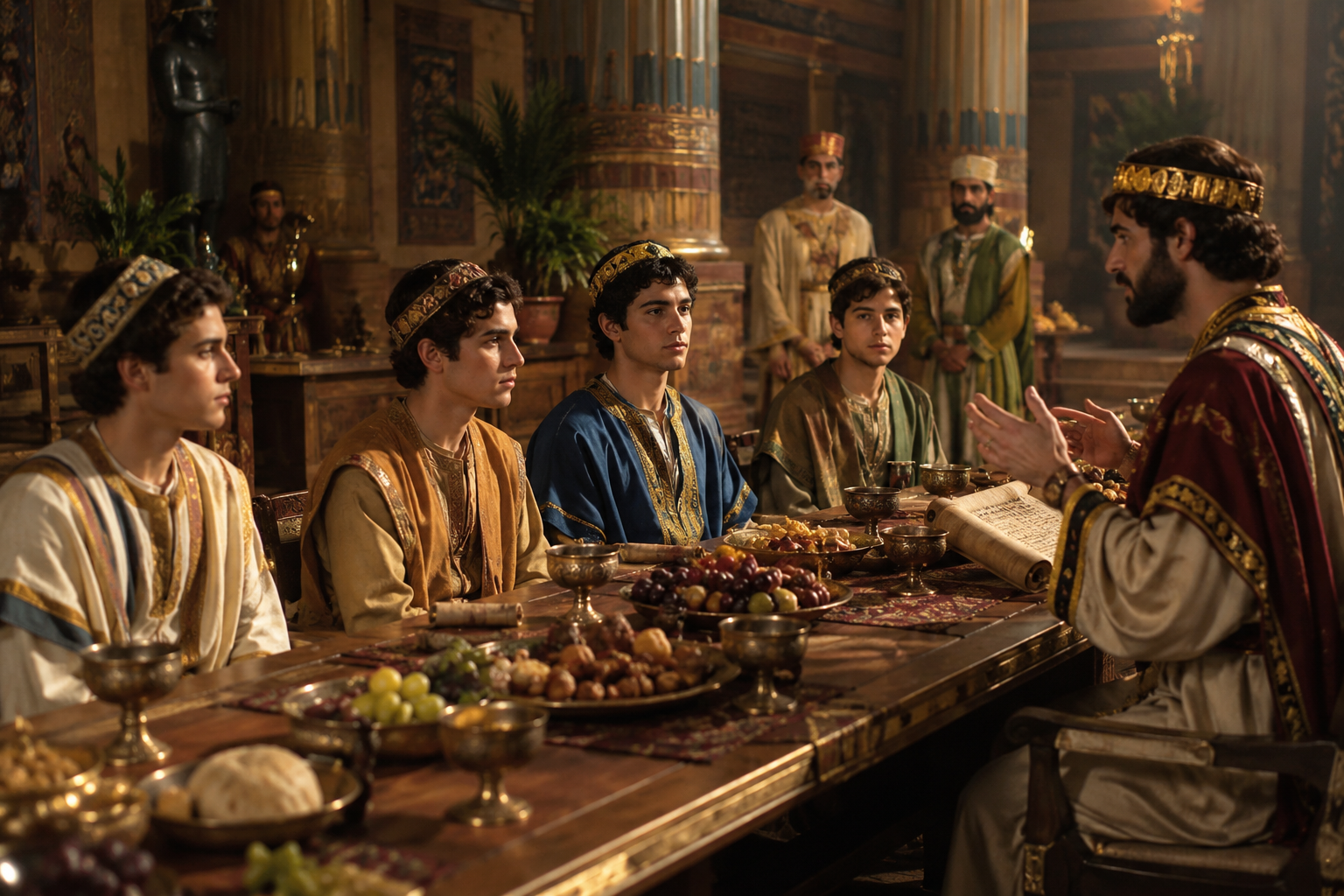
SPIRITUAL WARFARE
INDOCTRINATION 101
The king appointed for them a daily ration from the king's choice food and from the wine which he drank, and appointed that they should be educated three years, at the end of which they were to enter the king's personal service - “Operation Assimilation” continued with a carefully planned three-year program designed to transform these Judean youths into useful servants of Babylon. The goal was clear, to change their way of thinking! Nebuchadnezzar would control their education (Da 1:4), their diet (Da 1:5), their names (Da 1:7), and ultimately their occupation in the royal court. The daily provisions from the king's own table may have appeared to be an extraordinary privilege, but they also represented another powerful means of drawing the young captives into dependence upon and identification with Babylonian life. At the end of three years they were to “stand before the king,” an expression describing entrance into his personal royal service. Nebuchadnezzar's objective was not merely to educate these young men but to reshape their identity, worldview, and allegiance so thoroughly that they would think and function as Babylonians. Yet Daniel would demonstrate that it is possible to learn the language of Babylon, understand its literature, and serve effectively within its government without allowing Babylon to capture the heart (Da 1:8). Babylon sought transformation from the outside in. Daniel's allegiance to God worked from the inside out.
These verses (Da 1:4, 5) introduces us to the beginning of the training (a euphemism for sophisticated brain washing) of these godly young men in the ways of the (fallen, anti-God) world system, one of the three mortal enemies of every believer in every age - (1) the fallen world system (kosmos ~ world system), (2) our fallen flesh and (3) a fallen angel, the Devil (diabolos). It therefore behooves us to study how Daniel was able not just to survive, but to succeed, in the face of such an overt assault on his Biblical worldview. Then we need to choose to dare to be like Daniel, a choice which will surely bring us in conflict with the "majority opinion".
They were exposed to Babylonian education
at its very best, or rather at its pagan worst.
-- Donald Campbell
To reiterate Nebuchadnezzar was not interested only in education but indoctrination! Beloved, our children in America are being exposed to the same godless agenda, for the enemy of our souls knows that the future of a nation is not on Wall Street or in Washington as much as it is in our children.
David Jeremiah adds "The king’s intention was not just to educate these young men, but to brainwash them. He wanted them to look like Jews on the outside but be Babylonian on the inside. This is the aim of most secular universities if the professors do not know Christ; they don’t care if you look like a Christian on the outside, attending church or marking a denominational choice on your college application, as long as they can teach you to think like a humanist on the inside. The cunning strategy of the king was to offer them food and wine worthy of the royal household. He wanted them to be so accustomed to the good life that they would never be tempted to return to their old ways. He wanted them to be obligated to him. Another brainwashing tactic." (See The Handwriting on the Wall: Secrets from the Prophecies of Daniel)
Indoctrinate - Webster says this means to imbue with a usually partisan or sectarian opinion, point of view, or principle. To cause to accept a set of beliefs uncritically through repeated instruction.
Ray Stedman - If you are working in a company surrounded by a godless crowd who are taking the name of God in vain every moment, who agree with the ideas and attitudes of the world and its ways, and who make fun of the things of God, showing little interest in what God says to mankind, then I suggest that you read carefully the book of Daniel. (Daniel - On the Way to the Future)
Daniel 1:6 Now among them from the sons of Judah were Daniel, Hananiah, Mishael and Azariah.
KJV Now among these were of the children of Judah, Daniel, Hananiah, Mishael, and Azariah:
NET As it turned out, among these young men were some from Judah: Daniel, Hananiah, Mishael, and Azariah.
NLT Daniel, Hananiah, Mishael, and Azariah were four of the young men chosen, all from the tribe of Judah.
BGT καὶ ἦσαν ἐκ τοῦ γένους τῶν υἱῶν Ισραηλ τῶν ἀπὸ τῆς Ιουδαίας Δανιηλ Ανανιας Μισαηλ Αζαριας
--- Daniel (TH) 1:6 καὶ ἐγένετο ἐν αὐτοῖς ἐκ τῶν υἱῶν Ιουδα Δανιηλ καὶ Ανανιας καὶ Μισαηλ καὶ ΑζαριαςLXE Now these were among them of the children of Juda, Daniel, and Ananias, and Azarias, and Misael.
CSB Among them, from the descendants of Judah, were Daniel, Hananiah, Mishael, and Azariah.
ESV Among these were Daniel, Hananiah, Mishael, and Azariah of the tribe of Judah.
NIV Among these were some from Judah: Daniel, Hananiah, Mishael and Azariah.
YLT And there are among them out of the sons of Judah, Daniel, Hananiah, Mishael, and Azariah,
FOUR FAITH
SONS OF JUDAH
Now among them from the sons of Judah were Daniel, Hananiah, Mishael and Azariah - Among them indicates that these four were part of a larger group of Judean youths selected for Nebuchadnezzar's royal training program (Da 1:3–5). They were sons of Judah, young men uprooted from their homeland and transported hundreds of miles into a thoroughly pagan culture. Significantly, each bore a Hebrew name that testified to the God of Israel: Daniel = “God is my Judge,” Hananiah = “Yahweh is gracious,” Mishael = “Who is what God is?” and Azariah = “Yahweh has helped.” Their very names reminded them of who their God was and whose they were. One is reminded on Paul's words in 1Cor 6:19-20 "Or do you not know that your body is a temple of the Holy Spirit who is in you, whom you have from God, and that you are not your own? 20 For (WHY AREN'T BELIEVERS THEIR OWN?) you have been bought with a price: therefore glorify God in your body." Babylon would replace these names with Babylonian ones (Da 1:7) as part of the effort to assimilate them into Babylonian life. Yet while Nebuchadnezzar could change their location, education, diet, and names, he could not compel them to change their allegiance. These four young captives demonstrate that our circumstances may determine where we live, but they need not determine whom we worship. Babylon had possession of their bodies, but God possessed their hearts!
David Jeremiah on Daniel - Daniel is the man. No matter how his critics have tried to discredit him or belittle the book that bears his name, they have failed miserably. Their names are forgotten, and his name lives on as a man of intense integrity and profound piety. We cannot pass him off today as just the man in the lions’ den or a dreamer of surrealistic dreams. To know Daniel is to learn how to live today and look at the future with confidence (see Heb 6:12). This is not merely a biography of someone we should know, but an outline of our future. It’s not the images in a crystal ball or the babbling of a clairvoyant, but the truth contained in the Book of books. (The Handwriting on the Wall - Page 19)
Tony Garland - Daniel's name means either “God is judge” or “God is my judge.” Like Cyrus, who Isaiah prophesied was named by God (Isaiah 45:3), I believe Daniel's name was specifically arranged by God in order to underscore a primary theme of the book: the judgment of the nations (both Jew and Gentile). (Daniel - Introduction Part 2)
Daniel - The Hebrew name is found 28x in OT - 1Chr 3:1; Ezra 8:2; Neh 10:6; Ezek 14:14, 20; Ezek 28:3; Dan 1:6ff, 17, 19, 21; Dan 8:1, 15, 27; Dan 9:2, 22; Dan 10:1f, 7, 11f; Dan 12:4f, 9
John MacArthur - INTEGRITY TRIUMPHS OVER PERSONAL LOSS -- DANIEL 1:6-7 (Strength for Today: Daily Readings for a Deeper Faith)
You can’t always prevent personal loss,
but you can respond to it in ways that glorify God.
It was a quiet January morning in the San Fernando Valley of Southern California until suddenly and without warning the earth shook with such a violent force that many department stores, apartment houses, homes, and freeway overpasses crumbled under the strain. Within minutes the 1994 Northridge earthquake left scars upon lives and land that in some cases may never heal. Such catastrophic events remind us of just how difficult dealing with personal loss can be.
Daniel, Hananiah, Mishael, and Azariah understood personal loss. Perhaps in our day only those who have suffered as prisoners of war or as refugees from war’s ravages can fully appreciate the deep sense of loss those men must have felt after being cut off from family, friends, and homeland.
Their loss included even their own names. When taken captive, each of them had a Hebrew name that reflected his godly upbringing. But in an apparent effort to remove that influence and to exalt the pagan deities of Bel (or Baal) and Aku, Nebuchadnezzar’s commander changed their names from Daniel (which means “God is judge”) to Belteshazzar (“Bel provides” or “Bel’s prince”), from Hananiah (“the Lord is gracious”) to Shadrach (“under the command ofAku”), from Mishael (“Who is what the Lord is?”) to Meshach (“Who is what Aku is?”), and from Azariah (“the Lord is my helper”) to Abed–nego (“the servant of Nebo [the son of Baal]”).
Daniel and his friends couldn’t prevent their losses, but they could trust God and refuse to let those losses lead to despair or compromise. That’s an example you can follow when you face loss.
✧✧✧
Suggestions for Prayer: Ask the Lord for the wisdom to see your losses through His loving eyes, and for the grace to respond appropriately. ✧ Pray for those whom you know who have suffered loss recently.
For Further Study: Read Job 1:13–22. How did Job respond to his losses? ✧ What can you learn from his example?
Daniel 1:7 Then the commander of the officials assigned new names to them; and to Daniel he assigned the name Belteshazzar, to Hananiah Shadrach, to Mishael Meshach and to Azariah Abed-nego.
KJV Unto whom the prince of the eunuchs gave names: for he gave unto Daniel the name of Belteshazzar; and to Hananiah, of Shadrach; and to Mishael, of Meshach; and to Azariah, of Abednego.
NET But the overseer of the court officials renamed them. He gave Daniel the name Belteshazzar, Hananiah he named Shadrach, Mishael he named Meshach, and Azariah he named Abednego.
NLT The chief of staff renamed them with these Babylonian names: Daniel was called Belteshazzar. Hananiah was called Shadrach. Mishael was called Meshach. Azariah was called Abednego.
BGT καὶ ἐπέθηκεν αὐτοῖς ὁ ἀρχιευνοῦχος ὀνόματα τῷ μὲν Δανιηλ Βαλτασαρ τῷ δὲ Ανανια Σεδραχ καὶ τῷ Μισαηλ Μισαχ καὶ τῷ Αζαρια Αβδεναγω
--- Daniel (TH) 1:7 καὶ ἐπέθηκεν αὐτοῖς ὁ ἀρχιευνοῦχος ὀνόματα τῷ Δανιηλ Βαλτασαρ καὶ τῷ Ανανια Σεδραχ καὶ τῷ Μισαηλ Μισαχ καὶ τῷ Αζαρια ΑβδεναγωLXE And the chief of the eunuchs gave them names: to Daniel, Baltasar; and to Ananias, Sedrach; and to Misael, Misach; and to Azarias, Abdenago.
CSB The chief official gave them other names: he gave the name Belteshazzar to Daniel, Shadrach to Hananiah, Meshach to Mishael, and Abednego to Azariah.
ESV And the chief of the eunuchs gave them names: Daniel he called Belteshazzar, Hananiah he called Shadrach, Mishael he called Meshach, and Azariah he called Abednego.
NIV The chief official gave them new names: to Daniel, the name Belteshazzar; to Hananiah, Shadrach; to Mishael, Meshach; and to Azariah, Abednego.
YLT and the chief of the eunuchs setteth names on them, and he setteth on Daniel, Belteshazzar; and on Hananiah, Shadrach; and on Mishael, Meshach; and on Azariah, Abed-Nego.
- Daniel: Da 2:17 Eze 14:14,20 Eze 28:3 Mt 24:15 Mk 13:14
WHAT'S THE BIG DEAL
ABOUT A NAME?
Then the commander of the officials assigned new names - Why? Clearly this was part of the process of "Babylonization" of the boys. By calling them by names that glorified the idolatrous gods of Babylon the captors sought in effect to obliterate from their memory their given Hebrew names all of which glorified the only true and living God. Their Hebrew names indicate their relationship to the God of Israel, truth which their god fearing parents meant to convey.
There was no divine law prohibiting a name change, even a change to a pagan name! After interpreting Pharaoh's dreams, the Pharaoh exalted Joseph to second in command in Egypt and changed his name to "Zaphenath-paneah [Note: Probably Egyptian for "God speaks; he lives"]; and he gave him Asenath, the daughter of Potiphera priest of On, as his wife. And Joseph went forth over the land of Egypt." (Ge 41:45)
- Daniel = “God is my judge” > Belteshazzar = “Bel Protect the King.” (Isa 46:1; Jer 50:2; Jer 51:44). Every time His name was called it was a good thing reminder that one day he would stand before a holy God (cp 2Co 5:10) . Most of don't possess the name "Daniel" but we need to conduct ourselves as if that were our name!
- Hananiah = “Jehovah is Gracious” > Shadrach = “Command of Aku (Babylonian idolatrous god)."
- Mishael = “Who is like God?” > Meshach = “Who is what Aku (Babylonian idolatrous god) Is?”
- Azariah = “Jehovah is my Helper” > Abed-nego = “Servant of Nego (Babylonian idolatrous god)” also called Nebo, a god of vegetation (cf. Isa 46:1).
David Jeremiah writes "What cunning strategy! Try to get them to forget their homes, their lifestyle, and everything about their godly Jewish heritage." (See The Handwriting on the Wall: Secrets from the Prophecies of Daniel)
NET NOTE - The language of the Chaldeans referred to here is Akkadian, an East Semitic cuneiform language. The meanings of the Babylonian names are more conjectural than is the case with the Hebrew names. The probable etymologies are as follows: Belteshazzar means “protect his life,” although the MT vocalization may suggest “Belti, protect the king” (cf. Dan 4:8); Shadrach perhaps means “command of Aku”; Meshach is of uncertain meaning; Abednego means “servant of Nego.” Assigning Babylonian names to the Hebrew youths may have been an attempt to erase from their memory their Israelite heritage.
Tony Garland - Although there can be little doubt that the young men disliked their assigned names, they realized that what they were called by other people would not change their devotion to the One True God. They wisely determined not to take a stand because it would not compromise their walk with God. Thus, the young men demonstrate great wisdom at an early age. Besides, they had precedent for accepting a foreign name—Joseph in Egypt.
The Jews seemed to accept as a matter of course the fact that they were required to have foreign names in addition to those in Hebrew. For example, Joseph was given an Egyptian name by Pharaoh (Ge 41:45), and Hadasseh is known by her foreign name, Esther (Est. 2:7).... Many Jews in New Testament times had Greek as well as Hebrew (or Aramaic) names. An example is Peter (Greek), who is called Cephas in Aramaic (cf. John 1:42). Saul is also better known by his Roman name, Paul.206
This is an important principle: believers are not called to take a stand on things where God has not specifically spoken, but to seek peace where no principle of God is directly violated (Rom. 12:18) (“Sometimes Christians argue over the things where God hasn’t spoken, while allowing the things He has spoken to slip under the rug.”—Jeremiah, The Handwriting on the Wall: Secrets from the Prophecies of Daniel, 32.)
David Jeremiah - When God gives us a hard thing to do, there are many reasons not to do it. We can construct all sorts of rationale. Satan has the lists made up for us to follow.
Daniel could have thought, “Wait a minute, I’m just a kid. Why should I be expected to turn down the good life?” Or he could have said, “Look at all of those other fellows. Why should just four of us be denied the king’s meat and wine? After all, everybody else is living it up!”
Daniel could have said, “I’m away from home, and Mom and Dad will never know.” Someone said that the test of true character is what you do when you know absolutely nobody will find out. Daniel also knew that if he disobeyed, he might not be around very long—Nebuchadnezzar had a reputation for throwing people into the furnace. It was one of his favorite indoor sports. In fact, Jeremiah told about a time when Nebuchadnezzar decided he didn’t like someone and had him slowly roasted in the fire while others watched.
Here’s the best excuse of all. Daniel could have reasoned, “Now, Lord, I know this isn’t exactly right, and I probably shouldn’t do this, but I really want a place of leadership in the kingdom, and I know You could really use me if I were your representative to Nebuchadnezzar.” Isn’t that spiritual? However, Daniel had learned that it is never right to do wrong in order to do right.
Daniel didn’t make a fuss when his name was changed, nor when they wanted him to go to Babylon University, but when they tried to feed him the king’s meat he refused. Why? In the Old Testament there is no prohibition against taking another name. There is no command against learning what other people have to teach. Moses and Joseph were both assimilated into other cultures. However, in the Bible there is strong prohibition against eating that which has been offered to idols. Where God said no, Daniel said no.
Sometimes Christians argue over the things where God hasn’t spoken, while allowing the things He has spoken to slip under the rug. There are certain things God says are wrong. Immorality is wrong. Adultery is wrong. Homosexuality is wrong. Fornication is wrong. God draws the line on what our sexually stimulated society is offering today. If we want the blessing of God upon our lives, we better have the courage and authority to stand as Daniel stood and say, “I will not defile myself, because God has said no.”
The same strength that armed Daniel to be a tough-minded teenager and a man of courage is available to us. The marvelous thing is how God blesses when a person is committed. Daniel was not a second-rate believer, obeying God when he felt like it or when it was convenient. As a result, he was blessed in some incredible ways. (See The Handwriting on the Wall: Secrets from the Prophecies of Daniel)
ILLUSTRATION - Donald Campbell (BORROW Daniel Decoder of Dreams) - The tiny country of Albania has recently adopted ancient Babylon's practice by ruling that the names of its citizens must reflect that state's ambitions and priorities. Christianity Today, March 26, 1976, p. 27, reported:
"[Albania] has joined the list of countries taking away one of the most personal and private possessions of its citizens: their names...After all, someone named Abraham or Ruth or Mark might someday wonder where his name came from! And that could lead to a time-consuming search for a Bible or other religious literature. In the process, the unfortunately named Albanian might absorb some of the teachings of the outlawed book. That result, in the view of the government would be very bad."
Daniel 1:8 But Daniel made up his mind that he would not defile himself with the king's choice food or with the wine which he drank; so he sought permission from the commander of the officials that he might not defile himself.
KJV But Daniel purposed in his heart that he would not defile himself with the portion of the king's meat, nor with the wine which he drank: therefore he requested of the prince of the eunuchs that he might not defile himself.
NET But Daniel made up his mind that he would not defile himself with the royal delicacies or the royal wine. He therefore asked the overseer of the court officials for permission not to defile himself.
NLT But Daniel was determined not to defile himself by eating the food and wine given to them by the king. He asked the chief of staff for permission not to eat these unacceptable foods.
BGT καὶ ἐνεθυμήθη Δανιηλ ἐν τῇ καρδίᾳ ὅπως μὴ ἀλισγηθῇ ἐν τῷ δείπνῳ τοῦ βασιλέως καὶ ἐν ᾧ πίνει οἴνῳ καὶ ἠξίωσε τὸν ἀρχιευνοῦχον ἵνα μὴ συμμολυνθῇ
--- Daniel (TH) 1:8 καὶ ἔθετο Δανιηλ ἐπὶ τὴν καρδίαν αὐτοῦ ὡς οὐ μὴ ἀλισγηθῇ ἐν τῇ τραπέζῃ τοῦ βασιλέως καὶ ἐν τῷ οἴνῳ τοῦ πότου αὐτοῦ καὶ ἠξίωσε τὸν ἀρχιευνοῦχον ὡς οὐ μὴ ἀλισγηθῇLXE And Daniel purposed in his heart, that he would not defile himself with the king's table, nor with the wine of his drink: and he intreated the chief of the eunuchs that he might not defile himself.
CSB Daniel determined that he would not defile himself with the king's food or with the wine he drank. So he asked permission from the chief official not to defile himself.
ESV But Daniel resolved that he would not defile himself with the king's food, or with the wine that he drank. Therefore he asked the chief of the eunuchs to allow him not to defile himself.
NIV But Daniel resolved not to defile himself with the royal food and wine, and he asked the chief official for permission not to defile himself this way.
YLT And Daniel purposeth in his heart that he will not pollute himself with the king's portion of food, and with the wine of his drinking, and he seeketh of the chief of the eunuchs that he may not pollute himself.
- made up = purposed in KJV: Ru 1:17,18 1Ki 5:5 Ps 119:106,115 Ac 11:23 1Co 7:37 2Co 9:7
- Defile - note this is repeated - Lev 11:44-47 Dt 32:38 Ps 106:28 Ps 141:4 Eze 4:13,14 Ho 9:3,4 Ac 10:14, 15, 16 Ro 14:15, 16, 17 1Co 8:7, 8, 9, 10 1Co 10:18, 19, 20, 21,28, 29, 30, 31
Related Passages:
Proverbs 4:23 Watch over your heart with all diligence, For from it flow the springs of life.
Leviticus 11:44-47 ‘For I am the LORD your God. Consecrate yourselves therefore, and be holy, for I am holy. And you shall not make yourselves unclean with any of the swarming things that swarm on the earth. 45 ‘For I am the LORD who brought you up from the land of Egypt to be your God; thus you shall be holy, for I am holy.’” 46 This is the law regarding the animal and the bird, and every living thing that moves in the waters and everything that swarms on the earth, 47 to make a distinction between the unclean and the clean, and between the edible creature and the creature which is not to be eaten.
DANIEL'S CHOICE SETS THE
COURSE OF HIS ENTIRE LIFE
But - Term of contrast. Did that change him? So a pagan name is contrasted with a committed heart.
But Daniel - "But" always marks a contrast (see importance of analyzing this term of contrast), and in this case instead of "going with the flow" or "taking the easy road", Daniel and his 3 friends chose the "narrow road". Daniel had just been given a Babylonian name but that did not change him. Is it any surprise that "God granted Daniel favor"? From Genesis to Revelation the way to experience the "good hand of the LORD", the blessing of the LORD, is to conduct one's self in obedience to the revealed will of God. Jesus reaffirmed this basic Scriptural principle in Luke declaring "On the contrary (to Lk 11:27), blessed are those who hear the word of God, and observe it." (Lk 11:27, cp Ezra 7:9, 10)
Reading the Word is not enough. We must heed (obey) what we read. And here is where the problems begin to arise as one "tries" to obey in their own power only to fall into the subtle trap of legalism and self-effort. Under the New Covenant, believers have the Holy Spirit to enable obedience to the revealed will of God in the Word of God, but we must learn to walk by the Spirit (Gal 5:16).
Everything that follows in this book hinges upon
the fact that Daniel purposed in his heart to do what was right.
-- David Jeremiah
Daniel made up his mind (leb; LXX - kardia = the center and source of the whole inner life) - KJV = purposed in his heart. NAS Marginal Note = set upon his heart. The heart encompasses one's thinking, feeling, and choosing, including the mind, emotions, and will. Thus Daniel did not make a casual or impulsive decision; he deliberately resolved in the deepest part of his being that he would not defile himself. His conviction was settled before the test came. Think of the heart as the “control center” of one's life, like an air traffic controller directing what is permitted to enter and determining the course of one's thoughts, choices, and conduct (cf. Pr 4:23). Daniel settled the matter in his heart before he had to live it out with his life.
Related Resources:
- Give Me An Undivided Heart
- Heart - Kardia (Greek Word Study)
- Heart - Leb, Lebab (Hebrew Word Study)
- Integrity - A Whole Heart - especially as seen in the life of Daniel!
- Proverbs 4:23 Commentary
Grant Richison - The word “purposed” carries the idea of decided resolution. Daniel’s character was already formed for following God before the test came to him. The phrase “purposed in his heart” could be translated “laid upon his heart.” Daniel put himself under the full commitment to follow his heart. PRINCIPLE: An all-consuming purpose to live for the glory of God will enable us to meet spiritual tests of life. (Daniel 1:8)
Gleason Archer - Rather than break faith with God, Daniel was willing to risk expulsion from the Royal Academy with the disgrace and danger that entailed. His priorities were firm. (Expositor's Bible Commentary)
Jerry Bridges - We need not only a commitment to holiness as a total way of life, but frequently a commitment regarding specific areas of temptation. Job made a personal covenant not to look lustfully at young women (Job 31:1). Daniel resolved not to defile himself with forbidden food, even though from the king’s table (Da 1:8). These two Old Testament saints are commended by God Himself as among the most righteous who ever lived (Ezekiel 14:14); yet both found it necessary to make a commitment regarding some specific area of temptation. Job found his temptation in his own breast; Daniel found his in his particular circumstances. Both responded with a commitment to obey God. They lived up to their convictions.
That he would not defile (gaal; LXX - alisgeo ~ pollute) himself with the king's choice food or with the wine which he drank - ESV = "Therefore he asked the chief of the eunuchs to allow him not to defile himself." Daniel had clearly been taught Leviticus 11:1-47 and was determined not to be defiled. They could change his not but not his heart!
Daniel did not downplay this issue and chose a strong word defile (gaal), emphasizing the point that he was bold and courageous, not fearing the king. The idea of "defile" is that of polluting or staining something (cp Jas 1:27)
THOUGHT - How do you feel when you are watching TV or a movie and they take the Name of "Jesus" in vain, even using it as a curse word? Even more convicting, how to you respond? Do you "come apart from them" (cp 2Co 6:17 - The major part of this quotation (after the Lxx with several changes) is from Isa 52:11. The reference in Isaiah is to the captive nation leaving Babylon and returning to their own land, but the spiritual application is to the separation of the people of God today. God commands His people to “come out,” which implies a definite act on their part. Get out, escape for with your life like Joseph when he fled from Potiphar's wife IN Ge 39:12! Flee! 2Ti 2:20, 21, 22, 1Co 6:18 Isa 52:11; Jer 51:6 Rev 18:4 Nu 16:21,26,45 Ezra 6:21, Ezra 10:11, Pr 9:6 Note command come out of "Babylon" Isa 52:11, Jer 51:45; Rev 18:4.Nu 33:51-56 cp Ex 23:24,33; Ex 34:13; Dt 7:2,5; Dt 12:3; Jos 11:12; Jdg 2:2)
So (therefore - term of conclusion) - Based on the volitional (free will) choice he had made, he would not rebel but would humbly submit to his superiors. We are beginning to see into the inner working of this man later called highly esteemed (Da 9:23, 10:11, 10:19). And don't forget, this could have cost him his life for we see in Daniel 3 the king did in fact cast Daniel's 3 friends into the fire for refusing to bow to his image.
He sought permission from the commander of the officials that he might not defile himself - Conviction with courtesy. Daniel's inward conviction immediately produced outward action. Having made up his mind not to defile himself, he did not become rebellious or demanding but sought permission from the official God had placed over him. Daniel's courage was accompanied by courtesy. He would not compromise his allegiance to God, yet neither would he unnecessarily dishonor human authority. This is an important balance in biblical obedience. When human requirements conflict with God's will, “we must obey God rather than men” (Acts 5:29), but our manner should still demonstrate “gentleness and reverence” (1Pe 3:15; cf. Pr 15:1; Col 4:6). Daniel did not use conviction as an excuse for contentiousness. He respectfully sought a way to remain faithful to God while honoring the authority over him. Biblical conviction is firm about truth but gracious in its expression.
What's the big deal about the king's choice food? For one thing, the fact that it was the "King's choice food" would be a constant reminder of the source of their daily bread. It is interesting that in the model prayer, one of the first requests is "Give us this day our daily bread." (Mt 6:11) The decision Daniel makes here radically changes his entire life. It's interesting that when we first read about it, it doesn’t seem like such a big deal. But it turns out to be very big indeed as the "rest of the story" demonstrates. It is interesting to note that part of Israel’s judgment during dispersions among the Gentiles was their assumed partaking of unclean foods (Ezek 4:13-14; Hos. 9:3).
THOUGHT - Have you ever heard the saying "We make our decisions and our decisions turn around and make us"? Certainly this proved true in Daniel's case, just as in Joseph's (Ge 39:9, cp Ge 38:21), Ruth's (Ru 1:16, 17), Moses (Heb 11:24, 25, 26, 27) and a host of other saints many nameless and unknown, except to God Who will cause them to shine forth like stars throughout eternity (cp Da 12:3). A choice in time yields a destiny in eternity. It is interesting that many of these "destiny changing" decisions are made when we are younger, like Daniel and his 3 friends. We are who we are today because of decisions and choices we made years ago. Two roads diverge in the woods. Which one will we follow?
ESV Study Bible - Many have thought that the four men’s resolve came from their intent to eat only ceremonially clean food, not any “unclean” food as specified in Lev. 11:1-47 and Deut. 14:3-20—much as a group of Jewish priests later did in Rome, eating only figs and nuts (see Josephus, Life of Josephus 14; cf. Ro. 14:2). That may be part of the explanation, for the Babylonians would have eaten such things as pork, which was unclean for Jews. But wine (Dan. 1:8) would not have been prohibited by any law in Jewish Scripture, so that cannot be the entire explanation (unless the young men feared that somehow the wine had been polluted through failure to grow the grapes according to the rule of Lev. 19:25-28; cf. Deut. 20:6). Another view is that they feared the meat and wine would have been first offered to Babylonian idols. Again, this may have provided part of the reason for their reluctance to partake of the Babylonian food, but the vegetables and grains would probably also have been offered to idols, so that does not seem to be the most persuasive explanation. A third view, that they were following a vegetarian diet for health reasons, is unhelpful, because no OT laws would have taught them that (modern) idea. A fourth view combines elements of the first two, and seems the best explanation: Daniel and his friends avoided the luxurious diet of the king’s table as a way of protecting themselves from being ensnared by the temptations of the Babylonian culture. They used their distinctive diet as a way of retaining their distinctive identity as Jewish exiles and avoiding complete assimilation into Babylonian culture (which was the king’s goal with these conquered subjects). With this restricted diet they continually reminded themselves, in this time of testing, that they were the people of God in a foreign land and that they were dependent for their food, indeed for their very lives, upon God, their Creator, not King Nebuchadnezzar. (It is possible that Daniel later came to accept some of the Babylonian food; see Dan. 10:3.)
Elisabeth Eliot, a very wise saint, once said "Does it make sense to pray for guidance about the future if we are not obeying in the thing that lies before us today? How many momentous events in Scripture depended on one person’s seemingly small act of obedience! Rest assured: Do what God tells you to do now, and, depend upon it, you will be shown what to do next." (The Joy of Obedience)
THOUGHT - God blessed Daniel’s obedience exceeding abundantly beyond all he could have asked or thought (cf. Eph 3:20). The next time you come to a spiritual, ethical, or moral crossroads, remember Daniel’s decision to purpose in his heart over what might have seemed like a relatively small matter (Da 1:8). Small compromises can have large consequences. A single act of disobedience may seem insignificant from our earthly perspective, but no act of obedience is insignificant to God, and either choice may have ramifications we cannot foresee. Daniel did not know where his decision would lead; he simply knew whom he must obey. So when you face your next crossroads, purpose in your heart beforehand to trust God and obey His Word, leaving the consequences with Him (Pr 3:5-6). As the old hymn so simply puts it, “Trust and obey.”
Baldwin has another thought on why Daniel may have refused the food noting that "by eastern standards to share a meal was to commit oneself to friendship; it was of covenant significance...The defilement he feared was not so much a ritual as a moral defilement, arising from the subtle flattery of gifts and favors which entailed hidden implications of loyal support, however dubious the king's future policies might prove to be. (Ed Note: One is reminded of Jesus in Re 3:20 which clearly speaks of a spiritual intimacy associated with sharing a meal. Dining conveys the idea of intimate fellowship in Lk 19:5, 6, 7; John 13. See also Covenant The Oneness of Covenant which discusses how the sharing of a meal was a symbolic gesture in a covenant relationship) (Quoted in Daniel- Everyman's Bible Commentary - Page 30)
CRISES ARE GOOD TESTS
OF OUR CHARACTER
Remember that this is a time of crisis in Judah, and the "opportunity" to rise to the top in Babylonian government and society would have been a great temptation (we have no record of any of the other "youths" taking an uncompromising stand like Daniel). Times of crisis help to hone and develop one's character, but such times also test the mettle of our character. In other words, how we respond when difficulties arise says a lot about our character and our trust in God's sovereignty. You've probably not been ripped from your native country, the comforts of your home, your family and taken to a foreign land, but you have doubtless experienced many "smaller" crises (but not small to you!). How have your responded? Your answer says much about your belief in God and your character. Remember, reputation is what others think of you, but character is what God knows is true of you (cp 1Sa 16:7)
Daniel faced the same challenge every believer of ever age faces...to obey the command of God not to be "conformed to this world, but be transformed by the renewing of your mind, that you may prove what the will of God is, that which is good and acceptable and perfect." (Romans 12:2)
As Phillips paraphrases Romans 12:2 "Don't let the world ("Babylon") around you squeeze you into its own mold, but let God re-mould your minds from within, so that you may prove in practice ("make up your mind", "purpose in your heart") that the plan of God for you is good, meets all His demands and moves towards the goal of true maturity."
What pressures might have tempted Daniel to conform to the Babylonian lifestyle?
(1) Spiritual pressure - Daniel was in the birthplace of idolatry and false religion (Rev 17:6)
(2) Intellectual Pressure - Three years in the "University of Babylon" which must surely have included courses in "astrology" and other pagan practices.
(3) Peer Pressure - While we have to be careful when the Scripture is silent, Daniel has no record that other Jewish youths refused to bow to the pressures of the wealth and power of Babylon. After all when you're in Babylon, you do as the Babylonians do. No. Not everyone did. Specifically not Daniel and his friends. They had their priorities straight! The question that comes to mind is "Who do you want to please?". Do you want to please your peers, mere men or do you want to please the Almighty God? (cp 2Co 5:9)
Paul gave a similar charge to his half Jewish young disciple, Timothy
Therefore, if a man cleanses himself from these things (false teachers, false teaching), he will be a vessel for honor, sanctified (set apart), useful to the Master, prepared for every good work. Now flee (present imperative = Command to do this continually.) from youthful lusts, and pursue (present imperative = Command to do this continually) righteousness, faith, love and peace, with those who call on the Lord from a pure heart (Do you observe anything that reminds you of Daniel 1? Was he by himself?). (2Ti 2:21, 2Ti 2:22)
Gleason Archer - By their early refusal to disobey God, they prepared themselves for future greatness as true witnesses for the one true God in the midst of a degenerate pagan culture. It is significant that precisely in the matter of forbidden food, in which Satan successfully tripped up Adam and Eve (Ge 2:16, 17, Ge 3:1, 2, 3, 4, 5, 6, 7), these four Hebrew youths passed their first test with flying colors. (Ibid)
John MacArthur emphasizes that Daniel 1:8 and the succeeding passages emphasize that Daniel had an unashamed boldness, and that this God pleasing trait is mentioned directly or indirectly a number of times in Scripture, for example see Ps 71:15, Da 3:13, 14,15, 16, 17, 18, 1Pe 4:16, Ps 119:46, Php 1:27, 28, 29.
NET NOTE - Various reasons have been suggested as to why such food would defile Daniel. Perhaps it had to do with violations of Mosaic law with regard to unclean foods, or perhaps it had to do with such food having been offered to idols. Daniel’s practice in this regard is strikingly different from that of Esther, who was able successfully to conceal her Jewish identity
Defile (pollute, stain) (01351) gaal signifies ritual pollution or contamination that makes one ceremonially unclean (La 4:14) and thus disqualifies or renders them unfit for divine service (Ezra 2:62, Neh 7:64). Ga'al means to defile, to pollute, to stain, to make impure. In Isa 59:3 one's hands are polluted with blood. In Isa 63:3 Messiah's garment is polluted with blood as a result of His judgment of the nations. This ritual pollution or contamination is the result of some violation of the holiness code specified in the law of Moses (in this case the laws concerning acceptable animal sacrifices, cf. Lev 22:17–25; Deut 15:21).
R. Laird Harris says - This root doubtless is to be distinguished from gā'al I, “to redeem.” It appears that this root is a secondary formation from the similar root gā'al found also in Aramaic, meaning “abhor,” “loathe.” (See online Theological Wordbook of the Old Testament)
GAAL - 9V - Ezr. 2:62; Neh. 7:64; Isa. 59:3; Isa. 63:3; Lam. 4:14; Dan. 1:8; Zeph. 3:1; Mal. 1:7; Mal. 1:12
Some lasting principles (from Insight for Living) - (1) Inner conviction can overcome any outer pressure to compromise. (2) God-honoring convictions yield God-given rewards.
Henry Blackaby - But Daniel . . .
But Daniel resolved not to defile himself with the royal food and wine, and he asked the chief official for permission not to defile himself this way.Daniel 1:8
If Daniel were strictly to examine the facts, they would look something like this:
• Fact: He was far from home, facing the temptation to do things he knew were wrong.
• Fact: His parents would never find out if he gave in to the temptation.
• Fact: Most of his friends were sinning and encouraging him to join them.
• Fact: The most powerful king on earth wanted him to give up his beliefs in return for wealth and power. That would be a welcome change from his current status as a foreigner in a hostile land.
The facts seemed to indicate that it was in Daniel’s best interest to abandon his faith and take up this foreign religion. Then comes the word but. “But Daniel” made a commitment in his heart not to compromise his faith in God, no matter how tempting it was and no matter what the price he would have to pay for his obedience to God.
It’s something to think about, isn’t it? Others seem to be doing whatever they please. . . . Mom and Dad will never find out. . . . There are certain rewards for following the crowd. . . . But . . . I’ve made a commitment not to compromise my Christianity no matter what others are doing. No matter what the cost, no matter what others think or say, no matter what it takes, I will be faithful to God. You must decide whether you will be faithful to God regardless of what even your best friends are doing. God will bless you for your faithfulness, just as he blessed Daniel for his.
FOWELL BUXTON - The longer I live, the more I am certain that the great difference between men, between the feeble and the powerful, the great and the insignificant, is energy, invincible determination—a purpose once fixed, and then death or victory!
D L Moody - I CAN imagine men saying to Daniel, “Look here, young man, you are too puritanical. Don’t be too particular; don’t have too many religious scruples. Bear in mind you are not now in Jerusalem. You will have to get over these notions, now you are here in Babylon. You are not now surrounded by friends and relatives. You are not a Jerusalem prince now. You have been brought down from your high position. You are now a captive. And if the monarch hears about your refusing to eat the same kind of meat that he eats, and to drink the same kind of wine that he drinks, your head will soon roll from off your shoulders. You had better be a little politic.”
But this young man had piety and religion deep down in his heart; and that is the right place for it; where it will grow; where it will have power; where it will regulate the life. Daniel had not joined the company of the faithful few in Jerusalem because he wanted to get into “society,” and attain a position: it was because of the love he had toward the Lord God of Israel.
Donald Campbell (BORROW Daniel Decoder of Dreams) - Daniel was a tribute to the worth of a godly family. A Japanese girl, while studying at an American college, spent a Christmas vacation at the home of a classmate. The experience was a delightful one, and when the visit was over and she was ready to return to the campus, the mother asked, "How do you like the way we Americans live?"
"Oh, I love it," she said. "You have a beautiful home and a wonderful family, but one thing puzzles me. I went with you to church and saw you worship your God there. But I have missed the God in your home. In Japan we have a god-shelf, and we worship our gods right there in the house. Do Americans not worship their God in their houses?" (WOE!)
A thought-provoking and perhaps convicting question!
If we don't worship God in our homes,
we never prepare our families to live as effective Christians in our society.
Dare To Be a Daniel
by Philip Bliss
(Vocal version of Dare to be a Daniel)
(Children singing)
Standing by a purpose true,
Heeding God’s command,
Honor them, the faithful few!
All hail to Daniel’s band!Refrain
Dare to be a Daniel,
Dare to stand alone!
Dare to have a purpose firm!
Dare to make it known.Many mighty men are lost
Daring not to stand,
Who for God had been a host
By joining Daniel’s band.
RefrainMany giants, great and tall,
Stalking through the land,
Headlong to the earth would fall,
If met by Daniel’s band.
RefrainHold the Gospel banner high!
On to vict’ry grand!
Satan and his hosts defy,
And shout for Daniel’s band.
Refrain
DARE TO BE A DANIEL Words and Music by Philip P. Bliss, 1838–1876 - But Daniel resolved not to defile himself … (Daniel 1:8)
Doubt sees the obstacles—Faith sees the way.
Doubt sees the darkest night—Faith sees the day.
Doubt dreads to take a step—Faith soars on high.
Doubt questions, “Who believes?”—Faith answers, “I.”
—Unknown
The book of Daniel is really a textbook of instruction and an example of how God’s people can live in difficult conditions and come through victoriously. Even as the Jewish people were living in Babylonian captivity, so Christians today are pilgrims and sojourners in a foreign culture. We, like Daniel and his friends, must exercise our implicit faith in God’s purposes and leading for our lives. We too must resolve in advance that we will not be defiled by the world. And whether our God delivers us or not from the fiery furnace, we will remain faithful to Him (Daniel 3:17, 18).
Daniel and his friends also personify for us Christian courage at its best—not merely a desperate type of courage for some emergency situation, but a quiet steadfast courage that enables us to live in a Christ-like manner each day. It takes courage to be an unpopular minority when truth and right are involved. It takes courage to defend God’s name when everyone else is using it in blasphemy. It takes courage to be another Daniel in a godless society.
This is another of the fine Sunday school songs by Philip P. Bliss, one of the truly important contributors to both early gospel hymnody and the rise of the Sunday school movement. Bliss, like many other Christian leaders, realized the unusual potential of teaching our youth spiritual truths through appropriate songs.
Standing by a purpose true, heeding God’s command, honor them, the faithful few! All hail to Daniel’s Band!
Many mighty men are lost, daring not to stand, who for God had been a host, by joining Daniel’s Band!
Many giants, great and tall, stalking thro’ the land, headlong to the earth would fall, if met by Daniel’s Band!
Hold the gospel banner high! On to vict’ry grand! Satan and His host defy, and shout for Daniel’s Band!
Refrain: Dare to be a Daniel; dare to stand alone! Dare to have a purpose firm! Dare to make it known.
God is still seeking people who by faith will dare to prove His greatness and will represent Him courageously—regardless of the circumstances. Let this musical line be the desire of your life— (BORROW Kenneth Osbeck - Amazing Grace - 366 Inspiriting Hymn Stories for Daily Devotions).
A W Tozer - The Set of Our Sails - Daniel 1:8
Though we do not hear much of it in this age of spineless religion, there is nevertheless much in the Bible about the place of moral determination in the service of the Lord. “Jacob vowed a vow,” and it was the beginning of a very wonderful life with God.…
Daniel “purposed in his heart,” and God honored his purpose. Jesus set His face like a flint and walked straight toward the cross. Paul “determined not to know any thing among you, save Jesus Christ, and him crucified” (1 Corinthians 2:2).…
These are only a few of the many men … of the Bible who have left us a record of spiritual greatness born out of a will firmly set to do the will of God.…
Let us, then, set our sails in the will of God. If we do this we will certainly find ourselves moving in the right direction, no matter which way the wind blows. (SEE Tozer for the Christian Leader: A 365-Day Devotional)
Wesley H. Hager, Conquering
One ship drives east and another drives west
With the selfsame winds that blow.
’Tis the set of the sails
And not the gales
Which tells us the way to go.
Like the winds of the sea are the ways of fate,
As we voyage along through life—
’Tis the set of a soul
That decides its goal
And not the calm or the strife.
Dwight L Moody - I CAN imagine men saying to Daniel, “Look here, young man, you are too puritanical. Don’t be too particular; don’t have too many religious scruples. Bear in mind you are not now in Jerusalem. You will have to get over these notions, now you are here in Babylon. You are not now surrounded by friends and relatives. You are not a Jerusalem prince now. You have been brought down from your high position. You are now a captive. And if the monarch hears about your refusing to eat the same kind of meat that he eats, and to drink the same kind of wine that he drinks, your head will soon roll from off your shoulders. You had better be a little politic.” But this young man had piety and religion deep down in his heart; and that is the right place for it; where it will grow; where it will have power; where it will regulate the life. Daniel had not joined the company of the faithful few in Jerusalem because he wanted to get into “society,” and attain a position: it was because of the love he had toward the Lord God of Israel.
Wake Up Your Mind - (Daniel 1:8) - Great people usually aren’t smarter, richer or more talented—they’re just more committed. Before you can make a real commitment to anything, you have to overcome three problems: First, the security trap. Insecure people don’t take risks! They always have a “Plan B” in case God doesn’t come through; they depend on things rather than on Him. Next, the success problem. When you’ve had some success, you want to guard it. You want people to continue thinking well of you, so you start living defensively. Then, there’s the satisfaction problem. Listen, “I am rich and increased with goods, and have need of nothing” (Revelation 3:15). If your life is not touched by need, how can you be moved by the needs of others? Great commitments are made in dark hours. When the Battle of Britain began, Churchill rose and said, “Upon this battle depends the survival of Christian civilization. Let us therefore brace ourselves to our duties and so bare ourselves that, if the British Empire lasts for a thousand years, men will say—this was their finest hour.” Make your commitment because it’s right—not because it’s easy. It was after Daniel committed himself that. (Bob Gass - A Fresh Word for Today)
ILLUSTRATION - It is a mistake to think that the "small choices" don't impact on our lives. What may seem small to us (the refusal to eat the king's food) proved to be a watershed event in that led to the good hand of the Lord upon Daniel's life for the next 60+ years! The impact of "small" bad choices is well illustrated by the giant redwood tree. Ray Pritchard tells the story of such a tree...
Every time we compromise
something bad happens in our soul.
This week I read about a 400-year-old redwood that suddenly and without warning toppled to the forest floor. What caused the death of such a majestic giant? Was it fire? Lightning? A strong wind? A post-mortem examination revealed a startling cause. Tiny beetles had crawled under the bark and literally eaten the fibers away from the inside. Although it looked healthy on the outside, on the inside it was virtually hollow and one day finally collapsed. The same thing happens when we refuse to stand our ground for Christ. Every time we compromise something bad happens in our soul. Eventually the little decisions add up and we become hollow on the inside even though we may look great on the outside. Don’t let that happen to you. Godly convictions yield God-given rewards.
Here is the final lesson. What starts with Daniel ends with God. What starts with courage ends with a lifetime of blessing. Look what God did for this courageous teenager: God protected Daniel (when he proposed the test) God prospered Daniel (during the test and afterward) God promoted Daniel (in the eyes of the King) I cannot read this story without thinking of the words of God to Eli in 1Samuel 2:30b, “Those who honor me I will honor.”
I told you in the beginning that this was the crucial event of Daniel’s life. It may not have seemed important at the time, but his decision not to eat the King’s food shaped the next 60 years. We talk about Daniel 2500 years later precisely because of his decision. If he doesn’t make the right choice, the rest of the book never gets written, and he becomes a forgotten Jew in Babylon who looked and acted just like everyone else. I know that in terms of scientific progress, the world has changed since Daniel’s day, but God has not changed. God’s Word has not changed. And the world still tries to seduce us. The good news from Daniel 1 is that it is possible to live for God in high school, in college, at work, and in your career. Daniel has shown us the way. (Dare to be a Daniel - sermon by Dr. Ray Pritchard - November 1999)
ANOTHER TREE ILLUSTRATION - It started as a seedling on the slopes of the Colorado Rockies some 500 years ago. For centuries it had stood tall, enduring violent winds, lightning strikes, blizzards, even avalanches. Now, however, the once-towering tree is just a mound of decaying wood.
What caused its demise? A horde of beetles had attacked it, gnawing away until that skyscraper of nature surrendered to those tiny pests and toppled over.
That's also the tragic story of many Christians. For long years they stood tall for God. They resisted temptations, weathered crises, and were bold in the strength divinely provided. But little sins began to eat away at their lives--little lies, little compromises with greed or lust, sins that gradually eroded their character. And suddenly they fell.
Song 2:15 states, "Catch us the foxes, the little foxes that spoil the vines." This colorful Old Testament verse should sound a loud alarm in our consciences. We must not tolerate the little evils that eat away at the roots of our lives. Otherwise, our once-strong witness for Christ will become a silenced casualty of sin. Let's confess those "tiny" evils to God now, before they lead to a big fall. --Vernon C Grounds (Reprinted by permission from Our Daily Bread Ministries. Please do not repost the full devotional without their permission.)
Nothing between, like worldly pleasure,
Habits of life, though harmless they seem,
Must not my heart from Him ever sever--
He is my all! There's nothing between. --Tindley
A big fall begins with a little stumble.
(I would add a blessed life can begin with what may seem like a little obedience!)
David Jeremiah - Little Decisions and Big Consequences (See The Handwriting on the Wall: Secrets from the Prophecies of Daniel)
At a single moment in time we may make a decision that affects our entire life. All of us have had those experiences. Take a job. Move to another city. Ask her to marry you. Accept Christ as your Savior. Big decisions are the result of a series of little decisions. I found a bit of advice a father gave to his son when he was about to go out into the world. I don’t know who wrote it, but I would like to claim it for my sons.
You’re starting, my boy, on life’s journey.
Along the grand highway of life,
You meet with a thousand temptations.
Each city with evil is rife.
The world is a stage of excitement.
There’s danger wherever you go.
But if you are tempted in weakness,
Have courage, my boy, to say no.
In courage alone lies your safety,
When you the long journey begin
Your trust in the heavenly Father,
Will keep you unspotted from sin.
Temptations will go on increasing
As streams from a rivulet flow.
But if you’d be true to your manhood,
Have courage, my son, to say no.
Be careful in choosing companions.
Seek only the brave and the true.
Stand by your friends when in trial,
Not changing the old for the new.
And when, by false friends you are tempted
The taste of the wine cup to know
With firmness, with patience with kindness,
Have courage, my boy, to say no.
Everywhere you see a compromise struck
in the Bible you also see a loss.
It takes guts to say no, whether it was twenty-six hundred years ago or last night, it makes no difference. The resolution of Daniel is a reminder to us, whether it be in the political realm or the church or business or personal life, that we need not bend the rules to be blessed of God. Success is not dependent upon our compromise. Everywhere you see a compromise struck in the Bible you also see a loss.
Adam compromised God’s law and fell right in with his wife’s sin. He lost paradise.
Abraham compromised the truth and lied about Sarah. He almost lost his wife.
Sarah compromised God’s Word and sent Abraham to her servant, Hagar, who bore Ishmael. We lost peace in the Middle East.
Esau compromised for a meal with Jacob. He lost his birthright.
Aaron compromised his convictions about idolatry. He lost the privilege of seeing the Promised Land.
Samson compromised righteous devotion as a Nazarite. He lost his hair, his strength, his eyes, and his life.
David compromised the moral standard of God and committed adultery with Bathsheba and murdered Uriah. He lost his child.
Solomon compromised his convictions and married foreign wives. He lost the united kingdom.
Ahab compromised and married Jezebel. He lost his throne.
Ananias and Sapphira compromised their word about giving. They lost their lives.
Judas compromised his supposed love for Christ for thirty pieces of silver. He lost his eternal soul.
Is it any different today? The message of our culture is that if you want to get ahead, you’re going to have to break a few rules to do it. I believe that we are hungry in our world today for a few men who will stand up and say, “As Daniel was, so will I be.”
The story is told about some young people who walked into a high school class that was taught by a godless professor. In one of his lectures he said, “Will all of you who believe the myths of the Bible please stand.” Several stood. Then he added, “Now this semester I am going to free you from this religious Bible nonsense. I have read the Bible, and it is certainly written by a bunch of mixed-up men.” One young Daniel stood up and said, “Sir, the Bible is God’s letter to Christians, and if you are confused it’s because you’re reading somebody else’s mail.” (See The Handwriting on the Wall: Secrets from the Prophecies of Daniel)
Refusing The Easy Way
Looking out the window of an airplane, you can see the winding paths of rivers below. Except for some man-made waterways, all rivers have one thing in common—they all are crooked. The reason is simple—they follow the path of least resistance. Rivers find their way around anything that blocks their flow because they take the easy way.
The same can be said for some people. Because they fail to resist the devil, they yield to temptation and deviate from the path God would have them follow. Unlike Daniel, who “purposed in his heart that he would not defile himself” (Daniel 1:8), they bend to worldly pressures and compromise what they know is right.
Writing to followers of Christ, John said that we can be victorious in our struggle against evil, because “He who is in you is greater than he who is in the world” (1 John 4:4). Rather than being overcome, we can be overcomers. Nothing should deter us from the course God wants us to travel. We don’t have to yield to any temptation or foe. The Holy Spirit who lives in us will strengthen us so that we can remain steadfast.
We won’t become “crooked” if we refuse to follow the path of least resistance. — by Richard De Haan (Reprinted by permission from Our Daily Bread Ministries. Please do not repost the full devotional without their permission.)
We need a strength to keep us true
And straight, in everything we do;
We need a power to keep us strong
When we are tempted to do wrong. —Anon.
You won't go astray on the straight and narrow way.
TAKING A STAND...
NO MATTER THE COST!
The OT has a number of examples of men and women who took a "Daniel-like" stand at a pivotal moment in their life circumstances, none more dramatic than Ruth the Moabitess' reply to Naomi (who was trying to coerce Ruth into going back to "her people" the pagan Moabites)...
But Ruth said, "Do not urge me to leave you or turn back from following you; for where you go, I will go, and where you lodge, I will lodge. Your people shall be my people, and your God, my God. Where you die, I will die, and there I will be buried. Thus may the LORD do to me, and worse, if anything but death parts you and me." When she saw that she was determined to go with her, she said no more to her. (Ruth 1:16, 17, 18)
Wisdom for the Workplace - Daniel 1:8 - If there was ever a manual for Christians in the workplace it is the book of Daniel. Every time I read this book, I am impressed by Daniel's solid character traits. Before you discount his example, consider some very important details of Daniel's career. He was a foreigner employed in a hostile environment. He worked under some of the most wicked men in history. Very few of his peers shared his values. He served in very high-profile positions with incredible responsibility. He was persecuted for his beliefs. Daniel faced the same challenges that many of us face on a daily basis at our places of business. Don't think everything went smoothly for him. He didn't rise to the top without conflict. He didn't achieve success without paying a price. Daniel's career gives Christians a model for behavior. It is possible to serve God and work in a hostile environment. For most believers, there is no choice. A living must be earned. Like Daniel, we need to have an unbending commitment to God, yet a graciousness in our demeanor. Jesus said we are to be "wise as serpents, yet harmless as doves." There is no record of Daniel talking bad about the king or cutting down a fellow co-worker. If God has called you to the hostile workplace, work efficiently and diligently. Faithfully serve your employer. Get along with your co-workers. If you do, then your life will be a living testimony of Christ. "Be ye therefore wise as serpents, and harmless as doves." (Matthew 10:16) (Robert Neighbour - Living Water)
Daniel's Undaunted Courage - "Therefore he requested the prince of the eunuchs that he might not defile himself" (Dan. 1:8). It was a brave stand followed by a courageous step. How dare he do it! Take his stand contrary to the command of the king and to the customs of the court! Even the prince of the eunuchs feared that his consent to Daniel's unheard-of request, would endanger his own head to the king. But Daniel with much wisdom pled for a ten days' trial — and Daniel won out completely; for at the end of the days the countenances of him and his three friends were fairer and fatter than those of any of the youths, who had eaten the king's meat and who had drunken his wine. There is a word that goes the round these days. "When you are in Rome do as the Romans do." This was wholly obnoxious to Daniel. He believed that when he was in Babylon, he should do as God would have him do, having no fear for the consequences. It would have been the easy thing and the natural thing and the pleasing thing, for him to have graciously accepted the wishes of the king. Was he not a youth thrust by good fortune into the very presence of the king? Daniel might easily have reasoned thus: "I have every possible chance of favor and preferment now with the prince of the eunuchs; why should I spoil it all with my conscientious quibbles? My raising has been faulty, the requirements of my God are too severe. Why should I be different from others? Why spoil my chances?" It is always easy to drift with the tide, to follow public opinion, to do the natural thing. Illustration: We know of a youth who, just before he went to college, spent a while with a civil engineer corps. There were eight in the gang. Most of them young men from the same village. Only one was a Christian. This youth found the habits of the other boys quite contrary to his own. The real test came at bed time; when he had prepared to retire and the time had come for him to kneel down by the bed, as he had done from childhood. It was a simple thing to do? It did not seem so to him. He dreaded the laughter of the others — for all the men were sleeping in one large room. Finally, refusing to side-step his responsibility, and to merely pray under the covers, or even to wait until the light was out; he fell on his knees and began to pray. Some of the boys made fun. One fellow turned a sommersault on his bed and said mockingly, "Now I lay me down to sleep." When, however, the ordeal was over, the other fellows stood up for the one who had dared to pray, and as he crawled into bed, and quiet came on; he heard a still small voice saying: "My son, I want you to preach My Gospel." That was years ago, today that boy is a preacher and he sits here pounding the machine and thanking God as he writes this lesson, thanking God he won out in a very simple but wide-reaching test. (Robert Neighbour - Sermons and Bible Studies)
Making a Difference - "Daniel determined that he would not defile himself with the king’s food or with the wine he drank. So he asked permission from the chief official not to defile himself. (Daniel 1:8) Would you dare to believe that God, who called you to Himself and equipped you with His Spirit, could work mightily through you? Have you made the connection between the time and place in which you live and God's call upon you? World events never catch God by surprise. He placed you precisely where you are for a purpose. Daniel did not let the temptations of his day interfere with his relationship to the Lord. He knew that to make his life useful to God he must be obedient in all things. Regardless of what the most powerful king in the world commanded, Daniel refused to compromise what he knew God required of him. History is replete with examples of Christian men and women who believed that God would work through them to make a significant difference for His kingdom. God placed Esther strategically in the king's court at a crucial time when she could save the lives of God's people (Esther 4:14). God placed Joseph strategically to become the most powerful adviser to the pharaoh in Egypt and to save Jacob and his family from a devastating drought (Gen. 41:39–40). Are you allowing your surroundings to determine how you invest your life? Or are you letting God use you to make a difference in your generation? Ask God to reveal His purposes for you and His will for your life today. (Henry Blackaby and Richard Blackaby - Experiencing God Day by Day).
Daniel's Holy Purpose - "And Daniel purposed in his heart that he would not defile himself with the portion of the king's meat, nor with the wine that he drank" (Dan. 1:8). Many young men want to have their fling; they seem to have a craze to try out the sinful pleasures of this world. Even Solomon said: "Go to now, I will prove thee with mirth, therefore enjoy pleasure." Solomon also said: "I sought in my heart to give myself unto wine, yet acquainting mine heart with wisdom." But not so Daniel. Daniel refused to defile himself. Daniel's way proved far the wiser. Solomon sinned in many things. He grievously departed from God. Daniel never did. While, in after years, Daniel said in one of his wonderful prayers: "I prayed unto my God and made my confession, and said * * We have sinned;" the striking truth still remains that Daniel is one of the few characters in the Bible, which are treated with any fullness, against whom not one condemnatory word is recorded. It is utterly false that a young man must sow his wild oats; that he must taste the world in order that he may realize its folly. Young men may live and die without ever having transgressed the highest ideals of rectitude. Nor need any one doubt but that such a course of action always pays — pays immeasurably. How many homes today are wrecked and ruined because the father sinned in the days of his youth. He sowed to his flesh; and his children and his beloved wife, in after years, suffered the harvest of his deeds. Daniel's course is the sane, the safe, and the satisfying course to pursue. It is the best in the end, the best in the beginning, and the best all the way along. It never pays to defile one's self in any way. The young man who smokes, swears, keeps bad company, plays cards, goes to the theater, drinks, gambles, will find out some day to his sorrow, and to the sorrow of all those intimately associated with him, that sin does not pay. The wages of sin is death. Therefore let us, like Daniel, refuse to defile ourselves. Let us "enter not in the path of the wicked and go not in the way of evil men." Let us "avoid it, pass not by it, turn from it and pass away." Sin will darken your countenance, destroy your character, degrade your morals, and lead you to the doom of darkness and eternal despair. (Robert Neighbour - Sermons and Bible Studies)
INTEGRITY ENJOYS GOD’S FAVOR - "Now God granted Daniel favor and compassion in the sight of the commander of the officials.” (Daniel 1:9) God’s favor is the rich reward of obedience. God delights in granting special grace and favor to those whose hearts are set on pleasing Him. For example, “Noah found favor in the eyes of the Lord” and was spared the ravages of the Flood (Gen. 6:8). Joseph found favor in His sight and was elevated to prominence in Egypt (Gen. 39–41). God granted Moses and the children of Israel favor in the sight of the Egyptians, and they were able to plunder Egypt in the Exodus (Ex. 11:3; Ex 12:36). When Daniel chose to obey God by not defiling himself with the king’s special diet (Dan. 1:8), he demonstrated great courage and integrity. God responded by granting him favor and compassion in the sight of Ashpenaz, the commander of the king’s officials. The Hebrew word translated “favor” speaks of goodness or kindness. It can also include a strong affection from deep within. “Compassion” means a tender, unfailing love. Together these words tell us that God established a special relationship between Ashpenaz and Daniel that not only protected Daniel from harm in this instance, but also helped prepare him for his future role as a man of enormous influence in Babylon. Today God’s favor is the special grace He grants His children in times of need. It is especially evident when their obedience brings persecution. The apostle Peter wrote, “This finds favor [grace], if for the sake of conscience toward God a man bears up under sorrows when suffering unjustly…. If when you do what is right and suffer for it you patiently endure it, this finds favor [grace] with God” (1 Peter 2:19–20). Daniel knew that refusing the king’s special diet could lead to serious consequences, but he was more interested in obeying God’s Word than avoiding man’s punishment. He had the right priorities, and God honored his obedience, just as He will honor yours. Suggestions for Prayer: Let the prayer of Moses be yours today: “Let me know Thy ways, that I may know Thee, so that I may find favor in Thy sight” (Ex. 33:13). For Further Study: Read Genesis 39. What were the results of God’s favor upon Joseph? (John MacArthur - Strength for Today)
A Dare-Saint - “Daniel purposed in his heart that he would not defile himself with the portion of the king’s meat, nor with the wine which he drank; therefore he requested of the prince of the eunuchs that he might not defile himself.” (Daniel 1:8) - THERE are a number of “dare-devils” around in society. But Daniel was a “dare-saint.” The words of the song, “Dare to be a Daniel,” emphasize this truth. Our verse reports that Daniel did a very daring thing. He made a holy resolve in his heart. We note the calendar in the resolve, the character of the resolve, and the courage in the resolve. Calendar in the resolve. We often make resolves early in the year. Daniel made this resolve early in his life, for he was no older than a teenager when he made this resolve. You do not have to be up in years before you start living for God. It is better to start living for God when old than never; but when you start living for God early in life, you give a lifetime for God and prevent many wasted and sin-scarred years. Character of the resolve. “Daniel purposed in his heart that he would not defile himself.” There are two important notes here about the character of Daniel’s resolve. They concern the site and the subject of the resolve. First, the site. The resolve was made in his heart. It was not just words to impress people, but it was in his heart which gave it strength. Too much dedication today is only outward. It does not come from the heart, and so it will not last. Second, the subject. The resolve had to do with purity, for Daniel would not “defile” himself with the king’s food and drink. Many folk resolve to do a lot of things, but few resolve to live a holy life. But the resolve to holiness is the kind of resolve we need more than anything else. Courage in the resolve. Daniel had to have much courage when he made this resolve, for he was a captive under the authority and custody of wicked men, and he was going against the king’s wishes. If you are going to live a pure life, you will have to have courage. It will not be popular and many will protest and mock. But stick with your holy resolve, for it will bring you Divine blessings. (Daily Bible Reading: Volume 2: Sermonettes - John Butler)
SPECIFIC COMMITMENTS - Daniel resolved that he would not defile himself. (DANIEL 1:8) In addition to an overall commitment to pursue holiness in every area of life, I find it helpful to make specific commitments in areas where we’re particularly vulnerable to sin. There’s great value in identifying those areas—either in what we do (for example, gossip) or in what we fail to do (such as loving our wives as Christ loved the church)—and then making specific commitments of obedience to God in those areas. I urge you to list any areas of temptation wherein you need to make this specific commitment. Do you need to make a covenant with your eyes about what you look at (Job 31:1), or with your mouth about what you say, or with your mind about what you think? Is there a particular temptation or sinful practice that arises in your work environment that needs a commitment to fortify you against it? Write these commitments down on paper, for your eyes only, so you can review them and pray over them daily. Perhaps there’s a particular area in your marriage or in your relationship with your children, your parents, a friend, or an associate at work where you aren’t demonstrating the Spirit’s fruit of love, patience, or kindness. Do you need to make a commitment that, in dependence on the Holy Spirit to enable you, you’ll seek to display that particular “fruit” toward that individual? If so, I urge you to make such a commitment. You may find the need to make several commitments—sins to put off or avoid and Christlike traits to put on. If you don’t commit yourself to the pursuit of holiness in these specific areas of your life, you’ll find a tendency to vacillate in the face of these temptations. (Jerry Bridges - Holiness Day by Day: Transformational Thoughts for Your Spiritual Journey)
UNDEFILED IN THE MIDST OF WICKEDNESS -But Daniel purposed in his heart that he would not defile himself with the portion of the king’s delicacies, nor with the wine which he drank: therefore he requested of the chief of the eunuchs that he might not defile himself” (Daniel 1:8-9). The word defile here suggests “freeing through repudiation.” Daniel was saying, “Any compromise of my standards will rob me of my freedom.” So he committed to eat only beans and drink only water for ten days. When the chief of the eunuchs learned this, he told Daniel, “You are going to cost me my life! You will look sickly at the end of ten days. Your cheeks will be sunken, and the king will surely notice. Here, eat just a little meat. You need the protein. Drink the wine to build up your blood. Eat some of these sweets to give you energy!” I believe Daniel and the three Hebrew men had something more in mind than avoiding being ceremonially unclean. They had been taken captive along with thousands of their countrymen. What they saw when they first arrived in Babylon must have shocked them beyond belief. It was a society so loose, immoral and full of wickedness, these four men’s spiritual sensibilities were assailed. They made a commitment with each other: “We dare not compromise. We will be separate from society and disciplined in our walk of faith.” They did not go about preaching their way of life to others. It was strictly a matter between them and God. When you are in a crisis, do you cry out in unbelief and frustration? What if the Lord should answer, “I need strong voices in these sinful times through whom I can speak. Where are you when I need a voice? You say you want Me to come to your crisis—yet you remain a part of the wicked, worldly system. Tell Me—are you committed to My purposes?” Daniel and his friends’ witness was a testimony that turned all the people’s heads around. They were delivered from the lions’ den and the fiery furnace—and the whole society knew it was God who did it. (David Wilkerson - God is Faithful: A Daily Invitation into the Father Heart of God)
INTEGRITY STANDS ON PRINCIPLE - “And the king appointed for them a daily ration from the king’s choice food and from the wine which he drank, and appointed that they should be educated three years, at the end of which they were to enter the king’s personal service…. But Daniel made up his mind that he would not defile himself with the king’s choice food or with the wine which he drank; so he sought permission from the commander of the officials that he might not defile himself.” DANIEL 1:5, 8 ✧✧✧ Godly integrity is built upon the foundation of biblical authority. From the world’s perspective, King Nebuchadnezzar had much to offer his Hebrew captives: the best food, the best education, and high positions in his kingdom. But Daniel’s perspective was quite different. He did not object to receiving a pagan education because God had given no direct prohibition against that, and a Babylonian education had much to offer in the areas of architecture and science. But as with anyone receiving a secular education, Daniel would have to exercise discernment in sorting out the true from the false and the good from the bad. It was when Daniel was asked to violate a direct command from God that he drew the line and took his stand on biblical principle. That’s the character of godly integrity. It bases decisions on the principles from God’s Word, not on mere preference, intimidation, or peer pressure. Seemingly Daniel had every reason to compromise: he was young, away from home, and facing severe consequences if he defied the king’s order. Yet he was unwavering in his obedience to God. Although Daniel couldn’t obey the king’s order, he handled the situation in a wise and respectful manner by seeking permission to abstain from eating what God had forbidden. From his example we learn that standing on principle will sometimes put us at odds with those in authority over us, but even then we can love and respect them. Suggestions for Prayer: Pray for those in authority over you who may want you to do things that would displease the Lord. ✧ Pray for wisdom and grace to maintain a loving attitude toward them while still standing on biblical principles. For Further Study: Read Acts 5:17–29. How did the apostles respond to the authorities who commanded them to stop preaching the gospel. (John MacArthur - Strength for Today)
H A Ironside - Daniel and his three friends, and Paul the apostle, are striking examples of men who would not risk the ruin of their testimony by self-indulgence or pandering to “fleshly lusts which war against the soul” (1 Peter 2:11). Christians cannot afford to be careless as to these matters. The body is the Lord’s. It is the temple in which the Holy Spirit dwells. To defile it by any form of unclean living is to dishonor God and to render one powerless in the hour of stress. In the world we hear much today of efficiency experts. Men realize that if a workman, a clerk, a professional man, or an executive, is to be at his best, he must avoid many things that others indulge in who think only of momentary pleasure and sensual gratification. The man to be trusted is the man who rules himself and holds all his appetites in subjection. In spiritual things the same rule applies. He who purposes in his heart that he will not “defile himself,” but yields to the control of the Holy Spirit, is the one who will be most used of God on earth, and some day will stand before the King to be rewarded in the day of revelation.
There is a purity of heart,
A cleanness of desire,
Wrought by the Holy Comforter
With sanctifying fire.
There is a glory that awaits
Each blood-washed soul on high,
When Christ returns to take His Bride
With Him beyond the sky.
Compromising Convictions (Daniel 1:8; Daniel 3:16–18) " Vindicate me, O Lord, For I have walked in my integrity. I have also trusted in the LORD; I shall not slip."(Psalm 26:1) When Daniel refused to defile himself by eating the king’s food, he held fast to a conviction he deemed worthy enough for death. Convictions always challenge our level of commitment. Daniel viewed continuing his relationship with God far more important than satisfying the king’s whims. Once he took his stand, God provided a solution to the situation, and Daniel was allowed to eat what was in keeping with God’s commandments. Pleasing God, not men, was the most important issue to Daniel. Loving the Lord and keeping His commandments were his utmost desires. It wasn’t a matter of preference but a matter of godly conviction. Preferences are based on feelings. They change erratically and are often abandoned for the sake of immediate gratification. However, a conviction is based on God’s principles and deals with life from an eternal perspective. Satan’s ultimate goal is to move you from a point of conviction to a point of preference. Once he has done that, he changes your view from God’s best to what satisfies the flesh. Be wary of compromising your convictions, for you belong to the King of kings and the Lord of lords. Dear Lord, help me to stand firm in my convictions despite the temptation to compromise. (Charles Stanley - Seeking His Face)
"I HAVE SET MY FACE" by Vance Havner - For the Lord God will help me; therefore shall I not be confounded: therefore have I set my face like a flint, and I know that I shall not be ashamed" (Isa. 50:7). So wrote Isaiah concerning God's suffering servant, and when that suffering servant came to earth "He steadfastly set his face to go to Jerusalem" (Luke 9:51).
Our Lord did not have a hard face for it was full of love and compassion, but He did have a set face. He had made up His mind. He knew where He was going. He had fixed His course and He allowed no one to deflect Him. The devil offered Him the kingdoms of this world but our Saviour took no short cut; He chose the way of Calvary. John the Baptist in prison, questioned whether Jesus was "he that should come" (Luke 7:19), but our Lord answered, in effect, "I'm running on schedule and doing what I came to do." His brothers urged Him to go up to Jerusalem and perform before the world. That was not His program. Peter confessed Christ but denied the cross and remonstrated at the thought of Calvary. Our Lord declared him to be speaking not for God but for the devil. When He heard of Herod's threats, He called the king a fox and made it clear that He would go ahead with His plans as scheduled. He had set His face like a flint, and neither friend nor foe, man nor devil, could divert Him from His goal.
Throughout the Word of God, the heroes of faith were men who set their faces like a flint.
- Caleb "... wholly followed the Lord God" (Joshua 14:14).
- Joshua said, "As for me and my house, we will serve the Lord."
- Elijah asked, "How long halt ye between two opinions?" (1 Kings 18:21).
- Daniel "purposed in his heart" (Daniel 1:8) to be true to God.
- Paul said: "... this one thing I do" (Philippians 3:13).
- He also set his face to go to Jerusalem and said, "... none of these things move me" (Acts 21:24).
- (Ed: To this list of godly men I would add the godly woman Mary of Bethany - Luke 10:42, context Lk 10:38-42)
One of our biggest problems today is that most of our church people have never really made up their minds to follow Jesus Christ. They are like Mr. Looking-both-ways in The Pilgrims Progress, or like Lot's wife looking back toward Sodom. They are like the man in the Civil War who wore a blue coat and gray trousers, and was shot at from both sides. They are like a donkey between two bales of hay—undecided as to which to eat. They are like the son in our Lord's parable who said, "I go, Sir" (Matthew 22:30), and went not. They receive the word with joy, but have no root nor depth and soon fall away. They never really make up their minds, and are like the man who was asked, "Do you have trouble making decisions?" He replied, "Yes and no."
In the ninth chapter of Luke we read that our Lord stedfastly set His face to go to Jerusalem. In the same chapter, we read in contrast of three who were exactly opposite; they were not really going anywhere. They sounded as though they were serious but, one had not counted the cost, one wanted to bury his father, and another to bid his family goodbye before following Jesus. Whether it be the uncounted cost, the unburied corpse or the unforsaken circle, their attitude was, "I will follow Thee BUT...." Our Lord made it very clear to each of them, that He meant business, that He was going somewhere, and that His kingdom was no place for a man with his face pointed in one direction and his feet in the other.
I have been a pastor and have tried everything to induce church members to go on with God. I have scolded, praised, coaxed, and persuaded, but I am convinced that they go where they want to go, and where their hearts are, their heels will follow. We are dealing largely with a mixed multitude of uncommitted, disinterested, undisciplined people, who have never set their faces to say, "This one thing I do." Theirs is the sin of dissipated devotion. As someone has put it, their lives are not like swords with one point, but like brooms ending in a thousand straws.
Dr. J. B. Gambrell was a great dog lover as a boy. He got hold of a book that told him what he could be in life if he applied himself. He decided, "I cannot be what I ought and keep up with all these dogs," so he gave up dogs. He once wrote quite a piece about the neighborhood dog that wears no collar, is unattached, doesn't belong to anybody, feels no responsibility to keep stray dogs and cats off any place, goes around smiling and wagging his tail, and will bark as much at one house as another. The neighborhood dog, Gambrell wrote, is broad-minded, makes up with everybody, gets in no fights, for to him nothing is worth fighting for. "Judicious barking", we read further, "is a fine trait, but miscellaneous barking is worth nothing, and is confusing to dogs that are really hunting something." Then Dr. Gambrell made his application. "The neighborhood dog has a lot of kin who are too broad-minded to join any church. They run to all churches, particularly if there is a special service for they like crowds. The man who says one church is as good as another doesn't love any church enough to be of any use to it. There are hoboes in the dog world and deadbeats in the religious world. A thousand of them would never support a church or send a missionary."
These are the opposite of the saints of the set face! When Cortez landed on these shores, he burned his ships so that he and his company could not leave. He made no arrangements for a retreat. He had come to stay. God grant us a crop of saints who have stedfastly set their faces to go to Jerusalem; who will allow neither man nor the devil, friend nor foe, to deflect them from their holy resolve, "This one thing I do!"
A Will to Choose - F. B. Meyer was a dynamic preacher and author of more than seventy books. Charles Spurgeon wrote: "Rev. F. B. Meyer is a great gain to the armies of evangelical truth; for his tone, spirit and aspirations are all of a fine gospel sort. In all his books there is a sweet, holy savor." How did F. B. Meyer develop such closeness to the Lord and accomplish so much in his lifetime? When he was seventeen Meyer believed that the Lord was calling him into the full-time ministry. He discussed it with his mother and she pointed out that being in the ministry would involve sacrifice and many trying times. She also mentioned that if he later regretted taking such a step he could always leave the ministry. Looking her straight in the eye the young man said, "Never, Mother! That would be putting my hand to the plow and looking back." Through God's grace, F. B. Meyer did not waiver from his high calling and maintained a vigorous ministry serving Christ. Many have pointed to his decision as a seventeen-year-old as a watershed act, a resolve that carried him through a lifetime of service. How's your resolve? Today in prayer, give thanks to Jesus Christ that He rewards those who seek Him in all that they do. "God has given us a will to choose his will.."—Henrietta C. Mears
G Campbell Morgan - Daniel purposed in his heart.— Daniel went to his house, and made Dan. 1.8.
In this first chapter we have an introduction to Daniel. The dating shows that he was carried away into captivity before Ezekiel was, having been among those who were taken from Jerusalem in connection with the first invasion of Nebuchadnezzar, during the third year of Jehoiakim's reign. Evidently at the time lie was but a youth. He seems never to have returned to Jerusalem. His history is very remarkable, in that, notwithstanding the fact that he was one of the captive people, he came to occupy positions of power in three kingdoms, those namely of Babylon, Media, and Persia, and this without deflection from unswerving loyalty to the God of his fathers. In this regard his very first experience placed him in grave danger. He was among the number selected for the royal service, and thus brought into court relationship from the first. He was to be taught the learning and language of the Chaldeans, in order that he might be attached to the person of the king. Here, indeed, was a peril for the age of youth, so impressionable, and so likely to be influenced by the glitter of material splendour. But Daniel suffered nothing of deterioration of character either then, or subsequently. These words give us the secret of that strength. He "purposed in his heart." That is a fine phrase, revealing a conviction, made dynamic by the reinforcement of the will. Having thus inwardly made his choice, be acted in harmony therewith, as he requested permission to live and act according to his conviction. Then God acted, as He made him "to find kindness in the sight of the prince of the eunuchs" that "he might not defile himself." The first thing in life is that of a purpose definitely recognized and accepted; and then acted upon. If that purpose be true, God is always in cooperation, and He is able to control circumstances in the interest thereof.
TODAY IN THE WORD - Daniel 1:8 - In 1877, a group of Cambridge University students began to study the Bible, pray, and witness to their classmates. This InterVarsity student movement spread across England to Canada, and in 1938 the first U.S. chapter opened at the University of Michigan. Today, more than a thousand InterVarsity staff members work on more than 550 campuses, publish books and training materials, and facilitate events such as the Urbana missions conference. Like InterVarsity at secular universities, Daniel and his friends in the Babylonian palace stood out by contrast. They were God's lights in a dark place. From a human perspective, though, they were in no position to be leaders. They were young and inexperienced. They were exiles from a conquered nation, taking part in a highly competitive three-year imperial education program for a shot at a civil service job. The training rules were strict; the punishments for violations dire. This was a power-deficit situation if there ever was one! Yet God called Daniel to be a leader, and Daniel knew that God's sovereign control (Da 1:2) actually gave him the upper hand. He resolved not to accept the royal food and wine, and influenced his friends to do the same, probably because the prescribed food would have been offered to idols (Da 1:8 ). Instead, he boldly requested a special diet. Given the reality of the situation, he chose a non-confrontational approach: He asked permission from the proper authority and was ready with a ten-day-trial plan when the man (not unexpectedly) balked. God honored these steps of faith, and after the ten days their request was granted. In the end, Daniel and his friends graduated with honor. God gave them success in their studies and even gave Daniel an ability to interpret dreams (Da 1:17-20). This is how Daniel began his career, leading by tact and example and saturating everything he did with faith in the Lord. It wasn't flashy, but it was highly effective. and it honored God.
TODAY ALONG THE WAY Instead of feeling overwhelmed by the obstacles to obedience in his life, Daniel tallied up the advantages on his side and stepped out in faith. Servant leadership or witness may seem to you like similar impossibilities. But have you counted the advantages you have? We all have a God who is sovereign over your bosses. You may also have favor in a supervisor's eyes, access to professional training, or whatever your circumstances may offer. You can approach your workplace challenges in the spirit of Daniel and his friends.
TODAY IN THE WORD Daniel 1:3-20 - You will keep in perfect peace him whose mind is steadfast, because he trusts in you. - Isaiah 26:3 In 1924, Scottish sprinter Eric Liddell found his decisions questioned. His sister Jenny wondered if he was wasting time running races when he could be headed to the mission field. Fellow racers and the British Olympic committee doubted the wisdom of his decision not to race on Sundays. Eric famously told his sister, “I believe that God made me for a purpose, but He also made me fast. When I run it is in His pleasure.” He declined to run his best event, the 100-meter dash in the 1924 Olympics because it was held on Sunday, but he won the gold medal in the 400-meter race. In our story today we read of Daniel and his friends standing for what was right. Their courage impressed the Babylonian leaders and was blessed by God. Daniel, Hananiah, Mishael, and Azariah were the cream of the crop of Jewish exiles in Babylon (Da 1:3). They were selected for service to Nebuchadnezzar, an honor that included luxurious meals of the king's choicest food. The Babylonians stripped away their Hebrew names, but they could not take away their loyalty to God and His Law. Eating the food would have required Daniel and his friends to violate Jewish dietary requirements. Rather than refuse outright to participate, Daniel asked the chief official whether they could abstain. When the official balked, Daniel proposed a test. After ten days on their diet of vegetables and water, the four Jews were healthier than the others; one wonders how happy the other young men were to discover their access to the king's lush banquets was now curtailed (Da 1:16)! Scripture is clear that God blessed Daniel (Da 1:9, 17). All four young men became high officials in Nebuchadnezzar's court and sought to give him their best service (see Dan. 2:12-49). At the same time, they all remained faithful to God and continued to pursue obedience to Him as their highest priority (see Daniel 3, 6).
TODAY ALONG THE WAY - Most of us have obligations at work, school, or our community. At the very least, we are subject to the laws in our country. Daniel gives us an example of how to navigate tensions we might encounter as a follower of Christ and also as an employee, citizen, or student: first, commit to obeying God; second, be a responsible, hard-working contributor; third, try to negotiate solutions; and always surround every situation with prayer (cf. Dan. 2:18).
TODAY IN THE WORD Daniel 1:8-13 - But Daniel resolved not to defile himself. - Daniel 1:8 - “Please, sir, I want some more.” Those words from Oliver Twist are one of the most famous requests in literature. Even though Oliver spoke on behalf of his fellow starving orphans, barely surviving on paltry servings of gruel, his boldness earned him solitary confinement and dismissal from the parish. Daniel put himself in similar peril, except he was being offered a feast prepared for a king and he asked to be given less. The text doesn't indicate what exactly about the meat and wine would have defiled Daniel, but we can assume the Babylonians prepared the food in a manner contrary to Mosaic Law. What we do know is that Daniel made up his mind that he wouldn't compromise on the matter of his diet. Daniel's resolve didn't detract from his overall attitude of respect. He asked for permission to have a different diet, and God rewarded him by granting him sympathy from the chief official (Da 1:9). Personal affection, however, was outweighed by fear of Nebuchadnezzar, and the official wouldn't grant the request. Daniel didn't react stubbornly or brazenly. Instead, he sought out a different opportunity with another authority figure, his personal guard. He asked for a ten-day trial run on a vegetarian diet. His request was reasonable and respectful, and it was phrased to allow the guard an alternative plan of action if the results of the new diet were unfavorable. Notice how Daniel operated within the construct of authority he was under. He opposed ungodly orders without being self-righteous or rebellious. Both Daniel and the chief official spoke of comparing Daniel and his three friends with other young men their age. We can assume that they weren't the only young Israelites recruited into the three-year training program. Judging by Judah's history of floundering faith, Daniel and his friends were probably very rare examples of people who still remained true to the commands of the Lord. Daniel's faith didn't just stand out against the pagan culture, it was also one of the last signs of hope among God's chosen people.
TODAY ALONG THE WAY - It's certainly unacceptable for Christians to silently adopt sinful behavior, but we should not loudly and proudly parade our rightness. If someone orders you to compromise your beliefs, make up your mind to stay true to the Lord. Then ask God to soften your heart to avoid heated conflict or pride. Respect for authority and love for others is more important than drawing attention to ourselves. Remember, forcing the spotlight on our righteousness tends to reveal our sinfulness as well.
ABHOR … EVIL, CLEAVE TO THAT WHICH IS GOOD (Romans 12:9; Genesis 39:7–9; Daniel 1:8) - Stronger words could not be used to describe our attitude toward evil. Abhor it. It is the only time this word is used in the New Testament. It means to ‘detest utterly’ or ‘to hate’. There can be no compromise or accommodation of evil in any way in our lives. The Psalmist instructs us, ‘Ye that love the Lord, hate evil’, Ps. 97:10, and sets the example for us, ‘I will set no wicked thing before mine eyes: I hate the work of them that turn aside; it shall not cleave to me’, Ps. 101:3. Evil here is that which is evil in effect or influence. It goes beyond things that are essentially evil and includes that which spreads evil. We are to simply hate it. We hate it because God hates it. It is everything that opposes Him and is contrary to His will. It is destructive and leaves its victims in misery and despair. This is entirely opposite to the effect of the gospel and therefore a reason why the Christian abhors evil. Evil is around us everywhere in our culture. It presents itself in subtle and deceiving ways. It gets into our thinking and our lives almost unnoticed. How we need the word of God to keep us alert and cleansed from evil. But today’s command is not just negative. Our lives are not to be spent only in hating evil, but embracing good. In fact a life that is filled with good will not be able to accommodate evil. The word for cleaving here means ‘to glue or stick’. The idea is that embracing good is not an occasional or changing practice but something that is done continually and becomes the habit of life. In our other two readings, Genesis 39 and Daniel 1, we have examples of these very principles. Joseph, who fled from the presence of Potiphar’s wife, demonstrated the need to abhor that which is evil. He asked, ‘How … can I do this great wickedness, and sin against God?’, Gen. 39:9. The injustice that he suffered did not deflect him from such a habit of life. Of Daniel, we read that he ‘purposed in his heart that he would not defile himself’, Dan. 1:8. The risks involved with his decision were great but obedience to the command of God is not optional, whatever the consequences might be. (John Bennett - Day by Day: Bible Commands)
PICKING A WINNER - But Daniel made up his mind not to defile himself. (Daniel 1:8) HOW WOULD YOU define a winner? If you had to pick someone out of a crowd and hold him up as an example of what it takes to get ahead in life, what would you look for? What would it be that sets that person apart? King Nebuchadnezzar decided that he knew winners when he saw them, and those were the kind of people he wanted around him. He didn’t want any slouches serving in his court, so he commanded his chief palace official to bring him the best and brightest he could find from among the Jewish royal family and nobility. “ ‘Select only strong, healthy, and good-looking young men,’ he said. ‘Make sure they are well versed in every branch of learning, are gifted with knowledge and good sense, and have the poise needed to serve in the royal palace’ ” (Daniel 1:4). Then when his guards rounded them up, he instructed them to treat the young men like kings. They were to eat the best foods and drink only the finest wines from his own kitchens. They were to be taught Babylonian history and literature by the greatest professors around. They were to “be all that they could be,” and serve as a reminder to all Babylon what kind of people the king admired. These were the winners in the eyes of Nebuchadnezzer. Among the ones chosen was a young man named Daniel, but he wasn’t about to let it go to his head. He saw himself as a child of God, not a protégé of the king, so he immediately set himself to a different standard. “Daniel made up his mind not to defile himself by eating the food and wine given to them by the king. He asked the chief official for permission to eat other things instead” (1:8). Much of the food the king wanted them to eat was forbidden by Jewish law, so Daniel convinced his handler to let him and his four friends eat only vegetables and water. “At the end of the ten days, see how we look compared to the other[s]” Daniel told him (1:13). The king’s attendant agreed and soon saw that they were healthier than the rest. Because of Daniel’s obedience, God gave him a special measure of wisdom and knowledge as well as the gift of interpreting dreams and visions. In the eyes of God, Daniel was a winner. It wasn’t because he was strong or intelligent or good-looking. It was because of his loyalty to his King. His willingness to stand up for his beliefs. His obedience to his God in spite of the pressure and temptation to go along with the crowd. REFLECTION - Have you ever come under pressure to bend your principles? How did you react? How did God bless your response? (Embracing Eternity: Living Each Day with a Heart toward Heaven).
Ed comment: I refer to "living each day with a heart toward heaven" as "VERTICAL VISION" in contrast to living with your eyes on the world which I call "HORIZONTAL VISION." Daniel was clearly a man who even as a youth choose to live his life with "VERTICAL VISION!" May his tribe increase in Jesus' Name and for His glory. Amen See my discussion of "VERTICAL VISION"
DANIEL HAD A GOAL - TO GLORIFY GOD - Christians without goals are a little like Alice in the fairy tale Alice in Wonderland. In a conversation with the Cheshire Cat, Alice asked, "Would you tell me please, which way I ought to go from here?" "That depends a good deal on where you want to get to," said the Cat. "I don't much care where," said Alice. "Then it doesn't matter which way you go," said the Cat. That way of living may be okay in Wonderland, but it doesn't work in the real world. If I am going to make spiritual progress, I must be specific. It's not enough, for example, to say, "I'm going to try to be a better Christian." That's far too general. I need to say, "I'm going to set up a plan to battle my tendency to think that other people always have life easier than I do." If we do not establish specific spiritual goals for ourselves, we will make little if any real progress. We'll wander aimlessly from one experience to another. Realistic goals stretch our faith.—D. C. Egner. (Reprinted by permission from Our Daily Bread Ministries. Please do not repost the full devotional without their permission.)
If you aim for nothing, you're sure to hit it!
Daniel 1:8 - An interesting thing to watch from an airplane is the winding path of a river. No two waterways are alike, but they all have one thing in common: they are crooked. And the reason is simple—rivers follow the path of least resistance. They flow around anything that blocks their eroding work. Rivers are crooked because they take the easy way. Christians become crooked for the same reason. When we fail to overcome temptation, resist the devil, or tackle the enemy head-on, we deviate from the straight path God would have us follow. Unlike Daniel, who "purposed in his heart that he would not defile himself," we bend to worldly pressures and compromise what we know is right. This shouldn't happen. Nothing is so strong that we need allow it to sidetrack us. Writing to Christians, John said, "You are of God, little children, and have overcome them, because He who is in you is greater than he who is in the world" (1John 4:4). Believers can be "strong in the Lord" and press forward in "the power of His might." Rather than being overcome, we can be overcomers. Nothing should deter us in our Christian walk or divert us from our prescribed course. We don't have to give in to any temptation or foe. Unlike rivers, which have no choice in the matter, we can remain straight by refusing to follow the path of least resistance. —R W De Haan (Reprinted by permission from Our Daily Bread Ministries. Please do not repost the full devotional without their permission.)
No one ever goes crooked
who stays on the straight and narrow.
Daniel 1:8 - WHILE working on a summer construction job to pay his way through seminary, Byron accepted a special favor from his supervisor. In exchange for a little painting and repair work on the man's hunting lodge, he could spend the rest of the day fishing, swimming, and relaxing at full company pay. Byron was enjoying his first evening in the cabin when the phone rang. It was his father. "What are you doing collecting company pay for private work?" he asked pointedly. Byron felt the sting of conviction. Even though he needed the money and knew he might be fired if he backed out, he left the cabin at once and told his supervisor he could not continue the arrangement. Many Christians are serious about guarding against the "big" sins like sexual immorality, but they aren't as careful about the "lesser" ones. Byron made this mistake, but he was sensitive enough to recognize it and correct it
The prophet Daniel and his three friends were asked to eat food that was ceremonially unclean according to Jewish law. To them it seemed like a little thing, but they had decided to be obedient to God in everything.
How we handle little temptations
is the true test of our character.
—H V Lugt
Dare To Be A Daniel —Daniel 1:8 - Bible characters like Daniel encourage us and show us how to live. We still need “Daniels” today—men and women who have convictions and the courage to stand for them even when it involves sacrifice or unpopularity. My father, Dr. M. R. De Haan, was just such a man. Oh, he wasn’t perfect. He was human. He had his faults. Some people even thought of him as stubborn. But he was a man of the Book. He was a man of conviction. And he was a man of courage. It was 30 years ago, on December 13, 1965, that my father went home to be with the Lord. Yet I can recall his words to me on one occasion as if he said them only yesterday. Accenting his statement by pounding his fist on his desk, he said, “Richard, I don’t care if the whole world differs with me. I must do what’s right. I must act according to my convictions!” Of course, we must be careful to make sure our beliefs are properly grounded. But once we are certain of that, we should be like Daniel, who not only had convictions but the courage to stand for them. Today, when you are tempted to compromise your principles, don’t give in. Dare to be a Daniel! — by Richard De Haan (Reprinted by permission from Our Daily Bread Ministries. Please do not repost the full devotional without their permission.)
The life that counts must toil and fight,
Must hate the wrong and love the right,
Must stand for truth, by day, by night—
This is the life that counts.
—Anon.
Christ gives us the courage of our convictions.
You won't fall for what's wrong if you stand for what's right.
Gaining Respect - Daniel purposed in his heart that he would not defile himself. —Daniel 1:8 - When a professional musician nicknamed “Happy” became a Christian, he quit playing in nightclubs and offered his services to a rescue mission. Some time later, he received a phone call from a club manager who wanted to hire him to do a show that would have brought in a lot of money. But Happy turned down the offer, telling the manager that he would be playing at the mission. Happy said, “He congratulated me. That surprised me. Here was a man who wanted me to play for him and he was congratulating me for refusing his offer.” The manager respected Happy’s decision. Daniel was a captive in a foreign land, but he did not forget his religious principles. He could not in good conscience eat meat that had been dedicated to a pagan god and had not been slaughtered in accordance with Hebrew laws. He asked for a simple fare of vegetables and water, and the steward risked his life to honor his request. I believe he did this because Daniel’s noble conduct had earned his respect. The world looks with disdain on Christians who do not live what they say they believe. That’s why we should remain true to our convictions. Consistency of character is what gains the respect of others.— by Herbert Vander Lugt (Reprinted by permission from Our Daily Bread Ministries. Please do not repost the full devotional without their permission.)
You'll gain respect when people see
That you are faithful to God's Word;
There may be some who disagree,
But they will know you love the Lord.
—D. De Haan
If you're living for Christ you may lose some friends,
but you won't lose their respect.
Daniel 1:9 Now God granted Daniel favor and compassion in the sight of the commander of the officials.
KJV Now God had brought Daniel into favour and tender love with the prince of the eunuchs.
NET Then God made the overseer of the court officials sympathetic to Daniel.
NLT Now God had given the chief of staff both respect and affection for Daniel.
BGT καὶ ἔδωκε κύριος τῷ Δανιηλ τιμὴν καὶ χάριν ἐναντίον τοῦ ἀρχιευνούχου
LXE Now God had brought Daniel into favour and compassion with the chief of the eunuchs.
CSB God had granted Daniel favor and compassion from the chief official,
ESV And God gave Daniel favor and compassion in the sight of the chief of the eunuchs,
NIV Now God had caused the official to show favor and sympathy to Daniel,
YLT And God giveth Daniel for kindness and for mercies before the chief of the eunuchs;
- Ge 32:28 Ge 39:21 1Ki 8:50 Ezra 7:27-28 Ps 4:3 Ps 106:46 Ac 7:10
Related Passages:
1 Samuel 2:30 “Therefore the LORD God of Israel declares, ‘I did indeed say that your house and the house of your father should walk before Me forever’; but now the LORD declares, ‘Far be it from Me–for those who honor Me I will honor, and those who despise Me will be lightly esteemed.
1 Kings 8:50 (SOLOMON PRAYED THIS PRAYER ABOUT 370 YEARS EARLIER AND HERE WE SEE AN ANSWER) and forgive Your people who have sinned against You and all their transgressions which they have transgressed against You, and make them objects of compassion (racham) before those who have taken them captive, that they may have compassion (racham) on them
COMMENT - Solomon prayed for compassion toward future Jewish captives (1Ki 8:46–50); nearly four centuries later, “God granted Daniel favor and compassion” in Babylon (Da 1:9).
Ezra 7:27-28 (RETURN FROM BABYLONIAN EXILE) Blessed be the LORD, the God of our fathers, who has put such a thing as this in the king’s heart, to adorn the house of the LORD which is in Jerusalem, 28 and has extended lovingkindness to me before the king and his counselors and before all the king’s mighty princes. Thus I was strengthened according to the hand of the LORD my God upon me, and I gathered leading men from Israel to go up with me.
Nehemiah 1:11 (NEHEMIAH'S PRAYER) “O Lord, I beseech You, may Your ear be attentive to the prayer of Your servant and the prayer of Your servants who delight to revere Your name, and make Your servant successful today and grant him compassion (racham) before this man.” Now I was the cupbearer to the king.
Nehemiah 2:4 (GOD'S ANSWER) Then the king said to me, “What would you request?” So I prayed to the God of heaven.
NOW GOD
GRANTED FAVOR
Now God - What a glorious phrase in the midst of national defeat and personal affliction (bondage)!
Granted Daniel favor (hesed; LXX - time - value, esteem, privilege, respectability) and compassion (racham; LXX - charis) in the sight of the commander of the officials - Surely this verse in concert with Da 1:8 is evidence that Daniel and his 3 friends experienced the truth Jehovah's great promise that "the eyes of the LORD move to and fro throughout the earth that He may strongly support those whose heart is completely His...." (2Chr 16:9) This would also explain why they were found "ten times better that all the magicians and conjurers." (Da 1:20)
God granted - Don't miss this! God gave this gift (in answer to Solomon's prayer -- see above) to the committed man of God, so that he might keep his commitment to be holy as He is holy. God honors those who choose to honor him (1Sa 2:30), regardless of the overwhelming "odds" against that person. Solomon records a parallel thought, which while not a promise is nevertheless generally true (and one which I have personally experienced)
When a man's ways are pleasing to the LORD, He makes even his enemies to be at peace with him. (Pr 16:7)
NET NOTE - “Then God granted Daniel loyal love (hesed) and compassion (racham) before the overseer of the court officials.” The expression “loyal love and compassion” is a hendiadys; the two words combine to express one idea.
Favor (02617)(hesed/chesed/heced) speaks of the Lord's loyal love, His covenant love, His steadfast , unfailing love and tenderness. Hesed indicates faithfulness to a relationship. To show kindness or hesed is to act in a loyal, loving way to a person. Hesed is the devoted love promised within a covenant. Hesed is love that is willing to commit itself to another by making its promise a matter of solemn record. Hesed is central to God's character and is closely tied to His covenant with His Chosen people; in fact the covenant may be thought of as the relationship from which the hesed flows. Also used in Daniel 9:4 "I prayed to the LORD my God and confessed and said, “Alas, O Lord, the great and awesome God, who keeps His covenant and lovingkindness for those who love Him and keep His commandments."
"Hesed encompasses deeds of mercy performed by a more powerful party for the benefit of the weaker one." (Huey)
God's hesed is "the Divine Love condescending to His creatures, more especially to sinners, in unmerited kindness" (Delitzsch).
Compassion (07356) racham is from a root word which speaks of a deep love (usually "superior" for "inferior") based on some "natural" bond (eg, Joseph's deep yearning feeling toward Benjamin. Ge 43:30). Racham is also used in Daniel 9:18.
Daniel 1:9 is a beautiful example of the truth about God in Psalm 106:46)...
He also made them objects of compassion in the presence of all their captors.
Spurgeon's Comment: In our very worst condition our God has ways and means for allaying the severity of our sorrows: he can find us helpers among those who have been our oppressors, and he will do so if we be indeed his people.
A. R. Fausset's Comment: He made them also to be pitied of all them that carried them captives. This improved feeling towards the Jews through God's influence appears in Da 1:9; as Joseph similarly had his captivity improved by God's favour (Ge 39:21). So Evil Merodach, King of Babylon, treated kindly Jehoiachin, king of Judah (2Ki 25:27)
Racham - 42v - compassion(30), compassions(1), deeply(1), deeply*(1), mercies(4), mercy(2). Ge43:14 Ge 43:30 Ge 49:25 Dt13:17 Jdg5:30 2Sa24:14 1Ki3:26 1Ki 8:50 1Ch21:13 2Ch30:9 Neh1:11 Neh 9:19,27,28,31 Ps25:6 Ps 40:11 Ps 51:1 Ps 69:16 Ps 77:9 Ps 79:8 Ps 103:4 Ps 106:46 Ps 119:77 Ps 119:156 Ps 145:9 Pr12:10 Pr 30:16 Isa46:3 Isa 47:6 Isa 54:7 Isa 63:7,15 Je16:5 Je 42:12 Eze20:26 Da9:9,18 Ho2:19 Am1:11 Zec1:16 Zec 7:9
Daniel 1:10 and the commander of the officials said to Daniel, "I am afraid of my lord the king, who has appointed your food and your drink; for why should he see your faces looking more haggard than the youths who are your own age? Then you would make me forfeit my head to the king.".
NAU and the commander of the officials said to Daniel, "I am afraid of my lord the king, who has appointed your food and your drink; for why should he see your faces looking more haggard than the youths who are your own age? Then you would make me forfeit my head to the king."
KJV And the prince of the eunuchs said unto Daniel, I fear my lord the king, who hath appointed your meat and your drink: for why should he see your faces worse liking than the children which are of your sort? then shall ye make me endanger my head to the king.
NET But he responded to Daniel, "I fear my master the king. He is the one who has decided your food and drink. What would happen if he saw that you looked malnourished in comparison to the other young men your age? If that happened, you would endanger my life with the king!"
NLT But he responded, "I am afraid of my lord the king, who has ordered that you eat this food and wine. If you become pale and thin compared to the other youths your age, I am afraid the king will have me beheaded."
BGT καὶ εἶπεν ὁ ἀρχιευνοῦχος τῷ Δανιηλ ἀγωνιῶ τὸν κύριόν μου τὸν βασιλέα τὸν ἐκτάξαντα τὴν βρῶσιν ὑμῶν καὶ τὴν πόσιν ὑμῶν ἵνα μὴ ἴδῃ τὰ πρόσωπα ὑμῶν διατετραμμένα καὶ ἀσθενῆ παρὰ τοὺς συντρεφομένους ὑμῖν νεανίας τῶν ἀλλογενῶν καὶ κινδυνεύσω τῷ ἰδίῳ τραχήλῳ
--- Daniel (TH) 1:10 καὶ εἶπεν ὁ ἀρχιευνοῦχος τῷ Δανιηλ φοβοῦμαι ἐγὼ τὸν κύριόν μου τὸν βασιλέα τὸν ἐκτάξαντα τὴν βρῶσιν ὑμῶν καὶ τὴν πόσιν ὑμῶν μήποτε ἴδῃ τὰ πρόσωπα ὑμῶν σκυθρωπὰ παρὰ τὰ παιδάρια τὰ συνήλικα ὑμῶν καὶ καταδικάσητε τὴν κεφαλήν μου τῷ βασιλεῖLXE And the chief of the eunuchs said to Daniel, I fear my lord the king, who has appointed your meat and your drink, lest he see your countenances gloomy in comparison of the young men your equals; also shall ye endanger my head to the king.
CSB yet he said to Daniel, "My lord the king assigned your food and drink. I'm afraid of what would happen if he saw your faces looking thinner than those of the other young men your age. You would endanger my life with the king."
ESV and the chief of the eunuchs said to Daniel, "I fear my lord the king, who assigned your food and your drink; for why should he see that you were in worse condition than the youths who are of your own age? So you would endanger my head with the king."
NIV but the official told Daniel, "I am afraid of my lord the king, who has assigned your food and drink. Why should he see you looking worse than the other young men your age? The king would then have my head because of you."
YLT and the chief of the eunuchs saith to Daniel, 'I am fearing my lord the king, who hath appointed your food and your drink, for why doth he see your faces sadder than those of the lads which are of your circle? then ye have made my head indebted to the king,'
- I am afraid - Jn 12:42-43
- looking...haggard - Mt 6:16-18
Related Passages:
John 12:42-43 Nevertheless many even of the rulers believed in Him, but because of the Pharisees they were not confessing Him, for fear that they would be put out of the synagogue; 43 for they loved the approval of men rather than the approval of God.
Matthew 6:16-18 “Whenever you fast, do not put on a gloomy face as the hypocrites do, for they neglect their appearance so that they will be noticed by men when they are fasting. Truly I say to you, they have their reward in full. 17 “But you, when you fast, anoint your head and wash your face 18 so that your fasting will not be noticed by men, but by your Father who is in secret; and your Father who sees what is done in secret will reward you.
FEAR
OF MAN
And the commander of the officials said to Daniel, "I am afraid of my lord the king, who has appointed your food and your drink; for why should he see your faces looking more haggard than the youths who are your own age? Then you would make me forfeit my head to the king - Although God had granted Daniel favor and compassion with the commander (Da 1:9), that favor did not immediately remove every obstacle. Ashpenaz feared Nebuchadnezzar because he was personally accountable for the health and appearance of the young men entrusted to him. Forfeit my head is literally “make my head guilty” before the king and implies that failure could cost him his life. His fear was understandable, for Nebuchadnezzar later demonstrated that he would order severe punishment without hesitation (Da 2:5, 12; 3:19-20). Notice the contrast between Ashpenaz who feared the king, while Daniel feared God. Daniel did not condemn or confront him, but respectfully sought another solution (Da 1:11-14). God's favor did not eliminate the difficulty but did provide Daniel wisdom to work through out a solution. Daniel shows that conviction need not be contentious. He refused to compromise God's standards while remaining respectful toward those in authority (cf. Pr 15:1; Ro 12:18; 1Pe 3:15). Daniel would not violate his conscience, but neither did he demand that another man violate his.
NET NOTE on haggard - Heb “Why should he see your faces thin from the young men who are according to your age?” The term translated “thin” occurs only here and in Gen 40:6, where it appears to refer to a dejected facial expression. The word is related to an Arabic root meaning “be weak.”
NET NOTE on forfeit my head - Heb “my head.” Presumably this is an implicit reference to capital punishment (cf. NCV, TEV, CEV, NLT), although this is not entirely clear.
In Proverbs we read that the antidote for fear (Ashpenaz) is faith (Daniel)...
The fear of man brings a snare ( = The bait or lure in a fowler's net. Snare allures, then entraps and results in ruin), but he who trusts (Confident Trust in God's sovereignty and loving watchcare and sure Word of promise allows frail man to overcome the fear of man) in the LORD (Not "in" other people, not in psychological ploys, not in medications, not in programs, etc, but "in Jehovah") will be exalted (See Hebrew verb "sagab" also used in Pr 18:10 = "safe" - scroll down page to "Insights into Meaning of Sagab from the Psalms). (Pr 29:25)
Charles Bridges: (The fear of man is a) weighty hindrance to Christian integrity. Indeed--as Mr. Scott most truly observes--'it is'--often at least--'the last victory the Christian gains. He will master, by that grace which is given of God, his own lusts and passions, and all manner of inward and outward temptations. He will be dead to the pleasures of the world, long before he has mastered this fear of man. "This kind of spirit goeth not out" but by a very spiritual and devout course of life.'The hindrance meets us at every turn, like a chain upon our wheels; so that, like the Egyptian chariots, they "drive heavily." (Ex 14:25.) Oh! for a free deliverance from this principle of bondage; scarcely however to be expected, till we have been made to feel its power! Thank God--there is a way of deliverance. Faith unbinds the soul from fear. If fear makes the giant tremble before the worm, trust in the LORD makes the worm stronger than the giant. Neither the fury of the King (2Ki 6:31, 32) or of the people (Nu 14:6-10) neither the fire (Da 3:17), or the den of lions (Da 6:10) daunts and hurts him that "believeth in his God." 'He that fears to flinch, shall never flinch from fear.' Faith gives power to prayer. The strength from prayer makes us cheerful in obedience, and resolute in trial. Here is safety, strength, courage, peace. Nothing but faith gives the victory; but the victory of faith is complete.(1Jn 5:4,5, cp He 11:27) He only, who puts his trust in the Lord, is prepared, when God and man are at contraries, to "obey God rather than man." (Ac 4:19) A secret union with God is implanted in the soul by this faith; an union as right, as it is secret; a sacred spring of life--the energy of God Himself (Ga 2:20); triumphant therefore in the mightiest conflict with the flesh. The man, dependent on the world for happiness, is in bondage. The servant of God is in liberty. It matters not to him, whether the world smile or frown. He is safe, beyond its reach--set on high.1 Faith brings him to his strong tower. (Chap. 18:10.) There he is "kept by the power of God unto salvation." (1 Pet. 1:5.) Fear brings us into the snare. Faith brings liberty, safety, exaltation. Oh! thou God of power and grace, may my soul praise thee for this mighty deliverance, this joyous freedom! May I never be ashamed of my Master! May I be bound to his people, and glory in his cross! (Gal. 6:14.) (Example = 'I cannot wield the sword of the Spirit'--said the weak and timid Haller to his friends, when going to the disputation at Berne against the Romanists. 'If You do not stretch Your hands to me, all is over.' He then threw himself trembling at the feet of the Lord, and soon rose enlightened, and exclaiming ‘Faith in the Saviour gives me courage, and scatters all my fears.'-D'AUBIGNE'S Hist. Refor. (Bridges, Charles: A Commentary on Proverbs)
THOUGHT - When we fear men's criticism, rejection, etc, one result is we fall into the trap of seeking to be men pleasers (Ga 1:10), constantly trying to do whatever it takes to make others like us. And if we fear men we will find ourselves falling into the trap of one compromising situation after another. We cannot simultaneously be a bondservant of the Most High God (like Daniel) and a slave of men (like Ashpenaz) (cp Mt 6:24). If you want to walk without the fear of man, then you must choose the fear of God which will enable you to walk as a "God-pleaser". There is simply no middle ground when it comes to our spiritual allegiance (cp Elijah's challenge to the "sons of Israel" in 1Ki 18:21, 22ff, 2Ki 17:41) Even as Daniel was faced with the challenge of theological compromise, believers today encounter continual (and increasing) pressure and temptation to accommodate to pagan beliefs or practices (e.g., New Age practices, Theophostic "Prayer Ministry" [click for critique], listen to Bob DeWaay's Running Against the Wind series in 2007, etc) in the worship and service of the true God, a ploy that Satan, the great deceiver has unfortunately used in every age.
John MacArthur runs a series of Biblical examples of compromise that drive home the point that the uncompromising life is the exceptional life...
And so go the compromises.
Adam compromised God's law, followed his wife's sin and lost paradise.
Abraham comprised the truth, lied about Sarah, and nearly lost his wife.
Sarah compromised God's Word, sent Abraham to Hagar who bore Ishmael and lost peace in the Middle East.
Esau compromised for a meal with Jacob and lost his birthright.
Saul compromised the divine word, kept the animals and lost the royal seed.
Aaron compromised his convictions about idolatry and he and the people lost the privilege of the Promised Land.
Samson compromised righteous devotion as a Nazarite with Delilah and lost his strength, his eyes and his life.
Israel compromised the commands of the Lord, lived in sin and when fighting the Philistines, lost the ark of God.
David compromised the moral and divine standard of God, adulterated Bathsheba, murdered Uriah and lost his child.
Solomon compromised convictions, married foreign wives and lost the United Kingdom.
Ahab compromised, married Jezebel and lost his throne.
Israel compromised the law of God with sin and idolatry and lost their homeland.
Peter compromised his conviction about Christ, denied Him and lost his joy. Later on, he compromised the truth of the one church for acceptance with the Judaizers and he lost his liberty.
Ananias and Sapphira compromised their word about giving, lied to the Holy Spirit and lost their lives.
Judas compromised his supposed love for Christ for 30 pieces of silver and lost his eternal soul.
Compromise...sad word. But, there are some people who don't compromise. (The Consequences of an Uncompromising Life, Part 2)
THOUGHT: Did you note the common "refrain" of the tune of compromise? Lost...lost...lost! What irony! The compromiser thinks he gains something and may even appear to gain for a time, but in God's accounting, what is gained through compromise ultimately results in spiritual loss (Mk 8:36)! Spiritual compromise inevitably comes at a spiritual cost. So dare to be a Daniel the next time you are tempted to compromise your convictions, values, or integrity. Remember that God's “investment plan” has a guaranteed high rate of eternal return, for “godliness is profitable for all things, since it holds promise for the present life and also for the life to come” (1Ti 4:7,8). What we gain by compromise cannot compare with what we stand to lose. What we surrender for faithfulness cannot compare with what God promises to give.
A few quotes on compromise from The Complete Gathered Gold (highly recommended)...
The middle of the road is where most accidents happen. - Anon.
Those who follow the crowd are quickly lost in it. - Anon.
It is impossible to compromise with sin and conquer it at the same time. - John Blanchard
Compromise makes a good umbrella but a poor roof; it is a temporary expedient. - James Russell Lowell
We must eternally bid defiance to that peace with men which is inconsistent with peace with God. -John Owen
A compromise is the art of dividing a cake in such a way that everybody believes he got the biggest piece.
ILLUSTRATION OF A NO COMPROMISE MAN - One of the better stories of "no compromise" is the inspiring story of Scottish track star Eric Liddell he who had trained for the 100 meter race in the 1924 Olympics only to find out that it was to be run on Sunday. Although he was favored to win, his conviction to honor the Lord's day led him to withdraw a decision which resulted in considerable criticism from those who had formerly praised him. As providence would have it (cp 1Sa 2:30), a runner dropped out of the 400 meter race (a race he had not trained for) and Eric offered to fill the slot of this longer race which was scheduled for a weekday. And to everyone's surprise, Eric Liddell ran and won the gold medal in 1924. God honored his non-compromising spirit. Eric eventually died in a war camp in 1945 in China where he had gone to serve as missionary, a man who like Daniel remained uncompromising to the end. The stirring account of Eric Liddell's story was made into a movie (if you've not seen it, it is recommended), Chariots of Fire (click to buy or rent movie), which won the Academy Award for best picture in 1981. (PLAY THIS INCREDIBLE VERSION OF THE THEME SONG)
Resources Related to Fear of Men:
- How To Handle Fear Part 1
- How To Handle Fear Part 2
- How To Handle Fear Part 3
- How To Handle Fear Part 4
- Anxiety (merimna) - Word Study
- Anxious, be anxious (merimnao) - Word Study
- Jesus' solution "Do not be worried" Mt 6:25ff
- Paul's Solution - Philippians 4:6; Philippians 4:7
- Peter's Solution - Cast your cares on God - 1 Peter 5:7
- Worry - What is it?
Daniel 1:11 But Daniel said to the overseer whom the commander of the officials had appointed over Daniel, Hananiah, Mishael and Azariah.
KJV Then said Daniel to Melzar, whom the prince of the eunuchs had set over Daniel, Hananiah, Mishael, and Azariah,
NET Daniel then spoke to the warden whom the overseer of the court officials had appointed over Daniel, Hananiah, Mishael, and Azariah:
NLT Daniel spoke with the attendant who had been appointed by the chief of staff to look after Daniel, Hananiah, Mishael, and Azariah.
BGT καὶ εἶπεν Δανιηλ Αβιεσδρι τῷ ἀναδειχθέντι ἀρχιευνούχῳ ἐπὶ τὸν Δανιηλ Ανανιαν Μισαηλ Αζαριαν
--- Daniel (TH) 1:11 καὶ εἶπεν Δανιηλ πρὸς Αμελσαδ ὃν κατέστησεν ὁ ἀρχιευνοῦχος ἐπὶ Δανιηλ Ανανιαν Μισαηλ ΑζαριανLXE And Daniel said to Amelsad, whom the chief of the eunuchs had appointed over Daniel, Ananias, Misael, and Azarias.
CSB So Daniel said to the guard whom the chief official had assigned to Daniel, Hananiah, Mishael, and Azariah,
ESV Then Daniel said to the steward whom the chief of the eunuchs had assigned over Daniel, Hananiah, Mishael, and Azariah,
NIV Daniel then said to the guard whom the chief official had appointed over Daniel, Hananiah, Mishael and Azariah,
YLT And Daniel saith unto the Meltzar, whom the chief of the eunuchs hath appointed over Daniel, Hananiah, Mishael, and Azariah,
But Daniel said to the overseer whom the commander of the officials had appointed over Daniel, Hananiah, Mishael and Azariah. To the overseer - Note he did not go to Ashpenaz, but someone under his command. Note also he was persistent and did not let Asphenaz's negative respons discourage him! Overseer is the Hebrew מֶלְצַר (melṣar), found only in Da 1:11 and 1:16. The precise meaning is somewhat uncertain. It appears to refer to a subordinate official whom Ashpenaz had placed directly in charge of Daniel and his three friends. After the commander expressed fear of Nebuchadnezzar and declined Daniel's request (Da 1:10), Daniel did not become discouraged, argumentative, or rebellious. Instead, he wisely approached the overseer who had immediate supervision over them and proposed a practical alternative (Da 1:12–13). Daniel's response beautifully combines conviction with courtesy and persistence with submission to authority. He would not compromise his commitment to God, but neither would he needlessly antagonize those over him. A closed door did not cause Daniel to abandon his conviction. It prompted him to look for another God-honoring way forward.
In Da 1:10 we see fear of man, but in Daniel we see faith of a man whose conviction wasborne by that faith (Heb 11:1). He choose to take a stand on his convictions and because he had these convictions, he did not succumb to the fear of man (including even the possibility of death by an angered King! And in the next verse we see Daniel's tact.
NET NOTE - Having failed to convince the overseer, Daniel sought the favor of the warden whom the overseer had appointed to care for the young men.
Daniel 1:11-21 Three Friends
A friend loves at all times, and a brother is born for adversity. —Proverbs 17:17
The Old Testament characters Job and Daniel had much in common. Both went through serious trials and challenges. Both had great success because of the blessing of God’s presence in their lives. Both are viewed as giants of the faith, one for his patience in suffering and the other for his purity in an impure culture.
Job and Daniel had something else in common—each had three significant friends. Here, however, the similarities end. Job’s friends became a thorn in his flesh, offering him condemnation when he needed compassion and companionship. As Job struggled with loss and grief, Eliphaz, Bildad, and Zophar seemed bent on intensifying his pain rather than helping him in his adversity.
Daniel’s three friends were very different. Taken captive together, Daniel and his companions, Shadrach, Meshach, and Abed-Nego, supported and strengthened one another in difficult times. They stood together in honoring God (Daniel 1) and in prayer (2:17-18), and in refusing to bow before the king’s image (3:16-18). That’s the kind of friend we need.
So what kind of friend am I? Proverbs 17:17 says, “A friend loves at all times.” Who needs you to be a friend today?— by Bill Crowder
Lord, help me be the kind of friend
That makes my friend secure,
So he can find new strength and hope,
His trials to endure.
—D. De Haan
A true friend is like support to a leaning wall.
Daniel 1:12 Please test your servants for ten days, and let us be given some vegetables to eat and water to drink.
KJV Prove thy servants, I beseech thee, ten days; and let them give us pulse to eat, and water to drink.
NET "Please test your servants for ten days by providing us with some vegetables to eat and water to drink.
NLT "Please test us for ten days on a diet of vegetables and water," Daniel said.
BGT πείρασον δὴ τοὺς παῖδάς σου ἐφ᾽ ἡμέρας δέκα καὶ δοθήτω ἡμῖν ἀπὸ τῶν ὀσπρίων τῆς γῆς ὥστε κάπτειν καὶ ὑδροποτεῖν
--- Daniel (TH) 1:12 πείρασον δὴ τοὺς παῖδάς σου ἡμέρας δέκα καὶ δότωσαν ἡμῖν ἀπὸ τῶν σπερμάτων καὶ φαγόμεθα καὶ ὕδωρ πιόμεθαLXE Prove now thy servants ten days; and let them give us pulse, and let us eat, and let us drink water:
CSB "Please test your servants for 10 days. Let us be given vegetables to eat and water to drink.
ESV "Test your servants for ten days; let us be given vegetables to eat and water to drink.
NIV "Please test your servants for ten days: Give us nothing but vegetables to eat and water to drink.
YLT 'Try, I pray thee, thy servants, ten days; and they give to us of the vegetables, and we eat, and water, and we drink;
DANIEL PROPOSES
TEN DAY TEST
Please test your servants for ten days, and let us be given some vegetables to eat and water to drink - He proposed a limited and reasonable ten-day test rather than demanding that the overseer permanently change their diet. Please test reflects Daniel's respectful approach. He was firm in conviction but gracious in manner. Notice he does not say "us" but your servants demonstrating his humility and proper submission to authority. Vegetables is (zērōʿîm), literally referring to things sown or grown from seed, and could include grains, legumes, and other plant foods rather than merely what modern readers call vegetables. Their simple diet of plant food and water avoided the potential defilement associated with the king's provisions (Da 1:8).
Significantly, Daniel did not presume upon God by demanding a miracle. Instead, he proposed a test whose outcome could be objectively evaluated (Da 1:13). The ten days would demonstrate whether obedience to God would leave them disadvantaged. Daniel's faith was neither reckless nor passive. So on one hand he trusted God but on the other choose a wise, practical course of action. His conduct illustrates the principle that biblical conviction does not require an abrasive spirit. One can stand firmly for God's truth while speaking respectfully and proposing reasonable solutions (Pr 15:1; Col 4:6; 1Pe 3:15).
THOUGHT - Daniel provides a wonderful model for respectfully presenting godly objections to those in authority. He was tactful and courteous, not brash or demanding. He stood firmly for his convictions without becoming contentious. And because Daniel took his stand for the Most High God, God stood with Daniel, granting him favor and compassion in the eyes of his superiors (Da 1:9; cf. Pr 16:7).
Daniel reminds us that we need not compromise our convictions, but neither should we compromise our Christian conduct while defending them (Col 4:6; 1Pe 3:15). When you or I face a situation that threatens the integrity of our walk with God, we should ask: How thoughtful and careful are we about what we say, how we say it, and the spirit in which we say it? Stand firm in your convictions, but stay gracious in your conduct.
Daniel 1:12 Courage And Courtesy
I have always admired the boldness, courage, and conviction of Daniel. Recently I was struck by the way he stood for his principles in a pagan culture. The Bible tells us that Daniel “purposed in his heart that he would not defile himself” with food and drink that God said was forbidden for Jews, so he asked his captors for another menu (Dan. 1:8). Instead of crossing his arms and refusing to eat, Daniel asked permission to take a different nutritional approach. When the official refused, Daniel pursued his goal with a polite request to someone else: “Please test your servants for ten days” (v.12).
We can learn from this young man, who took a bold stand for God by asking permission instead of making demands. There is no trace of arrogance in his behavior.
Gentleness and respect are to characterize our testimony to an unbelieving world. We are not to compromise our commitment to Christ, but we are to be ready to answer anyone who asks about our hope (1 Pet. 3:15-16). Our witness for Christ, therefore, is to be lived and spoken boldly, yet gently and respectfully.
When it’s time to take a stand, let’s follow Daniel’s powerful example of courage combined with courtesy.— by David C. McCasland
Dare to be a Daniel,
Dare to stand alone!
Dare to have a purpose firm!
Dare to make it known!
—Bliss
It's easy to stand with the crowd
It takes courage to stand alone.
Daniel 1:13 Then let our appearance be observed in your presence and the appearance of the youths who are eating the king's choice food; and deal with your servants according to what you see.
KJV Then let our countenances be looked upon before thee, and the countenance of the children that eat of the portion of the king's meat: and as thou seest, deal with thy servants.
NET Then compare our appearance with that of the young men who are eating the royal delicacies; deal with us in light of what you see."
NLT "At the end of the ten days, see how we look compared to the other young men who are eating the king's food. Then make your decision in light of what you see."
BGT καὶ ἐὰν φανῇ ἡ ὄψις ἡμῶν διατετραμμένη παρὰ τοὺς ἄλλους νεανίσκους τοὺς ἐσθίοντας ἀπὸ τοῦ βασιλικοῦ δείπνου καθὼς ἐὰν θέλῃς οὕτω χρῆσαι τοῖς παισί σου
--- Daniel (TH) 1:13 καὶ ὀφθήτωσαν ἐνώπιόν σου αἱ ἰδέαι ἡμῶν καὶ αἱ ἰδέαι τῶν παιδαρίων τῶν ἐσθιόντων τὴν τράπεζαν τοῦ βασιλέως καὶ καθὼς ἂν ἴδῃς ποίησον μετὰ τῶν παίδων σουLXE And let our countenances be seen by thee, and the countenances of the children that eat at the king's table; and deal with thy servants according as thou shalt see.
CSB Then examine our appearance and the appearance of the young men who are eating the king's food, and deal with your servants based on what you see."
ESV Then let our appearance and the appearance of the youths who eat the king's food be observed by you, and deal with your servants according to what you see."
NIV Then compare our appearance with that of the young men who eat the royal food, and treat your servants in accordance with what you see."
YLT and our appearance is seen before thee, and the appearance of the lads who are eating the king's portion of food, and as thou seest -- deal with thy servants.'
TRUST GOD WITH
THE RESULTS
Then let our appearance be observed in your presence and the appearance of the youths who are eating the king's choice food; and deal with your servants according to what you see - Daniel proposed an objective comparison after the ten-day test. The overseer could examine Daniel and his three friends alongside the other youths who continued eating the king's food and then “deal with your servants according to what you see.” Daniel was not demanding a predetermined outcome, but respectfully placed the decision in the overseer's hands and trusted God with the results. His words reveal remarkable faith, humility, and wisdom. He did not insist on his rights, manipulate the official, or arrogantly announce that God would perform a miracle. Instead, he proposed a reasonable test and allowed the evidence to speak for itself. Daniel had already settled the issue of obedience in his heart (Da 1:8). Now he entrusted the consequences of that obedience to God (cf. Ps 37:5; Pr 3:5-6; 16:3). Faithfulness is our responsibility, but the outcome belongs to God.
Donald Campbell - Daniel's faith was remarkable in that he believed that in only ten days God would bring about such improvement in their appearance as to convince the steward change their diet permanently. (BORROW Daniel Decoder of Dreams)
Derrick Strickland - A NON-NEGOTIABLE FAITH
INTRO: Sometimes our faith can become an inconvenience. It will place us in inconvenient situation.
I. A NON-NEGOTIABLE FAITH MEANS THAT WE HAVE ESTABLISHED NON-NEGOTIABLES IN OUR LIVES.
II. A NON-NEGOTIABLE FAITH NEED NOT BE CONFRONTATIONAL.
III. A NON-NEGOTIABLE FAITH MEANS EMBRACING THE CONSEQUENCES OF OUR CONVICTIONS.”
Daniel 1:14 So he listened to them in this matter and tested them for ten days.
KJV So he consented to them in this matter, and proved them ten days.
NET So the warden agreed to their proposal and tested them for ten days.
NLT The attendant agreed to Daniel's suggestion and tested them for ten days.
BGT καὶ ἐχρήσατο αὐτοῖς τὸν τρόπον τοῦτον καὶ ἐπείρασεν αὐτοὺς ἡμέρας δέκα
--- Daniel (TH) 1:14 καὶ εἰσήκουσεν αὐτῶν καὶ ἐπείρασεν αὐτοὺς ἡμέρας δέκαLXE And he hearkened to them, and proved them ten days.
CSB He agreed with them about this and tested them for 10 days.
ESV So he listened to them in this matter, and tested them for ten days.
NIV So he agreed to this and tested them for ten days.
YLT And he hearkeneth to them, to this word, and trieth them ten days:
THE TEN DAY
TEST BEGINS
So he listened to (consented, agreed with) them in this matter and tested them for ten days - Why did this man who feared he might lose his head listen to this young Jewish boy? Recall that in Daniel 1:9 God showed Daniel favor and compassion and this was surely a manifestation of divine favor.
NET NOTE - The number ten is sometimes used in the OT as an ideal number of completeness. Cf. Da 1:20; Zech 8:23; Rev 2:10.
Daniel 1:15 At the end of ten days their appearance seemed better and they were fatter than all the youths who had been eating the king's choice food.
KJV And at the end of ten days their countenances appeared fairer and fatter in flesh than all the children which did eat the portion of the king's meat.
NET At the end of the ten days their appearance was better and their bodies were healthier than all the young men who had been eating the royal delicacies.
NLT At the end of the ten days, Daniel and his three friends looked healthier and better nourished than the young men who had been eating the food assigned by the king.
BGT μετὰ δὲ τὰς δέκα ἡμέρας ἐφάνη ἡ ὄψις αὐτῶν καλὴ καὶ ἡ ἕξις τοῦ σώματος κρείσσων τῶν ἄλλων νεανίσκων τῶν ἐσθιόντων τὸ βασιλικὸν δεῖπνον
--- Daniel (TH) 1:15 καὶ μετὰ τὸ τέλος τῶν δέκα ἡμερῶν ὡράθησαν αἱ ἰδέαι αὐτῶν ἀγαθαὶ καὶ ἰσχυραὶ ταῖς σαρξὶν ὑπὲρ τὰ παιδάρια τὰ ἐσθίοντα τὴν τράπεζαν τοῦ βασιλέωςLXE And at the end of the ten days their countenances appeared fairer and stouter in flesh, than the children that fed at the king's table.
CSB At the end of 10 days they looked better and healthier than all the young men who were eating the king's food.
ESV At the end of ten days it was seen that they were better in appearance and fatter in flesh than all the youths who ate the king's food.
NIV At the end of the ten days they looked healthier and better nourished than any of the young men who ate the royal food.
YLT and at the end of ten days their appearance hath appeared better and fatter in flesh then any of the lads who are eating the king's portion of food.
GOD HONORS THEIR
FAITHFULNESS
At the end of ten days their appearance seemed better and they were fatter than all the youths who had been eating the king's choice food. - Such a reversal of the laws of nutrition would require supernatural intervention, again a reflection of the fact that God "granted Daniel favor and compassion" in Da 1:9. At the conclusion of Daniel's proposed ten-day test, the results were unmistakable. Daniel and his three friends appeared healthier and better nourished than those eating from the king's table. In the context of Daniel 1 the emphasis clearly rests on God's providential blessing upon their faithful obedience (Da 1:9, 17). Daniel had trusted God with the outcome (Da 1:12–13), and God did not allow that trust to be put to shame. This was an early lesson Daniel would need repeatedly throughout his life. While obedience may involve risk, the consequences of obedience can safely be entrusted to God (Ps 37:5; Pr 3:5–6). Daniel honored God with his choice, and God honored Daniel in the outcome.
Donald Campbell - Clearly, God had intervened to honor the faith of those young men who had put Him to the test. God, in fact, never fails the person who tries to do His will and who puts his trust in Him! (BORROW Daniel Decoder of Dreams)
NET NOTE on they were fatter - Heb “fat of flesh”; KJV, ASV “fatter in flesh”; NASB, NRSV “fatter” (although this is no longer a sign of health in Western culture).
Gleason Archer comments that. "This was the first- recorded exercise of faith on Daniel's part, and it served to prepare him for the even greater testings that were to follow. It proved completely successful; and at the end of the ten days the four Israelites looked healthier and handsomer than all their classmates." (Expositor's Bible Commentary)
Daniel 1:16 So the overseer continued to withhold their choice food and the wine they were to drink, and kept giving them vegetables.
KJV Thus Melzar took away the portion of their meat, and the wine that they should drink; and gave them pulse.
NET So the warden removed the delicacies and the wine from their diet and gave them a diet of vegetables instead.
NLT So after that, the attendant fed them only vegetables instead of the food and wine provided for the others.
BGT καὶ ἦν Αβιεσδρι ἀναιρούμενος τὸ δεῖπνον αὐτῶν καὶ τὸν οἶνον αὐτῶν καὶ ἀντεδίδου αὐτοῖς ἀπὸ τῶν ὀσπρίων
--- Daniel (TH) 1:16 καὶ ἐγένετο Αμελσαδ ἀναιρούμενος τὸ δεῖπνον αὐτῶν καὶ τὸν οἶνον τοῦ πόματος αὐτῶν καὶ ἐδίδου αὐτοῖς σπέρματαLXE So Amelsad took away their supper and the wine of their drink, and gave them pulse.
CSB So the guard continued to remove their food and the wine they were to drink and gave them vegetables.
ESV So the steward took away their food and the wine they were to drink, and gave them vegetables.
NIV So the guard took away their choice food and the wine they were to drink and gave them vegetables instead.
YLT And the Meltzar is taking away their portion of food, and the wine of their drink, and is giving to them vegetables.
- Da 1:11
TEN DAY DIET BECOMES
THEIR DAILY PRACTICE
So the overseer continued to withhold their choice food and the wine they were to drink, and kept giving them vegetables. The successful ten-day test resulted in a permanent change of diet for Daniel and his three friends. The Hebrew verbs convey continuing action: the overseer “continued to withhold” the king's provisions and “kept giving” them the food they had requested. What began as a ten-day test became their established practice. Daniel had purposed in his heart not to defile himself (Da 1:8), respectfully requested an alternative (Da 1:12), trusted God with the outcome (Da 1:13), and God providentially opened the way for his conviction to be maintained (Da 1:15–16).
Daniel did not have to escape Babylon in order to remain faithful to God. God made it possible for him to live faithfully within Babylon without becoming spiritually assimilated by Babylon. He (and the boys) were in the world but not of the world! This illustrates an important principle: when conviction is rooted in God's truth and expressed with wisdom and humility, we can trust God to provide the way to remain faithful (cf. 1Co 10:13). Daniel refused to compromise for ten days, and God opened the way for him to maintain his conviction for years.
TODAY IN THE WORD- Daniel 1:1-21 In the popular children’s book The Secret Garden, Frances Burnett tells the story of the young girl Mary Lennox. Her childhood was spent in India, as her father worked for the English government there. For reasons un-known, Mary’s parents kept her hidden from the outside world.died...and Mary was forgotten until some soldiers happened upon her. As there was no family living in India to care for her, Mary was then sent to England to live with her Uncle Archibald Craven whom she had never met, in a place she had never been.far from family and all that is familiar! This happened to Daniel when King Nebuchad-nezzar conquered Jerusalem and took the people to Babylon and Daniel was probably just a teenager when he was taken. foundation that kept him upright. Daniel had an amazingly strong commitment to the Lord.prisoners refuse to cooperate with their captors. But Daniel took that risk because he had his eye on Someone bigger than the king. He was committed to being pure before God, no matter the cost.Because God honored Daniel’s resolve, his diet became the diet of all the young men being trained for the king’s service (v. 16). And when the three-year training was over, God blessed them further by gifting them beyond the wisest counselors Nebuchadnezzar had around him. It’s worth noting that Daniel chose his battles wisely. He didn’t seem to object to being given a Babylonian name or to being trained in the language and learning of his captors. But when it came to the revealed law and will of God, Daniel was immovable. Daniel knew God and His Word, and nothing could make him say yes, or even maybe, when God had said no.
Daniel 1:17 As for these four youths, God gave them knowledge and intelligence in every branch of literature and wisdom; Daniel even understood all kinds of visions and dreams.
KJV Daniel 1:17 As for these four children, God gave them knowledge and skill in all learning and wisdom: and Daniel had understanding in all visions and dreams.
NET Daniel 1:17 Now as for these four young men, God endowed them with knowledge and skill in all sorts of literature and wisdom– and Daniel had insight into all kinds of visions and dreams.
NLT Daniel 1:17 God gave these four young men an unusual aptitude for understanding every aspect of literature and wisdom. And God gave Daniel the special ability to interpret the meanings of visions and dreams.
BGT Daniel 1:17 καὶ τοῖς νεανίσκοις ἔδωκεν ὁ κύριος ἐπιστήμην καὶ σύνεσιν καὶ φρόνησιν ἐν πάσῃ γραμματικῇ τέχνῃ καὶ τῷ Δανιηλ ἔδωκε σύνεσιν ἐν παντὶ ῥήματι καὶ ὁράματι καὶ ἐνυπνίοις καὶ ἐν πάσῃ σοφίᾳ
--- Daniel (TH) 1:17 καὶ τὰ παιδάρια ταῦτα οἱ τέσσαρες αὐτοί ἔδωκεν αὐτοῖς ὁ θεὸς σύνεσιν καὶ φρόνησιν ἐν πάσῃ γραμματικῇ καὶ σοφίᾳ καὶ Δανιηλ συνῆκεν ἐν πάσῃ ὁράσει καὶ ἐνυπνίοιςLXE Daniel 1:17 And as for these four children, God gave them understanding and prudence in all learning and wisdom: and Daniel had understanding in all visions and dreams.
CSB Daniel 1:17 God gave these four young men knowledge and understanding in every kind of literature and wisdom. Daniel also understood visions and dreams of every kind.
ESV Daniel 1:17 As for these four youths, God gave them learning and skill in all literature and wisdom, and Daniel had understanding in all visions and dreams.
NIV Daniel 1:17 To these four young men God gave knowledge and understanding of all kinds of literature and learning. And Daniel could understand visions and dreams of all kinds.
YLT Daniel 1:17 As to these four lads, God hath given to them knowledge and understanding in every kind of literature, and wisdom; and Daniel hath given instruction about every kind of vision and dreams.
- God: Da 2:21,23 1Ki 3:12,28 1Ki 4:29, 30, 31 2Ch 1:10,12 Job 32:8 Ps 119:98-100 Pr 2:6 Ec 2:26 Isa 28:26 Lk 21:15 Ac 6:10 Ac 7:10 Col 1:9 Jas 1:5,17
- knowledge Ac 7:22
- Understood visions and dreams - Da 4:9-10 Da 5:11-14 Da 10:1 Ge 41:8-15 Nu 12:6 2Ch 26:5 Eze 28:3 1Co 12:7-11
Related Passages:
Acts 7:22 “Moses was educated in all the learning of the Egyptians, and he was a man of power in words and deeds.
Daniel 2:21 “It is He who changes the times and the epochs; He removes kings and establishes kings; He gives wisdom to wise men And knowledge to men of understanding.
Daniel 2:23 “To You, O God of my fathers, I give thanks and praise, For You have given me wisdom and power; Even now You have made known to me what we requested of You, For You have made known to us the king’s matter.”
Psalm 119:98-100 (THE HEBREW BOYS KNEW GOD'S WORD) Your commandments make me wiser than my enemies, For they are ever mine. 99 I have more insight than all my teachers, For Your testimonies are my meditation. 100 I understand more than the aged, Because I have observed Your precepts.
Daniel 4:9-10 ‘O Belteshazzar (DANIEL) chief of the magicians, since I know that a spirit of the holy gods is in you and no mystery baffles you, tell me the visions of my dream which I have seen, along with its interpretation. 10‘Now these were the visions in my mind as I lay on my bed: I was looking, and behold, there was a tree in the midst of the earth and its height was great.
Daniel 5:11-12,14 “There is a man in your kingdom in whom is a spirit of the holy gods; and in the days of your father, illumination, insight and wisdom like the wisdom of the gods were found in him. And King Nebuchadnezzar, your father, your father the king, appointed him chief of the magicians, conjurers, Chaldeans and diviners. 12“This was because an extraordinary spirit, knowledge and insight, interpretation of dreams, explanation of enigmas and solving of difficult problems were found in this Daniel, whom the king named Belteshazzar. Let Daniel now be summoned and he will declare the interpretation....14 “Now I have heard about you that a spirit of the gods is in you, and that illumination, insight and extraordinary wisdom have been found in you.
Daniel 10:1 In the third year of Cyrus king of Persia a message was revealed to Daniel, who was named Belteshazzar; and the message was true and one of great conflict, but he understood the message and had an understanding of the vision.
Genesis 41:8-15 (JOSEPH'S ABILITY TO INTERPRET DREAMS) Now in the morning his spirit was troubled, so he sent and called for all the magicians of Egypt, and all its wise men. And Pharaoh told them his dreams, but there was no one who could interpret them to Pharaoh. 9Then the chief cupbearer spoke to Pharaoh, saying, “I would make mention today of my own offenses. 10 “Pharaoh was furious with his servants, and he put me in confinement in the house of the captain of the bodyguard, both me and the chief baker. 11 “We had a dream on the same night, he and I; each of us dreamed according to the interpretation of his own dream. 12“Now a Hebrew youth was with us there, a servant of the captain of the bodyguard, and we related them to him, and he interpreted our dreams for us. To each one he interpreted according to his own dream. 13 “And just as he interpreted for us, so it happened; he restored me in my office, but he hanged him.” 14 Then Pharaoh sent and called for Joseph, and they hurriedly brought him out of the dungeon; and when he had shaved himself and changed his clothes, he came to Pharaoh. 15 Pharaoh said to Joseph, “I have had a dream, but no one can interpret it; and I have heard it said about you, that when you hear a dream you can interpret it.”
GOD'S GIFT PREPARES THEM
FOR THEIR PURPOSE
As for these four youths, God gave them knowledge (same word Da 1:4) and intelligence (sakal/sākhal) in every branch of literature and wisdom (chokmah)- This is the key! For the third time in this chapter we see the hand of God intervening in the life of men (Da 1:2, 9, 17), in this case granting them enhanced intellectual ability because of their faith and commitment to His Word. Although God never speaks directly in the book of Daniel, His sovereign presence saturates the story from beginning to end! Daniel and his friends undoubtedly studied diligently (Da 1:4-5), but their exceptional ability ultimately came from God. Knowledge speaks of what they learned, while intelligence describes their ability to understand, discern, and skillfully apply that knowledge. Their education included the literature and wisdom of Babylon (Da 1:4), yet learning Babylonian culture did not require embracing Babylonian religion. They could master the king's curriculum without allowing it to master their hearts (Da 1:8). Wisdom here seem to refer to the wisdom of the Chaldeans, but it was surely wisdom filtered by God and by their knowledge of His Word. One definition of wisdom is the knowledge and the ability to make the right choices at the opportune time, a priniciple that proved true in the lives of all 4 Hebrew boys! (cf godly and ungodly wisdom - James 3:13-18).
Donald Campbell - The final paragraph of this chapter gives illuminating answers to those questions. The four young Hebrew men achieved "knowledge and skill" (Da 1:17). The Bible states that this was a gift from God, though doubtlessly their intellectual prowess came also through the natural means of long hours of arduous study. In addition, and as a direct gift from God, Daniel was given special ability to interpret dreams and visions, an ability he would often utilize in the years that faced him. (BORROW Daniel Decoder of Dreams)
Tremper Longman III: The effect of the theme of “God’s giving” throughout the chapter is to press home who is really in control of the events of Daniel’s life. (See Daniel)
Bob Utley - "God gave" Again, like Dan. 1:9, it was not the natural talents or intelligence of these young men, but the power of God (i.e., 1 Chr. 22:12; 28:19; Dan. 9:22). God had a purpose for their lives. This is a good word for those who feel called by God, but feel inadequate for the task. When God calls, God equips and He equips in such a way that He gets the glory, not the human agent. As these youths honored God in what they did know (food laws), God gifted them in areas they did not know. Their one step of faith opened other opportunities. Believers must act on what they do understand, then more knowledge and opportunities will be provided (cf. Rom. 1:17).
Daniel even understood (bin/biyn; LXX - sunesis - ability to understand concepts and see relationships between them) all kinds of visions and dreams - Daniel received an additional divine gift: he “understood all kinds of visions and dreams,” anticipating the prominent role God would give him as the interpreter of Nebuchadnezzar's dreams and recipient of prophetic visions (Da 2:19, 27-30; 7:1; 8:1; 10:1). The contrast with Babylon's wise men becomes increasingly striking: Daniel was educated in Babylon's wisdom, but the wisdom that distinguished him came from the God of heaven (Da 2:20-23). What Babylon attempted to teach them, God enabled them to learn; what Babylon could never teach them, God alone revealed.
Dreams and visions - Daniel was granted skill in the "art of oneiromancy" (interpretation of dreams) even as Joseph had been granted during his "sojourn" to Egypt, in both cases this skill serving a to propel them into positions of power and influence in their respective governments.
Bob Utley - "Daniel even understood all kinds of visions and dreams" This was a special gift from God that only Daniel of the four Jewish youths possessed (cf. Dan. 2:19; 7:1; 8:1). It was similar to Joseph's ability in interpreting Pharaoh's dream (cf. Genesis 37;40-41). God would use this gift to equip Daniel to receive His revelation (1) to pagan kings, (2) to Daniel himself, (3) from angels. The rest of the book is based on these revelations and their interpretations. God equipped Daniel to minister to a culture where dreams were a primary way of receiving information from the spiritual realm. See John H. Walton, ANE Thought and the OT, p. 243. See WAYS OF REVELATION
Matthew Henry - Pious young persons should endeavour to do better than their fellows in useful things; not for the praise of man, but for the honour of the gospel, and that they may be qualified for usefulness. And it is well for a country, and for the honour of a prince, when he is able to judge who are best fitted to serve him, and prefers them on that account. Let young men steadily attend to this chapter; and let all remember that God will honour those who honour him, but those who despise him shall be lightly esteemed.
Henry Morris - In Christ "are hid all the treasures of wisdom and knowledge" (Colossians 2:3). To those who sincerely study, believe and obey God's Word and who are determined to stand for His truth in an ungodly society, God will provide the necessary wisdom and knowledge to accomplish the work He calls them to do.
Iain Duguid: If the Lord could keep these young men faithful to him in their situation, then he is surely able to keep us faithful to him in our much lesser trials and difficulties. No matter how overwhelming our situation may seem, God is able to keep us through it. It is his work from beginning to end, and he will do it. (Daniel)
Wisdom (02451) chokmah from the verb chakam - to be wise) is the ability to judge correctly and to follow the best course of action, based on knowledge and understanding. Wisdom is the ability to see something from God’s viewpoint. Wisdom is “God’s character in the many practical affairs of life.” We can get INFORMATION "on LINE" but true WISDOM is from "on HIGH" (from God)! Chokmah is the knowledge and the ability to make the right choices at the opportune time. The consistency of making the right choice is an indication of one's spiritual maturity. The prerequisite for this "wisdom" is the fear of the Lord (Pr 1:7). "Wisdom" is personified as crying out for disciples who will do everything to pursue her (Pr 1:20). The person who seeks chokmah diligently will receive understanding: (Pr 2:6) and will benefit in life by walking with God (Pr 2:20, cf Gal 5:16).
- Knowledge is what is gathered over time through study of the Scriptures. It can be said that wisdom, in turn, acts properly upon that knowledge. Wisdom is the fitting application of knowledge.
- Knowledge understands the light has turned red; wisdom applies the brakes.
- Knowledge sees the quicksand; wisdom walks around it.
- Knowledge memorizes the Ten Commandments; wisdom obeys them.
- Knowledge learns of God; wisdom loves Him. (What is wisdom?)
Understood (0995) bin/biyn means to understand or perceive. Bin/biyn conveys the same idea as our word discrimination. It entails the idea of making a distinction as in 1Ki 3:9 where Solomon ask God for the ability "to discern (bin/biyn) between good and evil". Many of the OT uses of bin/biyn are translated "understanding," an understanding which is the result of comparative "study" or "mental separation". In essence BIN/BIYN means to separate things from one another at their points of difference in order to distinguish them.” Discernment, then, is a synonym for discrimination. It refers to knowledge which is superior to the mere gathering of data....yāda generally describes the process whereby one gains knowledge through experience with objects and circumstances. bîn is a power of judgment and perceptive insight and is demonstrated in the use of knowledge.
BIN/BIYN IN DANIEL - Dan. 1:4; Dan. 1:17; Dan. 8:5; Dan. 8:16; Dan. 8:17; Dan. 8:23; Dan. 8:27; Dan. 9:2; Dan. 9:22; Dan. 9:23; Dan. 10:1; Dan. 10:11; Dan. 10:12; Dan. 10:14; Dan. 11:30; Dan. 11:33; Dan. 11:37; Dan. 12:8; Dan. 12:10; Hos. 4:14; Hos. 14:9; Mic. 4:12
TODAY IN THE WORD Daniel 1:14-21
To these four young men God gave knowledge and understanding. - Daniel 1:17
Although it was first introduced in 1972, the Atkins diet made its biggest explosion onto the weight-loss scene in 1999. People who employed the peculiar technique were shedding weight at an astounding rate, while boasting of eating as much bacon, steak, and other fatty foods as they pleased as long as they refrained from carbohydrates. What seemed like a formula for weight gain proved to be an effective weight-loss regimen for many people.
Daniel took more of a high-fiber, low-fat, high-faith approach, but weight loss was what he and his friends were hoping to avoid. At the end of the ten days, they shattered the expectations of the Babylonians, appearing healthier than their meat-eating peers. The results weren't necessarily miraculous, as a diet of beans, grains, fruits, and vegetables can provide more than adequate nutrition even for growing young men.
But the king didn't just want these men for their physical prowess. His chief concern appeared to be the areas of wisdom and understanding (v. 20). And the result of their faithful allegiance to God was unrivaled expertise in foreign fields of study. Daniel was granted additional insight into dreams and visions. It wasn't the training program that made them so talented. The text clearly names God as the source of their gifts (v. 17).
One might expect a man of Daniel's faith in Jehovah to be marginalized or belittled in the Babylonian court. But Nebuchadnezzar found the faithful four to be ten times better than the competition, and not just the other graduates of the program. Daniel and his friends surpassed the abilities of the king's entire roster of mystical experts.
The last statement in today's reading shows Daniel's longevity of service even until the end of the exile. Through his consistent pattern of faithfulness to the Lord, he was able to see the fulfillment of his purpose: to help restore Israel to her past glory and favor in the eyes of God. Daniel was also proving his credibility as one of the most important of God's prophets.
TODAY ALONG THE WAY
Why not ask God to bless you with wisdom appropriate to your situation so that He can be glorified today? Perhaps increased emotional understanding and sensitivity could help you witness to your family, or maybe God could grant you insight into scientific and logical matters and use you as an apologist. No matter what you choose, diligently seek out the knowledge of God as a foundation for your development and growth.
DANIEL 1:17 - IMAGINE being a teenager in Daniel's predicament. The king has told you what you're to eat and drink. But there's a problem. God has told you something different. He said that the food on the king's menu is prohibited. How many of us could stand up to that kind of pressure?
Many people today think teenagers don't have what it takes to do what's right in situations where it costs something to take a moral stand. And some parents of adolescents think that the teenage years are simply a time to endure. But instead of dwelling on the things teens do wrong, we ought to be taking advantage of opportunities to encourage them to do right.
Teens that love God and want to serve Him need guidance and encouragement not scorn and criticism. They need people ahead of them blazing the trail not behind them biting their ankles. Only when adults exercise self-control and refuse to give in to the pressure of their own peer groups can we expect to have teens who do the same. —J D Branon (Our Daily Bread, Copyright RBC Ministries, Grand Rapids, MI. Reprinted by permission. All rights reserved)
Daniel 1:17 Teens and Those Who Love Them
Imagine yourself in Daniel’s predicament. The king has told you, a Jewish teenager, what you’re going to eat and drink. But there’s a problem: God has said that the food on the king’s menu is prohibited. Could you stand up to that kind of pressure?
Many people don’t think teens have what it takes to do what’s right in a case like this—or in similar situations where it would cost them something to take a moral stand. Parents often think that the teenage years are simply a time to endure. But instead of dwelling on the difficulties they will face, we ought to think of the opportunities we have to encourage them to do what is right.
I think Daniel, the teen who was challenged to stand up to the king in God’s name, must have had people who taught him to make right choices. And it showed, for he boldly challenged the king’s rules.
Many teens have the love for God and wisdom that Daniel displayed. What they need is guidance and encouragement, not a prejudiced, negative attitude about the younger generation. Help the teens you know to develop the courage of Daniel.— by Dave Branon
ACTION SUGGESTIONS
Stay involved in the lives of teenagers.
Affirm their importance with words and actions.
Expect them to do what’s right, even if it won’t be popular.
Help them set their standards high—like Daniel’s.
Children tend to rise to the level of their parents’ expectations.
Daniel 1:18 Then at the end of the days which the king had specified for presenting them, the commander of the officials presented them before Nebuchadnezzar.
KJV Now at the end of the days that the king had said he should bring them in, then the prince of the eunuchs brought them in before Nebuchadnezzar.
NET When the time appointed by the king arrived, the overseer of the court officials brought them into Nebuchadnezzar's presence.
NLT When the training period ordered by the king was completed, the chief of staff brought all the young men to King Nebuchadnezzar.
BGT μετὰ δὲ τὰς ἡμέρας ταύτας ἐπέταξεν ὁ βασιλεὺς εἰσαγαγεῖν αὐτούς καὶ εἰσήχθησαν ἀπὸ τοῦ ἀρχιευνούχου πρὸς τὸν βασιλέα Ναβουχοδονοσορ
--- Daniel (TH) 1:18 καὶ μετὰ τὸ τέλος τῶν ἡμερῶν ὧν εἶπεν ὁ βασιλεὺς εἰσαγαγεῖν αὐτούς καὶ εἰσήγαγεν αὐτοὺς ὁ ἀρχιευνοῦχος ἐναντίον ΝαβουχοδονοσορLXE And at the end of the days, after which the king had given orders to bring them in, then the chief of the eunuchs brought them in before Nabuchodonosor.
CSB At the end of the time that the king had said to present them, the chief official presented them to Nebuchadnezzar.
ESV At the end of the time, when the king had commanded that they should be brought in, the chief of the eunuchs brought them in before Nebuchadnezzar.
NIV At the end of the time set by the king to bring them in, the chief official presented them to Nebuchadnezzar.
YLT And at the end of the days that the king had said to bring them in, bring them in doth the chief of the eunuchs before Nebuchadnezzar.
Related Passages:
Daniel 1:5 The king appointed for them a daily ration from the king’s choice food and from the wine which he drank, and appointed that they should be educated three years, at the end of which they were to enter the king’s personal service.
GRADUATION FROM
'BABYLON U"
Then at the end of the days which the king had specified for presenting them, the commander of the officials presented them before Nebuchadnezzar - The end of the days refers to the completion of the three-year period of education and preparation ordered by Nebuchadnezzar (Da 1:5). If the youths were 14-15 when taken into exile in 605BC, they are now 17-18 years old. Recall that Daniel served during the reigns of 4 kings for approximately 70 years. See how they kept from being indoctrinated at "Babylon U" - See previous discussion. The young men were then presented before the king for what amounted to a personal examination determining their fitness for royal service. The Hebrew idea behind presented (amad, “to stand”) is literally that they were caused to stand before Nebuchadnezzar, an expression frequently associated with serving in the presence of a king (cf. Ge 41:46; 1Ki 10:8; Pr 22:29). Daniel and his friends had spent three years surrounded by Babylonian language, literature, religion, and culture, yet they had maintained their allegiance to God (Da 1:8-16). Now the faithfulness practiced when no king was watching was about to be tested before the most powerful king in the world! What naively Nebuchadnezzar regarded as the product of his educational program would soon prove to be the result of God's gracious provision to him, for “God gave them knowledge and intelligence” (Da 1:17), which countered the pagan indoctrination they had received. The king prepared them for his service, but God was preparing them for His service!
Daniel 1:19 The king talked with them, and out of them all not one was found like Daniel, Hananiah, Mishael and Azariah; so they entered the king's personal service.
KJV And the king communed with them; and among them all was found none like Daniel, Hananiah, Mishael, and Azariah: therefore stood they before the king.
NET When the king spoke with them, he did not find among the entire group anyone like Daniel, Hananiah, Mishael, or Azariah. So they entered the king's service.
NLT The king talked with them, and no one impressed him as much as Daniel, Hananiah, Mishael, and Azariah. So they entered the royal service.
BGT καὶ ὡμίλησεν αὐτοῖς ὁ βασιλεύς καὶ οὐχ εὑρέθη ἐν τοῖς σοφοῖς ὅμοιος τῷ Δανιηλ καὶ Ανανια καὶ Μισαηλ καὶ Αζαρια καὶ ἦσαν παρὰ τῷ βασιλεῖ
--- Daniel (TH) 1:19 καὶ ἐλάλησεν μετ᾽ αὐτῶν ὁ βασιλεύς καὶ οὐχ εὑρέθησαν ἐκ πάντων αὐτῶν ὅμοιοι Δανιηλ καὶ Ανανια καὶ Μισαηλ καὶ Αζαρια καὶ ἔστησαν ἐνώπιον τοῦ βασιλέωςLXE And the king spoke with them; and there were not found out of them all any like Daniel, and Ananias and Misael, and Azarias: and they stood before the king.
CSB The king interviewed them, and among all of them, no one was found equal to Daniel, Hananiah, Mishael, and Azariah. So they began to serve in the king's court.
ESV And the king spoke with them, and among all of them none was found like Daniel, Hananiah, Mishael, and Azariah. Therefore they stood before the king.
NIV The king talked with them, and he found none equal to Daniel, Hananiah, Mishael and Azariah; so they entered the king's service.
YLT And the king speaketh with them, and there hath none been found among them all like Daniel, Hananiah, Mishael, and Azariah, and they stand before the king;
- So - Da 1:5 Ge 41:46 1Ki 17:1 Jer 15:19
FAITHFUL IN PRIVATE
USEFUL IN PUBLIC
The king talked with them, and out of them all not one was found like Daniel, Hananiah, Mishael and Azariah; so they entered the king's personal service. - At the conclusion of their three years in "Babylon U," (Da 1:5, 18), Nebuchadnezzar personally interviewed and examined the young men. He found all four stood above all the other candidates. Their superiority, however, was not ultimately the achievement of Babylon's educational system, for the preceding verse has already revealed the true explanation: “God gave them knowledge and intelligence” (Da 1:17). Consequently, “they entered the king's personal service,” literally “they stood before the king,” an expression describing privileged service in the royal court (cf. Ge 41:46; Pr 22:29). The four young captives who had refused to compromise their allegiance to God were now elevated to positions of influence before the world's most powerful monarch. O, the amazing providence of God! Nebuchadnezzar thought he was selecting servants for his kingdom, but God was strategically placing His servants in the king's court for the advancement of His purposes (cf. Ge 50:20; Esther 4:14). Their faithfulness in the private test prepared them for usefulness in the public arena. They honored God when no one was watching. God honored them when the king was watching.
Faithfulness in private
prepares us for usefulness in public.
Daniel and his friends are a wonderful example of the the proverb...
Do you see a man skilled in his work? He will stand before kings; He will not stand before obscure men. (Pr 22:29-note by Charles Bridges) (Remember although proverbs are not "promises" per se, they do are generally true...and worth heeding!)
Daniel 1:20 As for every matter of wisdom and understanding about which the king consulted them, he found them ten times better than all the magicians and conjurers who were in all his realm.
KJV And in all matters of wisdom and understanding, that the king enquired of them, he found them ten times better than all the magicians and astrologers that were in all his realm.
NET In every matter of wisdom and insight the king asked them about, he found them to be ten times better than any of the magicians and astrologers that were in his entire empire.
NLT Whenever the king consulted them in any matter requiring wisdom and balanced judgment, he found them ten times more capable than any of the magicians and enchanters in his entire kingdom.
BGT καὶ ἐν παντὶ λόγῳ καὶ συνέσει καὶ παιδείᾳ ὅσα ἐζήτησε παρ᾽ αὐτῶν ὁ βασιλεύς κατέλαβεν αὐτοὺς σοφωτέρους δεκαπλασίως ὑπὲρ τοὺς σοφιστὰς καὶ τοὺς φιλοσόφους τοὺς ἐν πάσῃ τῇ βασιλείᾳ αὐτοῦ καὶ ἐδόξασεν αὐτοὺς ὁ βασιλεὺς καὶ κατέστησεν αὐτοὺς ἄρχοντας καὶ ἀνέδειξεν αὐτοὺς σοφοὺς παρὰ πάντας τοὺς αὐτοῦ ἐν πράγμασιν ἐν πάσῃ τῇ γῇ αὐτοῦ καὶ ἐν τῇ βασιλείᾳ αὐτοῦ
--- Daniel (TH) 1:20 καὶ ἐν παντὶ ῥήματι σοφίας καὶ ἐπιστήμης ὧν ἐζήτησεν παρ᾽ αὐτῶν ὁ βασιλεύς εὗρεν αὐτοὺς δεκαπλασίονας παρὰ πάντας τοὺς ἐπαοιδοὺς καὶ τοὺς μάγους τοὺς ὄντας ἐν πάσῃ τῇ βασιλείᾳ αὐτοῦLXE And in every matter of wisdom and knowledge wherein the king questioned them, he found them ten times wiser than all the enchanters and sorcerers that were in all his kingdom.
CSB In every matter of wisdom and understanding that the king consulted them about, he found them 10 times better than all the diviner-priests and mediums in his entire kingdom.
ESV And in every matter of wisdom and understanding about which the king inquired of them, he found them ten times better than all the magicians and enchanters that were in all his kingdom.
NIV In every matter of wisdom and understanding about which the king questioned them, he found them ten times better than all the magicians and enchanters in his whole kingdom.
YLT and in any matter of wisdom and understanding that the king hath sought of them, he findeth them ten hands above all the scribes, the enchanters, who are in all his kingdom.
- in every matter: 1Ki 4:29-34, 1Ki 10:1-3,23,24 Ps 119:99
- ten times: Ge 31:7 Nu 14:22 Neh 4:12 Job 19:3
- magicians: Da 2:2-11,21 Da 4:7,8-18 Da 5:7,8,17 Ge 41:8 Ex 7:11,12,22 Ex 8:7,19 Isa 19:3 Isa 47:12, 13, 14 2Ti 3:8,9
Related Passages:
Psalm 119:98-99 Your commandments make me wiser than my enemies, For they are ever mine. 99 I have more insight than all my teachers, For Your testimonies are my meditation.
As for every matter of wisdom and understanding about which the king consulted them, he found them ten times better than all the magicians and conjurers who were in all his realm - Nebuchadnezzar's examination went beyond general knowledge to every matter of wisdom and understanding relevant to royal counsel, and Daniel and his friends proved vastly superior to Babylon's professional "wise" men. Ten times better is probably an idiomatic way of emphasizing their overwhelming superiority, not necessarily a mathematically precise measurement (cf. Ge 31:7, 41; Nu 14:22).
Magicians refers to members of Babylon's learned class associated with occult arts, dream interpretation, and divination, while conjurers describes another class of specialists upon whom Babylon depended for supernatural knowledge. The irony is striking for Nebuchadnezzar had educated these four Hebrews in Babylonian wisdom (Da 1:4–5), yet they surpassed Babylon's own experts because their ultimate source of wisdom was not Babylon but “the God of heaven” (Da 1:17; 2:19–23). This passage prepares us for Daniel 2, where all Babylon's wise men will be helpless before the king's dream, while God reveals “the profound and hidden things” to Daniel (Da 2:22). Babylon could educate them, but only God could give them true wisdom.
Ten times better - This phrase is most likely qualitative, signifying a fullness in their wisdom and understanding compared to their pagan peers. And so too can all believers be "ten times better". How? Knowing God's Word! As the psalmist affirms "Thy commandments make me wiser than my enemies, for they are ever mine." (Ps 119:98)
Bob Utley - "ten times better" Eastern literature uses many figures of speech, metaphors, and hyperboles. It also uses numbers in symbolic ways (BORROW Biblical Numerology: A Basic Study of the Use of Numbers in the Bible, by John J. Davis). Ten is the number of completeness (cf. Gen. 31:7,41; Exod. 34:28; Lev. 26:26; Num. 14:22; 1 Sam. 1:8; 25:38; 2 Sam. 19:43; 1 Kgs. 6-7; 11:31,35; 2 Kgs. 20:9-11; 25:25; 2 Chr. 4; Neh. 4:12; Job 19:3; Eccl. 7:19; Jer. 41; Ezek. 45;48; Dan. 1:12,14,15,20; Zech. 8:23, the Aramaic form of the Hebrew word in Dan. 7:7,20,24. Also notice Rev. 2:10; 12:3; 13:1; 17:3,7,12,16). To miss the symbolic nature of Dan. 1:1,4,6,7,10, & 12 is to miss a basic literary technique of eastern literature. This recognition of the Hebrew youths' superiority (cf. Daniel 1,2,4,5) over all the other Chaldean wise men will cause great jealousy (cf. chapters 3 & 6). SEE SYMBOLIC NUMBERS IN SCRIPTURE
Magicians and conjurers - The question arises "What about their involvement in these occult practices?" Although it is difficult to give a definitive answer, the fact remains that Daniel interpreted dreams in Daniel 2 and Daniel 4 as well as handwriting on the wall in Daniel 5 without any mention of having to resort to occult practices. Instead he simply went to his God in prayer and God revealed the interpretations directly to him. In sum, there is no evidence of inappropriate contact or conduct by Daniel in regard to the occult. To be in the same "realm" as the occultists does not mean he was an occultist. He was simply better at interpreting dreams and visions than the occultists because God granted him favor and ability and his God given superiority is shown repeatedly in the succeeding chapters.
Bob Utley - MAGICIANS (SEE MAGIC) - This type of counselor, magician, is used (1) in Egypt (cf. Gen. 41:8,24; Exod. 7:11,22; 8:15; 9:11; Isa. 19:11-12), (2) in Babylon (cf. 1:20; 2:2; Isa. 44:25; Jer. 50:35; 51:57) (3) in Persia (cf. Esther 1:13; 6:13) The Hebrew term (BDB 355) is chartummim, which is from charath, (1) an engraving tool from an Egyptian loan word (cf. Gen. 41:8,24; Exod. 7:11,22; 8:7,18-19; 9:11). This probably refers to the magical texts and charms found in cuneiform tablets. (2) in Akkadian an interpreter of dreams (NIDOTTE, vol. 2, p. 273) For Israel these things and their practitioners are condemned (cf. Deut. 18:9-11). This is one reason why the book of Daniel was not popular with the rabbis because Daniel was involved in and identified with this type of activity. CONJURERS - Brown, Driver, and Briggs (BDB 80) call this a Babylonian loan word, which denotes conjuring or necromancing. In the New International Dictionary of Old Testament Theology and Exegesis, vol. 1, p. 556, it lists the possible derivation. (1) Babylonian and Aramaic ‒ conjurer (2) Akkadian ‒ exorcist (NIDOTTE, vol. 4, p. 566) This type of person attempted to receive information from the dead.
Donald Campbell - Of course, the Hebrew youths had an education that was unequalled, because in addition to completing with highest honors the "graduate program" in Babylon, they had received a thorough "undergraduate" education in the Scriptures in Jerusalem. They were able to "put it all together." Modern universities have gone astray at this very point. Sir Walter Moberly, the British educator, observes,
"If you want a bomb, the chemist's department will teach you how to make it; if you want a cathedral, the department of architecture will teach you how to build it; if you want a healthy body, the department of physiology and medicine will teach you how to tend it. But when you ask whether and why you should want bombs, or cathedrals, or healthy bodies, the university is dumb and silent. It can help and give guidance in all things subsidiary but not in the attainment of the one thing useful" (The Crisis in the University [London: S.C.M. Press, 1949], 52).
In spiritual matters and in areas requiring moral judgment, only the Scriptures give us knowledge and discernment. Thus, Daniel was a student of the Scriptures as well as of his world, fully prepared for the difficult but highly strategic role he was to play all the rest of his natural life. Little did the teen-age Daniel realize how crucial the choices were that he faced. How sad if he had adopted a philosophy of compromise and concession in order to "get along." God vindicated .Daniel and honored him greatly because he stood by his convictions. God always does! (BORROW Daniel Decoder of Dreams)
Tony Garland - Living in the Kingdom of Man - Throughout this book, we find Daniel and his companions excelling in their service while immersed in a pagan culture which is man-centered rather than God-centered. Their example shows that, with wisdom, it is possible to resist worldly temptation while walking according to godly principles. If they could do so, then we can do so also. “How does the believer live in the kingdom of man, when he is surrounded 100% by human viewpoint, how does he live? Daniel was a young man who fought his way through the most concentrated dose of human viewpoint a believer had ever seen up until that time. Remember all the other heroes of the faith were men who lived inside the kingdom of God, on Jewish soil, under the priests and the prophets. They had their apostasy but they had the temple to go to. They always had the idolatry of Baalism but they always had the Torah to come back to. Daniel was all alone; Daniel had no priest; Daniel had no prophet to cry on his shoulder. All alone Daniel lived in the world of complete darkness and Daniel came out to be a shining example.” (Robert Dean) “[The Book of Daniel is] written to show us that you don’t need to compromise, you don’t need to give in to some sort of expedient course of action, and you don’t have to go along to get along just to advance in life, that God is the one who’s in control of the believer’s promotion or not, not mankind. It’s not your job, it’s not your employer, it’s not your culture, it’s not the political system, it’s God who is in control, not man.”306 “Daniel’s life serves as a textbook example of consecration to God first and foremost while trusting in Him to resolve the remaining issues.” (Leon Woods) “If we, too, are to understand the Scriptures, I believe that we must travel the path of separation from the world. Nothing more destroys spiritual intelligence than merely floating with the stream of men’s opinions and ways.”(William Kelly) “God receives glory through his captive people who learn to work within a pagan system and yet retain their faith in him. Thus Daniel and his companions assimilate to Babylonian culture when possible without compromising their faith (Steinmann)." (Daniel Defended - Daniel 1)
Daniel 1:21 And Daniel continued until the first year of Cyrus the king.
KJV And Daniel continued even unto the first year of king Cyrus.
NET Now Daniel lived on until the first year of Cyrus the king.
NLT Daniel remained in the royal service until the first year of the reign of King Cyrus.
BGT καὶ ἦν Δανιηλ ἕως τοῦ πρώτου ἔτους τῆς βασιλείας Κύρου βασιλέως Περσῶν
--- Daniel (TH) 1:21 καὶ ἐγένετο Δανιηλ ἕως ἔτους ἑνὸς Κύρου τοῦ βασιλέωςLXE And Daniel continued till the first year of king Cyrus.
CSB Daniel remained there until the first year of King Cyrus.
ESV And Daniel was there until the first year of King Cyrus.
NIV And Daniel remained there until the first year of King Cyrus.
YLT And Daniel is unto the first year of Cyrus the king.
- Da 6:28 Da 10:1
Related Passages:
Daniel 6:28 So this Daniel enjoyed success in the reign of Darius and in the reign of Cyrus the Persian.
Daniel 10:1 In the third year of Cyrus king of Persia a message was revealed to Daniel, who was named Belteshazzar; and the message was true and one of great conflict, but he understood the message and had an understanding of the vision.
DANIEL'S FAITHFULNESS
HONORED WITH
LONGEVITY AND HONOR
And Daniel continued until the first year of Cyrus the king - Cyrus of Persia conquered Babylon in 539BC and Daniel continued as an official under the Persians. The word until does not signify that Daniel died, for Daniel 10:1 takes place in the "third year of Cyrus king of Persia" or approximately 536BC. And so we can deduce that Daniel lived to see the completion of the 70 years of exile in Babylon and the fulfillment of Jeremiah's prophecy that the Jews would be allowed to return to Jerusalem (see Jer 25:11, 12; Jer 29:10, Ezra 1:1, 2, 2Chr 36:22, 23).
NET NOTE on Cyrus - The Persian king Cyrus’ first year in control of Babylon was 539 B.C. Daniel actually lived beyond the first year of Cyrus, as is clear from Daniel 10:1. The purpose of the statement in Da 1:21 is merely to say that Daniel’s life spanned the entire period of the neo-Babylonian empire. His life span also included the early years of the Persian control of Babylon. However, by that time his age was quite advanced; he probably died sometime in the 530’s B.C.
Bob Utley - "first year of Cyrus" This seems to contradict Dan. 10:1, but the meaning is that Daniel lived during the entire exilic period and into the reign of Cyrus II, "the Great" (cf. Da 6:28, NIDOTTE, vol. 4, pp. 493-494). Daniel fully lived out Jeremiah's prophecy (cf. Da 25:11,12; 29:10).
The venerable pastor Ray Stedman offers this wise counsel regarding our study of the book of Daniel - A second precaution God has taken in Daniel, and even more especially in the book of Revelation, is that he doesn't introduce the prophetic section first, but brings us through six chapters into an understanding of the moral character he requires of the reader before the prophetic program can begin to make sense. In other words, you can't understand the last section of Daniel unless you have lived through and understood what is involved in the first six chapters. There is no way to understand what the prophetic program means unless you first grasp the moral lessons of the first part of the book. There is no way to cheat on this. You can't just read it through, and then turn to the prophetic program and hope to understand. You will find that you get nothing out of it. You really have to carefully analyze these initial chapters, think them through, begin to walk accordingly, and experience them, before the prophetic program comes to life. That is the glory of God's book. You can't understand it with just the intellect. . . The first six chapters are for you if you are a teenager going to school where you are surrounded constantly by those who seem to have no interest in what God is like, or in the things of God. Daniel and his friends were themselves teenagers when they were first taken captive by Nebuchadnezzar and carried off to the land of Babylon. As they began their career of faith, they did so with a total lack of understanding of life and with all the insecurity of a teenager in a hostile environment. The book records in these first six chapters the pressure they underwent as they stood for their faith in the midst of these difficult surroundings. (Daniel - On the Way to the Future)
John Butler - FAITHFULNESS Daniel 1:21 (Sermon Starters)
“And Daniel continued even unto the first year of king Cyrus” (Daniel 1:21).
This commentary on Daniel says more than we can cram in our small sermonette. It speaks volumes about Daniel’s person.
FIRST—THE SURVIVAL OF DANIEL
“Continued.” Daniel’s survival was amazing. He was taken captive as a young boy, scholars believe he could have been 11 or 12 or a young teenager at most. His chances of surviving were extremely small and even when he got into government service it required a couple miracles to save his life. He lived some 70 years after the captivity began and much of that was in captivity. Also it needs to be noted that Daniel survived without the aid of his parents. In captivity he was separated from his parents and, as far as we know, never saw them again. Daniel may have been in his nineties when he died. He actually lived beyond the first year of Cyrus, the king, for Scripture speaks of him having a vision from God in “the third year of Cyrus king of Persia” (Daniel 10:1). To live that long under his circumstances is amazing. But every year of his life, he made the world a better place to live.
SECOND—THE SERVICE OF DANIEL
“Continued.” Perhaps even more amazing then his lengthy life is the fact that Daniel held high positions in two of the greatest powers on earth at the time (Babylon and Persia—the gold and silver part of the image that Nebuchadnezzar saw) and under different kings. He did such a good job in Babylon that when Persia conquered Babylon, he was taken out of forced retirement and put back in high office. His good reputation must have been world-wide which caused the Persians to put him in high office after they conquered Babylon. That was a rare bit of action. Today, we seldom put conquered officials like that over regions we have conquered. They are more likely to be executed than exalted in high office. Daniel served faithfully and with great skill so that his service was very valuable. All of that does not say much for Belshazzar who ruled with Daniel in forced retirement. But Belshazzar was not much of a ruler and his partying and doom were his legacy (see Daniel 4).
THIRD—THE SANCTITY OF DANIEL
“Continued.” The most important “continued” in all of this is Daniel’s lifestyle. In spite of the harsh treatment he received by being taken into captivity and separated from his godly parents, Daniel remained true to God even when the lion’s den tested his faith. Daniel would not pollute himself with the world’s niceties (Daniel 1:8) and he kept himself pure from wickedness, which would not be an easy thing to do considering his high office. High position in the world does not encourage one to live godly, but Daniel never let high position ruin him. Like Joseph in Genesis, Daniel lived a holy lifestyle all his life. May his number increase
F B Meyer - Daniel 1:21 And Daniel continued even unto the first year of King Cyrus.
Is that wonderful? It may seem so when you consider the uncertainty of Oriental politics, and the feverish haste with which favorites are raised to confidential positions and thrust back again to obscurity. In this very book we have glimpses of the virulence of hatred entertained in the court of Babylon towards Jews, and the mortification with which aspirants for the royal favor found it monopolized by Daniel and his friends. But we cease to wonder when we turn to Daniel 6:10, and discover Daniel’s habit of kneeling upon his knees three times a day, praying and giving thanks to his God. Prayer is the secret of continuance.
To all deep lives there come moments of serious questioning: Shall I be able to hold out? Shall I always be able to withstand the virulent hate of my foes, and overcome the corruption of my heart? Will it be always possible to meet the strong and imperious demands of duty, and the appeal of those who look to me for help? Amid the changes that the years may bring, will it be possible to maintain my ground? Men are so capricious; events so fluctuating; the sea of human life so unstable. To all such suggestions there is but one reply—prayer is the secret of continuance.
It is a dangerous temptation of the adversary, so writes one of God’s hidden ones, when upright minds suffer themselves to be completely cast down by the unbelieving—I had almost said proud—view of their infirmities: in the performance of God’s works such ought only to humble themselves, and go forward. He who loves and exercises prayer, will in due time be translated from self unto God: from being a pitcher, filled and emptied, to a river-bed.