James 1:2
James 1:3
James 1:4
James 1:5
James 1:6
James 1:7
James 1:8
James 1:9
James 1:10
James 1:11
James 1:12
James 1:13
James 1:14
James 1:15
James 1:16
James 1:17
James 1:18
James 1:19
James 1:20
James 1:21
James 1:22
James 1:23
James 1:24
James 1:25
James 1:26
James 1:27
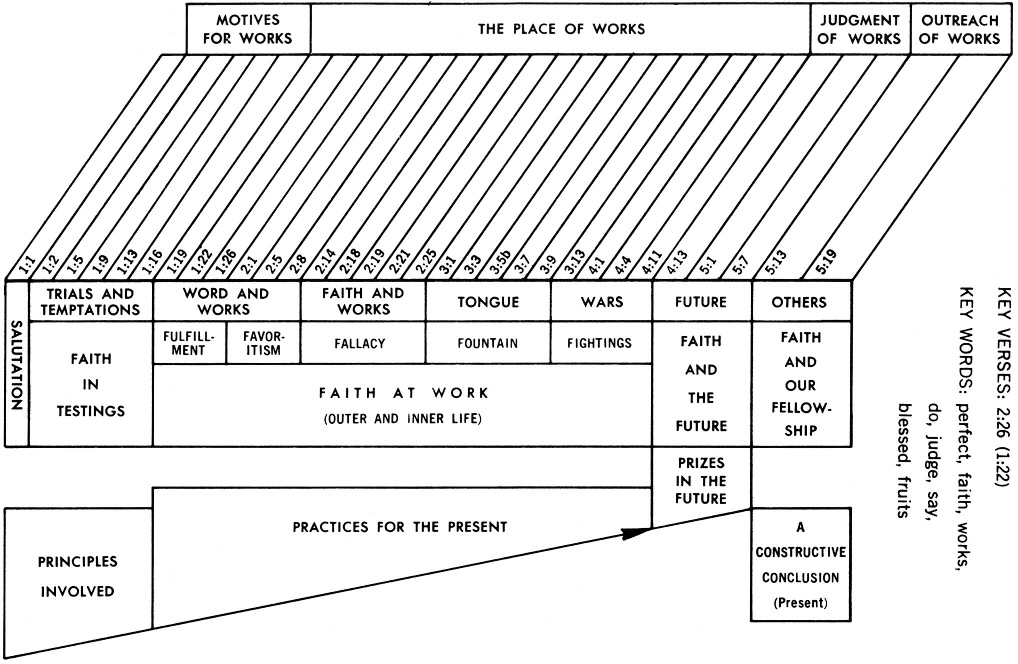
Click chart to enlarge
Chart from recommended resource Jensen's Survey of the NT - used by permission
See also Overview Chart by Charles Swindoll
|
JAMES |
|||||||
| Motives for Works |
The Place of Works: Outward Demonstration of Inner Faith |
Outreach of Works |
|||||
| Jas 1:1-18 | Jas 1:19-2:13 | Jas 2:14-25 | Jas 3:1-12 | Jas 3:13-4:12 | Jas 4:13-5:12 | Jas 5:13-19 | |
| Trials & Temptations |
Word & Works |
Faith & Works |
Tongue | Wars | Future | Others | |
|
Faith |
Fulfill |
Favor |
Fallacy |
Fountain |
Factions |
Faith |
Faith |
|
FAITH AT WORK |
|||||||
The Theme: The Testings of Personal Faith
The trials of the believer (James 1:2–12)
A. The proper attitude toward trials (James 1:2–4)
1. The attitude commanded (James 1:2)
2. The reason indicated (James 1:3)
3. The outcome to be realized (James 1:4)
B. The use of prayer amid trials (James 1:5–8)
1. The need for wisdom (James 1:5a)
2. The request for wisdom (James 1:5b)
3. The bestowal of wisdom (James 1:5c–8)
a. The divine response (James 1:5c)
b. The human obligation (James 1:6–8)
(1) The necessary attitude (James 1:6a)
(2) The rejected character (James 1:6b–8)
C. The correct attitude toward life by the tried (James 1:9–11)
1. The attitude of the lowly brother (James 1:9)
2. The attitude of the rich (James 1:10–11)
a. The reason for the attitude (James 1:10a)
b. The illustration from the flower (James 1:11a)
c. The application to the rich (James 1:11b)
D. The result of enduring trials (James 1:12)
1. The blessedness of endurance (v 12a)
2. The reward of endurance (James 1:12b)
The nature of human temptation (James 1:13–16)
A. The source of human temptation (James 1:13–14)
1. The repudiation of a divine source (James 1:13)
a. The rejection stated (James 1:13a)
b. The rejection vindicated (James 1:13b)
2. The reality of the human source (James 1:14)
B. The consequences of yielding to temptation (James 1:15)
C. The warning against being deceived (James 1:16)
The activity of God in human affairs (James 1:17–18)
A. The Giver of all good gifts (James 1:17)
B. The Author of the believer’s regeneration (James 1:18)
The Test Marks of a Living Faith
Faith tested by its response to the Word of God (James 1:19–27)
A. The reactions to the Word (James 1:19–20)
1. The knowledge possessed (James 1:19a)
2. The reaction demanded (James 1:19b)
3. The reason stated (James 1:20)
B. The reception of the Word (James 1:21)
1. The stripping off of sins (James 1:21a)
2. The appropriation of the Word (James 1:21b)
C. The obedience to the Word (James 1:22–27)
1. The demand for active obedience (James 1:22–25)
a. The statement of the requirement (James 1:22)
b. The illustration of the requirement (James 1:23–25)
(1) The negative portrayal (James 1:23–24)
(2) The positive portrayal (James 1:25)
2. The nature of acceptable obedience (James 1:26–27)
a. The futility of activity without inner control (James 1:26)
b. Acceptable service with inner control (James 1:27) (from Hiebert - James Commentary)
James 1:1 James, a bond-servant of God and of the Lord Jesus Christ, To the twelve tribes who are dispersed abroad: Greetings. (NASB: Lockman)
Greek: Iakobos theou kai kuriou Iesou Christou doulos tais dodeka phulais tais en te diaspora chairein. (PAN)
BGT Ἰάκωβος θεοῦ καὶ κυρίου Ἰησοῦ Χριστοῦ δοῦλος ταῖς δώδεκα φυλαῖς ταῖς ἐν τῇ διασπορᾷ χαίρειν.
Amplified: JAMES, A servant of God and of the Lord Jesus Christ, to the twelve tribes scattered abroad [among the Gentiles in the dispersion]: Greetings (rejoice)! (Amplified Bible - Lockman)
CSB James, a slave of God and of the Lord Jesus Christ: To the 12 tribes in the Dispersion. Greetings.
ESV James, a servant of God and of the Lord Jesus Christ, To the twelve tribes in the Dispersion: Greetings.
KJV: James, a servant of God and of the Lord Jesus Christ, to the twelve tribes which are scattered abroad, greeting.
NET From James, a slave of God and the Lord Jesus Christ, to the twelve tribes dispersed abroad. Greetings!
NLT: This letter is from James, a slave of God and of the Lord Jesus Christ. It is written to Jewish Christians scattered among the nations. Greetings! (NLT - Tyndale House)
NLT This letter is from James, a slave of God and of the Lord Jesus Christ.I am writing to the "twelve tribes"-- Jewish believers scattered abroad.Greetings! (REVISED)
NIV James, a servant of God and of the Lord Jesus Christ, To the twelve tribes scattered among the nations: Greetings.
Phillips: James, servant of God and of the Lord Jesus Christ, sends greetings to the twelve dispersed tribes. (Phillips: Touchstone)
Wuest: James, a bondslave of God and of the Lord Jesus Christ, to the twelve tribes, those in the dispersion. Be constantly rejoicing.
Young's Literal: James, of God and of the Lord Jesus Christ a servant, to the Twelve Tribes who are in the dispersion: Hail!
- James - Matthew 10:3; 13:55; Mark 3:18; Luke 6:15; Acts 1:13; 12:17; 15:13; 21:18; Galatians 1:19; 2:9,12; Jude 1:1)
- Bondservant - John 12:26; Romans 1:1; Philippians 1:1; Titus 1:1; 2Peter 1:1
- To the 12 tribes - Ex 24:4; 28:21; 39:14; 1Kings 18:31; Ezra 6:17; Matthew 19:28; Acts 26:7; Revelation 7:4
- Dispersed - Lev 26:33 Dt 4:27 Dt 28:64 Dt 30:3 Dt 32:26 Es 3:8 Eze 12:15 Joh 7:35 Ac 2:5 Acts 8:1 Acts 15:21 1Pe 1:1
- Related Resources: Article by Douglas Moo on Theology of James
- James 1 Resources - Multiple Sermons and Commentaries
- James 1:1-4 A Radical Approach to Trials - Steven Cole
- James Introduction - John MacArthur
- James 1:1 An Introduction to James, Pt. 1 - John MacArthur
- James 1:1 An Introduction to James, Pt. 2 - John MacArthur
Vine's Analysis of James…
I. Concerning trials (Jas 1:1–18).
II. Concerning obedience to the Word of God (Jas 1:19–27).
III. Concerning the royal law (Jas 2:1–13).
IV. Concerning a working faith (Jas 2:14–26).
V. Concerning the control of the tongue (Jas 3:1–12).
VI. Concerning strife and worldly-mindedness (Jas 3:18–4:6).
VII. Concerning patience, prayer and power (Jas 5:7–20).
Pastor Steven Cole opens his sermon series on James with this introduction…
One of the popular TV shows when I grew up was “Dragnet,” starring Jack Webb as Joe Friday, a detective with the Los Angeles Police Department. Joe Friday was a no-nonsense cop. His famous line was, “Just the facts, Ma’am.” He didn’t want to hear anything irrelevant to solving the case. If somebody went off on a tangent, he cut to the quick with, “Just the facts, Ma’am.” James is the Joe Friday of the New Testament. He cuts to the bottom line without messing around. He’s not really interested in hearing your profession of faith. He wants to see your practice of the faith. Several writers refer to James as the least theological epistle in the New Testament, except for Philemon. It’s not that James discounts the importance of sound doctrine, but rather that he wants to see that doctrine affecting how we live. Talk is cheap; James wants to see results. Of the 108 verses in the book, 54 (half) contain imperative verbs. James is like a crusty sergeant barking orders at the troops. He wants to see some action!
Who was James? There are several men in the New Testament by that name. We know that this James was not the apostle James, brother of John, because he was martyred in A.D. 44, too early for this epistle. The vast majority of scholars agree that the author of James was the half-brother of Jesus (Mt 13:55). Apparently he did not believe in Jesus as Lord until after the resurrection, when the risen Savior appeared to him (see John 7:5; 1Co 15:7). He became the leader of the church in Jerusalem in the years following the Day of Pentecost (Gal. 2:9; Acts 15:13-29; 21:17, 18, 19, 20, 21, 22, 23, 24, 25). He became known as “James the Just” (or, “Righteous”) because of his well-known holiness. James could have pulled rank by opening the letter, “James, the son of the virgin Mary, brother of none other than Jesus Christ. I grew up with Him! I knew Him long before He became famous!” But James (1:1) and his brother, Jude (Jude 1:1), both opened their letters by calling themselves bond-servants. The word means, “slaves,” and refers to those who are the property of their masters. They had no rights. They lived to do their masters’ will. James adds, “a bond-servant of God and of the Lord Jesus Christ.” By mentioning God and Jesus Christ on equal terms, and adding “Lord,” the Old Testament word for God, to Jesus, James affirms the deity of Jesus Christ. (James 1:1-4 A Radical Approach to Trials - Sermons are highly recommended)
Douglas Moo makes the point that "Many readers skip the opening verses of NT letters, treating them as unimportant formal details. But this is a mistake. For the letter introductions usually contain more than bare names. They also describe the writer and the recipients in ways that provide us with important clues about the nature and purposes of the letter that follows. The introduction of James is no exception. (SEE The letter of James. The Pillar New Testament commentary.)
Related Passages:
Matthew 13:55 “Is not this the carpenter’s son? Is not His mother called Mary, and His brothers, James and Joseph and Simon and Judas (AUTHOR OF JUDE)?
Galatians 1:19 But I did not see any other of the apostles except James, the Lord’s brother.
1 Corinthians 15:7 then He appeared to James, then to all the apostles
2 Peter 1:1 Simon Peter, a bond-servant and apostle of Jesus Christ, To those who have received a faith of the same kind as ours, by the righteousness of our God and Savior, Jesus Christ:
Romans 1:1 Paul, a bond-servant of Christ Jesus, called as an apostle, set apart for the gospel of God,
Exodus 24:4 Moses wrote down all the words of the LORD. Then he arose early in the morning, and built an altar at the foot of the mountain with twelve pillars for the twelve tribes of Israel.
Leviticus 26:33 ‘You, however, I will scatter among the nations (GENTILES) and will draw out a sword after you, as your land becomes desolate and your cities become waste.
Deuteronomy 4:27 “The LORD will scatter you among the peoples, and you will be left few in number among the nations where the LORD drives you.
Acts 11:19 So then those who were scattered because of the persecution that occurred in connection with Stephen made their way to Phoenicia and Cyprus and Antioch, speaking the word to no one except to Jews alone.
Acts 2:36 “Therefore let all the house of Israel know for certain that God has made Him both Lord and Christ–this Jesus whom you crucified.”
Acts 15:23 (SIMILAR SALUTATION --GREETINGS--IN JERUSALEM COUNCIL LETTER) and they sent this letter by them, “The apostles and the brethren who are elders, to the brethren in Antioch and Syria and Cilicia who are from the Gentiles, greetings.
INTRODUCTION OF AUTHOR
AND RECIPIENTS
James, a bond-servant (doulos) of God and of the Lord Jesus Christ, To the twelve tribes (phule) who are dispersed (diaspora) abroad: Greetings (chairo - present tense - rejoicing) - It should be noted that Jerome considered the author of the present epistle to be James, son of Alphaeus, but most evangelical scholars favor James, the younger brother of Jesus. By using bond-servant (doulos) James is saying "I am a slave to the Lord Jesus Christ. I am absolutely sold out to His will. I am willing to do whatever He tells me to do. I am willing to say whatever He tells me to say. I am willing to go wherever He leads me. I am a man who has made a choice. I am going to serve Him for all eternity." Let it be true in each of our short lives on earth for it will be true of our eternal life in Heaven. In the Master's Name. Amen and amen!
James (2385) (Jakobos) (Several dictionary articles) means supplanter and is transliterated as Jacob. In English we have two names, Jacob and James, both coming from the common Hebrew name Jacob. James was a common name among Palestinian Jews during the first century so it is not surprising to find that the NT uses it to refer to 5 individuals -
(1) James, the son of Zebedee, one of Jesus’ twelve apostles (Mt 4:21) and one that with Peter and John were with Jesus privately on 3 occasions (Mk 5:37, Lk 8:51), the transfiguration (Mt 17:1, Mk 9:2, Lk 9:28) and at Gethsemane (Mt 26:37, Mk 14:33).
(2) James, the son of Alphaeus (always added to distinguish him from James, the son of Zebedee), and also one of the 12 apostles, always mentioned ninth in the 4 lists (Mt 10:2, 3; Mk 3:16, 17, 18; Lk 6:13, 14, 15; Acts 1:12, 13, 14).
(3) James the Less (Mk 15:40)
(4) James, father of Judas (not Iscariot) (Lk 6:16; Acts 1:13),
(5) James, the oldest of Jesus' four younger (half) brothers (Mt 13:55, Mk 6:3, cp 1Co 9:5). He is generally considered to be the James who authored the epistle by his name. Eerdmans adds that this latter James "While not a follower of Jesus during his ministry, James seems to have been converted shortly afterwards, perhaps when the risen Jesus appeared to him (1 Cor. 15:7; cf. Acts 1:14). James gradually took over the leadership of the Jerusalem church from the leaders among the Twelve, becoming one of the most important leaders in the 1st-century Church" (Acts 12:17; 15:13, 14, 15, 16, 17, 18, 19, 20, 21; 21:18; Gal. 1:19; 2:9, 12). According to Josephus, James was stoned to death by order of the Jewish high priest Ananus II in 62 c.e. (Antiquities of the Jews. Book 20. Chapter 9 - scroll down), while according to Eusebius he was killed just before Vespasian invaded Jerusalem in 67 (He 2.23.18).
The name Jakobos is used 42 times in the NT to refer to 5 different individuals thus calling for careful attention to the context (or the paternal description "of Zebedee" or "of Alphaeus") in order to accurately interpret which specific James is being described -Mt. 4:21; 10:2, 3; 13:55; 17:1; 27:56; Mk. 1:19, 29; 3:17, 18; 5:37; 6:3; 9:2; 10:35, 41; 13:3; 14:33; 15:40; 16:1; Lk. 5:10; 6:14, 15, 16; 8:51; 9:28, 54; 24:10; Acts 1:13; 12:2, 17; 15:13; 21:18; 1Co. 15:7; Ga 1:19; 2:9, 12; Jas. 1:1; Jude 1:1
Regarding the description of bondservant, D Edmond Hiebert comments that "He prefers to speak only of his status as a Christian man. When after His resurrection Jesus appeared to James (1Cor. 15:7), and James became convinced of His true nature as the Messiah, the spiritual identity of the One Whom he had previously regarded as his physical brother became so important to him that the physical relations receded into the background. While others in the church might have referred to him as "the Lord's brother" (Gal 1:19), he preferred to speak of himself as a "servant" rather than the "brother" of the Lord Jesus Christ. Mayor observes: "We find here an example of the refusal "to know Christ after the flesh" (2Co 5:16) which appears in ii. 1; the same willingness to put himself on a level with others which appears in iii. 1,2." (James Commentary)
Bondservant(1401)(doulos from deo = to bind) (Click additional notes on doulos) was an individual bound to another in servitude and conveys the idea of the slave's close, binding ties with his master, belonging to him, obligated to and desiring to do his will and in a permanent relation of servitude. In sum, the will of the doulos is consumed in the will of the master.
In using the term bondservant James is not declaring any outstanding personal qualification other than the expression of his complete devotion and subservience to his heavenly Masters. In other words, James as a bondservant is saying he was surrendered wholly to God's will and thus devoted to God and the Lord Jesus Christ. James recognized that as a redeemed soul, he was no longer his own but had been bought with the price of the blood of Christ (1Co 6:20, 7:23, Acts 20:28, Gal 3:13, Titus 2:14, 1Pe 1:18,19, 2Pe 2:1, Ep 1:7, Heb 9:12, 1Pe 2:9; Ro 3:25, cp Mt 20:28 Mark10:45, Rev 5:9). He was now the property of his Lord Jesus Christ, the one who on earth was his half-brother. His relationship as a bondservant of the Lord Jesus Christ so much overshadowed his earthly family relationship that he does not even make mention of it in this introduction.
🙏THOUGHT - Beloved, does your (my) attitude and actions (thoughts, words, deeds) reflect the eternal truth that you are no longer your own, but that your body is actually a holy temple of God and that this privilege was purchased and made possible at infinite cost to God? Let us meditate on these profound principles and privileges, that the Spirit might renew our minds and empower of walk that it is indeed worthy of such a high and holy calling.
Hiebert comments that "Christianity found the term doulos appropriate in setting forth the essence of the believer's true relationship to God. It aptly set forth the Christian consciousness that believers are totally dependent upon God, belong wholly to Him, and are convinced that His will is the only true rule for all of His people. Because believers voluntarily and joyously accepted this relationship, the term was commonly used in the New Testament of the believer's relationship to God without any implication of involuntary servitude. For them the term did not suggest any degradation, but only their total surrender to their spiritual Master. (James Commentary)(Bolding added)
Why is this concept of bondservant so important? For one thing as Jesus taught, no man can serve two masters (Mt 6:24). James before his new birth by grace through faith (Eph 2:8, 9), had been a slave of Sin (see note on "the Sin"), by virtue of his physical birth in Adam's likeness (cp 1Co 15:22, Ro 5:12), but now by virtue of his spiritual birth (John 3:3, 2Cor 5:17), James had become a slave of Christ (cp "Born once, die twice. Born twice, die once.") In sum, James had no will of his own, no business of his own, no time of his own and was now devoted to his Master, Christ; dependent upon Him and obedient to Him. Click the convicting poem He Had No Rights written by Mabel Williamson a missionary to China.
As someone has well said no man's life is for his own private use. We can either spend our days for time or spend them for eternity. We all serve someone whether we realize it or not. If we are not born again, we are bondservants of Sin (Jn 8:34, 1Ki 21:25, Pr 5:22, Acts 8:23, Ro 6:6, Ro 6:16, 17, 18, 19, Ro 7:14, Ep 2:2, Titus 3:3, 2Pe 2:19) and of Satan (Jn 8:44, 1Jn 3:8, 9, 10, 1Jn 5:19). If we are born again we have a new Master, God the Father and Christ Jesus our Lord (Master) (Ro 6:22, Ro 8:2, Jn 8:32, 2Cor 3:17, Gal 5:1, 5:13, 1Pe 2:16)
Doulos - 124x[120v - NAS - bond-servant(11), bond-servants(12), bondslave(3), bondslaves(3), men(1), servants(1),slave(58), slave's(1), slaves(39), women(1). Matt. 8:9; 10:24, 25; 13:27, 28; 18:23, 26, 27, 28, 32; 20:27; 21:34, 35, 36; 22:3, 4, 6, 8, 10; 24:45, 46, 48, 50; 25:14, 19, 21, 23, 26, 30; 26:51; Mk. 10:44; 12:2, 4; 13:34; 14:47; Lk. 2:29; 7:2, 7:3, 8, 10; 12:37, 43, 45, 46, 47; 14:17, 21, 22, 23; 15:22; 17:7, 9, 10; 19:13, 15, 17, 22; 20:10, 11; 22:50; Jn. 4:51; 8:34, 35; 13:16; 15:15, 20; 18:10, 18, 26; Acts 2:18; 4:29; 16:17; Ro 1:1; 6:16, 17, 20; 1Co. 7:21, 22, 23, 24; 12:13; 2Co. 4:5; Gal. 1:10; 3:28; 4:1, 7; Ep 6:5, 6, 8; Phil. 1:1; 2:7; Col. 3:11, 22; 4:1, 12; 1Ti 6:1; 2Ti 2:24; Titus 1:1; 2:9; Philemon. 1:16; James. 1:1; 1Pe 2:16; 2Pe 1:1; 2:19; Jude 1:1; Rev. 1:1; 2:20; 6:15; 7:3; 10:7; 11:18; 13:16; 15:3; 19:2, 5, 18; 22:3, 6.
In the Greek culture doulos usually referred to the involuntary, permanent service of a slave, but the use in the epistles of Paul and Peter elevates the meaning of doulos to the Hebrew sense which describes a servant who willingly commits himself to serve a master he loves and respects (cp Ex 21:5, 6 Dt 15:12, 13, 14, 15, 16). By Roman times, slavery was so extensive that in the early Christian period one out of every two people was a slave! From at least 3000 BC captives in war were the primary source of slaves.
Doulos speaks of submission to one's master The doulos had no life of his own, no will of his own, no purpose of his own and no plan of his own. All was subject to his master. The bondservant's every thought, breath, and effort was subject to the will of his master. In sum, the picture of a bondservant is one who is absolutely surrendered and totally devoted to his master (cp single mindedness and purity of devotion in 2Co 11:3). What a picture of James' relation to his Lord! What an example and challenge for all believers of every age to emulate!
Matthew Henry adds that "The highest honour of the greatest apostle, and most eminent ministers, is to be the servants of Jesus Christ; not the masters of the churches, but the servants of Christ."
Kenneth Wuest explains that a doulos as "the most abject, servile term used by the Greeks to denote a slave. The word designated one who was born as a slave, one who was bound to his master in chords so strong that only death could break them, one who served his master to the disregard of his own interests, one whose will was swallowed up in the will of his master. Paul was born a slave of sin at his physical birth, and a bondslave of his Lord through regeneration. (Note: There was another word, andrapodon which was person taken prisoner in war and sold into slavery) The chords that bound him to his old master Satan, were rent asunder in his identification with Christ in the latter’s death (Ro 6:1,2,3, 4, 5, 6 Ro 6:11; Ro 7:4). The chords that bind him to his new Master will never be broken since the new Master will never die again, and is Paul’s new life (Php 1:21, Col 3:3,4). He has changed masters because he has a new nature (2Cor 5:17, 2Pe 1:3,4), the divine, and the evil nature which compelled him to serve the Devil has had its power over him broken (Col 1:13, Heb 2:14, 15). Paul’s will, at one time swallowed up in the will of Satan, now is swallowed up in the sweet will of God.
The reader will observe how wonderfully God has watched over the development of the Greek language so that at the time it was needed as the medium through which He would give His New Testament revelation to the human race, its words were fit receptacles and efficient instruments for the conveyance of His message to man. Paul calls himself a bondslave of Christ Jesus… The apostle is proud of the fact that he is a slave belonging to his Lord. There were certain individuals in the Roman empire designated “Slaves of the Emperor.” This was a position of honor. One finds a reflection of this in Paul’s act of designating himself as a slave of the King of kings. He puts this ahead of his apostleship." (Wuest's Word Studies from the Greek New Testament: Studies in the Vocabulary of the Greek New Testament: Grand Rapids: Eerdmans) (Bolding added)
In summary, the doulos…
- Was owned by and totally possessed by his master.
- Existed for his master and no other reason.
- Had no personal rights.
- Was at the master’s disposal "24/7".
- Had no will of his own but was completely subservient to the master.
Paradoxically a bondservant of the Most High God is one of the most privileged, noblest professions in the world. Little wonder that notable men of God in the have always been called the servants of God. The list of names includes
- Moses (Dt 34:5 Ps 105:26 Mal 4:4)
- Joshua (Josh 24:29)
- David (2Sa 3:18 Ps 78:70)
- Paul (Ro 1:1; Phil 1:1; Titus 1:1)
- Peter (2Pe 1:1)
- James (James 1:1)
- Jude (Jude 1:1 )
- Prophets (Amos 3:7; Jer 7:25).
- Ideally believers (Acts 2:18; 1Cor 7:22; Eph 6:6; Col 4:12; 2Ti 2:24).
Guy King comments on the phrase bondservants of Christ Jesus writing…
Let it be said at once that the word here is the same as bond-slaves - a conception which would be vividly familiar to every reader of this Letter. Quite a number of them were, or had been, slaves themselves - and the word would catch their attention at once. I say "had been" of some, because the law of manumission (process of releasing from slavery) would have operated in their case - a price would have been paid, and the slave set free.
In his fascinating Light from the Ancient East, Dr. Deissmann, pp. 319 ff., has some most interesting paragraphs on this releasing of slaves (see note that follows); and, with his quick and ready mind, the late Archbishop Harrington Lees, in his CHRIST and His Slaves, made use of the learned Doctor's discoveries to point many a moral concerning spiritual servitude and release.
Paul's writings abound in allusions to this last phenomenon. The material and the spiritual are found together in such a passage as 1Corinthians 7:22,
He that is called in the LORD, being a servant, is the Lord's freedman: likewise also he that is called, being free, is Christ's servant.
When a man becomes a Christian, though materially bound as a slave, he is spiritually freed from bondage to Satan and sin; on the other hand, such a man, though materially set at liberty, is, in the spiritual sense, bound hand and foot to CHRIST.
How Paul himself rejoiced - and even gloried - in this New Slavery. In his letters he so constantly uses the word as indicating his relationship to JESUS CHRIST. He would so readily enter into the attitude of the well-satisfied slave of Exodus 21:5, "I love my Master … I will not go out free."
From the bondage of sin, the believer has, by the manumission price of "the precious Blood", (1Pe 1:18, 19), been set free-only to find himself thereby committed to a bondage more binding than ever. Yet, this time the "service is perfect freedom", the bonds are honourable and sweet.
And, for our encouragement, let us remember that
(i) The Master is responsible for His slaves' needs - feeding, housing, clothing, and all else is the slaveowner's concern. It is because we are GOD'S servants (slaves) that our Lord says "Therefore … take no thought … ", (Mt 6:24,25), for the ordinary needs of life. Our apostle will say later in this very Epistle, "My GOD shall supply all your need." (Philippians 4:19)
Also
(ii) The Master is responsible for His slaves' duties - they will not choose their own task, or their own sphere. Whether ours is to be the more menial, or the more genial, work is in His plan, not ours. It is the Christian's wisdom to stand before Him as those in 2Samuel 15:15, "Thy servants are ready to do whatsoever my Lord the King shall appoint", or as Gabriel in Luke 1:19, "I … stand… and am sent … ".
Then, too
(iii) The Master is responsible for His slaves' supplies - "Who goeth a warfare any time at his own charges?" asks 1Corinthians 9:7: the soldier has all his military equipment provided; and likewise, the slave is supplied with everything needful for the adequate discharge of all his duties. Whatever He tells us to do, we can do - "If … God command thee … thou shalt be able to … " Exodus 18:23 - because all supplies are at our disposal. And as Paul records, in 2 Corinthians 12:9, "My grace is sufficient for thee". (Ibid)
Regarding the setting free of slaves in Paul's day, Adolf Deissmann records the following custom which has clear parallels with Paul's teaching on saints as bondslaves of Christ…
Among the various ways in which the manumission of a slave could take place by ancient law we find the solemn rite of fictitious purchase of the slave by some divinity. The owner comes with the slave to the temple, sells him there to the god, and receives the purchase money from the temple treasury, the slave having previously paid it in there out of his savings. The slave is now the property of the god; not, however, a slave of the temple, but a protégé of the god. Against all the world, especially his former master, he is a completely free man; at the utmost a few pious obligations to his old master are imposed upon him. The rite takes place before witnesses; a record is taken, and often perpetuated on stone. (SEE page 456 Light from the Ancient East the New Testament illustrated by recently discovered texts of the Graeco-Roman world).
Dr Wayne Barber has an excellent practical explanation of the significance of a bondservant asking the practical question…
"Why do you serve the Lord Jesus Christ? "Well, I had better. God will kill me if I don’t." You know, I’ve talked to a lot of people who have that mentality. It is as if God has a big club and if you don’t do what He wants you to do, then He will hit you over the head with it. Yet God says, "Wait a minute. I have set you free. You are free now to be what you ought to be. Make up your mind. No man can serve two masters." The person who has any sense at all will say, "Lord, You have overwhelmed me. I am making a choice out of love for You to be Your slave. I know I am no longer Your slave, but I choose to be Your slave." Do you want to be used by the Lord? Come to the place in your life that you are willing to say, "God, it doesn’t matter what You tell me to do, I am willing to be submissive to Your will." When you come to that place, God will do things through you like He did through Paul. One picture of that is beautiful, and it is found in Dt 15:12, 13, 14, 15,1 6, 17: "If your kinsman, a Hebrew man or woman, is sold to you, then he shall serve you six years, but in the seventh year you shall set him free. And when you set him free, you shall not send him away empty-handed. You shall furnish him liberally from your flock and from your threshing floor and from your wine vat; you shall give to him as the Lord your God has blessed you. And you shall remember that you were a slave in the land of Egypt, and the Lord your God redeemed you; therefore I command you this today. And it shall come about if he says to you, ‘I will not go out from you,’ because he loves you and your household, since he fares well with you; then you shall take an awl and pierce it through his ear into the door, and he shall be your servant forever. And also you shall do likewise to your maidservant." What a gorgeous picture. Slavery in that day and time was nothing like we know today. The slaves had to be treated as if they were your own children in your own family. You had to treat them with dignity and integrity. After they had served you for a period of time, you had to set them free. But the beautiful picture here is of a slave. He served a master for seven years. The master has loved him, provided for him, been kind to him, helped him, all the things that you would look for. Now the day comes that he has been set free. He is given of the flock, given of the threshing floor, given of the wine vat. This servant stands there, and he says, "You know, I have been so cared for during the seven years that I have worked with you, where would I go? I don’t know where I am going to go. Nobody would love me like you have loved me. Nobody would do for me what you have done for me. Why, I am going to choose to be your slave. I know you have set me free, but because of who you are and because of my love for you, I want to continue to be your slave. I want to do for you not because I have to but because I just want to." What a gorgeous picture. They had a public ceremony and they would take that little instrument and put it up by their ear and drive it through the ear into the door, leaving a hole in the ear. What a gorgeous picture when you see this slave walking alongside his master, smiling. You would see that man and you knew he had been with him seven years, maybe it is three years down the road past that seven years and you say, "Isn’t that wonderful! That man was set free and now that man has chosen to serve out of love for his master." Man looks on the outside. God looks at our heart. Why are you serving the Lord Jesus? If you don’t love Him, if you haven’t understood that nobody else will ever treat you like Jesus, then no wonder you are not being used of the Lord in the task He has assigned to His church. A man that God can use is a person who is willing to bow, a person who is willing to say, "God, I just want what You want in my life." … God is waiting on us to love Him and to bow before Him and to make conscious choices. "God, you have given me everything. If I left you, where would I go? Lord, I want to serve you. No man can serve two masters. I want to serve You. I want to be usable in the kingdom of God." That is the Apostle Paul. He was a man who was willing, sold out to the will of God." (Click for additional notes by Dr. Barber on "bondservant)
A businessman once asked his Bible study group, “How can you tell if you have a servant attitude?” The reply came back…“By the way you react when you are treated like one.” It’s not easy to find an attitude like that. But for a disciple, servant-hood is one of the keys to growing in Christ-likeness.
Describing His own ministry, Jesus said: “For the Son of man also came not to be served but to serve, and to give his life as a ransom for many” (Mark10:45)
Thomas Manton asks "But why not “apostle”? He does not mention his apostleship, first, because there was no need, as he was eminent in the opinion and reputation of the churches; therefore Paul says he was reputed to be a pillar of the Christian faith (Galatians 2:9). Paul, whose apostleship was openly questioned, often asserted it. Secondly, Paul himself does not call himself an apostle in every letter. Sometimes his style is, “Paul, a prisoner of Christ Jesus” (Philemon 1); sometimes “Paul and Timothy, servants of Christ Jesus” (Philippians 1:1); sometimes nothing but his name Paul is prefixed, as in 1 Thessalonians 1:1 and 2 Thessalonians 1:1.
Of God and of the Lord Jesus Christ - This order makes prominent the identity of his heavenly Masters. The description in this verse was utilized by the Greek fathers to argue against the Arians for the divinity of Jesus Christ.
🙏 THOUGHT - Think for a moment of what James is saying here - it is as if he could think of no higher honor than being the bondservant of such glorious Masters. And should not every believer adopt such a heavenly mindset? What a privilege to be in the service of such holy and loving Masters. Beloved of the Father and the Son (1Th 1:4), think about the work God has called you to today (the work He has prepared for you from eternity past! - Eph 2:10) and rejoice in your high position (Jas 1:9) and privilege to carry out His good and acceptable and perfect will (Ro 12:2), which will bear fruit (Jn 15:5, 8) not just in this life but he life to come! (cp 1Ti 4:8) Hallelujah!
Commenting on the name the Lord Jesus Christ, Hiebert writes that…
All three names serve to unfold the true nature of this Master. "Jesus" is His human name. It was the name given Him before His birth and speaks of His saving work in incarnation (Mt 1:21). Iesous is the Greek form of the Hebrew name Joshua meaning "salvation." This name embodies the entire gospel story concerning the historic Man of Nazareth. "Christ" (Christos) is the Greek rendering for the Hebrew "Messiah" (Ps. 2:2; Acts 4:26), both meaning "the anointed one." For Jewish readers, the term Christos, whether placed before or after Jesus," meant that He was the fulfillment of the Old Testament messianic promises. For James and the early church, the name "Jesus Christ" embodied the faith that the messianic redemption was realized in the incarnate Jesus.
Thus, "Jesus is the Christ" became the earliest Christian confession (Acts 2:36; 3:20; 5:42; cf. John 20:30, 31). This faith arose in the hearts of His disciples from their associations with Jesus during His earthly ministry (John 1:41; Mt. 16:16) and received unshakable confirmation from His resurrection and ascension (Acts 2:32, 36). The Christian church proclaimed this incarnate and risen Savior as its "Lord" (kurios). As her Savior and Master, He received her full allegiance and whole-hearted service. For Jewish readers, the title "Lord" carried with it implications of deity. In the Septuagint, it is the translation for the ineffable Name (Yahweh) and speaks of His sovereignty. Various quotations from the Old Testament referring to Jehovah are applied directly to Jesus in the New Testament, where they were "understood of the new Lord of the Christian church. The term kurios occurs fourteen times in this epistle (Jas 1:1, 7, 12; 2:1; 4:10, 15; 5:4, 7, 8, 10, 11 twice, Jas 1:14, 15). Only here and in Jas 2:1 does James connect it directly with Jesus Christ, and it is not always clear in the other places whether his reference is to God or to Christ.' (James Commentary)
When we give Jesus Christ His rightful place as Lord of our lives, His Lordship will be expressed in the way we serve others - no longer as a duty, but as a delight to please and imitate our Lord (Mk 10:45, Php 2:3, 4, 5, 6, 7see notes). Therefore, one of the best ways we can demonstrate our love for God is by showing love for our fellow man. We demonstrate love for others by helping them, by sharing their problems, and by doing what we can for them. Why should we serve? For Jesus’ sake that men might see our good works and glorify (as they observe our godly attitude and actions they might thereby obtain a proper opinion of) our heavenly Father (Mt 5:16).
TO THE TWELVE TRIBES WHO ARE DISPERSED ABROAD: GREETINGS: tais dodeka phulais tais en te diaspora chairein. (PAN):
- Dispersed - Leviticus 26:33; Deuteronomy 4:27; 28:64; 30:3; 32:26; Esther 3:8; Ezekiel 12:15; John 7:35; Acts 2:5; 8:1; 15:21; 1 Peter 1:1
- Greetings - Acts 15:23; 23:26; 2Timothy 4:21
- James 1 Resources - Multiple Sermons and Commentaries
- James 1:1-4 A Radical Approach to Trials - Steven Cole
- James Introduction - John MacArthur
- James 1:1 An Introduction to James, Pt. 1 - John MacArthur
- James 1:1 An Introduction to James, Pt. 2 - John MacArthur
THE DISPERSED
RECIPIENTS OF THE LETTER
The twelve tribes (10 times in OT/NT - Ge 49:28; Ex 24:4; 28:21; 39:14; Ezek 47:13; Mt 19:28; Lk 22:30; Acts 26:7; Jas 1:1; Rev 21:12) - Clearly addressed to Jews and in context those who have received Jesus as their Messiah (Jn 1:11, 12, 13). The phrase the twelve tribes in context is clearly a Jewish expression denoting the Jewish people as a whole (Mt 19:28; Acts 26:7). While tribal divisions had been lost to many Jews, nevertheless even in New Testament times many of the Jews were still able to establish their tribal descent (cp the importance of the tribal lineage of the Messiah in Mt.1:1-16; Lk 1:5, Lk 2:36; cp Php 3:5). It is interesting to note that James does not say to the tribes of Judah, Benjamin and the "ten lost tribes". They are all "lost" spiritually without Christ and none are lost who are in Christ. Though the "twelve tribes" were scattered (and are to this day), they are not "lost" in another since for members of each tribe (except Dan) are listed at the close of biblical history in the Revelation (Re 7:5, 6, 7, 8). The OT prophets repeatedly spoke of the reunification of the divided nations of Israel and Judah under the coming Messiah (e.g., Isa 11:11, 12, 13; Jer 3:18; 50:4; Ezek 37:15-23; Zec 10:6, 7, 8, 9, 10, 11, 12), and there was a strong Jewish expectation that when the Messiah came, He would reestablish the chosen people (Is 43:20) in their correct tribal divisions (Ezek 48:1-29).
Tribes (5443) (phule form phúlon = race, tribe, class) refers to a nation or people descended from a common ancestor. In this context phule refers to all the persons descended from one of the twelve sons of the patriarch Jacob.
Phule- 31x in 23v -Matt 19:28; 24:30; Luke 2:36; 22:30; Acts 13:21; Rom 11:1; Phil 3:5; Heb 7:13, 14; Jas 1:1; Rev 1:7; 5:5, 9; 7:4, 5, 6, 7, 8, 8; 11:9; 13:7; 14:6; 21:12
Dispersed abroad (1290) (diaspora [word study] from diaspeiro = to scatter abroad - from dia = through + spora = a sowing) is a noun describing the condition of being scattered and thus refers to a scattering or dispersion as one would scatter seed in a field. In John 7:35 diaspora is used with its literal meaning to refer to those Jews who were living outside Palestine, while the other NT use in Peter is figurative (1Pe 1:1) “Diaspora,” or “Dispersion” became a technical name for all the nations outside of Palestine where Jewish people had come to live (2 Macc. 1:27; John 7:35). James writes to Jewish Christians who have been “dispersed” as a result of persecution (Acts 11:19)
James used diaspora as a technical term to refer to Jews outside of Palestine, scattered like seed throughout the Gentile world. Over the previous several hundred years, various conquerors (including the Roman Pompey in 63 BC who carried hundreds of Jewish captives back to Rome) had deported Jews from their homeland in Palestine and spread them throughout the known world. In addition, other Jews had voluntarily moved to other countries for business or other reasons (cf. Acts 2:5, 6, 7, 8, 9, 10, 11). And so by NT times, many Jews lived outside of their homeland. In fact Philo (20BC to 50AD), a Jewish philosopher estimated that up to one million Jews lived in Alexandria, Egypt. An equal number had settled in both Persia and Asia Minor, and about 100,000 lived in Cyrenaica and Italy. The Jews who were dispersed throughout the world in this manner outnumbered the Jews who remained in their native land.
At various times and for various reasons, the Jews were scattered into foreign countries “to the outmost parts of heaven (cp Dt 30:4). (Additional resources on dispersion Easton, ISBE Smith) Some of these dispersions were voluntary (of great importance during the Greco-Roman period when Jews voluntarily migrated to all the chief towns of the civilized world, chiefly for the sake of trade), while others were forced upon them by the conquering nations (see below: Assyria [2Ki 17:6], Babylon, [cp 2Chr 36:10, 11, 12, 13, 14, 15, 16, 17, 18, 19, 20, 21] Rome [Lk 21:20, 21, 22, 23, 24 - describes destruction of Temple in 70AD]). The Jewish dispersions were predicted and sovereignly decreed by God in the Pentateuch (5 books of Moses = The Torah) where he warned Israel what would transpire if she rejected His statutes and abhorred His ordinances so as not to carry out all of His commandments.
In Leviticus we read God' s warning to Israel
You however, I will scatter (diaspeiro in the Greek translation of the Hebrew) among the nations and will draw out a sword after you, as your land becomes desolate and your cities become waste. (Lev 26:33)
Moses warned Israel again that
Jehovah will scatter (diaspeiro in the Greek translation of the Hebrew) you among the peoples, and you will be left few in number among the nations where Jehovah drives you. (Dt 4:27, cp Dt 28:64, Dt 30:3, this latter passage [Dt 30:1, 2, 3] prophetically promising restoration of the believing Jewish remnant at the end the Great Tribulation and inauguration of the Millennial reign of Christ in the Messianic Kingdom)
So clearly the various Jewish diasporas, especially those secondary to foreign conquest, were the result of the sovereign outworking of the righteous justice of Jehovah (see attribute - Justice). He is faithful (see His attribute - Faithfulness) to keep all of His "promises" (Ro 11:28,29), even the ones we don't particularly want Him to keep!
God speaking to His prophet Ezekiel in exile in Babylon explained that
I will leave a remnant, for you will have those who escaped the sword among the nations when you are scattered (Greek word = diaskorpismos = dispersion, scattering dispersal) among the countries. (Ezek 6:8)
The majority of the nation of Israel proved not to be believers, but God's grace and mercy continued to preserve a godly remnant of believing Jews (saved by grace through faith). Contrary to popular opinion there never has been nor ever will be a complete end to Israel (cp Ro 11:25, 26, 27, 28, 29). Click study of doctrine of the remnant.
One of the most interesting and strategic "dispersions" occurred in Acts 8, after the stoning of Stephen, at which time
a great persecution began against the church in Jerusalem and they were scattered (diaspeiro) throughout the regions of Judea and Samaria (Acts 8:1) and "those who had been scattered (diaspeiro) went about preaching (euaggelizo/euangelizo = "evangelizing") the word. (Acts 8:4)
The believers in Jerusalem (remember the church initially was almost 100% Jewish) were scattered like seed so that they might spread the "seed" of the Word of God, the Gospel.
J Alec Motyer writes "If James were to post his letter today it would be marked ‘Return to sender’ on the ground of being insufficiently addressed. He names no names and specifies no place as destination: twelve tribes contain a lot of people and the Dispersion, in its special sense of the scattered people of God, was in principle world-wide." (See The Message of James)
D Edmond Hiebert asserts that "Through their contacts with other people, the Jews of the Dispersion generally had a larger outlook on life and a greater openness to new ideas, whereas their contacts with the surrounding paganism generally made them more strongly convinced of the immeasurable superiority of Judaism over the pagan religions. As the gospel spread in the Gentile world, it was seen that wherever there was a colony of Jews with their synagogue, their message of ethical monotheism had become a strong preparatory force for Christianity. Scattered abroad as seed, they had "become the seed of a future harvest." (James Commentary)
GREETINGS
REJOICE
James, a bond-servant (doulos) of God and of the Lord Jesus Christ, To the twelve tribes (phule) who are dispersed (diaspora) abroad: Greetings (chairo - present tense - rejoicing) - Note that James opens with a subtle tone of joy that anticipates one of his major themes, that believers can experience genuine joy even in the midst of trials because God uses those trials to produce spiritual maturity. Given that these dispersed Jews were experiencing persecution, the word "Greeting" (REJOICE) prepares the reader for the paradoxical truth that their joy was not dependent upon favorable circumstances but upon their faith and confidence in God’s sovereign purposes in their trials (James 1:2–4).
Greetings (5463)(chairo - a primary verb) in some contexts means to rejoice or be glad (e.g., Jn 16:20, Ro 12:15, Mt 5:12) but here in James is used as a formalized greeting wishing the readers well. BAGD says that the idea can connote "that one is on good terms with the other". The Gospels render chairo as "hail" (Mt 26:49, 27:29). Luke uses chairo much like James to convey the idea of "Greetings" (Acts 15:23, Acts 23:26).
Chairo - 74x in 68v - am glad(1), glad(7), gladly(1), greeted*(1), greeting(2), greetings(4), hail(4), joyfully(1), make(1), rejoice(33), rejoiced(8), rejoices(2), rejoicing(10).Matt 2:10; 5:12; 18:13; 26:49; 27:29; 28:9; Mark 14:11; 15:18; Luke 1:14, 28; 6:23; 10:20; 13:17; 15:5, 32; 19:6, 37; 22:5; 23:8; John 3:29; 4:36; 8:56; 11:15; 14:28; 16:20, 22; 19:3; 20:20; Acts 5:41; 8:39; 11:23; 13:48; 15:23, 31; 23:26; Rom 12:12, 15; 16:19; 1 Cor 7:30; 13:6; 16:17; 2 Cor 2:3; 6:10; 7:7, 9, 13, 16; 13:9, 11; Phil 1:18; 2:17f, 28; 3:1; 4:4, 10; Col 1:24; 2:5; 1Th 3:9; 5:16; Jas 1:1; 1 Pet 4:13; 2 John 1:4, 10f; 3 John 1:3; Rev 11:10; 19:7.
Note that the verb chairo is related to the word joy (chara) in the next verse, suggesting James was in some sense preparing his readers for the radical command to consider it all joy.
John MacArthur makes a good point emphasizing that James uses chairo not as a "mere formality; he expected what he wrote to gladden his readers’ hearts by giving them means to verify the genuineness of their salvation. That, James knew, would provide great comfort to them in their trials, which Satan persistently uses to try to make Christians doubt they are indeed God’s children and fellow heirs with Jesus Christ. (Macarthur J. James. Moody)
Steven Cole comments that…
Many writers claim that there is no unifying theme to James, but that it is just a series of unrelated, random exhortations. But, as difficult as it may be to outline the book, I think that the contents may be arranged under this theme of true faith. James is giving a series of tests by which one may determine whether his faith is genuine or false (D. Edmond Hiebert “The Unifying Theme of the Epistle of James,” Bibliotheca Sacra [135:539, July-September, 1978], pp. 221-231 - see below). I offer this outline:
Introduction: Author and recipients (Jas 1:1).
1. True faith responds with practical godliness under testing (Jas 1:2-27).
A. True faith responds with joy when it faces testing (Jas 1:2, 3, 4).
B. True faith seeks God for wisdom in times of testing (Jas 1:5, 6, 7, 8).
C. True faith adopts God’s eternal perspective in both poverty and riches (Jas 1:9, 10, 11).
D. True faith perseveres under testing, not blaming God for temptations (Jas 1:12, 13, 14, 15, 16 17, 18).
E. True faith obeys God’s word, even when provoked (Jas 1:19-27).
2. True faith shows itself in practical obedience (Jas 2:1-26).
A. True faith does not show partiality (Jas 2:1, 2, 3, 4, 5, 6, 7).
B. True faith practices biblical love (Jas 2:8, 9, 10, 11, 12, 13).
C. True faith proves itself by its works (Jas 2:14, 15, 16, 17, 18, 19, 20, 21, 22, 23, 24, 25, 26).
3. True faith controls the tongue and acts with gentle wisdom (Jas 3:1-18).
A. True faith controls the tongue (Jas 3:1, 2, 3, 4, 5, 6, 7, 8, 9, 10, 11, 12).
B. True faith acts with gentle wisdom (Jas 3:13, 14, 15, 16, 17, 18).
4. True faith resists arrogance by humbling oneself before God (Jas 4:1-5:18).
A. True faith practices humility in relationships (Jas 4:1, 2, 3, 4, 5, 6, 7, 8, 9, 10, 11, 12).
B. True faith practices humility with regard to the future (Jas 4:13, 14, 15, 16, 17).
C. True faith practices humility by waiting for God to judge the wicked who have wronged us (Jas 5:1-11).
D. True faith practices humility by speaking the truth apart from self-serving oaths (Jas 5:12).
E. True faith practices humility by depending upon God through prayer (Jas 5:13, 14, 15, 16, 17, 18).
Conclusion: True faith practices biblical love by seeking to restore those who have strayed from the truth (Jas 5:19, 20). (James 1:1-4 A Radical Approach to Trials- His Sermons are highly recommended)
D Edmond Hiebert - The Unifying Theme of the Epistle of James
NOTE: For footnotes see the original article “The Unifying Theme of the Epistle of James,”
The Epistle of James is notoriously difficult to outline. This is confirmed by the great diversity of the outlines which have been proposed. They range all the way from two1 to twenty-five2 major divisions. The epistle itself does not herald any clear structural plan concerning the organization of its contents. Hendriksen well remarks, “A superficial glance at this epistle may easily leave the impression that every attempt to outline it must fail.”3
This impression that the epistle lacks any unifying theme for its contents is strengthened by the peculiar practice of James of connecting sentences by the repetition of a leading word or one of its cognates. As an illustration, note Jas 1:3–6 (NASB): “endurance” (v. 3)—“endurance” (v. 4); “lacking in nothing” (v. 4)—“if any of you lacks” (v. 5); “let him ask” (v. 5) - “but let him ask” (v. 6); “without any doubting” (v. 6)—“the one who doubts” (v. 6). See also Jas 1:12–15, 21–25; 3:2–8; 4:1–3. The brief paragraphs, the rapid shift of thought, and the apparent diversity of themes further support the impression that the epistle is disjointed and lacks a unifying theme.
The disjointed character of its contents is stressed by scholars who view this book as simply another example of “parenesis.” “It was characteristic of parenesis,” Songer remarks, “to place together in loose organization a series of exhortations without any concern to develop one theme or line of thought in the entire writing.”4 The term paraenesis or parenesis, derived from the Greek παραίνεσις means “exhortation, advise, counsel” (cf. Acts 27:9, 22). As applied to a written work, the Oxford English Dictionary defines it as “a hortatory composition.” In modern usage it denotes material characterized by ethical instruction and exhortation.
Those who view the Epistle of James as typical parenetic literature hold that no unifying theme should be expected; it should rather be accepted as a collection of miscellaneous exhortations devoid of any intentional unity. Thus Goodspeed describes the epistle as “just a handful of pearls, dropped one by one into the hearer’s mind.”5 And Hunter, recalling that the epistle had been called “an ethical scrapbook,” concludes that “it is so disconnected, as it stands, that it is the despair of the analyst.”6
But others, not yielding to despair, discern some measure of organizational unity in holding that James discusses several independent themes. Scroggie asserts that this epistle “has no one subject as have most of the Epistles, more than a dozen themes being treated almost disconnectedly,” and goes on to remark, “The nature and variety of these subjects suggest that they are abstracts of sermons which James had preached at Jerusalem.”7 Shepherd sees the epistle as consisting of “a series of eight homiletic-didactic discourses” with each discourse developing a principle theme linked together by “skilful use of word-links and thematic recapitulations.”8 Similarly Barker, Lane, and Michaels hold that this epistle is a series of “sermonic expansions of certain sayings of Jesus” and that in it “four brief homilies or messages have been merged into one: on temptation (Jas 1:2–18), on the law of love (Jas 1:19–2:26), on evil speaking (Jas 3:1–4:12), and on endurance (Jas 4:13–5:20).”9
The suggestion that the contents of this book originally had a sermonic origin is very probable. But the view that James, the dynamic leader of the Jerusalem church, should dispatch such a heterogeneous compilation of sermonic materials as his official message to his readers seems less probable.
Still others hold that all of the Epistle of James does indeed relate to a single theme which gives it an unobstrusive unity. This unifying thrust of the epistle is obviously ethical rather than doctrinal. Kee, Young, and Froehlich identify this unifying thrust as follows: “The whole epistle is concerned with one simple truth: It is not enough to ’be’ a Christian, if this fact does not show in one’s conduct.”10 McNeile identifies this unifying thread of the epistle as “the obvious but important truth that a man’s faith, his attitude toward God, is unreal and worthless if it is not effective, if it does not work practically in life.”11 And Lenski well identifies the unifying theme of the epistle when he asserts, “This entire epistle deals with Christian faith, and shows how this faith should be genuine, true, active, living, fruitful.”12
The Epistle of James has much to say about faith. The noun faith πίστις occurs sixteen times13 and the verb believe πιστεύω three times.14But a glance at the contents of the epistle makes it obvious that James is not concerned with developing a theological exposition of the nature of Christian faith. He holds that a saving faith accepts Jesus Christ as the all-sufficient Savior (Jas 1:1; 2:1), but otherwise he says but little about the theological content of such a faith. His purpose is practical rather than doctrinal.
The purpose of James is to goad his readers to recognize and accept their need for a living, active faith and to challenge them to test their own faith by the basic criterion that “faith without works is useless” (Jas 2:20). James insists that a saving faith is a living faith, proving its genuineness by what it does. But it is a misconception to assume that his purpose is simply to stress the importance of good works. James is not advocating works apart from faith, but he is vitally concerned to show that a living faith must demonstrate its dynamic character by its deeds.
The, contents of the epistle, further, make it clear that James is not content simply to establish the abstract truth that a saving faith is a dynamic, productive faith. His purpose is practical, to present a series of tests whereby his readers can determine the genuineness of their own faith. “The testing of your faith” (Jas 1:3) seems to be the key which James left hanging at the front door, intended to unlock the contents of the book. This writer proposes that tests of a living faith is indeed the unifying theme of the epistle and that it provides ready access to its contents.
A Survey of James
The opening salutation (Jas 1:1) stamps this document as an epistolary communication. Whatever may have been the initial use of this material, the author now employs that material to achieve his epistolary purpose. He is intent on meeting the needs of his readers.
In Jas 1:2–18 James states and discusses his theme. This paragraph is basic to a proper understanding of the thrust of the epistle. For James “faith,” the subject of his opening sentence (Jas 1:2–3), is central to the Christian life and its true energizing principle. It is essential, therefore, that its genuineness be tested. “The testing of your faith” (Jas 1:3) marks the basic thrust of the message. The Greek noun πειρασμός has a double meaning, “testing” and “temptation.” Since in human experience the two aspects are often related, James discusses both in this opening section. In verses 2–12 he deals with the tests and trials of believers, while in verses 13–16 he discusses the nature of temptation and then shows that it cannot come from God in view of His beneficent activities in human experience (Jas 1:17–18).
In order to profit from the testings of their faith, believers must rightly evaluate their testings (Jas 1:2–4). Prayer makes available to them the needed wisdom to profit from their testings (Jas 1:5); but such prayer must be unmixed with doubt and hesitancy (Jas 1:6–8). The testing of their faith equalizes believers (Jas 1:9–11), and successful endurance assures future reward (Jas 1:12).
In human experience testing and temptation are often closely related. Temptation has its source in lustful human nature and must not be blamed on God (Jas 1:13–14). Its nature and results (Jas 1:15–16) prove that it is not from God who acts beneficently in human experience (Jas 1:17–18). His greatest gift to man is His work of regeneration through His Word.
Having identified and discussed his theme, in the remainder of the epistle James develops a series of tests whereby the readers may seek to purify their own faith.
Faith Tested by Its Response
to the Word of God (Jas 1:19–27)
Since God’s Word is the means of regeneration (Jas 1:18), a right response to the Word is appropriately presented as the initial test of a vital faith. For the believer to accept regeneration through the Word is one thing; to permit the Word to work spiritual maturity in him is another.
The necessary response is threefold: eagerness to hear it, restraint on any premature reaction, bridling of any angry rejection (Jas 1:19–20). Before the Word can have full sway in the believer’s life, he must remove all that hinders its operation (Jas 1:21).
Acceptance of the Word must be followed by persistent obedience to the Word (Jas 1:22–27). Hearing must be followed by active obedience; otherwise the hearing is useless (Jas 1:22–25). But obedience to the Word is more than mere observance of outward forms of “religion” (church attendance, rote prayers, participation in the rites of religion) without the development of inner power to control the tongue (Jas 1:26). True obedience to the Word must reveal itself in beneficent social activity and stimulate personal self-control and purity in separation from worldly contamination (Jas 1:27).
Faith Tested by Its Reaction
to Partiality (Jas 2:1–13)
The second test of a living faith, as an unfolding of “pure and undefiled religion” (Jas 1:27), is drawn from the worship services of James’ readers. James administers a stinging rebuke for holding “faith in our glorious Lord Jesus Christ with an attitude of personal favoritism” (Jas 2:1). Their partiality, vividly pictured in verses 2–3, must be stopped as inconsistent with Christian faith.
The evil consequences of their partiality are expounded in verses 5–11. It is a false reaction toward both the rich and the poor (Jas 2:5–7) and is a breach of the law of love (Jas 2:8–11). Their act of partiality breaks the law of love and makes them guilty of violating the purpose of the whole law as an expression of God’s will.
Their faith demands a life in accordance with the law of liberty (Jas 2:12–13). They must obey the liberating law of love in word and deed in view of the coming judgment. The practice of mercy, giving a man what he needs and not what he deserves, will reveal that God’s grace has produced a transformation in their own lives.
Faith Tested by Its Production
of Works (Jas 2:14–26)
Faith and works are mentioned together ten times in this paragraph, but the stress throughout is on their interrelationship. The rhetorical questions of verse 14 state the theme of this further test. A saving faith is a working faith, proving its vitality by its production of works.
James insists that an inactive faith is useless (Jas 2:14–17). The rendering, “Can faith save him?” (AV) confuses the point of this test. The question is literally, “Can that faith save him” (i.e., a faith without works), and the question implies a strong no answer. Not faith, but an inoperative faith, is disparaged. Verses 15–16 vividly illustrate such a faith, and verse 17 states the categorical conclusion.
James further insists that even an orthodox creed apart from works is barren (Jas 2:18–20). The interpretation of verse 18 is problematic. From the context it is clear that James insists that even an orthodox, monotheistic faith, if it does not motivate conduct, is demonic (Jas 2:19). The faith of the demons stirs their feelings but does not change their conduct. James challenges his opponent to recognize that a faith which does not produce works is “useless,” barren like a field that produces no crop (Jas 2:20).
Jas 2:21–25 establish from Scripture that saving faith manifests itself in works. The proof is drawn from the stories of Abraham (Jas 2:21–24) and Rahab (2:25). James is not teaching that salvation is partly by faith and partly by works. Rather, both were justified by their faith, but their faith demonstrated its living nature in what it enabled them to do.
The analogy in verse 26 states the essence of this test of a living faith. As a body without the spirit of life in it is dead, so a profession of faith without deeds is lifeless. An inactive faith, entombed in an intellectually approved creed, has no more saving power than a lifeless corpse.
Faith Tested by Its Production
of Self-Control (Jas 3:1–18)
In chapter 3, a self-contained unit, James insists that a living faith must operate in the inner life of the believer in producing self-control. And this self-control is most readily tested by one’s use of his tongue.
Jas 3:1–2 stress the importance of a controlled tongue. It is of special importance for the teacher; because of his tremendous influence, conveyed through the tongue, he will be held more strictly accountable (Jas 3:1). Since all believers stumble, all need self-control (Jas 3:2). Perfect control of the tongue is the mark of a mature man, one able to exercise control in all areas of his life.
Jas 3:3–6 establish the importance of a controlled tongue. Two illustrations demonstrate the importance and need for properly applied control (Jas 3:3–4), while verse 5a applies the principle to the boasting tongue. Verses 5b-6 illustrate the damage of an uncontrolled tongue. It is an aggressive and destructive force if left uncontrolled.
Man’s natural inability to control the tongue is illustrated and affirmed in verses 7–8. Human nature has asserted control over all kinds of creatures, but effective control of the tongue is an impossible human achievement. Its restless nature and deadly impact make this so tragic.
James rebukes the inconsistency of an uncontrolled tongue (Jas 3:9–12). It is a veritable Dr. Jekyll and Mr. Hyde. Such inconsistent usage is utterly unfit for believers (Jas 3:10b). The world of nature is not guilty of such duplicity (Jas 3:11–12).
The tongue of man does not operate independently; its use reveals the inner spirit in control. Jas 3:13–18 discuss the two types of “wisdom” competing for control of man’s tongue. “Wisdom” is more than intellectual apprehension; it is a moral quality, enabling man to make moral evaluations and decisions in life.
Challenging his readers to identify a “wise and understanding” man in their midst (Jas 3:13), James identifies the nature and results of the two spirits seeking to control the inner man. Verses 14–16 describe the marks, nature, and results of the false “wisdom” in control; by contrast verses 17–18 delineate the results when heavenly wisdom is in control of the believer’s tongue. Its seven characteristics (Jas 3:17) as well as its fruit (Jas 3:18) establish that a saving faith must be controlled by such a heavenly wisdom.
Faith Tested by Its Reactions
to Worldliness (Jas 4:1–5:12)
Since faith is a matter of trust or dependence on something or someone outside oneself, one’s center of dependence in actual life is of crucial importance. Worldliness places self or the things of the world at the center of his aspirations and activities. “The worldly person is the self-centered person.”15 Worldliness manifests itself in various and often subtle ways among believers. Four specific manifestations of worldliness are treated by James.
Worldliness manifested through strife and faction (Jas 4:1–12). The quarrels and conflicts of believers are evidence of their worldliness (Jas 4:1–3). Their self-centered pleasures are like soldiers going to war against those who thwart the fulfilment of their selfish desires. Two parallel sets of consequences delineate the outcome of their worldliness (Jas 4:2a). The two series are clearly marked by the punctuation in the New American Standard Version. Two incriminating reasons, standing side by side as alternative explanations, explain their turbulent relations (Jas 4:2b-3).
In verses 4–6 worldliness is sharply rebuked. It is in reality spiritual adultery (Jas 4:4). Cultivation of the friendship of “the world,” the masses of unredeemed humanity in their self-centered indifference or hostility to God, proves that God does not have the believer’s undivided allegiance. It is a position of acting as an enemy of God. Such an attitude violates the teaching of Scripture (Jas 4:5a) and evokes God’s jealousy (Jas 4:5b). He jealously yearns for the believer’s undivided attention and in grace desires his return (Jas 4:6).
Jas 4:7–12 are a ringing exhortation to worldly-minded believers. They must resume a right relationship to God (Jas 4:7–10). Verse 7 states the basic requirement, while verses 8–10 elaborate the specific demands for a return to a right relationship with God. They must also resume a right relationship to their brethren by terminating their censoriousness toward one another (Jas 4:11–12).
Worldliness manifested through presumptuous planning Jas (4:13-17). The worldliness here censured is that of presumptuous planning in independence from God. James is not condemning intelligent planning for the future; he is rebuking that arrogant planning which formulates its course of action in disregard of God. “Come now” (Jas 4:13) calls for attention to what follows. Verses 13–14 rebuke the wrong attitude. It is the picture of the self-confident business man projecting his course of action for a whole year in advance. He arrogantly assumes that the unknown future is under his control.
Jas 4:15 points out the proper attitude: There must be a willing submission to God’s will, involving not only one’s continued life but also one’s future planned activities.
The present attitude of James’ readers is evil because of their arrogance (Jas 4:16). They presume to control the future in independence of God. It is a failure to conform their conduct to their professed relationship to God. Knowledge of what is right and the ability to do it involves obligation; failure to do it is sin (Jas 4:17).
Worldliness manifested in wrong reaction to injustice (Jas 5:1–11). The two parts of this section stand in remarkable contrast. In verses 1–6 James utters a stinging prophetic denunciation of the cruelty and oppression of the world, while verses 7–11 aim at safeguarding believers against a worldly reaction to such experiences of injustice. James strongly denounces social injustices but is concerned that believers maintain a proper attitude and perspective amid such injustices. They test the believer’s faith.
The denunciation of the oppressive rich (Jas 5:1–6) is in the spirit of the Old Testament prophets. James gives no indication that he regards these rich persons as being Christians. There is no call to repentance but simply the announcement of impending doom.
Jas 5:1 announces the fact of impending judgment and the resultant emotional reactions. The impact of the judgment is described in verses 2–3. Their wealth in its various forms will have lost its value and will be a means of torment for their possessors. Three charges are made against them: their oppression of the laborers (Jas 5:4), their self-indulgence (Jas 5:5), and their violent treatment of the unresisting righteous individual (5:6).
James next counsels and encourages his afflicted brethren (Jas 5:7–11). He urges patience and inner stability in view of the expected return of the Lord (Jas 5:7–8), warns against unjustified complaints and irritability against fellow believers (Jas 5:9), and encourages them with examples of past suffering and endurance under affliction (Jas 5:10–11).
Worldliness manifested in self-serving oaths (Jas 5:12). Those who see no unifying theme in this epistle find “not the remotest connection between this verse and the section that has gone just before.”16 Minear would explain this lack of connection as due to the fact that “we are dealing with an unorganized jumble of oral tradition which the editor felt no pressure to reorder into a smoother literary sequence.”17 But those who reject the view that its contents constitute “an unorganized jumble” and accept a unifying theme for the whole epistle find there is reason and significance in the inclusion of this exhortation at this point.
The words “But above all” seem best understood as marking the conclusion of a line of thought which James has been pursuing and call for attention to this important concluding matter. Having censured three different manifestations of worldliness (4:1–5:11), this exhortation deals with the spirit of worldliness in one of its most reprehensible forms. The Jews had learned the fine art of concealing the truth under an oath with their hair-splitting distinctions between binding and nonbinding oaths (Matt. 5:33–37; 23:16–22). Such self-serving oaths, used to hide the truth by appearing to appeal to God to establish the truth, were totally inconsistent with Christian honesty. The truthfulness of their word must stand open and unquestioned.
Faith Tested by Its Resort
to Prayer (Jas 5:13–18)
James brings his tests of a living faith to a logical conclusion by insisting that Christian faith finds its center and power in a vital relationship with God in prayer in all the experiences of life (Jas 5:13). Prayer constitutes the very heart of a vital Christian faith.
In Jas 5:14–16a this response is specifically applied to the experience of physical sickness. The “sick,” the one physically weak, is to take the initiative by summoning “the elders,” the recognized leaders of the local church. Their prayer for the sick is to be offered in connection with an act of anointing with oil, probably as an aid to faith. From verse 15 it is clear that the prayer, not the oil, is viewed as the healing means. “The prayer offered in faith” (Jas 5:15) apparently denotes a prayer prayed in the Spirit-wrought conviction that it is God’s will to heal the one prayed for. The sickness may be due to sin, but the construction in the original makes it clear that this is not always the case. The results of prayer encourage the practice of mutual confession and prayer (Jas 5:16a). The practice removes any possible hindrance to the free operation of God’s power.
In Jas 5:16b-18 James encourages the practice of prayer through his positive assertion of its power (5:16b) and his illustration of its mighty impact (Jas 5:17–18).
The last two verses (Jas 5:19–20) seem best viewed as forming a conclusion to the entire epistle. “If any among you strays from the truth” (Jas 5:19) seems to take a final look at the various evils which James has censured in the entire epistle. The verb “turns him back” ἐπιστρέφω seems best understood as relating to a believer who has erred from the path of God’s truth. Such straying is a serious matter. The one acting to restore the erring one is assured that he has saved his erring brother and thereby a multitude of sins are covered, rather than exposed to open judgment (Jas 5:20).
Summary
This survey of James suggests that the key which is found hanging at the front door (Jas 1:3) is indeed the proper key to unlock the structure of the epistle. The use of the key, tests of a living faith, has readily unlocked the door and given ready access to its various chambers. Not only does it give ready access to all parts of the house but it also brings into conscious display the fact of the underlying unity of the whole. Its use gives unity and coherence to the entire epistle. It displays the full harmony of this epistle with the rest of the New Testament. James, like Paul, fully believed in “faith working through love” (Gal. 5:6).
This understanding of the Epistle of James heightens its practical and timely message. The author’s stern insistence on Christian practice consistent with Christian profession, his open contempt for all sham, and his stinging rebukes of worldliness in its varied forms are notes that are urgently needed in Christendom today. As long as there are professed Christians who are prone to separate profession and practice, the message of this epistle will continue to be relevant.